UNIVERSITY OF SAN DIEGO ◆ SEPTEMBER 22, 2020
NEWS 500 students return to campus ․․․․․․․․․․․․ 3 OPINION Editorial: Justice Ginsburg’s legacy ․․․․․․․․․ 5 FEATURE Attending school from Yosemite ․․․․․․․․․․․ 9 National Voter Registration Day ․․․․․․․․․․ 11 ARTS & CULTURE Art speaks louder than words ․․․․․․․․․․․․ 13 SPORTS Tennis players compete over weekend ․․․․․․ 20
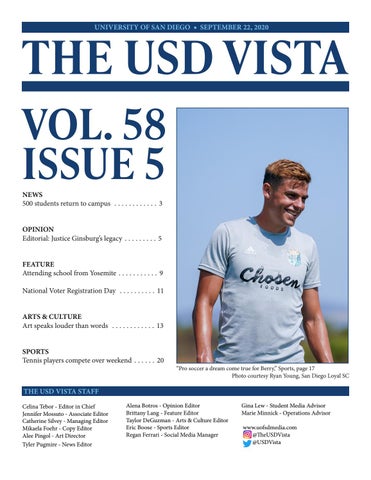
“Pro soccer a dream come true for Berry,” Sports, page 17 Photo courtesy Ryan Young, San Diego Loyal SC
THE USD VISTA STAFF Celina Tebor - Editor in Chief Jennifer Mossuto - Associate Editor Catherine Silvey - Managing Editor Mikaela Foehr - Copy Editor Alee Pingol - Art Director Tyler Pugmire - News Editor
Alena Botros - Opinion Editor Brittany Lang - Feature Editor Taylor DeGuzman - Arts & Culture Editor Eric Boose - Sports Editor Regan Ferrari - Social Media Manager
Gina Lew - Student Media Advisor Marie Minnick - Operations Advisor www.uofsdmedia.com @TheUSDVista @USDVista
The USD Vista
◆
September 22, 2020
The 2020 Election: Debate season is on the horizon As Joe Biden and Donald Trump prepare for the Sept. 29 debate at Case Western Reserve Univeristy, USD Votes is encouraging students to tune in and get educated EMMA VALDISERRI ASST. NEWS EDITOR
As if 2020 hasn’t yielded enough to be a year for the books, the United States is preparing for a historic election between current President and Republican party nominee, Donald J. Trump and his running mate, Mike Pence, and Democratic party nominee, former vice president Joe Biden, and his running mate, Senator Kamala Harris. The 2020 Presidential election is less than two months away, as early voting and mail-in voting ramps up, with North Carolina being the first state to begin mail-in voting as of Sept. 4. The first Presidential debate is scheduled for Tuesday, Sept. 29 starting at 6 p.m. PT. The first debate will take place at Case Western Reserve University in Cleveland, Ohio. The nonpartisan Commission on Presidential Debates has announced the first moderator will be Chris Wallace of “Fox News Sunday.” Normally, the Presidential debates have
NEWS
more than one moderator, but considering the circumstances under COVID-19, the pandemic has instilled the necessity to have as few people on stage as possible. The commercial-free debate will last 90 minutes and will be divided into six 15-minute topics which Wallace gets to select. He will be expected to announce these segments one week before the scheduled date of the debate. Similar to previous debates, the two nominees will be prompted to discuss their stance on major and relevant topics like healthcare, climate change, immigration, racial inequality, reproductive rights, the state of the economy, and gun laws, among others. With limited time to discuss each topic, each nominee will have to use their time effectively in order to get their message across to the American people. Given the nation’s state in regards to the pandemic and climate change, USD Votes President, Linnea
Leidy, expressed her thoughts on what the debate will cover:. “I feel like, unfortunately, so much of the conversation is going to have to be centered around current events [and] as a result, we won’t see as much policy,” Leidy said. Like most things in
politics, the nature of the debates has stirred controversy amongst the two parties. In response to the debates, President Trump and his campaign have unsuccessfully proposed the idea of having a fourth debate to be scheduled for early September, claiming it’s Con’t on Page 2
Trump and Biden will square off in their first debtae on Sept. 29th. Photo Courtesy of the Library of Congress Photo courtesy of beemergirl99/flickr
1
Volume 58 Issue 5
◆
NEWS
◆
The USD Vista
The Presidential Debate will be moderated by Chris Wallace, and will focus on healthcare, climate change, immigration, gun laws, racial inequity, the economy and reproductive rights
From Page 1
illogical for Americans to perform mail-in or early in-person voting nearly a month before they have the chance to watch a debate. The commission denied this proposal as well as all of the suggestions President Trump and his campaign had for moderators of the debates. On the flip side, Speaker of the House Nancy Pelosi has told reporters there shouldn’t be any debates this year, claiming there is no way to legitimize a conversation with President Trump. “I do not think that the President of the United States has comported himself in a way that anybody should that has any association with truth,
NEWS
evidence, data and facts,” she stated to the press. In response to Pelosi, Joe Biden believes there should be debates, asserting that he will fact check President Trump during the discussion and hoping the debates will veer away from personal attacks since their primary intent is to address topics that affect the entire nation. It’s likely that many current seniors at USD were not of age to vote in the 2016 Presidential election, meaning there’s an entirely new generation of voters this time around. “I think it’s important to watch the debates, I also think it’s also equally important not to base your entire perception of either candidate off
of their performance in the debates,” Leidy said. “Watching them can serve as a helpful tool and an opportunity to kind of see where these candidates stand on certain issues and how they’re hoping to handle all these current events that are going on.” The debate will be viewable on major news platforms like CNN, Fox News, and NBC. The Washington Post will also be providing a live stream of the debate, free of interruptions. Normally, USD students and faculty would be able to view the elections on USD’s campus at Frank’s Lounge. However, under the current circumstances, USD Votes and the political science department will be
Photo courtesy of Caleb Perez/unsplash
collaborating to promote the debate and provide a purely academic space on an application called Discord, where USD students can communicate via its messaging board and where professors can lend answers to any questions that students may have. The second and third debates are scheduled for Oct. 15 and 22. There will also be a vice-presidential debate between the current vice president, Mike Pence, and Joe Biden’s running mate, Senator Kamala Harris scheduled for Oct. 7. It’s safe to say these debates will be interesting to view and give America insight into what’s at stake on both sides of the political spectrum.
2
The USD Vista
◆
August 25, 2020
USD moves in over 500 students to on-campus housing Over the weekend, four residential students tested positive for COVID-19 TYLER PUGMIRE NEWS EDITOR
After USD canceled almost all in-person classes for the fall semester, they also delayed move-in for students by a month. Each bedroom has been limited to single occupancy, and there are no guests of any kind allowed in someone else’s room. There was a total of 1046 students that were assigned campus housing, and 527 indicated they would move into campus housing. As these students began arriving for move in on Friday, Sept. 20, where they were permitted two guests to assist them in their moving process. As students arrived, everyone had to be screened for temperature checks, given wristbands, and all guests had two hours to get in and out of the provided housing. Students were also required to schedule an appointment for oncampus COVID-19 testing, paid for by USD. Results for the test are expected within 24 to 48 hours. Students are
NEWS
required to be tested twice every month if they are living in universityprovided housing. At least four residential students have tested positive for COVID-19 since move-in weekend. In a faculty senate meeting, President James T. Harris III, D.eD noted that, “If a student comes down with the disease we’re not going to send
them home.” The positive number of cases will be recorded to the COVID-19 Dashboard, a graph that depicts the number of USD community members who contract the virus, including students and staff both on and off campus. As of Sept. 22, there have been a total of 33 self-reported cases for USD students or faculty
The Valley basketball court’s net was tied together in order to prevent students from playing. Tyler Pugmire/The USD Vista
since Aug. 16. When students moved into Pacific Ridge and Loma Palisades apartments on Aug. 13, there were three confirmed cases. For students who moved on to campus, the price of housing was prorated to make up for time not stayed in the dorms. Seeing around a $1,000 price decrease, the cost of living on campus for the Fall 2020 semester is now $3,195. The price for Spring 2021 housing is still being determined. As far as facilities available for students, benches have tape covering half of them in order to keep social distance. The basketball hoop’s net is tied together, the Valley Field has been locked and the goals are locked to the light poles. Bosley Cafe is still closed, but the fitness center is available to use by appointment. The pool, TRX Station, and tennis courts are all open as well with limited hours. Sophomore Isabel Saunders moved in this weekend and voiced concern about the school’s Con’t on Page 4
3
Volume 58 Issue 5 From Page 1
guidelines enforcement. “While I think it is super important to follow county and school guidelines, I’m concerned about how strictly the school will enforce this policy,” said Saunders. “How are they preventing student gatherings? What have they done to enforce this in Pacific Ridge?” All of the expectations of students that have moved on campus can be found in the Student Guide to Fall 2020. Some of those
◆
NEWS
include self-isolation, contact tracing, restricting oneself from gathering in groups, and travel. If a student is caught not following these guidelines they can be removed from campus housing and must be gone within 24 hours. How strictly this will be enforced is yet to be seen by students living on campus. There has been limited communication between Residential Life and students, according to some students. Alexia
◆
Rojas, a first year student, says she does not know who her RA is, and they have not made it clear what the consequences would be if a student isn’t practicing social distancing. As students wait for their results to come back from the testing center and begin settling on campus, USD will soon know whether its safety protocols will be enough to prevent COVID-19 outbreaks similar to those at neighboring
Students who moved in this weekend were greeted by The Bull Pit booth, where they could win free prizes.
NEWS
The USD Vista SDSU, which now has over 600 cases. As lines get longer for pavilion dining and the Learning Commons starts to fill up, it is imperative that the case number stays low; otherwise USD could be the next SDSU, University of Wisconsin at Madison, or UNC Chapel Hill. More information can be found on the COVID Dashboard provided by USD. The counties tier list was recently updated and has shown a recent uptick in positive case percentages.
Tanner Claudio/The USD Vista
4
The USD Vista
◆
September 22, 2020
Justice Ruth Bader Ginsburg leaves more than just a legacy The Supreme Court Justice was a force for women’s rights and a pop culture BAYLYNNE BRUNETTI ASST. OPINION EDITOR
There are no words that can begin to describe the impact Justice Ruth Bader Ginsburg left on our country. She was an inspiration in my pursuit of law and a huge role model, as I am sure she was for many other women. It is hard to grapple with the fact she has passed and that we now face an already tumultuous election with more uncertainty than we had before: the fear of women’s rights being toyed around with as a political pawn brings a dystopian-like feeling to an already disheartening year. For those who do not know, Justice Ginsburg was a huge force in the battle for gender equality. She entered Harvard Law School in 1956 as just one of a few women enrolled in a class of 500. After graduating top of her class from Columbia Law School, she was denied positions at law firms strictly because of her gender. She famously went on to become a professor where she fixated on
OPINION
gender and law relations. After gaining notoriety in the field over this, she was brought on as a founder of the ACLU’s Women’s Rights Project. Here, she used her brilliant legal expertise to argue gender equality cases in the front of the Supreme Court. Her work was recognized everywhere, which led her to serve in the U.S. Court of Appeals for the District of Columbia, where she served for 13 years until 1993, when Bill Clinton appointed her to the Supreme Court of the United States. She was the second woman to ever be nominated to the Supreme Court. Her work did not stop when she made it to the high Court. She became notorious for her scathing dissents from her conservative colleagues as she advocated for women’s rights. The mourning taking place is not just for an incredible judge. The mourning taking place is the fact that her life’s work could be in jeopardy. Just days before her death, as she realized this would be one of her last moments, Ginsburg
dictated this statement to her granddaughter Clara Spera: “My most fervent wish is that I will not be replaced until a new president is installed.” On her deathbed, Justice Ginsburg was worried for us. She did not die at peace: she died in a state of worry for what she was leaving behind. The loss of Justice Ruth Bader Ginsburg has left a gaping hole in our
democracy, one that dims the light at the end of the tunnel on the quest for gender equality in the United States. There is a fight ahead of us that will be comparable to the fight for gender equality in the 1970s. The best way we can honor Justice Ginsburg is to vote. To keep our eyes open, to remain diligent. She fought hard for us and now it is time for us to fight for her legacy.
Justice Ginsberg served in the U.S. Court of Appeals for the District of Columbia for 13 years until 1993, when she was appointed to the Supreme Court. Photo courtesy of Camilo Schaser-Hughes/flickr
5
Volume 58 Issue 5
◆
OPINION
◆
The USD Vista
As my world burns down, education takes a back seat COVID-19 made school hard. Wildfires aren’t making it any easier. As I sat at my desk wildfire evacuation maps last Thursday, listening that showed fires and areas to my professors lecture under evacuation inching political theory, closer to my house. Everyone knew online on obsessively toggled Suburbs of Portland classes would be difficult. I Zoom fatigue, easy access between my notes and the as close as 15 minutes to distractions on our phones and laptops, and disengaged virtual lectures have all contributed to my lack of focus on school this year. But recently, these aren’t the things that have been distracting me from school. It’s the ever-present scent of smoke wafting through my house, despite the fact that we haven’t opened the windows for days. It’s the hazardous air quality, the worst in the world, that prevents me from stepping outside my home. And it’s the looming threat of wildfires destroying more and more towns and cities across Oregon, and knowing that I might be next. Over the past week, wildfires throughout the state have killed eight people, left 16 missing, burned about 1 million acres, and destroyed 1,145 Downtown Portland was in a haze as wildfires spread across the state of Oregon. homes. CELINA TEBOR EDITOR IN CHIEF
OPINION
away from me were under evacuation. I tried to concentrate on what my professors were saying, but their abstract theories Con’t on Page 7
Celina Tebor/The USD Vista
6
The USD Vista
◆
September 22, 2020
Interstate 5 in Portland, Oregon was clouded with smoke last week.
From Page 6
settled in the back of my mind as the very real wildfires took the front seat. I wanted to flip the switch in my brain and tell myself to start listening to my lectures. But my brain wouldn’t stop running a continuous
OPINION
stream of thoughts cycling through my head: What am I going to bring with me if I get evacuated? It smells like smoke. Are my friends okay? The fires are growing. How am I supposed to think about school right now? There’s nothing I can do to help. Coronavirus locked us
Celina Tebor/The USD Vista
all in our homes. But not like this. My daily runs and walks have kept me sane during the pandemic — now, I can’t even step outside my house. I can’t even open my window for five seconds before the suffocating smoke fills my room. I wish I could forget
about the fires, even for a moment, so I can focus on school. But there are reminders everywhere that my home is burning to the ground. Over the past week, Portland has held the spot for the worst air quality out of any major city in the Con’t on Page 8
7
Volume 58 Issue 5
◆
OPINION
◆
The USD Vista
Yo u r n e w s i n yo u r h a n d s
@ u s dv i s ta @ t h e u s dv i s ta
From Page 7
world due to the wildfires. And I can tell without even going outside. I’ve suffered pounding headaches and constant lethargy from the smoke, detracting from my ability to study that much more. The thick blanket of smoke settling over the city, leaving little to no visibility, blocks out the sun completely. My family has had to refill our birdbath more frequently than ever before because there are so many birds covered in soot and ash looking for any way to clean themselves off. I love school. I love taking classes. I love learning. But as my world
OPINION
burns down around me, school is the last thing on my mind. Professors typically allowed for excused absences when a loved one dies. This feels like a loved one — my home state — is dying, and it’s getting worse every day. But I don’t know how to explain that to my professors, and there’s no point in asking to miss class just to sit in my room and stare at the smoke. I am mourning the eight lives that have been lost, and the towns that have been utterly destroyed and flattened. And I mourn the land that has generously let us settle on it, and that we have
abused and wrecked for as long as I’ve known. When the sun peeked through the smoke for the first time in days, I cried. There’s still a blanket of smoke suffocating my home a week after the wildfires began, and I haven’t seen a glimpse of blue in the sky for over 10 days. The largest fire in the state is only 20% contained. My heart hurts. Not only because my home is being destroyed, but because there is nothing I can do about it. And right now, learning how to critique a television program or reading Supreme Court cases seems trivial. The online
world and my education are trudging along as usual as my home as I know it is burning all around me. My 21st birthday was last Saturday. Coronavirus diminished all hopes of celebrating it with friends. Even the idea of going to an outdoor bar or restaurant has been tossed out the window due to the wildfires. There was only one wish I had for my birthday: rain. The views expressed in the editorial and op-ed sections are not necessarily those of The USD Vista staff, the University of San Diego, or its student body.
8
The USD Vista
◆
September 22, 2020
When COVID-19 forced people to stay home, she made her home the outdoors Staci Lanter spends her days rock climbing in Yosemite, while also finishing her senior year at USD CELINA TEBOR EDITOR IN CHIEF
Staci Lanter doesn’t have a shower. She doesn’t have a laundry machine. She doesn’t have running tap water. But she has her van, access to a river, and Yosemite National Park — and that’s all she needs. Before COVID-19 struck the world, Lanter was getting ready to return to the U.S. for her senior year of college after
taking a gap year from the University of San Diego and spending her spring in Peru. But once the virus hit, a two-week lockdown with strict and rigorous restrictions commenced. Two weeks turned into four months stuck in a foreign country. Lanter had a few options for when she finally returned to the states at the end of the summer when restrictions eased up: she could come
back to Portland, where the job that was waiting for her disappeared because of the pandemic; she could move down to San Diego and live in her van; or she could move back into her parents’ house in St. Louis, Missouri. Once USD announced its fall semester would be online, she opted to do none of the above. Armed with a fresh perspective on life and her 1995 Astrovan, she headed
Staci Lanter pictured with her climbing gear and her 1995 Astrovan, which doubles as her bedroom and study space.
FEATURE
down to Yosemite to rock climb. Today, she’s living in her van, climbing every chance she gets, and finishing her last year at USD to receive a degree in biology. To stay on top of her classes, Lanter drives into town from the park a couple of times a week, finds a library or sets up a mobile hotspot, and downloads everything she Con’t on Page 10
Photo courtesy of Jasmin Shah
9
Volume 58 Issue 5
◆
FEATURE
◆
The USD Vista
From Page 9
needs for class. It’s not the easiest way to take classes, she says, but planning everything out and getting into a routine has helped her adjust. In general, van life isn’t the most effortless, prettiest lifestyle. But that’s exactly why she loves it. “It’s the most bare human necessities of surviving,” Lanter said. And since she’s taking indigenous studies classes for school, her classroom isn’t regulated to a Zoom meeting on a 13-inch screen — it’s everything around her. And like the indigenous people who first settled in the U.S., she uses her natural resources as those who came before
When she’s not taking classes to finish up her final year at USD, Staci Lanter is sending it in Yosemite every chance she gets. Photo courtesy of Staci Lanter
natural resources and incredible scenery, there are days when Lanter has to spend all day studying, which aren’t her favorite. And one of
and do what I need to do,” Lanter said. “And do what I want to do, instead of having to prepare or pack. It’s so much more efficient, timing wise, to have
“I bathe in the river, I drink fresh water from the river — the water is so incredibly clean here, I don’t even have to filter it. I wash my clothes in the river. I’m just living as basically and minimally as possible, and I love that. -Staci Lanter her did. “I bathe in the river, I drink fresh water from the river — the water is so incredibly clean here, I don’t even have to filter it,” Lanter said. “I wash my clothes in the river. I’m just living as basically and minimally as possible, and I love that. I’m learning about solar, and trying to live plastic-less.” Despite abundant
FEATURE
the biggest disadvantages of her lifestyle is the ever-looming threat of wildfires, which have burned over 3.2 million acres of land in California this year alone. The uncertainty doesn’t bother Lanter enough to quit van life, however. In fact, the flexibility of the lifestyle is one of her favorite things about it. “I just like to wake up
everything with you. And you can just have much more flexibility.” If there’s one thing this year has taught Lanter, it’s to do the things you want to do now, because there’s no guarantee that they’ll still be there in a year, or even a week. “See the world now, before it burns down,” Lanter said. “Take the right measures — slowing
down and appreciating everything that you have that’s right in front of you. A lot of people don’t have access to this. I could not imagine being stuck inside for six months.” If USD returns to inperson classes for spring, Lanter will make her way down to San Diego. If classes remain online, she hopes to travel a little farther south into Mexico and settle there to continue climbing and finish her last semester of college. Right now, Lanter is setting her sights on climbing the Nose of El Capitan next, one of the most iconic rock climbing routes across the globe that was once considered impossible to climb. The idea alone terrifies her. But it excites her more.
10
Volume 58 Issue 5
â—†
GET OUT AND LET YOUR VOICE BE HEARD ON TUESDAY, SEPTEMBER 22
National Voter Registration Day is celebrated on the fourth Tuesday in September during election years and close to 3 million Americans have registered to vote on the holiday to date. This year the day falls on September 22 and all eligible voters are strongly encouraged to get out and exercise their civic duty. Every year, countless Americans find themselves unable to vote simply because they missed the registration deadline or were unsure how to register in the first place. First observed in 2012, National Voter Registration Day was created in order to make sure no eligible voter misses their opportunity to let their voice be heard. Volunteers and organizations from all across the country will take to the streets with the goal of reaching as many potential voters as possible who have not yet registered to vote.
-Volunteers will make appearances on college campuses, in workplaces, libraries, and throughout neighborhoods. -Social media outreach will help voters register online and find registration drives near them in order to make the process as accessible and straightforward as possible. -National and local media outlets will be raising awareness and feeding continuous information to the public. National Voter Registration Day is a day for education not only on how to register, but also an opportunity to sign up for election reminders, learn about early voting options, and request mail-in ballots, which are more important this year than ever before.
E T VO
It is a day to be celebrated — a day to celebrate democracy and the rights we have as citizens. However it is also a time to seriously consider what kind of necessary policy changes we want to see in our country and weigh the best candidates for achieving them for when it comes time to send in your ballot.
FEATURE
FEATURE
â—†
The USD Vista
All CA voters do not need to request a mail ballot as all will be sent one at their mailing address. It will need to be mailed back during the weeks leading up to the election. It is crucial to remember to sign the outer envelope when you mail it back, as those which are returned after November 3rd and/or do not have this signature will not be considered. For more information and to ask any questions you might have regarding voter registration, the instagram account @usdvotescampaign is also an extremely helpful tool to use. How to register to vote: Step-by-step tutorial 1. College students have a choice whether they want to register in their home state or in the state of the university they attend a. You have to register to vote at one address as you will also be voting for statewide and legislative offices that are elected in particular jurisdictions; your choice of address determines which candidates will be on your ballot 2. If you would like to register to vote in San Diego or elsewhere in California, go to www.registertovote.ca.gov a. If you previously registered to vote with your USD address and would like to update your address to reflect your current address, you can do this here 3. If you are an out-of-state student and need to register outside of CA or are for the time being living outside of CA, you can register with your out-of-state address a. Each state has different rules and procedures b. USD Votes had compiled the guidelines for each state which can be located at www.sandiego.edu/vote/state-specifics.php c. USD Votes Campaign also has videos on YouTube to walk you through the registration process for your state
11
The USD Vista
â—†
(Photo courtesy of USD Votes)
September 22, 2020
(Photo courtesy of USD Votes)
VOTE. (Photo courtesy of USD Votes)
FEATURE
(Photo courtesy of USD Votes)
Spread by Alee Pingol/ The USD Vista; Content by Brittany Lang/ The USD Vista
12
The USD Vista
◆
September 22, 2020
Art speaks louder than words
How creating art during a pandemic helped two artists spread a message JENNIFER MOSSUTO ASSOCIATE EDIOTR
USD junior Micaela Cross spent her time during the COVID-19 quarantine doing something she loves. Cross’ acrylic art is typically colorful and bright and focuses on light, summer themes featuring ice cream cones, pools, and strawberry fields, but Cross recently went out of her artistic comfort zone. Throughout her summer in San Diego, she found herself witnessing the Black Lives Matter (BLM) movement right before her eyes. “The rebirth of the Black Lives Matter movement was a very emotional time for our society,” Cross said. “These issues were not foreign to me prior to this in any way, however, this was the first time I saw and understood people’s expression of pain. It didn’t sit with me well. I’m not a comfortable advocate with my words, so I did what I do and I decided to create a piece of art, to sell and donate to
A&C
the cause.” Cross created a piece of art showing the recognizable fist in the air, representing the BLM movement. The fist in the air is made up of several different colors and skin tones, representing that we stand together. Titled “We stand,” Cross sold her print for $30 and donated all proceeds to the equal justice initiative. Cross’ artistic journey began far before this summer. An Arizona
native, Cross has loved creating art ever since she was a kid. “I tried all of the sports, but nothing was as fun to me as making things.” Cross said. “I didn’t get serious about it, or find my niche until late high school when I fell in love with acrylics.” Cross spent this summer in San Diego, but that didn’t stop her from getting her art into a gallery back home in Arizona, Art One Gallery,
Micaela Cross creates her acrylic ice cream cone dripping in pearls.
where her art is sold for up to $850. Amidst some of the most troubling times, Cross’ dreams were coming true. “When I was younger, it seemed far off, unattainable, and glamourous,” Cross said. “What I realized was that the hardest part of it all was just gathering up the courage to take initiative and just do it.” As a psychology and Con’t on Page 14
Photo courtesy of Micaela Cross
13
Volume 58 Issue 5
◆
A&C
Murphy O’Brien stands holding her piece destigmatizing mental health issues. Photo coutersy of Murphy O’Brien
From Page 13
marketing major, Cross has not always had the time to create art as much as she wanted. In a way, quarantine gave her the gift of time and allowed her passion to grow. Pandemics in the past have created an abundance of powerful art: the Great Depression, the Black Plague, etc. Cross believes a similar outburst of art can arise from the coronavirus pandemic as well. “If you trap an artist inside with art supplies, you are bound to be left
A&C
with something that wasn’t there before,” Cross said. Another student at USD shares a similar passion. Murphy O’Brien uses her art to speak out against the mental health stigma as well as to support the Black Lives Matter movement. Her “Stigma Stunts Growth” shows a person whose brain is overwhelmed with flowers, featuring a newspaper article in the background. “Although the idea was sparked from the [Times] magazine, the real catalyst
◆
The USD Vista
was my passion towards ending the stigma behind mental health,” O’Brien said. “Over the years, I have witnessed, supported and experienced battles with mental illness. I was fortunate enough to be raised in a household where vulnerability towards the conversation of mental health was encouraged and always supported.” O’Brien, like Cross, believes that art can spread a message in a way that words can’t. “I always think of the old English saying that ‘a picture paints a thousand words’ and it’s true — a multitude of feelings and complex ideas can be conveyed more effectively in one image than a verbal or written description,” O’Brien said. O’Brien wants to spread a message close to her that often lacks the recognition it deserves: to get rid of the mental health stigma. “I want to help promote the spread of that conversation beyond the walls of my home and increase the world’s understanding of the many faces of mental health,” O’Brien said. “I couldn’t think of a better way of starting that conversation than through my own mental therapy — art.” O’Brien’s recent piece of
art was based on systemic racism and the injustice she was seeing. O’Brien’s “Stronger Together” print is sold for $30 and 10% of all proceeds go to support the Boris Lawrence Henson foundation which “works to ensure cultural competency in caring for African Americans who struggle with mental illness by providing scholarships.” O’Brien’s painting shows fists in the air of all different colors. She wanted to illustrate the people she saw of all different color, size, and gender fighting the justice system. “I didn’t want my white silence to perpetuate the problem, so instead I decided to speak up through my art,” O’Brien said. O’Brien also found the extra time lately to be a gift, taking the opportunity to learn how to paint. She said it also taught her how to be more patient with her work, since she had all the time in the world. Cross and Murphy use their passion to create and also to spread important messages. The gift of time has only helped them use their artistic talents to put a little more good out into the world. Murphy’s Instagram: Murphypaints Cross’ Instagram: Micaelacross
14
The USD Vista
◆
September 22, 2020
When Performing Arts moves offstage to online Performing Arts students at USD struggle to stay connected with their passions and art forms amidst a pandemic and online classes TAYLOR DEGUZMAN A&C EDITOR
The transition to online learning and social distancing was not easy for a lot of students. Whether if surrounding oneself with friends was someone’s favorite thing to do, playing football on the field with a cheering crowd was how someone felt invincible, or simply walking to and from class and waving to familiar faces was someone’s favorite part of the day, this pandemic has impacted everyone in different ways. Specifically, performing arts students, whose world consists of performing on a stage in front of a large audience, are trying to survive in a space that does not allow them to share their art forms in a public space. Senior Alanna Bledman feels most unapologetically herself within the theatre world. Bledman has accomplished a lot throughout her past four years at USD: both her
A&C
first and second year, she was constantly in theatrical productions, and had the opportunity to perform in Hollywood and off Broadway in New York at big central theatre locations. Not only does Bledman have acting experience, but she has also written, produced and directed her own productions. After realizing that theatre was the one thing that brought her genuine, pure joy, Bledman decided it was the career path for her. However, the transition to online was not as seamless as she’d thought it would be. Bledman will star in an upcoming USD fall production titled, Calling My Children Home. However, this production will take form as a prefilmed show that will be broadcasted online, something that Bledman articulated will be incredibly different. “Now I have to think about how to feed off of an audience that I can’t see, because feeding off of a
live audience’s energy and reactions is what makes stage theatre so authentic,” Bledman said. “With live theatre, you have one chance to get it perfect, there aren’t any cuts, actors can’t second guess themselves.” Bledman shared how the pandemic largely affects the theatre community. Social distancing practices limit the physicality of theatre. Photo courtesy of flickr/M. Johnson “Theatre is taking a toll right now,” Bledman said. “Theatre is physical, theatre is touch, and theater cannot be those things right now. We have to shift and adjust to create that same connectivity that thespians yearn, and we’re all feeling a lack of connection right now.” As a senior, Bledman is bittersweet about graduating this semester and feels remorse for those theatre majors who are starting their first year in this way. “I can’t even imagine
how first year performing arts majors are feeling right now, but I also feel that they don’t exactly know what they’re missing out on, they don’t really know anything else,” Bledman shared. Bledman explained the type of mindset the theatre world has right now that is helping them remain strong together. “Everyone in the theatre world right now has that mentality of ‘The show must go on,’” Bledman said. “We’ve always had to adapt, and now with this semester’s fall production we have to shift and learn in this foreign space that we aren’t comfortable with yet.” Because theatre is such an interactive and handson art and experience, Bledman shared that there are so many components experienced in person that she deeply misses. “What I always loved about the theatre space is the ability to truly get away,” Bledman said. “There is something so Con’t on Page 16
15
Volume 58 Issue 5 From Page 15
unique about going into four-hour rehearsals and turning off my phone and silencing the outside world. On stage, I had someone else’s story to bring to life, another reality outside of my own.” Senior Jianna Andrews is a theater major who has plans to enroll in a Physician’s Assistant (PA) program after graduation. The pre-PA track allows her to choose whichever major as long as she finishes the prerequisites. However, her passion for acting is limited due to the climate of online classes. Currently taking a classical acting class, which delves into Shakespeare, Andrews explained how taking an acting class on Zoom fosters several limitations. “When you’re acting out a scene with a partner over Zoom, you have to look into the camera as if you’re looking at them,” Andrews said. “It is way more nerve wracking than being in person, because you have to learn to perform and handle your emotions when you’re talking to a computer screen instead of a person. On top of that, you don’t have a physical audience watching, so you can’t feel people’s energies in the room.” Andrews misses
A&C
◆
A&C
performing and genuinely connecting with other people and the relationships she’s created within the theatre community. Transitioning to a completely online format has also impacted another performing art form: music. Sophomore Donny Alcones is a music major and performs with USD’s concert and pep band playing the euphonium. Before he attended USD, Alcones was recruited by Jeffrey Malecki, D.M.A, USD’s Director of Bands and Music Education. Pursuing music after college is Alcones’ dream; he hopes to write music for video games and tv shows in the future. Nevertheless, Alcones is finding it incredibly difficult to nurture his passions and learn as much as he can from home. A majority of his course load is music related. He explained that in particular, online band experience deflects the ability to connect with the music and experience the community that band provides. “There’s a lot of nuances that you can’t get online, such as listening and reacting to the art that everyone is creating together,” Alcones said. Alcones is currently
◆
The USD Vista
taking a class called the History of Music Technology, which teaches students how to produce music.Alcones expressed how upset he felt about taking this class online because this is an important class for his future career. “It’s difficult because USD has a dedicated room with equipment you would see in a recording studio,” Alcones said. “We have to download a music production program on our computers and it’s extremely hard to do Zoom at the same time as running the program. I wish I could experience a professor walking around the room since this class is so hands on and I would benefit from live-time critiques.” Alcones explained how both being at home and trying to practice his passion for music isn’t the most beneficial experience. “As a music major I wish I had access to practice rooms or studio rooms to work on my craft because staying at home doesn’t put me in the right headspace to write or practice music,” Alcones said. “At home, I don’t really have that separation between the space that school occupies and the space where my music can thrive.”
Most of all, Alcones feels detached from his music community at USD and misses those that he would connect with through music. “Being able to rehearse with friends and performing with them is a musical experience that not many people know about or will ever experience,” Alcones said. “I miss the camaraderie that accompanies being a part of something as special as a band and getting the opportunity to share in this art form and express emotions at the same time.” In this current world, performing arts students struggle to practice the art form that helps them experience the connectivity and community they would have experienced in school. Bledman, Andrews, and Alcones can all empathize with one another that creating and crafting performing arts in an online environment is a foreign space that cannot compare to the physical and emotional experience that happens on stage and between an audience. There is a spotlight on the performing arts world, more than ever before, that is bringing light to how performers simply cannot thrive, as they did before, in a virtual setting.
16
The USD Vista
◆
September 22, 2020
Pro soccer a dream come true for Berry The former Torero forward is enjoying his rookie season with Columbus Crew SC, including a temporary return to San Diego on loan with Loyal SC ERIC BOOSE SPORTS EDITOR
Before Miguel Berry even played his first game for the Toreros, he knew that he was going to be a professional soccer player. It had been his dream since he was a young kid growing up in Barcelona, Spain, playing soccer to copy his older brother, as younger brothers do. By the time he arrived at the University of San Diego, it was more than a dream. “I realized it’s what I really want to do, and I’m good enough for it, and my senior year rolled around and physically I became even with the guys who were way ahead of me, and I didn’t look back since then,” Berry said. “I knew from freshman year in college that I was going to go pro, one way or the other.” By the end of Berry’s senior year at USD, other people knew it too. And they were right. In January, Columbus Crew SC picked Berry seventh overall in the Major League Soccer Draft — the earliest a Torero has
SPORTS
Former Torero Miguel Berry is back in San Diego, playing for San Diego Loyal SC, on loan from MLS club Columbus Crew SC. Photo courtesy of Ryan Young, San Diego Loyal SC
ever been selected. It was the cap to a tremendous season for Berry, who scored 17 goals in 18 games — tied for the most in the nation during the regular season — and assisted eight more to help the Toreros to 12 wins, earning West Coast Conference Player of the Year honors as a result. Despite Berry’s impressive contribution, the Toreros fell just short of earning spot in the playoffs. “At that point, I felt like everything I had done, all the extra training I had done, playing in the
summers, not going on vacation ever — it has paid off,” Berry said. “But, as a team when you don’t make the tournament, even though I thought we were wronged to not make the tournament, it’s frustrating, especially to not make it after four years of pouring your heart and soul into the program.” Regardless, the Toreros’ star had earned himself plenty of attention from the pros, with multiple MLS teams asking USD men’s soccer head coach Brian Quinn about the forward.
“There was a lot of interest in him, it wasn’t a case where he was an unknown, it was more a case of when people got to watch his highlights and his videotape people were impressed,” Quinn said. “It was just a matter of explaining to coaches that he is a kind of highend character kid and he’s going to get better and better.” By Jan. 7, draft day, the Los Angeles Galaxy, Los Angeles FC, and New England Revolution had all expressed interest Con’t on Page 18
17
Volume 58 Issue 5 From Page 17
in Berry, along with Columbus Crew. “Draft morning, I woke up at 7 a.m. thinking, ‘eh, I’m up early enough,’ and I had about 15 missed text messages and calls from my agent and other people about teams that were interested in me,” Berry said. “It was really last minute, I didn’t know where I was going to end up, and around pick three or four I got a text that it was going to be Columbus at seven.” But there was a time when Berry did not think that he would come near professional soccer, let alone being a top-ten pick in the draft. Berry moved from Barcelona to Poway, California when he was eight years old, his love of soccer already well-founded. He kept playing, but by his first year at Poway High School, his teammates and competitors had hit growth spurts, and he had not. “I went through a couple rough years in the U.S. where I was small, sort of underdeveloped physically, and I was having a tough time and I thought, ‘you know, I’ll use soccer to get into college somewhere, get a good education.,’” Berry said. “I definitely had some up and down times, for sure.” Eventually Berry hit his
SPORTS
◆
SPORTS
growth spurt as well, and by his senior year of high school he had drawn even with and even surpassed some of his teammates and rivals. Part of that development came thanks to Berry’s love for the game, which helped him through tough times off the field. “My mom got cancer when I was 15, 16, and it was stressful on the family, and for me, the thing I found that really made me happy was playing,” Berry
◆
The USD Vista
tallying eight in his first season. “In the first year, you don’t put a lot of pressure on the freshmen coming in, and you kind of let them find their way because in the soccer season there is a lot going on because you’re in a new environment, you’re getting used to classes, there is a lot going on in your whole life,” Quinn said. “Miguel came in and it was pleasing that he started off his freshman
“Miguel is a player that is always, always striving to improve different parts of his game,” - Coach Brian Quinn said. “You talk about times like that when you need to do something with your time, productive, to get away from it, and that was always soccer. I would go out on my own and all of the sudden I was training way more on my own, just because I knew that’s what I wanted to do.” Berry’s work ethic and development earned him attention from a handful of universities by the end of his high school career, but no team had expressed more faith in him than the University of San Diego, so he became a Torero. Unlike high school, Berry got his footing early in his college career, scoring in his first game en route to
year well, and I think his second year went reasonably well, and then in the last two years he was really, really good.” As Quinn mentioned, Berry only got better over his four years at USD, with the striker’s work ethic leading to his breakout senior season. “Miguel is a player that is always, always striving to improve different parts of his game,” Quinn said. “A lot of the credit goes to him because he participated in leagues in the offseason and then we would come back and he was always looking for more information, more training, and how he can improve his overall game
within the team.” Now a professional, Berry has plenty of room for improvement, and quite the selection of people to learn from. In Columbus, Berry has the opportunity to practice alongside veterans of the United States Men’s National Team, including prolific striker Gyasi Zardes, whose experience includes scoring a game winner at the 2016 Copa America tournament. “There are guys all over the field you can learn from — people who have played in World Cups, people say he’s the best American player, Darlington Nagbe, guys who have played in big tournaments, in the Champions League in Europe — so, I’m incredibly fortunate,” Berry said. “To single out one, if I had to pick, would be Gyasi, but there are so many other guys you can throw in that mix.” But Berry is not yet at the level to challenge Zardes for a starting role, and has returned to San Diego to get professional experience under his belt, finishing out the 2020 season with San Diego Loyal SC in the USL Championship. However, playing at a level below MLS has not deprived Berry of opportunities to get better. In joining the Loyal, he has swapped one Con’t on Page 19
18
The USD Vista From Page 18
great American forward for another as his mentor. San Diego is coached by one of the best American soccer players of all time, Landon Donovan. “I am so lucky, he has been incredible with me,” Berry said. “He technically didn’t play my position but he played a very similar position so he knows so much and he has so much insight to share with me, and I love that.” Berry joined Donovan’s team in late August and immediately got a spot in the starting lineup, a transition that required him to adjust after an extended time without playing in a competitive game. Berry’s final college game was last November, and his first game as a professional was in August. That time away from the game was made worse by the two-and-a-halfmonth-long break due to the COVID-19 pandemic, when Berry could not even practice with his teammates. But Berry found his feet quickly in San Diego, earning his first professional assist in only his second game, and scoring his first two professional goals in an impressive performance in Los Angeles. “I have scored everywhere I’ve gone, and I knew it was coming,” Berry said. “It was funny
SPORTS
◆
because the ball came across in the first 25 seconds or whatever it was, and I could have celebrated before I kicked the ball. I had the utmost confidence it was going in. When it did, it was obviously a big relief for the team because we haven’t scored many goals and to go one-nil up inside one minute is a big thing for us.” Thanks to Berry’s pair of goals, San Diego Loyal SC cruised past LA Galaxy II (the MLS club’s development team) 3-0 before facing off against Orange County SC in Miguel Berry’s return to Torero Stadium. The former Torero would have scored in the second half of that game as well, had his shot not been cleared
September 22, 2020 off the line. “It was obviously a great feeling, I wish he hadn’t saved that one off the line, it would have been great to score, but it was great to win,” Berry said. “Obviously, a great feeling to win there, I’ve won a lot of games there, and that was a special one for the team because it really gives us hope for the playoffs. It’s incredible to see just how far this club has come from its infancy, and I’m incredibly proud to play here.” The 2-0 win at Torero Stadium last week did indeed keep San Diego in the playoff picture in the USL Championship. Thanks to a gutsy win on the road against firstplace Phoenix Rising FC, in which Berry assisted
what turned out to be the winning goal, Loyal SC are in second place in their group. While that puts the team in a playoff spot for now, they will have to fight to stay there. The teams in third and fourth place have more games left to play than San Diego, so Loyal will have to do well enough in their remaining two games to hold off the challengers and remain in second place in order to earn a spot in the postseason. San Diego Loyal’s final games of the season — at LA Galaxy II at 7 p.m. on Sept. 23 and hosting Phoenix Rising FC at 5 p.m. on Sept. 30 — are closed to fans, but both will be broadcast on FOX 5 San Diego and streamed online through ESPN+.
In his first four professional appearances, Berry has shown his ability as a striker, scoring a pair of goals and assisting two more. Photo courtesy of Ryan Young, San Diego Loyal SC
19
Volume 58 Issue 5
◆
SPORTS
◆
The USD Vista
Torero tennis comes up short
USD men’s and women’s tennis teams couldn’t snag the championship in tournament last weekend MARIA WATTERS ASST. SPORTS EDITOR
Players from both the University of San Diego men’s and women’s tennis teams took the court for the Barnes Tennis Center September Championships last weekend at the Barnes Tennis Center. Though not all the players from each team competed, Torero tennis was wellrepresented with four players from the men’s team — redshirt senior Garrett Kurtz, redshirt junior David Norfeldt, redshirt junior Nico Borter, and redshirt freshman Marvin Schaber — and three from the women’s team — redshirt sophomore Solymar Colling, redshirt first year Elizabeth Goldsmith, and first year Jordyn McBride. Though it would not count toward their national ranking as a team, the tournament provided the opportunity for the players to gain experience and work on the skills they didn’t have the chance to during their time away from the courts. This proved to be a successful event for the USD tennis players as Norfeldt and Goldsmith reached the
SPORTS
Eric Boose/The USD Vista
semifinals, and Colling took second place overall for the women. All four men competed first on Saturday. Borter defeated Stanford University’s William Genesen in a close threeset match 2-6, 6-3, 107. Shaber lost his first match to Princeton University’s Will Peters 1-6, 3-6. It was a battle of the Toreros between Kurtz and Norfeldt for their first match, from which Norfeldt emerged victorious, defeating Kurtz 6-1, 6-3. In the second round,
while Kurtz and Shaber moved on to play their matches in the back draw for those who were eliminated in the first two rounds, Borter was defeated by UCLA’s Keegan Smith in another highly competitive three set contest 4-6, 7-6, 5-10. Meanwhile, Norfeldt took on Alan Yim from Harvard and won 6-0, 7-5. By the quarterfinals, Norfeldt was the last man standing for the Toreros. But despite the pressure, Norfeldt took the opportunity to work on his individual game and
improve his competitive mindset. “I just wanted to play physical and get into the right state of mind,” Norfeldt said. “I wanted to get that winning feeling and to gain confidence.” In his quarterfinal match, Norfeldt defeated Riley Smith of the University of Southern California in two sets 6-4, 7-6. Going into day two of the tournament, Norfeldt had three victories under his belt and the championship within Con’t on Page 21
20
The USD Vista From Page 20
reach. But standing between him and finals was Karl Poling from Princeton. The 42nd ranked college player in the country, Poling would not be the toughest opponent on paper Norfeldt had faced in the tournament, as his
◆
4th respectively, Colling and Goldsmith received byes for the first round, leaving McBride to be the sole Torero competing in the round of 32 for the women. But despite not playing beside her USD teammates, McBride defeated Ayala Stephens in a two set victory 6-4, 6-0.
“There is definitely work to do, but I was just happy to be able to compete.” - Solymar Colling quarterfinal opponent, Smith, was ranked 15th in the nation. Despite his lower ranking, Poling was able to defeat Norfeldt in two sets 6-3, 6-4. Though there would not be a Torero in the men’s final, assistant coach Sebastian Rey was still pleased with his players’ performances. “The main goal was for our boys to continue to get matches under their belts and continue to work their way into the semester from a match perspective since we were not able to get a full season of competition due to COVID,” Rey said. “It was great to have these guys compete again and continue to develop their games.” While the men battled it out on their side of the tournament, the Torero women were dominating their first round of matches on Saturday. Seeded 2nd and
SPORTS
With all of the Toreros reaching the round of 16, Goldsmith and Colling would take the court for the first time in the tournament alongside McBride. Goldsmith made quick work of her first opponent, winning in straight sets, 6-0, 6-1. McBride followed suit, defeating her second opponent of the tournament, 6-2, 6-1. In one of the last matches on Saturday, Colling had a tougher battle with her first opponent, but managed to secure the win in two sets 6-4, 6-1. Having survived the first day of competition, all three USD women appeared in the quarterfinals on Sunday. For McBride and Goldsmith, their next matchup would be against each other, a Torero versus Torero contest for a spot in the semifinals. The highly competitive match left
September 22, 2020 Goldsmith victorious over her teammate in three sets 4-6, 6-1, 10-6. On the other side of the bracket, Colling had just one more match between her and a spot in the semifinal. But Colling would not be denied another match as she won in a decisive two set victory 6-2, 6-3. In the semifinals Goldsmith faced the top seed, while Colling took on Camille Kiss of UC Santa Barbara. Despite her best efforts, Goldsmith was defeated in two sets 2-6, 4-6, leaving Colling the last Torero in the women’s tournament. And despite finishing her quarterfinal match just an hour before, Colling muscled her way to a two set victory 6-4, 6-2. Colling would have to leave the previous two days
Colling had an uphill battle in front of her as she lost the first set 3-6, dropping her first set of the whole tournament. But Colling came back strong, dominating the second set 6-1. The decision would come down to a ten point tiebreaker. After an intense twenty points, Colling was defeated 9-11. Despite the losses, assistant coach Nadia Abdala was very pleased with how the Toreros performed. “This tournament was great exposure for them and it will definitely help their confidence for the upcoming tournament in early October,” Abdala said. “Sherri and I feel very confident about our team. They are working really hard and making each other better on a daily basis.”
“It was great to have these guys compete again and continue to develop their games.” - Sebastian Rey of competition behind her in order to enter into her championship match on Monday with a positive mindset and focus on her game. “There were a lot of ups and downs, and a lot of great moments and frustrating moments,” Colling said. “There is definitely work to do, but I was just happy to be able to compete.”
Though the Toreros did not take home the championship, the ability to compete during a pandemic will no doubt aid in their preparations for their upcoming competitions. And it seems that by the time the regular season rolls around, the USD men’s and women’s tennis teams will be a force to be reckoned with.
21