UNIVERSITY OF SAN DIEGO ◆ AUGUST 25, 2020
NEWS University draws criticism ․․․․․․․․․․․․․․․ 1 ARTS & CULTURE The new SLP ․․․․․․․․․․․․․․․․․․․․․․․․․ 8 FEATURE USD steps toward adding ASL ․․․․․․․․․․․ 12 Spread: Alcala Bazaar ․․․․․․․․․․․․․․․․․․․14 OPINION Editorial: Trump vs. USPS ․․․․․․․․․․․․․․․ 17 SPORTS Coaches adapt to remote practice ․․․․․․․․․ 19
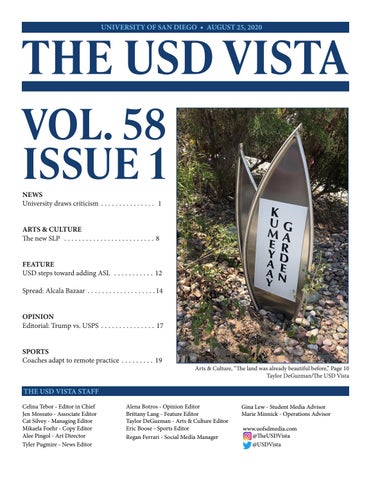
Arts & Culture, “The land was already beautiful before,” Page 10 Taylor DeGuzman/The USD Vista
THE USD VISTA STAFF Celina Tebor - Editor in Chief Jen Mossuto - Associate Editor Cat Silvey - Managing Editor Mikaela Foehr - Copy Editor Alee Pingol - Art Director Tyler Pugmire - News Editor
Alena Botros - Opinion Editor Brittany Lang - Feature Editor Taylor DeGuzman - Arts & Culture Editor Eric Boose - Sports Editor Regan Ferrari - Social Media Manager
Gina Lew - Student Media Advisor Marie Minnick - Operations Advisor www.uofsdmedia.com @TheUSDVista @USDVista
The USD Vista
◆
August 25, 2020
USD’s late remote learning announcement draws criticism Some students said USD informed students too late that Fall 2020 would be online OLIVIA CUNNINGHAM ASST. NEWS EDITOR
Following the University of San Diego’s announcement that Fall 2020 would be online, students took to social media comments to express their anxiety and disappointment. Whether the comments were calls for a tuition discount or refund, questions about housing, or expressions of annoyance, it was clear some students wanted an increase in communication and transparency. Incoming senior John McNicholas explained that he was never optimistic about USD’s return to campus due to increased cases in his native Los Angeles County. The LA County Public Health Department reported 1,759 total cases on May 12, and that number climbed to 12,807 total cases as reported on July 21. McNicholas said the #BlackLivesMatter protests and several looting instances in L.A. County might have led to the uptick in cases in
NEWS
May, and due to that, he never signed a lease to come back to San Diego. However, there are no current studies or statistics to show a causal link between an uptick in cases and #BLM protests. McNicholas drew attention to the messaging and formation of USD’s Six-Point Plan, a plan emailed to students regarding the re-opening of campus under the threat of COVID, and criticized the tone of those emails as being too relaxed. “I wouldn’t sign a lease on a just a plan,” McNicholas said. Several of his friends had signed leases, however, and are now left with no way out. He said although the school’s communication seemed confident and detailed, his doubts remained. “You had to question the authority of the school,” McNicholas said. “You should be able to trust your school.” Peter Marlow, associate vice president of University Communications, defended the language in the Six-Point Plan.
“The Fall 2020 Academic Task Force members, which include faculty and administrators, are confident in the quality of the flexible academic plan put in place as a result of the COVID-19 pandemic,” Marlow wrote in a statement. “The goal of the Six Point Plan was to bring students back to campus with proper health and safety measures in place.” Marlow further explained how the SixPoint Plan was developed and the university’s confidence in the plan. “While there are trends based off the metrics used by the state and county, the volatility was such that it was changing week to week and did not reflect a single trend,” Marlow said. “We also shared and coordinated our SixPoint Plan with other universities and state and county officials, and there was no indication by these entities that our plan was unreasonable.” McNicholas also called for a tuition reduction in his comment posted on the school’s “uofsandiego”
Instagram announcement of USD’s transition to fully remote learning. This comment garnered 89 likes from other commenters and viewers of the post. Similar comments on the post had close to 100 likes, as students called for their financial struggles to be put first, not those of the university. Other students created several petitions on change.org. The most popular petition has collected 2,784 signatures as of Aug. 22. USD will move forward with its tuition increase for the upcoming school year, Vice President of Student Affairs Carmen Vasquez confirmed over the summer during an online Q&A session. She relayed that the decision for this tuition increase was made prior to USD being affected by the pandemic. Neena Din, associate dean of the College of Arts and Sciences, also said during the Q&A that there have been increased costs for additional technology in the classroom, including 130 classrooms Con’t on Page 3
2
Volume 58 Issue 1 From Page 2
that now have cameras that will have the ability to live stream class and allow for student questions midlecture. Vasquez also mentioned that the university lost an estimated $17 million in the spring semester, with a total estimated loss of over $40 million. She also confirmed that the university’s endowment value has decreased by $50 million due to the stock market plunge. “It is important to remember that tuition pays for only 70% of the costs of a student’s education,” Marlow said. “The university receives the remaining 30% through philanthropic support, funding from our endowment, auxiliary services such as room and board, rentals, camps and attendance at events.” Another student who
◆
NEWS
had booked a flight and hotel room for move-in weekend in San Diego is Sebastian Sevilla. The incoming first year was critical of USD’s messaging as well. “I would say it’s a little bit late because I know some schools that already said they’re going remote,” Sevilla said. “Giving the earliest heads up would be ideal.” The announcement of USD’s move to fully remote learning came on July 29, only 19 days before the scheduled start of school on Aug. 17. “The intent was to bring students back to campus provided that state and county guidance permitted such a move,” Marlow said. “The timing was driven by guidance (or a lack of new guidance at the time) from state and county officials and the fact that we were only days
USD screens all those who come on campus for COVID-19 with a survey. Anna Behrens/The USD Vista
NEWS
◆
The USD Vista
away from the beginning of the fall semester.” The San Diego Unified School District announced the closure of San Diego K-12 schools on July 13. “The skyrocketing infection rates of the past few weeks make it clear the pandemic is not under control. Therefore, we are announcing that the new school year will start online only. Instruction will resume on...August 31 in San Diego Unified, as previously scheduled,” said a joint statement from the LA Unified School District and the San Diego Unified School District on July 13. However, universities are not under state and county guidance for K-12 schools and Marlow said there was no reason for USD to follow this guidance. Savannah Stallings, an incoming junior, signed her lease in July, but expressed similar disappointment to that of Sevilla. She would not have been as optimistic if the tone of USD’s communication about returning to campus was less assured. Her concerns about returning first began when California state colleges closed. The UC and CSU systems announced a plan for full remote learning on May 12. Marlow said private
universities like USD are not guided by the UC and CSU systems. “I definitely wish USD had been more transparent in their emails over the summer,” Stallings said. “I just think that they should have been more transparent that there was a bigger possibility that we weren’t going back.” San Diego County was taken off California’s coronavirus watchlist on Aug. 18, so a return to campus is not out of the question, according to USD. The university’s administration maintains that they are prepared to pivot to hybrid learning. “We are in the process of discussing bringing additional students to on-campus housing, and we soon will be sharing information about our plans,” Marlow said. “At the same time, we are closely monitoring universities across the country who are reversing decisions to bring students back on campus and hope to learn how best to mitigate a similar scenario from happening at USD.” The future is uncertain for faculty, staff, and students. Many issues remained unresolved and questions unanswered, but struggle and adjustment is certain as the national and local situation remains in flux.
3
The USD Vista
◆
August 25, 2020
Returning students: What to know about San Diego’s COVID regulations The County of San Diego has established guidelines for the COVID-19 pandemic EMMA VALDISERRI ASST. NEWS EDITOR
As of August 18, San Diego County has been removed from California’s COVID-19 watchlist, meaning there have been less than 100 new cases reported daily per 100,000 residents in the area. Theoretically, if San Diego maintains this rate for the next 14 days, K-12 schools
can reopen. Even though the watchlist only applies to K-12 schools, it may still inform USD’s decision, as the university continues its online semester. Several universities that reopened for the fall, such as the University of North Carolina at Chapel Hill and the University of Notre Dame in Southbend, Indiana, have seen spikes in cases and have been forced to suspend their
online classes or cancel them altogether. At the end of July, USD’s President James T. Harris III, D.Ed. confirmed that the university would be online for its fall semester after months of making efforts to have students return to campus in a hybrid setting. The university has also recently announced that its January intersession term will be taught remotely as well.
A face covering is required to enter the University of San Diego’s campus this fall, along other measures. Anna Behrens/The USD Vista
NEWS
Despite USD going online, many students have returned to San Diego to complete their courses, and some are noticing differences in how the pandemic is being handled between their hometowns and San Diego itself. Klea Washington, a senior undergraduate originally from Fresno, California, has safely returned to her house on Mission Beach that she shares with three roommates. “In Fresno, people are pretty good at wearing masks, but cases are still high,” Washington said. “San Diego feels completely different though, like you wouldn’t really know there’s a pandemic, especially on the beaches and boardwalks. I just hope people don’t think that being removed from the watchlist means we can go out and party, causing us to end up back where we started.” While San Diego is making progress by being taken off the watchlist for Con’t on Page 5
4
Volume 58 Issue 1 From Page 4
the virus, there have been other setbacks. The county has had to reclose certain businesses like indoor gyms and bars earlier this summer after cases surged from initial reopenings. That being said, it’s safest for returning students to continue following the CDC guidelines and take the necessary safety precautions to keep themselves and those around them safe and healthy. Although it’s not quite time to enjoy popcorn and soda at the movie theatre or lift weights at the gym, returning students still have a variety of options for places to go and activities to do when they need a break from Zoom. For those who enjoy outdoor recreation, beaches and parks are open and activities like boating, camping, golfing, tennis, and recreation equipment rentals are allowed as long as those participating wear masks and keep their distance. Businesses in the food industry that are currently open include restaurants with outdoor seating, grocery stores, food banks, and farmers markets like those in Ocean Beach and Little Italy. Restaurants with modified outdoor dining
NEWS
◆
NEWS
services are required to close on-site dining between 10 p.m.and 5 a.m. while bars, breweries, and distilleries that don’t serve food are closed, but can still offer takeout and pick-up services. The smaller the group size at a restaurant, the better. Other places such as convenience stores, pharmacies, banks, laundromats, hardware stores, pet groomers, car dealerships and washes are also open. If online shopping and Amazon packages have run their course, retail stores with outdoor entrances can have in-store customers while indoor malls have to wait longer before they can open. Businesses that are open but limited to outdoor operation include gyms, places of worship, salons, museums, galleries, zoos, among others. In other words, most businesses with the ability to operate outdoors can be open. The places that are closed and will have to wait for updated regulations from the state include indoor shopping malls, movie theatres, bowling alleys, and other indoor recreational activities. Of course, for these businesses to open and remain open, all employees and customers are required to wear masks and be cautious of
◆
The USD Vista
USD has taken measures to prevent the spread of COVID-19 on its campus. Anna Behrens/The USD Vista
their distance. While USD’s campus may not be open for classes and recreation, there are still a lot of safe and socially distant activities for returning students to do in San Diego that can bring some normalcy to the semester. Students visiting campus for any reason, like picking up textbooks, are required to wear a mask and must have their temperature checked at one of the oncampus tents (there is one located outside the Student Life Pavilion) to obtain a wristband before entering any of the
buildings. Even though online learning may leave more time for boogie boarding at the beach, it’s strongly recommended that returning students are responsible when it comes to wearing masks and keeping their distance to help San Diego remain off the watchlist. For more information in regards to San Diego County’s COVID-19 regulations, faculty and students can visit the San Diego County Government website for updates on what’s closed, open, and predicted to open in the future.
5
The USD Vista
◆
August 25, 2020
Disparities in universityprovided sophomore housing Documenting the return for students who came back to San Diego TYLER PUGMIRE NEWS EDITOR
Some USD students have already returned to San Diego, regardless of whether classes are in person. The sophomores that were granted housing have been living in the Pacific Ridge and Loma Palisades apartments as an alternative to on-campus housing. As the Pacific Ridge students moved in, some have been criticizing the school for not adequately furnishing the apartments, and most students have not received anything more than a bed, a dresser, and a desk, leaving the living rooms mostly empty. For others at Loma Palisades, there have been cases of people declining their housing agreement after moving in. “It just doesn’t make sense for me,” sophomore Patrick Larson said. “For someone who does not always have access to a car, I was not readily prepared to live that far away.” Something worth
NEWS
noting is that the average two-bedroom, twobathroom apartments at Pacific Ridge are currently priced from $3,351 to $3,625, with an additional $800 deposit. Meanwhile at Loma Palisades, there are currently many twobedroom, one and a half bathroom apartments that range from $2,072 to $2,390 with an additional $600 deposit. All students in these complexes are paying the same rate that they would for housing on campus. Pacific Ridge is located across the street from campus, while Loma Palisades is estimated as a twelve-minute drive from campus, with USD working to provide a tram service to and from the apartments to campus. “You can’t always trust the tram service,” Larson said. “Anyone who has had a class on west campus knows that there is nothing worse than having to wait for a tram, let alone a tram that is still fifteen minutes from campus.” The price of housing is Con’t on Page 7
The Pacific Ridge apartments are right across the street from USD. Jen Mossuto/The USD Vista
The Loma Palisades apartments are an estimated 12-minute drive from campus. Tanner Claudio/The USD Vista
6
Volume 58 Issue 1
◆
NEWS
◆
The USD Vista
There are several differences between the university-provided housing in Pacific Ridge apartments and the Loma Palisades apartment in which sophomores live. Mikaela Foehr/The USD Vista
From Page 6
not different for students who are placed in Loma Palisades, Pacific Ridge, or those who were placed in a lottery to live on campus once current regulations permit oncampus housing. Another concern is how liability will play into moving students to San Diego. Without being able to lock down and require social distancing to be enforced at all times for students, questions arise about how
NEWS
USD could control an outbreak. On campus in the Alcalá Vistas, where some Resident Assistants are living now, there are no guests allowed in each other’s rooms once students move in, as enforced by staff and Resident Assistants. In Pacific Ridge and Loma Palisades, there are no Resident Assistants that have this ability, and as students are spread around each respective complex, it is difficult to hold students in
these places to the same standard. Many organization leaders, such as DJ Mahoney, associate director for Fraternity and Sorority Life, sent out an email to students, urging them to respect social distancing guidelines and refrain from in-person gatherings in order to keep everyone safe. The USD Vista contacted Luke Lacroix, Assistant Dean of Students but did not respond when asked about
how Residential Life is enforcing social distancing in these complexes at the time of publication. Assuming cases continue to fall in San Diego, and the county stays off of the watchlist, more businesses and activities will be available for Toreros to explore. As students return, it is imperative for them to make sure to follow state and county guidelines in order to make a safe return to campus as soon as possible.
7
The USD Vista
◆
August 25, 2020
The new SLP: Wherever you are The Student Life Pavilion may not be accessible to all students, but students can make their own SLP ANNA VALAIK ASST. A&C EDITOR
When I first stepped foot onto USD’s campus for Olé Weekend, I never knew the Student Life Pavilion (SLP) would mean so much more than a dining hall. For me, SLP was the place I grew closer with friends over nightly dinners, waited in the Greek station line for what seemed like centuries, and worked on homework till my eyes were glazed over and tired. When feeling lost, it was the star that led me back home, back to a place always full of friendly faces and hot pizza. With the recent campus shutdown, I have been thinking a lot about how that will change students’ relationships with the school and their fellow classmates. If we cannot come to campus, where will we create long lasting friendships? If we cannot even eat at the SLP or other USD restaurants, will those places lose their value and meaning to the student body? Will campus start feeling like a distant place rather than a second home? These are all questions we have to
A&C
ask ourselves, and there seems to be no easy or right answer. In an attempt to bring the SLP experience to wherever students may be, I have decided to create “The New SLP”: places and ways to feel like you are still laughing with friends over Mickey’s pasta, being denied a togo box, or walking into those doors for the first time without necessarily being on campus. These are all small moments we cherish, and now is the time to create new ones. Farmers markets In San Diego, we are blessed with year-round gorgeous sunshine, which means we constantly have the opportunity to enjoy the weather and get outside. Recently, due to COVID restrictions, getting outside and taking a few moments in nature has turned into a luxury. One way to enjoy the open air, eat well, and support San Diego business is by attending the multiple farmers markets this county has to offer. Farmers markets are an integral part of San Diego’s culture, and each one has its own unique vibe and food offerings. Not only
Avocado toast from Avo Toast Bros and Sweet Tree Farms. Photo courtesy of Ashley Fehr.
is it a sustainable and ecofriendly way to grocery shop, it is also the perfect excuse to gather a few friends and try new foods. Here is a list of my favorites and what you should keep an eye out for while walking around. 1. Pacific Beach (Tuesday: 3 p.m. - 6 p.m., 4500 Bayard St from Garnet Ave to Hornblend St San Diego, CA 92109). Keep an eye out for: Doctor’s Daughters Nice Cream Bars and SuperFood & Company’s kombucha 2.Ocean Beach (Wednesday: 4 p.m. 8 p.m., 4900 block of Newport Between Cable & Bacon Ocean Beach, CA 92107). Keep an eye out for: The Green Fix
smoothies and Aloha Spreads coconut peanut butter 3. A peanut butter lover’s dream found at Aloha Spread stand. Anna Valaik/The USD Vista 4. Little Italy (Saturday: 8 a.m. - 2 p.m., West Cedar Street from Kettner to Front Street San Diego, CA 92101). Keep an eye out for: Avo Toast Bros and Sweet Tree Farms Family meals from restaurants Another way restaurants have been bringing an in-person dining experience to people’s homes is through family meals. Family meals, which you can pick up or get delivered, are Con’t on Page 9
8
Volume 58 Issue 1
◆
A&C
◆
The USD Vista
A peanut butter lover’s dream found at Aloha Spread stand. Anna Valaik/The USD Vista
A homemade margherita pizza.
are meal combos that bundle entrees, appetizers, and desserts together at a more affordable price. If you do not feel comfortable dining in or simply just want to pig out on your couch, this is an amazing option for you. Not only is the food delicious and reasonably priced, but you also will be supporting the people that need it the most: restaurant workers, delivery drivers, and the San Diego community as a whole. One way you can implement family meals into your weekly routine is gathering a small group, maybe roommates or friends, and pooling your money together to purchase one. Now is the perfect time to try different cuisines and share those experiences with friends. Next time you want
Cooking Night Have you ever wanted to master the art of cooking? Have you ever watched the Great British Baking Show and felt inspired to make a giant birthday cake for fun? Well, now is the time. When we are afforded this much time at home, surrounded by our kitchens and food, it makes sense to pick up a new skill — cooking. Before, when we would go to and from campus all week long, we rarely had a few hours to spare to go grocery shopping and make meals for ourselves. Now, considering we stay in our homes most of the time, a weekly roommate meal is the perfect way to connect with one another and get cooking. My roommates and I have decided every Sunday is Family Night, which means we will be choosing
A&C
to get out of the kitchen and enjoy a professionally made meal, here are a few places that look particularly appetizing. 1. Burger Lounge: Lounge Box → serves 4, $25.95, comes with all the fixings for a fun burger night. 2. North Italia: Fresh Pasta Meal Kit → serves 4-5, $65, includes a choice of pasta, pasta sauce, large salad and bread! Bring Italy to your home with this delicious kit. 3. Crack Shack: Big Flock → serves 5-6, $65, ten piece fried chicken, twelve nuggets large fry, classic slaw, six biscuits, and two cookies. Invite your whole flock and enjoy. 4. Buona Forchetta: Pizza night → serves 1-2, $9-25, order any pizza for pick up. The Angela pizza is out of this world. It’s a must try.
Anna Valaik/The USD Vista
a recipe and dividing the tasks amongst ourselves. At home, the options are endless: Italian, Greek, Asian, or American. Here are a few recipes we have had our eyes on: Resource for cooking during Coronavirus 1. Crispy MustardRoasted Chicken 2.Homemade Brownies 3. Sweet Potato Fries 4. Margherita Pizza Even though the closing of USD’s campus was an upsetting decision, I am determined to make the most of my semester with my fellow community members. To me, that means bringing the campus to my home. Whether you like cooking or just want a delicious meal delivered right to your dinner table, I hope you can find your very own SLP, no matter where you may be.
9
The USD Vista
◆
August 25, 2020
“The land was already beautiful before:” A look into the history beneath USD’s surface USD Tribal Liaison Persephone Lewis discusses the history of the Kumeyaay people TAYLOR DEGUZMAN A&C EDITOR
It’s hard to ignore the beauty that resides on USD’s campus. Students are met with an immense amount of greenery, beautiful buildings, and views of Mission Bay when they step on to campus. However, what isn’t as immediately recognized is what lies beneath our beautiful university — the traditional and unceded territory of the Kumeyaay nation. USD faculty and community leaders typically mention the Kumeyaay land acknowledgement in syllabi and classes during the first weeks of each semester. The land acknowledgement acts as a reminder to students that the land USD is on comes from a longstanding history that made it possible for students to reside here. USD’s Tribal Liaison, Persephone Lewis, is an advocate for bringing greater attention to, and emphasizing the
A&C
importance of, the history of the land USD is on in order to gain more respect for the Kumeyaay traditional land and natives. “The creation story of USD is that ‘this land was empty, there was nothing on this land,’ and then we built this beautiful campus,” Lewis said. “But, I think it is really important for us to remember that we are walking on thousands of thousands of years of habitation, that we are walking on thousands of years of history.” Lewis delved into the history of the Kumeyaay people that would have lived and survived off the land beneath USD, as well as the San Diego area in general. “I’ve talked to Kumeyaay folks where it would be reasonable to assume that our land, where USD is, would have been close to traditional villages, close to the valley and river sources,” Lewis explained. “Because we’re located right next to the bay, there would have
been lots of folks over the millennia on our land.” Old Town San Diego is known as the “birthplace of California.” Located in Old Town where the first mission was, was an original Kumeyaay village called “Kasoy,” Lewis said. In 1769, Father Junipero Serra established Mission San Diego de Alcalá, the
first of the twenty one missions in California. The Native Americans who had first occupied the region were extremely resistant to the taking of their lands. Lewis expressed her frustration with common myths that paint native Con’t on Page 11
Lewis co-teaches a course in Biology called “Integrating Indigenous and Western Science” where students adopt plants within the Kumeyaay garden because they play a big role in taking care of it. Taylor DeGuzman/The USD Vista
10
Volume 58 Issue 1
◆
A&C
AISO spearheaded the movement of the renaming of Serra Hall to the now Saints Tekakwitha and Serra Hall. Photo courtesy of AISO
lands as uninhabited and untouched by human beings. “The story of the ‘New World’ is that it was this really beautiful, plentiful place that was uninhabited and untouched by human beings,” Lewis said. “And the truth is that for thousands of years humans were touching the land; the land was plentiful because human beings were tending to it.” The Native Americans owned these lands which provided people with the food and resources that they needed to survive. However, because they were not Christians, they did not legally own the lands. As decided in an international court of law, the Doctrine of Discovery established a legal and spiritual justification for the seizure of the lands inhabited by those who were not Christian. Lewis continued to speak on her own opinions on the founding of USD, and more on how USD builds on this popular
A&C
myth that it was founded on unused land. “I feel like a lot of people, when they think about the founding of USD, think more about how beautiful of a campus we’ve built on this land, when the land was already beautiful before,” Lewis said. “Roses don’t make something beautiful, but western ideas of beauty have shaped what we get to decide is beautiful.” Lewis spoke on how inclusion of more indigenous plants on campus could be a huge step in the right direction toward respecting Indigenous culture. “Indigeneous plants sustain indigenous animals and they’re going to be easier to take care of,” Lewis said. “However, western ideas of beauty and what beautiful landscaping looks like does not support respective indigenous plants in the same way as the surplus of plants planted on campus.” In order to gain more
◆
The USD Vista
recognition and respect for indigenous plants, Native American culture, and Native American history by the USD community, Lewis advocated for a campus-wide initiative as the most necessary action step. “I think the incorporation of the land acknowledgement statement is great and the first step, but we are ready for the second step now and now it’s time for students to understand what it truly means to be guests in a traditional territory and the responsibility attached to that,” Lewis said. The American Indian Student Organization (AISO) is the epitome of student voices influencing change. Rhonda Papp, Chair of AISO, expressed how important it is to her that USD moves towards educating students on Native American history. “I truly believe that universities are where students should be learning about the world and the history of the land and the native communities,” Papp said. In order to gain more representation and respect for Native American history. Papp continued to explain that there are several initiatives she has thought about for the past two years that she wants
to bring to the university’s attention. “It would be incredible if during Olé Weekend, when Resident Assistants (RAs) have their mandatory meetings with their residents, the RAs had a talk about recognizing the land’s importance as well as respecting the people who were on this land before them,” Papp said. “Maybe there could be an activity where students go and connect with the land, learn more about AISO, and learn about the ethnic studies courses they could take centering around Native American culture.” Papp believes that not only is it imperative to recognize the land that USD is on, but it is equally important for individuals to stay curious about the history and background of the land wherever they may travel in the U.S. “There is something missing in U.S. culture; it’s that complete fascination with where everything started and where the roots of the land we stand on lie,” Papp said. Lewis and Papp speak to the same sentiment that change begins with the students. “You (students) all are the most powerful people on campus, I know it might not feel like it, but students’ voices matter,” Lewis said.
11
The USD Vista
◆
August 25, 2020
Student efforts for inclusivity cause a step in the right direction As USD makes a crucial first move to include ASL in their language curriculum, students share why including ASL in the USD curriculum is so important BRITTANY LANG FEATURE EDITOR
Rising senior Serena Stockton, a hard-ofhearing student, is one of the passionate individuals at USD who has joined the movement to change the university’s views on American Sign Language (ASL). She wants the university to recognize ASL as an official foreign language and adopt a new curriculum that will be inclusive to hard-ofhearing and Deaf students on campus, as well as those who have a desire to explore disability studies. Stockton believes this is a necessary step USD must take in order to meet the high standard the university claims to hold itself to, which is one that welcomes and encourages diversity within its student body. As a first year, Stockton was extremely disheartened when she came to the realization that she was not going to be able to pursue ASL at USD, after already being denied the opportunity at the high school level.
FEATURE
During her first year, she considered registering to take ASL courses at another institution. However at the time, USD did also not consider it as a language to be transferable as credit. “I was told by countless faculty members that ASL was not really a language because it was not spoken, lacked culture, was too hard to test, and it did not have grammar,” Stockton explained. She said these comments from the university only highlighted the ignorance and very limited knowledge many have towards the Deaf community, stating that they do in fact have a very rich and detailed history, unbeknown to some of the USD faculty. “I have always wanted to gain a deeper connection with those in my community and the Deaf community, but in order to fully do so, I myself need to be fluent in ASL,” Stockton said. It should be understood that Deaf culture is a powerful testimony to the profound
needs and possibilities of human beings, built from striving to make sense of their place in this world. Passed on and endured through generations of transmission, Deaf signers have fashioned their own signed language so rich and precise, that even intricate storytelling and poetry are possible. Members of the Deaf community continue to be oppressed and excluded by a disturbing
lack of equal access, particularly through a dearth of interpreters in the workplace and institutions. Deaf students, and those who are dedicated to ameliorating the living conditions for individuals with disabilities, strive for there to be equal opportunity in the work sector, social settings, and to be accorded basic human rights. Con’t on Page 13
Serena Stockton (pictured above) was disappointed to discover she would not be able to pursue ASL at USD. Photo courtesy of Serena Stockton
12
Volume 58 Issue 1
◆
FEATURE
◆
The USD Vista
Yo u r n e w s i n yo u r h a n d s
@ u s dv i s ta @ t h e u s dv i s ta
Senior Maddy Bass, another USD student who is dedicated to advocating for ASL, was present in multiple meetings in the fall of 2018 with Stockton and a few others students, faculty members, and department deans. In one particular meeting with the language department, the students presented their thoughts on why ASL needs to be eligible for transfer credit for the language requirement or an addition to the curriculum. “In response, we received a lot of blank stares that seemed uninterested,” Stockton said. “In fact, one faculty member even raised his
FEATURE
hand to question our thoughts about braille, completely changing the subject.” USD prides itself in being a campus that upholds its core values of academic excellence, community, compassionate service, knowledge, and ethical conduct and, above all else, being a changemaker campus. However, with their refusal to become more accessible and welcoming to students who are Deaf or hard-ofhearing by not offering courses in ASL and more broadly disability culture, Stockton believes they are actively going against their academic mission.
Stockton is just one of the many students who have had reservations with the areas of studies offered to students at USD due to a lack of diversity and representation. However, like other driven and impassioned students who have fought for academic change, their efforts have not been futile. USD finally accepted ASL to be transferable as credits for the language requirement officially last Spring, a considerable step in the right direction. Nevertheless, Stockton emphasized how there is still so much work to be done in the fight against audism, especially surrounding
representation and academic exploration for the Deaf community and those passionate about the cause. “My hopes for USD’s future is that we start to diversify our course options by incorporating courses like introduction to Deaf culture and history, an ASL program on campus, or a disability studies major or minor,” Stockton added. The university continuously proves that it is capable of positive and profound change in terms of diversification and inclusion. Afterall, one of the only constants that we can be absolutely certain of is change.
13
Volume 58 Issue 1
◆
FEATURE
◆
The USD Vista
ALCALA BAZAAR
[ VIRTUAL ]
DAY 1
-Model United Nations -Alcalá Club -National Society of Black Engineering (NSBE) -Institute of Industrial and Systems Engineering -Society of Women Engineers (SWE) -Phi Alpha Delta Pre-Law Fraternity -Spanish club -French and Francophone Studies Club -Environmental and Ocean Sciences Club -Real Estate Society -Entrepreneurship Club -International Business Club -Intramurals -Club Soccer -Dance Company -And more
FEATURE
BELIEVE IT OR NO TIME TO GET INV ORGANIZATIONS,
The Alcalá Ba Tuesday, Aug August 27 2:00 p.m. PS more at h e d u /s t u d e nt
DAY 2
-Alliance of Disability Advoca -Office of Sustainability -Pee in Peace -Soup Kitchen Club -S.W.A.T. (Students Working -Black Student Union -Association of Chicanx Activi -Diverse Sexuality and Gende -Womxn of Color Circle, Sout (SASA) -Jewish Student Union -Muslim Student Association -Political party clubs -The USD Vista -ASG: Associated Student Gov -USD Votes -And more
14
The USD Vista
OT, FALL 2020 IS THE VOLVED IN CAMPUS , AND HERE’S WHY:
azaar will take place on gust 25 and Thursday, from 12:00 p.m.ST via Zoom. Learn https://www.sandiego. t - l e a d e rs h i p /b a z a ar/
2
ates
Against Trafficking) Team
ists er Alliance th Asian Student Alliance
vernment
FEATURE
◆
August 25, 2020
First-year students have begun their first semester at USD under the most unprecedented circumstances that no student could have foreseen last fall when sending in their college applications. Despite this extremely unconventional start to their college experience, first years as well as returning students are strongly encouraged to take full advantage of the myriad of opportunities offered at USD this semester. Not only will getting involved ameliorate their remote experience and give them another accomplishment to add to their LinkedIn profile, but to also ensure that once the day comes when we are allowed to return to campus, students will already be involved in enriching organizations where they have made valuable connections and will be granted new and exciting opportunities in the future. The Alcalá Bazaar, an event for new and returning students that usually takes place on the second week of each semester during Tuesday dead hours, will look drastically different this year. The Bazaar provides a space for students to discover the countless ways to be involved at USD. Student organizations, university centers, and departments showcase all that they have to offer to help students become more integrated on campus and take part in things that they are passionate about outside of the classroom. Students get the opportunity to connect with fellow students and faculty, and hear from them what kind of opportunities and experiences their involvement has brought them. No matter what your background is or where your interests lie, USD has something to offer each and every student. Whether you are a first-year student adjusting to your unusual first semester of college, or a returning student who wants to try something new this year, participating in any of the previously mentioned organizations and clubs could dramatically heighten your college experience, open you up to new opportunities you would have otherwise not been awarded, and help you form long lasting friendships. Spread by Alee Pingol/ The USD Vista; Content by Brittany Lang/ The USD Vista
15
The USD Vista
◆
August 25, 2020
Enough whiplash for USD students As San Diego County clears a crucial parameter for in-person instruction, USD students face another opportunity to be disappointed by their university CATHERINE SILVEY MANAGING EDITOR
It’s August and it’s time for University of San Diego students to start the fall semester. However, there are a few key differences — summer ended a couple weeks early this year, but more importantly, students sit isolated in front of computer screens, many in their childhood bedrooms. Just four weeks ago, President James T. Harris III, D.Ed. announced that the optimistic plan to welcome Toreros back on campus had been canceled due to rising COVID-19 cases in California and San Diego. However, he assured that the university task forces would continue working to prepare for a mid-semester transition to in-person classes if state and county regulations allowed. The news was disappointing and frustrating to many Toreros, but left a glimmer of hope that students could potentially return this fall. And now it seems that door might unlock sooner than anticipated. On Aug. 18, the second day of the opinion
school year, San Diego County was removed from the California watch list for meeting the benchmark of less than 100 cases per 100,000 residents for three days in a row. If San Diego County is able to keep their cases low for the 14 days following this achievement, K-12 schools could be allowed to return to in-person instruction in early September, possibly acting as a catalyst for colleges such as USD to follow suit. However, given the whiplash USD students have experienced over the past few months, it is questionable that a midsemester return would truly be a viable option. The announcement that classes would begin online came less than three weeks before the first day of fall semester. Year-long leases had been signed, flights arranged, furniture purchased. First years were faced with a fast-approaching deadline to decide if they wanted to defer their acceptances and take a gap semester. Students and parents pulled up online bills to be met with an increased tuition, left wondering if a virtual semester was worth
this cost. But however painful that process was for many students and their families, the nationwide attempts of American colleges to facilitate inperson instruction paint a worrisome picture of what could be next for USD students. A cautionary tale of sorts has unraveled at University of North Carolina-Chapel Hill; after just one week of in-person instruction, the university pushed students off campus once again after reporting 135 new COVID-19 cases. It seemed that just as soon as students arrived they were forced to pack up their living spaces and go home, costing precious time and money. A near identical situation occurred at University of Notre Dame, where 146 students contracted COVID-19 after a mere eight days of classes. It’s hard to imagine that things would play out much differently at USD. While students and faculty alike are eager to return to a much-anticipated sense of normalcy, the track record for colleges’ attempts to open their campuses is bleak, indicating that a
return would most likely result in another wave of disappointment and frustration for everyone involved. Perhaps later in the semester conditions will improve and colleges will find success in returning and staying on-campus. However, USD should take a look at what isn’t working for others and recognize that their good intentions in the past have not always generated good results. Now is not the time for hasty decisionmaking. Social media caption: After thinking we would return in the fall, we abruptly discovered campus would be closed. Remote learning began, and we moved forward. However, we recently learned San Diego has been taken off the California watchlist. What does that mean for students? The views expressed in the editorial and oped sections are not necessarily those of The USD Vista staff, the University of San Diego, or its student body.
16
Volume 58 Issue 1
◆
OPINION
◆
The USD Vista
Trump takes on the postal service, further blurring lines of executive power The USPS has quickly turned into an unlikely final straw of tyranny. BAYLYNNE BRUNETTI ASST. OPINION EDITOR
Election collusion and meddling has been an issue that has run rampant within the Trump administration since the beginning of its sojourn at the White House. With the many indictments circling Trump advisors, this administration has fallen anywhere but short of corrupt. At this point, it feels like every day is just another day of hyper-partisanship, which unfortunately has become the status quo. This was amplified on Aug.13, 2020, when Trump, in his usual blazing fashion, took to Fox News to dismantle an unlikely branch: the United States Postal Service. President Trump did not shy away from taking the opportunity to address why he did not want to approve more funding for the USPS, with his biggest qualm being his falsifiable claim that mailin voting leads to higher levels of election fraud. It is important to note that there is no study in
OPINION
which mail-in voting leads to voter fraud, or that voter fraud is even an issue in our democracy. What is a problem in our democracy however, is a President threatening one of the most sacred rights we have: voting. President Trump attempting to use his power to block funding to the USPS is election meddling by definition, and both parties should be gravely concerned by his blatant authoritarianism. On Aug. 17, the first night of the Democratic National Convention, NAACP President Derrick Johnson said that, “voting should be patriotic, not partisan.” This could not be more true as we try to establish that Trump blocking funding to the USPS is not a partisan issue, but rather a bipartisan issue. Both sides of the aisle should be condemning a very blatant attempt at election meddling. As college students, absentee ballots are our life-line to democracy and that lifeline gets cut off without the postal service. Especially during a time when a
pandemic condemns us to our homes. Just when the American people thought it could not be anymore obvious that this attempt at blocking funding was election fraud, the postmaster general under the Trump administration, Louis Dejoy, announced a proposal to increase the price of postage for mailin ballots from 20 cents to 55 cents. So, why is this a problem? It’s a violation of the Twenty-fourth Amendment. The Twentyfourth Amendment of the United States Constitution was ratified in 1964; it prohibits conditioning the right to vote in a federal election on payment of a poll tax or other types of taxes. Election procedures are a states rights issue, that meaning, each individual state handles their own election protocol. Many states require the voter to pay for their own postage on their ballot. In a normal time, it would be significantly more difficult to argue that the postal fee to send back your ballot constitutes a poll tax. But,
in a time when mail-in voting can be a life or death situation for some individuals; it definitely can be debated that raising stamp prices constitutes a poll tax. Especially before an election when many Americans are struggling financially, the raising of stamps at this time is a violation of the Twentyfourth Amendment. In the time of a global pandemic, with an imminent election at stake, it is imperative that the USPS receives the funding it needs to be the catalyst for democracy. With states implementing mail-in voting to protect their residents, the USPS will be a pivotal factor in ensuring our democracy stays a democracy. As for the citizens of the United States, we should be taking a hard look at how our government officials respond to Trump’s executive overreach that extends its arm into authoritarianism. Voting is one of the most sacred rights we have in this country. It has been fought hard for and we should never give up the fight.
17
The USD Vista
◆
August 25, 2020
“They are on their own:” Coaches forced to adapt as players unable to train as a team With players at home because of the COVID-19 pandemic, Torero head coaches changed their approach to keep their teams in shape and unified ERIC BOOSE SPORTS EDITOR
If and when the University of San Diego volleyball team starts their first practice this fall, it will be their first time on the court — their first time actually playing volleyball — in at least five months. That would only be if practice started this week, and there is no indication of that happening following the West Coast Conference’s indefinite postponement of all fall competition this week. Which means, as head coach Jennifer Petrie explains, if the team can practice this fall, they will not just be picking up where they left off in the spring. “We are going to have to collaborate with Mark Lamoreaux, our strength coach, and our athletic training staff to make sure we are doing everything possible to ease them back into play without going full force the first couple weeks,” Petrie said. “You can do all of the individual
SPORTS
workouts and all of the individual skill stuff, but until you are playing the game, whatever sport you are playing, it is going to take a little adjustment to get back to playing the elite speed that they were. With their bodies too, the jump count that they have, and being able to be in condition to sustain that level, that is going to take a while, and that is going to be a challenge for all of us, to get them back into elite playing shape.” A summer without competition is a problem that every fall athlete at USD will have to overcome before they are ready for a full-speed game. With USD operating fully remotely due to San Diego’s early August increase in COVID-19 cases, Toreros will have to keep waiting even while other teams can get back together, women’s soccer head coach Louise Lieberman explained. “I know there are some schools that have some of their players back, and they are able to do stuff in
their bubble, but we are not allowed to because we are in San Diego, we are in California,” Lieberman said. “It is voluntary, but they have five or six or ten people where they can jump in and play fiveon-five if they wanted to, whereas our teams are still at home on their own, so it does make it a little more complicated.” And the challenges stretch beyond technical preparation. One of the difficulties for the men’s soccer team was finalizing their recruiting efforts during the altered spring semester, head coach Brian Quinn explained. “The tough part was
kids we had identified were taking care of their stuff without being able to bring them on campus, which is always a big, big part of recruiting at USD,” Quinn said. “The second part was being pretty consistent about touching base with our guys in regard to getting updates and finding out what they are doing with COVID. All of our international players went back home, and there was a little bit of anxiety because we were not sure when they would be able to return, and now that seems to be resolved.” Once the new recruits were successfully signed on, all Quinn could do,
“As coaches, you want your players to grow and develop as human beings more than anything. It seems like they have done that.” - Coach Louise Lieberman initially getting guys over the line, continually being diligent with our process of recruiting and working with admissions and then working with compliance to make sure that all the
like Lieberman and Petrie, was ask his players to train on their own. “I think the big part for me is I keep harping on about when you come Con’t on Page 19
18
Volume 58 Issue 1 From Page 18
back to San Diego, be in shape,” Quinn said. “Don’t be waiting to try and say, ‘oh I’ll get fit, I’ll work on my conditioning when I get back.’ It’s going to be too late.” To help his team keep in shape and connected with the coaching staff and one another, Quinn held weekly meetings with his players throughout the summer, individually and in position groups. Lieberman and Petrie did the same. All three coaches tried to be as clear with their expectations as possible and provided their players with
◆
SPORTS
workouts to do at home. “In the spring before we got shut down, we made several instructional videos for our players and made a library of them, so they have access to training on their own,” Petrie said, explaining what her team had to work with. “We did a really good job of creating these videos from scratch because we never had them before, but now we have them, this whole library that they can go back to and work on footwork, and training, and individual skill stuff, so hopefully they are doing that all summer.” But Petrie’s team
◆
The USD Vista
had the opportunity to work on more than just technical skills. “We have spent a lot of time developing our team and our individual athletes to be the best players that they can be in areas that are off the court, that includes mindset training, watching video, team bonding, leadership skills,” Petrie said. “There are a lot of intangibles that we have been working on to help us come into this fall season really prepared in ways where we have never had that opportunity before.” Likewise, Lieberman described how her players
have been developing more than just technical skills this summer. “When you are with your team, sometimes it is a little easier to get going, but since they have not been able to be with their team they have newfound ways of holding themselves accountable and they have really enjoyed that process,” Lieberman said. “That has been an ongoing tune that I have heard with them, which is super cool. As coaches, you want your players to grow and develop as human beings more than anything. It seems like they have done that.”
In support of the University of San Diego’s efforts to create and maintain a safe environment on and off campus, the following Rule of Conduct has been added to The Student Code of Rights and Responsibilities:
“Conduct that intentionally or recklessly threatens or endangers the health and safety of any person, including but not limited to, violating any health and safety requirements identified by the University or by local and state officials.” The Student Code of Rights and Responsibilities can be found at: sandiego.edu/conduct/the-code
SPORTS
19