
The REAL (Research, Evaluation, Audit and Literature) course
2025-26
The REAL (Research, Evaluation, Audit and Literature) course
2025-26


The REAL (Research, Evaluation, Audit and Literature) course is delivered annually for workers and professionals across health and social care. The inaugural programme was delivered during 2025, with participant places funded by the NIHR Applied Research Collaboration (ARC) Wessex.
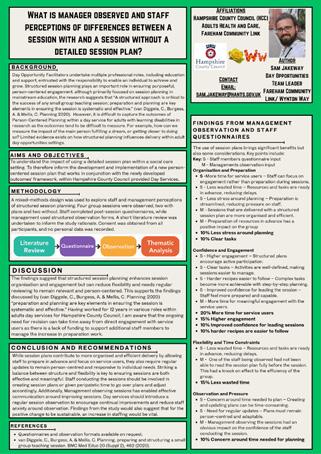
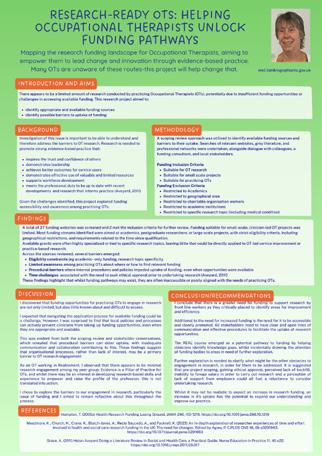
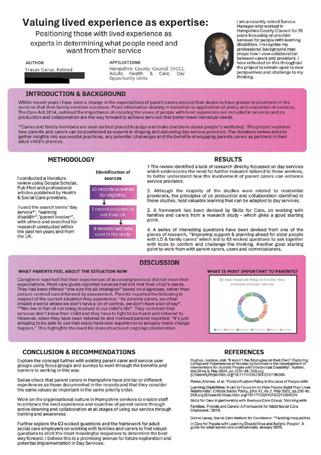
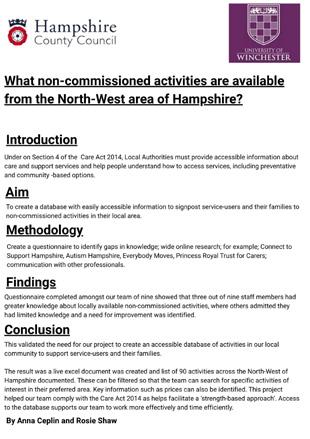
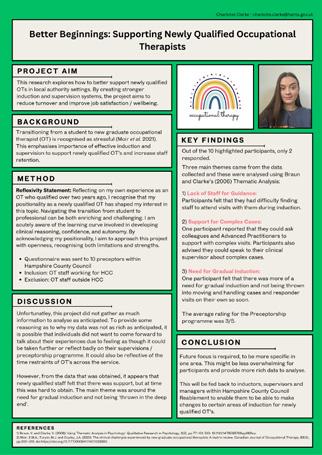
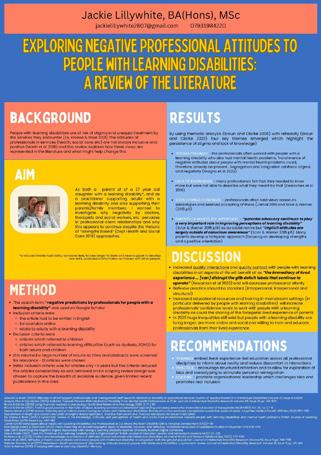
As a core element of the course, and as a means of demonstrating applied learning, participants undertook practice-based quality improvement and research projects within their own organisations. These projects addressed real-world challenges in health and social care settings and were designed to produce findings with immediate relevance to service delivery, workforce development, and outcomes for people who draw on care and support. Project methodologies, findings, and recommendations were presented through research posters.
The standard and rigour of the work produced by participants was consistently high, clearly demonstrating Level 7 (postgraduate) achievement in applied research, critical analysis, and knowledge translation. In recognition of both the quality and impact of this work, these posters are published collectively here, providing a curated and accessible record of the course’s outcomes.
The purpose of this e-booklet is threefold. First, it serves to communicate the impact of the REAL course to key stakeholders, including funders, employers, and partner organisations. Second, it provides an evidence-based showcase for past, current, and prospective learners, illustrating the value of the course in supporting professional development and research capability. Third, it contributes to wider knowledge exchange, demonstrating the potential of practitionerled research to drive meaningful improvement across health and social care systems.
The REAL course brings together frontline practitioners and university researchers, with participants drawn from local authorities, independent and voluntary sector care providers, and third sector organisations across the Wessex region. This collaborative model strengthens links between research and practice and supports the development of a sustainable research culture within social care.
With special thanks to Dr Rachel Harrison for designing and leading the course














‘‘A person's behaviour can be defined as "challenging" if it puts them or those around them at risk or leads to a poorer quality of life and impact their ability to join in everyday activities’’ (NHS 2023). This research explores how staff use consequences to respond to challenging behaviours in incident forms and to improve outcomes and quality of life for individuals affected Incident forms capture key details such as triggers, behaviours, and consequences.
•To explore how incident forms can be used to understand the consequences of challenging behaviour in adults' health and social care settings
•To identify common patterns in staff responses and the effectiveness of different types of consequences.
•To evaluate how consequences can inform proactive, personcentred support strategies.
This research involved a qualitative and quantitative analysis of 30 challenging behaviour incident forms completed from one service in adults’ social care setting between August 2013 and February 2025. Data were categorised into thematic groupssee Graph 1 Frequency analysis of common triggers were used to identify patterns and relationships between triggers and consequences. Graph 2. Frequency of consequences reported were grouped into themes.
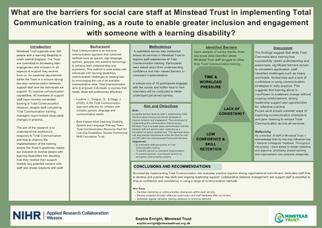
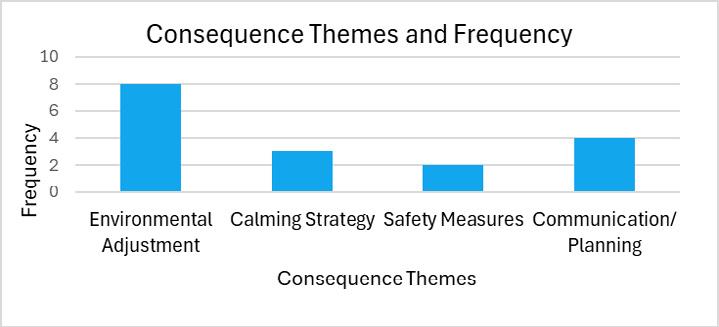
The most common trigger reported was 15 emotional distress followed by 4 communication difficulties and sensory overload, see Graph 1 Environmental adjustment was the most frequently used consequence, whereas calming strategies and safety measures were less common See Graph 2 Other consequences were used when environmental adjustment was not possible These findings informed how triggers and consequences relate to care practice.
GRAPH 1: Frequency of Common Behaviour Triggers Reported in Incident Forms.

My interpretations are influenced by my professional experience as a Deputy Manager within adult social care, I recognise that my role and experience may shape how I interpret incidents. To mitigate potential bias, I adopted a reflective approach throughout the analysis to ensure that the findings contribute meaningfully The analysed data revealed patterns in staff responses and in the documentation of both known and unknown behavioural triggers These findings underscore the critical importance of accurate, factual recording and highlight the need for targeted staff training to enhance the recognition of triggers and to develop a deeper understanding of the underlying causes of behaviours
My analysis highlights that while many responses to triggers are de-escalation strategies, they often reflect, person-centred needs to ensure the safety and wellbeing of an individual when a challenging behaviour has not be prevented Understanding these triggers would helps to form proactive support strategies and consequences, and the way they are used in adult’s health and social care

Alexander Ozegbe
Day Opportunities Deputy Manager Adults’ Health & Social Care alexander ozegbe@hants gov uk
GRAPH 2: Frequency of Staff Responses (Consequences) to Challenging Behaviour.
HCC Learning and Development Team to assign Incident form training to all staff annually.
Staff to ensure challenging behaviour incident forms captures the ABC framework.
Staff to consistently use terminologies from predefined categories for triggers in the Challenging Behaviour section of the incident form
A yearly review of service users communication needs by management.
1. Bowring, D L , et al (2017) Prevalence of psychotropic medication use and association with challenging behaviour in adults with an intellectual disability A total population study Journal of Intellectual Disability Research, 61(6), pp.604–617. doi:https://doi org/10 1111/jir 12359
2. NHS website (2023). How to deal with challenging behaviour in adults [online] nhs uk Available at: https://www nhs uk/social-careand-support/practical-tips-if-you-care-for-someone/how-to-deal-withchallenging-behaviour-in-adults [Accessed 1 July 2025]
Harrison, R A , Bradshaw, J and McCarthy, M (2025) Where Care Converges: Uncovering Shared Experiences of Parents and Service Providers for Adults With Intellectual Disabilities in Times of Austerity Journal of Applied Research in Intellectual Disabilities, 38(2), p e70044 https://onlinelibrary wiley com/doi/10 1111 /jar 7 0044
Harrison, R A , Bradshaw, J , Forrester‐Jones, R , McCarthy, M , & Smith, S (2021) Social networks and people with intellectual disabilities: A systematic review Journal of Applied Research in Intellectual Disabilities, 34(4), 973–992 https://doi org /10 1111 /jar 12878








































If you would like to know more, including how register for the next course, or would like an informal conversation, please contact: HWBShortCourses@winchester.ac.uk