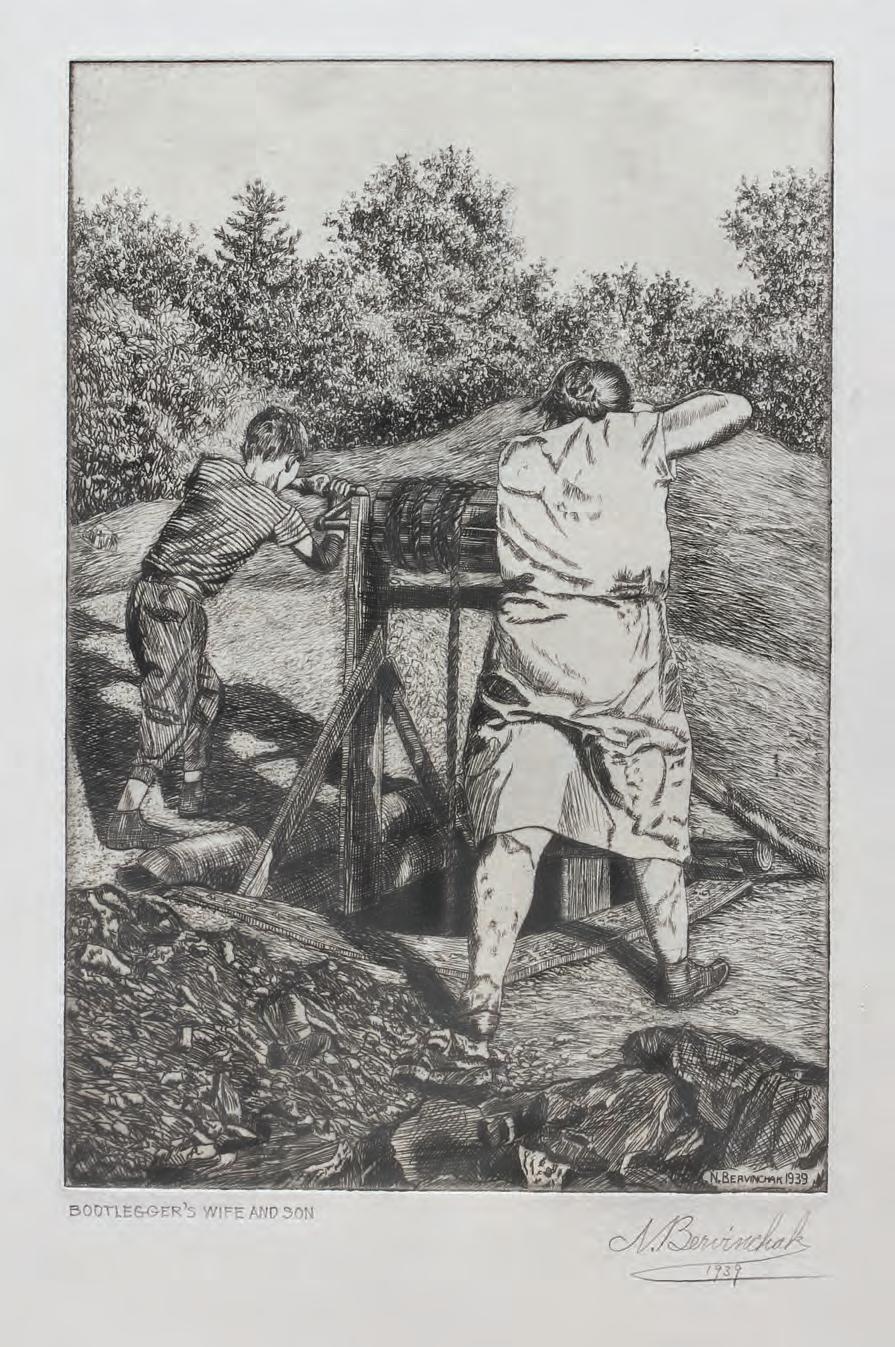
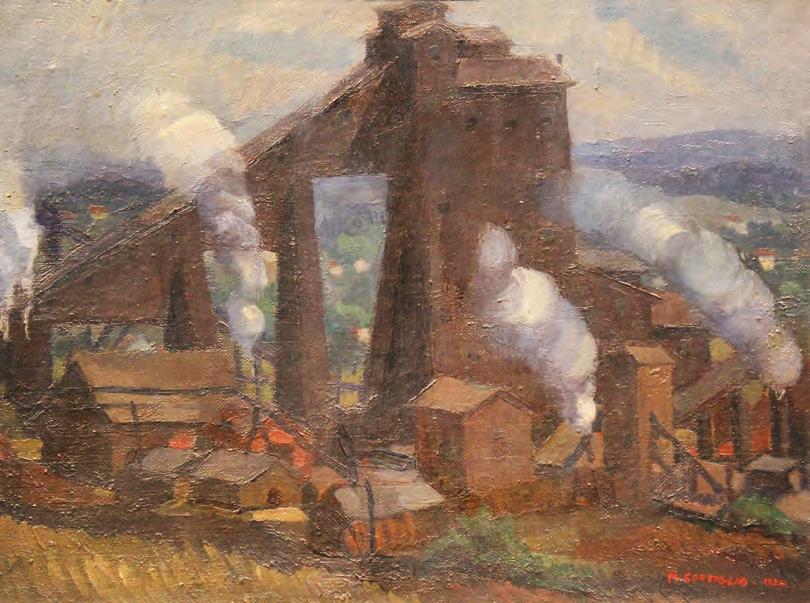
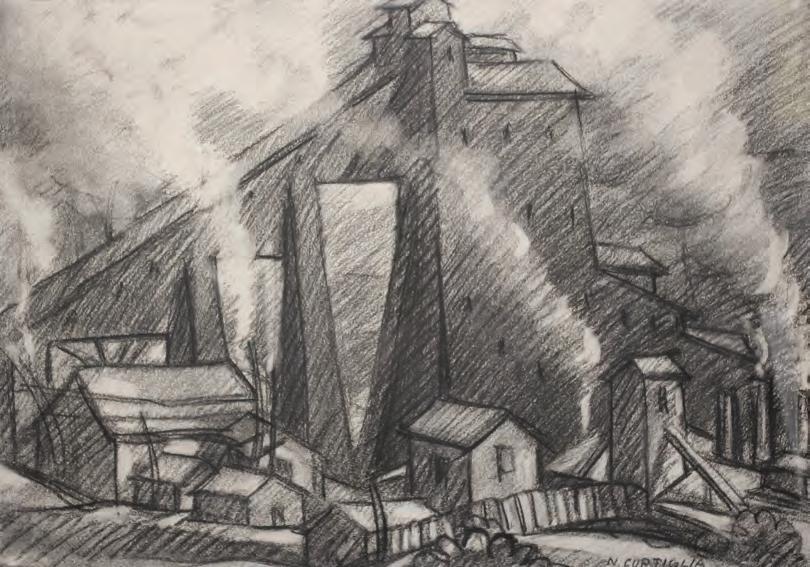
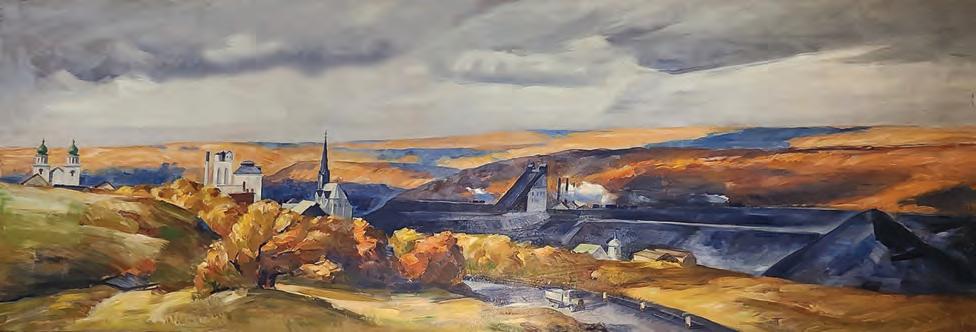
The Anthracite or Hard Coal Region of Northeastern Pennsylvania
Chester Kulesa
Anthracite is the story of many things in Northeastern Pennsylvania. Among these are geology and geography; history and culture; industry and transportation; immigration and ethnicity, as well as deindustrialization and redevelopment. This story is significant to local, state, national and international history. As maintained by Philip Mosley in Telling of the Anthracite. A Pennsylvania Posthistory (2023), “anthracite history is a fundamental part of...regional life and identity and deserves to be remembered in both its positive and negative aspects.”1
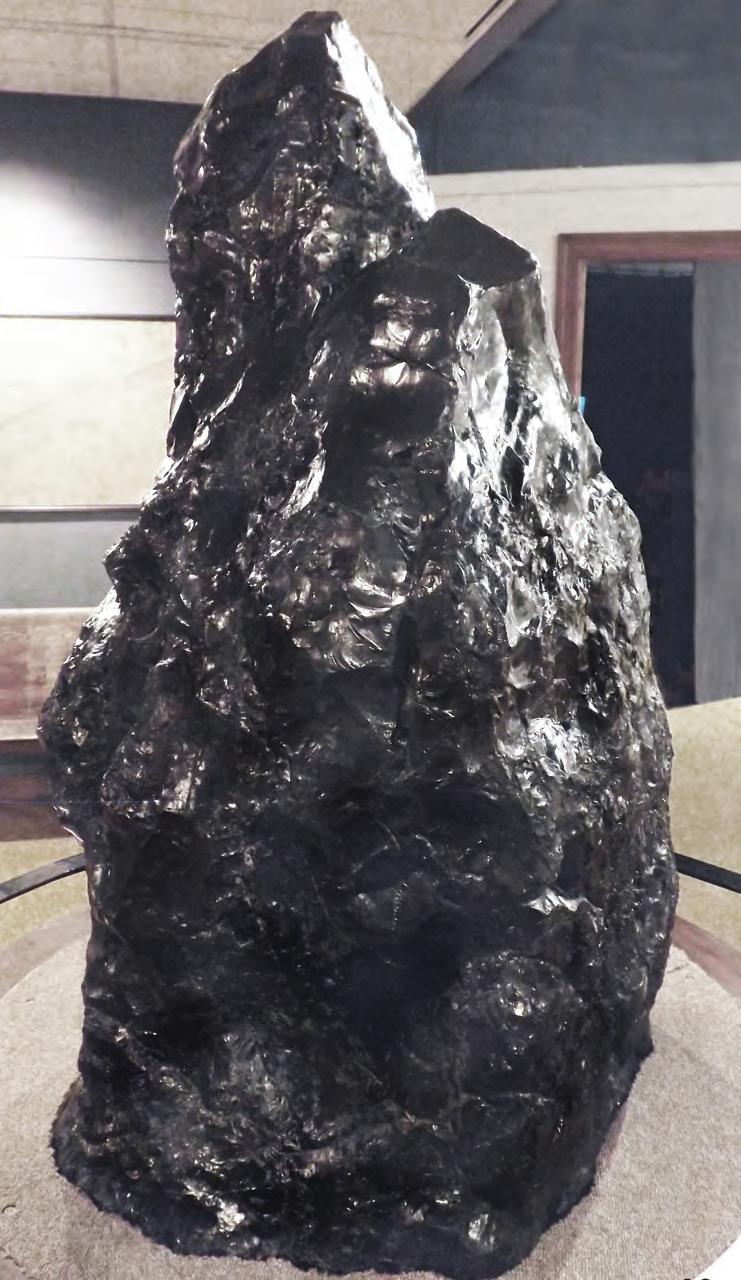
Also known as hard coal, anthracite is almost pure carbon—one of the planet’s most essential elements. Because it has few impurities, anthracite found wide favor as a domestic fuel that burned hot and produced little smoke. In the nineteenth century, the emergence of the anthracite mining industry helped fuel America’s industrial revolution in iron making, manufacturing, and steam production, as well as the development of transportation through canals and gravity and steam railroads. Anthracite contributed to the growth of eastern seaboard communities such as New York City and Philadelphia. Hard coal was the fuel of manufacturing from New York City to Chicago and from southern Canada to the Great Lakes.2 It was a home heating and cooking fuel for many, including farming families of the mid-west.
The anthracite region of Northeastern Pennsylvania is special as nine of its counties contain approximately 75% of the mineable hard coal deposits in the world, in four distinct, geologically non-continuous fields which also contain their own basins.3 The anthracite industry divided these four neighboring fields into three trade regions: the Wyoming Region in the Northern Field encompassing Wayne, Susquehanna, Lackawanna and parts of Luzerne counties; the Lehigh Region in the Eastern Middle Field including parts of Luzerne, Carbon and Schuylkill counties; and the Schuylkill Region in the Western Middle and Southern Fields covering parts of Schuylkill, Columbia, Northumberland and Dauphin counties.4
Among fossil fuels such as peat, lignite (brown coal) and bituminous (soft coal), anthracite is the highest rank of coal. It began its formation in ancient swamps over 300 million years ago throughout many cycles of decomposing vegetation. Toward the end of this geologic period, the weight and depth of these deposits were subject to the heat and pressure of geologic mountain folding and metamorphic stress carbonized the bituminous coal that became anthracite.5
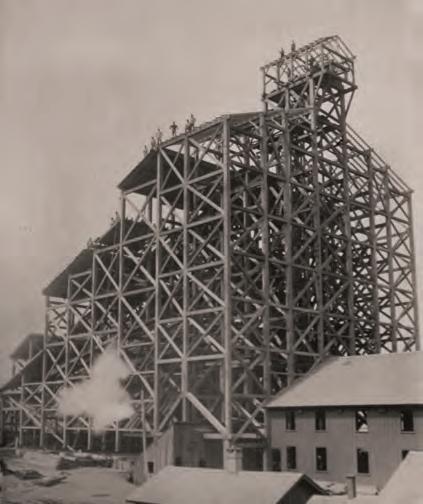
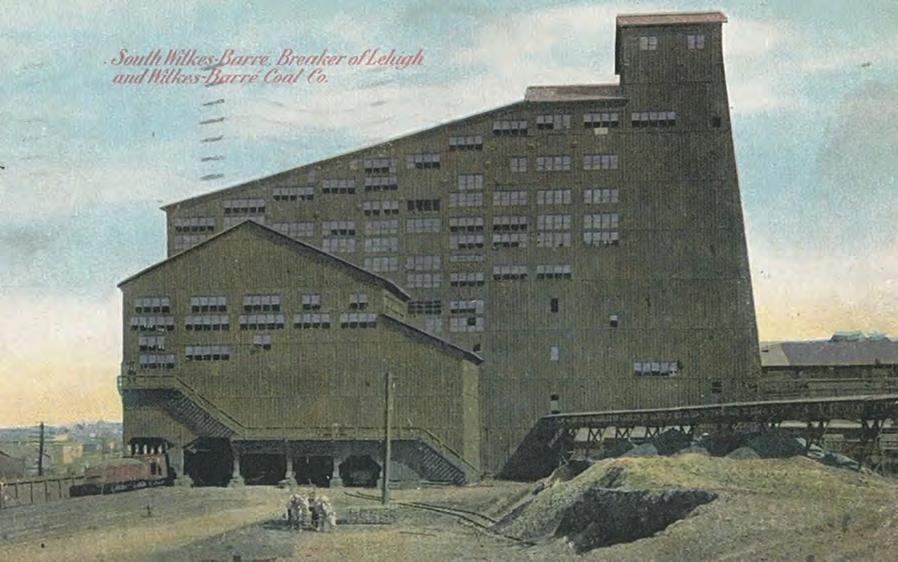
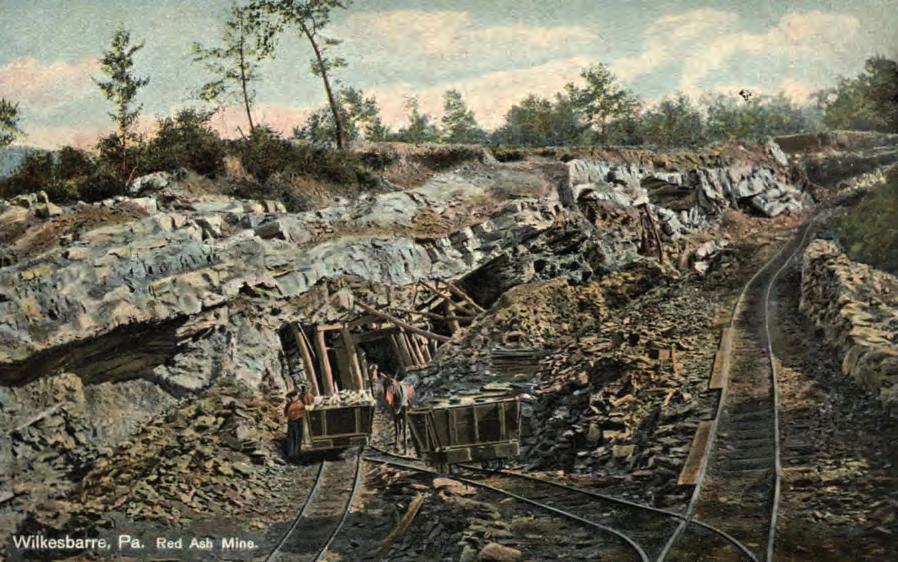
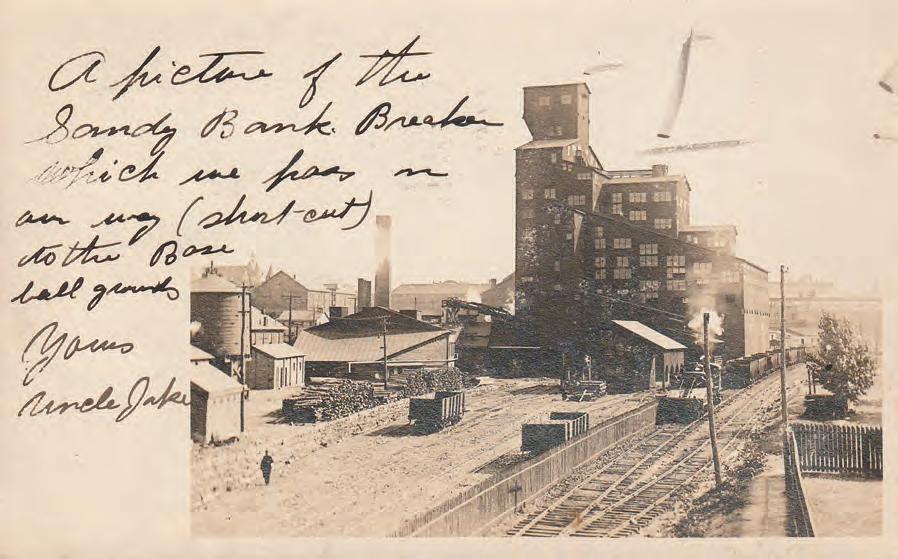
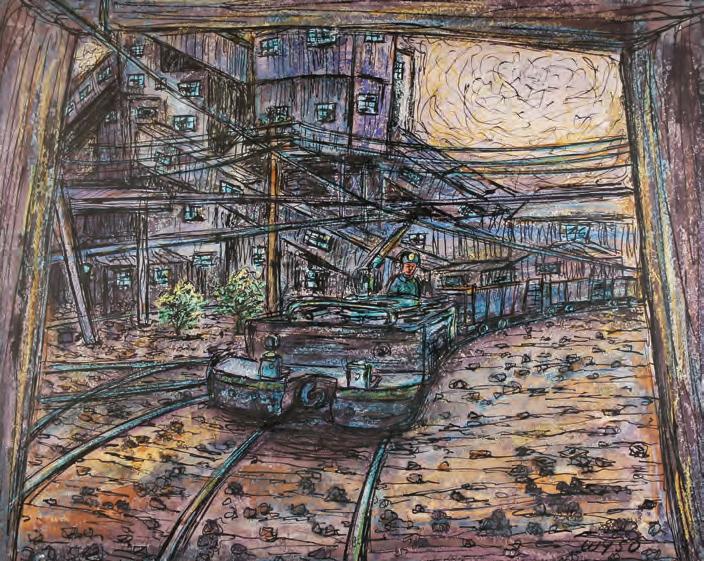
Because pieces of anthracite only burn on the surface, they must be of a similar size to allow air flow. If “run of mine” hard coal is burned without processing first, the smaller sizes will fill the gaps between the larger pieces and restrict efficient burning.6 This makes anthracite unique and requires the construction of expensive, large, multi-story preparation plants, called coal collieries or breakers, to prepare coal for market. Coal breakers crush, size and clean rock and slate from raw, mined anthracite before it is delivered to the consumer. In the heyday of the anthracite industry hundreds of these breakers dominated the industrial landscape with no comparative example anywhere else in the world.
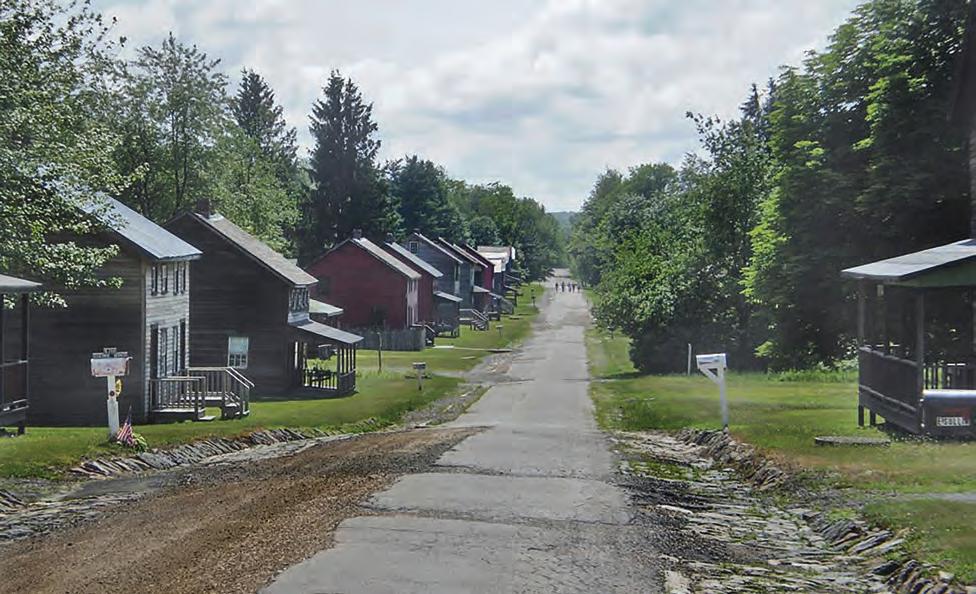
Coal was mined and processed on the colliery property. Here one could find the entire operation—open quarries or “strippings,” drift mines into mountains, tunnels, slope and/or shaft mines, rails, the coal breaker, rock banks, culm piles (coal refuse), locomotives, mine and railroad cars, support buildings such as wash houses and mule barns, and patch towns comprised of housing for workers and their families, the company store, churches, a doctor’s office, and school. Some companies maintained a force of coal and iron police to protect their property. The labor force at the colliery consisted of those who worked underground, inside the mines (about two-thirds), and those who worked aboveground, or outside the mines (about one-third). Most aboveground laborers worked in the coal breaker.7 Prior to the 1920s, these included many boys who picked out slate or rock from the anthracite coal. Miners and laborers were the largest segments of underground mine workers.
Women did not work in the mines in early days of the anthracite industry, but made important economic contributions at home to family life. As home makers women managed the household budget. They did cooking, sewing, washing, ironing, cleaning, and shopping. Women lowered family food bills by planting vegetable gardens and fruit trees and canning produce. When possible, they raised livestock for dairy products, eggs, and meat. They “saved fuel costs by picking coal from the culm bank, where the coal screenings from the coal breaker were piled, or along the railroad tracks.”8 Families picked huckleberries and sold them and took in boarders to supplement income. In the mid-1880s, silk manufacturers began to move into the region from Paterson, New Jersey. They offered employment to women and girls.9
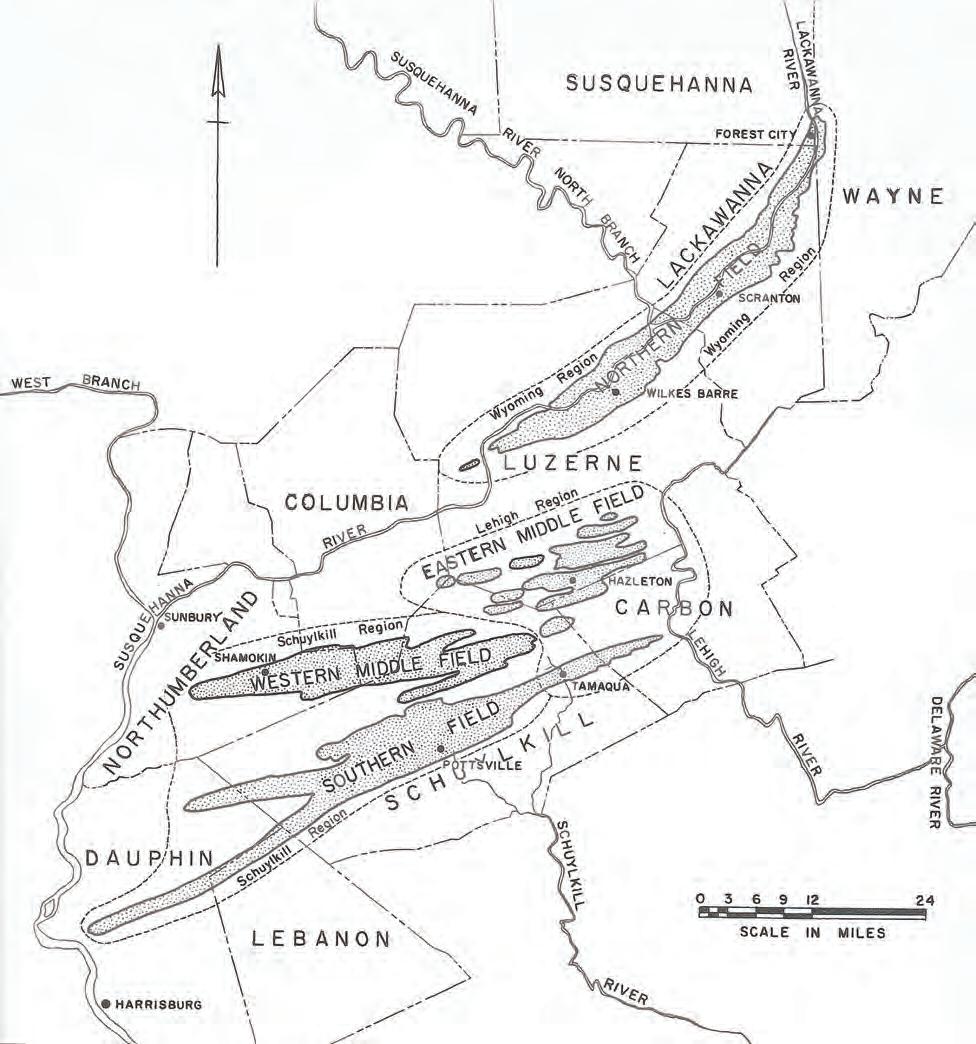
Coalfields of the Anthracite Producing Region of Pennsylvania. Map. Published in Anthracite Industry Survey, Mining Methods, Research, Preparation, Project No. CR-68 for the Coal Research Board, Department of Mines and Mineral Industries, Commonwealth of Pennsylvania. June 30, 1967. The Pierce Management Corporation. Mining and Management Engineers. Scranton, Pennsylvania. Figure 1. 12.
SUSQUEHANNA
Montrose
WAYNE
Carbondale
Clarks
Honesdale
Olyphant
LACKAWANNA
Scranton
Kingston
Plymouth
COLUMBIA
Bloomsburg
Susquehanna R.
Sunbury
NORTHUMBERLAND
SCHUYLKILL
DAUPHIN
Pittston
Wilkes-Barre
Freeland
Hazleton
LUZERNE
Mahanoy City
Shenandoah
CARBON
Lehighton
Mauch Chunk
Lansford
Pottsville
Schuylkill Haven
Harrisburg
Map of the Anthracite Coal Regions of Northeastern Pennsylvania Showing Selected Mining Towns.
Towns/Cities
In the eighteenth century, the bucolic Lackawanna and Wyoming Valleys and the elevated wooded terrain to the south and east (named Towamensing or “wild place” by the Native Americans and “St. Anthony’s Wilderness,” reportedly by Moravian missionary leader Count Nicholas Ludwig von Zinzendorf in 1742) had been a hunting ground for indigenous peoples. They had traveled throughout the area for the past 10,000 years.10 Parts of the region were occupied by the Lenape and Susquehannock peoples. The Report of the Department of Mines of Pennsylvania (1908) stated that Native Americans clearly knew of the existence of anthracite. In 1766, for example, “Indians from this locality visiting the Governor of Pennsylvania, complained of robbing of mine by whites, believed to be a coal mine.”11
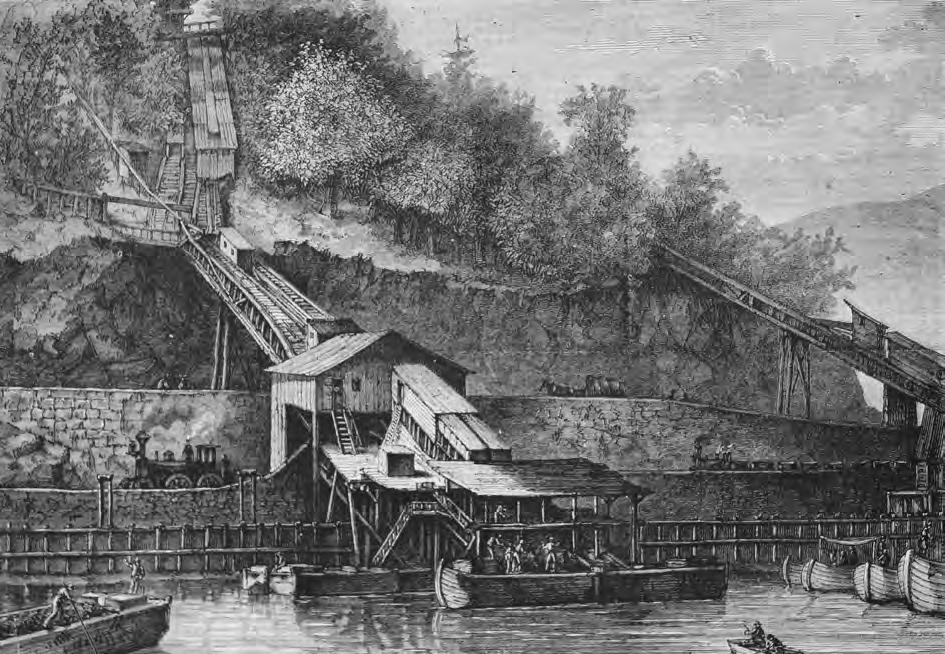
Early pioneers to the region, familiar with the experience of burning coal in Great Britain and Europe, began attempts to mine, use, and sell anthracite. Mapping of anthracite or “stone coal” at present day Edwardsville in 1768 was done by Charles Stewart.12 “The first use of anthracite was by the Gore Brothers in their blacksmith shop at Wilkes-Barre in 1769.”13 Additionally, in 1775, “coal was mined on the banks of the Susquehanna (river) near Pittston.”14 Anthracite was used as fuel for the production of military materials during the Revolutionary War.15 Philip Ginter (or Ginder) is credited with having “discovered” anthracite in 1791 on Sharp Mountain, not far from Summit Hill, and brought this to the attention of Colonel Jacob Weiss. Weiss and others then formed the first anthracite company—the Lehigh Coal Mine Company, in 1792.16 As historian Lance E. Metz has noted, the quarrying of anthracite and its transportation on the Lehigh River “was a direct catalyst of the advent of the Industrial Revolution in the United States. For the first time a much-needed alternative fuel became available to the cities of the Atlantic coast, diminishing their growing dependency on increasingly scarce and expensive supplies of wood and charcoal.”17
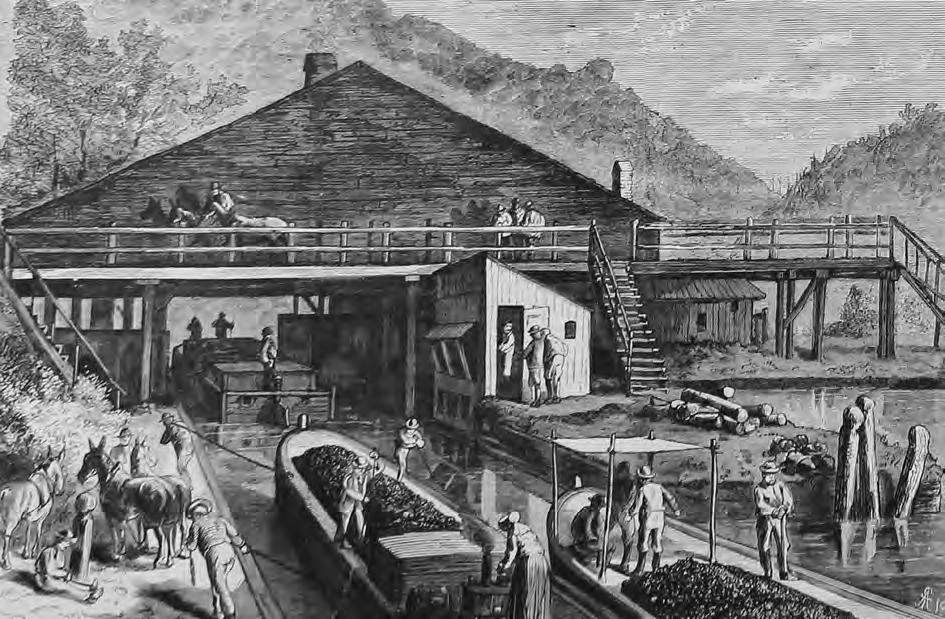
The War of 1812 (1812-1814) and the British naval blockade of Virginia and British bituminous coal created a fuel crisis that encouraged an increased trade in anthracite and the further development of its transportation.18 This reality inspired others, among them anthracite pioneers William and Maurice Wurts, to establish the Delaware and Hudson Canal Company and the Carbondale and Honesdale Gravity Railroad, as well as the first underground anthracite mine in Carbondale.19
Burton W. Folsom, Jr., has argued that: “In fact, America’s Industrial Revolution in coal and iron began in Pennsylvania— at Scranton in the Lackawanna Valley.”20 However, credit must also be given to communities such as Valley Furnace, near New Philadelphia, Schuylkill County, as well as Catasauqua, Lehigh County, where Welsh immigrant David Thomas established “the first long-term, commercially successful anthracite iron furnace in the United States” on July 4, 1840; and Danville, Montour County, for the rolling of the first iron “T” rails in 1845 for railroad use.21
During the nineteenth and early-twentieth century, immigrants from Germany, the British Isles, Eastern and Southern Europe and Russia came to the region to live and find work.22 The anthracite region of Northeastern Pennsylvania is a microcosm of American immigration and ethnic history. This includes, but is not limited to: Afro-Americans, Assyrians, Austrians, Bulgarians, Canadians, Carpatho-Rusyns, Croats, Czechs, English, French, Georgians, Germans, Greeks, Hispanics, Hungarians, Irish, Italians, Lebanese, Lithuanians, Magyars, Montenegrins, Poles, Russians, Ruthenians, Scots, Slovaks, Slovenians, Swedes, Swiss, Tyrolians, Ukrainians, and Welsh.
Churches and fraternal groups were essential to immigrant and ethnic life in the anthracite region of Northeastern Pennsylvania. “The church, not the mine site, was the soul and center of the ethnic community.”23 Protestant denominations include: Baptist, Congregational, Episcopal, Lutheran, Methodist, Presbyterian, Reformed, and United Evangelical. Roman Catholic ethnic parishes of Germans, Irish, Italians, Lebanese, Lithuanians, Magyars, Poles, Slovaks, Slovenians, Tyrolians and Ukrainians were established.24 There were also Greek-Catholic and Byzantine-Rite churches, as well as Orthodox and Russian Orthodox churches. Fraternal societies were “mutual brotherhoods” and helped to build churches, convents and schools. They served as social, cultural, linguistic, patriotic and spiritual focal points of ethnic communities.25 The Polish National Catholic Church was formed in Scranton in 1897 and, today, has over 100 congregations in the United States and Canada.26 Jewish congregations are also found throughout the region.
Mine work was difficult and dangerous. Workers were injured and killed by falls of coal or rock; accidents involving equipment, machinery and mine cars; asphyxiation and explosions of gases, black powder or dynamite; fires and floods. Research shows that between 1870 and 1993, some 30,905 mine workers lost their lives in the anthracite region.27 Immigrant mine workers from the British Isles in Jermyn, Pennsylvania, and Dr. Matthew J. Shields, worked to establish a “First Aid to the Injured” class in 1899. This grew into the Red Cross Plan for Industrial First Aid in America.28 Workers also suffered from pneumoconiosis or “black lung” disease from the coal dust that they had inhaled.
During the nineteenth century mine workers attempted to organize into labor unions to gain wage increases and promote safety. Some of these efforts included the Workingmen’s Benevolent Association, the Knights of Labor, and the
Miners and Laborers Amalgamated Association. The Workingmen’s Benevolent Association was interested in early Pennsylvania state mine safety legislation. This concern arose from the Avondale Mine Disaster of 1869, the largest in the history of anthracite, with the loss of 110 men and boys near Plymouth, Luzerne County.
“Between June 1877 and December 1878, twenty men were hanged for a variety of murders and other crimes committed since 1862 in Schuylkill and Carbon Counties.”29 Corporate officials saw this violence as part of “organized labor radicalism” by Irish Catholic mine workers or “Molly Maguires.”30 Therefore, in the nineteenth century, no regional union was able to unite all anthracite mine workers into one membership.
In 1890, a national miners union, the United Mine Workers of America (UMWA) was formed. Organizers began to recruit members in the anthracite region of Northeastern Pennsylvania. On September 10, 1897, a sheriff’s posse in Lattimer, not far from Hazleton, opened rifle fire on striking immigrant mine workers, killing 19 and wounding 36. “The shock of the Lattimer Massacre compelled members of all ethnic groups to join the United Mine Workers.”31
The UMWA Anthracite Coal Strikes of 1900 and 1902 were “among the longest in U.S. history” and introduced a new policy of unbiased federal intervention in labor disputes, for the good of public interest, through the efforts of President Theodore Roosevelt.32 The origins of the Pennsylvania State Police have their roots “in response to concern over labor and capital unrest, especially the anthracite coal strike of 1902.”33 Prior to the formation of the Pennsylvania State Police units from the Pennsylvania National Guard were called into service.
From 1902 to 1920, railroads dominated the lucrative anthracite trade as independent coal operators declined. World War I gave the anthracite industry its greatest employment of men and boys throughout the region (over 180,000 in 1914) and a peak production in 1917 of over 100 million tons of anthracite.34 However, the 1920s and 1930s represented hard times for hard coal. Competition from bituminous coal, coke, and convenience fuels such as heating oil, gas and electricity eroded the market for anthracite, as did the labor strikes of 1920, 1922, 1923, and 1925-1926. Additionally, coal operators began to mechanize the industry and introduced more strip or surface mines which put underground miners out of work.
In some parts of the region, this ushered in a period of bootleg or independent mining in which desperate workers and their family members tried to make a living by digging coal from land that mining companies owned, but had abandoned. It is interesting to note that the Independent Miners and Associates (IMA) grew out of the bootleg mining era after World War II as companies leased or sold their coal lands. For the last eight decades the IMA has promoted advocacy for small business, independent mining families, and groups.35
Some mine workers looked to a new union, the United Anthracite Miners of Pennsylvania, rather than the traditional United Mine Workers of America, to meet their needs, or to the equalization of available work for all, as responses to the decline of the anthracite industry. However, these efforts failed.36 As mine workers lost their jobs, or worked reduced hours, their wives became the wage earners of the family as garment or needle workers in apparel and clothing factories.37
World War II brought some work to the anthracite industry. Fuel oil and gas were critical for the war effort. Industry needed, and the home front was encouraged, to use anthracite coal. Following the war, the anthracite industry declined rapidly and Northeastern Pennsylvania became one of the most economically depressed areas in the United States.38 While many residents accepted whatever work was available, others left the region permanently. Some were commuters returning home whenever possible. Jobs were found elsewhere in Pennsylvania, such as Philadelphia, and in New Jersey, New York, Maryland, Connecticut, Delaware and Washington, D.C.
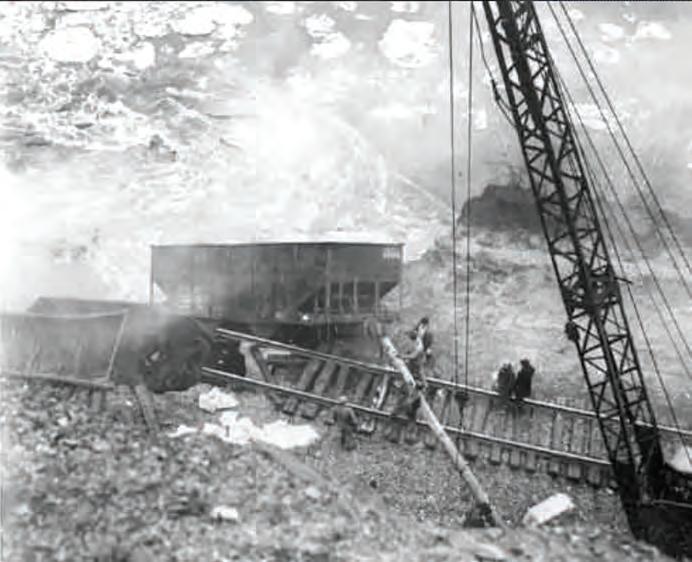
The decline of anthracite mining was further exacerbated by the Knox Mine Disaster. On January 22, 1959, the Susquehanna River broke into the mine slope, flooding the mine workings, killing 12 workers and ending mining in the Wyoming Valley of Luzerne County. In “the 1950s through the 1970s, the [local], state and federal government played a crucial role in diversifying the economy and rejuvenating the region’s opportunities for the good of the people.”39
Today, the United States ranks fourth among the top five coal producing nations in the world, with the state of Wyoming as a leader. China, India, Indonesia and Australia also contribute greatly to global coal production—primarily bituminous.40 However, natural gas, nuclear energy, and oil, in particular, continue to dominate as energy sources.41 In 2023, the Pennsylvania anthracite industry produced 2,847,000 tons with 974 workers.42 This is used in household applications, primarily as a component of charcoal briquettes for cooking and coal for space heating. Industrial uses include making steel, filtering water, landscape mulch, heat and power generation in specialized plants (such as glassmaking and sugar production), and metallurgy. Other global producers of anthracite include: Russia, China, Poland, Ukraine, Vietnam, North Korea and Canada.43
Cultural tourism is an important part of the anthracite region today. For example, in 2025, the Pennsylvania Anthracite Heritage Museum celebrates its fiftieth year as the largest history museum in the region. As Professor Harold Aurand has
observed: “This is truly a people’s museum; it interprets the heritage of a people through materials the people themselves [donated and] considered important reflections of their lives.”44 The museum interprets the culture and history of the anthracite region of Northeastern Pennsylvania. This is done with the knowledge that “members of various communities deeply invested themselves in promoting the histories of their hometowns. The public narratives they are fashioning emphasize the heroic contributions of anthracite miners to the nation’s development and the vibrant communities that the miners and their families established and sustained.”45
In fact, the historical memories of the anthracite region that residents have provided present “a positive vision of the history of anthracite coal mining and the region. They emphasize the strength and character of area residents in the face of hardships rather than the hardships themselves.”46 The loss of jobs with the decline of anthracite as a fuel in the twentieth century; the deaths, injuries, and “black lung” disease associated with mine work; and the scars left on and in the land by the industry have not defined the people of Northeastern Pennsylvania. Rather, they have “constructed historical memory [that] serves a protective function for anthracite residents. Their construction of the region’s history has permitted them to maintain a sense of purpose in the face of catastrophic loss…their history and strong sense of place make their lives personally rich and meaningful….”47
Richard G. Healey in his book The Pennsylvania Anthracite Coal Industry 1860-1902: Economic Cycles, Business DecisionMaking and Regional Dynamics (2007) presents an excellent summary of the industry for our consideration as we reflect on the historical significance of the region:
There can be few sagas of regional economic development where such rapid growth and such high levels of investment were concentrated into such a restricted area of geographic space. Hundreds of thousands of men and their families were to participate in the industry and its mining communities. The product would be shipped across a large portion of the United States and even abroad, competing with declining success in industrial markets against other coals and cokes, but remaining pre-eminent as a domestic fuel of choice, wherever it was distributed. And in the process, there developed one of the world’s most unique and abidingly fascinating regional industrial landscapes.48
The exhibition The Anthracite Coal Industry of Northeastern Pennsylvania. Selected Paintings, Sculptures, and Works on Paper from Public and Private Collections: 1829-1959 considers this history as presented in the visual arts.
Pennsylvania Historical and Museum Commission
Founded in 1854, Eckley Miners’ Village is an excellent example of a coal company “patch” town that provided housing to anthracite mine workers and their families on the colliery property. Photograph by Chester Kulesa.
The
Eckley Miners’ Village. Eckley, Pennsylvania.
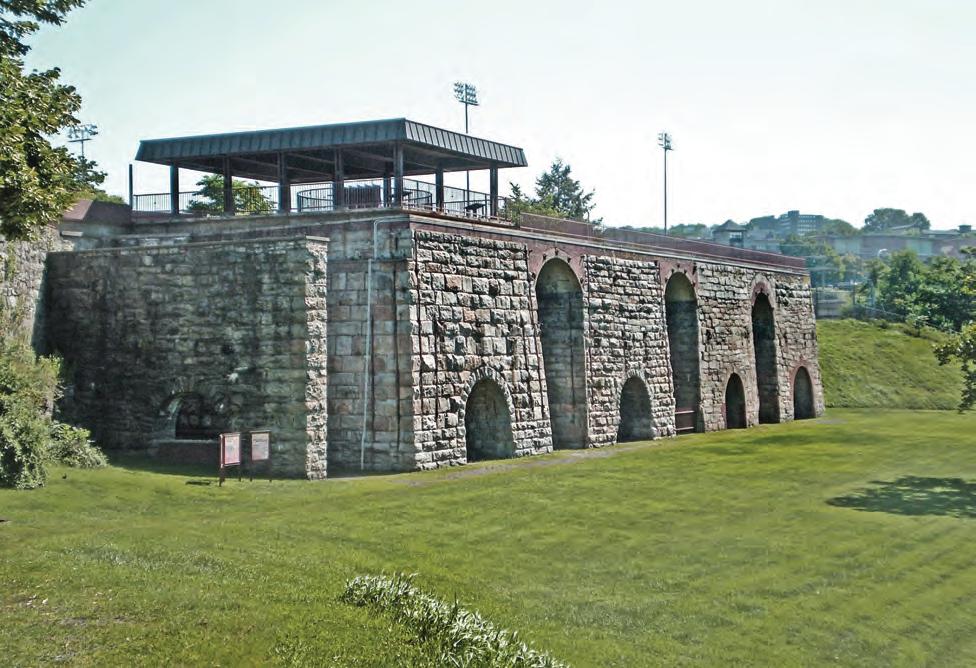
The Pennsylvania Historical and Museum Commission Scranton Iron Furnaces. Scranton, Pennsylvania. The Scranton Iron Furnaces preserve the four stone blast furnaces built between 1848 and 1857 by the Lackawanna Coal and Iron Company. Fueled by anthracite, these furnaces produced iron that was rolled into “T” rails. Photograph by Chester Kulesa.
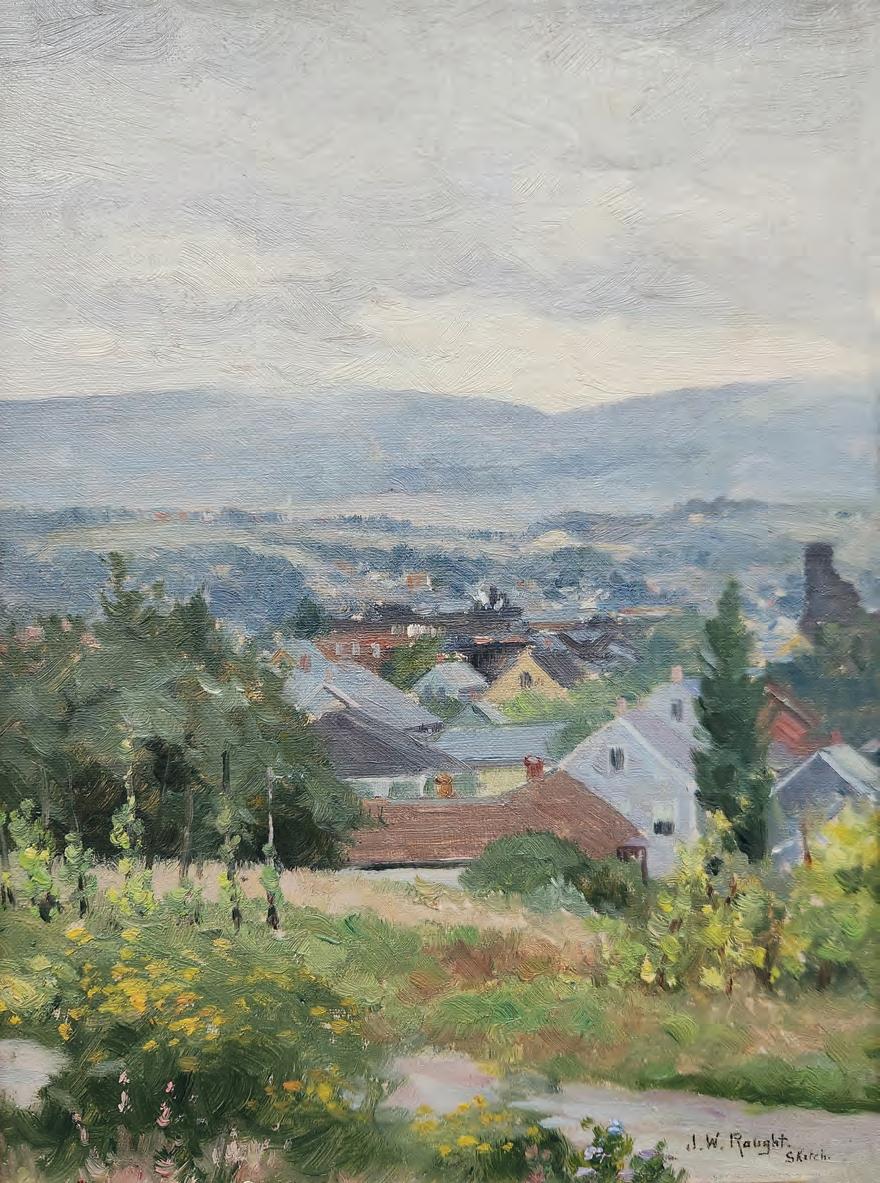
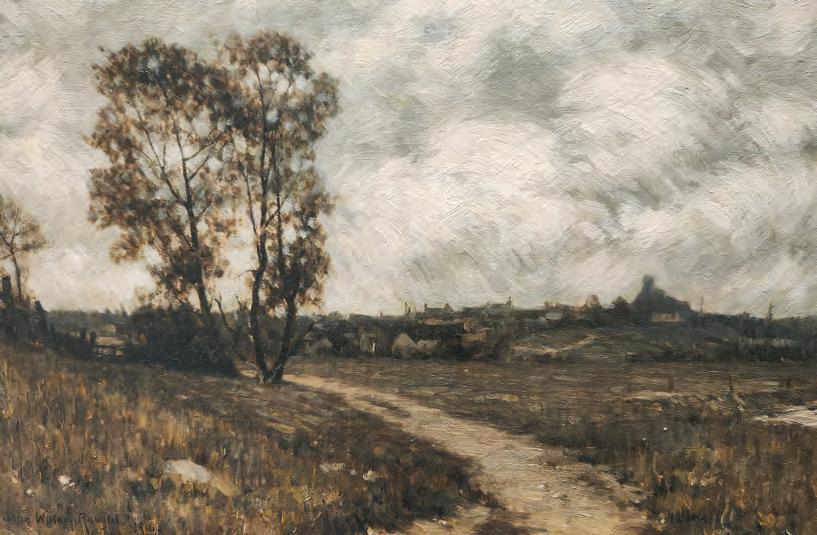
John Willard Raught (1857-1931). View of Scranton, Pennsylvania. Oil on canvas panel. c. 1920. The Stanislaus Collection. Scranton, Pennsylvania.
The
Anthracite Coal Industry of Northeastern Pennsylvania Selected Representations in Art: 1829-1959
Richard
Stanislaus and Darlene Miller-Lanning
Introduction
What is anthracite? In geological terms, anthracite is a rock. This is unremarkable: there are many kinds of rock. Yet the special qualities of anthracite, as well as its occurrence in the ridge-and-valley system of the Appalachian Mountains in Northeastern Pennsylvania, positioned it to become a catalyst for development in the United States. Anthracite is a metamorphic variety of coal, first formed of vegetal sediments later compressed during the mountain-building phases of distant time. Characterized by an iron-black color and sub-metallic luster, anthracite “hard coal” does not soil the fingers as bituminous “soft-coal” does. Once ignited, it slowly burns with a short blue flame, emits little odor or smoke, and requires minimal effort to sustain combustion. During the nineteenth century, anthracite attracted attention as a reliable energy source for heating, manufacturing, and transportation. Central to a growing network of investors, workers, and consumers, anthracite fueled debates about the relationships of nature to industry; community to commerce; politics to morality; and history to culture. Concurrent with this exchange of ideas during its active development and ultimate decline, the anthracite coal industry of Northeastern Pennsylvania inspired a rich legacy of artistic creativity embodied in paintings, sculptures, and works on paper produced over a span of 130 years. Visual artists generated imagery that represented anthracite resources of landscape and labor; negotiated industrial practice as class and action; developed public perspectives through audience and sponsorship; and encoded cultural history as medium and message. Demonstrating visual beauty and technical expertise, these works bear witness to their creators’ keen powers of observation and professional mastery of skill, as well as the artists’ own sensitivity to the important and passing era of anthracite mining.1
Representing Anthracite Resources: Landscape and Labor
During the 1920s, artist John Willard Raught (1857-1931) produced the urban landscape painting View of Scranton, Pennsylvania (c. 1920). Born in the nearby community of Dunmore, Raught came of age with Scranton, a city whose fortunes followed the lifecycle of its anthracite industry. Witnessing the twentieth-century pinnacle of the region’s coal mining economy, Raught represented its benefits in a softly-colored scene of peaceful settlement. Painted en plein air, the oil on canvas panel reveals his connection to stylistic variants of American Romanticism and French Impressionism gained through studies at the National Academy of Art in New York City and the Académie Julian in Paris. Prior to attending art school, however, Raught worked as a telegrapher for the Pennsylvania Coal Company Gravity Railroad. He understood the industrial reality of Scranton, where thousands of working families linked to hundreds of mining operations fueled the growth of the United States.2 Still, figures are absent from Raught’s painting and the colliery shown at the right is subdued. A decade earlier, Raught had depicted individual collieries or “breakers,” the massive structures where coal was cracked and sized, in a series of dark, atmospheric works. Yet the painter sustained the illusion that even in severely compromised landscapes, nature and industry could coexist. Precedents for this approach were set by George Inness (1825-1894) in his painting of The Lackawanna Valley (c. 1855), which depicted a steam locomotive in a rural setting. Described by critic Leo Marx (1919-2022) as the impossible ideal of “the machine in the garden,” this pastoral tradition in American art endured for nearly a century.
Predating paintings by Raught and Inness, many early illustrations of the anthracite industry were motivated by scientific and technological interests. During the late-eighteenth and early-nineteenth centuries, mining operations developed near Mauch Chunk, Pennsylvania, along the Lehigh River. In 1820, entrepreneurs Josiah White and Erskine Hazard consolidated small enterprises in this mountainous region to form the Lehigh Coal and Navigation Company, a system of mines, canals, and railroads capable of extracting coal from the Wyoming and Lehigh Valleys and transporting it to Philadelphia. Responding to this development, artist George Lehman (c. 1800-1870) produced an early color aquatint view of the Coal Mine at Mauch Chunk (1829), which included detailed images of rail trestles and mine excavations in an open anthracite quarry. A lithographic version of the scene, reproduced in The American Journal of Science and Art (1830), was used to illustrate an essay by Professor
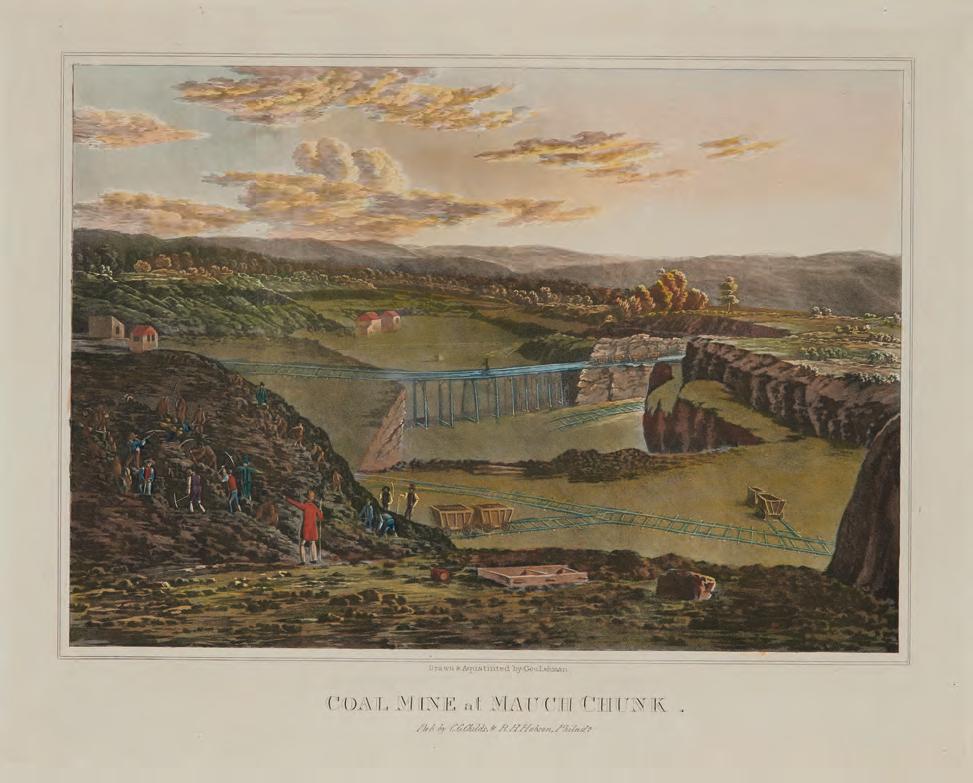
George Lehman (c. 1800-1870). Coal Mine at Mauch Chunk. Aquatint on paper. Published by C. G. Childs & R. H. Hobson. 1829. Partial gift and purchase from John C. O’Connor and Ralph M. Yeager. The Palmer Museum of Art. Pennsylvania State University. Main Campus. State College, Pennsylvania.
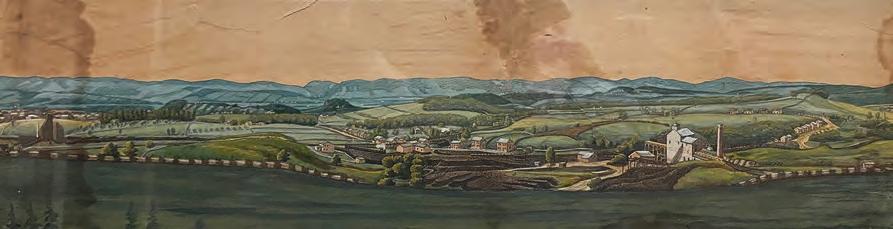
Unknown (dates unknown). The Wyoming Valley in 1850. Watercolor on paper. c. 1850. The Luzerne County Historical Society. Wilkes-Barre, Pennsylvania.
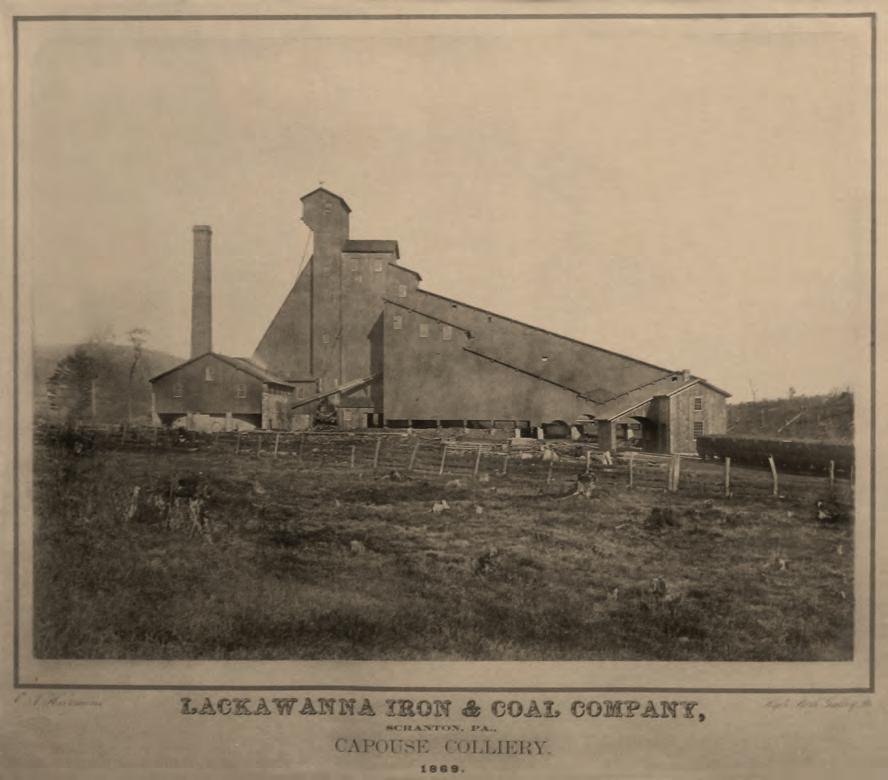
Eugene A. Heermans (1845-1910). The Lackawanna Iron & Coal Company. Scranton, Pennsylvania. Capouse Colliery. Albumen photograph on cardboard. 1869. The Lackawanna Historical Society. Scranton, Pennsylvania.
Unknown (dates unknown). Panoramic View of Scranton, Pennsylvania. Albumen photograph on cardboard. c. 1863. The Lackawanna Historical Society. Scranton, Pennsylvania.
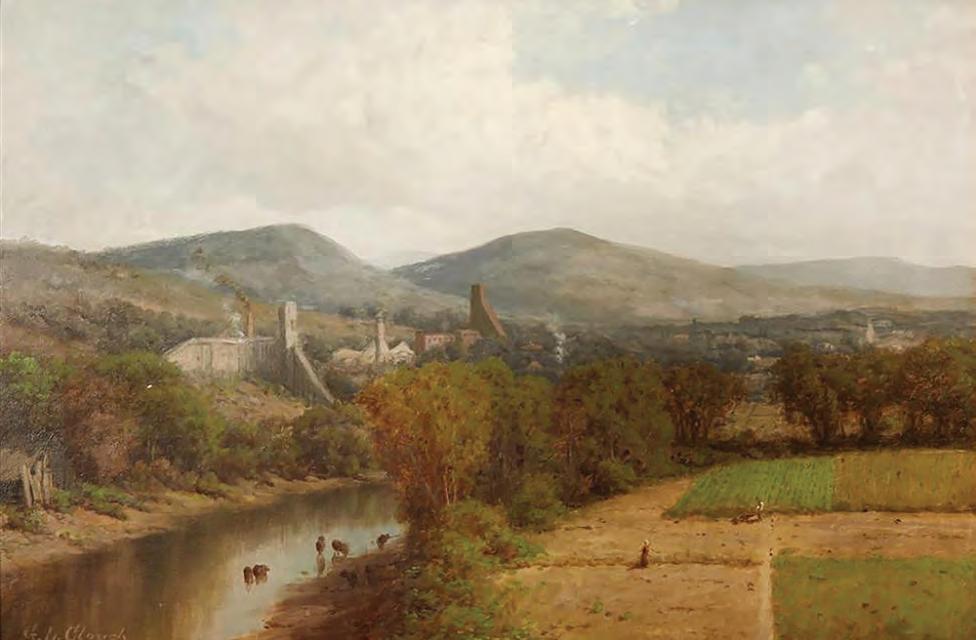
George Lafayette Clough (1824-1901). Coal Mines on the Susquehanna. Oil on canvas. c. 1870. The William Davis Collection. Bethesda, Maryland.
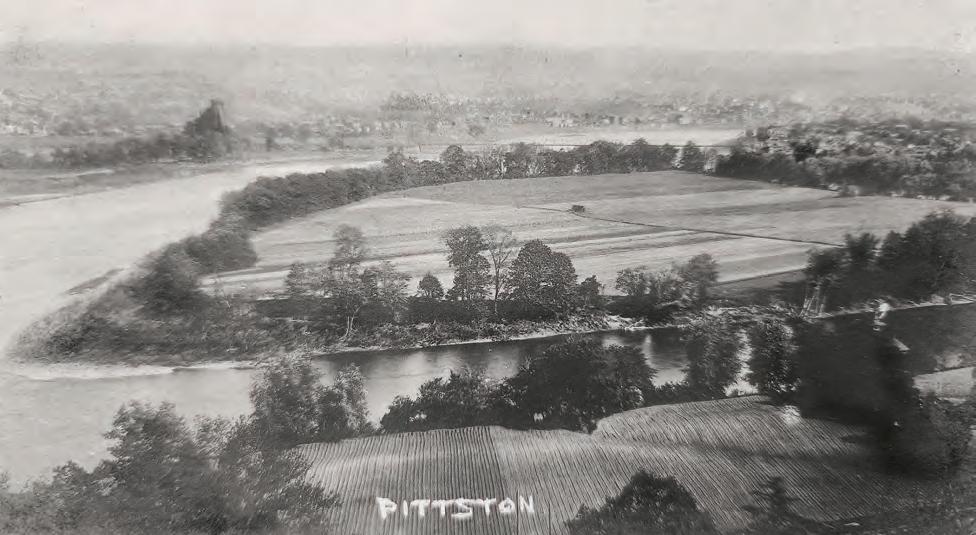
William James Harris (1868-1940). Pittston, Pennsylvania. Photographic postcard. Postmarked 1906. The Stanislaus Collection. Scranton, Pennsylvania.
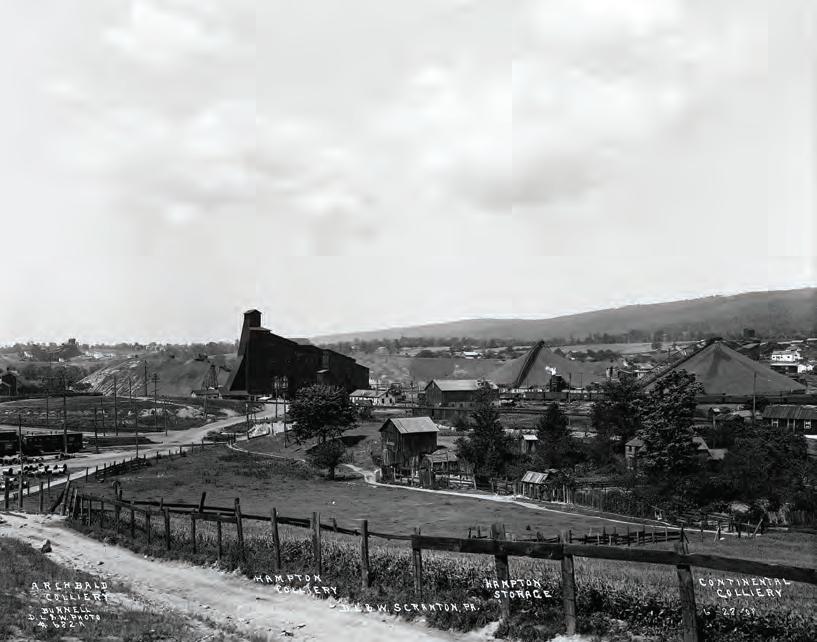
Watson B. Bunnell (1871-1950). View in Keyser Valley Showing the Archbald Colliery, Hampton Colliery, Hampton Storage, and Continental Colliery. Scranton, Pennsylvania. Digital photographic print on paper reproduced from glass plate negative. June 28, 1908. The Steamtown National Historic Site. Scranton, Pennsylvania.
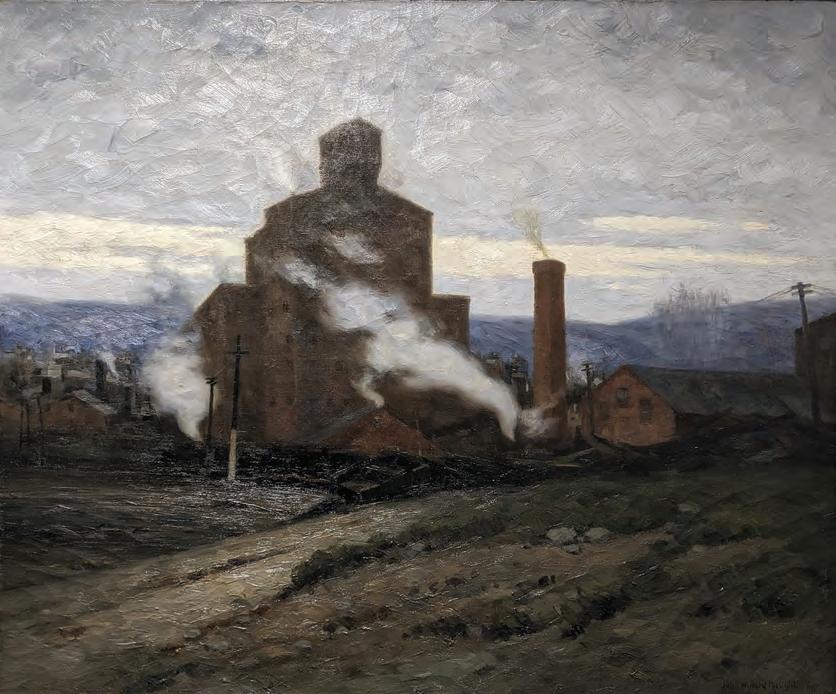
John Willard Raught (1857-1931). Scene Over Keyser Valley. Scranton, Pennsylvania. Oil on canvas. 1916. The Stanislaus Collection. Scranton, Pennsylvania.
Benjamin Silliman carefully describing these operations. Born in Switzerland, Lehman immigrated to the United States in 1824 and settled in Philadelphia. He exhibited landscape views at the Pennsylvania Academy of the Fine Arts by 1825, and worked as an assistant to John James Audubon (1785-1851) in Florida in 1831. After returning to Philadelphia, he produced engravings and lithographs with the printing firms of Childs and Lehman, as well as Lehman and Duval, from the 1830s through the 1850s, specializing in depictions of buildings and landmarks.3
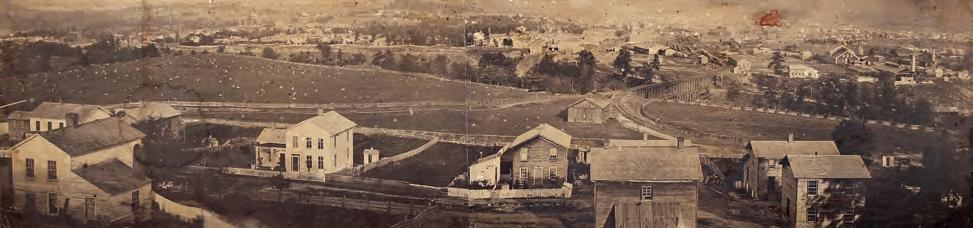
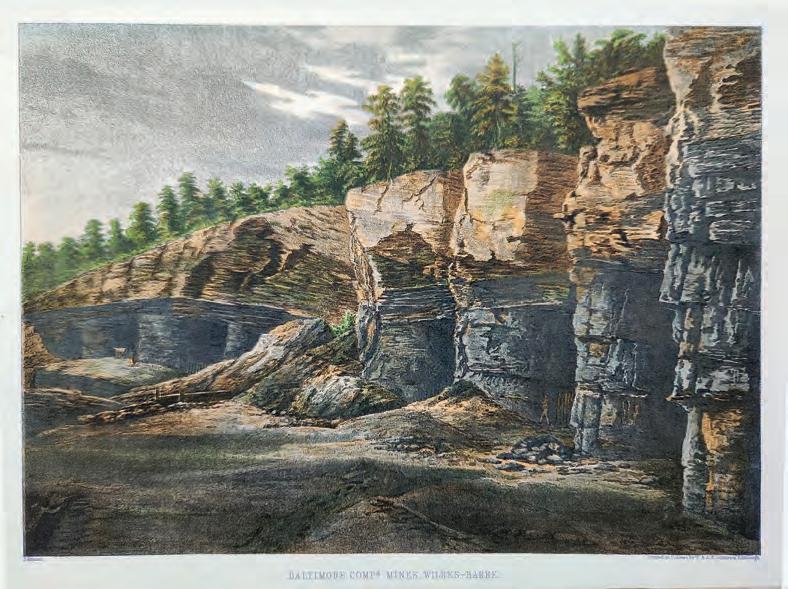
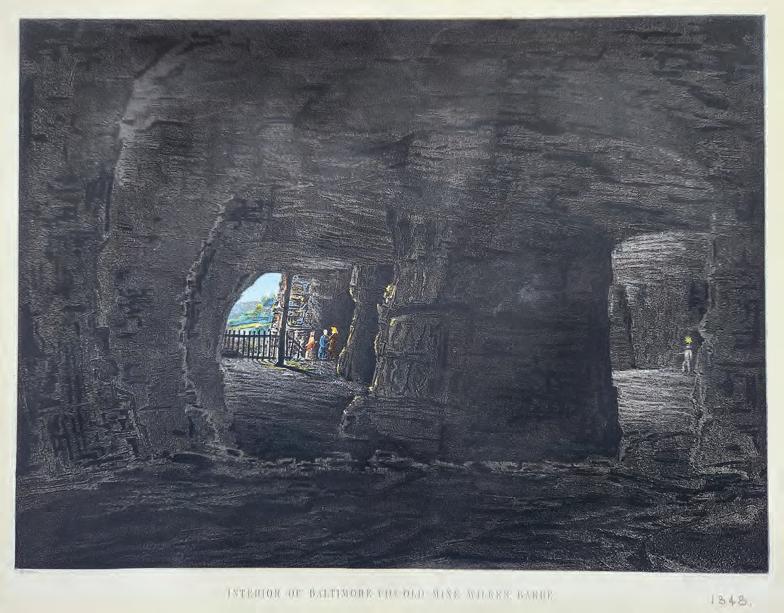
In 1840, Lehman traveled as a draftsman with state geologist Henry Darwin Rogers (1808-1866) through Schuylkill, Carbon, Luzerne, and Lackawanna counties. The results of this survey, published as part of The Geology of Pennsylvania (1858), included landscape views and geological diagrams by Lehman. Two color illustrations of the Baltimore Company’s Mines, Wilkesbarre (1858) and the Interior of Baltimore Company’s Old Mine, Wilkesbarre (1858), depict an early and extensive cave-like operation cut into the mountains east of the Susquehanna River.4 No miners are represented, but curious visitors are shown gathered in the massive, pierced spaces, described in Harper’s New Monthly Magazine (1857) as being over twentyfive feet high and worth crossing the Atlantic Ocean to visit.5 Similar to Lehman’s work in terms of style, subject, date, and location, a panoramic watercolor depicting The Wyoming Valley in 1850 (c. 1850) presents a view of Wilkes-Barre, Pennsylvania from a vantage point near the Baltimore Mine. Donated in 1910 to the Wyoming Historical and Geological Society by Philip J. Steinhauer (1853-1917), superintendent of the Black Diamond Breaker shown in the image, the piece bears an inscription by librarian Reverend Horace Edwin Hayden (1837-1917) noting it was found in debris of the old Delaware and Hudson Depot at Scranton in 1860. An attached list compiled by Steinhauer identifies sites in the image as the East End, Old Baltimore Breaker Number 4, School House, Baltimore Breaker Number 2, and the Lehigh and Susquehanna Railroad. During the 1830s, technological innovation transformed landscapes and broadened options available to artists representing them. Born in Philadelphia, Thomas H. Johnson (b. 1821) maintained a studio in Olean, New York, in 1860. About this time, he photographed thirty-two scenes along the Delaware and Hudson Canal between Rondout, New York, and Honesdale, Pennsylvania. Five large-scale albumen prints depicting the Lackawanna Iron and Coal Company might also have been produced during this period, as well as two panoramic views of Scranton taken from the vantage point chosen by Inness.6 In 1863, the Lackawanna Register announced that a new image, possibly the Panoramic View of Scranton, Pennsylvania (c. 1863), was available in Johnson’s studio.7 This harsh scene of raw railyards and clapboard houses belied the pastoral calm of the Inness painting, revealing instead the chaotic expansion of an industrial boomtown. When Johnson relocated, his efforts were taken up by Scranton photographer and physician Eugene A. Heermans (1845-1910). In 1869, the Pittston Gazette stated that Heermans had purchased studio equipment, including negatives by Johnson, to produce large-scale photographs.8 Adopting Johnson’s gilt borders, Heermans’ albumen print of The Lackawanna Iron and Coal Company. Scranton, Pennsylvania. Capouse Colliery (1869) documented this massive breaker. The son of a carpenter and lumber salesman, Heermans understood the colliery’s connection to natural resources: built of timber, it processed anthracite. While stylistic preferences in American art shifted from Romanticism to Impressionism, the distinction between idealized and literal imagery in paintings and photographs of anthracite landscapes remained. In 1859, George Lafayette Clough (1824-1901) produced the pendant oils on canvas View of the Lackawanna Valley (1859) and View of the Lackawanna Iron and Coal Company Furnaces (1859); two undated views of Coal Mines on the Susquehanna (c. 1860-1870) might also have been painted during this time. A native of Auburn, New York, Clough opened a studio there in 1844 and trained in Europe in 1850; associated with the Hudson River School, he exhibited at the National Academy of Design. While Clough’s reason for visiting the Wyoming and Lackawanna Valleys is unknown, artists recognized the region’s historical and aesthetic significance.9 Clough’s Susquehanna River views depict sites to the north and south of Campbell’s Ledge, a celebrated landmark rising at the intersection of the Lackawanna and Susquehanna Rivers near Pittston, Pennsylvania. By 1870, collieries and railroads were disrupting this natural landscape, yet Clough harmoniously embedded industrial structures within verdant depictions of the rocky cliff, placid river, and cultivated plain. In contrast, an early twentieth-century postcard of Pittston, Pennsylvania (c. 1906), distributed by West Pittston photographer William James Harris (1868-1940), revealed the continued expansion of anthracite operations in the valley, as well as visitors’ popular interest in them.
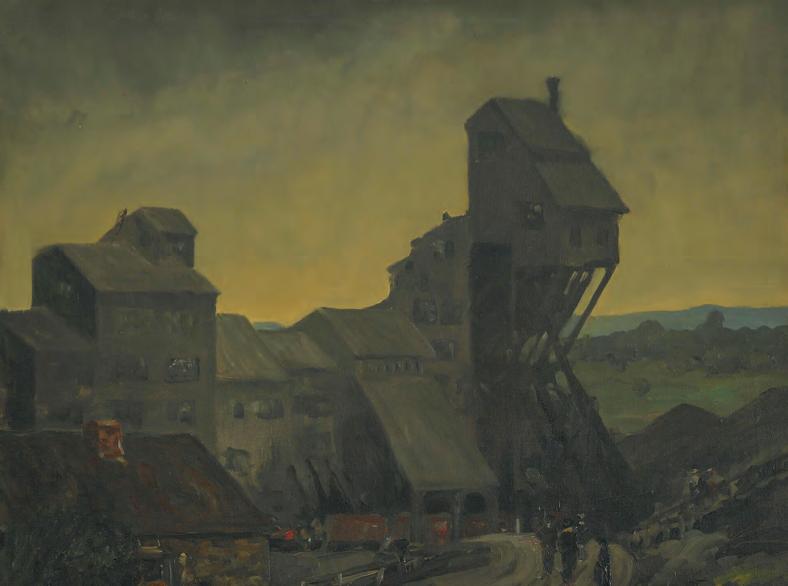
Another comparison can be made between a closely dated photograph and painting of an anthracite landscape in Scranton. As photographer for the Delaware, Lackawanna and Western Railroad, Scranton native Watson B. Bunnell (1871-1950) documented company interests in works like View in Keyser Valley Showing the Archbald Colliery, Hampton Colliery, Hampton Storage, and Continental Colliery. Scranton, Pennsylvania (1908). Originally printed from a glass-plate negative, this meticulously focused and labeled image recorded the Hampton Colliery and nearby facilities.10 Eight years later, Raught produced Scene Over Keyser Valley. Scranton, Pennsylvania (1916), an oil painting based on the same location.
George Lehman (c. 1800-1870). Baltimore Company’s Mines, Wilkesbarre.
Print illustration on paper. Published in Henry Darwin Rogers. The Geology of Pennsylvania. A Government Survey. Volume II. Philadelphia: J. B. Lippincott. 1858. Frontispiece. The Stanislaus Collection. Scranton, Pennsylvania.
George Lehman (c. 1800-1870). Interior of Baltimore Company’s Old Mine, Wilkesbarre.
Print illustration on paper. Published in Henry Darwin Rogers. The Geology of Pennsylvania. A Government Survey. Volume II. Philadelphia: J. B. Lippincott. 1858. 382. The Stanislaus Collection. Scranton, Pennsylvania.
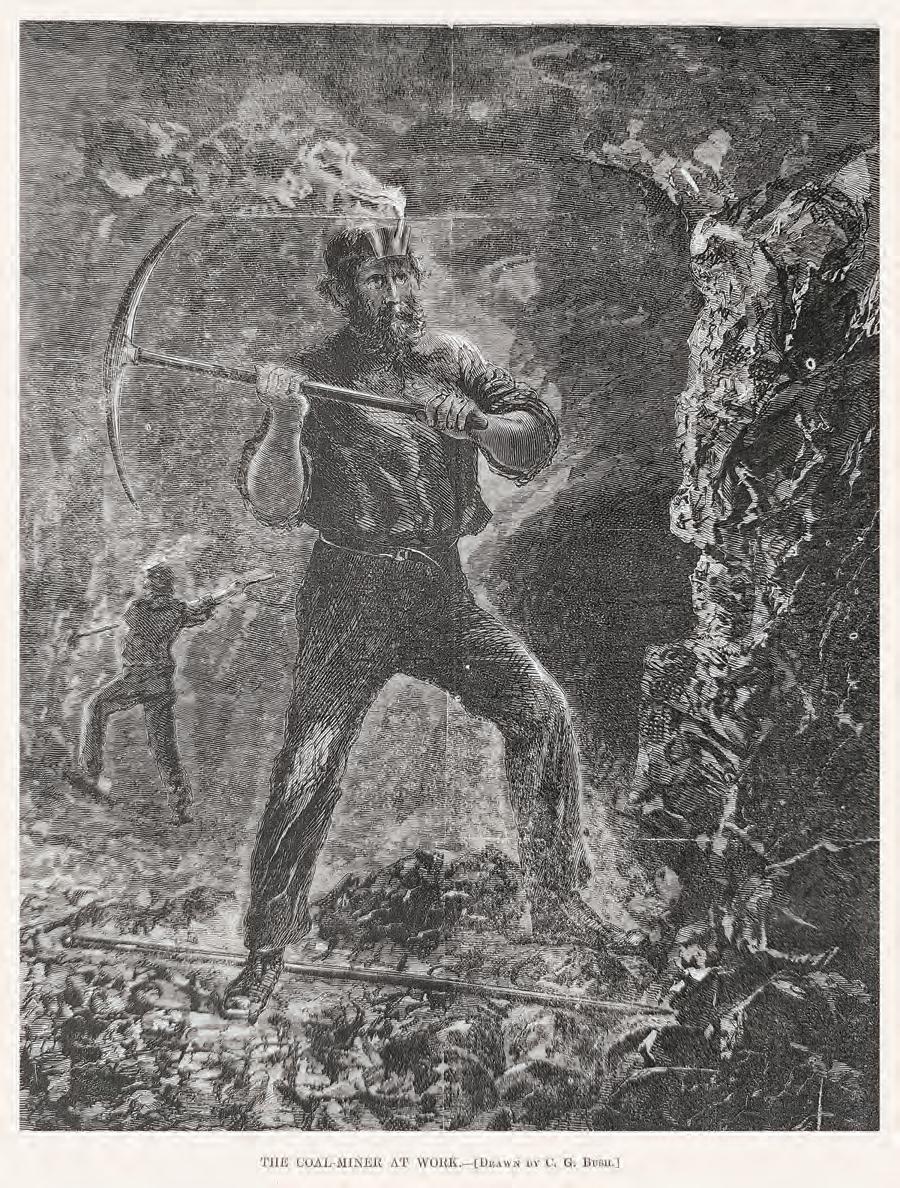
Charles Green Bush (1842-1909). The Coal-Miner at Work. Wood engraving on paper. Published in Harper’s Weekly. New York. Saturday, December 14, 1867. Vol. XI-No. 572. 788. The Stanislaus Collection. Scranton, Pennsylvania.
Despite its later date, the image is rooted in earlier aesthetic traditions, where a mysterious sense of atmosphere was deemed more desirable than a recognizable representation of structures. Raught noted he had seen collieries “at twilight when the coming shadows of night” threw “enchantment over the land,” transforming them “into exquisite poems of black and gray.”11 Executed with heavy impasto, a cloudy gray sky dominates the composition. Rising above the horizon is the outline of a breaker resembling the Hampton Colliery. In referencing past traditions, Raught anticipated future trends: painted on the eve of America’s entrance into World War I, the Scene Over Keyser Valley. Scranton, Pennsylvania presented a nostalgic view not only of a mediated landscape, but of an industry that was itself facing modernization.
While nineteenth-century investors in the anthracite industry utilized survey drawings and documentary photographs to inform and record their expanding operations, public consumers of newly-marketed anthracite products were also interested in visual representations of mining practices and events. Coinciding with the expansion of printing and publishing technologies, this popular curiosity was soon addressed in national illustrated periodicals including Harper’s Weekly and Frank Leslie’s Illustrated Newspaper. Both companies employed staff artists to make on-site sketches of intriguing people, places, and things, which were then transferred to printing blocks in art departments and published as wood engravings in widely-circulated periodicals. Just as scenes of anthracite landscapes in painting indicated discrepancies between concepts of pristine nature and industrial progress, depictions of mining subjects in popular illustrations revealed tensions between ideals of productive work and fears of labor conflict. Mining was a profitable yet dangerous process, and miners possessing the mental and physical strength for hard manual work were also capable of demanding better employment conditions and higher pay. Perceptions of these issues by artists, authors, and audiences varied, and were determined at least in part by whether individuals lived and worked within or beyond the anthracite regions.
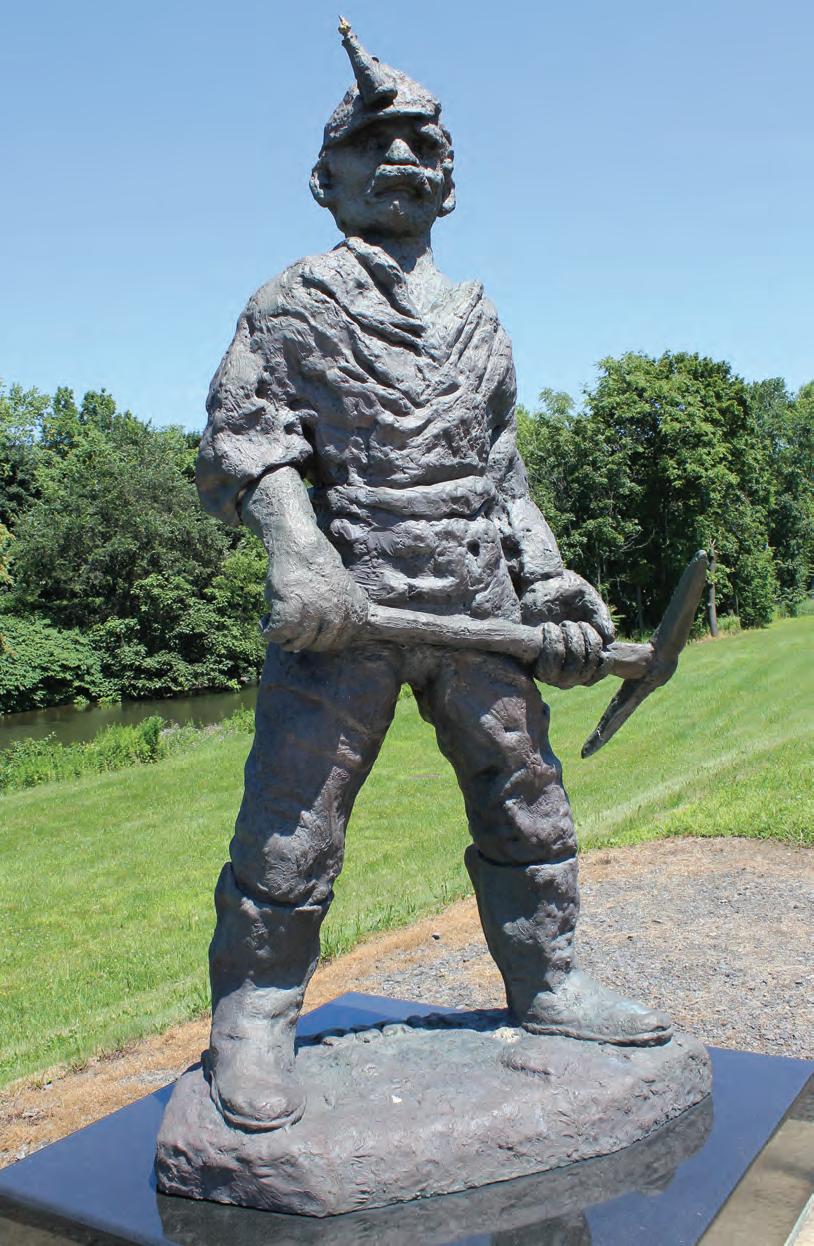
Born in Boston, Charles Green Bush (1842-1909) represented contradictions of anthracite labor in a Harper’s Weekly illustration of The Coal-Miner at Work (1867).12 Published with an article discussing the production and sale of coal at state, national, and international levels, the image was accompanied by a scene of coal boats on the Delaware and Hudson Canal. The miner depicted is not identified in relation to any company or location, but is a personification of his own intensive activity. Echoing the folkloric figure of the kobold, the miner is shown as a powerful primal manikin, compressed and animated by the latent geological energy of the earth itself. Dark and burly, he wears an oil-burning lamp on his forehead. Dimly lit, his bearded features are wreathed in smoke and revealed by flame. He strikes the coal with his pickaxe, carving a void that resounds with knocking towards the distant surface and into the subterranean deep. His work produces fuel that heats homes and powers progress for the benefit of civilization. Yet the miner, like the kobold, can harbor malevolent force. He should not yet must be trusted with the strength that he wields.
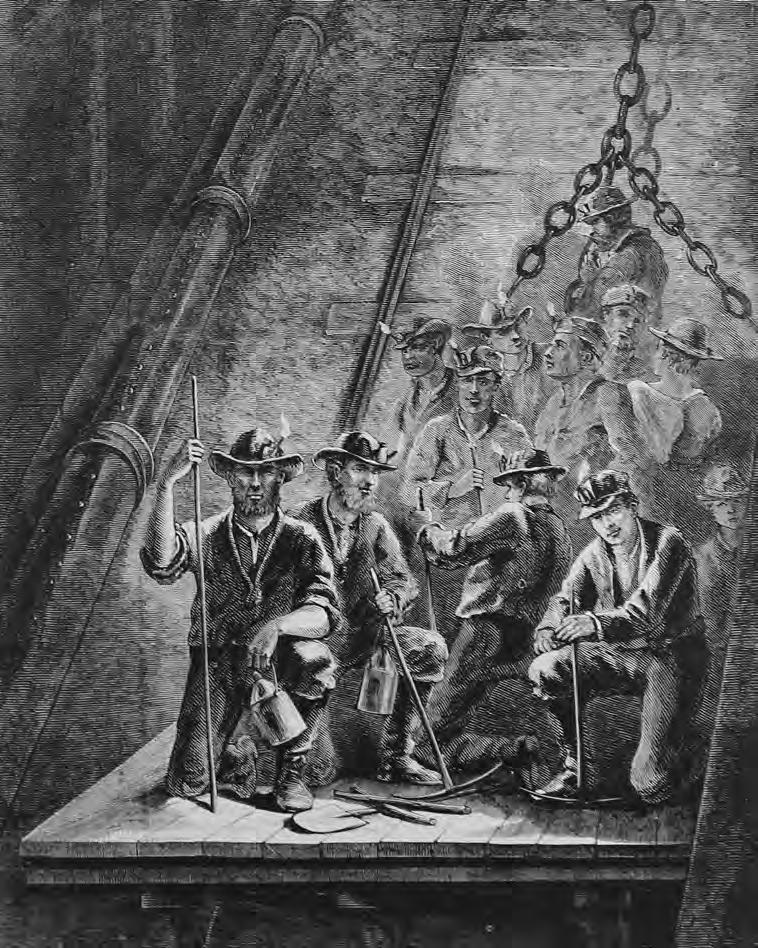
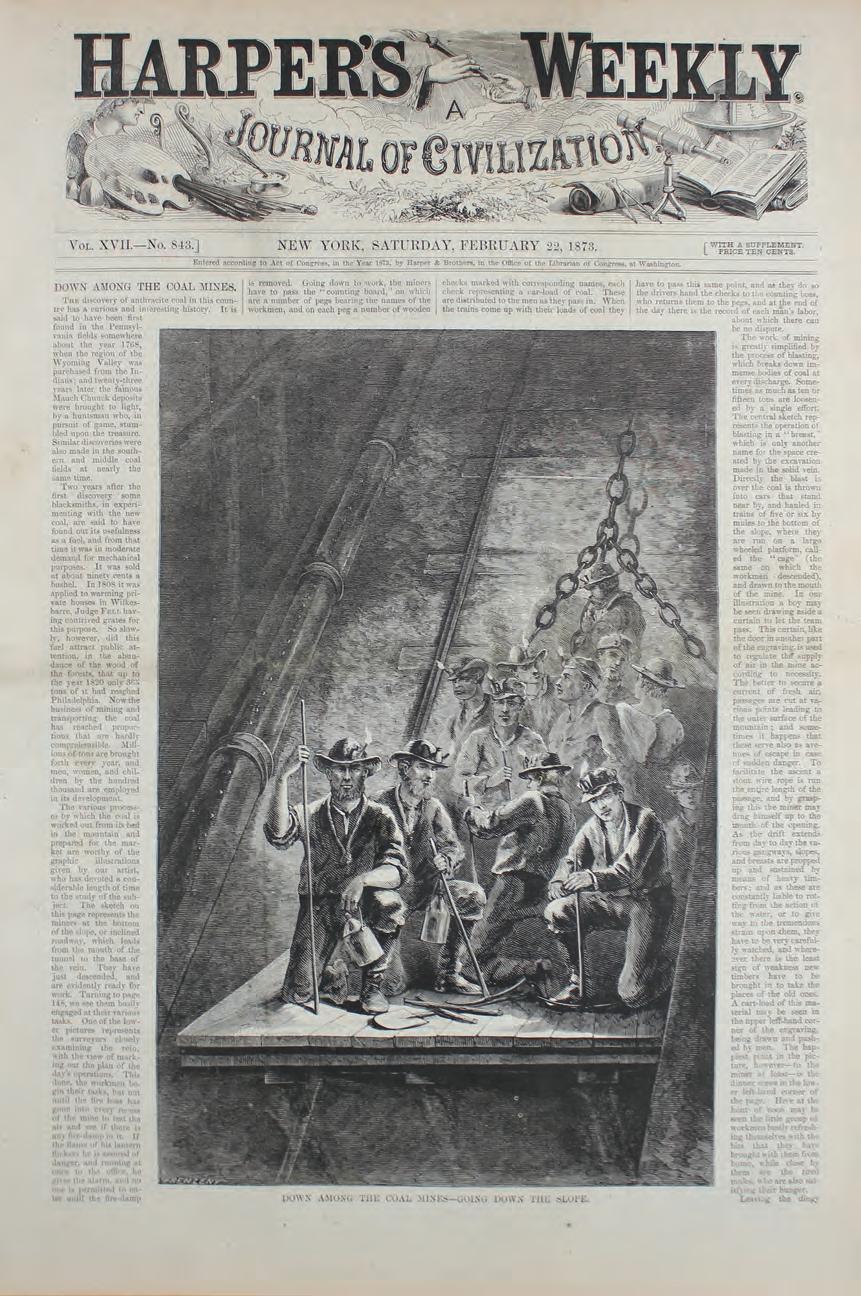
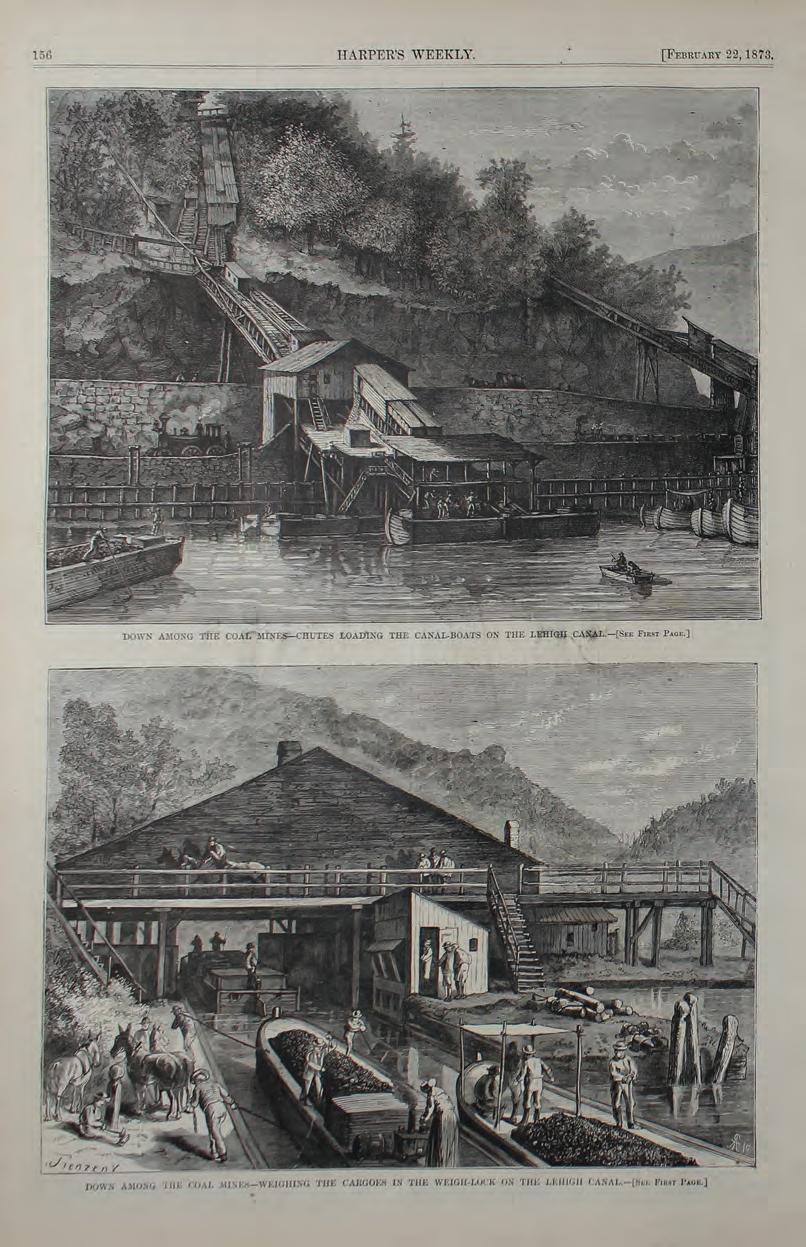
A more reassuring report, illustrated by Paul Frenzeny (c. 1840-1902) and published by Harper’s Weekly in 1873, framed mining as a dramatic but methodical enterprise. Trained as an artist in New York City after serving in the French army in Mexico, Frenzeny established a career with Harper’s Magazine in the 1870s.13 Scenes from Down Among the Coal Mines (1873) attest to the journal’s thorough coverage of the anthracite industry, as well as its engaging approach to publicizing it. Utilizing sublime contrasts of light to dark and high to low, the illustrations document specific mining and transportation operations along the Lehigh Canal, located near the Mauch Chunk mines represented by Lehman. In a vertical full-page cover image, an illuminated group of stalwart miners, several firmly balanced on single bended knees, descend into darkness on a wooden platform, lowered with iron chains past angled pipes along steep rails. An interior fullpage illustration presents a horizontal grouping of vignettes from inside the mine, including a timber cart, coal train, counting board, door tender, blasting site, fire boss, lunch break, mine surveyor, and air hole. Other half-page scenes, populated by small, industrious figures of men, women, and mules, depict mountain and canal views with cargo boats, coal chutes, and weigh locks. The article favorably concluded that hard-working miners’ pay was well-deserved.
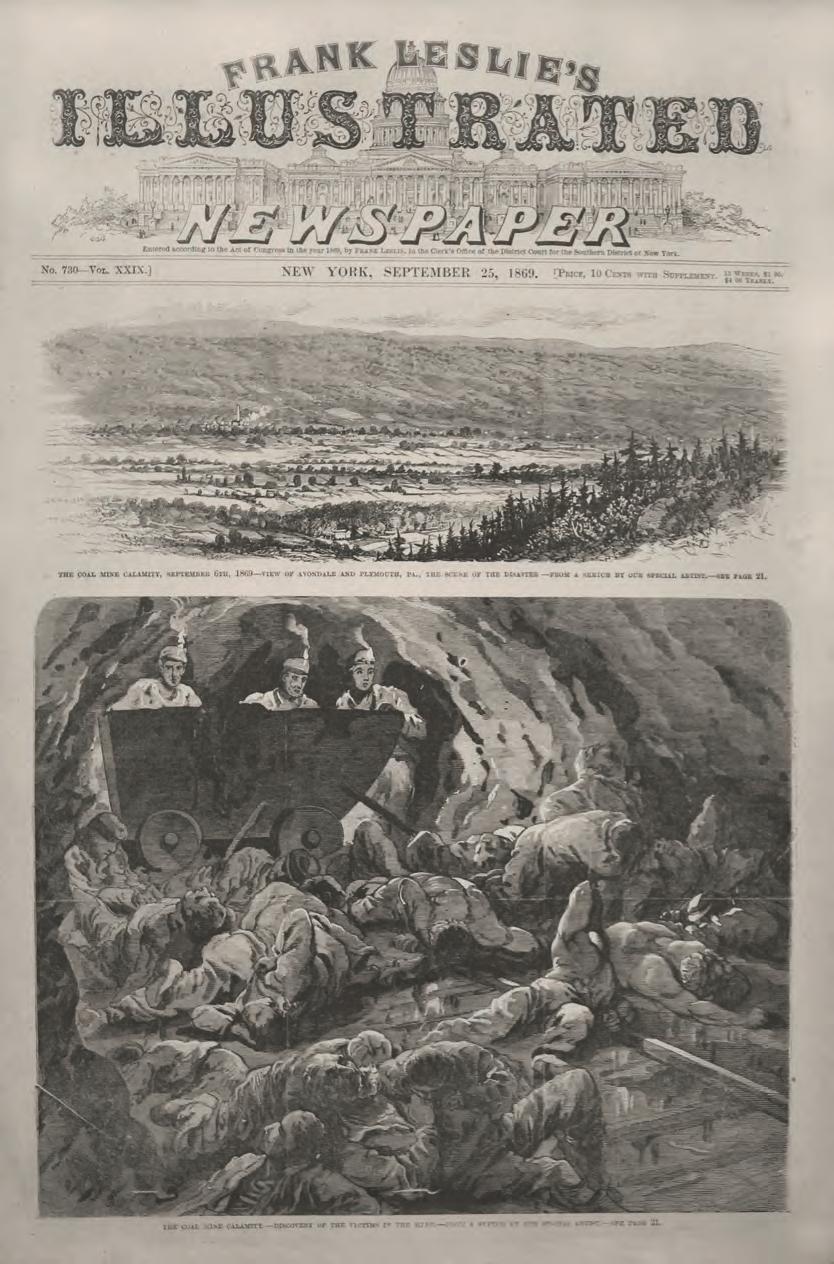
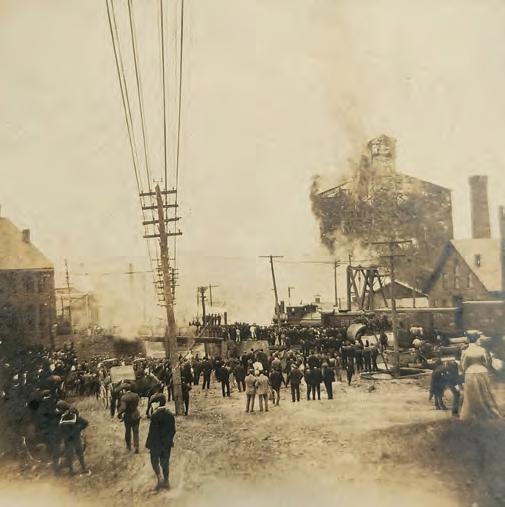
Tragedies also made headlines. The Avondale Mine Disaster occurred on September 6, 1869, when the Avondale Colliery, owned by the Nanticoke Coal Company, burned near Plymouth, Pennsylvania. The mine, which employed many Welsh workers, had a single entrance. Workers underground could not escape, and 110 deaths occurred. The event attracted national attention. The Scranton Weekly Republican of September 11, 1869, noted that respected artists Theodore Russel Davis (18401894) of Harper’s Weekly and Joseph Becker (1841-1910) of Frank Leslie’s Illustrated Newspaper were sent to Avondale to “take views.”14 A native of Boston, Davis studied illustration in New York City, while Becker, born and raised in Pottsville, Pennsylvania, learned his craft through employment with Leslie’s Illustrated Newspaper. Both were hired during the Civil War, and were known for producing on-site illustrations of military and historical events.15 Harper’s Weekly showcased views of the Avondale Colliery Disaster (1869) by Davis in a cover image of the ruined breaker and sorrowing crowds, as well as a centerfold
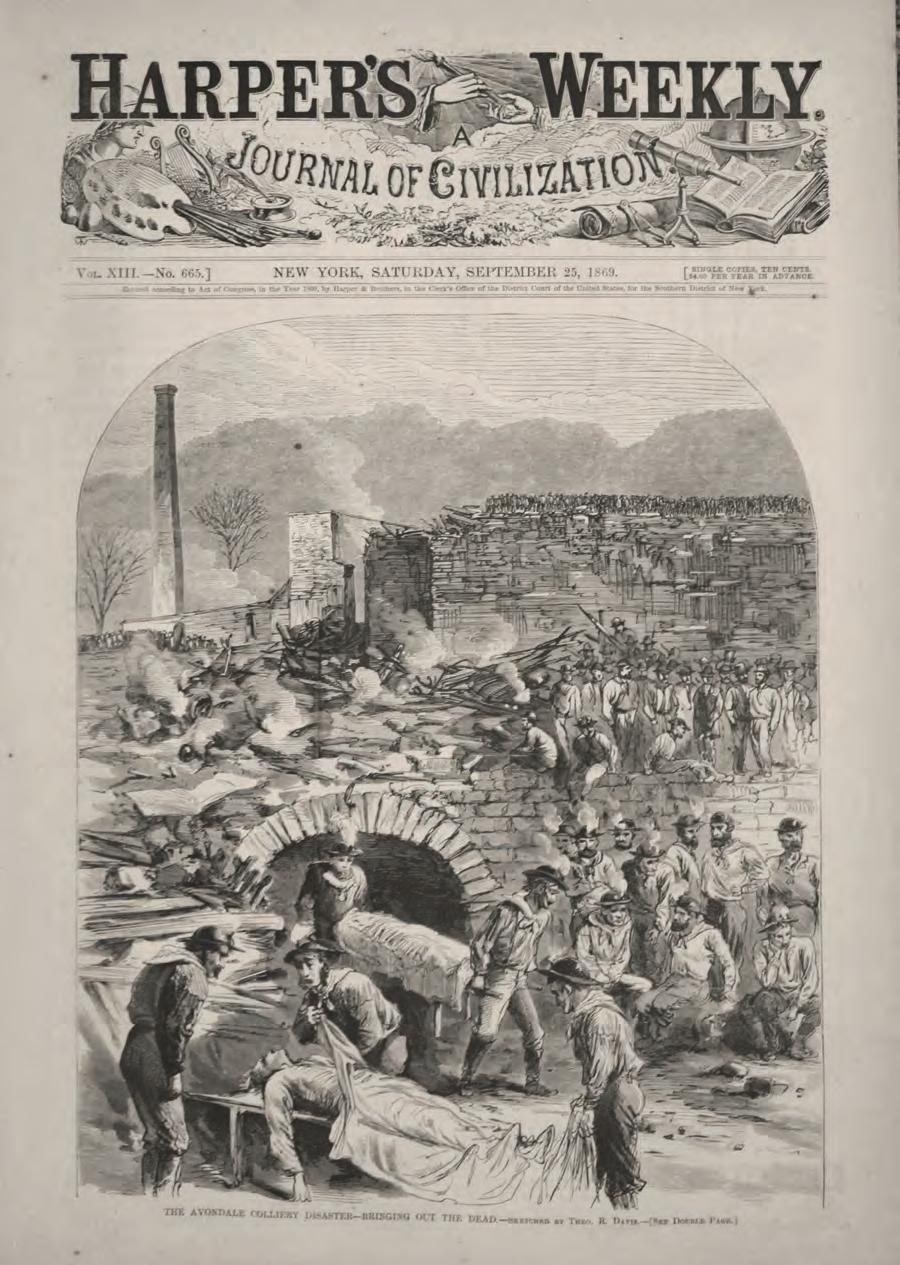
Theodore Russel Davis (1840-1894). The Avondale Colliery Disaster—Bringing Out the Dead. Wood engraving on paper. Published in Harper’s Weekly. New York. Saturday, September 28, 1869. Vol. XIII-No. 665. 609. The Stanislaus Collection. Scranton, Pennsylvania.
“Our Special Artist” (dates unknown).
The Coal Mine Calamity, September 6th—View of Avondale and Plymouth, Pennsylvania, the Scene of the Disaster. The Coal Mine Calamity—Discovery of the Victims in the Mine—From a Sketch by Our Special Artist. Wood engraving on paper. Published in Frank Leslie’s Illustrated Newspaper. New York. September 25, 1869. Vol. XXIX-No. 730. 1. The Stanislaus Collection. Scranton, Pennsylvania.
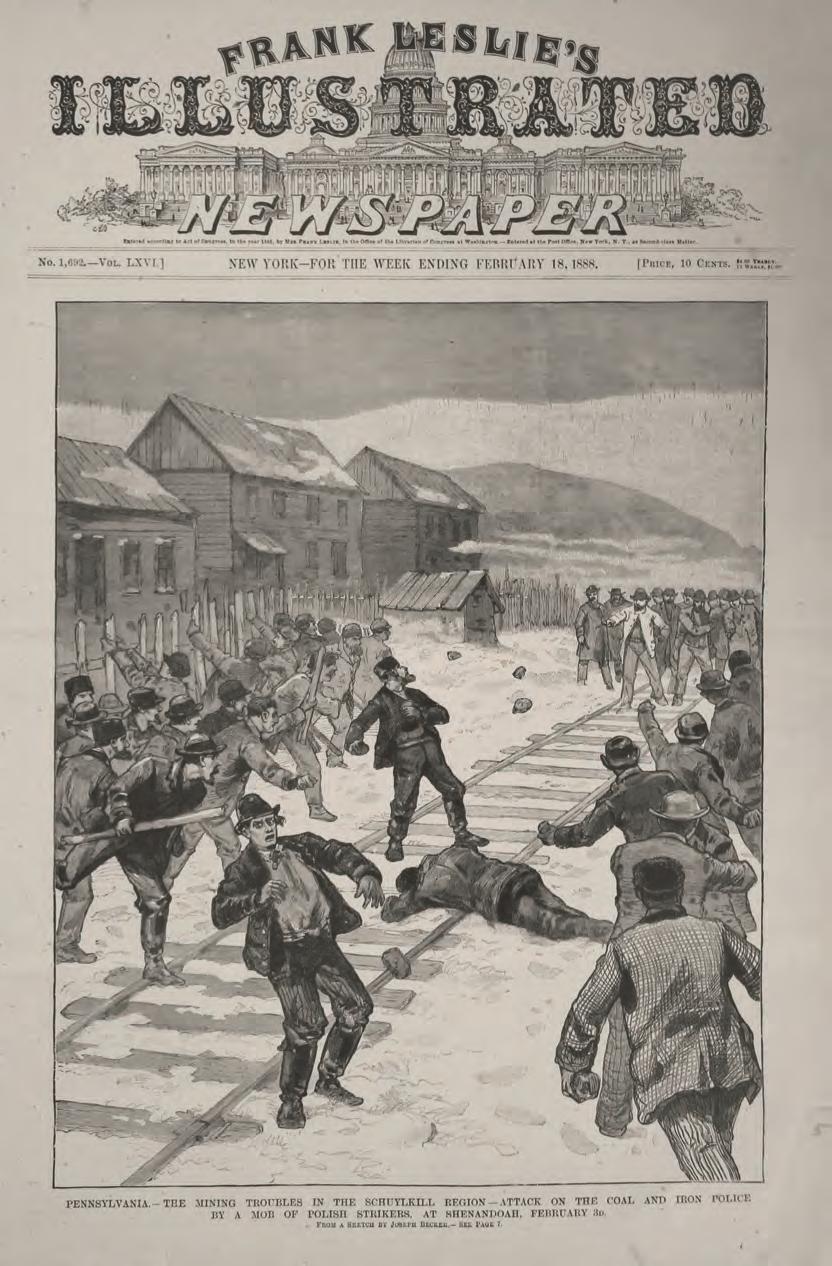
(Carl J.) Joseph Becker (1841-1910). Pennsylvania—The Mining Troubles in the Schuylkill Coal Region. Attack on the Coal and Iron Police by a Mob of Polish Strikers at Shenandoah, February 3d. Wood engraving on paper. Published in Frank Leslie’s Illustrated Newspaper. New York. February 18, 1888. Vol. LXVI-No. 1, 692. 1. The Stanislaus Collection. Scranton, Pennsylvania.
(Carl J.) Joseph Becker (1841-1910).
Pennsylvania—The Mining Troubles in the Schuylkill Coal Region.
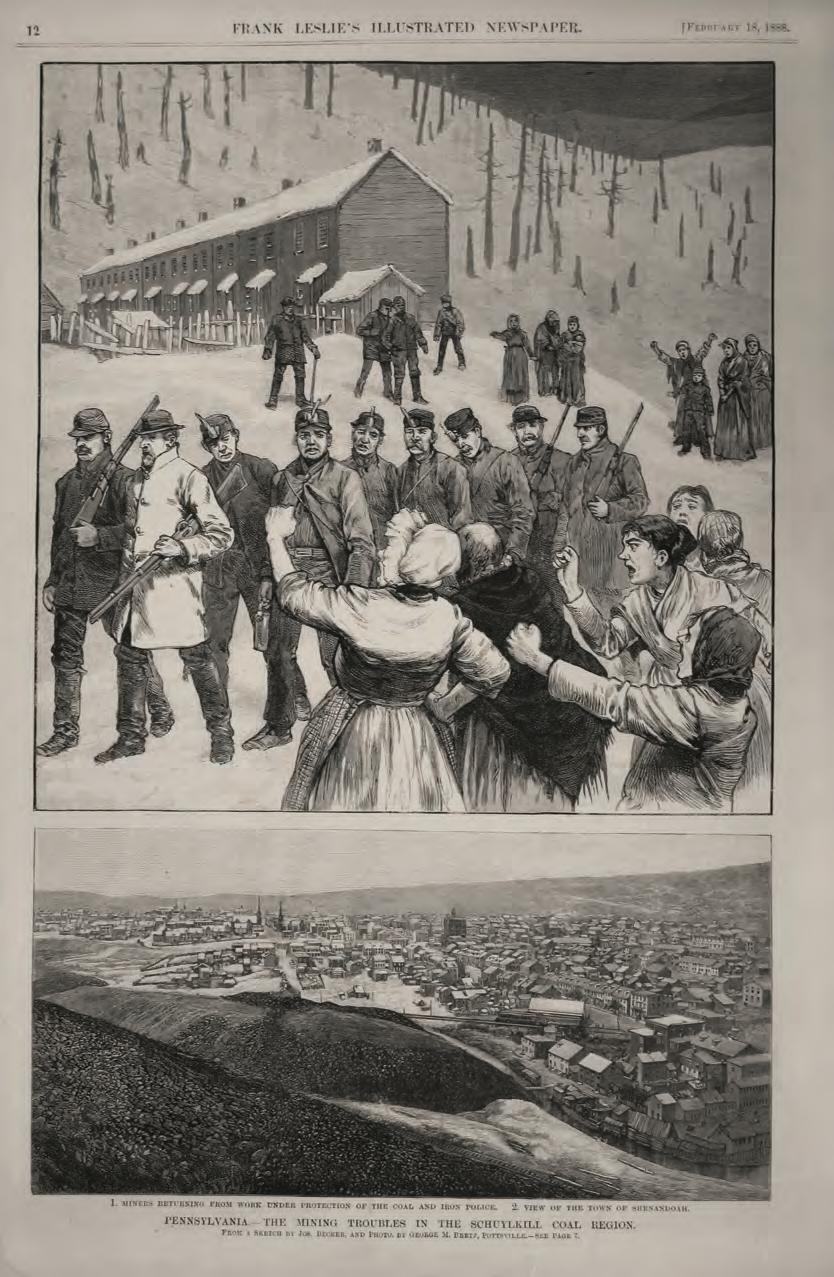
1. Miners Returning from Work Under the Protection of the Coal and Iron Police. 2. View of the Town of Shenandoah.
From a Sketch by Jos. Becker, and Photo. By George M. Bretz. Wood engraving on paper. Published in Frank Leslie’s Illustrated Newspaper. New York. February 18, 1888. Vol. LXVI-No. 1, 692. 12. The Stanislaus Collection. Scranton, Pennsylvania.
featuring individual scenes of rescue attempts and miners’ bodies. Crediting work to their “Special Artist,” Leslie’s Illustrated Newspaper published four pages of illustrations depicting the Coal Mine Calamity, including a cover and centerfold in their regular issue, accompanied by additional views in a Coal Calamity Supplement. Heartrending subjects included blasted structures, deceased miners, and bereaved families. The Avondale Mine Disaster initiated calls for both regulation by government and unionization of labor within the anthracite industry. Pennsylvania became the first state to enact mine safety legislation, requiring two entrances at underground operations. Miners drawn together in support of Avondale widows and orphans discovered strength through unity, driving increased membership in the Workingmen’s Benevolent Association.
The history of the anthracite industry is fraught with labor conflicts. Strikes wracked Northeastern Pennsylvania from the mid-nineteenth to the turn of the twentieth centuries, including the Long Strike of 1875; Great Strike of 1877; Pennsylvania Coal Strike of 1887-1888; Anthracite Coal Strike of 1900; and Great Anthracite Coal Strike of 1902. Labor groups including the Workingmen’s Benevolent Association, Knights of Labor, and United Mine Workers of America pressed for better workers’ rights. In doing so, they took actions that disrupted the flow of coal to markets, distressing not only investors averse to losing profits, but consumers dependent on anthracite fuel for heating, transportation, and manufacturing. Conflict also surrounded less formally organized groups, as revealed in the conviction and execution of the Molly Maguires in 1877 and the Lattimer Massacre of 1897. Adding to widespread fears concerning the volatility of anthracite labor and product supply were suspicions about new immigrants: while most early families connected with mining had traveled to the United States from England, Wales, and Germany, many later arrivals came from Ireland, Italy, Poland, Hungary, and Slovakia. Beyond cultural differences, established miners worried that an expanding pool of immigrant labor would weaken their bargaining position with coal operators, as uncooperative workers could simply be fired and replaced. Divisions of class and ethnicity complicated difficult negotiations.
In the Schuylkill region, labor conflicts became especially tense in 1888 when strikers in Shenandoah, Pennsylvania, clashed with members of the Philadelphia and Reading Coal Company’s Coal and Iron Police, stationed there to maintain order at the mines. Reporting for Frank Leslie’s Illustrated Newspaper, Joseph Becker produced images of Pennsylvania – The Mining Troubles in the Schuylkill Coal Region (1888), including an Attack on the Coal and Iron Police by a Mob of Polish Strikers at Shenandoah and Miners Returning from Work Under the Protection of the Coal and Iron Police. Published as a cover page, the mob scene depicts more than a score of miners, many armed with rocks and clubs, confronting almost a dozen guards, at least three of whom wield pistols. The diagonal composition of the image is reinforced by railroad tracks shown stretching from left to right, and the body of an injured man who has fallen across them. The full-page view of miners returning from work presents five men wearing caps and lamps surrounded by four coal company guards and at least six angry local women. The men have worked despite a labor stoppage, and so are being threatened by strikers’ families.
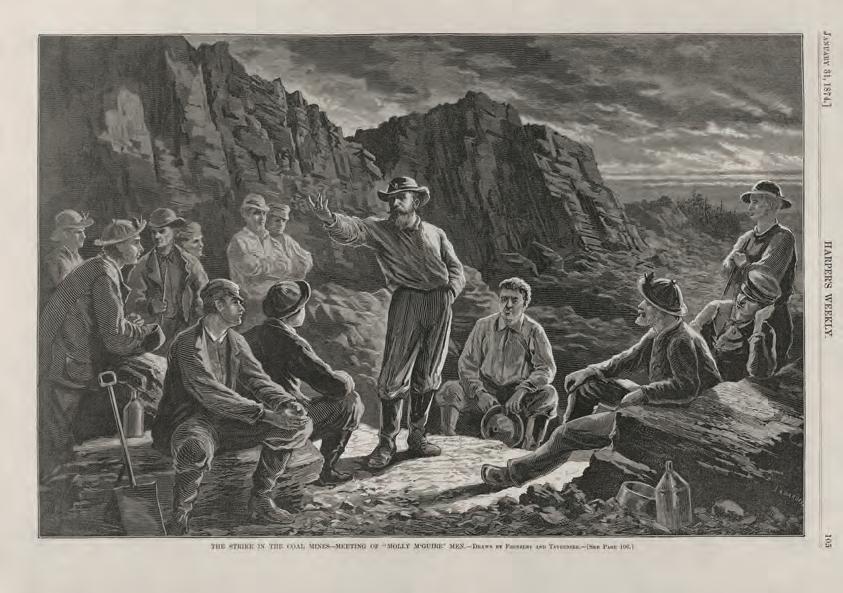
In contrast, the sometimes clandestine nature of labor meetings was emphasized by William Allen Rogers (1854-1931) in his depiction of The Pennsylvania Strike—Miners Calling a Meeting (1888), published in Harper’s Weekly Born in Springfield, Ohio, Rogers worked as an illustrator in New York City and Washington D.C.16 His quiet snow scene of two miners inscribing a stone with arcane signs, set at a distance from the steep-sided forms of company houses and a coal colliery, suggests secrecy, conjuration, and intelligence. They summon an invisible force; they call it forth from nothingness within the confines of a deep ravine. An earlier, animated illustration showing members of a secret society, The Strike in the Coal Mines—Meeting of the “Molly M’Guire” Men (1874), was produced by Paul Frenzeny and his colleague Jules Tavernier (1844-1889) for Harper’s Weekly. Alternately cast in legend as heroes and criminals, the Molly Maguires were broadly identified as Irish activists who used violent action to further their cause of labor reform. In Frenzeny’s scene, a lead speaker with an outstretched arm challenges seated miners from a bright ledge. Interest in the Molly Maguires grew in the early 1870s as Irish miners became numerous and outspoken, and coal operators sought to retain control of labor. By 1876, information on Molly Maguire activities gathered by undercover Pinkerton agent James McParland formed the basis of court cases against alleged members. In 1877, six men imprisoned at Pottsville and four others held at Mauch Chunk were sentenced and hanged.
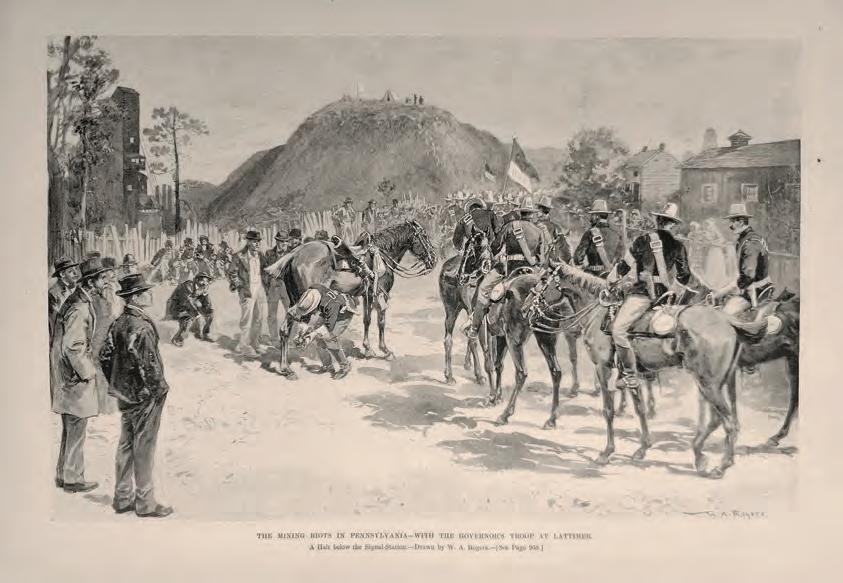
Violence in the coal fields was also documented by Rogers in his view of The Mining Riots in Pennsylvania—With the Governor’s Troop at Lattimer. A Halt Below the Signal Station (1897), published in Harper’s Weekly two weeks after the event shown. Labor troubles developed in August 1897 at the Honey Brook Colliery, owned by the Lehigh and Wilkes-Barre Coal Company, near Hazleton, Pennsylvania. As regional membership in the United Mine Workers of America increased, strikes spread when miners stopped production at neighboring coal operations. Coal and Iron Police failed to deter the strikers, and the Luzerne County sheriff was called to control growing unrest. On September 10, 1897, a posse of some 150 sheriff’s deputies encountered a group of nearly 400 unarmed strikers marching from the company town of Harwood to the nearby mines at Lattimer, which were not yet closed. Demonstrators, mainly Eastern European immigrants carrying an
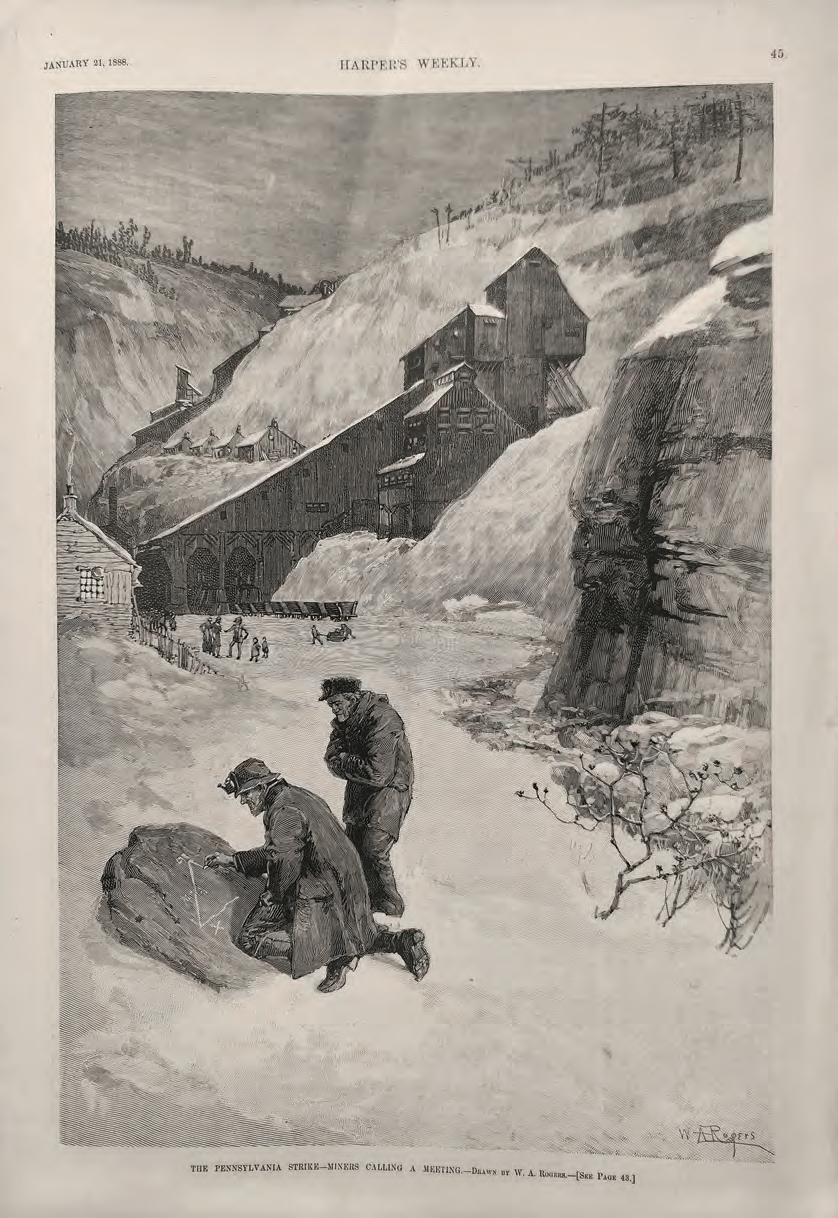
William Allen Rogers (1854-1931). The Pennsylvania Strike—Miners Calling a Meeting. Wood engraving on paper. Published in Harper’s Weekly. New York. Saturday, January 21, 1888. Vol. XXXII-No. 1622. 45. The Stanislaus Collection. Scranton, Pennsylvania.
Paul Frenzeny (c. 1840-1902) and Jules Tavernier (1844-1889).
The Strike in the Coal Mines—Meeting of the “Molly M’Guire” Men. Wood engraving on paper. Published in Harper’s Weekly. New York. Saturday, January 31, 1874. Vol. XVIII-No. 892. 105. The Stanislaus Collection. Scranton, Pennsylvania.
William Allen Rogers (1854-1931).
The Mining Riots in Pennsylvania—With the Governor’s Troop at Lattimer. A Halt Below the Signal Station. Print illustration on paper. Published in Harper’s Weekly. New York. Saturday, September 25, 1897. Vol. XLL-No.2127. 945. The Stanislaus Collection. Scranton, Pennsylvania.
American flag, were ordered to disperse but conflict ensued. Shots were fired, 19 marchers were killed, and 38 others were wounded. The Pennsylvania National Guard was summoned to restore order, and 2,500 troops were deployed to the area, remaining until late September. The illustration by Rogers depicts a moment of uneasy calm, as National Guard members arrive on horseback. The cause of their presence is shown in the opposed structures of a tall coal colliery and military signal tent, set above the village on high ground. Following the Lattimer Massacre, membership in the United Mine Workers of America expanded still further, as anthracite miners looked beyond ethnic divisions to the common goal of organized labor.
Negotiating Industrial Practice: Class and Action
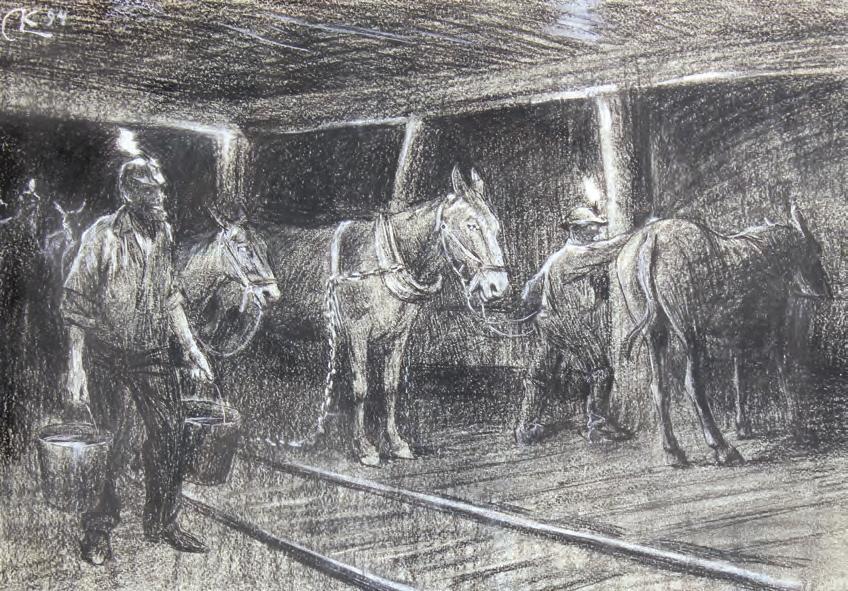
By the 1890s, Realism emerged in American art and literature as a stylistic response to photography and journalism. Unidealized subjects, including activities associated with the working classes, were increasingly represented in image and text. In June 1894, McClure’s Magazine hired author Stephen Crane (1871-1900) and artist Corwin Knapp Linson (18641959) to write and illustrate an article on anthracite mining. Born in Newark, New Jersey, Crane was the grandson of Reverend George Peck, a Methodist minister and local historian prominent in Northeastern Pennsylvania. Linson, a native of Brooklyn, New York, trained as an artist in France and shared a New York City studio with John Willard Raught. In preparation for their assignment, the pair traveled to Scranton, where they visited Raught and toured the Oxford and Dunmore Number 5 mines. Their essay, “In the Depths of a Coal Mine,” was published in August 1894. Crane’s terse paragraphs outlined the elemental battle between nature and industry waged in the anthracite region. Linson’s fifteen illustrations, based on direct observation, documented coal breakers, slate pickers, active miners, and coal tunnels; Crane described Linson’s effort to sketch a mule named Molly Maguire underground.
Linson’s drawing Putting in a Team. Mule Stables (1894) depicts four mules tended by two men and a boy. On gray toned paper, black charcoal shadows and china white highlights delineate a large room not unlike a catacomb. Mining companies utilized mules to haul coal from the mines, and stabled the animals in structures both above and below ground. In Linson’s image, activity associated with an open, grassy farm occurs in a dark, dangerous location. Crane stated that “the stable was like a dungeon” with “the mules arranged in solemn rows,” some “imprisoned for years in the limitless night of the mines.” The situation seemed “infinitely usual” and “one had to wait to see the tragedy of it,” perceived only when one had “grown familiar with the life and the traditions of the mines.”17 Mules were beasts of burden, and their lives were hard. While expensive to purchase and feed, they were investments essential to mining operations. Their care was limited, but sustained that investment. This same baseline consideration might not have been granted to human employees: within anthracite communities, common knowledge maintained that coal companies valued miners less than mules.
The pathos of the mules’ situation was sometimes countered in popular culture with humor. Mules were described as headstrong, and their spontaneous antics, as well as those of the boys who served as their caretakers, could be portrayed in lighthearted ways. As noted by Homer Greene (1853-1940) in Coal and the Coal Mines (1898):
One afternoon I chanced to be in a certain mine...with the fire boss. We were standing in a passage...[used by mules to enter and exit underground]. In the distance we heard a clattering of hoofs, growing louder as it came nearer, and, as we stepped aside, a mule went dashing by with a boy lying close on his back, the flame from the little lamp in the boy’s cap just a tiny backward streak of blue that gave no light. They had appeared from the intense darkness and had disappeared into it again almost while one could draw a breath. I looked at the fire boss inquiringly.
“Oh! that’s all right,” he said, “they’ve got through work and they’re going out, and the mule is in just as much of a hurry as the boy is.”
“But the danger,” I suggested, “of racing at such speed through narrow, winding passages, in almost total darkness!”
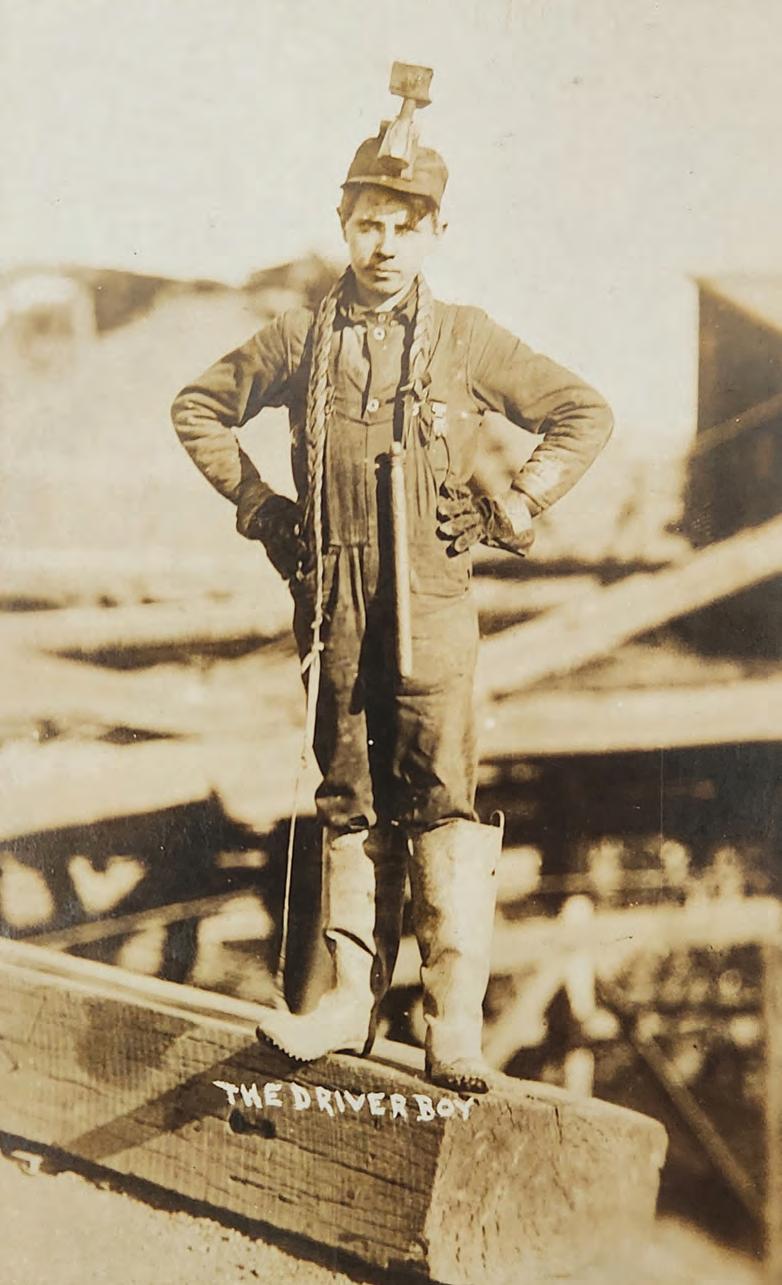
“Oh!” he replied, “that beast knows the way out just as well as I do, and he can find it as easy as if he could see every inch of it, and I don’t know but what he can. Anyway the boy ain’t afraid if the mule ain’t.” 18 In reality, mules were powerful, temperamental animals that could bite and kick. Their drivers were by necessity skilled and vigilant in their work. A photograph of The Driver Boy (c. 1900) by William James Harris depicts a self-assured young man with hands on his hips, standing on a rough-hewn beam. Around his neck he wears a long braided whip, used to direct the mules under his supervision.
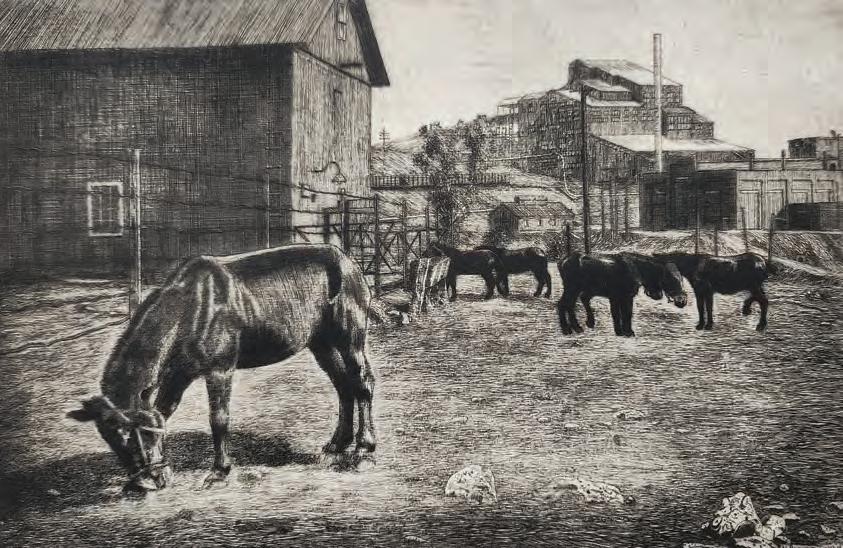
Some three decades later, Nicholas Bervinchak (1903-1978) produced an etching of Mine Mules (1933) acknowledging the pastoral and industrial aspects of an outdoor stable. A former miner, Bervinchak was born in Mahanoy City, Pennsylvania, to Ukrainian Lemko parents from the Austro-Hungarian Empire. During his teenage years in the mining village of Primrose, he worked as a slate picker and mule driver before taking a job underground. Bervinchak’s depiction of the animals he once
Corwin Knapp Linson (1864-1959). Putting in a Team. Mule Stables. Charcoal and china white on paper. 1894. Published in Stephen Crane. “In the Depths of a Coal Mine.” McClure’s Magazine. New York. August 1984. Vol. III-No. 3. 195-209. 207. The Stanislaus Collection. Scranton, Pennsylvania.
Nicholas Bervinchak (1903-1978). Mine Mules. Etching on paper. 1933. The Stanislaus Collection. Scranton, Pennsylvania.
William James Harris (1868-1940). The Driver Boy. Photographic postcard. c. 1900. The Stanislaus Collection. Scranton, Pennsylvania.
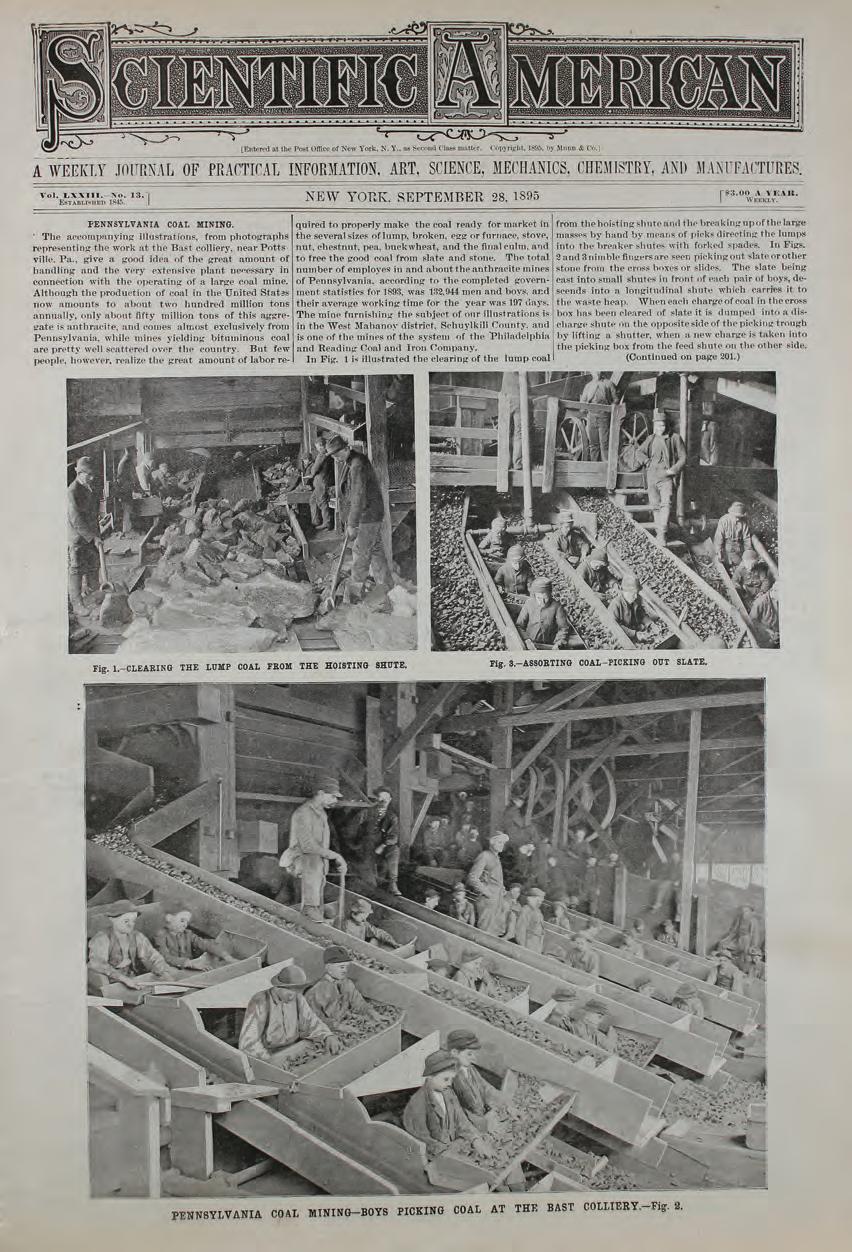
George Bretz (1842-1895). Pennsylvania Coal Mining. Fig. 1.—Clearing the Lump Coal from the Hoisting Chute. Fig. 2.—Boys Picking Coal at the Bast Colliery Fig. 3.—Assorting Coal - Picking Out Slate. Photographic illustration on paper. Published in Scientific American. New York. September 28, 1895. Vol. LXXIII.-No.13. 1. The Stanislaus Collection. Scranton, Pennsylvania.
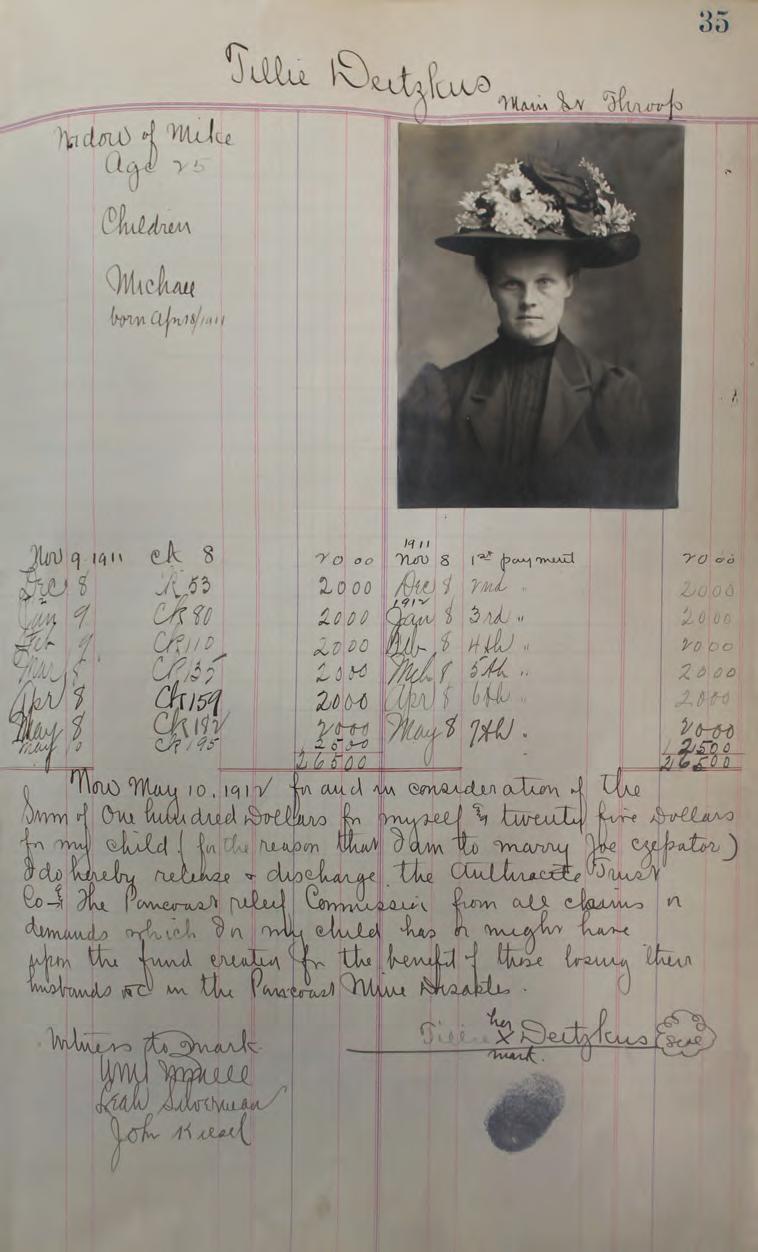
Anthracite Trust Company (1911-1912). Pancoast Colliery Compensation Ledger. Photographs and ledger entries on paper. 1911-1912. The Pennsylvania Historical and Museum Commission Anthracite Heritage Museum. McDade Park. Scranton, Pennsylvania.
tended reveals a knowledge of their anatomy, habits, and environment gained through critical observation and lived experience.19 In the foreground, five mules graze calmly in a fenced pasture near a neat barn. Carefully noted details include a fodder trough beside a stable gate and an electric light above the barn door. The mules, however, are not being kept for agricultural work on an open-air farm. Behind them, the orderly forms of a wooden coal colliery and brick powerhouse, possibly at the Lytle Colliery, rise in the middle distance. The mules are used to haul coal cars in the unseen tunnels below, but their era is passing. Soon, mule drivers will become motormen as electric locomotives replace mules in the mines.
Since the 1820s, the anthracite industry attracted public attention as writers and artists explored its practical aspects of geology, technology, and commerce. Between the 1870s and 1920s, reform initiatives of the Progressive Era also encouraged an examination of social issues like labor, health, and education. Journalists and illustrators were aided in their consideration of these subjects by continued advancements in commercial printing which allowed photographs to be reproduced in publications. Born in Carlisle, Pennsylvania, the photographer George Bretz (1842-1895) opened a studio in Pottsville after completing military service during the Civil War and working for a time in New York City. Attuned to controversy and innovation, he produced formal portraits of the alleged Molly Maguires in prison, taken a day before their executions, as well as underground views in the Kohinoor Mine at Shenandoah, photographed with the aid of electric lights.20 Photographs by Bretz were initially used as the basis for wood engravings released as journal illustrations. Later, photographs themselves were reproduced in layouts such as the Scientific American cover image Pennsylvania Coal Mining (1895), including a scene of Boys Picking Coal at the Bast Colliery near Ashland, Pennsylvania.
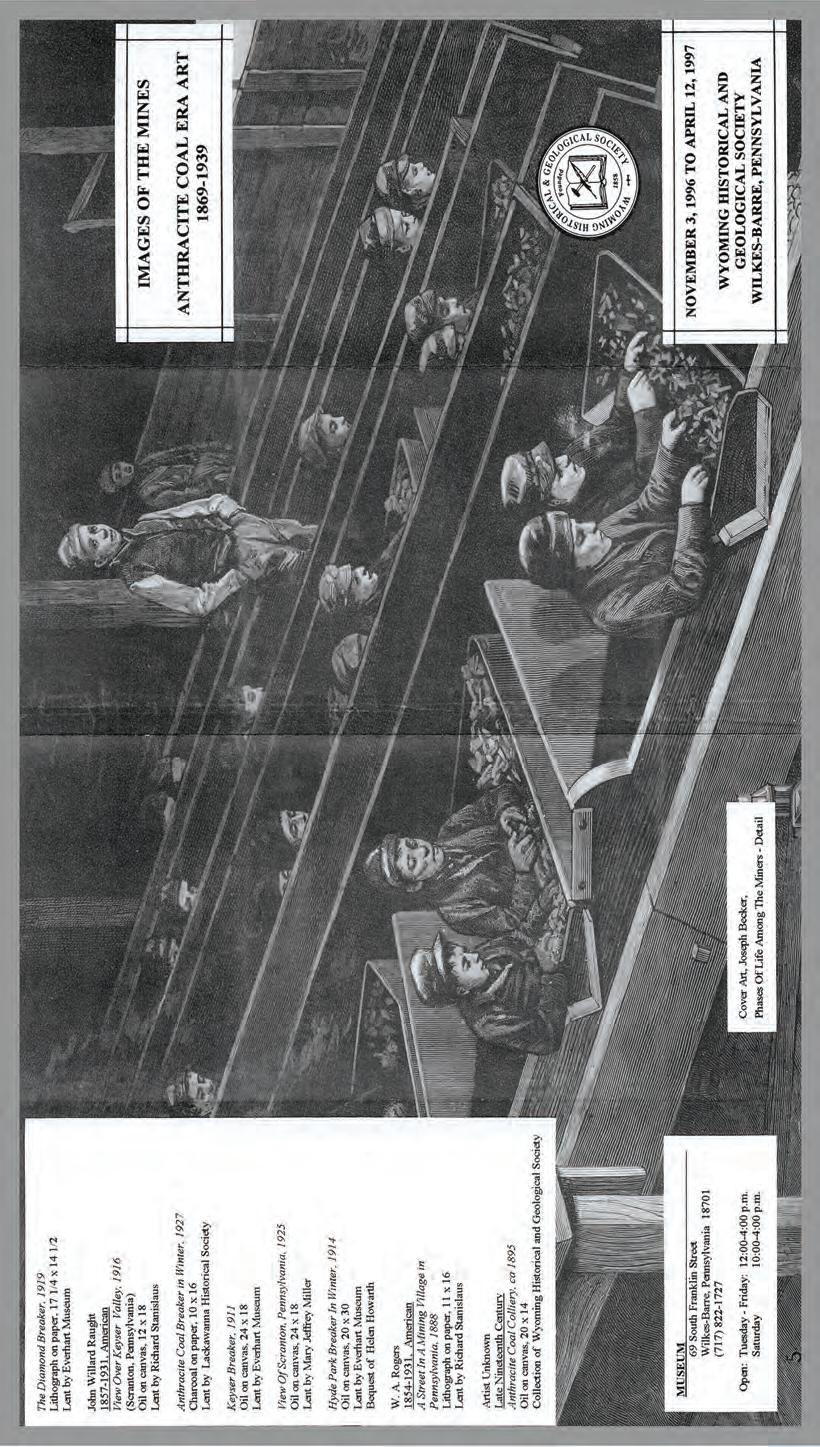
Child labor had long been used in mining, both in Europe and the United States. The practice was not considered unusual, and at best was a way for struggling families to increase their income. In Northeastern Pennsylvania, boys aged eight to fourteen were employed as slate pickers who removed stone from anthracite along colliery chutes, or as door tenders who maintained access points at mine gangways before aging out to work as mule drivers, mine laborers, and adult miners. The lack of varied opportunities for education and employment within this system meant that generations of workers remained in the mines. The efforts of children were closely monitored in the anthracite industry: seated in coal chutes for long hours, boys shown in the Bast Colliery photograph are supervised by a foreman holding a wooden rod, used to punish them if they strayed from their duties. Compared to drawings and engravings of the same subject, which could appear charming and naïve, photographs like those by Bretz provided a stark representation of the difficult and unhealthy conditions faced by working children. Soon, photographers would recognize the potential of their medium as a tool for labor reform.
As adult miners called for improved working conditions through unionization, demands for shorter hours and higher wages also sparked a reevaluation of child labor. Following strikes in 1899 and 1900, union efforts gained momentum. Anthracite miners in Northeastern Pennsylvania belonging to the United Mine Workers of America initiated the Anthracite Coal Strike of 1902. During the strike, union president John Mitchell (1870-1919) routinely addressed crowds of coal miners. Standing among the men were breaker boys, door tenders, and mule drivers. Mitchell afterwards remarked that:
[T]hese boys in the hard-coal regions are men. They have the bodies and faces of boys but they came to the meetings where I spoke and stood as still as the men and listened for every word. I was shocked and amazed…as I saw those eager eyes peering at me from eager little faces….The fight had a new meaning for me. I felt that I was fighting for the boys, fighting a battle for innocent childhood.21 The battle waged during the five-month strike, resolved with union gains after government intervention, was not forgotten by this young generation. Twenty years later, they would see it commemorated in the John Mitchell Monument in Scranton.
Even when intended for pragmatic purposes, coal region artifacts produced at the turn of the twentieth century could take on cultural significance in the context of social equity and stability. Created by the Anthracite Trust Company as a financial record, the Pancoast Colliery Compensation Ledger (1911-1912) also evolved as a testament to personal hardship and community resilience. On April 7, 1911, the Pancoast Mine Disaster, also known as the Anthracite Mine Disaster, occurred at the Price-Pancoast Mine in Throop, Pennsylvania. That morning, fire broke out in an engine house, and miners working in related coal veins were trapped by smoke and flames. Rescue and recovery efforts were made throughout the afternoon as a crowd of some 5,000 friends and relatives gathered at the site. By evening, 72 men were pronounced dead, leaving behind 56 widows and 123 orphans. A few miners’ families were eligible for insurance benefits, as coverage was sometimes offered through church and fraternal organizations. Others, however, were left with no income.
The Price-Pancoast Coal Company provided short-term aid following the fire, while a pension fund was organized by the community-based Pancoast Relief Committee, which raised money in various ways. The Pancoast Keg Fund collected proceeds from monthly dues and the sale of empty powder kegs. Red Tag Days offered townspeople the opportunity to assist Pancoast families through the purchase of red tags, sold door to door throughout the coalfields. A relief fund of nearly
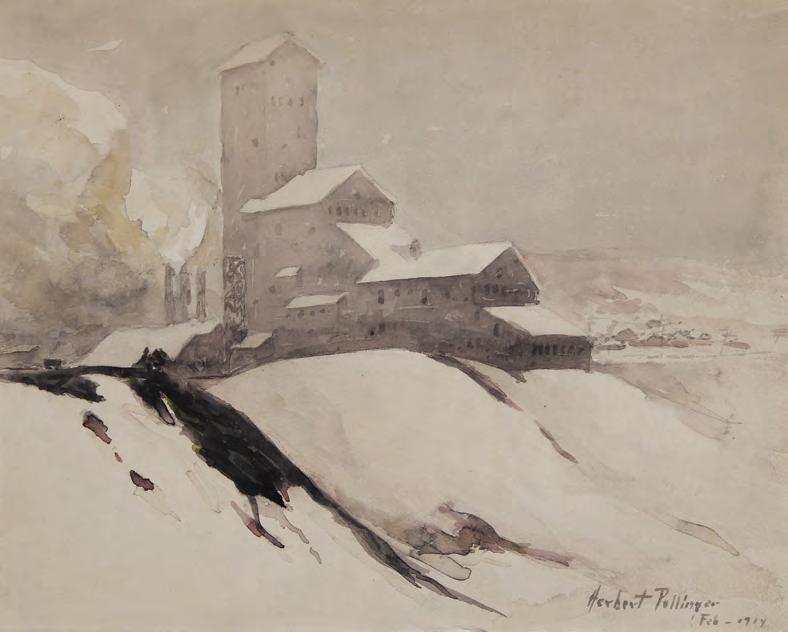
Herbert Pullinger (1878-1961). Anthracite Coal Breaker in Winter Snow. Watercolor on paper. February 1914. The Stanislaus Collection. Scranton, Pennsylvania.
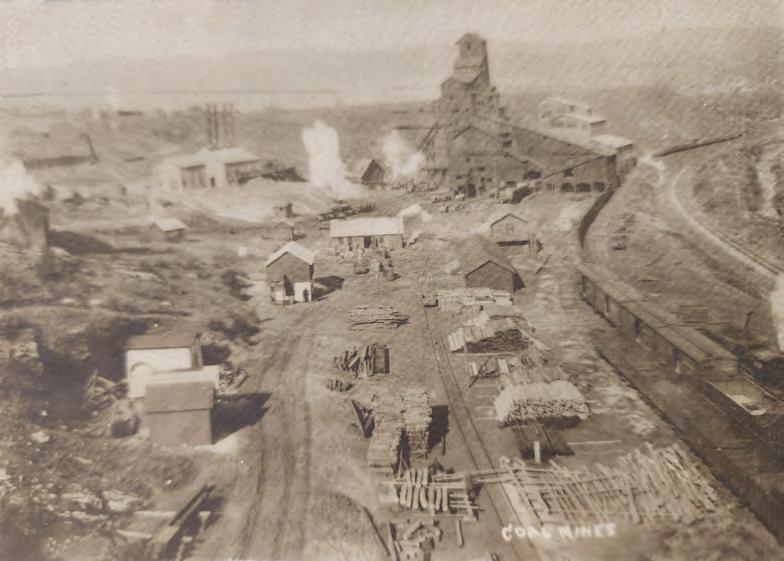
William James Harris (1868-1940). Coal Mines. Photographic postcard. Postmark 1906. The Stanislaus Collection. Scranton, Pennsylvania.
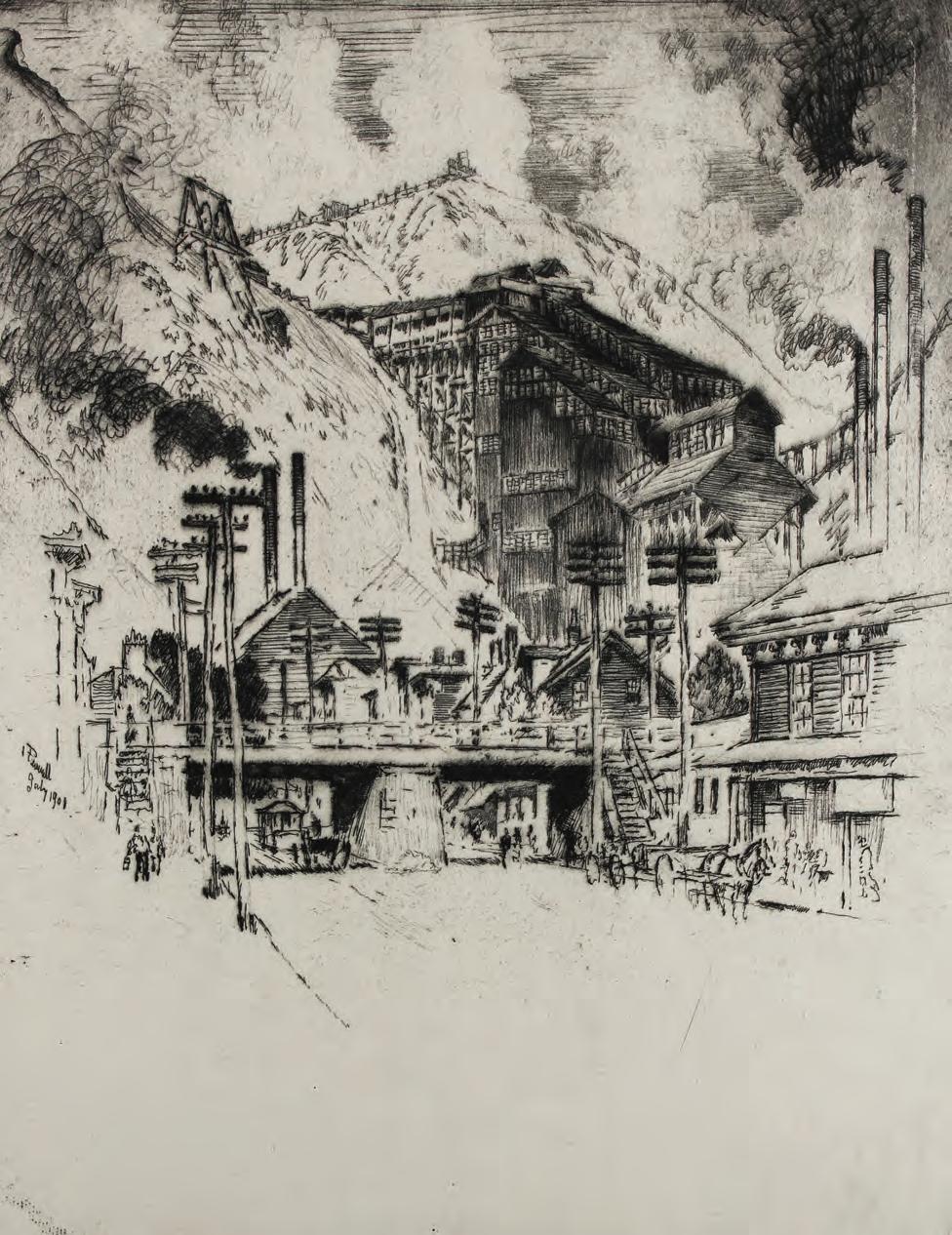
Joseph Pennell (1857-1926). Main Street. Mahanoy City, Pennsylvania. Etching on paper. 1909. The Stanislaus Collection. Scranton, Pennsylvania.
$90,000, administered by the Anthracite Trust Company of Scranton, was established. Thirty-two widows eligible for checks visited the bank, where their photographs were taken and family information was recorded. Monthly payments were listed in a ledger below these images and statistics. One page identifies Tillie Deitzkus, age 25, as the widow of Mike and mother of Michael, a son born eleven days after the Pancoast Disaster. She is shown dressed in mourning. Payment notes for eight months are accompanied by a statement that she will surrender her claim to funds as she intends to remarry. The notation is authorized not by a signature, but with an X and a fingerprint.22
In the realm of fine art, Realist depictions of the anthracite industry frequently appeared in the work of printmakers rather than painters. Separated in age by two decades, Joseph Pennell (1857-1926) and Herbert Pullinger (1878-1961) both grew up in Philadelphia, training at the Pennsylvania Museum School of Industrial Art and Pennsylvania Academy of the Fine Arts, where they studied respectively with Realist painters Thomas Eakins (1844-1916) and Thomas Anschutz (1851-1912). Attracted to the “wonders of work,” Pennell traveled in Europe and the United States with his wife, writer Elizabeth Robins Pennell (1855-1936). Together, they published images and narratives in books chronicling the sites and cultures they observed.23 Pennell did not hesitate to depict and describe the restless chaos of industrial centers, including the mining regions of Northeastern Pennsylvania. His etching Main Street. Mahanoy City, Pennsylvania (1909) records a scene of smokestacks and power lines that accepts disruption as a part of progress fueled by nearby mines and collieries. Known as an etcher and engraver, Pullinger also produced numerous urban and industrial views. In addition, he taught etching and watercolor at the Pennsylvania Museum School of Industrial Art.24 Pullinger’s monochromatic depiction of an Anthracite Coal Breaker in Winter Snow (1914), with its ghostly gabled colliery and stained coal slopes represented in subtle washes of gray and ochre, demonstrates his mastery of this delicate medium.
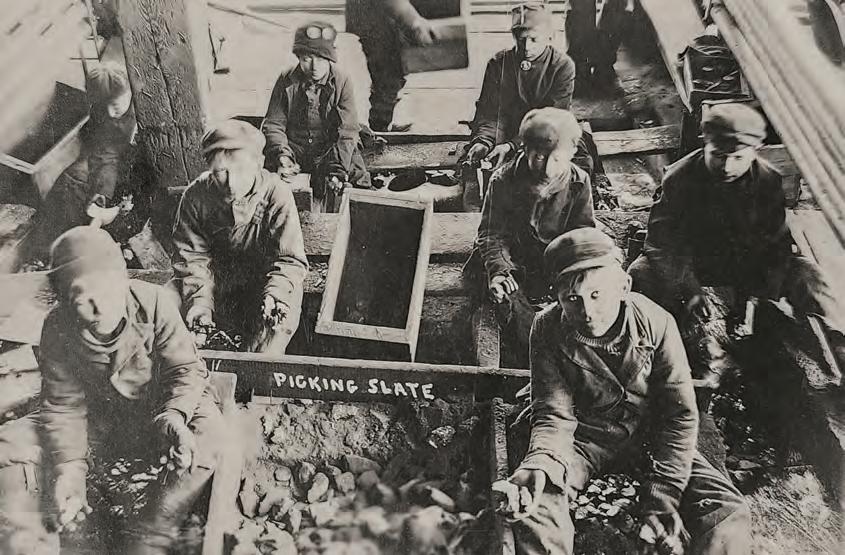
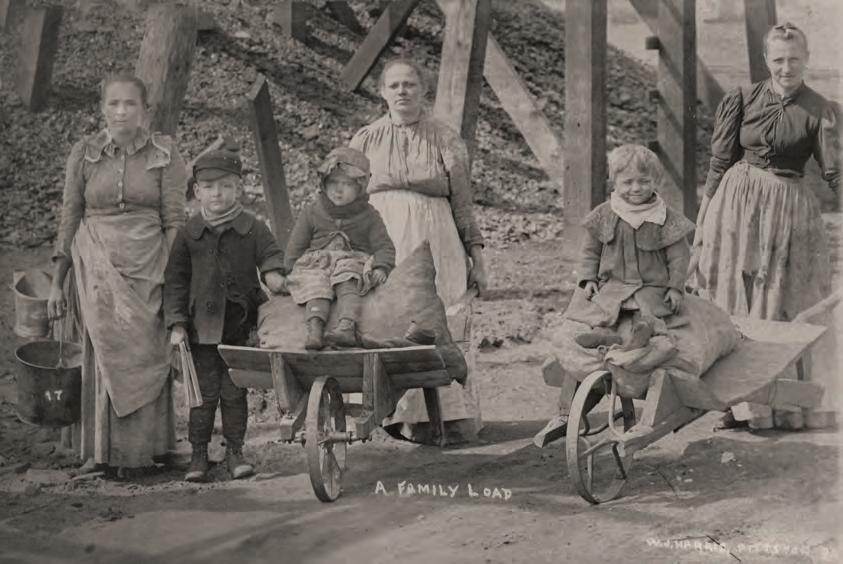
While paintings of mine workers were not commonly produced in variants of the Realist style until the second decade of the twentieth century, figurative subjects related to the coal industry were more frequently addressed in preceding years by photographers. As previously stated, William James Harris maintained a photographic studio in West Pittston during the 1890s. After that time, he became an itinerant photographer of resort areas in Pennsylvania and New Jersey before settling in St. Augustine, Florida.25 In addition to Pittston, Pennsylvania (c. 1906) and The Driver Boy (c. 1900), Harris printed and sold numerous photographic postcards documenting the anthracite regions and their inhabitants. Generally circulated between 1905 and 1920, the cards were possibly produced from photographs taken in the 1890s. Images initially perceived as quaint in the context of their commercial use, however, also carried with them the somber facts of activities and lives linked to mining. Utilizing aerial perspective, the colliery landscape presented in Coal Mines (c. 1906) features a complex transportation and supply network, including rails and timbers, near a busy colliery. Seated on splintered boards, the eight breaker boys shown in Picking Slate (c. 1907) meet the photographer’s gaze, presenting him with samples of the stone they separate from coal. Gathering fuel from culm piles, the three women portrayed in A Family Load (c. 1918) are accompanied by three children, two of whom are seated on coal sacks in wheelbarrows.
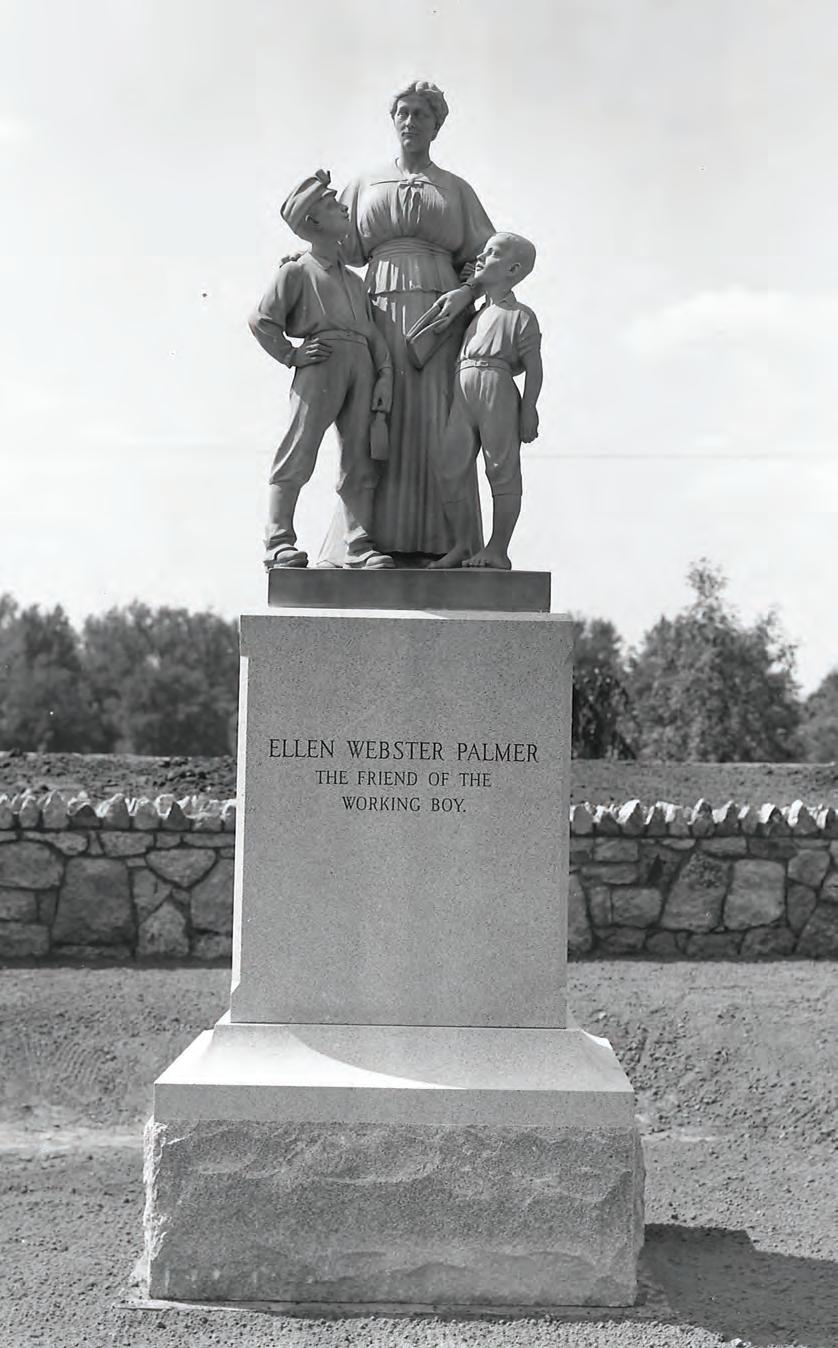
Monumental figurative sculptures of social reformers and labor leaders associated with the anthracite industry were also commissioned in the 1920s. Following the Anthracite Coal Strike of 1902, persistent problems of health and education associated with child labor were addressed by several noted philanthropists. Among them, Ellen Webster Palmer (1839-1918) was particularly known for her efforts to aid breaker boys. Born in Plattsburgh, New York, Palmer trained as a teacher before marrying Henry Palmer (1839-1913) of Wilkes-Barre, a lawyer who later served as Pennsylvania Attorney General. Concerned by the destructive cycles of hard labor and extended poverty that gripped families in the coal regions, Palmer founded the Boys Industrial Association in 1891. Housed in its own building, the organization provided working children with opportunities for education and recreation. Palmer spoke out against child labor and advocated for legislation regulating it. Laws passed in 1903, 1905, and 1909 set progressively stronger limitations on permissible ages and hours for young workers. In 1921, the Palmer family honored their matriarch, donating a sculpture of Ellen Webster Palmer. The Friend of the Working Boy (1921), to the city of Wilkes-Barre. Hundreds of men who had participated in Boys’ Industrial Association programs attended its dedication ceremonies on the River Commons, and the work was proudly acknowledged as the city’s first public memorial honoring a community citizen.26
Produced in Italy of Carrera marble, the life-sized monument features the figures of Palmer and two boys. Presented as both a nineteenth-century woman and an allegory of compassionate knowledge, Palmer wears a high-waisted, draped dress that includes a fashionable collar and bow, yet alludes to a classical peplos. Her facial features are similarly idealized but recognizable when compared to portrait photographs. Palmer holds a book in her left hand. Marking an open page with her finger, she has been actively engaged in reading. A barefoot young boy, dressed to resemble a newsboy in a simple shirt and cropped pants, takes her arm. Palmer’s right hand rests on the shoulder of an older boy, identifiable as a slate picker. Clad in heavy boots and a miner’s
William James Harris (1868-1940). Picking Slate. Photographic postcard. Postmark 1907.
The Stanislaus Collection. Scranton, Pennsylvania.
William James Harris (1868-1940). A Family Load. Photographic postcard. Postmark 1918. The Stanislaus Collection. Scranton, Pennsylvania.
Unknown (dates unknown). Ellen Webster Palmer. Friend of the Working Boy. Marble sculpture in the round. Commissioned by the Palmer Family. 1921. The Wilkes-Barre River Commons. Wilkes-Barre, Pennsylvania.
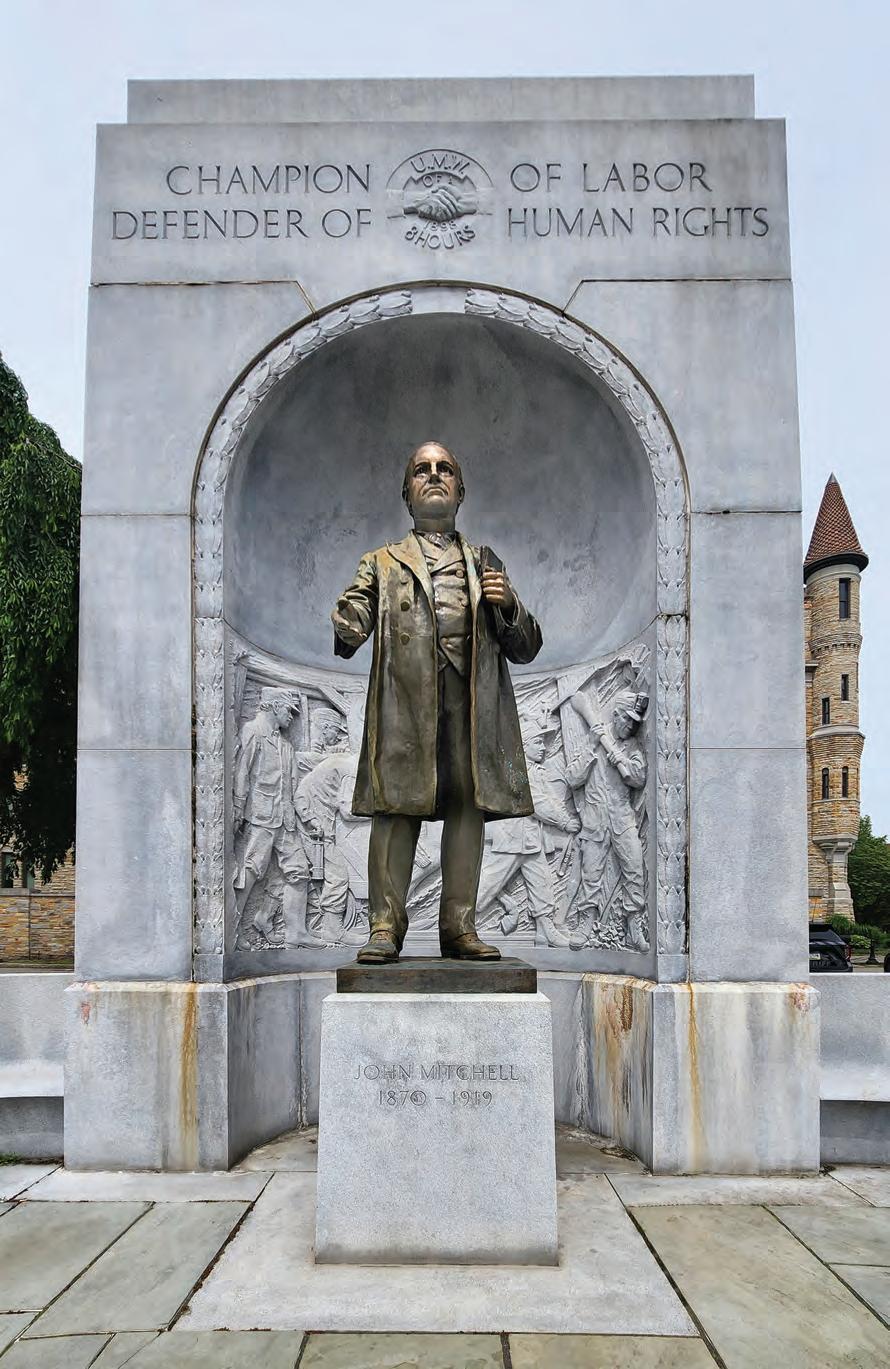
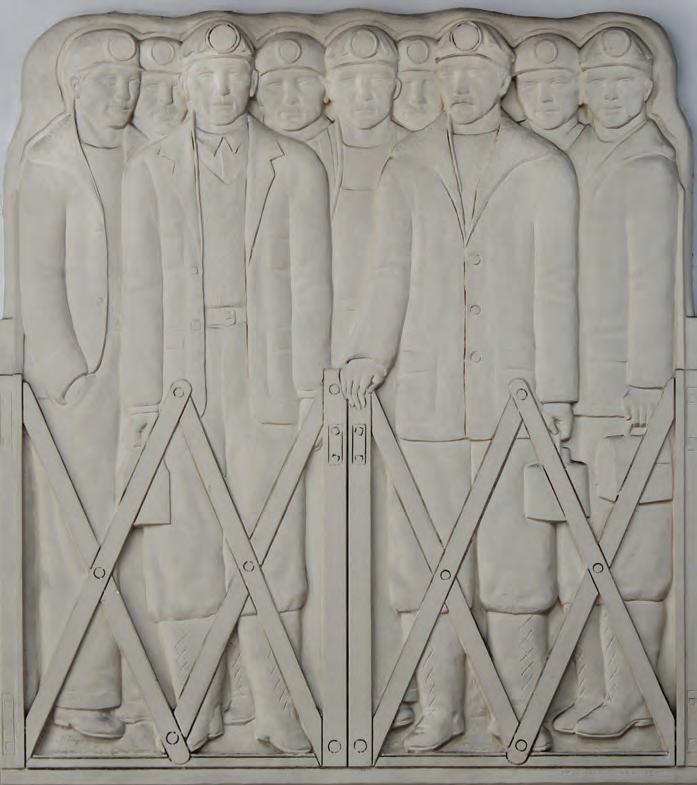
Charles Keck (1875-1951) and Peter Sheridan (1889-1978). John Mitchell Monument. Full Front View Showing John Mitchell and Miners at Work. Granite relief and bronze sculpture in the round. Erected by Members of the United Mine Workers and their Friends. 1924. The Lackawanna County Courthouse Square. Scranton, Pennsylvania.
Charles Keck (1875-1951) and Peter Sheridan (1889-1978).
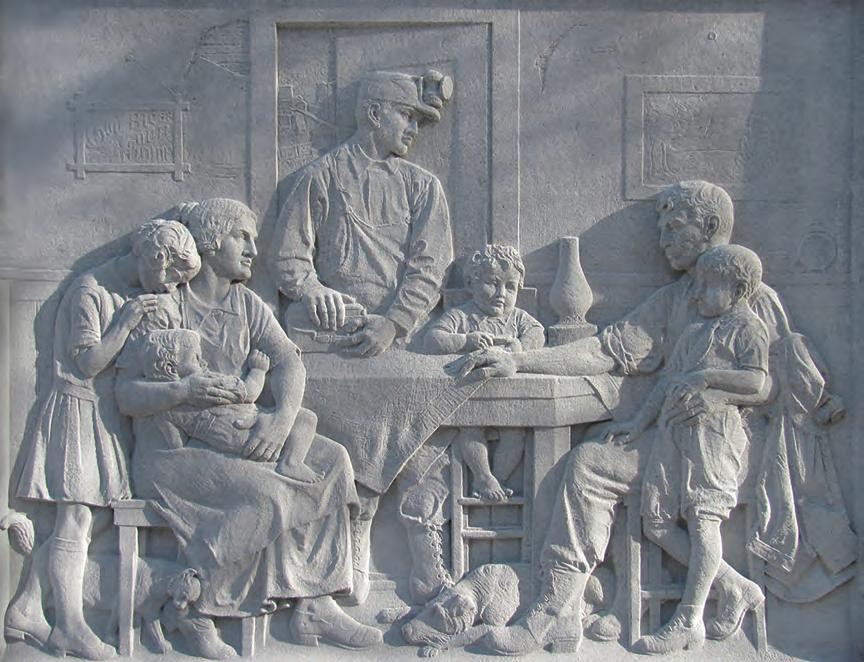
John Mitchell Monument. Detail of Back View Showing An Anthracite Miner and His Family. Granite relief. Erected by Members of the United Mine Workers and their Friends. 1924. The Lackawanna County Courthouse Square. Scranton, Pennsylvania.
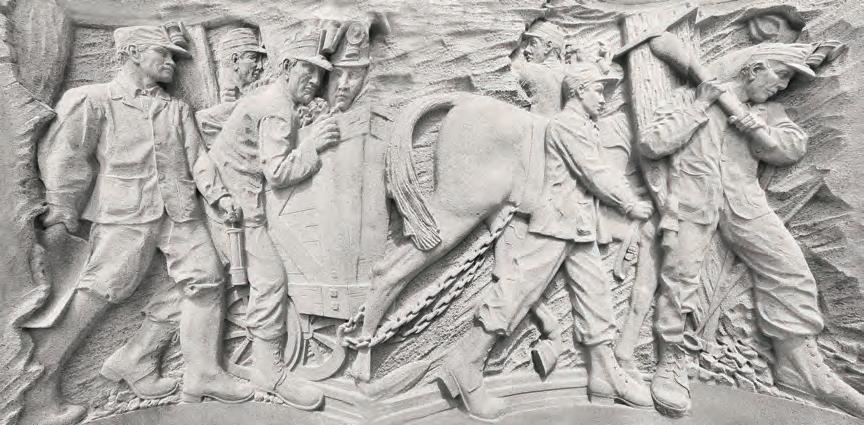
Charles Keck (1875-1951) and Peter Sheridan (1889-1978). John Mitchell Monument. Detail of Front View Showing Miners at Work. Granite relief. Erected by Members of the United Mine Workers and their Friends. 1924. The Lackawanna County Courthouse Square. Scranton, Pennsylvania.
cap, he stands with one hand on his right hip and holds a lunch pail in the other. Both boys turn their faces upward to look at Palmer with affection. She herself gazes into the distance above their heads, envisioning future fulfillment of the boys’ potential if they are encouraged to pursue it. The back of the sculpture’s base bears an inscription attributed to Palmer: Life is a tool to work with, not a toy to play with. Damaged during the early twenty-first century, Ellen Webster Palmer. The Friend of the Working Boy is undergoing fine art restoration at the Baut Studios in Swoyersville, Pennsylvania, and will be reinstalled on the River Commons along the Susquehanna River near the Luzerne County Court House.
A public sculpture financially supported by union members was the John Mitchell Monument (1924) in Scranton, located on the Lackawanna County Courthouse Square. John Mitchell (1870-1919) rose to prominence as president of the United Mine Workers of America between 1898 and 1908. A native of Braidwood, Illinois, he was an orphaned descendant of Irish immigrants and worked in the mines as a child. Mitchell joined the Knights of Labor in 1886 and helped to found the United Mine Workers of America in 1890. During his decade of leadership with that organization, he united miners from the bituminous and anthracite coal regions, and encouraged anthracite miners to put aside ethnic differences in support of shared goals. Mitchell led the United Mine Workers of America through the Anthracite Coal Strikes of 1900 and 1902. The first lasted six weeks and ended with gains for miners on October 29, which is still celebrated in the anthracite regions as “John Mitchell Day.” The second lasted nearly six months and was settled through government intervention. With coal production stalled and winter approaching, President Theodore Roosevelt authorized an Anthracite Strike Commission to investigate and resolve grievances through arbitration. The strike ended on October 23. Hearings, held over three months, resulted in a ten percent wage increase and a nine hour workday for laborers.
Moderate rather than militant in his views on when the union should strike, Mitchell left the United Mine Workers of America to serve with the American Federation of Labor. He died of pneumonia in 1919 and was buried as per his wishes in Scranton’s Cathedral Cemetery. In 1922, the United Mine Workers of America commissioned New York City sculptor Charles Keck (1875-1951) and Hazleton architect Peter Sheridan (1889-1978) to produce the John Mitchell Monument in his honor. Miners raised $75,000 in support of the massive granite and bronze sculpture, which at a weight of over ten tons, measured twenty feet wide and thirteen feet tall. Set before and carved into Sheridan’s architectural setting of Vermont Dummerstone were figurative components designed by Keck, including an eight-foot-tall bronze sculpture in the round cast at the Roman Bronze Company in Brooklyn, representing John Mitchell; a relief frieze showing Miners at Work; and a back relief panel depicting An Anthracite Miner and His Family. Several thousand people attended its dedication on the public square surrounding the Lackawanna County Courthouse, where the Anthracite Strike Commission convened in 1902.27
Trained at the National Academy of Design, Arts Students League, American Academy in Rome, and the studio of Augustus Saint-Gaudens (1848-1907), Keck understood the legacy of Classical art in American sculpture. Modulating the severity of nineteenth-century Neoclassicism with the streamlined elegance of the twentieth-century Beaux Arts style, he drew inspiration from the art of ancient Rome. Keck’s heroic bronze portrait of John Mitchell echoes the forms and ideals of Classical life-size cast figures like The Orator. A statesman for his cause, the labor leader is shown gazing upward, wearing a long coat and holding a sheaf of documents. Text inscribed on the granite monolith above and to each side of the bronze indicates Mitchell’s status and philosophy. Phrases surrounding a United Mine Workers of America emblem of clasped hands acknowledge him as a Champion of Labor and Defender of Human Rights. Quotes by Mitchell embody his ideals: I wish to see the interest and ideals of labor and capital fairly reconciled, not by surrender, but by mutual understanding, and So far as discontent is expressed in constructive movements for human betterment it is healthy and to be encouraged.
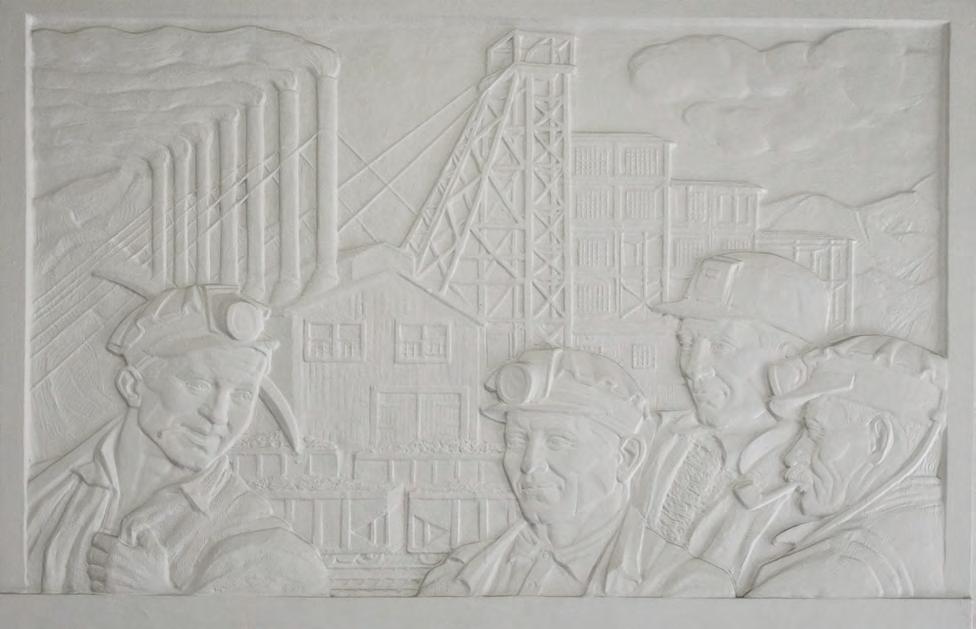
With right hand outstretched, the portrait of Mitchell welcomes members to the union, which advocates for the Mine Workers sculpted across a curved and domed niche. Echoing the progression of figures carved on the Roman Altar of Peace commemorating the end of civil war, the modernized images of seven men indicate specific jobs in the mine: the fire boss, with his safety lamp used for detecting gas; three laborers loading a coal car; a driver with his mule; and two miners using a pickaxe to excavate the face of a coal seam. They embody strength and intelligence, and the measured pace of their skilled production is uninterrupted.
While a labor subject is represented on the front of the monument, a domestic scene of An Anthracite Miner and His Family appears on the back. A husband and wife are shown seated at their kitchen table, surrounded by five children. The father, dressed for work in the mines, embraces his young son, who stands next to him. Wearing a tie and knickers, the boy is ready for school. A toddler sits in a highchair across the table. The mother, holding an infant, is accompanied by her daughter, who leans fondly against her shoulder. Male and female gender identities are reinforced by images of the family dog and cat below the table. The family lives in a respectable yet shabby home, with framed pictures and broken plaster
Robert Henri (1865-1929). Coal Breaker. Oil on canvas. 1902. Museum Purchase. Elizabeth B.G. Hamlin Fund. Bowdoin College Museum of Art. Brunswick, Maine.
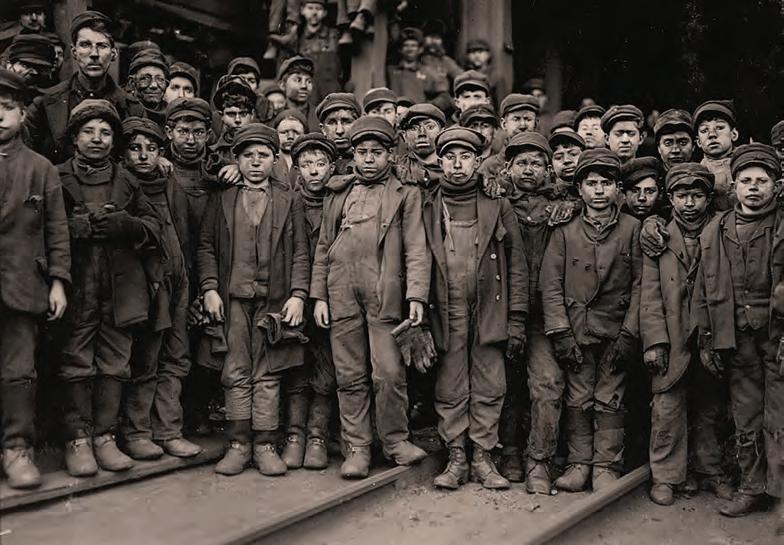
Lewis Wickes Hine (1874-1940). Breaker Boys Working in Ewen Breaker of Pennsylvania Coal Company. South Pittston, Pennsylvania. Photograph. January 1911. National Child Labor Committee Collection. The Library of Congress Prints and Photographs Division. Washington, D.C.
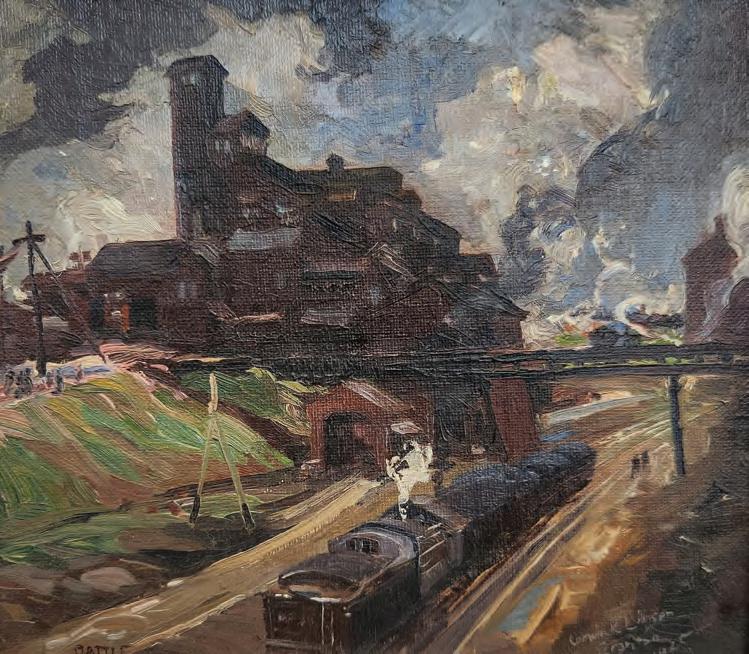
Corwin Knapp Linson (1864-1959). Battle. Mount Pleasant Anthracite Coal Breaker. Scranton, Pennsylvania. Oil on canvas panel. 1925. The Stanislaus Collection. Scranton, Pennsylvania.
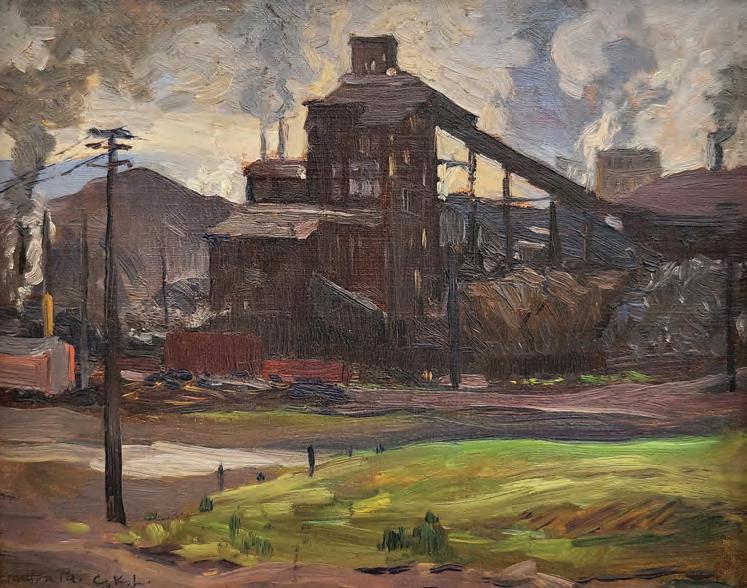
Corwin Knapp Linson (1864-1959). Johnson Anthracite Coal Breaker. Scranton, Pennsylvania. Oil on canvas panel. July 1925. The Stanislaus Collection. Scranton, Pennsylvania.
visible on the walls. The source of their income is the colliery, seen through an open door. The composition is dominated, however, by the figure of the eldest son, a young miner who stands in the doorway. Holding his dinner pail and wearing his miner’s cap, he looks confidently at his parents and siblings. Like the descendant shown in the Classical sculpture of a Roman Patrician with Ancestor Busts, the young miner honors his elders through rituals of visual representation. He personifies current members of the United Mine Workers of America, who, having witnessed as children the Anthracite Coal Strike of 1902, respectfully acknowledge as adults the courage and sacrifice of the previous generation.
Developing Public Perspectives: Audience and Sponsorship
Artists engaged with anthracite subjects on various levels ranging from passing interest to lifelong commitment, and were supported in their efforts to different degrees expressed by private and public audiences and sponsors. Colliery sites and mine workers sometimes attracted the attention of nationally-recognized painters and photographers who completed special projects in relation to them, but ultimately moved on to other activities. Ashcan Realist painter Robert Henri (1865-1929) documented a brief yet intense encounter with a mining landscape in his oil on canvas Coal Breaker (1902), painted during the Anthracite Coal Strike of 1902. Although he attended the Académie Julian and École des Beaux Arts in Paris, Henri, like Pennell and Pullinger, trained with Realist painters at the Pennsylvania Academy of the Fine Arts. In Philadelphia and New York City, he developed an affinity for harsh, contemporary, subject matter, and maintained connections with newspaper illustrators including John Sloan (1871-1951) and William Glackens (1870-1938). Henri was working in New York City when he traveled by train to visit relatives in Northeastern Pennsylvania. On his return trip through Wilkes-Barre, he was struck by the contrast of a stark industrial site in relation to the broad forested mountains surrounding it. As leader of The Eight, an artists’ group that sought to expand subject matter in painting to include “ugly” scenes of urbanization and immigration, Henri recognized art as an essential element of everyday life. He proclaimed its purpose was to increase viewers’ awareness of the world, including cultural differences and social inequalities.28 Painted in dark colors, the colliery looms above its small laborers as a symbol of struggle rather than progress.
Photographer Lewis Wickes Hine (1874-1940) used his artistic medium to bring public attention to social ills in a more methodical way. Born in Oshkosh, Wisconsin, Hine attended the University of Chicago before relocating to New York City. There he studied sociology at Columbia University and New York University, and taught at the Ethical Culture School, where he began to use photography for instructional purposes. Within the context of a city experiencing high levels of urbanization and immigration, Hine understood that photography could be used as a tool for social reform. In 1908, he was hired by the National Child Labor Committee to investigate abusive child labor working conditions in the United States. The scope of this project was broad, and the photographer traveled to document children variously working in regional mills and on city streets. Hine addressed the anthracite industry of Northeastern Pennsylvania in 1911, producing series of photographs depicting the work of slate pickers. Keeping careful records of conversations with the boys, he secretly made notes inside his coat pocket listing their ages, working conditions, years of employment, and schooling. He measured their height by the buttons on his vest.29 Hine’s image of Breaker Boys Working in Ewen Breaker of the Pennsylvania Coal Company. South Pittston, Pennsylvania (1911) depicts a large gathering of over thirty boys outside a colliery. Clearly too young to safely perform the difficult task assigned to them, they look directly towards the viewer. In conjunction with efforts by the National Child Labor Committee, Hine’s photographs contributed to the passage of new child labor regulations into the 1930s. Revisiting a subject he had addressed in early drawings, Corwin Knapp Linson also produced later paintings critiquing the anthracite industry. Over thirty years after his illustration assignment for McClure’s Magazine, the artist returned to Scranton, creating a series of small oil sketches on location at colliery sites, including Battle. Mount Pleasant Anthracite Coal Breaker. Scranton, Pennsylvania (1925) and Johnson Anthracite Coal Breaker. Scranton, Pennsylvania (1925). Linson possessed a long-term awareness of the dangers posed by mining to both workers and the environment.30 As the United Mine Workers of America prepared for yet another strike, he appropriately annotated his small paintings with the phrases “struggle for life” and “battle.” Similar in scale and technique, Linson’s views of the Mount Pleasant and Johnson Breakers evoke drama and movement. Painterly plumes of black smoke rise behind towering structures, while low banks of green vegetation soften the somber landscape. In the Mount Pleasant image, a tiny puff of white steam emerges from a “lokie” that labors to push gondolas loaded with coal.
Perhaps the artist most committed to representing the anthracite industry of Northeastern Pennsylvania during the 1920s was George Benjamin Luks (1867-1933). Born in Williamsport, Pennsylvania, Luks grew up near Shenandoah. He
George Benjamin Luks (1867-1933). Breaker Boy of Shenandoah, Pennsylvania. Oil on canvas. 1921. Gift of the T. B. Walker Foundation, John T. Baxter Memorial Collection of American Drawings, 1949.
The Walker Art Center. Minneapolis, Minnesota.
George Benjamin Luks (1867-1933). Five Miners with a Breaker in the Background. Watercolor on brown paper. c. 1925.
The Pottsville Free Public Library. Pottsville, Pennsylvania.
George Benjamin Luks (1867-1933). Yesterday and Today. Watercolor on brown paper. c. 1925.
The Pottsville Free Public Library. Pottsville, Pennsylvania.
George Benjamin Luks (1867-1933). Seated Miner. Watercolor on brown on paper. c. 1925. The Pottsville Free Public Library. Pottsville, Pennsylvania.
George Benjamin Luks (1867-1933). Necho Allen Discovering Coal. Oil on canvas mural. Commissioned for the Necho Allen Hotel. Pottsville, Pennsylvania. 1927. The Frederick M. Ciletti Memorial Library.The Pennsylvania State University, Schuylkill Campus. Schuylkill Haven, Pennsylvania.
Dick (1906-1950). Luks Mural on Mining in Necho Allen Hotel. Pottsville, Pennsylvania. Photograph from black and white negative. c. 1938. U.S. Farm Security Administration/Office of War Information. The Library of Congress Prints and Photographs Division. Washington, D.C.
Sheldon
became a member of Henri’s group The Eight, and shared with those colleagues a background that included study abroad, training at the Pennsylvania Academy of the Fine Arts, and experience as a newspaper illustrator. Like Henri, he moved from Philadelphia to New York City, and was committed to producing artistic images that confronted the difficult realities of everyday life. Colorful and flamboyant, Luks boasted about his prowess as a painter and a fighter. He returned frequently to the Pottsville region, producing paintings, sketches, and a mural based on the history and life of anthracite families in Schuylkill County.31 Among these works, the oil on canvas Breaker Boy of Shenandoah, Pennsylvania (1921) portrays a young slate picker dressed in dark clothing against a dark background, his dark eyes solemnly set in a pale but grimy face. Limited light is cast on the figure from a flickering lamp on his head and a glowing cigarette in his hand.
Luks produced numerous ink wash and watercolor sketches during this time as he explored themes for additional works. The movement of figures, suggested by their placement on an elevated foreground, is considered in Five Miners with a Breaker in the Background (c. 1925); the concept of time, expressed through the contrast of an automobile and mule, is demonstrated in Yesterday and Today (c. 1925); and the difficulty of labor, acknowledged in the context of an iconic portrait, is revealed in the Seated Miner (c. 1925). An oil on canvas version of the Seated Miner composition, variously known as The Miner, The Coal Miner, or The Fire Boss (1925), was exhibited in shows at the Pottsville Free Public Library and the Frank K. M. Rehn Gallery in New York City, where critics admired its humanistic qualities. Luks noted in regard to his subjects:
You know, these friends of mine, the miners, are the greatest individuals in the world. Strong, without fear, they leave their homes each morning with no established certainty that they will return to their wives and children that night. They have come to live in the proximity of danger, and they accept the hazards of their work.... Through this constant living with danger, ...a parcel of mysticism has come into their minds.32
Produced and shown in a period marked by United Mine Workers of America Strikes in 1922, 1923, and 1925, the pieces were also timely. A critic for the Rochester Democrat and Chronicle observed that Luks painted with one eye towards the news, and the other towards an art presentation of it.
In 1927, Luks was commissioned by Pottsville philanthropist Henry Sheafer to paint a mural depicting the origins of anthracite mining in Schuylkill County. The resulting triptych, Necho Allen Discovering Coal (1927), was presented to the newly-opened and elegantly-appointed Necho Allen Hotel and hung in a lounge adjoining the lobby. The mural’s wide central panel features the legendary Necho Allen, an eighteenth-century hunter and lumberman who discovered coal on Broad Mountain when his campfire ignited anthracite fragments on a rocky ledge. Most of the image displays a vibrant landscape of purple and orange mountains; Allen’s camp occupies only a small section of the foreground. Flanking this historical scene, narrow side panels feature continuing lines of the same mountain range, set behind narrative views from the present day. On the right, descending a ridge to reach work, three miners turn their faces towards a nearby city. On the left, ascending the ridge to return home, the miners turn their backs on a distant colliery. A view of the Luks Mural on Mining in Necho Allen Hotel. Pottsville, Pennsylvania (c. 1938), taken in situ by photographer Sheldon Dick (1906-1950) on behalf of the Farm Security Administration, documents the mural in its original opulent setting. Following the Great Depression, however, the hotel entered a period of decline. In 1971, Necho Allen Discovering Coal was acquired by the Pennsylvania National Bank, which in turn donated it to the Pennsylvania State University, Schuylkill Haven, in 1991.33
As demonstrated by the positioning of the Luks mural within the Necho Allen Hotel, representations of anthracite subjects, while associated with poverty and hardship for the working class, could also signify wealth and elegance among the elite. A concurrent use of mining imagery in an affluent setting was found in Pottsville at the Miners National Bank, constructed during the same time frame in 1927. To celebrate the centennial of its founding in 1828/1928, the financial organization hired renowned New York City architect Cass Gilbert (1859-1934) to design a new landmark facility for its operations. Classically inspired, the building featured a pair of ornate bronze doors on its façade. The commission for the Bronze Doors for Miners National Bank (1927) was awarded to sculptor John Polachek (1873-1955) of the Polachek Iron and Bronze Foundry in Long Island City, New York. Standing ten feet tall, the doors are comprised of six panels set into elaborate, openwork frames. Detailed and realistic, the panels themselves are cast bronze reliefs showing miners at work.34 Their individual jobs are categorized and recognizable. In the center of the paired doors, two facing panels show nineteenthcentury miners using a pickaxe to break and a shovel to move coal. Their actions are lit by rays from oil lamps on their caps. At the top and bottom of the doors, two sets of paired panels depict twentieth century miners checking for gas with a safety lamp; working with a pneumatic drill; boring holes with a hand drill to set explosives; and tamping charges with a bar prior to blasting. Their efforts are illuminated by the glare of electric headlamps on their helmets.
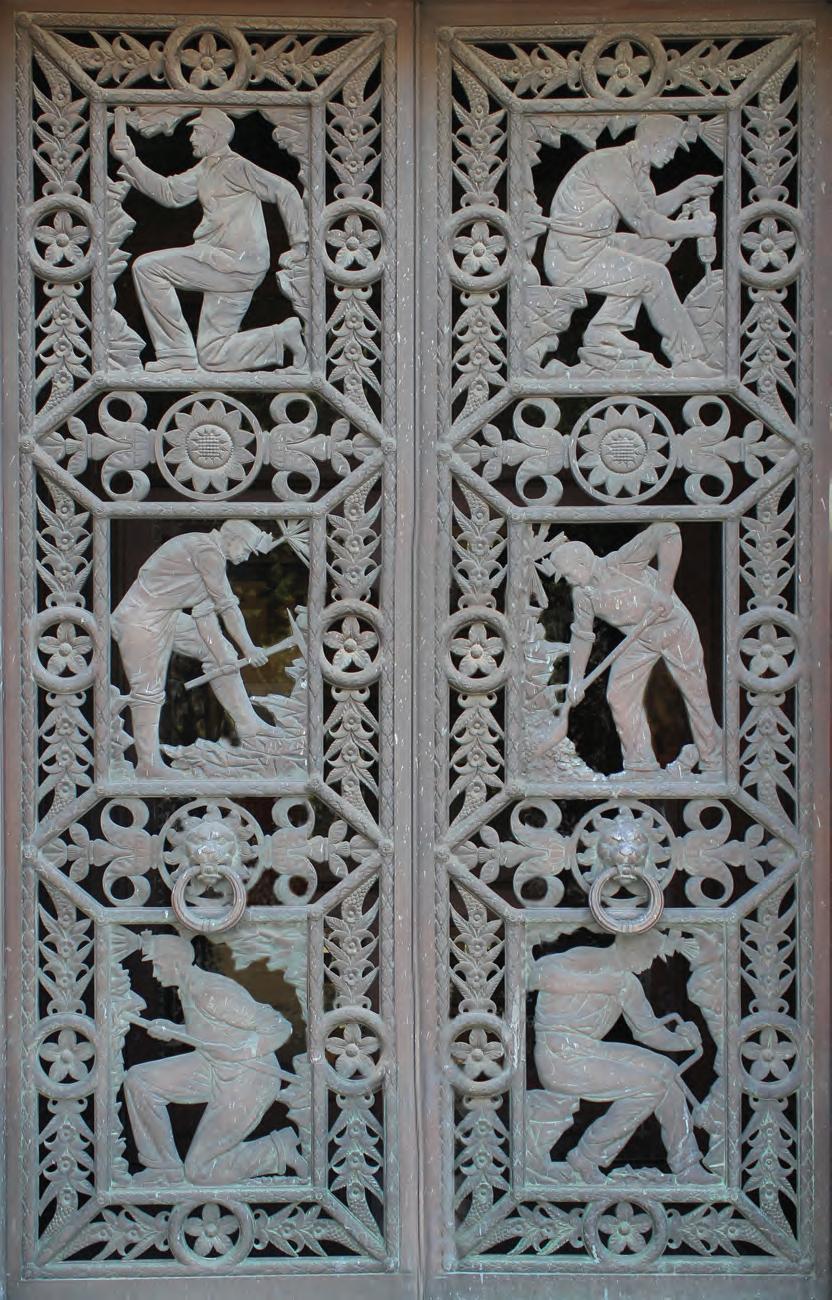
John Polachek (1873-1955). Bronze Doors for Miners National Bank. Bronze relief. Commissioned for the Miners National Bank. Pottsville, Pennsylvania. 1927. The Rosalia. Pottsville, Pennsylvania.
Print illustration on paper. Published in Survey Graphic. New York. May 1, 1928. Vol. LX-No.3.
Pennsylvania.
Oscar Edward Cesare (1883-1948). Miners and Murder.
1. The Stanislaus Collection. Scranton,
Over the course of a century, public perception of anthracite strikes registered the disruptive events on a continuum ranging from sinister and anarchistic to democratic and dignified. Throughout the 1920s, as unions continued to demand better working conditions and markets began to recognize new fuel sources, political and economic tensions increased. In May 1928, the magazine Survey Graphic published a sensational article describing four murders related to anthracite industry labor disputes that occurred in Pittson. Written on assignment by Ben Selekman, an author noted for his credentials in social work and labor relations, the essay “Miners and Murder. What Lies Back of the Labor Feud in Anthracite,” was accompanied by reproductions of the Luks painting The Coal Miner, as well as gestural line drawings of mining scenes by Herbert Pullinger.35 The angular Art Deco illustration Miners and Murder (1928), designed by prominent political cartoonist Oscar Edward Cesare (1883-1948), appeared on the magazine’s front cover. In contrast to the weary but determined laborer shown in the Luks portrait, the jagged and aggressive anthracite miner presented in Cesare’s black, white, and red composition glares at the viewer with a menacing stare, daring the reader to discover knowledge of violent deeds.
In 1929, the United States entered the Great Depression during the administration of President Herbert Hoover (18741964), who was not reelected to a second term. Soon after taking office in 1933, his successor President Franklin Delano Roosevelt (1882-1945) established a series of federal programs to mitigate the financial pressures faced by American citizens. Collectively known as the New Deal, these initiatives, which included the Works Progress Administration, later called the Work Projects Administration, attempted to provide economic relief, recovery, and reform from 1935 through 1943. Support for artists was provided through a specialized subdivision, the Federal Arts Project, which in turn maintained a Graphic Arts Division that offered opportunities for printmakers. Artists affiliated with branches of the Graphic Arts Division in Philadelphia and New York City developed an interest in anthracite subjects. While the mode in which they worked could be generally described as Social Realism, many printmakers also explored expressive techniques related to Modernist styles, utilizing them to generate support for the working class.
Born in Scranton to Irish immigrant parents, Michael Joseph Gallagher (1895-1965) was raised in a large family primarily employed in the mines. Gallagher was spared from this work due to poor health: while serving in the United States Army during World War I, he contracted tuberculosis, and was sent to a sanatorium near White Haven, Pennsylvania. He amused himself during his convalescence by drawing, and a doctor, noticing his abilities, recommended that he attend art school. Gallagher studied at the Pennsylvania Museum School of Industrial Art, where he trained as an illustrator and printmaker. During the 1920s, he produced many book illustrations and was known for his skill as a wood engraver. Following the Great Depression and the establishment of the Works Progress Administration in 1935, Gallagher helped to organize and direct the Graphic Arts Division Printmaking Workshop in Philadelphia. There he collaborated with Dox Thrash (1892-1965) and Hugh Mesibov (1916-2016) on a new intaglio process publicized as carborundum printing. In 1940, a selection of Gallagher’s prints were shown in Lackawanna County at the Everhart Museum.36
Many of Gallagher’s prints recalled scenes internalized by the artist during his early years in Scranton. The awardwinning wood engraving Sunday Evening (1936) depicts a young couple dressed in fashionable clothes, standing in the midst of an active anthracite community, yet gazing contentedly across a bright horizon. A colliery occupies most of the image, partially blocking the radiant sun behind it. Power lines and railroad tracks converge on the banks of a river, and the edge of a ramshackle house is shown rising from a gritty hillside. The man, however, stands confidently with his hand on his hip and his arm around the woman. Together, they anticipate a better life in this harsh environment. Less optimistic are the carborundum tints Anthracite (1938) and Lackawanna Valley (1935-1942), two among a series of Gallagher prints in this unusual medium. The monumental figures in these images wear timeless garments as they toil and glean. A man in a mine tunnel, his bare back bent as he pushes a loaded coal car, is clad in simple trousers, while a woman of the coal fields, her strong hand flexed as she fills a sagging coal sack, is dressed in a knotted headscarf, draped shawl, full blouse, and long skirt. The figures function as allegories of an industry and a landscape. The rough texture of the prints, created by the carborundum grit used in the printmaking process, reinforces their connection to coal.
A second native of Northeastern Pennsylvania to release prints in conjunction with the Works Progress Administration was Nicholas Bervinchak (1903-1978). As previously noted, Bervinchak was born and raised as the son of Ukrainian Lemko immigrants in Schuylkill County. Following the death of his father in a mining accident, he worked to support his family from an early age, first in the collieries and later in the mines. Art, however, always interested him, and he drew whenever he could. In 1924, Bervinchak met the Hungarian ecclesiastical artist Paul Daubner (1884-1967), who was decorating the interior of the Saints Peter and Paul Byzantine Catholic Church in nearby Minersville. He became Daubner’s assistant and worked with him producing religious imagery. During a visit to the George Luks exhibition at the Pottsville Free Public Library in 1925,
“Artist
Reformatted news article from digitized original. Published in Philadelphia Inquirer. Philadelphia. Saturday, November 21, 1936. 3.
Wins Gribbel Prize.”
Michael Joseph Gallagher (1895-1965). Sunday Evening. Wood engraving on paper. 1936. The Everhart Museum. Scranton, Pennsylvania.
Michael Joseph Gallagher (1895-1965). Anthracite. Carborundum tint on paper. 1938. The Everhart Museum. Scranton, Pennsylvania.
Michael Joseph Gallagher (1895-1965). Lackawanna Valley. Carborundum tint on paper. 1935-1942. The Everhart Museum. Scranton, Pennsylvania.
Harry Gottlieb (1895-1992). The Coal Pickers. Lithograph on Rives BFK paper. 1936. The Stanislaus Collection. Scranton, Pennsylvania.
Riva Helfond (1910-2002). Anthracite Valley. Lithograph on paper. 1938. Paramour Fine Arts. Franklin, Michigan.
Nicholas Bervinchak (1903-1978). Bootlegger’s Wife and Son. Etching on paper. 1939. The Pottsville Free Public Library. Pottsville, Pennsylvania.
Bervinchak befriended the artist, who viewed one of his paintings and encouraged him to pursue his career in art. Largely self-taught, Bervinchak made his first etchings with a victrola needle and tablespoon. His understanding of coal mines and patch towns, gained through lived experience, closely informed his detailed, insightful depictions of anthracite subjects.37
During the 1930s, unemployed miners continued to extract coal from company lands in a practice known as “bootleg” mining. The contraband fuel resulting from these efforts could be used by the miners’ families, or sold elsewhere below current market value to generate extra income. Bervinchak’s etching Bootlegger’s Wife and Son (1939) depicts this dangerous and illegal activity. A sturdy woman in a house dress and a young boy in a striped shirt are shown assisting their husband and father, who is removing coal from a “dog hole” pit and is consequently out of view. The woman and boy are seen from behind, struggling to turn a windlass that lowers and raises a heavy rope and coal buckets into and out of the hole. The family unit is clearly engaged in a survival activity, brought on by the adverse effects of the Great Depression and the subsequent lay-off of thousands of anthracite workers.
Many Graphic Arts Division printmakers in New York City were born in regions other than Northeastern Pennsylvania. A collective interest in labor issues and social justice, however, inspired several of them to take up the topic of anthracite mining. Riva Helfond was born in Brooklyn to Jewish parents who had emigrated to the United States from Russia. Raised in the environs of New York City, she studied at the Art Students League with instructors including the Romanian-born printmaker Harry Sternberg (1904-2001), who advocated political activism through art. Among other like-minded classmates were the printmakers Will Barnet (1911-2012) and Blanche Grambs (1916-2010). Helfond served as an instructor for the Works Progress Administration at the Harlem Community Art Center, and later transferred to the Graphic Arts Division. In 1936, Sternberg received a Guggenheim Fellowship to complete an art project addressing industrial subjects. He invited former students Helfond and Grambs to join him on a working trip to the anthracite community of Lansford, Pennsylvania, which Helfond helped to arrange: her husband, sculptor Bill Barrett, belonged to a Welsh mining family and had connections in the area.38
Helfond felt compassion for the mining families of Lansford, yet noted difficulties in representing them due to differences in gender and ethnicity. As a female artist, she was excluded from conversations between miners and male colleagues that often occurred in taverns. Women of the town who were at first friendly withdrew when they learned that Helfond was Jewish. Despite these challenges, Helfond’s lithograph Anthracite Valley (1938) encapsulates the history of anthracite mining in Schuylkill County, as well as the divided interests of labor and capital. In the center of the print, a miner is shown crouching underground. He fills the space of a cavern that can be equally interpreted as a womb and a tomb. The gaunt and frightened faces of his wife and children are shown to the right as they wait and worry over his personal safety and their family finances. A settlement of flimsy shelters rises in the distance, indicating the community’s poverty and solidarity during a strike. To the left, a line of guardsmen clad in helmets and armed with rifles form an arched line that bears down on the miner. Behind them stands a breaker served by endless coal trains moving their cargo to distant markets.
Blanche Grambs similarly felt an affinity for mine workers in Northeastern Pennsylvania. Born in Beijing, China, to American parents, Grambs relocated to New York City in 1934. Like Helfond, she studied with Sternberg at the Art Students League, and traveled with him on his research trip to Lansford in the company of her husband, artist Hugh “Lefty” Miller (1911-1988). Attracted to the expressive style of German printmaker and activist Käthe Kollwitz (18671945), Grambs was not afraid to break from realistic representations of the human form.39 Her aquatint and etching Miner’s Head (1939) is a haunting and provocative portrait of an anonymous anthracite miner. The stark, monochromatic contrast between the velvety black oval of the miner’s helmet and the glowing white spiral of his headlamp demonstrate the artist’s technical understanding of sophisticated printmaking techniques. As in Gallagher’s carborundum tints, the textured surface of the print, created through pressure applied to a rough plate and squeezed against soft paper, alludes to the tactile qualities of skin and stone.
Yet another artist based in New York City, Harry Gottlieb (1895-1992), examined the social and political implications of the anthracite industry in his art. Born in Romania, Gottlieb immigrated to Minneapolis, Minnesota, where he studied painting at the Minneapolis Institute. He traveled abroad on a Guggenheim Fellowship, and became a printmaker in an artists’ colony at Woodstock, New York, upon returning to the United States. Moving to New York City in 1935, Gottlieb went to work in the Graphic Arts Division of the Federal Arts Project. He was politically active in the Artists Union, which advocated for opportunities in the arts, and the American Artists Congress, an organization that sought to combat the spread of fascism. At the Harlem Community Art Center, Gottlieb periodically taught silk-screening in the printmaking program there, which was directed by Riva Helfond. Gottlieb was firm in his belief that printmaking, as a medium which
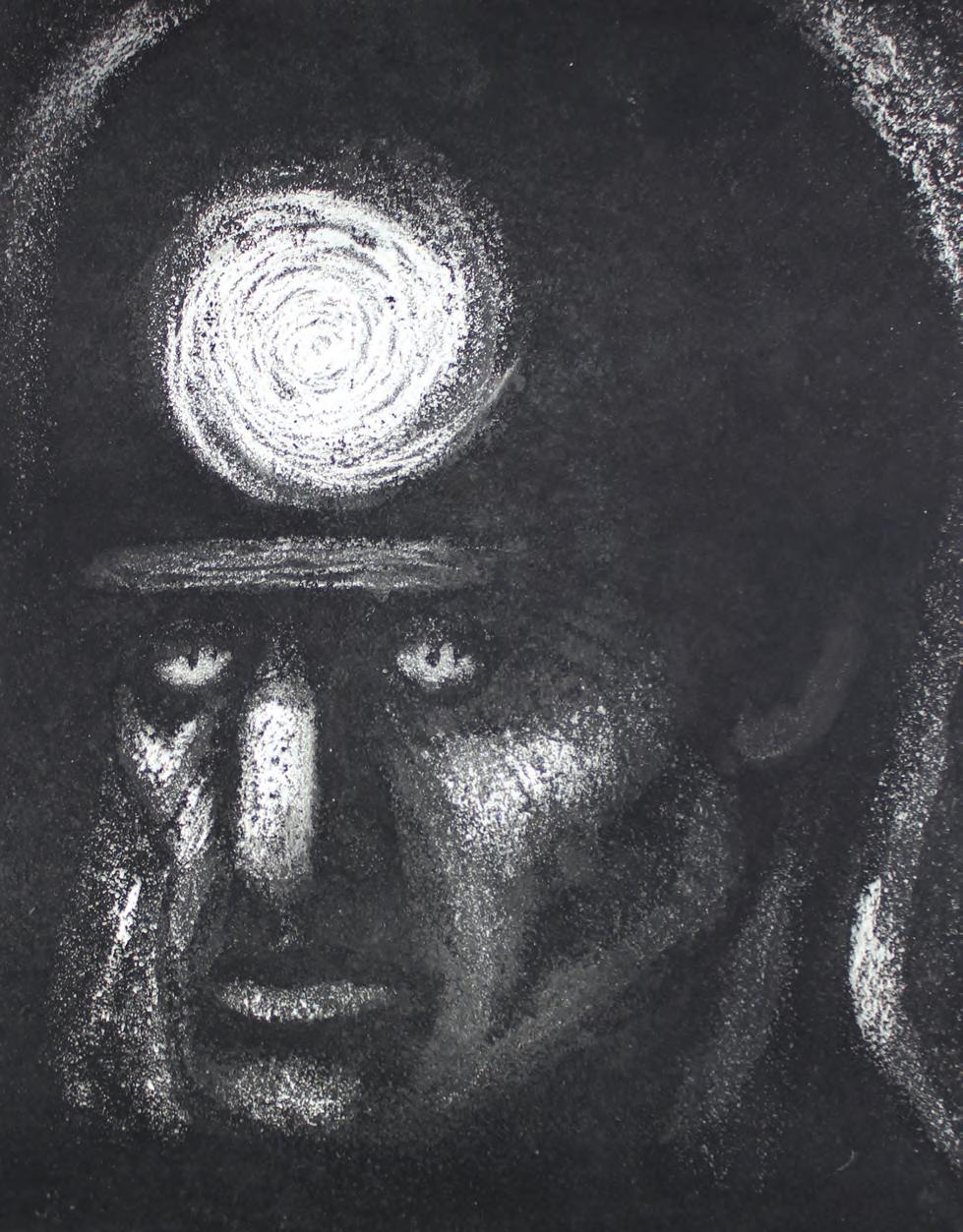
Blanche Grambs (1916-2010). Miner’s Head. Aquatint and etching on paper. Federal Art Project. N.Y.C. W.P.A. 1939. The Stanislaus Collection. Scranton, Pennsylvania.
Niccolo Cortiglia (1893-1982). Forty-Fort Anthracite Coal Breaker. Forty-Fort, Pennsylvania. Charcoal on paper. c. 1924. The Stanislaus Collection. Scranton, Pennsylvania.
Niccolo Cortiglia (1893-1982). Coal Breaker. Oil on canvas. 1924. The Everhart Museum. Scranton, Pennsylvania.
allowed for the production of multiple images, was an important democratic tool for addressing large audiences. While individual easel paintings would be acquired at great cost by elite collectors, duplicated series prints could be purchased at modest prices by common workers.40
A political activist interested in the power of labor unions, both in art and industry, Gottlieb visited the anthracite region between 1936 and 1939. Echoing a theme found in the Harris photograph A Family Load and Gallagher print The Lackawanna Valley, Gottlieb’s lithograph of The Coal Pickers (1936) shows a stylized view of private and professional activities near a coal processing site. In the foreground, three women bent at the waist and one man standing with a bucket gather scattered lumps of ungraded anthracite from a culm pile. Behind them, three miners make their way to work near a breaker, while four more distant figures clamber across a second slag heap, scavenging their own usable coal from discarded refuse. In the background, the domes of an Eastern Christian church rise above the company town. With flowing lines and subtle washes, the image represents a way of life grounded in labor and faith, where “work” extends beyond paid activity into every moment of life.
Encoding Cultural History: Medium and Message
As anthracite production peaked in the 1920s, Linson and Luks painted breakers and miners in Scranton and Pottsville. During the same period Niccolo Cortiglia (1893-1982) completed a series of colliery paintings in Wilkes-Barre. Born in New York City, Cortiglia was the son of Italian immigrants. He trained at the John Herron Art Institute in Indianapolis and the Royal Academy of Fine Art in Rome. Cortiglia came to Wilkes-Barre on a portrait commission, but was intrigued by unique features of the landscape, including industrial sites along the Susquehanna River.41 Based on observation, the charcoal sketch and colorful painting of the Forty-Fort Anthracite Coal Breaker. Forty-Fort, Pennsylvania (1924) demonstrate his affinity for compositional structure. In 1970, Cortiglia distilled the content of his early colliery paintings to produce a mural of an imagined coal landscape for the D. Leonard Corgan Library at Kings College in Wilkes-Barre. Marking a transition from the early to late twentieth century, the shift from observation to imagination demonstrated in Cortiglia’s anthracite subjects paralleled a decline in mining operations. In the decades spanning the 1930s through 1950s, many artists grappled with modes of expression that might chronicle the passage of an iconic industry from action to memory.
During the 1930s, New Deal art programs were not limited to the Works Progress Administration Federal Arts Project. Between 1934 and 1943, the United States Treasury Department supervised the Section of Painting and Sculpture, later called the Section of Fine Arts, which awarded merit-based commissions for art in federal buildings, including post offices. Styles and subjects were not strictly specified by the agency, but artists were encouraged to represent historical and cultural themes in a manner acceptable to public audiences struggling through stressful times. Artists walked a fine line between the unmodulated examination of controversial topics and the idealized representation of complex issues, either of which might alienate viewers. Envisioned as community art, post office projects were installed in highly-visible locations in the main lobby or above the postmaster’s door. Across Northeastern Pennsylvania, seven post office commissions depicting anthracite subjects were completed. These included four murals and three relief sculptures of regional landscapes and mine workers meant to inspire pride in residents who saw them every day.
Popular with American audiences since the nineteenth century, landscape paintings could readily meet the Section of Fine Arts mandate to engage local communities, albeit through twentieth-century variations on traditional techniques. Born in Buffalo, New York, John Fulton Folinsbee (1892-1972) studied with painter Jonas Lie (1880-1940) before training at the Art Students League and participating in art colonies at Woodstock, New York, and New Hope, Pennsylvania. Folinsbee also traveled abroad, synthesizing his encounters with Tonalism, Impressionism, and Expressionism. His oil on canvas mural Freeland, Pennsylvania (1938), painted for the United States Post Office in Freeland, maintains a sense of atmospheric perspective in its soft bands of orange and blue mountains, yet emphasizes elements of abstraction in the angular forms of a purple colliery. Recognizable landmarks include the Highland Number 2 Breaker, Drifton Slate Bank, Mining and Mechanical Institute, Saint Mary’s Greek Catholic Church, and Saint John’s Roman Catholic Church.42.
Born in Baltimore, Herman Maril (1908-1986) studied at the Maryland Institute of Fine Arts and taught at the University of Maryland. He received a Section of Fine Arts commission for the oil on canvas Nature’s Storehouse (1941), installed at the United States Post Office in West Scranton.43 In contrast to Folinsbee’s direct depiction of an industrial landscape, Maril’s view presents a dreamlike vista in terms of broad, understated fields of color arranged across the picture plane. Revisiting the concept of the “machine in the garden,” it features an image of a locomotive crossing a viaduct before a double mountain near a creek, with engine smoke streaming behind. The scene echoes the forms of a Hudson River
John Fulton Folinsbee (1892-1972). Freeland, Pennsylvania. Oil on canvas mural. Funded by the Treasury Section of Fine Arts. 1938. The United States Post Office. Freeland, Pennsylvania. The John F. Folinsbee Trust.
Malvina Hoffman (1887-1966). Coal Miners Returning from Work. Plaster relief. Funded by the Treasury Section of Fine Arts. 1939. The United States Post Office. Mahanoy City, Pennsylvania.
Jared French (1905-1988). Meal Time with the Early Coal Miners. Oil on canvas mural. Funded by the Treasury Section of Fine Arts. 1935. The United States Post Office. Plymouth, Pennsylvania.
Harry Poole Camden, Jr. (1900-1943). Agriculture and Mining. Aluminum relief. Funded by the Treasury Section of Fine Arts. 1939. The United States Post Office. Clarks Summit, Pennsylvania.
Herman Maril (1908-1986). Nature’s Storehouse. Oil on canvas mural. Funded by the Treasury Section of Fine Arts. 1941. The United States Post Office. West Scranton, Pennsylvania.
Marion Walton (1899-1996). Mine Elevator. Limestone relief. Funded by the Treasury Section of Fine Arts. 1942. The United States Post Office. Pittston, Pennsylvania.
George Matthews Harding (1882-1959). Anthracite Coal Tempera on plaster mural. Funded by the Treasury Section of Fine Arts. 1941. The United States Post Office. Kingston, Pennsylvania.
William Perlitch (1923-1987).
War Production Drive. Anthracite Rallies. [Anthracite Miners and Serviceman with Pneumatic Drill.] Hazleton, Pennsylvania. Photograph from black and white negative. 1942. U.S. Farm Security Administration/Office of War Information. The Library of Congress Prints and Photographs Division. Washington, D.C.
School landscape by Jasper Cropsey (1823-1900), whose Starrucca Viaduct, Pennsylvania (1865) depicts a famed railroad bridge near Scranton. In Maril’s twentieth-century view, collieries and factories replace wilderness on either side of the mural, while a central group of observers is transformed into a worker and dog.
In addition to paintings of anthracite landscapes, several New Deal mural commissions represented miners through relief sculpture. Interpretations of figures ran the gamut from portrait to allegory, and physical details were represented with varying degrees of specificity. Born in New York City, Malvina Hoffman (1885-1966) studied sculpture at the Art Students League and the Borglum School of Sculpture. Traveling to Paris, she attended the Académie Colarossi and apprenticed with sculptor Auguste Rodin (1840-1917). Known for her skill in portraiture, she completed The Races of Man, an ethnographically-themed sculpture series, for the Field Museum of Natural History in Chicago. Awarded a Section of Fine Arts commission for the United States Post Office in Mahanoy City, Hoffman produced a rectangular plaster relief of Coal Miners Returning from Work (1939).44 The sculpture depicts four highly-individualized miners with weathered but dignified faces. Set against a colliery backdrop of smokestacks, winding towers, and rail lines, they share an easy conversation as they walk along.
A commission assigned to Harry Poole Camden, Jr. (1900-1943) presented figures in allegorical form. A native of Parkersburg, West Virginia, Camden served in the United States Army during World Wars I and II. He attended the School of Fine Arts at Yale University and the American Academy in Rome before teaching sculpture at the University of Oregon, Eugene, and Cornell University. In 1938, Camden won a national sculpture competition for monumental male and female allegories of Unity and Peace, completed for the façade of the Federal Building at the World’s Fair of 1939. During that year, he also produced the aluminum relief Agriculture and Mining (1939) for the United States Post Office in Clarks Summit.45 Reminiscent of full-bodied figures found in works by Mexican muralists like Diego Rivera (1886-1957), the stylized man and woman shown in the organically-curved panel represent their labors with Art Deco grace. Agriculture is personified as a woman gathering farm vegetables while Labor is symbolized by a miner holding a pickaxe.
Like her contemporaries Hoffman and Camden, Marion Walton (1899-1996) received a Section of Fine Arts sculpture commission for an anthracite subject. Born in New Rochelle, New York, she trained at the Art Students League, Hunter College, and the Borglum School of Sculpture. Walton produced three limestone relief sculptures for the United States Post Office in Pittston. Two depicted scenes of local history related to Native Americans and the local landmark Campbell’s Ledge. The third, Mine Elevator (1942), represented anthracite workers of the 1940s. Carved in a simplified style from a slab of pale stone, the large sculpture was not well-received by viewers who associated mining with darkness and complexity.46 Neatly dressed in caps, jackets, and boots, the nine miners depicted in Walton’s relief stand in an orderly row behind the crossed bars of a scissors gate. Devoid of extreme variation, the repetition of forms suggests that the miners are organized and united, and that their work in the mine will be safe and productive.
Figurative murals related to anthracite themes also veered in opposite directions as artists both emulated the traditions of figure drawing and confronted the urgency of current events. Born in Ossining, New York, Jared French (1905-1988) attended Amherst College and studied at the Art Students League. He traveled in Italy with colleague and companion Paul Cadmus (1904-1999), and appreciated Renaissance art. In his oil on canvas Meal Time with the Early Coal Miners (1935), installed at the United States Post Office in Plymouth, French depicted a group of men in a timeless pastoral setting, rather than a specific mining site.47 Four men in active yet relaxed postures are shown gathered on a grassy bank near a clear stream. Clothed in knee-length trousers of muted red, blue, and tan, they remove their shirts to wash away the dust of work before enjoying a simple lunch of bread, fruit, and cheese. A mountain and river stretch across the canvas behind them, where three additional workers, two shirtless and one nude, move coal with a cart, wheelbarrow, and barge. More idyllic than laborious, the scene reveals the aesthetic interests of an artist, rather than the technological details of an industry.
Conversely, George Matthews Harding (1882-1959) produced a highly accurate representation of anthracite labor in his tempera on plaster mural Anthracite Coal (1941), commissioned for the United States Post Office in Kingston. A native of Philadelphia, Harding studied at the Pennsylvania Academy of the Fine Arts and trained with Howard Pyle (18531911). In the early twentieth century, he was an illustrator for Harper’s Magazine. During World War I, Harding worked as a combat artist with the American Expeditionary Forces in France, and was commissioned as a war artist in the Pacific Theater during World War II. He also taught at the Pennsylvania Academy of the Fine Arts and the University of Pennsylvania and received New Deal mural commissions.48 In Anthracite Coal, two breakers resembling the nearby Huber and Prospect Collieries stand in a frozen landscape against a bright blue sky. Trains move between them on snowy tracks. Dressed for winter in heavy coats, eight miners wait beneath a tower. Icicles hang from a beam overhead. Seven other
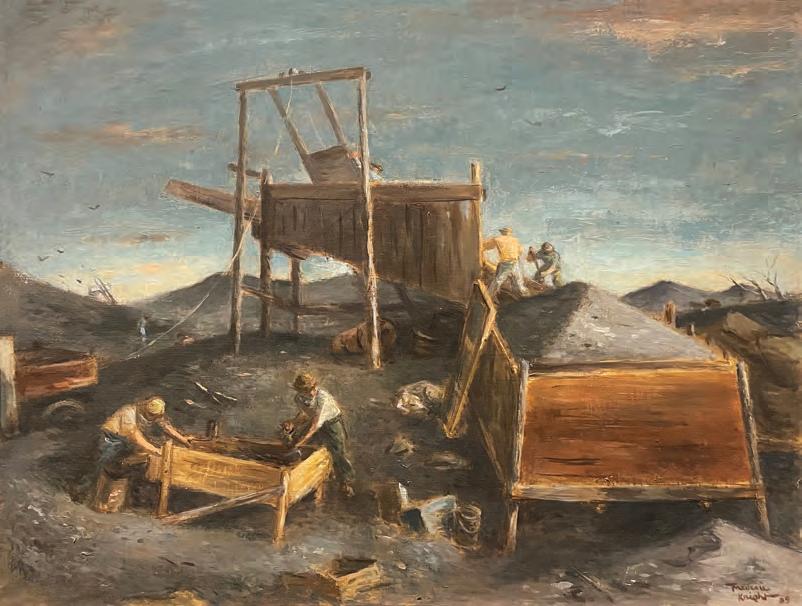
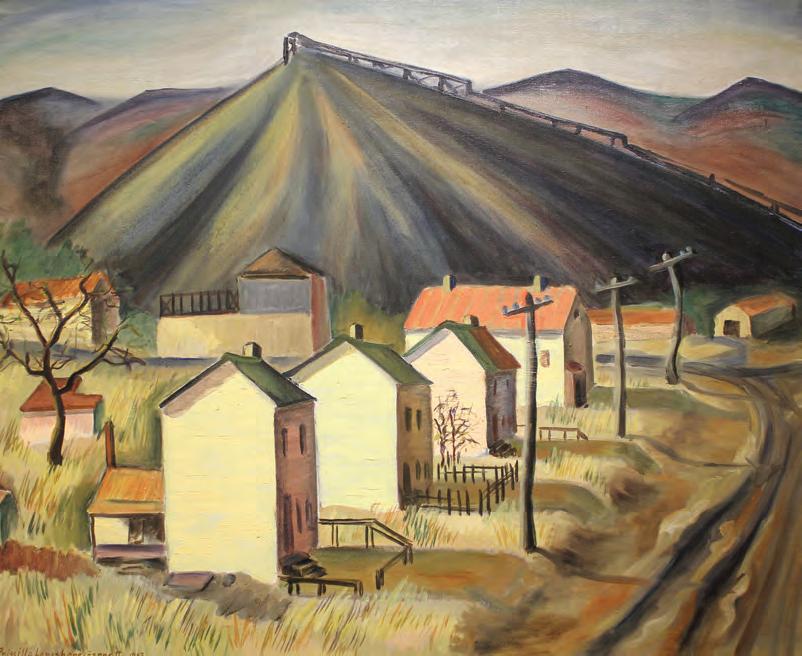
Priscilla Longshore Garrett (1907-1992). Company Houses. Duryea, Pennsylvania. Oil on canvas. 1943. The Everhart Museum. Scranton, Pennsylvania.
Frederic C. Knight (1898-1979). Bootleg Mining in Shenandoah. Oil on canvas. 1939. Gift of Mrs. Frederic C. Knight. The Everhart Museum. Scranton, Pennsylvania.
Unknown (dates unknown). Pine Brook Coal Breaker. Photograph on cardboard. 1885. The Stanislaus Collection. Scranton, Pennsylvania.
Unknown (dates unknown). Pine Brook Coal Breaker Fire. Photograph on cardboard. Undated. The Stanislaus Collection. Scranton, Pennsylvania.
John Willard Raught (1857-1931). Pine Brook Coal Breaker. Oil on canvas. 1911. The Everhart Museum. Scranton, Pennsylvania.
miners crowd a moving platform in a mine shaft, holding straps to steady themselves. A worker on a coal car raises his hand, while groups of men perform tasks in the distance. The mural outlines the physical hardships and strategic movements associated with coal production, similar in many ways to those common in military operations.
Connections between anthracite mining and the armed forces were more deliberately highlighted a year later in images produced by photographer William Perlitch (1923-1987) for the Office of War Information. Perlitch was nineteen years old when he accompanied the experienced newspaper photographer Morris Gordon on an assignment to document ArmyNavy Anthracite War Production Rallies held in Northeastern Pennsylvania in the fall of 1942. Organized by the War Production Board in Washington D.C., four rallies held in Scranton, Wilkes-Barre, Hazleton, and Pottsville promoted the concept of coal mining as a defense industry through presentations by active servicemen and demonstrations of military equipment. Photographs which documented soldiers and miners side by side also functioned as propaganda in support of the war effort.49 In Perlitch’s War Production Drive. Anthracite Rallies. [Anthracite Miners and Serviceman with Pneumatic Drill.] Hazleton, Pennsylvania (1942), a miner, accompanied by a soldier, handles a pneumatic drill in much the same way as a soldier might fire a machine gun in battle.
Artists working with variations on Modernist styles like Cubism and Expressionism carried subjects destined to be part of anthracite history into easel painting. Born in Philadelphia and raised in Scranton, Frederick C. Knight (1898-1979) studied illustration at the Pennsylvania Museum School of Industrial Art before traveling in Europe. Upon his return to the United States, he relocated to New York, teaching at Columbia University and painting landscape, figure, and portrait subjects. Knight received several New Deal commissions, including a mural depicting employees of the Endicott-Johnson Shoe Company for the United States Post Office at Johnson City, New York. Knight intermittently visited Scranton between 1938 and 1941.50 Several paintings from this period employed a blocky compositional technique to address anthracite themes, including the oil on canvas Bootleg Mining in Shenandoah (1939). The industrial scene shows an activity common in Northeastern Pennsylvania during the 1930s: unemployed miners, engaged in illegal activities on company property, extract coal from a clandestine mine under dangerous conditions.
Similarly, Priscilla Longshore Garrett (1907-1992) came to Scranton in 1938, noting that in the anthracite region she had found a “wealth of paintable material.” A native of Chatham, New Jersey, Garrett attended the Drexel Institute School of Design for Women and the Pennsylvania Academy of the Fine Arts. She also studied with George Harding, who she found demanding and inspiring as a teacher. Skilled in the use of charcoal, ink, pastel, watercolor, and oil, Garrett prepared preliminary sketches on site, then developed them into finished works in her studio. In the coal regions during the war years, the sight of a woman with a notepad attracted suspicion: while drawing an outdoor street scene, Garrett was reported to the local police by neighborhood residents who feared she might be a German spy.51 The oil on canvas Company Houses. Duryea, Pennsylvania (1943), expressively represents the homes of coal miners. Painted in vivid, jewel-like colors, the rough buildings seem self-illuminated against the towering black culm pile behind them.
Following World War II, the anthracite coal industry of Northeastern Pennsylvania entered a period of decline from which it did not emerge. Prior to that time, the network of companies, workers, facilities, and consumers had negotiated periodic setbacks in terms of capital, labor, technology, and economics for decades. With an inherent sense of prophecy, John Willard Raught exemplified this doomed perseverance in his painting Pine Brook Coal Breaker (1911). The Pine Brook, also known as the Sandy Banks Breaker, was built in 1857. Owned by the Lackawanna Iron and Coal Company, it was destroyed by fire in 1884 and rebuilt by 1886. It burned again in 1904 under the ownership of the Scranton Coal Company, and was rebuilt again by 1905. This second colliery was lauded as a modern edifice, even as reporters commented that many original workers did not return to employment there. Raught’s oil on canvas depicts the towering new structure in a frigid landscape, while period photographs of the Pine Brook Coal Breaker (1885) and Pine Brook Coal Breaker Fire (undated) chronicle its rise and fall. Operation of the breaker was sporadic after 1937, when its parent company fell into bankruptcy.52
If Raught envisioned the anthracite industry’s nostalgic dissolution, Abstract Expressionist painter Franz Kline (19101962) saw its cataclysmic fall. Artistically anticipated by Raught in tonal landscapes of 1910s, the decline of this colossal system was visually eulogized by Kline in gestural abstractions of the 1950s. Born in Wilkes-Barre and raised in Lehighton, Pennsylvania, Kline attended Girard College before studying art at Boston University and the Heatherly School of Art in London. He settled in New York City where New York School painters including Willem de Kooning (1904-1997) and Jackson Pollock (1912-1956) advocated an action-based approach to abstract painting. Kline remained connected to the anthracite region and at first maintained a representational painting style, as demonstrated in his mural Lehighton (1945), commissioned for the local American Legion. Within the next decade, he produced non-representational yet emotionally-
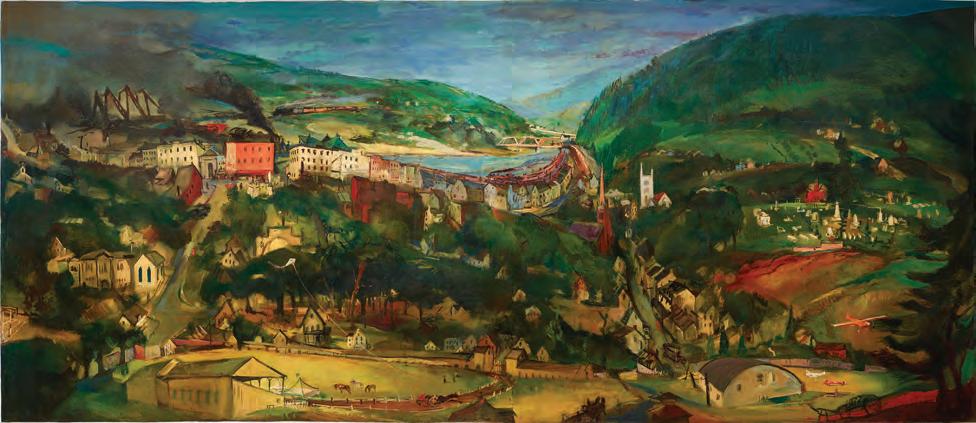
Franz Kline (1910-1962). Lehighton. Oil on canvas mural. Commissioned for the American Legion. Lehighton, Pennsylvania. 1945. Purchased through the Leigh Schadt and Edwin Schadt Art Museum Trust Fund, 2016. The Allentown Art Museum. Allentown, Pennsylvania. The Franz Kline Estate / Artists Rights Society (ARS), New York.
Franz Kline (1910-1962). Mahoning. Oil and paper on canvas. 1956. Museum Purchase with Funds from the Friends of the Whitney Museum of American Art. Whitney Museum of American Art. New York City, New York. The Franz Kline Estate / Artists Rights Society (ARS), New York.
William R. Lukasik (1924-2015) and Stephen N. Lukasik (1928-2009).
Knox Mine Disaster. Coal Cars Pushed into Susquehanna River Above Collapsed
Port Griffith, Pennsylvania. Photograph. January 22, 1959. The Stephen N. and William R. Lukasik Studio Archives.
The Pennsylvania Historical and Museum Commission Anthracite Heritage
Pennsylvania.
Mine Void.
Dupont, Pennsylvania.
Museum. McDade Park. Scranton,
William R. Lukasik (1924-2015) and Stephen N. Lukasik (1928-2009).
Knox Mine Disaster. Whirlpool in Susquehanna River Above Collapsed Mine Void. Port Griffith, Pennsylvania. Photograph. January 22, 1959. The William R. and Stephen N. Lukasik Studio Archives. Dupont, Pennsylvania. The Pennsylvania Historical and Museum Commission Anthracite Heritage Museum. McDade Park. Scranton, Pennsylvania.
Charles Edgar Patience (1906-1972). Altar for the Congregation of the Holy Cross. Anthracite sculpture from coal mined near Wanamie, Pennsylvania. Commissioned by Kings College. Wilkes-Barre, Pennsylvania. 1956. The Chapel of Christ the King. Kings College. Wilkes-Barre, Pennsylvania.
Charles Edgar Patience (1906-1972). Altar for the Congregation of the Holy Cross. Detail of Congregatio a Sancta Cruce. Spes Unica. J.M.J. (Congregation of the Holy Cross. The One Hope. Jesus, Mary, and Joseph). Anthracite sculpture from coal mined near Wanamie, Pennsylvania. Commissioned by Kings College. Wilkes-Barre, Pennsylvania. 1956. The Chapel of Christ the King. Kings College. Wilkes-Barre, Pennsylvania.
evocative works like Mahoning (1956). Composed of angular black and white strokes and vortices, the painting embodies rather than depicts the stark tension of an anthracite landscape strained by the forces of nature and industry.53
Three years later, photographers William R. Lukasik (1924-2015) and Stephen N. Lukasik (1928-2009) documented the physical and symbolic end of deep mining in Northeastern Pennsylvania during the Knox Mine Disaster near Pittston. Lifelong residents of nearby Dupont, the Lukasik brothers were community photographers who produced images for private families and public newspapers. In 1959, excavations in the Knox Mine, which extended beneath the Susquehanna River, breached the riverbed with devastating results. Water rushed into the mine void, flooding an extensive labyrinth of underground chambers. Twelve miners were lost in the deluge, while 33 others escaped. In an attempt to block the breach, railroad and mine cars were diverted into the river, to little effect. Released through numerous news outlets, the Lukasik views of the Knox Mine Disaster. Whirlpool in Susquehanna River Above Collapsed Mine Void. Port Griffith, Pennsylvania (1959) and Knox Mine Disaster. Coal Cars Pushed into Susquehanna River Above Collapsed Mine Void. Port Griffith, Pennsylvania (1959) quickly achieved iconic status.54 Eventually, coffer dams were constructed and the Knox Mine breach was sealed with concrete. The flooding that resulted from the accident, however, effectively prevented further underground mining in the Wyoming Valley, marking the end of an era.
During the later years of the anthracite industry, a synthesis of material and meaning emerged in the work of Charles Edgar Patience (1906-1972), an African-American sculptor born and raised in West Pittston. Patience was the son of Harry Patience, a miner-turned-coal-carver who established a family business crafting jewelry and souvenirs from anthracite. Nicknamed the “black diamond” due to its shiny surface, anthracite was an attractive medium for pendants and paperweights, but was brittle and difficult to manipulate. Despite this challenge, Patience moved beyond his father’s production of small novelty objects to create fine art sculptures emphasizing the purity of compressed black carbon. Commissioned by Kings College to carve an altar of anthracite for the campus chapel, Patience inscribed the seal of the Congregation of the Holy Cross onto the face of a ten-by-four-by-two-foot coal block extracted from the Top Red Ash Vein of the Glen Alden Coal Company strip mines at Wanamie, Pennsylvania. The emblem, which features a cross and two anchors accompanied by the phrases and initials Congregatio a Sancta Cruce, Spes Unica, and J.M.J., refers to the Holy Cross Fathers who founded the college in 1946; their motto “Hail the Cross, Our Only Hope;” and the Holy Family names of Jesus, Mary, and Joseph.55 Installed in the Chapel of Christ the King, the Altar for the Congregation of the Holy Cross (1956) functions as a relic of both death and regeneration, calling the community to remember and transcend the anthracite coal industry in which its traditions of faith, labor, and education are grounded.
The legacy of mining also informed the mixed media work of Frank (Wyso) Wysochansky (1915-1994), a lifelong resident of Blakely, Pennsylvania and one of twelve children born to Ukrainian immigrants. After his father was killed in a mining accident, Wysochansky left school in seventh grade and was self-taught as an artist. He worked as a freelance cartoonist for the United Mine Workers Journal, but attracted national and regional attention for his mixed-media pieces in pen, ink, watercolor, and crayon during the late twentieth century. Experiences of coal and culture formed the foundation of his expressive images like Motorman with Coal Cars Entering Mine (undated), which continued to resonate with audiences of a generation born beyond the active era of anthracite. In recognition of the region’s anthracite heritage, the Coal Miners Association of Olyphant, Pennsylvania, organized the large-scale production and installation of an Olyphant Coal Miners Memorial (2007) based on a small Wysochansky sculpture.56 The life-size bronze portrait of a work-worn but powerful miner, wearing an oil-lamp cap on his raised head and holding a pickaxe in his oversized hands, inhabits the banks of the Lackawanna River near the center of town. The solitary figure embodies the spirit of first-generation immigrants to the region, who met hardship with courage and determination, and inspired their descendants to do the same.
Conclusion
Between 1829 and 1959, anthracite mining attracted the attention of visual artists who represented it in drawings, paintings, prints, illustrations, sculptures, and photographs. Exploring themes of nature, work, and culture, their aesthetic productions bear witness to the benefits and challenges of a once-vibrant enterprise that shaped the environment, economy, and identity of the region. Critically considered, this rich artistic legacy provides a greater understanding of the anthracite coal industry of Northeastern Pennsylvania.
South Wilkes-Barre, Breaker of the Lehigh and Wilkes-Barre Coal Company. Postcard. c. 1910. The Stanislaus Collection. Scranton, Pennsylvania.
Wilkesbarre, PA. Red Ash Mine. Postcard. c. 1910. The Stanislaus Collection. Scranton, Pennsylvania.
Frank (Wyso) Wysochanski (1915-1994). Olyphant Coal Miners Memorial. Bronze sculpture in the round. Erected by the Olyphant Coal Miners Association and Others. 2007. The Lackawanna Riverfront near Lackawanna Avenue. Olyphant, Pennsylvania.
Notes
The Anthracite or Hard Coal Region of Northeastern Pennsylvania — Chester J. Kulesa
1. Philip Mosley, Telling of the Anthracite: A Pennsylvania Posthistory (Mechanicsburg, PA: Oxford Southern, an imprint of Sunbury Press, Inc., 2023) 220.
2. R.G. Healey, The Pennsylvania Anthracite Coal Industry 1860-1902: Economic Cycles, Business Decision-Making and Regional Dynamics (Scranton and London: University of Scranton Press, 2007) 1. This work hereafter cited as Healey.
3. Healey, 34.
4. The Story of Anthracite (Scranton: International Textbook Company, 1932) 12-14.
5. Healey, 34.
6. Healey, 36.
7. Harold W. Aurand, Anthracite Heritage Museum and Scranton Iron Furnaces Pennsylvania Trail of History Guide, Pennsylvania Historical and Museum Commission, (Mechanicsburg, PA: Stackpole Books, 2002) 13. This work hereafter cited as Aurand.
8. Aurand, 40.
9. Dublin, Thomas and Walter Licht, The Face of Decline: The Pennsylvania Anthracite Region in the Twentieth Century, (Ithaca and London: Cornell University Press, 2005) 28. This work hereafter cited as Dublin.
10. Dublin, 10-11.
11. Report of the Department of Mines of Pennsylvania, Part I - Anthracite, 1908 (Harrisburg, PA: C.E. Aughinbaugh, State Printer, 1909) xxxi. This work hereafter cited as Mine Report.
12. Mine Report, xxxi.
13. William E. Edmunds and Edwin F. Koppe, Coal in Pennsylvania, Educational Series No. 7, Commonwealth of Pennsylvania, Department of Environmental Resources, Topographic and Geologic Survey, Arthur A. Sololow, State Geologist (Fourth Printing, June 1976) 2.
14. Mine Report, xxxi.
15. Mine Report, xxxi.
16. Mine Report, xxxi.
17. Michael Knies, Coal on the Lehigh 1790-1827: Beginnings and Growth of the Anthracite Industry in Carbon County, Pennsylvania, National Canal Museum, Hugh Moore Historical Park and Museums Inc. (Easton, PA: Canal History and Technology Press, 2001) ix.
18. Healey, 48-49.
19. “Carbondale,” Historical Marker, Pennsylvania Historical and Museum Commission, www.ExplorePAHistory.com.
20. Burton W. Folsom, Jr., Urban Capitalists: Entrepreneurs and City Growth in Pennsylvania’s Lackawanna and Lehigh Regions, 1800-1920 (Baltimore: Johns Hopkins University Press, 1981) 11.
21. “Valley Furnace,” “David Thomas,” and “First Iron Rails,” Historical Markers, Pennsylvania Historical and Museum Commission. Online at www.Explore PA History.com.
22. Healey, 6.
23. Donald L. Miller and Richard E. Sharpless, The Kingdom of Coal: Work, Enterprise, and Ethnic Communities in the Mine Fields (Philadelphia: University of Pennsylvania Press, Second Printing, 1986) 186.
24. Peter Robert, Anthracite Coal Communities (London and New York: The MacMillan Company, 1904) 209.
25. Mark Stokoe and The Very Reverend Leonid Kishkovsky, Orthodox Christians in North America (1794-1994). Online at www.oca.org/History-Archives/ Orthodox-Christians-na/Chapter-2.
26. Aurand, 23.
27. Ed Conrad, “A Dangerous Occupation,” Exhibition Panel, and “Anthracite Mining Death Toll,” Framed Piece, as seen at Pennsylvania Anthracite Heritage Museum, Scranton, PA, 2025.
28. “First Aid Pioneer,” Historical Marker, Pennsylvania Historical and Museum Commission, www.ExplorePAHistory.com. and “Care of the Injured,” Exhibition Panel, as seen at the Pennsylvania Anthracite Heritage Museum, Scranton, PA, 2025.
29. Perry Blatz, Eckley Miners’ Village Pennsylvania Trail of History Guide, Pennsylvania Historical and Museum Commission (Mechanicsburg, PA: Stackpole Books, 2003) 20-21. This work hereafter cited as Blatz.
30. Aurand, 27.
31. Aurand, 29.
32. “The 1902 Anthracite Coal Strike,” Historical Marker, Pennsylvania Historical and Museum Commission. Online at www.ExplorePAHistory.com.
33. “Pennsylvania State Police,” Historical Marker, Pennsylvania Historical and Museum Commission. Online at www.ExplorePAHistory.com.
34. Report of the Department of Mines of Pennsylvania, Part I - Anthracite, 1917 (Harrisburg: Wm. Stanley Ray, State Printer, 1918) 5.
35. “Independent Miners & Associates,” Exhibition Label, The 50th Anniversary of the Anthracite Family Album, 1973-2023, Hardcoal Chronicles by Scott D. Herring, as seen at the Pennsylvania Anthracite Heritage Museum, Scranton, PA, 2025.
36. Dublin, 82.
37. Aurand, 40
38. Blatz, 32.
39. “Overview: Mining Anthracite,” Story Chapter, Pennsylvania Historical and Museum Commission. Online at ExplorePAHistory.com.
40. “Top Five Coal Producing Countries, Million Tonnes, 2021.” Online at www.Globaldata.com.
41. Dublin, 183.
42. “Table 1. Coal Production and Number of Mines by State and Mine Type, 2023 and 2022 (thousand short tons).” Online at www.eia.gov/coal/annual/pdf/table1.pdf.
43. “Anthracite.” Online at www.EN.wikipedia.org
44. Aurand, 33.
45. Dublin, 171.
46. Dublin, p. 199.
47. Dublin, p. 199-200.
48. Healey, 440.
The Anthracite Coal Industry of Northeastern Pennsylvania: Selected Paintings, Sculptures, and Works on Paper from Public and Private Collections: 1829-1959 — Richard Stanislaus and Darlene Miller-Lanning
1. Richard Stanislaus, “Anthracite Coal Industry Art: 1869-1945,” Manuscript, produced for the Pennsylvania Historical and Museum Commission Scholar in Residence Program, Harrisburg, PA, 1998, 19-21. This work hereafter cited as Stanislaus, “Coal Art.”
2. Richard Stanislaus and Darlene Miller-Lanning, “John Willard Raught: Scranton’s Beloved Artist,” John Willard Raught, Vol. I (Scranton: Hope Horn Gallery, University of Scranton, 2019) 7-22; Richard Stanislaus, “Industrial Landscapes: The Anthracite Coal Breaker Paintings of John Willard Raught (1857-1931),” Lackawanna Historical Society Journal, Vol. 23, No. 1 (Spring 1992) 4-5.
3. “Coal Mine at Mauch Chunk,” Palmer Museum of Fine Art, Pennsylvania State University, University Park, PA, 2025. Online at https://palmer.emuseum.com/ objects/2892/coal-mine-at-mauch-chunk; “Lehman, George,” Library Company of Philadelphia, Philadelphia, PA, 2025. Online at https://digital.librarycompany. org/islandora/object/digitool%3A79453.
4. Henry Darwin Rogers, The Geology of Pennsylvania. A Government Survey, Volume I (Philadelphia: J. B. Lippincott and Co., 1858) vii; Henry Darwin Rogers, The Geology of Pennsylvania. A Government Survey, Volume II (Philadelphia: J. B. Lippincott and Co., 1858) Frontispiece, 382.
5. “Coal, and the Coal-Mines of Pennsylvania,” Harper’s New Monthly Magazine, Vol. XV(June-November 1857) 451-469, 466-467.
6. Darlene Miller-Lanning, “The Lackawanna Iron Furnaces of Scranton, Pennsylvania: Histories and Images,” The Lackawanna Iron Furnaces, Scranton, Pennsylvania (Scranton: Hope Horn Gallery, University of Scranton, 2012) 9-25, 15-18.
7. “Thomas Johnson,” Lackawanna Register, June 1, 1863.
8. “Views! Views! Views!” Pittston Gazette, October 28, 1869, 1; “Grim Reaper Claims Prominent Physician,” Scranton Truth, June 6, 1910, 2.
9. Brucia Witthoft, “George L. Clough, Painter,” The Magazine Antiques, Vol. CXXI, No. 1 ( July 1982) 130-137; Jadviga M. da Costa Nunes, “Pennsylvania’s Anthracite Mines and Miners: A Portrait of the Industry in America Art, c. 1860-1940,” Journal of the Society for Industrial Archeology, Vol. 28, No. 1 (2002) 11-32, 13-14. This work hereafter cited as da Costa Nunes, “Portrait.”
10. “Personal and Pertinent,” Scranton Times, February 8, 1950, 6.
11. John Willard Raught, “The Tragedy of Coal Mining,” Scranton Republican, February 6, 1928, 8.
12. “Obituary,” New York Sun, May 23, 1909, 2.
13. Robert M. Hicklin, Jr., “Paul Frenzeny,” Charleston Renaissance Gallery, askART, 2025. Online at https://www.askart.com/artist/Paul_Frenzeny/8259/ Paul_Frenzeny.aspx.
14. “Avondale Mine Reporters. Pictorial Artists,” Scranton Weekly Republican, September 11, 1869, 5; Stanislaus, “Coal Art,” 4-6; S. Robert Powell, “The Avondale Mine Disaster,” Casgliad y Werin Cymru, People’s Collection Wales, 2025. Online at https://www.peoplescollection.wales/items/1382551.
15. “Death of Theodore Davis,” Asbury Park Daily Press, November 10, 1894, 1; “(Carl J.) Joseph Becker (1841-1910),” Boston College Libraries, Boston, MA, 2025. Online at https://beckercollection.bc.edu/joseph-becker.
16. “William Allen Rogers,” Smithsonian Libraries. Washington D.C., 2025. Online at https://www.sil.si.edu/ondisplay/caricatures/bio_rogers.htm.
17. Stephen Crane, “In The Depths of A Coal Mine,” S.S. McClure’s Magazine, Vol. III, No. 3 (August 1894) 195-209, 207; Richard Stanislaus, “A Gilded Era Illustration,” Lackawanna Historical Society Journal, Vol. 25, No. 4/Vol. 26, No. 1 (Winter/Spring 1994/1995) 5-7; da Costa Nunes, “Portrait,” 17; Stanislaus, “Coal Art,” 8-9.
18. Homer Greene. Coal and the Coal Mines (Boston: Houghton Mifflin Company, 1898) 212.
19. Michael Buryk with Alexis Buryk, “Nicholas Bervinchak: From Slate Picker to Celebrated Pennsylvania Coal Country Artist,” Ukrainian Weekly, October 2, 2011, 12-16. This work later cited as Buryk, “Bervinchak”; “One-time Mule Driver Noted for Sketches,” United Mine Workers Journal, February 15, 1950, 14; Stanislaus, “Coal Art,” 53.
20. “George Bretz Collection,” Albin O. Kuhn Library and Gallery, University of Maryland, Baltimore, MD, 2025. Online at https://contentdm.ad.umbc.edu/digital/ collection/georgebretz.
21. Elsie Gluck, John Mitchell – Miner. Labor’s Bargain with the Gilded Age (New York: John Day Company, 1929) 95.
22. William Conolgue, “Rallying Help for Pancoast Widows and Orphans,” Lackawanna Historical Society History Bytes, Vol. 2, No. 2, (March-April 2019) 5-14. 23. Elizabeth Robins Pennell, The Life and Letters of Joseph Pennell (Boston: Little, Brown, and Company, 1929). 24. Stanislaus, “Coal Art,” 15-17.
25. Robert R. Goller, “North and South with W.J. Harris, Photographer,” El Escribano, The Saint Augustine Journal of History, Vol. 28 (1991) 2-55, 1-5. 26. “Unveil Monument on River Common,” Wilkes-Barre Record, October 10, 1921, 5; Jadviga M. da Costa Nunes, “From Monuments to Memory Sites: Representing Pennsylvania’s Anthracite Industry in Public Sculpture, 1855-2010,” Journal of the Society for Industrial Archeology, Vol. 34, No. 1/2 (2008) 101-116, 103-104. This work hereafter cited as da Costa Nunes, “Monuments”; da Costa Nunes, “Portrait,” 20.
27. “Miners Offer Fine Tribute to Mitchell,” Scranton Republican, May 31, 1924, 1; “10,000 Miners in Mitchell Parade,” Scranton Republican, May 31, 1924, 1; Richard Stanislaus, “John Mitchell Monument,” The Miner’s Lamp, Vol. 9, No. 5 (September/October 1992) 1; Stanislaus, “Coal Art,” 23-25; da Costa Nunes, “Portrait,” 21-22; da Costa Nunes, “Monuments,” 104.
28. Bennard Perlman, Robert Henri: His Life and Art (New York: Dover Publications, 1991); da Costa Nunes, “Portrait,” 15-16; Joachim Homan, Modernism at Bowdoin: American Paintings from 1900 to 1940 (Brunswick: Bowdoin College Museum of Art at Bowdoin College, 2011) 8; “Robert Henri Papers,” Archives at Yale, Yale University, New Haven, CT, 2025. Online at https://archives.yale.edu/repositories/11/resources/1393.
29. Stanislaus, “Coal Art,” 13; “Lewis Wickes Hine,” Smithsonian American Art Museum, Washington D.C., 2025. Online at https://americanart.si.edu/artist/ lewis-w-hine-2232.
30. “Corwin Knapp Linson...has been visiting...John Willard Raught,” Scranton Times, July 9, 1925, 6; Stanislaus, “Coal Art,” 27.
Pine Brook (Sandy Banks) Breaker. Postcard. c. 1910. The Charles Kumpas Collection. Scranton, Pennsylvania.
Frank (Wyso) Wysochanski (1915-1994). Motorman with Coal Cars Entering Mine. Mixed media on paper. Undated. The Stanislaus Collection. Scranton, Pennsylvania.
31. “Exhibition of Paintings Depicts Life in Coal Belt,” Philadelphia Public Ledger, October 11, 1925, 6; Judith O’Toole, Stanley L. Cuba and Nina Kasanof, George Luks: An American Artist (Wilkes-Barre: Sordoni Art Gallery, Wilkes College, 1987); Richard Stanislaus, “The Anthracite Coal Subjects of George Benjamin Luks: American Realist,” Proceedings of the Fifth Annual Conference on the History of Northeastern Pennsylvania: The Last 100 Years (Nanticoke: Luzerne County Community College, October 1993) 68-113; Stanislaus, “Coal Art,” 29-33; da Costa Nunes, “Portrait,” 17-19; “George Benjamin Luks Papers,” Archives of American Art, Smithsonian Institution, Washington D.C., 2025. Online at https://www.aaa.si.edu/collections/george-benjamin-luks-papers-9186.
32. Robert Torchia, “American Paintings, 1900-1945: The Fire Boss, 1925,” National Gallery of Art, Washington, D.C., 2025. Online at https://www.nga.gov/ research/publications/online-editions/american-paintings-1900-1945-fire-boss-1925;
33. “Necho Allen Dinner Tonight, Miners Bank Opens Friday,” Pottsville Republican, November 3, 1927, 1,5,13; Richard Doud, “Interview with Roy Stryker at the Artist’s Home in Montrose, Colorado, January 23, 1965,” Archives of American Art, Smithsonian Institution, 2025, 36. Online at https://www.aaa.si.edu/collections/ interviews/oral-history-interview-roy-emerson-stryker-12480.
34. “Handsome New Miners National Bank Opening Friday,” Pottsville Republican, November 3, 1927, 12; da Costa Nunes, “Portrait,” 20-21.
35. Ben M. Selekman, “Miners and Murder,” Survey Graphic, May 1928; “Oscar Cesare, 83, Cartoonist, Dead,” New York Times, July 25, 1948, 48; Stanislaus, “Coal Art,” 43.
36. Gwyneth M. Leech, Michael J. Gallagher Prints. Biography and Catalog (Edinburgh: Edinburgh College of Art, 1991) 3-18; Cindy Medley-Buckner, “Carborundum Mezzotint and Carborundum Etching,” Print Quarterly , Vol. 16, No. 1 (March 1999) 34-49; da Costa Nunes, “Portrait,” 26-27; “Michael J. Gallagher,” Susan Teller Gallery, New York City, NY. 2025. Online at http://www.susantellergallery.com/cgi/STG_art.pl?artist=gallagher.
37. Buryk, “Bervinchak,” 12-16.
38. “Riva Helfond Papers,” Archives of American Art, Smithsonian Institution, Washington D.C., 2025. Online at https://www.aaa.si.edu/collections/riva-helfondpapers-7718; “Riva Helfond,” Susan Teller Gallery, New York City, NY. 2025. Online at http://www.susantellergallery.com/cgi/STG_bio.pl?artist=helfond.
39. James Wechsler, “The Great Depression and the Prints of Blanche Grambs,” Print Quarterly, (December 1996) 376-396; Stanislaus, “Coal Art,” 51.
40. da Costa Nunes, “Portrait,” 26; “Harry Gottlieb Papers,” Archives of American Art, Smithsonian Institution, Washington D.C., 2025. Online at https://www.aaa. si.edu/collections/harry-gottlieb-papers-7190.
41. Roy Morgan, “Cortiglia Mural Relives History,” Wilkes-Barre Times-Leader, June 12, 1970, 18; “Niccolo Cortiglia, Portrait Painter, Dies,” Wilkes-Barre Times-Leader, November 23, 1982, 18.
42. Aubrey Powell, “Display Mural Painting,” Hazleton Standard Speaker, May 3, 1938, 2; David Lembeck with photographs by Michael Mutmansky, “New Deal Murals in Pennsylvania’s Post Offices,” Pennsylvania Heritage, (Summer 2008) 28-37, 36. This work hereafter cited as Lembeck; Kirsten M. Jensen, “John F. Folinsbee Catalogue Raisonné,” John F. Folinsbee Art Trust, 2025. Online at https://www.johnfolinsbee.org/section/?id=about%20John%20Folinsbee.
43. “Nature’s Storehouse,” Scrantonian Tribune, October 19, 1941, 8; “Everhart Museum to Exhibit Work of Herman Maril,” Scrantonian Tribune, October 19, 1941, 20; “Herman Maril Biography,” Herman Maril Foundation, 2025. Online at https://hermanmaril.com/biography
44. “Malvina Hoffman Bas-Relief Installed at Post Office Here,” Mahanoy City Record American, November 9, 1939, 1, 10; da Costa Nunes, “Monuments,” 108; Julie Rosenberg and Beth Ann Guynn, “Malvina Hoffman Papers Biographical Note,” Getty Library, Los Angeles, CA, 2025. Online at https://www.getty.edu/research/ collections/collection/113Y6Q.
45. Marcia Camden, “Harry Poole Camden, Jr.,” WWII Veterans, Rye New York Veterans Project, 2025. Online at https://www.ryevets.org/harry-p-camden-us-armyair-corps-ww2-p/kia-39.htm.
46. da Costa Nunes, “Monuments,” 107; “Marion Walton Papers,” Archives of American Art, Washington D.C., 2025. Online at https://www.aaa.si.edu/collections/ marion-walton-papers-6984.
47. da Costa Nunes, “Portrait,” 23; Lembeck, 34; “Jared French Papers,” Beinecke Rare Book and Manuscript Library, Yale University, New Haven, CT, 2025. Online at https://archives.yale.edu/repositories/11/resources/820.
48. Leo Wong, “George M. Harding Papers,” Pennsylvania Academy of the Fine Arts, Philadelphia, PA, 2025. Online at https://www.pafa.org/sites/default/files/ media-assets/MS.2017.01_GeorgeHarding.pdf.
49. “Production Rallies to be Held in Coal Region,” Mahanoy City Record-American, September 21, 1942, 1; “Famed News Photographer at Coal Rally,” Scrantonian, October 4, 1942, 8.
50. Karal Ann Marling, Frederic C. Knight: 1898-1979, (Scranton: Everhart Museum, 1987) 1-39; Stanislaus, “Coal Art,” 47.
51. “Color and Warmth of Scranton Captured on Canvas by Local Artists Exhibiting at Museum,” Scrantonian, January 31, 1942, 20; “Scranton Artist Has Two Exhibits Showing in Ohio Valley Display,” Scrantonian, March 19, 1944, 3; Kent Ahrens, “Priscilla Longshore Garrett: A Painter of Two Regions,” Woman’s Art Journal, Vol. 6, No. 1 (Spring/Summer 1985) 12-16; Stanislaus, “Coal Art,” 49.
52. “Another Breaker Burned,” Scranton Republican, September 12, 1884, 3; “City and County,” Scranton Republican, April 25, 1886, 7; “Pine Brook Breaker is Destroyed by Fire,” Scranton Times, April 26, 1904, 1; “Pine Brook Breaker,” Scranton Times, March 1, 1905, 6; “Finances, Not Mining, Spelled Colliery’s Doom,” Scrantonian, August 11, 1940, 5.
53. da Costa Nunes, “Portrait,” 29; Robert Mattison, Franz Kline: Coal and Steel (Allentown: Allentown Art Museum, 2012); Tim Higgins, “Lehighton Art Gem in Allentown,” Allentown Morning Call, January 15, 2017, E1-GO2; “Franz Kline. Mahoning. 1956,” Whitney Museum of American Art, New York City, NY, 2025. Online at https://whitney.org/collection/works/1997.
54. “12 Missing and 35 Rescued After River Breaks Into Mine Near Pittston,” Wilkes-Barre Record, January 23, 1959, 1; “More Coal Cars Dumped into Knox Mine,” Wilkes-Barre Times-Leader Evening News, January 24, 1959, 3; “Stephen N. Lukasik,” Citizen’s Voice, September 20, 2009, A6; “William R. Lukasik,” Citizen’s Voice, March 8, 2015, B12.
55. “Altar of Anthracite Coal for Kings College,” Catholic Standard and Times, October 8, 1954; Juanita Patience Moss, The Anthracite Coal Art of Charles Edgar Patience (Westminster, MD: Heritage Books, 2006).
56.“Cast a Tribute,” Scranton Sunday Times, November 27, 2005, F1; “Frank Wysochansky, American Visionary Artist,” The WYSO Foundation, Bethlehem, PA. 2025. https://www.frankwyso.org/?page_id=765.