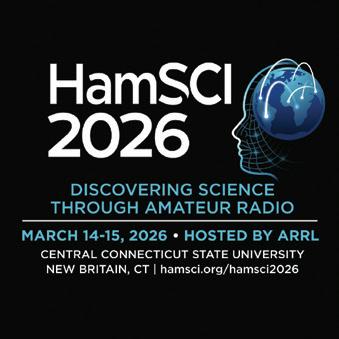
The 9th HamSCI workshop will be held from March 14–15, 2026 at Central Connecticut State University (CCSU) and at ARRL Headquarters in Newington, CT. The workshop will be hosted by the American Radio Relay League (ARRL) just a short distance away from the university. ARRL plans to offer a tour of its facilities and also provide an opportunity to operate historic W1AW, the Hiram Percy Maxim Memorial Station on site.
The location is nearby to Bradley International Airport outside of Hartford but connections are also available from the New York and Boston airports. There are many hotels located conveniently nearby so check the HamSCI website for more details and registration information.
The 2025 Q4 newsletter once again highlights the fantastic work that the HamSCI group has been doing in advancing both science and amateur radio. First up, the HamSCI group is extremely active in both amateur radio and professional conferences. This fall, the HamSCI team had booths at both the Northeast HamXPosition / ARRL New England Division convention in August 2025 in Marlboro, Massachusetts, and then again at the ARRL Rocky Mountain Convention in Grand Junction, Colorado. I was honored to give the banquet talk at the HamXPosition. At each of these conventions, HamSCI members met face-to-face with members of the greater amateur radio community and showed them the work we are doing.
We have many conventions coming up… Diego Sanchez KD2RLM and I will both be speaking at the Radio Club of America Technical Symposium in November, and then we have ten HamSCI presentations at the December 2025 American Geophysical Union conference in New Orleans. This is a major professional conference that normally attracts over 25,000 scientists from around the globe. We are also preparing for the annual HamSCI workshop that will be held in March 2026, this year in partnership with the ARRL at ARRL Headquarters in Newington, CT, and the nearby Central Connecticut State University.
HamSCI has also been doing amazing work on both the grants and publications front. Our own Dr. Kristina Collins KD8OXT just published a new python package for calculating geomagnetic conjugate points between hemispheres in the peer-reviewed journal Software-X, which you can read about in this issue of the newsletter, and even try it for yourself! Also, Dr. Kukkai Hozumi just had a major NASA Heliophysics grant selected that will allow us to advance the open-source PyLAP HF raytracing program used to study and predict HF radio propagation.
We also cannot forget about our Meteor Scatter QSO Parties! We now have our science team busy analyzing the data from the August Perseids MSQP and invite you to get on the air for the December 13-14 Geminids!
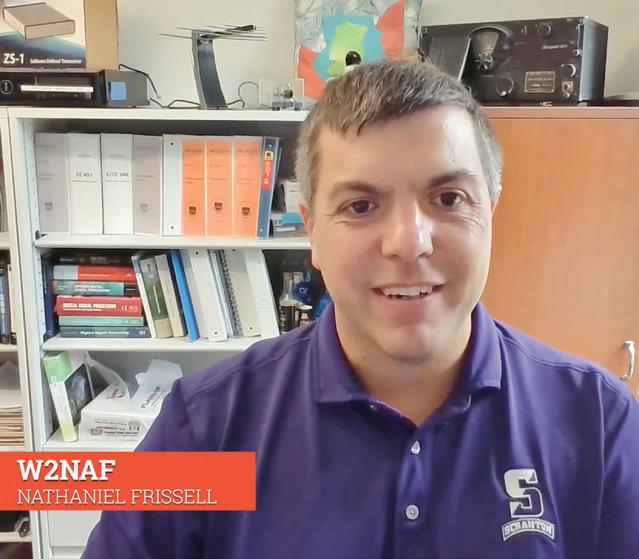
— Dr. Nathaniel Frissell, Ph.D. W2NAF
VY 73 de Nathaniel W2NAF
H am SCI AT ARRL ROCKY MOUNTAIN CONVENTION
HamSCI made its first ever appearance at the 2025 HamCon Colorado/ARRL Rocky Mountain Division Convention, held on October 24-26th in Grand Junction, Colorado.
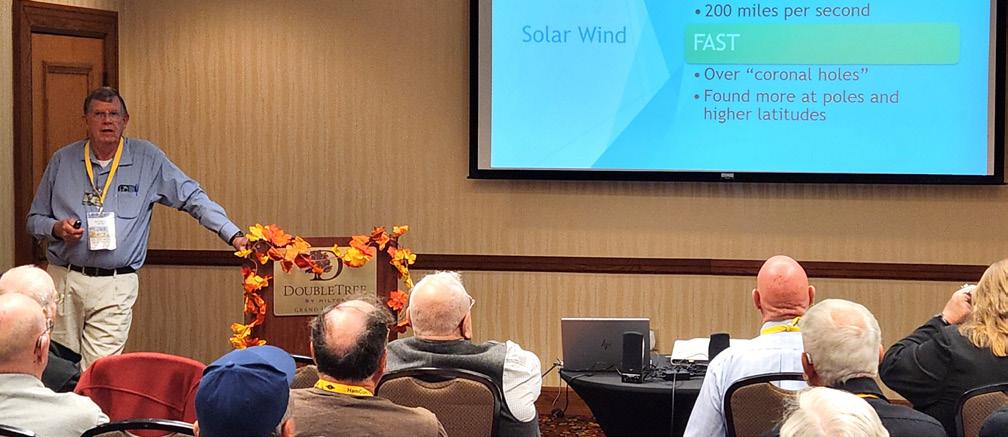
HamCon is a forum-oriented event, rather than the flea market/commercial vendor focus of most regional ham radio gatherings. This year’s HamCon was true to form, with well over 50 hour-long forums on Friday and Saturday. HamSCI members filled multiple time slots with topics including the HamSCI Personal Space Weather Station, WWV’s First Century, The Early Days of Ham Radio & DX’ing and The Ionosphere. The latter, presented by HamSCI volunteer Ron Wilcox KF7ZN, was so well attended that extra chairs had to be brought in at the last minute!
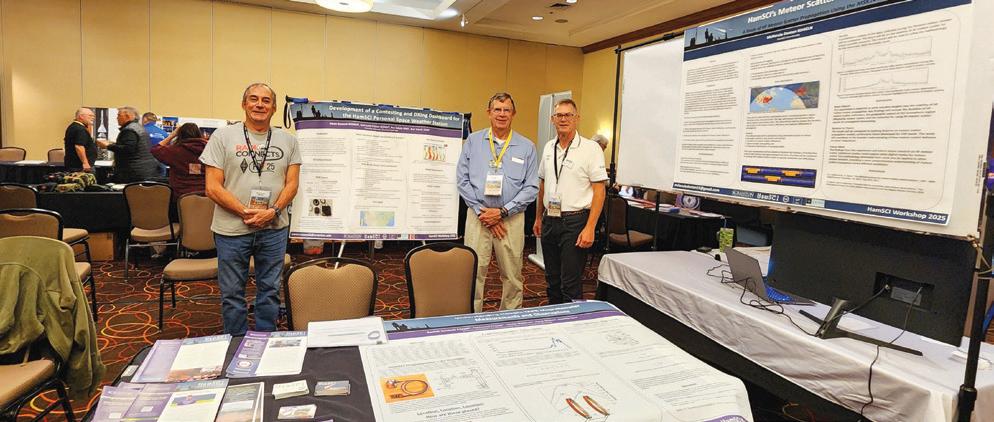
HamSCI and the WWV Amateur Radio Club had adjacent tables in the vendor/ club room, where we passed out materials on the upcoming Meteor Scatter QSO Party (MSQP), HamSCI Newsletters, cards inviting people to join one or both organizations and even some bumper stickers (“I Set My Clocks to WWV”). Three large format color posters explaining the MSQP, HamSCI’s ground magnetometer and DX’ing Dashboard projects, helped grabbed the attendees’ attention.
Where next, in 2026? HamSCI Workshop? Dayton Hamvention? Follow the news on HamSCI.org.
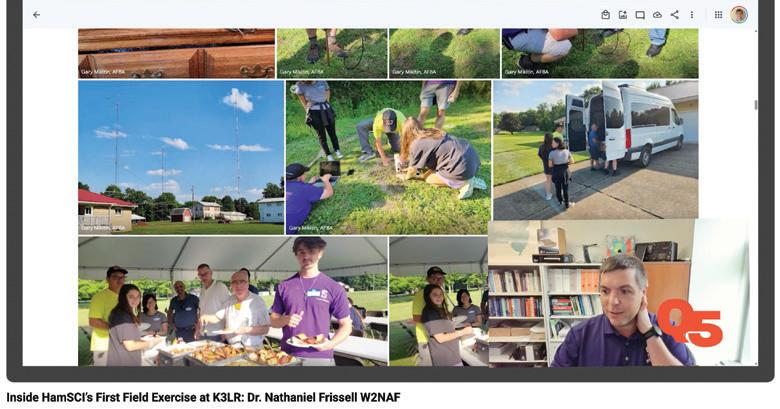
Dr. Nathaniel Frissell W2NAF and HamSCI volunteer McKenzie Denton KO4GLN were the recent subjects of interviews by the Q5 Worldwide Ham Radio Podcast.
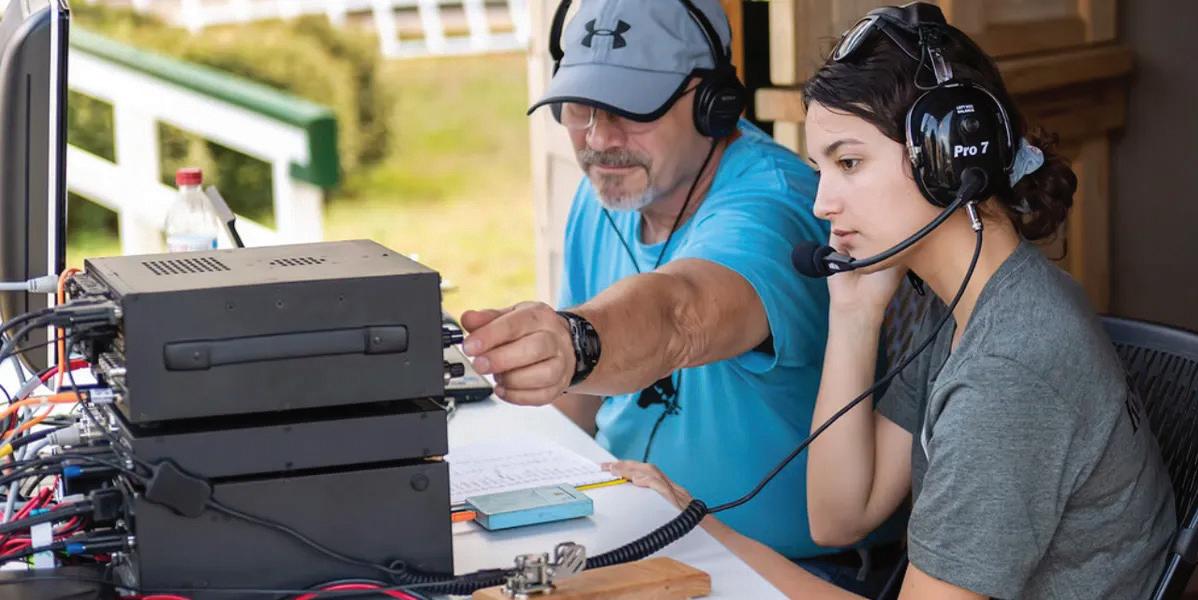
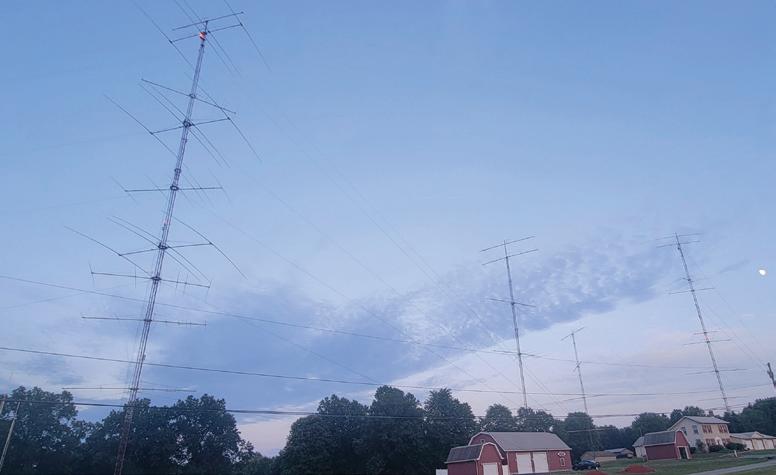
In the interview with founder Dr. Nathaniel Frissell, the podcast detailed HamSCI’s first field project at the K3LR superstation in western Pennsylvania. He discussed the project from pounding ground rods and deploying a DX Engineering active receive antenna, to configuring the RX888 wideband SDR and seeing the first live data roll in. He also discussed recent scientific experiments, the antenna farm tour, and even the first-ever QSOs made by new hams at the station.
Find the podcast online at: youtube.com/watch?v=FZUuLhQNRaU
McKenzie Denton KO4GLN was featured as part of the, “The Voice of the Next Generation in Ham Radio” and discussed her interests and future plans.
Find the feature online at: https://q5hamradio.substack.com/p/mckenzie-denton-ko4gln-the-voice
Dave W0DAS, Gary AF8A, Ron KF7ZN at HamCon
Ron KF7ZN Presenting at HamCon
The recent scientific work conducted by HamSCI at K3LR was also the subject of a feature by the University of Scranton.
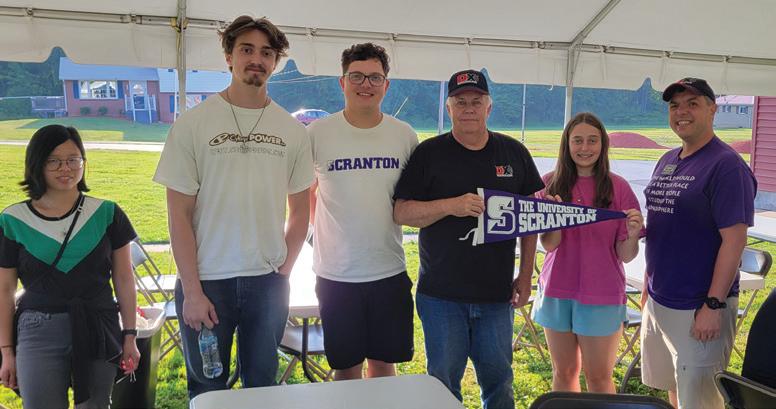
University of Scranton team presentd K3LR with a school pennant. Left to right: Rebecca Potter KE2EBI, Declan Reavy KD3BMA, Owen Ruzanski KD3ALD, Tim Duffy K3LR, Nina Tormann KD3BJV, and Dr. Nathaniel Frissell W2NAF.
Find the feature online at: https://news.scranton.edu/articles/2025/08/ news-hamsci-k3lr.shtml
Finally, Dr. Frissell was the featured speaker recently in the Radio Club of America (RCA) Interview Series in September 2025. The interview was conducted by RCA President Emeritus John Facella, and covered HamSCI, what it is about, recent results, and how amateurs can get involved.
Find the interview online at: www.youtube.complaylist?list= PLx5vFACfP6FkoU02Hpbq MNFBziAAiqqCB
H am SCI PRESENTS AT THE DELAWARE VALLEY RADIO ASSOCIATION
Dr. Nathaniel Frissell W2NAF was the guest speaker recently at the Delaware Valley Radio Association located just outside of Trenton, NJ. In the audience was Dr. Joe Taylor K1JT, the Nobel Laureate and codeveloper of the WSJTX software used by amateurs everywhere. Both met on previous occasions, but DVRA offered the opportunity to share insights and catch up.
Frissell’s presentation covered an overview of HamSCI and the upcoming Meteor Scatter QSO Party in December (see details below). Thanks to DVRA for the invitation for a wonderful turnout!
Meteor Scatter QSO Party
HamSCI is continuing its upcoming meteor scatter (MS) experiments. Operating will take place during the Geminids meteor showers on December 12-13th for 48 hours from 0000 to 2400 UTC in the 10 and 6 meter amateur bands.
The December activity follows a successful August operating event during the Perseids meteor show which generated over 70 amateur radio logs and wave files from amateur radio operators for scientific study. This activity is a combination ‘special event’ and a “contest” to generate contact data during meteor scatter events. No special operating equipment is required but use of MSK144 software (part of the WSJTX suite) is essential. You can find the description of the 2025 HamSCI Meteor Shower QSO Party and contest rules at hamsci.org/msqp-poster and at hamsci.org/msqp.
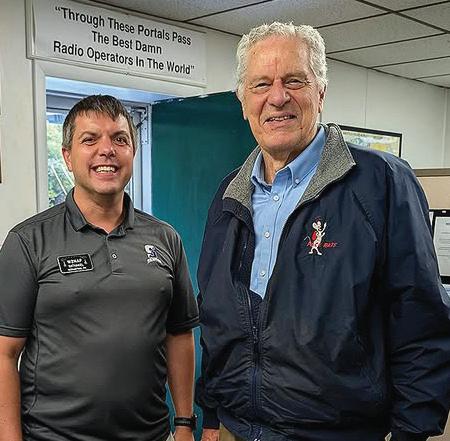
Dr. Nathaniel Frissell W2NAF and Dr. Joe Taylor K1JT
K3LR Antenna Farm
HamSCI at the AGU25 conference in New Orleans, LA, December 15-19, 2025
By Dr. Mary Lou West KC2NMC
In 2025 the HamSCI community has worked hard and generated ten presentations for the American Geophysical Union annual conference. We will have both oral and poster presentations.
Most of the presentations will be in session SA11A— The MacGyver Session: The Place for Novel, Exciting, Self-Made, Hacked, or Improved Sensors and Software Solutions to Understand Space Weather.
What makes this collaboration remarkable is that of the 38 co-authors, 21 represent universities and 15 are HamSCI communit volunteers. It is truly an exciting community to be part of!
1. The HamSCI Personal Space Weather Station Network in 2025: Citizen Science From Sun to Mud Kristina Collins, Nathaniel A Frissell, William Engelke, Gary Mikitin
Monday, Dec 15, Oral, 8:30 – 8:40, New Orleans Convention Center 283-285 https://agu.confex.com/agu/agu25/meetingapp.cgi/Paper/1946035
2. Novel Radio Instruments and Accessories to Support the HamSCI Personal Space Weather Station Project Paul Elliott, Glenn Ellmore, Nathaniel A Frissell, Rob S Robinett, Clinton Turner Monday, Dec 15, Oral, 8:40 – 8:50, New Orleans Convention Center 283-285 https://agu.confex.com/agu/agu25/meetingapp.cgi/Paper/1884766
3. Developing New and Novel Ways to Access and Analyze HamSCI Data William Engelke, Nathaniel A Frissell, Travis Atkinson, Kristina Collins Monday, Dec 15, Oral, 8:50 – 9:00, New Orleans Convention Center 283-285 https://agu.confex.com/agu/agu25/meetingapp.cgi/Paper/1892183
4. Doppler Radio Observations of the April, 2024 Solar Eclipse Analyzed by Citizen Scientists
Mary Lou West, McKenzie Denton, Gregory Popelas, Robert Spalletta, Ronald Wilcox, Nathaniel A Frissell
Monday, Dec 15, Oral, 9:00 – 9:10, New Orleans Convention Center 283-285 https://agu.confex.com/agu/agu25/meetingapp.cgi/Paper/1997444
5. Toward Automated Analysis of Ionospheric Doppler Spectrograms
Gwyn Griffiths, Nathaniel A Frissell, Rob S Robinett Monday, Dec 15, Oral, 9:10 – 9:20, New Orleans Convention Center 283-285 https://agu.confex.com/agu/agu25/meetingapp.cgi/Paper/1863616
6. Analysis, Waveform, and Processing Upgrades in the TDOA Method of Measuring Ionospheric Layer Height Using Amateur Radios and Audio Waveforms Sensitive to Multipath Time Difference of Arrival (TDOA) Steve Cerwin, Jesse McMahan, Alexandros Papadopoulos, Gerard Piccini, Nathaniel A Frissell Monday, Dec 15, Oral, 9:20 – 9:30, New Orleans Convention Center 283-285 https://agu.confex.com/agu/agu25/meetingapp.cgi/Paper/1883581
7. EPB Impacts on HF Propagation Observed by HamSCI with GOLD and GIRO Support Kornyanat Hozumi, Nathaniel A Frissell, Diego Sanchez, Ana M. Duque, Ercha Aa Monday, Dec 15, Poster, 14:15 – 17:45, Hall EFG, Poster Hall, MCCNO https://agu.confex.com/agu/agu25/meetingapp.cgi/Paper/1900817
8. Ham Radio Investigations of Ionospheric Changes During the April 2024 Total Solar Eclipse
Kuldeep Pandey, Gareth William Perry, Nathaniel A Frissell, Travis Atkinson, William Engelke, Joseph D Huba, Mary Lou West, Philip Gladstone, Gwyn Griffiths, Cameron Cushing, McKenzie Denton, Edward Efchak, Gary Mikitin, H. Ward Silver
Thursday, Dec 18, Poster, 14:15 – 17:45, Hall EFG, Poster Hall https://agu.confex.com/agu/agu25/meetingapp.cgi/Paper/1934648
9. Ionospheric Plasma Density Variations During the April 2024 Total Solar Eclipse: Observations and Modeling
Kuldeep Pandey, Gareth William Perry, Bharat Kundun, Daniel Emmons, David Themens, Joseph D Huba, Alex Chartier Monday, Dec 15, 8:30 – 12:00, Hall EFG (Poster Hall) (New Orleans Convention Center) https://agu.confex.com/agu/agu25/meetingapp.cgi/Paper/1933867
10. Effect of Equatorial Plasma Bubbles on High-Frequency Wave Propagation
Isaiah Scafffidi, Jay Johnson, Eun-Hwa Kim, Kornyanat Hozumi, Simon Wing, Nathaniel A Frissell
Wed, Dec 17, 14:15 – 17:45, Hall EFG (Poster Hall) (New Orleans Convention Center) https://agu.confex.com/agu/agu25/meetingapp.cgi/Paper/1873526
AMATEUR PROFILE BILL MADER K8TE
Q: How did you learn about HamSCI and how did you get involved? How have you been involved in the past? What is your current involvement?
A: I learned about HamSCI through a mention in the ARRL Letter several years ago. I have always been interested in science and have coupled that with my interest in Amateur Radio. I believe we Amateurs must remember our avocation is based on science, not on rumors or unscientific observations. I continue learning and never plan to stop!
Q: What HamSCI projects interest you?
A: Anything to do with HF propagation interests me. The more I learn the better I am able to enjoy my primary interests which are contesting and chasing DX (303 entities worked).
Q: What skills do you have that are best suited to HamSCI? How might other amateurs obtain similar skills?
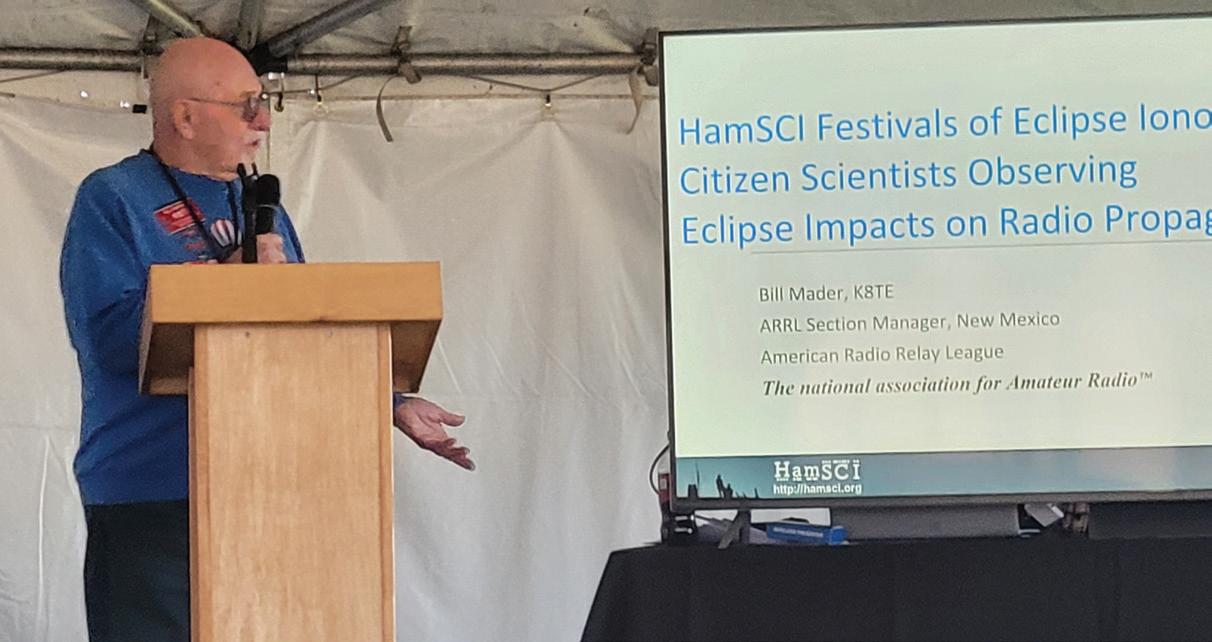
A: I use propagation tools a lot like paying attention to solarham.com for the latest conditions and voacap.com for predicting propagation for DX’ing and contesting. I was active during the last two eclipses. The annular passed over Albuquerque during our International Balloon Fiesta and I was able to give a prestation about its effects on propagation while a fellow club member and I operated on 80-40-20 meters CW to provide Reverse Beacon Network data.
Q: Why type(s) of equipment do you have in your shack? Antennas?
A: I am an Elecraft fan boy so I have a K4 and KPA1500 for my primary station. I also operate an IC-7610 on FT8/4, frequently while operating CW or SSB on the Elecraft station. I also use a Flex 6600M and plan to use it for SO2R (Single Operator 2 Radios) for contests. I enjoy station building, especially automating as much as possible.
Q: How active a ham would you say you are? When were you first licensed?
A: I am very active, both on-the-air, and as the ARRL Section Manager for New Mexico. I give presentations locally and across the southwest U.S. This includes our own Duke City Hamfest which is a full-fledged convention, plus other events including QuartzFest, the International DX Convention, Pacificon, the former Dallas Hamcomm and Rocky Mountain Division Convention. I am also available for Zoom presentations at club
meetings across the U.S. I visit many conventions annually. My favorite is HamVention which I have attended since 1970 missing just three while stationed in Europe. Of course, I attend Contest University each year and the DX and Contest dinners.
Q: What would you say is the future of HamSCI? What should HamSCI be doing to increase its awareness and provide more value to you as a ham?
A: HamSCI’s future is bright because we have many bright members whose ideas for studying science related to Amateur Radio are nearly endless! I look forward to the small contributions I can make while I encourage others to participate. I am honored to participate with such a renowned organization!
Finally (and importantly) a brief bio about yourself and your contribution to HamSCI as well as to scientific research.
First licensed in 1960 as WV2RBF, Bill started chasing DX when he became DX in 1974 as KZ5WA. He found Radio Sport (contesting) a terrific way to work DX from the Canal Zone, and later Canon AFB, NM, especially on 10 meters during Cycle 22. He now chases DXpeditions vigorously since Cycle 25 has provided such good propagation. In 2025 he activated the last two counties he needed to apply for the Worked All (3,077) USA Counties award.
Bill has been the ARRL New Mexico Section Manager since 2016. A member and officer of the Albuquerque DX Association, he helps motivate members to get on the air, regardless of their antennas and equipment. His log shows 303 DXCC entities worked, and he contacted over 100 countries in a weekend with just dipoles and a vertical, and even worked DX running 5 Watts to a mobile antenna!
A prolific writer and presenter on many topics related to Amateur Radio, Bill is an enthusiastic representative of our great avocation, both in New Mexico and across the Southwest U.S. His primary focus is to train and educate all current and prospective hams in the art of Amateur Radio, to become better hams, and have even more fun doing what they love to do.
Bill Mader K8TE at Dayton Hamfest
The 1921 New York Railroad Storm
By Ron Wilcox KF7ZN
Like any year, 1921 had important political and scientific events. Warren G. Harding was inaugurated as the 29th president. Albert Einstein was awarded the Nobel prize in Physics for his discovery of the photoelectric effect. The first successful isolation of insulin was announced in Canada by Frederick Banting and Charles Best. The first live radio broadcast of a sporting event, a baseball game, took place in Pittsburgh. And for someone that loves a nice hot piece of toast, the patent for the automatic pop-up bread toaster was granted to Charles Strite. And importantly for this article, the 1921 New York Railroad Storm took place.
The first signs of this occurred on May 13th when a large sunspot was seen. In fact, some scientists said it could be seen with the naked eye. It measured 21,000 miles by 94,000 miles and was numbered AR1842. This was shortly followed by one of the most intense magnetic storms recorded. Multiple Coronal Mass Ejections, CME’s, were sent earthward.
At this time, CME’s were unknown and would not be discovered until 1971. Multiple sources have compared this solar event to the Carrington Event of 1859. It came towards the end of solar cycle 15. The bottom of this cycle would occur in 1923. Reports are documented of magnetometers going off scale and the pens in the strip chart recorders were pegged at the top of their papers.
On May 15th at 02:00 UTC a fire broke out at the Karlstad, Sweden, telegraph station. In fact, there are reports of slowdowns and stoppages of telephone, telegraph and cable traffic all over Europe and areas farther south.
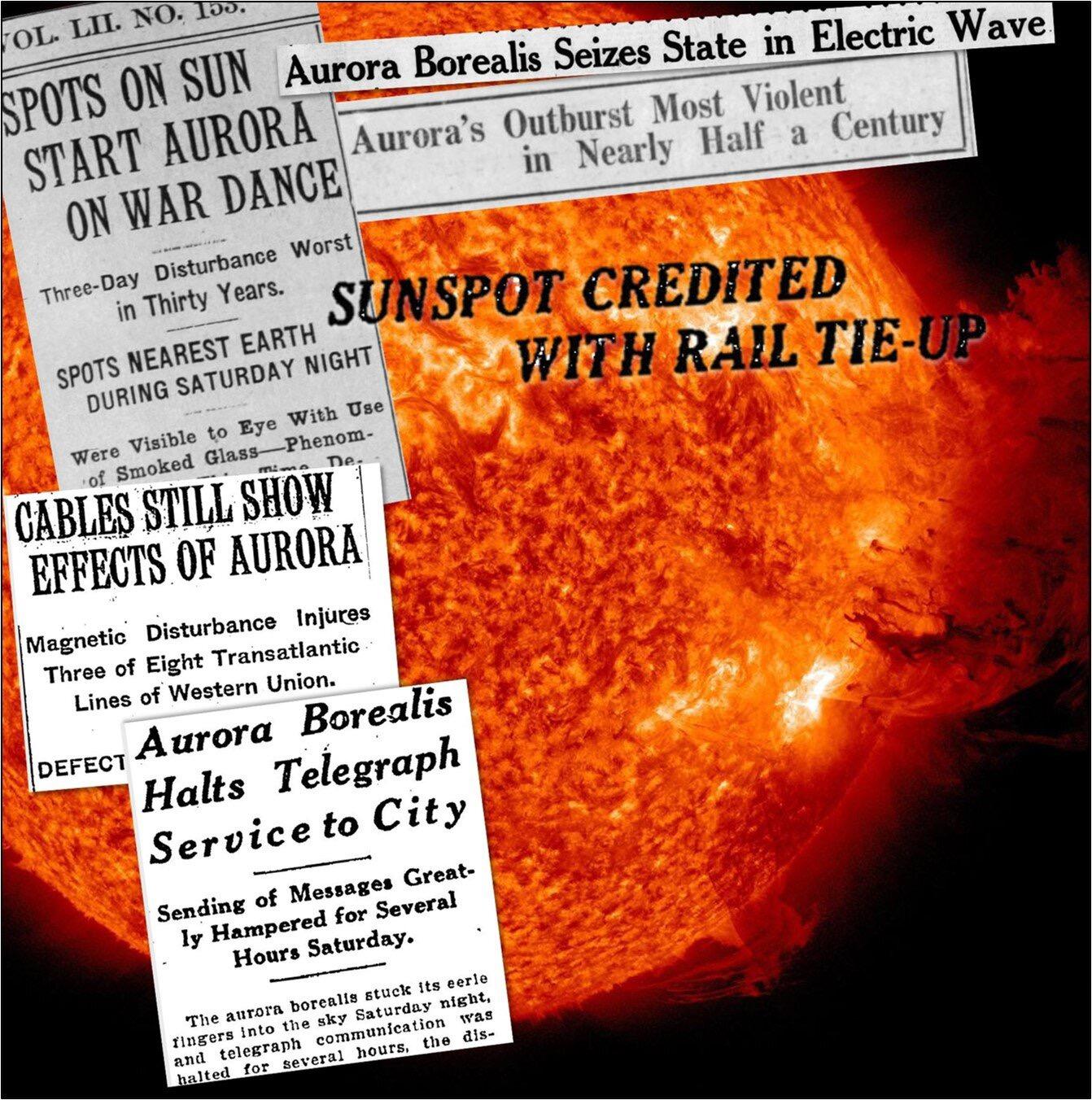
Here in the United States just before midnight on the 14th, the night operator for the Central New England railroad depot, a Mr. Hatch, had his switchboard suddenly burst in to flames. Within minutes the papers, combustibles, and then the entire building was engulfed. Hatch barely had enough time to wake another railroad employee, grab the cash and tickets, and then flee the burning building. Soon the bell of a nearby church began to peel to send the alarm out to the community as the building burned to the ground. There are numerous other reports of papers and telegraphs catching on fire. Soon all telegraph service in the nation began to slow down and then came to a stop.
At 7:04 the morning of the 15th, the entire switching and signal system below 125th street for the New York Central Railroad, came to a stop. These left thousands of commuters stranded. According to the newspapers this had never happened before. More reports of small fires at telegraph stations poured in. On many of the telegraph lines voltages were measured as high as 1000 volts.
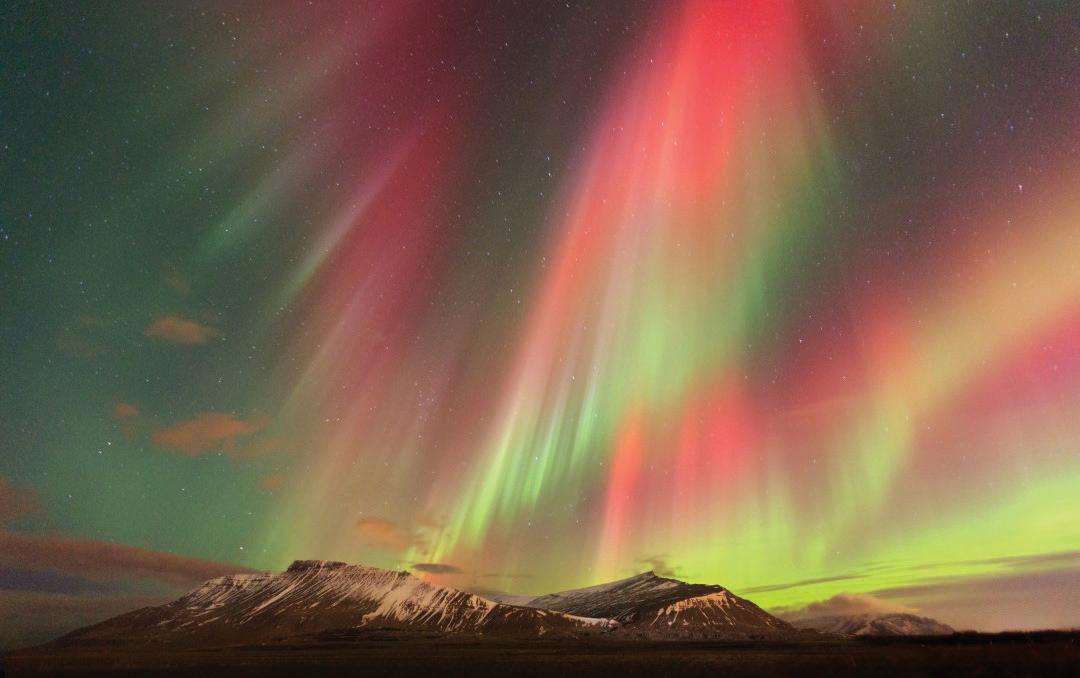
Strong and bright auroras were reported from Pasadena California to states in the far south and from ships that were crossing the equator.
Red Auroas
In Boston their newspapers said that one could read the newspaper in the middle of the night. In New York on Broadway, crowds of people stayed on the streets instead of going home, looking up at the entire night sky lit up by the aurora borealis. Quite a few of the newspapers carried headlines that the fires were caused by the Aurora Borealis, while some printed that the sunspot was involved. The Brewster Standard had this headline “Aurora Borealis Burns Depot”. The Western Union Telegraph Company reported that three of their trans-Atlantic cables were damaged. They recorded over 1000 volts on these cables leading to damage at weak places in the cables.
By the 17th of May they had managed to repair two of them. There was still one cable damaged near Valentia Island, off the coast of Ireland, which was the physical end or terminus of the cables. When engineers were calculating and measuring where the damage was, they could usually narrow it down to at least a mile. Repairing these cables was very difficult and expensive. As they would lift these cables up from depths as much as a few thousand feet the strain was tremendous. Generally, it involved removing a section of cable and splicing in good cable. They were finally able to repair the last damaged cable at a cost of $200,000. In terms of today’s dollars this would be $3,620,000.
Both the Carrington Event and this storm occurred towards the end of their solar cycles, and both solar cycles were unremarkable. Both events were intense. One measurement used is the disturbance storm time index (Dst index). It is a measure sometimes used for determining the intensity of solar storms.
A negative Dst index means that Earth’s magnetic field is weakened—particularly the case during solar storms—with a more negative Dst index indicating a stronger solar storm. It is estimated that the May 1921 geomagnetic storm had a peak Dst of -907nT.
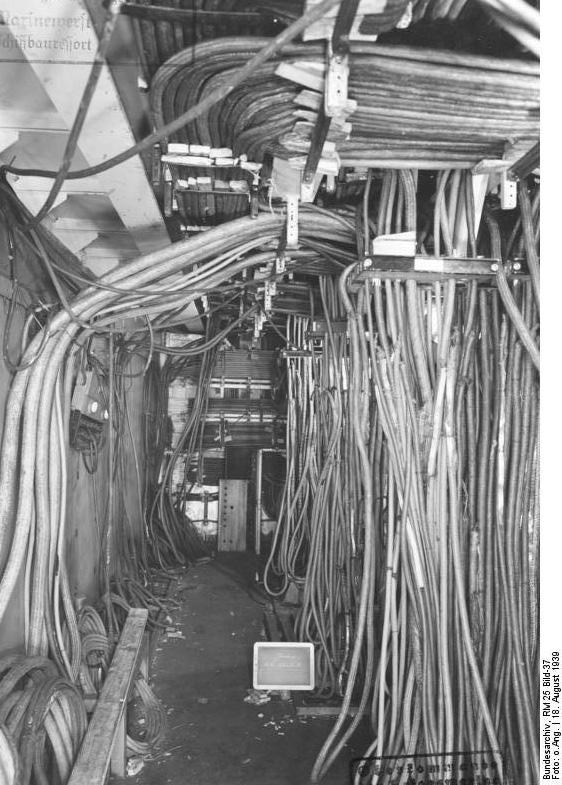
The image shows the aftermath of a fire at the telephone exchange building in Karlstad, Sweden, on May 14 & 15, 1921. The fire caused extensive damage to the building’s interior and the telephone connector system. The damage was reportedly blamed on solar flares, making it a notable historical event in the context of space weather impacts.
The Carrington Event of 1859 had a peak Dst estimated to be between -800 nT and -1750 nT. However, there are other techniques and measurements that need to be used when comparing solar storms and their effect. Dr Tamitha Skov has a great presentation and analysis of how to compare different solar storms on you tube, “(A Course Series) Mini courses on Analyses of Major Space Weather Events” that I would highly recommend.
Of course, one interesting and relevant question is how an event like this would affect us today with our satellites, GPS and massive power grids. There are quite a few excellent presentations on this topic which a short article like this cannot do justice. While studying these events is interesting it is also very important for us to learn from them.
Interested in reading some scientific papers but not sure where to start? Here’s a recent journal paper that may be of interest to members of the HamSCI community. If there’s a paper you’d like to see featured in a future HamSCI newsletter, email KD8OXT at kvcollins@spacescience.org.
TITLE: conjugate_map: A Python package for calculating geomagnetic conjugate points
LINK: https://doi.org/10.1016/j.softx.2025.102354
WHO WROTE IT: Yours truly, with collaborators from the Space Science Institute, the Naval Research Laboratory, and the Polar Geospatial Center at the University of Minnesota.
WHAT IT’S ABOUT: We made a software package in Python to find geomagnetic conjugate points, which are points in the northern and southern hemispheres connected by Earth’s magnetic field.
WHY IT’S INTERESTING:
1) Open-source software: SoftwareX is a peer-reviewed journal for documenting open-source software. HamSCI has published before in its sister journal, HardwareX. (Check out doi.org/10.1016/j.ohx.2024.e00580 , which documents the PSWS magnetometer!) These journals can help bridge the gap between academic science and the open source movement. They give open-source developers of hardware and software an incentive to write better documentation and a way to be recognized for their contributions by the scientific community. They also make it easier for scientists to find valid open-source projects that may support their work.
2) Fifth International Polar Year: International Polar Years are collaborative, international efforts with intensive research focus on the polar regions. The most famous one was the third IPY, known as the International Geophysical Year, in 19578. IPY5 is coming up in 2032-33, which is sooner than we think when it comes to planning citizen science campaigns.
WHICH PARTS TO READ: Check out Section 1 and Section 4 for a discussion of IPY5 instrumentation, and why we need data from both poles to understand the geospace system. If you want to try out the Python code, take a look at Section 3 as well.
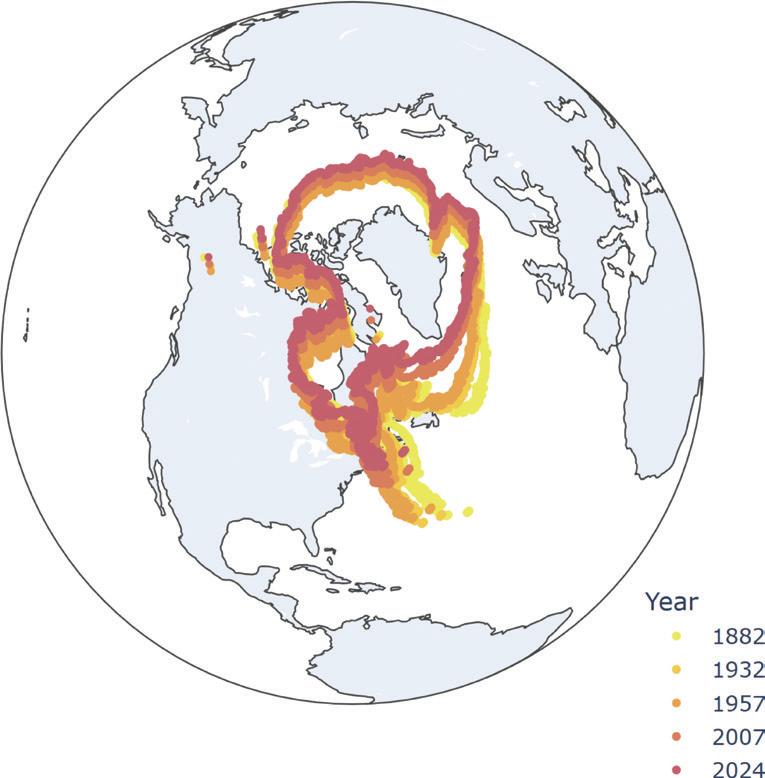
FIGURE HIGHLIGHT: Figure 4 shows a magnetic projection of the Antarctic coastline along the Northern Hemisphere. If you live in the Northeast, your location may be magnetically connected to the Antarctic Peninsula. What coordinated observations might you make with Antarctic researchers during IPY5?
4
WHERE YOU CAN LEARN MORE: Check out the interactive maps and supplements to the paper at kcollins.github.io/conjugate_map/. You can read more about the International Polar Year at ipy5.info. To see some maps from the Polar Geospatial Center, check out fridge.pgc.umn.edu/. Their main site has great historical maps as well.
H am SCI AT HAMX
HamSCI was well represented at the 2025 Northeast HamXposition, held August 21—24th, in Marlborough (Boston), Massachusetts.
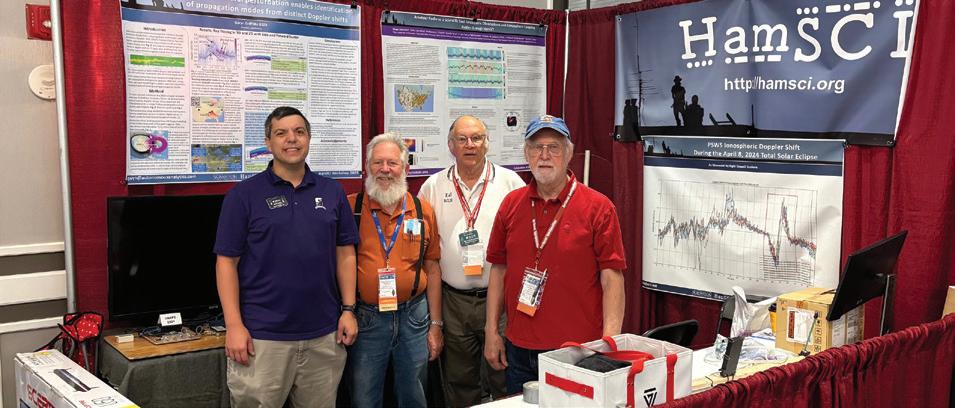
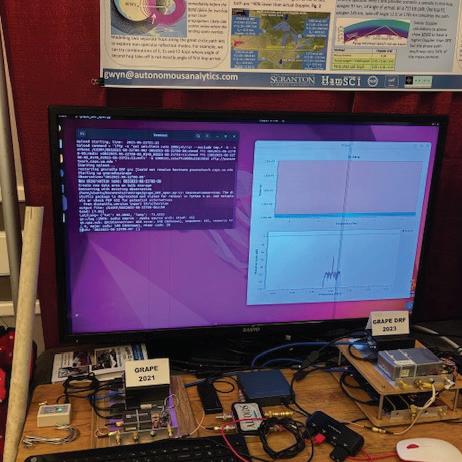
Our booth presentation attracted many visitors armed with questions and a strong fascination for what we do. A selection of HamSCI posters, GRAPE hardware, and a live PSWS spectrum stream made good use of the space. Material concerning past and active experiments was also available. Overall awareness of HamSCI appears to be getting better and better.
Dr. Nathaniel Frissell W2NAF was also the keynote speaker at the HamX banquet and provided a comprehensive overview of the origins of the group, our past and current experiments, and a look into the future.
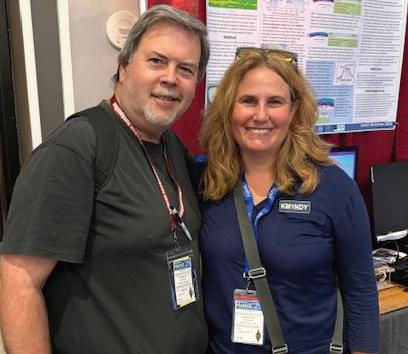
HamSCI volunteers accompanying Frissell were Bill Blackwell AB1XB, Bob Reif W1XP, Stan Pozerski KD1LE, Mindy Hull KM1NDY and Ed Efchak WX2R.
Full details, including photos, are available at hamsci.org/hamxpo-2025
Figure
Larry Kennedy W1VP and Mindy Hull KM1NDY
Dr. Nathaniel Frissell W2NAF, Bob Reif W1XP, Ed Efchak WX2R, Stan Pozerski KD1LE
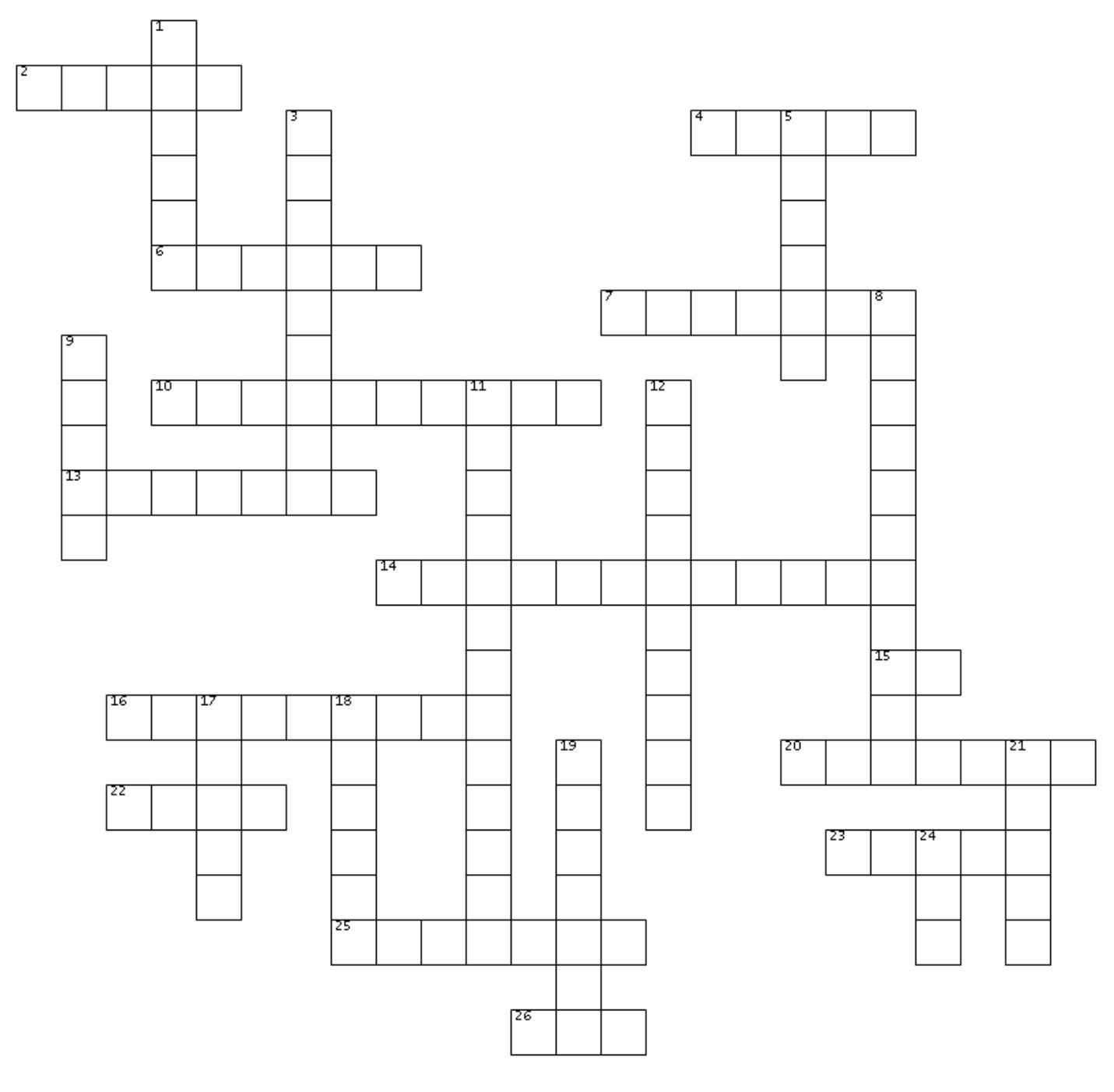
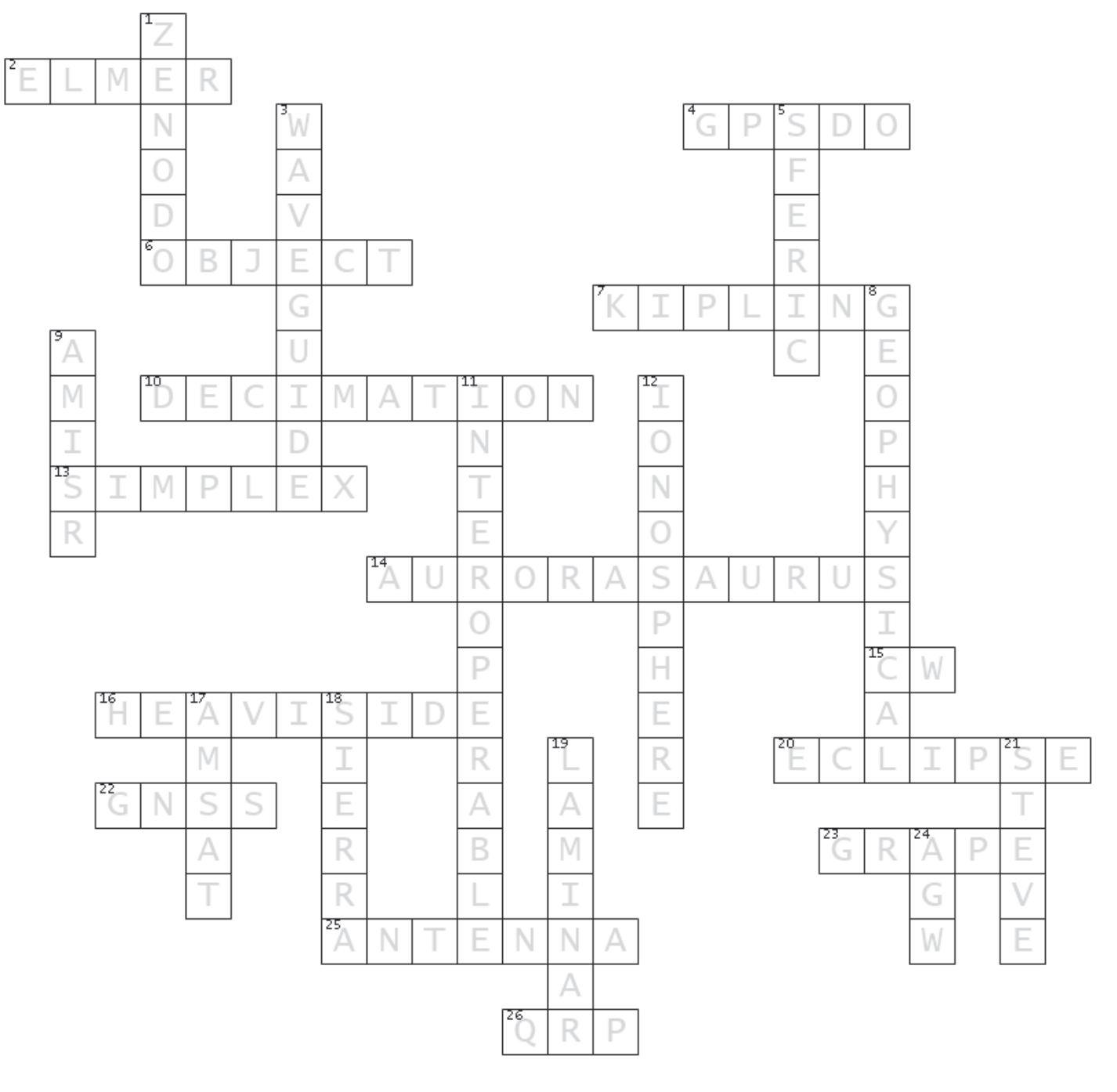
ACROSS
2. A mentor who helps a new ham operator.
4. Used to provide a reference frequency for making measurements.
6. Digital ___ identifier in “DOI”. (hint: doi.org). DOI is a “one-stop shop” to find a particular scientific dataset or article, and a way to get cited for your data and contributions as well.
7. Author Rudyard of “Wireless,” subject of HamSCI 2024 Book Club.
10. Keep only 1 out of N samples. Effectively reduces the time rate of the signal (but is subject to aliasing of higher frequencies if you haven’t filtered the signal first). Standard signal processing technique.
13. Direct stations to station communication.
14. Citizen scientists who hunt auroras.
15. Commonly referred to as Morse code.
16. Simplifier of Maxwell’s equations, made slightly more famous by the musical “Cats.”
20. Noteworthy geophysical event of 8 April 2024.
22. GPS is one. Others are GLONASS, GALILEO, COMPASS/BEIDOU.
23. Fruit-based name for the PSWS Doppler receiver.
25. Is to a radio as a lens is to a camera.
26. “Can you reduce power?”
Crossword Solutions on Page 11
CROSSWORD
DOWN
1. Data repository commonly used by HamSCI, named for a librarian of Alexandria.
3. A structure that guides waves by restricting the transmission of energy to one direction.
5. Sound produced on VLF by lightning strikes.
8. International ___ Year: the third of the International Polar years, held in 1957-8.
9. Phased-array incoherent scatter radar designed by SRI International and deployed at Poker Flat (PFISR), Resolute Bay (RISR-C, RISR-N), and a smaller version at Jicamarca, Perú.
11. The I in FAIR Data (hint: go-fair.org)
12. Conductive layer of Earth’s atmosphere.
17. An educational organization founded in 1969 to continue the work of Project OSCAR.
18. Sometimes replaced with “Sugar.”
19. A smooth flow, as opposed to highly structured (or turbulent) flow
21. Newly discovered sub-auroral sky glow in the upper atmosphere. Named by citizen scientists, after a line in the movie “Over the Hedge.”
24. Not to be confused with gravitational waves.
DEVELOPMENT OF A CONTESTING AND DXING DASHBOARD FOR THE H am SCI PERSONAL SPACE WEATHER STATION
By Owen J. Ruzanski KD3ALD, Computer Engineering Student, The University of Scranton
This project aims to develop a dashboard display specifically for amateur radio HF contesting, DXing, and general operations using data from the HamSCI Personal Space Weather Station as well as potentially adding other local and remote real time data.
The HamSCI Personal Space Weather Station is a multi-instrument system designed to measure space weather for both scientific research and amateur radio operations. The core of the PSWS is the RX-888/ KA9Q-radio WSPRDaemon-Grape High Frequency (HF) software-defined radio (SDR), capable of capturing and analyzing signals across the 0.3-30 MHz range.
While most PSWS development efforts thus far have focused on strictly scientific objectives, this project aims to make the data available and useful in real time for ham radio operators. The dashboard has a goal of enhancing real-time HF propagation assessments for amateur radio operators. By decoding Weak Signal Propagation Report (WSPR) spots and integrating with external space weather observations, this dashboard will provide propagation insights on an individual station basis.
The dashboard will also contribute to a larger understanding of both localized and global HF conditions. This should allow amateur radio operators to optimize their transmissions based on real-time ionospheric conditions, which can help improve contesting efficiency and DXing success.
Currently, this project is under development with a working prototype. Over the summer of 2025, I learned how to operate, develop software for, and research with the Personal Space Weather Station HF receiver installed at W3USR. During this time, I had the opportunity to help install three new PSWS Stations at
W2NAF. While helping install these systems, I had the chance to meet Rob Robinett, AI6VN, the creator of WSPRDaemon. Rob was very helpful in explaining how to install the software, how the software works, and how it could best be used for this project. Rob added a feature to WSPRDaemon that allowed the software to execute a command after each decoding cycle. This feature allowed me to store the decoded spots in a local database.
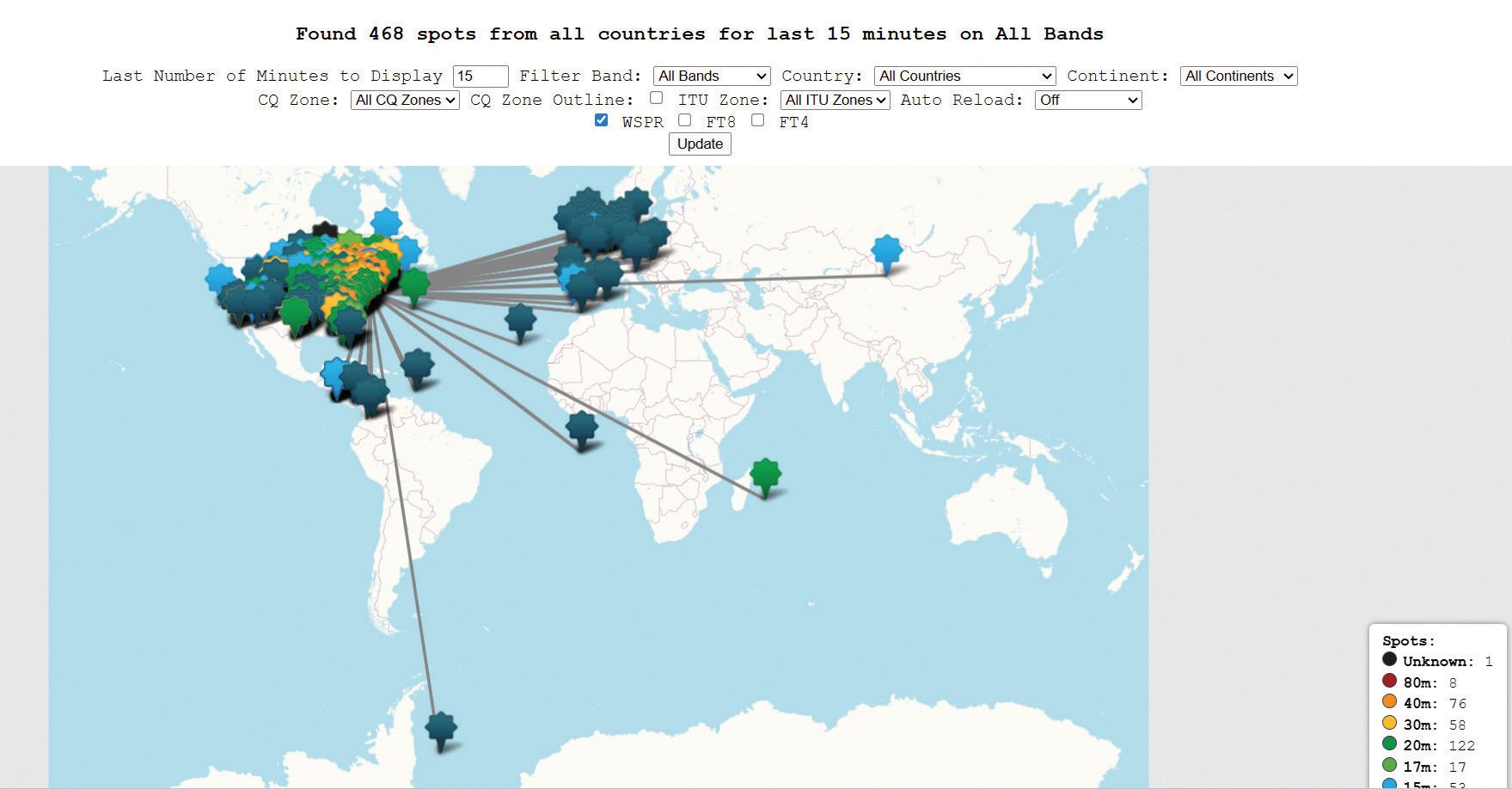
One of the goals of this project was to allow it to work completely offline. Having a local database to store these spots was essential to making this work. Over the summer, I also had the chance to install a Personal Space Weather Station at my house to allow for more local development of the dashboard. I also had the chance to install a Personal Space Weather Station at the K3LR Station. This was an amazing experience to learn more about radios, and to have the opportunity to get feedback on the dashboard. The dashboard is currently in a development stage but does have a working prototype. A picture of the dashboard prototype map is shown below:
The dashboard has many filters to display only the wanted results. For example, if I only wanted to display the last 100 spots in the United States, the dashboard could display such data. The next step of the dashboard to be developed is an option to show the decoded data in a table format instead of on the map. The table would allow users to select desired countries, desired “good” thresholds and number of spots to search from. The dashboard has been used by W3USR in the recent CQ WW RTTY contest on September 27-28th to try and see what countries could be contacted. In the future, the dashboard will be able to alert users of band openings. This allows the user to have very specific and localized information about propagation, which is not currently easily available from any other source. This project involves the HamSCI Community, the Frankford Radio Club, and the University of Scranton Amateur Radio Club, W3USR. This project aims to advance amateur radio capabilities and strengthen science contributions to space weather research.
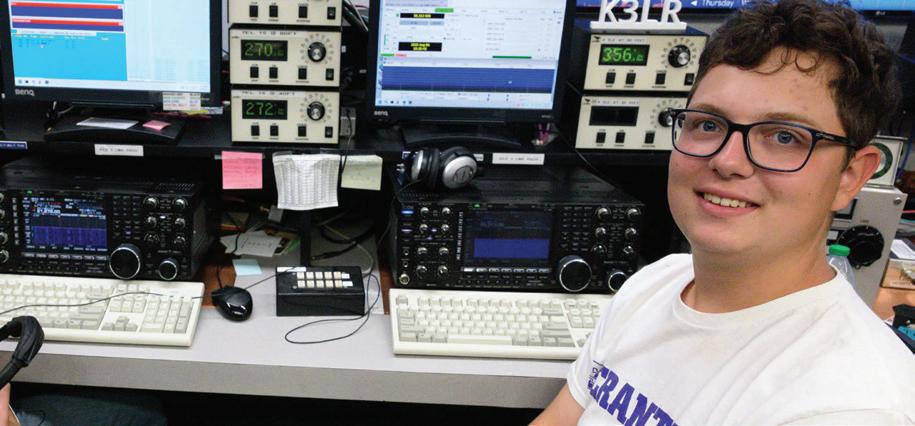
Owen Ruzanski KD3ALD operating at the K3LR Super Station.
HAMSCI GETS A BOOST FROM NASA TO ADVANCE OPEN HF PROPAGATION RESEARCH
DR. KORNYANAT “KUKKAI” HOZUMI
The HamSCI community is once again connecting radio and space science— this time with new support from NASA. Dr. Kornyanat “Kukkai” Hozumi, from The University of Scranton and an active member of the research pillar of the HamSCI project, is leading a newly awarded NASA Heliophysics Citizen Science Investigations (H-CSI) project in collaboration with the University of Scranton team and HamSCI citizen scientists. The effort unites professional researchers and the amateur-radio community to explore how space weather shapes our ability to communicate across the globe, embracing the openscience spirit of NASA’s Transform to Open Science (TOPS) initiative.
NASA and HamSCI team up to make HF research more open and global.
The project integrates three interconnected goals: to build a 3-D open-source HF ray-tracing toolkit, to validate global ionospheric models such as IRI and SAMI3 using HamSCI citizen-science data, and to simulate HF responses to ionospheric disturbances—including Equatorial Plasma Bubbles (EPBs)—as
The Orlando Hamcation has recently announced that Dr. Nathaniel Frissell W2NAF is the recipient of the 2026 Carole Perry Educator of the Year Award. The award recognizes his outstanding work with the HamSCI education program he created, grew, and continues to expand. The Orlando awards committee noted that,
Dr. Frissell has demonstrated outstanding dedication to promoting Amateur Radio by using radio to share knowledge, educate, and provide vital communications. The Hamcation team congratulates Dr. Frissell and other award winners for their award and the contribution they have personally made to Amateur Radio.
well as to investigate the understudied offgreat-circle propagation, a complex mode that can strongly influence long-distance HF communication. In addition, the project will enhance accessibility through user-friendly documentation and tutorials and foster public engagement through bi-weekly online seminars and open collaboration channels, including GitHub, where appropriate.
The project’s core team of scientists and HamSCI contributors includes Dr. Nathaniel Frissell (W2NAF), Dr. Mark Fenner, Mr. Gary Mikitin (AF8A), Mr. Gwyn Griffiths (G3ZIL), Mr. Bob Gerzoff (WK2Y), and Dr. Mary Lou West (KC2NMC). Dr. Joseph Huba supports the project as ionospheric model consultant, providing SAMI3 and SAMI3/WACCM-X outputs.
The team welcomes collaboration from scientists, students, and radio amateurs who share an interest in HF propagation, space weather, or open-source development. To get involved, reach out to Dr. Hozumi or any project team member, or look out for bi-weekly seminar announcements—planned as part of the project—where participation is open to all.
CROSSWORD SOLUTIONS
JOIN
We welcome you to join the HamSCI community! We are a group of amateur radio operators and scientists working together to study the ionosphere and further amateur radio. HamSCI consists of many different types of projects accessible to a variety of skill levels with various focuses on science to engineering to pure amateur radio.
The easiest way to participate in the HamSCI Community is by joining the HamSCI Google Group. The HamSCI Google Group is an e-mail discussion forum to facilitate communication between hams, the professional space and atmospheric science communities, and anyone else interested. When requesting to join, please include some information about who you are and why you would like to join. WELCOME!!
ABOUT CITIZEN SCIENCE
Citizen science is scientific work undertaken by members of the general public, often in collaboration with or under the direction of professional scientists and scientific institutions.
HamSCI engages amateur radio operators to help with the collection and analysis of data to help better understand the changing conditions of “space weather” within the ionosphere. As a HamSCI citizen scientist, you help collect valuable scientific data that can make a meaningful impact to scientific research.
HamSCI collaborators gratefully acknowledge the funding of NSF AGS-2045755, AGS-2230345, AGS-2230346, AGS-2404997, AGS-2432821, AGS-2432824, AGS-2432823, AGS-2432822, AGS-2431666, OPP-2332427, NASA 80NSSC25K7026, 80NSSC23K1322, Frankford Radio Club and ARDC grants.
The HamSCI silhouette photo is by Ann Marie Rogalcheck-Frissell KC2KRQ. Newsletter design by Vikki Lawhon, University of Scranton Creative Services.
WHAT IS H am SCI?
HamSCI, the Ham Radio Science Citizen Investigation, is a platform for the publicity and promotion of projects that are consistent with the following objectives:
• Advance scientific research and understanding through amateur radio activities.
• Encourage the development of new technologies to support this research.
• Provide educational opportunities for the amateur community and the public.
HamSCI serves as a means for fostering collaborations between professional researchers and amateur radio operators. It assists in developing and maintaining standards and agreements between all people and organizations involved.
HamSCI was started by ham-scientists who study upper atmospheric and space physics. These scientists recognized that projects such as the Reverse Beacon Network, WSPRNet, PSKReporter, DX Cluster, ClubLog, and others are generating big data sets that could provide useful observations of the Earth’s ionosphere and related systems. Because of this, HamSCI’s initial focus is on these fields of research. In the future, other researchers may join HamSCI and broaden its scope. For scientists, working with the amateur radio community is a way to access individually managed stations, available by the hundreds in dozens of countries, with receive and transmit capabilities across the electromagnetic spectrum, easily identified in areas of interest and deployed to remote locations, for free.
RECENT H am SCI PRESENTATIONS
HamSCI’s Thursday meetings often feature presentations by prominent scientists and amateurs that provide context to the weekly discussions.
Check the link for recent contributions from our members.
https://hamsci.org/telecons
Join our mailing list to be notified of upcoming topics and speakers.
H am SCI WEEKLY MEETINGS
There are numerous ways to learn about and participate in HamSCI activities. We meet three times a week on various aspects of our work:
TAPR/HamSCI Technical Session: This weekly telecon is hosted on Mondays at 9 PM Eastern by TAPR and The University of Scranton to support collaborative HamSCI-TAPR projects.
GRAPE-Low Cost PSWS Session: This weekly telecon is on Thursdays at 10 AM Eastern hosted by Case Western Reserve University to support the Grape Low-Cost Personal Space Weather Station Project.
The HamSCIence Telecon: Ths telecon takes place on the second Thursday of each month at 4 PM Eastern to discuss data collection, analysis and conclusions related to HamSCI’s scientific research efforts. All backgrounds, including researchers, data analysts and citizen scientists, are welcome and encouraged to attend.