













“That is so cool. Look at that,” said a lady, as she watched a university police offi cer circle around her on a Segway.
In an effort to make student and faculty protection more effi cient, UALR’s Department of Public Safety is weighing the idea of implementing a segway patrol.
Lt. Johnny Smith and patrolman Justin Davison took a ride on the two-wheeled machines on Friday, Nov. 1. A local company called Segway of Arkansas loaned the segways to the DPS so that offi cers will be prepared to ride them next year, when DPS is expected to get a few of their own.
The two Segways, the i2 patroller and the x2 patroller, are all-electric machines that can reach speeds of 12 miles per hour. That’s fast enough to catch a criminal who’s on foot, according to Smith. He said the machines are priced at about $6,500 and $7,500, respectively.
Each comes with a watch that is used to power the Segway on or off and even lock it. Without the watch, it cannot be operated.

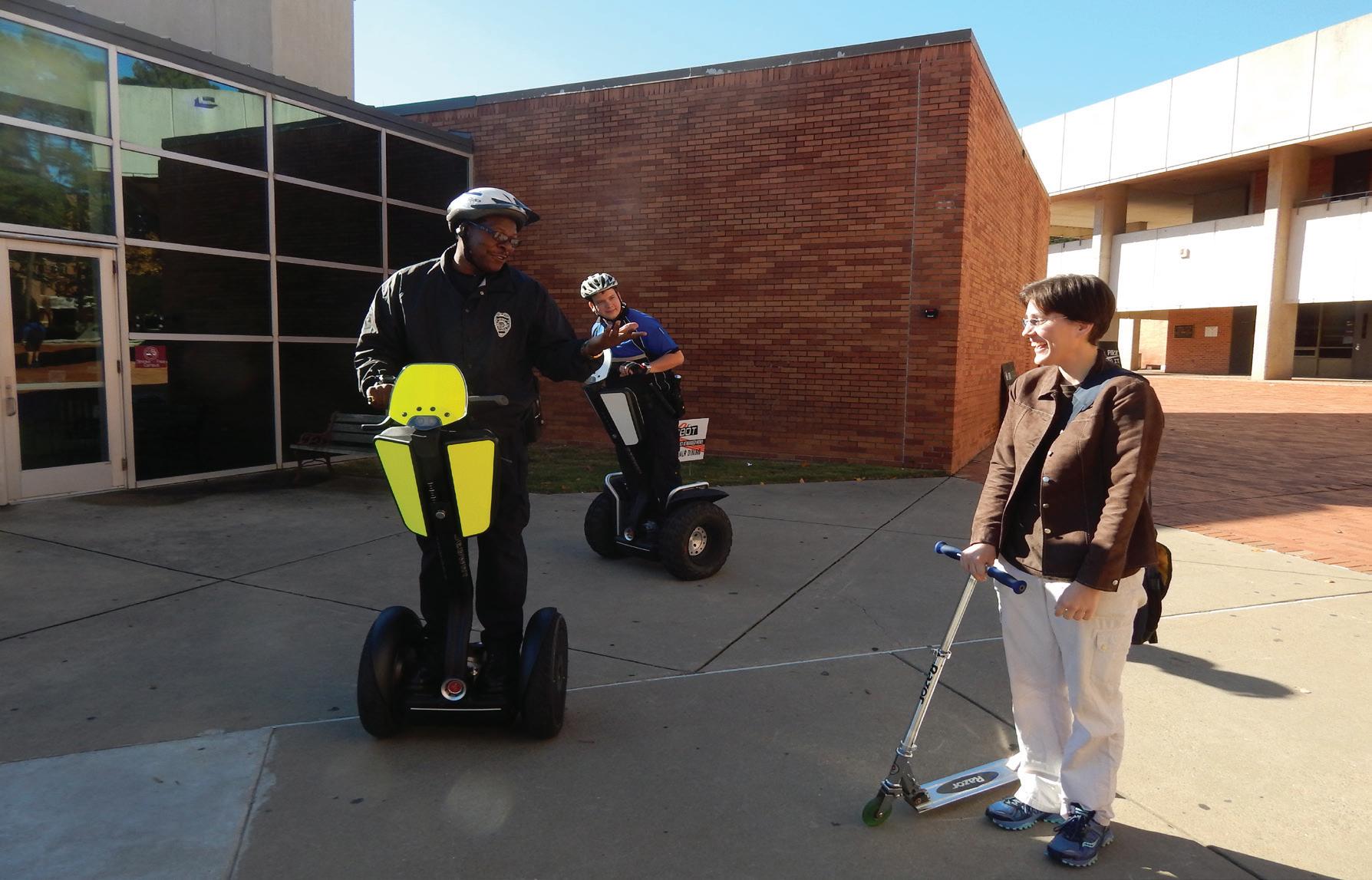
“Once it’s balanced you don’t have to worry about anything, it balances itself once you step on,” said Smith. In the event that an officer forgets to lock the Segway, a thief could only use it until the battery dies. After that, the machine will not function without the watch.
Its lithium-ion battery can withstand 24 miles of riding before it needs recharging.
The Segways will allow offi cers to maneuver quickly into places that cars cannot. Offi cers need only to lean forward, in order for it to move faster, no pedal is needed.
“Let’s say we get a call
right now in lot 5, versus a patrol car; I’d have to go though a gate, wait until the gate raises,” Smith said. On the other hand, the Segways allow easy movement between vehicles.
“We can spot things easily,” Smith said. “We can communicate with people easily.”
City officials have decided on a downtown site for the location of the long-awaited Little Rock Technology Park. The choice was made during the Oct. 23 meeting at the University of Arkansas for Medical Sciences, with the final decision coming down to a 4 to 3 vote. Attendees included UALR Chancellor Joel Anderson, and Mary Good, the founding dean for the College of Engineering & Information Technology who also serves as chair of the Little Rock Technology Park Authority Board.
“[They will] identify the sitespecifics in the downtown area
[and] how we can create connectivity,” Chamber of Commerce head Jay Chesshir told KUAR reporter Karen Steward. “Whether that’s taking existing buildings along with new buildings or if that’s strictly on a new building perspective. All of those things now need to be looked at.”
The park has been the center of much discussion since 2011 and can be described as a center of biotech research used to better the city and its residents. Among other considered sites were the Sears building on University Avenue and a blend of university-owned buildings and residential property, the latter of which caused a stir when it came to light that many people would be forced
“The advantage of this over the bike though, is you can’t ride the bike inside the building,” Davison said. “We can actually take these inside the building and actually do patrols; or if someone decided to try and run or something, we would be able to keep up with them on this.”
Nevertheless, Davison said he still loves the bike patrol too because it allows him to get exercise. “[The Segway] just gives us another tool to be able to do community-oriented policing,” he said. Both patrols appear to make the offi cers more approachable. Students stopped and talked to the offi cers as they strolled around the DSC on Friday morning. It only takes about 20 minutes to learn to ride the Segways, said Smith, and that’s if he or she is highly uncomfortable. Offi cer Davison learned to ride in less than 10 minutes.
On Nov. 13, students may have an opportunity to give the Segways a spin at the grand opening celebration of the new DPS Substation in Stabler hall. The event will take place from 11 a.m. to 1 p.m.
Sustainability Day promotes “green” lifestyles to move from their homes as a result of eminent domain.
While Chesshir, Acxiom senior vice president Kevin Zaffaroni and UAMS vice chancellor Tom Butler supported the arrangement, Good opposed the decision and implied it would change what the university was working toward when ideas for the tech park were conceived in 2010.
“How do we manage to acquire enough property down there to have some continuity?,” Good said during the meeting. “All of the pieces are very scattered and very small. How to put that together in somewhat of a park arrangement, in my mind, is going to be ...
See TECH PARK page 3
Jacob Ellerbee Executive Editor Editor@ualr.edu
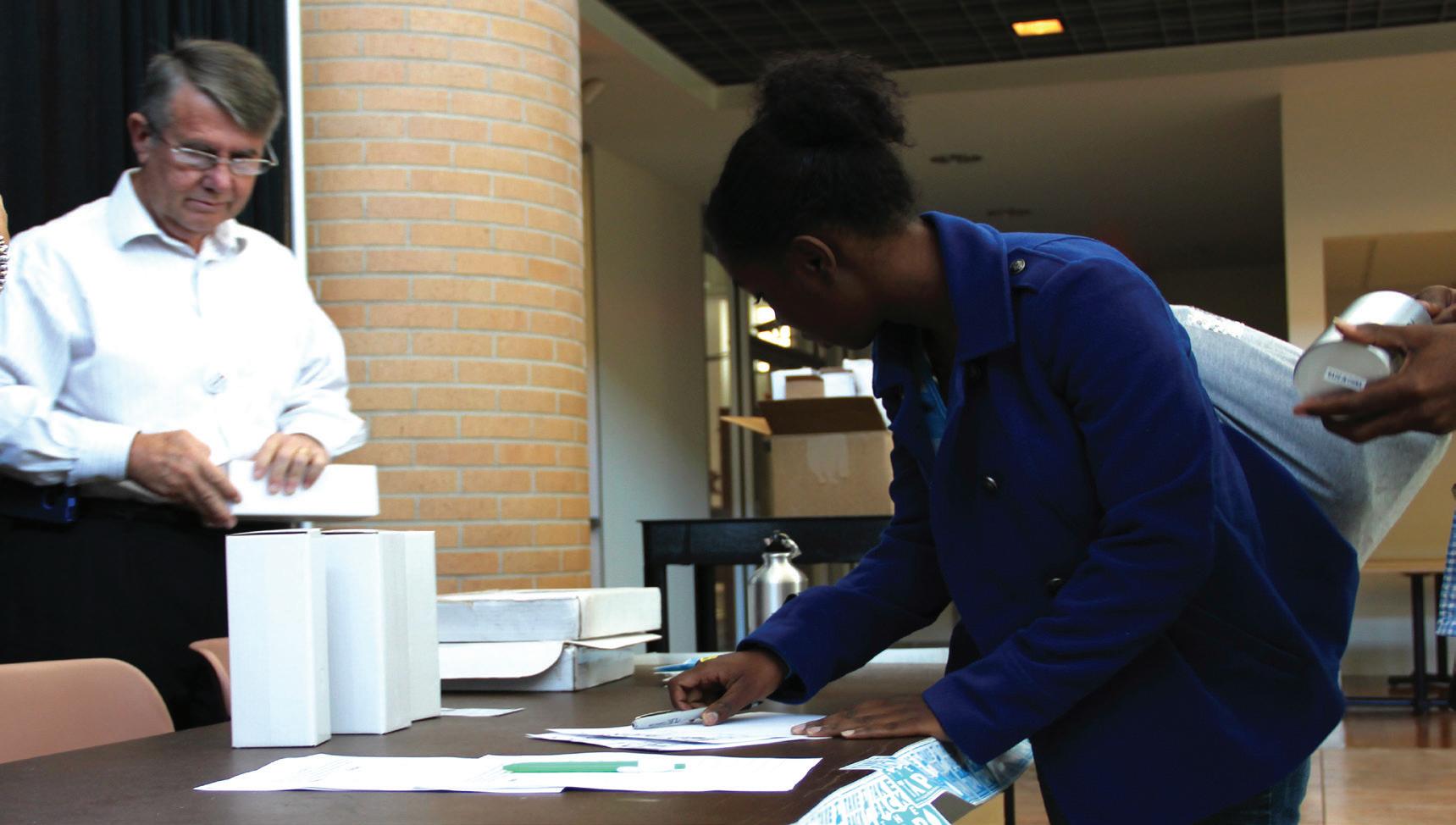
“Think about every product that you purchase. What is going to happen to that product when you’re finished using it or consuming it?,” Katie Becker asked Oct. 23 on National Sustainability Day, a day in which students learned about recycling and other conservation practices at UALR.
Becker, a staff interpreter and representative on the Sustainability Committee, coordinated activities and educational booths at UALR’s Sustainability Day.
Half a dozen local organizations were present at UALR to help educate students about recycling and conservation efforts during the annual event.
A slew of events took place at UALR, including educational booths about sustainable practices, a tour of the campus garden and sign-ups for the “Take ...
See SUSTAINABILITY page 3






Lawmakers in New York City have decided to make it harder for young people to purchase tobacco products in New York City. The law, adopted by the New York City Council, with the support of Mayor Michael Bloomberg, says that you must be at least 21 years old to purchase tobacco products in New York City.
According to a report by the New York Times, the new law would affect the sale of cigarettes, electronic cigarettes, cigars and cigarillos.
According to the U.S. Food and Drug Administration web site, businesses should “only sell cigarettes, cigarette tobacco, and smokeless tobacco to anyone age 18 or older.”
In the footnotes, the FDA reminds retailers that they must follow state law, in addition to the federal law.
“Retailers must also follow state tobacco laws, even if they are more restrictive. For example, in some states the minimum age is 19.”
It would be very unwise for Arkansas -- a state in which 27 percent of adults smoke, according to a report on FoxNews. com, filed Nov. 2. -- to get any ideas or inspiration from what New York City has done.
Although we’re essentially comparing a city to a state, New York City is an animal of its own, boasting a population of more than 8 million people, according to the latest data from the U.S. Census Bureau.
The population of the entire state of Arkansas, according to the 2012 census, is 2.9 million.
In some cases, New York City is a
trendsetter in terms of law making, giving other city governments and state governments ideas of future laws or policies to pursue.
It would be in the best interest of Arkansas, in terms of revenue, to not pursue a similar policy as that of New York City.
A large number of tobacco retailers have outposts in central Arkansas, where a majority of the state’s population resides.
Nearly one-fourth of all tobacco retailers in the state reside in the central part of Arkansas: Pulaski, Lonoke, White and Faulkner counties. These four counties are home to 21.3 percent of tobacco-selling retailers.
Tobacco sales generated $51.2 million dollars in gross tobacco revenue from July 2012 to June 2013, according to a report released by the Arkansas Department of Finance and Administration.
And, according to a report filed by The City Wire, a website covering news and politics in Fort Smith and northwest Arkansas in May, tobacco tax generated $188.2 million for the state from July 2012-April 2013.
While we don’t have statistics on just 18 – 21 year olds purchasing tobacco products in Arkansas, we do have data for the consumers as a whole.
Young people in the United States – not just Arkansas – are mature enough and financially responsible enough to purchase tobacco products if they so choose.
Besides, if an 18 year old wants to consume tobacco, they will find a way. Cutting them off from legally purchasing them at a store would mean the state is losing out on tax dollars.
While lawmakers have good inten-






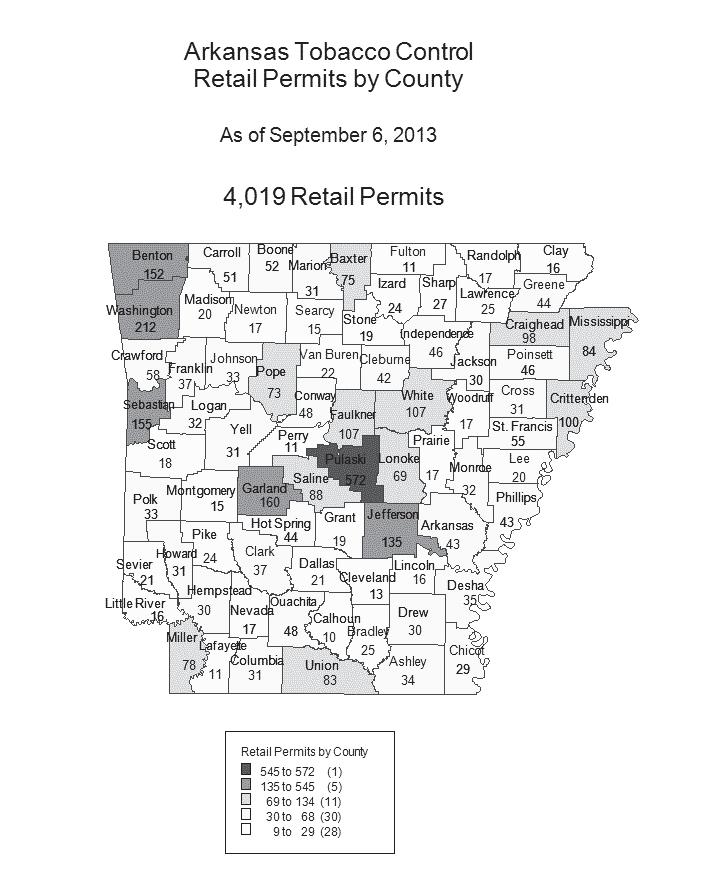
This graphic, prepared by Maurice T. Gilmore, represents the number of retailers in Arkansas with permits to sell tobacco products. The highest concentration of retail permits is in the central-most part of the state. Graphic courtesy of Arkansas Tobacco Control.
tions with increasing the minimum age for purchasing tobacco products, they are foolishly turning away precious revenue.
An 18-year-old is considered a legal adult, so why should they be disallowed to purchase tobacco?
If they want to smoke a cigarette, that is their prerogative. Whoever is getting the money spent to acquire those cigarettes should be the government, not some middleman reselling them to an 18, 19 or 20 year old.
I have flown out of LIT many times over the past few years & I feel that it's not that bad of an airport. It's small but I like the way that it's laid out and that it has some venders. Though I will say that I grew up in a much smaller city with a small airport with only two gates so anything bigger than that works for me.
- Nicole Sprouse

What do you think of the recently announced academic restructuring plans the Chancellor announced?
I

- Trevar Dye

I fly a lot and I'm not a fan of LIT. It feels like a closet and there aren't enough vendors, but both of these things are probably because nobody uses that airport.

Reaction
to Alliance President Zack
Baker nd a gay slur written on one of the group’s yer:

I have been in a similar situation. Someone wrote "slut" on one of my Homecoming fliers. Not quite as severe as this situation but still.. no one wants to be called names. It is SO sad that people have to try to make themselves feel better by putting others down.. but what can you do? Not a lot.. If no one sees it happen and reports it then nothing can be done about it. People that do things like this are obviously close-minded idiots. They are always going to be around though. You just have to let it go.




- Stacy Marie Hicks
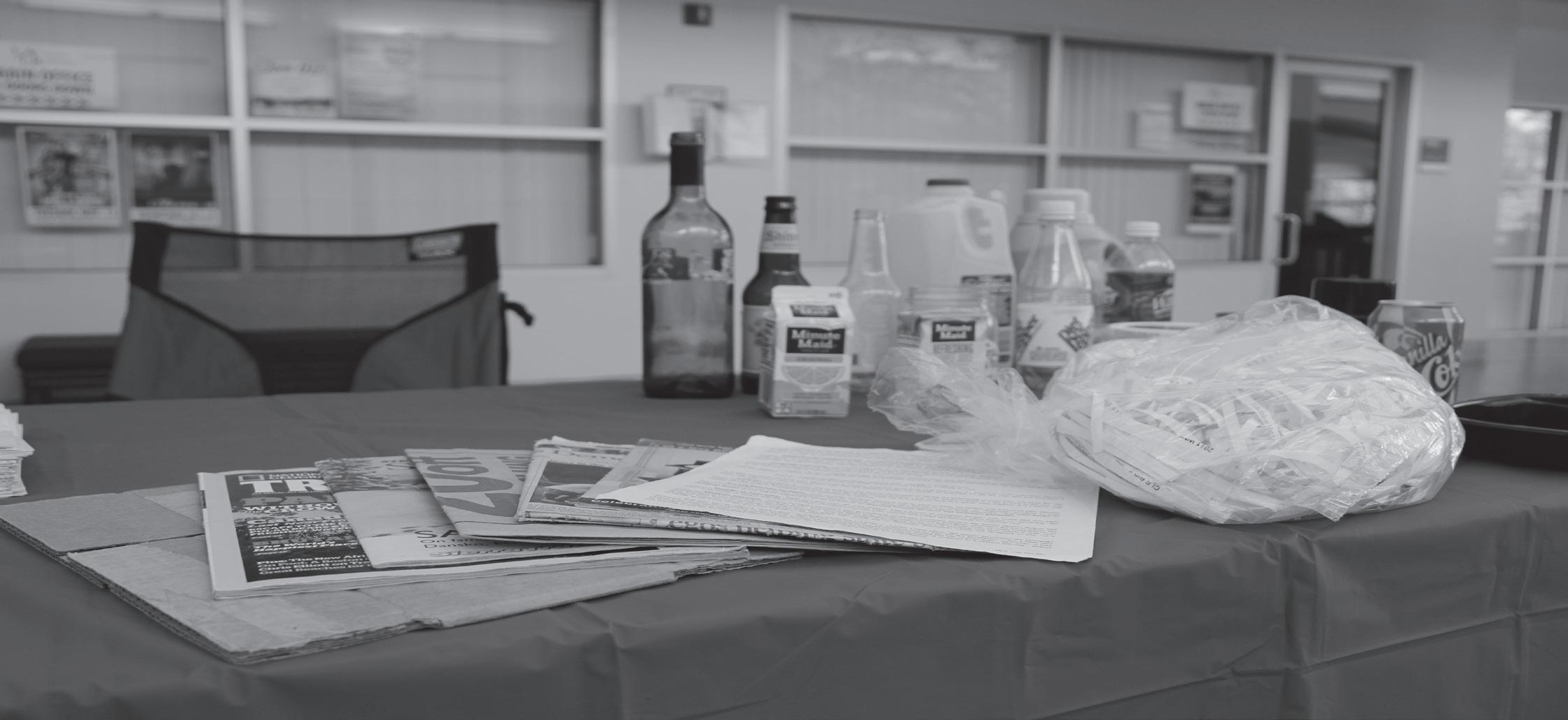
Waste Management brought examples of items that can be
required.
SUSTAINABILITY continued from page 1
Back the Tap” initiative. Sign-ups for the “Take Back the Tap” initiative totaled nearly 50 and those people have pledged to not purchase pre-bottled water and only use refillable containers.
Many of the organizations on hand for Sustainability Day were present to educate interested passerbys about sustainable practices and ways they can make a difference by making a few small, simple adjustments in everyday living.
The Arkansas Local Food Network was one of the organizations represented at UALR. The non-profit organization seeks to make local food more available to local citizens. The ALFN helps operate an online farmers market in which anyone can shop for local foods through the comfort of a year-round online mar-
TECH PARK, continued from page 1
somewhat difficult.”
According to an Oct. 31 Arkansas Times story by Leslie Newell Peacock, many of the downtown supporters are referring to a tech park-like area in St. Louis for ideas. The locale, founded in 2002 and officially known as “Cortex,” is comprised of start-ups and businesses that aim to push for research-driven commercialization in urban, metropolitan settings. Cortex also operates on principles of current and potential investment, which some officials say could work wonders for downtown Little Rock.
ketplace. Director Sam Hedges was present to educate students about the benefits of buying from local farmers.
Judy Watts from Metroplan educated students about alternative transportation methods. Watts said Metroplan helps coordinate the annual “Ditch the Keys” campaign, in which people pledge to bike into work for one week out of the year.
Barbara Meier of Waste Management fielded questions regarding recycling pick-up times, what can be recycled and how to purchase compost. She said the compost that is sold is made from leftover yard work clippings and they pick up throughout the year.
Autumn Erickson with the Anthropology club helped educate students about the campus garden. She talked with students about how much progress has been made on the garden and how any-
However, the vagueness of the concepts and goals of the tech park has confused a handful of involved individuals. Rod Ford, who serves as CEO of technology firm nGage, noted the board is unsure about what exactly the project will entail and how it will compare with endeavors in other cities.
“We’re really confused right here in Little Rock,” Ford told the Arkansas Times last month. “[The board has been] a lot more interested in finding a way to divide up the pie than build a bakery.”
While stipulations are still being discussed, the Little Rock Technology Park will be funded through city taxpayers to
one can get involved with the garden.
Becker said recycling and conservationism is still not getting enough attention from students.
“[Sustainability is] not as good as it could be. We need to start doing some work now to try to fix some of the problems that we have created on the planet,” Becker said.
Becker said the next big event for the Sustainability Committee will be National Recycling Day which is on Nov. 15.
“We’ll have recycling collection stations set up in lot 15. There, we’ll collect large electronics, small electronics, batteries, plastics and all kinds of household chemical waste that you need to get rid of,” Becker said.
She said items will be collected and then weighed so they can quantify exactly how much material they have saved from going into a landfill.
the tune of $22 million. Good has said no private investment will be involved until more details are fleshed out, but planners estimate an extra $50 million from residents will foot the bill for the first building.
The city board has voted to create a two-year lease agreement by March 2014 to keep interest in the venture. Meetings during the month of November will be used to discuss finances and other propositions for downtown property that’s currently standing vacant.
Rachel Wright Staff Writer Rswright@ualr.edu
The International Club was developed three years ago by International Student Coordinator & International Admissions Officer Allyson Hughes to bring international who none international students at the UALR together and share common interests and are looking for new ones.
Vivien Fechner, the club’s president, who is a student from Berlin, Germany, majoring in photography said, “It gives international students a chance to find national friends, as well as other international friends.”
International club is focused on sharing and accepting cultures.
Officer meetings are Wednesdays from 5 p.m. to 6 p.m. The officers met every two weeks in the spring semester of 2013 to lay out a structure for what they wanted to do and are able to do this semester. Fechner said the meetings setup a structure to, “get students to come to our events and have fun and want to tell their friends about it and grow as a club, kind of like the stepping stones for this semester. So, the semester was already planned out last semester.” Elections were also held during the spring 2013 semester.
The International Club functions as an umbrella organization for other international or cultural clubs and organizations on campus. They try to work with the Indian student
organization, Iraqi student organization, LULAC, and others to connect students.
International Club is not lacking in members. The number of students in the club has increased from about 100 during the spring to 300 this fall, but more students are encouraged to join.
Student meetings, or events, are every two weeks around Little Rock. “We have one little event every two weeks off campus to grow the club. Those events consist of rotating from Buffalo Wild Wings, Movie Night at the Rave [Theater], Bowling Night, and Bar Louie’s, their $1 Burger Night,” Fechner said.
The international club’s most recent event was a showing of The Rocky Horror Picture Show at Market Street Cinema on October 31. Students dressed up as characters from the movie or in other costumes for Halloween.
They try to have events off campus, to help students relax and take a break from classes. About 25 to 60 people attend the events depending on the time in the semester. “It really depends if it’s a homework loaded week or month or not,” said Fechner.
They also introduce international students to the social life, both on and off campus. International Club has three to four big events on campus which they either host alone or put on in partnership with other organizations.
They help with events, such as
Trojan Days and Welcome Back Week, put on by Campus Life at the beginning of each semester. The International Club hosted a Welcome Back Potluck. This event introduced students to international dishes, and made it possible for international students to share dishes from their home country.
The club will also be helping with International Celebration Week, consisting of five events, November 18th-21st.“The International Celebration Week, we are a big part of that, and the Thanksgiving Dinner,” Fechner said. “Our biggest day is International Celebration Day which is held in Leadbetter A B and C and students will represent their countries.”
Fechner talked about international club gathering for the Thanksgiving Dinner for national students who live in the dorms, and international students, who do not go home. This allows students to share the tradition only a week before Thanksgiving.
The club helps International students understand and become part of a new culture, while allowing none international students to gain an understanding of world wide cultures. They welcome all students and encourage them to get involved.
Students wanting to be involved in the International Club can contact Vivien Fechner at vsfechner@ ualr.edu with questions or to request more information. Emails are sent out on Fridays with information about events and meetings.

Mehr-Zahra Shah Staff Writer mbshah1@ualr.edu
UALR will be celebrating International Week November 18 - 21. The event will have activities ranging from panels to cultural food festivals.
“International Celebration Week is a nation-wide event celebrating internationalization, diversity and opportunities to make connections world-wide,” said Sara Parrott, an international student advisor. “Our hope is that the community will become increasingly aware of the nations and cultures represented at UALR and the opportunities for international exploration within their academic plans and beyond.”
The first event will be an International Panel discussion on the Middle East. It will occur on Monday, November 18 from 10 a.m. to 2 p.m. at the Donaghey Student Center. The panel will include both faculty and students with thorough expertise and knowledge on the area. Panelists will discuss the historical context of the Arab Spring as well as the differing ideologies present in the Middle East.
Light snacks will be provided at the panel discussion and an informal conversation on topics brought up during the panel discussion will take place afterwards. The event is open to the entire UALR community and to the general public, and everyone is welcomed to ask questions.
“We hope to give the audience a sense of developments in the Middle East that go beyond the headlines and an understanding of the broader context behind the specific events that draw attention at any given moment,”said Dr. Hawkins, an assistant professor of Anthropology. “Unfortunately the region is often deeply misunderstood and this is an opportunity to counter the many misrepresentations floating in popular culture.”
The second event at 6 p.m. on November 18 will be an International Thanksgiving Dinner. The dinner will be hosted in Ledbetter Assembly rooms A, B, and C. The International Thanksgiving Dinner is an opportunity to bring together faculty, staff, and students who will not be able to go home during the Thanksgiving Break.
The International Celebration Day main event is scheduled for November 19th. The event will feature worldwide cultures, customs, foods, and music. Students will also be able to use an interactive display and see organizations which represent countries from around the world. There will also be a T-shirt giveaway at the end. The event is free and open to the public.
On Thursday November 21, there will be an Interfaith Dialogue Lunch from 11:30 am to 1:00 pm at the Donaghey Student Center Leadership lounge. Free lunch will be served. The Interfaith Dialogue Lunch will provide people with the opportunity to talk to people from around the world with different faiths, traditions, and world views.
The last event will be an International Night, which will be held Thursday, November 21 at 7 p.m. in the Housing Commons. The Housing office will host International Night. The event will have fun filled activities such as international games and crafts.
Join UALR in celebrating the great amount of diversity present at the university. Additional details will be posted to UALR’s Programs Abroad’s website.
Hillary Perkins Staff Writer hdperkins@ualr.edu
UALR will be hosting the International Conference on Information Quality (ICIQ) at 5:30 p.m. in the Donaghey Engineering and Information Technology Building on Nov.7-8. Before the actual conference, there will also be the Information and Data Quality (IDQ) Conference when will be held Nov. 4-7. The ICIQ will continue with a weekend conference on Nov.8-9.
“It’s to advance knowledge about information and data quality, said Dr. John Talburt, the Acxiom Chair of Information Quality Information Science department. Talburt also said that the purpose of ICIQ is to bring awareness to the university about information and data quality.
The two topics will be on “BigData” and “Information Visualization”. The two speakers who will be speaking at this event are Dr. Scott Schumacher and Carolina Cruz-Neira.
Dr. Scott Schumacher is an initiate chief scientist working in Information management. He will be doing his presentation on Friday Nov. 8 over Entity Resolution and Data Quality Frameworks for Big Data.
Cruz-Neira will speak on Saturday Nov. 9. She is the William Hansen Hall Board of Regents super Chair in Telecommunications. Cruz-Neira is also the co-inventor of the Computer Automatic Virtual Environment (CAVE). Her topic will be on Data around Me: Immersive exploration to Turn Data into Information.
The Acxiom Corporation collaborated with the Massachusetts Institute of

Technology (MIT) and launched the ICIQ in 1995. The MIT program is training program for students to develop the skill and knowledge on information and data quality. The ICIQ was held on the MIT campus until 2009.

Elizabeth Pierce, who works in the Information Science department, said that the the IQ conference is about drawing people to come to the program. “It’s having visibility,” she said. Pierce conducted research on information quality. Then, her and Talbert collaborated to start the first Information Quality Graduate program. In 2008, Pierce became the Department Chair.


The Information Quality Graduate program has three different degrees: Graduate Certificate on Information Quality, Master Science and IQ Track of Integrated Computing of Ph.D. Since 2012, the program has had 70 Master Science graduates
and 8 Ph.D. graduates.
Conference speakers must submit their proposals to the Conference Program Committee. From there, the committee reviews the proposals and chooses those who meet the qualifications.


There are numerous sponsors such as Acxion Corporation, IBM Corporation, Target Stores, Black Oak Partners, etc. who will be attending this conference as well. The money that is collected different sponsors will go to students of the Information Quality Graduate program. For more information, visit ualr. edu/informationquality.

Alexis Williams Staff Writer aawilliams@ualr.edu
A newly arrived exhibit at the Fine Arts Center called “FuN HoUSe” proves to be surreal, interactive, and just a little bit unsettling. University art curator Brad Cushman describes some of the exhibit’s eccentric pieces and how they came to our campus.
“FuN HoUSe” is the group exhibit Cushman compiled for the fall gallery. It features artwork from four artists from across the nation: Dustin Farnsworth from North Carolina, Zina AlShukri from San Francisco, CA, Heidi Schwegler from Oregon, and the twoman collaboration of Brian Keith Jones and Brian Keith Scott (a.k.a. “Chuck and George”) from Dallas, TX. Brad Cushman, also the gallery director, has worked at UALR since 2000.
“You know, as a curator, you get to play with other people’s art,” Cushman said. “In this case, I noticed some commonalities between the different artists, and I started seeing that [their works] were dealing with interpersonal relationships with two people, and/or an individual with him/herself. So I thought it would be interesting to bring their works together to stimulate a dialogue among visitors about these notions of ‘What is interpersonal relationship? What is a person’s relationship with him/herself?’”
Cushman entitled the exhibit FuN HoUSe because “some of this work is conceptual and pushes the boundaries, and it puts you a little off at first-like a funhouse, where things are out of proportion or out of sync, and it challenges you to conceptualize and think ideas through.”
The curator chose these artists together because he enjoyed all of their work. “Do I like one more than the other? No. I can [praise] each individual piece.”
He said that Farnworth’s piece, “Marionettes in a Boat”, was unique because of its kinetic aspect. “It is an interactive work, in which Dustin encourages patrons to push the boat sculpture in a counterclockwise circle.” When visitors push it, the piece animates and the marionettes - a man and a woman - come to life.
“The male looks like he’s been injured, and everybody says, ‘What from?’. Well, you don’t know what from, so you get to fill in that story. The female and male both don’t have eyes, so that makes you think, ‘Hmmm. These are marionettes that don’t see, and they’re in a boat, and it’s on a stormy sea….” So I just like the narrative; it is a unique way to present this idea.”
Cushman admits that he often tells

patrons to “touch with your eyes, not with your hands”, because patrons are rarely allowed to touch exhibits in any gallery. “But in [“Marionettes in a Boat”], you are allowed to touch with your hands. You’re encouraged to interact and experience the artwork.”
“The piece has a unique sound, too,” he said. “It’s on a bike chain, so when you push it, you hear this rattling, mechanical noise that, in some ways, references an old rickety roller coaster or a train track. That noise adds a creepy element to the piece, and it’s kind of fun. Creepy and fun.”
The FuN HoUSe exhibit also welcomes two more of Farnsworth’s pieces: “Saint Anne’s Theatre” and “The Bones Of”. The complementary pieces are of individuals on the stages of two abandoned theatres. Cushman said, “One is a man on a stage by himself (“The Bones Of”), and one is a woman on a stage by herself (“Saint Anne’s Theatre”), but they’re not each carrying out monologues. So Farnsworth encourages you to interpret the unspoken monologue; he gives you a chance to fill in the gaps and tell the story.”
The curator praised Farnsworth’s “meticulous craftsmanship” and explained the measures that the artist exhausted to ensure the piece’s authenticity. “He even added small amounts of thread in these theatres to mimic spiderwebs. A spider got into one of his theatres and spun a web, but he realized that he couldn’t keep that spider in there, so he cleaned it out. But he really liked the look, so he went back and added thread to create the illusion of spiderwebs. Dustin is meticulous to the attention of detail.”
Every artist has contributed in some form or fashion kinetic pieces to the FuN HoUSe exhibit. “Every piece has movable elements. Though Dustin’s is the only one that you can truly activate, you do get to walk into the room that “Chuck and George” created. You’re drawn into their surreal environment. [Patrons] will walk up to the room and ask if they can walk in, and I tell them yes.” Visitors are permitted to open the book that rests on the table, but Cushman asks that they use the gloves provided (to prevent the oils found naturally on fingers from eroding the print).
The curator also viewed interesting the connection between the different artists’ work. “Chuck and George’s room has a diorama effect, and if you look through a peephole in the room, you see a smaller version of the room. It has an ‘Alice in Wonderland’ feel where you’re looking through the peephole and see the room you’re in. I think that’s fun, because Dustin’s theatre sets also act as dioramas, where you’re looking into this smaller world.”
Along with the works by these artists, the FuN HoUSe exhibit features Al-Shukri’s talking painting entitled, “The Anecdotalists” and Schwegler’s bizarre doll-woman portraits called “Passing Resemblance”, among several others.
The exhibit will remain open until December 10. During the fall semester, this exhibit is open weekdays 9 a.m.-5 p.m., Saturday 10 a.m.-1 pm., and Sunday 2 .p.m-5 .p.m. The exhibit is free and open to the public.

Pauline Mothu Staff Writer pxmothu@ualr.edu
Not everyone at UALR will have the chance to go to France - or any other francophone country - and embrace the French culture. Fortunately, students, faculty and staff from UALR will have the opportunity to learn more about the French culture during National French Week.
National French Week is an annual celebration of French language and culture organized by the American Association of Teachers of French. During this week, AATF members, French departments in high schools and colleges, as well as community groups across the U.S, join in promoting the French language and culture.
UALR will celebrate the week during Nov. 4-8, while the national celebration will take place Nov. 5-11 this year. The event is organized by the French faculty as well as the French club, presided by student Christine Stuckey.

KenDrell Collins Editor kdcollins@ualr.edu
About four out of five college students drink alcohol, according to the National Institute on Alcohol Abuse and Alcoholism. In excess, the combination of alcohol and youth can -- and often does -- lead to serious crimes. Responsible consumption is the best way to prevent violations of alcohol laws.A few of the most common crimes related to alcohol include:
• Driving under the influence (under 21)
• Driving while intoxicated (over 21)
• Underage driving under the influence
• Underage drinking
• Public intoxication
• Using an invalid ID to purchase alcohol Underage drinking applies to anyone under the age of 21 who consumes or possesses alcohol. Since nearly 4000 students at UALR are under that threshold, it is the to which students are most susceptible. Getting fake IDs is one way students attempt to evade the law. However, using an altered ID to purchase alcohol can result in a class-B misdemeanor. The punishment includes as many as 90 days of jail time and loss of license for a year.
Jennifer Sibley, a DPS crime prevention officer, warned against public intoxication which occurs when a person is openly drunk and appears to be a danger to himself or herself or others.
“So, if an officer see’s you staggering, falling down, walking out in the street, we’re going to stop you.”
Sibley also said one of the most serious alcohol offenses is drinking while driving.
“When you get your driver’s license, you agree to let every officer in the state of Arkansas to check you and do a blood alcohol check,” Sibley said. “If you refuse, your license will be taken away and you will receive a temporary 30 day driver’s license. Refusal to submit is against the law in the state of Arkansas. You can refuse but you are breaking another law. You’re going to have to work to get it back.”
Sometimes a person does not even have to be intoxicated for police to suspect he or she is under the influence. Texting and driving, much like drinking and driving, is a felony offense that can lead to more serious crimes like negligent homicide.
“You’re going to make the same mistakes that you make when you’re drinking and driving,” Sibley said. “So, an officer’s not going to know until he actually stops you. You might get stopped for DUI or DWI while you’re texting.”
Fortunately, though, the number of alcohol crimes at UALR is low. Only one arrest for alcohol was made in 2012, according to DPS crime statistics.
In the past, officers would make traffic stops on Asher and University, but now the main focus is on UALR’s campus - a decision made by new DPS chief Edward Smith.
“Those stats reflected on UALR because it was our police officers. Now our police officers are staying inside our campus. Our stats are dropping drastically for drug and alcohol. That isn’t to say that it doesn’t happen, but its fewer and far between.”
Regardless of these measures, Sibley stated that she knows alcohol is an everpresent concern. She made the following recommendations to those who are of drinking age:
• Know when you’ve had enough
• Have two sober people in the car,
including the driver
• Designate drivers should not drink
• Don’t drink when angry or depressed
“I think it’s very naive for anyone to think that their kids are going to go to college and never touch alcohol,” Sibley said. “You’re on your own for the first time; so prove that you can handle it. Act like an adult.”

The week, Stuckey said, is “an effort to take French out of the classroom and to promote French education.” The purpose of National French Week is to increase the school community’s understanding and appreciation of the francophone world, which includes France, Belgium, Quebec, Switzerland and also some African countries.
National French Week is the perfect opportunity for French professors to organize events outside of the classroom to encourage students to take French to fulfill their second language requirement. “We want to make learning French seem worthwhile for students who are not taking French,” Stuckey said.
There are many ways to promote francophone culture during National French Week, as each day is supposed to have a different theme. For instance, there is a cuisine day, a science, technology, and careers day, an arts and crafts day, a tradition day ,and a music and dance day.
Since, France is mainly known for the diversity and delicacy of its food, such as bread, cheese, pastries, snails, and wine, National French Week will start with a bake sale on Nov. 4. The bake sale is organized by the UALR French Club and students will have the opportunity to buy and taste food made by members of the club. Two other bake sales will occur on Nov. 6 and Nov. 8.
France is not only known for its food, it is also known for its monuments, perfumes, fashion and art. In order to promote French art, the UALR French club and French faculty will host a French movie night on Nov. 7 in Stabler Hall. The movie Le Placard (The Closet) will be shown in its original language. This movie night is a good opportunity for students to improve their French and learn new vocabulary.
In addition to the bake sales and the movie night, interested students are encouraged to attend the French Club meetings on Nov. 5 and Nov. 7.
In only a week, UALR students, faculty, and staff can learn a lot about the French culture and language without having to leave the country.

Mehr-Zahra Shah Staff Writer mbshah1@ualr.edu
At 3:03 p.m. Sarah Brown was already ready for her 3:15 interview. Dressed in a cream lace dress and a burgundy pashmina shawl, she extended her hand and gave a firm handshake while flashing a bright smile. Her punctuality and professionalism make it no surprise that Brown was named one of the top 50 female college leaders in construction engineering.
Brown always knew she was interested in math. However, it was during a volunteering trip in Louisiana to help rebuild communities after Hurricane Katrina that Brown truly found her calling.
“A city is, in a sense, the basic unit of a region, and to me it was fascinating to have such a broad impact that would ripple out to an entire regional community just by working to rebuild even a small area in a community.” Brown said.
Her experiences helped lead her to the decision of going into civil and construction engineering. She is currently the president of the UALR Civil and Construction Engineering Student Organization. Brown is also a member of UALR’s commercial Building Team, which went to Dallas to compete at the Associated Schools of Construction student competition. She has also interned with McCarthy Building Companies Inc. of Texas, which has been recognized as a top 10 training company.
On top of all these commitments, Brown is also a Donaghey Scholar in the university’s top honors program. With such experiences under her belt, Brown shows that she is already a truly dedicated and accomplished female leader in the construction engineering field.
This fall, Brown will attend a Women’s Construction Leadership Seminar in Omaha, Neb., funded by Kiewit, which is among the largest engineering and construction companies in the world. Brown had to compete with students from all over the U.S. for this coveted position. On top of being chosen to attend this esteemed conference, Brown was also recognized as one of the top
50 female leaders in construction engineering by the Kiewit corporation.
When asked about her prestigious recognition as a top female leader, she replied, “It really is a humbling moment.” She attributes her award to the Donaghey Scholars program and her professors. “Donaghey helps with opening a lot of opportunities, and my professor really helped me through the process,” Brown said. In fact, it was Brown’s professor who sent her an email urging her to apply for the seminar.
Brown, a self-described female advocate, said she was “really looking forward to the speeches by project managers and other female leaders in construction engineering.” Brown went on to say how the seminar builds motivation through such speeches. “Even now, as a female, construction engineering is difficult to establish oneself in, but during the time of these female speakers, there were even more difficulties.”
Brown also hopes to meet other female students like her interested in construction engineering, as well as to learn about other opportunities available in the industry.
Her love of architecture and construction even trickled in when she was talking about her study abroad trip to Europe as part of the Donaghey Scholars program curriculum. Brown said her favorite place on the tour was Germany, “because of its castles such as the Neuschwanstein castle in the city of Munich.” She went on to elaborate on the beautiful intricate details on the monumental castle.
Brown was also quick to point out the differences in the city layouts between Europe and the U.S. “When I first came to Europe, I was a bit surprised by how different the cities looked,” Brown said. “It was interesting to see how they worked around existing structures, since they do not have open spaces to build from scratch like we do.”
Although there is no such thing as a typical weekend for Brown, ideally she likes to spend time with her friends and go rock climbing. In fact, one of her friends actually introduced her to her newfound hobby. She considers it is a
Kezia Nanda contributing Writer kananda@ualr.edu
Prescription medicines are essential for treating diseases and other ailments, but when they are not properly disposed of, they can be deadly. Now, Arkansans are taking steps to protect children, pets, potential abusers and the environment from threats caused by improperly discarded prescription drugs.
Agencies across Arkansas like the Office of the Drug Director, the Department of Human Services, the Arkansas Attorney General’s Office, the U.S. Drug Enforcement Administration and the Arkansas Law Enforcement Community have been organizing Prescription Drug Take Back events and providing some permanent prescription drop-off boxes around the state.
The Department of Public Safety has been appointed as one permanent locations to dispose of unused, expired and undesired prescription medications. West Little Rock Rotary Club provided the dropbox, which Detective Sharon Houlette, coordinator of the Drug Take Back event, said is a convenient way for people in the community to be able to
drop their prescription medications. It is available 24/7.
Some common - but dangerous and prohibited - methods of discarding prescription drugs include throwing them in the trash, crushing them before throwing them away and flushing them down the toilet.
The dropbox is the proper way to dispose of prescription medications, she said. The National Guard will escort the medications collected in the dropbox to an incinerator. Houlette reminded college students to properly dispose of drugs to protect potential abusers. “You don’t know who’s going to be around,” she said.
Potential abusers are one of the most alarming threats of improperly discarding prescription drugs. A 2007 study by the Substance Abuse and Mental Health Services Administration found that Arkansas ranked the highest in the nation in the number of teens abusing of prescription pain relievers. Furthermore, more than 60 percent of teens in the United States say prescription drugs are easily obtained from parents’ medicine cabinets, a 2010 study by Partnership for a Drug Free America and MetLife Foundation found.


good break at times from work.
She stressed the importance for college students of prioritizing and managing time. Brown pointed out how during college, since there are so many opportunities and clubs to participate in, students often let other things such as their grades slip. Her advice to other college students is to “stay focused and do not put your hands in too many pots!”
Although Brown has not made any official plans yet, she said, “Right now, I think I am leaning more towards graduate school.” In the future, Brown hopes to pursue a career in the non-profit sec-
tor. “I am really interested in construction after events such as natural disasters,” she said. “I know I really want to go out and do something.”
“Donaghey helps with opening a lot of opportunities.”
-Sarah Brown, engineering student

In 2011, Gov. Mike Beebe signed Senate Bill 345, which established the Arkansas Prescription Monitoring Program. This bill aims at preventing the misuse, abuse and trafficking of prescription medications.
Prescription medications are designed for a specific individual based on his or her height, weight and health status, Arkansas Drug Director Fran Flener said in a KUAR News story. Limiting young people’s access to prescription medications that were not designed for them could potentially reduce the number of people who overdose on prescription medication.
The Substance abuse and Mental Health Services Administration estimated that more than 100,000 emergency room visits were caused by children less than five years old who had accidentally ingested drugs. One case was that of a 4-year-old girl who was found dead in her grandparents’ house. An autopsy showed strong opioid pain medicine in her gastrointestinal tract. Apparently, the child had ate a discarded pain patch she found in the trash.
Crushing pills before dumping them to the trash can also lead to danger. Take Back Your Meds, a group of several or-
ganizations pushing for proper disposal of drugs, said crushing pills puts the handler at risk of exposure through skin contact and inhalation of dust. Other family members and pets may also risk inhaling the dust. Because some medications are designed to work in the body over time, crushing the pills could release a really high dose.
Medicines dumped in the toilet will run with the water and pollute the water system. The chemicals in medicines can end up in streams, lakes and groundwater. Aquatic animals and humans who are swimming in the lake or using the water may be exposed to chemicals from the drugs.
The number of Arkansas youth who abuse prescription drugs has dropped in the past three years, a 2013 study by the Division of Behavioral Health Services found. Efforts like properly disposing prescription medications, buying only needed medications and centralizing medications to avoid buying more may have played a role in the decrease. More information about drop off centers and properly disposing prescribed medications can be found at www.artakeback. org.
have just moved out.
For many freshmen, living in dorms is their first experience sharing a room with someone else. While living with a roommate has its benefits, sharing such a small space with another person can be onerous. In close quarters, some boundary disputes are inevitable.
Even best friends can get on each other’s nerves when they are sharing a tight space. Jordan Anderson, a junior music major, said things started to get tense when his best friend became his roommate.
“Going in, I was super pumped,” he said. It was not long before they started to aggravate each other, however. Anderson said they would have disputes when one of them wanted to play loud music while the other one wanted to study. Instead of talking it out, he said, they would throw things at each other. Even insignificant habits, like leaving the cover off a toothbrush, would cause friction.
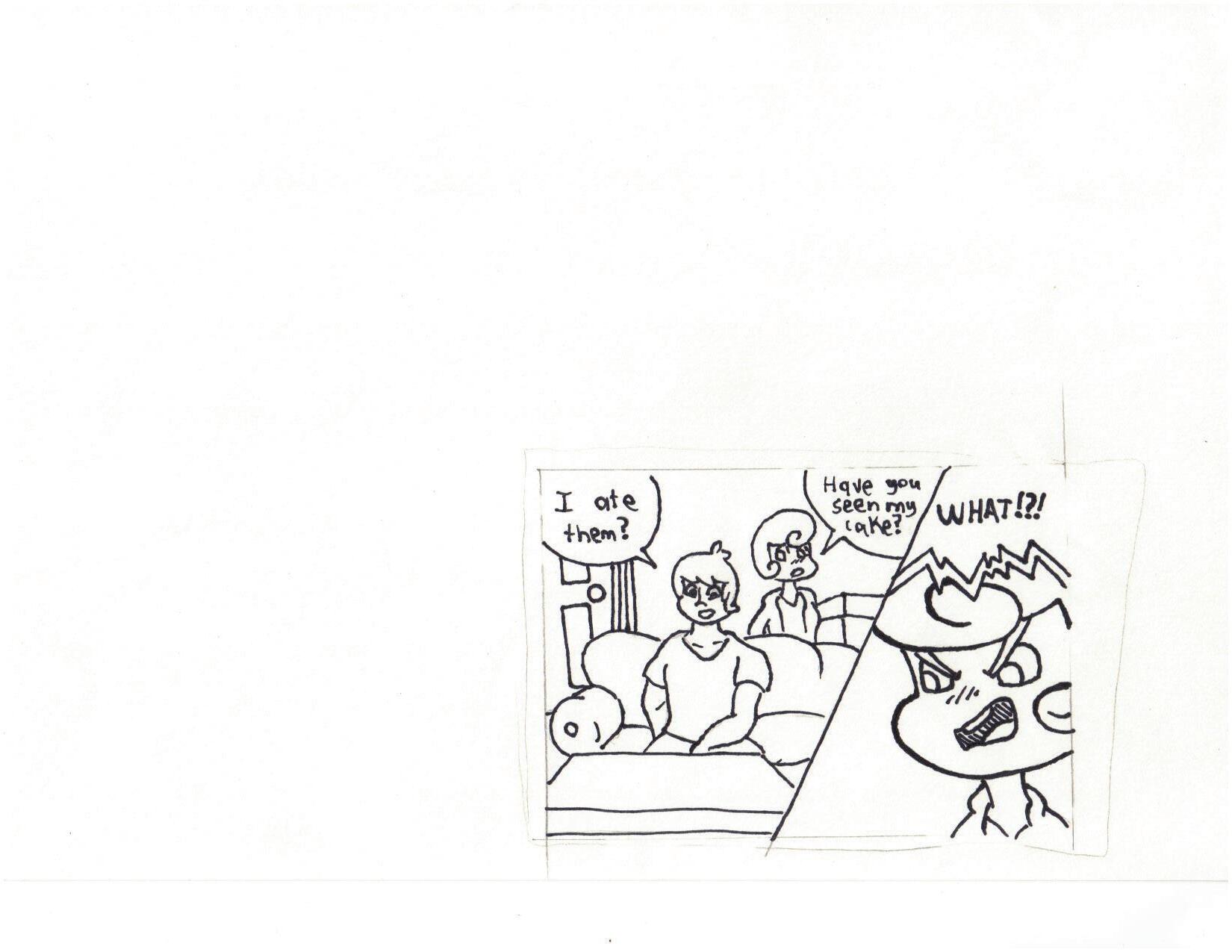
“Small things start to drive you nuts,” Anderson said. “For a while I hated it, before I realized I could get up and go out to other people’s places. I spent all my time in the room with him.”
Eventually the two managed to talk out some of their problems. Anderson said he wanted to work it out; he wanted to keep his best friend. If he had been living with a stranger, he said, he might
“It’s going to happen every time,” said Mason Qualls, a senior double-majoring in history and biology. “Even if it’s a really good friend, it’s a different situation living with them. They’ll have habits you didn’t know about little things come to the surface when you live with friends.”
Qualls said he had come across problems like keeping items on one side of the room, conflicting sleep schedules and having one roommate bring guests over when the other is trying to study. Communication is the key to resolving those disputes, he said.
“If you are already having some problems, have a frank discussion with them. You have to live together at least a few months, so you need to address those problems.”
“The worst thing you can do is try to get back at them or find other ways to take away from their living situation. That’s not an adult way to handle it,” he said.
“The biggest thing I’ve seen is timeliness. Respect my sleep time,” said Jimmy Johnson, a junior business finance major who has been a resident assistant in West Hall for more than a year. “As little sleep as freshmen do get, they cherish their sleep.”
Seeing the same person every day can get annoying, he said, and some freshmen are not used to sharing a small space. He said guests, can be a problem, but usually they spend their time playing video games in the common area or
just stop by and leave again. Most of the time, he said, residents are able to solve their own disagreements.
“They do a good job compromising and working things out themselves,” he said. In fact, he added, space disputes are not the main reason people change roommates; room changes usually occur when people buddy up and decide to be roommates.
“That’s the environment we try to create,” he said. “We want everyone to respect one another. We want them to know their roommate’s schedule.”
This year, RA’s had students fill out roommate contracts with their roommates when they started living together. The contracts cover things like items that can and cannot be shared and quiet hours. Qualls said the contracts are a good idea, though he doubts that most people take them seriously.
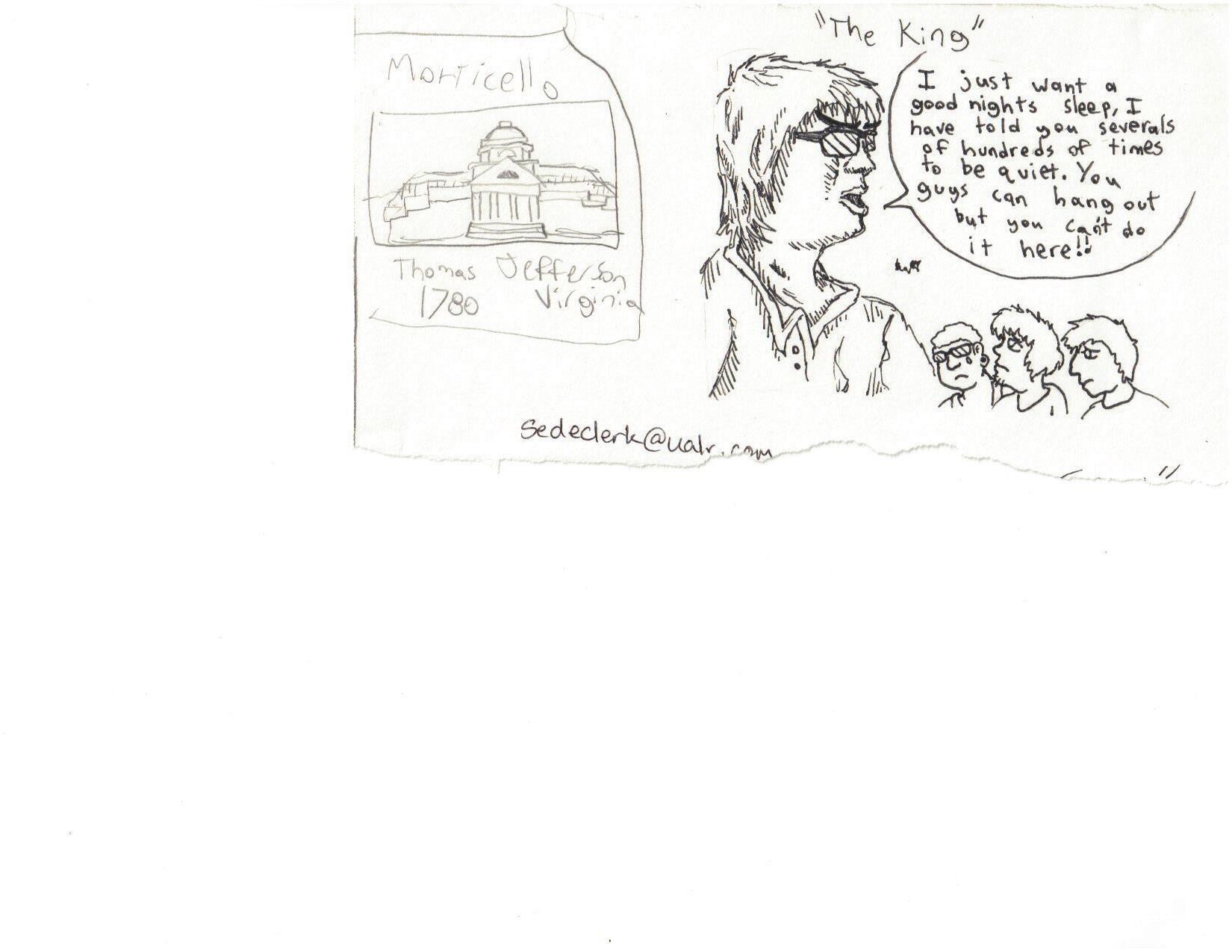
Johnson said if students are having problems with their roommates about it, they should first bring it up with them – politely. If the problem continues, they should go to an RA, who can mediate the situation. If all else fails, the RA might suggest a roommate swap.
“There are some conflicts you can prevent, of course, but the issue about conflicts is that they usually require some kind of external factor that is going to trigger a conflict,” said Charlie Simpson, a marriage counselor who earned his master’s degree in psychology from UALR in 2005.
Simpson said he analyzes peoples’ emotional states during a conflict. Healthy moods make people more likely to handle conflict in a positive way.
When people first live together, they are optimistic, but they become more sensitive as boundaries are continuously breached. Sometimes people may already be sensitive to some triggers, like a student whose siblings violated his or her personal space back home.
It is important to identify triggers
and determine why they cause tension, Simpson said. Then students can find positive ways to deal with the issue when it comes up. Students cannot always control what happens to them, but they can control how they react.
“It’s important to control what you can, and that is yourself. If you are able to apply that, then you have a lot more positive outcomes,” Simpson said.
Although students can accept some problems, acceptance is not the solution if it leads to passive aggressiveness or stress. Setting boundaries, determining a plan of action if those boundaries are breached and following through on that action is a good way to deal with disputes, Simpson said. For example, if a roommate is eating your food without permission, tell them not to. If they keep doing it, tell them you will lock the fridge if they do not stop. If they continue anyway, lock the fridge. Even if a conflict cannot be resolved, people can handle it without throwing things at each other. “The ultimate goal in a conflict is to have a healthy dialogue,” Simpson said. “Even though the conflict is not resolved, you are able to walk away not angry at each other.”
College is unlikely to be the last time students live with other people. They may go on to have more roommates, spouses or families. That is why it is important to learn to overcome conflict early on, Simpson said.
Ideally, he said, people learn conflict resolution skills in childhood, but many learn to shutdown, criticize or become sarcastic instead. If students understand their triggers and how they deal with conflict in college, they will take that knowledge with them later in life.
“The earlier the better, because then they don’t have to go through that trial-and-error period,” Simpson said. “It’s just important to understand your style.”

Paige Buffington Staff Writer spbuffington@ualr.edu
Teachers may search for ways to motivate students, but what keeps a college professor passionate about teaching, semester after semester and year after year?
Not one faculty member that was interviewed could find anything negative to say. All seemed to share a passion for three things: people, learning and research, and sharing knowledge with others.
Amar Kanekar, an assistant professor in the Department of Health, Human Performance and Sport Management, said he had not always planned on being a professor. Imagine signing up for one of his classes - Community Health Agency, Controversial Issues in Health Education or Evaluation of Health Programs - and then discovering that he is trained as a physician.
It was while he did his three year residency in Mumbai, India, his home
country, that his love for teaching emerged. There, he taught a few classes to medical school students and to other doctors who were working on their residency requirements. Teaching, combined with lengthy reading sessions spent studying scientific research from
“My philosphy is to do whatever makes me and keeps me happy.”
-Amar Kanekar, assistant professor in the Department of Health, Human Performance and Sport Management
all disciplines, gradually led him to realize that he would take a slightly different career path.
He felt inspired to understand the problems and to contribute solutions regarding global health issues. By 2004, he had moved to the U.S. and enrolled in
graduate school. He received his Ph.D. in health promotion and health education from the University of Cincinnati. He has been at UALR for two years.
Kanekar said he loves research. His interest in research gives him the opportunity to look for new ways to solve health issues that impact our world. Kanekar said he has not yet reached his biggest professional accomplishment. He said he is aiming to make a contribution to new knowledge in the Public Health arena and hopes to be able to generate something useful and creative to the body of research on global health issues. The biggest of those issues, he said, are HIV, malnourishment and obesity.
Like Raymond Ortega, visiting professor in the Department of Counseling, Adult & Rehabilitation Education, Kanekar said he believes online teaching is a great improvement in the college environment. “Online courses are an improvement and a good model for teaching. Less face to face is ok,” he said.
Other professors disagree, however. Cheryl Johnston, instructor, and Avinash Thombre, associate professor, both located in the Department of Speech Communication, said they prefer teaching to a “live” audience rather than online. Johnston said she prefers “face to face” classes. “I love my students, and I enjoy teaching,” she said.
“I don’t think there is a better job than teaching,” said Thombre, who specializes in health communication, intercultural communication, new technologies and social impact, diffusion of innovations, and entertainment education. He said he views his first career as a journalist in India as a sub-field of communication, and what he does now as “working in the ‘Mother-field’ of Communication.”
But what philosophy keeps a professor going day after day? When asked this question Kanekar’s eyes lit up and he smiled warmly. “My philosophy is to do whatever makes me and keeps me happy,” he said.

Alex Mills Contributing Writer aiden.alexander.mills@gmail.com
Did you know the National Survey of Drug Use and Health, which provides national- and state-level data on the use of tobacco, alcohol, illicit drugs and mental health, has found marijuana to be the most-used illicit drug? According to it, more than 8.9 million people in the U.S. use marijuana, which is interesting since it is illegal.
Cannabis sativa, more commonly known as marijuana, has a long history of medical and recreational uses. Today, the drug is sometimes used as a medical remedy for pain, nausea and seizures. Currently, two proposals are attempting to pass the medical use of marijuana in Arkansas legislature.
The drug is mostly sought for because of the “high” sensation people get when
smoked. When smoked, the delta-9-tetrahydrocannabinol, or THC, passes through the lungs and into the bloodstream. It then targets the brain cells called cannabinoid receptors, which are commonly found in the parts of the brain that influence pleasure, memory, thinking, concentration and coordinated movement.
The side effects of marijuana include rapid heartbeat, low blood pressure, muscle relaxation, bloodshot eyes, increased appetite, dizziness, depression, hallucination and paranoia. However, there is not enough clinical research to be definitely certain of the effects of the drug.
Some of the effects have been reported to help patients with certain lifealtering illnesses, like that of Charlotte Figi. According to an article at CNN. com, Charlotte Figi is a 6-year old girl who suffered from more than 300 grand mal seizures a month. Her family went from doctor to doctor and only found one medicine that worked: marijuana. A family of marijuana growers was able to create a strand of the drug which was high in THC but low in CBD, a chemical called cannabidiol which makes the drug psychoactive. Before, Charlotte lost the ability to eat, talk and walk, but using marijuana allowed her to quickly regain her mobility and catch up with her peers.
Today marijuana is medically legal in 20 states and the District of Columbia. But is only recreationally legal in two states: Washington and Colorado.
Many states have started to see the use of marijuana, whether recreational or medical, come to ballot - including Arkansas.
In early August, the Arkansas Secretary of State Dustin McDaniel approved the language of the Arkansans for Responsible Medicine-sponsored campaign to legalize marijuana. It specifies the legalization of the medical use of marijuana, but not for allowing people
to grow their own. The Arkansas for Compassionate Care campaign may have failed because of this clause.
David Couch, spokesman for Arkansans for Responsible Medicine, said he thinks the Arkansas for Compassionate Care campaign, which holds the ability to grow one’s own marijuana, will not pass is because many citizens believe it will be harder to regulate the use of marijuana.
“There was a poll conducted after the election, and 15 to 20 percent of people who voted against the proposal last time said they would probably vote for it had it not been for the grow your own,” Couch told Arkansas Matters, KARK 4 news, in July.
However not all welcome the idea that marijuana is a savior to those who have certain illnesses like Charlotte.
Jerry Cox of Family Council of Arkansas said he is highly opposed to the idea of medical use of marijuana and marijuana in general.
“It’s not about medicine. It’s about legalizing marijuana for all purposes. Look at Washington and Colorado.” Cox said. “It introduces more drug addiction in our society. If you are for more drug addiction, then you should vote for this measure.”
When asked about the idea that marijuana is not a chemically addictive drug, he questioned why the Drug Enforcement Administration classified it as a Schedule 1 drug.
“It is a mind-altering drug, especially to young children,” Cox said.
He went on to talk about how doctors and pharmacists do not favor the use of marijuana because there are already forms of THC, the chemical which helps, available in pill form.
Couch’s proposal must collect over 62,000 signatures by July 2014 to be able to go to ballot in November 2014. Arkansans for Responsible Medicine will visit the UALR campus to collect signatures and recruit volunteers.

Sarah DeClerk Editor sedeclerk@ualr.edu
Busy students build up big appetites darting from class to class, but may not have time to sit down for a proper meal. Students have many options when they need a quick snack, but what can they choose that is nutritious and filling, as well as convenient?
Fruit seems to be a popular option for healthy snacking. Aliyah Joseph, a freshman speech pathology major, said she likes to munch on bananas and apples, while Corrigan Revels, a junior mass communication major, said he likes to eat grapes.
Donna Quimby, an associate professor with the Department of Health, Human Performance and Sport Management who teaches a nutrition class, said one of her snacks for the day was a pear.
“I try to eat foods that are as close to natural as possible, so your fruits and vegetables and those kind of things,” she said.
Protein bars are another snack Quimby packed for the day. “When you’re snacking, you want to try to pick a snack that is going to be a combination of sugar, protein and fats,” she said.
“Protein is the most satisfying of the three energy-supplying nutrients, so if you want to snack, make sure you have a snack that has some protein in it, not just sugar.”
Joseph said granola bars and nut bars are a convenient option. Students may want to check the label first, however, to make sure the bar will really satisfy them in the long run.
“Look at it and see what’s on the label and that kind of gives you some idea of how the sugar level rises.”
Sandwiches are good on-the-go snacks, Revels said, adding that turkey
and cheese is a favorite. “And tuna fish, because you can eat it by itself or on a tuna fish sandwich,” he added.
As long as people watch out for the fat content in condiments, sandwiches seem to be a good option because they combine a variety of food groups, which is important, Quimby said.
“Don’t leave out any of the major food groups. Don’t leave out the dairy products. Don’t leave out the grains,” she said, adding that dairy supplies calcium to the body, while grains are a good source of B vitamins.
“I am a believer that all food is good food. It’s just when and how it’s consumed and the quantity of it.”
-Donna Quimby,
associate professor with the Department of Health, Human Performanc and Sport Management
Candy contains sugar, which gives the body a quick burst of energy that some students may rely on to make it through lectures. That short-lived energy boost could be followed by a sugar crash, however.
“When you have a real strong sugar increase in the blood then you have a larger-than-normal insulin response, which causes blood sugar to drop below normal levels. You become lethargic and want to eat again,” Quimby said.
Potato chips are another common snack, but some chips may have health drawbacks.
“I would stay away from processed foods as much as possible,” Quimby said, noting that processed foods like chips, canned food and individual packages of oatmeal can have high sodium levels,
“Do you believe in God? What is your religion? Are you a Christian? Which church are you going to?”
I have been asked these a lot since I came to the U.S. It may seem normal for Americans - especially those who live in the Bible Belt - to be asked this kind of questions, but it is not something I am used to. You may wonder why.
France is a secular country - the government institutions are separated from the religious ones - and French people do not talk much about religion, especially at school.
French schools are ruled by the government (except private ones), so they are free and secular. Students are not allowed to show any kind of religious signs. For instance, Christian students are not allowed to wear a necklace with a cross and Muslim girls are not allowed to wear a veil.
Things are a little different in colleges. Students are allowed to show their religious affiliation as long as the religious signs are not too big. However, students - and teachers - are not allowed to talk about religion in class or distribute religious pamphlets. Religious practices in colleges may change soon though. Indeed, the French government may forbid the allowance for students to show any religious affiliation. For instance, the French government does not want female Muslim students to wear a veil . I do not know if this will happen soon, but I know many people do not agree with this proposal.
I believe France has more religious diversity than the U.S.; there are Christians, Muslims and Jews. Knowing this, the proposal may be a good idea because there have been some issues related to religion in some colleges.
For instance, some students use their religious affiliation against their professors. Some would say they received bad grades because their religion was not the same as a professor’s - which may or may not be true. Others would not want to be paired with - or be in a group with - students of another religion. Fortunately, this does not happen often, but it happens and it is a problem.
which can lead to high blood pressure.
“The salt we’re consuming so much is not coming from the saltshaker. It’s really already in the food you’re eating,” she said.
Fast food is another hunger fix students may turn to when they are low on time. Fast food may have received a lot of bad press in recent years, but Quimby said it is not always unhealthy.
“I think that in each one of those [fast food restaurants on campus], you can make healthy choices or healthier choices,” she said. “Within all fast foods, you have to be a little more diligent about the selection that you make or the amount of it that you consume or how often you eat there.”
“I am a believer that all food is good food. It’s just when and how it’s consumed and the quantity of it,” Quimby added.
Planning meals is very important, she said, because “If you wait until you’re hungry, you’re going to eat whatever you can get your hands on at that point, and it’s usually not something that’s very healthy for you.”
She also warned against skipping meals, which can lead to binge eating later in the day. It’s best to eat small, regular meals, she said.
Simply becoming conscious of snacking can help people make healthy decisions, she said.
“Become aware of what you’re putting in your mouth, because a lot of people eat and they’re not even conscious of eating. So if you’re snacking, pay attention to that; why are you snacking?”
Quimby recommended that people who are interested in understanding what they eat keep a food log for three days, and be honest about it. “That’s one of the best ways to look at what it is you’re really doing on a day-to-day basis,” she said.
Talking about religion, showing our religious affiliation and distributing religious pamphlets in school is seen as a normal thing in the U.S. Knowing that it is not allowed in France may be shocking for some Americans, especially here in the South. French people and Americans have different conceptions about whether or not religion should be part of the education system.
I have been to church both in the U.S. and in France. I can tell you it is very different. Here, many people go to church every Sunday; French people usually go to church for baptism, communion, wedding, Christmas, and Easter. Only a few - mostly old people - go to church every week and pray before eating.
France being mostly a Christian country, you may wonder how churches are different. First, they do not have the same architecture; American churches, for me, look more like a hall. French churches have stained glass, statues etc. I would say they are more traditional than American churches.
The services are also different. The first time I attended a church service here in the U.S., I was shocked and surprised to see how different it is from a French mass. For instance, there is no band during a French mass, only an organ. The mass is told by a priest, not a pastor, and it lasts longer than an American mass. I am not sure how long a mass lasts in France, but I know that some weddings or funerals can last two hours at the church, and people constantly stand up or sit depending on what the priest says. There is no shouting, putting hands up or singing like here in the US. The Catholic mass is very traditional I enjoy going to church in both countries but the church I go to here in the U.S. is colorful and has a lot of diversity. Adapting oneself to another culture is not easy, especially concerning religion, but it is nice and interesting to see how people do things differently.
A bientôt pour de nouvelles aventures! (See you later for other adventures!)

Caleb Mitchell Staff Writer cfmitchell@ualr.edu
To some, Katy Perry is just another pop star; to others, she is an icon. But to me, she’s one of the most controversial musical artists out there. You might wonder why this is, given that, with the exception of her 2008 single “I Kissed a Girl,” Perry has been a relatively controversy-free artist. The reason is this: Perry is an artist that I have both liked and disliked, a singer whose music I have loved, hated, loved to hate and hated to love.
When Perry’s 2008 album “One of the Boys” was released, I was instantly in love with her, yet when 2010’s “Teenage Dream” came out, I had to listen to the album repeatedly before it grew on me. Now, with the release of Perry’s fourth studio album “Prism,” I’m more conflicted than ever. “Prism” is an album filled with tracks that I could put on repeat and listen to all day, and tracks that I could go the rest of my life without ever hearing again.
Like Perry’s previous albums, “Prism” is filled with a mix of upbeat,
teenybopper tunes and a smattering of hit-or-miss ballads thrown in for good measure. “Prism” manages to stand out from Perry’s previous work in the selection of new musical styles that Perry experimented with on the album. Tracks like “Dark Horse,” featuring rapper Juicy J, initially seems like it’d be more at home on a Jesse J album than something from the typically pop-oriented Perry (not to mention “This Is How We Do” wouldn’t sound out of place on a Ke$ha album).
“Prism” starts off with the lead single “Roar,” which, thanks to top 40 stations everywhere, listeners are likely well-acquainted with and ready to never hear again. But it’s a good start for the album, kicking things off with a bang and setting things up for the string of dancepop tracks that follow it (which are all sure to be singles eventually). “Legendary Lovers” comes next on the album, and while it is quite catchy, its tribal beats and vibes are at odds with other tracks, and it seems randomly thrown into the second slot of the album.
“Birthday” is arguably the catchiest of the 16 featured on “Prism” despite hav-

ing some of the stupidest lyrics you’re bound to hear all year: “So let me get you in your birthday suit, it’s time to bring out the big balloons, so let me get you in your birthday suit, it’s time to bring out the big, big, big, big balloons...” Hmm… I’m beginning to think this song isn’t actually about a birthday at all.
The remainder of the first half is rounded out with more club-ready tracks like “Walking on Air,” which sounds like it was pulled straight from the ‘80s, the aforementioned “Dark Horse” and “This Is How We Do,” and “International Smile,” a song sure to drill itself into your head on first listen. Oddly enough, the power-ballad “Unconditionally” is thrown into the middle of this mix, which disrupts the otherwise faster flow and should have been placed further down the track listing, where all of the other ballads and beltyour-heart-out tracks are located.
The latter half of the album (where all those previously mentioned power jams are located) is a bit rockier. While some of these songs work, others fall flat; in particular, “Double Rainbow” is eye-roll inducing with its cheesy rela-
tionship analogy, and “By The Grace Of God,” while lyrically sound, is mediocre at best.
Overall, “Prism” is respectable. The new style keeps things fresh and interesting, while Perry’s signature voice and eccentric song lyrics keep things familiar enough to not totally alienate her legion of fans. My main issue with the album is that it’s not up to par with Perry’s previous work. “One of the Boys” had a distinct, vintage-pop sound dominated with incredible singles that people are still singing almost six years later, and “Teenage Dream,” while drastically different from “One of the Boys,” was such a force in the world of pop that it holds a record that to this day only Michael Jackson has beaten.
“Prism” is by no means a bad album, but with that kind of pop star power in her, it seems that Perry could manage to put out an album so much better than this one, which flirts dangerously close to mediocrity. Perhaps like its predecessor, “Prism” will continue to improve with repeated listening, but for now, the best I can say about “Prism” is that it’s simply pretty good.
Liz Fox Managing Editor elfox@ualr.edu
Since their formation at the turn of the century, Montreal-based indie act Arcade Fire has made several impressions. While the group captured hungry audiences with the baroque bombast of its first two albums, Win Butler and his bandmates perplexed pop-saturated ears and manicured eyebrows at the 2011 Grammys, where Arcade Fire performed and subsequently snagged Album of the Year. But as newfound fame found the bunch, it seemed as if they struggled with the cacophony of sound they’d constructed. With nowhere to venture but the unknown, Arcade Fire piled into a Jamaican studio last year and created “Reflektor,” the group’s fourth album that befuddles listeners in pleasant, sometimes pretentious fashion. Like The Decemberists, Arcade Fire has long been considered one of indie rock’s intellectual behemoths, choosing classical instruments over noise to spin florid tales. Surprisingly, most of these elements are absent on “Reflektor.” The album is an electronic ode to everything from authentic Haitian music (provided by band co-founder Regine Chassagne) to Greek mythology, with former LCD Soundsystem frontman James Murphy serving as producer and drum-machine aficionado. This apparent shift to semipoppy, computerized sounds may prove stifling for impatient fans looking for the outfit that once was, but for the most part, the group treads an even path. Perhaps a little appeal lies in influences since certain riffs and twists echo that of Arcade Fire’s predecessors. “You Already Know” begins with an infectious bass similar to that of the Replacements’ “Let It Be,” while “Normal Person” retains a vibe similar to The
Velvet Underground’s “What Goes On.” Whether this was intentional is a mystery, as Butler and Chassagne attribute inspiration to academic essays and old films. But it definitely works for “Reflektor,” especially since many listeners may be grasping for familiarity among all the blips.
There’s also a distinct split between the two halves, which can easily provoke a few love-hate responses. Like most albums, side A is used to lure listeners with sometimes conventional hooks and easily recollected lyrics, with the titular track serving up a complicated yet catchy score. But as “Joan of Arc” - another highlight - segues into “Here Comes the Night Time, P. II,” the mood changes. Instead of bouncing along joyously, the beats slow to a crawl, providing for a melancholy backdrop as Butler questions his life experience in painful terms. Though it doesn’t drudge on with vague misery, “Reflektor’s” second installment is far more nebulous and emotional than the first, allowing for some much-needed balance.
Despite arriving at a definitive turning point that may mean the loss of a few fans, Arcade Fire has yet to show any sign of slowing. The stark shift in sound may initially seem off-putting for people lusting for a consistent catalog, but Butler, Chassagne and their colleagues continue to drum up critical success. While “Reflektor” doesn’t necessarily live up to the ambition found in earlier work, it’s still solid and beautiful. As Butler wails in part one of “Here Comes in the Night Time:” “when they hear the beat coming from the street, they lock the door … but if there’s no music in heaven, then what’s it for?”


Marquise Jones Contributing writer
It’s cold outside, which means the season of UALR act the Slutty Polar Bears is here.
The experimental quartet – comprised of students Sam Lawhorn, Everett Elam of Benton, Jordan Anderson of Lonoke and Norway native Theo Holen – recently joined forces in October 2013. Its first performance was at The Parlor, a jazz club hosted by East Hall, on Oct. 17 during the first monthly jazz night. With only an hour’s worth of practice, the band took to the stage to perform a 3-song set and its selection, which included “Use Me” by Bill Withers, was a real crowd-pleaser.
BriAnna Branson, Lawford’s RA, approached him and asked if he knew of someone willing to participate in the dorm’s upcoming event. Lawford said he’d worked with Elam and Anderson in the past, so their names quickly came to mind when making the decision to form a band.
“Sam and I met one another the second week of school and exchanged digits,” Elam said. “We didn’t meet for a little while, and then the fourth week it was one of those Fridays when I was like, ‘I could be doing my homework or jam with this guy.’ We rounded about some instruments and recorded ourselves performing the ‘Cups’ song by Anna Kendrick and posted it on Tumblr.”
During the Oct. 17 performance, Lawhorn served as lead vocalist and drummer, with Elam playing the violin and guitar, Anderson on bass and Holen acting as pianist. Although many of them stayed on these instruments, the members made it perfectly clear that

they should take turns filling different roles. The band’s influences also range from hip-hop to classical, with tastes in pure jazz, folk, ragtime, latin and rock and roll playing a big role in original compositions.
“I’ve started experimenting with the violin as more of a percussive instrument,” Elam said.
Lawhorn said the Slutty Polar Bears is not the group’s official title, and the four piece is still seeking a name to fit their style.
“We will have our name by the next jazz club event,” Lawhorn said. “Hopefully we will be performing at least two original songs of our own.”
While Elam has been trying to book the Stella Boyle Smith Concert Hall for future performances, band members agree that it may be a while before they decide to commit to a headlining performance. Long-term goals include recording and releasing a record of all original material.
“I would really love to record and put an album out with this band. I feel we’re all sensitive enough that we’re probably going to be picky in our performances and what will go on our album,” Lawhorn said. “I think that there’s a degree of perfectionism in every player and at the same time, perfectionism can be destructive because you can get to the point where you won’t put anything out unless it’s just so. I hope that whatever we produce comes off as something polished and crisp, but not too crisp because we want that raw feel.”
The Slutty Polar Bears will give its next performance on Nov. 14. Those interested are encouraged to contact Sam Lawhorn at sxlawhorn@ualr.edu.


Sarah DeClerk
Editor sedeclerk@ualr.edu
The cramped state of Ledbetter C in the Donaghey Student Center showed that this 20-year-old murder case refuses to die. Almost 100 people gathered Oct. 23 to watch a screening of “West of Memphis,” a documentary that chronicles the case of the West Memphis Three. The 2012 film was directed by Amy Berg and produced by Peter Jackson, and the screening was hosted by the Department of Mass Communication.
The evening’s screening was especially gripping because it featured a question and answer session with former defendant Jason Baldwin, activist Holly Ballard and Pam Hobbs, mother of one of the victims.
Liz Dailey, a senior psychology major, said she attended the screening to receive extra credit for her film class.
“It was interesting,” she said, “I enjoyed listening to the commentary.”
At least four security officers were present at the screening.
“Because it’s a popular story and because there is a possibility for hecklers or acts against the parties involved and because UALR likes to be on top of things, they wanted security here just in case,” said one security officer, who would only identify herself as Badge Number 64.
To call the case well-known would be an understatement. Still, it warrants a retelling.
The West Memphis Police Depart-
ment found the naked, hog-tied bodies of three 8-year-old boys on May 6, 1993. The police linked the murders with cult activity and brought in three local teens as suspects: Damien Echols, Jessie Misskelley and Baldwin. Misskelley and Baldwin were given life sentences, while Echols – the supposed mastermind behind the killings – was sentenced to death.
After their imprisonment, questions began to surface about the handling of the investigation and trial. Two HBO documentaries, titled “Paradise Lost” and “Paradise Lost 2: Revelations,” and the book “Devil’s Knot” by Arkansas Times journalist Mara Leveritt brought these questions into public consciousness. This exposure also brought support from celebrities like Black Flag, Johnny Depp and the Dixie Chicks. Then, new technology for analyzing DNA found no connection between the defendants and the crime.
A 2010 Arkansas Supreme Court decision allowed the new evidence to be submitted for consideration, and the defendants made a deal with the prosecution. In 2011, the three entered Alford pleas, which allowed them to plead guilty while maintaining their innocence, and after serving more than 18 years, they were freed.
The documentary pieces together photographs and video clips from the investigation, trial, appeal and effort to free the defendants, and also includes some discussion by people involved in the case. Although the actual murder has not been determined, the film strongly suggests the killer was Terry
Hobbs, Pam Hobbs’ ex-husband and stepfather of victim Stevie Branch.
“It’s evident that the film has a slant or bias as to who perpetrated the crime,” said Brad Pierce, who teaches an introduction to motion pictures class. “Just because it’s controversial doesn’t mean we shouldn’t watch it or talk about it.”
But Baldwin did not seem eager to accuse Terry Hobbs.
“As soon as the finger of suspicion is pointed, it’s automatic – even if you didn’t do it, people think you’re guilty,” he said. “I don’t want to put another innocent person in prison.”
The film was cut about ten minutes short because of technical difficulties. Nonetheless, it made a definite impression on the audience. In the darkness, people could be heard giggling at distinctive rural phrasing and scoffing at gaping holes in the investigation. When the lights turned back on however, the atmosphere turned heartfelt and contemplative.
About 15 questions were asked during the 40-minute Q&A. Baldwin was well-spoken and upbeat. He said that throughout his ordeal, he never lost hope, because he had to stay strong for his mother and brothers. He also said he is enjoying life now.
“For people who survive a tragedy, it’s a double tragedy if you allow anger and bitterness to steal your heart,” he said. At that, the audience exploded in applause.
Ballard, Baldwin’s partner who advocated for his release and now works with the Washington Coalition to Abolish the Death Penalty, stressed the im-
portance of reopening the now-closed case in order to prove the defendants’ innocence and find the real murderer.
“The sad truth is that this happens all the time. If we don’t talk about it, who’s going to talk about it?,” she said. “It’s not just about this case; it’s about preventing this from continuing to happen in our justice system.”
Pam Hobbs was comparatively reserved and barely audible in the densely-packed room. Some of the most heartwrenching questions asked of her came from mothers in the crowd. She said that she had learned to forgive the men who she once accused of killing her son, and that she now wanted other parents to be aware of the case.
“My biggest goal is for people to always be aware that this was a real live happening. It’s not Hollywood,” she said. “I pray for Arkansas to step up, man up and look at the evidence in the case.”
“This case affected so many people,” said one commenter, who said she had grown up following the case because she is 20 and lived near West Memphis when the murders occurred. She said it had influenced her career path. “My dad always taught me to fight for the underdog,” she added.
“That’s always heartwarming to me, when I meet people who have been inspired to do good things because of this tragedy,” Baldwin said.

by Jacob Ellerbee
Jacob Ellerbee executive editor jjellerbee@ualr.edu
The Wild Feathers, an up-and-coming band from Nashville, Tenn. put on a dazzling performance for the lucky patrons at the Revolution Music Room in the River Market district on Halloween night.
The band is currently on tour in support of their self-titled debut album, which has been recognized by iTunes as part of its “2013 Rock Highlights.” The album was produced by Jay Joyce (Cage the Elephant, the Wallflowers) and recorded live, straight to analog tape in order to encapsulate the live energy the band emanates on stage each night.
The Wild Feathers are currently amidst a slew of headlining dates after touring with veteran acts like Bob Dylan and Willie Nelson.
However, there was a time, not too long ago, in which The Wild Feathers were on the ropes and unsure of their future.
The band was originally signed by Interscope Records but dropped soon after. Warner Bros. later scooped them up and put them in a situation that would give them the best chance to succeed.
“There were about six months in between [Interscope and Warner Bros.] where we didn’t have a label or any money or anything,” lead guitarist and pedal steel guitarist Preston Wimberly said. “We were just living on blow-up mattresses and hoping that Warner deal was going to go through and sure
enough it did. Warner Bros. is just the perfect home for us. Their line up is rock bands that we want to be like.”
Wimberly sat down with The Forum at a bar in the DoubleTree hotel before The Wild Feathers took the stage Halloween night, to discuss recording their debut album and how those recordings sound when they are performed in front of audiences each night.
Wimberly said the band draws influence from bands of old and new. Established acts such as The Rolling Stones, Bob Dylan, The Byrds and The Band give The Wild Feathers something to strive toward while newer artists like Ryan Adams, My Morning Jacket and Dawes give the band contemporaries to lean on.
“Modern bands that are playing their own instruments is so rare now, so that’s kind of something that we’re trying to keep alive and also bring back to some extent,” Wimberly said.
Those aspirations of genuine musicianship came out during the recording of the band’s debut album, with Wimberly describing the sessions as “intense” and “challenging.”
“[Joyce is] a great producer and he pushes you real hard to get the best stuff out of you. That’s what we loved about him too,” Wimberly said.
The band recorded live and straight to analog tape, save for a few overdubs.
“It’s kind of cool because it’s spontaneous, but it sounds like we sound live, which is what we wanted to do,” Wimberly said. “We didn’t want a slick, polished, harmony boy-band-sounding record, you know? We wanted it raw; like we sound live.”
Wimberly and his cohorts, who consist of Ricky Young (guitar, vocals), Joel King (vocals, bass), Taylor Burns (vocals, guitar) and Ben Dumas (drums), are clearly accomplishing their goal, as evidenced by their Halloween performance at the Revolution Music Room.
“We show up somewhere we’ve never even been,” Wimberly said. “And we have people in the front row singing [our] songs.”
The band played for more than an hour and a half, putting on a memorable performance that included songs from their debut album as well as a slew of cover songs.
Half-way through The Band’s “The Weight,” The Wild Feathers motioned for a couple of the guys from the local opening band to help them finish the big song.
Stephen Neeper and Drew DeFrance of The Stephen Neeper and the Wild Hearts band joined The Wild Feathers to beef up the second-half of the song, to a roaring crowd.
The Wild Feathers had impressive chops on all of their instruments, which included multiple guitars, bass, drums and a steel guitar, played by Wimberly on select songs.
The group has unparalleled chemistry and genuinely has a great time performing on stage, as you could see them frequently smiling and reacting positively to the crowd.
One of the unique features of this band is that there is no designated lead singer. There is a different lead vocalist on virtually every song. When the band was in the studio preparing to record the album, they found that each of their
voices had something unique to offer.
“We have all these different ideas that we throw to the table and then it’s like, ‘Well your voice sounds best on that part, so you sing that part. You sound best on this. This was kind of your idea, so you sing that.’”
“Somehow it works,” Wimberly said. “None of us are vocally trained or anything like that, which is what I think is beautiful about it, too. We just sing what sounds good to us, we don’t know if it’s right or not.”
It’s definitely right, as they harmonize during live performances while continuing to play their instruments. This composure and tightness is difficult to maintain, especially when trading off lead vocals between three different guys.
A cover of Led Zeppelin’s “Hey Hey What Can I Do “ saw the band putting their own spin on a classic song by a legendary band, using a steel guitar and beautiful harmonies.
After the show’s conclusion, the rowdy crowd immediately chanted for an encore and the band obliged, ultimately rocking out a few more songs and satisfying fans before the members left the stage.
The Wild Feathers will continue to tour around the country throughout November and some of December. Wimberly said he hopes the band can arrange a European tour sometime next year, hitting places like England and Germany.

Alton Young Editor axyoung1@ualr.edu
Sony’s latest video game system will be unleashed on the world Friday Nov. 15 (or for die-hards, Thursday at midnight). The PlayStation 4 (or the PS4) will up the ante in the next-gen video game console wars. Microsoft’s new Xbox One makes it debut Nov. 22, exactly one week later.
Most people with $400 to spend on such things may have already reserved a unit at their favorite retailer. For those willing to fight for it, there will be units available on the launch date. For the rest of the populace who may be wondering which system to purchase or whether it’s worth the money to upgrade, here’s a quick look at some of the features of the new PS4: the good and the bad. This information comes from Sony’s own Official PlayStation Blog.
The PS4 comes equipped with a 500GB hard drive and is boxed with the new DUALSHOCK 4 wireless controller,
a cable to charge the controller, a monoheadset for voice-chat, an HDMI cable, and of course the power cable. The games are sold separately.
The system is Blu-Ray based like the PS3, but isn’t capable of CD playback at all. The new unit also isn’t capable of playing MP3 files. It is also worth noting that the PS4 isn’t backward compatible with PS3 or PS2 games; only the new PS4 discs will run. The system will need the initial online update in order to watch Blu-Ray or DVD movies, otherwise there is a disc that can be requested from customer service. According to Sony, the new system is capable of 10 times the processing speed of the PS3 and has a very powerful graphics processor. In other words, the games look awesome. The difference may not be noticeable to non-gamers, but to hardcore gamers the difference could mean everything.
The PS4 may also provide a lifeline for the almost-forgotten PlayStation Vita. Sony has taken a page from the book of Nintendo’s WiiU controller,
by allowing remote play with the Vita handheld system. Players will be able to use the Vita to play their PS4 games, freeing up the television for something or someone else. Sony expects that most games will be playable this way, unless they use the camera.
Which brings us to the camera, a device that is sold separately and is capable of face-recognition. The camera can be used in conjunction with the PlayStation Move device to give the player an interactive gaming experience.
A new feature is the ability to use an iPhone or Android phone as another screen while playing certain games. The extra screen will be used to show items, maps, etc. The PlayStation controller is an upgraded version of the tried and true DUALSHOCK design. This version comes with the addition of a Share button that allows the user to show-off gameplay on Facebook. Also new is a light bar that will be used to show things such as health in a game. This potentially irritating addition cannot be turned off.
In order to compete online, you will have now have to be a PlayStation Plus member. This is a drastic change to the free online service PS3 players enjoyed. However there is some good news, Sony reports that PS3 owners and PS4 will be able to face each other online on some games. It will apparently be up to the developer if they want to allow the cross-console action. Last (and maybe least) are the games. While there are several third-party games that look gorgeous on the new system, these games are available on many other platforms, including the last PlayStation. There are a handful of games that will allow players to upgrade from the PS3 version to the PS4 for 9.99, but that doesn’t make up for the lack of exclusives. There are only five firstparty games slated for the launch date. The lack of exclusive games notwithstanding, the PS4 is set up to make a great attempt at establishing itself as THE game system to purchase this year. The first shots of the console wars have been fired.
ALTON YOUNG Alton Young Editor axyoung1@ualr.edu
Leah Thorvilson, the new University of Arkansas at Little Rock director of development, leads a double life. In her work life, she is a dedicated university employee who has been on post since September. But in her off-hours, Thorvilson is one of the most successful distance runners in the country.
Thorvilson won the Midsouth Marathon in Wynne on Nov. 2, which qualifies her for the 2016 U.S. Olympic Trials in January. She finished 55th in the 2012 Olympic Trials. She also won the Susan G. Komen Race for the Cure last month.
Her victories represent more than just the typical determination of a distance runner. Thorvilson is coming back from a torn hamstring that might have ended the careers of most runners. For Thorvilson, though, the injury was just the latest challenge in her career.
The Robbinsdale, Minn., native said that although she did compete in high school, she wasn’t heavily recruited by college programs. She wasn’t a longdistance runner on her high school team; instead she participated in events such as sprints, relays, hurdles, and the triple jump.
“I had contact from a couple of Division II colleges, but I just wasn’t real sure of what I wanted to do,” Thorvilson said. A member of her high school dance team, she figured that dance was in her future. After graduating high school, she was coaching the school’s junior varsity dance team and attending a community college that had no track team. A chance meeting with the track coach changed her career path.
She had heard that the girl’s track coach had quit and she offered to supervise the team, but instead the coach told her that she should still be competing herself. He got her in contact with UALR’s head coach at the time, Kirk Elias. Elias had ties to her home state, having worked at the University of Minnesota from 1985-1993. The coach brought her to the campus for a visit. UALR offered her a partial scholarship to join the track team, which she accepted in January 1999. That’s when she “kind of fell in love with running.”
The 2003 UALR graduate was a member of the school’s cross-country and
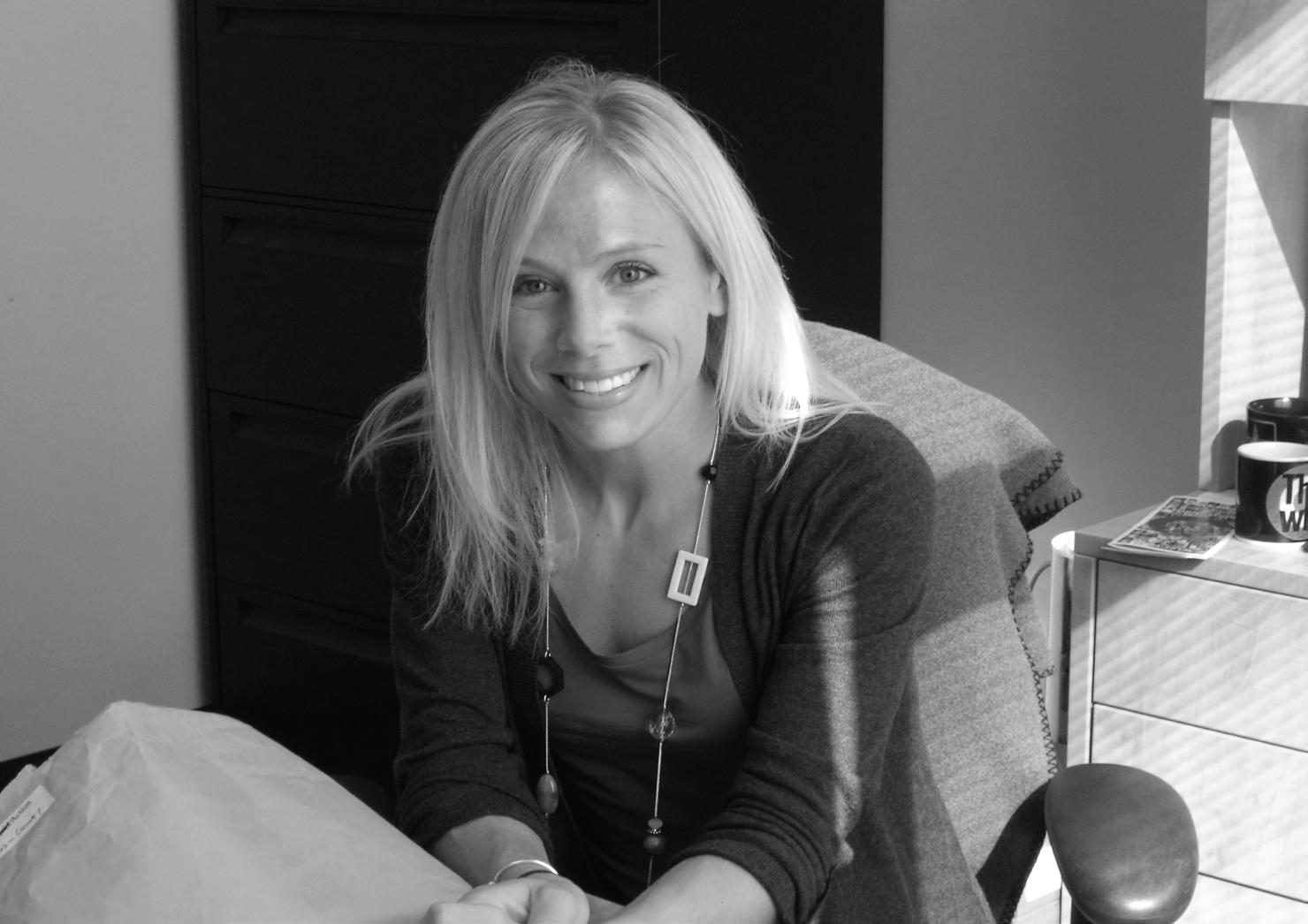
the track and field teams from 19992002. According to the UALR Trojan website, Thorvilson was a leader on the 2002 team that repeated as Sun Belt Champions. She also won several other Sun Belt honors during her collegiate career. She holds course records in 17 distance races.
The first time that she remembers participating in a distance run was during high school when her father, who only ran for exercise at the time, asked her to join him in a 5K run. She thinks that he asked her only in jest, thinking she would go back to sleep, but she agreed to join him and ended up beating him.
Her father kept the record of the results from that race, recently mailing them to her. She was 16 at the time of that race and she has continued racing ever since. To hear her talk about running is to understand why she still does it.
“Everything can feel so scrambled, but you can get out there on a run and kind of lose yourself in it,” she said. “You feel good; you feel at peace with yourself.”
And though she says the feeling may not last for forever, it’s “a feeling that I don’t get from anything else.”
The determination of getting that
feeling back is part of what helped her get back in the race. The other thing that helped were her friends, who helped her during recovery from surgery by driving her to work and basically being her support system as she recovered. Even while on crutches, she would walk miles – with friends on bikes riding beside her in some instances. The people that she has met through running mean a lot to Thorvilson.
“I don’t have any family in the state, so they’ve become like a family to me,” she said. “It would be hard to get me to move out of Little Rock, because of the people I’ve met.”
The diagnosis of a torn hamstring took several months to find, so though the news wasn’t great, she was glad to finally know what it was. She wanted to have surgery to repair it as soon as she knew that it was necessary, if she wanted to compete again.
It’s no surprise that, now that she is well into her recovery, her training regimen continues even with the added responsibilities of her new job. The 85100 total miles per week and the 4:00 a.m. sessions, while also juggling a fulltime job show that her determination isn’t faltering. Despite everything else, she plans to keep on running.
Antonio Gayden Staff Writer Axgayden@ualr.edu
For the first time in four seasons, it’s tournament time for the Trojans. A South Alabama win over ULM secured the eighth and final seed in the Sun Belt Conference tournament the team.
No stranger to the playoffs and championships, first-year coach Adrian Blewitt says the team accomplished their one goal for themselves. The Trojans will be in the SBC tournament for the first time since 2009.
“If we didn’t make it, we would’ve been absolutely devastated,” Blewitt said. He understands the situation of the program and says that the girls have really been working hard and giving him everything they have.
Defense and a little bit more scoring at times will make or break the playoffs for the team according to Blewitt. The team has a defense that has improved from allowing 73 goals in 2012 to only 30 goals this season. The coaching change and new roster has the team feeling confident.
“We’re not going to get everything we need in my first recruiting class,”Blewitt said. “But I think we’ve gotten the most out of what we have, we’re happy to be here, they’re bubbly and excited; it’s like a new lease on life.”
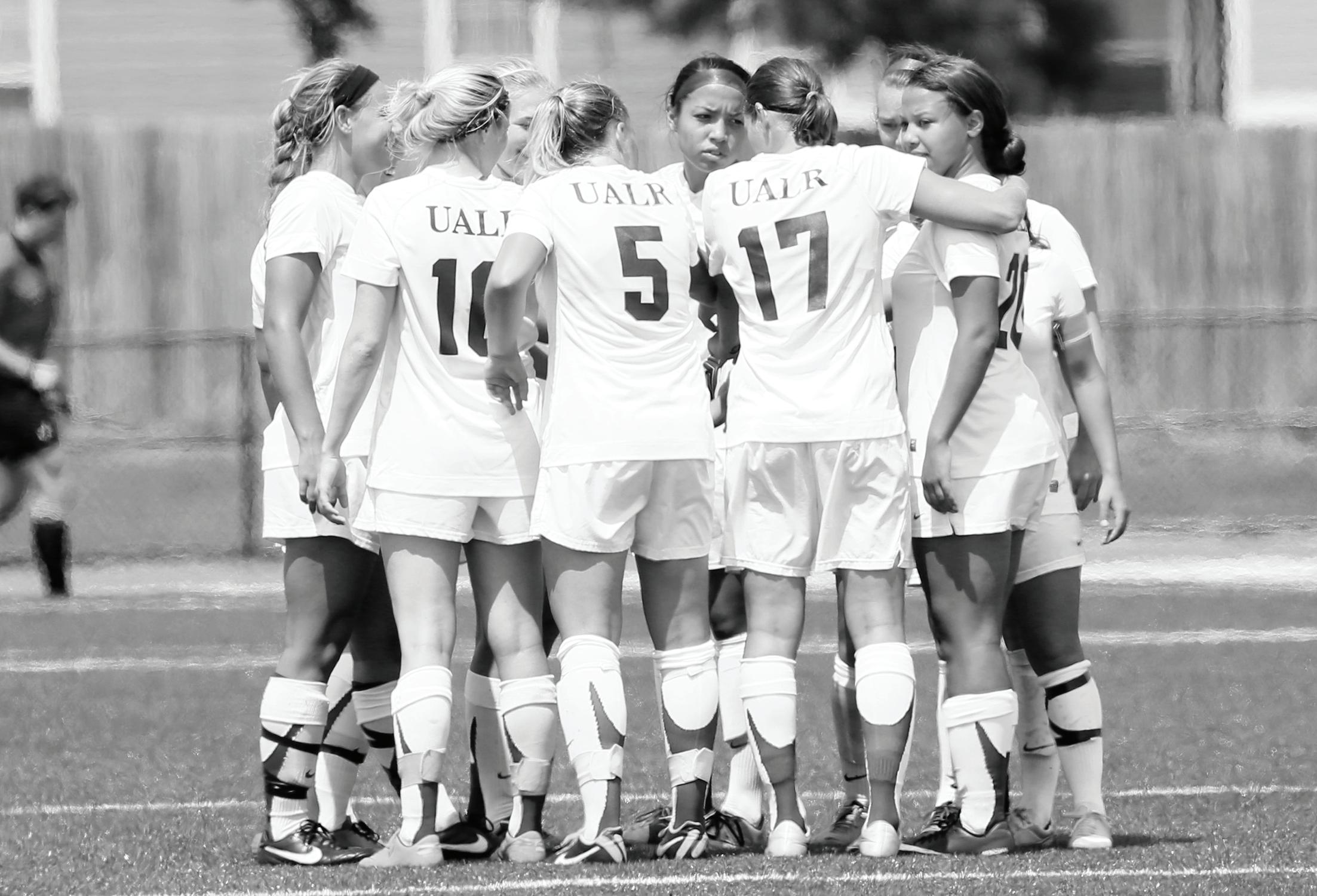
The Trojans face the top seed, Western Kentucky, in the rst game of the SBC Tournament. go out there and hold nothing back,” Blewitt said.
It’s the most wonderful time of the year. I’m not talking about the holidays. (I hate shopping, Christmas or otherwise). No sir, this time of year is great for sport fans. There is or there shortly will be something for everyone. The return of the NBA is at the very top of my own list (keep reading and I’ll give you my prediction), but every sports fan is being served.
The World Series just capped off another year for MLB, with the Boston Red Sox winning the championship - this comes after the Sox had a disaster of a season last year.
College football is going strong now with big match-ups taking place every weekend. And we can now all celebrate the demise of the BCS with this being the last year; next year the four-team playoff begins. That, of course, will give us something new to complain about. The disappointing season of the team in Fayetteville has put a damper on some of the state’s college football fans. But like the rest of the teams in Arkansas, they’re hopeful for a strong finish. It makes me wish that we had a team of our own here at UALR.
The NFL season just hit its halfway point and though there are several teams that are and have been favorites, there are just as many surprise teams. The key to the NFL season seems to be to make the playoffs and then play your best football on your way to the championship. We’ll just see who follows the formula this season.
College basketball is starting to ramp up. The typical year for me involves following the college game only casually until March Madness (the NCAA Tournament). But there is a buzz right here on our own campus with the UALR men and women’s squads. Both teams return a good mix of experience and newcomers. The women have even been picked by the SBC coaches to win the conference in a recent preseason poll.
And, though I don’t follow it personally, the NHL season is also going on. Hockey fans may be few in terms of tv ratings, but they are among the most passionate of any sport.
Yes, there is something for every sports fan right now, but like Kurtis Blow said or sang: Basketball is my favorite sport. The fact is, I can watch any game, be it a perennial matchup like the Heat vs. Bulls or a battle of bottom-feeders like Celtics vs. Suns.
The team will have nothing to lose when they face Western Kentucky in a quarterfinal match in San Marcos, Texas, Wednesday Nov. 6 at 4 p.m. The Trojans lost to the Hilltoppers earlier this season 1-0 on a late goal Oct. 20 at home.
“I think we can be the bad news bears,” Blewitt said. The last time the Trojans were the number eight seed in 2009, they advanced to the title game. In the one and done tournament, coach says that no fear is what he is instilling in his team. “Let’s
Coach Blewitt says he’s looking for consistency in Wednesday’s game; for players to step up and make goals, take chances, and for consistent goalkeeping.
“If we can get those things, then I think we have a chance,” Blewitt said.



Here’s how I see the season shaking out: In the Western Conference the San Antonio Spurs will battle the L.A. Clippers for conference supremacy. The addition of Doc Rivers as the Clippers new coach may be just enough to tip the scales in their favor.The old veterans of the Spurs will have to remain healthy for them to achieve the championship goal that alluded them by mere seconds last season.
The Clippers will only go as far as Chris Paul can take them on the court. Blake Griffin and DeAndre Jordan still need to continue their on-court development and become more than just dunkers.
In the Eastern Conference, the defending champion Miami Heat will be challenged by the Indiana Pacers, the Chicago Bulls, and the Brooklyn Nets. The Heat will be attempting to threepeat while keeping everyone motivated and healthy. The Pacers took the Heat to a Game 7 in the Eastern Finals last season and want to finish them off this year. The Bulls have Derrick Rose back after he missed the entire 2012-2013 season with an ACL injury. The Nets have the largest payroll in the league with the addition of veterans Garnett and Pierce.
My prediction? The Miami Heat will win their third title in a row in an entertaining series against the L.A. Clippers. Sorry anti-LeBron fans.
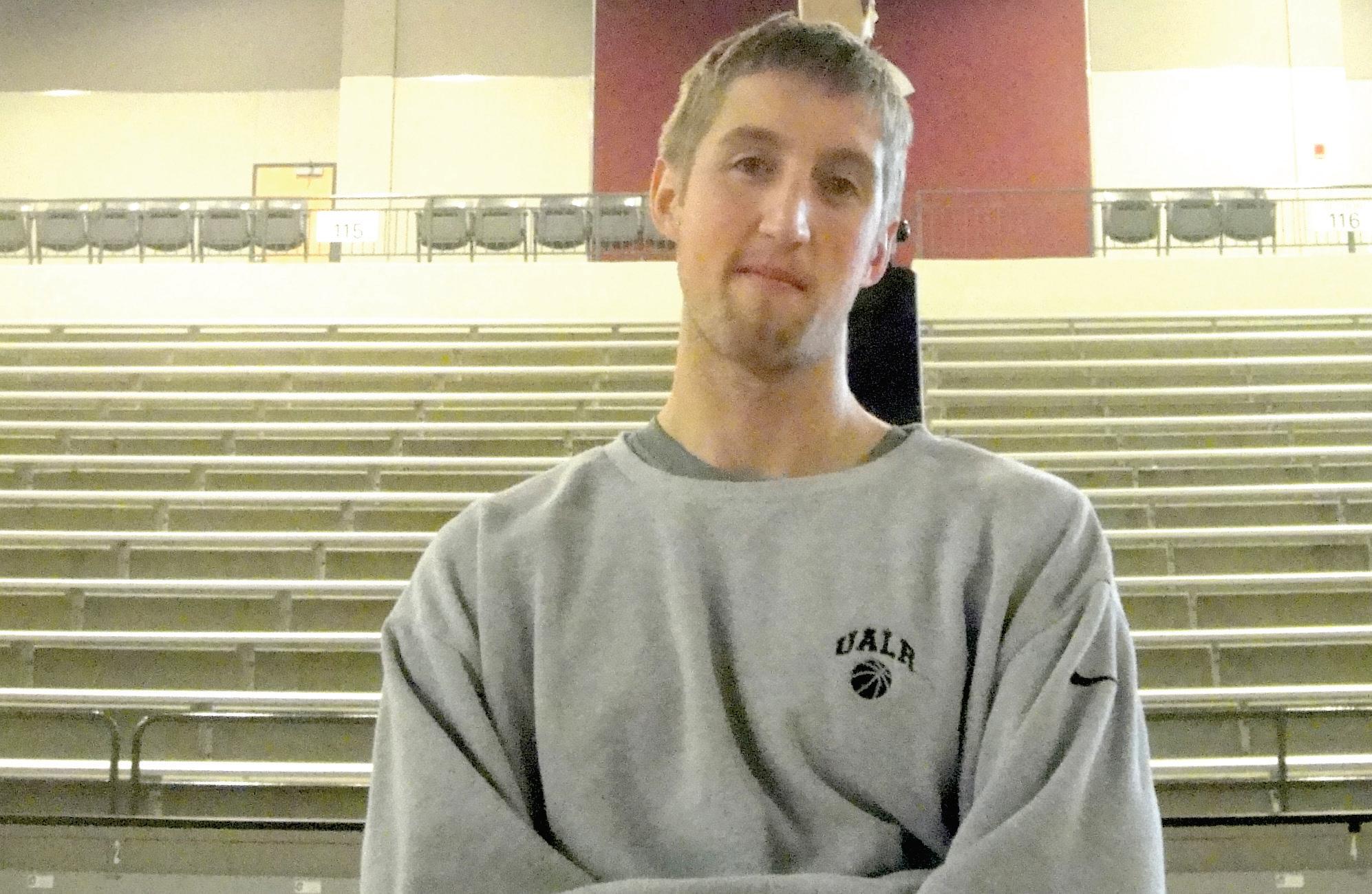
College basketball teams across the country are gearing up for the season. This is true for the UALR Trojans, as well. In an SBC preseason poll, the UALR Men’s basketball team is predicted to finish sixth in the conference. Senior William Neighbour earned Preseason Second Team AllSun Belt Conference honors heading into this season.
Neighbour, a forward/center for the team, has led UALR in scoring the past two years. His rebounding average ranked fifth in the SBC and he had the second highest single-season boards total at UALR since Rashad Jones-Jennings in 2006-07 season.
Neighbour said he is very proud of his championship at UALR. The team won the
SBC Tournament Championship in 2011. He is also proud to have been nominated a few times for Sun Belt player of the week and for pursuing education in another country.
“Coming all the way from England, being out here on my own and getting my degree...I’m pretty excited about that,” said Neighbour, a criminal justice major and a native of Greyshott, England.
Neighbour, who won a national championship in high school and represented Britain in international competition, said there are few differences in college basketball in the United States and in England.
“It’s much bigger over here,” Neighbour said. “It’s on TV over here and it means so much to people.”
Winning the Sun Belt championship and to making it to the NCAA
VOLLEYBALL: The team has already clinched a spot in the SBC tournament and is the only team to have an undefeated conference record on the road so far.
TRACK: The Men finished 2nd and the Women 10th at the Sun Belt Conference Championship in Ala. on Nov. 2.
SWIMMING: 1st place winners at the Hendrix Classic were - Megan Scott in diving, Kang Jinson in the 200 yd IM, Lexie Stone in the 500 yd Freestyle.
BASKETBALL (W): The SBC preseason #1 seed will have their season opener at the Jack Stephens Center Nov. 10th.
BASKETBALL (M): The men’s team starts their challenging schedule with a game at the Jack Stephens Center Nov 11th. Admission is free for military.
SOCCER: The team plays in the conference tournament for the first time since 2009.
GOLF: The men finished tied for 8th at the Jim Rivers Intercollegiate. The women finished 11th at the Blue Raider Invitational
Tournament are two of Neighbour’s goals. The Kobe Bryant and L.A. Lakers fan said he hopes to play well this year and also hopes to play in the NBA someday. Neighbour said he needs to maintain not only performances on the court, but also grades in school. “[If] it’s what you want to do, you’ll find a way,” said Neighbour.
Neighbour thinks that UALR’s basketball head coach Steve Shields, along with his three assistant coaches are experienced and knowledgable in helping and giving advice to players. Neighbour considers assistant coach Charles Cunningham like a father to him. He said he has good relationship with the other teammates as well. “They are overall funny guys, we get along pretty well,” said Neighbour.
His journey in basketball dates back to when he was 12 years old. It was his brother who inspired him. “He (Neighbour’s brother) came home and we started playing one day in the backyard and I just enjoyed it and I just kept playing it,” Neighbour said.
Although basketball is his favorite sport, Neighbour said he enjoys playing any sports. He said he likes to play golf, tennis, soccer (football in England), and chess. Neighbour said, “I’m good at chess. I like to play chess.”
The 6-foot-10-inch player said he comes from an athletic family. His father was a tennis player and coach, his mother was a gymnast and a trampolinist, and his brother plays soccer in Australia.
As an international student, he said he often misses home. “Just the family, Christmas time with the family, and I really miss my mom’s cooking,” Neighbour said.
The season begins Nov. 11.
Alton Young Editor axyoung1@ualr.edu
Soloman Bozeman played for the Trojans basketball team from the 20082011. Bozeman averaged 16.6 ppg in his final season, shooting nearly 46 percent from 3-point range. He is currently with Krvybasket in Ukraine. The Forum recently caught up with him to ask a few questions.
Forum: What team are you currently playing for?
Bozeman: I am currently playing for Kryvbasbasket in Kryvyi Rih, Ukraine. Forum: How is the season going for you so far?
Bozeman: The season is going well so far. We just finished our pre-season schedule. Our team had a good training camp in Lithuania; we won six games and lost two. I really feel as though I’m developing as a point guard.
Forum: What has been the most exciting thing to happen to you as a professional player?
Bozeman: One of the most exciting things that happened in my career was playing for Coach Eduardo Najera last season. He was a tough player and a great athlete in the NBA. I have a great
Alton Young Editor axyoung1@ualr.edu
The UALR men and women basketball teams kicked off their seasons with Meet the Trojans Nov 4 at the Jack Stephens Center. In an event hosted by Rex Nelson, the head coaches of both teams spoke about their upcoming season. The players participated in a dunk and 3-point contests. Both teams begin their seasons with games.
Coach Joe Foley spoke about the toughness of the women’s non-conference schedule this season; citing games against LSU and Louisiana Tech as examples.
Coach Shields took the moment to announce that the team had just voted seniors Will Neighbour and Leroy Isler as captains. He also talked about the NCAA emphasis on the elimination of handchecking that may be evident with a possible increases in scoring and in free throws.
Following the competition, players were available to sign autographs.

deal of respect for him as a coach because he believed in me and gave me a lot of confidence as basketball player.
Forum: What was it like to play in the NBDL? (Bozeman played in the NBA Development League from 2011-13 averaging over 8 ppg)
Bozeman: It was a great learning experience because I got a chance to play with some really talented guys, who have played in the NBA before. A few were Chris Douglas Roberts, Mike James, Delonte West, and Sean Singletary. There was a lot of young talent and veteran players who all worked really hard. This created a lot of great competition in the D-League because everybody was playing for that one shot – to get that call to the NBA.
Forum: What did you learn while playing here at UALR that you still use now?
Bozeman: I learned how to play hard and play defense. I also learned to bring toughness every day. Those three things are important and you will definitely learn them while working with Coach Shields. What I learned from Coach Shields plays a huge part in my success now and it is the reason I am still a professional to this day.
Forum: What is your ultimate goal as a professional?
Bozeman: My ultimate goal is to be in the NBA. This is what drives me. It motivates me to wake up every morning and work extremely hard.