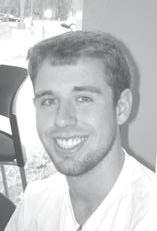
Dan Shisler has been named director of UALR’s new Office of Digital Strategy, which leads in developing and implementing a comprehensive digital presence for the university. Shisler, who began his duties in March, previously served as manager of search-engine marketing and optimization at Dillards Inc. and has more than 15 years of experience as a web developer, analyst and production manager.
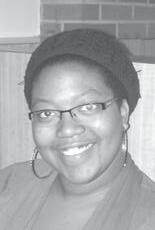
Professor Sarah Howard Jenkins Hobbs has been awarded a Fulbright Scholar grant to lecture in Bulgaria during the 2013-2014 academic year. Hobbs, who is one of 1,100 U.S. faculty who is travelling abroad next year, will teach foreign students about U.S. domestic contract law and the evolution of those principles. Recipients of Fulbright grants are selected on basis of academic or professional achievement as well as demonstrated leadership in their respective fields.
Graduate students Andrea Ringer David Sesser, Bryan McDade and Wendy Richter have received accolades from the Arkansas Historical Association, a nonprofit geared toward shaping the study of Arkansas and United States history. Each winner was chosen based on articles written on a variety of historical topics.
Mary Louise Roberts, a professor of history at the University of Wisconsin-Madison. Roberts, will present her lecture “Rape Hysteria and the Sexual Economy: French Accusations of Sexual Assault Against African-American G.I.s,” at 4 p.m. Thursday, April 18 in Stabler Hall Room 111.
Mayflower oil spill hits home for student
Mayflower residents, including one UALR commuter, are still experiencing illness and distress after last month’s pipeline rupture, according to reports.
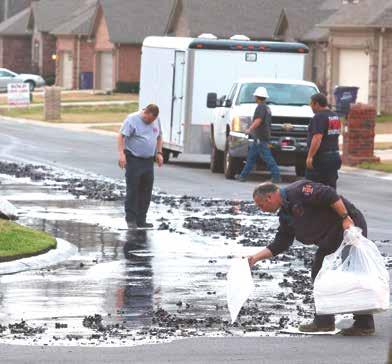
The Exxon-owned Pegasus pipeline burst March 29 in a yard between homes in the Northwood subdivision of Mayflower. A total of 22 residents were evacuated from the area before a large clean-up crew arrived to prevent oil from soaking into Lake Conway, located close to the spill’s origin. The 22-foot, 18-mile tear has been classified as “major” by the U.S. Environmental Protection Agency with more than 250 barrels of crude oil making its way into neighboring areas and affecting the city’s ecosystem. According to Exxon officials, more than 19,000 barrels of the oil-and-water blend were collect-
ed at the site as of April 4.
Kimla Lemmons, a mass communications student and mother of two, lives in the neighborhood adjacent to the site of the rupture, located approximately 350 feet from the spill site. While she left for Little Rock minutes before the pipeline burst, Lemmons said she began to experience side effects from fumes radiating from crude oil that nearly flooded her property.
“I’ve taken myself [to the emergency room] because my airway was cut off,” Lemmons said. “My voice is just now coming back to the point of being audible. ... I was totally not able to talk and that happened immediately.”
Lemmons also said her children complained of various flu-like symptoms following the spill, including nausea and headaches. Upon returning to
Academic restructuring to bring change
With seasoned faculty retiring and budget cuts looming, the Chancellor has called on upper administration to assist in improving UALR’s 25-yearold academic structure. Chancellor Joel Anderson, in a Feb. 8 memo, tasked Provost Zulma Toro with developing a proposal that will change the university’s structure.
The change is directly linked to Goal Five of the Strategic Plan written two years ago. The plan calls for the implementation of “cost-containment initiatives and resource reallocations.”
One of the reasons for restructuring is the recent departure of three deans: Paula Casey of the Bowen Law School, An-
gela Sewall of the College of Education, and Angela Brenton of the College of Professional Studies. Additionally, this year’s decrease in enrollment is likely to result in a reduction of state appropriations and federal funding.
Another factor igniting the push for restructuring is time. “It has been 25 years since we have ad a fundamental, thorough review of our academic structure,” wrote Anderson.
According to Toro, her team is still in the first phase of the
process. She has compiled two groups, the Faculty Task Force and the Chair’s Task Force, which include representatives from various colleges on campus to help develop a proposal.
The two parties are currently analyzing information that has been collected from community members and are expected to submit a report of their findings by May 15, explained Toro. Around midAugust, after the groups meet with a Steering Committee, the final recommendations will be made.
The Provost said she will discuss those recommendations with individuals who will potentially be affected by the changes. As for the three unfilled dean positions, interim deans will temporarily be put
in place until the final structure is agreed upon. She will submit her recommendation on Oct. 1 to the Chancellor, who will make the final decision.
“We hope to start implementation during the spring semester of 2014,” Toro said. “The plan is to have the academic restructuring completely in place by December of 2014.”
The process has brought about mixed reactions from faculty members. Most of the complaints regarding the change stem from the uncertainty regarding what it will mean for the future. Toro remains optimistic, stating, “I think that as in any process there are people that are very positive about the process, very
Advisers to become boss over declaring a major relay lights the night
Students who want to select or change their major will no longer be able to make the request in the Banner Online Service System, known as BOSS. Instead, beginning June 1, students will have to meet with a department adviser for approval of any change to their declared major, according to administrators.
If students attempt to use BOSS to change their major, they will see directions outlining the new process, including who to contact for the major.
“Without personal contact, it is impossible to guide the student to the right major,” said Daryl Rice, associate vice chancellor for student success.
Students began using BOSS to change their major 10 years ago to simplify the process for students. While BOSS is more accessible to students, it has not made the system better, he said. The universities colleges, and departments have received numerous reports of students becoming frustrated at the current system.
“To me part of advising should be more seamless and more hands on. The idea is to create a system where the student, the department, and the dean are all on the same page,” Rice said.
Without human interaction, the student does not know if or when the appropriate individuals have received the request. Further, without communica-
tion, those reviewing the peti-
tion do not know whether the student has made an educated decision regarding their major.
Additionally under the current system, if an adviser needs to make changes to the students’ declared major, Banner will not allow it. The adviser must instruct the student to make the necessary adjustments before the adviser can proceed.
But with the new system, UALR Technical Services has designed a master website that enables a department chair, or dean to make changes to a students’ declared major eliminating the existing multiple steps.
Academic advisers will begin training on the new website mid-May.
Each department will determine how they want to communicate with their students: in the office, by telephone, or email. This matches the purpose of the universities’ advising department, which is to provide the student with one on one attention ensure they receive training in the appropriate field of study.
After advisement, the student will sign a statement affirming the declared major. It will be the responsibility of the adviser to change the students’ records to the new major immediately.
“These relationships ought to happen naturally. However, it is necessary to structure to cause these relationships to happen. We know good advising is crucial to students’ success,” said Rice.
KenDrell Collins Assistant Editor
See OIL SPILL, page 3
LaShane Rostago Staff Writer
Liz Fox Entertainment Editor Toro
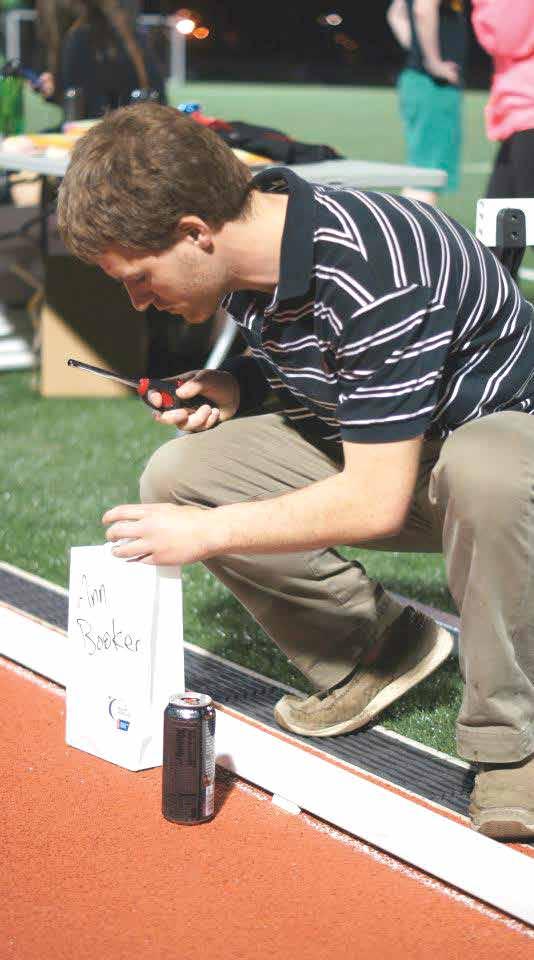
Beau Bienvenu, a senior business management major, lights a luminaria at the Coleman Sports Complex during the second annual UALR Relay for Life on Friday, April 12. The 142 participants on 14 teams raised more than $7,300 on behalf of the American Cancer Society.
Photo by Jennifer Ellis
Firefighters drop absorbent cloths on the ground where oil flowed down North Starlite Road in Mayflower’s Northwood subdivision, after crews stopped the flow of oil from a pipeline break March 29. Photo courtesy of Stephen B. Thornton/Arkansas Democrat-Gazette
Act minimizes corporate risk, jeopardizes the rest
The Forum
Even if you do not know exactly what GMOs are, you have probably heard of them. Genetically modified organisms and genetically engineered food have become a volatile topic. Although their purveyors tout the benefits of pest-resistant, fast-growing crops, many are concerned about the consequences of GMOs. As a result, their proliferation has been the focus of international and domestic protests.
Despite this controversy and the health implications of GMOs, which have yet to be fully understood, President Obama signed a bill protecting GMO producers March 26. The Monsanto Protection Act keeps corporations from being sued for health problems caused by eating crops grown from genetically-modified seeds. The act was added as a rider to an unrelated bill, suggesting that it would not have passed on its own.
Dear Editor,
While Obama is minimizing financial risks to corporations, he is disregarding incalculable risks associated with GMOs. This act has set precedent for government support of GMOs and the companies that produce them. Moreover, he has denied corporate responsibility for the consequences of their product, and has robbed consumers of a mechanism for litigation if GMOs do cause harm.
Genetically modified seeds have yet to be fully tested for potential health risks. Because genetic engineering is a relatively new field, there is no way of anticipating how this technology will affect the population. There are no safeguards to ensure its security and reliability. Therefore, the signing of this bill seems premature. Obama is endorsing a product no one fully understands.
Many consumers are not aware of GMOs or their implications. They do not know
Not only do I find it appalling that UALR closed the doors to its Community School of the Arts, but the university continues to give the erroneous impression that children are being taught on campus on a continuous basis by including in your “It’s Time for UALR” video a segment of one of the teachers from the Community School teaching cello to children. It’s time UALR quit propagating such a lie to the general public. By continuing to use the Community School in the video undermines everything the Office of Development is trying to accomplish. Either bring back the Community School, a great source for encouraging young students to attend UALR, or edit the video to eradicate this misrepresentation by the university.
Keith Klosky
MALS
Graduate Student
how their food was produced and should not be held responsible for health risks caused by GMOs. This bill makes them responsible, however, by denying corporate responsibility. Those consumers who are aware of GMOs may choose to buy organic, non-modified food, usually at an outrageous price most cannot afford.
At the time of the bills signage, Monsanto, its namesake, was celebrating last year’s profits from the sale of geneticallymodified seeds. Monsanto is notorious for dominating the transgenic seed market. Their patented genes are found in 90 percent of all soybeans and 80 percent of all corn grown in the U.S., according to the Associated Press. Monsanto’s agricultural control allows it to undercut small farmers, and the supposed superiority of its seeds pushes traditional farmers out of the market.
This monopoly, coupled with the nature of GMOs, could
We made a mistake:
In the April 3 edition, we mistakenly listed the names of the 2012 college level Faculty Excellence Award winners rather than the 2013 winners. The following are the correct 2013 college-level award winners:
TEACHING
Coleen M. Barger, professor of law; Judith A. Hayn, associate professor of teacher education; Stacy Caroline Moak, professor of criminal justice; Gaurav Kumar, associate professor of accounting; Hirak Patangia, professor of engineering technology; Stacy M. Pendergraft, associate professor of theatre arts and dance.
RESEARCH Frances S. Fendler, professor of law; Ibrahim Duyar, associate profes-
have devastating environmental consequences. Larger farms create more pollution and take up more land, which degrades wildlife habitats. Transgenic crops’ invulnerability to pests could make them lethal to helpful, pollinating insects. In addition, pests and viruses could become resistant to geneticallyengineered immunities. Although they have the potential to cause medical, economic and environmental harm, GMOs also have the potential to end famine and disease. These were not the considerations that went into this bill, however; mostly, it seems to be concerned with lining corporate pockets by allowing companies to exploit these genetic experiments without risking lawsuits. While corporations make a profit, consumers have no recourse if these seeds do damage. By signing this bill despite public outcry, legislators have shown that lobbyists are their true constituents.
sor of educational leadership; Kwasi Boateng, associate professor of mass communication; Joseph R. Bell, professor of management; Tansel Karabacak, associate professor of applied science; David F. Mastin, professor of psychology.
PUBLIC SERVICE
Kelly Browe Olson, associate professor of law and director of clinical programs; Anarella Cellitti, associate professor of teacher education; Amy Oliver Barnes, assistant professor of mass communication; Wm. Jay Sims, instructor of earth sciences; Catherine Lowry, senior instructor of information science and coordinator of information technology minor; Angela Hunter, associate professor of philosophy and interdisciplinary studies.
Prioritize planetary protection over profit
The March 29 oil spill in Mayflower demonstrated how industry can devastate the environment. It is a particularly striking reminder because the spill happened in a residential area and humans, not just ducks and turtles, are dealing with the fallout. The implications of this spill, taking into consideration other spills across the world, should compel us to adjust our priorities so that the environment comes first.
The planet must work correctly, more so that industry, economy and government. It must because without it, we cannot live. The planet, and not a corporation, produces everything we need to survive. If the planet could not support us and the air and water were contaminated or the atmosphere destroyed, we would die.
The Earth is the most important thing in our lives. We rely on it for basic existence. Yet, protecting it is considered an afterthought and a nuisance. Environmental protection is something to be bought off and avoided – something that interferes with business.
Environmentalists are ridiculed. Global warming is denied. People quickly forget about oil spills, quickly brushed off by tightlipped tycoons with deep pockets.
Environmentalism drifts down to the bottom of the to-do list. This is understandable. Protecting the planet is a difficult, untested field. Doing an adequate job of it would require transforming industrial structures. People would rather the government spent its time and effort on something useful, like getting out of debt, urban development or perfecting drones. People do not have the motivation to be aware of their environment; they have to pay rent, get to work and feed their families.
Then again, if the planet cannot support life anymore, we will have a 100 percent unemployment rate, and our mortality rate would be pretty high, too.
If the Earth goes, we all go –although those in power rarely acknowledge it. Industrial regulation is a violation of free trade and a supposed hazard to the economy (although unregulated pollution is a hazard to the environment). If we regulate more, companies simply go somewhere without environmental protection. In fact, companies actually profit from a hostile environment because it forces people to pay for air, water, food and shelter.
Development is not the problem. We do not have to live in the woods and weave our own sandals. Doing so would be unnecessary and undesirable. Industry has bettered people’s lives, overall. Although cities produce a lot of pollution, they are necessary educational and cultural centers.
However, we develop without respect for the environment, the planet will not be able to support us and society will collapse.
We must strive to develop in ways that are compatible with the planet. To do this, we must find new ideas and technologies that limit our affect on the environment or allow the planet to grow with us. Such a revolution would encourage ingenuity and boost the economy.
It can only be accomplished, however, by preventing further damage to the environment and holding companies accountable for their actions. This cannot be solved with a payoff. It is time for the planet to be our first priority.
SARAH DE CLERK
Strange girl, stranger world
their home over the weekend to collect essential belongings, her young daughter experienced vomiting and stomach pain, which cleared up hours after returning to their temporary home: a hotel in downtown Little Rock.
According to marine toxicologist Riki Ott, the symptoms of exposure to oil spills often include respiratory problems and central nervous system complications. However, these ailments often imitate those associated with the common cold as well as those linked to more serious illnesses like pneumonia, bronchitis or chronic obstructive pulmonary disease. So while several symptoms can arise from exposure to crude oil, many of them cannot be explicitly coupled with the spill.
However, Ott also claims certain individuals may be affected more than the average person.
“Diluents are industrial solvents and degreasers, like dispersants, that act as an oil delivery mechanism,” Ott said in a recent Huffington Post story. “Some people are more vulnerable [to oil] than others, especially children, pregnant women, elderly, African-Americans and those with pre-existing illnesses.”
Among others, it is these factors that have led Lemmons, who also goes by Kimla Greene, and her neighbor, Kathryn Jane Roachell Chunn, to file an extensive lawsuit against Exxon Mobil. The 16-page suit, filed April 5 with the Little Rockbased Duncan and Thrash law firms, seeks compensatory and punitive damages for lessened property value -- a concern shared by many residents, including Ryan Senia, who lives a few houses away from where the tear occurred.
“Even if not a single drop of oil got on my property, because my address is on that street, I just think no one is going to buy that house now,” Senia told the Arkansas Times last week. “Even if I’m not personally scared of contamination, a buyer might be unless there is someone to document the clean-up process, and know that everything was removed.”
Exxon Mobil is currently devising a plan to address property value concerns that may involve home-purchasing options. According to Karen Tyrone, vice president of operations for Exxon Mobil Pipeline Co., the company has a team that’s planning to meet with residents after working out some details.
“[The homes would need] some sort of clean bill of health before they were really ... marketable at all,” Conway appraiser Tommy Nabholz told the Arkansas Democrat-Gazette. “There’s probably still going to be some sort of negative reaction from potential buyers who might think that if the pipeline ruptured there once, it could happen again.”
Although a small number of the 22 af-
fected residents have been allowed to return to their homes after an air-quality assessment, Tyrone also noted the interest in re-entering the affected properties has been slim, considering all of the permitted families have yet to go back.
“Some might not want to return because of so much heavy equipment [that’s] still in the neighborhood,” Tyrone said in a news conference last week.
While different tests are set to be overseen and conducted in the following weeks, the section of the pipeline where the original rupture occurred was removed April 15. The highly-visible gash was seen after the section was removed from a large hole shortly after 12:30 p.m.
Faulkner County Judge Allen Dodson said the section of pipeline will be independently tested to help uncover the cause of the rupture, which has so far been owed to age and reverse of flow.
“It’s a milestone, I think,” Dodson told the Democrat-Gazette Monday. “But ... it really doesn’t impact our clean-up at all.”
While officials believe the removal may convince admitted residents to return to their homes, Lemmons believes going back will only worsen the problem, especially since a local elementary school — separated from the site by a pair of worn railroad tracks — has been allowed to stay in session despite potentially-troublesome conditions.
“They have allowed school to go on, downplaying the fact that they’ve had kids go home sick from the fumes,” Lemmons said. “The only precautions they’ve taken is to spray the air vents with disinfectant and to keep the kids inside. How much good they thought that was going to do, I have no idea.”
With Mayflower homeowners still displaced and a swarm of investigations surrounding the spill, many factors have yet to be determined. But one thing is certain: many are unhappy with how the incident was handled and wish the confusion surrounding the March 29 rupture would have been managed differently.
“I don’t think they handled this oil spill correctly at all,” Lemmons said. “They should have evacuated everybody within a mile radius of where it happened. ... The mayor has said nothing about the spill, and I’m disappointed about that.”
Originally constructed in 1948 to transport oil to Midwest refineries, the 20-inch Pegasus pipeline extends from Patoka, Ill. to Nedarland, Texas, creating an 850-mile underground stretch that can move up to 95,000 barrels — or 4,000 gallons — of tar crude per day. Though it has not been proven, officials and researchers speculate the cause of the abrasion is the result of age and a period of construction from 2002 to 2006, when the flow of the oil was reversed.
Police Beat
Confiscated drugs appear in lost-andfound
Two officers discovered suspected marijuana in a lost-andfound at the department of public safety April 5, a DPS report said.
The material was sealed in an evidence bag that’s label revealed it had been confiscated in 2007 by Cpl. Bobby Hicks and weighed 5.6 grams, it said. One officer put it in another bag and into the evidence locker.
Burned sweet potato causes fire scare
A charred sweet potato set off fire alarms in South Hall April 3, a department of public safety report said.
Officers found the burnt spud in a garbage can near a warm, open microwave in the room that originated the alarm. A resident said she cooked it by pressing the “potato” button, it said.
A community advisor told the student to cook the potato in a shallow dish of water next time, to avoid burning it, the report said.
Child left alone at Donaghey Student Center
Donaghey Student Center staff told public safety officers that a ten-year-old girl had been at the DSC unattended for about 40 minutes, a department of public safety report said.
The child told officers that her mother had a new phone number and there was no way to reach
her, it said.
Officers took the child to the department of public safety. Her mother, Charissa E. Gurley, 37, arrived there a half-hour after the dispatch, it said. Officers gave her a lecture and a warning.
Camera gone from vehicle during baseball game
A woman found that her camera, camera lenses and driver’s license vanished from her vehicle at the March 30 baseball game, a department of public safety report said.
She told an officer there was a group of people in the vehicle next to hers, it said. When the officer approached it, four people ran away. The woman then told the officer about the missing items and that her locks did not work, it said.
Uncooperative man arrested for public intoxication
Officers arrested Frederick Beron Gilmore, 36, for public intoxication while he was walking on Fair Park Boulevard March 30, a department of public safety report said.
An officer had to shout at him three times before getting a response, it said. According to the report, Gilmore was staggering, mumbling and his breath smelled of alcohol. He told officers he was getting exercise, it said.
The officers took him to the Pulaski County Detention Center, where he refused to relinquish a tube of Now & Later candy, it said.
New student organization hosts panel discussion of LR lawyers
Alexis Williams Assistant Editor
The Pre-Law Society’s bimonthly “Law@Lunch” meeting on April 3 featured a panel of Little Rock lawyers who spoke of future law school decisions, attorney career opportunities, and personal advice.
Guest attorneys were Murad Elsaidi, staff attorney for the Arkansas Board of Review; Caleb Garcia of the Immigration Law Center; John Johnson, chief deputy prosecuting attorney for Pulaski and Perry Counties; and Mark Ohrenberger of the Agency Division of Civil Department at the Arkansas Attorney General’s Office.
Having only recently become a registered student organization in spring 2013, student membership is low. But this proved advantageous as the panel seemed comfortable speaking to the small assembly of aspiring attorneys.
“The best thing about being an attorney is that it grants you a certain level of autonomy,” Johnson said. He works 8 to 5 and answers only to his senior prosecuting attorney.
Ohrenberger shared his perspective of a lawyer’s life as well. “Litigation means there are ongoing deadlines, lots of nighttime and weekend hours, and it’s really nonstop,” he said. “Just because you leave the office at 2:30 because it’s a sunny day outside doesn’t mean that those cases aren’t constantly running through your head.”
Garcia relayed to the assembly much the same message. “I work anywhere from 65 to 80 hours a week, mostly drafting motions, filling out forms, and speaking with clients. You always hear about ‘billable hours’. Well, not in immigration law. We deal primarily with the Hispanic population in Arkansas, and we charge a flat rate. Instead of billable hours, we ask for $1000 and we’ll do the rest.”
Naturally, a major concern for the Pre-Law Society involved advice for applying to law school and what to do afterwards. The panel offered several useful tips.
Prior to entering law school, a prelaw student should focus heavily on maintaining a high GPA and scoring well on the Law School Admissions Test (LSAT). Once a student has been admitted in law school, the attorneys agreed that the student need not focus on one particular path, but should branch out
and explore options. If the student is interested in working during this time, the William H. Bowen School of Law also offers aid in their Career Services office. Many law firms come to the Bowen campus for recruitment. The student may find a position as a courier at a law firm or in the Public Defender’s office.
“That’ll at least get your foot in the door,” Ohrenberger said.
Johnson stressed the importance of networking as early as during undergraduate study. “I always say that law school is a trade school to learn how to make money,” he said. “It’s about the contacts you make and the experiences you make.”
Arkansas is a small legal community, so making connections is always conducive to a graduate. Pre-Law Society
Advisor Joanne Matson called 2013 a “good year” to apply to law school.
To succeed in law school means to be able to write well and read difficult pieces. The final grade for a course is often contingent upon the final paper’s grade. Law students will develop what the panel called “issue spotting”, which is exactly what it describes: spotting the issues in papers, briefs, court cases, testimonies, etc.
Matson asked the panel if they might offer final “pearls of wisdom” before the meeting adjourned.
“I would say, just work hard, but take time for yourself. It’s all about balance,” Garcia said.
Ohrenberger asserted the prudence of assessing one’s goals in terms of standard of living. “Just think about what you really want in life. I know guys who work in big firms at $125,000 a year and have miserable lives,” he said.
“I’d say, look into clerkships, internships and externships,” Elsaidi suggested. “They show you the work that you’ll be doing, but they also help improve your writing.”
Johnson echoed his colleagues, as well as including his own advice. “Like and be liked. Start to network and like people. Have goals, but be flexible in them,” he said. “Don’t be afraid to acknowledge who you are. And once you’re in law school, talk to your professors.”
Students interested in joining the Pre-Law Society can contact President KenDrell Collins at kdcollins@ualr.edu or Faculty Advisor Joanne Matson at jlmatson@ualr.edu.
Winners named in annual Faculty Excellence Awards
LaShane Rostago Staff Writer
Three professors were honored with top accolades at the UALR 2013 Faculty Excellence Awards held Friday, April 12.
Margaret E. McMillan, a geoscientist and professor in the College of Science, received the Bailey Teaching Award, the highest honor that included a grant of $10,000. The department of earth sciences also received $5000 to fund more research.
According to colleagues, McMillan received his award for her devotion to education by adapting classroom lab exercises to enable students to use their studies in real-life situations. She also works with Donaghey scholars and designed a program that treats each student as a hired professional with coursework listed as job responsibilities.
“It is a privilege. I love interacting with my students,” McMillan said. “I teach them, and I learn from them. ... I don’t have to go to work; I get to go to work.”
Nidhal Bouaynaya, a professor in the College of Systems Engineering & Information Technology, won the $5000
r e S tr UC t U r I ng , continued from page 1
Bailey Faculty Excellence Award in Research sponsored by the UALR Society of Philanthropy. Bouaynaya works in the field of genomic signal processing, and her research combined this process with mathematics to further cancer research. Nancy Landrum from the College of Business received the Faculty Excellence Award for Public Service, which included a monetary prize of $5,000. Landrum developed UALR’s first undergraduate and graduate courses in sustainable business practices, which engage students with service learning projects like the campus garden. These ventures provide resources to teach students how to run sustainability audits, assessments and how to further market research. Landrum is currently on sabbatical in Germany and serves on the sustainability committees UALR has celebrated the Faculty Excellence Awards for 25 years. Each UALR college or school selects one winner in the categories of public service, research and teaching. The Foundation Fund Board later presents a check for $1000 to each recipient. PepsiCo, the Bailey Foundation and the UALR Philanthropy Society sponsored the awards.
motivated and excited about something different. There are people who are just waiting to see what happens and there are others, like in any organization, small percentage, that doubt that this will be the positive thing for us. But, I think it will be.”
eral arts classes, Toro believes it is still feasible.
“Currently there is an initiative that a couple of faculty members from the art department that are working with faculty in the college of engineering to come up with a program that will be multi-disciplinary or interdisciplinary in nature,” Toro mentioned. This program is likely to start with upper level courses, she added.
One question is whether the restructuring will impact the job load of some people. According to Toro, “Everything is on the table at this point in time. We are not eliminating anything from consideration yet. We don’t really know but, in terms of faculty, I think that they will not have more work than the work they currently have.”
Students are expected to be impacted by the restructuring as well. Toro hopes that with more faculty collaboration, some courses will be team-taught. She intends to implement a classroom structure that mirrors that of the Donaghey Scholars Program, where multiple professors teach one class.
Despite the hurdles that come with implementing such a model in non-lib-
Toro encourages students to participate in the restructuring process by attending the University Town Hall meeting on April 26. Another way for students to voice their opinions is by conversing with the Student Government Association.
“We will be selecting a student representative in the next few weeks to sit in the final, overarching Steering Committee,” said Toro. The selected student will be a member of the SGA. Faculty and students can keep updated on the process by going the myCommunities page on Blackboard.
Margaret E. McMillan, an associate professor in the Department of Earth Sciences, accepts the Bailey Teaching Award, which includes a $10,000 grant, at the 25th annual Faculty Excellence Awards on Friday, April 12 at the Stella Boyle Smith Concert Hall. Photo by Jennifer Ellis
That damned Ellis kid
DAvi D E LL i S
the midnight rider gets caught
In fall 1988, I signed up for driver’s education. I had to pass a written exam to obtain a learner’s permit. Little did I know it, but that little piece of paper would be the beginning of a debacle that will live in infamy until the day I die.
My parents had bought a customized van back in the ‘70s. It was a top-of-theline Ford Econoline. In its heyday, that van was the envy of the neighborhood; but after my parents drove the hell out of it for a decade, it was a rattletrap. It was rusted on the sides, the carpet looked like a huge, dirty dog had rolled in it, the mini fridge had been torn out to make a storage cabinet, every door rattled like it was going to fall off the hinges and, worst of all, the air conditioning didn’t work.
My parents had long since bought newer vehicles, but like an old dog that you just don’t have the heart to put down, that van stayed around. To a teenager with no other options, it was a ride.
I could not drive without an adult in the car. After a while, I was tired of having to follow this rule, so on weekends when I was home, I would sneak into my folks’ bedroom as they slept and, like a ninja, quietly took the keys to the rattletrap and went on a midnight joyride. I usually didn’t go far and had the van back by morning with no one the wiser.
I was able to do this a few times by myself, but one weekend I mentioned my night outings to a friend and asked him if he wanted to come along. I made the mistake of allowing my brother Joe to hear the conversation. He threatened to rat me out unless I let him tag along.
We got the keys, despite all the noise Joe was making, and drove off our block to the street where my friend lived with no problem. I parked the van opposite his house, with the engine running and the headlights on. I thought it was going to be a quick pickup. It wasn’t.
Joe went to the back door of the house with a flashlight to get my friend, who was not awake or dressed. After a few minutes, Joe came to tell me what was up and brought a bottle of vodka with him, which I promptly hid beneath the seats.
As Joe went back to check on my friend’s progress, a cop car passed on the cross street. I shut off the engine and headlights and ducked, hoping they hadn’t seen me. I hovered down between the seats for several minutes. When I was sure they had passed by I sat up in the seat. To my surprise, I had a flashlight being shined in my face. I was busted. The cop asked me what I was doing. “Picking up a friend,” I said. It wasn’t a lie. “Let me see your drivers license,” he said. There was a long pause, after which I said, “Uh, I don’t have one.” His response was, “ Get out of the vehicle.” It was right about that time that Joe and my friend were coming around the house, and they got busted, too.
The jig was up, so we laid out the whole story out for the cops, except for the vodka under the seat. They really didn’t want to book all of us, so they let my friend go back in his house, but took Joe and me into custody. We were not under arrest; they were going to take us home.
We stood on the front porch of our house with the cops while they rang the doorbell and banged on the door. My parents were such heavy sleepers that they didn’t notice. The cops had dispatch call our house but my parents just slept through all the ringing. After about a half-hour of banging on the door and calling my parents’ phone, one of the cops had Joe go into the house to wake up Mom and Pop.
I could hear my father cussing and yelling at Joe about waking him up. The cops looked at each other in puzzlement. The front door jerked open. Joe quickly came back out on the front porch with the cops. Pop was standing in the doorway in his tighty-whities, scratching his wedding tackle, with a wild look in his eye and his hair a mess.
“Mr. Ellis?” the cop asked. “Yeah,” my dad said. “Did your boys have permission to take your van out tonight?” the cop asked. “Hell no they didn’t,” he replied. They told my dad what was going on and that we were not under arrest.
Dad woke up my mom to have her drive him to get the van. “It’s the cops! They brought the boys home!” he yelled, and told us to “get in the house.”
Pop bawled me out for about an hour about how what I had done was stupid. He got up in my face with enough ferocity to make me pee a little bit but never threw me the beating I was expecting. He took my learner’s permit and I wasn’t allowed to drive for quite a while. We hadn’t opened the vodka, so I was able to retrieve it and give it back to my friend. I learned a huge lesson from that incident. All of what my dad said was true. I could very well have killed myself or someone else. Forward thinking is a key skill in life. When you make a decision to do something, you have to think ahead. You should consider the gravity of your decision. In the end, what you do can affect not just your life, but the lives of others as well.
Vice chancellor to continue service after retiring from 40-year career dedicated to student success
Sarah DeClerk Features Editor
Charles W. Donaldson, vice chancellor for educational and student services, flipped through a binder of pictures of his extensive glass collection. He and his wife have collected American Brilliant Cut Glass, produced between 1875 and 1915, for 38 years. “It is an expensive hobby,” he admitted, but one borne of research and dedication, as well as opulence.
Donaldson was dressed immaculately in a white shirt with “CWD” monogrammed on the cuffs, paired with a light blue tie. His speech was calm and measured, spoken in the pattern of a minister at the volume of a church mouse. His gaze was stern, but kind and his posture relaxed with sharp eyes.
Like most educators, his office was lined with bookshelves. A table between two comfortable chairs displayed books about spirituality, travel and education. The walls were conspicuously bare, however, and half of the office looked like it had been packed away. This summer, Donaldson will retire.
“He has been 100 percent dedicated to UALR students and their success,” Chancellor Joel Anderson said. He described Donaldson as sensitive, intelligent and hardworking. “He is well-rounded and very balanced and reasonable in the view that he takes of people and issues,” he said.
Logan C. Hampton, associate vice chancellor for educational and student services, said he was in graduate school when first met Donaldson. “He is one of the sharpest persons I’ve had the occasion to work with,” he said. “His ability to hold numbers in his head – and facts – is unique among human beings.” He added that Donaldson was a compassionate, generous and focused visionary. Both he and Anderson said that Donaldson had high expectations of himself and others.
A self-described overachiever, Don-
“I think it is important for minority students and individuals to have a positive role model, and it is also important for nonminority individuals to see a minority who could be a positive role model to them as well.”
- Charles W. Donaldson
aldson squeezed in an interview between meetings, events and his various projects. When asked how he keeps up the pace, he said he begins each day with reading and meditation. He opened a small, brown book called “Today is Mine” and flipped to today’s page – bigger than self. He meticulously read the page aloud, about living beyond one’s own interests. It is a lesson Donaldson seems to have taken to heart, and was taught at an early age.
Donaldson was born March 8, 1947 and grew up in Newport, Ark. It was a nurturing community, he said, that instilled in him a great self-concept and the belief that he could accomplish anything with hard work. “Everyone looked out for everyone,” he said. Edu-
cation was also highly prized, and it was understood that the children would go to college. He grew up Methodist and recalled childhood trips to Philander Smith College to watch performances of “The Messiah.” He later returned to the institution to earn his bachelor’s in psychology. He then received his master’s and doctorate in counseling from the State College of Arkansas at Conway (now the University of Central Arkansas) and the University of Arkansas at Fayetteville.
When he began college, he decided to pursue education instead of theology. “I questioned if I were to go to seminary, sit next to a non-minority student and earn the same degree, to then be relegated to serving at a minority church,” he said. “Education seemed more flexible at that time.”
Donaldson said he viewed his educational career as a form of ministry. “It has allowed me to help so many people from various ethnic and cultural backgrounds,” he said. “I think it is important for minority students and individuals to have a positive role model, and it is also important for nonminority individuals to see a minority who could be a positive role model to them as well.”
Although teaching was his passion, Donaldson said he moved into administration for a better salary. He was an administrator at a public school before he came to UALR in 1973, after deciding that he could make better use of his skills at the university level.
“I could not have designed a better job or career than what I have had,” he said. He began as a counselor for the student special services program, and then became director of career planning and placement. Then, he became associate vice chancellor for educational and student services and dean of university college before he was appointed to his current position. He also serves on various boards and teaches higher education classes.
Hampton said that Donaldson’s expansive, varied portfolio made him “a different kind of student services professional.”
“I don’t have to worry about what’s going on in all the areas for which he’s responsible,” Anderson said.
Donaldson said his most gratifying accomplishment at UALR was constructing the student services center, which he dreamed of for 25 years before it came to fruition. “He masterminded the planning and hovered over the process from the time it was being planned by the architect to the time the contractors were finishing it,” Anderson said.
“I see the glee on the faces of students being served and the faculty doing the serving,” Donaldson said. He added that the one-stop building was part of a larger plan to create a “heart” of campus, as well as to minimize students’ legwork.
In addition, Donaldson led the oncampus housing expansion to “provide students desiring a more traditional experience the option to do so.” Anderson said that the construction process sailed smoothly under Donaldson’s command.
He led the Rwandan Presidential Scholars Consortium. Anderson said that the international students who came to the university made an excellent addition to the class and had overall academic success. “Through them, UALR will make an important contribution to the development of the country of Rwanda,” he said. Donaldson also implemented the
African-American Male Initiative, African-American Female Initiative and Hispanic Initiative. The programs, which mentor at-risk students, have had real success, Anderson said.
“The pedagogy is working. The intrusive intervention strategies are working. My belief is that if these strategies can work success with these populations it can be good for the entire university. However, we must be more intrusive with intervention,” Donaldson said. “That means getting up into the student’s business while creating a nurturing environment where students know we care and our goals are not incongruent with their goals.”
In his time at UALR, Donaldson said
“I don’t have to worry about what’s going on in all the areas for which he’s responsible.”
- Chancellor Joel Anderson
he has encountered many challenges, including having funding and resources. He said that although education is a great investment, he is concerned about students and the amount of debt they are allocating while earning a degree. He is also concerned about how long it takes students to earn a degree. Managing personnel is the greatest challenge, he said, describing himself as an introvert. Overall, he is positive about the university.
“I see the university as being a firstclass, world-class institution that cares for students, faculty and staff and one that will keep pace with the changing world we live in, one open to and that embraces diversity and one that will continue to be engaged in the community.”
“I’ll miss it all,” he said, adding that the breadth of his work keeps him engaged and energized. “No two days are the same.”
“I will miss him greatly,” Anderson said. “On the one hand I regret the loss to the institution. On the other, if it’s what he wants to do, I’ll support it enthusiastically. That’s the dilemma that I feel.”
“I am sad for me and for us and for our institution. He is an institution in and of himself,” Hampton said. “I trust he will continue to be a servant in some way.”
“My fear is probably I will be busier in retirement than working fulltime,” Donaldson said. He said he plans to continue serving on boards, his involvement with the Rwandan program and his volunteerism. He will also travel; he and his wife are planning a trip to Malaysia and Singapore, he said. In addition, he said he considers himself a budding chef, and cooks dinner for his family on Saturdays. “That’s the way we keep community going for the family,” he said.
His parting advice to students was to focus and set goals. Work hard and do not let anything stop you from reaching your goals, he said. “Understand and celebrate who you are,” he added.
“My advice to new professors and other administrators is to have a good understanding of who they are and what turns them on and what turns them off,” he said. Be willing to go beyond the call of duty, he added. “Above all, treat people the way you want to be treated.”
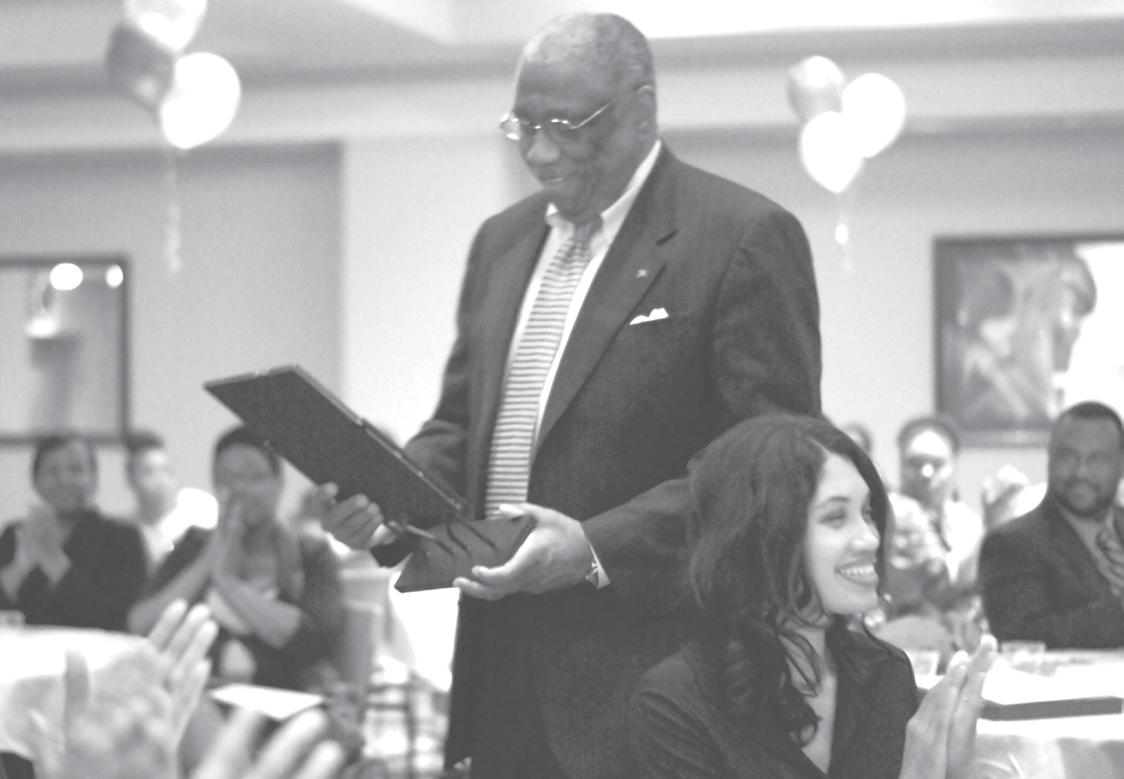
The African-American Male Initiative, African-American Female Initiative and Hispanic/Latino Initiative hosted an end of year celebration to honor Donaldson, who established the AAMI in 2009. This year’s graduating class is the first since that initiative began. Photo by Jennifer Ellis
religious diversity flourishes on secular campus in Bible Belt
Alexis Williams Assistant Editor
As a predominantly Christian state — 86 percent Christian as reported by StateGuidesUSA.com — Arkansans’ knowledge of other religions is often derived from secondary sources, rather than first-hand exposure.
“Exposure to religions other than one’s own helps broaden one’s perspective on the world, helps avoid misunderstanding of other people and their practices and beliefs, and can also help one better understand one’s own tradition by way of comparison. I think these are all positive goals,” Michael Norton, assistant professor in the department of philosophy, said.
Norton, new to UALR faculty this year, said that the student demographics on campus reflected the regional population in terms of religious diversity. “If anything, it might be more diverse,” he said.
Although many religions have common themes, Norton said that it is better to embrace diversity, in order to gain a more accurate understanding of a religion.
“I think that there are perhaps very broad themes that many religions seem to have in common, such as the imperfection of the world and thus the need to hope and work for justice and salvation. Many religions also stress the limitations of human knowledge or the error of placing too much value in material goods. It’s important to recognize also that, in practice, many religions have historically been associated with violent actions and intolerant attitudes. I don’t think this has to be a part of religion, but it certainly has often been,” he said.
“I think we should also be cautious about looking for common elements among different religions though, because this can too easily lead to us uncritically imposing an image of religion based on our own traditions onto other traditions that don’t really reflect that image.”
Registered Student Organizations can expose people to religions outside the Christian majority. One such organization is the Islam and Sufism Club (ISC).
According to the BBC, Muslims, followers of Islam, believe the Prophet Muhammad revealed the religion to humanity. Islam is monotheistic, and believes in a single God, which is called “Allah,” in Arabic.
UALR is a secular campus in a Chris-
tian state, and the ISC is one of only two Islamic RSOs on campus. Because of this distinction, some conflicts would seem to be expected. The ISC has suffered no such altercation, however, Demirkan said.
“We have not faced any bad attitude or disrespectful behavior from individuals at UALR so far,” he said.
In fact, the university had made minor accommodations for religious RSOs.
“Rooms and related facilities can be used by student organizations for free, so UALR is very kind to allow us to use this opportunity,” Demirkan said.
This is one problem with being a religious club on a secular campus, he said. The club has no official location to worship – mosque or otherwise. “There should be at least one ‘non-dominant’ chapel or similar place where anybody from any religion can make prayer,” Demirkan said.
“[Having a pluralistic house of worship] in principle, I think, is a good idea,” Norton said. “I can imagine a problem arising from it, but I don’t foresee it happening.” Some administration might express a pluralistic attitude toward the idea, he said. “On the other hand, I’m not sure how even opening up a nonfaith-specific space on campus would be perceived by some who wouldn’t even want that [on a secular campus],” he said.
Despite having no place to worship, the ISC maintains an active presence on campus by holding regular biweekly lectures. “We are planning to do a last big event in the semester on April 30th,” Demirkan said. “We plan to bring speakers to talk about three major prophets: Muhammad, Jesus and Moses; Peace Be Upon Them.”
students with the knowledge, skills, and ethical concepts not only to function as competent attorneys, public o cials, and other professionals, but also to think critically about the e cacy of the law and legal institutions and to work for their
Bowen is a community of scholars committed to professionalism, public service, and access to justice in the heart of Little Rock, Arkansas’s capital city. ualr.edu/law/tenreasons
Illustration by Byron Buslig
Sustainability Committee plans events to encourage awareness for earth Day
Alton Young Staff writer
The Sustainability Committee has a week of activities planned to raise campus awareness of Earth Day. The committee is calling this week UALR Pre-Earth Day Week and there are several opportunities for student involvement. The week started with the Sidewalk Chalk Art activity Monday and culminates with the Garden and Compost Day Friday April 19. The festivities continue on Earth Day which is Monday April 22 at the Diamond Cafe and includes the Earth Walk, Clothing Swap, Food Show, and the Newspaper Fashion Show. The Sustainability webpage on the school site as well as its Facebook page provides times and details on each event. This week is a major highlight of the committee’s schedule, but the efforts continue year-round.
Holly Warg, a senior International Studies major, has been an intern with the committee since last year. “Right now we’re really working on organizing Earth Day,” she said. The Pre-Earth Day Week is important because she says, “we can kind of make it into more of an awareness campaign and just get more students involved, instead of just having a one-day event.” One thing that she’s proud of is the committee’s involvement in the campus garden project.
“It’s always been an interest of mine,” she said. “I like being able to grow my own food. Being able to help other people
start to do it as well, that’s probably the most satisfying (thing) for me.”
Staff member Kathleen Becker, an interpreter for the Disability Resource Center, has been involved with the Sustainability Committee for two years and has been busy this week. “This my second year, so you’d think it would get better,” she said. According to Becker the American Association of Sustainability and Higher Education (AASHE) puts out a report each year called the STARS report. This report evaluates everything on a college campus for its sustainability requirements. Last year UALR qualified for Bronze status. “It meant that we did very well, however we can always have improvement to reach the Gold status,” Becker said. Becker also stated that the committee provides grants to faculty members who apply “to do research in areas such
as gardening, wind turbine; we just put out another grant that would be for any kind of research that a faculty or staff member would like to engage in.” The most satisfying aspect of being involved is simple for Becker. “I think just being on the committee and being aware that UALR is really committed to becoming a more sustainable campus,” she said.
There are ways for students to find out more about sustainability. “We do provide educational courses to individuals or students who want to learn more about becoming sustainable,” said Becker.
For the average student who doesn’t have the time to become more involved Becker gives this advice. “I think just becoming more aware of your carbon footprint. UALR has a lot of recycling stations here on campus, but I continually see plastics in the garbage. I continually see paper that could be recycled, in the garbage can. Just taking that extra effort to make sure that things are in their appropriate recycle container. It’s amazing how much is thrown away and put into a landfill,” she said.
Becker has high hopes though for the future of UALR sustainability efforts. “I think one of the goals for UALR could be to become a zero waste university and there are universities out there that are,” she said. “So if we could become that, then we would reach a goal that few others have, but we have to have the students involved.”
What are you doing to help the environment?
“As a chapter of Pike, we have a highway we clean up.”
corEy daniEl JUnior Ecology MaJor
“I do larger loads of laundry, so I use less water.”
BricEn PacE JUnior PUBlic rElations MaJor
“I volunteer at a local farmers market ... I eat organic ... I recycle.”
EllE Mccarty UndEclarEd FrEshMan
“I don’t drive as much, so I don’t leave as big of a carbon footprint.”
sEaUndra aUstin JUnior nUrsing MaJor
By Paige Mason
By Byron Buslig
Illustration by Byron Buslig
New horror reboot brings hilarious hijinks, havoc
When it was announced that Sam Raimi’s 1981 horror classic “The Evil Dead” was going to be revisited, groans were heard at news of yet another Hollywood reboot. Things were further exacerbated when word got out that the remake, shortened simply to “Evil Dead,” was being helmed by Uruguayan filmmaker Fede Alvarez, a relativelyunknown director with only four short films to his credit.
However, all of this is now a moot point. “Evil Dead” is an absolute thrill ride, horrifying at times in its amount of gore and sometimes hilarious with its over-the-top buckets of blood and unbelievably corny dialogue (oh, the one-liners!); yet, it is always consistently entertaining. In short, it’s a B-movie lover’s absolute dream flick.
Fans of the original film can expect to see some changes, as “Evil Dead” is more of a re-imagining than an outright remake. There are several references and subtle nods to the original, and some of the more prominent scenes — such as the infamous tree rape — carry over into Alvarez’s version of the story. I’ve heard some argue the film isn’t as endearing as its predecessor due to its increase in gore, relative lack of scares and stilted acting, but all of these things make the film more enjoyable in a way that resembles one of SyFy’s notorious made-for-television movies.
But one point that needs addressing is the lack of scare factor. If you’ve
been following this film at all — or have seen even one trailer — you’re probably aware “Evil Dead” has been purported as “the most terrifying film you will ever experience.” While it’s true it’s horrifying at times, it’s more appalling than frightening. There are a few genuinely creepy moments in the film, but overall “Evil Dead” is much more of a “gorror” film than it is horror. Unless flicks like Robert Rodriguez’s “Planet Terror” or Alexandre Aja’s “Piranha” left you rocking yourself to sleep, the odds that you’ll actually be scared by this movie are about as low as the chance that Justin Beiber will ever hit puberty.
Overall, “Evil Dead” is a fantastic movie for enjoying on a Friday night or an evening out with friends. It’s definitely one of those “shallow popcorn flicks,” but if you don’t mind your movies having a heavy dose of red and some hilariously-inconsistent acting, you’ll probably have a blast. Purveyors of cinema, film snobs, movie purists and the weak-stomached beware, but everyone else? Prepare to have one of the most disgustingly fun times of your life.
‘Body
Works’ to showcase eclectic student performances
Theatre, dance majors display skills in new ways
Sarah De Clerk Features Editor
The UALR theatre and dance department will showcase fresh choreography and an array of dance styles this month at “Body Works,” its spring dance concert.
The concert will be held at the Center for Performing arts April 19 through 21 at 8 p.m., with another show on April 22 at 2:30 p.m.. Tickets cost $5 for students and general admission is $7.
The showcase will consist of two acts with four pieces each and a 15-minute intermission, totaling about two hours. It will feature original pieces choreographed by seniors Ali Herring and Sydney Ippolito as well as faculty members Rhythm McCarthy, Stephen Thibeault and Stephen K. Stone, the concert’s director and assistant professor in the department of theatre and dance. In addition, Ballet Arkansas will perform Thibeault’s “American Dream” every day except Thursday. Stone said the concert will primarily be celebrating the two student works, which were evaluated at the American College Dance Festival in February.
Auditions were held at the end of the fall 2012 semester and rehearsals began in spring. According to Stone, some choreographers started thinking of ideas months or years in advance, with him beginning work on his own piece last summer.
The concert will feature everything from contemporary dance to neoclassical ballet. One of the modern pieces
includes a large, moving sculpture with which dancers interact. Stone’s own work is based on “Chicago” and features live vocals and transition monologues; it also includes theater, dance and music majors.
“No two pieces are anything alike,” he said. “There’s quite an array of different designs.”
Stone also said the concert provides a vital performance opportunity for dance students, adding that it also gives the department an opportunity to connect with the UALR and outside communities.
“Students should come to the concert because events like this concert are the extension of the core curriculum,” Stone said. “Seeing art is the next natural step to learning about it beyond the classroom.”
“It’s good for the department to have a showcase to show people we really are taking great strides for as young as [the program] is,” said Emily Karnes, 22, a senior dance major, who added that the program was the main reason she came to UALR.
“I think a lot of people don’t know any kind of dance besides what they see in music videos and on dance contest TV shows,” she said. “This will help them see that there are other styles of dance,” she said.
She added that the concert could inspire younger dancers and show them what they have to look forward to.
“If you come to one concert, you’ll be hooked,” Karnes said. “You’ll definitely want to keep coming back for more.”
Sophisticated synthpop turns tedious with ‘Delta Machine’
In 1989, Depeche Mode released “Violator,” a collection of tracks displaying lyrical seriousness and evident evolution from the days of “Just Can’t Get Enough.” Their megahit, “Personal Jesus,” climbed the charts and catapulted the band to wider worldwide celebrity, ensuring the avoidance of has-been stigma that afflicted other ‘80s monoliths by the end of the decade. But 24 years and six albums later, it seems as if Dave Gahan and company have little to do than rehash their era of innovation, and “Delta Machine,” released March 22 on Columbia, only illuminates this long-term stagnancy.
Like their synthpop counterparts, Depeche Mode has established a formula they deem infallible due to how their all-too-adoring fanbase has responded. Such a crowd of devotees can be helpful in sustaining a career in an everchanging business, but catering to a subset that yearns for the group’s dated stylings only knots a noose for artistic instincts. Though Depeche Mode has released new material and toured immensely since their heyday, they stray away from performing much material beyond 2001’s “Exciter,” which says a lot — or perhaps very little — about their creative identity. With “Delta Machine,” we see Gahan and instrumentalist Martin Gore bring out the same weary, dark overtones consistent with every Depeche Mode album since “Some Great Reward.” Religion, usually cast in an ambiguous-tonegative light, has often been incorporated in the group’s songwriting and the word “soul,” as observed by Pitchfork’s Douglas Wolk, is included in five songs penned by Gore. This is an element that
rendered the band appealing to the then-burgeoning goth and industrial communities, but now it merely creates a feeling of kitsch or cheese. This, paired with what translates as a nasty Nick Cave impression from Gahan, is what marks the album as another disappointment in the group’s discography. But it would be unfair to write off the album as “wholly horrendous.” Though the songwriting is melodramatic and mediocre at best, the musicality of “Delta Machine” is pretty solid, thanks to producer Ben Hillier, who lent a hand on mixing DM’s last two albums. “Welcome to My World” and “Angel” are especially enticing to those not familiar with the band’s discography, which works to the band’s advantage if they’re attempting to garner attention from new audiences. Although “Delta Machine” doesn’t translate as the group’s swan song, the lack of refreshment is stifling to impatient fans. Maybe the old cliché about artists and their addictions rings true. Gahan kicked his heroin habit two decades ago after nearly overdosing, but the fact that his prime product has stopped existing since his stint in rehab seems like no coincidence. But despite the sheer monotony of “Delta Machine,” there’s a sliver of hope that Depeche Mode, who insist on remaining relevant, will again push for pioneerism.
Mitchell
Writer
Depeche Mode’s 13th studio album continues with the same trends that created famous megahits — at a price. Photo courtesy of Columbia Records
“Body Works,” UALR’s annual spring concert, will feature a variety of performances created and choreographed by students and several faculty members. Photo courtesy of UALR Theatre/Dance
Athletics cuts tennis, nets $200K in savings
Jacob Ellerbee Sports Editor
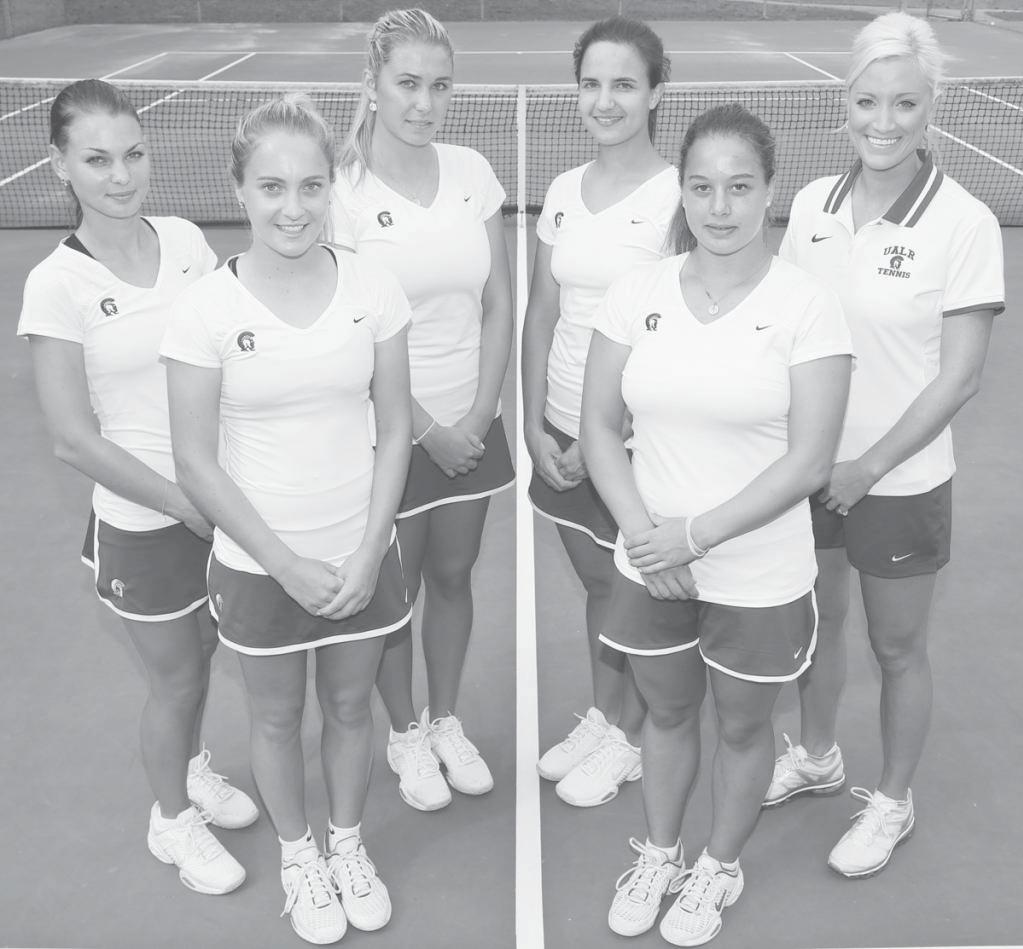
The UALR Athletics department announced it will discontinue the women's tennis program at UALR at the end of the academic year, according to a press release issued April 3.
"The elimination of a sport was necessary to meet budget reductions," Director of Athletics Chris Peterson said in the release.
Currently the department is running at about an $850,000 deficit, and cutting the tennis program will save the department nearly $200,000, said George Lee, the assistant director of athletics/business operations.
“When there is a gap that big, somehow we have to either increase our revenue or cut expenses or a combination of both,” Lee said.
For the fiscal year 2013, the tennis program had a budget of $172,219; however, the total amount spent has been more than $196,000. In comparison, the men's basketball team had a budget of $1.1 million dollars, but spent more than $1.23 million, creating more than $130,000 in the deficit.
The UALR Athletic Department has a budget of about $7.1 million for the fiscal year 2013. More than $4.6 million of which comes from the athletic fee that all students pay along with tuition, according to the annual budget. But with enrollment down this year, the amount of money the Department of Athletics will have to operate with in the next fiscal year will be less, which forces the department to make cuts in order to have a balanced budget.
“We tried to really look at the sport that would be least effected as far as the number of student athletes ... and that is tennis,” Lee said.
“The beginning of early March is when I started working on next year’s budget. And like I said, it’s not finalized, but after looking at it and putting all the numbers in there — probably about the middle of March — I came to the realization that there’s no way it’s going to work with 15 sports,” Lee said.
golf, indoor track and outdoor track and women’s: basketball, cross country, golf, indoor track, outdoor track, soccer, swimming, volleyball and tennis. But when the tennis program is cut, after the current season ends, it will bring the total number of sports at UALR to 14, the minimum number of sports that must be offered in order to maintain membership as a division-1 school.
Richard Turner, the associate director of athletics/compliance, said the department does not expect any other programs to be discontinued.
The student-athletes currently on the roster will have the option to stay at UALR for one year or transfer to another school and receive immediate clearance for eligibility.
“We scheduled a meeting with student athletes and we visited with them about the decision, why it was made, and we also offered to stay and help them process through all the ramifications that this meant to them personally in their lives,” Turner said.
But most of the players still don’t know what they are going to do.
Viktoriya Plyata, a junior international studies major and tennis player from Russia, said she may have to stay at UALR because no other schools will want to give her a scholarship to play tennis for just one year.
“It’s pretty hard to find the coach who wants the girl for just one year,” Plyata said. “I don’t know what to do right now.”
Trojans shift focus toward SBC
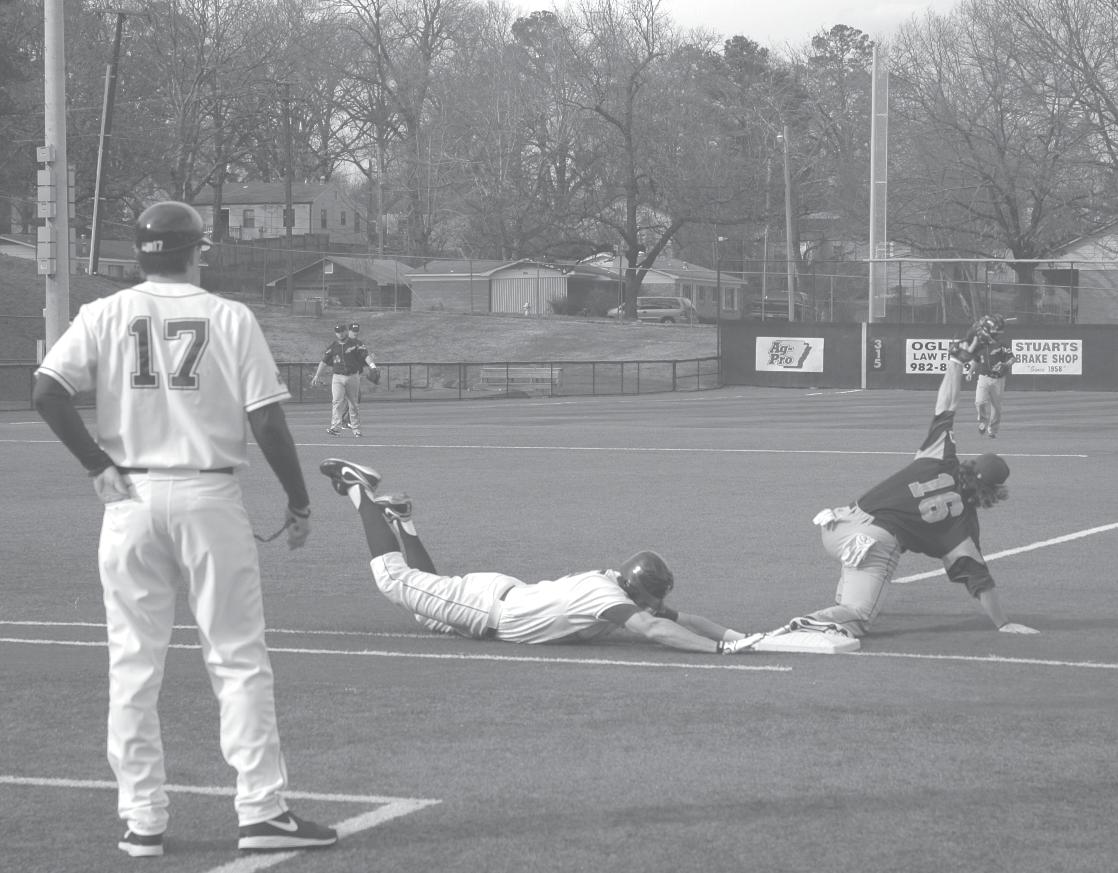
After Scott Norwood, head coach of the UALR baseball team, earned his 400th career win April 13 against Louisiana-Lafayette, his team is looking to utilize the momentum to make a push for the SBC Conference Regionals with about twenty games remaining in the season.
UALR begins the stretch run April 19 when it visits Troy for a three-game matchup. With more than half of the games in the books, Norwood has found both good and bad things about his team’s play this season, but the make-orbreak point will be how they finish.
“I think we’ve pitched it really well and we’ve been really consistent on Friday and Saturday,” Norwood said. “I think Blake and Chance have been really outstanding starters for us. Offensively, we’ve been pretty consistent most of the year.”
“We’ve just kind of lacked on finishing a game off or two and that’s, in my opinion, what’s held us back just a little bit,” the coach said. “We need to just finish off some games. We’ve had leads and let them slip away,
and that’s just maybe staying focused a little bit longer in a game, which I think we’ll do,” he said. While there has been inconsistent play for the Trojans, there have been several bright spots, including shortstop Austin Pfeiffer being named the SBC Player of the Week on April 1. The junior marketing major agreed with Norwood on the importance of finishing the season strongly.
“I feel like this is a pivotal part of the season now,” he said. “We need to finish strong so we can have a good seed in the conference tournament.”
Pfeiffer is batting .343 so far this season and leads the team and conference with 12 stolen bases.
Pfeiffer learned that he was named the Player of the Week while having lunch with a friend.
“[My friend] saw it on Twitter or Instagram or something and told me congratulations,” Pfeiffer said. Catcher Blake Johnson, a senior history major, is batting .356 through 31 games, leading the team and garnering national attention. Johnson was placed on the Johnny Bench Award watch list, which monitors elite NCAA catchers on On March 11.
regionals
After finding out about the honor, Johnson did a little research.
“I had no idea what it was. I looked it up on the Internet and read about it. I thought it was pretty cool,” he said.
Despite a slow start for the team, early season goals are still in place for the Trojans.
“One of our goals at the beginning of the year was to try to be the best team that’s ever played here. [We will] try to pick it up in the next half of the season, see if we can do that,” Johnson said.
Norwood said his team is poised to make a push during the next few weeks, as he points to expectations that were set before the season started.
“You never accept losing; you just acknowledge it and move on,” Norwood said. “We’re getting better. We just have to keep getting better every day.”
He remembers a time — not so long ago — when expectations were a little different.
“From where we were five years ago to now, it’s amazing how goals have changed. It used to be just about winning games and now it’s expecting to win games,” Norwood said. “And now we just need to finish off games.”
Plyata said she was not prepared for this and no one on the team expected the program to be discontinued.
“No one expected it. We heard there was a men’s team a couple of years ago, and they got cut off as well, and we wondered why, but we never thought it would happen to us. But it happened,” Plyata said.
“I was going to go home for summer, but now I can’t because I can’t afford the ticket,” Plyata said. “Now, I have to completely change my flight because I don’t know if I’m going to transfer or not. If I’m going to buy the ticket for one way, it’s going to cost me a lot of money.”
The financial impact is not hurting just current players, Plyata said.
“The coach just signed up a girl from Belgium for the fall of 2013
“It’s pretty hard to find the coach who wants the girl for just one year. I don’t know what to do right now.”
- Viktoriya Plyata
and she had to tell her, find another school, change your flight ticket, get a new I-20.”
An I-20 is a certificate of eligibility for non-immigrant student status that must be submitted to the U.S. Department of State, but it takes time to be approved.
The budget cuts are unlikely to stop with the tennis program, as the department of athletics will still be operating with about a $600,000 deficit. The budget for fiscal year 2014 is still being created, so when and where the next cuts will be made are still unknown.
The women’s tennis program has been sponsored by UALR every year since 1975, making it one of the longest-tenured sports at the university.
Senior Nicklaus Benton is making the best of his last year of college golf at UALR.
The Cabot native returns to the Trojans golf team as a three-year lettermen.
Being the only senior on the golf team, Benton looks to bring leadership to the team this season.
“It’s pretty nice because everybody looks to you to be the leader of the team,” Benton said. “I grew up being the youngest on the team for four years. It’s nice to kind of take that role because I know I looked to the seniors on the team when I was a freshmen.”
Benton said his leadership role this season is preparing him for the real world.
“It’s going good. It’s learning a lot of things and it’s getting me ready for the real world.”
“Everybody looks to you to be the leader of the team.”
- Nicklaus Benton
Last season, he competed in 10 events in which he was ranked second on the team and 20th in the Sun Belt Conference after averaging 73.97 in scoring. Benton finished with eight top-25 finishes on the year and captured his first title in the Cardinal Collegiate event. In his final year at Cabot High School, he was named ASGA Player of
the Year after recording wins in the 2009 River Valley Men’s Stroke Play Championship and the 2009 Summit Bank Classic. Benton graduated with a 3.99 grade point average and was a member of the Honors Society and Spanish Honors. Benton’s choice to enroll at UALR was based on his focus on golf and a good school.
“It was mainly for the golf because we get to practice in some pretty sweet places. We get to go to some good tournaments and I just liked our athletic department,” he said.
In his freshmen year, he opened his collegiate career as a Trojan with a one-over par to earn a share of 14th place at the Purple and Red Invitational and played in 10 events on the year. He averaged 75.37 strokes per round while recording four top-25 finished. Benton is currently ranked seventh in the Sun Belt Conference with an average of 73.08 strokes per round and helped UALR move up four spots to finish tenth of 17 teams in the final day of the Wyoming Desert Intercollegiate. He led the Trojans with a final round 74 to give him a three-day total of seven-over par 223.
After graduating from UALR, Benton plans to play professional golf.
“I plan on playing golf. My family lives in Arizona. So, I’m planning on going out there to play some pro golf.”
Alton Young Staff Writer
C.J. Waters Staff Writer
With about a month remaining in the season, the Trojans will continue to face non-confernce opponents like TexasArlington, Stephen F. Austin and UCA. Photo by Jacob Ellerbee
Benton
After the Sun Belt Confernce tournament April 17-21, the tennis program will be discontinued at UALR. Photo courtesy of UALR Athletics
Graduating Undergraduates with a 3.5 G.P.A.or be er