Multiple stories about the COVID-19 pandemic on campus

Campus garden flourishes, even during COVID-19 Celebrating Black History Month


UA Little Rock Basketball battles rival, Arkansas State

Multiple stories about the COVID-19 pandemic on campus
Campus garden flourishes, even during COVID-19 Celebrating Black History Month
UA Little Rock Basketball battles rival, Arkansas State

Executive Editor: Chloe McGehee @chloeamkbs
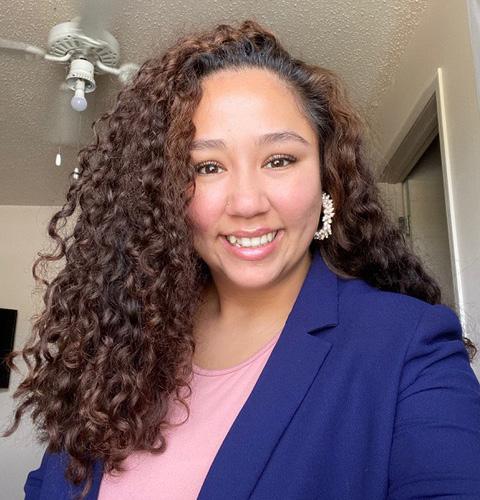
Sports Editor: Azalea Andrade
@dontcallmeiggy

News Editor: Payton Dhooge
@paytondhooge

Entertainment Editor:
Deserhea Kelly @DessiKali
The Forum is the official student newspaper at the University of Arkansas at Little Rock. The Forum is funded in part by the student activity fee; members of the UALR community are allowed one copy per edition. The opinions expressed in The Forum are those of the staff and contributing writers and do not represent the official views of UALR. The Forum is published 7 times in each of the fall and spring semesters. The Forum editor can be reached at editor@ualr.edu. All material published in this newspaper is copyrighted.
The Forum welcomes letters to the editor on any subject as well as comments on our news coverage and editorial position.
•Letters must include the author’s name, classification, major or position and a contact telephone number for confirmation.
•Letters are subject to editing to meet space limitations.
•Please limit letter to 500 words or less.
•The staff will not alter the meaning of the letter, but will correct spelling and punctuation and edit to conform to Associated Press and news style.
•All letters are subject to publication. The editor has the right to reject any letter especially those letters that are libelous, obscene or incoherent.
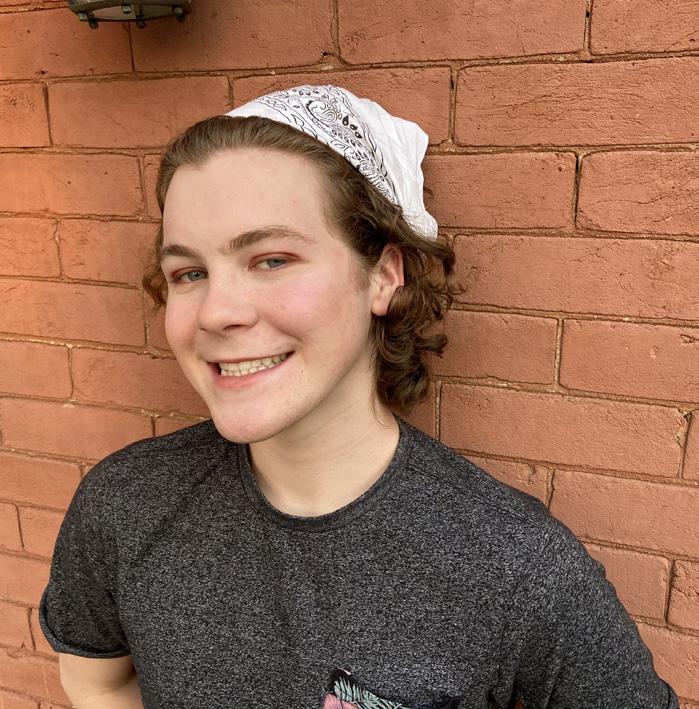
Writer: Alex Ball @justalexball
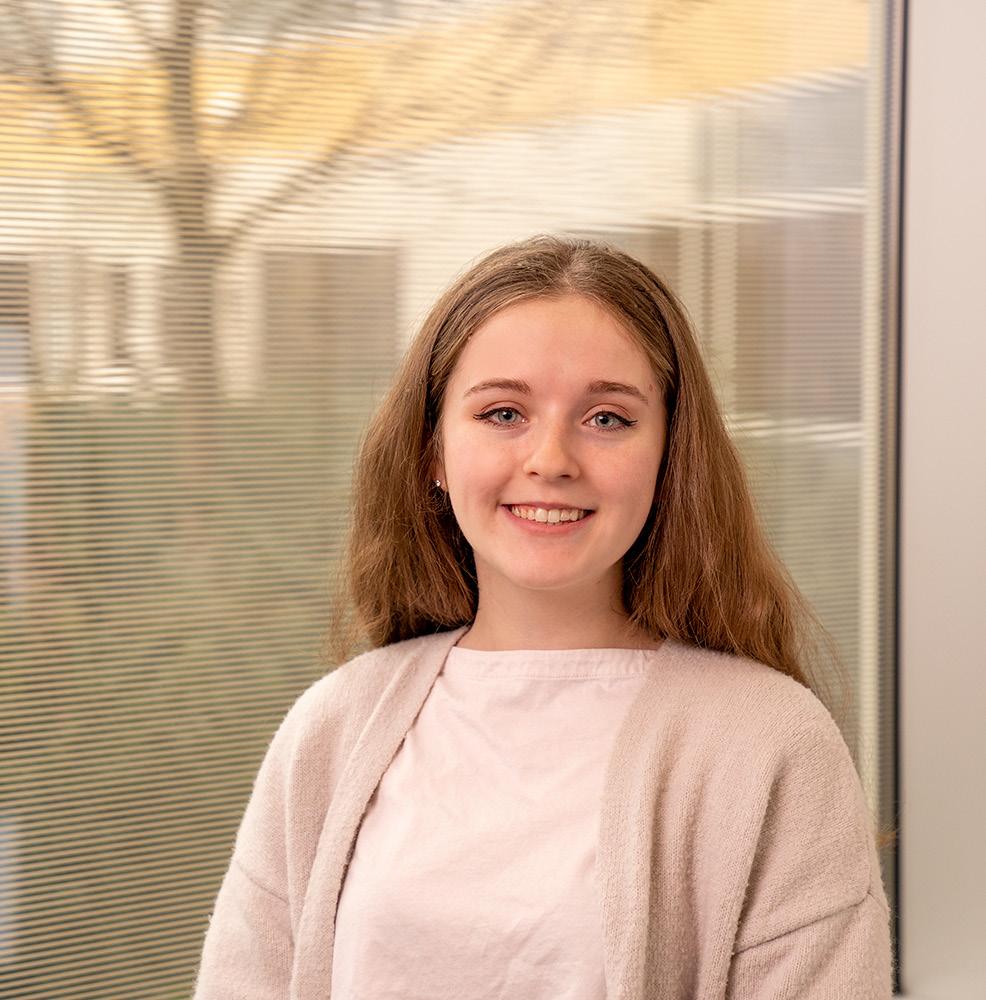
Writer: Danielle Spence @daniellejspence

Writer: Amanda Gordon @amanda_michele_3

Writer:

Writer: Ari Garcia @aricgarcia01
Writer:

Writer:
Writer: Bennett Wood @_misterbennett

Writer: Magnolia Risley @mags.ris
Writer: Tessah Conatser @lerainroxp Writer:
By Bennett Wood
While the pandemic wreaks havoc throughout the United States (and the globe), COVID-19 continues to uproot the lives of many Americans and reveal problem areas of our government and their lack of adequate response.
Wash your hands, stay six feet socially distanced from one another and wear a mask! This is the mantra everyone has been reciting over the past year to stay safe and keep from contracting COVID-19. Practicing these safety measures is important, but it doesn’t mean you will be immune to catching the virus. My testing positive for COVID-19, alongside surviving the virus, left me with a first-hand account and knowledge of the deadly coronavirus strain.
Turning over in the bed at 5:37 a.m. one early January morning, shivering and covered in sweat, I knew that something wasn’t right. This combination of cold sweats and body aches came with a 100.1-degree fever, and a very dreadful case of anxiety. Thirty hours after spiking a fever I was leaving the drive-through testing facility at the big Baptist Hospital in West Little Rock.
Right out of the gate and even before definitively knowing my test results, the coronavirus was disrupting my life and instigating stress.
Once tested, a self-quarantine
is required until you receive the results. And once the results are confirmed to be positive, the quarantine is in effect until you are symptom free.
After testing positive for COVID19, I was bombarded by countless phone calls. The Arkansas Department of Health and Baptist Health reached out first, asking me a specific set of medical questions. The questions varied, relating to my symptoms and how I was feeling at the time.
A few hours later, calls from a contact tracer and my employer really cemented the fact in my brain that I was sick. I really did have COVID-19. While my symptoms evolved into losing my sense of smell and taste, I increasingly became weaker as the hours passed.
Dealing with the ramifications and aftermath of having COVD-19 is almost as detrimental as actually contracting the virus itself. Not only does the required fourteenday quarantine disrupt daily living, the loss of wages that one would earn from working could be the difference between buying food and paying the water bill.
Life changed for me during and after coming down with COVID-19, in a couple different ways.
After being sick, I still have this ingrained fear of being around other people. An irrational fear, yes, but after being isolated for two weeks straight, the notion of
being contagious doesn’t dissipate. The stigma imposed on COVID-19 positive individuals by the rest of society (and even our own selves) causes mental and emotional stress, on top of the physical stress of being sick. Coming out on top of my battle with the coronavirus, the way I interact with people has forever been changed. I no longer shake hands, and you’re lucky if we bump elbows. When standing next to people I subconsciously distance myself at least six feet, without thinking. And it will be a few years before I feel comfortable touching my face again. Having COVID-19 changes the way you think and interact with people.
According to a research in an article produced by the Pew Research Center, many American’s and global citizens alike state that their lives have been changed due to the coronavirus. 68% of men in the United States claim their lives have been affected by COVID-19, whereas 79% of women claim the same.
I am one of the lucky few who contracted COVID-19, due to the financial and physical assistance from my parents. Most people who do contract the virus don’t have that direct line of support, making it much more difficult (and in some cases impossible) to recover.
With the lack of a national,
unified response to the pandemic, mitigating practices, ordinances and guidance came from various different sources. Individual states required masks to be worn in public, while some states held events that would later become known as “super-spreader events”.
Denial of the mere existence of COVID-19 coupled with the poor national response in the U.S. created a vacuum in which the coronavirus was able to multiply, divide, variate and grow.
This coronavirus pandemic has highlighted all sorts of disparities within our government’s systems, from healthcare and the economy, to criminal justice and education. The pandemic has also made an example out of the United States and their less than favorable response to handling the deadly virus.
The same article and its research mentioned earlier by the Pew Research Center shows less than half of the U.S. population approving of the coronavirus response efforts being made. Around 41% of Americans approve of the inadequate response to COVID-19, which is not favorable.
“I’m just lucky I had such a mild experience,” Spencer Hamilton of Little Rock says, “It was still pretty rough, though.”
Hamilton contracted the virus around the same time I tested positive, and experienced a lot of the same symptoms, feelings, and
thoughts that I and many other Americans faced while being sick.
“Even after a week or two, I still get chest pains and trouble breathing,” Hamilton says, “now the next step is to get vaccinated!”
As COVID-19 continues to disrupt the lives of everyday people and highlight problem areas within our government and their pandemic response, it is more important than ever to follow healthcare professional’s guidance and advice. Wear a mask, wash your hands, social distance and most importantly, get vaccinated! Take it from someone who’s temporarily lost two of his senses, being sick from COVID-19 is not something you want to try.
“Right out of the gate and even before definitively knowing my test results, the coronavirus was disrupting my life and instigating stress.”
By Remington Miller
Student residents returned to the University of Arkansas at Little Rock last semester, sporting sweat from the Arkansas Summer heat and the masks covering their noses and mouths. A mask mandate is one safety precaution in place to keep students on campus safe. Residents pulled in carrying suitcases in one hand and a green thumb in the other. Now in January, students are still carrying green thumbs on their mobile devices.
entrance of any major building. Like the library, the cafeteria, the DSC,” Taylor said. “These are essential areas of student life. Many students have to travel through these places to get food or sit in-between classes.”
He did not have in-person classes this semester or last semester, but when working or eating on campus he never was asked about his green thumb or to show the screening tool.
However, the screening tool is being utilized in some unexpected areas on campus.
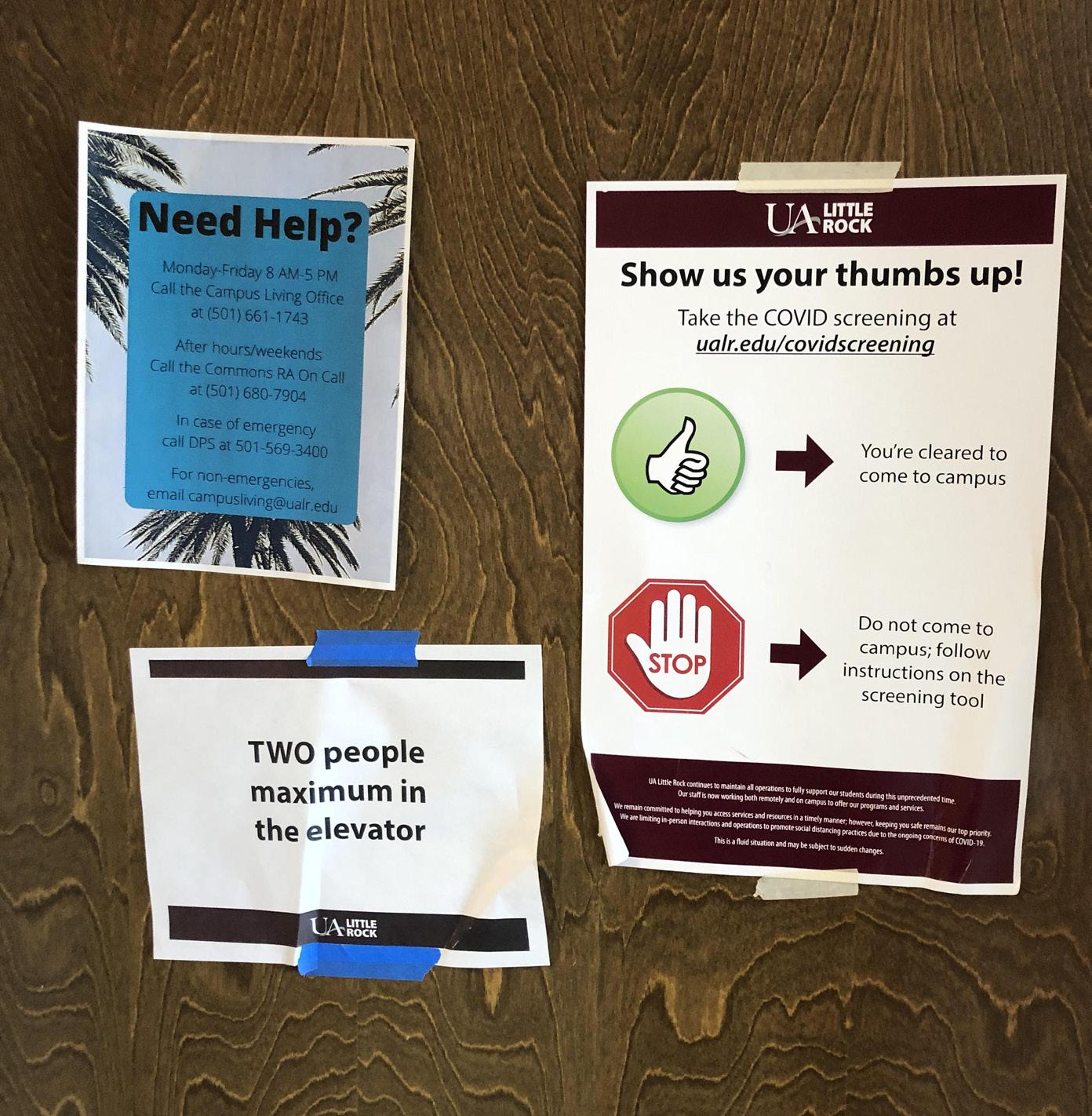
The UA Little Rock Return to Campus Guide for Students states “Complete the Trojan COVID-19 Screening Tool every time you are coming to campus” as the first step to returning to campus, as well as a mask mandate and social distancing guidelines.
UA Little Rock formulated a screening tool where individuals answered a set of three questions to determine whether or not they should come to campus. The screening tool will either produce a green thumbs-up or a red thumbs-down with more information about what actions the individual should take. Red thumbs mean that the user should not return to campus until they could produce a green thumb response from the screening tool.
If a user receives a green thumb the webpage reads: “please show this green symbol when entering any area on campus with signage asking for it to be shown, and upon request. We appreciate your participation to keep our campus safe.”
Many students considered the focus on the screening tool to mean that it would be an integrated part of daily life. However, most students found that they had only been asked to take it or provide a green thumb a handful of times.
Gage Taylor, a junior student resident and a student worker on campus, said he expected the green thumb to be presented often.
Kaitlynn Mitchell was a student working for UA Little Rock last semester in the theatre building. Mitchell said her roles were “to make sure everyone had a green screen and was wearing a mask. I also made sure all PPE [Personal Protective Equipment] was stocked throughout the building.” She said many students had their green thumbs ready and that those who didn’t would fill out the survey outside the doors.
As a student, she was only ever asked to present a green COVID-19 screening when entering the theatre building. Mitchell felt that the screening tool was effective in giving the university a count of COVID but felt that she it is not doing any good to the university because of how easy it is to lie on the screening.
Sharon Downs, assistant vice chancellor, commented that “the screening was developed to reduce the number of persons with ILI [influenza-like illness] coming to campus in order to reduce the spread of the virus,” and that she did not have a sense for how often it was used for that purpose.
While students expected to interact with the screening tool frequently, it is rarely used on campus. Mainly, students should use the tool to evaluate their own symptoms and make an educated decision before attending campus.
Photo by Remington Miller
“I expected to be asked [to have it] at the
By Alex Ball
On January 28, 2021, the Office of the Chancellor met with the Board of Trustees to discuss the issues affecting the University in the last year. The presentation brought to the Board emphasized the onset of the COVID-19 pandemic in March 2020, the racial justice movements following the murder of George Floyd, the requirements necessary in our University’s reaccreditation journey, and the availability of scholarships to students with financial needs.
Our Chancellor, Dr. Christina Drale, compiled a presentation
with structured outlines on how the University shall address these issues in compliance with our four institutional priorities.
“[This presentation] highlights our obligation to serve a diverse student body, to offer degrees that meet the demand for professional and advanced level preparation in areas of critical need, and to apply our expertise and resources to public concerns and community wellbeing,” Dr. Drale said.
To alleviate the pressures students have faced from the challenges in 2020, the Office of the Chancellor communicated to the Board the need for reconstructing how scholarships are awarded to students.
“One of the things I realized early on is that nearly all of our institutional and private scholarships were exclusively merit-based and many were designated for continuing students,” Dr. Drale said. “These are important and valuable assets, but they didn’t fully address the needs of our diverse, often firstgeneration incoming students. We’ve put an emphasis on raising funds for need-based scholarships and overhauled our recruitment, admissions, and financial aid infrastructure to become more efficient, more effective [and] more data-driven than ever before.”
In conjunction with broadening scholarship allotment, the Office of the Chancellor has also
initiated a new career success program.
“In alignment with our institutional role and scope, we are placing a renewed emphasis on career path assistance,” Drale said. “To that end, we are redirecting our marketing efforts to focus on programs, student experiences, and career potential [by] launching a new Career Center later this spring. We continue to collaborate with business, industry, government, and community partners to develop high-quality programs and to provide unique applied experiences.”
To conclude the presentation, Dr. Drale reminded the Board and the University as a whole that its
faculty, staff, and leaders are in constant consideration of our student body.
“Despite our considerable challenges this past year, we have not lost sight of what is important and eternal,” Drale said. “And although we still have much work to do, I believe the path forward is clear.”
By Azalea Andrade
The University of Arkansas at Little Rock takes pride in its online graduate programs and has now been acknowledged for having some of the best online programs in computer information technology in the country. UA-Little Rock’s demographics consist of a large population of non-traditional students due to having vast options of online programs for undergraduate and graduate degrees. UA-Little Rock ranked 19th in the U.S. News & World Report in its 2021 ranking of “Best Online Graduate Computer Information Technology Programs.”
“UA-Little Rock is unique in that it is the only university to offer graduate degrees in Information Quality. The MSIQ [Masters of Science in Information Quality] degree was created in 2006 with support from the MIT Information Quality program and Acxiom Corporation,” said Dr. John Talburt, coordinator for the Information Quality master’s program.
Dr. John Talburt has a longstanding history with UA-Little Rock working in what was previously known as the computer and information department from 1983 to 1995. During his time away, the department split into two different, more specific departments. He has been with the information science department since 2005.
The university is ranked among the top 20 along with some of the top public universities in the nation. This report evaluates online master’s degree programs in computer science, computer engineering, software engineering, information systems, and information technology. The ranking includes both the online Master of Science in information quality and Master of Science in information science.
“Many universities are flocking to offer education online, because of the covid pandemic. Although face-to-face instruction can be better in some ways, online instruction is better in other important ways - time, convenience, gas money, even parking lot, and classroom construction,” said Dr. Daniel Berleant. “Luckily the online information science graduate program began before all of this, so we have experience and a jump start on universities that are just getting into it now. Our online program also noted for its reasonable cost.”
Dr. Daniel Berleant has worked for the University of Arkansas
system for over 20 years, starting at the University of Arkansas in Fayetteville as an assistant professor and then associate professor in the computer science and computer engineering department from 1991-1999. He has worked for the information science department since 2006.
Both programs require 33 hours of course work to graduate and are rigorous in their structure. Since its launch in 2006, the online master’s in information quality has made a great impact on its students. It is career-oriented focused on practice, skills, and theory. The curriculum is centered around information quality theory and implements the industry’s best practices using state-of-the-art tools and technology. The program was developed with the guidance of the Massachusetts Institute of Technology Information Quality Program.
Dr. Talburt expressed how the UA-Little Rock information quality stands out from other programs in the country.
“Many companies recruit our [Information Quaility] and [Information Science] graduates because of the growing emphasis on data quality, data governance, data engineering, data analytics, and data science. The MSIQ and MSIS programs prepared students for these kinds of roles,” said Dr. Talburt. “Also, both programs use a synchronous on-campus and online webcast delivery so students have the same experience and quality of education regardless of whether they are on-campus or online.”
The online master’s degree in information science is intended to give students advanced knowledge, skills, and technologies for working with large amounts of complex data. Students learn to design database schemas, maintain databases, the privacy of personal data, and much more. Both degrees can serve as a step towards a Ph.D. in the field or a great job in the growing industry of information technology.
Both departments are focused on seeing their students succeed after graduation. They ensure that students are heard and helped when needed and provide resources for their continued learning.
“We want our students to have wide and deep knowledge and well as project skills and leadership ability that they can use to contribute to their organizations after
graduating,” said Dr. Berleant. “We focus on getting students to succeed. By teaching at the level that enables students to learn the most, not too easy, not too hard, but just right, learning can be delivered most efficiently and successfully.”
Dr. Talburt has a similar ideology in helping his students succeed and understands the complexity of the program can sometimes prove difficult to navigate. However, the department’s hard work and experience in the field have allowed them to maintain a high-quality program.
“Many of the faculty have worked in industry and some are still actively engaged in consulting in their subject areas. Because of the uniqueness of the program, the graduates have formed a close network in which they not only help each other but also reach out to students currently in the program,” said Dr. Talburt. “Many of the program’s graduates are now in leadership roles in large companies and when hiring, contact faculty members to post openings and to recommend current students.”
For the 2021 rankings edition, U.S. News evaluated schools on five categories, including engagement, faculty credentials and training, expert opinion, service and technologies, and student excellence.
With the great leadership that both programs have, their hope is to have continued success for the years to come.
“The department’s hard work and experience in the field have allowed them to maintain a high-quality program.”

By Magnolia Risley
University residence halls are usually the social hub for students. Music can be heard throughout the buildings, friends are studying together in the common areas and the elevator chimes between floors as scholars walk to and from classes throughout the day.
Gone are the days of hustle and bustle on campus at the University of Arkansas Little Rock. COVID-19 precautions have limited campus activity in the name of safety, with entire offices working remotely from campus, and other employees being on a rotation; alternating when they are physically on campus versus working from home.
Sophomore Briana Graham remembers how full of life campus was last year.
“We had so many events going, we had so many people just sitting in the foyer of the cafeteria with tables set up, encouraging people to interact. Being on campus gave you that opportunity to see what our school is all about! Due to it being so empty, many people are not able to see our school’s full potential,” Graham said.
The emptiness of campus has had an impact on the students who live here. Dining hours have been shortened, access to the library has decreased as entire floors and study rooms have closed, health and wellness visits are mostly virtual. Aside from trying to make life
during a pandemic work, students who live on campus have had to figure out how to be safe and navigate a drastically changed environment.
That adjustment began on day one. Move-in day is usually a large event crowded with volunteers from campus organizations and eager students ready to get into their rooms and get settled. Parents and family members embrace their students and bid them a good semester in group hugs.
2020 move-in day was actually a move-in week, and students were only able to bring two people to help them move in. They signed up for an arrival time based on which residence hall they would be occupying, and had to pass an online COVID-19 screening and temperature check to begin moving in.
The experience of the day was condensed into two-hour appointments filled with masks and face shields amongst Resident Assistants, and the smell of disinfectant spray and bleach wafted through the halls as students found their new rooms and wanted to assure themselves that everything was clean.
Sophomore Caroline Holt, felt rushed during the process.
“Move-in day this year in a way was harder than my freshman year,” Holt said. “My parents had to leave by 5 and I was not even close to being completed with my room when they had to leave.”
Cleaning shared spaces was a challenge for Holt and her roommates.
“It was way more stressful as well because our shared spaces and bathrooms were not clean at all,” Holt said. “We had some things left in our apartment from the students before us, like socks in the dryer and even a knife in one of the cabinets by the sink.
I was really hoping that campus would keep their word that they would have our apartment clean. But when we were finding stuff that belonged to the [residents] before us, it showed me that campus didn’t clean like they said they would. My mom actually sanitized both bathrooms along with my other roommate’s mom.”
The difficulty of roommates being exposed to COVID-19 also presented a problem. Roommates needed to keep open and honest communication with each other so they knew if they needed to go get tested or not.
West Hall, which houses freshmen, mitigated this problem by assigning one person per room, when each room is usually occupied by two students. Campus Living trained RAs for weeks before the arrival of students. They met in mixed environments, both in person and online, in order to learn the new protocols and paperwork. The new rules were hammered into their brains.
Outside visitors who do not live on campus are not allowed in the residence halls. Masks must be worn at all times outside of each person’s room. Only two people are allowed to ride the elevator at once. Specific rooms are purposely left empty for students who need to quarantine. Meals must be delivered to students in quarantine.
The ‘normal’ tasks of an RA became increasingly harder. They usually have a floor meeting during the first week of classes in order to establish rapport with their residents and give the building a sense of home and companionship. These floor meetings continue through the semester as necessary. With COVID-19, these mandatory meetings were held over Zoom, with minimal attendance. RAs host programs each month in order to continue the feeling of camaraderie amongst their residents. Programs that brought students together and created new friendships are now held over Zoom, where it’s difficult to connect with specific individuals and everything becomes much more group-oriented.
“We don’t get to have in person programs or do room occupancy checks. A lot of people aren’t moving in and out of the residence halls like they used to, so it’s difficult to form relationships with residents,” said Caleb McConnell, a South Hall RA.
Participation is decreasing. Students are not able to build that
network around them that they need to be successful. Does this affect their performance in class? Their involvement on campus? How do they build meaningful relationships with peers through a computer screen? Freshmen who live in West Hall are not able to make use of common areas, which includes a kitchen. So far, the Office of Campus Living’s efforts have paid off. While other universities saw case numbers soar into the hundreds, the University of Arkansas Little Rock has reported a total of less than 200 on-campus student cases since March of 2020. The conditions that have changed residence hall life might not be ideal, but they are serving their purpose. With the university wanting to return to normal in the upcoming fall semester and wanting more in-person events, students are left wondering how many more times they will have to adjust.
UA Little Rock hosts art pieces from multiple artists in this inclusive exhibit

By Payton Dhooge
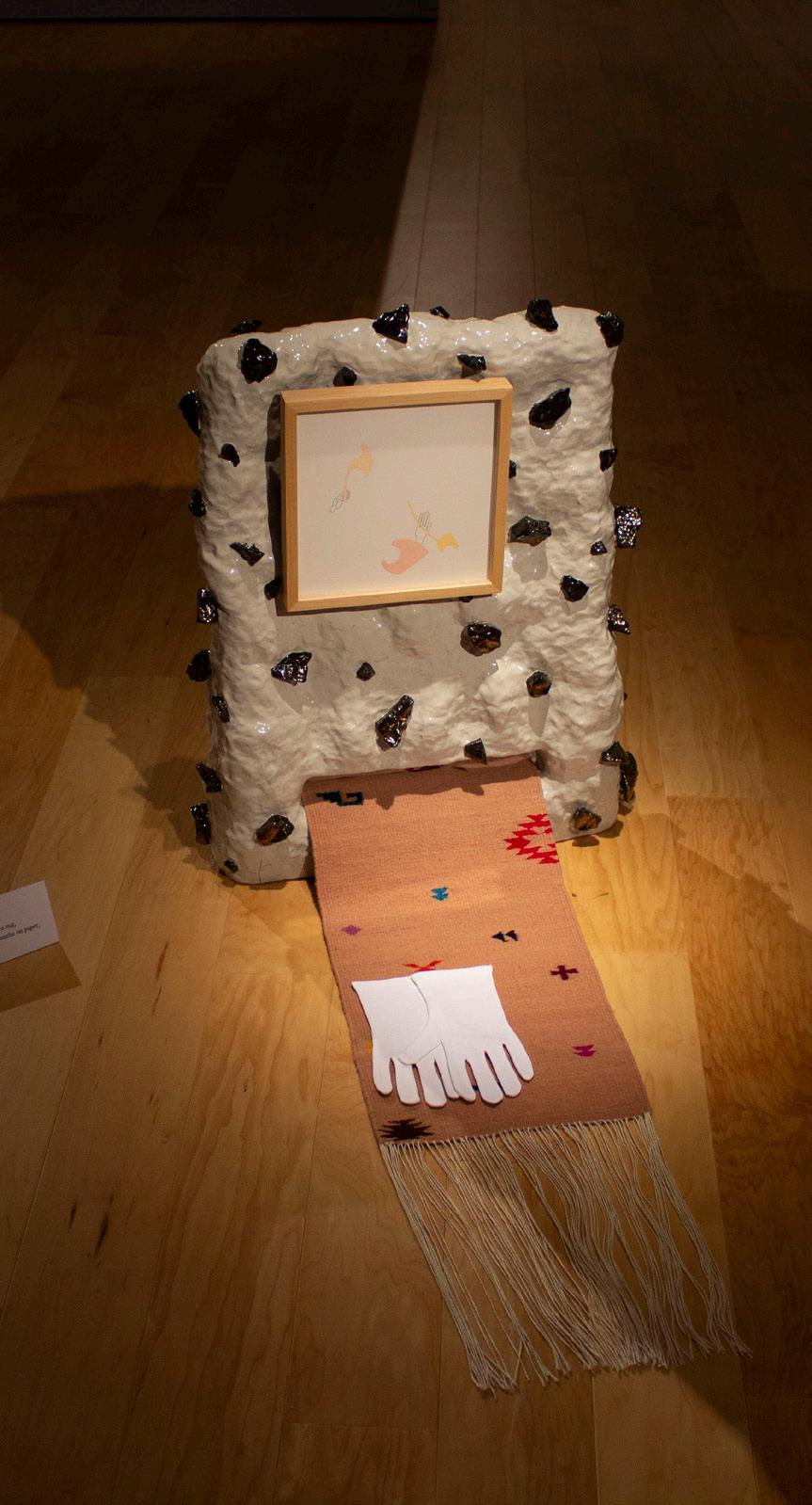
Joli Livaudais’ artwork crawls along the walls and floor of The Gallery in her ongoing installation All That I Love along with Imperata Grassland. Who Belongs on Our Money? By Suzannah Schreckhise glints as its covered in diamond dust. Kim Brewers’ collection of paintings Rosebud Moments in Paper Planes stand out from the wall with texture because they are created from pulp painting. In the center of the gallery Linda Nguyen Lopez’ Start/ Neverending is a collection of items that hold a presence.
The Arkansas Women to Watch: Paper Routes exhibit presented by The Arkansas Committee of the National Museum of Women in the Arts is open to view from January 29 – March 12. The Exhibit is located in the Brad Cushman
Gallery on level 2 of The Windgate Center of Art and Design at UA Little Rock. Open Monday – Friday between 10 a.m. – 4 p.m. the gallery is free and open to the public.
This years theme paper routes was chosen by the National Museum of Women in Arts in D.C. The guest curator is Allison Glenn of Crystal Bridges Museum of American Art. The exhibit showcases the artwork of four Arkansas women artists: Joli Livaudais (Photography, UA Little rock), Kim Brewer, Linda Nguyen Lopez, Suzannah Schreckhise.
Masks are required on campus and in the Gallery. The galleries are closed on weekends and University Holidays. If there are questions contact the main office of the Department of Art and Design at 501-916-3182 or email Brad Cushman at becushman@ualr.edu.





By Desi Kelly
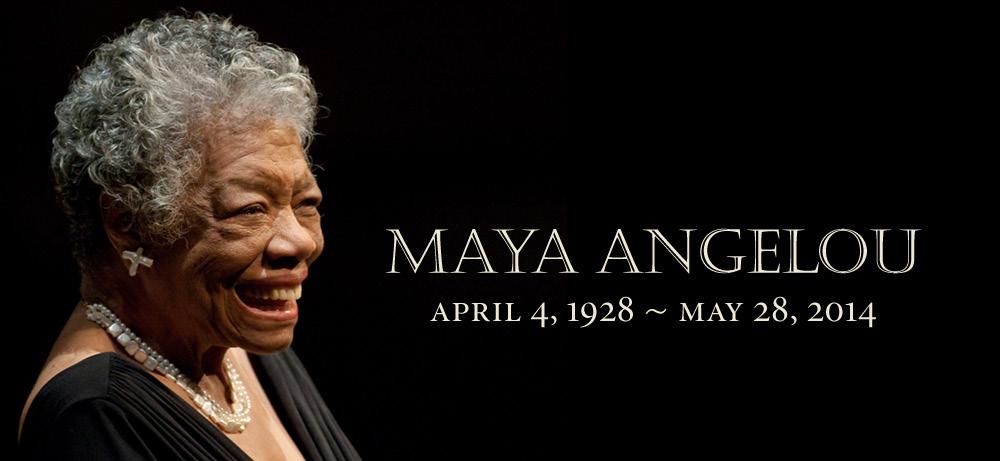
Numerous iconic AfricanAmerican women have touched millions of hearts via their words and presence. One of those amazing women is the inspirational writer Dr. Maya Angelou. At age 40, she published her book “I Know Why the Caged Bird Sings,” which became the first non-fiction bestseller by an African-American woman.
She was born on April 04, 1928, in St. Louis, Missouri however; Dr. Angelou spent her early childhood in the rural town of Stamps, Arkansas. Dr. Angelou endured the bitterness and stench of racism in the South. Her innocence was stolen from her when she was seven
years old. The retaliation she witnessed by her uncles toward her rapist left a scar in her life. She refused to speak for five years and found refuge through poetry.
A voice that once lay dormant rose to a frequency that broke down barriers in the Civil Rights movement. She loved the arts and learned to dance and sing on a professional level. When I was in high school, I remember listening to her cite her poem “Still I Rise.” Through time and space, those words have remained an inspiration to rise out of any unpleasant situation.
In January of 2021, Barbie Mattel released a new barbie doll in the image of Dr. Maya Angelou, which sold out online within the first five days. Moreover, the “Maya
Angelou Doll” is part of the toymaker’s “Inspiring Women Series” collection. Dr. Angelou once said that, “You are the sum total of everything you’ve ever seen, heard, eaten, smelled, been told, forgotten - it’s all there. Everything influences each of us, and because of that I try to make sure that my experiences are positive.” Despite her passing in 2014, her essence continues to live on. Rest in peace, Dr. Maya Angelou.
If you would like to purchase the “Maya Angelou Doll” from Barbie Mattel, the link is below.
https://barbie.mattel.com/ shop/en-us/ba/barbie-inspiring-women-maya-angeloudoll-gyh04

By Azalea Andrade
This year, Arkansas had a white Valentine’s Day that prevented as many celebrations from taking place but love was still in the air. Chocolates, roses, and candle-lit dinners are all staples of this day that make it that much more special. However, there is a big population that isn’t so fond of the holiday. Whether you love it or hate it, are single or in a relationship, when the day gets close, it is almost impossible to escape.
A day set aside for the appreciation of loved ones was not always filled with roses and chocolates. The origins were different and much grimmer from how it is celebrated now. The most common origin story of Valentine’s Day is said to be the ancient festival of Lupercalia.
According to History.com, it was “a bloody, violent and sexually-charged celebration awash with animal sacrifice, random matchmaking, and coupling in the hopes of warding off evil spirits and infertility.”
This celebration continued on for centuries during mid-February, but as the Roman Empire shifted into a more Christian ideology, it became a celebration honoring St. Valentine. Now, we know it as a romantic day where people show to express their love for each other through various gifts (sometimes too expensive if you ask me) and
other gestures.
Because of the progression of Valentine’s Day, there are many different points of view about the day and its meaning. I asked a few people what they thought about Valentine’s Day. Here are a few opinions on Valentine’s Day.
James Johnson, a senior mass communication major at UA-Little, likes to enjoy the day with all his loved ones, not just a significant other. He also acknowledges that Valentine’s Day has changed over the years.
“Though I feel that the meaning behind Valentine’s Day has been watered down and over-emphasized, I feel that it’s still a very sacred holiday to be celebrated,” said James. “It’s a tradition in my family for my mom to give us gifts and baskets of candy every year and we double up on her presents since her birthday is the day before the holiday.”
Susan Schade, a graduate student at the school of mass communication, has had a not-so-common experience on Valentine’s Day.
“During my junior year of high school, I had a boyfriend on Valentine’s Day for the first time, and I decided to get him something nice. We had not discussed getting each other anything because I thought it was just something you just did on that day,” said Susan. “When I gave him his notso-cheap gift, he did not bother to look up from his phone. He shoved
it out of the way and that’s when I knew I had to break up with him. Needless to say, I was boyfriendless the next day.”
I found myself relating a lot to Laura Jansen, a junior mass communication major, and Shyanne Kidd, a sophomore mass communication major, who expressed a more cynical opinion than others.
“I don’t really celebrate Valentine’s because I think that it is weird that people make one day so big and buy each other gifts even though they can do that every day when they are together,” said Laura. “Why is that one day so special? I think you can be sweet and generous whenever you want.”
Shyanne shared her thoughts on the day. “Growing up, I felt that Valentine’s Day was sweet for those who celebrated the day, but now I don’t see why people go all out for one day? Why can’t they show love all the time?” she said. “If you love someone, then you shouldn’t dedicate one day to them. I guess you can say that we get the chocolate’s the day after everyone else celebrates it.”
Other opinions were more general but still loved the spirit of what the holiday means these days. Aside from romantic relationships, some like to celebrate the friendships they have and value on this day.
Senior mass comm student Caitlyn Robbins enjoys the day as
much as she can because to her, it is a day to show your love for others and get dressed up. And it doesn’t hurt that her favorite color is red.
“If I’m not in a relationship, I’ll probably call up my best friend and go out to dinner or get our nails done,” said Caitlyn. “Something special/an excuse to get dressed up in my favorite color (red) and do our make-up. If I am in a relationship there’s usually a gift exchange and a special date.”
Valentine’s Day as we know it is not the same for everyone. That day can also be a birthday for some or even a grim memory for others. For Remington Miller, a junior English and mass communications double major, Valentine’s Day still has a lovely meaning about relationships and self-care but just a year ago, she had a loved one pass away on this day.
“My brother-in-law overdosed. I got the call that morning and things felt really different. It was a hard pill to swallow seeing my older sister lose her husband and to see my younger sister lose someone she had been building a relationship with,” Remington recalls. “When I think of Valentine’s Day roses, I think of the untouched ones from the last bouquet he brought to my house that stayed there for months until my mother put them into a shadow box.”
Aside from the romantic part, there are many ways to still appreciate Valentine’s Day. Regardless of
disliking the holiday, it is inevitably celebrated throughout the US every year, so maybe, as Shyanne does, have a sweet next day with discounted chocolate.
“Valentine’s Day as we know it is not the same for everyone. That day can also be a birthday for some or even a grim memory for others.”
By Danielle Spence
The University of Arkansas at Little Rock compost bucket program began during the summer of 2020 after Dr. Stephen Grace, Dr. Michael DeAngelis and several students assembled the new compost bin system. Since then, the program has gone through various changes.
“The program expanded in January 2021 beyond individual buckets by working with our oncampus partners in Sodexo,” said Nancy Hyde, the Office Manager at Donaghey Student Center. “A bucket pick-up system was implemented through a collaboration with the Trojan Café, Starbucks and the Donaghey Student Center to col-
lect and deliver kitchen food waste and coffee grounds.”
The compost bucket shelf is located near the entrance of the Campus Garden, which is across from U.S. Pizza on Fair Park, and is accessible 24/7. Participation from students, faculty and staff, along with the collections from the Trojan Café and Starbucks, contribute to 20-30 buckets per week. Those working within the garden anticipate a significant increase with the arrival of warmer weather and changes in seasonal produce availability.
Part of the program’s success is its flexible and volunteer-based process. Hyde affirms that a compost bucket is easy to fill when preparing food at home, as food waste from fruits, vegetables, cheese and
grains is one of the main sources for composting. Additionally, tea leaves and compostable tea bags are effective in compost. Hyde also says that before the compost bucket program, the Campus Garden partnered with the City of Little Rock for yard waste compost and the Little Rock Zoo for zoo compost. They are in the process of curing equine manure as well, which will be useful for future projects.
The three-stage aerobic compost bin, whose design was inspired by the Centennial Garden compost bin at Arkansas Children’s Hospital, is a low-odor, low-cost and practical solution with rapid decomposition. With this system, food scraps and other compost materials move through three rotations: in stage one the materials produce internal
heat that breaks them down, in stage two the decomposing compost cures after cooling and in stage three the compost finishes curing and is ready to be used.
“This process helps support healthy roots, healthy plants, and vigorous production,” Hyde said.
Composting has a variety of advantages. Compost enriches the soil by adding important nutrients and minerals for the crops, suppresses plant disease and pests, improves “moisture retention” and the “workability” of the soil, and reduces overall waste. According to Rhonda Sherman, an Extension Solid Waste Specialist, recycling organic matter can reduce trash disposal, save money, and conserve natural resources.
The Campus Garden’s compost
bucket program is UA Little Rock’s way of helping the environment.
“We greatly appreciate our Campus Garden supporters as partners in sustainable agriculture practices making a personal and collective impact on local, urban food production,” Hyde said. “Everyone can help to make a difference with small acts that support food independence and healthy living.”
If you are interested in participating in the compost bucket program, feel free to stop by the Campus Garden entrance to pick up a bucket. On UA Little Rock’s official website, the Campus Garden page has additional resources and information for participants.


By Alex Ball
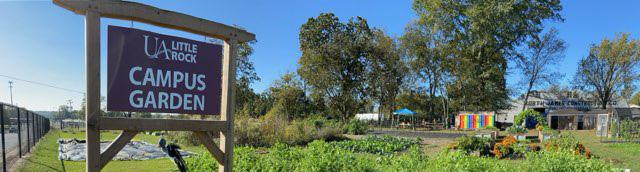
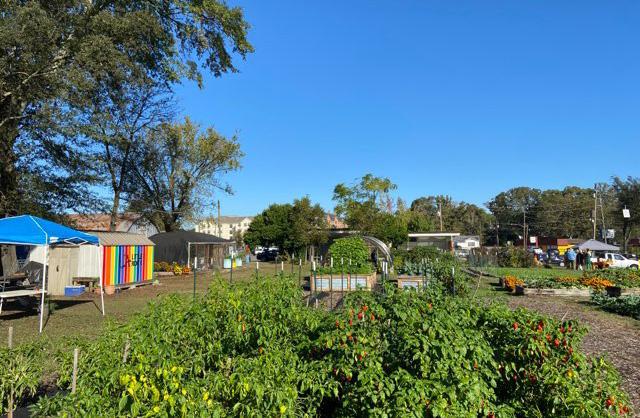
On a normal day, the UA Little Rock campus teems with life; students hustling to and from class, instructors sharing their passions with next-generation thinkers, and faculty offices addressing the whirl of day-to-day tasks required to keep our school operating at its finest. Although we’ are used to the typical business of life at university, tucked in the corner of campus, shining right onto Fair Park Boulevard, lives an independent world of itself: our campus garden.
The UA Little Rock garden has been growing since 2012, blossoming under the care of our Garden club and its directors Drs. Stephen Grace and Michael DeAngelis.
“The garden started as a collaboration, initiated by a professor in the Anthropology department, Dr. Crystal Lewis and it involved the Anthropology club,” Dr. Grace said. “They wanted to promote native plants and sustainable land-
scaping.”
Although the garden hadn’t anticipated the heavy food production it has today, Dr. Grace saw the potential for a fully-developed garden, capable of providing produce to Little Rock’s residents
“Our mission at the garden is to have healthy, locally-grown, nutritious food available to our community,” Dr. Grace said. “We donate a lot of food; this last summer we donated about 12,000 pounds to food pantries and other local farm stands.”
Through the dedication of its management team, our garden has been able to maintain activity, despite the onset of the COVID-19 pandemic.
“We haven’t been able to have as many farmstands over the last [year], but what we have done instead is we have opened up our garden for folks to come in on a donation-request basis,” Grace said. “They pay what they can afford, which is sometimes noth-

ing; but that’s what we’re here for.”
Not only does the garden provide access for UA Little Rock and the surrounding community to acquire fresh produce, but it also serves as an educational resource as well.
“We offer classes that take advantage of the garden space, like a class I teach in the summer, ‘Class, Food, and People,’” Dr. Grace said. “Part of this class is learning basic horticulture and gardening methods, and also looking at the issue of food systems, [focusing on] where food comes from, how it’s grown, how to do so sustainably, and how to address food insecurity.”
The garden and its directors, Drs. Grace and DeAngelis, offer a systematic approach to flaws within the food industry, primarily through urban gardening.
“This can fill a gap in providing fresh produce,” Dr. Grace said. “We are trying to promote awareness for the potential of urban farming.”
Not limiting their audience to UA Little Rock students, Grace and DeAngelis are also in communication with the city.
“With one acre of urban gardening, and replicating that through the municipality, you can provide a very substantial amount of food,” Grace said.
Other members of the management team - students, faculty from varying departments, and locals - participate as well.
The President of the Garden Club, senior Lily Shaw, has been involved for over a year now.
“I started out as a volunteer,” Shaw said. “After a while, I became the President of the Garden Club and did an internship to help maintain [the garden] over the last winter.”
Shaw focused her time at the campus garden to supplement her degree as well.
“Here I am getting a biology major, but my end goal is a degree
in Botany, so getting to work with a wide variety of plants you don’t usually see if the supermarket was really helpful,” Shaw said.
Despite the biological nature of the garden, the volunteers are often from interdisciplinary fields.
“I want other people to be able to get out here because a lot of students live in dorms and apartments, and don’t have a space for a garden in their own home,” Shaw said. “This is a great place to be able to get produce, which is sometimes hard to find.”
The garden was established almost a decade ago, but through the involvement of students like Shaw, it will continue to expand and impact our University.
“We are always happy to have volunteers, we would love it for them to come out and support our food stands or help volunteer,” Dr. Grace said.
Photos By Alex Ball

By Bennett Wood
When you think of Little Rock, locations to scout and film movie scenes is not the first thing that comes to mind.
Well, it’s time to think again!
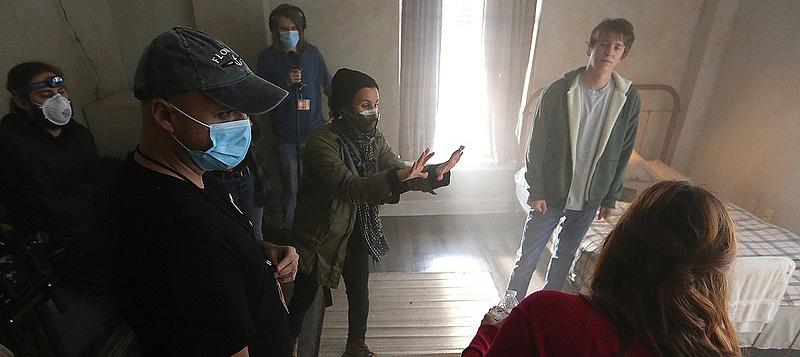
Film cameras, large trucks and socially distanced production crews were seen the first Friday in February spilling into the Lafayette Building’s parking lot, located on South Louisiana Street in the heart of downtown Little Rock.
“The Chariot” is a dark and comedic film, written and directed by Adam Sigal (“Daydreamer”, “When the Starlight Ends”) and executive produced by Melissa McPhail and Scarlett Pictures, LLC. We follow the story of a young man and his journey meeting the love of his (previous) life through a business firm that facilitates the reincarnation process.
Starring in Sigal’s third feature production is John Malkovich (“Being John Malkovich”, “Dangerous Liaisons,”),Rosa Salazar (“American Horror Story”, “Birdbox”) and Shane West (“A Walk to Remember”, “The League of Extraordinary Gentlemen.”)
Other accomplished actors working on the film include Thomas Mann (“Project X”, “Kong: Skull Island”) and Scout Taylor-Compton (“Halloween”, “Halloween II.”)
Actors flew in from out of state to work side-byside with 35 Arkansas locals starring as extra. One extra, a local nightlife entertainer at the forefront of the Little Rock LGBTQ+ nightclub scene, found themselves bumping shoulders with Hollywood veterans.
Evan Jacobs, 30, of Little Rock works throughout the week as a cosmetologist at R Hair Co. to pay the bills. His passion lies within hosting and performing at drag shows in drag as Chloe Jacobs. You can
find her on stage most weekends at both the Triniti and Discovery Nightclubs.
Jacobs’ talent for entertaining and performing in drag prepared him for this once in a lifetime opportunity. He was connected with the casting agency through an indirect family friend and secured one of those 35 extra roles. Filming the scenes in drag as Chloe was career first for Jacobs.
One upside to filming on location in Arkansas is the affordable prices of renting properties, equipment and crews within the community. By hiring local businesses, people and services within the community, along with buying local products, directly benefits and stimulates the states’ economy.
Shouting a movie on location can be tougher than filming in a studio on a good day, let alone during an ongoing pandemic. CDC measures and professional healthcare guidelines were adhered to by everyone behind the scenes, in production and by those actively shooting scenes on set. COVID19 rapid tests were provided each day of filming and before anyone stepped in front of the camera. Masks were mandatory and worn by everyone present on the days of filming.
Some celebrities took advantage of this mask mandate to create some anonymity while in town. John Malkovich was seen sporting a low-profile while walking around on set in sunglasses, pants, a hoodie and a mask. Seeing the disguised actor walking around amongst the crew, Jacobs recalls the moment he realized it was Malkovich. “He was just hanging out, casually walking around on set,” Jacobs said, “we never even knew it was him.” A release date has not been confirmed at this time for the film, but if you are interested, make sure to keep an eye out for your local Arkansans.

may have given her best performance yet in
‘Malcolm and Marie’
Netflix gives insight into Hollywood relationships with their new dramatic film
By Payton Dhooge
“Malcolm & Marie” is an emotional tirade written and directed by Sam Levinson (writer and director of “Euphoria”) starring John David Washington (“BlacKkKlansman”) as an upcoming film director and Zendaya Coleman (“Euphoria”) as a failed actress. The movie is a secret project filmed in 2020 during the COVID-19 pandemic and it is evident through only 2 onscreen actors and a single film location where they adhered to as many safety measures as possible.
This drama is set in a swanky Hollywood house isolated in the woods at 1 am in the morning after director Malcolm’s movie premiere. In the beginning monologue Malcolm ruminates over how his film is going to be politicized by reviewers because of him being a black man as well as his film actors
being people of color. Marie is not entertained by his zeal for the night and is visibly upset while making them mac and cheese for dinner. Thus begins the many arguments that comprise the almost 2 hour long film.
Malcolm initially stands out as a narcissist infatuated with his own triumphs and Marie as the exploited younger partner. Later Malcolm is perceived as the forgiving partner and Marie as the backstabber. Both characters slowly unveil their feelings, fighting to be the one in the right. Marie is deglamorized along the course of the night enhancing the rawness of emotion, the bathtub scene especially garners sympathy for her. The movie is also cheeky in instances where Marie is close to naked and discussion turns to criticism of the male gaze. There are many occurrences of a critique on Hollywood being
played out in the scene, which is just a little meta.
The camera shots are inventive and stylized in a grainy black and white. Certain camera angle choices, for example there was not a close up of either of the actors until after the dialogue began, create dramatic effect. They make full use of the outside and inside of the house that makes the film feel less constrained by the single location. The jazzy soundtrack is curated by Labrinth who also worked on “Euphoria” and emphasizes each character’s emotion through the music. My favorite instance of this is Marie playing “Get Rid of Him” by Dionne Warwick after an especially upsetting conversation. Zendaya and Washington’s chemistry is amazing and their acting brilliant as they convey each of their character’s hurt as raw and real. At times there are really sweet
moments and in others it almost physically hurts to watch.
One issue I had with the film is with the writer and director Sam Levinson. With one of the film’s characters being a Hollywood director it is hard to tell when Malcolm’s rants are his character’s own or Levinson’s. It was obvious that Levinson was channeling himself through Malcolm which took away from him being a fully formed character. The discussions of black directors and how they are received in the film industry was a little off to me and that may have been because Levinson is a white man whose lived experience will never be the same as the characters.
This is a difficult to watch film and truthfully not satisfying by the end but I was never bored. The movie showcases the ups and downs of a relationship in a single night and there is a lot to relate to for anybody who has been in one. There is no happily ever after and the message to be taken is that love is not perfect or always romantic. The substance of the movie was not perfect but the acting was so incredibly captivating. I would recommend the movie to someone who wants to be immersed in the drama of someone else’s else for a night. Sit down with a bowl of mac and cheese be ready to be emotionally exhausted.
By Maygan Bryant
Ty Dolla $ign’s newest album, ironically titled ‘Featuring Ty Dolla $ign’, is the artist’s third studio album. This project was released through his record label, Atlantic Records, on October 23, 2020.
Before even listening to any of the songs, the title of the album itself is compelling enough to grasp anyone’s attention. The brilliance of the album title is that Ty Dolla $ign is known for being a feature artist, serving as an accessory to hits with artists all the way from Kanye West to Megan Thee Stallion.
There is nothing better than taking what you are already known for and using it as a positive advantage, which was intelligent marketing on Ty Dolla $ign’s management’s end.
As for the songs on the album, they all flow together in vibrant harmony, quite literally. This can be caught in several songs on the album where the ending of one track mixes directly into the beginning of the next track right after it.
The album features appearances from Post Malone, Anderson Paak, Kid Cudi, Quavo, Nicki Minaj, Future, Young Thug, Big Sean, Roddy Ricch, Jhene Aiko, Skrillex, Gunna, Musiq Soulchild, and more.
Although Featuring Ty Dolla $ign has a total of 25 songs, none of the songs were a disappointment at all. The entire 60 minutes sends listeners on a wave of positive vibes, satisfaction, and replay value.
Whilst all of the songs were of great quality, there were a few songs that stood out as even more superior than their counterparts. These songs were ‘serpentwithfeet Interlude’, ‘Universe’ featuring Kehlani, and ‘Your Turn” featuring Musiq Soulchild, Tish Hyman, and 6lack.
‘Serpentwithfeet Interlude’ is only 56 seconds long, which left me wanting more. But that’s the bittersweet beauty of interludes, they are always the shortest, but tend to stick to your soul for the longest. This song was also an example of the songs flowing into one another, serving as a continuation of track 3 titled ‘Tempations’ featuring Kid Cudi that preceded it.
‘Universe’ featuring Kehlani utilizes a simple beat along with guitar strums to send listeners into a state of peaceful nirvana. Ty Dolla and Kehlani talk about their gratefulness for their lovers, friends, and family in this nearly 4-minute track. The main line of the chorus is “The universe must want me to win, I’m happier than I’ve ever been”, which summarizes the message of the song as a whole.
As for ‘Your Turn’, the magnitude of this group’s collaboration can only be compared to ‘Ultralight Beam” by Kanye West featuring Kelly Price, Chance The Rapper, and Kirk Franklin. Ty Dolla $ign, Tish Hyman, Musiq Soulchild, and 6lack came together as a group of soulfulness with the help of a choir as well in the same way. The message of this song emits through the chorus verse “Nobody’s truly yours, it’s just your turn”, implying that people are bound to get heartbroken and that you only have your turn with some people because they are meant to only be a lesson in your life. Even Ty Dolla $ign himself has stated in an interview with High Snobiety that “Your Turn” is his favorite song from the album as well.
Since its release, ‘Featuring Ty Dolla $ign’ has reached number 2 on the US Top R&B/Hip-Hop Albums for Billboard. Other achievements include peak positions of number 5 for Canada’s Billboard albums and number 4 on the US Billboard 200 chart.
Overall, I would give ‘Featuring Ty Dolla $ign’ a 9/10. Some songs fell slightly shorter than others, but the album as a whole was a union of music to vibe to, soul, and amazing tracks with a bigger meaning behind them.


By Remington Miller
From the moment you press play on “Soul” the unique jazz influence begins and can be heard from the Disney logo before the film.
“Soul” is a children’s movie that targets complex ideas like the purpose of life and how we define ourselves. This intense discussion of philosophy is made palpable to children by focusing on an African-American man’s pursuit of his dreams, during his life and even beyond life.
“Soul,” directed by Pete Docter, was released on Christmas Day in 2020 on the streaming site Disney+. Docter is also known for his work on other Disney movies such as “Inside Out,” “Up,” “Monsters Inc.,” and “WALL-E.”
The movie is a fantasy comedy movie following Joe Gardner (voiced by Jamie Foxx) as he pursues his musical dreams. This movie features computer-animated characters and backgrounds as it shows the audience a day in the life of New York, especially the jazz scene in the city. He meets a soul not ready for Earth yet, named 22 (voiced by Tina Fey). 22 is a cynic and rejects the possibility of having a life, even after several influential historical figures are said to have mentored 22. After an unfortunate sequence of events, Joe must mentor 22 in order to take their Earth pass and return to his body. The duo runs around New York City interacting with a ton of lovable characters that will entertain children and adults alike.
A lot of effort was put into creating diverse characters, especially those in supporting roles. There are also many emotional and heart-warming moments with Joe’s mother, Libba (voiced by Phylicia Rashad).
To sum up the appearance of the film, it was stunning. The computeranimated scenes were detailed and beautiful. All of the characters were designed to stand out. The scenes covering the subway and the streets of the city were bustling and colorful. It really was a beautiful art form.
“Soul” is not the first Disney or Pixar animated film to feature a character of color in the starring role. But, “Soul” does have Pixar’s first African-American protagonist. I decided to watch this movie during Black History Month to celebrate the increasing diversity I was seeing from popular entertainment companies.
While I found that “Soul” was an entertaining comedy, I would agree with a lot of criticism the film received. Joe Gardner is an AfricanAmerican man, but for most of the movie, he is portrayed as a cyan blob. This is meant to represent an individual’s soul. All souls are this cyan color and change facial characteristics once they live a life on Earth. Comparing this movie to Disney’s “Princess and the Frog,” the issue is very similar. The main character is a person of color, but they take on some other form during the majority of the movie. Tiana and Naveen turned into green frogs, Joe Gardner turned into a cyan blob. This makes me question if media is as progressive as we applaud it for being.
When Joe does get to return to his body, he is in the form of a therapy cat, Mr. Mittens, and 22 has landed inside his body. Even in the return, there is still a separation of the main character and an African-American body.
Despite the comedy and wholesome philosophy provided in the movie, I have an issue with the subliminal message that all souls look alike. They become unique eventually but having Joe be a cyan blob amidst all the other characters does not sit right with me. It provides an idea to children that, yes Disney could be trying to push the idea that we are all the same inside. This could be an attempt to create the idea of true equality on the screen, teaching children that everyone is the same on the inside and should be equal. However, it perpetuates the social issue of being colorblind and the negative impact that can have within our modern racial climate.
While “Soul” should be applauded for its beautiful art style and talented cast and director, along with an action-packed plot and introduction to philosophical thoughts, the movie still falls short on truly bringing well-done diversity to the television screen.
By Laura Jansen
LITTLE ROCK, Ark. - Little Rock
senior forward Teal Battle tied her career high, scoring 25 points during senior night on Feb. 13th, leading the Trojans to a thrilling 60-56 overtime win over rival Arkansas State.
Battle hit three back-to-back 3-pointers to get Little Rock back from a deficit and force an overtime period.
“I knew I had to score since they were packing the paint up a little bit and they were just kind of leaving the arc open,” Battle said. “As it went in, I had to keep my composure. I couldn’t get too hype, couldn’t get too excited. I had to move to the next play, because the
game isn’t over until the horn goes completely off.”
She extended that hot shooting into overtime, hitting another pair of 3-pointers, which led her to a career-best scoring output and her first double-double of the season as she added 11 rebounds.
With the win, Little Rock (127, 8-4 Sun Belt) swept the rivalry weekend series over Arkansas State (9-9, 4-8), while the Red Wolves lost their seventh-straight game. The Trojans also continued their perfect record at home against A-State as the Red Wolves are winless alltime at the Jack Stephens Center Freshman guard Tia Harvey exceeded her career high for the second straight game, scoring 16 points. Senior forward Krystan
Vornes almost closed out her senior night game with a doubledouble, scoring 12 points and nine rebounds. Vornes’ performance was critical in overtime, hitting four out of four free throws down the stretch refusing A-State to come back.
Trinitee Jackson led A-State with 13 points, followed by Payton Martin with 12 points. Martin, who entered the weekend with over 1,000 career points, was unable to provide another scoring option for the Red Wolves in overtime after fouling out. It was a tough loss for the Red Wolves. Head coach Matt Daniel was way more pleased with the fight in Saturday’s game, although it didn’t make the loss easier.
“It stung more in the locker room today. The reason it stung more is because we invested more,” Daniel said.
The Little Rock seniors had an outstanding performance Saturday, refusing to lose on their senior night against the Red Wolves. Little Rock head coach Joe Foley couldn’t be more proud of his two senior stepping up.
“Great night for the seniors, [Vornes] hit big free throws and Teal hit big three’s so I can’t even express enough how much I appreciate those seniors.”
Little Rock now travels to Monroe for a two-game Sun Belt Conference series starting Feb. 19 at 3 p.m.

By Laura Jansen
LITTLE ROCK, Ark.- Junior guard CJ White earned two career highs in the games against the Red Wolves. The two teams hold the longest active rivalry in the Sun Belt Conference, having their 92nd and 93rd meeting February 12th and February 13th. Little Rock dropped the game 67-65 after a close score the whole game.
The Red Wolves were scoring well over 50% and kept a lead of 10 plus points in the first half, but the Trojans kept fighting and closed the gap to two points in the last eight minutes. Junior forward Nikola Maric tied the game with a layup 65-65, with only 40 seconds left in the game. A-State player Christian Willis shot a jumper in
the last 10 seconds bringing the score up to 67-65 with no time left for the Trojans to score more points.
Little Rock has 17 doubledoubles this season, while ranked second nationally. Three teams in Little Rock’s conference are in the top-10 of double-doubles, Arkansas State is ranked sixth. Little Rock’s defense has been very important. They held opponents under 70 points in nine of the last 11 games, while making that 10 out of 13 games after this weekend. However, they are struggling to find their touch for shooting, getting an average of 64 points a game.
One of the most consistent players on the team, Maric, led the Trojans with 16 points. Maric was
followed by White. He played an unbelievable ball game, getting a career high of 15 points while scoring 10 out of the 15 points in the second half. Senior guard Ben Coupet Jr. had a career high of 8 rebounds. Coupet is ranked fourth on the team averaging 9.5 points a game, scoring 7 points in Saturday’s game. Other Trojans (10-11, 6-8 Sun Belt Conference) scoring double figures were sophomore guard Marko Lukic with 14 points, and senior forward Ruot Monyyong with 13 points. Monyyong also added five rebounds, while being the Sun Belt’s active leader in rebounds.
Arkansas State(10-9, 7-5 Sun Belt Conference) had a 3-pointer field goal percentage of 50% while Little Rock only had a percentage
of 32%. They had two players scoring double digits. Willis had a total of 12 points, while Marquis Eaton led the Red Wolves with 23 points.
A-State’s top rebounder Omier got fouled out in the last two minutes of the game, having a total of six rebounds. Arkansas State’s rebounding threat Norchad Omier and Little Rock’s Monyyong challenged each other in the rivalry games this weekend. Omier ranks top five in the Sun Belt conference in rebounds per game, while Monyyong ranks seventh.
The Trojans put up a fight, but it wasn’t enough this weekend. They will have a chance to break their losing streak when they play against ULM in Monroe. Little Rock will be playing: Fri. Feb. 19th at 6 P.M. and Sat. Feb. 20th at 4 P.M.

By Amanda Gordon
It was an exciting meet for the University of Arkansas-Little Rock Track and Field team Feb. 7, 2021. The South Alabama University’s Jaguar Invitational in Birmingham, Alabama revealed how the athletes’ hard work has been paying off, and brought newfound confidence for The SunBelt Conference which will occur on the dates Feb. 22, 2021 and Feb. 23, 2021. Ever since Head Coach Johnathon Behnke took over the team almost three years ago, he has worked to make UALR track more competitive. After this meet, he was confident in reporting that Arkansas-Little Rock is now a threat in the Sun Belt Conference.
There were many highlights from this meet with Arkansas-Little Rock student athletes. Competing against fifteen other strong southern schools in the NCAA only made the Trojans look more intimidating. Multiple athletes broke personal and school records to set forth new ones: allowing the team to place high in the NCAA. In men’s high jumping, sophomore Johnathon Jones not only set
a new Personal Record of 7’1, but is now ranked second in the Sun Belt conference and eighth nationally. This is extremely impressive considering he had red-shirted last indoor season competing unattached with a PR of 6’11.50. Compared to his competition, Jones feels he is in a good place right now to remain in the top ten, but has plenty of work ahead of him if he wants to make top five. Despite a recent obstacle that has presented itself in the form of a nagging knee problem ,with proper care, Jones will be able to overcome this injury to have a great conference.
An intersquad battle ensued during the 800 meter men’s race as sophomore Colby Swecker, junior Ricardo Banks , and freshman Logan Nelson gave the other schools a run for their money. The first 200 is well-known as the hardest part of the 800 as it can not be run too fast or the runner will suffer later on. As the men stayed relaxed for the first 400 as they should, Swecker was feeling confident and made a move to pass a preceding runner and Banks followed instantly. Working together,
they moved up through the ranks finishing hard and placing well. In their heat, Swecker took second and Banks third: overall finishing sixth and seventh. For his first season running indoor track Nelson running and finishing the way he did was impressive. He took 13th overall. On top of this, all three set new personal records where Swecker ran a 1:53.79, Banks a 1:53.95, and Nelson a 1:57.04.
Speeding things up to the men’s 60 meter race, freshman Cameron Jackson set a new personal record of 6.77 seconds and ranked second in the Sun Belt conference. From the gun to the finish line in heat 2 lane 4, Jackson was relentless in the race. Jackson was also able to beat the 200 meter top runner during this race. He qualified for finals where he ran in lane 3 and took first. Based on these races, Jackson has set himself up nicely for having a chance at winning conference in his event.
Gaining new distance in men’s weight throw, sophomore Isaiah Parker did something extraordinary. Parker’s first throw went 15 meters which was a personal record. For his second throw, he
In this
pre-conference
meet, the track and field team showed that missing a year of competing due to COVID-19 did not slow them down
beat his brand new personal record immediately with a throw of 16.28 meters. Clearly training has been going well as he has gotten the technique down for the spin, and followed it with a powerful throw.
The key to conference for Parker will be further improving his technique in order to be successful.
In the women’s mile, senior and women’s distance captain, Kimberly Boni, broke new ground in her collegiate athlete career. Boni ran an impressive 5:16 mile which ranked her as 16th in Conference.
After three years of battling multiple injuries, Boni has made this year different. Since cross country season in the fall, she has been preparing for the conference race and by trusting in her training and coaches, Boni is expected to triumph.
Persistence and intense focus is what led freshman Avianna Trinidad to reach new heights in women’s pole vaulting. Trinidad continued to clear each jump smoothly making it over the bar. It wasn’t until the fifth jump, though, that there was victory. Trinidad tied the Arkansas-Little Rock school record with a height of 12’5 meters.
In the women’s 60 meter race, Little Rock athletes set two personal records. It began with the block starts. Neither one wasted a single second taking full advantage of their opportunities. Kendall Johnson ran a 7.71 second dash, and Maliyah Holland a 7.84 making for two very smooth and fast races. Both are expected to do well at conference.
During this season, indoor track athletes have already faced some big challenges including limited meets and competition due to COVID, along with no spectators or fans at the meets. Despite these challenges, their dedication and persistence keeps them moving forward. The Arkansas-Little Rock track team has become increasingly mentally motivated to take advantage of every opportunity to improve. “What I have learned from this sport so faris to bet on yourself,” Jones said. “The bar will always go up and if your confidence doesn’t move when the bar does then you’ll never clear it”.
By Azalea Andrade
The Little Rock wrestling team concluded its regular season on Feb. 7 with a disappointing loss in its final matchup, Oklahoma State. It was a rough ending to the regular season for the Trojans as they fell 45-0.
In an interview at the end of the match, head coach Niel Erisman expressed his thoughts.
“Even though it was a tough night, we had some individuals that I thought did pretty well,” he said. “Guys like Triston closed the gap and learned a lot about what they can and can’t do. It was a good experience, it was a tough experience, and it was hard, but it was much needed.”
UA-Little Rock is home to the only NCAA Division 1 wrestling program in Arkansas. The program
began in 2018, and this year, they won their first D1 match in the history of the program against Fresno State.
The team has seen ongoing success including the NCAA Coaches Ranking of Paul Bianchi, a senior on the team, at number 26. On Jan 31, senior day, Bianchi gave the team some recognition with his 3-0 win against some of the best teams in the conference.
Now the team is preparing for the 2021 Pac-12 Championships. This year, the conference tournament will take place in Corvallis, hosted by Oregon State.
The conference tournament begins this Sunday, Feb 28 at 1:30 p.m. central time. Don’t miss out on the Trojans as they wrestle for that championship.


By Laura Jansen
TULSA, Okla.- Little Rock played their first game of the season on Sunday, Feb. 21 against Oral Roberts University after their season was abruptly canceled in 2020 because of COVID-19. Graduate transfer Chris Prentiss started it out strong for the Trojans with a run in the first inning. They closed out the game with a 4-3 victory over ORU at J.L. Johnson Stadium.
After 347 days, Little Rock’s baseball team can finally start their season with a game against the Oral Roberts Golden Eagles, which was taken away last year due to the coronavirus. “I can’t really put
words onto how much it means to play a game,” Senior pitcher Aaron Funk said. “Being back on the field like that was unreal, it was awesome.”
Funk had five straight innings of scoreless pitching, while only allowing one hit. Funk received Sun Belt’s Preseason Pitcher of the year, and he led last year’s league with 31.1 innings pitched while he was ranked 26th nationally with 37 strikeouts. In Sunday’s game, he had a total of five strikeouts in five innings.
The Trojans had a total of four runs, with Graduate Student and infielder Chris Prentiss scoring two of them. In the previous two seasons, he played at Jackson State
University batting .322 as a senior in 15 games. Prentiss received First team All-SWAC selection his junior year while batting .381 with 61 hits.
ORU infielder Caleb Denny scored the first run for their team in the sixth inning to tie up the game. Denny also hit a home run in the eighth inning, trying to get his team back in the game, bringing the score up to 3-2 for the Trojans. The red shirt freshman received Summit League Preseason Freshman of the year and Perfect Game Preseason Summit League Freshman of the year in 2020.
Sophomore center fielder Tyler Williams hit a bunt in the top of the seventh inning to make ORU scrabble to get the ball to a base. This
allowed for Canyon McWilliams to score, bringing the Trojans back in the lead. Williams had scouts looking at him nationally his freshman year, batting .220 with two doubles, a triple and a home run while also stealing four bases.
Eldridge Figueroa doubled in the ninth inning, allowing Nathan Lyons to get his first run of the season. Eight Trojans registered a hit, Figueroa leading with a total of three hits followed by Noah Dickerson with two.
UA Little Rock Senior Pitcher Hayden Arnold had the bases loaded in the bottom of the ninth inning, finishing out the game pitching a total of six strikeouts in four innings. Hayden pitched four
balls, allowing ORU’s B Gibson to walk to first base, advancing every player to the next base. This way Jake McMurray was able to score ORU’s third and final run.
Arnold still closed out the game with a win when ORU’s batter hit a fly ball in the hands of infielder Miguel Soto. The Trojans win their first game of the season 4-3.
“Being able to play and getting over here and getting the win, we’re very proud and fortunate.” Coach Chris Curry said while showing his gratitude towards game host Oral Roberts.

By Chloe McGehee
This 2021 session of the Arkansas House has been home to multiple new bills, many of which have caused controversy around the state, none so much as AR House Bill 1218, though. Sponsored by Maumelle Representative Mark Lowery, the bill’s introduction into the House sparked heavy discussion on both political sides of the aisle, and angered the people of Arkansas.
This controversial bill would have prohibited Arkansas public schools from offering courses, events or activities that “isolated” students based on race, gender or other attributes. Schools that didn’t comply would have been penalized by reducing their state funding by 10%. This decrease would significantly harm public schools, especially those in desperate need of more funding already.
Arkansas local advocate Loriee Evans was one of the main voices against the bill. Evans works for Indivisible Little Rock Central Arkansas, an organization founded to raise awareness of the power of the people and local government.
“House Bill 1218 [was] based on the misguided idea that we can create ‘unity’ by silencing any discus-
sion on issues like race, gender, religion, class or political affiliation,” Evans said. “The bill amounted to a gag rule on educators, and would have resulted in a white-wash of teaching of America’s history of slavery, civil rights, suffrage, etc. Arkansas students already don’t get the full and complete history of the contributions of enslaved peoples to America’s founding -- this bill would have further weakened our history and social studies curriculums.”
Evans did notice a huge outreach from the community, with hundreds of people across the state calling their representatives to stop the bill. Even Lowery’s constituents called and emailed him repeatedly to get him to pull the bill he had sponsored. It’s a huge example of how regular citizens can stand together to create change, according to Evans.
Students around the state were also alarmed by the bill’s rhetoric, especially those involved in extracurricular activities that would be forcefully canceled.
“I was involved in at least three clubs that were mentioned in this bill,” UA Little Rock student and public school alumni Joseph Sepulveda said. “For so many students, those clubs are their home in high school, where they feel safe.
To take that away from students could be detrimental to way too many people.”
Not only did the bill receive statewide attention, but Lowery’s bill also received national press attention, which put our state in a bad light. According to Indivisible, Arkansas needs to be able to attract new business and keep energetic young people learning and working here, which cannot be done if we’re censuring high quality, factbased education.
“I know it’s really hard to pay attention to what’s happening at the state legislature too, when we’ve got classes to worry about and jobs to get to,” Evans said. “But these bills are an example of how crucial it is that we pay attention to what’s happening at the state capitol, because many of the bills being proposed and passed will have a real impact on us as individuals. If you have younger siblings, or kids in public school --and I do! --their education would have been seriously impoverished by bills like HB1218. And then that’s compounded by making Arkansas and our workers less prepared and less competitive.”
Not only should parents be paying attention to the capitol, but students and young adults as well.
“To see something like this from
my state, it’s shocking,” Sepulveda said. “I would have never known this was happening if not for it making national news, and it makes me wonder what I need to do to make sure this does not happen again. Could they go for public universities next? It’s questions we need to ask.”
Although this bill managed to be sponsored and cosponsored by nine House Representatives, after the major public outreach Lowery did decide to pull the bill from the session, so it will not be passed this year. Lowery could bring it back next session, though.
It is important to ask ourselves how a bill like this could get so far into the legislation when it is clearly disliked by the people. Although organizations like Citizens First Congress and Indivisible LRCA send out calls to action, it is a constant battle to inform the people about bills they may disagree with. Evans has an idea of how we can move forward to stop this from happening again.
“Get involved with local civic groups, support candidates who inspire you, practice leadership on your campus and look for opportunities to practice leadership in your church or community,” Evans said.
“Our state needs young people to engage in public conversations, we
need students engaging other students in thinking about how public policies affect your lives. Because ultimately young people will be our leaders, so why not start today?”
“This bill would have further weakened our history.”
By Bennett Wood
The Inauguration of President Joseph R. Biden and Vice President Kamala D. Harris took place on schedule, despite the horde of obstacles and challenges it faced leading up to Jan. 20, 2021. Prioritizing policy approaches to address the COVID-19 and climate crisis, racial justice and domestic extremism within the U.S., President Biden also called for, and stressed greatly, unity during his inaugural address.
Harris made history as the United States’ first female, first black and first Asian-American Vice President, signaling the nation’s path toward equality, equity and the future. During her first speech as V.P., Harris struck the same tone as Biden: a call for unity amongst the nation by calling upon the ambition, determination and aspirational drive that every American possesses.
After the past four years of continually growing hyper-partisanship in politics that have bled into our communities, along with the volatile rhetoric recently used by elected officials, it’s hard to imagine this type of behavior disappearing in response to a call for unity one day. The former President Trump’s absence at the Inauguration, the first absence by a presidential predecessor in over 150 years, is an example of this behavioral deficiency. This poison must be eradicated, though it won’t happen overnight.
Starting with his Inauguration Day speech, President Biden set out to differentiate his message and the tone for his presidency from that of his predecessor. Acknowledging how far the country has evolved since its birth, Biden underscores this with how much the nation still has to go.
His message of unity is an aspiring one, for a nation struggling with racial justice, a climate crisis, a deadly pandemic, a poor economy, and the rise of political extremism. President Biden acknowledges the path forward towards unity will be a difficult one, but it is a path we as a nation must endure together. The past four years have led to a historic culmination of crises that we must embrace head on, as one
nation. Start reaching out and saying hello to someone new in your community, a single act of kindness goes a long way.
Passionately declaring himself to be a leader to all Americans, President Biden calls for an end to the un-civil war being waged between republicans, democrats, conservatives, liberals or anyone with differing views or opinions.
Achieving unity can’t happen when disagreements lead to disunion, highlighting the devolving political atmosphere on Capitol Hill.
Further highlighting the need for unity, President Biden commemorated the historic peaceful transition of power and its tradition of ensuring a continuous democracy. This moment was highlighted in response to the attempted insurrection of the Capitol on January 6, a couple weeks prior. Unity in the face of an insurrection and violent dissent is a courageous act, and its path to success will be an uphill battle. As Americans, I believe we are well equipped to win that battle.
As the nation edges closer to dystopia with each passing day, President Biden pledges to act as a healer and lead the U.S. into a better future. The Inauguration of Joe Biden marks a shift from a country dealing in “alternative facts” to operating by one shared set of facts, with President Biden asking us to place more value in truth. President Biden stopped short of romanticizing the nation’s tumultuous past and making false claims of goodwill during his speech, being straightforward with the American people.
The spirit of the American people is strong, ambitious and aspirational, determined, bold and optimistic. This American spirit is exactly how we, together as one nation, can rise to occasion for the call to unity. It will take each and every one of us working together, reaching across ideological, political, and partisan lines to work with one another toward a shared goal of unity, prosperity, equity, and justice. As President Biden said, “The American story depends not on any one of us, not on some of us, but on all of us. On ‘We the People’ who seek a more perfect Union.”
By Tessah Conatser
Do you know what caused a crucial turning point for segregation in the state of Arkansas? Imagine it is the year 1954, the U.S. Supreme Court ruled in Brown vs. Board of Education that segregated schools were unconstitutional. Now, three years after the ruling, the Little Rock Nine are placed into an allwhite high school. This moment in time marked history for our state.
The National Guard was even called to ensure the integration of Central High School. They were deployed after Dwight D. Eisenhower gave a subtle warning to Governor Orval Faubus not to defy the Supreme Courts ruling after Faubus threatened using the Arkansas National Guard to block integration.
These monuments and their hidden figures allow us to reflect on the past. We do not usually think about city history when we think of active change. We do not think about the fact that there used to be labels on water fountains and separate sections on our bus. Most of all, we do not think of the hidden figures in our very community that helped inspire social change. Today, there are activists stepping back up to the plate after resting years on the bench.
Mrs. Misty Cartright, an 85-yearold African American woman, is one of them.
“Segregation isn’t about color, but about how we treat people,” Cartright said.
Cartwright is a prior social worker who has enacted change in many lives. In the 1960s she
worked through many cases to get where she is today. “Seventy years I have been fighting this fight,” Cartwright said with a proud smile. That fight presses on through years of social ignorance, and this last year we were faced with the hard truths. The color of our skin has always defined our ethnicity, but as we have grown there have been prejudices set out on both sides. In 2020, we had an opportunity to visit our views on racism and our morals. The emergence of Black Lives Matter was a profound moment in our year of troubles, and people everywhere like Misty and Tracey Dae continue to pursue social change.
“Black, white, yellow, brown or whatever color you are; your treatment should depend on your character,” said Dae, a retired teacher
that continues to work with social activist groups. “Sometimes that means being the bigger man, and other times you should know when to admit your wrongs.”
Black Lives Matter was created to fight for freedom, liberation and justice. There were multiple peaceful protests in 2020 that hoped to develop social change. Although the peaceful protests received criticism, there was a lot of realization through these events. There were multiple reform changes and a drastic development on dash cams and body cams for the police force.
Our country continued to push through these challenges during the race between Donald J. Trump and Joe Biden for President. Tensions ran high, but whenever inauguration came around- history was made. When President
Joe Biden was elected as the 46th United States President, Kamala Harris became the Vice President and made history as she is the first woman in a presidential office of both South American and African American ancestry.
These moments in history show us that social activism can bring about not only subtle change, but lasting effects. Our country is constantly evolving. We may seem to be taking steps back right now, but history is bound to throw us forward into the future, espeically with the amazing work of activists like Cartwright and Dae.
Take the time this Black History Month to learn the history of your city! Find the hidden figures everywhere around you. Take the time to watch history being made. How will you enact social change?



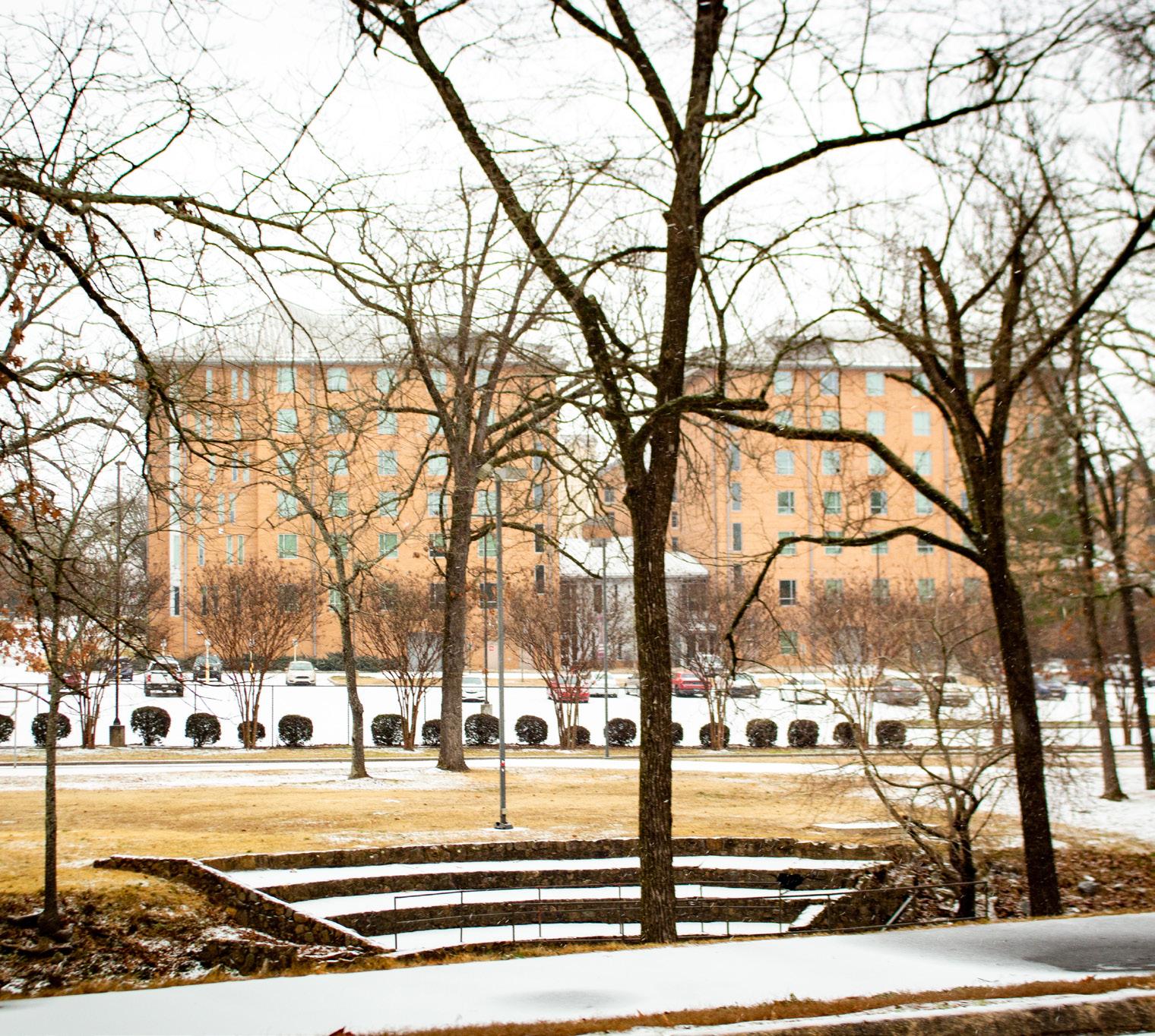
By