SUMMER 2026 VOLUME 34 NO. 2
FOR MEMBERS AND SUPPORTERS OF THE TRUSTEES
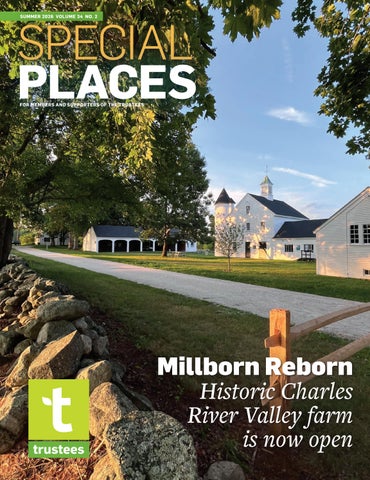
Millborn Reborn Historic Charles River Valley farm is now open
©TRUSTEES
American Indepe
Field Farm
Begin your adventure at TheTrustees.org/Stay IFC2 THE TRUSTEES
0 I-19
Rt
Peaked Mountain
e
Worcester Rte
Charl e
I-90
sPike Ma s
Quinebaug Woods
RESERVATIONS IN THE CHARLES RIVER VALLEY Cormier Woods
s Riv e r
THE CRANE ESTATE Castle Hill Crane Beach Crane Wildlife Refuge Halibut Point
8
Rte 128
Mount Ann Park Ravenswood Park Coolidge Reservation The Monoliths Misery Islands Crowninshield Island Gerry Island
I-9 5
BOSTON REGION
Pierce Reservation
PHOTOS: ASHLEY HOUSE PHOTO BY A. DONNELLY; ©TRUSTEES; WARD MISSION HOUSE RESERVATION PHOTO BY DAVID PHOTO COURTESY COURTESY OF EDGECOMB; THE LIBRARY OF @BOSTON_PHOTO CONGRESS. GRAPH. BACKGROUND OLD MANSE PHOTO ©TRUSTEES; APPLETON FARMS AND ELBRIDGE GERRY SIGNATURE: PHOTO DECLARATION OF INDEPENDENCE,
World’s End
5
Weir River Farm Whitney & Thayer
Bradley Estate Signal Hill Archives & Research Center Moose Hill Farm
Woods
Norris Reservation Two Mile Farm
Gerry Island
I-9
Governor Hutchinson’s Field
I-295
Gov. Oliver Ames Estate
5
10 Holmes Reservation
I-4 Rte
Dunes’ Edge Campground
95
Cape Cod Bay MILTON Lyman East Over The last royal Governor Reserve Reservation of the Massachusetts Bay Copicut East Over: Hales Colony, Thomas Brook Woods and Sippican River Hutchinson built Tract a country Allen C. Haskell grounds in the mid-1700s. estate on these Lowell Holly Public Gardens He was charged with upholding British rule in the Armstrong-Kelley Park restless colony, but in 1774, Cornell Farm Mashpee River shortly after the Reservation Boston Tea Party, he fled B to England. His Nantucket Sound Slocum’s River property and effects were Reserve confiscated and Westport later sold at Town Cape Poge auction. Stroll through Farm Wildlife Refuge the field to find The Brickyard ha” (retaining wall a “haCoskata-Coatue Menemsha Hills and ditch used as Wildlife Refuge Mytoi a livestock barrier) which is the only visible remnant of this former estate, along Long Point Wasque with views of the Wildlife Refuge River and Boston The FARM Institute Neponset skyline. 14 0
I-195
ay
Rte 6
9
MARBLEHEAD Walk across at low tide journey by watercraft or to this island once owned by Thomas Gerry, whose son Elbridge Gerry grew up to be a signer of of Independence, delegate to the 1787 the Declaration Constitutional Convention (where he helped draft the Bill of Rights), Governor of the Commonwealth, and Vice President the United States of under President James Madison.
sB
4
Shortly before the Revolutionar y War, Shakers arrived the in America. The utopian group known for its devotion to pacifism religious originally viewed was with suspicion but slowly gathered followers drawn to the Shaker of communal living, beliefs and equality. They establishedgender and racial their second American settlement in Harvard and continued to communities throughout form the colonies. Soon after the Harvard Shaker Village closed the historic Shaker in 1918, Office was moved to the Fruitlands hillside where it was restored opened to the public and as the world’s first Museum. Here it Shaker remains to this day to celebrate Shaker beliefs and traditions. share and
Appleton Farms
8 HAMILTON & IPSWICH Established in 1638 by one of the country’s founding families, this farm was split acreages operated into separately by cousins two and Oliver Appleton Isaac during the American Revolution. Their hay, cutting thatch, work included hauling sawing wood, and around this working selling posts and rails. Wander the farm—one of the trails and stop by the oldest continually Farmhouse, which operating in America— stood in this same now reflects generations spot through the of change and fascinating war and history.
5
Francis William Bird Park
9
Boston
Gov. Hutchinson’s Field
I-90 I-
er
Mary Cummings Park deCordova Sculpture Park and Museum
7
rd
Fruitlands Museum
HARVARD
6
Charles W. Ward Reservation
ANDOVER & NORTH ANDOVER The focal point of this sprawling landscape is 420-foot-tall Holt Hill, the highest point in Essex County. On June 17, 1775, townspeople the burning of Charlestown climbed to the top of the hill to watch during the Battle can hike to this of Bunker Hill. Visitors same Valley and the Boston vantage point today for views of the Merrimack skyline.
za
3
7
Pine & Hemlock Knoll Moraine Farm Malcolm Preserve I- 9 5 Long Hill
The Old Manse
Rte 9
Tantiusques
The Colonel John Ashley House
SHEFFIELD A precursor to the Declaration of Independenc the Sheffield Resolves—is e— believed to have drafted in this home been in 1773 with Col. moderating. He Ashley later financially backed the Continental Army while with the 1st Berkshire his son fought as a colonel Regiment. When ratified its new Massachusetts Constitution in 1780, Elizabeth Freeman—who was enslaved by the Ashleys—dre upon its revolutionary w language to sue paving the way for the end of slavery for her freedom, throughout the state. Learn more about her life and legacy when visiting this historic home.
M
Appleton Farms Grass Rides Weir Hill Appleton Farms
Ward Reservation 95 I-4
Chestnut Hill Farm
9
I-84
Springfield
4
Fruitlands Museum Dexter Drumlin
290
3
Camp amid flowing sand dunes and seablown pines, minutes from the beach and outdoor adventures.
Dinosaur Footprints Land of Providence
Cobble
Doyle Community Park Farandnear
Redemption Rock Brooks Woodland Preserve Swift River Reservation
Quabbin Reservoir
Rock House Reservation
Questing Bartholomew’s
Rte 2
Elliott Laurel
North Common Meadow
Rt e
©TRUSTEES
I-90
Dry Hill
Jewell Hill
Tully Lake Campground
Bear’s Den
Mount Warner
Little Tom Mountain
24
DUNES’ EDGE CAMPGROUND, Provincetown
116
Petticoat Hill
Rte
Classic tent-only camping retreat on the shores of a pristine Central MA lake.
3
Ashintully Gardens
Rte
Chapel Brook
90
PHOTO BY JERRY MONKMAN/ECOPHOTOGRAPHY
As Massachusetts celebrates the nation’s Semiquincentennial, The Trustees invites Members to embark on a challenge of discovery at special places across the state. Visit TheTrustees.org/Independence to download the Trustees American Independence Tour passport, which highlights ten properties from Sheffield in the Berkshires to the North Shore coast of Marblehead. Discover untold histories and diverse perspectives often left out of the national narrative, alongside familiar watershed moments and the people and landscapes that influenced them. Each place is packed with stories, landscapes, and landmarks that shaped our nation’s founding. Visit and check off all the sites on the downloadable map and submit your completed map at the same webpage—
9
2
I- 93
Glendale Falls
Jacobs Hill Doane’s Falls
Rte 2
Bullitt Reservation
Rte
Chesterfield Gorge
Tyringham Becket Cobble Quarry McLennan Reservation
Old Town Hill Greenwood Farm Hamlin Reservation Stavros Reservation
ack R i ver ri m
3
Monument Mountain
StevensCoolidge House & Gardens
Royalston Falls Bear Swamp
Notchview
Bryant Homestead
Mission Goose Pond
1 House
6
CONCORD
The first shots of the American Revolution at the Old North rang out Bridge on April 19, 1775, only a few hundred feet from this home. Owned minister Reverend by influential Phebe Bliss, many William Emerson sermons championing and his wife penned within these liberty and independenc walls. The Emerson e from Great Britain at the heart of the and Bliss families were Revolution: the also embodied a fight for freedom lives of Cate, Phyllis, and the perpetuation contradiction and of slavery. The illustrate this disjunction.Frank who were enslaved here around the time Thanks to new of the Revolution organizations around research and partnerships Concord, their stories with historic continue to be uncovered.
Mountain Meadow Preserve
Naumkeag
Ashley House
The Old Manse
2
CHESTERFIELD 6,000 British soldiers marched across this gorge along the old post road connecting Albany, New York to Boston after General John Burgoyne’s defeat at Saratoga in October 1777. The bridge used during their journey was swept away by floodwaters in 1835, but its stone abutments are still visible today.
uz
1
STOCKBRIDGE Only days after the first shots were fired in Concord, the Mohican men of Stockbridge answered the patriotic call to arms. They served as scouts and warriors at Bunker Hill, Bennington, Ticonderoga , Saratoga, and across the northeast. General Washington honored George their service by sponsoring an ox roast in Stockbridge in 1783. Before and the war, Native during community members—in these veterans—w ere stripped of their cluding rights, forcing many land to move away from homeland. Today, their the StockbridgeMunsee Band of Mohican Indians is telling their own story, in their own words, on their ancestral land through ongoing The Mission House. exhibitions at
ndence Tour
I-95
Chesterfield Gorge
Rte
Join The Trustees' America 250 Challenge
The Mission House
I-3 9 5
TULLY LAKE CAMPGROUND, Royalston
Rte 8
Authentic mid-century modern bed & breakfast with unparalleled views of Mt. Greylock.
River
PHOTO BY DAVID EDGECOMB
t i cut
THE GUEST HOUSE AT FIELD FARM, Williamstown
I-91
Step into timeless elegance and serenity in the heart of the Crane Estate.
The Trustees’ Outdoor Ambassadors program is a seven-week youth employment and leadership development program that engages young people ages 15-18 in hands-on stewardship, environmental education, and community-based learning experiences across Boston and beyond. Formerly known as Waterfront Ambassadors, the program was renamed to better capture the broad range of experiences the teens engage The 2025 Ambassadors at the Eastie Farmers Market in throughout the summer. Highlights in East Boston last summer. of this summer’s program will include visits to Boston City Hall and the Massachusetts State House focused on climate resilience and civic engagement, along with mentorship opportunities with PhD students from Boston University. The Ambassadors will help distribute CSA produce from the Trustees Mobile Market at the Eastie Farmers Market, and they will participate in exchange days with Trustees Urban Outdoors partners, such as Pocasset Pokanoket Land Trust and Worcester Regional Environmental Council (see article, page 10). The teens will visit Trustees special places across the state, including Nightingale Community Garden (Dorchester), City Natives (Mattapan), and Leatherbee Woods (an Urban Wild in West Roxbury). They will explore Indigenous art, history, and connections to the environment at Fruitlands Museum in Harvard, and will take part in an overnight kayak experience to Choate Island (Crane Wildlife Refuge in Essex) while learning about coastal ecology, archaeology, Indigenous history, and intertidal ecosystems. Keep an eye on our blog at TheTrustees.org/Blog for updates and reports from the Ambassadors as their summer progresses.
C onn e c
PHOTO BY JUMPING ROCKS
Outdoor Ambassador Youth Program Launches its Summer 2026 Season
7
THE INN AT CASTLE HILL, Ipswich
NEWS FROM ACROSS THE STATE
Rte
Whether you prefer to camp out or relax in an elegant country inn, The Trustees offers unique accommodations set within spectacular natural surroundings.
Rte 112
Stay With Us!
Holmes Reserva tion
PLYMOUTH
10
Wander the grassy field used as a “Muster Plymouth farmers Ground” by in the militia to assemble and train colonial Minutemen companies in the Revolutionar y War. lead-up to the
For a detailed look at each of these Trustees special American Independ places linked to ence visit thetrust ees.org/indepen dence
PHOTO BY JULIE POLLUCK
The Old Manse (background) stands watch during a reenactment of the Battle of Concord at the Old North Bridge.
by September 30—for a chance to win a free one-year extension on your Trustees Household Membership.
Long-Lost Portrait of George Washington Discovered in Appleton Farms Collection Founded in 1638, Appleton Farms is the oldest continuously operated farm in America and among the most influential in the country’s agricultural history. It was also home to nine generations of Appletons—from 17th-century English emigrant Samuel Appleton to 20th-century lawyer Francis R. Appleton Jr.—who loved their bucolic farm in Ipswich. This year, as we celebrate our nation’s 250th Anniversary, a serendipitous discovery has revealed the provenance of a portrait of founding father, and America's first president, George Washington, in the Appleton collection. According to Susan Hill Dolan, Curator for the Trustees North Shore Region, “There were art collectors in the Appleton family. The most passionate among them was Daniel Fuller Appleton (1826-1904), who amassed a diverse collection of antiques, many of which we categorize today as ‘Patriotic Americana.’” This rich collection, inherited by The Trustees as part of the family’s 1998 bequest, includes the striking, bust-length, and unsigned, oil-on-canvas portrait of General Washington in uniform set against a dramatic, cloud-filled sky. As Hill Dolan tells it, “Fast-forward to the winter of 2026—200 years after the birth of Daniel Fuller Appleton—when I discovered a nearly identical, circa 1798 portrait, attributed to Charles Peale Polk (1767-1822).” Research has since confirmed that Polk was, indeed, the artist of the portrait in the Appleton collection. Additionally, it has recently been discovered that a partial, hand-written note on the reverse of the painting appears to convey true provenance information—a fact that previous appraisers had not considered. Dated 1888, the note includes the name Alexander Balmain. A 1981 Corcoran Gallery of Art exhibition catalog entitled Charles Peale Polk, 1767-1822: A Limner and His Likeness, helps confirm that The Trustees’ portrait—Entry No. 42, with its current owner listed as "unknown"— was, in fact, originally owned by Rev. Alexander Balmain, Winchester, VA. Balmain was an Episcopal minister who supported the American cause and had dealings with Washington.
George Washington portrait, by artist Charles Peale Polk, from the Trustees’ Appleton Farms Collection; AF.237. Recent conservation of the painting by Geraldine Brooks of Carmichael Art Conservation has revealed the proposed 1799 date for the portrait to be consistent with the paints and materials used. The portrait will be on view at Castle Hill to honor America’s 250th. PHOTO COURTESY OF CARMICHAEL ART CONSERVATION LLC
The path that brought the portrait to Daniel Fuller Appleton’s collection has not yet been fully established, but “we do know he bought numerous paintings by wellknown artists in the 1880s, as revealed through receipts in our archives,” says Hill Dolan. The Corcoran exhibition catalog notes that this portrait was known to exist through Balmain family correspondence, which also claims it was painted from life. The full provenance lists Balmain, then his widow, then her nephew, father of 19thcentury painter Edward C. Bruce and curator at the Corcoran Gallery. It is noted that the Bruces tried to sell it to the Corcoran Gallery in 1884, but the museum
did not buy it. Where the portrait went in 1884 is still unknown, but it is likely that Daniel Fuller Appleton purchased it, either then or possibly in 1888, which may explain the date on the note. “Though research continues, the discovery is already a compelling one," adds Hill Dolan. "It connects the Appletons, one of New England’s founding families, with an important portrait of George Washington, a founding father of the nation, painted by Charles Peale Polk, a significant artist of the Revolutionary War era. In the year of America’s 250th Anniversary, this newly understood provenance adds a thrilling chapter to The Trustees’ history.” SUMMER 2026
1
LONG POINT WILDLIFE REFUGE WEST TISBURY PHOTO BY TOM KATES
IN THIS ISSUE
04 07 10 12 13 18 21 23 24 26
Millborn Reborn
New property in Sherborn & Millis
The Land Tells Our Stories
Art & the Landscape celebrates 10 years
Urban Outdoors
Initiative fosters conservation in MA cities
Taking it to the Ballot
Vote to protect water and nature
Things To Do
Summer highlights and special events
Working Better Together
Land stewardship is a community effort
Bringing Hidden Histories to Light Revealing stories of enslaved people on Choate Island
Relying on Community Science
The Trustees Biodiversity Monitoring Project
Statewide Map
Celebrate, explore, and support biodiversity
Harriet Backus: An Unexpected Conservationist
The Gift of Coskata-Coatue Wildlife Refuge
ON THE COVER: MILLBORN FARM, SHERBORN & MILLIS; ©TRUSTEES
2 THE TRUSTEES
from the President Hello! After a long winter the summer sun beckons us outdoors, inviting us to find joy in the wild and beautiful places across Massachusetts. Whether you are at the beach, taking a hike in the cool morning air, or visiting a historic site for the 250th Anniversary of the signing of the Declaration of Independence, there is much to learn, explore, and discover.
©TRUSTEES
In this issue of Special Places, we learn about two enslaved young people whose story was brought to light by a descendant and a local student. A new plaque on Choate Island on the Crane Estate, where they were buried, memorializes their lives. We are honored to share their story with you. We also highlight a very special place for you to explore, our newest reservation— Millborn Farm in Sherborn and Millis. This beautiful landscape along the Charles River features a “water trail” that connects seven different Trustees’ properties by water. The historic farm’s 195 acres, now permanently protected, features meandering walking trails, meadows, and iconic farm buildings. Did you know you can help track and protect biodiversity right from your smartphone? A phone app called iNaturalist makes it easier for community scientists, just like you, to help us monitor biodiversity at many of our properties and understand what we can do to better support the plants and animals that make our home so rich. Learn more about how we are using iNaturalist data to monitor wildflowers and pollinators at Bartholomew’s Cobble in Sheffield or how we use it to collect information to support stewardship efforts at Beaver Brook Conservation Park in Williamsburg and Northampton. We hope you join this effort at various properties around the state. Finally, we’re thrilled to share a deeper invitation to explore our special places through art in our newest Art & the Landscape exhibition. The Land Tells Our Stories is our first-ever multi-site exhibition, with art installations at Rock House Reservation in West Brookfield, Moose Hill Farm in Sharon, and Castle Hill on the Crane Estate in Ipswich. A special process gallery at Fruitlands Museum in Harvard also takes you behind-the-scenes into creating these site-specific installations. I hope you make beautiful stories of your own in our special places this summer— we will see you there!
Katie Theoharides President & CEO
SUMMER 2026
3
NEW PROPERTY
Trustees’ newest special place is ready to welcome you!
MILLBORN
Reborn
BY TRUSTEES STAFF
©TRUSTEES
Above: Trustees stewardship manager Eli Rosinha hangs the new entrance sign, making it official!
4 THE TRUSTEES
S
Situated on 195 acres in the towns of Sherborn and Millis lies the Trustees’ latest property to be protected, revitalized, and opened for the public to enjoy. Rich in agricultural history and ecological variety, Millborn Farm is an idyllic reminder of life before development and suburban sprawl. The first new Trustees property in the Charles River Valley in 22 years, Millborn Farm is an expansive open landscape of stonewall-lined hay fields, forestland, farm lanes, and more than a mile of waterfront along the Charles River, Bogastow Brook, and South End Pond. Trails meander through fields, woodlands, and around floodplain habitat along the water’s edge. Visitors can take in the stunning landscape features and beautiful views, iconic farm buildings, and the mesmerizing birdsongs of Millborn Farm. Birdwatchers will have a field day here—more than 130 species of birds have been identified on the Farm and ornithologists estimate there may be as many as 50 more species yet to be recorded.
©TRUSTEES
The property is the perfect place to engage in self-guided exploration and passive recreation, including hiking, horseback riding, snowshoeing, and cross-country skiing. Two-and-a-half miles of trails traverse the property, including newly named and mapped Woodland, Meadow, and Pond Trails. Interpretive signage along the Discovery Loop shares the fascinating ecological, cultural, and Indigenous history of the property. Millborn Farm also features the first accessible trail in Sherborn, along with accessible benches and picnic tables, furthering the Trustees' commitment to make its properties welcoming for all.
A LEGACY OF STEWARDSHIP
For more than ten thousand years, the Nipmuc people coexisted with this land, cultivating food, managing forests, and maintaining relationships with water and wildlife. Many Nipmuc were forcibly displaced from the Sherborn and Millis area by settler colonialism after the arrival of the
©TRUSTEES
English. By the mid-1600s, settler families established large farms, living and working across what are now Millborn’s fields while raising livestock, growing hay, and adapting to changing agricultural needs. Many of the stone walls that remain on the property today defined the crop and livestock fields of those early farms. Throughout much of the 20th century, the Cunningham and Constable families supported hay production, dairy cows, and later beef cattle on the farm. Although Millborn gradually took on a more refined character as a country retreat, it remained a working farm, intact and undeveloped into the modern era. Today, while active farming has ended, the working character of the land remains clearly written on the landscape.
BECOMING A TRUSTEES SPECIAL PLACE
The story of Millborn Farm becoming a Trustees property has been nearly a decade in the making. Trustees staff first met with the Constable family, then owners of Millborn Farm, in 2019. The property had long been a conservation priority due to its significance as open space and its more than one mile of water frontage.
By 2022, when the Constables were ready to move on from the property, they provided The Trustees with an opportunity to purchase the farm before it was offered on the open market. The family and The Trustees negotiated an agreement to conserve Millborn Farm in early 2023. Within ten months, the largest singleproperty fundraising campaign in the organization’s history brought in enough funds to cover the acquisition, activation costs, and an endowment for long-term care of the farm. Isabel Constable said, in Hometown Weekly at the time of the acquisition, “We are very excited to be turning over stewardship of Millborn Farm to the capable and creative team at The Trustees, whose mission will allow the public to enjoy the property as much as we have.” By the spring of 2024, work began to create a unique, safe, and welcoming Trustees property. Staff from across the organization collaborated to research the cultural history of the property, map and inventory ecological features, begin the work of assessing, renovating, and reconditioning buildings, establishing trails and water access, removing invasive species from stone walls, paths, and viewsheds, and developing visitor amenities. With the help of more than 150 professional arborists who came together as part of the Massachusetts Arborists Association’s Arbor Day of Service in 2025, the property really began to take shape. The arborists donated their energy and equipment to care for the trees on site, pruning and reviving hundreds of trees, removing others that were dead, sickly, or unsafe, and planting replacement trees throughout the property’s planned trail system and landscape. On June 20, 2026, Millborn Farm was ready to welcome visitors; the excitement was palpable. An estimated 800-1,000 people visited on opening day to celebrate the grand achievement of saving the historic property for the public to enjoy. “We are deeply grateful to the Constable family, who have owned this property since 1920 and are direct descendants of our founder, Charles Eliot,” said Trustees President & CEO Katie Theoharides at the opening celebration. “They chose to have Millborn Farm conserved for everyone, forever, and we are indebted to them for working with us to achieve the permanent protection of this land.”
VISIT BY PADDLE POWER
As Millborn Farm joins the more than 120 Trustees special places, it links seven of them via a new “water trail” along the Charles River, Bogastow Brook, and South End Pond. Canoe and kayak enthusiasts can paddle The Trustees Charles River Water Trail, connecting Millborn Farm to Bridge Island Meadows to the east across South End Pond; Cedariver in Millis and Shattuck Reservation in Medfield to the south; and Rocky Narrows in Sherborn, Peters Reservation in Dover, and Charles River Peninsula in Needham to the north. A map of the water trail is available on the property and on the Trustees website at TheTrustees.org/WaterTrail. While boats cannot be launched from Trustees properties, the map highlights the many public launch points along the route.
©KRISTA GUENIN; KRISTA PHOTOGRAPHY
A LIVING LABORATORY
A ground-breaking partnership between The Trustees and the Massachusetts Arborists Association (MAA) provides experiential learning opportunities for professional arborists and Trustees stewardship staff, through a new Arboriculture Learning Hub at Millborn Farm. A first of its kind in the Commonwealth, the Hub will specialize in hands-on arboriculture education, training,
SUMMER 2026
5
©TRUSTEES
Special Place, Special Thanks The Trustees is grateful to the following, for their invaluable contributions to making Millborn Farm a truly special place: T owns of Millis and Sherborn — for their support protecting the land for the use of the entire community herborn Rural Land S Foundation, Upper Charles Conservation Trust, and Norfolk Hunt Foundation — for rallying consistent support and funding to protect Millborn Farm M assachusetts Arborists Association — for care and maintenance of the property’s trees and ongoing arboriculture education N orfolk Hunt Club — for maintaining the historic equestrian use of the property, trails, and horse jumps B oggestow Garden Club of Sherborn — for adopting and maintaining the historic Warren Leach-designed Perennial Garden A lan Pasnik and Eliot Foulds, who built custom accessible picnic tables and benches, and the Trustees volunteer trails team, TerraCorps service members, and all of the volunteers who helped with clearing invasives, planting trees, and creating trails And many more!
6 THE TRUSTEES
PHOTOS BY DAN LOVY PHOTOGRAPHY
Above Left: Painting sections of restored Fletcher Steele-designed fencing at the site of the original Ware house; Center: The property's accessible trails are a first in Sherborn; Right: A new Winter King Hawthorn tree being planted to celebrate the grand opening and MAA partnership.
field research, professional growth, and community engagement. Funds are currently being raised to complete renovation of the farm’s Carriage Barn for the Hub, providing a four-season space to advance professional education, inspire environmental stewardship, and highlight the beneficial role trees play in carbon sequestration and climate resilience. To contribute to the effort, donors can contact the Trustees development department or the MAA. “On behalf of the more than 700 tree care professionals who make up the Massachusetts Arborists Association, I would like to thank The Trustees for the opportunity to partner in restoring and preserving this spectacular landscape,” said Russell Holman, MAA President. “Together, we are helping to create a place for conservation, learning, connection, and best practices in arboriculture, that will serve and inspire people for years to come.”
IT TAKES A VILLAGE
In an extraordinary, multi-dimensional community effort, local residents, land trusts, foundations, clubs, and government representatives from the towns of Millis and Sherborn collaborated with The Trustees to save Millborn Farm from development and provide a beautiful natural resource for all to enjoy. “It truly took a very special village to get us from purchase to opening day,”
said D.A. Hayden, Trustees Regional Vice President, MetroWest. “We are incredibly thankful for the enthusiasm, generosity, and support we’ve received from donors, partners, neighbors, town government officials, conservationists, consultants, contractors, volunteers, and friends. Everyone who touches Millborn Farm is captivated by its beauty and immediately understands the importance of protecting this special place for everyone, forever.”
Discover Millborn! From walks and hikes to paddles and saddles, Millborn Farm has something to offer everyone looking to explore.
Millborn Farm 97 Bullard Street Sherborn, MA 01770 WHEN TO VISIT: Daily, sunrise to sunset. ADMISSION: FREE to all. SCAN CODE TO LEARN MORE:
The Land BY MEREDITH CUTLER
ART @ THE TRUSTEES
Tells Our Stories
New installations at four Trustees properties mark ten years of Art & the Landscape
T
he land that makes up Massachusetts is crisscrossed by old stone walls and meandering rivers, rooted with woodlands and wildflower-laden meadows, framed by white-capped waves in the east and mountains in the west. But the Massachusetts landscape is more than just soil, stone, stream, and flora—it is a repository of intersecting layers of human and ecological history. Visitors to the more than 120 Trustees properties are invited to reflect on those legacies with each hike, museum visit, picnic, and paddle. This summer, a fresh lens is trained on four special places as the Trustees’ Art & the Landscape public art program
marks ten years of commissioning site-specific artist installations for Trustees properties. Curated by Tess Lukey, the Trustees Associate Curator of Native American Art, The Land Tells Our Stories presents thoughtful new works by three contemporary female artists, each examining a different facet of the land’s relationship to our human presence over time, as well as our hopes, fears, and influence over its future. Says Lukey, “We’re in a time of big global crises and a real disconnect from the natural world. Art has this wonderful way of talking about those tough things while pointing toward healing and inclusion.”
SUMMER 2026
7
PHOTO COURTESY OF THE ARTIST
Standing Solid Against the Tides Second Wind by Pamela “Posey” Moulton at Castle Hill
PREVIOUS PAGE & LEFT: Pamela “Posey” Moulton (b. 1961 in Abington, PA, lives and works in North Bridgton, ME), Second Wind, 2026, galvanized steel, cement-based sculpting medium, resin shells, industrial exterior coatings and adhesives, abandoned fishing gear, and stainless steel hog rings, installed at Castle Hill on the Crane Estate, Ipswich, MA, Courtesy of the Artist. TOP: Ella Mahoney (b. 1995, lives and works in Brooklyn, NY and Aquinnah, MA), Moshup’s Hand, 2026, silk painted cyanotype, silk, dye, steel, mermaid’s toenails (Anomia ephippium), and resin, installed at Rock House Reservation, West Brookfield, MA, Courtesy of the Artist. BOTTOM: May Babcock (b. 1986 in MA, lives and works in Pawtucket, RI), Seaside Chestnuts, 2026, flax, recycled fencing, milkweed, black walnut, goldenrod, and beeswax, installed at Moose Hill Farm, Sharon, MA, Courtesy of the Artist. ALL PHOTOS BY CHRIS CARDOZA, DOZA VISUALS
8 THE TRUSTEES
Located behind the Great House at Castle Hill on the Crane Estate, Ipswich, Posey Moulton’s Second Wind stands like a magical gate to the expansive vista of Crane Beach and its surrounding salt marshes, far below. The sculpture’s colorful armature is bedazzled with marine industry detritus known as “ghost gear.” It stands sturdy on two galvanized steel legs, festooned in cement and resin-stiffened, reclaimed fishing nets and chainmail crafted from “rockhoppers,” hard black rubber discs used in marine trawling. She’s sporting some surprisingly bright colors, too: fuchsia, lavender, marigold orange, mustard yellow, and gold—hues that are striking in contrast to the ombre greens, blues, and sand tones of the seaside landscape stretching out below. “[The color] was pretty toned down for me!” laughs Moulton. “We need color so badly, we need joy—bright colors are like blossoms or plants coming to life.” The sculpture’s undulating, globular forms—which the artist identifies as “alveoli”—are reminiscent of bladderwrack, a type of seaweed. Intriguingly, they sound of hollow metal when tapped. It’s another contrast; so unlike the rubbery real thing. With its slightly larger than human scale, Second Wind invites interaction and observation from all sides. Pass beneath its arch, then sit to contemplate the view of the ever-changing dunes and salt marsh. Walk back through to traverse the rolling Grand Allée all the way to the edge of Steep Hill (while the theme song from Downton Abbey lives rent free in your head.)
Moshup’s Hand by Ella Mahoney at Rock House Reservation Rock House Reservation is an off-thebeaten-path destination in West Brookfield. During the last Ice Age, nature’s sticky hand dragged large boulders through the landscape, dropping them here and there like children’s toys. Ella Mahoney (Aquinnah Wampanoag) chose one such dramatic and prominent tumble of boulders for the site of her sculpture, Moshup’s Hand. In Wampanoag and nearby coastal tribes’ oral histories, Moshup was a benevolent giant who lived peacefully with the first peoples. Mahoney recounts a tribal legend in which the hero dragged his toe through the water to carve out the islands of Martha’s Vineyard and Nantucket, and the coast. Seeing the glacial deposits at Rock House for the first time, she immediately knew, “This is where the story goes.” Before settler colonization, this area was a sheltering place for Indigenous communities. It offered protection from the elements, running water, and woods for foraging and hunting. Moshup’s Hand is embodied by a metal framework perched atop the property’s signature rocks, which create a natural leanto against the elements known as the “Rock House.” Suspended from the teal frame are silk banners hung in concentric circles and
“So much of placemaking is tied to traditional ecological knowledge and Indigenous perspectives.” —Tess Lukey
PHOTO BY SASHA ISRAEL
PHOTO COURTESY OF THE ARTIST
The Stories in These Stones
strings of “mermaid’s toenail” shells, fluttering in the wind. The banners are painted and cyanotype-printed with depictions of plants and seaweed, alternating with white silhouettes of figures performing circle dances that are still proudly practiced at contemporary Powwow gatherings. Moshup’s story “is a creation story to Wampanoag people,” says Mahoney, but “it’s continuing to be told about this landscape.” The banners and shells moving in the wind sing: “We’re still here… dancing.” “It was important that we [engaged] an Indigenous artist from a local tribal community,” notes Lukey, who, like Mahoney, is also of Aquinnah Wampanoag heritage. “So much of placemaking is tied to traditional ecological knowledge and Indigenous perspectives.”
Stewarding the Future Coastline
Seaside Chestnuts by May Babcock at Moose Hill Farm Ecological knowledge comes to the forefront at Sharon’s Moose Hill Farm, where artist and papermaker May Babcock was surprised to encounter rare mature American Chestnut trees on her first site visit. This endangered population was mostly lost to blight in the last century, but was once as common as a maple tree, according to the artist. Inspired by the Moose Hill chestnuts’ survival against disease and climate change, she teamed up with the American Chestnut Foundation to create her installation, Seaside Chestnuts. The Foundation scientists supplied eleven young hybrid chestnut trees, which were planted in May. “Their [mission] is to make a blightresistant version of American Chestnut, by hybridizing with Chinese Chestnut, so they
can restore it to eastern North America,” reports Babcock. “I thought that was fascinating, as a Taiwanese American [in New England.]” Babcock created enclosures to protect each immature tree while they establish strong roots and grow tall enough to avoid bark-nibbling deer and other pests. She formed these from repurposed cattle fencing she found in the Moose Hill barn. To this she applied layers of surprisingly durable paper pulp crafted from regionally cultivated flax fibers combined with milkweed and other plants she foraged on-site. “I used Goldenrod for color and Black Walnut, which makes that beautiful chocolate, dark brown,” notes Babcock. The obvious question is: How can a paper fence endure, never mind protect a vulnerable tree from the elements? “Flax is a very strong fiber,” Babcock reassures me. “There’s something about our modern culture that doesn’t know how to deal with states of impermanence and that things change, but that’s just the way things are.”
Behind the Stories Exhibition Gallery at Fruitlands Museum
Each installation stands on its own, but for a behind-the-scenes perspective, visit the Seasonal Gallery at Fruitlands Museum in Harvard. “This is the exhibition’s process gallery, so it’s talking about the works, the artists, all of the materials that are used, the histories of the sites, and the collaborators that were involved,” explains Lukey. “There’s a spot where young minds can interact and play with the materials that these works were made of. There’s so much learning that can happen that way.” There is also a narrative video featuring Lukey and each of the artists in their own words, along with project collaborators. The Fruitlands exhibition, as well as Moshup’s Hand, will be up through the end of October 2026. Second Wind will be on view until Summer 2027. And Seaside Chestnuts, if all goes to plan, will be around for a long, long time. Meredith Cutler is a freelance arts writer and communications consultant based in Boston’s MetroWest.
SUMMER 2026
9
URBAN OUTDOORS
BY LEE MATSUEDA, TRUSTEES STAFF
M Building Conservation Through Community New initiative fosters partnerships to shape the future of urban land protection ALL PHOTOS ©TRUSTEES, UNLESS OTHERWISE NOTED
ore than a century ago, The Trustees was founded on a simple but powerful idea: to protect special places for public use and enjoyment. That vision began in Boston and continues today through Urban Outdoors, a growing initiative that explores how community partnerships can advance urban conservation, stewardship, and access to green space across Massachusetts cities. Urban Outdoors builds on decades of urban engagement by The Trustees and the former Boston Natural Areas Network, including the organization’s network of Boston Community Gardens, Urban Wilds, and neighborhood-based environmental programming. Today, the initiative is helping The Trustees deepen that work while exploring new pathways for protecting and stewarding urban green spaces in partnership with communities. These partnerships also help The Trustees build relationships in neighborhoods where it has historically had a limited presence, learning from community leaders and broadening how the organization approaches stewardship and conservation. Left: Urban Outdoors staff tend the Open Pantry Community Garden alongside PPLT and Open Pantry partners in June. Above: Urban Outdoors, PPLT, and Open Pantry staff celebrate the new partnership in Springfield, including PPLT Food Sovereignty Director Sister Anna Gilbert-Muhammad (in blue, center), Chief George Spring Buffalo (to her left, in red), Lee Hutchins/Chief Skywalker (with his arm on Chief George’s shoulder), and PPLT Board member Daryl Black Eagle Jamieson (4th from right).
10 THE TRUSTEES
Right: Urban Outdoors staff tour La Finquita, the first of Nuestras Raíces’ nine community gardens. These gardens are often the only places where Holyoke’s Puerto Rican population can find beloved and culturally significant crops like ají dulce peppers. Far right: Hilda Roque, Executive Director of Nuestras Raíces, speaks to attendees at the partnership launch event.
“At its core, Urban Outdoors is about meeting communities where they are,” says Vidya Tikku, Vice President of Urban Outdoors. “We’re working alongside communities to understand where The Trustees can add lasting value while also learning how community knowledge and leadership can strengthen our own conservation work. We’re building relationships today that can lead to stronger stewardship and future conservation opportunities.”
BUILDING COMMUNITY PARTNERSHIPS Rather than bringing pre-designed programs into communities, Urban Outdoors begins by building relationships with organizations already leading important work in food access, youth development, environmental justice, and land stewardship. In Worcester, for example, The Trustees is partnering with the Regional Environmental Council (REC), a longtime leader in food justice and urban agriculture. In Holyoke, Nuestras Raíces advances culturally rooted urban agriculture and community leadership and has spent decades building food sovereignty and community power in the city. In Springfield, partnerships with Gardening the Community and the Pocasset Pokanoket Land Trust (PPLT) support youth leadership, Indigenous stewardship, food justice, and community connection to land. In late June, Urban Outdoors launched its first community partnership in Springfield with hands-on stewardship activities, shared food, and conversations about Indigenous stewardship and community care for the land. “The Pocasset Pokanoket Land Trust is honored to stand alongside Open Pantry and The Trustees in this work. Since 2019, our Food Sovereignty Program has supported the Open Pantry Community Garden—growing and sharing nearly 2,000 pounds of food with community members,” says Chief George Spring Buffalo, Executive Director and Founder of PPLT. “This partnership reflects what we have always known: that
PHOTOS COURTESY OF NUESTRAS RAÍCES
honest relationships hold our communities together. We are also grateful to work alongside our affiliated tribes, bands, and clans in Springfield as we continue our mission to reconnect people to the land and to one another.” Urban Outdoors also recently co-hosted a gathering in Holyoke with Nuestras Raíces that engaged more than 40 youth and local residents. The program—which was conducted in Spanish with English interpretation—included stewardship activities, conversations about urban agriculture and food access, and a shared lunch. “Holyoke’s environmental justice communities have long led the way in creating solutions rooted in culture, land, and resilience,” says Hilda Roque, Executive Director of Nuestras Raíces. “This partnership reflects a shared vision: that every resident deserves access to nature, healthy food, and vibrant green spaces.” “These partners aren’t just collaborators— they’re trusted leaders in their communities,” says Maria Rodriguez Ortega, Urban Outdoors Program Coordinator. “We’re building relationships, learning together, and exploring opportunities to strengthen stewardship and urban conservation over the long term.”
STRENGTHENING YOUTH PROGRAMS Urban Outdoors also connects and strengthens existing Trustees programs, including Outdoor Ambassadors, a Bostonbased youth employment and leadership program focused on environmental stewardship, conservation careers, and inspiring the next generation of community leaders, and Mobile Adventures, which brings free nature-based programming directly into neighborhoods, parks, and community spaces. As climate change intensifies and urban populations continue to grow, Urban Outdoors is helping shape a broader vision for how conservation organizations can remain relevant, accessible, and community centered. From Boston to Holyoke, New Bedford to Springfield, Worcester and beyond, The Trustees’ Urban Outdoors initiative is helping reimagine how community partnerships can strengthen conservation, stewardship, and access to green space across Massachusetts. Below: Trustees Mobile Adventures engaging children in nature-based exploration at Brooklawn Park in New Bedford last summer.
SUMMER 2026
11
NATURE FOR ALL
Taking it to the Ballot! BY HEATHER CLISH, TRUSTEES STAFF
A
At The Trustees, our vision is clear: to protect, care for, and share special places where people and nature can thrive. Now, the Nature for Massachusetts Coalition has brought nearly 90 organizations together based on our common value that everyone in our state—no matter where they live—deserves access to nature. This growing campaign, led by The Trustees and a broad coalition of partners, seeks to establish a permanent Nature for All Fund that would provide as much as $100 million each year to conserve and restore land, safeguard water resources, and create and improve parks, trails, and urban greenspaces—all without raising taxes. The idea is simple: The Nature for All Fund would be funded by the state’s existing sales tax on sporting goods, not by creating a new tax. This system is already in place in other states—including Virginia, Georgia, and Texas—providing those states with hundreds of millions of dollars annually to preserve and restore land and water, create parks, and improve outdoor recreation.
12 THE TRUSTEES
PHOTO BY JERRY MONKMAN/ECOPHOTOGRAPHY
THE TIME TO ACT IS NOW
There has been a 33% loss of biodiversity in North America since 1970, according to the World Wildlife Foundation. We continue to suffer from unequal access to nature, with, as the Center for American Progress has stated, 91% of People of Color in Massachusetts living in areas with limited access to nature. Our state climate plan calls for protecting 40% of our lands and waters, or 2 million acres, by 2050 through investment and partnership to build climate resilience. Our state biodiversity plan calls for protecting 425,000 million acres of key habitat to reverse species loss. And conserved lands and waters underpin our state’s $14.6 billion recreation economy, which is currently the fastest growing of all U.S. states. Opportunities abound to complete this work, yet the available state funding has been woefully inadequate and inconsistent, averaging approximately $25-30 million in recent years, according to Mass Audubon research. The time to act is now: The Coalition is pursuing both legislation and a ballot
initiative to create the Nature for All Fund. The law would also establish a public oversight board to approve expenditures for the fund to entities that include municipalities and nonprofit organizations. Volunteers from The Trustees and dozens of coalition organizations collected signatures at trailheads, festivals, and from their neighbors. On June 30, the Nature for Massachusetts Coalition submitted the final signatures needed to place the Protect Water and Nature initiative on the ballot. As you enjoy and create memories at all kinds of special places this summer— beaches, forests, rivers, and farms— we invite you to get involved and vote YES on Question 6 in November.
For more information, visit NatureForMA.org.
The Great Outdoors is Calling! T
here’s nothing like summer with The Trustees. Come enjoy outdoor concerts and picnics with some of the best views in Massachusetts, historic houses and garden tours, hiking and kayaking adventures, and a whole lot more! Here are a just a few ideas to get you started:
YOUR SUMMER GUIDE TO PICNICS, MUSIC, EXPLORATION, AND OUTDOOR ADVENTURES
We’ve got music and more at our Sunset Picnics at Weir River Farm (Hingham) and Thursday Summer Sunsets at Powisset Farm (Dover). There’s nothing like experiencing the sun setting over our bucolic farm fields with great music, farm-fresh food, and cool beverages. It’ll make you feel like dancing!
OUTDOOR ADVENTURES
HUM. NOSH. DANCE! Summer at The Trustees is all about the music. The Castle Hill Picnic Concerts (Ipswich) are perennial favorites, presenting shows featuring Roots Rock Reggae to Soul & Motown to World Music and Blues. Upcoming deCordova Performance Series (Lincoln) concerts feature Ellis Paul and Arias Aloft. Scenic Songs, the unique Trustees hiking and unplugged live music experience, has teamed with renowned folk venue Passim to bring Sweet Petunia to Appleton Farms (Hamilton & Ipswich), Rachel Sumner to North Common Meadow (Petersham), and in the fall, The Nields to Rocky Woods (Medfield). And don’t miss the big Summer Send-Off at World’s End (Hingham) for a party like no other.
From the North Shore to the Berkshires, we’ve got hiking and kayaking adventures galore. Get out on the trail with Trustees partner Adventure East at Notchview (Windsor) for a Full Moon Hike, or an Old Growth Forest Walk at William Cullen Bryant Homestead (Cummington). They’ve got Full Moon Kayak adventures at Tully Lake Campground (Royalston), too. Summer is the best time to go hiking or kayaking with CraneOutdoors—take an
unforgettable paddling adventure around Choate Island, on the Castle Neck River, or a Sunset Kayak to the Crane Wildlife Refuge (Ipswich & Essex), or a Castle Hill Hike or Sunset Hike to Cedar Point. Bring the kids on a Wildlife Identification Walk at Bartholomew’s Cobble (Sheffield) or a StoryWalk® at Stevens-Coolidge House & Gardens (North Andover).
ALL PHOTOS ©TRUSTEES
SUMMER 2026
13
Summer 2026 Highlights & Special Events A glimpse at just a few of the hundreds of things to do at our special places across the state this season. For a list of upcoming programs curated just for Trustees Members, including registration and ticketing information, visit TheTrustees.org/CuratedEvents. We hope to see you at one of our properties soon!
Come Hear the Music!
From large picnic-style concerts to sunsets on the farm and smaller intimate performances, find your perfect blend of live music and stunning scenery. Visit TheTrustees.org/Concerts for schedule details and tickets. Castle Hill Picnic Concerts, Ipswich; deCordova Performance Series, Lincoln; Fruitlands Summer Concerts, Harvard; Powisset Farm, Dover; Rocky Woods, Medfield; Stevens-Coolidge House & Gardens, North Andover; World’s End, Hingham ©TRUSTEES
Summer Send-Off at World’s End
The top of Planter’s Hill in World’s End is the destination for music, food, local craft brews, and an incredible sunset over the Boston skyline. Join us as we celebrate the end of an amazing summer with an outdoor concert featuring Montello North! SATURDAY, AUG 22 World’s End, Hingham ©TRUSTEES
In the Barnyard
Come meet the animals! Programs including Farmer for a Day, Family Farm Chores, Barnyard Story Hours, and Cow Connection for both families and adults. Guests of all ages are welcome in our barnyards throughout the summer with even more to come during fall festival season. See the full lineup and details at TheTrustees.org/Barnyard-Fun Appleton Farms, Hamilton & Ipswich; The FARM Institute, Edgartown; Powisset Farm, Dover; Weir River Farm, Hingham ©TRUSTEES
Scenic Songs
Calling all outdoor enthusiasts and music lovers! The Trustees and Passim are thrilled to collaborate for the 2026 Scenic Songs series, bringing Passim’s renowned folk music to The Trustees’ special places across Massachusetts. Join us on the trail with some of your favorite performing artists for a guided hike and acoustic music experience like no other. TheTrustees.org/ ScenicSongs SATURDAY, AUG 1: SWEET PETUNIA Appleton Farms, Hamilton & Ipswich SATURDAY, SEP 19: RACHEL SUMNER North Common Meadow, Petersham SUNDAY, OCT 4: THE NIELDS Rocky Woods, Medfield ©TRUSTEES
For a FULL LISTING OF PROGRAMS not shown here, visit TheTrustees.org/Things-To-Do Program details subject to change. For up-to-date event information, or to search for events in your area, at a specific property, by type or by date, click on Things To Do at TheTrustees.org
Roaring Twenties Lawn Party
It’s the party of the summer! This popular two-day event features jazz musicians on two stages, antique autos, a vintage fair, flappers and dandies, contests, dance lessons, fashion parade, and drinks at the Bootlegger’s Garden. New this year: Sunday’s schedule also features additional activities just for families—field games, contests, crafts, and more! Details at RoaringTwentiesLawnParty.org SATURDAY & SUNDAY, AUG 1 & 2 Castle Hill on the Crane Estate, Ipswich
Elizabeth Freeman Day Celebration
Gather for a joyful day of reflection, learning, and community at this annual celebration honoring the life and legacy of Elizabeth Freeman, whose landmark 1781 case contributed to the abolition of slavery in Massachusetts. TheTrustees.org/ Ashley-House SATURDAY, AUG 23 Ashley House, Sheffield PHOTO BY @reymoraga.ph
PHOTO BY DAVID EDGECOMB
CraneOutdoors Kayak Adventures
Kayaking season at the Crane Estate runs through mid-October. Enjoy a broad portfolio of professionally guided adventures, including the fan-favorite Choate Island Kayak & Hike trip, historic Fox Creek paddle, and memory-making sunset paddle. Details at TheTrustees.org/CraneOutdoors The Crane Estate, Ipswich & Essex ©TRUSTEES
Yoga & Wellness
Slow down and enjoy the moment during yoga classes, mindfulness walks, forest bathing, meditations, and Tai Chi. With summer series offered at both Naumkeag in Stockbridge and Stevens-Coolidge House & Gardens in North Andover, plus additional offerings sprinkled throughout the state, our gardens provide the perfect setting to relax, refresh, and rejuvenate. See the full lineup at TheTrustees.org/Wellness THURSDAY-SUNDAY, AUG 7-10 Naumkeag, Stockbridge Stevens-Coolidge House & Gardens, North Andover PHOTO BY DAVID EDGECOMB
14th Annual Craft Festival at Fruitlands Museum
Fruitlands’ picturesque grounds come alive with artisans from all over New England. Top quality craft, museum offerings, and stunning views make this festival an ever-popular destination—the perfect fall outing to find holiday gifts for family and friends. Details at TheTrustees.org/CraftFestival SATURDAY & SUNDAY, SEP 19 & 20 Fruitlands Museum, Harvard ©TRUSTEES
Don’t forget to REGISTER ONLINE FOR YOUR PROGRAM at TheTrustees.org/Things-To-Do Use your Member ID (above your name on your Member card) to qualify for Member discounts. If you need to find your Member ID, account information, or look up ticket and registration status for specific programs, visit TheTrustees.org/Manage
ART & EXHIBITIONS
EXHIBITIONS DECORDOVA SCULPTURE PARK AND MUSEUM ON VIEW
51 Sandy Pond Road, Lincoln
For more information on these and all Trustees exhibitions, visit TheTrustees.org/ Exhibitions
ART & THE LANDSCAPE Castle Hill on the Crane Estate, Ipswich Moose Hill Farm, Sharon Rock House Reservation, West Brookfield Fruitlands Museum, Harvard THE LAND TELLS OUR STORIES Through October 2026
Three New England artists—May Babcock, Ella Mahoney, and Posey Moulton—explore belonging, environmental change, cultural storytelling, and the ways landscapes carry generational memory. (See article, page 7.)
NATURE SANCTUARY
Through October 4, 2026 Expressing refuge, care, and the shared protective relationship between humans and the natural world, six site-inspired artworks link deCordova’s ecology, its past as a family home, and its integration with The Trustees in a landscape shared and shaped by people and art.
LAND PORTAL
Through November 30, 2026 The Sculpture Park’s ecological and geological features are revealed through this walking tour and published resource by artists Ellie Irons and Aubrie James. Connect to the sky, earth, and ground as you’re drawn to lesser-known environmental sites including unique tree specimens, remnants of earlier agricultural land use, and bedrock shaped by glacial sheets.
FRUITLANDS MUSEUM
102 Prospect Hill Road, Harvard
HISTORIC SPACES ASHLEY HOUSE Sheffield
Revamped panels in both the Elizabeth Freeman Exhibit and the home expound upon Elizabeth’s story and the history of slavery in rural Massachusetts.
THE GREAT HOUSE AT CASTLE HILL Ipswich
Highlights on the Hill—a leisurely tour of the grounds from a comfy tour cart—returns this summer alongside multiple specialty weekend tours.
LONG HILL Beverly
Step inside the Sedgwick family’s summer home with a 10:30AM tour of the Federal-style mansion and its breathtaking gardens. Fridays–Sundays, through Sep 20.
THE MISSION HOUSE Stockbridge
Guided tours return on select Fridays and Saturdays throughout the summer, sharing the interesting history of the Mohicans and Stockbridge’s first minister. Stockbridge
Through November 7, 2027
On Thursdays–Sundays through early September, discover the secrets of running a Gilded Age country estate during a Backstairs Tour, or tour the richly appointed rooms of the main house.
Cherished portraits, landscapes, and furniture pair with objects once belonging to artists, scholars, and communities to capture the subjective nature of taste in art. The items on display might differ from today’s definitions of beauty or importance but speak volumes about the time and place from which they emerged.
THE OLD MANSE Concord
Celebrate America’s 250th with a guided tour of this National Historic Landmark, leaving every 30 minutes from 11AM–4:30PM on Thursdays–Mondays.
ACROSS BOUNDARIES ACROSS BARRIERS Ongoing
16 THE TRUSTEES
©TRUSTEES
NAUMKEAG
EYE OF THE BEHOLDER
Historic and contemporary works of art from several Indigenous communities use a directional framework derived from the symbol of a medicine wheel to explore concepts of the personal body, seasons, colors, and times of day (among others) grounded in Indigenous ways of knowing and the living presence of Tribal Nations.
STEVENS-COOLIDGE HOUSE & GARDENS NORTH ANDOVER
STEVENS-COOLIDGE HOUSE & GARDENS North Andover
Discover the stories behind the walls of this Colonial Revival treasure with an 11AM tour. Fridays–Sundays, through Sep 27. Kapwani Kiwanga, On Growth, 2023; part of Nature Sanctuary, on view at deCordova Sculpture Park and Museum. © 2025 Artists Rights Society (ARS), New York / ADAGP, Paris. A High Line Commission. Courtesy of the High Line, the artist, and Goodman Gallery. Photo by Mel Taing
WILLIAM CULLEN BRYANT HOMESTEAD
Cummington
Explore the historic estate on August 8 or September 11. Discover the first floor via a self-guided tour or register for the Literary Legacy guided tours to see more of the house.
CONTINUED FROM PAGE 13
TAKE A TOUR The Trustees has tours of all kinds, guided and self-guided, indoor and outdoor, this summer and into the fall. With a dozen historic homes across Massachusetts, as well as spectacular natural and designed landscapes, there are more opportunities to learn about our state’s wonders than ever before. Discover Frederick Law Olmsted’s designs on a Moraine Farm Guided Landscape Tour in Beverly, learn about Literary Legacy at William Cullen Bryant Homestead in Cummington, take a Walk in the Park at deCordova Sculpture Park and Museum in Lincoln, or a Walking Tour of World’s End in Hingham. If you’re on the Islands, try a Farm Tour with Meadow Wagon Ride at The FARM Institute in Edgartown or, new this year, venture onto the dunes with Where Land Meets Sea: A Coskata-Coatue Nature Tour on Nantucket. There are loads of things to see and do—check the list on page 16 for more!
ASHLEY HOUSE SHEFFIELD PHOTO BY DAVID EDGECOMB
WE’RE HERE TO HELP Trustees has your weekend inspiration in mind! Look for our Things To Do This Weekend page at TheTrustees.org/ Weekend where you’ll find detailed listings of everything happening at Trustees properties, with links for signing up. Weekends need to be easy and Things To Do This Weekend is here to help! Also, check out our Events Curated for Members page at TheTrustees.org/ CuratedEvents for a selection of events
and programs that should be of special interest. There you’ll also find links to our downloadable six-week listings calendars. These are updated every month, so you’ll always be able to find out what’s happening soon at a property near you. Bookmark the page and you’ll never miss a program or event—there’s never a dull moment at Trustees properties! As always, schedules are subject to change, so please be sure to check TheTrustees.org/Things-To-Do for the latest program information and to use your Member discount when you sign up.
HOLIDAY MAGIC RETURNS WITH
Naumkeag IN THE BERKSHIRES IN STOCKBRIDGE Eleanor Cabot Bradley Estate SOUTH OF BOSTON IN CANTON
Save the Dates!
Friday, November 27-Saturday, January 2 Tuesdays-Sundays Additional Holiday Hours: Mondays, December 21 & 28; Closed Christmas Eve and Christmas Day
MEMBER TICKETS GO ON SALE THURSDAY, OCTOBER 8 Ticket sales for the general public open Wednesday, October 14
Get notified as soon as tickets release: TheTrustees.org/Winterlights SUMMER 2026 17 PHOTO BY DAVID EDGECOMB
STEWARDSHIP UPDATE
Together W O R K I N G
B E T T E R
Land stewardship is a community effort BY BETH MOORE, TRUSTEES STAFF
18 THE TRUSTEES
What does it mean to steward a landscape responsibly and successfully?
T
he answer to this question goes beyond landscape alone. It encompasses a human element— The Trustees’ willingness to not only listen to and learn from nature itself to know what it needs, but to work with partners and surrounding communities toward a shared goal of protecting it. Successful land stewardship supports both local landscapes and the human communities in and around them. Looking at Trustees stewardship efforts over the past year offers a glimpse into the organization’s commitment to responsible care for its landscapes. Staff teams and partners work together to apply diverse techniques—many of them nature-based— to steward Trustees special places and surrounding communities thoughtfully. Highlights of recent work span a variety of environments, such as barrens habitats, salt marsh, cultural landscapes, and forests of all sizes.
MARSH MAGIC
The 25,500-acre Great Marsh is New England’s longest contiguous stretch of salt marsh, running from Gloucester to Salisbury. The Trustees protects a significant portion of the Great Marsh and works to support this unique and important landscape and its nearby communities through responsible stewardship. Critical to local wildlife populations, some of whom are already threatened by habitat loss, the Great Marsh also shields local communities from the effects of climate change by storing carbon and protecting against storm surges. “The marsh needs our help,” says Russell Hopping, Director of Coastal Ecology at The Trustees, “since it is highly vulnerable to loss from sea level rise. Hundreds of years of ditching for agriculture and mosquito control have altered the marsh’s hydrology, resulting in vast areas of the marsh subsiding and eroding. While human alteration is ALL PHOTOS ©TRUSTEES
Above & Left: A portion of the Great Marsh at the Crane Estate in Ipswich & Essex was the site of marsh restoration training with Trustees ecologists, partners, and volunteers this June.
currently driving its vulnerability, human intervention is also part of the solution.” This past year, the Trustees Coastal Ecology team initiated the third phase of the organization’s Great Marsh restoration project, which includes a goal of restoring more than 1,000 marsh acres in Ipswich and Essex. Working with partners to provide nature-based solutions on the ground, volunteers and Trustees employees filled in legacy agricultural ditches with salt hay grass from the marsh itself, and constructed runnels (shallow ditches) to restore natural drainage. “These techniques work together,” Hopping explains, “to restore the natural hydrology that allows the grasses to prosper and trap sediment, allowing the marsh to build in elevation and keep pace with sea level rise.” By restoring the marsh using its own natural elements, The Trustees not only supports the landscape itself, but involves and protects surrounding communities. Local partnerships have been key in completing this work. “Partners work together for a shared goal,” says Hopping. “We support each other and share data, designs, and problem solving.”
BARRENS, HARDLY ‘BARREN’
Barrens habitats currently under The Trustees’ purview, including several on the North Shore, Cape Cod, and Martha’s
Vineyard, differ from other landscapes in their special need for fire in order to thrive. Care for barrens begins with tree thinning and mowing followed, occasionally, by prescribed burns to clear the barrens understory. This then encourages native plants to grow and improves Pitch Pine tree reproduction by allowing pinecones to open and spread their seeds. Barrens landscapes are also unique for the special role they play in supporting local biodiversity, supporting 40% of the state’s listed rare species. “One of my favorite outcomes of [barrens stewardship] work is seeing how the plants and animals respond to our management,” says Hopping. “We regularly find plant species, not previously observed, growing after a mowing or a fire as they emerge from the seedbank. These plants were just waiting for the next disturbance to reemerge and keep the lineage going.” This past year, The Trustees completed four prescribed fires (covering nearly 120 acres) at four barrens sites in southeast MA and Martha’s Vineyard, working in partnership with state and local agencies. Stewardship of this kind not only supports barrens ecosystems, but benefits surrounding communities by reducing wildfire risk and providing opportunities for local fire departments to train.
Below: Trustees ecology and stewardship teams conduct controlled burns on barrens habitat at the Charles W. Ward Reservation in Andover & North Andover and (next page) at the Theodore Lyman Reserve in Buzzards Bay.
SUMMER 2026
19
“I really enjoy hearing visitors that may have been skeptical of our plans expressing their delight after the work has been implemented,” says Hopping. “Some skeptics have actually confessed later that these restored areas have become their favorite places.” In addition to stewarding these landscapes, Hopping and his team have worked to involve and educate local communities in their efforts, participating in partnerships to spread the word about their work, presenting forums in communities where barrens occur, and sharing project information through on-site educational panels in multiple languages. Successful stewardship is, in this sense, two-fold: it engages both the local ecosystem and the surrounding human communities.
To help protect beech trees currently under Trustees care, the organization’s horticulturists, stewardship partners, and consulting specialist arborist completed comprehensive inspections and soil testing for 81 specimen trees across 14 properties this past year, implementing nature-based solutions where possible to strengthen the trees’ natural immunity to the disease. “Two chemical treatments [for BLD] are currently in use in the arboriculture industry,” Vieira notes, “but are not practical to use on landscape or forest scale. We deepen our commitment to supporting these important organisms using horticultural best practices like
limiting foot traffic in rootzones, mitigating nutrient and pH deficiencies and applying specific nutrient drenches which help to stimulate the trees’ own defense system, applying well-rotted compost in light layers where organic matter is low, and retaining leaves and chips from pruning under the canopy.” By stewarding beech trees using natural techniques—some of which are already available in these habitats—The Trustees works to foster biodiversity, which in turn supports surrounding landscapes and communities. The work goes beyond the trees and landscapes themselves to positively influence everything around them. Visitors are likewise engaged in the work being done in the Trustees’ efforts to battle BLD, prompting stimulating questions and conversations with staff and the consulting arborist. “Beech trees are deeply intertwined in complex relationships with everything around them, both above and below the ground,” says Vieira, expressing a sentiment that might be applied to The Trustees’ land stewardship work as a whole. “For every interaction we have with a tree—whether finding relief in its shade or benefiting from the way it redirects the wind—there are thousands of other organisms interacting simultaneously, in their own way, for their own purpose and most often unseen, with the same tree. That, in itself, is miraculous.” To learn more about this work, visit TheTrustees.org/Ecology.
BATTLING BLD
Partnerships have also provided a key ingredient to the organization’s efforts to combat Beech Leaf Disease (BLD)—a malady caused by a nematode that feeds on incipient beech tree leaves while in their buds, resulting in damaged leaves, reduced photosynthesis, and eventual starvation—on its properties. “My favorite thing [about stewardship work],” says Joann Vieira, the Trustees Director of Horticulture, “is digging deep into science and collaborating with arborists, site teams, extension agents, and other public garden professionals across the northeast to learn from them and share our approach.” 20 THE TRUSTEES
Leaves of a Green European Beech impacted by the Beech Leaf Disease nematode, and a beautiful Copper Beech specimen at Farandnear in Shirley.
REVEALING OUR PAST
Bringing Hidden Histories to Light
PHOTO BY STONEY STONE
T
Two advocates amplify untold stories of those enslaved on Choate Island BY SARAH CASSELL, TRUSTEES STAFF
he land The Trustees cares for is shaped by many stories—past and present. Some are well known; many more still wait to be learned, uncovered, and shared. One such history is that of the enslaved people who lived on Choate Island, part of the Crane Estate’s Crane Wildlife Refuge in Ipswich. Ned and Sabina were enslaved there in the 1700s with their seven children, including daughters Jane and Violet. In the early 1750s, the teenage sisters became ill after working late in a cold barn. Family papers from the time suggest Jane and Violet died soon after and are buried on Choate Island.
History Uncovered Ipswich parish birth, death, and baptism records, letters, and family papers reveal details that introduce us to stories like Jane, Violet, Ned, and Sabina’s. However, they often reflect only what enslavers and record
Above: During the 18th and 19th centuries, Choate Island and Long Island, connected by a causeway, comprised a prosperous farming community. The ca. 1725–40 Choate family homestead stands as a reminder of this agricultural past.
keepers deemed important, leaving painful gaps that require care and commitment to interpret and uncover. “Some people are surprised to learn slavery was common and prevalent here,” says Val Perini, Trustees Regional Education Manager for the North Shore. “This history has been purposefully obscured.” This spring, The Trustees installed an historic marker on the island to formally acknowledge enslaved peoples’ lives and this painful history. It is an important step, made possible because people both inside and outside The Trustees championed the memory of Jane, Violet, and their family. That effort was driven in large part by Maddie Jay, a local civics student, and Debbie Bynoe, a descendant of Ned and Sabina. Through their research and advocacy, Jane and Violet’s story moved from the margins of archived records into the living history of Choate Island. Debbie first learned of her family’s direct connection after her pastor
connected her to researcher Rachel Collopy, a direct descendant of the Choate family who is working to uncover the hidden histories of enslaved individuals. “Learning that someone in my family was enslaved was not a surprise,” Debbie says. “Learning that they were enslaved 30 minutes from where I live was surprising. Knowing our story began here helps answer the question, ‘How did we get here?’ My family has lived on the North Shore for more than 300 years.”
“Slavery and the systems it formed still impact us today. We have to recognize there’s not just one version of history.” —MADDIE JAY SUMMER 2026
21
Above: Based on research, The Trustees believes Jane and Violet were buried near this stone wall that remains on the island.
Amplifying Untold Stories Visiting Choate Island after learning her family was enslaved there was a powerful experience for Debbie. “As I reached the dock, I remember thinking it was beautiful. Did [my family] stand here and think the same thing? Or did they stand here and think of escaping? They were confined to one island practically their whole life.” ALL PHOTOS ©TRUSTEES
22 THE TRUSTEES
When Debbie learned Maddie was working on a civics project to help recognize Jane and Violet’s final resting place with an historic marker, she immediately offered her support. Together, Maddie and Debbie often speak at public programs and community events to continue sharing the story. At a Trustees event in February to celebrate this untold story, Maddie shared, “Slavery and the systems it formed still impact us today. We have to recognize there’s not just one version of history.”
With an historic marker now in place, the work continues. “My ultimate goal,” Debbie says, “is to know which ship Ned came here on and what his mother named him—not the name his enslaver gave him.” To learn more about the ongoing research or to learn more about this story, visit TheTrustees.org/Choate-IslandMarker. Below: Debbie (left), Maddie, and Val stand with the new historic marker, installed on Choate Island this spring.
Relying on
COMMUNITY SCIENCE The Trustees Biodiversity Monitoring Project seeks to understand which flora and fauna call our special places home BY JOSEPHINE BRENNAN, TRUSTEES STAFF
©TRUSTEES
©TRUSTEES
C
elebrating and championing biodiversity is at the heart of Trustees work. Diverse flora and fauna thrive across its special places, thanks to the careful stewardship and care of staff, volunteers, Members, and visitors. To help understand and analyze the many and varied species on its properties, the organization has established the Trustees Biodiversity Monitoring Project through iNaturalist, an app that, among a few others, allows community scientists to identify plants and animals. The Trustees is using this as a crowdsourcing tool to build its database; more than 5,000 participants have posted nearly 65,000 observations to date. Via the app, Members and visitors can either identify wildlife themselves or discover the identification of unknown wildlife from experts. Almost all Trustees properties are part of the project, and all are welcome to participate. Folks can venture out as part of an organized “bioblitz,” which is a community science effort linked to a specific day and time, or can add to iNaturalist data for Trustees properties on their own time. Several Trustees properties offer programming that can introduce visitors to the work of biodiversity monitoring and species identification. Val Perini, Regional Education Manager for the North Shore, has been leading biodiversity walks for years. On a recent walk, she shared that participants’ experiences varied—
Ranger Robert leads a wildlife identification walk at Bartholomew’s Cobble in Sheffield, and TerraCorps* service members Tracy and Lily host a “bioblitz” at Millborn Farm in Sherborn & Millis, in June.
but passion was what brought the volunteers together. “We can all learn something from each other,” says Perini. Some folks may be experts in a niche area—understanding the local fungi or expert birdwatchers, for example. Some people are good with technology and have experience using iNaturalist. And some people simply bring the ambition to be a part of something bigger, and to aid in conservation efforts. Ultimately, apps like iNaturalist and group gatherings provide a great way to make community science accessible. Perini’s biggest tip for newcomers is to grab a field guide and your smartphone, and set out! “iNaturalist has a quick-start guide that is incredibly user friendly,” she shared. “This app, and a local field guide are great ways to acquaint yourself with local flora and fauna in the area, and to begin to identify species around you.”
*TerraCorps, an AmeriCorps program, is supported in part by the Massachusetts Service Alliance.
How You Can Help Want to join the fun? Download the iNaturalist app on your smartphone or visit iNaturalist.org and search “Trustees Biodiversity Monitoring Project,” or scan the QR code above.
SUMMER 2026
23
Be a COMMUNITY Mountain Meadow Preserve
STATEWIDE MAP
Royalston Falls
2
Field Farm
91
7
Bear Swamp
Tully Lake Campground
ecticut Riv e r
2
Jacobs Hill Doane’s Falls
2
Jewe Doyl Park
Elliott Laurel Bear’s Den North Common Meadow 9 Rede Mountain Meadow Preserve Brooks PittsfieldMountain Meadow Preserve Chapel Brook Sarah Cowls Rock Woodland Royalston Falls William Cullen Royalston Falls Forest at Preserve Bryant Homestead 9 Beaver Brook Pelham Hills Swift River 2 Conservation Park Reservation 2 Chesterfield Gorge 190 Stevens-Coolidge House Jacobs Hill Mount Jacobs Hill & Gard Field Farm Field Farm 91 Charles W. Ward Reserva Warner Jewell Hill Doane’s Falls 91 Doane’s Falls Glendale Falls Petticoat Hill QuabbinLake Tully Lake Tully 2 Lowell Reservoir 2 Doyle Community Campground Naumkeag Hop BrookPark Forest Campground & Center Goose Pond Reservation Rock House 7 495 Bear Swamp 7 3 2 Bear Swamp 7 90 Elliott Laurel Reservation Elliott Laurel 2 The Bear’s Den Notchview Bear’s Den Farandnear Notchview Little Tom Bullitt Reservation Malcolm Preserve Mission House Tyringham Mountain Bullitt Reservation Cobble North Common Meadow 9 North Common Meadow 9 Across the Commonwealth, Trustees Redemption BrooksDinosaur Footprints McLennan Brooks Pittsfield Wor Sarah Reservation Cowls The Old Manse Pittsfield 9 Chapel Brook Monument Sarah Cowls Fruitlands Woodland 91Chapel Brook Rock Woodland William Cullen William Cullen Forest at Land of2Preserve Museum Mountain Ashintully Gardens staff, volunteers, Members, and visitors 9 Forest at Preserve 2 Bryant Homestead Beaver Brook SwiftProvidence River 9 Beaver Brook Bryant Homestead Pelham Hills Pelham Hills Swift River 90 Park Dexter Reservation Conservation deCordova Gorge 7Conservation Park Reservation 190 are documenting the floraChesterfield and fauna Dry Hill Mount Chesterfield Gorge 90 Ashley Sculpture Park MountDrumlin Questing Warner and Museum 395 Char Warner Glendale Falls House Petticoat Hill 95 Glendale Falls Petticoat Hill Quabbin Springfield 84 Quinebaug Quabbin found at our more than 120 special Reservoir Chestnut Reservoir Hill Farm Woods Peaked Naumkeag Hop Brook Forest Naumkeag Hop Brook290 Forest Goose Pond Reservation Rock House 90 Leatherbee W Mountain Tantiusques Goose Pond Reservation Rock House places. Help us gather this critical data Bartholomew’s Cobble 90 9 90 The JUN 2026 Reservation Little The Tom Reservation Little Tom Mission House Mountain Tyringham to inform how we steward andCobble care Mission House Tyringham Cobble Mountain Go Dinosaur Footprints Dinosaur Footprints McLennan Reservation Worcester 495 McLennan Reservation & 9 Monument 91 9 Monument for theseMountain places we all love. Here are 91 PROPERTIES IN THE LandMountain of Ashintully Gardens Land of Ashintully Gardens CHARLES RIVER VALLEY Providence Providence 7 90 some highlights fromDry among the 7 90 Bridge Island Meadows, Millis Hill 90 Ashley Dry Hill 90 Ashley Questing 395 Cedariver, Millis House Francis William Questing many properties participating in the House Springfield SpringfieldCharles River Peninsula, Quinebaug 84 Bird Park 84 Quinebaug Needham Woods Peaked 95 Woods Peaked Trustees Biodiversity Monitoring Chase Woodlands, Dover Mountain Tantiusques MountainCormier Woods Tantiusques Bartholomew’s Cobble Bartholomew’s Cobble Fork Factory Brook, Medfield Gove JUN 2026 Project on iNaturalist, along with JUN 2026 Ames 1 Medfield Rhododendrons, Medfield examples of species photos Millborn Farm, Sherborn & Millis295 PROPERTIES IN THE PROPERTIES IN THE Noanet Woodlands, CHARLES RIVER VALLEY uploaded by participants: CHARLES Dover RIVER VALLEY Noon Hill,Bridge Medfield Bridge Island Meadows, Millis Island Meadows, Millis Pegan Hill, Dover & Natick Cedariver, Millis Cedariver, Millis Peters Reservation, Dover Charles River Peninsula, Needham 1 Bartholomew’s Cobble, Sheffield Charles River Peninsula, Needham Powisset Farm, Dover Chase Woodlands, Dover Chase Woodlands, Dover A wildflower hotspot Rocky Narrows, Sherborn Fork Factory Brook, Medfield Fork Factory Brook, Medfield in spring and summer, Rocky Woods, Medfield Medfield Rhododendrons, Medfield Medfield Rhododendrons, Medfield see Red Trillium Shattuck Reservation, Medfield Millborn Farm, Sherborn & Millis Millborn Farm, Sherborn & Millis F (pictured), Bloodroot, Noanet Woodlands, Dover Noanet Woodlands, Dover Noon Hill, Medfield W and Round-lobed Noon Hill, Medfield T Pegan Hill, Dover & Natick 5 Copicut Woods, Fall River Long Point Wildlife Refuge, 3 Hepatica at Pegan Hill, Dover & Natick Peters Reservation, Dover Peters Reservation, Dover West Tisbury Bartholomew’s Cobble. Copicut Woods was one property that Powisset Farm, Dover Powisset Farm, Dover Many butterflies stop here to pollinate. took part in the 2026 City Nature Challenge This property is one Rocky Narrows, Sherborn Rocky Narrows, Sherborn Try to spot an Eastern Giant Swallowtail in April, a weekend-long event that saw Medfieldof eight that are Rocky Woods, Rocky Woods, Medfield during warmer months. multiple “bioblitzes”—community actively managed for Shattuck Reservation, Medfield Shattuck Reservation, Medfield
2 Beaver Brook Conservation Park, Williamsburg & Northampton A newly opened property, Beaver Brook Conservation Park is in need of continued data collection to inform stewardship practices. Join us as we document the Red Milkweed Beetle (pictured), and the wide variety of wildlife and plants before and after restoration of this landscape from a golf course to native habitats.
24 THE TRUSTEES
science efforts to document species using iNaturalist. Look for the American Toad and Sweet Pepperbush here, or if you’re lucky, a Spotted Salamander emerging from a vernal pool.
4 The Crane Estate, Ipswich & Essex Amid the turkeys, gulls, and deer that call this special place home, keep your eyes peeled for Atlantic Horseshoe Crabs, the Common Sand Dollar, and the elusive Snowy Owl (pictured).
ecticut Riv e r
C onn
ecticut Riv e r
C onn
Bullitt Reservation
C onn
Join the Trustees Biodiversity Monitoring Project on iNaturalist
Notchview
their barrens habitat, an important and protected ecosystem (see article, page 18). Catch glimpses of a variety of pollinators— bees, butterflies, and moths. Keep your ears on alert for the distinctive call of the Eastern Towhee (pictured).
6 Millborn Farm, Sherborn & Millis With Millborn Farm now open to visitors (see article, page 4), we are excited to see what you spot! Take the Discovery Loop and use helpful signs to acquaint yourself with the variety of habitats and the plants and animals that call them home.
495
ac
Mer
rim
SCIENTIST Want to join the fun? kR
.
Appleton Farms & Grass Rides
Weir Hill
Stevens-Coolidge House & Gardens Charles W. Ward Reservation 8 95 Jewell Hill Lowell Doyle Community Moraine Farm Park & Center 495 Farandnear Redemption Rock Dexter Drumlin 290
95
Mary Cummings Park
2
Massachusetts Bay
Boston Community Gardens & Parks City Natives
Boston
90 Leatherbee Woods
9
495
Download the iNaturalist app on your smartphone or scan this code:
World’s End Weir River Farm Gov. Hutchinson’s Field & Pierce Reservation Whitney and Thayer Woods Eleanor Cabot Bradley Estate 3 Norris Reservation Signal Hill 93
6 Francis William Bird Park
Cormier Woods
Dunes’ Edge Campground
Two Mile Farm
Moose Hill Farm 95
Governor Oliver Ames Estate 24
Holmes Reservation
295
495
m
140
3
The perfect property to explore during every season of the year. Enjoy evergreen trees and wildlife tracks in the snow and mud, and beautiful wildflowers and ferns in the fields and woodlands of this 3,100-acre gem.
Cape Cod Bay
Lyman Reserve
8 Charles W. Ward Reservation, Andover & North Andover From the Common Garter Snake to Ghost Pipe (pictured), to the springtime sighting of an American Woodcock, Ward has many types of flora and fauna to spot. Explore the quaking (kettlehole) bog along the boardwalk for unique species.
ay
East Over: Hales Brook Copicut Woods and Sippican River Tract 6 Allen C. Haskell Fall River Lowell Holly Public Gardens 195 Armstrong-Kelley Park New Bedford Westport Town Farm Cornell Farm Mashpee River Reservation sB
7 Notchview, Windsor
East Over Reservation
6
rd
d
3
zza
395
The Old Manse
93
deCordova Sculpture Park Charles River and Museum 95 Chestnut Hill Farm 9
Worcester
Malcolm Preserve
Ravenswood Park Coolidge Reservation The Monoliths Misery Islands Gerry Island Crowninshield Island 128
Long Hill
Slocum’s River Reserve
Nantucket Sound
Bu
190
Fruitlands Museum
3
Greenwood Farm Hamlin Reservation 4 Stavros Reservation The Crane Estate (Castle Hill, Crane Beach & Crane Wildlife Refuge) Halibut Point Reservation
Old Town Hill
Cape Poge Wildlife Refuge The Brickyard Menemsha Hills
5
Mytoi
Coskata-Coatue Wildlife Refuge
The Long Wasque FARM Point Wildlife Institute Refuge
9 World’s End, Hingham Just a few years ago, a researcher discovered a new species of fungi at World’s End. See if you can spot Simocybe ramosa, or maybe a Whitetailed Deer, Wild Turkey (pictured), or the many pollinators in the fields.
PHOTO CREDITS: BARTHOLOMEW’S COBBLE, ©VALERIEEBURNS (CC BY-NC); BEAVER BROOK CONSERVATION PARK, ©DANNY CASTRIOTTA (CC BY-NC); THE CRANE ESTATE, ©SUE WETMORE (CC BY-NC); LONG POINT WILDLIFE REFUGE, ©LUANNE JOHNSON (CC BY); CHARLES W. WARD RESERVATION, ©SANDERSON1044 (CC BY-NC); WORLD’S END, ©JTROPE (CC BY-NC)
SUMMER 2026
25
SPOTLIGHT ON CONSERVATION
Harriet Backus:
An Unexpected Conservationist THE GRAND GIFT OF COSKATA-COATUE WILDLIFE REFUGE BY MEAGHAN FLAHERTY, TRUSTEES STAFF
V
Coskata-Coatue’s signature (and rare) cuspate spits. PHOTO BY ABOVE SUMMIT
isitors to the nation’s newest National Natural Landmark— Coskata-Coatue Wildlife Refuge on Nantucket—spend their time exploring its hundreds of acres of rolling dunes, discovering unique habitats and ecology, and, if they’re lucky, spotting seals basking on the sand at the water’s edge. Without the foresight and care of Mrs. Harriet W. Backus, along with her husband J. Allen Backus and their family, CoskataCoatue would look very different today. We sat down with granddaughters Lisa Sziklas and Teal Sziklas Colliton to learn more about Harriet and to celebrate the remarkable story of her efforts to protect this landscape for everyone, forever—more than 50 years ago.
FINDING JOY IN THE LAND
Aerial view of Wauwinet extending to Great Point, 1949. Courtesy of the Nantucket Historical Association.
26 THE TRUSTEES
Lisa and Teal both live on Nantucket, with deep family roots spanning many generations on the island. In the 1920s, their grandmother, Harriet Withers, was a young nurse who moved to Nantucket to work at the Cottage Hospital. There, she met and married Allen Backus. Allen’s family had called this area home for many generations, owning and operating the popular Wauwinet House Inn. Over the next few decades, Harriet and Allen raised their family on Wauwinet, a narrow strip of land between the calm waters of Nantucket Harbor and the Atlantic Ocean. The beach became the backdrop to their everyday lives, filled with picnics, fishing, and fun, while Allen focused on saving money in order to piece together additional land along the sandy
children sought the advice of local lawyer and friend, David Roby, who introduced her to Gordon Abbott Jr., then the Executive Director of The Trustees of Reservations. In 1974, after significant discussions with Gordon, Harriet decided to donate 810 acres of her wild and scenic landscape to be protected by The Trustees, for everyone, forever.
HARRIET’S FORESIGHT
Harriet Withers Backus; Courtesy of Saving Special Places, Ipswich Press, 1993.
stretch of raw, windswept land at the far northeastern end of the island. Teal notes that, as the years passed and people started to visit Nantucket shores from far-flung places, there was a desire for year-round residents to find a place to spend time together away from the vacationers. “A lot of Nantucket families would go up to this property to go fishing, have picnics, and spend the whole day up there, because it is so special,” says Teal. “It’s one of the most beautiful places on the East Coast.”
SIX LANES LEADING TO THE BEACH
Harriet and Allen, who was an avid hunter and fisherman, enjoyed sharing this land with their community, but started to see the wear and tear over the ensuing decades. With all the use, a lot of stress was inevitably placed on the fragile landscape. At one point, cars had carved six different lanes traversing the Haulover, a vulnerable 104-acre strip of barrier beach connecting mainland Nantucket to the peninsula leading out to Coskata Pond and Great Point. “People were driving on dunes, letting their dogs go everywhere, leaving trash,” says Lisa. “Our grandmother always used to say that spending time on this land was a privilege, not a right.” Eventually, after Allen passed away in 1962, Harriet felt it was time to preserve and steward the land in a way that future generations could enjoy, without development. Determined to find the best partners for this endeavor, she and her
Harriet was known throughout the island as a very proper lady. Teal and Lisa recall that she wore dresses every single day of her life, whether she was on a boat or in the back of a Jeep. She likely would never call herself a conservationist, but without her foresight to conserve this special place, access would have been lost years ago. Not simply human access, at that, but also access for the diverse flora and fauna that call this place home; including the rare Eastern Pear Cactus, Common Eider, Gray and Harbor seals, and many more. Looking from the 1970s to 2026 and beyond, thoughts turn to the work of caring for Coskata-Coatue Wildlife Refuge. In 2024, the refuge was designated a National Natural Landmark (NNL) for providing “a world-class example of a rhythmic cuspate spit series, unparalleled among coastal features of the Atlantic Coastal Plain,” according to the National Park Service, which manages the NNL program. These cuspate spits, together with the larger barrier beach, offer protection to the town of Nantucket and its harbor. Washouts, like this one in the 1970s, are an ever-increasing risk for Coskata-Coatue, due to sea level rise and the increasing severity of storms. Courtesy of the Nantucket Historical Association.
PHOTO BY LISA SZIKLAS
A Common Eider splashes in the water at Coskata-Coatue Wildlife Refuge.
As the barrier beach and dune system face increasing risks of over wash and the opening of breaches, it’s effectiveness for protecting the town and harbor is reduced. Coskata-Coatue’s benefits for the residents and visitors of Harriet’s beloved adopted home, both environmental and recreational, are immeasurable. And none of it would have been possible without the foresight and generosity of this unexpected conservationist. To support the future of the refuge, The Trustees works in partnership with the Nantucket Conservation Foundation and leading scientific institutions, using nature-based, adaptive solutions to help foster coastal resiliency, in order to protect Coskata-Coatue from accelerated erosion, sea level rise, and increasing intensity of storms and flooding. To learn more about Harriet, and about The Trustees’ current coastal resiliency work at Coskata-Coatue Wildlife Refuge, visit TheTrustees.org/CCWR.
ICYMI #TheTrustees
Show Us Your Stuff!
We love seeing your photos and videos of Trustees special places! Share them on your favorite social media platform, add #TheTrustees to your post so we see them, and we will select our favorite images to share in this gallery.
Many of your favorite properties are also on social media. To find out the details, visit their pages on the Trustees website, at TheTrustees.org
Follow The Trustees on these social media platforms: FACEBOOK: Facebook.com/TheTrustees INSTAGRAM, TIKTOK, X: @TheTrustees PINTEREST: Pinterest.com/TheTrustees LINKEDIN: The Trustees of Reservations #TheTrustees | The photos in this gallery were sourced from Trustees followers on Instagram and Facebook, including the Trustees Hikers group on Facebook.
Thank you for sharing your images with us! Left to right, top to bottom, the properties and photographers are: Appleton Farms (Hamilton & Ipswich), Greg Power; Ashintully Gardens (Tyringham), Chris Cee; Peaked Mountain (Monson), Brian Czapienski; Bullitt Reservation (Ashfield and Conway), Jason Hendershaw; Swift River Reservation (Petersham), Shawn Adams; Bartholomew’s Cobble (Sheffield), @earlybirdonthetrail; Greenwood Farm (Ipswich), Paul W_CC BY-NC-SA 2.0; Doane’s Falls (Royalston), @surf_the_storm; World’s End (Hingham), @igbostonsouthshore.
28 THE TRUSTEES
A green gift of Trustees Membership is perfect for any occasion: graduations, weddings, family reunions, co-worker appreciations, holidays, and many more!
For information and to purchase, visit TheTrustees.org/GiftMembership
Katie Theoharides President & CEO Nathan Hutto Chief Operating Officer Noah Matson Chief Conservation & Climate Officer Gerben Scherpbier Chief of Staff & Senior Advisor to the President & CEO Janelle Woods-McNish Chief Marketing & Diversity Officer
EDITORIAL
Wayne Wilkins Director, Brand & Content Editor Sarah Cassell Managing Director Marketing & Communications Chris Costello Gina Janovitz Senior Graphic Designers
PHOTO BY MICHAEL BLANCHARD PHOTOGRAPHY
The Trustees is Massachusetts’ largest, and the nation’s first, conservation and preservation nonprofit. We are supported by Members, friends, and donors. Explore more than 120 amazing places across Massachusetts, from beaches, farms and woodlands, to historic homes, museums, urban gardens, and more.
We invite your input, letters, and suggestions. Please send them to: Special Places | The Trustees 200 High Street, 4th Floor Boston, MA 02110 tel 978.921.1944 email Marketing@TheTrustees.org For information about becoming a Member please contact us at 978.921.1944, email us at Membership@TheTrustees.org, or visit our website at TheTrustees.org. If you need to find your Member ID, account information, or look up ticket and registration status for specific programs, visit TheTrustees.org/Manage Special Places, Summer 2026. Volume 34, Issue Number 2. Special Places (ISSN 1087-5026) is published quarterly and distributed to Members and donors of The Trustees of Reservations. Copyright ©2026. All rights reserved. Photographers may retain copyrights. Printed in the USA by Cummings Printing, which recycles material used in manufacturing, adheres to strict environmental standards, and uses soy and vegetable based inks.
PHOTO: NAUMKEAG, STOCKBRIDGE; BY DAVID EDGECOMB
Give the gift that lasts all year— Membership!
Make a difference this year… Founders Circle members are vital partners who ensure The Trustees continues to thrive. Join and receive special invitations, private tours, and more!
We count on your generous support to make our work possible. TheTrustees.org/FoundersCircle
SUMMER 2026
29
THE TRUSTEES
200 High Street, 4th Floor Boston, MA 02110-3044
Get Ready for Fall Fun! THE INCREDIBLE NAUMKEAG PUMPKIN SHOW WEDNESDAYS-SUNDAYS, OCTOBER 1-31 In the Berkshires at Naumkeag, Stockbridge
HALLOWEEN ON THE HILL WEDNESDAYS-SUNDAYS, OCTOBER 1-30 (PLUS MONDAY OCTOBER 27) North of Boston at Long Hill, Beverly
SAVE THE DATE! MEMBER TICKETS GO ON SALE WEDNESDAY, AUGUST 26 Ticket sales for the general public open Tuesday, September 1
Receive an email alert when tickets go on sale: TheTrustees.org/Halloween PHOTO BY DAVID EDGECOMB
TheTrustees.org