business@tribunemedia.net
TUESDAY, DECEMBER 18, 2018
$4.55 Non-profit forced to ‘get creative’ on Aliv donation By NEIL HARTNELL Tribune Business Editor nhartnell@tribunemedia.net A NON-PROFIT’S need to “get creative” so it could access a major donation from Aliv highlights why civil society wants the law to impose “accountability” for the sector’s timely registration. Mark Palmer, Civil Society Bahamas’ secretary, recounted to Tribune Business how Friends of the Blood Bank at the Princess Margaret Hospital (PMH) had to alter its founding documents, and incorporate itself as a regular Bahamian company, in order to access vital funding that was used to acquire a van to support the facility. “We really do want some accountability on the registrar [of Non-Profits] to deliver registration,” Mr Palmer told Tribune Business. “It should be strengthened. The Attorney General [Carl Bethel QC] was arguing cases which were the exception to the rule. “It takes so long that it’s rare that we find a new non-profit (NPO) is able to register within two years, which is very detrimental to the sector. We, Friends of the Blood Bank, had to incorporate as a Bahamian company and change the memorandum and articles of association. “Aliv wanted to see governance, incorporation and board accountability. The only way to do that was incorporate, which cost us more money. That was the only way of getting this money. There was no way of getting this registration [as a non-profit] done in time,” he explained. “We were able to buy a van for the Public Hospitals Authority (PHA), which was a fantastic initiative. We had to be creative to accomplish that. I know how slow the system is. We really need to get some accountability. We want to grow this sector over the next three to six years so we need to get this going quickly.” Civil Society Bahamas, in public statements on the proposed Non-Profit Organisations Bill, has questioned whether the Registrar of Non-Profit Organisations had the capacity to be converted from an information gatherer to a regulator. It fears this will exacerbate the current two-year wait for non-profit registration into “a significant backlog”. Mr Palmer said Bahamian profits could not afford
SEE PAGE 4
$4.56
$4.30
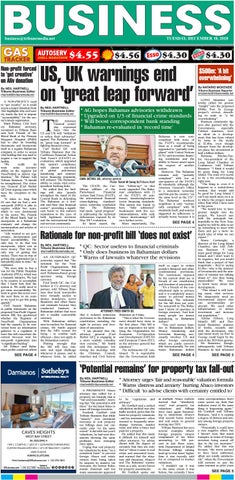
US, UK warnings end on ‘great leap forward’ By NEIL HARTNELL Tribune Business Editor nhartnell@tribunemedia.net
T
HE Attorney General yesterday expressed hope that the US and UK will “withdraw or soften their advisories” against The Bahamas after its “great leap forward” in fighting financial crime. Carl Bethel QC told Tribune Business that the Caribbean Financial Action Task Force’s (CFATF) reevaluation, which upgraded this nation’s compliance with almost one-third of global anti-money laundering and counterterror financing standards, will enhance The Bahamas’ ability to retain vital correspondent banking links. He added that the findings will also “greatly strengthen the hand of the Central Bank in defending The Bahamas as a lowrisk and blue chip financial centre”, providing a significant boost to this nation’s reputation in the eyes of both legitimate investors and the international financial services community.
AN OUTSPOKEN QC yesterday argued that “the rationale for the NonProfit Organisations Bill does not exist” because no such Bahamas-based group operates using foreign currency. Fred Smith QC, the Callenders & Co attorney and partner, told Tribune Business that local non-profits were virtually useless to money launderers, terror financiers and other financial criminals because they conducted business in Bahamian dollars that were not a readily convertible currency. With Bahamian dollars next-to-useless for financial crimes, Mr Smith argued that the bill’s reason for being - to combat such offences - does not apply in the Bahamian context. Hinting strongly that the bill will face lawsuits and legal challenge whenever it passes, and in whatever form, he added
Tribune Business Reporter
nmckenzie@tribunemedia.net
SEE PAGE 4
SEE PAGE 5
SEE PAGE 4
* QC: Sector useless to financial criminals * Only does business in Bahamian dollars * Warns of lawsuits whatever the revisions
ATTORNEY FRED SMITH QC that it violated numerous Bahamas on Friday. provisions in the Bahamian “This is what the Governconstitution including the ment should have done in right to privacy and free- the first place. This bill is dom of association. not an imperative for satis“I am pleased that the fying the Organisation for attorney general [Carl Economic Co-Operation Bethel QC] is engaging in and Development (OECD) a more realistic consulta- and European Union (EU), tion exercise,” Mr Smith as the attorney general has told this newspaper, fol- admitted.” lowing his meetings with The well-known QC conthe Christian Council, tinued: “It is regrettable churches and Civil Society that the Government finds
By NATARIO MCKENZIE
itself so eager to violate people’s financial and other constitutional provisions. The restrictions imposed by the current draft are in breach of our constitution and freedom of association. “It’s a breach of the constitutional right to privacy, and it is completely unnecessary to prevent money laundering. The rationale for the bill does not exist. No non-profit in The Bahamas I know of operates in foreign currency. And how many people are money laundering in Bahamian dollars? “You can’t money launder in Bahamian dollars. Money laundering and terrorism financing necessarily involves US and other foreign currencies which are easily convertible internationally. No one wants Bahamian dollars
Bahamas is now noncompliant with none of the FATF’s recommendations as a result of being upgraded to “partially compliant” with United Nations (UN) anti-terrorism financing resolutions and the ability to freeze assets upon the request of another nation. However, The Bahamas remains only “partially compliant” with ten or one-quarter of the FATF’s 40 standards, although the Attorney General’s Office in a statement yesterday said this put the country “on the same level as the US”. The Bahamas’ northern neighbour is only “technically compliant” with 30 standards itself, and sources suggested its adherence is actually worse because it is
Rationale for non-profit bill ‘does not exist’ By NEIL HARTNELL Tribune Business Editor nhartnell@tribunemedia.net
$500m: ‘A bit overwhelming’ LONG Islanders yesterday called for greater “insight” into the proposed $500m Port St George project’s revival, describing its scale as “a bit overwhelming”. Business community figures also queried why the Government, especially Cabinet ministers, were so silent on a development that has been valued by some in the media at $1.6bn, even though releases from the developers place the investment at half a billion dollars. Romona Ritchie-Taylor, vice-president of the Long Island Chamber of Commerce, told Tribune Business: “I think it would be great thing for Long Island. The scale of it seems to be a bit overwhelming right now. “The thing is, even if it happens in a scaled-down version, that would still be good for Long Island. I can’t say much more on it as to where the project stands other than what I have seen in the press. “We would love to have greater insight into the project. We haven’t met with the principals but, hopefully in the New Year, maybe we will be able to set up something to meet with them and get a more indepth idea of what we can expect.” Mario Cartwright, a director of the Long Island Chamber, also told Tribune Business: “I only want good things for Long Island, and I don’t want to be negative, but you would think that a project of that magnitude - they’re saying $1.6bn - why is the minister of investments and the minister of tourism not talking about it? Are they being stand-offish? We need to know more about this development. “This island is still lacking many vital services. We desperately need an international airport that can accommodate jet aircraft. We need other infrastructure to attract investment and increase our population.” Adrian Gibson, Long Island’s MP, and Desmond Bannister, minister of works, recently met with the developers, who said initial work on Port St George could begin by the end of the 2019 first quarter. Mr Bannister, though, subsequently told Tribune Business he had informed
* AG hopes Bahamas advisories withdrawn * Upgraded on 1/3 of financial crime standards * Will boost correspondent bank standing * Bahamas re-evaluated in ‘record time’
CARL BETHEL QC, attorney general. Photo: Terrel W Carey Sr/Tribune Staff The CFATF, the Car- first “follow-up” to that ibbean affiliate of the work, upgraded The BahaParis-based Financial mas’ compliance with 13 Action Task Force (FATF), of the FATF’s 40 antithe international financial money laundering/counter crime-fighting standard- terror financing standards. setter, yesterday concluded This nation was found to that The Bahamas have “fully addressed” had made “good progress” weaknesses with five recin addressing the technical ommendations, with only deficiencies exposed by its “minor shortcomings” left May 2017 evaluation. on a further seven. Its latest report, the More importantly, The
$4.30
‘Potential remains’ for property tax fall-out By NEIL HARTNELL Tribune Business Editor nhartnell@tribunemedia.net
CAVES HEIGHTS WEST BAY STREET
3A, BUILDING 4 2 BR | 2.5 BATHS | 1,855 SF | GERVASONI FURNISHINGS CUSTOM ITALIAN KITCHEN | 14’ X 35’ BALCONY | GATED WEB: TLND2R ASKING $1,075,000. Nick.Damianos@SIRbahamas.com • 242.376.1841
SIRbahamas.com t 242.322.2305
Member of The Bahamas MLS
A PROMINENT Abaco attorney has called for a property tax formula that is “fair and reasonable”, warning that “the potential is still there” for the latest hikes to scare off foreign investors. Frederik Gottlieb told Tribune Business that while “anxiety” over enormous increases in real property tax billings does not currently exist “to the same extent” it did with last year’s valuations, he had seen documents showing the same problems were emerging once again. Urging that real property tax valuations be done “on a consistent basis” to prevent foreign Abaco real estate owners from being taken by surprise by massive tax increases, the former Bahamasair chairman said too many assessments appeared
* Attorney urges ‘fair and reasonable’ valuation formula * Warns ‘distress and anxiety’ hurting Abaco investors * Difficult ‘to advise clients with certainty entitled to’ to be “capricious and arbitrary”. Mr Gottlieb said a settled calculation method was also badly needed, given that the basis for property valuations - and tax assessments - often seemed to frequently interchange between market value and what a buyer had paid for a property. He added that this made it difficult for himself and other attorneys “to advise clients with the degree of certainty that they are entitled to” when it came to real estate and associated taxes, and warned that the situation still threatens Abaco’s and The Bahamas’ reputations as a safe, secure haven for property assessments. Mr Gottlieb spoke out
as multiple Abaco realtors warned that “absolutely crazy” real property tax valuations and billings were once again threatening to undermine Abaco’s vital second home market and real estate in general moving into 2019. Tribune Business has seen several examples where foreign property owners complained of tax hikes amounting to 500 percent in just three years, with Department of Inland Revenue billings valuing land up to four times’ higher than it was recently sold for or compared to market valuations. “I wouldn’t say it was to the same extent it was before, but certainly I have
some correspondence that’s come across my desk that indicates some of the same thing is happening again,” Mr Gottlieb told Tribune Business, “and it is causing a degree of distress and anxiety among foreign property owners. “Potentially it could have a very negative effect, but I haven’t seen that much transpire in terms of foreign investors being scared off due to the tax increases.” He added that this was because “the worst seemed to have been addressed, albeit not totally satisfactorily”, when the Government told persons to pay the same amount as prior years
SEE PAGE 5
PAGE 2, Tuesday, December 18, 2018
THE TRIBUNE
Cruise bidder pledges partnership approach
O
NE of the three Nassau cruise port bidders is pledging to drive more passengers off-ship and increase their per capita spending in an effort to boost downtown Nassau businesses. Emre Sayin, Global Ports Holding’s chief executive, said in a statement that the group’s operation and management of Prince George Wharf will be directly linked to helping Bay Street’s wider transformation should its consortium be awarded the contract by the Minnis administration. “We recognise the potential of the Nassau cruise port to benefit not only Nassau, but The Bahamas as a whole, boosting the entire economy,” said Mr Sayin. “For us, this project is not just about improving the port, but rather about how improving the port will serve as a catalyst for revitalising the downtown core, rebranding Nassau as a destination, and bringing more people to The Bahamas. “While the cruise passenger arrival experience and improvements to the facilities are major factors in the success in each of the 15 cruise ports that we currently operate, a big part of our job is also to support the people of each destination that we serve. Currently, cruise lines prefer Nassau due to its proximity to major Florida ports. Our mission is to create a passenger demand-driven port from a convenience port.” Global Ports Holding, a UK-listed company that operates 15 cruise ports in the Mediterranean and Far East, has partnered with two Bahamian entities - BISX-listed Arawak Port Development Company (APD) and CFAL (formerly Colina Financial Advisors) - to bid on the Request for Proposal (RFP) to manage and upgrade Nassau’s cruise port. The RFP was itself triggered by the Global Ports Holding consortium’s
EMRE SAYIN, chief executive, Global Ports Holding. 49-page “unsolicited proposal” that was submitted to the Government in the summer. That proposal, previously exclusively revealed by Tribune Business, said its plans to transform Nassau’s cruise port would give the economy a $16bn boost spread over 30 years. It added that a $285.7m upgrade of Prince George Wharf through a waterfront entertainment park would inject an extra $216m into the Bahamian economy in the first year alone. Global Ports Holding’s revised proposal for the formal RFP is understood to involve a base $250m investment. “The Bahamas is one of the most beautiful and interesting places in the world,” Mr Sayin said in his statement. “We want to help Bahamians to enhance that beauty, benefit from it, and remind the world of it through creativity and innovation. We want to establish a genuine partnership with the people of The Bahamas in this transformative process. The time is now.” Global Ports Holding promised it will work with the Bahamian business community, especially merchants in the downtown Nassau area, to achieve goals tied to the cruise port’s redevelopment. These include getting more passengers to come off the ships and into Nassau; getting them to spend more
money; and driving more hotel visitors and Bahamians downtown to support local businesses there. A recent economic impact survey on behalf of the Florida-Caribbean Cruise Association (FCCA) found that cruise passenger spending in Nassau and Freeport soared by 59 percent over the past three years, making The Bahamas the third highest-yielding destination in the Caribbean. The study attributed the rise to increased luxury goods purchases, with per capita spending rising from $82.83 in 2015 - a low to average sum in comparison to the rest of the Caribbean - to $131.95 just three years later, an almost $50 increase. “In order for downtown Nassau to become a true city centre, we have to be strategic about its design, flow, function and operation,” added Mr Sayin. “We know that there are local organisations that have plans in the works to help make this happen. We are very interested in partnering with all groups involved in this process, and integrating the port to downtown Nassau. “This should be a worldclass city centre, sharing its unique flavour with the everyone who lives and visits here. The Bahamian people deserve it, and we are the team that can make that happen. We have done it successfully around the world and can do it here, too.” Global Ports Holding said six of the cruise ports it manages manages have been named as some of the world’s top destinations by Cruise Critic, a leading industry review website. Barcelona, Malaga, Venice, Lisbon, Singapore and Havana were each selected as a ‘top-rated cruise destination’ in the Cruise Critic 2018 Cruiser’s Choice Destination Awards programme. The winning destinations were selected by cruise passengers through the Cruise Critic website.
THE TRIBUNE
Tuesday, December 18, 2018, PAGE 3
EX-BPL CHAIR LAMENTS MISSED LNG POSSIBILITY
By NATARIO MCKENZIE
Tribune Business Reporter
nmckenzie@tribunemedia.net A FORMER Bahamas Power and Light (BPL) chairman yesterday urged the utility to “sort out” its Clifton power plant woes “sooner rather than later”, arguing that the country’s energy costs would now likely match Florida’s had his liquefied natural gas (LNG) plan been embraced. Leslie Miller, pictured, told Tribune Business: “They need to go and get Clifton sorted out so they can lower the cost
of electricity in this country. No one is saying anything about Clifton, the cost associated with the fires and when that situation is going to be resolved. They need to get Clifton sorted out sooner rather than later.” Dr Donovan Moxey, BPL’s chairman, recently indicated that it is still awaiting final reports from its insurers over the fires. But, as the Government moves forward with the Shell deal to construct a new multifuel power plant, Mr Miller lamented what he described as a missed opportunity more than a decade ago.
Then a Cabinet minister, he had strongly advocated for LNG during his tenure
GB resort targets March for 50% room renovation
INVITED guests inspected Pelican Bay’s brand new decor, and were presented with gift bags. The resort’s corporate customer base has experienced siginificant growth over the past two years.
FROM left: Magnus Alnebeck, general manager, Pelican Bay; and Ryan Graham, president of YellowFin Construction. Photos: Derek Carroll Photography/Barefoot Marketing GRAND Bahama’s Pelican Bay resort plans to complete the renovation of half its room inventory by mid-March 2019 after investing $4m to finish 45 units in time for Christmas. Management and staff hosted a customer appreciation and new room viewing evening for their large volume clients last week, honouring a market segment that has driven the record numbers experienced by Pelican Bay over the past two years. “We really wanted to express our thanks to our corporate bookers for the business they have sent us over the past two years and, we hope, the business they will send us in the future,” said Magnus Alnebeck, Pelican Bay’s general manager. “We now have 45 beautiful rooms that have been totally renovated by local contractors with new bathrooms, new air conditioning units, new technology and new furniture, which will be in use for Christmas. Our goal is to then work on another 42 rooms with a mid-March 2019 deadline, expecting to have half of the hotel renovated.” Following the damage inflicted by Hurricane Matthew in October 2016, Pelican Bay scheduled planned repairs that were effected by Bahamian companies YellowFin Construction, as the lead contractor, and FRECON, which executed minor hurricane repairs.
During that time, the property continued to operate with a large percentage of room bookings coming from Bahamian and new businesses coming to the island. “Our corporate sector is doing very well,” explained Mr Alnebeck. “We decided to invest our repair funds and profits right back into the property. The renovated rooms have not been changed since 1996. Some minor work was done to the rooms over the years, but this time they were completely gutted and totally re-done.” The rooms have been transformed into a modern but comfortable décor encompassing both European and island themes. Some $4m has been invested to create subtle but impactful changes. “We know that our guests come to The Bahamas to enjoy things that are distinctly Bahamian, and we wanted them to have that authentic island experience from the moment that they check in to their hotel rooms,” said Pelican Bay operations manager, Della Bridgewater. “We value our corporate and leisure guests. We want our new décor to be an addition to our visitors’ experience at the hotel. We appreciate every room reservation booked. Pelican Bay has built a great corporate culture with our local, domestic and international guests; they have sustained us and have really contributed to our bottom line.”
as minister of trade and industry in the first Christie administration. “Everyone today is talking LNG. I see now that the cruise ships are talking about LNG,” Mr Miller said. “In 2005 when we were talking about those things people, especially the armchair environmentalists, were raising hell. They said we were going to blow up the place. That was a huge missed opportunity for the country and it bothers me. Our prices would have been pretty much competitive with Florida today.” Mr Miller, though,
praised BPL for giving consumers a break during the Christmas holidays in an effort to help consumers keep their lights on. Around 15,000 BPL customers will be able to benefit from the utility’s Decemberonly offer, according to Dr Moxey. BPL will allow customers more than 60 days in arrears to pay 25 percent of their outstanding balance by December 21 to avoid disconnection. Customers who have been disconnected can be connected in time for Christmas if they pay 25 percent of their existing
outstanding bills on or before the close of business on December 19. Mr Miller told Tribune Business: “When we were there we had implemented two polices. During the month of September we gave people a break. We gave consideration to the fact that they had school fees to pay and then, in December, given that people normally try to put food on the table and buy a few gifts. I’m happy that they are doing at least one of those things. Let’s hope that they keep going.”
PAGE 4, Tuesday, December 18, 2018
THE TRIBUNE
US, UK warnings end on ‘great leap forward’ FROM PAGE ONE non-compliant in four areas. Still, despite The Bahamas’ improvement, it remains under the CFATF’s “enhanced follow-up” programme for countries with major deficiencies in their financial crime defences. This is because it has “a low or moderate level of effectiveness” in actually implementing the FATF’s standards, with deficiencies identified in seven of the 11 areas assessed. And The Bahamas also stays on the FATF’s ‘watch list of countries with “structural deficiencies” relating to the same implementation issues, even though some in the financial services industry believe the country should be given credit as a result of its Caribbean affiliate’s latest assessment. Mr Bethel yesterday said The Bahamas was “the first country in the region” to request a re-evaluation, and be upgraded, within a year of an unfavourable CFATF assessment. He argued that this achievement “marks The Bahamas as a very important and special member of the international financial community”. “It’s very important. There are thousands of
Bahamians who depend on the financial services sector for high-paying and middle class jobs. It’s a vital sector of our economy,” Mr Bethel told Tribune Business of the CFATF report. “What you see today is a great leap forward for The Bahamas. “I cannot recall a time in the last decade when we’ve been upgraded on any aspect of our financial services industry; it’s always been threats of ‘blacklisting’ or ‘grey listing’. We are well on our way to getting off this compliance [CFATF] programme...” The attorney general expressed optimism that the favourable CFATF review would persuade the US Treasury Department and UK Treasury to either remove or moderate advisories warning their financial institutions to apply extra scrutiny to customer relationships and dealings with The Bahamas. “The importance of this is that the Central Bank will be able to reach out to the US Treasury and the UK Treasury to see whether or not it can get them to withdraw or soften their advisories against The Bahamas,” Mr Bethel said, adding that the upgrades will also strengthen this nation’s correspondent banking ties.
“The Central Bank is engaged in an ongoing programme of consultation and correspondence with correspondent banks around the world,” he continued. “This greatly strengthens the hand of the Central Bank in defending The Bahamas as a low-risk, blue chip financial centre; one that the correspondent banks can take comfort in that The Bahamas has achieved a high level of compliance.” It is uncertain whether the US and UK will relax their advisories on The Bahamas, given that these were sparked by this nation’s inclusion on the separate FATF “watch list” - not the CFATF’s initial evaluation findings. However, the latter’s upgrading of The Bahamas’ could boost this nation’s correspondent banking relationships, which are vital to this nation’s standing as an international business centre as they enable local companies to conduct global commerce and transactions overseas. Correspondent banks often base decisions to maintain these relationships on risk perceptions, particularly the quality of anti-financial crime defences in the foreign bank’s home country,
so the CFATF re-evaluation may help The Bahamas in this area. Mr Bethel, meanwhile, argued yesterday that The Bahamas had scored a Caribbean first by being upgraded so quickly by the CFATF following last May’s evaluation. “We are working aggressively, sometimes too aggressively for some, but with good intent for all,” he told Tribune Business. “We have to continue to do our very best. We are fighting on many fronts. It was this drive that led The Bahamas to be the first country in the region to do this in one year. No other country had the courage to ask for a re-evaluation in that time. “The Bahamas has clearly shown the world that when we put our minds to it, we do the job and do it well. That marks The Bahamas as a very important and special member of the international financial community. We finalised our National Risk Assessment in record time.” Mr Bethel said The Bahamas’ passage of the new Financial Transactions Reporting Act and Proceeds of Crime Act, together with changes to the Anti-Terrorism Act and publication of this nation’s National Risk Assessment (NRA)
on money laundering and other financial crimes, had resulted in the CFATF’s reevaluation upgrade. A parliamentary resolution is now required to bring the Anti-Terrorism Act’s regulations into effect, and Mr Bethel reiterated that passage of the Non-Profit Organisations Bill would have brought The Bahamas into compliance with two more of the FATF’s standards. However, he confirmed that the Government’s focus was now switching from legal reforms to implementation, and doing what was necessary to meet its “Action Plan” commitments to the FATF and escaping that group’s ‘watch list’ by September 2019. That requires meeting the FATF’s 11 implementation “outcomes”, with The Bahamas’ progress in this area due to be assessed at meetings of the Paris-based organisation in February and June next year. “It’s now not a question of any further legal reforms per se,” Mr Bethel said. “It’s all about implementation of what we have, not just passing the law. We have to prove, show implementation, show results. We have taken a great leap forward; it’s now merely a question
of making sure the system works.” This means The Bahamas has to provide evidence of a sufficient number of money laundering prosecutions for a financial centre of its size, as well as showing it is aware of risks posed by crimes such as human trafficking, corruption and the proliferation of weapons of mass destruction. Mr Bethel said case management software had been installed in the Attorney General’s Office last week to enable staff to better track the progress of cases, and see what needed to be done next, while similar technology is in the process of being obtained by the Financial Intelligence Unit (FIU). Both issues are key demands of the FATF. “Together, if we can all continue to work, we will eventually be successful in removing any blemish on the quality of our legal and supervisory framework, and preserve the reputation of The Bahamas as a clean, effective, low-risk and compliant international financial services jurisdiction for the benefit of global commerce and every Bahamian,” the Attorney General’s Office said.
Rationale for non-profit bill ‘does not exist’ FROM PAGE ONE that non-profits in The Bahamas operate with,” Mr Smith argued. “The rationale for this legislation as somehow preventing terrorism financing and money laundering is a misconception, and the Government is trying to pull the wool over the eyes of the Bahamian people.” The Government, though, is likely to vehemently dispute Mr Smith’s analysis even though it has already acknowledged that the main motivation behind the NonProfit Organisations Bill is to bring the sector - and, by extension, The Bahamas - into compliance with global standards in the fight against financial crime. Mr Bethel, the attorney
general, previously confirmed Tribune Business revelations that the Financial Action Task Force (FATF), which recently placed The Bahamas on a monitoring or “watch” list because of “structural deficiencies” in its antifinancial crime defences, was particularly vexed about this nation’s minimal to non-existent regulation of non-profit entities. The Government will likely counter Mr Smith’s argument by saying many Bahamians non-profits are likely to receive donations in foreign currency from outside sources. And there is also the possibility that some may engage in activities, and be involved with issues, outside The Bahamas will conducting no activities in this jurisdiction.
But Mr Smith, who is also legal director for the highprofile non-profit, Save The Bays, yesterday told Tribune Business that litigation was highly likely should the Government proceed with the Non-Profit Organisations bill even if was substantially revised prior to returning to Parliament. “I can guarantee that in whatever form this bill finally passes, it will be strongly challenged over invasion of privacy, breach of our rights to freely associate,” he blasted. “I am dismayed by the extent to which my government seems to freely enact regressive and unconstitutional legislation. “I urge them to stop, because when the FNM is no longer in power, the legislation which they have
passed will be used to annihilate freedom of expression and privacy. Therein lies the mischief with this kind of legislation; it’s potential for abuse.” Legal action from the church is especially likely, given that it appears to be on a collision course with the Government over its demands to be completely exempted from the bill’s provisions. Mr Bethel yesterday told Tribune Business that the Government believes it has “accommodated 80-90 percent” of non-profit concerns over plans to regulate the sector, having agreed to make the legislation less onerous and “more user friendly”. Speaking following his meeting with the Christian Council and church leaders
on Friday, Mr Bethel said they cited one other jurisdiction that had developed a law exempting the church from such regulation, arguing it has established a precedent to justify their demands. The attorney general, though, described the church’s viewpoint as an “unsustainable position”, adding that the information he possessed contradicted their assertions. While agreeing that one country had drafted such a law, he added that it never been brought to Parliament or passed on to the statute book. “What we have done is drafted a series of amendments that will remove the bulk of their concerns, save for this one issue of complete exemption for the
church,” Mr Bethel told Tribune Business, “which in my view is not a sustainable position. But we’re assessing to see what other jurisdictions did with it. “The church is seeking either a complete exemption, and they are saying there is some law in one other jurisdiction that enabled them to do so,” the attorney general added. “My information is that it is not accurate that there is any law in any jurisdiction that gives an exemption to the church. “One jurisdiction drafted something along those lines, but it was not tabled in Parliament. There is no jurisdiction that has done that. I’ve asked for a copy of that legislation but can’t get it because it was only a draft and never passed into law.”
Non-profit forced to ‘get creative’ on Aliv donation FROM PAGE ONE to “sit twiddling their thumbs” waiting for registration applications under the new legislation to be approved, with Civil Society Bahamas having warned: “It is currently taking two years to register non-profits, and the increased information required under this bill for registration is anticipated to cause a significant backlog and does not augur well, evidencing an equal lack of the Government’s capacity for implementation.” Following Friday’s meeting with Mr Bethel, Civil Society Bahamas again raised concerns about the
To advertise in The Tribune, contact 502-2394
lack of accountability when it came to the speedy registration of the non-profit sector. Dr Anthony Hamilton, its president, said: “The BVI Act, which the Government apparently benchmarked, provides that within 30 working days of receiving a registration application from an NPO, the registrar must consider it and if satisfied that the applicant complies with the requirements for registration, approve the application. “This provides a level of accountability that currently does not exist within our registrar. It often takes two years or more to register as a new non-profit. While we commend the Government’s commitment to significantly simplify the registration requirements within the Non-Profit Organisations Bill, without this important safeguard we fear non-profit registration
will continue to be a daunting task.” Meanwhile, Civil Society Bahamas (CSB) yesterday denied that it had sought to make the Government “bow” to pressure to change the Non-Profit Organisations Bill, adding that it did not want to be “confrontational” on the matter. The group, which purports to represent over 300 nonprofit and civil society groups, said: “By releasing information from the meeting, CSB wanted to let our partners and members know about the various positive issues that the attorney general had asked draftspersons in his office to make. It was not CSB’s intention in any way to be seen as trying to ‘force the Government’s hand’.” Dr Hamilton added: “In hindsight we should have clarified that the discussions were mutually agreed upon for public discussion.
We have reached out to the attorney general today to reassure him of our intention to continue to consult in good faith. We believe the attorney general will take the necessary steps to make this bill as positive as possible for our sector, and we look forward to seeing the bill again, once the drafting is complete.” Mr Palmer added: “CSB is committed to national development planning through the achievement of sustainable development and environmental goals. Constructive dialogue is an important part of this process, and it is our intention to establish civil society as a trusted and valuable partner in the tripartite process. As this is a relatively new process, there will be teething issues, and we will do all we can to improve the process and make that engagement as constructive as possible.”
GINGERELLA GROUP LTD. Company No. 1616499 (In Voluntary Liquidation) NOTICE is hereby given pursuant to Section 204 (1)(b) of the BVI Business Companies Act, 2004 that GINGERELLA GROUP LTD. is in voluntary liquidation. The voluntary liquidation commenced on 12th December, 2018 and Rahel Ruth Kieber of Dorfstrasse 7A, 9495 Triesen, Principality of Liechtenstein, has been appointed as the Sole Liquidator. Dated this 14th day of December, 2018 Sgd. Rahel Ruth Kieber Voluntary Liquidator
THE TRIBUNE
Tuesday, December 18, 2018, PAGE 5
‘Potential remains’ for property tax fall-out FROM PAGE ONE and apply for reevaluations following the outcry over 2018 real property tax billings. However, Mr Gottlieb warned: “The potential is still there, and the correspondence I’ve seen from the individuals affected is negative. It’s a question of how much is promulgated by them outside the country.” He added that many of the challenges threatening Abaco’s real estate market, especially the second home industry that is vital to its economy, could be resolved if “a better system is put in place for valuations on a consistent basis that are fair and reasonable, and do not come as a sudden
surprise to foreign property owners”. “It’s not a satisfactory situation,” Mr Gottlieb said. “It appears to be very capricious and arbitrary how this is carried out. It does not happen for long intervals and then there’s a heavy increase and no nexus to the true market value of the property. “It does cause a lot of disquiet and apprehension. There has been some negative fall-out, not recently, but the potential is there and the Government should take note.” He added: “The Government is trying to address some of the problems that exist in the Department of Inland Revenue in trying to come up with some acceptable way of determining what tax is owed on a more
regular basis, and one that is fair and reasonable. “The big problem is that the particulars keep changing with regard to real property tax. One day it’s based on purchase price, the next day it’s considered to be the market value of the property. “One never knows what you’re up against, and it’s very difficult for colleagues - myself included - to advise clients with the degree of certainty that they are entitled to. I think the Government is trying to address the situation.” Marlon Johnson, the Ministry of Finance’s financial secretary, told Tribune Business that the Government is planning to “tighten up” real property tax legislation and employ “modern real estate technology to
assist with mapping and valuations. While the Ministry of Finance was unaware of any “widespread concerns” over 2019 valuations from Abaco or any other island, the top official called on those believing they are being over-taxed to come forward. “There will be people who take issue with their valuations, and we certainly want them to make themselves known to the Abaco office or office of the Department of Inland Revenue in New Providence,” Mr Johnson said. “We’ll happily take a look at them if there’s any merit to their particular complaint. “There’s a valuation methodology in place. If persons feel the valuation is not accurate, they can come
in, have a discussion with us, and we will go and do another look. In cases like that, tell folks to let us know. We want to make sure valuations are accurate. “We are looking at legislation to tighten that up where possible. We will be making the investment in software and processes around land evaluations in coming years.” Confronted by Tribune Business with the complaints from Abaco about discrepancies between property tax billings and valuations, which were detailed in Tribune Business on Monday, Mr Johnson replied: “I don’t see any evidence of that yet.’ “We’ve not had widespread concerns about that. We do have individuals
who have issues from time to time, and they will be dealt with on a case-by-case basis. We have seen nothing yet to suggest systemic risk because of valuation concerns.” Mr Johnson said the Real Property Tax Act imposed a legal obligation on real estate owners to notify the Department of Inland Revenue about any improvements made to their property, but conceded that the law stipulated the period when valuations should take place. “We will be taking steps to comply with that, and feel we can utilise technology and modern real estate technology to make the exercise more timely with respect to real property tax valuations,” he told Tribune Business.
$500m: ‘A bit overwhelming’ FROM PAGE ONE the developers to “come back and see me when you have a Heads of Agreement”. He described the meeting as “a courtesy call”, adding that he knew nothing about efforts to revive the Port St George development, which has been stalled for almost a decade, and did not discuss with the investors/ developers whether they had started the process of applying for the necessary investment and planning approvals. Mr Gibson, though, issued a much more upbeat What’s App message to his constituents on both the meeting and the development. “Today, minister of public works, Desmond Bannister, and I met with the developers - Duane Gerenser (president, Star Resorts Group); James Moss (principal and Board member); and Sean Callender (attorney)-- of the proposed Port St George resort project,” he wrote. “In sharing their plans for the upcoming mixeduse resort (hotel rooms, luxury condos/villas), the developers spoke of their intent to embark upon a socially and environmentally sustainable project. “We were advised that as the project gets underway, persons will be employed from the immediate locality (Long Islanders first), the wider Bahamas and, in instances where additional expertise is needed, internationally.” Mr Gibson continued: “We were informed that initial works are projected to commence in the latter part of the first quarter of
2019. They stated that first phase of construction will see the dredging and development of the harbour/ marina (640 slips); construction of 60 units; and the build-out of a soccer field, baseball/softball field, tennis court, a cricket pitch, the 18-hole golf course/golf club and a track. The developers further advised that, given the scope of the project, final completion would take four to five years. “The developers shared their plans to re-route the Queens Highway; incorporation of alternative energy sources in their operations; construction of a Customs house, fire station, small medical facility, fuelling docks, a culinary institute... “Moreover, they expressed a willingness to incorporate Bahamian/ local entrepreneurs in their final project as well as the local community. Like many Long Islanders, we remain hopeful that such a project - which will no doubt improve and contribute positively to the state of affairs on Long Island comes to fruition.” When the Port St George project was unveiled in 2008, it was touted as creating over 300 jobs on a 951.4-acre site in northern Long Island. It featured plans for a boutique hotel with 146 suites/villas; 60 boutique villas; more than 300 residential lots and 331 multi-family lots; and marinas with numerous boat slips; plus golf courses, a town centre and other resort/community amenities. The project was projected to have an annual economic impact of between $54m to $90m, and at the time the developers
had also signed a 25-year management agreement with Langham Hotels International. Some 875 construction workers were forecast to be employed over the build-out phase. Port St George, though, became a casualty of the 2008-2009 “credit crunch” and subsequent global recession, which dried up all potential sources of funding. In 2014 the original developers, Ian Moorcroft and his business partner, Jon Houghton, were said to be hunting for a joint venture partner to move the proposed $110m development forward. Nothing was heard subsequently until Star Resort Group issued a press release several months ago detailing its efforts to revive Port St George. Clairfield International, which advertises itself as “mid-market” mergers and acquisitions specialist working on transactions up to 500 million euros in value, was said to have “arranged funding”.
To advertise in The Tribune, contact 502-2394
FOCOL HOLDINGS LTD. NOTICE OF FILING EXTENSION Notice is hereby given that The Bahamas International Securities Exchange (BISX) has granted an extension for the filing of the audited financial statements for the year ended 31st July 2018. The extension was requested as a result of the implementation of a new Enterprise Resource Planning (ERP) system to improve our administrative and operational efficiency. Our ERP systems implementation team require additional time to perform validation procedures to ensure that our financial statements comply with International Financial Reporting Standards. The audited financial statements for FOCOL Holdings Limited (FOCOL) will be submitted to BISX and published in the newspaper on or before 11th January 2019. Due to this delay, FOCOL will also be required to delay the publication of our Q1-2019 unaudited financial statements to 31st January 2019.
“Fuelling Growth For People”
PAGE 6, Tuesday, December 18, 2018
THE TRIBUNE
SILICON VALLEY EAST: GOOGLE PLANS $1B EXPANSION IN NEW YORK By MAE ANDERSON Associated Press SILICON Valley is becoming Silicon Nation. Google announced yesterday it will spend more than $1bn to build a new office complex in New York City that will allow the internet search giant to double the number of people it employs there. It is the tech industry’s latest major expansion beyond the Seattle-San Francisco Bay corridor. It follows recent steps by Amazon and Apple to set up large operations well outside their home turf. Tech companies are “coming to the realisation that the Bay Area, which has traditionally been the major centre of tech activity in the US, is getting expensive and crowded,” said Andrew Bartels, principal analyst at Forrester Research. “A lot of vendors are coming to the realisation that ‘We can probably find top talent elsewhere at a more affordable costs, and perhaps a better style of life for employees who may be struggling to make ends meet.’” The Northeast is attractive because of its large concentration of highly educated young people. New York in particular also offers proximity to Wall Street and already has the second-biggest concentration of tech startups behind the Bay Area and a large base of tech employees, Bartels said. Facebook, based in Menlo Park, California, has over 2,000
THIS artist rendering provided by COOKFOX architects shows a building conceived by COOKFOX architects at 550 Washington Street to house an expansion by Google on Manhattan’s west side at the site of the former St John’s Terminal. It’s part of a new office complex Google said yesterday, it was spending more than $1bn to build, allowing the internet search giant to double the number of people it employs there. Photo: Oxford Properties/AP employees in New York. Google, based in Mountain View, California, will fashion a complex of more than 1.7 million square feet along the Hudson River in the city’s West Village neighbourhood, Ruth Porat, senior vice president and chief financial officer, said in a blog post. Google opened its first
office in New York nearly 20 years ago and now employs 7,000 people in the city. Its footprint is expanding rapidly. Google said earlier this year that it would buy the Chelsea Market building for $2.4bn and planned to lease more space at Pier 57, both along the Hudson about a mile north of the newly announced complex.
Porat telegraphed Google’s plans to double down in New York a month ago during a technology conference. “Not everybody — big surprise — wants to live in Silicon Valley, so we want to make sure we have the opportunity to build vibrant centres across the country,” she said.
NOTICE CAROLITO LTD. N O T I C E IS HEREBY GIVEN as follows: (a) CAROLITO LTD. is in voluntary dissolution under the provisions of Section 138 (4) of the International Business Companies Act 2000. (b) The dissolution of the said company commenced on the 11th December, 2018 when the Articles of Dissolution were submitted to and registered by the Registrar General. (c) The Liquidator of the said company is CST Administration (Bahamas) Limited, The Bahamas Financial Centre, Shirley and Charlotte Streets, PO Box N-3023 Nassau, Bahamas Dated this 18th day of December, A. D. 2018 _________________________________ CST Administration (Bahamas) Limited Liquidator
NOTICE
NOTICE
KUREDU LIMITED
ZERMAT MANAGEMENT LIMITED
N O T I C E IS HEREBY GIVEN as follows:
N O T I C E IS HEREBY GIVEN as follows:
(a) KUREDU LIMITED is in voluntary dissolution under the provisions of Section 138 (4) of the International Business Companies Act 2000.
(a) ZERMAT MANAGEMENT LIMITED is in voluntary dissolution under the provisions of Section 138 (4) of the International Business Companies Act 2000.
(b) The dissolution of the said company commenced on the 5th November, 2018 when the Articles of Dissolution were submitted to and registered by the Registrar General.
(b) The dissolution of the said company commenced on the 11th December, 2018 when the Articles of Dissolution were submitted to and registered by the Registrar General.
(c) The Liquidator of the said company is CST Administration (Bahamas) Limited, The Bahamas Financial Centre, Shirley and Charlotte Streets, PO Box N-3023 Nassau, Bahamas
(c) The Liquidator of the said company is CST Administration (Bahamas) Limited, Shirley and Charlotte Streets, Nassau, Bahamas
Dated this 18th day of December, A. D. 2018
Dated this 18th day of December, A. D. 2018
_________________________________ CST Administration (Bahamas) Limited Liquidator
_________________________________ CST Administration (Bahamas) Limited Liquidator
The news follows Seattle-based Amazon’s announcement a month ago that it would set up new headquarters in New York’s Long Island City neighbourhood and in Arlington, Virginia, creating upwards of 25,000 jobs in each location. But it’s not just the East Coast that is benefiting from the expansion. Apple, based in Cupertino, California, said last week that it plans to build a $1bn campus in Austin, Texas, that will create at least 5,000 jobs. Even as it looks elsewhere, Google is still buying offices and drawing up plans to construct new campuses near its headquarters, as it tries to build upon its success in internet search, email, web browsers, digital mapping, online video and smartphone software to make money in other markets such as health care and internet-connected homes. The company recently agreed to pay more than $100m for a swath of land in downtown San Jose, California, for a big new campus that will include employee housing. Microsoft likewise is overhauling its headquarters in Redmond, Washington, with an 18-building construction
project that will make room for an additional 8,000 workers. It currently employs about 47,000 in the area. But the competition for programmers is driving salaries higher, which in turn is catapulting the average prices of homes in many parts of the San Francisco Bay Area above $1m. Many high-tech workers are choosing to live elsewhere, forcing major tech companies to look in new places for the employees they need. Google hopes to move into the new campus by 2020. Porat said that the company’s most recent investments give it the ability to more than double the number of Google employees in New York over the next ten years. Tech companies see New York as a way to gain a new perspective, one that is different from that of Silicon Valley, which can be seen as an “out-of-touch echo chamber,” Bartels said. “New Yorkers consider themselves to be more in tune with the reality of life in US urban centers and believe this helps them innovate products and services that are more closely aligned with the needs of the average American,” he said.
THE TRIBUNE WASHINGTON Associated Press A FEDERAL judge’s ruling would, if upheld, wipe away the entire Affordable Care Act, the health care overhaul championed by President Barack Obama and twice sustained by the Supreme Court. Judge Reed O’Connor’s opinion was issued late Friday, and supporters of the law vowed to appeal and take other steps to preserve health benefits in the law sometimes called “Obamacare”. Some questions and answers about O’Connor’s ruling: WHAT IS THE IMMEDIATE EFFECT OF THE RULING FOR AMERICANS COVERED UNDER OBAMACARE? In a word, nothing. Although O’Connor said the entire law must fall, he did not grant a request from its opponents to have his ruling take effect immediately. That means that all the law’s provisions remain in effect. The federal Health and Human Services Department put out a statement making clear that it “will continue administering and enforcing all aspects of the ACA as it had before the court issued its decision”. HOW WOULD THE AVERAGE PERSON’S HEALTH CARE BE AFFECTED IF THE RULING IS UPHELD? The impact would go well beyond the more than 20 million people who are
Tuesday, December 18, 2018, PAGE 7
After judge’s ruling against ‘Obamacare,’ what happens now? directly covered through Obamacare. More than 170 million Americans are covered by employers, and they could lose no-cost preventive care, from screening tests like colonoscopies to birth control for women. Employers would no longer be required to keep the young adult children of their workers covered up to age 26. Gone would be limits on annual out-ofpocket expenses, which provide greater financial protection for people with job-based coverage. Another kind of limit — lifetime caps on what insurance will pay for medical bills — could stage a comeback. Medicare would be affected because the ACA expanded no-cost coverage of preventive services and reduced the bills of seniors with high prescription drug costs. Programme finances would also take a hit. Medicaid, the federal-state programme for low-income people, was expanded under the ACA. So about 12 million people who gained coverage could
be left uninsured. Efforts to counter the opioid epidemic would be dealt a severe blow since Medicaid has become a mainstay for treatment. HealthCare.gov and state insurance markets offering subsidised private insurance would disappear, potentially leaving ten million people or more uninsured. And the list would go on. The health law made hundreds of changes. WHAT WAS THE JUDGE’S REASONING IN STRIKING DOWN THE ENTIRE HEALTH CARE LAW? A key part of the Affordable Care Act that Obama signed into law in 2010 was the provision requiring people to have health insurance or pay a penalty if they refused. The Supreme Court upheld this individual mandate in 2012. Congress reduced that penalty to zero as part of the tax legislation it passed, and President Donald Trump signed, in 2017. That means that beginning in January, there no longer will be a
penalty for not purchasing health insurance. O’Connor agreed with Texas and other Republican-led states that challenged the law that the elimination of the penalty rendered the requirement to have health insurance unconstitutional. In a crucial step in his logic, O’Connor then held that because the individual mandate is so important to the overall law, the whole thing can no longer stand. The legal explanation is that O’Connor found that the mandate could not be severed from the rest of the law, meaning he struck it down in its entirety. HOW LIKELY IS IT THAT HIGHER COURTS WILL AGREE WITH O’CONNOR’S RULING? Even some opponents of the health care law, including The Wall Street Journal editorial page, have said O’Connor went too far and predicted he would be reversed in the appeals process. Congress did indeed render the individual
mandate unenforceable when it reduced the penalty for not complying to zero. But that very same Congress left the rest of the law intact. What’s more, Republican efforts to repeal the ACA failed in the same Congress. In addition, even if the federal appeals court that oversees Texas were to agree with O’Connor, it seems improbable at best that Chief Justice John Roberts, who twice wrote opinions upholding the law — in 2012 and 2015, would now strike it down. WHO WILL APPEAL THE RULING, AND HOW LONG MIGHT THE PROCESS TAKE? California Attorney General Xavier Becerra, the leader of a coalition of states defending the law in court, already has promised to appeal. The process will take months at a minimum, even with the states pressing for a speedy resolution because of the uncertainty O’Connor’s ruling creates and the potential effects on the insurance markets. If the 5th US Circuit
Court of Appeals reverses O’Connor, chances that the Supreme Court would hear the case are slim. If the 5th Circuit agrees with O’Connor, high court review becomes very likely because the justices almost always weigh in when a federal law has been struck down. But even then, the Supreme Court wouldn’t hear the case before the fall of 2019 at the earliest, with a decision unlikely before the spring of 2020 — amid the presidential and congressional campaigns. HOW WILL CONGRESS RESPOND? Democrats in the House say they plan to intervene in the defense of the law, joining Democrat-led states. In addition, expect hearings in the House to focus on Trump administration efforts that Democrats, who take charge of the House in January, say are intended to undermine the health care law. These include encouraging the use of low-cost short-term policies with limited coverage and cuts to government attempts to sign up beneficiaries. Rep Frank Pallone, the incoming chairman of the House Energy and Commerce Committee, said Democrats are readying bills to curb the use of the short-term plans and bolster the Obama law’s coverage of people with pre-existing conditions. The bill could also make federal subsidies for lower-earning beneficiaries more generous and shore up insurers for covering seriously ill customers with extremely high costs of care, he said.
DOW JONES INDUSTRIALS TAKE SECOND STRAIGHT 2-PERCENT PLUNGE NEW YORK Associated Press ANOTHER day of big losses knocked US stocks to their lowest levels in more than a year yesterday. Investors dumped highgrowth technology and retail companies as well as steadier, high-dividend companies. Oil fell below $50 a barrel for the first time since October 2017. Hospitals and health insurers slumped after a federal judge in Texas ruled that the 2010 Affordable Care Act is unconstitutional. Other stocks wobbled in morning trading, then plunged in the afternoon. The Dow Jones Industrial Average fell 507 points after a 496 point drop on Friday. Amazon led a rout among retailers and tech companies including Microsoft turned sharply lower. Some of the largest losses went to utilities and real estate companies, which have done better than the rest of the market during the turbulence of the last three months. “That is basically retail investors panicking,” said Mark Hackett, chief of investment research at Nationwide Investment Management. “Investors basically are confusing the idea of a slowdown with a recession.” But investors dumped almost everything. Less than 40 of the 500 stocks comprising the S&P 500 finished the day higher. The S&P 500 index, the benchmark for many investors and funds, finished at its lowest level since Oct 9, 2017. It has fallen 13.1 percent since its last record close on Sept 20. The Russell 2000, an index of smaller companies, has dropped more than 20 percent since the end of August, meaning that index is now in what Wall Street calls a “bear market”. Germany’s main stock index also fell into a bear market yesterday as companies like Siemens and SAP kept falling. Smaller US stocks have taken dramatic losses as investors have lost confidence in the US economy’s growth prospects. Smaller companies are considered more vulnerable in a downturn than larger companies because they are more dependent on economic growth and tend to have higher levels of debt. Hackett said the current drop is similar to the market’s big plunge in late 2015 and early 2016, which was also tied to fears that the global economy was
weakening in a hurry. But even though the economy is slowing down after its surge in 2017 and 2018, it should continue to do fairly well. “It’s a slowdown from extremely high levels to healthy levels,” he said. “The globe isn’t going into a recession.” The S&P 500 skidded 54.01 points, or 2.1 percent, at 2,545.94. The Dow Jones Industrial Average lost 507.53 points, or 2.1 percent, to 23,592.98. The Nasdaq composite fell 156.93 points, or 2.3 percent, to 6,753.73. The Russell 2000 index dipped 32.97 points, or 2.3 percent, to 1,378.14. Following the health care ruling, hospital operator HCA dropped 2.8 percent to $123.1 and health insurer UnitedHealth lost 2.6 percent to $258.07. Centene, a health insurer that focuses on Medicaid and the Affordable Care Act’s individual health insurance exchanges, fell 4.8 percent to $121.42 and Molina skidded 8.9 percent to $120. Many experts expect the ruling will be overturned, but with the markets suffering steep declines in recent months, investors didn’t appear willing to wait and see. Benchmark US crude fell 2.6 percent to $49.88 a barrel in New York. Brent crude, used to price international oils, dipped 1.1 percent to $59.61 a barrel in London. Weaker economic growth would mean less demand for oil, and traders have been concerned there is too much crude supply on the market. That’s chopped oil prices by one-third since early October. Bond prices rose. The yield on the ten-year Treasury note fell to 2.86 percent from 2.89 percent. The Federal Reserve is expected to raise interest rates again tomorrow, the fourth increase of this year. It’s been raising rates over the last three years, and investors will want to know if the Fed is scaling back its plans for further increases based on the turmoil in the stock market over the last few months and mounting evidence that world economic growth is slowing down. Hackett, of Nationwide, said investors will be happy if the Fed adjusts its plans and projects fewer increases in interest rates next year. But he said investors might be startled if the Fed doesn’t raise rates this week, as has been widely expected. British Prime Minister Theresa May said Parliament will vote Jan 14 on her
deal setting terms for Britain’s departure from the European Union. She cancelled a vote on the deal last week because it was clear legislators were going to reject it. May insists she can save the deal, but pressure is mounting for either a vote by lawmakers or a new referendum on the issue. Britain is scheduled to leave the EU in late March, and if it does so without a
deal in place governing its trade and economic relationships with the bloc, it could bring huge disruptions to the British and European economies and financial markets. Germany’s DAX lost 0.9 percent. That means the DAX, which represents Europe’s largest single economy, is also in a bear market. France’s CAC 40 and Britain’s FTSE 100
both fell 1.1 percent. Japan’s Nikkei 225 index added 0.6 percent and the Kospi in South Korea gained 0.1 percent. Hong Kong’s Hang Seng was less than 0.1 percent lower. Both the Kospi and Hang Seng are in bear markets as well. In other energy trading, wholesale gasoline shed 1.7 percent to $1.41 a gallon and heating oil slid one percent to $1.83 a gallon.
Natural gas dropped 7.8 percent to $3.53 per 1,000 cubic feet. Gold rose 0.8 percent to $1,251.80 an ounce. Silver added 0.8 percent to $14.76 an ounce. Copper dipped 0.3 percent to $2.75 a pound. The dollar slipped to 112.75 yen from 113.29 yen. The euro rose to $1.1350 from $1.1303. The British pound rose to $1.2629 from $1.2579.
MARKET REPORT MONDAY, 17 DECEMBER 2018
t. 242.323.2330 | f. 242.323.2320 | www.bisxbahamas.com
BISX ALL SHARE INDEX: CLOSE 2,077.23 | CHG -0.14 | %CHG -0.01 | YTD 13.66 | YTD% 0.66 BISX LISTED & TRADED SECURITIES 52WK HI 4.50 20.91 7.50 4.90 1.35 0.56 3.92 9.30 6.60 4.92 12.50 2.74 1.78 8.21 6.30 13.20 6.98 4.49 13.50
52WK LOW 3.50 19.17 4.90 3.32 0.90 0.18 2.10 8.70 6.10 3.54 9.00 2.30 1.50 7.25 6.00 10.10 5.85 3.25 12.51
1050.00 1000.00 1000.00 1000.00
1000.00 1000.00 1000.00 1000.00
PREFERENCE SHARES
1.00 103.00 100.00 106.00 105.00 103.00 100.00 10.00 1.01
1.00 100.00 100.00 100.00 100.00 100.00 100.00 10.00 1.00
SECURITY AML Foods Limited APD Limited Bahamas Property Fund Bahamas Waste Bank of Bahamas Benchmark Cable Bahamas CIBC FirstCaribbean Bank Colina Holdings Commonwealth Bank Commonwealth Brewery Consolidated Water BDRs Doctor's Hospital Emera Incorporated Famguard Fidelity Bank Finco Focol J. S. Johnson
Cable Bahamas Series 6 Cable Bahamas Series 8 Cable Bahamas Series 9 Cable Bahamas Series 10 Colina Holdings Class A Commonwealth Bank Class E Commonwealth Bank Class J Commonwealth Bank Class K Commonwealth Bank Class L Commonwealth Bank Class M Commonwealth Bank Class N Fidelity Bank Class A Focol Class B
CORPORATE DEBT - (percentage pricing) 52WK HI 100.00
52WK LOW 100.00
SYMBOL LAST CLOSE AML 4.44 APD 17.43 BPF 7.00 BWL 4.90 BOB 1.35 BBL 0.56 CAB 2.30 CIB 9.30 CHL 6.16 CBL 4.62 CBB 11.25 CWCB 2.43 DHS 1.78 EMAB 8.12 FAM 6.30 FBB 12.85 FIN 6.98 FCL 3.62 JSJ 13.01 CAB6 CAB8 CAB9 CAB10 CHLA CBLE CBLJ CBLK CBLL CBLM CBLN FBBA FCLB
SECURITY Fidelity Bank Note 22 (Series B) +
SYMBOL FBB22
Bahamas Note 6.95 (2029) BGS: 2015-1-3Y BGS: 2014-12-5Y BGS: 2015-1-5Y BGS: 2014-12-7Y BGS: 2015-1-7Y BGS: 2014-12-30Y BGS: 2015-1-30Y BGS: 2015-6-3Y BGS: 2015-6-5Y BGS: 2015-6-7Y BGS: 2015-6-30Y BGS: 2015-10-3Y BGS: 2015-10-5Y BGS: 2015-10-7Y
BAH29 BG0203 BG0105 BG0205 BG0107 BG0207 BG0130 BG0230 BG0303 BG0305 BG0307 BG0330 BG0403 BG0405 BG0407
BAHAMAS GOVERNMENT STOCK - (percentage pricing) 115.92 100.00 100.00 100.00 100.00 100.00 100.00 100.00 100.00 100.00 100.00 100.00 100.00 100.00 100.00
104.79 100.00 100.00 100.00 100.00 100.00 100.00 100.00 100.00 100.00 100.00 100.00 100.00 100.00 100.00
MUTUAL FUNDS 52WK HI 2.19 4.18 2.02 182.41 158.55 1.59 1.71 1.67 1.10 6.99 8.54 6.15 10.52 11.46 10.46 10.00 8.69 11.79
52WK LOW 1.67 3.04 1.68 164.74 116.70 1.52 1.68 1.61 1.08 6.41 7.62 5.66 8.65 10.54 9.57 9.88 8.45 11.20
1000.00 1000.00 1000.00 1000.00 1.00 100.00 100.00 100.40 100.00 100.00 100.00 10.00 1.00 LAST SALE 100.00 107.31 100.00 100.00 100.00 100.00 100.00 100.00 100.00 100.00 100.00 100.00 100.00 100.00 100.00 100.00
CLOSE 4.44 17.43 7.00 4.90 1.35 0.56 2.30 9.30 6.16 4.62 11.25 2.38 1.78 8.01 6.30 12.85 6.98 3.62 13.01
CHANGE 0.00 0.00 0.00 0.00 0.00 0.00 0.00 0.00 0.00 0.00 0.00 -0.05 0.00 -0.11 0.00 0.00 0.00 0.00 0.00
1000.00 1000.00 1000.00 1000.00 1.00 100.00 100.00 100.40 100.00 100.00 100.00 10.00 1.00
0.00 0.00 0.00 0.00 0.00 0.00 0.00 0.00 0.00 0.00 0.00 0.00 0.00
CLOSE 100.00
CHANGE 0.00
107.31 100.00 100.00 100.00 100.00 100.00 100.00 100.00 100.00 100.00 100.00 100.00 100.00 100.00 100.00
0.00 0.00 0.00 0.00 0.00 0.00 0.00 0.00 0.00 0.00 0.00 0.00 0.00 0.00 0.00
FUND CFAL Bond Fund CFAL Balanced Fund CFAL Money Market Fund CFAL Global Bond Fund CFAL Global Equity Fund FG Financial Preferred Income Fund FG Financial Growth Fund FG Financial Diversified Fund FG Financial Global USD Bond Fund Royal Fidelity Bahamas Opportunities Fund - Secured Balanced Fund Royal Fidelity Bahamas Opportunities Fund - Targeted Equity Fund Royal Fidelity Bahamas Opportunities Fund - Prime Income Fund Royal Fidelity Int'l Fund - Equities Sub Fund Royal Fidelity Int'l Fund - High Yield Fund Royal Fidelity Int'l Fund - Alternative Strategies Fund Colonial Bahamas Fund Class D Colonial Bahamas Fund Class E Colonial Bahamas Fund Class F
VOLUME
38,500
VOLUME
EPS$ 0.214 0.932 -0.306 0.317 0.059 0.000 -0.588 0.700 0.441 0.154 0.627 0.102 0.209 0.000 0.670 0.701 0.578 0.277 0.631
DIV$ 0.100 1.260 0.000 0.240 0.000 0.020 0.000 0.710 0.220 0.120 0.620 0.060 0.060 0.084 0.280 0.500 0.150 0.130 0.600
P/E 20.7 18.7 N/M 15.5 N/M N/M -3.9 13.3 14.0 30.0 17.9 23.3 8.5 N/M 9.4 18.3 12.1 13.1 20.6
YIELD 2.25% 7.23% 0.00% 4.90% 0.00% 3.57% 0.00% 7.63% 3.57% 2.60% 5.51% 2.52% 3.37% 1.05% 4.44% 3.89% 2.15% 3.59% 4.61%
0.000 0.000 0.000 0.000 0.000 0.000 0.000 0.000 0.000 0.000 0.000 0.000 0.000
0.000 0.000 0.000 0.000 0.000 0.000 0.000 0.000 0.000 0.000 0.000 0.000 0.000
0.0 0.0 0.0 0.0 0.0 0.0 0.0 0.0 0.0 0.0 0.0 0.0 0.0
0.00% 0.00% 0.00% 0.00% 6.25% 6.25% 6.25% 6.25% 6.25% 6.25% 6.25% 7.00% 6.50%
INTEREST Prime + 1.75% 6.95% 4.00% 4.25% 4.25% 4.50% 4.50% 6.25% 6.25% 4.00% 4.25% 4.50% 6.25% 3.50% 3.88% 4.25%
NAV 2.19 4.18 2.02 182.41 158.55 1.59 1.71 1.67 1.09 7.41 8.57 6.55 10.68 11.65 10.62 9.92 8.69 11.79
YTD% 12 MTH% 3.23% 4.04% 1.03% 1.38% 1.92% 2.39% 2.08% 3.47% 3.35% 5.94% 3.67% 4.43% 0.73% 0.96% 2.88% 3.53% -0.53% 0.27% -1.08% 1.77% -5.96% -3.05% 1.90% 4.59% 7.24% 11.96% 2.77% 3.88% 3.94% 4.69% -0.71% 0.16% 3.96% 7.75% 8.34% 14.88
MATURITY 19-Oct-2022 20-Nov-2029 30-Jul-2018 16-Dec-2019 30-Jul-2020 15-Dec-2021 30-Jul-2022 15-Dec-2044 30-Jul-2045 26-Jun-2018 26-Jun-2020 26-Jun-2022 26-Jun-2045 15-Oct-2018 15-Oct-2020 15-Oct-2022 NAV Date 31-Oct-2018 31-Oct-2018 26-Oct-2018 30-Sep-2018 30-Sep-2018 31-Oct-2018 31-Oct-2018 31-Oct-2018 31-Oct-2018 31-Oct-2018 31-Oct-2018 31-Oct-2018 31-Oct-2018 31-Oct-2018 31-Oct-2018 30-Sep-2018 30-Sep-2018 30-Sep-2018
MARKET TERMS BISX ALL SHARE INDEX - 19 Dec 02 = 1,000.00 52wk-Hi - Highest closing price in last 52 weeks 52wk-Low - Lowest closing price in last 52 weeks Previous Close - Previous day's weighted price for daily volume Today's Close - Current day's weighted price for daily volume Change - Change in closing price from day to day Daily Vol. - Number of total shares traded today DIV $ - Dividends per share paid in the last 12 months P/E - Closing price divided by the last 12 month earnings
YIELD - last 12 month dividends divided by closing price Bid $ - Buying price of Colina and Fidelity Ask $ - Selling price of Colina and fidelity Last Price - Last traded over-the-counter price Weekly Vol. - Trading volume of the prior week EPS $ - A company's reported earnings per share for the last 12 mths NAV - Net Asset Value N/M - Not Meaningful
TO TRADE CALL: CFAL 242-502-7010 | ROYALFIDELITY 242-356-7764 | FG CAPITAL MARKETS 242-396-4000 | COLONIAL 242-502-7525 | LENO 242-396-3225