MONDAY i’m lovin’ it!
HIGH 86ºF LOW 76ºF
The Tribune Established 1903
24/7 BREAKING NEWS ON TRIBUNE242.COM
Biggest And Best!
VOLUME:116 No.187, SEPTEMBER 23RD, 2019
HO US E & 12 THE PEOPLE’S PAPER: $1
INSIGHT: END DISCRIMINATION TOWARDS HAITIANS PAGES
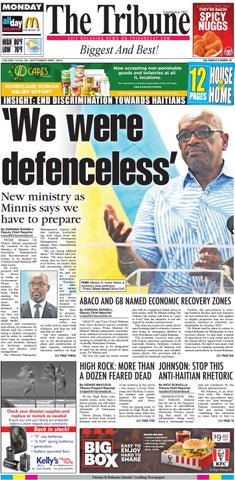
‘We were defenceless’
HOME
New ministry as Minnis says we have to prepare By KHRISNA RUSSELL Deputy Chief Reporter krussell@tribunemedia.net PRIME Minister Dr Hubert Minnis announced the creation of the new Ministry of Disaster Preparedness, Management and Reconstruction yesterday, to be headed by Central Grand Bahama MP Iram Lewis. Mr Lewis, pictured, will be sworn in today at Government House as minister of state for the body. While making the announcement, Dr Minnis declared it was critical that red tape, which might hinder recovery and reconstruction efforts, be removed. Dr Minnis said the country is facing a climate emergency and in order to combat it, there must be comprehensive and dramatic changes in hurricane preparedness and disaster relief management. The National Emergency
Management Agency will also undergo restructuring with input from the US Federal Emergency Management Agency, among other international counterparts. “We are facing difficult times,” Dr Minnis said yesterday. “We have faced an enemy that we have never seen before, an enemy that had devastating effects to our country and yet we were defenceless. “Enemies of similar nature will again approach our shores and our only weapon is preparation. We have to prepare, we have to improve our codes, our sea walls and we must build resilience and that we will and that we must.” The new ministry will work with local authorities in the development of plans and construction of high capacity, reinforced hurricane shelters on high SEE PAGE THREE
PRIME Minister Dr Hubert Minnis at yesterday’s press conference. Photos: Shawn Hanna/Tribune Staff
ABACO AND GB NAMED ECONOMIC RECOVERY ZONES By KHRISNA RUSSELL Deputy Chief Reporter krussell@tribunemedia.net ABACO and East Grand Bahama have been declared special economic recovery zones, Prime Minister Dr Hubert Minnis announced yesterday, as he outlined several tax exemptions, waivers and concessions for residents seeking to rebuild life in the aftermath of deadly Hurricane Dorian. These areas are to be designated as such for an initial period of three years, Dr Minnis said. His tent city plan for storm victims
also will be completed within three to four weeks, with Dr Minnis telling The Tribune the nation will have to “pray to God” that the initiative is not disrupted by another serious storm. The cities are a part of a newly developed housing plan to relocate evacuees now living in emergency shelters in New Providence and Grand Bahama. The economic recovery zone plan will feature duty-free purchases of all materials, fixtures, furniture, vehicles and equipment for all business and residential construction and rehabilitation efforts. The provision will be extended for domestic purchases.
Further, the government is waiving business licence and real property tax fees within the zones. This applies to eligible properties that are reconstructed, restored or otherwise are inhabitable by October 2020. Dr Minnis said he plans to return to Grand Bahama on Wednesday to view recovery efforts. At that time, a heads of agreement for a new cruise port on the island will be signed with Carnival Corporation. He said it was more vital than ever to continue economic development particularly in Grand Bahama. SEE PAGE SIX
HIGH ROCK: MORE THAN JOHNSON: STOP THIS A DOZEN FEARED DEAD ANTI-HAITIAN RHETORIC By DENISE MAYCOCK Tribune Freeport Reporter dmaycock@tribunemedia.net IN the High Rock community alone, more than a dozen people are still missing and feared dead in the aftermath of Hurricane Dorian. Pastor Jenese Pinder, a native of East End, Grand Bahama said he lost seven
of his relatives in the storm – two sisters, Lovette Munnings and Sherlene Cooper; his nephew and grandnephew, DJ and Omari Munnings; and three cousins. They are among some 14 persons in High Rock that were swept away when the area experienced a surge of SEE PAGE FIVE
By NICO SCAVELLA Tribune Staff Reporter nscavella@tribunemedia.net IMMIGRATION Minister Elsworth Johnson has hit out at the burgeoning wave of anti-Haitian rhetoric in the aftermath of Hurricane Dorian, asserting that much of the information being circulated is “downright wrong”
Nassau & Bahama Islands’ Leading Newspaper
and not condoned by the Minnis administration. Mr Johnson, in an interview with The Tribune, said the government disavows any “hate messages” towards members of the Haitian community, and that any person found “exhibiting the intention to cause harm or hurt to SEE PAGE 13
PAGE 2, Monday, September 23, 2019
THE TRIBUNE
Teddy bears after the tragedy for displaced children CLARA Smith, wife of Governor General C A Smith, along her daughterin-law Charlene Smith, presented children who were displaced by Hurricane Dorian with teddy bears at their shelters last week. Mrs Smith was assisted by Kim Sawyer, deputy director, Department of Social Services. The initiative was spearheaded by seven-year-old
Caitlyn Boyer, great granddaughter Mrs and Mrs Smith, and grand-daughter of their son and his wife, Clayton and Charlene Smith of Freeport, Grand Bahama. Caitlyn, wanting to bring a little happiness to those children who were displaced by Hurricane Dorian, collected 500 teddy bears within the United States to present to children whose lives had been
disrupted by the storm. The officials of NEMA and the Department of Social Services welcomed “this bit of cheer” last Wednesday. Shelters receiving teddy bears were Kendal G L Isaacs Gym, Bahamas Academy Gym and the Fox Hill Community Centre. The balance of the toys were to be distributed to remaining shelters and children’s homes. Photos: Letisha Henderson/BIS
THE TRIBUNE
Monday, September 23, 2019, PAGE 3
New ministry as Minnis says we have to prepare fro m page o ne ground in vulnerable communities; work with NEMA to pre-position hurricane relief stores, foodstuffs, water and supplies; preposition life rafts, life jackets, generators, chainsaws, jet skis, tools and heavy equipment and other material to provide immediate services to affected areas; and focus on consultation and training of residents in vulnerable communities. It will also implement and oversee the enforcement of mandatory evacuation orders, which are currently in draft form, Dr Minnis said. “The National Emergency Management Agency is going to be dramatically restructured, especially in light of the global climate emergency, which is making hurricanes more powerful and more deadly,” Dr Minnis said. “In restructuring NEMA, we will work with disaster preparedness, recovery and management experts from around the world, including the Federal Emergency Management Agency (FEMA) of the United States of America. Let me be clear, it cannot be business as usual in government. “We have to break down the silos. There is no time for territorial or turf battles. Egos must be put aside in the interest of the common good,” the nation’s leader said. The ministry also will be in charge of disaster response. Meanwhile, as he outlined plans for Grand Bahama and Abaco, Mr Lewis said it was his intention to see a greener more efficient utility infrastructure in Abaco, adding Hurricane Dorian created an opportunity to do so. To have efficient and effective restoration on those islands, he said there needed to be a layered approach, handled in phases.
PRIME Minister Dr Hubert Minnis held a press conference yesterday to announce special economic recovery zones for Abaco and Grand Bahama along with unveiling the new Ministry of Disaster Preparedness Management and Reconstruction. Photo: Shawn Hanna/Tribune Staff community in “In my commitment to but Cabinet is expected The first phase will business He also said: “We will feature cleanup and Abaco and restarting the total transparency we will to discuss this matter work along with the Office islands economy is vital to ensure weekly updates tomorrow. sanitisation. of the Prime Minister and However, he said, given the local lending instituHe said once the Depart- returning Abaco to normalcy. are made to the public to ment of Environmental As is clear, the building inform them of our pro- Dorian’s destruction, the tions in Grand Bahama to would do find comprehensive ways to Health gives the green light, codes will be addressed gress, possible setbacks, government the government will begin and moving forward will etc. We will also work to everything in its power assist the residents and busito erect temporary housing be strictly adhered to, in create a clear dialogue with to restart the economic ness owners with rebuilding facilities for the teams that order to give the residents of the public to ensure proper engines of Abaco and their homes and reopening will carry out the necessary Abaco, the best opportunity information is disseminated Grand Bahama. their establishments. in the event of another major and that questions are Abaco generates $120m infrastructural work. “We will work along with Mr Lewis, a certified storm. We have learned a answered by those with the per year for the Baha- the Grand Bahama Port architect and project man- lot from Dorian and there correct answers,” Mr Lewis mian economy and Grand Authority to revisit the Bahama contributes $137m, building codes as they perager, said: “It is my intent is still much to learn, so we said. The main body of the Dr Minnis said yesterday. to see a greener more effi- must not take these lessons tain to flood prone areas. ministry will function as As for Grand Bahama, We must also address the cient utility infrastructure lightly,” Mr Lewis said. “My team will work along an authority, similar to the Mr Lewis said he intended topic of proper disaster in Abaco and Dorian has presented us with an oppor- with central government, Public Hospitals Authority, to work with several stake- shelters throughout both holders to open the gates of islands.” tunity to make this a reality. the banking sector and Dr Minnis said. Dr Minnis explained that opportunity for rapid busiOur team of engineers and other institutions to create The new ministry will consultants will ensure vehicles that allow residents legislation establishing a ness development on the operate from the Office that we build state-of-the- to get the assistance needed board of directors for this island. of the Prime Minister. Dr He said much like Abaco, Minnis said he will guide art infrastructure for the during the rebuilding phase. authority would be debated We are going to review in Parliament in early East Grand Bahama, the larger policy objecpeople of Abaco.” areas over the bridge and tives of the ministry and The second phase will a public housing scheme October. The prime minister said a Queen’s Cove appeared to help to coordinate the full be rebuilding homes and which we anticipate will prove very beneficial for budget for the new ministry be the hardest hit areas of governmental response to businesses. had not yet been decided, Grand Bahama. “Working with the many residents. Hurricane Dorian.
SPEAKER URGES CHINA TO DEVELOP SOUTH-EAST BAHAMAS By KHRISNA RUSSELL Deputy Chief Reporter krussell@tribunemedia.net HOUSE Speaker Halson Moultrie recommended to a People’s Republic of China delegation that its country consider developing the southeast region of The Bahamas to shift the population concentration from the northwest. It was also his suggestion that China help this country with relocating the Bahamas Department of Correctional Services from New Providence to Little Inagua. Speaker Moultrie made the recommendations during a courtesy call with Dr Cai Dafend, vice chairman of the Standing Committee of the National People’s Congress of China, on Friday. Dr Dafend and a 14-member delegation held brief discussions in the Senate with the speaker, his deputy, Donald Saunders, and David Forbes, Parliament’s chief clerk. At the time, the Chinese official announced his government would give an additional $500,000 to The Bahamas for Hurricane Dorian relief efforts. Following the visit, Speaker Moultrie explained that the intent was to seek mutually beneficial opportunities to advance the people of The Bahamas and citizens of China. “There has been a concentration of our population in the northwest Bahamas (and) Dorian has interrupted that development,” the Nassau Village MP told reporters. “Abaco is the fastest growing island in The Bahamas and, of course, Grand Bahama has always been considered the second city.
“Well, two of the three major population centres in The Bahamas have been affected by Hurricane Dorian and so I for one believe in the concept in looking for the good in even the worst situation in the midst of all of our sorrow and mourning as a result of Hurricane Dorian.” He continued: “We see opportunities for the remainder of the archipelago to develop as we restore and redevelop Grand Bahama and Great Abaco so that it could be a greater population distribution and the southeast Bahamas is the port of entry to The Bahamas from the south. “That is why I gave my personal recommendations to the Chinese that perhaps one of the considerations as we move forward in a joint development of both nations to look at the possibility of developing the southeast Bahamas and making another economic centre in the southeast Bahamas so that we can get a better distribution of our population throughout the
archipelago. We think that will auger well not only for The Bahamas but for the entire region. “I also recommended that we should take a look at removing the correctional facilities out of the capital and putting it in one of the remote places in The Bahamas and I suggested Little Inagua of course because that is strategically positioned at the gateway to the Bahamas from the south. “We seem to have more problems coming from the south with respect to illegal immigration and with respect to poaching of our Bahamian waters.
So we believe that if we put the proper facilities at that gateway we can better protect ourselves and our sovereignty.” When asked about this at a press conference yesterday, Prime Minister Dr Hubert Minnis said Mr Moultrie was not speaking on behalf of the Minnis administration when he made the recommendation. “The speaker was speaking on his behalf,” Dr Minnis said. “It was a courtesy call with the speaker. “China is a friend of The Bahamas and we have relationships with China just as we do with America
and other countries and those relationships will continue.” In prepared remarks during the courtesy call, Speaker Moultrie said the Bahamas remains “open for business with China”. As he thanked China for whatever assistance it could provide as the country seeks to rebuild after Dorian, Speaker Moultrie said The Bahamas could benefit from
scientific research on the impact of global warming; research on the development of marine industries, educational grants, cultural exchanges and technical assistance; industrial development of the southeast Bahamas; infrastructural development throughout the country especially a deep water harbour; and a maximum security correctional facility.
PAGE 4, Monday, September 23, 2019
THE TRIBUNE
The Tribune Limited NULLIUS ADDICTUS JURARE IN VERBA MAGISTRI “Being Bound to Swear to The Dogmas of No Master”
LEON E. H. DUPUCH,
Publisher/Editor 1903-1914
SIR ETIENNE DUPUCH,
Kt., O.B.E., K.M., K.C.S.G., (Hon.) LL.D., D.Litt .
Publisher/Editor 1919-1972 Contributing Editor 1972-1991
EILEEN DUPUCH CARRON,
C.M.G., M.S., B.A., LL.B. Publisher/Editor 1972-
Published daily Monday to Friday
Shirley & Deveaux Streets, Nassau, Bahamas N3207 TELEPHONES
News & General Information Advertising Manager Circulation Department Nassau fax Freeport, Grand Bahama Freeport fax
(242) 322-1986 (242) 502-2394 (242) 502-2386 (242) 328-2398 (242)-352-6608 (242) 352-9348
WEBSITE, TWITTER & FACEBOOK www.tribune242.com
@tribune242
tribune news network
Learning our lesson but this is just the start IT HAS been said many times since Hurricane Dorian struck The Bahamas: We must learn from this. The signs are that the Bahamian government is doing just that. Yesterday, Prime Minister Dr Hubert Minnis announced a new ministry – the Ministry of Disaster Preparedness, Management and Reconstruction, with Central Grand Bahama MP Iram Lewis appointed as minister of state for the body. Mr Lewis has the right background for the role - he is a certified architect and project manager - though the challenge he faces as The Bahamas starts the recovery process is a daunting one. While the new ministry will give an extra degree of oversight of reconstruction and planning for future storms, it is perhaps as notable that the National Emergency Management Agency will undergo restructuring. NEMA has come under fire during the aftermath of the storm for its response, and it is wise to look at what NEMA can do better. It is also wise, as Dr Minnis is doing, to turn to the US Federal Emergency Management Agency and other international counterparts to draw upon their experience. The Bahamas, thankfully, has not had to deal with tragedies of this scale often. While we prepare for the prospect of more such storms, it is only sensible to speak to experts who are used to dealing with disasters on a more regular basis. The sheer size and population of the United States means that FEMA has expertise in preparation and response and we would be foolish not to draw upon that knowledge. There are other positive ideas being
put forward - more work to position emergency equipment where it is needed, for example. That includes life rafts and life jackets, generators and chainsaws. One thing of note is the plan to put jet skis in place as part of the emergency response. We all saw videos of jet skis being used to rescue people in the aftermath of the storm, finding a way through flooded roads to those in need of help. Training those in areas at risk is also a sensible move - and we hope this is extended to all residents in vulnerable areas, no matter what their background or their first language. There will be other questions to be raised as time goes by, and other ways in which we can find ways to improve our ability to confront such disasters. For example, one of the crucial ways in which lives were saved right after the storm was through the actions of the US Coast Guard, whose helicopter rescue teams were the difference between life and death for many. Can we implement our own helicopter rescue service to operate alongside the Coast Guard? That’s one of the questions to ponder. To begin to improve, we have to accept that there are areas in which we have not been as strong as perhaps we could have been. We hope never again to face such a deadly storm - even as we note the effects of climate change seem to make it likelier that we will. But if we do, we must be ready. We welcome the changes being introduced by the prime minister - but they are just the first step. We must keep taking the next step, and the next - our future really does depend on doing so.
Rebuilding in The Mudd EDITOR, The Tribune. WE can sympathise with the plight of Haitians evacuated from Abaco to temporary shelter in Nassau. It is painful for anyone, particularly singleparent families with no back- up resources, to be displaced from a long-time home, even if if it’s nothing more than a shanty without running water. Yet government will be entirely correct in preventing the return of these people to Abaco, where without insurance they can only rebuild the same slum-like communities. An entirely new system of development must replace
what’s been destroyed in The Mudd and similar districts. As I pointed out in my recent Business Bites column, the present tragedy did not start with the Minnis administration. It stems from immigration policies, or lack thereof, stretching back to Pindling, Ingraham, and Christie, all of whom simply let a growing Haitian population gradually accumulate around Marsh Harbour. Our governments have had a deplorable habit, when faced with an a threatening crisis, of “kicking the can down the road” instead of stepping in with a tough but timely solution.
Hurricane Dorian shows that the can simply can’t be kicked any further. The crisis has arrived, and now will take long-term money and effort to resettle the Haitians, find them jobs, and create a humane and rational scheme of repatriation to Haiti for those who cannot be integrated into Bahamian economic life. We wish Prime Minister Minnis courage and good fortune in executing a decisive and imaginative plan to replace years of official waffling. RICHARD COULSON Nassau, September 19, 2019.
Keep church out of politics EDITOR, The Tribune.
WHY can’t the Bahamas Christian Council keep the politicians out of church services? Politicians don’t allow you to go on the floor of Parliament so never, I mean never, should politicians be permitted to make opinioned speeches
at church services of any kind. Let them read a lesson. Also at church service it is wrong protocol to have someone shout out ‘please stand for the Most Honourable…Or the Leader of the Opposition - at the BFM Memorial Service most inappropriate - it should have never
happened…It is a Church Service! Ashamed Hon Philip Davis for your inclusion of “solid as a rock” in your address that is precisely why politicians must stay in the pews. ABRAHAM MOSS Nassau, September 19, 2019.
jamaaltheartist@gmail.com
Drug cartels EDITOR, The Tribune. FOR a while, I’ve looked at crime trends and studied them closely to understand and learn how to fully combat these problems. We always had a gang problem and illegal arms dealing being the two biggest issues in crime. But I learned that those issues were fueled by a far worse problem that has plagued not only Bahamians, but the entire Caribbean region for decades, which is the Mexican drug cartels. In the 1980s, we were ground zero for Pablo Escobar’s global expansion of his cocaine trade, starting with Carlos Lehder-Rivas purchasing Norman’s Cay and holding the island for four years, running cocaine shipments flawlessly from Columbia to Miami without resistance. Eventually, Carlos was caught and sentenced for life, and the Cay was reclaimed by the government. Unfortunately, the PLP suffered catastrophic losses to its reputation, causing them to lose the election of 1992 and the incident made them infamous for being the party that supported various drug lords in Bahamian history. Worse, the Bahamian drug trade never actually died off after the DEA and the RBPF intervened. In fact, the new set of cartels has taken over the previous smuggling routes that the Colombian cartels had before, and the Caribbean cocaine trade is rising fast. The various Mexican cartels constantly fight each other over smuggling routes and territory to build new infrastructure to process coca leaves into cocaine, labs to create meth and Fentanyl, places to hide money, and even places to train people to be sicarios with training grounds and ex-military instructors. News stations, newspapers and journalists have been almost silenced by the cartel drug lords, and anyone who disobeys them will face certain death. Because of bribery and sheer brutality and power, Mexico is a narco-state, where narcoterrorists reign supreme and their influence spreads far from their country. The level of violence in Mexico has crossed into literal terrorism, and with hundreds of millions of dollars that is funnelled to bribe politicians and arm each sicarios to fight against their rivals and security forces. 28,000 and 35,000 people have been slaughtered in Mexico in 2017 and 2018. All of those victims were mostly tortured before being killed, and torture is like a sport to them. They’re true terrorists to the bone, just like Al-Qaeda and ISIS. In other countries, the Mexican cartels give local gangs money and guns to ensure loyalty to the sicarios and they start community programmes to win trust over local governments. More likely, these cartels have adopted the rulebook from the US Army’s Green Berets and the CIA’s Special Activities Division and mastered their own version of unconventional warfare, psychological operations and asymmetric warfare on
LETTERS letters@tribunemedia.net a massive scale. Most peace offerings by the cartels to stop the violence is for their benefit for drug smuggling and drug production, not for the Mexican citizen. In terms of drug smuggling, the Columbian smugglers and the Mexican sicarios use tunnels under the US-Mexico border constantly to get drugs to it’s destination with most success. But if the border wall goes up, along with the preexisting tunnels rendered unusable. Then the Central American drug routes will dry up, but the Caribbean is another massive problem. A problem that puts everyone at risk to become a narco-state just like Mexico. The Caribbean’s military power and security measures are far weaker than Central American military forces, and the matter is made worse is that we’re over water and the cartels use go fast boats, bribe captains of commercial cargo ships and use narcosubmarines to move tons of cocaine up to the US East Coast, which some of those shipments going past one hundred million dollars. While many Caribbean islands don’t have a militarygrade radar to monitor ships. The Bahamas is a special prize to the Mexican drug cartels. Geologically, we’re located within a hundred miles from Florida and our country is a major shipping route that has ships coming from South America, Europe, North America and Asia. But what makes smuggling easier is that we have a crippled police force, an almost nonexistent military navy and a highly disorganised Customs department, giving the smugglers the edge over law enforcement at every corner. From a perspective of a cartel drug lord. I possibly could bribe the RBPF, the RBDF and Customs to ensure that my shipment remains secure from prying eyes. I can hire the local Bahamian gangs to guard the cocaine shipments and pay them almost a million dollars and with high end military rifles, machine guns, tactical body armour and plates and explosives. I can build some new businesses to “help” the community and build legal money to hide the dirty ones. Most of our local gangs were supplied with guns from cartel connected gun runners from Florida. That’s what these narcoterrorists do to survive and climb their way up the ranks of their organisation. Along with terrorist attacks and brutal executions that has destabilised Mexico. All of the acts of narcoterrorism that has occurred in Mexico will soon fall on the Bahamas. Should we fail to act, the sicarios will flock to the country to guard their own drug shipments, which will bring a cataclysmic increase to crime, creating new rogue paramilitary groups, terrorism going rampant and the eventual downfall of the Bahamas. At that point, the rest of the Caribbean will be in grave
danger, even if we managed to avoid becoming a narco-state. The only medicine to our crime crisis locally and regionally is not with failing youth reform programmes and wasteful spending on those projects. The DEA should be more involved and NATO needs to launch a task force with CARICOM to hunt the street gangs who work with the cartels in Mexico and Columbia. We need to act tough with enforcement and prosecution with gangs heavily connected with the Mexican cartels, who are mostly the ones heavily involved in the black market drug and gun smuggling in the Caribbean. There should be a terrorist watchlist system with all existing drug cartels being on the list. Anyone caught doing any business with them will freeze their financial accounts and place them under the watchlist. Politicians can be held on sanctions and prohibited from travelling on evidence of hiding cartel members or dirty money for the narco-terrorists. Street gangs working for sicarios should also be top priority for arrests, and a 25-year sentence is mandatory for those who are cartel members or being a local gangster working for smugglers. Extradition for the sicarios and their gang allies to the US should also be a priority. Like I said above. CARICOM and NATO should establish a multinational task force dedicated to counternarcotics and hunting down local gangs and cartel sicarios, using both police and military assets to complete their daily tasks. Their main base of operations should be located in Andros for being in close proximity to the US. The Task Force can be governed by trustworthy individuals from CARICOM and NATO commanders, and they should be able to cross over different Caribbean countries with naval forces with approval and legislation that allows it. If someone gives the task force any intelligence of cartel activity or street gangs running their own smuggling and theft rings then investigations will begin. And when enough evidence is gathered, then a large joint and military operation is launched to capture local criminals and narcoterrorists from Mexico and Columbia, and make illegal drugs and weapons smuggling harder for them. Then the individuals are extradited to the US and evidence will be used against them to ensure that these people are successfully convicted. By that point, the goals of CARICOM and NATO is to ensure regional safety and order, by discouraging local street gangs and lower the lucrative illegal marker in drugs and gun trafficking, preventing the growth of the drug cartels and narcoterrorism. Only then, can the youth reform programmes work because the task force will ensure that the street gangs will face proper justice and give the youth another avenue for a better life. AMMAKA RUSSELL Nassau, August 16, 2019.
THE TRIBUNE
Monday, September 23, 2019, PAGE 5
Newlyweds killed as house swept away by storm surge By DENISE MAYCOCK Tribune Freeport Reporter dmaycock@tribunemedia.net AFTER tying the knot in June, LaTravalia Williams and Agno Daniel were planning to start a family, but they never knew that their house in Lady Lakes would flood and be swept off its foundations by a deadly storm surge during Hurricane Dorian on September 2. The Grand Bahama newlyweds were swept from their home and fought against a strong surge by clinging to a tree for hours, but despite their fight for life, they did not survive the horrific ordeal. Mrs Williams-Daniel, 33, and her husband, were owners of Wing Ding, a new restaurant they opened in downtown, Freeport. Although they were married two months ago, the couple had been together for the past ten years. According to her uncle, Samuel Williams Jr, they were planning to start a family. Two weeks after the wedding, he learned that his niece was pregnant, but had later suffered a miscarriage. “I just can’t believe it,”
said Mr Williams of their tragic deaths. “Just to hear the last cry of her saying ‘someone come save me,’ is heartwrenching,” he said. As water filled their house, the couple fled into their ceiling and had called a close relative to inform them of their desperate situation. Mr Williams said his niece had contacted his daughter and told her they were trapped in the ceiling. “They were communicating up to the time the signal went out. She told my daughter that the water was now coming in, and that it was touching her feet while they were clinging to the rafters in the ceiling. So, you are looking at least maybe about 20 to almost 25ft of surge water,” he said. On September 2, at 7.38am, the young business owner made her last post to Facebook. She wrote: “We are currently in the ceiling! Water is above the windows, please send help when it’s clear!! Lady Lake, in the back yellow house white metal roof, garage isn’t completed. Our neighbours
are also in their roof!” However, a rescue would not arrive in time. According to Mr Williams, a relative went out in a Jet Ski to rescue them and found Mr Daniel clinging to a tree. They took Mr Daniel to Rand Memorial Hospital. Mr Williams said his niece’s husband was in a critical state, and foaming at the mouth when found. He died two hours later, he said. “Before he passed (away), he was talking and said, ‘man y’all got to go back for Tray.’ He said, ‘I left her hanging on and holding onto something.’” Mr Williams said when Mr Daniel’s brother went back to the area, he could not find the young wife. After the storm, Mr Williams’ daughter went to the police station and reported that her cousin was still missing, but was informed by an officer that the description she had given fit that of a deceased individual that was found shortly after the storm’s passage. Mr Williams said his niece was like a daughter to him; and that she and his own daughter had grown up like sisters and were
HIGH ROCK: MORE THAN A DOZEN FEARED DEAD from page one
up to 20ft that reached the roof tops of most houses in the area. Some people had to flee to the ceiling and attics of their homes and had to cut a hole in the roof so they would not drown. “They had to stick their heads out the roof, and that’s how they survived,” said Mr Pinder. “They never expected anything like this to happen.” Mr Pinder hasn’t seen his relatives since the storm and their bodies have not been recovered. Before the storm, an official evacuation order was issued for east Grand Bahama, however many did not heed the warning. “A lot of people were encouraging them to come to Freeport because of the (wind strength that was projected). That was a big concern, but they did not want to leave. They thought it would be all right, but the surge caught them off guard,” Pastor Pinder lamented. According to the pastor, the house his relatives were in collapsed during the storm, and they were swept off in the surge. Monster storm Dorian hit Grand Bahama as a Category 5 on September 1, and became the first hurricane of that intensity to make landfall on the island, after first making landfall in the Abacos earlier in the day, according to the Weather Channel. Its maximum sustained winds topped out at 185 mph with higher gusts. The slow moving storm stalled over Grand Bahama for about two days. Many communities were left unrecognisable and there has been significant property loss in the wake of the storm. The official death toll now stands at 53, with more than a thousand people still reported
SOME of the debris in High Rock after Hurricane Dorian. as missing in Abaco and Grand Bahama. Three days before the storm, Pastor Pinder and his two nephews, DJ and Omari, went around and assisted others in High Rock, particularly the elderly and widowed residents, with securing their houses. After assisting as many persons as they could, he returned to Freeport. However, Omari and DJ stayed with his two sisters at their mother’s house, which is about 150-ft from the water on the front road along the bayside. “Somehow, the house collapsed and it was swept off the foundation when the surge came in, and they were swept out the house; we have not seen them since,” he said. Mr Pinder said it is hard accepting that they’re gone. “It is very devastating,” he said, of losing so many loved ones all at once. He recalled a recent vacation trip to Florida with his sister. “We had recently returned from vacation and we had a wonderful time; we would always go on vacation together and I never knew that would be the last time with her,” he said. Mr Pinder grew up in
High Rock and said that his family had expected some damage, but nothing like this. “They thought that it would be a lot of wind and breeze; that some shingles would blow off – they never thought the surge would flood (the house). “The family is taking this hard losing so many members in the storm. Their bodies have not been recovered, and so it is much harder for us to have some closure,” he said. Mr Pinder noted that the High Rock community is still reeling from the tragedy as some 14 persons are missing from that one community alone. “We are a close-knit family community here and so we are all hurting from this,” he said. “Only God knows everything. We may ask the question why, but we must be thankful we are here because it could have been anyone of us. We must trust God in the midst of everything.” The entire East End community, from Gold Rock Creek to McLean’s Town on the mainland, and Sweeting’s Cay, was devastated. The 33 residents who remained behind on the cay during the storm, have survived.
LATRAVALIA Williams and Agno Daniel married in June - but died on September 2 during a deadly storm surge from Hurricane Dorian. very close. He recalled how happy and full of life she was on her wedding day. “She was beautiful, she was happy, and she was full of laughter. She was a great person,” he said. His niece had tattooed the word “laughter” on the inside of her forearm, and a rose on her ankle, which helped relatives identify her body. This was one of the
hardest things he and his family have ever had to do, Mr Williams said. “That was very difficult,” he said. When he spoke to The Tribune, the family was in the midst of making funeral arrangements. The couple’s funeral was held Saturday at New Life Worship Centre. When asked how is he coping with the loss, Mr Williams said that returning
to work has helped. “I try to keep my mind focus to be strong not only for yourself, but also for my family who are also struggling with it.” He said that his niece’s mother – his sister – Patrice Williams, died a year ago. “Right now, I still have my smile and people ask how could I still smile. My niece (LaTravalia) would not have wanted me to be sad,” he said.
PAGE 6, Monday, September 23, 2019
THE TRIBUNE
Abaco and GB named economic recovery zones from page one “For the communities of East Grand Bahama, Abaco, and the surrounding cays to get back to their former levels of social and economic vitality, it will be critical for the government to move with determination and haste to establish the right environment needed to restore commerce in the affected areas,” Dr Minnis said during a press conference at the Office of the Prime Minister. “Once commerce recommences, displaced residents can move back home with jobs and with economic opportunities. These communities must be restored to the economic and social vibrancy they enjoyed before Hurricane Dorian. “We must do all that we can to ensure that this happens as soon as possible.
“Accordingly, to facilitate the required social and economic recovery on the islands impacted by Dorian, I am pleased to announce that East Grand Bahama, Abaco, and the Abaco Cays, will be designated as special economic recovery zones for an initial period of three years. “This designation – modelled after what is already in place for the Over-the-Hill initiative – will enable the communities impacted by Hurricane Dorian to benefit from a broad range of tax breaks and incentives. “They will also benefit from other means of support that will restore the various economies, and indeed, over time, make these economies more vibrant.” The government will also extend a VAT credit of up to 50 percent on the sale of real property.
However, the concession is only provided that such a sale will be immediately followed by material construction on or enhancement to the property. To maintain the credit, the qualifying activity must commence within 75 days of the close of the sale and has to be followed through to scheduled completion. Otherwise the full VAT becomes payable. Another measure to support recovery and rebuilding in the zones is the establishment of $10m loan guarantee and equity financing programme. Dr Minnis said this will allow qualifying Bahamian small and medium sized businesses to secure up to $500,000 in financing to fund the restoration of businesses, or the creation of new businesses. Asked how the government would fund this initiative, Dr Minnis said: “When there are disasters like this and emergencies, governments must make decisions as to how to move and prioritise matters moving forward. “We will reprioritise what our commitments are and ensure that those two economic engines are restarted.” Other concessions include the establishment of a business assistance onestop-shop on both islands along with the extension of the provisional business licence programme to all businesses. The latter measure will have limited exceptions within the zones to allow for qualifying businesses to get started with their businesses within two business days of completed application. The centre will house representatives of the Small
CENTRAL Grand Bahama MP Iram Lewis after being announced as the newly-appointed Minister of Disaster Preparedness Management and Reconstruction. Photo: Shawn Hanna/Tribune Staff Business Development – through participating ven- as possible for Grand BahaCentre, Ministry of Finance, dors – and be able to obtain mians and Abaconians to Bahamas Investment duty-free prices. both get back in business Noting that the aim of this and to access these financial Authority, Department of Inland Revenue, Depart- exercise was to facilitate facilities. ment of Environmental and encourage economic “To minimise the Health and building per- activity and development, possibilities for abuse – mits units of the various Dr Minnis said it is foreign businesses and individuals land holders in the Family accessing the duty-free agencies. This centre will be Islands who are subject to concessions for businesses equipped and empowered Real Property Tax will only or individual construction to ensure that all existing qualify for this exemption projects will be required to and new businesses will be if their developed proper- have their projects regisable to work through any ties are up to standard, or tered. These projects will be regulatory requirements if they are taking the steps subject to monitoring and within five working days, to repair and refurbish their verification. premises to get them back Dr Minnis said. “However, the governFor the duty-free pur- to standard. ment will ensure that the Properties that are not business licensing and the chases of commercial items and construction materials, repaired or refurbished project monitoring proDr Minnis said government will not benefit from this cesses will be as nimble and was taking steps to ensure concession. Undeveloped as efficient as possible. that Bahamian wholesal- properties will not benefit “With limited exemptions ers and distributors benefit from this concession. for potentially hazardous “The government wants undertakings, all businesses from these provisions so that those who want to the business communities within the zone will receive access the concessions will in the affected islands to a provisional business know that we will support licence on application – be able to buy locally. Those with approved them in the most direct of even as the formal licensing projects in the special ways to get them up and process continues. zones also will be able to running again. The govern“This will allow people buy their goods in New ment recognises though, to begin operating immediProvidence and elsewhere that it must make it as easy ately,” Dr Minnis said.
MONDAY, SEPTEMBER 23, 2019
THE STORIES BEHIND THE NEWS
Haitians are human beings time to end discrimination
A MAN stands on the rubble of his home in a shanty town in Abaco after the passage of Hurricane Dorian. By FREDRICK SMITH, QC HURRICANE Dorian brought the many serious issues regarding shanty towns in Abaco into sharp focus. If ever doubted, it is now crystal clear that the residents of these communities are among the most vulnerable who live in our midst. It is also beyond question that these unfortunates remain victims of a brand of xenophobia so deep-rooted and persistent that not even a tragedy of this magnitude can assuage it. Hence the government’s no-rebuild order which singles out shanty towns specifically. If such a measure is really necessary in the circumstances, surely it should apply to all affected areas. Why pinpoint these communities in particular? Why does the order not extend to the wealthy foreign homeowners in Bakers Bay, or Bahamians, both black and white, who live in other areas of Abaco? Clearly, it is a case of discrimination, pure and simple. In general, Family Islanders are resilient, self-reliant – regardless of their background or ethnic origin. They usually know best how to go about reconstructing their lives. It is normal for people to do all they can, using the support of the government, charitable donations and whatever is left of their former homes to try and put some sort of roof over their heads. We can’t blame anyone for wanting that. Unless and until someone proves otherwise in a court of law, the residents of shanty towns have as much right as anyone else to return to their homes and salvage what they can of their former lives. The post-hurricane help honeymoon is coming to an end. Hotels and other shelters in Nassau are approaching capacity. If not allowed to rebuild, at least in the short term, where will former shanty town residents go? The tent cities that have been proposed are not a permanent solution, so what is the government’s long term plan? Surely, the FNM will not use this terrible tragedy to move in with the tractors and illegally bulldoze what is left of these people’s lives – people who, at the very least, have the right to return to collect their property and valuables, and also search for the bodies of the many loved ones who are still missing. It is easy to use sweeping platitudes and say that if the Mudd and other shanty town communities had been previously demolished, somehow the extent of the tragedy would have been
mitigated. Such massive over simplifications ignore the fact that the government would still have faced the vexing problem that confronts it today – what to do with 5,000 people forcibly made homeless overnight – by either state or storm? It also conveniently sweeps under the rug the hateful circumstances that have led us to this point. Firstly, since 2014, the government has been singularly focused on illegally removing, or at the very least limiting, access to citizenship by people of Haitian descent, particularly those born to Haitian parents. It has been documented in the newspapers, and adjudicated on in the courts. Recourse for injustice is extremely limited, and a one-way ticket to Haiti via the Carmichael Road Detention Centre has been the only certainty for those souls caught inside an inherently biased system. It is this system, and its enforcement – zealously upheld and protected by the state – that has bred an environment where people would rather stare down a category five hurricane than entrust their safety to officials who have repeatedly targeted them illegally. If found to be true that the government did all it could to evacuate shanty towns (and this remains an open question) then certainly the reason why this had so little impact on these vulnerable communities must be investigated. Do we truly believe they are too uncivilised to prioritise their safety? Or was it that they made a calculated choice, just as they’ve had to do for generations, to stand before God’s might and beg his mercy rather than place their trust, their freedom and their children’s freedom, in the hands of a hostile and corrupt power structure? Secondly, make no mistake, this event has shaped The Bahamas, scarred us, irreparably so – but even as we begin again, we must ensure that we do it with open eyes and hearts. The people of the shanty towns in Abaco and throughout The Bahamas are not economic dependents, but drivers of economic activity. They do not burden us, they built us up. Not just in affordable labour, exploited tirelessly, but in administrative fees for “papers”. We feed off their legal troubles and as they gamble with their livelihood; and the house always wins. Simplistic and uninformed tropes about property rights and immigration wrongs have been rendered meaningless in the face of thousands of decimated structures, spreading as far as the eye can see. Dorian gobbled up entire
communities of all stripes, it spared precious few and even now, the country is still reeling, still weeping. It is important not to get lost here, not to allow this tragedy to further strip us of our humanity and capacity to reason fairly. We must remember that the government surveyed Abaco and determined there was no room to accommodate shanty town residents. We must remember the plan to simply flatten their homes without giving each their legally mandated day in court. We must remember that Prime Minister Dr Hubert Minnis said his government would not spend a dime to develop housing for them. We must acknowledge that these human beings have been denied the simple right to live on the land their ancestors were corralled onto, denied a humane process for resettlement, denied the chance to prove their ownership of land. They are apparently expected to simply disappear – out of sight, out of mind. Thirdly, the government’s focus must be unwavering at this time. We cannot afford the resuscitation of hateful, discriminatory rhetoric at a time when the entire country stares down climate injustice that has equalised despair and desperation across all classes and ethnicities. We must not slip into lazy, time-worn patterns of “othering” and status wars. We must stop the discrimination, especially against these human beings of Haitian ethnic origin. We must interrogate why government felt it necessary to mandate no building in shanty town zones but not the wider Marsh Harbour. Was it nothing more than a political cheap shot to gain currency as the government tries to stave off deafening public criticism over its own actions, or lack thereof, concerning its initial response and management of this disaster? There will be plenty of time to sift through the negativity that always emerges in crisis, to make new political campaigns. But now is not that time. Let us instead commit to removing ambiguity from recent immigration statements, outlining clear steps on how the government plans to identify victims, and establish and protect their rights. We need leadership on the front lines, not placebos for the xenophobic baseline. Does the government have a plan to humanely address the rights of migrants and their children, and their descendants who have been displaced? The legal fight over their right to claim land in Abaco will not be washed away by the storm, nor will the previous injustices of the
government. However, the focus now must be singular and rooted in equity and humanity and love. There is simply too much at stake. We have experienced a major tragedy; it’s important that public statements reflect a concern for the greater good and do not foster division and hatred. Human rights defenders have been working tirelessly on the front lines assisting government in supporting victims and collecting data on missing people. The work, and the
Photo: Ramon Espinosa/AP impact it reveals on the most vulnerable, speaks for itself. We must all stand in the gaps created by systemic inequality and lain bare by the ravages of this storm. The Bahamas remains in deep shock over this, our most visceral taste of climate injustice. The singular focus of the government at this time should be to protect, preserve, and unfortunately in some cases establish, the rights of all within its borders. The lives and our quality
of life of all ought to be tantamount. Any scurrilous statements otherwise only betray their own vicious prejudice. The residents of shanty towns are not just “Haitians”, they are human beings. If we cannot find it in our hearts to treat them as such, to recognise their urgent vulnerability and intense suffering at this moment, to do what is decent and right, I fear it will leave an indelible stain on our national conscience forever.
PAGE 8 MONDAY, SEPTEMBER 23, 2019
INSIGHT
EMAIL: insight@tribunemedia.net
Sensitivity must be set aside as the government prepares for future superstorms By MALCOLM STRACHAN THREE weeks after the most traumatic experience The Bahamas has ever faced we are still picking up the pieces for what may be a years-long recovery and rebuilding process. The physical and psychological damage experienced by the victims, as well as other citizens that have listened to the many nightmarish accounts of surviving Dorian is palpable. After the initial shock and with an agitation to return to normal bubbling, there are still mixed views over the government – great support in some circles, questions over the government’s lack of readiness for the storm in others. Since the establishment of NEMA in 2006 by way of the Disaster Preparedness and Response Act, The Bahamas has experienced a number of powerful storms.
THE RUBBLE of a destroyed neighbourhood stands in the aftermath of Hurricane Dorian in Abaco. Photo: Ramon Espinosa/AP In recent years, the nation the level of devastation we we could have imagined has been hit by Category 4 encountered when Hurri- the level of destruction we storms Joaquin in 2015 and cane Dorian made landfall faced three weeks later as Matthew the following year in the northern Bahamas thousands of people are in 2016. In 2017, Hurricane with sustained winds of 185 displaced and many feared Irma decimated Ragged mph, gusts of 220 mph, 36 dead. Island with the unrelenting inches of rain, and a 23ft However, while the citiforce of Category 5 condi- storm surge – a power- zenry cannot be completely tions. Yet, two years later, packed recipe for disaster. absolved of the responCertainly, there is no way sibility to keep not only we could not have imagined
themselves but also first responders safe, the challenge of making life-saving decisions rests in the hands of the government. Following the tragic circumstances of Hurricane Irma, legislating mandatory evacuations was a talking point, but not acted upon. Surely, if the government was swift in following through with that policy, we could have been having a discussion that focused solely on urban planning and the rebuilding of the nation’s second and third cities. However, because of the penchant to be reactive rather than proactive - which is a cultural norm rather than a Minnis administration problem - the government was caught flat-footed. Of course, no one wants to accept the blame. Likewise, we shouldn’t only be focusing on who is wrong because it is counterproductive to what is truly needed – sustainable solutions. At the same time, government has to stand firm in the face of the justified criticisms they’re receiving. In the acceptance of their unpreparedness, there is much that can be harnessed from constructive analysis of their action, or lack thereof, prior to the storm. During the prayer service last week to honour victims of the storm and pray for the nation, Anglican Bishop Laish Boyd called on the Bahamian people to stop blaming Prime Minister Minnis and the government for the lack of preparedness as well as the ongoing management of the post-storm recovery and rebuilding efforts. He said: “Abaco, Grand Bahama and the whole Bahamas will not be the same for a long time. There are years of healing, settling and resettling, rebuilding and redevelopment before us. Entire local economies have to be rebuilt. “However, right now the pain and anguish and suffering are great, for all of us. Blaming the prime minister – any prime minister – is not helpful. Lambasting the government – any government – is of no value. We need to come together, not be divided. Animosity and competition, fighting among ourselves and being at odds do not heal.” Bishop Boyd is partially correct. Mudslinging, political drivel and nonsolution-oriented criticisms are going to serve little purpose. However, we can’t afford to be in an environment where politicians are coddled in their protective bubbles away from criticism. In all fairness, the government has given regular press updates on what is happening. But there is still a great lack of clarity on what the plan is going forward as it relates to rebuilding Abaco and Grand Bahama and recovering the remains of those we lost. As families agonisingly wait for their loved ones’ remains to be retrieved, they fear the worst. With the death toll count reaching a slow crawl, many questions loom on what is taking so long. Similar questions have risen regarding how seriously the government viewed Hurricane Dorian in the lead-up to its landfall on Abaco. During the prime minister’s address days before the storm hit, he cautioned those still on Abaco and Grand Bahama to heed his call to evacuate before the storm unleashed its fury on the ravaged islands. However, as the government is doing the best that it can, despite their efforts, NEMA still looks punch drunk as they try to navigate this situation. Thus, questions circulating NEMA’s mandate are warranted. What studies took place to identify the designated storm shelters as being
structurally sound enough to withstand the strength of Hurricane Dorian? What trends have been followed by the Met Office and NEMA to ascertain if our disaster readiness and management policies were up to standard? Were any tests conducted to study what would be the maximum wind force our buildings could withstand? One would like to have answers to these questions and more. Penn State climate scientist Michael Mann has been one of many experts sounding the alarms on the increasing threat that this new era of superstorms can bring. In a 2018 article on Inside Climate News website, the urgency required by nations in hurricane zones to address their preparedness for the future of natural disasters was made very clear. Referencing the devastation in Puerto Rico after Hurricane Maria took the lives of more than 4,600 people, Mann warned: “That’s not a coincidence. We have to recognise that by some measures, dangerous climate change isn’t some far-off thing we can look to avoid. It has arrived.” In the same article, the importance of well-thought out recovery and restoration programmes was also stressed. Where we find the government mulling over the path forward, rebuilding these islands without taking into account how vulnerable the affected communities were to the storm’s strengths will be another fatal mistake. Last week, Minister of the Environment and Housing Romauld Ferreira stated that the building codes have to be revisited and houses would need to be designed to withstand stronger winds. As discussions regarding the country’s building code have emerged in the wake of tens of thousands of homes being flattened by Dorian, former Bahamas Construction Association president Leonard Sands believes that most Bahamians would be further priced out of the housing market. “If you make it mandatory that houses now have to be built to deal with that category of strength, you’re talking about absolutely wiping out the construction centre because no one would be able to qualify for their homes,” he said. “The cost of the houses is going up already in places where you see the home building market is depressed because a lot of people can’t qualify anymore. “The typical house that you could probably build in Marsh Harbour can probably be built at $130,000. To build for Category Five storms, people in the islands would be building three-bedroom, two bathrooms houses for a quarter million.” No doubt there are many moving parts to this issue. However, there exists an opportunity to build a sustainable Bahamas. At the same time, we must not delude ourselves. The process will take time and the costs will be substantial. Hopefully, the government is considering the possibility of flood barriers, as storm surge was the most lethal component of Hurricane Dorian. But even that will require great research and planning. Indeed, many international, as well as regional partners have displayed their generosity in our time of need. That being said, the importance of capitalising on the intelligence and other human resources that can help us rebuild a sustainable Bahamas is paramount. As sure as the sun rises and sets, hurricanes are an annual reality for us. Likewise, our lives, as we’ve learned, depend on our preparedness.
EMAIL: insight@tribunemedia.net
INSIGHT
MONDAY, SEPTEMBER 23, 2019 PAGE 9
How can you help stop the climate crisis? Eat less meat. By TANEKA THOMPSON Tribune News Editor tmthompson@tribunemedia.net
IT’S the stuff of apocalyptic movies. Ocean waves wiping out entire cities and drowning families. Mother Nature in all her fury flattening homes and buildings, as people scramble for shelter in stronger structures, some clinging to mangroves and tree branches in a desperate attempt not to be swept away by storm surge. Desperate people barricading themselves inside their homes, fearful armed looters will storm in and steal precious food and resources – or worse. Except this isn’t a scene from a Hollywood script, it was the fear and reality for many on Grand Bahama and Abaco who were subjected to Hurricane Dorian’s fury earlier this month. And as thousands of people who were lucky to escape the storm with their lives struggle to pick up the pieces in the aftermath, one chilling fact remains. Monster storms like Dorian are not an anomaly. They will become more commonplace as time runs out to save the world from climate change. That might seem like an extreme, alarmist statement, but it’s the consensus of many scientists and climate change activists. Mankind can no longer afford to be skeptical about the science. Human behaviour — our collective arrogance and abuse of the earth and its inhabitants – has come back to hit us in the face like a karma-filled boomerang. While world leaders squabble about how to fix the issue, and the United States’ president pretends that the problem doesn’t exist, individuals will have to make extreme changes in their lives to save the planet – or risk not having one at all. But can individuals really make a difference? A recent United Nations report has found that adopting a plant-based diet could help stave off climate change. Here’s how your slab of steak affects weather patterns. Massive amounts of food and water are given to farmed animals who are then killed and processed for human consumption. Vast swaths of valuable forest that land absorb carbon dioxide and produce oxygen for humans, such as the Amazon Rainforest, are then bulldozed for farmland and to grow crops for these animals to eat. These farmed animals also release a significant amount of greenhouse gases, which exacerbate the problem. The world over, animal agriculture is said to be responsible for more greenhouse gas emissions than all of the world’s transportation systems.
The UN report, released in August, explores how land-use practices have impacted the planet and finds that reduced meat and dairy consumption can help save the world. Produced by the UN’s Intergovernmental Panel on Climate Change, the report argues that if people eat more plantbased foods and sustainably produced animal products, that will “present major opportunities for adaptation and mitigation while generating significant cobenefits in terms of human health”. The report calls for people in Western countries to move away from a heavy reliance on factory farmed meat and animal products to a diet focused on whole grains, legumes, fruit and vegetables – things that have a lower carbon footprint than animal products. By this point, you’re rolling your eyes and thinking, “I can’t give up steak or bacon. Why can’t the world’s leaders just come up with a nice solution to climate change that doesn’t affect my plate?” The fact is, we all have to make changes if we want to have a suitable planet to live on.
DAMAGE in Abaco in the aftermath of Hurricane Dorian. As the questions are asked as to how to deal with the prospect of future hurricanes, one solution can be acted upon by each of us - simply to eat less meat. Photo: Shawn Hanna/Tribune Staff from climate change. We world. Reducing meat as temperatures increase,” and expensive fossil fuels face losing our coral reefs and dairy consumption is Ms Thomas said. “Locally, not only contributes to that protect us from storms, a simple way to not only we need to develop and emissions but also places losing our fisheries indus- mitigate against global enforce policies on adapt- our natural resources at try, losing our appeal as a warming but to also address ing to climate change, on risk due to spills and leaktourism destination and the health concerns that we more effectively respond- ages. We should be a losing our residents as they have as a nation.” ing to disasters when they leader in the world in showrelocate to more stable While the world’s focus do occur, and on more ing that we can be a carbon countries.” is on the devastation stringent planning for neutral country and that She explained that cli- Dorian brought to Grand where infrastructure and other countries need to mate change is fueling Bahama and Abaco, Ms communities are located. follow suit to limit global the increasing intensity of Thomas believes our coun- We must take the impacts warming. hurricanes. try should harness that of climate change into “However, if global tem“Greenhouse gas emis- attention to highlight the account as we develop and peratures continue to warm, sions have led to warmer need for international stop approving projects there will be limits to our oceans, sea level rise, and cooperation to limit emis- that make us more vulner- ability to adapt. As impacts increased levels of moisture sions and keep global able to climate change. For increase and intensify there in the atmosphere. These warming to below 1.5 instance, approving the is only so much that we The ferocity of hurricanes changes then result in hurri- degrees Celsius. And on development of projects can do to prepare for and is expected to continue. canes with heavier rainfall, a local level, The Baha- that remove our natu- recover from record-breakWith The Bahamas being higher storm surges and mas must focus on a shift ral defences such as coral ing storms or to account for a small, low-lying coastal stronger winds – all char- towards renewable energy, reefs, mangroves and sea increased sea levels due to country, our vulnerability acteristics that were seen protect natural resources grass only makes us more our flat topography.” with Hurricane Dorian,” and stop green-lighting vulnerable to impacts of On the weekend, millions cannot be understated. projects that decimate climate change. of young people around the Adelle Thomas, senior she said. When asked about the mangroves and coral reefs “We must stop treat- world took part in a climate researcher at the University of The Bahamas and UN report’s recommen- - which are natural barriers ing our natural resources strike to bring attention to as expendable and enact the crisis. Led by 16-yearClimate Analytics, recently dation of reduced meat to extreme storms. “There must be increased effective policies that keep old Swedish climate activist told Insight that the impact consumption as part of the of climate change is increas- solution to climate change, ambition at the interna- our residents and resources Greta Thunberg, they want ing at an alarming and Ms Thomas stressed that tional scale to limit global as safe as possible. We also the world to wake up to the individual temperatures and prevent need to urgently shift to threat on our doorstep. rapid rate – habits can impacts of climate change renewable energy. RemainLet’s hope it’s not too threatening ‘Massive amounts have a wide- from becoming even worse ing dependent on inefficient late. mankind’s of food and water spread effect existence. when mul“As a are given to farmed tiplied. She Bahamian, I animals who are added that am very con- then killed and lower meat cerned about dairy the increased processed for human and consumplevels of consumption. Vast tion would impacts that swaths of valuable not only be we face as better for the global tem- forest that land planet, but peratures absorb carbon warm. We dioxide and produce for Bahamians’ overall are currently health. at about one oxygen for humans, “The degree Cel- such as the Amazon UN report sius of global Rainforest, are highlights warming and that there are already then bulldozed for are some experiencing farmland and to activities hurricanes grow crops for these that we can that are animals to eat.’ take as indibreaking viduals to records in intensity and levels of reduce global warming,” Ms Thomas said. “As damage,” Ms Thomas said. “As the world contin- Bahamians, we are highly ues to warm, the impacts vulnerable to the impacts will only get worse and we of climate change and so I may be facing storms that do believe that we should threaten our very exist- be doing our part in reducence. Not only do we need ing emissions. Although to be aware of the increased our contribution to global intensity of hurricanes, emissions is small, we can things like sea level rise, be examples of the change salinization of our water that everyone around the tables, changes in rainfall world needs to make. Our patterns and increased tem- personal activities do make perature and acidity of our a difference when they oceans are under threat are multiplied around the
THREATS
PAGE 10 MONDAY, SEPTEMBER 23, 2019
INSIGHT
EMAIL: insight@tribunemedia.net
CROSS-BORDER CLIMATE CHANGE REFUGEES LOOMING LARGE “HURRICANE Hell” and “The Bahamas is at war being attacked by Hurricane Dorian. And yet The Bahamas has no weapon to defend itself”, are two memorable expressions that emerged from the wreckage of the Abaco Islands and Grand Bahama in the chain of islands that make up the territory of The Bahamas. The first was a description by UN Secretary-General António Guterres, after he inspected the ruin inflicted by Hurricane Dorian. The second was the lament by Bahamas Prime Minister, Hubert Minnis, as the storm hung over his nation for
World View
By SIR RONALD SANDERS
24 hours, driving 185 mph winds, creating surges of 18-to-23 feet above normal tide, and decimating all in its path. Both the “hell” that the UN Secretary-General described, and the hopelessness expressed by the Prime Minister as The Bahamas was attacked by Hurricane
Dorian, are now part and parcel of Caribbean life. These conditions will worsen as the causes of Climate Change - the rapid rise of greenhouse gas emissions from human activity - continue unabated in wealthy developed countries such as the US, and in China and India. A recent UN
UN Secretary General Antonio Guterres inspecting Abaco. report titled, “The Heat Is On: Taking Stock of Global Climate Ambition”, states unequivocally that “Temperatures are already up about 1.0°C from pre-industrial times and the last four years were the warmest on record – including July 2019, which was the hottest month of all. And there are ever starker signs of harm caused by climate change. Coral reefs are dying, Arctic sea ice is shrinking, and sea levels are rising, while droughts, floods, and hurricanes grow more severe”. The people of the Abaco Islands and Grand Bahama can testify to the lived reality of hurricanes growing more severe. What the aftermath of Dorian in The Bahamas brought into stark reality is that the phenomenon of Climate Change refugees in the Caribbean is not limited to Barbuda in 2017. In the complete decimation of Barbuda, the entire population had to be evacuated to Antigua. Similarly, large numbers of people had to be moved from the Abaco Islands where little was left to sustain livelihoods. These large movements of people were possible in The Bahamas and Antigua and Barbuda because they were done within the same national jurisdiction. Refugees from Barbuda after Hurricane Irma were accommodated on Antigua and those from the Abaco Islands in The Bahamas have been billeted in Nassau. But, had the territory of The Bahamas not been a chain of islands and had Antigua and Barbuda not been a single state, the people from the Abaco Islands and Barbuda would have had to seek refuge outside of their own national borders. The possibility of an entire territory being decimated cannot now be ruled out in the future. Consequently, the prospect of cross-border climate refugees is looming large. For, it should now be obvious to all
that the damaging effects of Climate Change are growing. And, there is little point in wishing away the suddenness of having to absorb the entire population of one or more islands as refugees, or at least large numbers of vulnerable groups. It should be recalled that in the wake of hurricanes Irma and Maria in 2017, Puerto Rico received ships evacuating not only US citizens but also vulnerable persons of other nationalities from affected British, Dutch and French overseas territories in the Caribbean. Puerto Ricans also fled their homeland in the aftermath of its destruction. Fortunately for them, they could go to the US where they have the right to live and work. But, the US is not open to non-citizens and residents as was evident when non US visa holders were decanted from a ship taking refugees from The Bahamas to Florida. The question then arises as to where would climate refugees from an entire country go, who would accept them, for how long would they be accepted, how would they be transported, and who would pay the cost of sheltering them? Then there is the cost of supplying food, water, clothing and medicines. Who would foot that bill? And, since children will be among those refugees, will accepting countries be able to accommodate them in schools and provide textbooks? Clearly, Caribbean countries, however well-meaning they are to their kith and kin, would be unable to tackle the enormity of such a problem alone. The region would require meaningful financial, technical and other international assistance within a legal and regulatory framework. The problem should be placed squarely before the UN starting at this year’s UN General Assembly at which every Caribbean speaker should rail against
those countries and their governments whose profligacy is killing Caribbean countries by storm after storm, each more destructive than the last. Collectively, Caribbean countries should also use their unified voting power in all the appropriate committees of the UN, particularly the Sixth Committee (the Legal Committee), the primary forum for the consideration of legal questions, to secure an agreed definition of the term, “Climate Refugee” that could be adopted in international law where it does not now exist. The term is also not endorsed by the UN because powerful nations, in protecting the economic interests of the oil, gas and coal industries, refuse to recognise Climate Change. Right now, the UN High Commission for Refugees, which operates under the 1951 Refugee Convention, contemplates refugees only in the context of conflict and or political upheaval. However, the relatively large number of refugees already created by Climate Change and the potential for greater numbers in the future, demand that the legal recognition of a “refugee” includes persons forced to seek refuge outside of their national borders. Even as Caribbean governments should give urgent attention to seeking an international framework for addressing the problem of cross-border refugees created by climate change, they should also urgently consider what preparations they could make regionally for dealing with refugees caused by sudden disasters in neighbouring states. The sooner Caribbean governments establish a multi-disciplinary task force to consider all the aspects of dealing with rapid-onset disasters and migration flows, the better. Wishing and hoping are not options. • Responses and previous commentaries: www. sirronaldsanders.com The writer is Ambassador of Antigua and Barbuda to the United States and the Organization of American States. He is also a Senior Fellow at the Institute of Commonwealth Studies at the University of London and at Massey College in the University of Toronto. The views expressed are entirely his own.
THE TRIBUNE
Monday, September 23, 2019, PAGE 11
‘Climate change a threat to our very existence’ By LEANDRA ROLLE lrolle@tribunemedia.net THE Bahamas is facing an impending and existential threat due to climate change, according to the Cat Island Conservation Institute. CICI, during a press conference on Friday, presented Environment Minister Romauld Ferreira with its ‘Climate Crisis Emergency’ declaration, imploring all to action in protesting against climate injustice. The group wants this declaration to spark action from Bahamians that will combat the effects of climate change. In the declaration, CICI called on the House of Assembly to proclaim the country as being “in a national climate emergency” which requires “a commitment to mobilising resources and prioritising policy as it relates to the mitigation and adaption of climate change in our country.” The declaration continued: “We declare that immediate and bold action by The Bahamas, other SIDS (small island developing states), and the international community is required to address this climate crisis. National, regional and global strategic partnerships are essential to strengthen policy as it relates to climate resilience and emergency response system.” CICI policy team leader Charles Hamilton explained the goal of this climate crisis declaration, noting it was an initiative for governments to recognise and address climate change and the broader ecological crisis. He said: “As of July 2019, 19 countries, over a thousand governments primarily at a local level, have passed a climate emergency
declaration. The Bahamas by making this declaration will show itself to be a leader as the first small island developing state and seventh country at a national level to adopt this stance.” When Hurricane Dorian pummelled Abaco and Grand Bahama three weeks ago - leaving behind a trail of destruction - many saw it as evidence that climate change is a threat and has to be taken seriously. According to CICI, hurricanes like Dorian are projected to occur more frequently in future and will require a significant change in how the country responds to this issue. Founder and executive director of CICI, Nikita Shiel-Rolle added that Hurricane Dorian has provided an opportunity for all Bahamians to participate and become agents for change. She said: “Hurricane Dorian is an example of our new normal. The Bahamas, along with our brothers and sisters in the region are sitting ducks every hurricane season as we pray our islands would be spared. “My call to action today is for every single person in the Bahamas, throughout the region and around the world to join me in solidarity to protesting climate injustice.” Mr Ferreira agreed that The Bahamas is in a national climate crisis, adding officials were committed to combating its effects. “The immediate next step is for our prime minister to make a subsequent declaration and then I would approach the speaker of the House of Assembly to do the same. But those are sort of the first immediate steps. Thereafter, we will look at long-term adaptation and we look at the ability for us to raise awareness around the world and to attract funding,” he said.
MUNROE: DISASTER BILL IS UNCONSTITUTIONAL By KHRISNA RUSSELL Deputy Chief Reportet krussell@tribunemedia.net ATTORNEY Wayne Munroe, QC, believes the government’s proposed Disaster Preparedness and Response Amendment Bill 2019 is “unconstitutional”. In an interview with The Tribune on Friday, Mr Munroe said should this proposed amendment be made law, it would be challenged in court as going against the country’s constitutional provisions. The draft bill would allow a peace officer to take a resident into custody who has not evacuated from a specified high-risk area according to orders. That person would be handed over to a shelter. The prime minister would also have the right to demand the evacuation of any person or group from any place once there is a threat of disaster. Also, no first responder would be obligated to risk their lives to rescue or recover any person in a specified area or island. The proposed amendment comes weeks after Category Five Hurricane Dorian devastated Abaco and Grand Bahama. Up to press time, the official death toll from the storm was 53. The Minnis government had promised mandatory evacuation legislation in 2017, however the pledge did not materialise at the time. For his part, Mr Munroe said the government’s proposed legislation is nothing but a “great ruse”. He said: “When the governor general proclaims a state of emergency, your fundamental rights are abridged or suspended, so for instance you can be subject to arbitrary arrest so this thing about peace officers arresting you - if the
constitutional fundamental rights provision isn’t suspended, Article 19 of the Constitution says no person should be deprived of his personal liberty save as may be authorised by law in any of the following cases: execution of sentence or order of a court; execution of a court order to bring him before the court; unreasonable suspicion of having committed an offence; if it’s somebody under 18 for the purpose of education and welfare; to prevent the spread of infectious disease or to prevent unlawful entry into The Bahamas. “Now unless the provision is covering any of those you can’t be detained. But if you declare a state of emergency your Article 19 rights are suspended but they make it quite clear that they are doing that. So immediately (if this is passed), it’ll be challenged as being unconstitutional, which in fact it would be.” He continued: “All of this is one great ruse. There was nothing wrong with the existing law. You declare the disaster emergency, the prime minister under the disaster can under the Preparedness Act if per chance you think there is a state of emergency suspend people’s fundamental rights. “The only way you do that in this country is under the Article 29 process where the Governor General declares a state of emergency, it remains in place for 14 days unless its shortened. Then your right to protection from arbitrary arrest, your freedom of movement, your sanctity of your home, your protection against compulsory acquisition, all of that goes away during the period of the state of emergency.” The amendment bill is expected to be tabled in the House of Assembly when it reconvenes on October 2.
THIS photo provided by the Dutch Defense Ministry shows the aftermath of Hurricane Dorian on Abaco. Two Dutch navy ships have been assisting with the relief operation.
PAGE 12, Monday, September 23, 2019
THE TRIBUNE
THE KENDAL GL isaacs gym, where hurricane refugees have taken shelter after being evacuated from Abaco and Grand Bahama. Photo: Terrel W Carey Sr/Tribune Staff
Gym shelter unsatisfactory, say officials By KHRISNA RUSSELL Deputy Chief Reporter krussell@tribunemedia.net CONDITIONS at the Kendal G L Isaacs Gymnasium, which houses more than 1,000 Hurricane Dorian evacuees, were found to be unsatisfactory upon inspection by a group of officials. The National Emergency Management Agency, the Department of Environmental Health Services, Pan-American Health Organisation and an accompanying vector control team carried out an inspection of the facility recently. NEMA did not say when this inspection took place, but it said issues related to “diesel spillage from a standing generator, empty containers holding water, settled water in outdoor public areas and rodent control” were addressed. On Thursday, the agency said 1,056 people were in this emergency shelter. An inspection of the Fox Hill Community Centre was also done and conditions
for the 140 persons there were said to be satisfactory. Its grounds were also treated for rodents. Clean up in Grand Bahama is also ongoing, NEMA said. “The Building and Development Services Department says the cleanup of the island continues. As of Friday they will be moving into the Highland Park and the Regency Park to begin clean-up work in those neighbourhoods. The department is also working with the power company to restore the traffic lights firstly in the downtown area.” As this effort progresses, NEMA is preparing a new warehouse site. This is a 22,000 square foot facility on Queen’s Highway, Grand Bahama. “This new facility will greatly assist NEMA in having a bigger, more permanent location from which to work. After a few days of cleaning, scrubbing and moving around equipment in the warehouse, Commander Daxon reported that they are just about completed. “Now, we just need the power and water so that NEMA workers and volunteers can begin moving supplies to that facility and begin distributing from there,” NEMA said in an update.
To advertise in The Tribune, contact 502-2394
THE TRIBUNE
Monday, September 23, 2019, PAGE 13
Tributes paid to Lachino By KHRISNA RUSSELL Deputy Chief Reporter krussell@tribunemedia.net A BLUE urn held the remains of little Lachino Anton Dean on Saturday as distraught relatives gazed on, trying to make sense of a life cut short. Amid the utter destruction of Hurricane Dorian in Abaco, the eight-year-old boy was one of the monster storm’s first tragedies. It is said that his mother, Lashan McIntosh found him dead, presumably by drowning, as she searched for her small daughter. The family reportedly became separated as they tried to flee the storm. It has been three weeks since Dorian’s destruction, and the grief remained unbearable for many gathered at the First Baptist
Church on Market Street. While some cried silently, others wept violently over the loss, his mother was at times inconsolable. “Lil Chino” was remembered as a mannerly child, well loved by those around him. He was the typical boy who enjoyed spending time with family, especially when he could get the chance to play with little cousins. “Although his passing was sudden and unexpected for his family, we take comfort in knowing that he is indeed in the Master’s arm,” his obituary read. As she brought condolences to the small crowd gathered, Englerston MP Glenys Hanna Martin told the church that Lachino had brought out the best in both his parents, pointing to her personal relationship
AN URN with the remains of Lachino Anton Dean stands next to his photograph at his funeral service on Saturday. Photos: Terrel W Carey Sr/Tribune Staff with his mother. “It was the first indication “…One thing I noticed of the nature and the enorwas the way that this little mity of the disaster that we boy was coming up,” Mrs would face as a people and Hanna Martin said. “This as a nation. We offer our little boy brought out the support for this family.” best in his parents. This was Up to press time, the something that the entire official Hurricane Dorian nation experienced. death toll stood at 53.
JOHNSON: STOP THIS ANTI-HAITIAN RHETORIC
from page one
anybody will be dealt with in accordance with the law.” However, Mr Johnson warned against the misinterpretation of persons defending The Bahamas’ immigration laws as anti-Haitian rhetoric, or “conflating” them to the level of hate speech. “…If someone says to you that this is the way to build, this is the way to come and leave the country, I don’t know that that constitutes hate,” he said. “It’s a way to say it, and you must say it properly because we invite more than seven million people here every year. So we must be very careful. But in terms of if someone states what the law is, I don’t know that you can say that that is hate against somebody.” Mr Johnson’s comments come as some Bahamians have taken to social media to express their apprehension and anxiety with the displacement of the thousands of residents of the shanty town communities in Abaco—some of whom are feared to be in the country illegally—in the aftermath of Hurricane Dorian. In one voice note circulated on WhatsApp shortly after Dorian passed, a woman speaks about information she received from someone named “Travis” about his and a group of other people’s experiences on the Abaco post-hurricane. Starting the voice note with what she said were Travis’ words - “The n*****s have taken over” - the woman explains how Travis told her that the island desperately needed some “law and order” and that he would probably have to “shoot people dead” to survive if the alleged looting didn’t stop. Later on in the voice note, the woman alleged a woman called her from Abaco and told her how they managed to make it to a particular location, but encountered Haitians with “guns and knives and crowbars” who forced them to retreat back to Sunrise Bay. In response to claims like the ones the woman made, various Bahamians took to social media to vent their
disdain for such actions and express macabre ways to deal with the problem. Two of the voice notes were referred to in a video posted by Jamaican dancehall musician ‘Mr Vegas’ in a video on his official Facebook page, titled: “The hatred for our Haitian brothers and sisters is real!” Mr Vegas has since drawn the ire of hundreds of Bahamians, who have taken to his social media page to chastise him for making the post. Yesterday, Mr Johnson told The Tribune he has personally seen certain social media posts about how Haitians are being treated post-hurricane, claims he said were “totally dishonest”. “I saw a post where it’s alleged that persons were being burnt alive in The Bahamas,” he said. “Total lies. My duties after the hurricane was to go to
all the shelters and speak with all the shelter managers and let them know that listen, while persons are here receiving social assistance, no issue about their origin or immigration status should be raised. Because some persons were injured, some persons were suffering psychological damage. You have to give those types of services to those persons. “…I’ve seen statements, for instance I’ve seen a statement made by a young man that alleged that the (Seventh-day Adventist) church was purporting acts against Haitian nationals, which was totally false. I was there that night when the persons came. I spoke to them, I was there when they took the locks off and prepared the building.” He added: “The policy of the government of The Bahamas and the people of The Bahamas in keeping
with the laws of The Bahamas or ‘the rule of law’ and international norms, is that all persons who suffered the ravages of Hurricane Dorian are to receive healthcare, social welfare, not having regard to their place of origin, religion, race, sex, political opinion and immigration status. And the rule of law in The Bahamas has not been suspended, and so the law has to be applied. “…Any hate messages or whatever have you is not condoned by the government of The Bahamas. But I can tell you there’s some information that’s going about that’s dead wrong. Totally dishonest. And I think we just have to love each other.” Last week, a group of Andros residents from Staniard Creek blocked a bridge leading to Kamalame Cay in an attempt to prevent some
Haitian nationals from going to work on Thursday. Superintendent Ricardo Richardson, the officerin-charge on the island, said the residents claimed the workers were undocumented, which was why they prohibited them from passing. Supt Richardson said there was no violence and police ordered the group to unblock the bridge. A meeting was then held at 11am with several officials, including immigration officers who conducted due diligence, but found no merit in the claims. Supt Richardson said he was given the assurance of residents that these actions would not be repeated. Prior to that, and immediately after the storm’s passage, a photo was circulated across various social media platforms portraying what was alleged to be several Abaconian men, three
of whom were armed with high powered weapons, standing in front of several trucks parked across an unspecified road in a bid to prevent looters from passing. Yesterday, Mr Johnson denounced such actions, and said any attempt at enforcing law and order should be made by the proper authorities. “There are trained persons by way of law, immigration officers, police officers, customs officers, who enforce the immigration laws, rules and regulations. Leave that to those persons,” he said. “Just like the Police Act gives the police officers certain powers or the customs act gives customs officers certain powers, if you’re not authorised under law to do certain things you have no authority to do it. So you should leave that to the persons in authority.”
PAGE 14, Monday, September 23, 2019
THE TRIBUNE
Sentence cut to three weeks for fatal collision By NICO SCAVELLA Tribune Staff Reporter nscavella@tribunemedia.net
A MAN has been released from prison after the Court of Appeal
shortened his one year sentence to three weeks for hitting a motorcyclist
with his car and killing him in Abaco earlier this year. The appellate tribunal of Justices Jon Isaacs, Stella Crane-Scott and Sir Michael Barnett shortened Ducamel Simeus’ sentence to just 21 days for killing Brandon Turnquest on June 6 on Forest Drive. As the new sentence was ordered to commence in the second week of August, and because he was in custody from the day before, Simeus was released two days before the start of September. According to the appellate judges, their reason for shortening Simeus’ original sentence was because the sentence passed was “unduly severe” given the circumstances of the case. According to the facts, around 5.55am on June 6, Turnquest was travelling east on Forest Drive on a 2005 red and blue Honda XL motorcycle. While passing the Church of God of Prophecy near an unnamed street, he was struck from his motorcycle by a black Mazda waggon driven by Simeus. Simeus was travelling west on Forest Drive and failed to stay on his side of street, thus entering the path of the motorcycle and
causing the collision. An eyewitness, Michael Russell, who was sitting on a wall with his girlfriend in the vicinity of the accident, said he saw a white bus travelling east. He said he also saw a black car in the left lane that had signalled its intent to make a turn. Russell said Turnquest then overtook the white bus on the inside lane. Simeus’ car, meanwhile, was at a stop. Russell said Turnquest could not apply his brakes in time, thus he hit his head on Simeus’ windshield and flew into a tree before hitting the ground. Simeus was subsequently charged with killing in the course of dangerous driving and pleaded guilty to the offence. He was consequently sentenced to 12 months in prison by Magistrate Ancella Evans. In sentencing Simeus, Magistrate Evans opted not to impose the maximum sentence nor the maximum fine, as the man had pleaded guilty at the “earliest opportunity and did not waste the court’s time with a lengthy trial”. Magistrate Evans also said she “carefully considered” the submissions by Simeus’ attorney as well as his age. However, she said
she could not ignore the “undisputed facts nor the preponderance of offences of this nature”. Dissatisfied with Magistrate Evans’ “apparent failure” to consider a fine as opposed to incarceration, Simeus appealed her decision on the grounds that the sentence passed “without a fine as an alternative” was “harsh and unreasonable having regard to the total circumstances of the case”; and “any other ground which the court deems just”. The appellate judges, following a “concession” by Crown prosecutor Abigail Farrington, said the court was of the view that “the sentence imposed by the learned magistrate in the circumstances of this case is unduly severe”. As a result, they quashed the original sentence and substituted a sentence of 21 days. The judges ordered the new sentence to take effect from August 9. However, as Simeus was in custody from the day prior, the appellate court took into account the time he spent on remand, thus allowing for his release on August 29. Mario Gray represented Simeus on appeal.
POLICE HUNT PAIR OF ARMED ROBBERS TWO armed men robbed Budget food store on Bernard Road on Saturday night. According to police, the incident occurred after 8pm when an armed man entered the food store, held employees up and robbed the place of cash. The
suspect escaped in a light coloured Nissan Cube. While the police report only mentions one suspect, security camera footage from the food store, which was circulated on social media, showed two gunmen entering the store around 8.30pm, with handguns
drawn. The men wore long sleeved shirts, hats and sunglasses. They are seen heading towards the cash register before the video clip ends. Anyone with information is asked to call police at 919, 502-9991 or Crime Stoppers at 328-TIPS.
To advertise in The Tribune, contact 502-2394
PORTIONS of West Bay Street were covered in sand washed into the road from the sea amid rough weather yesterday, with drivers and pedestrians urged to be cautious. Photos: Shawn Hanna/Tribune Staff
PAGE 16, Monday, September 23, 2019
THE TRIBUNE
Trump says he did talk to Ukraine about Biden WASHINGTON Associated Press
PRESIDENT Donald Trump talks to reporters before leaving on Marine One on the South Lawn of the White House in Washington yesterday. Photo: Susan Walsh/AP
PRESIDENT Donald Trump suggested yesterday that he raised former Vice President Joe Biden and Biden’s son in a summer phone call with Ukraine’s new leader, as Democrats pressed for investigations into whether Trump improperly used his office to try to dig up damaging information about a political rival. Trump told reporters that the July 25 call with Ukrainian President Volodymyr Zelenskiy was “congratulatory” and focused on corruption in the East European nation. In his remarks to reporters, he then raised Biden as an example, although there is no evidence of wrongdoing by Biden or his son Hunter, who worked for a Ukrainian gas company. “It was largely the fact that we don’t want our people, like Vice President
Biden and his son, creating to the corruption already in the Ukraine,” Trump said as he left the White House for a trip to Texas. Biden, who is among the front-runners for the Democratic presidential nomination, accused Trump of making a baseless political smear. The matter has sparked a debate over whether Trump misused his office for political gain and whether his administration is withholding critical information from Congress. The incident is part of a whistleblower complaint, but the acting director of national intelligence, Joseph Maguire, has refused to share details with lawmakers, citing presidential privilege. Democratic House Speaker Nancy Pelosi, who has resisted calls for impeachment for other alleged Trump transgressions, said yesterday that unless Maguire provides information to Congress,
administration officials “will be entering a grave new chapter of lawlessness which will take us into a whole new stage of investigation”. Another impeachment holdout so far, the chairman of the House Intelligence Committee, Rep Adam Schiff, D-Calif, said Sunday on CNN’s “State of the Union” that “we may very well have crossed the Rubicon here”. A person familiar with the matter has told The Associated Press that Trump urged Zelenskiy to investigate Hunter Biden. The person wasn’t authorised to discuss the issue publicly and spoke on condition of anonymity. “Ukraine’s got a lot of problems,” Trump said at the White House. “The new president is saying that he’s going to be able to rid the country of corruption and I said that would be a great thing. We had a great conversation. We had a conversation on many things.”
MECHANIC PLEADS NOT GUILTY IN AIRLINER SABOTAGE CASE MIAMI Associated Press
A FORMER American Airlines mechanic who prosecutors say may have some links to terrorists pleaded not guilty on Friday to charges that he sabotaged an aircraft with 150 people aboard. The plea came at a hearing in Miami federal court for Abdul-Majeed Marouf Ahmed Alani, 60. He’s charged with deliberately disabling a key navigation component inside the Boeing 737 at Miami International Airport in July because, he told investigators, he was upset an ongoing labour dispute
was denying him overtime work. Prosecutors unveiled evidence earlier this week indicating Alani, an Iraqi-American, may be sympathetic to terrorist groups such as the Islamic State. Alani purportedly told co-workers his brother is a member of the extremist group, stated that he hoped Allah would harm non-Muslims and the FBI reported finding violent Islamic State videos on his cellphone. No terrorism-related charges have been filed. Alani’s new private lawyer, Jonathan Meltz, said the claims by prosecutors about possible
terrorism connections are unfounded. An aircraft mechanic for 30 years with no prior criminal record, Alani is charged with sabotaging the airliner because ongoing labour negotiations were jeopardising his chances at earning overtime, according to a criminal complaint. The aircraft did not take off and no one was injured. And Alani did work overtime to help fix the plane. Authorities say the problem was detected just before takeoff, when an error message appeared on a screen in the cockpit and the jet returned to a gate. It had been bound for Nassau, Bahamas.