MONDAY i’m lovin’ it!
HIGH 88ºF LOW 76ºF
The Tribune Established 1903
24/7 BREAKING NEWS ON TRIBUNE242.COM
Biggest And Best!
VOLUME:116 No.182, SEPTEMBER 16TH, 2019
HO US E & 16 THE PEOPLE’S PAPER: $1
INSIGHT: LESSONS FROM THE EQUINOR OIL SPILL PAGES
HOME
Please help us
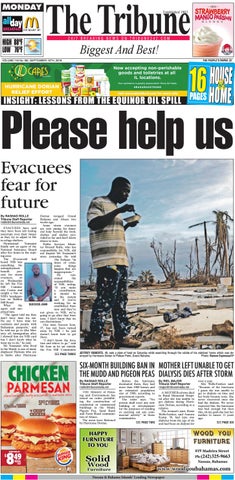
Evacuees fear for future By RASHAD ROLLE Tribune Staff Reporter rrolle@tribunemedia.net
Dorian ravaged Grand Bahama and Abaco two weeks ago. Some storm evacuees EVACUEES have said are now pining for finanthey have been left feeling cial help beyond the food, uncertain over their future clothes and shelter proas they try to adjust to life vided so far and don’t know in refuge shelters. where to turn. Fleurimond Toussaint Public Services Minisfinally saw an agent of the ter Brensil Rolle, who has National Insurance Board responsibility for NIB, did after five hours in the wait- not dispute Mr Toussaint’s ing area. story yesterday. He told The 42-year-old had The Tribune: “In heard NIB was times of crisis, expediting the some things unemployment happen that are benefit proinappropriate.” cess for storm He reitevacuees, so erated the on Wednesday responsibilities he left the Fox of NIB, noting: Hill Commu“If you make nity Centre and a contribution, caught a bus to it should be NIB’s headquarin the system ters on Baillou and if you’re Hill Road. working for an SUCCESS JEAN What the established busiagent said surness and they’ve prised him. not given to NIB, we’re “The agent told me they going to go after that busidon’t have time for me. ness. I don’t know that we He say ‘I have time for can discriminate.” residents and people with One man, Success Jean, Bahamian passports,’ and 37, has not been turned he told me go to (the Min- away by NIB – he just istry of) Immigration after doesn’t know how to get I showed him my NIB card there. but I don’t know what he “I don’t know the locawant me to do,” he said. tion and where to go,” said Mr Toussaint, who lived Mr Jean as he sat outside in the Mudd, is one of many the Fox Hill Community displaced Haitians who are SEE PAGE THREE in limbo after Hurricane
JEFFREY ROBERTS, 49, eats a plate of food on Saturday while searching through the rubble of his relatives’ home which was destroyed by Hurricane Dorian in Pelican Point, Grand Bahama. Photo: Ramon Espinosa/AP
SIX-MONTH BUILDING BAN IN MOTHER LEFT UNABLE TO GET THE MUDD AND PIGEON PEAS DIALYSIS DIES AFTER STORM By RASHAD ROLLE Tribune Staff Reporter rrolle@tribunemedia.net
THE Ministry of Housing and Environment has issued an order prohibiting the construction of residential or commercial buildings in the Mudd, Pigeon Pea, Sand Bank and Farm Road communities of Abaco. The areas were flattened by Hurricane Dorian.
Before the hurricane decimated them, they had more than 1000 homes and an estimated population size of 3500, according to government reports. The order says: “No person shall erect any new building or development for the purposes of residing or carrying out any commercial activity” in those communities. SEE PAGE TWO
By RIEL MAJOR Tribune Staff Reporter rmajor@tribunemedia.net
A MOTHER-of-two died in Rand Memorial Hospital after she was unable to get dialysis during Hurricane Dorian, according to a relative. The woman’s aunt, Rosie Wells-Fawkes, said Annora Kemp, 38, had type one diabetes from the age of six and had been on dialysis for
Nassau & Bahama Islands’ Leading Newspaper
over a year. Mrs Wells-Fawkes said: “Because of the hurricane I guess she was unable to get to dialysis on time and her body became toxic. She never recovered once she had the dialysis. We never expected this, the hurricane was bad enough but then this, oh my gosh she lost her mother to cancer 11 years ago. SEE PAGE SIX
PAGE 2, Monday, September 16, 2019
THE TRIBUNE
SECRETARY General of the United Nations Antonio Guterres pictured inspecting damage in Abaco during his visit to The Bahamas. Photos: Patrick Hanna/BIS
SIX-MONTH BUILDING BAN IN THE MUDD AND PIGEON PEAS from page one
In a statement yesterday, the government said: “The purpose of the Order is to allow for recovery efforts and the removal of storm debris related to Hurricane Dorian. The Order is made in accordance with Section 24(1)(b) of the Planning and Subdivision Act, 2010 and the Planning and Subdivision (Prohibition to Build) (Abaco) Order, 2019. “As previously indicated by Prime Minister Dr Hubert Minnis, the government intends to provide initial temporary accommodation for all affected
residents in safe alternative locations on Abaco.” “The Order is valid for six months but may be extended for a further period up to six months as required.” Last year the government planned to demolish shantytowns nationwide. Residents in such communities on New Providence were given until August 10, 2018 to leave while Abaco shantytowns were given until July 31, 2019. Supreme Court Justice Cheryl GrantThompson granted an injunction last year blocking the demolition of shantytown structures.
THE TRIBUNE
Monday, September 16, 2019, PAGE 3
DONATIONS being made at Fox Hill Community Centre which is now a shelter for evacuees affected by Hurricane Dorian.
Evacuees fear for future from page one
“I don’t know the location and where to go,” said Mr Jean as he sat outside the Fox Hill Community Centre yesterday morning. Breakfast was running late and some displaced residents were fearing the shelter was running out of food. Soon they were served grits and tuna with slices of avocado and packaged drinks like Capri Sun or Yoo-Hoo chocolate drink. Medical personnel from the Heart-toHeart nonprofit organisation administered Tetanus shots nearby. Dozens of displaced residents were dressed in donated clothes they wore as volunteers took them to church. Mr Jean stayed behind. “Sometimes my bosses paid NIB every month, sometimes every three months, sometimes every six months,” he said. “I went to NIB before with a letter for a business licence. They told me my contributions were not up to date. I called my boss and he said he paid it every few months. If I go there now, I don’t know what to expect.” People like Patrick Augustine, 24, say their inability to get benefits speaks to larger problems relating to immigration. Mr Augustine was born in The Bahamas to Haitian parents and never visited Haiti. He applied for citizenship two years ago but has not received approval. He did maintenance work for the past three years without a work permit. He doesn’t have an NIB card. “I went to school here and everything but I can’t get benefits,” he said. One hundred and thirtyfive people, mostly of Haitian descent, now stay at the Fox Hill centre, down from a peak of 239. Most Bahamian storm evacuees are staying with family and friends, but Shonel Ferguson, the Fox Hill MP, said they return to the shelter to collect a box
To advertise in The Tribune, contact 502-2394
HELPERS at Fox Hill Community Centre. of goods containing food, clothes, diapers and toiletries – important items that help lessen the burden on families that take them in. Some of the people who have left the shelter have gone to Haiti, she said. Fred Louis, 47, told The Tribune he is open to returning to Haiti for three months to clear his mind, but he can’t leave because his young daughters don’t have legal status. “If I go Haiti with them, I can’t bring them back,” he said. For now Mr Louis, a permanent resident who has lived in the Bahamas for 24 years, has no reason to seek unemployment benefits because his employer, Starfish Construction, has tentatively committed to providing him a salary. “I talked to human resources on Tuesday, they’re trying to get (a) one bedroom (apartment) for me in Nassau,” he said. “I’m registered with NIB. I received a cheque from them before for being sick.” As residents pondered
their situation, a man from a Fort Lauderdale church stopped by and committed to indefinitely supplying breakfast and dinner to displaced residents, according to Ms Ferguson. Another company volunteered to donate a freezer. Bahamas Waste donated four portable toilets and a dumpster. The community centre has an industrial stove and a local company has agreed to run a line from the kitchen to the gas tank, which is separated by a pool. Ms Ferguson said there has scarcely been a need donors have not met. Beginning on Friday, however, displaced
"If something seems 'off' about your car after heavy rains, even if your vehicle was not flooded, you may have driven through deep puddles and some electrical component could have been splashed by water. Stop by and see us."
Photos: Shawn Hanna/Tribune Staff residents have been ordered outside at 10pm to be searched for weapons. “I never been jail in my life but I feel like I’m there now,” Mr Louis said. “My daughter was sleeping. I put her on my shoulder in the draft to be searched outside.” “We’re grateful,” Mr Toussaint nonetheless added. Across from him, Patricia Box, 51, looked at the street, waiting for a pastor she recently met to take her to church. She and Mr Toussaint have taken no comfort in the government’s suspension of apprehension and
“QUOTE OF THE DAY” Distributed By
BAY STREET GARAGE Dowdeswell Street
322-2434 • 322-2082
repatriation exercises for people affected by the storm. Their work permits are expiring soon and if their renewal requests are approved, they will have no money to pay to get them. There are no jobs for them on the horizon and without something like a work permit, they fear they aren’t safe from deportation. “Last week Friday, the
Asue draw was supposed to come,” Mr Toussaint said. “I paid $200 every week and I was supposed to get about $5,000. That would have covered my work permit. I applied for two years.” “If you don’t pay that,” Ms Box interjected, “if you don’t have that paper in your hand, that’s a problem for you. Immigration don’t play with people.”
PAGE 4, Monday, September 16, 2019
THE TRIBUNE
The Tribune Limited NULLIUS ADDICTUS JURARE IN VERBA MAGISTRI “Being Bound to Swear to The Dogmas of No Master”
LEON E. H. DUPUCH,
SIR ETIENNE DUPUCH,
jamaaltheartist@gmail.com
Publisher/Editor 1903-1914 Kt., O.B.E., K.M., K.C.S.G., (Hon.) LL.D., D.Litt .
Publisher/Editor 1919-1972 Contributing Editor 1972-1991
EILEEN DUPUCH CARRON,
C.M.G., M.S., B.A., LL.B. Publisher/Editor 1972-
Published daily Monday to Friday
Shirley & Deveaux Streets, Nassau, Bahamas N3207 TELEPHONES
News & General Information Advertising Manager Circulation Department Nassau fax Freeport, Grand Bahama Freeport fax
(242) 322-1986 (242) 502-2394 (242) 502-2386 (242) 328-2398 (242)-352-6608 (242) 352-9348
WEBSITE, TWITTER & FACEBOOK www.tribune242.com
@tribune242
tribune news network
We must not fail those in need “IN TIMES of crisis, some things happen that are inappropriate.” These are the words of Public Services Minister Brensil Rolle, after The Tribune related an incident to him of Fleurimond Toussaint, turned away from NIB after a five-hour wait and told that the agent didn’t have time for him, saying “I have time for residents and people with Bahamian passports”. It is without doubt that The Bahamas is in a time of crisis. We may be moving beyond the first phase of that crisis - getting people out of the immediate path of danger, but now we begin the longer crisis, with people not having a home, not having a job, not sure what their future will hold. Around the country, people are trying to work out what their situation is. Some are in shelters, and may remain there for some considerable time. Some are lucky and still have a job, but may have been left without clothes on their back to wear while they work. Others have to begin looking for work all over again. Not a single person will find their lives improved by being subjected to petty prejudice, or being turned away because their name isn’t Bahamian enough for some. We talk of being a Christian nation, this kind of prejudice certainly isn’t a Christian attitude. Even those outside of shelters - staying with friends or family perhaps - still need support too, returning for essential supplies that can ease the burden as they try to rebuild their lives. As Bahamians, we face a simple choice: We can help those in need, or we can make their lives harder. We can choose to turn away people
who have been waiting hours for our help. Or we can follow the example of the staff at Rubins, donating clothes for people who need them for work, or for job interviews. We can look to the example of the New Providence Community Church - which has not only been conducting non-stop relief operations, but has also now started a job placement initiative to help find work for Hurricane Dorian victims. Government too can help. Prime Minister Dr Hubert Minnis talked of shredding the red tape that hinders the recovery effort - well, what red tape can we shred to help people get back on their feet? What extra resources can we put in to cut the long queues that see someone wait five hours at NIB to start with, or that sees talk of student registration continuing for as long as another month for those displaced by the storm? What transport can be provided for those in shelters who know where to go to sort out their paperwork but have little way of getting there? Or can the staff from those departments come to the shelters and sort out the replacement paperwork there and then? We need to think carefully about the problems our refugees face, and we need to offer them solutions, not more hurdles. At the same time, we must remember that we are now in for the long haul. We must not let up on donating items that are needed, or giving our time to help distribute them. It is our turn to be there for those less fortunate than us, and we must not fail them in their hour of need.
A source of hope EDITOR, The Tribune. Re: Hope in Times of Despair IN the daily devotional booklet, Living Faith, Kristin Armstrong wrote a reflection entitled, The Other Side, on the occasion of the 11th September attack on the United States. Upon reading this, I thought how appropriate it is for us at this period, and that you might wish to share it with your readers. I have paraphrased some of it to fit our situation. Blessed are you who are now weeping, for you shall laugh. (Luke6:21). September 1st 2nd and 3rd 2019 represent a period of great pain and loss for our country. It also
represents a time of great resilience, faith and courage Every challenge, every grief, every heartache brings a deep hunger and a well of tears. The emptiness inside us reminds us that our ultimate hunger and our ultimate source of nourishment, is God... and God alone. If you are in a time of struggle or pain, know that this is not random; it isn’t heartless or without purpose. No matter what it is, no matter how deep the pain of your broken heart, God is with you! He has a plan for you! He will redeem and repurpose every bit of your ache for something greater than you could ever imagine. If that seems unfathomable
Hapless Christie EDITOR, The Tribune.
THE great tragedy in the affair of the Two Former Prime Ministers is the pathetic, hapless figure of Perry Christie. Does Christie not realise that he is being manipulated by Hubert Ingraham? Does he not realise that Ingraham is using him – not for the
first time – but this time to achieve his hopeless dream of a political come-back? Imagine that, a has-been PLP prime minister being used by a has-been FNM prime minister to regain lost glory! But all Christie did for Ingraham was to let the cat out of the bag. What Ingraham really wanted was for
or impossible right now, all the better. Because when you get to the other side of this, you will be amazed at what he was doing for you behind the scenes. Watch, Wait, and Wonder and Work. Colossians3:1-11*Psalm 145:2-3,10 -13*Luke6:20-26 And here is a final word of encouragement from Stephen Biko: “The sense of defeat is what we are fighting against. People must not just give in to the hardship of life. People must develop Hope. People must develop some form of security to be together to look at their problems……..” A L CAREY Nassau, September 12, 2019.
Prime Minister Minnis to turn the country over to him! Incredible! PS: If Ingraham wants to get back into power the least he should do is dress properly for a solemn occasion such as a lying-in-state. FLABBERGASTED Nassau, September 13, 2019
Minnis can go it alone EDITOR, The Tribune. IT IS amazing and a spectacle of no small order to see and witness two of our former, and I stress the adjective, former, Prime Ministers seeking to publicly “upstage” the Most Honourable Prime Minister relative to their bogus attempts to inject themselves into matters of public policy in the aftermath of Dorian. Minnis and his crew were elected, in case anyone forgets, conveniently, to administer and govern the affairs of The Bahamas. Ingraham and Christie had their opportunities and have now exited the political stage, however reluctantly they may have done so or been forced to accept. Ingraham was not a “bad” Prime Minister but I have always, personally, found him to be a vain; petty and a dismissive individual. He is prone, in my view, to lambasting all and sundry who are not his water carriers, as I used to be. Christie is cut from the same cloth but is more of a “poodle” than the boisterous “pit bull” that Ingraham pretends to be. Between the two of them, The Bahamas today is in the state that it is in. Ingraham, to his lasting credit, was successful in having the massive roadworks completed here in New Providence. Christie’s pie-in-the sky legacy is still been googled and may yet be found, one day in the distant future. Minnis, love him or hate him, is the duly elected Prime Minister of our wonderful, if temporarily devastated, nation. Some people have a big problem with this fact. Mind you, I supported him and his now motley crew back in 2017 because I could not stomach another term in office by bumbling and fast asleep Christie. Both Ingraham and Christie could have and should have conceptualised a master plan for dealing with unexpected natural disasters. NEMA has been around for a long time but it is, obviously, a half baked institution led by Captain Russell for too long. Neither Ingraham or Christie
LETTERS letters@tribunemedia.net saw fit to have huge fully mobilised stand alone dormitories in major populated areas like New Providence; Abaco and Grand Bahama. Infrastructure in those Islands were allowed by Ingraham and Christie to deteriorate and crumbling, literally, before our very eyes. Now, they say, they want to help Minnis and the administration with recovery efforts. I supported and encouraged the Most Honourable in his quest for secure leadership of the FNM when Loretta and others, inclusive of Duane Sands, were seeking to chop him down at the knees. He’s forgotten that but that is all right. His “word” like all Bahamian politicians means nothing, at least to me. He is, however, the duly elected Prime Minister and he was right, if he did so, to decline the offers of assistance made by the two politicians and relics of a long gone era. I question their sincerity, big time, and the hidden motives. If Ingraham and Christie really wanted to “assist” they could easily make substantial personal financial donations from the apparent wealth they would have accumulated after being “wards of the state” most of the adult and professional lives. In addition, they both collect a fantastic sum of pension money each month (for the rest of their natural lives) from you, taxpayers. If they are/were so concerned about being a part of the rescue; recovery and rebuilding efforts, they could easily donate all of their pension due for the rest of this year. Even though they have retired from front line politics, they are still, to the best of my knowledge, engaged in the lucrative practice of the law and are powerful lobbyists. As far as I know they are not hurting, financially. Minnis was and is totally correct to keep these two at a distance. Those two politicians could also, in their private capacities as wealthy lawyers and former
Prime Ministers with extensive local and international contacts set up a nonprofit foundation or purpose driven vehicle to solicit and collect sizable financial contributions specifically earmarked for the impacted Islands. Have they done so yet or announced the setting up of the same? No. What they are seeking to do, intentionally or otherwise, is to upstage Minnis and to make him look even more incompetent than he might well be (the jury is still out on whether or not Minnis is up to speed). The Ingraham era is, indeed, over. The ghost of a politically humiliated and vanquished Christie needs to go back, wherever it rose from, and rest peacefully. Remember the last hurricane on Christie’s watch? Allegedly over $100m were donated by the private sector. To this very day, impacted Bahamians are still awaiting “hurricane relief supplies” and there was never a public accounting for the proceeds. How Minnis conducts himself and his regime over the next few months will determine his political success going into the 2022 general elections. He can rise to the challenge or he can simply kiss it all good bye. He has been baptised by water.... next time the fire. Keep Ingraham and Christie right where they are....on the outside looking in and seeking to kick the door down or jump through the window. They miss, obviously, sitting at the table. Yes, we do need all hands on deck, but Minnis would be the biggest jack ass in the world to present a platform to these two relics of the past. Imagine President Trump (the greatest thing to happen to the USA and the world since sliced bread) accepting an offer from former Presidents Bill Clinton; Barrack Obama or even George Bush to assist him in responding to a natural disaster? To God then, in all things, be the glory. ORTLAND H. BODIE, Jr. Nassau, September 13, 2019.
THE TRIBUNE
Monday, September 16, 2019, PAGE 5
‘Ingraham is welcome but we don’t need egos’ By RIEL MAJOR Tribune Staff Reporter rmajor@tribunemedia.net
SOME residents of hurricane ravaged Abaco yesterday welcomed assistance from former Prime Minister Hubert Ingraham, but stressed egos need to be put aside in the best interests of storm victims. Victor Patterson, chairman of the Free National Movement’s Central and South Abaco constituency association, said the recovery of Abaco is a “huge job” and help is needed from all quarters. Mr Patterson said: “(Former) Prime Minister Ingraham, who I’m very fond of, has a large network of people who he has worked with in the past. I would just say just pick a lane so to speak and just jump right in and help. I don’t think it’s necessarily productive to say, ‘give me a title.’ Just jump right in and do it basically would be my feeling on the matter. “The thing is, a lot of people are doing a lot of things to help. They’re not necessarily going to the
government and saying, ‘here I am what do you want me to do?’ They are just diving in and helping.” He added: “Pick an area that you think you’d be best able to help with, whether it’s securing aid or whatever. It’s so many jobs to be done…I would welcome any help.” Mr Patterson said while he is an FNM supporter, he welcomes help from anyone – even former Prime Minister Perry Christie. “Even from Mr Christie or anybody that wants to help, I think I should welcome the help. I don’t think the government needs to be formally handing out a bunch of roles. ‘You’re the this and you’re the that’ just find a lane and jump right in and do it,” he said. Abaco District Council member Roscoe Thompson told The Tribune egos need to be put aside for the benefit of hurricane victims. Mr Thompson said: “I don’t think it should be a pissing contest between Hubert Minnis, Hubert Ingraham and Perry Christie. Do I say that Ingraham should be one (involved in hurricane
FORMER Prime Ministers Hubert Ingraham and Perry Christie during a flight to inspect damage in Abaco. get help from everybody?” restoration)? Yes, he is one our family. He has always Abaco MP. done everything with care She referenced the Last week, Mr Ingrathat should be there. “But there also should be and never looking for any- country’s recovery after ham and Mr Christie held some business people that thing in return, even if you Hurricane Floyd in 1999, a press conference, saying when Mr Ingraham was they are willing to help the actually live in Marsh Har- tried, he would decline.” She added: “I truly prime minister. government with the restobour, Dundas Town and the “When Mr Ingraham ration efforts in Hurricane Murphy Town area to see believe he has the interwhat’s going on. I do think est of Abaco and Grand was in charge, he helped Dorian ravaged islands. people. Although However, they appeared that (Mr Ingraham) can be Bahama. I truly believe he the beneficial, but they have to cares and would want to (Hurricane Floyd) was dev- sceptical about whether help those two islands. We astating, people felt secure Prime Minister Dr Hubert put the egos aside.” He added: “I think there are dealing with humans; and they trusted him to get Minnis would have them is trust there, a lot of people we are dealing with indi- Abaco back on the path of take an active role in the still do respect Ingraham viduals who have lost recovering and he did that. recovery process. “As you can see years On Thursday, Prime and you know trust him. everything. There is one I think Ingraham would common goal and that is to later Abaco did rebuild so Minister Dr Hubert Minnis disappointlisten to the people of get the island back up and I think Mr Minnis should expressed allow him to be a part of ment and surprise in his Abaco more per se...and running.” Mrs Bootle said everyone recovering Abaco and predecessors over their he would be down on the needs to “put aside their Grand Bahama as well. This comments suggesting he ground in Abaco.” Treasure Cay resident petty difference and move is not a one-man job, I think has ignored their capacity all hands should be on deck to help the country recover Charmaine Fox-Bootle said on with one agenda.” “If Mr Ingraham could and I don’t think they should from Hurricane Dorian. she thinks Mr Ingraham In a statement, Dr Minnis should be involved in the be that person who could be political about this.” come in and help us rejuveShe added: “It’s Baha- called their comments misrecovery efforts of Abaco. Mrs Fox-Bootle said: “He nate our island, I am for it.” mians helping Bahamians leading and referred to Meghan Bootle, a Treas- and I don’t think it should them as an “unnecessary shows heart, understanding ure Cay resident, said Mr (viewed) as Mr Ingraham distraction”. and care. “We as a country do not “Putting all politics aside Ingraham being involved or Mr Christie having a big I don’t think his agenda is in relief efforts can be ben- ego or trying to get back in have the time for divisiveabout politics. I don’t see eficial because of his past power. I think they see the ness, partisan politics or that, dealing with him he experiences as a former situation as one man can’t jockeying for position,” Dr has been a close friend to prime minister and North do it on his own so why not Minnis said.
BUILDING TO RESIST CATEGORY FIVE ‘TOO EXPENSIVE’ By RASHAD ROLLE Tribune Staff Reporter rrolle@tribunemedia.net
MOST Bahamians would be priced out of the real estate market if the building code were changed so residential homes and businesses could withstand a Category Five hurricane, former Bahamas Contractor’s Association President Leonard Sands said yesterday. “If you make it mandatory that houses now have to be built to deal with that category of strength, you’re talking
about absolutely wiping out the construction centre because no one would be able to qualify for their homes,” he said. “The cost of the houses is going up already in places where you see the home building market is depressed because a lot of people can’t qualify anymore. “The typical house that you could probably build in Marsh Harbour can probably be built at $130,000. To build for Category Five storms, people in the islands would be building three-bedroom, two bathrooms houses for a
quarter million.” The cost increase is because of the amount of steel and concrete needed for reinforcement. Some Bahamians have long taken pride in the strength of the country’s building code, but with 90 percent of the buildings in Marsh Harbour destroyed, for instance, some have questioned whether the standards are outdated in the era of climate change. George Cornish, 51, Abaco’s chief councillor, said evacuating entire islands before a storm is preferable
to changing the building code. “From my point of view, we’ve never seen a hurricane like this in our life,” he said from the United States where he went after the storm. “I went through Hurricane Floyd that damaged docks and buildings and stuff and the damage wasn’t this. This was Category Five, maybe even a six. I don’t think the building codes needs to change. I think we have a proper building code that has stood the test of time of other hurricanes. I think they are strong but it’s just
this hurricane is something we’ve never seen in our lives before. If you change the code, poor people and those in the middle class wouldn’t be able to afford to build.” Instead, Mr Cornish said massive hurricane shelters should be built in communities on all inhabited islands. Some designated shelters, like the Central Abaco Primary School, initially housed hundreds of residents before the storm but became so severely compromised that people scrambled to leave in the
midst of Dorian’s passage. “We need to build something up to code that can stand 180mph winds and more,” he said, noting the only shelter built specifically to withstand major hurricanes is located in Sandy Point, a settlement that did not get directly hit by Dorian. The existing building code is designed to protect buildings when facing winds of up to 150mph. Dorian was a monster storm that had wind gusts exceeding 200mph when it made landfall on Abaco on September 1.
EXPERT: MORE HURRICANES AS SCARY AS DORIAN TO COME By AVA TURNQUEST Tribune Chief Reporter aturnquest@tribunemedia.net
A DISASTER expert on Friday forecast there will likely be more “scary” hurricanes like Category 5 Dorian to come. Pacific Disaster Centre Director Dr Erin Huey said the only other disaster that came close to fitting Hurricane Dorian’s damage profile was deadly Super Typhoon Haiyan that devastated the Philippines in 2013. She believes there was nothing more the government could have done to prepare for the monster storm, and told reporters outside NEMA’s headquarters the focus should now be on supporting impacted people and the communities that have absorbed them. “Never before in the 20 years I’ve been doing disaster management have I ever seen a storm that stopped and impacted at a Category 5 for an extended period of time,” Dr Huey said on Friday. “So I’ve seen storm surge this high, strong winds, but never for the duration that the Bahamas had to experience and that is unique, but also scary because I don’t think this will be the last time that we see it. “Honestly,” she continued, “I don’t think there is anything else they could have done. Your building codes are some of the strongest in the Western Hemisphere, the commitment to disaster management that NEMA and the Family Islands have placed to build disaster resilient communities is really unmatched. “So I think when you’re talking about a really mammoth storm like this, an event. The best thing we can do is help support the people that were
impacted and in that respect I believe very strongly that NEMA has developed quite a robust structure…that is very commendable.” Based on her understanding, Dr Huey said the government acted on data provided by the PDC and attempted to evacuate people ahead of the storm. However, she noted officials could not physically force people to leave their homes even if mandatory evacuation laws were passed. She noted the promised mandatory evacuation legislation would still go far to raise awareness about the severity of natural disasters, adding the Bahamas was extremely high-risk to not only hurricanes but flooding and wild land fires. Pre-storm impact data analysis by PDC put the country’s capital exposure from Hurricane Dorian at $8.1 billion with a projected impact to more than 70,000 Bahamians. The billion dollar sum reflected what’s exposed to the monster Category 5 storm, not how much it will cost to rebuild. On Friday Dr Huey said officials had not yet tallied the costs associated with the deadly storm’s wrath, and pointed to a number of variables impacting estimates like the cost of shipping goods to the affected islands. Dr Huey said: “It’s going to take a very resilient nation to commit to rebuilding these communities and rebuilding them in a way that is safe and prepared for climate change. “The biggest challenge right now is getting information and getting goods from point A to point B, tracking individuals so that the government can provide the right level of support is hard when you’ve got people who are scared
or frightened and they’re moving in, you’ve got some of them brought to Nassau, and then moving out. So the challenges that you are
seeing are challenges that are universal anytime you deal with disaster of this magnitude. “I wouldn’t say it’s a
waste of time something that should be considered because it raises the awareness of the severity – something government will
have to look at and address. The risk is extremely high, it’s not just hurricanes, it’s not just flooding and wild land fires.”
PAGE 6, Monday, September 16, 2019
THE TRIBUNE
Govt expects revenue drop - but other nations helping By RIEL MAJOR Tribune Staff Reporter rmajor@tribunemedia.net PRIME Minister Dr Hubert Minnis said he “anticipates revenue to decrease” as a result of Hurricane Dorian, but noted The Bahamas is receiving “a lot of assistance from the international community”. Dr Minnis made the comment at a press conference at the Office of the Prime Minister on Friday, flanked by United Nations Secretary General António Guterres. Dr Minnis said: “The Bahamas is comprised of
700 islands and only two of our islands have been affected (by the hurricane), that’s Grand Bahama and Abaco. “Our major economic engine Nassau has not been affected and (is) still open for business. The way we can be assisted by the international community and the world is to continue to come to Nassau.” With The Bahamas being a high-risk country for hurricanes, the prime minister spoke of the importance of improving the country’s building codes going forward and making sure structures adhere to best
building practices. “The shanty towns that we have that we know about, you know that those individuals are in danger of being affected by the storm so those are areas that we must aggressively pursue and correct,” he said. “It’s essential for individuals to know that they must live in proper accommodations and we will continue to build resilience and improve continuously because the strength of the hurricane was (Category Five) and who knows what’s next.” Moving forward, the government’s “greatest
challenge would be accommodations” for displaced storm victims, Dr Minnis said. “So, that’s what we’ll be looking at, temporary accommodations but we must also move to permanent accommodations. It’s essential for us, to those individuals that were evacuated here to New Providence, Bahamians are a resilient group of individuals,” he noted. “Abaco especially as they want recommence reconstruction as quickly as possible. In fact they have already started so it’s essential for us to mobilise
the evacuees back to their island so that they can participate and become a part of that reconstruction effort.” For his part, Mr Guterres said countries like The Bahamas should be able to access financing in the wake of super storms like Dorian. “In our new era of climate crisis, hurricanes and storms have turbocharged,” the UN official said. “They have come with greater intensity and frequency, the direct result of warmer oceans. “...Concessional financing must be made available to indebted middle-income
countries that are vulnerable to extreme weather events and this is something which we have been working hard to make the international community fully support.” He also said: “...It is absolutely essential to create an international consensus that concessional financing needs to be put at the disposal of countries for the reconstruction and for the capacity to do that reconstruction, increasing the resilience of the societies, and of the communities and of the countries to future disasters that inevitably will come.”
MOTHER LEFT UNABLE TO GET DIALYSIS DIES AFTER STORM from page one
ANNORA KEMP
“Her youngest son, I don’t think he realises the full extent of it. However, (her oldest son) knows and I think he’s been keeping himself busy. Everyone is pulling together trying to help them as much as they can and, of course, myself and my extended family. Her father is doing well initially it was hard, but he’s coming along, each day it gets better.” Ms Kemp died on September 4. Hurricane Dorian left only devastation in its wake, snapping utility poles, overturning vehicles and tearing entire communities apart, ultimately disintegrating life for Grand Bahama residents when it churned over the island on September 1. It hit Grand Bahama as a Category Four hurricane
with winds of more than 150mph and stalled over the island for about two days. Dorian also brought powerful gusts, intensified by flash flooding and storm surges. Mrs Wells-Fawkes’ voice began to crack as she reminisced on the last words she shared with her niece. “The last conversation we had, and it really was a WhatsApp because she was in hospital and the last conversation I had with her was (telling her) God will see us through and that I loved her. That was it, she died that night at 11pm at the Rand. “She was such a fantastic mother she took such good care of those two boys. Excellent care, I mean the father helped but she was there 24/7 even through dialysis. She went to work, went to dialysis and went back to work. She wanted
the best for those two children.” Mrs Wells-Fawkes said they are a tight-knit family, and everyone is coping with her death. “Everyone is coping very well, her father especially and her sister are doing extremely well considering the circumstances with the hurricane. We as a family on the whole is doing extremely well,” she said. Rand Memorial Hospital (RMH) was hit by severe flooding during the hurricane and the hospital was left unable to offer medical care. Last week, a field hospital was set up on the island by Samaritan’s Purse, a non-profit organisation. The field hospital will provide healthcare services in Freeport while RMH is closed to undergo sanitisation and decontamination.
SICK CHILD RESCUED FROM MUDD A SICK infant was rescued from a damaged home in The Mudd in Abaco by rescue workers and is now receiving medical care in Nassau. Gwen Denton DeLeon, an American doctor volunteering in Abaco, posted on Facebook about the emotional moment a search team stumbled upon the sick baby in a storm damaged home. “Some good news...We rescued a very sick twoand-a-half month-old baby
from a severely damaged home in The Mudd,” she wrote on Saturday. “While we were searching the debris piles in The Mudd, a member of the CNN news crew - who learned I was a doctor - told me there was a sick baby in a house not far from us. “I left the search effort with my team and we went door-to-door until we found him. The baby had a high fever, severe respiratory infection, and was dehydrated from not eating in
over a day. He was living in terrible conditions with his mom and dad who were afraid to take him to the clinic (because) they didn’t want to be deported back to Haiti. I was able to convince them to let me take the baby to the clinic where he was evacuated to a hospital in Nassau that same day.” Ms DeLeon said she was told the baby’s mother accompanied the infant to Nassau. The child’s condition was not known up to press time.
THE TRIBUNE
Monday, September 16, 2019, PAGE 7
MORE THAN 300 HAITIANS FEARED MISSING AFTER DORIAN By MORGAN ADDERLEY Tribune Staff Reporter madderley@tribunemedia.net
A NEWLY formed Haitian advocacy group said it has forwarded the names of more than 300 people listed as missing from shanty towns in the aftermath of Hurricane Dorian. The group, United Haitian Community Front, is chaired by League of Haitian Pastors President Dr Jean Paul Charles. Seven organisations are represented by UHCF, including Rights Bahamas.
Robertson Dieudonne, of Queen of Peace Roman Catholic Church, explained that UHCF was created to assist with the “massive work” of helping the victims of Hurricane Dorian. The Category 5 storm made landfall on Abaco and Grand Bahama on September 1 and 2. It decimated the Mudd and Pigeon Peas shantytowns of Abaco. At a press conference on Friday, UHCF was asked about the number of persons who are missing from the Haitian community. The National Emergency
Management Agency has pegged the number of missing people at 1,300. Rights Bahamas president Stephanie St Fleur said the organisation has reported the names of 309 missing people, the majority of whom are from Abaco. However, she could not confirm whether all of these individuals are of Haitian descent. Ms St Fleur also could not comment on the demographics of the death toll. “We formed a group called ‘Abaco Relief’ and we were having families
sending the names of their family members and pictures, and so far, I think I’ve sent three pages into NEMA,” she said. “The total is 309 so far, and we’re still continuing to gather names of missing persons.” Regarding concerns surrounding deportation of undocumented Haitian migrants, activist Louby Georges said on Friday that this is not currently a “priority” area for UHCF, adding the focus is more recovery and relief. “The only thing we would have done in that area
is to advise persons that that can’t be a priority for them…compared to their health issues or getting immediate aid or helping us with recovery,” Mr Georges said. “The fear of registering…because it may bring you into the system, I think that’s minute compared to the fact that you might get aid that you deserve and need or assist in getting missing persons (removed off) the missing persons list or getting a person put on the list of persons who are not missing, but actually dead.”
Berea Seventh-Day Adventist Church Pastor Edward St Fleur also spoke of how UCHF is assisting with mental health recovery. “Many, especially the children, they have been traumatised,” Mr St Fleur said. “We have an organisation that’s ready to assist us in providing counselling,, either one-to-one or group counselling so that we can help them to debrief, to get into the proper mind frame to continue their education, that’s for the children, and, of course, (to assist) the parents.”
Storm victims ‘need to comply with law and order’ By AVA TURNQUEST Tribune Chief Reporter aturnquest@tribunemedia.net NATIONAL Emergency Management Agency spokesperson Carl Smith has suggested storm victims were exacerbating challenges in the distribution of relief because they refused “to comply with law and order”. Addressing concerns there was a critical need for water on Grand Bahama, Mr Smith on Friday appealed for storm victims to be patient amidst communication and transportation challenges. He insisted there was “a lot” of water on the island, but called for a “realist” perspective on the tremendous challenges being faced. “We are dealing with a disaster,” Mr Smith said, “unfortunately patience is running out. We are begging the public, they will be serviced. We need to have law and order. One of the reasons why we have this
CARL SMITH exacerbated situation is because people refuse to comply with law and order. We need law and order and we must drive that into our people.” When asked whether NEMA was sensitive to the circumstances faced by storm victims, particularly those without access to transportation, Mr Smith said: “We are facilitating getting them to the places as best we can.” He also said: “Our representatives on the ground who know where those distribution sites are, and affected populations are
PM SPEAKS TO PRINCE CHARLES
PRIME Minister Dr Hubert Minnis speaking to Prince Charles on Friday. PRIME Minister Dr Hubert Minnis spoke by phone with Prince Charles on Friday from his office at Cabinet, Churchill Building. Prince Charles expressed how deeply the people of the United Kingdom are feeling for Bahamians during this time of tragedy in the aftermath of Hurricane Dorian, according to a press release from the Office of the Prime Minister. Prince Charles and Dr Minnis also spoke about ways to rebuild stormaffected communities better and with resilience and long-term reconstruction. “This call means so much to the Bahamian people. It shows the deep friendship between our two nations
and that we are like family. The Royal Navy was here at the start and was able to bring in food and supplies almost immediately. Thank you for your strong support,” Dr Minnis said during the call. Prince Charles is no stranger to the Bahamas having spent many holidays here with his grand uncle, Lord Mountbatten of Burma, as the house guest of the Columbus O’Donnells on East Hill Street, now known as Mountbatten House. Prince Charles has also stayed at Windemere in Eleuthera, where interior decorator David Hicks, Lord Moutbatten’s son-inlaw, designed and built a family home.
doing that. It takes time to get to everyone, we are doing our best.” Mr Smith likened the disaster relief management to a hospital system, adding while some people expect to be served immediately, all needs must be prioritised. “We have to have priorities,” he said, “we have to attend to the most urgent need first. “I think it’s related a lot to the communication challenges that we may have, there is a tremendous amount of water (in Grand Bahama), There may be pockets of affected population that may have had difficulty making contact with us, and us with them. But I can assure you there is a lot of water, we need more water. “Let’s be a realist, the challenges are tremendous but we are making tremendous progress. And to the extent that persons may not have received supplies we are there to help.”
DAMAGE in Marsh Harbour.
Photo: Patrick Hanna/BIS
PAGE 8 Monday, September 16, 2019
THE TRIBUNE
PREPARED meals being distributed on the grounds of the old Portion Control Shopping Centre in Grand Bahama by Carnival Cruise Line.
Carnival feeds thousands in GB THE National Emergency Management Agency, along with Carnival Cruise Line, took thousands of prepared lunches to the residents of Grand Bahama on Thursday afternoon during the lunchtime rush.
The prepared meals were distributed on the grounds of the old Portion Control Shopping Centre, which intersects two major highways. The meals, which were prepared by chefs aboard Carnival Cruise
Line, were properly packed and handed out to any and all residents who stopped by for lunch. Bottles of water were given with each meal. Churches and local charities also stopped by to
pack lunches to take to those individuals unable to make it to a feeding centre. Carnival has made a commitment to deliver thousands of prepared meals each day until the
company feels the island is back to some level of normalcy. NEMA is working along with a number of charitable organisations to set up such food distribution centres throughout the
island. The feeding initiative is one aspect of the restoration programme by NEMA as Grand Bahama slowly recovers from the devastation of Hurricane Dorian almost two weeks ago.
60 BOXES OF AID PACKED AT NATIONAL GALLERY HURRICANE relief efforts are continuing among volunteers at the National Art Gallery of The Bahamas - with 60 boxes of aid packed yesterday. With people largely evacuated from the affected islands of Abaco and Grand Bahama now, the relief operation has moved into the second phase of helping to provide for people who face living long-term away from their homes. “Not all the shelters have cooking facilities,” said volunteer Alicia Wallace, who added that relief goods were also needed by people who had found shelter with friends or relatives rather than in the official government shelters. “The National Training Agency people are preparing food and sending it to the shelters,” she said. There is also a need for sustained support from the public. “Donations really drop off after two weeks,” said Ms Wallace, who stressed that the most indemand items right now are toiletries. “Deodorant seems to be something we can’t keep in, soap is similar, and shampoo and conditioner.” On the food front, items such as beans, pasta and ramen - with seasonings to add flavour - are
also welcomed. As the shift to the longterm continues, different types of donations are welcomed. “There’s a big gap between people in the shelters and people on the outside. People on the outside need help too with jobs, clothing and interviews. “We had a big donation of clothing from Rubins to help people with jobs or going to interviews. You can also go in Rubins and buy clothing and leave it for them to give to someone in need.” The relief operation is continuing at NAGB, as a partnership between the gallery, Equality Bahamas and Lend a Hand Bahamas, and volunteers are welcomed, particularly during the working week and on mornings especially. For anyone interested, they can drop in or email equalitybahamas@gmail. com, or message the Equality Bahamas group on Facebook. Donations can also be dropped off at the gallery - which organisers want to especially highlight to people working in nearby downtown Nassau. The gallery is also open for free to visitors until the end of September, for anyone who needs a quiet space in the aftermath of Hurricane Dorian.
THE TRIBUNE
Monday, September 16, 2019, PAGE 9
THE START of registration on Thursday last week. Photo: Terre W Carey Sr/ Tribune Staff
Registration of displaced students will continue until mid-October By MORGAN ADDERLEY Tribune Staff Reporter madderley@tribunemedia.net THE registration of 10,000 displaced students from Abaco and Grand Bahama will continue until mid-October, National Emergency Management Agency spokesperson Carl Smith said on Friday. To manage this “large volume”, Mr Smith said the Ministry of Education is busing students housed in shelters to the National Stadium, adding registration time slots are being scheduled in advance. Mr Smith said evacuees who are not staying in shelters must call the Ministry of Education to schedule a registration time. His remarks came one day after the first school registration exercise was held. This event was marked by extreme frustration and confusion by parents
and guardians who complained of long wait times and a lack of transparency regarding when the process would finally be complete and their students enrolled in a local school. For many parents, school placement is synonymous with providing children with a sense of normalcy in the aftermath of the traumatising experience of surviving a devastating hurricane and having to relocate to New Providence. Hurricane Dorian made landfall over Abaco and Grand Bahama on September 1 and 2, leaving unprecedented destruction in its wake. “The government is committed to getting displaced students back into school as quickly as possible,” Mr Smith said. “Yesterday (Thursday), the Ministry of Education began the vital process of registering the 10,000
students affected by Dorian into these schools,” he continued. “The Ministry of Education is busing students in shelters to the National Stadium for the registration to take place. “To manage the large volume, registration time slots have been scheduled in advance and persons who have been affected but are not in shelters should contact the Ministry of Education to get an appointment time so that their registration can take place. “This is very important because the registration involves capturing information on immunisation and medical checks,” he said. “That is why we are scheduling the registration process, so that people are not waiting on lines long periods of time and getting frustrated.. “As I indicated, if you’re not in a shelter but need to
register a student, please call the Ministry of Education to schedule the time of registration and the number is available on NEMA’s webpage and Facebook. “This registration process will continue until midOctober. We have UNICEF here today with us who are partnering with the Ministry of Education to get our kids back in school as quickly as possible.” The Tribune visited the National Stadium on Thursday and witnessed the scores of parents, guardians, and children attempting to be registered. Eugene Ferguson Sr, an Abaco resident, was there attempting to register to his 18-year-old son, Eugene Jr, who he affectionately referred to as “Geno”. Geno was days away from beginning his senior year at Patrick J Bethel High School in Abaco when
the monster storm hit. When asked how long he has been in New Providence, the elder Mr Ferguson replied: “I came in three days after the hurricane. I’m losing sense of the days now because nothing is normal. I think I came in on Monday of this week. “Luckily, a high school friend of mine and his wife, they decided to take us in – me and my son. I’m grateful to them. “As far as the (registration) process here is concerned, I know that there is a lot of people to deal with and nothing is ever perfect. I’m prepared to just wait it out and wait my turn. You find a lot of people complaining, complaining about this and complaining about that, but whatever assistance they can give, I appreciate it.” He added his son was excited to graduate with his
senior class in Abaco, but understands their current predicament. “(My son) doesn’t want to be interviewed because he got some trauma,” Mr Ferguson said. “He’s one of them who decided to go and look at the damage in Marsh Harbour and...he saw like ten body bags with bodies in them and he told me he saw this guy who got trapped in his car holding the steering wheel and apparently drowned right there. “It’s affecting him on some level because he came home this evening and 18-year-olds don’t go to bed six o’clock in the evening, (but) he went straight to bed. He’s going to need some counselling.” Mr Ferguson added he believes returning to school and being around students his age will also help his son. “I know he needs counseling, but we’ll get through this,” Mr Ferguson said.
PAGE 10, Monday, September 16, 2019
THE TRIBUNE
How to recognise and help to stop abuse of children WHETHER the abuse is a slap, a harsh comment, silence, or not knowing if there will be dinner on the table, the end result is a child that feels unsafe, uncared for, and alone. Many abused or neglected children are too young to articulate what has happened to them, or to understand right from wrong. Even teenagers may not understand that it is illegal to be sexual with adults. When the abuser is a loved one, the dynamic may cause a great deal of psychological conflict for
Police advice
By SERGEANT NATHALIE RANGER
the victim and lead them to hide the abuse. Keep in mind that older children may not talk about the problem, because they fear or want to protect the offender. Or they do not believe they
will be taken seriously. General symptoms of child abuse Certain general symptoms that may suggest that a child is experiencing some type of abuse or neglect include:
• Slower-than-normal development. The child does not show the abilities and skills normally found in other children the same age, such as starting to talk or socialise with others. Some children regress, which means they slip backward, losing skills they had before. • Failure to thrive. meaning the child is not gaining weight or height the way he or she should. Although this can be caused by a medical problem, it can also be a sign that the child is not being well cared for. • Unusual interaction with a parent. The parent may not be interested in the child. Or the child may be constantly trying not to upset the parent. The child may actually be afraid of the parent. • Suddenly getting lower grades in school. • Behaving in a way that is not appropriate or that causes problems. In a young child, this could mean being unusually fussy, being afraid, or not being interested in activities. Children often act out what they have seen or experienced, such as violence or sexual activity. Older children may act out in unusual ways, such as having sex, fighting, using drugs, or running away. Symptoms of physical abuse • Children often get injured, but physical injuries may point to abuse when: • It is hard to see how they could have been caused by an accident. Suspicious injuries include: • Injuries that have a pattern, such as a straight line or a circle. • Injuries to areas of the body that usually are protected, such as the inside of the legs and arms, the back, the genitals, and the buttocks. • The explanation for the injury changes. Or it is not a believable explanation. • There are signs that the child has been hurt before. • The child does not receive medical care for his
or her injury. Emotional abuse means doing or saying things to hurt a child emotionally. For example, the adult may say things to make the child feel unwanted or worthless. A child who is emotionally abused may: • Not care much about what is going on around him or her. • Not react normally to pain, other people, or changes in his or her life. • Avoid a particular parent or caregiver. • Act more fearful, angry, or sad than would seem normal. • Not do well in school. • Hurt himself or herself on purpose. Symptoms of sexual abuse • A child with symptoms of recent sexual abuse may: • Not want to go to the bathroom. • Show signs of discomfort or pain while sitting, urinating, or passing stools. • Have discharge from the vagina or penis. • Bleed through his or her pants. Certain ways of behaving may also point to sexual abuse. These include: • Knowing more than he or she should about sex. • Running away from home. • Attempting suicide. • Being involved with drugs or prostitution. Domestic and family violence – signs in childhood Children living in a family violence environment are living in a situation of fear, anxiety and unpredictability. They experience emotional and psychological trauma similar to children experiencing other forms of child abuse and neglect. Some will be directly targeted and may experience physical or sexual abuse as well as neglect. A child witnessing family violence is at risk of: behavioural and emotional difficulties, learning difficulties, long-term developmental problems, aggressive language and behaviour, restlessness, anxiety and depression. Help to prevent child abuse Anything you do to support kids and parents can help reduce the stress that often leads to abuse and neglect. By educating yourself and others you can help your community prevent child abuse and neglect from happening in the first place. The behaviour of
children may signal abuse or neglect long before any change in physical appearance. If you suspect abuse or neglect may be occurring, Report it. Be a nurturing parent. Children need to know that they are special, loved and capable of following their dreams. Learn about how children grow and mature and have realistic expectations of what your child can and cannot do. Help a friend, neighbour or relative. Being a parent is not easy. Someone you know may be struggling with his or her parenting responsibilities. Offer a helping hand- take care of the children, so the parent(s) can rest or spend time together. Help yourself. When the big and little problems of everyday life pile up to the point you feel overwhelmed and out of control – take time out. Do not take it out on your kid. Take a deep breath. Turn on some music. Know who to call for help, and keep the numbers next to your phone. Respect kids. Treat them the same way you want to be treated. Get involved. Advocate for services to families. Help to establish parenting groups in your community. Ask your community leaders, clergy, library and schools to develop services to meet the needs of healthy children and families. Promote programmes in schools. Teaching children, parents and teachers prevention strategies can help to keep children safe. Monitor your child’s television and video viewing. Watching violent films and TV programmes harms young children. It scares them, and teaches children that aggression is a good way to handle frustration and solve problems Report suspected abuse or neglect. Keeping children safe is the responsibility of every adult in the community. If you have reason to believe a child has been or may be harmed report it to the appropriate authorities. Let us create safer communities by reporting child abuse today. For more information, contact the National Crime Prevention Office on 3028430, 302-8431, 302-8154 or visit our website, www.royalbahamaspolice.org.
MAN DIES AFTER BEING HIT BY CAR A PEDESTRIAN died in hospital after he was hit by a car on Friday. According to police, the man was walking on Shirley Street, near Williams Lane, shortly after 9pm when he was struck by a silver Mercedes Benz. Paramedics
took the victim to hospital, however the man died from his injuries. The driver of the vehicle remained on scene and is assisting police with this investigation. The RBPF Traffic Department is investigating the incident.
POLICE HUNT FOR ARMED ROBBERS NEW Providence are searching for the suspects behind two armed robberies which occurred on Friday September 13. Shortly after 1pm, a man was at Shady Tree Street when he was approached by an armed man, who robbed him of cash and jewelry before getting into a white
vehicle and speeding off. In the second incident, shortly before 9pm, a woman was at Faith Gardens when she was approached by two armed men who robbed her of a grey Nissan Cube and a cell phone before escaping. Investigations are ongoing.
MONDAY, SEPTEMBER 16, 2019
THE STORIES BEHIND THE NEWS
Lessons from the Equinor oil spill By FREDERICK SMITH, QC EQUINOR, formerly Statoil, operates the old Burmah Oil storage facility at South Riding Point in East Grand Bahama. Equinor is a Norwegian multinational energy company majority owned by the Norwegian government. It is a petroleum and wind energy company operating in 36 countries. By revenue, Forbes ranked it as the world’s 11th largest oil and gas company and the 26th largest company, regardless of industry, by profit in the world with annual revenues of $60bn and 20,000 employees. Norway is a rich country, with a GDP of $443bn and a per capita income of $83,000. In comparison, The Bahamas has a GDP of $13bn and a per capita income of $34,000. It is regarded as one of the greenest and most eco-friendly countries in the world. Paradoxically, the petroleum industry accounts for around a quarter of its GDP. On a per-capita basis, Norway is the world’s largest producer of oil and natural gas outside of the Middle East. It must be doing something right in balancing an oil with a green economy.
ENTER HURRICANE DORIAN
Dorian hit Grand Bahama after devastating Abaco on August 31. The Equinor above-ground storage tank (AST) facility was hit and six tank roofs were blown off (how?), resulting in an oil spill which mercifully blew north onto land and not south into the sea. It is still a disaster, but dramatically less than it could have been. The prevailing current on the south shore of GB is from the southeast to the west. If it had blown into the sea, it would have drifted to Carnival’s Grand Port beach, Peterson’s Cay National Park, Barbary Beach, Royal Caribbean’s Lucayan Beach, into the many miles of Freeport’s canals, along the rest of Freeport’s beaches, into Freeport Harbour and eventually West End. Freeport’s desirability would have evaporated and would be known as “Freepoil”! The media has shared photos of the environmental damage. Equinor has pledged and mobilised to clean up the oil spill. Thankfully, Equinor has the resources and, given its ownership, a vested interest in maintaining its reputation as an environmentally responsible corporate citizen of the world.
ENTER OBAN
Oban obtained approval to develop a $5.5bn oil storage and refinery facility east of Equinor’s. Despite the fact that Oban has no history in the industry and has mired the government in political embarrassment, Cabinet continues to promote it as an opportunity to resurrect GB’s economy, and seeks to further justify it on the basis that GB residents are “overwhelmingly” in support.
Tragically, it seems Dorian killed dozens of people in GB, particularly from east GB. It has displaced thousands and destroyed their homes. GB can rise Phoenix-like from Dorian’s ashes. It has dodged an oil disaster that could have crippled its environment and future. Luckily, Equinor has the means and will to remediate the spill. But what if Equinor didn’t? What if the oil had spread south-west? What if Oban had built a refinery? What if crude oil and refined product was now on our beaches, in our canals, in our water table, in all our reefs and in the harbour? Mind you, Freeport already has much of this challenge on a smaller scale with Borco at Freeport Harbour. Just imagine it exponentially bigger for the entire southern coastline of GB, 30 times larger than the 10 million gallons of crude that oozed over Prince William Sound from the Exxon Valdez in 1989. That was 1 tanker. Equinor has 10 ATSs. Oban would have at least 20. And what could we do about this? What can we do about the Equinor land oil spill?
LACK OF BAHAMAS ENVIRONMENTAL LAW
We have no Environmental Protection Act. The government is reported to have stated that after it takes care of the immediate needs of the people it will turn its attention to the oil spill clean-up. However, that is not the job of government. That is the job of Equinor. The government’s job is to have in place laws and a regulatory agency which can effectively prevent an Oban-type development and not to license an unknown Johnny-cum-lately like Oban; to ensure that existing facilities like Borco and Equinor operate as safely as possible; to oversee regular maintenance and prevent pollution, and at industry’s expense (not the Bahamian taxpayer) oversee emergency reaction to spills and damage from accidents to the highest industry standards, given that we are a tourist-based economy in Hurricane Alley! Irresponsibly, neither the PLP nor the FNM governments have taken protection of the environment and the safety and health of workers seriously. The highfalutin-sounding Cabinet “National Economic Council” (NEC) and committees negotiating Heads of Agreements (HOA) make a big song and dance about protecting the environment. They are wellmeaning but ineffective. It’s
all dissonant talk which ultimately frustrates investors from abroad. Because of our pristine environment, The Bahamas is desirable to investors for private islands, golf courses, mega-yacht marinas, second home projects, hotels, casinos, water parks and condominiums. Freeport is the industrial capital of the The Bahamas. In addition to the above, Freeport is home to oil storage facilities such as Equinor and Borco, ship repair facilities, a container port, chemical plants and aggregate mining. In addition to foreign investors, domestic Bahamian development is also taking place. These projects have tremendous environmental, social, cultural and planning impacts. Yet both political parties muddle along amateurishly and irresponsibly. The irony is that both foreign and domestic investors appreciate and would comply and cooperate within well run
organised statutory regulatory frameworks. A well run green economy is within our grasp! Yet, The Bahamas still has not passed an Environmental Protection Act. It has no environmental protection agency with any statutory teeth. It relies on the Bahamas Environmental Science and Technology (BEST) Commission that does not exist in law and is also under-funded and resourced. The NEC serially negotiates HOAs with each new foreign investor with wonderful provisions dealing with the environment.
LACK OF REGULATORY OVERSIGHT
Firstly, it is a perverse waste of time for HOAs to be negotiated afresh, each time instead of simply having an Investment Act with a framework and efficient negotiation of business terms by a statutory Bahamas Investment Authority (which still does not exist). Secondly, once signed, there is no government department that oversees the enforcement of provisions of HOAs. Thirdly, domestic investors are not even subject to the NEC or HOAs. They are all non-statutory policy constructs.
They are, however, subject to the Planning and Subdivision Act (PSA), the Environmental Health and Safety Act and other building control and development legislation. These laws are well-meaning and well drafted and also apply to foreign investors after the HOAs are signed. However, these statutory agencies are often ignored by the executive branch of government. They are underfunded and underresourced. The PSA is supposed to be the cornerstone of development in The Bahamas. Yet no National or Island Use Plans have been created as required by the PSA. As to Freeport, sadly even though it is the Industrial Capital of The Bahamas operating under the Hawksbill Creek Agreements (HCA), the Grand Bahama Port Authority (GBPA) and the Grand Bahama Development Co. (DEVCO) have negligently failed to provide development, environment, health and safety Bye-Laws as required by the HCA and the Freeport Act 1993. Instead, all governments have continued to undermine the HCA and bicker with the GBPA, instead of holding the GBPA and DEVCO to account for their responsibilities under the HCA and cooperating with them in passing the Freeport Environmental Bylaws.
A DOG’S BREAKFAST
So, we are left with a dog’s breakfast of conflicting jurisdictions, disrespect
and failure to abide by laws passed by Parliament, strangulation by policy and statutory red tape, and ultimately frustration of both foreign and domestic investors. All to the detriment of The Bahamas and opportunities for developing a green and environmentally sustainable economy, where both domestic and foreign investors would comply with the laws if they were properly set out and administered by properly funded and resourced statutory agencies. Instead we have constant political interference and obsession with minutiae by the executive to the ultimate frustration of everybody concerned. It is in this environment that we find ourselves dealing with the disaster of an oil spill on land with absolutely no effective laws to force Equinor to do right by The Bahamas. We must simply put our hands together in prayer and hope for the best. We can only beg King Harald V of Norway and his PM Erna Solberg to please clean the oil spill quickly and effectively.
BAN OBAN
Given this negligent and ineffective political, statutory and policing environment, we ask, how on earth, could any rational politician continue to promote the Oban oil and refinery? Despite our lack of laws, I have faith that King Harald will do right by The Bahamas. As to Oban, it would just walk away. GB would be left to clean up Oban’s mess at the expense of the Bahamian taxpayer.
INSIGHT
PAGE 12 MONDAY, SEPTEMBER 16, 2019
EMAIL: insight@tribunemedia.net
In our darkest hour, caring hearts are most needed By MALCOLM STRACHAN
J
UST over two weeks ago, the islands and cays of Abaco and Grand Bahama were devastated by the ruthless winds and rain of Category 5 Hurricane Dorian. Left in its trail of destruction, the stench of death and loss still permeates the air of two jewels in the crown of The Bahamas – completely altering the picturesque landscape of the treasured Bahama islands. Homes pancaked throughout the close-knit communities where families once enjoyed tranquil beauty away from the hustle and bustle of New Providence have left us all
RESIDENTS from the Mudd cleaning clothes outside the Bahamas Government Complex. Photo: Terrel W. Carey Sr/Tribune Staff with mild to acute forms of post-traumatic stress
disorder. Indeed,
it
has
been
nothing short of the most horrific experience in Bahamian history. Even for those of us on islands that were mildly affected and others that weren’t, if you had communication with Abaconians and Grand Bahamians that endured the storm, you felt like you were watching a real-time horror movie. This nightmarish ordeal has been unsettling in more ways than one. Certainly, our vulnerability in this new era of superstorms has been brought to the forefront. The impact of climate change on the intensity of storms has made it so that even a tropical depression now sends chills down the spine. Justifiably, the Bahamian people are frightened, as it is clear that the stakes have changed, and it is now a matter of life and death to be taken seriously. Naturally, one would assume that grief and loss bring people closer. However, while this has been the story in some instances, Hurricane Dorian has unfortunately sprinkled salt in bitter wounds as tension between Haitians and Bahamians has again reared its ugly head. Putting it mildly, the vile manner in which some Bahamians have responded to the Haitian community in this time of crisis has been disappointing. Notwithstanding the long unresolved issues with illegal migration, there is little sympathy for the Haitian community who have also lost everything
along with our country- the affected areas – that’s men in the mounds of the Abacos and Freeport, rubble left behind by the Grand Bahama. storm. He added: “Why I say Hurricane Dorian was an we were extremely careful equal opportunity disaster because the notice sent out that ravaged the impacted does not include islands islands. Whatever your like Inagua, Cat Island and nationalistic views, that San Salvador, Long Island, calls for a measure of whatever have you. We empathy for other human still have the constitutional beings. right to safeguard our Of course, sympathy does borders.” not equate to a free pass, Indeed, this was a combut Bahamians have to mendable policy shift. But become more open-minded let us not be naive in our and kind-hearted in the thinking that’s where it wake of such an historic ends. No doubt the govtragedy. ernment is embroiled in its However, at a time when recovery and restoration those of us in the nation’s efforts on both affected capital should be focused islands. Nevertheless, a on providing support in any hard policy stance will be way we can, many are spew- necessary to bring clarity to ing hateful rhetoric towards one of the more convoluted the Haitian community all issues plaguing Bahamian over social media which society. embarrasses us all. Here it is, we’ve seen It is absolutely what can happen when despicable. these issues are not mitiIf there had ever been a gated, which they should time when our humanity have been eons ago. To should prevail, rather than Prime Minister Minnis’ bigoted nationalism, it is credit, he attempted to take right at this very moment a firm approach to immiwhen our brothers and gration and the removal of sisters – Haitian and Baha- shantytowns but was met mian – are most in need. with legal roadblocks that Unfortunately, though, hindered this process – a many Bahamians don’t process which potentially share these ideals. Amidst a could have saved countless life-shattering event, people lives. are asking for Haitians to Obviously, with the be sent “home”. But to rebuilding process taking which home are we sending place and the symbiotic them? relationship of the rich Some of and poor in the resi- ‘In such a time Abaco comdents of The munities, Mudd and when our economy the governPigeon Peas has received such ment is going have lived a staggering blow, to be faced there for with some generations the last thing the very tough government and unencumdecisions. bered in what citizens need to do Where one Washis the manington Post is show ugliness in power journalcoming from a time when love ist dubs a should illuminate to drive these “libertarrebuilding ian utopia” every man, woman efforts if the where the and child in this government rules did not country – Haitian decides to apply. deport the and Bahamian.’ Rather surviving than unleash residents of our disgust and hatred of these communities? Surely, Haitian people, why not there were able-bodied really put on our critical unemployed men (and thinking caps and take women) on the capital, but issue with the policies, will they be as motivated as or lack thereof, that have the Haitians to rebuild their allowed this vexing issue “home”? to proliferate for such While there is a full a long time. Surely you cheering squad in support would agree that our col- of the government deportlective energies should be ing Haitians that were directed toward a goal- in Abaco illegally, how focused end. And whether heartless will that make we’d like to admit it or us look in the eyes of the not, this road does not international community circumvent the people of amidst a humanitarian the demolished commu- crisis? nities of The Mudd and Make no mistake, the Pigeon Peas becoming world is watching. We have regularised be it through everyone’s attention, and temporary status or for the government, there otherwise. may be no politically expeThe fact is that the gov- dient decision available to ernment is faced with an them. Taking into account, unpopular, but no less, nec- that while observers within essary decision that it has to the international commumake. nity do not go to the polls While the government and elect our leaders, they has taken the position to do, however, help to feed suspend deportation exer- our families by visiting our cises of immigrants from shores. And in such a time areas impacted by Hur- when our economy has ricane Dorian, there is received such a staggercurrently no plan to offer ing blow, the last thing the asylum to non-Bahamian government and citizens storm survivors. need to do is show ugliMinister of Immigra- ness in a time when love tion Elsworth Johnson, should illuminate every when speaking to the man, woman and child in media last week, said: this country – Haitian and “Having regard that we’re Bahamian. now facing a humanitarHurricane Dorian has ian crisis, the government connected us in a way that is taking the decision that we cannot ignore. And those immigration policies while it may be difficult to or enforcement measures accept for some, the reality suspended forthwith in is that we are not a homogenous society. Rather, we are made up of different cultures and history – a history that Hurricane Dorian intertwined in the space of two days. Like the philosopher George Santayana said, later popularised in Winston Churchill’s famous speech to the House of Commons, “Those who fail to learn from history are condemned to repeat it.” There is a valuable lesson for us in this tragedy. And in perhaps what may be our darkest hour when we are all going to have to pick up the pieces together, it would be best if we learned it.
EMAIL: insight@tribunemedia.net
INSIGHT
MONDAY, SEPTEMBER 16, 2019 PAGE 13
Joplin recovered from tornado - so can we from 2019 Dorian? I
N THE Tornado Alley states of the USA, tornadoes, large and small, are too frequent to be named. Only the worst are identified for the official records — like Joplin in 2011. It was a warm and muggy afternoon about 5pm on Sunday, May 22, 2011, when the civil defence warning sirens were first heard in Joplin, Missouri, population 50,000. With typically brief notice, at 5.34pm the first blast of a tornado touched down on the western edge of town. For the next 40 minutes, the tornado spread its narrow path of devastation six miles eastward, rising in force to EF-5, the highest rating given by the National Weather Service, promising winds of over 200mph, that probably rose to gusts of 260mph, what a local meteorologist called “a fist coming out of the sky”. By 6.30pm the wind had died, leaving a desolate and rain-soaked Joplin to dig out and start assessing the catastrophe. The death toll was soon set at 161, most of the victims crushed in their own homes, with others caught in stores, cars, or outside, including 21 in a destroyed nursing home, and nearly 1,000 were injured. About 7,500 houses were destroyed, plus high school, churches, and Walmart and Home Depot facilities, larger than anything in The Bahamas. A modern nine-story hospital was evacuated but lost five critical-care patients and was blown off its foundations, requiring demolition. Vehicles were thrown 300 feet from the parking lot and found mangled around trees. Dorian’s problem: island evacuation Whether the present Dorian death toll of 50 will ever rise to match Joplin, the two afflicted Bahamian islands suffer recovery problems even tougher than in Missouri. All reinforcements of people or supplies must be brought in by sea or air, rather than by the unmatched American rail and highway systems. We have nothing to match FEMA (Federal Emergency Management Administration), which quickly installed 600 temporary housing units in Joplin, finally vacated two years later. Absent in Joplin, we face the agonising humanitarian question of handling the indigent foreigners who had settled in The Mudd and Pigeon Peas. Certainly uninsured, these Haitians won’t be rebuilding any of their destroyed shanties. Virtually undocumented, their names and numbers will bollix any detailed rehabilitation plan. Are they 2,000 or 10,000, among Abaco’s official census of 17,000 people? Who knows? The answer can only be general relocation, with minimal paperwork. Obviously to New Providence, and only Government can pay the transport cost, preferably by chartering ferries or barges. Once they reach Nassau, some of the refugees can be lodged with
Haitian relatives, but most will have to shift for themselves, with little work available. Government may have to provide both housing and employment, or simply charity payments. Return to Haiti is the ultimate solution, but whether the Port-au-Prince regime can, or wants to, share the expense with our Government is pretty doubtful. For years we may see a budget item of several million labeled “Haitian Repatriation”, a direct drain on our Treasury. Of course, native Bahamians too are suffering physical or mental trauma from Dorian. But most of them have solid family connections to give succour, and at the least the hope of a job when reconstruction begins. Homeless Haitians will remain our most pressing social burden. Our authorities must make sure that never again will such a mass of needy foreigners be allowed to accumulate, in The Mudd or anywhere else. We can be more hopeful about the task of rebuilding, long-term though it may be. Our basic resource is people, and Bahamians show no lack of energy and ingenuity when faced with a crisis. An amazing array of foreign contributors is already pushing money and goods at us, whether from organised charities, development banks or lending agencies, or commercial companies doing business here There will certainly be a temporary drop in current revenues from tourism and services, but any decline in our reserves will be more than met from these inflows. The Central Bank has already announced technical measures to help impacted borrowers. The alarming figure of an $8.1 billion hit to our economy should be taken with a large grain of salt. How was it calculated and over what period? Any capital loss from the massive destruction of property will be largely balanced by the receipt of insurance proceeds on all substantial buildings and much of our infrastructure, which our insurers and their foreign co-insurers are fully capable of providing. Much of the new construction will be probably of higher quality than before and assessed accordingly. How Joplin recovered, over seven years We can turn to the extensive writing about the Joplin tornado and its aftermath, enough for a book, to help us chart our future. Among scores of items, from 2011 right up until this year, we learn: • Within three months, three billion cubic feet of rubble was cleared away to permit reconstruction, and no new victims or survivors were found.
• Churches throughout the US, led by the Amish, immediately contributed both cash and work crews, and AmericCorps provided 450 volunteer workers. • The ASPCA contributed $100,000 for pet and animal treatment. • On the first anniversary, the Joplin Town Council dedicated 161 trees in a central location as a memorial for the dead, noting the need for the City to recover “physically, emotionally, and spiritually”. • Within five years in 2016, over 1,600 new houses had been built and 550 businesses had reopened, with 4,500 -5,000 employees; Walmart was one of the first to reopen its major retail facility. • The St John’s Hospital had been rebuilt at a new location, and a first-time municipal library was in operation. • In February, 2018, the Joplin Globe reported that PwC, the consulting firm hired by the City for coordination of Federal aid, called the Joplin recovery “one of the most successful” they had ever seen, and later that year ABC TV announced that the “city is thriving, just thriving, thanks to a solid rebuilding programme.” • The council was even willing to admit one mistake: in the first days after the tornado, it signed with a Texas real estate company for a redevelopment scheme that was never performed, leaving the city to sue for $1.5 million when the company folded. The Joplin disaster did not leave every story a happy one. A Methodist minister still suffers from PTSD from his observing the shattered dead and counselling the wounded five years earlier. But the St Louis Post-Dispatch of January 2016 concluded that “Joplin rebounds strongly”. Facing the future The Bahamas can never be certain another Dorian will not strike, or shift its track 5 degrees and hit Nassau. The Tornado Alley of the Midwestern states, with Joplin smack in its midst, lives under this threat every year. In a twoweek period in May 2019, over 200 tornadoes touched down, with at least 40 rated EF-2 or higher. Thanks to improved early warning networks, fatalities were low but property damage amounted to billions across the region. Business does not shut down nor population flee these states, home to so much American commerce, industry and agriculture, and neither will they do so across The Bahamas or the wider Caribbean. There are simply too many reasons to live in this vast zone of natural beauty and weather that smiles 95% of time and
THE ST John’s Hospital facility was blown off its foundations, leading it to be demolished.
THE AFTERMATH of the tornado in Joplin in 2011. place. If indeed “global warming” is bringing an era of more violent weather, our task is simply to enforce building codes, replace slums with decent housing, improve drainage of lowlands, and encourage building on ridges or
our limited amount of elevated land. We must recall that the most destructive hurricane of all battered the Florida Keys with 400 deaths back in 1935—but was not the predicted kiss of death for now booming Key West
NOTE: The present Mayor of Joplin, who survived the 2011 Tornado and led the recovery effort, just three months ago spoke about his experiences in Dayton, Ohio. I hope we can invite him to do the same in our country.
PAGE 14 MONDAY, SEPTEMBER 16, 2019
INSIGHT
EMAIL: insight@tribunemedia.net
Handmaiden to the tyranny of a minority THERE have been many ignominious moments at the Permanent Council of the Organization of American States (OAS) and many farcical decisions made, but they pale in significance when compared with the events of Wednesday, September 11, 2019. On that day, 11 countries, accompanied by the illegitimate representative of the self-proclaimed “Interim President” of Venezuela, Juan Guaidó, adopted a resolution opening the possibility of invading the sovereign territory of Venezuela with the obvious intention of achieving their self-interested goal of toppling the government of Nicolás Maduro. The ridiculousness of the proceedings at the OAS Permanent Council is that 16 of the legitimate 33 member states of the Organization had no vote in the resolution because they are not signatories of The Inter-American Treaty of Reciprocal Assistance (the Rio Treaty) under which the dangerous resolution was invoked and adopted. By a previously absurd decision, in 1975, 21 then signatory countries of the Rio Treaty decided to make the OAS Permanent Council the body in which matters related to the Treaty would be discussed. At that time, only two CARICOM countries were signatories to the Treaty, namely Haiti and Trinidad and Tobago. A third CARICOM country, the Bahamas, did not join until 1982. No CARICOM country has joined since. Canada, a big player in the OAS, is also not a signatory.
World View
By SIR RONALD SANDERS
The actual number of signatory states is now 17, although farcically, the register still shows the membership as 19 with Cuba and Venezuela as signatory states. Cuba withdrew from the OAS and, informally, from all hemispheric bodies in 1962 and Venezuela formally withdrew in 2013. It would have been interesting to see what the present signatory countries would have done had Cuba sent a representative to the meeting. Another four of the original members of the Rio Treaty have also “denounced” it, withdrawing from membership. These countries are: Bolivia, Ecuador, Mexico and Nicaragua. In the event, ten signatory states of the Rio Treaty and Juan Guaidó’s improperly seated OAS representative, proposed a resolution, arising from this anachronistic 1947 Treaty for adoption at a meeting of the Permanent Council of the OAS. The objective of the resolution was clearly set out in an accompanying notice. It claimed, without any supporting evidence, that “a series of developments and situations, which are as a consequence of the Venezuelan crisis, pose a threat to peace in the Americas and [-} affect the inviolability or the integrity of the territory or the sovereignty or political independence of
various American states”. Spuriously it went on to say: “It is for that reason that measures need to be adopted by the member states of the (Rio Treaty) based on the principles of inter-American solidarity and cooperation established in said instrument”. Venezuela was thereby set-up for “measures” that would be agreed by a twothirds vote of the Foreign Ministers of the claimed 19 signatory countries at a meeting to be held “in the second half of September 2019” when they will be attending the UN General Assembly in New York. The measures include: establishing a naval and aerial blockade of Venezuela or using military force. If there was any doubt that the ten governments plus Guaidó’s representative had anything but military force in mind, that doubt disappeared when, by virtue of their simple majority of the claimed 19 signatories, they spurned an amendment from Costa Rica which proposed that any “measures” would exclude “those that may involve the use of armed force”. So, clearly armed force is very much in the collective minds of the countries the 11 governments plus Guaidó’s representative that eventually pushed
VENEZUELA’s opposition leader and self-proclaimed interim President of Venezuela, Juan Guaidó, shows a video of Venezuelan President Nicolas Maduro during a meeting with lawmakers in Caracas, Venezuela, on Tuesday. Photo: Andrea Hernandez Briceño/AP through the resolution. The too distant future, CARI- Today, Venezuela; tomor11 countries are the original COM itself will have to row who and to serve whose ten proposers of the reso- consider whether its member interests? lution - Argentina, Brazil, states have breached underEqually, it continues to be Colombia, El Salvador, takings in its own treaty and deeply disturbing that, at the Guatemala, Haiti, Hondu- whether they should aban- OAS, a minority of states ras, Paraguay, Dominican don any effort to achieve make and impose decisions Republic and the United a common foreign policy. that wreck the organisation’s States of America, plus Failure to deal definitively institutional foundations and with this situation would reduces it to a weapon for Chile that voted with them. Alarmingly – and ludi- ruin CARICOM’s greatest the interests of a few. crously – the resolution strength – its 14 votes pooled Peace and security is was adopted in the name in unison. increasingly endangered in The 1947 Rio Treaty the hemisphere, as is the relof the Permanent Council of the OAS, even through emerged in the context of a evance of the OAS as set out 15 member states have no world that had just emerged in the obligations of its Charconnection with the Rio from World War II. It was a ter: “to achieve an order of Treaty and could not vote, world in which CARICOM peace and justice, to promote and five of the signatory countries, except for Haiti, their solidarity, to strengthen states did not support it. were all colonies as were their collaboration, and to The latter states are: Costa the majority of countries of defend their sovereignty, Rica, Panama, Peru, Uru- Asia, Africa and the Pacific. their territorial integrity, and guay and Trinidad and The United States was their independence”. Tobago. Bahamas, which is the rising, but dominant, • Responses and previa member state, was absent. power of the Americas, and ous commentaries: www. Sadly, governments of Canada was still a domin- sirronaldsanders.com countries, which have been ion of the British Crown. the victims of invasion, sup- Cuba was in thrall to mafia The writer is Ambassador ported this resolution which, outfits from the US, and of Antigua and Barbuda to in the words of the Mexican Latin American countries the United States and the Ambassador, Luz Elena were ruled by undemocratic Organization of American Baños Rivas, “inextricably juntas for the most part. States. He is also a Senior It is nothing short of Fellow at the Institute of entails the possibility of the use of force [-} and is con- shameful that a handful of Commonwealth Studies at trary to international law”. countries would invoke a the University of London Among these is the govern- 72-year old, outdated treaty and at Massey College in the ment of Haiti, a CARICOM in today’s world to try to University of Toronto. The accomplish the crushing of views expressed are entirely member state. At some point in the not a government they dislike. his own.
PAGE 16, Monday, September 16, 2019
THE TRIBUNE
Saudi oil attack sees US-Iran tensions rise DUBAI, United Arab Emirates Associated Press A WEEKEND drone attack on Saudi Arabia that cut into global energy supplies and halved the kingdom’s oil production threatened yesterday to fuel a regional crisis, as the US released new evidence to back up its allegation that Iran was responsible for the assault amid heightened tensions over Tehran’s collapsing nuclear deal. U.S. Secretary of State Mike Pompeo has blamed Iran for the attack on Saturday on key Saudi oil infrastructure. Yesterday, senior US officials again said the American government believes there is no doubt Iran was responsible, saying satellite imagery and other intelligence, show the strike was inconsistent with one launched from Yemen, where Iranian-backed Houthi rebels had claimed responsibility. Iran, meanwhile, called the US claims “maximum lies,” while a commander in its paramilitary Revolutionary Guard reiterated its forces could strike US military bases across the Mideast with their arsenal of ballistic missiles. The US government
SMOKE fills the sky at the Abqaiq oil processing facility on Saturday in Saudi Arabia. attack on the Kingdom and drone could have been fired US officials said a strike from Yemen, then taken a from there would be a vio- round-about path, but did lation of Iraq’s sovereignty. not explicitly rule it out. The US officials said The attacks and recrimiadditional devices, which nations are increasing apparently didn’t reach already heightened fears their targets, were recov- of an escalation in the ered northwest of the region, after a prominent facilities are being jointly US senator suggested strikanalysed by Saudi and ing Iranian oil refineries in American intelligence. The response to the assault, and officials, who spoke on Iran warned of the potencondition of anonymity to tial of more violence. discuss intelligence matters, “Because of the tension did not address whether the and sensitive situation,
produced satellite photos showing what officials said were at least 19 points of impact at two Saudi energy facilities, including damage at the heart of the kingdom’s crucial oil processing plant at Abqaiq. Officials said the photos show impacts consistent with the attack coming from the direction of Iran or Iraq, rather than from Yemen to the south. Iraq denied Sunday that its territory was used for an
Photo: Validated UGC via AP our region is like a powder keg,” said Iranian Brig Gen Amir Ali Hajizadeh. “When these contacts come too close, when forces come into contact with one another, it is possible a conflict happens because of a misunderstanding.” Actions on any side could break into the open a twilight war that’s been raging just below the surface of the wider Persian Gulf in recent months. Already, there have been mysterious attacks on oil tankers that America blames on Tehran, at least one suspected Israeli strike on Shiite forces in Iraq, and Iran shooting down a US military surveillance drone. The attack on Saudi Arabia’s Abqaiq plant and its Khurais oil field led to the interruption of an estimated 5.7 million barrels of the kingdom’s crude oil production per day, equivalent to more than five percent of the world’s daily supply. It remains unclear how King Salman and his assertive son, Crown Prince Mohammed bin Salman, will respond to an attack targeting the heart of the Saudi oil industry. There was no immediate impact on global oil prices
from the attacks as markets were closed for the weekend, but analysts anticipate a spike in oil prices when markets reopen today. Saudi Arabia has promised to fill in the cut in production with its reserves, but has not said how long it will take to repair the damage. Images from the European Commission’s Sentinel-2 satellite examined by the AP showed black char marks at the heart of the Abqaiq plant on Sunday, marks not seen over the prior month. Identical marks are visible on the US imagery. The Washington-based Center for Strategic and International Studies in August identified the area with the char marks as the plant’s stabilisation area. The center said the area includes “storage tanks and processing and compressor trains — which greatly increases the likelihood of a strike successfully disrupting or destroying its operations”. The state-run oil giant Saudi Aramco, which the kingdom hopes to offer a sliver of in a public stock offering, did not respond to a request for comment. Pompeo directly blamed Iran for the Saudi attack on Twitter late on Saturday, and officials worked to provide evidence for his claim the following day. “Amid all the calls for de-escalation, Iran has now launched an unprecedented attack on the world’s energy supply,” Pompeo wrote. “There is no evidence the attacks came from Yemen.” The US, Western nations, their Gulf Arab allies and UN experts say Iran supplies the Houthis with weapons and drones — a charge that Tehran denies. US officials previously alleged at least one recent drone attack on Saudi Arabia came from Iraq, where Iran backs Shiite militias. Those militias in recent weeks have been targeted themselves by mysterious airstrikes, with at least one believed to have been carried out by Israel.
CALL FOR JUSTICE’S IMPEACHEMENT AFTER MORE ALLEGATIONS WASHINGTON Associated Press SEVERAL Democratic presidential candidates yesterday lined up to call for the impeachment of Supreme Court Justice Brett Kavanaugh in the face of a new, uninvestigated, allegation of sexual impropriety when he was in college. Kavanaugh was confirmed last October after emotional hearings in the Senate over a sexual assault allegation from his high school years. The New York Times now reports that Kavanaugh faced a separate allegation from his time at Yale University and that the FBI did not investigate the claim. The latest claim mirrors one offered during his confirmation process by Deborah Ramirez, a Yale classmate who claimed Kavanaugh exposed himself to her during a drunken party. When he testified before the Senate Judiciary Committee last year, Kavanaugh denied all allegations of impropriety . Sen Kamala Harris, D-Calif, said after the new report that “Brett Kavanaugh lied to the US Senate and most importantly to the American people.” She tweeted: “He must be impeached.” A 2020 rival, Massachusetts Sen Elizabeth Warren, tweeted that “Confirmation is not exoneration, and these newest revelations are disturbing. Like the man who appointed him, Kavanaugh should be impeached.” Former Texas Rep Beto O’Rourke asserted in a tweeted, “We know he lied under oath. He should be impeached.” He accused the GOP-run Senate of forcing the FBI “to rush its investigation to save his nomination.” Their comments followed similar ones from Julian
BRETT KAVANAUGH Castro, a former US housing secretary, on Saturday night. “It’s more clear than ever that Brett Kavanaugh lied under oath,” he tweeted. “He should be impeached and Congress should review the failure of the Department of Justice to properly investigate the matter.” Sen Bernie Sanders of Vermont didn’t refer to impeachment by name in a tweet yesterday, but said he would “support any appropriate constitutional mechanism” to hold Kavanaugh “accountable”. Democrats control the House, which holds the power of impeachment. If the House took that route, a trial would take place in the Senate, where Republicans now have a majority, making it unlikely that Kavanaugh would be removed from office. Trump, who fiercely defended Kavanaugh during his contentious confirmation process, dismissed the latest allegation as “lies”. In a tweet yesterday, Trump said Kavanaugh “should start suing people for libel, or the Justice Department should come to his rescue.” It wasn’t immediately clear how the Justice Department could come to the justice’s defense. Trump added that they were “False Accusations without recrimination,” and claimed his accusers were seeking to influence Kavanaugh’s opinions on the bench.