business@tribunemedia.net
MONDAY, SEPTEMBER 3, 2018
$4.94
$4.99
$4.94
$4.93
Cruise port bid RFP ‘ready in 2-3 weeks’ By NEIL HARTNELL Tribune Business Editor nhartnell@tribunemedia.net
T
he Government plans to complete a formal bid document for outsourcing management of Nassau’s cruise port within the next two to three weeks, a Cabinet minister has revealed. Dionisio D’Aguilar, minister of tourism and aviation, confirmed to Tribune Business that a formal Request for Proposal (RFP) will be issued to transform Prince George Wharf into the cruise tourism equivalent of Lynden Pindling International Airport (LPIA). Given that the downtown Nassau dock acts as “the gateway for 3.6 million” cruise visitors per year, Mr D’Aguilar said it needed an overhaul comparable to LPIA under the Nassau Airport Development Company’s (NAD) management, which had “not cost the taxpayer a dollar”. He added that private investors and capital were essential to finance improvements to Nassau’s cruise product, with the Government viewing upgrades to Prince
* Formal process for Prince George manager * Private capital needed for ‘fund-starved’ facility * ‘No advantage’ for unsolicited proposals
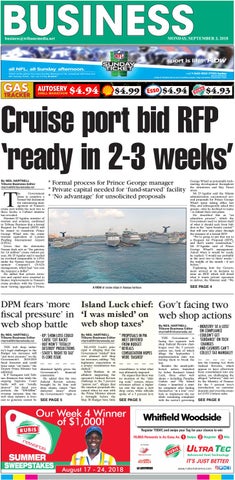
A VIEW of cruise ships in Nassau harbour.
George Wharf as potentially kickstarting development throughout the downtown and Bay Street areas. Mr D’Aguilar said the Minnis administration encountered several proposals for Prince George Wharf upon taking office last May, and subsequently asked two groups - who he declined to name - to submit their own plans. He described this as “an education process”, which the Government used to inform itself of what it should seek from bidders in the “open beauty contest” that will now take place through the issuance of a formal RFP. “We’re going to put that out to a Request for Proposal (RFP), and that’s under construction,” Mr D’Aguilar said of Prince George Wharf’s management. Asked when it would be ready, he replied: “I would say probably in the next two to three weeks the middle of the month - if not before.” Explaining how the Government arrived at its decision to issue an RFP, which will detail what it wants private operators to deliver, the Minister said: “We
SEE PAGE 4
DPM fears ‘more Island Luck chief: Gov’t facing two fiscal pressure’ in ‘I was misled’ on web shop actions web shop battle web shop taxes’ · INDUSTRY ‘AT A LOSS’ By NEIL HARTNELL Tribune Business Editor nhartnell@tribunemedia.net THE web shop industry’s legal challenges to the Budget tax increases will “put more pressure” on the Government’s 2018-2019 fiscal forecasts and could force some “cut backs,” the Deputy Prime Minister has admitted. K P Turnquest told Tribune Business that while the ongoing Supreme Court battle will not “totally destroy” his fiscal projections, the “$30-$40m” revenue increase that the web shop industry is forecast to generate cannot be
· KP: $40M LOSS COULD CAUSE ‘CUT BACKS’ · BUT WON’T ‘TOTALLY DESTROY’ PROJECTIONS · STATE’S ‘RIGHT TO TAX’ IS CORE ISSUE dismissed lightly given the Government’s financial constraints. He added that the two Judicial Review actions, brought by by four web shop chains, raised “fundamental issues” about the Government’s “right to
SEE PAGE 5
By NEIL HARTNELL Tribune Business Editor nhartnell@tribunemedia.net ISLAND Luck’s principal is alleging that the Government “misled” him over planned web shop tax increases, adding: “My legitimate expectation in a proper consultation was dashed.” Sebas Bastian, in an affidavit supporting the operator’s Judicial Review challenge to the 5 percent “patron tax”, alleges that the taxation proposals discussed when he met with the Prime Minister almost a fortnight before the May 30 Budget bore little
* PROPOSALS IN PM MEET DIFFERED FROM BUDGET * REVEALS CONSULTATION HOPES WERE ‘DASHED’ resemblance to what what was ultimately imposed. He argues that there was no mention of the “sliding scale” system, where revenues attract a higher tax rate the more a web shop earns, while officials spoke of a 5 percent levy
SEE PAGE 5
By NEIL HARTNELL Tribune Business Editor nhartnell@tribunemedia.net
THE Government is facing two separate web shop Judicial Review challenges over the 5 percent patron tax, both of which allege the September 1 implementation date was forcing them to break the law. Besides the much-publicised action launched by Sebas Bastian’s Island Luck, three other web shops – including Paradise Games and The Island Game – launched a similar complaint after finding themselves “at a loss” over how to implement the tax while remaining compliant with the sector’s governing
ON COMPLIANCE · COULDN’T GET ‘GUIDANCE’ ON TECH CHANGES · AND CASHIERS CAN’T COLLECT TAX MANUALLY
law, the Gaming Act. Both Judicial Reviews, which appear to have effectively been consolidated into one action, are challenging the alleged “arbitrary” date set by the Ministry of Finance for the 5 percent levy’s introduction on customer deposits and over-the-counter (OTC) lottery sales.
SEE PAGE 8
PAGE 2, Monday, September 3, 2018
THE TRIBUNE
BISX listings worth $9.4bn SECURITIES and mutual funds listed on the Bahamas International Securities Exchange (BISX) had a $9.4 billion collective value at mid2018, even though domestic stock prices were down 4.46 percent for the half-year. The exchange, unveiling its mid-2018 report, said its BISX All-Share
Index – which measures the movement of stock prices alone, excluding dividends – dropped by slightly more than the prior year’s 3.78 percent decline. “As at June 29, 2018 the market was comprised of 19 ordinary shares with a market capitalisation of $4.162 billion,” BISX said. “In addition, there were
13 preference shares with a market capitalisation of $327.25m and 19 bonds with a face value of $579m. As at 31 December, 2017, there were 48 mutual funds listed on BISX with approximately $4.4 Billion in assets under management.” The market capitalization for ordinary shares is somewhat skewed by the
presence of CIBC FirstCaribbean, but the collective value of listed securities - equity and debt – now stands at almost $5 billion, representing a slow but steady increase on prior years. The BISX All-Share Index’s half-yearly decline was in line with other global stock market indices, with the MSCI Emerging Market Index down 8.53 percent for the same period. London’s FTSE 100 Index was off slightly by 0.15 percent, with only the S&P 500 Index up – and narrowly at that, by 0.84 percent. As for investor activity on BISX, the exchange said: “Trading volume for the six-month period January 2, 2018, to June 29, 2018, was 3,868,181 shares for a value of $22.134m.
“Trading volume for the six-month period January 1, 2017, to June 30, 2017, was 2,350,303 shares for a value of $15.737 million.” BISX continued: “Trading volume for the three-month period April 1, 2018, to June 29, 2018, was 1,217,120 shares for a value of $8.81m. “Trading volume for the three-month period April1, 2017, to June 30, 2017, was 1,354,166 shares for a value of $9.422m.” Breaking it down by the day, BISX added: “For the six-month period from January 2, 2018, to June 29, 2018, the average volume per trading day was 31,478 shares for a value of $178,564. “By comparison, for the six-month period from January 1, 2017, to June 30,
2017, the average volume per trading day was 18,328 shares for an average value of $122,923.” Commonwealth Bank led trading volumes for the six months to end-June 2018, accounting for 38.7 percent of the total with almost 1.5m shares changing hands. AML Foods was in second spot, with 952,743 shares trading, accounting for 24.6 percent of market activity, and FOCOL in third at 12 percent. On the value front, Commonwealth Bank again led the pack at $6.646m and 30 percent of the total value of shares traded. AML Foods and FOCOL Holdings also retained the same spots, accounting for 15.4 percent and 8 percent, respectively.
B39 Albany Club Villa
Lot size: 10,729 sq.ft Living area: 5,044 sq.ft 5 Bedrooms | 5 Bathrooms MLS# 33387
Offered with Hotel Amenities and Concierge services! www.grahamrealestate.com
Phone: (242) 356-5030
THE TRIBUNE
Monday, September 3, 2018, PAGE 3
‘Higher capital buffers’ for commercial banks By NEIL HARTNELL Tribune Business Editor nhartnell@tribunemedia.net THE Central Bank is proposing “materially higher capital buffers” for domestic commercial banks than other institutions to ensure they are properly insulated from heavy losses and financial crises. The banking industry regulator, in discussion papers on how it plans to ensure the Bahamas meets the Basle global requirements on capital and other regulatory requirements, is proposing that the commercial banking sector maintain a “minimum capital ratio requirement” of 16 percent. This compares to just 10.5 percent for Bahamian credit union and international banks with subsidiaries here, and 12 percent for institutions that count the Bahamas as their home jurisdiction. “The revised capital approach is more focused on reinforcing a
regime that allows domestic SFIs (supervised financial institutions) to maintain a significant amount of capital that is accessible in the event of unexpected losses or a financial crisis,” the regulator said. “The Central Bank expects that these buffers will maintain simplicity, whilst being super-equivalent to Basel’s standards. Once the capital buffer regime is in place, the current trigger and target ratio framework of 14 percent and 17 percent will fall away.” The Central Bank, in discussion papers sent out for a 60-day consultation, said it wanted to make the industry’s capital adequacy regime both much simpler than Basle III but “appreciably more conservative” for domestic commercial banks. “Accordingly, the Central Bank’s capital buffer strategy varies significantly between the domestically
licensed and internationally licensed banks,” the regulator added. “In particular, the Central Bank considers that domestically-licensed institutions must be able to carry sufficient capital to meet not only current requirements, but to absorb material economic adversity, without any need for recapitalisation. “When the need arises to deploy this pre-raised capital, however, it will be important that high fixed capital requirements do not impair a Bahamian banking and economic recovery.” The Central Bank possibly has in mind Bank of the Bahamas’ recent travails, where the BISX-listed institution was twice “bailed out” by the taxpayer and, with an initial public offering (IPO) thrown in, saw more than $300m in public money committed to save it. It added that the Bahamas’ vulnerability to hurricanes, and global recessions, also justified its strategy
to impose extra capital adequacy requirements on Bahamian commercial banks – especially those owned locally, and which do not have an international parent. “These considerations suggest that the best capital strategy for Bahamian domestic banks is to require both a high minimum capital requirement and a high buffer, but with considerable flexibility to deploy the buffer in adverse times,” the Central Bank said. “The domestic commercial banks require a larger buffer to ensure financial stability of the domestic banking system. The additional capital buffer for international SFIs should reflect the lower risk these institutions pose to the Bahamian jurisdiction. “Home-supervised (headquartered in The Bahamas with no offshore parent) SFIs would be required to maintain a higher capital buffer than host-supervised
SFIs. There is a higher Bahamian reputational risk associated with the failure of a home-supervised SFI. Also, as a general rule, home-supervised SFIs enjoy less access to additional capital under stress compared to host-supervised SFIs.” The Central Bank said it expected minimal impact on the Bahamian banking industry as a whole from having to adopt the new standards. “The Central Bank has conducted a preliminary assessment of the likely capital impacts of the proposed Basel III regime, using information already to hand from SFI filings,” it added. “Preliminary results suggest that all, or nearly all, Bahamian banks will be able to adopt the new Basel III rules with very little (if
any) change to their balance sheets. “The impact of this regulatory reform may be larger for credit unions than for banks.” Outlining its overall objectives, the Central Bank added: “Somewhat contrary to local and international experience, the Central Bank intends that its Basel III regime will reduce regulatory compliance costs, relative to the current capital regime, and greatly reduce costs relative to the typical international implementation of Basel III. “This is in keeping with the Central Bank’s intent to develop prudential policies and regulations that balance safety, efficiency and competitiveness in the Bahamian banking system, while promoting financial system stability.”
RETAILERS SEE LAST MINUTE BACK TO SCHOOL PICK-UP By NATARIO MCKENZIE Tribune Business Reporter nmckenzie@tribunemedia.net BAHAMIAN retailers say Back to School sales were “holding steady” with 2017’s results, telling Tribune Business there was a noticeable pick-up heading into the final weekend. Charmaine Daley, manager at John’s and Accessories on Carmichael Road, told Tribune Business: “I would say business has been pretty good. There’s been a steady flow of customers. Business picked
up right round government pay day on Wednesday. “We expect that level of traffic to continue for a few days. A lot of people are waiting until the last minute and that is something we have come to expect. “I would say business is pretty much the same as last year.” Back-to-school shopping is traditionally the second busiest period of the year for many Bahamian retailers, second only to Christmas. Shantell Rolle, manager at the Brass & Leather Shop’s Mall at Marathon outlet, told Tribune
Business: “So far business is going well. Sales have been good. “I wouldn’t say they have been as good as last year, but still with the VAT increase it really hasn’t been as bad as we anticipated. Sales have picked up a bit in the past few days but not a whole lot.” Audrika Glinton, marketing coordinator at Bahamas Office and School Supplies (BOSS), said there was a “definitely” an increase in customer traffic in recent days. “We have definitely seen an increase in traffic as schools reopen. It’s been
really busy. It looks like sales are holding steady with last year,” she added.
To advertise in The Tribune, contact 502-2394 A growing company in the maritime logistics industry, with more than fifteen years of operations in Freeport, Grand Bahama invites applications from qualified and experienced candidates for the following vacant position:
FINANCIAL CONTROLLER POSITION SUMMARY
The Financial Controller is ultimately responsible for the accuracy, completeness, and timeliness of the company’s financial reporting. The Financial Controller helps establish and direct the company’s financial goals and objectives. The Financial Controller has primary responsibility for ensuring internal controls are in place, enforced, and reviewed periodically for conformance to accounting and financial standards and applicable regulations. ESSENTIAL DUTIES AND RESPONSIBILITIES • Directs day-to-day leadership of all accounting and finance activities as Accounts Department Head; encompassing management of the daily accounting functions in accounts receivables, payables, banking, general ledger maintenance, and other related duties. • Develops and implements accounting policies, coordination of systems and procedures, and the preparation of operating data and special reports as required, including interim and year-end financial statements (consolidated as well as stand-alone statements). Maintains company’s system of accounts; safeguards books and records on all company transactions and assets • Establishes and administers all tax policies and procedures (inclusive of VAT reporting and communicating directly with the Department of Inland Revenue) • Implements and maintains an effective cash flow management system • Coordinates month-end close procedures of financial records for reporting to Executive Management • Prepares annual budget and monitors monthly against actuals for reporting to Executive Management and Department Heads • Leads the weekly processing of payroll in conjunction with Human Resources • Chief communications liaison between the company and external stakeholders (banks, government agencies, special vendors, etc.) • Assists Executive Management Team with any other duties as assigned by the President QUALIFICATIONS AND REQUIREMENTS • Qualified Accountant (CPA, CA or ACCA) with 5 or more years of experience in a finance managerial or controller role • Member of the Bahamas Institute of Chartered Accountants • Proficiency in the use of QuickBooks, Microsoft Dynamics, and other relative computer applications (Microsoft Word, Excel, Outlook, etc.) • Ability to communicate with all members of the staff on financial matters • Results oriented, accuracy and attention to detail • Flexibility and adaptability to work under pressure • Team player with high level of enthusiasm • Professional in demeanor and communication skills • Knowledge of the Maritime Industry, and familiarity with Bahamas Customs procedures is a plus The Company offers a competitive remuneration package. Compensation will be aligned with relative experience and qualifications. Interested candidates should submit resumes via email only to: controller@freeportshipservices.com no later than Thursday September 6, 2018. Only candidates shortlisted for an interview will be contacted.
PAGE 4, Monday, September 3, 2018
THE TRIBUNE
Cruise port bid RFP ‘ready in 2-3 weeks’ FROM PAGE 1 had
a
number
of
expressions of interest, not that we asked for them, but when we came to office
NOTICE IN THE ESTATE OF VIRGINA ETHLYN FERGUSON a.k.a. ETHELYN VIRGINIA FERGUSON late of Maple Street, Pinewood Gardens in the Southern District of the Island of New Providence one of the Islands of the Commonwealth of The Bahamas, Deceased NOTICE is hereby given that all persons having any claim or demand against the above-named Estate are required to send the same to the undersigned on or before the 14th day of September A.D. 2018 and if so required by notice in writing from the undersigned to come in and prove such demand or claim or in default thereof be excluded from the benefit of any distribution made before such debts are proved; AND NOTICE is hereby given that all persons indebted to the said Estate are requested to settle their respective debts at the chambers of the undersigned on or before the date hereinbefore mentioned. Dated the 20th day of August A.D. 2018 GIBSON & ASSOCIATES Chambers, Deanna House Dowdeswell Street P.O. Box N-4377 Nassau, The Bahamas Attorneys for the Personal Representatives
we met some in place. “We asked a number of people to put forward their proposals. It was more of an education process for us. It was very, very enlightening. Now, we’re much more equipped and knowledgeable of what to ask for in the RFP, and who the players are. “We came to office not knowing what to ask for, what could be done, what are the possibilities. Two consortiums put their proposals forward, and at that time we said it was better to put it out to an RFP. We’re much more knowledgeable, and much further along the learning curve.” Mr D’Aguilar declined to identify the two consortia asked to submit bids, but one of those groups is almost certainly UKbased Global Port Holdings and its Bahamian partner, BISX-listed Arawak Port Development Company (APD), together with investment advisory firm, CFAL (formerly Colina Financial Advisors). APD made no secret of their interest in its 2017 annual report, revealing that the partners planned to add “additional berths and facilities” to the Bahamas’ busiest cruise port if the Minnis administration gave their project the go-ahead. Global Port Holdings generated $115m in revenue in 2016, and APD’s
annual report said: “In response to the Government’s interest in improving the operational and financial performance of Prince George Wharf, APD is exploring the possibility of a joint venture with Global Port Holdings, the largest global cruise port operator in business today. “This company is considered the world’s largest cruise port operator with a portfolio that includes 14 ports in eight countries, serving cruise liners, ferries, yachts and mega yachts,” APD said of Global Port Holdings. “Additionally, Global Port Holdings has connections with all the major cruise lines - Carnival, Royal Caribbean, MSC Cruises and so on.” APD is 40 percent owned by the Government, with the shipping companies and related businesses that relocated from Bay Street in 2011 holding a further 40 percent. The remaining 20 percent is held by public investors. When asked whether the two groups already asked to submit proposals will have an advantage in a public bidding process, Mr D’Aguilar replied: “Not really, because the RFP will give everyone time to put their best forward. “There’s a standard number of days you have to give people so everyone has sufficient time to get their information. There will be sufficient time for everybody.” The Minister, though, said he
was currently unable to say when the RFP will be released or how long bidders will be given. Mr D’Aguilar said there were “a number of benefits” to outsourcing Prince George Wharf’s management, although he confirmed that the Government would retain ownership of the key infrastructure asset. “First and foremost, the Government firmly believes an entity should be created to manage the Prince George Dock,” he told Tribune Business. “It is an important piece of infrastructure that has been starved of funds for many years, is in a state of disrepair and requires substantial investment. “If we need substantial investment, the Government feels this operating entity should be created to go out and seek funds to upgrade Prince George Wharf into something transformative that would be the catalyst for the redevelopment of Bay Street. “As we upgrade the Port of Nassau that begins to flow into Bay Street and will start the transformation of Bay Street,” Mr D’Aguilar continued. “This is the gateway for 3.6m foreign visitors to the country. “I’ve said this many times: It’s important we make this as exceptional as LPIA. LPIA is the gateway for 1.5m stopover visitors and has experienced that transformation. It has a company focused on its
PUBLIC NOTICE
INTENT TO CHANGE NAME BY DEED POLL
The Public is hereby advised that I, MARCIA ELOUISE ROLLE, of #20 Jamaica Avenue, Elizabeth Estates, New Providence, Bahamas, intend to change my name to MARCIA ELOISE ROLLE. If there are any objections to this change of name by Deed Poll, you may write such objections to the Chief Passport Officer, P.O.Box N-742, Nassau, Bahamas no later than thirty (30) days after the date of publication of this notice.
transformation, and has not cost the state a dollar. We want to bring a similar transformation to Prince George Wharf.” Data published by the Central Bank shows that despite a 23.7 per cent increase in cruise passenger arrivals from 2010 to 2016, rising from 3.8 million to 4.7 million per annum, total spending has remained stubbornly at $300 million. This is because per passenger spending yields have fallen from $78 to $64 over the same period, a drop of 18 per cent. Mr D’Aguilar said there were “many other reasons” to improve Nassau’s cruise product, including the 90 new, larger cruise vessels currently under construction, and which all Caribbean ports are now competing to attract. “We feel the need to bring about a transformation, remain competitive and, given the importance of this piece of infrastructure to our economy, it behooves us to do what we’ve done with LPIA,” he added. “If we wait for the Government to have funds available, given its limited borrowing capacity it will take for ever.” Mr D’Aguilar added that any Prince George Wharf management company could recoup its capital, and earn a return on investment (ROI), by levying a passenger user facility fee and other charges similar to those implemented at LPIA. He added that the RFP process would determine the type of management model employed - whether it was the ‘NAD model’, where LPIA has been leased to the management company for 30 years, or the private-public partnership (PPP) type used for the Arawak Cay port. “Both assets have been significantly improved, and the cost to the taxpayer has been negligible,” Mr D’Aguilar said.
THE TRIBUNE
Monday, September 3, 2018, PAGE 5
DPM fears ‘more fiscal pressure’ in web shop battle FROM PAGE 1 implement taxes” as it saw fit, and without hindrance. Technology challenges, related to the need to ensure all web shop games comply with the Gaming Act’s certification requirements, and now coupled with the court battle, will mean the Government misses out on an entire quarter of revenues projected from the 5 percent tax on patron deposits and over-the-counter (OTC) lottery/ticket sales. And the “sliding scale” taxation structure, which taxes different portions of web shop revenue at a rate between 20-50 percent, has also now been “stayed” until at least October 5 as a result of the dual legal challenges. “It’s not going to totally destroy the fiscal projections, but obviously it’s going to put more pressure on them,” Mr Turnquest told Tribune Business of
TAXES
FROM PAGE 1
on patron “winnings” not one on deposits and over-the-counter (OTC) lottery sales. The latter was the option selected in the Budget and, as a result, Mr Bastian is branding his May 14, 2018, meeting with Dr Hubert Minnis, two Cabinet officials and senior Ministry of Finance officials as “meaningless” because the proposals discussed were markedly different from the 2018-2019 Budget announcement. Besides Dr Minnis, others present included Dionisio D’Aguilar, minister of tourism with responsibility for gaming; Brent Symonette, minister of financial services, Immigration and trade and industry; Marlon Johnson, acting financial secretary; and Viana Gardiner from the Prime Minister’s Office. “At the meeting, [Mr] Johnson said that the Government wanted to increase taxes on gaming house operators for the 20182019 Budget,” Mr Bastian alleged. “The Government represented that it was proposing to increase the 11 percent tax on gross gaming revenue by two to three points; transfer to the Government the 2 percent of gross gaming revenue for community rehabilitation and charitable causes; and to introduce a 5 percent tax on all patrons’ winnings.” While the Island Luck chief was invited to respond to these plans, Mr Bastian alleged: “In that meeting, the Government never disclosed that a sliding scale of
developments. “Forty million is $40m. If you don’t have it, it means you’ve got to cut back. We’re going to have to see how quickly this case can be heard, because there are some fundamental issues that are involved; the state’s ability to implement taxes as a right.” Mr Turnquest added that it was “too early to say” how much revenue the Government may relinquish as a result of the web shops’ decision to take their battle with the Government over the new and increased taxes before the Supreme Court. “We’ll have to evaluate that,” he told this newspaper. “I can’t remember off the top of my head. On the 5 percent I don’t know what that number if. I could imagine around $15m. “On the overall [increase in taxes] from the web shops, it’s about $30-$40m we’d anticipated collecting. I don’t know where this will end up, but it will be an interesting case.”
Tribune Business’s ‘back of the envelope’ calculations suggest the Government may have been seeking more than $30-$40m from the combined “sliding scale” tax structure and 5 percent patron Stamp Duty. A review of the 2018-2019 Budget documents shows gaming taxes near doubling, increasing by almost $34m from a projected $36.5m in 2017-2018 to $70.039m this fiscal year. With no changes to casino tax, the extra $34m is forecast to come from the “sliding scale” structure. Given that the increase is almost $3m per month, its suspension for September at least suggests the Government is now going to forego that figure. And while the 5 percent patron Stamp Duty is not “broken out” in the Budget, other Stamp Tax is shown as jumping from a mere $15,000 in 2017-2018 to more than $20m this fiscal year.
The increase likely represents the patron tax. Given the magnitude of this increase, and with one quarter of the 2018-2019 fiscal year already lost, the data suggests the Government may have lost $5m of this increase already. Dioniso D’Aguilar, the minister of tourism and who has responsibility for gaming, previously told Tribune Business that The Bahamas’ “national interest” demanded that the government “slow down the rate of growth” in web shop gaming through increased taxation. He said too many Bahamians are “robbing their livelihood” to feed an industry whose gross gaming revenue (GGR) will have almost doubled in just four years if 2018 forecasts prove accurate. The minister, who has responsibility for gaming regulation, reiterated his belief that a web shop sector generating around $50m in collective profits would be able to absorb the
tax hikes more easily than it is letting on. Pointing to the 92 percent top-line growth forecast to be enjoyed by the web shops since 2014, Mr D’Aguilar said this $100m-plus revenue rise was evidence that the sector had been able to shrug off a much greater trauma - the impact of its legalisation four years ago. “The gaming industry is growing so exponentially,” he told Tribune Business, pointing out that web shops’ collective GGR had increased from $112m in 2014 to $154m in 2015, representing a $42m year-over-year increase in the first year of legal operations. Mr D’Aguilar added that the industry’s revenues had grown by around $20 million “every year thereafter”, hitting $175 million and $195 million in 2016 and 2017 respectively, with projections of similar growth to $215 million for 2018 (prior to the Budget’s
tax changes). “It’s almost doubled in four years,” the Minister said of GGR. “It’s in the national interest to slow down the rate of growth. We don’t want people to keep throwing money into this. “People clearly want disposable income to put into gaming. They’re robbing their livelihood, quality of life, in order to feed this past-time.” Under the web shop industry’s new sliding scale tax, those operators earning up to $20m in revenue will be taxed at a rate of 20 percent. Six of the seven chains fall only within this bracket. Revenues falling between $20m and $40m will be taxed at a rate of 25 percent, while earnings between $40m and $60m will be taxed at a rate of 30 percent. Revenues between $60m and $80m will attract a rate of 35 percent; those between $80m and $100m, some 40 percent; and those over $100m will be levied at 50 percent.
20 percent to 50 percent of taxable revenue was being considered. “Therefore, I never had an opportunity to address it, which led me to believe that I had been misled during that meeting to which I had been invited. My legitimate expectation in a proper consultation was dashed. “The consultation was meaningless, as I could not have given an intelligent consideration of, and an intelligent response to, a proposal that was never presented to me at a formative stage. I learned about the sliding scale tax and the patrons’ deposit tax two weeks’ later on May 30, 2018, during the Budget presentation.” Under the “sliding scale” tax structure, web shops pay on each portion of their revenue: * Up to $20 million in revenue, a rate of 20 per cent. * Between $20 million and $40 million, a rate of 25 per cent. * Between $40 million and $60 million, a rate of 30 per cent. * Between $60 million and $80 million, a rate of 35 per cent. * Between $80 million and $100 million, a rate of 40 per cent. * Over $100 million, a rate of 50 per cent. Mr D’Aguilar said five out of seven web shop operators fell solely in the lowest 20 percent category, while for a sixth, only a small portion of its revenue fell into the 25 percent category. Only Island Luck, the market leader, whose revenues will attract all tax rates.
Mr Bastian, meanwhile, said he warned the Government that the new and increased taxes would have unintended consequences for the industry. “I... cautioned the representatives of the Government that any increase of taxes on gross gaming revenue, or any direct tax on patrons’ winnings or patrons’ deposits would be reckless without prior empirical study and technical advice,” he alleged, “and may have the unintended consequences of reducing the gross gaming revenue of licensed gaming house operator and channeling gaming patrons into the growing unregulated gaming market.” Mr Bastian said he shared several international studies with the Prime Minister, and his fellow ministers, on “optimal tax rates and different tax methodologies, consistent with best international best practices from many of the regulated jurisdictions for online” gaming. The Island Luck principal is arguing that the Gaming Board and minister of finance, K P Turnquest, “had a duty to act fairly, reasonably and consult” the web shop industry on any changes impacting their gaming control systems and platforms. He also asserts that the sector had “a legitimate expectation that” it “would be consulted and treated reasonably and fairly” relating to any tax matters, and not doing so would be “irrational and unfair” given the implications for compliance with the Gaming Act 2014 and accompanying regulations.
The Government on Friday agreed to postpone implementation of the 5 percent patron tax until
Island Luck’s, and three other web shops’, separate Judicial Reviews are heard by the Supreme Court on
October 5. The “sliding scale” structure, which took effect from July 1, has also been postponed.
We’re looking for a
RETAIL MANAGER Established Organization is seeking a Retail Manager. Position requires extensive retail exposure with the ability toefficientlymonitor multiple outlets, while maintaining focus on retail operational procedures, inventory, planning, sales forecasting and annual budget. Superb managerial and innovative skills capitalizing on product demands while ensuring the maintenance of excellent customer service at all retail outlets. Submit resumes to professionaltouch04@gmail.com no later than September 7th, 2018.
PAGE 6, Monday, September 3, 2018
THE TRIBUNE
SUPPORT THE BLOOD BANK
SAVE A LIFE GIVE THE GIFT OF
BLOOD
BECOME A REGULAR DONOR
1 PINT CAN SAVE 3 LIVES GIVE BLOOD - GIVE LIFE
SOME HELPFUL TIPS BEFORE YOU DONATE:
4 You must have eaten at least once for the day.
4 You need at least 30 minutes between your last meal and donating blood. 4 You will need at least 10 minutes rest after donating blood. 4 You can donate blood every 8 weeks.
4 The Blood Bank will do FREE Pre-screening tests to make sure you are healthy enough to donate blood.
BECOME A REGULAR DONOR
PLEASE ENCOURAGE YOUR COLLEAGUES TO SUPPORT THE BLOOD DRIVES
PAGE 8, Monday, September 3, 2018
THE TRIBUNE
Government facing two web shop actions FROM PAGE 1 Central to their case is the claim that web shops were given insufficient time to certify their games and technology platforms to accommodate the five percent levy, with the offering of any uncertified games violating the law and potentially “eroding public confidence” in the sector. Erica Laing, The Island Game’s executive director for administration and finance, alleged in an August 30, 2018, affidavit that numerous concerns raised with the Treasury and Ministry of Finance over the 5 percent patron
tax had not been satisfactorily addressed with two days to go before the September 1 implementation deadline. She added that replies received from Marlon Johnson, the acting financial secretary, appeared to be “inconsistent with the law”, while both web shop Judicial Reviews complained about a lack of guidance from the Gaming Board, their primary regulator, as to how the levy on patron deposits and over-the-counter (OTC) lottery/ticket sales should be incorporated into their technology platforms. The Gaming Board then allegedly instructed the
sector that they were to collect the 5 percent patron tax manually if their games could not be re-certified in time for the September 1 deadline – something Ms Laing described as impossible to do. “Requiring the cashiers at gaming houses to operate a manual system for collection of Stamp Duty would be unreasonable,” she alleged. “As a fact, cashiers are entry level employees who are not required to have extensive accounting or other qualifications. “It is likely that our patrons will come to our premises and tender a sum of money, and ask that our cashiers take out the Stamp
Duty and deposit the balance on their account, or tender a sum of money and ask how many ‘3’ or ‘4’ ball numbers they can purchase over-the-counter after the Stamp Duty is taken out. “One need only consider the number of calculations necessary to determine how much would be deposited on the patron’s account if the patron tenders $10 to a cashier to take out the Stamp Duty and to deposit the balance on the account,” Ms Laing continued. “Patrons routinely purchase five and 10 cent ‘numbers’ over-the-counter’. We have heard patrons indicate an intention to
purchase tickets over-thecounter for a sum that would attract Stamp Duty at a rate of less than 1 per cent. “This will create the problem, for instance, if we were to round the Stamp Duty up on a 10 cent number purchase, the actual Stamp Duty collected would be 10 percent and not the specified 5 percent.” Ms Laing also said the time allowed for web shops to alter, test and recertify their games was “unreasonable” compared to that afforded the retail and wholesale industry in adjusting to 12 percent VAT and the ‘zero rating’ of breadbasket items – something she indicated was easier by comparison. Web shop systems and games have to be “recertified” by independent testing laboratories any time changes – such as the introduction of the 5 percent levies -are made. This gives players confidence in the game’s integrity, that it does what it says it does, and has not been manipulated to the house’s advantage. And, prior to going to the laboratory, the games have to be altered and tested by the web shops’ own software developers – a process that takes time. It appears, though, that the industry only turned its mind to implementation – and the associated difficulties – in late June 2018, almost a month after the Budget’s unveiling. It is unclear why the response took so long, but it is possible the web shops thought they could successfully lobby the Government to back down from its plans. Ms Laing, on The Island Game’s behalf, wrote to acting Gaming Board secretary, Ian Tynes, on June 29, 2018, seeking “directives” on “proper procedures for the implementation” of the 5 percent patron tax. “In order to properly put in place a procedure for the tax, programming will have to be done to create the proper flow for deduction, reporting and payment of collected funds,” she wrote. “Any programming which is created cannot go live until the necessary testing is done, and certification of the same is obtained from Gaming Laboratories International.
“We find ourselves at this time at a loss on how to proceed to meet the requirements of the Government for the new tax while remaining compliant with the controls and standards required as a gaming house operator.” Ms Laing repeated these concerns in a letter sent three days’ later to Marlon Johnson, the Ministry of Finance’s acting financial secretary, in which she wrote: “Given the sheer volume of deposits and tickets generated daily, it is virtually impossible to ‘collect’ the taxes from the customers without a programme in place which properly accounts for the difference in the cost of tickets, and deposits, and allocates the Stamp Tax to the correct suspense account for monthly reporting and disbursement.” Similar concerns were expressed by William Fountain, attorney for Paradise Games, in a letter to Mr Johnson on July 5, 2018. He revealed that the web shop’s software developer had advised that the necessary changes to incorporate the 5 percent patron levy would take 30-60 days, with independent certification requiring 30-120 days – meaning the entire process to comply with the Gaming Act could last up to six months. Describing the time allowed for compliance as “almost non-existent”, Mr Fountain said overriding the technology with a manual collection system would increase Paradise Games’ expense and expose the web shop “to a greater degree of possible fraud”. The web shop’s systems were said to be handling 750,000 transactions per day. Gershan Major, the Bahamas Gaming Operators Association’s chief executive, also warned in a June 25, 2018, letter to Mr Tynes that re-certification of software platforms and games could take between 11-18 weeks. He described October 1, 2018, as “a reasonable and responsible timeframe” for implementing the 5 percent patron tax and enabling the industry to comply with the Gaming Act and accompanying regulations. The Government first delayed the 5 percent patron levy from July 1 to August 13, and then pushed it back again to September 1 with the proviso that all games and related platforms be certified by August 25 – dates that the web shops said were still too difficult to meet. Both Island Luck and The Island Game, on August 16 and August 8, respectively, sent Mr Johnson a list of issues they were seeking clarification on – ranging from rounding and the treatment of voided transactions to franchise commissions and store deposits – for which they allege they did not receive satisfactory answers, and guidance, from Mr Johnson. Island Luck’s principal, Sebas Bastian, alleged that Mr Johnson responded to only four of the chain’s 10 concerns, and added that he was “unclear” about the issues relating to ‘for store deposits’ and ‘for tax reporting’. Apart from blocking implementation of the 5 percent patron tax, the web shops’ Judicial Reviews are also asking the courts to declare it void on constitutional grounds because it has not been levied on casino hotel patrons. And they want similar treatment for the industry’s new “sliding scale” taxation structure on the grounds that its imposition on “revenue collected breaches the industry’s regulations that this be assessed on “taxable revenue” or a percentage of earnings before interest, taxes, depreciation and amortization (EBITDA).