THE TRIBUNE
Monday, July 9, 2018, PAGE 13
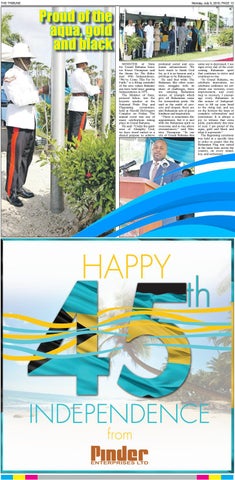
Proud of the aqua, gold and black MINISTER of State for Grand Bahama Senator Kwasi Thompson said the theme for The Bahamas’ 45th Independence, “We’ve Come This Far by Faith,” is a fitting reminder of the core values Bahamians have held since gaining Independence in 1973. The Minister of State, pictured below, was the keynote speaker at the National Pride Day and Flagraising ceremonies, held at Harold DeGregory Complex on Friday. The annual event was one of many celebrations taking place in Grand Bahama. He said: “Under the guidance of Almighty God, we have stood united in a shared purpose to achieve
profound social and economic advancement. We have much to thank God for, as it is an honour and a privilege to be Bahamian.” He said that while The Bahamas, like other countries, struggles with its share of challenges, there are amazing Bahamian stories of triumph which give all Bahamians cause for tremendous pride. He said in the midst of poverty and despair, there are also Bahamian acts of great kindness and inspiration. “There is sometimes disappointment, but it is met with the Bahamian spirit to overcome and to rise above circumstances,” said Minister Thompson. “In our city of Grand Bahama that
some say is depressed, I see signs every day of the overcoming Bahamian spirit that continues to strive and continues to rise. “In Grand Bahama, we celebrate innovation, we celebrate resilience we celebrate our victories, every improvement, and every step to recovery. I encourage every Bahamian in this season of Independence to lift up your head to the rising sun, and see on the horizon the hope of complete reformation and restoration. It is always a joy to witness that extra pride, particularly this time of year. I am proud of the aqua, gold and black and what it represents.” The flagraising ceremony was held at a specific time in order to ensure that the Bahamian Flag was raised at the same time across the country, on every island, key, and settlement.
PAGE 14, Monday, July 9, 2018
THE TRIBUNE
Rhythm and sound of the
Beat Retreat
LAW enforcers perform at the annual Independence celebration Beat Retreat on Sunday evening downtown in Rawson and Parliament squares.
THE TRIBUNE
Monday, July 9, 2018, PAGE 15
Tomorrow’s leaders As The Bahamas marks its 45th anniversary of Independence, RASHAD ROLLE spoke to the leaders of both the FNM Torchbearers and the Progressive Young Liberals about their visions of what comes next for the country.
A COMMUNITY VISION
By RASHAD ROLLE Tribune Staff Reporter rrolle@tribunemedia.net
grandfather, Sir Arthur Foulkes, was a founding father of the FNM, serving as governor general from PEOPLE who support 2012 to 2014. His uncles, Carlyle Bethel – and in the Dion Foulkes and Michael Free National Movement Foulkes, are sitting MPs, that includes many – say the one a Cabinet minister, first thing to know about the other chairman of the him is he is down-to-earth. Bahamas Agriculture & If so, his venue choice Industrial Corporation. for an interview with The And his father, of course, Tribune, Goldies at Arawak is Attorney General Carl Cay, helps illustrate the Bethel. point. This history doesn’t daunt “It’s one of him, he said. the best places After all, he’s to experience ‘No one knows gotten used to the culture a community scrutiny and and I just love as well as those knows how the vibes,” he dirty the game that live there. said on Friday can get. during his We want to “When I lunch break empower people was in grade there. “Anythree I was where with a to positively coming out live Bahamian impact their own of school, rake ’n scrape community and out the gates, band, that’s to the get young people walking me.” sandpit where His coolness more involved I waited to belies the pres- in the party. get picked up sure that comes and a parent with being the came up to me brightest political pros- and gave me a Punch artipect within arguably the cle,” he recalled. “It was a country’s most successful negative article about my political family. dad and she said ‘here give His grand-uncle, Earl this to your pa’. I sat there, Thompson Sr, was the Pro- opened it up and tried to gressive Liberal Party MP read it. My mother was for Fort Charlotte from livid. That was a traumatis1972 to 1977. His inimitable ing event, my first glimpse
into the negative side of politics.” Earlier this year, Mr Bethel, 25, was elected president of the Torchbearers Youth Association. Among his priorities has been decentralising the orgranisation, establishing youth associations in every constituency. “No one knows a community as well as those that live there,” he said. “We want to empower people to positively impact their own community and get young people more involved in the party.” He demurred when told some believe he could easily get a nomination in the next general election, however. “When it comes to frontline politics, I still haven’t made that decision yet because at the end of the day it has to be a family decision,” he said. “I know what it’s like to grow up in politics, the good and the bad and I think it would be unfair to subject your wife and your kids to it without giving them the proper insight into what it fully entails. At the end of the day, if I could make my contribution outside of politics I would.” A graduate of Queen’s College, Mr Bethel is
YOUTH CALL FOR BAHAMIAN OUTLOOK
working on becoming a chartered financial analyst charter holder, having already passed the first level of the exam. It’s important to him that if he enters frontline politics he makes only thoughtful contributions to the national discourse, so today he voraciously reads anything he can. No matter what, he believes his future will be with the FNM, a choice he said transcends his family’s involvement in the party. “I would’ve researched as much as I can about
all the political parties,” he said. “And it’s just like Christianity, I was born into the Christian faith but I went off to college and I would’ve went to meetings and learned about Judaism, the Muslim faith, I read the Quran, I read the Bible and I felt Christianity embodied who I was and what I believe so I stuck with it. “Does that make my faith any less because I was born into this? I don’t think so. I think it’s similar to politics. Yes, I was born into the FNM but I wanted to make
sure I made the decision myself. “Sir Cecil Wallace Whitfield, when he resigned as education minister in the PLP government, said there was a creeping totalitarianism in that party, there was a creeping cult of personality in the party, there was no room for dissent and discussion and no room for young people in the party, so he and others left. What I find is what the PLP fought for originally was excellent and noble. But they lost their way a long time ago so I don’t want anything to do with it.”
‘One of the key things is young people have a nationalist view of our country. Young people more and more are demanding Bahamianisation. That’s a core tenant of the PLP, back from the 1960s when it was an actual policy of the government to Bahamianise everything, to force hotels and other businesses to hire Bahamians.’
By RASHAD ROLLE Tribune Staff Reporter rrolle@tribunemedia.net
BEFORE his death in 2011, William Griffin Sr gave his grandson Barry Griffin Jr a box of mementos. “…It was filled with memories from his time as a young activist,” Mr Griffin recalled on Friday. “Letters, fliers, notes, awards. These were his most prized possessions.” Griffin Sr was educated up to the 6th grade but linked his aspirations to the Progressive Liberal Party growing up, agitating for the social and political transformation that was the party’s rallying cry. Decades later, he passed his values on to his grandson, a little boy who would sit on the floor in his room while the radio was tuned to daytime talk shows, learning trivia about the country’s historical figures, unaware he would carry on his grandfather’s vision through the PLP. That 29-year-old, now leader of the Progressive Young Liberals (PYL), would have been highly sought by either political party. He graduated from Saint Augustine’s College with $100,000 in scholarship offers to attend university. He was awarded a Queen’s Diamond Jubilee Prize and mooted before Queen Elizabeth II in 2012. Wellspoken, he drops random, obscure but relevant quotes in the middle of discussions to punctuate his points, as he did frequently during a recent television appearance on “On the Record” with Jerome Sawyer in March. But the PLP is in his blood, he says. As if to prove the point, Arthur Dion Hanna is his key inspiration. “A lot of people back in the day saw (Mr Hanna) as very much to the left of Pindling, a lot of his ideas were more radical than Pindling,” he said. “Even now, one of the things I admire about him is he’s one of the few governors general who
CARLYLE Bethel with Sir Arthur Foulkes.
BARRY GRIFFIN JR, leader of the Progressive Young Liberals. hasn’t been knighted by the Queen. He’s been offered twice by the Queen to be Sir Arthur Hanna and he has denied it because he’s always felt there should be a Bahamian honour system. “One of the key things is young people have a nationalist view of our country. Young people more and more are demanding Bahamianisation. That’s a core tenant of the PLP, back from the 1960s when it was an actual policy of the government to Bahamianise everything, to force hotels and other businesses to hire Bahamians. I think you see up to now there seems to be a difference in terms of how the parties prioritise Bahamians in this regard.” Last week, PLP stalwart George Smith spoke glowingly to The Tribune about Mr Griffin. For a party eager to rehabilitate its image and push fresh faces forward, he will likely be a candidate for the PLP in the next general election, according to Mr Smith. But despite a history that includes participating in student government bodies throughout college, joining Barack Obama’s 2008 US presidential campaign in Minnesota and writing speeches in the background for PLP candidates while studying law in the UK, Mr Griffin insists a future as a
politician isn’t a done deal. “I’m not sure I’m going to be a candidate in the next election and to be honest I consider myself a novice in all of this,” he said. “I am not a politician. I don’t consider myself a politician by any stretch of the imagination. I am simply a young person who has come forward to help change a party that I believe in, to help bring transformative change in a country that I love.” So far, he’s watched as his advocacy for young people in the party translated into them getting a seat on every PLP board and committee. Now he wants to take it a step further, enshrining this as a right within the party’s constitution. “I am fighting for more youth representation at our national convention,” he said of the constitutional reform process underway in the PLP. “I believe young people should represent a larger voting block at our convention than we currently do. I am fighting for PYL representatives from every constituency to have full voting rights at our conventions. I believe that a move like this will ensure that decisions made at our convention will be more closely in line with the privation views of young people across the country.”
PAGE 16, Monday, July 9, 2018
45
THE TRIBUNE
years of celebration
THE TRIBUNE
Monday, July 9, 2018, PAGE 17
CELEBRATIONS of previous Independence Day Events.
PAGE 18, Monday, July 9, 2018
THE TRIBUNE
Symbols of a new era for
The Bahamas
On Wednesday, April 12, 1972, at a national conference on Independence, Hervis L Bain Jr, education officer for Arts and Crafts, gave a talk on the Bahamas’ national symbols and the importance of national pride. The conference was held in the Baillou Hill High School Auditorium. Attending were members of the Cabinet, House and Senate as well as a cross-section of the community. This was his speech.
“
Surely this morning I can see assembled here the symbolic mothers and fathers of the new Commonwealth of the Bahamas awaiting the birth of their child with stout spirit and determined hearts on the beach of history. I am sure that there are many who share the excitement that these labour pains have come at this time and in this generation but it is true also, there might be others who have not heard or who have refused to hear the rolling tide. And so may these walls resound this morning with the stirring message: you stand on the beach of history but you will not hold back the tide. Mr Chairman, fellow countrymen, I am to address you on the topic, National Symbols and National Pride to which paragraph 105 of the Government’s green paper refers. Recently, in an address before another body, I made the following remark on the National Culture of the Bahamas. “It is clear that the national culture has never been that of the people, not for that matter, is it so today. It is still, expressed or tacit, European, predominantly that of the coloniser or colonisers, but today, it is served, hopefuly to be more palatable, laced heavily with the exotic spices of Bahmian legends, Bahamian folklore and festivals. Significant changes in the Bahamian National Culture are immediately imminent and ought to be, if national sovereignty is to be a thrust of meaning and relevant for the Bahamian people.” The historic-cultural experiences of slavery or involuntary servitude topped by colonialism have been a systematic dehumanisation and acculturation process for the mass of the subjected Bahamian people. One must understand the nature of Colonial powers on slavery and colonialism. The colonial nations are rooted in the ideological assumptions of the superiority of western cultural values, and the moral duty of the European colonies to carry out a ‘civilising mission’.”
LEGITIMACY The point I am making, Mr Chairman, is that the slavery (involuntary servitude) and colonialism have left the Bahamian people with the social and cultural infliction - infliction which are psychological or intangible and infliction which are physical or tangible. It follows therefore that Independence, cultural independence, cannot be the mere replacement of the symbols of the colonial powers by symbols selected by the new nation state. Cultural independence must therefore transcend the physical dimensions and enter into the realms of essence and therefore provide the nexus for cultural consciousness and relevant cultural choices for the legitimacy and the national integration of the Commonwealth of the Bahamas. Here lies the What is and What is to be of National Symbol and National Pride.
SYMBOLISM AND SYMBOLS Symbolism was born out of the conscious affinity between man and his universe. A symbol, therefore, represents a high order of expression which penetrates the external thereunto the intrinsic. National symbols are therefore persons, word and object which are employed by the
nation-state to evoke and direct psychological energy; in other words national symbols instil and evoke pride, rapture, loyalty and patriotism for the state. Operational national symbols support the social order through rites and rituals that will impress and mould the young. The use of symbols is probably as old as civilisation and no doubt many of you are familiar with symbols of the Cross or the Symbol of the Union Jack.
NATIONAL SYMBOLS Let us examine briefly the national symbols which are presently in use in the Commonwealth of the Bahamas. First I should like to point out that the design and preparation of the national symbols are governed by the conventions of heraldic design and considering that national symbols possess property status to all intents and purpose, and are therefore granted by Her Majesty the Queen through the Royal College of Arms, the body assigned by Her Majesty for the purpose. At present, the outstanding national symbols are: The National Anthem, The Public Seal, The National Flag, The National Coat of Arms. Patriotism, religious sentiments, love of one’s native land are all the sources of motivation and the constituents of a national anthem. Nevertheless as a colony, the Bahamas has adopted the British National Anthem - God Save The Queen: with the coming of Independence the Commonwealth of the Bahamas will adopt a national anthem of its own. To this end, the Ministry of Home Affairs has announced a competition for the lyrics and music of the National Anthem. The Seal - the official insignia or stamp which is used on all important national documents like all national symbols should reflect the new people of the new Commonwealth of the Bahamas and arrangements are in hand for the preparation thereof. Ministerial, Consular and other official seals might be similarly affected. The Commonwealth of the Bahamas does not have a distinctive flag of its own; the official national flag of this land is the British National - the Union Jack - the flag with the familiar red, white and blue colours. However the blue and red ensigns with the flag badge of the Commonwealth of the Bahamas emblasoned thereon. The Blue Ensign can be seen flying from poles as one enters this building. The Red Ensign is reversed for use on the sea. The topic of the national flag for the new Commonwealth of the Bahamas has become the subject of a nation-wide competition launched by the Ministry of Home Affairs on behalf of the government. As a result, it is hoped that some Bahamians would combine the powerful symbolism of colour and the skill of heraldic designing to a flag design that can reflect the dignity worth and national consciousness of all the Bahamian people, and thereupon independence, the Commonwealth would have its own national flag, one full with meaning and pride and one that can rally Bahamian people from Grand Bahama down to Inagua, from the Berry Islands across to Mayaguana
ETIQUETTE There is a standard design for the Governor General’s flag - a dark blue flag with the Royal Crest of the Lion and Crown in full colour in the centre and the name of the country underneath. I should point out also that the Prime Minister and other ministers may use the national flag or pendants either with or without the Coat of Arms emblazoned thereon. It is indeed with honour that I present this national symbol, to this convention for it is a distinguished concept of the Bahamian people, conceived for the Bahamian people by a native son of the Bahamian people and approved by the Queen “for the greater honour and distinction of the Bahamian people and of the Commonwealth of the Bahama Islands.”
I pray that the Bahamian people would continue to reflect the character of the two NATIONAL supporters in this Coat of Arms new Coat of Arms. It can be observed that the flamingo, the national bird, stands tall, stately, elegant and resplendent in the beauty of its colour; the marlin, the national fish, is the aristocrat of Atlantic game fish; the blue marlin likes plenty of room in which to throw its bulk about; it is not easily hooked and landed; the marlin is a fighter, and a fighter with style. On closer examination, therefore, it can be seen that this national symbol is a composite of things Bahamian and things which all Bahamians, wherever be it in the fair Bahamas, can identify. This is the true nature of national identity and national pride. And now to a more delicate matter. Some nations have carefully laid down a code of etiquette which gives precise instructions as to how the national symbol can be used under all conditions. A case in point is the United States of America. The Commonwealth of the Bahamas must outline a code of etiquette governing the use of national symbols and it should then be the implicit and explicit function of every national institution to propagate understanding and respect for the Nation’s symbols. It seems imperative therefore that the new Bahamas, the Independent Commonwealth of the Bahamas, must examine the structural elements of all national social institutions and practice and reform and transform where necessary. This does not exclude the national education system of the new nation state. Schools in the Independent Commonwealth of the Bahamas should become living, national, simple, spawning national and cultural consciousness, national pride, and a spirit of togetherness. It should spawn unceasingly, sincere loyalty to the nation state, Democracy, national identity and in essence, would the behaviour of the young and the immature into relevant social and cultural form. In conclusion, I wish to refer to some recent developments in international relationships which no doubt will open new avenues in the world on international diplomacy. Not long ago, you will remember that the United States sent a ping-pong team to Red China, shortly thereafter, the President of the United States made an official visit. More recently, Cuba hosted a volleyball team from the United States. Just two days ago, the announcement came that the United States and Russia had signed a cultural agreement which would allow for academic and cultural exchanges between the two nations. Can it be, Mr Chairman, that the new Commonwealth of the Bahamas might never see a wholesale attack on her shores by an enemy employing marine and military hardware? Can it not be, Mr Chairman, that the security of the Bahamian people rests in the development of an indigenous culture, in the ability to recognise cultural offensives and to communicate eloquently through the sophisticated language of cultural expressions and symbolism? Indeed this is the challenge of the new Bahamian in the new Commonwealth of the Bahamas. Fellow country, we have reached “The Jordan” and here it is “Mount Pisgah” and take a look and those who are prepared must make ready for that glorious crossing to possess the promised land. And so, in whatever category you placed yourself, leave with you the scripture command, “Be strong and of good courage, be not afraid, neither be dismayed, for the Lord thy God is with thee, whithersoever thou goest.
NATIONAL Flower-Yellow Elder
NATIONAL Tree- Flowers of the Lignum Vitae
NATIONAL Fish-Blue Marlin -
NATIONAL Bird-Flamingo
THE TRIBUNE
Monday, July 9, 2018, PAGE 19
‘The Bahamas’ own street philosopher’
The amendments made to the National Insurance Act in 2010 introduced automatic biennial adjustments to pensions, grants and the wage ceiling. The adjustment to pensions and grants is based on the change in the retail price index in the two previous calendar years prior to the adjustment year.
PAGE 20, Monday, July 9, 2018
THE TRIBUNE
PAGE 22, Monday, July 9, 2018
THE TRIBUNE
By command
A COMMAND performance was held in honour of artistic icons Patricia Bazard, Cleophas Adderley and Ronnie Butler as The Bahamas marks its 45th Anniversary of Independence. Governor General Dame Marguerite Pindling enjoyed presentations by various national choirs, orchestras, and dance troupes at the Performing Arts Centre, University of The Bahamas, on Monday, July 2. The Governor General was joined by number of political figures, including Minister of Health Dr Duane Sands, Minister of Education Jeffrey Lloyd, and chairman of the 45th Independence Secretariat Mark Humes. Photos: Derek Smith/BIS
THE TRIBUNE
A time for healing A message for the 45th anniversary of Independence from Monsignor Preston Moss Beloved, On July 10th we will mark the 45th anniversary of our country’s independence. It is a significant milestone. 45 years is sometimes seen as a symbol of the mid-life crisis and being “over the hill”. It is a time if we want to continue to mature, that we need to honestly look at ourselves. Such an opportunity is afforded us as a people, as a Family of Islands and as individual persons, as we commemorate our 45th anniversary. It is time for us to stop and reflect on our current situation. The readings appointed for July 10th in all our Catholic Churches throughout the world come from Hosea 8: 4-7, 11-13 and Matthew 9: 32-38. They are most appropriate. The Word of God, we believe, is always on target. Let me begin our reflection by quoting from Matthew 9: 36-38, “When He (Jesus) saw the crowds, He had compassion for them, because they were harassed and helpless, like sheep without a shepherd. Then He said to his disciples, ‘The harvest is plentiful, but the
labourers are few; therefore, ask the Lord of the harvest to send out labourers into His harvest.’ “ Do not these words describe our country’s present situation? There is a need for deep healing, grieving, forgiveness, reconciliation, beseeching and allowing the Lord to heal our wounds. The Gospel for July 10th is precisely about Jesus’ compassion and His healing the wounds, sins and pains of the people. We are the people! Over and over again it has come to me that our country urgently needs deep divine healing. Everyone and every family in our country have been profoundly touched by some sort of tragedy; touched by the violence that has invaded our spirits and altered our lives. We are, Beloved, in need of healing. If we do not have our wounds transformed, we transmit them. We are in need of calling upon the Lord’s mercy. We cannot go on, or mature as individuals or as a people unless we consciously, deliberately and humbly allow ourselves to acknowledge our wounds and our grief, and open ourselves to the transforming power of healing. Our country needs to cry, to weep! The pain is as real as life itself. Jesus wept over Jerusalem
and He weeps over our Bahamaland. As a nation we need to stop and get in touch with the pain within us. We must pray together, forgive however and whenever possible, and open ourselves to what the Lord can do within us, which is beyond our imagination. Just as the rain cleanses, purifies and gives new life and freshness to our environment, so can our tears and God’s loving mercy heal and cleanse our hearts, our families, our neighbourhoods, us as individuals and our very Bahamaland. We need humbly, as a people and a Family of Islands, to open ourselves to such a moment as our 45th anniversary of nationhood affords us. God created us a beautiful and diverse people. He gave us a very lush, rich and beautiful Bahamaland. However, we are experiencing the devastation of chaos in our lives. As we read from the prophet Hosea, “For they sow the wind, and they shall reap the whirlwind.” (Hosea. 8: 7) Our God is in the business of changing chaos into a new creation, as He did on the Cross when He wept over us and, by His resurrection, gave us new
life. He can lead us from the chaos of the present to a new creation, but we need to open ourselves humbly and trustingly, and let Him do what He alone can do and does best: HEAL. That is why He came among us, precisely as “SAVIOUR,” which means, “HEALER”. What is our response as individual persons, as a people loved by the Lord and who belong to each other in this our Bahamaland? May I offer a prayer for our country: God of our family, we praise and adore you, our Creator. Thank you for creating us in your image, Father, Son and Holy Spirit, the divine family. We thank you for the grace of belonging to you and each other. We are grateful for the many blessings that come to us as family. Forgive us for the sins we have committed against each other: neglect, abuse, abandonment, impatience. Help us to
Monday, July 9, 2018, PAGE 23
forgive those members of our family, including ourselves who have caused us pain and suffering. Lord, heal the deep scars within us. We have all been deeply wounded by our history. Re-create our families, O Father, in our Bahamian family of islands. Show us how to accept and appreciate ourselves and each other. Re-create us, Lord, make us again like you, that we may
recommit ourselves to building a better world of families according to the wisdom of your Kingdom. This prayer we make through Christ our Lord. Amen. A blessed and hope-filled anniversary to you all. (Msgr.) Preston Moss
PAGE 24, Monday, July 9, 2018
THE TRIBUNE