Mortgage payments soar 27% amid doubledigit lending fall
BY NEIL HARTNELL Tribune Business Editor
MONTHLY residential
mortgage payments increased by 27 percent or $438 over the decade to 2024, it has been revealed, despite other key drivers of Bahamian home ownership affordability easing to seemingly make purchases less costly.
The Inter-American Development Bank (IDB), in its just-published study on ‘Unpacking housing affordability in The Bahamas’, revealed that despite a 20 percent reduction in residential mortgage interest rates during the ten years to 2024, and a ten percentage point reduction in the loan-to-value ratio that is a major determinant of whether banks will provide financing, lending declined by double-digit percentages in all housing categories.
New home lending falls by between 14-30 percent over decade to 2025
IDB: Decline occurs despite easing on interest rates, loan-to-value ratio
Banks shun low-cost housing, Gov’t homes over value appreciation
Residential mortgage commitments fell by between 14 percent and 30 percent between 2015 and 2025, depending on whether the loan applied for was new construction or renovations, with the IDB report revealing that Bahamian commercial banks have an aversion to lending for low-cost housing and tend to shy away from financing homes in such neighbourhoods.
And rising monthly mortgage payments, which the study asserted are driven by a combination of increased construction costs, home buyers seeking larger properties and increased borrowing against a property’s equity value, are occurring just when Bahamians are increasingly struggling with affordability as real estate price increases outpace wage growth. The IMF last year revealed that property and rental prices rose by 14 percent between 2012 and
‘Everything is hitting us one time’,
By NEIL HARTNELL Tribune Business Editor nhartnell@tribunemedia.net
SUPER Value’s president yesterday warned businesses cannot keep on absorbing multiple cost increases after the Government moved to increase the Business Licence fee rates for the largest enterprises, adding: “It’s like everything is hitting us one time.”
Debra Symonette told Tribune Business that the 0.25 percentage point increase, which will take the rate to 1.5 percent for companies with annual top-line turnover exceeding $175m per annum, is striking just when Super
Value is having to grapple with a $1.6m yearly expense hike from the VAT ‘exempt’ treatment on uncooked foods plus rising freight, transportation and supplier costs due to surging fuel costs and other uncertainties.
Signalling that the planned Business Licence fee rate increase cannot be looked at in isolation, but has to be viewed as part of a package of ever-increasing cost pressures
Legislative reforms eye corporate tax ‘pre-pay’
BY NEIL HARTNELL and Fay Simmons Tribune Business Reporters
THE Government is moving to amend corporate income tax legislation in a bid to have qualifying companies pre-pay Domestic Minimum Top-Up Tax based on the amount they handed to the Public Treasury in the previous fiscal year. The Domestic Minimum Top-Up Tax (Amendment Bill) 2026, tabled in the House of Assembly on Wednesday to accompany the 2026-2027 Budget, would - if passed - introduce a new section 7A entitled ‘Instalment Payments’ that seemingly seeks to align the 15 percent corporate
income tax with the Business Licence fee regime that requires companies to pay the current year’s fee based on the prior one’s calculation and turnover. And, should taxpayers pay instalments that are both less than the prior
Forced labour goods ban to ward off US sanctions
BY NEIL HARTNELL Tribune Business Editor
nhartnell@tribunemedia.net
THE Government has moved swiftly to avert the possibility of the Trump administration imposing trade sanctions on The Bahamas with reforms to the Customs Management Act that ban the importation of goods made with forced labour. The Customs Management (Amendment) Bill 2026, tabled in the House of Assembly alongside Wednesday’s Budget, introduces a new section 208A which stipulates: “The
Minister may, by Order, prohibit the importation of any goods, wholly or partially produced or manufactured, from any supplier, country or territory if there are reasonable grounds to believe that the goods are a result of forced labour.”
The Bill’s ‘objects and reasons’ section reaffirmed that the change is geared towards “prohibiting goods from suppliers, places or countries that produce forced (child) labour from entering The Bahamas”.
The Davis administration appears to have reacted
2022, while wages grew by just 2 percent.
Dissecting The Bahamas’ home ownership and housing affordability woes, which were a central element in both major political parties’ campaigns prior to the May 12 general election, the IDB study said the volume of mortgage lending in The Bahamas declined significantly over the decade to 2025. It added that this was hidden by the fact that lending values had increased as a result of higher-priced properties and rising construction costs.
“In the period 2015-2025, residential mortgage commitments declined 30 percent for new construction, 20 percent for existing dwellings and 14 percent for rehabilitation and additions. These declines are sometimes obscured by the
CREDIT - See Page B7
says Super Value chief
facing Bahamian businesses in general, she added that the growing strain makes it difficult to contain consumer prices and ease the cost of living woes for Super Value staff via salary increases.
The Government is targeting a major increase in Business Licence revenues for the upcoming 2026-2027 fiscal year as it aims for a $470m or near half-a-billion dollars, increase in total income to almost $4.4bn. It is forecasting that Business Licence fee income will rise by 41.6 percent year-over-year compared to 2025-2026’s estimate of $205.22m, hitting $290.525m, with much of the $85m-plus increase likely to come from
the rate rise on the largest enterprises. Michael Halkitis, minister of finance, in his Budget presentation to the House of Assembly argued that such companies have been benefiting from recent economic growth, pegged at 3.8 percent for 2025, and can afford to pay more via greater contributions to the Public Treasury.
“We recognise that this robust economy has bought significant returns to the largest businesses, and they have the capacity to contribute more to national development. In this regard, we are increasing the Business
BFSU to ‘watch, wait and see’ on member impact
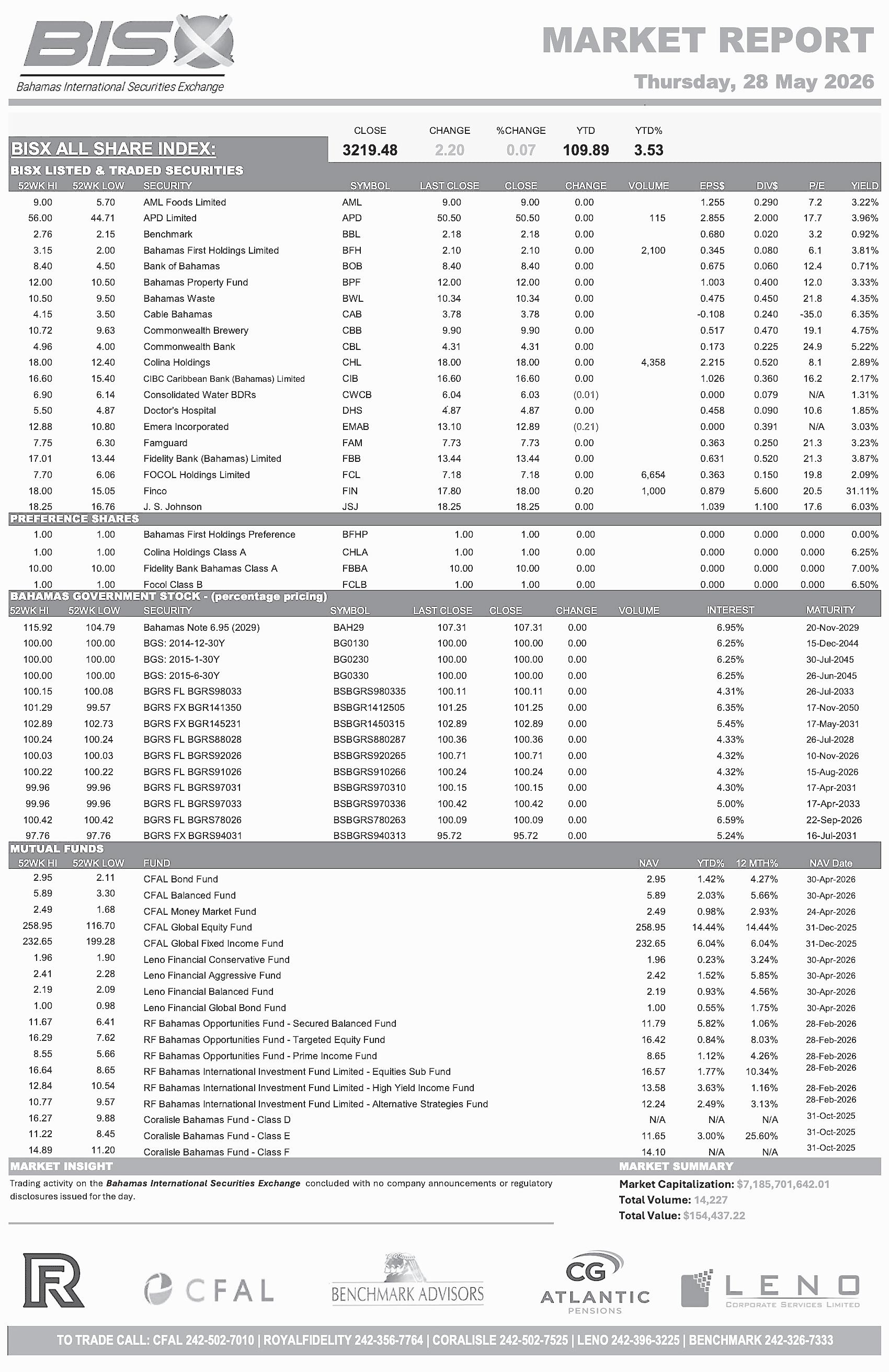
BISX hopes for ‘extended presence’ from merger Bank in exchange’s market capitalisation leaders
BY NEIL HARTNELL Tribune Business Editor nhartnell@tribunemedia.net
THE trade union representing CIBC’s Bahamian line staff yesterday revealed it was blindsided by the bank’s planned $1.8bn sale to Bank of Butterfield, with its president conceding: “This one was fresh out of the bucket.” Teresa Mortimer, the Bahamas Financial Services Union's (BFSU) chief, told Tribune Business that she and her 300 members are in “watch, wait and see” mode with many of their questions yet to be answered after the Canadian bank unveiled its latest bid to exit the Caribbean via the sale and merger of its regional commercial banking interests to the Bermuda-headquartered purchaser. Banking industry sources, speaking on condition of anonymity, described the CIBC-Butterfield tie-up as “a very good fit for the region” should the acquisition obtain all the necessary regulatory and shareholder approvals and close during the 2027 first-half as scheduled. An investor presentation by Butterfield unveiled its ambitions to create the largest banking and financial services group in the Caribbean with combined total assets of $29bn. The document confirmed that The Bahamas will continue to play a critical role in the merged entity, with this jurisdiction forecast to generate 11 percent of the merged Butterfield-CIBC entity’s earnings to rank behind only the Cayman Islands, at 50 percent, and Bermuda with 13 percent. However, observers said that if the 9 percent contribution from the Turks & Caicos operations was included, given that it falls under CIBC’s operations in this nation, The Bahamas would rank second at 20 percent.
How employers can drive worker health
As summer approaches, many Bahamians jokingly speak about “working on their beach body”. Yet behind the humour lies a serious national concern.
Weight loss and obesity remain sensitive issues for countless Bahamians, particularly in a society where unhealthy eating habits and sedentary lifestyles have become increasingly common.
The reality is that many Bahamians are overweight or obese, a condition linked to major illnesses such as diabetes, hypertension, heart disease and certain cancers. Beyond the personal health impact, obesity also affects the workplace through increased sick days, reduced productivity and
FERGUSON IAN
rising medical insurance costs for employers. As healthcare expenses continue to climb, businesses have a vested interest in
Bilateral compliance network eyed for Bahamas and Ghana
A BAHAMIAN compliance executive has been invited to speak at a London event on how Africa can resposition itself in an evolving global geoplitical climate.
Eliot Kelly, founder of Universal Compliance Interoperability Protocol, said he will address the African Affairs Think Tank Society on June 25, 2026, at Fyvie Hall in London. He will address both Africa's economic repositioning and the compliance issues blocking cross-border trade.
Mr Kelly said UCIP is actively working to develop a bilateral compliance framework between Ghana and The Bahamas, which would position this nation as the first non-African anchor jurisdiction for a protocol designed to connect African, Caribbean and Commonwealth trade. He added that the initiative is currently under regulatory sandbox co-ordination with the Central Bank of The Bahamas and the Bank of Ghana.
"Africa has solved how money moves. The next frontier is solving how trust moves," said Mr Kelly. "If we are serious about repositioning Africa from a resource hub to a strategic economic power,
we must stop treating compliance fragmentation as a back office problem.
“For the SME trader in Accra trying to sell into the Caribbean or Commonwealth markets, compliance duplication is the new tariff. It is costing the continent formal trade volume, tax revenue and jobs."
Mr Kelly said he will address an audience of policymakers, diplomats, institutional investors and trade specialists on the compliance interoperability gap that prevents African small and medium-sized enterprises, particularly those headed by women and youth, from accessing global markets at scale.
While Africa's payment infrastructure has advanced through initiatives like PAPSS, Mr Kelly argued that compliance identity remains jurisdiction-locked, effectively taxing African exporters with repeated Know Your Customer (KYC) and anti-money laundering verification in every new market.
He plans to explore how federated compliance infrastructure could enable African trade credentials to travel with transactions, without requiring nations to surrender regulatory sovereignty.
helping employees pursue healthier lifestyles in a safe, supportive and non-judgmental environment.
Employers have a unique opportunity to drive workforce health by creating workplace cultures that remove barriers to healthy living rather than placing blame on individuals. One practical starting point is nutritional support. Break rooms stocked with sugary snacks and soft drinks can gradually be replaced with healthier options such as fresh fruits, nuts and sparkling water. Companies with cafeterias can subsidise healthier meals, ensuring salads, vegetables and lean proteins are more affordable than fast food alternatives. Visible touchless filtered water stations
placed throughout offices can also encourage employees to drink more water and reduce sugary beverage consumption. Physical activity is another critical area. Employers can partner with local gyms and fitness centres to provide discounted memberships for staff. Simple workplace adjustments such as standing desks, walking work stations or under-desk exercise equipment can encourage movement during the work day. Voluntary fitness challenges, including step-count competitions with meaningful incentives, can also foster camaraderie while promoting healthier habits. Equally important is creating a culture of education and encouragement.
Businesses can host wellness seminars featuring registered dietitians or health professionals who provide practical advice on nutrition and safe weight management. Walking meetings can be normalised for smaller groups, encouraging exercise while conducting business. Access to professional health coaches through employee benefits packages can also provide long-term accountability and guidance. Perhaps most importantly, company leadership must actively participate in wellness initiatives. When executives and managers engage openly in healthy lifestyle programmes, it reduces stigma and sends a clear message that health is everyone’s responsibility.
Healthy employees contribute to healthier businesses. By investing in wellness initiatives today, Bahamian employers can build stronger, more productive workplaces while helping employees enjoy longer, healthier lives.
• NB: Ian R Ferguson is a talent management and organisational development consultant, having completed graduate studies with regional and international universities. He has served organisations, both locally and globally, providing relevant solutions to their business growth and development issues. He may be contacted at tcconsultants@coralwave.com.
Bahamas Striping expands to Nassau road upgrading
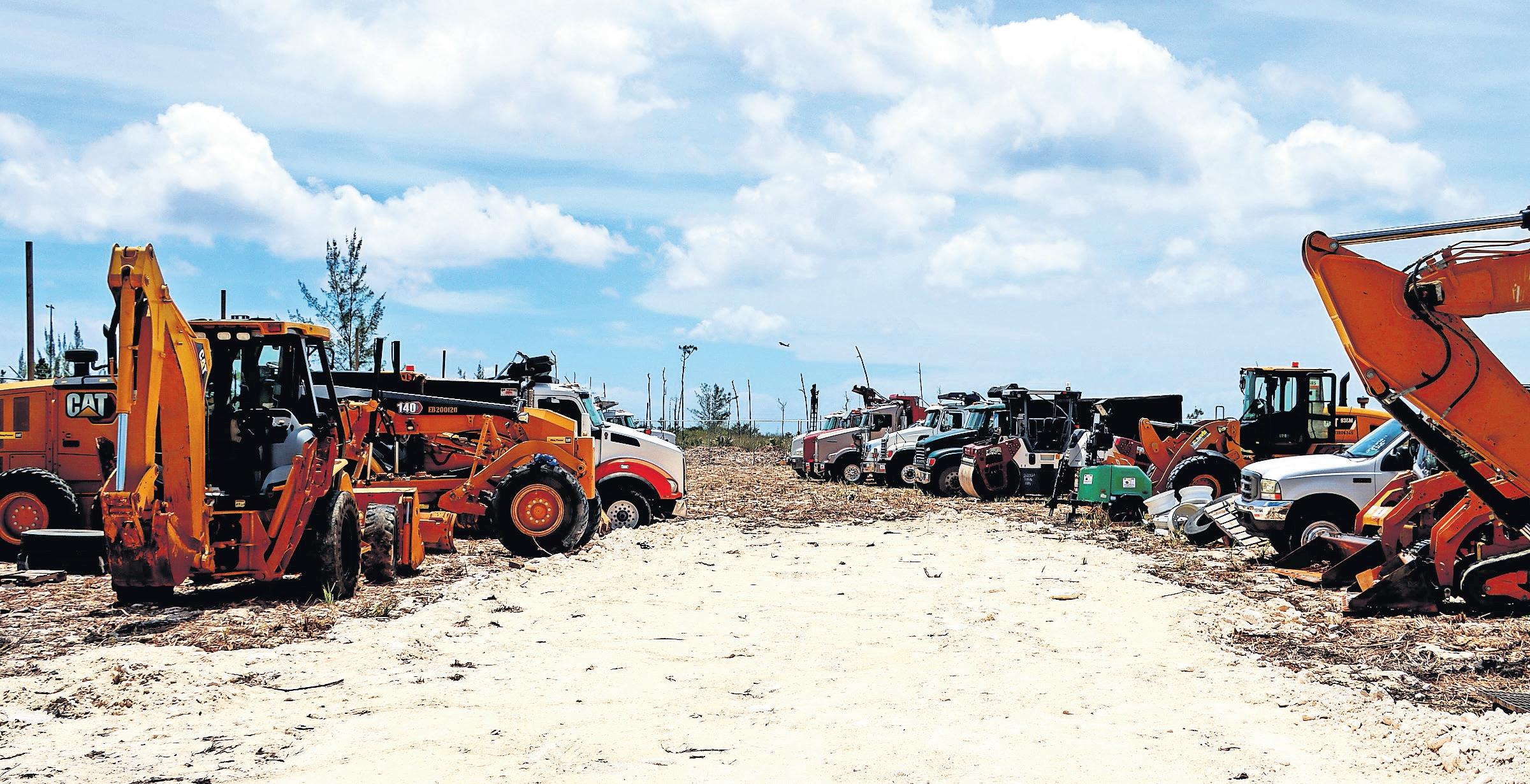
BAHAMAS Striping, which is upgrading Eleuthera and Exuma’s road infrastructure under ‘public-private partnership’ (PPP) deals with the Government, yesterday announced it is entering the Nassau market after acquiring a new multi-million dollar hub for its operations.
The company, in a statement, said it has been selected by the Government as the successful bidder on another road improvement project although it provided no details. It added that its entry into the Nassau market has been paved by financing from the Africa Export-Import Bank (Afreximbank).
Bahamas Striping said its principals and executive management team recently
Pension
toured the new operational site along with officials from Afreximbank. The facility will house the company’s equipment, machinery and supplies required to support its upcoming road paving operations within New Providence.
Dominic Sturrup, Bahamas Striping’s executive chairman, said: "This expansion into Nassau could not have happened without the factoring arrangement facilitated through Afreximbank.
“We are grateful for their confidence and support, which has positioned us to continue growing and investing in The Bahamas. We are also confident that the impact we have made in Exuma and Eleuthera - coupled with our
reform eyes fall Parliament debate
competitive and responsible approach - helped position Bahamas Striping as the successful recipient of this opportunity."
Bahamas Striping said its new Nassau facility represents more than a paving depot as it reflects the group’s broader diversification strategy. It added that, over the past 16 years, the company has evolved from a road striping company into a diversified infrastructure and development group with regional
BY FAY SIMMONS Tribune Business Reporter jsimmons@tribunemedia.net
THE Government aims to bring long-awaited public pension reforms to Parliament after the summer recess following a 30 to 60-day public consultation period on its newly-tabled white paper
Michael Halkitis, minister of finance, said the Davis administration hopes to complete public consultations during the summer and return to Parliament in the fall to debate - and potentially pass - legislation designed to address the Government’s rapidly-growing pension liabilities.
“We expect that when we come back from the summer recess, in the fall, we’ll be able to take it up and debate it, and hopefully pass it and bring it into effect,” Mr Halkitis said. “So we’ll have the summer period for additional public viewing, and take it to Parliament in September, October, whenever we come back from the break.”
Mr Halkitis added that the consultation phase would likely last between 30 and 60 days before the Government finalises the legislation.
“Normally we do like a 30-day or 45-day consultation, or 60 days, then we take in all of the comments, see whatever we want to adopt, incorporate it into the legislation, and then take it to Parliament,” he said.
The minister said the pension reform effort has been under discussion for more than a decade, dating back to the last Christie
ambitions and a track record of projects.
"The impact we have made throughout The Bahamas has afforded us opportunities to diversify into other industries and better meet the ever-growing needs and development of our country," Mr Sturrup added. The Eleuthera and Exuma road improvement contracts that Bahamas Striping is currently performing are worth $180m and $62m, respectively.
administration, when the Government’s unfunded pension obligations stood at just over $1bn. “We started this back in our term in 2012 because back then, I think, the outstanding obligation might have been just over $1bn. Now it’s north of $3bn,” he said.
He described the reform effort as the result of years of consultation with unions, businesses and other stakeholders, with one of the central challenges being how to address pension contributions for existing public servants who currently do not contribute toward their retirement benefits.
“One of the main things that guided us was that, right now, public servants do not contribute to their pensions,” said Mr Halkitis. “You don’t want to start something where you have people who have already vested, and now you’re asking them to make a payment, and so we had a lot of back and forth.” Mr Halkitis said the Government has now reached the stage where it is seeking broader public feedback through the ‘white paper’ consultation process. “We’re at the point now where we’re going out to public consultation, where we’re sending out the white paper to the general public to get their views,” he said. The proposed reforms are intended to help contain the Government’s escalating pension obligations, which officials have warned are placing increasing long-term pressure on the country’s fiscal position.
ELIOT KELLY
‘Nothing to hide’ on Gov’ts PPP projects
BY FAY SIMMONS Tribune Business Reporter jsimmons@tribunemedia.net
THE Government has “nothing to hide”, the minister of finance said yesterday, as he defended its use of public-private partnerships (PPPs) against charges from the Opposition that they are ‘off the books’ loans designed to keep debt off the books and from adding to the annual deficit.
Michael Halktis said such structures are an internationally-accepted tool for accelerating infrastructure investment without requiring the state to fund projects entirely upfront.
Addressing concerns over the structure and transparency of PPP projects, Mr Halkitis said the Government has already established a framework for such arrangements and hired consultants to further refine the process, while also receiving feedback from the International Monetary Fund (IMF).
“I addressed it in the Budget communication,
where we have a framework in place, we have hired a company to refine our framework. The IMF has seen our framework and commented on it,” said Mr Halkitis. He rejected suggestions that there was anything improper about the Government’s growing use of PPP financing for infrastructure works.
“Private-public partnerships allow government to invest in infrastructure without paying all of the money upfront,” he said. “They get a partner that can put forward the money, and the Government, there’s a payment schedule, and so you’re able to accelerate your infrastructure without having the money upfront. There’s nothing wrong with that. It’s an established procedure that many countries use.”
Mr Halkitis said some critics incorrectly define PPPs as only legitimate when the underlying infrastructure directly generates revenue, such as toll roads or bridges.
“Some people think that unless money is being
NHI subsidy rise allocation key to restoring confidence
BY ANNELIA NIXON
NATIONAL Health Insurance (NHI) providers yesterday argued that a 50 percent increase in the scheme’s subsidy will do little to restore confidence in the Government unless long-standing payment delays and transparency concerns are resolved.
The Government, in its 2026-2027 Budget, said the National Health Insurance Authority’s (NHIA) subsidy will rise from $48.2m to $72.7m, describing the increase as part of its commitment to healthcare reform and improved access to care. However, physicians enrolled in the programme said they remain sceptical over whether the additional funding will actually reach providers or merely support an expansion of the system while existing problems persist.
“It depends on how it’s allocated,” Dr Ian Kelly, an NHI provider, said. “We don’t know yet. It could be trying to get more people in, more doctors involved, and so the situation persists. What I think is that the Government really doesn’t care about us.
““The proof of the pudding is in the eating. So, we’ll see what happens when the money comes down; whether it’s allocated to us and we’re kept up to date
or not.” Dr Kelly said NHI providers are still waiting for payments that are two months or more overdue, which is placing mounting pressure on private practices already grappling with rising operational costs and inflation.
“Obviously it makes it very difficult to practice,” he said. “If our income was higher before, and now we’re taking in less money, it makes it so that we have to look at what bills we pay and when.
“We haven’t seen anything for April. If your employer says we can’t pay you for two months, how’s that going to affect your daily life? Are you going to go to work with the same enthusiasm that you went to before?” He added that the delayed payments have damaged providers’ perception of the programme.
“It’s a very irritating problem,” Dr Kelly said. “It does affect our attitude in general to NHI.” When asked whether the Budget increase has restored providers’ trust in the Government over NHI, Dr Kelly said: “I’d say we’ve never really trusted the Government.”
Dr Dentroah Archer-Cartwright, another NHI provider, said the funding increase fails to address deeper structural concerns surrounding accountability, consultation and contract compliance. “We will have
generated from the infrastructure project, like if it’s a toll road or a toll bridge, then it’s not a so-called true PPP because it does not generate income. But we don’t take that view,” he said.
“The idea is we are a country that needs infrastructure, and once it’s transparent and above board, properly structured, it enables us to do things like accelerate our airport infrastructure and improvement of infrastructure in the Family Islands.”
Mr Halkitis also pushed back against suggestions that the IMF had raised concerns about the Government’s PPP approach, saying the Fund instead viewed such financing arrangements as a practical investment tool for heavily indebted countries emerging from the COVID-19 pandemic.
“The IMF did not have concerns, so to speak,” he said. “The IMF comment was that PPPs are a useful tool to accelerate investment because countries tend not to have the
to see if the increase leads to resolved payment delays,” she said. “Current trust and confidence are at an all-time low.”
Dr Archer-Cartwright said providers learned about the Government’s plans at the same time as the public, and claimed there has been no meaningful engagement with physicians despite repeated requests for meetings and clarification over policy changes.
“We have received no communication on this matter and are still months behind in receiving payment,” she said. “We have not been paid in the past years for persons who have signed up since June of last year based on the capitation agreement.”
Dr Archer-Cartwright alleged that the NHI Authority has altered payment arrangements without consultation, despite contractual agreements stating that capitation payments should begin once patients enrol with providers.
“The Authority decided that they would change that arrangement and pay when they deemed appropriate without consultation or amendment to the agreement,” Dr Archer-Cartwright said. “Now we are also having fees taken out of the money we are owed without our consent.”
She described the relationship between providers and the NHI Authority as increasingly strained. She added that the delayed payments and administrative uncertainty have forced many clinics to restructure
money upfront to be able to do it, and you have a lot of countries who are in that position, particularly coming out of COVID-19 where everybody’s debt was sky high.”
Responding to questions about transparency, and whether taxpayers should know the financing terms private companies secure to execute PPP projects, Mr Halkitis said those arrangements are matters between the companies and their lenders.
“If they take out loans to do PPP work, that’s between them and their financial institution,” he said. “What we are concerned about is the financial terms of the Government of The Bahamas and the person who’s executing the PPP.”
However, Mr Halkitis maintained the Government had “nothing to hide” regarding its own obligations and agreements tied to PPP arrangements.
“We can lay them [in Parliament], nothing to hide,” he added.
operations, reduce staffing and scale back services.
“Clinics have had to cut back services, some physicians have left the programme, others have had to cut staff or increase fees and charges for things not covered by NHI,” she said.
Dr Archer-Cartwright added that some providers have pivoted towards alternative revenue streams to survive, reducing the time allocated to NHI patients and contributing to longer wait times. “With less time allocation wait times have increased, and some providers are simply no longer participating,” she said.
Dr Archer-Cartwright also questioned whether the programme’s current structure disadvantages smaller clinics that are less able to absorb prolonged cash flow disruptions than larger medical facilities.
“I think both small and larger facilities have felt this cash flow issue. But perhaps larger groups were more positioned to absorb the cost,” she said. “So this brings up the question: Do we just want big businesses in medicine or stick with who provides quality care for the Bahamian people?”
Dr Archer-Cartwright said physicians remain hopeful discussions can still take place. “We look forward to still having a comprehensive discussion with the Government,” she said. “Our request to meet with the Prime Minister is still pending but we are hopeful it will all work out for the health of the people of the nation.”
Minister reassures over $700m Investment Fund debt transfer
BY FAY SIMMONS Tribune Business Reporter jsimmons@tribunemedia.net
THE minister of finance yesterday reassured that there was “a resolution to do the borrowing” and deposit $700m in net debt proceeds into the National Investment Fund, adding that the transaction was fully compliant with the law and supported by legal advice.
Responding to criticism over the legal authority used for the debt transfer, Michael Halkitis said the Government was satisfied that “everything was done in accordance with the law” and argued the exercise had delivered significant benefits for The Bahamas.
“There was a resolution to do the borrowing. It was done. It was successful. The money is there. It wasn’t used to finance spending. It’s used for future investment,” said Mr Halkitis.
“We are satisfied when we do these things. We get the input from our lawyers, from the bank’s lawyers, from the investment lawyers, so we’re satisfied that everything was done in accordance with the law. Everything was done according to what needed to be done.”
Mr Halkitis was responding after questions were raised over the legal framework used to execute the Government’s refinancing and liability management exercise involving approximately $700m in net new debt.
He argued the transaction should be viewed as a positive financial achievement for the country, pointing to improved borrowing terms and recent sovereign credit rating upgrades.
“To be able to do that sort of transaction and get improved conditions is a very positive thing for the country, extremely positive, and you see the results of it in two ratings upgrades in the past year,” he said.
“A lot of that is because we are able to demonstrate to financial companies and rating agencies that we can go out to the market and do successful transactions.”
Mr Halkitis explained that the Government had
undertaken two separate liability management exercises in recent years, including the 2024 debt-fornature swap executed with The Nature Conservancy.
Under that arrangement, the Government refinanced approximately $220m in high-interest debt and an additional $80m bond, securing lower interest costs and extended repayment terms. “We were able to save, I think it was $124m over the course of 15 years for the improved management of our marine protected areas,” he said.
The finance minister said the Government later conducted another liability management exercise involving the refinancing of bonds maturing around 2028 and other outstanding obligations.
According to Mr Halkitis, the Government paid off about $700m in existing bonds while raising a larger amount overall, with excess proceeds placed into a National Investment Fund earmarked for future infrastructure development.
“The additional money that was raised was not spent, but was put in a National Investment Fund for future infrastructure development, in particular,” he said.
Mr Halkitis added that the Government deliberately opted for a larger refinancing transaction because larger issuances tend to attract greater investor participation and market liquidity.
“We didn’t want to do just $700m in the refinancing because what we find is if you do larger size, up to a billion, there’s more liquidity, more people buy it, it’s more attractive for other investors to get involved,” he said.
He also argued the transaction demonstrated The Bahamas’ ability to successfully access international capital markets at competitive rates. “I think it’s something that all Bahamians, no matter what their political stripes, should be able to look at and say this is something positive for the country,” Mr Halkitis added.
Gov’t expects ‘many more players’ on corporate tax
COLLECT - from page B1
fiscal year’s and what the current one’s DMTT amount turns out to be, they will be “liable to pay a penalty and prescribed interest on that deficiency”.
This reform, which was never mentioned by Michael Halkitis, minister of finance, during Wednesday’s Budget presentation will impact some of The Bahamas’ largest companies and all entities that qualify to pay the DMTT - those that are part of multinational groups with more than 750m euros in annual turnover.
The DMTT (Amendment) Bill’s objects and reasons section states: “Clause four of the Bill creates the requirement that the constituent entities have to pay the current fiscal year’s DMTT tax in prescribed instalments.
“Those instalments are based on the prior fiscal year’s DMTT amount. Where the constituent eEntities choose to pay less than the amount computed on the prior fiscal year, and end up paying less in instalments than the current year’s DMTT tax payable, they will be liable for penalties and interest.”
The new clause adds that, should the current year’s corporate income
tax be more than what has been already paid in instalments, the taxpayer has to be the balance owed “before the filing date” for payment. And, if the instalments exceed the tax that is ultimately due, “the excess shall be refunded or applied against any other liability under this Act” that is approved by the Government. The 2026-2027 Budget identifies several areas where the Government expects to generate significant revenue growth, and chief among them is the DMTT. The Government is forecasting that revenue from this source will near-triple from the $130m projected in the present 2025-2026 fiscal year to $350m - a 169 percent yearover-year jump - and the new pre-payment regime may be one factor driving this.
Mr Halkitis, meanwhile, yesterday said the Government is “pretty confident” qualifying companies are prepared to begin filing and paying the DMTT due for the 2025-2026 fiscal year before its end-June close despite lingering questions over whether all guidance notes and regulations have been formally circulated to affected firms.
Speaking at the Office of the Prime Minister’s weekly
Reforms seek to plug Customs Act loophole
TRADE - from page B1
rapidly after the Government’s director of legal affairs admitted at a hearing before US trade chiefs that The Bahamas has no laws, regulations or policies in place to prohibit the importation of goods made by forced labour.
Danya Wallace, who replaced former attorney general Ryan Pinder KC as The Bahamas’ panellist during a two-day hearing held in Washington D.C. by the US Trade Representative’s Office, conceded under questioning that this nation has nothing in the Customs Management Act or other legislation “that directly addresses” the importation of goods manufactured by forced labour. She was speaking at a hearing called over the probe by the US Trade Representative’s Office into 60 countries, including The Bahamas, to determine if they have all implemented - and are enforcing - measures to ban the importation of products made with forced labour. The Bahamas appears to have been the only state
officially represented at the hearing, and it is unclear what impact Ms Wallace’s testimony will have on the outcome of the investigation for this nation.
The director of legal affairs echoed Mr Pinder’s previous written submissions to the investigation by calling for the US to address the forced labour issue via “mutual co-operation” with The Bahamas. She also reiterated the Government’s “request” that the Trump administration find none of The Bahamas’ “acts, policies or practices” relating to forced labour are worthy of attracting sanctions under under Section 301 of the 1974 US Trade Act.
A negative determination could potentially trigger the imposition of extra US tariffs on Bahamian exports, or other so-called “remedies”, designed to protect US companies and industries from what Washington D. C. deems to be “unfair foreign trade practices”. The present probe is particularly interested in whether US products and manufacturers are being placed at a competitive disadvantage by other countries failing to
press briefing, Mr Halkitis said Department of Inland Revenue officials have advised him the system is fully operational and companies can already begin filing returns and making payments under the new framework.
“I spoke with Inland Revenue yesterday and their advice to me is everything is ready,” said Mr Halkitis. “My information is that the system is ready for people to file their returns and they can begin the process of paying.”
His comments come amid concerns from some observers and businesses over whether companies have received sufficient regulatory guidance ahead of the implementation of The Bahamas’ domestic minimum top-up tax, which is intended to comply with the G-20/OECD-led global minimum corporate tax initiative.
Mr Halkitis acknowledged he could not personally confirm whether every affected company had formally received guidance documents, but maintained the filing infrastructure is operational.
“I don’t know if they’ve been given to them or if they’re available,” he said. “I understand that they have [the guidance].”
The Fiscal Responsibility
crack down on rival goods made with forced labour.
Ms Wallace, who works in the Attorney General’s Office, also repeated Mr Pinder’s suggestion thatas an alternative - the US “suspend” its forced labour probe to provide time for it and The Bahamas to work out an unspecified “satisfactory solution”. The Bahamas’ presence at the hearing, combined with Mr Pinder’s submission, suggests the Government is taking the probe - and possibility of a negative finding and imposition of sanctions on trade and commerce with the US - very seriously. The director of legal affairs’ confirmation of a potential gap in Bahamian laws and regulations came as she was questioned by Jennifer Atkin, of the US Trade Representative’s Office, over whether this nation has any statutory authorities to enforce a ban on, or prevent the entry of, goods made by forced labour at this country’s borders.
“The written testimony describes domestic and international commitments to enforce laws and policies oriented at combating forced labour,” Ms Atkin said, seemingly referring to Mr Pinder’s earlier submissions. “What are these commitments, and can you describe recent use of the authorities implementing these commitments? Also, does The Bahamas have legal authorities regarding the ability to enforce a prohibition on imported goods produced with forced labour?”
Ms Wallace, according to the hearing transcript released by the US Trade Representative’s Office, pointed to the Bahamian constitution as well as the likes of statute laws such as the Employment Act, Industrial Relations Acts and Trafficking in Persons Prevention and Suppression Act, as prohibiting slavery and forced labour within the domestic Bahamian economy.
“In relation to the present framework that we have, the first thing that I would wish to state is that under the constitution of The Bahamas itself, there is
Council, the Bahamas’ top public finance watchdog, in its recently-published assessment of the 20252026 mid-year Budget had voiced doubts over whether the $130m in DMTT revenues for 2025-2026 would be collected before the fiscal year closed because the necessary collection mechanism, guidance notes and regulations had not been implemented.
“The Fiscal Responsibility Council also notes that the projected DMTT revenue outlook is in doubt, as the implementation framework continues to take shape ahead of the March 31, 2026, submission deadline for entities subject to the tax. Failure to achieve the $130m projection could have significant implications for the final budgetary outcome,” the Councik said in its assessment of the midyear Budget
Similar concerns were previously voiced by Gowon Bowe, Fidelity Bank (Bahamas) chief executive, who told this newspaper: “The question is, and I think I know the answer because the work is not completed, is the DMTT going to make it into this fiscal year?
“I may be wrong. There may be bilateral discussions and agreements, but there needs to be a very clear framework for reporting,
something enshrined within the constitution at Article 18 that prohibits slavery and forced labour, and in reading that Article 18, it reads in similar form to the Article 2 of the International Labour Organisation (ILO) protocol of 1930, and so we have that as the highest form of legal enforcement,” Ms Wallace replied.
“We also have within our domestic law, both under the Employment Act as well as the Industrial Relations Act, protections and safeguards for employees, as well as the right to have a bargaining agent and representation. We also have before us the Trafficking in Persons Prevention and Suppression Act, and in the most recent TIPPS report of 2025, The Bahamas maintained its Tier 1 standard in that regard.” TIPPS is the annual US State Department report on human trafficking.
But, as to the second part of Ms Atkin’s question, Ms Wallace acknowledged a potential gap in The Bahamas’ legal and regulatory regime. “I believe your second question was whether we have anything relative to the enforcement of goods themselves, right?”
the Government’s director of legal affairs said. “So, we do not presently have anything that directly addresses that issue.
“The Customs Management Act is the domestic law responsible for that, and that provides authority for the regulation and control of imported goods, and empowers the Customs Department to prohibit or restrict goods, but there is nothing presently in place to address goods that are as a result of forced labour.”
It is unclear whether any reforms are being drafted to tackle this legal gap in time for Parliament’s return after the May 12 general election.
Ms Wallace’s testimony backs Ralph Munroe, comptroller at Bahamas Customs, who last month told Tribune Business that The Bahamas has no laws, policies or regulations in place to detect and prevent products manufactured by forced labour from accessing this nation.
He personally believes it is virtually “impossible”
NOTICE is hereby given that SHERONDA VERNEUS of, Minnie Street & Balfour Avenue, Nassau, Bahamas, applying to the Minister responsible for Nationality and Citizenship, for Registration Naturalization as a citizen of The Bahamas, and that any person who knows any reason why registration/ naturalization should not be granted, should send a written and signed statement of the facts within twenty-eight days from the 22nd day of May, 2026 to the Minister responsible for nationality and Citizenship, P.O. Box N-7147, Nassau, New Providence, The Bahamas.
paying and confirmation of having done so to be set out for all those affected. We only have two months, and we are losing May because of the election and efforts to get the Budget completed. From that perspective, how are we making up the stagger?”
Mr Halkitis yesterday said the Government initially projected that fewer than five companies would fall within the DMTT tax regime during its first year, but revised expectations upward after receiving updated information during the year.
“We had estimated that we would have about five or fewer taxpayers. Information that has come to us during the course of the year indicates that there will be more,” Mr Halkitis said. “The filing period has begun, and they will pay in June, so over the next few weeks we’ll get a better picture of the actual amount as they file and as they pay.”
Mr Halkitis said the Government deliberately adopted conservative revenue projections in the 2025-2026 Budget because of uncertainty surrounding the first year of implementation.
to determine whether any goods, or their components, are being manufactured using forced labour, and said: “There are no policies with respect to these types of matters. No, none at all. None that I am aware of, and certainly none that I have been asked” to enforce.
“As a matter of fact, all the world’s markets are open to The Bahamas for trade purposes. If there are any kind of prohibitions on imports or trade matters, those would be coming from another ministry, the Ministry of Economic Affairs,” Mr Munroe added.
Ms Wallace, during the remainder of her presentation at last week’s hearing, reiterated previous assertions by Mr Pinder that the dominant share of total Bahamian imports enjoyed by US goods undermines the notion they are being squeezed out by cheaper products made with forced labour. She added that trade data shows “the opposite is occurring” with the volume, and value, of US goods entering The Bahamas increasing year-over-year.
“The Government of the Commonwealth of The Bahamas believes that the important issues raised in this Section 301 investigation can be addressed through mutual co-operation between the two countries, which share a common perspective on this important issue,” Ms Wallace said. “Indeed, given our relationship, we hope that the basis of this investigation can be clarified further during consultations in order to reach an amicable solution.
“The Bahamas’ trade relationship is dominated, both from an export and import perspective, by the United States. Based on data from the Bahamas’ National Statistical Institute, in 2024, trade with the US represented approximately 83 percent of total imports, and imports from the next largest trading partner were merely 2.5 percent.
“Furthermore, The Bahamas maintains a trade surplus that expanded to $3.4bn in 2025 with The Bahamas…. As we stated in our brief, American goods reflect American values. The dominant US volume of imports impairs any allegations that goods imported into The Bahamas originate from sources that undermine US commerce, trade interests or labour rights.”
Ms Wallace added that “there have been no concrete allegations reflected or related to forced labour in Bahamian supply chains, and The Bahamas’ import profile demonstrates a significantly low risk of forced labour given the dominance of US imports.
“The Bahamas and US’ trading relationship is a boon to both countries, and US goods not only effectively compete in, but rather
According to Mr Halkitis, the Government now projects it will receive $350m in corporate income tax in the upcoing 2026-2027 Budget year as it expects significantly more companies to fall within the regime than originally anticipated.
“This year was the first year, and there were fewer than five companies who indicated at the beginning that they would pay,” he said. “We’ve gotten information during the course of this year that there will be additional companies this year and additional next year, so that’s why it was raised to that amount for next year, because we expect many more players.” The domestic minimum top-up tax forms part of The Bahamas’ response to the OECD’s global corporate minimum tax initiative targeting large multinational enterprises with annual revenues exceeding €750m.
The Government has argued that implementing the regime locally will allow The Bahamas to collect top-up tax revenues itself rather than allowing other jurisdictions to impose the tax on profits generated within the country.
“We tend to be very cautious and very conservative when we put these things in the Bbudget, because you don’t want to put a number expecting a certain amount of money and you don’t get it,” he said.
also dominate Bahamian markets. US commerce is aided by The Bahamas, as evidenced by the consistent US trade surplus,” she continued.
As for the argument that US goods are being discriminated against, and undermined competitively by products made cheaper by being manufactured with forced labour, Ms Wallace countered: “US goods dominate Bahamian markets, indicating that US goods are not discriminated against in The Bahamas. The economic data rather demonstrates that the opposite is occurring, with year-over-year increases in the volume and value of US goods entering the Bahamian market.
“If discrimination against US goods were occurring in The Bahamas, or if articles produced with forced labour were allowed to enter as contended, the trend lines of US exports to The Bahamas should be trending rather in the opposite direction.
“In other words, there is no evidence yet before us that US goods may face any form of discrimination in the Bahamian market or that US commerce has been negatively impacted in any way by virtue of The Bahamas and US trading relationship,” Ms Wallace added.
“In light thereof, the Government of The Bahamas respectfully requests that the US Trade Representative’s Office makes a negative determination that any of the Government’s acts, policies or practices are actionable under Section 301 of the Trade Act 1974, or alternatively, suspend the investigation to allow time to see if a satisfactory solution may be reached between our two nations.
“There are compelling reasons for adopting this approach. Firstly, the strength of The Bahamas and US trade partnership and overall diplomatic relations. Further, that The Bahamas shares the US commitment against forced labour, and thirdly, the lack of any known forced labour issues arising from The Bahamas, whether directly or indirectly, through transshipment to date.” Of The Bahamas’ $8.92bn worth of total imports in 2024, the US accounted for $5.59bn or 63 percent, with many originating from sectors identified by the Trump administration as “critical for securing the health of the US economy”.
Some $985m of The Bahamas’ exports went to the US out of total exports worth $2.38bn. The major export by far was refined petroleum, valued at $610m, while other categories included documents of title ($95.2m), styrene polymers ($55.7m) and pearl products ($39m).
Supermarket chain warns on prices, wages over Business Licence rise
PACKAGE - from page B1
Licence rate for businesses which earn more than $175m by 0.25 percentage points to 1.5 percent per annum,” he told the House of Assembly.
The rate increase will impact high turnover companies such as food stores, especially Super Value and its BISX-listed rival, AML Foods, as well as the larger hotels such as Atlantis and Baha Mar plus the oil majors - Rubis, Esso and Shell (FOCOL Holdings).
Other contenders would be the likes of Cable Bahamas and the Bahamas Telecommunications Company (BTC), although both pay their own separate communications licence fees already.
And some, though, may not feel the impact as much as others - especially if they are caught in the Domestic Minimum Top-Up Tax’s 15 percent corporate income tax net, which uses the Business Licence fee to offset the amount of tax payable.
“It’s going to increase our expenses because the
Business Licence fee, that’s a significant portion of our expenses anyway, and now it’s going up in addition to it,” Ms Symonette said. “That’s along with all the other things that are coming our way. We’re really going to have a significant increase in our expenses as we go throughout this year.” She explained that Super Value is already bracing for increased prices from suppliers overseas as a result of rising energy, freight and transportation costs driven by surging global fuel and oil prices as a result of the Middle East conflict. “That is definitely going to cause some kind of change,” Ms Symonette said. “We don’t know exactly what products we are going to get hit on, but it’s going to happen. It’s just a matter of time.
“We’re watching it and adjust as we have to. Then there’s freight because shipping plays a major role in the process. Shipping will definitely be affected. It’s like everything is hitting us one time. It’s like you cannot avoid it nowadays. Every time you look around
something is increasing. It’s going to be hard to control prices and keep things down. Even though we’re going to do our best to keep them as low as possible, at some point we may have to take a look at it.”
Confirming that price increases for Bahamian shoppers, which would erode at least some of the benefits from the April 1 elimination of VAT on uncooked foods, are a possibility, Ms Symonette said: “Essentially, that’s what can happen. We won’t be able to absorb everything, although we will try to absorb as much as we can.
“It’s one [cost increase] on top of another. Even businesses of that size can be significantly affected by a small percentage change. It may seem small, but when you apply it to reve nue and profits, it’s a good amount. Everybody has to contend with the cost of living. Our employees are looking to get some help, and it’s so difficult to help them if all these other things are coming our way. We’re hoping we’ll get some
Benchmark (Bahamas) Ltd. Consolidated Performance for the First Quarter 2026 was a Net Profit of B$76,659 with results from Subsidiaries mixed. The primary detractor to the Groups Consolidated results during the quarter was Alliance Investment Management. Notwithstanding a significant turn around in revenue generated from commission a Net Comprehensive Loss of (B$57,391) was registered against B$(131,565) for the same period 2025. The other operating subsidiaries Benchmark Properties, Benchmark Advisors and Benchmark Ventures produced for the Quarter Net Comprehensive Income/ Loss of B$139,298, B$60,692 and B$ (7,822) respectively.
(Group)
relief somewhere down the line.”
As an example, using AML Foods’ $203m sales top-line for the year to end-April 2025, the 0.25 percentage point increase would equate to just over a $500,000 increase in Business Licence fees. That money would likely have to come off the bottom line given the turnover-based nature of the levy.
Meanwhile, the Government is also reforming the Business Licence Act with amendments that alter the liquor licensing regime that it introduced just one year ago in the 20252026 Budget. It is creating a Liquor Review Board, which will assess all new and renewal licence applications from the likes of bars, restaurants, merchants and nightclubs, and issue those it approves with a ‘certificate of endorsement’.
secretary whether to grant, renew, suspend or revoke a liquor establishment’s Business Licence as that power remains in his hands rather than the newly-created regulator’s. However, the Liquor Review Board process will not apply to Business Licence applications by hotels as they fall under the Hotel Licensing Board’s purview.
The Board, though, will have the ability to set operating and compliance standards for liquor vendors; impose conditions on their operations such as restricted operating hours; conduct inspections; and stage public hearings to obtain feedback from members of the nearby community - essentially replicating the functions that the Department of Inland Revenue has.
“Clause seven of the Bill seeks to insert a new
body known as the Liquor Review Board,” the Business Licence (Amendment) Bill 2026 states in its objects and reasons section.
“The Board is intended to provide a co-ordinated and transparent mechanism for the review of liquor establishments and to enhance public participation, public safety and regulatory oversight in relation to the operation of businesses engaged in the sale, manufacture, storage, distribution or supply of liquor.
“The Board will review applications, conduct public consultations where appropriate, consider objections and compliance issues, and make recommendations to the secretary regarding the grant, refusal, suspension, amendment or
Bahamas nearly 70% of CIBC’s Caribbean profits
EXIT - from page B1
Butterfield plans to acquire CIBC’s Caribbean regional operations, including The Bahamas, through a combination of cash and shares. Besides $1.091bn in cash, it will also give CIBC some $703m worth of Butterfield shares, providing the Canadian bank with a minority 22 percent stake in the merged entity under current terms.
And, as part of the deal, Butterfield will make a bid to acquire the remaining 8.3 percent of CIBC Caribbean’s shares presently held by minority investors at the same price and terms offered to the Canadian-owned bank. These appear to be shareholders in CIBC’s regional parent, and it is presently unclear whether Butterfield will also make a buy-out offer to Bahamian minority investors who hold a combined 4.79 percent equity stake in the Canadian bank’s local BISX-listed subsidiary.
CIBC declined to directly address this issue when questioned by Tribune Business, although it confirmed that the Bahamas International Securities Exchange (BISX) listing will be maintained - albeit as a secondary listing, and likely under Butterfield’s name.
“All confirmed details are in the release and, at this stage, we don’t have anything to add. Further information about the bid process will be available in due course,” the bank replied.
“Following the transaction, Butterfield’s ordinary shares will continue to be listed on the New York Stock Exchange (NYSE) and the Bermuda Stock Exchange (BSX), and Butterfield intends to undertake additional secondary share listings on the Barbados Stock Exchange (BSE), the Bahamas International Securities Exchange (BISX) and the Trinidad & Tobago Stock Exchange (TTSE), subject to local listing and regulatory requirements.”
CIBC Caribbean’s minority shareholders can also choose to receive 100 percent of the purchase price for their interest in Butterfield shares, enabling them to maintain their entire investment in the merged entity.
The continued presence of CIBC, or Butterfield, as a BISX listing is important for the Bahamian stock exchange as the Canadian bank’s local unit has
consistently accounted for between 30-40 percent of its market capitalisation, which means the combined net worth or value of all securities that are listed and traded.
Keith Davies, BISX’s chief executive, yesterday told Tribune Business that it was “early days” in the transaction and Butterfield, as a publicly listed company on both the New York Stock Exchange (NYSE) and its Bermuda counterpart, had complied with its obligations to disclose the deal to the markets. He signalled his hope that Butterfield, as majority owner of the merged entity, might make even more stock in its local subsidiary available to Bahamian minority investors via BISX.
“I’m hoping and looking forward to working with the new owners,” Mr Davies said. “I’m looking forward to them being a part of our market. I hope they will extend their presence in the market; that would be a good thing. We encourage all companies to do that. This is no different, and would be an opportune time given the change. We’re looking forward to engaging and speaking with them, and are looking forward to positive things.”
As for CIBC’s importance for BISX and, by extension, the wider capital markets, Mr Davies added: “They are one of the major players in terms of size of the market. They do have an impact. You have these larger companies that impact our market, and you want to see a level of continuity in things like that.”
Banking industry sources yesterday suggested that there was likely to be minimal to no impact on CIBC’s operations, or customer interactions, as a result of the transaction - at least not in the early stages. While CIBC is a commercial or retail bank, based in the domestic economy, Butterfield’s Bahamian operations are entirely focused on providing wealth management, asset protection and estate planning services to international clients.
As a result, industry executives added that there were no employment or services overlaps that will likely cause job losses, especially in the near-term. And, given that CIBC and Butterfield are operating in two entirely different segments of the Bahamian financial services industry,
LEGAL NOTICE NOTICE
INTERNATIONAL BUSINESS COMPANIES ACT (No.45 of 2000)
In Voluntary Liquidation
Notice is hereby given that, in accordance with Section 138 (4) of the International Business Companies Act, (No.45 of 2000), MJ Capital LTD (the “Company”) is in dissolution. The date of commencement of the dissolution is May 26, 2026 Delio José De León Mela is the Liquidator and can be contacted at Bloc Office Hub, Fifth Floor, Santa Maria Business District, Panama, Republic of Panama. All persons having claims against the above-named Company are required to send their names, addresses and particulars of their debts or claims to the Liquidator before June 25, 2026.
the merger will not arouse competition concerns in the commercial banking space, while the fact both are existing Central Bank licensees and known operators will likely smooth the regulatory approval process.
Ms Mortimer, meanwhile, reiterated that CIBC has been seeking an exit route from the Caribbean region for some time. Its last bid, selling a controlling 66.73 percent equity stake in its regional operations to the Colombia-headquartered GNB Financial Group, fell through in 2021 during the COVID pandemic.
The BFSU president told Tribune Business she and the union were informed of the Butterfield deal one hour before CIBC staff and union members were informed yesterday. The bank was due to have a meeting with employees yesterday to provide further details on the deal, and Ms Mortimer recalled how the current CIBC was itself formed from a similar sale/merger when Barclays sought to exit the Caribbean in 2022-2004. Barclays is now serving as an adviser to Butterfield on this deal.
“This is another surprise, and I really shouldn’t be surprised because when it comes to CIBC nothing surprises me,” she said. “We just have to watch, wait and see what happens. We know they wanted to exit the Caribbean. That’s no secret. They wanted to exit the Caribbean. It’s just sad, because in these sales they don’t do what’s right for staff members…
“We really don’t have the answers yet. This one was fresh out of the bucket. We had no idea this was coming down. Absolutely none. It’s out of our jurisdiction really. This one was above our pay grade. We’ll keep watching and see what happens. We have questions that we have put to them that, perhaps, we will get answers to later on.”
Ms Mortimer said CIBC has initially informed the union that, “as far as they know, they will see if they can keep the same staff and everybody will keep the same salaries and benefits”. She added: “There’s nothing we can do as the union, but wait and see when they come to us and what they come with.
“We do have a Caribbean trade union partnership [with unions representing CIBC workers in other countries], so we are hoping that partnership means something, and that we can get together and meet Butterfield. We need to know where we stand, especially the fact they are not unionised. Where does the union participate? Do they still recognise the union?
“The question for the union is whether or not we are still going to have a union. All our agreements say the union doesn’t go away; the union stays put. The first reaction from staff yesterday was: ‘Are we getting our money? Can we go?’ They wanted to know if they have an option for a pay-out or leave. I told them that the union fights for job security.”
Butterfield, in its investor presentation, said the merger would combined financial institutions of equal size into a Caribbean giant. Both itself and CIBC were shown as having total assets of $14bn, and combining them will create a single entity with $29bn - larger than Scotiabank’s Caribbean operations, at $20bn, and Royal Bank of Canada at $9bn, plus the likes of National Commercial Bank of Jamaica and Republic Bank of Trinidad & Tobago. The merged entity would also have a combined earnings run rate of $400mplus and some $25bn in customer deposits. The Bahamas would continue to play an important role as it represents CIBC’s largest lending market, accounting for 27 percent or more than one-quarter of all outstanding credit. For the year to end-October 2025, the Bahamian operation generated $111.333m in net income - 69.6 percent, or more than two-thirds, of the regional parent’s $160m net profit.
Bank mortgage requirements ‘barrier to home ownership’
fact that the total value of lending has increased across all these categories during the same period,” the IDB study said.
It added that the strict mortgage qualifying requirements imposed by Bahamian banks on prospective borrowers “also function as barriers to home ownership”, while asserting that the industry tends to walk away from lending on low-cost houses - such as in government subdivisions - because the property’s value does not appreciate and thus offer more security for the loan. The 2008-2009 recession, the aftermath of which saw banks saddled with massive distressed mortgage portfolios, has also hit lender desire.
“The length of time that individuals typically need to be employed to qualify for a mortgage, along with down payment and salary deduction requirements, are challenges for entrepreneurs and those employed in the informal sector,” the IDB study said.
“Additionally, many financial institutions have an ‘aggressive growth strategy’ focused on clients with A and B credit rating scores, with higher and more stringent equity requirements for borrowers, and more emphasis on buyouts of existing mortgages from other financial institutions ; refinancing/ mortgage switch. Financial institutions are increasingly risk averse, given prior experiences with toxic, non-performing loans, and unmanageable debt.”
The IDB study said Bahamian commercial bank mortgage portfolios, on average, have 5 percent of loans which are non-performing - meaning they are 90 days or more past due. And between 9-10 percent are in arrears. This compares to 25 percent non-performing, and 33 percent arrears, ratios at the Bahamas Mortgage Corporation.
“Banks have little appetite for low-cost housing. They try to stay away from the neighbourhoods where the value of the asset does
not appreciate, regardless of whether the client financially qualifies or not,” the report said.
“For government housing projects, they typically require higher loan-to-value (LTV) ratios to ensure that, in the event of a foreclosure, they can successfully sell the property. Given the risk aversion among mortgage lenders, loanto-value ratios decreased from 81 percent in 2015 to 71 percent in 2024.” Mortgage lenders often use the loan-to-value ratio to determine whether credit will be advanced as it measures the loan amount against the property’s appraised worth and potential equity.
“For those who qualify, the average monthly mortgage payment for households in The Bahamas has been increasing. The median monthly payment for residential mortgages issued in 2024 was 27 percent higher than for those issued in 2015,” the IDB study said. “Between 2016 and 2022, changes in monthly mortgage
US and Iranian negotiators reach tentative deal to
extend ceasefire and start new nuclear
By AAMER MADHANI,
JON GAMBRELL,
MICHELLE L. PRICE and SAM METZ Associated Press
U.S. and Iranian negotiators reached a tentative agreement Thursday to extend the ceasefire in the 3-month-old war by 60 days
NOTICE
NOTICE is hereby given that I ELICENE ELIE of, P.O. BOX CR45802, Bacardi Road, Nassau, Bahamas, applying to the Minister responsible for Nationality and Citizenship, for Registration Naturalization as a citizen of The Bahamas, and that any person who knows any reason why registration/ naturalization should not be granted, should send a written and signed statement of the facts within twenty-eight days from the 22nd day of May, 2026 to the Minister responsible for nationality and Citizenship, P.O. Box N-7147, Nassau, New Providence, The Bahamas.
NOTICE
NOTICE is hereby given that I MAXWELL ELIE of, P.O. BOX CR45802, Bacardi Road, Nassau, Bahamas, applying to the Minister responsible for Nationality and Citizenship, for Registration Naturalization as a citizen of The Bahamas, and that any person who knows any reason why registration/ naturalization should not be granted, should send a written and signed statement of the facts within twenty-eight days from the 22nd day of May, 2026 to the Minister responsible for nationality and Citizenship, P.O. Box N-7147, Nassau, New Providence, The Bahamas.
NOTICE
NOTICE is hereby given that I KERBY DUCTAN of, #10 Abundant Life Road, Nassau, Bahamas, applying to the Minister responsible for Nationality and Citizenship, for Registration Naturalization as a citizen of The Bahamas, and that any person who knows any reason why registration/naturalization should not be granted, should send a written and signed statement of the facts within twenty-eight days from the 22nd day of May, 2026 to the Minister responsible for nationality and Citizenship, P.O. Box N-7147, Nassau, New Providence, The Bahamas.
Amity Estates Limited
NOTICE IS HEREBY GIVEN as follows:
(a) Amity Estates Limited is in dissolution under the provisions of the International Business Companies Act, 2000.
(b) The dissolution of the said Company commenced on the 26 May 2026 when its Articles of Dissolution were submitted to and registered by the Registrar General.
(c) The Liquidator of the said Company is Brian Selvadurai.
Dated the 27th day of May, 2026.
H&J
talks
and start a new round of talks on Iran’s nuclear program, according to a U.S. official familiar with the matter.
Iran did not immediately confirm any deal. Vice President JD Vance on Thursday evening confirmed there was a tentative agreement, but said it was unclear if President Donald Trump would approve it.
“It’s hard to say exactly when or if the president’s going to sign,” Vance told reporters.
He added: “We’re going back and forth on a couple of language points.”
payments followed a similar pattern to changes in GDP
“Monthly mortgage payments increased, on average, by 27 percent from $1,608 in 2015 to $2,046 in 2024, while the interest rates for residential mortgage rates decreased by 20 percent during the same period and loan to value ratios decreased from 81 percent in 2015 to 71 percent in 2024. This trend is reflective of inflation in construction costs, changes in consumer preferences including larger projects and borrowing against equity in cases of refinancing.”
Suggesting a solution to the banking industry’s risk aversion, the IDB study said: “The appetite of commercial banks to lend to low and lower-middle income households for housing could be expanded by strategic investments in trunk infrastructure to facilitate transit-oriented development.
“Spatially targeted infrastructure for drainage and flooding resilience, wastewater treatment and public transportation could
The emerging memorandum of understanding came as the fragile ceasefire in the war between the U.S. and Iran appeared to be wavering. The latest flare-up in fighting happened less than a day earlier, when Kuwait intercepted missiles fired from Iran, according to U.S. Central Command.
Proposal addresses Strait of Hormuz
The memorandum makes clear that Iran will not be able to impose tolls on the Strait of Hormuz and that Iran will have to remove all mines from the vital waterway within 30 days, according to the official, who was not authorized to comment publicly and
stimulate private housing developments in additional, more affordable locations, while giving commercial bankers greater assurance of price appreciation over time.”
Housing affordability, and the ability of many Bahamians to realise their dream of home ownership, has been a growing concern for many years given the relatively low annual economic growth pre-COVID together with stagnant incomes and wages. Higher construction costs, difficulties in accessing mortgage financing, a reduced supply of land particularly in New Providence, and escalating prices have worsened these fears.
Keith Bell, minister of housing and land reform, told 2024’ Exuma Business Outlook conference that The Bahamas is suffering from a “12,000-plus” shortage of units and even went so far as to suggest ““there’s no such thing as affordable housing” in present market conditions.
And the IMF, in its study of Bahamian housing, said
spoke on condition of anonymity.
During the war, Iran has effectively closed the strait, which had been the conduit for about a fifth of the world’s traded oil and natural gas. Its closure has sent oil prices skyrocketing around the world. U.S. Treasury Secretary Scott Bessent predicted Thursday at a news briefing that the cost of oil could “come down very quickly” once a deal is finalized.
Iran has said it’s letting some commercial vessels pass — about two dozen daily in recent days, compared with more than 100 a day before the war — but the Islamic Republic also has charged tolls for at least some ships. It set up a
property prices and rental rates outpaced growth in Bahamian wages seven-fold during the decade to 2022 to deepen the affordability crisis.
“Though the population in The Bahamas has expanded swiftly since 2010, the stock and affordability of new housing has not kept pace due to limited wage growth and financing constraints,” the IMF said in its assessment of housing affordability in The Bahamas. “Limited growth in wages may have impacted housing affordability over the past decade.
“Between 2012 and 2022, the implied price of real estate, owner-occupied and actual rents activities increased by 14 percent compared to just 2 percent for employee compensation per capita. The effect is likely to have been the greatest among the most vulnerable, with 58 percent of the poor living in privately-rented housing that is subject to changes in annual rental rates, compared to 34 percent across the country.”
formal gatekeeper agency earlier this month, spurring a new round of U.S. sanctions this week.
Under the tentative agreement, the U.S. would gradually lift its naval blockade on Iranian ports and would also agree to relax sanctions, allowing Iran to sell more of its oil.
Yet even as word of the potential deal emerged, the U.S. Treasury Department imposed additional sanctions on the Iranian military’s oil sales arm. The new penalties, first reported by The Associated Press, extend the Trump administration’s economic pressure campaign on the Islamic Republic.
What To Know
WORLD CUP
BY JA M E S R O BS O N AP SOCCER WRITER
The biggest FIFA World Cup ever is almost here A record 48 teams are set to play a record 104 matches spread out across the U.S., Canada and Mexico, with defending champion Argentina tr ying to do something that hasn’t been done in generations: win back-to-back World Cups. e only nations to ever achieve that feat were Italy (1934 and 1938) and Brazil (1958 and 1962).
It will be a World Cup of extremes. Besides the most teams – up from 32 – and games – up from 90, the upcoming World Cup will have the most host countries and highest prices for tickets, transportation and parking e expanded format e ectively removed the chance of multiple top-ranked teams ended up in the same group – known as a group of death” in soccer vernacular Much of the jeopardy traditionally seen in the early stages of the tournament has been removed until the round of 16 because the eight best third-place teams also advance to the round of 32 this time
Purists are concerned that the world’s largest sports spectacle may be diluted as a result of all the expansion.
“Maybe FIFA gets away with it this time because it’s the rst expanded tournament and because ticket prices are enormous. But eventually broadcasters and fans may stop caring if the tournament doesn’t become interesting until the last 16,” said Jonathan Wilson, author of e Power and the Glor y : A New Histor y of the World Cup A World Cup game should feel almost must-watch. Nobody is watching 90 out of 104 games. It’s just too much ”
FIFA President Gianni Infantino says the expansion of the tournament will make the game “truly global” and create opportunities for countries that “would never have dreamed to participate in a World Cup
e theor y is that given a greater chance to qualify more nations would increase grassroots funding and therefore improve the standard of soccer around the globe
Considering the greater global reach of soccer, the sport needs to think more about the quality of its output, said Maheta Molango chief executive of England's Professional Footballers' Association and an outspoken critic of the expanded format.
We target China, the U.S., India. So this, in my view, should make us re ect on the value of scarcity because sometimes we always think that more is more but I disagree,"
he said e starting point has to be ‘let’s put back the quality of the show at the center of our project AL L A BO U T TH
e World Cup is FIFAs main revenue generator and the nancial advantage to expanding it is compelling More games mean more tickets to sell, with prices rising to thousands of dollars for the best seats at the biggest matches. When tickets went on general sale in Januar y they ranged from $140 to $8,680. Since then some have been made available for less and others for signi cantly more — rising to a face price of $32,970 for the nal FIFA can make more money on its resale marketplace where it takes a 30% commission from each sale In April, the platform listed four tickets to the nal for just under $2.3 million each.
Fans have accused FIFA of a “monumental betrayal” over its pricing strateg y, but demand appears to be high and the not-for-pro t organization says the money it makes goes back into the sport, more than $9 billion in revenue anticipated this year A LOT TO WATCH It remains to be seen if the supersized format is a turn-o for fans. Audience
FIRST TIMERS Four nations
goalkeeper Eloy Room said Jordan, Cape Verde and Uzbekistan are the other debutants. Haiti has quali ed for the rst time since 1974. “As children, we all watched the World Cup We all dreamed of playing in the World Cup But it was just a dream, a fantasy when you ’ re a child," Haiti mid elder Yassin Fortune said Qualifying and being able to participate is unimaginable." THE PARIT Y ER A e last six World Cups have seen six di erent champions Argentina in
Fans celebrate announcement of the U.S men’s national team roster May 26 in New York
rotation, often exceeding what would normally be considered physiologic range. This places significant stress on the anterior capsule, labrum, and rotator cuff. The acceleration phase that follows generates tremendous rotational velocity as the arm rapidly moves forward.
However, from a sports medicine standpoint, the deceleration phase may be even more demanding. Once the ball is released, the posterior shoulder muscles and rotator cuff must eccentrically contract to slow the arm down safely.
This repeated braking mechanism is one of the primary reasons pitchers develop posterior shoulder pain, rotator cuff tendinopathy, labral injuries, and chronic inflammation over time.Quarterbacks experience somewhat different mechanics, but similar injury principles apply.
While baseball pitching involves maximal velocity with repeated high rotational stress, quarterback throwing often combines rotational force with unstable body positioning, defensive contact, and rapid release timing. Quarterbacks frequently
throw while moving, off-balance, or under pressure, which increases reliance on trunk stability and scapular control. Because of this, poor core strength or inefficient lower body mechanics can significantly increase shoulder stress in football players. If force generation from the legs and trunk becomes inefficient, the shoulder compensates by generating more force independently. Over time, this contributes to rotator cuff overload, biceps tendinopathy, impingement syndromes, and internal instability of the shoulder.
Swimming presents a completely different type of stress profile. Unlike pitchers or quarterbacks, swimmers may perform several thousand overhead repetitions in a single training session. The issue here is not usually maximal force, but cumulative microtrauma.
In freestyle swimming, for example, the shoulder repeatedly moves through flexion, internal rotation, and adduction while simultaneously generating propulsion through the water. Early in training sessions, mechanics may remain efficient. As fatigue develops, however, scapular
control often deteriorates. The shoulder begins migrating into less stable positions, increasing compression within the joint and placing greater strain on the rotator cuff and surrounding soft tissues.
This is why “swimmer’s shoulder” is rarely one isolated injury. It is usually a combination of instability, rotator cuff overload, muscular imbalance, altered scapular mechanics, and chronic inflammation occurring simultaneously.
Across all overhead athletes, several biomechanical themes consistently appear.
Scapular dysfunction is one of the biggest. The scapula acts as the foundation for shoulder movement. If it lacks proper stability, timing, or positioning, the shoulder joint loses efficiency.
Many athletes develop dominant anterior musculature - large chest muscles and anterior deltoids - while neglecting the posterior stabilizers that actually protect the shoulder during highspeed movement.
Thoracic spine mobility also becomes critical. Limited thoracic rotation forces the shoulder to compensate during rotational movement. Similarly, deficits in hip mobility or lower body power reduce energy
transfer through the kinetic chain, increasing stress further up the system.
Range of motion adaptations are another major factor. Overhead athletes commonly develop increased external rotation but reduced internal rotation over time, particularly in the dominant arm. This condition, known as Glenohumeral Internal Rotation Deficit (GIRD), alters shoulder mechanics and significantly increases injury risk when left unaddressed.
This is where modern sports medicine and performance testing become extremely valuable.At Empire Sports Medicine & Performance, assessment goes beyond identifying pain.
We evaluate movement quality, asymmetry, deceleration strength, rotational power, scapular control, mobility deficits, and force production patterns. Objective measurements help identify athletes at risk before major injury occurs.
Power testing can reveal reductions in force output or asymmetries between sides that may indicate fatigue, inhibition, or poor load tolerance.
Range of motion measurements help identify restrictions or instability
patterns that alter throwing mechanics. In many cases, athletes may still be performing well while already compensating biomechanically beneath the surface. Prevention and rehabilitation must therefore focus on the entire movement system, not just the shoulder itself.
Rotator cuff strengthening remains essential, particularly emphasizing eccentric control and deceleration training. Scapular stabilization exercises help restore proper shoulder mechanics, while posterior chain strengthening improves overall balance and posture.
Thoracic mobility work, core stabilization, hip strength, and lower body power development all contribute directly to shoulder durability.
For swimmers, workload management and stroke mechanics are critical. For pitchers and quarterbacks, monitoring throwing volume, recovery periods, and cumulative stress becomes extremely important. Recovery strategies - including sleep, hydration, nutrition, and progressive loading - are not optional at high levels of performance.
protein intake for tissue repair, adequate caloric intake to support recovery, and proper hydration to maintain muscle and connective tissue function.
Athletes who are under-recovered metabolically are far more vulnerable to chronic overuse injuries. Perhaps the most important concept for athletes, parents, and coaches to understand is this: shoulder injuries rarely begin at the shoulder alone. The shoulder is often the victim of dysfunction occurring elsewhere in the body. When mechanics are efficient, strength is balanced, and recovery is appropriate, the body tolerates tremendous stress remarkably well. But when weakness, fatigue, poor movement quality, or excessive workload accumulate, the shoulder eventually becomes the point of breakdown.
For overhead athletes, longevity is not built by simply throwing harder or training more aggressively. It is built through intelligent preparation, movement efficiency, structured recovery, and attention to the entire kinetic chain.
Because ultimately, the best ability in sports is not just performance - it is durability.
SPORTS
Bahamas to host PONY Baseball Championships
By BRENT STUBBS Chief Sports Editor bstubbs@tribunemedia.net
THE Bahamas will have two chances to qualify for the 2026 Pony (Protect Our Nation’s Youth) Baseball World Series when the 2026 Caribbean and Latin America 14U Pony Baseball Championships comes to town next weekend.
Pony Baseball-Softball Bahamas is scheduled to host the prestigious championships June 4-9 at the Andre Rodgers Baseball Stadium with the winner advancing to the Pony Baseball World Series set for Washington, Pennsylvania, in August.
The Bahamas will host a championship team and a host team participating in the championships against the visiting teams from Aruba, Curacao, Ecuador, Nicaragua, Puerto Rico and Venezuela.
Shane Albury, president of the host Pony Baseball-Softball Bahamas, called it a major moment for baseball in The Bahamas and for youth sports throughout the region.
"For more than 25 years, PONY Baseball-Softball Bahamas has remained committed to its mission: Protect Our Nation's Youth, using baseball as a tool to teach discipline, teamwork, sportsmanship, leadership and character," Albury said. But Albury said the tournament is more than just baseball.
"Many professional players and scholarship athletes started at this level," he pointed out.
"These are the moments where young athletes gain exposure, build character and begin to see what is possible for their future. Through programmes
like PONY, our players are exposed to international competition, new cultures and opportunities that can change the trajectory of their lives."
In hosting the championships, Albury said The Bahamas will strengthen sports tourism and continue investing in youth development through sports.
He thanked the Bahamas Government, their partners and sponsors, volunteers, coaches and supporters who understand the importance of creating opportunities for young people.
Bahamas Baseball Association president Clarence McKenzie revealed that hosting a regional championship of this magnitude requires tremendous commitment, planning and sacrifices.
"Next week, we look forward to playing great hosts as we welcome seven outstanding international teams that will compete for the regional championship and the opportunity to qualify for the prestigious PONY World Series," McKenzie said.
"We are proud that The Bahamas has once again been entrusted to host the elite baseball championship and we are confident that our visitors will experience the warmth, hospitality and spirit of the Bahamian people."
Kerry Baker, the deputy director of sports in the Ministry of Youth and Sports, represented Minister Mario Bowleg, who was unable to attend the press conference.
Baker said it was important to note that the young men will get to showcase their talent against the visiting young men from the region.
"The Ministry supports such events and applauds
the organisers and we want you to continue the tournament," said Baker, who also commended the sponsors and the supporters who will come out and cheer on Team Bahamas.
The championships, according to McKenzie, will enable The Bahamas to continue to build its momentum on the international baseball stage, following the successful hosting of the 7th Caribbean Baseball Cup in December.
The historic second-place finish not only gave The Bahamas a chance to compete against the very best in the region, but provided the country a chance to move up the world ranking in a bid to eventually qualify a team for the Olympic Games and the World Baseball Classic. "To our fans and supporters, let us come out and rally behind our
young players and show the region the strength and unity of the Bahamian people by packing the stadium," he urged.
"You don't have to be a baseball or sports enthusiast to be proud to be Bahamian. May these championships be competitive and inspiring for everyone involved."
PONY Baseball-Softball
Bahamas secretary Javier 'Sonic' Bowe noted that The Bahamas has selected two teams with players representing all of the leagues currently being played in the country.
The championship team will be coached by Donovan Cox, assisted by Marcian Curry and Lionel Frguson Jr. The host team will be coached by Mario Ford, Garvin Williams and Aneko Knowles. The tournament will
Jonquel Jones and Liberty beat Mercury 84-74 boosted by 23-0 third-quarter run
By DOUG FEINBERG AP Basketball Writer
NEW YORK (AP) — Marine Johannes scored 21 points, Jonquel Jones added a double double17 points and 12 rebounds - and keyed a huge run to close the third quarter as the New York Liberty beat the Phoenix Mercury 84-74 on Wednesday night. Jones also contributed four assists and a steal in 31 minutes of playing time. The game was a rematch of last season's first-round playoff series that the Mercury won en route to reaching the WNBA Finals. Both teams are different this season as Satou Sabally came to New York from Phoenix. Coming into the game she was questionable to play because of an illness that forced her out of Monday's game. She warmed up but was scratched an hour before tipoff.
start on June 5 with the first game being played at 8:30am. However, the opening ceremony will be held at 6:30pm, followed by the featured game that will be played by one of the Bahamas' teams. Each day, the Bahamas teams will play the last two two games at 4:30pm and 7:30pm, which would enable the public to come out and cheer on Team Bahamas.
During the tournament, Bowe revealed that every team will be assured of playing at least four games in a round robin format.
The top four will advance to the playoffs with the top two getting into the championship game and then the next two competing for the bronze medal.
The sponsors for the championships are the Ministry of Youth and Sports, the Bahamas Baseball
Association, Junior Baseball League of Nassau, Global Sun, Family Guardian, IL Cares Foundation, BAF, Tropical Gyros, Architectural Design Solutions, TGR Sports Management, TGR Project Management, Consolidated Water, Woslee Construction, the Design Group and Basden Elevator. Bowe, however, said the local organising committee welcomes persons who are still interested in coming on board as a sponsor to log onto ponybaseballsoftballbahamas@hotmail.com or call him at 477-2006.
Children under the age of 12 will be allowed free access into the stadium, while high school students will be charged $5 and adults $10 each day. Full packages for each day combined will be $45 per person.
By Dr KENT L BAZARD
Teams face off again tonight
Sports Medicine Physician
New York led 72-55 heading into the final quarter and Phoenix finally ended its nearly seven-minute scoring drought with a 3-pointer in the corner from Monique Akoa Makani. The Mercury could only get within 10 in the fourth as they dropped their fourth consecutive game.
It was Akoa Makani's first game of the season as she was finishing her overseas commitments. Kahleah Copper scored 19 to lead Phoenix.
While Sabally was out, along with Sabrina Ionescu (back), the Liberty did welcome back Betnijah Laney-Hamilton and Leonie Fiebich. Laney-Hamilton had missed a few games for personal reasons. Fiebich was recovering from winning a Spanish league title. The Liberty (4-4) trailed 55-49 with 6:09 left in the third quarter when coach Chris DeMarco put Laney-Hamilton into the game. New York responded with a 23-0 run to close the quarter that included 10 points from Jones. The Mercury (2-6) had eight turnovers, including three on offensive fouls during the drought.
SOME of the most explosive and technically demanding movements in sports happen overhead.
A baseball pitcher driving a fastball at full velocity. A quarterback launching a deep pass under pressure.
A swimmer repeating thousands of strokes over the course of a training week. While these athletes compete in very different environments, the demands placed on the shoulder are remarkably similar - high speed, high repetition, and extreme stress placed on a joint designed more for mobility than stability. What makes overhead athletes unique is that their injuries are rarely caused by a single traumatic event. More often, the breakdown happens gradually. Small biomechanical inefficiencies, repeated thousands of times under fatigue, eventually overload tissues beyond their ability to recover.
To understand why these injuries occur, it is important to understand how throwing and overhead movement actually work.
One of the biggest misconceptions is that power comes mainly from the arm. In reality, elite throwing is a full-body kinetic chain movement. Force begins from the ground, transfers through the legs and hips, moves through the core and trunk, and finally reaches the shoulder and arm. The shoulder is not designed to create most of the force - it is designed to transfer and direct it efficiently. When any part of that chain fails, the shoulder pays the price.
In baseball pitching, the movement is divided into several biomechanical phases: wind-up, stride, cocking, acceleration, deceleration, and follow-through. The late cocking phase is particularly stressful. During this phase, the shoulder reaches extreme external
SHOWN, from left to right, are BBA secretary Theodore Sweeting, BBA president Clarence McKenzie, deputy director of sports Kerry Baker, Pony Baseball-Softball Bahamas president Shane Albury, Global Sun sponsor James Clarke, NSA manager Moses Johnson and Pony Baseball-Softball Bahamas secretary Javier Bowe.
The Liberty ended their three-game losing streak, which was the team's longest since 2022.
JONQUEL Jones keyed a huge run to close the third quarter as the New York Liberty beat the Phoenix Mercury 84-74 on Wednesday night. (AP photo)