PAGE 8, Tuesday, May 11, 2021
THE TRIBUNE
BODY AND MIND
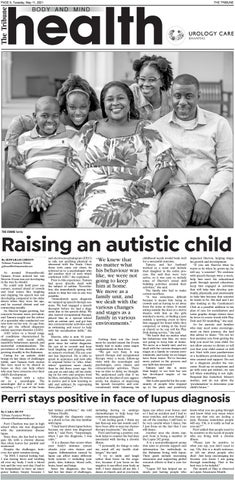
THE EVANS family
Raising an autistic child By JEFFARAH GIBSON Tribune Features Writer jgibson@tribunemedia.net
At around 18-months-old, Tamara Evans noticed her son Shervin Evans was not developing in the way he should. He could only hold poor eye contact, seemed afraid of crowds and loud noises like laughing and clapping, his speech was not developing compared to his older sisters when they were his age, and he seemed distant and not connecting socially. As Shervin began growing, her concerns became more prevalent, and Tamara sought out the advice of a specialist who conducted various tests on her son. At age four, they got the official diagnosis: autism spectrum disorder (ASD). ASD refers to a broad range of conditions characterised by challenges with social skills, repetitive behaviours, speech, and nonverbal communication. The prevalence of this disorder is also growing steadily in the Bahamas. Caring for an autistic child brings its fair share of challenges withit, and Tamara feels stories like hers need to be shared in hopes so they can help others who may have concerns over their child’s development. “We started with a referral to a neurologist. The neurologist did a slew of tests including a CT scan of the brain
and electroencephalogram (EEG) to rule out anything physical or abnormal with the brain. Once those tests came out clean, he referred us to a psychologist who did another slew of tests which confirmed ASD,” she explained. Prior to this experience, Tamara had never directly dealt with the subject of autism. Nevertheless, she immediately sprang into action to help her son in any way possible. “Immediately upon diagnosis we ramped up speech therapy sessions. We had engaged a speech therapist before we had a diagnosis due to his speech delay. We also started occupational therapy, placed him in a special school with an autism unit, and got him into extracurricular activities such as swimming and soccer to help with his socialisation skills,” she said. Shervin, who is now 10 years old, has made tremendous progress since his initial diagnosis. He can sit in crowds and hear loud laughing and clapping with no sensory overload. His eye contact has improved. He is able to speak in sentences and now able to respond better to ‘who, what, where’ questions more clearly than he did three years ago. He can put on and take off his clothing on his own and prepare food he likes, including pizza. He writes in cursive and is now learning to add and subtract by regrouping three place values.”
“We knew that no matter what his behaviour was like, we were not going to keep him at home. We move as a family unit, and we dealt with the various changes and stages as a family in various environments.”
Getting their son the treatment he needed meant the Evans family had to make some major readjustments in their lives. “We got very busy. It was speech therapy and occupational therapy twice a week, follow-up visits with the neurologist and psychologist, extra classes and extracurricular activities. There was no time to delay, we thought. We understood early that if we worked on his plan of care aggressively, his chances of improving his speech (receptive and conversational) while balancing his
childhood needs would bode well for a successful outcome. Tamera and her husband worked as a team and include their daughter in the entire process. She said they were very active, so it was easy to include some of Shervin’s social skill building activities around their activities,” she said. The family also had to make certain sacrifices. “It was sometimes difficult because it meant him being in crowds and us having to sit away from the noise at times. It meant sitting outside the door at a movie theatre with him as the girls watched a movie, or finding a spot outside a sporting event to have him engaged for hours while they competed, or sitting in the foyer at church so he can roll his Play Doh during service,” she said. “We knew that no matter what his behaviour was like, we were not going to keep him at home. We move as a family unit, and we dealt with the various changes and stages as a family in various environments, and today we no longer have those issues. We’ve become more patient in the process and our faith has increased.” Tamara said she is more than happy to see how her son has developed inspite of his challenges. She is also grateful for the community of people who stepped up to the plate and positively
impacted Shervin, helping shape his growth and development. “If you ask Shervin what he wants to be when he grows up, he will say, ‘a scientist’. We continue with speech therapy twice a week, help him meet his educational goals through special education, keep him engaged in activities that will help him develop spiritually, physically, and emotionally to help him become that scientist he wants to be. His dad and I are also looking at the Gentlemen’s Club as a possible addition to his plan of care for socialisation and some graphic design classes since he loves to create words with Play Doh and 3D modelling,” she said. As for parents and families who may need some encouragement on their journey, she had this advice to share: “Do not let fear paralyse you from getting the help you need for your child. Do not allow anyone to dictate or tell you that your child cannot or will not. Start with your paediatrician or a healthcare professional. Seek wise counsel and support. Do not let a diagnosis predict the outcome. Read up on symptoms and go with your gut instinct...we can tell when something is not right. Respond like Jochebed, Moses’s mother, and do not allow the ‘proclamation’ to determine your child’s future.”
Perri stays positive in face of lupus diagnosis By CARA HUNT Tribune Features Writer cbrennen@tribunemedia.net
Perri Charlton was just in high school when she was diagnosed with the autoimmune disease lupus. Since then, she has had to navigate life with a chronic disease that often leaves her painful and weakened. Despite the challenges, however, her spirit remains strong. “In 2018, I started feeling bad. I was having hives and swelling all over my body. I took a blood test and the very next day I had to be hospitalised to have an emergency kidney biopsy because I
had kidney problems,” she told Tribune Health. Although the diagnosis came as a shock to her, she was familiar with lupus. “I had heard about lupus before because my sister was diagnosed with it,” said Perri. “Surprisingly, when I got the diagnosis, I was calm.” It is a disease that occurs when your body’s immune system attacks your own tissues and organs. Inflammation caused by lupus can affect many different body systems — including your joints, skin, kidneys, blood cells, brain, heart and lungs. Since the diagnosis, she has had her fair share of challenges,
including having to undergo chemotherapy to help keep her symptoms manageable. “I am feeling good, I think my last flare-up was last month and I have been able to stop my chemotherapy treatments,” she said. Perri said having a positive outlook helps to counter the bad days associated with having a chronic illness. “I personally do things to take my mind off my health challenges,” she said. “I try to smile and laugh rather than focus on the negative, because if you focus on the negative it can affect your body as well. I have danced all my life. I dance at church, and as you know,
lupus can affect your bones, and so I had an accident and I had to wear crutches, and even though I am off the crutches, I still have to be very careful when I dance, but I just focus on the fact that I can still dance . Another area she draws support from is being a member of the Lupus 242 group. It is a non-profitsupport group that aims to provide support and information for individuals in the Bahamas living with lupus. Their goals include increasing awareness and supporting global research efforts to find a cure for lupus. “Lupus 242 has helped me so much; just having people who
know what you are going through and know what you mean when you say that you are feeling a pain. Because sometimes people will say, ‘Oh, is it really as bad as you say?’” Perri added that people need to be sensitive to the needs of people who are living with a chronic illness. “Please just be positive in what you say, you don’t need to say, ‘Oh, this is a death sentence, or tell me about people who died.’ Just keep encouraging me because you know I am going through something. That is the best way to be helpful.” The month of May is observed as Lupus Awareness Month.
THE TRIBUNE
Tuesday, May 11, 2021, PAGE 9
Passing a kidney stone can be more painful than childbirth Kidney stones are formed when hard crystals supersaturate and accumulate in the kidneys. Kidney stones can vary greatly in size, ranging from a small grain of sand to the size of a marble or larger. There are five main types of kidney stones: calcium oxalate and calcium phosphate stones, infective stones called struvite, uric acid stones and cystine stones. One in ten adults will develop a kidney stone in their lifetime and approximately 50 percent of kidney stone formers will have a recurrence. More than 500,000 Americans are forced to visit a hospital emergency room due to the severe pain of a kidney stone. As a urologist, I have treated thousands of men, women and children with kidney stones, particularly after being a postgraduate fellow in Hamburg, Germany, with the world-leading kidney stone surgeon and urologist Professor Andreas Gross. I have seen macho men cry like a baby from the pain of a kidney stone. An interesting study conducted in London sought to assess whether women who had natural child birth experienced more pain passing a kidney stone or having a baby. Nineteen women were asked this question and surprisingly most of the ladies found that having a kidney stone was more painful than giving birth to a baby. These interesting results were published in the scientific Journal of Pain Research.
Another recent interesting kidney stone study found that riding a roller coaster could help in passing a kidney stone. This study was conducted using the Big Thunder Mountain Railroad ride at Florida’s Walt Disney World, and was conducted by a Michigan State University urology professor. The Journal of the American Osteopathic Association published the interesting results that determined that by riding the rear carriages of this roller coaster there was a 64 percent chance of kidney stones moving. Many invididuals with kidney stones are able to spontaneously pass the stone, but the process can potentially be a severely painful long ordeal. The pain associated with passing a kidney stone could be off the pain scale charts.
What causes the pain?
The majority of the sometimes-severe pain associated with passing a kidney stone stems from the inflammation and colicky cramping in the ureter as the stone passes through the narrow tube ureter (the tube that connects the kidneys to the bladder). The current medical conservative expulsion therapy for promoting kidney stones, involves prescribing pain killers and the medication Tamsulosin/Flomax, which is a drug often prescribed for men with benign prostate hyperplasia (BPH). Flomax is believed to relax the ureter and aid in the passage of a stone.
According to the American Urological Association, a kidney stone patient should not wait more than six weeks to pass a small kidney stone and urological consult should be sought sooner if there are complications of infection or persistent or worsening pain. There are two main factors that determine how fast a kidney/ ureter stone is passed and that is the size of the kidney stone and the location thereof. Generally speaking, smaller stones pass faster and with less pain. Scientific researchers at Massachusetts Institute of Technology (MIT) and Massachusetts General Hospital have developed a new promising potential treatment to assist persons in passing kidneys stones faster and with much less pain. Two drugs given in combination have shown to cause effective relaxation of the ureter and thus promote the passage of stones down the ureter more easily and into the bladder. The two drugs are Nifedipine, a calcium channel blocker that is often used to treat high blood pressure, and the drug ROCK (rho kinase), an inhibitor that is used in eye glaucoma treatment. The two drugs are delivered directly into the affected ureter with the obstructive kidney/ureter stone in an endoscopic minimally invasive procedure using a cystoscope, an instrument with optic fibers and a camera, that is placed through the urethra and into the bladder. The experiments determined that these two
THE UROLOGY DOCTOR IS IN...
Dr Greggory Pinto
drugs remained in the ureter and were not detected in the blood stream, thus reducing potential side effects to the body. The Nifedipine and ROCK inhibitor combination therapy could also potentially make the placement of kidney/ureter stents easier and less painful. Kidney/ureter stents are often placed to relieve the obstruction and pain in the case of obstructive kidney stones. A kidney stone larger than 6mm has, on average, a 20 percent chance of being spontaneously passed without any intervention. Kidney stones smaller than 4mm have about an 80 percent chance of passing spontaneously within 30 days. Large stones will need
Coping with COVID fatigue
The Bahamas Psychological Association recognises May as Mental Health Awareness Month and stands in solidarity with the theme “Mental Health is Health, Too!” It is critical, therefore, to commence this month of activities by strengthening our collective effort toward reducing the stigma of mental illness in the Bahamas. By NICORA STUBBSYOUNG, PHD The Bahamas Psychological Association COVID-19, officially referred to as the severe acute respiratory syndrome coronavirus 2 (SARSCoV-2) or coronavirus disease, has become a household term in the Bahamas and all over the world. What began in 2019 as an epidemic in Wuhan, China, in a matter of weeks, developed into a pandemic affecting all countries around the globe. It has been some fourteen months since COVID-19 arrived on our shores, in March 2020. Since then, residents have been constantly bombarded with information, albeit necessary information, concerning the nature, prevention and management of this novel virus, with conversations regarding vaccinations currently taking precedence. Moreover, one cannot neglect to mention the daily dashboards on cases, hospitalisations and deaths. And, although adherence to COVID-19 protocols has become almost second nature to the average Bahamian, there is a longing for some return to normalcy. The World Health Organisation asserts that “pandemic fatigue” - the physical and mental exhaustion associated with global viruses or diseases - is an expected and natural response to a prolonged public health crisis. Therefore, it comes as no surprise that individuals are now experiencing “COVID fatigue”. While this fatigue can be marked by physical symptoms including headaches, racing
heartbeat, chronic pain, or gastrointestinal upset, it can also affect an individual’s mental health. According to Masten and MottiStefandi (2020), pandemic fatigue is manifested as demotivation to follow recommended protective behaviours, emerging gradually over time, and affected by several emotions, experiences and perceptions. Individuals affected by COVID fatigue can feel a sense of hopelessness and may alienate themselves from family, friends and co-workers. They can easily become complacent in following guidelines, restrictions, and often break national curfews. COVID fatigue can also manifest as a disinterest in keeping informed about the developments of the pandemic. Several factors can impact the onset of COVID fatigue. The prolonged nature and longevity of the pandemic an affect an individual’s motivation, thoughts and behaviours. For instance, some have become accustomed to the virus and are no longer threatened by its existence. They hold the view that they can co-exist
with COVID-19, hence the protocols are unnecessary, despite the increase in cases, the severity of symptoms experienced by others, and the deaths. Others have become disenchanted by the economic reality resulting from COVID-19 as they struggle with losing businesses or jobs. People are also disgruntled because their rights and freedoms have been taken away; they crave control and self-determination once more and subsequently relent in nonchalance. Bahamians can relate all too well to these perceptions and experiences, and perhaps can add further to this discourse on factors fuelling COVID fatigue. Frontline workers, including healthcare professionals, comprise a specific population who often struggle with pandemic fatigue. Healthcare workers, for example, are placed in precarious positions where they are sometimes forced to choose between caring for the sick and protecting themselves from exposure to the virus. Furthermore, if infected with COVID-19, healthcare workers carry the additional burden of
potentially exposing family members upon arriving home. This dilemma can lead to COVID fatigue, presenting through desensitisation to the needs of patients, as well as neglecting self and family obligations. Certainly, every Bahamian must exercise responsibility and remain sensitive to the thoughts, feelings and lived experiences of both healthcare workers and patients. These are indeed challenging times, and COVID-19 is unprecedented. Therefore, it behooves everyone to demonstrate empathy, respect, fairness, genuine care and compassion toward others. The reality is that COVID-19 will remain with us for a while yet and Bahamians must learn to cope with it. For those struggling with COVID fatigue, here are a few practical coping strategies that can help: • Maintain a positive attitude – Optimistic individuals who maintain a positive attitude and understand that they cannot control the pandemic, but can control their response to it (thoughts, feelings and behaviours) are not only able to manage but thrive in crises. Focus on what you can control. See challenges as opportunities. • Develop a support network – Whether this network comprises trusted family, friends or church members, it is important to have an outlet to express your thoughts and feelings in a safe space. Faceto-face interactions may not always be possible, however, telephone calls and Zoom meetings can facilitate these connections. • Moderate your media consumption – It is evident that those affected by COVID fatigue either over-consume pandemicrelated information via various
some urological intervention that is often minimally invasive, such as a laser procedure. Individuals suffering from kidney stones should seek hospital emergency room consult or a urologist consult with symptoms of severe or persistent flank, back or lower abdominal pain, foul smelling urine or increased urinary urgency and frequency, blood in the urine, fever and chills and/or gastrointestinal symptoms such as nausea or vomiting. A large and obstructive kidney stone could lead to back pressure on the affected kidney and acute or potentially chronic kidney failure. Never ignore the worsening symptoms of a suspected kidney stone. Seek confidential, compassionate and comprehensive urological care for kidney stones. • Dr Greggory Pinto is a board-certified Bahamian urologist and laparoscopic surgeon. He has trained in Germany, South Africa and France, and is a member of the European Association of Urology. He can be contacted at OakTree Medical Center, #2 Fifth Terrace & Mount Royal Avenue. Telephone: (242) 322-1145 (6) (7); e-mail: welcome@urologycarebahamas.com, or visit the website:www.urologycarebahamas.com. media platforms or display little to no engagement. Therefore, be sure to follow legitimate sources for weekly updates to remain informed. However, clicking and scrolling on social media excessively throughout the day is harmful to one’s mental health. • Take care of yourself – Selfcare is critical during a pandemic. Individuals can become caught up in taking care of others or fulfilling deadlines at work and neglect themselves. Ensure to take a few minutes each day to focus on yourself. Engage in a hobby such as gardening or baking; treat yourself to a movie at home; give yourself a pedicure or take a walk around your neighbourhood. • Contact a mental health professional – If the pressures of COVID-19 become overwhelming and you are not maintaining personal hygiene, have difficulty functioning at school or on the job, and are withdrawn from family and friends, seek help! For mental health support you may contact the Bahamas Psychological Association (BPA) support lines at 816-3799, 812-0576, 815-5850, and 819-7652. As we continue to observe Mental Health Awareness Month this May, the BPA further admonishes residents of the Bahamas to focus on the facts pertaining to COVID-19. Ensure to fact-check posts viewed on social media, as erroneous statements and fake news can result in unnecessary panic, which has the potential to exasperate the weariness associated with the pandemic. Moreover, continue to adhere to Government Emergency Orders, COVID-19 guidelines and protocols. In doing so, you are taking control of your immediate situation. Employing a proactive approach in a pandemic can preserve your mental and physical health.
PAGE 10, Tuesday, May 11, 2021
Women aren’t better multitaskers than men – they’re just doing more work
THE TRIBUNE
By LEAH RUPPANNER Associate Professor in Sociology and Co-Director of The Policy Lab, The University of Melbourne
(THE CONVERSATION) - Multitasking has traditionally been perceived as a woman’s domain. A woman, particularly one with children, will routinely be juggling a job and running a household – in itself a frantic mix of kids’ lunch boxes, housework, and organising appointments and social arrangements. But a new study, published today in PLOS One, shows women are actually no better at multitasking than men. The study tested whether women were better at switching between tasks and juggling multiple tasks at the same time. The results showed women’s brains are no more efficient at either of these activities than men’s. Using robust data to challenge these sorts of myths is important, especially given women continue to be bombarded with work, family and household tasks.
No one is good at multitasking
Multitasking is the act of performing several independent tasks within a short time. It requires rapidly and frequently switching attention from one task to another, increasing the cognitive demand, compared to completing single tasks in sequence. This study builds on an existing body of research showing human brains cannot manage multiple activities at once. Particularly when two tasks are similar, they compete to use the same part of
the brain, which makes multitasking very difficult. But human brains are good at switching between activities quickly, which makes people feel like they’re multitasking. The brain, however, is working on one project at a time. In this new study, German researchers compared the abilities of 48 men and 48 women in how well they identified letters and numbers. In some experiments, participants were required to pay attention to two tasks at once (called concurrent multitasking), while in others they needed to switch attention between tasks (called sequential multitasking). The researchers measured reaction time and accuracy for the multitasking experiments against a control condition (performing one task only). They found multitasking substantially affected the speed and accuracy of completing the tasks for both men and women. There was no difference between the groups.
Domestic duties
My colleagues and I recently busted another relevant myth – that women are better at seeing mess than men. We found men and women equally rated a space as messy. The reason men do less cleaning than women may lie in the fact that women are held to higher standards of cleanliness than men, rather than men’s “dirt blindness”.
Recent data shows Australian men are spending more time doing domestic work than they used to, but women still do the vast majority of housework. Working Australian women have seen their total time across work and family activities increase over time, with breadwinning mothers spending four hours more across these activities per week than bread-winning fathers. This means working mums are balancing planning birthday parties, childcare drop-offs and ballet lessons all on top of their regular jobs, commutes and careers.
Consequences of the myth
If women’s brains are equally strained by multitasking, why do we keep asking women to do this work? And, more importantly, what are the consequences? Our recent study shows mothers are more time pressed and report poorer mental health than fathers. We found the birth of a child increases parents’ reports of feeling rushed or pressed for time, but the effect is twice the size for mothers than it is for fathers. Second children double mothers’ time pressure again and, as a consequence, lead to a deterioration in their mental health. Women are also more likely to drop out of paid work when children are born or family demands intensify. They carry a larger mental load tied to organising
the needs of the family – who has clean socks, who needs to be picked up from school, whether there is enough Vegemite for lunch. All of this labour is at the expense of time planning for the next day’s work, the next promotion, and so on. Women are also asked to multitask family demands at night. Children are more likely to interrupt their mother’s than their father’s sleep. Although gender roles are changing and men are assuming a larger share of the housework and childcare than in the past, gender gaps remain in many important domains of work and family life. These include the allocation of childcare, the division of housework, the wage gap, and the concentration of women in top positions. So, the multitasking myth means mothers are expected to “do it all”. But this obligation can affect women’s mental health, as well as their capacity to excel at work.
Challenging misconceptions
Public opinion persists that women have a biological edge as super-efficient multitaskers. But, as this study shows, this myth is not supported by evidence. This means the extra family work women perform is just that – extra work. And we need to see it as such.
Within the family, this work needs to be catalogued, discussed and then equally divided. More men today are invested in gender equality, equal sharing and coparenting than ever before. As well as in the home, we need to dismantle these myths in the workplace. The assumption women are better multitaskers can influence the allocation of administrative tasks. Tasks like taking minutes and organising meetings should not be allocated based on gender. Finally, governments need to dismantle these myths within their policies. Children add work that cannot be easily multitasked. Women need affordable, highquality, and widely available childcare. Men also need access to flexible work, parental leave and childcare to share in this labour, and protections to ensure they aren’t penalised for taking time to share in the care. Debunking these myths that expect women to be superheroes is a good thing, but we need to go further and create policy environments where gender equality can thrive. • This article is republished from The Conversation, an independent and nonprofit source of news, analysis and commentary from academic experts. Read the original article here: https://theconversation.com.
TV’s growth is a boon for ‘diverse voices’ among novelists BY LYNN ELBER AP Television Writer LOS ANGELES (AP) — Growing up an avid reader, Kwana Jackson knew where to look for romance novels with Black characters: Segregated in the “African American interest” section where only determined shoppers would find them. When Jackson became a published author she saw other ways in which writers of colour were obscured, potentially affecting both book sales and the odds their work would catch the entertainment industry’s attention. “That’s why, after 10 novels, I was surprised and thrilled when my agent came to me and said, ‘We’ve had interest in ‘Real Men Knit,’” Jackson said of her 2020 novel about four brothers in New York’s Harlem, optioned by a production company for a potential TV series. What she calls a dream come true is a pragmatic reflection of the unprecedented number of TV outlets in need of shows and growing pressure for inclusive fare — a one-two punch creating opportunities for overlooked writers and ignored perspectives. “There’s a huge appetite for diverse voices and for almost
forgotten voices,” said Steve Fisher, head of intellectual property and a partner at the APA talent agency. While the entertainment industry was born hungry for adaptations — a 1908 version of “The Count of Monte Cristo” is early proof — today’s beneficiaries include writers of colour, those in the LGBTQ community and women. When Jason Bateman’s film and TV production company sought the rights to APA client Tess Sharpe’s novel “The Girls I’ve Been,” Fisher met with executive Tracey Nyberg, who explained the company’s keen interest: Sharpe represents both a female and LGBTQ point of view “and we want to be part of the vanguard of new voices out there,” Fisher recalled Nyberg saying. Science fiction and young-adult author MK England’s debut novel was quickly snapped up. England identifies as nonbinary and queer, and their characters reflect varied ethnic and religious backgrounds along with LGBTQ diversity. England’s space adventure “The Disasters” was optioned before its late 2018 hard-cover publication and is in development for the CW network. While England knows adaptations differ
AUTHOR Kwana Jackson from source material, they will take the win if the series comes to fruition — which, they realistically note, isn’t guaranteed. “I just love the work so much, I love the characters so much,” England said. “Just the chance of those getting out to more people means a lot, even though I know they will not be the same versions I wrote.” Payment for screen rights is a welcome addition to a writer’s income, but “nobody’s getting wealthy over here,” England said. “All I want is a sustainable career. I’m not looking for Scrooge McDuck’ing it.”
Jackson, who said she strives to write stories that portray Black and other ethnic characters fully, both in conflict and love, believes such depictions on TV have the power to chip away at stereotypes and build empathy. “We need to change that perception of how we’ve been shown. We are just like anyone else, with real stories, real love, real joy, real problems,” she said. Sean Berard, literary manager with the Grandview management agency, credits publishers for making the effort to find stories that are “coming from authentic
places” and for bringing deserved attention to their authors. “We hear from time to time a (rights) scramble for a certain project, a certain book, that’s not even published,” Berard said. Such fierce competition was inevitable. Within a year’s time, Netflix, Amazon and Hulu were joined by new streaming services including Disney+, Apple TV+, HBO Max and Peacock, all jockeying for viewers and justifying their subscription fees alongside premium cable channels including HBO and Showtime. See PG B11
THE TRIBUNE
Tuesday, May 11, 2021, PAGE 11
TV’s growth is a boon for ‘diverse voices’ among novelists From pg B10
Overall demand by the entertainment industry for content has “increased exponentially” in the last few years, said Michael Cader, founder of the Publishers Marketplace newsletter. Streaming services are among the neediest outlets, and book-related content “often brings a built-in audience and respect,” he said. They industry has also become acutely aware of demands for
change, facing organized criticism in the form of #OscarsSoWhite and the #MeToo movement, among others, and within the context of the country’s rising social and political tensions. Established writers are among the beneficiaries of the scramble for content, including those whose literary novels make for a more challenging transfer to the screen. Colson Whitehead, for example, has been “a fabulous writer for decades and now he’s finally getting his adaptation,” Cader said. Whitehead’s 2016 Pulitzer Prize-winning novel “The Underground Railroad” is the African American writer’s inaugural work brought to the screen, the basis of an Amazon series debuting May 14. Sci-fi and fantasy author NK Jemisin became the first Black writer to win the prestigious Hugo Award for best novel, for 2015’s
AUTHOR M K England Although Black-themed projects have been in the forefront, producers are beginning to cast a wider net. Native American author Angeline Boulley’s 2021
“The Fifth Season,” then made it three in a row. Jemisin’s work has yet to be adapted, but her “The Inheritance Trilogy” reportedly was optioned earlier this year.
debut novel “Firekeeper’s Daughter,” a thriller set on an Ojibwe reservation, is being developed for Netflix by Barack and Michelle Obama’s production company. Charles Yu’s National Book Award-winning 2020 novel “Interior Chinatown” is in development for Hulu, which ordered a pilot based on the forthcoming debut novel “Olga Dies Dreaming” by Xochitl Gonzalez. Despite the signs of change, MK England, for one, isn’t ready to sit back and applaud. “People say, ‘Everything’s fine now, we have achieved equality here, the industry is no longer racist or homophobic because, see, we have these things,’” England said. “It’s just not the case. There’s still lots and lots of work to be done, especially in terms of race representation and having people of colour actually in the industry, calling the shots.”
THE WEATHER REPORT
5-Day Forecast
TODAY
ORLANDO
High: 92° F/33° C Low: 74° F/23° C
TAMPA
TONIGHT
WEDNESDAY
THURSDAY
FRIDAY
SATURDAY
Mostly sunny with a passing shower
Clear to partly cloudy and humid
A morning shower; some sun, humid
A morning t‑storm; some sun, humid
Partly sunny with a shower
Morning showers; variable clouds
High: 88°
Low: 75°
High: 87° Low: 76°
High: 87° Low: 75°
High: 87° Low: 74°
High: 86° Low: 73°
AccuWeather RealFeel
AccuWeather RealFeel
AccuWeather RealFeel
AccuWeather RealFeel
AccuWeather RealFeel
AccuWeather RealFeel
97° F
81° F
98°-80° F
98°-80° F
99°-80° F
95°-74° F
High: 91° F/33° C Low: 76° F/24° C
The exclusive AccuWeather RealFeel Temperature® is an index that combines the effects of temperature, wind, humidity, sunshine intensity, cloudiness, precipitation, pressure and elevation on the human body—everything that affects how warm or cold a person feels. Temperatures reflect the high and the low for the day.
N
almanac
E
W
ABACO
S
N
High: 83° F/28° C Low: 76° F/24° C
4‑8 knots
S
High: 90° F/32° C Low: 77° F/25° C
4‑8 knots
FT. LAUDERDALE
FREEPORT
High: 88° F/31° C Low: 79° F/26° C
E
W S
E
W
WEST PALM BEACH
N
| Go to AccuWeather.com
High: 86° F/30° C Low: 75° F/24° C
MIAMI
High: 88° F/31° C Low: 79° F/26° C
4‑8 knots
KEY WEST
High: 87° F/31° C Low: 81° F/27° C
Statistics are for Nassau through 2 p.m. yesterday Temperature High ................................................... 84° F/29° C Low .................................................... 74° F/23° C Normal high ....................................... 84° F/29° C Normal low ........................................ 71° F/21° C Last year’s high ................................. 79° F/26° C Last year’s low ................................... 68° F/20° C Precipitation As of 2 p.m. yesterday .................................. trace Year to date ................................................. 3.32” Normal year to date ..................................... 6.88”
ELEUTHERA
NASSAU
High: 88° F/31° C Low: 75° F/24° C
Forecasts and graphics provided by AccuWeather, Inc. ©2021
High: 84° F/29° C Low: 77° F/25° C
N
High: 84° F/29° C Low: 77° F/25° C
N
S
E
W
6‑12 knots
S
7‑14 knots
ANDROS
Shown is today’s weather. Temperatures are today’s highs and tonight’s lows.
High Today
Ht.(ft.)
Low
Ht.(ft.)
8:24 a.m. 8:46 p.m.
2.3 2.8
2:34 a.m. 0.0 2:28 p.m. ‑0.1
Wednesday 9:01 a.m. 9:22 p.m.
2.3 2.8
3:12 a.m. 3:02 p.m.
0.0 0.0
Thursday
9:37 a.m. 9:59 p.m.
2.2 2.8
3:50 a.m. 3:37 p.m.
0.0 0.0
Friday
10:15 a.m. 10:37 p.m.
2.1 2.8
4:29 a.m. 4:13 p.m.
0.1 0.1
Saturday
10:54 a.m. 11:17 p.m.
2.0 2.7
5:09 a.m. 4:51 p.m.
0.2 0.2
Sunday
11:36 a.m. ‑‑‑‑‑
2.0 ‑‑‑‑‑
5:51 a.m. 5:33 p.m.
0.3 0.3
Monday
12:00 a.m. 12:23 p.m.
2.7 2.0
6:36 a.m. 6:20 p.m.
0.4 0.5
sun anD moon Sunrise Sunset
6:28 a.m. 7:45 p.m.
Moonrise Moonset
6:25 a.m. 7:50 p.m.
New
First
Full
Last
May 11
May 19
May 26
Jun. 2
High: 84° F/29° C Low: 77° F/25° C
High: 84° F/29° C Low: 78° F/26° C
N E
W S
LONG ISLAND
tracking map
L
tiDes For nassau
SAN SALVADOR
GREAT EXUMA
High: 86° F/30° C Low: 78° F/26° C
L
The higher the AccuWeather UV IndexTM number, the greater the need for eye and skin protection.
CAT ISLAND
E
W
uV inDex toDay
High: 84° F/29° C Low: 77° F/25° C
6‑12 knots
MAYAGUANA High: 85° F/29° C Low: 79° F/26° C
Shown is today’s weather. Temperatures are today’s highs and tonight’s lows.
CROOKED ISLAND / ACKLINS RAGGED ISLAND High: 84° F/29° C Low: 78° F/26° C
High: 84° F/29° C Low: 78° F/26° C
GREAT INAGUA High: 87° F/31° C Low: 79° F/26° C
N
E
W
E
W
N
S
S
7‑14 knots
8‑16 knots
marine Forecast ABACO ANDROS CAT ISLAND CROOKED ISLAND ELEUTHERA FREEPORT GREAT EXUMA GREAT INAGUA LONG ISLAND MAYAGUANA NASSAU RAGGED ISLAND SAN SALVADOR
Today: Wednesday: Today: Wednesday: Today: Wednesday: Today: Wednesday: Today: Wednesday: Today: Wednesday: Today: Wednesday: Today: Wednesday: Today: Wednesday: Today: Wednesday: Today: Wednesday: Today: Wednesday: Today: Wednesday:
WINDS SE at 4‑8 Knots SE at 6‑12 Knots E at 6‑12 Knots SE at 6‑12 Knots ESE at 7‑14 Knots ESE at 6‑12 Knots ESE at 8‑16 Knots ESE at 8‑16 Knots E at 6‑12 Knots SE at 6‑12 Knots S at 4‑8 Knots SE at 4‑8 Knots SE at 7‑14 Knots ESE at 7‑14 Knots E at 8‑16 Knots E at 8‑16 Knots ESE at 7‑14 Knots E at 7‑14 Knots ESE at 8‑16 Knots ESE at 8‑16 Knots E at 6‑12 Knots ESE at 6‑12 Knots E at 7‑14 Knots E at 8‑16 Knots SE at 6‑12 Knots ESE at 6‑12 Knots
WAVES 2‑4 Feet 2‑4 Feet 0‑1 Feet 1‑2 Feet 2‑4 Feet 2‑4 Feet 3‑5 Feet 3‑5 Feet 2‑4 Feet 2‑4 Feet 1‑2 Feet 1‑2 Feet 0‑1 Feet 1‑2 Feet 2‑4 Feet 2‑4 Feet 2‑4 Feet 2‑4 Feet 3‑6 Feet 3‑6 Feet 1‑2 Feet 1‑2 Feet 2‑4 Feet 2‑4 Feet 1‑2 Feet 1‑2 Feet
VISIBILITY 10 Miles 10 Miles 10 Miles 6 Miles 10 Miles 10 Miles 10 Miles 10 Miles 10 Miles 10 Miles 10 Miles 10 Miles 10 Miles 10 Miles 10 Miles 10 Miles 10 Miles 10 Miles 10 Miles 10 Miles 10 Miles 10 Miles 10 Miles 10 Miles 10 Miles 10 Miles
WATER TEMPS. 79° F 79° F 84° F 84° F 81° F 81° F 80° F 81° F 78° F 79° F 81° F 83° F 82° F 83° F 81° F 81° F 80° F 80° F 81° F 81° F 81° F 81° F 82° F 82° F 81° F 81° F
SECTION B
TUESDAY, MAY 11, 2021
Miss Universe Bahamas Shauntae Miller heads to international pageant than 160 territories and countries across the globe. In the US, it will air in Spanish on Telemundo. Englishlanguage broadcasters will soon be announced. Bahamians can watch the pageant live on the official Miss Universe YouTube channel. When Shauntae was crowned last September there were no cheers or applause to usher in her reign. Instead, she received her accolades by virtual means due to the coronavirus pandemic. It was what most major world pageants were forced to do – host virtual workshops and other events, since gathering in large crowds was prohibited in most countries to control the spread of the virus. Shauntae is the sister of Bahamian gold medalwinning Olympian Shaunae Miller. Shauntae is also a health and fitness advocate, track coach and an aspiring entrepreneur. She also holds a Bachelor of Science in pre-medicine biology, a Masters of Science in clinical mental health counselling and is currently pursuing a PhD at Carson-Newman University in Tennessee. This was Shauntae’s second time entering the competition. When asked what made her try again, she said with teary eyes: “My faith.” And it is that same faith, she said, that will steady her and keep her grounded as she gets through the upcoming competition in Florida. She hopes her fellow Bahamians will show their support for her Miss Universe bid.
By JEFFARAH GIBSON Tribune Features Writer jgibson@tribunemedia.net
SHAUNTAE Miller is ready for her close-up and the crown
WITH high hopes that she will bring the crown home, the Miss Universe Bahamas organisation has sent off its reigning queen, Shauntae Miller, to compete in the international Miss Universe pageant being held under the theme “Confidently Beautfiul”. Last Friday, Bahamasair, in collaboration with the Miss Bahamas Universe organisation, conveyed Shauntae to Fort Lauderdale, Florida. Bahamasair was proud to transport the Bahamian beauty along with all her wardrobe. Official farewell remarks were provided by Betty Benoit, Sr, Director of Operations, and Tracey Cooper, Managing Director of Bahamasair. “On behalf of Bahamians everywhere, we wish Shauntae the very best as she vies for this prestigious title,” said Ms Benoit. Shauntae, who is confident she will return home with the crown and title of Miss Universe 2021, has been preparing herself physically and mentally for the competition. The 69th Miss Universe event will be held at the Seminole Hard Rock Hotel & Casino Hollywood in Hollywood, Florida on May 16. Paula Shugart, president of the Miss Universe Organisation, said in a press release Wednesday that pageant officials have spent months planning a COVID-safe competition. It will follow similar guidelines as November’s 2020 Miss USA competition in Memphis, Tennessee. Whether there will be a limited live audience is still being considered. The Miss Universe competition will air in more
Another feather in Gertie’s hat Bahamian designer’s 2021 launch Bahamian hat designer Gertie O’Brien is exemplifying that ‘the show must go on’ with the resumption of her highly anticipated fashion events. Following last year’s decrease in face-to-face activities, Gertie recently marked the start of her 2021 season giving a ‘hats off’ to her dearest longtime supporters. Bold colours, varied shapes, mixes, matches, and more were showcased by models as socially distant guests imagined to which upcoming Sunday service, christening, funeral, or even horse race like the Kentucky Derby, they would wear these new hats to. Gertie knows first-hand that there is nothing like a room full of women adorned with unique hats. It was at a young age that her father counselled her that a woman should never enter the house of the Lord without her head covered. This message not only stuck with Gertie, but also inspired her to envision and bring to life custom-made hats for her enjoyment and the delight of many others, especially her family, whose support she greatly appreciates. “When you wear a hat, people look at you as a lady. The outfit is not complete without the hat,” said Gertie O’Brien. She also gave some insight on how her weekly church outfits which are admired by her priest especially – come together. “I prepare myself from Saturday. I go into my closet; I decide what I am going to wear, and if I don’t have a hat to complement or enhance my outfit, I will design and make one – another gorgeous and fashionable addition to my range of Gerties Hats! And when
“When you wear a hat, people look at you as a lady.”
I get to church, everyone is there waiting in great anticipation to see my outfit and of course the hat of the day that completes and enhances the look!” Kimberley Bain, who was present at the recent launch and who
attends the same church as Gertie, describes her as a “fashion show”. “Since she’s been doing hats, I have been encouraged to wear them. Whenever I get a hat for me I’m sure to get one for my mom as
well so we can join the beautiful hats at church”, said Ms Bain Attendees at the Red Cross hall, where Gertie’s Hats debuted this year, were thankful and happy for the event, noted her daughters, Nicole O’Brien and Nicara O’Brien-Adderley. Gertie’s Hats officially came about in 2018 after Gertie’s friend, Isabel Rattazzi, suggested she turn her passion and fashion talents into a business, explained Nicole. “From my infancy I’ve watched and admired her talent
and love of everything fashionable bloom. I’m so proud of her.” Nicara added: “From designing hats to fascinators and full-on outfits - this is something my mother is truly passionate about and something that will take her far. Her hats have already travelled to the Kentucky Derby and I look forward to her doing even bigger things - growing and glowing.” At the Kentucky Derby Horse Race in the United States, an international reporter was amazed by a Bahamian flag-themed hat worn by Tamara Smith, and was adamant that she let his audience know who made it. Ever since, Gertie has been committed to not only sharing her talent with the Bahamas, but the international market too. Those interested in Gertie’s Hats or one of her shows can reach Gertie O’Brien by emailing her at Gertie.Obrien@gmail.com or calling her at (242) 544-2953. Gertie can also be found on Instagram at the following handles: @ gertieobrien and @gertyshats.