‘Damn close’: Exminister warns over 25% revenue target breach
BY NEIL HARTNELL Tribune Business Editor nhartnell@tribunemedia.net
A FORMER Cabinet minister is warning that the Government will retard economic growth if it breaches its 25 percent revenue-to-GDP target, adding that The Bahamas is getting “damn close” to this even before mulling a wide-ranging corporate income tax.
Dionisio D’Aguilar, ex-minister of tourism and aviation, told Tribune Business that whoever wins the May 12 general election must “not lose sight” of that ratio benchmark because the Government is moving perilously near to it prior to expanding corporate income tax beyond the existing Qualified Domestic Minimum Top-Up Tax (QDMTT) regime and into the domestic economy.
Calling on the next administration to focus on growing the economy as the primary means of generating greater tax income,
Bahamas admits to US: No laws to ban forced labour goods
BY NEIL HARTNELL Tribune Business Editor
nhartnell@tribunemedia.net
THE Government’s director of legal affairs has admitted at a hearing before US trade chiefs that The Bahamas has no laws, regulations or policies in place to prohibit the importation of goods made by forced labour.
Danya Wallace, who replaced attorney general Ryan Pinder KC as The Bahamas’ panellist during last week’s two-day hearing
BY NEIL HARTNELL Tribune Business Editor
nhartnell@tribunemedia.net
THE Bahamas’ improved creditworthiness has provoked sharply polarised political responses ahead of the May 12 general election, with the Prime Minister branding the Moody’s upgrade “a big deal” but the Opposition’s chairman asserting “it means nothing to 95 percent” of the population.
Bypassing Gov’t target would threaten to retard economic growth
Superwash chief: ‘Don’t lose sight’ in eyeing corporate income tax
‘Vicious circle’ of politicans demanding ever-more taxpayer dollars
with revenues currently forecast to breach the $4bn mark in the next 2026-2027 Budget year, he argued that The Bahamas is “slightly in a vicious circle” with politicians still using taxpayer dollars to finance jobs and government contracts for supporters and constituents.
Asserting that this merely creates “further strain” for Bahamian taxpayers, Mr D’Aguilar told this newspaper that The Bahamas must focus on making itself more competitive - through improvements to the ease of doing business, infrastructure and developing an educated workforceto the point where it can
held in Washington D.C. by the US Trade Representative’s Office, conceded under questioning that this nation has nothing in the Customs Management Act or other legislation “that directly addresses” the importation of goods manufactured by forced labour.
She was speaking at a hearing called over the probe by the US Trade Representative’s Office into 60 countries, including The Bahamas, to determine if they have all implemented - and are enforcing - measures to ban the importation of products made with forced labour. The Bahamas appears to have been the only state officially represented at the hearing, and it is unclear what impact Ms Wallace’s
MANUFACTURE - See Page B10
Philip Davis KC and his administration, not surprisingly, seized on the rating agency’s decision to upgrade the country’s sovereign creditworthiness from ‘B1’ to ‘Ba3’ as “a strong endorsement” of the Government’s economic
attract more multinational companies in a global environment where most countries are levying a 15 percent minimum corporate tax in compliance with the G-20/OECD initiative. He spoke out as Tribune Business was informed that the Free National Movement’s (FNM) campaign manifesto is not calling for corporate income tax to be extended beyond those companies caught in the QDMTT net, meaning entities that are part of multinational groups generating over 750m euros annually in turnover. While the FNM manifesto referred to reforming the existing Business
Licence fee via the introduction of “a fairer net earnings based tax”, this newspaper was told this is not a reference to corporate income tax but, rather, a return to where Business Licence rates were calculated and based upon gross profits that deduct the cost of sales from total top-line turnover.
This, in turn, would allow high volume, low margin businesses such as food stores and gas stations to pay a lower Business Licence fee because the
BY NEIL HARTNELL Tribune Business Editor nhartnell@tribunemedia.net
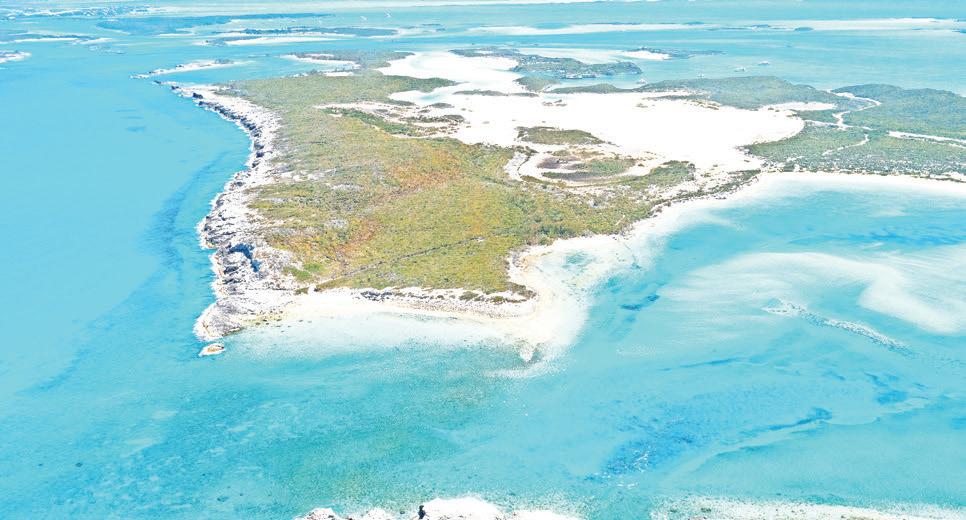
A KEY opponent of the $200m Rosewood Exuma project yesterday revealed it has been forced to terminate 53 staff amid its own planning approvals dispute with the Government as impacted workers pledged to “go to Rawson Square and fight for our jobs”.
Now-former employees, speaking on condition of anonymity, told Tribune Business that the redundancies are set to have a “devastating” impact on Black Point and surrounding central Exuma settlements just a week before the May 12 general election. Noting that as many as 25-30 residents
from that community alone were employed by Turtlegrass Resort & Island Club, they added that it will impact both families and the local businesses that staff patronised. They spoke out after Turtlegrass, which has been leading the opposition and legal challenges to the neighbouring Rosewood Exuma project on Big Sampson Cay, revealed it had no choice but to release the workers after
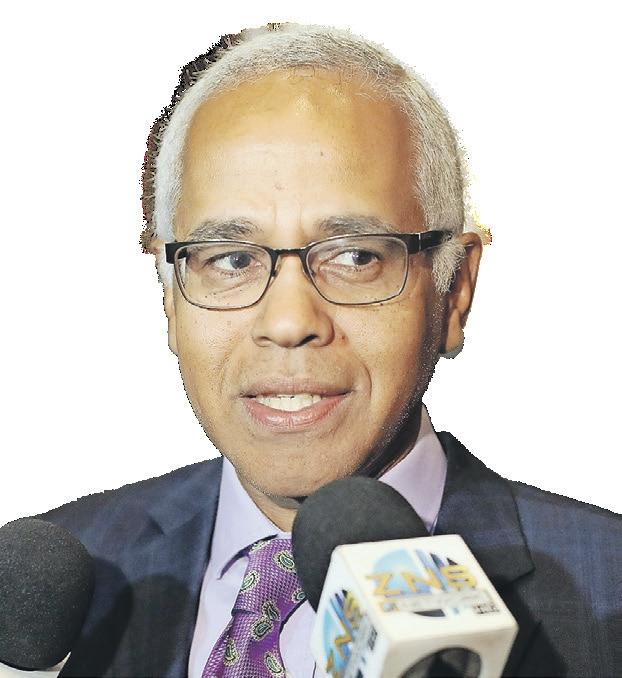
DR DUANE SANDS
LEVY - See Page B7
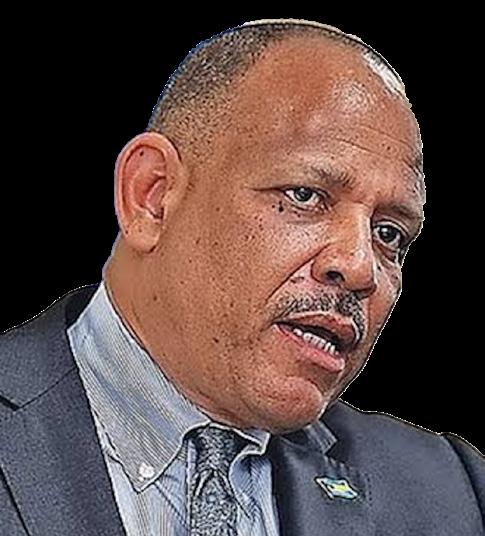
DIONISIO D’AGUILAR
BUILD - See Page B7
Workers pledge to ‘go to Rawson Square’ as Gov’t halts Turtlegrass construction
Morton staff ‘more confident’ jobs and plant’s future secure
BY NEIL HARTNELL Tribune Business Editor nhartnell@tribunemedia.net
THE head of Morton Salt’s line staff union said workers now “feel more confident and “more at ease” over their future following last week’s meeting with the Prime Minister as they await the outcome of his talks with the salt producer’s management. Richard Ingraham, the Bahamas Industrial, Manufacturing and Allied Workers Union’s (BIMAWU) president, told Tribune Business that Philip Davis KC had been due to meet with Morton Salt executives in a bid to preserve Bahamian jobs and resolve the tax dispute that has delayed the sale of the Inagua plant’s operations to Lusca Group. While unaware of that meeting’s outcome, and if it has produced a resolution that saves Bahamian jobs
and allows the sale to proceed, Mr Ingraham said he and union executives had met with members upon their return from Nassau to reassure them about the future following their own discussions with Mr Davis last week.
“He really heard us out,” the union president said of Mr Davis. “He said he will meet with the [Morton Salt] owners and try to deal with the situation; try to deal with all the problems. He was supposed to meet with them yesterday [Saturday] and we’re still waiting to see how that meeting went.
“We are grateful to the Prime Minister for hearing our concerns and dealing with it. We feel much more confident now. The members are at ease. We are waiting to hear from them. He also said he would make the transition to Lusca much better. He said Lusca is a company willing to do a lot of
BY FAY SIMMONS Tribune Business Reporter jsimmons@tribunemedia.net
THE Prime Minister says the opening of Arthur’s Town airport will bring “more people, more trade and more opportunity” to Cat Island as the Government advances its strategy of deploying infrastructure investment to drive economic growth across the Family Islands.
Speaking at the airport’s commissioning ceremony, Philip Davis KC said the upgraded facility is intended to expand access and unlock new economic activity, while placing responsibility on residents to shape how that growth unfolds.
“Yes, the opening of this airport will bring more people, more trade and more opportunity, but it is up to you, the people of Cat Island, to determine how you wish to expand that community, how you wish to share that tranquillity, and how you wish to seize those opportunities,” he said. Mr Davis, who is also the MP for Cat Island, Rum Cay and San Salvador, framed the project as a long-term investment in the island’s future. “All that I’m looking forward to is that a good foundation is laid for the future. This is about the future, so my grandkids can be here to enjoy what I left behind,” he added. Chester Cooper, deputy prime minister and minister
processing and will continue to hire more people.”
The union headed to Nassau after being presented with two options by Morton Salt. The first involved making 75 percent of workers redundant with effect from Friday, June 5, following a 45-day notice period. Only persons involved in the powerhouse, pump house, fuelling and maintenance would be retained, with production and general store staff all laid-off. The second involved retaining all staff but cutting everybody’s work week by 50 percent to 20 hours, with all benefits retained. The general store’s operations would be cut to two to three days per week under both options.
Mr Ingraham previously said neither was a route that the union and its members want to take. However, he explained that if forced to choose, he would take the ‘75 percent redundant’
of tourism, investments and aviation, said the Arthur’s Town airport forms part of a wider push to transform economic prospects across The Bahamas. “It’s more than an airport. This is a gateway to economic renaissance for this part of Cat Island,” he said.
“This is the kind of investment that changes how people live, how they travel, how they do business and how they see the future of their own island. This airport is a major transformation.”
Mr Cooper said the project is one element of what he described as The Bahamas’ most ambitious airport development drive.“This is part of the most aggressive and historic airport development programme this country has ever seen, and across our Family Islands, our administration has delivered new terminals,” he said.
option because the 45-day period provides extra time to galvanise both the Government and Morton Salt to a resolution of their dispute protects all jobs and the survival of the Inagua business. The ‘50 percent work week’ cut option would take effect much earlier from Friday, May 1.
Tribune Business previously reported that Morton Salt’s move to drastically downsize the workforce and cut costs is directly linked to the Chicago-headquartered company’s planned deal to sell the Inagua operation to Lusca Group and its subsidiary, Grand Bahama Salt Company - entities linked to the Liwathon Group, which has acquired and restarted operations at Grand Bahama’s former South Riding Point oil storage terminal. The deal, which was agreed around seven months ago, has yet to close because of a significant difference
Mr Cooper added that such infrastructure is central to expanding tourism and business activity. “These are not just airports. These are lifelines and engines for opportunity. They help our people move more easily. They help our visitors arrive more safely. They help our businesses grow. They help tourism to thrive,” he said.
Mr Cooper also pointed to immediate airlift gains, noting that international service will begin shortly.
“Here in Arthur’s Town, you will see landing here your first international service every Tuesday and every Thursday. Makers Air will land here directly from Florida on May 12,” he said.
Clay Sweeting, minister of works and Family Island affairs, said the project represents a shift in how infrastructure is delivered to Family Island communities.
“Today is not just an opening of an airport. It’s
between the Government and Morton Salt over how much “transfer tax” - VAT and other levies charged on the assets of the business being sold, such as land - is payable to the Public Treasury on the transaction. This is likely to be a muchneeded multi-million dollar sum from the Government’s perspective, but Morton Salt feels the delay - and ongoing losses - have left it with no option but to cut costs. The downsizing’s timing also coincides with the May 12 general election, which further serves to increase the pressure on the Government to reach a favourable settlement with Morton Salt and allow the sale to proceed. Mr Ingraham, though, yesterday said that following last week’s talks with the Prime Minister “we feel like we’re going to have a good, viable future and everything will go well”.
He added of Mr Davis:
“He loves Inagua, he loves the people of Inagua and he will not allow anything under his leadership to cause Inagua to go down when it comes to jobs and stuff. He really made us feel much better, and we are grateful to him. We came
about opening opportunities, because for far too long, Family Island communities like Arthur’s Town have had to work around infrastructure. Today, we are building infrastructure that works for you,” said Mr Sweeting.
back to the members with good assurances and all are now at ease”.
Lusca Group, in announcing the potential Morton Bahamas acquisition in September 2025, gave few specifics on its plans and did not disclose the purchase price. In confirming that its Grand Bahama Salt Company had signed an agreement to acquire 100 percent of Morton Bahamas’ shares, it said: “The facility, the second-largest solar salt operation in North America, positions The Bahamas as a leading source of high-quality solar salt for international markets.
“Lusca Group will also enter into a long-term supply agreement with Morton Salt USA, securing Morton’s role as an anchor client and ensuring continuity of production and export from Inagua. Following completion, Lusca Group plans to invest substantially in the facility’s operations, improve efficiency and expand production capacity. This will include investments in upgrading salt quality on the island, as well as targeted investments into other on-island businesses and the local community.”
He said the airport will improve connectivity and quality of life for residents. “This airport means easier access. It means safer travel. It means greater connection to the rest of the country and the world,” Mr Sweeting added.
At least two years’ experience, great attitude and willing to work some Saturdays and Sundays.
Bahamas must rethink financial services sector
BY FAY SIMMONS Tribune Business Reporter jsimmons@tribunemedia.net
A FORMER Cabinet Minister says the global conditions that enabled The Bahamas to build a thriving financial services industry are steadily eroding, forcing a rethink of how the country protects one of its most critical industries.
Speaking at the Bahamas Financial Services Board’s (BFSB) Global Wealth Summit, now-economic consultant, Zhivargo Laing, said the long-standing framework that supported the industry’s growth is being reshaped by deeper structural changes in the global economy - changes that are altering how capital moves, how jurisdictions compete, and how trust is established between clients and financial centres.
“For decades, The Bahamas’ financial services sector, particularly its international component, has enjoyed a symbiotic relationship between three key players: Global wealth owners; global wealth advisers, managers and administrators; and the Government of The Bahamas,” said Mr Laing.
Land surveyors meet with Governor General
He described the model as one in which each participant derived clear and reinforcing benefits. That structure allowed The Bahamas to position itself as a stable and attractive jurisdiction for international wealth, while simultaneously generating highvalue employment and significant national income.
However, Mr Laing argued that the external environment that made this model successful can no longer be taken for granted.
“The global map we used to navigate economic and financial success has been redrawn. Old landmarks have shifted, and some have disappeared altogether,” said Mr Laing.
He explained that shifts in geopolitics are not isolated events but interconnected forces that are collectively reshaping the operating environment for international financial centres.
Mr Laing pointed to a gradual but decisive move away from global integration towards more fragmented and competitive dynamics between nations. “Globalism is yielding, at worst, to total nationalism, and at best to regionalism. Co-operative leadership is giving way to transactional power dynamics,” said Mr Laing.
“Economic competitiveness is becoming economic combativeness. Trust in institutions is being replaced by cynicism and scepticism.” Mr Laing said that, for The Bahamas, the implications are significant because the sector’s success has historically depended on stability, predictability and confidence - qualities that are harder to sustain in a more volatile and less co-operative global system.
“This new landscape no longer guarantees the certainty valued by wealth creators and managers. It threatens the very symbiosis that underpinned the success of our financial services sector,” he warned.
Rather than signalling decline, however, Mr Laing framed the moment as one requiring strategic adjustment, arguing that the same principles that drove past success can be recalibrated to meet new conditions.
“The answer lies in doubling down on the very formula that created our success; co-operation, collaboration and co-ordination,” said Mr Laing. “Symbiosis is key.”
He outlined how that recalibration must take place across all major stakeholders, beginning with the Government, which he said must move towards
more proactive policymaking supported by stronger communication, better intelligence gathering and greater consistency in execution.
For private sector providers, the shift requires a more client-centric and forward-looking approach, including the development of bespoke services, stronger brand positioning and a deeper understanding of changing client demographics.
“Multiple generations of wealth holders are now shaping the market, each with different expectations,” Mr Laing said, noting that younger clients are more engaged, more demanding and less willing to accept traditional, passive wealth management models.
Regulators, meanwhile, must balance maintaining credibility with enabling competitiveness, ensuring that oversight frameworks are both robust and
Law School teams with SBDC to tackle workplace concerns
THE Eugene Dupuch Law School has teamed with the Small Business Development Centre (SBDC) to launch a course to help entrepreneurs navigate employment-related legal issues when they arise.
The Law School, in a statement, said the new professional development programme will begin on May 30, 2026, and be called ‘Employment law and human resource fundamentals’.
It added that the programme is targeted at entrepreneurs and small business owners; human resources professionals; and managers and supervisors. The sixweek course will provide practical guidance on managing employment relationships lawfully and effectively within the Bahamian workplace.
The Eugene Dupuch Law School said participants will gain a practical working knowledge of employment contracts, recruitment and hiring practices; National Insurance Board (NIB) obligations, statutory leave entitlements, workplace discipline, termination and redundancy, and the steps needed to keep their business legally compliant. The programme is built around real workplace situations and practical decision-making.
It added that the course aims to help businesses reduce exposure to employment disputes, penalties and Industrial Tribunal proceedings by promoting proactive compliance and fair employment practices.
Sessions will be held in-person on Saturdays from 10am to 1pm over six weeks. The course fee is $1,500 plus VAT, and includes instructional materials, practical templates and a certificate of completion issued by the Eugene Dupuch Law School. Registration is now open. For more information about this course and other professional development courses offered by the Eugene Dupuch Law School, interested persons are encouraged to contact the Eugene Dupuch Law School professional development programme at pdp@edls. edu.bs or 326-8507.
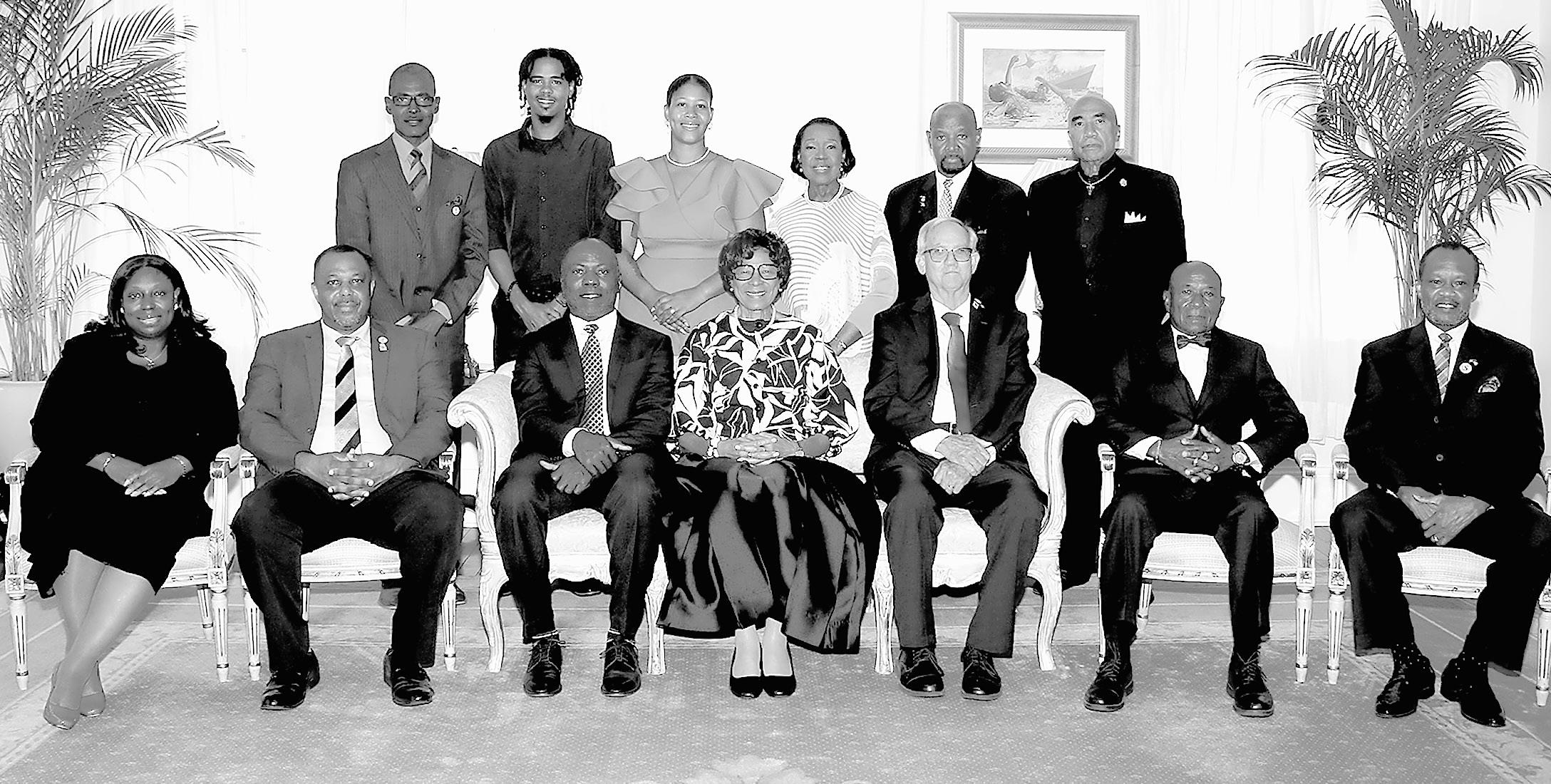
DAME Cynthia A. Pratt, the governor general, received executive members of the Bahamas Association of Land Surveyors (BALS) in a courtesy call at Government House on Wednesday, April 29, 2026.
Photo:Letisha Henderson/ BIS
ZHIVARGO LAING
MODEL - See Page B8
Moody’s upgrade signals Bahamas ‘on right track’
BY FAY SIMMONS Tribune Business Reporter
A CABINET minister says The Bahamas is “on the right track” to regaining ‘investment grade’ status with the major rating agencies within two to three years while conceding that government debt remains “too high” despite the Moody’s upgrade.
Michael Halkitis, minister of economic of affairs, said the action by Moody’s showed the Government’s fiscal strategy is beginning to yield results, but warned there is still significant work ahead to restore debt levels and accompanying ratios to pre-COVID levels.
“We set a timetable for The Bahamas to get back to an ‘investment grade’ rating within the next two to three years. We are about one year into that timetable, and so to see the ratings upgrade, it shows that we
are on the right track,” said Mr Halkitis. “Even though our debt level has come down, it’s still too high, in my opinion. We need to get it back down to those levels that we were pre-pandemic, preCOVID, pre-Dorian, and actually going all the way back to the 2008 financial crisis.”
Moody’s upgraded The Bahamas’ long-term issuer and senior unsecured ratings to ‘Ba3’ from ‘B1’ last week, citing sustained fiscal consolidation, improved liquidity and funding conditions, and stronger revenue performance.
Mr Halkitis said the upgrade represents independent validation of the country’s progress. “This is the perspective of an impartial international credit rating agency. It’s not something coming from the Government of The Bahamas,” he added.
“This is coming from the professionals at this rating
agency who have looked at our prospects, who have looked at our performance so far, and have decided to upgrade the rating of The Bahamas.”
Mr Halkitis added that the move provides a direct boost to investor sentiment and confidence in the domestic economy.
“What that means is it’s an injection of confidence in the economy of The Bahamas. It undergirds the confidence of international investors, both financial and people who want to come in and do developments. It shows the strength of the economy,” he said.
Mr Halkitis pointed to consistent economic growth, reduced borrowing and improved fiscal management as key drivers behind the upgrade.
“The growth in the economy - we’ve been growing consistently - the reduction in the levels of debt, so we’ve been managing the finances, borrowing less
Taxis and tour operators cautious on Lucayan plan
BY ANNELIA NIXON Tribune Business Reporter
GRAND Bahama taxi drivers and tour operators in say the Grand Lucayan’s proposed $700m redevelopment with a 550-room Hilton-branded property as its centrepiece could provide a much-needed economic boost although many remain cautious given past unfulfilled promises.
According to a client note from law firm Dupuch & Turnquest, which represents developer Concord Wilshire, the project is expected to transform Freeport into a tourism hub complementing significant cruise investments and drawing both stopover and cruise visitors. Plans include multiple hotels, casinos, a mega yacht marina and a 20-acre beach club developed by Mediterranean Shipping Company (MSC), all of which will be open to the public rather than restricted to cruise passengers.
For taxi drivers, the potential increase in visitors, particularly overnight guests, could be significant.
“That would mean a lot to cab drivers,” Harold Curry, president of the Grand Bahama Taxi Union, said.
“It would mean a lot in the Port Lucaya area as well. They will help the restaurants and bars in that area boost up.”
Mr Curry said the addition of a major resort brand could help revive nightlife and activity in Port Lucaya, an area that has struggled in recent years.
“That would also be a good boost because then we’ll have overnighters, and even the nightlife would pick up a little bit,” he said.
“Especially in the Port Lucaya area. We used to have a little live band there and activities, things to do. But right now, they’re trying to put life in Port Lucaya.”
He added that efforts are already underway to assess what the area needs.
“They’re going around now, and they’re trying to see what Port Lucaya really needs to boost up that area,” said Mr Curry, who represents about 400 taxi drivers, most of whom currently depend on cruise-related traffic.
“Most of them work from the harbour, from the Freeport Harbour,” he said. “And a lot of them are working now up to Celebration Key.” Mr Curry believes additional amenities, such as a casino at the redeveloped resort, could
further increase demand for transportation services.
“If the Hilton is going to have a casino out there as well, that’ll also be a big boost,” Mr Curry said. “The cruise ships, they can’t gamble… so a lot of people will want to venture out to the casino. So it’ll make a big difference.”
The redevelopment comes as Grand Bahama continues to adjust to the presence of Carnival’s Celebration Key cruise destination, which initially drew visitors away from local businesses when it opened. However, according to Mr Curry, taxi operators have been seeing more customers, especially on the weekends.
“Things are good with Celebration Key and taxi drivers now. It boosted up good, especially on the weekends,” he said.
Mr Curry explained that while first-time visitors often remain within the cruise port, repeat passengers are more likely to explore the island. He noted that increasing passenger volumes are already translating into more business for taxi drivers.
“When those guests come here the first time, they
DRIVERS - See Page B8
money on a year-over-year basis, and so all of that has led to an improvement in the financial picture of the country,” he said.
“What this means as well is that, going forward, it will cost the country less to sustain its debt, to borrow money. And it’s an allaround very, very positive development.”
Mr Halkitis said the Government will continue to analyse international assessments and incorporate recommendations where appropriate, while maintaining focus on fiscal discipline.
“Whenever we get these international reports, we look at them, we analyse them, we see where there’s merit, where we can take some advice and implement some of their suggestions,” he added.
Mr Halkitis also acknowledged ongoing global risks that could affect The Bahamas’ economic and fiscal outlook.
“We recognise that there’s a lot of work left to be done. Just look around now; what’s happening in the Middle East has the potential to impact our economy,” he added.
Despite these risks, Mr Halkitis said the Government remains optimistic that continued reforms and economic expansion will support further rating improvements.
“Very, very optimistic; very optimistic,” he said.
“Part of our strategy to recover our finances, at the top of the list was growing the economy.”
Mr Halkitis pointed to infrastructure investments across the Family Islands
as a key component of that strategy, citing developments such as the Cat Island Arthur’s Town international airport as examples of initiatives expected to drive tourism, entrepreneurship and local business activity.
“And as we make these investments, that leads to growth in the economy. This is being replicated throughout the Family Islands. So there’s a lot of reason for optimism,” Mr Halkitis said.
“And you see the evidence, not from what I am saying, but what the international rating agency Moody’s is saying. And we expect, as we move forward, to hear similar results from the other agencies like Fitch and S&P. So it’s a reason for optimism. All Bahamians can take pride in it.”
Opposition chairman: Most focused on personal finances
and fiscal management less than two weeks before Bahamians go to the pollsespecially since it represents the second improvement within a year after Standard & Poor’s (S&P) made the same move in September 2025.
He added that Moody’s decision to upgrade this nation’s credit rating by one notch, albeit leaving it still in ‘junk’ or non-investment grade territory, will benefit Bahamian families by reducing the Government’s debt servicing costs, or interest payments, on current and future debt issues.
This, Mr Davis said, will free-up more tax dollars for spending on critical public services such as health, education, “affordable housing”, social services and national security.
And, besides boosting investor confidence in The Bahamas, the Prime Minister also asserted the improved credit rating will “translate” into lower interest rates for Bahamian families and businesses seeking mortgages and other forms of debt financing.
However, the latter assertion was challenged by economists and other observers who told Tribune Business that it is the Central Bank of The Bahamas which sets the Discount Rate - the interest rate levied on funds it lends to the commercial banks - based on monetary and economic conditions within this nation. This decision, and that of commercial banks in setting Bahamian Prime - the rate they charge their best customers for loans - is not impacted or influenced by rating upgrades.
Only the interest paid on future external foreign currency bond issues, and existing debt with floating rates, stand to be positively and directly impacted by the credit rating improvements from Moody’s and S&P. Domestic lending, given The Bahamas’ fixed exchange rate regime, will not be affected.
Moody’s said the upgrade was heavily based on the Government’s progress in cutting annual fiscal deficits and The Bahamas’ debt-toGDP ratio, with annual 4 percent primary surpluses “among the strongest” of similarly-rated nations. Primary surpluses strip out interest payments (debt servicing costs) in measuring by how much the Government’s annual revenues exceed all other spending. Moody’s hailed the Davis administration’s efforts that have placed government debt “on a firm downward trajectory and materially reduced liquidity risk”, although its prediction that The Bahamas will achieve a debt-to-GDP ratio of 60 percent by decade-end signals it believes the Government will not hit its 50 percent target for 2030-2031.
Meanwhile, a distinctly unimpressed Dr Duane Sands, the Free National Movement (FNM) chairman and candidate for the Bamboo Town constituency, told Tribune Business he believes the Moody’s upgrade will have little to no impact on the general election outcome because most voters are “not paying the slightest bit of attention” to it since it has little relevance to their daily lives.
He asserted that most Bahamians are more concerned with their own incomes and personal finances, and whether these are sufficient to meet the ever-increasing cost of living. As for those who are focused on Moody’s action, Dr Sands argued that most are “not getting too excited” as they realise The Bahamas still has major “structural challenges” to overcome and remains three notches away from returning to ‘investment grade’ status with both Moody’s and S&P. “I don’t think the general public pays the slightest bit of attention,” the Opposition chairman said. “The majority of the public couldn’t care less about this rating. The public pays attention to what their own personal finances are like, not what
the sovereign debt rating is. Whether we are rated ‘B’, ‘C’ or ‘D’, or ‘1’, ‘2’, ‘3’, is of no significance to 95 percent of Bahamians. I don’t think they [the Government] are going to get any bump in popularity on that basis.
“The remaining 5 percent, who understand the significance, don’t get too excited about this improved rating because we still have some structural challenges. We’re still in ‘junk’ status, and are now quibbling over whether it’s ‘good junk’ or ‘not so good junk’. It’s not investment grade, and we still have an unsustainable level of debt and some headwinds coming. We’re grateful [for the upgrade], but let’s not get too caught up in the moment.”
Returning to his main theme, Dr Sands told this newspaper: “People, when they hear about how well the economy is doing, they want to put their hands in their pocket to see if they have a couple of dollars to buy their children ice cream, take their wife to dinner, go to the movies with their family or get that new car that they have been waiting on for a while.
“Those are the kinds of things people use to determine whether these ‘highfalutin’ projections mean anything to them and, right now, for the average Bahamian, this means nothing to them because they are struggling.” The FNM chairman said it was no surprise that the Government would “seize” on the Moody’s upgrade to try and boost its re-election chances.
“Having been in charge for four-and-a-half years and got more tax revenue than any government in history, they have nothing of any significance to show for it despite no major headwinds and the post-COVID global economic recovery,” Dr Sands added. “The fact of the matter is that the national debt has risen to the extent it has [$12bn-plus], and there has been a massive increase in Bahamian and US dollar loans. The fundamentals of our economy are not strong.”
Mr Davis, in contrast, said Moody’s action last Thursday was “the second upgrade we have received from a major international credit rating agency in a single year” after S&P’s September 2025 move. “So, in just one fiscal year, we’ve had two upgrades from two of the world’s toughest independent experts trusted around the world,” the Prime Minister added in a pre-recorded video.
“This is a big deal for our country. It is a strong endorsement of the direction of our economy and strategy to manage the public finances, implement energy reform and create more opportunities for Bahamians.” Mr Davis laced his Moody’s recording with election campaign messaging, reiterating that his administration had made “tough choices instead of postponing them” after coming to office in September 2021 following the worst of COVID-19.
“In our baseline scenario, primary surpluses remain robust at around 4 percent of GDP (gross domestic product) throughout the next few years, among the strongest outcomes for similarly-rated sovereigns, and supporting a decline in government debt to around 68 percent of GDP by the end of the fiscal year ending June 30, 2027, and just above 60 percent by the end of the decade.
“At the same time, lower net borrowing requirements, increased reliance on longer-term multilateral financing and active liability management have reduced refinancing pressures and improved the quality of the Government’s funding profile.”
Seeking to explain how ordinary Bahamians will benefit from Moody’s action, the Prime Minister said: “The work we have done over the last few years made our country stronger and more resilient….
“A higher credit rating means we save money on interest payments. Every dollar we save is a dollar more we can spend investing in what really matters, like our classrooms and clinics, energy reform and grid upgrades, affordable housing, airport upgrades, roads and docks across the Family Islands, and training and upskilling of our people.
Moody’s said: “The upgrade to ‘Ba3’ reflects a sustained strengthening in fiscal performance that has placed government debt on a firm downward trajectory and materially reduced liquidity risk. The Government has established a credible track record of large primary surpluses, supported by stronger revenue collection, policy measures that broaden the tax base, and continued expenditure restraint.
“Over time, a stronger sovereign credit rating also translates into more competitive rates on mortgages and business capital, so more Bahamian families can afford homes and more Bahamian entrepreneurs can build and grow their businesses.” Mr Davis then acknowledged that “progress is not just about making our economy bigger’, adding that he was focused on making “sure more Bahamians have more opportunities to learn, to earn and to own their economy”.
He said: “When ratings improve, confidence in The Bahamas goes up. We can turn that confidence into more Bahamian entrepreneurs, more Bahamian shareholders and more Bahamian families able to own their own home and build generational wealth.”
The Prime Minister also told Bahamian workers: “This upgrade belongs to you. This is your work being recognised by the world. Now we have to build on our progress. As our economy grows, more Bahamians must own a larger share of our nation’s success across all of our islands, and in every settlement and every community.
“We have come a long way. We have turned downgrades into upgrades. We are finally moving in the right direction but we still have a lot of work to do. I’m more confident than ever that the best chapters of our nation’s story are still ahead.”
Black Point fears ‘devastating’ Turtlegrass termination impact
the Government’s regulatory agencies ordered that it halt all construction work on its own site amid a permit dispute.
Turtlegrass and its principal, Bob Coughlin, in a statement confirming the terminations revealed they had been “compelled to halt all construction activities following a government-issued ‘cease and desist’ order, despite having secured the required permits and approvals from the appropriate local authorities”.
They asserted that the controversy arose after they scaled down their resort development plan given the uncertainties, unanswered questions and “environmental risks” that emerged when Miami-based developer, Yntegra, and its $200m Rosewood Exuma project were unveiled on land immediately adjacent to Turtlegrass’s eco-resort property.
This prompted Mr Coughlin to instead focus solely on the construction of his own residential home at the Big Sampson Cay site, plus two supporting cottages and infrastructure. Turtlegrass added that it had received all necessary permits and approvals from the relevant government regulators for the work it was undertaking, only for the Department of Physical Planning to suddenly in February 2026 demand that it obtain full site plan approval.
The developer added that, rather than seek site plan approval that could take months, it instead applied for site plan approval exemption - something it described as routine for small-scale Family Island projects, and
which is normally granted swiftly. However, this has not been forthcoming and, stating that it had undertaken weeks’ long effort to negotiate and resolve the situation, Turtlegrass said the Department of Physical Planning decided against granting such an exemption. As a result, with all construction work halted and costs mounting, Turtlegrass and Mr Coughlin said they were left with no choice but to release the 53-strong workforce given that the ‘cease and desist’ order has been in place since February 2026. They also hit out at what they termed double standards, contrasting their treatment with how the Government has dealt with permit applications and approvals requested by Yntegra.
And, in a thinly-veiled suggestion that the Government’s actions may be motivated by the Turtlegrass Judicial Review challenge to the neighbouring Rosewood Exuma development, Turtlegrass and Mr Coughlin asserted that they had been building for two years “with no permitting issues from the Government” until they began “asking legitimate questions about the Yntegra project.
“This is not a case of missing approvals. All necessary permits were properly obtained through the established local channels in Black Point, Exuma, as required,” said Mr Coughlin. “The issue is that, suddenly, those approvals came to be disregarded by central authorities in Nassau.
“We were repeatedly told that local government approval was appropriate for the small-scale work we were doing, but now those same approvals granted in
‘Guiding light’ must be growth drives revenue
LEVY - from page B1
rate would be determined by their lower gross profits.
Mr D’Aguilar, meanwhile, reiterated his belief that a corporate income tax would be “extremely complex to roll-out” in The Bahamas compared to the existing Business Licence fee regime because many of the accounting definitions, such as what constitutes ‘revenue’, are extremely subjective. This, he added, applies to relatively simple matters, such as when companies include deposits paid in advance as revenue, and the useful life of assets and over how long they should be depreciated.
“First world nations have been at this door for decades and even they are not certain,” the Superwash president argued. “It’s very, very complex. Rollling out
a corporate income tax depends on an enormous amount of subjectivity. “If the Government’s intent is to raise revenue in the fairest possible way, no doubt an income-based tax is the fairest way to do it. But we must have systems and infrastructure in place to calculate what we collect otherwise it will be subject to an enormous amount of leakage.
“I think the current Business Licence fees, while seriously unfair, can be made fairer if the rate is determined based on a company’s gross profit. Unfortunately, what is included in the cost of sales is also subjective, and you are introducing a limited level of subjectivity to that calculation. But it does introduce an increased level of fairness” if high sales volume, low margin businesses are taxed on gross profits.
Exuma are being overridden by the central government, in our view, without justification.” It appears likely that a second Judicial Review challenge could be mounted unless the situation is resolved.
Turtlegrass added that the “harsh treatment” shown towards its project contrasts with the “red carpet” that it asserts the Government has provided for Yntegra, which includes using Bahamian taxpayer dollars to pay for high-powered, expensive UK attorneys, chiefly Edward Fitzgerald KC, to defend the regulatory agencies against the former’s Judicial Review challenge.
Asserting that this “raises serious concerns about fairness and transparency”, Turtlegrass added: “Turtlegrass has been actively building for more than two years with no permitting issues from the Government until it began asking legitimate questions about the Yntegra project. The timing of the cease-and-desist order raises serious concerns about fairness, consistency and the even-handed application of the law….
“Turtlegrass has made continuous, good faith efforts to resolve any concerns raised by the Department of Physical Planning and the Town Planning Committee to allow for the withdrawal of the ceaseand-desist order since it was issued in early February.
“Inexplicably, the authorities have refused to budge despite knowing what this would mean for our workers. Unfortunately, we must now challenge this decision in court. As a result, construction activities remain halted and the entire construction team has been put out of work.”
Mr D’Aguilar, though, said he remains “convinced” that the Davis administration if re-elected plans to extend corporate income tax beyond the QDMTT companies to most of the Bahamian economy. He based this on both the Government’s corporate income tax ‘green paper’, released in 2023, and previous comments by Simon Wilson, the Ministry of Finance’s financial secretary, who said the issue would be revisited in 2026 - meaning after a general election.
The Superwash chief, though, voiced concern that implementing corporate income tax could tip the Bahamian economy beyond the threshold where total taxation does not retard or impair economic growth. He said this benchmark is the 25 percent revenue-to-GDP ratio that the Davis administration has targeted from the earliest days it took office, and the Government is coming closer to it with forecasts that it will hit 23.6
The terminations could not have come at a worse time for the Government given the imminent May 12 general election. They will impact the constituency presently held by Chester Cooper, deputy prime minister and minister of tourism, investment and aviation.
One impacted Turtlegrass employee, speaking on condition of anonymity, told Tribune Business that the Government should have reached an agreement with the resort to resolve the construction halt and preserve Bahamian jobs. “It’s a big impact for the community of Black Point,” they confirmed, with Turtlegrass describing itself as the largest employer in the central Exumas before yesterday.
“We had over 25-30 people going to Turtlegrass daily. They are all being affected as of today. That was our livelihood, our bread and butter. There’s nothing around the community for us to do. Some may find jobs in construction, but they are not going to find a job that pays as well as Turtlegrass. The persons who worked at Turtlegrass patronised businesses in Black Point; the restaurants, the bars, the wash houses.
“It’s heart-breaking. We had mostly Bahamians employed at Turtlegrass and I feel the Government should have come to an agreement with Turtlegrass. There was never a late pay cheque. Every Friday that pay cheque was in the account. The whole community has been affected by this. We may have a new dock, a new airport, but Mr Coughlin was a heaven-sent to the people of Black Point and community of Black Point. He’s a genuine
percent during the current 2025-2026 Budget year.
“When I’m determining my methodology for taxation, my guiding light is what percentage of GDP does taxation make up?”
Mr D’Aguilar told Tribune Business. “Everybody says it should be no more than 25 percent. If it goes over 25 percent, the impact on the economy becomes negative. Currently, we’re at 23.6 percent.
“No matter what you do, we are inching incredibly close to that threshold with our current model of taxation. When five years to a decade ago, tax revenue was equivalent to 15-17 percent of GDP, one could argue we were under-taxed. We are now very close to that [25 percent] threshold. How we decide to ‘skin the cat’ to get to $4bn of revenue is not semantics.
“We want to have a tax code that encourages growth, because the higher the growth, the greater our tax revenues will be,” Mr D’Aguilar said. “Let’s focus on growing the economy. It’s about growing the economy to increase your tax revenue.
person,” the now ex-employee added. “I just wish it could have been resolved so that it did not lead to this. We have to pay our bills and put food on the table. When it comes to people’s livelihoods, that’s a different story. Some people may be living pay cheque to pay cheque. I can’t believe they [the Government] couldn’t come to the table and resolve it with Turtlegrass.”
The former worker added that the terminations were especially ill-timed because Exuma’s tourism season is starting to slow down now, having gone through the Easter season, and will not resume in force until November/December 2026.
“I am still hoping for the best for Turtlegrass,” they said. “You don’t find persons like Mr Coughlin who look out for the community.
“I will be there for Turtlegrass. If they call me today, tomorrow, I will be there. It’s just what it is. It’s disheartening but it is what it is, but we’ll pick up the pieces. I’ve supported Treasure Cay from the beginning, and I will be there at the end.”
Another ex-Turtlegrass employee, also laid-off yesterday, had no doubt that the blame for the impasse lies with the Government.
“He was the only one in the Exuma cays who had the most employees from Exuma,” they said of Mr Coughlin. “And he was the biggest payer in Exuma. We have our families to feed. Our government, they are not for the people. We are wiling to go down to Rawson Square and fight for our jobs.”
Turtlegrass, further explaining its position, said: “Turtlegrass received authorisation for the current
We’re almost at that threshold. Do not lose sight of that 25 percent threshold. We’re damn close.
“I’m a laundry, wash house man. I am guided by what the economists say. Do not let your tax revenue exceed 25 percent of your GDP because the effects then become detrimental. The Government need to focus on growing the economy. If It is growing by only 1.6 percent every year, you can only tweak so much of your tax revenue. You cannot meaningfully grow you tax revenue.”
The former Cabinet minister said many Bahamian politicians are still trapped in a mindset where they require ever-increasing taxpayer dollars to finance costly promises made to supporters and constituents.
“We’re slightly in a vicious circle,” he told Tribune Business.
“Politicians want to help their people as easily and quickly as they can, and the quickest way to do that is to use government revenue to provide employment and government contracts, whatever, but that puts further
work being undertaken from the Department of Environmental Planning & Protection, Forestry Unit, Docks Committee, and holds site plans and permits approved by the Black Point District Council and the Ministry of Works for everything built or under construction.
“Two years ago, both the Government and the Bahamian public were made fully aware that, in light of the excessive scale, encroachment and negative environmental risks of the neighbouring Yntegra’s development plans, Turtlegrass voluntarily scaled back its work. The work which had been underway prior to the cease and desist consisted solely of a single residential home, two accompanying cottages and infrastructure to support them – all fully permitted. Plans for the previously contemplated development were placed on indefinite hold with full transparency and public notice.
“Yet suddenly, in February, the Department of Physical Planning decided that we needed full site plan approval (SPA)for the small residential work underway – a process that could take many months or even longer.
“Turtlegrass requested SPA exemption, a routine path in the Family Islands for this kind of work, which usually proceeds under the same local permits that we already have in hand. After weeks of attempts at constructive dialogue in an effort to resolve the situation, this week, Department of Physical Planning abruptly decided that no exemption would be granted.”
strain on our resources and taxpayers to fund this. That’s just a short-term solution. We have to fundamentally grow GDP in a sensible manner.”
The FNM, in pledging Business Licence reform, said: “We will replace the current unfair Business Licence tax that requires businesses to pay a tax on gross turnover, even when they are losing money, with a fairer net earnings-based tax that will allow for targeted tax breaks for productive capital expansion, charitable giving and social contribution.
“It will also end the unfair practice of Bahamian entrepreneurs being forced to pay next year’s license fees in advance. This will help ensure that companies generating substantial profits pay their fair share, whilst making it easier to grow. The rate will be set after consultation to achieve the correct balance between domestic producers, importers and service-based businesses, and will ensure The Bahamas remains competitive with peer jurisdictions.”
FEMA tells court it is offering jobs back to employees who were let go in January
By GABRIELA AOUN ANGUEIRA Associated Press
AN ATTORNEY representing the Trump administration informed a U.S. District Court Friday evening that the Federal Emergency Management Agency has begun offering new appointments to disaster workers whose contracts the agency did not renew in January, reversing a controversial decision that prompted a coalition of labor unions, scientific groups and local governments to sue the administration.
FEMA has "initiated contact to offer new appointments" to term-limited staff whose contracts expired the first three weeks of January, U.S. Attorney Craig H. Missakian wrote in a notice submitted to the U.S. District Court in San Francisco Friday.
The notice comes after months of uncertainty over the future of FEMA's term-limited disaster workers, who make up roughly half the agency's workforce. It follows news earlier this week that FEMA had reinstated 14 employees who were put on paid administrative leave for eight months for signing a public letter of dissent critiquing policies taken by FEMA and its parent agency, the Department of Homeland Security. The actions are the latest indications that Homeland Security Secretary Markwayne Mullin is moving away from his predecessor Kristi Noem's harsher approach toward FEMA, before she was fired as DHS leader. They also raise questions about whether the measures are a response to concerns that the disaster agency might not be prepared for the Atlantic
hurricane season and major events like the FIFA World Cup. FEMA did not immediately respond to questions Friday about the court notice or how many employees received offers to return. On Thursday a spokesperson told The Associated Press that while it does not comment on specific personnel actions, the agency is "addressing outstanding personnel actions to ensure workforce stability and a strong, deployable surge force for upcoming national events and potential disasters."
FEMA's Cadre of On-Call Response/Recovery Employees, or CORE, work on two- to four-year assignments, though they traditionally have been routinely renewed, a system that allows the agency to build up and taper down its capacity as needed.
Ex-minister: Bahamas must adapt to change
MODEL - from page B4
responsive to the realities of a rapidly-evolving industry.
Beyond individual roles, Mr Laing stressed that one of the greatest risks lies in a lack of co-ordination between key stakeholders, particularly at a time when external pressures are intensifying.
“Too often, stakeholders speak within their own corners instead of engaging with each other,” he said, warning that fragmented
responses weaken The Bahamas’ overall positioning in the global market.
He argued that a more unified and anticipatory approach is essential, particularly given that many global shifts can be identified in advance.
“We cannot operate in silos. Too often, stakeholders speak within their own corners instead of engaging with each other. In today’s environment, the stakes are too high for that approach,” said Mr Laing.
Taxis seeing better cruise port impact
DRIVERS - from page B5
probably stay on the property,” Mr Curry said. “But on the second cruise, they’re not staying… they’re venturing out.”
“Right now they have two ships a day, and sometimes they have like 8,000, 12,000 people a day in there,” he said. “I think last Sunday or so, they moved like 92 taxi cars… sometimes 50, 60 cars a day. So that means things are moving.”
However, tour operator H Rudy Sawyer, of Blue Green Outdoors, said he is taking a wait-and-see approach, noting a history of stalled or failed developments on the island.
“You’re talking about Grand Bahama and particularly Freeport. I call it the promised land,” Mr Sawyer said. “We keep hearing promises. I’m waiting to see it happen. If it happens, we’re happy that
“We must be prepared to engage in real dialogue and take collaborative action. Intelligence gathering and environmental surveillance must improve, as too often we are reacting to developments rather than anticipating them.”
While acknowledging that the challenges ahead are significant, he maintained that the sector’s future remains firmly within The Bahamas’ control if the right adjustments are made. “What lies before us is daunting, but not impossible,” said Mr Laing. “If we properly prepare and recalibrate, the rewards will be significant.”
it will happen. So that’s my approach to it.”
Despite his scepticism, Mr Sawyer acknowledged the broader benefits that increased visitor arrivals would bring if the project materialises.
“Any development that happens in Grand Bahama that brings in more tourists is going to be better for all of us who are in the tourism industry,” he said.
Developers have indicated that construction on the Grand Lucayan redevelopment will unfold over the next two years, in tandem with upgrades to the Grand Bahama International Airport.
● KARIM ● KENNEDY
MCQUEEN ● MITCHELL ● MORGAN PLATT ● RAMSAY ● SLATER ● STEWART SUGDEN ● TATE ● WEBSTER ● WICKS
1 Horse, 2 Swindle, 3 Cooper, 4 1960s, 5 Newcastle United, 6 World, 7 Animal Farm, 8 Speed, 9 Tipping Point, 10 National Gallery.
1 5 Boroughs of New York, 2 47 Atomic Number of Silver, 3 50 Points for a Bull’s-eye, 4 2 People in a Double Act, 5 12 Chimes at Midnight, 6 3 Days of the Condor
1 Kipling, 2 The New Moon, 3 Pigeon, 4 Thirty-three, 5 Stephen Pile, 6 Berengaria, 7 Sinitta, 8 Matt Murdock, 9 David Niven, 10 HMS Charybdis
7+9=16, 3x4=12, 4x5=20
across: 1 Suffering, 7 Ante, 8 Ringo, 10 Ann, 11 Dearth, 13 Water polo, 14 Petrol, 16 Din, 18 Grind, 19 Rome, 20 Except for. down: 1 Sand wedge, 2 Unseal, 3 Fear, 4 Rio, 5 In a word, 6 Gondolier, 8 Retread, 9 Satanic, 12 Slow mo, 15 Tart, 17 One. croSS douBt across: DOLLY down: MIXED
Trump urged to clear Bahamas on forced labour sanction threat
testimony will have on the outcome of the investigation for this nation.
The director of legal affairs echoed Mr Pinder’s previous written submissions to the investigation by calling for the US to address the forced labour issue via “mutual co-operation” with The Bahamas. She also reiterated the Government’s “request” that the Trump administration find none of The Bahamas’ “acts, policies or practices” relating to forced labour are worthy of attracting sanctions under under Section 301 of the 1974 US Trade Act.
A negative determination could potentially trigger the imposition of extra US tariffs on Bahamian exports, or other so-called “remedies”, designed to protect US companies and industries from what Washington D. C. deems to be “unfair foreign trade practices”. The present probe is particularly interested in whether US products and manufacturers are being placed at a competitive disadvantage by other countries failing to crack down on rival goods made with forced labour.
Ms Wallace, who works in the Attorney General’s Office, also repeated Mr Pinder’s suggestion thatas an alternative - the US “suspend” its forced labour probe to provide time for it and The Bahamas to work out an unspecified “satisfactory solution”. The Bahamas’ presence at the hearing, combined with Mr Pinder’s submission, suggests the Government is taking the probe - and possibility of a negative finding and imposition of sanctions on trade
and commerce with the US - very seriously. The director of legal affairs’ confirmation of a potential gap in Bahamian laws and regulations came as she was questioned by Jennifer Atkin, of the US Trade Representative’s Office, over whether this nation has any statutory authorities to enforce a ban on, or prevent the entry of, goods made by forced labour at this country’s borders.
“The written testimony describes domestic and international commitments to enforce laws and policies oriented at combating forced labour,” Ms Atkin said, seemingly referring to Mr Pinder’s earlier submissions. “What are these commitments, and can you describe recent use of the authorities implementing these commitments? Also, does The Bahamas have legal authorities regarding the ability to enforce a prohibition on imported goods produced with forced labour?”
Ms Wallace, according to the hearing transcript released by the US Trade Representative’s Office, pointed to the Bahamian constitution as well as the likes of statute laws such as the Employment Act, Industrial Relations Acts and Trafficking in Persons Prevention and Suppression Act, as prohibiting slavery and forced labour within the domestic Bahamian economy.
“In relation to the present framework that we have, the first thing that I would wish to state is that under the constitution of The Bahamas itself, there is something enshrined within the constitution at Article
18 that prohibits slavery and forced labour, and in reading that Article 18, it reads in similar form to the Article 2 of the International Labour Organisation (ILO) protocol of 1930, and so we have that as the highest form of legal enforcement,” Ms Wallace replied.
“We also have within our domestic law, both under the Employment Act as well as the Industrial Relations Act, protections and safeguards for employees, as well as the right to have a bargaining agent and representation. We also have before us the Trafficking in Persons Prevention and Suppression Act, and in the most recent TIPPS report of 2025, The Bahamas maintained its Tier 1 standard in that regard.” TIPPS is the annual US State Department report on human trafficking.
But, as to the second part of Ms Atkin’s question, Ms Wallace acknowledged a potential gap in The Bahamas’ legal and regulatory regime. “I believe your second question was whether we have anything relative to the enforcement of goods themselves, right?” the Government’s director of legal affairs said. “So, we do not presently have anything that directly addresses that issue.
“The Customs Management Act is the domestic law responsible for that, and that provides authority for the regulation and control of imported goods, and empowers the Customs Department to prohibit or restrict goods, but there is nothing presently in place to address goods that are as a result of forced labour.” It is unclear whether any reforms are being drafted to
tackle this legal gap in time for Parliament’s return after the May 12 general election.
Ms Wallace’s testimony backs Ralph Munroe, comptroller at Bahamas Customs, who last month told Tribune Business that The Bahamas has no laws, policies or regulations in place to detect and prevent products manufactured by forced labour from accessing this nation. He personally believes it is virtually “impossible” to determine whether any goods, or their components, are being manufactured using forced labour, and said: “There are no policies with respect to these types of matters. No, none at all. None that I am aware of, and certainly none that I have been asked” to enforce.
“As a matter of fact, all the world’s markets are open to The Bahamas for trade purposes. If there are any kind of prohibitions on imports or trade matters, those would be coming from another ministry, the Ministry of Economic Affairs,” Mr Munroe added.
Ms Wallace, during the remainder of her presentation at last week’s hearing, reiterated previous assertions by Mr Pinder that the dominant share of total Bahamian imports enjoyed by US goods undermines the notion they are being squeezed out by cheaper products made with forced labour. She added that trade data shows “the opposite is occurring” with the volume, and value, of US goods entering The Bahamas increasing year-over-year.
“The Government of the Commonwealth of The Bahamas believes that the important issues raised in
this Section 301 investigation can be addressed through mutual co-operation between the two countries, which share a common perspective on this important issue,” Ms Wallace said. “Indeed, given our relationship, we hope that the basis of this investigation can be clarified further during consultations in order to reach an amicable solution.
“The Bahamas’ trade relationship is dominated, both from an export and import perspective, by the United States. Based on data from the Bahamas’ National Statistical Institute, in 2024, trade with the US represented approximately 83 percent of total imports, and imports from the next largest trading partner were merely 2.5 percent.
“Furthermore, The Bahamas maintains a trade surplus that expanded to $3.4bn in 2025 with The Bahamas…. As we stated in our brief, American goods reflect American values. The dominant US volume of imports impairs any allegations that goods imported into The Bahamas originate from sources that undermine US commerce, trade interests or labour rights.”
Ms Wallace added that “there have been no concrete allegations reflected or related to forced labour in Bahamian supply chains, and The Bahamas’ import profile demonstrates a significantly low risk of forced labour given the dominance of US imports.
“The Bahamas and US’ trading relationship is a boon to both countries, and US goods not only effectively compete in, but rather also dominate Bahamian markets. US commerce is aided by The Bahamas, as evidenced by the consistent US trade surplus,” she continued.
As for the argument that US goods are being discriminated against, and undermined competitively by products made cheaper by being manufactured with forced labour, Ms Wallace countered: “US goods dominate Bahamian markets, indicating that US goods are not discriminated against in The Bahamas. The economic data rather demonstrates that the
opposite is occurring, with year-over-year increases in the volume and value of US goods entering the Bahamian market.
“If discrimination against US goods were occurring in The Bahamas, or if articles produced with forced labour were allowed to enter as contended, the trend lines of US exports to The Bahamas should be trending rather in the opposite direction.
“In other words, there is no evidence yet before us that US goods may face any form of discrimination in the Bahamian market or that US commerce has been negatively impacted in any way by virtue of The Bahamas and US trading relationship,” Ms Wallace added.
“In light thereof, the Government of The Bahamas respectfully requests that the US Trade Representative’s Office makes a negative determination that any of the Government’s acts, policies or practices are actionable under Section 301 of the Trade Act 1974, or alternatively, suspend the investigation to allow time to see if a satisfactory solution may be reached between our two nations.
“There are compelling reasons for adopting this approach. Firstly, the strength of The Bahamas and US trade partnership and overall diplomatic relations. Further, that The Bahamas shares the US commitment against forced labour, and thirdly, the lack of any known forced labour issues arising from The Bahamas, whether directly or indirectly, through transshipment to date.”
Of The Bahamas’ $8.92bn worth of total imports in 2024, the US accounted for $5.59bn or 63 percent, with many originating from sectors identified by the Trump administration as “critical for securing the health of the US economy”.
Some $985m of The Bahamas’ exports went to the US out of total exports worth $2.38bn. The major export by far was refined petroleum, valued at $610m, while other categories included documents of title ($95.2m), styrene polymers ($55.7m) and pearl products ($39m).
Notice is hereby given that in accordance with Section 138(4) of the International Business Companies Act. 2000, LITERARY WORKS LTD. is in dissolution as of April 28, 2026
International Liquidator Services Ltd. situated at 3rd Floor Whit eld Tower, 4792 Coney Drive, Belize City, Belize is the Liquidator.
LIQUIDATOR
Notice is hereby given that in accordance with Section 138(4) of the International Business Companies Act. 2000, BRADGATE WINE LTD. is in dissolution as of April 28, 2026
International Liquidator Services Ltd. situated at 3rd Floor Whit eld Tower, 4792 Coney Drive, Belize City, Belize is the Liquidator.
Crowd shrinks as Berkshire Hathaway’s new CEO leads
By JOSH FUNK AP Business Writer
the annual meeting for the first time
THE folksy wisdom and jokes that were a staple of the Berkshire Hathaway annual meeting for decades when Warren Buffett led the show was mostly replaced Saturday with detailed business discussions led by new CEO Greg Abel.
Attendance is down significantly this year with the arena only a little over half full, but still no other corporate meeting can come close to matching the crowds at Berkshire’s Woodstock for Capitalists. For years, more than 40,000 attended to listen to the 95-yearold Buffett and — before his death in 2023, Buffett’s longtime partner Charlie Munger was always part of the fun. Buffett gave up the CEO title in January, but he remains chairman and did make a few comments during the meeting.
Berkshire’s businesses were the focus, but timely topics like the Iran war and the risks and benefits of artificial intelligence also came up.
Vice Chairman Ajit Jain said Berkshire would be willing to insure ships crossing the Strait of Hormuz if the price was right and the U.S. Navy escorted those ships.
Jain said he believes there is enough capacity across the insurance industry to take on that risk and there is definitely a need for it because that waterway is the path for so much of the world’s oil supply.
“The short answer is it depends on the price,” Jain said.
Abel said the war in the Middle East is definitely creating challenges for Berkshire’s businesses because oil is such a fundamental input, but he’s confident that the managers will find a way to deal with that.
“We very quickly move to what is the best solution for our customers,” Abel said.
Honoring Buffett’s contributions
Saturday’s meeting began with a video tribute to Buffett beginning with a clip showing the standing ovation Buffett received last year after he surprised shareholders by announcing that he would step down.
Abel then announced the symbolic move of retiring jerseys with Buffett’s and Munger’s names on them
that will hang in the rafters of the arena.
Buffett again praised Abel and said he’s glad that he made the decision to promote him now.
“He’s very, very smart about businesses,” Buffett said during a live interview that aired during the meeting. And Abel is close to earning his American citizenship after growing up in Canada. He has been with Berkshire more than 25 years.
Buffett complained that too many people treat the stock market like a casino and gamble with their investments. He said the world would work better if more people treated each other well.
“If the whole world lived by the golden rule then it would be such a more wonderful society,” Buffett said.
Easing the transition to Abel
Signs of the transition were peppered throughout the 200,000-square-foot exhibit hall where Berkshire companies sold their products. A caricature of Abel playing his favorite sport of hockey is front and center on commemorative boxes of See’s Candy. At the Pilot Travel Center booth, pictures of Abel and Buffett are plastered on a semitrailer truck windshield, but Abel is in the driver’s seat. And shareholders lined up to buy a Squishmallow version of Abel to go with the latest versions of the popular Buffett and Munger stuffed dolls.
“Sadly we miss Warren and Charlie and that show which was fun, but it’s a business meeting for a lot of us and hearing what the businesses are doing is what it’s all about,” investor Chris Bloomstran, who is president of Semper Augustus Investments Group said.
Also, many people travel to Omaha primarily to meet up with like-minded value investors, who practice the approach that Buffett employed, and attend some of the investment conferences and meetings that are scheduled around Berkshire’s shareholder meeting.
“That’s why I’m really here, really here is to network with other people,” said Bob Robotti, who runs his own investment company.
Focusing on Berkshire’s businesses
Saturday
Abel opened the meeting with a detailed discussion of how Berkshire’s biggest businesses are performing. He gave a granular explanation about the performance of Berkshire’s insurers, its BNSF railroad, utilities and manufacturers. He talked about how Berkshire is using artificial intelligence “to solve problems at our companies.”
But Abel also used a deepfake video of Buffett asking a question about Berkshire’s long-term prospects at the start of the Q-and-A session to highlight some of the cyber
challenges and risks AI presents.
“It’s scary,” Buffett said later in the meeting. For example, AI could easily create an extremely convincing fake version of the leader of a country with nuclear weapons, he said.
Abel stressed over and over that Berkshire’s basic approach that trusts CEOs to manage the day-to-day operations of their companies will not change, and he won’t feel pressured to spend the company’s nearly $400 billion in cash prematurely.
“One of our greatest strengths at Berkshire is
patience and being disciplined at allocating our capital,” Abel said. “We’re not anxious to deploy capital into subpar opportunities.”
Enduring culture at Berkshire
The CEOs of Dairy Queen, See’s Candy, Jazwares and Brooks Running all said very little has changed since Abel was promoted other than they now report to NetJets CEO Adam Johnson who is overseeing 32 retail and service businesses.
“I think this is a very deeply rooted culture that Warren has created, and
I believe the transition to Greg is going to be rooted in those values that Warren has for 60 years instituted and will continue,” Brooks CEO Dan Sheridan said. For years Buffett always said he was having too much fun running Berkshire to ever retire, but once the shock of his announcement in the final minutes of last year’s meeting wore off, the company’s executives quickly agreed this plan for the transition was better because Buffett can still be around to advise Abel.
“That’s the greatest combination right now, to be able to have that transition in leadership where Greg and Warren can still work together,” DQ CEO Troy Bader said as his staff sold Dilly Bars to shareholders.
Striving to improve Abel is known to be a more demanding and hands-on boss than Buffett ever was, but he does that by challenging Berkshire’s CEOs to strengthen their competitive advantages while taking care of their customers. Abel asks tough questions and offers advice that his CEOs appreciate, but he doesn’t tell them exactly what to do. And with Buffett remaining Berkshire’s chairman and its largest shareholder it’s unlikely that Abel will make any drastic changes.
Robotti said the performance of Berkshire’s businesses should be much more important to shareholders than the entertainment value of the annual meetings.
SHAREHOLDER Alex Vacca of Milwaukee poses for a photo in a foam hat in the Justin display at the Berkshire Hathaway annual meeting on Saturday, May 2, 2026, in Omaha, Neb. Photo:Rebecca S. Gratz/AP
Cubans struggle to survive on pocket-size government ration books as products dwindle
By DÁNICA COTO Associated Press
JOSÉ Luis Amate López hasn’t had a customer in almost two weeks, not counting the scrawny brown kitten that slinks around the bodega where he works in central Havana.
The shelves once laden with goods during his childhood sat nearly empty in late April, with barely anything to offer the 5,000 clients who depend on the state-run store for subsidized food.
Government ration books that once provided for a healthy diet and kept families fully fed for a month are now shrinking.
As the economy collapses and prices soar, a growing number of Cubans find themselves unable to afford alternatives to state-run stores and struggle to subsist on meager salaries in a socialist country of nearly 10 million where basic goods increasingly are sold in U.S. dollars.
“No Cuban can truly survive on the products from the ration book anymore,”
Amate López said.
‘Livingoff air’
Revolutionary leader Fidel Castro established the ration book — “la libreta”— in the early 1960s. It offered heavily subsidized goods ranging from milk to fish and even cigarettes. Cubans knew their assigned bodega would be stocked with everything they needed by the first of the month.
The ration book shrank during the “Special Period,” when Soviet aid plummeted in the 1990s and deprivation hit Cuba. During that time, Cubans lost an average of 5% to 25% of their body weight, according to one study published in a medical journal, with goods including bread, milk, eggs and chicken in scarce quantities.
Even so, many Cubans who lived through that period say the current situation is worse.
Amate López recalled that his assigned bodega was so full decades ago “you could barely walk.” It’s now an empty room with dusty old posters detailing the prices and
amounts of nearly two dozen goods no longer available, including yogurt, pasta and bars of soap. Two industrial freezers once packed with meat and chicken serve only to keep Amate López’s water bottle cold. In April, the only items he had available to sell were rice, sugar and split chickpeas.
Cuban teens turning 15, a landmark birthday in Latin America, used to receive cake and several cases of beer. Now they only get 3 kilograms (6.6 pounds) of ground beef. The government recently opted to celebrate those turning 65 by awarding them sardines, a bar of soap and a package of toilet paper. But Amate
López said he doesn’t have those items.
Havana resident Ana Enamorado, 68, said she only was able to buy split chickpeas and 2 pounds (1 kilogram) of sugar at her assigned bodega in April.
She struggles to buy the remaining basic goods at small, privately owned stores known as “mipymes” with her salary and pension totaling some 8,000 Cuban pesos ($16) a month.
A carton of 30 eggs costs roughly 3,000 pesos ($6), 2 pounds of meat hash are nearly 900 pesos ($2) and 1 pound of cornmeal is roughly 200 pesos (50 cents).
“There’s hardly anything in the ration book,”
A MAN shows his ration book known as a “libreta,” backdropped by a framed image of Fidel Castro, at a state-run bodega in Havana, Cuba, Saturday, May 2, 2026.
she said. “We’re practically living off air.”
Her lunches and dinners are a rotation of rice, seasoned ground meat and cornmeal, or sometimes nothing at all. She recalled once upon a time being able to eat pork, lamb, fricassee, fried plantain slices and red beans and rice.
“Now we have to cut back, have one meal a day and live on memories,” Enamorado said.
Subsidizing people in need instead of goods
Cuba imports up to 80% of the food it consumes, including goods offered at state stores that are increasingly unavailable given a lack of government resources.
“They just don’t have the money to do it anymore,” William LeoGrande, a professor at American University who has tracked Cuba for years, said about the government running out of funds. “Things come in an ad hoc way.”
LeoGrande said the government “bungled” the 2021 merging of two Cuban currencies and the resulting inflation has persisted because the state spends far more money than it takes in.
The government has to stop printing money and balance its budget without drastically cutting social services, a challenge since the bulk of state funds is spent on health, education, social welfare and food imports, he said.
“Any major cuts in state spending are going to have a profound social impact, which is why they haven’t done it,” LeoGrande said, adding that the government’s investment in tourism is “way higher” than the demand for tourism, which has plummeted.
In recent years, Cuba’s government has talked about subsidizing people in need instead of goods. That would free up money to import fuel, medicine and other items, LeoGrande said.
But many Cubans still depend on their ration books while the island’s crises deepen as severe power outages, petroleum
Ramon Espinosa/AP
shortages and a U.S. energy blockade persist.
Cuban comedians have spoofed the ration book, creating a character named “Pánfilo” who sings a rhyming chorus in a recent video posted online: “Place the notebook in a cemetery, because it’s ready to be buried.”
Struggling to buy basic goods
On a recent sunny afternoon, Lázaro Cuesta, 56, stood in line to receive a daily allowance of two small bread rolls for him and his wife.
“Before it was 80 grams and cost 5 (Cuban) cents. Now it’s 40 grams and costs 75 cents,’’ he said. “And the quality is worse.”
Cuesta works in food preparation and earns 6,000 Cuban pesos ($12) a month. His wife, a retired nurse, receives 4,800 pesos ($10) in monthly pension. They also receive $200 a month from her brother and daughter who live abroad. The remittances allow them to eat avocados, eggs and red beans and rice, Cuesta said.
“If not for the remittances,” he said as he grabbed his neck with his right hand, “hang yourself.”
Roughly 60% of Cubans on the island receive remittances, but Rosa Rodríguez, 54, of Havana is not one of them.
“Everything is scarce here — everything — even that wretched bread they give us,” Rodríguez said. She earns 4,000 Cuban pesos ($8) a month, which she said isn’t a bad salary for Cuba, but “no matter how hard you work, it’s simply not enough.”
Rodríguez said the only product she obtained at her assigned bodega in April was a donation of 4 pounds (1.8 kilograms) of rice, while she struggles to buy other basic goods.
“If you buy beans, then you can’t buy sugar,” she said, noting that most of her salary is spent on a large carton of eggs. “If I retire, I die.”
Share your news
The Tribune wants to hear from people who are making news in their neighbourhoods. Perhaps you are raising funds for a good cause, campaigning for improvements in the area or have won an award. If so, call us on 322-1986 and share your story.
Photo:
Yemen introduced the world to coffee. Now, its coffeehouse culture is booming in the US
By DEE-ANN DURBIN and HAVEN DALEY Associated Press Writers
HUNDREDS of years ago, Yemen helped introduce the world to coffee.
Lately, the mountainous, war-ravaged country that borders Saudi Arabia and Oman is exporting something else: its coffee culture.
Yemeni coffeehouses are opening at a rapid pace across the U.S. The number of cafes run by six major chains that serve Yemeni-style drinks grew 50% last year to 136, according to Technomic, a restaurant industry consulting company. The count doesn’t include the many smaller chains and independent cafes serving coffees and teas imported from Yemen.
Yemeni coffeehouses are meeting the moment for several reasons. They stay open late — sometimes past 3 a.m., especially during Ramadan — and provide a place to socialize for the growing number of Americans who don’t drink alcohol. Last year, a Gallup poll found that just 54% U.S. adults reported drinking alcohol, the lowest percentage in 90 years.
“Generally in the Middle East. our nightlife is coffee, right? People hang out at coffee shops, they play cards, they talk. We wanted to bring that here,” said Ahmad Badr, who owns an Arwa Yemeni Coffee franchise in Sunnyvale, California.
Another reason for the cafes’ popularity is the growing number of Americans of Arab descent. Between 2010 and 2024, the Arab American population in the U.S. rose by 43%, compared to around 10% growth for the U.S. population as a whole, according to the Arab American Institute.
While most Yemeni coffee shops are in places
with high concentrations of Arab Americans, including Michigan, California and Texas, they’re also opening in locations as diverse as Alpharetta, Georgia; Overland Park, Kansas; and Portland, Maine.
A taste of home
Faris Almatrahi is the co-founder and owner of Texas-based Arwa Yemeni Coffee, a chain with 11 cafes across the U.S. and 30 more in development. He said an ongoing civil war in Yemen that began in 2014 has prevented Yemeni Americans like himself from visiting their homeland, so he has tried to evoke Yemen in his cafes.
Arwa locations are painted in natural desert tones, with archways that mimic mosques and lampshades shaped like the hats worn by Yemen’s coffee farmers.
“One of the ways to actually visit without traveling
NOTICE is hereby given that I CASSANDRA VENESA BENNETT of Marsh Harbour Abaco, Bahamas is applying to the Minister responsible for Nationality and Citizenship, for registration/ naturalization as a citizen of The Bahamas, and that any person who knows any reason why registration/ naturalization should not be granted, should send a written and signed statement of the facts within twenty-eight days from the 1ST day of MAY, 2026 to the Minister responsible for nationality and Citizenship, P.O. Box N-7147, Nassau, Bahamas.
NOTICE is here by given that I, ISMITE BELFORT of S.C Bootle Highway, Abaco, The Bahamas, is applying to the Minister responsible for Nationality and Citizenship, for Registration Naturalization as a citizen of The Bahamas, and that any person who knows any reason why registration/naturalization should not be granted, should send a written and signed statement of the facts within twenty-eight days from the 27th day of April, 2026 to the Minister responsible for nationality and Citizenship, P.O. Box N-7147, Nassau, New Providence, The Bahamas
there was to bring that experience to the U.S., and that was a huge passion for us when we opened our first location,” Almatrahi said. “It was extremely emotional for all of us due to the fact that it really transported us to Yemen.”
But Almatrahi noted that most of his customers aren’t of Arab descent. In fact, Americans of all backgrounds are seeking out new global flavors and authentic experiences, according to market research company Datassential. Food trends are also spreading quickly through social media.
Menus vary, but Yemeni cafes generally serve
specialties like Adeni tea, a spiced tea similar to chai, and qishr, a traditional drink made from the dried husks of coffee cherries. Familiar drinks like lattes might contain special spices or honey; at Arwa, lattes features the outline of a camel stenciled in spices.
Bakery cases might contain khaliat nahal, or Yemeni honeycomb bread, a cheese-filled pastry drizzled with honey, or basboosa, a cake soaked in sugar syrup and often flavored with lemon or rose water. Many Yemeni menus also mix in more typical U.S. coffeeshop fare, like matcha lattes or berry refreshers.
Choices for coffee lovers
Peter Giuliano, a researcher with the Specialty Coffee Association, a California-based nonprofit, said culturally specific cafes have been a key growth driver in the U.S. coffee industry for the last few years. In addition to Yemeni cafes, he cited the Latin-style chain Tierra Mia in California and Nguyen Coffee Supply, a New Yorkbased company that roasts Vietnamese beans.
A customer who visited Badr’s shop in Sunnyvale for the first time said an internet search brought her there on a recent weekday.
Cindy Donovan said she’s always on the hunt for good coffee and was excited by Yemeni coffees she tried.
“I think they’re much more refined and mellow, and much more full of flavor than a regular cup of dark roast, for instance,” Donovan said. “The cardamom in the drinks is fantastic. Very, very flavorful, rich but not heavy.”
Most Yemeni coffee is sun-dried, which enhances its flavor and brings out undertones of chocolate and fruit, Almatrahi said.
Yemeni cafes often mix coffee with special spice mixes – or hawaij – that may contain cardamon, ginger, cinnamon, cloves, coriander or nutmeg.
“Our coffee and teas are not just made through a fully automatic machine,” said Mohamed Nasser, the director of operations for Haraz Coffee House, a Dearborn, Michigan-based
chain with 50 U.S. outlets and another 50 in development. “We have to manually blend and mix our coffee and tea, boil it with water and evaporated milk, make sure that it comes out (with the) perfect taste, perfect color.”
Yemen’s flavorful history
Coffee has a long history in Yemen. While the plant was likely discovered in Ethiopia, by the 1400s it was being cultivated in Yemen, where monks brewed it to stay awake during prayers, according to the National Coffee Association, a U.S. trade group. Yemen monopolized the coffee trade for around 200 years until Dutch merchants smuggled coffee seeds to Indonesia and began growing plants there.
Almatrahi said a revitalization of the Yemeni coffee industry over the last two decades, led by coffee companies, foundations and young entrepreneurs, helped make the current U.S. boom possible. Coffee is one of the most promising sectors for economic development in Yemen, where more than 80% of the population lives in poverty, according to the Food and Agriculture Organization of the United Nations. “We are ambassadors for our culture and our people. So when we open these shops, we want to perform the outreach, to show the hospitality, to show what we have to offer,” Almatrahi said.
FRANCHISEE Ahmad Badr serves a drink and treat sampler at Arwa Yemeni Coffee on April 6, 2026, in Sunnyvale, Calif.
Photo:Haven Daley/AP
Spirit Airlines shutdown: What to do to get home and get refunds
By SALLY HO
The Associated Press
THE collapse of the U.S.based Spirit Airlines may mark the end of an era for travelers with a certain financial sensibility.
But if you’ve been snagged in their now-defunct flight schedule, here are some things to know on how to get home, and get whole.
“Rescue fares,” reduced prices for new flights
Many airlines that used to compete with Spirit are now parachuting in with deals to save their travelers. Airlines including American Airlines, United Airlines, Delta Air Lines, JetBlue Airways, Frontier Airlines and Southwest Airlines are capping or reducing ticket prices for people to book new flights.
There is a limited window for this deal, which
prioritizes now-stranded travelers who need to find a new way to their next destination.
For example, Southwest’s offer is only available in person at an airport ticket counter through Wednesday, May 6, according to industry trade group, Airlines for America and the U.S. Department of Transportation. United, meanwhile, is allowing such bookings for up to two weeks, which can be accessed online.
For those who were planning to fly Spirit and now need to find an alternative to the ultra low cost carrier, American, Allegiant, Frontier and Delta advertised reduced fares on the same routes Spirit once flew.
Many company announcements include maps showing where its routes overlapped with Spirits, which can help
narrow the search to find a comparable flight.
“Spirit Airlines played an important role in expanding access to affordable travel and bringing more low fares to more people,” said Bobby Schroeter, Frontier’s chief commercial officer.
“We recognize this is a difficult time for their customers and team members.
Get your money back in refunds
Spirit Airlines said they were prepared for an “orderly wind-down” of its operations, and that it will automatically process refunds for any flights booked on a credit or debit card.
Travelers who booked through third-party travel agencies should direct refund requests to those agents. Anyone else who got their reservation through vouchers, credit or
points will have to wait and see though Spirit’s bankruptcy process.
If there are questions about whether your money will make a safe landing back to your wallet, there are other ways to try to claw back your cash for the Spirit flight not taken.
The DOT suggests contacting your credit card company and exercising your rights under the Fair Credit Billing Act, by requesting a “chargeback” for services not rendered.
If you purchased travel insurance or it is included
OPEC+ countries agree modest rise in production as Iran retains chokehold on key Strait of Hormuz
Associated Press
in your credit card’s policy and perks, call them to see if they cover “insolvency” or “service cessation.”
The last resort would be filing a bankruptcy claim but officials warn this route eats up time and money, and ultimately may only result in a partial refund.
The National Consumers League warned travelers to keep all documentation to prove they were booked for Spirit flights, including receipts, booking confirmations, cancellation notices, and any correspondence with the airline. The
nonprofit watchdog organization also urged those affected to act immediately as credit card and insurance companies may have strict deadlines that can be time-sensitive.
“Not all Spirit customers should assume a refund will automatically appear,” said John Breyault, the league’s vice president of public policy, telecommunications, and fraud. “When an airline shuts down this suddenly, it’s up to travelers to take proactive steps to have the best chance of getting their money back.”
The commitment from the seven countries, also including Algeria, Iraq, Kazakhstan, Kuwait and Oman, to raise production by 188,000 barrels per day comes after a virtual meeting they held on Sunday.
SEVEN countries in the OPEC+ grouping of oil-producing countries — including Saudi Arabia and Russia — say they've decided to a modest increase in production starting in June as part of a commitment to "market stability."
The move is mostly symbolic because it comes as Iran blocks the Strait of Hormuz at the mouth of the Persian Gulf, where about a fifth of the world's trade in oil and natural gas typically passes, in the midst of the U.S.-Israeli war. That has stopped much of the oil shipped from Gulf producers and knocked millions of barrels a day off the global market. It also follows a decision by the United Arab Emirates to leave the OPEC oil cartel, shaking up the 65-year-old alliance that produces some 40% of the world's crude oil and exerts major influence over the
price of energy around the globe. Iran is one of OPEC's 12 member countries, and Russia is not — it works with the Vienna-based oil producers alliance through the OPEC+ grouping.
The seven countries said they would hold monthly meetings "to review market conditions, conformity, and compensation" and plan to meet again on June 7.
NOTICE
NOTICE is hereby given that I LAWRENCE JEAN SIMON of Ponciana Avenue, Nassau, The Bahamas, is applying to the Minister responsible for Nationality and Citizenship, for registration/ naturalization as a citizen of The Bahamas, and that any person who knows any reason why registration/ naturalization should not be granted, should send a written and signed statement of the facts within twenty-eight days from the 1ST day of MAY, 2026 to the Minister responsible for nationality and Citizenship, P.O. Box N-7147, Nassau, Bahamas.
NOTICE
NOTICE is here by given that I, JESSICA MICHEL of Robinson Road, Second Street, Nassau, The Bahamas, is applying to the Minister responsible for Nationality and Citizenship, for Registration Naturalization as a citizen of The Bahamas, and that any person who knows any reason why registration/naturalization should not be granted, should send a written and signed statement of the facts within twenty-eight days from the 27th day of April, 2026 to the Minister responsible for nationality and Citizenship, P.O. Box N-7147, Nassau, New Providence, The Bahamas
NOTICE
NOTICE is hereby given that KEMAR CHRISTOPHER DALEY
of
Village Road, New Providence, Bahamas is applying to the Minister responsible for Nationality and Citizenship, for registration/ naturalization as a citizen of The Bahamas, and that any person who knows any reason why registration/naturalization should not be granted, should send a written and signed statement of the facts within twenty-eight days from the 27th day of April, 2026 to the Minister responsible for nationality and Citizenship, P.O. Box N-7147, Nassau, Bahamas.
A SIGN announces Spirit Airlines’ shutdown on Saturday, May 2, 2026 at Hartsfield-Jackson Atlan-
ta International Airport in Atlanta.
Photo:Jeff Amy/AP
VIENNA
THE LOGO of the Organization of the Petroleum Exporting Countries (OPEC) is displayed outside of OPEC’s headquarters in Vienna, Austria, Thursday, March 3, 2022.
Photo:Lisa Leutner/AP
JR.
Sandiland
JOB VACANCY
Registration Officer (London/Nassau)
An exciting opportunity to work with a well-established ship registry in the capacity of Registration Officer within the global Registration team.
Working within the Registration Team, the key client delivery team of the flag state. The team is vocal point in client delivery and ensure compliance to flag state legal framework and international maritime regulations upon registration of vessels. There is an exciting opportunity to join a global ship registry in the supporting the London Registration Team as a Registration Officer.
The Registration Team is key to provide efficient and clientfocused services to our stakeholders and customers. With clients across the global maritime industry, the team is the vocal point in client delivery and ensures compliance of flag state legal framework and international maritime regulations upon registration of vessels.
The successful candidate will play a key role in the management of the end-to-end registration process and ensure all transactions comply with national and international maritime regulations.
Nature of the role:
A detail-oriented and proactive person to provide delivery of our Ship Registration Department. The successful candidate will be responsible for providing experienced support and guidance to clients to ensure the smooth processing of vessel registrations, certifications, and compliance documentation in accordance with international maritime regulations and registry policies.
Key responsibilities:
1. Provide quality service to clients registering their vessels and registration transactions with the flag administration.
2. Prepare and compile appropriate vessels’ documents to perform the completion of registration transactions, such as delivery of vessels, change of ownerships, court sales, mortgages etc.
3. Advise clients on the registration procedures for each registration transaction, inclusive of relevant legal and statutory requirements.
4. Ensure that relevant office procedures are followed, and during the registration of vessel transactions and information is put into the database.
5. Manage provisional extension whenever the need arises.
6. Issue various ship documents as ensure delivery of service.
7. Document the change of ownership, change in vessel name and other registration transactions.
8. Provide guidance to junior team members and necessary training of team members were required.
Qualifications required:
• Essential:
o Undergraduate Degree-level with law being preferable.
o Previous experience working as supervisory level in a registry (flag or aviation administration) or registration team at shipping company.
o Up to five (5) years or more experience working in a client-based industry; working directly with lawyers would be useful.
o Ability to read and understand mortgages instruments
o Understanding of IMO and other international maritime conventions
o Experience using vessel registration database.
• Desirable:
· Knowledge of Document Management System
· Knowledge business or insurance sector
Personal qualities required:
Attention to detail is essential
Fluent in both written and spoken English
Highly developed written and oral presentation skills in a professional manner
Good critical thinking and analysis skills
Good inter-personal and cross-culture skills
Good team-working skills
Self-motivated and able to work without supervision
Good organisational skills and capable of logical prioritisation of activities
Computer competency is essential
Benefits: Competitive salary
Annual Leave: 22 days per annum (pro-rated first year) & Bahamas public holidays