business@tribunemedia.net
MONDAY, MAY 4, 2020
$3.28
$3.28
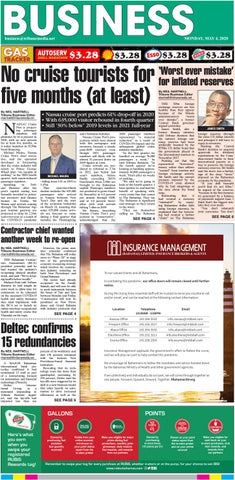
No cruise tourists for five months (at least) By NEIL HARTNELL Tribune Business Editor nhartnell@tribunemedia.net
N
ASSAU Cruise Port is projecting passenger numbers will plummet by 61.4 percent in 2020, with no new arrivals for at least five months, as it today launches its $130m bond financing. Michael Maura, Nassau Cruise Port’s chief executive, said the operator/ developer is forecasting that the cruise industry will return to Prince George Wharf after “six months of nothing” in the 2020 fourth quarter with much-reduced passenger numbers. Speaking to Tribune Business after the port’s capital raising was formally unveiled to potential investors and finance houses on Friday, Mr Maura said arrivals coming through The Bahamas’ biggest tourism gateway are projected to drop by 2.34m year-over-year as a result of the COVID-19 pandemic
• Nassau cruise port predicts 61% drop-off in 2020 • With 635,000 visitor rebound in fourth quarter • Still ‘30% below’ 2019 levels in 2021 full-year
MICHAEL MAURA - falling from 3.81 in 2019 to 1.47m. That near-two-thirds decline includes the 835,000 passengers who arrived in Nassau between New Year’s Day and the start of the economic lockdown on March 16, meaning that some 635,000 cruise arrivals are forecast to come during a final quarter that includes the Thanksgiving
Contractor chief wanted another week to re-open By NEIL HARTNELL Tribune Business Editor nhartnell@tribunemedia.net THE Bahamian Contractors Association’s (BCA) president yesterday said he had wanted the industry’s re-opening delayed another week, and said: “We’re keeping health before wealth.” Michael Pratt told Tribune Business he had sought an extra week to allow time for contractors to be educated on the necessary COVID-19 health and safety measures they must implement, with the BCA set to launch an online two-hour occupational health and safety course this Thursday on the topic.
However, the prime minister yesterday confirmed that The Bahamas will today move to “Phase 1B” or stage two of the government’s economy re-opening strategy which involves the construction industry restarting on both New Providence and Grand Bahama. The sector had already re-opened on the Family Islands, and will now be able to work nationwide between the hours of 7am and 5pm between Monday and Friday. “Construction will now be permitted on New Providence and Grand Bahama with industry protocols that
SEE PAGE 4
Deltec confirms 15 redundancies By NEIL HARTNELL Tribune Business Editor nhartnell@tribunemedia.net
A MAJOR Bahamian international bank yesterday confirmed it had terminated 15 staff as part of a restructuring focused on automation and financial technology (Fintech). Deltec International Group, in a statement responding to Tribune Business inquiries, said the lay-offs had impacted less than ten
percent of its workforce and that 150 persons remained with the western New Providence-based financial institution. Revealing that its technology team has more than quadrupled, increasing by 350 percent, Deltec said the lay-offs were triggered by its shift to a new business model that relies heavily on automation to drive increased efficiencies as well as the
SEE PAGE 6
and Christmas holidays. Nassau Cruise Port’s projections, which were shared with this newspaper and investors, forecast a steady post-2020 recovery even though 2021 passenger numbers will likely still be almost 32 percent down on 2019 figures at 2.6m. Cruise arrivals are predicted to rebound to 3.7m in 2022, just below last year’s numbers, before finally exceeding 2019’s benchmark when 3.88m are brought to the Bahamian capital. Passenger numbers are predicted to grow steadily thereafter at 4.8 percent per annum through 2030, and at 3.8 percent thereafter, with total arrivals hitting 7.48m in 2039. Mr Maura, describing Nassau Cruise Port’s projections as “conservative”, acknowledged that the
2020 passenger numbers represented “a material reduction” as a result of COVID-19’s impact and the subsequent global cruise industry shutdown. “In the first quarter we handled on average 76,000 passengers a week,” he told Tribune Business. “In the fourth quarter we’re looking at handling approximately 48,000 passengers a week. That’s after six weeks of nothing.... “We said we’re going to look at the fourth quarter. I have spoken to, and had the benefit of speaking with, every cruise line that comes to The Bahamas. They say The Bahamas is significant and strategic in their return to the water. “They see themselves calling on The Bahamas
SEE PAGE 4
$3.28
$3.28
‘Worst ever mistake’ for inflated reserves By NEIL HARTNELL Tribune Business Editor nhartnell@tribunemedia.net THE $2bn foreign exchange reserves are less healthy than they appear because of the Minnis administration’s “worst ever mistake”, a former Central Bank governor argued yesterday. James Smith, also a former finance minister, told Tribune Business that the nation’s foreign currency reserves had been artificially boosted by the $750m US dollar bond that the government placed in the international markets in November 2017. Pointing out that this represented “borrowed” money rather than inflows “earned” from tourism and foreign exchange activity, Mr Smith said the current pressure imposed by the COVID-19 crisis showed why he had misgivings at the time about the bond issue. Reiterating that it had created a currency “mismatch” by repaying Bahamian dollar debt using foreign currency, he explained that the borrowing had created a further “claim” on The Bahamas
JAMES SMITH foreign reserves through the extra US dollar interest and principal it will have to repay to investors. Backing the Central Bank’s decision to suspend approvals for dividend repatriations by the Canadian-owned banks to their international parents as a way to preserve the foreign currency reserves, Mr Smith said the move was a further sign of the deep “stress” imposed on the Bahamian economy by the pandemic. “If you drill beneath you’ll find it’s not $2bn,” he argued of the reserves, “because in the first instance it’s generated by a balance of payments support loan. I think that’s the biggest mistake they ever made. “You don’t mismatch your currencies. You don’t
SEE PAGE 6
PAGE 2, Monday, May 4, 2020
In the second of a three-part series, Hubert Edwards analyses the challenges confronting The Bahamas as it seeks to secure sufficient funding to ride-out the COVID-19 storm
P
OLICYMAKERS are dealing with an evolving crisis, a major aspect of which creates greater economic damage. The focus on time is multifaceted and important for the Caribbean as countries start to make plans to restart their economies. As time drags on, we can anticipate that the crisis will impose a higher cost on funding the recovery. Moody’s indication that its rating for The Bahamas is under review for a downgrade, due to the fallout from COVID-19, is significant for the region. Moody’s statement that the decision “reflects significant risks to its economic and fiscal metrics as a result of the coronavirus outbreak” should cause many other countries to become very concerned. Most countries within the Caribbean are rated as risky when it comes to sovereign debt. With the exception of the Cayman Islands, which has an excellent investment grade rating, The Bahamas and Trinidad & Tobago share the next highest ratings in the region, at “BB+” and “Baa3”, from Standard & Poor’s (S&P) and Moody’s, respectively. Both of these are considered “lower investment grade”. A downgrade for The Bahamas, therefore, holds very worrying implications for the rest of the region. With weaker economies, most could effectively be relegated to junk status. Many are already in the realm of being “highly speculative”, as is the case with Jamaica,
THE VICIOUS CYCLE OF LOCKDOWNS, DOWNGRADES AND STIMULUS COST BY HUBERT EDWARDS
or the lower level rating of “substantial risk”. A downgrade for The Bahamas by Moody’s will push its sovereign rating into the non-investment grade category, rendering it a higher risk and potentially pushing up the cost of borrowing significantly. The average debt-toGDP ratio for CARICOM countries stands at approximately 65 percent, ranging from a low of 33 percent (Haiti) to a high of 125 percent (Barbados). Adjusting for the two lowest countries, Trinidad and Haiti, this ratio increases to 78 percent. This number is significant. Using 60 percent debt-to-GDP as a benchmark that most countries wish to remain below, it indicates that most countries do not have the fiscal space they desire. For example, at the start of the global crisis of 20082009, The Bahamas had a debt-to-GDP of 39 percent compared to its current position of 64 percent. It thus has a weaker position from which to respond. The combination of potential downgrades and limited fiscal space will spell trouble for many countries, and borrowing thus becomes imperative. It does not require expert
assessment to determine that, with the significant loss of tourist dollars, countries will need to borrow. In the case of The Bahamas, in its most recent quarterly publication, the Central Bank outlined this very clearly. Speaking to projected fiscal activities for 2020, it said: “In terms of the fiscal sector, expenditures related to the restoration of key infrastructure and social welfare spending, combined with revenue intake disruptions related to COVID-19, are anticipated to weigh profoundly on the government’s fiscal outturn. Reinsurance receipts and donations from domestic and international sources should mitigate some of the shortfall in revenue. However, the remaining budgetary gap will require a rise in domestic and external borrowings.” The circumstances for Barbados, Belize and Jamaica, with much higher debt-toGDP, is more disconcerting. This will no doubt be very concerning for the leaders of those countries. If the need for significant borrowing holds true, as we think it will, policymakers must be ready to make hard decisions and bring some level of creativity to reinvigorating the economy should
THE TRIBUNE inflows from borrowings prove insufficient. Will further rating agency reviews place greater pressures on the region to secure funding for economic recovery? Could we see an increased risk of sovereign defaults? Will the region be able to afford any funding premium that may arise because of the current unfavourable outlook? Factors such as unusually high demand for debt; weakened economy and negative outlook; potential shortages of bilateral loan arrangements and the limited resources of multilateral agencies all weight heavily. These are important questions to contemplate for policymakers and citizens alike. The answers to this will impact what our recovery may look like. The risk factors for the region As it relates to sovereign debt, COVID-19 may be delivering to the world a ticking time bomb. Is there a storm brewing as it relates to emerging economies securing loans? There are a number of factors to be considered as we analyse the potential challenges that emerging economies face at this time. These provide important signals. This economic and financial crisis is different from past events in that every single country is experiencing the ravages. The demand, as mentioned before, increases the potential cost of securing debt. The market for borrowing is reduced given the fact that facilities which Caribbean countries would normally look to secure, borrowing on a bilateral basis or through some predetermined agreements, have likely evaporated, as the countries that usually facilitate these are themselves grappling with the immense cost of securing funds for stimulus. Soft loans that may be available prior to now are likely all gone. The demand is high in a contracting market. Countries within the region will most likely
resort to multilateral agencies such as the International Monetary Fund (IMF). Kristalina Georgieva, its managing director, said there is demand for $2.5tn - an estimate that is considered to be on the low side. Our research shows that the IMF’s available resources are likely to significantly lag this amount. Where, then, will some of the most vulnerable states turn, including those within the region? Policymakers should take seriously the statement she made on the same call, noting that more than 80 countries have already placed requests for IMF financing. One question is whether this will be granted on a “first come, first served” basis, or will there be an underwriting standard that takes into account the fundamentals of the country? Will sovereign ratings, the risk of some disorderly sovereigns, and unusual demand place certain countries at risk of having to navigate the post COVID-19 event with very limited resources? Certainly, the impact will vary. However, taken as a whole, the Caribbean is highly dependent on tourism for its foreign exchange inflows. There are commentators who have espoused the idea that countries should start looking within for resources to fund the recovery. While this may be a supplemental approach, it is not likely to be optimal. Such an approach will fail to address the need for new capital injection, especially for net importing countries, and those with pegged exchange rates such as The Bahamas, where net reserves will come under significant pressure. It is worthwhile to repeat that there is no definitive projection as to when this event ends. It is also worth underlining that the end of the virus is not the natural end of the financial and economic pressure. There will be a likely lag as behaviours renormalise, reversing social distancing as a necessary precursor for the return to vibrancy of tourism, the lifeblood for the Caribbean. According to Oxford Tourism (Oxford Economics), 15.2 percent of the Caribbean’s GDP and 13.8 percent of employment is generated from tourism. On an individual country basis, this contribution ranges significantly from a low of 7.7 percent of GDP, in the case of Trinidad and Tobago, to a high of 98.5 percent of GDP for the British Virgin Islands. In 11 of the 21 countries analysed, tourism accounts for over
25 percent of GDP, which is more than double the world average of 10.4 percent. In the case of The Bahamas, the contribution amounts to 48 percent, and in Jamaica, approximately 20 percent of GDP. This dependency highlights the vulnerability of the region, which gets worse for many individual countries. Given that a large portion of our spend is with developed countries, and having regard for the potential difficulties, based on the risk highlighted above can an argument be made that G-7/ G-10 countries start looking at how they can support the region and other emerging economies? After all, these are their markets. These markets will have pent-up demand but with significantly retarded ability to purchase. This, therefore, may be a practical way of addressing the demand-side shock of this event. Following the global supply chains, it will be easily appreciated that weakened importing countries will result in weak sales for exporters. As policymakers interact with their global counterparts, initiating strategic conversations such as these could bring value to a country. While all the above are fundamental, maybe the most significant risk facing the region is the main source of its tourism market, the US. To-date, the challenges seen in battling the virus in the US suggest that the tourism market is in serious peril and will be so for a long time. Therefore, despite efforts to restart economies, we are grappling with a demand-side shock that has to be solved first before any semblance of vibrancy returns to the market. Until this state of affairs changes, there will be little progress. Understanding that tourism contributes heavily to the majority of foreign exchange inflows for the region, we must guided by the evolving developments in that country. With jobless claims standing at 22m and unemployment increasing daily, and with the stock market and nest egg investment portfolio taking huge losses, reductions in disposable income will also occur. We must therefore anticipate a curtailment of discretionary spending, and hence a hit to the travel and tourism market. As we argued in our previous articles, the industry itself is likely to display a long-tail recovery and this spells trouble for earnings and government revenue. To be continued.....
BTC aids Health Ministry with communication need THE Bahamas Telecommunications Company (BTC) has teamed with the Ministry of Health (MoH) to improve its communications in response to the global COVID-19 pandemic. The carrier donated ten mobile devices equipped with post-paid services. These will be used by the COVID-19 Crisis Centre and the COVID response team to carry out their duties. Garfield “Garry” Sinclair, BTC’s chief executive, said: “The ability to communicate is critical and even more heightened during this time. We believe that when we collaborate, we all win, and as a corporate citizen we were happy to lend our support to the Ministry of Health to assist in the fight against COVID-19. “We are also committed to doing all that we can to support those who are on the frontlines of this global pandemic.”
BTC also provided a tollfree hotline to the Ministry of Health. Residents can call 511 if they need medical assistance or have COVID19 specific questions. The calls are free of charge. Duane Sands, minister of health, pictured, added: “The COVID-19 response requires the use of every possible tool and mode of communication to reach our citizens wherever they are in real-time. We appreciate these gifts and are grateful to BTC for their continued support and generous donation.”
THE TRIBUNE
Monday, May 4, 2020, PAGE 3
Govt sets 45% of business ‘at liberty’ By NEIL HARTNELL Tribune Business Editor nhartnell@tribunemedia.net THE Chamber of Commerce’s chief executive yesterday said the government has “set many businesses at liberty” with 45 percent suggesting that can offer online ordering and delivery. Jeffrey Beckles, reacting to the prime minister’s decision to move the Bahamian economy to the second stage of his reopening strategy, told Tribune Business that it had given multiple companies with the ability to offer delivery and curb-side pick up services the “green light” to re-open. Suggesting that it will also unlock the ingenuity and creativity of many firms, Mr Beckles urged companies allowed to re-open “not to let your guard down” and “sacrifice our country for a dollar” by failing to enforce the required COVID-19 health and safety protocols. “It was very positive in that a number of businesses can really focus on transformation, as it were, in terms of being able to set themselves up to take orders over the Internet, take orders over the phone, and deliver the goods,” he told this newspaper of Dr Hubert Minnis’ announcement. “That’s going to open up a good portion of commerce. We did a survey where 45 percent of businesses suggested they have the ability to do basic orders and delivery of goods and services. Now that the green light has also been given to do curb side, we’ll see many more businesses move to accomplish re-opening.” Dr Minnis, in his national address yesterday, said the government was moving to Phase 1B of the economy’s re-opening. This allows construction to restart on New Providence and
JEFFREY BECKLES Grand Bahama between the hours of 7pm and 5pm, five days per week, while companies with the ability to offer delivery and pickup can also do so from 8am to 5pm between Friday and Monday. It is unclear if liquor stores can open for delivery and pick-up, but the prime minister added that home, hardware, plant nurseries and auto parts stores which are currently allowed to open in-store in certain days of the week - can also expand to five-day delivery and pick-up. “Because of the progress we are making, I am pleased to announce that effective tomorrow, May 4, we will move to phase 1B in the reopening of our economy,” Dr Minnis said. “This phased re-opening is aimed at striking the right balance between permitting some further level of commerce to resume while still maintaining a vigilant national position promoting physical distancing and reinforcing the health and safety precautions necessary to mitigate community spread of COVID-19.” He added: “Businesses must be able to demonstrate existing capabilities to take orders by phone or online and acknowledgement of receipt. Businesses should use gloves and other protocols in handling and delivery of goods, and interaction with customers. Proper physical distancing and sanitizing measures must be practiced at all times.”
The COVID-19 crisis has shown the value of Bahamian companies having an e-commerce/online operation with the ability to take payment via the Internet. Mr Beckles yesterday suggested a phone ordering operation, with the ability to take and process debit and credit card information, could also function equally as well. “I think we’ll see many businesses doing that,” he added, suggesting that delivery and curb-side pickup are “the easier part of social distancing” because of the minimal interaction required between staff and customer. “This will set at liberty many of the smaller businesses who will be able to operate,” Mr Beckles told Tribune Business. “What that means is that as time progresses more and more companies will begin to refine their online services, and that’s a good thing. No opportunity goes unused. This is a positive step and all bodes well. “I think you’ll find the ability of Bahamian businesses to adjust is on display right now. They’ve gone from not being able to operate to unleashing the creative spirit and we’ll more of that in the coming weeks and months.” The chamber chief, though, warned companies able to open not to become complacent about the threat posed by COVID-19. “It’s an opportunity to keep moving forward and make sure we get the economy moving and commerce started in a very specific and right way,” he told Tribune Business. “The prime minister’s announcement was a step in the right direction. We have to make sure everybody’s complying, not let our guard down and be very vigilant to make sure we keep customers safe and not sacrifice our country for a dollar.”
GB: 82% OF FIRMS PLAN TO RE-OPEN By YOURI KEMP Tribune Business Reporter ykemp@tribunemedia.net
SOME 82 percent of closed Grand Bahama businesses surveyed by the island’s Chamber of Commerce expect to re-open, it has been confirmed, with just two firms saying they will go out of business. The COVID-19 survey of 127 companies found that 42 percent, or 53, expect to lay off staff. Of that number, 75 percent or 40 plan to layoff less than 75 percent of their workforce, with 13 planning to lay-off more than 75 percent. Gregory Laroda,
the chamber’s president, told Tribune Business he was optimistic that the Hurricane Dorian-related tax breaks will continue beyond their June 30 expiry date. And his call for the government to start relaxing COVID-19 restrictions on different Family Islands was yesterday answered when the Prime Minister opened up the more sparsely populated southern islands. The GB Chamber survey said Grand Bahama businesses are also seeking assistance with e-commerce and help for small businesses that may not qualify
for existing loans due to the absence of VAT filings or government licenses. Some 87 percent of respondents said COVID19 has negatively affected their business, with just 9 percent saying it was too early to tell. Out of the 127 businesses surveyed, only 40 of them or 31 percent were currently open. The survey’s most cited needs were “relief from value added tax (VAT), duty and license fees and an extension of existing exemptions; VAT timing exemption, waiving of penalty; and short-term, low interest loans”.
Firms seek clarity over ‘curb side’ By YOURI KEMP Tribune Business Reporter ykemp@tribunemedia.net COMPANIES permitted to offer delivery and pickup services from today have called for more clarity after the prime minister moved the Bahamian economy to its second re-opening stage. Dwayne Higgs, WHIM Automotive’s general manager, told Tribune Business he was “trying to get some more clarity on exactly what curb-side is” after Dr Hubert Minnis said businesses that can offer “goods and services through delivery and curbside pick-up” can open for five days per week between the hours of 8am and 5pm. “I expect there may be some people that show up today, business as usual, or to try and pay for something at the door, or something like that,” Mr Higgs said, explaining that this will only happen on Tuesday the day currently set aside for when auto parts providers can open in-store. He added: “The way we are going to operate is just servicing online orders only for those four days, because if we don’t do that then what’s the difference between those four days and the Tuesday besides the
fact that the customer can’t actually physically come inside. “We just don’t want to have you moving cash around. You’re taking cash from the customer outside and you’re bringing them back change; it could be a safety issue. So from our standpoint we’re going to operate cashless and only service the online orders. That’s what we’re going to do today. Let’s see how it is. “I wish there would have been some more clarity, because it’s a fairly new term for us here. My take on curb side pickup is that you wold have already placed your order and paid for it, and you’re just coming to pick up just like Wal-Mart and Target in the States. You place your order on the website and pick it up, and they bring it out to your car in a designated curb side area.” Asked to differentiate what will happen between the additional four days and the Tuesday WHIM’s store is allowed to open Mr Higgs, said: “The main difference is that you are not going to be allowed inside, and then it would be not handling cash or credit card either, because if the whole point is to have as little
contact as possible you can’t pay for an order unless you pay for it on the website. “This is the struggle of some of the other companies that are not advanced and don’t have the website. How are they going to take orders? Are they going to take order via Whatsapp, or e-mail or telephone, and then how are they going to get payment? I wouldn’t want to be them.” Mark Smith, general manager of Oasis Landscape, told Tribune Business that the shifting the economy to ‘Phase 1B’ of the reopening “would be very helpful for the whole economy”. He added: “I am so glad that he is being very cautious, and glad because in the labour sector everybody is crying. We need to get back to work, but we have to be safe. So I am glad that he is implementing safe tactics and everybody is going to abide by the rules. “Everybody is going to be able to afford the rent again, and as an employer I can pay them gladly for a week’s work and get my business going again. We are very grateful. We realise that this is important times and the need to be cautious.”
PAGE 4, Monday, May 4, 2020
THE TRIBUNE
No cruise tourists for five months (at least) FROM PAGE ONE first because of the three to four-day cruises, enabling them to offer two to three calls in the same itinerary, and with only one head (departure) tax needing to be paid.” Mr Maura said the Nassau Cruise Port was basing its rebound optimism on multiple factors, not least The Bahamas’ proximity to the major south Florida cruise ports as well as its geography, which enables it to offer calls at multiple islands. The US Jones Act, which requires foreign-flagged vessels such as cruise ships to make at least one overseas port of call before they can return to their US home port, coupled with the Trump administration’s tightening of relations with Cuba, again makes The Bahamas the only viable port of call on the short three to four-day cruises likely to be popular in COVID-19’s immediate aftermath. And, with 113 new cruise vessels on order as at March 1, 2020, with a collective 232,172 passenger capacity, Mr Maura said “those ships have to sail some place” once all the necessary health and safety protocols were properly implemented. Still, acknowledging that the recovery will not be immediate, Mr Maura said ARTIST renderings of proposed development of Nassau Cruise Port. that once past the pandemic Nassau will still be some 1.21m cruise visitors down compared to 2019 for the 2021 full-year. “That is less than 70 percent of the 2019 numbers,” he added. “We’re still more than 30 percent below in 2021 what we had in 2019. Not until 2023 are we going to see 2019 numbers. We believe we’re going to find we’re going to be busy, but at the same time we’d rather be conservative. “Even during this ‘no sail’ order we’re getting contacted on a daily basis by the cruise lines asking for berths and berth availability. There’s a whole team they have looking at getting back to business and making sure berths are available.” Bahamas Paradise Cruise Line has already announced its intention to resume voyages to Freeport and Nassau with its two ships in June and July, respectively, with Royal Caribbean’s website also stating that June 12 is when it will restart. However, Nassau Cruise Port’s forecast of at least a five-month wait for cruise
Contractor chief wanted another week to re-open FROM PAGE ONE cover transportation, the use of personal protective equipment, physical distancing, cleaning and disinfecting protective measures and other measures,” Dr Hubert Minnis added. But, while hailing the government’s decision to re-open the industry, Mr Pratt said the BCA had been hoping that the training initiative to be overseen by a Bahamian, Dr Kevin Storr, would have acted as a “prerequisite” to the sector’s re-start. “We have to be careful how we open this industry,” the BCA president told Tribune Business. “Our intention was to open a week later, but tomorrow construction starts. We were hoping it would be open a week from today. If contractors want to work they need to prepare themselves. “We’re excited it’s opening. We believe construction’s the third pillar of the economy and our society. Anything now to bring relief to those smaller contractors and give them an opportunity to go out and make money will be good. “The only thing we stress is that we focus on health first.
tourism to return will likely be of little immediate comfort to Bay Street/ downtown Nassau merchants; taxi drivers; tour operators and excursion providers; restaurants; straw vendors; hair braiders; and hotels (such as Atlantis with its day passes) who all rely on the sector for their living. While the prospect of a lengthy wait may come as little surprise to many, they - and their employees - are faced with a lengthy period during which they will have to focus on survival from both a business and personal perspective. And some observers will likely argue that Nassau Cruise Port’s forecast of a 2020 fourth quarter cruise industry return is too optimistic even if the city - and The Bahamas in general - are likely to be the first ports of call when the sector does open up. Indeed, several believe that the cruise lines will not come back until New Year 2021 at earliest given the numerous obstacles it must overcome to resume sailing. Even if the US permits the industry to launch once the Centres for Disease Control and Prevention’s (CDC) 100-day “no sail” order expires, it must then satisfy the Bahamian government that it has implemented the necessary safety measures to ensure it does not bring COVID-19 infected passengers here. Given that opening The Bahamas’ borders to tourism generally will only occur in the sixth and final stage of the prime minister’s economic revival strategy, the cruise industry’s return still appears some way off and certainly beyond June. The cruise industry will also have to overcome significant negative publicity stemming from the multiple outbreaks of COVID-19 upon its ships, which led in some cases to passengers being stranded at sea for days if not weeks before they were permitted to disembark. The Guardian newspaper in the UK reported on Thursday that more than 100,000 cruise ship crew remain stuck on ships, of which at least 50 have suffered an outbreak of the virus. However, Mr Maura voiced “absolute confidence” in the cruise industry’s ability to rebound rapidly despite the challenges it faces and bring The Bahamas with it. He added that the industry is working with the CDC, World Health Organisation (WHO) and International Maritime Organisation (IMO) to address all healthrelated concerns. “They would have had to make retrofits, have
to make design changes, implement the necessary safety protocols and invest in the necessary technology, including temperature screening and COVID-19 testing, not only on ship but at their port terminals,” the Nassau Container Port chief said. “From a COVID-19 perspective, the cruise lines are working with the CDC and submitting plans to it on how they’ll operate when they return to service, and how they’re going to monitor and screen persons leaving the ship. The COVID-19 testing will be required not just for passengers but crew.” Mr Maura said cruise lines will also have to invest in quarantine and isolation facilities aboard their vessels, while trained medical personnel will also have to be in place. He added that Nassau Cruise Port was also working on the health and safety measures it needs to implement, and sits on a committee alongside Atlantis and Nassau Development Company (NAD) executives to devise the necessary protocols. “We’re looking at what we have to do as a destination to provide a safe experience for those visitors but also to ensure Bahamian residents and citizens can safely go to work,” he added. Mr Maura added that the “incredible experience and value for money” offered by the cruise industry would also help restore consumer confidence and overcome health-related fears. He suggested this was shown by the fact around 50 percent of persons who had booked a cruise during the COVID-19 “no sail” order have elected to rebook and take a credit for a future voyage rather than seek a refund. And the cruise industry’s need to offer discounts to entice customers back will also benefit The Bahamas because this will push it to focus on three and fournight cruises to keep costs low, Mr Maura said. “The cruise lines are likely to have to discount to build volume for their ships, so they will want to keep costs as low as possible,” he added, “and those three-day cruises burn the least amount of fuel. That’s something they have to consider in these circumstances, and the cruise lines are looking at The Bahamas as being a very important part of their return. “We’re absolutely confident we’ll have success working through this. We have no doubt that the cruise industry will hit the water safer and better than before.”
We’re keeping health before wealth. Our workers are very important in terms of Dorian recovery. We’re already struggling there with skills shortages and don’t want our workers precariously exposed without proper controls. We cannot afford to lose any of our crews. They’re valuable right now.” Restarting the construction industry offers the potential to get 19,500 workers, or between five to ten percent of the Bahamian labour force, back to work while also soaking up much of the semiskilled and unskilled labour in The Bahamas. It also has strong links to foreign direct investment (FDI) and the possibility to bring in some, albeit modest, foreign exchange inflows to partially compensate for the tourism shutdown. As an industry where much activity takes place outdoors, construction is also thought less susceptible to spreading COVID-19. However, Mr Pratt warned that any detected infections could be “massive” for both contractor/ developer as they would lead to the construction site being shut down for two weeks with all workers quarantined. Suggesting the associated costs could be catastrophic for an industry that typically operates on thin margins, the BCA chief said contractors and their workers will have to abide by protocols that involve wearing masks and enforcing social distancing at all times.
Mobile toilets will need to be disinfected up to twice daily, while temperature screening and registration of all workers entering a construction site will be mandatory. Mr Pratt added that workers would need to bring their own food and water, rather than share it, while health inspectors will need access to all work locations to ensure that protocols are being properly enforces. He said implementation of the protocols themselves will be an additional expense for Bahamian contractors already grappling with the pressure of extra costs incurred in demobilising, and now remobilising, a construction contract. “I can guarantee you there are a number of cases where the contractor cannot pick up the cost, come out the other side and survive,” Mr Pratt told this newspaper. “It’s a new normal and we have to adjust.” He added that the COVID19 health and safety measures by themselves represented an additional cost that will have to be factored into construction contracts going forward, describing them as akin to a “change order”. “A lot of times contractors are working on percentages that are marginal, not high, and they cannot absorb these things,” Mr Pratt said. “It’s almost like a VAT, a tax. This is a new cost to the contractor, and has to be a line item attached. A lot of contracts may have to be addressed in terms of a change order.”
THE TRIBUNE
Monday, May 4, 2020, PAGE 5
Economic vision must go beyond restarting
ACTIVTRADES WEEKLY By RICARDO EVANGELISTA www.activtrades.bs
BY RODERICK A SIMMS II AN ADVOCATE FOR SUSTAINABLE FAMILY ISLAND GROWTH AND DEVELOPMENT EMAIL: RASII@ME.COM PRELIMINARY estimates by the Organisation for Economic Co-operation and Development (OECD) indicate there will be at least a 45 percent decline in international tourism this year because of COVID19. This will have negative economic implications for countries such as The Bahamas that depend heavily on the tourism industry as their main economic and fiscal driver. The industry directly contributes 40 percent of The Bahamas’ gross domestic product (GDP) and around 50 percent of employment. Therefore, the temporary closure of most hotels and international/domestic travel should not be taken lightly. The country’s economic development hinges on all aspects of tourism. This segment will explore the challenges faced by the industry, and identify the best steps to take based on lessons from COVID-19. It is important that these lessons are considered by policymakers and incorporated into the National Development Plan (NDP). A New Reality The United Nations’ (UN) World Tourism Organisation (UNWTO) has pointed out that tourism is one of the most impacted sectors as a result of COVID-19. It also estimates that small and medium-sized enterprises, which make up around 80 percent of the tourism sector, are expected to be particularly impacted. For The Bahamas, this is an added downside on top of recovery efforts related to Hurricane Dorian, fiscal restrictions and an increasingly competitive tourism market within the Caribbean. Global travel is expected to slow down even after restrictions and travel bans are lifted, since many will be faced with new economic challenges and budget constraints. For those who can still enjoy travelling, they will be faced with new measures to ensure “responsible travelling”. Self-health precautions at airports will become the new norm, and health-related technology will play an important part in allowing visitors to enter countries. While many nations are desperate to recover, it is also important to put people first. For instance, with cruise ship passengers, screening and health checks need to be in place before disembarking because these vessels carry large amounts of people. In addition, the
Bahamian government should be wary of visitors from countries worst hit by COVID-19, such as the US, Italy and Spain. Unfortunately, the bulk of our tourists come from the US, Canadian and European markets. Therefore re-opening the economy will require strong collaboration regionally and internationally, along with strict safety measures at the borders. The best form of screening and testing should be also be adopted. The tourism sector’s recovery will require more than new hotel bookings and lifted restrictions. UNCATD (Hamilton, 2020) points out that countries may be able to weather economic storms by relying on additional debt or using available foreign reserves. It said: “However, access to global capital markets is increasingly tight, more so for small countries such as small island developing states (SIDS), which are often highly indebted and not well diversified.. Many of the SIDS, like Jamaica and The Bahamas, also face high external debt burdens which require complementary external debt suspension or relief programmes.” The author also points out that the World Travel and Tourism Council (WTTC) found that in previous viral epidemics the average recovery time for visitors to a destination was about 19 months. As the number infected by COVID-19 continues to increase, this recovery time could be longer. Therefore, the government needs a plan that will sustain tourism, shore up revenue losses and also look beyond dependency on tourism for economic growth. Diversifying the economy Diversification within economies will play a key role in how The Bahamas and other Caribbean countries survive in the future. Industries such as tourism, along with other services sectors (banking, insurance, etc.), have always provided jobs for Bahamians and, as a result, play a crucial role keeping the domestic economy functioning. However, we have seen that unprecedented disasters, even the ones we can prepare for, have always had an impact on the serviced sector, particularly tourism. Before COVID-19, natural disasters such as hurricanes have wiped out millions of dollars in revenue and, in some instances, completely halted industry operations. Much of Grand Bahama’s fragile
economic state is due to the closure of major hotels on the island from the passage of major hurricanes. Notwithstanding that the tourism industry is very competitive, due to comparatively high labour costs in The Bahamas, investors are now looking for the best deals on labour, consumables and utilities. In addition, cruise ship visitors have increased in number due to cheaper vacation packages. These visitors will tend to spend less than stopover visitors. Notwithstanding a near $1bn loss as a result of COVID-19, decades have passed and no government has successfully implemented a plan to build a resilient economy for The Bahamas. Justin Ram, director of economics at the Caribbean Development Bank (CDB), urged: “Leaders must invest in a diversified future to reduce our overall vulnerabilities.” The concept of ‘box tourism’ will no longer be sustainable. A plan should include steps towards a sustainable tourism sector with the expansion of Bahamianowned boutique hotels, eco-tourism activities on the Family Islands and a service-led industry that allows for human resources to be exported rather than imported. This pandemic should warn leaders that the reliance on tourism is simply not sustainable, and that while improving the industry is beneficial, looking outside to more innovative sectors will provide a better platform for future economic and social development. Conclusion The government has provided a measured plan for reopening the economy and reopening the borders, and restarting tourism will be the final stage. It mentioned that it is currently working with industry and regional partners to ensure “a strong rebound that will meet global health standards and protocols”. These discussions should go beyond restarting and look to diversify the economy in the event of future unexpected events. This pandemic heightens the need for The Bahamas and other Caribbean countries to be leaders in renewable energy, agriculture and technology. If not, more disasters will come, and we will have to continue depending largely on tourism for economic recovery. Read NDP @ www. vision2040bahamas.org
Light industries donate to help most vulnerable THE Bahamas Light Industries Development Council (BLIDC) and its members have donated free food and drink to support charities in the battle against COVID-19 related hunger. Companies such as Purity Bakery, the Caribbean Bottling Company (CBC), Blanco Chemicals and Commonwealth Brewery have helped to stock supermarket shelves as well as assist non-governmental organisations (NGOs) in providing muchneeded assistance to struggling households and communities. To date, Purity Bakery, Blanco Chemicals, CBC and Commonwealth Brewery have collectively donated over 1,500 cases of beverages, 2,000 loaves of bread and 50 cases of
HANDS for Hunger accepting a donation from the Caribbean Bottling Company and Commonwealth Brewery. bleach to groups such as the Salvation Army, Red Cross, Hands for Hunger, Lend a Hand Bahamas, Great Commission, the Bahamas Feeding Network and a number of homes for the aged. “This has been an objectively challenging time for all Bahamians,” said Jonathan Cartwright, president of the Council and Cartwright’s Bedding. “As we navigate this difficult period, our BLIDC members understand how important it is to assist wherever and whenever we can. “Companies like Purity Bakery, Blanco Chemicals, the Caribbean Bottling
Who’ll be the winners and losers in this post-COVID new world?
Company and Commonwealth Brewery are not only performing essential manufacturing functions right now, and ensuring that Bahamians have uninterrupted access to bread, water and other beverages. They are also committed to making sure that the most vulnerable members of our community also have access to those essential items.” “The BLIDC and our members not only live, work and thrive in the communities that we serve, but we also support, invest and are committed to those communities through thick and thin,” added Karla Wells-Lisgaris, the council’s vice-president.
SPECULATING about what the post-COVID-19 world will be like, at a stage when we are all still experiencing the shock caused by the disease, could be compared, as someone said, with writing the review of a theatre play before the first act is over. The coronavirus presents itself as the greatest global challenge since World War II and crises of this dimension tend to leave deep marks, breaking long-established balances and laying the foundations for new eras. The enormous costs of social confinement and consequent economic slowdown have forced public authorities to intervene decisively, through social action policies, subsidies and bailouts. In the West, and beyond, the last few decades had been of a neoliberal stance characterized by a discreet public sector, with the market being the main driver. The coronavirus pandemic changed this in just a few weeks and circumstances are not expected to return to what they were, any time soon. One of the main differences between the pre and post-coronavirus world will be the renewed importance of the State, with obvious implications for taxation and public investment, among others.
The Western concept of individual freedom may also be tested; it is interesting to note entire societies have resigned themselves to social isolation, accepting all their steps are always to be controlled through apps developed to track the whereabouts of individuals. Now, this ‘genie’, once released, will not be easy to send back into the lamp. The political and cultural longterm impact of these new dynamics remains uncertain, but I foresee changes in the expectations and lifestyles of billions of people, happening within a context of prolonged economic recession. As previously mentioned, we are still in the first act of this drama, however, after less than two months, patterns of change have emerged. If, on the one hand, the global economy has fallen into depression, oil consumption has declined sharply and tourism is in a deep coma; on the other hand, online shopping with home delivery has skyrocketed, as has the number of subscribers to video streaming services, while working from home is the
new normal. Companies with a solid financial situation, seen as the standard bearers of the respective industries, are recording huge stock value losses due to the pessimism of the markets regarding their future viability. Carnival, the largest cruise operator in the world, saw the price of its stock drop by more than 75 percent, while the oil giant Exxon Mobil’s market capitalization is today practically the same as Netflix, which, conversely, appreciated more than 30 percent; Amazon, the giant of e-commerce, which was already the largest global company by market capitalisation, added an additional 25 percent to its value. All of this since the beginning of January. The game rules are changing; the winners will not necessarily be the strongest, but the ones that best adapt. The coming years are likely to bring growth for the technology, renewable energy, home delivery and entertainment sectors. As for travel and tourism, oil and banking, there may be trouble ahead.
PAGE 6, Monday, May 4, 2020
THE TRIBUNE
‘Worst ever mistake’ for inflated reserves FROM PAGE ONE borrow in foreign currency to pay back your domestic debt. The result of that, immediately when you make that borrowing, is that money is sold to the Central Bank and put in the reserves. Now the Central Bank has hundreds of millions more in its reserves than it didn’t earn. “Normally reserves are added to by trade, the net spending of tourists. When $700m of that is a balance of payments support loan, it says we’re doing well but we didn’t earn that from net inflows, tourist spending. Now, with COVID-19, you’re not getting the inflows but still have to feed the nation and pay back the foreign currency debt associated with that $750m.” Marlon Johnson, the Ministry of Finance’s acting financial secretary, defended the $750m US dollar bond placement at the time and pointed out that it had only been undertaken after consultation with the Central Bank. He added that the Minnis administration had decided to tap the international capital markets because there were limits locally on how much government paper can be held by the Bahamian commercial banks, and the size of the market generally. Some $300m of the foreign currency borrowing was used to repay Bahamian dollardenominated bank loans and Treasury Bills. Multiple private sector contacts have expressed alarm at the Central Bank’s decision to halt the payment
of dividends by the Canadian banks, thereby interrupting what has long been seen as a cornerstone of the Bahamian investment regime - no obstacles to profit repatriation by a foreign investor. Apart from the impact to investor confidence, the Central Bank’s move was also interpreted as a sign of just how much trouble COVID19 has left The Bahamas in. William Wong, a former Bahamas Real Estate Association president, told this newspaper of the regulator’s action: “I don’t know how many people appreciate that, but it’s a serious statement. That’s very serious. “When I was working in the banks, every three months we used to send millions of dollars outside the country. Now it’s stopped. That’s a big, big statement right there. Wow.” Robert Myers, a businessman with interests in sectors ranging from construction to landscaping and hardware, yesterday told Tribune Business the Central Bank’s action was an indication of how concerned it is about pressures on the reserves that ultimately support the one:one exchange rate peg with the US dollar. With no tourism inflows to replenish the reserves, he argued that the government needed to “stimulate” construction-related foreign direct investment (FDI) with time-limited real property and transaction VAT cuts to entice overseas developers and homeowners. “They wouldn’t do that if they were not worried about the reserves and the peg,”
PUBLIC NOTICE
INTENT TO CHANGE NAME BY DEED POLL The Public is hereby advised that I, PETHRONA INDIRA RUSSELL of 6470A Summit St, Halifax, Nova Scotia Canada B3L 1S1, mother of AARIYAH JADE MCKINNEY A minor intend to change my child’s name to AARIYAH ELIYAH RUSSELL If there are any objections to this change of name by Deed Poll, you may write such objections to the Deputy Chief Passport Officer, P.O. Box N-742, Nassau, Bahamas no later than thirty (30) days after the date of publication of this notice.
Mr Myers added. “That’s a pretty draconian measure, a pretty harsh policy to say you cannot send a dividend to a foreign parent. That’s telling you something, right?” The Bahamas, as a nation that imports virtually all it needs for consumption, faces a massive foreign reserves drain without any inflows to replenish them amid the ongoing tourism industry shutdown. While the reserves were said by the Central Bank to remain at $1.995bn in March, just as the COVID-19 pandemic took hold, they are projected to fall by $1bn over the course of 2020. The government’s foreign currency borrowings amount to just over one-third of its total debt, and Mr Smith said this component would be far more difficult to reschedule given that it is held by international money managers, institutions and other foreign investors. Suggesting that the Central Bank had likely acted out of “an abundance of caution”, and would have discussed its intentions with the Canadian-owned banks beforehand, Mr Smith reiterated: “You have reserves that are not necessarily what they appear to be and look higher than they are because they’re being propped up by the Government. “It’s a double whammy in a way, and you might have a perfect storm in terms of the impact on the foreign reserves.... It is actually an indicator of the stress under which we find the economy. We import everything we consume, our ability to import depends on our foreign currency holdings, and foreign exchange depends on tourism inflows. We have no tourists coming in. “We have competing demands for the international reserves. These are to pay off the country’s foreign debt, pay for food imports and other services needed by the public, and profits repatriated by the banks. It can’t happen at the same time, so we have to make some choices.” Mr Smith said he was unable to recall any previous suspension of bank dividend approvals. The Central Bank has said it will keep the move under regular review through September 2020.
Bahamas must ‘reinvent rules’ following COVID-19 By YOURI KEMP Tribune Business Reporter ykemp@tribunemedia.net THE head of the Chamber of Commerce’s digital transformation committee is urging Bahamians to “reinvent the rules” to revive the economy in a postCOVID-19 environment. Royann Dean, speaking on a webinar hosted by the Organisation for Responsible Governance (ORG), said: “I think the situation right now is we are going to hit some rough times, let’s be honest about it. “I think we don’t even have a full awareness of how difficult those times will be. There are businesses that have closed their doors; they have had to lay-off people and furlough workers. Some have closed their doors and have not laid-off people yet, but those things may still happen depending on how long we have these emergency orders and businesses are not allowed to open.” Ms Dean added: “I don’t think we have seen the full brunt of it yet. I think we are going to be in the trenches for a while still. However, there are opportunities for us to reinvent the rules going forward. “We have to be smart about what our fiscal
By YOURI KEMP Tribune Business Reporter ykemp@tribunemedia.net THE taxi union’s president said fares and the number of passengers drivers carry from Prince George Wharf may alter as a result of the COVID-19 pandemic. Wesley Ferguson, the Bahamas Taxi Cab Union’s (BTCU) chief, told Tribune Business: “We may have to reduce the amount of people that are allowed in the taxis, especially from the dock, because the [Prince George Wharf] dock is an area where people move in groups.
www.bisxbahamas.com
(242) 323-2330
(242) 323-2320
ALL SHARE INDEX: CLOSE: 2,138.41 | CHG: -0.28 | %CHG: -0.01 | YTD: -93.19 | YTD%: -4.18 BISX LISTED & TRADED SECURITIES 52WK HI 4.45 22.65 7.00 6.75 2.60 2.00 5.47 12.77 6.17 4.50 10.30 3.64 5.10 10.88 8.15 16.99 9.40 4.25 15.21
52WK LOW 3.35 20.91 5.50 5.39 1.89 0.67 2.00 10.21 5.60 3.75 5.41 2.53 1.80 8.00 6.63 13.04 6.98 3.14 13.90
SECURITY AML Foods Limited APD Limited Bahamas Property Fund Bahamas Waste Bank of Bahamas Benchmark Cable Bahamas CIBC FirstCaribbean Bank Colina Holdings Commonwealth Bank Commonwealth Brewery Consolidated Water BDRs Doctor's Hospital Emera Incorporated Famguard Fidelity Bank Finco Focol J. S. Johnson
SYMBOL AML APD BPF BWL BOB BBL CAB CIB CHL CBL CBB CWCB DHS EMAB FAM FBB FIN FCL JSJ
1000.00 1000.00 1000.00 1000.00
1000.00 1000.00 1000.00 1000.00
Cable Bahamas Series 6 Cable Bahamas Series 8 Cable Bahamas Series 9 Cable Bahamas Series 10 Colina Holdings Class A Fidelity Bank Class A Focol Class B
CAB6 CAB8 CAB9 CAB10 CHLA FBBA FCLB
PREFERENCE SHARES
1.00 10.00 1.00
1.00 10.00 1.00
CORPORATE DEBT - (percentage pricing) 52WK HI 100.00
52WK LOW 100.00
115.92 100.00 100.00 100.00 100.00 100.00 100.00 100.00 100.00 100.00 100.00 100.00 100.00 100.00 100.00
104.79 100.00 100.00 100.00 100.00 100.00 100.00 100.00 100.00 100.00 100.00 100.00 100.00 100.00 100.00
SECURITY Fidelity Bank Note 22 (Series B) +
SYMBOL FBB22
Bahamas Note 6.95 (2029) BGS: 2015-1-3Y BGS: 2014-12-5Y BGS: 2015-1-5Y BGS: 2014-12-7Y BGS: 2015-1-7Y BGS: 2014-12-30Y BGS: 2015-1-30Y BGS: 2015-6-3Y BGS: 2015-6-5Y BGS: 2015-6-7Y BGS: 2015-6-30Y BGS: 2015-10-3Y BGS: 2015-10-5Y BGS: 2015-10-7Y
BAH29 BG0203 BG0105 BG0205 BG0107 BG0207 BG0130 BG0230 BG0303 BG0305 BG0307 BG0330 BG0403 BG0405 BG0407
BAHAMAS GOVERNMENT STOCK - (percentage pricing)
LAST CLOSE 3.55 17.43 6.00 6.68 1.89 1.62 2.99 11.26 6.00 4.02 6.01 3.00 4.90 9.73 8.15 14.15 8.97 4.09 15.20
CLOSE 3.55 17.43 6.00 6.68 1.89 1.62 2.99 11.26 6.00 4.02 6.01 2.95 4.90 9.44 8.15 14.15 8.97 4.09 15.20
CHANGE 0.00 0.00 0.00 0.00 0.00 0.00 0.00 0.00 0.00 0.00 0.00 -0.05 0.00 -0.29 0.00 0.00 0.00 0.00 0.00
1000.00 1000.00 1000.00 1000.00 1.00 10.00 1.00
1000.00 1000.00 1000.00 1000.00 1.00 10.00 1.00
0.00 0.00 0.00 0.00 0.00 0.00 0.00
CLOSE 100.00
CHANGE 0.00
107.31 100.00 100.00 100.00 100.00 100.00 100.00 100.00 100.00 100.00 100.00 100.00 100.00 100.00 100.00
0.00 0.00 0.00 0.00 0.00 0.00 0.00 0.00 0.00 0.00 0.00 0.00 0.00 0.00 0.00
LAST SALE 100.00 107.31 100.00 100.00 100.00 100.00 100.00 100.00 100.00 100.00 100.00 100.00 100.00 100.00 100.00 100.00
VOLUME 1,000
3,335
19,250
1,000
VOLUME
EPS$ 0.239 0.932 1.760 0.369 0.070 0.000 -0.438 0.722 0.449 0.184 0.140 0.102 0.467 0.646 0.728 0.816 0.939 0.203 0.631
DIV$ 0.170 1.260 0.000 0.260 0.000 0.020 0.000 0.720 0.220 0.120 0.000 0.434 0.060 0.328 0.240 0.540 0.200 0.120 0.610
P/E 14.9 18.7 N/M 18.1 N/M N/M -6.8 15.6 13.4 21.8 42.9 28.9 10.5 14.6 11.2 17.3 9.6 20.1 24.1
0.000 0.000 0.000 0.000 0.000 0.000 0.000
0.000 0.000 0.000 0.000 0.000 0.000 0.000
0.0 0.0 0.0 0.0 0.0 0.0 0.0
YIELD 4.79% 7.23% 0.00% 3.89% 0.00% 1.23% 0.00% 6.39% 3.67% 2.99% 0.00% 14.71% 1.22% 3.47% 2.94% 3.82% 2.23% 2.93% 4.01% 0.00% 0.00% 0.00% 0.00% 6.25% 7.00% 6.50%
INTEREST Prime + 1.75%
MATURITY 19-Oct-2022
6.95% 4.00% 4.25% 4.25% 4.50% 4.50% 6.25% 6.25% 4.00% 4.25% 4.50% 6.25% 3.50% 3.88% 4.25%
20-Nov-2029 30-Jul-2018 16-Dec-2019 30-Jul-2020 15-Dec-2021 30-Jul-2022 15-Dec-2044 30-Jul-2045 26-Jun-2018 26-Jun-2020 26-Jun-2022 26-Jun-2045 15-Oct-2018 15-Oct-2020 15-Oct-2022
YTD% 12 MTH% 0.37% 3.81% 0.24% 4.38% 0.23% 2.75% 5.76% 5.76% 12.81% 12.81% 0.94% 3.72% -3.46% 2.09% -0.11% 3.43% -3.33% 1.53% -0.32% 10.20% -1.58% 15.37% 0.88% 5.22% -4.91% 10.77% 1.89% 6.75% -1.95% 0.38% N/A N/A 10.80% 2.60% 10.40% -4.00%
NAV Date 31-Jan-2020 31-Jan-2020 31-Jan-2020 31-Dec-2019 31-Dec-2019 31-Mar-2020 31-Mar-2020 31-Mar-2020 31-Mar-2020 29-Feb-2020 29-Feb-2020 29-Feb-2020 29-Feb-2020 29-Feb-2020 29-Feb-2020
MUTUAL FUNDS 52WK HI 2.30 4.38 2.09 195.13 166.73 1.67 1.85 1.76 1.24 8.34 10.26 7.00 12.15 12.58 10.81 10.00 8.98 11.79
52WK LOW 1.67 3.30 1.68 164.74 116.70 1.61 1.75 1.70 1.14 6.41 7.62 5.66 8.65 10.54 9.57 9.88 8.45 11.20
FUND CFAL Bond Fund CFAL Balanced Fund CFAL Money Market Fund CFAL Global Bond Fund CFAL Global Equity Fund Leno Preferred Income Fund Leno Growth Fund Leno Diversified Fund Leno Global USD Bond Fund Royal Fidelity Bahamas Opportunities Fund - Secured Balanced Fund Royal Fidelity Bahamas Opportunities Fund - Targeted Equity Fund Royal Fidelity Bahamas Opportunities Fund - Prime Income Fund Royal Fidelity Int'l Fund - Equities Sub Fund Royal Fidelity Int'l Fund - High Yield Fund Royal Fidelity Int'l Fund - Alternative Strategies Fund Colonial Bahamas Fund Class D Colonial Bahamas Fund Class E Colonial Bahamas Fund Class F
NAV 2.30 4.38 2.09 195.13 166.73 1.67 1.79 1.75 1.16 8.31 10.07 7.00 11.42 12.58 10.52 N/A 8.98 11.40
MARKET TERMS
BISX ALL SHARE INDEX - 19 Dec 02 = 1,000.00 52wk-Hi - Highest closing price in last 52 weeks 52wk-Low - Lowest closing price in last 52 weeks Previous Close - Previous day's weighted price for daily volume Today's Close - Current day's weighted price for daily volume Change - Change in closing price from day to day Daily Vol. - Number of total shares traded today DIV $ - Dividends per share paid in the last 12 months P/E - Closing price divided by the last 12 month earnings
how we do things. “We no longer need to continue along the traditional norms. We have means, we have access to numerous raw materials, numerous streams of revenue where we can take a country and build in that sustainable finance where we can securitise these stream of assets.” Mr Rees added, “I think we need more of a shifting in terms of corporate Bahamas and their infrastructural development, and shifting the mindset in the direction of the Family Islands is where we need to go coming out of this.” “That’s how you get people on the ground working, and you get them in the family islands. Every Family Island should have a private school, a government school, a top-line medical facility, access to medical flights in and out into Nassau, everything tied in with the technology platform. “I love the positive spin, which is really about changing the mindset. Yes, we are all affected by this. But in great turmoil and trouble is a lot of promise and opportunity. If we look at it from that perspective we can come out of this ten times better than we came in.”
TAXI CHIEF PREDICTS FARE AND PASSENGER CHANGE
MARKET REPORT FRIDAY, 1 MAY 2020
policies are. We have to make a decision about whether we invest to stimulate the economy. We have to on the one hand be careful about spending, but on the other hand there is a lot of expenditure that needs to happen in order for us to have some baseline level of activity.” “It does give us the opportunity to redefine how we look at where we get our economic development from, and technology can play a major part in that. The good part about it is we are not the only country in this situation. There are companies were we can collaborate, and there are benchmarks we can learn from. “So there are opportunities for us to not be in the trenches as long as we would have been if this would have happened in 2008. I think that climb out of it doesn’t have to be as steep.” Nicholas Rees, Kanoo’s chief operating officer, added: “We need to change our mindset as a nation. I love the comment Royann said where she said we need to reinvent the rules. What this says is really this is an awakening of the country, of the world essentially, to change the mindset and to re-look at
YIELD - last 12 month dividends divided by closing price Bid $ - Buying price of Colina and Fidelity Ask $ - Selling price of Colina and fidelity Last Price - Last traded over-the-counter price Weekly Vol. - Trading volume of the prior week EPS $ - A company's reported earnings per share for the last 12 mths NAV - Net Asset Value N/M - Not Meaningful
TO TRADE CALL: CFAL 242-502-7010 | ROYALFIDELITY 242-356-7764 | COLONIAL 242-502-7525 | LENO 242-396-3225 | BENCHMARK 242-326-7333
30-Sep-2019 30-Sep-2019 30-Sep-2019
“There are special rates there at the dock for the cruise ship passengers that encourages them to ride along with strangers or other passengers from the cruise ship not with their party.” Mr Ferguson said he anticipated taxi fares will also change. While travelling from downtown Nassau to go to Paradise Island may cost $15 per person, the present system at the dock allows taxis to charge $4 per person if someone waits on other people to travel with them and make up the fare. Suggesting that this ride sharing system will change, Mr Ferguson said it may be “discouraged” now due to the safety concerns and people becoming more “health conscious”. He added that it will hurt taxi drivers who are accustomed to waiting for passengers to fill up their large buses with passengers, and said: “There has to be some enforcement in place where taxi drivers will have to understand that you don’t have that right to tell people that they must join in with strangers to go in your taxi. “The airport and the regular hotels don’t do this. Just as soon as you come out of a hotel you go into a taxi, but this is a special rate that was negotiated years ago with the BTCU and the taxi drivers to encourage the cruise ship passengers to go in groups. “We have to have protocols in place for when COVID-19 has passed. We
are putting our programme together and waiting on the government to basically let us know what they intend to do so we put the two together and make one.” Mr Ferguson continued: “We will have sanctions from the CDC (Centres for Disease Control and Prevention) and the World Health Organisation, and all of those other health conglomerate organisations who are going to put their protocols in place. “You are going to have the cruise ships putting their protocols in place, you are going to have the airlines putting their protocols in place, from the NAD (Nassau Airport Development Company) and the hotels. The dock is going to have a different protocol for passengers coming off of the cruise ships to go in taxis. Responding to arguments that the Government should do away with implementing a phased economic reopening, Mr Ferguson said: “I don’t agree with that, because when you look at other countries, you take a chance of reinfection. I don’t mind not having a timeline, because you don’t want to risk that.” “In any event, even if it is not worse when it comes to contracting the disease, it would be worse for the economy to rise up and then fall again. I would prefer the economy to come up gradually and stay up there, than to rise and then everyone to get comfortable and then fall again within the space of a year.”
Deltec confirms 15 redundancies
“We recognise the impact of these decisions on those affected, and do not take them lightly. It is even more difficult for all of us because we have tremendous respect for the persons impacted by the recent reduction in staff.” Tribune Business sources suggested that Deltec had been over-staffed as a result of acquisitions it had made over the last several years, adding that the lay-offs came as no surprise especially given its emphasis on technology as a core business driver. “Over the last few years, the main focus for Deltec International Group has been to ensure that we have a business model that is sustainable in an ever-changing financial environment,” the bank added yesterday. “While the financial services sector has been faced with major disruption over the years due to a changing customer base, emerging digital technologies and competition from non-traditional financial service providers, our strategy has positioned us for future success and sustainability.”
FROM PAGE ONE
fall-out from the COVID-19 pandemic. “With the investment in technology, there have been continuous shifts in how our resources are allocated,” Deltec said. “Quite notably, our technology team has grown by 350 percent. Additionally, with added automation, the bank has reduced a number of manual processes and restructured to facilitate this change. “This, coupled with the COVID-19 pandemic reshaping how we conduct ‘business as usual’, has resulted in the difficult decision to release 15 staff members. With this difficult decision, and because of the difficult situation that faces our country in view of COVID-19, the bank has provided enhanced severance payments with extended medical insurance coverage to make this transition as smooth as possible and to help affected employees in as much as possible throughout the crisis.
THE TRIBUNE
Monday, May 4, 2020, PAGE 7
CAN MAKE A DIFFERENCE IN THE LIVES OF THE CHILDREN AT RANFURLY
T
he Ranfurly Homes for Children has been a safe haven for thousands of Bahamian children since 1956. The Home provides a safe, structured environment for children who have been orphaned, abused, neglected or abandoned. YOU can make a difference in the lives of the children at Ranfurly. With your support children can have nutritious food, warm beds and a safe environment where they can discover the joy of being children. For years the children living and learning at Ranfurly have made great social and academic strides. Their further development requires additional support in the form of a Transitional Home, planned for construction on the Ranfurly property. This residence will cater to teenagers and young adults who are beyond school age, but need accommodation while they find work and gain independence from the Home. We look forward to your continued support in this worthwhile endeavour.
MEMBERSHIP PACKAGES Individuals, Families & Corporate Sponsors Children Helping Children - $5 (Individual children from ages 6 - 18) Individuals Helping Children - $50 (Individual adults 18 years and over) Families Helping Children - $100
CIRCLE of FRIENDS Silver: $1,500 - $2,499 Gold: $2,500 - $4,999 Platinum: $5,000 plus
OPPORTUNITIES • • • •
Invitations to Ranfurly events Assist with fundraising events Involvement with special activities Adults are eligible to join the Board after three months • Stay in touch with Ranfurly through website and newsletters
BENEFITS
• Personal fulfillment in knowing you are impacting lives • Ranfurly children’s appreciation and positive response • Continued support provides stability and constant care
For more information visit: www.ranfurlyhome.org Please “Like” us on Facebook Ranfurly Home for Children, Mackey Street P.O. Box 1413 Nassau, Bahamas 242-393-3115
THE TRIBUNE
Monday, May 4, 2020, PAGE 9
THE WEATHER REPORT
5-Day Forecast
TODAY
ORLANDO
High: 91° F/33° C Low: 64° F/18° C
TAMPA
TUESDAY
WEDNESDAY
THURSDAY
FRIDAY
Mostly sunny and nice
A moonlit sky
Pleasant with plenty of sun
Partly sunny with a stray shower
Pleasant with some sun
Clouds and sun, a t‑storm possible
High: 85°
Low: 74°
High: 85° Low: 74°
High: 87° Low: 75°
High: 86° Low: 73°
High: 84° Low: 74°
AccuWeather RealFeel
AccuWeather RealFeel
AccuWeather RealFeel
AccuWeather RealFeel
AccuWeather RealFeel
AccuWeather RealFeel
95° F
75° F
95°-80° F
96°-79° F
95°-73° F
90°-74° F
High: 86° F/30° C Low: 69° F/21° C
The exclusive AccuWeather RealFeel Temperature® is an index that combines the effects of temperature, wind, humidity, sunshine intensity, cloudiness, precipitation, pressure and elevation on the human body—everything that affects how warm or cold a person feels. Temperatures reflect the high and the low for the day.
N
almanac
E
W
ABACO
S
N
High: 79° F/26° C Low: 74° F/23° C
3‑6 knots
S
High: 87° F/31° C Low: 67° F/19° C
3‑6 knots
FT. LAUDERDALE
FREEPORT
High: 86° F/30° C Low: 70° F/21° C
E
W S
E
W
WEST PALM BEACH
N
uV inDex toDay
TONIGHT
High: 83° F/28° C Low: 74° F/23° C
MIAMI
High: 88° F/31° C Low: 71° F/22° C
3‑6 knots
KEY WEST
High: 84° F/29° C Low: 75° F/24° C
ELEUTHERA
NASSAU
High: 85° F/29° C Low: 74° F/24° C
Forecasts and graphics provided by AccuWeather, Inc. ©2020
High: 80° F/27° C Low: 76° F/24° C
N
tiDes For nassau High
Ht.(ft.)
Low
Ht.(ft.)
Today
5:39 a.m. 6:13 p.m.
2.9 3.1
12:00 p.m. ‑0.4 ‑‑‑‑‑ ‑‑‑‑‑
Tuesday
6:34 a.m. 7:07 p.m.
2.9 3.3
12:32 a.m. ‑0.4 12:50 p.m. ‑0.7
Wednesday 7:27 a.m. 7:58 p.m.
3.0 3.5
1:29 a.m. ‑0.6 1:40 p.m. ‑0.9
Thursday
8:19 a.m. 8:49 p.m.
2.9 3.6
2:23 a.m. ‑0.7 2:29 p.m. ‑0.9
Friday
9:10 a.m. 9:39 p.m.
2.8 3.5
3:16 a.m. ‑0.7 3:18 p.m. ‑0.9
Saturday
10:01 a.m. 10:30 p.m.
2.7 3.4
4:08 a.m. ‑0.7 4:07 p.m. ‑0.7
Sunday
10:53 a.m. 11:22 p.m.
2.5 3.2
5:01 a.m. ‑0.5 4:58 p.m. ‑0.5
sun anD moon Sunrise Sunset
6:32 a.m. 7:42 p.m.
Moonrise Moonset
4:55 p.m. 4:38 a.m.
Full
Last
New
First
May 7
May 14
May 22
May 29
CAT ISLAND
E
W
High: 81° F/27° C Low: 76° F/24° C
N
S
E
W
4‑8 knots
S
6‑12 knots Shown is today’s weather. Temperatures are today’s highs and tonight’s lows.
Statistics are for Nassau through 2 p.m. yesterday Temperature High ................................................... 81° F/27° C Low .................................................... 71° F/22° C Normal high ....................................... 83° F/28° C Normal low ........................................ 70° F/21° C Last year’s high ................................. 87° F/31° C Last year’s low ................................... 73° F/23° C Precipitation As of 2 p.m. yesterday ................................. 0.00” Year to date ................................................. 6.21” Normal year to date ..................................... 6.40”
The higher the AccuWeather UV IndexTM number, the greater the need for eye and skin protection.
ANDROS
SAN SALVADOR
GREAT EXUMA
High: 81° F/27° C Low: 76° F/24° C
High: 81° F/27° C Low: 77° F/25° C
N
High: 83° F/28° C Low: 76° F/24° C
E
W S
LONG ISLAND
tracking map
High: 82° F/28° C Low: 77° F/25° C
4‑8 knots
MAYAGUANA High: 84° F/29° C Low: 78° F/26° C
Shown is today’s weather. Temperatures are today’s highs and tonight’s lows.
CROOKED ISLAND / ACKLINS RAGGED ISLAND High: 82° F/28° C Low: 78° F/26° C
GREAT INAGUA High: 85° F/29° C Low: 78° F/26° C
N
H
High: 82° F/28° C Low: 76° F/24° C
E
W
E
W
N
S
S
6‑12 knots
7‑14 knots
marine Forecast ABACO ANDROS CAT ISLAND CROOKED ISLAND ELEUTHERA FREEPORT GREAT EXUMA GREAT INAGUA LONG ISLAND MAYAGUANA NASSAU RAGGED ISLAND SAN SALVADOR
Today: Tuesday: Today: Tuesday: Today: Tuesday: Today: Tuesday: Today: Tuesday: Today: Tuesday: Today: Tuesday: Today: Tuesday: Today: Tuesday: Today: Tuesday: Today: Tuesday: Today: Tuesday: Today: Tuesday:
WINDS S at 3‑6 Knots SSW at 4‑8 Knots NE at 4‑8 Knots ESE at 4‑8 Knots NE at 6‑12 Knots ESE at 6‑12 Knots ESE at 7‑14 Knots E at 7‑14 Knots ENE at 4‑8 Knots SE at 4‑8 Knots SSE at 3‑6 Knots S at 4‑8 Knots NE at 6‑12 Knots E at 7‑14 Knots E at 7‑14 Knots E at 7‑14 Knots E at 7‑14 Knots ESE at 7‑14 Knots ESE at 6‑12 Knots ESE at 7‑14 Knots E at 4‑8 Knots SE at 4‑8 Knots SE at 6‑12 Knots ESE at 8‑16 Knots NE at 4‑8 Knots ESE at 6‑12 Knots
WAVES 1‑2 Feet 0‑2 Feet 0‑2 Feet 0‑1 Feet 1‑2 Feet 0‑2 Feet 1‑3 Feet 1‑3 Feet 1‑2 Feet 1‑2 Feet 0‑2 Feet 0‑2 Feet 0‑2 Feet 0‑2 Feet 1‑3 Feet 1‑2 Feet 1‑3 Feet 1‑2 Feet 2‑3 Feet 1‑3 Feet 0‑2 Feet 0‑1 Feet 0‑2 Feet 0‑2 Feet 1‑3 Feet 1‑2 Feet
To advertise ALL your LEGAL NOTICES, call The Tribune’s Sales Department
502-2394
VISIBILITY 10 Miles 10 Miles 10 Miles 10 Miles 10 Miles 10 Miles 10 Miles 10 Miles 10 Miles 10 Miles 10 Miles 10 Miles 10 Miles 10 Miles 10 Miles 10 Miles 6 Miles 10 Miles 10 Miles 10 Miles 10 Miles 10 Miles 6 Miles 10 Miles 10 Miles 10 Miles
WATER TEMPS. 79° F 80° F 83° F 83° F 81° F 81° F 81° F 82° F 81° F 82° F 80° F 82° F 82° F 83° F 82° F 82° F 81° F 81° F 80° F 81° F 82° F 82° F 82° F 82° F 81° F 82° F