WEDNESDAY i’m lovin’ it!
HIGH 84ºF LOW 73ºF
The Tribune Established 1903
24/7 BREAKING NEWS ON TRIBUNE242.COM
Biggest And Best!
VOLUME:116 No.80, APRIL 17TH, 2019
THE PEOPLE’S PAPER: $1
ALICIA WALLACE: WE DON’T HAVE TO MAKE EVERYTHING A CONTEST
Immigration ‘draft’ should not have been published
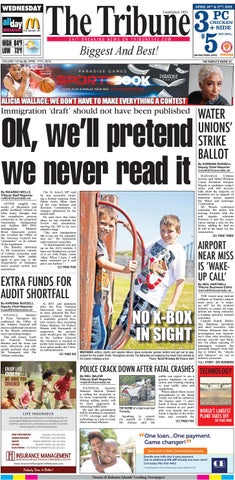
OK, we’ll pretend we never read it
By RICARDO WELLS Tribune Staff Reporter rwells@tribunemedia.net
AFTER roughly two weeks of discussion and public feedback related to what many thought was the consultative process connected to the proposed Nationality, Immigration and Asylum Bill 2018, Immigration Minister Brent Symonette yesterday revealed the Office of the Attorney General was “premature” in its release of the legislation. The blunder, disclosed by Mr Symonette outside of Cabinet yesterday, now tentatively halts public input to give way to the Department of Immigration’s needed review and assessment.
The St Anne’s MP said he was presently awaiting a formal response from Dame Anita Allen, chair of the Law Reform and Revision Commission, to changes submitted by his senior staff. He said once this takes place, he can conclude his review and assessment, moving the bill to its consultative stage. “The new immigration bill is not out for consultation yet,” Mr Symonette told reporters yesterday. “It unfortunately was put up on the AG’s website. I have not finished my review of it yet with Dame Anita Allen. When I have, I will make comment on it and put it out further.” SEE PAGE FIVE
FINANCE Minister K Peter Turnquest has confirmed the Office of the Auditor General will receive additional resources in the Minnis administration’s upcoming budget. This will ensure Auditor General Terrence Bastian and his team can more effectively and efficiently perform their jobs, Mr Turnquest told The Tribune yesterday.
In 2017, just moments after the Free National Movement was declared to have defeated the Progressive Liberal Party in a landslide general election victory, then incoming Prime Minister Dr Hubert Minnis told thousands of supporters his government would give the Office of the Auditor General the resources it needed to probe how taxpayer dollars were spent under the Christie administration. SEE PAGE SIX
By KHRISNA RUSSELL Deputy Chief Reporter krussell@tribunemedia.net
BAHAMAS Utilities Service and Allied Workers Union President Dwayne Woods is confident today’s strike poll will successfully show the majority of members are in support of industrial action against the Water and Sewerage Corporation. Mr Woods confirmed yesterday the union was moving forward with the poll despite relations between it and the corporation taking a turn for the better, adding he had no ill will in his heart for the corporation. SEE PAGE THREE
AIRPORT NEAR MISS IS ‘WAKEUP CALL’
EXTRA FUNDS FOR AUDIT SHORTFALL By KHRISNA RUSSELL Deputy Chief Reporter krussell@tribunemedia.net
WATER UNIONS’ STRIKE BALLOT
By NEIL HARTNELL Tribune Business Editor nhartnell@tribunemedia.net
NO X-BOX IN SIGHT BROTHERS Jeffery (right) and Jayden Albury leave computer games behind and get out to play, excited for the Easter break. Youngsters across The Bahamas are enjoying the break from school as the Easter holidays arrive. Photo: Terrel W Carey Sr/Tribune Staff
THE recent near mid-air collision at Nassau’s airport must serve as “a wakeup call” for the aviation industry to ensure all regulations are being enforced, a leading operator warned yesterday. Captain Randy Butler, Sky Bahamas president and chief executive, told Tribune Business that the investigation into September’s close miss involving a private aircraft and Western Air plane carrying 25 passengers exposed the potential dangers from failing to follow the “checks and balances” set out in industry processes. FULL STORY - SEE BUSINESS
POLICE CRACK DOWN AFTER FATAL CRASHES TECHNOLOGY By RIEL MAJOR Tribune Staff Reporter rmajor@tribunemedia.net
NATIONAL Security Minister Marvin Dames is calling for motorists to be more responsible when driving adding police will be more aggressive in enforcing traffic laws. He said the government will be investing in expanded CCTV coverage and other technology as a way to crack down on road offences.
THE SCENE of a fatal crash last Thursday. Speaking to reporters outside of Cabinet, Mr Dames said the
public can expect to see a greater emphasis on education and training relating to road traffic rules and regulations. When asked when recent amendments to the Road Traffic Act will be enforced, Mr Dames said: “I don’t know if those would have been enacted as yet, probably very shortly but you know, it speaks to the wider issue and certainly the
Nassau & Bahama Islands’ Leading Newspaper
SEE PAGE FIVE
WORLD’S LARGEST PLANE TAKES OFF
SEE PAGE NINE
PAGE 2, Wednesday, April 17, 2019
THE TRIBUNE
Blossoming Stars
THE BAHAMAS All Stars Marching Band took part in the Cherry Blossom Festival Parade on Saturday in Washington DC. The All Stars were the only international band to be invited to this year’s parade. Photos: Felipe Major
THE TRIBUNE
Wednesday, April 17, 2019, PAGE 3
Water unions’ strike ballot
‘PLEASE HELP KENNIYHA GET BRAIN SURGERY SHE NEEDS’ By RIEL MAJOR Tribune Staff Reporter rmajor@tribunemedia.net A DISTRAUGHT father struggling to raise funds to airlift his daughter to the United States for emergency brain surgery has made an emotional plea to the public for financial assistance. Kenton Rolle is the father of nine-year-old Kenniyha Rolle who was rushed to hospital last week after she experienced symptoms of a stroke. Unfortunately, his daughter’s medical bills are $100,000 and she doesn’t have any medical insurance. “Last Wednesday the school called me to pick her up because she wasn’t feeling good,” Mr Rolle said. “When my wife took her to PMH, she did a scan and that’s when we discovered she had a brain tumour. They released some of the fluid out of her head to relieve
from page one
KENNIYHA Rolle some of the pressure.” Mr Rolle said an MRI scan showed his daughter has a tumour that required immediate removal. “She is currently in the Intensive Care Unit. Sunday, the doctors took the tube out of her throat because she was feeding through the tube
and they removed the drips from her hand. Now she can talk and is doing good.” Mr Rolle said his family is in dire need of financial assistance. Anyone who wants to lend support or offer donations can contact Kenniyha’s parents at 242-436-8676 or 242-426-3663.
$1,500 FINES FOR OVERSTAYING By NICO SCAVELLA Tribune Staff Reporter nscavella@tribunemedia.net
TWO Jamaican cousins were fined over $1,000 each for overstaying in The Bahamas by almost a month, after having secured fake immigration time extension stamps to remain in the country. Delano Jordan and Khalfani Robb were both fined $1,500 by Magistrate Samuel McKinney for admitting to being caught with fake immigration stamps a local friend got for them. Immigration officials said both men were arrested at the My Three Daughters restaurant in Bimini on April 11. They were landed legally on March 1 for two weeks, and later received an extension but they did not leave the country at the specified time. Robb told the court he and his cousin sought assistance from a local friend in securing new time extension stamps, despite
knowing the correct procedure and utilising it to obtain their first extensions. However, Robb claimed he and his cousin had no idea the stamps were fake, and only realised as much when immigration and police officers stormed the room they were in and pointed the discrepancies out to them. Nonetheless, they both admitted it was a “stupid mistake” to have placed so much “confidence” in their friend as opposed to just securing the extensions the proper way. Meanwhile, Trinidad & Tobago native Sudesh Sonnylal was fined $1,500 or otherwise serve three months in prison for overstaying by three months and 11 days. Prosecutors said Sonnylal was caught on April 12 at a residence in the Grove area by Royal Bahamas Police Force (RBPF) officers. He landed legally in the in the Bahamas on December 25 of last year, but was not granted any further
extensions by immigration officials. A Haitian man, Pierre St Louis, was also fined $300 or will otherwise serve one month in prison for admitting to being caught having entered the country illegally. According to the facts, St Louis was arrested by police officers during a traffic stop in Governor’s Harbour, Eleuthera. He was turned over to immigration officials, who, upon checking their database, found no application for legal status on St Louis’ behalf. St Louis, meanwhile, said he doesn’t have any family in The Bahamas, and was just “dropped off” in the country. He said he was headed to the United States for university. All four men are to be turned over to immigration authorities who will use their discretion as to whether any or all of them should remain in the country or be deported.
He said he was not concerned about the poll’s success as this was not his will, but the wish of employees who want action and not just promises. There are 318 people in BUSAWU and the majority of them would have to vote in favour of a strike in order for it to be considered a success. Union members in Nassau will vote at the corporation on University Drive from 9am to 4pm today. Others on islands where WSC offices are located will also vote as the same time. The Water and Sewerage Management Union (WSMU) is also holding a strike poll today. Last week, WSMU President Ednel Rolle said his organisation has four outstanding grievances with WSC. Yesterday, Labour Director John Pinder said it was never guaranteed that the strike poll would be permitted, adding it will take place only because of the intervention of Labour Minister Dion Foulkes. This is because Mr Rolle’s tenure as president of WSMU ended last month and he has not yet called an election. In such circumstances, Mr Pinder said, the only power unions have according to the Industrial Relations Act is to call an election. “That’s the only power they have,” he said, “but I was instructed by my minister to conduct the polls as a show of goodwill and good faith.”
MAN GUILTY OF WOODS ALLEY KILLING By NICO SCAVELLA Tribune Staff Reporter nscavella@tribunemedia.net
JAHMARO “Bingy” Edgecombe is guilty of murdering Kenyari Lightbourne in his Woods Alley neighbourhood three years ago, a Supreme Court jury unanimously found yesterday. However, Edgecombe was unanimously acquitted of conspiring with others to commit the murder. Sean “Fire” Brown, meanwhile, was unanimously acquitted of the role the Crown said he played in the plot, that he paid Edgecombe $6,000 for killing Lightbourne on the orders of a third person, Daran Neely. Justice Cheryl GrantThompson will sentence Edgecombe on June 11. On June 21, 2016, Lightbourne was shot multiple times while walking through his neighbourhood off Market Street. He died at the scene. Neely and Edgecombe were arraigned within months of each other in 2016 in connection with Lightbourne’s death. Brown was charged with being an accessory after the fact. Evidence was previously led that Edgecombe killed Lightbourne not only in furtherance of a murder plot the Crown claimed was hatched by Neely, but because he and the deceased were gang rivals. The jury watched a video in which Edgecombe admitted to killing Lightbourne because of his affiliation with the Mad Ass gang when initially interviewed by then Detective Constable Raphael Miller just three weeks after the incident.
JAHMARO EDGECOMBE During that interview, Edgecombe said he was after Lightbourne and several other affiliates of the Mad Ass gang, namely “Spider”, “Eyes”, and “Kadi”, with the promise that he could be paid $8,000 for killing any of them. Lightbourne ended up being the one he shot and killed that day. Edgecombe said on the morning of June 21, 2016, he was “looking for affiliates” of Lightbourne and the Mad Ass street gang and that he was in the area to “take out a hit”. When asked to specify what he meant by taking out a hit, Edgecombe replied: “To commit a murder that I would be paid for.” He said on that morning, he saw both Lightbourne and “Eyes”, the latter was near an abandoned building while Lightbourne was on Market Street walking through Woods Alley. Edgecombe agreed with assertions from DC Miller that when he saw both men, he was hiding through a shortcut. Edgecombe said when he saw Lightbourne, he did not call out his name to get his attention. Instead,
Edgecombe said he simply approached Lightbourne and shot him three times with a chrome 40-caliber handgun. Afterwards, he said he ran onto Baillou Hill Road and caught a bus into the Pinewood area so he could “get paid”. The gun he used was on his waist during his entire commute from the Woods Alley area to Pinewood, Edgecombe admitted. He said he ultimately sold it to a guy from the Chippingham area who goes by the name of “Mob”. Edgecombe also told the officer that Neely was the one who authorised the hit on Lightbourne’s life some days before the actual murder, and that it was Neely who sent Brown to pay him the $6,000 for successfully executing the crime. And after killing Lightbourne and cashing in on his reward, Edgecombe told police he “paid off some bills” with the blood money and distributed the rest to family members. However, Justice GrantThompson instructed the jury to acquit Neely following submissions by his attorneys that he had no case to answer. Subsequent to that, Edgecombe, taking the witness stand in his own defence, said officers squeezed his testicles and suffocated him with a plastic bag to get him to confess to killing Lightbourne. However, Edgecombe said the officers who threatened and manhandled him told him they didn’t really want him; they were more interested in him implicating the “big fish”, namely Brown and Neely. And for that reason, he said, officers forcibly
instructed him on what to say during his record of interview, and also instructed him on what to do and say when they would ultimately record a video of him showing them exactly where and how he allegedly committed the crime. Edgecombe also said officers tried to use allegations that he shot at the police prior to Lightbourne’s death as leverage in the situation by saying they would drop those charges against him if he cooperated with their scheme. During his closing submissions, Edgecombe’s attorney David Cash told jurors that accepting the Crown’s claims that his client admitted to killing Lightbourne would be like putting a “stamp of approval” on police savagery. And without Edgecombe’s confession to police, which he asserted is “tainted with brutality and torture”, Mr Cash said the Crown’s evidence against his client consequently amounted to “nothing”. However, lead Crown prosecutor Racquel Whymms encouraged jurors not to “buy into” Edgecombe’s “performance”, suggesting that it was likely a by-product of his experience in prison, which she asserted is an institution of higher learning for criminality in which accused persons discuss ways and tactics to get off criminal charges. Al-Leecia Delancy was the next Crown attorney on record. Nathan Smith represented Brown. Wayne Munroe, QC and Jomo Campbell represented Neely.
Mr Pinder said if Mr Rolle does not set a date for union elections in short order, he will intervene and set the date himself. Meanwhile, Mr Woods told this newspaper that “the people” asked for a strike poll. “This ain’t my wish,” Mr Woods said. “This is the wish of the people. So any time you doing the wishes of the people it is what it is. Only when you pushing your own agenda you have to be concerned about that. I have no qualms about it that it will pass.” Asked about the relationship between the union and corporation, Mr Woods said the most recent meeting with WSC Executive Chairman Adrian Gibson was amicable. This comes just two weeks after tensions flared between Mr Woods and Mr Gibson. The Long Island MP announced he instructed his attorney to sue the union chief for defamation relating to untrue statements made about him by Mr Woods. Mr Gibson had also doubled down on accusations that workers at the utility provider illegally shut off water supply to parts of New Providence and sabotaged WSC property. Mr Gibson told the House of Assembly at the
time that any employee found to have tampered with the water supply would be “summarily dismissed and referred to the police”. Mr Woods said yesterday: “My thing is there is no bad blood on behalf of the union and the last meeting we had with the executive chairman, like I say, we left there shaking hands and talking so that’s a good sign. “I can’t lie and say we parted on bad terms. We didn’t, but that doesn’t mean that the union’s strike vote isn’t inevitable. “The union has to continue on the road that it’s on until we can see things change within itself. The relationship is getting better, but that doesn’t mean that the wishes of the people won’t be honoured. “I can’t stop proceeding unless I see the expectations that is expected of the people is being met so the relationship and what is actually happening are two different things. “So I don’t have ill-will in my heart for the corporation. The relationship is to a point where we are communicating.” He continued: “Now the results of that communication is what determines the actions of the people not the relationship, results is what needs to be placed on the table moving forward.”
PAGE 4, Wednesday, April 17, 2019
THE TRIBUNE
The Tribune Limited NULLIUS ADDICTUS JURARE IN VERBA MAGISTRI “Being Bound to Swear to The Dogmas of No Master”
LEON E. H. DUPUCH,
SIR ETIENNE DUPUCH,
jamaaltheartist@gmail.com
Publisher/Editor 1903-1914 Kt., O.B.E., K.M., K.C.S.G., (Hon.) LL.D., D.Litt .
Publisher/Editor 1919-1972 Contributing Editor 1972-1991
EILEEN DUPUCH CARRON,
C.M.G., M.S., B.A., LL.B. Publisher/Editor 1972-
Published daily Monday to Friday
Shirley & Deveaux Streets, Nassau, Bahamas N3207 TELEPHONES
News & General Information Advertising Manager Circulation Department Nassau fax Freeport, Grand Bahama Freeport fax
(242) 322-1986 (242) 502-2394 (242) 502-2386 (242) 328-2398 (242)-352-6608 (242) 352-9348
WEBSITE, TWITTER & FACEBOOK www.tribune242.com
@tribune242
tribune news network
A lie has speed, the truth has endurance GOSSIP got out of hand, it seems, at SC McPherson last week. It all started with the tragic death of Robert Valcom Jr, who collapsed at a Dairy Queen two weekends ago. He was only 15-years-old, and his death could and should have been enough to talk about on its own. It is a truly sad moment, leaving a family in mourning. At such a time, the community who knew him should be reaching out to the family to offer support, to show they share the pain of his loss – and yet, instead we have mischief makers who seem to have little thought for the family and their grief. It appears some students, rather than contacting the family and asking what could they do to help, decided it would be better to start a rumour. They spread the word that Robert died because a teacher denied him medication during a Saturday class. It’s not true. Let us be clear about that. His own mother said her son didn’t take any medication, while his father bemoans “people here making chaos and making this what it isn’t and they ain’ feeling the pain that I am feeling”. Sadly, one half of an old saying, about a lie having speed, has proven to be true. Rather than question whether the rumour was true, it led to a wave of vile behaviour on the campus of SC McPherson School. Teachers have been threatened, profanity has been chanted throughout the school, classrooms have been vandalised, graffiti plastered on school walls and teachers’ belongings have been stolen, says the vice-president of the Bahamas Union of Teachers, Vernon Rodgers. One teacher even had a student sneak up behind her and cut off some of her hair, said Mr Rodgers, while another had a bottle of water thrown at her chest. He also said two “outsiders” came onto the school compound armed with a weapon looking for the teacher they said “killed the student”. In such an atmosphere, it is sad to see that teachers felt the need to walk out until the matter can be resolved, much to the displeasure of Minister of Education Jeff Lloyd, who yesterday denounced such a move. Before he denounced the teachers’ actions, however, his first step was to reiterate that the rumour was false, and no teacher was empowered to administer or withhold medication. It is perhaps a blessing that we are now on mid-term break so tempers can cool – but we must make sure that we
do not rely on crossed fingers that things will return to normal. Let us return to that old saying. A lie has speed, but truth has endurance. It must be made very clear to students that not only is this behaviour based on a false rumour, but that it is also hurting the very family the students purport to be acting out on behalf of. Robert’s family would not want teachers to be threatened and assaulted based on a lie about their son’s death. He deserves better treatment by those who would call themselves his classmates and colleagues. For those who damaged property, who initiated such abuse, we would hope they would feel shame at their actions, knowing they had acted on a lie. And in all of this, we would hope the rest of The Bahamas can learn a lesson too. Too often, stories based on unreliable rumours sweep around the social networks and gossip sites of this country. Perhaps look at this moment and next time someone sends you an unverified WhatsApp or a suspicious Facebook meme, think twice and check it before you share it. And to those who think it’s fun to start such rumours? Don’t. You’re helping no one. There are enough real problems in this country that need to be dealt with. No one should have to waste time and resources dealing with fake ones.
False start
So after weeks of reaction to the FNM’s plans for a Nationality, Immigration and Asylum Bill, out comes Immigration Minister Brent Symonette to say wait, hold up, we didn’t mean for you to see that. He says the document was put up prematurely on the Attorney General’s website. Well, that may explain a technical blunder, but it doesn’t explain the Attorney General himself coming out to discuss the implications of the bill. It doesn’t explain PLP leader Philip ‘Brave’ Davis standing up to weigh in on the proposals, because clearly no one from the government had reached out to him to explain the gaffe. So what are we supposed to do? Pretend we never saw it? Pretend these aren’t actually proposals being considered by the government? And if people affected by the proposals were confused before, where are they left to stand now? Come on, government, get your act together.
Support middle class EDITOR, The Tribune. PRIME Minister Minnis and his FNM government won the election in May, 2017 on the theme of the election – “It’s the People’s Time”. Let me say at the outset that I supported PM Minnis and his FNM Team. I am very concerned, but not given up on them. They have made a decision that does not support the middle class and challenged families. The Minnis-led FNM government, to my surprise and utter dismay passed what is commonly referred to as the “Credit Bureau Act”. I understand the view of the governor of the Central Bank who wholeheartedly supports this Act. I also understand that the Banks support the Act too. But, what about the people? Who will be assisted by the Act? Surely, middle class families, the near-poor and poor, will not be aided by this Act in any way. Let’s say for arguments sake that, it is a good idea for The Bahamas to have a credit bureau, it is without question not the time for it, at least in terms of the middle class, near-poor and poor in our country today.
It has only been a couple of years ago, that we experienced the great depression, (not seen in the world since 1929) in this country. While the worst effects of it were experienced in the US in 2008 and 2009 and somewhat 2010, we, in The Bahamas, did not really begin to feel the drastic negative effects until 2011 earliest. That means that, the US came out of the worst of it earlier and we have not really gotten out of the effects of it as yet! Middle class families and the near-poor (who are desperately struggling daily to join the middle class) would be set back like we have never seen - the set-back would indeed be unprecedented, and for whose benefit? Certainly not the most important group in any society that contributes more than any other to economic growth, vitality, energy and by most accounts, worldwide, a real barometer as to how well a country and its people are doing across-theboard or broadly speaking. To implement a credit bureau when Bahamian families for the most part, with few exceptions,
probably would have a poor re-payment record with most of their creditors, especially mortgages, personal loans, credit cards and let us not forget utility bills (they too will be tracked and considered to arrive at your score) would be ruinous for most middle class families and those, right now, daily, struggling to achieve that standard of living, as they should, and we ought to applaud them and assist them wherever and whenever possible rather than place monstrous road-blocks and obstacles in their way. Lastly, perhaps PM Minnis and his FNM government, if for no other reason, would realise that for the party to win the next general election, (just 37 months away), as it always has, it will need the middle class and the very same people who are desirous of achieving that standard of living and doing all that they can for their families, their children, to achieve it, struggling every day – as the young people say – “the struggle is real”! UNIVERSALIST Nassau, April 12, 2019.
Rupert Roberts must evolve EDITOR, The Tribune. KING Canute was simultaneously ruler of England, Denmark and Norway from 1016 to 1035. He became famous, rightly or wrongly, as the ruler who stood on the sea-shore and tried but failed to hold back the tide. Rupert Roberts is a successful Bahamian grocer who had his own King Canute moment recently. Sadly, he damaged his reputation in what will be a failed attempt to stop the tide of globalism reaching our shores. Roberts is a likeable curmudgeon whose legacy and loyalty to his country is beyond reproach. His supermarkets are a testament to Bahamianisation, be it in the boardroom, the stockroom, the cashier’s pit or the scrum of young people eager to pack grocery bags and assist shoppers to their cars. But the years have revealed him to be an obdurate old man, fearful of change and now resentful of competition. In other words, he is comfortable being a near-monopolistic oligarch and chief lord of the supermarket business. His Super Value stores gobbled up the City Market chain when the latter ended their epic battle for supermarket supremacy. Since then a host of Bahamian grocers have entered the marketplace. Mr Roberts didn’t much like VAT, he isn’t a fan of the amorous goings-on in the stockrooms of his stores that result in maternity claims that impact his employee insurance rates, and he certainly has a bone to pick with the web-shop operators who he claimed are eating into his supermarkets’ profit margins. What he does have in common with the webshops is that they both cater to the poor and the vulnerable. Roberts because they have to eat and the webshops because they still harbour dreams of changing their circumstances by sheer luck. Mr Roberts likes to wrap himself in the flag by saying his campaign is about saving the nation more than it is about protecting his market share. Get rid of VAT and the
LETTERS letters@tribunemedia.net web-shops, his thinking goes, and people will have more cash left over after their weekly grocery shopping to spend on school fees, light bills and the like. Mr Roberts pulled the scab off his old wounds recently by announcing that he had set his cap against the Bahamas joining the World Trade Organisation (WTO) and no amount of academic fact or common sense would get him to change his mind. Leave well enough alone, he says to the Treasury. Start flirting with the WTO and pretty soon we will be overrun with foreign workers and, lo and behold, pesky foreign investors who might want to open a food store to compete with his empire. It probably came as news to our WTO negotiators that free movement of labour is a part of the agenda. What is on the table is the drastic reduction of customs duty, a process the government has already started. This is supposed to lead to a lowering of costs in the shops but because it came with the introduction of VAT, some merchants (not accusing Roberts of this) have not been passing on these savings to shoppers. If a 35% custom’s duty is reduced to 10% and is accompanied by a 12% VAT then the total tax burden becomes 22%, which is still a whopping 13% savings for the consumer. Roberts seems to have an unhealthy fear of foreign competition. But he has proven himself a worthy competitor to foreigners. In 1967 the Winn Dixie chain out of Florida bought into City Markets. In Freeport they even traded under their own name, WinnDixie. W-D Bahamas Limited operated until 2006 when it was purchased by a Bahamian family better known for selling liquor than grocery. The head of the team negotiating our ascension to the WTO offered Mr Roberts assurances that the grocery business would
remain in Bahamian hands but that was apparently of little comfort to the crotchety old merchant. Mr Roberts should be more interested in modernising his stores and if that means partnering with a foreign supermarket chain to drive down his costs, then so much the better for consumers. Besides, the last time a Bahamian grocer had a US partner we got a side benefit called the City Market/ Bahamas Supermarkets Scholarship programme which educated many Bahamian college students. In the US, large grocery chains such as Kroger and Publix are having to contend with the encroachment by behemoths like Walmart and Amazon onto their turf. Despite our proximity to Florida we are still light years behind in making food shopping a pleasure and it’s no coincidence that some merchants hide behind the smoke screen of customs duties and VAT as reasons why they still charge high prices. A cursory check with the Customs Department shows so many of what the supermarkets stock as being both free of duty and free of VAT that it is mindboggling to understand why prices keep going up while the store owners keep crying poor mouth. Rice, sardines, flour, bread, cereals, deli meats, grits, juices, pasta and tuna are among a long list of items that can be imported duty free and are zero rated for VAT purposes. Yet they continue to sell here at prices that are often more than three times the Miami retail price. If Mr Roberts really wanted to win hearts and minds, he should concentrate less on bashing the WTO and more on lobbying the government to put even more of life’s necessities on the duty free/VAT free list. And instead of being an old fuddy-duddy, he should learn to accept globalism as a force for the betterment of all our lives. A little change can be good, King Rupert. THE GRADUATE Nassau, April 16, 2019
THE TRIBUNE
Wednesday, April 17, 2019, PAGE 5
Immigration ‘draft’ should not have been published from page one “The premature release of it has resulted in some comments, which have been noted, but that was the idea of the consultation; that the bill would be prepared, it would be presented like I did the Arbitration Bill and go out for wide consultation, come back after possibly the summer break and take another look at it. “Unfortunately, it got up on the AG’s website prematurely.” The Nationality, Immigration and Asylum Bill 2018 - which features expanded grounds for the refusal of citizenship under the constitution, and registration and naturalisation under the law to include terrorism, human and drug trafficking, as well as gangrelated activities — has drawn commentary from both the political and civic arenas. Earlier this month, prominent immigration rights attorney Fred Smith, QC, announced his opposition to a provision in the bill that would prevent people born in The Bahamas to nonBahamians from becoming citizens if they miss the
BRENT Symonette. Minister of Financial Services, Trade and Industry and Immigration. constitutional window for said he had received cer- that will grant children born tain assurances from Dame to Bahamians outside of application. In the following days, Anita that the version of The Bahamas to non-BahaOpposition Leader Philip the bill in the public domain mian parents the right to “Brave” Davis made head- is not set in stone, leaving Bahamian citizenship. lines when he indicated that room for changes. The process has been a Meanwhile, for his part spot of contention for years his party would offer several recommendations to yesterday, Mr Symonette in The Bahamas, being the government related to applauded the Law Reform most recently rejected as and Revision Commission a part of the 2016 gender the bill. Mr Davis at the time for its inclusion of clauses equality referendum.
Addressing the rejection yesterday, Mr Symonette said he was “surprised” that Bahamian women haven’t picked up on the inclusion and come out in support of it. “I am constantly amazed that the people of The Bahamas turned that referendum issue down because in my daily life, I am bombarded with that on daily basis and quite often I bring to Cabinet the papers that make those people Bahamian,” he said. The Nationality, Immigration and Asylum Bill 2018 as proposed, further seeks to address areas of the constitution relating to what happens to people born post-independence to two non-Bahamian parents before their 18th birthday and after their 19th birthday; and those born outside of The Bahamas to a Bahamian mother before their 18th birthday and after their 21st birthday. These issues are derived primarily from articles 7 and 9 of the constitution; but aren’t addressed therein or by later amendments. The bill will grant individuals in both these categories — born outside of The Bahamas to a Bahamian mother and born
inside the Bahamas to two non-Bahamian parents — the “right of abode” or the right to live in The Bahamas while a minor, up to the age of 18. In the case of those children born to two nonBahamian parents, they will be given an opportunity to apply for a resident belonger’s permit if they are in the custody and care of a parent or guardian who has the right to live in The Bahamas. Additionally, this classification of person will now have a right to legally live and work in The Bahamas up to the time they apply to be registered as a Bahamian citizen and while that application is being processed and/or appealed. The new bill will also establish that these people lose their constitutional right to be registered as Bahamians after their 21st birthday. Those whose time to apply to be registered has already expired, would be given six months from the date on the bill’s passage to apply for some form of status — naturalisation, permanent residency, etcetera — or face jail time or deportation.
POLICE CRACK CHANCE TO LEAD FOR YOUNG OFFICERS DOWN AFTER FATAL CRASHES By RICARDO WELLS Tribune Staff Reporter rwells@tribunemedia.net
from page one
police have been having these discussions and working with other groups to look at, there are any number of components here, you can create all the laws in the world that you want to.” He added: “This island is seven miles wide, by 21 miles long; we probably have move vehicles per capita than anywhere. (We are) working closely with the Road Traffic Department, you can expect to see, and you are seeing it because the police are writing hundreds and hundreds of fixed penalties (tickets) every week. “You are going to see public education. As I have said, that is one of the commissioner’s threads, that’s one of his key planks for this year in his plan which I will be laying in Parliament next week, as the focus on traffic related accidents and deaths.” Mr Dames encouraged motorists to always be considerate of other drivers when on the road. “I mean you can’t want to go from (the Churchill Building) to Scotiabank and want to push the gas pedal through the floor. There is no room for that in this country,” said Mr Dames. “But after having said that, the police have acquired new technology in the way of these new more modern speed guns. You can expect, and I’ve been seeing, more officers up and about. They will certainly use the statistics to drive how they do their business. “But as you can see, we’ve been having these incidents (in other) islands which is certainly a challenge as well, and I was in Abaco last week and there were road checks. But at the end of the day, the responsibility is with the driver and there will be a greater level of enforcement (and) the
use of technology.” The minister said there have been talks about modern speed guns and the request for proposals for more closed-circuit televisions should be going to Cabinet for discussions. “(That) is bringing on an additional 500 cameras to the complement, and these cameras are five pixel cameras…These cameras have the ability to read licence plates, they will be equipped with analytical software and so, this government is investing heavily. “And you will see these cameras in main thoroughfares, and we have to tighten-up on working towards keeping our streets safe for all.” Changes to the Road Traffic Act meant to save lives were passed in the House of Assembly last month. Transport and Local Government Minister Renward Wells told the House before the passing of the amendments that the government hoped to disrupt increasing traffic fatalities, which are now ranked among the common causes of death in the country. The amendments will criminalise both the use of phones while driving and driving with an open alcoholic beverage. Motorists will also immediately have to produce proof of insurance and a driver’s licence upon the request of a police officer. The changes also require the payment of outstanding traffic offence fines before renewing a driver’s licence. Driving instructors will further be prohibited from holding electronic devices under the bill but the stipulation will not apply to those driving emergency vehicles or a vehicle that is lawfully parked and not impeding traffic. The changes have yet to be enacted.
To advertise in The Tribune, contact 502-2394
NATIONAL Security Minister Marvin Dames yesterday touted his ministry’s multi-agency “succession planning model,” declaring the scheme will guarantee “young and ambitious and capable” officers a chance to lead. Mr Dames’ comments came outside of Cabinet yesterday, where he told reporters the model has been effective in aiding the decisions around the recent restructuring of both the Royal Bahamas Police Force and Royal Bahamas Defence Force. He also said the model will play a role in the upcoming structuring of the Department of Correctional Services’ new executive team. “We are in the business of putting the right persons, the most competent persons, in these positions and we make no apologies for it,” the Mount Moriah MP said. In line with this, Mr Dames yesterday revealed the vacant substantive post of deputy commissioner of police will only be filled in an acting capacity until outgoing Deputy Commissioner of Police Emrick Seymour concludes his pre-retirement vacation leave. He also noted that newly appointed Commissioner of Corrections Charles Murphy would hold his post for a period of four years due to his age. Mr Dames said both scenarios would be addressed by the succession plan. Mr Dames scoffed at the notion that the work of the RBPF was impeded by the move to direct several senior officers with accrued vacation leave to
take that time off — a move he said had to be made to protect the public from having to pay scores of officers for owed leave all at once. He implored the public to look at the bigger picture, insisting the country move in a direction where these agencies can operate no matter who is out. “These agencies ought to be able to function regardless as to who is sitting where,” he said. “We said from the onset that we are committed to putting in place a succession planning model that will serve these agencies well. (A model) that will allow young and ambitious, and capable persons an opportunity for the future. “This happens anywhere. This is human resource management 101. You have to allow for growth within agencies, by that, it means that when people’s time comes up for retirement, they must be prepared to leave. “On the flip side of that,” he said, “I believe, as any good government would do and as good governance calls for, as that we have an obligation to ensure that we prepare our people for retirement. And I think that is something that we have not done well in this country. It sneaks up on people. When we say it’s time to go, we need to do a better job of preparing our people for retirement.” He continued: “The deputy commissioner, the substantive position is still there. The deputy commissioner is currently on pre-retirement and so, as is often the case, (when) the commissioner leaves town he will make an appointment for a someone to act as commissioner. “If the deputy commissioner is out
of town, then the commissioner can make a request or application for somebody to serve as deputy commissioner; that’s his prerogative as commissioner of police. So I assume that somebody very shortly will be designated deputy commissioner of police and that’s how it works. “It has been working. I mean we’ve been doing it… it happens if the commissioner travels, the deputy commissioner is out of the country it happens. And in this case, the deputy commissioner is currently on preretirement leave, so the commissioner will make application and there will be an acting deputy in place until the substantive position is made vacant,” he said. As it relates to the tenure of the new corrections commissioner, Mr Dames noted: “There are no concerns. He has at least four years remaining. We have a plan. There is a succession planning model for all of these agencies that we have created and it gives us an opportunity to put a young, competent, capable executive team around him to which we will be working to achieve very shortly.” Mr Dames said advertisements for those posts are forthcoming. He also brushed off criticism from the Progressive Liberal Party about Commissioner Murphy’s appointment. The PLP has said the party does not support the appointment and that two women who were qualified were passed over for the job. Mr Dames blasted the critiques as “political mischief,” insisting the Official Opposition was interfering in the general management and running of various law enforcement agencies.
PAGE 6, Wednesday, April 17, 2019
THE TRIBUNE
Extra funds for audit shortfall from page one His pledge was solidified by another declaration to allow the law to take its course if there was evidence of “criminality”. Asked specifically about the prime minister’s nearly two-year-old promise, Mr Turnquest said: “Year on year the office received extra allowance.” However, he said this was not specific to the prime minister’s comments. He later confirmed the office would receive additional resources “so that they can perform their jobs effectively and efficiently”. Mr Bastian admitted to The Tribune a week ago his office did not have sufficient manpower. He has also suggested to Tribune Business that the government should implement a real-time, integrated financial management system — covering the entire public sector —as a way to boost accountability in the way it manages the
people’s money. Mr Bastian said: “We are definitely understaffed, we could triple our staff today and get more done. But I don’t know if I want to use the word lack of confidence, maybe certain people may have a lack of confidence but my workers don’t have a lack of confidence. We are confident in the work that we do. “I believe my report speaks for itself. “I’m not defending the facts, the facts speak for itself.” These comments came as he defended his office in the face of criticisms levelled by the Official Opposition, sparked by findings of an audit into the operations of the National Sports Authority under the former Christie administration. Mr Bastian did not directly address accusations levelled by the Progressive Liberal Party and former Sports Minister Dr Danny Johnson, but expressed full confidence in the work conducted by his department.
Acknowledging it was not the first time an audit report has faced criticism in recent years, Mr Bastian said he longs for a time when the work of his department would be viewed impartially as the law intended. “I try not to make statements that will create issues and tensions,” Mr Bastian said. “That’s why I write the facts. I don’t go no further than that. It’s always when you write it, someone may think it’s a political statement but if it’s a fact then it can’t be political. I write what we find and if we are wrong then I’d be the first person to admit that we were wrong.” He continued: “Hopefully the day will come when whether it’s the FNM, or the PLP, or the DNA, that these reports will not be taken as political. My job is not to make any political statement. We don’t do that, my job is to be a public trust and let the public know our findings. I don’t write my opinion, I write the facts simple.”
The NSA audit tabled two weeks ago in the House of Assembly covered the operations of the authority from July 2011 to December 2017 and revealed the authority’s financial allocation increased by more than $3.3m during the most recent election fiscal year. It found that one company received more than $1m in taxpayer funds, but did not complete any of ten deliverables promised to the NSA. Mr Bastian further highlighted irregularities in the payment of employees, an “unusual” handling of petty cash, and stated the organisation’s accounting practises had apparent weaknesses and did not fully comply with regulations. In its wake, Dr Johnson suggested the department did not do a good job, insisting that “every penny” could be accounted for, and further made reference to a “petty, jaundiced, unprincipled, evil and destructive” agenda.
DEPUTY Prime Minister Peter Turnquest.
MAN ACCUSED OF INDECENT ASSAULT ON CO-WORKER By NICO SCAVELLA Tribune Staff Reporter nscavella@tribunemedia.net A WOMAN who claimed her Haitian co-worker
fondled only did so to avoid the “unnecessary drama” of her police boyfriend finding out she had caught a ride home with the accused and that they had stopped
at her former lover’s house along the way, an attorney asserted yesterday. Keevon Maynard told Magistrate Samuel McKinney that the “shame” of
being spotted at her exboyfriend’s house, with whom she admitted she was rumoured to be twotiming, was the genesis for her “bogus” story that his client, Loody Loriston, groped her instead of taking her home as she agreed. Mr Maynard further suggested that after Loriston was driven to her ex-boyfriend’s house by the accused, she was likely further incentivised to “concoct” the story in view of the fact that her boyfriend strictly prohibits her catching a ride home with strangers. Mr Maynard made the assertions while making his closing submissions in Loriston’s trial over allegations he promised to take his co-worker home, but took her somewhere else and indecently assaulted her on January 25. According to the evidence previously led, Loriston and the woman both work at Warwick Hotel on Paradise Island. Loriston said he started working there in December 2018, but said he has since been suspended due to his court matter. The woman had reported that on January 25, Loriston offered her a ride home. She said she accepted his offer because at that time of the year, dark falls quickly. She said earlier that day, Loriston had taken to a bank in Palmdale to run an errand. The woman said while driving to her home, the route Loriston took became concerning to her. She said Loriston drove through many corners that she thought were shortcuts at the time. Nonetheless, she said as she had been out of New Providence for six years, the turns made her somewhat disoriented. She said Loriston eventually brought his car to a stop in front of a residence in an area with which she was unfamiliar. She said when she asked him why they were there instead of at her residence on Market Street, Loriston did not answer, but instead fondled her. The woman said she was able to fight him off, and struck him numerous times in his face. She said when she was able to break free from his hold, she opened the car and ran away. She said she ended up at a stranger’s residence where she sought help from the person who lived there, who turned
out to be a police officer. Her boyfriend was subsequently contacted, who later took her to a police station where she filed a formal complaint. According to Magistrate McKinney, the officer from whom the woman got help confirmed her story. The woman officer said she heard the woman calling for help, but out of an abundance of caution did not open her door. Instead, the officer said she got a cell number from the woman, called that number and gave the person who answered certain information. Loriston was later arrested and charged with indecent assault. He, however, told a different story when he took the stand. He said around noon on the date in question, the woman asked him for a ride home once their shift had been completed at 5pm. He said the day before he had given her a ride over the Paradise Island Bridge to the bus stop. Loriston said when the woman asked him for a ride on the 25th, he said “okay”. He said when 5pm arrived, the woman came looking for him. When they both got into his car, she then asked him to do her an additional favour by taking her to a bank in the Mackey Street area, taking her back over to Paradise Island, before dropping her home. Loriston said he again consented. He said he took her to the bank, where she withdrew some funds, then took her back to Paradise Island for her to drop off the money. At some point, he said, the woman used his cellphone to call her cousin to get the money she withdrew. Afterwards, he said they left Paradise Island for the second and final time en route to her home. Loriston said as they were driving, he got a call from someone named Phillipson who asked him to pick up some money. Phillipson is the woman’s ex-boyfriend, who Loriston said also worked at Warwick Hotel covering the night shift. But based on Loriston’s evidence, the suggestion is she did not know it was Phillipson he was going to see. Nonetheless, Loriston said he asked the woman if she wanted to go along with him to Phillipson’s residence, or if she preferred to get out of the car at that point. He said she consented to going along.
Loriston said when he arrived at Phillipson’s place in the Mackey Street area, and when Phillipson walked out to greet him, the woman abruptly got out of the car and told him that if she knew Loriston was going to see her ex-boyfriend, she never would have gone with him and instead would have got off at the corner. Loriston also repeatedly insisted that the woman told him: “My boyfriend is a police, I’m a Bahamian, and you’re a Haitian. I will deal with that.” Yesterday, Mr Maynard said the woman’s actions and statements upon realising she was at Philipson’s house was a “clear indication” that they were her attempts to prevent herself from being said to have been caught in a compromising position. Mr Maynard also noted that the woman’s evidence was littered with “inconsistencies”, chief amongst which was the fact that although she claimed she struck Loriston numerous times in the face in a bid to get away from him, the officers who testified in the matter said they did not observe any facial injuries on Loriston whatsoever. He also noted that one officer testified how when he interviewed both parties, Loriston looked “tearyeyed, as if he wanted to cry”, while the woman looked “composed”, something he submitted was proof that the woman’s story was a “complete and total fabrication”. Mr Maynard thus noted that the case for Magistrate McKinney really boils down to a “he said, she said” situation, and that it would be up to him to determine whose story is more credible. However, Mr Maynard urged the magistrate to consider the testimony of the officer who said that there have been instances where false allegations of a similar nature were made against certain individuals that resulted in those persons being charged. Mr Maynard said that “straight across the board”, in both The Bahamas and internationally, there have been “numerous” instances where people have been falsely accused of similar offences and convicted. He urged the magistrate not to let the present case turn out to be one of those instances. Loriston will learn his fate on May 13.
THE TRIBUNE
Wednesday, April 17, 2019, PAGE 7
FLAMINGO GARDENS TO BE TENTH URBAN RENEWAL CENTRE
MINISTER of Social Services and Urban Development Frankie Campbell (left) inspects the building that will house the island’s tenth Urban Renewal Centre, at Flamingo Gardens Park. Also pictured (from left) are Corporal Gerard Butterfield; Pam Miller, operations manager, Urban Renewal Commission, and Sheryl Knowles, programmes and special projects coordinator, Urban Renewal Commission. Photo: Matt Maura/BIS
FLAMINGO Gardens is on schedule to become the tenth Urban Renewal location in New Providence. Minister of Social Services and Urban Development Frankie Campbell said officials at his ministry and the Urban Renewal Commission have received approval from Cabinet that will pave the way for the establishment of the centre at Flamingo Gardens Park. “The building is ready. We have the approval and there is no reason why activities won’t officially begin there within a reasonable timeframe,” Mr Campbell said. He toured the facility on Saturday while attending the Urban Renewal Commission’s Easter egg hunt/ fun day held at Flamingo Gardens Park – one of eight such events hosted by the commission in New Providence. “I think it is significant that this area has an Urban Renewal Centre that will cover the needs of the
residents of Carmichael and Southern Shores, when you take into consideration the geographic make-up of the two communities,” Mr Campbell said. The newest centre got its first volunteer on Saturday, when Gerard Butterfield, a corporal with the Royal Bahamas Police Force, volunteered his services. A former resident of the area whose mother and other family members still reside in Flamingo Gardens, Corporal Butterfield applauded the decision. He sons also participated in the Easter egg hunt. “Once I heard the news that Flamingo Gardens will be the newest Urban Renewal Centre in New Providence, I just had to volunteer my services free of charge, they do not have to give me a dollar. I want to do this for my neighbourhood. I may not live around here anymore, but I have many family members and friends and their children who still live here,” he said.
Minister unhappy after gossip leads to walkout by teachers By MORGAN ADDERLEY Tribune Staff Reporter madderley@tribunemedia.net EDUCATION Minister Jeff Lloyd has decried the demonstration by a small contingent of SC McPherson Junior High School teachers that occurred Friday morning, insisting this broke an industrial agreement with teachers and the public school system. Some teachers walked out of classes and vowed not to return until authorities get a handle on the conflict which erupted after a rumour about a teacher in aftermath of the tragic death of an SC McPherson student in Dairy Queen two weekends ago. Robert Valcom Jr, 15, collapsed and died at Dairy Queen’s Southwest Plaza location on April 6. Bahamas Union of Teachers area vice-president for New Providence Vernon Rodgers told The Tribune some students started a rumour that the boy died because a teacher denied him access to medication during an extracurricular Saturday class. Mr Lloyd, however, fervently denied this rumour to The Tribune, noting no teacher has the authority to administer or withhold medication. Mr Rodgers also said as the rumour spread, students began “threatening the teachers verbally, chanting profanity throughout the school, vandalising classrooms and stealing teachers’ personal items throughout the school.”
When contacted earlier this week, Mr Lloyd confirmed the Monday after the student died, “students began chanting or repeating a rumour that began that the teacher was responsible for the student’s death because the teacher did not provide the student with his, I presume, medicine. “First of all, that is not true,” Mr Lloyd emphasised. “The rumour is false. The teacher is not authorised - no teacher in the public school system of the Commonwealth of the Bahamas has the authority and will not administer medication to a student. The teacher is not a medical practitioner, the teacher is not medically trained, the teacher is not a medical diagnostician.” While extending condolences to the victim’s family, Mr Lloyd underscored the deceased teen was not even on campus on the Saturday in question. “So when the principal, having received word of this rumour, called in the student who they claimed (originated) this rumour, every student confirmed to the principal that the student was not on campus, that they never saw the teacher with medication… or that they knew of the teacher as having any right or authority to administer medication. So that matter is put to rest. It is false.” Mr Lloyd then addressed subsequent meetings between teachers and union officials, which he described as being in “clear violation of the industrial agreement”.
“It was further understood that the principal became aware of some emergency meeting on the school campus by teachers, called by a union shop steward,” Mr Lloyd said. “There is an article within the industrial agreement…which clearly states that any meeting desirous of being held by the union with its members, teachers, must receive permission from the principal, which was not done. “I am further advised by the principal that an area vice president, on the following morning of this meeting in question…shows up on the campus. And the principal was advised. And to the principal’s surprise, this person is having a meeting with her staff in the staff room.” Mr Lloyd added he has “no idea” what was discussed during the meetings. He said on Friday, approximately 20 teachers decided to walk out. He noted SC McPherson has a staff complement of about 100 — thereby stating only 1/5th of the staff population demonstrated while “80 percent of the teachers” continued to conduct classes. “So here is a teacher now, being threatened by a rumour that is started by someone that is clearly false. And a teacher’s life is potentially put in danger by some false rumour… And you get this kind of unfortunate incident when the school (and) students are dealing with the loss of their friend and colleague
MITCHELL WANTS WHOLE TRUTH ON REHIRING BY GOVERNMENT By RASHAD ROLLE Tribune Staff Reporter rrolle@tribunemedia.net PROGRESSIVE Liberal Party Chairman Fred Mitchell says Public Services Minister Brensil Rolle has not told the whole truth about the government’s rehiring processes. Last week, Mr Rolle told The Tribune the government has rehired a “large number” of people who were engaged from 2012 to 2017 and then fired by the Minnis administration. A Labour Force survey by the Department of Statistics estimated that 2,500 people had been fired by the Minnis administration up to November 2017. Mr Rolle has not said how many have been re-engaged. His admission was a surprising turnabout for an administration that came into office lambasting the hiring practices of the Christie administration
while vowing to right-size the civil service. In 2017, Prime Minister Dr Hubert Minnis implemented a hiring freeze on the government, one that was never officially lifted. Last week, Mr Mitchell called the administration “hypocritical”. In a new statement yesterday, he said: “Following upon the statement of the party on the weekend about the hypocrisy of the FNM public service minister’s statement about the rehiring of those disengaged who worked on contract, the PLP has been flooded with reports that the FNM minister has not been frank with the Bahamian people about the government’s rehiring practices.” He alleged: “The reports which come to us indicate that there has been a general purging of the public service through this process, in that, all people on contract were let go, and the practice is now
to re-engage only those that have been recommended by various FNM generals in constitutions in New Providence and throughout the Family Islands. “Administrators in the islands are being instructed to check the names of the rehires with various generals before the rehiring process takes place. “This will not only hurt and undermine the public service, it is corrupt... We again point out that the FNM government is rank with the discrimination which it practices against Bahamians who they suspect support the PLP. They ought to be careful before there is not a revolt for deliberately taking bread out of the mouths of Bahamian citizens for their political beliefs.” Attempts to reach Mr Rolle for comment on Mr Mitchell’s allegations were unsuccessful up to press time.
and comrade,” the South Beach MP said. Mr Lloyd also insisted there have been no attacks on teachers and that no teachers were threatened or accosted. He noted the reported incident involving students allegedly cutting a teacher’s hair is a separate matter, not connected to Robert’s death. He added this matter was reported to the principal and the girls in question were suspended. When asked why teachers demonstrated if no
instructors were threatened due to the rumour, Mr Lloyd replied: “Ask the teachers. And ask in particular the one who leads the demonstration. The person in question. Because it appears as if this particular individual, who would’ve been the (spokesperson) that person seem to have a particular objective or agenda. But I don’t know. But the school is fine.” Regarding if there will be further walk offs, Mr Lloyd said: “Why should there be? What is the dispute?
“But this nonsense of jumping to conclusions and acting out of some figment of somebody’s imagination is not only irresponsible, it’s dangerous. And it puts students’ lives in danger.” When asked if he as minister will be intervening further in the matter, Mr Lloyd told The Tribune: “Of course. The minister is always involved. The minister doesn’t have to act with any particular intervention. The minister is always involved. But the principals are very capable.”
PAGE 8, Wednesday, April 17, 2019
THE TRIBUNE
PEOPLE attend a vigil in Paris last night after the inferno which engulfed Paris’ iconic Notre Dame cathedral.
Photo: Kamil Zihnioglu/AP
We don’t have to make everything a competition DISASTERS intrigue us. We are interested in how the fire started, who was targetted and why it took so long for help to come. Some become amateur detectives, trying to find motive. Some are self-appointed jury members and judges, deciding who did what and what they deserve as punishment. Not much time passes between freak accidents and terrorist attacks, especially when we have international news at our fingertips. There is always something to theorise, obsess, pray and argue over. This week, the big news is the fire which engulfed Notre Dame cathedral in Paris which was probably caused by renovations to the spire. The art and
By Alicia Wallace
architecture are being publicly grieved. While some recognise the loss, others are taking a hard line, asserting this is nothing to be upset about because worse things are happening all over the world and not receiving coverage, and France is guilty of atrocities, including in the Caribbean region, for which it has yet to atone. These are the two main reasons to go about
our lives are normal, refusing to acknowledge the fire or validate the feelings of those who are saddened. The structure has been saved and hundreds of millions of dollars have been pledged to rebuild, so everything should be okay, right? Roll the calendar back just one month. News of the Christchurch shootings flooded media channels everywhere. Cyclone Idai
completely flooded towns in Mozambique, creating miles of inland ocean, a death toll in the hundreds and leaving approximately two million people in need of assistance. Zimbabwe was affected by the same storm. Venezuelans are fleeing to Trinidad & Tobago which now finds itself in a humanitarian crisis. People of Haitian descent in The Bahamas contend with xenophobia on a regular basis, and are specifically targeted by legislation and policy. What determines which of these stories make it to our newspapers and social media feeds and draw empathetic reactions? Who decides what the public — as a collective and as individuals — should know, and
how? In what ways do our responses to crises inform the media and algorithms, developing our access to information? And then, why do we care so much about what other people care about, to the point that we want to control it? It is entirely possible to recognise the loss resulting from the fire at Notre Dame while holding France responsible for its pillage and destruction of other countries, especially Haiti. We can be saddened by the loss of material and understand that human life is of far greater value. It’s difficult to keep up with everything happening around us and parse meanings and complicated feelings around them.
There is often more nuance than we care to acknowledge. That would leave little room for our own superiority. Are you capable of not watching Game of Thrones and refraining from telling everyone else as they share in the excitement of a new season? In drawing attention to your own brand of special — not watching Game of Thrones or not caring about Notre Dame — you steal, or force others to fight for their right to think and feel differently when it does no harm. There are ways to productively bring different perspectives and experiences to the conversation. It doesn’t have to be a competition.
LONG WALK TO JUSTICE LAST week, the Equality & Justice Alliance (EJA) brought dozens of Caribbean parliamentarians, NGOs, academics and technocrats together to focus on reforming laws that discriminate against women, girls, and LGBT+ people. EJA introduced itself and its programme goals and created space for participants from nine countries to consider existing areas for reform, previous attempts at reform and successes within the region. Former Minister of Human Development, Women and Civil Society Dolores Balderamos Garcia SC presented a case study on the reform of the sexual offences law in Belize. She walked us through the process, including high profile cases that helped to push amendments forward. It is noteworthy that Belize has a Special Envoy for Women and Children. The office works closely with the Ministry of Human Development and Social Transformation and promotes the rights of women and children, advocates for necessary programs, and
engages in activities to raise public awareness. Balderamos Garcia was able to highlight the strides Belize has made, the gaps that still exist, and the major role played by NGOs including PETAL, a leading women’s organisation focused on economic, social and gender justice for lesbian and bisexual women. Head of Women and Development Unit at University of the West Indies Open Campus, Taitu Heron presented on safe abortion in the Caribbean. She began with the history of decriminalisation of abortion, starting with the Barbados Medical Termination Act of 1983 after which the maternal mortality rate decreased by 53 percent. She also looked at the Guyana Medical Termination Act of 1995 which removed restrictions, but Heron pointed out that access, especially for rural people, remains an issue. The presentation included a detailed decision tree that enabled participants to walk through the process, from deciding to have sex to making the decision about pregnancy, birth
and child-rearing where applicable. It made clear distinctions between planned and unplanned pregnancies, wanted and unwanted pregnancies, and safe and unsafe abortions which showed that access to information and services are critical to the people making decisions about their bodies and lives, and legal restrictions create unsafe environments that do not necessarily prevent abortions. They just put more lives at risk. On the second day, I presented a small part of the youth engagement toolkit I have been developing for Commonwealth leaders working toward legal reform. It was useful to talk through the youth-identified needs and recommendations for engagement, and to receive feedback from the diverse group of Caribbean people who are interested in more effectively engaging young people in their work. EJA will produce and share the toolkit in the coming months, and the report on this two-day meeting will be available on the EJA website in a few weeks.
LEAVE EARLIER, SLOW DOWN I’VE seen far too many photos of terrible accidents over the past few days. There are two issues here. The first is that people are too quick to take pictures and videos of tragic events, even when gruesome and clearly showing the faces of victims. New Zealand has been charging people for sharing footage of the Christchurch shootings. Do we need to resort to that, or can we use commonsense and demonstrate empathy for the victims and their loved ones? The second issue is that people are clearly driving recklessly. Nassau is not that big, the rads are not that long, and nowhere you
need to go is that far away. We complain when traffic police direct traffic because it tends to slow us down, but maybe we need to slow down. Running stop signs and flying through red lights is not acceptable behaviour. Stop putting lives, including yours, in danger. We all know there are too many cars on the road during the day. Traffic is ridiculous, and we all just want to get where we’re going. Reliable, affordable public transportation would reduce traffic, road rage, and expenses. The government keeps promising us a better system, but we don’t seem to be getting
any closer. Is the attitude that the people who need a better system don’t matter as much as those who don’t? Have we not sufficiently expressed our willingness to use the system out of convenience, even if they need does not exist? There are places where it does not make sense to drive. Downtown is one of them. It would be great to have a park ’n ride system to avoid parking issues on the personal level and reduce traffic for everyone. It could reduce accidents and traffic fatalities too. You can check safely check WhatsApp as a passenger. Who needs more convincing than that?
THE TRIBUNE
LOS ANGELES Associated Press A GIANT six-engine aircraft with the world’s longest wingspan completed what company officials called a superb initial flight over California’s Mojave Desert, bringing to life a dream held by the late Microsoft co-founder Paul G Allen. Stratolaunch Systems Corp chief executive Jean Floyd said on Saturday the aircraft made a “spectacular” landing that was on the mark. Stratolaunch, which was founded by Allen, is vying to be a contender in the market for air-launching small satellites. He died in October. “It was an emotional moment for me, to personally watch this majestic bird take flight, to see Paul Allen’s dream come to life in front of my very eyes,” Floyd told a teleconference briefing. Floyd said that as the plane lifted off, “I did whisper a ‘thank you’ to Paul for allowing me to be part of this remarkable achievement.” The behemoth, twinfuselage Stratolaunch jet lifted off from Mojave Air and Space Port shortly before 7am on Saturday and climbed into the desert sky 70 miles north of Los Angeles. The jet flew 2 ½ hours, achieving a maximum speed of 189 mph and
Wednesday, April 17, 2019, PAGE 9
In California, giant Stratolaunch jet flies for first time
STRATOLAUNCH, a giant six-engine aircraft with the world’s longest wingspan, makes its historic first flight from the Mojave Air and Space Port in Mojave, Calif, on Saturday. Founded by the late billionaire Paul G Allen, Stratolaunch is vying to be a contender in the market for air-launching small satellites. Photo: Matt Hartman/AP altitudes up to 17,000 feet, the company said. Test pilot Evan Thomas of Scaled Composites LLC, which built the aircraft, said the flight overall was “fantastic” and for the most part the plane flew as predicted. “The airplane very nicely, smoothly rotated and really just lifted off the ground,” he said. “It
definitely was ready to fly and wanted to fly and climbed out quickly.” Thomas said there were “a few little things that were off-nominal but really for a first flight it was spoton.” He did not specify what those things were, and briefing participants did not take questions. The aircraft is designed to carry as many as three
satellite-laden rockets at a time under the center of its enormous wing, which stretches 385 feet — a longer wingspan than any other aircraft. At an altitude of 35,000 feet, the rockets would be released, ignite their engines and soar into space. The advantages of such air-launch systems include being able to use numerous airports and avoid the limitations of fixed launch sites which can be impacted by weather, air traffic and ship traffic on ocean ranges. Allen, the co-founder of Microsoft, founded Stratolaunch Systems Corp in 2011 after emerging in aerospace by funding the development of the experimental air-launched SpaceShipOne, which in 2004 became the first privately built manned rocket to reach space. After Allen’s death in October 2018, Stratolaunch dropped plans to develop its own type of
rocket engine and a family of launch vehicles, focusing instead on getting the giant plane airborne and launching Northrop Grumman’s proven Pegasus XL. The Stratolaunch aircraft emerged from its Mojave hangar for the first time in May 2017 and proceeded through ground tests, including taxiing and rolling down a runway at near-takeoff speeds. Powered by the same type of engines used by Boeing 747s, the aircraft is designed to take off at a maximum weight of 1.3 million pounds. Its twin fuselages — sort of the airplane equivalent of a catamaran — are 238 feet long. The previous wingspan leader was Howard Hughes’ World War II-era eight-engine H-4 Hercules flying boat — nicknamed the Spruce Goose. Surviving in an aviation museum, it has an approximately 320-foot wingspan but is just under 219 feet long. While Stratolaunch calls its aircraft the world’s largest, other airplanes exceed it in length from nose to tail. They include the sixengine Antonov AN 225 cargo plane, which is 275.5 feet long, and the Boeing 747-8, which is just over 250 feet long.
NEW SAMSUNG HANDSET: INNOVATION HINGES ON FOLDING SCREEN LONDON Associated Press WHEN Samsung said this year it would launch a smartphone with a folding screen, the big question was whether the innovation was something people actually wanted or needed. Is the Galaxy Fold a gimmick to help sell more smartphones in a slowing market or a true breakthrough that will change how we use our devices? Major manufacturers have in recent years been largely updating smartphones with marginal improvements like better cameras and face scanning technology, so skepticism has been high. The South Korean electronics company this week offered the media a hands-on preview ahead of the release in the US this month, and the first impression is that a folding screen in some circumstances might be a useful innovation — but at a cost of almost $2,000 it won’t be a mass market product anytime soon. WHY A FOLDABLE SCREEN? As people increasingly use their phones to do data-hungry tasks like view photos on Instagram and watch movies or TV shows on YouTube or Netflix, Samsung says the case for a folding phone has become clear: People want bigger screens but they also want
it out of the open position and snap the sides shut. SCREEN TIME
THE SAMSUNG Galaxy Fold smartphone is seen during a media preview event in London, yesterday. Samsung is hoping the innovation of smartphones with folding screens reinvigorates the market. Photo: Kelvin Chan/AP a phone they can carry around in their pocket. Sceptics might say that folding phones are a sign that the smartphone industry has run out of good ideas and fallen into an innovation malaise. Samsung isn’t alone. Little known Royole started selling its FlexPai in China last year while Chinese tech giant Huawei announced its own folding phone, the Mate X, days after Samsung’s announcement. OPEN AND SHUT Closed, the Galaxy Fold is about 6.3 centimetres wide and 16 centimetres long. It felt like holding a TV remote control, but heavier. The phone’s two
panels are held shut by magnets, so a bit of force is needed to get it open. With a little practice I was able to do it one-handed by jamming my thumb between the two sections to pop them apart. Samsung spent nearly five years working on the hinge, which went through more than 1,000 prototypes. It uses cogs and gears to give it a smooth feel and has two open positions. First, it unfolds to 140 degrees — handy if you want to put it down on your desk but still need to angle part of the screen for a video call, for example. Bend it further and the screen silently and solidly opens to a flat position. To close the phone, you click
Fully open, there’s plenty of real estate on the Galaxy Fold’s main screen, which measures 7.3 inches diagonally. It’s great if you want to take and review photos, watch videos or read e-books without squinting. Multi-tasking is also possible with up to three apps open at the same time. Wide open, the Fold felt more like a small tablet than a smartphone, which suggests that one possible market is people who want both kinds of devices but don’t want to buy two. As with anything that folds, there’s a crease. It runs down the center of the screen and is visible at certain angles, though I didn’t really notice it when using the apps. Samsung developed a new adhesive to glue the composite polymer screen together, and promises it can withstand being opened and closed 200,000 times, or 100 times a day for five years. The Fold has a second screen, a long, narrow display, on one of its outer panels, so you can continue using apps while it’s closed. I tried out a few — YouTube and car racing game “Asphalt” — that transitioned seamlessly between both screens. It could, for example, be useful to consult Google Maps in detail on the big screen before setting off, then put it in your pocket and quickly
check the directions en route. But I’m still not convinced that “app continuity” is something I need. The phone’s specs have been available to app makers for a while and the company says most should only need a few tweaks to run properly on its Android operating system. Hundreds of apps have already been “optimised” for the Fold but Samsung won’t say how many until it’s released. CAMERAS AND MORE The Galaxy Fold has no less than six cameras. Three lenses on the rear, another on the cover next to the second screen, and two more inside, including a selfie camera. There’s a fingerprint scanner on the right side, which can be used when it’s both open and closed. Inside, the battery is split in two, one in each panel, and it has enough juice to wirelessly charge another device, such as the wireless earphones included. It’s not clear if the bigger screen needs more power — Samsung hasn’t given any battery life estimates, saying only that it may vary. WHEN The Galaxy Fold is set for release in the US on April 26, priced at $1,980. It goes on sale in some Europe markets on May 3.
• AN ISRAELI spacecraft crashed into the moon just moments before touchdown, failing in an ambitious attempt to make history last week as the first privately funded lunar landing. The spacecraft lost communication with ground control during its final descent on Thursday. Moments later, the mission was declared a failure. “We definitely crashed on the surface of the moon,” said Opher Doron of Israel Aerospace Industries. He said the spacecraft’s engine turned off shortly before landing, and scientists were still trying to figure out the cause. The spacecraft, called Beresheet, was in pieces scattered at the landing site, he said. Doron nonetheless called the mission an “amazing success”, for reaching the moon and coming so close to landing successfully. “It is by far the smallest, cheapest spacecraft ever to get to the moon,” he said. Beresheet was about the size of a washing machine. The mishap occurred in front of a packed audience that included Prime Minister Benjamin Netanyahu and was broadcast live on national television. “We will try again,” Netanyahu said. “We reached the moon, but we want to land more comfortably, and that is for the next time.” It had been hoped that the small robotic spacecraft, built by the nonprofit SpaceIL and state-owned Israel Aerospace Industries, would match a feat that has been achieved only by US, Russia and China. • AUTOMAKERS showcased electric SUVs and sedans with longer range and luxury features yesterday at the Shanghai auto show, wooing Chinese buyers as Beijing slashes subsidies that helped to launch the industry. Two of China’s biggest state-owned automakers unveiled models they said can travel 600 kilometres on one charge, or nearly double the range of global competitors. If that can be achieved, it would raise the standard for an industry trying to compete with gasoline models by defusing “range anxiety” or fear of being stranded with a dead battery. China’s communist leaders have spent heavily seeking to make the country a leader in electrics. They’re now shifting the burden to automakers by imposing sales targets. That requires brands to create consumer-friendly models at a time when they are struggling with a sales slump. “Competition will become more fierce,” said Ma Fanglie, chairman of BJEV, the electric unit of state-owned BAIC Group. BJEV, one of the biggest electric producers by sales volume, unveiled the EX3 sedan, which it said can travel up to 630 kilometres on one charge. Ma said it is one of five new electric models under a plan to “transform and upgrade” BJEV into a brand that can compete without subsidies. China is a top market for global automakers, giving them an incentive to go along with Beijing’s electric ambitions.
PAGE 10, Wednesday, April 17, 2019
THE TRIBUNE
CHERRY blossom trees surround the Martin Luther King Jr, Memorial at dusk on Wednesday, April 3 in Washington. Photo: Patrick Semansky/AP
Has the time for reparations come? By John Torpey City University of New York DOES the United States owe descendants of slaves reparations? It’s a question being asked more frequently of Democrats running for the 2020 presidential nomination. Many have expressed varying degrees of support for reparations, giving the idea the greatest prominence it’s ever had among leading politicians. Although the notion of compensating freed slaves has been around since at least the Civil War, providing reparations for their descendants has never really gained much traction in the United States, as I learned while researching my book “Making Whole What Has Been Smashed”. Is anything different now? Reparations are rare Historically, the term “reparations” dealt primarily with the indemnification of states ravaged by war, such as those required of the Germans by the Versailles Treaty after the First World War. In the aftermath of the Second World War, however, the term began to acquire a broader meaning, extending to compensation for those injured by the actions of a state. Still, such compensation has happened only rarely. Germany paid Holocaust survivors $927m – or $8.84bn today – in compensation as part of the 1952 Luxembourg Agreement, most of it going to the newly created state of Israel to defray the costs of resettlement. Later, the US offered “redress” to some 82,000 Japanese Americans who were incarcerated as “enemy aliens” during the Second World War. The 1988 Civil Liberties Act granted a presidential apology and $20,000 to each living person who had been detained based on the recommendations of a commission created by Congress in 1980 to examine the causes of the “internment”. But this payback was intended to be very limited. During the debate, then-Sen Ernest Hollings worried: “Where do we draw the line against reparations to the countless other groups of Americans who have suffered because of actions of the US government?” And the law explicitly
says compensation would only be provided to victims still alive in order to preclude reparations claims by the descendants of black slaves and others. ‘40 acres and a mule’ Efforts to avoid establishing a precedent for reparations arose in part because former slaves and their descendants have long sought some sort of compensation for their suffering under slavery and segregation. These efforts have achieved little. Perhaps the best-known measure intended to get blacks on their feet after the Civil War was General William Sherman’s promise of land and loaned mules to work it. Yet after taking office in 1865, President Andrew Johnson rescinded efforts to distribute land to those who were freed. Scholaractivist WEB Du Bois thus observed that “the vision of ‘forty acres and a mule’ … was destined in most cases to bitter disappointment”. ‘Freedom is not enough’ A century after the Civil War, however, President Lyndon Johnson hinted at the need for reparations when he pushed through civil rights legislation intended to make blacks full citizens. During a speech at Howard University in 1965, he declared: “Freedom is not enough. … It is not enough just to open the gates of opportunity.” Although Johnson didn’t
ACTIVISTS have called for reparations for slavery for years. speech has often been seen as a harbinger of affirmative action. Two years later, in the aftermath of urban riots in Newark, Detroit, and elsewhere, Johnson created the Kerner Commission to investigate the causes and recommend remedies. The commission found that “white racism” was the basic cause of the racial unrest and proposed massiveinvestment in
WEB DU BOIS call explicitly for reparations, he urged something more than just equal rights for blacks – something that would rectify the economic disadvantage blacks faced. The
black communities. Although the report was a best-seller, Johnson found the conclusions politically distasteful and distanced himself from the commission.
Martin Luther King Jr a national apology and proagreed with these criti- posal for reparations for cal assessments of black the institution of slavery, its deprivation, but gener- subsequent de jure and de ally couched his appeals facto racial and economic for addressing poverty in discrimination against interracial African terms. King ‘Freedom is not Americans, did once indiand the impact cate that he enough. … It is of these was coming to not enough just to forces on Washington living African open the gates of “for a check”, Americans, but this was a opportunity.’ [and] to make President Lyndon recommendarare aside. The heart Johnson tions to the of King’s Congress on “Poor Peoappropriate ple’s Campaign”, his main remedies”. focus toward the end of his The Commission to Study life, was a universal basic Reparation Proposals for income, not reparations. African Americans Act But others would has been proposed in every pick up the repara- legislature since and never tions baton. Black garnered much support. radical James Even during President Forman, for exam- Barack Obama’s tenure ple, stormed in the Oval Office, little Manhattan’s changed, despite the famously progres- appearance of author sive Riverside Ta-Nehisi Coates’ muchChurch in May discussed 2014 plea for 1969 to demand reparations. $500m from Indeed, shortly before “the white Chris- he left office, Obama told tian churches and Coates that, as a politiJewish synagogues cal matter, reparations for that are part and black people was far less parcel of the capitalist likely than a “progressive system”. This and other program for lifting up all demands formed the people”. basis of the Black National Economic Conference’s Different this time? “Black Manifesto”. Heading into 2020, some believe that the time for Calls for a commission reparations may have come. Little came of these A driving force behind efforts until decades later the persistence of reparawhen then-Congressman tions is just how stark the John Conyers introduced racial differences remain. the first bill on the issue in Relative to whites, blacks 1989. tend to have lower educaIt proposed a commis- tional attainment, rates of sion to “study and consider home ownership and life
Photo: Hillery Smith Garrison/AP expectancy but higher rates of poverty, incarceration, unemployment and lifethreatening diseases. The wealth gap between whites and blacks is very large, and wage inequality is likely making it worse. But are all these disparities rooted in slavery and segregation? This is where a congressional inquiry, which may finally be politically palatable thanks to the growing embrace of the idea among prominent Democrats, would come in. Success, which will require legislation, will depend on building bipartisan support for the inquiry. Accordingly, I believe it’s best to avoid talk of “reparations”. After all, most Americans oppose them and always have. First, get the commission and let it determine the causes of racial inequalities and the form that remedies should take. As poverty is not an affliction of blacks alone, the US must also address the poverty that affects many others as well. If the commission is given the opportunity to explore the causes of and remedies for racial inequality, however, perhaps Americans can finally move toward rectifying the inequities that beset blacks as a result of their country’s history of slavery, segregation and discrimination. First published by theconversation.com. The Conversation is an independent and non-profit source of news, analysis and commentary from academic experts.
THE TRIBUNE
Wednesday, April 17, 2019, PAGE 11
FLAMES and smoke rise from the blaze after the spire toppled over on Notre Dame cathedral in Paris on Monday.
Photo: Thierry Mallet/AP
‘We will rebuild Notre Dame’ PARIS Associated Press
FRENCH President Emmanuel Macron pledged yesterday to rebuild Paris’ beloved Notre Dame Cathedral “even more beautifully” after a raging fire destroyed its spire and its roof but spared most of the structure, including the church’s twin medieval bell towers. Macron said he wanted to see the renovation of the beloved Roman Catholic architectural landmark completed within five years. “We have so much to rebuild,” Macron said in a televised address to the nation. “We will rebuild Notre Dame Cathedral even more beautifully. We can do it, and once again, we will mobilise (to do so).” Authorities consider the fire an accident, possibly as a result of restoration work at the global architectural treasure that survived almost 900 years of tumultuous French history but was devastated in the blaze on the second day of Holy Week. Paris prosecutor Remy Heitz said the inquiry into the fire would be “long and complex”. Fifty investigators were working on it and would interview workers from five companies hired for the renovations to the cathedral’s roof, where the flames first broke out. Heitz said an initial fire alert was sounded at 6:20pm on Monday but no fire was found. The second alert was sounded at 6:43pm, and the blaze was discovered on the roof. Investigators have already questioned nearly 30 people, said a Paris judicial police official, speaking on condition of anonymity in order to comment on an ongoing probe. “Notre Dame has survived the revolutionary history of France, and this
happened during building works,” said influential former Culture Minister Jack Lang. News that the fire was probably accidental has done nothing to ease the national mourning for the symbol of national pride. Hundreds of people gathered for a vigil prayer across the Seine from the cathedral, singing and listening to music by a string quartet. Interior Minister Christophe Castaner said there were still some risks to the structure and that it was “under permanent surveillance because it can still budge”. A plan to safeguard the masterpieces and relics was quickly put into action after the fire broke out. The Crown of Thorns, regarded as Notre Dame’s most sacred relic, was among the treasures quickly transported after the fire broke out, said Deputy Mayor Emmanuel Gregoire. Brought to Paris by King Louis IX in the 13th century, it is purported to have been pressed onto Christ’s head during the crucifixion. Also saved was the tunic of St. Louis, a long, shirt-like garment from the 13th century, said Culture Minister Franck Riester. The cathedral’s famous 18th century organ that boasts more than 8,000 pipes also survived. “The works of art, the most precious treasures were secured last night,” Riester told reporters, thanking teams from city hall, the culture ministry, firefighters and the bishopric who worked to save the items. Some of the works were being transferred from City Hall to the Louvre, where they will be dehumidified, protected and eventually restored. The minister said the cathedral’s
greatest paintings would be removed starting Friday. “We assume they have not been damaged by the fire but there will eventually be damage from the smoke,” he added. The 3m-tall copper statues that looked over Paris from Notre Dame’s 96m peak already had been removed from the roof days ago and sent to southwestern France as part of a $6.8m renovation on the spire and its 250 tons of lead. Much was saved in the interior too. The only major work damaged inside was the cathedral’s high altar, installed in 1989 under Cardinal Jean-Marie Lustiger. It was hit when the spire collapsed, said Laurent Prades, heritage director for Notre Dame. “We have been able to salvage all the rest,” said Prades, who watched the recovery overnight. “All the 18th century steles, the pietas, frescoes, chapels and the big organ are fine.” The three large stainedglass rose windows, among the most famous parts of the cathedral, were not destroyed, but might have been damaged by the heat and will be assessed by an expert, he added. “The task is — now the risk of fire has been put aside — about the building, how the structure will resist,” said Junior Interior Minister Laurent Nunez. UNESCO Director-General Audrey Azoulay said work must begin immediately to protect the remaining structure. The first 24-48 hours were crucial to protecting the stone and wood structure from water damage and assessing the next steps, she told The Associated Press, warning that parts of the cathedral remain “extremely fragile”, notably hundreds of tons of scaffolding around the spire
TRUMP HITS OUT AHEAD OF REPORT WASHINGTON Associated Press
THE president isn’t waiting. As Washington counts down the final hours until publication of the redacted special counsel report — now expected tomorrow — Donald Trump stepped up his attacks in an effort to undermine potential disclosures on Russia, his 2016 campaign and the aftermath. He unleashed a series of tweets on Monday focusing on the previously released summary of special counsel Robert Mueller’s conclusions — including a crucial one on obstruction of justice that Trump again misrepresented
— produced by Attorney General William Barr. “Mueller, and the AG based on Mueller findings (and great intelligence), have already ruled No Collusion, No Obstruction,” Trump tweeted. “These were crimes committed by Crooked Hillary, the DNC, Dirty Cops and others! INVESTIGATE THE INVESTIGATORS!” Press secretary Sarah Sanders repeatedly tried to make the same case on TV talk shows on Sunday. But the political battle is far from finished over the special counsel’s investigation of Russian efforts to help Trump in 2016 and whether there was cooperation with his campaign.
Democrats are calling for Mueller himself to testify before Congress and have expressed concern that Barr will order unnecessary censoring of the report to protect the president. The House Judiciary Committee, led by Rep. Jerry Nadler of New York, is poised to try to compel Barr to turn over an unredacted copy as well as the report’s underlying investigative files. The Justice Department announced on Monday that it expects to release the redacted version tomorrow morning, sending the findings of the nearly twoyear probe to Congress and making them available to the public.
that collapsed. Notre Dame is part of a UNESCO heritage site and UNESCO has offered its expertise. Pope Francis offered his prayers that Notre Dame, the “architectural gem of a collective memory”, will once again be a shrine to the Catholic faith, a symbol of the French nation and a spiritual and architectural gift to humanity. In a condolence note to Paris Archbishop Michel Aupetit, Francis said the fire was particularly
devastating given that it came during the somber days leading up to Easter during which Christians commemorate the death and resurrection of Jesus. Repairing the cathedral, including the 800-yearold wooden beams that made up its roof, presents challenges. The roof cannot be rebuilt exactly as it was because “we don’t, at the moment, have trees on our territory of the size that were cut in the 13th
century,” said Bertrand de Feydeau, vice president of preservation group Fondation du Patrimoine, adding the roof restoration work would have to use new technology. Also of concern, Feydeau said, is the organ, “a very fragile instrument, especially its pipes”. “It has not burnt, but no one can tell whether it has been damaged by water. Nobody knows if it is a functioning state or will need to be restored,” he told AP.