WOMAN & HEALTH


![]()


By DENISE MAYCOCK Tribune Freeport Reporter dmaycock@tribunemedia.net
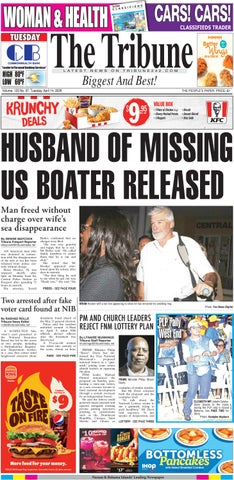
AN American man who was detained in connection with the disappearance of his wife at sea has been released from police custody without charge.
Brian Hooker, 58, was released shortly after 8pm on Monday from the Central Police Station in Freeport after spending 72 hours in custody.
His attorney, Terrell
By RASHAD ROLLE
A SUSPECTED fake
voter’s card presented at the National Insurance Board has led to the arrest of two people, including a Parliamentary Registration Department worker, in a case that comes amid heightened concerns about
Butler, confirmed that no charges were filed.
“He was very grateful and happy that he is out,” Ms Butler said. “He called family members to assure them that he is out and okay.”
She noted that Mr Hooker appeared emotional upon his release after days in custody.
“The first thing he said to me when he got out was, ‘Thank you,’” she said. “He

document fraud ahead of the May 12 general election. Police said the incident unfolded around 11.30am on April 9, when NIB officials alerted officers after the document was discovered.
A 33-year-old woman was taken into custody at the scene. About an hour
By LYNAIRE MUNNINGS Tribune
Staff Reporter lmunnings@tribunemedia.net
PRIME Minister Philip “Brave” Davis has dismissed the Free National Movement’s proposed national lottery as a “gimmick”, joining some senior church leaders in opposing the plan.


FNM leader Michael Pintard announced the proposal on Sunday, positioning a state-run lottery as a new revenue stream to fund national development through a system overseen by an independent board. He said the lottery could generate major payouts and operate alongside existing private gaming operators, pointing to jurisdictions such as the Dominican Republic, Curaçao, Saint Martin and Ghana as


PRIME Minister Philip ‘Brave’ Davis.
examples of similar models.
But Mr Davis criticised both the proposal and the examples cited.
“To talk about the National Lottery seems to me a gimmick, trying to grab headlines,” Mr Davis told reporters. “It just speaks of desperation, and


By DENISE MAYCOCK Tribune Freeport Reporter dmaycock@tribunemedia.net
PRIME Minister Philip ‘Brave’ Davis declared that Grand Bahama is on the rebound during a rally last night, pointing to investment, job creation and long-awaited developments on the island.
Speaking at rally in West End, Mr Davis said a “new chapter” has begun for Grand Bahama, with visible signs of economic recovery now taking shape.
“People are working again. The new Freeport Health Campus is going up. Serious investments are in motion. The Shipyard is growing. Grand Bahamians are upskilling,” he said.
Mr Davis also referenced a recent Grand Lucian related announcement by MSC Cruises, saying it validates the government’s long-standing efforts to secure meaningful investment for the island.
He believes that the PLP candidates in Grand Bahama – Ginger Moxey, Mp for Pineridge; Kingsley Smith, Mp for West Grand Bahama; Parko Deal, candidate for Central Grand Bahama, and Eddie Whan, candidate in Marco City - will ensure continued progress.
Mr Davis pointed to a recent arbitration involving
the Grand Bahama Port Authority, saying the government took decisive action to hold the entity accountable. He inaccurately claimed the administration won the arbitration.
“For far too long, a private authority has been collecting fees and concessions, but they haven’t been living up to their part of the bargain,” he said.
“The days of licence fees without accountability are numbered. The Port has been put on notice: the Bahamian people will not keep subsidizing private profits while our communities crumble.”
He added that the government intends to take a firm approach moving forward.
“We will use every legal tool, every regulatory power, every ounce of political strength to make sure the promises of Hawksbill Creek are finally honoured,” he said.
The prime minister also took aim at Opposition Leader Michael Pintard over policy proposals, particularly remarks about abolishing the Post Office Savings Bank.
According to Mr Davis, some 7,000 people in Grand Bahama rely on it, and that approximately 35,000 Bahamians nationwide use the service.
He also dismissed the opposition’s proposed

national lottery as lacking substance.
“Their national lottery is not a plan – it’s a gimmick,” he said. “They’re chasing headlines, not solutions.”
Mr Davis argued that his administration is instead focused on long-term development through
energy reform, infrastructure investment, skills training and expanding opportunities for Bahamians.
“While we are investing in real solutions, their big idea is to turn the government into a numbers house,” he said.


Despite political tensions, Mr Davis maintained that progress in Grand Bahama is tangible and ongoing.
“A government is finally standing up for the people of Grand Bahama,” he said, “and not bowing to private interests or outdated arrangements.”
Deputy Prime Minister Chester Cooper said the airport is fully funded and moving forward. “For 34 years the FNM gave the Port Authority a free ride, but this PLP government gave them a deadline,” he said.


it’s really not for help.”
“For him to use the Dominican Republic as the model for his national lottery, when the National Lottery of the Dominican Republic was proven to be such a failure, with corruption and fraud and the like, that’s the model he’s going to do, you know, one has to question, why is he wanting to have a national lottery?
“Is it for the purpose of a slush fund, for corrupters and fraudsters as the model that he cling onto or embrace has proven to be? It seems to be gimmick, not thought out; the amount of Bahamians that is now in the gaming industry, how their lives will be impacted, how it impacts revenues for the country or any regards to the fact that that we collect tremendous amount of taxes from the gaming industry, it’s rather odd that you want to turn the Treasury into a gaming house,.”
The proposal has revived a long-running national debate. Several administrations have explored the idea of a national lottery but failed to implement it amid political resistance
and public concern.
The Christie administration sought to introduce a lottery through provisions in the Gaming Bill 2014, but the plan stalled in the face of opposition from religious groups and segments of the public.
That resistance was evident in the 2013 gambling referendum, when voters rejected a national lottery.
Of the 81,239 votes cast, 59 percent voted against the lottery.
Critics of a national lottery have consistently questioned whether The Bahamas’ population can sustain such a system without undermining existing gaming revenues, while raising concerns about transparency, regulation, corruption risk and the social impact on lower-income households.
Supporters argue that a properly regulated lottery could generate revenue for public services, including education and infrastructure, while strengthening oversight of gaming activity.
Religious leaders yesterday renewed their opposition.
Bishop Walter Hanchell said a national lottery contradicts Christian principles and pointed to the
outcome of the gambling referendum.
“We opposed and voted against the legalisation of the number houses and the lottery during the gambling referendum a few years ago, which the “NO” vote won,” he recalled. “Yet, former Prime Minister Perry Christie went ahead and legalised it, contrary to the wishes of the Bahamian people, after saying that he had no horse in the race.”
“Everything that the Church said would happen concerning the number houses has materialised. Gambling addicts have increased, while people continue to lose their mortgage, rent and food money every day to the number bosses. This is all wrong.”
He said gambling has contributed to financial hardship, leaving some unable to meet basic needs, and urged political leaders to focus on social support and economic empowerment instead.
Bishop Delton Fernander, president of the Bahamas Christian Council, said the proposal risks placing a heavier burden on lower- and middle-income Bahamians.
“It is sad that the
country voted on it under a previous administration and it was a no, but yet it was still privatised in the country,” he said. “And here we go again, a party that is offering itself to be the government is offering something the country has said no.”
“The council has been adamantly against it. The data back then was showing that the base was not big enough to make it happen, and if that is not true, was it just so that they could privatise this to the select few? And so, the council has stood firm that we are adamantly against this because it mainly feeds on the poor and the middle class, and I can’t see someone or a party offering to be government of all wanting to base their whole way of collecting funds for education and sports on the back of the poor and those trying to rise to the middle class.”
Bishop Fernander also said key safeguards remain absent, including rehabilitation programmes for gambling addiction and systems to identify compulsive gamblers, warning that introducing a national lottery without addressing those gaps would deepen existing social challenges.

By DENISE MAYCOCK Tribune Freeport Reporter dmaycock@tribunemedia.net
AN 82-year-old Grand Bahama man says he was left shaken after immigration officers allegedly broke into his home in the middle of the night without producing a warrant or identifying themselves.
Leroy Bell, a Bahamian who has lived in Grand Bahama since 1968, said the incident occurred shortly after midnight on March 5, when he was awakened by loud banging at his property.
His attorney, Paul Wallace-Whitfield, has since lodged a formal complaint with the director and assistant director of the Bahamas Department of Immigration, as well as Attorney General Ryan Pinder.
“I was asleep when I heard a banging on the gate,” Mr Bell said. “They broke the lock to gain entry, and then they came banging on the door and window saying they were immigration officers.”
In a letter dated March 20, Mr Wallace-Whitfield said officers broke the lock on Mr Bell’s gate to access the property and demanded that he open the door.
When Mr Bell hesitated and questioned their presence, one officer
allegedly responded: “Open the door! Or we will break it down!”
Mr Bell said he complied out of fear. Four officers in Immigration Department uniforms then entered the apartment. Three searched the bedrooms, while a fourth remained with him in the kitchen.
The attorney said the officer who stayed with Mr Bell appeared “puzzled, perplexed and confused” after it became clear that Mr Bell was a Bahamian citizen living alone and that no undocumented people were present.
“They were rude, and they were arrogant,” Mr Bell said. “I told them I was born in Behring Point, Andros, to Bahamian parents and that I’m Bahamian, and that I live here alone.”
Mr Bell and his attorney said none of the officers identified themselves by name or rank.
“All I saw was their uniforms,” Mr Bell said. “They never gave any names, nothing.”
The officers questioned Mr Bell about whether he was hiding anyone in the apartment and asked him to provide documentation to prove his citizenship. The search lasted between 15 and 30 minutes, and no one else was found.
According to Mr Wallace-Whitfield, the officers left abruptly without explanation, apology or acknowledgement that they had entered the wrong premises. He described their conduct as “inappropriate, excessive, high-handed and unacceptable in the circumstances.”
Mr Bell said the officers also failed to secure the property before leaving and that the damaged gate was left open.
“They broke the lock off my gate and I had to replace it myself,” he said. “To this day, nobody has apologised.”
In his letter, the attorney said no offer of restitution was made for the damage. He is demanding a written apology, compensation for the damaged lock, improved training for immigration officers in executing search warrants, and disciplinary action against the four officers involved.
He also called for a full investigation into the incident and said he has not received any acknowledgement of the complaint from immigration officials or the Attorney General’s Office.
“There is no justification for our Bahamian client being treated in the fashion that he was,” Mr

Wallace-Whitfield wrote.
“This must never happen again to a Bahamian in his own country.”
Mr Bell said the experience was deeply distressing.
“I was frightened and very scared,” he said. “I
never had anything like this happen to me in my life.”
The Tribune contacted the Department of Immigration in Grand Bahama to speak with Assistant Director Bernard Pratt, but got no response up to
press time. Mr Bell said he has received no follow-up communication from authorities.
“I feel there was no justification to treat me that way,” he said.

was very emotional, especially when he spoke to his family members, which is understandable in the circumstances. He just needs a little time to process all that he has gone through.”
Ms Butler said she was focused on ensuring her client could rest following what she described as a “horrible experience.”
“I am trying to get him somewhere where he can relax and de-stress,” she said, adding that she was unable at that time to confirm whether he would be permitted to leave the country or where he would be staying.
Mr Hooker had been
in custody since Friday after being flown to Grand Bahama from Abaco for further questioning. His detention reached the 72-hour period typically permitted without charge.
Speaking to reporters earlier in the evening around 7:20pm, Ms Butler expressed concern over the delay in his release. “The hour that we should have received some information or he should have been released, they have been stalling,” she said. “It is his constitutional right that after the 72 hours he should be released. This is totally unacceptable and disrespectful.”
Police later confirmed that Mr Hooker’s release followed consultation with
the Department of Public Prosecutions, which advised that no charges be filed at this time pending further investigations.
Authorities are continuing to investigate the disappearance of his wife, Lynette Hooker, 55, of Michigan.
According to reports, the couple departed from Hope Town on Saturday, April 4, in a small dinghy in route to their yacht. Mr Hooker told authorities that his wife fell overboard with the boat’s keys, causing the engine to shut off, and that she was swept away by strong currents.
He reportedly paddled for hours before reaching Marsh Harbour Boat Yard, where he alerted
By LEANDRA ROLLE Tribune Chief Reporter lrolle@tribunemedia.net
THE PLP’s Fred Mitchell, John Pinder and McKell Bonaby lead the list of the most absent MPs in the House of Assembly since the Davis administration assumed office in 2021, each attending fewer than 80 percent of sittings during the period, according to records obtained by The Tribune.
Marco City MP Michael Pintard, leader of the FNM, MICAL MP Basil McIntosh, and St Barnabas MP Shanendon Cartwright, had the best attendance records.
The records cover two sessions: 88 sittings from October 2021 to August 2023 and 106 sittings from October 2023 to March 2026.
Fox HIll MP Fred Mitchell, the Foreign Affairs Minister and PLP Chairman, missed 76 sittings for an attendance rate of 60.8 percent. He declined to comment yesterday.
He was followed by Mr Pinder, the Central and
South Abaco MP with 55 absences, (71.6 percent attendance rate) and Mr Bonaby, the Mount Moriah MP and chairman of the Bahamas Public Parks and Beaches Authority, with 52 or (73.2 per cent attendance rate.) Neither man responded to The Tribune’s questions yesterday about their high number of absences.
Energy Minister JoBeth Coleby-Davis was not far behind them with 47 absences for a 75.8 percent attendance rate.
Seabreeze MP Leslia Miller-Brice and North Andros and Berry Islands MP Leonardo Lightbourne trailed behind at 43 and 41 absences respectively, though records note that Mr Lightbourne missed one sitting while attending a parliamentary conference.
After Mr Pintard, Mr Mcintosh, and Mr Cartwright, the MPs who attended sittings the most were Englerston MP Glenys Hanna-Martin, North Eleuthera MP Sylvanus Petty, Carmichael MP Keith Bell and Freetown
MP Wayne Munroe. Each recorded attendance rates either at or above 90 percent.
The late West Grand Bahama and Bimini MP Obie Wilchcombe didn’t miss a single sitting before his surprise death in September 2023.
Prime Minister Philip Davis, Deputy Prime Minister Chester Cooper, Myles LaRoda, Dr Michael Darville, Pia Glover-Rolle Bacchus Rolle, Alfred Sears, Clay Sweeting, Jomo Campbell, Mario Bowleg, Ginger Moxey, Leon Lundy, Zane Lightbourne, Wayde Watson, Kirk Cornish, Jamahl Strachan, Lisa Rahming, Leroy Major, Dr Hubert Minnis, Adrian Gibson and Kwasi Thompson were among those with attendance rates above 80 percent.
Kingsley Smith was absent 14 times since winning the West Grand Bahama and Bimini by election in 2023, while Darron Pickstock only missed one session since winning last November’s Golden Isles by-election.
authorities.
Police initially questioned Mr Hooker on April 7 and later took him into custody on April 10 after being transported to Grand Bahama.
Police have issued an appeal to members of the public for any information that may assist with the ongoing investigation, urging anyone with relevant details to contact authorities or Crime Stoppers.
The case has drawn significant international attention, with major media outlets, including Fox News, NBC News, and CNN, traveling to Grand Bahama to follow developments.
Investigations into the disappearance remain ongoing.


By LEANDRA ROLLE Tribune Chief Reporter
A ROYAL Bahamas Defence Force marine is under investigation after being accused of assaulting several female marine recruits, a defence official has confirmed. Lieutenant Darius Adams, RBDF public relations officer, declined to disclose details on the nature of the allegations, but confirmed that an investigation has been launched. The incident reportedly happened last Wednesday. The marine has not been removed from duty but has been isolated from the training environment pending the outcome of the probe. This is not the first time assault allegations have been made against a marine.
Last year, a RBDF marine faced charges after being accused of abusing seven male cadets at a rangers camp in Eleuthera. Those allegations included reports of physical assaults, forced consumption of toilet water, and sexually inappropriate behaviour by a supervising officer at the camp.
Asked yesterday whether any protocols have been implemented to strengthen safety for recruits, Mr Adams said the investigation would determine that.
“The commodore has made some changes before this where he would’ve put persons more of a higher rank to deal with recruits so changes were made before these allegations and obviously, an investigation would determine if additional changes have to be made,” he added.

later, a 31-year-old Bahamian male employee of the Parliamentary Registration Department was also detained.
Both remain in custody assisting police. No charges had been filed up to the time of yesterday’s police report.
In a statement attributed to Parliamentary
Registration Department Commissioner Harrison Thompson after the arrests, the government said the case forms part of a broader, multi-agency effort to detect and prevent fraud, including within government agencies. The statement suggested the suspect faces a charge of fraud by false pretences. “I am satisfied that the persons involved were
seeking to use fraudulent voter cards to obtain other supporting identification documents, rather than for the purpose of voting,” the statement said. It added that the attempt to secure an NIB smart card triggered internal checks after officials detected the absence of a parliamentary seal and mismatched identification details. “I also wish to advise
By LEANDRA ROLLE Tribune Chief Reporter lrolle@tribunemedia.net
THE Bahamas Union of Teachers has given the government until tomorrow (Wednesday) to submit a revised counter-proposal on salary increases and other benefits for educators after rejecting its second offer. Union president Belinda Wilson set the deadline after sharing the results of a recent membership survey on the government’s latest financial counter proposal. She did not say what action would follow if no response is received, though The Tribune understands industrial action could be an option. It marks the second rejection by the union and officials have declined to disclose details of either the
government’s offer or the union’s demands.
Ms Wilson said 90 percent of surveyed teachers voted to reject the government’s second financial counter-proposal, while 95 percent supported a three-year agreement. The majority of members also backed giving the Davis administration three days to respond.“Three days,” she said in a voice-note.
“I’ve already sent the union’s position to Prime Minister Davis, to the chief consultant and the government’s negotiating team. I’m awaiting their response.”
Bernard Evans, the chief labour consultant, yesterday acknowledged receiving Ms Wilson’s communication, but declined to discuss negotiations in the media.
By JADE RUSSELL Tribune Staff Reporter jrussell@tribunemedia.net
A CHAOTIC scene unfolded yesterday after students were forced to escape a school bus after it collided with a car, then narrowly missing a nearby house by inches. The incident occurred after the bus driver picked up high school students from a career fair held at the government complex in Marsh Harbour. While transporting the students back to SC Bootle High School, the crash happened. One student, speaking to The Tribune, said he was seated near the stairs when the bus suddenly began moving at speed. Moments later, it collided with a car. The driver then allegedly veered sharply to avoid
crashing into a nearby house.
Students began screaming, panicking, crying, and rushing to exit the bus. Videos circulating on social media showed some students jumping out of windows, while others escaped through the back door. The Tribune understands that no one was seriously injured. The crash occurred approximately three minutes away from the school. Teachers responded to the scene and transported the students safely back to campus.
Another bus driver described the driver involved in the incident as responsible, noting that he typically operates a 25-mile route but had been assigned a 65-mile run yesterday.

Welder Specialist
the public that possession of a fraudulent voter card does not allow a person to vote,” the PRD statement said. “An authentic voter card carries the parliamentary seal embedded into the card, along with security features that cannot be copied. A card without these features is invalid and will be detected. All government agencies have been on heightened alert for the past year, with
stronger scrutiny of official documents.
“I have said from the start that there is a crossagency approach to identify fraud. There is no working around the checks and balances that are in place. There are too many layers of verification across government agencies.”
The development comes amid heightened concern about document fraud in The Bahamas ahead of the
“We’ve taken her counter proposal. We haven’t collectively looked at it. Like I said, we received it last night, so our side will meet to go over her counter because she did add a few additional stuff to look at,” he said. As for the union’s threeday deadline, he could not say whether the government would comply, adding that there is a chain of command that must advise on the way forward.
May 12 general election, with allegations of widespread fraud dominating political discourse. Opposition Leader Michael Pintard has claimed that investigations are ongoing into hundreds of fraudulent documents, including cases linked to the voters’ register. Prime Minister Philip “Brave” Davis, however, has accused the opposition of exaggerating the issue.


NULLIUS ADDICTUS JURARE IN VERBA MAGISTRI
“Being Bound to Swear to The Dogmas of No Master”
LEON E. H. DUPUCH,
Publisher/Editor 1903-1914
SIR ETIENNE DUPUCH, Kt., O.B.E., K.M., K.C.S.G., (Hon.) LL.D., D.Litt .
Publisher/Editor 1919-1972
Contributing Editor 1972-1991
RT HON EILEEN DUPUCH CARRON, C.M.G., M.S., B.A., LL.B.
Publisher/Editor 1972-
Published daily Monday to Friday Shirley & Deveaux Streets, Nassau, Bahamas N3207
TELEPHONES
News & General Information (242) 502-2350
Advertising Manager (242) 502-2394
Circulation Department (242) 502-2386
Nassau fax (242) 328-2398
Freeport, Grand Bahama (242)-352-6608
Freeport fax (242) 352-9348
WEBSITE, TWITTER & FACEBOOK
www.tribune242.com

@tribune242

tribune news network
THE inclusion of a national lottery in the election manifesto of the Free National Movement puts the gaming debate front and centre on the election trail.
Prime Minister Philip Davis has quickly called the proposal a “gimmick”, and declaring opposition to the plan.
Numerous commentators have already pointed out that Mr Davis has in his own camp individuals who have been closely connected to the gaming industry.
It is worth a trip back in history when talking about gaming.
In 2013, Mr Davis was Deputy Prime Minister when the then Perry Christie administration ran a public referendum on gaming.
There were two proposals on the table at the time. One asked whether people supported the regulation and taxation of web shop gaming. The other asked if people supported the establishment of a national lottery.
Note, that was a PLP administration asking about a national lottery, as well as web shop regularisation. It was not a gimmick back then.
At the time of the referendum, Mr Christie said he did not “have a horse in the race”.
The outcome of the vote was unequivocal. When it came to web shop gaming, 60.71 percent opposed regulation and taxation, with 39.29 percent in support.
For a national lottery, 59.56 percent were against, and 40.44 percent in favour.
After the outcome of the vote, Mr Christie announced that all web shops must close with immediate effect, saying: “In keeping with my government’s commitment to abide by the will of the electorate as expressed on Monday’s referendum, it has now become necessary to effect the closure of all web shop gaming operations in The Bahamas. Accordingly, all offending web shop owners and operators are placed on notice that all their gaming operations, including all online gaming and the numbers games, must cease with immediate effect. Failure to do so will leave all such web shop owners, operators and web shop gaming patrons exposed to arrest and criminal prosecution without further notice or warning.”
And yet, not only was there a lack of action and no sign of a flurry of prosecutions, but the government proceeded to move forward with legalising web shop gaming despite the vote. But not the lottery.
Within hours of Mr Christie’s warning that operations must cease, attorney Wayne Munroe and former Attorney General Alfred Sears had obtained an injunction preventing the government from shutting down operations.
The then deputy chairman of the FNM, Dr Duane Sands, now the chairman, said: “The fact that they were not mindful of the Constitutional and legal ramifications that such a referendum would have had created a huge nightmare, not only for the government as a whole, but particularly for the Prime Minister and the Attorney General. Unfortunately, in the end, the Bahamian people will suffer the most.”
A year after the referendum, senior pastor Lyall Bethel was calling on Mr
Christie to “Stop playing with God” and respect the moral vote made by the Bahamian electorate – saying Mr Christie was “out of line” if he intended to move forward with regularising web shops.
Mr Bethel said: “In the war between money and morality, money has won.
Last year, morality won, now it looks like money has won, and where money wins over morality, crime always wins.”
Fast forward to today and we know what happened with web shops. We know the names of the shops that fill our islands, we know the names of the business owners who lead those organisations. One prominent web shop owner, Sebas Bastian, who has diversified his businesses over the years, is stepping away from Island Luck to run in the election this year as a candidate for the PLP. No further referendum was carried out to get us to where we are now. Indeed, in the year after the vote, Mr Christie made public that he should simply have legalised the industry rather than putting it to a referendum. Still, the unanswered question remains over the national lottery.
The public was asked and said no over web shops, but that process went ahead anyway. Largely the same amount of voters said no to a national lottery – but that came to a halt. Until now.
Mr Pintard sees the lottery as a source of revenue – and it is true, it is. That is how it works in numerous places in the United States, it is how it works in the United Kingdom, where significant funds have been raised for a range of projects from the lottery there. The simple dynamics of a lottery are this – to be a revenue raiser, more people must lose the lottery than win the lottery. You buy a ticket in the hope that you will win big, but the reality is that mostly you will lose.
Among the pledges when web shop regularisation took place was a promise to tackle gambling addiction – but not nearly enough has been done there. Introducing even more gambling on top runs the risk of deepening addiction, and snaring more addicts who will buy a lottery ticket who might never have stepped into a web shop.
There will undoubtedly be opposition, particularly from church figures. That said, there have been positive results from community investment from lottery funds, especially in the UK, where numerous examples of investment in sport and the arts, particularly, can be seen.
The biggest effect of Mr Pintard’s pledge, however, may well be to put the gaming links of the current party in the spotlight. It is unlikely they were to avoid the spotlight, given some of the campaign money being spent, but it opens up the debate – how did we get here, did we do the right thing, and is this the way we want to carry on?
Debate is always good – but this particular topic picks at a scar in the political psyche of the country. Mr Davis says “it’s rather odd that you want to turn the Treasury into a gaming house”. Will it be a winning talking point for Mr Pintard? Place your bets.
EDITOR, The Tribune.
PLEASE be informed that I have been a target living on the dangerous curves of the street and traffic hotspot for property damages hit and run. For the past four years, now after this neglect was assessed that I had been awaiting the ministry of works to carry out their promises of installing guard rails for my street on Marshall Road. I am a resident of 20 plus years and I have had more than two dozen vehicles landed in my yard because of a very dangerous curve on the map here. There were two deaths a car written off and multiple damages to my home and property after two dozen crashes, I stopped recording and counting. But this keeps happening All of these instances including two deaths should be on record at the traffic area. I have had a vehicle came straight through my bedroom walls crashing in and destroying furniture. After several phone calls and onsite visit by the department of Works and their promises to install guardrails, the two employees Munroe and Joy have stopped taking my phone calls and have been non-compliant in going
EDITOR, The Tribune.
AS Bahamians prepare to exercise their democratic right to vote, let us reflect, for a moment, on the profound historical significance of sites like the “Door of No Return” and other “Doors” that were located on the African coast and marks a new forced beginning our ancestors.
The powerful symbols shared evoked the unimaginable journey and adventure for many of our ancestors, who endured the horrors of the transatlantic slave trade to reach what was known as the New World.
Their passage through those gates represented pivotal chapters in human history, and were marked by profound loss yet also by an enduring spirit of resilience.
I entreat my fellow Bahamians to reflect deeply on the profound historical significance of sites such as the “Door of No Return” on the Ghanaian African Coast…and the following gateways others that will be highlighted in this posting.
Other places of departure points from Agrica The following were the other represented places from which our ancestors departed Africa against their will.
Gorée Island, Senegal: The “House of Slaves” (Maison des Esclaves) on Gorée Island, also a UNESCO site, features perhaps the most widely recognised “Door of No Return.” Standing at this threshold, one gazes directly out onto the vast, indifferent ocean, imagining the horror of those who passed through, never to return. The small, cramped cells and the direct, unobstructed view of the Atlantic amplify the sense of irreversible departure and the systematic dehumanisation of millions.
Ouidah, Benin (La Porte du Non-Retour): In Ouidah, the memory is solidified not by an ancient structure, but by a striking monument inaugurated in 1995. This powerful artistic installation stands on the very beach from which thousands were loaded onto slave ships. It serves as a
stark, modern testament to the historical trauma, offering a sacred space for honor and remembrance for all who began their involuntary journey from this point. The symbolism embedded in these “Doors of No Return” is profoundly complex. They represent not merely a physical exit, but a “social death”—a deliberate and brutal severing of individuals from their families, cultures, languages, and identities. It was a calculated act to erase their humanity, transforming vibrant lives into commodities.
These doors are metaphors for the ultimate loss of freedom, dignity, and belonging, marking the point where hope itself was extinguished for generations.
Conclusion
forward to solve this issue. Several attempts to contact the MP of the area have also been unresponsive. I’m of the opinion No one is interested due to the fact it’s has only affected me generally but all surrounding properties have also been hit. As we speak this moment just in the last 24 hours a car had hit and run off the curve and into my yard. Thank you so much for your time and your support. This is a government that under mind its people until they are needed for votes.
VANRIA FORBES Nassau, April 11, 2026.
EDITOR, The Tribune. FREE National Movement Leader Michael Pintard’s National Lottery proposal is a game changer, one anonymous FNM opined on Monday. While Pintard argued that a National Lottery can coexist with the current Web Shop Gaming industry, I view it as an existential threat to the hegemony of the Numbers Boys who were requesting an additional 25-year moratorium on the issuance of licenses to others wanting to break into the lucrative sector. They don’t want anyone else in their industry. Pintard’s proposal creates an interesting dilemma for not only the Numbers Boys, but for the church as well. I would go as far as stating that the FNM is the only legitimate barrier to preventing the Numbers Boys from assuming complete control of The Bahamas on May 12. They have already assumed control of the Progressive Liberal Party based on what I’m seeing. Island Luck CEO Sebas Bastian, I believe, will succeed Prime Minister Philip Brave Davis as PLP leader, quite possibly this year. Once the Numbers Boys are in control of the government, they will use their newfound
This powerful symbol of the Door of No Return evokes the unimaginable journey of our ancestors, who endured the horrors of the transatlantic slave trade to reach what was known as the New World. Their passage through that gate represents a pivotal chapter in human history, one marked by profound loss yet also by an enduring spirit of resilience.
While the physical chains of the past are gone, we face contemporary challenges that threaten to subtly erode our hard-won liberty and autonomy.
The integrity of our democratic processes, once considered sacrosanct, is increasingly vulnerable. We observe a new form of societal subjugation, manifested through sophisticated systems of control: economic frameworks concentrating wealth, leveraging dependency, and pervasive digital oversight that subtly circumscribes civic freedoms and personal agency. This intricate web transforms genuine liberty into a conditional state, where individual self-determination is progressively diminished.
Let the memory of those who passed through the “Door of No Return” invigorate our commitment to safeguarding freedom in all its forms.
Your participation in the electoral process is not merely a civic duty; it is an act of profound historical consciousness, demanding vigilance against any force that seeks to compromise our collective and individual sovereignty.
The right to vote is one of the modern symbols of the “Doors of Return”… and by all means must be seen as a symbol of a free people’s sacred right to vote, and therefore it must not and should not be taken for granted and sold for a “mess” of pottage…Now or in the future…
DR DONALD M McCARTNEY
Yet, in a testament to the resilience of the human spirit and the enduring power of connection, there has been a powerful movement in recent decades to reimagine this narrative. At sites like Cape Coast Castle, the Door of No Return has been symbolically renamed the “Door of Return. This transformative renaming signifies more than just a change in nomenclature; it is a profound gesture of healing, reconciliation, and reconnection. It encourages descendants of the enslaved, particularly those in the African diaspora, to undertake journeys of remembrance and discovery, to reclaim their heritage, and to return to their ancestral lands, thereby forging new pathways of cultural and historical affirmation. These sacred sites are not just relics of the past; they are living testaments to an indelible history, vital for educating future generations about the atrocities of slavery and the ongoing impact of its legacy. They call upon us to remember, to reflect, and to commit to a future where such injustices are never repeated, and where the threads of human connection, once brutally severed, are consciously and compassionately rewoven.
Freeport, Grand Bahama April 12, 2026.
powers to further protect their hegemony. Bahamians need to appreciate what’s at stake on May 12. The soul of The Bahamas will be permanently ruined if these scenarios come to fruition. The late Dr Myles Munroe prophetically warned the country in 2013. During the period leading up to the January 28, 2013 Gaming Referendum, there were strong voices for the implementation of a National Lottery, as opposed to the current Web Shop Gaming industry. It was argued that a National Lottery, a lesser of two evils, would benefit the entire nation. Look at the Florida Lottery, in which the proceeds go into the Educational Enhancement Trust Fund; public schools, state-run colleges and universities. The Florida Lottery also makes it possible for the state to provide scholarships to thousands of American students. With a National Lottery here, much needed funds could be used to fund education and to fix a broken healthcare system. Reading portions of the FNM Manifesto in one of the dailies, I am sure the FNM will flesh out the details for the implementation of a National Lottery. Pintard strikes me as one who is meticulous and highly organised. This isn’t a seat of the pants proposal. PLPs who oppose the Pintard proposal literally have no moral authority to do so after what transpired in 2014. Remember, the Bahamian people voted overwhelmingly for the rejection of web shop gaming. The will of the people was shrewdly circumvented via legislation in the House of Assembly. This is evidence of the “scary” influence the Numbers Boys veil within the PLP. They are rapidly outgrowing the Bahamian government with no signs of slowing down thanks to the legislative stranglehold they have on gaming. The only checks and balances to the burgeoning powers of the Numbers Boys is the FNM. The lotto proposal has catapulted Pintard’s political stock. Moving forward, he must be taken seriously by his political detractors as a potential prime minister. He has gotten my attention for sure as he is willing to challenge the hegemony of the Numbers Boys by creating a legitimate competition to their lucrative sector.
KEVIN EVANS Freeport, Grand Bahama April 13, 2026.
By LYNAIRE MUNNINGS Tribune Staff Reporter
lmunnings@tribunemedia.net
NATIONAL Develop-
ment Plan chairman Felix Stubbs has confirmed that long-promised legislation to establish a statutory planning institute will miss its intended deadline again, with the bill waiting in limbo until after the May 12 general election.
Mr Stubbs said the bill, currently with the Attorney General’s Office for revisions, could be among the first pieces of legislation debated when a new Parliament convenes, maintaining that it will still be passed before the end of 2026, regardless of which paarty forms the next administration.
The delay marks a shift from earlier expectations that the National Development Planning Institute
Bill 2026 would be tabled before the election. Mr Stubbs previously indicated the legislation could be introduced as early as February, later pushing that timeline to March, with the goal of securing passage ahead of the polls to avoid disruption from a change in administration.
However, he said further legal strengthening is now required following
consultations, which has contributed to the setback.
“What we got back was that the original bill we had didn't have enough teeth and so they wanted more enforcement things like giving the Secretariat power to go into ministries and request information to see how they're doing against the plan,” he said.
“The original bill didn't have enough teeth to make that happen. In fact, recommendations, both from the public and from the current attorney general, are that we should strengthen the bill, and that's what we're doing now.”
Mr Stubbs said the draft remains under review in the Attorney General’s Office, with requested changes still being incorporated. He suggested a revised version will not be ready until after Parliament resumes.
Despite the delay, he insisted the timeline for implementation has not changed and said work on the institute’s administrative structure is already underway.
“I don't think the public should be concerned about the bill not being passed as yet. These things do take time. I was very hopeful we get it before election.
He attributed part of the delay to the timing of the election, noting it was called earlier than anticipated.
Mr Stubbs emphasised that the legislation has bipartisan backing and expressed confidence it will advance under any administration.
The proposed legislation is intended to establish a National Development Planning Institute as a statutory body responsible for co-ordinating national planning, overseeing implementation of the National Development Plan and advising the government on economic, social and environmental policy.
The National Development Plan, branded Vision 2040, was developed during the Christie administration as a non-partisan roadmap for the country’s long-term development, focusing on key pillars including the economy, governance, social policy and the environment.
In February, Opposition Leader Michael Pintard signalled bipartisan support for the initiative, stressing the importance of continuity in national planning and warning against policy disruption with changes in government.
By PAVEL BAILEY Tribune Staff Reporter pbailey@tribunemedia.net
A MAN accused of a series of rapes and armed robberies in the Collins Avenue area over the past month was remanded to prison yesterday.
Prosecutors allege that Lyndon Taylor, 29, armed with a handgun, forced two women into their vehicle while they were outside a business on East Street around 12am on March 22. The accused allegedly extorted $200 from one of the women. During the ordeal, one woman escaped the vehicle.
Taylor allegedly forced the remaining 20-yearold woman to drive to a
secluded area on Collins Avenue, where he raped her at gunpoint. The defendant also allegedly stole the victim’s pink iPad. Police later intercepted the vehicle on Ragged Island Street, but the defendant fled on foot. Taylor allegedly accosted a 17-year-old girl while she was walking on Collins Avenue and raped her in an abandoned building at gunpoint around 10pm on April 2. He is also accused of forcing an 18-year-old woman, who was walking in the area, at gunpoint into an abandoned building on Collins Avenue and raping her around 11pm on April 4. The defendant allegedly stole the victim’s pink
iPhone 13.
Taylor was not required to enter a plea to charges of extortion, three counts of rape and two counts of armed robbery before Acting Chief Magistrate Ancella Evans.
The court was told the matter would proceed to the Supreme Court by way of a voluntary bill of indictment.
Taylor was informed of his right to apply for bail in the higher court. He was remanded to the Bahamas Department of Correctional Services until service of his voluntary bill of indictment on August 20. Wilber Deleveaux represented the accused, while Inspector Deon Barr prosecuted.
By PAVEL BAILEY Tribune Staff Reporter
pbailey@tribunemedia.net
A MAN was sentenced to six months in prison for a knife assault on Hay Street last week.
Timothy Fountain, 47, assaulted Richard Bonaby Sr with a knife during a verbal altercation between 6am and 7am on April 9. Fountain pleaded guilty to assault with a dangerous instrument before Senior Magistrate
By LEANDRA ROLLE Tribune Chief Reporter lrolle@tribunemedia.net
LONG Island MP Adrian Gibson confirmed yesterday that he will not be offering himself as an independent candidate for the upcoming election.
Mr Gibson revealed his decision in a social media post yesterday, saying it was made after deep reflection and prayerful consideration.
The announcement follows calls from some within the FNM constituency association for him to contest the election as an independent after being denied the party’s nomination.
The FNM has since ratified former Fort Charlotte MP Dr Andre Rollins as its candidate for Long Island.
Mr Gibson said he had weighed all perspectives and decided to focus on personal and professional matters. He added that he would speak more fully about his journey over the past several years in due course.
He called serving constituents over two consecutive terms “the greatest honour and privilege” of his life and thanked residents for their support.
He said his exit from

frontline politics was not the end and pledged to continue contributing to the island’s growth.
“I remain, first and foremost, a son of Long Island. I look forward to being home more, to spending time among you, to continuing to invest in our communities, and to contributing meaningfully to the life and future of our island in the years ahead,” Mr Gibson added.
“In the coming days, I will share, in a structured and transparent way, aspects of
my record of service – so that the work we have done together is properly documented and understood.”
“As I demit office, I will also be completing several final initiatives. This includes the handover of recently acquired items to the Island Administrator for public use, the execution of outstanding commitments, and the distribution of materials – including construction supplies – to those affected by Hurricane Melissa.”
“To each of you, I say thank you.”
BAHAMAS Power and Light has warned political parties and the public that attaching campaign materials to utility poles — especially by drilling or wrapping fabric around them — is strictly prohibited, citing safety risks and potential damage to the country’s electrical infrastructure.
In a statement, BPL said the warning comes amid increased activity during the election season, stressing that such practices can compromise the integrity of poles and pose hazards to the public.
The company said the restrictions are enforced year-round, including during holidays, and are not specific to the current political climate. Under BPL’s Pole Attachment Agreement, approved attachments must be secured using proper banding methods such as stainless steel bands, straps or wire clamps, particularly on poles fitted with streetlights. The company said drilling into poles is not allowed under any circumstances.
BPL said any request for an exception must be
formally submitted and will be considered at its sole discretion, with attention to the structural integrity and long-term maintenance of the poles.
The utility urged political organisations and members of the public to comply with the rules and avoid placing fabric or other unauthorised materials on utility and lamp poles.
BPL said adherence to the guidelines is necessary to protect infrastructure and ensure the safety and reliability of the electrical network.
Algernon Allen Jr.
After being admonished for letting his anger get the better of him, he was sentenced to six months at the Bahamas Department of Correctional Services. Sergeant 3004 Forbes prosecuted.

WHEN the two-week ceasefire between the United States and Iran was announced on 7 April 2026, the immediate reaction across much of the world was relief. By 8 April, that relief was reflected in a sharp fall in oil prices, after weeks in which conflict had shaken energy markets, threatened Gulf States, and unsettled the wider global economy. Markets moved quickly, but they were only registering a deeper reality. People everywhere prefer peace to war, stability to fear, and development to destruction.
That instinct has been plainly at odds with the conduct of Benjamin Netanyahu, the Prime Minister of Israel, whose political course has been one of widening conflict, not containing it. It is important to recognise that the regime of the Ayatollahs in Iran has been deeply repressive toward its own people. Recent United Nations reporting and human rights organisations have documented severe restrictions on freedom of expression, peaceful assembly and association, arbitrary detention, persecution of women, girls and minorities, and the excessive use of force against civilians and protesters. At the same time, it is well established that Tehran has long provided material backing to both Hezbollah and Hamas as part of its regional strategy against Israel.
No fair-minded account can ignore the horror of Hamas’s attack on Israel on 7 October 2023. That attack was murderous and indefensible.
But what followed in Gaza has long ceased to be explicable as a proportionate exercise of self-defence.
Tens of thousands of Palestinians have been killed, including great numbers of children, and vast areas of Gaza have been reduced to ruin. Whatever military claims Israel has made about Hamas using civilians as cover, the resulting devastation has been immense and morally indefensible in its scale.
Nor has the violence been confined to Gaza. Israel’s government has also pursued a harder line in the occupied West Bank while massively escalating operations against Hezbollah in Lebanon.
Even as Washington and Tehran moved towards a truce on 8 April, Israel launched its heaviest strikes yet on Lebanon. The United Nations condemned the casualty reports as “appalling”, and Volker Türk, the United Nations High Commissioner for Human Rights, described


“The peoples of the world understand something that ideologues too often ignore: war consumes lives, distorts priorities, and robs whole societies of a future.”
the destruction and deaths as “horrific”. The day the United States-Iran ceasefire was announced, many hoped the region might be stepping back from a wider war. It is regrettable that there appears to be continuing disagreement over whether Lebanon was covered by that ceasefire. Israel and the United States have said that Lebanon was not part of the arrangement, while Iran and a number of other governments have taken the contrary view. What is clear is that Israel continued bombing Lebanon after the ceasefire was announced. According to Lebanon’s Civil Defence, at least 254 people were killed, and 1,165 others were wounded in the attacks on 8 April alone. These attacks have placed further strain on an already fragile truce. Recent analysis has described Israel as digging in for a “forever
war” through buffer zones in Gaza, Syria, and Lebanon.
It is in that context that Netanyahu’s conduct must be assessed. Chatham House has said plainly that he has taken a bet that war will improve his chances of political survival in Israel. Recent reporting has also noted that, with the halt in attacks on Iran, Netanyahu’s corruption trial will resume, and that his coalition is predicted to lose the October elections. The reasonable conclusion is that the prolongation and widening of conflict have served Netanyahu politically, even as they have damaged Israel strategically and morally.
This also explains why the broader confrontation involving Iran appeared to offer political advantage to Netanyahu. A regional crisis provided diplomatic cover, widened military latitude, and shifted international attention. It

created space for continued operations in Gaza and Lebanon and reduced immediate pressure for restraint.
It is difficult to argue that this course enjoys broad international support. Public language may be measured, and some governments may be silent, but growing unease and widespread alarm at the scale of civilian suffering are evident across the world. The gap between formal diplomatic caution and underlying global sentiment has become increasingly clear.
In many parts of the Caribbean, we have lived a unique experience. Jewish communities have been part of Caribbean life since the seventeenth century, and Lebanese communities have also been established in the region for well over a century. They have lived among us and contributed to our societies without religious or communal clashes between them becoming a feature of Caribbean life. That equilibrium matters.
We have no desire to see it disturbed by hostilities imported from the Middle East. Our own experience affirms that people of different histories, faiths, and traditions can live together in peace, and that hardwon balance should be protected.
The peoples of the world understand something that ideologues too often ignore: war consumes lives, distorts priorities, and robs whole societies of a future.
The market reaction to the United States-Iran ceasefire was only the most visible sign of a deeper human instinct. People want resources devoted to human development, not destruction.
The International Criminal Court has issued arrest warrants for Benjamin Netanyahu. The Court states that the warrants concern alleged war crimes and crimes against humanity, including starvation as a method of warfare, murder, persecution, and other inhumane acts. These are
not findings of guilt. But they do represent a judicial determination that there are reasonable grounds to believe that such crimes had been committed. In more normal circumstances, such a development would have triggered far-reaching diplomatic consequences. That it has not done so to the full extent reflects the realities of contemporary geopolitics rather than any absence of concern.
The destruction of Gaza, the spread of conflict beyond it, the global disruption it has caused, and the loss of tens of thousands of lives point to one unmistakable conclusion: these wars have not strengthened Israel. They have diminished it morally, weakened it diplomatically, and made its long-term security more uncertain.
The author is Antigua and Barbuda’s Ambassador to the US and the OAS and Chancellor of the University of Guyana. The views expressed are his own.
By ABBY SEWELL Associated Press
THE Lebanese militant group Hezbollah will not abide by any agreements that may result from the direct Lebanon-Israel talks in the United States, negotiations it firmly opposes, a senior Hezbollah official said Monday.
Wafiq Safa, a high-ranking member of Hezbollah's political council, spoke on the eve of the talks expected in Washington between Lebanese and Israeli ambassadors to the US It will be the first time in decades that envoys from Lebanon and Israel, which do not have diplomatic relations, meet face-to-face in direct talks.
"As for the outcomes of this negotiation between Lebanon and the Israeli enemy, we are not interested in or concerned with them at all," Safa told The Associated Press.
"We are not bound by what they agree to," he added in a rare interview
with international media. He spoke next to a cemetery as an Israeli drone buzzed overhead.
Lebanese officials are looking to broker a ceasefire in the Israel-Hezbollah war in the US talks.
Israeli Prime Minister Benjamin Netanyahu, meanwhile, has said the goal is Hezbollah's disarmament and a potential peace agreement between Lebanon and Israel. Shosh Bedrosian, a spokesperson for Netanyahu said Monday that there will be no ceasefire with Hezbollah.
Separately, in US-Iran peace talks held last weekend in Pakistan, Iran has sought to include Lebanon in any ceasefire deal of its own with the US Israel and the US have insisted Lebanon would not be a part of it.
Hours after Tehran and Washington announced a truce last Wednesday, Israel launched more than 100 strikes across Lebanon, including in densely packed residential and commercial areas of central Beirut.
And though the US-Iran talks broke up without an agreement, Safa said Hezbollah has been informed that Iran "was able to obtain a cessation of attacks" in the entire administrative region of Beirut, Lebanon's capital, including Beirut's southern suburbs — a Hezbollah-strong area known as Dahiyeh.
Israeli strikes on Beirut and its southern suburbs have halted since Wednesday but intense fighting has continued in southern Lebanon.
Israel and Hezbollah have fought multiple wars since the Iran-backed Lebanese militant group was formed in the 1980s as a guerrilla force fighting against Israel's occupation of southern Lebanon at the time.
The latest round began on March 2, two days after Israel and the US launched a war on Iran. Hezbollah entered the fray, firing missiles across the border into Israel. Israel responded with aerial bombardment and a ground invasion.
Since then, the war has displaced more than 1 million people in Lebanon and killed more than 2,000, including more than 500 women, children and medical workers. Many Lebanese have blamed Hezbollah for pulling Lebanon into the war, accusing it of acting on behalf of its patron, Iran.
Safa said Hezbollah's actions were preemptive because its leaders believed "Israel was preparing for a second battle with Lebanon" with the aim of destroying Hezbollah.
It was "an appropriate moment for Hezbollah ... to rebuild a new equation" and restore deterrence against Israel, he said, denying any prior deals with Tehran that Hezbollah would enter the war if Iran was attacked.
After a US-brokered ceasefire halted the last Israel-Hezbollah war in November 2024, Israel continued to carry out near-daily strike in Lebanon that it said aimed to stop the group from rebuilding. Hezbollah wants to avoid a return to that status quo, Safa said.
Israel has claimed that its strikes on Lebanon last Wednesday killed more than 250 Hezbollah militants.
More than 100 women and children were among the over 350 people killed, according to Lebanon's health ministry.
That would mean that, according to Israel's assertion, every adult male killed that day was a Hezbollah member.
"None of our officials or cadres was killed in Beirut," Safa said. "Those who died in Beirut are 100% civilians." He did not deny that members of the group were killed outside of the Lebanese capital. Israel claimed to have killed Hezbollah leader Naim Kassem's secretary who was also his nephew, Ali Yusuf Harshi, as well as some high-level commanders.
Safa said Kassem's secretary was not killed, although "maybe a relative of his was." He also confirmed for the first time that he was wounded during the earlier, 2024 Israel-Hezbollah war, after being targeted by two Israeli strikes in Beirut, "but God granted me survival."
Relations between the Lebanese government and Hezbollah — which is not just a militant group but also a political party with a
parliamentary bloc — have grown increasingly tense.
The government last year approved a plan to remove all weapons that are not property of the state — its security forces or military — and later said it had largely completed the task south of the Litani River, where Hezbollah militants are now fighting with Israeli forces.
After March 2, the government went further, declaring Hezbollah's armed wing illegal.
Safa said Hezbollah is currently not directly speaking with President Joseph Aoun or Prime Minister Nawaf Salam but that all its communications are going through Parliament Speaker Nabih Berri, the head of the Hezbollah-allied Amal party. Safa said that if there is a ceasefire and a withdrawal of Israeli troops from Lebanon, Hezbollah — which calls itself a "resistance" movement against archenemy Israel — is ready to negotiate with the Lebanese government about the fate of its weapons.
"The issue of resistance weapons is a Lebanese matter that has nothing to do with Israel or the United States," he said.


THERE was a time— not long ago—when pride was not a slogan, but a standard. It lived in how we greeted strangers, how we kept our surroundings, how we showed up to work, and how we treated one another. It was reflected in the simple but powerful understanding that our actions, however small, contributed to a larger national identity. We were known for it. We celebrated it. We protected it.
Today, that sense of pride is slipping. Not in dramatic collapse, but in a slow, quiet erosion.
And perhaps what is most troubling is not just the rise of mediocrity, but its acceptance. Mediocrity has not simply appeared—it has been allowed, tolerated, and in some cases, defended.
It has become, dangerously, a culture.
This is not about perfection. It’s about standards. It’s about the fundamental expectation that people should care about their work, their environment, their responsibilities, and their impact on others. When that expectation weakens, everything else begins to unravel.
We see it in the workplace. Shared spaces demand shared respect, yet increasingly, there is a disregard for both. Punctuality is treated as optional. Deadlines are suggestions. Professionalism is negotiable. And those who maintain discipline and consistency are often left frustrated, carrying not only their own responsibilities, but compensating for others who simply “go through the motions.”
The result is predictable: tension builds, morale drops, and productivity suffers. But beyond that, something deeper is lost—the dignity of work. When mediocrity is tolerated, excellence feels unnecessary. When lateness is excused, punctuality feels foolish. When effort is not rewarded, effort disappears.
This same pattern extends beyond the workplace and into our daily lives. On the roads, there’s a growing sense of entitlement—a belief that rules are for others. Reckless driving, disregard for traffic laws, and a lack of basic courtesy are no longer exceptions. They are becoming the norm. The simple act of sharing the road has turned into a contest of dominance rather than cooperation. And yet, we say nothing. We shake our heads, complain in private, and move on. We “keep the peace.”
But what peace are we really preserving? Silence, in this context, is not neutral—it’s permission. Every time we ignore poor behaviour, we reinforce it. Every time we accommodate irresponsibility, we normalize it. Nowhere is this more visible than in our communities.
Neighbourhoods that were once clean, orderly, and inviting are slowly changing. Garbage accumulates. Properties are neglected. Standards decline. And again, the response is often the same: quiet acceptance. We tell ourselves it’s not our place to intervene. We
principle. And when enough people adopt that mindset, the entire system begins to weaken.
There is also a deeper issue at play: the quiet influence of those who are comfortable in disorder. Not everyone is bothered by decline. Some adapt to it. Some even prefer it.
‘We see it in the workplace. Shared spaces demand shared respect, yet increasingly, there is a disregard for both. Punctuality is treated as optional. Deadlines are suggestions. Professionalism is negotiable.’

avoid confrontation. We prioritize comfort over accountability. But in doing so, we allow the problem to grow. What begins as a minor issue becomes a pattern. What becomes a pattern becomes a culture. And before long, the environment reflects the very neglect we chose not to address. Then, inevitably, the complaints begin. Calls are made for government intervention. Demands for clean-up and enforcement grow louder. But this raises an uncomfortable question: how much of this could have been prevented if we had acted sooner? If we had spoken up? If we had held one another accountable? Responsibility does not begin and end with institutions. It begins with individuals. A society cannot outsource its standards. No amount of policy or enforcement can compensate for a collective lack of care.
This is where pride matters—not as an abstract concept, but as a daily practice. Pride is what makes a person pick up litter even when no one is watching. It’s what ensures someone arrives on time, not out of fear of punishment, but out of respect for others. It’s what drives a person to do their job well, even when they could get away with doing less.
Without pride, there’s no internal compass. Behaviour becomes driven by convenience rather than
Standards require effort, discipline, and accountability—things that not everyone is willing to embrace.
These individuals benefit from silence. They rely on it. Because as long as those who care remain quiet, those who do not care face no resistance. The path of least resistance becomes the dominant path.
This is why speaking up is not just important—it’s necessary. Not in a hostile or divisive way, but in a firm and consistent one. Standards must be defended. Expectations must be clear. And accountability must be the norm, not the exception.
There’s a misconception that addressing poor behaviour creates conflict. In reality, avoiding it creates decay. True harmony is not the absence of tension. It’s the presence of order, respect, and shared responsibility.
We must also confront the growing comfort with “slackness.” It’s becoming fashionable to be casual about commitments, indifferent to consequences, and dismissive of structure. Discipline is often portrayed as rigidity, and effort as unnecessary strain.
But discipline is not the enemy of freedom—it is its foundation. Without discipline, systems fail. Without structure, chaos takes over. And without accountability, there is no progress.
A society that embraces slackness cannot sustain excellence. It cannot
maintain order. And it certainly cannot compete or thrive in a world that rewards consistency, reliability, and effort.
The consequences of this shift are not abstract. They are real and visible. They affect the quality of public services, the safety of our communities, the reputation of our nation, and the daily experiences of those who strive to do things the right way. For those who care, the impact is especially frustrating. It creates an environment where doing the right thing feels like swimming against the current. It breeds resentment. It drains motivation. And over time, it risks pulling even the most disciplined individuals toward the very mediocrity they once resisted.
This is how decline spreads—not through sudden collapse, but through gradual surrender. But it does not have to continue.
Reversing this trend requires a shift in mindset. It requires moving from passive observation to active participation. It requires recognizing that standards are not self-sustaining—they must be upheld, reinforced, and defended.
It starts with small, consistent actions. Holding ourselves accountable before expecting it from others. Refusing to excuse poor behaviour simply to avoid discomfort. Valuing
time—our own and that of others. Taking pride in our surroundings and taking responsibility for maintaining them. It also requires courage. The courage to speak up when something is wrong. The courage to challenge norms that have become harmful. The courage to set expectations and stand by them. This is not about creating a culture of criticism. It’s about creating a culture of care. A culture where people understand that their actions matter, that standards exist for a reason, and that collective well-being depends on individual responsibility.
We must also reclaim the narrative of who we are. We have long identified ourselves as a proud people—friendly, welcoming, and respectful. But identity is not static. It must be reinforced through behaviour. If we continue down the current path, that identity will fade. Not because it was never real, but because it was not maintained.
The question, then, is simple: what do we want to be known for?
Do we want to be a society that tolerates disorder, excuses irresponsibility, and avoids accountability? Or do we want to be a society that values discipline, respects others, and takes pride in doing things well?
The answer is not determined by policy. It’s
determined by practice. There’s no justification for accepting mediocrity. There’s no benefit in accommodating negligence. And there’s no future in allowing standards to erode.
We must be clear and unapologetic: nastiness, mediocrity, and squalor are not acceptable. Not in our workplaces. Not on our roads. Not in our communities.
Not in our culture.
Silence is no longer an option.
Because if we continue to tolerate what we know is wrong, we will eventually lose what we once valued. And when that loss becomes undeniable, it may be far more difficult to recover than it was to prevent.
The responsibility is ours—collectively and individually. To care. To act. To speak. To uphold standards not as burdens, but as commitments to one another. Mediocrity may be creeping in, but it’s not inevitable. It thrives on indifference and survives on silence. Remove those, and it loses its power. The time to act is now. Not tomorrow. Not when things get worse. Now.
Because a society that refuses to defend its standards will eventually forget them. And a society that forgets its standards risks losing not just its identity, but its future.

ALGIERS Associated Press
POPE Leo XIV called for peace and the end of “neocolonial tendencies” in world affairs on Monday during the first papal visit to Algeria, all while facing an extraordinary broadside by President Donald Trump over his criticism of the US-Israeli war with Iran.
Leo’s arrival in Algiers marks the start of an 11-day tour of four African nations — Algeria, Cameroon, Angola and Equatorial Guinea — that will bring the first US-born pope deep into the growing heart of the Catholic Church.
Leo is in Algeria to pro-
mote Christian-Muslim coexistence in the majority Muslim nation at a time of global conflict, and to honour the locally born inspiration of his religious spirituality, St. Augustine.
The trip began, however, against the backdrop of a growing feud between the Leo and Trump over the Iran war. Trump overnight said he didn’t think Leo was doing a good job as pope and suggested he should “stop catering to the Radical Left.”
Leo responded by saying his appeals for peace and reconciliation are rooted in the Gospel, and that he didn’t fear the Trump administration.

‘Neocolonial tendencies’
religion, which is one of the foundations of our identity. As such, this visit is merely a circumstantial event.”
A violent past of martyrs Algeria fought a civil war in the 1990s that is known locally as the “black decade,” when around 250,000 people were killed as the army fought an Islamist insurgency. Among them were 19 Catholics, including seven Trappist monks from the Tibhirine monastery south of Algiers, who were kidnapped and killed in 1996 by Islamic fighters. Also among them were two nuns from Leo’s Augustinian religious family.
All 19 were beatified in 2018 as martyrs for the faith in what was then the first such beatification ceremony in the Muslim world.
In his first remarks in Algiers, Leo tied his current appeal for peace to the country’s struggle for independence from France, obtained in 1962. Hundreds of thousands of people died in the revolution during which French forces tortured detainees, disappeared suspects and devastated villages as part of a strategy to maintain a grip on power.
“God desires peace for every nation, a peace that is not merely an absence of conflict but one that is an expression of justice and dignity,” Leo told a crowd of several thousand people at the monument to Algeria’s martyrs.
At a later meeting with President Abdelmadjid Tebboune and other government authorities, Leo praised Algerians for their solidarity and respect for one another, which he said provided an important perspective today “on the global balance of power.”
“Today, this is more urgent than ever in the face

of continuous violations of international law and neocolonial tendencies,” he said without elaborating, though he has previously spoken about Russia’s war in Ukraine, the Iran war and Israel’s invasion of southern Lebanon.
Great Mosque visit
Leo’s visit dominated news headlines in Algeria, where a tiny Catholic community of around 9,000 people made up mostly of foreigners exists alongside the Sunni Muslim majority of about 47 million.
El Moudjahid, a state-run daily newspaper, declared that “the planet is staring at Algeria,” while Arabic-language daily Echorouk wrote that “the land of peace and coexistence speaks to the world.”
Leo visited the country’s Great Mosque and stood silently with his hands clasped in front of him, as if in prayer. He thanked the mosque rector for receiving him in this “divine space, space of God” that is also a study centre.
“Through this place of prayer, through the search for truth, including through study and through the ability to recognize the dignity of every human being, we know — and today’s gathering is proof of this — that we can learn to respect one another, live in harmony, and build a world of peace,” Leo said in Italian in a rare, off-the-cuff comment.
Tebboune hailed the historic nature of Leo’s visit and the pride Algerians felt over St. Augustine, “a cherished son of this land.”
But others downplayed the significance of the visit.
“God’s religion is Islam, which has illuminated this land for 14 centuries,” said Lamia Sellimi, a literature teacher at a high school near the Basilica of Our Lady of Africa. “Algerians are deeply attached to their
Leo paid homage to the 19 martyrs and visited the remaining Augustinian nuns who run a social services project out of the Algiers basilica that helps people of all faiths.
The Algiers archbishop likes to remind audiences that Leo was elected on May 8, the Catholic feast day of the 19 martyrs. Immediately after Leo’s election, Vesco invited him to visit.
Leo has also made a mantra out of one of the sayings of the martyred prior of the Tibherine monastery, Christian de Chergé, who spoke of an “unarmed and disarming peace.” Leo has cited the line starting from the night of his election.
Personal and pastoral visit
Leo’s Augustinian religious order was inspired by the teachings of St. Augustine of Hippo, the fifth-century theological and philosophical titan of the early Christian church who was born in what is today Algeria and spent all but five years of his life there.
On Tuesday, Leo will visit Annaba, the modern-day Hippo where St. Augustine was bishop for three decades, and will literally walk in the footsteps of the saint. From his first public words as pope, Leo proclaimed himself a “son of St. Augustine,” and he has repeatedly cited the church father in speeches and homilies.
“I don’t know if I have seen a statement, a homily, an apostolic letter or exhortation that doesn’t reference Augustine,” said Paul Camacho, associate director of the Augustinian Institute at Villanova University, Leo’s Augustinian-run alma mater outside Philadelphia. “The shadow that he casts on Western thought, not just the Roman Catholic Church but on Western thought more broadly, is very, very long indeed.”

By FAY SIMMONS Tribune Education Reporter jsimmons@tribunemedia.net
AS the demand for financial literacy and entrepreneurial thinking continues to grow, a local initiative is stepping in to equip young Bahamians with the tools they need to succeed in business and in life.
Students between the ages of 12 and 17 recently participated in a dynamic series of business skills workshops designed to introduce them to the fundamentals of entrepreneurship, financial literacy, and leadership development.
The initiative, hosted by The Financial Academy and supported by the U.S. Embassy in Nassau, provided young people with practical tools and realworld insights to help them better understand how businesses operate and how they can develop their own ideas into successful ventures.
The program was led by founder Lakeisha Rolle-Deveaux, who previously represented The Bahamas in the Young Leaders of the Americas Initiative (YLAI) Fellowship Program in 2022. She continued her work in youth empowerment by winning the US Embassy’s Alumni Small Grants Competition in 2023, which supported the expansion of financial education initiatives in The Bahamas.
Under the theme “IMPACT 200: Business Skills for Beginners Youth Entrepreneurship Program,” the workshops

STUDENTS between the ages of 12 and 17 participate in a series of business skills workshops to in-
troduce them to the fundamentals of entrepreneurship, financial literacy, and leadership development.
aimed to reach approximately 200 students.
Between July 2024 and January 2026, more than 150 students from a variety of schools and programs participated in five engaging workshops. These sessions brought together students from institutions such as LW Young Junior High School, Boost Academy, HO Nash Junior High School, ISBET, the Transitional Alternative Program for Students, and the Royal Bahamas Police Force Cadet Corps. Throughout the program, students took part in six interactive sessions where they learned key business concepts, explored the advantages and challenges of entrepreneurship, and developed skills in pricing and marketing strategies. With guidance from
facilitators, participants created detailed business plans and presented their ideas in competitive pitch sessions, giving them the opportunity to turn their concepts into potential real-life ventures. Reflecting on the experience, one teacher chaperone noted that the students “truly had a wonderful time and learned a lot,” describing the sessions as both enriching and engaging.
One standout participant, Xandria Cleare of R. M. Bailey Senior High School, shared that her experience during the camp was “fantastic,” explaining that she learned essential business skills such as managing finances, marketing, and understanding the costs of supplies needed to run a business
smoothly.
She added that winning the competition was unexpected and expressed gratitude for the opportunity, noting that the skills she gained would help not only in launching her business idea, “Xandria Paints,” but also in managing her personal finances in the future.
Other students echoed similar sentiments about the program’s impact. Amiyah Beneby explained that she learned how to budget and recognized the importance of providing services that meet specific needs rather than rushing into business.
Cadet Sands described the workshop as informative, highlighting lessons in marketing ideas and the realities of teamwork,


including the challenges that can arise when working in large groups.
Mykesha Clarke shared that the camp was an amazing experience that introduced her to new concepts such as partnerships, sole proprietorships, and limited companies, along with the steps required to build a successful business.
Participants from Boost Academy emphasized that the program taught them how to start a business from the ground up with the potential for growth, while another teacher chaperone expressed appreciation for the opportunity, noting that
the information presented was of a high standard and valuable not only for students but for educators as well.
Overall, the IMPACT 200 program successfully demonstrated the importance of equipping young people with entrepreneurial skills at an early age. By combining hands-on learning with mentorship and real-world application, the workshops inspired students to think creatively about business opportunities while building confidence and essential life skills such as budgeting, teamwork, and problem-solving.
STUDENTS at Kingsway Academy gained first-hand insight into life after graduation through an alumni career symposium designed to link classroom learning with real-world opportunities. The event brought together more than 20 former students, who returned to share their career paths and advice with the next generation. Representing fields ranging from law and education to technology and business, the alumni offered students a clearer understanding of the options available to them. School administrators encouraged students to make the most of the experience by listening, asking questions and learning from those who once sat in the same classrooms.

Monique Hinsey. Students were introduced to growing fields such as artificial intelligence, cybersecurity, healthcare, renewable energy and digital media.
Dr Hinsey also pointed to gaps between education and workforce readiness, stressing that academic qualifications alone are not enough. She encouraged students to build practical skills through internships, volunteer work and certifications, while developing communication and problem-solving abilities. Students were urged to think beyond traditional careers and consider opportunities in both established industries and emerging sectors, including those developing locally.
Students also heard from keynote speaker
Director of Academy Affairs Dorothy Anderson said the engagement reflects a continued partnership between the school and its graduates, with alumni serving as mentors and role models for current students.
Ja’Ann Major, who shared her personal journey and the challenges she overcame, including the loss of her father and a change in career direction. She encouraged students to
stay focused despite obstacles, commit to excellence, and believe in their ability to succeed.
“You have to stay on the path, even when it’s difficult,” she told students,
adding that discipline and integrity developed now will shape future success. A second session focused on emerging career opportunities, led by education consultant
The symposium reinforced the message that career success requires preparation, adaptability and a willingness to learn beyond the classroom.

By EARYEL BOWLEG Tribune Staff Reporter ebowleg@tribunemedia.net
WITH tears in his eyes, Ray Wood finally met the man he believes gave him a second chance at life.
Five years after collapsing from a major stroke during a wedding anniversary trip in The Bahamas, the 54-year-old American returned to Doctor’s Hospital to thank consultant neurosurgeon Dr Susheel Wadhwa, who treated him during a critical two-week period when his survival was uncertain.
And he told The Tribune that today he’s just grateful to be alive.
For the past year, Mr Wood had focused on meeting the doctor who operated on him as his condition rapidly deteriorated.
That moment came last Friday, when he met Dr Wadhwa and they revisited the CT scan that revealed the bleeding in Mr Wood’s brain.
“I was a policeman for 28 years,” he told The Tribune.
“I can't tell you how many times I was shot at. I can't tell you how many times the bad guy tried to take my life. Here I am, celebrating life and having a great time and have this come up and a man that can save my life.”
Dr Wadhwa said such reunions are rare, as many patients are unable to travel back after treatment, but they have a profound impact on medical teams.
“When you are amidst all of this, and you have a story like this that just comes back, it brightens the whole team,” Dr Wadhwa said.
“Even the team’s morale, especially with nurses in the ICU, they’re seeing very sick patients every day; for them, they don't even know what’s going to be that person’s outcome.”
Mr Wood’s ordeal began in July 2021 during what was meant to be a celebratory trip. He and his wife, Raemie, had travelled from Southern California to mark their 10th wedding anniversary.
The couple, frequent visitors to the Caribbean, were on the fourth day of their trip when Mr Wood developed a
headache and experienced difficulty breathing ahead of a planned scuba dive. Although he initially stayed on the boat, he entered the water about 45 minutes later.
Soon after returning to shore, his condition worsened.
“We ended up getting back on the boat and heading back into a taxi,” he said. “We got back to the hotel room and I have no memory from that point forward.”
Raemie, also a police officer, quickly realised something was wrong.
“I actually laid down and I could hear him trying to get out of the room,” she said. “He was struggling with the door. By then, it was already happening. When I asked him, ‘Hey, what's going on with you?’ He was slurring his speech.”
“I said, ‘Hey, come lay down with me, back next to me. You know you're scaring me.’ When I saw him stand up to try to walk to the bathroom, he could not walk straight. I realized he'd been throwing up.”
She called for an ambulance, gathered essentials, and contacted a doctor friend while waiting in the hospital hallway as he underwent a CT scan.
“There was no time to cry about stuff,” she said. “I just kind of broke down in the hallway of the emergency room and made phone calls.”
Doctors confirmed a significant brain bleed affecting nearly a quarter of his brain. He arrived at hospital around 2am with weakness on his right side, an inability to speak, and a declining level of consciousness.
Dr Wadhwa said his Glasgow Coma Scale score had dropped to about ten and was worsening.
The bleed was on the left side of the brain, the dominant side responsible for key functions in a righthanded person.
The case was further complicated by Mr Wood’s medical history. He had undergone a heart ablation in 2019 and was taking aspirin, increasing the risk of
bleeding during surgery. He had also tested positive for COVID-19.
His first operation lasted about four hours, though the full process stretched to seven or eight hours.
In the days that followed, his condition slowly improved, but his memory did not return.
Dr Wadhwa explained that the brain cannot form memories properly when it is not functioning, leaving Mr Wood with little recollection of that critical period.
When he regained consciousness, his first concern was not himself.
“Are you okay?” he asked his wife. “I was worried about her”.
He later underwent a second, shorter operation and spent two weeks in hospital before being trans ferred to Florida for rehabilitation.
Recovery was slow and disorienting. Mr Wood struggled with speech and mobility, while Raemie noted ongoing balance issues that may have been linked to vision loss, as he cannot see below chest level.
She recalled the emotional toll of watching a highly capable professional relearn basic skills.
Part of his skull was temporarily removed during treatment and stored in his abdomen before being reattached months later in November.


Today, Mr Wood says he is grateful to be alive but acknowledges that life has changed permanently.
“I walk with a cane because I can't see,” he said. “I've tripped on things so the cane has to help me not trip and fall and things like that, so it's just a complete change.”
Raemie has since retired to support his recovery, marking a new chapter shaped by survival, adjustment, and the enduring impact of a moment that nearly took his life.

By JADE RUSSELL Tribune Staff Reporter
jrussell@tribunemedia.net
THE government yesterday celebrated 1,000 Bahamians who graduated from its online learning initiative, Upskill Bahamas. Upskill Bahamas, first announced in the 2025/26 budget, is a centrepiece of the Davis administration’s push to expand digital learning. The platform, launched last November, offers more than 40 courses from over 30 institutions, allowing Bahamians aged 16 and older to study technology, business, finance,
health, marketing, hospitality, foreign languages, artificial intelligence and skilled trades, and to earn certificates at no cost.
A graduation ceremony was held at Baha Mar with some of the graduates in attendance. Prime Minister Philip “Brave” Davis highlighted the wide range of participants, noting that the youngest graduate is 16 and the oldest is 67.
Mr Davis said that when his administration launched the initiative, it identified a “possibility gap — the gap between what your skills allow you to do and what you dream
of doing.”
“Too many of our people have lived inside that gap for too long. You have the talent, you have the drive – but something is missing. A qualification, a skill, access to the right training,” Mr Davis.
“Sometimes the most important thing that’s missing is the confidence you can learn and master something new.Well, let me tell you something. Every one of you, every graduate here today, decided to build a bridge across that gap.”
Mr Davis noted that the world is changing

at a much faster pace with the use of artificial intelligence.
He said AI has changed the way the world communicates, and while some jobs in various fields have been replaced through its use, it also presents opportunities.
“These changes also represent extraordinary opportunity – if we are prepared. That’s why we are going to expand Upskill Bahamas, so that it is central to our national development plans.”
“Education and training in this country will no longer be treated as something exclusively for your childhood or teenage years, or your early twenties. We are building a Bahamas where learning is truly a lifelong pursuit – supported by your government, connected to real opportunities, and available to every Bahamian, at every stage of life.”
Education Minister Glenys Hanna-Martin said that of the 1,000 graduates, 25 percent were male and 75 percent were female. She noted that the diversity in age, background and career choices shows how many Bahamians are eager for self-development.
Meanwhile, Progressive Liberal Party candidate for Fort Charlotte, Mr Sebas Bastian, emphasised that one of the greatest contributors to his personal success is a lifelong commitment to learning.


