By NEIL HARTNELL Tribune Business Editor nhartnell@tribunemedia.net
MOODY’S shrugged off the Government’s $400mplus deficit for the first seven months of 2024-2025 by asserting that the past two years’ reductions outweigh any “slippage” from the full 12-month target.
While admitting that the Davis administration’s halfyear fiscal performance was “mixed”, and the Government faces “some risks” over hitting both its $69.9m full-year deficit target and revenue goals, the credit rating agency nevertheless gave it the benefit of the doubt regarding its financial position for 2024-2025 to-date.
The credit rating agency, in an April 11, 2025, update following last Tuesday’s decision to raise outlook for The Bahamas’ sovereign creditworthiness from ‘stable’ to ‘positive’, forecast that the Government
will likely overshoot its full-year deficit target by projecting this will now hit the equivalent of 1.1 percent of gross domestic product (GDP).
Given that the Government’s $69.8m target is equal to 0.5 percent of Bahamian GDP, or economic output, Moody’s is projecting that the deficit - which measures by how much government spending exceeds revenue income - will ultimately be slightly more than double that dollar figure. Based on the 1.1 percent, that translates into a projected deficit of $153.56m.
Using Moody’s own figures, which place Bahamian GDP slightly higher, that 1.1 percent is equal to a $168.38m deficit, which places the full-year outcome between $84m and just over $99m higher than the Government’s original projections. And, to even
By NEIL HARTNELL Tribune Business Editor nhartnell@tribunemedia.net
A BAHAMIAN developer is urging tourism to adopt the “small lateral development” model that has enabled his resort group to “grow revenues and profits by 400 percent” over a ten-year period.
Ben Simmons told Tribune Business that the expansion of his Little Island Hotels group, now three properties strong with plans for a fourth well underway, is proof that this concept - and moving away from the “single intensive development” strategy - offers a more sustainable, environmentally-friendly model for hotel and tourism growth especially in the Family Islands.
Instead of developers placing “all their eggs in one basket” through investing huge sums of money into just one project, with the likelihood they will never generate the targeted returns, he urged that they and The Bahamas adopt a development model that spreads their investment through multiple islands and properties.
While his group is now one of North Eleuthera’s and Harbour Island’s major employers, with staff levels expanding ten-fold to 150 since its first property opened ten years
ago, Mr Simmons told this newspaper that Little Island Hotels’ growth has been achieved “without taking a single concession from the Government” in the form of tax breaks and other incentives.
And, with the group’s third boutique resort, The Farm, focused on agri-tourism and hydroponic and aquaponic growing techniques, he revealed that Little Island Hotels has slashed its food costs by 18-20 percent across all properties through growing its own produce.
Mr Simmons, who also operates Ocean View and The Other Side resorts on Harbour Island and mainland Eleuthera, argued that the
development model he is pursuing is more resilient and better suited to “ride out” global economic shocks such as the continuing confidencedamaging uncertainty caused by Donald Trump’s trade and tariff policies.
He also suggested that Little Island Hotels’ growth has been at a pace the local community can match and absorb rather than outstripping its capacity to provide the necessary workforce and supplies/resources the group requires. This, Mr Simmons said, had also made it easier for employees to stay with the business and progress from entry-level jobs to “senior posts”.
“One of the things I spoke about at the recent [Harbour Island] Business Outlook is sustainable tourism with an agricultural component, and an eco-sensitive approach to tourism, are more likely to withstand economic contractions or any environmental shocks,” he told Tribune Business. “When you are a smallbased business it’s easier to ride these things out.
“I was advocating or sharing that we look at this as the future for our development. So, similar to what we’re doing with Little Island Hotels, it’s an example of small
By NEIL HARTNELL Tribune Business Editor nhartnell@tribunemedia.net
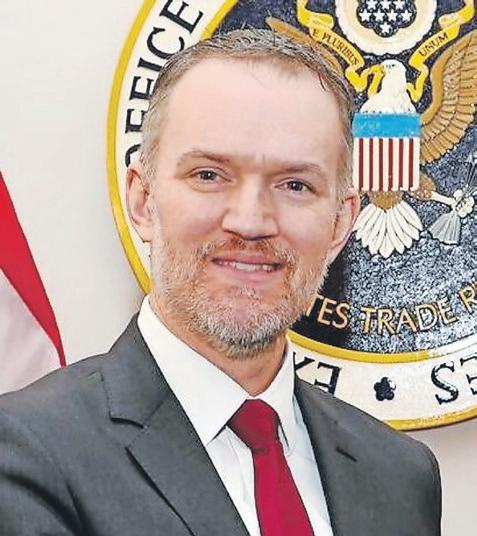
BAHAMIAN businesses were yesterday anxiously awaiting “more clarity” after the top US trade negotiator promised the up to $1m per port call fee on Chinese-made ships will not be implemented as proposed.
While some hailed the position unveiled to Congress by Jamieson Greer, the US Trade Representative, as “excellent news”, others said they are taking nothing for granted and are “on pins and needles” waiting to see all the details that
the Trump administration intends to unveil on Thursday as part of its strategy to drive ship-building back to the US.
IMF: Mortgage payments double as wages stagnate
By NEIL HARTNELL Tribune Business Editor nhartnell@tribunemedia.net
MORE Bahamians are struggling to afford their own home because wages have remained relatively stagnant while the average monthly mortgage payment has near-doubled since the 21st century started.
The International Monetary Fund (IMF), unveiling updated research on The Bahamas’ housing struggles, signalled that affordability is a key factor with nominal monthly
mortgage payments having increased from around $1,000 at the turn of the century to just below $2,000 in 2022-2023. The increase came despite incomes, salaries and other worker compensation being little changed for the past 13 years.
“Employee compensation per capita has remained almost unchanged compared to 2012,” the Fund said of The Bahamas. “Average monthly payments on
JAMIESON GREER
Group’s 400% profits jump proves going ‘lateral’ works
FROM PAGE B1
lateral development rather than single intensive development.
“Let’s say you’re going to put a $20m investment into the country. Why are you putting all that energy and effort into one spot as opposed to investing more laterally across The Bahamas. Your eggs are then not in one basket. That takes a bit of know how, but intensive development takes a skill set and more capital development than the original investment that was sent in.”
Mr Simmons’ argument is that resort investors/developers should diversify their investments and activities across multiple Bahamian islands with involvement in more than one small, boutique resort. This, he said, would be both less risky and more beneficial to the Bahamian communities that host such projects rather than attempting to pull-off a single mega resort that is out of scale and character with the Family Islands.
achieve those elevated deficits, the Government will have to run a fiscal surplus of between $232m and close to $250m during the fiscal year’s final five months.
The ‘positive’ Moody’s outlook, and the Government’s own objective of escaping ‘junk’ status with all three credit rating agencies - the other two being Fitch and Standard & Poor’s (S&P) - have coincided with an International Monetary Fund (IMF) study which estimated that the “spreads” on Bahamian external sovereign debt could decline by up to 2.4 percentage points by 2029 if there is a credit rating upgraded (see other article on Page 1B).
‘Spreads’ measure the difference in interest, or the yield, paid on Bahamian
The Bahamas is littered with so-called ‘anchor projects’ that have either been abandoned or closed by the developer. These sites often remained tied-up in disputes and litigation with the financiers for years, as the sheer expense tied up with the necessary infrastructure investments and other ‘sunken’ costs makes it impossible to earn an investment return, generate cash flow and service debt funding.
For these very reason, it is often the second or third purchasers of Bahamian resort developments or properties that often earn the returns because they are able to acquire such assets at low or significantly discounted entry prices. One example of such a price was Exuma’s Emerald Bay resort, which Sandals purchased for around $25m$30m, when the Japanese insurer holding it had been trying to recover $130m.
“With Little Island Hotels, we’ve completed three hotels, are about to start on the fourth, and want
government bonds versus what is paid on others, with US Treasuries usually used as the benchmark. The IMF report suggested “sustained and credible efforts” will be required to secure an improvement in The Bahamas’ credit rating, while inclusion in indices such as JP Morgan’s emerging market bond index could also have cut The Bahamas’ spreads.
Moody’s, meanwhile, said the ‘positive’ outlook it has now placed on The Bahamas “reflects the increased likelihood that fiscal consolidation will strengthen The Bahamas’ credit profile over time”. It added that the Davis administration’s efforts over the past two fiscal years, in slashing the fiscal deficit from $722.2m in 2021-2022 to $186.7m in 2023-2024, will more than
to do five, six, seven,” Mr Simmons told this newspaper, asserting that the group’s success to-date serves as “proof of concept” and that such a development model works.
“We’re one of the largest employers in the community, starting with 15 and going to 150 between the three properties. You’re looking at a ten-fold increase in employment over ten years. There’s other projects that have been around that long and have not got there. They’re trying to build one thing and there’s still a lot to do.
“In the same timeframe, we have enjoyed a ten-fold increase in employment, and from a revenue and profit standpoint they’ve increased by 400 percent. We give back to the community with donations on a huge level. One percent of our top line is reinvested in education within the community,” he added.
“We allow people to grow with us and grow to the senior ranks, and because we are a smaller operator and formulaic to a certain
offset any miss of this year’s target.
“The Ministry of Finance published a mid-year fiscal update in February 2025, which showed a fiscal deficit equal to $398m or 2.6 percent of estimated fiscal year GDP. This compares with the full-year target for a fiscal deficit of 0.5 percent of GDP,” Moody’s said, noting the more than five-fold difference in dollar terms.
“The larger-than-projected deficit was driven by both shortfalls in revenue and higher-than-planned spending, and poses some risks to the Government’s fiscal deficit target for this year. Even if there is some fiscal slippage relative to the target, the fiscal consolidation over the past two years has been sufficient to place debt on a downward trend.”
degree it makes it easier to train people to occupy management roles. Whereas if you try to build a company with 300 employees in one go it’s going to take tremendous expertise.
“We’re trying to make the argument that this style of development is better for the country in the longrun and, if we can do it in Eleuthera we can do it elsewhere and maybe the Government needs to look closely at it. We’ve done it without a single concession from the Government. It’s not cost the Government anything.”
Kerry Fountain, the Bahama Out Island Promotion Board’s executive director, recently told Tribune Business he was encouraging member hotels to follow Mr Simmons’ lead with The Farm and grow some of their own food “to cut down on what we import from the US” given the Trump trade and tariff upheaval.
“What we’re trying to encourage our hotel members to do is how we can
And, while there was no mention of the uncertainty and blows to business and consumer confidence from the Trump tariff woes, Moody’s added: “There are some risks to the Government’s forecast for revenue growth of 15 percent yearover-year in fiscal 2024-2025. In the first half of the fiscal year, VAT - which accounts for more than 40 percent of total revenue - increased by only 2.6 percent.
“This was offset by very strong growth in taxes on international trade and transactions. Overall, total revenue increased by 10.6 percent year-over-year. On the other hand, we expect the Government to control spending in the second half of the fiscal year to limit the deviation, if any, from the full-year fiscal target.
“Total spending increased nearly 18 percent in the first half of the fiscal year, driven primarily by an increase in capital expenditure. Some of this spending likely reflects delayed capital spending from the previous fiscal year, and we would expect slower growth in capital expenditure through the remainder of the fiscal year.”
Moody’s also gave the Davis administration a further vote of confidence by backing its forecast that it will generate a fiscal surplus in the upcoming 2025-2026 budget year, meaning it will almost certainly be the first time in Bahamian history since independence where annual tax and other revenues exceed spending.
However, while also affirming the extra revenue that the Government hopes
create greater linkages with our farmers and purchase from them some of the goods they consume on an annual basis,” Mr Fountain added. Mr Simmons said the Little Island Hotels group was again proof that such initiatives can work especially given current inflationary pressures and the high cost of living.
“By adding the agricultural component we’ve been able to reduce food costs across all businesses by 18-20 percent,” he told Tribune Business. “All of these things combined make for a more robust business model. We only expand when we have the revenues to do so, so it’s tethered to when the workforce is available and makes for a more robust operation.
“While we have not taken the concessions, it would be nice to know we’re supported by the Government and this form of development, they’re advocating for it and want to see it succeed, and more people are likely to embrace it.”
to generate from its 15 percent corporate income tax on companies that are part of multinational groups generating 750m euros and above in annual turnover, Moody’s suggested that the 2025-2026 surplus will be much less than the forecast $448.2m. It is instead predicting the surplus will be $30.9m, or 0.2 percent of GDP, more than $400m less.
“Notwithstanding the mixed mid-year fiscal performance, we expect The Bahamas’ fiscal consolidation to continue, with the fiscal balance turning to a surplus in fiscal 2026 along with sizeable primary surpluses above 4 percent of GDP,” Moody’s said.
“In the absence of shocks, this would place debt on a steady downward trend over the remainder of the decade. Beyond the Government’s efforts to improve tax compliance, which have yielded results, the introduction of a 15 percent Qualified Domestic Minimum Top-Up Tax (QDMTT) on large multinational corporations operating in The Bahamas should increase revenue by about 1 percentage point of GDP beginning in fiscal 2026.
“Risks to the fiscal trajectory relate to the country’s exposure to climate-related shocks and the reliance on tourism, which is sensitive to external factors.” As for the tourism outlook, Moody’s said this is heavily tied to the fate of the US economy, which continues to recoil from the uncertainty created by Mr Trump’s tariff policies and whether these will weigh on the cost of living, spending and travel demand.
“The Bahamas’ growth outlook is particularly
Mr Simmons said Little Island Hotels’ fourth property will be constructed on land that was formerly part of The Current Club, which was demolished by Hurricane Andrew in 1992. Construction of what is anticipated to be a 22-room property will likely take 18 months, once all permits and approvals are obtained, and another 20-30 jobs will be created to take the group’s total workforce to 180. With all relevant submissions made to the Department of Environmental Planning and Protection (DEPP), Mr Simmons said he is now simply waiting for “the green light” and to “make sure we do it right” in terms of whether any Environmental Impact Assessment (EIA), Environmental Management Plan (EMP) and public consultation is first required. Pledging “to go from there” once The Current is completed, he added of further expansion: “Who knows? Hatchet Bay, Governor’s Harbour, other islands.. Who knows?”
vulnerable to changes in US growth prospects given its importance as a source market for tourism. Therefore, slower growth in the US economy or a deterioration in consumer sentiment could weigh on demand for travel,” Moody’s said.
“We estimate that real GDP growth moderated to 1.9 percent in 2024, down from 2.6 percent in 2023, and closer to the economy’s long-term potential of around 1.5 percent to 2 percent. In 2024, total visitor arrivals increased by about 16.2 percent compared with the previous year. Stayover arrivals, which tend to contribute more to the economy, declined by 0.3 percent year over year.
“However, cruise ship arrivals increased by 20.3 percent, driving tourism growth. Tourism is likely to continue to display strong growth projections in 2025, with total visitor arrivals increasing by 7.8 percent in January compared with the year-earlier period. This will be supported by investments made by cruise operators in recent years in private island destinations within the Bahamas,” the credit rating agency continued
“Royal Caribbean, Carnival Corporation and Norwegian Cruise Line have all invested in private island destination since 2019, contributing to a doubling of visitor capacity in 2025 compared with 2019. However, growth in stayover arrivals will face capacity constraints in terms of room availability, specifically in Nassau and Paradise Island, the most popular destinations.”
‘More clarity’ urged on US Chinese ship fee pullback
Mr Greer, under questioning by Senator Bill Cassidy during a Senate Finance Committee hearing, confirmed that “not all fees” contained in the original Chinese-made ship proposal will be implemented following strong opposition and push back from the shipping industry, US exporters and others. He also promised that not all would be “stacked”, which seemed to suggest that fees will not be layered on fees.
After Mr Cassidy pointed out that the proposal would negatively impact the ports in his Louisiana constituency, Mr Greer replied:
“To address the lack of ship building in the US, the US Trade Representative’s Office proposed actions to do just this. They are proposed actions. They are series of potential remedies that could be used to incentivise ship building in the US.
“They [the fees] are not all going to implemented. They are not all going to be stacked. We’ve asked for a lot of input on that. We’ve had a hearing on that, we’ve collected comments, we’re reviewed it, I’ve met personally with certain stakeholders during that time period, and I think the president is looking very carefully to make sure that we have the right amount of time and right incentives to create ship building here without impeding our commodities exports.”
While Mr Greer’s comments have raised hopes and expectations that The Bahamas, its importdependent economy, citizens and businesses may escape the worst or full effects of the Trump administration’s Chinesemade ship fees, they also confirm that some fees will likely be implemented although on who, and the how and when, are presently unknown.
Tim Martin, Tropical Shipping’s chief executive, in a messaged reply to Tribune Business wrote yesterday: “We will know on April 17.” The freight operator, one of the biggest cargo movers between Florida and The Bahamas, would be among those taking the greatest hit given the number of Chinesemade vessels in its existing fleet. Such increased costs would inevitably be passed on to Bahamian companies and consumers.
Tropical Shipping, in its last submission to the US Trade Representative’s Office on April 2, 2025, had warned that if implemented in its original form the Chinese-made ship fee would increase its cargo rates by $2,500 per 40-foot container and make The Bahamas and wider Caribbean “altogether economically infeasible for carriers to serve’.
And Dr Patrick Antoine, chief executive and technical director for the Caribbean Private Sector Organisation (CPSO), added that the $1m per
port call fee would increase freight costs by between 50 percent to 60 percent for companies in The Bahamas and wider region.
“As proposed, the US Trade Representative’s Office’s measures will result in unintended consequences for CARICOM economies, private sector business and consumers as maritime transport accounts for more than 90% of CARICOM’s trade in goods,” Dr Antoine wrote.
“Estimates of the additional freight cost resulting from the implementation of the proposed US Trade Representative’s Office’s measures among CARICOM businesses suggest increases ranging from 50 percent to 6 60 percent based on the US $1m fee.”
Bahamian businesses yesterday reacted to Mr Greer’s comments with cautious but nervous optimism. Sir Franklyn Wilson, the Arawak Homes and Sunshine Insurance chairman, told this newspaper: “Let me put it this way. All the persons to whom I have spoken think it’s very, very good news. The point of the matter is that we have to go through this thing one step at a time. That is good news.”
Mark A Turnquest, founder of the 242 Small Business Association and Resource Centre, as well as a consultant to many companies of that size, agreed that the US Trade Representative’s remarks were “excellent news” but
added that “more clarity” is required before the Bahamian private sector can celebrate.
“That’s excellent news because we cannot afford any hike in prices related to shipping or any hike in prices related to actual product costs,” Mr Turnquest told Tribune Business “That would be detrimental to our well-being, and we will most definitely lose business and some of us might go out of business eventually because it will become too competitive to stay in business.”
However, with the US Trade Representative’s Office yet to reveal the specifics of what it now plans to implement, he added: “We are on pins and needles. We don’t know what Donald Trump is about in terms of strategy.... The shipping cost proposal is excessive. The problem with it is we need more substantive policies.
“We need clearly identified information as to whether, and by what percentage, shipping costs will increase, how and when it will be executed, and how Tropical and other carriers that ship to The Bahamas will be affected.
“It’s going to affect the level of prices; that’s what we have to be concerned about. At the end of the day, a rise in shipping costs is a rise in prices to the customer and a rise in prices to business and, of course, a decline in profit margins for us. A rise in prices clearly leads to a decrease in sales;
IMF: MORTGAGE PAYMENTS DOUBLE AS WAGES STAGNATE
residential mortgages have increased more rapidly, despite the secular decline in average interest rates for residential mortgages over the same period.”
Besides affordability, access to and qualifying for mortgage financing was identified as a further obstacle to Bahamian ownership dreams. Data displayed by the IMF showed that the number of new annual residential mortgage commitments has fallen from a peak of around 2,500 per year in 2008, which was when the financial crisis and global recession hit, to less than 1,000 per year since 2020 and the COVID pandemic.
That marks a decline of more than 60 percent from the 2008 peak, and the IMF said: “Financing constraints may also be an obstacle to home ownership. The number of new residential mortgage commitments for single dwellings and duplex and row dwellings have trended downward since 2008....
“Mortgage applications recorded the lowest approval rate of all credit categories in the 2024 first half, standing at 54.3 percent. Most application denials were due largely to low credit scores, constraints on banks’ lending outside of internal policy, underemployment, the applicant’s prior history of delinquency on prior loans, higher debt service ratios, insufficient working history in the current job, the bank’s inability to verify the applicant’s income and inadequate funds for a down payment.”
Elsewhere, the IMF, in a research blitz on The Bahamas, estimated in a separate study that the “spreads” on Bahamian external sovereign debt could decline by up to 2.4 percentage points by 2029 if the country’s sovereign creditworthiness is upgraded by the likes of
Moody’s, Standard & Poor’s (S&P) and Fitch. Such a decline would also benefit Bahamian taxpayers by lowering the country’s borrowing costs.
‘Spreads’ measure the difference in interest, or the yield, paid on Bahamian government bonds versus what is paid on others, with US Treasuries usually used as the benchmark. The IMF report suggested “sustained and credible efforts” will be required to secure an improvement in The Bahamas’ credit rating, while inclusion in indices such as JP Morgan’s emerging market bond index could also have cut The Bahamas’ spreads.
Noting that The Bahamas’ credit rating, which is presently in ‘junk’ territory with all three rating agencies and non-investment grade, together with investor “risk aversion” has a major impact on sovereign bond spreads, the IMF recalled how the interest rate or yields on this nation’s debt soared by more than 10 percentage points during the peak of the COVID-19 pandemic and its aftermath.
“Spreads on Bahamian sovereign bonds issued on international capital markets increased sharply following the onset of the COVID-19 pandemic, rising by as much as 1,200 basis points - more than five times’ their pre-pandemic levels,” the Fund’s paper added.
“The country faced multiple challenges during this period, including a substantial rise in debt driven by both pandemic-related expenditures and the impact of a major hurricane [Dorian] that occurred just prior to the pandemic. Moreover, the Bahamian economy, heavily reliant on tourism, was severely impacted by the global downturn in travel.
“Although spreads have recently moderated, they
remain elevated relative to their historical levels.
Wider spreads imply higher government borrowing costs, and consequently that a larger share of fiscal resources has to be devoted to servicing public debt.”
This means increasing sums of money diverted away from much-needed public services such as health, education, national security and social security.
“Changes in The Bahamas’ sovereign rating correspond closely with significant movements in Bahamian sovereign spreads,” the IMF paper said. “The country’s median rating dropped from ‘BBB’ to ‘BB’ in early 2020, and again from ‘BB’ to ‘B’ in late 2022. At both times, the fitted spread exhibits discrete jumps, consistent with relatively large estimated coefficients for sovereign rating grades below investment grade.
“These jumps in the fitted spread coincide closely with increases in the observed sovereign spread, though it is notable that spread increases can precede official rating downgrades by several months.... Inclusion in bond indices like the Emerging Market Global Bond Index could lower sovereign spreads, for example through increasing the available investor base.
“The spreads in The Bahamas would have compressed by 56 basis points (0.56 percentage points) compared to other countries with similar fundamentals if the archipelago were included in JP Morgan’s Emerging Market Bond Index Global.”
However, the bigger gains for The Bahamas lie in improving its fiscal and economic fundamentals such that its sovereign credit
it always happens,” Mr Turnquest said. “It’s a challenge every morning now. You wake up, you cannot plan, you cannot grow at the level you want to, you cannot invest... We need more clarity; how it affects us directly. We don’t want it to be applied to our jurisdiction, and need to know more from Tropical to determine how it affects us. It’s chaos. It’s really chaotic. I’ve never seen such a chaotic policy from the US. No Republican or Democrat signed up for this.”
Tropical Shipping, in its final submissions to the US Trade Representative’s Office, urged that the Chinese-made ship fee not be imposed if those vessels are owned and operated by an American carrier. And, alternatively, it also called for a waiver or exemption for vessels weighing below 55,000 dead weight tonnes which are typically those that service The Bahamas and the Caribbean.
Dr Antoine and the CPSO, meanwhile, also urged that The Bahamas, wider Caribbean and shipping serving the region be exempted from the Chinese-made ship port fee. They suggested ‘grandfathering’ in existing Chinese-made ships and creating a waiver for regional transshipment hubs.
The Bahamas, according to the US’ very own investment climate statement, currently has a $4.5bn trade deficit with the US. This means it imports far more
worthiness is upgraded.
The Davis administration recently unveiled a return to ‘investment grade’ status with all three rating agencies and an escape from ‘junk’ territory as being one of its key objectives.
“Bahamian external sovereign spreads could decline by 65 to 240 basis points
by 2029 if there is a rating upgrade from sustained and credible fiscal efforts,” the IMF paper forecast. The lower end of that range would be achieved without a rating upgrade and relies on favourable movements in global bond market indices.
However, the IMF then added: “Under the scenario with a rating upgrade by one notch, the fitted value declines by an additional
physical goods from the US than it exports to it, raising immediate questions about why the country has been caught up in Mr Trump’s tariff war.
“There has been significant consolidation of liner services in CARICOM over the past two decades - a reduction from over 15 to the five consistent lines currently,” Dr Antoine said. “Several CARICOM member states are serviced by only two liners, largely from ports in Florida.
“The relatively small markets of CARICOM member states, port depths and ‘short sea’ shipping models require smaller shallow drafts which are more difficult to procure. The five liners operate at least one China-built vessel. Many of these vessels have been ‘purpose built’ with the capability to supplement deficient port infrastructure such as gantry cranes.
“The reduction of ‘vessel’ service - a distinct possibility if the US Trade Representative’s Office’s measures are implemented in their present form - will result in major supply side challenges to US and CARICOM businesses and consumers, the erosion of lucrative markets for the US and CARICOM farmers, manufacturers, distributors, shipping and logistics services, among others.”
175 basis points, implying a spread of about 260 basis points by 2029, a level close to the pre-pandemic period.
“Since rating upgrades are often linked to improvements in a country’s macroeconomic fundamentals and its fiscal situation, this suggests that an appropriate domestic policy mix can lead to substantial drop in spreads and funding costs.”