MONDAY TUESDAY 20 Pc McNuggets $7 + VAT
i’m lovin’ it!
The Tribune Established 1903
24/7 BREAKING NEWS ON TRIBUNE242.COM
HIGH 85ºF LOW 75ºF
Biggest And Best!
VOLUME:117 No.97, APRIL 14TH, 2020
THE PEOPLE’S PAPER: $1
HEALTH: NO WONDER THE PASTOR’S ALWAYS SMILING
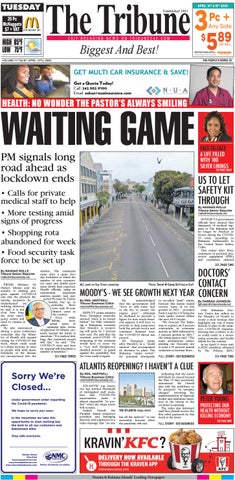
WAITING GAME
PM signals long road ahead as lockdown ends
PRIME Minister Dr Hubert Minnis said the country is making progress against COVID-19 and that the physical distancing measures he implemented are working. However, he said, it is not clear how long the strict emergency orders will need to remain in place. He also announced during a press conference yesterday that the Ministry of Health will expand testing for COVID-19 this week, which could result in a sharp increase in cases as people with mild manifestations of the disease are incorporated into the
statistic. His comments came after a quiet fiveday lockdown in which the number of new coronavirus cases and deaths grew more slowly than expected. Health officials, using an exponential regression analysis model, had projected 90 cases by Easter Sunday but up to yesterday there were only 49 confirmed cases in the country. Even while hitting occasional notes of optimism after weeks of upheaval, Dr Minnis , pictured, warned the future is uncertain. “It is unclear how long this restricted period will last,” he said. “The COVID-19 virus and how we respond will determine a number of timelines.” SEE PAGE THREE
Sorry We’re Closed... Under government order regarding the Covid-19 pandemic. We hope to serve you soon. In the meantime we take this opportunity to wish nothing but the best to all our customers and Bahamians alike.
US TO LET SAFETY KIT THROUGH
By RASHAD ROLLE Tribune Senior Reporter rrolle@tribunemedia.net
SENIOR US government officials have assured that shipments of medical supplies to The Bahamas will no longer be blocked or frozen during the COVID19 crisis, according to Bahamas Ambassador to the United States Sidney Collie. This comes after three containers of personal protective equipment (PPE) and ventilators ordered SEE PAGE TWO
DOCTORS’ CONTACT MOODY’S - WE SEE GROWTH NEXT YEAR CONCERN ALL quiet on Bay Street yesterday
By NEIL HARTNELL Tribune Business Editor nhartnell@tribunemedia.net
DEPUTY prime minister Peter Turnquest yesterday warned “there is no restart button” for fully relaunching a Bahamian economy that Moody’s is projecting will grow by 2 percent next year. He said that the eventual post-COVID 19 reopening of the economy would have to occur via a “very well thought-out, detailed process” to guard against the possibility that the virus could re-ignite.
Photo: Terrel W Carey Sr/Tribune Staff
He acknowledged that the government will “have to add some fuel to the fire to ensure the engine goes”, although he declined to provide a figure for how much financial support it will have to provide to help jump-start both the private sector and consumer demand once the COVID-19 threat has passed. Mr Turnquest spoke after Moody’s, in a “credit opinion” that accompanied its decision to place The Bahamas “under review” for potential downgrade
to so-called “junk” status, forecast this nation would recover some of its lost growth in 2021 - provided both it and the US bring the virus under control within the next 10-12 weeks. “We forecast The Bahamas to register an 8 percent contraction in economic activity in 2020, followed by 2 percent growth in 2021,” the rating agency said. “The main assumptions underpinning our forecasts are at least a 35 percent annual reduction in tourism flows.
FULL STORY - SEE BUSINESS
By FARRAH JOHNSON fjohnson@tribunemedia.net THE Bahamas Doctors Union has called on the Ministry of Health to create a clear strategy that highlights the role it wants doctors to play in the country’s COVID-19 response, warning that a failure to do so could result in a devastating economic and health fallout for the country. In an April 11 letter sent to BDU members, obtained by The Tribune, BDU SEE PAGE TWO
ATLANTIS REOPENING? I HAVEN’T A CLUE By NEIL HARTNELL Tribune Business Editor nhartnell@tribunemedia.net
ATLANTIS’ top executive has warned thousands of furloughed staff members that COVID-19’s uncertainties make it almost impossible “to predict” when the mega resort will re-open. Audrey Oswell, the Paradise Island property’s president and managing director, told employees in a video message that “no one
THE ATLANTIS mega resort has all the answers” or can accurately forecast when the pandemic will end.
Indicating that the resort will likely be closed beyond the May 15 date previously announced, Ms Oswell also told the workforce to be prepared “to navigate changes” involving the implementation of rigorous health and sanitation measures in the run-up to the eventual re-opening. The video also informed staff they should receive the first relief payments by this week at the latest. FULL STORY - SEE BUSINESS
Stay safe everyone.
Shirley Street 302-0130 www.nassaumotor.com www.hondabahamas.com www.chevroletbahamas.com
A LIFE FILLED WITH 100 SILVER LININGS
SEE PAGE EIGHT
• Calls for private medical staff to help • More testing amid signs of progress • Shopping rota abandoned for week • Food security task force to be set up By RASHAD ROLLE Tribune Senior Reporter rrolle@tribunemedia.net
FACE-TO-FACE
Where Standards are Higher
Nassau & Bahama Islands’ Leading Newspaper
PETER YOUNG
PROTECTING OUR HEALTH WITHOUT KILLING ECONOMY
SEE PAGE NINE
PAGE 2, Tuesday, April 14, 2020
THE TRIBUNE
CORONAVIRUS CRISIS
US to let safety kit through after blockage from page one by the Ministry of Health were blocked last week, following an order signed by US President Donald Trump directing his administration to stop exporting N-95 masks and other medical equipment. The Tribune was first to report how the US Coast Guard sent a letter to Betty K, a local shipping company, denying the company access to the supplies and demanding the return of the items. However, that shipment has since been released and is expected to arrive this week, after Bahamian officials made appeals to American diplomats. Rupert Roberts, owner of Super Value, said on Saturday he too believes his order of 100,000 masks, including 70,000 N-95 masks and 30,000 medical masks, was held up in the US, prompting his need for intervention by the Bahamian government. He said the items should have arrived on Wednesday. He said he intends to distribute the masks to merchants around the country. Mr Collie said yesterday that Super Value’s shipment has not been frozen by the American government but is in a queue along with other shipments waiting to be released around the region. “I have been assured by my sources at the highest level of the US government
that the shipments for The Bahamas have been released, there are no holds on any of them and the only restrictions now are one of procedure and processing,” Mr Collie said. “There is a long queue of items for 17 other countries in the Caribbean and Central America and you have to hold your spot in the queue and wait your turn. “There is an enhanced procedure by (US) Customs and Border Protection involving additional steps and every shipment has to be checked in accordance with new protocols. Along with the holiday weekend and reduced staff, there is a backlog. The local customs and border control office is reduced and stagnant. I have been assured that there will not be any blockage or freezing on any shipments coming to The Bahamas as far as the protocol under President Trump’s order is concerned.” Among the shipments destined for The Bahamas is a large purchase by Ports
AMBASSADOR Sidney Collie
International, a medical supplies and equipment company. “I have all of their invoices, I’ve interceded on their behalf and they are also on my radar and I’m doing what I can to expedite their shipment,” Mr Collie said. “Their shipment is much larger than Rupert Roberts’ shipment or the Betty K one.” Hillary Hall, assistant executive officer of Ports International, said yesterday she is happy to hear their shipment has not been blocked by the US government. She confirmed the incoming supplies are COVID-19 related and include personal protection items. President Trump was asked at a press conference on Friday about the US blocking supplies to Latin American and Caribbean countries. He suggested the situation was not deliberate, but part of a larger fight to stop drug trafficking. He said: “We have a tremendous force out there, naval force, and we’re blocking the shipment of drugs so maybe what they’re doing is they’re stopping ships they want to look…we’re not blocking, what we’re doing is we’re making sure, we don’t want drugs in our country and especially with the over 160 miles of wall, it’s getting really hard to get through the border, they used to drive right through the border like they owned
it and in a certain way they did, they could drive right there, they human trafficking, all of a sudden they have a powerful wall up and they’re not driving through that wall, that wall is tough… “A lot of people though what they’re trying to do is come in through the water ways, whether it’s the gulf or the ocean ways and what we’re doing is we’re being very tough and we’re being tough because of drugs and human trafficking and remember
the human trafficking, it’s mostly females…we have a big naval force that’s stopping so maybe when you mention that, their ships are getting caught but we’re stopping a lot of ships and finding a lot of drugs.” However, the Miami Herald reported on Saturday that a spokesperson from US Customs and Border Protection confirmed the agency is working with the Federal Emergency Management Agency to prevent distributors from diverting
personal protective equipment, or PPE, such as face masks and gloves, overseas. Ventilators also are on the prohibited list, the Miami Herald said. “To accomplish this, CBP will detain shipments of the PPE specified in the President’s Memorandum while FEMA determines whether to return the PPE for use within the United States; to purchase the PPE on behalf of the United States; or, allow it to be exported,” the statement sent to the Miami Herald read.
Doctors’ union calls for a clear strategy from page one President Melisande Bassett said that the union has learned of doctors allegedly being “threatened with non-contract renewal” if they choose not to volunteer to be a part of the COVID-19 response. Noting that doctors are at the “greatest risk” of contracting the disease, Dr Basset also wrote that she has submitted a list of medical professionals who are willing to offer their services under particular conditions. “I have presented to the Department of Medicine a list of volunteers who are: willing to have direct contact with COVID-19 patients; those with premorbid conditions that put them at high risk and have indicated that they will assist via telephone contact in history taking or patient review, and those that are willing to man the phone lines for non-COVID-19 related issues.” Still, Dr Bassett noted that some doctors have not had proper training in putting on and removing personal protective equipment (PPE) nor proper N-95 mask fitting. “In addition to these concerns, some physicians have elderly parents and family members with
comorbidities,” the letter continued. “These physicians have expressed that, if possible, they will assist if they are able to sequester themselves away from home for the period where they are assisting directly with positive patients. “Since the beginning of March, the BDU has requested additional sleeping facilities to facilitate social distancing and to provide lodging for persons who wish to sequester themselves away from home. To date, the BDU has not received any official information from the minister on this. We know that this is an impediment to many wishing to volunteer.” Dr Bassett also called for “official documentation” to back up the government’s verbal promise for “compensation and insurance benefits” for doctors or their family members, if they ended up contracting the disease. She added that there has been “widespread reservation” by members of the union due to their history with receiving compensation in the past. “If the aim is to have doctors volunteer for the COVID-19 response, the BDU suggests that a clear plan be penned with specific categories for work, as suggested above, those with direct contact with patients,
those who can serve in other capacities, hours expected to be engaged, protocols for various COVID-19 centres, level of involvement needed by volunteers, and any other pertinent information. “We all understand that this is a national response, and admonish you to lend your support. If we delay in mounting a strong response to this dilemma, the health and economic fallout will be devastating.” In the letter, Dr Bassett said one of the union’s primary goals was to ensure that the country’s physicians were not the “greatest number of casualties.” She added that the BDU has requested to meet with Health Minister Dr Duane Sands to discuss their concerns. Despite numerous attempts, health officials did not respond to requests for comment up to press time. However, last week, Dr Sands said the government was aware that healthcare workers have families. No one is safe at home if someone in the house is serving on the frontline, Dr Sands said. To ease this concern, he said the ministry is exploring relief accommodations that can house at least 100 healthcare workers. Editorial View - Page 6
PUPILS TO GET LESSONS VIA TV ALL schools will remain closed until further advice is received from the Ministry of Health, a statement announced on Friday – and all examinations will be postponed with no date given for when they will be held. The statement read: “The Ministry of Education wishes to assure the general public that it considers the health of our citizens and residents of paramount importance.
The Ministry remains dedicated to making decisions that will ensure the well being of all and we will be guided by the Ministry of Health’s advice regarding the COVID-19 pandemic. “The Ministry of Education further informs the public that all examinations, including the national examinations, GLAT, BJC and BGCSE, will be postponed until such time as the government of The
Bahamas deems it safe for students, teachers and support staff to return to physical buildings.” Teaching will continue through virtual learning platforms, and new content and lessons will be posted today. In a new move, lessons will also be broadcast on television – initially on cable channel 295, starting tomorrow and then shortly afterwards on channel 296.
THE TRIBUNE
Tuesday, April 14, 2020, PAGE 3
CORONAVIRUS CRISIS
It’s a long road ahead, warns PM from page one
THE ROADS in New Providence were virtually empty yesterday
“We are making progress,” he added. “Our physical distancing measures, curfews and “We are making progress,” he added. “Our physical distancing measures, curfews and lockdowns are having an affect but we still have a long way to go. We must and we will remain vigilant. Now is not the time to let down our guard. There will be no complacency on the part of your government. We must remain on full alert. We will not recover properly unless we are disciplined in applying the right and necessary measures in restoring our country to better health.” Dr Minnis acknowledged the country faces “real challenges” because of testing limitations. With a mortality rate of about 16 percent, the Bahamas has one of the highest death rates in the world.“As testing expands,” Dr Minnis said, “more people will be diagnosed with COVID-19 in the Bahamas, including those with mild symptoms. The Ministry of Health plans to expand testing this week. This will result in an increase in the number of cases. Health officials are closely monitoring the case numbers as this will inform us where we are in the surge. As we get a broader picture of the true extent of COVID-19, this should reflect the case fatality rate is indeed lower.” He continued: “Information from the field is also informing us that some populations are particularly hard hit and have higher mortality rates from COVID-19. Photo: Terrel W Carey Sr/Tribune Staff Our health team is continuing
to compile information on the COVID-19 outbreak in the Bahamas that will help to guide our health strategy, including measures like curfews and lockdowns. “I understand the many burdens associated with the curfew and lockdowns, including for the poorest and more vulnerable in our society. I understand the mental health challenges, the loneliness, the difficulties, problems and anxiety caused by various measures. But rest assured that we have put in place these restrictions and guidelines to save lives. The more you abide by physical distancing, by wearing masks and by staying at home, the quicker we can ease restrictions at the appropriate time.” Eight people have died from COVID-19. The two latest confirmed cases of the virus include a 40-year-old New Providence woman who is in isolation at home and a hospitalised 50-yearold New Providence man who also has no history of travel. On Sunday, the Ministry of Health announced that a woman from Cat Cay, a small community off Bimini, had tested positive for the disease. The 36-year-old woman has no history of travel. She is in isolation at home. Dr Minnis appealed to medical doctors in the private sector to help in the fight against COVID-19. “We need every health professional available to fight this grave threat,” he said. He said the South Beach Clinic was prepared to act as a COVID19 facility. Once fully operational, it will be able to accommodate 10 COVID-19 patients.
SHOPPING SCHEDULE SUSPENDED FOR ONE WEEK By RASHAD ROLLE Tribune Senior Reporter rrolle@tribunemedia.net
PRIME Minister Dr Hubert Minnis announced the suspension of the food shopping schedule for the remainder of this week. The schedule will resume next Monday. In the meantime, grocery stores will be open from 6am to 7pm on weekdays, with 6am to 8am reserved for seniors and people with disabilities. During weekend lockdowns scheduled until the end of this month, the stores will open on Saturdays from 6am to 6pm for essential workers only. Pharmacies will also be allowed to open on Saturdays until 3pm for essential workers. “Police will be present at major stores to support physical distancing measures,” he said. The shopping schedule was introduced last week to limit the number of people at food stores and prevent the spread of COVID-19. The plan backfired, however, as residents prepared for the five-day lockdown, with stores across New Providence and Grand Bahama bombarded with shoppers who sometimes created chaotic scenes and flouted social distancing guidelines. Dr Minnis said food stores are required to have hand sanitisers available for everyone entering their
establishments. He again assured the public that there is no food shortage in the country and no need to panic buy. “There is enough food,” he stressed. He warned against hoarding and possibly stocking up on food with a limited shelf life. “You do not wish to make yourself and your family sick by consuming food that has expired,” he said. He encouraged store owners who encounter difficulty enforcing distancing rules to use a ticket or numbering system that let people stay in their vehicles until their number is called. He also encouraged residents to embrace reputable online grocery delivery services as a way to remain physically distant from other people during this time. “The more we create online ordering, payment and delivery options, the more we keep our domestic economy functioning while also reducing lines at stores,” he said. “There is a major opportunity that exists for businesses that create easy-to-use online payment and delivery options. I advise companies that have been slow to (do) this to see how they can retool their operations to meet the challenges of these times.” Dr Minnis, who recently announced a ban on nonmedical mask imports, clarified that this policy does not apply to mask
Since 1892 Bahamians have been protecting the environment with the passage of the Sea Gardens Protection Act, which prohibited dredging or removal of coral, sea fans or other organisms from the seabed.
Donate today to BPAF | 242-698-1152 or 437-2168 | www.bahamasprotected.com
orders made before April 10. He also said the government will appoint a food security task force to ensure every resident who needs a meal is provided with food. “This is a major and fundamental priority,” he said. Acknowledging that some people with food needs do not qualify for Ministry of Social Services assistance and can’t get help
from the National Insurance Board, Dr Minnis said the Ministry of Health has brought together governmental, non-governmental and private sector companies to examine food insecurity issues and mobilise resources to address this challenge. “Private sector donors have included Atlantis resort, Baha Mar resort, and other known and
anonymous donors inside and outside of the hotel sector,” he said. “Through their combined efforts, fresh produce, cooked meals, grocery packets and other food supplies have been delivered directly to those in need in Abaco, Grand Bahama, Eleuthera, and New Providence. “In the last seven days, the Bahamas Feeding
Network distributed $40,000 in food vouchers and between $10,000 and $15,000 in food parcels; Hands for Hunger has distributed 50,000 lbs of donated food: $5,000 in non-perishables and are budgeting about $20,000 for food vouchers. We encourage others to donate food. The Food Security Task Force will indicate how such donations can be made.”
PAGE 4, Tuesday, April 14, 2020
THE TRIBUNE
CORONAVIRUS CRISIS
SANDS LOOKING TO IMPROVE TESTING OPTIONS By RASHAD ROLLE Tribune Senior Reporter rrolle@tribunemedia.net
HEALTH Minister Dr Duane Sands said officials are examining options to increase COVID-19 PCR test supplies, suggesting this includes an option to buy supplies from the Cayman Islands, which recently acquired 200,000 kits from a South Korean company. The Cayman Islands has since sold 35,000 PCR test kits to Bermuda and 20,000 to Barbados.
Asked yesterday if The Bahamas is looking to get kits from the Cayman Islands, Dr Sands said: “We are looking at all options.” The coveted polymerase chain reaction (PCR) test kit is considered the gold standard of COVID-19 diagnostic tools and acquiring them is thought to be a difficult and competitive process. At a press conference last week, health officials were asked about the Cayman Islands’ purchase. At the time, Dr Sands said details of it were
unknown and he suspected the country had obtained rapid test kits, which are difficult to validate and have high rates of false positives. However, Cayman Islands chief medical officer, Dr John Lee said at a recent press conference that the 200,000 tests, which cost $4.4 million, are not immunoglobulin-based. “We’re not doing that,” Dr Lee said. “Our testing kits that have arrived to give us a very large capacity are for reagents for polymerisation and that is the test
mechanism that we’re using at the moment.” He said the tests passed their validation “with no problems whatsoever”. Cayman officials said local businessmen provided the initial contacts to help secure their supply of PCR test kits. The Cayman Islands has a population of about 65,000. The country has committed to keeping 100,000 test kits for its own use. According to the Cayman Compass, the country is selling the remaining kits at cost. At
last report, the country had 45,000 kits to sell. With its vast numbers of test kits, the country’s clinical panel has agreed to relax its COVID-19 testing protocol. “We will loosen the abili y for us to test and will move away from the World Health Organisation’s recommendations to test more widely,” Dr Lee said. Bahamians have been clamouring for more testing and local infectious disease expert Dr Nikkiah Forbes said last week this country’s high COVID-19 mortality
rate is likely because of its limited testing capacity. “Those (COVID-19 cases that died),” she said, “they were older in age and they had other medical comorbidities such as diabetes and hypertension, obesity and lung problems like asthma. I have no doubt that as we increase our capacity to do testing we will see that mortality rate balance out but this is a reflection of the section of the population we have been able to test, those with moderate and severe manifestations.”
BIMINI RESIDENTS ARE ‘HOLDING ON’ By FARRAH JOHNSON fjohnson@tribunemedia.net
PEOPLE on Grand Cay are facing the COVID-19 lockdown without adequate internet and phone services, challenging those seeking education, healthcare and other services.
Losing touch with the outside world By RASHAD ROLLE Tribune Senior Reporter rrolle@tribunemedia.net GRAND Cay residents are facing the COVID-19 lockdown without adequate internet and phone services, challenging those seeking education, healthcare and other services. Hurricane Dorian and COVID19 have intersected to limit the Cay’s connection to the outside world. To access the only reliable phone and internet service on the cay, residents huddle on the property of Craig Cephas. On Friday, Mr Cephas said he was “running a satellite” in his yard that attracts 60-plus residents each day. People sit on top of concrete blocks and stairways around his house, some with cell phones, others with laptops, making calls and surfing the internet. Fisherman Wendell Saunders, 52, said Dorian damaged the cay’s telecommunications infrastructure and they have not had decent services since. “When (Mr Cephas’) system is overloaded, you could be there for half-an-hour trying to get online and when you do get online and you send a text message, it takes five, ten minutes before it goes,” said
Mr Saunders, a 37-year resident of Grand Cay and father-of-five. “When the person you sent it to gets it, then it takes another five, ten minutes before you get their message back.” Mr Saunders estimates that about 50 or so school-aged children left Grand Cay, which is in the Abaco chain, to attend school elsewhere after Hurricane Dorian. With schools shut nationwide, the remaining students cannot access essential online learning services at home, he said. “We got like about 40 of the kids who go at (Mr Cephas yard) trying to get internet service to do their school work. That’s the only way for them to get service and sometimes they get on, sometimes they don’t because the service is so loaded from people coming to the yard,” he said. The problem prevents efficient healthcare services as well. “It is sad,” Mr Saunders said, “to see even the nurse, if she has a patient at the clinic, she now has to leave the patient, walk down the end of the island because she don’t have a golf cart and she has to call the doctor to know what the situation is with her patient, then walk back up the clinic and tend to the patient.” John Michael Clarke, chairman
of the Bahamas Disaster Reconstruction Authority, confirmed the network of one telecommunication provider is available on the cay. The services of the other provider, residents say, is so weak it may only work one or two days each week. Despite the remoteness of Grand Cay, residents are mindful of COVID-19 and are taking precautions. They urged officials to close-off their cay after guests arrived within the last three weeks. “We’re not allowing any strangers to come,” Mr Saunders said. “They can’t come off their boat. Those that came, the policeman made sure they stayed in their boat and if they needed a bottle of water or something, they threw them the bottle of water and told them go back where they come from. And I mean this is Bahamian people we talking about; if they come from Freeport or Abaco, the policeman don’t let them on the island, they have to go back.” He added: “We are taking this thing so seriously that even though we does change custom officers every two months, on April 1 they came to change a custom officer and the policeman did not let the custom officer off the boat and didn’t let the one who was here get on (sic).”
RESIDENTS of Bimini said they are not worried about a surge of COVID-19 cases sweeping the island despite one resident dying from the coronavirus and another testing positive for the contagious disease. Bimini resident Kim JohnsonRolle, pictured, was the first confirmed COVID-19 death in the country. Since her death, officials have reported an additional case of the virus just off the coast of Bimini on Cat Cay. The patient, identified as case #47, is a 36-year-old woman with no history of travel, health officials said. At last report, she was isolated at home. One resident, Dexter Rolle, who hails from Bailey Town, Bimini told The Tribune he is not concerned about seeing a surge of positive cases in the close-knit community. “The first one happened about three weeks ago and we have not heard of no large spikes yet, so we feel like maybe we’ve been spared and no one else has contracted the disease,” he said. “I don’t think the Cat Cay case will have an effect on us directly because I don’t think the lady ever came off the cay, so I think we are still in the same position that we were in from the first case.” Mr Rolle insisted area residents were “still holding on” and not too worried about the case on Cat Cay since it happened on a “little private cay on another settlement.” “People were concerned when they heard cases coming out of Bimini. I think some of them might have been waiting to hear about more people being infected with the disease since Bimini is so small and tight-knit. But like I said, so far so good and as time goes on we feel like things are looking up since the first case was confirmed. “So we’re still in the same mode that we were in, just expecting anything and keeping ourselves under the regulations put forth from the government and hoping for the best. When I look outside I don’t see nothing happening. Everything is closed down besides the essential services and everybody is in lockdown, so clearly it’s not business as usual.” Another resident, Oslien Jadorte, added that he felt Mrs Johnson-Rolle’s death served as a wake up call for the island. “I think prior to that incident we were taking it kind of casually,” he said. “Persons were just out and about even though
there was a social distancing order and although we were adhering to the 9pm curfew, during the day time, people were just casually hanging out in groups and stores were loaded. So (her death) kind of woke up everybody to take this thing a little bit more seriously.” Mr Jadorte said that Mrs Johnson-Rolle’s death was a “tough blow” because they were members of the same church. “The sad part about it is around this time we probably would have been having a memorial or a home-going celebration for her, but we can’t even do that. And with the uncertainty of what’s going on, we don’t even know if or when we will be able to do something like that.” He said once Bimini residents understood the severity of the situation, everyone on the island made an effort to comply with the emergency orders issued by the government. “It’s hard to say how everyone is coping because we have not really had much interaction besides within our own households, but I must say Bimini has been doing a great job in terms of adhering to the curfew and complying,” he said. Elmeta Rolle, a recent retiree from Bailey Town, also told this newspaper she and her family were “holding up pretty good”. “I’m not worried about the virus spreading to mainland Bimini because Cat Cay is a little distance from here,” she said. “You have to get a boat or plane to get back and forth there and they were saying before they wasn’t letting anyone on or off the cay, so I don’t know how the person got infected, but I’m following the rules and as far as I can talk for the ones that are here, we’re following the rules.” Still, Mrs Rolle said while there wasn’t much fear on the island, she was concerned about the regulations surrounding the government’s self-isolation orders. “That disturbs me because if I take a test at Princess Margaret Hospital and they tell me I’ll get the results in two days and in two days when I go back they say I test positive, I may stop to the store since I know I’m not coming back out. “I think they should be more strict with that and have somebody monitor them to see that they are carrying out what they’re supposed to do. Police or somebody should accompany that person to make sure they get home and isolate and then there would be less spread of the virus.”
4,000 IN ABACO NOW IN ‘DIRE NEED’ OF FOOD By RASHAD ROLLE Tribune Senior Reporter rrolle@tribunemedia.net
FOUR thousand people in Abaco are in “dire need” of food after COVID-19 disrupted their food chain supply, says the cofounder of Idea Relief, a Bahamian non-profit organisation filling the void left when the contagious coronavirus prompted international NGOs to leave the island. “COVID-19 has drastically changed the situation faced by the residents of Abaco,” Scott Aranha wrote in a recent letter, “forcing the departure of several non-profits, causing a shortage of food and supplies for those who are still unable to support
themselves and causing the sense of insecurity to return.” Among the organisations that left Abaco is World Central Kitchen which, up to the beginning of this month, was supplying food to the island’s food distribution centres. “The call and information we got was that there was no food in the food distribution centres,” Mr Aranha said. “A lot of the people don’t have any money and food banks were empty because of the departure of US non-profits.” The assessment of how many people in Abaco are in desperate need of food was done by UNICEF and Open World Relief, according to Mr Aranaha. “The assessment was made off of communities and the numbers
World Central Kitchen was feeding up to its last 10 days. Many were not only being fed but employed for reconstruction but currently reconstruction has been halted because of the lockdown. We are now submitting food through (a) pre-existing network of distribution centres before COVID-19 developed.” Initially, Idea Relief, with the benefit of funding, sought to provide therapy fishing services to residents in Abaco hard hit Category Five Hurricane Dorian last year. “This would involve taking people out to sea who went through traumatic experiences and having a counsellor on board,” Mr Aranha said. “It was a proposal that was brought to us
by two sponsors and we thought it was a suitable way to give people a little bit of fun with what they used to do in their normal lives but can’t do anymore.” However, COVID-19 got in the way of the group’s plans and it has since shifted its focus. About five days after World Central Kitchen left the country, the group filled the gap, with Mr Aranaha saying it bought $20,000 worth of food from Maxwells and Abaco Grocery stores which were then delivered to distribution centres managed by volunteers. “We have delivered through the distribution centres about $20,000 worth of food as far south as Sandy Point and as north as Fox Town,” he said. The group is now working with
store owners to assess food security issues, he added. A shipment of food from the United States is expected to arrive on Thursday. “We are looking at many different avenues of sourcing food,” Mr Aranha said. “If local businesses can sustain our demand, we purchase through them to keep money flowing in Abaco.” Now the organisation is making an appeal for funds, which can be donated through PayPal. “We need everyone to lend a hand,” Mr Aranha said. “Make sure people who have already been through a major disaster in the last six months are helped out in the second.” For more information or to donate visit www.idearelief.org/
THE TRIBUNE
Tuesday, April 14, 2020, PAGE 5
CORONAVIRUS CRISIS By JEFFARAH GIBSON Tribune Features Writer jgibson@tribunemedia.net SO what was lockdown like for you? Still speaking to the family, seen everything there is on Netflix and Amazon, re-read all your books. Most of us will never have experienced anything like it so we asked a few well known Bahamians how they coped with stay-athome easter. Former official opposition leader Loretta Butler-Turner set out determined to create a memorable Easter for her family. “This morning (Sunday) l started my day with a prayer of thanksgiving, then l went into the back garden to harvest fresh herbs and vegetables for the Easter dinner,� she told The Tribune. “Inside our house l have added lots of flowers from the garden. Our dinner table is dressed in bright spring colours. As a very special touch to remind us of our faith and the meaning of Easter, I created an ‘altar’ with Jesus on the cross as the focal point.� It was important for Mrs Butler-Turner who said she fully supported the government’s decision for the five-day shutdown, to remain grounded in faith during this time. “My family and l have taken this time to reflect on the frailty of our lives, especially as the world searches for answers to this lifethreatening pandemic we are experiencing,� she said. To ensure her peace is not threatened by deluge of pandemic stories Mrs Butler-Turner manages her consumption of news and social media to twice daily just to keep herself updated. However, she overindulges in tending to her garden, spending time with her family, and their two Siberian Huskies “who love petting and grooming�. As for humdrum activities, she has been doing a great deal of spring cleaning. “I guess this is indeed mundane but guess what, after this lockdown things will really be much cleaner.� As for Erin Brown, Bahamian disability advocate and para-triathlete whose dreams of participating in the 2020 Paralympic Games in Tokyo has been put off until next year, mundane is not a word in her vocabulary. If life happened the way she envisions, Ms Brown would have be conquering qualifying matches to participate in the games this year. Unfortunately, the world was hit with the pandemic, leading to the postponement of the games until 2021.
CLOCKWISE from left: athlete Erin Brown; celebrity artist Jamaal Rolle; entertainer Sonovia Pierre and daugher Diana; Loretta Butler-Turner.
So what did you do during the lockdown? “The games are still a reality,� she said. With that goal in mind her time during the five-day lockdown has been divided between training for next year’s games, spending moments with her daughter and advocating for the rights of those in the disability community. “Being a single mother, my four-year-old daughter keeps me very busy with schoolwork and creative activities to stimulate her mind,� she said. Ms Brown is also working remotely as a Disability Inclusion Consultant which includes her duties in the office of Disabilities and Compliance at The University of The Bahamas. “The heaviest duty has been my role as a Disability Advocate during
COVID-19 where Disability Rights are not being addressed. Due to the lack of inclusion and access during emergency preparedness and response. “On a brighter note, I am embracing the time to sit outside, spend it with my daughter and train throughout the day. What many see as a lack thereof, I have made the decision to always find the light,� she said. It took some time for veteran Bahamian singer and entertainer Sonovia Pierre to find the light in this lockdown. “My initial reaction to the lockdown was one of panic. It isn’t easy because I am involved in so many projects with ‘important deadlines’,� she said. “I realized quite quickly that it was not an easy decision
for the powers-that-be. The government and health authorities had to do what must be done to save the lives of our people,� she said. Since her important deadlines have been placed on pause for the time being, she has been working on public service announcements, being purposeful with time she has with family as well and getting loose working on her patience. “My family has been cooking together, playing games at a set time per night, dancing together every night, just letting go and being silly. But most of all the entertainer said it was important to leave the lockdown with a new lease on life. “There are so many things we
stress over that we honestly cannot control. Because the world has intentionally stopped, we must look at ourselves our lives and prioritize what is most important. If I die tomorrow because of corona, what did I achieve accomplish that has meaning? Did I waste time working endlessly rather than taking real meaningful time for myself and my family? After all of this (not only the 5 days) I want to come away with a new lease and perspective on life and not go back to the same old routine,� she said. Artist Jamaal Rolle agreed the lockdown was necessary for the country. “I support the government’s decision to the five-day lockdown to aid in flattening the curve of this global
pandemic, especially seeing the number of affected people and death tolls rising in many countries, including ours,� he said. Having been confined to his home, Mr Rolle said he has great gains over the past few days. “Working out has been a huge focus of my time; but also making time to do lots of research. As an artist I am always busy, and I am taking advantage of this five-day lockdown as my opportunity to complete all my pending. While he has still been keeping himself busy, one of the main things this fiveday lockdown presented the Bahamas’ celebrity artist Jamaal was a break from the routine. “I’ve finally had the time to indulge in some much needed rest,� he said.
 � �
 Â
…†… ‡ˆ† ‰‰‰‰
 „ Â
Â? Â
…†… ‡‰Š ‡‰…‹
 „ Â
€ Â
…†… ‡ˆ† ‰‰‰‰
 „ Â
‚ Â
…†… ‡‡… ‡…ŒŒ
 „ Â
‚ƒ Â
…†… ‡‡Ž …‡Š†
 ƒ „ Â
 Â? Â? Â
 Â? Â?  Â
PAGE 6, Tuesday, April 14, 2020
THE TRIBUNE
The Tribune Limited NULLIUS ADDICTUS JURARE IN VERBA MAGISTRI “Being Bound to Swear to The Dogmas of No Master”
LEON E. H. DUPUCH,
SIR ETIENNE DUPUCH,
jamaaltheartist@gmail.com
Publisher/Editor 1903-1914 Kt., O.B.E., K.M., K.C.S.G., (Hon.) LL.D., D.Litt .
Publisher/Editor 1919-1972 Contributing Editor 1972-1991
EILEEN DUPUCH CARRON,
C.M.G., M.S., B.A., LL.B. Publisher/Editor 1972-
EVERY DAY FEELS LIKE A HOLIDAY
Published daily Monday to Friday
Shirley & Deveaux Streets, Nassau, Bahamas N3207 TELEPHONES
News & General Information Advertising Manager Circulation Department Nassau fax Freeport, Grand Bahama Freeport fax
(242) 322-1986 (242) 502-2394 (242) 502-2386 (242) 328-2398 (242)-352-6608 (242) 352-9348
WEBSITE, TWITTER & FACEBOOK www.tribune242.com
@tribune242
tribune news network
It’s time for the doctors to show up, too AS Prime Minister Dr Hubert Minnis gave his national address yesterday on the latest state of the battle against coronavirus, there was one note that sounded odd. Dr Minnis appealed – in fact, he said it was a “strong appeal” – to doctors in private practice to help in the fight against COVID-19 “during this hour of great need”. He said he wanted more of his former colleagues to join the fight, and then referred to the way in which AIDS patients were treated in the 1980s and 1990s when there was a stigma over touching patients. What was that about? Well, turn to the story in today’s Tribune about the response of the Bahamas Doctors Union and you will find out. The union has sent a letter out to members and what it exposes is a debate over how doctors should get involved. Dr Melisande Bassett, the president of the union, said that she has submitted a list of medical professionals who are willing to offer their services – but with conditions. Some were “willing to have direct contact with COVID-19 patients”. But others? Oh no, no contact for them. She said those with “premorbid conditions that put them at high risk” only wanted to assist with telephone contact or history taking. Others wanted to man phone lines for non-COVID-19 issues. Others still said that they hadn’t had proper training in putting on and removing personal protective equipment or masks. Yet more talked about having elderly parents or family members who were vulnerable and wanted somewhere to stay away from home while they helped. In the midst of a national emergency, a battle the Prime Minister has likened to a war, the call to arms has been answered with a resounding maybe.
Perhaps. Oh, can I do that job or this job? This is not showing up in force and saying how can we help? So that’s why Dr Minnis referred to the stigma of the early days of treating AIDS patients – to remind doctors of what they’re supposed to do. That’s why Dr Minnis said he himself would return to treating patients if that’s what it takes – to remind doctors of the oath they have sworn to help. We are reminded of the story of Captain Noel Godfrey Chavasse, a British medical doctor who served in the army during the First World War. He was injured by shell splinters while rescuing men in no man’s land between the trenches in 1916, and then again in 1917 went out repeatedly under heavy fire to tend to the wounded. He was one of only three people to be awarded a Victoria Cross twice. These are our trenches today, this is the battle we must fight – and those in the position to do so, those who have sworn an oath must rise to the occasion, must serve in this war. If you don’t know how to put on equipment? Learn. The government must play its part – but Health Minister Dr Duane Sands has already indicated the provision of accommodation for healthcare workers. So if the government is showing up then it’s time too for the doctors to show up. In years to come, some will ask doctors what part they played in the battle against coronavirus. Doctors, do you really want the answer to be that you sat at home answering phones? Do you want the answer to be that you wanted to help but you didn’t know how to put on a mask? The Prime Minister is ready to put his gloves back on and go back to treating patients – are you? The Bahamas needs you. It’s time to show up.
Police need to be able to test people THE lockdown was the only talking point in town at tribune242.com over the weekend. This is what Giordano had to say: “Based on factual situations that we are facing, as a nation, visible flash lighting police presence should be exhibited all the time or 24/7 in every neighbourhood in order to add confidence and dignity to the Law abiding citizens keeping the curfew religiously by staying behind doors and in many occasions observing from their windows those mentally ill people violating the curfew and trespassing into private properties and knocking on doors and asking for money or something to eat causing stress to dogs in the yard and panic to the people inside their house. “Law enforcement officers should be equipped, in this time of pandemic, with short time test kit and scanner to test, randomly, those people still gathering in public corners clearly violating the curfew dictated by the government.” And John went on to add: “After watching what was going on in China for weeks, the US was still caught unprepared. And so their number of
Corona cases and related deaths skyrocketed and is surpassing every country in the world. The media show pictures in China where persons suspected of Corona were forcefully removed from their homes (super spreaders they are called) and quarantined. They said the treatment was in humane. “Then pictures started surfacing in the US where police were using tear gas and rubber bullets to force teens of beaches and other open species. Just yesterday a video went viral where police lifted a man off the bus and physically threw him to the ground because he was not wearing a mask. Some stores have turned their aisles into one way lanes to make social distancing easier and some cities are also turning sidewalks into one way to avoid pedestrians from coming in close contact with each other. “And after all that if done to fight this dreaded )
some say man made) virus, the world and most countries will have to struggle to get their economies going and to pay off the astronomical, hugely staggering bill left by the Covid-19 virus.” Bahamas Power and Light’s decisioin to create a COVID-19 relief programme prompted this reaction from Well_mudda_take_sic. “Great job Heastie and Rutherford. Many Bahamians are being conditioned to think they no longer have to pay their electricity bills in the same way that they have been conditioned not to pay their property tax bills for decades. Minnis must be so proud that you two have implemented a programme that will surely bankrupt an already bankrupt BPL. All of us will soon once again be without electricity in the sweltering heat of summer.....much like the vast areas of Abaco and Grand Bahama that have yet to have electrical power restored since Hurricane Dorian at the beginning of September last year. Yes indeed, well done!” Have your say and join the debate at tribune242. com
Bravery of those on front line
EDITOR, The Tribune. “BLESSED is he that considereth the poor: the Lord will deliver him in time of trouble.” Psalm 41v1 “There was an increase in the incidence of poverty in the country during the period 2001‐2013: the poverty rate for 2001 was 9.3%, and in 2013 the poverty rate was 12.5%.” (Bahamas Household Expenditure Report 2013 p.17) Since 2013 we have experienced Hurricane Dorian, which, as we know, led to an increase in The Bahamas’ poverty level. The poverty level, and other accompanying inequities were at unacceptable levels prior to the COVID19 pandemic. We know that there has probably been a dramatic increase in poverty since the COVID19 pandemic. The way that we react to the pandemic indicates our preparedness to make the necessary systemic changes to enable a recovery that meets the needs of the world, changed by the pandemic. People are key to recovery. Are we satisfied that the decisions being made to “save lives” fully consider the poor? For example, we accept that handwashing and social distancing are key to combatting COVID19. The curfew and the complete lock down address social distancing. For the many Bahamians who must go to the corner pump to get water, the complete lockdown prevents or significantly limits handwashing. Government says it is responding to the advice of scientists. Would the scientists who are advising the government please advise how a 5 day lockdown over Easter with little or no water in the house promotes the antiCOVID19 fight? We know the neighbourhoods where people have to go to the corner pump to get water. There are experts who were previously involved in
LETTERS letters@tribunemedia.net Urban Renewal community policing in these neighbourhoods. I suggest that these experts should be called in to advise Government how to make provisions for each household to get water necessary for handwashing and life. Also, we know that hundreds of people go to the grocery store several times a week because they can buy groceries only when they have money. The poor are disproportionately affected. How can Government enable all people to obtain groceries as needed, get rid of extra-long lines (some people stood in line for more than 6 hours to get into the grocery store) and assure physical distancing? Here are 5 suggestions. 1. The experts involved in the RISE conditional cash transfer programme (Renewing. Inspiring. Sustaining. Empowering.) can advise how immediately to reimplement the programme that enables persons receiving social services benefits to receive a government issued Visa pre-paid card that is loaded every month. People with a loaded Visa pre-paid card, without leaving home, can obtain goods and services using their cell phones and the Visa prepaid card. 2. Government can mandate the National Insurance Board (“NIB”) to transfer NIB benefits to these government issued pre-paid Visa cards. For those who don’t have a card, NIB can enable the cards to be issued to those who qualify through online applications. Everyone with the card can get money transferred to the card. 3. Encourage and support small businesses who deliver groceries and expedite their licenses rather than force people to line up for hours to get groceries.
Banks must play their part. If a bank account in London or the U.S. can be opened in one day, these potential business people in The Bahamas should be able to open a bank account in one day, rather than being turned around for 3-6 months. 4. Government can mandate that BTC and ALIV facilitate connection to digital wallets for all who have cell phones. Many Bahamian businesses now operate using only a digital platform for goods and services. Banks must remove bureaucracy so that businesses can get up and running using a digital platform. 5. BTC and ALIV can be added to the entitles prohibited from disconnecting people during the crisis. The ability to pay bills using debit or credit cards (including the RISE Visa pre-paid card) will eliminate long lines everywhere. Also, it will facilitate the systemic change, to a digital platform, necessary for life in the 21st century. In this transition, only people who cannot get online results would need to attend any government agency or line up for any goods or services. We know that we live in a digital world. Working together, government and the private sector can rapidly make these changes. Remote areas in Kenya and India for many years have been using cell phones to conduct business. If they can do it so can we. Let’s use the COVID19 crisis as an opportunity to alleviate the hardship experienced by the poor and change the way we do business. I thank everyone on the front line of the battle against COVID19 for the sacrifices that they and their families are making to keep us safe. Yes, we can! ALLYSON GIBSON Nassau April 8, 2020
THE TRIBUNE
Tuesday, April 14, 2020, PAGE 7
ELEVEN Cuban migrants were brought to the Royal Bahamas Defence Force’s base on Friday morning after they were apprehended during a joint effort with the US Coast Guard last week. Around 4am last Thursday, HMBS Nassau along with a USCG cutter intercepted a small rustic migrant vessel with 11 Cuban male migrants onboard in the Anguilla Cay area. The migrants were medically screened, inclusive of screening for COVID-19, and were cleared for transportation to the Coral Harbour base, the RBDF said. Upon their arrival, the Cuban migrants were also examined by a surveillance team from the Ministry of Health, before their eventual handover to immigration officials. They are expected to be quarantined before any introduction to the general population at the Carmichael Road Detention Centre, the RBDF said.
SEVERAL ARRESTS IN GB OVER EASTER WEEKEND
11 CUBANS HELD IN OPERATION WITH US COAST GUARD
Missing fishermen found alive in Cuba By LEANDRA ROLLE Tribune Staff Reporter lrolle@tribunemedia.net
CICELY Armbrister can now sleep peacefully at night knowing her husband, who was missing at sea for over a week, has been found and is safe in Cuba. Dwayne Armbrister, 54, who was last seen in Andros on Thursday, March 26 with another Andros native named Peter Taylor, went missing on a fishing trip off Mangrove Cay. It was a family’s worst nightmare, relatives said, waiting to hear if they were still alive or had been lost at sea. “My mind wasn’t at rest; even though your body was physically tired when you lay down, it was hard to even close your eyes,” Mr Armbrister’s wife told The Tribune. “But my mind was
continually going because the ocean is so big. The only thing to do is to turn to God and ask God, this is in your hands. It was beyond human control. It was a lot to deal with.” Still, the Armbrister family kept hope alive the men would eventually return home safely. This hope unexpectedly came in the form of a phone call from Cuba, more than a week after the duo went missing. Describing the special moment family members realised Mr Armbrister was alive, another close relative, who did not want to be named, told The Tribune: “I received a call from Cuba on Monday afternoon (April 6). When I looked at the number, I said to myself that ‘this number don’t look like no Bahamian number.’ “I wasn’t going to answer it but I said ‘man, you
DWAYNE ARMBRISTER, left, and Peter Taylor know what answer the phone because that could be Dwayne’ and when I answered that phone and the (man) said ‘this is Dwayne and I’m in Cuba’ and I said ‘ Praise God’. “I didn’t know what to do and then the call cut off. It wasn’t an opportunity to speak for long because whatever phone they were using, they couldn’t be on the phone long because the
call dropped. Shortly after that, I got a call from Peter Taylor’s family saying, ‘you got the call’ and I said yeah’. Asked how the family now feels knowing Mr Armbrister and his colleague are safe, relatives said there are no words to describe the feeling. “I can’t express the relief. . . it’s been a hard experience,” one relative said.
“My head hurt. My stomach was hurting me. I felt off. I fell on the ground when the call came.” Meanwhile, Mrs Armbrister added: “I mean everyone is pretty much rejoicing. (But), I am relieved because it’s something that was plaguing my mind and I am thankful to God that they were found.” Mrs Armbrister also told The Tribune the family has contacted the relevant authorities to notify them of her husband’s whereabouts. She said while the family understands her husband might not be able to return home right away due to the COVID-19 travel restrictions, they are trusting in God to keep him safe abroad. “If he comes today, or tomorrow or next month, it’s all God. He’s an on-time God and whatever he does is well done,” she said.
POLICE in Grand Bahama made several arrests over the holiday weekend. In the first incident, on Friday shortly after 7pm, officers of the Mobile Unit arrested a man who was found in the area of a major hardware store on Yellow Pine Street. He was arrested for breach of the curfew and for being in possession of instruments for burglary. In the second incident, on Sunday shortly after 5pm, officers of the North Eastern Division, while on mobile patrol, saw a grey Chevy HHR vehicle driving in the area of East Indian Man Road. Officers then signaled for the vehicle to stop and arrested the woman who was driving along with two male passengers. One of the men was carrying a number of Bahamian documents including passports and voter’s cards. He was unable to give a satisfactory account of why he had them. All three were arrested for curfew violation and unlawful possession. And in the third incident, on Monday shortly before 3am, officers of the Mobile Unit, acting on information, went to the area of the post office in Grand Bahama, where they saw two men dressed in dark clothing, who then ran off. Officers gave chase and captured and arrested one of the men. He was found in possession of a backpack containing a number of assorted clothing items from a major sports store on Grand Bahama. Officers later arrested another man in connection with this matter. All are expected to be arraigned early this week.
MOTHER AND DAUGHTER ACCUSED OF DAMAGING CAR AND ASSAULT
By FARRAH JOHNSON fjohnson@tribunemedia.net
A MOTHER and daughter were charged on Wednesday with damaging their neighbour’s car and assaulting another neighbour with a golf club. Agnes Smith, 45, and Andesha Brown, 23, appeared in Magistrate’s Court before Magistrate Andrew Forbes charged with causing harm. Smith was also charged with assault with a dangerous weapon after she was accused of assaulting Rashaun Seymour with a golf club on March 22. She pleaded guilty to the charges and was conditionally discharged for 12 months and ordered to attend anger management classes. Magistrate Forbes said Smith’s failure to comply with the conditions of her sentence would result in the accused spending three months at the Bahamas Department of Correctional Services (BCDS) on each charge, which he ordered to run concurrently. According to the facts read by prosecutor Sergeant McPhee, on March 22 Sean Seymour came to the East Street Police Station
to report that a woman named Agnes Smith assaulted him with a golf club during an argument. Smith was arrested and during an interview with police, admitted to being in an argument with the complainant. As a result, she was cautioned and charged. Her daughter, Andesha Brown, also pleaded guilty to causing harm and damage after she was accused of harming Shauniqua Seymour and causing $975 worth of damage to her black 2009 Honda Accord. Brown was also conditionally discharged for 12 months, but must maintain good behaviour. However, failure to comply with the conditions of her sentence would result in her being sentenced to three months at the BCDS on each count, which was ordered to run concurrently. She was also ordered to pay Ms Seymour $975 on or before June 30. According to the prosecution, Ms Seymour came to the East Street Police Station on March 22 around 2.45pm to report that a woman named Andesha Brown got into an argument with her. During the argument, Brown allegedly threw a liquid substance on Ms Seymour, which burned
MAN CHARGED WITH TWO COUNTS OF ARMED ROBBERY
By FARRAH JOHNSON fjohnson@tribunemedia.net
A 21-YEAR-OLD man was remanded to prison on Wednesday after he was charged with holding two men at gunpoint and robbing them of over $1,000 worth of goods last month. Derren Bastian appeared before Magistrate Andrew Forbes charged with two counts of armed robbery. It is alleged Bastian robbed Julius Pickstock of a stainless steel Milano hand chain, valued at $450, on March 6.
It is also alleged he robbed Mario Knowles of a black and gold Technomarine watch, worth $350, and $300 in cash that same day. Bastian was not required to enter a plea to the charges and the matter was adjourned to July 2 for service of a voluntary bill of indictment (VBI). Bail was denied and he was remanded to the Bahamas Department of Correctional Services (BCDS) in the interim. He has the right to apply to the Supreme Court for bail.
her and caused damage to her car. Brown was subsequently arrested and during an interview with police, denied the allegations. Sgt McPhee said while Brown admitted being involved in an argument with Ms Seymour, she did not know who threw the liquid and claimed that
some of it got into her own eyes as well. Mother and daughter were represented by attorney Ian Cargill, who told the judge the incident came out of an “ongoing situation” with their neighbours. He added that Brown didn’t even live in the area and had only got involved in the argument
to defend her mother, who, he claimed, was “struck” by Ms Seymour’s mother during the incident in the presence of police. Mr Cargill insisted that all parties should have been brought to court because everyone involved received injuries. He said he could not understand why his
clients were kept in custody while the “other people” were released on bail. During the arraignment, Magistrate Forbes told the defendants the situation could have been avoided had they controlled their anger and applied “dispute resolution tools” to resolve the disagreement.
PAGE 8, Tuesday, April 14, 2020
THE TRIBUNE RIGHT: DORIS JOHNSON, new author; below: a young Doris with her son, Rancario; left: Doris’ mother, Victoria in the field on Acklins Island
A life filled with a hundred silver linings A LOCKDOWN amid a global pandemic could be a good thing if you look on the bright side. There’s an opportunity to get proper rest, start a new hobby, connect with your family like never before, or take time for self improvement. Another way to make use of the time, is to pick up a book. Doris Emmanuel-Johnson had been planning her book launch, unaware the Covid-19 was going to change her plans. She poured her heart and soul into her first publication and was looking forward to introducing it to family,
friends and the general public. But with a ban on social gatherings and the implementation of social distancing, the book launch plans have been drastically changed. Looking on the bright side, however, is nothing
new to Doris. She saw that even though plans have changed, the fact many people are stuck home, means they have an opportunity to actually read her book and hopefully be inspired in their own lives. Doris’ book is all about
seeing the silver lining. Through the storms of life, she realised she was actually being presented with opportunities to strengthen her faith and lean on God like never before. Doris’ Amazing God – 100 Miraculous Interventions of Christ in My Life is her memories presented in a relatable way with opportunities to laugh and even cry as she shares the little miracles that have happened to her along the way. She goes from telling her story of the innocent island girl, to the woman who went through marriage and divorce – the woman who never gave up on God through it all. She feels she is rewarded for her faithfulness and she documents a series of what she considers “miraculous interventions”. These same incidents could be considered coincidence by some, or luck by others. But Doris is sure they were all by divine design. “I could remember having to go to the mall to get some money from the ATM to pay for my grocery that I had picked up and was unable to pay for at the store,” Doris shares. “After I had gotten exactly the amount of money that the grocery required, I hurriedly left the machine and began to run because I was anxious to get back. As I did so I recalled that I had no monies for water or to catch the jitney to visit my father the next day, at the hospital. I didn’t wish to turn back because I was tired and only had a few dollars left on my account. I thought, ‘Lord you have to work out this situation, for I am tired physically and mentally.’ I was running through the mall with my head bent down in contemplation. When I looked up I saw money spread out on the floor of the mall a few yards ahead of me. I looked around wondering if it was a mirage or if I was dreaming, because people were walking to and fro and no one seemed to see the money. I began to wonder if someone was laying a trap for me, and then recalled my prayer for help. I continued running and just stopped briefly to pick up the dollar bills. When I reached out to the main road, I paused to see how much money I had picked up. I was happy to see that I had enough money to accomplish what I desired. Indeed, God had done it again. He had answered my unspoken request, because we had a relationship. I thanked and praised Him for His marvellous grace, as I made my way back to the store to pick up my groceries.” This is just one of the hundred incidents she shares in the book. Each of them are detailed and tie in with life events and things she was going through at the time. The way she tells the stories make for good entertainment while
keeping you aware this is actually a story of faith and purpose. Doris was born in Salina Point, Acklins. It was one of the larger settlements on this southern isle, but it was almost isolated from the other settlement. At that time, it was mostly accessible by boat; there was no road that led to the other settlement. Only the very brave would traverse the day’s journey by foot, walking near the sea shore, and Doris’ mother, Victoria Forbes was one of them. Victoria had to stop sometimes to wait until the tide was low enough to cross, making this a journey not for the faint of heart. Life was not easy for Doris growing up in Salina Point. Her mother had to manage as a single mother of three girls, Doris being the middle child. Her grandfather, James Forbes, was the local constable for the settlement, who was known to be ‘very stern’. He was also a prayer elder in the local Baptist church, which was the only church there. Doris’ grandmother, Evalina, bore 14 children for her grandfather and the entire family lived in one area of the community, called Forbes Town. Doris, her mother and siblings lived with James and Evalina. While she recalls fond memories of island life, she also recalls the hardships she and her family faced. “Those days were extremely hard and food and fresh water were scarce,” Doris recalls. “Most days, our breakfast was flour pap and our school lunch was sweet potato and milk switcher. I cried many nights for food, but there was none. We sometimes had rice on Sundays, which was a treat. The only job that people did was farming and fishing, to feed their families. My mother went in the field almost every day. The main crops she planted were peas, corn and potatoes.” Eventually, Doris moved to Nassau as an adult. She worked in the hotel industry for over 25 years. After that, she worked in the insurance industry for a few years. Although she grew up in the Baptist church, she became a Seventh Day Adventist in 1979 after coming to Nassau. She says she loves her church because “it teaches all the truths of the Bible” and “you don’t have to guess about the doctrines because they can all be found in the scriptures”. Over the years, she has held many positions in the SDA church, including women’s ministry leader, youth leader and master guide. One of her favourite callings is being a Bible worker and medical missionary, because “it encompasses the whole man, as expressed in 3 John 1:2”. Today, she is selfemployed, helping the
elderly, doing missionary work, promoting healthy lifestyles and selling or giving away health literature. She got married in Nassau but is now divorced; however, she is thankful for the blessing that came out of it – her son Rancario Johnson. Throughout the years, she is thankful for the support of her father, Granville Emmanuel Sr, who is now deceased. She also assists in taking care of her elderly mother, who lives with her sister. “What inspired me to write this book is my love for Christ and His unfailing desire to see me through each difficulty,” she said. “I wanted people to know that the Christ of the disciples in the Bible days has not changed and is willing and ready to help all of his children. I wanted to share some of my personal and professional experiences that the Lord miraculously brought me through. I know that many people had similar experiences, and I wanted them to know that the Saviour who never left me alone in the time of trials, would never leave them also. They need only to love and believe His promises, as its found in scriptures. I want them to know and feel the love of God, so that they too would tell the world what an amazing God we serve.” “My book is excellent to read during this Covid19 lockdown because it reminds us that God is in control of everything, for He is creator, sustainer and redeemer and knows the unknown. We can trust Him to bring us out of this pandemic, no matter if we don’t see a way out. He has more than a hundred ways to deliver us. My book shares some of His glorious deliverances in my life when I had almost given up, and He doesn’t love me anymore than He loves you.” “You can be still and trust the Lord because He promises that He will never leave you nor forsake you, and I have proven that He is not a liar. My book is a Bahamian book that has a touch of humour, that would lighten your spirits, and a little sadness, that shows you that you cannot stop fighting no matter what situation you fine yourselves in.” You can find Doris’ Amazing God – 100 Miraculous Interventions of Christ in My Life at: amazon.com/ author/dorisemmanueljohnson. You can email her at johnsondoris77@gmail. com or call 824-1991.
THE TRIBUNE
Tuesday, April 14, 2020, PAGE 9
BORIS BATTLES BACK AFTER COMING CLOSE TO LOSING HIS LIFE
NO-one to be seen in Rawson Square in Nassau yesterday Photo: Terrel W Carey Sr/Tribune Staff
BRITAIN’S Prime Minister Boris Johnson praised NHS staff in a video message after he was discharged from hospital
Walking the tightrope of protecting health without killing economy THE complete lockdown in The Bahamas over the last five days may have been regarded by many as excessively heavy-handed. But others have welcomed such tough action in response to the coronavirus crisis on the grounds it is better to enforce social distancing in this way than risk a spread of the virus that could devastate this country’s relatively small population. Many complain, however, the government’s decisions could have been communicated better and with more notice. Dr Minnis’ strong action seems to have been justified since the numbers of infections and deaths here are relatively low even taking account our small population. Sadly, however, the latest developments in some other countries make sombre reading; for example, the US has already registered over 20,000 fatalities while Britain has now passed 11,000, with Spain and Italy the worst affected in Europe so far. Inevitably, this horrific figure in Britain is now prompting questions about the authorities’ alleged delay in taking COVID-19 seriously, though the government’s well publicised strategy from the start was to rely on the advice of the medical and scientific experts. Those experts are now saying that, despite some of the latest figures, the curve of the number of new cases and of those being hospitalised is starting to flatten. Entering the fourth week of the lockdown, people read of other countries like Denmark, Austria and Italy looking at phasing out restrictions – with even Spain lifting the ban
The Peter Young column on non-essential jobs – and they are prompted to ask why their government is not considering at least some sort of slow and staged relaxation of its own. The question remains, however, whether the flattening of the curve is a direct result of the majority of Britons acting responsibly and abiding by the tough restrictions. If that is the case, it makes no sense to lift them while the threat of infection remains. But this has to be balanced against the economic disruption of a prolonged lockdown. This applies equally to us in The Bahamas where we can learn from the experience of other countries. Government ministers here are faced with the same issue – how to weigh the potential further loss of life to the killer disease against a lengthy period of disruptive economic and social misery for the majority. At some point there has to be some sort of trade-off.
For any responsible government, the health, wellbeing and security of its citizens must be an overarching priority. But some ask why this has to be a stark choice between the protection of health and the extreme measures of a total lockdown that is threatening thousands of businesses and jobs. There are now real fears the Bahamian economy will not just be at a standstill but could suffer irreparable damage and people wonder whether any proper calculation of the extent of this is being made. They also ask why there is no middle course of a partial lifting of restrictions in stages. The broader picture of the indirect impact of a prolonged lockdown is grim and must surely worry policy-makers. It can affect people’s mental and physical health. As well as the increased difficulty of leaving home for personal reasons - including for general medical treatment there is the residual fear of those with respiratory conditions like asthma of contracting the virus even though they are following the rules of self-isolation. For vulnerable individuals, it can lead to feelings of total isolation, loneliness, despair, anxiety and suicide and, in some cases, there is the threat of increased domestic violence. The ill and disabled will also be concerned about being left without vital medication and even without food. All this ought to be taken into account in exercising the government’s responsibility to protect public welfare. While insisting on the maintenance of rules about social distancing, there
must surely be ways of extending essential services and mitigating the worst of the economic impact. For example, since the banks are still operating, why not reopen small businesses which have few employees and where there can be social distancing - as well as liquor stores which could operate in the same way as supermarkets by limiting their number of customers at any one time? And what about small construction work projects and restaurants and private clubs providing a takeout service to help them keep afloat financially in the short term? In addition, can some way be found to manage queues at supermarkets so that people do not have to stand for hours in the sun? And what about a system of delivering basic food items to the elderly and infirm at home? In Britain, some reassurance has been provided by the Minister of Health’s commitment to take into account the overall impact of the virus on the wellbeing of the public – not just the horror of so much loss of life but also the indirect economic effects. While agreeing about the importance of more testing, UK government ministers are now saying there can be no real exit strategy without a vaccine or a cure. But they admit the effects of the lockdown resulting in economic chaos will cause needless extra deaths unrelated to the virus. So they must now strike a balance between controlling the epidemic and limiting the other damage caused by the lockdown. Might there not be lessons from this that will be worth studying?
IN the words of the fiancée of Prime Minister Boris Johnson, there were dark times last week. She was referring, of course, to his five-night stay in hospital, three of which were in intensive care, after he contracted COVID-19 and his condition deteriorated during a period of self-isolation. Mr Johnson has now been released from hospital, though he is clearly not yet out of the woods, and has started a period of convalescence and recuperation at the prime ministerial residence, Chequers, in the Buckinghamshire countryside. It has now become clear publicly that for a time in hospital his life was in serious danger. In fact, in a video tribute at the weekend to National Health Service staff he thanked all concerned for the exemplary care he received and he stated plainly that they had saved his life. He singled out for special thanks and appreciation two nurses who had been monitoring his condition 24/7 and helped him to stay alive and eventually recover. It is said Mr Johnson has always adopted a robust approach to ill health and was loath to take his infection too seriously. So he played down the gravity of
his condition and continued to work for a period in isolation rather than being treated in hospital. Like him or not, many people reacted with disbelief to the news that he had been admitted to hospital where his condition worsened so that he had to be transferred to intensive care, and even his strongest critics were swept up in a wave of sympathy for him. Perhaps it was this more than anything else that brought home to the British people the seriousness of the coronavirus crisis – on the basis that “if Boris can get it, anyone can”. He remains a popular figure and it was interesting that, during his spell in intensive care, an NHS team at a hospital in Warwickshire made headlines by showing a lovely ‘get well’ message with the letters spelt out on panels held above their heads. Most people, whatever their political persuasion, are now wishing the Prime Minister a speedy and full recovery - and some commentators are saying, knowingly, this whole incident will only serve to enhance his macho image and reputation as the leader who worked himself in to the ground dealing with coronavirus and nearly lost his own life in the process.
LONG TO TAKE CARE OF US TO the delight of many, Her Majesty The Queen’s special televised address last week to Britain and the Commonwealth was followed by her pre-recorded audio Easter message at the weekend. As in the case of her TV address, this has been described as uplifting and reassuring at a time of sadness and distress for the nation. It has also been seen as an appropriate continuation of last week’s address which evoked the spirit of the British people during the Second World War with the words of Dame Vera Lynn’s famous song of the time “We’ll Meet Again”. The Easter message contained an admonition to stick to the rules about social distancing because “by keeping apart we keep others safe” - and, by staying united, coronavirus will be defeated. It also included the inspiring
words “As dark as death can be - particularly for those suffering with grief light and life are greater”. As always, The Queen succeeded in striking exactly the right note. Among many responses to her message, one which stood out for me called her a calm and steady beacon of hope in a time of darkness. How true that is and how fortunate the British people are that this has remained the case throughout her long reign.
PAGE 10, Tuesday, April 14, 2020
THE TRIBUNE
MORE THAN 30 DIE AS STORMS RIP ACROSS SOUTHERN STATES Associated Press STORMS that killed more than 30 people in the Southeast, piling fresh misery atop a pandemic, spread across the eastern United States yesterday, leaving more than 1 million homes and businesses without power amid floods and mudslides. In Alabama, people seeking shelter from tornadoes huddled in community shelters, protective masks covering their faces to guard against the new coronavirus. A twister demolished a Mississippi home save for a concrete room where a married couple and their children
survived unharmed, but 11 others died in the state. About 85 miles from Atlanta in the mountains of north Georgia, Emma and Charles “Peewee” Pritchett laid still in their bed praying as a suspected twister splintered the rest of their home. “I said, ‘If we’re gonna die I’m going to be beside him,’” the woman said Monday. Both survived without injuries. Nine died in South Carolina, Gov. Gov. Henry McMaster said, and coroners said eight were killed in Georgia. Tennessee Gov. Bill Lee said two people were killed in Chattanooga, and others died under falling trees or inside collapsed
CAVES VILLAGE Premium Office Space for Lease 1,056 sq.ft. 4 offices, conference room, reception, kitchenette and bathroom, IT closet. $3,696.00 pm. Inc. CAM + VAT Contact Mr. Matt Pyfrom on 327 1575 or 477-0992 Email: matt@cavesvillage.com
buildings in Arkansas and North Carolina. With a handful of tornadoes already confirmed in the south and storms still raging up the Eastern Seaboard, forecasters fanned out to determine how much of the widespread damage was caused by twisters. Mississippi Gov. Tate Reeves said the storms were “as bad or worse than anything we’ve seen in a decade.” “We are used to tornadoes in Mississippi,” he said. “No one is used to this.” Georgia Gov. Brian Kemp said some storm victims already were out of work because of shutdowns caused by COVID-19. “Now they have lost literally everything they own,” he said. Striking first on Easter across a landscape largely emptied by coronavirus stayat-home orders, the storm front forced some uncomfortable decisions. Alabama Gov. Kay Ivey suspended social distancing rules, and some people wearing protective masks huddled closely together in storm shelters. The storms blew onward through the night, causing flooding and mudslides in mountainous areas, and knocking out electricity for nearly 1.3 million customers in a path from Texas to Maine, according to poweroutages.us.
THE TRIBUNE
Tuesday, April 14, 2020, PAGE 11
New York death toll passes 10,000 WASHINGTON Associated Press NEW York’s coronavirus death toll topped 10,000 even as the lack of fresh hot spots in the US or elsewhere in the world yielded a ray of optimism and fuelled discussions yesterday about how some places might begin to reopen. The brunt of the disease has been felt most heavily in New York, Italy, France, Spain and the United Kingdom, but grim projections of a virus that would spread with equal ferocity to other corners of America and the world have not yet materialised after more than a month of measures meant to blunt its impact. The statewide death toll in populous states like Florida and Pennsylvania was on par with some individual counties outside New York City. Houston, the nation’s fourth-largest city and a hub for immigrant communities and business travelers in the energy industry, has been largely spared compared to other parts of the US. As Colorado deaths surpassed 300, Gov. Jared Polis compared that figure to New York’s thousands and called it “a tragic indication of our success in Colorado.” Officials around the world worried that halting quarantine and social-distancing measures could easily undo the hard-earned progress that those steps have achieved in slowing the spread. Still, there were signs countries were looking in that direction. Spain permitted some workers to return to their jobs, while a hard-hit region of Italy loosened its lockdown restrictions. Governors on both coasts of the US announced that they would join forces to come up with a coordinated reopening at some point, setting the stage for a potential conflict with President Donald Trump, who asserted that he is the ultimate decision-maker
A PATIENT and medical worker outside the emergency room at NYU Langone Medical Center in New York yesterday for determining how and when to reopen. New York saw a few positive signs yesterday even as it reached another bleak milestone. It marked the first time in a week that the daily toll dipped below 700. Almost 2,000 people were newly hospitalised with the virus Sunday, though once discharges and deaths are accounted for, the number of people hospitalized has flattened to just under 19,000. “This virus is very good at what it does. It is a killer,” Gov. Andrew Cuomo said. In the US, about half of the more than 22,000 deaths reported
DEATHS ARE RISING BUT SWEDEN STICKS TO ITS ‘LOW-SCALE’ LOCKDOWN STOCKHOLM Associated Press CROWDS swarm Stockholm’s waterfront, with some people sipping cocktails in the sun. In much of the world, this sort of gathering would be frowned upon or even banned. Not in Sweden. It doesn’t worry Anders Tegnell, the country’s chief epidemiologist and top strategist in the fight against the coronavirus pandemic. The 63-year-old has become a household name in Sweden, appearing across the media and holding daily briefings outlining the progression of the outbreak with a precise, quiet demeanor. As countries across Europe have restricted the movement of their citizens, Sweden stands out for what Tegnell calls a “low-scale” approach that “is much more sustainable” over a longer period. The softer approach means that schools for younger children, restaurants and most businesses are still open, creating the impression that Swedes are living their lives as usual. And while most businesses in Sweden are still operating, the economic cost of the pandemic is already being felt. Last week, 25,350 Swedes registered as unemployed, according to the Stockholm Chamber of Commerce — a
larger increase than during the 2008 financial crisis. In contrast, just across a narrow strip of sea, neighboring Denmark is already talking about reopening society. They imposed a much stricter lockdown four weeks ago, closing borders, schools and businesses. This week, the prime minister said by acting early, Denmark will be ready after Easter for a slow return to normal life that starts with reopening preschools and primary schools. For weeks, the numbers of COVID-19 cases and fatalities were proportionally similar between Sweden and Denmark, but while the economic results of the strict isolation are being felt in Denmark, Sweden’s mortality rate has reached more than 88 dead per million, compared with around 47 dead per million in Denmark. After a sharp spike in deaths in Sweden, Prime Minister Stefan Lofven proposed an emergency law allowing the quick closure of public venues and transportation if needed. Lofven also warned citizens to prepare for possibly up to thousands of deaths. Nevertheless, Tegnell, the chief epidemiologist, insists that Sweden’s approach still seems to make sense, though he also acknowledges that the world is in uncharted territory with the virus.
SOUTH AFRICA CURFEW EFFECTIVE BUT SOME PROBLEMS EMERGE JOHANNESBURG Associated Press
SOUTH Africa’s strict, five-week lockdown, credited with slowing the rate of coronavirus infections and reducing overall crime, has also been marked by some violence. The stay-at-home order for the country’s 57 million people does not allow going outside or dog-walking,
except for visits to grocery stores, pharmacies and doctors. No sales of alcohol or cigarettes are permitted in the lockdown, which lasts until the end of April. South Africa’s has the continent’s highest number of infections with more than 2,100 confirmed cases and 25 deaths. Fifty-two of Africa’s 54 countries have reported the virus, with just over 14,500 cases and 788 deaths.
are in the New York metropolitan area. Meanwhile, tracking maps maintained by Johns Hopkins University showed a dense patchwork of coronavirus cases along the Northeast corridor, as well as significant outbreaks corresponding to other major metropolitan areas — though nothing on the scale of what New York has endured. Houston’s 18 total deaths since the start of the outbreak make up a tiny fraction of the one-day toll in New York City, prompting Mayor Sylvester Turner to say the city was achieving its goal of slowing “the progression of this virus so that our
health care delivery system would not be overwhelmed.” Hot spots may yet emerge as states lift stay-at-home orders, said Dr. Christopher Murray, director of the University of Washington institute that created widely cited projections of virus-related deaths. He pointed to states where the number of COVID-19 cases is still climbing: Massachusetts, Pennsylvania, Texas and Florida. “Don’t consider relaxing social distancing in the near term,” Murray said he’d advise leaders in those states. “You need to stay the course.”
IMF DELAYS PAYMENTS FROM 25 NATIONS NEW YORK Associated Press THE International Monetary Fund approved $500 million yesterday to cancel six months of debt payments for 25 of the world’s most impoverished countries so they can help tackle the COVID-19 pandemic. IMF Executive Director Kristalina Georgieva issued a statement saying the IMF executive board approved the immediate debt service relief for 19 African countries, Afghanistan, Haiti, Nepal, Solomon Islands, Tajikistan and Yemen. “This provides grants to our poorest and most vulnerable members to cover their IMF debt obligations for an initial phase over the next six months and will help them channel more of their scarce financial resources towards vital emergency medical and other relief efforts,” Georgieva said. She said the money will come from the IMF’s revamped Catastrophe Containment and Relief Trust, which will use recent pledges of $185m from the UK and $100m from Japan. UN Secretary-General Antonio Guterres and a group of 165 former global leaders and prominent international figures have urged the suspension of debt repayments for the world’s poorest and most vulnerable countries so they can use their scant resources for the coronavirus crisis. Eric LeCompte, executive director of Jubilee USA Network called the IMF announcement “an incredibly positive step.”
SPORTS SECTION E
TUESDAY, APRIL 14, 2020
Grand Bahamian point guard Joanna secures scholarship By BRENT STUBBS Senior Sports Reporter bstubbs@tribunemedia.net
T
hrough the assistance of the Darrell Sears Basketball Showcase, Grand Bahamian point guard Joanna Munroe has secured a scholarship to attend Coffeyville Community College in Coffeyville, Kansas, in August. The 19-year-old former St George’s Jaguars standout signed the deal last week as she completed her final year of high school at Sunrise Christian Academy in Bel Aire, Kansas. “I took a visit there and I liked the coaching staff and everything,” said Munroe in making her final selection after going through a number of offers she received. “I thought it would be a good place for me.” As a business major, the 5-foot, 4-inch Munroe said she felt good about
her transition from playing basketball in the Bahamas to playing in the United States. “This is my second year in the US. Last year, I was in North Carolina but this year I’m at Sunrise Academy in Kansas, so it’s been good,” pointed out Munroe, who averaged about eight points and four assists per game. “I had a lot of offers this year.” On her visit to Coffeyville, Munroe said she got the assurance from the coaching staff, headed by Tony Turner, that she can come in and make an impact immediately on the Red Ravens women’s basketball team. “They say they like my game, so I can fit in and I’m quick, which is what they also liked,” she stated. “I also saw them play, so I like what I saw. I know I can fit in.” Sears, one of the top high school coaches in the Bahamas, said Munroe showed a lot of promise for a long
time and now she’s reaping the rewards of her hard labour. “We don’t really deal with girls basketball, but we try to help anyone who has some talent,” Sears said. “Mrs Stephanie Higgs was head of the Athletic Department at the time at St George’s and she directed Joanna to us and we sent her off to school in North Carolina first. “She finished her last year in high school this year at Sunrise Christian Academy in Kansas. She’s always been a talented young kid, but her size was always her issue. She’s very small, but she’s very talented on the court. I just knew that someone there would have appreciated her talent and given her opportunity to go to college.” He congratulated Munroe for her ability to get a collegiate scholarship, but more importantly, he said he hopes that she will excel to the point that she can obtain her degree.
Still actively involved in the coaching of the St George’s senior boys basketball team, Sears said his goal, through his basketball showcase, is to provide an avenue for as many Bahamians as possible to complete their high school in the United States or go directly to college. “We have at least five more Bahamians in high school, just waiting to complete their eligibility and hopefully sign on for athletic scholarships to college or university,” he said. “I don’t pay attention as much as I used to, but I know that there are also a number of young girls in Grand Bahama who have the potential to play at the next level.” He noted that St George’s was doing very well in the last four years since taking over the reigns from the Catholic High Crusaders and the Tabernacle Baptist Academy Falcons. To other Bahamians, who would like to follow in her
JOANNA MUNROE
THROUGH the assistance of the Darrell Sears Basketball Showcase, Grand Bahamian point guard Joanna Munroe (centre) has secured a scholarship to attend Coffeyville Community College in Coffeyville, Kansas, in August.
footsteps, Munroe advised them to take their dream alive. “Keep working hard and keep God first,” she lamented. As a result of the spread of the coronavirus pandemic, Munroe was unable to leave Kansas to return to Grand Bahama. But she’s making the best of her situation as she copes with the rules and regulations in her state. “We have about 30 cases here so far, but luckily for us, we can still use the basketball gym at school,” she said. “But we can only go from here (gym) and back home.” Fortunately for Munroe, she resides about two minutes away from the gym, so she’s not affected by the curfew rules applied. “I’m just practicing right now, training and working
on my weaknesses,” she stressed. To the Bahamian people, especially those in Grand Bahama who are still trying to deal with the after effects of Hurricane Dorian from last year, Munroe encouraged them to stay safe as possible. “Just listen to the government and just prepare yourself. There’s nothing more that you can do,” she said. “It’s rough, but you just have to hope for the best as we move forward.” Munoe is the daughter of Valisha Johnson and Johley. She has a sister and two brothers. None of them played any sport or were afforded the opportunity to attend college. She’s breaking new grounds for her family at Coffeyville Community College.
Johnson: ‘All my hard work and dedication has gone down the drain’ By RENALDO DORSETT Tribune Sports Reporter rdorsett@tribunemedia.net THE Easter holiday weekend was expected to be a time when the Bahamas Aquatics Federation capitalised on the opportunity to successfully defend their CARIFTA championship titles. However, as the COVID-19 pandemic continues, the meet was another casualty in the world of sports. The 36-member swim Team Bahamas was going after its fourth straight championship title and its sixth in the past seven years had the meet taken place in Barbados last weekend. The top performer at the 2019 CARIFTA Swimming Championships, Marvin Johnson, and several team members, discussed the cancellation of the 2020 event. “It’s really affected me knowing that all my hard work and dedication has gone down the drain. I was really looking forward to representing the Bahamas to the best of my abilities. The pool closure has impacted me and not being able to swim daily has been a tough transition. Swimming has been a part of my life since the age of three and I really do miss it,” he said in a message posted to the Bahamas Aquatics Facebook page. “It’s stopped all possibility of training. We can’t utilise
beaches or running facilities and it has made it very difficult to train. My coach has sent me various links on YouTube to create some form of training but it is very challenging.” Johnson collected 14 gold medals, 10 individual and four as a member of relay teams overall en route to the High Point trophy in the 11-12 boys category with 90 points. Elle Theberges, a first time CARIFTA qualifier, expressed her disappointment at the missed opportunity. “When I first found out [the meet was cancelled] it was very upsetting, I was sad and even sometimes now I still get sad. It was my first time getting into CARIFTA and I wanted to get the full experience but I realise its for the best because everyone needs to be safe,” she said. “With the curfew, we’re all now being at home in our communities, coach sends us workouts, we can spend more time with our families but I really hope this goes away soon.” Many other CARIFTA hopefuls shared her disappointment. Zaylie Elizabeth Thompson, a member of several CARIFTA teams, urged her teammates to stay active in their downtime. “You might not be able to go to the pool, go to the track or go to the court anymore but that does not mean you have to stop
training. You have to do things to keep yourself active so that when you do return you’re not too far behind and you don’t have to do too much to catch up,” she said. “We have to grow from what we’ve learned and how our lives have drastically changed. We have to learn from it, knowing that this global pandemic happened, our lives have changed, we are out of the pool and out of school for weeks, however, we can work on land training, mental training, focus on topics we may not have focused on while we were in school.” Seannia Norville Smith added: “The cancellation is on my mind and we are reminded of it almost everyday. What is happening is scary, but when we are able to get back in the pool we have to be mentally and physically prepared. The amount of personal interaction presented at CARIFTA is a great concern and honestly I would rather not go than take the chance, it’s better to be safe than sorry. It’s a terrible thing that’s happening to us all but it is going to get cured. We have to keep thinking positively, saying it is going to get better it is going to be cured. When it is then we can proceed to the CARIFTA Games.” Zidane Saltings provided a unique perspective and said it provided an opportunity for growth during this timeframe.
“I was upset and I was anxious about us not being able to swim. We’re swimmers, we need to be in the pool, but I realised that being anxious, worried, scared will not help,” she said. “CARIFTA and swimming are cancelled and with everything that is happening right now, it’s training and practice for your mind, for your mental toughness. My coach sent out motivational clips and different exercises for the swimmers to do and I made it to a point where I decided I would compensate the hours I put into swimming and I will put them into dryland training.” The team was once again to be led by head coach Travano McPhee, assisted by Andy Loviett, Cameron Bruney and David Delcueto. Former CARIFTA and NCAA swimmers, Laura Morely and Izaak Bastian, empathised with their young teammates, particularly those with their first opportunity to compete at the national team level. “That was my absolute favourite meet growing up and I know how upsetting it might be for the younger kids to lose out on such a great opportunity, but it’s really important right now to follow health guidelines and limit possible exposure to COVID19,” Morley said. “The younger kids shouldn’t get too upset, if
anything it’ll give them an opportunity to take a step back from the sport, re-evaluate their goals and get even more exciting for training next year. Try to view the positives of the situation.” Bastian was recently named an All-American in two events following his sophomore season at Florida State. A lot of the kids must be disappointed, especially if it was their first time or their last one, it’s kind of sad to have that opportunity taken away from you,” he said. “For the first timers, those kids now know what it takes to make a team so they have something to train for next year and they can use it as a benchmark for next season to make adjustments in their training.” In winning last year’s title, Team Bahamas picked up a total of 73 medals, inclusive of 35 gold, 18 silver and 20 bronze to finish well ahead of Jamaica, who had 22 gold, 25 silver and 12 bronze for their total of 59. The Bahamas also finished with 889.50 points ahead of runners-up Jamaica with 748.50. The Bahamas has won three straight CARIFTA swimming titles and five of the last six. In water polo, the Bahamas’ under-16 boys are the defending CARIFTA champions. The U-14 coed team won a silver medal, while the U-19 team won bronze.
PAGE 14, Tuesday, April 14, 2020
THE TRIBUNE
Draft date unknown, but NBA presses on with evaluations By TIM REYNOLDS AP Basketball Writer THERE are many unknowns about the NBA draft, though some elements are proceeding as usual and one deadline is looming this week. The NBA — as per usual — has been sending evaluations to players who are considering leaving college early and entering the draft and will continue doing so to all underclassmen who ask for them before Thursday’s deadline. That task falls to the league’s Undergraduate Advisory Committee, which understands that what it says in these uncertain times may carry even more weight than usual. “This is a process that’s important, maybe more important this year than ever,” said Kiki VanDeWeghe, the NBA’s Executive Vice President of Basketball Operations and UAC committee chair. “We’re trying to get the athletes and the schools as much information as we possibly can. It’s important that they have the clearest picture.” Because of the coronavirus pandemic that has shut down the sports world, including the NBA, nobody knows when the draft will be held, who will have the No. 1 overall pick or how that will be decided. Nobody even knows when or if the draft combine, which is scheduled for midMay and technically has not yet been changed, will take place. When underclassmen ask, the NBA sends evaluations with a percentage of likelihood that they will fall into one of five draftnight categories — lottery (picks 1-14), first-round non-lottery (picks 15-30),
first half of second round (picks 31-45), second half of second round (picks 46-60), and undrafted. It’s not an exact science, but the league has pretty good success with it: Since 2016, based on its own evaluation and feedback that the 30 NBA teams share as part of the process, the league has told 66 candidates that they are first-round material and 49 others that they wouldn’t be drafted. They hit on 89 per cent of those firstround projections and 96 per cent of the undrafted projections. “It is unprecedented times and difficult times for everybody and we try to do our best to make that easier for student athletes as far as navigating that process and understanding that process,” VanDeWeghe said. “This is a time of uncertainty. Even in a normal year, student athletes are very nervous about applying of the draft. But our role in this is to try to give as much information as we possibly can.” The UAC will continue sending evaluations through April 26, which is also the league’s deadline for players to officially decide if they will enter the draft. Typically, they could start setting up workouts almost immediately after that date but the league’s shutdown in response to the coronavirus pandemic has all that on indefinite hold. So far, about 200 college early entry and international players have tested the waters for this draft. Most will withdraw, and that number is consistent with last year — when the league saw 219 hopefuls. Those applicants are not just getting their potential draft slot, but the league is
taking the additional step this year of offering mental health resources under the advice of Dr Kensa Gunter and Dr Vic Schwartz — an extra and necessary part of the puzzle, the NBA thinks, given the unprecedented nature of these times. The evaluation-request and early entry deadlines aren’t changing, as of now anyway, VanDeWeghe said. Everything else is on a very fluid timetable. “The in-person workouts and the combine and all of that type of stuff looks like it will be significantly impacted by COVID-19, but it doesn’t mean that the work stops,” Los Angeles Lakers general manager Rob Pelinka said. “Our scouts are doing tons of film study. I’m doing tons of synergy, watching, studying guys overseas, studying guys here, and that work has to continue. We have to be as well-prepared as we can for when the draft occurs.” The draft was supposed to be June 25. That now seems highly unlikely, and plenty of teams have asked the NBA for a delay that looks inevitable. The NBA is looking at several options, just as it is when it comes to possibilities for resuming the season when public health officials say that would be appropriate. Not having NCAA Tournament games is not hurting the process, VanDeWeghe said, noting that the players who are most likely to come out early — especially the likely lottery and firstround picks — have been well-known to teams and scouts for many years. “We’ll get through this,” VanDeWeghe said. “We’ll get through it together and hopefully come out the other side a little better, a little stronger, a little wiser.”
To advertise ALL your LEGAL NOTICES, call The Tribune’s Sales Department
502-2394
THE TRIBUNE
Tuesday, April 14, 2020, PAGE 15
FIFA VP to AP: International games could be off until 2021 By ROB HARRIS AP Global Soccer Writer MOST international soccer might not be played until 2021 due to coronavirus pandemic travel restrictions and the need to give club competitions the chance to resume, a FIFA vice president said yesterday. Victor Montagliani, a Canadian who is president of the governing body for North and Central America and the Caribbean, has been heading a FIFA working group formulating plans to deal with the implications of the world’s biggest sport being largely shut down since last month. FIFA already has called off matches between countries that were due to be played in March and June. Montagliani, CONCACAF’s president, believes the September, October and November windows for national team matches could be scrapped. “I personally think that might be a bit of a challenge, not so much because of just the health issues around the world and the various degrees of preparedness, but also committing to international travel as soon as we come back,” Montagliani said in an interview with The Associated Press. “I think that domestic football is a priority. September is still in the books, but I would garner to say that I’m not sure it’s there on solid ground the way things are trending right now.” The return of fans into packed stadiums could be dependent on a vaccine for the COVID-19 disease being ready -- and that might not be until 2021.
CANADIAN Soccer Association President Victor Montagliani, CEO of the National Organizing Committee, arrives for a news conference for the FIFA Women’s World Cup in Vancouver, British Columbia, Canada, on July 3, 2015. A FIFA vice president says most international soccer might not be played until 2021 due to coronavirus pandemic travel restrictions and the need to give club competitions the chance to resume. CONCACAF president Victor Montagliani has been heading a FIFA working group formulating plans to deal with the implications of the world’s biggest sport being largely shut down since last month. (Darryl Dyck/The Canadian Press via AP) “If we get the green light to play a football match. I highly doubt that first football match will be with fans. I just can’t see that. I think that would be taken a massive risk,” he said in a video interview from Vancouver, British Columbia. “I’m pretty sure it’ll be a phased in approach, just like the rest of society is going to be is then in terms of us trying to get back to normal here.” A full resumption of soccer in 2020 might not be possible in parts of the world hardest hit by
the pandemic, including Europe and North America. “If you take that across international boundaries, that’s a significant issue,” Montagliani said. “And so, yes absolutely, there’s always that possibility.” CONCACAF’s hexagonal that determines the region’s three direct qualifiers is to start in the fall with each nation playing two games each in September, October and November. The United States, Mexico, Costa Rica, Jamaica, Honduras and either El
Salvador or Canada will compete. Scheduling will be discussed further by a working group featuring the six confederations. “I’m fairly confident the March window in 2021 will be fine,” Montagliani said. “The priority is to help our national leagues … then look at our events.” The qualifying format for the World Cup in Qatar might have to be curtailed with the time frame tightening to play matches to reach the tournament that starts in November 2022.
“We’re likely going to be having to seriously look at reformatting some of our events,” Montagliani said. “We’re committed to our final four (in the Nations League). But we have other events that we have to probably look at reformatting, whether it’s some of our youth competitions, even our World Cup qualifying, where we’re going to have to, in the balance of probabilities, look at how that would work in a situation where the calendar there is now less than what we expected it to be.”
Montagliani maintains that CONCACAF is in a good financial situation to cope with the disruption to the match calendar. “A lot of the things we can recoup over time. We don’t have fixtures every weekend like a league does,” he said. “But I think where the financial impact is going to happen in CONCACAF is within the stakeholders, within the leagues and the clubs. “That’s where I think the biggest financial impact is going to be.”
Don’t Be A Spreader of CORONAVIRUS -19,
STAY HOME ! STAY PUT ! N BRO-HUGS !
HELP SAVE LIVES #TogetherWeWin MINISTRY OF HEALTH
KINDLY SPONSORED BY
PAGE 16, Tuesday, April 14, 2020
THE TRIBUNE
ATHLETES COMPLETING BANS GET UNEXPECTED CHANCE AT OLYMPICS By KEN MAGUIRE Associated Press BRUSSELS, Belgium (AP) — Athletes completing doping bans over the next year will be eligible to compete in the postponed Tokyo Olympics, an unintended effect of the coronavirus pandemic that has some crying foul. Turkish runner Gamze Bulut, for example, will now have plenty of time to qualify for a games she likely would have missed had they gone ahead as scheduled. “It doesn’t seem like a fair punishment,” Irish race walker Brendan Boyce told The Associated Press in a phone interview. “They haven’t really missed the events they were supposed to miss.” The 2020 Olympics were officially postponed last month for one year, with the opening ceremony now set for July 23, 2021. Bulut originally won silver in the
Join Us!
1,500 metres at the 2012 London Olympics but was stripped of her medal because of irregularities in her biological passport, which monitors an athlete’s blood profile. She was given a four-year ban that began in 2016 and expires on May 29 — giving her an unexpected full year to qualify for Tokyo. “I’m trying my best to (attend) the Olympics,” the 27-year-old runner said. “I hope I can join.” The Athletics Integrity Unit estimates that about 40 of the 200 or so banned track and field athletes who stand to gain from the Olympic postponement are international-level competitors. The AIU maintains a global list of track athletes banned for doping violations. More than 11,000 athletes are expected to compete in 33 sports in Tokyo, with about 2,000 of them in track and field.
Boyce, a two-time Olympian who has qualified for Tokyo, said restrictions on the number of competitors could make it harder for clean athletes to earn places. “I wouldn’t be too happy now if I lost an Olympic spot because of an anomaly like what’s going on at the minute,” Boyce said. The Irishman protested on social media but stopped short of filing any formal complaints. British long-distance runner and Tokyo hopeful Lily Partridge agreed. “I don’t believe in second chances with regards to serious doping offenses unless you provide serious assistance to antidoping authorities and even then I don’t believe you should have the privilege of being able to compete and earn money from the sport,” Partridge told the AP. However, World Anti-Doping Agency President Witold Banka said the unforeseen health crisis
You will be moving in the Right Direction
Secure Your Spot TODAY!
CALL: Charles Gaitor 502-2394 or EMAIL: cgaitor@tribunemedia.net
doesn’t mean authorities can “cherry-pick” when athletes have completed their bans. “While an athlete cannot choose when he or she would like to be ineligible, an (anti-doping organisation) cannot either,” Banka said. “This is entirely consistent with principles of natural justice and other areas of the law as it relates to sports or even criminal activity. When an offender has done the time, the sentence is considered to be served.” Sebastian Coe, the Olympic great who is now president of World Athletics, was less definitive in comments shortly after the games were postponed. “This is something we will need to look at,” Coe said. “I know it’s something the Athletics Integrity Unit, and I’m sure all the other agencies out there in concert with our sports, will need to think about, and that will just
be another issue in an overflowing inbox at the moment.” Athletes who have already qualified for Tokyo have been assured that they’ll keep their spots as future qualification decisions unfold. Among notable athletes due to come off doping bans are Polish weightlifter Tomasz Zielinski and Irish boxer Michael O’Reilly. Neither returned messages seeking comment. Boyce, the race walker, said it would be difficult for an Irish athlete to compete after a doping ban. “Having a doping ban in Ireland is much more than serving time away from your sport,” he said. “It’s really crippling for your life because you’re basically seen as a criminal. It’s a form of fraud. In other countries, you see some athletes who are on doping bans just training normally and they’re just waiting to come back and nobody in that country seems to be too bothered.”
CALLING ALL: BREA Agents Contractors Landscapers Paint Suppliers Cabinet Makers Furniture Stores Alarm Companies Insurance Companies Financing Institutions
H ome Buyers’ Guide The Tribune
The Bahamas Source For Homes, Condos, Apartments, Lots & Rentals