WEDNESDAY 20 Pc McNuggets $7 + VAT
i’m lovin’ it!
HIGH 84ºF LOW 69ºF
The Tribune Established 1903
24/7 BREAKING NEWS ON TRIBUNE242.COM
Biggest And Best!
VOLUME:117 No.91, APRIL 1ST, 2020
THE PEOPLE’S PAPER: $1
TODAY: DON’T MISS YOUR 12-PAGE PUZZLER SPECIAL
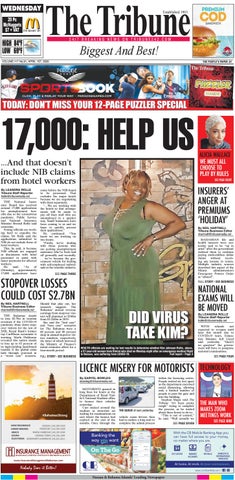
17,000: HELP US
...And that doesn’t include NIB claims from hotel workers By LEANDRA ROLLE Tribune Staff Reporter lrolle@tribunemedia.net THE National Insurance Board has received around 17,000 applications for unemployment benefits due to the coronavirus pandemic, Public Service and National Insurance Minister Brensil Rolle said yesterday. Noting officials are working hard to expedite the claims, Mr Rolle said the applications submitted to NIB do not include those of hotel workers. This, he said, is because NIB officials are engaged in discussions with hotel personnel to assist with faster payments for affected workers. He said: “As of (Monday), approximately 17,000 applications have
SEE PAGE EIGHT
INSURERS’ ANGER AT PREMIUMS ‘HOLIDAY’
come before the NIB board to be processed. That excludes the major hotels because we are negotiating with them separately. “…We are working with the hotels so that arrangements will be made to pay off their staff who are unemployed in a quicker way. Small businesses have been coming to us and we hope to quickly process their applications.” He continued: “You know we are working on two fronts. “Firstly, we’re dealing with those persons who are seeking unemployment assistance who’ve been laid off generally and secondly. . . we’ve become the government vehicle for dealing with self-employed individuals in the touristic industry.
By NEIL HARTNELL Tribune Business Editor nhartnell@tribunemedia.net
BAHAMIAN life and health insurers were yesterday said to be “up in arms” after the government ordered them to continue paying multi-million dollar claims without receiving any income in return. Multiple industry sources described this aspect of the Minnis administration’s Emergency Powers Order as “absurd”.
SEE PAGE THREE
STOPOVER LOSSES COULD COST $2.7BN By NEIL HARTNELL Tribune Business Editor nhartnell@tribunemedia.net
THE Bahamas stands to lose $2.7bn in tourism revenues if the COVID-19 pandemic shuts down stopover visitors for the rest of 2020, Royal Bank’s former top Caribbean economist is warning. Marla Dukharan revealed this nation stands to lose up to 83 percent of its high-yielding land-based tourists if the global crisis lasts through year-end in a “worst case” scenario.
Should that play out, her research suggests The Bahamas’ annual revenue earnings from stopover visitors will plummet to $548m from $3.244bn in 2019. She said the “best case” and “base case” scenarios for The Bahamas were a 60 percent and 80 percent drop in annual stopover visitor numbers, respectively, the latter of which mirrored the Ministry of Finance’s initial estimates albeit for a four-month period.
FULL STORY - SEE BUSINESS
ALICIA WALLACE WE MUST ALL CHOOSE TO PLAY BY RULES
FULL STORY - SEE BUSINESS
DID VIRUS TAKE KIM? HEALTH officials are waiting for test results to determine whether Kim Johnson-Rolle, above, a 57-year-old woman from Bimini who died on Monday night after an emergency medical flight to Nassau, was suffering from COVID-19. Full report - Page 3
LICENCE MISERY FOR MOTORISTS By EARYEL BOWLEG ebowleg@tribunemedia.net MOTORISTS queued in long lines for hours at the Department of Road Traffic’s National Stadium office to licence their vehicles yesterday. Cars snaked around the stadium as motorists sat waiting for examinations on cars where the licence had expired at the end of the months. Once through the
THE QUEUE of cars yesterday vehicle exam drivers then had to endure a long wait to complete the admin process
within the licencing centre. People waited six feet apart as the department exercised social distancing, allowing only a limited number of people to pass the gate and into the building. Stephan Major told The Tribune “it’s been pretty rough” trying to complete the process, as he waited about three hours to do so. “This is out of control,” he said. “Well actually we
Nassau & Bahama Islands’ Leading Newspaper
SEE PAGE SEVEN
NATIONAL EXAMS WILL BE MOVED By LEANDRA ROLLE Tribune Staff Reporter lrolle@tribunemedia.net
WITH schools not expected to re-open until later this month due to COVID-19 fears, Education Minister Jeff Lloyd said yesterday “there’s no question” the government will have to postpone national examinations. SEE PAGE FOUR
TECHNOLOGY
THE MAN WHO MAKES ZOOM MEETINGS WORK
SEE PAGE NINE
PAGE 2, Wednesday, April 1, 2020
THE TRIBUNE
CORONAVIRUS CRISIS
TOP left: Richard Desmangles; bottom left: Susan Smith; right: Jonathan Farrington; below right: Joan Hutcheson.
Coping with the crisis when you’re away from home
By TANYA SMITH-CARTWRIGHT ts-cartwright @tribunemedia.net
MANY Bahamians living in infected cities in the United States are having to make the necessary adjustments to keep themselves safe from COVID-19. Bahamian Susan Smith, a healthcare manager living in New York, says the virus has put a halt on travel for work and to see family. “Clearly COVID-19 is affecting me, just as it is with nearly everyone on every continent,” she told The Tribune. “My work typically requires travel throughout New York/New Jersey and the US Virgin Islands, however, that is impossible for the foreseeable future and I am working remotely from home. As much as that impacts my ability to be as productive as I’d like, I am more bothered by the distance this virus puts between me and my loved ones, in particular my mother and aunt who are both in their 70s. “Not knowing when I can
see them, other than from being six feet away and engaging in all the activities we usually do, saddens me. Furthermore, my mom and her sister have always been quite active, now they’re bound to their apartment basically 24 hours a day, aside from the five-minute walk they take around their block wearing masks and surgical gloves.” There are nearly 40,000 COVID-19 cases in New York City and the high case rate is taking a toll on the state’s residents. “This all also takes a psychological toll,” Ms Smith said. “Every single day there are breaking news reports with the number of deaths in our area. We’ve seen on our daily news makeshift hospitals being placed in Central Park and sadly refrigerated tractor trailers being used as morgues. Honestly, it all has become too overwhelming, so to a large degree I’ve decided to try to tune it out as much as I can. COVID19 might not attack you physically, but it will certainly attack your mental
well-being. Usually I am a news junkie, but that has changed. I spend my down-time listening to music, running on my treadmill and talking/ video chatting with my friends and family. Trust me, that helps a lot.” Jonathan Farrington, also living in New York, was on tour when the pandemic broke out. He works in the performing arts. He is now in self-isolation. “I was on a national tour doing a musical but because of the virus all work had been suspended,” he said. “Basically if you’re not a health care professional, law enforcement officer or in some food service industry you are advised to stay at home. We’re still able to go to the grocery store or pharmacy but it has been advised that all New Yorkers stay indoors.” Mr Farrington is normally performing on a stage or in front of a camera but the lockdown has him being creative. He is using social media to share inspirational songs and messages to encourage people through this pandemic.
“It’s really bad here in New York, almost surreal the rate at which people are dying,” Mr Farrington said. “I’ve been staying indoors, social distancing, building my immune system and praying. Fear hasn’t hit me but I do feel saddened for the persons who have lost family members because of this virus. I often think about what will happen after this passes? What will be the world’s ‘new normal’ because so much has changed already? But I’m hopeful and optimistic that we will rise.” Joan Hutcheson lives in Virginia and is being very careful as she is an asthmatic which is a high-risk category for the COVID-19 virus. She is following all the precautions given and is staying indoors. “I work in the secondary mortgage industry,” Ms Hutcheson noted. “I am working full time from home. The entire company I work for with over 6,000 employees are all working remotely. We are not in total lockdown. We are not in quarantine.
We are not in curfew, but we are on a mandatory stay at home order. The governor Ralph Northam just ordered it on Monday. This order will be in effect until June. So only essential services are open. People are allowed to go out for food, essentials and necessities. Businesses are closed until June. That’s how we are in Virginia.” As of Monday, in Virginia there were 1,020 cases of people infected with COVID-19 and 20 deaths. Ms Hutcheson said she has self-quarantined. “I am in the high-risk category,” she explained. “I have asthma and I do not want this virus that aggressively attacks the respiratory system. So I am staying indoors, I am taking vitamin C, I am drinking a lot of fluids, staying hydrated, boosting my immune system, staying healthy. Like the saying goes, ‘you are not stranded at home; you are safe at home’. That’s where I am right now. Richard Desmangles is a registered nurse who lives in Florida. He works in a
hospital emergency room and is taking extra steps to protect himself. “I am following all the CDC (Center for Disease Control) guidelines – washing my hands constantly, making sure my surfaces at home are clean,” Mr Desmangles said. “I am the only person in our home who works in healthcare so the risk is high for me bringing it home to my family so at work I use N-95 (medical mask), a yellow gown, eye shields, gloves for patients who we suspect have the virus. And, for other patients I just use my mask and gloves as usual. “I am a man of God so I am not fearful. I always ask God for peace when I go on the job – peace of mind and peace of spirit. So I am not fearful like how some people are panicking. I just put my trust in God that each day I go to work I will be okay. I live in a small area of Florida there are only 26 people who have been infected with it and one death so far. A lot of people are being tested though.”
THE TRIBUNE
Wednesday, April 1, 2020, PAGE 3
CORONAVIRUS CRISIS from page one “And so, the jet ski operators, the beach workers, the taxi drivers - they’re all coming to NIB. What we have done though is establish a platform and a small form that they could download to their telephone, fill out the application (so) it can be processed as quickly as possible. “There are three things we are looking for - we want to see a letter from the employer. When it comes to the self-employed individuals, we’re looking for an ID, an indication from inland revenue to check your business background.” Initially, the government had only announced help for self-employed and employed individuals directly connected to the tourism sector. However, recognising that thousands have been adversely impacted by the COVID-19 pandemic, Minister of Finance Peter Turnquest announced on Monday the government will expand its
17,000 need help - and that doesn’t include NIB claims from hotel workers unemployment assistance programme to self-employed people outside of the tourism industry. Still, it is not clear exactly when workers will be able receive the payments, with Mr Rolle telling reporters yesterday that officials are hoping to finalise the process very soon. “One of the things we discussed yesterday in NIB is how we could make the process faster so that individuals through this period could get their money,” he said. “…In terms of hotels and other big establishments, we’re working
closely with them so that they could in some instances issue cheques to their persons who’ve been laid off. “In terms of the selfemployed individuals, I think we are at the advanced stage. We have a wonderful team the director has put together to process and we anticipate that very quickly, these individuals will receive their money.” Once applications have been processed and approved, Mr Rolle also said payments will be transferred to individual’s respective banking accounts. “We’re trying to reduce face to face
contact so that we’re asking people for example to give us their bank account, confirm where they are, we process and we, in many instances, will deposit directly to the bank account.” The same procedure, Mr Rolle said, applies for those on Family Islands. When asked what will happen to workers whose employers have not paid their NIB benefits, the minister replied: “We’re negotiating with these businesses. This process will really expose businesses who have not been forthright in making payments to
MINISTER Brensil Rolle NIB but this is a time where we can negotiate with those
businesses and come up with arrangements and get things done. “We want persons to acknowledge that a bill exists, and we will set some parameters upon which we can make those arrangements to sort of soften the blow of COVID-19.” Tourism Minister Dionisio D’Aguilar has previously said the temporary unemployment rate could now probably be above 30 percent. He also said it was expected to grow, due to widespread hotel closures. Editorial View - Page 6
Officials waiting on COVID-19 results after mother dies By LEANDRA ROLLE & DENISE MAYCOCK Tribune Staff Reporters HEALTH officials are awaiting test results to determine if a Bimini woman who died Monday night after an emergency medical flight to Nassau had COVID-19. According to relatives, she is Kim Johnson-Rolle, 57, the sister of Immigration Minister Elsworth Johnson. Health Minister Dr Duane Sands said the woman had suspected COVID-19 symptoms, but until test results come back, it is not confirmed she had the disease. The news came hours before the Ministry of Health reported an additional COVID-19 case in Grand Bahama, bringing the national total to 15. There are now three confirmed cases of COVID-19 in Grand Bahama and 12 confirmed cases in New Providence. The latest confirmed case is a 57-year-old female with no history of travel and no known direct link to previous cases. She is in hospital in stable condition. Speaking about the Bimini woman’s death yesterday, Dr Sands, said she had shortness of breath and a recent travel history. “This is a very unfortunate case, yes there was a patient airlifted from Bimini,” he said before heading into a Cabinet meeting. “She had shortness of breath and a travel history… We can confirm there was significant clinical suspicion of COVID.” Stressing he could not confirm her COVID-19 status, Dr Sands said officials would have to wait on test results to determine whether she had tested positive for highly infectious disease. “We do not know her COVID status at this point. She has been tested because there were clinical signs suggestive of COVID, but we do not know those results at this point,” he said. “We would notify the public as we always do…
VICTIM: Kim Johnson-Rolle, the sister of Immigration Minister Elsworth Johnson. after we have met to discuss the results of the day’s findings.” When asked if this case could be the country’s first COVID-19 death, Dr Sands said it was a possibility. “It could be, and I think we have to be very clear about that, we do not yet know. When we do get the test results, we will advise the family members and the public,” he said. According to a relative, Mrs Johnson-Rolle travelled to Florida two weeks ago. The relative said she complained of having chest pains early this week and went to the Bimini clinic. The family was informed Mrs Johnson-Rolle was having issues with oxygen intake and would need to be airlifted to Nassau for further medical treatment. A plane was secured for her on Monday and she was accompanied by a medical team but died en route to Nassau, the relative said. “We were told that her heart stopped and they tried to revive her,” said Mrs Johnson-Rolle’s brotherin-law, businessman Lloyd Edgecombe, who said her death is “a blow to the entire family”. Mrs Johnson-Rolle owned a restaurant/deli and was very well-known in the Bimini community. Mr Edgecombe said the death of his wife’s sister is very difficult for them to come to terms with as she was a “healthy” individual who
loved to work. Mrs Johnson-Rolle’s brother-in-law is frustrated with speculation about her cause of death on social media. He believes she had a heart attack. “She was a regular person who experienced a heart attack on the way to Nassau. No test was run on her; she never made it to Nassau, she died on the plane,” said Mr Edgecombe. When asked whether his sister-in-law had travelled recently, he said that she went to Miami on March 18 with her grandchildren for a medical check-up. According to Mr Edgecombe, his sister-in-law was a “healthy” person and relatives are shocked over her sudden passing. “She was strong and healthy, and loved to get up early every day to go to work,” he said. “My wife and her sister were close and would talk all the time and travel together, so this is very difficult for us,” he said. Mrs Johnson-Rolle also leaves behind a disabled husband, who is paralyzed and was dependent on her.
MINISTER Duane Sands
The incident has raised concerns about the Family Islands’ capacity to treat suspected COVID-19 patients. However, Dr Sands was very clear that “every effort” was made by officials to get Mrs JohnsonRolle the required medical care. He said: “There are no specific medications for COVID-19 and she did not have a diagnosis of COVID. I’ve had questions asked about the availability of ventilators on the Family Islands. “(But) it’s very important to understand that a ventilator in the wrong hands is a dangerous tool and a ventilator, if you put a breathing tube in somebody’s airway, COVID, which is ordinarily spread through droplet will become aerosolised and you have the (possibility) of infecting or contaminating everybody in the room.” He continued: “We do not have intensive care units in Acklins, Crooked Island, Bimini, Long Island etc, nor are we likely in the foreseeable future to have intensive care units (there). “So, as we look seriously at the rollout of our national response to COVID, I think we have to be honest, I think we have to be direct with the Bahamian public to help them understand the implications.” “This is not about machines. This is about the holistic ability to provide competent, intensive care support to critically care patients and that could only be done in Grand Bahama and Nassau.” Still, Dr Sands said health officials are working out ways to hasten the process
where Family Island residents who are in need of medical attention can be transported to the capital faster. “We have been working on this for many weeks now and there were exigencies about this particular situation that we have not overcome for some 24 hours. As a matter of fact, I want to say thank to the Royal Bahamas Defense Force, who ultimately would’ve scrambled vessels and aircraft to bring this patient ultimately here.” Noting that the country is already seeing a surge of COVID-19 cases, Dr Sands said it’s important for everyone to adhere to guidelines “to minimise the number of people affected” in the country. According to the latest Ministry of Health COVID19 dashboard, more than 200 persons are currently under quarantine. Speaking on the increase of persons in quarantine, Dr Sands said: “What we have been seeking to do is validate and verify the numbers. We have modified the dashboard a number of times. “…We wanted to validate the numbers of how many people are in government
quarantine facilities and how many are being isolated that we’re following. We think that that is as transparent as we can be but we had to verify and validate those numbers. And so moving forward, the numbers that you see there should be an accurate reflection of what is going on in the Bahamas.” Asked why there are no recovered cases on the dashboard, Dr Sands replied: “The definition of recovered required a series of negative COVID tests done over a period of time.” He added: “So, even though patient number one is recovering and according to lay talk, they may be recovered. (But) when we report to our international public health agencies, we need to make sure that our definition of recovered is in line with the international definitions. “When that happens and we’ve gotten a series of negative molecular RTPCR COVID tests, we will be pleased to report that that patient and subsequent others have recovered.” Editorial View - Page 6 Fears in the Family Islands - Page 5
PAGE 4, Wednesday, April 1, 2020
THE TRIBUNE
CORONAVIRUS CRISIS
Dozen charged with violating the curfew By FARRAH JOHNSON fjohnson@tribunemedia.net A DOZEN people appeared before Magistrate Andrew Forbes yesterday charged with violating the national curfew. Stephen Hanna, 25, was charged for being on the road around 9.50 pm on Monday. He pleaded guilty to the charge and was fined $250 or two months at the Bahamas Department of Correctional Services (BDCS). Prosecutor, Sergeant Lincoln McKenzie said Hanna was arrested after he was found in the area of Coral Harbour during curfew hours. At the time, he told police he had just left Fox Hill after getting baby supplies for his child. When given an opportunity to speak, Hanna said he was “literally 30 seconds” away from his house at 9pm and would have made the curfew if he was not stopped by police. However, he told the judge the officers informed him that the curfew had been extended to 24 hours. In response, Magistrate Forbes
told the defendant if he was not going to the foodstore, pharmacy or gas station, he should not have been on the road because he was putting himself and everyone else he came in contact with at risk. Jason Newbold, 40, and Marquell Daniels, 25, were also charged with violating the curfew on March 27 in the area of Hospital Lane. Initially, both defendants denied the allegations,however, Daniels returned to court an hour later to change her plea. She told the judge she was outside because she had just got off from her job in Old Fort Bay and was trying to hike a ride to pick up her child. She also said she was trying to get her daughter something to eat after the child had told her she was hungry. As a result, Magistrate Forbes discharged Daniels and dismissed the case. Newbold, who had pleaded not guilty to the charge, was released on $500 bail with one surerter. His matter was adjourned to June 18 at 10am for trial. Both Daniels and Newbold
are represented by attorney Ian Cargill. Stephen Walkes, 23, was also accused of violating the national curfew on March 27 in the area of Poinciana Drive. According to the prosecutor, when questioned that night, Walkes told police he had just left his uncle who lives on Boyd Road. During the arraignment, Magistrate Forbes noted that Walkes had appeared before his court for the same matter last week. He reiterated the importance of following the law and said it appeared as if the message had not gotten through to people particularly between the ages of 18-35. For being a second time offender, Walkes was fined $750 or eight months at the Bahamas Department of Correctional Services (BDCS). Magistrate Forbes also told the defendant every time he came back, the penalty would double. George Turnquest, 35, and Jeffrey Demeritte, 29, also pleaded guilty to the charge and were both fined $250 each or two months at BDCS.
Sgt McKenzie said Turnquest was found in the area of Coral Harbour around 10.35pm on Monday acting in a suspicious manner. When questioned by police, Turnquest told them he had just left his cousin’s house and was heading home. Demeritte, who was found walking in the area of Crooked Island Street around 8.35pm last Saturday, told officers he went to see his godchild. Malik McKenzie, 24, and Anthony Clarke,18, were also accused of breaking the curfew on March 23 after police found them in the area of Zion Boulevard around 9.40 pm. Two other teenagers were also charged alongside a man for violating the national curfew last Friday. Quest Bullard, 18, Shannai Moss, 18, and Ashton Sands, 21, all pleaded guilty and were fined $250 each or two months in prison. Sergeant McKenzie said the defendants, who were riding in a vehicle together, were stopped by officers on mobile patrol in the
area of Farrington Road off East Street at 10pm. When questioned, Sands told the officers he was dropping off his co-workers. However, the prosecutor said Bullard and Moss told police they were riding with Sands to get something to eat. During the arraignment, Sands also showed the judge a letter from his workplace which requested permission for its employees to be allowed outside between the hours of 6am and 5pm. Still, Magistrate Forbes told the defendant the document did not justify them violating the curfew at 10pm. During his arraignment Sanchez Williams, 25, also pleaded guilty to violating the curfew after he was found in the Lily of the Valley Corner around 9.30pm on March 26. He told the judge the gas went out while he was cooking for his child, so he had left his home to go and get food for his baby so that he could give him his medication. Williams was subsequently discharged and the case was dismissed.
NATIONAL EXAMS WILL BE MOVED from page one
PEOPLE out and about in Nassau wearing face masks in the last few days. Photos: Terrel W Carey Sr & Shawn Hanna/Tribune Staff
‘Face masks may offer some more protection’ HEALTH officials are now suggesting people wear face masks to help reduce the spread of COVID-19, although they initially advised against such measures. Health Minister Dr Duane Sands said yesterday that while medical grade face masks are needed as a priority for healthcare workers and others on the frontline, homemade masks may “provide some protection” to the general public. “We have moved from some of our strongly held views,” Dr Sands said yesterday on 96.9FM show Morning Blend, with host Dwight Strachan. “For instance, even up to yesterday (Monday), the World Health Organization (WHO) has been saying that face masks are not
being recommended. The Bahamas has softened its position a bit and said that look, while we are aware of the evidence, certainly what we have to do first is make sure that face masks are available for front line workers inclusive of healthcare workers, police officers, immigration officers, ambulance drivers, even people that interact with the public.” He added: “And while homemade face masks do not provide the same level of protection, they probably provide some protection and they reduce the spread of this disease, which except in extenuating circumstances, is spread by droplets.” “So, we’re suggesting that people should consider wearing even a homemade mask,
or if they have access to masks, that would be fine.” A day earlier, Dr Sands told Parliament he would not discourage people seeking extra means of self-protection. However, he said the small supply of masks in the country meant only people on the frontline should acquire them. “These masks protect people on the frontline and if we do not protect them they will not be around to protect you so we cannot recommend because these are in short supply all around the world that these should be used for the ordinary person,” he said on Monday. “However, what is clear is that any protection, even if they do not provide a whole lot of protection, is not a bad idea. So even
if you make a homemade covering for your nose and mouth, so the answer to the question is while we cannot support the average person anywhere in the world using an N95 mask, certainly we are not going to discourage the use of any type of protection.” American officials are also softening their stance on face masks and who should wear them. Initially there were fears that recommendations to wear masks would prompt a run on the items, causing shortages for healthcare workers. Wearing face masks, while not common in the west, is a normal practice in Asia. On Monday during a coronavirus task force briefing, US President Donald Trump was asked whether Americans should
wear non-medical masks. “That’s certainly something we could discuss,” he said. “It could be something like that for a limited period of time.” The US Centers for Disease Control is said to be reviewing whether the health agency should advise people to wear masks. “Officials at the Centers for Disease Control and Prevention are considering altering the official guidance to encourage people to take measures to cover their faces amid the coronavirus pandemic, according to a federal official who spoke on the condition of anonymity because it is an ongoing matter of internal discussion and nothing has been finalised,” the Washington Post reported on Monday.
Speaking outside Cabinet, he said: “You know today, the BJC was supposed to begin but as you know we’ve had to review our exam schedules and we will continue to review it as the coronavirus determines how we should respond. “There’s no question that we’re going to have to put examinations back. When and how that is going to be accomplished, we cannot say at this time, but we are watching it very closely. “And, we are obviously consulting with our stakeholders, meaning the unions and internal stakeholders, the parents and students and the private sector to make the best determination as to how we should proceed.” After the country recorded its first COVID19 case last month, the government announced several prevention measures, including a national curfew and the closure of schools in the country. Since then, many local institutions have shifted to online classes, allowing for students to continue their studies at home. To ensure students have access to learning material while at home, the Ministry of Education launched its Virtual Learning Education programme, making classes available for students online. Speaking in the House of Assembly on Monday, the education minister said more than 20,000 students have registered for the programme. Noting the “school system” has lost enough time as a result of Hurricane Dorian, Mr Lloyd, said officials were committed to ensuring students have access to various learning materials. “Our school system has already lost precious instruction and learning time due to Hurricane Dorian,” he stressed yesterday. “We cannot afford a single day further in lost educational time.”
MINISTER: Jeff Lloyd
THE TRIBUNE
Wednesday, April 1, 2020, PAGE 5
CORONAVIRUS CRISIS
MINNIS SUSPENDS NEED TO MAKE INSURANCE PAYMENTS By RASHAD ROLLE Tribune Senior Reporter rrolle@tribunemedia.net
PRIME Minister Dr Hubert Minnis has suspended the obligation to pay health, medical and life insurance premiums as long as the state of emergency is in place and for 60 days afterward. “Should any insured event occur giving rise to the liability of the insurer to pay a claim to the insured, the insurer shall honour the claim and only deduct the renewal fee and any deductible from the money paid under the By RASHAD ROLLE Tribune Senior Reporter rrolle@tribunemedia.net FAMILY Island residents worry they are unprepared for COVID-19 despite assurances from the government. Their concerns were heightened yesterday after Kim Johnson-Rolle, a mother of three who was airlifted off Bimini and brought to New Providence, died after displaying what Health Minister Dr Duane Sands said were symptoms consistent with COVID-19. Officials are awaiting her test result. However, infectious disease expert Dr Nikkiah Forbes suggested last night that Mrs Johnson-Rolle’s arrival to New Providence took long because it was difficult getting aircraft operators to transport her to the island. “I was there when the lady came to the hospital and unfortunately this patient was critically ill, she did have symptoms that could overlap with COVID-19, cough, fever and shortness of breath…” she said in an interview on Behind the Headlines with Clint Watson. “The sad part is in this situation where we’ve never been in before, there is fear and stigma, we are seeing where people are afraid to even offer care and do the usual. On an every day time outside COVID19 we have support, we have ways to get patients from the Family Islands if they require care in Nassau to get care. Because of fear, those fell through, not because of efforts that we didn’t make. We made the best efforts to get her here and as Minister Sands said, the defence force should be congratulated for getting this patient here so that we can do all that we could for her. Unfortunately, she was having significant distress and difficulty breathing and by the time she got to us there was nothing we could do for her. That was not in any small part because of fear for transporting this patient and the level of care that she would’ve needed.”
claim,” his order released Tuesday says. Dr Minnis has also suspended the obligation to file documents with, pay fees to and renew a licence, visa or permit issued by any government entity, statutory body or regulator. This will be in effect for the duration of the state of emergency and thirty days afterward. However, this does not apply to matters applicable under the Customs Management Act, Value Added Tax Act, Real Property Tax Act and National Insurance Act. This also does not apply to the obligation to pay for child support
and maintenance and other civil payments ordered by courts. Attorney General Carl Bethel, asked about this yesterday, said the order does not apply to Road Traffic Department requirements since that department is open for licensing. Dr Minnis has also suspended provisions under the Limitation Act for the rest of the state of emergency and 30 days after. “Basically any civil claim, in tort, contract and even judicial review applications have time limits, after the expiration of which suit cannot be brought, unless they can invoke special rules which allow a
Family Island residents fear they’re not ready to handle virus threat
WHY did it take 30 hours to respond to this emergency?, asks PLP senator Michael Darville Myron Saunders, a Bimini resident, said his community is waiting to hear if Mrs Johnson-Rolle was COVID-19 positive or not. “With the flights, hearing what happened to her, it took too long for her to get to New Providence,” he said. “I think once you’re at that level where you need assistance breathing, you should be flown out immediately.” Former Grand Bahama Minister and Progressive Liberal Party Senator Dr Michael Darville echoed his sentiment. “On close examination
of the timeline I am constrained to ask why it took the government some 30 hours to respond to this emergency,” he said in a statement. “Pointedly, are the facilities in the Family Islands equipped to attend effectively to persons who exhibit extreme respiratory distress? If they are not, what alternative arrangements has the government made to give urgent medical support to such persons?” Terrence Davis, the Harbour Island Chief Councillor, said health officials on his island have had multiple meetings to prepare for a crisis. However,
‘WHAT HAPPENS WHEN THERE IS NO MONEY TO BUY FOOD?’ AFTER Prime Minister Dr Hubert Minnis pledged that police will step up the enforcement of the curfew and that a food shopping schedule will be issued, readers posted their reactions on tribune242.com. John had this to say: “Apparently the Corona COVID-19 has already left the station and it will take a number of passengers with it, regardless of what measures are put in place. The USA expects some 200,000 people will die in that country (current toll is 2,600), and April is expected to be that country’s most deadly month, thus far, at least. And they plan to restrict movement even more, restricting and even prohibiting travel between some states and making air travel undesirable if not impossible. So Bahamians must prepare for the long haul. And government must be prepared to face a situation where maybe less than 20 percent of the population is working. The food store shelves may be stocked but most people’s pockets are running empty. What happens when there’s no money to buy food and medicine?” He said: “The problem is that many Bahamians now go to the food store
PRIME Minister Hubert Minnis
judge to extend the time beyond the general limit,” Mr Bethel said. “(This order) means that the limitation on suing for breach of contract, or to eject a squatter is all suspended for the period of the emergency so people don’t lose their rights to sue because the courts are closed.” Dr Minnis has also suspended requirements to pay fees or may declarations under the International Business Companies Act for the duration of the state of emergency and 14 days after. The suspension obligation is backdated to March 17.
because they want an excuse to go out. Not only does this create unnecessary long lines but creates more health risks that will cause the curfew to extend even more. It looks that the new daily routine is to go out with your kids buy them junk food and then hang out with them in the food store for as long as you can. We have so many fools in this country it is not funny anymore.” There was this from Joeblow: “We simply need to extend shopping hours starting from 6 am until . . . Once people know there is no shortage of food the tendency to hoard will decrease. But I do agree that we don’t need entire families crowding up aisles in grocery stores to buy three items!” Minister of Works Desmond Bannister said Bahamas Power & Light (BPL) has suffered a “frightening” multi-million dollar March revenue drop that threatens the energy
provider’s very existence if it continues, prompting this comment from Millennial242: “The quickest way to enhance cash flow – make it as easy as possible for customers to pay you. BPL should quickly adjust their policies to make sure it meets the current situation of their customers. Start making calls and put out mass communication on how to make payments during the COVID-19 dilemma . . . don’t just wait until payments stop coming in. “Currently, there is an online portal that businesses can use to make payments, but it only works efficiently under the best of circumstances. I know of multiple businesses that struggle to retrieve their bills timely and have challenges using the online portal because it was set up under an email address that is no longer available (ie. a previous accounts clerk that no longer works for the company). Or, businesses that have multiple meters can’t get their bills all at once or in the same manner because of some bureaucracy. The entity needs to revisit their online payment process with a particular focus for the ease of businesses.”
he said he has not yet been given a definitive answer on how long it would take for someone with respiratory distress to be flown to New Providence. Usually, he said, the local doctor can get an emergency flight in and out in a reasonable time. “If there is a possible case,” he said, “what would be the timeframe of getting from here to Nassau? Honestly, we haven’t gotten a conclusive answer as yet and that’s something we were supposed to (find out) today. I would hope that it would be somewhere between one and two hours
after someone is diagnosed and there is speculation based on that person having symptoms. I would hope it would be two hours the most but it’s something we should get definite answers for.” Yesterday, Dr Sands confirmed that ventilators, an essential resource for people with severe respiratory challenges, are only available in New Providence and Grand Bahama. Moreover, samples can be collected from people on Family Islands but must then be transported to New Providence to be tested. These caveats worry residents on islands like South Andros, according to former Family Island administrator Francita Neely, 74, who said her island does not have a resident doctor and people wonder if action can be taken quick enough to save lives during emergencies. “We only have the nurses that we are depending on so it’s really hard,” she said yesterday. “God forbid if we have something consistent with a breakout of the case here, it would be really hard on the nurses to handle situations and right now, if you want to go to Nassau you can’t move because the boats are not being allowed to carry passengers and the airline has been put on temporary hold until further notice.”
Mrs Neely said she is obeying Prime Minister Dr Hubert Minnis’ social distancing orders, staying away from people, not venturing outside her yard and relying on her stockpile of goods to see her through. However, she worries about her health and that of her husband, who is 77 and asthmatic. “This community is depending solely on prayers and the protection of God. If something happens God forbid I don’t think we are prepared,” she said. “They have a room in the clinic in case anybody shows symptoms, they have a place where persons can be carried without them having to come in the outer part of the clinic, that is good, but what do we do when we don’t have the life-saving equipment?” Another South Andros resident, Joel Rahming, 52, said the government’s shutdown of the island has helpfully prevented the arrival of foreigners who might be carriers. “But what if it’s already here?” he asked. “We operate food stores and a gas station and people are moving. Those on the island are moving around to the food store, the bank, the gas station and those essential places. If it’s on the island, sooner or later you would have a multiplication of cases and what we gon’ do? How many people can they airlift at one time if it comes to that?”
A Private Funeral Service for SHEILA LOUISE SYMMONETT, 76 of Bethel Avenue and formerly of Inagua, will be held on Thursday April 2nd, 2020 at 10:00 a.m. at the graveside at St. Mary’s the Virgin Cemetery, Virginia Street. Officiating will be Rev’d Fr. Dwight Bowe. Interment will follow. In compliance with current Government regulations, attendance is limited to ten (10) family members. Left to cherish her fond memories are her Siblings and Spouses: Lionel Symmonett, Vernon & Phyllis Symonnette, Yvonne Symmonett, Veronica & Warren Fraser, Geoffrey & Audrey Symmonett, Don & Gertrude Symmonett, Oris & Chanelle Symmonett; Nieces and Nephews: Stephen, Dellareece and Anya Symmonett; Derek, Darcia and Dominique Symonette; Gia and Gregory Stubbs (Annastacia and Gregory Stubbs); Tishka and Darius Francis (Kristina Dorsett and Jordan Francis); Kyra and Denzil Augustine, Darrion, Jamaal, Kenyon Symmonett and Kayette d’Albenas, Edward, Orissa and Obriel Symmonett; Extended Family: Mable, Stella, Juanita & Arthur Symonette; Dwight, Julian, Corlis, Janis & Antoinette Glover; Gwendolyn Turner, Venencia Thompson, Betty & Sam Hall, Mary & Philip Symonette, Dr. Elizabeth Darville, Kendolyn Cartwright, Evie Rolle, Dr. Leslie & Bev Culmer, Prescola King, Mary Ferguson, Meta Bethel, Angela Archer, Adesta Gooden, Georgia Rolle, Sherry Jackson, Billy Albury, Virbart Wills, Charlamae Forbes, Patrice & Charles Major & Maxine Taylor. Friends may pay their last respects at Bethel Brothers Morticians & Crematorium, #44 Nassau Street on Wednesday from 10:00 a.m. to 5:00 p.m.
PAGE 6, Wednesday, April 1, 2020
THE TRIBUNE
The Tribune Limited NULLIUS ADDICTUS JURARE IN VERBA MAGISTRI “Being Bound to Swear to The Dogmas of No Master”
LEON E. H. DUPUCH,
SIR ETIENNE DUPUCH,
jamaaltheartist@gmail.com
Publisher/Editor 1903-1914 Kt., O.B.E., K.M., K.C.S.G., (Hon.) LL.D., D.Litt .
Publisher/Editor 1919-1972 Contributing Editor 1972-1991
EILEEN DUPUCH CARRON,
C.M.G., M.S., B.A., LL.B. Publisher/Editor 1972-
Published daily Monday to Friday
Shirley & Deveaux Streets, Nassau, Bahamas N3207 TELEPHONES
News & General Information Advertising Manager Circulation Department Nassau fax Freeport, Grand Bahama Freeport fax
(242) 322-1986 (242) 502-2394 (242) 502-2386 (242) 328-2398 (242)-352-6608 (242) 352-9348
WEBSITE, TWITTER & FACEBOOK www.tribune242.com
@tribune242
tribune news network
The numbers and the need to talk LET’S talk numbers for a moment. There are around 400,000 people living in The Bahamas. According to the World Bank, last year 74.51% of the population were part of the workforce. That’s about three-quarters, so 300,000 people. The National Insurance Board has received about 17,000 applications for unemployment benefits directly as a result of the pandemic – that’s around one in 18 people in the workforce. That sounds sizeable – but it’s worse than that. That number doesn’t include those in the hotel industry, with NIB talking directly to hotel personnel to arrange faster payments for those workers. That workforce is somewhere around 14,000 people – the 2018 report on hotel workers had the figure at 13,863 in New Providence alone. That’s potentially more than 30,000 directly affected people. That’s just the direct figures. Previously, Tourism Minister Dionisio D’Aguilar has said the unemployment rate could now be higher than 30 percent. Nearly a third of the nation suddenly jobless. It’s not just a Bahamas problem, it’s a global problem. Even as we write this column, the Secretary General of the United Nations, António Guterres, released a report calling for a large-scale response amounting to at least ten percent of global gross domestic product – and a massive increase in resources for the developing world.
The finances, clearly, are precarious. Getting the balance right is a tough matter –keeping people fed and sheltered, while not hurting the nation’s long-term prospects. One of the latest measures has drawn criticism – a move to eliminate payments on health insurance for 60 days beyond the length of the public emergency. That helps companies with some temporary cashflow that would have been dedicated to paying their staff’s insurance – but the insurance companies themselves now have a hole in their finances. They’ll still be paying out for treatment – but where is their income to cover those costs? Some compare it to handing out free food from Super Value – and not expecting Super Value to complain. For at least three months, the insurance industry will have to figure out how to survive without income. For that, you’d expect the government to be involved in dialogue – but the insurance industry says it was blindsided. This is an urgent situation – but there is still a need to talk to sectors affected by decisions. It’s also a sign to other businesses they may be hit by government decisions. Is this the kind of impact businesses need to prepare themselves for as we begin to rebuild? After all, we know this will come at a cost. There will be increased borrowing. That will have to be paid back. This is a numbers game – and it doesn’t have an easy solution.
Too soon to say - but death is a reminder of the danger we face HAVE we reached a sad landmark in the spread of coronavirus in this country? Much as there might be a rush to ascribe the death of Kim Johnson-Rolle to the virus, it is too soon to say. Test results need to come back before it is confirmed. It is important to know for sure, not least of all for those who have been in contact with Mrs JohnsonRolle. Two weeks ago, she travelled to Florida, and this week she complained of chest pains and went to the clinic on Bimini, the island where she lived. The speculation has already frustrated the family, and whatever the cause of death, she will be mourned by family and friends. Understanding the cause, however, will dictate the response. That will mean testing as a result of coming into contact, or the need to self-isolate. Understanding is a matter for ensuring the health of others. There were clinical signs suggesting this was indeed a case of coronavirus, but there is a process to this that must be followed, and getting too far ahead of ourselves serves no one. Take precautions, yes. Make assumptions, no. That need for a process is also why the
statistics do not yet show a recovered case – the first patient has not yet met the standard for international reporting to be recorded as recovered. What all this does do is bring home the danger we face, a danger reinforced by another confirmed case in Grand Bahama yesterday, the third there. It also highlights the difficulty faced in caring for patients across the Family Islands – with the emphasis on bringing patients quickly to New Providence rather than placing ventilators there. That can mean delays – so if you have any symptoms, report them right away – but it also means getting the right treatment. This is not an easy time for any of us. To the family of Mrs Johnson-Rolle, including her brother, Immigration Minister Elsworth Johnson, we send our condolences. If this is a first fatal case of coronavirus, we must redouble our efforts to try to make sure it is our last. To that end, we can only reiterate the advice being given over and over: Stay at home, wash your hands, avoid contact, only go out if you truly must. Be safe.
Too long to open a bank account EDITOR, The Tribune MALCOLM Strachan wrote a very good article in The Tribune the other day, and his advice to the public and admonishment to those not following the new rules about social distancing and behaving in a responsible manner should be read and understood by everyone. However, one point he makes about those
requiring social assistance having a bank account makes little sense unless the Government browbeats the Banks into opening accounts with a simple form. I understand Malcolm’s suggestion is to make the frontline workers dealing with those on social assistance safer. But I once watched a couple opening a bank account at my bank and it took 1 1/2
hours and all sorts of paperwork and information from their mobiles and I left before they had finished! What should the Government advise the banks as to how to deal with this very good, but at the moment impractical suggestion? PATRICK H THOMPSON Nassau March 30, 2020
Pensive about the global order EDITOR, The Tribune AS THE world is gripped by by Covid-19 pandemic, I find myself pensive about the global political, economic and social order. As of March 25, 2020 there were 460,065 confirmed cases with 20,829 deaths worldwide. This is a 4.5 % mortality rate; bearing in mind not all cases are detected. Only 17 fatalities were under 50 and 99% had other health complications. Whether you agree with martial law-like methods of fighting the pandemics everyone will agree that life globally and locally has changed. For me after this, everything is on the table for change and this proves the present global and economic system is ineffective. The United States, the most powerful country in the world has a shortage of medical equipment and some staple groceries. My sister in Los Angeles was terrified when she could not get water, hand sanitizers, canned food and toilet paper. Mike Pence, Vice president of the United States, said they did not have enough testing kits for Covid-19. If the so-called leader of the free world has the 3rd most confirmed cases after China and Italy speaks volume of systematic incompetence. We live in a time when
LETTERS letters@tribunemedia.net nationalism and populism are prominent in virtually every country. This has translated to hoarding of resources for national use. Bloomberg reports many countries cutting export of rice, wheat and other food and medical equipment in case it is needed nationally. We see in the Bahamas people stocking up on groceries. Every country on the planet has a Covid-19 stimulus package. All the packages are business centric and miss the point if you do not deal with the disease the economic shock will persist. After this crisis is over, everything is on the table, including self reliance and creating a better economic system. The populism and nationalism is mainly caused by the negative perception of globalization, but the main cause of loss of jobs globally is automation. Technology is deflationary. Many economists say that technological revolutions are deflationary. They provide supply side shock. Technology allow more intensive use of resources and increases productivity. With more goods being
produced, prices decrease. We are in the fourth industrial revolution. For example cellphones have gotten cheaper with more capacity. In about 20 years artificial general intelligence will be functional. This is the first time in history entities will exist that are smarter than humans. This will eliminate many jobs. Solar and alternative source of energy will eliminate millions of job. Thinking that enough new jobs will be created that will replace technological disruption is delusionary. The current economic systems (communism , capitalism and socialism) are based on scarcity and suited for the 20th century not 21st century. 25 % of groceries are throwaway globally. Air is precious because you die in a few minutes, if you don’t have it. Air is free unless air pollution or other similar phenomenon occurs. A global debt of US$ 257 trillion produces US$ 85 trillion GDP: a 302% debt to GDP ratio. This is inflationary, inefficient and unsustainable. The new economic system will be based on functionalism, adaptability, harmony and self-interest. BRIAN ELLIS PLUMMER Nassau March 30, 2020
All hands on deck for this EDITOR, The Tribune THE idea of the West End Clinic being used as a quarantine facility for COVID-19 patients has been rejected outright by some West End residents. With the current state of the Rand Memorial Hospital in Freeport City, owing to the devastating impact of Hurricane Dorian in September 2019, Health Minister Dr. Duane Sands and the Free National Movement (FNM) administration view the West End Clinic as a superior option to the Hawksbill Clinic and Pearce Plaza on Coral Road. The makeshift hospital set up by Samaritan’s Purse is obviously not a feasible option. The West End Clinic is the second best healthcare facility owned by the Public Hospitals Authority on Grand Bahama. The previous Progressive Liberal Party
administration, under the auspices of former West Grand Bahama and Bimini MP Obie Wilchcombe, had pumped over $2 million in upgrading that facility into a state of the art clinic that all West End residents can be proud of. This can explain why the FNM is viewing it as an attractive site to house potential COVID-19 patients. What must be underscored is that the $2 million used to carry out upgrades came from the very taxpayers West End residents are dead set against being cared for at the facility in the event they contract the novel coronavirus. Again, it must be emphasized that tax dollars paid for the upgrades to that clinic -- a point that these West End residents seems to have missed. Had Dorian not slammed into Grand Bahama, potential COVID-19 patients
from West End would’ve been treated at the Rand Memorial. Freeporters, particularly those who live on East Atlantic Drive where the Rand Memorial is located, wouldn’t have objected to such, as West End residents are human beings deserving of human empathy – a virtue some West End residents are severely lacking in, during one of the most challenging crisis in recent history. History will not be kind to these West End residents. West End residents should not allow their fear of COVID19 to cloud their judgment. COVID-19 has the potential of morphing into an humanitarian crisis. All hands must be on deck to fight this monster. Now is not the time for self-centredness. KEVIN EVANS Freeport, March 30, 2010
THE TRIBUNE
Wednesday, April 1, 2020, PAGE 7
MOTORISTS queued for hours at the Department of Road Traffic’s National Stadium office to licence their vehicles yesterday. Photos: Terrel W Carey Sr/Tribune Staff
from page one had people here since 6.30 this morning and you would have gotten a number like 18 or 20 then it’s another process getting inside the gate and letting in five a time. And then when you get in the gate, you get to section four, section five it’s a pretty long process. “... On the outside, there are so many people to do six feet, three feet apart - the lines would probably be down Thompson Boulevard.” Most people said the main reason they did their car licencing on the last day of the month was because Road Traffic was closed to the public last week. Motorist Shedrick McPhee Sr said: “I didn’t wait last minute. I called last week and they say they was closed. When I came back yesterday they was closed again. So I found out they was open today. “...There could be more communication when it comes to licencing cars.” Yvonne Fowler assumed the office closed due to the current state of emergency and national curfew. She said a relative was able to get their car licenced but when she arrived on Monday, the process had already ended for the day.
Motorists face long queue for licences
“I came down yesterday and the line was extra long and they had already stopped,” she said. When asked if drivers whose licence and inspection expired in March should be given leniency, she answered: “Oh yes
they should be. I was confused and they didn’t make it specifically clear that Road Traffic would have been open so that we would have, you know, know what to do earlier and try to beat this time. They didn’t make it clear.”
Anthony Reid went through the same ordeal and also agreed drivers should receive leniency by police. He explained: “Road Traffic was closed for a whole week and people who wanted to come down to license their vehicle last week weren’t
able to because I’m one of those persons that (found out they) were closed and I just found they were open yesterday. So I came back here this morning waiting to be served.” Janet Hannah, a government worker, said she
was waiting on payday to licence her car. People were astonished at the fact senior citizens were not allowed to go to the front of the line. When pressed on the issue, the controller of the Road Traffic Department stated older people should not be out as mandated by the prime minister. He also denied the claims of the office being closed for a week. The prime minister noted in a letter on Monday that the department could operate from 9am to 4pm for the purpose of facilitating registration and licencing motor vehicles. Yet, the controller said yesterday the office would stop processing at 1pm that day. Attempts to reach Transport Minister Renward Wells yesterday were unsuccessful.
ZERO-TOLERANCE APPROACH TO CRIME, SAYS NEW GB POLICE CHIEF By DENISE MAYCOCK Tribune Freeport Reporter dmaycock@tribunemedia.net
ASSISTANT Commissioner of Police Ashton Greenslade takes command of the Grand Bahama District.
Photo: Vandyke Hepburn
THE new Grand Bahama new police chief has warned that there will be a “zero tolerance” approach to crime and that all laws, including measures put in place in response to COVID-19, will be enforced. Assistant Commissioner of Police Ashton Greenslade - who took command of the Grand Bahama District on Tuesday - sent a “stern warning” to criminals. “If you continue to commit crime, we are coming to get you; we are coming after you. We have a zero-tolerance approach to crime and the criminal elements,” he said. He indicated that to continue “the downward trend” in crime on Grand Bahama, there will be strategic patrols, community policing, and frequent arrests. He said patrols will be increased at “hot spots” on the island. He said Grand Bahama officers are also enforcing the national 24-hour curfew. He said about 10 people have already been arraigned in Grand Bahama for curfew violations. “We will increase police presence and ensure that persons who are supposed to be home during curfew are home. We will continue to send persons to court who break the law. I think they got the message and we will continue to enforce it (curfew),” he said. Concerning the alleged illegal operation of bars in outlying areas, such as Pinder’s Point, Eight Mile Rock, and Williams Town, ACP Greenslade said patrols are conducted in those areas and officers would address any violation.
TWO ACCUSED OF CAUSING HARM
By FARRAH JOHNSON fjohnson@tribunemedia.net
TWO 25-year-old men were charged yesterday with causing grievous harm and making threats of death in two separate incidents. In the first matter, Stephen Devallon appeared before Magistrate Andrew Forbes, charged with intentionally and unlawfully causing harm to Nicole Lewis on March 16. He pleaded not guilty to the charge and the matter was adjourned to September 8. Bail was denied and the defendant was remanded to
the Bahamas Department of Correctional Services (BDCS) until that time. He has the right to apply to the Supreme Court for bail. Jerome Robinson also appeared before Magistrate Andrew Forbes yesterday, charged with one count of making threats of death and another count of assault. He denied both allegations and the matter was adjourned to June 18 at 10am for trial. Bail was denied and he too was remanded to BDCS. It is alleged that Robinson unlawfully assaulted
his sister, Johnette Robinson, on March 15. It is also alleged the accused threatened Johnette with death on March 29. Still, during the arraignment, Robinson accused his sister of lying to keep him locked up in jail. In response, Magistrate Forbes told Robinson that he would give him a copy of the witness statement and reminded the defendant that he had the right to file charges against any one making false allegations against him. Robinson was not represented by an attorney.
To advertise in The Tribune, contact 502-2394
PAGE 8, Wednesday, April 1, 2020
THE TRIBUNE LIFE GOES ON: MOST of us have been able to reconcile that it is critical for us to take guidance from medical professionals, practice being “together alone,” and do our part to flatten the curve.
Choose life for ourselves and each other by playing by the rules WE ARE almost two weeks into our new and temporary way of living. It has been extended, as many of us expected, and it is in our best interest to follow the guidelines provided. It became clear from very early that there are people determined to be defiant. It is not clear whether those people are just ignorant or have other issues. Many of us were concerned about the emergency orders and the power it put in the hands of a few from the very beginning. Most of us, however, have been able to reconcile that it is critical for us to take guidance from medical professionals, practice being “together alone,” and do our part to flatten the curve. This is not a conspiracy. This is a matter of life and death. By staying in our homes, except for essential tasks, we choose life not only for ourselves, but for each other. We know the healthcare system does not have large capacity and COVID-19 could complete overwhelm it. It is currently within our power to prevent that from happening and protect the elderly and immuno-compromised. I remain concerned about the most vulnerable among us and more people and organisations should be talking about and advocating for them. At one of the first press conferences, a journalist asked: “What about homeless people?” It was distressing to see and hear officials in the room laugh in response, as though the unhoused are
The
Alicia Wallace column not people, they do not deserve consideration and it is not required of officials to intentionally make provisions for them. Days later, we saw that unhoused people were arrested for breaking the curfew. Let’s be clear. This is not funny, and this is not the fault of the unhoused. This is an embarrassment. It is evidence of the need to consider vulnerable groups. What are people without homes expected to do? Did any check the hotspots and attempt to provide housing for those without it? Well, they could not even be bothered to give serious thought to the simple question posed at the press conference. Little has been said about women experiencing domestic violence. We can expect their situations to worsen as they are effectively trapped in their homes with abusers. Abused children are in the same situation. There were no messages directed at them. They were not even given a phone number to call if they felt unsafe and wanted to be rehoused for safety reasons. There was no promotion of domestic violence hotlines or ways to reach police
officer trained to respond to domestic violence reports. Again, a journalist asked about domestic violence and the expected surge, and all the prime minister said was they could call the police. In case you have never had to call the police to report domestic violence, let me tell you that it is not always helpful. It is often difficult to get officers to take it seriously under regular circumstances. How much worse would it be now, with a curfew? We must hold this government accountable for the effects of its decisions and its refusal to put safeguards in place for vulnerable people. Unhoused people and those experiencing domestic violence are just two groups. Who else is being left out, and what are we, as citizens of privilege, prepared to do about it?
More questions please A group of people, always on the job and keeping us informed, is one we do not always remember or thank. We see them on television screens and livestreams of the news and read their stories, but a lot of the work they do is invisible. They
are members of the press. They tell us when Members of Parliament have failed to disclose their assets and liabilities. They report election results. They attend Parliament and let us know what took place. They find the right people and ask the right questions in order to keep us informed. These days, they are focused on COVID-19 and the way the government is handling it. They are keeping abreast of the numbers, watching as things unfold in other countries, researching the virus and the varying national responses to it, and asking questions that help to give us a better understanding of the virus itself, what is being done to contain it and how effective our efforts will be over time. It is important to note many of the journalists attending press conferences and covering the COVID19 crisis are young people. They are researching, monitoring social media, thinking critically and asking questions we all want answered. The answers do not always come easily, or at all, but they are persevering. It must also be noted they remain professional in difficult circumstances, including in the face of outright rudeness. The question and answer portion of the press conferences are quite limited. It seems each journalist is allowed a maximum of two questions and there is little room for follow-ups. It lacks flow, completely impeded by an unnecessary moderator. There
is no need for anyone to interrupt the question and answer portion. Questions should be asked and then answered by the person best equipped to give accurate information. It is also unhelpful for the journalists, already in the room so presumably checked and approved, to be badgered about where they work and how many people present are from that particular media house. Those issues need to be sorted at the point of entry. With less time spent on micromanaging journalists and offering largely useless commentary, it would be possible for them to ask more than two questions, or at least be permitted to follow up as needed. A cursory look at the comments on the live feeds and social media commentary makes it clear many are frustrated by this “moderation” and would appreciate the facilitation of the media doing its job – getting pertinent information to us.
Focus on what matters There is no denying this is a difficult time. We are practicing social distancing, losing income, trying to find credible information, being duped or trying to help others not to be duped by false information, unsure about how long this crisis will last, tired of the people in our households, upset that we cannot walk or run our usual strip and worrying about people in other households. It is
amazing that so much is going on when we are not even moving. We have to do what we can to improve our mental health. We need to limit news consumption, especially if it is a source of stress. There is no need to be online all day, every day, taking in reports from all over the world, anticipating the challenges we will face and getting riled up by radio talk shows. Take breaks. Decide how much news you can consume in a healthy way. This may be the morning news and evening news, it may be one or the other and it could be 15 minutes on social media. Decide what works for you, set the limit, and stick with it. A lot is out of our control. This can stressful. Some of us want to stop our neighbours from going out. Some of us wish we could cook for our grandparents who live somewhere else. Some of us have no idea how we will pay the next bill. While these are valid concerns, we need to focus on what we can control. We cannot visit other homes, but we can call daily to check on people. We cannot make money appear in our bank accounts, but we can work on our resumes and cover letters, and we can work on passion projects. Let’s so what we can, and think less about what we cannot change. One of the things we can do to restore some normalcy and bring joy to our days is connecting with loved ones. Check on those aunts, uncles, godparents and long distance friends. Set up video chats. Have virtual lunch dates, watch TV shows together and show off your gardens. I have had at least one video chat per day since Saturday and it has been great to catch up with friends I have not seen in a long time. Admittedly, we talked a lot about the situations in our countries, but we also got into more pleasant conversation about favourite TV shows, best books we read so far this year, new relationships and what we are cooking. Talking to friends about ordinary matters is a reminder that we are people, there is good in the world and human connection feels good. Let’s do our best to connect, find and spread joy and put our attention on the things we can control. Whatever energy we have, let it be put to good use, produce what we need and help people whose needs are greater than our own. While tourism is paused, let us be more hospitable to one another.
THE TRIBUNE
Wednesday, April 1, 2020, PAGE 9
THE MAN WHO MAKES ZOOM MEETINGS POSSIBLE TECHTALK NEW MEXICO By MICHAEL LIEDTKE AP Business Writer
IF YOU hadn’t already heard have of Zoom Video Communications, there is a decent chance you’ve made its acquaintance over the past few weeks. Millions of people are now working from home as part of the intensifying fight against the coronavirus outbreak. In addition to using the video conference for work, many are also tapping it to hold virtual playdates for their kids and virtual happy hours with friends and family banned from gathering in public places. The crisis has cast a spotlight on Zoom, a company founded nine years ago by its CEO Eric Yuan after he defected from Cisco Systems and took about 40 engineers with him. He wanted to refine a concept he first dreamed up during the 1990s as a college student in China, when he dreaded the 10-hour train trips to see his then-girlfriend, now his wife. Now Zoom is booming, just 11 months after it made its debut on the stock market. While the Standard & Poor’s 500 index has fallen by 25% since its record high on Feb. 19, Zoom’s stock has soared 46% as investors bet on its service becoming a mainstream staple in life after the coronavirus.
is always up. The second thing is how can we help the local community, like the K-12 schools, handle this crisis. Anything else, I told our team, that’s just a distraction.
ZOOM CEO Eric Yuan. Millions of people are now working from home as part of the intensifying fight against the coronavirus outbreak. Beside relying on Zoom, the video conference service, more frequently as part of their jobs, more people are also tapping it to hold virtual happy hours with friends and family banned from gathering in public places. (AP Photo/Mark Lennihan, File) Yuan, 50, recently spoke to The Associated Press during an interview conducted on Zoom. The conversation has been edited for clarity and length. Q: Are these strange times providing a glimpse at how we are going to be working and living in the future? A: I hope this crisis can be over very, very soon, but one one thing I know for sure is that companies will learn this is the way to work. I am pretty sure almost every company will be thinking about it and say,
“Hey, maybe working from home makes sense,” and maybe let every employee work from home, maybe once a week. Previously, a lot of businesses didn’t even want to try. Q: Do you think we will find out that people can be more productive at home? A: It’s too early to tell whether it’s more productive or less productive, at least for me. I am finding I have even more meetings, and every day I miss the lunch time, so I am also learning how to adapt to all this working from home.
Q: Zoom primarily has been used by businesses. Are you discovering new social applications now that people are using it to virtually hang out too? A: That is not our intention. But kids are pretty smart, they always figure out new use cases. There are some very cool consumer use cases. For now, I am just telling my team and reminding myself this is a very critical time because we are in a crisis. So we are focusing on two things: To serve our existing customers and make sure our service is always great quality and
Q: Zoom’s stock has been soaring while most of the market has been plunging. How are you managing that? A: It’s good that I am 50 now. If you had asked me this question when I was 25, I would tell you, “Yes, we are very excited about the stock price!” But, now, seriously, I can tell you the truth, it don’t matter. So the stock is up, it’s good for our investors. If it’s down, we keep working hard. I really do not focus on the stock price. Q: Do you still see personal, physical interaction as an important element in society? A: I think for the foreseeable future, that’s absolutely right. We still haven’t been able to have cool features like a virtual hug that you can actually feel. We talk about that, but we don’t have that. Or when you drink tea or coffee, with one click you can digitise a smell. Those features will be available with AR (augmented reality) technology, but for now it’s too early. That’s why you have to have the personal interactions.
TECH STARTUP LANDS $5M INVESTMENT
ALBUQUERQUE, N.M. (AP) — A New Mexico startup has landed $5 million in private equity from investors to accelerate the marketing of super-fast cell-screening and analysis technology. The Albuquerque Journal reports that BennuBio Inc. won the funding from New Mexico and international investments, including money from Co-Win Ventures. BennuBio President and CEO Steven Graves says Co-Win’s participation could substantially boost BennuBio’s marketing success because that firm has extensive experience in the cytometer industry. Flow-through cytometers are used to analyse millions rapidly, and often billions, of cells for medical diagnostics and drug discovery. But today’s cytometers can process only about 10,000 cells per second because tissue samples are pushed through cytometers one at a time. Officials say BennuBio’s technology processes 10 tissue samples through a cytometer simultaneously, allowing researchers to screen up to 100,000 cells per second for simple tissue samples.
INDYCAR GOES
iRACING
AS LATEST SERIES TO OFFER FANS CONTENT
By JENNA FRYER AP Auto Racing Writer
THE walk to the starting grid for Tony Kanaan began in his Indianapolis kitchen, through the foyer, past the trophy case, up the stairs, down the hall, through the master bedroom, master bathroom and finally into the closet. That’s where the former Indianapolis 500 winner tucked away Saturday to participate in a full day of iRacing on a simulator in the one place his wife will tolerate the rig. Kanaan participated in two virtual races, a legends event won by three-time Indianapolis 500 winner Dario Franchitti. Then he joined the first of a six-week series that launched Saturday to give IndyCar fans content during the coronavirus pandemic. IndyCar followed the lead of NASCAR and other racing series in throwing together something - anything - to fill the void created when COVID-19 brought sports to a halt. IndyCar suspended the start of its season 48 hours before the March 15 opener in St. Petersburg, Florida, and on Thursday the Indianapolis
500 was postponed until August. NASCAR had a successful launch of its iRacing series last Sunday and it was the most-watched televised esports event ever with more than 900,000 viewers. IndyCar couldn’t get a television deal so its inaugural race was streamed online from virtual Watkins Glen International Speedway, the venue decided by fan vote. YouTube streams from IndyCar and iRacing combined for about 45,000 viewers to watch a virtual race called by NBC Sports’ regular booth of Leigh Diffey, Townsend Bell and Paul Tracy. The invocation was done remotely, as was the National Anthem, sung by Chicago Blackhawks regular Jim Cornelison. The field included NASCAR’s seven-time champion Jimmie Johnson, who made his iRacing debut last weekend in a stock car using SIM settings more suited for IndyCar or sports car. Johnson has been using his rig to prepare for potential races in other series upon his retirement from full-time racing at the end of the season. He was scheduled to test
INDYCAR driver Tony Kanaan, of Brazil, practices on his racing simulator in his home in Indianapolis. an IndyCar next month in Alabama but that’s been canceled amid the pandemic. He wore a T-Shirt honouring late open-wheel driver Greg Moore for his virtual IndyCar debut, which he streamed live on his social media channels. Most drivers tried to give viewers an inside look of their experience, including James Hinchcliffe, the popular Canadian who played the part wearing a stereotypical flannel shirt and Team Canada red hat with ear flaps. But a technical glitch stopped his SIM before the green flag and Hinchcliffe didn’t get to race, er, play, after all. Hinchcliffe had to go to an Indianapolis-area friends’ house to participate in the race because he doesn’t own a simulator, same with Robert Wickens, who hasn’t raced since his spinal cord injury in a 2018 crash but hoped to be in the iRacing event. Wickens struggled to find a simulator with a steering wheel equipped
with hand controls so he could bypass pedals. The IndyCar community stepped in and Wickens was able to get a simulator from Cary and Todd Bettenhausen, the twin sons of former IndyCar racer Gary Bettenhausen. A steering wheel designed by IndyCar steward Max Papis’ innovation company was shipped from North Carolina, but alas, did not arrive in Indianapolis in time for Wickens to participate. Much like NASCAR’s first event last week, the iRace had a wide range of talents because the younger drivers use iRacing as a training tool, while veterans are new to the gaming rage. Participating in the series requires having the technology – which can be difficult to not only secure in a hurry, but also have installed in a drivers’ home during a lockdown – and the desire to be a good sport for fans starving for entertainment. Teams also viewed it as an opportunity to showcase their sponsors at a time there’s almost no way for
promotion or activation. It was important to many organisations to have their car and sponsor represented, which got Scott Speed a slot in Marco Andretti’s place when Andretti declined to participate. Australian V8 SuperCars champion Scott McLaughlin entered the virtual event as one of four Team Penske drivers, but it is the closest he’ll get to a race now that his IndyCar debut has been put on hold. He was scheduled to run May 9 on the road course at Indianapolis Motor Speedway but those plans were scrapped when the race was moved to July 4. The race results were not surprising as the top iRacers led the way. Sage Karam, who turned 25 in March, won the race with no prior experience at Watkins Glen. Felix Rosenqvist, last year’s IndyCar top rookie, was second. The Penske crew of Will Power and McLaughlin were third and fourth, followed by Indy Lights champion Oliver Askew, who is 23.
PAGE 10, Wednesday, April 1, 2020
THE TRIBUNE
TOO LITTLE TOO LATE? EXPERTS DECRY MEXICO VIRUS POLICY MEXICO CITY Associated Press
MEXICO has started taking tougher measures against the coronavirus after weeks of its president hugging followers and saying religious medals would protect him. Some experts warn the sprawling country of 129 million is acting too late and testing too little to prevent the type of crisis unfolding across the border in the United States. Last week Mexico banned non-essential government work as confirmed cases climbed, but took until late Monday to extend
that to other business sectors and to bar gatherings of more than 50 people. By Tuesday, Mexico had reported more than 1,200 confirmed cases and at least 29 deaths. Experts say those figures greatly understate the true number of infections. Mexico has done far less testing than many other countries — around 10,000 tests. New York state alone had performed more than 205,000 tests by Tuesday. There were also signs the disease may be far more advanced in Mexico than the limited testing shows — three state governors have already tested
positive for coronavirus. “Politics is very, very much involved in the decision-making going on right now,” said Janine Ramsey, an infectious disease expert who works for Mexico’s National Public Health Institute, a federal research agency, and has spent 35 years of her public health career in Mexico. “Mexico, politically, does not value scientific evidence. Why? Because it takes decision-making away from the politicians,” Ramsey said. “For most of us, especially those of us who work with infectious pathogens, there is absolutely no excuse not to test because you cannot predict
a) the response, b) the velocity of transmission, or c) the vulnerability of people” to becoming infected or to infecting others, she said. “February and March is when we should have been testing everybody.” Dr. Joseph Eisenberg, chair of the Epidemiology Department at the University of Michigan’s School of Public Health, agreed. “Testing is really our eyes, otherwise we’re kind of blind,” he said. “The only way you can really understand where the disease is and where you really need to focus your energies with respect to control is to be able to know where the
infections are. And the only way to know that is through testing.” The Mexican government has defended its policies, saying that its robust health surveillance system gives it a good idea of how the epidemic is evolving and that health experts are charting the country’s fight against the virus. It’s focus now, it says, is keeping people at home to avoid a rapid spread that would quickly overwhelm the health care system. “We’re making an energetic, emphatic, unmistakable call: Stay at home,’’ said Hugo López-Gatell, the government’s coronavirus spokesman.
US WARSHIP CAPTAIN SEEKS CREW ISOLATION WASHINGTON Associated Press
LEFT: A worker sprays disinfectant on Duomo Square in Milan; above: Buddhist monks walk to collect alms from devotees in Bangkok; right: a woman in Taiwan; below: an emergency field hospital is prepared in New York’s Central Park
White House projects up to 240,000 deaths WASHINGTON Associated Press President Donald Trump yesterday warned Americans to brace for a “hell of a bad two weeks” ahead as the White House projected there could be 100,000 to 240,000 deaths in the US from the coronavirus pandemic even if current social distancing guidelines are maintained. Public health officials stressed that the number could be less if people across the country bear down on keeping their distance from one another. “We really believe we can do a lot better than that,” said Dr Deborah Birx, the coordinator of the White House coronavirus task force. That would require all Americans to take seriously their role in preventing the spread of disease, she said. Added Dr Anthony Fauci, the government’s top infectious disease expert, “This is a number that we need to anticipate, but we don’t
necessarily have to accept it as being inevitable.” Trump called it “a matter of life and death” for Americans to heed his administration’s guidelines and predicted the country would soon see a “light at the end of the tunnel” in a pandemic that has killed more than 3,500 Americans and infected 170,000 more. “I want every American to be prepared for the hard days that lie ahead,” Trump said. “This is going to be one of the roughest two or three weeks we’ve ever had in our country,” Trump added. “We’re going to lose thousands of people.” The jaw-dropping projections were laid out during a grim, two-hour White House briefing. Officials described a death toll that in a best-case scenario would likely be greater than the more than 53,000 American lives lost during World War I. And the model’s high end neared the realm of possibility that Americans lost to the virus
could approach the 291,000 Americans killed on the battlefield during World II. “There’s no magic bullet,” Birx said. “There’s no magic vaccine or therapy. It’s just behaviors. Each of our behaviors, translating into something that changes the course of this viral pandemic.” Fauci called the numbers “sobering” and urged Americans to “step on the accelerator” with their collective mitigation efforts. “We are continuing to see things go up,” Fauci said. “We cannot be discouraged by that because the mitigation is actually working and will work.” Birx said pandemic forecasts initially predicted 1.5 million to 2.2 million deaths in the US. But that was a worst-case scenario, without efforts to slow the spread of the coronavirus through social distancing. She added that states that have not yet seen a spike in cases as New York has could take action to flatten the curve of rising hospitalizations
and deaths. It’s not only social distancing that could make a difference, but also the frantic efforts by hospitals around the country to prepare for an onslaught of seriously ill patients. The better prepared hospitals are, the greater the chances of lives being saved. There’s also a wild card when it comes to treatment: whether the experimental drug combination Trump has touted — a medicine for malaria and an antibiotic — will actually make a difference. That combination is already being used on thousands of patients, and Fauci said he would want to see a rigorous test of its effectiveness. Trump’s comments came after he announced on Sunday that he was extending to April 30 the social distancing guidelines that advise Americans to cease large gatherings, work from home, suspend onsite learning at schools and more in a nationwide effort to stem the spread of the virus.
The captain of a US Navy aircraft carrier facing a growing outbreak of the coronavirus is asking for permission to isolate the bulk of his roughly 5,000 crew members on shore, which would take the warship out of duty in an effort to save lives. In a memo to Navy leaders, the captain of the USS Theodore Roosevelt said the spread of the disease is ongoing and accelerating, and said that removing all but 10% of the crew is a “necessary risk” in order to stop the spread of the virus. The ship is in Guam. US Navy leaders are scrambling to determine how to best respond to the extraordinary request as dozens of crew members tested positive. “We are not at war. Sailors do not need to die. If we do not act now, we are failing to properly take care of our most trusted asset our sailors,” said its Navy Capt. Brett Crozier. A US Navy official said Crozier alerted commanders on Sunday evening of the continuing challenges in isolating the virus. The official said Crozier wants more isolated housing for the crew and that Navy leadership is reviewing options to ensure the health and safety of the crew. Acting Navy Secretary Thomas Modly told CNN that they are doing the best they can to “adjust on the fly” and take care of sailors on the carrier. The outbreak on the carrier may be the Navy’s most dramatic, but it tracks an accelerating upward trend across the military. The Pentagon said the number of cases in the military reached 673 on Tuesday morning, a jump of 104 from the day before and up from 174 a week ago. Since March 20, the total has surged tenfold, even as the Pentagon has taken many steps to try to limit the spread.
UN-BAAAAA-LIEVABLE: WILD GOATS KIM, THE SOUTH KOREAN COBBLER, INVADE LOCKED-DOWN WELSH TOWN DECIDES TO DONATE TO THE NEEDY PAJU, South Korea Associated Press
CARDIFF Associated Press UN-baaaaa-lievable: This wild bunch is completely ignoring rules on social distancing. With humans sheltering indoors to escape the new coronavirus, mountain goats are taking advantage of the peace and space to roam through the streets of Llandudno in North Wales. Andrew Stuart, a video producer for the Manchester Evening News, has been posting videos of the furry adventurers on his Twitter feed and they are
racking up hundreds of thousands of views. He said the goats normally keep largely to themselves, in a country park that butts up against Llandudno. But now emboldened by the lack of people and cars, the long-horned animals are venturing deeper into the seaside town. The UK has been in lockdown for the past week to combat the spread of the coronavirus. “There’s no one around at the moment, because of the lockdown, so they take their chances and go as far as they can. And they are going further and further
into the town,” Stuart said from his parents’ pub in Llandudno, where he is waiting out the pandemic. His videos show the goats munching on people’s neatly trimmed hedges and trees in front yards and loitering casually on empty streets as if they own the place. “One of the videos on my Twitter shows that they were on a narrow side street and I was on the other side and they were scared of me. They were edging away from me. So they are still scared of people,” Stuart said.
KIM Byung-rok survived tuberculosis when he was 23, but was left with one good lung. In his work polishing and mending shoes, he inhaled too much dirt. So when he bought land on a small, quiet mountain in 2014, he wanted to heal, to do some farming — and to breathe fresh air. But now Kim, 60, wants to donate a big chunk of his holdings to the local government. So many South Koreans are shutting their businesses and face declining incomes due to the coronavirus outbreak, which has hit the country hard; Kim thought the value of his land could be put to good use. “I went through a rough childhood and I got help from others all the time. I’ve always thought I should one day become a person who helps others,” Kim said at his Seoul shop. “Wouldn’t it be good if I give the people strength and courage?” he said.
KIM in his shop It has had that effect. An online media story on his offer has garnered more than 2,100 comments. Some call him “an angel” or “a person who deserves a seat in heaven.” Kim’s three plots of land are located in Paju, near the border with North Korea. He bought the land when its prices plummeted due to North Korean missile tests, before they rose again after inter-Korean relations improved in recent years. He’s since planted ginseng, herbs and other vegetables there. He has pledged the largest parcel of about 10,000 pyeong (a bit more than 8
acres). Local officials value the gift at between 500 and 700 million won, or between $400,000 and $570,000. There are technicalities that must be worked out. Authorities are trying to make sure Kim will not face gift taxes, but he’s adamant: “If I have to pay that, I would accept that.” Kim, a devout Christian who jokingly calls himself “a lamb,” has led a turbulent life. His father died when he was 6, and his mother later married a man who beat and abused him. Kim ran away from his home and began working as a shoeshine boy when he was 10. Tormented by the separation from his family, Kim drank and smoked excessively. Then came the TB. When he survived, he found relief in his faith and in volunteer service. For the past 25 years, he has fixed thousands of used or castoff shoes and donated them to poor people, and provided free haircuts to older people with dementia or other health problems.
PAGE 12, Wednesday, April 1, 2020
THE TRIBUNE
Countdown clock is clicking again for the Tokyo Olympics By STEPHEN WADE AP Sports Writer TOKYO (AP) — The countdown clocks have been reset and are ticking again for the Tokyo Olympics. The model outside Tokyo Station, and others across the Japanese capital, were switched on almost immediately after organisers announced the new dates — July 23 to August 8, 2021. The clocks read 479 days to go. That seems a long way away, but also small and insignificant compared with the worldwide fallout from the coronavirus. Then again, it’s not much time to reassemble the first Olympics to be postponed since the modern games began 124 years ago; not for 11,000 Olympic athletes and 4,400 Paralympic athletes, and not for sponsors, broadcasters, the fans that have already bought tickets and Japanese organisers and taxpayers who have spent billions and will have to come up with billions more to pay for the setback. “I believe that these Olympics are going to have great historical significance,” Yoshiro Mori, the president of the Tokyo organising committee, said after confirming the new dates. Mori, an 82-year-old former Japanese prime minister, also recalled there’s no guarantee that the coronavirus pandemic will be under control a year from now. That includes the new dates for the Paralympics now set for August 24 to September 5. “This is a prayer that we have and I do believe that someone is going to listen to our prayers,” Mori said. After cursory talk about an Olympics in the spring,
the new summer dates overlap perfectly with the same time slot that was picked for 2020. Organisers are hoping to overlay the old plans with new plans, keeping venues in place, securing thousands of rooms in the Athletes Village, deploying the same volunteers, and letting people who bought tickets keep them. The summer date also avoids conflicts with the crowded North American and European sports schedules. But summer in Tokyo also means grappling with intense heat and humidity, the major worry for games organisers before the pandemic. “Obviously in the summer there might be typhoons and the heat problems,” Mori said. “However, this situation is the same. We always had those problems so we will be prepared for those issues.” Though the international sports federations went along with the new dates, some of them, like the International Triathlon Union, preferred the cooler spring during Japan’s cherry blossom season. But that was overridden by the easiest route to lining up venues. “We are having discussions with all the venues at the moment,” said Toshiro Muto, the CEO of the organising committee. “At this point we don’t have a final decision. However, some problems have already become apparent.” Muto said organisers haven’t yet heard from any venues saying the rescheduled Olympic events can’t be staged there next year. “There are a lot of venues that can’t make a decision yet. So we have to negotiate with them,” he said. “If we
A MAN takes pictures of a countdown display for the Tokyo Olympics and Paralympics yesterday in Tokyo. The countdown clock is ticking again for the Tokyo Olympics, scheduled for July 23 to August 8, 2021. (AP Photo/Jae C Hong) have to make a change to the venues, then we might have to change the competition schedule as well. “I personally don’t think there are going to be many major changes to the (competition) schedule,” he added. “But our discussions haven’t gone that far yet.” David Wallechinsky, the president of the International Society of Olympic Historians, said the Olympics in 2021 — they will still be officially called the 2020 Olympics — could become a symbol for a world pulling together after the pandemic. “I see this postponement as more of an opportunity for the Olympic Movement, rather than a setback,” he said in an email to The Associated Press. He said an outright cancellation, rather than postponement, probably was not feasible. “From a financial point of view, cancellation was not a viable option,” he said. “The repercussions would
have been complex and widespread.” The Olympic flame, which arrived from Greece on March 12, will stay temporarily in the northeastern prefecture of Fukushima. The Olympics were supposed to focus on that area’s struggles from the earthquake, tsunami and the meltdown of three nuclear reactors in 2011. But the flame’s symbolism next year is likely to shift to recovery from the pandemic. Mori and Muto have both acknowledged rejiggering the Olympics will incur “massive costs.” Estimates range between an added $2 billion-$6 billion. And Japanese taxpayers will pick up most of the bills, as they have for most of the preparations so far. Muto promised transparency in calculating the costs, and testing times deciding how they are divided up. “There will be costs and we will need to consider them one by one,” Muto
said. “I think that will be the tougher process.” Japan is officially spending $12.6 billion to organise the Olympics. However, an audit bureau of the Japanese government says the costs are already twice that much. When it won the bid in 2013, Tokyo said the Olympics could cost $7.3 billion. All of the spending is public money except for $5.6 billion from a privately funded operating budget. About $3.3 billion in that budget has been raised from local sponsorship deals driven by Dentsu Inc., Japan’s giant advertising and public relations company. That sponsorship amount is almost three times more than any previous Olympics. “The current sponsor contracts will expire this year,” Muto said. “And since the games will be extended until next year, we would like to ask them for extensions. I’m not hearing they have any specific
objections to this. And whether we would like to ask them for more contributions — nothing has been decided.” The Switzerland-based International Olympic Committee is contributing $1.3 billion to the Tokyo Olympics, according to organising committee documents. The IOC’s contribution goes into the operating budget. The IOC had income in the latest four-year Olympic cycle of $5.7 billion, and 73 per cent was from selling broadcast rights with 18 per cent from long-term sponsor revenue. American broadcaster NBC makes up half of the IOC’s broadcast revenue and pays more than $1 billion for the rights to each Olympics. The IOC also has almost $2 billion in reserve funds and insurance to cover emergency situations. “NBC, in particular, has a lot to say,” Wallechinsky said. “That’s why the games are scheduled for the summer, which is not ideal for athletes competing in outdoors sports. The 1964 Tokyo Olympics took place in October, when the weather was more favourable.” The Olympics planned for 1940 in Tokyo were cancelled because of Japan’s war with China. The Olympics in 1916 and 1944 were also cancelled because of wars. And these Olympics have had a bumpy time, which included the resignation last year of the president of the Japanese Olympic Committee amid a bribery scandal. “Even the 1940 Tokyo Olympics were planned for September-October,” Wallechinsky said. “For 2020-2021, you see the power of television.”
NCAA to give spring sport athletes extra year of eligibility By RALPH D. RUSSO AP College Sports Writer THE NCAA will permit Division I spring-sport athletes — such as baseball, softball and lacrosse players — who had their seasons shortened by the coronavirus pandemic to have an additional year of eligibility. The NCAA Division I Council voted Monday to give spring-sport athletes regardless of their year in school a way to get back the season they lost, but it did not guarantee financial aid to the current crop of seniors if they return to play next year. Winter sports, such as basketball and hockey, were not included in the decision because many athletes in those sports had completed all or most of their regular seasons, the council decided. The council is made up of college sports administrators representing all 32 D-I conferences, plus two members of the studentathlete advisory committee. Voting is weighted to give the Power Five conferences more say. Chairwoman Grace Calhoun, who is Penn’s athletic director, declined to reveal the final vote. “At the end we really did coalesce around all of the decisions that we made today,” Calhoun said. “They were strongly supported.” How much scholarship money will be made available to each athlete whose college career would have ended this spring will be determined by the athlete’s school. The amount could range from nothing to as much the athlete received had been receiving. The added scholarships could cost a school
THE NATIONAL office of the NCAA in Indianapolis on March 12. The NCAA will permit spring sport athletes - such as baseball, softball and lacrosse players - who had their seasons shortened by the coronavirus outbreak to have an additional year of eligibility. The NCAA Division I Council voted Monday to give spring sport athletes regardless of their year in school a way to get back the season they lost, but did not guarantee financial aid to the current crop of seniors if they return to play next year. (AP Photo/Michael Conroy) hundreds of thousands of dollars more than it would usually spend on springsport athletes. The extra expenses come at a time when athletic departments could be facing cutbacks. The pandemic forced the cancellation of the NCAA men’s basketball tournament, which cut the association’s distribution to members by $375 million this year. “We had long discussions around the fact that this
does not avoid substantially difficult circumstances, but what we felt was important was to localise that decision-making and to ensure that we were as permissive as possible,” Calhoun said. “At the end of the day, each institution is going to have to figure out what it can do.” Schools will be able to use the NCAA’s Student Assistance Fund to pay for scholarships for students who take advantage of
the additional eligibility in 2020-21. Roster and scholarship limits for teams will be adjusted next season to fit returning seniors and incoming freshman. Katie Hoeg, an AllAmerican lacrosse player from North Carolina, said she has a teaching and coaching job lined up after she graduates this spring, but now plans to return for another season as a graduate student.
“I’m choosing my passion,” she said. “I can’t imagine ending my lacrosse career the way this season is going. I was pretty hopeful this would be a possibility. I’m really excited this decision has been made.” Nebraska-Omaha softball player Hailey Bartz was planning to graduate in December and move on from school. Now she’s not so sure. “I’ve been speaking with my family about it and
trying to figure out pros and cons. Do I want to take advantage of that year? Do I not?” Bartz said. “Some of my teammates have their schooling set up, full-time jobs. You have your life planned out and then this kind of pushes everything back another year. At the same time it’s really hard to pass up because it’s a game of love.” NCAA Division I rules allow athletes to have four seasons of competition in a five-year period. Schools will be allowed to apply for waivers to restore one of those seasons for any athlete who competed while eligible in the spring season shortened by COVID-19 in 2020. After the 2021 spring season, scholarship and roster limits will apply to athletes granted the waiver. “This has a four- or fiveyear effect depending on how you want to count it,” said Marquette athletic director Bill Scholl, whose school fields track, lacrosse, tennis and golf teams in the spring. “So the roster management piece is just something our coaches, we’re going to have to figure out and work our way through.’’ Calhoun said the council did not consider the possibility of the fall sports season, including football, being interrupted. Football generates billions of dollars, especially for Power Five conferences. Losing that would be potentially devastating to schools that play major college football. “There was an acknowledgment that we don’t know the future and if other seasons are canceled other things happen in the future we’ll have to take that up with the individual merits of the case at time,” Calhoun said.
THE TRIBUNE
Wednesday, April 1, 2020, PAGE 13
ESPN TO AIR MEMORABLE NBA FINALS GAMES ON WEDNESDAY NIGHTS BRISTOL, Conn. (AP) — ESPN will air NBA doubleheaders on Wednesday nights during April showcasing key NBA Finals games. The doubleheaders begin this Wednesday (tonight) with two games from the 2016 NBA Finals
between the Cleveland Cavaliers and the Golden State Warriors, where the Cavaliers became the first team in league history to rally from a 3-1 deficit to win the title. The final two games from Miami’s 2013 title run will air April 8.
The rest of the month will feature the clinching games from the Lakers’ titles in 2009 and ‘10, Boston’s 2008 championship run and the final games for Shaquille O’Neal with the Lakers and LeBron James with the Miami Heat.
SPORTS SECTION A
WEDNESDAY, APRIL 1, 2020
‘Fireman’ has more time to prepare for Olympics By BRENT STUBBS Senior Sports Reporter bstubbs@tribunemedia.net
H
e is now in his second year as the head coach of the Clayton State University Lakers track and field team, but veteran quarter-miler Chris ‘Fireman’ Brown is still committed to completing his long and illustrious track and field career at the 2020 Olympic Games. Now that the games have been moved from July 24 to August 8, 2020, to July 23 to August 8, 2021, Brown said he’s even more committed to participating in his fifth and final Olympic Games for the Bahamas, preferably as a member of the men’s 4 x 400 metre team. “I was kind of disappointed that they postponed the games this year to 2021, but I am also kind of relieved because I didn’t feel that I was in the tip-top shape that I wanted to be in,” Brown said. “So I have more time to prepare for next year. This has given me time to get my body recovered so I can be better prepared. I was looking for this to be my last year, but the quest remains the same and the goal and the objective is still the same. So the Olympic Games next year will be it for me.” With this being his swan song, Brown said he wants to go out on his own terms and so he’s trying to deal with the coronavirus pandemic like everybody else and has resorted to working out at home, doing his push-ups and jogging whenever he can. “This delay will help all of us who have to regroup and recover from injuries and other ailments,” Brown said. “Whatever you were lacking this year, you have the time to bounce back and be ready to compete next year. “Mentally my mind was still going back and forth. I am in great shape, but my mind was going back and forward, so now this delay has given me the chance to really focus and get into that frame of mind where I’m ready to get back on the track and train.” As the head coach of a new, young programme at Clayton State, Brown said he has had to juggle his time with preparing his athletes for competition, while at the same time focusing on what he
CHRIS BROWN, head coach of the Clayton State University Lakers. had to do to train himself for the upcoming season. “As long as you have a master plan, anything can happen,” said Brown, who started at Clayton State in 2018 as an assistant coach before he was elevated to head coach in 2019. “I lift my weights in the morning, train my kids in the evening and either early in the morning or later in the evening, I get my running in. At the end of the day, I was concentrating more on getting my strength up. That was why this postponement will help me. This year was supposed to be a long year, but a short year, but now I have a longer year to prepare for next year.” In ensuring that he satisfied his bosses at Clayton State, Brown said he was able to watch as several athletes produced personal best times indoors and things were looking up for them as they were making the transition to the outdoor season. “We were not putting any pressure on them. We just wanted them to get a feel of the track,” he said. “Unfortunately this incident occurred and they were not able to continue competing. But everything happens for a reason, so I’m just being positive that God will work it out and they will come back stronger for next year.”
With school closed due to the spread of the coronavirus, Brown said everybody is locked down at home and he’s enjoying the time with his wife, Faith, and their four children, whom he ensures get ample time get out of the house and exercise a bit. “My kids need some outside time, so every day we try to go outside and burn some energy,” he said. “That’s the main focus for them instead of being cooped up in the house all day. Outdoor time is very critical for the kids, so we just pray that God will dispatch his angels over us so that no weapon formed against us will prosper. “So I am just trying to stay safe and keep my family safe and hope that this too shall pass away. We are blessed, so far God has done that. So we’re just waiting on time for this to pass and we can get back to our normal way of living and I can get prepared for my final Olympics.” During their lock down, Brown said his wife’s father passed away, not from the coronavirus, and like it has been mandated, they had the funeral service last week with a limited amount of persons present. He said it was a difficult time for them because there were so many people who wanted to join them in their bereavement.
“She was a daddy’s girl and so she took it really hard,” Brown said. “So we’re coping and dealing with that too. But we all know it’s a process and we all have to go through it together.” Brown, 41, has been the anchor of the men’s 400m for the past three decades. He’s won an individual medal in the men’s 400m in every major global track and field meet, except for the Commonwealth Games, the World Outdoor Championships and the Olympics. But the former national record holder, who has medalled numerous times at the CARIFTA Games, Central American and Caribbean Games, Pan American Games and the World Indoor Championships, has been a part of just about every male 4 x 400m relay team that has ascended the podium at all levels of competition. Highlighting his list of achievements have been his inclusion on a gold, a silver and two bronze medal winning 4 x 400m relay teams at the Olympics and a gold, two silver and a bronze at the World Championships. Additionally, he competed on two silver winning teams at the World Relays and silver and bronze medal relay teams at the Commonwealth Games. The native of Eleuthera has produced a lifetime best of 44.40 seconds in the one-lap race on June 6, 2008 in Bislett, Oslo, and his time of 1:49.54 in the two-lap 800m he ran on August 17, 1998 in Maracaibo, Venezuela still stands as the Bahamian national record. Running the lead-off leg at the 2012 Olympics in London, England, Brown helped the quartet of Demetrius Pinder, Michael Mathieu and Ramon Miller establish the national 4 x 400m record of 2:56.72 with their gold medal performance over the United States and Trinidad & Tobago. As the country joins the world in dealing with the coronavirus, Brown extended this message to the Bahamian people: “I just want to encourage everyone in the Bahamas to be safe, stay blessed and enjoy this time with your family. “Tomorrow is not promised and we will all get through these different and difficult times. God bless,” he added.
‘I DEFINITELY THINK THAT GOD HAS HIS REASONS FOR EVERYTHING’ By BRENT STUBBS Senior Sports Reporter bstubbs@tribunemedia.net SHE was on the brink of making history as the first Bahamian to compete in judo at the Olympic Games. But Cynthia Rahming said it was a blessing in disguise that the Tokyo Olympic Games have been postponed from 2020 to 2021. “I definitely think that God has his reasons for everything,” Rahming said. “It is in my favour because it gives me a whole year to qualify and to do it where it’s more of a secured position. So right now, I’m just training at home so that whenever they do open up competition, I will be in a better position to qualify.” Just as the coronavirus started to spread, Rahming’s trip to the Chilean Open with a few other Bahamians from March 14-15 was called off. It would have been the Bahamians’ last chance to qualify for Tokyo, had the games remained intact for July 24 to August 8, 2020. Rahming, 25, was sitting on the outside of the qualifying list for the Olympics in the female under 57 kilogram class, but she was dropped off it and would have had to make the cut from the Pan American region by this month, which would have been her last shot to qualify. “So it was really a relief,” she stated. “I’m glad that I now have a longer period to try and officially qualify.”
Having competed in the sport In preparation for her debut at for the past 15 years, Rahming has the Olympics, Rahming has also travelled extensively as a member contested the Continental Chamof the Bahamas Judo Federation pionships in Lima, Peru in 2019; where she has been able to wrack Havana, Cuba in 2016 and Edmonup the mileage to make up an ton, Canada in 2015 and she also impressive résumé. participated in the Her trips World Championincluded the Pan ships in Tokyo, American Open Japan in 2019; in Brioche, ArgenAstana, Kazakhtina in 2020; stan in 2015; Santo Domingo, (Juniors) in Fort Dominican Lauderdale, FlorRepublic; Quito, ida in 2014; Rio Ecuador; Panama de Janeiro, Brazil City, Panama and in 2013; RotterLima, Peru in 2019; dam, Netherlands Santo Domingo in 2009 and as a in 2018; Buenos Cadet in Budapest, Aires, Argentina Hungary in 2009. and Lima, Peru In non-Olympic in 2016 and San qualifying events, Salvador, El SalRahming also got vador; Buenos a taste of compeAires, Argentina; tition at the Pan Montevideo, UruAmerican Games guay and Santiago, in Lima in 2019; CYNTHIA RAHMING Chile in 2015. the Central AmeriShe has also can and Caribbean competed in the European Open Games in Barranquilla, Colomin Lisbon, Portugal in 2020; Sofia, bia in 2018; the Commonwealth Bulgaria in 2019; Prague, Czech Games in Glasgow, Scotland in Republic ; Wart, Austria and Sofia, 2014; the Youth Olympic Games in Bulgaria again in 2015. Addition- Singapore in 2010 and the Central ally, Rahming has competed in four American and Caribbean Games Grand Slams in Tokyo in Osaka in in Mayaquez, Puerto Rico in 2010. 2019 and Tokyo in 2017, 2015 and With the country on a 24-hour 2014, as well as the Grand Prix in lockdown and confined to home, Tel Aviv, Israel in 2020; Cancun, Rahming said she’s appreciative Mexico in 2017; Havana, Cuba in of the fact that her father, D’Arcy 2016 and both Budapest, Hungary Rahming, the president of the BJF, and Dusseldorf, Germany in 2015. has made it possible for her to
utilise a training facility at home. “Judo is the type of sport where I would need a partner to improve my technique, but what I primarily was doing was gym work and cardio training,” Rahming said. “So the postponement has given me a relief. I can reset my training and slow it down a bit. “The Olympics was coming up so fast and the qualification was going to end for me next month, but because we won’t have it anymore this year, this was a refresher button that I got to push because I can now look at going somewhere else to train when this coronavirus and everything is over and done with.” Having trained in Japan for the a month in December, Rahming said the plan is to go to Europe for the more intense training, “In Japan, I was able to improve my technical side, but it didn’t give me the upper edge where I can just be that energiser bunnie, who just goes and goes and goes,” she quipped. “So I really want to go to Europe and train there.” And if she does make the cut and qualify as the first Bahamian to compete in the Olympics in the sport of judo, Rahming said it would be a humbling experience. “Judo isn’t an easy sport,” she pointed out. “It’s not at that level as the other sports that we compete in. It’s very complicated. It’s a very stressful sport, so I would be honoured and ecstatic if I got the opportunity to qualify for the Olympics.”
PAGE 12
MYRON ROLLE ON FRONT LINE IN COVID-19 FIGHT By RENALDO DORSETT Tribune Sports Reporter rdorsett@tribunemedia.net ONE of the many medical professionals on the front lines fighting the COVID-19 pandemic, Bahamian Rhodes Scholar, former NFL player, and future neurosurgeon, Myron Rolle has continued to document his experience for various media outlets. Rolle has used his platform as a neurosurgery resident at Massachusetts General Hospital on ESPN, TMZ Sports and the Athletic to bring further awareness and bridge the gap between the worlds of sports and medicine. Massachusetts health officials reported a total of 4,257 coronavirus cases on Saturday. “I went down to the emergency department, and as I was walking through the emergency department I was seeing so many individuals with respiratory distress and respiratory compromise, and the numbers are staggering,” Rolle told ESPN. “Our neurosurgical floor has been transformed into a floor just for COVID-19 patients.” The continued exponential rise of COVID-19 patients has funnelled all resources toward fighting the disease. “We’re right now struggling for bed space and personnel to take care of the surge and influx of COVID-19 patients that are just knocking down the door,” Rolle told TMZ Sports. “They’ve tried to recruit neurosurgery residents and nurse practitioners to sort of help out in the surge. So it’s sort of an all-hands-ondeck deal right now.” In the early stages of the COVID-19 rise in Massachusetts, Rolle discussed the resolve toward aggressive containment measures with the Athletic. “I’m sure exposure has already happened. Testing was behind, so I believe the number of people infected (even asymptomatic) is a lot higher than they’re reporting. My role now is just to stay as healthy as possible by getting good rest, staying hydrated, wearing protective gear when in contact with known patients,” he said. “Most of the primary players right now are anesthesiologists given the respiratory demise seen in these patients. And obviously we work with anesthesia every day for our cases. We also consult in the Emergency Department often, so we develop relationships with this team as well. They are the front porch of our hospital and have to triage these patients effectively.” In his third-year as a MGH neurosurgery resident, he said the dedication and approach he took to the field has carried over in the field of medicine.