
AROUND DA ISLANDS

“We got you covered under our radars”


The Tribune


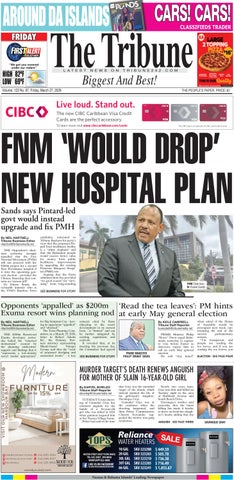
FNM ‘WOULD DROP’
NEW HOSPITAL PLAN
Sands says Pintard-led govt would instead upgrade and fix PMH
By NEIL HARTNELL Tribune Business Editor nhartnell@tribunemedia.net
THE Opposition’s chairman yesterday strongly signalled that the Free National Movement (FNM) will not proceed with the $268m project for a second New Providence hospital if it wins the upcoming general election - provided the Chinese financing deal contains no “poison pill”.
Dr Duane Sands, the ex-health minister who is the FNM’s Bamboo Town
candidate, reiterated to Tribune Business his party’s view that the proposed Perpall Tract healthcare facility is a “white elephant” and that the Bahamian people would receive better value for money from public healthcare improvements by upgrading the existing Princesss Margaret Hospital (PMH) site. Arguing that the Davis administration has provided “no good reason” for “deviating” from long-standing


By NEIL HARTNELL Tribune Business Editor
nhartnell@tribunemedia.net
THE $200m Rosewood
Exuma developer yesterday hailed the “renewed momentum” created by the planning authorities’ support and findings that it “represents a low-density resort model appropriate” for Big Sampson Cay - leaving its opponents “appalled” and “shocked”.
The Town Planning Committee, in a March, 25, 2026, letter to Robert Adams KC, the Delaney Partners attorney representing Miami-based Yntegra Group, said that the “scale of proposed dredging and associated works” - a key

concern cited by those objecting to the resort development in its current form - is “limited” and can be further mitigated by existing regulations and controls.
It revealed that, at its meeting the previous day, the Committee had agreed

By KEILE CAMPBELL Tribune Staff Reporter kcampbell@tribunemedia.net
PRIME Minister Philip “Brave” Davis urged Bahamians yesterday to register to vote before Easter as observers expect him to call an early May general election. He said “stay tuned” when asked if the House of Assembly would be prorogued next week, representing the end of the current parliamentary session.
MURDER TARGET’S DEATH RENEWS ANGUISH FOR MOTHER OF SLAIN 16-YEAR-OLD GIRL
By EARYEL BOWLEG Tribune Staff Reporter ebowleg@tribunemedia.net
TUESDAY’S fatal shooting of Gamaliel Gray has renewed anguish for the family of a 16-year-old girl who was killed in 2024 when gunmen targeted him at her Nassau Village home. Police had said at the time
that Gray was the intended target of the attack, which instead claimed the life of his girlfriend’s daughter, Davinique Gray. Gamaliel Gray was at the residence when the shooting happened, and then Police Commissioner Clayton Fernander suggested the motive was gang retaliation.
Nearly two years later, Gray was shot and killed on Tuesday night in the area of Ruthland Avenue and South Beach Drive. Davinique’s mother said yesterday that the latest killing has made it harder to move on from her daughter’s death, adding that she
“I’m transparent, and people are reading the tea leaves, and if you are reading the tea leaves, you


DAVINIQUE GRAY
FNM Chairman Dr Duane Sands
Mom begs public to stop judging her following Tuesday’s fatal shooting
and her younger daughter withdrew from social media and socialising after the 2024 shooting.
“It brings up all types of memories,” she said. “I just need them to let my daughter’s soul rest because she ain’t rest since she was down.”
Davinique, an 11th-grade student, was inside her home charging a mobile device when gunfire erupted. She was killed two years after her father’s murder and one day after what would have been his birthday.
At the time of her death, Gray was wanted in connection with the killing of Gerrad Coakley. He was later granted bail in December 2024 while
awaiting trial on a murder charge. The teen’s mother was also charged with harbouring a criminal in connection with Gray. She pleaded not guilty.
Following Gray’s death this week, the woman said she has again faced public criticism that she believes is unfair.
“They don’t know me,” she said. “How you could judge me? You ain’t God. Don’t judge me. Don’t go with what the media or what people say because all this what they saying, this aint true.” She said she continues to relive the trauma of losing her daughter.
“I have flashbacks because anybody know me, when they see me, they see her,” she said. “She never leave my side.
“It brings up all types of memories. I just need them to let my daughter’s soul rest because she ain’t rest since she was down.”
- Mother of Davinique Gray
That was my best friend. That’s why I say people gotta stop making me look like I’m a bad parent.”

Families of Bahamian victims slam ‘fast track’ US justice
By LEANDRA ROLLE Tribune Chief Reporter
THE arraignment of a senior police officer in a fatal shooting involving an American has triggered fresh anger among families still waiting for answers in other police-involved killings, with relatives questioning what they see as uneven pace of action in the justice system.
Relatives of Makaveli Tinker, 28, and Valentino Seymour, 32, said their cases have stalled, while Superintendent Berneil Pinder was swiftly brought before the courts after being charged with the murder of an American Pike Corporation worker outside Da Plantation Bar & Grill over the weekend.
Pinder has not yet entered a plea, and the matter is expected to take months to reach trial if he contests the charge. His case has drawn international attention, with the US Embassy offering the FBI’s assistance.
US Deputy Chief of Mission Kimberly Furnish confirmed yesterday that officials will monitor the case closely and are confident the government can bring it to justice.
Most police-involved killings are sent to the
Coroner’s Court. Direct criminal charges are rare but not unprecedented. In 2020, a former police sergeant was charged with manslaughter in Exuma, and in 2021, three officers were charged with murder in a separate case. Neither case went to the Coroner’s Court. Privately, officials say the existence of clear video footage is often decisive in determining what route is taken. Even so, Pinder’s case has sharpened concerns about how quickly authorities act in some matters compared with others.
A relative of Tinker said the family has yet to receive a timeline for an inquest and was warned the process could take years. Tinker was killed last month by an off-duty officer. Although police press liaison Chief Superintendent Sheria King said at the scene that Tinker was unknown to the officer, relatives of the victim contradicted this, saying they saw the men arguing days earlier. The officer remains on active duty, a reality that has deepened the family’s frustration.
“I don't even understand how this one guy get a whole fast track case because he's American,” Tinker’s relative said yesterday. “It’s troubling to


know that there's no justice or clarity. Makaveli could have been in the wrong, but I would never know until years later.”
For Seymour’s family, the wait has been similar.
A year after he was shot by an off-duty officer, his sister, Shanequa Thompson, said there has been little progress and limited information about the status of the investigation.
“Right now, I’m wishing I was related to this Pike people because at least I would’ve gotten straight fast,” she said.
Seymour, a father of one, was killed last February after police said he was seen firing a weapon near Palm Beach Street. His family disputes that account and said the lack of answers has forced them to try to piece together what happened themselves.
“In The Bahamas,” Ms Thompson said, “a police would shoot and kill someone, and it's like, ‘okay, it's on hold until it comes up’ and the family has to wait in limbo like no answers, no questions, no nothing. You don't know what happened and based on what

they said, you try to find witnesses, and you start doing your own investigation just to piece together what actually happened because if you go by the account that they initially give, you'll be like, wow, my relative did that?”
Ms Thompson said the family is now trying to determine its next steps following the death of their attorney, Romona
TINKER
Farquharson-Seymour.
She said the lawyer had indicated last year she would try to have the case expedited, though she acknowledged such matters can take years.
“You know what, for my brother, I'm going to keep pushing,” Ms Thompson said. “But seeing this whole situation with the Pike worker, I was like, wow, like this country is
something else because it’s no way Bahamians shouldn't be first in our own country.”
Yesterday, Police Commissioner Shanta Knowles, in an interview with Eyewitness News, rejected claims of external pressure in the American’s case. She acknowledged the long wait many families face but said the pace of proceedings rests with the courts.

DAVINIQUE GRAY
MAKAVELI
ANGUISH from
VALENTINO SEYMOUR
PM tours his constituency to open clinics and sign airport deal
By LYNAIRE MUNNINGS Tribune Staff Reporter lmunnings@tribunemedia.net
THE government has signed a $986,000 contract for a new airport terminal in Rum Cay and opened new clinics on Rum Cay, San Salvador and Cat Island during a tour of the prime minister’s constituency.
Prime Minister Philip “Brave” Davis, alongside Deputy Prime Minister Chester Cooper, Health Minister Dr Michael Darville, Energy Minister JoBeth Coleby-Davis and other officials, visited the islands to mark the projects and provide updates on infrastructure works.
In Rum Cay, officials signed the contract for a new airport terminal to replace what was described as a cabana with wooden benches in an open space.
The project, led by Greenslade Construction Company, is expected to take 12 months to complete, though officials are aiming for an eight-month timeline and plan to break ground within a month.
Desmond Greenslade, the company’s president, thanked the government for the opportunity and

said he intends to employ residents in the construction process.
The planned terminal will measure about 2,500 square feet and include seating for about 20 people, a baggage ramp, wheelchair access, a generator and solar power.
Mr Cooper said the administration is working to ensure smaller islands are not left behind and announced plans for Southern Air to establish a consistent route to Rum Cay, where officials said

about 60 residents live.
While on the island, officials also opened the Rum Cay Medical Clinic, a 3,000 square foot facility built by Knowles Construction. It includes a triage treatment room, doctor’s office, phlebotomy services and the potential for dental services. The clinic is expected to operate Monday to Friday from 9am to 5pm.
The delegation then travelled to San Salvador for the opening of the United Estates Clinic, a
2,900 square foot facility with similar amenities and an ambulance. Mr Davis said the project had been in progress for years.
The clinic will operate Monday to Friday from 9am to 5pm.
The tour ended in Cat Island with the opening of the Old Bight Community Clinic, a 3,300 square foot facility. Cat Island also received a new ambulance as part of the initiative.
Mr Davis spoke about his family ties to the island during the opening.


to register before Easter as election looms

ELECTION from page one
should be able to deduct what is happening,” Mr Davis told reporters. The comments came after some Members of Parliament delivered what appeared to be their final contributions for the current term in the House of Assembly on Wednesday. Although the House of Assembly was adjourned until April 15, observers expect Parliament to be dissolved before then. Political insiders have frequently discussed May 12 as the likely election date. Former Finance Minister Peter Turnquest said the next fiscal budget, which is traditionally presented on the last Wednesday of May, will likely have “significant bearing” on election timing.
Before a general election is called, Parliament is usually prorogued. This means the current session is formally brought to an end by the Governor-General on the advice of the prime minister. Parliamentary business stops, but Parliament itself is not dissolved, and MPs remain in office. An election becomes necessary when Parliament is dissolved, either early on the prime minister’s advice or automatically at the end of its five-year term. Once that happens, the Governor-General issues election writs for each constituency, setting the process in motion and outlining key dates. By law, nomination day must come at least seven days after the writs are issued, and polling day must be at least seven days after nomination day. That means the earliest an election can be held is about two weeks after the writs are issued, though in practice elections in The Bahamas are usually held three to four weeks after Parliament is dissolved.
Attorneys debate relevance of obscene language criminal charge
By EARYEL BOWLEG Tribune Staff Reporter ebowleg@tribunemedia.net
ATTORNEYS are raising fresh questions about the value of the obscene language offence, with some arguing it is overused and unnecessary, while others say it remains a tool for maintaining public order.
The offence, broadly defined in law, gives police wide discretion in deciding when language crosses the line into criminal conduct.
Defence attorney David Cash said the offence should be removed altogether, arguing that existing laws already cover situations where language escalates into more serious conduct.
“There's already sufficient criminal offences on the books that would cover
offences if something escalates from just language, because if you're living in a free country, then people ought to have freedom of speech,” Mr Cash said. He said profanity is commonly used by both civilians and police officers, particularly in moments of frustration, and does not in itself cause harm.
Attorney Bryan Bastian said the issue depends on context, noting that the charge is often paired with offences such as resisting arrest or disorderly behaviour.
Attorneys said the charge is often used alongside other offences, raising concerns that it can function as an add-on count rather than a standalone public order measure.
“What is the end goal?” he said. “You charge someone with using obscene

language, you know, wasting judicial time. Nine times out of ten, they’ll probably be admonished or pay some minimal fine or something.”
Some attorneys also questioned how the offence is applied in practice, particularly in cases where officers themselves use similar language during confrontations.
Indeed, Mr Bastian questioned the fairness of officers charging individuals for obscene language while engaging in similar conduct.
“What example are they setting?” he said. “Their whole position is to uphold the law. But if they're using profanity and then turn around and charge someone with using obscene language, what’s the sense?”
Attorney K Brian Hanna said many Bahamians use profanity without intending harm and that the charge can be unreasonable depending on the circumstances.
He said police may bring the charge out of annoyance, particularly when individuals fail to comply with instructions, and suggested such matters are often better resolved on the spot.
One attorney, Ian Cargill, defended the offence as a necessary tool for maintaining order in public spaces, though he said it should not apply in private settings.
“It's a tough one because Bahamians are so disrespectful when they're ready,” he said. “I think there needs to be some order, and so I have no difficulty with the charge. If it's once you are warned and you continue, I think you should be charged.”
“You could imagine Bahamians, you downtown and they cussing each other
in front of the tourist or by the hotel, or like Jet Ski operators or boaters?”
PRIME Minister Philip ‘Brave’ Davis holds a voter’s card during a session of the House of Assembly in August last year.
PRIME Minister Philip ‘Brave’ Davis, along with his wife Ann Marie Davsi, DPM Chester Cooper, Minister of Health and Wellness Dr. Michael Darville, Nassau Village MP Jamahl Strachan, Minister of Energy and Transport Jobeth Coleby-Davis, Director of Aviation Dr Kenneth Romer, pose with Desmond Greenslade & Jackie Knowles Greensladeof Greenslade Construction at the contract signing for Rum Cay Airprot. Photos: Shawn Hanna
RIBBON cutting at new clinic in Rum Cay.
GOVT officials tour new clinic in Rum Cay.
Govt to drop property tax on owner-occupied triplexes
By DENISE MAYCOCK Tribune Freeport Reporter dmaycock@tribunemedia.net
THE government is moving to eliminate real property tax on certain small multi-family homes, with Senator Michael Halkitis saying the change is meant to make it easier for Bahamians to build wealth through rental income.
Speaking in the Senate on Thursday, the Minister of Economic Affairs said legislation will be amended to allow homeowners who build a triplex and live in one unit to avoid paying real property tax on the other two units.
“We made a commitment that we will no longer require that tax,” he said, arguing that current rules have made such developments less viable.
He said building duplexes and triplexes has long been promoted as a path to wealth, but the requirement to pay tax on additional units has discouraged some homeowners.
The proposed change forms part of a wider push to expand affordable housing, as the Senate debated three land resolutions tied to the government’s housing programme.
Mr Halkitis said two of the measures are aimed at regularising land ownership for people who have struggled for years to obtain proper title. A third resolution provides for the transfer of about 68 acres in Exuma — in two parcels of 38.4 acres and 30 acres — to the housing minister for $10, with the land earmarked for housing development.
“These lands are being conveyed for the purpose of providing housing,” Mr Halkitis said, adding that the initiative is expected to benefit Exuma residents, including those abroad who may want to return home. The Senate was also told of plans to transfer roughly 30 acres in Bozine Town from the Treasurer to the Ministry of Housing, land that has been tied up in legal disputes for years.
“This is in an effort to allow the Ministry of Housing to resolve longstanding issues of title and regularisation,” he said. A separate resolution covers just over three acres in the Pit Road area, also to be transferred for nominal consideration to support housing development. Beyond the land measures, Mr Halkitis said the government is exploring modular construction to cut costs and the acquisition of abandoned and derelict properties for redevelopment.
“There has to be more ways to incentivise construction,” he said, noting that discussions are ongoing with regional and international partners on improving access to housing finance. He said housing affordability remains a challenge across The Bahamas and the wider Caribbean, with institutions such as the Inter-American Development Bank engaged in efforts to address it.
Mr Halkitis described the measures before the Senate as a “good step,” particularly for residents in areas such as Bozine Town and Pit Road who have long faced uncertainty over land ownership.

Licensees warn taxpayers could bear burden of GB Power deal
By RASHAD ROLLE Tribune News Editor rrolle@tribunemedia.net
THE Freeport Licensee Association is urging the government to fully explain its plan to acquire the Grand Bahama Power Company, warning that taxpayers could be left carrying the burden of a costly and unclear deal.
In a statement yesterday, the association said the proposed takeover must be backed by transparency, sound financial reasoning and public consultation, noting that “very few details” have been provided about how the purchase would benefit Grand Bahama residents.
The group raised particular concern about how the government intends to repay the $280m borrowing tied to the deal, especially as residents are still grappling with the financial fallout from Hurricane Dorian and other past storms. While officials have pointed to the prospect of lower electricity bills, the association said there has been no clear explanation of how this would be achieved if the acquisition requires additional
borrowing that will ultimately fall to taxpayers.
The FLA also questioned whether government ownership would deliver better results, noting that state-owned utilities have struggled with efficiency and profitability in some cases. It argued that private ownership, properly regulated under the Hawksbill Creek Agreement, can provide accountability without exposing the public to unnecessary financial risk. The statement comes as the proposed acquisition continues to face scrutiny, with the government seeking parliamentary approval for borrowing resolutions totalling $280m to fund the purchase and provide operational support.
Prime Minister Philip “Brave” Davis has defended the move as part of a broader effort to tackle high energy costs on Grand Bahama, where electricity rates significantly exceed those on New Providence.
He said the government cannot stand by while residents continue to pay more for power.
Opposition Leader Michael Pintard, however, has criticised the plan, accusing the administration
of seeking approval without providing key details about the transaction, including the company’s valuation, liabilities and how it would be managed.
The Freeport Licensee Association echoed those concerns, pointing to unanswered questions about the company’s value, its ability to service new debt while lowering electricity costs, and the scope of additional capital requirements linked to the deal.
It also warned that the proposal could have implications for businesses already struggling with high energy costs, which affect investment decisions on the island.
The association called on the prime minister and minister for Grand Bahama to meet with residents to provide detailed answers, and urged Members of Parliament representing the island to press for greater clarity on behalf of their constituents.
It said public confidence in the proposed takeover will depend on “full disclosure, proper financial justification, and a realistic plan” that delivers measurable benefits to Grand Bahamians.


SENATOR MICHAEL HALKITIS
The Tribune Limited
NULLIUS ADDICTUS JURARE IN VERBA MAGISTRI
“Being Bound to Swear to The Dogmas of No Master”
LEON E. H. DUPUCH,
Publisher/Editor 1903-1914
SIR ETIENNE DUPUCH, Kt., O.B.E., K.M., K.C.S.G., (Hon.) LL.D., D.Litt .
Publisher/Editor 1919-1972
Contributing Editor 1972-1991
RT HON EILEEN DUPUCH CARRON, C.M.G., M.S., B.A., LL.B.
Publisher/Editor 1972-
Published daily Monday to Friday Shirley & Deveaux Streets, Nassau, Bahamas N3207
TELEPHONES
News & General Information
(242) 502-2350
Advertising Manager (242) 502-2394
Circulation Department (242) 502-2386
Nassau fax (242) 328-2398
Freeport, Grand Bahama (242)-352-6608
Freeport fax (242) 352-9348
WEBSITE, TWITTER & FACEBOOK
www.tribune242.com

@tribune242

Elections matter.
Each one of us should bear that in mind with an election just around the corner. In fact, last night, the Director of Communications in the Office of the Prime Minister, Latrae Rahming, was posting to social media that those who need to register to vote must do so before Easter. The bell is about to ring.
“But they’re all the same” is a familiar refrain. Yes, when we talk about institutional problems in our country, they have spanned multiple administrations, both FNM and PLP. That does not mean that your choices in the ballot box will not directly affect choices by the next administration, whoever they are.
One campaign issue that has been put on the table is the future of plans to build a second New Providence hospital at Perpall Tract.
The current government has put forward the plans, arranged nearly $200m in financing from China and plans to proceed with the $268m project – which has run into concerns over flooding from nearby residents.
There have also been concerns over staffing – given that the healthcare system is already struggling to find enough staff before adding a whole new hospital to the mix.
The PLP has put forward the idea and, if elected, will presumably push on with the plans.
The FNM has now said they will not proceed, unless there is something in the funding deal that forces them to borrow the money regardless.
Former Health Minister Dr Duane Sands says there will be better value for money in upgrading the existing Princess Margaret Hospital, calling the new hospital a “hare-brained scheme”. He said the Rand in Freeport would also be improved.
That is a choice. Whichever option you believe is best, that is on the table for you to consider when you cast your vote.
On the subject of freedom of information, the current administration has kicked the can down the road throughout its term in office. It has shown no interest in implementing freedom of information, and zero urgency to bring in other transparency measures, such as campaign finance laws or the Ombudsman Act implementation.
The FNM has said both the Ombudsman and Freedom of Information Acts will be fully implemented within the first year in office.
In fact, St Anne’s MP Adrian White said the Freedom of Information Act would be implemented within the first 90 days of an FNM administration, alongside stronger whistleblower protections. Killarney candidate Michela
tribune news network
Barnett-Ellis has promised anti-corruption legislation.
Again, there is a choice when you cast your vote.
Of course, one always has to weigh the possibility that what is said on the campaign trail will not materialise when in office – that has happened plenty of times down the years in The Bahamas. Indeed, that happens around the world.
Right now, however, it is again among the options to consider when casting your vote.
A recent poll touted by the PLP claimed that voters considered the PLP to be the strongest party when it comes to being good for the economy. The poll said 44 percent chose the PLP as being strongest for the economy, while just 14 percent chose the FNM. A massive 31 percent, however, remained undecided, according to the poll.
Again, this is an issue that will be front and centre in the election build-up. The last FNM administration had to deal with the twin hammer blows of COVID-19 and Hurricane Dorian and the damage they did to the economy. For Bahamians, that means jobs lost, houses needing to be rebuilt, lives that were shattered. The current administration has presided over an economy that has rebounded since those disasters, even if there are some areas presently, such as stopover tourism, which seem to have stumbled.
The economy is a big part of what drives voters around the world. People want to know their future is secure, that there will be money in their pockets, that their pay is rising, that inflation will not run riot.
Whichever party makes voters believe their personal financial future will be more secure will go a long way to winning the argument at the polls.
There are, of course, a host of different issues. Each voter will have their own individual concern, that will be addressed or fail to be addressed by each candidate.
But do not believe for a moment that elections do not make a difference. They do – on issues of immediate importance and bringing immediate change.
If you have not registered to vote, do so as quickly as possible. Use your vote wisely. Ask the candidates what they will do about the issues that matter to you. And whichever party wins and forms the next administration? Hold them to account. The promises they make on the doorstep should be the actions they carry out in office. If they want your vote, the least you deserve is that they live up to their promises.
PLP doctringSecrecy by design
EDITOR, The Tribune.
THE recent announcement about the government’s plan to purchase the Grand Bahama Power Company, coupled with the complete lack of information and details, once again highlights that this Progressive Liberal Party (PLP) Administration has mastered the language of transparency while perfecting the practice of concealment. They speak endlessly about transparency, accountability, integrity, anti-corruption, and freedom of information, yet govern like black paint on a black wall, covering rather than revealing.
This administration’s opacity does not appear accidental; it looks
FNM’s Oliver can win North Andros
EDITOR, The Tribune.
I WAS pleasantly surprised and elated after reading in The Nassau Guardian that the Free National Movement had ratified the talented and highly accomplished Janice Oliver as its standard bearer in North Andros -- a seat that is traditionally held by the Progressive Liberal Party. The perception of The Big Yard being “PLP Country” was concretised during the lengthy representations of Sir Lynden Pindling in Kemp’s Bay, South Andros from 1967 to 1997 and Darrell Rolle in Mangrove Cay from 1971 to 1987; and in North Andros from 1987 to 1997. Rolle succeeded Loftus Roker in North Andros -- the latter winning that seat in 1968, 1972, 1977 and 1982. Roker retired from Parliament in 1987. Rolle entered the House of Assembly after winning the Mangrove Cay by-election in 1971 following the death of Clarence Bain.
Andros is the land of the crab. The crab is the symbol of the PLP, which underscores the deeply profound relationship between the largely undeveloped island and the PLP. It was a South Androsian clergyman who forecasted a PLP victory ahead of the January 10, 1967 general election. Pindling switched from his Southern District constituency in New Providence for Andros in 1967, largely due to his wife who hails from that Out Island. It is against this historical backdrop that Oliver is tasked with competing against. The Leonardo D Lightbourne camp must be thinking that reelection is automatic, owing to deep historical ties between the PLP and Andros. But for Oliver, unseating Lightbourne is by no means an insurmountable task. The odds aren’t stacked in the PLP incumbent’s favor. I believe Oliver can deliver North Andros for the FNM.
In fact, I believe she should be regarded as the clear frontrunner to win
North Andros whenever voters head to the polls. Lightbourne is not politically heavyweight like Roker and Rolle. He is a quintessential back bencher who has been extremely quiet in his tenure as MP. Oliver winning North Andros will not the first time the FNM has won in that PLP impregnable stronghold. The first to do so was Dr Earl Deveaux in 1997, followed by Carlton Bowleg in 2017. But both of those elections were outliers. Oliver won’t need a catastrophic mistake by the PLP incumbent to win North Andros. Her impressive record of service, family pedigree and ties to North Andros are more than enough to woo swing voters and even uncommitted PLPs in North Andros. Oliver hails from North Andros. She is the daughter of the venerable Bishop Carl Oliver, pastor of Mount Pleasant View Assemblies of God Church. She is the sibling of renowned track and field athlete Carl Oliver, Jr. The track and field stadium in North Andros is named in his honor. Oliver, who attained a Master of Science in Nursing Leadership and Administration, is a registered nurse and midwife who has selflessly served in Andros, Bimini and Grand Bahama for two solid decades. In the Public Hospitals Authority, Oliver served as Resident Nurse in Eight Mile Rock. She also served in senior clinical and administrative roles. Unlike so many healthcare professionals who have opted to relocate to the US and Canada where they can earn a six-figure income, Oliver has chosen to remain in The Bahamas where her expertise is in dire need. She could have followed the money. Her decision to remain in The Bahamas
where nurses are severely underpaid and underappreciated is a testament of her love and commitment to the Bahamian people. This speaks of her character. She is not chasing after money. With her academic and professional credentials, Oliver could easily earn a quarter million dollars annually abroad. She was active in local government, where she, I believe, cut her teeth in politics at the municipal level. As a community advocate and leader, she founded Unity in the Community, which is a health education, social support and empowerment organisation. I remember Oliver as a prodigy at the Huntley P Christie High School, which was named the North Andros High School in the early nineties. She was highly intelligent and a gifted athlete. Her qualifications are impeccable. Even as a student, she exhibited leadership straits. I believe God was preparing and molding her for this moment in this nation’s history. She is also an anointed soloist and a devout Christian who inherited her evangelical faith from her godly parents. Nicholls Town, Conch Sound, Lowe Sound, Red Bays, Morgan’s Bluff and Mastic Point must circle the wagon around Oliver, who is one of their own. She understands North Andros. She is from that community. If elected, she will represent North Andros well. She will fight for North Andros. I consider her to be one of the most interesting female candidates in this year’s general election. As a midwife who has probably delivered hundreds of babies, Janice Oliver is more than capable of delivering North Andros for the FNM. I hope the people of North Andros will reward her for her selfless service and commitment to them.
KEVIN EVANS Freeport, Grand Bahama March 24, 2026.
GB Power sucking Grand Bahama dry
deliberate, calculated, and politically convenient. Time and again, the public is promised openness, only to be met with silence, evasion, delay, and carefully managed ambiguity. Expecting straightforward answers from the PLP has become an exercise in futility, like a blind person searching for a dime in the corner of a pitch-black circular room. There is no corner, and more importantly, there is no dime, because the truth was never placed within public reach to begin with.
A government that truly believes in transparency does not fear scrutiny, dodge disclosure, or treat information as a private asset. The PLP may continue to speak the
vocabulary of reform, but its record suggests a government far more committed to darkness than daylight. In this Information Age, the citizens of the Bahamas deserve more meaningful and transparent representation and support from their leaders.
PLP Members of Parliament and Senators often stand to passionately express the concerns and aspirations of their constituents; their actions should also reflect the commitments they made to transparency, accountability, integrity, anti-corruption, and freedom of information. Disappointed. Again.
C ALLEN JOHNSON Freeport, Grand Bahama March 25, 2026.
EDITOR, The Tribune. OVER the past three bill cycles, I have noticed that my light bill from the Grand Bahama Power Company has seen a significant increase from around $230 per month to $380. The explanation given to me by a GBPC customer service representative was that I must be doing something different. Six people reside at my home. Between 7:30am and 6:00pm each weekday no one is home. The house is completely shut down. I make sure to pull out the plugs for the appliances; the fridge being the exception. I have a propane gas stove. Yet despite all of the above measures, I am being billed nearly $400. I do not accept the lame explanation given to me by the rep. I believe that they
have increased the kilowatt rate. Freeport needs URCA to come in and police GB Power. Emera does not care about Bahamians. They are only interested in making windfall profits. There’s literally nothing else to suck from a dried-up economy yet Emera continues to find innovative ways to milk Bahamian households and businesses. I also believe they are charging us a fuel surcharge, even though the Aggreko generators have been sent back to the US and they are using the cheap bunker C fuel. GBPC must level with the Grand Bahamian community on whether or not they are still charging us for the Hurricane Dorian restoration of their facilities and equipment nearly seven years after the storm.
Other residents have also expressed alarm to this writer of high light bills in recent months. This is supposed to be the time of the year our light bills are low as no one is using their AC units. In February, it was extremely cold. Yet my bill is nearly $200 more than what it used to be.
GB Power along with the GB Port Authority are the two main culprits for Freeport’s sorry state. I welcome the Progressive Liberal Party government’s takeover of GB Power. And I hope the Port is next in line for a government takeover. Both cannot happen soon enough.
FRUSTRATED GB POWER CUSTOMER Freeport, Grand Bahama March 26, 2026.

By PAVEL BAILEY Tribune Staff Reporter pbailey@tribunemedia.net
A MAN was found guilty yesterday of the 2018 murder of a man outside his home in Yellow Elder Gardens.
Stephon Mackey, 35, was convicted of murder by a 6-3 jury verdict before Justice Rene McKay.
Mackey murdered Glenton Pablito Smith, 28, on February 27, 2018. According to initial
reports, shortly before 11pm on the day in question, a man and woman arrived at a residence on Seymour Street, Yellow Elder Gardens. As the man was about to secure the premises, he was approached by two armed men, who shot him before running away. He was pronounced dead at the scene.
Dr Caryn Sands, a pathologist, said Smith’s body was identified by his wife at the Princess Margaret Hospital morgue on February 28
2018. Dr Sands said she completed her autopsy on March 8 2018.
She confirmed that Smith’s cause of death was gunshot and shotgun wounds to the head, torso and extremities.
Mackey will return to court for sentencing later this year.
Erica Ingraham, Brent McNeil and Valentino Bowe were the prosecutors.
Damian White represented the accused.
Bail granted for woman accused of attacking police officer
By PAVEL BAILEY Tribune Staff Reporter pbailey@tribunemedia.net
A WOMAN accused of aggravated assault against a police officer on a public road was granted bail yesterday.
Prosecutors allege Diamonde Thompson, 23, acted disorderly on Prince Charles Drive on March 19. During the same incident, Thompson is accused of resisting arrest and
committing aggravated assault against Corporal 3347 Taylor. The defendant pleaded not guilty to disorderly behaviour, resisting arrest and aggravated assault before Deputy Chief Magistrate Shaka Serville.
Inspector Cordero Farrington, the prosecutor, objected to bail, citing a prior assault charge from February, for which Thompson was ordered to be of good behaviour until May. He argued that
Mistrial declared in case of man who claimed police torture
By PAVEL BAILEY Tribune Staff Reporter pbailey@tribunemedia.net
A JURY was told yesterday that a mistrial had been ordered in the case of a man who claimed he had been tortured into confessing to the murders of two teenage boys who were shot and killed in Yellow Elder Gardens in 2017.
Deon Scavella, 30, was present as the jury was dismissed by Justice Jeannine Weech-Gomez in the Supreme Court. Prosecutors allege that
the latest charge was an “upgrade”, as the defendant was allegedly now attacking officers.
In response, Thompson said she had been of good behaviour for a month.
Magistrate Serville granted bail of $3,500 with one or two sureties. She must sign in at the Elizabeth Estates Police Station every Tuesday and Saturday by 7pm.
The defendant returns to court for both matters on May 11.


Scavella shot and killed Devonte Lindsey, 15, and Keishon Williams, 13, on March 19 2017. Their bodies were later found on a dirt road off Graham Drive in Yellow Elder. Earlier this week, the prosecution closed its case against the accused. Scavella had taken the stand in his defence and was set to continue cross-examination when the mistrial was ordered.
The jury was not told the reason for the court’s decision. Scavella will remain in custody until the court
decides how to proceed. He has the right to apply for bail during that time. Scavella claimed on Tuesday that he was forced to confess to the murders after police tortured him at CDU. Scavella’s trial was previously discontinued before Justice Neil Braithwaite in 2024, when the jury was discharged after he was hospitalised following a serious traffic accident. Marianne Cadet represented the accused.
Shaneka Carey and Davina Pinder were the prosecutors.
$6,000 bail for man accused of indecent assault of 19-year-old
By PAVEL BAILEY Tribune Staff Reporter pbailey@tribunemedia.net
A MAN accused of indecently assaulting a 19-year-old woman on Augusta Street last weekend was granted bail yesterday.
Prosecutors allege Ronel Aime, 42, inappropriately touched a young woman on March 21. Aime pleaded not guilty to a charge of indecent assault before Magistrate Abigail Farrington.
Aime has prior firearm convictions and served two years in prison for a July 2023 offence. The defendant was granted bail of $6,000 with one or two sureties. Under the terms of his
bail, the defendant must sign in at the Quakoo Street Police Station on the last Sunday of every month by 7pm. He was warned not to have any contact with the complainant or any witnesses in this matter or risk his bail being revoked.
Aime’s trial begins on May 22.
85-year-old passenger dies after golf cart and car collide
AN 85-YEAR-OLD man has died following a traffic collision at the junction of Western Road and Nelson Road on Wednesday.
Police said the crash happened shortly after 12pm and involved a 2015 Mini Cooper and a red Club Car
golf cart carrying two men. According to initial reports, the Mini Cooper was travelling south along Western Road when it collided with the golf cart as it entered from Nelson Road. Both occupants of the golf cart were seriously
injured and taken to hospital by Emergency Medical Services.
The 85-year-old passenger later died while receiving treatment. Police are investigating the circumstances surrounding the collision.
MAN SHOT IN BOTH HANDS REFUSES TO HELP POLICE
A 20-YEAR-OLD man was shot in the hands during a drive-by attack in the area of New Hope Drive and East Street South on Wednesday night.
Police said ShotSpotter technology detected gunfire shortly before 9.30pm, prompting officers to respond after receiving reports that a man had been shot.
On arrival, police found two damaged silver vehicles — a Toyota Corolla and a Toyota Passo.
Investigators said the victim was at a park near New Hope Drive with a group of men when a darkcoloured Nissan pulled up. Two men dressed in dark
clothing exited the vehicle, and one produced a firearm and fired multiple shots at the group.
The victim was struck in his left hand and the middle fingers of his right hand and was taken to the hospital by
private vehicle. Police later learned the man had left the hospital and declined further medical treatment. When officers spoke with him, he refused to cooperate or provide details about the incident.


SUNLAND Baptist Academy student, Raia Cargill is crowned the 2026 Junior Director of Tourism for Grand Bahama after delivering a standout speech on the theme, “Where Paradise Meets Responsibility” during the Ministry of Tourism’s annual preliminary competition on March 19, 2026 at the Ministry of Labour and Public Service’s Training Room, Grand Bahama.
Photo: Andrew Miller/BIS
From 1970s cartels to today: MICAL’s enduring smuggling legacy
IN 2000, I was waiting at the Acklins airport in the shade of an abandoned C-47 when a US DEA chopper bristling with guns buzzed loudly overhead. I was surprised when someone nearby looked at their watch and casually commented “three hours late, but getting closer” to murmurs of agreement.
In December of 2024, the Nassau Tribune carried an interesting story related to that same airport, paraphrased here from the article. “Shortly before 2:00 am on Friday, an aircraft crash landed on the western section of the airport runway. Combined Bahamian and US law enforcement encountered the abandoned aircraft. Although initially the police found no occupants onboard or near the crash, a search of the plane revealed a large quantity of suspected dangerous drugs.
“In fact, there were nearly 2,000 pounds of cocaine and 25 pounds of hydroponically grown marijuana, with a combined street value of nearly $15.5 million. Soon thereafter they were able to apprehend and arrest five Bahamians and Colombians.”
In Mayaguana, Inagua, Crooked, Acklins and Long Cay—otherwise known as “MICAL”-- most air accidents were precautionary in nature: low fuel, stall, spin, or nose down. In MICAL four Beechcraft and three Cessnas were lost. Bahamas news outlets report on incidents in the area up to the present.
Crashes—drug-related or not—have also been reported on other southern Bahamas islands. A man named Lincoln Russell perished in a crash in 1987 in Cutlass Bay, Port Howe, Cat Island. That island itself recorded crashes of two Pipers and two Cessnas. Back to MICAL. “Police on Crooked Island seized 44 packages and 12 bricks of cocaine from a plane that landed on the island yesterday,” the Bahamas Times reported. “Preliminary reports indicate that officers heard the aircraft circling the airport around 11:45pm and upon further investigation they found two men attempting to flee. The men, who are Venezuelan, were arrested.” And another: “Police have arrested seven men on Long Island in connection with a major drug bust on Acklins.” Long Cay is south of Crooked Island and has seen its share of drug trafficking incidents too.
“Bahamians Busted After Major Drug Find On Long Cay,” screamed a headline on ournews.bs in July 2023. “Sixty-six sacks filled with drugs were found on the cay, 54 of those packages containing marijuana and 12 containing cocaine. Police reported that a helicopter had followed a white Beechcraft that landed on Mayaguana with its engine still running. Two suspects fled into the bushes, leaving behind 18 crocus sacks of cocaine. The cocaine seized in that incident totalled 520 kilos, with a street value of $10.4 million.”
In the early morning of October 28, 2024, police were alerted to a crashed aircraft in a bushy rocky area east of the Duncan Town Airport on Ragged Island. The wreckage of a twin-engine plane ablaze was found with the charred remains of two people inside. The pilot had not filed a flight plan, which National Security Minister Wayne Munroe said was suspicious and that pointed to a link to the illegal drug trade. Reports indicate that Investigators were looking into whether the 5am arrival was being undertaken with runway lights on and, if so, whether the airport was meant to be open for commercial and private traffic at that time. Local pilots who spoke under the condition of anonymity to


The Bahama Journal said that the pilot may have undershot the runway while trying to land without lighting.
Recently, local news sources reported that “four men including three Bahamians and one Jamaican were arrested and charged in relation to a multi-million drug seizure after being caught in the Ragged Island chain by a joint operation between the Royal Bahamas Police Force (RBPF) and Operation Bahamas and Turks & Caicos (OPBAT) with 2,908 pounds of marijuana and five pounds of cocaine on a go-fast boat.” In 2022 RBPF, OPBAT and the US Coast Guard seized over 800 pounds of marijuana valued at $815,000 from a go-fast boat.
Despite the danger and misery that characterised the trade, some of these traffickers became folk heroes. In the book Weed Man, by John McCaslin, chronicles the tale of the protagonist, Jimmy Moree, who “was born and grew up poor in the Bahamas” – on Long Island.
“Nicknamed ‘Jimmy Divine’ for his teetotaling ways, he became one of the most successful marijuana traffickers of the 1970s, smuggling high-grade South American weed across the tempestuous seas into North American ports of call.” A bit of a Robin Hood story, Moree returned periodically to Long Island to reward those who helped look after his ailing mother.
Others, as penned in the book No Ordinary Bird: Drug Smuggling, a Plane Crash, and a Daughter’s Quest for the Truth, by Artis Henderson (2025), repeats fiction about World War II at Darby Island and recounts the personal loss of loved ones caused by the activity, as well as the entrepreneurial aspect of the trade.
Her father, Lamar Chester, a successful oilman from the US, purchased the Darby Islands in Exuma in 1978 and, according to his daughter, “spread his money around for local causes: a town dump, a bridge connecting Exuma to Barreterre.”
The island had an airstrip which only locals could master. In 1975, Chester flew in 300-lbs of marijuana per flight. By 1978 it had risen to 1,000 lbs a time.
“After he bought the Darby Islands,” the book reveals, “he moved 8,000 pounds of marijuana through the Exumas and into Florida in a single gig.” Years later, Chester advanced to moving 21,000 lbs of pot through the Exumas and into the US.
“The Darby’s turned my father’s midsize smuggling


business into a major international operation.”
In The Pilot’s Double Life, Elliot J. Stone writes that risk-taking businessmen from around the world – Australian, South American, North American, European, Bahamian, Canadian – purchased assets from aircraft to islands, boats and houses— to benefit from the lucrative trade. Some simply invested in risks that others took and hid behind shell companies and nominee directors.
“This was not only about wealth,” Stone writes, “but about belonging to a fraternity of men who had crossed from legitimate aviation into something darker. To own a cay, however small, was to possess a piece of the trade’s infrastructure – a strip of sand that doubled as an airfield, a dock where fuel drums could be stored, a house that could serve as safe lodging between flights.”
In his 2016 memoir, Smuggler, Roger Reaves
“To own a cay, however small, was to possess a piece of the trade’s infrastructure – a strip of sand that doubled as an airfield, a dock where fuel drums could be stored, a house that could serve as safe lodging between flights.”
-
Elliot J Stone Author
recounts the type of aircraft he preferred most for the dangerous flights.
“Howard 350 is the fastest piston-engined passenger plane available. She would throw you back in your seat on take-off, carry two tons of cocaine for 2,000 miles at 400 mph. My favourite aircraft.”
He also liked the Aero Commander 690B, of which there are many wrecks around New Providence and the Bahamas, and the Queen Air 80-B, Cessna 182, one of his first aircraft. He writes that, in 1973, he earned more by flying ganja from Mexico, than he had in a year as a fireman. He described the Twin Beech by Beechcraft of Wichita as “a hauler and a pleasure to fly. She carried one ton for a thousand miles. I owned 12, all five models.”
In another book about that adventurous time, Snow on the Palms, George Williams describes a drug pilot rendezvous on Cat Island in the 1970s. “Before embarking, I purchased a roll of black tape and altered the registration number on my fuselage.
I wasn’t a Van Gogh, and if you looked closely you could tell. But from any distance I was now N5349K, instead of N5319K. I picked up the beacon as I neared the island, but had no trouble finding New Bight Airport. A couple of other aircraft were already there being loaded.
“Both [of the other aircraft] were twin-engine planes. The loading crew spoke Spanish, so I assumed they were Colombian. The stuff was pungent, so I kept the little vent window open. I was afraid maybe I’d get high just on the aroma.”
He liked the DC-3 and military variant C-47, but felt it was too obvious.
“They were reliable and inexpensive, and plenty were available,” he writes.
Many of those crashed in the Bahamas and some still fly here each afternoon with fresh meat.
Williams observes that “what finally changed the attractiveness of the trade was not the law or a war between suppliers. It
was a saturated market. The price of grass began to drop significantly. The runs became fewer, and the payoffs smaller. As the 1970s waned, changes were in the mail. The biggest change, though, was the weather – a snowstorm from South America. The Colombians were replacing their marijuana fields with a more profitable dangerous crop, one that paid so much money as to be unthinkable. A crop that would produce violence, addiction, untold wealth, murder, and a reign of terror: cocaine.” In Buccaneer, a new book by Jack Carlton Reed and Maycay Beeler, a veteran pilot for Medellin Cartel co-founder Carlos Lehder, highlights a bizarre type of job satisfaction prevalent among some in the industry. “I can say with pride that I never lost a load or been caught in the act of smuggling. The lure of any smuggling operation is fuelled by the insane amount of dollars it generates. The money grew own trees (so to speak), with its roots in rural Colombia.” He compared it to farmer-to-market economics.
“The service we provided was [transportation] for any dealer that wanted to pay our fee of $5,000 per kilo to deliver it to their agent in the US. At that time a kilo of coke purchased in the US would cost no less than $50,000.” Lehder was paid $1m for arranging the transportation and the pilot would receive $250,000 if he flew both legs of the trip, from Colombia to [Bahamas] and then to the US.” With many runways and remote islands where planes flying “under the radar” could land, unload or load, and refuel without constant harassment, The Bahamas became an important, convenient, and cost-effective place to transit drug cargoes and, afterwards, to dump unwanted and unused aircraft.
The evidence is still there along the landing strips at Acklins and Mayaguana and no doubt others in MICAL and beyond.
A MAP of The Bahama Islands with Mayaguan circled.
MAYAGUANA
MAYAGUANA BONEYARD ABANDONED AIRCRAFT.
Diane Phillips
Promises of Bay Steet’s rebirth predates most living Bahamians
SOME things do get better with age. Fine wine for one, young lime trees for another. Empty promises not so much. Including the promise of a revitalized Bay Street, a subject that has made headlines so often over the years that an editor could leave the headline and just change the date.
I was reminded of this the other day when my niece handed me a tattered page from a scrapbook kept by her recently deceased parents, who had once operated a restaurant and hotel in the heart of historic Nassau. They had saved it all these years, the yellowed pages of the story glued to its front and back, and a bold headline that shouts ‘Master Plan’ to rejuvenate Bay Street.
It was front page news February 25, 1982.
Forty four years ago – February, 1982 – and still there is no plan, no management in place, no tax structure that plows money back into where it comes from, no direction for the historic downtown, no rules and regulations around historic preservation, little enforcement of harassment, and less hope than ever for the once world-renowned national capital and world-renowned shopping mile.
THE OUTSIDE CHILD WAITING FOR LOVE
Once a glamourous mix-
ture of hand-woven straw works and 18k gold jewellery, duty free leather and French fragrances, Cartier and crystal amidst a setting of stately government buildings, architectural purity begging to be photographed--the heartbeat of a nation--is now a disgrace, the outside child waiting for someone else to show it love in a family that shuns the relationship.
The Page One story by Athena Damianos was written before the majority of Bahamians alive today were even born. It quoted Baltron Bethel, then Director-General of Tourism, speaking to the Bahamas Chamber of Commerce.
“Let me sound a serious note of warning,” he said in that deep voice that rang with an uncomfortable truth. “Unless all concerned on Bay Street band together in a concentrated effort to urgently renew its historic picturesque, cultural, architectural aesthetic and commercial charm, burgeoning new enterprise areas like Paradise Island, Cable Beach, Palmdale, and other similar commercial centres will attract most of the local tourist business.”
How right he was. Cartier is gone. So is Fendi. There’s no Rosenthal china or Swarowswki champagne flutes anymore, or cashmere from Kashmir.
But it’s not the loss of luxury that matters. People don’t shop like they used to, and today’s Bay Street is not the market for $4,000 handbags and $50,000 glass tables. It makes no sense to even waste time dreaming of bringing those goods back. For the foreseeable future, they belong exactly where they are: in the interior high rent spaces of BahaMar and Atlantis and a scattering here and there where the wealthy live or come to play.
EXPERIENTIAL
TOURISM THE WAY FORWARD
But there is a place for a NEW Bay Street, a reinvigorated space for experiential tourism where visitors and locals gather for culture, art, history, where life pulsates with cafes, jazz, local musicians, cooking experiences that include everything from learning how to make a conch salad to what goes into guava duff.
Nearly endless possibilities await. This renaissance could include mini-museums

NEWSPAPER
Februaryfrom 25,
with video on how sailing shaped The Bahamas, for instance, from 1492 to today - the trade, transportation, commerce, and now the national sport. Watch or participate. Why do we not have someone taking visitors sailing on a Class B or C sloop? Folks would pay handsomely for the experience. With all the super athletes in the country, why do we not have a meet-the-Olympians or swim with champions or run track where Olympic gold medallists trained? Or at the very least, a shop with Bahamian-designed active wear. A pottery stop where bowls or cups can be made and fired, maybe with Bahamian designs or colours. A junkanoo mask-making storefront.
GOVERNMENT
PAID CUNARD TO BRING GUESTS
Getting tourism right has had as many bold starts and hard stops as a Newcastle-Manchester match. The first attempt goes back to 1859 when the then-British ruling government offered Samuel Cunard three thousand pounds a year to bring his steamships to The Bahamas. He complied. Many decades later, the Bahamas National Trust produced a study looking at the valuable assets of Nassau’s historic heritage and the need for preservation. That effort was spearheaded by Lynn Holowesko, who later became president of the Senate.
As the Bahamas Development Board evolved into the Ministry of Tourism, tourism was emerging as the economic engine of the country. Airlift was increasing. Carnival, followed quickly by Royal Caribbean, made their first international voyages, with Nassau as their first port of call outside the US.
In the early 90s and for the next decade-plus, tourism got a huge boost from the private sector. In what became a model of public and private participation, the Nassau Tourism & Development Board and the Ministry of Tourism partnered to commission the $80,000 Historic Nassau Study produced by the late great architect Jackson Burnside. It was, guess what: a master plan. Call it Master Plan #3.
THREE STEPS TO SUCCESS That

last year netted 400 rats in a small area. What’s the matter with us? Do we get up in the morning, stretch, have coffee or tea and put blinders on before we head out the door?
ARE WE BLIND TO THE PLIGHT OF SURREY HORSES?
Do we not see that the rest of the world, with few exceptions, has stopped using live animals for surrey rides because for every two people who climb aboard there are far more who ache for the plight of the surrey horses, disgusted by the practice, hearts breaking for the horses that are forced to perform in the worst heat, inhaling diesel fumes of jitney buses, pulling heavy loads, suffering too much weight in the surrey and too much heat from the tarmac of the road with too little water at the trough.
with all the Graycliff-connected cottages is bustling and so popular that Google maps now refers to it as “Umbrella Street.” While businesses at the top of the hill are growing, Bay Street, so much closer to Nassau Cruise Port, is falling into further and further decay. We have no master plan, despite the promise and outline of one 44 years ago. Since Sir Baltron made those statements, the Ministry of Tourism has grown from a hard-working group of people you knew and recognised to more than 460 (more than 150 of those added since the current Minister of Tourism, Investments and Aviation took the helm.)
“...there is a place for a NEW Bay Street, a reinvigorated space for experiential tourism where visitors and locals gather for culture, art, history, where life pulsates with cafes, jazz, local musicians, cooking experiences that include everything from learning how to make a conch salad to what goes into guava duff.”
Con-
tainers and affiliated activities occupied way too much of the downtown waterfront, some 30 acres of prime real estate. Trucks caused congestion. Why shipping landed there was easy to understand. Nassau town developed--like many cities of old--around its harbour. But times changed and that had to change with it.
Strong resistance by owners and operators nearly knocked the plan out of the water, but practicality and right won out with a little incentive thrown in. Nassau Container Port at Arawak Cay took shape.
Tragically, those properties that Burnside and those of us involved in the study envisioned as enriching historic Nassau remain much as they were. Vast areas are used for heavy equipment storage or remain vacant, owners saying unless the allowable height of the buildings is increased the numbers don’t work. The city limit is four stories, but exceptions are made.
And you can’t create a living city unless you have people living in it.
That master plan also called for the harbour to become the east-west highway, with parking spots in five areas so downtown workers could leave their vehicle, catch a ferry to town, and not occupy precious parking space in the heart of the city, leaving it open for transient traffic.
To this day, it’s beyond me why no one operates a service like that in Nassau. It’s exactly what I would do if I could. Visitors could pick up the ferry from their hotel, workers from any of the five parking locations.
Thirdly, Jackson said, downtown must have local management and government, with all that self-government entails,
including collection of taxes and authorization for budgeting oversight and all management responsibilities. Where two key measures were left hanging, we had other successes.
When we changed the law to allow shops to open on Sunday, we launched Sundays on Bay with entertainment nearly every Sunday afternoon. The street was filled with families after church. Whether it was a church choir or a boys’ or girls’ club or a well-known personality, there was always activity. Shops engaged in giveaways, we had a roving microphone and we could announce what shops were offering specials or holding an event at a certain time. Visitors did not have to rely on lecturers advertising those who pay them to promote them on the ships.
We were all too happy to promote general categories, share information about duty free shopping with verifiable price comparisons. We talked to folks on the street, inviting visitors to come to the mic, tell us where they were from or speak about what they saw in The Bahamas –and that was before social media. Imagine what we could do with that content now.
So, while we were successful with some changes - but not with the major overhaul that Bay Street needed - one thing never changed. Bethel (now Sir Baltron) was so right when he urged the group of businesspeople listening to his words 44 years ago to heed his warning. He did not mince words.
“Not to face the issue would be assuming a blind ostrich-like posture…”
We chose to be that ostrich, our head buried in the sand while one shop window after another went from elegant to something more suited for t-shirt alley. A clean-up
Even New York City is in the process of banning horse and carriage surrey rides after 150 years of the tradition in Central Park where there was greenery, where they were not allowed to operate in extreme heat, and where they were safe from jitney fumes smacking them in their faces. Supporters of the ban cite safety concerns and conditions with horses “collapsing and dying on the job” and incidents where horses have broken free from their drivers and run loose in the park.
VISITORS LONG FOR EXPERIENCES
Visitors want experiences they cannot get at home. They want to interact with locals. Nassau is the only place in The Bahamas where a visitor has to go out of his or her way to interact with locals. We’re behind the counter, the visitor is in front. We’re at the bank or fuel station or food store while the visitor is downtown or at the hotel. Only at McKenzie’s or Twin Brothers or one of the other spots at Arawak Cay is there a chance that we might - if we’re lucky, friendly and determined to show hospitality - get a chance to talk with someone from Tennessee or Minnesota about what life is really like in The Bahamas. We, meaning locals, aren’t going to the pirate museum in the heart of downtown, although the outdoor seating is nearly always full. So it must be good (and I hear they make a mean burger and the menu is reasonably priced.)
If we go at all, it’s for take-out. Why? If it were located in a family island, it would be as popular as Buccaneer’s in Eleuthera or Pete’s Pub in Abaco or Shirley’s at Fish Fry in Georgetown, Exuma, or Staniel Cay Yacht Club further north in the chain of islands. It would feel as natural to talk to Lynn from North Carolina and Ginny and Bob from Tennessee as it would to the person we were meeting there to begin with.
TOP OF THE HILL GETTING IT RIGH t
Nearly 12 million tourists a year and Bay Street is losing out, while businesses on West Hill Street and Delancey Street are getting it right. They understand the craving for experiences. More than 400,000 took the free John Watling’s Distillery tour in 2025, walking the historic and beautifully restored grounds of Buena Vista Estate that dates back to 1789. Some took advantage of the rum-tasting experience, or a mixology class, or bottling their own sample bottle of rum. Tasty Teas next door is booming. Nearby West Hill Street
Until we get true local government, nothing will change substantively. I’ve said it over and over. We wouldn’t dream of opening a mom-and-pop shop over the hill without a manager in place, yet we open our capital city every day, knowing thousands will descend upon it, without anyone in charge.
TOO MANY COOKS IN THE KITCHEN
Maybe the problem is the reverse. Everyone is in charge, everyone has his or her own little piece. Police are supposed to curb the hassling yet it’s worse than ever. Trust me, as much as I love historic Nassau, I dread the hassling I know is coming my way when I walk Bay Street. Most of it is by foreigners, though there are the few locals, especially near the eastern end of the Straw Market. They make me wonder why my heart is still so attached to this little chunk of geography. Ministry of Works is supposedly responsible for sidewalks, yet sandwich board signs, cracked sidewalks, and other obstacles threaten easy passage. Parks and Beaches Authority is supposed to be responsible for signage, but it’s out of control with no aesthetically-pleasing standard or appropriate historic style. Every week signs all over the island seem to grow as if they were injected with steroids. Does no one care what a blight on the physical landscape, or how offensive they are?
In a single block of downtown Nassau, there are so many voices involved, it’s a chorus without a conductor.
STOP BLAMING OTHERS
It isn’t the cruise line’s fault that downtown Nassau is a town searching for management and order, love, and a facelift. All the cruise lines are doing is delivering guests. On a single day in March 2025, Nassau Cruise Port reported a record 30,538 passengers. Every one of those guests is a potential return visitor. But you want to blame the cruise port, too, for historic Nassau’s woes. Take a lesson regarding management from the cruise port. It’s organized and clean and safe and people don’t trip over obstacles or get hassled by those trying to braid ya’ hair, honey, or sell you something that’s ‘gonna make your skin look young’. Personally, I prefer the authenticity of historic Nassau. And if we were to take a lesson from anyone who’s getting it right, it’s the folks at the top of the hill who are showing guests old Nassau revisited and restored – the Graycliff cottages and industries, the distillery, the National Art Gallery, Edu-culture, Tasty Teas. They will become the new ‘Bay Street,’ whatever they call themselves, and it will stretch from West Hill to Delancey, eventually taking in West Street and parts of Augusta. Maybe then Bay Street will come up with a master plan. It’s never too late.
A
clipping
1982 with then Minister of Tourism Baltron Bethel introducing a ‘master plan’ to rejuvenate Bay Street.
Woman pleads not guilty to attempted murder of Rihanna and to assaulting the superstar's family
By ANDREW DALTON AP Entertainment Writer
A WOMAN from Florida pleaded not guilty Wednesday to attempted murder of Rihanna, and a newly public police report revealed that the shots she is alleged to have fired from an AR-15 style rifle hit an Airstream trailer while the singing superstar and her partner A$AP Rocky were inside.
Ivanna Lisette Ortiz, of Orlando, who had no prior police record, also pleaded not guilty through her attorney to more than a dozen other felony counts in Los Angeles Superior Court.
Hours after her arrest on March 8, Ortiz told detectives she would not answer questions without a lawyer, but spoke up once, according to the Los Angeles police report made public in a court filing Tuesday.
"Can I say one sentence?" she said. "I would like to say that I wasn't attempting murder. But that's all I wanted to say."
Police and prosecutors said that Ortiz, 35, pulled up in a white Tesla to the home Rihanna and Rocky share with their three young children in the Beverly Hills area, pointed the rifle out the window and sprayed at least 20 bullets toward the property and a neighbouring home. No one was injured.
Rihanna told detectives in an interview that Rocky was sleeping in the rear of the trailer that was parked in the driveway next to the home's garage, and she

FILE - Rihanna arrives at the premiere of "Smurfs" on Sunday, July 13, 2025, at Paramount Studios in Los Angeles.
Photo: Jordan Strauss/Invision/AP
was sitting at a window seat when she heard about 10 loud sounds like something banging on metal.
She pulled back a curtain and saw bullet holes in the Airstream's front window, according to the report. She pulled him out of bed, and both of them got on the floor before running into the main house to check on the people inside, which included the kids, her mother, and staffers. Rocky, identified in the report as "a famous rapper," told police that Rihanna shouted that someone was shooting at them as she woke him. Two bullets hit the double-paned window of the Airstream, but did not go through it, the police report said. A third appeared to have hit the trailer's side. A bullet hole was found on the exterior wall of the home's second-floor nursery where the three kids were with their nanny. The
nanny told police that she heard the shots but hadn't believed they were gunfire initially.
Three bullet fragments were found in the home's front porch area, while at least 10 bullet holes were identified in the property's gates and walls. Shots were also hit at a neighbouring home.
Ortiz is charged with 10 counts of assault with a semiautomatic firearm, one for each of the people on the two properties. She's also charged with three counts of shooting at an occupied vehicle or dwelling for the trailer and the two neighbouring homes. She could get life in prison if convicted on all charges.
Ortiz appeared behind glass Wednesday in a custody area, wearing yellow jail clothes with her blond hair in braids. She spoke only to agree to waive her right to a speedy preliminary hearing, the next phase of the case where evidence is presented to determine whether a trial is warranted.
Her lawyer, Deputy Public Defender Derek Dillman, asked that her bail be reduced from $1.9 million to $70,000 based on her ability to pay. Judge Theresa McGonigle declined the request.
The prosecutor said she's a major risk to the community and would likely flee if she made bail.
"This case involves a dangerous, deliberate shooting into occupied homes," Deputy District Attorney Alexander Bott said. "This is the kind of conduct that

could easily have resulted in multiple homicides."
When Ortiz was arrested hours after the shooting, she was alone in her car with the rifle, more rounds and a wig she was using as a disguise, Bott said.
Public records show Ortiz has been a licensed speech pathologist for more than a decade. McGonigle ruled that she should be prevented from practising in California. The move came at the request of the state
attorney general, whose motion included the police report, making it public. Neither side spoke to reporters outside the courthouse.
District Attorney Nathan Hochman has declined to discuss a motive or describe any connection between Ortiz and Rihanna, saying all were under investigation. He also said his office was investigating social media posts from Ortiz from the days leading up to
the gunfire. A nine-time Grammy Award winner, Rihanna has 14 No. 1 hits on the Billboard Hot 100, including "We Found Love," "Work," "Umbrella" and "Disturbia." She founded the makeup brand Fenty Beauty in 2017. She and A$AP Rocky announced the birth of their third child, a girl named Rocki Irish Mayers, in September. They also have sons ages 2 and 3.
Dash Crofts of Seals & Crofts, known for hits 'Summer Breeze' and 'Diamond Girl,' dies at 87
NEW YORK Associated Press
SINGER-SONG-
WRITER Darrell "Dash"
Crofts, who teamed with childhood friend Jim Seals for such 1970s soft-rock hits as "Summer Breeze," "Diamond Girl" and "Get Closer," has died. He was 87.
Crofts died Wednesday of heart failure at the Heart Hospital of Austin in Austin, Texas, said his daughter, Lua Crofts Faragher. She said her father had been suffering heart issues for several years and had been hospitalized for about a month.
Funeral Service For
Hugh Theophilus Clarke, 68

of Kenilworth Street, New Providence, Bahamas who died on Sunday, March 1, 2026 will be held on Saturday, March 28, 2026, 1:00pm at St. George’s Anglican Church, Montrose Avenue, New Providence. Officiating will be the Canon Andrew Toppin assisted by the Clergy. Interment will follow in St. Agnes Anglican Church Cemetery, Nassau Street, New Providence.
Hugh was pre-deceased by his parents, Chester T. Clarke and Ruth P. Clarke-Goodridge and his nephew Renauldo Clarke.
He is survived by his son, Nicholas Hugh Clarke; mother: Barbara Lyons-Clarke; siblings: Barbara (Vincent) Chong, Janice (Paul) Major, Wendell Clarke, McDonna Robyn (Lawrence) Rolle; aunt & godmother: Marina Coakley-Sands; nephews: Lee (Francis) Chong, Re’shawn (Lourdes) Buckhannon, Kristin Major and Kenneth Clarke; nieces: Patricia Solomon, Tiffany (David) Dailey, Kristina (James) Williamson, Rechea Rolle; grandnieces & grandnephews: Kayden, Kassandra, Kiarah Chong, Shaunari, Shaundez, Shauntrell, Shaunias Buckhannon, Jasper, Arlo and Rowen Williamson; cousins and their families including: Judge Kenneth and Brenda Thompson, Linda Thompson, Wesley Thompson, Madame Justice Cheryl Albury Ret. Jeanette Thompson, Cordell, Lionella, Bancroft Thompson, Ena Reid, Ingrid Young, Cheryl Thompson Taylor, Fred Donathan, Kenneth and Holly Donathan, Marina Donathan, Sir. Burton Hall, Cyril Thompson, Priscilla Angie Thompson, Christina Thompson, Dr. Wendy Thompson, Nicholas and Nathan Thompson, Audrey Watson, Drs. Catherine & Rosanne Adderley, Paula Adderley Wilmott (Judson), Creola Kelly, Dorothy Springer, Helen Rahming, Bridgette Cash, Remilda Rolle, Kevin Rolle, Andrew Rolle, Blaise Rolle, Sonia & Rupert Anderson, Caleen Cockburn, Claudette Clarke, Margaret Ebanks, Claudette Reid, Idell Whyms, Lindsay Thompson, Gia Davis and Zoe, The Glovers, Claire Hepburn, Diana Wallace, the families of the Late Jewel Adderley-Flowers, Robert (Bob) Thompson, Garth (Russ) Thompson and Robert Donathan; other relatives & friends including: Irene Major, Shirley, Susie & Pam Major & family, Maria Major & family, Kurt and Nicky Major, George and Freddie McCartney & family, Clinton McCartney and staff of McCartney’s Pharmacy, The family of the late Bishop Joseph & Mrs. Estella Zonicle, Bernadette Galanos, Sanjin, Gracine Sermons & Christine Williams & family, The Bethel & Aranha families, the Lobosky family, the Bowleg family, Steve Collie, Cliff Bain, Dwayne (Footie) Ferguson, Sammy Arnette, Ian & Tracey Cooper, Lyn Moxey, Cassie Ferguson, Plato Thompson, Everista Mitchell, Anthony (Boots) Weech & Family, Elaine Foster, Bonnie Lyn Gaitor, Peggy Bethel, Mgmt & Staff Nassau Flight Services Ltd. & the wider LPIA community, Regina Beneby, the family of the late Joshua & Althea Rolle, Ivy Taylor & family, children of the late Bishop John & Mrs. Davis, Linda Strachan, Maurice & Lin Glinton, Thomas & Paul Demeritte, Jermaine Smith, Patricia Ferguson, Shirley Smith, Stephanie Sargent, Lynn Rolle, Samuel (Bookie) & Inez Johnson, Debbie Johnson, Sue Demeritte, Patricia Mortimore & Stan Davis, Barbara Johnson & family, Rhonda, Julian & David Chase, the fam. of the late Maxine Chase, Daphne Miller, Bernadette Moultrie & Family, Cordero Curtis, Georgette Sands, McIntosh family, Kyle Worrell, Gelize Ferguson, St. John’s College, C. C. Sweeting High School, Staff of Pat’s Senior Citizens Home and many other friends and relatives.
May Hugh Rest in Peace and Rise in Glory.
Viewing will be held in the Legacy Suite of Vaughn O. Jones Memorial Center, Mt. Royal Avenue and Talbot Street, New Providence on Friday from 12:00 noon to 5:00pm and on Saturday at the Church from 12:00 noon until service time.
Seals and Crofts were native Texans who had known each other since high school and played together in various groups before becoming a duo, Seals & Crofts, in the late 1960s. Blending pop, country, folk and jazz, they were part of a wave of million-selling soft-rock (or "easy listening") bands that included America, Bread and Loggins and Messina. "Summer Breeze," "Diamond Girl" and "Get Closer" all reached the Top 10, while their other popular singles included "I'll Play for You," "Hummingbird" and "We May Never Pass This Way (Again)." The wide-eyed sentiments of the latter made it a favourite for high school yearbooks:
"Life / So they say / Is but a game and they'd let it slip away / Love / Like the autumn sun / Should be dyin' / But it's only just begun."
Like many bands of the era, Seals & Crofts sang of love, peace, music and the natural world. But the inspirations were rooted less in the counterculture than in the Baha'i faith, a monotheistic religion advocating global unity that they both embraced in the 1960s.
"It became a driving force in their careers and the way they lived their lives," Faragher said. They worked Baha'i themes into their music

— "Hummingbird" is a metaphor for the Baha'i prophet Bahaullah — distributed literature after their shows, and sometimes preached from the stage, including during a performance on "Tonight" with Johnny Carson. "You start out writing songs like 'the leaves are green and the sky is blue and I love you and you love me' — very simple lyrics — but you grow into a much, much broader awareness of life, of love, and of unity," Crofts told Stereo Review in 1971. "It's really great to be able to say something real in your music." One Baha'i tenet, that the soul begins with the formation of the embryo, led to controversy. In 1974, the year after the Supreme Court's Roe v. Wade decision established the right to abortion, Seals & Crofts released the ballad "Unborn Child," the title song of their new album. It was inspired by the wife of their recording engineer, who had seen a television documentary about abortion and wrote a poem with such lines as "Oh tiny bud, that grows in the womb, only to be crushed before you can bloom." Numerous radio stations refused to play "Unborn Child" and protesters picketed Seals & Crofts, although the album was certified gold for selling 500,000 copies.
"I think we got more good results out of it than bad," Crofts later told

the St. Petersburg Press, "because a lot of people called us and said, 'We're naming our children after you, because you helped us decide to save their lives with that song.' That was very fulfilling to us."
By the early 1980s, softrock bands were out of fashion and Seals & Crofts had been dropped by its label, Warner Bros. They broke up for a time but continued to appear together at Baha'i gatherings, while also recording on their own. Crofts released a solo album, "Today," in 1998, and six years later reunited with Seals for "Traces." More recently, their music was revived by Faragher and Seals' cousin Brady, who toured together as Seals & Crofts 2. (Jim Seals died in 2022).
"There's not a time that we performed that we didn't have hundreds of people coming up and expressing their love and often saying the music changed their life," Faragher said.
"There were so many people who loved them," she added. "They were a constant service to mankind." She said that her father's death, a few years after that of Seals, marked the end of an era.
"That's what makes it so painful — that it's the end," she said. "But the music will always, always live on."
Darrell George "Dash" Crofts was born in Cisco, Texas, in 1938 and was singing and playing music from an early age, eventually learning piano, guitar, drums and mandolin.
He met and befriended Seals when both were teenagers and in a local rockabilly band, the Crew Cats. By the end of the 1950s, they had moved to Los Angeles and joined The Champs, best known for the early rock hit "Tequila." Seals and Crofts would later briefly play in a band led by Glen Campbell, and join another California group, the Dawnbreakers, whose members included Crofts' future wife, Billie Lee Day.
Although they performed on the same bill as Eric Clapton and Deep Purple among others, they were turned off by the volume and the lifestyle of hard-rock performers and honed a gentle sound. Seals & Crofts released their eponymous debut album in 1969, and soon followed with "Down Home" and "Year of Sunday."
Their commercial breakthrough came in 1972 with "Summer Breeze," which featured a chorus that ranked with a contemporary hit, the Eagles' "Take it Easy," as a definition of post-1960s escapism: "Summer breeze makes me feel fine/blowing through the jasmine of my mind."
"That was the beginning of bigger concerts, bigger crowds and we kept getting hits in the Top 40," Crofts told the podcast "Inside MusiCast" in 2021. "That cemented us in the music business."
Crofts is survived by his second wife, Louise Crofts; his children
and Amelia; and eight grandchildren, Faragher said. His first marriage ended in divorce.
Lua, Faizi
THIS undated image shows Dash Crofts from the music duo Seals & Crofts. Photo: Luis Javier Lizarraga/ AP
Cancer Society signs contract for major expansion of Caring Centre as demand rises
AS cancer rates continue to impact communities across The Bahamas, the Cancer Society of The Bahamas (CSOB) has taken a monumental step toward expanding its capacity to care for those in need.
On Monday, the organisation officially signed a pivotal contract with Coastline Construction to expand the Cancer Caring Centre, bringing a long-awaited vision for comprehensive patient support closer to reality.
The historic signing arrives at a deeply significant moment for the Cancer Society, coinciding with its 50th anniversary.
For half a century, the organisation has served as a vital pillar of hope, advocacy, education,
and support for countless Bahamian families navigating the harrowing realities of a cancer diagnosis.
Rochelle Wilkinson, President of the Cancer Society of The Bahamas, noted that the expansion project is a direct and necessary response to the growing demand for the organisation’s assistance, largely driven by rising cancer rates across local communities. While the new construction will immediately increase operational efficiency and provide much-needed additional space to better accommodate patients, families, staff, and volunteers, Ms Wilkinson highlighted an even broader vision for the future. The expanded
footprint, she explained, will ultimately propel the Society toward its longterm goal of introducing dedicated hospice care for individuals battling terminal cancer—a compassionate, end-of-life service that is not currently offered anywhere in The Bahamas.
The expansion will also bring immediate comfort to patients undergoing active treatment.
Dr Williamson Chea, Immediate Past President of the Cancer Society, shared the organisation’s goal of establishing a dedicated day centre specifically for Nassauvian cancer patients. This new facility will offer patients a tranquil, scenic environment where they can safely rest and recover immediately following exhausting chemotherapy appointments.


During the signing ceremony, Dr Chea extended profound gratitude to the vast network of supporters who made the milestone possible. He praised the relentless efforts of the organisation’s fundraising committees, private donors, and corporate sponsors for securing the capital required to break ground. He also acknowledged the vital contributions of Coastline Construction, the CSOB Board of Directors, CSOB Administrator Errin Storr, and the enduring legacy of Ms Susan Roberts, the visionary Founder of the Cancer Society of The Bahamas. Taking on the responsibility of bringing the blueprints to life, Keith Knox, President of Coastline Construction, thanked the Cancer Society for entrusting his team with such a crucial community asset. He assured stakeholders that the expansion would be executed to the highest standards of quality and completed within a timely manner to ensure
patients can benefit from the new facilities as soon as possible.
For the design team, the project is more than just another building contract; it is a deeply personal mission. Jason Lorandos, an architect at Architekton Design Studios Bahamas, reflected on the widespread impact of the disease, noting that like so many Bahamians, his own family has been touched by cancer. He explained that working on the expansion provides a meaningful opportunity for his team to give back to families in need and contribute to a space of healing and refuge.
With the ink now dry on the construction agreement, the Cancer Society of The Bahamas is preparing to take the next physical step. The organisation expects to announce details for an official groundbreaking ceremony in the coming weeks, inviting the public to celebrate the dawn of a new era in Bahamian cancer care.
