WOMAN & HEALTH


March 24, 2026


![]()


March 24, 2026


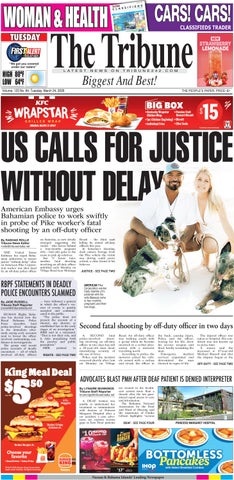
American Embassy urges Bahamian police to work swiftly in probe of Pike worker’s fatal shooting by an off-duty officer
By RASHAD ROLLE Tribune News Editor
rrolle@tribunemedia.net
THE United States Embassy has urged Bahamian authorities to ensure justice “without delay” after an American Pike Corporation worker was shot dead by an off-duty police officer on Saturday, as new details emerged suggesting the victim – who leaves behind a four-months pregnant wife – had only gone to the scene to pick up relatives. Just 31 hours later, another fatal shooting involving an off-duty officer unfolded early Monday on Village Road near Montagu Beach - the third such killing by armed off-duty officers this year. In Saturday’s shooting, dash camera footage from the Pike vehicle the victim was driving could prove critical, a close friend of his believes.
By JADE RUSSELL Tribune Staff Reporter
jrussell@tribunemedia.net
HUMAN Rights Baha-
mas has decried how the Royal Bahamas Police Force describes fatal police-involved shootings in the immediate aftermath, saying early accounts tend to favour the officer involved, undermining confidence in investigations.
The group said recent police accounts of deadly encounters — all of which involved off-duty officers
— have followed a pattern in which the officer’s version of events is quickly accepted and communicated to the public.
“The police must not present the account of a shooter, any shooter, as established fact in the early stages of an investigation,”
HRB said in a statement. “That is not their role, and it risks prejudicing both the process and public perception.”
HRB pointed to

AMERICAN Pike Corporation worker Cody Castillo (31) pictured with his wife Makayla (who is four months pregnant) and their two dogs.


A SECOND fatal police-involved shooting involving an off-duty officer in two days has left a 48-year-old man dead, intensifying scrutiny of the use of force.
Police said the incident occurred shortly after 1am on Monday on Village
By LYNAIRE MUNNINGS Tribune Staff Reporter lmunnings@tribunemedia.net
A DEAF woman was unable to understand her treatment or communicate with doctors at Princess Margaret Hospital after a car accident, a case advocates say exposes serious gaps in how Deaf patients
Road. An off-duty officer was walking south with a group when he became involved in a verbal altercation with a motorist travelling north.
According to police, the motorist exited his vehicle armed with a cutlass and struck the officer in
are treated in the healthcare system more than a decade after the law guaranteed equal access to care and information.
The Bahamas National Association for the Deaf and Hard of Hearing said the experience of Ginika Gibson highlights “serious
the back, causing injury.
Police said the officer, fearing for his life, drew his service weapon and fired, fatally wounding the man.
Emergency medical services responded and determined the man showed no signs of life.
The injured officer was taken to hospital. His condition was not known up to press time. A source said the deceased is 47-year-old Michael Russell and that the dispute began at the


“He was not the type to be looking for trouble,” said the friend, adding that the victim, Cody Castillo, 31, had not even been inside Da Plantation Bar & Grill before the fatal shooting and could therefore not have been involved in any altercation with the off-duty officer, who is believed to be a superintendent.
“Cody’s baby brother and a cousin had been at Plantation for a drink and called him asking to be picked up,” the friend said.
“He hadn’t even been at the bar. He was probably at the hotel talking to his wife or something. That’s the type of man he was. His wife Makayla is four months pregnant and he was super excited to become a father for the first time. They only got married last year.”
A US Embassy spokesperson told The Tribune:
“We are closely following the case of the shooting death of a US citizen by an off-duty police officer last weekend. We note with deepest concern media reports that the officer followed the unarmed victim to his vehicle before fatally shooting him. We urge the government of The Bahamas to ensure the victim receives justice in this case without delay.”
Police have said the American worker, who was originally from Huntsville, Texas, was shot shortly before 6pm on Saturday after an altercation that began inside the bar moved outside. Officers said a man entered a vehicle and drove in a way the off-duty senior office considered threatening,
prompting him to fire a single shot. But the victim’s friend disputed any suggestion he was involved in trouble.
“I’ve heard different stories about what happened, but it seems his brother, cousin and another friend, who all work for Pike, walked out when Cody arrived to pick them up,” the friend said. “The offduty cop seems to have followed them out and then fired at Cody while he was behind the wheel. He may have stopped to talk to the guy, I really don’t know. But he is not the type to be looking for trouble. He was quiet and reserved - one of the most respectful guys I’ve ever met in my life.”
It is believed the officer shot Castillo through the vehicle’s side window - and not the front windscreen – as he passed.
“I’m pretty sure the dash cam will show exactly what happened,” the friend said. “I’m not sure who has the footage now - Pike, or the police, but that should provide all the evidence police need.”
In the aftermath, Cas tillo’s brother, cousin and another man were arrested for disorderly conduct but later granted bail and released.
family have all seen in and are devastated,” he said. “It’s horrible. No one can believe this has happened.
“Family had to disable Makayla’s Facebook so she couldn’t get on and see it. That would break her.
“We’re all worried about her and the unborn baby. This just isn’t right.”
The friend added:
“People are saying the cop who shot Cody was walking around and taking pictures

“Cody’s brother and cousin went straight to the airport and caught a flight to Florida so they could try and comfort Makayla. “She is in pieces, as you’d expect,” the friend said. Grief has been compounded by the circulation of video from the scene.
“The video of Cody lying there dead in the street has been all over social media and his mother, sister and


give a damn. I hope justice is donethat’s all I can say. Cody was a lovely guy and didn’t deserve to die.”
A video circulating on social media shows the victim lying on the ground near a Pike truck as onlookers gather. In the footage, one person says the worker “was not doing anything at the establish-
ment,” while another voice adds: “He wasn’t even the one.”
A GoFundMe page created for the victim’s wife underscores the scale of the loss.
“Makayla and Cody’s love story was just beginning,” it states. “They married a year ago, and
their hearts were full of hope as they prepared to welcome their first child— a baby boy due in August. Cody was working to support his family with PIKE Electric in the Bahamas. Then, in a moment that changed everything, Cody’s life was taken by senseless violence while he was working abroad.”
“Makayla is now facing the unimaginable: grieving her husband while preparing to bring their son into the world alone.
She’s overwhelmed by the
sudden loss, the weight of funeral expenses and the uncertainty of how she’ll manage living costs and care for her baby without Cody by her side.”
The GoFundMe had raised more than $34k up to press time.
Yesterday, National Security Minister Wayne Munroe said he understands the restaurant had cameras.
“If they find anything to initiate a criminal investigation, they will,” he said. “If they don’t, they’ll forward a file on to the Coroner.”
OFF-DUTY from page one
Beer Fest event on Montagu Beach.
The shooting follows Saturday’s fatal police-involved shooting involving a senior off-duty officer and an American worker outside Da Plantation Bar & Grill.
National Security Minister Wayne Munroe said the incident occurred on Village Road, where he believed there were
cameras, and that police would investigate and determine whether a criminal probe is warranted.
“If somebody attacks you with a cutlass, not only the police but a private citizen, has a right to defend themselves,” he said. “I don’t know what the injuries are for the officer. I’m told that he is in hospital with injuries.
“I’m told that the gentleman in Da Plantation injury incident does
not have injuries. It will depend on the threat that faces you. It’s governed by what is justifiable force set out in the penal code, and so as I say, the police will investigate.”
He said if authorities find grounds to bring charges, they will do so.
The latest incident marks the third fatal police-involved shooting this year involving an offduty officer. In February, 28-yearold Makavali Tinker was
shot and killed by an off-duty officer on Kemp Road. Police Press Liaison Chief Superintendent Sheria King said at the time that a plain-clothes officer arrived at his Margaret Street residence and confronted an “unknown” male on the premises, but not inside the home.
However, The Tribune reported the deceased was known to the officer, and those close to Tinker said the two men had argued days earlier.
RIGHTS from page one
Saturday’s fatal shooting of an American worker by a senior off-duty officer outside Da Plantation Bar & Grill, saying the case reflects broader concerns about both the use of force and how such incidents are described.
Police said the officer fired after a man drove a vehicle in a threatening manner, fearing for his life. However, HRB noted that the official account has been widely challenged by people who claim to have witnessed the events, and said some of those witnesses have not yet been contacted by investigators.
“This raises serious concerns not only about the investigation itself, but about the appearance of impartiality from the outset,” HRB said.
The organisation said the issue is compounded by what it described as
a recurring approach in which police statements assert that officers acted in fear for their lives, presented as fact rather than as claims to be tested.
“In at least one instance, subsequent information has contradicted elements of the initial account,” HRB said, likely referring to an incident in February where 28-year-old Makavali Tinker was shot and killed by an off-duty officer on Kemp Road.
Police Press Liaison Chief Superintendent Sheria King said at the time that a plain-clothes officer arrived at his Margaret Street residence and confronted an “unknown” male on the premises, but not inside the home.
However, residents told The Tribune the deceased was known to the officer, and those close to Tinker said the two men had argued days earlier.
“This underscores the importance of restraint, neutrality, and rigorous
fact-checking before conclusions are communicated to the public,” HRB said. “If the standard approach is to accept the officer’s version of events at face value, then the question must be asked: can there be true independence in these investigations?”
HRB said the use of lethal force by police — whether on duty or off — must be a last resort and warned that any perception officers are too quick to resort to firearms is a serious public concern.
“The public must have confidence that force is used only when absolutely necessary - not as a default response, and never without full and independent scrutiny when it occurs,” HRB said.
The group also said police must remain neutral and be seen to remain neutral, particularly in cases involving their own officers, adding that on-scene statements
risk compromising active investigations. It called for transparent investigations into recent incidents, independent oversight of all police-involved shootings, a review of protocols governing off-duty officers carrying firearms, and more disciplined public communication based on evidence.
The statement comes amid a series of recent fatal police-involved shootings.
On Monday, a second fatal police-involved shooting involving an offduty officer in two days left a 48-year-old man dead. The incident followed Saturday’s fatal shooting involving an offduty senior officer and an American worker outside Da Plantation Bar and Grill.
The latest case marks the third fatal police-involved shooting this year involving an off-duty officer.
By LEANDRA ROLLE Tribune Chief Reporter lrolle@tribunemedia.net
EDUCATION Minis-
ter Glenys Hanna-Martin says data show that early learning improves longterm student outcomes as she explained the decision to lower the compulsory school age from five to four during debate on key education reform legislation yesterday.
Her comments came as MPs passed the Education Bill 2026 alongside the Early Childhood Care Commission Bill 2026 and the National Youth Commission Bill 2026, pieces of legislation described as the most comprehensive review of the country’s education policy and administrative framework in decades.
The bills seek to formally regulate home schooling, impose mandatory accreditation on private schools, tighten financial oversight of public schools and introduce a national curriculum with measurable learning outcomes. It would also provide for the oversight and regulation of daycare centres and preschools.
A key provision of the bill lowers the compulsory school age from five to four.
Mrs Hanna-Martin said the move recognises what educators, parents and researchers have long known — that the early years are critical.

She said learning gaps formed early are difficult to reverse, while early investment delivers lifelong benefits by making pre-primary education compulsory.
“Research studies indicate that 80 to 90 percent of brain development occurs before the age of five,” she told Parliament. “High-quality early childhood education, therefore, plays a vital role in supporting this key developmental stage.”
“When children have access to structured, nurturing and stimulating early learning environments, they experience significant benefits. These include improved literacy and numeracy skills, better social behavior and greater readiness for formal schools.”
Under the new law, compulsory school age would begin at four and continue until 16, unless a student meets graduation requirements earlier.
The bill also affirms the right to free education in public schools at public expense. However,
it specifies that free education is limited to the waiver of tuition fees and does not cover ancillary costs.
Yesterday, Mrs Hanna Martin announced the government’s intention to amend this provision, bringing it in line with 1962 legislation that addresses “the provision of materials as resources permit.”
“This legislation raises up education to the highest pinnacle in our quest for human advance, undergirded by progressive policy and a targeted administrative regime to procure desired outcomes for the Bahamian child,” she added.
She said it is both a legal and moral declaration that every child, regardless of background, ability, location or circumstance, is entitled to an education, adding that the legislation enshrines this right. Among other things, home-schooling would also become regulated under the legislation for the first time.
Parents who choose to educate their children at home would be required to meet prescribed standards, follow approved requirements and submit to monitoring.
“This framework protects children's rights on education, supports parents through clarity rather than uncertainty, brings home education into the national education family,” Mrs Hanna-Martin said.
“This is about
partnership, not punishment, and about ensuring every child's education counts.”
The Early Childhood Care Commission Bill 2026 establishes a body to oversee the management of daycare centres and preschools, ensuring compliance with national standards while setting out strict penalties for non-compliance.
The National Youth Commission will function as a modern agency to coordinate and monitor youth development programmes across government and non-governmental organisations. Opposition Leader Michael Pintard expressed support for the bills but criticised what he described as a lack of consultation with stakeholders, a point disputed by Minister Hanna-Martin.
He cautioned policymakers to be mindful of how they present their record programmes aimed at addressing youth challenges, saying one of the most pressing issues remains youth unemployment.
“We have to do a better job in linking the training to meeting the demands that are young people have which is they want a fair shot at opportunities so they are able to support their families. We do not believe that this administration has done sufficient work to meet the practical needs of young people who today is facing a 21 per cent unemployment rate,” he added.
By LEANDRA ROLLE Tribune Chief Reporter
lrolle@tribunemedia.net
HUNDREDS of academically at-risk students have significantly improved their performance, with many moving from GPAs below 1.0 to achieving a 3.0, Education Minister Glenys Hanna Martin said yesterday.
Mrs Hanna-Martin credited the gains to targeted interventions and also pointed to a decline in school violence over a three-year period.
Her comments came during debate yesterday on a suite of legislation aimed at modernising the country’s education system.
She said there has been a 7.3 percent increase in at-risk students now achieving at least a 2.0 GPA in 2025 compared to the previous year. Additionally, 16.3 percent of students who were previously performing at around a 1.0 GPA have improved to a 3.0 GPA, representing 1,812 students.
Mrs Hanna-Martin said the figures represent an increase compared to 14.1 percent in 2024, and praised academic coaches for driving the improved success rate.
According to Mrs Hanna-Martin, nine of the country’s ten education
districts recorded GPA gains last December compared to December 2024.
She said BJC results showed measurable gains in several subjects including art, literature, craft, social studies, family and consumer science.
“English language, chemistry, French, history, physics, religious studies and graphical communications had cumulative achievement rates of 80 to 89 percent,” she said.
“We know we have a lot of work to do in this. We saw challenges in mathematics, but we've conducted research and we're now implementing strategies for
mathematics.”
Grade Level Assessment Test Examination results for grades three and six recorded gains in reading and listening comprehension, while Grade six students achieved their highest GPA in ten years, she said.
Last year’s graduation rate also increased to 59 percent, representing “the highest ever.”
On the issue of school violence, Mrs Hanna Martin said incidents have decreased by 46 percent, falling from 142 in the fall of 2022 — when schools resumed full operations post pandemic — to 77 in the fall of 2025.
“This decrease is
significant, and that's nearly cut overall incidents in half,” she said.
She also reported notable decreases in school violence, including a 74 percent drop in fights, a 100 percent decline in stabbings, and a 41 percent reduction in unlawful carrying of arms.
Nationwide, violent incidents fell 30 percent in New Providence, 73 percent in Grand Bahama, and 81 percent in the Family Islands.
“We have more work to do but we’re making progress,” she added.
She also noted that the ministry has reached a landmark development phase in the creation of a
policy on artificial intelligence in education.
Mrs Hanna Martin said the policy is currently in draft form and outlines clear, student-focused goals, emphasising both empowerment and responsibility.
“The policy envisions students not only as users of AI, but also as active contributors to innovation, participating in hands on projects, coding clubs and national competitions,” she added.
“Ultimately, the goal is to prepare every learner, regardless of island or income, to navigate and shape an AI augmented future with confidence, creativity and integrity.”


ongoing issues in accessibility, communication, and equal treatment,” pointing to what it described as a reliance on next of kin and a failure to respect patient autonomy.
Under the Persons with Disabilities (Equal Opportunities) Act, people with disabilities are entitled to the same standard of healthcare and access to health information as others, and services must be provided in accessible formats.
The law also requires medical personnel to be adequately trained to treat persons with disabilities and defines discrimination to include the denial of reasonable accommodation, such as necessary communication support. Critics have long lamented the government’s failure to enforce the law effectively, even within its own institutions.
According to the association, Ms Gibson, described as a culturally deaf patient, requested a qualified sign language interpreter during her care, but “interpreter access was restricted and treated as non-essential, with communication routed through next of kin, despite her full capacity as an independent adult.”
“This not only undermined her autonomy but also placed her health and safety at risk as she was unable to communicate with healthcare professionals effectively,” the organisation said.
Interpreter and educator Tamiko Brown, who was called in to assist, said she was initially denied meaningful access to the patient.
“When I got there,” she told The Tribune yesterday, “the head nurse
at that time said, what can I help you with? So I said I was the deaf interpreter for Ginika. I said I came to see her and interpret for her, but she said she don’t need you, she understands quite well.”
“If I said that I am an interpreter, that means I came to fend for her, I thought that she should have stood on the side of me so that I can relay and I can communicate with the girl and say, this is what’s going on, she totally ignored me.”
When Ms Brown eventually reached Ms Gibson, she said the patient was in pain, confused, and struggling to understand what was happening, particularly when it came to medication.
“I asked her if she was receiving medication, and she told me no, she had not received any medicine. But the nurse said it was being administered through the IV,” she said.
Ms Brown said Ms Gibson did not understand that medication could be administered intravenously.
“Her impression was that she was not getting any medication, because she had no understanding that it was being administered through the IV,” she said.
“She understands that she is being treated, but she does not understand the format or the way that the medication is being administered.”
Ms Brown said communication was further hindered by staff wearing masks, which made lip-reading impossible.
“A hearing-impaired person cannot lip-read if you have a mask on,” she said. “She told me that when they speak to her, they are wearing masks. So how is she understanding what they are saying if she cannot see their lips?”

She said the most troubling issue was the apparent reliance on Ms Gibson’s mother to make medical decisions, despite Ms Gibson being an adult.
“You cannot tell me that you are going to contact the next of kin and allow them to make decisions for her,” she said. “She is an adult. She has the right to decide what happens to her body.”
Ms Brown said without proper communication, patients cannot give informed consent, raising concerns about their safety.
The BNADHH said the incident reflects a wider systemic failure, warning that reliance on next of kin in place of proper communication can lead to “dangerous reliance on next of kin” and increased risks, including misdiagnosis and improper treatment.
The organisation said access to communication is a fundamental right, not an optional service,

and warned that without proper systems, deaf patients are unable to make informed decisions about their care.
It added that the issue extends beyond a single case, noting that between three and five percent of the population is Deaf or Hard of Hearing, meaning thousands of Bahamians face similar barriers.
“In education, Deaf and Hard of Hearing learners face limited access to qualified interpreters and captioning services, inadequate inclusive learning frameworks, and persistent barriers to full academic participation and achievement,” the organisation said.
“These inequities extend into employment and public life. Deaf and Hard of Hearing citizens encounter ongoing barriers to hiring due to communication gaps and discrimination, a lack of workplaceaccommodations, and underemployment.
Within public services, communication systems across government agencies remain largely inaccessible, and concerns raised with various ministries have gone unacknowledged.
The result is continued exclusion from essential services, national programs, and opportunities, reinforcing a cycle of inequality that has gone unaddressed for years.”
Ms Brown said the incident has resonated across the Deaf community.
“They always think that we are equal to the hearing. They don’t understand that we are different,” she said. The BNADHH is calling for reforms, including formal recognition of interpreters as essential in healthcare settings, national funding for interpretation services, enforcement of accessibility laws, and mandatory deaf awareness training for frontline workers.
“Every five years,
politicians come to our communities seeking our votes, our support, and our trust. Yet, time and time again, their actions, or lack thereof, demonstrate that Deaf and Hard of Hearing Bahamians are neither respected nor prioritized.
“Our voices are disregarded, our language is ignored, and our needs continue to be overlooked. This pattern persists regardless of which administration is in power. We therefore implore the current government, and any future government, to do what is right. We are not asking for any favors, but for what we are entitled to as Bahamian citizens with equal rights under the law,” the statement read.
Ms Brown said Ms Gibson has since been discharged, but said the experience has left a lasting impact and exposed a critical gap in the healthcare system.

By LEANDRA ROLLE Tribune Chief Reporter
THE Davis administration is pressing ahead with its housing expansion plans, with Housing Minister Keith Bell announcing moves to secure land for the development of two residential communities meant to benefit hundreds of families.
Mr Bell made the announcement while advising the House of Assembly of the government’s intention to advance two resolutions to facilitate the transfer of land for two sites, one to regularise land at Pitt Road in New Providence and the other to expand access to land in Georgetown, Exuma.
The lands will be transferred to the Ministry of Housing from the treasurer once the resolutions are passed.
He said while the circumstances of the resolutions differ, “the objective is the same, to place these lands
under the control of the ministry so that they can be properly developed, regularised, and made available for the benefit of Bahamian families.”
He pointed to the community of Pitt Road as an example of a historic area built over time by hardworking Bahamian families.
He stressed that dozens of families live on approximately three acres of land in Pitt Road without formal subdivision or clear title, leaving them without the legal security they deserve. He further pledged to bring “order, structure and certainty” to these communities.
“Let me be clear, this is not about displacing people,” he said. “This is about supporting them. We will work with the residents of Pit Road. We will engage the community.
We will chart a path forth that allows for the regularisation of their occupation, the improvement of their infrastructure and the creation of a safer, healthier and
orderly environment, which families can live.” In Exuma, Mr Bell said plans are underway to transfer more than 60 acres of land to his ministry for the development of a structured, multi-phase residential community.
He said the project is a expected to yield more than 200 residential lots once completed.
“Over 200 opportunities, over 200 families, over 200 futures secured,” he said, “This is how we ensure that Bahamians participate in the growth of Exuma. This is how we ensure that opportunity is not reserved for a few, but extended to many. This is how we ensure that development translates into ownership, into stability and into generational wealth for families.”
Mr Bell said the two resolutions, while different in nature, reflect a common purpose — addressing long-standing housing challenges while planning for future growth and development.
By KEILE CAMPBELL Tribune Staff Reporter kcampbell@tribunemedia.net
MORE than 200 demolition notices remain outstanding across shantytown communities, with further action expected after the Lent period as the government prepares its next phase of clearances.
Stephen Carey, chairman of the Unregulated Communities Action Task Force, said notices were recently erected in Montgomery, Andros. Others are located “in the Bacardi area” in New Providence.
Meanwhile, Works and Family Island Affairs Minister Clay Sweeting told The Tribune the administration has demolished more than 700 structures to date.
Mr Sweeting said authorities are making final preparations to clear areas in Abaco and North Eleuthera after completing assessments and serving notices in other communities.
“We provide by law the 28-day notice, and then we usually put it out to tender — it’s a process,” he said. “We have to ensure that social services, the Ministry of National Security, the police, defence force, all of them are included so that the full task force has full preparation before we demolish.”

The comments indicate more communities could face removal in the coming weeks as the government advances its effort to eliminate informal settlements. Mr Sweeting also gave an update on drainage works in Pinewood, describing the project
as part of a wider flood mitigation plan linked to Coral Harbour. “It’s called the lift station, and the lift station is also part of the Coral Harbour drainage project
as well, so it isn’t new, so that’ll be a part of that and the drainage in Pinewood as well,” Mr Sweeting said. He said the project has Cabinet approval and will cover three areas.
“Basically, how it works is once water reaches a certain level, it’ll automatically move the water to location to remove the flooding,” he said. Mr Sweeting said preparatory work has started, with excavation expected within two to three weeks, and added that pumps for the system have already been ordered.
By DENISE MAYCOCK Tribune Freeport Reporter
dmaycock@tribunemedia.net
THE government is moving to take control of the Grand Bahama Power Company through a stateowned entity, backed by $280 million in guaranteed loans, a plan it says will ease electricity costs.
Grand Bahama Minister Ginger Moxey tabled two resolutions in the House of Assembly yesterday to support the borrowing, which would finance the acquisition of all ordinary voting shares in the power company and provide additional funding for its operations.
The proposals would see Grand Bahama Energy Company Ltd., a government-owned entity, borrow $200 million through a consortium of banks led by Standard Chartered Bank to acquire all ordinary voting shares in the Grand Bahama Power Company — effectively giving the state control of the utility.
A second resolution seeks an additional $80 million loan from Royal Bank (Bahamas) Limited to fund capital expenditure and working capital.
“The people of Grand Bahama have carried an energy burden for far too long,” Ms Moxey said, pointing to the strain high electricity bills place on households, businesses and economic growth.
She said the plan forms part of a broader strategy to address longstanding issues in the island’s energy sector, improve affordability and strengthen reliability.
“High power costs distort every calculation,” she said, explaining that they influence whether families can save, businesses can hire, and investors choose to commit to Grand Bahama.
Ms Moxey said the resolutions are intended to increase public oversight and accountability while fostering economic expansion. She noted the measures are being

brought under the Public Debt Management Act, 2021, which requires parliamentary approval for government-backed guarantees.
However, the proposal drew concern yesterday from Ralph Hepburn, president of the Grand Bahama Chamber of Commerce, who questioned the lack of consultation ahead of a decision of this scale.
“The first concern is the level of engagement with stakeholders in Grand Bahama before a decision of this magnitude was made,” he said.
“This impacts not only the business environment, but residents as well, and there was no clear discussion as to whether we would support the government acquiring the island’s power company.”
He also warned that the financial risks could ultimately fall on taxpayers.
“Our concern is that the government generates most of its revenue from the people through taxation,” he said. “If there are shortfalls, it is ultimately the Bahamian people who will have to make up that difference.”
Mr Hepburn pointed to existing debt in the energy sector, including at Bahamas Power and Light,
and questioned whether further borrowing is sustainable.
“They already have substantial debt in the energy sector, and now there is a proposal to borrow an additional $200 million-plus to acquire GB Power, while also aiming to reduce electricity costs,” he said. “That raises questions about whether sufficient revenue can be generated to maintain and improve the system.”
He also raised concerns about service reliability.
“Grand Bahama Power currently has less downtime over a year than what is experienced in Nassau over a shorter period,” he said. “We have to ask who will ensure that reliability is maintained or improved.”
Mr Hepburn said reliable and modern energy infrastructure will be critical as new investments come on stream.
“We have a number of developments in the pipeline that will require a sophisticated and reliable generation system,” he said. “We cannot afford to be in a position where we are unable to meet the needs of new businesses while maintaining what we already have.”
He further questioned
the government’s track record in managing stateowned enterprises.
“At the end of the day, the government’s record in managing profit-driven entities is limited,” he said. “Outside of BTC in its earlier form, there are few examples that demonstrate consistent success in this area.”
Mr Hepburn added that uncertainty remains over whether the acquisition could deliver both profitability and lower electricity costs.w
Meanwhile, the opposition said it supports energy reform but warned the government’s plan risks placing a heavy burden on taxpayers without clear answers on cost and long-term impact.
In a statement, Free National Movement leader Michael Pintard said the proposal asks Bahamians to stand behind $280 million in new borrowing to acquire and operate Grand Bahama Power, despite existing debt challenges in the electricity sector.
“Before adding hundreds of millions more in guarantees, the government needs to explain why it still struggles to deliver affordable, reliable power $800 million
later,” he said. He also questioned key aspects of the deal, including how the purchase price was determined, what liabilities are attached to the company, and whether electricity costs will actually fall.
The Opposition further argued that the structure excludes Bahamians from ownership while exposing them to financial risk.
“Instead, all the risk is being placed on taxpayers, with no opportunity for citizens to participate,” Mr Pintard said. He said while the party supports improving reliability and reducing costs, it “will not endorse piling new debt onto an already broken system” and “cannot support blank cheques backed by taxpayers.”

NULLIUS ADDICTUS JURARE IN VERBA MAGISTRI
“Being Bound to Swear to The Dogmas of No Master”
LEON E. H. DUPUCH,
Publisher/Editor 1903-1914
SIR ETIENNE DUPUCH, Kt., O.B.E., K.M., K.C.S.G., (Hon.) LL.D., D.Litt .
Publisher/Editor 1919-1972
Contributing Editor 1972-1991
RT HON EILEEN DUPUCH CARRON, C.M.G., M.S., B.A., LL.B.
Publisher/Editor 1972-
Published daily Monday to Friday Shirley & Deveaux Streets, Nassau, Bahamas N3207
TELEPHONES
News & General Information (242) 502-2350
Advertising Manager (242) 502-2394
Circulation Department (242) 502-2386
Nassau fax (242) 328-2398
Freeport, Grand Bahama (242)-352-6608
Freeport fax (242) 352-9348
WEBSITE, TWITTER & FACEBOOK
www.tribune242.com

@tribune242

tribune news network
THE importance of public confidence in the actions of uniformed officers cannot be understated.
In recent years, the coroner’s court has heard – and ruled on – a number of cases involving shootings by police officers.
In some of those cases, there have been rulings including homicide by manslaughter, and even homicide by murder.
Previously such rulings have been rare, but such was the number of rulings in more recent times that two years ago, Prime Minister Philip Davis said he would have a conversation with the commissioner of police if the pattern of such findings continued.
There is a level of distrust at times in the public realm that shows a lack of belief in the fairness of investigations.
This could be seen recently by the reaction over the shooting of a dog by a prison officer. After it was announced by National Security Minister Wayne Munroe that investigators found no breach in policy over the shooting, there was strong reaction – with the Bahamas Humane Society president, Kim Aranha, calling the decision “predictable”.
This concern comes into even greater focus in the immediate aftermath of a police-involved shooting of a person.
There have been two officer-involved shootings in under 48 hours, both ending with fatalities.
The latest took place shortly after 1am yesterday on Village Road.
Police report – and we will come back to that phrase in a moment – that an offduty officer was walking along the road when he got into a verbal altercation with a motorist.
Police said the motorist got out of his vehicle and struck the officer in the back, injuring him, and that the officer, fearing for his life, drew his service weapon and fired, killing the man.
There are two phrases there that we should pay attention to. One is that “police report” – this is what the police have said, in the immediate aftermath of the shooting, while the investigation is under way. The second is that the officer was “fearing for his life”, which even while the investigation has only just begun, is inferring the officer’s reason for shooting. In any such incident, that may be true, that may not be true.
Mr Munroe spoke to the matter too, saying: “If somebody attacks you with a cutlass, not only the police but a private citizen, has a right to defend themselves.”
Perhaps so, but while the facts are being established, it can be premature to provide the explanation.
There have been previous cases that appeared before the coroner’s court where it was claimed that officers feared for their lives, only for the verdict to direct the case towards a criminal prosecution.
Last month, police said after an incident that saw a man shot dead by an off-duty officer that the man was “unknown” to the officer. However, others told The Tribune after the shooting that the two knew one another, and that the two men had argued days earlier.
In the other recent incident, an American man was shot and killed by an off-duty officer after an incident on Saturday.
Police said the man was shot shortly before 6pm after an altercation that began inside the bar moved outside. Police said that a man entered a vehicle and drove in a way the off-duty officer considered threatening, prompting him to fire a shot.
Again, this is offering an explanation while the investigation is still under way.
Others have since said the man who was shot had not even been at the bar and had just come to pick up those leaving the location. Another man said the victim “is not the type to be looking for trouble. He was quiet and reserved –one of the most respectful guys I’ve ever met in my life”.
It has been suggested the officer shot the victim through the side window of the vehicle, not the front windscreen, which if true suggests the officer was out of the path of the vehicle.
Now there are a lot of ifs in all of this. There are a lot of things being “said”. What matters is getting to the bottom of the story in an impartial fashion.
Human Rights Bahamas has rightly questioned whether investigations are truly impartial – pointing to the way in which such shootings are reported by police, with the officer’s justification or explanation included from the start, rather than being questioned as one side of the story, to be supported or rejected based on the rest of the evidence.
Human Rights Bahamas noted that a number of people who said they witnessed the shooting have said they have not yet been contacted by investigators. Therefore, how can the complete picture have been investigated as yet?
“The police must not present the account of a shooter, any shooter, as established fact in the early stages of an investigation. That is not their role, and it risks prejudicing both the process and public perception.”
What an officer claims took place may very well be true. There are plenty of criminals out there who pose a risk to the lives of officers going about their duties – or targeting off-duty officers too.
But it may also be untrue – and it is the job of level-headed investigators to wait and see the outcome of the investigation before saying anything that gives credence to one side or the other.
Where there is a rush to justify a shooting, it leaves citizens feeling that a case may not be judged fairly. That undermines confidence in the whole force, especially if it turns out later that a very different story is the real one.
In the case of the shooting in February, when The Tribune asked police for comment after people said the victim was in fact known to the police officer, despite the initial report being that he was unknown, police press liaison Chief Superintendent Sheria King said “that was the information I had at the time”. That case will go to the coroner.
To rush to judgement risks leaving justice behind. Let the investigation happen at the pace it needs.
EDITOR, The Tribune.
SHOOTING innocent dogs, fathers in vehicles; well, done you parasites. All brushed or about to be swept under the rug with this disastrous corrupt administration. Why not try go three for three?!! Shoot a mother, perhaps a toddler or two? Better yet an infant!
You’ll are quite the perfectionists at murdering. What a freaking disgrace this country has become. You killed the marina business, why not just continue murdering visitors. “Police are investigating”; Thank God, that’s reassuring. We are in a police state people. Should you make it home from work alive today, consider it a blessing.
CHRISTOPHER
ARMALY
Nassau, March 23, 2026.
EDITOR, The Tribune.
AGAIN, our nation is confronted with deeply troubling allegations involving a visiting guest—this time, yet another American woman reporting a sexual assault.
These incidents are not only serious; they are damaging to the very fabric of our society and to the reputation of The Bahamas as a tourist destination.
Let me be clear: the behavior of the few jet ski operators in the water-sports sector who engage in predatory conduct must be called out without hesitation. And face harsh punishment. These men are not merely acting unlawfully; they are bringing an entire industry under scrutiny and casting a shadow over the many hardworking, honest Bahamian men who depend on tourism for their livelihood. It is unacceptable that such misconduct continues to surface.
Equally concerning is the apparent failure of the governing and licensing authorities responsible for overseeing this sector.
As public-facing operators entrusted with the safety of visitors
letters@tribunemedia.net
and locals alike, these individuals should be thoroughly vetted. Background checks must not be optional—they must be strict. If an applicant is found to have a criminal past, they should not be permitted anywhere near an industry that places them in direct contact with our guests. We must not allow this rape culture to become a norm in our society. This issue also forces us to confront an uncomfortable truth about a subset of men in our society. A woman has an absolute right to say no—to reject advances, to set boundaries, and to exist without harassment. When that right is ignored or violated, it signals a deeper cultural problem that cannot be excused or minimised. Predatory behavior must be met with firm consequences, including stronger penalties and longer jail sentences for those found guilty.
At the same time, while responsibility always lies with the perpetrator, it would be remiss
not to also urge vigilance among visitors. To our guests and all women who come to enjoy our beautiful islands: please exercise caution. Be aware of your surroundings. If you feel unsafe, remove yourself immediately and report the situation to authorities. Avoid accepting drinks from strangers, refrain from sharing personal details with individuals you have just met, and do not leave with unfamiliar persons—especially when alone. Travel in groups when possible, and look out for one another.
This is not about placing blame on victims, but about encouraging awareness in an imperfect world where risks do exist.
We must work on both fronts: eliminating predatory behavior at its root, and promoting personal safety practices. The Bahamas must do better. Our women— Bahamian and visitor alike—deserve to feel safe, respected, and protected. Anything less is a failure we can no longer afford to ignore.
SHERVONNE CASH HOLLIS Nassau, March 19, 2026.
EDITOR, The Tribune.
IN the recent article, Cuban Ambassador Juan Carlos Marcof Sánchez argues that United States policy is “starving” Cuba and driving its hardships. It is a serious claim, but one that does not withstand closer examination.
From our vantage point in The Bahamas, the reality is more complex. Cuba maintains trade with Europe, Canada, and Latin America. Goods and aid continue to arrive. Even the United States permits the export of agricultural products and medical supplies. The notion that Cuba is entirely cut off does not align with reality.
What is less discussed is what happens once those goods arrive. Much is controlled by the state and redirected into hard-currency stores, where it is sold beyond the reach of ordinary citizens. Rather than alleviating scarcity, this system entrenches it, creating a dual economy in which access depends on foreign currency, not need.
Cuba’s economic challenges are also rooted internally. The country has repeatedly defaulted on international debt, limiting access to financing. Its electrical grid has deteriorated for years, with blackouts long predating recent changes in Venezuelan oil supply. These conditions reflect decades of mismanagement, corruption, and underinvestment.
To understand the problem, one must consider Cuba’s trajectory. In 1958, Cuba functioned as an open economy with strong regional standing
in income, infrastructure, and trade. That system was imperfect, but it was not the closed, centrally controlled model that exists today.
During the revolution, Cubans were promised free elections, civil liberties, and the restoration of the 1940 Constitution, as outlined in the Sierra Maestra Manifesto on July 12, 1957. These commitments were never fulfilled. Instead, a oneparty authoritarian state was established and remains in place today.
More than six decades later, there are still no free elections, no legal opposition, and no meaningful political participation outside the state. If the system is working, why are citizens not allowed to choose their leaders freely?
The consequences are clear. Cuba’s productive base has eroded. Infrastructure has weakened, agriculture cannot meet demand, and the country depends on imports, remittances, and external assistance.
This contradiction is evident in healthcare.
While Cuba exports medical services abroad, many doctors receive only a fraction of what is paid for their work. Meanwhile, hospitals serving ordinary citizens face shortages and deteriorating conditions. Patients are often required to provide their own supplies.
Perhaps most telling is migration. An estimated 2.5 to 3 million Cubans now live abroad. Here in The Bahamas, we have witnessed Cubans risk their lives at sea in search of a better future. People do not take such
risks because of external policy alone, but because conditions at home have become unbearable.
The clearest message comes from those who remain. When protests occur, people are not calling for trade agreements. They are calling for something more fundamental. They are shouting Libertad. For that, many have been imprisoned.
More than 1,000 political prisoners remain, many detained after the protests of July 11, 2021. They spoke and protested, and for this, they now serve long sentences.
From where we stand in The Bahamas, Cuba’s challenges cannot be reduced to a single external cause. They are rooted in a system unchanged for more than six decades, one that does not allow free elections, political plurality, or accountability. When the Ambassador presents the crisis as solely the result of United States policy, he offers a narrative that is incomplete and misleading. It diverts attention from the internal realities that define Cuba and risks misinforming the Bahamian public.
The voices of the Cuban people make this clear. They are asking for dignity, freedom, and the right to choose their future.
They are asking for a Cuba Libre.
From a Cuban living legally in The Bahamas CUBAN LIVING LEGALLY Nassau, March 20 2026.
By KEILE CAMPBELL Tribune Staff Reporter kcampbell@tribunemedia.net
FREE National Move-
ment leader Michael Pintard said a future FNM government would tackle the housing crisis by partnering with the private sector and using public land to cut costs for thousands of Bahamians priced out of home ownership.
He said demand for housing exceeds 12,000 people and argued that government intervention can make homes more affordable.
“We believe we have many companies that are skilled in home construction, and we ought to work with the private sector to drive the process of creating more affordable homes for the thousands of Bahamians who do not have access to them right now,”
Mr Pintard told reporters outside the House of Assembly.
He said the government could reduce the cost of housing by contributing land to developments.
“The government is in a position to partner with private sector groups in
terms of shaving the cost of a home investment by putting in that pool, land that we have access to, land that we own, it will shave the cost,” he said.
Mr Pintard said the previous FNM administration showed how government action can expand access to home ownership, particularly for young Bahamians who would not otherwise afford land in certain areas.
He said costs could be reduced by making land available, contributing to infrastructure and working with suitable lenders.
Mr Pintard also criticised delays in the approvals process, saying the Ministry of Works “needs dramatic help” and should use private sector expertise to speed up evaluations.
“We have engineers who can help. We have persons who work in the area of the environment who can help in the evaluation of plans, building plans, and the speedy approval of both commercial and residential projects,” Mr Pintard said.
He said housing construction could see a “fundamental shift” and suggested Bahamian-owned factories could

help supply materials.
On rent control, Mr Pintard said “all things are on the table” but indicated it is not the party’s current focus.
He said the FNM is prioritising policies to expand affordable housing and
upgrade existing properties, particularly in over-the-hill communities, by supporting landlords willing to improve conditions.
“There are things government can do through tax incentives, duty free import of material, or working
By PAVEL BAILEY Tribune Staff Reporter pbailey@tribunemedia.net
A 52-YEAR-OLD man accused of raping his 36-year-old niece in her home earlier this month was remanded to prison yesterday.
Prosecutors allege the defendant, whose name is being withheld to protect the identity of the victim, had sexual relations with his niece in Stapleton Gardens on the night of March 15. The victim was allegedly awoken by the defendant
touching her, after which he allegedly held her down and raped her. The defendant was not required to enter a plea to incest before Magistrate Abigail Farrington. He was informed that his matter would proceed to the Supreme Court by
way of a voluntary bill of indictment.
The accused was told of his right to apply for bail before the higher court. He will be remanded to the Bahamas Department of Correctional Services until the potential service of his VBI on July 22.
By PAVEL BAILEY Tribune Staff Reporter pbailey@tribunemedia.net
A MAN accused of having $240,000 worth of cocaine in his backpack aboard a plane at Rock Sound International Airport last week was granted $80,000 bail yesterday.
with hardware stores that already have material so that you can afford to upgrade without passing that cost on, because the government is eating some of that cost by foregoing the revenue through incentives,” Mr Pintard said.
Mr Pintard defended the party’s proposals against criticism comparing them to a mortgage relief initiative under former Prime Minister Perry Christie, saying the FNM remains confident after consultations with local and international stakeholders.
“The pundits do what they do,” he said. “They can assess what they believe we're saying and how successful we'll be. We are absolutely committed to this project. We spend a lot of time meeting the persons, both locally and internationally, having a discussion about a new vision for housing in the Bahamas, and so we have more confidence in those persons opinion on what we can do with housing than the others who are on the sideline looking in.”
He said his own experience building and selling homes informs the party’s approach and argued the scale of the proposals reflects the scale of the problem.
“Those who believe we are thinking too big, we believe that their ambitions are just too small,” he said.
By PAVEL BAILEY Tribune Staff Reporter pbailey@tribunemedia.net
A MAN accused of trying to abduct a 12-year-old girl earlier this month and having child pornography on his phone was granted bail yesterday.
Prosecutors allege that Keyshawn Williams, 27, was found with 30lbs, or 12 kilograms, of cocaine after a white and blue Aztec aircraft landed in Eleuthera at 3.30pm on March 18. Police also seized $3,358, which they suspect is the proceeds of crime.
Williams pleaded not guilty to charges of possession of dangerous drugs with intent to supply and conspiracy to possess dangerous drugs with intent to supply before Senior Magistrate Raquel Whyms. His bail was set at $80,000. Under the terms of his bail, he must surrender his travel documents and be fitted with a monitoring device. Williams must also sign in at the Central Police Station in Grand Bahama every Monday by 6pm. His trial begins on June 1.
Prosecutors allege that Isaiah Seymour, 29, attempted to snatch a 12-year-old girl off the streets of New Providence on March 10.
Sergeant 2257 Wilkinson prosecuted the case.
By PAVEL BAILEY Tribune Staff Reporter pbailey@tribunemedia.net
A MAN accused of stealing more than $30,000 worth of building supplies was granted bail yesterday.
Prosecutors allege that Perry Davis, 59, stole 378 bundles of Enviroshake aged cedar shingles valued at $30,825 and 11 Enviroshake ridge cap bundles valued at $915 from Pernel
Kelly between March 13, 2025 and March 13, 2026. Davis pleaded not guilty to charges of stealing and receiving before Senior Magistrate Anishka Isaacs.
He was granted bail in the sum of $6,000 with one or two sureties. As a condition of bail, Davis must sign in at the Grove Police Station every Tuesday by 7pm. His trial begins on June 11.

Keith Seymour represented the accused, while Inspector Timothy Bain prosecuted the case.
Seymour is also accused of possessing three pornographic videos of nude underage girls engaged in sexual acts on his phone, dated between March 20, 2023 and October 15, 2025.
While Seymour pleaded not guilty to three counts of
possession of child pornography before Magistrate Abigail Farrington, he was not required to enter a plea to the charge of attempted child stealing. Although the prosecution objected to bail, Seymour was granted bail in the sum of $9,500 with one or two sureties. As part of his bail conditions, he must surrender his travel documents and be fitted with a monitoring device. Seymour must also sign in at the East Street South Police Station every Monday, Wednesday and Friday by 7pm. He returns to court for trial and service of his voluntary bill of indictment on June 22. Levan Johnson represented the accused.


THE warin Iranis already at Caribbean doors. The attacks in Iran andthe Gulf are beingjustifiedbysomeonthe groundsthat Iran’s record on terrorism, nuclearambition, and regionalmeddling leaves the free world with no choice but to act militarily.
The Caribbean has every reasontotakethatrecordseriously.But forsmall,importdependent states in this hemisphere, anadditional set of questionsdemands urgent attention: whois payingthe economic andsocial pricefor this war, and whatis it doing totherules thataremeantto protectsmallstates?
Awarfought there,abill paid here
The conflict has already pushedup oilprices,freight rates,andinsurancepremiums forshippingthroughtheStrait ofHormuz,oneoftheworld’s most critical corridors for oil and liquefiednatural gas.For Caribbeancountries thatimport most ofwhat they consume,every additionaldollar on a barrel of oil, and every extra cent ona container or tanker, quickly appears on electricity bills, food prices, andpublictransportfares.
Manystates inthishemisphere import a large share of their goods from the United States. As American producers face higherfuel, fertiliser, logistics,and financing costs, thoseincreases are passed on in the prices of exportstotheCaribbean.Ourregion is thereforenot only directly exposedto worldoil andfreightmarkets, itisalso importing USembedded costs intheformofmoreexpensive food, manufacturedgoods, andinputs.
For mostcountries inthe Western Hemisphere, including theUS itself,the war
has meant tighter supply chains, highershipping and warrisk insurancecosts. Only anarrow groupofoil andgas exporters haveenjoyed a shorttermwindfall fromelevated prices.In ourown region, Guyanaand Trinidad andTobagoareamongthefew that see higher hydrocarbon revenues, but even they remain exposed to volatility, shipping risk, and the broader slowdownthat higherenergy pricescanbring.
Security narratives and international law
Publicargument overthis war hasbeendominated by two types ofnarratives. One focusesonsovereigntyandinternational law: whether one or two powerfulnations may bomb anothersovereign state on thebasis thatit mightdevelop nuclear weapons that could oneday beused against them,even withoutanimminent attack ora mandate from the UN Security Council. The other is increasinglycast in ethnic andreligious terms, withsocial mediafloodedby Islamophobic andsectarian rhetoric thatreduces complex realities toa clashof civilisations and obscures sober discussionoflawandproportionality.
The Caribbeanshould not turna blindeyeto Iran’s conduct.The regime’s longstanding repression at home, including the grave violations of the rights of women and dissenters, and its support for armedgroups anddestabilisingactivities abroad,are mattersof legitimateconcern toallstates,includingours.
Nor should any country s aggression against its neighboursbeexcusedorignored.
At thesame time,argumentsinsomequarters,which catalogue Iran’s support for

Hezbollah, Hamas and other networksin theMiddleEast and Latin America and then treatthis assufficientjustification foropenended military action,raise profoundconcerns. Similarly, Israel’s declared aims require scrutiny. By his ownaccount, PrimeMinister BenjaminNetanyahudoesnot seek only toneutralise discretethreats.Hehasspokenof crushing and weakening Iran’s regime,of delivering crushing blows to its security apparatus, and of creating optimal conditions for a fu-

Retired Chief Superintendent #434 Osborne Alphonso Ferguson, 76 affectionately called “Ossie”

of Seawell Manor off Gladstone Road, New Providence, Bahamas will be held on Thursday, March 26th, 2026, 11:00am at Church of God Cathedral, East Street, New Providence. Officiating will be Bishop Hulan Hanna assisted by other ministers of the gospel. Interment will be held at Lakeview Memorial Gardens, Gladstone Road, New Providence.
He was pre-deceased by his parents: George Sr. and Agnes Ferguson; children: Vanessa and Jarius Ferguson; siblings: Wilfred Ferguson and Ruthmae Adderley.
He will surely be missed, but never forgotten and will forever be in our hearts. Left with cherished memories are his sons: Osborne Jr. (Rochelle), Atlanta, GA, and Quintin (Brooke) Ferguson; grandchildren: Kyle, Ethan, Hannah (Atlanta, GA.), Jada (Ft. Lauderdale), Jasmine, Caylee and Quintin Ferguson, Jr.; sisters: Myrtis Beneby, Thelma and Naomi Ferguson and Brenda Smith; brothers: Roland and George Ferguson, Jr.; nieces: Antoinette, Eleanor, Lavonda, Caroline, Denise, Bonnie, Bianca, Branell, Andrea, Carolyn, Jewel, Rochelle, Karen, Cheryl and Wendy; nephews: Benjamin, Paul, Steve, Ricardo, Carl, Brian, Brent, Bradley, Lester, Kevin, Don, Desmond and Matias; numerous grand and great grand nieces and nephews including: Lorraine and Lynette Bridgewater and Amanda Moss; cousins: Dorothy Cox-Sands and family, Vernal Sands, the children of the late Samuel, Arnold and Paul Farquharson, families of the late Blossom and Victoria Sands, Elizabeth “Mella” Mackey, Ettamae Lloyd, Ervin and Bossie Wright; special friends: Sherry Ann, Terrance, Theon, Terrel and Terrinique Sands, Micheal Anderson Jr (MJ), Victor Brown, Philip Don Wilson, Reginald Ferguson (Former Commissioner, Retired), Commissioner Shanta Knowles, present and retired members of the RBPF, NAD, employees of True Value Security Services LTD, the Seawell Manor community; and a host of other relatives and friends.
Viewing will be held at the Paul Farquharson Centre, Police Headquarters, East Street North, New Providence on Wednesday, March 25th, 2026 from 10:00am to 4:00pm and at the church on Thursday from 9:30am until service time.
turetoppling oftheregime, even as heacknowledges that actual regimechange would dependon theIranianpeople. These statementspoint not justtoself defence,buttowardaneffort toleaveIrana substantially weakenedstate, withlongtermimplicationsfor regional balanceand forthe principle that oneor two powersshould notdecide,by force,the politicalfutureof others.
Accepting the seriousness of Iran s record, and recognising thegenuine security concerns ofother states,does not mean acceptingthat powerfulstates mayunilaterally wagepreventive waroutside clearselfdefence orSecurity Council authorisation.For small countries, the restraints in the UN Charteron the use offorcearevital.Theyarethe firstlineofprotection.
Fracturedglobal andregional leadership Institutionsthatshouldhelp guideglobal opinionhave doneso onlypartially.The UN Security Council has managedto condemnspecific Iranian attacksinthe Gulfandto call for an immediate halt tohostilities and the protection of civilians. But deep divisions among its permanent members exist. Some are simultaneously profiting from higher oil prices and from easing of sanctions related to their own past violations ofinternational law.
Regional organisations in the Americas have likewise fallen short. TheOrganisation of American States (OAS) has noteven discusseda memberstatenegotiated position onthis war.There isno collectiveview oftheOrganisation. Likewise,although CARICOM had issued earlier statements onMiddle Eastescalation and some governmentshave spokennationally on the latest developments, there is no unified Caribbean position on the present conflict equivalentto aclear, common lineadopted by HeadsofGovernment.
Caribbean?
Caribbean countries, individually andcollectively, havevirtually nomilitary leverage and limited economic power, yet they are deeply exposed to the conflict’s fallout.Tourismdependenteconomies facehigher jetfuelcosts, potentialsoftening of traveldemand, and tighter airline margins. Importdependent economies confront risingenergy and foodprices, moreexpensive USsourced goods,and growing fiscalpressure as governmentstry toprotect households from inflation while servicing already heavy debt burdens. For many, the warhasarrivedashigherbills, fragile supply chains,and renewed threats togrowth and socialstability. Ideally, CARICOMshould respond by speaking clearly andcollectively. Aunified Caribbeanstance coulddefend deescalation and immediate ceasefire,insist onrespect for the UN Charter s rules onsovereignty andthe use offorce, call forthe protection and reopeningof crit-
Photo: shawn shipping/unsplash thisenvironment, manygovernments will hesitateto supportanycollectiveposition.

ical sea lanes, and draw attention to the disproportionate economic burdenthe war places onsmall, vulnerable states thathad no sayin the decisiontofight. Inpractice,suchunityisunlikely.
A measuredCaribbean stance But, even without full regional consensus,Caribbean statescanstillexerciseleadership byarticulating afirm stance grounded in their own interestsand values.Sucha stancewould reston aclear defenceof internationallaw andsovereignty,opposingunlawfuluses offorce byany country, and insisting that concerns about security, nuclear proliferation,or terrorism be addressed, as far as possible,within theframeworkoftheUNCharter. Itwould maintainaconsistent call fordeescalation and diplomacy, prioritising ceasefire,restraint,andtheresumptionofnegotiationsonnuclear issues and regional security, while underliningthe urgent need to keep vital shipping lanesopenandsafe. Itwouldinsistoneconomic justice for vulnerable economies, showing how the war s consequences -such as energy price spikes, freight costs, imported inflation, and potential recessions intourism origin marketsare hurting societies thathad no voicein thedecision to fight, and pressing for tailored financial support and shockabsorbing mechanisms. And itwould rejectethnicand religious polarisation, acknowledging humanrights abusesandsecurity threats without embracing narratives thatstigmatise entire peoples or faiths, drawing on the Caribbean’s own history to advocate fora discourse rooted inrights, law,andsharedhumanity.
In practice, public opinion in the Caribbeanis being shapedless byregionalguidance than byglobal cable news and polarised social mediafeeds.
Where does thisleave the
Recent developments have exposed divisions within CARICOM. Some member statessee theUnited Statesas theirprincipalsecuritypartner and a crucialeconomic lifeline in trade,investment, remittances, andtourism. Smaller statesare acutely awareofhowshiftsinUSvisa policy,travel restrictions,and migrationenforcementcanaffecttheir societies,andrecent episodes of visa and travel pressure havereinforced the perception thatforeignpolicy choicescancarryrealcosts.In
For smallstates inthis hemisphere, thepath forward lies in principled, measured diplomacy: engaging all major actors,avoiding gratuitousoffence, butspeaking clearly about the need for deescalation, respectfor the Charter, and protection of societiesthat areotherwiseleft to bearthe war sdistant but veryrealcosts. To say nothingprotects no one.
Theauthor istheAmbassador of Antigua and Barbuda to theUnited Statesand the OAS, andChancellor ofthe Universityof Guyana.The viewsexpressed areentirely his own. Responses and previous commentaries: www.sirronaldsanders.com

why the architecture of leadership must be built on INTEGRITY


INa developingnation, leaders’ words andactions pave the pathbetween order and chaos.Leadership isnot merely a position, but a stewardship of public trust. When thatstewardship is soldfor manipulation,the leader rarely pays the price.
The Bahamian people’s future does.
We find ourselves at a crossroads, where the temptation tointentionally create confusionand disorderfor personalorpoliticalgainhas become a dangerous trend. But there’s a fundamental law of social behaviour that many inpower seemto forget: the emotions, attitudes, andactions youinspirein apopulationoften returnto influenceyou, sometimes creatingbacklash or unintended consequences.
Theanatomyofexploitation:fromthestreetstothe state
Tounderstand thedanger of negative leadership, examineourstreets.Theriseof gangs in theBahamas is morethan failedpolicing: it sanexploitationofvulnerability. Every gang member seeks belonging.Young men, oftenrejected bytraditionalstructures,craveattention and validation and will do anythingto provethemselves. Here,the ‘leader’ preyson naivety.Theyuse influence to: Create unnecessary borders: Restricting movement in neighbourhoods where young people livein fear for reasons no onecan logically explain.
Weaponise loyalty: Turningthe beautifulhuman desirefor communityintoa tool for criminal enterprise.
Normalise negativity: Teachingthenextgeneration that poweris derivedfrom the ability to instil fear, rather thanthe abilityto build.
If thesesame leadersused theirinfluence toplantseeds of productivity, we would see a duplication of success thatcould transformcom-
munities overnight.Instead, we seethe persistenceof crimebecause theobjective is selfish.
The political mirror: the egovsthemission
The tragedy is that this pattern of exploitationis not confined to the street corners.We seeasophisticated reflection of this behaviour inour politicallandscape. Leadership, by definition, is meant tobe positive,yet we increasingly witness leaders so consumed withthe sheer number of their followers that they ve forgottenthe quality of their mission. When a politician acts solelytofeedtheiregoorsecure votes, theyengage in high-level political gangbanging. Theyexploit the public’stendencytotrustauthority, sowingseeds of doubt andunrest tokeep people reactive rather than reflective.
“Freedom ofspeech isa luxury, but we cannot holler ‘fire’ in acrowdedroom with only one exit,” someone once said.
When leadersuse their platformto spreadinflammatory rhetoricor “loose” talk, they are effectively shouting “fire” in our nationalhome. Thereis nopolitical reward great enough to justify acountry that has become suspicious of everything andeveryone. The anxiety ofbeing elected mustnever outweightheresponsibility ofmaking the Bahamas a better place.
The backfire effect: when chaosreaches the doorstep
The danger of manipulatingpeopleforselfishends is thatonce youhave trained apopulation tobesuspicious, reactionary, and aggressive,you cannolonger control them.
1. The Erosion of Truth: When leaders lie or manipulate to achieve a goal, they destroy thefoundation of trust. Eventually,even when they need tospeak the truth

When leaders use their platform to spread inflammatory rhetoric or “loose” talk, they are effectively shouting “fire” in our national home.
forthegoodofthenation,no one believes them.
2. The Cycleof Emulation:Most peoplearefollowers. They look to the “top”toseehowtheyshould behave. Ifa leaderachieves their goals through deceit and division, followers will replicate thatbehaviour in theirpersonal lives,their jobs, and their communities.
3. National Weakness: A countrydivided bynegative policies and manufactured
unrest cannotcompete globally. We becomeour own greatest enemy.
Acall foraccountable leadership
We, asBahamians, canno longeraffordsilenceorcomplacency.Each ofusmust holdourleaders toahigher standard, actively calling for transparent, principled leadership.It stimeforeverycitizen todemand change speak up, scrutinise,and insistonleaders who build trust and unity.
Being irresponsible is not a style ofpolitics. It sa disqualification for office. A selfishpersonhasnoplacein aparliamentary seat.The wider public maybe enamoured with the charisma of politicians,butwemustlook past the performanceto the fruit oftheir labour.Does their leadershiplead to peace, ordoes itleave atrail of anxiety?
The path forward: leadingbyexample True leadershiprequires
the courage to be positive evenwhen negativityis easier.
It requires:
• PracticingEasy Positivity:Finding simple,daily waysto modelintegrityso that others have a blueprint for success.
• Rejecting NegativeNarratives:Refusingtouse stories” orpropaganda that serve no purpose other than to divide.
Prioritizingthe Bahamas: Puttingthe welfare of thenext generationabove the ego of the current one. Let's facereality: ifwe want to stop the recruitment into gangs and the decay of our social fabric,our work must begin now,from the top down.
Insistthat leadersreflect justice,truth, andservice. Refuse to accept shadows. Demand leadership by example, andcommit yourself to echoingand supporting integrity, ensuringthat together, welight theway forward for the Bahamas.


Associated Press
THE head of the International Energy Agency said Monday that the global economy faces a “major, major threat” because of the Iran war.
“No country will be immune to the effects of this crisis if it continues to go in this direction,” Fatih Birol said at Australia’s National Press Club in Canberra on Monday.
The crisis in the Middle East, he said, has had a worse impact on oil than the two oil shocks of the 1970s combined, and a worse effect on gas than the Russia-Ukraine war.
Israel launched a new wave of attacks early Monday against Tehran. US President Donald Trump also warned the United States will “obliterate” Iran’s power plants if Tehran doesn’t fully open the Strait of Hormuz within 48 hours. That prompted Iran to say it would respond to any such strike with attacks on US and Israeli energy and infrastructure assets.
Trump is facing increasing pressure at home to secure the strait as oil prices soar.
One major fear is that the war could knock out oil and gas production in the Middle East for a long time, which would mean high prices could last a while and cause inflation to rip higher around the world. The US stock market has a history of bouncing back relatively quickly from past conflicts in the Middle East and elsewhere, as long as oil prices don’t stay too high for too long.
Iran on Monday renewed strikes on its Gulf neighbours and threatened to start hitting their power plants.
“The situation is very severe,” Birol said in Australia. The oil crises of 1973 and 1979, he said, lost together 10 million barrels per day, causing “major economic problems around the world, the recessions. And today, only as of today, we lost 11 million barrels per day — so more than two major oil shocks put together.”
After Russia’s invasion of Ukraine, he said, the gas markets, especially in Europe, “lost about 75 billion cubic meters, 75BCM. And as of now, as a result of this crisis, we lost about 140BCM, almost twice (as
much).”
Birol said 40 energy assets in nine countries across the region were “severely or very severely damaged.”
“Some of the vital arteries of the global economy, such as petrochemical, such as fertilizers, such as sulfur, such as helium — their trade is all interrupted, which would have serious consequences for the global economy,” he said.
He said the International Energy Agency, “in order to comfort the markets,” earlier released 400 million barrels of oil, “which is historic. We have never released so much oil to the markets. ... The single most important solution to this problem is opening up the Hormuz Strait as things stand now.”
The official added that he was consulting with governments in Europe, Asia, North America and the Middle East about the prospect of releasing further stockpiled oil.
“We will see, we will look at the markets,” he said. “If it is necessary, of course, we will do it, but we will look at the conditions, we will analyse, assess the market and discuss with our member countries.”

BAHAMIAN students andyoungprofessionalsare being encouraged to explore a rangeof fully funded postgraduatescholarship opportunitiesbeing offered throughthe 2026 Degree Education Programs sponsored by China’s Ministryof Commerce(MOFCOM).
The programmes, which arenowopenforglobalenrolment,areaimedatdevelopinghigh-level talentin key sectorssuch asgovernment,trade,technology,education, agriculture, health, cultureandinternationalrelations.Theinitiativeforms part of China’sbroader effort to helpbuild professional capacityand support economicand socialdevelopmentin partnercountries.
Successful applicants will receive Chinese Government Scholarshipsthat cover awide rangeof expenses associated with studyingabroad.Thescholarshippackage includestuition, round-trip international airfare,teaching materials,researchandinvestigationcosts, thesisguidance fees,and subsidiesfor English-taught programmes.
The programmeswill beginin September2026 and are offered at several leading universities across China.Most ofthedegrees are master’s programmes lasting one to two years, whilesome doctoralprogrammes extendfor upto threeyears.
Studentscanpursuestudies in awide varietyof disciplines. Amongthe available options areprogrammes in public administration, business administration,artificial intelligence, software engineering, environmentalmanagement, internationalrelations,journalismandcommunication, tourism and hotel management, education leadership, meteorology, transportation engineering, and projectmanagement.
There are also specialised programmes in areassuch as urbanplanning, foresteconomicsand policy,international business, international law, electricalengineering, audit, social development, ruraldevelopmentandgovernance.
Several programmesfocus on emerging and high-demand sectors,including information and communication technology, artificial intelligence, softwareengineering, environmentalengineering and sustainable development. These areas are expected to play an increasinglyimportant roleinglobal economicgrowthandinnovation.
Other programmesare designedforprofessionalsinterestedinpublicserviceandinternational cooperation. Theseinclude coursesin public diplomacy,developmentand governance,public administration ininternationaldevelopment, andnationaldevelopmentstudies.
In addition,students interestedinmediaandcommunication canapply tospecial-


ized master’s programmes injournalism, mediaand digital communication, which focus on global media trendsand the evolving digitalcommunicationslandscape.
The programmesare hosted by a number of highly regardedChinese universities, including Peking University, Tsinghua University, Wuhan University, Tongji University, Nankai University, Renmin University of China andBeijing Normal University,amongothers.
The initiative aims to strengthen international collaboration whilegiving participantstheopportunity to gainadvanced academic training, buildprofessional networksanddevelopskills that cancontribute tonational developmentwhen theyreturnhome.
Interested candidates are encouragedto explorethe available programmesand speak withthe Ministryof Foreign Affairsabout potential nominations,as recommendations mustbe submitted beforethe endof March2026.
Students considering postgraduatestudiesabroad are advisedto reviewthe list ofprogrammes carefully,identify areasaligned with their career goals and preparethenecessaryapplication materialsearly, as the scholarships provide a rareopportunity topursue advanced degreesoverseas with most majorcosts covered.

STUDENTSacrossGrand Bahamaare findingtheir voices throughthe Urban Renewal Authority’s (URA) annual speech competition, whichsaw increasedparticipation in its second year.
Nearly30 studentsfrom both publicand private schoolscompetedacrossprimary,junior andseniordivisions, showcasing their public speakingskills and confidence.
The competitionbegan on March13 withtheprimary school round at Freeport
Great Faith Ministry, where seven youngstudents deliveredspeeches inaspirited contest. The following day, junior and senior students took to thestage at Freeport Bible Church,with nine competitorsin thejuniordivision and 10in the senior category.
The top students from each division willnow advancetothenationalcompetition in NewProvidence on March 27, wherethey will represent Grand Bahama.
URA Grand Bahama
Acting Deputy Director LloydGrant praisedthe level of participation and support behind the students. “Guidance counsellors, parents, everyonecame together to make this happen. We have a good mix this time around and so we’re looking forward toa winner tocome outof GrandBahama forthe nationals,” said Mr Grant. All participants were recognisedfor theirefforts, with top performers receiving medals.
By Allandra
Russell AS theconversation surroundingartificial intelligence continuesto gain momentum,one thingbecomesincreasingly clear:this isnotsomethingwe cancontinue to ignore. The question we must now ask, particularly ineducation, is whether we will move with it or whether we will risk beingleft behind.Artificial intelligence is no longer a matter of comfort or preference. It is no longer reserved for corporate spaces or techindustries. It is here, itisevolvingrapidly, anditisalreadyreshapingteaching andlearning. Thereality is that it must now be intentionally guided, because without structureand understanding,the verytoolthathas thepower to support learning can just as easily deepen the divide.
For years,educators havevoiced the sameconcerns:thelack oftime,theneed forgreatersupport, andthechallengeof meeting theneeds ofdiverse learners within a single classroom. AI, when used correctly,hasthe capacitytorespondto these challenges. It can support differentiation, assist withplanning, and provide moreimmediate feedbackto students.In fact, UNESCO hasalready emphasized the need for AIto be integrated responsibly,with clearframeworks andsupport systemsfor educators.But despitethis, thereremains alevel offear.We areoften cautious of what we do not fully understand, and in manyways, AI has entered our classrooms faster thanwe have been able to catch up with it. It is almost like being handed apowerful tool without
being shown how to use it. The potential is there, but without guidance, it can feel overwhelming or even out of control.
Oneof themost commonconcerns raised is whether AI has the potential to replace teachers. The answer is no. It cannot replace educators,because teachingextends far beyond the delivery of content. It is rootedin relationships, inintuition, and in understanding the needs of a child beyond what any system can detect. However, what AI can beis an assistant. It can make the work of teachers more efficient and, in many cases, more effective. The roleoftheteacher doesnotdisappear,it shifts.Teachers wereonceregarded asthe gatekeepers ofinformation, butthat isno longer the position. Information is now accessible almost anywhere. What matters now isnot access,but theability toquestion it,to analyseit, andto useit responsibly.
This was the heart of the conversation at the recent AI Education Summit hosted by TomMillinchip,Digital LiteracyLeadat Windsor School. The event saw over 180 registrants, bringing educators together to begin unpacking theserealities. The summit provided space for both beginners andthose moreadvancedin theirunderstanding, recognizing that everyone is at a different point in this process. The keynote address, delivered by Bahamian aerospace engineer AishaBowe, was areminder of what is possible when opportunity meets preparation. Her journey spoke to resilience,but alsototheimportance ofpositioningourselves andourstudents fora
future that demands innovation. Throughout the summit, conversations moved beyond what AI cando to how it should be used. Discussions around ethics, responsibility, andclassroom integration made one thing evident: AI is not optional, it isinevitable. However,without clear policies, without nationalguidance, and without investment inteacher training, we risk allowing AI todevelop in ways that do not serve our students well.
Atthe sametime,educators cannotafford to sit on the sidelines of this conversation. Ourrole has shifted, andwith that shift comes responsibility. We must now teach students how to think critically, how to identify bias, how to question what they see, and how to navigate tools like AI with intention. If we do not take ownership of this space,we leave our studentsto figure itouton theirown,andthatis ariskwe cannot afford to take.
Whatweareseeing nowisurgency.AI hasbecometoo present,tooinfluential, andtoo integratedintoeverydaylife tobe treated asan afterthought. Thetime for hesitation has passed andwhat is needed now is action. What Millinchip has started isa clearexample ofwhat ispossible when thoughtful, collaborative,and intentional actionbrings educators,policymakers, andstakeholders togetherto definehow AIwillexistwithin oureducationsystem.The questionisnolonger whetherithasa placeasitalreadydoes. The realquestion iswhether weare prepared to lead in how it is used.


Grove police officers share time and a meal with elderly at Good Samaritan


