03092026 NEWS

Page 1


The Tribune

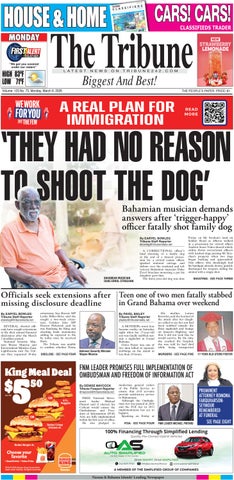
‘THEY HAD NO REASON TO SHOOT THE DOG’

Officials seek extensions after missing disclosure

Tribune Staff Reporter ebowleg@tribunemedia.net

SEVERAL elected officials have sought extensions to file their annual financial disclosures after the March 2 deadline passed. National Security Minister Wayne Munroe and Environment Minister Zane Lightbourne told The Tribune they requested 30-day

extensions. Sea Breeze MP Leslia Miller-Brice said she sought a two-week extension. Golden Isles MP Darren Pickstock said he was finalising his filing and awaiting bank statements, adding he expected to file by today once he received them. The Tribune was unable to confirm whether Prime

FREE National Movement leader Michael Pintard said if elected, his Cabient would ensure the Ombudsman and Freedom of Information (FOI) Acts are fully implemented within his first year of office. He also pledged to

Bahamian musician demands answers after ‘trigger-happy’ officer fatally shot family dog

A CORRECTIONAL officer’s fatal shooting of a family dog at the end of a funeral procession for a retired canine officer sparked national outrage and debate over the weekend and left veteran Bahamian musician Duke Errol Strachan mourning a pet his daughter gave him. The three-year-old dog was shot

Friday on Mr Strahan’s land on Soldier Road as officers walked in a procession for retired officer Andrew Sears. Video shared widely online shows correctional officers with leashed dogs passing Mr Strachan’s property when two dogs began barking and approached. One officer, who shockingly had his handgun already drawn, quickly discharged his weapon, killing the animal with a single shot.

SHOOTING - SEE PAGE

Teen one of two men fatally stabbed in Grand Bahama over weekend

A MOTHER’s worst fear became reality on Saturday night when her 17-year-old son was fatally stabbed outside a nightclub in Grand Bahama.

Gtero Foster was one of two men killed in separate stabbings on the island in less than 24 hours.

His mother, Latara Knowles, said she learned of the attack after her daughter called to say her son had been stabbed outside the Ibiza nightclub and lounge on Queen’s Highway and that it did not look like he would survive. By the time she reached the hospital, she was told he had died while being transported

modernise general orders of the Public Service to ensure that civil servants provide satisfactory service to Bahamians. Although the Ombudsman Act was passed in 2024 and the FOI Act in 2017, implementation has yet to happen.

Speaking on Friday at

Security Minister Wayne Munroe

Animal advocates condemn ‘trigger-happy’ shooting of dog

SHOOTING from page one

Mr Strachan has spent decades on the Bahamian music scene. Known as Duke Errol, he formed the Errol Strachan Quintet in 1959, led bands on Bay Street and Paradise Island, opened Edem Music Centre and helped establish what became the National Youth Orchestra.

Now 92, he lamented that his dog was shot while still on his property by what he described as a ‘trigger-happy’ officer.

“I’m annoyed,” he said yesterday. They had no reason to shoot the dog.”

He said he did not hear the gunshot because he was elsewhere in the house. He learned what happened when his wife came to him.

“She said three of the officers came to the door and said, ‘we just shot your dog. We’re going to send somebody to move it’,” he added.

When he went to see the dog the following morning, he said, it was already gone.

Asked what explanation he was given, he said:

“Because the dog was trying to attack the other dogs, not them. I can understand if the dog was trying to attack them. The dog was barking, not attacking.

“(He) was a great dog,” he said. “He would come to the door every morning, feeding time, look him up in my face until I give him the food.”

He said the officer seemed “trigger-happy.”

As the shooting drew condemnation from animal welfare advocates, the Bahamas Department of Correctional Services, which described the incident as ‘unfortunate,’ said officers involved would be interviewed today (Monday).

“The Commissioner of Corrections is fully aware of the matter and extends sincere condolences to the family affected. The matter is presently under investigation,” a spokesman said. A statement claimed the two dogs ‘charged at the Department’s trained canines.’

Animal Protection and Control Board chairman and Bahamas Humane Society president Kim Aranha called it “a disgraceful action” and said officers and other uniformed personnel should not be given leeway to shoot dogs.

“You don’t walk around the streets of Nassau with your gun already drawn,” she said. “I mean, what if he tripped and set it off and killed a child?”

“It’s a dark day for The Bahamas,” she added. She argued that the officers could have continued walking and that the dogs would have remained on their property and posed no threat.

“I’ll tell you what the problem is,” she said. “There are so many people who are afraid of dogs in The Bahamas, it’s amazing. There’s an inborn fear. Personally, I think he shot the dog out of fear.”

She said law enforcement needs better training and respect for animal life.

“They need to respect animal life and stop thinking it’s only a dog. They need to have proper training, and they need to not be afraid, and it’s very hard to train somebody to not be afraid. If you are afraid, you shouldn’t be in a canine unit.”

“I think the government has to stop allowing these policemen and whatever other force, these people in uniform, the leniency to go and kill dogs.”

Lisse McCombe, vice-president of the Bahamas Alliance for Animal Rights and Kindness (BAARK!), said the situation appeared to escalate too quickly to lethal force.

“This video doesn’t just show a dog being shot — it highlights the consequences of poor training and selective enforcement of the Animal Protection and Control Act,” she said. She said that while dogs should be properly contained by their owners, territorial behaviour is not unusual and can often be managed without a firearm. The incident has also

sparked commentary on enforcing laws requiring owners to secure their dogs. Hours after the video went viral, the Royal Bahamas Police Force released a poster urging the public to secure their dogs, though it did not reference the shooting. Some viewed the timing as insensitive.

Reaction extended beyond advocacy groups.

Paige Waugh, granddaughter of Super Value owner Rupert Roberts, said she was saddened and disappointed, calling the shooting a ‘disgrace, morally wrong and unethical.’

She said she wrote to National Security Minister Wayne Munroe and Police Commissioner Shanta Knowles demanding the matter be properly investigated.

“May a lot of attention be given to this matter so it doesn’t happen again,” she said. “To shoot a dog dead like that was totally unnecessary.”

The Bahamas Department of Correctional Services, meanwhile, said the animal appeared to charge at the department’s canine unit during the funeral procession.

In a statement, the department said: “The Department of Corrections have value the lives of animals having a fond love for dogs and as such has created a Canine Department where all of the dogs are treated humanely. These canines play a pivotal role in protecting the staff, residents and by extension the society.”

The Department of Agriculture said its Animal Control Unit has spoken with the dog’s owners and collected the animal. Interviews with the officers involved are scheduled as part of the ongoing investigation. Agriculture Director Dr Jason Sands said the department does not condone the inhumane treatment of animals but stressed the need for a proper investigation before conclusions are drawn.

BAHAMIAN Musician Duke Errol Strachan stiting on his porch after a prison officer fatally shot one of his dogs.
Photo: Shawn Hanna
Screen capture shows a BDOCS officer walking along the street with a gun in his hand where a dog would be shot on Friday.

Delays highlight past US criticisms of ‘complete disregard’ for financial disclosure laws

Minister Philip “Brave” Davis met the deadline.

When contacted on March 6, Public Disclosures Committee

chairman Bishop Victor Cooper said he did not have a rough figure for how many officials had filed and was unable to provide details because the board had not yet met.

Several cabinet ministers said they met the deadline, including

Deputy Prime Minister Chester Cooper; Health and Wellness Minister Dr Michael Darville; Education Minister Glenys Hanna-Martin; Youth, Sports and Culture Minister Mario Bowleg; Social Services Minister Myles Laroda; Transport and Energy Minister JoBeth Coleby-Davis; Labour and Public Service Minister Pia Glover-Rolle; and Works Minister Clay Sweeting.

Other parliamentarians who said they filed include Mount Moriah

MP Mckell Bonaby, MICAL MP Basil McIntosh, Southern Shores

MP Leroy Major, West Grand Bahama and Bimini MP Kingsley Smith, Nassau Village

MP Jamahl Strachan, and South Beach MP Bacchus Rolle. A Free National Movement official claimed all FNM members filed on time.

Several officials did not respond to requests for comment up to press time, including Foreign Affairs Minister Fred

Mitchell; Housing and Urban Renewal Minister Keith Bell; Immigration Minister Alfred Sears; Grand Bahama Minister Ginger Moxey; Agriculture and Marine Resources Minister Jomo Campbell; State Minister for Housing and Urban Renewal Lisa Rahming; Bamboo Town MP Patricia Deveaux; South and Central Andros MP Leon Lundy; Bain and Grants Town MP Wayde Watson; North Abaco MP Kirk Cornish; Central and South Abaco MP John Pinder; and North Andros and Berry Islands MP Leonardo Lightbourne. Under the Public Disclosure Act, only the prime minister or the

leader of the opposition can act on delinquent filings. Either may table the matter in the House or Senate or refer it to the attorney general or commissioner of police. Offenders face a $10,000 fine or up to two years in prison.

The issue of disclosure compliance has surfaced repeatedly over the years.

Last year, after similar questions arose about missed filings, officials acknowledged shortcomings but never publicly identified who failed to disclose, a perennial concern surrounding enforcement of the law.

The US Department of State, in its 2024 Investment Climate Statement on The Bahamas,

highlighted the country’s failure to release public disclosure reports for more than a decade.

The report noted that the Public Disclosures Committee has not published required reports for 13 years, with the last one issued in 2011 covering financial declarations only up to 2008. It also criticised delays in fully enacting anti-corruption laws and accused some Bahamian officials of showing a “complete disregard” for compliance with the Public Disclosure Act.

The law requires senators, members of parliament and senior public officials to declare annually their assets, income and liabilities.

Pintard pledges ‘no one will be above’ Ombudsman Act

FOIA from page one

a political forum at Life Community Church, Mr Pintard stressed that confidentiality is crucial for both the accuser and the accused for the system around the Ombudsman to work.

“No one will be above it,” he said. “We will protect you to the law. We are quite serious about that.

“Whistleblowers should be protected. But the person who is being accused, their reputation will also be protected until it is verified that the accusation is correct. So they will be protected against

malicious complaints being issued by the public.” The Ombudsman and FOI Acts are key pieces of legislation in The Bahamas intended to promote transparency, accountability, and citizen rights. Although both have been passed by Parliament, delays have prevented their full enforcement, limiting the public’s ability to exercise these rights effectively. Mr Pintard also said an FNM government would seek to expand homeownership opportunities without introducing new taxes. He suggested that

existing revenue streams, including roughly $1 billion in additional VAT collections, could help finance housing programs.

He said it would allow frontline workers— including police officers, nurses, and other essential employees—to access home financing without a traditional down payment.

Pintard reiterated his party’s opposition to plans for a new hospital at Prospect Road.

He said the FNM would instead return to its original healthcare plan and consult medical professionals and healthcare experts on the way forward.

PUBLIC DISCLOSURES COMMITTEE CHAIRMAN BISHOP VICTOR COOPER
PRIME MINISTER PHILIP ‘BRAVE’ DAVIS
FNM Leader Michael Pintard speaks at the Political Party Q&A Meeting at Life Community Church in Freeport on Friday evening, hosted by Pastor Cedric Beckles, who was also the moderator. A second meeting is scheduled for March 19 at 7pm with the Coalition of Independents.

Suspect in second murder turned himself in to police

MURDERS from page one

She said her son was stabbed in the chest and lung.

Hours earlier, she had messaged him around 10pm to ask why he was out late. She said she threatened to come for him and warned him not to miss church because he was tired. She said his final text to her read: “I isse going church in the morning.”

Ms Knowles described her son as helpful and mannerly. A baseball player, he aspired to join Major League Baseball. He was a student at St George’s who had recently taken graduation

photographs and was working to meet the requirements to graduate after transferring to the school in November.

She said that, from her understanding, her son never entered the club and was outside with friends when the assailants arrived in a car and stabbed him. She claimed four people were stabbed during the incident and believes the attackers were known to the victims.

She said her son was not a troublemaker and any issues he faced involved helping friends. She believes his friends were often targeted, though they were not the type to start trouble.

Police said during a press conference in Grand Bahama that the two other people injured in the nightclub incident had been treated and discharged. A teenage boy and an adult male are in custody in connection with that matter.

The second fatal stabbing occurred at Eight Mile Rock around 11pm on Saturday. Police said a 38-year-old man, identified by The Tribune as Okino Kareem Burrows, was fatally stabbed by a 46-year-old man in Hepburn Town during a physical altercation. The suspect later turned himself in at the Eight Mile Rock Police Station.

Last year, Mr Burrows

told The Tribune he lost everything when fire tore through the home where he was staying in Hepburn Town. The blaze broke out around 3am. He told The Tribune he woke to use the bathroom and discovered flames coming from an unoccupied bedroom.

Despite trying to contain it, the fire spread.

“I have nothing — no documents, no clothes. Everything burned,” Mr Burrows said at the time during a television interview on ZNS.

He believed the fire was set deliberately, saying a mattress had been ignited in one of the rooms.

“My life is ruined. I have to start all over,” he said.

Pintard: FNM administration would establish a separate fire department

FREE National Move-

ment Leader Michael Pintard says an FNM administration would establish an independent fire department separate from the police force. Under such a structure, he indicated that a director would be in charge and would not have to report to the Commissioner of Police.

“We intend to introduce an independent fire department that is not under the Royal Bahamas Police Force Commission's control,” he said Friday in Grand Bahama.

“The government ultimately is responsible for the budget, but you are creating an entirely new structure

While speaking at a public Political Forum held at Life Community Church, Mr Pintard was responding to questions raised about the capacity of emergency services here on the island.

The FNM leader said the independent fire

APOLOGIES

department will have its own separate budget from the Royal Bahamas Police Force.

He stressed that it will operate and determine its own priorities for equipment and resources.

According to Mr Pintard, under the current system, where the Fire Service falls under the Royal Bahamas Police Force, there are challenges when it comes to resources and priorities.

He noted that fire services sometimes have to compete with other police needs for limited funding.

“You can have a choice being made between taking scarce resources to fix cars versus to fix or purchase a fire truck,” he explained. Mr Pintard said the goal would be to create a properly resourced department responsible for determining its own operational priorities, including ensuring the country has the necessary number of fire units.

He also suggested expanding the role of volunteer firefighters, particularly

IN FRIDAY’S back-page advertisement celebrating women at The Tribune Media Group, in recognition of International Women’s Day, we inadvertently left out our highly-respected Grand Bahama reporter Denise Maycock. We’re sorry Denise! You are every bit as important as all the other women members of staff at here at The Tribune We apologise sincerely.

in the Family Islands. “We should not rule out the value of volunteer firefighters,” he said, noting that many residents have equipment or resources that could assist during emergencies but are rarely called upon.

According to Pintard, volunteer fire teams could help strengthen emergency response capacity in

communities throughout the country.

“You would recall in Abaco, there was an issue where there was a question of whether a volunteer firefighter can actually handle the equipment to put out fires. And so, just even the certification of who drives is an issue under the hands of the government, and we want to end that,” he said.

There continues to be ongoing concerns about firefighting capacity on Grand Bahama, with only one functioning fire truck for the entire island.

The five fire trucks stationed in Grand Bahama are no longer in operation due to mechanical failure when they were submerged in seawater during Hurricane Dorian, leaving the island reliant on fire resources at Grand Bahama International Airport and from the industrial sector. The shortage sparked widespread concern among residents, business leaders, and public officials, particularly after last year’s bushfires destroyed homes and damaged businesses, and threatened properties throughout the island.

The Tribune Limited

NULLIUS ADDICTUS JURARE IN VERBA MAGISTRI

“Being Bound to Swear to The Dogmas of No Master”

LEON E. H. DUPUCH,

Publisher/Editor 1903-1914

SIR ETIENNE DUPUCH, Kt., O.B.E., K.M., K.C.S.G., (Hon.) LL.D., D.Litt .

Publisher/Editor 1919-1972

Contributing Editor 1972-1991

RT HON EILEEN DUPUCH CARRON, C.M.G., M.S., B.A., LL.B.

Publisher/Editor 1972-

Published daily Monday to Friday Shirley & Deveaux Streets, Nassau, Bahamas N3207

TELEPHONES

News & General Information (242) 502-2350

Advertising Manager (242) 502-2394

Circulation Department (242) 502-2386

Nassau fax (242) 328-2398

Freeport, Grand Bahama (242)-352-6608

Freeport fax (242) 352-9348

WEBSITE, TWITTER & FACEBOOK

www.tribune242.com

Too quick to pull the trigger?

THE shooting of a dog by a prison corrections officer on Friday has caused considerable concern.

Captured on video, the shooting has been widely viewed on social media –and has been followed by mentions of an investigation but conspicuously little action.

We will come to the issue of dogs loose in gardens and on the streets shortly, because it is a matter of importance.

However, let us look at the before and after of the shooting as could be seen on video.

A group of corrections officers can be seen in the video approaching the scene where the dogs are. A moment before, another officer, a musician who was attending the funeral that was the occasion that brought all the officers to Soldier Road, passed the dogs without incident.

At least one of the corrections officers already had a gun in hand before they reached the location where the dogs were.

It is unusual to see officers walking around with a gun already drawn. It is even more unusual to see an officer with a gun in one hand and a dog in the other, as was the case with these officers from the canine unit at the prison.

It does, however, presumably mean that the officers were wary of a possible threat.

There could have been many ways to deal with that concern. The officers could have crossed the road, for example, to avoid any risk of a confrontation. They could have paused and called in units equipped for dog control. An officer could have approached the property owner to instruct them to restrain the animals. All manner of possible options could have been considered rather than the option taken – to walk past with a gun drawn.

Then, after the shooting, there is another oddity. An officer has discharged his weapon in public, resulting in the death of the dog. This is now the scene of a shooting. Rather than call in back-up to deal with the incident, the officers simply walked away. No one stopped to check on the health of the dog or to inform the owners.

Can it really be possible that an officer can fire his weapon in public and there not be a response that requires them to remain at the scene to explain what has happened?

If there was no video recording, would we even have heard of this incident at all? The Royal Bahamas Defence Force response to the incident was to post on social media a warning to owners to secure their dogs.

The owner of the dog was well-known musician Duke Errol Strachan, now aged 92. He said he did not hear the gunshot that killed his dog. He said his wife told him after three officers came to the door and said ‘we just shot your dog’.

Mr Strachan said the officer in the incident seemed “trigger-happy”.

Kim Aranha, of the Bahamas Humane Society, said officers needed to have proper training, and pointed to the officers’ specialised role, saying “it’s very hard to train somebody to not be afraid. If you are afraid, you shouldn’t be in a canine unit”.

There are two separate issues in all this. There is the decision-making of the

officers that led up to the shooting. This could perhaps have been avoided.

Then there is the issue of dogs being allowed to run loose.

This is indeed a concern, and as much as the owner of this animal talked of how friendly it was, that is not the case with all animals – and people who encounter loose dogs never know which is friendly and which is not.

We should do more to ensure dogs are properly contained – for both the safety of others and for their own. It is far from uncommon for dogs to have been struck by vehicles while roaming.

But that issue should not excuse any fault of the officers involved in this incident. It should absolutely be investigated properly – and solutions should be available that do not mean resorting to deadly means.

Control units should be able to respond, while officers ought to have non-lethal options at their disposal too.

An investigation has been promised – we hope it is carried out with appropriate concern for all elements of the shooting, and whether better choices could have avoided it entirely.

Time to enforce disclosure laws

Yet again, the deadline for financial disclosures has passed, and yet again we hear that several officials have asked for an extension beyond the deadline.

This deadline comes around every year – you would think officials would have got into the habit of meeting it by now.

Wayne Munroe and Zane Lightbourne are asking for 30-day extensions. Leslia Miller-Brice is asking for two weeks. Darren Pickstock expects to file by today, he says. He is apparently awaiting his bank statements. We do not know if the Prime Minister met the deadline.

The Public Disclosures Chairman, Bishop Victor Cooper, whose job it is to oversee the process, does not know how many officials filed and how many did not. He said the board has not met yet.

The FNM, meanwhile, says all their members filed on time. Party leader Michael Pintard has also pledged to implement the Ombudsman and Freedom of Information Acts in his first year in office if elected.

We still do not know who failed to obey the disclosures law last year.

Bishop Cooper has never enlightened us and nor has it been tabled in the House by either the Prime Minister or the leader of the Opposition.

Failing to disclose can mean jail time –up to two years in prison is possible. And yet we do not know.

The disclosure law is there for a reason. It is to help ensure that our leaders are held to account. The disclosures are meant to be able to be analysed to see if there are any inappropriate changes to officials’ assets, income and liabilities.

Ignoring it – as has been done for far too long – is ignoring the law. Why should officials be able to ignore the law when the rest of us cannot?

Let us start with last year’s disclosures – can the Prime Minister or Mr Pintard kindly table those in the House? Your action, gentlemen, please.

Civil service badly in need of reform

EDITOR, The Tribune. MANY Bahamians over the decades since Independence, way back in 1973, continue to be frustrated; marginalized and overlooked by our own ‘employees’ referred to as the Civil Service… The Prime Minister himself had to issue a very direct directive to the members of the so called civil service a few months ago. The Civil Service, as we know it was the administrative arm of the central government of the day. This archaic system was inherited from our former colonial masters over in the United Kingdom of Great Britain, et al. Almost all high school graduates and those who for whatever reason may choose not to attend tertiary level education, rush to get into that institution, especially if they have some sort of political connection. It is not surprising to me that there is this preference for employment. The income is reasonable; employment is for life’, there are great benefits such as health insurance; a guaranteed gratuity at the end of one’s service, a life long pension after retirement and, of course, the work required is not difficult.

In such cases, many civil servants simply perform the minimum of tasks and literally ‘waste’ governmental resources. These

LETTERS

slow down the delivery of services and the processing of almost everything, except where, allegedly, the present Tip is paid. This is not acceptable but very pervasive. The Real problem, in my view, lies within the upper echelons of the civil service, straight up to the ranks of Permanent Secretaries. In fact, I suggest that that small inner circle of Permanent Secretaries actual runs the administration de jour.

Many civil servants, especially the decision makers seem to have a sinister plan to discourage; delay and deny legitimate applications and permits by the unwashed masses. If you are not politically connected or have access to facilitation money, your applications and request for a permit go absolutely nowhere.

As a Business Consultant, I personally know of Bahamians. young; middle aged; seniors and even a few who are long dead, who would have applied for a Crown Grant or Approval to make an Outright Purchase 10; 20 or More Years ago. Yes, they receive the standard ‘acknowledgement’ with the ‘assurance’ that we

will revert back to you. Years later the unwashed and unconnected Bahamian, black and Conchy Joe, are still waiting, ad nauseam, for the grant or approval, if they don’t die first, The incumbent and very progressive Davis led administration more than likely will be returned to high office with a comfortable majority. It will not, however, be a cake walk. One of the clear and present ‘threat’ to a second consecutive term for the PLP is and will be, the entrenched civil servants and the unnecessary bureaucratic delays and placing Bahamians in what is referred to by many civil servants as ‘The Dance’. Many Permanent Secretaries have been in senior ranks for eons and are almost powered unto themselves, regardless of who is Prime Minister at the relevant time. Many senior civil servants appear to be ‘independently wealthy’ and, unlike politicians, they are Not Required to disclose assets and liabilities publicly. The civil service is badly in need of reform and many of those who are there as ‘consultants’ need to go home, once and for all.

ORTLAND H BODIE, Jr Nassau, March 5, 2026.

Is PM Haitianising Bahamas

EDITOR, The Tribune.

BAHAMIANS need to ask their PLP government the following: why the flurry of newspaper notices of Haitians applying for citizenship and naturalisation so close to an election? The notices of Haitian applicants to the Minister responsible for Nationality and Citizenship has exploded over the past several months. On March 2 in The Tribune there were 13 notices. The Tribune has such notices each week, I believe. It could be more. The Whistleblower has already touched on this matter previously, as the number of applications appear to be excessively high and alarming.

He has a very strong suspicion that PM Brave and PLP have resorted to pandering to the Haitian community for much

needed votes. This is a reciprocal, tactical move in which both groups will benefit. Brave those get the much-needed votes and the Haitians gain citizenship. One of the vocal Haitian activists was already seen in a Facebook video voicing his approval of the PLP. And there is no reason to think that the Haitian community will not vote PLP. The rash of naturalisation applications reeks of politics. Citizenship is being handed out like candy. It is no longer sacred. Our sovereign birthright is being sold out for a mess of porridge.

Bahamians are losing their country thanks to this government that is becoming increasingly desperate to hold onto the government. What we are witnessing is

borderline treason. It is a betrayal of our sovereignty as a nation which Sir Lynden fought hard for. At the pace we are on, The Bahamas will be Haitianised within decades, thanks to the open border policies of Brave and his government. He is Haitianising this country. Bahamians need to demand that a review of the number of Haitian applicants be tabled in Parliament before the Easter break. This has gotten out of hand. By the way, why is the FNM silent about this important matter? We need to know exactly how many Haitians have been granted citizenship over the past four years.

THE WHISTLEBLOWER Freeport, Grand Bahama March 2, 2026.

HEADS up, everyone: there’s a new cartoonist in town – and nobody in authority or power should consider themselves safe from his pointed pen. The Tribune’s brilliant new cartoonist, Lamaro Smith, will be skewering hypocrisy, highlighting absurdity, and giving readers plenty to think about. You can follow Lamaro on Instagram @lamarosmith.

Man accused of sex assault of two teen girls and possession of forged documents

A MAN accused of sexually assaulting two teenage girls last month was remanded to prison on Friday.

Prosecutors allege Jahmal Daniels, 37, raped a 16-yearold girl in New Providence on February 23. He is also accused of having unlawful sexual intercourse with a 15-year-old girl on February 24.

Police allegedly found Daniels in possession of a forged NIB card and driver’s licence on March 1. Daniels was not required to enter a plea to the rape charge before Magistrate Abigail Farrington. He pleaded not guilty to unlawful sexual intercourse and two counts of possession of a forged document. He was previously accused of unlawful sexual intercourse with a 14-yearold girl on January 3, 2020. Daniels was informed

that the rape charge will proceed to the Supreme Court by way of a voluntary bill of indictment. He must apply for bail in that court. He was denied bail on the remaining charges before the Magistrate’s Court. He was remanded to the Bahamas Department of Correctional Services until service of the voluntary bill of indictment on June 10.

Assistant Superintendent of Police K Bould was the prosecutor. Moses Bain represented the accused.

18-year prison sentence for man convicted of raping 17-year-old

A MAN convicted of raping a 17-year-old girl in 2017 was sentenced to 18 years in prison last week.

Spark Elvis Strapp, 46, was sentenced by Justice Guillimina Archer-Minns.

The court heard that Strapp raped the teenager at his residence after

offering her a ride home from Arawak Cay on January 26, 2017. During his trial, Strapp claimed the sex was consensual and transactional. He said the complainant was upset because he did not pay her the $500 he alleged she demanded.

Justice Archer-Minns said Strapp was old enough to be the victim’s father and had violated

Defendant granted

the trust she placed in him as an older person.

The now-adult victim said she wanted the accused to pay for his actions.

The court noted Strapp’s request to be placed in protective custody while serving his sentence.

David Cash represented the accused. Davina Pinder was the prosecutor.

$6,000

bail in violent stabbing incident

A MAN accused of a violent stabbing last week was granted bail.

Prosecutors allege Lionel Johnson, 40, stabbed Stephen Mackey about the body with a knife during a physical altercation in the early morning of March 1 in New Providence.

Johnson pleaded not guilty to grievous harm before Senior Magistrate Algernon Allen Jr. He was granted bail in the amount of $6,000 with one or two sureties. He must sign in at the Quakoo Street Police Station every Tuesday by 6pm. Johnson returns to court for trial on May 8. Sergeant 3004 Forbes was the prosecutor.

CONVICTED ARMED ROBBER LOSES APPEAL OVER SIX-YEAR SENTENCE

A MAN lost his appeal against his six-year prison sentence for a string of armed robberies committed between 2017 and 2020. Letero Pyfrom, 30, had his appeal dismissed by Justices of Appeal Indra Charles, Gregory Smith and Deborah Fraser. He was convicted of multiple armed robberies, as well as possession of an unlicensed firearm, possession of ammunition and receiving.

Pyfrom argued that time spent on remand was not taken into account as part of his plea agreement. After reviewing the sentencing transcripts, the Court of Appeal found it

was expressly stated that time on remand would not be deducted from his sentence. The justices said the terms of the agreement were fully explained to him and that he entered into it voluntarily.

The court rejected the appeal, ruling that it had no realistic prospect of success.

In November 2023, Pyfrom and Ashley Minnis, 34, were sentenced by Justice Guillimina Archer-Minns.

On April 29, 2017, Pyfrom and an accomplice reportedly held Dario Williams and Shawn Moxey at gunpoint at Fritz Lane. Pyfrom was said to have stolen a $2,200 Rolex, a $50,000 Rolex Presidential watch, a $600 Samsung phone and

$7,400 in cash. He was arrested later that night during an armed confrontation in which he was shot in the left thigh.

On July 2, 2020, Minnis reportedly robbed Phoenix Foodstore cashier Marlene Pierre of $3,300 in cash.

On July 16, 2020, Minnis and Pyfrom, armed with a .380 pistol, robbed Derick Hepburn of $544.90 in cash belonging to Coca-Cola. Both men were sentenced to six years in prison. Only Minnis’ time on remand will be deducted from his sentence. Pyfrom will be placed on one year’s probation upon his release; breaching that order would result in an additional twoyear sentence. Shaneka Carey appeared for the prosecution.

22-year-old accused of possession of a loaded firearm in police car chase

A 22-YEAR-OLD man accused of having a loaded gun during a car chase on Robinson Road was remanded to prison on Friday.

Prosecutors allege Shaquille Anderson was pursued by police after he failed to stop his vehicle at 11.30am on March 3. After the chase ended on Pinedale Street, police reportedly recovered a black Ruger 5.7 pistol and three rounds of ammunition.

Anderson pleaded not guilty to possession of an unlicensed firearm and possession of ammunition before Magistrate Lennox Coleby. He was remanded to the Bahamas Department of Correctional Services until his bail hearing on March 16. Alphonso Lewis represented the accused. Inspector Lincoln McKenzie was the prosecutor.

Tributes paid at funeral to Romona Farquharson-Seymour

PROMINENT law-

yers and political figures

paid tribute on Saturday to Romona Farquharson

Seymour, describing her as fearless in court and formidable in the legal field as her funeral was held at Salem Union Baptist Church.

Leader of the Opposition

Dr Michael Pintard said Mrs Farquharson Seymour was a strong and present voice in the legal profession. He described her as a formidable attorney who did not sugarcoat the truth and was committed to holding people accountable. He said she asked hard questions and challenged uncomfortable thinking.

Reverend Cedric Farquharson said he was shocked to hear of her sudden death. He said she was cut down in the prime of her life.

Attorney Cathleen Hassan, a family friend, said Mrs Farquharson Seymour was a ferocious warrior for her clients and

took on cases others were afraid to handle. She said Mrs Farquharson Seymour loved people even if they did not love her back. She described her as a devoted mother who ran a fulltime law firm and said her daughters were always present in her office.

During his sermon, Reverend Heuter Rolle of Salem Baptist said she was a woman of faith who showed unwavering dedication to her church and family.

Mrs Farquharson Seymour was 49. She is survived by her widower, Calvin Seymour, a prominent attorney, and their two young daughters, Victoria and Sienna. According to the Bahamas Bar Association, Mrs Farquharson Seymour was called to the Bar in 2001 and practised as a general attorney for more than two decades. She was involved in several high-profile matters.

She recently represented former Prison Commissioner Charles Murphy in his lawsuit against the government after he was placed on administrative leave in September 2021. That case

is ongoing.

She was also part of the legal team for Long Island MP Adrian Gibson when he was initially arrested and questioned by officers from the Central Detective Unit in 2022 in connection with his tenure at the Water and Sewerage Corporation. Mr Gibson later went to trial represented by different counsel.

In 2023, Mrs Farquharson Seymour told The Tribune she intended to run for president of the Bahamas Bar Association, saying the organisation needed new vision and leadership. The incumbent, Khalil Parker, retained the post.

The Tribune understands that she had initially sought a Free National Movement nomination for the next general election but later withdrew her application.

Upon hearing of her passing last month, Prime Minister Philip “Brave” Davis extended condolences to the family. He said Mrs Farquharson Seymour was a force in the legal field with a name that carried weight among her peers.

Dr Soomer urges Caribbean

to intensify push for reparations

A FORMER chair of the United Nations Permanent Forum on People of African Descent urged Caribbean governments to intensify their push for reparatory justice on Friday, arguing that sustainable development cannot occur without confronting the legacies of slavery and colonialism.

Dr June Soomer made the remarks during the launch of the United Nations’ Second Decade for People of African Descent at the University of The Bahamas’ Performing Arts Centre at the Keva M Bethel Building on the Oakes Field campus. The event included a symposium on Haitian restitution and reparatory justice.

Dr Soomer, Saint Lucia’s former ambassador to CARICOM and the Organisation of Eastern Caribbean States, said the Caribbean has played a leading role in advancing the global reparations movement and that the regional push dates back decades.

“Reparatory justice is not a recent movement,” Dr Soomer said. “Reparatory justice is something that started on the African coast when we were enslaved and put into dungeons before we were shipped across and trafficked to the Americas.”

She said the Caribbean’s reparations agenda gained renewed momentum in 2013 when CARICOM leaders agreed to pursue reparatory justice for Indigenous peoples and people of African descent. The CARICOM Reparations Commission, she said, first acknowledged the genocide of Indigenous peoples before addressing crimes committed against Africans who were enslaved and transported to the Americas.

“It is important that we never forget what the Indigenous people went through first,” she said.

“Genocide and ethnic cleansing have made them invisible in plain sight.”

Dr Soomer said the movement also seeks to challenge how slavery is described.

“We were not slaves,” she said. “We were human beings who were enslaved.”

She continued: "We were not born slaves. We were human beings. We were lawyers, doctors, teachers. They make you think that we were only people running around in the fields. No, we were learned people."

She rejected the notion that Africans passively accepted enslavement.

“Not only did we resist in Africa, we fought many colonial wars so that we would not be shipped across,” Dr Soomer said.

“There are collaborators everywhere there is oppression because it is a question of survival,” she said.

Dr Soomer said the second UN decade must move beyond symbolic recognition and focus on structural change, including education reform and legal review in Caribbean nations. She urged governments to expand the scope of reparatory justice to include environmental injustice, climate change and technological bias.

She said Caribbean communities remain disproportionately vulnerable to environmental damage despite contributing little to the global emissions driving climate change.

“All of the greenhouse gases are now coming back and affecting us,” she said.

“It is a double reparations we want because they left us to live on marginalised lands, on the slopes of mountains or on river banks, or in places where the sea can come and wipe out a whole island,” she said, pointing to Hurricane Dorian as an example of the region’s exposure to climate impacts.

Dr Soomer also called for a review of laws and

constitutions inherited from colonial rule.

“We cannot continue to depend on colonial legislation that does not represent us,” she said.

“We have to call for review of all of our constitutions and legislation that not only continues to dehumanise us within the criminal justice system as a group, but continues to discriminate against us as women of African descent.”

She said the legal structure of slavery placed particular burdens on enslaved women, noting that the status of children born into slavery was determined through the mother.

“We think that when we talk about labour we are only talking about work in the field,” she said. “We are also talking about labour and the forced impregnation of women of African descent.”

“Capitalism was built on the wounds of black women,” Dr Soomer said. She said the second UN decade must also address collective rights.

“We have to fight for something called collective rights,” she said.

“We were collectively stolen. We were collectively criminalised. We were collectively beaten. And now we do not have collective rights.”

“Independence did not mean decolonisation,” Dr Soomer said.

Dr Soomer called for stronger engagement between governments and civil society groups involved in the reparations movement.

“How is the Caribbean mobilising civil society to support the work that we are doing?” she asked. She warned that without wider public participation, the movement risks losing momentum.

“We will be running globally with reparatory justice at a governmental level and we will not find our people running behind us because they do not know what we are running behind,” she said.

“We must break the back of systemic racism.”

AMBASSADOR June Soomer from St Lucia speaks during University of The Bahamas’ United Nations’ Second Decade for People of African Descent forum held at the performing arts centre.
Photo: Nikia Charlton
Attorney

THE STORIES BEHIND THE NEWS

MONDAY, MARCH 9, 2026

Another dog shooting. Accountability this time?

THE shooting of a dog by an officerin uniform,as seen inavideo thatcirculatedon Friday, has caused plenty of outrage on social media at the weekend. There has been angeratthe waytheshooting took place, while many have also pointedout thatthe dog that was shot should not have been loose. Both things can be true.

Afriend sentme thevideo on Friday with an angry note sayingthe authoritieshaveto do something about it.

If youwatch thevideo, the situationbegins evenbefore thedogappearsinthepicture.

A funeral was taking place for a retired corrections officer, Andrew Sears. And as you wouldexpect, theuniformed serviceswere therein forceto paytribute totheir colleague. As partof that group, corrections officers fromwhatappeared tobethe canine unit were taking part.

Thevideo showsseveral officerswith dogswalking along SoldierRoad – with one of theofficers clearly seen tohave hisgun inhand even before the group arrives ataspot wheretwodogsare on thegrass outsidea propertywithno fence,bythe road,barking atallthe passing people.

A musician walks by first, with thedogs barkingat him, but he passeswithout incident.

Then comes the group with dogs, includingone officer leading the waywith gun in hand. At this stage, in the video atleast, thedogs inthe yard have donenothing other than bark at passers-by.

From whatI couldsee, a second officer also had a gun inhand–thoughthatwasless clear. Both were also walking dogs, aswas anotherofficer at the rear of the group.

As they passed by, the two dogs fromthe yardapproachedcloser andfollowed the dogunit, whereuponthe officerat thefrontof theunit turned and pointed his gun.

Thedogsfromtheyardinitiallyranback beforeoneran forward and a shot is heard. Thegroup ofofficersthen proceeded to walk on without stopping to check on the dog or toinform theresidents of the property what happened.

A picturecirculating later showed thedead dogstill lyingonthe grasssomeconsiderable timelater. Reaction was swift, certainly on social media, withits mixof responses bothreasonable and

far from reasonable. The BahamasHumane Societypostedalistofemailaddressesto contactwhereyou could “demand accountability, adding: This dog wasnot attackinganyone. This dog belonged to a family. Violence against animals must neverbe normalised.

The Humane Society of Grand Bahama said there was a patternthis incidentreflects” “Overthe years,” it states, our clinic has treated numerousdogs whowere shot by police.In almost every case,the firearmwas used as afirst reaction rather than a lastresort. This most recentincident appearsto followthat sametroubling pattern.

The society knows what it s talkingabout whenit comes to animals, of course, so it’s worth listening to what it says.

“The officers had clear visibility ofthe dogsand could have crossed the street to avoidpassingdirectlyinfront of them, thesociety stated. “They did not.Even so, the dogs didnot appearto leave theirproperty.Atleastoneofficer is seenholding a handgunastheyapproach.As they pass,an officerthen raises their weapon and shootsone ofthebarking dogs in a manner that appears both unnecessaryand disturbingly casual. Itdoes not appearfromthevideothatthe officers even stopped or at-

tempted to renderor call for aid. Theysimply continued walking.”

The society asked several questions: what training officersreceive inuseof firearms? Whyare theynot equipped with non-lethal options? What protocols exist when encounteringloose or barkingdogs? Andwhyis therenothing torenderaid after an animal is shot? There was also a swift series ofresponses onofficial platforms. The Department of Corrections issueda notice that saidthe incidentwas being investigated,but then also pre-judged that investigation by stating--complete withatypo--thatthetwodogs “appeared to me charging at the Department’s canines.”

At least one officer is seen holding a handgun as they approach. As they pass, an officer then raises his weapon and shoots one of the barking dogs in a manner that appears both unnecessary and disturbingly casual. It does not appear that the officers even stopped or attempted to render aid. They simply continued walking.

-- Humane Society of Grand Bahama

The Royal Bahamas Police Forcejumpedonsocialmedia after theincident toshare a flyerwarning peopletosecure their dogsand of possible prison timefor owners who don’t.

No mention of possible penaltiesfor shootingadog, however.

The Directorof Agriculture also issueda statement. It s important that the matter be properly investigated before any finalconclusions are drawn.”

Seriously?The Directorof Agriculture? When was the last anyone heard from them? Apparently, we’ll hear from themagain, as “further updateswillbeprovidedonce theinvestigation hasbeen completed.

Thisis notthe firstinstanceofa dogbeingshotby uniformed officers.In June last year, police shot and killed adog duringa foot chaseinKey WestStreet.A suspectfledinto ayard,policepursued, andanofficer shot adog there,reportedly after being attacked, though residentssay itdid not.One residentsaid: “Itwas apotcake. Yougo insomebody yard,ofcourse thedogwill bark. InJuly theyear before,officers shotand killeda dogat a homewhen theycame

looking for a suspect. It was the wrong house. By October, itwas determinedthatno charges wouldbe brought against the officers. It s not fairtoknow thattheycame into my house unexpectedly. It wasn’tthe housetheywere supposedto cometo,and they re notgoing tobe held accountable for it,” the dog’s owner said. Therehave beenotherincidentsoverthe years.Backin 2019, police shot two dogs in a yard, despite thedogs being tied upat thetime. Bahamas Humane Society president Kim Aranha at the time said ourambulance driverhadto undotheleashesthatrestrained the dogs in order to put them in the ambulance” There isan issuein oursocietywithdogs notbeingsecured properly. Plenty of times I see joggersand even sometimes cyclistscarrying sticks asthey goabout theirexercise justin casethey encounteran aggressive dog. We absolutely should be doingsomething toproperly secure our petsand to prevent roaming packs ofanimals on the streets. It’s something that s not only is an issue for us as a daily encounter, but that drawscriticism frominternational visitors.

We do notwant to put young children atrisk, for example,or limitwherepeople can go and exercise or play becausethey arewary ofloose dogs.

However,we alsoshould notbe treatingthe shootingof a dog as a commonplace event. Thewayin whichtheofficers just walkedon, as ifthey had brushed a piece of lint from their uniform and nothing more, seemedcallous. Ifa gun needs to be discharged – on a busypublicroad – then stay and deal with the aftermath.

Theswift publicstatements from authorities--especially the police putting up a warning to owners, rather than pledging an investigation--raisesquestions about how seriously the investigation will be treated.

Even ifsomething hadhappenedwith thesedogsearlier (andwe don tknow ifthere was anything that prompted officerstobe wary)callingout aunitto restrainthemwould havebeen theright thingto do.

Notto justwalk alongwith your gun already in hand.

Theoutrageisjustified–but answeringthose pointedquestionsfrom theGrandBahama Humane Society iseven more important.

Ihope theyget someanswers.

Electrolyte supplements: Who benefits from them and when?

NASHVILLE, Tenn.(AP)

Social media is filled with influencers rating electrolyte supplements or even telling followershow tomaketheir own. But expertssay many of the claims about the health benefits of thesedrinks need to be taken witha grain of salt.

Electrolytes are electrically chargedsubstances that help regulate chemical reactionsinthe body.Inthecontext ofhydration, theybalance fluid levelsinside and outside of cells, said Julia Zumpano,a registereddietitian at the Cleveland Clinic. Welose someelectrolytes through sweat, primarily sodium chloride which is what is in table salt. Drinking too muchplain waterwhen sweating very heavily can dilute thesalt inyour body even further, throwing things outof balance.Electrolyte drinksand powdersare meant to hydrateand replace the lost salt.They often contain other electrolytes like potassium and magnesium. Manyalso containsome form of sugar. In general, the kidneys in a healthy persondo anexcellent job ofkeeping our electrolytes in balance. Extras simplycome outinyour urine, said Vanderbilt University nephrologistHunter Huston, who also consults

for a UK-based company that provides electrolytereplacement plansfor endurance athletes. Taking "an electrolyte-enriched drink,just forhealth purposes, probablyisn t doing much," he said. Today rapid hydration and advanced hydration drinks are taking off, but who actually benefitsfrom them and when?

It all started with Gatorade Itwas1965 attheUniversity ofFlorida andthen-assistant Gatorsfootball Coach Dwayne Douglashad something on hismind. As Robert Cade,the school'sfirst kidneyresearcher, laterexplained, Douglasasked him,

“Doctor,why don’t football players wee-wee after a game?”

That question changed our lives, Cade said.

The obvious answer was that the football players couldn't urinatebecause they were losingso muchfluid through sweat. Cade s research teamdetermined a playercouldlose asmuchas 18 pounds(8.16 kilograms) during a game. But it wasn't just water the players were losing. Theywere sweating away sodium andchloride and losing both plasma volume and blood volume. The losses were sapping theirstrength and stamina.

Cade mixed up a briny solution to replace the water and salt playerswere losing.Sugar would help thegut absorb the sodium. The first batch made himvomit. Somelemonjuice made ittaste alittle better.It still wasn't delicious,but soon the team’s performance improvement could not be ignored especially in the second half ofgames when the opposite team'splayers were starting to wiltin the Florida heat and humidity.

Cade, who diedin 2007, said he never dreamed Gatorade wouldbe purchased by regular consumers.

is drinking electrolyte supplements these days,not everyone actually needs them. A good ruleof thumb is that if you are exercisingfor less thantwo hours,plain water is probablyfine, said Vanderbilt's Huston. The average healthy person can tolerate losing around 2% of their body weight in sweat beforethey reallystartto feelit, hesaid. That s increased thirst,it’s fatigue,it cramping. Everyone is different, though.Some peoplesweat

very heavily orhave sweat that is especially salty.

Inthe worldof extreme sports likeultramarathons, athletes often get professional help to test how much theysweat andget atailored nutrition plan. “Most folks that are exercising, thatare, say,doing a marathon, are gonnabe way pastthattwo hours,andit does thenmake senseto be thinking about, ‘What’s going to bemy fluid and electrolyte replacement plan?’” Huston said.

Photo: andres siimon/unsplash
Electrolyte supplements in Nashville, Tenn., on Tuesday, Feb. 24, 2026.
Photo:George Walker IV
New York Jets linebacker
Jermaine Johnson warms up before an NFL football game against the Jacksonville Jaguars, Dec. 14, 2025, in Jacksonville, Fla.
AP Photo:Gary McCullough
Gatorade bottles and coolers are seen on the sideline before an NFL football game between the Dallas Cowboys and the Minnesota Vikings, Dec. 14, 2025, in Arlington, Texas.
AP Photo: Jerome Miron
Photo: andres-siimon/unsplash

INSIGHT

Loses?

Who Gains, Who Gains, Who Loses? Who

...the global cost of the Iran war

and the

Caribbean

fallout

IT'S a mistake to believe thatthe warinIran andthe retaliatoryactionsintheGulf are toofar awayto matterto theCaribbean. Thefalloutis already reachingthe region, pushing up thecosts of fuel, freight, and everyday goods acrosstheregion.Forimportdependent economies,this instability bringshigher prices, greater fiscal strain, andadded vulnerabilityfor those least able to absorb shocks. The Strait ofHormuz, the corridor throughwhich roughlyone fifthofthe world s oil and liquefied naturalgaspasses,hasbecomea pressurepoint fortheglobal economy. “War risk” premiumsfor vesselshave jumped toas muchas 1per cent of aship’s value from about0.2 percent theweek before.Insomecases,underwritersare decliningcover for Hormuz transits altogether.

Theresult is higherprices foreverything thatdepends onpredictable maritimetrade.Energyprices respondquickly.OnMarch3, theglobaloilbenchmarkwas upabout8percenttoaround US$84 abarrel. Someana-

Panama Canal ports drag Panama into a tussle between superpowers

PANAMA CITY (AP) Two ports run for years by a Hong Kong-based company at either endof thePanamaCanalhave thrustPanama into a geopoliticaltug-of-war between the United States and China.

Even before taking office for his second term, U.S.President DonaldTrump complainedthat China was running thePanama Canal, because of concerns over the Hong Kong-based parent of the company running the ports on either side. ThePanamanian government,whichoperates the canal,strongly denied anyChinese control over the waterway. But in late January, Panama's SupremeCourtruledthattheconcessionmadeto a local subsidiary of Hong Kong's CK Hutchison wasunconstitutional. Panamahas maintainedit isactingonlyin accordancewiththelaw,but China has alleged that the court case is a reaction to "hegemonic" pressure.

Thisweek,thePanamaniangovernmentoccupied the two ports and designated two other companiestokeepthem runninguntiltheconcession can be rebid.And on Thursday, investigators removed boxes of documents from Panama Ports Co.

China isnot happyand threatenedconsequences for Panama. President José Raúl Mulino responded Thursday, tellingChina "be careful," adding: "Theyneed us more thanwe need them."

Here isa look at theports that havethe attention of two of the world's superpowers:

Two key ports

Although Panama is not abig importer or exporterofgoods,itscanalhasmadethecountryof 4million residentsacritical internationallogistics hub.

Massive cargoships arrive dailyfrom Asia, Europe andboth coasts of theUnited States. Littleofwhatthey carryisforPanamanians,but they unload their containers in Balboa, Cristobal andother portsforonwardshipping viasmaller routes to their final destinations.

The Balboa Port on thePacific Ocean side of the canaland the CristobalPort atthe Atlantic endhandlearound39% ofallofPanama'scontainertraffic.About7,000 peopleworkatthe two ports.

The two ports havebeen operated by Panama Ports Company, a localsubsidiary of Hong Kong's CK Hutchison, since 1997. Trump administration callsport situation is unacceptable Panama'scomptroller announceditwas startinganauditofthePanamaPortsCo.concession on Jan. 20, 2025 the day of Trump's inauguration.Two weekslater, U.S.Secretary ofState Marco Rubioarrived andmade clearthat aChinese company operating the ports was unacceptabletoWashington. HesuggestedthatChina could obstruct canal traffic if it wanted to.

On July 30, 2025, the comptroller said he was filinga complaintwiththe SupremeCourt asking thatthe concession befound unconstitutional. Thecourt announced itsdecision finding it was unconstitutional atthe end of January 2026.

lystsexpectBrentcrude,the main internationalbenchmarkpricefor oil,toreach orexceed US$100ifthe conflict continues.

Higher fuelcosts feed into electricity generation, public transport,aviation, and the movement of food andconsumer goods.When energyrises, thecostof living rises, most sharply forthosewiththeleastspare income. That’s whythe Caribbean isparticularly exposed. The region’s dependence onimported energy and imported food turns external conflict into domestic inflation.

The Caribbeanimports approximately US$8.5 billion in food annually, so higher freightand fuel costs, coupled with disruption to global fertiliser supplies, quickly become higher prices at the till. Oil prices explainroughly 60 percent ofregionalenergy inflation, sohouseholds can see electricityand transport costs climb quickly.

Tourism,the mainsource offoreignexchangeandemploymentformanystates,is also at risk. If jet fuel rises and traveller sentiment weakens, the Caribbean’s 2026tourism outlookbecomes harderto sustain. Thewarhas ledtomass flightcancellations andclosures: atleast 11,000flights toand fromMiddleEastern countries werecancelled, affectingmorethanonemillion travellers.

Evenairlines farfromthe conflict are vulnerable because fueltypically accountsfor15 to25percent of aflight s costs,and sustained oilspikes worktheir way into ticketprices and demand.

It s not difficult to see howthis reachesthe Caribbean: fewertravellers, higherfares, andtighter margins for hotels, restaurants,taxioperators,andthe smallbusinessesthatrelyon visitor spending.

Regret for war does not require silenceabout the Iranian regime.Ayatollah Ali Khamenei’srule has long beenassociated with harsh repression inIran: the denialofrights,arbitraryarrests and imprisonment, and the crushing of dissent. Women havebeen particularvictims ofenforced control and state violence. Toacknowledgethesetruths isimportant, becausemany people willfeel anunderstandable ambivalence: condemning a regime’s cruelty while fearingthe wider consequences of escalation. One can hold both positions at once.

The UnitedNations also shows theconstraints that arise when the Security Council cannot reach consensus. The Secretary-General, António Guterres, condemnedthe militaryescalation, called foran immediate cessationof hostilities and de-escalation,and urged allparties backto diplomacy. Yetthe Security Councilhas remaineddividedandunabletoagreeon a unified response.

So, who winsand who

loses?

Israel s PrimeMinister, Benjamin Netanyahu, plainlypresentsthewarasa strategicgain. Forhim,the Iranian regime hasbeen a mortalenemyofIsraelanda principalsponsor ofregionalhostility towardsit. Whether this war reduces anti-Israeli sentiment,or fuels it further, remains to be seen.

TheUnited Statesadministration has also cast the conflict asa success,particularlybecauseofitsconcern about Iran’s capacityto develop nuclear weapons. At thesame time,evenwhere governments believe strategic objectives have been advanced,the imperativeisto preventfurtherescalation, protectcivilian life,andreturntodiplomacy thatcanbringtheconfrontation to an end.

Thelosers aretheglobal public, particularlyin import-dependent and debtconstrained states.Stock markets havestumbled, reflecting fears of inflation, disrupted trade, and recession risk.

Thelosers arealsothose whoarekilled onallsides, especially innocent children.

Consumers lose through higher prices for food, shippingand essentials,as higher oilcosts bleedinto nearly every sector.

Governments losefiscal space, pressured to cushion households throughsubsidiesortax reliefatthevery moment that import bills andinterestcoststhreatento widen deficits.

The winners are narrower. Energyproducers and commoditytraders often benefit from volatility and price spikes, at least in the short term.

Defence contractors and munitions suppliersrarely suffer in wartime markets.

Shipping and insurance canextracthigherpremiums from higher risk. Meanwhile, ordinary economies pay the price.

Even withinthe Caribbean, thedistribution is uneven. Guyanais a notable outlier:higher oiland LNG pricescan liftexport

earningsandtherevenuesof thelicensedproducersoperating there.This isa market effectofthewar,notanoutcome that Guyana sought. Amidall this,the Caribbean Community (CARICOM) has not yet spoken with asingle voice, although theGovernments of Antigua and Barbuda, Guyana andTrinidad and Tobagohaveeachmadeseparate statements.The absence of a clear, joint CARICOMpositionprojects hesitation whenthe region s interestsare directlyimplicated through energy prices, shipping risk and inflation. Antigua and Barbuda, for its part,hasurgedmaximumrestraint, an immediate de-escalation, andrenewed diplomatic engagementunder the ruleof law,reflectingthe kindofprincipled,measured stance theCommunity asa wholeshouldnowadopt.

Consensus isdifficult when memberstates weigh differentexposures andbilateral relationships. Some will fear offending major partnersandprovokingretaliation.Butwaranywhereundermines peace everywhere, and itpunishes most severely those economies that rely on stable prices, open sea lanes,tourism confidence, and investment flows.

Forthe Caribbean,the properresponse shouldbea clear-eyeddefence ofde-escalation,therule oflaw,and protection ofcivilian life. CARICOM should,therefore, speak withone voice, nottoassignblameortoposture, but tourge restraint, a returnto diplomacy,andrespect forthe normsthat protect small statesas much as largeones.

Thiswould notbe anattackonany state;itwould simply be acall for good senseintheinterestofallhumanity,even asthewar travels steadilyto Caribbean shores.

(The author isthe Ambassador of Antigua and Barbuda to the UnitedStates and the OAS,and Chancellorofthe Universityof Guyana.Responses andprevious commentaries: www.sirronaldsanders.com)

An aerial view of the Balboa terminal, run by CK Hutchison's Panama Ports Co., after Panama's government ordered the occupation of the port following a Supreme Court ruling that the concession was unconstitutional, in Panama City, Monday, Feb. 23, 2026.
AP Photo: Matias Delacroix
AP Photo: Kamran Jebreili, File

China hopes 2026 will be ‘landmark year’ for relationship with US

CHINA said it hopes this year will be a “landmark year” for its relationship with its biggest competitor, the US, striking a largely positive tone ahead of an expected summit between the leaders of the two countries later this month.

China’s Foreign Minister Wang Yi, speaking Sunday at a press briefing on the sidelines of an annual meeting of China’s ceremonial legislature, said that it was a “big year” for the relationship between the two world powers. He said that while there are many differences, “the two heads of state have personally maintained good exchanges at the highest level,” providing a level of “strategic guarantee” for the bilateral relationship.

US President Donald Trump is due to visit Beijing for a summit with China’s President Xi Jinping at the end of March. While Wang did not confirm the visit, he signalled that Beijing is looking for a less fraught relationship.

“The agenda for high-level exchanges is already on our table. What needs to be done now is for both sides to make thorough preparations for this, foster a suitable atmosphere, manage existing differences, and eliminate unnecessary distractions,” said Wang. “China’s attitude has always been positive and open, and the key is for the US side to meet us halfway.”

The two countries have been at loggerheads for years, especially since Trump launched a trade war with China during his first term. Last year, he hit China with the highest trade duties of his worldwide tariffs, citing a major trade imbalance with the country. Trump and Xi agreed to a temporary trade truce last October that hit pause on the highest of the

tariffs, but did not resolve any of the deeper underlying issues.

The minister’s speech has set the overall tone for US-China relations for the year, said George Chen of consultancy The Asia Group, indicating “a welcoming gesture from Beijing for Trump to come and visit.”

The “Chinese side is prepared to talk,” he said, adding that

Beijing wants to be clear that China is ready to host Trump.

Wang’s comments also reflected a China that views itself on the ascendant. In this role, it would defend the position of the United Nations, which is undergoing layoffs and reductions after the US withdrew from multiple UN initiatives.

Beijing is one of the five

members of the UN Security Council that holds a permanent seat and veto power, and has been able to leverage its position to build relationships, while also filing a diplomatic void left by the US since Trump’s first term.

The minister spoke about the Global Governance Initiative, a security initiative that China’s Xi first unveiled last September.

Beijing is now saying that the initiative will centre the United Nations. “The clearest signal from global governance initiatives is that the UN’s leading role must be upheld and cannot be shaken; its core role should be strengthened, not weakened.”

“Although the UN is not perfect, without it the world would only be worse. Bypassing the UN to set up alternative arrangements, going one’s own way, or cobbling together various small groupings will win no support and are not sustainable,” he also said.

Wang also reiterated his call for an immediate stop to military actions in Iran.

“This is a war that shouldn’t have happened, and is one that doesn’t bring any benefit to anyone,” said Wang, without mentioning the US by name, he issued a thinly-veiled criticism. “Might does not equal right, and the world cannot revert to the law of the jungle.”

He called on major powers to “play a constructive role” and to return to the negotiations table to end the war.

Chinese Foreign Minister Wang Yi speaks during a press conference on the sideline of the National People’s Congress (NPC) at the media centre, in Beijing, yesterday.
Photo: Andy Wong/AP

Trump encourages Latin American leaders to use military action to help US fight cartels

DORAL

PRESIDENT Donald Trump said Saturday that the United States and Latin American countries are banding together to combat violent cartels as his administration looks to demonstrate it remains committed to sharpening US foreign policy focus on the Western Hemisphere even while dealing with five-alarm crises around the globe.

Trump encouraged regional leaders gathered at his Miami-area golf club to take military action against drug trafficking cartels and transnational gangs that he says pose an “unacceptable threat” to the hemisphere’s national security.

“The only way to defeat these enemies is by unleashing the power of our militaries,” Trump said. “We have to use our military. You have to use your military.”

Citing the US-led coalition that confronted the Islamic State group in the Middle East, the Republican president said that “we must now do the same thing to eradicate the cartels at home.”

The gathering, which the White House called the “Shield of the Americas” summit, came just two months after Trump ordered an audacious US military operation to capture Venezuela’s then-president, Nicolás Maduro, and whisk him and his wife to the United States to face drug conspiracy charges.

Looming even larger is Trump’s decision to launch a war on Iran with Israel one week ago, a conflict that has left hundreds dead, convulsed global markets and unsettled the broader Middle East.

Trump’s time with the Latin American leaders was limited: Afterward, he set out for Dover Air Force Base, Delaware, to be on hand for the dignified transfer of the six US troops killed in a drone strike on a command centre in Kuwait, one day after the US and Israel launched their military campaign against Iran.

Trump called the American deaths a “very sad situation” and praised the fallen troops as “great heroes.”

With the summit, Trump aimed to turn attention to the Western Hemisphere, at least for a moment. He has pledged to reassert US dominance in the region and push back on what he sees as years of Chinese economic encroachment in America’s backyard.

Trump also said the US

will turn its attention to Cuba after the war with Iran and suggested his administration would cut a deal with Havana, underscoring Washington’s increasingly aggressive stance against the island’s communist leadership. “Great change will soon be coming to Cuba,” he said, adding that “they’re very much at the end of the line.”

Cuban President Miguel Díaz-Canel on Saturday described the summit as “small, reactionary, and neocolonial.” He wrote in a social media post that the US has committed right-wing governments from the region “to accept the lethal use of US military force to resolve internal problems and maintain order and tranquility in their countries.”

Who was there

The leaders of Argentina, Bolivia, Chile, Costa Rica, the Dominican Republic, Ecuador, El Salvador, Guyana, Honduras, Panama, Paraguay, and Trinidad and Tobago joined the Republican president at Trump National Doral Miami, a golf resort where he is also set to host the Group of 20 summit later this year.

The idea for a summit of like-minded conservatives from across the hemisphere emerged from the ashes of what was to be the 10th edition of the Summit of the Americas, which was scrapped during the US military buildup off the coast of Venezuela last year. Host Dominican Republic, pressured by the White House, had barred Cuba, Nicaragua and Venezuela from attending the regional gathering. But after leftist leaders in Colombia and Mexico threatened to pull out in protest — and with no commitment

from Trump to attend — the Dominican Republic’s president, Luis Abinader, decided at the last minute to postpone the event, citing “deep differences” in the region.

The Shield of the Americas moniker was meant to speak to Trump’s vision for an “America First” foreign policy toward the region that leverages US military and intelligence assets unseen across the area since the end of the Cold War.

To that end, Ecuador and the United States conducted military operations this week against organized crime groups in the South American country. Ecuadorian and

US security forces attacked a refuge belonging to the Colombian illegal armed group Comandos de la Frontera in the Ecuadorian Amazon on Friday, authorities reported.

This joint fight against drug traffickers “is only the beginning,” said Ecuador’s president, Daniel Noboa.

Notably missing at the summit were the region’s two dominant powers — Brazil and Mexico — as well as Colombia, long the linchpin of US anti-narcotics strategy in the region.

Trump grumbled that Mexico is the “epicentre of cartel violence” with drug

kingpins “orchestrating much of the bloodshed and chaos in this hemisphere.”

“The cartels are running Mexico,’ Trump said. “We can’t have that. Too close to us. Too close to you.”

The challenge from China

Trump made no mention of his administration’s insistence that countering Chinese influence in the hemisphere is a top priority for his second term.

His national security strategy promotes the “Trump Corollary” to the 19th century Monroe Doctrine, which had sought to ban European incursions in the Americas, by targeting Chinese infrastructure projects, military cooperation and investment in the region’s resource industries.

The first demonstration of the more muscular approach was Trump’s strong-arming of Panama to withdraw from China’s Belt and Road Initiative and review longterm port contracts held by a Hong Kong-based company amid US threats to retake the Panama Canal.

More recently, the US capture of Maduro and Trump’s pledge to “run” Venezuela threatens to disrupt oil shipments to China — the biggest buyer of Venezuelan crude before the raid — and bring into Washington’s orbit one of Beijing’s closest allies in the region. Trump is scheduled

to travel to Beijing later this month to meet with Chinese President Xi Jinping.

For many countries, China’s trade-focused diplomacy fills a critical financial void in a region with major development challenges ranging from poverty reduction to infrastructure bottlenecks. In contrast, Trump has been slashing foreign assistance to the region while rewarding countries lined up behind his crackdown on immigration — a policy widely unpopular across the hemisphere.

China’s Foreign Minister Wang Yi said on Sunday its diplomacy in the region wasn’t targeted at any third party, but “nor should it be interfered with by any third party.”

“The international stage of the 21st century should no longer be a stage for the old dramas of the 19th century,” he said.

Secretary of State Marco Rubio then hosted the leaders for a working lunch after Trump left for the event in Delaware. The lunch gave Kristi Noem, whom Trump fired as homeland security secretary on Thursday, the chance to make her debut in her new role as a special envoy for the “Shield of the Americas.”

“We want our hemisphere to be safer, to be more sovereign, and to be more prosperous,” Noem told the leaders.

PRESIDENT Donald Trump speaks at the Shield of the Americas Summit, Saturday at Trump National Doral Miami in Doral, Florida.
Photo: Rebecca Blackwell/AP

Iranian state TV says Mojtaba Khamenei, son of late supreme leader, has been named

DUBAI

IRANIAN state TV

on Sunday said Mojtaba Khamenei, son of the country’s late supreme leader, has been named his successor.

He had long been considered a contender, even before an Israeli strike killed his father at the start of the war, and despite never being elected or appointed to a government position.

Iran’s powerful paramilitary Revolutionary Guard answers to the supreme leader, and now the younger Khamenei will have the central say in war strategy.

The 88-seat Assembly of Experts, a group of clerics, selects Iran’s supreme leader.

The war toll on civilian targets grew Sunday in the Middle East as Bahrain accused Iran of striking a desalination plant vital to drinking water supplies, and

oil depots in Tehran smouldered following overnight Israeli strikes.

In a sign of rising regional anger, the Arab League chief lashed out at Iran for its “reckless policy” of attacking neighbours, including ones that host US forces. Gulf countries have been struck by hundreds of missiles and drones since the war started on Feb. 28, and Iran’s president has vowed to expand attacks.

Saudi Arabia reported its first deaths, saying a military projectile fell onto a residential area and killed two people of Indian and Bangladeshi nationality. Foreign residents and workers have made up most of the war’s deaths in Gulf nations.

US President Donald Trump told ABC News he wants a say in who comes to power once the war is over; a new leader “is not going to last long” without his approval, Trump added. The US and Israel killed Supreme Leader Ayatollah

his successor

Ali Khamenei in the war’s opening airstrikes, and Iranians are awaiting the selection of his successor.

Israel reported its first soldier deaths, saying two were killed in southern Lebanon, where its military is fighting the Iran-backed militant group Hezbollah. The US military said a service member died of injuries from an Iranian attack on troops in Saudi Arabia on March 1. Seven US soldiers have now been killed.

The war has killed at least 1,230 people in Iran, at least 397 in Lebanon and at least 11 in Israel, according to officials.

Iranian President Masoud Pezeshkian backtracked from conciliatory comments a day earlier in which he apologized for attacks on neighbours’ soil. Iranian hard-liners had swiftly contradicted him, saying war strategy wouldn’t change.

“The more pressure they impose on us, the stronger our response will naturally

be,” Pezeshkian said Sunday.

Pezeshkian has urged neighbouring states not to take part in US and Israeli attacks. The US strikes have not come from the Gulf Arab governments but from US bases and vessels in the region.

“The geography of some countries in the region — both overtly and covertly — is in the hands of the enemy, and those points are used against our country in acts of aggression. Intense attacks on these targets will continue,” judiciary chief Gholam Hossein Mohseni-Ejei wrote on X on Saturday.

Mohseni-Ejei and Pezeshkian are part of the three-member leadership council overseeing Iran since Khamenei was killed.

Bahrain, Kuwait, the United Arab Emirates and Saudi Arabia reported additional Iranian missiles launched toward them.

Bahrain accused Iran of

a US

indiscriminately attacking civilian targets and damaging one of its desalination plants, though its electricity and water authority said supplies remained online.

Desalination plants supply water to millions of residents in the region and thousands of stranded travellers, raising new fears of catastrophic risks in parched desert nations.

The desalination plant strike came after Iran said

airstrike damaged a desalination plant there. Foreign Minister Abbas Araghchi said the strike on Qeshm Island in the Strait of Hormuz had cut into the water supply to 30 villages. He warned that in doing so “the US set this precedent, not Iran.” In response, CENTCOM spokesperson US Navy Capt. Tim Hawkins said that “US forces do not target civilians – period.”
MOJTABA KHAMENEI, the son of Iranian Supreme Leader Ayatollah Ali Khamenei, centre, attends the annual Quds, or Jerusalem Day rally in Tehran, Iran, on May 31, 2019.
Photo: Vahid Salemi/AP

Reclaiming Evryting

EQUALITY Bahamas and Poinciana Paper Press host an open silkscreen and letter press printing session to create t-shirts and prints with the theme “Reclaiming Evryting!” in to celebrate international Women’s Day on at Poinciana Paper Press on Saturday.
Photo: Chappell Whyms Jr.

Turn static files into dynamic content formats.

Create a flipbook