MONDAY TUESDAY Pumpkin Pie i’m lovin’ it!
HIGH 82ºF LOW 73ºF
The Tribune Established 1903
24/7 BREAKING NEWS ON TRIBUNE242.COM
Biggest And Best!
VOLUME:117 No.60, FEBRUARY 18TH, 2020
THE PEOPLE’S PAPER: $1
WOMAN: HOW TO MANAGE WITH A BROKEN HEART
‘Why would anyone want to kill Jamal?’ By DENISE MAYCOCK Tribune Freeport Reporter dmaycock@tribunemedia.net THE family of Jamal Russell, whose body was found stuffed in a plastic storage bin at his home, is clueless as to why someone would kill the deaf man who “never bothered anyone”. Carlton Russell, of Lewis Yard, accompanied several family members to the hospital yesterday to officially identify his deceased brother, the youngest of 11
A RETIRED woman yesterday described the moment she was shot in the chest and leg from a hail of bullets while waiting for Junkanoo results at Freedom Park during the 2013 Fox Hill mass shooting. Janet Davis testified about how she feared for her life when she felt the
SEE PAGE SIX
THE government’s aviation chief yesterday said he has received a Bahamian-generated offer to provide the “north of $120m” financing needed to kickstart overhauls of the Family Island airports. Director of Aviation Algernon Cargill is planning to meet the Ministry of Finance to select, and gain approval for, the best private-public partnership funding proposal as he revealed the government is seeking to finance the redevelopment of the Exuma, north Eleuthera, Long Island (Deadman’s Cay) and Great Harbour Cay (Berry Islands) airports in this financing round.
CHINA VIRUS: NO MORE IN QUARANTINE
By FARRAH JOHNSON fjohnson@tribunemedia.net
ALL those who were under quarantine amid fears of the spread of the deadly coronavirus have been released, Health Minister Dr Duane Sands said yesterday. Dr Sands said that there are no suspected, reported or confirmed cases of the virus in the country to date.
SEE PAGE TWO
“burning” sensation to her chest just after hearing “crackling, firecracker sounds” going off at the park. Her arms casually folded at the time, Ms Davis said she didn’t realise she was shot until she felt the searing pain in her chest, leading her to look down and see blood oozing from her bosom.
By NEIL HARTNELL Tribune Business Editor nhartnell@tribunemedia.net
FULL STORY - SEE BUSINESS
siblings. Jamal Russell was discovered dead on Friday evening at his residence in Lewis Yard after family members had reported him missing to police. He was last seen by relatives on Wednesday. Mr Russell, who lives just three houses down from his brother, said Jamal was a regular churchgoer and read his Bible daily. “He never bothered anyone, and we don’t know who or why someone would do that to him,” he said.
MOTHER TELLS COURT: ‘OH LORD - I GOT SHOT’ By NICO SCAVELLA Tribune Staff Reporter nscavella@tribunemedia.net
$120M PLAN FOR FAMILY AIRPORTS
SEE PAGE FIVE
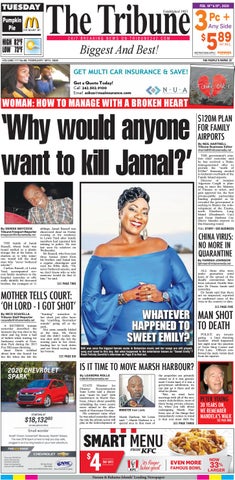
WHATEVER MAN SHOT HAPPENED TO TO DEATH SWEET EMILY? SHE was once the biggest female name in Bahamian music and her songs are still played, sung and loved to this day. But what happened to the entertainer known as “Sweet Emily”? Read Felicity Darville’s interview on Page 8 to find out.
POLICE are investigating a fatal shooting incident which happened last night near the junction of Toote Shop Corner and Fritz Lane. Officers confirmed the male victim died from his injuries.
IS IT TIME TO MOVE MARSH HARBOUR? By LEANDRA ROLLE lrolle@tribunemedia.net STATE Minister for Disaster Reconstruction Iram Lewis said a discussion “must be had” with landowners in Marsh Harbour, Abaco about possibly rebuilding the town centre more inland in the aftermath of Hurricane Dorian. His comment came when he was asked yesterday about the role the private sector will play in the redevelopment of
MINISTER Iram Lewis Marsh Harbour. Mr Lewis said: “...Marsh Harbour is a special area in that most of
the properties are privately owned so if it was government Crown land, if it was a government subdivision, we can just go it there and do what we please. “But, we must have meetings with all of the necessary stakeholders, most of them being private citizens. So, when you talk about redesigning Marsh Harbour, one of the things that immediately comes to mind is that you must shift the SEE PAGE THREE
Nassau & Bahama Islands’ Leading Newspaper
PETER YOUNG
30 YEARS ON, WE REMEMBER MANDELA’S WALK
SEE PAGE NINE
PAGE 2, Tuesday, February 18, 2020 from page one According to Mr Russell, the family became concerned when they hadn’t heard from Jamal on Thursday. “They were texting him all day Thursday; he can’t hear so they text him on his cellphone. My sister texted him that morning, but there was no response. Jamal always sends them inspiration every morning of a Bible quote and he didn’t do that on Thursday,” he said. Mr Russell said when relatives did not get a response from Jamal, they assumed he was out driving around because the vehicle he had rented was also gone. However, a representative of the car rental company went to the house looking for Jamal on Thursday because he had failed to return the rental car. That’s when relatives
THE TRIBUNE
Jamal never bothered anyone, says brother realised something was wrong. “One of my nephews said something ain’t right because Jamal rented a car every month and would always turn the car in on time,” Mr Russell said. A relative —who lived in the same structure with Jamal — looked through the deceased’s house window and noticed that it was in disarray and decided to go to the police. Mr Russell said that was very unusual because Jamal was a very tidy person.
“She said his clothes were all over the floor and that is not like him; he is very clean and cleans his room daily. She felt something was wrong and it is a good thing she did that. The police went through the window and discovered the body.” According to police reports, shortly after 6pm on Friday, February 14, officers conducting inquiries of a reported missing male in the Lewis Yard area discovered the lifeless body
of a man at his residence. Supt Brian Rolle, the officer in charge of Central Detective Unit, reported that the victim, a man believed to be in his early 40’s who was last seen on Wednesday, was discovered stuffed inside a bin at his residence. He said foul play was suspected and that the incident was classified as a murder. It is the second for the year on Grand Bahama. ASP Terecita Pinder confirmed yesterday that people are being
questioned in connection with the incident and that charges could be brought before the end of the week. Mr Russell said that a person or persons were allegedly found in the rented vehicle with all of Jamal’s possessions still inside the car. He said that his sister heard a car alarm go off sometime early on Thursday morning and went to check, and saw a car pulling out of the yard when she turned
the lights on. Mr Russell believes his brother’s killer was in the car. “They killed him and put his body in a plastic storage bin – the ones that Bahamians purchase in Walmart to pack things in when they travel. “God is good. My brother is a nice person, he never bothered nobody and was always going to church, praying and reading his Bible, and that’s why it worked out, that is why the police solved this so quickly,” Mr Russell said.
Fatal stabbing came after an argument with friend By FARRAH JOHNSON fjohnson@tribunemedia.net FRIENDS of the man who was fatally stabbed in an argument off East Street early Sunday morning said he will be dearly missed. According to police reports, shortly after 2am on Sunday, the body of a man was discovered on Ross Corner with what appeared to be stab wounds. Paramedics were called and attempted to revive him, but he was pronounced dead at the scene. A short time later, police acting on intelligence, went to a residence on Ross Corner where they arrested a man in connection with the incident. While his identity was not confirmed by police, The Tribune understands the victim is 53-year-old Roderick “Barbie” Taylor. Those in the community well acquainted with the victim described him as a kind man who loved his mother. They also said that the deceased and his assailant were good friends who got into an argument; however, the circumstances surrounding the victim’s death were not confirmed by officials. One family friend, who asked to be identified as D Smith, told The Tribune the victim was like a brother to her. “I knew Roderick for numerous years because they were living through here for a good while and he was good with his mom,” she said. “Barbie was a good man, he didn’t bother
FRIENDS talk about Roderick Taylor. Left: Donovan Campbell; right: Remanda Bodie Photos: Shawn Hanna/Tribune Staff
with nobody. He would hail and everything like that. He was a cool guy and I know him well because he is call me ‘sister’.” Ms Smith said while she was saddened by Mr Taylor’s death, she sympathised with the victim’s mother who was very close to her son. “I am so sorry for her now because his father (has) been dead for about three years and then he lost three of his brothers before him. Just him and his mom used to be there and two of his sons and he loved his boys. He had three boys.”
Talking about the incident itself, she added: “When it happened, it was through the morning and I was asleep (so) I didn’t find out until the next morning. “Him and the guy are good friends (and) I think they had a small argument. It wasn’t nothing like no intentional stuff they just got into a little altercation.” While canvassing the area, another community member directed The Tribune to Biggs Bar and Restaurant — the victim’s favourite hangout.
There, Donovan Campbell, the bar’s owner, described Mr Taylor as a loyal customer and caring man. “Barbie was my customer from when I first open up here,” he said. “He had his ways, but he was a generous soul and we will really miss him here.” Mr Campbell said after Mr Taylor’s death, a number of his friends and family gathered at his place because they knew the victim would routinely hang out there. “I don’t know what to say because the young man that
was in the altercation with him and thing, they were friends,” he said. “I wish they could have worked out something a little better than that, but I guess that’s how the cookie crumble.” Describing the kind of person the victim was, he added: “You see on a Friday afternoon after Barbie get pay, he would come inside the bar and buy you something to drink. “He loved his grandchildren the most. He was like a father figure to many around here, man.”
Remanda Bodie, one of the bar’s employees, said she was one of the people who looked up to Mr Taylor. “Barbie was close to me, he could have tell me anything (and) I could have tell him anything and it really hurt me how it went down,” she said. “I was not here (when it happened), I just got off from work and they call at 5 ‘o’clock (on Sunday) and told me one of my customers had got stabbed.” She added that the other man involved in the stabbing incident was also a frequent customer to the bar. “He also be here every day. I expect him at three or four ‘o’clock in the evening to play dominoes (or) shoot pool and dance. “I’m shocked that both of my customers (are gone). One left and one has to sit up where he ain’t suppose to be and he has a young child.” Ms Bodie insisted though that Mr Taylor “had his ways”, he was a “sweet person” that cared for those around him. “Every day at 4 or 5 ‘o’clock he is here,” she said. “He sit down, shoot pool, play dominoes, drink and have fun, but at a certain time, it’s always (about) his mother. “He would say ‘I gotta go and put in my mother number, I gotta go and get her water, I have to make sure the house clean.’ Everything was about his mother. He never left his mother behind and I sorry that he had to leave her like that.”
THE TRIBUNE from page one town centre more inland. But, again that is on private property so the discussion must be had with private property owners so that they will all be in agreement and that they must trade off how do they agree and be comfortable with whatever trade offer might come.” He added: “With respect to Marsh Harbour dock itself, based on the fact that the terminal buildings, the international, the domestic and the administrative buildings right on the harbour itself is too close to the coast, they are now being demolished as we speak. Actively being demolished. We will not put those buildings back in those communication. We will push those away from the seafront, allow us more apron and working space at the harbour itself and put those in a more elevated area.” Mr Lewis also defended the pace of debris removal and restoration on the island. He said Abaco will not be rebuilt “overnight” as construction on the island alone will take years. “…I did say that there will be years of construction. It doesn’t happen overnight. It will be a long time. There’s a lot of debris to clean up and we had to be very sensitive in how we clean those debris in areas like the Peas and the Mudd. “We couldn’t take any of the machines and just be insensitive. We had to take that layer by layer and there were a lot of pits for waste disposal all over there, so we had to be very careful. We’re now in the area of Marsh Harbour itself going towards the ferry dock, a lot of privately-owned properties. We have no right to just go on their properties and clean without having the
Tuesday, February 18, 2020, PAGE 3
Is it time to move Marsh Harbour further inland?
ALIANA Alexis stands on what was left of her home after Hurricane Dorian hit Marsh Harbour permission of the owners. “We’re asking (the owners) to do their best in bringing their debris to the roadside so once it’s at the roadside, we can go and remove it so it’s a partnership so once we have full cooperation from all, I’m sure that we will
work as fast and we’ve been doing that.” He said officials have seen “tremendous progress” on the storm impacted island since the passage of the monster storm. “The unfortunate thing is that there will always be naysayers and
persons will always have their opinion. I invite all to go there and to measure where we were immediately after Dorian and where we are now and use their best judgments,” he told reporters on the sidelines at a recovery policy workshop
yesterday. “I am not one to feed a negative monster. I like to focus on the positive. I like to focus on what we have achieved and use that as a springboard moving forward so we have made tremendous progress and I believe it will come.”
After Hurricane Dorian ravaged Abaco and Grand Bahama in early September, the government awarded contracts to several companies to assist with the clean-up process. However, in recent weeks, many Abaco residents have expressed disappointment with the process, saying more can be done. The minister was also asked about the pledges made during the Hurricane Dorian Pledging Conference last month and concerning when they will be made available to the public. However, to this, he replied: “I believe that there was no secret with respect to the pledging conference itself. It was wide open for everyone to be there to take pictures and to record. There was no anonymous donors. “Everyone was very open with what their proposals were and I’m sure that all the information that needs to be had is available to the public.” Editorial View - Page 4
‘WE’RE WORKING TO PROVIDE TEMPORARY HOUSING IN ABACO’ By LEANDRA ROLLE lrolle@tribunemedia.net CHAIRMAN of the Disaster Reconstruction Authority John-Michael Clarke said yesterday the authority will be working with the Department of Social Services to determine a solution to provide “temporary” housing in Abaco for displaced shelter victims living in New Providence. “...As you know the (Department of) Social Services has moved out of the Kendal G L Isaacs Gym and the residents are now housed at the Poinciana Inn. They are there for a period of 90 days,” he told reporters yesterday. “In Abaco, we’ve actually still cleared the land and made preparations for the family relief centre so we still have the big tents and between now and the end of the 90-day period, we will be working with social services to come up with a solution for temporary relief in Abaco.”
Mr Clarke made the statements when asked by reporters yesterday for an update concerning the government’s family relief centre. The initiative was established after Hurricane Dorian hit Abaco and Grand Bahama in early September, destroying homes and displacing thousands. Asked who will be eligible to live in the family centre, Mr Clarke listed residents who are still living in shelters in the capital as those who fit the criteria. “Well, as a matter of policy, those persons that are still sheltered and those persons that have no property or any other place to go in Abaco, the same criteria that was (put) in place at the beginning of the disaster, that criteria will remain for those that are eligible for the family relief centre. “And those are essentially the persons that are in shelters now.” It is not clear, however,
Since 1892 Bahamians have been protecting the environment with the passage of the Sea Gardens Protection Act, which prohibited dredging or removal of coral, sea fans or other organisms from the seabed.
Donate today to BPAF | 242-698-1152 or 437-2168 | www.bahamasprotected.com
when the relief centre in Abaco will start housing hurricane survivors on the storm affected island. “Originally, the family relief centre was being designed to take up to 1,000 persons,” Mr Clarke told reporters yesterday. “I understand that there are just under 300 persons who are still in shelters. That is my understanding… but, we will make sure that whatever we do it is adequate for the number of persons that need to be sheltered.” As it relates to the dome structures on the island, Mr Clarke said that 32 of the government’s domes in Spring City, Abaco are expected to be made available to residents in the community by February 20. The remaining domes, Mr Clarke said, will be
installed in other communities throughout the island and on the properties of residents, which fit the criteria established by the DRA. “The strategy has totally shifted from where we began and having all the domes in one place so now we’re going to put them on properties,” he told reporters yesterday. “I got a call last week from the contractor who said there was a need for 20 domes in North Abaco. So, we’re pursuing that, and we want to put the domes where people want the domes. “They are free, but they are also temporary so they’re not meant to be a replacement house and I think there is a lot of confusion and trepidation about that as well. “What we’re doing in
addition to the domes is that we are actively pursuing permanent housing solutions even though the dome has a certain resilience.” One of those solutions, according to Mr Clarke, includes developing potential sites in Abaco as new subdivisions. “…There are two 60-acre tracks that will be open for development for private developers locally and international developers who may want to provide resilient home solutions.” “The new development, that will be done in consultation with the stakeholders in Abaco and that’s a part of our new reconstruction resilient solution for the island of Abaco. One is in Wilson City and one is just a mile north of Spring City,
I’m told. ...Right now we’re planning for permanent homes and we’re planning for permanent homes with the view that we will actually get people back into permanent living spaces and they won’t have to rely on the domes for 15 – 24 months.” Asked how much money has been spent on the post-Dorian recovery efforts thus far, Mr Clarke said he could not give an estimate. However, he added: “It varies...that varies because December 1, the Reconstruction Authority has its own budget and spending so at this particular time, I can’t say (but) I can say ...collectively, I know that we haven’t spent more than 30 million as yet on the ground.” Editorial View - Page 4
PAGE 4, Tuesday, February 18, 2020
THE TRIBUNE
The Tribune Limited NULLIUS ADDICTUS JURARE IN VERBA MAGISTRI “Being Bound to Swear to The Dogmas of No Master”
LEON E. H. DUPUCH,
SIR ETIENNE DUPUCH,
jamaaltheartist@gmail.com
Publisher/Editor 1903-1914 Kt., O.B.E., K.M., K.C.S.G., (Hon.) LL.D., D.Litt .
Publisher/Editor 1919-1972 Contributing Editor 1972-1991
EILEEN DUPUCH CARRON,
C.M.G., M.S., B.A., LL.B. Publisher/Editor 1972-
Published daily Monday to Friday
Shirley & Deveaux Streets, Nassau, Bahamas N3207 TELEPHONES
News & General Information Advertising Manager Circulation Department Nassau fax Freeport, Grand Bahama Freeport fax
(242) 322-1986 (242) 502-2394 (242) 502-2386 (242) 328-2398 (242)-352-6608 (242) 352-9348
WEBSITE, TWITTER & FACEBOOK www.tribune242.com
@tribune242
tribune news network
Marsh Harbour relocation a model for all our futures SHOULD Marsh Harbour be moved inland? That’s a question being raised by Iram Lewis, the State Minister for Disaster Reconstruction, as efforts to rebuild after Hurricane Dorian continue. “When you talk about redesigning Marsh Harbour,” he said, “one of the things that immediately comes to mind is that you must shift the town centre more inland.” Such a move would of course be far from easy – between land rights and agreements and people’s feelings about wanting to stay where they have been for years. Already, Mr Lewis says terminal buildings at Marsh Harbour dock are being demolished and will be moved further away from the seafront to a more elevated area. The challenge comes with talking to so many private citizens about relocating. Mr Lewis says a discussion “must be had” with landowners – although he did not suggest when that would be taking place. The truth is such a discussion might be one that other parts of The Bahamas might well need to have if predictions about climate change hold true. In November, The Tribune published research that showed that rising seas are expected to have worse impact than previously known – with most of Grand Bahama, Abaco and Spanish Wells projected to be under flood levels by 2050 because of climate change. Much of Crooked Island, Acklins, Andros and Cat Island are also projected to be under flood levels, according to projections by Climate Central, a nonprofit organisation that reports climate science news. As for New Providence? Eastern and South-Eastern parts of the island are also projected to be at risk. So as the government approaches
the prospect of moving the Marsh Harbour community, its actions now could well serve as a lesson for the rest of The Bahamas – how to do it right if all goes well or what to avoid if things don’t go smoothly. Of course there are concerns – the government hasn’t seemed to ensure the best lines of communication with those affected by Hurricane Dorian, which doesn’t bode terribly well for talks. Another example of that miscommunication was on show yesterday, with Mr Lewis asked when the list of pledges from last month’s pledging conference would be made public. He responded to say that “there was no secret with respect to the pledging conference itself. It was wide open for everyone to be there to take pictures and to record… I’m sure that all the information that needs to be had is available to the public”. Well, Mr Lewis, that’s not what was promised by Katherine Forbes-Smith, the managing director of the Bahamas Disaster Reconstruction Authority, who said that a full breakdown of all pledges would be made “soon”. That “soon” has never arrived, so no, “all the information that needs to be had” is not yet available to the public. More than that, when one voice in the reconstruction effort says one thing and another says something different, that’s the kind of communication problem that causes disgruntlement with the government’s approach – and that’s what needs to be avoided in any talks about uprooting a community and relocating it. So should Marsh Harbour be moved inland? That’s not for us to say, but rather for every member of the community there to be able to have their say. The desire for talks on the subject is good – but let’s make sure that miscommunications don’t get in the way.
Domes available at last WHAT’S happening with the domes planned as temporary housing in Abaco? The plan to put up domes to offer shelter to victims of Hurricane Dorian seems to be ever shifting. First it was to be a large dome city, and now the domes are being offered around to put up on people’s properties. First, the good – 32 domes at the Spring City site in Abaco are to be available to residents on Thursday, according to Disaster Reconstruction Authority chairman John-Michael Clarke. That date had slipped a couple of times so it’s good to see it finally happening – assuming nothing changes this week. It’s also good to see the government being responsive and, as Mr Clarke puts it, nothing that “we want to put the domes where people want the domes”.
Now for the bad – the rest is a little muddled. One of the advantages of having the “dome city” is that it allowed support services to be concentrated in one spot – which will not be the case with domes being distributed elsewhere. A total of 32 domes will not go far either – so we hope that people will not be caught in between the shelters being closed down and the domes being available. Mr Clarke says just under 300 people are still in shelters – and there are of course others living temporarily with families or in rented accommodation elsewhere. In the end, we all want the same – people being given the best chance to rebuild their lives as well as their homes. We hope at last that people taking occupancy of domes this week will be a step on that path.
It’s good to see a paper that is standing up for the underdog EDITOR, The Tribune THE Tribune is The Bahamas’ most courageous newspaper. The prestigious daily dares to break stories that no other newspaper would even dare to touch with a ten foot pole. Indeed, neither The Nassau Guardian nor The Bahama Journal would’ve covered the riveting story about a certain flamboyant socialite with deep pockets. Granted, The Punch has also had its fair share of breaking stories. But its reporters hide behind the cloak of anonymity. Not so with The Tribune, whose
reporters’ names are published above their articles, which exposes them to scrutiny if their stories shed light on an embarrassing situation. The Tribune even went further with a sobering editorial on the same disturbing incident mentioned above – an alleged incident that only serves to underscore the depth of corruption in our Third World jurisdiction. On the day before the publishing of the foregoing story, The Tribune published two or three articles and an editorial on the tragic death of Ericka Fowler, a
former employee – further proof that the newspaper is continuing the tradition of Etienne Dupuch and Eileen Dupuch Carron in standing up for the underdog. With our political climate becoming increasingly dangerous with radical political operatives threatening journalists who are simply doing their job, The Tribune and its courageous staff are the bulwark of the Bahamian democracy. KEVIN EVANS Freeport, Grand Bahama February 16, 2020.
A love for light skin EDITOR, The Tribune LAST week, during the PLP’s rally, Patricia Deveaux introduced Senator the Hon Dr Michael Darville with specific language. Her words used described and amplified her colleague’s intellect and skill set based on his skin tone as opposed to other dark people who she suggests only bring heat. She expressed unequivocally that Dr Darville was a “real” doctor because he is not only, as she stated, “light skin” but also because he is “handsome (and) curly hair”—a statement which suggested that Darville holds a monopoly on knowledge because of his assumed proximity to whiteness. While Deveaux’s comments are both ignorant and incorrect—because neither matter when physicians are conferred their credentials—her comments not only bring to the fore a type of arrogant and unfettered mediocrity which pervades Bahamian politics, but it also demonstrates how vestiges of the colonial project continue to permeate and manifest itself in the Bahamian reality. It is most necessary and almost imperative that we focus on how her comments reveal a type of colonial continuity that whiteness is more desirable. While it is easy to write Deveaux in the books of history as a colourist and self-hating Black woman who may praise eurocentrism and desire white
LETTERS letters@tribunemedia.net recognition, Deveaux and her comments are part of a much larger structure of white western imperialism and colonialism that should be addressed. As a former colony, white supremacy continues to infiltrate our political structures and most of all the political imagination of Bahamians. We see this trope of white superiority manifest itself in the Bahamas daily as whiteness receives unlimited access to Bahamian resources while “darkies” are kept on the outside with unimaginable forms of bureaucracy which limit progress. Similarly, we see white supremacy through the mass accrual of concentrated wealth among whiteness while “darkies” live below the poverty line. It is important, however, to note that these oppressive circumstances are not pathological and should not be seen as a form of inherent inferiority among “darkies.” Instead, it should be seen as what it is, an anti-black and systemic, institutional phenomenon of colourism born of racism and the entire legacy of the colonial project. In this same way colourism, or the extent to which people of a lighter skin hue receive more degrees of freedom and privilege, cannot be separated from forms of misogynoir, homophobia, ableism, and ageism which are inherent to the
Bahamian culture and are part of a long-complicated colonial history. To understand colourism then, there is no need to look far. All that is needed is an honest and introspective look into ourselves and the ways in which we desire to be more like whiteness; in our actions and appearance. We make Black men cut and comb their hair to be more “respectable”—as if respectability has ever gotten us anything. We make our women straighten their hair, bleach their skin and practically starve their bodies to achieve a sort of whiteness that does not exist. Then, when those around us do not meet our criteria of whiteness, we victimise them, discredit their knowledge, disrespect their work and remind them of their place as “darkies” like Patricia Deveaux did. Though sometimes nuanced, white supremacy and our internalised oppression and beliefs of inferiority make discussing colourism and its reality so hard to talk about and identify. I am, however, aware that we did not arrive at this place overnight and we will not get free overnight either. Therefore, if we are going to build communities that are authentic, we must do the work and engage in explicit discussions surrounding the denial of beauty in blackness and the desire for whiteness and white recognition. SHELBY A E McPHEE Nassau, February 12, 2020.
Follow the British example EDITOR, The Tribune HOUSE of Assembly – just how open to speech is the House when an opposing side MP can interrupt constantly through a presentation? Compare that to the mother of parliaments, this never occurs. Mr Speaker, these rules must change…a request on a Point of Order should not be adjudicated by the Chair. The Brits have it
100% correct. The MP standing gives way to a MP wishing to cause an intervention when the standing MP gives the floor after the Point of Order is made that previously speaking MP continues…now an opposing MP can interrupt constantly disrupting the flow of their presentation. Centreville makes a good point…where are the reports? Finance - Treasury - Authorities - Departments
– some have not reported for years! Censure them, Mr Speaker. Labour Laws and certificate to strike…a certificate is not worth the paper it is typed on…as soon as you strike the Minister sends the issue to the Labour Tribunal…this is laughable and unconstitutional. ABRAHAM MOSS Nassau February 13, 2020.
THE TRIBUNE
Tuesday, February 18, 2020, PAGE 5
NURSING HOMES MAY BE USED TO EASE BURDEN ON PMH By KHRISNA RUSSELL Tribune Chief Reporter krussell@tribunemedia.net
HEALTH Minister Dr Duane Sands said officials are looking at various nursing homes to provide alternative accommodations for boarders at Princess Margaret Hospital. Not only does the situation create a burden on public finances, but it has exacerbated a current bed shortage at PMH.
According to Dr Sands yesterday, it costs several million dollars to care for 31 boarders, an outlay government cannot afford. “We’ve been looking at the various nursing homes considering the options (and) determining skill sets because once we take that initiative — bear in mind there are some legal implications whether we think there ought to be or not there are legal implications —so we have to move with
all deliberate haste, but very carefully,” Dr Sands said yesterday. Asked if assisted living care would be significantly cost effective when compared to allowing them to remain at PMH, Dr Sands told The Tribune: “Yes, the difference is the costs currently are not direct charges. Bear in mind we don’t have a line item in our budget for outsourcing care to nursing homes even though if you look at
the cost to have somebody in a bed, the cost of food, the cost of staff, medical, physician care, housekeeping etc, we have priced that in a previous study done by Dr Greg Carey sometime in 2017. At that time the cost to the healthcare system was anticipated to be as much as several million dollars per year. “Clearly we can’t afford a several million dollars outlay because we simply do not have that in our
budget, but at the same time the cost that is borne by people waiting for beds and the attendant complications or morbidity is a cost that is also unacceptable and unreasonable.” When he addressed Parliament yesterday, the Elizabeth MP said the Public Hospitals Authority planned to add 22 additional beds at PMH. The new beds will be available in six to eight weeks. All three public hospitals
have a combined inpatient complement of 1,010 beds. This is juxtaposed against the need to accommodate in excess of 21,000 admissions annually, totaling 271,410 annual patient days. During the 2015/2016 fiscal year, the hospital spent about $6.4m to facilitate the needs of boarders. This equated to about $17,819 daily. At the time, there were 23 boarders at the hospital.
Sands: We need to take a close look at the funeral industry By KHRISNA RUSSELL Tribune Chief Reporter krussell@tribunemedia.net
MINISTER Duane Sands speaking in the House yesterday
Photo: Terrel W Carey Sr/Tribune Staff
CHINA VIRUS: NO MORE IN QUARANTINE from page one
His comments came during the mid-year budget debate in the House of Assembly yesterday. “As of today, there are not and have not been any suspected, reported or confirmed cases of COVID-19 in The Bahamas,” he said. “I am pleased to advise that as of today, all persons who were quarantined have
been released, all asymptomatic and now returning to normal activities.” Last month, the government banned travel from China after the World Health Organisation declared the new strain of the coronavirus a public health emergency of international concern. At the time, non-residents who visited China in the last 20 days were denied entry to the country
regardless of their nationality and returning residents were quarantined and monitored for symptoms during an incubation period of 14 days in an effort to combat the spread of the new coronavirus. To date, there have been 71,451 confirmed cases of the disease worldwide with 1,776 reported deaths. Dr Sands said his ministry “will remain vigilant” in monitoring the matter.
THE country’s unregulated funeral industry has presented some “‘pretty scary” situations that now requires attention to prevent calamity, according to Health Minister Dr Duane Sands yesterday. Recognising the challenges this presents, Dr Sands said the government is “minded to consider” draft legislation presented by the sector. He said trained and certified morticians want to regulate the sector before they are faced with the imposition of laws with which they might not agree. Officials expect this draft legislation will be tabled in the House of Assembly this quarter. “The funeral industry in the Bahamas is completely unregulated,” Dr Sands told reporters yesterday following the morning sitting of Parliament. “We have gotten from the funeral association, draft legislation, which we are minded to consider. “But in the immediate term, we are going to be adding them to the Health Professions Council so that there are qualifications (and) certifications so people would have to be licensed in order to offer themselves as morticians. “This is an area where the majority of the persons that operate in this sector do an admirable job, but there are some instances where it is less than adequate, less
than appropriate and the public has complained.” Asked if officials were finding this to be more of an issue now than in the past, Dr Sands said there had been some challenges. “In some instances it can get pretty scary. There are a number of individuals who have been trained as morticians. They have been certified as morticians, but we do not have any legislative or regulatory framework to guide the practice of mortuary science in the Bahamas and so it is the ethics of the individual proprietors that determines the outcome. This can go pretty bad pretty quickly depending on who you engage to take care of your loved ones. “We have had some challenging issues. Bear in mind that mortuary science requires training if you are going to avoid some of the calamities that could happen.” He continued: “There could be transfer of infectious disease, inappropriate management of remains, illness in terms of contamination of the environment and so on and so forth. “Those people that are properly trained and have a proper business approach understand these things, but if any person can get involved in this business without any certification at all, ostensibly because they provide a cheaper service, imagine the risk to the community imagine the risk to the public not to mention the fact that people’s loved ones can be desecrated.
“This is an unregulated environment and it requires attention now. The majority of morticians understand this and they want to selfregulate before something is imposed on them.” In 2018, professionals in the funeral industry formed an association to advance and protect funeral professional practices. The move was in response to a surge of uncertified and untrained funeral director and embalmers. At the time, the new Bahamas Funeral Directors Association (BFDA) said: “Historically, providers of funeral services and products were men and women with years of hands-on experience and a tremendous depth of practical knowledge and skills. “As with all professions, with the adoption 21st century best practices and technological advances, the funeral industry in the Bahamas has witnessed the emergence of a dynamic and diverse cadre of professionally certified and skillfully trained funeral service practitioners with the entrepreneurial skills and acumen to match. With this emergence, the funeral industry has simultaneously witnessed an unprecedented upsurge of individuals claiming to be funeral directors and embalmers,” the BFDA said. The association noted that regrettably, such individuals grossly misrepresent the essence of a certified funeral director and embalmer.
PAGE 6, Tuesday, February 18, 2020
THE TRIBUNE
MAN CHARGED WITH HOLDING UP PHOTO STUDIO AT GUNPOINT By NICO SCAVELLA Tribune Staff Reporter nscavella@tribunemedia.net
A MAN was remanded to prison yesterday charged with holding up at gunpoint the proprietor of a photo studio on Carmichael Road and robbing him of over $200,000 last week. George Bennet Delva Sr, 44, of Blair Estates, was charged before Chief Magistrate Joyann Ferguson-Pratt with robbing Charles Sawyers’ Portraitsa-La Sawyers photo studio at gunpoint of $203,028 cash on February 11. Delva was further charged with being in possession of an unlicensed, silver and black Smith and Wesson 9mm pistol, as well as three unfired rounds of 9mm ammunition on February 11. He is further charged with indecently assaulting a 26-year-old woman during the incident. Initial reports from police
GEORGE Bennet Delva outside court yesterday
Photo: Terrel W Carey Sr/Tribune Staff
said before 8.15am on the day in question, two men entered Portraits-a-La Sawyers photo studio dressed in white jumpsuits and claiming to be window cleaners. They held up the proprietor and a worker, it was previously reported. Police shot a suspect at the scene while an officer was injured during a struggle with one of the suspects, police said. The injured officer got medical assistance while the wounded suspect was taken to the hospital. Delva was not required to enter a plea to the charges and the matter was adjourned to April 1 for service of a voluntary bill of indictment (VBI). Bail was denied and he was remanded to the Bahamas Department of Correctional Services in the interim. He has a right to apply to the Supreme Court for bail. Delva is represented by attorney Dion Smith.
Mother tells court: ‘Oh Lord - I got shot’ from page one
She said one bullet ripped through her left arm, struck her in the chest, before blasting clean through her right upper arm. A second bullet struck her in her inner thigh and is still lodged in her leg to this day. She maintains that years later, she still has no idea why she was shot at. Samuel Ferguson, who was shot in the leg during the mass shooting, also testified how he saw when a grey, silver colour Honda vehicle pulled up from the east and started “shooting up the area”.
Mr Ferguson also said he caught a glimpse of the shooter—a male of slim build—who was brandishing a black handgun and shooting over the car towards the basketball court on the park. However, Mr Ferguson said he did not get a good enough look at the shooter’s facial features. Meanwhile, defence attorney Geoffrey Farquharson revealed yesterday the alleged motive behind the mass shooting: the death of a Haitian drug dealer known as “Limbo”, as well as that of his brother, who went by the alias “Spy”. Ms Davis’ and Mr
Ferguson’s testimony came during Peter Rolle’s, Jermaine Curry’s and Justin Williams’ trial concerning the December 27, 2013 shooting at Freedom Park before Justice Deborah Fraser, just over six years after the incident took place. Williams, Rolle and Curry are accused of murdering four people – Claudezino Davis, Shaquille Demeritte, Eric Morrison and Shenique Sands on that date. They are also charged with attempting to murder Ms Davis, Mr Ferguson, Chino Davis, John Davis, Jermaine Pratt and Leroy Taylor.
According to reports, around 6pm, occupants of a small, dark vehicle opened fire in the area just behind the basketball court where several people were gathered. Davis was pronounced dead on the scene while 10 others were taken to hospital. Demeritte, Morrison and Sands later died in hospital of their injuries. Taking the witness stand yesterday, Ms Davis said she was at Freedom Park waiting for the announcement of the Junkanoo results. Her son asked her something, prompting her to go to the store to purchase a thermos for her
son’s child, as the original one had broken. She also went to her home to boil some water and later returned to the park. While standing around waiting for the results, along with about 30 to 45 people, Ms Davis said she heard a “crackling, firecracker” sound, before she saw people “screaming” and running. Then, she said she felt a burning pain in her chest. Ms Davis said when she looked down, she saw blood. Upon seeing the blood on her chest area, Ms Davis said she said: “Oh Lord, I got shot!” She said she started to fear for her life and collapsed, but was caught by her husband and her son. She said they took her to her daughter’s car, and she was later taken to hospital where she was shown an x-ray of her injured leg. Ms Davis said she was discharged from hospital that Sunday, but still had to go to the clinic every Monday, Wednesday and Friday afterwards to have her wounds checked and dressed. While being cross-examined by Williams’ attorney, Mr Farquharson, Ms Davis’ attention was drawn to one of the photographs captured by crime scene investigators of the scene in Fox Hill. That photograph captured the Junkanoo shack of the Original Congos, according to Mr Farquharson. On the side of that shack,
Mr Farquharson said, is some graffiti that reads: “RIP Spy and Limbo. Real Gs”. Ms Davis, in response to a question by Mr Farquharson, said she does not know who Limbo and Spy are. However, Mr Farquharson said the deaths of those two men—based on the graffiti—served as the incentive of the 2013 mass shooting. He argued the mass shooting has its roots in the death of Haitian drug dealer “Limbo” and his brother “Spy”, whose real name is David. And according to Mr Farquharson, “Limbo” is mentioned by one of the witnesses in the case. Otherwise, Mr Farquharson suggested it is ludicrous for the prosecution to suggest to the jury that “for some reason unknown, somebody went and shoot 10 people” on the Fox Hill-based recreation ground. Next up to testify was another retiree, Reginald Sands, and the father of Shenique Sands who died as a result of the mass shooting. Mr Sands said his daughter was one of 11 children, six of whom are girls. Mr Sands said that the last time he saw his daughter alive was about two weeks before the shooting. The next time he saw her was on December 30, 2013, when he identified her body at the morgue. The case continues today.
Death Notice for MARY ELLEN THOMPSON-KNOTT, 58
of Guyana Court, Flamingo Gardens, and formerly of Fox Town, Abaco, died at Doctors Hospital on Sunday February 9th, 2020. She is survived by her children: Adam Knott and Johanna Knott-Hudson; father: Bernard C. Thompson; stepmother: Rosemary Thompson; one brother: Bernard (Golden) Thompson Jr.; three sisters: Dolly Mae Cooper, Natasha Lightbourne and Irma Walkine and a host of other relatives and friends including: Kirk Hudson, Fredrick Cooper, Derick Lightbourne and Maxwell Walkine.
THE TRIBUNE By RASHAD ROLLE Tribune Senior Reporter rrolle@tribunemedia.net A SUPREME Court judge has ordered that 24 people fired from the Gaming Board in 2017 be reinstated and/or damages paid to them, according to lawyer Wayne Munroe. Justice Indra Charles’ ruling is among the first to challenge parts of the Minnis administration’s termination exercises that followed the 2017 general election. Mr Munroe told The Tribune yesterday it opens the door for others who were fired after the election to potentially see their termination reversed. While his lawyers are calculating how much is now owed to the plaintiffs, he previously said his clients would seek $2.7m in exemplary damages. Thirty former Gaming Board employees took legal action in 2018 after receiving termination letters between November 1, 2017
Tuesday, February 18, 2020, PAGE 7
24 fired from Gaming Board to get jobs back, court rules and December 13, 2017. They argued the Gaming Board failed to comply with Section 26A of the Employment Act, which outlines redundancy procedures like discussing steps to avoid redundancy with the relevant union. Palincia Hunter, the Munroe & Associates lawyer who represented the plaintiffs, said of the 24 people ordered reinstated, ten were managerial staff and 14 were from the bargaining unit of the Gaming Board. She said Justice Charles also ordered that two fired contract workers be paid the balance of their contracts and damages. However, the judge did not order that plaintiffs
on probationary contracts be reinstated or given damages because the law lets them be terminated without notice, she said. “(The government) purported to terminate workers based on Section 29 of the Employment Act which allows for termination without notice and in lieu of notice payment of the requisite severance,” she said. “But based on the wording of their termination letters, Mr Munroe concluded it was a redundancy procedure that was triggered, not a termination procedure. In that case, the requirements are different. The judge agreed that the procedures taken should not have fallen
COMMISSION NOT IMPRESSED BY BDCS PERORMANCE APPRAISALS By EARYEL BOWLEG ebowleg@tribunemedia.net
THE Public Service Commission was “not impressed” by recent Bahamas Department of Corrections’ performance appraisals, according to a national security official who advised department heads not to let their feelings sway the process. Eugene Poitier, permanent secretary at the Ministry of National Security, referred to the commission returning an “inordinate amount” of appraisals from the department which he believes were not properly filled out. He said he has also seen officers’ performance appraisals being negatively affected by supervisors who don’t like them. “It’s a totally objective process,” he said at the BDCS’s performance
management workshop. “It has nothing to do with your feelings – it’s not a witch hunt to get back at officers who you don’t like. I’ve seen it too often. “What I’m also seeing from the Department of Corrections since I’ve arrived is officers’ performance appraisal not correlating with their behaviour. You don’t give an officer above average when in fact their performance is average or below average. I’ve also seen officers being subjected to what is called the ‘recency effect’. What that is, is just before the performance appraisal an officer does something (to) you and so that particular incident it colours the entire process. “So, whatever the officer’s performance would have been for that entire period that doesn’t matter. That one particular
incident determines how he’s graded.” Prison Commissioner Charles Murphy did not shy away from the permanent secretary’s criticism, but instead admitted the issue at the department. “Well there are times when they need to be frank. The facts speaks for themselves. The ACR, they weren’t done properly and so we seek to improve the way the officers go in about executing that part of their duty,” Commissioner Murphy said. The two-week Performance Management Training workshop is one of the initiatives of the Ministry of National Security to encourage stronger correctional approach in management. Currently, there are 750 staff members at the BDCS — including officers and civilians.
MURPHY: NO GLASS FOUND IN PRISON MEALS By EARYEL BOWLEG ebowleg@tribunemedia.net BAHAMAS Department of Correctional Services Commissioner Charles Murphy said “there is no truth” about claims of small pieces of broken glass being found in inmates’ food. “What I’ve learned (is) that there’s nothing, no fact to that statement,” Commissioner Murphy said during an event at the facility yesterday. “The investigation is still going on and as soon as we complete it, then we will publish the finding but so far there’s no truth to what was said.”
CHARLES MURPHY Last December, a prisoner told The Tribune he found small pieces of glass broken up in the food the correctional facility provided him. He alerted guards and they took the plate of food away from him.
“I don’t eat their food anymore,” the prisoner told this newspaper via telephone. “I gone to the prison doctor, doctor told me this is a serious matter.” The commissioner revealed previously that the matter was being investigated after he heard the claims. He also said officials were awaiting autopsies of two inmates who died late last year. He said that foul play was not suspected in their deaths. “One inmate fell sick and was taken to the hospital and passed there,” he said last year. “The other died in his dorm.”
GIBSON HITS BACK AT DAVIS OVER ‘CHILD’ JIBE By RASHAD ROLLE Tribune Senior Reporter rrolle@tribunemedia.net LONG Island MP Adrian Gibson hit back yesterday at Opposition Leader Philip “Brave” Davis for referring to him as a child. As he joined striking members of the Bahamas Utilities Services and Allied Workers Union (BUSAWU) outside WSC headquarters last week, Mr Davis said: “…The time has come for that child to be moved from that post.” During his contribution to the mid-year budget debate yesterday, Mr Gibson responded. “Don’t be fooled by (the PLP),” he said. “Do not allow them to be use youthful props. These comments show you exactly what the leadership
ADRIAN GIBSON of the PLP think of young people. I was elected by the Bahamian people to do a job. If doing my job to the best of my ability and the interest and well being of the Bahamian public is considered an act of a child, then the Bahamas needs more children in leadership.
POLICE HUNT CAR & WATCH THIEF
POLICE are looking for a gunman who stole a man’s car and watch yesterday. Police said shortly after 4am Monday, a man was outside a residence at Chenille Avenue, Garden Hills when he was approached by a gunman who robbed him of a cherry red Mazda, LP# SN1090, and a watch. The
culprit fired two shots in the air before leaving the scene in the stolen vehicle. No one was injured during the incident. Anyone with information on this or any other crime is asked to contact the Central Detective Unit at 502-9991/2, Crime Stoppers at 328-TIPS (8477) or the nearest police station.
“The comments of the member gave the public an insight into the mind of someone who wants to be prime minister. Sixty percent of the Bahamas population is between zero and 40. I’m 36 this year, if I’m considered the child then certainly 60 percent is viewed as hapless children by a man who wants to be prime minister. “Children cannot vote. What was even more disrespectful was the loud cackling of disrespectful PLPs who accompanied him. This attempt to denigrate was insulting and disrespectful, smacks of ageism and allows us all to infer that the member would not give opportunities to young people if elected.”
LAWYER Wayne Munroe under Section 29 and that it is the Employment Act amendment Section 26A
that it should have fallen under.” Mr Munroe said this is
the first time a case has been tried under that provision of the Employment Act, which was enacted in 2017 by the former Christie administration. “If someone was terminated or downsized from the public service, they could look and see where they fall with respect to the ruling and determine whether they have a right to be vindicated,” he said. In 2017, then Gaming Board Chairman Kenyatta Gibson said the 30 employees were fired following a manpower assessment at the agency. He said the workers were “ill-suited for the modern-day requirements of our current regulatory regime.”
PAGE 8, Tuesday, February 18, 2020
S
HE was the biggest female name in Bahamian music. Her songs are still played, sung and loved to this day. Songs like Bring Back the Good ‘Ole Days, Send Him Home and Look Wha’ Ya Do, a duet with Ronnie Butler, hold a special place in the hearts of Bahamians. Her captivating voice, signature smile and enthusiasm for Bahamian music and culture led to her recognition as the Queen of Junkanoo. But all of a sudden, the entertainer we knew and loved as “Sweet Emily” dropped from the secular music scene. She became “Evangelist Emily”. She stopped her popular stage performances and she recorded no more cultural hits. That was 16 years ago. Emily married a pastor and she and her husband founded a ministry: Church Without Borders. Her husband, Pastor Wendell Williams, also took a leap of faith when they got married and he went on to form his own church. They were each being led in a different path from the one which they had devoted so much time to. For Emily, she had spent some 18 years as an entertainer, performing at venues throughout The Bahamas and the world. Pastor Wendell was the comptroller of City Market Food Stores for over 25 years. He already had a Masters degree in Business Administration and was doing well. But he felt a call on his life, resigned from his job and went to school in Canada. He attended Regent College in Vancouver, gaining a Masters in Divinity. Together, the Williams birthed Church Without Borders with the goal of going beyond the four walls of the church to share the Gospel. They appealed to people from all walks of life who were attracted to their style of teaching, feeling accepted for who they are as they sought after God’s word. During this time, Evangelist Emily never stopped singing. She produced a single as well as an album. Her gospel songs are in rotation on faith-based radio programmes today. She is a dutiful wife and
THE TRIBUNE
What happened next to Sweet Emily, the Queen of Junkanoo church leader. The church has been through ups and downs, but has stood the test of time and is still growing today. But there was something missing. “I had totally left the secular scene and was doing ministry, but there was always this void,” she said. “I felt I could be doing more. I continued to pray about it. I said, ‘God, surely it has to be more than this. Lord, I don’t know what you want me to do but you have got to show me’. God normally speaks to me, but this night I had a dream. I got up on this stage to speak, and someone said, ‘It’s time for you to speak, Evangelist Emily’. I was waiting to go on at the time. I was sitting at the back of the stage, so I couldn’t see the people. When they called me I stood up and headed to the stage and I said, ‘Wow, I didn’t know all these people were out here’. It was a huge crowd. I was getting ready to preach. I was about to start with ‘Let us pray’. But when I opened my mouth, I started singing. I don’t know where the song came from. I said, ‘How is this possible’? I don’t know where the song came from, yet all these people were singing along with me.”
When Emily woke up, the song was still on her tongue. She wrote it down. She called Ira Storr, veteran Bahamian entertainer and told him about the dream, adding that God told her to call him. At the time, he was working on a track called the Backyard Riddim that various Bahamian artists were singing on. Emily produced her song “It’s Not an Easy Road” on that track. It speaks of God’s unfailing love through the trials of life. It was Emily’s first non-traditional Gospel song. Nehemiah Heild also produced a Gospel song on the track. But that was just the beginning. Emily made the decision to make her big comeback as the Queen of Junkanoo, and she kept the name “Sweet Emily” because she feels there’s nothing ungodly about being sweet. She decided that her fans need her, and that she has so much more to give. This past weekend, Sweet Emily dropped her latest track It’s Good to Be Back. The song is produced by Fred Ferguson, whom she describes as a perfectionist who pushed her as they produced her first comeback hit. The song lets her fans know how much she misses them, and she says: “I
realise here is where I need to be. I’m glad you waited. Let’s try again… I am happy with you, I am grateful and thankful. Let’s start all over, let’s try again.” This is a huge step for Emily. It’s one that came through fervent prayer. When she awoke from that dream, she went into her living room and started praying. There, a conversation with God left her feeling confident about her next big step. “God told me to notice that I thought I was going to preach but that he brought me there to sing,” Emily shared. “He said, ‘Remember I told you I would save you but that I was going to send you back? I wanted you to be grounded. I wanted to build a relationship with you so you would know me. I wanted you to be solid in the Word because where I am going to send you, there is a lot of temptation. I wanted you to be grounded before I sent you back. Your calling is unique – it’s never done before in The Bahamas. That is why I took so long to send you back - 16 years.’ He said to me, ‘You ready now. I can trust You. Now, I am going to send you back to sing. You can still do your Gospel too. But, remember I told you I would clean you up and send you back in the world? That’s where your pulpit is.” “I never called you to have a four-walls mindset, God told me. ‘I always called you to go into the darkness so you can be the light. The position you are in is unique. No one in The Bahamas has
ever transitioned like this before. Some people will not understand. Some will criticise you. They will say you are not saved. They will say you backslide. But I have called you to be an evangelist. Remember, when Christ walked this Earth, yes he went to the synagogue to preach, but he always went where the sinners were. You can’t be effective just being among church people. They do not respect you. Your audience is the people that I sent you to, and I always told you I would send you back.” These words resonated to the very core of Emily’s soul. She said throughout the years, God often told her He would clean her up and send her back, but she never knew what it meant. She said she thought the Lord had called her to sing just gospel music and she was ok with it. She recalls going through the different motions and changes in the church. She came to a place here she felt her well of passion was drying up. She felt that many Christians were not appreciating her for what she brought to the table. She said she got a lot of backlash when transitioning from secular music to the gospel scene. There were people who would look at her as not being truly saved, considering the world she came from. Then, she felt never fit into the circle of pastors’ wives. “I saw the church from an internal position… I saw the hypocrisy in the church” says Emily. “When they need you to sing, they don’t want to pay you. You are supposed to sing for free because you are saved. Financially, it was affecting me. I couldn’t pay my bills the way I used to. I am not saying that God doesn’t provide, but the church situation was not a fulfilling one.” Emily and her husband are used to criticism. They feel compelled to teach the Gospel in a form they call “marketplace ministry”, allowing them to reach people beyond the borders of the church.
Church Without Borders always made bold moves, such as when it became a Saturday church instead of a Sunday church. But the Williamses felt they were making decisions according to their assignment. The couple faced trials as their flock would grow and fall off. They had put a significant amount of money into maintaining a high rent. Today, they stream live on Facebook every Saturday. They had received a word of prophecy more than once, that the Lord would take them down a different route. Emily feels it’s all making sense now. Pastor Wendell fully supports his wife’s decision. She also feels the love and support from her son, D’Aundre and daughter Aysia, as well as her three grandchildren. “This is not an easy place to be in,” Emily confesses, “Being in the church and coming back to secular music. “There are people on Facebook trying to criticise me - some people I respected, people I call friends… some I had to block. God called me - I know that. I love to be where sinners are because they are the people who need God. He told me that the doors that I need to walk through to reach certain people, I can’t do it in the church. You have to be in certain places to reach certain people. I have come full circle to believe that even though I am a Christian, I am called to do more – marketplace ministry.” Emily first released her song Good to Be Back on Natural Empress’ radio show Free Ya Mind on Star 106.5fm this past Friday, because it was Empress who encouraged her to follow her heart no matter what people thought. This weekend, the music video was released on YouTube. This week, she is making the rounds on all of the radio stations. She also authored a book: The Transformation of Sweet Emily. Find her on social media by the name: sweetemilywilliams. Reach out to her at evangelistemi@msn.com.
THE TRIBUNE
A
FREE man at last. Nelson Mandela was released from prison in South Africa 30 years ago. As an anti-apartheid activist and revolutionary, he had become the symbol of opposition to it. Such was the intensity of international interest in him that it was no exaggeration to say that the world watched and waited on February 11, 1990 as he emerged from prison on Robben Island where he had been incarcerated for 27 years. He was serving a life sentence after having been convicted of sabotage at the 1963 Rivonia Trial. His release marked the beginning of a relatively swift process towards the dream of a unified South Africa with the ending of discrimination on the grounds of race or colour. Mandela himself was elected President in 1994 and, through his leadership, became a global icon in the anti-apartheid struggle. His autobiography ‘Long Walk to Freedom’ published in 1995 has been variously described as a chronicle of one of the remarkable lives of the 20th century and a reminder of man’s ‘indomitable spirit’. It is a compelling memoir which should surely be on people’s ‘must-read’ list. Having served as a young diplomat in the British Embassy in South Africa during the 1970s, I have to
Tuesday, February 18, 2020, PAGE 9
30 years on, we remember Mandela’s walk to freedom The Peter Young column confess to a special interest in the subject. So, briefly, apartheid – defined as the separate and parallel development of people according to their colour and race – was introduced in South Africa by the Afrikaner-dominated National Party following its election victory in 1948. In a nation where whites made up some fourteen percent of the population and owned almost all the wealth including the best land, apartheid developed into a way of protecting their privileges and way of life and of
reserving the land for themselves. Black people were stripped of their rights as citizens and their dignity as human beings by being systematically dispossessed of land and homes and forced to provide cheap labour for whites in their designated areas. Such an iniquitous system imposed by brute force was widely regarded overseas as morally repugnant and was condemned accordingly. It was also opposed by many within the white community in South Africa itself. While the use of force by the international community to end apartheid was ruled out, tools like sanctions and a sports boycott – which was notably effective, for example, by stopping rugby-mad white South Africans from competing internationally – were deployed. But progress towards overcoming this deeply embedded system of discrimination was gradual, involving both domestic and international pressure – including the Commonwealth Heads of Government meeting in Nassau in 1985 which contributed to that pressure -- on the minority National Party government to begin a meaningful programme of
reform. The British government was at the forefront of this, with then Prime Minister Margaret Thatcher engaging in regular direct dialogue with President P W Botha. For example, soon after the Nassau summit she wrote to him urging a public announcement of specific steps towards the ending of apartheid including the release of Mandela. This correspondence was highly classified at the time but can now be found on the internet. Ultimately, with the emergence of F W de Klerk as President in 1989, the National Party, realising the country’s international isolation had to end, decided to discontinue the policy of separate development, and political leaders developed a vision of a united South Africa by abolishing all forms of discrimination based on race or colour. They accepted the full logical consequences of power-sharing with the
black majority and agreed that the opposition African National Congress should be a part of the process as long as this included reasonable protection for minority rights. A year later most of the apartheid laws were scrapped, Mandela was released and, after extensive negotiations, the first fully democratic elections in South African history took place in 1994. It is interesting that in his speech immediately after his release Mandela did not call for peace and reconciliation but recommitted the ANC to the armed struggle and called on the international community to continue its campaign to boycott South Africa. Later, however, known for his dignity, courtesy and self-confidence, he became the leading symbol of national unity and the embodiment of the spirit of reconciliation; and, in the words of F W de Klerk, he had an unfailing ability to
make ‘just the right gesture at just the right time’, not least when he donned the South African rugby team’s green and gold jersey after its victory in the rugby World Cup on home soil in 1995, thereby winning the hearts of millions of white rugby fans. It was well known that the relationship between Mandela and de Klerk was often fractious as they frequently clashed while working together towards a fundamentally reformed South Africa, but the measure of their efforts was seen in their being jointly awarded the Nobel Peace Prize and the Philadelphia Peace Medal. While today South Africa may remain deeply divided, with many disillusioned by unfulfilled expectations, Nelson Mandela will surely always be regarded as an icon who played a vital role in bringing about, through a relatively peaceful transition period, a nation of equal rights and opportunities. He was truly a man of the century, who, in writing in typically modest fashion about his Nobel Prize, said that this award was not just about him but was a tribute to all South Africans who had fought in the struggle against apartheid.
were morally reprehensible because they were designed to slaughter civilians and destroy the architectural and cultural heritage of a great European city. By contrast, others pointed out that Germany itself had already launched night-time bombing raids on English cities, including London, Coventry, Liverpool and others during the ‘blitz’ from late 1940 to mid-1941 following the Luftwaffe’s defeat by the Royal Air Force in the Battle of Britain. These had resulted in the deaths of 43,000 innocent civilians. There were also the unspeakable atrocities committed by German forces, including concentration camps and the extermination of 6 million Jews together with numberless people forced in to labour camps. For Britain, the Second World War was first a matter of survival and then of making a supreme effort to secure the unconditional surrender of Nazi Germany. The Allies judged that the only way to ensure the defeat of the enemy was
a strategic bombing campaign despite huge losses of aircraft and aircrew and the deaths of German civilians. It can be argued that, in fighting a moral war against the evil of Nazism and an aggressive Germany which had occupied Czechoslovakia, annexed Austria and then launched an unprovoked attack on Poland, the Allies, in trying to destroy the Third Reich, could still commit what might be considered immoral
acts amounting to crimes. But it is equally contended that since Germany initiated the war it should be held morally responsible for the destructive consequences of the Allied use of retaliatory force. While these issues and arguments remain unresolved, it is interesting that at a ceremonial event in Dresden on February 13 to mark the anniversary of the bombing, Germany’s president called for his fellow
citizens to stand up to extremism and nationalism, warning that hatred and a desire for authoritarianism were on the rise again in Europe, including in his own country. He admitted that Germany had started the gruesome and devastating Second World War and could not forget its guilt and responsibility, but those who perished in the Dresden bombings deserved to be commemorated.
THOSE WHO PERISHED IN DRESDEN SHOULD BE COMMEMORATED
ANOTHER anniversary last week of a more sombre kind was the night and day bombardment of the city of Dresden in eastern Germany 75 years ago by hundreds of US and British planes dropping some 3,500 tons of explosives that turned the area in to a smouldering ruin. This resulted in an estimated 25,000 deaths – mostly older people, refugees, women and children. The attacks took place between February 13 and 15, 1945 in the final stages of the Second World War. This attack on Dresden remains as controversial as the atomic bombing of Hiroshima and Nagasaki preceded by the US firebombing of Tokyo, and it continues to stir deep emotions. Dresden had always been regarded as one of the world’s most beautiful, ancient cities for its architecture, museums and cathedral and was known as ‘Florence on the Elbe’. It was considered to be an unlikely target for a major Allied air attack - and until that point had been left alone - because its contribution to Germany’s
military machine was said to be minimal. The city thus had few defences in the shape of ant-aircraft guns and searchlights. However, the Allies claimed it was a legitimate target because, even if it was not a major industrial centre, it was a key transport junction and its important communications links had to be destroyed. Such bombing in the region was needed as well to shorten the war by reducing pressure on Soviet forces advancing from the east. The city of Dresden was also said to be fanatically pro-Nazi. Nonetheless, critics condemned the Dresden bombardment as being unjustified militarily since it could have had little real effect on the German war effort so near to the end of the conflict in Europe. They also questioned the action on moral grounds because the Allies had launched ‘area’ and ‘saturation’ bombing that targeted noncombatant civilians to break the morale of the German people. Some continue to argue that the Dresden raids
I’M GLAD TO SEE BRITAIN BACK IN BUSINESS IN THE BAHAMAS TWO RBDF marines slowly and deftly raise the Union Flag
I IMAGINE I may not have been the only one with a lump in my throat and a misty eye as two efficient RBDF marines slowly and deftly raised the Union Flag to the top of the flagpole in the garden of the official residence in Nassau of Sarah Dickson, the new British High Commissioner. It was an emotional moment for it signalled formally the re-establishment of a diplomatic mission after a gap of 15 years. Last week’s ceremony - in the presence of the Prime Minister, who spoke of his delight that the High Commission had been reopened, and of the Minister of Foreign Affairs together with invited guests – was a dignified and solemn occasion but also a happy event, with everyone there welcoming a renewed British official
presence in The Bahamas. It had always seemed to me, as a former High Commissioner (with two successors before closure in 2005), that the Blair government’s decision to shut a number of diplomatic posts around the world as an economy measure was short sighted and misguided in light of Britain’s worldwide interests; and, following the UK’s departure from the European Union, these have now taken on a new dimension as the nation spreads its wings globally - particularly in the Commonwealth, including an increasing presence in the Caribbean. The role of British diplomats is to promote and protect the nation’s interests, to support British citizens and to promote trade and investment; and, at the same
time, to provide advice and support to government ministers developing UK foreign policy. When posted overseas, it means, in practice, not only conducting the business of the British government with a host country but also becoming involved in every aspect of the relationship between the two countries, working to build bridges and fostering cooperation in many different fields – and, while seeking to promote mutual interests also reconciling conflicting ones. So the remit is broad and the range of activity varied. A new British official presence in The Bahamas, with an experienced and active career diplomat at the helm, augurs well for future co-operation – and, as the saying goes, the best is surely yet to come.
PAGE 10, Tuesday, February 18, 2020
THE TRIBUNE
BEZOS COMMITS $10BN TO FIGHT CLIMATE CHANGE
DRIVER ALIVE AFTER CRASH AT DAYTONA
NEW YORK Associated Press
Associated Press RYAN Newman flipped across the finish line, his Ford planted upside down and engulfed in flames, a grim reminder of a sport steeped in danger that has stretched nearly two decades without a fatality. Roughly two hours after the crash, NASCAR read a statement from Roush Fenway Racing that said Newman is in “serious condition, but doctors have indicated his injuries are not life threatening.” During the long wait for an update on Newman’s condition, President Donald Trump took to Twitter to express his concern. Trump has attended the race as the grand marshal a day earlier.
RYAN Newman goes airborne on the final lap of the NASCAR Daytona 500 auto race yesterday
Buttigieg needs to win over minority voters Associated Press SO FAR, Pete Buttigieg has made it look easy. The once little-known former mayor of a midsize Midwestern city vaulted over a former vice president and several U.S. senators in the Iowa caucuses and New Hampshire presidential primary. The 38-year-old’s fresh face, intellect and turn-the-page message won votes across many demographic groups in the kickoff states. Now the promise of his candidacy is colliding with the reality of the central question about his viability: Can he win among minority voters who form the critical foundation of the party’s base? That will be tested on Saturday in Nevada, with a diverse blend of Latinos and African Americans, but especially in South Carolina, where two-thirds of the primary electorate could be black voters, the base of
the Democratic Party that Buttigieg has struggled to attract. Buttigieg’s strategy is to earn a fresh look from black and brown voters by flashing his support in the first two contests, drawing on the validation of minority leaders who have endorsed him and leveraging the personal networks of his supporters. With the South Carolina primary rapidly approaching Feb. 29, he faces a steep climb. “I’ve not seen any real support coming from black local officials. Pete has to make the case himself,” said state Sen. Gerald Malloy, a longtime supporter of former Vice President Joe Biden’s who has not endorsed a 2020 candidate. “He’s obviously a tireless warrior and making the calls. The question is: Will people answer?” The former South Bend, Indiana, mayor, who has
registered negligible support among black voters nationally, has been to South Carolina 10 times and has been airing ads on black radio stations in South Carolina since last fall, as well as ads in black newspapers. He has been airing TV ads in the state since December, and this month began a spot reflecting his call for parting with the politics of the past. In it, Walter A. Clyburn Reed, the grandson of Rep. James Clyburn of South Carolina, the highest-ranking African American in the House, and Abe Jenkins, grandson of civil rights activist Esau Jenkins, pay tribute to their forebears but call Buttigieg “a fresh start.” It and other ads blanketing YouTube and Facebook reinforce Buttigieg’s heavy outreach to younger black voters, especially on college campuses.
AMAZON founder Jeff Bezos said yesterday that he plans to spend $10 billion of his own fortune to help fight climate change. Bezos, the world’s richest person, said in an Instagram post that he’ll start giving grants this summer to scientists, activists and nonprofits working to protect Earth. “I want to work alongside others both to amplify known ways and to explore new ways of fighting the devastating impact of climate change,” Bezos said in the post. Amazon, the company Bezos runs, has an enormous carbon footprint. Last year, Amazon officials said the company would work to have 100% of its energy use come from solar panels and other renewable energy by 2030. The online retailer relies on fossil fuels to power planes, trucks and vans in order to ship billions of items all around the world. Amazon workers in its Seattle headquarters have been vocal in criticising some of the company’s practices, pushing it to do more to combat climate change.
GOVT ADVISER QUITS OVER RACE COMMENT LONDON Associated Press AN ADVISER to British Prime Minister Boris Johnson resigned yesterday amid fierce criticism of his past comments linking intelligence to race and suggesting contraception should be made compulsory to avoid “a permanent underclass.” Andrew Sabisky said he was quitting because he had become “a distraction.” Sabisky — who has a master’s degree in the psychology of education, according to an online biography — suggested that black Americans have a lower average IQ than white Americans. He also wrote in 2014 that “one way to get around the problems of unplanned pregnancies creating a permanent underclass would be to legally enforce universal uptake of long-term contraception at the onset of puberty. Vaccination laws give it a precedent, I would argue.”
THE TRIBUNE
Tuesday, February 18, 2020, PAGE 11
THE CARGO ship Duncan Island in Kalundborg Harbour in Denmark on Sunday.
BAHAMAS-REGISTERED VESSEL HELD IN DANISH COCAINE RAID
Associated Press
DANISH police say they have arrested 27 people for suspected drug smuggling after finding some 100 kilograms of cocaine on a Bahamas-registered cargo vessel plying Danish waters. Copenhagen police said on Sunday in a statement that the cocaine was seized during an internationally coordinated bust on Saturday on the container ship Duncan Island while it was sailing south of the town of
Gedser. The suspects are charged with serious drug crimes under Danish law and may face a sentence of up to 16 years in prison. They include the vessel’s international crew with Russian, Latvian, Ecuadorian and Filipino nationals among others and remain in custody pending further investigation. “We’re naturally very pleased that many kilos of cocaine have not hit the street. Now we are investigating further to find out
who is waiting in vain for the deliveries,” said Inspector Dannie Rise, the head of the special Investigation unit at the Copenhagen police. According to Danish broadcaster TV2, the vessel was en route from Helsingborg, Sweden to St Petersburg, Russia, when it was seized by authorities. It said the cocaine is believed to have a street value of approximately 350 million Danish kroner ($50m).
PAGE 12, Tuesday, February 18, 2020
THE TRIBUNE