01222026 NEWS

Page 1


THURSDAY

“We got you covered under the

Volume: 123 No. 41, Thursday, January 22, 2026

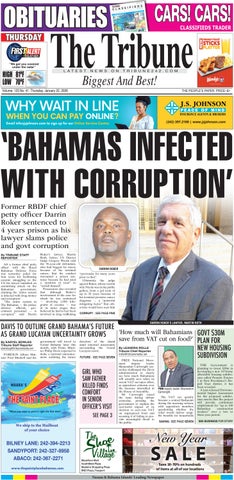
‘BAHAMAS INFECTED WITH CORRUPTION’

Former RBDF chief petty officer Darrin Roker sentenced to 4 years prison as his lawyer slams police and govt corruption

AS a former chief petty officer with the Royal Bahamas Defence Force was yesterday jailed for four years for facilitating cocaine smuggling to the US, his lawyer launched an astonishing attack on the Bahamian government, claiming the 'entire system is infected with drug money and corruption'.

“The entire system in The Bahamas — the police, defence officials, government personnel — is corrupted,” said Darrin

Roker’s lawyer, Martin Roth, before US District Judge Gregory Woods told the 56-year-old defendant, who had begged for mercy because of his terminal cancer, that his conduct warranted a prison sentence because he had used a “position of trust” to “enrich himself”. Prosecutors also revealed that although Roker’s involvement in the case for which he was sentenced — involving 1,000 kilograms of cocaine — was in its latter stages, they believed he had in fact been involved in drug trafficking

“previously for many years prior to that”. Ultimately, the judge spared Roker, whose tearful wife Nicole was in the public gallery, from a jail term of up to 20 years because of his terminal prostate cancer diagnosis — a “powerful mitigating factor” that otherwise would have seen him CORRUPT - SEE PAGE FIVE

DAVIS TO OUTLINE GRAND BAHAMA’S FUTURE AS GRAND LUCAYAN UNCERTAINTY GROWS

By

ister Fred Mitchell said the government will travel to Grand Bahama later this month, with Prime Minister Philip Davis expected to make a national announcement outlining the future

FOREIGN Affairs Min-

direction of the island amid renewed uncertainty surrounding the Grand Lucayan resort.

FUTURE - SEE PAGE SEVEN

‘How

FREE National Movement deputy leader Shanendon Cartwright yesterday challenged the Davis administration to clearly say how much Bahamians will actually save when its recent VAT cut takes effect, as opposition criticism over the measure intensified in the House of Assembly.

Mr Cartwright raised the issue during debate yesterday, pressing the government to explain the real-world impact of its decision to zero-rate VAT on unprepared food and accusing it of failing to provide meaningful detail to the public.

The VAT cut quickly became a central flashpoint during the morning session, with opposition members questioning whether the relief would

for the proposed subdivision asserts that the project will provide continuous employment for “up to 100 Bahamian construction workers” over a

DARRIN ROKER
DARRIN ROKER’S LAWYER, MARTIN ROTH
FNM deputy leader Shanendon Cartwright.

CHINESE AMBASSADOR VISITS ‘BRIGHTNESS ACTION’ PATIENTS AT

ON Monday, Her Excellency Yan Jiarong, Chinese Ambassador to The Bahamas, together with Michael Darville, Minister of Health and Wellness, paid a special visit to patients who had received free cataract surgeries under the Chinese Brightness Action Initiative at Princess Margaret Hospital. Ambassador Yan inquired about the patients’ recovery and congratulated them on regaining their sight. She emphasized that the Brightness Action Initiative, carried out by China, is a major international medical well-being project that brings benefits and hope to patients in Global South countries, including The Bahamas. She said that the Brightness Action Initiative has produced many heartwarming stories of friendship and brought new momentum into China-Bahamas friendly cooperation.

Ambassador Yan stressed that benefiting the people is a hallmark of China–Bahamas relations. Despite the world and the region being in such turmoil, China firmly believes that China-Bahamas relations, built on equality, mutual respect, and mutual benefit, will continue to grow.

Minister Darville thanked the Chinese government for implementing the Brightness Action Initiative, describing it as a “gift of love” from China to the Bahamian people. He praised the Chinese medical experts for their outstanding professional skills, which have brought light and warmth to many patients, and expressed his hope to further strengthen exchanges and cooperation between the two countries in the health sector.

Chinese medical experts explained that many cases were highly complex.

Several patients were over 90 years old, more than half were over 70, and over 50 percent were in wheelchairs. Almost every patient suffered from underlying conditions such as hypertension, diabetes, stroke, kidney disease requiring dialysis, mental disorders, or limb amputations. In addition, many patients had complicated eye conditions, including advanced cataracts, glaucoma, retinal diseases, and eye injuries. Despite these challenges, the Chinese medical team worked closely with their Bahamian colleagues and successfully completed 146 surgeries up until January 19. The team’s superb medical expertise earned widespread trust and praise from patients, and the doctors were also warmly received by local residents during their visit to the Nassau Straw Market.

Three patients shared

their joy at regaining their sight and the profound positive changes the surgeries had brought to their lives, expressing sincere gratitude to China. Ms. Brice said, “I was honoured to be the first patient to receive treatment. I was not nervous at all before the surgery because I fully trusted the Chinese doctors to restore my vision.” Mr. Carroll remarked, “I am grateful to the Chinese government for sending such highly skilled doctors. I have regained my sight. The first thing I did after the surgery was to walk around and drive. My neighbours are surprised

to see that I can drive again. I hope the Chinese doctors will continue to come to The Bahamas.” Ms. Morley said, “I used to live in darkness, like being in a prison. Thanks to the Chinese doctors, I am so excited to see again. Now I can drive, I can cook, I can do whatever I want to do.”

Chinese Ambassador to The Bahamas Yan Jiarong and Minister of Health and Wellness Dr Michael
Darville visit Brightness Action programme on Monday.

Girl who saw dad killed finds comfort in senior officer’s visit

NEARLY a year after witnessing her father’s murder at just four years old, Quay’liah Arnett again found comfort in the arms of Chief Superintendent Chrislyn Skippings — this time as she celebrated her fifth birthday.

The killing of Quintero Arnett, 24, in February last year stunned the country and left his family grieving a loss that remains raw. CCTV footage of the early-morning shooting showed gunmen opening fire as Quintero’s young daughter fled for her life, a sequence that sparked widespread outrage and disbelief at the brutality of the attack. No charges have even been brought against those responsible.

Since then, public sympathy has followed the family’s calls for justice, alongside hopes that a wider community would help shield Quay’liah from the trauma she

“She was in high spirits, still have that beautiful smile that she exhibited last year. It’s important for her to see that law enforcement still cares.”

- CSP Skippings

endured. One figure who has quietly become part of that support network is CSP Skippings, officer in charge of the South-Central Division. On Tuesday, CSP Skippings shared photographs on Facebook of herself embracing Quay’liah on her birthday. The images closely echoed a photograph taken by The Tribune last February, when the senior officer visited the child

shortly after her father’s death. In both moments, Quay’liah smiled brightly despite the violence that

Trial of Mexican man accused of killing Paige Bell set for 2028

pbailey@tribunemedia.net

A MEXICAN man accused of murdering a 20-year-old South African woman aboard a superyacht in Eleuthera last July will stand trial, but not until 2028.

Brigido Munoz, 39, of Monterrey, Mexico, was informed before Justice Guillimina Archer-Minns that his trial is scheduled to begin on February 7, 2028. A back-up trial date was set for June 20, 2027.

His next status hearing is scheduled for November 18.

Munoz is accused of killing Paige Bell aboard a yacht docked in Harbour Island, Eleuthera, on July 3, 2025.

Police found Bell’s body with visible injuries in the engine room sometime after 1pm that day. Prosecutors allege Munoz attempted suicide following the killing and suffered serious injuries to his arms.

He was treated for his injuries at a local clinic.

Both Munoz and Bell were crew members aboard the vessel.

Bell’s parents, John and Michelle Bell, told The Tribune last November that they were still reeling from the loss of their daughter and said her murder “stole their world.”

had upended her life.

Speaking with The Tribune, CSP Skippings said she has remained in contact with Quintero’s family since the killing and arranged for the child to visit the police station for a birthday surprise, with the permission of her grandfather. Quay’liah was given a new doll and a pair of headphones.

“These little acts of kindness, they go a long way,” CSP Skippings said. “This is how the police transform and develop trust in our young people, when they see that constant interaction of love and care and concern being expressed.”

She said her involvement extends well beyond a single celebration, adding that she wants Quay’liah to grow up knowing that law

enforcement remains part of her support system.

“We still have an interest in her to ensure that she still receives that love that she ought to get,” she said, while praising the child’s family for the care they continue to provide.

CSP Skippings said she hopes Quay’liah will grow into a responsible citizen and retain the joyful spirit she has shown despite her loss.

“She was in high spirits, still have that beautiful smile that she exhibited last year. It's important for her to see that law enforcement still cares.”

Family members have described Quintero as a devoted father and hard worker with no involvement in criminal activity, insisting he was not the intended target.

CSP Skippings said she had met Quintero just

one day before he was killed, recalling seeing him at the police station’s basketball court with his daughter and another relative. She described him as a positive young man with a promising future.

“I feel a sense of obligation to constantly be there for her, you know, and to mentor her as best as I can,” she said.

Quintero’s father, Quinton Arnett, said the continued presence of CSP Skippings has brought comfort as the family continues to grieve. He said his granddaughter frequently asks for her father or says she misses him, but is still too young to fully grasp that he will not return.

Reflecting on the months since his son’s death, Mr Arnett said: “I take it one day at a time. I'll be honest with you every single day I think about him.”

He added that it remains painful knowing those responsible have not yet been brought to justice, stressing that accountability is still outstanding.

Mr Arnett said he hopes Quay’liah grows up knowing how deeply her father loved her.

On the morning of the murder, Quintero was sitting in a vehicle with his daughter and girlfriend outside a business when another car pulled up. Masked gunmen got out and opened fire.

In his final moments, Quintero opened the back door to allow his daughter to escape. CCTV footage showed the child briefly turning back toward him as the gunmen circled. He appeared to speak one last word before collapsing. The child then ran as the gunfire continued.

PAIGE Bell (front right) pictured with her parents and sister
Chief Superintendent Chrislyn Skippings pays a visit to Quay’liah Arnett on her fifth birthday. Quay’liah witnessed her father shot to death in February last year.

PLP to ratify 14 more candidates tonight

THE Progressive Liberal Party is expected to move closer to finalising its slate of candidates for the next General Election tonight, with about 14 aspirants likely to be advanced when the party’s National General Council meets, PLP chairman Fred Mitchell said yesterday.

If confirmed, the approvals would leave 13 constituencies still to be ratified ahead of the election.

The developments follow

interviews conducted by the PLP’s Candidates Committee on Tuesday night, where both incumbents and new faces appeared to seek the party’s nomination.

He declined to say whether a candidate would be announced for Southern Shores, a constituency marked by internal tensions among branch members over hopefuls Clint Watson and Obie Roberts.

Mr Mitchell said the party would not comment on the status of any candidate until selections are formally ratified, adding that aspirants are free to speak publicly

“You’re cautiously optimistic that you’ve done the work. You’ve tried to stay connected to people. We have an acceptability level of our leadership and our party’s work in the public, which is pretty good.”

on their own behalf if they choose.

He stressed that the selection process begins “de novo” for all applicants, regardless of whether they currently hold office, and said party rules allow both incumbents and non-incumbents to put themselves forward for consideration.

This election cycle has also seen a noticeable shift in how candidates present themselves publicly, with aspirants increasingly appearing outside PLP headquarters on interview nights alongside supporters and media — a departure from what was once a largely private process.

Mr Mitchell said the party itself does not make candidate announcements, explaining that candidates now tend to declare publicly once they receive the nod, reflecting a more open and social-media-driven political environment.

“I think it's very encouraging to see people come out with their supporters once they're respectful and they there's no violence connected with it, and there's order,” he said. “I hope that they keep up the level of enthusiasm all the way into the general election and carry that over so that we get across the finish line when the general election takes place.”

“You know, more the merrier. PLP, looks like people are interested in what we're doing and in the people that we have to present, and so that is a portent of great things to come.”

The PLP chairman also

a second consecutive term,

Mr Mitchell cautioned against long-range political predictions, noting that no government has achieved back-to-back victories since 1997.

“You're cautiously optimistic that you've done the work. You've tried to stay connected to people. We have an acceptability level of our leadership and our party's work in the public, which is pretty good,” he said.

He said the PLP is asking voters for a second term to ensure continuity and allow the government to complete its agenda.

“We've told all of our aspirants and told all the people who are going to get nominations Look, this is a people's business,” he said.

“This is a transactional generation, and you know, you got to be door-to-door, door to door. The constituencies in our country are small, so everybody expects to be touched and felt, and that's what they have to do.”

Leroy Major hints at possible run as indpendent - ‘Nothing is off the table’

SOUTHERN Shores MP

Leroy Major yesterday left open the possibility of running as an independent in the next general election, saying “nothing is off the table.”

His remarks come as questions continue over his standing within the Progressive Liberal Party, particularly after he was absent from recent candidate interviews for Southern Shores aspirants at the PLP’s headquarters.

Asked directly about rumours of an independent run, he said “time will tell” and urged residents to “watch the road” when pressed further about his intentions.

When questioned about his absence from the PLP meeting and whether he had been advised to step aside, Mr Major again declined to give a clear answer, repeating only: “Watch the road”.

Mr Major first drew national attention last year after publicly criticising what he described as the unequal distribution of resources and voicing frustration over the treatment of backbenchers in an interview with The Tribune.

He later sought to walk back those remarks in the House of Assembly, saying his comments had been misunderstood and misrepresented, a position The Tribune disputed and stood by its reporting.

Interest in the Southern Shores seat has since intensified as the PLP

moves closer to selecting its candidate. Deputy chairman Obie Roberts and ZNS General Manager Clint Watson have both expressed interest and were recently interviewed by the party’s Candidates Committee.

Asked whom he supports for the nomination, Mr Major again avoided a direct response, instead questioning whether he had ever made a public statement on Southern Shores or addressed its residents formally.

Asked about growing

tension between supporters of Mr Roberts and Mr Watson, Mr Major said the issue was beyond his pay grade.

“My job is as a sitting member of parliament, to continue to serve my people, and that’s what I have been doing for day one.”

He said he intends to meet with constituents and let them know “what time it is.”

“I could tell you this, whoever they put in Southern Shores, tell them go bring their boss,” he added.

Mitchell dismisses Fox as a ‘lost cause’

Tribune

ebowleg@tribunemedia.net

PROGRESSIVE Liberal

Party chairman Fred Mitchell yesterday dismissed former NBA star and political hopeful Mr Fox as a “lost cause.”

“I've tried to stay away. I don't want to add any more publicity to, you know, a lost cause. I really don’t,” Mr Mitchell said. The remark marks a notable shift in tone from Mitchell, who has largely avoided direct comment on Fox since the former basketball star began airing public grievances with the government and PLP supporters. Mr Fox has sought to frame his candidacy around his personal and professional ties to St James, outlining his rationale in a Majority Rule Day Facebook post. Tensions between the two men surfaced publicly last November, when Mr Mitchell appeared to rebuke Mr Fox in his capacity as an ambassador-at-large, saying ambassadors serve the government that appoints them and that “the honorable course is clear” if they disagree with the authority that placed them in office.

That followed a Facebook post by Fox responding to PLP supporters who argued that his diplomatic status should bar him from commenting on the Golden Isles by-election. In that post, Mr Fox pointed to what he described as a contradiction, noting that “a sitting ambassador with a portfolio is openly endorsing a candidate while currently running for office himself”, a reference to non-resident Ambassador Sebas Bastian, who is contesting the Fort Charlotte seat.

Mr Fox has said he has no plans to resign as ambassador.

“I’ve tried to stay away. I don’t want to add any more publicity to, you know, a lost cause. I really don’t,” Mr Mitchell said.

claimed the party made about 383 commitments in its Blueprint for Change and believes roughly 80 percent
been fulfilled.
about the party’s prospects of winning
SOUTHERN SHORES MP LEROY MAJOR
PLP CHAIRMAN FRED MITCHELL

Ex-RBDF officer jailed for drug smuggling conspiracy

CORRUPT from page one

imprisoned for far longer.

Roker’s lawyer Martin Roth admitted: “He (Roker) was weak. He wasn’t himself. In that moment of weakness, he joined the conspiracy and took the $20,000…”

“...It’s not easy when you are living in a culture where the entire system, almost every branch, is infected with drug money and corruption.”

Prosecutor Jonathan Bodansky also criticised The Bahamas and said that traffickers rely on “corrupt government officials and police” like Roker in order to ship their drugs to the US.

Roker had admitted one count of cocaine importation conspiracy and begged for mercy from the judge, saying he had “lost everything”.

Roker is the first of 13 people to be sentenced in a sprawling case involving corruption that includes numerous police officers and a “high-ranking Bahamian politician”.

Among the other defendants is Elvis Nathaniel Curtis, 51, a former Royal Bahamas Police Force chief superintendent who was the officer in charge of a police station in the airport.

The case has caused acute embarrassment for the authorities in Nassau and focused attention on The Bahamas’ failure to clamp down on drug trafficking.

At the federal court in Manhattan, Roker walked in wearing a tan-coloured, prison-issue top and pants, with shackles on his legs.

He smiled at his wife Nicole, who dabbed her eyes with a tissue throughout the proceedings, and two other family members.

Addressing the judge, Mr Roth said that Roker had become involved with the conspiracy near its end and

attended just two meetings, in August and October 2024. During the second meeting, Roker took a $20,000 bribe in exchange for information that would help drug traffickers avoid detection.

Mr Roth said that Roker had made a “fatal error” and called his decision “uncharacteristic bad judgement on his part”. In addition, Roker had undergone gruelling radiotherapy for his cancer in early 2024 and was still recovering when he went back to work and took the bribe.

Mr Roth said that Mr Roker “doesn’t want to die in prison” and wanted to be released into the care of his wife.

Asked to address the court, Roker stood up and said that his cancer had been like a “monster” and that sometimes he sleeps for 23 hours a day.

Roker, a father of two whose adult children live in Canada, pleaded with the judge to give him “another chance”.

“That’s all I can ask, and thank God,” Roker said. “I want a chance to go back home to my family. I have lost everything in The Bahamas: my job, my pension. I have nothing else but my family.”

The court was later told that Roker had been fired from his job — he had joined the military in 1998 — and that he had therefore forfeited his pension and health insurance.

Prosecutor Bodansky painted a different picture of Roker and said his crimes were “extremely serious”.

Mr Bodansky said the drug deal Roker had agreed to provide information about involved 1,000 kilograms of cocaine.

According to Mr Bodansky, Roker shared the locations of US anti-drug boats so traffickers could avoid detection; promised to help recover any drugs

dumped overboard; and advised traffickers on what type of vessel to use so they would not be caught.

In an ordinary case, Roker’s crimes would warrant a “substantial” term of imprisonment, but in light of his cancer diagnosis, prosecutors sought a fiveyear jail term.

Mr Bodansky said that while it was true Roker joined the conspiracy later on, they believed he had been involved in drug trafficking “previously for many years prior to that”.

As Judge Woods read out the sentence, Roker appeared nervous and briefly held his head in his hands.

The judge said the crimes were “very serious” and that the amounts of cocaine involved were “enormous”.

“He facilitated maritime drug trafficking by using his official position to obtain sensitive information about

“...It’s not
when you

easy

are living in

a

culture where the entire system, almost every branch, is infected with drug money and corruption.”

- Martin Roth Roker’s defence lawyer

law enforcement operations” and providing it to drug traffickers, the judge said, adding: “He held a position of trust. His government placed him in a position of trust in the military.

“He used his role as a government official… to enrich himself.”

Judge Woods described Roker’s health challenges as a “powerful mitigating factor” and, in a warning to other defendants, said that without it he would have faced a “substantial period of incarceration”.

The fact that Roker became involved with the conspiracy despite having a successful career and having married his wife that same year was “problematic”, the judge said.

In addition to the four years in prison, Roker will have three years of supervised release, with the special condition that he must allow a probation officer to search his home and electronic devices if they suspect he is engaging in criminal activity. The court also entered a formal money judgment ordering Roker to forfeit $20,000 — the amount prosecutors said he personally received from the conspiracy — after he admitted the proceeds could not be located. The forfeiture forms part of his criminal sentence and allows US authorities to pursue other assets of equal value if the money is not recovered.

Roker’s wife and Mr Roth both declined to comment

after the case.

Also in court was Leroy F Major, the Consul General of The Bahamas in New York. He said he was there to “support” Roker and his family.

Five other defendants are currently in custody in the US, including Curtis and Prince Albert Symonette, 52, a former RBPF sergeant.

Both Curtis and Symonette are accused of taking a $10,000 cash bribe in 2023 as a down payment for helping to get a future 600-kilogram cocaine shipment through Nassau airport to the US.

The other defendants who are in custody are next due in court on February 25, at which point Judge Woods has said he expects to set a trial date.

MINNIS DEMANDS PM APOLOGY OVER FOOD TASK FORCE

FORMER prime min-

ister Dr Hubert Minnis yesterday renewed his call for Prime Minister Philip “Brave” Davis to apologise over allegations made against the National Food Distribution Task Force, saying an Auditor General’s report had fully vindicated the programme and exposed what he described as a false public narrative.

Speaking in the House of Assembly, Dr Minnis said the COVID-19 pandemic struck The Bahamas at a moment of extreme national vulnerability, compounding the effects of Hurricanes Dorian and Irma and triggering the most severe social and economic crisis in modern history.

“The COVID-19 pandemic was one of the worst periods of our country,” he said, pointing to the collapse of tourism, falling government revenues, a sharp decline in GDP and widespread unemployment, debt and food insecurity.

He said the country’s challenges were intensified in Family Island communities with limited healthcare facilities, supplies and personnel.

He described the National Food Distribution Programme as the largest food assistance initiative ever undertaken in The Bahamas, with more than $50m allocated to feed Bahamians affected by the economic shutdown.

The programme was delivered through partnerships with non-governmental organisations, churches and community groups, with the task force

chaired by Susan Larson.

Dr Minnis said Ms Larson served with integrity, professionalism and without political motivation.

He also pointed to systems developed during the Hurricane Dorian response, including the electronic registration and daily monitoring of evacuees, as evidence of the administrative capacity later applied to food distribution.

“I have never seen such an organisation performing in such manner,” he said.

Dr Minnis said the Auditor General’s report, tabled in the House last October, confirmed that the task force fulfilled its mandate and properly accounted for all public funds.

Quoting from the report, he said it found that “no one went hungry” during the pandemic and that the programme prevented a national food security crisis.

According to the Auditor General, the programme operated between 2020 and 2021, with total government allocations of $52.99m, of which $50.17m was spent. Unused funds amounting to $2.87m were returned to the Treasury, while NGOs also received $1.96m in cash and in-kind donations, bringing total expenditure to $52.14m.

The report praised the “tireless” work of NGOs, volunteers and religious groups and found no evidence of financial misconduct or misuse of public funds, describing the programme as effective, accountable and well managed.

Dr Minnis said those findings directly contradicted statements made by Prime Minister Davis, who had alleged that funds were unaccounted

for, record-keeping was inadequate and that the programme may not have been solely focused on food security.

Dr Minnis said the allegations triggered police investigations that traumatised NGO staff and volunteers, including the arrest of Ms Larson. He said he was questioned by police but not arrested.

“They may call me many things, but never a thief,” he said.

He added that police officers later expressed admiration for the programme and questioned why its success had not been better communicated

to the public.

Dr Minnis again called on the Prime Minister to apologise in the House of Assembly to Ms Larson, the former FNM administration and all those involved in the programme.

“With the release of this audit, which was tabled in the House, it is time for the prime minister to apologise for all the incorrect things he said about this programme. It is time for him to answer questions about why he made his repeated attacks on the programme,” he said.

“For example, what misinformation was his allegations based on, and

who gave him this incorrect information? Why didn’t he wait for the auditor general’s report before making his claims? His unmerited suspicions had many devastating consequences and effects,” he added.

In November 2025, Prime Minister Davis said the task force remained under police investigation and declined to apologise, despite the Auditor General’s findings. At the time, Mr Davis said the Auditor General’s review was not, in his view, “an audit of the propriety of the distribution of those funds”.

“I will respond at the

appropriate time,” he said.

“The matter is still under police investigation and I'll await that.” Ms Larson has said the government’s accusations caused lasting reputational harm to charities and volunteers and described her arrest as “wrongful”.

Early in his term, Mr Davis accused organisations involved in the programme of holding large sums of cash and alleged poor record-keeping, claims that were rejected by the Auditor General. The report marked the second audit to clear those responsible for administering the programme.

FORMER PRIME MINISTER DR HUBERT MINNIS
DARRIN ROKER
Former RBPF chief superintendent Elvis Curtis also awaits trial on drug smuggling charges.
DARRIN ROKER’S LAWYER MARTIN ROTH

The Tribune Limited

NULLIUS ADDICTUS JURARE IN VERBA MAGISTRI

“Being Bound to Swear to The Dogmas of No Master”

LEON E. H. DUPUCH,

Publisher/Editor 1903-1914

SIR ETIENNE DUPUCH, Kt., O.B.E., K.M., K.C.S.G., (Hon.) LL.D., D.Litt .

Publisher/Editor 1919-1972

Contributing Editor 1972-1991

RT HON EILEEN DUPUCH CARRON, C.M.G., M.S., B.A., LL.B.

Publisher/Editor 1972-

Published daily Monday to Friday Shirley & Deveaux Streets, Nassau, Bahamas N3207

TELEPHONES

News & General Information (242) 502-2350

Advertising Manager (242) 502-2394

Circulation Department (242) 502-2386

Nassau fax (242) 328-2398

Freeport, Grand Bahama (242)-352-6608

Freeport fax (242) 352-9348

WEBSITE, TWITTER & FACEBOOK

www.tribune242.com

@tribune242

tribune news network

Treat infection with urgency

IN yesterday’s editorial, we discussed how unlikely it was that this administration would introduce the anti-corruption measures in the Independent Commission of Investigations Act. In today’s Tribune , we see an example of why such measures are so necessary. But the news that an officer from the Royal Bahamas Defence Force has admitted his part and accepted a four-year sentence over a cocaine smuggling ring that allegedly involves other officers and Bahamas officials is much bigger than one piece of legislation.

Darrin Roker, a chief petty officer now fired from the defence force, is guilty. He betrayed his uniform and he betrayed his nation. He could have been sentenced to 20 years in jail but was given only four years in part because he has terminal cancer and begged mercy as a result. His sentence was very obviously part of a plea deal. It seems apparent he cooperated with prosecutors in providing evidence. Exactly what, we do not know. But it’s quite possible he will have named names. Maybe that is why his lawyer was so outspoken on his claims of widespread corruption.

His lawyer says Roker took $20,000 as part of a conspiracy. That lawyer, Martin Roth, told the US court hearing the case: “The entire system in The Bahamas – the police, defence officials, government personnel – is corrupted.”

The prosecutor in the case, Jonathan Bodansky, said traffickers rely on “corrupt government officials and police” to ship their drugs through The Bahamas to the US.

Take note, this court case is taking place in the US. As yet, The Bahamas has yet to launch any meaningful investigation into a case that allegedly extends to include an unnamed high-ranking Bahamian politician.

The announcement of the investigation led to a change at the top of the police force here – Commissioner Clayton Fernander pledged in a national statement that he would tackle corruption in the force, a plan he never carried out, resigning soon after.

Prime Minister Philip Davis said that the claims were “unforgivable” and “will not go unanswered”. We still await that answer, even as he also pledged that “no stone will be left unturned in seeking the truth”.

At the time, Mr Davis added: “We cannot wait – and will not wait – for the outcomes of court proceedings in the United States. We are going to use every resource – and consider every option – so that Bahamians can trust those who take an oath to protect them.”

On a much smaller scale, the start of the year has seen cases of a police officer being accused of soliciting a bribe to allow a tourist to go on his way without a traffic ticket and an immigration officer pressuring immigrants for payment. Whatever

resources Mr Davis has applied, it does not appear to have reached the ranks.

Meanwhile, we have indeed awaited the outcome of court proceedings in the US. Mr Roker is guilty and sentenced in the US, but where is the investigation by Bahamian officers of his actions? What charges does he face here?

Famously, or perhaps infamously, corruption in The Bahamas hit international headlines in the 1980s, when NBC ran a report titled “The Bahamas: A Nation For Sale”.

The country was very much for sale. It was used by the likes of drugs smuggler Carlos Lehder, who set up Norman’s Cay as a base for smuggling cocaine into the United States.

He did not do that without the assistance of officials, who took bribes in order to allow him to carry on his work.

The 1984 Royal Commission into drug trafficking and government corruption led to resignations and sackings.

Now, today, we have a US indictment alleging a wide-scale cocaine and gun smuggling operation moving drugs into the US with members of our country’s uniformed services as a part of it. One of those officers has now held his hands up and admitted it. It is undeniable.

The allegations say that the conspiracy reaches into “high-ranking” levels of the political realm.

There have been calls previously for a new Commission of Inquiry to properly examine corruption in our nation. We have echoed those calls here.

Since then, there has been a notable lack of action to tackle either this specific allegation of corruption – or any wider allegations, of which there have been several.

Elsewhere, there is the court case examining leaked voice notes involving a criminal, a senior police officer and a lawyer. There are the ongoing cases against sex predator Peter Nygard, who made his home here in The Bahamas and who has been accused of abuse here too, yet has not faced charges.

There are more than enough reasons to implement anti-corruption measures with urgency, and to hold a new Commission of Inquiry into the corruption already alleged in our systems.

The judge in Roker’s case said the amounts of cocaine involved were “enormous” and that Roker “used his role as a government official… to enrich himself”.

Roker’s layer described The Bahamas as “a culture where the entire system, almost every branch is infected with drug money and corruption”.

As any doctor will tell you, infections cannot be left untreated. They spread. Corruption does the same thing. We must act. Our government must draw a line. If it does not, one has to ask why.

Time for economic truth

EDITOR, The Tribune.

WE must confront a hard truth about our nation’s foundation. The Bahamian economy is not the resilient, dual-pillar model we celebrate, but a highly specialised monoculture in disguise, suffering from a modern iteration of “Dutch Disease.”

Our over-reliance on Tourism and Financial Services has made us profoundly vulnerable, stifled native entrepreneurship, and created a structural dependency on imports that bleeds national wealth.

This is not an argument to dismantle our core industries, but a diagnosis of their dangerous dominance. We have cultivated two magnificent, but shallow-rooted, trees in otherwise barren soil.

The Evidence for this fragility is overwhelming, and it is now compounded by severe external pressures and internal failures. Our economy shudders not only from hurricanes and pandemics but from geopolitical winds.

Consider the external landscape: US policies in the region, while often supportive, simultaneously limit permanent migration pathways, restricting a vital pressure valve and a source of remittances and skills. The crises in Venezuela and Cuba will contribute to irregular migration, straining our social services. A world conflict over a place like Greenland reminds us how distant tensions can disrupt trade and travel.

Most pointedly, we face direct pressure from the United States to limit Chinese investment, forcing us into an impossible geopolitical tightrope that threatens capital inflows. Our core pillars are at the mercy of these global forces.

Meanwhile, our domestic institutions are crumbling under the weight of this brittle model. The government’s failure to control spiraling crime and illegal migration pulls down wages and imposes a crushing toll on our

education, medical, and social services. We have failed to develop a serious agriculture program to feed 400,000 Bahamians, prioritising the supply chain instead for 12 million tourists, which only deepens our import dependency. Our education system fails to produce the tradespeople and professionals - the engineers, agro-scientists, and tech innovatorsneeded to build a diverse economy, instead feeding a narrow service loop.

And our citizenship is trapped in a ruthless cycle of political partisanship, led by individuals whose ambitions too often eclipse their abilities, making longterm, nationally coherent economic planning impossible.

The Counter-Narrative we cling to is a fable. We point to glittering resorts and glass towers as proof of our economic genius, dismissing diversification as naive. We call ourselves savvy service providers on a clean, modern path. But this is the myth of the safe bet.

The truth is, we have put all our eggs in two beautiful, externally woven baskets held by unpredictable hands - from Washington to Wall Street to the World Health Organisation. We have confused high GDP with a healthy, sovereign nation. This model tells our youth that success lies only in a hotel uniform or a bank ledger, closing off worlds of potential. It leaves us as a strategically located service station, not a productive nation. The Unavoidable Question is this. If our economy is a specialised, import-dependent machine that thrives on foreign demand and fails to feed or defend itself, what is the specific, actionable plan to build at least three new economic pillars before the next inevitable crisis?

We need more than vague slogans. We need a wartime-level mobilisation for internal production and innovation. This means politically painful choices. Deliberately protecting and subsidising nascent Bahamian industries in green energy, marine tech, agro-processing, and digital services until they can compete. It means overhauling education to meet the needs of these sectors.

It means leveraging our relationship with the US not for concessions alone, but for technology transfer and investment in real productivity. It means using the Chinese investment question to our strategic advantage, negotiating for infrastructure that serves our diversification agenda, not just their geopolitical one. It means launching a national food security initiative with the urgency of a hurricane response. It demands a grand, non-partisan consensus that places national survival above political gamesmanship.

The hard truth is this. A nation that cannot feed, power, or innovate for itself in a basic way is not a sovereign nation. Our breathtaking beauty has been a blessing and a curse, allowing us to delay the hard work of building a complex, modern economy. That delay must end. We are at the mercy of global cycles, US policy shifts, regional instability, and our own failing institutions. We must choose: will we remain grateful tenants in an economy owned by outside forces, or will we finally become deliberate economic architects and pour a wider, deeper foundation?

This conversation must continue, but it must now develop into a conversation of courage and concrete action. Do we have the will to build something that lasts, not just something that looks good?

RABBI COMMON ZENSE

Freeport, Grand Bahama January 18, 2026.

Economics and Electability

EDITOR, The Tribune.

THE ‘silly season’ has now commenced, even if the PM has yet to ring the proverbial bell! The near total elimination of Vale Add Tax (VAT), which comes into play on the 1st April, 2026. This, along with incidental competition market forces. will go a long way in tackling affordability and the constant increases in the cost of living. Some misguided and possibly economically ignorant individuals have already opinion, without any credible empirical evidence that the near total removal of VAT will save the average householder $11.00 per month or B$132.00 annually!! These juvenile and patently bogus miscalculations are a sad reflection on those who should know better.

Let us imagine that the average Bahamian family of four spends about $150.00 per week on basic grocery items. That equates to a savings of roughly B$15.00 per week or B$60.00 per month which translates

into $ 720.00 per annum for each household using these simple calculations!

That savings could possibly be stashed away into an educational account or towards the down payment, eventually, on the purchase of a piece of real estate. The first annual ‘savings’ would be transformational for individuals and, of course, for the Gross Domestic Product (GDPP. The outcome of the upcoming general elections, in my view, will be predicated on three factors: the state of the economy; liberalisation of Crown Land and, more importantly, leadership. The economic status quo over the course of the next Six (6) months will be the determining factor relative to the electability of any caucus; individual and/ or political entity. It is also a given that some meaningful progress will have to be made with the final disposal of The Grand Lucayan Resort, a pure white elephant if ever there were be. The rebuilding and restoration of The

Freeport International Airport is not likely to come on stream anytime soon.

An internationally recognised airport construction company Must be brought in as a full partner who will rebuild and manage the same for an exclusive period of 25 years, with collection of all revenue less an agreed annual lease and profit sharing. with the administration de jour. The ease of doing business for the small to medium sized entities is prohibitive in terms of actual costs; governmental fees and burdensome regulations. With the practice of economics, adroitly, will come electoral success. These elections will be the PLP’s to loosen. There is much more work to be done and plenty of heavy lifting But Brave is ‘the man’ with a plan!! To God then, in all things, be the glory...

ORTLAND H BODIE, JR Nassau, January 20, 2026.

Mitchell: Large projects are ‘difficult and torturous’

Cartwright challenges Davis on VAT savings

SAVING from page one

already under financial strain.

In making his case, Mr Cartwright cited a Nassau Guardian report estimating that the measure would save the average Bahamian household about $11 per month, or roughly $127 per year. The estimate was based on dividing the government’s projected $15m revenue loss by the number of households nationwide, a calculation later dismissed by the Office of the Prime Minister.

Mr Cartwright, the MP for St Barnabas, described the projected savings as “shameful,” questioning what $11 a month would realistically mean for a family of four.

Yamacraw MP Zane Lightbourne pushed back, accusing Mr Cartwright of misrepresenting the VAT relief and rejecting claims that savings could be reduced to a single figure.

“There is never a one number that can be put to any amount of savings on any family,

because everyone makes a different amount of income and also have different spending,” Mr Lightbourne said. “And so when you go to a food store, unless you can determine that my grocery cart looks exactly like your grocery cart, you cannot determine that me and you will save $11.”

Mr Cartwright maintained that the government had failed to properly communicate what the VAT reduction would deliver, calling it “incredible” that the policy was announced without a clear explanation of its expected benefits.

Despite repeated calls from the opposition, government officials did not provide a specific estimate of anticipated household savings during the debate.

Opposition members also questioned why the administration had only now acted on VAT relief, despite previously arguing for similar measures while in opposition.

Prime Minister Philip Davis defended the timing, describing his

government as fiscally responsible and saying the conditions were only recently right to proceed.

“We did it when it was appropriate,” Mr Davis said. He said governing required difficult choices and noted that international financial institutions had cautioned against premature VAT reductions.

“I told them ‘no’. Y’all want me to go that way,” he said, pointing upward, “but I going this way, down.”

East Grand Bahama MP Kwasi Thompson said the relief should go further if Bahamians are to feel meaningful change, pointing to rising demand for assistance from nonprofit organisations.

“Not only has the relief come late, but it appears to come without transparency, without analysis and without accountability,” Mr Thompson said. “Time and time again, this administration announces changes through headlines rather than evidence, leaving Bahamians in the dark about both the benefits and the consequences.”

Mr Mitchell was responding to The Tribune’s report that employees at the Grand Lucayan were recently sent home without pay, deepening concern about the property’s stability. While he said he could not confirm the accuracy of the pay complaints, Mr Mitchell suggested any issues would require careful assessment and could involve technical or due diligence matters.

Pressed on what action the government is taking, Mr Mitchell said discussions and assessments are ongoing.

“All I can say is it continues,” he said. “The actual development of it is a work in progress. I understand there’s some due diligence issues connected with pay so that might be, I’m not sure about the truth or otherwise of these reports in the press, but the government itself is going up to Grand Bahama on the 26th. The Cabinet is going to meet on Tuesday of next week.”

He said the Prime

Minister intends to reset the national conversation on Grand Bahama once those meetings take place.

“The prime minister promises a relaunch of all the issues, which, he’ll announce to the country as to what’s happening with Grand Bahama. So you’ll know that. I would want to, you know, try and prescribe what he says in connection with it.”

Concerns among workers have intensified following claims that some employees who attempted to access National Insurance benefits were told that contributions had not been paid since June of last year.

Trade Union Congress president Obie Ferguson confirmed that he had received reports that workers were sent home, but said he was still seeking clarity on the circumstances.

Payment concerns at the resort first surfaced last month, when workers reported salary delays before overdue funds were paid days ahead of Christmas, fuelling uncertainty about the hotel’s future.

Mr Mitchell, however,

rejected suggestions that the resort’s situation is beyond recovery, stressing that delays and complications are common in major development projects.

“Look, you know, I keep saying, life in the best of times is difficult and torturous, and you think that you’ve got things on a smooth trajectory, and then something happens,” he said.

He said lengthy timelines between government decisions and on-theground progress are not unusual.

“Look, as a cabinet minister, I realised long time ago, Obie Wilchcombe used to sit next to me in the Cabinet. You make a decision, for example, to build a school in this country and from the day the Cabinet makes a decision, it’s three years before the shovel gets in the ground.”

“Why that is? That’s just how life is. So you try your best to get these things done and get them done expeditiously but, you know, things come in the way. That doesn’t mean that the project is dead. It just means that you have to keep at it.”

PLP CHAIRMAN FRED MITCHELL
FNM DEPUTY LEADER SHANENDON CARTWRIGHT

Trump changing the world order (in his own way)

CHANCES ARE that for your entire life, you have been dwelling in an international political environment anchoredby themilitaryand economic supremacy of the UnitedStates.Andwhilethere have certainly been many wars duringthe 80years that havepassedsince theendof WorldWarII, andwhilethe USAhas beendirectlyinvolved inmany ofthem, the relatively stableera since 1945 has largelybeen defined by a powerful but essentially idealisticandoftenbenevolent American presencein our lives and in the life of the world. Is that allcoming crashing

down before our eyes?

It’s becomingharder and harder to imagine that the currentAmerican presidentisn’t pushing things inthat direction. Butthere’s stillthe fact that thereare stilla lotof talented, experiencedmen and women in his orbit who continue to enableand support him.

It taxes belief to imagine that all of these allies and supporters have also lost their bearingsin adesperateeffort to curry andmaintain favour withthe raggedandmercurial US president.Many ofthese advisors have lucrative and probably fulfilling careers outside government, with

much less stress, to which theycould returnwithouttoo much difficulty.They must therefore believe that Trump isat leastgenerally onthe righttrack withhisaggressive effortsto remaketheglobal order even more in America s favour than it already is.

Maybeallof thatistrue. Butthe evidenceisnonetheless accumulating that Trump is a greedy,narcissistic rogue carelessly plungingthe world offthe roadanddown asteep, slippery slope into chaotic upheaval, even ashe and his family accumulate staggering riches.

This week he’sin Davos, Switzerland toaddress and dominatetheWorldEconomic Forum. He has brought with him a lot of staff, including Secretary ofthe Treasury Scott Bessent, a well-regarded WallStreet veteran.Arriving inSwitzerland aheadofthe president, Bessent addressed the current Greenland controversy bynoting that “Denmark s investment in US Treasury bonds, like Denmark itself, is irrelevant.

The treasury secretary was responding toreports that European nationsand pension funds were protesting Trump s aggressionby organising a selloff of the American treasurybondsthatfinancethe massive US national debt.

Greenlandisbroadlypartof metropolitan Denmark, though it largely manages its own internal affairs.

Afterlanguishinginrelative obscurity for aslong as anyone can remember, Greenlandhas movedto thefront pages in this second Trump administration because Trump hasdeclaredthattheUSneeds to acquireit inthe interestsof itsown andWesternHemi-

returning tohis insistencethat theUS needstoadequately defend Greenland?

Any reasonable response is: “no.”

However, it s bizarre that he’s approaching the issue fromsuch acharacteristically bombastic position.The US already has broad, perfectly legal latitudein expandingits andNATOs defensivepositions in Greenland. The president clearly relishes keeping fellow European leadersoff guard. At one point during the past week,he reportedlymessaged thepresident ofNorwayto link his aggressivestance on Greenlandto theNobelPeace Prize committee’s failure to award himthe NobelPrize lastyear. IsTrumpserious?

Probably.Butis thatallthere is to his current stance?

Likely not.

Foras longashe hasbeen in publiclife, Trumphas soughtheadlines andnotoriety. Manypundits have suggested that thisis fine if you’re aNew YorkCity playboy and luxury property developer. Butif you somehow become president, the fit isn tas goodorasappropriate.

Buthe isthepresident, twice elected now,and determined to assert the primacy of his ideas in the manner that he is most comfortable with.

Politicsas theatrehasbecomealmostatruisminrecent years, and not just with regard to Trump. Fox News has been especiallyadept inrecognising and adapting its socalled fair and balanced newscasts to this reality.

sphere defence.

IfyoucountAustraliaasthe world’s seventh-largestcontinent and not an island, Greenland is the world’s biggestisland.It snearlythree timeslarger thanthenextbiggestisland – New Guinea. As weall nowknow, only about 50,000 people live there permanently.The numberof temporary visitorsis increasing though, as small contingents of European troops arrive in a show of support for Greenland andDanish defianceof Trump s demands that theisland simplybe soldto the US.

Globalwarminghasopened such longicebound maritime routes as the fabled Northwest Passage tocommercial shipping. Serious policyanalysts have longregarded theArctic regionasapotentialeconomic (andperhaps literal)gold mine, as well as a potential security challenge to North America from Russia and perhaps even China and North Korea. So,is Trumpcrazy tokeep

Polls continue to point to an ever-growing sense of voter cynicism about the truthfulness and authenticity of politicians in general. It seems that some American voters now believe that membersof Congress andthe USSupreme Court have ignored their constitutional duty to resist,impedeor blockmanyof Trump’s initiativesto gain more executive power. Trump s politicalinfluence hassimply madethemtimid andfearful fortheir ownfutures. Many hope thatthe American highcourt willsoon rule that Trump s unilateral impositionof tariffsisunconstitutionalwithout priorapproval ofCongress.If thatwereto happen,suchadecisionwould certainly deprive Trumpof a powerful weapon in his highly personalised foreign policy. But will theSupreme Court issue a ruling that is unambiguous, or will its nuanced legal-ezeoffer perfectlydefensible legal opportunities for Trump lawyersto delay

any retraction of his tariff power? We will see. Meantime, Trump seems to be taking his rightful place in thekleptocracy HallofFame. The NewYork Times has just released ananalysis of Trump’s remarkably successfuleffortstousethepower and influence ofhis office to enrich himselfand hisfamily. The newspaper estimates that Trump s efforts have netted the staggering sum of $1.408 billion!

He has pouredhis energy andcreativity intotheexploitationofthe presidency into finding out just how much moneycorporations, someindividuals and other nations are willingtoput intohispockets in hopes of bending the power of thegovernment tothe serviceoftheirinterests, itseditorial board wrote.

A review bythe editorial boardrelying onanalyses from newsorganisations showsthat Mr.Trumphas used the officeof the presidency to make atleast $1.4billion.Weknow thisnumberto be anunderestimate because some of hisprofits remain hidden frompublic view.And they continue to grow.

Americans have longderided strongmen leaders in other countries that have plunderedtheir nation’s treasuries forimmense personal gain. The most recent example is Venezuela’s ex-president Nicolas Maduro. It s prettyhard forany American to bejudgmental now.

Whereis Trumpreapingall these gains? The Times has some answers.For instance, Trumphas pocketedanestimated$867 millionfrom various cryptocurrency deals.

Mr. Trump s saleofcrypto has been by far his biggest moneymaker,accordingtoReuters, the paper stated.

“People who hope to influence federal policy,including foreigners, can buyhis family s coins, effectivelytransferring money tothe Trumps,and the deals are often secret. One that has becomepublic: AUnited Arab Emirates-backedinvestment firm announced plans last yearto deposit $2 billion into a Trumpfirm two weeks before the president gave the UAEaccess to advanced computer chips.”

The paper s editorial board offersa soberingassessment of Trump’s behaviour. It is impossible to know how often Mr.Trump makes official decisions,in partor entirely, simply because he wants to be richer. And that is preciselythe problem.Acultureofcorruptionispernicious becauseit isnotjust adeviation from governmentinthe publicinterest;it isalsothe destruction ofthe state’s democratic legitimacy. It underminesthe necessaryfaith that the representativesof the peopleareacting intheinterest of the people.

Trump’s seemingbetrayal of thefaith ofthe American foundingfathers, especiallyin a year that commemorates that nation’s semiquincentennial, continuesto beastain onan obviously still immature country.

Photo: Mark Hebert on Unsplash
Photo:Gian Ehrenzeller/Keystone via AP
AP Photo: Virginia Mayo

Bahamas paying dearly for Christie’s greatest betrayal as Prime Minister

WHEN THE Perry Christie-led PLP lost office in 2017, they did so for reasonsthat havehobbled asuccession of Bahamian governments: lack of jobs andpersistenteconomicchallenges,the propensityto throwparties outafter one term,and adisdain forunaccountable, arrogant politicians.

Still, the magnitude of theloss was personal.ThePLP wasreducedto small numbersin the Houseof Assembly. Mr. Christie became the first and,thus far,the onlyheadof amajor party to lose his seat.

Many lost faith in the affable Christie. Many were tired of his blather and blunders. Thecountry seemed adrift. He had taken both the Bahamian people and theresidents of Centreville for granted.

There were two betrayals that factoredintothe backlashagainstMr. Christie: First, the prime minister most associatedwith Junkanoointroduceda foreigncarnivalexperience toTheBahamas.

When hegiddily announcedtheidea withhisbreathlessrelish,itwasevident that he had little in the way of a comprehensivevisionfor Carnivalorfor heritage promotionand culturaldevelopment. In conflating Junkanoo and Carnival we risked doing great damage to the genesis, history, and potential of Junkanoo, especiallyin the minds of younger, more impressionable Bahamians.

Ten yearsafter Carnival was introduced,a March 2025storyin The Tribune notedwhat hasbecomeof it. Introduced with great fanfare in 2015, Carnival in The Bahamas was meant to establish itself as a staple onthe country’sculturalcalendar.Now, opinionson its future are split, with many seeing it as a fading experiment thatnever fullytook rootin Bahamianculture.

In the yearsto come we’ll see thedegree to which Carnival survives.

Wedon thavetowaitthatlong,however,tounderstand the devastatingeffects onBahamian societyof

Mr. Christie’s second-and worst-betrayal of the Bahamian people and the common good: the legalisation and subsequent granting of a near monopoly to gaming and web shop barons.

In 2012, then Prime Minister Christie gave a communication in the House of Assembly, entitled,

“Bahamas National Lottery and Web ShopGaming ReferendumCommunication”

My government, Mr Christie promised, “pledges toensure afree andfair nationalreferendum inwhich theBahamianelectorate willexercisetheir democratic rightto freelyvote onthe question ofweb shop gaming anda national lottery.

“It is for the Bahamian people to decide. My government will respect, honour,andabidebytheresultofthereferendum, be itYesorNo tothequestion of webshop gamingand anational lottery.” He further noted in the communication: Allgaming activitiesshould be undertakenfairlywithappropriateplayer protections.

Two yearslater? Thedemocratic wishes of the Bahamianpeople was abjectly ignored.He disrespectedand dishonoured the will of the people.

Thoughtherewasgreatersupportfora national lottery,Christie and thePLP instead gave a few operators much of what theywantedatthe expenseofafairer gaming system thatcould have benefitted more Bahamians.

The Bahamas is one of the few jurisdictionsin theworldwitha fullyprivatisedlotterysystem. Christiecouldhave introduced ahybrid system.His failure to do suggests the depth of his betrayal.

It is a betrayal that has increased the pernicious effects of gambling on individuals, families, and communities.

Democratic societies committed to political, economic, and social equality, always struggleto reinin excessivepower and monopolies.

Christie s betrayalunleashed amonopolisticgrab forpolitical andeconomic

powerbywebshopoperators whose outsized influence is corruptingour societyand politics.The flowofmoney to buyvotes andinfluence has worsened.

Now, one of the richest web shop owners has entered frontlinepolitics, withhis sightson directpoliticalinfluence(and possiblybecoming primeminister.)

The selfishgenies Christiehelped unleash are getting their three wishes and more, while many citizensare getting theirwishes dashed while spinning. And the majority of Bahamiansarenotgettingtheirwishesandneeds fulfilled through receipts from a national lottery that could benefit hundreds of thousands.

Belize hasapproximately thesame populationas TheBahamas.Thecountry hashad legalisedgames ofchance fora numberof years. In November last year, the Government of Belize made an announcement.

“PrimeMinister JohnBriceño hasannounced amajor revenuemilestonefollowing the government stakeover of the Boledo (a popular, state-runlottery game)and Sunday Lottery.

“Government officiallyassumed controlof thenationalgaming operationsonNovember 14, 2023, after theprevious private contract wasterminated.Sincethen,theprimeminister says the returns havevindicated the administration’sdecisionto bringthelotteryback under public ownership.

which includes large construction projects, lucrativegovernmentrentals, andburgeoningreal estate holdings. With the attainmentof a seat inthe House of Assemblyandpossiblya higherseatbySebastian Bastian, the combination of political and economic power isbecoming even more dangerous and perilousfor Bahamian democracy.

We ve seenthroughout history andin the worldtoday,theilleffectsofsuchpoweronnations. In aneditoriallastOctober, The Nassau Guardian outlined a number of the dangers.

“Fortoolong,the interestsofthewebshop bosses havebeen politicallyand commercially entrenchedtothepointthattheyaretreatedlike royalty.Theircontinued dominanceofthefinanciallylucrativesectorhasgoneuncheckedby politicians who have been thebeneficiaries of the industry s largesse.

“At best, the ask [for a moratorium] is a cynicalact ofattemptedself-dealingby ahandful of already wealthyand well-connected individuals tolock up anational industryfor an-

Heexplainedthat therevenueperformance reflectsstronger oversight,improvedcompliance, andthe eliminationof leakagesthat had previously affected the system...

The prime ministeraddedthat theseearnings are now returneddirectly to the Belizean people through the Consolidated Revenue Fund,helpingto supportnationalprograms, primarily theNational HealthInsurance scheme.

Last year,a number of thegaming operators (though notably not Craig Flowers) greedily asked for a 25-year – quarter of a century! –moratoriumontheissuance ofnewgaminglicences.

The request was another example of the greed, hubris, and arrogance by certain web shopoperatorsflauntingtheirexcessandreach,

other generation, guaranteeing their own enrichment while denying opportunity, competition, and innovation for everyone else.

“More disgraceful than the boldness to make such an outrageous request isthat the request waskept secret from the Bahamian peopleby the Davisadministration.

To date, not a word of it was sharedpublicly by any policymaker in the government. Itlies in the face of the valuesthis administrationhas long claimed to represent. At the same time that ordinary Bahamians struggle with high costs, stagnantwages,and limitedopportunities,a small,protected classseekstouse itsproximityto politicalpower tofurther enrichtheir own circle of wealth and power.

Thisconcentrationofwealthandpowerwill onlyincrease ifwe donotaddress theeffects and the grave threat to our democracy, social fabric, economic well-being,families, and way of life.

Does Mr.Christie, whois aBahamian patriot, and who has given service to our country, have any regrets?

Historic Beirut "foreign press" hotel closes doors for good

BEIRUT (AP) During Lebanon’s civil war, the Commodore Hotelin western Beirut's Hamradistrict becameiconic among the foreign press corps. For many, itserved as an unofficial newsroom where they couldfile dispatches even whencommunications systemswere downelsewhere. Armedguards atthe doorprovided somesenseof protection assniper fights andshelling wereturningthe cosmopolitan city to rubble.

The hotel even had its own much-loved mascot:a cheeky parrot at the bar.

The Commodoreendured fordecades afterthe15-year civil warendedin 1990 until thisweek, whenit closed for good. The main gate of the ninestory hotel with more than 200 rooms was shuttered Monday. Officialsat the Commodorerefusedtospeak

to the media about the decision to close.

Although the country s economy is beginningto recover from a protracted financial crisis thatbegan in2019, tensions in theregionand theaftermathof the IsraelHezbollah warthatwas halted bya tenuous ceasefirein November2024 arekeeping manytourists away.Lengthy daily electricity cuts force businesses torely onexpensive private generators. The Commodore isnot the first of the crisis-battered country s once-bustling hotels to shut downin recent years.

But forjournalists who lived,worked andfiledtheir dispatches there, its demise hits particularly hard.

“The Commodorewas a hub of information various guerrilla leaders, diplomats, spies andof coursescores of journalists circledthe bars, cafes and lounges, said Tim Llewellyn, aformer BBC Middle Eastcorrespondent

who coveredthe civilwar.

“Onone occasion(late Palestinian leader) Yasser Arafat himself droppedin to sip coffeewith” the hotel manager's father, he recalled.

A lineto theoutside world

At theheight ofthe civil war, whentelecommunications were dysfunctional and much ofBeirut wascut off fromtheoutsideworld,itwas at the Commodore where journalists foundlandlines andTelex machinesthatalways worked to send reports to their media organisations around the globe.

Across thefront office deskinthe widelobbyofthe Commodore,there weretwo teleprintersthat carriedreportsofTheAssociatedPress and Reuters news agencies.

“The Commodorehad a certain seedy charm. The rooms werebasic, themattresses lumpy and the meal fare wasn t spectacular, said RobertH. Reid,theAP’s former Middle East regional editor, who wasamong the APjournalists whocovered the war. The hotel was across the street fromthe international agency’s MiddleEast head office at the time.

“The friendlystaff andthe camaraderie among the journalist-guests madethe Commodoreseem morelike asocialclubwhereyoucould unwind after a dayin one of the world smost dangerous cities,” Reid said.

Llewellyn remembers that the hotel manager at the time, Yusuf Nazzal,told himin the late 1970s “that it was I who had givenhim theidea to open such a hotelin a war zone.

Llewellyn saidthat during a long chat withNazzal on a

near-empty Middle East AirlinesJumbo flightfrom LondontoBeirutinthefallof 1975,hetold himthatthere should bea hotelthat would make sure journalists had good communications, “a street-wise andwell-connected staff running the desks, thephones, theteletypes.”

During Israel's 1982 invasion of Lebanonand a nearly three-month siege of West Beirut byIsraeli troops, journalistsused theroofof the hotel tofilm fighter jets striking the city.

The parrot at the bar

One of the best-known charactersat theCommodore wasCoco theparrot,who was always in a cage near the bar. Patrons were often startledby whattheythought was thewhiz ofan incoming shell,only todiscover thatit was Cocowho madethe sound.

AP schief MiddleEast correspondent Terry Anderson wasa regularat the hotel beforehe waskidnappedin Beirutin 1985and held for sevenyears, becoming one of the longestheld American hostages in history.

Videos ofAnderson released by his kidnappers later showed himwearing awhite T-shirt withthe words Hotel Commodore Lebanon.

With the kidnapping of Anderson andother Western journalists, many foreign mediaworkers leftthepredominantly-Muslim western partofBeirut, andafterthat thehotellost itsstatusasa safehaven forforeignjournalists.

Ahmad Shbaro, who worked at different departments of the hotel until 1988, said the main reason behind

the Commodore s success was the presence of armed guards that made journalists feelsecure inthe middleof Beirut’schaos aswellas functioning telecommunications. He addedthat thehotel alsooffered financialfacilities for journalists whoran out of money. They would borrow moneyfrom Nazzal and their companies could payhim backbydepositing moneyinhisbankaccountin London.

Shbaro remembersa terrifying day in the late 1970s when the areaof the hotel was heavilyshelled andtwo rooms atthe Commodore were hit. “The hotel was full and all ofus,staffersandjournalists, spent the nightat Le Casbah,” afamous nightclub inthe basementofthe building, he said. In quietertimes, journalists usedto spendthe night partying by the pool.

Itwasalifelinefortheinternational media in West Beirut, where journalists filed,ate, drank,slept,and hid from airraids, shelling, and otherviolence,” said former APcorrespondent Scheherezade Faramarzi. “It gainedboth fameandnotoriety, she said, speaking fromthe Mediterraneanisland of Cyprus. The hotel wasbuilt in 1943 andkept functioning until 1987 whenit was heavilydamaged infighting between Shiiteand Druze militiamenat thetime.The old Commodorebuilding was laterdemolished anda new structure wasbuild with anannex andofficially openedagain forthepublic in 1996. But Coco theparrot was no longer at the bar. The bird went missingduring the 1987 fighting. Shbaro said it is believedhe wastaken by oneof thegunmenwho stormed the hotel.

Tribune file photo
Tribune file photo
Tribune file photo
ASSOCIATED Press journalist Terry A. Anderson appears in aphototaken whilehewasbeingheldcaptive bytheIslamic Jihad in Beirut, Lebanon, Oct. 21, 1988. AP File Photo
A JEEP-MOUNTED 106mm recoilless weapon ofthe Druse Progressive Party at the entrance to the Commodore Hotel, in West Beirut, on Feb. 19, 1987.
AP Photo/Zouheir Saade

Union lawyer calls BAIC disciplinary action ‘unlawful’

DISCIPLINARY action

taken by the Bahamas Agricultural and Industrial Corporation against Bahamas General Workers Union secretary general Natania Johnson was unlawful and a direct breach of labour law, veteran union lawyer Obie Ferguson claimed Wednesday, warning that the move threatens trade union representation across government corporations.

Ms Johnson received a “final warning” letter from BAIC alleging a breach of confidentiality following her appearance on Shenique Miller’s Beyond the Headlines programme, prompting a public legal challenge from the union and raising fresh questions about the limits of employer authority over union officers.

Speaking at a press conference after the letter was issued, Mr Ferguson said union leaders are protected by law when advancing trade disputes and representing workers publicly, arguing that BAIC has no legal standing to discipline a union officer for carrying out those duties.

“The trade union leader ought not be subject to the wishes of these corporation chairmen or managers," Mr Ferguson said. "Ms Johnson appeared as Secretary General of the union, representing the workers, and they disciplined her for doing what she is contractually required to do.”

Mr Ferguson also criticised BAIC chairman Darron Pickstock, the recently elected Member of Parliament for Golden Isles, questioning how the

corporation proceeded despite clear statutory protections.

“I’m surprised at the chairman of BAIC, because he just got elected, and he’s a lawyer," he said. "You mean to tell me that section 45 of the Industrial Relations Act says an employer shall not intimidate or discipline a trade union officer, and you still take this position?”

“You can’t allow him to portray to the Bahamian public that because he is now a Member of Parliament, he has the authority to discipline a trade union leader for representing workers.”

Mr Ferguson warned that if the action against Ms Johnson is allowed to stand, it would open the door for broader victimisation of union officials.

“If they do it to Ms Johnson, they’re going to try and do it elsewhere,” he said.

The letter, dated January 2 and signed by BAIC general manager Troy Sampson and assistant general manager Deidre LaRoda, outlined potential suspension or dismissal over the alleged breach but instead issued a “final warning”.

It said the action was taken “as per the Board of Directors”, asserted that statements made during the interview breached confidentiality, and claimed it was “not the first occurrence of this nature” involving Ms Johnson.

BAIC acknowledged Ms Johnson’s union role but maintained that she remained bound by employee obligations and a signed confidentiality agreement, asserting that her public comments were made in her capacity as a BAIC employee.

While citing article 43.5 (c) of the Industrial Agreement

between BAIC and BGWU, which classifies breaches of confidentiality as a major disciplinary offence, Ms Johnson said the same management officials had previously taken the position that the agreement was not registered.

In her response, Ms Johnson relied on section 45(1) of the Industrial Relations Act, which states that an employer must not “intimidate or dismiss” or otherwise adversely affect an employee because the employee “is an officer, delegate of member of a trade union”.

Mr Ferguson said the statute clearly shields union officers from disciplinary action when representing workers or advancing trade disputes.

Ms Johnson described the warning as discriminatory, unlawful and a violation of natural justice, saying it was an attempt to penalise her for performing her “most sacred responsibility” to union members. She said the matter has been referred to the Trade Union Congress.

Addressing reporters, Ms Johnson said she appeared twice on Beyond the Headlines, once alongside BGWU president Linda Sands, who was present at the press conference, but she alone was disciplined.

She said repeated attempts by the union to meet with BAIC leadership were ignored, leaving media engagement as a last resort.

“We had made several attempts to have meetings with the chairman, and we were unsuccessful, and so that was kind of our last resort in terms of sending a strong message to say, ‘hey, these issues need to be addressed’,” she said.

Ms Johnson said the issues raised publicly included outstanding internal and external salary increments,

appraisal delays affecting pay, and workplace conditions, particularly on some Family Island locations.

She also questioned the timing of the disciplinary action, noting a three-month gap between her October 2025 appearance and the warning, which she said was only delivered on January 15.

“This letter was dated the second of January, but it was issued to me on the 15th of January, and they’re trying to discipline me for something they say I did in October of 2025,” she said. “I have never received a verbal or written warning in the four years that I’ve been employed at BAIC.”

She cited positive performance appraisals and promotion recommendations during her tenure and said the warning effectively sought to force her to choose

between her job and her union role.

“In other words, the letter is indicating that from this point onward I’m not to go back on air to speak on the issues at BAIC, because it’s considered confidential," she said. “I think they want me to determine if I’m going to operate as just a regular employee, or if I’m going to carry out my duties as Secretary General of the union.”

Ms Johnson said the union would continue pressing for a resolution through the TUC and would not be silenced.

“My desired outcome is fairness, and to send a strong message that the union will not be silenced,” she said.

Contacted for comment,

Mr Pickstock said he had not yet been fully briefed but pointed to confidentiality obligations as the basis for BAIC’s actions.

“I haven’t had time to be fully briefed about it as yet, so I can’t fully speak on it,” he said. “If you do sign a confidentiality agreement, you have to abide by that, and to the extent that somebody breaches the confidentiality agreement that they sign, then we have to take action.”

He said the matter was “not a matter of trying to stifle free speech”, but added that employees must be “responsible in your commentary, especially when you sign something like a confidentiality agreement”. The dispute unfolds amid ongoing tensions over union representation at BAIC, where BGWU remains the recognised bargaining agent, though the matter is currently before the courts, a fact Mr Pickstock acknowledged.

Ferguson: PLP yet to fulfill 2021 labour agreement

SEVERAL commitments made to organised labour under a pre-election memorandum of understanding the PLP signed ahead of the 2021 general election remain outstanding, veteran union lawyer Obie Ferguson Jr said Wednesday, stopping short of assigning the Davis administration a formal grade on labour relations nearly five years into its term.

Mr Ferguson said the agreement, executed with the Trade Union Congress, set out a range of commitments that he said have yet to be fulfilled despite repeated engagement with the government.

He noted that while multiple political parties were invited to sign the memorandum, the PLP was the only party to formally execute the agreement ahead of the 2021 vote.

Among the unresolved issues, Mr Ferguson highlighted the continued absence of union

representation on pension boards, despite workers contributing to those funds.

He also said the agreement required the inclusion of trade unions in major undertakings affecting workers, but argued that organised labour continues to be shut out of key decisions.

Mr Ferguson further pointed to the failure to establish a redundancy fund, which he said was intended to protect workers when businesses collapse without notice.

He also cited commitments relating to cultural and entertainment arrangements in the tourism sector, arguing that Bahamians have yet to see meaningful benefits.

Mr Ferguson said many of the commitments in the memorandum were not sweeping or complex, but practical measures aimed at improving working conditions. He said he intends to engage the Prime Minister directly in an effort to resolve the outstanding matters.

He again called for the

refurbishment of the House of Labour, which he said was included in the 2021 agreement and remains undone, describing it as symbolic of the broader relationship between the state and the labour movement.

Asked to give the Davis administration a letter grade on labour relations, Mr Ferguson declined, saying organised labour would not take part in an exercise that strengthened a government while workers’ concerns remained unresolved.

Instead, he framed the issue as one of reciprocity and accountability.

He said he would revisit the question of grading the government “at another stage”, adding that “something is happening”.

“We supported this government 101 per cent. We didn’t go around the corner. We didn’t hide,” he said. “You help me, I help you. If you do good for me, you’re doing good for the workers.”

He added: “You ain’t doing it for me. I just happen to be the leader at this particular time.”

PRESIDENT of the Trade Union Congress, Obie Ferguson addresses members of the media during a press conference on matters of national interest at the firm’s offices. Also pictured are Christopher Hanna, President of the Bahamas Electrical Managerial Union; Natania Johnson, Secretary General of the Bahamas General Workers Union; and Linda Sands, President of the Bahamas General Workers Union.
Photo: Shawn Hanna

Myles LaRoda defends Watson’s right to run

ZNS employees who intend to run in the next general election should be allowed to perform their duties without intimidation or retaliation, Social Services, Information and Broadcasting Minister Myles LaRoda said yesterday, pushing back against calls for the resignation of ZNS General Manager Clint Watson.

Mr LaRoda’s comments came after Free National Movement chairman Dr Duane Sands demanded that Mr Watson step aside, arguing that his political ambitions undermine public confidence in the Broadcasting Corporation of The Bahamas.

The controversy followed a public clash this week between Mr Watson and Freeport radio host Darren Cooper, after Mr Watson was denied entry to Riddim 102.7FM, where he had planned to respond live to criticism aired on the programme It Is What It Is.

“We are in political season. The good thing about ZNS is that the PLP don't have a monopoly there,” Mr LaRoda said.

He said Dr Sands was

well aware that more than one ZNS employee is seeking nomination under the FNM banner and noted that he had not heard complaints from those people about political bias or unfair treatment. He did not elaborate on the identity of those people; The Tribune is not aware of any other ZNS employee currently under serious consideration for a party nomination.

Asked whether he believed Mr Watson should resign, Mr

LaRoda, ignoring general orders, said employees should not be punished for exercising their constitutional rights.

“I don't judge those individuals who are good employees, who come to work and do their job they have a right under the Constitution to affiliation,” he said. “We will

see what happens if they are ratified or nominated. Until then, they continue to do their job without any form of victimisation or biases towards them.”

Mr LaRoda added that Mr Watson should be afforded the same consideration as any other ZNS employee pursuing political office.

Progressive Liberal Party chairman Fred Mitchell also rejected Dr Sands’ criticism, dismissing it as politically motivated.

Mr Mitchell pointed to Dr Sands’ past controversies, including judicial findings in the Frank Smith bribery and extortion case in

2019 and criticism over his conduct during the COVID-19 pandemic while serving as Minister of Health.

Questioning Dr Sands’ standing to lecture others on standards of conduct, Mr Mitchell said: “I dismiss anything he says. You know, this is just politics at work.”

PLP chairman Fred Mitchell (left) and Social Services, Information and Broadcasting Minister Myles LaRoda (centre) dismiss FNMs calls for the resignation of ZNS general manager Clint Watson of his political aspiration.

Police officer identifies suspect who opened fire with rifle during patrol

A POLICE officer told the Supreme Court yesterday that she came under rifle fire while on patrol at St Lucia Crescent in 2022, as the attempted murder trial of Antonio Cartwright opened before Justice Franklyn Williams.

Cartwright, 34, is charged with attempted murder and possession of a firearm with intent to endanger life. Prosecutors allege he shot

at and attempted to kill Sergeant 3614 Danielle Wilson and Police Constable 4318 Whitley Brown during the incident on May 5, 2022. Giving evidence, Sergeant Wilson said that around 3pm she received information from a man at the Elizabeth Estates Police Station. She and PC Brown then followed the man’s vehicle in a marked police car.

While trailing the vehicle, Sergeant Wilson said she saw a heavy-set, darkskinned man with braids

approach from about two houses away and open fire with a rifle at the black Nissan they were following. She said the gunman then fired in the direction of the police vehicle.

Sergeant Wilson told the court that she and PC Brown exited their vehicle and identified themselves as police officers. She said she ordered the suspect to stop, but when he continued to resist, she discharged her service weapon. She said the suspect fled to the rear of a blue

building at No. 46 St Lucia Crescent and again fired at officers. During the chase, Sergeant Wilson said she saw the accused throw the rifle into a tree before continuing to run.

She told the court that she remained at the location of the discarded weapon to ensure it was not tampered with, while her partner continued the pursuit.

Sergeant Wilson identified Cartwright in court as the gunman.

Under cross-examination by defence attorney Stanley

Rolle, Sergeant Wilson said she could not say whether PC Brown discharged his weapon. She said she fired her weapon before entering the property during the pursuit. She told Mr Rolle that she briefly lost sight of the suspect as he rounded a corner, but regained visual contact as she caught up to him.

Sergeant Wilson said a crime scene investigator later photographed the rifle at the scene. She confirmed she was not wearing

a body camera that day and could not say whether her partner was equipped with one.

Shown photographs of the scene, Sergeant Wilson said none of the cartridge casings found in the yard belonged to her weapon, but identified a casing near the police vehicle as hers. She told prosecutors her service weapon at the time was a 9mm Sig Sauer loaded with 15 rounds. The prosecution is being led by Janet Munnings and Jacklyn Burrows.

Man accused of making threats with firearm granted $7,000 bail

A SECOND suspect has been charged in the murder of Reserve Inspector Lernex Williams, who was shot and killed during an armed robbery outside RBC Palmdale last June.

Prosecutors allege Shavarous Woodside, 45, along with accomplices, shot and killed Inspector Williams, 52, with a handgun as he attempted to deliver deposit bags to RBC on Palmdale on June 15 2025.

Inspector Williams, who had previously lost his eldest son in 2020, is survived by two sons and a daughter. His nephew, Leshardo Stovell, had described him as a generous and joyful man who was deeply loved by both his family and the wider police force.

The killing triggered an islandwide manhunt for those responsible. Woodside was not required to enter a plea to charges of murder and

Woodside is accused of stealing an RBC deposit bag containing $25,686.75 in assorted currency belonging to Esso Montrose Avenue, along with another deposit bag containing $12,877.35 in assorted currency belonging to Rubis Joe Farrington Road.

armed robbery when he appeared before Deputy Chief Magistrate Shaka Serville.

His alleged accomplice, Ronald Telfort, was arraigned on the same charges last June.

Woodside was informed that his case will proceed to the Supreme Court by way of a voluntary bill of indictment and that he has the right to apply for bail in the higher court.

He was remanded to the Bahamas Department of Correctional Services pending the possible service of the voluntary bill of indictment on April 6.

Inspector Cordero Farrington prosecuted.

A MAN accused of threatening another man with a gun was granted bail yesterday.

Prosecutors allege Jamal Ranger, 32, placed Gary Fox in fear with a black handgun on January 17 in New Providence. Ranger pleaded not guilty to possession of a firearm with intent to put another in fear before Senior Magistrate Raquel Whyms. He was granted bail in the amount of $7,000 with one or two sureties. As part of his bail conditions,

Ranger must sign in at the East Street South Police Station every Monday and Thursday by 6pm and will be fitted with a monitoring device.

The matter returns for trial date fixture on January 26. Sergeant 2257 Wilkinson prosecuted.

Man charged after pit bull attack on Guana Cay

A WOMAN was injured after a grey pit bull attacked her while she was walking her dog on Guana Cay in northern Abaco, police said.

According to police, the incident occurred around 5pm on Monday as the victim was walking west along Carlin Roberts Highway when the dog attacked her.

The complainant reported that both the dog and its owner are known to her and alleged that the same animal had previously attacked her because it was routinely left unsupervised.

The victim sustained lacerations to her right

forearm. Medical personnel assessed her injuries and determined they were not life-threatening.

Following the report,

police took a 34-year-old man of Guana Cay into custody on Tuesday. The dog was seized, and the owner has since been charged with various offences in connection with the incident. He is expected to be arraigned before the court.

The dog is currently being impounded by police and is expected to be handed over to either the Abaco Shelter or the Bahamas Humane Society for safekeeping.

Teen arrested after police seize gun in Kemp Road

A 17-YEAR-OLD boy was arrested Tuesday evening after police seized a firearm and ammunition in the Kemp Road area of Fox Hill.

Police reported that shortly after 9pm, officers acting on information observed a male behaving suspiciously on White Road.

The suspect fled on foot carrying a brown pouch, which he later discarded.

Officers recovered the pouch, apprehended the suspect and found a firearm and ammunition inside.

The juvenile remains in custody and is assisting police with their investigation.

Two arrested after $4k drug bust in Eleuthera

POLICE on Eleuthera

seized about four pounds of suspected marijuana and arrested two men in Green Castle on Tuesday, January 20. The drugs have an estimated street value of $4,000. According to preliminary reports, around 10am, officers acting on information went to a local business, where they observed a group of men behaving suspiciously.

During searches, a 21-yearold and a 47-year-old were found in possession of small amounts of suspected marijuana and were

arrested. Further searches of the surrounding area led to the discovery of a clear plastic bag containing additional suspected marijuana. The 21-year-old was further cautioned.

Police later executed a search warrant at the 47-year-old’s residence, where they found one package of suspected marijuana inside the home and three additional packages outside in a black plastic bag. Officers also seized $189, believed to be proceeds derived from criminal activity.

POSITIONS WANTED

Chile fights wildfires that killed 19 and forced massive evacuations

FIREFIGHTERS in Chile are battling forest fires Monday that have killed at least 19 people and forced 50,000 to evacuate their homes as they swept through thousands of acres in the centre and south of the country.

Fifteen wildfires were still active Monday after fires started Sunday in the South American nation, according to the National Service for the Prevention of Disasters. The agency said the wildfires have destroyed homes, vehicles, infrastructure and forests.

Chilean President Gabriel Boric declared a state of catastrophe in the central Biobio and neighbouring Ñuble regions on Sunday. The emergency designation allows greater coordination with the military to rein wildfires.

The president said that the wildfires have blazed through at least 30,000 hectares, an area that is roughly five times the size of Manhattan Island.

“Controlling fires of this magnitude, with unfavourable weather conditions like high temperature, wind, and a lack of humidity is a tremendously difficult job,” Boric said in a press conference Monday. The president thanked nations that have sent firefighters and supplies to Chile, including Mexico, Argentina and Brazil.

Chilean officials said that 325 homes have been destroyed by the wildfires, while another 1,140 homes have been damaged.

Police are investigating the causes of the current spate of wildfires. Boric on Monday said that in “99% of cases” wildfires in Chile are the result of human behaviour.

Wildfires are common in Chile during the summer due to high temperatures and dry weather. The current outbreak of fires in central and southern Chile is one of the deadliest in recent years. In 2024, massive fires ripping across Chile’s central coastline killed at least 130 people, becoming the nation’s deadliest natural disaster since a devastating 2010 earthquake.

RESIDENTIAL areas burned by wildfires stretch across Tome, Chile, Monday.
Photo: Javier Torres/AP

If someone's always late, is it time blindness . . .

or are they just rude?

Even asa kid,Alice Lovattwas alwaysgettingin trouble for being late. She wasoften embarrassed after letting down friends for her tardiness, and she was routinely stressed about arriving at school on time.

"I just don't seem to have thatclockthatticksbyinmy head," said Lovatt, a musicianandgroup-homeworker in Liverpool, England.

It wasn't until she was diagnosedwith ADHDat22 thatshelearned shewasexperiencingasymptomsometimes called "time blind-

ness."

Russell Barkley,a retired clinical neuropsychologistat theUniversity ofMassachusetts, is often credited with linking time impairment with people with ADHD or autism.In1997, hecalledit "temporal myopia." But recently,time blindness has sparkeda social media debate: Where is the line between agenuine conditionand someonewhois disorganised or just plain rude?

When arriving late meansmore Timeblindnessistheinability to determine how long a task will takeor conceptu-

alize how much time has passed. It relates to executive function thatoccurs in thefrontallobesofthebrain, and it is a well-documented characteristic of many people with ADHD, said StephanieSarkis, apsychotherapist in Tampa Bay, Florida.

"Anyone can have issues with running late, just with ADHD there's functional impairment," saidSarkis, author of "10 Simple Solutionsto AdultADD." "Itimpactsfamily lifeandsocial life. Itimpacts work,money management, allareas of life."

Sarkis said ifa person's chronic tardiness is "one star

inthe constellationofsymptoms,"then itcould beevidence of a treatable disorder. She cited researchthat stimulant medication prescribed for other ADHD symptoms, such as inattention or restlessness,is alsoeffectiveat treating time blindness.

That's not to say, however, that everyonewho ischronicallylatehasADHD ora built-in excuse.

Consider the reason for beinglate

JeffreyMeltzer,atherapist in Bradenton, Florida, counsels people who never show upontime toexaminethe core issue behind their lateness.

Some people who hate smalltalkfeararrivingearly, which couldpoint toanxiety asthe underlyingissue, Meltzer said. Others may feelthey don'thavemuch control over their lives, so theytry toreclaim afew minutes from responsibilities.

"It'sthe samepsychology concept behind revenge bedtime procrastination," he said, referring to the urge onemayhavetostayuplater to recoup personaltime after a busy day.

Inthose cases,one toolis to create a small "coping card" to refer to regularly, he said. After determining a reasonfor chroniclateness, take an index card and write down a reframed thought aboutthatreason andaconsequence of being late.

For instance, onone side write, "Attending this meeting doesn'tmean thatI lose my freedom." On the other side,write: "Beinglate againwill upsetpeopleat work."

Meltzersaid thehardest reason tochange thehabit would be something that early-arrivers oftenattribute to late-comers asense of entitlement. People whofeel their time ismore important than others'time maygive themselves permission to be late.

ButMeltzer saidthose people wouldalso exhibit

entitlement in other areas, suchasparkinginaspotdesignated for peoplewith disabilitiesortendingtomakea grand entrance at an event.

"Maybe they're 20, 30 minutes late, andit's like, 'Oh,lookwho ishere,'"he said."Soit'sawaytokindof get attention."

Whattodoaboutit

Whether a person has ADHDor not,they'restill responsible for their actions, said Sarkis, who was also diagnosed as anadult and struggles withmanaging time.

The goodnews isthat the sameinterventions thathelp peoplewith ADHDcan work for all late-arrivers. Sarkis said using a smart watchtoset alertscanhelp with knowingwhen you need toleave, although having analogueclocks around also helps. Relying only on your phone to see the time creates more distractions.

She also suggested breaking tasks down into a checklist of smaller parts andresisting theurgeto cramtoomanyactivitiesinto one day. Lovatt has learned to give herself much more time than shethinks sheneeds.She alsousesForest,atimemanagementapp, andanother apptolock herselfoutof otherappson herphoneto helpkeeptrackoftimewhile concentrating. Particularly helpful has beenmakinggranularlistsof howlong thingstake.Getting out thedoor inthe morningfeltlike ittook20 minutes until Lovatt listed every step from bed to door. "Walk downstairs, one minute.Find shoes,one minute.AndI hadalistthat wasawholepagelongofliterally walkingbetween rooms," she said. She learned it instead took 45 minutes.

"Itdoesn't work,like, 100%ofthetime.Butgenerally,I amalot morereliable now."

Photo: Associated Press

ON TUESDAY, an historic agreement was signed in the Embassy of The Commonwealth of The Bahamas in Washington DC. The document executed between The Bahamas and the government of The Republic of Kosovo provides for Mutual Exemption of Entry Visa Requirements for holders of Diplomatic, Official/Service and ordinary passports for citizens of each country. Signing for The Bahamas was Wendall Jones, the country’s Ambassador to the United States of America, while Ilir Dugolli, Kosovo’s Ambassador to the United States of America, signed on behalf of his country. Diplomatic relations between both countries was established 19th December 2025.

Photo: BIS

Turn static files into dynamic content formats.

Create a flipbook
Issuu converts static files into: digital portfolios, online yearbooks, online catalogs, digital photo albums and more. Sign up and create your flipbook.