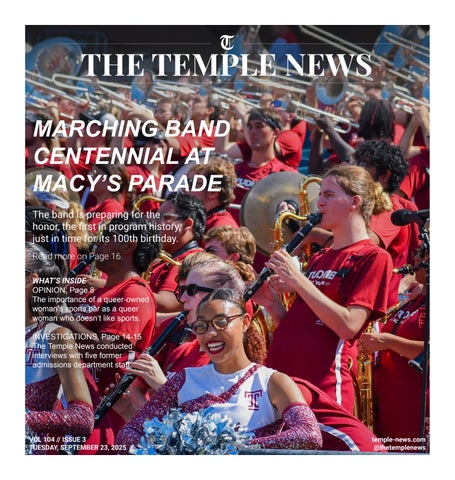
THE TEMPLE NEWS MARCHING BAND CENTENNIAL AT MACY’S PARADE The band is preparing for the honor, the first in program history, just in time for its 100th birthday. Read more on Page 16. WHAT’S INSIDE OPINION, Page 8 The importance of a queer-owned woman’s sports bar as a queer woman who doesn’t like sports. INVESTIGATIONS, Page 14-15 The Temple News conducted interviews with five former admissions department staff.
VOL 104 // ISSUE 3 TUESDAY, SEPTEMBER 23, 2025
temple-news.com @thetemplenews
PAGE 2
The Temple News
THE TEMPLE NEWS A watchdog for the Temple University community since 1921.
Sidney Rochnik Editor-in-Chief Valeria Uribe Managing Editor Anna Augustine Managing Editor Ryan Mack Co-Chief Copy Editor Bradley McEntee Co-Chief Copy Editor Nathan Horwitz Co-News Editor Connor Pugh Co-News Editor Caelan O’Neill Opinion Editor Wania Irfan Assistant Opinion Editor Madelynne Ferro Features Editor Benjamin Dipalma Assistant Features Editor Sienna Conaghan Co-Sports Editor Colin Schofield Co-Sports Editor Jacob Moreno Assistant Sports Editor Leah Duffy Investigations Editor Julia Anderson Director of Audience Engagement Nathaniel Thrush Co-Community Engagement Coordinator Kayla McMonagle Co-Community Engagement Coordinator Isabella Farrow Audience Engagement Editor Nalani Chiles Audience Engagement Editor Xavier Johnson Sports Engagement Editor Brian Nelson Photo Editor Lillian Prieto Assistant Photo Editor Aidan Gallo Assistant Photo Editor Ava Campbell Multimedia Editor Jeremy Shover Assistant Multimedia Editor Jack Larson Print Design Editor Daniya Eggleston Graphic Design Editor Chili Ramgolam Data Editor Ariana Droz Podcast Editor Sage Spohn Newsletter Editor Nadia Bodnari Web Editor Maria Lombana Advertising Manager Aaliyah Abdur-Rashid Advertising Manager
Follow us @TheTempleNews
The Temple News is an editorially independent weekly publication serving the Temple University community. Unsigned editorial content represents the opinion of The Temple News. Adjacent commentary is reflective of their authors, not The Temple News. The Editorial Board is made up of The Temple News’ Editor-inChief, Managing Editors, Chief Copy Editor, Deputy Copy Editor, News Editor and Opinion Editors. The views expressed in editorials only reflect those of the Board, and not of the entire Temple News staff.
ON THE COVER TEMPLE UNIVERSITY MARCHING BAND AT THE OKLAHOMA VS TEMPLE GAME ON SEPT. 13. LILLIAN PRIETO / THE TEMPLE NEWS
Contacts Visit us online at temple-news.com Email section staff news@temple-news.com letters@temple-news.com features@temple-news.com sports@temple-news.com The Temple News is located at: Student Center, Room 243 1755 N. 13th St. Philadelphia, PA 19122
CORRECTIONS In the print issue on Sept. 9, an article on PHEAA grants mistated the date financial holds will be placed on student accounts. Accuracy is our business, so when a mistake is made, we’ll correct it as soon as possible. Anyone with inquiries about content in this newspaper can contact Editor-in-Chief Sidney Rochnik at editor@temple-news.com.
The Temple News
NEWS
PAGE 3
CAMPUS
Temple falls 139 places in free speech rankings The school ranked 204 out of 257 schools in FIRE’s 2026 College Free Speech Rankings. BY NATHAN HORWITZ Co-News Editor
I
n the Foundation for Individual Rights and Expression’s college free speech rankings for 2025, Temple dropped 139 places compared to the 2024 results, ranking 204 out of a pool of 257 universities. Temple also received a grade of F for its overall speech climate rating. FIRE is an American nonprofit, nonpartisan organization which describes itself as devoted to defending free expression. Their annual rankings were launched in 2020 in collaboration with College Pulse and RealClearEducation to assist parents and soon-to-be students in making educated decisions about where they attend college. FIRE attributed Temple’s ranking to policy issues and a recent disciplinary action alongside decreased scores in their categories of comfort expressing ideas, disruptive conduct, openness, self-censorship, administrative support and political tolerance, with the latter two categories receiving grades of F. “[Students are] less comfortable expressing controversial views in different campus settings, that they’re finding more topics difficult to discuss openly and honestly,” said Sean Stevens, FIRE’s chief research advisor. FIRE and College Pulse polled 68,510 students for this year’s survey, using a core set of 20 questions. Temple’s survey results came from 307 student respondents. Seventy-two percent of Temple respondents said they would be uncomfortable expressing an unpopular political opinion to other students on a social media account tied to their name. “Temple University is deeply committed to free speech and the free discourse of ideas,” a university spokesperson wrote in a statement to The Temple News. “We encourage and educate our
BRIAN NELSON / THE TEMPLE NEWS The FIRE office in Old City.
students to use their voices to advocate for their beliefs and values, raise awareness and provoke thought.” Temple also lost points for its suspension of a student off-campus who filmed and posted a video of a sign that read “F–ck the Jews” in May. One day after the suspension, FIRE responded to Temple’s actions, asserting that while the sign may have been offensive, it is protected by the First Amendment and therefore does not meet the standard for discipline at a public university. “There’s no legal definition of [hate speech] in this country, because what most people put under that umbrella is protected speech,” Stevens said. Rocco Spinozzi-D’Andrea, a member of Temple’s Jewish Voice for Peace chapter, doesn’t give the results much weight. “FIRE is kind of notorious for looking for conservative voices, then finding instances of hate speech and then saying that should always be protected,”
Spinozzi-D’Andrea said. Temple received a yellow light rating for its Policy for Preventing and Addressing Discrimination and Harassment because of its definition of harassment, wrote Laura Beltz, FIRE’s director of policy reform. “It bans conduct that is “severe or pervasive,” rather than “severe and pervasive” per the Supreme Court’s standard for peer harassment,” Beltz wrote in an email to The Temple News. This definition risks punishing conversations for extending outside the classroom during the course of a multiday lesson on a sensitive subject, Beltz said. Temple also received a yellow light for its speech code rating. Colleges get this rating when they have at least one policy that leaves room for arbitrary application and administrative abuse due to its ambiguous language, according to FIRE. The Common Area Posting policy, Room Decorating policy, Political
Campaign Activities policy, Technology and Software Usage policy, Hostile Environment Harassment policy and the PADH were all designated as yellow light policies. “While we are committed to fostering an environment open to a diversity of thought, opinion and peaceful expression, it is also important to note that there are limitations,” the university spokesperson wrote. “To that point, Temple does not condone acts of hatred, incitement to violence, threats, harassment and discrimination against any individual or group. nathan.horwitz@temple.edu
NEWS
PAGE 4
The Temple News
CAMPUS
Philadelphia ranks fourth worst city for asthma Problems like poor air quality and ventilation contribute to difficult conditions for asthmatics. BY CONNOR PUGH Co-News Editor Philadelphia was ranked fourth most challenging United States city for asthmatics to live in a Sept. 9 report by the Asthma and Allergy Foundation. The report lists numerous factors that contribute to Philadelphia’s placement on the list, including high levels of air pollution, poverty and a lack of access to sufficient asthma care. Philadelphia also received a failing grade in the American Lung Association’s annual State of the Air report in April. The report was graded based on three categories of ozone pollution, short-term and year-round particle pollution. Situated in the heart of Philadelphia, Temple’s Main Campus is affected by general trends in air quality seen throughout the city. As a public place seeing daily use by numerous people, the needs for ventilation and air circulation are different from a private house or building. “If you grew up in a house, there is no outside air, besides you opening the front door,” said Joe Monahan, associate vice president of operations and maintenance. “With buildings, campuses, dormitories, there’s a constant flow of outside air.” Jackson Duncan, an asthmatic who lived in Morgan Hall during his freshman year at Temple, felt that he got sicker for a longer time while in the dorms compared to when he lived away from campus. “It definitely felt like I noticed a serious increase in asthma symptoms when I lived in the dorms compared to living off campus,” said Duncan, a junior political science major. Temple offers a variety of dedicated dorm buildings for on-campus living to students that have been constructed
COLT GUNN / THE TEMPLE NEWS A student walks out of Johnson and Hardwick Halls.
across multiple decades. Temple has regularly added and removed dorm options to accommodate demand and to modernize its facilities. This includes the closure of Peabody Hall, Temple’s oldest residential building at the time, in 2017. The newest built Temple dormitory is the Morgan Hall complex, which opened to residents in August 2013. The oldest buildings for dorm living are the Johnson and Hardwick halls, which first opened in the 1960s, and many of Temple’s school and dorm buildings have been constructed over the course of a century since the university’s founding in 1884. Ayden Arana, an asthmatic senior advertising major, lived in Johnson and Hardwick her freshman year, and felt a noticeable downgrade in air quality in the Temple dorms compared to other places she has lived in Philadelphia. “All of freshman year I would definitely need to have my inhaler on hand,” Ayana said. “When I moved out and moved into an apartment sophomore year, junior year and senior year, it has
not been nearly as big of a problem.” Around six buildings and the Baptist Temple have been in use by the university since before 1950. Other buildings’ interiors, like 1810 Liacouras Walk, have been extensively renovated, while its exteriors still remain from when it was originally rowhomes built in the early 20th century. All Temple buildings since the 1960s have had air filters for proper ventilation, Monahan said. These air filters can be easily replaced and cleaned to improve air flow and circulation within Temple buildings. Temple’s buildings also have air filters that are regularly cleaned and replaced alongside general maintenance of facilities. Maintenance of ventilation and air circulation at Temple is practiced in accordance with the American Society of Heating, Refrigeration, and Air Conditioning Engineers’ regulations. The ASHRAE publishes guidebooks with updated standards and procedures every four years and is followed by Temple maintenance, Monahan said. Proper air quality and ventilation is
part of the sustainability goals Temple adheres to with its Office of Sustainability. In its 2019 Climate Action Plan, one of the action goals was to improve indoor air quality by making all paints, adhesives and sealers in campus buildings free of Volatile Organic Compounds by 2019. This goal is categorized as “in progress,” according to the Office of Sustainability website. In the plan, Temple further committed to improving indoor air quality as future areas of study by ensuring all existing buildings have a high standard of indoor air quality. “Sustainability could be looking at energy, sustainability could be looking at air quality, and they conflict with each other,” Monahan said. “Higher air quality, higher outside air would require more energy, which is not sustainable. So there’s kind of a happy medium, and that’s where these guidelines come into play, to follow what is appropriate for this area and region.” connor.pugh@temple.edu
The Temple News
NEWS
PAGE 5
LABOR
TAP, TUHN authorize strike amid negotiations
Nurse and health professional unions are in negotiations with Temple hospital. BY BRADLEY MCENTEE & ANNA AUGUSTINE For The Temple News Temple University Hospital Nurses Association and Temple University Hospital Allied Health Professionals voted to authorize a strike Sept. 19 ahead of their contract’s expiration at the end of the month. Both unions, which are affiliated with Pennsylvania Association of Staff Nurses and Allied Professionals, are in negotiations with Temple University Hospital administration against proposed benefit cuts and for increased safety and staffing. Contract negotiations have been ongoing since July 8, said Marty Harrison, president of TUHNA. The unions, which represent 2,600 of the hospital’s nurses and allied professionals, picketed outside Temple’s Women and Families Hospital and Temple Hospital Main Campus on Sept. 10 to raise awareness of their ongoing negotiations. Their safety concerns come after registered nurses at TUH facilities experienced an increase in workplace violence, according to a PASNAP press release Sept. 8. “The safety of our patients and staff is our top priority,” a spokesperson for TUH wrote in an email to The Temple News. “We feel we’re having productive discussions on all the issues that the union has raised, and those discussions are ongoing as part of our regular labor relations process.” Seventy-nine percent of TUH Main Campus RNs do not feel safe at work and 94% believe administration has not instated sufficient security measures, an August 2025 internal survey, PASNAP wrote in the release. The unions are pushing for improved security stations at Temple hospitals. The current systems use similar
COURTESY / PENNSYLVANIA ASSOCIATION OF STAFF NURSES & ALLIED PROFESSIONALS
scanners to the Transportation Security Administration that compare scans to databases to identify weapons or other threatening objects. Since the systems are designed to screen for TSA, they often flag items hospital staff may not be concerned about, like eyeglass cases that are mistaken for improvised explosive devices. Other weapons, like knives, box cutters and guns have gotten past these checkpoints, Harrison said. The unions’ proposed safety initiatives include requiring a security or police officer to clear all private vehicles transporting patients to the emergency room, creating a new position for behavioral health specialists trained in de-escalation and providing staff access to emergency department door lockdown. “The biggest [proposal] is that new position of people trained in behavioral and mental health that can de-escalate situations and get people back on track so we can continue to provide care for that person,” Harrison said. The unions also proposed an updated policy on violent incident debriefs,
meetings held with affected staff members, hospital administration and union representation after security incidents, to identify how to avoid future incidents of workplace violence. Though the meetings are standard practice, they are not executed in the same manner across all units. The unions are pushing for debrief protocols to be formally written in their contract to ensure them as a consistent practice and to apply the necessary changes relayed in the meetings across the hospital, not just in localized units. TUHNA and TAP also have proposed initiatives surrounding Temple’s Women and Families Facility, which opened inpatient services Sept. 3. They are advocating for licensed security officers to be on-site 24/7 at the new location and improved emergency labor and delivery care at Main Campus. All labor and delivery services have moved from TUH Main Campus to the new facility, which does not have an ambulance bay to receive emergency patients. TUH administration is stationing one labor and delivery nurse in Main Campus emergency department for the
first month. The unions cited concerns about adequate emergency maternal care after the one-month deadline. In contract negotiations, TUH proposed changes to the benefits plan that PASNAP said would greatly increase the cost of out-of-network care for its employees, requiring them to visit TUH facilities for care they would typically receive elsewhere. The unions are concerned with TUH’s number of facilities and ability to accommodate their workers. The policy changes would be especially impactful to union members residing in Philadelphia’s suburbs or New Jersey, as their local urgent cares and emergency rooms are often University of Pennsylvania or Thomas Jefferson University facilities. “We had the example, for instance, of a nurse who just found out she was pregnant and when she called to get an OB appointment, the next available appointment would have been in her second trimester by that point,” Harrison said. bradley.mcentee@temple.edu annaaugustine@temple.edu
NEWS
PAGE 6
The Temple News
CAMPUS
Cuts to SNAP impact food security for students Resources like The Hope Center and the Cherry Pantry hope to reduce the cuts’ impact. BY CONNOR PUGH Co-News Editor Cuts and policy changes to the Supplemental Nutrition Assistance Program went into effect Sept. 1, impacting millions of Americans on the program. The changes are part of larger policy changes of the One Big Beautiful Bill Act the Trump Administration signed into law July 4. SNAP recipients who are between 18 and 54 years old, considered able to work and do not have a dependent under 18 must now work at least 20 hours a week. Those enrolled in a work-study program, participate in an on-the-job training or who are self-employed and earning at least $145 a week are exempt from this requirement. These restrictions will be extended to veterans, the legally homeless and former foster youth aged 18 to 24 on Nov. 1. The exemption for dependent children will also be lowered to age 14. Temple programs like the Cherry Pantry and the Hope Center for Student Basic Needs work to combat student food insecurity and will be expanded alongside these cuts, including a new Essential Needs Hub that will provide services to cover the basic living needs of all students. “For many, SNAP has been a critical resource in closing the gap between limited income and high living costs,” wrote Jodi Bailey Accavallo, vice president for student affairs, in an email to The Temple News. “The new work requirements may be especially difficult for students who cannot take on additional hours because of class schedules, clinical placements, or disabilities.” Any person who does not meet these requirements and is not exempt will only receive three months of SNAP benefits in a three-year period. These new requirements are especially impactful to college students, said
MARIA MAZA RION / THE TEMPLE NEWS A student looks through the Cherry Pantry at the Howard Gittis Student Center.
Annette Ditolvo, senior program manager for basic needs support. “You are going to school full time, you’re not necessarily working full time,” Ditolvo said. “That’s a lot on someone’s schedule. Just by virtue of being a college student, the eligibility requirements are a bit more restrictive than the general population.” College students can meet certain exemptions to receive benefits, like participating in a federal work-study or an on-the-job training program. About 41% of college students in the United States face food insecurity, according to Temple’s Hope Center for Student Basic Needs. Alongside the survey’s findings of high levels of housing insecurity, tuition rates and mental health challenges, the cost of living at college can be burdensome for students with financial difficulties. “I think [SNAP changes] will have a great effect on students and Temple University,” said Maeve Finnegan, a senior public health major and intern at the Cherry Pantry. “If Temple University students use SNAP to purchase nutri-
tious foods, then they’ll be greatly affected, because college students are disproportionately affected by food insecurity.” The Hope Center is a program through the Lewis Katz School of Medicine dedicated to combatting student financial insecurity. Alongside nationwide studies, the center implements programs at Temple to reduce the impacts of hunger and other forms of economic adversity. Temple students can also use the Cherry Pantry, a resource in the Howard Gittis Student Center that offers food items and hygiene products on a weekly point-based system. Since SNAP cuts took effect, more students have used the Cherry Pantry, Accavallo wrote. This year, the Hope Center will launch its Essential Needs Hub in the basement of the student center, where the campus bookstore used to be located. The Hub will offer a variety of programs and services dedicated to supporting the students’ basic needs. The Essential Needs Hub will house an expanded Cherry Pantry that offers food items, hygiene products, laundry and cleaning
supplies, pharmacy products and a new test kitchen for nutrition programming. Other services part of the Essential Needs Hub will include crisis and emergency services, as well as case management for crisis responses. The Essential Needs Hub will also include population-specific resources for first-generation students, students formerly in the foster system and parent students, as well as veterans and commuters. Besides the Cherry Pantry, the Essential Needs Hub will contain a 50-seat classroom for programming, a satellite resource center for Tuttleman counseling services, a “zen den” and an autism sensory space. The Essential Needs Hub will also include a bike distribution program and a Temple Thrift Storefront for kitchen and clothing goods. “The idea is to create a comprehensive space where students are able to get connected to resources that help them thrive at Temple,” Ditolvo said. connor.pugh@temple.edu
OPINION
The Temple News
PAGE 7
EDITORIAL
STUDENT LIFE
Minimum wages
Trying to make ends meet
Student workers are vital to the Temple community, performing a variety of jobs across multiple departments. Jobs like library or Information Technology operations play a role in how the university functions as a whole, while other jobs prepare students for their desired careers. The starting wage for Temple student workers is $7.25, in accordance with the federal minimum wage. While some students can earn as much as $40 an hour, the average wage for Temple student workers sits at $12.67 an hour, according to a university spokesperson. Current wages are unsuitable to support students during a time of inflation and economic decline. The Editorial Board urges Temple to raise its university-wide student worker minimum wage to fairly compensate students and ensure student workers can get by, even if they’re only being paid the university’s minimum. If the university wants to show they care about these invaluable members of the Temple community, then wages should be increased to reflect such a sentiment. Wages at Temple are determined by each individual department, so any department with student workers can choose their own payrates depending on the kind of work a student is doing, a university spokesperson told the Temple News. Raising the university minimum wage would force departments across the board to increase their wages accordingly and lead to many students receiving pay increases. Temple’s average student wage is almost $4 short of the national average and isn’t on par with other Philadelphia schools.
A student discusses living paycheck to paycheck and argues that it’s not an indication of failure.
The average wage for student workers in the United States is $16.57 an hour while the standard student worker in Philadelphia earns $17 an hour, according to ZipRecruiter. The lowest possible livable wage for a single adult with no children in Philadelphia is more than $25 an hour, according to a calculator created by the Massachusetts Institute of Technology. Students need adequate wages to be able to afford basic needs. During a time of economic decline, increasing inflation and cutbacks of government supplemental programs like SNAP and Medicaid, low student wages aren’t acceptable. Fifty-nine percent of students have at least one form of basic needs insecurity, with 41% of students facing food insecurity and 48% struggling with housing insecurity, according to February 2025 survey by The Hope Center for Student Basic Needs. Temple needs to set the standard for students who are entering the workforce about what fair compensation looks like. By underpaying students, Temple is teaching them it’s acceptable to be unfairly compensated when they leave school. Working as a student employee for a university can have many benefits, from networking to experience to skill strengthening. Students shouldn’t have to pick between work experience and their basic necessities. Temple’s operations would look drastically different without the assistance of student workers. Student workers deserve to be fairly compensated for their hard work and sacrifice of what little free time they have to ensure the efficacy of university functions.
BY CAELAN O’NEILL Opinion Editor
A
s the first of the month approaches, I feel a bubble of dread in my chest. Rent is due and I don’t have the money to pay it. This happens every month and I always tell myself I’ll be better prepared next time. But as someone who lives paycheck to paycheck, it’s not possible to simply “do better.” I often find myself having to pick between groceries and rent, and when I choose groceries, I regret it. I blame myself for spending too much on frivolous purchases, even if it’s on necessary items. However, blaming myself isn’t productive. Larger societal problems like low wages and high cost of living force many people to pull, yank and stretch themselves to make ends meet. Many people who pay their own bills know the dread that comes when a due date approaches. Living paycheck to paycheck means that all income goes to necessities like rent, food and healthcare without having money for savings or pleasure. Many people can’t afford to cover their necessities with one paycheck and have to choose between some of their basic needs. This is by no means healthy, but it is a common issue. People shouldn’t feel like they are failing because they don’t have an abundance of money. Sixty-seven percent of U.S. workers in 2025 report living paycheck to paycheck, up 4% from the year prior, according to a March 2025 report by PNC Bank. The current state of the economy makes it harder for people to be able to support themselves because resources, such as public assistance and wages, aren’t adjusting with the times. While inflation rates aren’t the highest they’ve ever been, consumer prices have risen 24.6% since August 2020. Rent and mortgage prices are increasing rapidly but wages aren’t increasing fast enough for people to keep up.
The average rental price in the United States reached $2,005 this year. Someone’s income would need to be more than $80,000 a year to live comfortably with a rent payment this expensive. This is a 35% increase since before the pandemic, according to a March 2025 study by Zillow. There’s a flaw in the system when people are struggling this badly without any government assistance. People should be able to find support in public aid programs. Instead, they’re being neglected and failed by the system. There are currently no states in the US that have a minimum wage that people can support themselves with. The average income of a Gen Z employee in Pennsylvania is only $40,784, Nasdaq reported. Students are taking new measures to save money, including living with six people and turning living rooms into bedrooms to split rent with more people. Parents are also working extra jobs, borrowing from retirement funds or delaying retirement to help their students pay for college. It’s terrifying to look at these statistics while working so hard in college and knowing the struggle is going to continue after graduation. But it reinforces that it’s not an individual problem, it’s systemic. These statistics aren’t meant to create a sense of doom and hopelessness. But sometimes it’s reassuring to know everyone is on the same level and that savings don’t determine people’s value and worth. Living paycheck to paycheck isn’t an indication of failure. It’s just a horrific side effect of a system designed to make the wealthy richer and ignore the poor. caelan.oneill@temple.edu
PAGE 8
OPINION
The Temple News
THE ESSAYIST
Finding home in Philly’s new women’s sports bar A student shares how important Philly’s newest bar will be to her as a queer woman.
BY CAELAN O’NEILL Opinion Editor A line spanning two and a half blocks appeared on Friday night at South Street to celebrate opening night of Philly’s newest bar, Marsha’s. The bar opened at 4 p.m., but the line wasn’t moving despite the fact I showed up at 8:45 p.m. Even though I couldn’t get in, it warmed my heart to see people posted up in line. Many people brought friends to chat with to pass the time and others brought their latest crochet projects to work on while they waited in line. I went back the next night, with low hopes and high determination. This time I had most of my friends with me to endure the 45-minute wait. We caught each other up on drama, chatted with other people in line and one of my friends started an Eagles chant. I eagerly awaited the opening of Philly’s first queer owned women’s sports bar all summer. I don’t actively support any sports teams, regardless of gender, mostly because I lack an understanding of them. I also find sports-centric places intimidating. I can feel the exasperation radiating off any man who’s trying to explain to me what a first down is. The one sport I do understand, hockey, is a white male dominated sport from the fans to the players. I went to many hockey games when I was younger and started going again last year when I moved to Philadelphia. It’s the easiest and most entertaining sport to follow, without the downtime of football or the lengthiness of soccer. Although I love it, I never see my-
GEORGIA BOND / THE TEMPLE NEWS
self represented in these environments, and I constantly feel out of place. But the importance of Marsha’s to me isn’t just about sports. First and foremost, Marsha’s is a queer bar and Temple alumna, Chivonn Anderson, owns it. The keyword here is owns — Anderson wanted to make sure the bar wouldn’t fall victim to slumlord tactics like raising rent to flush the bar out, so she bought the space that Marsha’s operates out of. Our space can’t be taken if we own it. Philadelphia doesn’t have a lesbian bar. The last one closed due to the pandemic before I moved here, so I didn’t get to experience it. Lesbians and sapphic queers are expected to accept the handout of being allowed into gay male spaces, to shrink themselves and not take up too much room. It’s not just an expectation in Philadelphia, it’s everywhere. Sip City, a Philly-based organization curating events centered around women and LGBTQ+ identities, exists but it’s not
the same as an established bar. While Sip City has been instrumental in exploring my sexuality and connecting me to the queer community, these events often rent out straight bars or restaurants. We get three to four hours to exist, together as a community, and then lose it. There was no permanence nor stability in the sapphic spaces in Philly — until Marsha’s. In addition to being a queer bar, Marsha’s is for sapphics and those who support us. Marsha’s commitment to women’s sports sends a broader message; people care about women’s sports to the point we want a bar solely dedicated to them. When I finally walked into Marsha’s, I wanted to cry. I was overwhelmed by the sense of community and the excitement buzzing in the air. No one felt like a stranger because we were all connected through our desire to feel like we finally had a home. I only made it into Marsha’s an hour before closing, but for that hour I wasn’t
stressed or scared. My friends and I were together and it felt like there wasn’t anything wrong in the world. Marsha’s opening comes at the perfect time, providing a safe space and a beacon of hope that the queer community isn’t going anywhere. The drinks were cheap and strong, the music was loud and the people were happy. It’s all we’re asking for, to simply be able to exist with our community without fear. Now we have a home in Philly, where we can do just that for a few hours at a time, nestled within queerowned, rust-colored bricks on the corner of Fourth and South Street. Marsha’s welcomed us, now we have to welcome Marsha’s. caelan.oneill@temple.edu
The Temple News
OPINION
PAGE 9
THE ESSAYIST
How the ritual of coffee became my daily routine A student shares what coffee means to her and how it has helped her through school.
BY WANIA IRFAN Assistant Opinion Editor I never enjoyed the taste of coffee when I was younger. Since I was just a child, I prioritized sweeter tastes and didn’t care for the caffeine boost. But my coffee journey changed when I was 11. I vividly remember going to Dunkin Donuts to grab breakfast with my father. He excitedly bought a warm cup of coffee and can still recall hearing the “ahh” sound with every sip he took. His reaction made coffee seem more appealing to me and it drew my attention. During the drive back home, he noticed I was eyeing down his cup and offered me a sip. My father was not the biggest fan of sweet coffee; his coffee was often bitter, so when I first tried it, I hated it. The next time my father and I went on a breakfast run, I asked him if I could order my own coffee. I got it with vanilla and a lot more sugar in comparison to his bitter one. When I took the first sip, I immediately fell in love. At first, I only ordered hot vanilla lattes, but with time my taste expanded to a variety of cappuccinos, americanos, lattes, espressos, iced coffees and cold brews. My latest hyper-fixation has been a salted caramel cream cold brew. At first coffee started as a simple caffeinated drink I ordered for fun, but with time it became something more meaningful to me. A sip of coffee can help me survive when I only get a few hours of sleep, or it can make me slow down during a hectic day. It’s ritual, comfort and identity poured into a cup. Coffee has the power to bring peo-
MARIA JONES / THE TEMPLE NEWS
ple together, but this is especially true for my family. This caffeinated beverage is the common denominator that ties us to each other. We all enjoy our coffee in different ways, but what matters is that we enjoy it while sitting together, sharing laughter and conversation. For me and my family, coffee is connection. Coffee had always been a constant in my life, but once I got to college, coffee became my lifeline. During my freshman year, I realized how much I relied on coffee and the fact that a simple beverage was able to remind me of home. I religiously grabbed a cup before my morning classes. I felt like I couldn’t function without it and needed it to find the motivation to study and get out of my bed. Coffee became something I looked forward to every morning, it became a comforting part of my routine. I would constantly spend my last $5 on and I even risked being late just so I could grab a cup. I always found a way to have a cup of coffee in my hand if I needed it. Nowadays coffee still brings me the same comfort and it will probably con-
tinue to be a precious part of my routine in the years to come. I always crave a cup to alleviate the stress and dullness of a long day. Campus is full of students walking around with a cup of coffee in their hands. Seeing everyone with their coffee makes me feel like I’m part of an unspoken community. It brings me comfort knowing I’m not the only one who might need the extra energy boosts on days when I feel unmotivated. I’m not the only one who uses coffee as part of their ritual, which makes it even more meaningful to me. Every cup tells a different story and even though coffee is just an ordinary drink it can also be a common denominator among students on campus — a ritual that belongs to a wider community. While I do not consume coffee as consistently as I did during my freshmen year, it will always remain a comfort drink of mine. Something I can look forward to, something that helps brighten my mood and something that brings me nostalgia.
Coffee is more than a caffeine fix. It is a cultural and personal ritual. A reminder that even in most individual routines, there is a similarity of coffee. Not only does each cup hold energy, but it holds community. wania.irfan@temple.edu
PAGE 10
OPINION
The Temple News
STUDENT LIFE
Set healthy boundaries with alcohol in college A student encourages her peers to examine their drinking habits and use campus resources. BY CAELAN O’NEILL Opinion Editor Jaharrah Hartman realized she tends to drink more when she’s with friends or in social settings compared to when she’s alone. She now sets certain boundaries to make sure she doesn’t get too drunk when she goes out. “I try not to drink too much if I haven’t eaten that day, and I usually give myself at least like, 30 minutes before getting another drink. Just so I know my tolerance and how I’m feeling,” said Hartman, a sophomore architecture major. “If I was by myself, I wouldn’t really be drinking at all. I only really drink when I’m out with my friends.” Peer pressure, social anxiety and stress are some of the reasons that cause students to drink. More than 2 million college-aged people report heavy alcohol use, according to a 2024 survey by the Substance Abuse and Mental Health Services Administration. While it’s not realistic to expect all students to stop drinking, they should establish healthy boundaries with alcohol early in life to minimize negative effects, injuries or accidents. Students who feel like they need help improving their relationship with alcohol should take advantage of the resources Temple offers. It might be scary but recognizing the need for help is the first step. Approximately 20% of college students display patterns of alcohol use disorders. One in four students report academic problems like missing class, falling behind and getting lower grades, according to Standford Medicine. The stigma around alcohol use can prevent students from asking for help when they need it. Setting boundaries with alcohol is nothing to be ashamed of. Asking for help is a logical step to deal with health concerns and students shouldn’t be afraid of reaching out for support. The first six weeks of the freshman semester is a vulnerable time for new
KEELY CARTER / THE TEMPLE NEWS
students and can lead to overdrinking. Students desire to fit in, make friends and their newfound freedom can be overwhelming, which is why setting limits with alcohol is paramount. Dr. Sharon Kotch, the coordinator of Campus Alcohol and Substance Awareness Unit at Tuttleman Counseling Services believes it’s important for students to learn how to set boundaries with alcohol early in college. “I think if students would take some time to educate themselves on how alcohol could really impact their physical health, their emotional health, and their ability to concentrate, they may drink less,” Kotch said. “It really can be so impactful on their ability to do well in college.” Behaviors like excessive drinking while alone and participating in physically risky activities, like drunk driving, are an indication a student needs to evaluate their alcohol use. Students should pay attention to these signs to know when it’s time to reach out for help. Dr. Mary Morrison, the vice chair-
person for research, psychiatry and behavioral science, believes it’s important to look for alcohol consumption patterns since there are multiple guidelines to help students identify if they may be overdrinking. “If you wake up the next day and you don’t remember what happened, or maybe bad things happened that you wouldn’t have wanted to happen if you hadn’t been drinking,” Morrison said. “Amounts are important, and rapidity of use, as well has having control.” Students can set limits on the amount of time and money spent on drinks and join alcohol-free activities like attending a club meeting, utilizing the student center or attending Temple sporting events. Having friendships that go beyond drinking can be helpful to create healthy boundaries with alcohol. Tuttleman offers several alcohol use programs to help students improve their relationship to alcohol. Let’s Talk About Alcohol is a 45-minute peer facilitated group to help students discuss why they may choose to drink or not.
Temple Collegiate Recovery is an on-campus program with weekly meetings to connect students who are in recovery. Students who are sober-curious can reach out to discuss their experiences and gain insight from others in a similar situation. Students shouldn’t feel the need to keep up with friends who have a higher alcohol tolerance. Doing so only harms the person pushing their limits and might have negative consequences. It’s important for students to remember they’re the ones who have to deal with the effects of drinking. caelan.oneill@temple.edu
ALL IN GOOD FUN
The Temple News
Costume Ideas Halloween Costumes Word Search
PAGE 11
Autumn Chain Link
‘Tis the season to start planning for the Halloween festivities.
Join consecutive words using the clues in-between. Every word pairs with the word above and the word below.
E P S S J Z N S P S G K R U E B X ON R K K C Y A E Y R J GG I WN C L K P G V A R UMG B I ZWB G H F S F R G E N L M P L D R L RON B U R G A ND Y A C A AM U Q X N I I M C K C O VWV Y R K Y Y MM B F C H N N I C R T X Y H Y L I T A Z N X E FWB D A K I D S U F L RM K P B V Q S T R K F A C K Y Y Y E H I P R A D A V I D B E C K H A M F U ZWQ OW P E L P H A B A D S R Z R H P E X U S E A O S H ND I T E D S K H P F NM F S D Y Q P X E L L I DM YW P L E VM A I N A DOMM A J A Y P V K K F C NM B B E WV I B X B B V D A V E R K R N T U L S S B S Y Y U R X A Y S D E U J X V E E D T OOGQ BMC FMG R Z X E RO I R A S K N U B UQ R E X C A U Z X G CMX Y L D I G T Y C I I K X Z G T X R E I I K B V V P I R A T E K Q O C A U X E R RW G M Y X F PWM A R T Y M C F L Y V D X Kim Possible Pirate Amaya Papaya Labubu Poison Ivy David Beckham Lady Gaga David Beckham Ron Burgandy Pearl Elphaba Freddy Krueger Sabrina Carpenter Marty McFly Sabrina Carpenter Freddy Krueger Pearl Kim PossibleGlinda Ron Burgandy Poison Wednesday Ivy
Wednesday
Lady Gaga
Elphaba
Amaya Papaya
Marty McFly
Glinda
Labubu
Pirate
®
DANIYA EGGLESTON, MARIA JONES, JACK LARSON, ETHAN NOCK/ THE TEMPLE NEWS Build your own custom worksheet at education.com/worksheet-generator © 2007 - 2025 Education.com
LIVE Philly in
BRIAN NELSON / THE TEMPLE NEWS The Pig Iron Theatre performed at Logan Square on Sept. 20.
Philadelphia celebrates opening of Calder Gardens Calder Gardens was consecrated from bohemian chic to eclectic artwear, with an enchanting pre-opening were on full display to celebrate Calder, day parade. whose work championed queerness, bold expression and individuality in a BY BRIAN NELSON world that often demands conformity. & LILLIAN PRIETO “It’s so important to see queer visiFor The Temple News bility of not only queer trans folks, but
T
he sun burned down on Love Park as hundreds gathered to honor the work of 20th century American sculptor and artist Alexander Calder at noon on Sept. 20. After the parade began, it spilled down the Benjamin Franklin Parkway to its destination point at Maja Park. Artists young and old wore all sorts of fun fabrics and patterns in an eclectic riot of color. Avant-garde styles, ranging
of Black and brown folks as well,” said Tiffany Uma Mascara, a local drag performing artist. As the parade progressed, it attractedthe gaze of curious onlookers. Dog walkers paused mid-stride, cafe diners turned in their seats and passersby amazed as if caught in a sudden trance. PHonk!Philly, a local percussionist group, and Mad Beatz Philly, a professional drum-line entertainment company based in Kensington, led the way from LOVE Park through Swann Me-
morial Fountain playing sounds of jubilation with their sticks. “I’ve seen Mad Beatz practicing in Kensington, so I came down to support them,” said Jesse Engard, an attendee from Kensington. Instead of floats and decorated cars, there were pockets of performance — artists and dancers weaving through the streets in complete orchestrated chaos. Performances by the Almanac Dance Circus Theatre and the Pig Iron Theater School, local performing arts groups, paid tribute in their own language of movement, a symbolic ode to Calder and his absurdist vision and creative legacy. Dancers swirled in spirals and cried out in displays of the kinetic elegance of camp. “It’s such an honor to be asked by
a traditional arts institution to represent a more marginalized underground form of art,” said Miss Thing, a local interdisciplinary drag artist. The parade concluded on a cosmic note at Maja Park with a performance by Sun Ra Arkestra, Philadelphia’s own interstellar jazz ensemble. Led by Marshall Allen, a 101-year-old saxophonist, the band appeared in shimmering metallic robes. Their set, a journey through sound and space, included a collection of original songs from their most recent album release, “Lights on a Satellite.” “Art is here, art will always be here and art will keep coming,” said Cupid Bowe, a local drag queen performer. brian.nelson0003@temple.edu
LILLIAN PRIETO / THE TEMPLE NEWS Kensington-based drumline Mad Beatz leads the second half of the parade.
BRIAN NELSON / THE TEMPLE NEWS Drag performers Miss Thing and Eric Jaffe strut down the Benjamin Franklin Parkway.
LILLIAN PRIETO / THE TEMPLE NEWS Jazz ensemble Sun Ra Arkestra perform a collection of original songs at Maja Park.
BRIAN NELSON / THE TEMPLE NEWS The Almanac Dance Circus Theatre showcasing their final act at Maja Park.
BRIAN NELSON / THE TEMPLE NEWS PHonk!Philly guides attendees down the Benjamin Franklin Parkway.
PAGE 14
INVESTIGATION
The Temple News
INVESTIGATION
How admissions lost dozens of its staff members Several of the former employees cited leadership under Jose Aviles for their departures. BY EVELYN BLOWER For The Temple News
D
aniel Pearson walked into the office after a two-month break from the admissions team on Jan. 6, 2025. He was away from his role as assistant director for transfer admissions and re-enrollment from November to January, using the time off allotted by the Family and Medical Leave Act. Pearson left in November due to anxiety and depression, which was exacerbated by his job at the admission office, he said. When he came back on Jan. 6, Pearson quickly realized he needed to leave — the environment was stressful, and nothing improved while he was away. “I didn’t have another job lined up,” Pearson said. “I had been applying for a while, but I just couldn’t do it anymore. I tried to take a couple months away to readjust my head to everything and see if I was just being too alarmist. In fact, if anything, a lot of my warnings were on the low side of what occurred.” Pearson cited multiple factors that influenced his departure, but one of the biggest was the Vice President for Enrollment Management Jose Aviles’ leadership. Aviles didn’t listen to staff members about admissions issues, among other things, which made a large portion of the admissions department doubt him, Pearson said. More than 25 admissions counselors, directors and staff were laid off or left the department between Aviles’ hiring in March 2023 to present, according to former anonymous staff members. The university cannot comment on specific personnel decisions, but confirmed there was a broad restructure in the department under Aviles. “I’m proud of the work that we’ve done,” Aviles said. “We definitely walked into a challenging time for admissions
but when you look at what’s really happened in the last two years, I think I’m most proud of the foundation that we’ve set.” The Temple News interviewed former admissions staff and Aviles to conduct a comprehensive investigation into what was happening in the admissions department as students reported experiencing delays in admissions decisions, issues with credit transfers, struggles with advising and financial aid packages in the last year. Names have been changed to honor the anonymity of the former admissions staff. MAY 2023 Aviles began his position in May 2023 after six years at Louisiana State University as the vice president for enrollment management and student success. He also previously worked in the admissions departments of multiple universities. “Up until [Aviles] came, I had noted the stark difference in his ‘leadership’ approach to that of [Jim Van Blunk] or [Karin Mormando] or anyone else that I had previously connected with at Temple,” said ‘Z,’ an anonymous former admissions staff member. “I recall our first meeting with him, and he talked at us the entire time. His leadership style just left a lot of questions for folks about why he would choose to engage us in the way that he elected to.” At least three former admissions counselors posited that Aviles’ tone while speaking to employees and his leadership style were significantly different from previous department leaders. “His [Aviles] sentiments were, ‘If you don’t like it, leave if you’re out of alignment, leave if the work is not for you,’” Z said. “That was very jarring. None of us are obviously in higher education, certainly not at Temple, for the paycheck.” Freshman admissions counselors made around $39,000 to $42,000 per year, and transfer admissions staff made a starting salary of around $50,000 a year, said ‘Y,’ another anonymous for-
mer admissions staff member. A current job listing on Temple’s human resources page for a Temple enrollment management admissions counselor is at the T23 level on Temple’s salary structure — the minimum yearly wage is $32,000, with a salary range that extends to $60,830. OCTOBER 2023 Aviles met with the admissions staff and announced he would restructure the department, according to the former admissions staff. The changes included shifts in employee reporting and adding new vice provost positions. At the time, many of the admissions associate directors and team heads reported to Karin Mormando, the director of undergraduate admissions, and she reported to Aviles. After the meeting, Aviles reassigned the staff members who used to report to her to other supervisors. Aviles also announced three new assistant vice provost positions: one in student success, one in recruitment and one in operations and processes. Aviles hired Bhavesh Bambhrolia for enrollment management operations from his position at the Office of the University Registrar in January 2024. He also hired Nakia Mack for recruitment in April and Shawn Fagan from the College of Engineering for student success in May. JUNE 2024 The University of the Arts abruptly announced its closure on May 31, 2024. The news shook the higher education sector in Philadelphia and approximately 300 of UArts’ former students transferred to Temple to continue their education. Aviles laid off two admissions directors on June 4: Mormando and Christina Irby, the director of transfer admissions. Mormando and Irby each had 20 years of experience in university admissions. Aviles cited budget reasons for the decision, said one former staff member familiar with the situation. James Van Blunk, the director of
first-year admissions, planned to retire at the end of the month. With the departure of at least three long-time staff members from the department, many of the remaining employees were unsure of their future in the department. “After you’ve dedicated your life to an institution for that long and have not been scandalous or anything, that’s insane,” said ‘W’, a former admissions staff member who was still with the department when Mormando and Irby were let go. “For what they did for the institution, [laying them off] was unfathomable and changed and solidified everything of what we had been feeling for a while.” The university cannot comment on specific personnel decisions, but a university spokesperson confirmed two positions were eliminated as part of a broader restructure within the department. After Aviles let Mormando and Irby go, he directed all transfer admissions staff to report to Nakia Mack. “Yes, we’ve had to restructure the organization because it wasn’t structured in a way to be able to accomplish [student success and recruitment],” Aviles said. “We’re in a much better place, and we continue to look at and think about putting students at the center of our decision making.” FALL 2024 Multiple people in the admissions office left in October. Some cited their reasons to leave, like the low pay grade or the “excessive workload” Aviles expected from the regional counselors. A few staff members left without other employment offers, multiple former admissions counselors said. The first-year counselors who recruited students from high schools made around $39,000 a year. Before Aviles was hired, admissions counselors were expected to complete around 65 to 75 visits in a year, but Aviles wanted to “outwork the competition,” Z said. “Initially, it was really jarring to up our school visits to do 160 to 200 visits,” W said. “Regional counselors in California, Texas, Illinois or Florida recruiting
The Temple News
INVESTIGATION
PAGE 15
INVESTIGATION in those areas had to do 240 visits. There wasn’t really a change in support, or a reason why, and that number is unheard of through the admissions community nationally.” Aviles confirmed baseline recruitment functions in admissions should be traveling to three to four high schools in a given day during application season. Admissions counselors typically begin reviewing applications for Spring admission in early to mid-October. To Pearson’s understanding, while he was on FMLA, they didn’t start reviewing files for the Spring 2025 semester until the third week of November, he said. Aviles implemented Slate, a customer relationship management system for college admissions. Former admissions counselors noted it was the top platform for admissions offices across the country. Many staff members at Temple wanted the system, but its rollout was plagued with issues, they said. Multiple admissions staff did not have access to Slate or did not know how to use it until late in the admissions process, some reported. Slate offers a technology trainer to assist with the installation, but Aviles did not hire an in-person trainer to aid during the transition, former admissions staff members said. “I sent emails in October to my superiors which I believe were passed along,” Pearson said. “I started with, ‘We need
LILLIAN PRIETO / THE TEMPLE NEWS Students walk down Polett Walk.
to get this figured out, we need access to Slate, we need access to review files, we need to be able to start doing credit evaluations or we are not going to do this.’ I got no responses from those.” Aviles told The Temple News that Strata Information Group, a higher education technology consultant, was engaged to support the implementation of Slate. “We, as a staff, would constantly be reaching out for updates to leadership, to [Bambhrolia], and to [Mack], and [Aviles] through them, and we would get nothing, absolute crickets,” said ‘X,’ a former admissions staff member. “Students are constantly calling and emailing and rightfully so, they don’t have answers. And every day we are just getting berated from every side because we don’t have anything to tell them.” That fall, Temple applicants posted on Reddit, mentioning issues getting in contact with the admissions staff. Applicants reported “radio silence” treatment after applying for early action in October and other issues with receiving admissions decisions within months of applying during the typical college application season. Many of the posts cited communication issues with the university’s enrollment department. Aviles said some of the issues with the implementation of Slate caused the department to start reviewing applica-
tions in November, later than usual. “There were a lot of pieces there and certainly challenges came along with that, but that’s expected with something of that scale,” Aviles said. “What’s important for all of us to keep in mind is that we were focused on the long term impact and continuous improvement.” The Nov. 1 early action deadline caused problems for students and admissions counselors alike. The student portal and application checklist had issues with requirements and different activation problems that counselors were unable to fix. Some students called to inquire about the portal activation email they never received. “The best way I can describe the Fall semester is that all of us, first year and transfer team, were on an apology tour for the entire semester,” X said. “All we were doing was apologizing to students, to parents, to high school counselors, to community college partners, just constantly, ‘I’m sorry your student hasn’t heard from us,’ ‘I’m sorry your student can’t get a hold of us.’” FEBRUARY 2025 Though the number of admissions staff who left varied between Aviles’ hiring and the staffing changes around June 2024, more than 25 people left for other positions or retirement by February 2025, according to former staff mem-
bers. There were about three remaining first-year counselors at the time when one former admissions staff member left, they said. The university cannot comment on specific personnel decisions. “More people leave, that increases burnout, but it should never happen that [more than 20 people] leave and we have no new hires the whole time I was there,” W said. Due to budget concerns, Temple is currently in a hiring freeze, but Aviles appealed and got an exception for the admissions department. Aviles said he takes pride in being able to welcome a record high number of undergraduate first-year deposits for the Class of 2029, and that the university is on track to increase the retention rate for first- to second-year students for the first time in seven years. “It happens when we work hard and are really laser focused and committed and believe in the mission of what we’re trying to do,” Aviles said. “I think the outcomes you see are evidence of the things that are moving in the right direction, even though we’ve had difficult times throughout the year where we’ve had to juggle a bit and keep things moving forward.” evelyn.blower@temple.edu
PAGE 16
FEATURES
The Temple News
AROUND CAMPUS
TUDMB drums up excitement for its 100th year The Temple University Diamond Marching Band play at Macy’s Thanksgiving Day Parade. BY BEN DIPALMA Assistant Features Editor
M
atthew Brunner, director of the Temple University Diamond Marching Band, dreamed of one day taking the band’s performance to Macy’s Thanksgiving Day Parade. He thought that 2025, the band’s 100th year, would be prime time for the performance. He began the meticulous application process nearly a year and a half before the parade was taking place and anxiously awaited an answer. Then, a letter arrived in the mail. His dreams had finally come true: TUDMB was picked to march in the Macy’s Thanksgiving Day Parade for the first time in its history. “We all went nuts,” said Anh Thu Tran, a junior chemistry major and the logistics coordinator for TUDMB. “We had our confetti, and we were throwing it everywhere. I was really excited because we watched the Macy’s Thanksgiving Day Parade on TV every year and knowing that we were going to be a part of it, especially on the 100th anniversary of the band, was something really awesome.” TUDMB was founded by Herbert E. McMahan in 1925. The band has performed in a plethora events since its inception, including the first-ever Sugar Bowl in 1935, the Mirage Bowl in Tokyo, Japan, the Garden State Bowl at the Giants Stadium, and the “We the People 200” parade, in celebration of the 200th anniversary of the signing of the constitution. Their work has also received national recognition throughout the band’s history, including features in magazines like Rolling Stone and USA Today and the films “The Wolf of Wall Street and “Annie.” The band’s energy during games is a huge part of what has made it stand out
LILLIAN PRIETO / THE TEMPLE NEWS The Temple University Diamond Marching Band performed during Oklahoma vs Temple on Sept. 13.
among others for the role in the Macy’s parade, Brunner said. He believes that this enthusiasm reflects that of the Temple community. “They have a lot of energy, they are a lot of fun, and it’s just something that’s infectious” Brunner said. “To get to go to this parade, and have a lot of people that have not seen us before, see us for the first time, it’s really going to open some eyes for Temple University.” TUDMB has been known to switch up the music and keep the setlist current to cater to fans and build up energy. In recent years, they have gained popularity for their performances of songs from popular artists like Chappell Roan, Sabrina Carpenter and Benson Boone. In October 2024, a YouTube video of their cover of Roan’s “Red Wine Supernova” amassed more than 200 thousand views. “It’s a band for the students, and I’m not just talking about the students in the band: It’s one for the students that are
here on campus,” Brunner said. Along with its consideration for current students, TUDMB cherishes its former members as a continuous core of their community. Alumni are invited to support current members at the Macy’s parade and each year the former band members are invited to return for a special homecoming performance. This year’s homecoming game, where the Owls will take on Navy, is expected to see a major turnout. Generally, around 200 alumni show up to participate in homecoming. This year, Brunner expects that number to double for TUDMB’s anniversary. “I love homecoming because it’s a chance for the current members to meet the alumni,” Brunner said. “Just that interaction in itself, they see how much it means to some of the alumni, and how much the group meant to them, and what it did for them when they were in school — it’s fun, and it’s always good to
see the growth.” Students are working diligently to get down their marching drills, parading and practicing the new songs on top of their usual schoolwork. Older students in the band are working to uplift the newer bandmates as the burden intensifies. At the same time, the band is practicing for their other performances during the year and learning entirely new songs and marches for each home game. Despite the increased workload, band members are poised for the big day. “There’s a real good community there, everyone gets along well,” said Jillian Smyles, a junior management information systems major and trumpet section leader. “There are a lot of laughs. So, we’re just super excited to be a part of something that’s this big.” ben.dipalma@temple.edu
The Temple News
FEATURES
PAGE 17
MUSIC
Student social media star launches music career Known for his viral videos, Jeb McCormick is now looking to release his debut EP on Oct 1. BY BEN DIPALMA Assistant Features Editor Jeb McCormick is used to being recognized around campus. Students often call him “the dancing guy” or “that guy from TikTok,” and even his teachers have admitted to being familiar with his videos on social media. McCormick catapulted to niche internet celebrity status following the viral success of his platforms with a TikTok account of 280 thousand followers and Instagram account of 138 thousand followers. McCormick’s content includes typical comedy, skits and dancing but each with an absurd twist. In one video series, McCormick and his friends show up to classrooms, a pizza shop and even a breakup on a subway all while speaking and moving together in perfect unison. While McCormick has achieved individual success, he finds the most compelling parts of his projects to be getting his friends and peers involved in the process. “I think it creates a great atmosphere to involve everyone in any projects you’re doing,” said McCormick, a senior advertising major. “Even if it’s a random peer.” McCormick has been involved in directing short-form videos and creating art since he was 16-years-old and has had a talent for music for even longer. He began learning the piano when he was 9-years-old and picked up guitar while in high school. With an EP release slated for Oct. 1, McCormick is looking to enter a new medium in addition to his viral skits and dancing videos. During the summer, McCormick lived in New York City and worked on a film series where people on the street were given impromptu 15-second-long films to direct. In this time, he roomed with River Bunster, a junior theater film and media arts major. McCormick met River Bunster in
AIDAN GALLO / THE TEMPLE NEWS Jeb McCormick poses for a portrait on Aug. 28, 2025.
2023 at a concert in Philly Style Pizza & Grill. The two have collaborated on a number of projects since they first met, including one short film called “Exuvia.” However, McCormick’s near obsession with creating music is what sticks out most for Bunster. McCormick’s first official single “Endorphin Orphan” is set to be on his upcoming EP and debuted on all platforms during the summer. The single, which has amassed more than 17,000 streams since its release, was inspired by a poem McCormick wrote in his Intellectual Heritage class. Bunster described McCormick’s sound as experimental folk music with heavy inspiration from acts like Alex G, Big Thief and Modest Mouse. Like his video content, McCormick’s live shows get the audience involved in the experience. Bunster has been going
to every show since McCormick began touring around a year ago. He urged fans to see him live to get the full experience. At his latest show at PhilaMoca, McCormick handed out instruments to the crowd. Among the variety of musical objects audience members received were a shaker, a hit stick and a frog rasp. “He actually said in the last two shows that everybody should introduce themselves at the beginning so it’s not awkward,” Bunster said. “It’s not the usual show experience.” McCormick’s live shows break down the barriers between performance and audience. This helps him to become more connected with his fans and allows the audience to become more comfortable with one another. He feels that oftentimes concerts can be an overwhelming experience, and it helps when the audience is more friendly with one another.
He also embraces strangeness; concert attendees feel it sets his live performances apart from anyone else. Joe Cary performed a show alongside Jeb with his band “For Rent.” After hearing McCormick play some songs from his upcoming album, Cary was sure it was going to be a monumental release. “I expect it to be life changing, career altering, and from a different planet,” said Cary, a senior economics major. In the meantime, McCormick is playing shows around the Pennsylvania region, with one slated for Sept. 27 at Scranton Indie-rock fest. ben.dipalma@temple.edu
PAGE 18
LONGFORM
The Temple News
AROUND CAMPUS
NIL class imparts sports management experience
In Andy Carl’s course students work with brands and studentathletes on NIL deals. BY COLIN SCHOFIELD Co-Sports Editor Despite still learning each other’s names, the students in Room 107 in Speakman Hall were hammering away at their first class project together: a hoagie-eating competition between 11 Temple Football players, that starred Philadelphia sports culture influencer “The Godfather of Meat” as a host. The event was not put together by any marketing team or company, but rather the students of a new sports management class: NIL, Revenue Share and the Future of the Ever-changing Collegiate Athletics Landscape. The contest, held on Sept. 11, was just the first of what the class plans to be many events with brands and student-athletes this semester. The class operates as a fully-fledged organization, with the students working in various leadership roles and subcommittees and Andy Carl, the course’s instructor, keeping an eye on operations. Together, they are working with Temple student-athletes to pair them with brands for NIL deals and charitable events, giving students real-world experience in the sports and branding world. Carl’s class is the first of its kind — not just at Temple, but in the entire country. “It kind of organically came together with the class, and I’m lucky enough to have 14 students who were interested in the topic,” said Carl, a 2007 bachelor of science, sport and recreation management and 2012 master’s in education, sport administration alumnus. “I think it’s just a unique concept for the students to be able to work in realities, as opposed to what could be from page to page in a textbook.” BUILDING THE VISION Carl’s desire to build the class came from his own experiences within the growing world of NIL through Temple Athletics.
LILLIAN PRIETO / THE TEMPLE NEWS Professor Andy Carl teaches a lecture.
When NIL began in 2021, allowing student-athletes to monetize their Name, Image and Likeness for the first time, there was a change in college athletics. Carl decided to help form an NIL collective for Temple called The TUFF Fund, which became the university’s main source of NIL revenue. Carl served as the executive director of The TUFF Fund from 2022-25 before Temple moved NIL efforts in-house in March, a step to keep up as the House v. NCAA settlement allowed institutions to directly pay student-athletes. Carl knew he wanted to use his NIL expertise and passion for Temple to do something positive and came up with the idea for the class. “One of the nice things about the class is there is something new in the industry every day,” Carl said. “Some of the ‘dinosaur’ classes, if you will, haven’t changed in 5, 10, 20 years, where every time you log into Twitter, there’s something new in the internet NIL space and the collegiate athletic space.” When STHM administration ap-
proved the idea Carl immediately put the wheels in motion. With how rapidly the NIL landscape changes, he knew an interactive class could provide students with fresh, in-field experiences that keeps up with the ever-evolving nature of NIL. “It’s super cool that we’re taking a class that I can actually put this experience on a resume and bring up in an interview,” said Andrew Kline, a junior sports and recreation management major. “It’s something that, as a class, I registered for. I didn’t apply for this, I didn’t do anything like that.” THE INS AND OUTS When Kline first looked into the class, there was nothing that gave him an idea that he was signing up to help run his own organization. So, as Carl explained what was ahead for the semester, Kline and the rest of the class gave him perplexed and worried looks. However, in just a few short weeks, things are in full swing. “I really didn’t know what to expect
from the class at first, but I did know that it had something to do with sports,” said Sakinah Abdus-Salaam, a sophomore sports management major. Abdus-Salaam is aiming to become a sports agent and took the class as a way to educate herself in her future field. She had no idea that they were creating an organization, but has since fully embraced it. In the opening weeks of the semester, students nominated themselves for different roles in the organization while Carl helped them settle in. Abdus-Salaam is the class CEO, Adam Stull, a junior sport and recreation management major, is the COO. The rest of the class is divided into four subcommittees: business development, athlete outreach, strategic communications and event planning. The groups all go hand in hand with each other, making it a cohesive unit fully operated by the students. “We’re a very group-like class, it’s not individual,” Abdus-Salaam said. “Everybody hears what they have to say.
The Temple News
LONGFORM
PAGE 19
AROUND CAMPUS
LILLIAN PRIETO / THE TEMPLE NEWS Sakinah Abdus-Salaam (left) talks to Andy Carl (right) about Broad Street NIL.
We make decisions together mutually. It’s definitely been a process, getting the wheels turning, but it’s very intriguing. You never know what’s going to happen when you come to class or the opportunities that we’re getting.” The class has already made progress with getting the organization off the ground. They announced their company name on Instagram and X on Sept. 11, presenting themselves as “Broad Street NIL.” Their organization’s premier event, the hoagie eating contest, was held on Sept. 11 at Edberg Olson Hall with Ricci’s Hoagies on Callowhill. It was hosted by The Godfather of Meat, who boasts a large social media following of more than 309,000 followers on TikTok and more than 75,000 on Instagram. Carl pitched the idea of working with Ricci’s to the class and they ran with it. He wanted to give the students proof of concept and an easy win to build confidence for more events in the future, which he felt worked with the success of the event.
“I feel like it changes every day, so kind of being able to stay on top of it and go to class and like learn about it from someone in the industry was what piqued my interest,” Kline said. A BRIGHT FUTURE The class has five athletes locked in to work with: football running back Terrez Worthy, linebacker Ty Davis, wide receiver Ramier Hardy, women’s basketball guard Kaylah Turner and men’s soccer defender Paolo Kampula. They wanted to find athletes who had interesting personal stories that could make working with brands easier, like Hardy being local to Philadelphia or Worthy balancing life with four kids. They’re also working on getting an apparel store up and running while continuing to set up more events like the hoagie-eating contest. They sent out official press releases to local media on Sept. 17 to gain more coverage. With Carl giving the students free reign to make the class their sandbox, they see endless possibilities for the se-
mester. “We’re a lot of very unique individuals and I feel as though we have a lot of unique and creative ideas to bring,” Abdus-Salaam said. “So I just really want to see what happens when we get out of this class, the opportunities that it brings.” Carl is still making sure his students keep learning about the NIL landscape and has guest speakers lined up who can offer insight to the class. Temple Football general manager Clayton Barnes and chief of staff Nico Piraino, along with NBA agent Justin Haynes, are among guest speakers Carl plans on bringing in for the class. With three months left in the semester, one event already in the books and athletes locked in, Carl’s students are shifting to full throttle to take Broad Street NIL to the moon. For his part, Carl is ready to sit back and watch his students turn Broad Street NIL into something real in Philadelphia. With NIL and the sports management landscape continuing to change, the class
aims to give students a chance to learn and apply concepts to real life. “I think everyone will get something out of it,” Carl said. “I think the brands will, I think the student athletes will, I think the class will. And ultimately, that’s all I’m worried about.” colin.schofield@temple.edu
FEATURES
PAGE 20
The Temple News
THEATER
Shay Overstone turns tables with satirical play The alumna’s “Plum” sold out four preplanned shows and one encore performance. BY MADELYNNE FERRO Features Editor Shay Overstone is a multi-tour veteran of the service industry, from greeting guests with a pleasant smile to tackling dish piles a mile high. When she began to write her first play, it’s no surprise the restaurant business was her afflatus. “I waited tables so much of my life,” said Overtone, writer and director of “Plum.” “I kind of wanted to see someone get kicked out of a restaurant, and that’s why I wrote it.” Overstone, a native Australian, graduated from Temple in 2022 with BA in psychology and has since produced a collection of visual, written and performance art. However, the first-born of Overstone’s playwright career wouldn’t leave home until her two other plays — “A Day in the Life” and “Next Stop,” per-
formed in July 2023 and April 2024, respectively — were produced. Overstone centers each play around everyday experiences of the working class with her own fantastical twist: in “Plum,” the audience follows a server of a budding speakeasy through a night of comical guests and tumultuous service. The one-act satirical play was awarded the Immersive Track for Cannonball Festival 2025, a hub for the Philly Fringe Festival. “Plum” sold out every night of its four-show run from Sept. 4 to Sept. 8 and an encore on Sept. 19. Overstone intentionally released two plays before “Plum” in hopes of building an audience that would be receptive to the political undertones. “I enjoy putting the working class on a platform,” Overstone said. “These are our places and spaces, and this is where we laugh and have fun.” Overstone funded the play with her “big girl job” at the Children’s Hospital of Philadelphia as a clinical research coordinator in the Division of Neurosurgery. The DIY set was designed with fellow Temple grad and current professor, Nicolo Gentile, in the Tyler School of
Art and Architecture’s studio. Overstone and Gentile hand-painted the iconic plum mural positioned center upstage. The speakeasy was envisioned as a former warehouse space, pronounced by disheveled-chic décor. Overstone’s enthusiasm for improv encouraged confident acting over perfect syntax, often stirring actors to improvise new dialogue with each performance. Leo Sirianni, a senior secondary-education social studies major, played George, a solo man nervously awaiting his date’s arrival at the speakeasy while the other characters’ shenanigans unfold. Sirianni implemented Overstone’s wisdom and used his prop iPhone to develop his character, sans dialogue. “Time was just flying by,” Sirianni said. “I’m texting myself stuff to stay in what’s going on like, ‘Where are you?’ to my ‘date’ and everything.” Sirianni collaborated with Overstone once before in “Next Stop,” but cherishes “Plum’s” cast as family. Overstone praised authenticity in her crew and supported audacious acting. One attendee, Seraiah Nicole, was especially moved by the closing scene
between the berated server and restaurant owner. “That was the most heartfelt moment,” Nicole said. “You can be kind and giving, but you have to make sure people don’t walk all over you.” Despite Plum’s success, the production’s revenue did not, and was never expected to, cover the expenses necessary to produce the play. Overstone’s future productions are unlikely without grants or sponsors. Although this may be the end of a chapter for Overstone, she hopes “Plum” left a mark on those who experienced it. “Be nice to wait staff,” Overstone said. “The person that is serving you is a person.” madelynne.ferro@temple.com
Question?
ARE YOU MOST LOOKING V O I C E S WHAT FOWARD TO THIS FALL? LUCY LUNAY
NOAH GREEN
Senior ommunications major | she/her
Freshman international business major | he/him
“ I’m looking forward to going
“ I’m excited for homecoming and
LUKE KUPSEY
ADIE TAMBADOU
Freshman business major | he/him
Freshman biology major | she/her
“ Me and my friends tried out for
“ Spooky season. I heard Tem-
on walks and seeing all the fall foliage. ”
the lacrosse team, so we’re pretty excited to play some lacrosse.”
everything that comes with that weekend. ”
ple gets down with Halloween, so I can’t wait to find out. ”
PHOTOS BY BRIAN NELSON / THE TEMPLE NEWS
The Temple News
SPORTS
PAGE 21
WOMEN’S SOCCER
Temple trying to succeed in conference schedule The Owls hope to get back on track during conference play after poor start to season. BY FAIYAAD KAMAL Women’s Soccer Beat Reporter
T
emple has only had six winning seasons since the program’s inception in 1991, but the first game of the 2025 season made it seem like a seventh one was possible. The Owls blanked Iona 3-0 on Aug. 14 for their first season-opening victory since 2017. Temple has since been brought back to earth, unable to mimic that success yet this season. The Owls just snapped a six-game losing skid on Sept. 21. However, the victory came against Division II Lincoln (PA) and the opening day win has become distant memory. Temple scored just eight goals between the first game and the 6-0 blowout against Lincoln to sport a 3-8 record. The season has taken a downhill turn with Temple ranked dead last in the American Conference, but the Owls are not ready to wave the white flag on their season. “We can’t just show up and think we’re gonna outplay teams,” said head coach Chris Shaw. “We’ve gotta embrace our inner Philly-ness, be gritty, be tough and grind out results.” Temple’s roster is littered with 11 freshmen and many of them have had to play significant roles this season. Three of the top five minutes leaders are freshmen due to the team losing most of its seniors from last season. Even though some of the freshmen have taken advantage of their minutes, they are still trying to learn the college game on the fly. Some have impressed, but the team’s overall youth has led to mistakes on the pitch. “We don’t have many upperclassmen in general,” said goalkeeper Tamsin Bynoe. “Sometimes it takes experience to play against the level of teams we play.” Midfielder Valentina Bitterwolf has been one of the freshmen to make an
LILLIAN PRIETO / THE TEMPLE NEWS Temple Women’s Soccer huddled together against South Florida on Sept. 11.
early impact. She has become the face of the young core as she’s developed into one of Temple’s most crucial pieces on the field. Bitterwolf leads the Owls with 18 shots and eight of them on goal. She has shown versatility on the pitch and is one of five players who have recorded two goals. She leads the squad with eight points and with a team-high four assists. “I just love the game,” Bitterwolf said. “I love being on the field. Every time I get to start or get to play, it’s an honor. The best feeling is when you stand on the field with your teammates and you feel that high energy.” While the early returns on some of the freshmen are promising, the lack of experience has led Temple’s offense to stagnate for much of the season. The Owls rank second to last in the American with 4.5 shots on goal per game. They have only managed to score more than one goal in just three games this season and midfielder Ariana Gronauer
is the only player to score more than two goals. The offensive lapses have pressured the defense to keep them afloat. Temple’s goalkeeping trio of Bynoe, Claudia Viau and Taylor Vecchione have been one of the strong points. Bynoe has the most saves with 27, stopping 79.4% of the shots she’s faced. Viau has 16 saves this season, including a shutout against Le Moyne on Aug. 24. Vecchione made 10 saves in three games. Due to Temple’s reserved offensive attack, the defense is forced into an amplified role. Bynoe, Viau and Vecchione face 12.6 shots per game, but the high amount they’ve been able to stop has found them success. “That gives me confidence,” Bynoe said. “Knowing that I have the ability to help the team, whatever the situation is when I’m on the field. I’ll do anything to stop the ball.” The Owls are now in conference play, a constant struggle in recent years.
They dropped their first two American games against South Florida on Sept. 11 and Tulsa on Sept. 18 to extend its conference losing streak to 32 games dating back to 2021. Temple is slated to face top-conference opponents in Rice, UTSA and Memphis, so the margin for error is slim. Shaw has seen the team embracing a culture centered around hard work, urging them to maintain the intensity and focus as the schedule heats up. “One of the things we really harped on going into conference play is, ‘Look, going into the conference we’re 0-0,’” Shaw said. “The next game is a new opportunity to make a statement. Anything could happen as long as the players keep a positive mindset.” faiyaad.kamal@temple.edu
PAGE 22
SPORTS
The Temple News
VOLLEYBALL
Harper’s career season pushes Owls to success Outside hitter Leia Harper has 69 more kills this season than her four years at Georgia Tech. BY AUSTIN BOYNES Volleyball Beat Reporter Leia Harper arrived at Temple prior to the start of the 2025 season, unsure of what her role in the team would be. The Owls suffered devastating losses after outside hitters Taylor Davenport graduated and Sydney Jones transferred to Tennessee. Harper joined the Owls from Georgia Tech to help a team that nearly made American Conference tournament last season. Head coach Linda Hampton-Keith wanted to recruit someone with experience on a winning team and zeroed her focus on Harper. The graduate student made the NCAA Tournament in each of her four seasons at Georgia Tech, which made her the perfect match for Hampton-Keith. Harper was expected to bring maturity and experience to a young team. She never endured a losing season in Atlanta, but she never had to lead Georgia Tech during her tenure either. No one could predict her contributions. She took on the main attacking role with ease and is having the best season of her career while emerging as one of Temple’s best players. Her team-leading 140 kills are 69 more than her entire career with the Yellow Jackets. She is using her fresh start to push a team vying to reach the American tournament. “A goal of mine when I was transferring was to get a little bit more opportunities and be able to play my best version of volleyball, no matter what the outcome was,” Harper said. “The experience that I’m having so far with the team has been so amazing and it’s heightened even my biggest possible dreams.” The outside hitter contemplated staying close to home for college, but wasn’t going to decline the opportunity to move somewhere to gain new experiences. That chance arose when she committed to Georgia Tech in 2020, joining
JUSTIN ALEX / THE TEMPLE NEWS Outside hitter Leia Harper preparing to serve against Presbyterian on Sept. 19.
a team loaded with talent. She spent her time there developing her skillset rather than directly contributing on the court. “I was going to a program that had a lot of upper-level talent,” Harper said. “I knew that working into a starting role or even working my way onto the court was going to be something that I was going to have to put a lot of effort into.” Harper saw action for a single set during her freshman year in 2021 before her playing time increased throughout the next three seasons. She played 18 matches and recorded 28 kills in 2024 before entering the transfer portal that offseason. Harper wanted a fresh place to finish her playing career and needed to find another school, as Georgia Tech didn’t have the advanced core health science grad program she wanted to pursue. Hampton-Keith and Harper clicked during their first conversation, making Harper’s decision to join Temple easy. Hampton-Keith envisioned Harper
as a Swiss-army knife on the court and she has delivered so far; Harper ranks top five on the team in kills, digs, blocks and aces. “She’s carried a big load for us, maybe one that we weren’t particularly expecting her to have to carry, but she’s carrying it well,” Hampton-Keith said. “She’s playing all six rotations and she has to do a little bit of everything. She’s gotta serve, defend, block, hit, she has to do literally every facet of the game and that’s a big load.” Along with Harper’s increased contributions, she’s become a leader. She’s a competitor at her core and celebrates every little achievement. Her positive energy consistently motivates her teammates and maintains their confidence. “She has provided a great leadership presence for the team and always brings positivity to the group,” said setter Lexi Yoza. “She is super positive and encouraging to everyone and super fun to be around off the court and has a super car-
ing and kindhearted humor and energy.” Harper has already made her presence felt throughout the program in her first season on North Broad Street. Her maturity has rubbed off on her teammates and helped Temple remain calm throughout difficult matches, Hampton-Keith said. The Owls start conference play on Friday, Sept. 26 and Harper, with everything she’s brought to the team, could help them finally reach the postseason this year. “There’s a lot of things that I still have to work on and a lot of things that I want to improve on,” Harper said. “Just coming into practice every day with a game plan. Watching video, scouting, seeing what I can do, watching back my matches and seeing areas I can improve on will help me continue in conference.” austin.boynes@temple.edu @austin_boynes
The Temple News
SPORTS
PAGE 23
COLUMN
Owls’ defeat proves their viability in American Temple’s loss to Georgia Tech bodes well for its conference hopes. BY COLIN SCHOFIELD Co-Sports Editor Temple played like the same team of the last five years during the first quarter of its game against No. 16 Georgia Tech on Saturday. The Yellow Jackets held a 21-0 lead in the blink of an eye and the Owls were in danger of reliving last week’s defeat to No. 7 Oklahoma, when they were trounced 42-3. However, the Owls did a 180 turn to get within a single score in the third quarter. They were suddenly in perfect position to pull off a program-altering win and prove themselves to the college football world. While Georgia Tech eventually pulled away, Temple was able to keep up against a nationally ranked team. The game may go in the loss column, but Temple showed that it can compete in a loaded American Conference. “We got selfish a little bit and tried to do more than our job so when we settled in and just did our job. I thought we played some good football,” said head coach K.C. Keeler. “I think we gave up eight plays for 200 yards and the rest was just two per attempt.” Temple’s nonconference slate is finished and out of all four games; the loss to Georgia Tech provides the most clarity of where the team stands. Temple plays Tulsa, Army and Tulane during conference play, who each have come out on top against a Power Four opponent. While the Owls have not defeated any top teams, they have displayed that they have what it takes to make an impact in the American. Temple started the first quarter on the wrong foot as Georgia Tech tripled the Owls in yards with 199 to Temple’s 61. After that, Temple spent the remainder of the game trading blows with
LILLIAN PRIETO / THE TEMPLE NEWS Running back Jay Ducker splits the gap against Oklahoma on Sept. 13.
Georgia Tech. The Owls put together multiple scoring drives against a ranked defense for the first time since Nov. 7, 2020, when they lost 47-23 to then No. 18 SMU. Temple’s rushing attack started slowly before getting more involved as the game went on. The Owls put up 184 yards on the ground against the Yellow Jackets, the most they ever had against a Power Four school since they had 195 against Georgia Tech in 2019. The Owls began to crawl back into the game behind the running game, Jay Ducker, quarterback Evan Simon and a stout defense. Temple held Georgia Tech to just nine second quarter yards and the offense found the endzone to make it a 21-7 game at halftime. Running the ball was supposed to be Temple’s offensive focus coming into
this season with new offensive coordinator Tyler Walker. Temple put up video game rushing numbers against UMass and Howard, but it passed the true test against Georgia Tech and could significantly help the team entering conference play. Temple’s momentum carried into the third quarter. The defense forced a fumble on Georgia Tech’s second play of the drive that led to a touchdown from quarterback Evan Simon to wide receiver JoJo Bermudez. The touchdown cut the deficit to just seven points against Georgia Tech, who were coming off an upset win a week before. The Yellow Jackets quickly snapped back into form with a pair of third quarter touchdowns to spoil any chances of a Temple upset. The teams traded scores in the fourth quarter and the game end-
ed in a 45-24 loss for Temple. While the final score is not pretty, the loss shows that the Owls are more than ready to compete against the top teams in the American. “Down 21, I didn’t blink and I knew our kids would keep on playing,” Keeler said. “They have worked too hard to not keep playing. At times they have done some really good things. They are a really good team and there’s a reason they are top 20 in the country. It was really good to see, after we settled down, that we played snap to snap with them.” colin.schofield@temple.edu @ColinSchofield9
FFIRMING CARE EMERGENCY CONTRACEPTION SEX EDUCATION WELLNESS EXAMS BIRTH CONTROL ABORTION CARE GENDER AFF ONTRACEPTION BIRTH CONTROL ABORTION CARE GENDER AFFIR ONTRACEPTION SEX EDUCATION SEXUAL REPRODUCTIVE HEALT ONTROL ABORTION CARE GENDER AFFIRMING CARE EMERGENCY BORTION CARE GENDER AFFIRMING CARE EMERGENCY CONTRAC EPRODUCTIVE HEALTH WELLNESS EXAMS BIRTH CONTROL ABOR ARE EMERGENCY CONTRACEPTION BIRTH CONTROL ABORTION C MERGENCY CONTRACEPTION SEX EDUCATION SEXUAL REPRODU IRTH CONTROL ABORTION CARE GENDER AFFIRMING CARE EMER ONTROL ABORTION CARE GENDER AFFIRMING CARE EMERGENCY EXUAL REPRODUCTIVE HEALTH WELLNESS EXAMS BIRTH CONTRO FFIRMINGMillions CARE EMERGENCY CONTRACEPTION trust Planned Parenthood for BIRTH expert,CONTROL FFIRMINGaffordable CARE EMERGENCY CONTRACEPTION SEX EDUCATION care—including students like you. WELLNESS EXAMS CONTROL ABORTION CARE Care isBIRTH confidential, compassionate, andGENDER AFF ONTRACEPTIONcentered BIRTH CONTROL ABORTION CARE GENDER AFFIR around you—not profit. ONTRACEPTION SEX EDUCATION SEXUAL REPRODUCTIVE HEALT ONTROL ABORTION CARE GENDER AFFIRMING CARE EMERGENCY Book an appointment today. BORTION CARE GENDER AFFIRMING CARE EMERGENCY CONTRAC EPRODUCTIVE HEALTH WELLNESS EXAMS BIRTH CONTROL ABOR ppsp.org | 215-496-9696 ARE EMERGENCY CONTRACEPTION BIRTH CONTROL ABORTION C MERGENCY CONTRACEPTION SEX EDUCATION SEXUAL REPRODU IRTH CONTROL ABORTION CARE GENDER AFFIRMING CARE EMER ONTROL ABORTION CARE GENDER AFFIRMING CARE EMERGENCY EXUAL REPRODUCTIVE HEALTH WELLNESS EXAMS BIRTH CONTRO
MORE THAN YOU THINK. EXACTLY WHAT YOU NEED.