WICHITA STATE UNIVERSITY’S STUDENT NEWS SOURCE SINCE 1896
Volume 131
Issue 5
Tuesday, Sept. 22, 2026
www.thesunflower.com
@thesunflowernews
@sunflowernews
The Sunflower
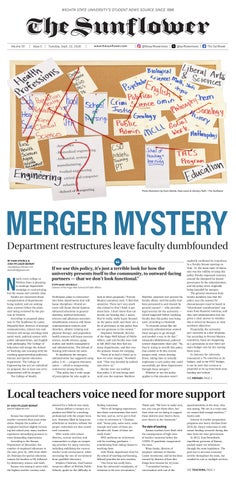
Photo illustration by Kami Steinle, Kass Lewis & Zachary Ruth / The Sunflower
MERGER MYSTERY
Department restructures leave faculty dumbfounded “
BY KAMI STEINLE & JOSH PFLEGER-BERNAT news@thesunflower.com jbernat13@gmail.com
N
early every college at Wichita State is planning to undergo department mergings or restructuring, but the reason isn’t entirely clear. Faculty are concerned about reorganization of departments being rushed, and are seeking clear answers before the plans start being reviewed by the provost in October. According to proposed plans sent to The Sunflower by Lainie Mazzullo-Hart, director of strategic communication, Liberal Arts and Sciences will merge sociology with social work, political science with public administration, and English with philosophy. The College of Education will merge the School of Teaching and Learning with the teaching apprenticeship pathways, literacy and special education department. The College of Engineering has not yet submitted its proposal, but at least one of its departments will be merged. The College of Health
If we use this policy, it’s just a terrible look for how the university presents itself to the community, to outward-facing partners — that we don’t look functional.” STEPHANIE NEWBOLD Director of the Hugo Wall School of Public Affairs
Professions plans to restructure into three departments that will house disciplines: clinical sciences will house dental hygiene, advanced education in general dentistry, medical laboratory sciences and physician associate; rehabilitation sciences will house communication sciences and disorders, athletic training and physical therapy; and population health sciences will house exercise science, health science, aging studies and health management and administration. The School of Nursing will remain the same. To implement the mergers, administration has suggested using policy 2.10 — program discontinuance — which is exasperating controversy among faculty. “This policy has a wide range of prescription for who ought to
look at these proposals,” Provost Monica Lounsbery said. “I find that attractive. There isn’t very much else related to that I think is germane here. I don’t know that our faculty are hearing that, I mean, they’re really, really hyper focused on the policy itself, and there are a lot of provisions in that policy that are not germane to the context.” Stephanie Newbold, director of the Hugo Wall School of Public Affairs, said LAS faculty were told in fall 2025 that they had too many departments, and that was the primary reason for merging. “None of us had a choice as to how we were merged,” Newbold said. “That was decided by individuals above us.” Faculty were not notified that policy 2.10 was being used until over the summer. Matthew
Muether, associate vice provost for faculty affairs. said the policy had been presented to and cleared by general counsel — who provides legal services for the university — which happened before notifying faculty that this policy was being used, according to Newbold. “It certainly seems like the university administration wanted these mergers to go through and needed a way to do that,” Alexandra Middlewood, political science department chair said. “So, they’re trying to retrofit this policy that existed to fit this current merger need, versus slowing down, taking time to actually implement a new policy that could successfully get these departments through these mergers.” Whether or not the policy applies to this situation wasn’t
explicitly confirmed by Lounsbery. In a Faculty Senate meeting on Sept. 14, the main topic of discussion was the validity of using this policy. Faculty expressed concerns around the disregard for shared governance by the administration, and the policy never originally being intended for mergers. The general consensus from faculty members was that the policy says the reasons for discontinuance must be based in “educational considerations” separate from financial concerns, and they said administration has not given a clear answer to whether this is driven by finances or clear academic objectives. Financially, the university isn’t currently in a dire situation, but according to Provost Monica Lounsbery, these are happening as a precaution in case there are more budget cuts for the coming fiscal years. In January, the university announced a 7% reduction in its budget, and in the FY27 budget, it can be seen that revenue is projected to be up from both state funding and tuition. SEE MERGER, PAGE 2
Local teachers voice need for more support BY JOSH PFLEGER-BERNAT jbernat13@gmail.com
Kansas has experienced more teacher vacancies than most other states. Despite the number of employed teachers slightly increasing last school year, many teachers experience intensifying pressure to meet demanding expectations. According to the Kansas Department of Education, the number of employed educators in the state grew by .28% from 202426. Positions for special education remain the hardest to fill, followed by elementary, science and math. Kansas was among 6 states with the highest teacher vacancy rates
selected for a federal case study. Kansas defines a vacancy as a position not filled by a teaching professional with the proper licensure. Positions filled by long-term substitutes or teachers without the proper credentials are also considered vacancies. WSU works with school districts, current teachers and communities to align on competing priorities for many concerns, including stabilizing the current teacher work environment, while increasing the rate of recruitment from qualified educators. Stephen Christian, chief human resources officer of Wichita Public Schools, spoke on the difficulty in
finding consensus. “We’re all bringing experiences into these conversations that aren’t the best, and so, we’ve got to find a way to overcome it,” Christian said. “Some pain, some scars, some wounds and some of those are decades old. Some of those are really fresh.” WSU performs an in-between role for teaching graduates — transitioning from taking classes to teaching them. Julie Thiele, department chair for the school of teaching and learning, defined priorities for new teachers. “Our focus has really been, from the university’s standpoint, of retention is the new recruitment,”
Thiele said. “We have to make sure, yes, you can get them there, but then what are we doing to support those districts once they’re there, once they’re in the classroom.”
The state of teaching
Kansas teachers have dealt with the consequences of high rates of teacher vacancies before the COVID-19 pandemic exasperated the issue. Brian Austin, director of employer relations at Shocker Career Accelerator, said he has been warned by districts of how dire things have become for 10 years. “I remember having a conversation with one of the
superintendents at the time, who was saying, ‘We are in a crisis now, we cannot find enough teachers,’” Austin said. Interest in teacher preparation programs saw heavy declines from 2010-20. Heavy reductions in education funding occurred during this time from the state government. In 2012, Sam Brownback, republican governor of Kansas, pushed major tax reductions through the state legislature. The goal was to increase economic activity throughout the state, but resulted in cuts to multiple services. SEE TEACHERS, PAGE 3
NEWS
2 | Sept. 22, 2026
www.thesunflower.com
Kansas blocked from offering in-state tuition to undocumented immigrants BY KAMI STEINLE news@thesunflower.com
Undocumented immigrants have had one of the few benefits the state of Kansas offers them taken away. Since 2004, universities in Kansas have been allowed to offer in-state tuition rates to undocumented immigrants who completed at least three years of high school and graduated in Kansas. This summer, the U.S. Department of Justice sued the state over this law, saying it violates federal law, and on Sept. 10 the U.S. District Attorney of Kansas issued a permanent injunction banning the implementation. “We’re removing any mention of the statute that was overturned by the court from our websites,” Wichita State’s Chief of Staff Zach Gearhart said. “We’re reaching out to individual students to let them know how this is impacting them.” Republicans passed this law initially and recently changed their tune on the grounds that it took away opportunities from American citizens. Gearhart said WSU is looking into other opportunities for students this will be affecting, approaching this on an individual basis. “I think it’s important to understand that the statute simply says undocumented individuals can qualify for in-state tuition,” Gearhart said. “There are other statutes that also define in-state tuition and who that applies to.” Wichita State’s interpretation of the law will not cause any changes for beneficiaries of the statute for the fall semester; when they enroll in classes for next semester is when they could potentially see the effects. About two years ago, WSU had around 50 undocumented students enrolled. “Obviously, we want students to be able to receive an affordable and accessible education,” Gearhart said. “That’s our first priority. We feel that the previous statute helped do that for a certain group of individuals. We’re still going to work to minimize the impact to the biggest extent possible under existing law.” The ruling from the federal court claimed the law violated immigration laws and encouraged illegal immigration, while also being discriminatory against U.S. citizens. This isn’t the first time in-state tuition for undocumented immigrants was challenged. Earlier this year, the Kansas Legislature attempted to pass a bill that would have revoked this law, but it was vetoed by Governor Laura Kelly. Kansas Attorney General Kris Kobach collaborated with the DOJ to block the law and has been outspoken about his disdain for the law for quite some time, filing a non-binding legal opinion around the time the legislature was first drafting the bill.
A group of faculty members listen to a presentation during the Faculty Senate meeting on Sept. 14. Photos by Noah DeVault / The Sunflower
MERGER / FROM PAGE 1 “There’s just innumerable kinds of examples of how revenue has not kept pace with cost,” Lounsbery said. “... We got to do it because if the legislature chooses to cut us, and they might, with those costs we just talked about, even though, ‘Well, there’s new revenue because we increased tuition.’ Ok, but yeah, it just got ate up. It’s like one step forward and five steps back.” At the beginning of the Faculty Senate meeting, Susan Castro, associate professor of philosophy, said she was working on a resolution that will be presented at the next meeting on Sept. 28 to make a new policy that would better fit this situation. “Our university makes a very strong distinction between policy and procedure,” Castro said in the Faculty Senate meeting. “Policies take years to get through all the approval steps. We are proceeding before any of that has been happening. “We did that last year, and from all intents and purposes, it seems like this freight train is going now. The purpose of offering the resolution now is to haul that freight train just a little, so that we do have input and the faculty senate resolution is the voice of the faculty.” Many faculty members expressed their disapproval of using this policy, and Newbold made a motion to not use the policy for this situation. After more discussion, the faculty senate passed a statement that said policy 2.10 was inappropriate for department mergers. “The idea that a merger is the same as discontinuing an academic department is really disturbing,” Newbold said. “... if we use this policy, it’s just a terrible look for how the university presents itself to the community, to outward-facing partners — that we don’t look functional.” Lounsbery said the language in the policy is anxiety-inducing, which was her explanation for why faculty are against using the policy. “(The policy) starts to talk about faculty in the affected unit, can be laid off,” Lounsbery said. “So that’s not what we’re doing. And no matter how many times this is being communicated, I think
saying that we’re using this policy is creating a barrier and it’s creating a trust factor for our campus.” When asked what role faculty should play in these situations, she replied that she herself is a faculty member and emphasized the importance of understanding the financial situation. “I think faculty need to understand the gravity of the real financial situation higher education is in across the country, including this institution,” Lounsbery said. The possibility of further financial constraints is the exact reason why a merger policy is a necessity, but the lack of communication has created accusations among faculty of administration of being disingenuous, Castro said. Some faculty members have expressed that there has been little to no communication about any of the mergers happening. “There’s definitely been a lack of transparency on the university side about department mergers,” Middlewood said. “All the way from why certain departments were on this list to begin with, to which department each department was going to merge with.” During the Sept. 14 faculty senate meeting, Matthew Muether presented slides showing the multiple town halls and meetings that occurred to discuss mergers. None of those meetings mentioned the use of policy 2.10, according to faculty. Middlewood, Newbold and Castro all independently told The Sunflower that those meetings were high-level, largely led by leadership and lacked specific discussions between departments. Lounsbery said that most of the communication faculty would have received should’ve been through their deans. “It’s confusing to me because they do know what’s going on, and even affected units will know, you heard that, ‘I’m in an affected unit,’ well that’s what’s happening,” Lounsbery said. That is in contrast with what multiple faculty members affected by the mergers have said to the Sunflower. Newbold confirmed the philosophy department submitted four separate merger proposals, indicating faculty’s view about which department would be best to merge with. Each of those proposals was
Irman Musaji fires a statement in response to Mathew Muether about the motion on the table at the Faculty Senate meeting on Sept. 14 in Woolsey Hall.
denied with no reason given, and philosophy is now being merged with the English department. Middlewood and Newbold said they have been working together to coordinate what a merger between political science and public affairs would look like, but are struggling to do so with lack of proper guidance. “This summer, I know our dean and her staff submitted formal plans for what these mergers were going to look like for each department’s concern,” Newbold said. “We’ve never seen what that plan is. We didn’t have a say in its construction. We didn’t have a voice in what it was going to outline and articulate moving forward, and to this day we still have not seen it.” Chase Billingham, professor of sociology, said last year these mergers were brought up to LAS faculty by the dean, but no reasoning was provided other than it would be a way to save money if needed. “It is completely illegitimate,” Billingham said. “And is an attempt to justify — after the fact — the rushed proposals that were already in development last year that academic departments — at least mine — have not even seen the justification for why we are supposed to be merging.” Billingham said the budgetary crisis that the university has said it is going through does not necessarily line up because, according to the budget for FY27, the university’s financial position is decent. “I didn’t quite understand what
MISSION The Sunflower — both in print and online — will be a timely resource of information about the Wichita State University community. It will report on news, issues, activities, academics and athletics, in addition to offering a forum for discussion, reviews and commentary. It will also be an effective learning opportunity for students, who will have the final authority on what is published. The Sunflower is a member of the Associated Collegiate Press, College Media Association and the Wichita Journalism Collaborative.
LEGAL One free copy of The Sunflower is available to members of the WSU community. Additional copies may be obtained from the newsroom, Elliott Hall 019. The Sunflower is private property and unlawful removal or use of papers is prosecutable. The Sunflower is funded by a combination of print and online advertisement sales and allocations by the Student Government Association. Copyright @ 2026 The Sunflower. This newspaper, its design, photos and all contents are copyrighted.
was going on,” Billingham said about the proposal that was presented by the dean in the spring. “And now we’re hearing again that the proposed restructures are based upon the budget, but the university has not declared a state of financial exigency. So where is that disconnect?” Billingham said he noticed money being moved from academics to athletics in the FY27 budget. Lounsbery said she has heard those concerns. “I don’t feel good about when we move into spaces and places where we’re talking about others, and we’re deflecting what others should be doing,” Lounsbery said. “I heard a comment about athletics, well, in this difficult budget period, athletics has suffered, I think pretty greatly.” Last semester, WSU athletics discontinued both men’s and women’s golf programs. Billingham said the $5 million that was cut from Academic Affairs correlated to an increase of about $5 million in the Office of the President for intercollegiate athletics — which had never been funded through the Office of the President other than small amounts to pay some coaches and other personnel. “It just basically says: miscellaneous other expenditures. It hasn’t been made clear exactly what those are. It’s completely hidden,” Billingham said. “But that is what is driving this entire ship, is a reallocation of money away from the academic mission of the university to other places in this university.”
CONTACT US
The Sunflower, founded in 1896, is the student-run news publication covering Wichita State University. The print edition is published Tuesday during the fall and spring semester. The staff publishes daily online at www.thesunflower.com. EDITOR-IN-CHIEF Mya Scott editor@thesunflower.com
NEWS EDITOR Kami Steinle news@thesunflower.com
PODCAST EDITOR Taliyah Winn podcast@thesunflower.com
ADVERTISING MANAGER Addie Clayton admanager@thesunflower.com
IN-DEPTH EDITOR Josh Pfleger-Bernat jbernat13@gmail.com
PHOTO EDITOR Ellery Prothro photo@thesunflower.com
MANAGING EDITOR Kass Lewis managing@thesunflower.com
ARTS & CULTURE EDITOR Kiona Brown arts@thesunflower.com
DESIGN EDITOR Mikah Herzberg mdhzbg@gmail.com
MULTIMEDIA DIRECTOR Zachary Ruth zachruthphoto@gmail.com
SPORTS EDITOR Evan Long sports@thesunflower.com
SOCIAL MEDIA EDITOR Lizzie Rush elizabethrush1105@gmail.com
ENGAGEMENT DIRECTOR Emma Wilks emmawilks78@gmail.com
OPINION EDITOR Jadin Kaltenbach opinion@thesunflower.com
For a complete staff list, go to www.thesunflower.com
019 Elliott Hall 1845 N. Fairmount Ave. Campus Box 134 Wichita, KS 67260-0134 EDITORIAL Mya Scott: 316-978-6906 editor@thesunflower.com ADVERTISING Addie Clayton: 316-978-6905 admanager@thesunflower.com FACULTY ADVISER Amy DeVault: 316-978-6052 amy.devault@wichita.edu
CORRECTIONS The Sunflower is committed to accuracy in its publications. If you find an error in any of its publications, please email the editor at editor@thesunflower.com immediately.
NEWS
www.thesunflower.com
Sept. 22, 2026 | 3
Student Government Comittee Chairs and Speaker of the Senate Matthew Phan stand behind the podium to speak on their experience with Advisor Lauren Madison. File photo by Zachary Ruth / The Sunflower
SGA 2026 midterm results mirror last year’s turnout BY JOSH PFLEGER-BERNAT jbernat13@gmail.com
President Richard Muma listens to administrators from other universities as a Kansas Board of Regents meeting on May 20. File photo by Zachary Ruth / The Sunflower
Wichita State to build dance and theater building and off-campus tennis complex BY KAMI STEINLE
news@thesunflower.com
Wichita State received approval to add $46.35 million to its fiscal year 2027 capital improvement plan to build a new dance and theater building and approval to accept property for a new tennis facility. Both of these items were approved by the Kansas Board of Regents — the governing body of Kansas higher education institutions — during the meeting on Wednesday. The new dance and theater building is planned to be a
three-story, 58,000-square-foot facility located immediately south of Duerksen Fine Arts Center. This building will house the School of Performing Arts’ dance, theater and acting programs with a 180-seat black box theater; dance, acting and movement studios; media and student performance spaces; and costume and design laboratories. Currently, these are housed across Wilner Auditorium, the Heskett Center and the Eugene Hughes Metropolitan Complex. The College of Fine Arts dean’s office, faculty offices and student support spaces will also be moved
into the building. It will cost about $46.35 million and is proposed to be funded through private fundraising. The facility will take about three years to complete. The future tennis facility will be located near Greenwich and K-96, and WSU will accept the property as a gift from Family Destination Development LLC once improvements to the space are made. The annual operating cost of the facility will be about $500,000 per year and is planned to be covered by revenue from the property and the WSU Athletics Department.
TEACHERS / FROM PAGE 1 The “Kansas experiment” created a $900 million state funding gap, leading to $51 million in education cuts, due to changes in how public schools were funded. The cuts caused Kansas schools to close early, cut programs, phase out teacher positions, enlarge classrooms and more. Katie Laske, President of the United Teachers of Wichita, said those years of teaching were hard. “Your class sizes went up, and budgets were cut,” Laske said. “It was very difficult on teachers, I saw a lot of people leave teaching.” Teaching positions were reduced in many districts, which increased expectations of employed teachers. The strain was increased as the COVID-19 pandemic pushed many educators to leave during the 2020-21 school year, mirroring a national trend. Educators say the effect of shortages, in part, is due to their needs not being completely addressed. Some of those needs, like planning time, have been a focus for over 10 years, Laske said. “Teachers are looking at more than just salary,” Laske said. “They’re looking at planning time, workload, class size, student behavior.” United Teachers of Wichita recently approved the proposed contract for the 2026-27 school years with Wichita Public Schools, after negotiations reached a stalemate. The contract was voted on by 86% of eligible members, and 56% of them voted in favor. The deal did not have the endorsement of union leadership, and some teachers are against the raise and lack of increased planning time.
Impact on special education
Districts continue to struggle with addressing special education needs. “Generally speaking, the number of students who are identified with needing special education support has been increasing over the last decade,” Christian said. “Similarly, finding teachers who can provide those supports has been challenging, so meeting that demand is hard for us. It’s hard for urbans across the state, across the nation.”
The 2026 Student Government Association midterm election results were announced on Wednesday evening. Out of the 13,550 eligible voters, 912 cast a vote, meaning 6.7% of the entire student body voted in this election. Voters were able to submit votes from Sept. 14-16. Last year, voter turnout rose from 77 votes in the 2024 midterm elections, to 937 in 2025, a 1,216% increase. Out of State, Adult Learner, and Military and Veteran Senators had one seat won by write-in. Health and Professions had two seats won by write in. Graduate SenatorsFine had three seats won by write-in. Business, Education and International Senators each had four seats won by write-in Write-in winners have until Sept. 22 at noon to accept their seats and will be announced when the election is certified on Friday at 1 p.m.
From 2015-25, Kansas saw an increase of 12,000 students classified as needing special education assistance. Addie Foulk, a special education teacher at Truesdell Middle School, said the impact has reduced the effectiveness of current teachers. “You can see the difference depending on the team you have, so having longevity for a special education teacher is amazing,” Foulk said. “Like, if you can get a group of teachers that have been around for at least five years, night and day, it makes a huge difference.” The new teachers are thought to bring energy to those already there. Unfortunately, the extra pressure on special education teachers creates uncertainty on how long they’ll be there. “I like meeting them, because then it’s a rejuvenating experience when they’re eager, they’re optimistic,” Foulk said. “‘Let’s do this,’ and for a moment I’m like, ‘okay, I got this, I can do this.’ And then you start to see that, ‘I’m tired, this is hard,’ and I’m like, ‘no, no, no, don’t quit, it’ll be okay, like we got each other.’” Last year, the United Teachers of Wichita negotiated for special education teachers to receive bonus pay. Part of the recently approved agreement continues that initiative. The union also negotiated for more time so teachers working with special education students can properly document student behaviors and needs. The extra time became necessary after Wichita Public Schools reached a settlement with the U.S. Department of Justice in July 2024 over discriminatory practices. The settlement requires many teachers to produce detailed documentation for behavioral instances, and the development of “individualized education programs” for students. The focus on documentation does not seem to effectively translate to proper action being taken, but rather focuses on the optics, Foulk said. The discrepancy is one of many challenges that WSU, school districts and communities are attempting to address for all parties.
Creating new paths
WSU and the College of
ELECTED SENATORS AND THEIR VOTE COUNTS At Large Senators: n Annabelle Heiman: 569 n Elijah VanDeCreek: 404 n Joshua Goodman: 370
Education Senators n Corwin Spatharos: 32
Engineering Senators n Amelia Boor: 165 n Alexander Zdrojewski: 118
Fine Arts Senators n Marianne Griffith: 42 n Patrick Murphy: 33
Freshman Senators n Preston Mallet: 132 n Mersadies Marciano: 122
Health Professions Senator n Lucas Vinduska: 83
Health Professions Senator n Jayce McClellan: 189 n Leyton Bell: 118 n Hope Grimmett: 116
Education are exploring alternative ways to address the teacher shortage. One that has shown a lot of positive results is the teacher apprenticeship program. The program, launched in 2017, allows paraeducators, long-term substitutes and other school employees to use their work experience as credit. TAP is fully completed online, allowing for many to stay in the communities they currently work in. “We’re building better paras, while they are preparing to become teachers,” Thiele said. WSU’s status as a commuter school means many students have personal ties to Wichita, which creates problems for other school districts looking to recruit new teachers, Austin said. Over half of the teachers at Wichita Public Schools are WSU graduates, which impacts outside communities as well. “When they leave their communities to come to university, oftentimes, they don’t go back to that same community, and so TAP really emphasizes growing those communities,” Thiele said. In May 2025, WSU, WSU Tech and Wichita Public Schools pushed this effort further by announcing the future teacher academy. Students complete two years of coursework at WSU Tech then WSU, while working as a paraeducator for Wichita Public Schools. Students obtain licensure to either become elementary or special education for K-6 teachers. According to the Kansas Department of Education, most teachers currently employed have between one-to-four years of experience. Paraeducators with possibly more classroom experience can help make up for the lack of experience. “We’ve had to learn how to behave very differently in the last 10-15 years, and to be flexible in new ways,” Christian said. “Even now, you have new areas that are harder to fill, but maybe weren’t five years ago. And all right, we have some tools and resources and some strategies that we’ve found to be successful, and we can lean into those a little bit more quickly.” Laske teaches an online program for TAP. The results of the program along with proper support is crucial.
4 | Sept. 22, 2026 www.thesunflower.com
SPORTS
HAVE A STORY IDEA? Contact the Sports editor, Evan Long sports@thesunflower.com
SHOCKER 7-FOOTER WILL BERG BRINGS DEDICATION: ‘I’D DIE ON THE COURT’ BY EVAN LONG
sports@thesunflower.com
In the first round of the NIT last season against Wyoming, center Will Berg was helped to the locker room with 24.7 seconds left in the first half after injuring his left ankle. The crowd at Charles Koch Arena had reason to be worried about the 7-foot-2 fan favorite from Sweden. But at the end of halftime, Berg, with his ankle taped up, emerged from the tunnel ready to play. It was an example of the toughness and tenacity fans had come to expect since he arrived as a transfer earlier that season. It was also nothing compared to when Berg played with eight bone spurs in his right ankle — which eventually required surgery — early in his career at Purdue. “I’d die on the court if I needed to,” Berg said. That attitude helped Berg contribute to the Shockers’ 24-12 season that culminated in an NIT Quarterfinal appearance. In the era of NIL, when players often leave for other schools, Berg is one of 10 returners to the Wichita State men’s basketball team that reached the American Conference championship last year. “Having 10 dudes who are all very good basketball players return
to a program where you already know how to play, what’s expected of you, is incredible,” Berg said after a recent workout. “It’s a very special situation. I’m very excited. Instead of starting over, being able to build up on what we started last year and then on top of that, adding all of the amazing players.” Last season, Berg emerged as an inside force after arriving from Purdue. He averaged 8.8 points per game, 8.1 rebounds, shot .559 percent from the field and notched a team-high 45 blocks. Josh Eilert, also entering his second season with the Shockers as an assistant coach, works closely with Berg. “He’s come a long way in terms of his progression from the beginning of the season (last year) to his progression at the end of the season and some of that’s even expanded over the course of the summer,” Eilert said. “A lot of that stems from his confidence.” Berg’s confidence should be even higher this season as he was named the 2026 American Conference Sixth Man of the Year. However, he is more focused on earning team accolades. “It means a lot. It’s cool getting recognition for the work you put in,” Berg said. “But at the end of
the day, the individual awards don’t really matter that much if you don’t end up with a championship. That’s what we’re aiming for this year, winning the league and then winning the conference tournament.” He started the first 10 games for WSU, but later found success subbing in for senior forward Emmanuel Okorafor. In his first game off the bench, Berg recorded 15 points and seven rebounds in an 84-73 victory over Wofford. In the next game, against Eastern Kentucky, he scored 14 points and grabbed 12 rebounds during the 88-57 win. “I preferred coming off the bench last year,” Berg said. “It was a comfort thing to help me be more comfortable on the court.” Berg, who’s now a redshirt senior, was one of the most prolific offensive rebounders in the country. He brought down 117 offensive boards (3.3 per game) — which was good for first on the team, third in the conference and 19th in the country. “It’s a culture at Wichita,” Berg said. “We crash the boards, we play the right way, we hustle. This is the culture we’ve been taught and the culture I’m trying to represent.” During the off-season, the
7-footer has been focusing on improving his outside shooting to help space the floor for Wichita State. Eilert believes Berg has all of the tools and potential to up his game even further this season, thanks to his desire to get better. “He’s really working on expanding his game,” Eilert said. “He’s put an immense amount of time into his shot. Having a pickand-pop five can really create a lot of space, but we’ve got to find that balance to where we’re playing upon his strengths. “In terms of him making the next step, it’s going to be a mental thing. He’s got to realize that he’s the alpha on the floor.” Berg and the Shockers will make their first appearance of the season against outside competition on Oct. 7 in a charity scrimmage against Murray State at Koch Arena. Berg is looking forward to it. “We had a good year last year, but I definitely hope to have a better year this year,” Berg said. “Being able to bring the fire back to Wichita State basketball is something that a lot of the guys on the team value highly, just paying it back to the fans. We had an incredible fanbase behind us that supported us during the game, before the game and after the game.”
Red shirt senior Will Berg throws up a free-throw during a game against Tulsa on March 14 at the American Conference Tournament. File photo by Zachary Ruth / The Sunflower
‘GENTLE GIANTS’ — ALUMNI OVER 7 FEET TALL BY EVAN LONG sports@thesunflower.com
Ron Smith (1970-71) 7-2, 205: Smith was perfect in his Shocker career, but he only played one game due to injuries. Made his only FG attempt and both free throws.
Greg Dreiling (1981-82) 7-1, 230: Kapaun high school star averaged 8.1 points and 4.2 rebounds. Transferred to KU and had a 10-year NBA career.
Paul Wight (1991-92) 7-1, 325: Not
The top six tallest basketball alumni from Wichita State in height order from left to right, categorized by 7’2”, 7’1” and 7’0”. Illustration by Mikah Herzberg / The Sunflower
much of a player — averaged 2 points a game — but became a huge success as a professional wrestler named The Big Show.
Garrett Stutz (2008-12) 7-0, 255: Averaged 13 points, was first-team All-Missouri Valley and helped WSU to NIT championship. Shot .542 on FGs and 82 percent on FTs.
Ehimen Orukpe (2010-13) 7-0, 250: The Nigerian started 30 games and was a defensive force (56 blocks) for Gregg Marshall’s Final Four team.
Asbjorn Mitgaard (2017-20) 7-0, 260: Fan favorite from Denmark was described as a “gentle giant” by athletic department and won most-improved award for NIT semifinal team in 2019.
Shocker volleyball loses both matches against Northern Iowa heading into conference play BY EVAN LONG
sports@thesunflower.com
Losers of five straight matches, the Shocker volleyball team will look to reset as it begins conference play against Memphis at 6 p.m. Friday in Charles Koch Arena. While the Tigers are 5-6, Memphis has won three straight matches. Picked to finish 10th in the 13-team American Conference, Memphis is led by outside hitter Amanda Hardt, an all-conference pre-season pick. The Shockers were predicted to finish fourth. On Sept. 27, Wichita State will host conference-opponent South Florida at noon. South Florida has lost seven straight matches and is 1-9, but the Bulls have played five ranked teams. Finishing a difficult stretch of eight road games in nine outings, Wichita State (3-9) dropped both matches to Northern Iowa (6-5) over the weekend in Cedar Falls. On Friday night, WSU was swept 3-0 by scores of 25-23, 25-18 and 25-15, and on Saturday the Shockers fell 3-1 (25-16, 26-28, 25-22, 25-14). In the first match, Wichita State hit .103 to UNI’s .255 hit percentage, and Northern Iowa outblocked WSU seven to five. The Shockers’ hitting percentage decreased in each set (.163, .098, .048), while the Panthers improved their hit percentage each game (.231, .250, .297). Sophomore outside hitter Jenna Cubbage led Wichita State with nine kills, hitting .241 and adding two blocks and 12 digs. Danielle Moore, also a sophomore hitter, recorded seven kills and hit .240.
Fifth-year defensive specialist Gabi Maas notched a team-high 18 digs, while setters Addie Oeth (16) and Jordan Heatherly (11) combined for 27 assists. Lily Dykstra, a senior hitter for UNI, recorded a match-high 17 kills, hitting .301 and tallying two blocks and 10 digs. Senior outside hitter Cassidy Hartman finished with 15 kills, a .257 hit percentage, two blocks and 10 digs. Junior setter Reese Booth notched 30 assists, a match high, and 14 digs, while Jadyn Petersen, a junior defensive specialist, recorded a match-high 19 digs and a careerhigh 14 assists. In the first set, Northern Iowa jumped out to an early 4-0 lead and didn’t let the Shockers take the advantage during the game. Wichita State went on a 5-0 run to cut the score to 20-19, but the Panthers recovered to win the set 25-23. The Shockers scored the first point of game two, but allowed seven consecutive points to trail Northern Iowa 7-1. Wichita State fought back, but was unable to trim the UNI lead to fewer than three points. The Panthers won the second set 25-18 to take a 2-0 lead. Wichita State got off to another rough start in the third game, falling behind 9-2. Later in the set, Northern Iowa put together an 8-1 stretch to seize a 19-7 advantage. The Panthers closed out the set, winning 25-15 to complete a 3-0 sweep. WSU’s only lead of the match was 1-0 at the start of set two. In the second match on Saturday, the Shockers were outhit
.190 to .253 and outblocked five to 13. Northern Iowa also registered 13 service aces to Wichita State’s one. The Shockers had a widespread attack with Cubbage (13), sophomore Olivia Cohee (12), sophomore McKenzie Jones (12) and fifth-year Maddie Wilson (10) all reaching double-digit kills. Wilson, a middle blocker, hit .500 and notched three blocks, while Moore finished with six kills, a season-high four blocks and eight digs. Oeth got her first start of the season, recording 24 assists and seven digs, while Heatherly contributed 18 assists and seven digs. Maas notched 18 digs again in the second match, tying her season best and junior Grace Hett added 12 digs. Dykstra finished with a matchhigh 19 kills for the Panthers, hitting .425 and adding seven digs and two service aces. Booth recorded a match-high 38 assists and careerhigh 20 digs, while Petersen tallied 14 digs, seven assists and a careerhigh six service aces. The Shockers once again struggled to get going early as they trailed Northern Iowa 4-0 to start the first set. The Panthers extended their lead to 11-4 after a 3-0 run and held the advantage, taking down WSU 25-16. The second game looked to be more of the same with UNI leading by scores of 4-1 and 9-5 early. However, a 6-0 Shocker run saw them seize a 17-14 advantage over the Panthers. The set went backand-forth until kills from Cubbage
Wichita State volleyball setter Jordan Heatherly (16) attempts to assist middle blocker Maddie Wilson (14) on Sept. 15 against KU. The Shockers lost to the Jayhawks, 3-0. File photo by Ellery Prothro / The Sunflower
and Cohee gave Wichita State a 28-26 victory that featured 11 ties and five lead changes. Northern Iowa didn’t get flustered after a disappointing set two loss as the Panthers put together a 6-1 stretch to lead 13-8 in the third set. However, the Shockers immediately answered with a 5-1 run to cut the deficit to 14-13. UNI bounced back to take a 21-15 lead after another 6-1 run,
which made Wichita State’s late 4-0 stretch too little, too late as WSU fell 25-22. The Panthers led 2-1 going into the fourth and final set. The two teams traded blows at the beginning of game four with a Wilson kill tying it up at 10-10 before Northern Iowa stormed ahead 17-12 after a 7-2 stretch. The Panthers capped off the match with an 8-1 run, defeating the Shockers 25-14.
OPINION
HAVE A STORY IDEA? Contact the Opinion editor, Jadin Kaltenbach opinion@thesunflower.com
Sept. 22, 2026 | 5 www.thesunflower.com
‘Resident Evil’ (2026) was a refreshing new story Mya Scott
editor@thesunflower.com
REVIEW
Illustration by Emma Wilks / The Sunflower
NOVIG USES SWEENEY TO COMBINE TWO OF MEN’S FAVORITE VICES: GAMBLING AND PORNOGRAPHY Jadin Kaltenbach
opinion@thesunflower.com
OPINION On Sept. 9, actress Sydney Sweeney’s “Just Sports” campaign ad for the sports prediction market Novig debuted. And similar to the “Sydney Sweeney Has Great Jeans” ad, it sparked controversy. I think it’s important to first clarify that because Novig is a prediction market that is exclusively used for betting on sports, we have to take into account their target audience: men. Globally, the sports betting market is on track to hit $125 billion by the end of 2026. Men (42.1%) gamble on sports at nearly double the rate of women (21.5%). Men also make up 98% of the documented problem gamblers in sports betting. In an effort to remain honest, the two-part marketing strategy is kind of perfect. They 100% followed the Hollywood slogan “any publicity is good publicity.” Part one: Appeal to the manosphere. Give them something they “can’t resist” looking at. And according to Novig that is a petite, blonde-haired, blueeyed woman with large breasts, basically naked for the entirety of the ad, repeating the word “sports”
“ This ad is literally playing on that. Novig and Sweeney are banking on the fact you’re addicted, to one at least, but more than likely, both. You, specifically, as a man. That is degrading.” JADIN KALTENBACH Opinion editor
while posing in provocative positions, using sports equipment to “cover” her. Part two: Ensure people will see it. Give them something they “can’t resist” being divided on. And once the masses are pitted against each other, reap all the benefits. In the time since the ad was posted, the public did exactly as predicted: completely divided. Critics — from athletes to journalists — said the ad sexualizes women in sports. It took an already incredibly difficult space for women to exist in, and gave it a pornographic image. Supporters, however, siding with Sweeney and Novig, called it great marketing; an easy way to get men interested in the platform and, either insinuated or bluntly stated, that women who had a problem with the ad were just jealous. In the time since the ad was posted, I’ve been reviewing articles, posts and reactions in order to have a better understanding of
both perspectives. And I find myself returning to the same few points. First, I think the way they chose to market to their target audience says a lot about how this company views men, about how society views men. The ad says: men have no self-control and are so desperate to see Sweeney as our nude prop, that they will then participate in sports betting using our platform because she told them to while she was naked. That is embarrassing. Which directly leads me into my next point. Second, for men specifically, gambling, sports betting and pornography are in the top five vices used. What do pornography and gambling have in common that research has proven countless times? With frequent usage, it fries your dopamine receptors, leaving you in a position where your brain literally needs more, even if it damages personal or social relationships. This ad is literally playing on
that. Novig and Sweeney are banking on the fact you’re addicted, to one at least, but more than likely, both. You, specifically, as a man. That is degrading. Finally, the ad alone said so much about how women are viewed in society. But paired with Sweeney’s response, specifically addressing female athletes, they made a statement without ever actually having to comment. Playing on men’s addiction to gambling and pornography made women, as a whole, their prop. Sweeney isn’t known for her amazing skills on the court or the field. She isn’t even recognized for her acting abilities most of the time. She is known for her body, specifically her breasts. And for Sweeney, it’s easier to just post several stories of women in the ESPN magazine that’s whole purpose was to photograph the bodies of women in sports, capturing what years of training and dedication look like. The most frustrating part about the ad and the reaction is the reality that this is where we are as a society. Companies will continue to play on men’s most profitable addictions to ensure capital and then wash their hands of it. While women, and men who recognize that the system is rigged against them, are continually forced to do their dirty work.
Converse uses same broken-record apology for racist ad Jadin Kaltenbach
opinion@thesunflower.com
OPINION In the past week, the Nike-owned brand Converse has come under direct fire for a social media ad that many say had racist symbolism. The ad photo was a part of an international marketing campaign featuring K-pop singer Karina that launched in late August to promote the Chuck 70 X sneaker. In the full ad, the singer is wearing a white skirt, walking around in the featured shoes and ending under a spotlight. Seemingly harmless when watching it in its entirety. However, the Instagram ad photo that went viral was a cropped version, showing only part of Karina’s skirt. Her hand is also featured, holding a pair of the shoes under the spotlight. Many critics say the lighting created a white triangular image resembling a Klu Klux Klan hood. Not only that, but the combined positioning of the shoes, the lighting and the way the ad was cropped make the sneakers look like “the dangling feet of a lynching victim,” according to the PBS article. On Sept. 18, Converse issued this apology: “We’re sorry, We understand why this image is deeply upsetting and recognize that we got this wrong. We removed it from our channels and are working to remove it everywhere it appeared. This should not have happened and we will do better.”
Photo illustration by Kiona Brown & Zachary Ruth / The Sunflower
And while the public is divided on whether this was an intentional dog whistle, or simply an oversight by the company’s marketing team, it does result in what a lot would consider a fair question —- why does this keep happening? This isn’t the first time this has happened recently. At the end of August, Target removed their “Kids’ Glows Under Blacklight Circus Clown Halloween” costume. The orange-and-black circus clown costume contained gloves, a top hat and a grinning mask with large teeth. Again, critics pointed out the racist symbolism in the costume, along with bringing up that choosing to have a black child model the costume had suggested undertones related to discrimination, racial violence and segregation. And similar to Converse, Target issued an apology:
“As a company, we know we got this wrong, and we are deeply sorry. The costume is offensive and should never have been part of our assortment. It is no longer available for sale.” I wish those two were the only examples, but that isn’t true. H&M (2018), Prada (2018), Gucci (2019), Bath&Body Works (2024) — these are just a few. Do I believe that honest mistakes happen? Yes. Do I think that marketing is sometimes up to personal interpretation? Also yes. However, when the same offense keeps happening to the same marginalized group constantly, I know it is simply wrong to write off the outrage as “reaching.” And if I could simplify my understanding of most of our world’s history into one centralized idea it would be that if marginalized communities are
Screenshot of Converse ad
saying something is off, something is definitely off. At some point, the apologies hold no weight. Companies need to stop issuing statements that they’ll “do better” and actually commit to being better through their actions.
Movie adaptations of video games are a sensitive subject to most. No one needs reminding of “A Minecraft Movie,” because while fun, it made me feel like I was approaching death quickly. “Until Dawn” wasn’t an objectively bad movie, but was not the greatest adaptation of the popular game. Those are just a couple of examples. And now Zach Cregger has taken another stab at making “Resident Evil” into a movie. “Resident Evil” (2026) follows Bryan, played by Austin Abrams, a courier tasked with delivering a specialty package to Raccoon City General. The icy terrain becomes Bryan’s worst nightmare as monsters follow and attack him throughout the night. Something to note: this isn’t the first “Resident Evil” movie. It isn’t even the second. Each rendition has been the subject to much criticism from the franchise’s fan base. While this movie is not immune to criticism, it was actually great, so great that I watched it twice on the opening weekend. And you know what? I’m glad this movie didn’t follow Leon Kennedy. I am also glad it didn’t follow Chris Redfield, Jill Valentine, Claire Redfield, Albert Wesker or one of the many characters from the games. It’s not that I hate those characters — I love their stories and motivations — but it was time for another story to be told. It’s similar to “Resident Evil 7: Biohazard.” The franchise needed a reboot. The latest movie gave a refreshing, new twist to the lore. It was awesome to see Cregger’s monsters come to life and not just be facing Nemesis all over again. Bryan’s character was amazing. In an interview, Abrams described Bryan as “a boy trying to be a man,” which is probably the most accurate description ever. He perfectly plays a normal dude trying to survive the horrors of RE. Bryan is funny with his one-liners on one hand and complex as he struggles with his own inner conflicts about big changes in his life. And yeah, he’s a little stupid in some (most) moments, but wouldn’t most of the world’s population if they were being chased by zombies that grew tentacles that attach to toilets? Not only was the acting phenomenal, the way it was shot was perfect. It switched between that classic third-person behind the shoulder point of view, and the first-person POV that made you feel like you were actually in the movie, surviving with Bryan. The snowy set added another layer of terror. And the jumpscares in the movie were actually really well done. They didn’t feel cheap, but like something that would actually happen in the games. And there were just enough hat-tips to the games to be respectful to the lore that came before. The typewriter, the herbs, the steady progression of guns from pistol to shotgun found on the wall to the machine gun. Even some of the stuff Bryan had to do was similar to the game, like searching for weirdly labeled keys or hiding in a sewer. “Resident Evil” (2026) was amazing. Saying the movie was bad doesn’t make you an original fan, or better than anyone else. And people aren’t “larping” if they say they like it. People are allowed to want people who don’t backflip over chainsaws or push boulders into volcanoes.
6 | Sept. 22, 2026 www.thesunflower.com
Fartsy ....
ARTSY
ARTS & CULTURE
HAVE A STORY IDEA? Contact the Arts editor, Kiona Brown arts@thesunflower.com
LOCKED IN ON LATE NIGHT CRAFTS
Musical theater major Kailer Megrail poses on the stage of Wilner Auditorium. Photo by Kiona Brown / The Sunflower
A conversation with Kailer Megrail JUNIOR / MUSICAL THEATER Q: What path do you hope to pursue after college? A: After college, I think I would want to go the teaching route just because it’s so stable in this industry in general, but of course that also leaves you open to be able to do shows in town that are paid… it gives you that kind of freedom and that push and pull where you’re doing your craft, but you’re still living your life and you’re not having to be a nomad. Q: What led you to pursuing art and being creative long term? A: Honestly, since I did start as that business major side, I hated it… It just, it was killing me slowly, just the slog of it all. And so then, I was like, well I loved musical theater in high school, loved it in middle school, loved it always. So I decided, “I’ll just audition for the program and see what happens.” And then I did and then I got an email back saying, “Congratulations, you’re a musical theater major now.” Q: What would be your dream role and why? A: My dream role, I think I would have to say Elle Woods in Legally Blonde. That’s just because, one, she’s in my voice type, two, it’s such a fun show in general. We see a lot more of the serious, darker roles here at WSU… Those are all great, and they’re fun, and they’re important, however, sometimes you can still have that deeper, darker side… And then you also have those fun moments as well. Q: If money didn’t matter at all, what would be your dream career? A: I think my dream career would probably be, I’d really want to work for Smosh out in LA, and I’d love to just work in LA, in Beverly Hills. That is my like, my mind goal, but I have a house here, of course. And I love my house. I mean, a homeowner at 21? It’s like, we’re going to keep the house. But I’d love to be able to keep that house and then also have a home in Beverly Hills and get to work out in LA and get to do all of the fun things that come with being in that kind of world. Q: What is something you wish more people understood about creatives? A: I wish people understood that we simply can’t just work desk jobs. That’s not what our brains are wired for. Like yes, in theory, physically, we can go in and we can sit there and do all the grueling paperwork and all the nightmares of the office of who knows what. But at the end of the day, we will feel so sad doing that… And so I wish people just understood, no, a creative mind has to stay creative or it will get bored and it’ll start fizzling.
INTERVIEW BY KIONA BROWN arts@thesunflower.com
Several students of Tornado Alley Press locks in on Friday night at the open lab to work on course projects. Guild members were focused on separate wood blocks for their upcoming steamroller event. Photos by Peyton Eck / The Sunflower
Tornado Alley Press spends the night collaborating on upcoming project for Shocktoberfest BY PEYTON ECK
eckpeyton3@gmail.com
Like any space frequented by artists, the Wichita State printmaking lab is characterized by the decor of its patrons: art lines most walls, Lego figurines pose on light switches and industrial equipment is labelled with fond titles such as “Paquita” or “Bambi.” On Friday night, the studio space was adapted to fit the goings-on of its resident guild. Pillows littered walkways and slow cookers filled the room with the smell of home-cooked meals as members of the guild donned their comfiest clothes and got down to business. Tornado Alley Press is one of two current art guilds at WSU, made up of art students with a passion for printmaking. For Shocktoberfest, the group is crafting 12 3-foot-by-4-foot wood blocks that will be run over by a steamroller to create prints. It’s a lot of work to be done, so the group decided to hold a block “lock-in” to chisel at the job together. Held from 7 p.m. Friday to 2 p.m. Saturday, the “lock-in” was more of a walk-in, with members coming and going as they needed. “We have 20 members; it’s hard for all of us to come together,” said Anita Mockry, the guild’s president. The event is fitting for the guild; the printmaking lab itself is often prone to odd hours. There are four graduate students and one printmaking professor belonging to the space, and between
“
It just was amazing for me to hear all this energy, this passion they had for printmaking.” AARON MALDONADO Graduate student from Texas
them they keep the doors open for anyone wanting to use the space. It’s tradition for the guild to hold late-night crafting/work sessions, which they informally refer to as “crochknittery,” a combination of crochet, knit and embroidery. “If you come here, there’s usually someone in the studio, whether that’s one of the grads taking naps in their studio or there’s people working on their projects to get done before the due date,” said Jaiden Kennedy, the guild’s vice president. “Someone always haunts this studio, you could say.” Each of the printmaking graduates attended the lock-in, guiding newer members of the guild. WSU’s printmaking lab was renovated recently, and according to Mockry, it’s surprisingly sizable and well-supplied for a comparatively smaller university like WSU. The graduate students get their tuition 75% paid for and also receive weekly payment for teaching students. “It’s a really good setup here. It’s pretty competitive to get a spot here because other places aren’t as open with their funding for graduate students,”
Jaiden Kennedy and Krista Edwards transfer projected artwork onto wood block during the Steamroller Block Lock-in. The design was later traced over with marker to prepare for carving.
Mockry said. Aaron Maldonado, a graduate student from Texas, met Hernandez at a printmaking workshop in Iowa. After speaking with Hernandez and another educator about the community they were building in their schools, Maldonado looked into WSU. “It just was amazing for me to hear all this energy, this passion they had for printmaking,” Maldonado said. Community and access are emphasized at the guild, and it’s part of why they’re still functioning while other guilds are not. Tornado Alley Press organizes print sales for other artists to sell through and regularly sells prints in the McKnight Art Center. They also set up travel opportunities for their artists, visiting other universities and conferences across the country. Mockry said the goal is to show their artists the greater printmaking community. They also stress the importance of people from any major or level of experience being able to try their hand at printmaking. Many of the non-graduate students present came from outside the School of Art, Design and Creative Industries, such as Kennedy, a medical laboratory science major, or Lucas Roach, a cello performance major. Overall, the guild unites through more than just a love of “The Pitt” or debates on the true definition of Elvira’s hair — they’re all brought together by enjoying the same craft.
Evelyn Johnson sketches on wood block at Tornado Alley Press’ Steamroller Block Lock-in. The block will be ran over by a steamroller.
Mac and cheese made by a bunch of frat guys is pretty good Noah DeVault
noahdevault1@gmail.com
REVIEW Philanthropy events can range anywhere from tabling outside of Shocker Hall to big house parties. This weekend, I attended Sigma Alpha Epsilon’s eighth annual Mac & Cheese event. Funds raised at this event went to support the Children’s Miracle Network. Mac and cheese is one of the best foods out there. I almost always get it as my side at Chick-fil-A. With that being said, mac and cheese is an easy thing to mess up. If the cheese is under or over cooked, it’s bad; if the noodles are mushy or too hard it’s bad or even if you use the wrong types of cheese, it’s just not good. So before buying my ticket, I had my doubts. How good could mac and cheese made by a bunch of college fraternity guys really be? When I got there, I waited to get my food, still second guessing myself. Everyone got the same base of mac and cheese, but everyone got their choice of protein: chicken, bacon, buffalo chicken or
Mac and cheese sitting on a table at the annual Sigma Alpha Epsilon charity event on Sept. 18-19. Photo courtesy of Carsen Blasdel.
simply no protein. I got the buffalo chicken, and I was blown away when I took my first bite. The chicken was cooked well and surprisingly the mac and cheese was very good as well. The noodles were perfectly cooked and they used Velveeta cheese, which is one of the best cheeses for mac and cheese. The mac and cheese alone would have been good, but adding the protein made it 10 times better. I went back for seconds. This time I got the
bacon, and it was good, but not better than the buffalo chicken. Besides the food, SAE provided water and Red Bull. Members of SAE wore aprons and really bought into the “chef” role. There was music and most people ended up line dancing in the little space they had. I would definitely go to the event again next year, and I would encourage others to go check it out because it really is the tastiest philanthropy event at Wichita State.
www.thesunflower.com
ADVERTISEMENT
Sept. 22, 2026 | 7
Our Community. Our Vote. We Protect Us. Protecting Our Community Starts With Knowing What's On Your Ballot. Voting isn't about loyalty to a party or system. It's a strategic tool we use to protect our communities. Know your ballot, make a plan to vote, and show up for the people you care about. GET READY TO VOTE
ARTS & CULTURE
8 | Sept. 22, 2026
www.thesunflower.com
UPCOMING EVENTS JAZZ PROGRAM PERFORMANCES Tuesday, Sept. 22 7:30 p.m. Somewhere Works
Enjoy energetic ensembles from the Wichita State Jazz Program for $5 with student ID or $15 at the door.
COFFEE HOUR WITH VETERAN SUPPORT SERVICES Wednesday, Sept. 23
8:30 - 9:30 a.m. Grace Wilkie Hall, Room 320 Make new connections and foster community by dropping-in for a free cup of coffee provided by Veteran Student Support Services.
WILDLIFE WEDNESDAY Wednesday, Sept. 23
11 a.m. - 1 p.m. Rhatigan Student Center Interact with the ambassador animals of Tanganyika Wildlife Park in the RSC East Atrium.
CRAM CAFE
Wednesday, Sept. 23
2 - 6 p.m. Rhatigan Student Center, Room 301
Join members of Fraternity and Sorority Life for a bi-monthly drop-in study hall offering snacks, drinks and connection.
SHOCKER FIESTA Thursday, Sept. 24 Her, played by Peyton Grace Henderson, holds Him, played by Colton Farmer, after killing him and eating his heart in the final scene of the opening night performance on Sept. 17. The play was the winner of the Bela Kiralyfalvi National Student Playwriting Competition. Photos by Zachary Ruth / The Sunflower
11 a.m. - 1 p.m. Rhatigan Student Center, North Patio Kick off Hispanic Heritage Month with an afternoon of cultural foods, interactive activities hosted by Hispanic student groups and music.
‘THE SILENCE OF HOCQ’REILA’ ARTIST TALK Thursday, Sept. 24
4 - 5 p.m. McKnight Art Center second floor Hear from artist Steve Willis about the inspiration behind exhibition, ‘The Silence of Hocq’reila,’ now on display in the Clayton Staples Gallery.
VOLLEYBALL VS. MEMPHIS Playwright Anna Halza answers a question from the audience after the first performance of “Dinnertime: a Play in Seven Courses.” Halza is a student at the University of Oklahoma.
Narrator Grace Ryan places a on an esael sign for the second scene, “Hors Doeuvre.” Each scene was named for a different course of the meal the characters were sharing.
DOUBLE TIME Fine arts holds opening season performances
Friday, Sept. 25
6 p.m. Charles Koch Arena Watch Shocker Volleyball take on conference opponents Memphis in Charles Koch Arena. Students get free tickets with Shocker ID.
WSU ATHLETICS GARAGE SALE Saturday, Sept. 26 8 - 11 a.m. Charles Koch Arena
Stop by the garage sale inside the Aetna Multi-Purpose facility for jerseys, shoes, apparel and equipment. Items are first-come, first served.
WU’S BIG EVENT Saturday, Sept. 26 8 a.m. - 1:30 p.m. Hubbard Hall
Join fellow Shockers and volunteer in partnership with local organizations. Breakfast, lunch and a commemorative T-shirt will be provided.
BASEBALL VS. NEBRASKA Saturday, Sept. 26 1 p.m. Eck Stadium
Watch Shocker baseball battle regional rivals Nebraska in an exhibition game. Tickets are $5 or free with student ID.
VOLLEYBALL VS. SOUTH FLORIDA Sunday, Sept. 27
Noon Charles Koch Arena
Wichita State student Emma Lockwood plays the double bass during a Symphony Orchestra performance put on by the School of Music on Sept. 17. Photos by Ellery Prothro / The Sunflower
Assistant Teaching Professor Lucas Hulett performs a tuba concerto during a Symphony Orchestra performance. The concert was held in Miller Concert Hall on Sept. 17.
Witness Shocker Volleyball face conference rival South Florida in Charles Koch arena. Tickets are free with student ID.
FACULTY ARTIST SERIES: TRIO BALEZ Sunday, Sept. 27 3 p.m. Wiedemann Hall
Join three music professors exploring voice, viola and piano for an afternoon of chamber music. Tickets are free for students, $7-$14 otherwise.
HAVE AN EVENT YOU WOULD LIKE LISTED? CONTACT THE ARTS EDITOR: arts@thesunflower.com Wichita State’s Symphony Orchestra performs in Miller Concert Hall on Sept. 17. The orchestra performed 3 pieces, one included seven movements from “Romeo and Juliet.”
CONTACT THE NEWS EDITOR: news@thesunflower.com