WICHITA STATE UNIVERSITY’S STUDENT NEWS SOURCE SINCE 1896
Volume 131
Issue 3
Tuesday, Sept. 1, 2026
www.thesunflower.com
@thesunflowernews
@sunflowernews
The Sunflower
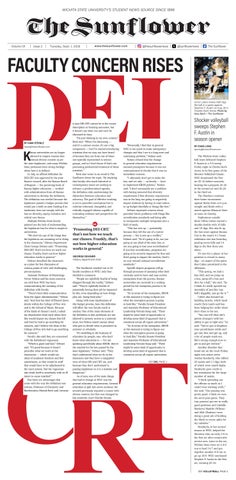
FACULTY CONCERN RISES Junior Libero Grace Hett digs the ball in a game against Stephen F. Austin on Aug. 28 in Charles Koch Arena. Photo by Kaia Bach / The Sunflower
BY KAMI STEINLE news@thesunflower.com
K
ansas universities are no longer allowed to require courses that contain diverse content as per the state legislature, and many Wichita State professors have strong feelings about how it is defined. In July, an official definition for DEI-CRT was approved by the state finance council, after the Kansas Board of Regents — the governing body of Kansas higher education — worked with administration from all Kansas universities to develop the definition. The definition was needed because the legislature passed a budget proviso that would put a hold on state funding if an institution does not comply with the ban on diversity, equity, inclusion and critical race theory. Multiple Wichita State faculty pointed out the lack of understanding the legislature has for what is taught in universities. “We don’t do any of the things that the legislators are assuming we’re doing in the classroom,” History Department Chair George Dehner said. “‘Promoting DEI-CRT,’ that’s not how we teach our classes. Frankly, that’s not how higher education works in general.” Dehner described the classroom as a place for free discussion of various points of view and challenging preconceptions. Assistant Professor of Musicology Trevor Nelson said his main concerns are with how WSU has been communicating the meaning of the definition with faculty. “There’s been little communication from the upper administration,” Nelson said. “And that has kind of filtered down slowly within the College of Fine Arts and in the School of Music. Because of the kinds of classes I teach, I asked my department chair early about how this would impact my classes this fall and then he had to go searching for answers, and I believe the dean of the College of Fine Arts had to go searching for answers.” Faculty also said they are concerned with the definition’s vagueness. “Which is good and bad,” Dehner said. “It’s good because it doesn’t prescribe what we teach in the classrooms — which would run afoul of academic freedom and first amendment, so that would be stuff that would have to be adjudicated in the court system. But the vagueness also lends itself to somebody with an ill intent to cause mischief.” But there are advantages that come with the way the definition was written, Professor of Chemistry and Biochemistry Moriah Beck said, because
it says DEI-CRT cannot be in the course description or learning outcomes, but it doesn’t say what can and can’t be discussed in class. “I’m just thinking in my own context,” Beck said. “When I’m discussing — and it’s a science course, it’s not a big component — but I’ve started introducing scientists that we may not have heard of because they are from one of those not typically represented in science groups, and so I don’t know if that’s not promoting preferential treatment of those scientists.” Beck also wrote in an email to The Sunflower about the topic, “By implying that faculty who teach historical or contemporary issues are seeking to advance a predetermined agenda, the definition risks undermining the distinction between education and advocacy. The goal of effective teaching is not to prescribe conclusions but to cultivate informed, thoughtful, and critically engaged citizens capable of evaluating evidence and perspectives for themselves.”
“
‘Promoting DEI-CRT,’ that’s not how we teach our classes. Frankly, that’s not how higher education works in general.” GEORGE DEHNER History department chair The Sunflower reached out to 24 faculty members at WSU; only four decided to comment. “People are rightfully fearful of being dragged through the media,” Dehner said. “They’re rightfully fearful of potentially having their job be impacted by this, even depending on how things play out, losing their jobs.” Along with most implications of this budget proviso, how this definition will affect the way faculty teach is unclear. One of the main elements of the definition is that professors are not allowed to present racism as a systemic issue, but Nelson raised unease about who gets to decide what is presented as systemic or scholarly. “It’s meddling in the business of education by people, one, who don’t know what education is — I’m not speaking specifically about KBOR; they’re the conduit for the law passed by the state legislators,” Dehner said. “They don’t understand what we do in the classroom and they have a misguided view of what DEI and CRT are, and because they don’t understand it, passing legislation on it is a mistake and dangerous.” As of now, one of the main things that had to change at WSU was the general education requirements. General education is split into seven sections; the seventh previously required a course with diverse content, but that was changed by last academic year’s Faculty Senate.
Shocker volleyball sweeps Stephen F. Austin in season opener “Personally, I find that in general WSU is too quick to make anticipatory changes and that I see is a long-term and continuing problem,” Dehner said. Nelson echoed that the change in general education requirements seemed preemptive because it was not communicated to faculty that it was an immediate concern. “I ultimately don’t get to make the law, and we only — as faculty — have to implement KBOR policies,” Nelson said. “I don’t necessarily see a problem with having removed that diversity requirement if that diversity requirement was in the long run going to negatively impact students by having to raise tuition to up budget shortfalls or things like that.” Dehner expressed concern about potential future problems with things like accreditation standards and being able to incorporate multiple viewpoints into a field of study. “This law sets up — potentially, because they left the out of a waiver process — but it sets up a conflict,” Dehner said. “So it’s going to be, are you going to run afoul of the state law, or are you going to lose your accreditation? If you lose accreditation, programs are going to be severely impacted by that and that’s going to impact the student, there’s no way around national accreditation standards.” Specific degree programs will go through processes of assessing what their curricula need to have and may receive exemptions from the proviso. Kansas universities are currently in a waiting period for the exemption process to be decided. “So in terms of the exemption, KBOR at this moment is trying to figure out what the exemption process is going to look like,” Faculty Senate President and Associate Professor of Educational Leadership Victoria Koop said. “There might be some kind of opportunity to develop some kind of approach that is consistent across all regent universities.” “So in terms of the exemption, KBOR at this moment is trying to figure out what the exemption process is going to look like,” Faculty Senate President and Associate Professor of Educational Leadership Victoria Koop said. “There might be some kind of opportunity to develop some kind of approach that is consistent across all regent universities. SEE DEI, PAGE 2
BY EVAN LONG
sports@thesunflower.com
The Wichita State volleyball team defeated Stephen F. Austin in a 3-0 sweep Friday night at Charles Koch Arena in its first game of the Shocker Volleyball Classic. WSU dominated the first set 25-16 before narrowly beating the Ladyjacks 25-23 in the second set and 26-24 in the third set. The Shockers continue their home tournament against Idaho State at 6 p.m. tonight and finish with a match against Missouri State at noon on Sunday. Sophomore outside hitter Olivia Cohee earned a double-double with 10 kills and 10 digs. She also lit up the box score against Kansas City in the team’s 4-1 home exhibition win last Saturday, posting seven kills and 14 digs in the first three sets alone. It’s rare for a player at her position to record so many digs – an aspect of the game that Cohee prioritized in the offseason. “This spring, we had a box drill, and we jump on a box, jump off a box and dive for a ball,” she said. “So I think it’s really opened my mentality of just like ‘any ball’s diggable, just go for it.’” Cohee also focused on building muscle, which head coach Chris Lamb said has been helping her strike when she’s close to the net. “You can tell (that she’s gotten stronger) with her ability to get to tight sets,” he said. “You’ve got to lengthen your penultimate stride and get into that and get up, and a lot of people wash out. She’s strong enough now to get in and get vertical.” Another Shocker that stood out on the court Friday night was senior setter Jordan Heatherly, who tallied 23 assists and 11 digs, both of which were match-highs. Heatherly gave credit to her teammates for her large number of assists. “I think spreading out the offense as much as I could (was working well),” she said. “Our passing was pretty good. I think we won the serve-pass game. They (my passers) put me in really good positions and (middle blockers) Maddie (Wilson) and Allie (Paulsen) were doing a great job of holding the block to create splits for my outsides.” Heatherly, in her second season at WSU, helped the Shockers take an early 3-0 in the first set after consecutive service aces. Later in the set, Wichita State went on a 4-0 run to lead 14-7 and put together another 4-0 run to go up 18-9. WSU outclassed Stephen F. Austin in the first set, winning 25-16. SEE VOLLEYBALL PAGE 4
NEWS
2 | Sept. 1, 2026
www.thesunflower.com
DEI/ FROM PAGE 1
Photo illustration by Zachary Ruth / The Sunflower
The Kansas Board of Regents listen to a presentation regarding the introduction of a reduced credit bachelor’s degree on May 20. File photo by Zachary Ruth / The Sunflower
WICHITA STATE RAMPS UP AI USAGE BY KAMI STEINLE
news@thesunflower.com
The use of Artificial Intelligence has been increasing across higher education institutions nationwide, including within Wichita State. In September 2025, the Kansas Board of Regents set a goal for all universities in Kansas to monitor AI uses on their campuses, stating “state universities will submit a report detailing current initiatives, research, and instructional strategies related to Artificial Intelligence (AI). This effort will help identify best practices, foster collaboration, and position Kansas institutions as leaders in AI-driven education and workforce development.” An AI Strategy Council comprised of faculty and staff across WSU’s campus was put together toward the beginning of last school year in response to KBOR’s request. “So that launched us to first do a faculty staff survey,” Vice Provost Ashlie Jack said. “... We just kind of wanted to see where faculty and staff were in their understanding of AI. We are looking — the strategy council is looking at a survey that we would do with students this fall, so we’re just in an exploration stage right now.” Two surveys were conducted. The first was about AI awareness, knowledge and ethics. According to the report, many faculty and staff members said they are familiar with AI risks, concepts and the importance of verification and disclosure. The second survey was over AI use, tools and departmental activity. This found many faculty and staff members were experimenting with AI in areas like writing, analysis, workflow automation and instructional design.
“
There’s built in AI tools that just add efficiency more than anything. It doesn’t replace your work, it doesn’t do the work for you, it just adds some efficiency to your work.” ASHLIE JACK Vice provost
Students, faculty and staff
Jack said Provost Monica Lounsbery wants the council to ensure every academic program will be integrating AI in some way. “So if you’re graduating from this X program, what is the AI knowledge that you need heading out?” Jack said. “... But we’re also looking at advanced programs and when I talk about advanced programs, what skills, knowledge do we have here on campus that we can develop and respond to industry who needs to get their workforce ready to utilize this AI tool or to integrate AI.” Lounsbery asked for the Strategy Council to be put together and Jack said when seeking members for the council, they looked into what was already being done on campus, like Associate Vice President for Research and Industry Engagement Pierre Harter was already using AI in research and Professor Susan Castro already had a faculty group called Responsible AI — which focuses on the ethics of AI use. “While there’s the council, there’s also working groups, and several other members are a part of the working groups, so it’s very much collaborative,” Vice President of Strategic Communications and Marketing Shelly Coleman-Martins said. Working groups look into academics, research, business operations, governance, risk and
compliance, ethics, internal training and community engagement and analyze those aspects of campus within the framework. Some students are also involved in some of the working groups.
Research
Harter leads the research work group for the council. He said the main goal of the group is examining who is using AI and how they want to use it through things like surveys and workshops. “And then understanding what they think they’ll need to use it for in the future, so that we can facilitate those needs,” Harter said. In the research group, there are currently five different faculty members from various colleges and two students involved. “We’re looking at several different things, one of those things would be, how do we — I mean overall the research groups’ focus is — how do we incorporate AI into the research complex for the institution?” Harter said. “How can we make our researchers more effective at what they do? “The group doesn’t consist of people researching AI. Researchers in the group look into how AI can be incorporated into their processes where it’s appropriate and makes sense.”
Operations
Jack said there is currently no AI
use in big university operations. For the most part just efficiency tools in smaller areas are being looked into. “There’s built in AI tools that just add efficiency more than anything,” Jack said. “It doesn’t replace your work, it doesn’t do the work for you, it just adds some efficiency to your work.” Another example of AI use in university operations is in Navigate 360 which has some AI tools built into it that gives advisors summaries of any notes left in previous appointments, so they don’t have to pull up any services that a student has received in the past or the usual topics a student discusses with an advisor.
AI policies currently around campus
As of now, there is a generative AI statement in syllabi where professors can set how much AI use is allowed in classes. Coleman-Martins said they are currently doing reviews of the AI policies and seeing what all needs to be included in the policy. The policy is not finished yet. “We’re wanting to really (look at), what are our best practices, what does KBOR have, what are the other KBOR institutions have,” Coleman-Martins said. “We’re going to balance between ethics and responsibility and not stymieing creativity and allowing room for AI to move and shift.” Jack said the goal of the council is to advance the work and mission of the university, and to stay in line with WSU’s strategic plan. “For the foreseeable future, I see this council continuing as we continue to embrace the use of AI,” Jack said.
Anthropology museum says goodbye to Neff Hall BY SARAH MATADI
sarahjmatadi@gmail.com
The demolishing of Neff Hall will bring many changes to Wichita State’s campus, one of them being the moving of the Lowell D. Holmes Museum of Anthropology from Neff Hall to Ablah Library. Despite a few construction delays that occurred over the summer, the museum hopes to be open in late October or early November. Neff Hall has been in talks to be demolished for over two years, but the museum did not begin packing up all the artifacts until April. The museum will be moved to the second floor of the library, which will allow for a better quality of space for students and staff. The museum has been housed in Neff Hall since its formation in
1966 and has grown in the years since. “These spaces are specifically designed for these activities in the museum area, where before they were kind of crammed into a corner here and a corner there to make it work,” said Brent Mai, Wichita State’s dean of University Libraries, on a recent tour of the new museum space. To make the museum more accessible for potential visitors, a new entrance will be added to the south side of the building which will lead to a staircase that goes directly to the museum. “This is going to be a better space for them to interact with the collections, but also to learn from the courses that are taught,” Mai said. Students can expect a new
gallery, tours of the museum and more educational programming for students studying exhibit design. According to Director of Strategic Communication Helaine Mazzullo-Hart, the department will be moved into the Geology Building over winter break.
“The department of geology has been really great to work with,” Chair of the Anthropology Department Crystal Dozier said in an interview with The Sunflower in April. “They’ve been very understanding and accommodating as we kind of move into our space.”
The Holmes Museum of Anthropology on Aug. 31. The museum features artifacts from various cultures across different periods of history. Photo by Zachary Ruth / The Sunflower
MISSION The Sunflower — both in print and online — will be a timely resource of information about the Wichita State University community. It will report on news, issues, activities, academics and athletics, in addition to offering a forum for discussion, reviews and commentary. It will also be an effective learning opportunity for students, who will have the final authority on what is published. The Sunflower is a member of the Associated Collegiate Press, College Media Association and the Wichita Journalism Collaborative.
LEGAL One free copy of The Sunflower is available to members of the WSU community. Additional copies may be obtained from the newsroom, Elliott Hall 019. The Sunflower is private property and unlawful removal or use of papers is prosecutable. The Sunflower is funded by a combination of print and online advertisement sales and allocations by the Student Government Association. Copyright @ 2026 The Sunflower. This newspaper, its design, photos and all contents are copyrighted.
Koop said there will likely be opportunities for faculty to participate in the process for exemption as well. “Faculty are the people who know their courses very well, first and foremost,” Koop said. “I think they would be the people who will (be) counted (on) to provide rationale for why courses or the programs need to be exempted. “And one of the things that will be taken into consideration is how well those courses are meeting student learning needs and their objectives that fall under their degree programs and fall under their accrediting body.” Right now, most of the changes happening around campus are proactive approaches because universities won’t need to be in full compliance until July 2028. “I think one of the things, honestly, is the exemption pathway is there,” Koop said. “Certain discussions will have place to be in classrooms because those discussions are a part of the degree — part of the student training. And we want to make sure that the students are prepared and trained for the future workforce… faculty will need to kind of come together to see how we can make sure we will continue to do that.”
Editor’s note: All faculty members who chose to comment stated that these are their personal opinions and do not represent the views of their respective departments, colleges. or the university as a whole.
OFFICIAL DEI-CRT DEFINITION
n DEI-CRT
Diversity, equity, inclusion and critical race theory. n DEI-CRT COURSE
A course whose title, course description or learning outcomes include DEI-CRT related content. n DEI-CRT RELATED CONTENT (with respect to DEI)
Content that intentionally establishes and promotes the preferential treatment of groups based on race, color, gender, ethnicity or nation origin. n DEI-CRT RELATED CONTENT (with respect to CRT)
Content that presents racism as systemic within laws, policies or institutions and promotes acceptance of that viewpoint rather than presenting it as a subject of scholarly, historical or legal study. Discussions of race, racism or the history of the civil rights movement do not constitute DEI-CRT related content for the purposes of this policy. This policy does not prohibit post-secondary educational institutions from complying with federal law or state law, including anti-discrimination laws or from taking action against a student, faculty member or employee for violating of federal or state law.
CONTACT US
The Sunflower, founded in 1896, is the student-run news publication covering Wichita State University. The print edition is published Tuesday during the fall and spring semester. The staff publishes daily online at www.thesunflower.com. EDITOR-IN-CHIEF Mya Scott editor@thesunflower.com
NEWS EDITOR Kami Steinle news@thesunflower.com
PODCAST EDITOR Taliyah Winn podcast@thesunflower.com
ADVERTISING MANAGER Addie Clayton admanager@thesunflower.com
IN-DEPTH EDITOR Josh Pfleger-Bernat jbernat13@gmail.com
PHOTO EDITOR Ellery Prothro photo@thesunflower.com
MANAGING EDITOR Kass Lewis managing@thesunflower.com
ARTS & CULTURE EDITOR Kiona Brown arts@thesunflower.com
DESIGN EDITOR Mikah Herzberg mdhzbg@gmail.com
MULTIMEDIA DIRECTOR Zachary Ruth zachruthphoto@gmail.com
SPORTS EDITOR Evan Long sports@thesunflower.com
SOCIAL MEDIA EDITOR Lizzie Rush elizabethrush1105@gmail.com
ENGAGEMENT DIRECTOR Emma Wilks emmawilks78@gmail.com
OPINION EDITOR Jadin Kaltenbach opinion@thesunflower.com
For a complete staff list, go to www.thesunflower.com
019 Elliott Hall 1845 N. Fairmount Ave. Campus Box 134 Wichita, KS 67260-0134 EDITORIAL Mya Scott: 316-978-6906 editor@thesunflower.com ADVERTISING Addie Clayton: 316-978-6905 admanager@thesunflower.com FACULTY ADVISER Amy DeVault: 316-978-6052 amy.devault@wichita.edu
CORRECTIONS The Sunflower is committed to accuracy in its publications. If you find an error in any of its publications, please email the editor at editor@thesunflower.com immediately.
NEWS
www.thesunflower.com
Sept. 1, 2026 | 3
Student goverment’s appropriations process looked different this year BY KASS LEWIS
managing@thesunflower.com
Wichita State’s Student Government Association used to have agencies like the Black Student Union and the Asian Student Conference, but a change at the state level last year led to the demotion of the agencies back into student organizations. Those agencies-of-the-past had to go about funding in a different way this year. Each year SGA’s finance commission hears from every registered student organization seeking funding through the appropriations process. After the finance commission hears from the orgs, it goes into deliberations where the commissioners make a draft budget with various dollar amounts going to each of the organizations. That draft budget then goes to the Student Senate. The senate has the opportunity to pass the budget as is, alter the budget then pass it, or fail the budget and force the finance commission to redraft it. At Wednesday’s Student Senate meeting, all 80 bills related to proposed appropriations funding were passed without alteration. Student Body Treasurer Grace Naylor experienced appropriations for the first time this year because she joined the finance commission after last year’s appropriations. “I am proud of myself for making it through this one little, this hurdle as a new student body treasurer,” Naylor said. Naylor said the finance commission had to make difficult decisions and it “did a really, really good job
trying to make educated decisions at that.” In prior years, the president’s budget directly funded SGA’s agencies. This meant that agencies had a bit more security in their funding and more resources from the Office of Student Engagement and Belonging as well SGA. But after the Kansas State Finance Council decided student governments had to follow the same DEI regulations as other public entities, SGA demoted its agencies back to RSOs in order to allow the groups to still function. After the change last year, then Student Body President Jia Wen Wang said if she was crafting the president’s budget to fit this change, she would take what would’ve been given to agencies and add it to the appropriations budget. Current Student Body President Jayden Island took a slightly different approach to it. “What we did was looked at generally what agencies spent in the past two fiscal years, and then took an average of that to allot to the pool,” Island said. Island also pointed out that some former agencies did not apply as tier 4 organizations. Being a lower tier means that those former agencies couldn’t request as much funding. The Graduate Student Council was one of the former agencies that didn’t apply as a tier 4 org, but rather as a tier 3 org. Tier 3 orgs can only request $10,000, but can request up to $20,000 at the discretion of the student body treasurer. GSC requested $20,000 and received $9,937.
Student Body Treasurer Grace Naylor listens as a member of senate asks a question regarding fee allocations. The Student Government Association met on Aug. 26 to vote on the budgets of student organizations. Photo by Ellery Prothro / The Sunflower
When putting together GSC’s presentation, GSC President Urmee Helal and Treasurer Elizabeth Chali made a revised request lowered to $14,000. “We want to do a lot, but we also don’t want to put too much pressure,” Helal said. Chali echoed Helal, saying, “We want to be really mindful and spend the money wisely … but we understand the situation. That’s why we lowered to this amount.” Spectrum: LGBTQ & Allies requested the tier 4 maximum, $30,000, and received $16,794. Spectrum’s President Moe
Hatfield said they felt more prepared for the appropriations process than they did for the agency funding process of the past. “I felt more prepared because they had a briefing for all RSOs that you had to attend in order to do the application,” Hatfield said. “And then not only that, but we got emailed with information about tips for the presentations, and we had a longer timeline because the agency presentations were in either June or July.” Hatfield said their issues were with the process’ rules and requirements.
“I would also say there’s a lot of things that I still wish would be more clear in general, especially since the way that we are now a tier 4 RSO and how that’s really new,” Hatfield said. “I wish there would be more clear information put out about that.” The tier system is laid out in SGA’s bylaws. In order to read the bylaws, you have to contact SGA and have them sent to you. SGA Adviser Gabriel Fonseca said SGA is working on adding a page to WSU’s website that has the complete bylaws.
Wichita State LIFE, new postsecondary program, set to begin in 2027 despite challenges BY JAGGER JACOBS jbjacobs1@shocker.wichita.edu
Wichita State Learning Independence for Future Employment program is a two-year program for individuals with intellectual and developing disabilities. Its goal is to help them develop academic, career, independent living and social skills. “For most students, college or some sort of career training is the next step, and unfortunately, too often for our students with intellectual disabilities, they’re not afforded that same step,” Wichita State LIFE Program Director Reagan Murnan said. Wichita State hasn’t previously had any program similar to Wichita State LIFE. For over a decade every part of the journey — from its conception to its official establishment — has been undertaken by
Murnan and her team, including many challenges with limited time and resources. “They had kind of started it, but again, without any financial or human resource support, it becomes very difficult to sustain the workload,” Murnan said. “... There’s not a lot of people who know how to navigate this — building a program.” Despite the challenges, Wichita State LIFE will begin at the start of the fall 2027 semester. Murnan anticipates that the program will continue indefinitely at Wichita State, especially if someone would “be willing to provide an endowed instructor role or an endowed program director role.” The program will feature a hands-on approach when it comes to giving its students the college experience, particularly through the use of student mentors. The
mentors are typical WSU students whose purpose is to socially interact with the students in the program and to include them in on-campus activities. Wichita State LIFE will also feature a curriculum along with independent living courses. However, they will not result in any official certifications, but will give its students experiences that could help them in the future. “Our courses are below the 100 level, and so part of our university registrar regulations requires that university credit courses are at or above the 100 level,” Murnan said. “What we are in the process of developing is micro-credentials for students.” The students can add these micro-credentials to their resume, helping them find jobs and navigate their careers in the future.
Young Democrats President Jenna Ghent and Vice President Emily Spurlock greet group members at the Tuesday meeting. Both are their second terms in Young Democrats. Photo by Peyton Eck / The Sunflower
Young Democrats localizes politics for university students BY MYA SCOTT editor@thesunflower.com
Gubernatorial candidate Ty Masterson’s former position at Wichita State’s GoCreate has been the centerpiece of many conversations since July, and the topic has not escaped WSU students. At WSU’s Young Democrats inaugural meeting of the school year, the topic of Masterson was heavily discussed, with President Jenna Ghant leading the conversation. “Let’s call it timely and interesting that Ty Masterson would choose to take a leave of absence after winning his gubernatorial primary,” Ghant said. “In a very hotly contested Republican primary, he came out victorious and he’s like, ‘This pressure is mounting, the media’s asking me about it, I must step back.’ “Which is it ultimately the right decision? Yes. But it’s convenient that he’s held this position and taken something to the tune of a million dollars from WSU in a salary.” Masterson’s salary at GoCreate is public record. In 2025, he was paid $163,000 and was paid $217,350 in 2026. When Masterson announced his leave from GoCreate, The Sunflower reached out to Director of Strategic Communication Lainie Mazzulo-Hart, asking her to confirm whether Masterson was still employed by WSU. MazzuloHart told The Sunflower that the university did not comment on
“individual personnel matters.” Ghant said she understood, and respected, where the university was coming from. “I understand WSU — the administration side of it — 100% understand why they chose not to comment on Ty Masterson’s employment status,” Ghant said. “I guess to play devil’s advocate, this also shows that the university would not comment on a professor’s employment status, or any other faculty member, if that were to come up. “So I think it’s a level of confidentiality that the university respects, which I respect and appreciate.” Ghant said they picked the topic of Masterson for their first meeting back in the school year to help students navigate the “tumultuous” grounds of politics. “It can feel very stressful,” Ghant said. “And our goal is to highlight, ‘wow, this is happening, you can still make a difference in your community by visiting university council members, your state house reps and your senators.’ I think, especially choosing GoCreate to talk about, since it’s such an issue pertaining to WSU, I think it was good thing to get people going.” WSU Young Democrats will be tabling more in the future, according to Ghant, and holding voter drives to help students register to vote.
HAVE A STORY IDEA? Contact the Sports editor, Evan Long sports@thesunflower.com
SPORTS
Sept. 1, 2026 | 4 www.thesunflower.com
Three Wichita State players sophomore Olivia Cohee, senior Allie Paulsen, and senior Elinor Engel block the ball. Photo by Bethany Hollis / The Sunflower
Wilson powers Wichita State volleyball in sweep of Missouri State BY EVAN LONG
sports@thesunflower.com
Wichita State sophomore McKenzie Jones spikes the ball to the Missouri State Bears. Wichita State Volleyball won this set against the Bears 25-22. Photo by Bethany Hollis / The Sunflower
VOLLEYBALL DOMINATES OPENING SET, FALLS IN THREE STRAIGHT GAMES TO IDAHO STATE BY EVAN LONG
sports@thesunflower.com
The Shocker volleyball team beat Idaho State by a large margin in the first set before losing three straight in a 3-1 loss in their second match of the Shocker Volleyball Classic Saturday night in Koch Arena. Wichita State overwhelmed the Bengals in the first game 25-9, but lost the last three sets 25-23, 25-22 and 25-20. Head coach Chris Lamb said the Shockers beat themselves following the dominant first set. “All of a sudden we started making errors — 27 to their three (in the last three sets),” Lamb said. “That’s it, we hit the ball out of bounds.” Sophomore outside hitter McKenzie Jones recorded a matchhigh 14 kills, while hitting .375. She had the mindset of attacking, but not being careless. “Staying high and being aggressive (worked for me), but also keeping in mind that I need to get this ball in the court really helped me a lot,” Jones said. Maddie Wilson, a fifth-year middle blocker, notched nine kills and a match-leading .389 hitting percentage. Sophomore outside Jenna Cubbage also pitched in offensively, finishing with 12 kills. Senior setter Jordan Heatherly helped set up these attackers as she finished with 31 assists, tied for the match-high. Her counterpart
VOLLEYBALL/ FROM PAGE 1 The second and third sets, however, were much more of a battle between the two sides. Cohee started off strong in the second set, delivering two kills to put Wichita State up 2-1. Wilson, a fifth-year middle, had two nice digs to keep the play alive before sophomore outside hitter McKenzie Jones spiked the ball down, making it 4-2 WSU.
at the setter position, freshman Addie Oeth, recorded 21 assists on Saturday. The Shockers are running a 6-2 offensive system, which rotates in two setters, to start the season. “It’s great, I have so much trust and faith in her,” Heatherly said about running the 6-2 with Oeth. In the first set, the Shockers finished the game out with a 22-3 run. It marked the second match in a row that WSU held its opponent to a negative hitting percentage in the opening set. “Right now, I attribute it (the dominant early defense) to everybody just playing early and everybody’s trying to find a way,” Lamb said. “We did a great job against their outside hitters.” Wichita State took an early 3-0 lead in the second set before the Bengals went on a 6-0 run. The game went back and forth with both teams going on scoring stretches, including the Shockers’ 6-1 streak to take a 23-21 lead. However, Idaho State used a 4-0 run to win the set 25-23. The third set was another backand-forth battle between Lamb and his former assistant coaches Sean and Chelsea Carter. Wichita State went up 6-2 after a 5-0 run before the Bengals went on two different 5-1 runs to take a 13-10 lead. The Shockers retook the advantage 17-15, but lost the game 25-22 to go down 2-1. The third
set included 12 ties and five lead changes. Wichita State lost a nail-biter once again in the fourth and final set that featured two 5-1 Idaho State runs. The Shockers fell 25-20 to drop the match 3-1. There were 31 ties and 16 lead changes throughout the match. WSU committed 32 errors and recorded four blocks to the Bengals’ 20 errors and nine blocks. The Shockers’ next match was against Missouri State on Sunday in the final game of the Shocker Volleyball Classic. “(Lamb) talked about losing and learning,” Heatherly said. “This one’s going to sting for a little bit, as it should. Coming in tomorrow, we’re facing a good team that’s probably going to do well in their conference, knowing that it’s going to be a dog fight, knowing that we have to come out strong.”
The Ladyjacks rattled off six of seven points to take a 12-9 lead, but Jones notched another powerful kill to flip the momentum back in the Shockers’ favor. This point was the start of a 5-0 run that saw Wichita State reclaim the advantage, 14-12. Set 2 went back and forth before WSU inched ahead, claiming a 25-23 victory and moving to within one game of a 3-0 sweep. Cohee, who hails from
McKinney, Texas, once again wasted no time before producing as she recorded two kills at the beginning of the third set, helping give the Shockers a 3-0 lead. Wichita State led by a small margin before going on a 3-0 run to pull ahead 23-18. Stephen F. Austin scored two straight to pull closer, but a Heatherly back set and commanding kill from Jones gave the Shockers match point at 24-20.
WHAT IS A 6-2?
A 6-2 system has six hitters and two setters rotating in and out as a team can only have six players on the court at a time. The system makes it so that the setter is always playing from the back row, which frees up the front row to have three attackers. This gives the setter more options to play balls to and is supposed to lead to more offensive production.
After the Shockers’ first two matches of the Shocker Volleyball Classic, head coach Chris Lamb wanted fifth-year middle Maddie Wilson to get more involved. She had tallied 13 kills, four errors and hit .272 across the matches against Stephen F. Austin and Idaho State. “There’s a little bit of a mandate that we’ve got to get her busier,” Lamb said. “With that, she’ll get better. I just feel that a busy Maddie Wilson is us playing our better volleyball.” It’s safe to say that the team listened to Lamb’s mandate ahead of their match against Missouri State. Wilson recorded 14 kills, no errors, hit .667 and added six digs and five blocks on Sunday. “Today she just got to react, she didn’t have to overthink anything,” Lamb said. “That was a career performance from Maddie Wilson.” Wilson led Wichita State to a 3-0 sweep of the Bears by scores of 25-23, 25-22 and 25-16. The Shockers (2-1) travel to Boulder, Colorado, this weekend to take on No. 23 Colorado at 7 p.m. on Friday and Northern Colorado at 2 p.m. on Saturday in the Buffs Invitational. Another Shocker who stood out against Missouri State was senior setter Jordan Heatherly. She notched 22 assists, a 43 percent assist percentage, six digs and two service aces, while playing a huge role in Wilson’s powerful performance. “Jordan and I always just talk to each other and it’s always just ‘what can I do better for you?’” Wilson said. “We work hard for each other.” Sophomore outside hitter McKenzie Jones also benefited from Heatherly’s sets. Jones finished with 11 kills and one
Wichita State couldn’t celebrate yet, however, as the Ladyjacks put together a 4-0 stretch to tie it up. Jenna Cubbage, a sophomore outside hitter, called game for the Shockers with back-to- back kills, helping WSU to another dramatic set win. “(It was) nice for Jenna to take that big swing at the end, and you want that,” Lamb said. The Shockers hit .204, while holding Stephen F. Austin to a .096
error, while hitting .400, and also recorded four digs and three blocks. “I’m just glad that she’s patient,” Lamb said. “The moment I put my eyes on her, I knew I wanted her here, but I also knew the road she was going to have to travel to impact the scoreboard. Learning how to hit high balls with range and just becoming confident and her having to learn at this level. I think she can be a six-rotation player. The sky’s the limit for McKenzie Jones.” In the first set, Wichita State went up 4-2 after a 4-0 run, and a nice quick set from Heatherly to Wilson made it 5-3 WSU. Later in the game, Missouri State went on a 6-0 run to lead the Shockers 21-16. However, Wichita State put together two different 4-0 stretches to take the first set 25-23 after 12 ties and five lead changes. Jones delivered a strong kill to end a 7-2 Missouri State run, and notched another kill on the very next point to cut the Bears’ lead to 13-11. The Shockers went on a 5-0 run to seize the advantage 19-16 and were able to close it out, winning 25-22. On set point, Heatherly ran fast to get under the ball and was able to set it up to Wilson for the kill, capping off a 5-1 run. The second set was another back-andforth battle with seven ties and four lead changes occurring. The third set, however, was all Wichita State. Heatherly and Wilson connected on two early kills to help give WSU a 4-3 lead. On match point, there was a long rally before Wilson connected on a set from Heatherly to give the Shockers a 25-16 victory and a 3-0 sweep of the Bears. Wichita State never trailed in the third and final set.
hitting percentage, and tallied eight blocks to the Ladyjacks’ five. Heatherly noted that it was an important win at home because Wichita State won’t host another match at Koch Arena for over two weeks following the Shocker Volleyball Classic. “It was great,” Heatherly said. “I thought we did really well at just controlling the chaos on our side and just to get the first win at home is really big for us.”
S’mores and Oars without the oars BY NOAH DEVAULT
noahdevault1@gmail.com
The ninth-annual S’mores and Oars event hosted by Shocker Rowing looked a little different this year. The name of the event comes from the opportunity to row, participate in other activities on the water and make s’mores. However, this year the river is low due to construction on a bridge, so those who attended the event could not get out on the water. As a result, the attendance was lower than in years past. “We expected the turn out to be a little bit lower because we didn’t have the water activities for sure, but we wanted to make sure people knew that in advance before coming,” head rowing coach Calvin Cupp said. “But the people that are here are having a lot of fun.” The event is a way for the team
to give students who may be interested in rowing a little glimpse into what they do. It’s also an opportunity for students to see the facilities even if they aren’t planning on joining the rowing team. “People think this is just for Shocker Rowing,” Cupp said. “Really, this is a university facility. It’s no different than the RSC or the Heskett Center. This is our home, yes, but the RSC is home to the bowling team and it’s not just the bowling team who uses it.” On top of the water activities being cut this year, it started raining in the middle of the event. All the yard games were pulled into an awning area and the rowing machines were put away except for the two they left under the awning. “Last year when it rained we had the water activities and the people had signed waivers saying they didn’t mind getting wet, so we
just kept sending them out there on the water,” team captain Ricky Martin said. “This year we did have to pull inside, but I mean we can erg (rowing machine) inside, we can make our snacks inside, we can do our drawing inside, we can still do the event, it’s just not outside.” Despite the rain and lack of water activities, the event was still a success for Shocker Rowing. “I showed up thinking this is something I might want to do,” first-year student Tirth Thakka said. “This event has been great, Jackson (Barnes, a rower on the team) has been showing me how to do some of the (rowing) stuff and given me the tour.” Thakka plans to join the team this fall. “I just want to be the best team member I can be and hopefully even help Wichita State win,” Thakka said.
A Shocker Rowing member laughs as she shows her friend how to use a rowing machine at S’mores and Oars on Aug. 26. Photo by Noah DeVault / The Sunflower
HAVE A STORY IDEA? Contact the Opinion editor, Jadin Kaltenbach opinion@thesunflower.com
OPINION
Sept. 1, 2026 | 5 www.thesunflower.com
Illustration by Mikah Herzberg / The Sunflower
IT’S NOT ‘OVER-ACCOMMODATING’; IT’S LEVELING THE PLAYING FIELD Jadin Kaltenbach
opinion@thesunflower.com
OPINION The New York Times reported, “the number of college students reporting disabilities rose more than 50 percent over the last decade.” The government data assessed included a diverse array of U.S. colleges, from liberal arts institutions to some of the nation’s most prestigious universities. And while experts haven’t confirmed the cause, there has been an overall increase in ADHD and autism diagnoses, as well as an overall increase in severe anxiety diagnoses after the pandemic. Despite the data showing that these increases have impacted students of all ages, there seems to be a misunderstanding among higher education commentators. Some have gone so far as to say that the accommodations system is being “cheated,” as if
it’s unfathomable that an increase in diagnosed learning disabilities and mental health diagnoses could result in an influx of accommodations at the collegiate level. But this is not some incredibly complex equation; it’s a “one plus one equals two” kind of thing. I am stunned by how the narrative has been spun in a way that frames accommodations as though anyone can just “get” accommodations and that they are an unfair advantage. Let’s tackle the myth that anyone can just walk into the office and “get” accommodations. First, you, as the student or family, must seek out the accommodations office and begin the process. No institution is going to search for you and figure out what you need. You have to be willing to self-advocate. While this presents as a no-brainer, it can be extremely difficult for some people, especially if they are new to the area and their institution or if, in their previous education experience, they did not
have to self-advocate (or were even encouraged not to). You then begin the application process. You have to fill out intake forms, complete a self-assessment, and then provide medical or psychological documentation that details your limitations. After that, you will meet with an accessibility counselor to see the best ways the school can support you. And finally, you are encouraged to talk to your professors and instructors to ensure that they received your accommodations and continue to check in with them throughout your time in their class. The entire process takes between two to six weeks. The idea that a process that needs documentation from medical professionals is easily attainable is naive. It is also insensitive to assume that the process is anything less than an ongoing commitment for the academic year to continue to communicate and advocate for yourself. Now, to address the idea that
students with accommodations have an unfair advantage. When I was in high school, I remember seeing this example of equality versus equity. Hopefully, some of you are familiar. There are two different pictures of three people of different heights standing on the same box trying to see over this fence. Because the three boxes are the same size but the people are different heights, not everyone can see over the fence. This was an example of equality. Everyone had the same tool to see over the fence: the box. They were equal in that sense. But the concept of equality ignores pre-existing disadvantages. These people were at different heights before they were given the boxes. However, in the second picture, the three people’s heights were taken into account. The tallest person, who could easily see over the fence without the box, gave theirs to the third person. Now everyone is able to see over the fence. This is equity. The specific need
of the third person was met. There was an understanding of their disadvantage, and there was extra effort to accommodate. That is what accommodations are in higher education — the attempt to provide equity over equality. It is the effort of meeting people where they are at, assessing their needs and allowing them the opportunity to experience it on the same level as anyone else in the classroom or on the campus. Being critical of the process is important. Being observant and vocal about the fact that accessibility to accommodations is biased towards those who are privileged is imperative. This ensures that there is a constant effort to better an ever-evolving system. But the narrative that accommodations are easy to get and that students who have them have it easy or have an unfair advantage only continues to perpetuate a narrative that encourages disapproval and opposition rather than acceptance and support.
Every club comes with controversy. Pick your poison. Liberty Thompson
libertythompsonsunflower@gmail.com
OPINION College has never just been about classes. They’re important, yes, and you should absolutely be trying your best. But college is also meant for finding your friends, finding your style and finding yourself. Campus clubs and organizations are a great way to do this. Wichita State currently hosts a variety of clubs, each with their own attributes. A full list of the clubs and organizations available at WSU on ShockerSync. Within this variety, there are many religious groups on campus. This fall sees the beginning of a new religious student group: The Satanic Temple Club. From the sounds of it, the newly formed group has been nothing short of controversial. According to club President Josh Mallard, over 250 of TSTC’s posters have been taken down in the four weeks since the organization’s founding. My first question when considering when I want to join a
club is “who’s going to be there?” Mallard says it’s a mostly younger crowd, with a lot of anthropology majors and leftist ideologies. They have around 30 members, and are LGBTQ+ friendly. In other news of controversy, Turning Point USA has been controversial since its founding as well. On a national level, this group has been the center of racist, anti-semitic and homophobic scandals. At Wichita State, TPUSA was nearly not allowed to form when the student senate voted to deny it in 2021. Turning Point was supported in 2021 by FIRE, a legal rights group focused on constitutional questions on college campuses. This wasn’t the end of controversy for WSU’s chapter though. Earlier this year, the group, led by President Ryan Whalen, hosted Paula Scanlan at a TPUSA question and answer event. Scanlan is most well-known for being teammates with transgender athlete Lia Thomas and using transphobic rhetoric. As far as who’s attending these meetings, it’s a mystery to me. Turning Point declined a request for comment on their demographic
data. In their description on ShockerSync, Turning Point says “capitalism is the most moral and proven economic system ever discovered,” along with other conservative talking points. Again, with controversy, the WSU Young Democrats publicized by putting up posters with simply a picture of Donald Trump next to Jeffrey Epstein with a QR code on it. This drove up talk and conversation about the club. They have 78 registered members this year. Young Democrats did respond to our request for demographic data, and president Jenna Ghant said that the average age of the organization is 19. Not surprisingly, the most common major is political science, but Ghant reports they also have students with majors such as accounting and criminal justice. Young Democrats gains members through tabling efforts in the RSC, an event called “Donuts with Democrats,” voter registration efforts and their weekly meetings. So you went to the Involvement Fair and a few clubs caught your eye and now you have flyers laying around or crumpled in your backpack. Each group has its fair share of controversy.
Ryan Whalen, the Wichita chapter president of Turning Point USA takes the stand last year to begin the vigil for Charlie Kirk. File Photo by Evan Tong / The Sunflower
Wichita State’s Young Democrats and the Sedgwick County Democratic Party displayed signs and art across the Rhatigan Student Center last year. File Photo by Piper Pinnetti / The Sunflower
6 | Sept. 1, 2026 www.thesunflower.com
ARTS & CULTURE
HAVE A STORY IDEA? Contact the Arts editor, Kiona Brown arts@thesunflower.com
Fartsy ....
ARTSY
Phoenix Hill poses by artwork. Photo by Taliyah Winn / The Sunflower
A conversation with Phoenix Hill SENIOR / STUDIO ART
Tyler Vo and Layton Mainschein of Tyka perform together on stage at Kirby’s Beer Store during Wichita Forever Fest on Aug. 22. Photo by Zachary Ruth/ The Sunflower
‘TYKA’ BANDED TOGETHER BY A LOVE TO PERFORM BY TALIYAH WINN
podcast@thesunflower.com
It was just last November. The wind had an actual chill to it, and leaves dropped with the change in season, not due to persistent bouts of triple digit weather threatening the ecology. Stranger Things season 5 was almost out, the internet got a somewhat disappointing accumulation of the Wicked: For Good press tour and Doja Cat was announced as a Fortnite skin. But the month was also the start of a homegrown band of Wichita State students who came together to join “Tyka’” an indiepop band created by Tyler Vo. Last fall, Vo, who goes by the stage name “Tyka,” said he was asked to perform at Flavors of Asia, an annual event held by the Asian Student Conference. It was his second live performance and a big show. He said he wasn’t sure he could do it alone. “It was on this huge stage,” Vo said. “And I honestly was not comfortable performing on such a big stage just by myself. So I asked one of the event coordinators, ‘Hey, could we maybe get a band for me?’” So he put out a call for a band. Gradually, people reached out through connections, social media and word of mouth. Now the band has five members, adding a lead guitarist, rhythm guitarist, bassist and drummer. All the students have had a lifelong passion for music, and dream to play live. The November
performance started a new part of their lives, and created a group of tight knit friends. “When I first met the band… none of us knew each other,” Vo said. “But we’ve grown to just love each other. And they’re some of my best friends now. So I’m really pretty grateful for them.” Tyka’s bassist, Brendon Tyler, said he hadn’t listened to the band’s music before he reached out, but he had a deep desire to perform. “I’ve always wanted to be in a band. So I was like, ‘yeah, of course I’ll do it,’” Tyler said. “And then it’s just a bonus that I really love the music that we’re playing.” Kyana Dugong, the band’s rhythm guitarist, had a similar urge to be a part of something bigger, moving her instrumentation from a hobby to a practice. “I was just looking through Instagram stories and then one of the stories was posted 13 minutes ago and it said, if you play guitar or if you know anyone that plays guitar, let me know or sign up,” she said. “And I was like, ‘oh my god, I play guitar.’” After that show, there weren’t plans to continue the band, Vo said. He didn’t even know if he was going to keep performing. But then came the feedback — requests to perform elsewhere. Over the next few months, Tyka traveled to perform across Iowa, Kansas and Oklahoma. Vo and the lead guitarist Layton Maienschein, are both audio production majors, which has helped them be self-sufficient at live shows.
“All the shows that we go to, we pretty much help out the audio people and set up our own equipment,” Maienschein said. “It’s helped me realize… how the music industry operates, especially in a live setting.” The band’s drummer, Hudson Garcia, is only 18. He said he never expected to be able to perform in this capacity at this stage of his life. “I always wanted to play music live, especially,” Garcia said. “I did not think I would get a chance so early on. I mean, I’m freshly 18, and I figured music would be something that would come later on in life.” Dugong said performing isn’t new to her, but playing with a group makes her more confident. “Whenever I play with a band, I don’t really have as much stage fright because the attention isn’t mainly on me. It’s mainly on Tyka. And that’s okay,” she said. Vo said some of his music inspirations include Joji, Boy Pop World, Malcolm Todd and Steve Lacey, and other artists that he was drawn to growing up. “I like to think I take pieces of each from what I like and just kind of mash it together into my own sort of thing,” Vo said. The group recently played at Wichita Forever Fest — a local daylong music festival founded by two WSU alumni. One of Vo’s friends from high school, graphic design senior Mathew Nguyen, helped design t-shirts to sell during the festival. “It means a world to me,
honestly, to display my creative passion through Tyka’s creative vision, executing my designs and all that,” Nguyen said. “It just means a world to me. Seeing everyone… just come together. It’s just a really awesome and cool experience.” In less than a year, “Tyka” now has over 2,000 monthly listeners on Spotify, and has created a local following for themselves. Maienschein said that local music is the heart of cities. “Without local music, there’s no I feel like that’s a community,” Maienschein said. “Our local music brings in a community of its own and springs in the essence togetherness.” Vo, and others in the band, said it’s been a challenge to balance music with other demands of life — school, work, friendships — but Vo grounds himself in defining his purpose for art. “I just remember why I’m making music in the first place,” Vo said. “I’m not really making it for people. It’s not a product I’m trying to push out. It’s what I like.” Now, Tyka is teasing its release of CYBMG (Can You Be My Girlfriend), a song the band performed at Wichita Forever Fest. At times, Vo said he feels a looming pressure to release new music, but he remains centered in his passion. “I sometimes get in my head like, ‘Oh, I haven’t released anything in a while’ or ‘People aren’t going to like this.’ But then I just kind of have to reel it back,” Vo said. “And it’s like ‘I’m doing this for myself and people are liking it.’”
Q: Do you have a project that you hope to pursue? A: Yes, I have this high fantasy universe, it’s called “Oracle.” It’s where all my oil paintings live and so it’s really every painting is about this universe, and I’m really inspired by when I was little, Cartoon Network, Steven Universe, Adventure Time, stuff like that. I’ve always wanted to make a full-blown story, whether it be a graphic novel or a cartoon. Q: Is there an artist that influenced you or that you look up to? A: Yes, I would say Fox and Comet is a Louisiana-based artist. They do amazing work. It’s more about feminism and changing into animals and stuff like that, which I also think is really cool. Also, Rebecca Sugar, she was the creator of Steven Universe, and so that’s always been one of my bigger inspirations. Q: What led you to being creative? A: I definitely think making stories. I think having a narrative and having, even listening to a song and I’ll think of a character I have or I’ll think, “Oh, what if this character went through a big change or they went through something crazy?” Q: What is something you wish more people understood about creatives and artists? A: I think there’s a lot more avenues than people think, like job wise. I think it’s like, even growing up, it’s like, “Oh, what are you going to do with that?” You know? Which is kind of frustrating. I do feel like, my perspective is that math and art are kind of the same where it’s like, you can’t do anything without math, you can’t do anything without art. INTERVIEW BY KIONA BROWN arts@thesunflower.com
Annual involvement fair offers groups a chance to meet students BY KIONA BROWN arts@thesunflower.com
The north patio of the RSC was swarming with students, faculty and staff who were either tabling to promote their group or going from table to table to talk to different organizations and departments on campus on Thursday. WSU’s annual Involvement Fair was full of tables and students trying to find the best freebies and clubs to join. Outside of WSU-affiliated groups, Just a Sip, a dirty soda shop, was in front of the Grace Memorial Chapel giving out free drinks. Some student organizations set up tables to bring awareness to their group and make sure that other students following the same path knew about their club. PrePhysician Assistant Club member Avery Thomsen was glad to inform students and advisers of her club, and enjoyed hearing from students with similar career goals. “Just interacting with people
and hearing what they are, like the paths they’re on and how everyone has the same end goal, but is on different paths to get there,” Thomsen said. Other organizations attended the Involvement Fair because of how big the event has been in the past. Preston Dinh, a member of the Society of Asian Scientists and Engineers, said their goal was recruiting more students to join their organization. “So our main goal is just recruit, trying to get people out to our first meeting, see if they kind of like it, kind of vibe with us and then yeah, just spread awareness of that, of our community and that the opportunities that we offer to people,” Dinh said. Dinh found success and was happy with the number of students who talked to their group during the event. “I think we’ve talked to probably over 20 students already,” Dinh said.
“I think it’s only been like an hour and a half maybe, maybe less.” Students who were attending the event to see what different groups had to offer attended for a variety of reasons. Senior Joshua Ritter attended the event because he was already on campus and to look around. Ritter said his goal was “mostly just to look around, see some of my friends, get some free stuff.” Other students, like Elyzabeth Nunez, attended to get a feel for what’s on campus despite already being in five student organizations. “I wanted to get free snacks and have a break between classes and catch up with some of my friends that are part of other clubs and get a feel for what’s around on campus,” Nunez said. “As an engineering student, I like to see what’s on campus and see the diversity and make new friends, I guess.” Freshman Zella Dodge is new to campus and attended the event
because of how crowded and interesting it looked. She found that she didn’t know what was happening on campus, and it was fun for her
to find out. “It’s a great school and everyone is so involved, and it’s great to see,” Dodge said.
Students learn about campus organizations outside of the Rhatigan Student Center during Involvement Fair on Aug. 27. Photo by Ellery Prothro / The Sunflower
ARTS
www.thesunflower.com
Sept. 1, 2026 | 7
BRINGING THE
BEAT
Top: WuShock jogs with the rest of the field early in the Barton Centinnial 5k. Photos by Zachary Ruth / The Sunflower Bottom: Two runners celebrate along the final stretch of the race while participating in the Barton Centinnial 5k. Students, alumni, and community members were invited to participate in the event.
A bash to remember: Barton celebrates 100 years BY MYA SCOTT editor@thesunflower.com
What began as a co-operative education opportunity has now produced over 22,000 alumni around the globe after 100 years of operation, and the W. Frank Barton School of Business did not let this milestone pass without a party. On Aug. 26, students, faculty, staff and community members were able to participate in the Barton Centennial Bash, an all day event that had everything from zip lining to ice cream sundae bars to dunk tanks. While it has gone through location shifts, name changes and many different deans, the weight of this history has not escaped current staff members. “To be a part of this journey and to see how far this school has come and the places that it’s going,” said Kianga Crowley, manager of the Barton School’s Office of Career and Professional Development. “To see all of the faces that have been through the classes — they haven’t been through this actual building because it’s a new one — but to see everyone come and go and see the legacy that’s been left behind, and then to see the future, what’s to come, is wonderful.” Crowley also served as the co-chair of the Barton Centennial Bash alongside Assistant Dean Jenn Lopez. The two of them helped plan the event. “To be part of the history, it’s monumental,” Lopez said. “To know that 100 years from now, people are going to look back and see what we have done as well, it’s just really cool.” While the bash is designed to celebrate the school’s long legacy, Crowley said there was another motive for hosting the event. “Our goal is to get everyone out of their shell,” Crowley said. “We want them to get excited for that school year.” Crowley said that to understand the Barton School of Business, you have to be a part of the Barton School of Business. “Barton is all about taking care of business,” Crowley said. “We’re working nine to five in the words of Dolly Parton. We’re here pushing our students to go out and thrive.” Lopez described being a part of the Barton School of Business as “unforgettable, magical, exciting.” “There’s always something new happening,” she said. “We’re always looking for the next best things. One thing for me that’s really important is working with students or giving students an experience.” While the bash may be over, the school continues to look forward, already planning its next 100 years.
Sorority girls stroll at the Yardshow event held in the courtyard of Shocker Hall on Aug. 27. Photo by Noah DeVault / The Sunflower
Yard Show promotes the fun side of Greek life at WSU BY NOAH DEVAULT
noahdevault1@gmail.com
T
he RSC has hosted the Cultural Greek Council’s and the National Pan-Hellenic Council’s Yard Show for nearly two decades, but this year, the 18th annual Yard Show took place outside in the Shocker Hall courtyard. Students and family of the fraternity and sorority members sat around on the steps, benches and on the ground as multiple organizations did their detailed “stroll” around the courtyard. “It’s just kind of a way of having everyone come together from two councils to pretty much just have fun,” Phi Beta Sigma member Xavier Souvers said. The event promoted not just the
entertaining side of Greek life, but also told the story of where every fraternity and sorority originated. Family members were encouraged to come out to the event and support their kids from the crowd. “Obviously being in the event was my favorite part, but besides that, I love seeing all the people that come to support family members and other frats,” Souvers said. With the event moving outdoors, it caught more attention from people passing by and also made it more fun for the participants. “I think with it being outside it felt more like a yard show,” Souvers said. “It made it more raw and authentic; we weren’t just in some room, we were actually outside.”
During Kappa Alpha Si’s stroll at the Yard Show on Aug. 27, one member gave roses to the audience as the song talked about roses.
Fast fashion impact demonstrated with interpretive dance BY DARREK BISHOP darrekbishop07@gmail.com
Fast Fashion has been a topic of concern for a couple of decades as companies shifted from making clothes with sturdier materials and more sustainable practices to mass-producing cheaper-quality clothing. Actions have been made to fight against and raise awareness about fast fashion such as creating slower fashion clothing brands or organizing protests, but not everyone is following that path. WSU assistant professor of dance Megan Bascom and owner of TISSU Sewing Studio, Nina Winter, held a dance performance and clothing swapping event to advocate for slow fashion and more sustainable clothing practices
last Friday, Aug. 28 at 6 p.m. in the Heskett Center. Participants were able to show up and learn about fast fashion through the dance performance and how to support more sustainable practices through swapping lightly used clothes to wear or upcycle. The evening started off with the interpretive dance titled “Fabricated Need,” performed by Bascom and adjunct professor and professional dancer Aviance Battles. Dancing to fast-paced somber music and occasional statistics about fast fashion impacts, Bascom and Battles wore, discarded and fought over piles of clothing to physically show the impact of fast fashion. Winter explained that the reason why they organized the
event was because the statistics and data can be one overwhelming and discouraging, “so we just kind of give up all together” After the dance was finished, Bascom and Battles let the audience give their interpretations of the dance. One audience member liked how quickly Bascom and Battles moved because it felt like that represented the dopamine hits that occur when buying and wanting more dopamine. Another audience member thought about how much other people can influence a person’s style and what they think. Afterward, Winter spoke about practicing slow fashion rather than fast fashion due to the impacts it has. “Billion dollar brands, they pay their workers — let’s say in
A group of students jokingly give feedback on an item another student found at a clothing swap on Aug. 28. The swap took place in a Heskett Center dance studio. Photos by Zachary Ruth / The Sunflower
Bangladesh — cents, and there are bars on the building so they can’t escape,” said Winter. “Once you dive in and do that research, it’s really hard to support all these billionaires, and that’s why you want to start supporting the small businesses.” “How much is produced and how many chemicals go into clothes…,” said Bascom. “Then how much never gets worn or grabbed.“ Participants placed their lightly used clothes along a wall and began picking out clothes to bring home to wear or use to make something else. Any clothes left over were to be brought back to Winter’s studio to use for her students’ learning projects.
Assistant Professor Megan Bascom picks up and spins Adjunct Professor Aviance Battles during a performance of “Fabricated Need.” The performance was followed by a communty clothing swap.
ALL ARTS
www.thesunflower.com
BAR E IT
8 | Sept. 1, 2026
Docent Randy Treece speaks with guests Thursday at the Ulrich Museum’s fall exhibition opening. Treece is pictured in front of Devan Shimoyama’s “Togetherness (Eclipse).” Photos by Peyton Eck / The Sunflower
‘Bare It All’: Ulrich exhibition opening bears to mind essential questions about the purpose of museums BY PEYTON ECK
eckpeyton3@gmail.com
L
ast year, the Ulrich Museum of Art’s fall exhibition opening signaled the end of a two-year long celebration of the museum’s 50th birthday. This year, the Ulrich presents another multiple year undertaking: displaying almost the entirety of its over 7,400 piece permanent collection. The Polk/Wilson Gallery is the museum’s largest display room. On opening night, walking into the gallery felt like being swallowed. “It’s overwhelming,” said Wichita State provost Monica Lounsbery. “I’ve never seen an art display from ceiling to floor, and I’ve been told this was what I was going to see, but the impression that you get when in this space is just simply overwhelming, in a wonderful way.” Almost every inch of wall in each upstairs gallery displays
artwork. There are 7,157 pieces of museum quality artwork in the Ulrich’s collection — the remaining portion of the collection is largely study works. Over 90% of the 3D collection is out, more than 90% of the “ready to hang,” framed collection is out. The only group not out in majority currently is “works on paper,” which entails about 4,300 works that are burdened by space constraints. According to the Ulrich Museum’s page on the exhibition, many museums actively display fewer than 5% of their collection. So why undergo such a large project? Why battle the logistical issues of planning, researching, condition checking and framing for two and a half years? From his own estimate, exhibition designer James Porter spent 60 hours specifically on putting artwork onto walls. None of the process has been a small feat. Within the Grafly Gallery,
Denise Jackson-Simons wanders the Polk/Wilson Gallery at the Ulrich Museum’s “Bare It All” celebration. Jackson-Simons wore a shirt paying homage to Joan Miró’s “La Poetesse.”
A guest inspired by the Ulrich’s collection of seascapes chats in the McKnight Art Center Thursday evening. McKnight housed the cash bar and live music.
museum goers are prompted by several questions. “Why this exhibition?” “What does a museum owe you?” “What gets left out of history?” “Who decides what gets collected?” According to Vivian Zavataro, the Ulrich’s executive and creative director, these are questions the Ulrich team faced themselves. The “Bare It All” exhibit is their way of answering them. “We just wanted to show as much as we could so people could make their own narratives and their own stories and connections of our permanent collection,” Zavataro said. Zavataro acknowledged that many people did not know what all the Ulrich Museum had. The “Bare It All” exhibit highlights not only mainstream artists, but artists who haven’t been shown for decades, some who have never been shown. Grafly displays some of these pieces that never made it out of
the vault, all from women artists. Displayed opposing them are pieces from white, Western, male artists. “You start to get those kinds of, ‘OK, who gets to tell and what gets to be seen?’” Zavataro said. “Whose stories get to be hidden or buried in the vault?” The exhibition also aims to expand its reach through “satellite programs,” pop-up exhibitions, artist talks and workshops in partner venues across Wichita. Information about where Ulrich pieces will be and at what time can be found on the Ulrich’s upcoming exhibitions page. The core of “Bare It All” is accessibility, from what is present in the Ulrich galleries to what will reach new audiences through the satellite programs. “This collection is so precious and the quality of it is so high,” Zavataro said. “(Through the satellite programs) our collection should be seen by more people, which is really cool. I think it’s a gift, truly.”
Jessy Day mimcs the piece that inspired her outfit at the Ulrich Museum “Bare It All” fall exhibition opening. Day handles membership and special events at the Ulrich.
Vivian Zavataro, creative and executive director of the Ulrich Museum, addresses the crowd Thursday. The museum’s fall exhibition opening celebration was titled “Bare It All.”
Ariana Mixon, curatorial intern at the Ulrich Museum, stands surrounded by people and art. The museum’s fall exhibition opening celebration was titled “Bare It All.”