
BY KASS LEWIS, AINSLEY SMYTH, MYA SCOTT & DARREK BISHOP
news@thesunflower.com
managing@thesunflower.com
opinion@thesunflower.com
darrekbishop07@gmail.com
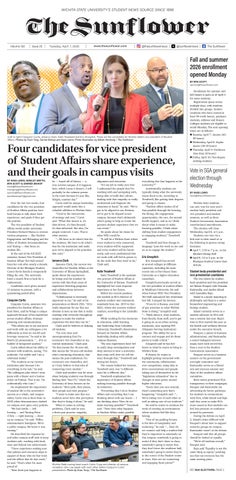
Over the last two weeks, four candidates for the vice president of Student Affairs position have held forums to talk about their experience, and goals if they get the position.
The vice president of Student Affairs works under university President Richard Muma to oversee various programs — like Student Engagement and Belonging and the Office of Student Accommodations and Testing — that focus on student life.
At the end of the fall 2025 semester, former Vice President of Student Affairs Teri Hall retired from her role after nearly a decade. Director of the Rhatigan Student Center Kevin Konda is temporarily filling the role. The university hired a search firm to look for a replacement.
Candidates were given around 15 minutes to present, with a questioning period after.
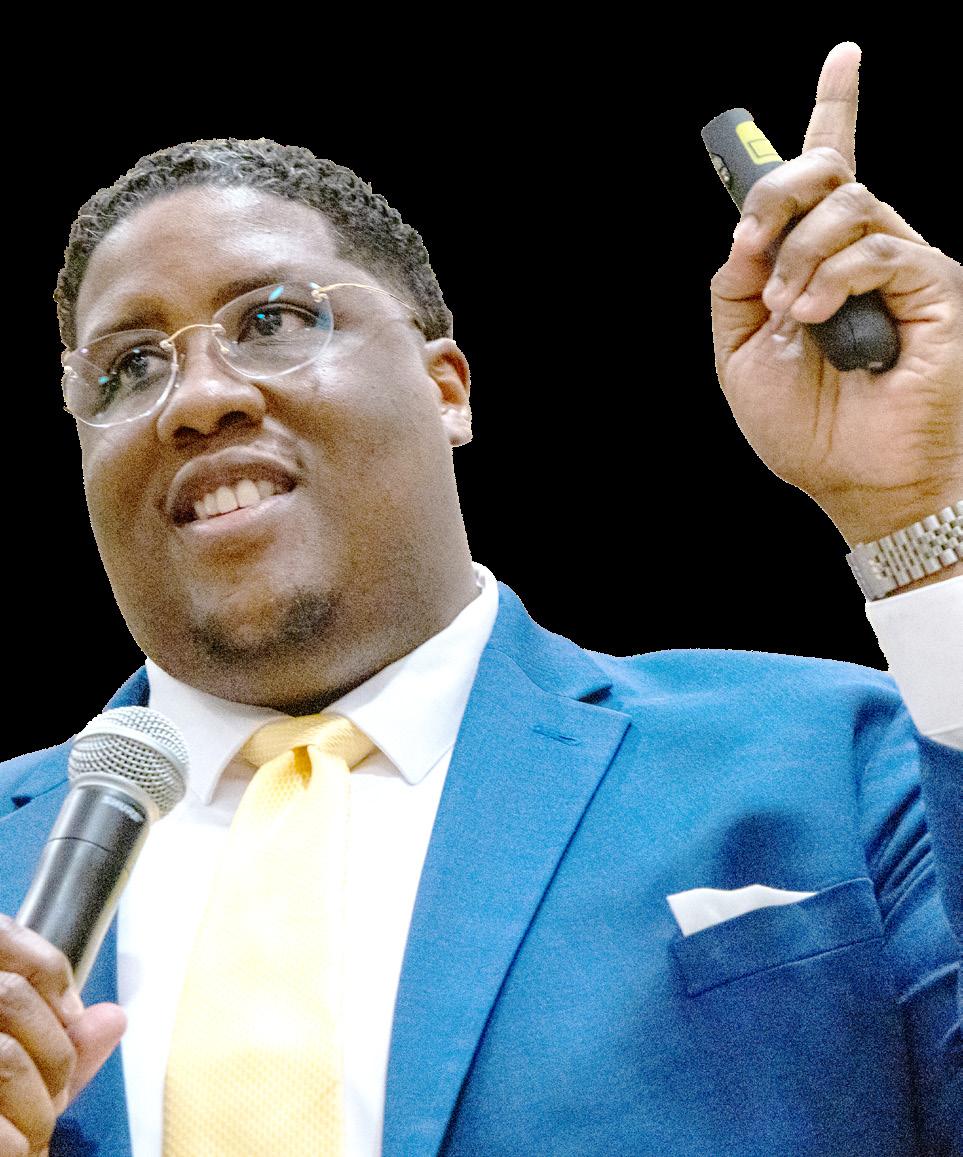
Cesquinn Curtis
Cesquinn Curtis, associate vice president for Student Affairs at Kent State, said he brings a unique approach because of his experience across student affairs, strategic planning and communication.
“This allows me to see and pivot and work with my colleagues a lot differently so that we can lift and leverage resources,” he said at his March 23 presentation. “... (I’m a) builder of integrated systems.”
Curtis talked about his ability to connect with students, saying, “I’m authentic. I’m visible and I am a relational leader.”
“The students at my current institution joke because I do everything in the suit,” he said. “My colleagues joke when I wear jeans with a blazer and a buttondown on Fridays. That is me. I’m authentically who I am.”
He emphasized the importance of student life to the university’s success as a whole, and campus safety. Curtis was at Kent State in 2018 when demonstrators clashed on campus over open carry policies.
“We had Antifa — leftleaning — and Turning Point (USA) — right-leaning — show up on campus,” he said. “Rifles, semiautomatic handguns. We’re a public campus. We knew it was coming.”
He described the response he and other campus staff took to keep students safe, working with local, state and federal law enforcement.
“I have experience making sure that policies and resources align in support of those who do that work and the offices that do that work,” he said. “That’s what I’m most proud of.
“Kent State just happens to
be — based off of history — a very activist campus. If it happens here, which I pray it doesn’t, I will probably be the calmest person in the room because it’s just like, ‘Alright, another day.’”
Curtis said his unique leadership approach would make him a valuable addition to Wichita State.
“I lead at the intersection of strategy and care,” Curtis said. “What that means is, it’s data-driven, it’s data-focused, it’s data-informed. But also, I’m people-centered. I care. That is what matters.
“...We have to do what’s best for the students. We have to do what’s best for the institution and make sure we’re aligned to the priorities that exist.”
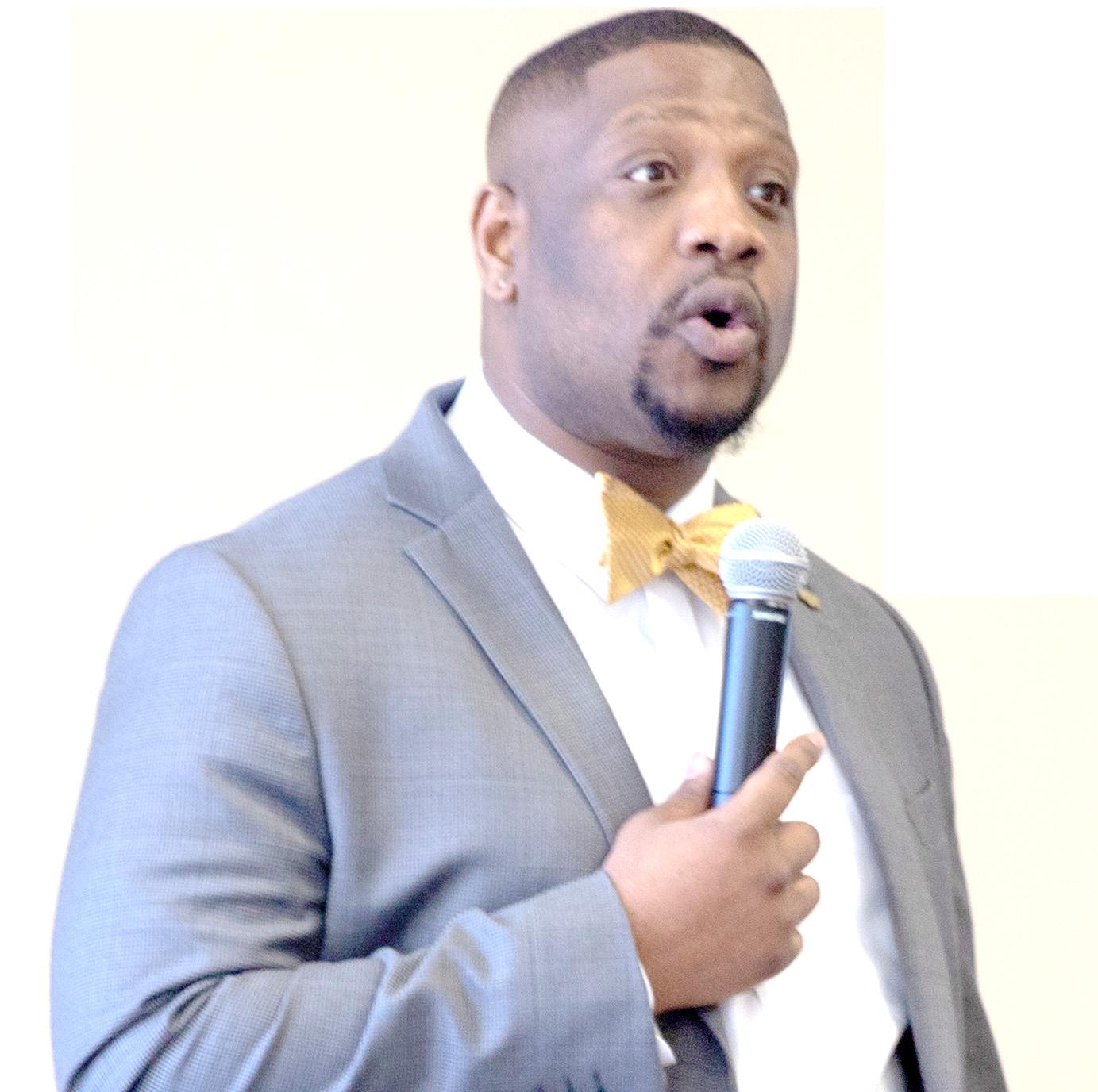
Jamarco Clark
Jamarco Clark, the current vice chancellor for Student Affairs at the University of Illinois Springfield, spoke about the experiences he brings and the mindset he carries with him from years of experience directing programs and collaborations between departments.
“Collaboration is extremely important to me,” he said at his presentation on March 25th. “(It’s) really important for me that our division is seen as one that is really working with everyone throughout campus to make the student experience the best they can be.”
Clark said he believes in helping all students.
“I’m very clear and uncompromising that I’m everyone’s vice chancellor at my current institution,” Clark said.
“So that means the 18-year-old, that means the 50-year-old student who’s continuing education, that means the post-traditional. I’m everyone’s vice chancellor, and so I truly believe in that idea of connecting every student.”
Clark said another way he went about helping students was through finding their “four P’s,” which the University of Iowa focuses on for students: “their path, their places, their people and their purpose.”
“I want to make sure that our students never have that perception that they’re doing it alone,” he said.
When it comes to solving problems, Clark said he uses a three-part process: empathy,
alignment and execution.
“It’s my job to make sure that I understand the people that I’m working with and navigating with, being able to build that culture, leading with that empathy to really understand and diagnose the situations at hand,” he said. “We’ve got to be aligned in our division, we’ve got to be aligned across campus, because that’s ultimately what’s going to help us create the greatest student experience that we can create.”
He spoke about his vision for what WSU could be.
“It will be a Wichita State where every student is truly connected, every student will be supported and every student will be futureready, and every professional that we work with will feel in power to do the work that they need to do,” Clark said.
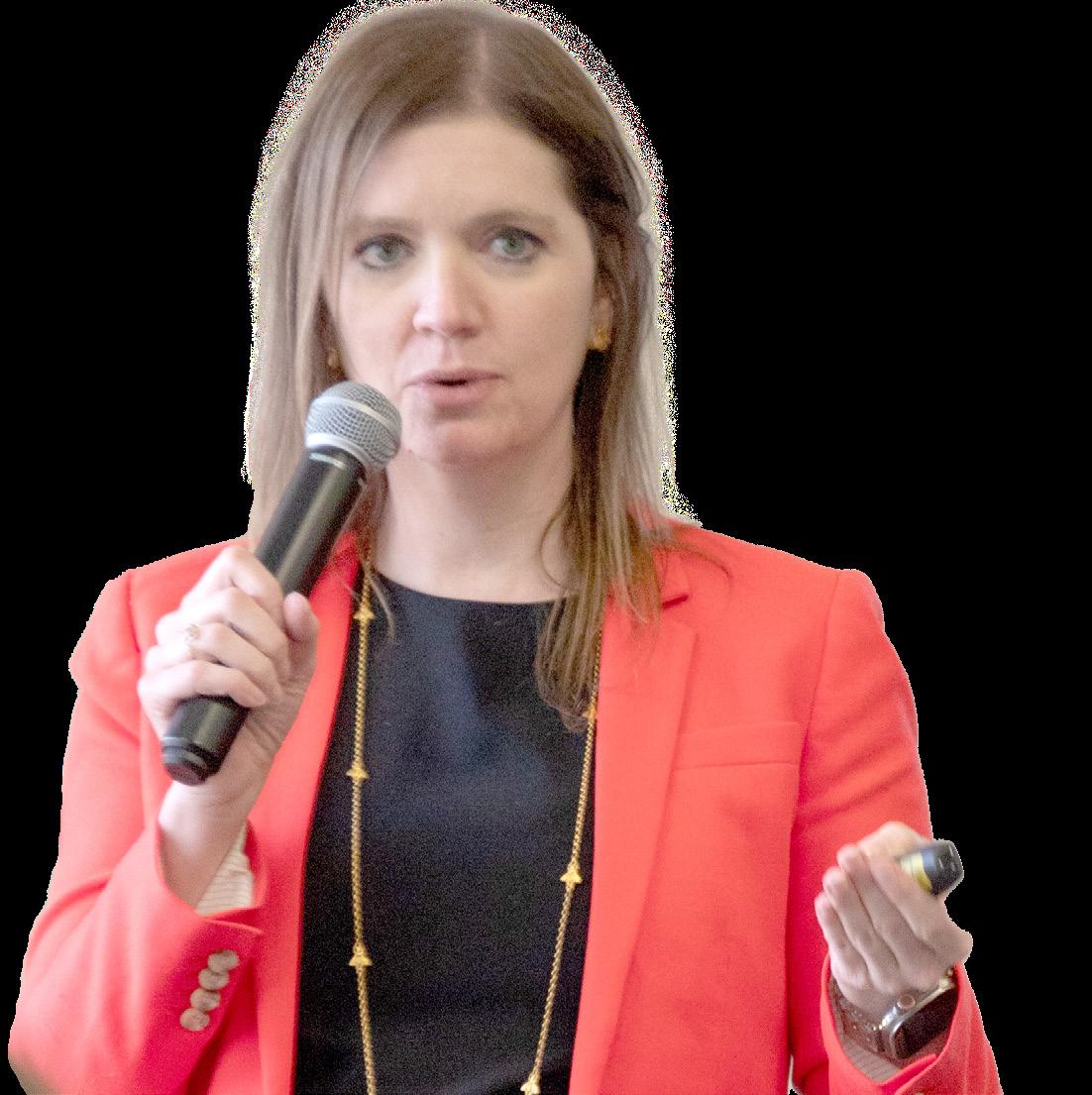
Katie Treadwell
Katie Treadwell is the assistant vice provost of Student Affairs at the University of Kansas. Treadwell highlighted her crisis response experience at her forum.
Before her current position, she worked as KU’s director of student conduct and community standards from Jan. 2019 to Dec. 2021, where she oversaw student conduct, according to her LinkedIn page.
While working for her doctorate in education, adult learning and leadership from Columbia University, Treadwell’s dissertation focused on Student Affairs leadership dealing with college campus disasters.
“My own experiences have led to really deep investigations and deep interest in how a university does crisis well, how we tell the story through that,” Treadwell said during her forum.
The reason behind her interest, Treadwell said, was “a different story for a different day.”
Treadwell emphasized the importance of Student Affairs making learning possible through its initiatives.
“Everything that I do in Student Affairs and everything that I am thinking about with our teams — I am thinking about ‘How do we make learning possible?’” Treadwell said. “‘How does what happens in Student Affairs make possible
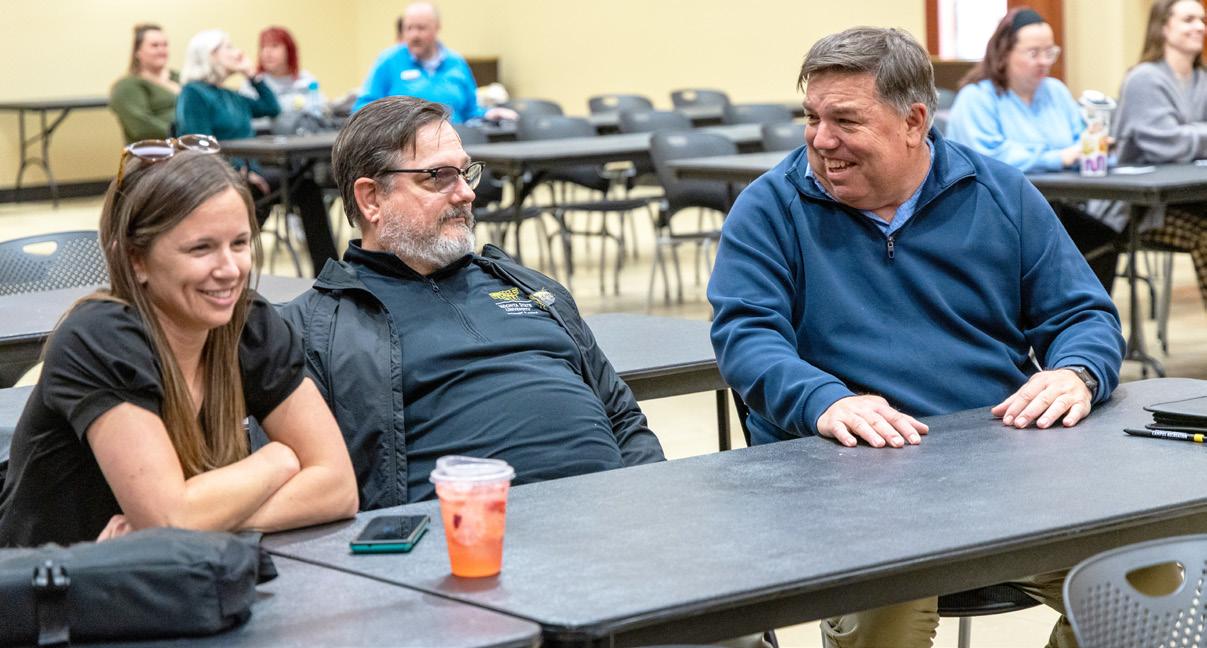
everything else that happens at the university?’”
Academically, students are typically doing what the university wants them to do, according to Treadwell, like getting their degrees and going to classes.
“Student affairs makes all of that possible through the housing, the dining, the engagement opportunities, the care, the mental health support, and so as I think about what it means to make learning possible, I think about shifting from student engagement to engaging students,” Treadwell said.
Treadwell said that change in language “puts the work on me and on us to engage the student.”
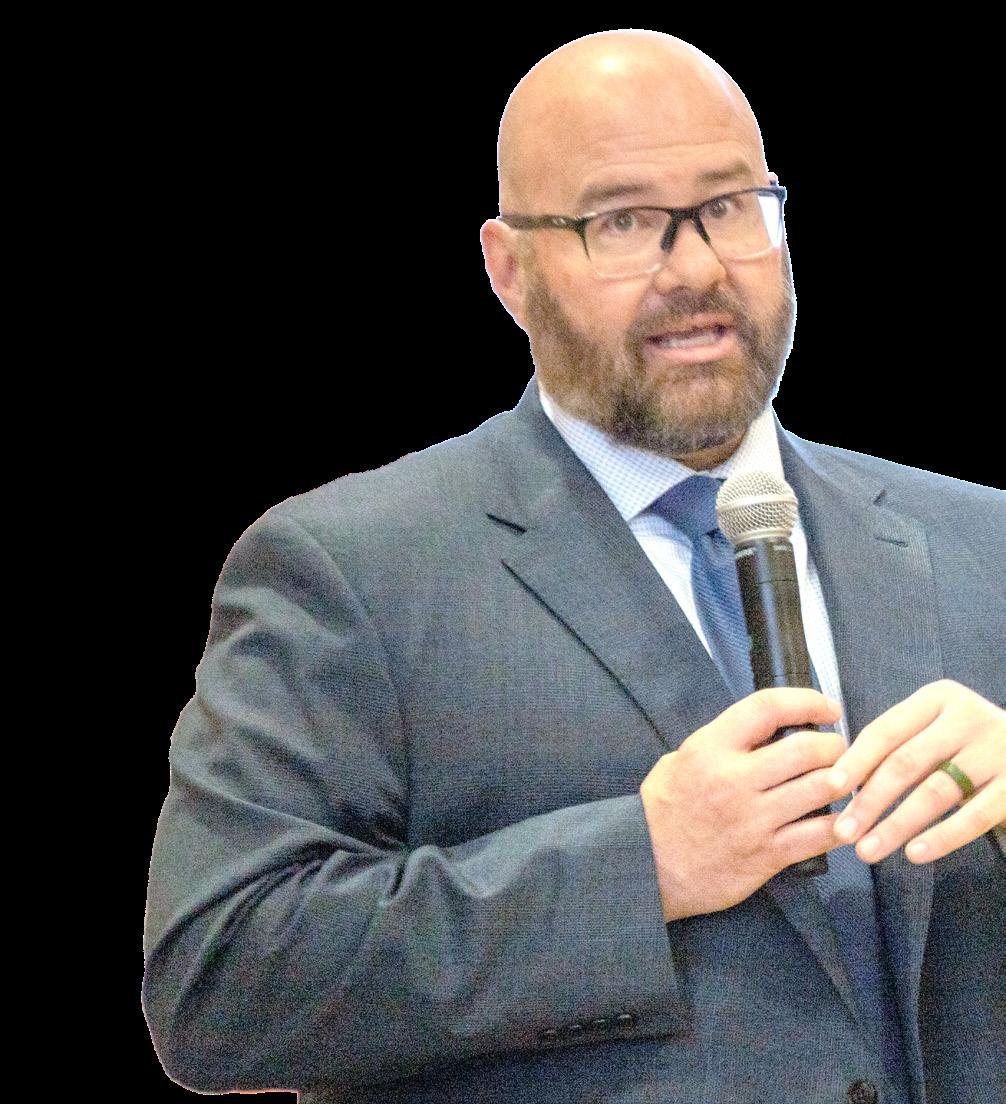
Eric Grospitch
Eric Grospitch has served at several colleges in different capacities, including his most recent role at Fort Hayes State University as a higher education consultant.
Grospitch previously served as the vice president of student affairs at Washburn University. He said when former WSU Vice President Teri Hall announced her retirement last fall, it piqued his interest.
“If you’re in Kansas, you kind of pay attention to what Wichita State is doing,” Grospitch said.
“... Think about it, from students, from faculty, from staff, you’ve got it going on as an urban serving institution, now aspiring HSI (Hispanic-Serving Institution) program. The ability for us to connect and engage and do those pieces is really critical.”
Grospitch said he has five facets to what he wants to bring to Wichita State.
If chosen, he wants to highlight getting connected with the community, collaboration over competition, using data to drive conversations and people taking care of themselves in the “legislation exhaustion” due to changes in state policy around higher education.
“Every time you turn around, there’s something new that’s happening,” Grospitch said. “... We’re taking care of each other as well as taking care of our students.”
He said he wants to continue the work of creating an environment where students feel like they belong.
“One of my guiding focuses is the idea of marginality and mattering,” he said. “... How do we connect and help a student find they’re important to somebody on this campus; somebody is going to notice if they don’t show to class; somebody’s going to notice that they don’t leave the residence hall, somebody’s going to notice they’re in the corner of the Heskett center in tears. How are we connecting and engaging those pieces?”
BY MYA SCOTT opinion@thesunflower.com
Enrollment for summer and fall classes is open as of April 6 for some students. Registration spans across multiple days, with students divided into groups. Seniors (students who have earned at least 90 credit hours), graduate students, athletes and Honors Colleges students are eligible to enroll Monday. The next opening times are as follows:
n Tuesday, April 7: Juniors (6089 hours)
n Wednesday, April 8: Sophomores (30-59 hours) n Thursday, April 9: Freshmen (less than 30 hours) n Friday, April 10: Non-degree seeking students
Vote in SGA general election through Wednesday
BY KASS LEWIS news@thesunflower.com
Wichita State students can now vote for next year’s student body president and vice president and student senators, as well as three Student Government Association constitutional amendments. The election will close Wednesday, April 8, at 5 p.m. Students can vote via a link sent to their email or at the following in-person voting locations:
n April 7, 5:30 to 7 p.m., in the Shocker Dining Hall n April 8, 12 to 2 p.m. in the Rhatigan Student Center East Atrium.
Student body presidential and vice presidential candidates
The two tickets for student body president and vice president are Mason Fouquet with Nazanin Kasirosafar, and Jayden Island with Anoushka Raju.
Island is a junior majoring in philosophy and Raju is a senior biomedical engineering and biology student.
Island currently serves as a student advocate in SGA and was a senator last year. Raju’s time in SGA started this year as the health and wellness director under the executive branch. Fouquet, a junior in business administration, and Kasirosafar, a senior biological sciences major, have each served less than a year in the Student Government Association.
Fouquet serves as a business senator on the government oversight committee and Kasirosafar serves as a liberal arts and sciences senator and chair of the academic affairs committee.
Both tickets prioritized SGA transparency in their campaigns. Fouquet and Kasirosafar are advocating for better pathways for students to communicate with SGA, while Island and Raju said they want to make SGA more casual so that students can feel less pressure or confusion around its processes.
During the debate on April 2, Island’s ticket differed with Fouquet’s about how to support minority groups on campus. Kasirosafar wasn’t at the debate. Fouquet said that all groups should be looked at equally.
“We’re all students overall,” Fouquet said.
Raju said “Equality is not the same thing as equity,” pointing out that not everyone has the same starting place.
BY KASS LEWIS news@thesunflower.com
Wichita State Student Body
President Jia Wen Wang announced on Wednesday that she vetoed Association Resolution 68-014, which would recommend the university add an honorary A+ to its grading scale.
“I am vetoing this resolution on the grounds that it would not provide clear, consistent support for Wichita State students,” Wang said. “A+ — as an honorary title — would not be transferable to other state institutions within Kansas and would fail to benefit our students as such.”
Wang also said that the A+ as an honorary title was found to be the least popular option in the Academic Affairs Committee’s surveys. The committee surveyed nearly 400 students to see if they would approve of the change. When he presented the resolution in senate, Liberal Arts and Sciences Senator Josh Mallard said that the registrar’s office made it clear changing the way GPA works was not currently possible.
Wang shared the complete survey findings with The Sunflower.
The survey showed that the average rating out of 10 for “How would you rate having the A+ replace A as the 4.0 GPA?” was 7.17 and “How would you rate having A+ be assigned a GPA higher than 4?” was 8.77.
The least popular option was the A+ being purely honorary, with an average rating of 6.86.
The resolution was first introduced at the March 4 Student Senate meeting and was approved by the Senate on March 11.
BY KASS LEWIS news@thesunflower.com
The Student Senate passed legislation Wednesday evening that changes student agencies to student organizations. The change was made to comply with state regulations that limit diversity, equity and inclusion language and initiatives.
The bill — first introduced at the March 11 Senate meeting — means that agencies won’t have direct staff support from the Office of Student Engagement and Belonging and will not receive funding from the student body president’s budget.
The agencies will now have to apply for funding through the appropriations process, like other student organizations on campus. The student body president decides how much of their budget goes to both agencies and the appropriations pool.
Student Body President Jia Wen Wang said that if she was the next president making their budget, she would simply reallocate the agencies’ funding into the appropriations budget, so that the agencies can still receive normal funding amounts without reducing the amount available for other student organizations.
Wang is not running for reelection and provided this as advice for the next president.
BY KAMI STEINLE steinlekami@gmail.com
The Kansas Legislature’s budget includes a ban on state higher education institutions requiring courses with diversity, equity and inclusion content for most undergraduate degrees.
In the appropriation bill passed by the Legislature, the budget is not the only content; legislators can also add provisos, policies that create conditions for funding, and pass them with the budget.
The new proviso regarding DEI curriculum adds to language included in the past years, barring DEI policies and initiatives. It would withhold $2 million from Wichita State if the university violated the policy, and be enforced starting in academic year 2028. Kansas Governor Laura Kelly has not yet signed or vetoed the appropriations bill. Universities have until academic year 2028 to make all the changes that are needed to comply. Schools can apply for exemptions from the Kansas Board of Regents, which oversees higher education in the state, for programs that they think are inseparable from the topics targeted by the legislation.
Two years ago, the Legislature passed Senate Bill 125, banning any DEI activities or programs at state universities. It included banning state employees from having pronouns in email signatures, which Wichita State’s Chief of Staff Zach Gearhart said WSU interpreted to also include members of student organizations.
SB 125 put restrictions on appropriations for fiscal years 2025, 2026 and 2027. If universities violate the DEI restrictions, funds can be withheld.
However, this year the legislature is allowing the universities to work with KBOR, to interpret what content violates the rule.
“I think there’s a mischaracterization of what, at least, this university does with DEI,” Gearhart said at a legislative update on March 27. “I think in the legislature, their interpretation is that DEI is a zero-sum game … that’s not what Wichita State does. What Wichita State does is we want anybody who wants to come to this university, regardless of their personal lived experiences in the background, to be successful.”
Changes are being made at all universities to correct what the legislature found to be in violation.
The budget has not passed yet — it has been sent to Kelly and is waiting on action from her.
Existing anti-DEI policy
In December, the legislature found that every university in Kansas still had DEI-related language in their course catalogs and websites, Gearhart said. The legislature found these violations by running websites and course catalogs through artificial intelligence.
Gearhart said part of the reason for the violations was “a timing issue.”
“We have a strategic plan … and we updated our strategic plan
to comply with the previous law,” he said. “The problem is the course catalog gets approved and printed prior to that previous law coming into effect.”
Gearhart said that because this year’s new proviso was passed after the course catalogs came out, there was no way to go back and change it for the coming academic year.
The legislature allowed universities to work with KBOR to define DEI — which was never defined in previous provisos or bills — and universities have until academic year 2028 to make sure no degree programs require DEIrelated classes.
“This is challenging because in one lens you’re going to see that this is more specific, but then you’re also going to see that it is very broad,” Gearhart said. “... programs, activities — that’s very broad, nebulous term that we’re left to interpret.”
But, he said, the language banning university employees from including pronouns in their email signatures “is pretty definitive.”
DEI first became a topic of discussion in the Kansas Legislature three years ago when the House introduced House Bill 2105, which prohibited institutions from hiring or promoting faculty and staff based on factors like race and ethnicity. One of the bill’s provisions said there would be no effect on curriculum or violations of academic freedom.
What needs to change at WSU, and faculty concerns
One of the main concerns that WSU has to deal with regarding DEI in degree requirements are general education requirements.
Because there’s no clear definition for DEI, Gearhart said, “if the word DEI is mentioned, it’s not good.” Gearhart also said that in SB 125, the provision does affect curriculum.
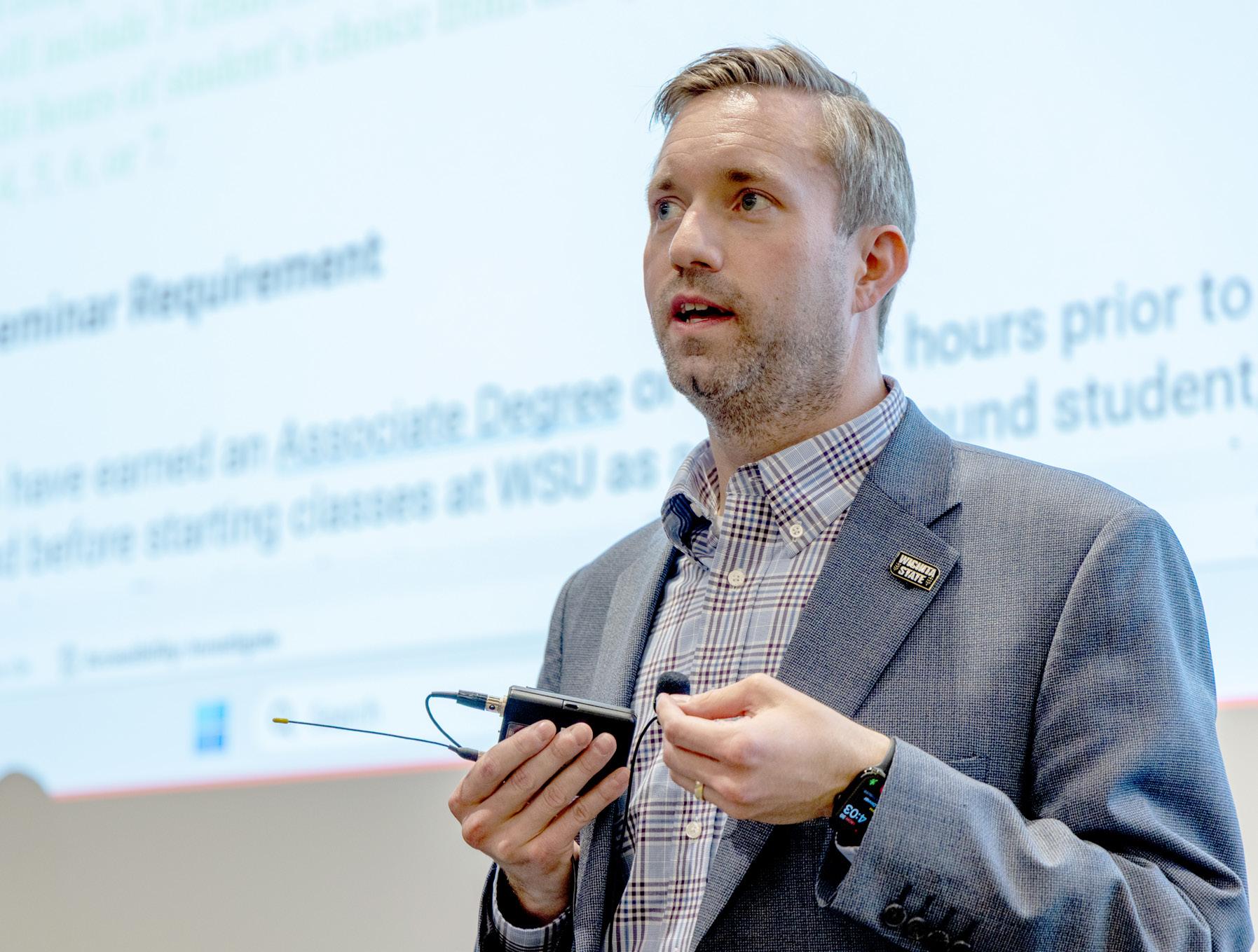
General education requirements are split into seven buckets that are decided by KBOR, each bucket having different requirements. Bucket seven specifically requires
three credit hours with diversity content and three credit hours of a first-year seminar.
During a general faculty meeting last Monday, faculty voted to approve a change to make bucket seven’s requirements include three credit hours from an approved list of courses in either buckets 4, 5, 6 or 7 with no diversity requirement and the first year seminar requirement.
“What we’re essentially doing is taking the bucket as kind of a catchall where a student can take another class; it doesn’t have any real purpose other than to just fill credit hours,” Faculty Senate president Christopher Stone said during the general faculty meeting.
Many faculty members voiced disagreement with the change, but Stone said academic affairs would have to change the language regardless of how the faculty voted, because failure to make this change would result in $2 million being withheld from the university.
“I will tell you, when I first saw this, whenever we were first introduced, my gut reaction, the first thing I said was, ‘How much money are we talking about? Can we just tell them to shove it?’”
Stone said. “And I was quickly told by senior administration we can’t afford to tell them no.”
Faculty gets to vote on this language change because they have shared governance, but Stone said that doesn’t mean they have control over what happens — they just get to participate. Often when changes like this need to happen, the faculty gets to decide how those changes look, he said.
“To students, the greatest threat is a loss of funding,” political science professor Neal Allen said.
Political science professor Carolyn Shaw said prior to the diversity requirement being added to general education, most students were already taking classes with diverse content, even before they got to the point in their general education when it was required.
Stone also said that more major
changes to general education requirements could be made in the future — since many faculty members were unhappy with the revisions — and it will be sent to the Faculty Senate’s general education committee in the fall for further review.
“This is obviously a hasty decision, so I would strongly recommend that next year’s senate take on making this better,” associate professor of philosophy Susan Castro said.
The blurry definition of DEI was also a factor in faculty’s reluctance to make this change.
“They say we’re out of compliance,” Chair of the history department George Dehner said.
“But they say ‘give us a definition of DEI by 7/31/26,’ so how can we be out of compliance if we don’t have a definition?”
The way the legislature is handling this year’s budget provisos is a “doozy,” Gearhart said during the faculty meeting, and many faculty members expressed that they feel it is a violation of academic freedom.
Some faculty members didn’t see the risk of pushing back on the legislature as worth it — especially since, according to Shaw, 90% of students were already taking diverse courses without the requirement — but others were still concerned that this would lead to the legislature making changes in curricula and what can be taught at institutions, not just prohibiting DEI in degree requirements.
“So, the impact of students taking the courses is minimal, and yet we’re willing to risk money over this requirement,” aerospace engineering professor Roy Myose said in support of the language change.
Though the language change did pass, this likely won’t be the final change to the general education requirements.
“I’m glad lots of our students take diverse courses, but this is giving up our academic freedom,” Shaw said.
photos and all contents are copyrighted.
MALEAH EVANS
arts@thesunflower.com
Since the beginning of 2026, over 15 people have been killed by Immigration and Customs Enforcement officers, or have died while in ICE custody.
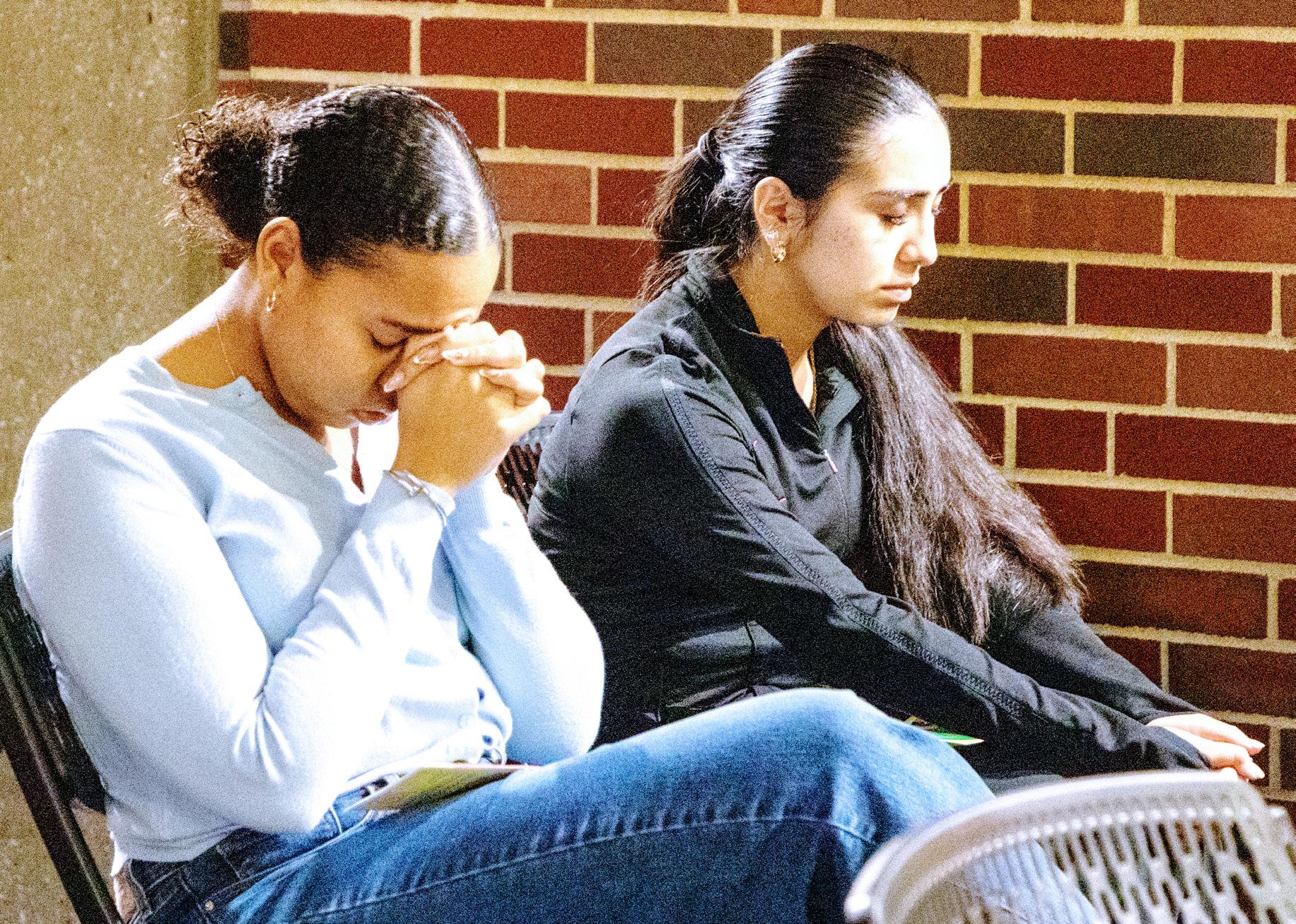
On April 1, Wichita State’s Shocker Organization for LGBTQIA+ Research and Advocacy held a vigil for the victims of ICE violence. Ruby Godsey, the president of SOLAR, opened the vigil with a statement about coping with grief and fear.
“There is no easy way to go about acknowledging the previous actions of ICE under the current administration,” Godsey said. “The United States is a country founded by and upon immigrants. However, violence against immigrants and people of color is nothing new.
“Solidarity is not merely a moral obligation, but also a practical one.”
She went on to say that despite the discomfort these topics bring, it is important for people to have a safe space to sit with their grief and fears.
“It’s uncomfortable to sit with the painful truth that ICE officers are essentially hunting down people of color and immigrants and anyone who is brave enough to speak out against those gross injustices,” she said. “I believe that it is very important that we sit with that uncomfortable feeling and confront the systemic injustices that have gotten us to this point in the country.”
Godsey took a moment to read the names of people who had been killed by ICE or died in ICE facilities.
The group then took a moment of silence for the people killed, and Godsey encouraged people to sit as long as they needed to process their grief.
Attendees of the vigil stressed
n Emmanuel Damas
n Jose Guadalup Ramos-Solano
n Royer Perez-Jimenez
n Pejman Karshenas Najafabadi
n Renee Nichole Good
n Parady La
n Herber Sanchez Domínguez
n Geraldo Lunas Campos
n Nurul Amin Shah Alam
n Alberto Gutierrez-Reyes
n Mohammed Nazeer Paktiawal
n Victor Manuel Diaz
n Alex Pretti
n Dr. Linda Davis
n Lorth Sim
n Luis Beltran Yanez-Cruz
n Jairo Garcia Hernandez
n Luis Gustavo Nunez Caceres
community.
I want this vigil to serve as a space for grief, support and community for those who need it.”
GENESIS MERRIETT President of Spectrum: LGBTQ & Allies “
the importance of supporting the community in order to show their strength.
“We need to show that our community is not what they’re saying it is,” Merry Mendoza, a Wichita State sophomore, said. “It’s showing up for my people, for my community, no matter (what little) impact.”
Josie Medina, a freshman at the university, said that showing up to vigils like these is important to
show that “other people are here for you as well.”
Attendees said they were thinking about the people around them who have been impacted by fears of ICE raids and violence.
“I was praying … for my family, for my friends, for me, for anyone,” Mendoza said.
Mariah Smith, a freshman who attended the vigil, stressed the importance of attending awareness events like this for the communities
to stick together.
“As a woman of color, it’s very important to me to sit with those who are also of color because I understand what it’s like to have this happen … It’s very important to stick together as communities, regardless of what your race or color is,” Smith said.
To Arizvel Tavarez, a freshman, vigils on campus show her that people at Wichita State care about political issues that impact every
KAMI STEINLE
steinlekami@gmail.com
Candidates for the upcoming student body president and vice president elections had their final debate on April 2, focusing on topics like student outreach, support for marginalized students and current SGA processes.
Candidates Mason Fouquet and Nazanin Kasirosafar are running against Jayden Island and Anoushka Raju for student body president and vice president. Kasirosafar was not at Thursday’s debate. Fouquet said that she was out of the country on a vacation that was planned before they entered the race.
After the candidates appeared to agree on most issues at the first debate on March 26, they clashed Thursday over how to support students amid state policies against diversity, equity and inclusion initiatives.
Support for minorities
Fouquet said the biggest concern should be to always be staying in compliance with state and federal law because of the threat of losing funding.
“We need to advocate for them as much as anyone else,” Fouquet said. “I think that for me at least, I view that as almost a pointed question, it’s like guys, we are not focusing on the right thing here. Rather than picking out and cherry picking certain groups and saying, ‘How can we help them?’ Let’s think about why we’re all here. We’re all students overall.”
He said all groups should be looked at equally and one shouldn’t be prioritized.
Island said it is not enough to assume changes will happen with the legislature; they should be actively engaged with minority groups in order to help them when they need.
“Equality is not the same thing as equity,” Raju said. “Not all of us come into college with the same resources and so providing equal support is not going to bring us all to the same level. By providing equitable support, we’re able to help students who maybe come in with fewer resources or fewer support systems to succeed and ultimately cross the stage at graduation.”
In rebuttal, Fouquet asked Island to explain the ways universities may not be set up for Black students, as they mentioned earlier.
“This discussion is so much more than my individual experience as a Black student has been,” Island said. “There are systems set up against me in every single way, but I think that by having connections in the university, in administrators, legislative people and the student body that are willing to advocate for me … who may not be able to speak to my experiences but understand where I’m coming from and can even say that I have a problem… just being able to acknowledge that is something that I hope any person in a leadership position would be able to do.”
Fouquet is the vice president of the Wichita State chapter of Turning Point USA. An audience question asked how he would remain impartial while also being a part of a political organization.
“What I think is that Turning Point USA has not hindered my ability to have impartiality among student leadership in any way, I think it’s actually helped,” Fouquet said. “If you think about what Turning Point USA is and does as an organization, we are a civic group that tries to promote engagement of different thoughts in respectful debate and discussion.”
Island disagreed because of TPUSA’s reputation across the country, pointing to aggressive marketing tactics that target queer and trans students.
“While yes, the organization may not hold the values that many students perceive them to have, it’s still important to recognize the impact you have on students and be able to directly address the concern,” Island said.
Managing student fees
During an interview with The Sunflower, Fouquet and Kasirosafar said that they were unhappy with how student fees were handled this year. An audience question at the debate asked why neither of them voiced their concern during the deliberations.
“The budget cuts were too late
and too much at once,” Fouquet said. “The funding decisions were made very quickly by the finance commission, obviously … with how late in the evening it was during our senate sessions, the senate didn’t really have a chance to fully digest the numbers and so at the time it felt like it seemed like it would make sense to split the discussion and come back on a different day, but unfortunately that’s not how finance hearings work.”
The senate reviews and debates the student fee budget over the course of two meetings. In the first, senators can suggest and vote on changes to the allocations. In the second, they can only change policy notes written into the bill.
There was about a week between the end of the Student Fees Commission’s deliberations, where it finalized the budget recommendation, and when it brought the budget to the senate. Senators, and the public, have access to the recommended budget when it is finalized and the deliberations are live streamed.
“The arguments were valid, and I think that the unfortunate part was afterward, after this was all put into effect, the student response was what hurt,” Fouquet said. “... I mean, it’s never going to be perfect, students are still going to have things that happen that they don’t agree with, and their funding’s going to get cut. When it may seem OK in the moment, it’s not OK overall. I mean, look at O.J. Simpson, he got off.”
Island said it’s unfortunate that neither Fouquet nor Kasirosafar spoke during the senate meeting because it is a privilege to be able to speak with legislative committees prior to the presentation to the senate. Senators usually receive the final budget from the finance commission days in advance to look over anything that they may not agree with. Also, Island pointed out the opportunities both candidates had to watch the student fees deliberations while they were happening.
“We certainly think that if Fouquet and Kasirosafar had reservations beforehand that those should have been brought to the floor,” Island said.
Combating student issues on campus
When asked about complaints from students and how SGA would work to fix the problem, Fouquet said that he hears a lot of students talk about food quality on campus.
“I’ve heard complaints of soggy chicken from Chick-fil-A, I’ve heard complaints of hard, rock-hard rice from Panda Express,” Fouquet said. “And while that may seem like a minor thing, I think that at the core of what we’re doing here, you know, it’s in our campaign, we want to advocate for students.”
Island said the biggest concern they’ve heard from students is parking. Because of the complexity of the issue, one suggestion for helping the problem Island brought up was building strong relationships with parking services.
“I think having strong relationships with those offices and sitting down with parking services to see what can we do in our capacity as student government officials to help guide those conversations forward,” Island said. “Even provide more information about parking services to students to really build that gap in communication.”
“If elected, we plan to lead by making SGA more open and approachable,” Fouquet said. “That means sharing information about budgets, policies and initiatives early so students can provide input before decisions are made.”
Raju said that she and Island are focused on connecting with students and making sure everyone feels like they have a place on campus.
“Those conversations remind us that while Wichita State is strong, there is still work to do,” Raju said.
Fouquet described his campaign as “motivated.” Island said they consider their campaign “driven” and Raju described it as “fun.”
When asked about their oppositions, Fouquet said that he and Kasirosafar had had multiple conversations about how the other candidates are “passionate.” Island said they noticed their opponents “drive to stay engaged on issues that matter to our students.”
“It shows that there’s people who care, especially where there (were) other events here that didn’t really make sense for them to be here or for them to be happening,” Taverez said. “… with such a big attendance for something that didn’t really make sense and something smaller for something that’s so important.”
Genesis Merriett, president of WSU’s Spectrum: LGBTQ & Allies, challenged people who attended the vigil to not let attending be their only “good deed” of the day.
“I want this vigil to serve as a space for grief, support and community for those who need it,” Merriett said. “I also want this vigil to serve as a call to action, don’t let your attendance to this vigil count as your good deed … I call on you to continue showing up, to contact your representatives.”
SGA ELECTION / FROM PAGE 1
The debates are on SGA’s YouTube channel under the “Live” tab.
Senator seats are also up for election. Students will vote on senators representing their college and other groups like freshmen, graduate students and the student body at large. More information about candidates can be found on SGA’s Instagram, @wichitastatesga.
Constitutional amendments
The first of the three constitutional amendments would change language to clarify SGA’s definition of a freshman senator. The proposed definition states that freshmen are undergraduate students who are entering college for the first time.
This definition also excludes prior transfer or dual-enrollment credits, meaning that a student who completed their freshman year of college in high school could still run for freshman senator in their first year at Wichita State.
The second amendment makes a change to SGA’s Judicial Branch’s section of the constitution. The new version adds the Student Organization Code of Conduct to the list of things that the student supreme court will hear appeals on.
“The Court shall hear appeals from Traffic Court, Parking Appeals, Student Organization Code of Conduct and Library Court of Appeals and shall render decisions in these cases,” the new language would say.
The third and final amendment would alter the underserved senator seats.
Following the change in designation from the Kansas State Finance Council, which stated that student governments are “quasigovernmental,” SGA now has to comply with state policies against diversity, equity and inclusion initiatives.
If approved, underserved senators would change to at-large senators, and they no longer have to be a part of underserved communities, such as the LGBTQ+ or disabled communities.
Underserved senators are still on the ballot, but if the amendment is approved, the elected underserved senators would be changed to at-large senators.
BY OWEN PROTHRO sports@thesunflower.com
The transfer portal, a yearly revolving door for college athletes and coaches, is here.
Opening Tuesday and closing April 21, the next two weeks can potentially make or break a basketball season seven months before it starts. But Wichita State finds itself in a unique position entering this year’s cycle.
The expectation no longer seems to be putting together a new roster year-in and year-out. It seems to be retaining foundational pieces, then building up the walls for long-term success.
That was made apparent when head coach Paul Mills said the days following a season-ending loss to Tulsa in the National Invitation Tournament would be filled with exit interviews designed to discuss what comes next for players and how to build on a 24-12 year.
In the quiet weeks since then, Mills has already begun the process of returning the black and yellow to national prominence.
It didn’t start with offering anyone seven-figure promises or exaggerated roles. It started with a belief that development and bonds between players, coaching staff and the community far outweigh any price tags offered.
“Good people make good players,” Mills said. “We’ll have a tight-knit group and you’ll see us emerge here nationally in the very near future.”
That last line is already starting
to take effect.
TJ Williams, Dillon Battie and Will Berg — three centerpiece players a year ago — have already publicly stated that they will return for another year. Promising center Noah Hill followed suit with his own plans to come back just days after the trio’s announcement. The flow of retention continued as of Monday afternoon, when the team posted that senior guard Mike Gray Jr., who received an addition year of eligibility through a medical hardship waiver, and redshirt freshman guard Tyrus RathanMayes will return next season.
It’s an encouraging sign for a team that put together a roster with 12 new players less than a year ago and returned less than one percent of its scoring and minutes.
“It was intentional on our part a year ago,” Mills said. “We didn’t want to be in the same position that we were last year, losing eight seniors.
“We were really mindful about finding juniors and sophomores who we believe could contribute.”
Mills didn’t sell players on a million-dollar dream. He sold players on a promise that the strength of the community was different than anywhere else and that the coaches would extract the most out of them — as players and young adults.
It seems to be working so far.
“When you get into evaluating character, it’s everything, right?”
WSU Athletic Director Kevin Saal said in a recent Roundhouse
podcast.
“You’re having conversations with the sphere of influence with that young person. You’re watching videos — how do they respond to criticism?
“You’re not going to bat 1.000, but I do have a lot of confidence in this staff’s ability to identify highcharacter people.”
This year’s graduating class, though small, perhaps best exemplified Saal’s question and confidence about an incoming players’ character, and the coaching staff’s level to gauge it.
In one season, Kenyon Giles and Karon Boyd helped reignite a buzz in the community that had fallen dormant for years.
Giles, a 5-foot-10 guard, repeatedly said how his time in Wichita brought back his joy for basketball. He reciprocated with a season that will long be remembered — averaging 19.1 points per game (the most since Jason Perez’s 20.2 in 1999-2000), setting a program record in single season 3-pointers (125) and scoring the third most points in a season (689).
Boyd, a 6-foot-6 forward, guided the defense and saw his offensive production climb throughout the season. He might be remembered best for a gamedefining block against Tulsa at Koch Arena in February. Or maybe that he, too, showed his joy by signing autographs and taking pictures after games.
“Guys like Kenyon Giles and
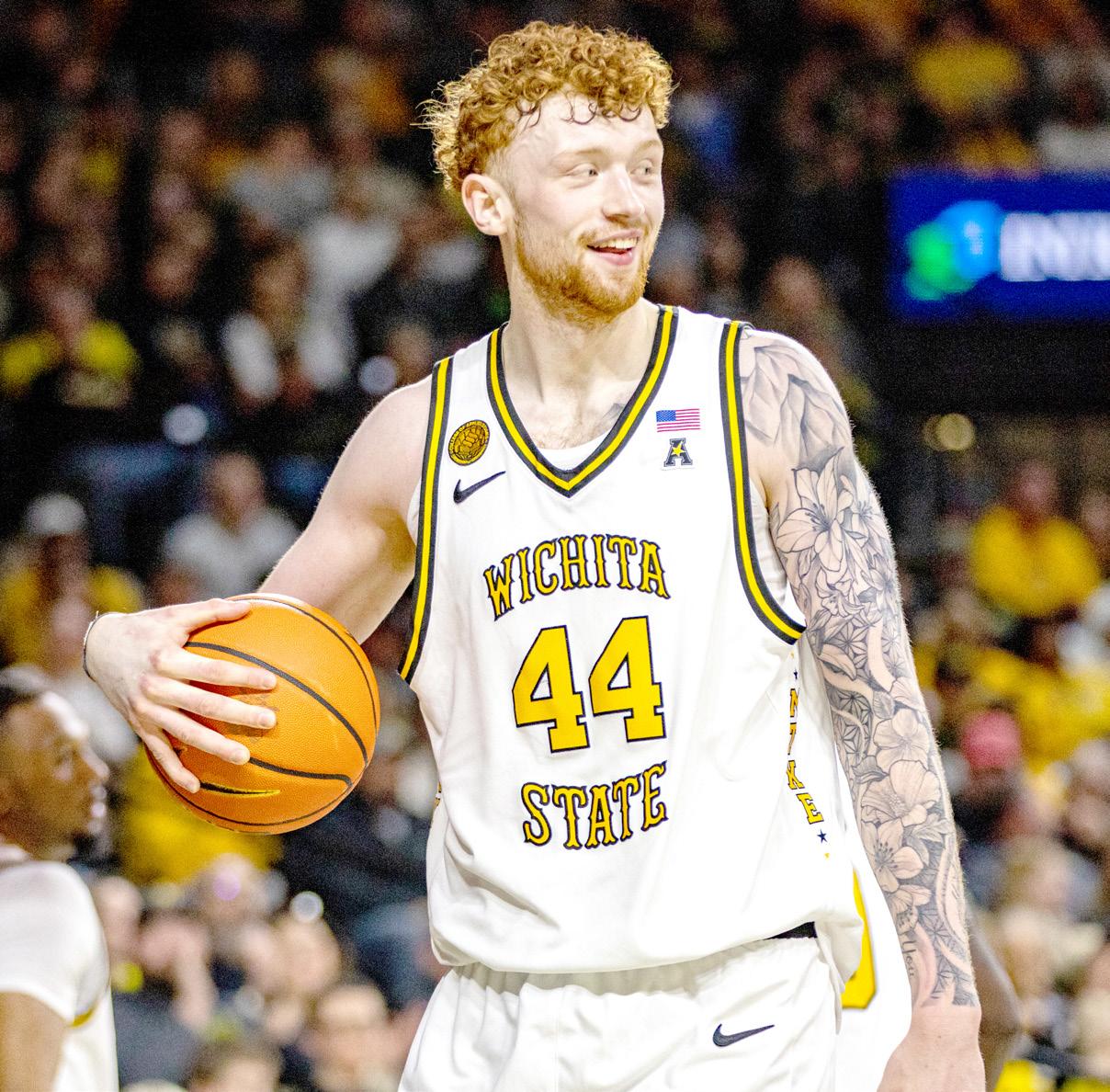
Karon Boyd will be responsible for the success of this program for many years to come,” Saal said to the Roundhouse.
Saal also mentioned in the podcast how the number of fans at home games steadily climbed throughout the season.
“Seeing Shocker nation get excited and get some genuine happiness and joy was really meaningful to me this year,” Saal said.
Still, filling the void Giles and Boyd are leaving will be the next biggest step for improving on the
success in Mills’ third year at the helm. And the players who have already announced they’ll return haven’t just shown they’re ready to begin that process — they’re showing to the fans and each other that the newest trends don’t have to become the norm.
“I want Shocker nation to pause for just a minute and smell the roses that we’ve got … guys that are completely bucking the trend for what’s going on in college athletics,” Saal said.
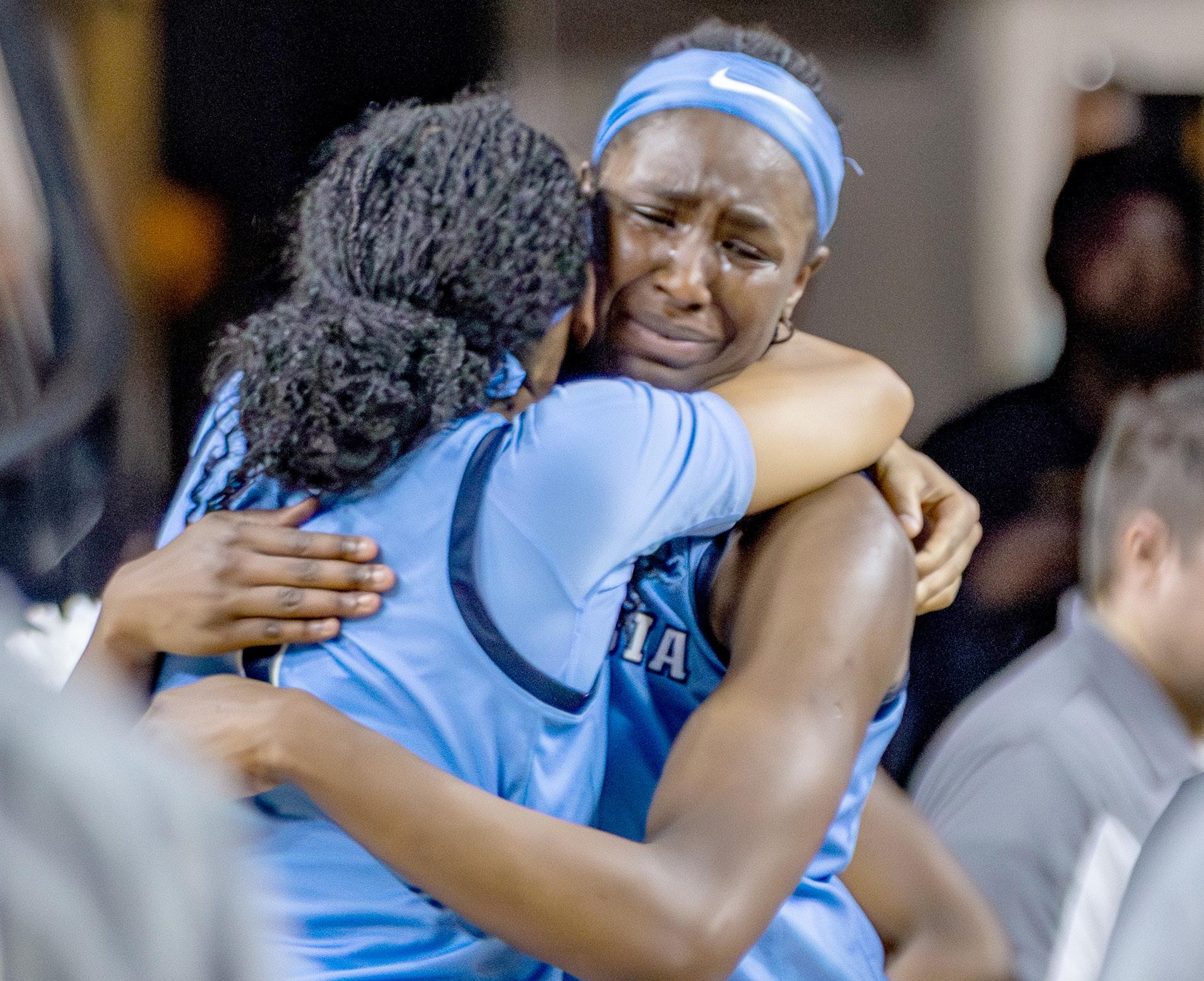
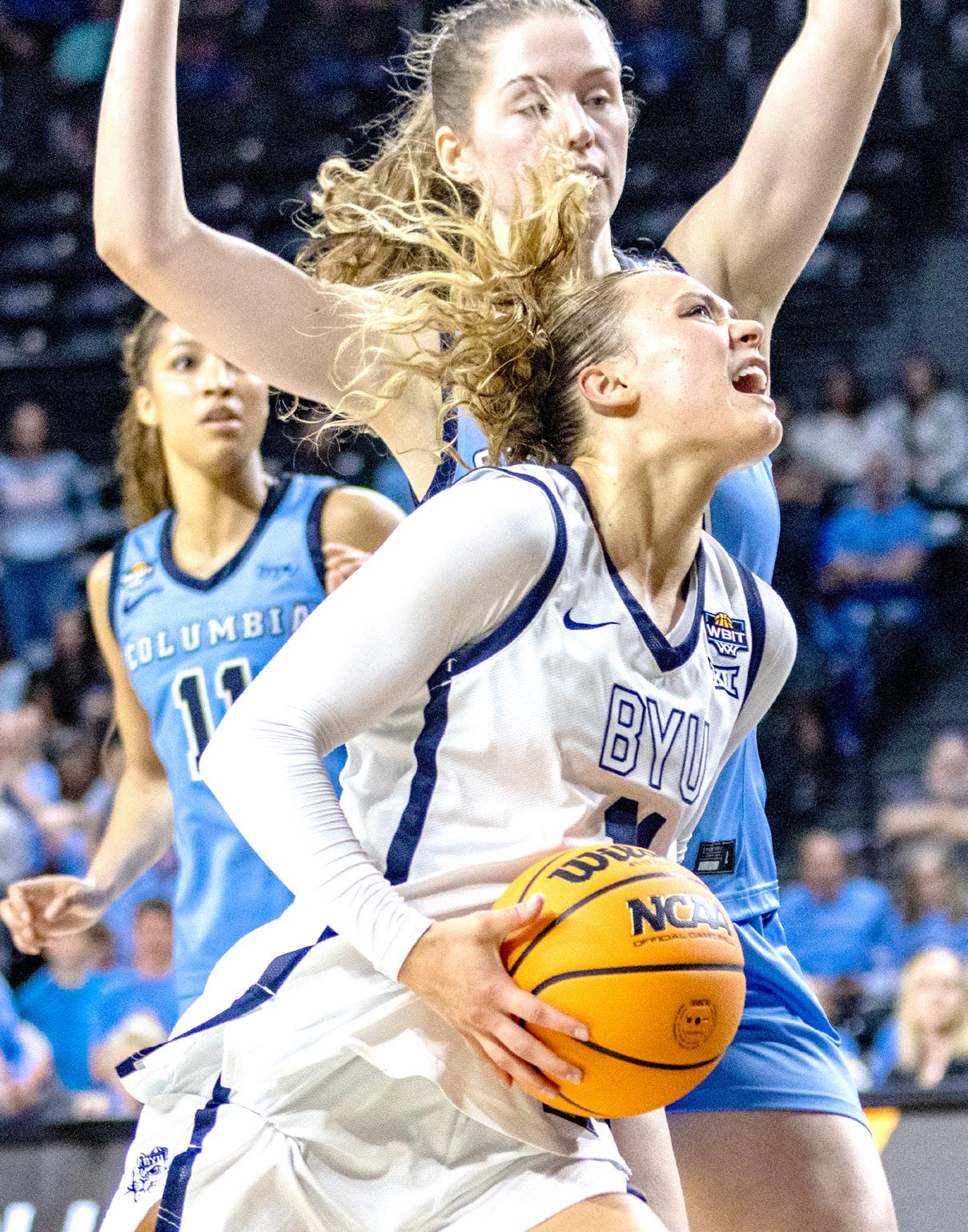
Wichita hosted the Women’s Basketball Invitation Tournament semifinals and finals last week at Koch Arena
BY MACK SMITH
mackred22@gmail.com
Track and field
Over the weekend, the track and field team competed at the Midwest Classic and the Friends Spring Open last Thursday and Friday, picking up 10 first place finishes along the way. At the Friends Spring Open, junior Kelvin Kipyego, freshmen Greyson Ellensohn and Austin Carrera and senior Riley Vandaveer finished all in the top four in the men’s 1,500, with Kipyego placing first after a time of 3 minutes, 49.92 seconds.
Junior Tyler Carroll and freshman Asher Buggs-Tipton finished in first and second in the 110-meter hurdles, respectively.
Sophomore Chairo Ogbebor and freshman Andre Pentecost Jr. finished earned gold and bronze in the long jump after marks of 7.17 meters and 6.82 meters, respectively.
In men’s discus, freshman Eli Johnson and sophomore Jarrett Schmidt also finished in first and third. Finally, senior Beau Kerschen finished first in the hammer throw with a distance of 58.86 meters.
On the women’s side of the Friends Spring Open, seniors Lucy Ndungu and Lea Jerkovic and sophomore Faith Ekart swept the podium in the 1,500-meter.
Freshman Keely Hoback finished first in the 400 hurdles with a time of 1:00.82. Senior Mattelyn Swartz finished first in the high jump with a mark of 1.70 meters.
The Shockers swept the podium in the pole vault, as sophomore Kylie Scott finished in first with teammates Lilly Charest and Shellamae Farmer close behind in second and third place.
The Shocker multis will be in College Station, Texas, to compete in the 44 Farms Team Invitational
on Thursday and Friday. The rest of the team will be in the Grizzly Gold Invite in El Dorado, Kan., on Friday and the Arkansas Spring Invitational in Fayetteville, Ark. on Saturday.
Tennis
Wichita State’s men’s tennis team concluded its regular season with a 6-1 win over old Missouri Valley Conference foe Drake on Saturday in Des Moines, Iowa. The Shockers concluded the regular season at 13-9, the highest win total since the 2020-21 campaign.
Wichita State started the match strong, winning the doubles point in a 2-0 decision.
Five Shockers went on to win their singles matches in straight sets. Drake’s only point came from a three-set win on singles court No. 3.
Wichita State will now prepare for the American Conference
Championship from April 15-19 in Tulsa, Okla.
The women’s tennis team extended its win streak to 15.
The Shockers are now 17-3 and 5-0 in conference play. The team’s three losses came early in the spring schedule against then-No. 6 Oklahoma, then-No. 10 Oklahoma State and Long Beach State.
Wichita State beat Liberty 4-0 Saturday to begin its weekend.
The Shockers won two of three doubles matches to clinch the doubles point. Junior Xin Tong Wang and seniors Theodora Chantava and Vichitraporn Vimuktananda picked singles wins to give WSU the sweep.
On Sunday, the Shockers beat North Texas 4-1 to conclude their weekend and extend the win streak.
The Mean Green’s only point came after winning the doubles point. Chantava and Vimuktananda
both won their matches in straight sets, while seniors Kristina Kudryavtseva and Tatyana Nikolenko picked up wins in three sets.
The women’s tennis team will play its final two matches at home before the American Conference Championship. The Shockers will play Creighton at 4 p.m. Friday and Tulsa at 1 p.m. Saturday.
Men’s golf
Wichita State’s men’s golf team finished fifth out of 25 teams last Tuesday and Wednesday at the Wyoming Cowboy Classic. The Shockers shot rounds of 282, 289 and 276 to finish 17 strokes under par and claim their top 10 finish. Senior Jose Carletta shot nine under par and finished in fifth.
The men’s golf team will play in the Tiger Invitational on Monday and Tuesday.
BY OWEN PROTHRO &
MACK SMITH sports@thesunflower.com & mackred22@gmail.com
Wichita State spent most of Thursday night digging out of a hole it created early.
By the time the Shockers got within reach, there wasn’t enough game left.
Facing a six-run deficit through three innings against Tulsa, Wichita State chipped away inning by inning before falling just short in an 11-10 loss in the series opener at Wilkins Stadium.
“We could have gotten ourselves in a little bit of a (bigger) hole and struggled,” head coach Kristi Bredbenner said. “We just kept making adjustments.”
The adjustments came — just not soon enough.
After surrendering a four-run second inning, Wichita State spent the rest of the night responding. Take away that frame, and the Shockers outscored Tulsa 10-7 the rest of the way, a telling split that underscored both their offensive capability and the cost of another slow start.
It’s become a pattern during a four-game skid.
In a loss to South Florida, Wichita State gave up three runs in the second inning. Two days later, No. 3 Oklahoma scored four in the opening frame of a run-rule win. Tulsa followed the same script Thursday, building a 4-0 lead before the second inning was over.
“We’re having a tough week,” Bredbenner said. “We have to figure out the recipe or the combination to win some ball games.
“Today’s combination wasn’t
great, and I’ll take some of the blame.”
The early damage came against sophomore starter Ryley Nihart (7-9), who allowed four runs on five hits in two innings. Tulsa continued to add on against reliever Gabby Fakes, who gave up five runs on seven hits, before Ava Sliger closed the final two innings.
While the pitching staff struggled to contain momentum, the offense steadily built its own.
Wichita State finished with 10 hits and 10 runs, climbing back into the game behind its most dangerous bats.
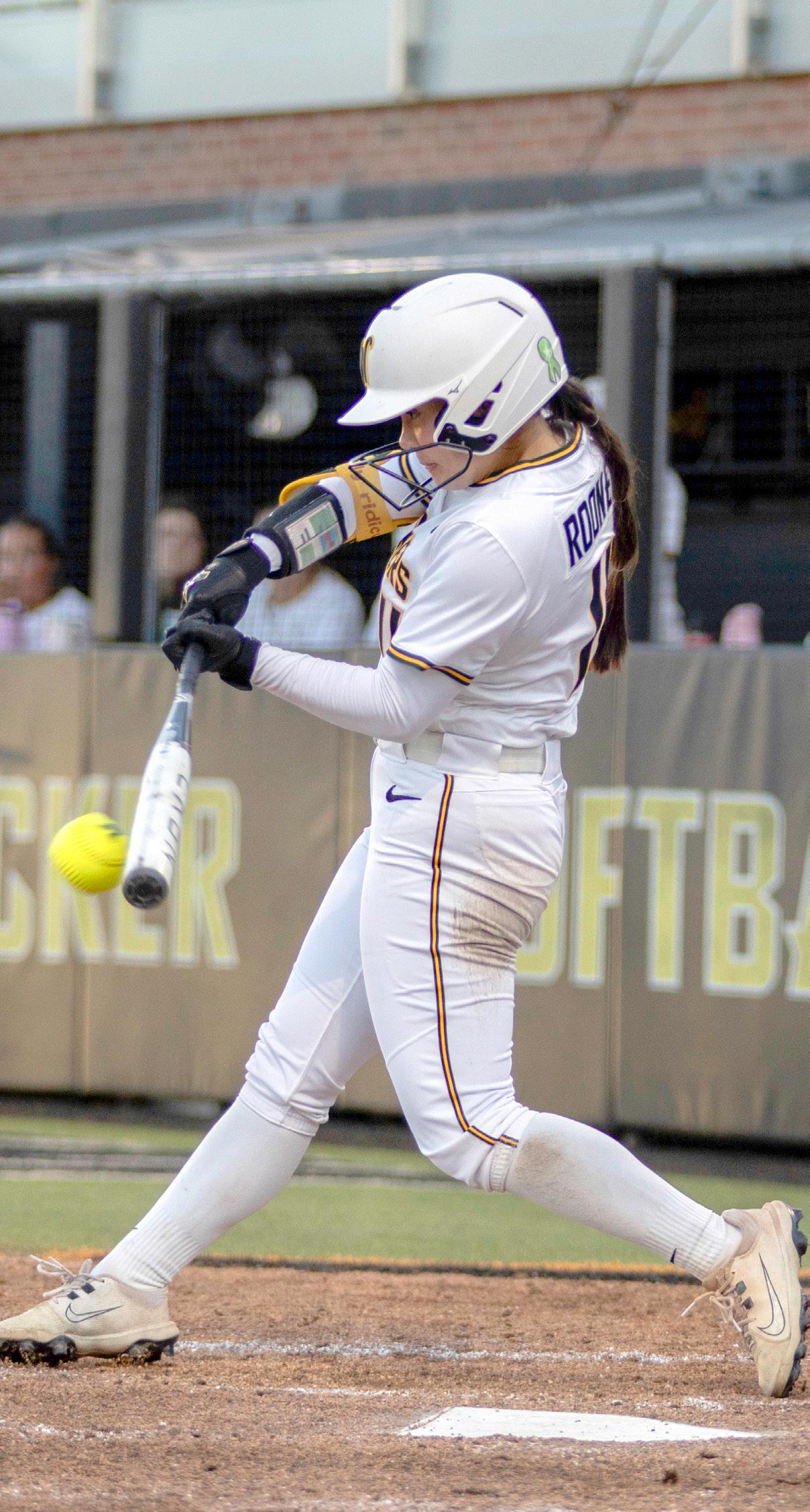
Junior Trinity Allen delivered the biggest swings, going 3-for-4 with two home runs and five RBIs.
Her first came in the fourth inning, a drive to deep right that trimmed an 8-3 deficit to two runs and shifted the energy in the stadium.
Senior Jodie Epperson added a solo home run of her own in the fifth to cap off a 2-for-4 night.
“She keeps the ball pretty low in the zone,” Allen said of Tulsa pitcher Brinly Maples (4-4), a former teammate at McLennan Community College. “So, I just knew I needed to get a pitch that was elevated on the plate that I could just barrel up.”
In the sixth, Allen did it again.
Allen launched a two-run shot to pull Wichita State within two again, setting up a tense final stretch. Moments later, freshman Kammie Smith lined an RBI double to bring the Shockers within one, 11-10.
The climb was complete. The comeback wasn’t.
Wichita State put the tying run at the plate throughout the seventh, but the rally ended
abruptly with three straight strikeouts.
“We’re a really gritty team,” Allen said. “This team is all about fighting back. Underdog mentality.”
-- Owen Prothro
Shockers claim series with game two and three wins
WSU regained momentum after the series-opening loss with backto-back to conclude the weekend and snap a four-game skid.
The Shockers are now 21-15 and 9-6 against league opponents. Currently, they’re in third place in the conference.
Friday’s 7-1 win was highlighted by a complete game from sophomore Ava Sliger (5-1) in the circle. She gave up just four hits and repeatedly forced the Golden Hurricane into weak pop ups or grounders to the infield.
Wichita State took advantage of the solid pitching, recording 12 hits, six RBIs and playing small ball. The Shockers didn’t record a home run throughout the night, but four of their runs were manufactured from singles.
The momentum the team gained from the game two win carried over into a 9-3 victory in the series finale Saturday afternoon.
WSU put up three-run innings in the second and sixth, respectively, and piled on two in the fourth.
Next up, the Shockers will host Oklahoma State Wednesday at Wilkins Stadium. WSU and the Cowgirls will finish a game that was suspended March 10 this season due to inclement weather before playing a full seven-inning game shortly after.
-- Mack Smith

BY EVAN LONG & MACK SMITH
evan.long.soccer@gmail.com & mackred22@gmail.com
Center fielder Kaleb Duncan had the most successful night at the plate for Wichita State on Thursday, notching two hits — including a double — against Tulane. In the bottom of the seventh inning, Duncan’s RBI single to right field finally put the Shockers on the board and cut Tulane’s lead to 3-1.
“(I) tried to stick to the approach and just kind of crack something open,” Duncan said.
“(It) definitely was big.
“I felt the dugout get energized by it and just wish we could’ve kept it going.”
This breakthrough was one of the few offensive highlights of the game for WSU.
The Shockers brought the tying run to the plate, after Duncan doubled and scored in the ninth, but the rally stalled and Wichita State (20-11, 4-3 American) fell to Tulane (16-15, 3-4 American) by a 4-2 score in the series opener.
Starting pitcher Matthew Cuccias (3-1) took his first loss of the season after allowing six hits, four walks and three earned runs, to go along with three strikeouts, in 4.2 innings pitched.
The bullpen’s relievers, however, kept the Shockers in the game and gave the offense a chance to hit its stride. Reese Kortum, a junior left-handed pitcher, struck out three in 2.1 innings of work, allowing one run on a Tulane homer.
“I thought Reese did a really good job,” coach Brian Green said. “He was down (in the strike zone), and he had two, if not three, pitches going for strikes.
“He was aggressive and he was getting ahead of hitters.”
Kortum, who pitched for Fort Scott Community College in Kansas the previous two years, loves to throw strikes. It was apparent in the opener, as he didn’t allow a walk against the patient Green Wave hitters.
“My whole focus is just always attacking the zone,” Kortum said.
“That’s kind of my identity as a pitcher, just mixing multiple pitches in the zone.
“I had my sinker, cutter and sweeper for strikes, and it was able to keep them off balance.”
Amar Tsengeg, a right-hander who pitched for Northwestern last year, also had an impressive outing on the mound. Tsengeg, who had five straight scoreless outings entering the game, threw two perfect innings and struck out three hitters to finish the game for WSU.
“I thought our pitching staff did a good job,” Green said. “We pitched well enough to win tonight. Our offense was disappointing.”
-- Evan Long
Series split the rest of the way
The teams split the final two games and WSU lost its first conference series of the year.
Wichita State now sits 21-12 and 5-4 in league play and are tied for fourth in the conference.
In game two Friday, the
BY OWEN PROTHRO sports@thesunflower.com
A lesser team might’ve given up sooner.
But for nearly 12 hours Saturday inside Arlington, Texas’ International Training and Research Center, Wichita State’s women’s bowling team battled uphill to keep its season alive.
During that stretch, every swing carried more weight. Every missed spare became a missed opportunity. Every strike bought the Shockers a little more time.
By the end of the marathon, Wichita State was rewarded with its second NCAA Final Four berth, climbing out of the elimination bracket of the Arlington Regional after an early loss Friday and sweeping the top-seeded team in a best-of-seven rematch.
Shockers avenged Thursday’s loss with a 7-4 win.
Three Shockers recorded extra base hits, with two home runs from senior Owen Washburn and doubles from Jayson Jones and Owen Rush.
WSU concluded the series Saturday with an 8-1 loss to the Green Wave. Much like in the series opener, the Shockers couldn’t find production at the plate, managing just six hits in 32 at bats.
Johnny Nuanez (3-1) was tagged with the loss on the mound after allowing four runs on five hits in 1 2/3 innings. Jones did extend his hitting streak to 24 games, however, despite the Shockers’ first series loss in the American this year.
The Shockers will stay home for their next game against Kansas State at 6:05 p.m. Tuesday at Eck Stadium. The Shockers fell to the Wildcats earlier this year.
-- Mack Smith
The come-from-behind regional win offered a glimpse of what the Shockers can do on a bigger stage. Prior to becoming an NCAAaffiliated program in 2025, Wichita State had already built a national resume, winning 11 Intercollegiate Team Championships and making 47 appearances since 1975.
Now, they’ll head to the National Collegiate Bowling Championship semifinals and finals at Yorktown Lanes in Parma Heights, Ohio, from April 10-11 with a chance to add another title.
To get there, Wichita State had to win three straight matches — and a final Baker best-of-seven tiebreaker — after dropping its opening match Friday morning to crosstown foe Newman. In the Mega Match format, another loss after that would have ended the Shockers’ season.
Instead, they responded.
Wichita State defeated Bryant 2-0 Friday afternoon to stay alive and set up a Saturday morning rematch with Newman. But the third meeting between the teams this season started in familiar fashion.
The Shockers won the traditional match, 1,011-976,
but dropped total pinfall, forcing another best-of-seven with their season on the line.
This time, they didn’t slip.
Newman left the final three frames open in the opening game, and Wichita State capitalized with three strikes to take a 1-0 lead.
The Shockers followed with eight strikes in the second game, then repeated the effort in a 249-224 win in game three.
They finished the sweep in four games, advancing to the regional final against Louisiana Tech.
Wichita State opened the final the same way it had all weekend, winning its fourth traditional match in as many tries to take an early lead. But Louisiana Tech answered in total pinfall, sending the Shockers to their third best-ofseven of the regional.
WSU came out strong again, recording 13 total strikes to win the first two games. Louisiana Tech responded with eight straight strikes to take game three, but Wichita State regained control with a 201-188 win in game four.
The Bulldogs extended the match with a 268-203 win in game five, but the Shockers answered in game six, 233-199, to force a bestof-seven winner-take-all finale. With a trip to the national semifinals on the line, Wichita State didn’t wait.
The Shockers opened with four consecutive strikes over the four matches it took and completed the sweep to clinch the regional title and punch their ticket to the Final Four.
For Wichita State, it wasn’t just about advancing — it was about resilience.
After nearly 12 hours of pressure, elimination games and second chances, the Shockers walked out of Arlington still standing, carrying with them the confidence that comes from earning every frame the hard way. And now, with the season still alive, they’ll get to keep writing it.
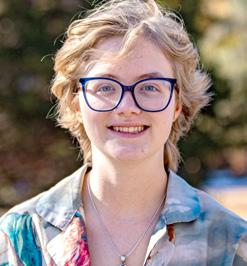
About this time last year, we, as a student body, welcomed the current Student Government
President Jia Wen Wang and Vice President Amy Nguyen as our new student government leaders. They ran uncontested and have served a respectable and dignified term.
The lack of student participation in the Student Government Association has been noticeable throughout recent academic years, but we are fortunate to see a contested presidential election this year. However, I will say that the announcement of election candidates left me with a singular emotion paramount.
Which is to say — I was confused.
The dual tickets feature Student Senators Mason Fouquet and Nazanin Kasirosafar opposite Undergraduate Advocate Jayden Island and SGA Director of Health and Wellness Anoushka Raju. Fouquet and Island are running for president on their respective tickets.
My first thought was: “Fouquet? Didn’t he just join?”
Indeed, he did. Fouquet is a recent addition to WSU’s student senate; he entered SGA midsemester last fall as a write-in primary candidate.
Now, term length isn’t everything when it comes to a qualified candidate, but it is a little concerning when it comes to running for the highest position within SGA. This is further supported by the fact that his running mate, Kasirosafar, has also served less than a year, meaning she would not have a significant margin of experience to supplement the knowledge Fouquet may lack.
I think this is put in sharp contrast by their opposing ticket. Island is a student advocate in the judicial branch and previously served in the Senate. Raju is part of the executive cabinet. Raju has served a comparable tenure to Kasirosafar, while Island is in their second year in SGA.
Why does this matter? I think
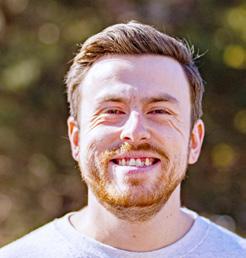
Kansas legislators believe the best way to address national outrage about Immigration and Customs Enforcement agents murdering civilians in the street is to protect the agents, not their constituents. Senate Bill 452 would allow local officers to establish a 25-foot zone around them that cannot be entered by onlookers. It would also give federal law enforcement agents — such as ICE officers — the same protections granted to local law enforcement.
The bill has passed the senate with a vote of 31-7. After being considered by the House Committee on Federal and State Affairs, it’s scheduled to be presented on the house floor on April 9.
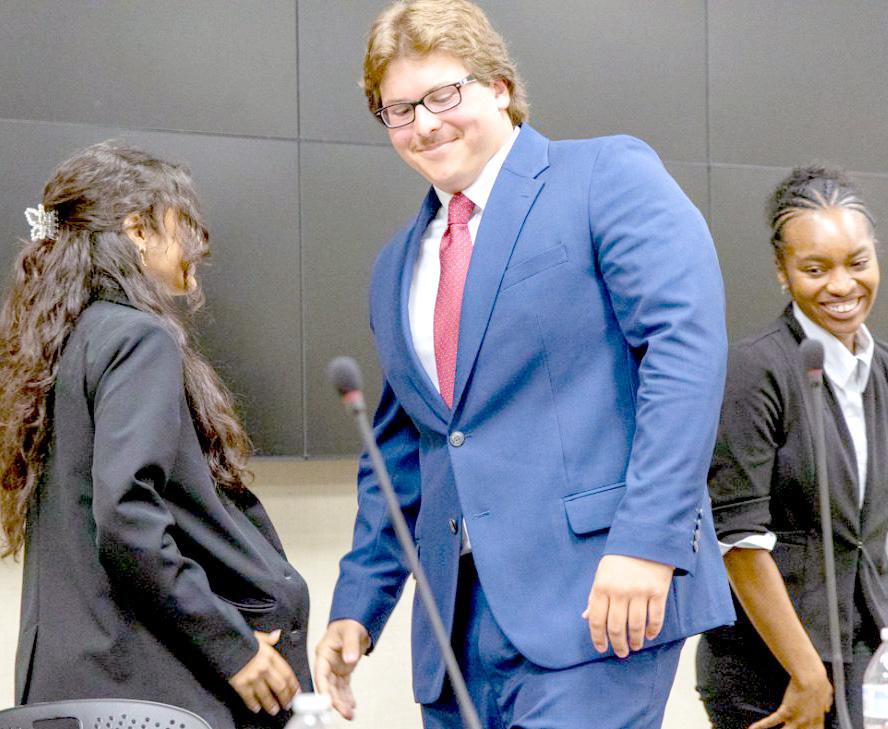
this is made clear by the level of professionalism each ticket has shown in their campaigns.
Browsing the Instagram profiles for either ticket, I was impressed immediately with the organization of Island and Raju’s platform. Their campaign had a distinct color palette and style.
Sue me, marketing is unfortunately what makes up a good chunk of communication studies. The campaign features an abundance of unique, personal testimonies from a number of students about why they support the two, which I thought was a very adept way to show commitment to engagement and community.
This is not to say Fouquet and Kasirosafar lack a good social media presence. However, unlike Island and Raju, I do think Fouquet and Kasirosafar’s media strikes such a similarity to official WSU design that it does not grant them the same memorability as Island and Raju.
Outside of media presence, I think we can also see a difference in professionalism in each ticket’s
The bill does not directly prohibit recording law enforcement, but officers establishing a 25-foot barrier at any point can obviously affect bystanders’ ability to record their actions. The legislation establishes penalties in the form of fines or even jail time.
Anyone with a basic understanding of the dangers of police misconduct should be outraged at the cowardice in this bill. There needs to be accountability for officers who have the ability to violate civil rights, abuse their power and hurt people.
It’s important to emphasize that SB452 gives protections afforded to local law enforcement to all federal agents, including ICE. The agency is top of mind when reading this bill after their assault on Minneapolis recently.
The bill’s implementation of a 25-foot buffer zone for onlookers will severely hinder reporters and peaceful protesters’ ability to
showing in the presidential debates on March 26 and April 2.
I work late, so my roommate viewed the March 26 debate before I did. When I asked her what she thought of each ticket, she told me that while both tickets expressed similar sentiments, she believed that Island and Raju were able to answer with less vagueness and better clarity. I agreed.
I found that all four candidates were skillful speakers and made good points across the board. The particular eloquence of Island and Raju definitely set the expectation for response quality high.
The second debate took a bit of a different tone than the first, having picked up the pace with more questions submitted by students. Once again, I was impressed by Island and Raju’s ability to answer concisely and articulately in the short time allowed. Fouquet attended the second debate alone, as Kasirosafar was out of the country, but followed along online.
I don’t know if it was the lack of
properly record law enforcement’s overreach of power.
ICE’s massive surge to Minneapolis resulted in multiple horrific incidents, including the death of two civilians.
Video taken from multiple angles of ICE agent Jonathan Ross shooting and allegedly murdering Renée Good were crucial in properly understanding what happened.
Ross claimed Good was attempting to run him over with her car. A New York Times analysis of these videos showed conclusively that Good was actively turning her vehicle away from the agent when she attempted to drive away.
While Minnesota officials are fighting to independently investigate the murders of Good and Pretti, Kansas lawmakers are hindering the ability to hold ICE agents in our state to the same level of accountability.
This bill increases the chances of that happening by allowing sheriff departments to enter agreements
his running mate throwing him off, but Fouquet did seem less polished in the second debate.
Notably, when discussing the unique outreach approach he would take if elected, Fouquet offered a suggestion for a group chat of student organization leaders, which is already in place. After an acknowledgment of his memory slip, he recommended that the SGA executive branch perform tabling to reach students. Island rebutted with a reminder that SGA leadership already does that as well, with themself and Raju having attended an estimated 80% of those tabling sessions this year. This estimation comes from Island themself, which I am unable to confirm.
The question specifically asked for ideas that weren’t already in place.
Also, when answering a question about how each ticket would support students of color and queer students in the wake of state policy changes, Fouquet, the vice president of WSU’s Turning Point USA chapter, stated that the
with ICE, without county commission approval.
Understanding how important it was for civilian onlookers to properly witness and record events in Minneapolis, I have to ask what the motivation is for hindering Kansans from doing the same thing.
The bill also creates no objective understanding for when a barrier should be implemented and leaves it completely to the discretion of the officers.
It is a vile betrayal of that obligation to serve, reducing accountability over the murder of civilians by jacked booted thugs that U.S. taxpayers are funding.
Even if this bill did not expand to federal law enforcement, it would still be a major overstep of the government, harming citizens ability to hold local and state officers accountable.
The ability to record police within a close vicinity has resulted in acts of police brutality being brought to light.
question felt almost pointed. He said he didn’t believe that certain groups should be “cherry picked” for support — that all students should receive equal support. He also emphasized the importance of compliance with state law. Island replied that their administration would seek creative solutions to ensure safe spaces for marginalized students while maintaining administrative accountability. Raju added that equality isn’t the same as equity — not all students have access to the same resources, so they may need additional, targeted support to be successful.
In response, Fouquet pointed out that Island had mentioned that “the university might not be set up as well for Black students.” He then asked Island, who is Black, to elaborate on that. I feel this comment is much more pointed than the very pertinent and widely-discussed starting question. While the second debate did see both tickets referencing possible shortcomings of the opposing ticket — making it a more personal discussion than the previous — this seems like a breach in professionalism that is at odds with the rest of the debate. I feel like Fouquet’s performance in the second debate, alongside his and Kasirosafar’s less collected showing in general, does not build the sort of confidence I expect in the highest tier of my community leaders. Fouquet and Kasirosafar are assets to their community by their service in SGA and beyond, but I do not believe them to be the best equipped for the roles of president and vice president.
More than anything else, I recommend that anyone reading this article should devote time to looking up each ticket’s campaign media, including their Instagram accounts, as well as watching the March 26 debate and the April 2 debate. Take what I’ve said with a grain of salt and let the candidates themselves convince you.
And of course, don’t forget to mark the date — general elections are open April 6-8 via SimplyVoting. You’ll get a notice sent to your student email. I hope all of you vote consciously and enthusiastically.
George Floyd’s murder by former Minneapolis police officer Derek Chauvin in 2020 was filmed by 17-year-old high school student Darnella Frazier.
Frazier spoke to how being close to Chauvin kneeling on Floyd’s neck was vitally important in an Instagram post she shared.
“Right in front of my eyes, a few feet away. I didn’t know this man from a can of paint, but I knew his life mattered,” Frazier said. “I knew he was in pain, I knew that he was another Black man in danger with no power.”
Police brutality and misconduct have occurred whether recording of the incident happens or not. Frazier’s words speak to many incidents where people’s safety was no longer in their control.
Senate Bill 452 signals to Kansans that lawmakers prioritize protection for tyrannical officers abusing their power over the safety of citizens.

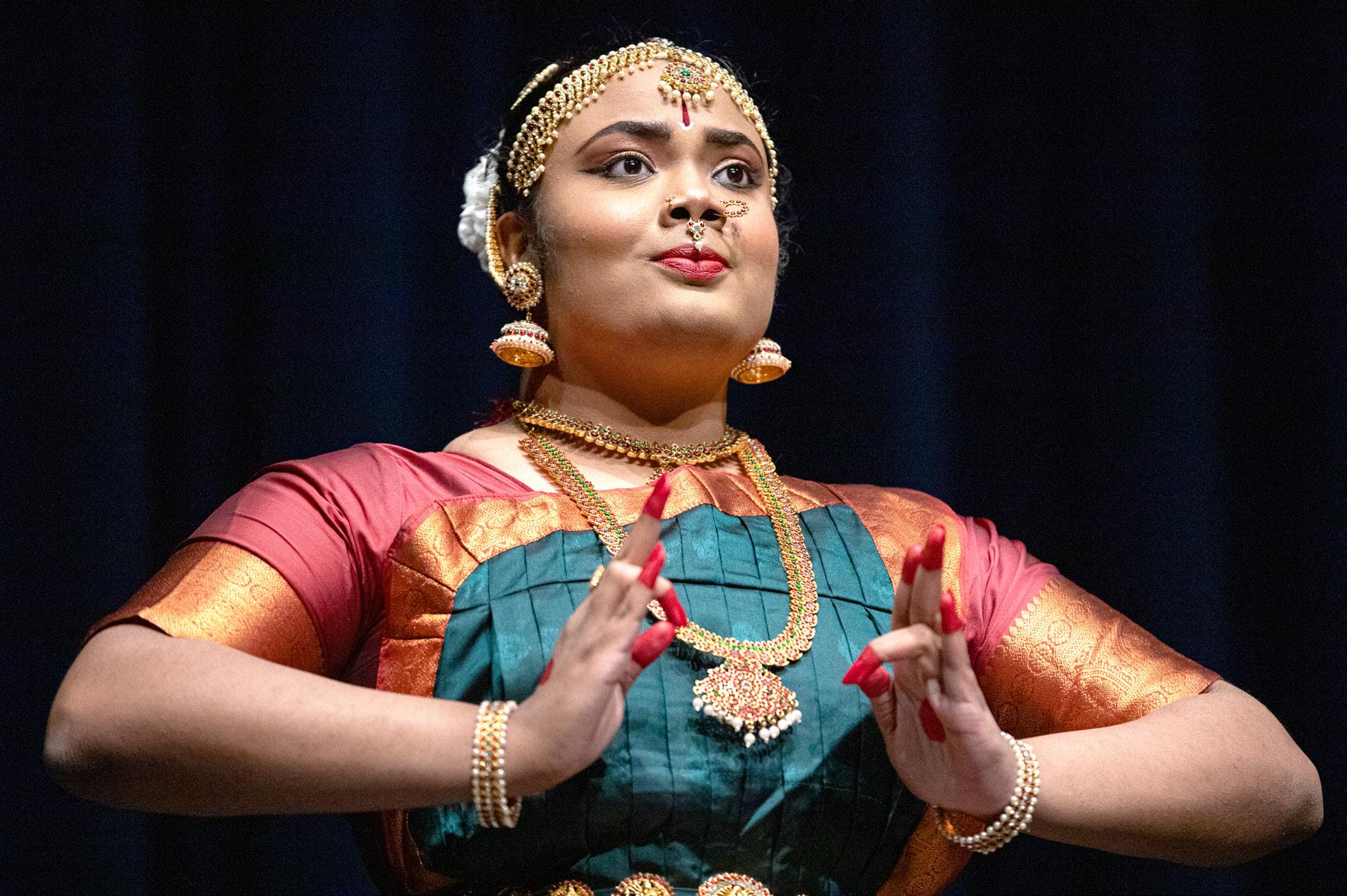
‘The
Literary club explores monsters and marginalization
BY PEYTON ECK
eckpeyton3@gmail.com
A new film discussion club on campus is proving that “what goes bump in the night” isn’t just for Halloween.
Monsters in the Margins is a movie dialogue group formed by sisters Cyndi and Estefany Álvarez Santillán.
It focuses on the inherent “otherness” that is placed on marginalized people and how that intersects with monster depiction in media.
Both sisters are graduate teaching assistants. Estefany teaches Spanish courses on campus, and Cyndi is in the English department. The club is a blend of both of their academic fields, with an emphasis on community on top of its scholarly nature.
Fittingly, the club was formed this February, on Friday the 13th. It holds bi-monthly meetings in Spanglish, or combined Spanish-English.
“There isn’t a lot of people that I feel are attracted to that title because maybe you’re scared of Spanish or maybe you’re scared of English. So it is definitely more that
we want to benefit the community that do fall into this little niche,” Estefany said.
The club opens up opportunities for speakers of either language to practice and feel comfortable in the discussions held.
“I feel like that’s open to anyone talking about marginalization – or that they’ve ever felt that way – because there’s so many components to it,” Cyndi said.
The club has already featured Andy Muschietti’s short “Mamá,” and Guillermo del Toro’s “Frankenstein” and “The Shape of Water.”
It analyzed Muschietti’s work alongside its later 2013 film adaptation, and paired “Frankenstein” with the 1973 Spanish film “The Spirit of the Beehive.”
It reviewed “The Shape of Water” with articles related to the film, instead.
Inclusion of older films and academic articles adds a scholarly aspect to club meetings.
“There is scholarship, but I feel like its scholarship that isn’t too heavy or difficult to understand because mostly we’re focusing on the movies and the things that happened and analyzing it from that perspective,” Estefany said. “So it’s pretty approachable.”
The work of del Toro has been featured multiple times already in the club’s catalog. The sisters expressed a fondness for the director.
“He is from Guadalajara, our family’s from Jalisco, so he’s kind of like our weird uncle almost because we have close proximity,” Estefany
said. “He has a really artistic way of portraying horror and gothic.”
The current line-up of films was chosen to focus on directors who are Black, Indigenous and people of color that show the monster, or the “other,” according to Estefany.
They picked “Frankenstein” for its focus on exploring femininity in horror, Jordan Peele’s “Get Out” and Ryan Coogler’s “Sinners” for their focus on the blending of what is monstrous with everyday humans.
“One of the things that we emphasize in this club is the wheel of power,” Estefany said.
“The further you move from the center, which is power and basically represents whiteness, heterosexualness, cis-genderness— the further that you are, the more like a monster you are.”
The club is set to feature del Toro’s “Pan’s Labyrinth,” Peele’s “Get Out” and Coogler’s “Sinners” on April 10, 17 and 24, respectively. Further titles and themes will be explored in the next semester.
Shockers to compete for laughs at annual skit show
BY DARREK BISHOP darrekbishop07@gmail.com
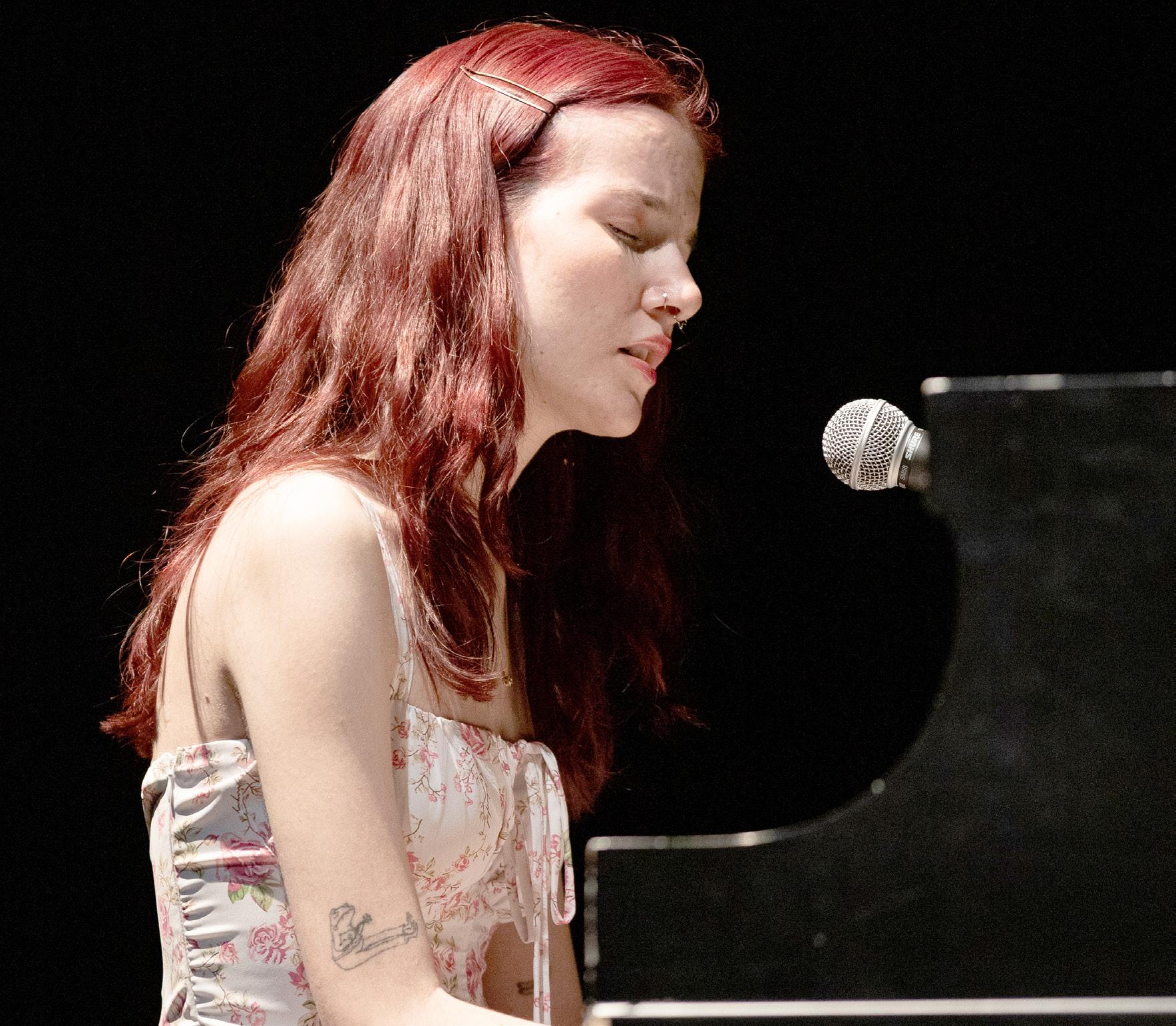
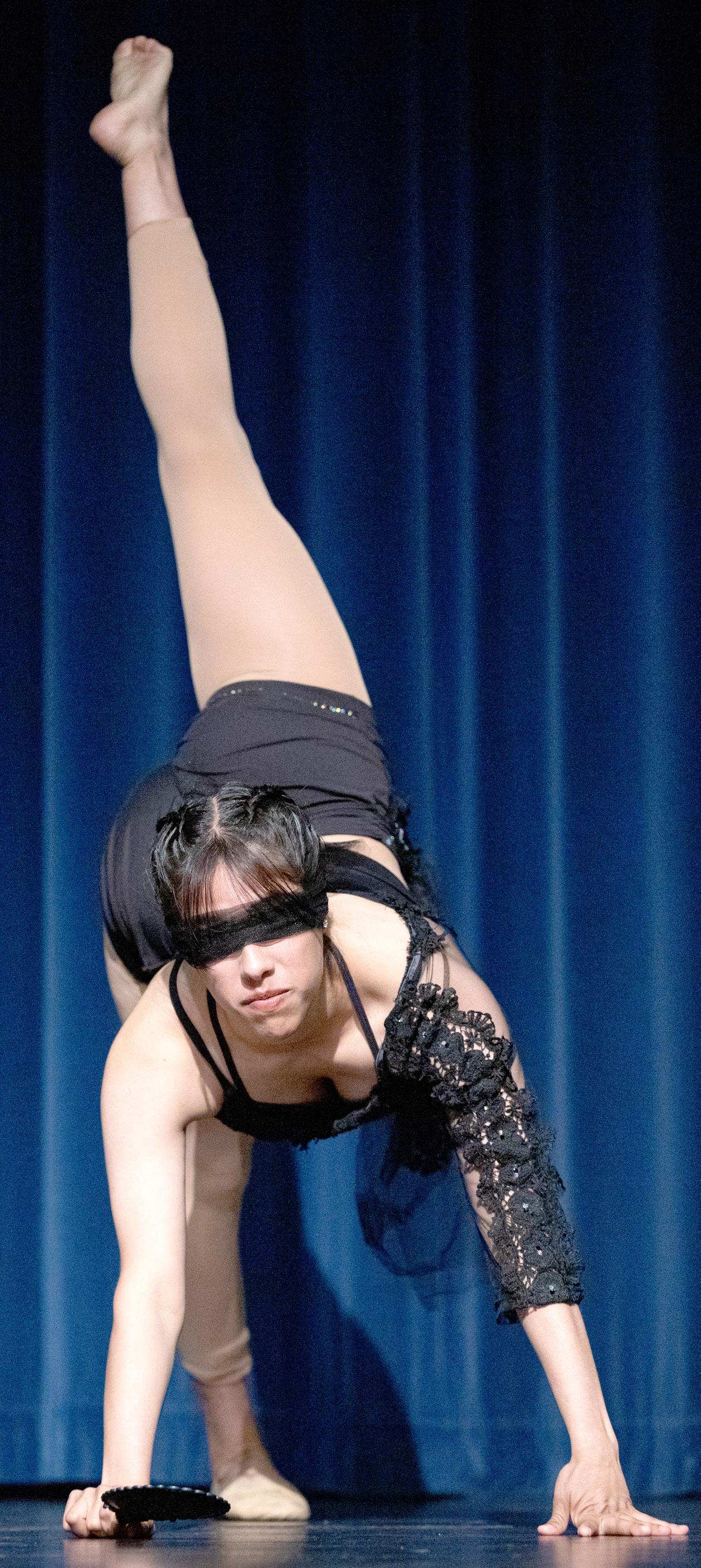
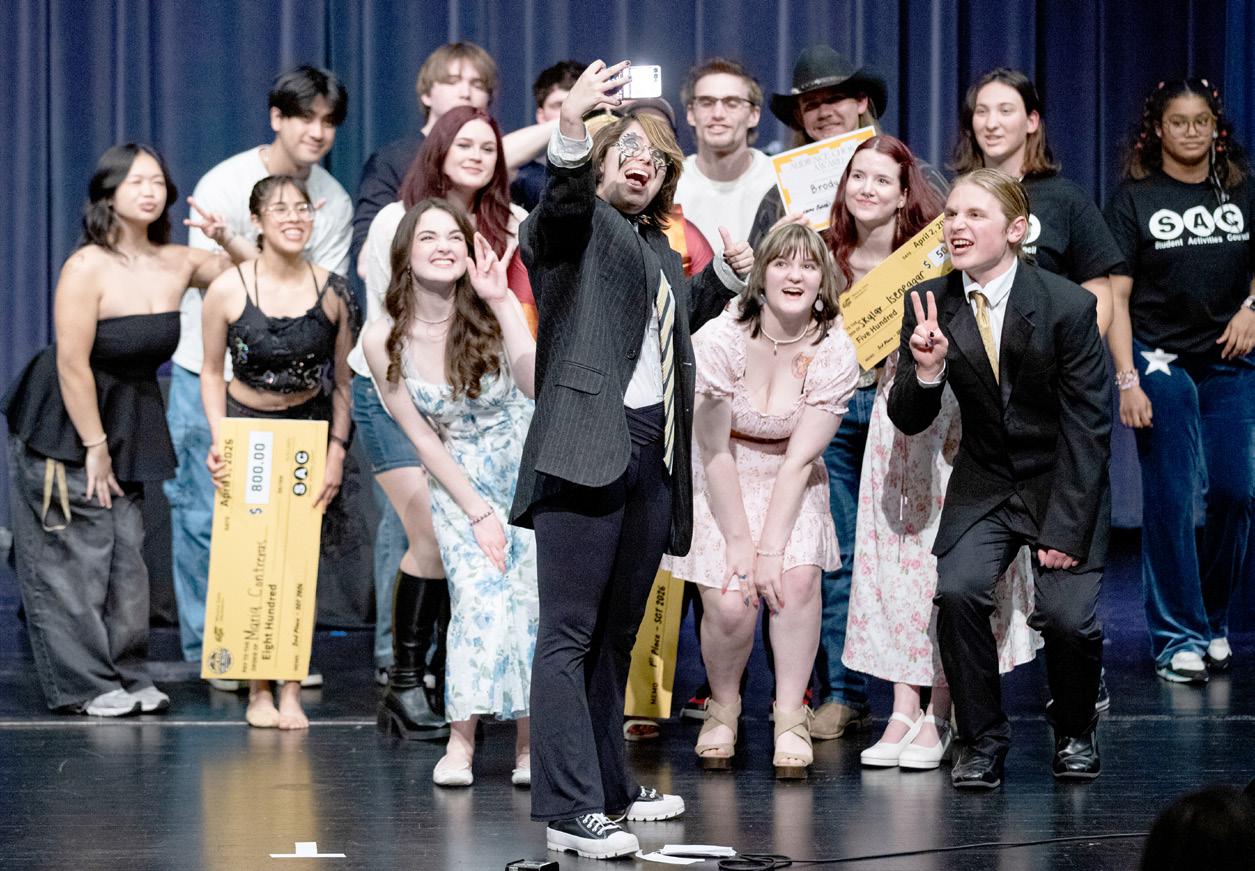
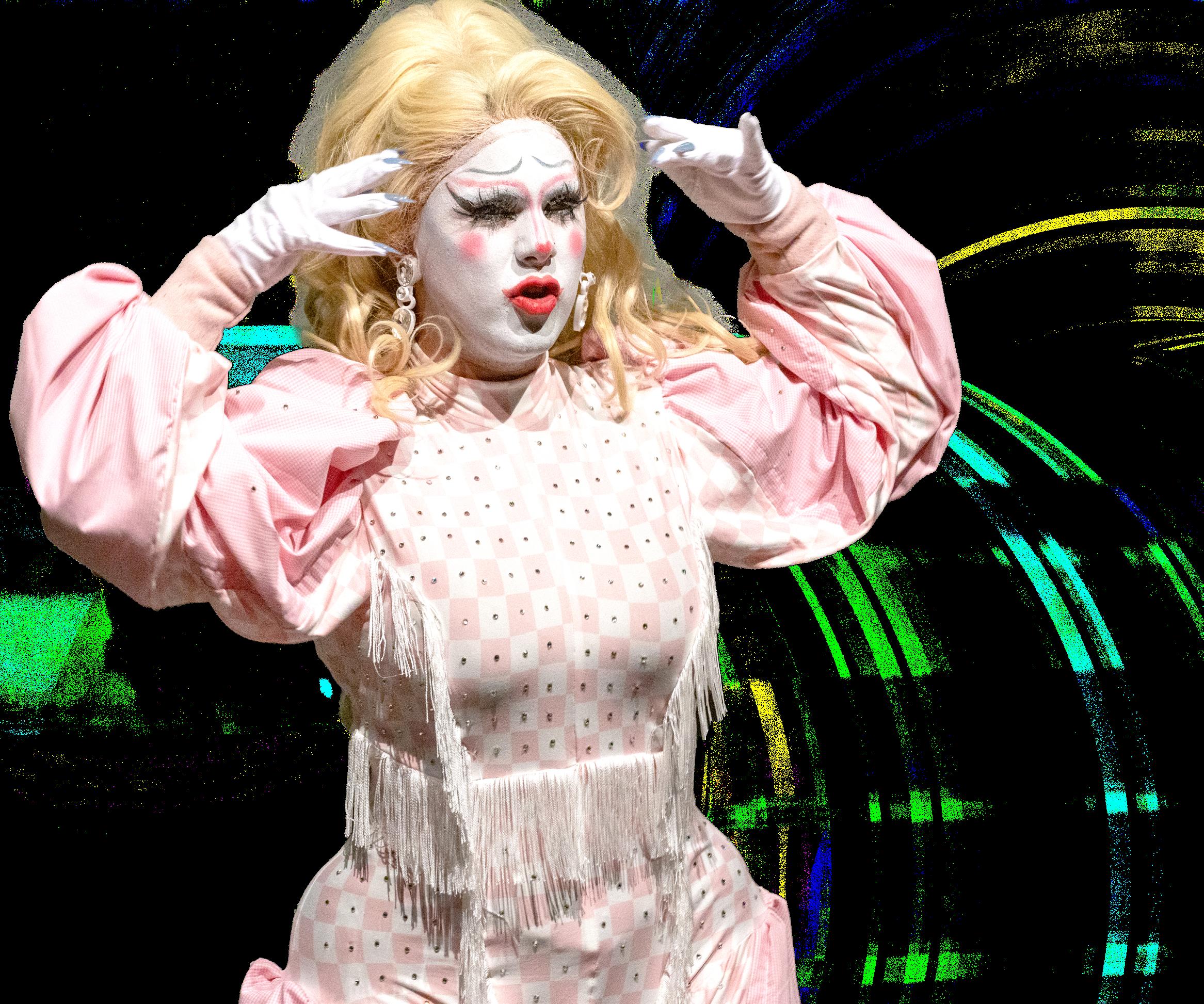
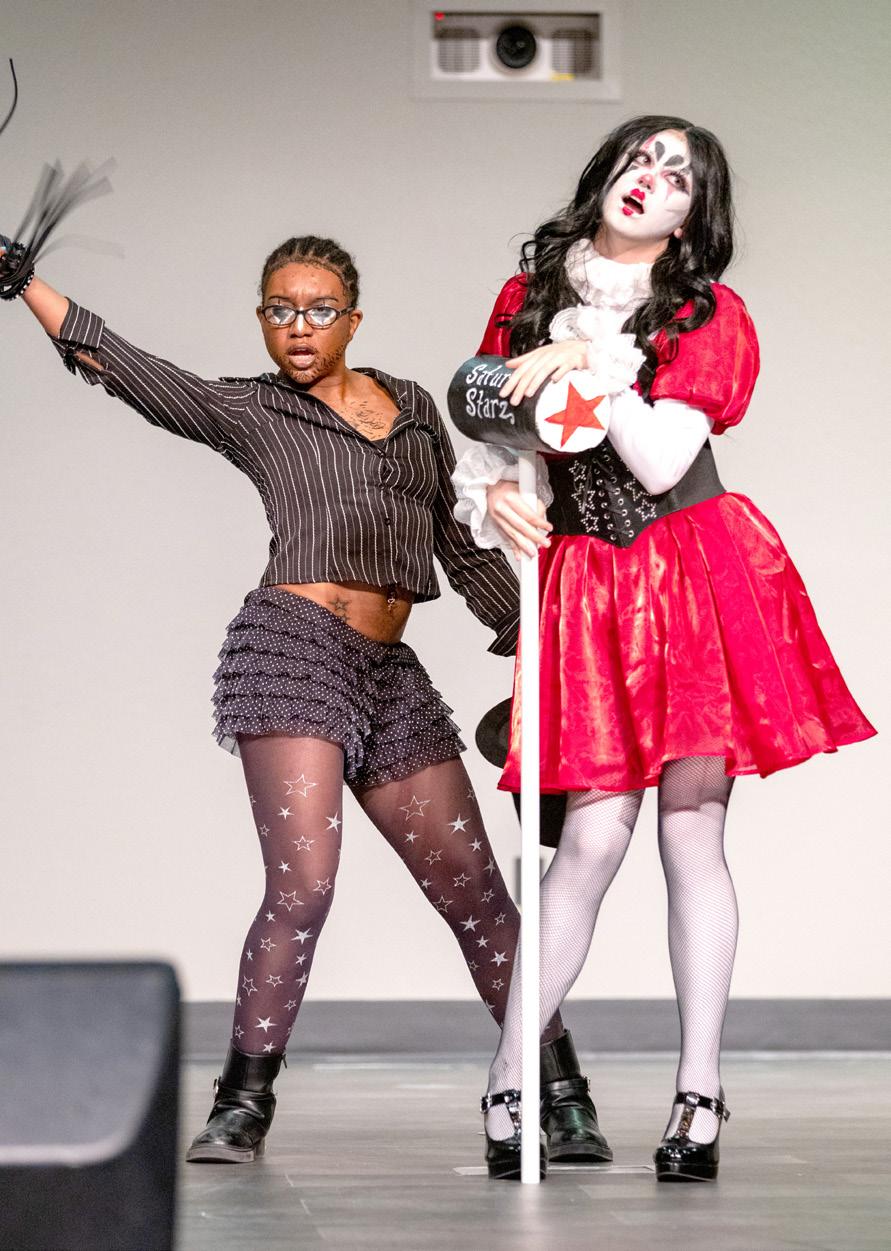
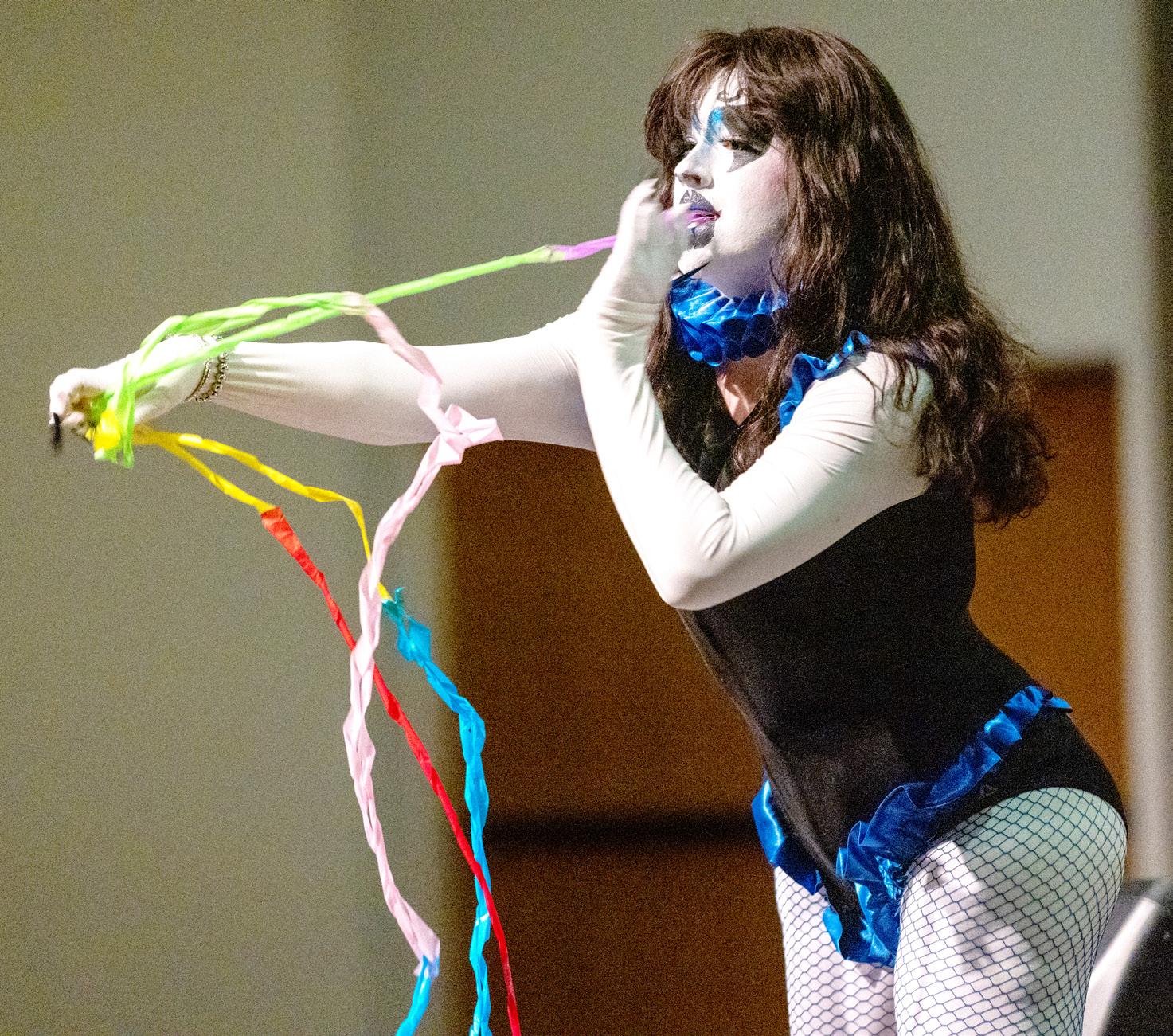
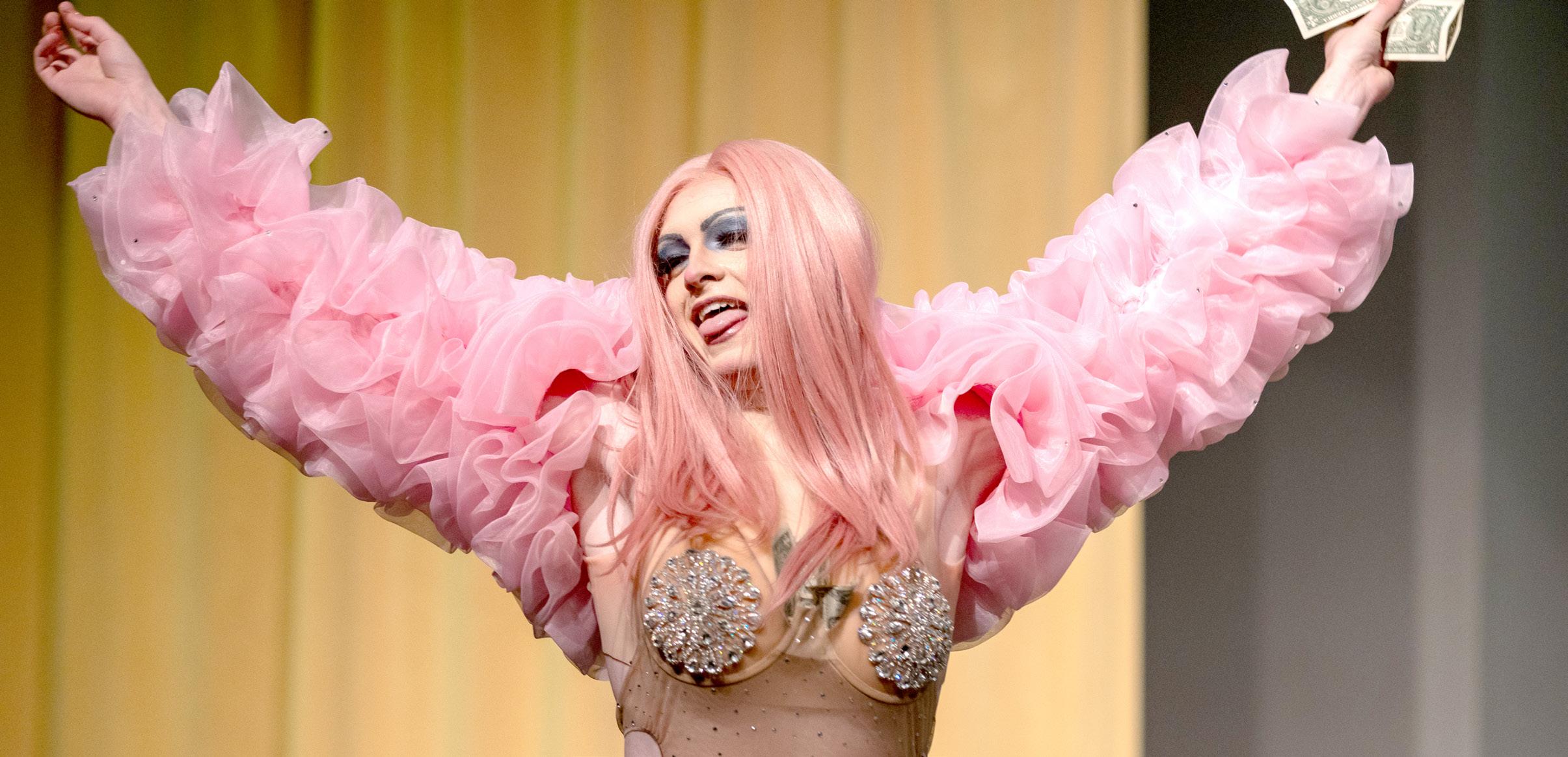
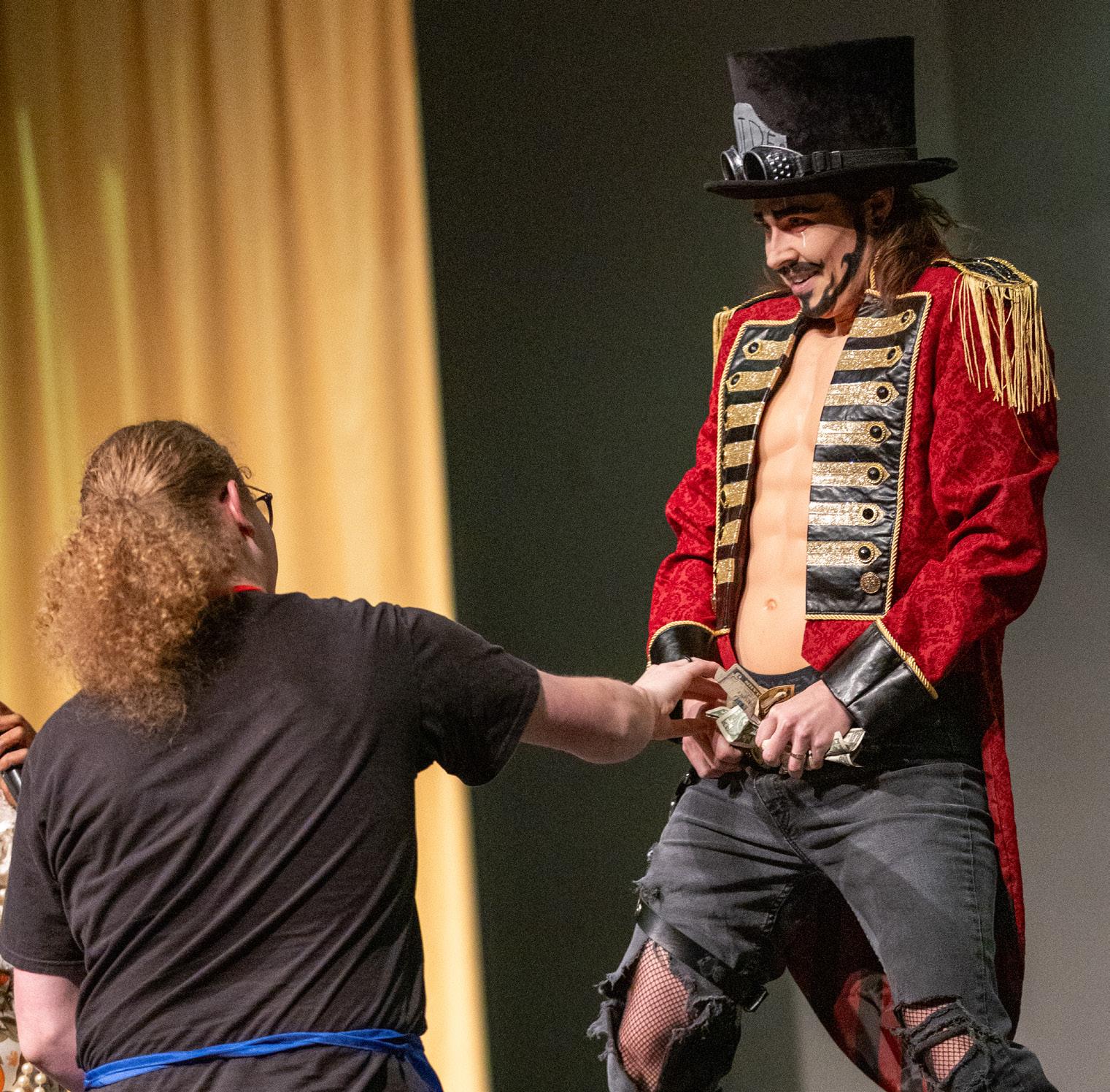
A night of entertainment through comedy, drama and music is coming to Wichita State on April 10 in the form of Hippodrome. According to the Student Engagement and Belonging website, Hippodrome first appeared in 1928, when students and organizations were invited to enter a stunt competition for a $10 prize. The top three winners of the skit and variety show competition will be awarded first, second and third place. Individual awards will
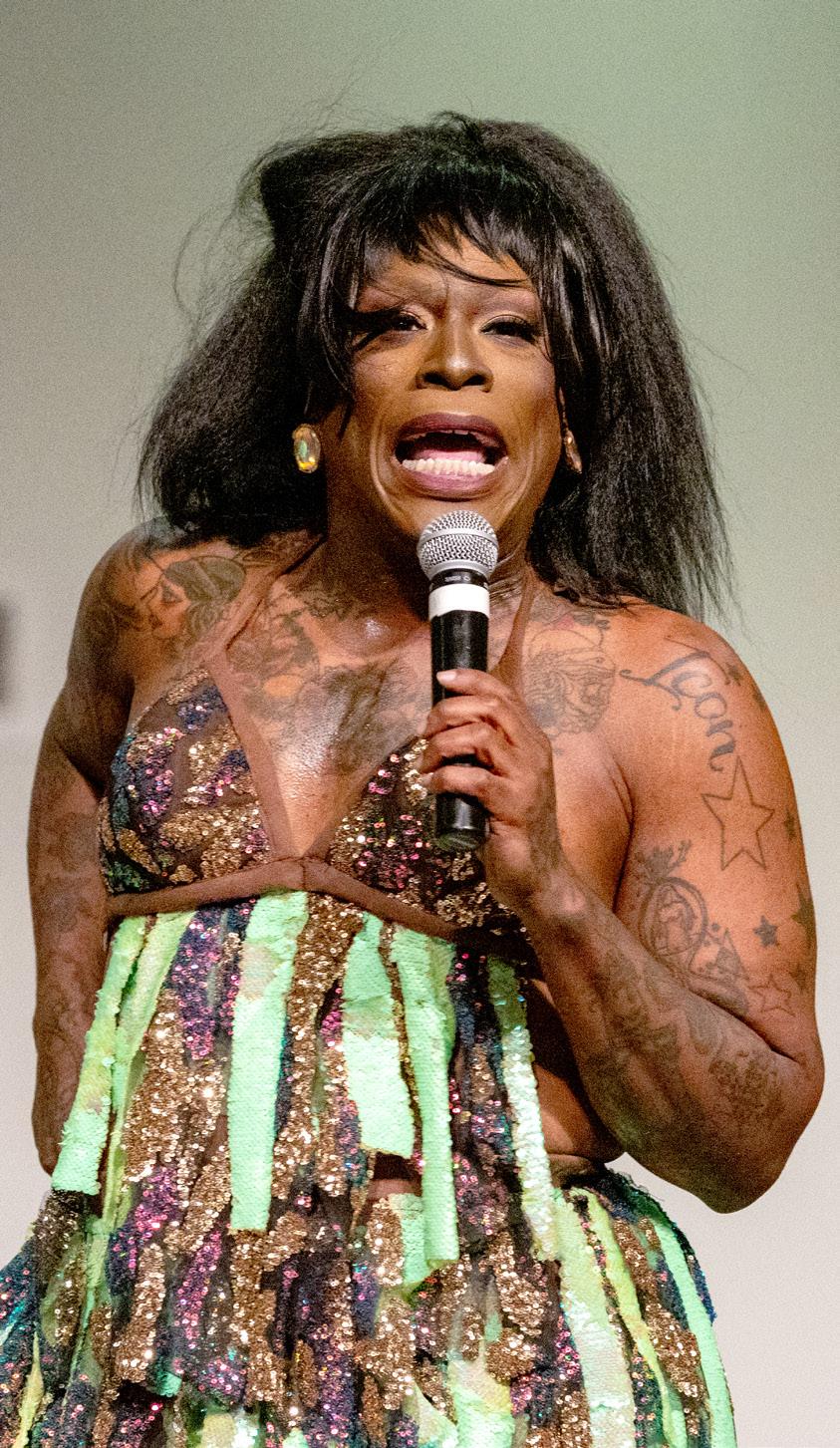
former U.S. National Security Advisor and three-star general H.R. McMaster. The discussion will be part of the Barton Speaker Series.
GAMES ACROSS ASIA
Thursday, April 9
11 a.m. - 1 p.m.
Rhatigan Student Center
Join the Office of Student Engagement and Belonging to try traditional and modern games from across Asia in a fun and welcoming space.
ARTIST TALK: GUILLERMO GÓMEZ-PEÑA
Thursday, April 9 6 p.m.
Ulrich Museum of Art Listen to an artist talk from video/ performance artist, philosopher, writer and activist Guillermo GómezPeña. The talk will take place in the Polk/Wilson Gallery.
KANSAS FOOD BANK
WAREHOUSE VOLUNTEER OPPORTUNITY
Friday, April 10
10 a.m. - noon Kansas Food Bank
Volunteer with the Community Service Board and help sort and organize food that will be distributed around Kansas through Kansas Food Bank initiatives.
HIPPODROME Friday, April 10 6 - 8 p.m. Eugene Hughes Metropolitan Complex Experience Wichita State’s longest running campus tradition, featuring skits and entertainment written, directed and choreographed by student leaders.
COLLEGE OF EDUCATION CENTENNIAL OPEN HOUSE Saturday, April 11
1 - 4:30 p.m.
Corbin Education Center
Students, faculty, staff and alumni are invited to a centennial open house to celebrate 100 years of the College of Education. Alumni Gathering at
WSU CHOIR X WICHITA SYMPHONY CHORUS: VERDI’S REQUIEM Saturday, April 11
7:30 - 10 p.m. Century II Performing