Former Shocker Alec Bohm suing parents over alleged misuse of earnings
BY OWEN PROTHRO sports@thesunflower.com
The MLB’s Opening Day was Thursday, and former Wichita State baseball player Alec Bohm is already making national headlines. Bohm, who now plays for the Philadelphia Phillies, hit 1-3 with three RBIs in their season-opening win. But the 29-year-old third baseman has more to deal with than reaching another Fall Classic. According to multiple sources,
Bohm is suing his parents for upward of $3 million over alleged misuse of funds. He accused his parents of “siphoning large amounts of his money into financial accounts they managed for him and then using some of the cash to pay their own expenses,” the Associated Press reported Thursday, March 26.
Along with the $3 million in damages, the AP reported that Bohm is seeking that his parents “hand over control of the accounts and hire an accountant to track
every dollar they transferred from Bohm’s personal accounts to the accounts they controlled.”
Robert Eckard, Bohm’s parents’ lawyer, said in a statement that “Mr. and Mrs. Bohm love their son very much and have always acted in his best interests, both personally and professionally, and still do so to this day.”
Bohm declined to comment to reporters on the matter after the Phillies’ 5-3 win over the Texas Rangers, saying he doesn’t want to
“address any personal matters right now,” according to the AP. Bohm hit .317 over three seasons at Wichita State and was the third-overall pick in the 2018 MLB Draft. He quickly made the Phillies’ big-league roster and has been an everyday starter since 2020. But for now, Bohm must handle the personal legal battle off the playing field and, at the same time, help Philadelphia reach its second World Series in five seasons.
UP FOR DEBATE
Student body presidential candidates speak on transparency,
BY MALEAH EVANS arts@thesunflower.com
Candidates Jayden Island and Anoushka Raju, and Mason Fouquet and Nazanin Kasirosafar laid out their visions and goals for student government at the first of two presidential debates on Thursday, March 26.
Much of the debate covered themes of transparency, both in how SGA is run and how information is given to students. Questions were selected by The Sunflower’s moderators and students in-person and online.
Why did candidates run?
“I certainly, through my involvement on campus, have recognized significant room for growth in Wichita State University,” Island, candidate for student body president, said. “I know there’s a lot more that we can do for our students, whether that be having more equitable conversations through academic affairs and providing good opportunities for scholarships.”
Raju said she agreed to be Island’s vice president because of the “wealth of knowledge” Island had.
“I have completely fallen in love with serving students through Student Government Association,” she said. Fouquet, the other student body presidential candidate and the vice president of WSU’s Turning Point USA chapter, said he is running for president because of his history in Wichita, his home town.
“I grew to love this city,” he said. “I’m passionate about the university, I would like to inspire the change that we hope to be, and I feel that there is no one better to lead it than someone who is more passionate about this than probably most of the people that have been involved in the last few years.”
Kasirosafar, who is running as Fouquet’s vice president, said that “it was such an honor to sit next to Mason.”
goals in first debate
Qualifications to lead
“Being able to adequately represent students from different parts of campus, from different backgrounds and identities — that is not a task or responsibility we take lightly,” Island said. “The unique identities of our students and their backgrounds deserve to be respected and understood for their concerns for the future of our university.”
Fouquet said that he and Kasirosafar are both natural listeners.
“That’s what we need to be able to do as student leaders,” he said.
“Being able to represent an entire student body is a tough task for any and I think it’s partly something that we’re both blessed with, but to be able to leave your beliefs at the door … coming here with an open ear and hear from people that you may not agree with.”
Issues with current student body administration
Island said there is always room for improvement in SGA leadership.
“One of our main goals is to ensure that transparency across specific branches is happening,” they said. “And specifically make sure that our senators feel understood in that they have the support that they need for administrative connections.”
Fouquet expressed some of his frustrations with leadership in the current administration and with how the Senate can treat people.
“I won’t be shy of this one at all, you guys are all great people, but this needs to be improved, drastically,” he said. “I don’t know whether it was because of my background or because I’m a Catholic, but it seemed like I was just immediately hated.”
Fouquet’s role in TPUSA has created controversy around his bid for student body president on YikYak, an anonymous social media platform. In the debate, he also said he felt like he was alienated due to his involvement in TPUSA.
“I think that I would like to foster a community of more collaboration, maybe respect for your neighbor,
because rather than hating on each other, we need to be able to build each other up,” he said.
What transparency means to candidates
For Island and Raju, transparency means being willing to have conversations with students.
“Being able to bring students that rationale directly to where they are,” Island said. “To ensure that they understand that we are serving them.”
Fouquet agreed that increased communication with students via social media and tabling is important, but said that if he is elected, he would consider having a board of directors that would reach out to students directly.
“It would be more important to make sure every student is kind of in the know (with) what’s going on and not left in the dust, because there are a lot of decisions that are made somewhat behind closed doors,” he said.
Fouquet said that while a large majority of SGA meetings are open to students, due to the lack of awareness around SGA, he considers the decisions made to be “behind closed doors.”
The March 26 debate can be found on SGA’s YouTube channel.
ELECTION INFORMATION
Next debate
The candidates will debate again on April 2 at 6 p.m. in Room 233 in the Rhatigan Student Center. The debate will be livestreamed on SGA’s YouTube channel and on The Sunflower’s Instagram.
Elections
Voting for the student body presidential tickets and Student Senate seats will open April 6 at 8 a.m. and close April 8 at 5 p.m. Ballots will be sent to students’ emails via SimplyVoting.
cuts 3.5% from WSU budget, 4% tuition increase possible
BY AINSLEY SMYTH managing@thesunflower.com
The Kansas Legislature passed its budget for fiscal year 2027 Friday morning, prescribing a 2.5% cut in base operations funding for the state’s public research universities — including Wichita State — and the elimination of student success funding. It also allows the universities to raise tuition.
Wichita State University was allocated $78.2 million in base operational funding. The University of Kansas was allocated the most, at $160.5 million, and Kansas State followed at $115.3 million.
Zach Gearhart, Wichita State’s director of government relations and chief of staff, said the cuts were about what Wichita State expected.
“Is it great? No,” Gearhart said at the first of two public legislative updates Friday. “Is it better than probably my worst case scenario? Yes, but I don’t think we’re out of the woods for next year.”
Student success funding, which was entirely cut from the budget, previously went to services like advising. Its elimination brings WSU’s total cut to a little under 3.5%, Gearhart said.
The conference committee also decided not to cap tuition, so universities can raise tuition to offset the cuts.
According to Wichita State’s Chief Financial Officer David Miller, at the Friday afternoon meeting, the university will seek a 4% tuition increase.
University employee pay
Wichita State, and other state universities, will receive money to increase pay for employees. The amount would be equivalent to 1% of all benefits-eligible employee salaries.
“That doesn’t mean every employee at WSU would necessarily get 1%,” Gearhart said. That’s only on our state general fund side.”
University leadership, Gearhart said, will have to determine what money is available through other funding, like tuition, and how that factors into a potential pay increase.
Other funding
The budget includes campus renewal funding, which helps the universities address deferred maintenance.
“This was a previous bill that passed, that had multiyear funding,” Gearhart said at Friday’s second update, aimed at students. “But there was talk of cutting that in the budget, but we successfully defended that.”
The budget also retained funding for need-based aid, which goes to universities based on the number of Pell Grant-eligible students at each institution.
After the conference committee’s report passed both the House and Senate Thursday (with a 23-16 vote in the Senate and 67-53 vote in the House), it was sent to Kansas Governor Laura Kelly for her signature. Kelly can alternatively decide to veto the bill, sending it back for further discussion.
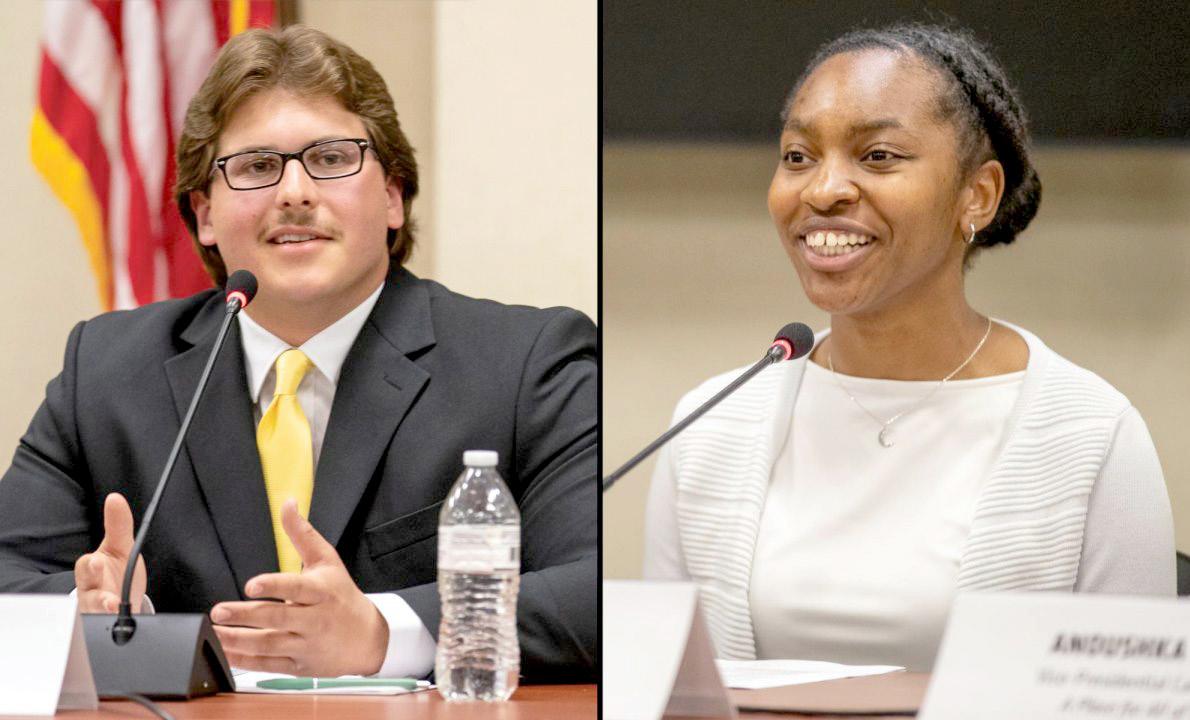
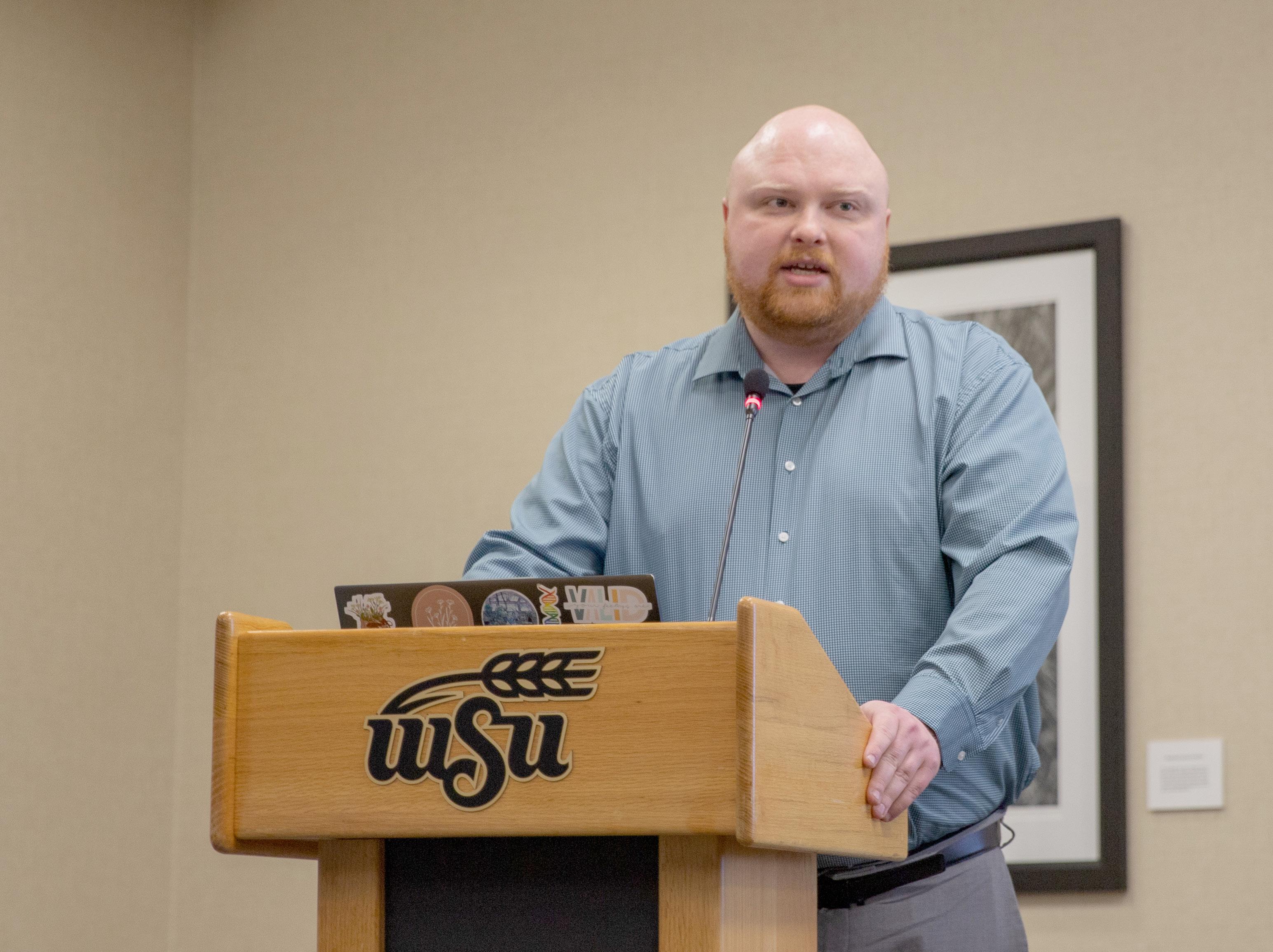
SGA presidential candidates Mason Fouquet (left) and Jayden Island (right) answer questions during a debate. Photos by Mya Scott; Graphic by Zachary Ruth / The Sunflower
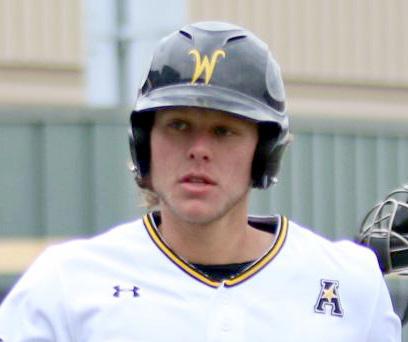
Former Shocker Alec Bohm celebrates after scoring against Tulane in April 2018. File photo by Selena Favela / The Sunflower
Student fees budget approved, CAPS permitted to charge for counseling
BY KASS LEWIS news@thesunflower.com
The Student Senate passed the student fees budget, but not before changing policy notes to cover a pay-back of money given to Student Health Services for last year’s deficit, and allow Counseling and Psychological Services to keep charging students $10 per session.
The student fees budget allocates money to various student services and funds that pay student workers or provide scholarships. In its initial version, it included a proviso, or condition for funding, that would prohibit CAPS from charging students for counseling services. The Student Senate voted to eliminate that measure with 16 in favor, two against and seven abstaining.
In the March 11 meeting, CAPS Director Christopher Leonard said that if the charges were reduced to zero, CAPS would see around a $57,000 loss in revenue, likely leading to staff cuts.
Speaker of the Student Senate Matthew Phan yielded his time to Student Body President Jia Wen Wang during the debate period of the motion. Wang said that if she were a senator, she would vote to approve the change.
Wang’s reasoning was that she didn’t like the fact that there isn’t a formalized process for reducing the cost of a session if a student requested a reduction due to financial insecurities.
“I gave that feedback to them, they received it very well, and they have stated that in the future if that is what we would like as a student government — to formalize a process in partnership with them — that they would be willing to do so,” Wang said.
Following a student fee budget shortfall last year that resulted in lower funding for every entity, the Student Government Association gave Student Health Services
$75,000 from SGA’s student fee contingency fund to make up for some of the cuts due to the shortfall.
In the version of the budget that was recommended by the Student Fees Commission, Student Health would pay back the money by Aug. 1, 2026. But the Student Senate voted at the Wednesday meeting — with permission from Wang — to pay off the loan from SGA’s Special Projects Fund. Wang had to give permission because money from the Special Projects Fund requires authorization from the president to utilize.
The vote to alter the proviso was 20 in favor, zero against and five abstaining.
Other provisos, which included adding regulations around how student fees were kept and transferred, and changing the NonTraditional Scholarship changing its bylaws in order to receive funding, were left unchanged.
After the two changes were made, the budget passed unanimously. Student fees will remain unchanged next year if the budget receives approval from WSU President Richard Muma and the Kansas Board of Regents, which oversees the state’s public higher education.
BY LIBERTY THOMPSON liberty_thompson@icloud.com
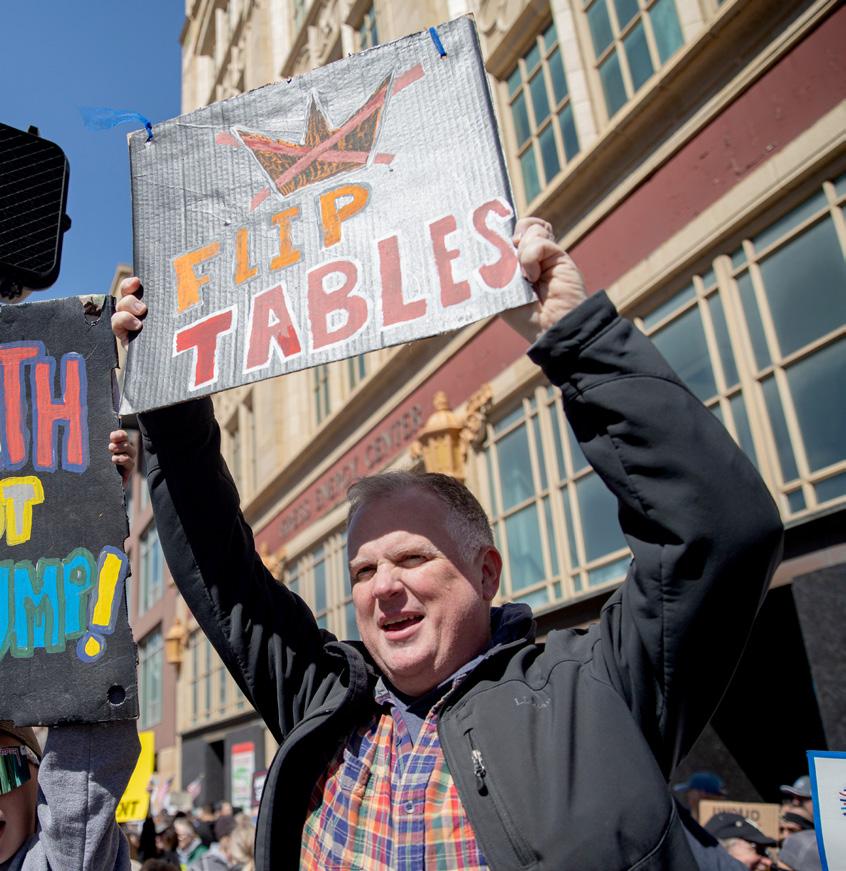
Whistles, chants and hundreds of signs proclaimed the message
“No Kings” as over 3,500 people took to the streets of downtown Wichita for another No Kings protest to showcase their distaste for the presidential administration on Saturday.
The No Kings movement’s website describes the motivations of the protests: “(T)his country does not belong to kings, dictators, or tyrants. It belongs to We the People — the people who care, who show up, and who fight for dignity, a life we can afford, and real opportunity. No Thrones. No Crowns. No Kings.”
“It’s really important that we take control of our future,” Wichita State sophomore Jamel West said at Saturday’s No Kings protest. “It’s looking like young people really won’t have a say in our government or how we live our lives. It’s important to call out corruption and bigotry in general.”
West and his companion, Catalina Palacios, are politically active and protest frequently.
Two weeks ago, they organized a smaller protest near City Hall.
“We’ve been doing scattered protests throughout,” Palacios said.
Democracy was a common word at the rally, with frequent calls of “show me what democracy looks like” being answered with cries of “this is what democracy looks like.”
“We’re here for democracy. That’s the principles of America that we’re standing on,” Palacios said.
The No Kings protest started at
BY KAMI STEINLE steinlekami@gmail.com
The Student Senate unanimously passed a bill to change the role of underserved senator to at-large senator.
“These changes are happening because of a budget proviso that’s prohibiting DEI programming, training, activities and related efforts, which went into effect on July 1, and we expect to continue to be in effect with the new budget provisos,” Speaker of the Student Senate Matthew Phan said.
In the previous SGA by-laws,
It gives me a lot of hope seeing so many people turn up here. I think it’s a good time for change.”
CIARA MOULA WSU alum, therapist “
the Sedgwick County Courthouse, though several other origin points were scattered around downtown Wichita. The groups congregated at Douglas and Broadway before filtering into Chester I Lewis Reflection Square Park to listen to speakers.
The crowd was cheerful and in good spirits. People were smiling, laughing and introducing themselves to strangers. Several people brought their kids and their dogs.
“What brought me out today was the camaraderie,” Ciara Mould, a therapist and WSU alum, said. “I think it gives me a lot of hope seeing so many people turn up here. I think it’s a good time for change.”
The signs at the protest were angry. Several were from veterans disappointed with the current administration, with one from a former Marine reading, “I have to uphold my oath. Why don’t you?”
“I think we’re all just really upset with what’s going on, and this feels like a way to express in a way that’s also helpful,” Katelyn Keough, a protester at the No Kings march, said. “I’m tired of being embarrassed about our government. I want our democracy back.”
Democratic Congressional candidate Katy Tyndell was also in attendance and said she thinks the protest is a “testament to how
fed up people are right now with overreach of this administration.”
District One City Councilman Joseph Shepard and State Representative Abi Boatman spoke as well.
“I’m inspired by the turnout of young people today,” Shepard said.
According to data from the 2022 election, Americans under 30 are the most underrepresented age group in public office and the polls. Some young people claim they feel their vote doesn’t matter and that democracy isn’t working, according to an article by PBS News. But many young people attended the March 28 No Kings protest.
“I think young people should be encouraged to use their voices,” Palacios said. “After all, we are the future of this country. I think we have a chance to decide what ideals we hold to be true and self-evident.”
West said movements like these are some of the best chances young people have to “take back our future.”
“They [Gen Z] want change, and we better be paying attention to not just their wants, but giving them a seat at the table,” Shepard said.
Change was another prevalent topic at the march. Signs demanded the release of the Epstein files, the taxation of billionaires and the removal of Immigration and Customs
Enforcement (ICE) from the city of Wichita.
“If change is going to happen, it’s going to happen in the heart of America first, right here, in Wichita, Kansas,” Shepard said. “Wichita State has roughly 15,000 students, that can change the entire trajectory of an election at the local level. So they have more power than they might even realize.”
The idea that Wichita will be a battleground site for civil rights is no new claim. Wichita was the origin of the diner sit-ins in 1950’s Civil Rights-era America. The Dockum Drug Store sit-in inspired protests like it across the country and helped on the long, arduous and incomplete journey towards equality for Black Americans.
“If you say, ‘You know what, I’m not voting, I’m not seeing the change,’ I need you to wake up and shake yourself because if you don’t do politics, politics will do you,” Shepard said. “I need you to get on the phone and call your family member and your friend, who is voting for people who are harming you, harming your rights, harming our democracy, harming the sanctity of who we are as a country. I need you to tell them to change their mind.”
Shepard stressed the importance of voting and how what citizens do outside of protests “sets the pace of where we can go.”
“Every time our country has seen significant social change in the last 250 years, it was activists standing on the front line, pushing for that change,” Tyndell said.
SGA changes senate seats amid purge of DEI policies
underserved senator seats were “reserved for Association members who are identified as underserved students as defined through the University’s Strategic Enrollment Management Plan including students who self identify as LGBTQ+ or disabled individuals as well as all persons of color. If the University does not track said information, the underserved position shall serve all identities represented by this seat.”
The by-laws have now been changed to “Five (5) seats shall be reserved for Association members
elected at-large from the general Association membership. Students serving in this seat shall be known as At-Large Senators.”
This makes the seats open to all students.
For this initiative to go into effect, the WSU student body has to vote to approve it. The measure will be on the ballot for the upcoming SGA elections starting on April 6.
Senate meetings are every week on Wednesdays at 7:30 p.m., open to the public and live streamed on SGA’s YouTube.
Jackson Rukes, 17, holds up a 35-star American flag from when Kansas was admitted into the union while attending the No Kings protest on Saturday, March 28, 2026. Photo by Zachary Ruth / KMUW
Speaker of the Senate Matthew Phan answers questions about the proposed change to the underserved senator role at the March 25 Senate meeting.
Photo by Darrek Bishop / The Sunflower
Proposed Student Bill of Rights amendment would add new protections against discrimination
KAMI STEINLE
steinlekami@gmail.com
Legislation was introduced in Wichita State’s Student Senate on March 25 to amend the Student Bill of Rights with protections for students with disabilities, and other groups of students.
This would add a sixth article to the Student Bill of Rights, saying students can not be discriminated against in “funding, participation, evaluation, registration, advising, attending, housing or any other aspect of University life.”
Protections for ethnicity, culture, age, veteran status, gender and sexuality would also be added through the amendment.
Adult Learners Senator and
sponsor of the bill, Andrew Hatch, said that after multiple states sued to strip 504 protections — protections against discrimination for students with disabilities — in 2025, this bill was developed during the previous SGA session to protect students at WSU.
“This is basically just an amendment to the Student Bill of Rights to guarantee protections for disabled students and other groups that would’ve lost protections had that lawsuit gone through,” Hatch said. “I know it’s still in the courts right now, however, just preemptively getting ahead of any changes that might happen to 504 protections guaranteeing our students the right to participate
in campus activities regardless of disability status.”
The article would provide specific protections to students with disabilities detailing, “Discrimination against people with disabilities includes, but is not limited to, failure to provide reasonable accommodation for said disability, or failure to make Wichita State University accessible to students with disabilities. Accessible means a person with a disability is afforded the opportunity to acquire the same information, engage in the same activities, and enjoy the same services as a person without a disability in an equally effective and substantially equivalent ease of use.”
“This bill did pass last year,”
Hatch said. “We were waiting on Faculty Senate to get back to us because previously we needed approval from them to amend the Student Bill of Rights. They have since changed that so now just this body needs to approve those changes.”
The bill was referred to the Student Services Committee and will have a second read, debate and vote during the April 8 meeting.
The Student Senate meets every week on Wednesdays at 7:30 p.m. Meetings are open to the public and live streamed on SGA’s YouTube. Members of the public, including students, can speak in the public forum period at each meeting.
SGA to fund vision care popup clinic initiative
BY JONAS LORD legobrickslord@gmail.com
Wichita State’s Student Senate voted Wednesday night to approve a bill that will fund a vision care pop-up clinic on campus. Before the vote, Director of Health and Wellness Anoushka Raju spoke before the senate in support of the bill.
“Access to healthcare is not just about treatment, it’s about giving students the ability to fully show up in their daily lives,” Raju said. “Vision care directly impacts how students learn, engage and navigate both their academic and personal environments.”
According to Raju, the bill was created in response to Student Health Services’ Quality and Utilization Report, which identified vision care as the most requested service among students.
The initiative will start by providing free eye exams and glasses for 50 students on a first come, first serve basis.
“This establishes a foundation for more accessible and supportive wellness culture on campus, one where students are not held back by preventable barriers,” Raju said.
Three senators, all of whom wear glasses, spoke in affirmation of the bill, which passed unanimously.
“I’m gonna speak in affirmation, I agree, I’m incredibly impressed by how much information has been included in the bill,” Liberal Arts and Sciences Senator Braeden Miller said.
Adult Learners Senator Andrew Hatch presents an amendment to the Student Bill of Rights to the Student Senate. This amendment will provide protections for disabled students. Photo by Darrek Bishop / The Sunflower
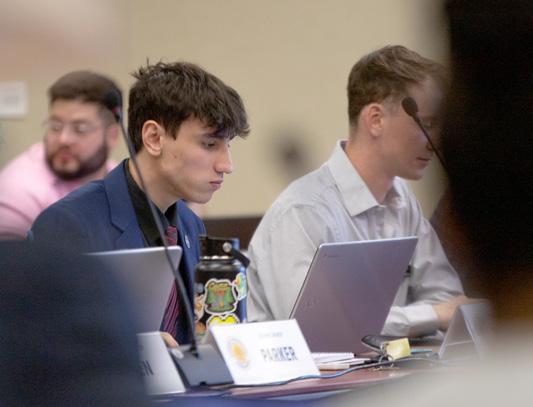
Business Senator Jamie Winslow looks at his laptop during a Student Senate meeting. File photo by Kass Lewis / The Sunflower
Women’s bowling earns NCAA Tournament berth
BY MACK SMITH mackred22@gmail.com
It didn’t take long for the Wichita State women’s bowling team to make back-to-back NCAA Tournament appearances.
In just their second season as an NCAA program, the Shockers earned an at-large bid during Wednesday’s selection show, even after a 0-2 showing at the Conference USA Championship — a disappointing result for a team who escaped last season’s contender’s bracket to win the tournament.
Wichita State earned the No. 2 seed in the Arlington Region and will face cross-town rival Newman Friday, April 3, at the International Training and Research Center in Texas. The region’s top-seeded and tournament’s overall No. 4-seeded Louisiana Tech, a CUSA opponent, will play Bryant on the other side of the four-team bracket.
The Shockers fell to Newman Nov. 2 this season, 938-923, during the Track Kat Klash. They’ve also split 10 matches with Louisiana Tech this season and have yet to play Bryant.
Wichita State finished the regular season at 73-33 and was most recently ranked No. 5 nationally in the National Tenpin Committee’s March poll.
The Shockers won the Lansing Region a season ago to make the Final Four.
Transfer portal news: Who’s staying, leaving?
BY OWEN PROTHRO sports@thesunflower.com
The transfer portal officially opens April 7 and closes April 21, but that doesn’t mean your favorite player will stay between now and then.
Here’s everything that’s happened this offseason so far for Wichita State:
Departures:
Dre Kindell, who averaged 5.9 points, 1.6 rebounds and 2.3 assists per game, will look for a new home going into next season, according to his agent Friday afternoon.
Kindell, a senior guard, spent just one season in the black and yellow. He will have at least one year of eligibility remaining.
Kindell’s playing time fluctuated throughout the season, going from 19.6 minutes a game through the first 24 to 11.9 through the last 12.
Returners:
As of Monday afternoon, forwards TJ Williams and Dillon Battie and center Will Berg will spend another year in Wichita.
All three announced their return via their personal social media accounts, like X and Instagram.
Williams averaged 8.7 points and 5.0 rebounds per game. Battie finished with 7.6 points and 4.7 rebounds on average and Berg scored 8.8 points and pulled down 8.1 boards a game. The Shockers managed a program-best 14.67 offensive rebounds per game. Battie and Williams will have at two years of eligibility remaining. Berg will have at least one year of eligibility left for next season.
SPORTS
What’s next for Paul Mills, men’s basketball after season-ending loss?
BY OWEN PROTHRO sports@thesunflower.com
In the quiet moments after Wichita State’s season ended — an 83-79 loss to Tulsa in the National Invitation Tournament quarterfinals — Paul Mills wasn’t focused on the scoreboard.
He was already thinking about who would still be in the locker room next year.
In a sport increasingly defined by one-year acquisitions and transfer portal bidding wars, roster continuity has become rare. Mills, who just concluded his third season as Wichita State’s head coach, is betting the Shockers can be the exception.
“We’re a top 25 program,” Mills said. “We’re going to be a top 25 team. It’s going to happen.”
That vision didn’t materialize overnight this season, but the foundation is unmistakable. The Shockers finished 24-12 — their most wins in eight years — and reestablished an identity built on cohesion as much as talent.
Now comes the harder part: keeping it intact.
The transfer portal opens April 7, but the real work begins immediately. Mills said he will conduct exit interviews with every eligible player in the coming days, aiming to secure commitments before outside influences — agents, coaches, and name, image and likeness opportunities — enter the equation.
It’s a reality every program faces. Rosters turn over faster than ever and development timelines have shrunk. Retaining players, even for a second season, can feel
like a victory.
That’s why Mills has emphasized something the portal can’t easily replicate: connection.
“We’re a brotherhood,” senior guard Kenyon Giles said with tears in his eyes. “I’m going to talk to these guys a month from now.
“I don’t know if they know it, but when I have my wedding, they’re all invited.”
Moments like that are what Mills hopes will resonate when decisions are made in the coming weeks.
“I feel really good about the group that we have, and who’s going to end up returning,” Mills said.
That confidence is rooted in intentional roster building. After losing eight seniors a year ago, the staff prioritized balance — a mix designed to avoid another full reset.
Players have echoed that belief throughout the season.
“The program’s constantly growing,” senior forward Karon Boyd said to The Sunflower after a loss to South Florida in the conference title game. “A lot of core guys are returning.
“Wichita is not going anywhere — it’s only getting better from here.”
Still, replacing Boyd and Giles
won’t be simple. Giles delivered one of the most dazzling seasons in recent program history, averaging 19.1 points per game — the highest mark since Jason Perez’s 20.2 in 1999-2000 — while setting a single-season record with 125 made 3-pointers. His 689 total points rank third all-time for a season, trailing only Xavier McDaniel and Dave Stallworth. Boyd, meanwhile, anchored the defense while expanding his offensive game, averaging 10.9 points and knocking down 46 threes at a 35.1% clip after struggling from deep earlier in his career. Their departures leave production gaps, but not necessarily a void.
Wichita State could return as many as 12 players, with the possibility of 13 if center Emmanuel Okorafor is granted a medical hardship waiver.
Among the most important decisions is that of center Will Berg. Berg, a 7-foot-2 Purdue transfer, led the team in rebounds (8.1) and blocks (45), earning the American Conference’s Sixth Man of the Year honors.
Guard Mike Gray Jr., who has already secured an additional year of eligibility, would provide
experience and stability if he returns, while forward Dillon Battie’s late-season surge offered a glimpse of the program’s next wave. After limited early minutes, Battie averaged 10 points over the final 20 games, including a 22-point, 12-rebound doubledouble on senior day.
“We’re going to have a young core that’s going to dominate,” Battie said to The Sunflower March 15.
For some, the decision may be more personal than strategic.
Redshirt freshman TJ Williams, a Wichitan, described his choice in simpler terms.
“A lot of people were like, ‘Why Wichita State?’” Williams said. “But ‘why not?’ is what I tell them. Why not?
“(We’re) just trying to get back to the glory days. We were really close this year.”
That question — part belief, part challenge — may define the Shockers’ offseason as much as any NIL offer or recruiting pitch.
Mills understands what’s ahead. He even joked about it, reviving the nickname fans have embraced.
“You go in the next room, you change your clothes,” he said with a grin.
“And Portal Paul emerges.”
The line drew laughs. The work behind it won’t.
Because if Wichita State is going to become what Mills insists it will be, the next step isn’t just adding talent.
It’ll be convincing enough of it to stay.
Softball comes up short against South Florida
BY JAYDEN WOODS jaydenwoods86@gmail.com
The Wichita State softball team (19-13, 7-5 American) traveled to Tampa, Fla., to face South Florida (27-11, 9-3) in a three-game weekend series.
The Shockers dropped two of the three games and scored the fewest runs in a three-game series this year (9), the second lowest being 14. They did manage a series-opening win on Friday that lasted 3 hours, 50 minutes against a team ranked No. 39 in RPI.
Wichita State will play against No. 3 Oklahoma at 5 p.m. on March 31 at Love’s Field in Norman.
Friday
An extra-inning thriller opened the series for Wichita State, as they defeated the Bulls 5-4 in 11 innings.
South Florida took an early lead in the first inning, but Wichita State responded in the second when freshman Kammie Smith hit a solo home run.
The Shockers kept the momentum going into the third inning, with freshman Kinzey Woody hitting a two-run double.
Smith followed with another hit, bringing Woody home to extend the lead to 4-1.
Senior Jade Sanders stepped into the circle in the seventh inning, but the Bulls rallied to tie the game and force extras, 4-4.
After the teams pushed the game to an 11th inning, a throwing error by South Florida allowed freshman Mackenzie Rooney to score the game-winning run.
Sanders earned her fourth win of the season, while Riley Nihart recorded her first save of the season and second of her career after re-entering to secure the final two outs.
Five Shockers recorded hits, all posting multi-hit performances. Smith led the way, going 3-for-6 with two RBIs.
Saturday
The Shockers’ offense was limited during a 3-1 loss in Game 2 against the Bulls.
South Florida opened the scoring in the third inning with a sacrifice flyout. Wichita State answered in the fourth when sophomore Ausha Moore hit a solo home run — the Shockers’ only
run of the game. The Bulls responded with runs in the fourth and sixth innings to secure the win.
Sophomore Ava Sliger was tagged with her first loss of the season, allowing three runs on seven hits. Wichita State managed just four hits offensively. The game lasted 1 hour and 40 minutes, marking the shortest seven-inning contest for the Shockers this season.
Sunday In the rubber match, the Shockers’ offense came out strong, with junior Trinity Allen hitting a solo home run. Wichita State eventually fell, 6-3. Sanders returned to the mound after her outing on Friday and gave up three runs during the bottom of the second inning. Allen added another home run in the top of the third, recording her first multi-home run game of the season.
Shocker ace Nihart came in for relief in the third inning, not starting on the bump due to a stomach bug, according to the ESPNU announcers. Woody hit another homer for
Wichita State, tying the game up at three. All three runs from the Shockers were solo home runs. The Bulls answered back in the fourth, taking the lead back by one and never looking back, earning two more in the sixth inning to close out the game Nihart took her eighth loss of the season, moving to 7-8 in the circle. 1. South Florida: 9-3 (27-11)
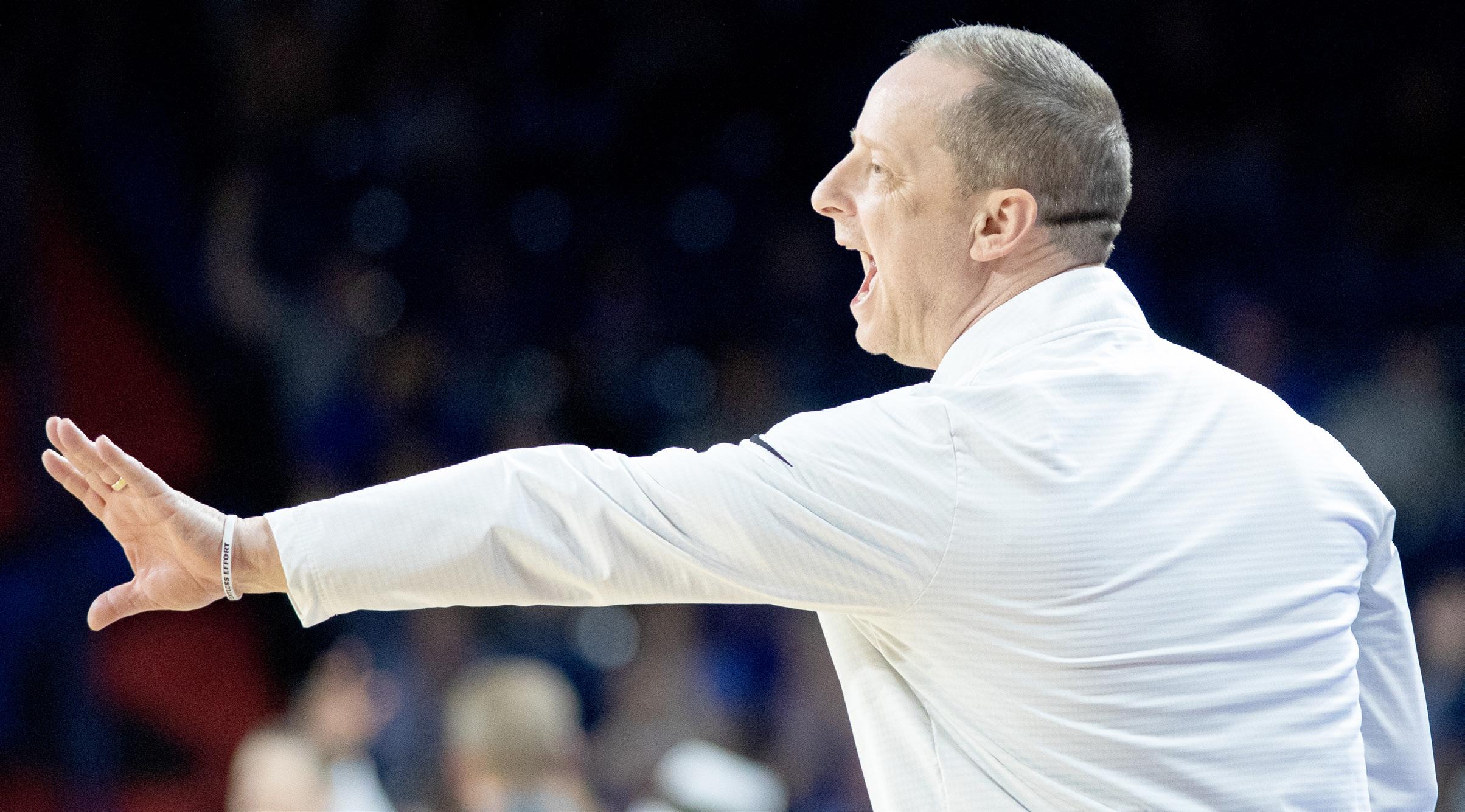
Wichita State men’s basketball head coach Paul Mills gives directions to the Shockers on March 24 at the Reynolds Center in Tulsa, Okla. The Shockers’ season ended with an 83-79 loss to conference rival Tulsa. Photo by Zachary Ruth / The Sunflower
Wichita State men’s basketball forward TJ Williams (4) slams down a dunk against Tulsa on March 14 at Legacy Arena in Birmingham, Ala. Photo by Zachary Ruth / The Sunflower
Baseball wins 2 of 3 games vs. Memphis
BY EVAN LONG
In the bottom of the third inning with two outs and the bases loaded in a tie game, Wichita State’s Caleb Reed came on in relief to face Michael Gupton, Memphis’ leader in home runs, extra-base hits and slugging percentage.
Reed struck out Gupton on a 2-2 pitch to keep the score 1-1, and first baseman Jack Quick quickly added his own dramatic moment from the batter’s box just minutes later in the fourth.
A first-year Shocker, Quick mashed the ball 417 feet over the left-field wall for his first home run of the season to give WSU a lead it would keep the rest of the game at FedEx Park.
Wichita State (19-10, 4-2 American) beat the Tigers (8-18, 2-4) by a score of 7-3 on Sunday to take two of three games in an American Conference series in Memphis. The Shockers are tied with two other teams for the conference lead.
A day after losing the second game of the series 11-1, the Shockers took an early lead in the finale on Sunday. In the top of the second, shortstop Alex Ulloa singled to score Jacob Gutierrez, who dove head-first past the catcher and across the plate to put the Shockers up 1-0.
Ulloa made a huge impact in the field, as well, on Sunday. A hard hit ball in the second inning forced Ulloa to fall back and toss the ball — while sitting — to second baseman Owen Rush. Rush threw to first to complete WSU’s second straight inning-ending double play.
On offense, third baseman Jayson Jones extended his hitting streak to 20 games by notching an RBI single in the top of the fifth. In the same inning, Quick struck again, hitting an RBI single to left field, widening Wichita State’s lead to 4-1.
Coach Brian Green asked a lot of his relief pitchers after pulling starter Johnny Nuanez in the bottom of the third inning, and they delivered for him.
Reed (4-0) allowed two solo home runs, but he was lights out
in the rest of his appearance. He gave up three hits, no walks, and struck out five batters.
Senior left-handed pitcher
Brady Owens allowed one hit, one walk and no runs, along with two strikeouts, in two innings pitched.
“I thought Owens was absolutely the player of the game,” said Green, while surrounded by players in a postgame huddle, in a video on the team’s X account.
Graduate right-hander Brady Pacha, a Bishop Carroll High School alum, closed the game out for WSU, allowing one hit, no walks, no runs while recording two strikeouts in 1.2 innings to earn his fourth save.
“Johnny (Nuanez) comes out and somebody’s got to step up, and big time step-ups out of the bullpen with Reed and Owens to take it to Pacha. That was fantastic,” Green said in the same video.
The Shockers led 4-3 going into the top of the seventh inning when they broke the game open.
After Jones’ sacrifice fly, senior designated hitter Owen Washburn smacked an RBI single to right field to extend WSU’s lead to 6-3.
Gutierrez followed by ripping an RBI single up the middle for a 7-3 game-deciding lead.
In Game 1 on Friday, senior right fielder Jaden Gustafson and Jones homered to power the Shockers to a 7-3 victory. Junior
right-handed starter Matthew Cuccias improved to 3-0 with 5.1 solid innings and Pacha worked the final 3.1, allowing one hit and striking out five.
In the second game on Saturday, Jones recorded two hits but Wichita State fell 11-1 in a run-ruled eight-inning contest.
Six Shocker pitchers allowed nine walks, three wild pitches and hit a batter.
Wichita State is back in action against Division II Washburn at 11:05 a.m. Tuesday at Eck Stadium.
Women’s tennis wins 13th-straight match vs. USF
BY MADDOX TOPLIFF maddoxtopliff07@gmail.com
The win streak continues for Wichita State women’s tennis.
The Shockers took down USF in a Friday afternoon sweep at Sheldon Coleman Tennis Complex, extending their winning streak to 13.
“These matches are easy to let one slip at some point, but the girls have been really focused,” WSU head coach Jacob Eddins said.
“Take care of one match at a time.”
The 4-0 outcome marked the Shockers’ fourth win in four American Conference games, and improved their record to 15-3.
The Bulls fell to 5-12 and 1-3 in conference play.
“Credit to the girls and the hard work they’re putting in,” Eddins said. WSU’s winning streak is its longest since rattling off 17 in a row in 2016.
“It’s been an unbelievable season, and we want to play our best tennis down the stretch,” he continued. The Shockers are doing just that — currently No. 26 in the ITA national rankings, as of March 24. Wins during the 13-game streak include No. 42 Rice and No. 61 Long Beach State.
(15-13) 9. Tulane: 2-4 (14-15)
2-4 (8-18)
The team isn’t the only one earning national recognition. Juniors Giorgia Roselli and Xin Tong Wang are ranked No. 17 in the doubles ITA national rankings, and senior Theodora Chantava is ranked No. 124 in singles.
On the court Friday, senior
Palmy Vimuktananda and graduate student Anne Knuettel started off the sweep, winning their doubles court, 6-2. They were followed up by Chantava and senior Kristina Kudryavtseva’s 6-4 victory, securing the doubles point for WSU.
Roselli and Wang went down 4-0 and were amid a rally, coming back to 4-3, but had their match left unfinished down 5-3.
The Shockers have won the doubles point in the last 14 matches and carried the momentum into singles play, not dropping a court in the process.
Chantava got right back to work, taking her court first with a 6-2, 6-1 victory. Vimuktananda came right after, with a 6-2, 6-2 victory. Wang followed in her footsteps with a 6-2, 6-2 victory of her own, cementing the win and sweep.
Roselli appreciated the team’s efficiency, saying, “I’m just so proud of them to get it done quickly.” Both her singles and doubles matches were left unfinished, as her teammates cleaned up the sweep.
Wang also spoke to the speed of Wichita State’s victory.
“I’m so happy to get four points straight,” she said.
The Shockers head to Denton, Texas, to play their next matches against Liberty and conference foe North Texas April 4 and 5. First serves are slated for noon and 10 a.m., respectively.
Wichita State baseball senior Jayson Jones (23) swings during a game against Memphis on March 28 at FedEx Park in Memphis, Tenn. Photo courtesy of Nick Flynn / Wichita State Athletics
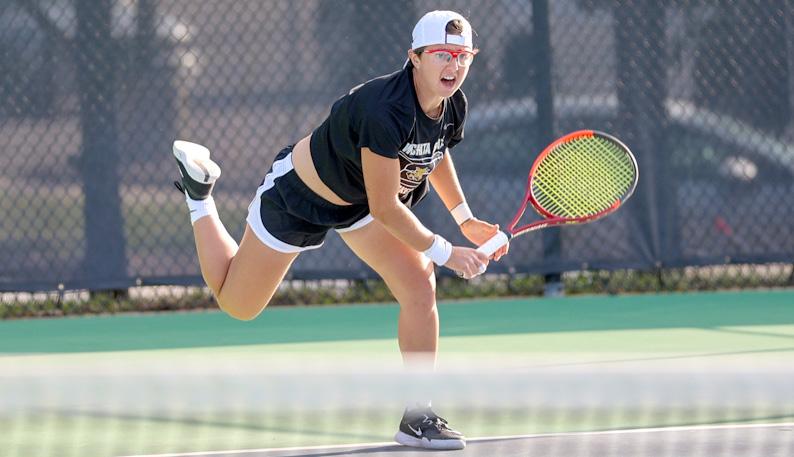
Wichita State women’s tennis junior Giorgia Roselli follows through with a shot against South Florida March 27 at the Sheldon Coleman Tennis Complex. Roselli is a part of the No. 17 doubles duo with junior Xin Tong Wang. Photo by Mack Smith / The Sunflower
1.
OPINION
Campus fast food hours should be extended to better accommodate students’ schedules
Ever been in the mood for a late-night fast food run? Or even just basic dinner plans after class?
I find myself in this exact situation more than twice a week.
I generally have classes from 9 a.m. to 7 p.m., with only enough time for a 30-minute lunch, which is not ideal. Admittedly, it’s my fault for setting up a loaded schedule, but the rather odd hours of the Rhatigan Student Center’s food locations don’t help. And by comparison, Braeburn Square has vastly more consistent hours, longer hours, and better food on average.
As someone who commutes about 40 minutes to campus and gets done rather late from my last class, I often leave that class starving. Hungry, I arrive at the RSC around 7:30 p.m., greeted by steel bars, locking me away from those options.
I often find myself either eating
at the Dining Hall after late classes or whenever I find a break between around 2 p.m. and 6 p.m. which is a gamble most of the time. By that time, the food can be dry, burnt or not even appetizing half the time.
The options for a student heading out of a class later in the evening are the dining hall, Braeburn Square, or off campus in a drive-thru. But another great option is going somewhere off campus if time allows.
Whatever the case, I don’t understand the reasoning behind the early hours of the dining options at the RSC.
I personally think the hours are odd and rather unusual, especially for a college campus, where hundreds of students might be feeling hungry after their classes or just spending time on campus in the evenings. I think that the hours should be expanded — not all night, but instead of closing at 7 p.m., add one to two more hours. This would allow lots more students to eat at Chick-fil-A, Panda Express, or another RSC restaurant, driving more business to those locations.
Starbucks
n Mon-Thurs: 7 a.m. - 9 p.m.
n Fri:
Chick-fil-A
n Mon-Thurs: 7 a.m. - 7 p.m.
n Fri: 7 a.m. - 5 p.m. n Sat: 11
Panda Express
n
Freddy’s
n Mon-Thurs: 10 a.m. -
Sushi Do n
Letter to the Editor:
Graduate student writes in disapproval of recent Sunflower opinion piece, ‘God forbid I need a cig’
Dear Editor,
In the March 24 issue of The Sunflower, I was surprised to see a student advocating for the removal of the tobacco-free status of Wichita State, in the form of smoking areas. In “God forbid I need a cig: Smokers deserve a place on campus too,” Assistant Editor and columnist Kami Steinle laments the days when students could smoke on campus without seemingly any concern for others’ well-being.
At this point, we know the negative impact smoking has on one’s physical and mental health. If one smokes, that’s their decision. The greater concern is the impact that the small smoking population has on the rest of us on campus. When considering if tobacco consumption on campus is a good idea, let’s consider how this would impact all students, faculty and staff.
Let’s take a look at the research on tobacco-free campuses: A systematic review by Geindreau et al. (2024) included 113 studies, concluding that tobaccofree campuses are successful at curbing tobacco use and reducing secondhand smoke exposure. To
Steinle’s credit, the analysis still found that stealth-vaping is a problem, as Steinle noted in her piece. However, the persistence of vaping is not an indicator that tobacco use on campus is better for us all.
According to the World Health Organization (2022), cigarette butts are the most common type of litter on the entire planet: 4.5 trillion butts are littered every year, equivalent to 1.69 billion pounds of litter that is neither compostable nor biodegradable. Furthermore, cigarette smoking causes 8.4 million tons of CO2 emissions annually, more than its fair share.
Let’s assess some of Steinle’s arguments: for example, the “people are going to do it anyway” argument. We can apply this argument to any policy, but that doesn’t mean we should. People still drive while intoxicated, but it is still a benefit to society that we have laws against drunk driving.
Steinle also claims that more students would be outside on campus and interacting more if smoking were allowed, just like the good ol’ days. Two flaws with this argument: 1), people can already do that, smoking is not
required for socializing and being outdoors. 2), her prediction may be incorrect; I imagine many students would smoke while looking at their phones and then go back inside.
Steinle’s piece may as well have been written by a tobacco representative. The tobacco industry is worth approximately $944 billion — it doesn’t need college students shilling for it.
— Jesse Borosky Graduate Student
Letter to the Editor:
Student expresses support of raising Kansas’ minimum wage
Dear Editor, Kansas workers deserve a wage that reflects today’s economic reality. Raising our state minimum wage to $16 an hour is not a radical idea but a practical, necessary step toward ensuring working families can afford basic living expenses.
Housing, groceries, transportation and healthcare costs have all risen sharply in recent years. Yet Kansas’ minimum wage has not kept pace. A full-time worker should not have to choose between paying rent and buying groceries. Work should provide stability, not constant financial stress.
Increasing the minimum wage would also strengthen our local economy. When workers earn more, they spend more in their communities. That spending could support small businesses and would keep money circulating within Kansas towns and cities.
Some argue that raising wages harms businesses, but evidence from other states shows that reasonable increases can be implemented gradually and responsibly. Businesses benefit from
lower turnover, improved morale, and greater productivity when employees are paid fairly. Kansas prides itself on hard work and strong communities. Paying workers at least $16 an hour honors those values. It is time for our lawmakers to act and raise the minimum wage to meet the needs of today’s Kansas families.
Panda Express inside the RSC on Oct. 23, 2026. File photo by Zachary Ruth / The Sunflower
Photo courtesy of Jesse Borosky
ARTS & CULTURE
GETTING PERSONAL
Creative writing professor finishes memoir
BY KAMI STEINLE steinlekami@gmail.com
Jason Allen’s memoir “Boys Without Fathers” has been in the making for about a decade, exploring deeply personal themes and telling the story of an unconventional life.
In the memoir, which will be published in September, Allen, an assistant professor of creative writing at Wichita State, explores themes of addiction and recovery, and draws parallels between himself and his brother, Jesse.
“My brother fell into hard drug addiction right about the point where I got sober myself from alcohol,” Allen said. “So, I tried to pull my brother into recovery with me, and that’s a big part of the book — our connection as brothers with a toxic father when we were kids and then an absent father when we’re adults.”
With his job, he said it can be difficult to find time to work on outside projects, but he writes when he can.
“It’s a relief as much as anything that it’s finished and that it’s going to be out in the world,” Allen said. “There are times that working on something that’s really extra personal — if you’re really tired and busy during the semester — that might not be the right time. So, during the breaks is where I get more work done.”
Allen has been teaching at WSU for four years. Previously, he has had two different teaching positions in Georgia and then one
It’s so personal. One thing I have to prepare myself for it that it’s not just the secenes that feature my brother’s addiction or my father’s alcoholism and things like that, that has to be secondary to my own. You try to show yourself from all different angles so it’s not just the best view.”
JASON ALLEN Assistant Professor, Creative Writing “
in Colorado.
“I really love the students here, especially because I have such a working-class background, and a lot of the students here really appreciate everything that they have and really want to be in school,” Allen said. “I think other places, sometimes people are just killing time.”
In the past, Allen has published two poetry collections — one, “A Meditation on Fire,” a full-length collection — and a novel, “The East End,” published in 2019. Allen said writing a memoir was a very different experience compared to his other works.
“It’s so personal,” Allen said. “One thing I have to prepare myself for is that it’s not just the scenes that feature my brother’s addiction or my father’s alcoholism and things like that, that has to be secondary to my own. You try to show yourself from all different angles so it’s not just the best view.”
Creative writing graduate student Elizabeth George, who
took a graduate fiction writing class with Allen last semester, described Allen as “personable” in the way he “tells anecdotes about the past, whether it’s teaching experiences and lived experiences.” George also said they tried to read most of their professors’ publications before coming to WSU, and that Allen is “really open to sharing if he’s had a new publication.”
“‘East End,’ I remember being really excited about,” George said. “I really enjoyed some of the character dynamics and the relationships between one another … There’s plenty of warmth and humor and humanness in his characters and stories that I find appealing.”
George said class with Allen was very “freeform” and student-led, using open-ended questions to allow students to talk about whatever was being workshopped.
“He introduced some more contemporary work and contemporary styles that he
appreciated and helped me appreciate too,” George said. “He does give a lot of affirmations to some of the things that we bring to workshop and … maybe helping extend it a little bit or see if somebody else wants to speak to something you notice, so you don’t feel like a weirdo for having a different reaction.”
Originally from the east end of Long Island, New York — the inspiration for the location of his first novel — Allen was raised mostly by a single mother who worked for a wealthy family in the Hamptons.
Because of his struggles in his early life with family and addictions — as he writes in his memoir — he did not start his college education until later in his life.
“I was a nontraditional student, so I wasn’t really ready to be in college until my late 20s,” Allen said. “I moved to the West Coast, so I spent 10 years in Portland. I went to Portland State, and then I went to Pacific University out there for my MFA, and then I traveled all the way back to New York for my PhD.”
Allen also said that one of his favorite authors, Karen Russell, author of “The Antidote,” wrote the blurb — the short description that’s found on the back of a book — for his memoir.
He met Russell last year while she was giving a reading at Watermark Books and Cafe in Wichita. He told her about his
History in fast-forward at the Ulrich
BY ANSHIKA CHAUHAN
axchauhan0@gmail.com
The Ulrich Museum of Art went quiet for exactly 20 seconds at a time Thursday evening — long enough to look, to sit with an image, to let it ask something of you.
That was the format: 20 images, 20 seconds each, six artists, one night.
The Schoof of Arts, Design and Creative Industries Faculty Artists’ “Symbols of Greatness” talk brought together six Wichita State University faculty to present work from the museum’s current exhibition.
Six very different artists — a printmaker, a graphic designer, an art historian, a studio painter, a horror-influenced multimedia artist and an instructor who brought a poem instead of slides — each had the same amount of time and the same exhibition prompt. What they did with it was anything but uniform.
Sprinting through history
Joshua Smith, an assistant professor of graphic design, opened with a word he invented: “truthoring.” Truth, authored. His work examined a document once designed to function as a clean instructional signal that failed — not visually, but systemically. Rather than replace or add anything, he rearranged only what was already there, testing what meaning could shift through structure alone. His final slide landed quietly. Something was missing from the work, he said.
Six letters spelling out — SANITY.
Irma Puškarević, an assistant professor of graphic design, spent her slides on a history most people have never heard — women in 20th-century printing whose labor kept entire resistance operations running but who were written out of the official record. Her ongoing project, the “Woman Factor Archive,” is a handmade box of reimagined periodicals recovering that history one issue at a time.
The centerpiece of her talk was a specific Slavian typeface designed by a woman — proposed, drawn and then just left there, never made real. Puškarević actualized it herself because for her, the project isn’t
about looking back at a finished history, but about “sitting inside an unfinished one” to challenge who still gets credited for the labor that sustains the structure of design today.
“That is not a historical question,” she said as her final slide faded. “It is today’s question.”
Break in the slides
The urgency shifted when Kendra Cremin, an ADCI instructor, walked up to the microphone and announced she was doing something different — a poem. She read Lawrence Ferlinghetti’s 1958 poem “I Am Waiting,” letting his long, restless catalog of American longing fill the room.
She chose him, she said, because he gave her language for her own discomfort with powerlessness inside larger systems. Cremin said he was a philosophical anarchist who believed art belonged to everyone, not just the educated few.
The room listened.
Brittany Lockard, an associate professor of art history, opened by asking the audience to say a word out loud.
The word was “fat.” She uses it herself as a plain description, same as noting she has gray hair or wears glasses. Her work traces how bodies get coded in art history, criticism, fiction and advertising to signal worth, intelligence and
moral standing — from Renaissance sculpture to the “Jack Reacher” novels — and what it means when real people can’t measure up to images that were never meant to be real in the first place.
For Briella Lujan, a junior art education major in the audience, moments like that were the whole point of being there.
“I really liked being able to hear from my professors from the perspective of artists,” Lujan said. “Not just them telling me about art training, as a professor. I thought that was really beneficial.”
What the format couldn’t finish
After the talk ended, the room returned to life. People lingered, talked and pointed at the work on the walls with a new context for it. The artists who had just sprinted through six minutes and 40 seconds were now standing among the people they had been speaking to — unhurried, answering questions, continuing conversations the timer had cut short.
“I could have given a whole hour-long talk on Freddy Krueger,” said Megan St. Clair, a lecturer in studio arts, laughing after the event. “It was really hard to knit it all together.”
She wasn’t alone. Marie Bukowski, dean of the College of Fine Arts, said the format barely
book, and she offered to write the blurb.
“I didn’t ask her for the blurb because usually with a memoir, you would have people who have published memoirs write the blurb for you,” Allen said. “She was just one of the nicest people I’ve ever met, too, so when it’s your favorite author plus you really love them as a person, it’s just a really nice thing.”
Allen said now that he’s finished with his memoir, he’s planning on writing another novel. He has multiple manuscripts that are partially finished, and he’s deciding which one to follow through with.
“There’s one that takes place in Portland that I began a long time ago,” Allen said. “It has a lot to do with some of the same themes that are in my memoir and even my other published novel and poetry collection.”
Allen said his memoir will be published on Sept. 1, and he hopes that he represented the struggles his family members were going through well.
He mentioned that the most important thing is that his brother feels good about the memoir because “he was always a good guy, he just was suffering a lot through his addiction.”
“By showing my own flaws or my challenges that I’ve had to overcome, I think that’s what allows you as a memoir writer to show other people’s stories within that,” Allen said.
Students
to
touched what she wanted to say.
“I’m a very process-driven person, and that drives everything I do, whether it’s my artwork or my job here,” she said. “I can spend all the livelong day talking about process.”
Lockard had similar feelings.
“I’m a teacher. I could do a whole class,” she said.
She added that she was moved by Cremin’s poetry presentation — the emotion of it, the way it stretched what a faculty talk could even look like.
The format also left attendees like Lujan wanting more time with the images.
“There were a lot of pieces that were really intriguing,” she said. “I would have loved to be able to engage with them more.”
Bukowski called her colleagues “rock stars.”
What struck her most, she said, was the range — how differently each discipline approached the same stubborn question of who gets to author history and who gets written out of it.
These six faculty members have a different answer. It’s on the walls at Polk-Wilson. Thursday night, you could feel it in the room too.
“Symbols of Greatness: Restoring Truth and Sanity to American History” is on view at the Ulrich Museum of Art on campus until June 13.
showcase skills at Shockers Got Talent April 2
BY JONAS LORD legobrickslord@gmail.com
For the third year in a row, students have the opportunity to showcase their skills for a chance to win prize money at the Shockers Got Talent event. According to Coordinator of Student Activities Jillian Belden, two people auditioned for the emcee role and 16 people auditioned for performances this year. Eight performers were selected by the committee, and Charles Modelski was chosen to be the emcee, or master of ceremony.
“All applicants were required to submit an application along with a performance video,” Belden said in an email. “The Shocker Night Life Committee carefully reviewed each submission, evaluating applicants across multiple criteria to select the final lineup of performers.”
The show will be held in the Miller Concert Hall on April 2 at 7 p.m., doors open at 6 p.m. Admission is free to students with a WSU ID, $5 for faculty and $8 for the public.
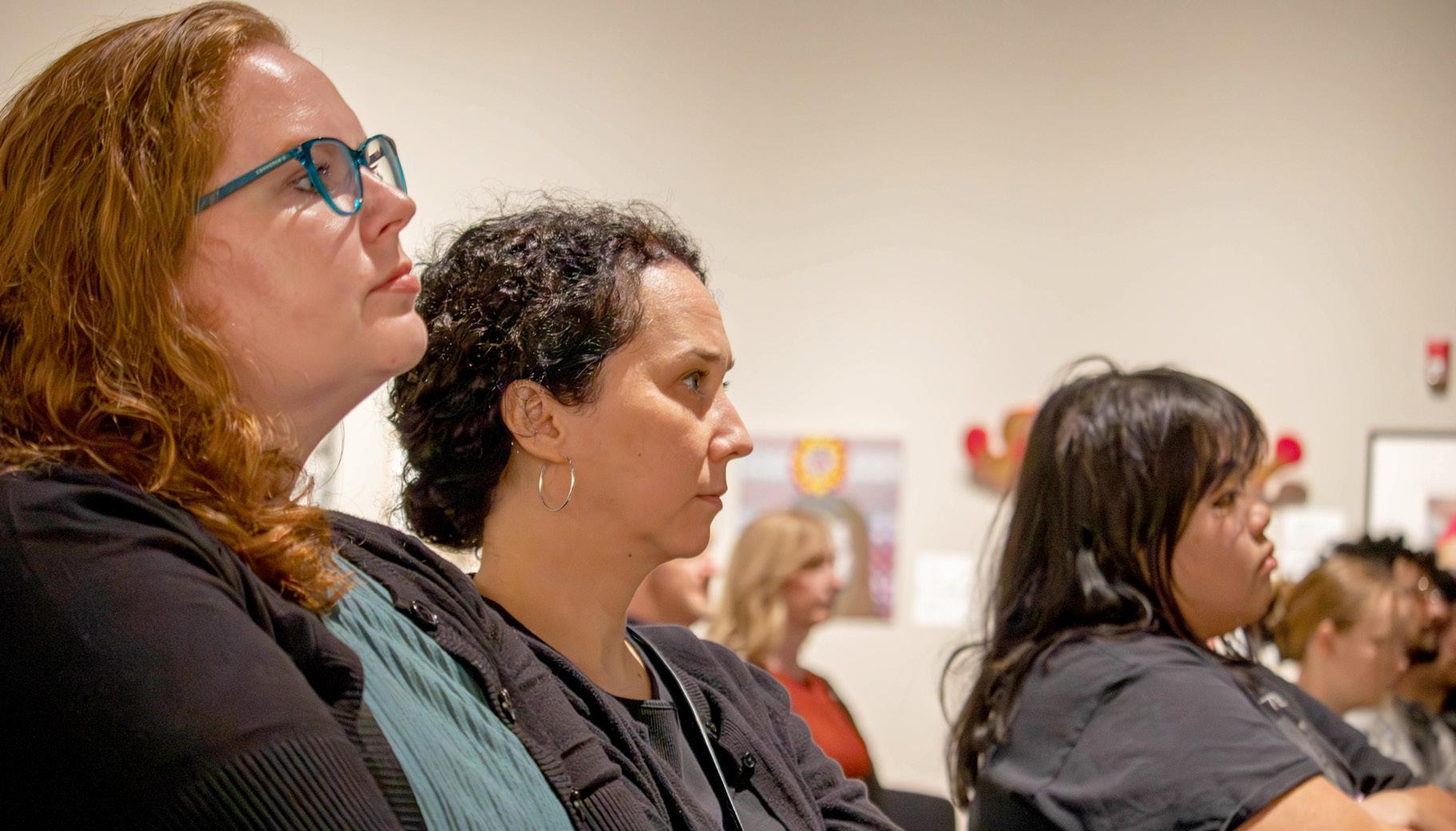
Audience members listen as various faculty artists give brief introductions to their fields of focus and their methodology.
This talk given on March 26, was part one of two in a series. Photo by Peyton Eck / The Sunflower
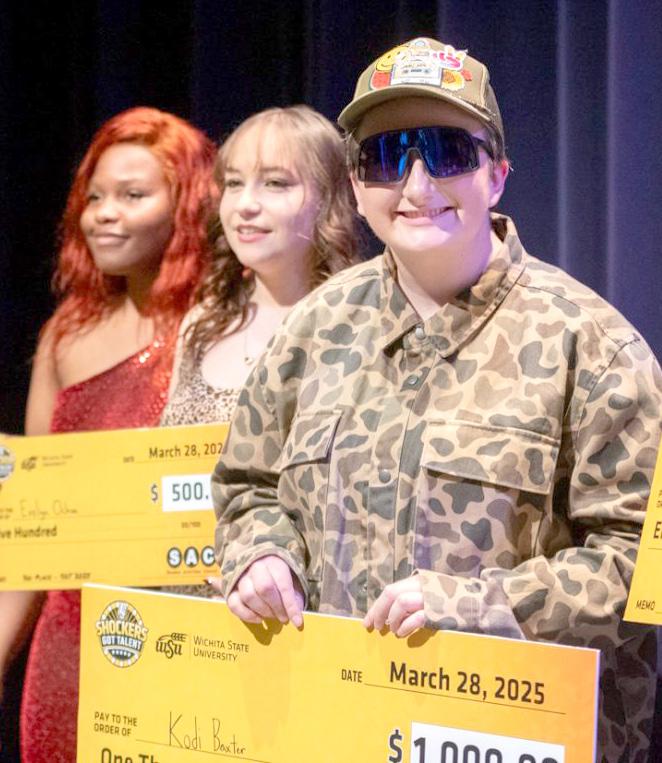
Kodi Baxter and other winners of Shockers Got Talent 2025 smile for photos after being awarded their prizes. Baxter won first place with her original house song, “I Never Could Let Anyone In.” File photo by Allison Campbell / The Sunflower PREVIEW
‘NO KINGS’
Wichitans join international protests against Trump admin.
to a performance of award winning pianist Wynona Wang, known for performances in the U.S., Australia, Ukraine and Romania. Admission is free for students.
16TH ANNUAL SPECTRUM SPRING DRAG SHOW Friday, April 3
8 - 10 p.m.
Hughes Metropolitan Complex
Come support local performers and watch a drag show performance hosted by Spectrum: LGBTQ+ and Allies. Guests must be 18 years or older to attend.
A demonstrator holds a sign reading “save our Constitution” as he walks through a crowd in Wichita, Kan. on Saturday, March 28. Demonstrators were escorted by police throughout the protest. Photos by Zachary Ruth / KMUW
Demonstrators cheer for a speaker during the No Kings protest in Chester I. Lewis park. Multiple politicians came to speak to the crowd.
A demonstrator plays a banjo outside the Historic Sedgwick County Courthouse. Organizers estimated attendence to be around 3500.
U.S. Senate candidate Jason Hart holds up a sign and yells while attending the No Kings protest. Hart was formerly a U.S. Attorney’s Office prosecutor, who resigned in order to run against Sen. Rodger Marshall (R-KS).
Demonstrators march down Broadway during the No Kings protest. Multiple groups formed and marched through the street to the corner of Broadway and Douglas to protest.
Demonstrators stand along Douglas Avenue during the No Kings protest on March 28. Many demonstrators brought signs, flags, megaphones and other items to draw attention to the protest.