


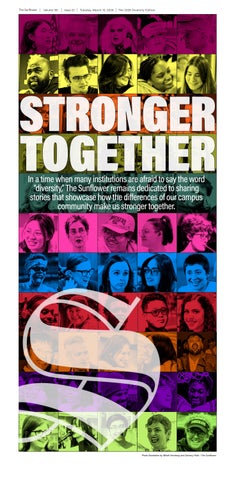






In a time when many institutions are afraid to say the word “diversity,” The Sunflower remains dedicated to sharing stories that showcase how the differences of our campus community make us stronger together.









Increasingly in recent years, the concept of diversity has been caught up in a storm of political changes that challenge its place in American culture and institutions. From the top office in our country down to our state’s lawmakers, many push the idea that diversity is bad — or at least that trying to encourage it in the workplace, or in cultural, governmental and educational structures is harmful. This is extremely worrying.
We at The Sunflower see diversity not just as a necessary topic for addressing the inequalities that still exist in our world, but also as a crucial tool that helps us cover our campus community accurately and brings our newsroom together.
Diversity has become more and more of a bad word — a taboo, of sorts — as we delve further into the Trump administration.
Certainly, this isn’t new; a basic understanding of American history makes clear how our culture has struggled with this concept for a long time. This isn’t just true in the wider world; it’s true in journalism as well. The news industry, like most institutions, has long struggled — and mostly failed — to reflect the diversity of the world we live in.
This failure doesn’t just affect the people who work in newsrooms. It also means a failure to execute the basic role of journalism. When newsrooms do not reflect diversity, they cannot tell the truth; only a limited, half version of it.
With recent strikes against diversity, equity and inclusion policies, it’s important to remember that these words — diversity, equity, inclusion — aren’t evil.
This discussion is polarizing the American people, causing the tectonic plates of political sides to shift further apart. Left vs. right, Republican vs. Democrat: these terms have evolved from simple words describing how you view economic policies to declarations of war on each other’s psyches.
The discourse isn’t just confined to the White House and social media platforms. It’s made its way into the very foundations of higher education.
Here at Wichita State, the organization Ambassadors for Diversity and Inclusion has changed its name to the Student Belonging Coalition, and the Office of Diversity and Inclusion has become the Office of Student Engagement and Belonging. Websites containing DEI vernacular have been removed from the university’s webpages, and university employees were required to remove pronouns from their email signatures. Legislators threaten the freedom of faculty in Kansas to teach about these concepts.
Organizations across Wichita State are forced to be subtle about the diversity within their groups, or put their existence and ability to support students at risk. They are essentially being forced to hide themselves for the sake of some individuals’ comfort, and that is absolutely shameful.
At The Sunflower, diversity is seen as a righteous thing. It bolsters both our coverage and our individual growth.
Without diversity, the weekly newspaper would be full of the same types of coverage, over and over again. The unique and fun gems hidden around this campus would never see the light of day. It helps us keep our
stories from being unfairly biased, while also keeping things interesting. We seek diversity — across topics, interests, demographics and viewpoint— to fulfill our mission of covering this campus accurately.
We all come from different backgrounds — editors, reporters, photographers, designers. Some of us come from giant cities, some from small, rural towns. Some of us come from across the country, while some of us have lived in Kansas all of our lives. There are even people from across the world who have chosen to work at The Sunflower and bring their stories and ideas to the newsroom.
Diversity also helps us grow as people. The world is diverse, whether you like it or not, acknowledge it or try to adopt a “colorblind” view of it. Differences are needed to help us learn, especially in a work environment, and especially in education.
While diversity is a loaded concept today, and for the foreseeable future, we feel the need to make our stance known.
We aim to adopt an objective lens in all of our reporting, including on this topic. We will continue to do so. Nevertheless, we believe in diversity. In the words of our publication’s founders, which they wrote in the very first Sunflower back in 1896: We offer no apology.
If we abandon our commitment to diversity, we abandon our mission. It is crucial to our work. So in this special edition issue, you’ll find stories about the diversity that makes up this campus — something that we always aim to reflect, not just this week but every week.
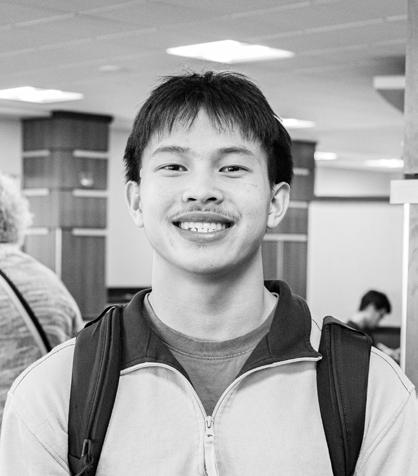
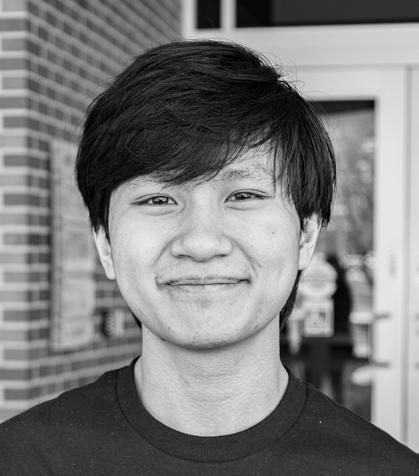
WHAT DOES DIVERSITY MEAN TO YOU?
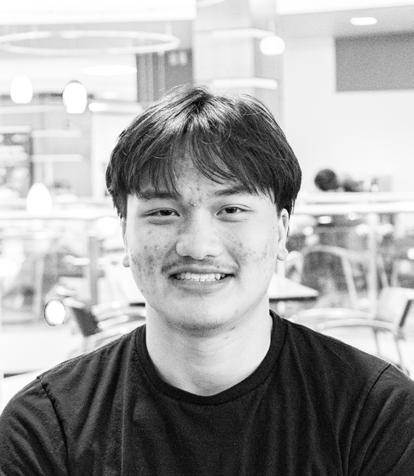
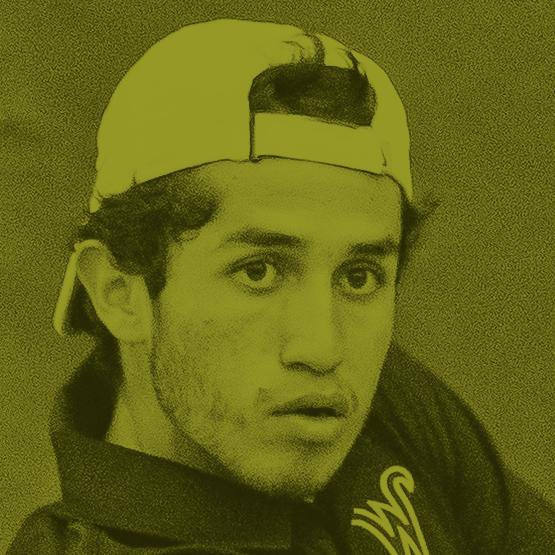
JON TRAN Freshman
“People of all walks of life getting together. And just being peaceful, no issues from other people around them.”
“Diversity really means to me just embracing a bunch of different cultures. It’s just seeing people that are different than you... Just knowing we all bleed the same color.”

“Diversity to me is a way for all cultures to experience different cultures and a way to express your own because I think diversity is a special thing.”
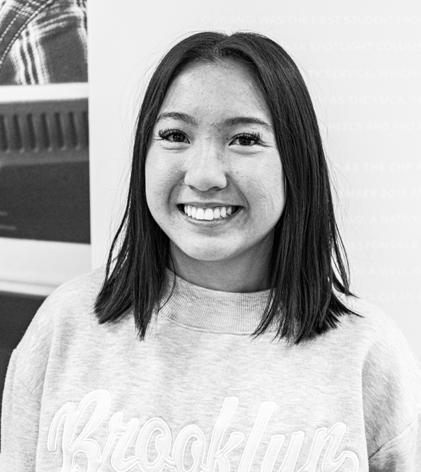
Senior
“Diversity to me means supporting and uplifting anyone and everyone from different backgrounds, from different economic statuses, anything like that and just making sure we’re supporting and guiding them through everything.”

the
BY AINSLEY SMYTH managing@thesunflower.com
There are new restrictions on who can use bathrooms and other single-gender spaces in all state properties, including university buildings, and some Kansans’ driver’s licenses may be invalidated.
But the enforcement of these measures will be delayed.
House Substitute for Senate Bill 244 was passed into law in February despite a veto from Kansas Governor Laura Kelly, after it secured two-thirds majorities in both the state House and Senate.
It’s facing a lawsuit by two trans men from Lawrence, whose lawyers argued it violates their clients’ rights including privacy, due process and expression. They also cite possible discrimination and harassment and risks to their jobs and mental health.
The law may be suspended for up to 14 days due to the lawsuit, after a hearing Friday. The Kansas Reflector reports a decision on that delay won’t be announced until at least Tuesday.
Kansas Attorney General Kris Kobach told the judge on the case that he will not carry out enforcement until March 26.
Moe Hatfield, a sophomore at Wichita State, said the legislation has already affected their experience on campus — even before the bill passed.
“As someone that’s nonbinary and tends to present mostly androgynously, I already had concerns about my safety using the bathroom,” said Hatfield, who also serves as an ambassador for Spectrum, WSU’s LGBTQ student group. “And these concerns have only escalated. I’ve already had issues where people have very obviously looked at me questioningly when I use the bathroom. I’ve had people ask me if I’m sure I’m in the right bathroom.”
How will the law be enforced on campus?
It’s unlikely that any particular measures will be taken by the university to prevent people from using restrooms that don’t align
WHERE ARE CAMPUS GENDER-NEUTRAL BATHROOMS?
Interactive campus map
A list of single-occupancy, gender-neutral bathrooms is on the Wichita State interactive campus map.
Scan the code to see locations. Or select “Single-occupancy Restrooms” under the “Accessibility” tab on the interactive campus map.
with their sex as recorded at birth.
If a person is caught using facilities that do not align with their gender assigned at birth, the first violation will result in a written notice, the second could include a $1,000 penalty and the third would result in a misdemeanor.
Citizens would also be able to sue people they think have violated the law.
“It’s kind of like — what are the logistics going into that?” Genesis Merriett, the president of Spectrum, said. “Do we have people that are going to be checking IDs outside of every bathroom now?”
Zach Gearhart, WSU’s chief of staff and executive director of government relations, said that’s not likely to happen.
“I think all parties involved have acknowledged that it’s not practical to have people monitoring that,”
Gearhart said Friday morning at a meeting to update students, staff and faculty on the legislature. “I think what they’re looking for is, ‘are you making a big effort to follow the law,’ which is largely having the appropriately marked bathrooms for multi-occupancy (bathrooms) and if you are brought complaints, are you following the law for dealing with the complaints?’”
The law does not include direction as to how institutions should enforce this measure. But they would be fined up to $25,000 for failing to enforce the rule on a first occurrence and $125,000 for each time after.
It bans these state institutions from having gender-neutral restrooms with more than one stall, as well as multi-occupancy spaces such as locker rooms or theater dressing rooms, but does not affect single-occupancy facilities.
Effects on trans and gendernonconforming people
Hatfield said they began to notice an escalation in uncomfortable or hostile interactions in campus bathrooms since the bill was first introduced and public awareness of it grew.
“I fear that it will likely only continue to affect me as I’ve started
more of a process of medically transitioning,” they said. “So even if I continue to use the women’s restroom — which for this legislation, I am supposed to — I fear it’s only going to continue to affect me more.”
Many trans Kansans who had previously changed their gender markers received letters telling them their IDs had been immediately invalidated after the law took effect.
“It is just a bit smaller of a population that has actually had their birth certificate and ID changed to match the gender that they would like to be identified as,” Merriett said. “I’ve only met one person that has gotten that letter. ... There haven’t been a lot of people reaching out to me. And I don’t know if that’s just because it is so few students (who are impacted) or if that’s because they just aren’t even sure where to start.”
Concern about scrutiny in bathrooms impacts Hatfield’s dayto-day life on campus.
“I’ve gotten to a point where I have been purposely drinking less water when I know I’m not going to be somewhere where there’s a gender neutral bathroom, specifically to avoid having to go to the bathroom in gendered restrooms, because I’m afraid of potential backlash.
“And I know I’m not the only person that has started taking those steps.”
Hatfield said, legislation like this has a big effect on peoples’ mental health.
“When these bills pass, or even just seeing them be proposed, it drains the mental health of so much of the trans community,” they said. “And I personally know my mental health has gotten worse following this bill.
“It’s bad when I am informed and know what’s going on, because I see the reality of the situation. And it’s worse if I don’t keep myself informed, because… my brain is creating all these ‘what ifs.’ ... There’s no good way to exist when people are legislating against my existence.”
BY JOSH PFLEGER-BERNAT jbernat13@gmail.com
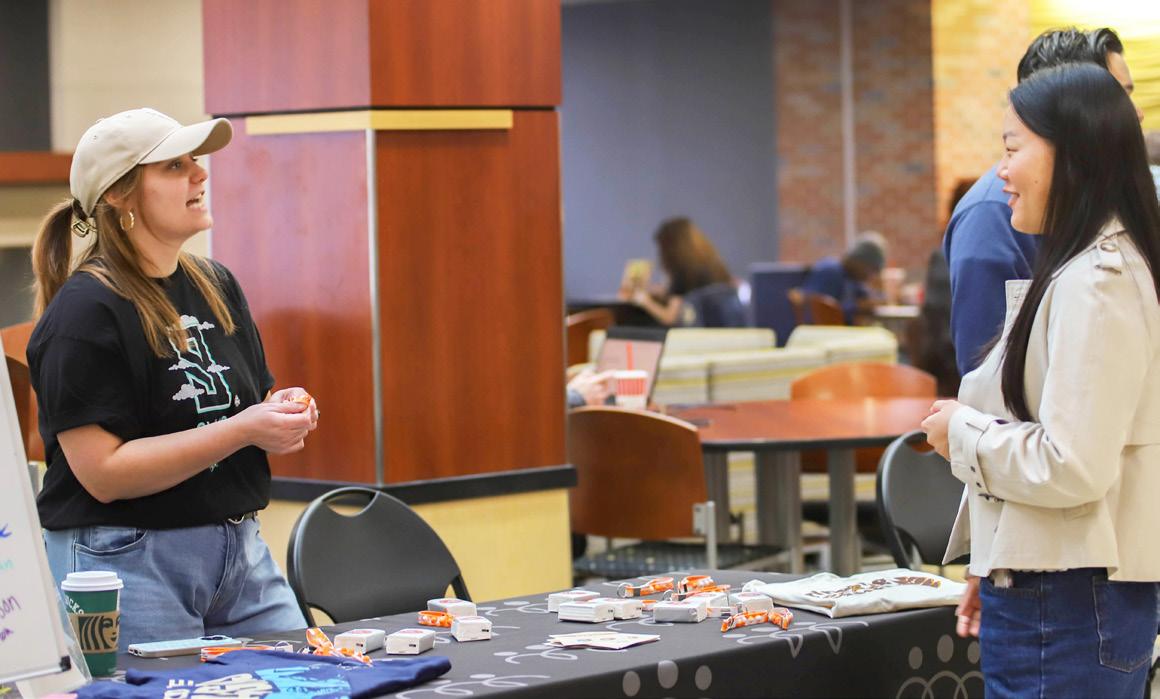
Wichita State’s Ambassadors for Diversity and Inclusion rebranded to the Student Belonging Coalition in August, with the focus of helping students find community and celebrate their backgrounds.
The change from ADI to the Student Belonging Coalition came after the Office of Diversity and Inclusion merged with Student Engagement, Advocacy and Leadership in 2024. It also came after a state bill in August instructed public universities to eliminate policies, positions and programs related to diversity, equity and inclusion.
The merger of ODI and SEAL, which became the Office of Student Engagement and Belonging, took place before the August legislation.
Liz Thornton-McGaha, assistant director of student experiences for Student Engagement and Belonging, advises the belonging coalition and emphasizes that recognizing diversity is still central to their work.
“We are really pushing that we want every Shocker to feel like they belong,” Thornton-McGaha said. “We have an understanding that every single person that walks into that room comes with their own background and their own identity that is beautiful in its own way.”
The Student Belonging Coalition is a student-run organization that is a part of Student Engagement and Belonging. Staff at SEB support the initiatives and ambitions of the coalition members to better students’ campus experience.
The shift from Ambassadors for Diversity and Inclusion to the Student Belonging Coalition was partially motivated by its goals of expanding ways it could reach out and assist other students.
Members incorporate their own perspectives to the coalition’s efforts. Many of them are part of other student organizations, which builds a larger network to help SBC provide value to students, Thornton-McGaha said.
“We have seen in the past that sometimes, as professional staff, we can host programs, we can host cultural events, but when the students are the ones who are running it, we are more likely to have student participation,” Thornton-McGaha said.
Student organizations come to the belonging coalition to improve what they offer to their members and fill in gaps that are outside their scope.
Iván Castillo, student program coordinator and a Student Belonging Coalition adviser, believes the value goes beyond any specific organizations, groups or the coalition itself.
“We try to support students in what they want to do,” Castillo said. “When I say students, it’s not necessarily just our membership, but also looking at what is the overall student experience.”
Advisers for the belonging coalition, like Thornton-McGaha and Castillo, agree that it is in many ways a bridge for students to the rest of the WSU community. This takes form through creating opportunities for connection both on and off campus.
SBC’s efforts to educate
others on community and diverse identities, whether that be race, sexual identity or socioeconomic background, continue to provide value on campus, ThorntonMcGaha said.
The process of rebranding from ADI to SBC was not due to federal and state policy shifts related to DEI, Thornton-McGaha said, but they did shorten the timeline for developing a new brand from the standard 10 months down to four.
Advisers are aware of how these policy changes potentially affect students.
“At a time where students are feeling a lot of different feelings — regardless of what’s going on in the world — we’ve kind of taken the approach of how do we create space where students can have those intentional conversations with each other,” Castillo said.
Thornton-McGaha highlighted how Student Belonging Coalition members who identify as LGBTQ hosted a presentation for LGBTQ history month in October. This effort created a space for other LGBTQ students to find community and resources they needed on campus.
Organizations throughout campus also seek to keep diversity front and center by asking the coalition to provide resources on programming focused on diversity.
The Student Belonging Coalition was able to avoid the larger changes made at Wichita State concerning DEI policies because it is a student organization, Thornton-McGaha said, meaning most decisions are in the hands of its student leaders, not advisers or the university.
The coalition is designated as a student group operating within SEB. This gives SBC more flexibility in its operations while having access to resources that help with its initiatives.
WSU leadership also did not pressure SBC to make changes to its branding or operations, due to the dual student and office organization status, ThorntonMcGaha said.
The advisers to SBC said another goal for the organization is to create ways for students to be involved that are manageable for their busy lives.
“We tend to attract a lot of over-engaged students or overinvolved students, which is great and we love to have,” Castillo said. “But, sometimes there are those conversations of like — ‘How do we make sure their engagements are also sustainable for them as students?”
Students interested in joining the Student Belonging Coalition must go through an application process that opens each spring semester to join for an entire school year, starting in the following fall.
The biggest consideration for advisers is finding the best ways to support the ambitions and ideas of coalition members, while also making sure the experience is enjoyable and rewarding.
“It is a lot of work, but it should be a fun experience,” Castillo said.
Students interested in joining SBC must meet certain requirements, including a minimum 2.5 cumulative GPA. People can email SBC@wichita. edu with any questions.
BY TALIYAH WINN editor@thesunflower.com
As guests entered the doors of a Women’s History Month panel at Wichita State, they grabbed food from a table filled with tea-party-style treats, including triangle-cut cucumber sandwiches, pastries and fruit skewers.
An intimate group of students and faculty sat at tables with pastel-colored tablecloths, each adorned with flowers, topped with a tower of macaroons and a party favor at each seat on March 4
Candace Dave, a graduate assistant in Student Engagement and Belonging, organized the event, bringing “inspirational and powerful” women on campus together to share their stories with students and other guests.
“This month reminds us that women’s contributions are living, ongoing and deeply impactful,” Dave said before introducing the speakers. “We’re honored to be joined by remarkable women whose experiences and leadership enrich our campus and community.”
There were six different speakers, who each spoke about their relationship with femininity in the world of higher education.
The importance of female higher education Sara Mata, executive director of Hispanic Speaking Initiatives, shared her journey to become a PhD holder, opening up about recent struggles as she’s taken the role of primary caretaker for her mother.
“I have been able to be here to support my mama, and she has ungraciously faced the brutality of aging and the illness,” Mata said, choking up. “Throughout all the educational, professional development, everything that we go through, there are no classes and no preparation for being a caregiver for your ailing parents.”
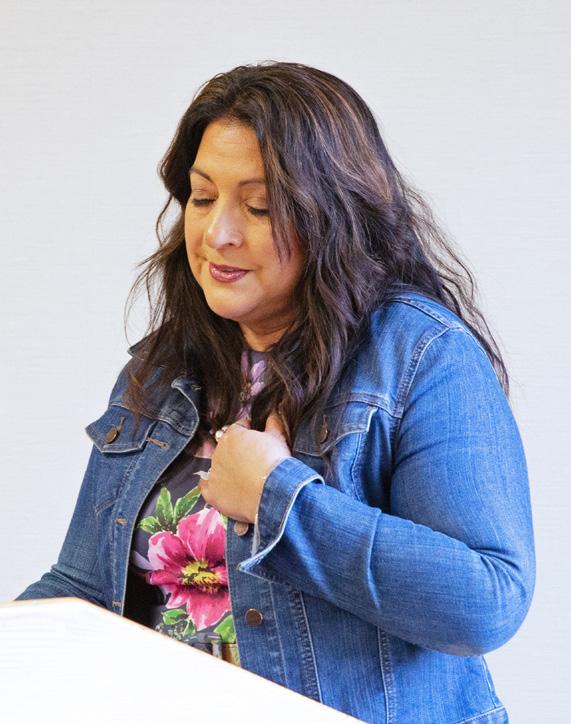
Mata recalled the hardships of getting her PhD, which she said could be “life-sucking” at times. She said she pushed through with the support of colleagues and friends to complete a degree that is held by few, especially among Latina women.
“As a Latina, with a PhD, I am proud” Mata said. “I am extremely proud to be one (of) less than 1% of Latinas to have earned a doctorate. I am passionate in promoting students to thrive in college and eventually receive a graduate degree.”
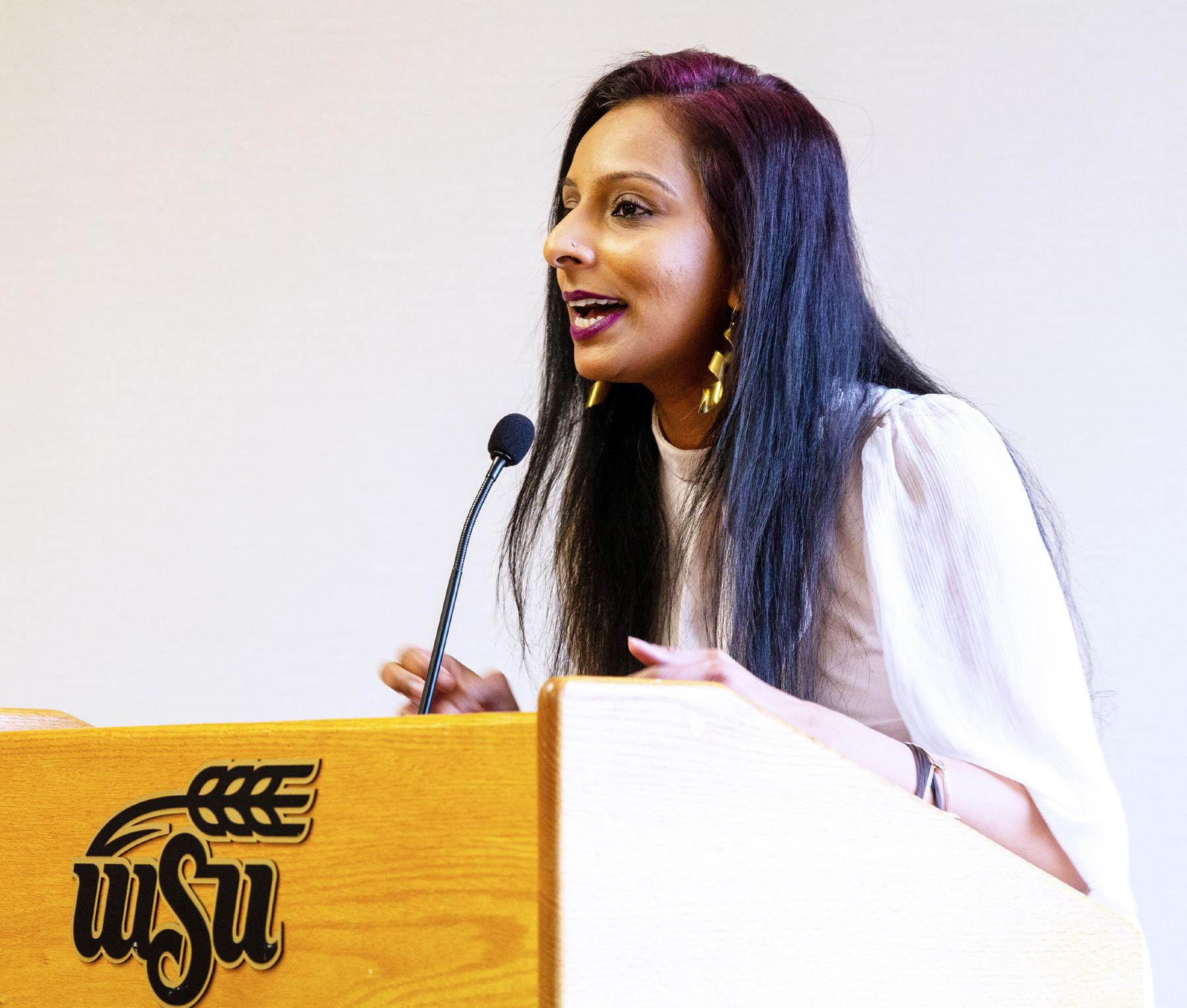
Mythili Menon, director and associate professor of linguistics, spoke about her unique experience growing up in Kerala, India, one of the few matrilineal communities in the country where inheritance is traced through the mother’s line.
“Any person I saw who had power was a woman,” Menon said. “My mom, my grandma, my great grandma — and they all had education. Education was a huge factor in my family growing up. If you are a girl, you had to be educated.”
Student drag performer finds community in creative expression
Young women… Students who are in this institute, you belong here. Don’t ever let anyone tell you differently, don’t let anyone make you feel small. Don’t let anyone ever silence your voice. Stand up for what you think is right.”
CHANTAL NEZ DOMINGUEZ WSU Center for Public Health Program Manager “
She compared aspects of life in the state of Kerala and India as a whole. In India, female infanticide, the intentional, deliberate killing of newborn female infants, is “very high.” Menon attributed this to the gender inequality in the country, which is especially connected to dowry.
“A dowry is a huge sum of money… that has to be given to the boy’s family for taking care of your daughter,” Menon said. “And so it is actually illegal to find the gender of your baby in India because the female infanticide is so high.”
She said that Kerala is different in various aspects. It’s the only state in the country with a higher female-to-male ratio; the female literacy rate sits at 95%, with a lower maternal mortality rate.
“The lesson I was being imparted… was that you have to stand up on your own feet,” Menon said. “You have to be self-sufficient, right? Before you get married, before you start a family… that is one lesson I impart to my students.”
Female resilience
Chantal Nez Dominguez, a program manager with WSU’s Center for Public Health Initiatives, began the panel, introducing herself in the Navajo language.
“I introduced myself with my clans, and that’s a way to really honor the women,” Dominguez said. “Our tribe is a matrilineal tribe and culture, so we always pay respect to our paternal and our maternal grandmothers and mothers as well… we connect through kinship.”
Dominguez is Diné, from the Navajo Nation in Arizona.
Her interest in public health started at a young age, growing up in a home without running water or electricity, with a diabetic mother and a father with high blood pressure.
“Them accessing health care was really, really hard and really difficult,” Dominguez said. “Then also the fact that there was no practitioners in our community and so the barriers of language… of having culturally appropriate and respectful healthcare, I saw that right away, I really think that that helped me and my path into public health now.”
She shared that her mother
died last month, and recalled one of the lessons she told her: “beginnings do not limit your becoming.”
“She always just said, no matter where you came from, you can pave the path of where you get to go, where your children get to go,” Dominguez said.
Now, her husband and three children drive her further to advocate for health care rights and to push her two daughters to become resilient.
“Young women… Students who are in this institute, you belong here,” Dominguez said. “Don’t ever let anyone tell you differently, don’t let anyone make you feel small. Don’t let anyone ever silence your voice. Stand up for what you think is right.”
Sheelu Surender, the assistant vice provost for financial aid and scholarships, spoke to curbing what she called “ANTs” or automatic negative thoughts.
“It’s so hard to silence those ANTs, but that is what you have to work at day in and day out,” Surender said. “Because you have every ability to do what you are trying to achieve.”
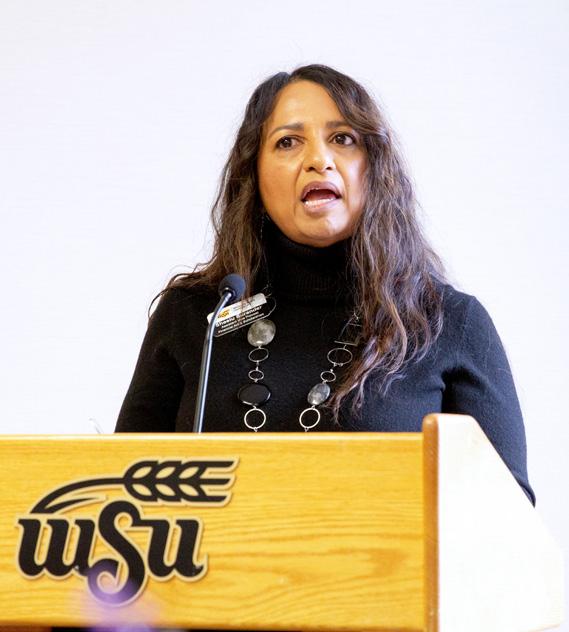
Bri Bell, academic and retention coordinator in Student Engagement and Belonging, shared poetry from her “brutal honesty journal” during her presentation.
“‘You cannot be silenced, and you for sure cannot be contained,’’’ Bell read from her poem, “The Gentle Soul.”
“‘So do it. Give in to the boiling chaos around you.’”
Building community
“If you want to go fast, go alone. If you want to go far, go together,” said Surender,
quoting an African proverb she said she first read during a tour of the Bill and Melinda Gates Foundation.
Surender took that message to heart.
“Early in my career, I kind of misunderstood things about success,” Surender said. “I really thought it meant proving that I could do it all.”
She said one of the most important lessons she learned was that to go far, she had to rely on other people. She encouraged others to do the same.
“Go far, build community, share knowledge, ask for help, offer help and celebrate with one another,” Surender said, “Because when one woman rises alone, it’s inspiring. But when women rise together, it’s transformational.”
The final speaker, Christie Henderson, spoke about her love of higher education.
“I remember standing outside the Corbin Education Center, because I got my undergrad in education, and I said, ‘I’m going to work here someday,’ and I do,” Henderson said.
Henderson grew up in the foster care system and recalled the people who helped her along her journey, including her grandparents, who took her in.
“We all have an invisible paint bucket, and it’s not paint in our paint bucket,” Henderson said, recalling a story her grandfather told her when she was younger. “It’s the experiences and the stories and the mentors that we have that keep us going, that keep us painting.”
She ended with another lesson from her grandpa, Ken.
“(He) told me that it’s more important in life to build a legacy than a resume,” Henderson said. “And I’m really proud of my resume, but I hope that every one of you is proud of your legacy.”
After the event ended, Dave said she was happy with the way it went.
“It was very emotional,” Dave said. “I didn’t expect it to be so emotional in mood. I’m glad that it was, but it was just — their words were very moving… they gave a lot of great advice.”
Sony Thakuri, a master’s student in innovation and design, said the event was “inspirational.”
“I really got emotional hearing everyone’s story,” Thakuri said. “I also got a lot of motivation and inspiration, so many talked about building a legacy and giving back to the community.
“It was really beautiful just to be here in a room full of women, hearing their stories.”
BY JONAS LORD legobrickslord@thesunflower.com
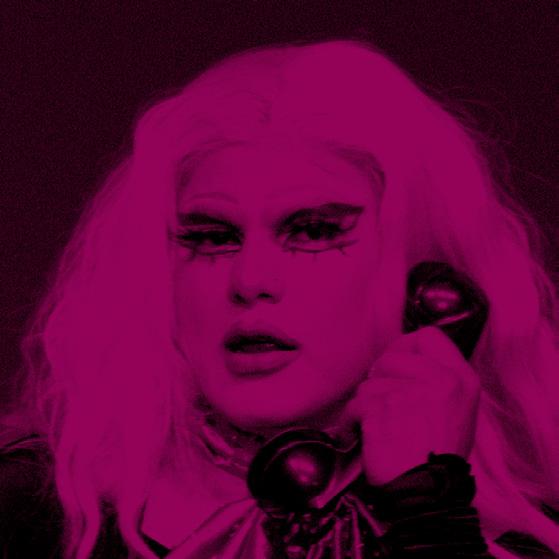
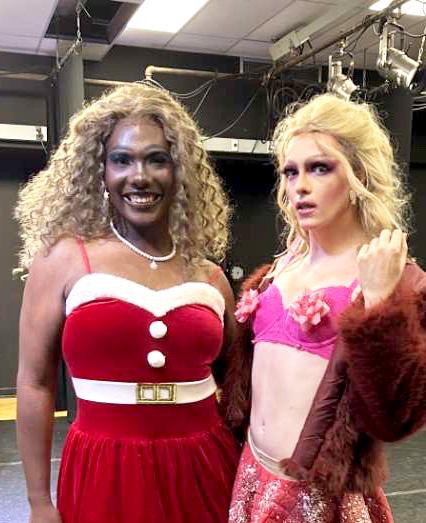
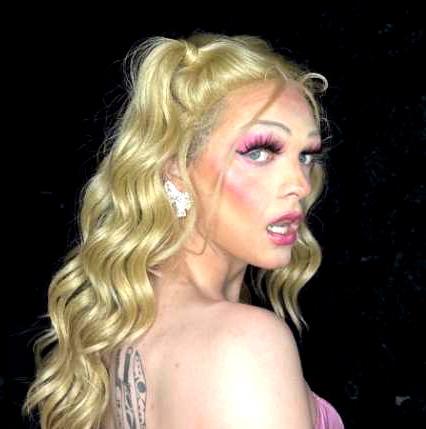
Wichita State sophomore Riley Johnsen describes his drag persona — Beholda Grudge — as an extension of himself.
“It’s a way for me to remove that pressure of having to be he/him all the time,” Johnsen said. “And I could go by she/ her while I’m in drag. So it really helps me explore my self identity.”
Johnsen was first introduced to the art of drag over a year ago when he met Von Love III in the WSU theatre program. Love is Johnsen’s drag mother — or mentor — and performs under the name Venus Medley.
“Riley expressed to me that they were interested in drag, and I was like, you’ve come to the right place,” Love said. “So, me and my friend, we put Riley into drag one night, and then I just saw the crazy amount of joy that it brought Riley, and I was immediately like, ‘okay, yeah, you’re gonna do this now,’ and then Riley had no objection.” Love and Johnsen have a particularly close relationship that extends off the stage.
“He’s been so helpful with figuring out myself (and) my aesthetic,” Johnsen said. “And of course, he’s let me borrow his shoes for shows and stuff like that and he helped me do my makeup for my first ever drag show.”
At this point, Johnsen has only been in a few shows and instead focuses on honing his performance skills through student groups and classes.
“So like right now I’m in a stage makeup class, which drag is inherently a big stage makeup,” Johnsen said. “So being able to apply what I’m learning in theater and what I learned in my own time with Beholda Grudge, I have noticed that I’m able to combine the two.”
On top of being a drag mother, mentor and student, Love is also working on uniting his drag and musical theater skills.
“My big thing is, I feel like a lot of people’s goals are to go on ‘RuPaul’s Drag Race,’ because that’s the biggest platform that there is,” Love said. “But since I do musical theater, my main goal is to excel in musical theater, and then find a way to twist my drag into it.”
The most important thing about drag for Love, however, is community.
“My ultimate goal is to entertain, and if I feel like I’m doing my job as an entertainer, and the audience is living for it, then I feel like I’m doing my job,” Love said. “I feel like that’s what brings me the most joy, seeing the smiles on people’s faces.”
BY TALIYAH WINN editor@thesunflower.com
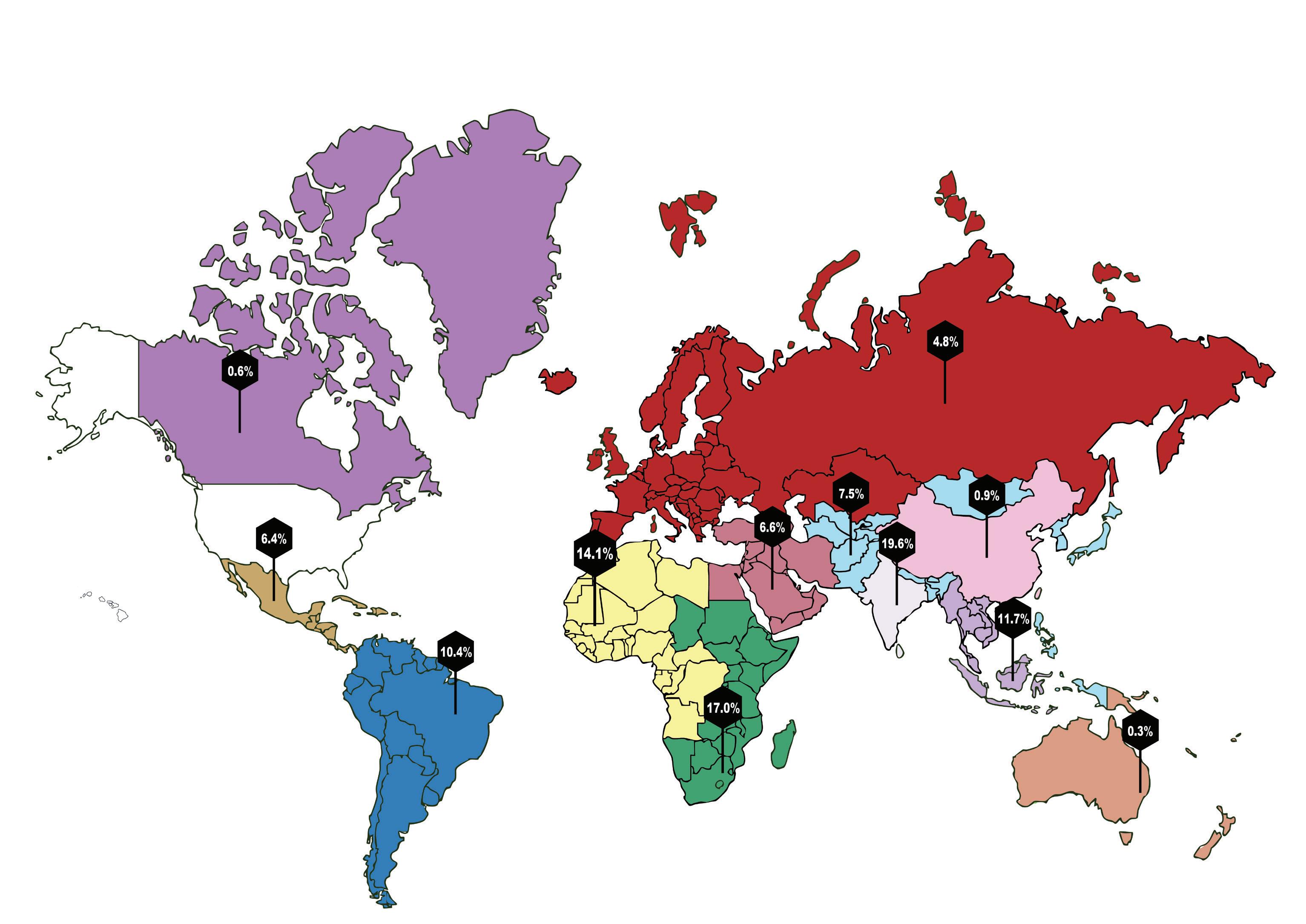
International enrollment has been cited as one of the largest reasons behind Wichita State’s budget crisis by university administration.
Wichita State has had the highest number of international students of any Kansas public university since 2022. But now that enrollment is down, particularly in graduate programs.
According to data from WSU’s Office of Planning and Analysis’s Fall 2025 Census, graduate international enrollment is down 18%, with undergraduate enrollment growing a little over 7%. U.S. immigration policy is a driver, but staff who work with international students said this is also a “natural decline.”
Vince Altum has worked in the Office of International Education for nearly 40 years and has served as its executive director for more than a decade. He said one of the biggest recent changes to international enrollment has been a new travel ban on 40 countries that began on Jan. 1.
“That’s definitely going to start affecting every (program) in the U.S., including ours,” Altum said. “We are definitely seeing a decrease in students, but I fear it’s going to get far worse before it gets better.”
According to the Association of International Educators — a
BY ANSHIKA CHAUHAN axchauhan0@gmail.com
In a Wichita State University aerospace engineering classroom, the silence isn’t always about concentration. For Aoi Ito, an undergraduate student from Japan, it’s a cultural hangover.
Back home, a classroom is a place of quiet reception; here, it is a theater of participation.
“In my country, there is a kind of pressure against offering (answers to) questions in class,” Aoi said. “But here, students want to answer them by themselves. It’s very interesting.”
For the 3,166 international students, recorded in the fall census, who study at WSU, the “academic struggle” isn’t just about mastering complex fluid mechanics or data structures. It is a constant, exhausting act of translation — not just of language, but of social unwritten rules, teaching styles and the sheer pace of American higher education.
Language barriers make lectures extra challenging
While domestic students might
service that guides and supports international education programs across the country, including WSU’s — declines in international student enrollment have led to more than $1.1 billion of lost revenue across the country in 2025-26, $6 million of that in Kansas.
At a university level, international students pay a higher rate of tuition than domestic students, creating a larger impact to the university budget. There is a discounted rate for some international students called Global Select.
Barriers to studying in the U.S. Compared to a domestic student, international students must meet additional requirements in the enrollment process, including federal immigration policies, visas and higher costs.
A step all international students must take before attending an American university is obtaining a visa.
The visa application process is extensive. The Office of International Education uses an electronic manual provided by NAFSA, which helps guide international offices at American universities. The office uses the NAFSA manual to monitor student compliance in the visa process and track regulatory changes.
Once international students arrive on campus, they still have to remain in compliance to continue
complain about a professor’s handwriting, international students often face a more invisible hurdle: the verbal-only lecture.
Aoi noted that when professors forgo handouts or digital slides in favor of “just words,” the cognitive load doubles. Without a slide or a handout to look at, the language gap can feel much wider. Many international students bridge that gap by leaning on peer support to make sense of the “just words” lectures.
“This university has a lot of support,” Aoi said, pointing to teaching assistants as a vital lifeline for navigating the lectures that “just stay with the words.”
The speed and the rules
The transition is even more jarring for graduate students like Pratyusha Daram. Coming from Telangana, India, to pursue a Master’s in Data Science, Daram found that the American “practical” approach is a far cry from the theory-heavy teaching models back home.
But the biggest shock? The clock.
their education.
The Office of International Education helps students monitor compliance through the Student and Exchange Visitor Information System. The looks at a lot of things when people are applying: class enrollment, finances and the amount of online classes students take.
Each semester, international students have to check in with the office.
“As a part of that check-in process, we have a SEVIS agreement that they have to read that reeducates them on all the things they have to remember, because they can’t forget,” Altum said. “It’s a semesterly way to keep the regulations fresh in the student’s mind.”
Another natural part of the decline in international students is true for all students; sometimes, people decide to leave WSU for “one reason or another.”
“It could be culture shock when they first arrive,” Altum said. “It could be a family member died, and maybe they were their full source of funding for their college, so they couldn’t continue.”
Prospective students adapt to changing policies, interest in studying in the U.S. declines
Aaron Coffey, the assistant dean and executive director of graduate enrollment management, said that he’s noticed significant changes
“For some people who just finished their undergraduation and come here for masters, they have to be really fast to learn things,” Daram said.
Beyond the pace lies the “unwritten rule” of American academic integrity. In many global education systems, collaboration is the default; at WSU, the line between “helping” and “plagiarism” can be a legalistic minefield that international students must learn to navigate on day one. Daram said that adapting to these unique assignment timelines and integrity standards is the “secret” to staying afloat.
Survival starts at the suitcase Success, however, requires more than just academic skills; it requires a full stomach and a winter coat.
Christina Castillo, a sophomore accounting major from Dallas, Texas, has observed that the international struggle often starts at the suitcase. Because students can’t pack their entire lives into two checked bags, campus resources like the Kiah Duggins Shocker
in the behavior of prospective graduate students in recent years.
“There are few students that come to this process with the sense of urgency we typically see,” Coffey said. “Far more are coming with a ‘If I can’t make it this year, next year is fine,’ attitude.”
Admission and enrollment are what the university tracks for its fall census, but Coffey also notes the decline in applicants.
“We are getting fewer applications for international prospective students, and that is true from my knowledge and my network at most institutions across the country,” Coffey said.
“There’s just less interest in studying in the United States, and those that are interested have more hurdles to go through.”
He said that even if students get admitted to the university, visa applications are getting approved at a much lower rate.
Coffey said that he thinks the decline also comes from an unpredictable job market and global competition.
“It’s not a simple problem, and there is no single cause for the challenges we are having,” Coffey said. “It’s a global market… our competitors are not just in the United States, they are in countries all across the globe.”
The biggest area of decline for international graduate students at WSU is from India, which has decreased by 41.2% since 2024.
Support Locker and the Career Closet become more than just amenities — they are essential infrastructure.
“A lot of international students can’t pack a whole lot of stuff— clothes, food,” Castillo said. “The Shocker Locker and the professional Career Closet help a lot.”
Castillo also noted a social “bubble” that she said tends to persist in introductory courses, where domestic and international students remain politely segregated. It isn’t until the junior and senior years, when the heat of high-level coursework forces collaboration, that the bubble finally pops.
Making the campus yours As Wichita State leans into its role as the state’s most diverse campus, a common thread in these student experiences is a shift from passive enrollment to active engagement: the resources are there, but you have to be the one to grab them.
For Castillo, her advice to international peers is equal parts
Retention and rebuilding enrollment
Retention and recruitment are the “uphill battles” the Office of International Education is attempting to address.
“(Our) priority is trying to retain as many students as we can and to get as many new students in that we can, knowing that it’s an uphill battle for the next three years, but it could be five years.”
Altum said that rebuilding will take time.
“We don’t know what the law will be in three months, I don’t know what the law will be in three years,” Coffey said. “... I can’t combat a national narrative. That is not anything any of us in higher education can do.”
So instead, Coffey focuses on what he can do.
“That’s really to build confidence and trust that WSU provides a great education,” Coffey said. “If they don’t have trust in the workforce or in an industry to hire people, there’s not a lot I can do other than connect them with career services.” But the intention is to maintain WSU’s role as a school that welcomes international students.
“It won’t just be Wichita State that has these challenges due to the loss of our international student population,” Coffey said. “It will be the community that loses so much more than just money, but the opportunity to have these students integrated into our communities.”
common sense and Shocker pride:
“Utilize every resource. I mean, you’re paying for it,” Castillo said. “I always like to explore every building... it’s almost like it’s mine, you know?”
Castillo thinks international students should try to branch out from places like the Office of International Education and actually explore the rest of campus.
To her, feeling like you belong at WSU mostly comes down to just talking to people, even if it feels a little awkward at the start.
“People like me, or people who are just working around — we’re always happy to help,” Castillo said. “If you have any questions, just ask. If you just want to say hi, say hi. Everyone’s nice here.”
For the student body’s international contingent, “making it mine” is the ultimate academic assignment — one that requires a strong foundation, a bit of TA assistance, and the courage to finally speak up in a quiet room.
‘The
BY KASS LEWIS news@thesunflower.com
Melody McCray-Miller, a Wichita State adjunct instructor in the Political Science department and local politician, died after a long-term illness in February at the age of 69. Her legacy, however, can be seen at the university and across Wichita.
“It’s just (a) shock that somebody so vibrant and active and just meaningful to our community work could be gone so suddenly,” said Nikki Keene-Woods, a professor and department chair of public health sciences.
McCray-Miller and KeeneWoods worked together on research that focused on infant mortality and improving the quality of healthcare in Sedgwick County.
“Melody is well known in the community from her policy background, and just an advocate for making positive changes in her community and representing those unusual voices or those voices that aren’t normally heard,” Keene-Woods said. “But my work with her is really more of maybe a less-known side in her work as a community scholar.”
Keene-Woods recalled memories where she admired McCray-Miller’s personality.
“I just remember that Melody had this positive, just aura or being about her, and that was definitely something I remembered right away is being there with our community partners and celebrating their success,” Keene-Woods said.
The pair started their work about 16 years ago, and KeeneWoods said they kept in touch after they stopped working together.
“We’re lifelong friends,” KeeneWoods said.
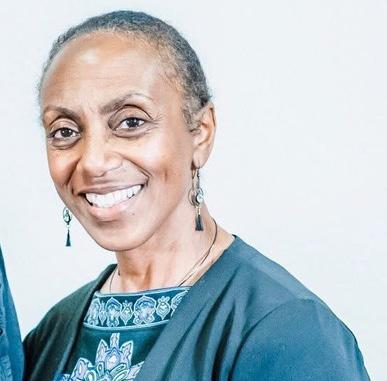
McCray-Miller was more commonly known for her work in the public service sphere. She served on the Wichita Board of Education, represented Wichita’s 89th District in the Kansas House from 2005-2013, and served as the first Black woman on the Sedgwick County Commission from 1996-2000.
“She has an incredible wealth, experience and knowledge and wisdom,” said Ngoc Vuong, a fellow school board member.
Vuong and McCray-Miller were elected onto the Wichita Board of Education in 2023, and McCrayMiller stepped down from her role earlier this year in relation to her illness.
“She was my favorite school board member — was my favorite elected official in general,” Vuong said.
Neal Allen, an associate professor in the political science department, highlighted the importance of bringing public officials into the classroom. He said McCray-Miller was a great asset to the students she taught prior to joining the Wichita school board.
“There are many examples of people that have degrees from Wichita State and go on to serve in elected office,” said Neal Allen. “But Melody is one who shows … the best of the American system.”


American artist shares how cultural details tell stories in contemporary work
BY MALEAH EVANS arts@thesunflower.com
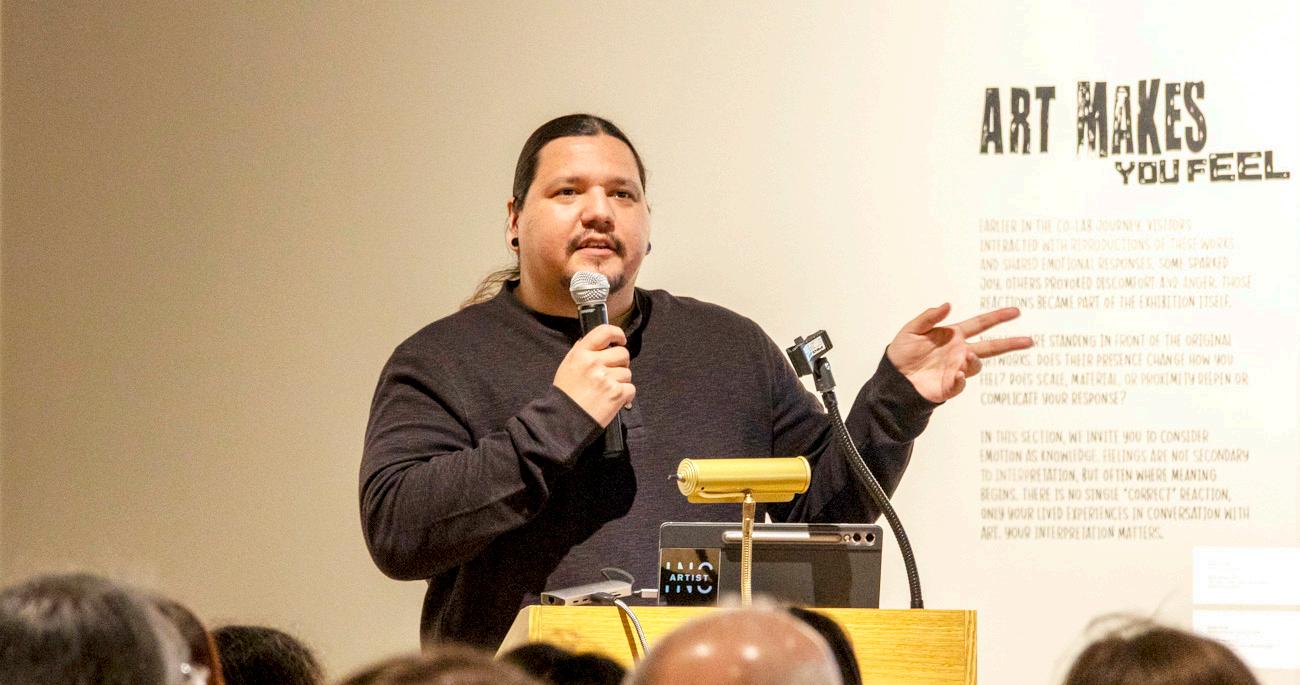
Visitors to the Ulrich Museum of Art will see work from a local Native American artist, Taiomah Rutledge, that focuses on the symbolism and cultural history of his work. His exhibit and talk on March 5 were the first installment in a new speaker series, “In Place,” hosted by the Ulrich, which works to highlight artists who live and create work in Wichita.
Rutledge, a multidisciplinary artist of Ojibwe, Dakota and Meskwaki descent, began his talk at the Ulrich with a traditional Ojibwe greeting: “boozhoo,” a formal way to say hello.
Rutledge then spoke about the importance of names and how empowering it is to have someone use your full name.
“My name roughly translates to ‘bear whose voice makes rocks tremble,’ so that’s an entire sentence,” he said. “The name Taiomah comes from the Meskawaki side … so we have different tribal affiliations and different representations with their name.
“I like to use my full name, no matter how scary or intimidating it is for people to pronounce. But there’s something that’s very powerful when you use your full name, and especially names in






a language that you can’t even speak yourself.”
Rutledge said he likes to explore proximity in his art, not just to lineage but to location.
“Growing up and having that proximity to the culture, one of the things that informs our design — making our artwork — is this Native design, things that were observed in nature, a lot of things that would actually tell you what region these people were from,” he said.
“Anytime I do artwork, I like to have an artifact that is present that will ground things into present day, because oftentimes, as Indigenous people, we’re depicted in the past-tense aesthetic.”
With the prominence of artifacts in his work, Rutledge said a lot of his ideas come from thinking about what defines Native art.
“I always choose to actually depict indigentity and indigenous, because representation is very, very powerful for younger people, especially people that have been excluded or haven’t had autonomy over how they’ve been depicted,” he said.
Storytelling is a large part of all forms of Native American art, Rutledge said. Dances, songs and physical artwork all tell a story.
In several of his designs,




Rutledge said he hides small messages in the details. One example he showed includes what he called otter tracks, which had a circular base, and going around the circle, there were straight areas broken up with two rhombuses side by side.
“If you have ever watched otters and the way they move in the snow, they hop, hop slide, hop, hop slide,” he said. “So that otter track goes all the way around, so you can just imagine an otter going hop, hop, slide.”
Certain combinations and designs of patterns are associated with specific Native families and societies, Rutledge said.
“You can actually tell a lot about something based on what they’re wearing,” he said. “And it will actually tell you, not only the region where they’re from, but even very specific things depending on what colors are used, what plants are used, how they‘re arranged — that can tell you about specific families, something that’s passed down for hundreds and hundreds of years.”
Rutledge’s work can be found on the first floor of the Ulrich Museum of Art, where it will remain until July.
More information about upcoming exhibits and events at the Ulrich can be found online.

Wichita State students are invited to a Q&A event with Lieutenant General (Ret.) H.R. McMaster , who served as the 25th U.S. National Security Advisor from 2017 to 2018. McMaster holds a Ph.D. in military history and is the author of three bestselling books: “Dereliction of Duty: Lyndon Johnson, Robert McNamara, the Joint Chiefs of Staff and the Lies that Led to Vietnam,” “Battlegrounds: The Fight to Defend the Free World,” and “At War with Ourselves: My Tour of Duty in the Trump White House.”


by April 3 at wichita.edu/MeetMcMaster

























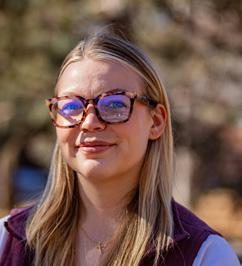
Over the last few months, there has been a drastic increase in the number of masked agents carrying out immigration enforcement nationwide. According to the ICE website, these agents wear masks “to prevent doxing, which can (and has) placed them and their families at risk.”
To remedy the fact that the public cannot see their faces, all officers are to carry their badge and credentials with them at all times, identifying themselves when it is required to assure public safety or to comply with the legal standard. But whether or not they actually do seemingly depends on the day.
While I won’t dismiss the severity of doxing or the harmful ramifications it may have on someone’s life or family, I don’t agree that federal agents should continue to be allowed to wear masks while carrying out this administration’s immigration enforcement plans because of the safety risks they pose to the public.
In the last few months, ICE officers have been carrying out immigration enforcement in unmarked vehicles, wearing masks and plainclothes, armed with weapons. They have been reported to break windows, tear-gas people and shoot into vehicles.
In many of these instances,
the agents involved were wearing masks and not appropriately identifying themselves, or did not identify themselves at all.
With new reports coming in daily of these egregious behaviors, it’s difficult to be empathetic toward the possible doxing of this caliber of agent. It is more important to be empathetic towards those who have been victim to this agency’s appalling process.
It speaks volumes when the safety and well-being of a federal agency and its members are placed above the needs of the people the agency is supposed to protect. Being able to wear a mask in the service of our government seems counterproductive.
The question I have is: if you believe in what you are doing, if you believe it is right and fair, if you are following correct legal procedure, why are you afraid to show your face?
The fear of doxing seems underwhelming. ICE agents are federal agents. Doxing is a federal crime. You have the support of the federal government if that happens.
It’s hypocritical of our government not to support all individuals involved in this process. Supporting your citizens would mean ensuring that these officers do not wear facial coverings. If that puts them at risk, the bare minimum is to require them to identify themselves appropriately.
If there were not numerous reports of these agents constantly
Children,
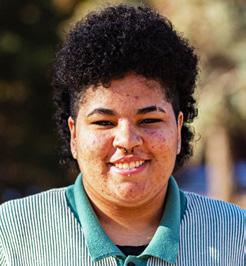
Disney has a long history on both sides of the diversity coin, with the problematic depictions of Native Americans in “Peter Pan” to the increasing number of characters of color in its movies.
I still remember the joy I felt when I watched “The Princess and the Frog” for the first time, seeing someone who looked like me on the big screen getting her “happily ever after.”
That is a feeling I will never forget 17 years later.
But recently, there has been a trend of remaking old animated films as live action, and some of the casting choices have raised the question of if Disney is subscribing to the “woke agenda.”
This topic gained mainstream attention with the casting choice of
Halle Bailey as Ariel in the remake of “The Little Mermaid.”
People on the internet were up in arms about the choice to have a black woman play the mermaid, with some social media comments arguing that Ariel was a northern European character and should be portrayed as such, and others outright attacking Bailey for her skin color.
These same arguments were rekindled when Disney announced that Rachel Zegler, a ColombianAmerican actress, would play Snow White in the live-action remake of the film.
This whole discussion raises the question of when a character’s race can — or should — be changed.
I believe that if a character’s arc does not revolve around culture or them dealing with the prejudices that come from being a certain race, they can be portrayed by whatever actor or actress can best play the role.
Ariel’s story doesn’t depend on her being white for it to be the

It’s time to stop treating immigrants like villains
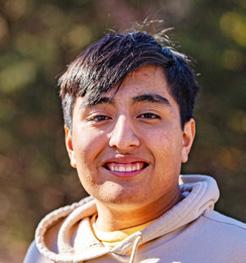
As a son of immigrant parents, I have heard time and time again about the struggles that drove them from Mexico and why they left to come to the U.S.
breaking the law, I don’t know if the public outcry to unmask ICE agents would be as loud. But to counter that point, if agents were not committing crimes themselves during the process, would they think it was necessary for them to wear masks at all?
The final public safety concern I have with the masks might be one of the biggest. How is Homeland Security ensuring that there are no rogue individuals parading as ICE agents? If there are unmarked vehicles, masks involved, plainclothes and consistent reports of lack of proper identification and illegal activity, how is anyone supposed to believe that these people are who they say (or don’t say) they are?
This administration’s immigration task force has a duty to protect this country. It has worked over time to persuade us that undocumented immigrants are the criminals. Yet in these last few months alone, it has employed hundreds of people who have allegedly been a part of several crimes, including destruction of private property, breaking and entering, illegal search and seizure, kidnapping, attempted manslaughter, murder, etc.
And these individuals remain at large because they are allowed to hide behind a two-layered mask: the one they wear on their own face when committing the crimes and the one the federal government gives them by not holding them accountable for their unlawful actions.
Hearing from my parents about their troubles crossing the border, I felt devastated about what they had to endure. The struggle they had speaking basic English when they first crossed over, being mistreated and underpaid working in jobs with some of the worst conditions I’ve heard of. They have sacrificed so much for my family and me, all for them to still be sorely underrepresented. Unfortunately, people often don’t show empathy towards these struggles and what really was sacrificed.
I have often been looked at differently because of who I am, and even called slurs in some casual settings.
With recent events in the U.S., like Immigration and Customs Enforcement running rampant around the country with support from our president, being an immigrant or even a child of an immigrant makes the tension in the air even more noticeable.
Put yourself in someone else’s shoes for a moment. I want you to imagine that you leave your home country to escape poverty, escalating crime or even dire situations that could result in death. You come into the U.S. for safety and sanctuary, trying to live your best life working in some physically demanding job, only to find yourself being persecuted by a country deemed the “melting pot.”
It doesn’t matter what country you’re from, or what culture you have — it should never justify the tragedies, like Luis Gustavo Núñez Caceres, a 42-year-old son and brother from Honduras who died on Jan. 5 while detained at Joe Corley Processing facility in Conroe, Texas.
Or like Liam Conejo Ramos, a
Minnesotan 5-year-old boy who, with his father, was detained and held in a detention facility in Texas specifically for families.
I cannot believe that this actually has to be said, especially by a student at Wichita State University, but just because someone comes from a different country doesn’t mean that you get to treat them any differently than you would treat any other person.
But what makes it worse is that the amount of hateful rhetoric and crimes that are committed against immigrants has grown significantly due to the political climate.
Immigrants or children of immigrants should not have to be scared to call the cops to report a crime, or avoid public places, or refuse to speak Spanish in public — all because they’re scared of being asked about their legal status.
According to research from Brookings, 16% of foreign-born Latinos have avoided calling the police or reporting a crime out of fear of being questioned about their legal status. The study also showed that 15% of foreign-born Latinos have avoided public places, and 14% have stopped speaking Spanish in public.
But since it doesn’t affect those people who spread hate and can’t understand a different point of view, does that make it correct to ruin a family for the sole reason of them being from a different country?
It should not be the norm that one day immigrants could just be taken away from their families by masked ICE agents, due to the language they speak, or where they’re found, or the way they look. The Supreme Court recently voted to allow ICE to profile Americans based on how they look or speak.
I fear that we, as humans, have lost our ability to feel for others — to feel compassion and be able to set aside our differences. While I wish for greater change and for all of this hate and violence towards immigrants to be gone, it seems like a really big challenge. But all I can do is start small and hope it connects to those who are willing to listen.
same or to make sense — she was still able to meet her prince, give up her voice for human legs and eventually live happily ever after, regardless of whether she was Black, Asian or any other race.
On the other hand, characters’ racial identities in “Turning Red,” “Mulan” or “The Princess and the Frog” are imperative to their story and growth.
The growth of the characters and the cultural impact these films had wouldn’t be the same if the characters’ ethnicities were changed, and I think that people who use this claim to back up their racially charged arguments about Bailey or Zelger’s performances are literally grasping at straws.
Get out of the Facebook comments and off the Reddit threads, and let a new generation of young children of color experience the joy and happiness of seeing someone who looks like them on the big screen. I can almost guarantee you’ve experienced it more than we have.
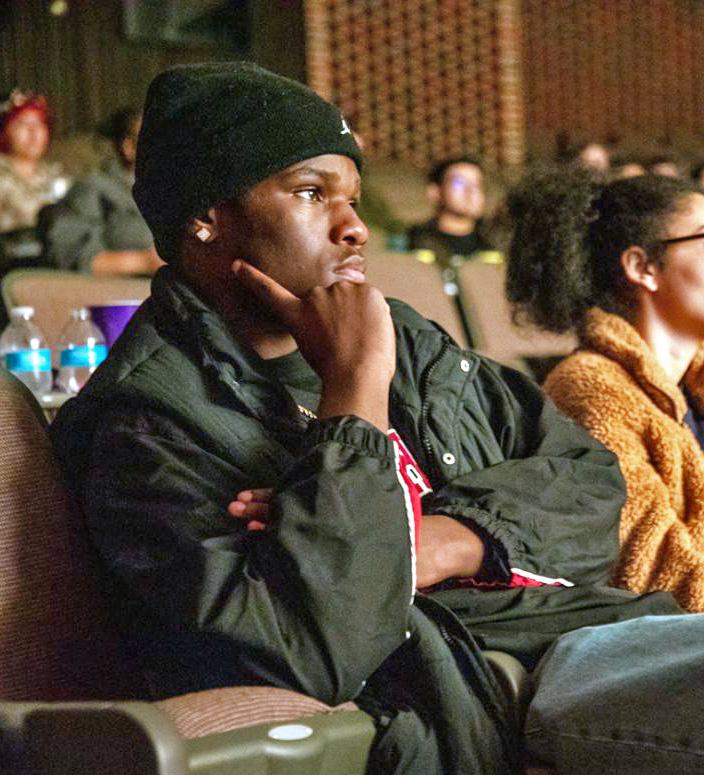
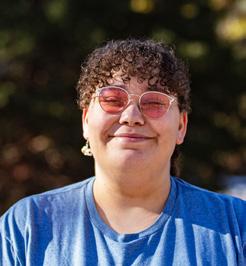
Mya Scott
While it’s not written in the Constitution, I feel like having the right to pee in a bathroom where you feel comfortable should be a guarantee.
Unfortunately, Kansas lawmakers have decided to revoke this right for many people with their recent passing of Senate Bill 244, though the enforcement of the bill has been delayed until March 26.
The driver’s licenses of many transgender Kansans who previously changed the gender markers on them have been revoked and state entities are facing fines in the six figures if they don’t “clearly label” restrooms. One of the other policies SB244 would enact is the ban of multi-stall gender-neutral bathrooms. In the exact words of the bill, “Requiring the designation of multipleoccupancy private spaces in public buildings for use by only one sex.”
As of now, there aren’t any multi-stall gender-neutral restrooms in most state-owned buildings, but that doesn’t eliminate the need.
While this would allow singlestall bathrooms to be preserved, it’s still unnecessary and detrimental to everyone.
This is obviously an attack on transgender Kansans — it takes exactly ¼ of someone’s brain to draw this conclusion. The lawmakers of our state apparently hate to see a trans person literally just exist peacefully.
Lawmakers say it’s an attempt to “protect women” and is just about “making it really clear who can go in each restroom,” with the bitter taste of transphobia clinging to their words.
But this policy will affect everyone — not just transgender people.
Gender neutral bathrooms are useful to a large number of people, including but not limited to single parents who have a child of the opposite sex and elderly people who need a caretaker.
The bill also states children over 8 aren’t allowed to join their parents in a restroom of the opposite sex. This will force parents to leave their young children to hang out outside the bathroom by themselves. Because that’s definitely way safer than just accompanying their parents.
Imagine being a parent at Wichita State University and being forced to leave your 9-year-old to stand in the Rhatigan Student Center by themselves while you use the restroom. They would be surrounded by sights, smells and people they don’t know, and no 9-year-old is fully aware of their surroundings.
This would also limit elderly people’s caretakers from being able to help them in ways they desperately need.
And I’m not the only one who noticed these glaring oversights and hypocrisies.
Gov. Laura Kelly attempted to stop this bill in its tracks by vetoing it on Feb. 13, saying it was “poorly drafted.” Unfortunately, the Kansas Senate overturned Kelly’s veto, and the bill made its way back to the House, where it was passed and enacted into law.
Now, Kansans, transgender and cisgender alike, are living in a state full to the brim of hypocrisy. People are suffering in real time, but the people in our government are too small-minded to see that. I just know they are sitting in their homes, reclining with a drink, celebrating their “victory” as the citizens they swore to serve are scrambling to abide by their bigoted rules.
Multi-stall gender-neutral bathrooms are a must; there just aren’t enough single-stalls to be able to aid everyone. And when those same lawmakers are forced to leave their children outside of the restroom, they’ll understand too.
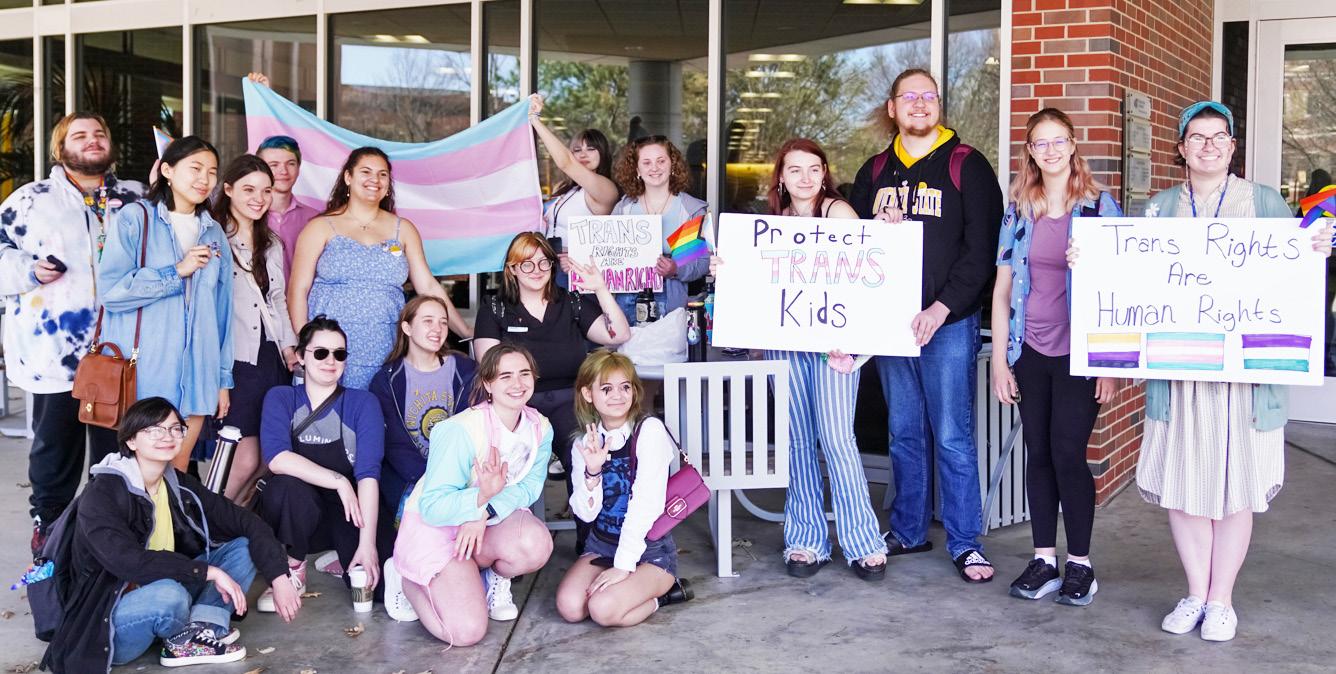
Allyship is not supposed to be a comfortable title we give ourselves in theoretical support of a community.
It is easy to say we support diversity when we are in spaces where that support feels comfortable or widely accepted, but what about when policies and public statements directly target members of a community we claim to stand beside?
In the past month, the lives of transgender people in Kansas have been affected in a major way by a new law regarding bathrooms and government identification.
Kansas Senate Bill 244 requires transgender people to use
restrooms and other sex-separated spaces in government buildings based on the sex assigned to them at birth. The law also changes rules around government identification. It prevents transgender people from updating driver’s licenses or state ID cards to reflect their gender and invalidates some previously issued documents.
When changes like this happen, allyship becomes more than a title; it becomes a responsibility.
Wichita State University says it prides itself on being a diverse campus that celebrates people from all backgrounds. Walk across campus, and you will see people from different cultures, identities and beliefs sharing the same classrooms and spaces. That diversity is part of what makes both Wichita and our campus community so amazing.
A commitment to diversity should include recognizing transgender people as valid
Jayden Woods
jaydenwoods86@gmail.com OPINION
Activism has never been louder or more visible than it is today.
From viral hashtags to statements posted by celebrities, social media movements now unfold in front of millions of people online. But this visibility raises an important question: How much of that activism is genuine, how much is simply performative and does either hold more weight with audiences?
In hip-hop, where artists often speak about social issues in both music and public statements, the line between advocacy and imagebuilding can become especially blurred.
Artists such as Kendrick Lamar, J. Cole and several others often come to mind when discussing performative activism in hip-hop.
In 2020, during the peak of the Black Lives Matter movement following the death of George Floyd, rapper Noname publicly called out parts of the rap industry for staying silent or failing to show up to protests. Her criticism sparked debate about whether some artists use social issues in their music and public statements while avoiding real involvement in activism when it matters most.
Despite these criticisms, many people argue that even performative activism can still have value. When influential artists speak about social issues, they introduce those conversations to millions of listeners who may not otherwise engage with them.
Hip-hop has long been a space where artists address topics such as racism, inequality and police violence. Even brief statements or lyrics can push audiences to think more critically about these issues. In that sense, the visibility that comes from celebrities speaking out, even if imperfect, can still contribute to broader awareness.
However, I think it goes both ways. Artists can bring awareness to an issue even if their intentions are not completely genuine. When rappers speak about social issues, millions of fans hear that message and may begin to look into those issues themselves. In that sense, even performative activism can still start conversations that are meaningful to the general public.
Fans often look up to artists they admire, so when those artists mention social movements, , it can push listeners to research, discuss and engage with those issues in ways they might not have otherwise.
The debate around performative activism is not simply about whether celebrities speak out, but about what follows after the spotlight fades. Artists in hip-hop hold enormous cultural influence, and their voices can bring attention to issues that might otherwise be ignored. However, visibility should not replace meaningful action.
When artists choose to address social movements, their words carry weight, and with that influence comes responsibility. Performative activism may start conversations, but real change requires those conversations to turn into consistent action both inside and outside the spotlight.
members of our community, whose identities deserve more respect and protection. Diversity cannot only exist when it is convenient or easy to celebrate, it also means recognizing and calling out when members of our community are faced with challenges outside of the university’s control, and asking ourselves what role we can play in supporting them.
While debates over bathroom access and government ID policies are discussed and decided on in courtrooms and offices, people in our community are feeling the impact.
For those of us who are not transgender, it can be easy to ignore these issues or distance ourselves from them, but allyship means acknowledging that the well-being of others in our community matters even when their experiences are different from our own.
Supporting diversity means that everyone deserves to exist safely and authentically in public spaces. I am not transgender, but I share classrooms and other community spaces with people who are. When policies make it harder for them to move through the world safely and authentically, that matters to me. These are people in our community; it should matter to all of us, even if we are not directly affected.
Being part of a diverse campus means more than celebrating differences when it is convenient. It means standing with and speaking up for those whose identities are being challenged. Diversity should not just be a word in a mission statement but something we actively protect and support.
After all, allyship is not about comfort, it is about responsibility.
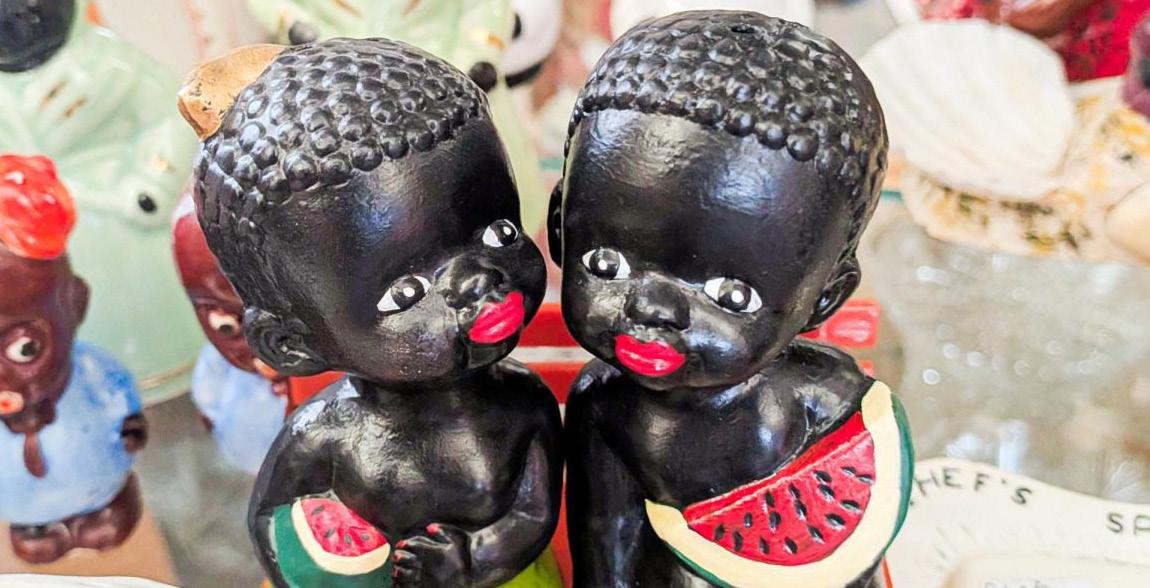
Have you ever been followed in a store because of the color of your skin?
I have, and it doesn’t feel great. Especially when I stop being followed as soon as my white family comes to stand next to me. Imagine all of your worst moments of embarrassment and fear bundled up into one ball, and multiply that five times over, and you won’t come close to the feeling I had standing in that Best Buy phone case aisle.
Now, I didn’t talk to the employee afterward, but I can only assume, based on experience and other similar stories shared, that I was followed due to the rampant stereotypes that Black people are thieves and the fact that I myself am Black. This is just one of the many harmful stereotypes circulated about Black people, which perpetuate the distrust and mistreatment of Black people every day.
Historical stereotypes and their modern implications
Harmful stereotypes against
Black people have been maintained since the era of slavery.
The modern depiction of this can be found in the claims that Black people are athletically superior to other races and are often viewed as getting into college based on their athletic ability rather than their intelligence.
I did grow up playing sports, primarily basketball, and I really enjoyed playing it. It was a fun sport that I felt I could get incredibly good at, but that joy was sucked out when I got older, and people started to ask me if basketball was in my blood. No YMCA attendee and teammates, basketball is not in my blood, but thanks for ruining an activity for me. It is so hard to be Black and wonder and second-guess every interaction I have with people.
I find myself questioning if all they see when they look at me is the stereotypes that have haunted my people for generations, making it hard to find trust in others. Due to these stereotypes, I feel like I have to work twice as hard to get just as far as my white companions.
So if the next time you see me in the store, your first thought is that I may steal something, check your bias.

BY KASS LEWIS news@thesunflower.com
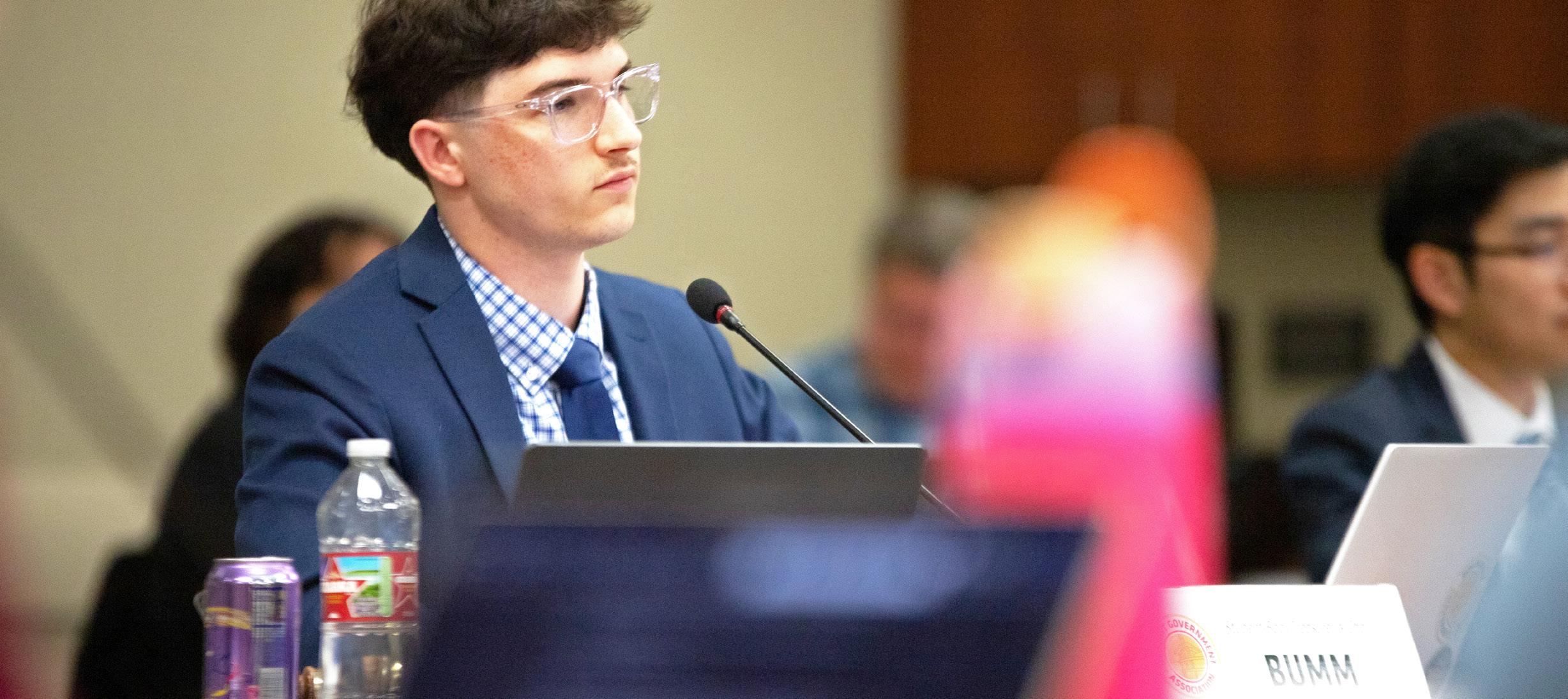
The Wichita State student government’s Student Fees Commission fully cut a total of six student fee entities in its proposed fiscal year 2027 budget, which takes effect next school year.
The student fees commission completed its deliberations Thursday afternoon. It will present the proposed budget for allocations to student services and scholarship funds to the Student Senate in a future Senate meeting, likely March 11. The Senate can make adjustments to the budget proposal before passing it.
The student fee entities are split between education opportunity funds and student support services. EOFs fund various scholarships, while student support services are made up of entities that provide a service to students.
Of the 33 student fee entities, seven received partial cuts in addition to the six that were fully cut.
The six entities the commission cut in its proposal are scholarships for the debate team, Disability Support Services, esports scholarships, the Varsity Esports team, Student Outreach Services and the Office of Student Accommodations and Testing.
Several of these entities also receive funding from donations or other sources, not just student government.
Those cuts equaled $221,193.
The seven entities the commission proposed to partially cut are the first-generation student scholarship, non-traditional student scholarship, Student Health Services, Counseling and Psychological Services, HOPE services, Campus Recreation and Student Government Association office expenditures.
Those cuts equaled $334,878.
Scholarship cuts
Both esports’ and debate’s scholarships were completely cut from the fiscal year 2027 budget proposal. The main reason commissioners gave for the decisions were that the scholarship requirements were too narrow.
Speaker of the Student Senate
Matthew Phan motioned to allocate $0 of the $25,000 requested by the debate team.
“I made this motion to allocate $0 for a couple reasons,” Phan said. “I believe that as we evaluate some of our EOF funds and our student support services funds, one thing that I’m looking at when I’m evaluating these different line items are the range that it has to support students and the impact it has on all of our students on campus as well.”
Phan also pointed out that the scholarships didn’t go to a wide range of students.
Phan’s motion passed with eight commissioners in favor, one against and one abstaining.
Phan also motioned to allocate the esports scholarship $0 of its $25,000 request.
“I think kind of similar to my thoughts on the debate team, I don’t think that I can justify allocating student fee dollars toward esports for their items,” Phan said.
Phan said he felt the scholarship’s breadth was too narrow, and not enough students qualify to apply to the scholarship to make it worth funding.
The motion passed with six in favor, two against and two abstentions.
How SGA bylaw changes affected student fee allocations
A change to the Student Government Association’s bylaws that was passed in February led to one educational opportunity fund being fully cut and another being funded with a stipulation.
Student Senate Bill 68-144 states, “No scholarship applicant will be excluded from consideration, and no scholarship recipient will be chosen on the basis of age, ancestry, color, disability, gender, gender expression, gender identity, genetic information, marital status, national origin, political affiliation, pregnancy, race, religion, sex, sexual orientation, or status as a veteran.”
The Student Fees Commission said they felt that the Disability Support Services EOF fund would be in violation of this bylaw and therefore opted not to allocate money to the fund.
Similarly, the commission funded the non-traditional student
scholarship $25,000, with a requirement that the scholarship change its application requirements to comply with SB-68-144.
The student fees commission passed its proposed budget with no funding toward Wichita State’s varsity esports team and $121,144 less than Campus Recreation’s request of $1,134,834.
The commission said the Campus Recreation cut stemmed from the amount of money going toward the Shocker Rowing Team.
Student Body Treasurer Luke Bumm motioned the cut to Campus Recreation.
“I do think Campus Recreation is very frugal — they did not request an increase from last year, they are operating on very bare bones; however, with the commission’s previous cuts and sentiments towards the debate team and the esports team — willing to kind of defund those areas as they’re not suitable for student fee dollars — I think the same should go for the Shocker Rowing Team, which is housed under Campus Recreation,” Bumm said.
Bumm said the makeup of his proposed cut was $57,263 for travel, $57,888 for the currently open assistant coaching position and $19,993.50 — half the rowing team’s equipment and maintenance budget.
$19,993.50 was later rounded up to the nearest dollar in a separate motion.
“All of these cuts are coming straight from the rowing team,” Bumm said. “Their scholarships are not affected as those are funded by outside sources.”
The motion passed with eight in favor, zero against and two abstentions.
The commission also cut varsity esports’ requested $95,000 to a proposed $0, motioned by Phan.
“I don’t believe that student fee dollars should go to funding entities that I view more like student organizations,” Phan said.
Phan cited the Model United Nations and Formula SAE teams that used to be student fee entities but were moved to student organizations, which are funded
from a different pool of money.
Phan said that the cut is in line with the other cuts the commission made to campus recreation, debate and the esports scholarship fund.
“This is not bashing on their students or anything at all,” Phan said. “I believe we just have to be consistent in the way that we approach our student fee allocations for this as well.”
Phan’s motion passed with nine in favor, zero against and one abstention.
Commission proposes counseling services should be free to students
Underserved Commissioner Jia Wen Wang motioned to allocate $445,084 to the Counseling and Psychological Services — $103,000 less than its request — with the stipulation that the counseling services are free to students.
Wang pointed out that the $10 charge for a visit to CAPS is “offputting” to students.
“I don’t understand what really our funds are being used for if not for the counseling of students,” Wang said. “That should be free to students.”
Commissioner Grace Naylor spoke in affirmation.
“I believe that without offering these free counseling services to students, we are essentially charging them twice if we are funding their counselors and their salaries,” Naylor said. “I’m in affirmation of this stipulation specifically because I believe this would be great, especially for incoming freshmen.”
The motion passed with nine in favor, zero against and one abstention.
Entities that disagree with their proposed allocations are welcome to contest in public forum during Student Senate meetings, which are every Wednesday at 7:30 p.m. in RSC 233 and live streamed to SGA’s YouTube.
The budget is planned to be presented at the March 11 Senate meeting, according to Bumm. The Senate has the authority to alter the budget before voting on it. If the Senate does not approve the budget, the Student Fees Commission will have to draft a new budget and present to the Senate again.
BY KASS LEWIS news@thesunflower.com
A resolution to add an honorary A+ to Wichita State’s grading scale was introduced at the Student Senate meeting March 4. Liberal Arts and Sciences Senator Josh Mallard — an author of the resolution — called the legislation a “stepping stone” to change GPA in future years.
A student government resolution acts as the opinion of the Student Government Association, urging the university to make the proposed change. It is nonbinding.
The current resolution would only add A+ to the grading scale as
an honorary title. The grade would not increase GPA or diminish the value of an A. After conversations between the registrar’s office and the senate’s Academic Affairs Committee, Mallard said the registrar made it clear that it wasn’t feasible to change the way GPA currently functions.
The committee surveyed around 309 students, and 85% said they would be interested in adding the honorary A+ to the grading scale.
Engineering Senator Abby Otten questioned whether 387 students properly reflect the beliefs of students at large.
“Are you worried that this
doesn’t totally encapsulate the opinions of the student body since there’s a lot more?” Otten said.
LAS Senator Braeden Miller echoed Otten’s question, pointing out that the survey did not include demographics, so there’s no way to know whether the sample was an accurate representation of the whole student body.
“I would say no,” Mallard said in response to Otten’s question.
“I mean, if you’re looking at it statistically, 85% out of that 300 is still a very large number compared to the 14,000 students.”
255 students — 85% of 300 — is 1.4% of 18,458, which was
Here’s how Shocker Career Accelerator advises students to use AI in job searches
BY JOSH PFLEGER-BERNAT news@thesunflower.com
AI has a growing role in the job search process, something that students moving into the job market will have to navigate.
The Shocker Career Accelerator assists students who are preparing to apply for jobs. Appointments are offered by either a certified career coach or a peer advisor. And it’s trying to help students adapt to the new AI-filled job search process.
Sara Leftwich — a program specialist for the Shocker Career Accelerator — explained the process for each type of session and how career coaches may approach working with students.
“All of our coaches at the Shocker Career Accelerator provide the same resume standards and guidance, but each coach brings their own personality and communication style to appointments,” Leftwich said.
The Career Accelerator recommends ways students can use AI to help them with their resumes.
During resume building, advisers help students include often overlooked details like volunteer experience and relevant coursework. This is followed by resume review sessions, where students get a finished resume reviewed to refine smaller details.
Coaches and peer advisers look to meet students where they are and help create resumes that match the job and industry the student is interested in.
“In my experience, many students seek out our services because they’ve been using one approach to apply for all opportunities and they’ve identified that something isn’t working,” career coach Aaron Evans said.
Students are often not aware of how employers go about reviewing resumes or cover letters, Leftwich said.
A big part of these sessions is ensuring resumes can make it through Applicant Tracking Systems — a software many employers use to search resumes for keywords matching job descriptions. Those in the office say online resume templates can’t be read by ATS systems, which can result in applications being thrown out.
Leftwich said a lot of effort goes into ensuring students’ resumes are a genuine reflection of who they are and the goals they want to achieve.
At the Shocker Career Accelerator, AI is often suggested to students as a tool, but not to write the entire resume. Students should use AI for tasks like brainstorming ideas, but the final result should be their own writing, Leftwich said
“We work to help students’ personalities be present in their resumes,” Leftwich said.
The Shocker Career Accelerator provides resources for students on how to use AI as a reference during the writing process. The Career Accelerator adheres to WSU’s guidelines on AI in its approach.
The guidelines go over how to best use AI for task automation and content creation, but say that users should avoid inputting sensitive information.
enrollment in fall 2025.
Speaker of the Student Senate Matthew Phan opted to skip a committee referral. This means the legislation will stray from the typical process where legislation is introduced, referred to the committee and altered, then presented again and voted on. Students can share their thoughts on legislation at weekly Student Senate meetings during the public forum period. Senate meetings are on Wednesdays at 7:30 p.m. in the Rhatigan Student Center, room 233. All senate meetings are livestreamed on SGA’s YouTube.
AI platforms take the information users put into them to train their models. Each platform goes about this differently, but it’s a better rule to avoid inputting personal information like names, addresses, contact info, etc. into these systems, Leftwich said
Shocker Career Accelerator takes the same approach toward AI when it comes to other areas they assist with, such as cover letters, job search and career exploration.
BY MACK SMITH mackred22@gmail.com
The women’s basketball team ended its season with a 65-61 loss to Memphis Saturday afternoon.
The Shockers finished their year at 8-23 and 5-13 in the American Conference. It was the first time they didn’t win 10 or more games since 2014-15, aside from the
COVID-scattered 2020-21 season.
Wichita State came out competitive against the Tigers, knotting the score at 12 at the first media timeout in the first quarter, but Memphis used a 6-0 run to take a 20-17 lead by the end of it.
The Shockers later tied the game at 20 in the second quarter and eventually missed six straight
shots and went scoreless for over five minutes of game time, allowing the Tigers to create a nine-point gap, 29-20. A 3-pointer by graduate guard Jaila Harding finally ended the drought and brought Wichita State within two possessions.
The Shockers later trailed 35–29 before the break, however.
Graduates Abby Cater and

Treasure Thompson sparked a 9-0 run for WSU in the third quarter before Memphis responded with a 7-0 burst of its own at the end of the period, 50-44. In the fourth quarter, the Shockers battled but could not take back the lead.
With one minute left, Harding was fouled on a three and drained

two of the untimed shots to bring the Shockers within three points, 62-59. The Tigers converted to free throws on the other end to go back up by five and made another after Cater’s tip-in to decide the score. Cater finished the game with her second straight double-double to lead the Shockers in points (19) and rebounds (11).
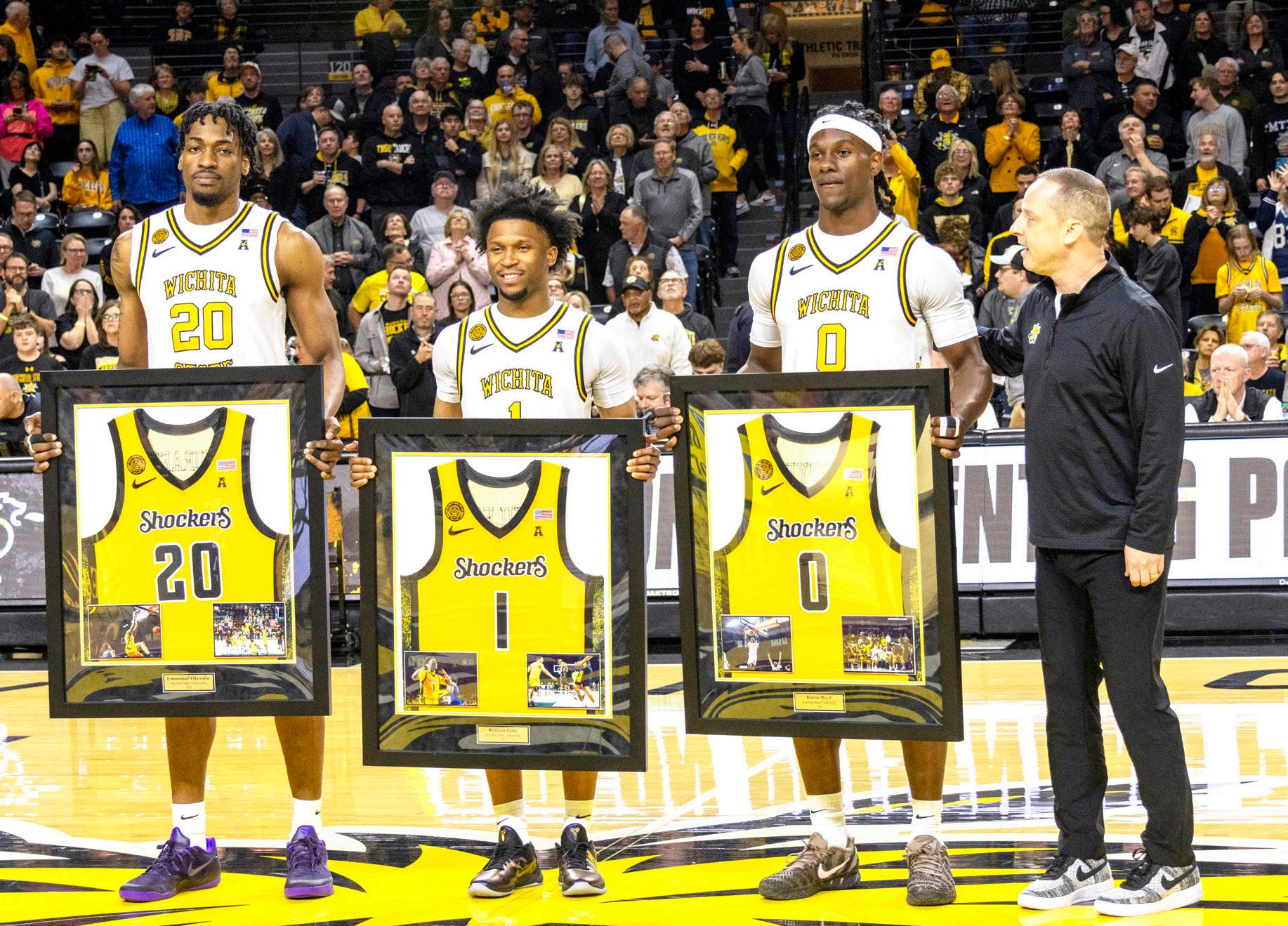
BY OWEN PROTHRO sports@thesunflower.com
Wichita State’s path to a league title and NCAA Tournament berth has been made clearer after Sunday’s regular season conclusion.
The Shockers, who won their sixth-straight game Saturday against Florida Atlantic, locked up the No. 2 seed and bye all the way to the semifinals at the American Conference Championship a day before the rest of the league solidified their spots in Birmingham, Ala.
Wichita State earned the No. 2 seed over Tulsa because the Shockers split their series against top-seeded South Florida, which bested the Golden Hurricane during their home-and-home this season. The Shockers ended the regular season at 21-10 (their most regularseason wins in the last six years) and 13-5 against league opponents.
WSU’s potential opponents include No. 3 Tulsa (25-6, 13-5 American), No. 6 North Texas (1813, 9-9), No. 7 Florida Atlantic (1714, 9-9) or No. 10 Temple (16-15,
8-10). It has beaten all four teams this season, but split the series with the Golden Hurricane and the Owls from Boca Raton.
The step-ladder tournament format begins Wednesday and runs through Sunday at Legacy Arena in Birmingham.
Wichita State’s first game will be at 4 p.m. CST Saturday and can be streamed on ESPN2. Sunday’s championship game is scheduled for 2:15 p.m. CST on ESPN.
“What I’m happy about as a coach is you always see the holes that need to get fixed,” head coach Paul Mills said following Saturday’s win over FAU.
“I’m happy that we get a little bit of extra time to make sure that we’re doing the things that lend itself to winning,” he continued.
“You’re going to have to have some wrinkles (to iron out) just because all these teams know each other so well.”
For the players, they see the same value in getting an extra week to prepare for a game.
“We have time to focus on our
recovery and game plan,” senior forward Karon Boyd said. “(We get to) watch to see what all the teams do and get the game film. A lot of time to rest our bodies and prepare mentally for the game ahead of us.”
Boyd explained that the extra time to rest will be “extremely important” for the Shockers. Some teams will have to win five games in as many days to reach the championship game, but Wichita State will need just two. Having fresh legs is a real value this time of year.
“A lot of teams don’t have that (extra) week,” Boyd said. “They have to play multiple games to get to the semifinals and then the championship, and we have less amount of games to play.
“We know that’s taxing on their bodies, so they’re getting tired, and we have more time to be prepared than they do.”
The Shockers’ path is now clear: Two wins stand between them and a conference title. Now it’s up to them to take advantage of the extra time they earned.
BY OWEN PROTHRO sports@thesunflower.com
Kenyon Giles, usually all smiles inside Koch Arena, was brought to tears.
“Pretty good at not showing too much emotion,” he put it. But everything about Saturday’s matinee finally let those emotions out before the opening tip-off.
“It kind of hit me,” Giles said.
“I love this community, and they love me back. The love I got back was out of this world — more than I expected. This one year here brought my joy back.”
Giles, a senior guard, wasn’t alone. Karon Boyd and Emmanuel Okorafor also felt that bond with the city.
Boyd cherished every moment of Wichita State’s 88-70 win over Florida Atlantic on senior day. The noise that 8,163 fans blared throughout the Roundhouse. The way it can make it feel like a home away from home.
“It’s kind of been hitting me all week,” Boyd said. “Just between teammates helping me come to the realization in a way, like, ‘How do you feel about the last home game, really?’”
For Okorafor, checking out of the game with around a minute left felt like a moment that had come too soon.
“This season has been so, so, so quick,” said Okorafor, who finished what could be his final game at the Roundhouse. A medical hardship waiver he has applied for, which would grant him an extra year of eligibility, has yet to be approved by the NCAA.
But this year’s seniors, and Wichita State’s entire roster, won back a city yearning for winning basketball.
In less than a year, a fan base that had gone quiet has slowly reignited. Attendance has risen to over 6,700 over the last seven home games, up from an average of a little over 5,400 in the 10 home games before.
Even in an era when many
First Round: Wednesday, March 11
players stay only one year, Wichita fans still connected with this team. They’ve also won the most games in six seasons after improving to 21-10 and 13-5 in the American Conference against Florida Atlantic.
“I don’t think that anybody would deny just how much they kind of resuscitated (and) not only just reinvigorated a fan base, but just the level of confidence,” head coach Paul Mills said.
“They’ve elevated the room,” Mills continued. “Any time that you can have a group to where they can elevate the room, it’s a huge plus.”
The growth showed on the court as well.
Jan. 15 became a turning point.
Wichita State lost to FAU in Boca Raton, which has turned out to be the team’s most lopsided defeat this season.
The Shockers have won 11 of their last 13 games since then, including their last six. Players agreed that the initial loss to the Owls was not going to sink their season.
“Shoutout FAU for lighting the fire in us,” Giles said. “After that loss, we all talked about it. We just got punked at their crib. It helped us. We took that loss as a lesson. That’s all we can ask for.”
Wichita State is now just two wins away from its first NCAA Tournament berth since the 202021 season.
But Saturday’s celebration inside Koch Arena felt like more than just a senior day sendoff and best finish to a regular season in years. After seasons of uneven results, the Shockers and their fans once again seemed in sync — feeding off the same energy that once defined the Roundhouse.
“It’s a great feeling to have the crowd behind us,” Boyd said. “There was just so much joy throughout that game. I was happy for my teammates, myself, the crowd — everybody, really. I know that feeling is going to come again once we get the next two wins.”
Game 1: No. 8 Memphis vs. No 9 Tulane - 6 p.m.
Second Round: Thursday, March 12 Game 3: Game 1
Quarterfinals: Friday, March 13 Game
Semifinals: Saturday, March 14
Championship: Sunday, March 15
Game 9: Game 7 winner vs. Game 8
‘One Night Only with Julius Thomas III’ blends the whimsy of musicals with the reality of the industry
BY MYA SCOTT opinion@thesunflower.com
Listen. When I heard someone who performed in a Broadway production of “Hamilton” — as the Alexander Hamilton himself — was coming to Wichita State, I knew I had to be in that audience. I was deep in the trenches when it came out on Disney+ in 2020, and I have been to a live production of the show in Wichita during 2023; I love it that much.
I had no idea what to expect when I grabbed my ticket, but in the end, I was pleasantly surprised and glad I blocked out an hour and a half on a Thursday night to witness “One Night Only with Julius Thomas III.”
Thomas is a WSU alum who graduated in 2005 with a degree in musical theater and eventually found himself in four Broadway
shows with a variety of different acting credits.
But he didn’t start out on the Broadway stage. His acting career started at Wichita State and has only grown since then.
Thomas began his performance on Thursday with a song from the last musical he participated in on the Wichita State stage, “Pippin,” before moving into introductions.
Between each song, Thomas sprinkled in anecdotes about his own experience with theater, from roller skates being a saving grace during an audition to how he learned to grow his career.
His second song of the night was from the “25th Annual Putnam Spelling Bee,” where Thomas was not alone on stage.
WSU students Olivia Lybarger and Liv Rivera performed solos during the song. The two were chosen
to participate in the performance after submitting audition tapes. One of Thomas’s big messages was the importance of preparation meeting opportunity, which he said these students exemplified.
I had literal chills during the last harmonies of the piece. The way the trio’s voices mixed and filled Weidemann Hall was truly mesmerizing.
Thomas went on to perform music numbers from shows like “Motown: The Musical,” “Xanadu” and “Shrek.” He told stories about his time on the stage in between each performance, like the time he went to Japan for the traveling tour of “Xanadu” unwillingly.
One of my favorite parts of his performance was his energy.
Even though he was on a near bare stage with only a piano and
a mic stand, I could imagine each scene and setting perfectly. His little dance moves really added to the whole performance.
As part of a grand finale, Thomas performed “Wait for It” from “Hamilton,” which was a major win in my book as it’s my favorite song from the musical’s score. The riffs, the emotion, the literal everything about the performance was perfect.
He ended the night with a hopeful message to the future generations of acting — the road would be hard, but it was possible if the time and work was put in.
Overall, Thomas’s performance was always high in energy, and his vocals were on point the entire time. I had not heard of Thomas before this event, but I’m excited to see his name on more programs in the future.
‘Providing respite’: Alum and former ‘Hamilton’ star returns to advise the next generation of performers
BY MALEAH EVANS arts@thesunflower.com
Julius Thomas III, Wichita State musical theater alum and former titular character in “Hamilton: An American Musical,” visited his alma mater for a brief residency where he gave a performance and shared advice for the younger generation.
Amy Baker Schwiethale, the musical theater program coordinator and the associate director of the School of Performing Arts, said that Thomas’ visit was a part of the school’s Connoisseur Series.
“A lot of times that takes the form of just artist talks, but with a voice and a career like that there was no way we weren’t going to have (Thomas) do a full concert,” Schwiethale said. “(It) was to bring in a WSU alum who had such an incredible career and we knew could share so much wisdom with our current students.”
After his performance, the music theater department wanted to give Thomas another opportunity to share insights about working in the performing arts world before he ended his residency at the university.
“When I (graduated), my only goal was to do good work and to make a living doing what it is that I wanted to do,” Thomas said. “Everything that’s happened in my career and in my life has far exceeded that.
BY MALEAH EVANS arts@thesunflower.com
Editor’s Note: Savanna Nichols is an illustrator with The Sunflower. Nichols was one of the student artists awarded at the reception. The Sunflower is dedicated to fair and equal coverage. Nichols had no part in the reporting, writing or editing process of this story.
Three student artists from Wichita State were honored with cash prizes at the Emerging Artists reception on Friday. This year’s reception was the eighth annual Emerging Artists reception. It is usually hosted by the Art and Design Advocates, the patron group of the School of Art, Design and Creative Industries.
The Advocates work to raise funds that go towards creating student opportunities from international travels to attending conferences.
Aly Horn, JaiDe Brown and Savanna Nichols were selected by juror and New York based artist Ann Resnick for the awards.
Each artist received a part of the $2,500 prize pool, which was sponsored by Aspen Boutique, Frank and Fido and the Cotillion.
Aly Horn, a graduate student working towards their Master of Fine Arts at Wichita State, received one of the two $1,000 checks that were handed out.
“I hate it,” they said about receiving the check. “I’m not really one for competition and things like that so it’s a bit daunting. So I hope I don’t get too big of an ego.”
Horn’s work often focuses on the struggles of childhood trauma, through the persona of a stuffed bear named Honey.
“It’s a lot easier to be like ‘Yeah this happened to this super cute, cuddly creature and not me,’” they said. “(I’m) building up that story around it to kind of give it a little bit more limelight to child trauma that’s happened, not only to me, but hopefully other people.”
JaiDe Brown is studying studio art at the university and in her free time, she teaches ceramics throughout the city.
“I feel very validated in my art form, and I’m really proud to represent for ceramics because I feel like we’re very underrated,” Brown said.
I just want to leave the world better than I found it, and my way of doing that is providing respite and moments of release and relax in the context of theater and art and performance, and if I’m doing that then I’m on task.”
JULIUS THOMAS III Music Theater alum “
“But the overarching thing is that I just want to leave the world better than I found it, and my way of doing that is providing respite and moments of release and relax in the context of theater and art and performance, and if I’m doing that then I’m on task.”
When Thomas takes on a character and builds a role, he said he will always relate it back to something in his life that he has experienced before.
“What is the thing that allows me to understand the emotion behind what we’re supposed to be experiencing?” he said. “That’s where I’m always sort of starting the journey from every character that I play, and I feel like that’s where I do my best and honest work is just leading from me.”
The world of performing arts is a shifting one; artists never know where their next role will come from, or if they will even get the next role. Thomas keeps grounded by the thought that anything can happen.
“All of it could be done
tomorrow for any number of reasons,” he said. “It’s kind of a calming thing that says ‘today is all I’ve got, and the best show that I do today either determines that I will be here tomorrow or that whatever happens, happens. So how about we do as best we can today and we worry about anything else tomorrow?’”
Thomas auditioned for “Hamilton: An American Musical,” 15 times before finally landing the leading role.
“I went on a journey of all the men in the show, where they brought me in. This was something I was experiencing with Tommy Kali, the director, quite a bit, where he brought me in for many characters. I could see that he could see something in me, but he had no idea where to place me,” he said. “I started to get a little disillusioned with it, because it felt like he was getting too comfortable with passing me over.
“They finally called me up, and they said, ‘Can we see you for Hamilton?’ and I said no,
because I didn’t think that I was going to go in and excel at that. I wanted to feel very comfortable about going in the room and knowing that this was going to be a knockout, and I didn’t.”
After some pressure from the people around him, Thomas auditioned for the role of Hamilton in 2019, and that was the fit for him.
“It wasn’t ever about the fact that I wasn’t right, or I wasn’t good enough,” he said. “I let ‘no’ be the fuel for the fire; got a little discouraged along the way, but I ended up with the role that defined and changed my career for the rest of my life.”
Part of staying on top of an ever-changing field, for Thomas, is reinvention.
“Certain things are not within my facility anymore, new things are, and so I’m constantly having to rethink of where I am in this moment in my life and govern myself accordingly,” he said.
In his thoughts about reinvention, he said he looks forward to stepping into a writer or director role, tossing the idea of coming back to WSU to direct a show for the School of Performing Arts.
“It’s been something that’s been burning in me,” he said. “I loved working with you guys, I loved trying to craft a thing, and so it’s just about finding the right projects and about the right moments and the right people to allow me to come.”
Brown said a lot of the time, she builds her pieces based on intuition, starting with a broad idea.
“After a few hours of building, I take a step back, let it sit for a few days, I kind of ruminate,” she said. “(I) have it tell me where it wants to go. With my more functional work, I usually go into that with more of a plan. I am (also) exploring this new process, photolithography, so I’m taking photos I’ve taken from around town and then printing them onto my ceramic pieces.”
Savanna Nichols, a senior at WSU studying studio arts, was the recipient of a $500 check.
“I’m really excited, I didn’t think I’d get anything,” they said. “It’ll probably go back into preparing for the senior show we do at the end of the semester, into supplies and snacks to fuel my eight-hour (days).”
Nichols focuses on including symbolism, biology and mythology in their work.
“These are all different selfportraits,” they said about their displayed work. “A metaphor for growing up and maturing, trying to be my own person.”
Art from the three award recipients and the twelve other students is on display in the ShiftSpace gallery located in HarvesterArts in downtown Wichita through the March 27th.

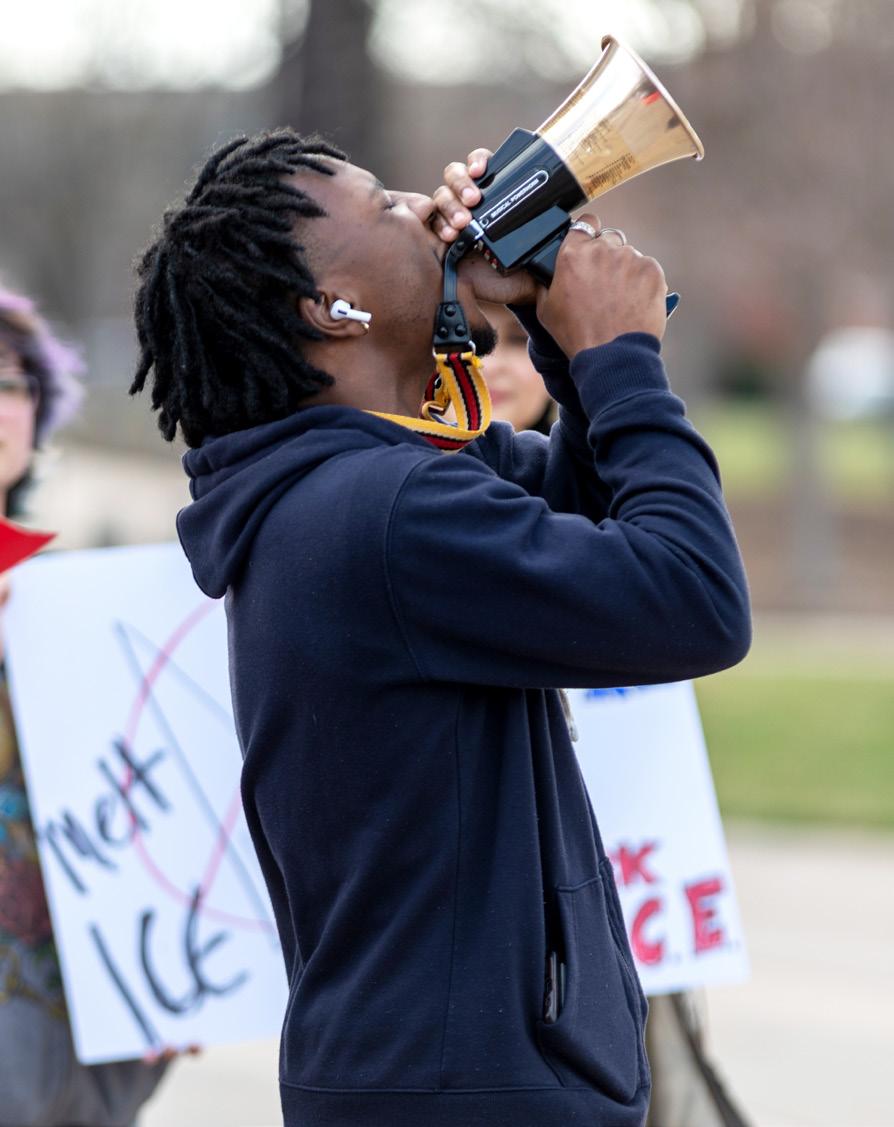

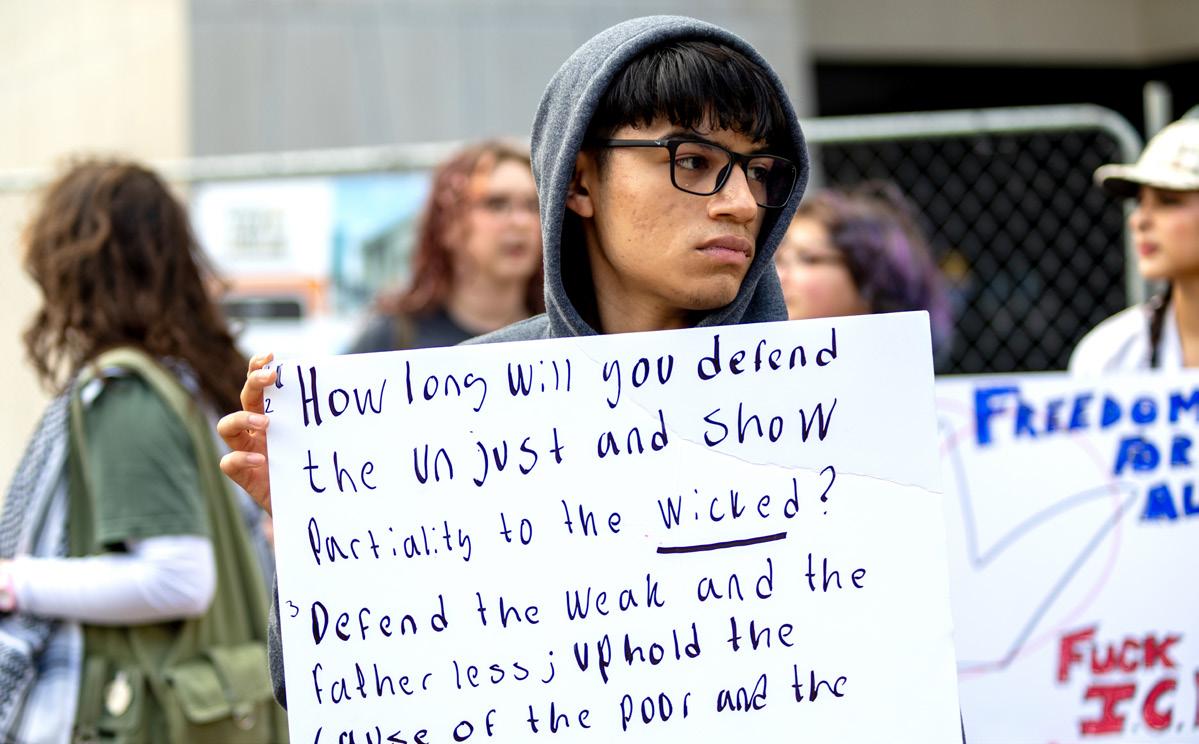

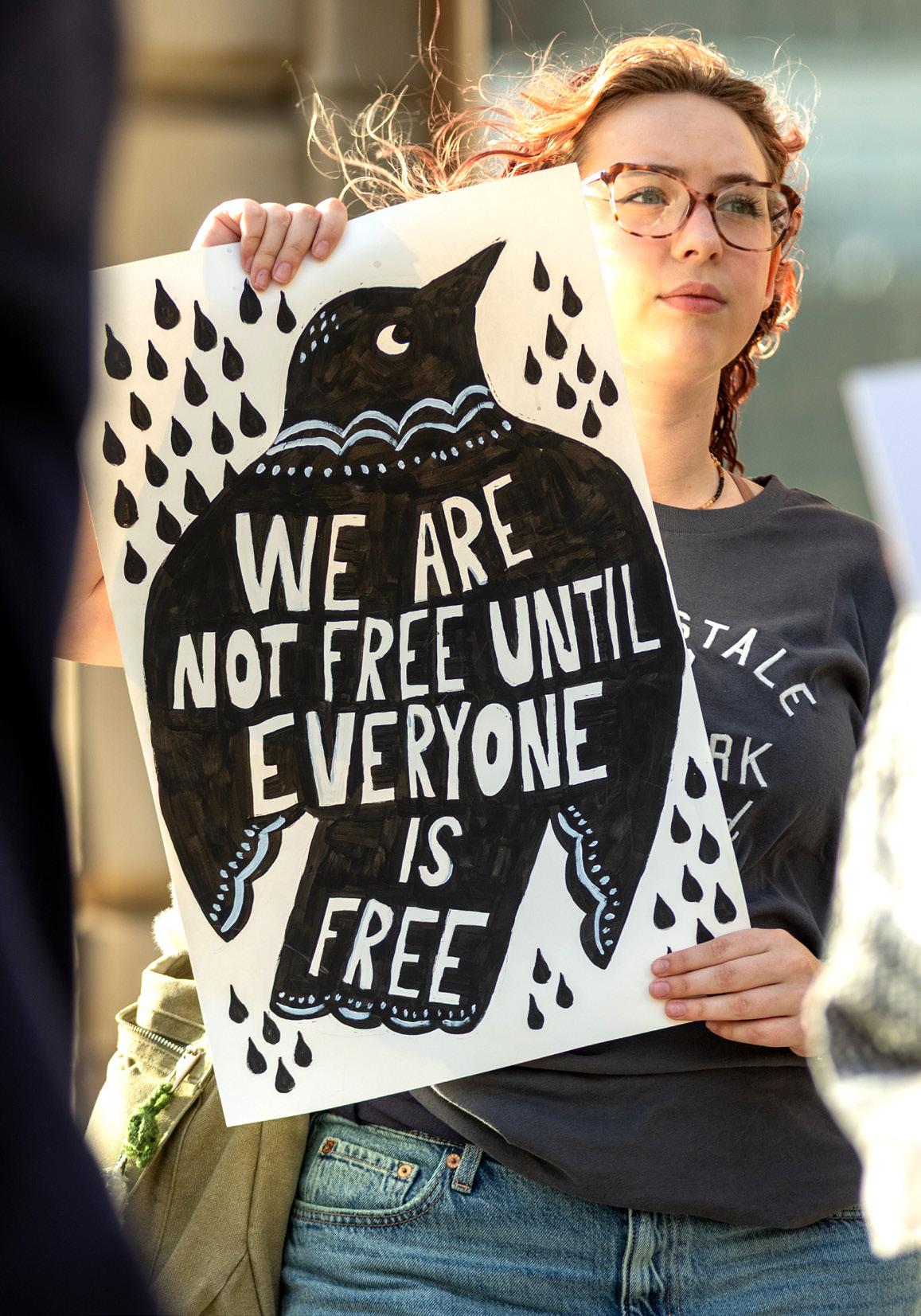
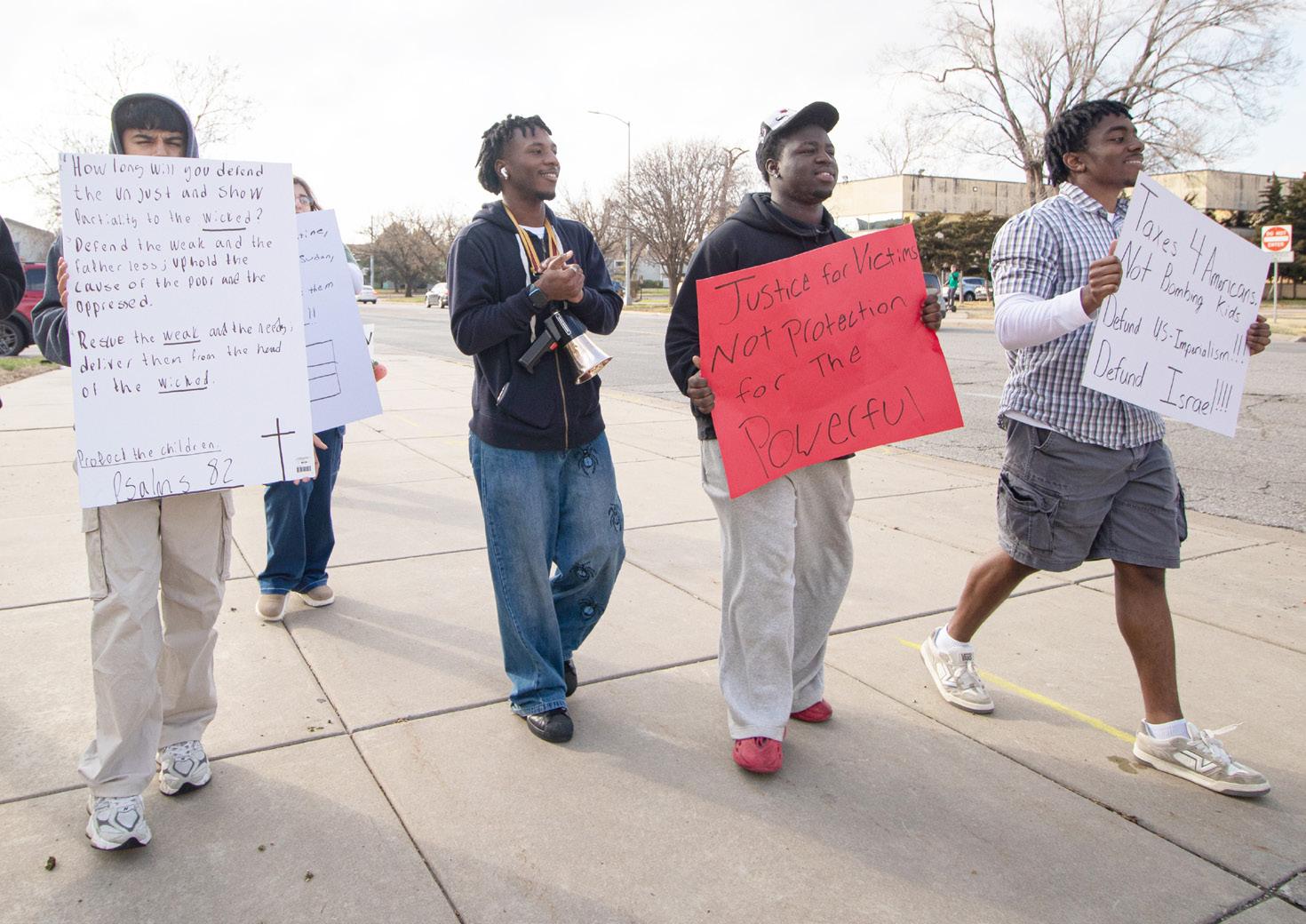
MAR10 DAY
Tuesday, March 10
11 a.m.
Rhatigan Student Center
Celebrate Mario Day at the Rhatigan Student Center with themed freebies, Mario painting, pizza and gaming in Shocker Sports Grill and Lanes. The event starts at 11 a.m. on the first floor.
CRAM CAFE
Tuesday, March 10
4 - 7 p.m.
Rhatigan Student Center
Drop-in to the Rhatigan Student Center’s Harvest Room to work on homework, study for exams or finish assignments in a calm and relaxed space.
MARCH MADNESS BRACKET CHALLENGE Wednesday, March 11
11 a.m. - 2 p.m.
Rhatigan Student Center
Come by the SAC table to register and join the campus bracket challenge. Make your picks when the bracket drops and follow along to see who will win the grand prize.
MAKERS & MASTERPIECES: COMMUNITY MAGNET COLLAGE SWAP Wednesday, March 11 5:30 - 7:30 p.m. Ulrich Museum of Art
Create mini collage magnets from everyday items, one to keep and one to swap. The event is a collaboration between the Student Activities Council Ulrich Museum.
CANTARITOS WITH STUDENT ENGAGEMENT AND BELONGING Thursday, March 12 4 - 6 p.m.
Rhatigan Student Center
Design your own cantarito to take home and enjoy snacks and drinks while you work. The event is hosted by the Office of Student Engagement and Belonging.
BASEBALL VS. BUTLER March 12 - March 14 Time varies Eck Stadium
Support the Shocker Baseball team as they take on Butler University at Eck Stadium. Current students can pick up free online tickets before the game.
MUSIC THEATRE COMPANY PRODUCTION OF ‘RIDE THE CYCLONE’ March 12 - March 14
7:30 p.m. Hughes Metropolitan Complex Watch a performance of “Ride the Cyclone” by the Wichita State Music Theatre Company in the Welsbacher Theatre. The production is led and produced by students.
WICHITA CLEAN STREAMS Saturday, March 14 10 a.m. - noon Arkansas River & Little Arkansas River Help clean up Wichita and the area around the Arkansas and Little Arkansas rivers. Gloves,
CELEBRATION
HAVE AN EVENT YOU WOULD LIKE LISTED?
CONTACT THE ARTS EDITOR: arts@thesunflower.com
CONTACT THE NEWS EDITOR: news@thesunflower.com