Neff Hall set to be demolished in 2027. What’s next?
BY DARREK BISHOP darrekbishop07@gmail.com
Neff Hall has been home to many departments since it was built in 1951, but now its time on campus is nearing its end.
The building is slated for demolition in 2027 as part of Wichita State’s master plan. With long-standing structural and maintenance issues, the cost to repair is higher than to demolish it and rebuild the area.
The building was named in honor of Frank A. Neff, the dean of the College of Business
Administration and Industry — now the Barton School of Business — from 1926 to 1950.
Neff Hall now houses the Department of Anthropology, the Lowell D. Holmes Anthropology Museum and the Emory Lindquist Honors Center.
“The HVAC system in this building is ready to not (work),”
said Crystal Dozier, Chair and Associate Professor of Wichita State’s anthropology department.
“We want to get all of our people and objects safely out of here.”
The museum will move to
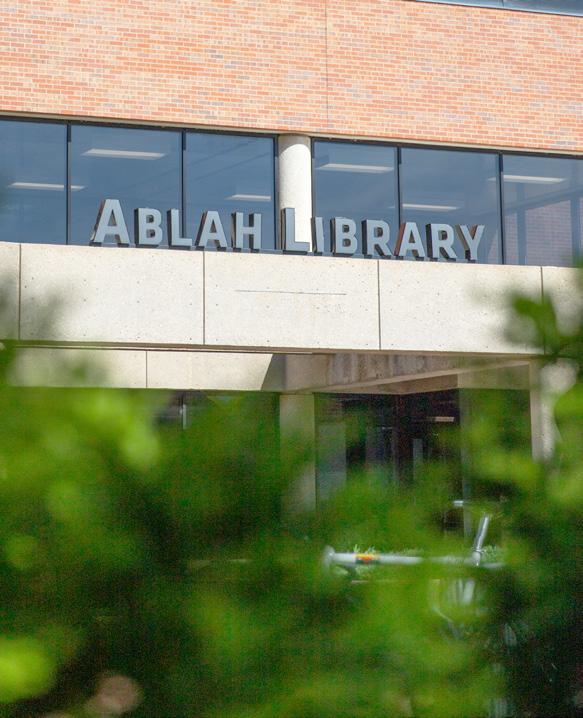
the second floor of the Ablah Library this summer after library renovations are made to accommodate it. The exhibition is set to open this fall.
“They’re in construction now, and they’re building gallery space, exhibit space and a workroom for the museum studies program,” Dozier said.
All of the anthropology department and the leftover museum collection will be moved into the geology building in the spring of 2027 after some necessary structural renovations and
maintenance are taken care of.
“They’re going to be taking care of things like water infiltration issues, going to be checking (that) renovated spaces are cleared for contaminants, asbestos,” Dozier said. “New floors in quite a number of spaces, (new) paint in the spaces we’re moving into… renovations in the main lecture hall in geology.”
The renovations to accommodate the anthropology department will include a shared teaching and research laboratory space.
“The department of geology has been really great to work with,”
Game Theory creator shares his journey, offers advice to college students
BY MYA SCOTT opinion@thesunflower.com
A lot of people know Matthew Patrick as MatPat. He’s known for educational content like debating whether beloved Nintendo character Mario is a communist, solving the “Five Nights at Freddy’s” timeline or even deciding the best boobs in the gaming world.
But before being the widely successful YouTube celebrity MatPat, he was “tiny MatPat.” Patrick began his content creator journey as “YouTube’s biggest nerd” not with the intention to have millions of subscribers to his five channels — “Game Theory,” “Film Theory,” “Food Theory,” “Style Theory” and “GTLive” — but with the intention to inspire a love of learning in other people.
“I was told by my parents to never stop learning,” Patrick said. “That is the most valuable thing that I could do, never stop asking questions and to always question the world around me. And I was fortunate through my schooling to have great teachers that inspired a love of learning. But I recognized that I was very lucky to have that, and not a lot of other people had that opportunity.
“And so when I was starting the channel in the early days of YouTube, and in my career as a content creator, the thought of, ‘Hey, how can I pass on that love of learning to other people out there who might not have been as lucky?’ That was always a goal of mine.”
With that original goal in mind, Patrick said his favorite thing from his time as a public figure was not the billions of views or the revenue. It was the impact he was able to leave his theorist community with.
“In middle school and high school, I got it in my head that, ‘Hey, I want to make the world a better place, because I was a part of it.’ The butterfly effect kind of thing,” he said. “And it was one of those things where I never anticipated being able to cure cancer, that’s not my skillset, but by being a positive impact in someone else’s life.
“So when people come up to me and say, ‘Hey, this video helped me pass a test,’ or ‘watching your videos inspired me to pursue this major,’ or ‘you got me through a really hard time in my life.’ That part is always the proudest thing I’ve ever done.”
And he was able to see the impact he made on a collegeaged audience on April 16, with every seat in The Metroplex full during “An Evening with MatPat.”
Nearly 1,700 people cheered as Patrick ran through the audience, giving high-fives to his theorist community.
But it isn’t just actions.
WSU students like Student Body President Jia Wen Wang said Patrick left an impact on her during her youth.
“A lot of the times when I was younger, being a nerd wasn’t exactly the greatest thing,” Wang said. “It really always had a negative connotation, and so I really enjoyed having a role
model that I could see a lot of the knowledge that he had being applied into some of these spaces. It really drove me to appreciate that knowledge can be used in such different ways.”
However, everything must eventually come to an end. And it did for Patrick over two years ago.
Kind of.
On March 9, 2024, MatPat posted his last video hosting “Game Theory.” Despite Patrick saying it wasn’t an easy decision, even then, he knew it was the right one.
“Saying goodbye is hard,” he said. “Even though it was the right decision to move away from the channels, giving up that part of my life and that regular touch base with the audience was really sad … The theorist community has always been the theorists, right? It’s a community … We are a community of nerds who like overthinking the world.”
Saying goodbye wasn’t just hard for Patrick, though — it was hard on the fans, too.
“It was like, ‘No, what?’” WSU student Emmaline Ferguson said. “Cause you think, ‘Oh, they’re going to keep doing it forever,’ but everybody has a limit.”
Some fans were sad about Patrick’s departure from the Game Theories channel (and its expansions), but others felt it was a bittersweet moment to see him move on.
“I was sad that a part of my childhood was ending, but happy he got to move on and do everything else,” WSU student Kaela Cozine added.
Dozier said. “They’ve been very understanding and accommodating as we kind of move into their space.”
Student Senate argues about tone before creating police advisory board
BY KASS LEWIS news@thesunflower.com
Debate around legislation creating a student advisory board with the Wichita State Police Department turned to discussions on the culture of the Student Senate last Wednesday.
The bill on the floor, Student Senate Bill 68-165, is aimed at creating an advisory board made up of various students, faculty and staff to advocate to campus police. Sen. Jamie Winslow, the author of the bill, collaborated with campus police Chief Guy Schroeder to write the legislation.
The bill passed with 21 senators in favor, one against and four abstaining.
The board will meet twice a semester with the goal of keeping clearer connections between WSUPD, students and the surrounding community.
Disagreement over board makeup leads to discussion of senate culture
In the last few years of his career on YouTube, Patrick said he was getting an average of four hours of sleep a night. Retirement — for him — has meant self-care.
“I have fewer bags under my eyes now, which is great,” he said. “I am fitter. I’ve been able to regain some element of cardio ability. (When) my kid’s like, ‘play tag with me,’ … I can actually play with him. It’s great.”
He hasn’t stopped working completely, though. Throughout these last two years, Patrick has worked with Congress for the Creator Caucus, cameoed in “Five Nights at Freddy’s 2” as Toy Bonnie, and has appeared at college campuses, like Wichita State University, to speak with students.
Patrick said he enjoys having the time to visit campuses, even if they don’t all have a “top two” mascot like WuShock.
“Now that I have more time on my hands, that I’m not slammed in a video production schedule, it is nice to get back to go out and meet fans,” he said. “It’s awesome to get to go out and meet the theorist community in especially places that I’ve never gotten to go to before.”
A big mantra for Patrick is the idea of intentionality in actions, and how that can guide you on a path to good things.
“Choosing the things in your life that you’re engaging with and being an active participant in your life is so crucially important,” Patrick said. “… Intentionality in your life, I think, is a big one.”
The legislation was first introduced at the April 1 senate meeting. During the first read of legislation, senators are able to ask questions but can’t take any actions like amending or passing it.
At the April 8 meeting, Winslow spoke during the senate floor speeches. This time is meant for senators to address the senate or student body.
“Let me start out by saying I am extremely frustrated,” Winslow said. “I am frustrated with two things specifically. First, the content of questions during my presentation of SB-68-165… Second, the lack of help, input, collaboration and effort of other senators with this legislation over the past week.”
Winslow then said that of the eight questions asked at the April 1 meeting, half were repeat questions. The four repeat questions he was referring to had to do with the section of the bill relating to the majors of students allowed on the board.
“What a waste of time and energy that was,” Winslow said. Winslow said he felt that the questions weren’t seeking clarification but instead senators wishing to amend the bill, so he sent out a message to the senate afterward asking for input. Only one senator responded, he said. At the April 15 meeting, the bill had its second read, meaning there was a second questioning process, a debate process including the ability to amend or change certain aspects of the bill and a vote.
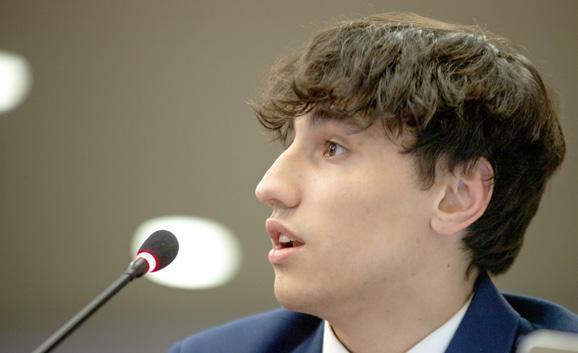
Sen. Jamie Winslow speaks in debate for a bill he authored. The bill was passed on April 15 and created the Wichita State University Police Department Advisory Board. Photo by Kass Lewis / The Sunflower
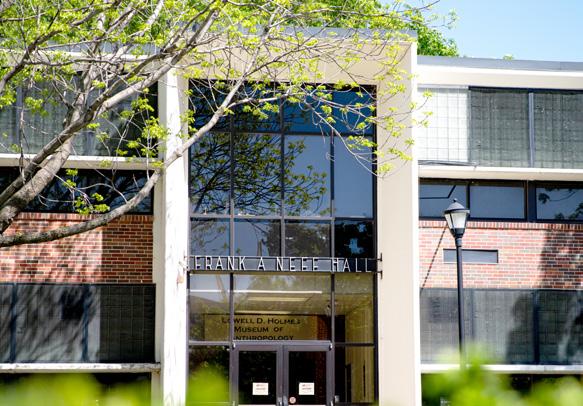
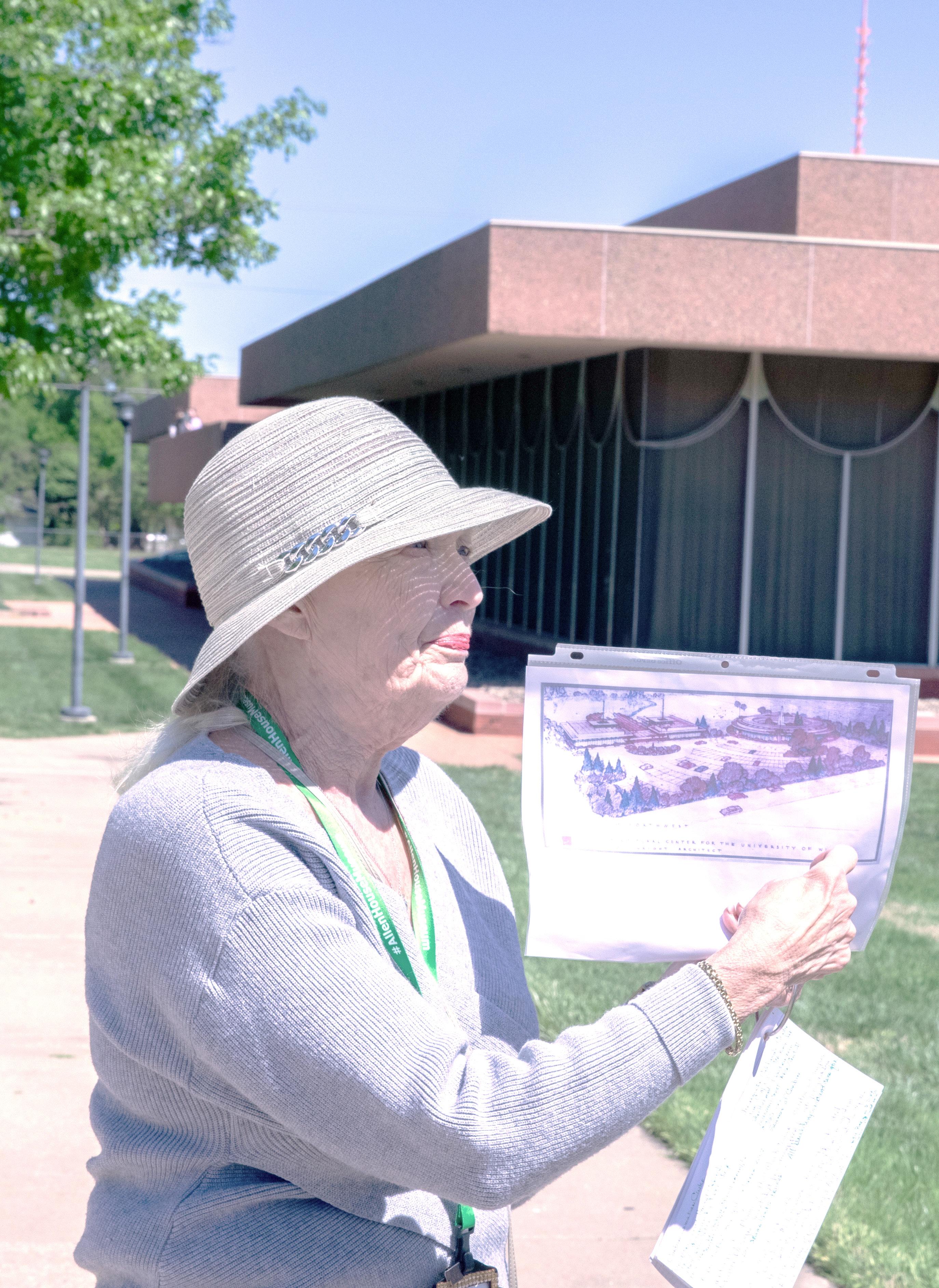
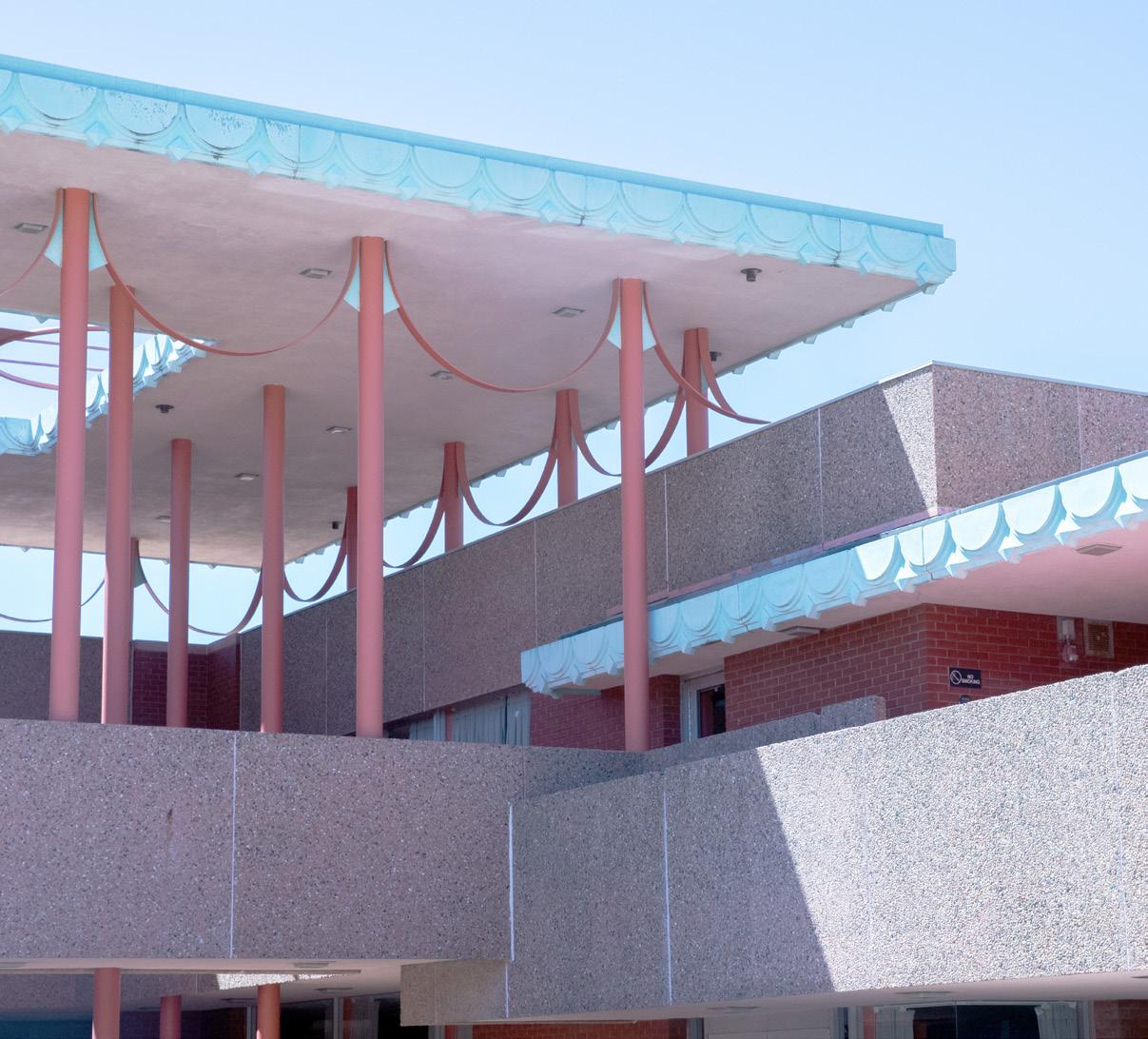
Neff Hall on April 20. Neff Hall will be demolished in 2027 according to Wichita State’s 10 year plan. Photo by Zachary Ruth / The Sunflower
Online personality Matthew “MatPat” Patrick smiles while speaking to a crowd on April 16 at “An Evening with MatPat.” The event began around 7 p.m. with some guests lining up over an hour early. Photos by Zachary Ruth / The Sunflower
Matthew Patrick laughs after an audience member shouted out during the Q&A portion of “An Evening With MatPat”.
An audience member applauds Matthew Patrick on April 16. Patrick involved the crowd regularly by asking them questions and speaking to specific students.
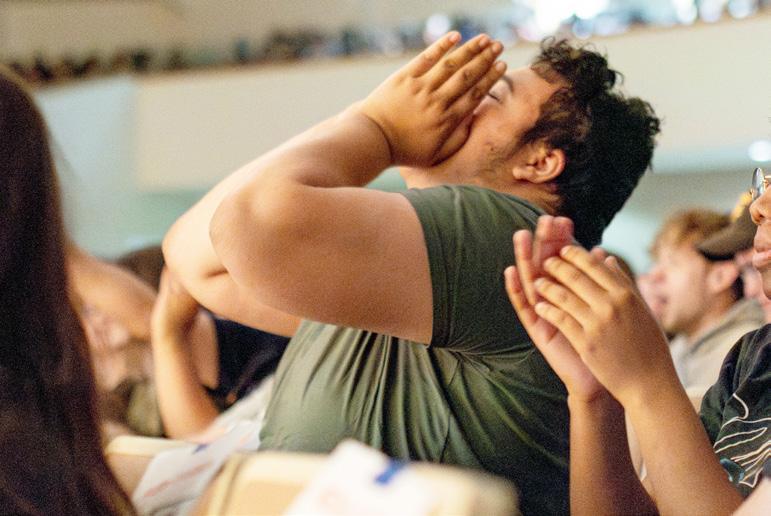
An audience member cups his hands and yells towards the stage during the event. Many audience members directly interacted with MatPat, yelling from their seats throughout the event.
Wichita State seeks 4% tuition increase to address funding cuts
BY JOSH PFLEGER-BERNAT jbernat13@gmail.com
Wichita State will likely increase tuition to address numerous financial challenges at the university.
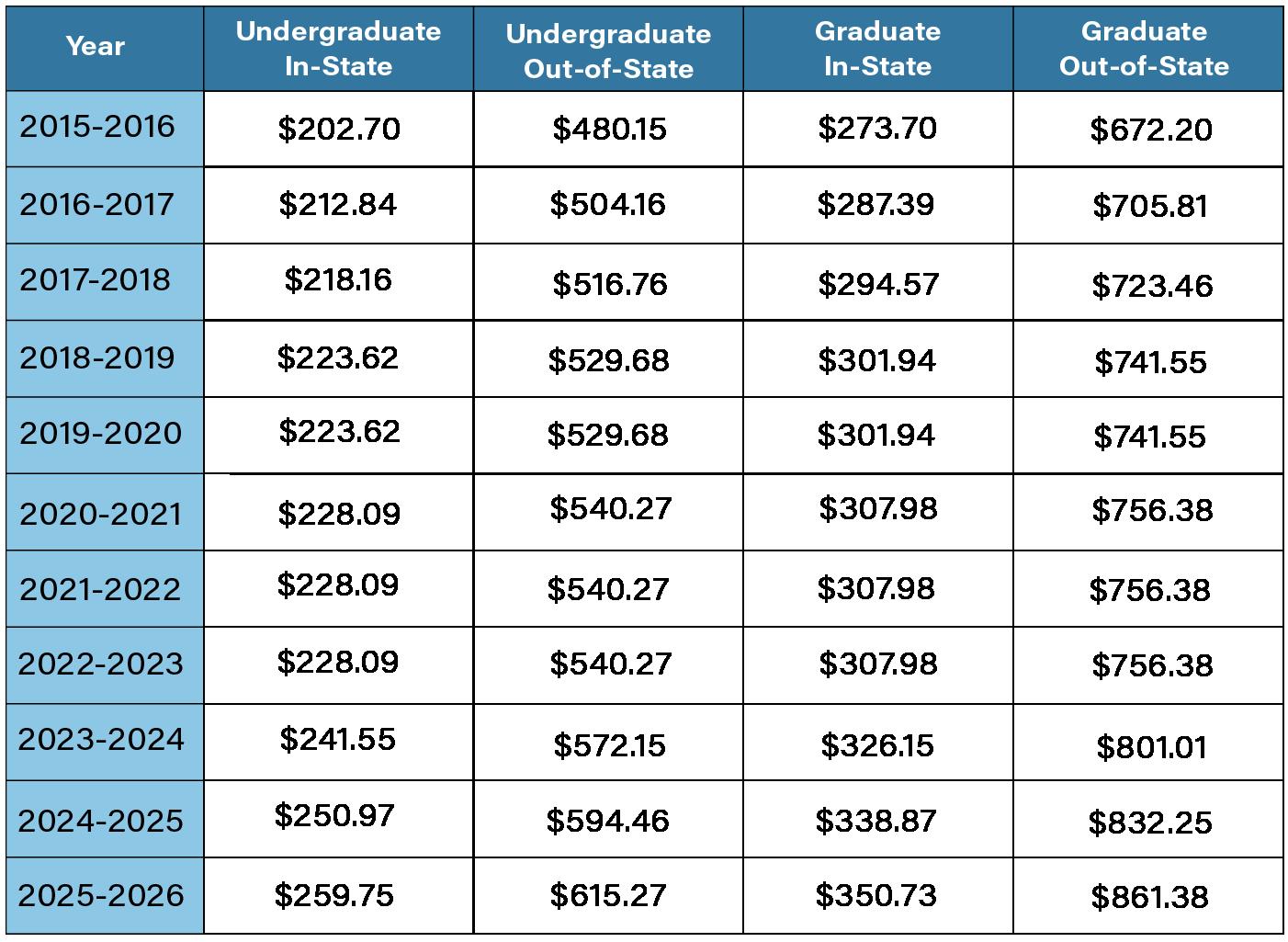
Chief Financial Officer David Miller said the university will seek a 4% increase, after WSU’s state funding was cut by 3.5%.
“You know, we don’t know what the next year is going to give us; there’s a potential,” said Lyndsay Pletcher, executive director of budget. “It really just depends on what happens in the next fiscal year to set us up for fiscal year 2028.”
WSU President Richard Muma said in an announcement earlier this year that the focus must remain on long-term growth and investment initiatives. Miller announced in March that WSU’s investments — especially in multiple building projects — are a big driver of WSU’s $235.9 million in debt as of fiscal year 2026.
Various programs are being reviewed to determine where cuts may be possible, Pletcher said.
“The provost office is always kind of watching program evaluations, paying attention to the programs that are more successful versus other things we might need to tweak and make a little more efficient,” Pletcher said.
Program evaluations identify how each program is meeting certain criteria. This process
After a motion from Winslow to clear up some grammatical errors and words of affirmation from various senators, Sen. Braeden Miller motioned to table the legislation indefinitely, meaning the legislation couldn’t be brought back up during the current session but could in a later session.
resulted in women’s studies, physics, geology, philosophy and forensic science being looked into further.
Financial considerations include market and student demand, cost effectiveness and return on investment. If these considerations are not meeting expectations, they could be met with restructuring efforts to align with the university’s
or some of the environment around it is enough to table the legislation indefinitely.”
Sen. Andrew Hatch also spoke in negation of Miller’s motion, pointing out that senators have the ability to make amendments during the debate period.
“We are here to pass legislation that will improve the student experience,” Hatch said. “I think that this legislation as it stands can do that.”
financial priorities.
WSU may consider changing programs to align with long-term financial goals, Pletcher said.
Vice President of Strategic Communications and Marketing, Shelly Coleman-Martin, said efforts are being made to inform faculty and staff of WSU’s financial needs.
“We do university communications to make sure
everyone understands the constraints we’re in,” ColemanMartin said. “We’re doing some cost-cutting measures, and nothing’s off the table.”
What got us here
Muma said an anticipated 7% budget reduction for WSU would likely result in workforce reductions. This budget prediction
was based on decreased state funding and lower international enrollment.
The Kansas Legislature cut base operations funding for public research universities in the state by 2.5%, including WSU, the University of Kansas and Kansas State University.
The state house originally planned to implement funding cuts to universities and place a cap on tuition rates, but that cap was not in the finalized version of the budget.
Muma also cited state and federal actions — and a decline in international enrollment — as top factors causing budget issues in an announcement last year.
Muma originally announced a possible 3% budget reduction; it was later updated to 7%.
What’s next
WSU and other Kansas Board of Regents institutions will give a financial report and can request tuition increases for next year in May.
KBOR is the governing board for Kansas public colleges and universities, which includes Wichita State, Kansas State and the University of Kansas among others. Last year, Wichita State and four other public universities requested a tuition increase.
KBOR will decide on the universities’ proposed tuition rates in June.
affirmation from various senators, the bill passed.
One motion from Sen. TeRay Boyd failed to have a second. Each motion that is made in senate meetings requires a second senator to back the motion in order for voting to occur.
Wichita State’s Student Senate meets every Wednesday during the academic year at 7:30 p.m. in the Rhatigan Student Center, room 233, and live streamed on SGA’s YouTube. The current session has one more meeting left on April 22, and the next session begins the week following. SENATE / FROM PAGE 1
“There’s been a lot of conversation about people reaching out over this piece of legislation, but I don’t feel as though the author of this legislation has given it the room to be amended,” Miller said.
Miller explained that some of the questions at the first read were requests to make adjustments, but Winslow was “unbudging on making those amendments.” Miller also said that there were suggestions within the Student Services Committee that were not taken into consideration.
Authors of legislation are able to accept or reject informal suggestions to their legislation. During senate meetings, senators can motion to make changes to the legislation. Those changes are decided by a vote of the senate, not by a decision of the author.
“I also feel as though some of the conversations that happened during last senate meeting was quite frankly somewhat hostile,” Miller said. “I don’t think that is an energy that we should be bringing to senate.”
Speaker of the Student Senate Matthew Phan said that the legislation “stands on its own” separate from actions of its author.
“If … senators feel like changes should be made, they should make the amendments,” Phan said. “... I don’t believe that tabling indefinitely just because of not feeling comfortable making amendments
Sen. Josh Mallard also spoke in negation of the motion, while Sen. Ismael Saeed and Sen. Erin Tims spoke in affirmation of Miller’s motion.
“The purpose of senate is that we work together, and that we’re open to criticism, and that we’re open to feedback, and a lot of the feedback that was presented was shut down,” Saeed said. “... The broader intention of (the motion) — and this is just in defense of Sen. Miller’s argument — is just that it doesn’t truly reflect the wishes of the student body.”
“I don’t think this motion was made maliciously,” Tims said. “I think it was made to be constructive. Personally I think that a UPD advisory board would be beneficial on campus — I’ve never said otherwise — I just think that given some of those discussions we’ve had in committee, some of the discussions I’ve had with the sponsor of this legislation and with of senators, it could use a little more time and a little more editing.”
Phan then ended the debate period and Miller’s motion to table the bill indefinitely failed with five in favor, 16 against and five abstentions.
Following one approved amendment by Sen. Adán Parker that changed language on the reason for the board and words of
photos and all contents are copyrighted.
MEMBERS OF THE WSU POLICE ADVISORY BOARD
n Student body president, acting as chair
n Student Services Committee chairperson or designee
n One student senator appointed by the speaker of the Student
Senate
n WSU Police Department Chief or designee
n Two WSUPD employees (Neither can be a member of the Parking Services Division)
n Three resident assistants (one from each dorm building), appointed by the student body
president
n Faculty Senate president or designee
n Staff Senate president or designee
n WSU Tech head of security or designee
n Three WSU students majoring in political science or criminal justice appointed by the student body president
n A representative from the Wichita Police Department appointed by the WPD Patrol North Captain (non-voting member)
Student Senate creates rural scholarship and international student mentorship program
BY DARREK BISHOP darrekbishop07@gmail.com
Wichita State’s Student Senate passed bills last Wednesday to start a need-based scholarship for graduate students from rural Kansas, and a mentorship program for international students.
Scholarship for grad students from rural Kansas
The need-based scholarship was presented by Sen. Grant Phillips. The scholarship is intended to help graduate and postdoctoral students from rural counties in Kansas.
Students would have to verify that they have graduated with a bachelor’s degree with a GPA of at least 2.5, as well as provide proof of residence in a rural area via mailing address. Students actively enrolled in a graduate program would need to have and maintain a 3.0 GPA.
After its first read on April 1 and going back to the Government Oversight Committee, some changes were made to the bill.
The scholarship fund was set at $10,000 from SGA’s special projects budget, with permission from Student Body President Jia Wen Wang. Senators added a required scholarship essay where applicants must describe their past in rural Kansas, what they plan on doing as a graduate student and how they plan to serve their communities.
The scholarship was originally specific to students from Kansas
Congressional District 1. During the April 15 Student Senate meeting, a motion by Sen. Erin Tims was passed to change the requirement to having lived in any rural area in Kansas. The scholarship will use Wichita State’s definition of rural.
After the amendments were made, the bill passed unanimously.
Mentorship program for international students The mentorship program, presented by Sen. Ashly Artiaga Sevilla is meant to assist international students by providing support through mentors to help them adjust to life in the U.S. and at Wichita State, as well as workshops and programs related to academic success, campus engagement and student life.
The Diversity, Empowerment and Inclusion Committee amended the bill to include a collaboration between SGA and the International Student Union, so students from ISU can volunteer to be mentors. Changes were also made to the funding structure so the program is not solely funded by SGA but by ISU as well.
With these changes, the bill was passed with unanimous consent and no discussion.
Student Senate meetings happen every Wednesday at 7:30 p.m. in room 233 of the Rhatigan Student Center, and are also live streamed to the SGA’s YouTube channel.
Changes in the rate of tuition per credit hour since 2015 | Graphic by Mikah Herzberg and Emma Wilks / The Sunflower
Corbin Education Center offering tours to raise money for conservation
BY KAMI STEINLE steinlekami@gmail.com
The Corbin Education Center, which houses Wichita State’s College of Education, will now be offering tours through the Allen House Foundation — a charity that conserves architecture designed by Frank Lloyd Wright in Wichita — once a month through August. These tours began in March and are intended to generate funding to turn the building into a museum, like the Allen House. On April 18, the second tour of the Corbin Education Center was given.
“I had a lot of people that were interested,” DJ Spaeth, a tour guide for the Allen House Foundation, said about the April 18 tour. “... It’s in the growing stages of a tour. This group’s really helpful to me, for what I need to add to personalize
I think this is good for awareness for people to realize that maybe down the road this place is going to be more of a museum and just more open to the public. I think it was a really good overview just to tease you and get you interested in it.”
MELINDA SCHNYDER
Corbin Education Center tour guest
this tour or what the consumer wants, and that’s always really good.”
Wright designed the Corbin Education Center in 1957, and the construction was finished in 1964. The building currently houses administrative suites and classrooms for the College of Education.
“I think this is good for awareness for people to realize that maybe down the road this place is going to be more of a museum and just more open to the public,”
Melinda Schnyder, a guest on the tour, said. “I think it was a really good overview just to tease you and get you interested in it.”
Schnyder said she has been on multiple tours of buildings designed by Wright across the country and that this one interested her because she often drives by and had wanted to see the inside.
“I really like hearing the background about what was happening in Wichita and what was happening at Wichita State the time it was built, that really helps
Two new justices approved for Student Supreme Court
BY KASS LEWIS news@thesunflower.com
Sarah Lamatsch and Kailene VeaSpencer were approved by Wichita State’s Student Senate Wednesday evening to be associate justices on the Student Supreme Court.
Lamatsch is a first-year political science student with plans for law school. She is also currently on the Student Government Association’s Freshmen Leadership Council.
“Through my experience with Freshmen Leadership Council this year, I got to work with a lot of people in SGA, and figure out a lot of the ins and outs of this organization,” Lamatsch said. “Through that work, I learned that I really would like to be an associate justice.”
Vea-Spencer is a second-year student studying criminal justice and also plans to pursue law school. The bill appointing Vea-Spencer states she is “an advocate for justice (and) serving and guiding students on the laws of the Association.”
“I strive for my student engagement — as a student leader — to be rooted in making sure students are represented and prioritized in spaces where decisions enhance their student experience,” Vea-Spencer said.
Vea-Spencer previously served as the president of the Black Student Union. The two were sworn in on Monday when the Student Supreme Court met and will remain in their positions until they graduate, step down or are removed.
WSU’s Supreme Court doesn’t work on the same timeline as SGA’s sessions, where a new presidential cabinet and senate begin every mid-to-late April. Justices instead have terms as long as the justice
stays enrolled at WSU. The court currently has many seniors, which is why so many justices have been appointed throughout the school year. Wichita State’s Student Senate meets every Wednesday during the academic year at 7:30 p.m. in the Rhatigan Student Center, room 233, and live streamed on SGA’s YouTube. The current session has one more meeting left on April 22, and the next session begins the week following.
set the tone,” Schnyder said.
Originally, there were supposed to be two buildings, the Corbin Education Center and a laboratory school. The laboratory school was never built because the funding of $1.6 million was not approved. Instead, parking lots were put in, according to Spaeth. The Corbin Education Center cost $960,000.
“The Kansas (Board of) Regents were not going to approve Frank Lloyd Wright architecture for this campus, so they hurried up and accelerated the building of this
(Corbin),” Spaeth said.
The Kansas Board of Regents is the governing board for higher education in Kansas, overseeing public colleges and universities including Wichita State.
Spaeth also co-teaches classes in the Corbin Education Center and said that the building does not accommodate the needs of the students or faculty. This is one of the reasons the building is going to be turned into a museum, and everything housed in Corbin will be moved to other places on campus.
“It’s not functional,” Spaeth said. “It would’ve been functional had they built the second building… because this (Corbin) would’ve been for collaborational meetings, not for instructing.”
Ablah library to close for electrical work on April 25
BY JONAS LORD legobrickslord@gmail.com
Ablah Library will be closed on April 25. The library will be closed for electrical work on the new Holmes Museum of Anthropology, which will be moving onto floor two of the library. The 24-hour study room will also be closed. The building will be closed from 7:30 a.m. to 5 p.m. The 24-hour study room will open once power for the building returns. The library will reopen on April 26 with normal hours.
Parking garage to be closed from April 22 through 25
BY JONAS LORD legobrickslord@gmail.com
Wichita State Parking Garage will be closed from April 22 to April 25 for pressure washing.
DJ Spaeth, a tour guide from the Frank Lloyd Wright Allen House, explains the original plan for the Corbin Education Center. A laboratory school was supposed to be next to the Corbin Education Center. Photos by Kami Steinle / The Sunflower
The Corbin Education Center at Wichita State finished its construction in 1964. Architect Frank Lloyd Wright designed the building to create a compression and release feeling for the viewer.
The exterior design of the Corbin Education Center on April 19. The building was designed by Frank Lloyd Wright in 1957 with his style of blending nature into his work.
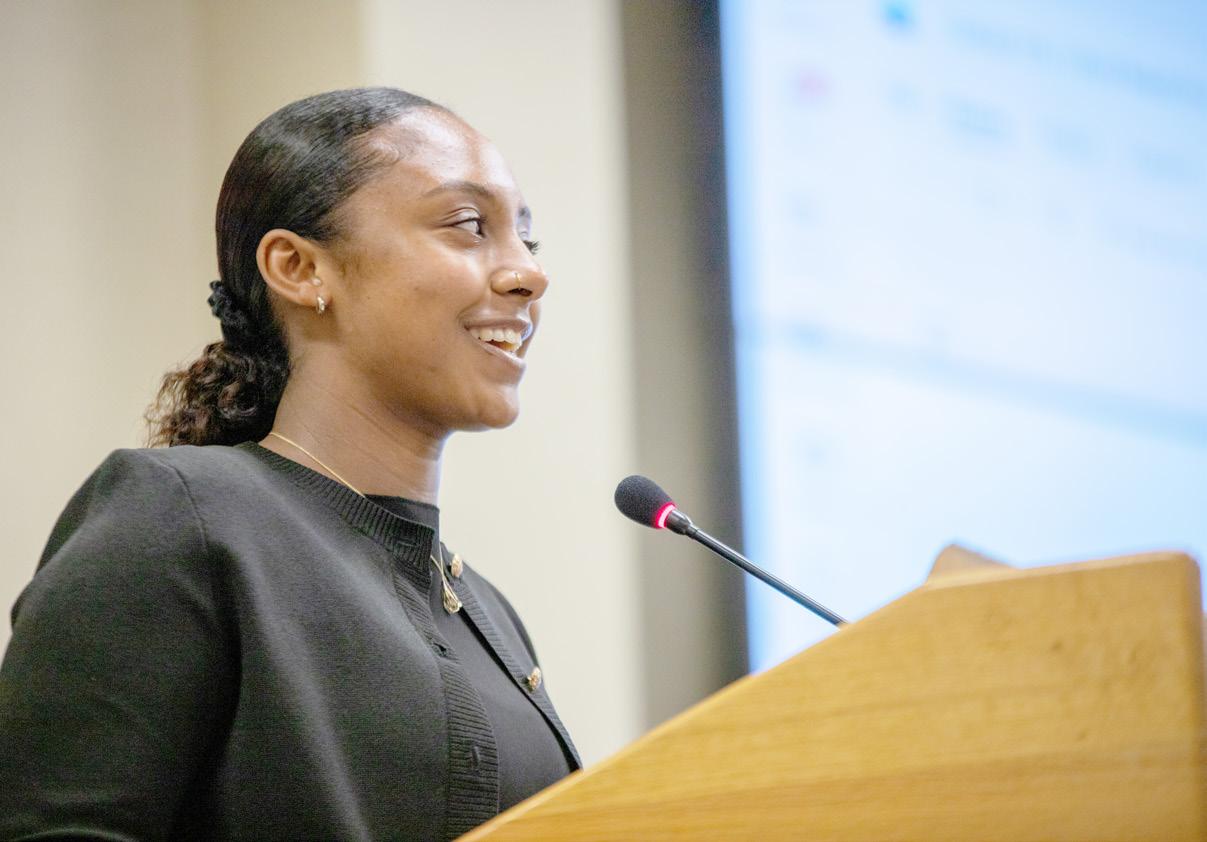
Kailene Vea-Spencer speaks to the Student Senate. Vea-Spencer was appointed to the Student Supreme Court by the senate on April 15. Photo by Kass Lewis / The Sunflower
Photo by
Lewis / The Sunflower
4
Shocker Sports Roundup:
What you missed over the last week
BY MACK SMITH & EVAN LONG
mackred22@gmail.com & evan.long.soccer@gmail.com
Women’s golf
The Wichita State women’s golf team finished its regular season with a third-place finish during the Stampede at the Creek in Omaha, Neb., last Monday and Tuesday.
Senior Mackenzie Wilson and sophomore Kayla Van de Ven led the way for the Shockers as they both finished in a tie for fifth, individually, shooting 228 strokes (12 over-par) after three rounds of play. Wilson moved up 13 spots on the leaderboard after she hit an even 72 in the third round.
As a team, Wichita State carded a 911 (47 over-par) to finish on the podium. Drake won the tournament, finishing just five strokes fewer than the Shockers with 906 (42 over-par).
Next up, the Shockers will play in the American Women’s Golf Championship from April 20-22 in Brooksville, Fla.
-- Mack Smith
Baseball Wichita State’s pitching performed well against Kansas’ strong lineup, except against one Jayhawk batter.
Junior shortstop Tyson LeBlanc crushed home runs in his first two at bats of the match-up between in-state rivals last Tuesday.
Those homers were a big factor as Wichita State fell to No. 18 Kansas 5-2 at Hoglund Ballpark in Lawrence.
Wichita State’s bullpen found some success against KU’s potent offense. However, the Shockers’ offense didn’t shine like the pitching did. They only recorded two hits after the second inning, when they scored both of their runs.
-- Evan Long Track and field
A school record was broken as WSU’s track and field team also claimed multiple podium finishes during three different meets over the weekend.
Sophomore Elkana Kipruto now stands alone atop the men’s 10,000-meter list after setting a 28 minute, 9.21 second time at the Bryan Clay Invitational on Thursday. Kipruto surpassed Mornay Annandale’s time of 28:48.64, which had been held since 1991.
Senior Lucy Ndungu also ran at the Bryan Clay Invitational, claiming first place after running the women’s 10,000-meter in 33:20.55.
At the ESU Relays last Thursday in Emporia, Kan., senior Weston Hulse finished eighth in the pole vault with a mark of 4.87 meters. On the women’s side, junior Miya Evans got a sixth-place finish in the 100 meters with a time of 12.03 seconds. Sophomore Kelli DeSpain also finished fifth in the discus with a throw of 41.71 meters.
On the men’s side of the Oregon Team Invitational, the 4x100-meter relay team set the second fastest time in program history at 39.66 seconds. Freshman Ty Bybee, sophomore Carson Ratzlaff and freshman Liam Miller swept the podium in the pole vault and junior Jason Parrish won the 400-meter hurdles with a time of 50.41 seconds.
On the women’s side in Eugene, junior Jenna Kuepker finished third in the javelin with a distance of 47.01 meters. In the 4x100-meter relay, the Shockers finished with a time of 45.78, good for third place. Sophomores Shellamae Farmer and Kylie Scott both finished in second place in the pole vault. Farmer and Scott are now both tied for sixth place all-time in WSU history with a height of 4.06 meters. The Shockers’
SPORTS
GET THE BROOMS OUT
Ausha Moore’s career day, softball’s dominant bats lead to series sweep on the road vs. Charlotte
BY OWEN PROTHRO sports@thesunflower.com
Ausha Moore and the Wichita State softball team had a weekend to remember.
In three games against Charlotte from Friday through Sunday, the Shockers smacked eight home runs and outscored the 49ers 33-10 to extend their winning streak to eight in a row and improve to 27-15 and 15-6 in the American Conference.
Moore was the primary benefactor at Sue M. Daughtridge Stadium.
She hit two home runs worth four RBIs on Friday and Saturday to help lead Wichita State to 10-3 and 9-3 wins.
Moore’s weekend concluded with program history when she hit three home runs Sunday to become the sixth Shocker to do so in a game. She also drove in nine runs to set a single-game record.
Wichita State eventually won via run-rule after six innings, 14-4, behind Moore’s career day and completed its third series sweep this season.
The Shockers moved into a tie for first place in the league standings with two conference series remaining before the championship tournament as a result. Charlotte dropped to 26-22
and 10-11 in the American.
Moore, a sophomore transfer from North Texas, now leads the conference with 18 home runs — the program’s fifth most in a season. She’s gone yard in each of the last five games.
Her first one of the series came in the third inning of Friday’s game to extend Wichita State’s lead to eight runs. Moore sent a solo shot over the center field fence Saturday to give the Shockers a 5-1 advantage.
Moore’s trifecta in Sunday’s finale were all multi-RBI whacks.
She broke open the scoring in the first inning with a two-run blast. Then, later in the same frame, she created a 9-0 advantage with a grand slam that put the game out of reach before it really began. Moore’s afternoon ended with a homer to right field in the third, another two-RBI shot.
But it wasn’t just Moore who made an impact in the batter’s box over the weekend. As a team, Wichita State hit 34-for-95 and manufactured 32 RBIs.
Kinzey Woody also continued her breakout freshman season.
Woody, who is from Westphalia, Mo., hit 4-for-11 against Charlotte with four RBIs and two home runs. She leads the conference in batting average (.470), slugging
percentage (1.015), on base percentage (.557) and home runs (10) since the start of league play.
The Shockers’ pitching fed off the productive bats, as well.
Sophomore Ryley Nihart threw a complete game Friday, allowing one earned run on five hits and striking out three batters. The 49ers’ other two runs were scored via Wichita State fielding and throwing errors in the third and fourth innings, respectively.
On Saturday, sophomore Ava Sliger was given the start in the circle and pitched four innings of two-run ball to earn her seventh win of the season. Senior Jade
Baseball avoids series sweep at East Carolina with game 3 win
BY EVAN LONG evan.long.soccer@gmail.com
Starting pitcher Johnny Nuanez shut down East Carolina in the series finale on Sunday, helping Wichita State win Game 3 of an American Conference matchup in Greenville, N.C. Nuanez, a junior right-hander, threw four scoreless innings while allowing just two hits and racking up seven strikeouts.
The Shockers (24-17, 8-7 American) pulled away in the fifth inning, scoring five runs with two outs on the Pirates (24-16-1, 9-6 American) en route to a 13-1 victory in one of the toughest places to win in the conference. East Carolina was 58-15 at home against league opponents since 2021 entering the weekend.
Wichita State managed to bounce back and avoid getting swept after dropping each of the first two games 7-1 on Friday and Saturday.
Nuanez (4-1) also shone in his last start against UAB, throwing 106 pitches in 6 2/3 innings while allowing two earned runs and striking out five. This performance contributed to Wichita State winning the rubber match of the three-game series over the Blazers, who were first in the American at the time.
Arguably the most important offensive moments in the Shockers’ huge fifth inning were two-out, two-run singles from senior third baseman Jayson Jones and sophomore outfielder Josh Wulfert.
The first of the two, hit by Jones, skipped through the middle of the infield to score Evan Escobar and Kaleb Duncan. The second two-run single from Wulfert went through the same spot to drive in Jones and Owen Washburn, extending WSU’s lead to 6-0.
These four RBIs assisted in Wichita State’s total of 10 runs
driven in with two outs in Game 3.
Wulfert, a transfer from Midland College in Texas, finished the day with three hits, two walks and three RBIs. Jones, the cleanup hitter, notched one hit, two walks, two RBIs and two runs in the win.
Junior first baseman Nolan Ganter was also hot at the plate, recording three hits, a walk, an RBI and three runs. Ganter was Wichita State’s most effective batter against East Carolina, tallying eight hits, including multi-hit games in all three matchups.
Senior left fielder Jaden Gustafson, Washburn, a senior designated hitter, and sophomore second baseman Escobar found success as well. Gustafson finished with two RBIs and two runs scored after substituting for Jacob Gutierrez in the top of the fifth.
Washburn, a Texas Tech transfer, recorded one hit, three walks, two RBIs and one run, while Escobar finished with three hits and two runs.
Wichita State capitalized on poor pitching from East Carolina, which walked 11 hitters, plunked
three and threw two wild pitches.
The Shocker bullpen, on the other hand, was lights out after Nuanez’s stellar outing.
Senior righty Amar Tsengeg (2-0) earned his second win of the season after throwing 1 1/3 innings, allowing no hits and striking out two batters. Brady Owens, a senior left-hander, came in for Tsengeg in the sixth and contributed a perfect 1 2/3 innings.
Closer Brady Pacha, a Bishop Carroll Catholic High School graduate, recorded the last six outs for the Shockers and allowed two hits, no walks and one earned run. He also struck out the first and last batter he faced in the game, both on just three pitches.
Wichita State played a much cleaner game defensively on Sunday as well. In the series opener on Friday night, the Shockers committed four errors, and in Game 2 on Saturday, they made two errors. However, on Sunday, WSU finished the contest with no errors.
The Shockers finish off a challenging eight-game road trip against Oklahoma State at 6 p.m. Tuesday in Stillwater.
Sanders came in for relief and allowed a home run, but struck out six batters in three innings. Nihart started Sunday’s matinee and gave up four runs in five innings. Sanders returned to close out the sixth, giving up a hit and striking out two 49ers.
After the dominant weekend, Wichita State now stares down a series that could provide some separation in the league standings.
The Shockers will travel to play three games against North Texas next weekend in Denton, beginning at 6 p.m. Friday. The Mean Green are in third place in the conference standings at 14-7.
PORTAL PAULERS:
RETURNERS
DEPARTURES
GRADUATES
BY MADDOX TOPLIFF maddoxtopliff07@gmail.com
The Wichita State women’s tennis team made program history at the American Conference Championship but fell short of a title.
A 4-2 loss in Sunday’s championship match against the tournament’s No. 3 seed Rice closed the door for the topseeded Shockers’ first conference title since joining the American.
Along the way, WSU took down No. 8 seed UAB and No. 4 seed Tulsa but ultimately was defeated in the championship match.
“We were here to win it, but came up just a bit short,” head coach Jacob Eddins said.
The Shockers’ conference title match appearance was their first since the 2016-17 season, when they won the Missouri Valley Conference for the ninth consecutive year. Eddins capped his debut season with 19 consecutive wins before Sunday’s loss, setting a program record.
Despite the loss, Wichita State has put itself in prime position for an NCAA tournament appearance, ranked No. 28 in the nation heading into the match.
Eddins is confident in the team’s postseason future.
“We are an at-large team, and in another week, our name will be called in the selection show, and we will get in as an at-large team,” he said.
The national tournament consists of a 64-team field, with 32 automatic qualifiers (teams that won their conference championship) and 32 at-large teams, selected based on rankings.
The NCAA selection show is scheduled at 4:30 p.m. Monday, April 27, with the first round beginning either Friday, May 1 or Saturday, May 2.
Quarterfinals: [1] WSU vs. [8] UAB WSU took down UAB in a quarterfinal sweep Friday morning, marking its second win in the American Conference quarterfinals since joining ahead of the 2017-18 season.
Seniors Anne Knuettel and
‘JUST A BIT SHORT’
BY OWEN PROTHRO sports@thesunflower.com
Vichitraporn Vimuktananda started the day off strong for the Shockers, with a 6-1 victory on court three in doubles play. They were followed by No. 34-ranked Xin Tong Wang and Giorgia Roselli, winning 6-4 on court one, securing the doubles point.
The point marked the Shockers’ 18th of the season.
Seniors Theodora Chantava and Kristina Kudryavtseva were left unfinished on court two, down 5-4.
Wang started singles off for the Shockers with a 6-2, 6-0 victory on court one, putting them up 2-0. Kudryavtseva followed suit on court five, who earned a 6-2, 6-1 win of her own, giving WSU a 3-0 lead.
Tatyana Nikolenko’s 6-4, 6-3 victory on court six secured the sweep and advancement to the semifinals, setting up a rematch against Tulsa, who they played on April 11.
The win marked the Shockers’ 18th in a row, setting a program record.
“It means a lot to the group and the program overall. This team has put in the work and really deserves to set a record like that,” Eddins said.
Semifinals:
[1] WSU vs. [4] Tulsa
Wichita State carried its momentum during a 4-0 sweep of Tulsa, continuing the winning streak and all but solidifying a case for an NCAA tournament berth.
Chantava and Kudryavtseva finished first in doubles, setting the tone with a 6-3 victory. Wang and Roselli secured the doubles point dominantly, winning 6-1, giving the Shockers an early advantage.
WSU never looked back, winning without dropping a single court — even leading in all courts before they were left unfinished.
No. 92-ranked Chantava opened up singles play with a strong 6-1, 6-2 showing, giving WSU a 2-0 lead. Soon after, Roselli delivered another point for the Shockers with a 6-3, 6-4 victory on court No. 2. Wang finished off the sweep with
a 6-1, 6-4 victory, advancing the Shockers to the American Conference championship.
The Shockers rewrote the record book again with their 19th straight win.
Experience was a key piece that coach Jacob Eddins said guided the team.
“We’ve got a really experienced and veteran group,” he said. “In a lot of these close moments, they can lean on past experiences in college matches, and that’s really helped them continue to grow and handle those situations better each time.”
The victory set up a championship match with Rice.
Championship: [1] WSU vs. [3] Rice
Chantava and Kudryavtseva started off doubles right for Wichita State, with a 6-2 victory on court two to begin Sunday’s title match against the Owls.
Knuettel and Vimuktananda went down 5-4 but rallied back and went the distance for a 7-6 victory to secure the doubles point yet again for the Shockers.
Wang and Roselli also found themselves down 5-4 at the same time as Knuettel and Vimuktananda, but ultimately fell 6-4.
Wang got revenge in her singles match, starting WSU’s day off hot with a 6-3, 6-0 victory, giving the top-seeded Shockers an early 2-0 advantage.
Vimuktananda wasn’t able to carry her momentum into singles, however, and fell with a pair of 6-2 losses. Nikolenko fell as well, losing court six, 7-5, 6-3, and the Shockers’ 2-0 lead had been erased.
Chantava went down next, losing 6-3, 6-3, 6-3, after claiming the second set as Rice took a 3-2 lead.
WSU ultimately fell to Rice when Roselli lost on court No. 2 against the Owls’ Divna Ratkovic for the Conference Championship in three sets.
Rice broke WSU’s 19-match win streak — its first defeat since Jan. 24.
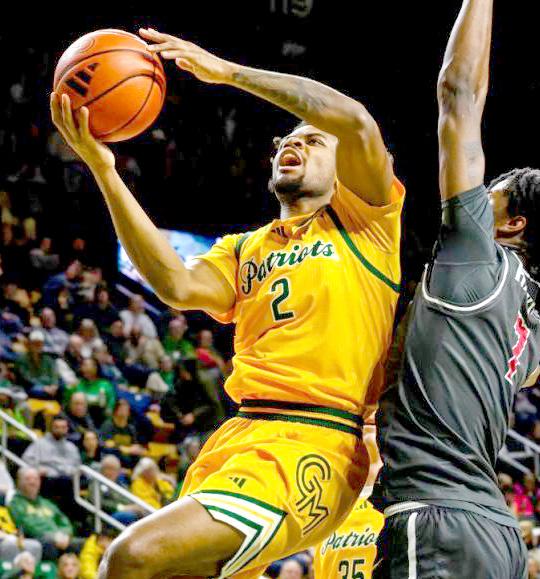
Another backcourt transfer has been landed for Wichita State men’s basketball, as former George Mason guard Jahari Long announced his commitment last Tuesday via his personal Instagram account.
Long, a 6-foot-5 senior, was reportedly pursued by Southern California, according to The Wichita Eagle.
But the Houston connection between Long, head coach Paul Mills and assistant coach PJ Couisnard perhaps outweighed the Power Four interest, as Long played for Couisnard’s AAU team, Cooz Elite. Wichita State also offered Long a scholarship while he was in high school, according to 247 Sports.
Long made previous stops at Seton Hall and Maryland before transferring to George Mason last year. He’s entering his seventh season of collegiate basketball and will have one year of eligibility remaining. Long played in five games at Seton Hall in 2021-22 and missed the entire 2024-25 season due to injuries.
With the recent addition of Jordan Frison out of the portal, the Shockers’ roster formation is a little clearer. Frison was a proven playmaker at Division II Pittsburg State, and Chattanooga.
Long fits a similar mold.
Coming off a career-year for the Patriots, Long averaged 12.2 points per game and shot 45.4% from the floor, 37.7% from 3-point range and 82.6% at the foul line. He grabbed 3.3 rebounds a game and dished out 4.0 assists on average, good for an eye-popping 2.26 assist-to-turnover ratio.
Wichita State’s backcourt is now full of veteran leadership. Long and Frison, a senior, join guard Mike Gray Jr., who also received a medical hardship waiver and announced he plans to stay a Shocker with his extra year of eligibility.
Mills can now deploy up to three proven shooters and playmakers on the court at the same time and relieve some pressure from Gray, who switched roles from an off-ball scorer at Nicholls State to Wichita State’s primary ball-handler for most of last season.
With Long’s commitment, the Shockers now have three roster spots available ahead of the 202627 season.
Photo courtesy of George Mason Athletics
Wichita State women’s tennis senior Theodora Chantava returns a ball during a singles match on April 11 at the Sheldon Coleman Tennis Complex in Wichita, Kan. File photo by Garima Thapa / The Sunflower Women’s tennis falls in conference title match
LETTER TO THE EDITOR
A COUNTRY THAT CAN’T DELIVER
USPS faces financial issues that affect everyone
Dear editor, Kansas continues to be one of the few states without a regulated medical cannabis program. Senate Bill 294, the Kansas Medical Cannabis Act, was introduced to address this gap by creating a system that would allow individuals with qualifying medical conditions to access cannabis under medical supervision. However, the bill remains stalled in the Senate Committee on Federal and State Affairs, with no clear path forward.
As graduate students studying social work and policy at Wichita State University, we have spent time examining this issue and engaging with legislators and advocacy organizations to better understand the factors influencing the bill’s lack of progress. Through this process, one thing has become clear: the conversation around medical cannabis in Kansas is complex, shaped by concerns related to public safety, medical efficacy and regulatory oversight.
Rather than viewing this issue as a simple yes-or-no debate, we believe it deserves thoughtful consideration and open discussion. Kansans benefit when policies are evaluated through a balanced lens that considers both potential risks and potential benefits.
Regardless of where individuals stand on this issue, greater transparency around the legislative process is important. Understanding why SB 294 remains stalled and what factors are influencing decision-making would allow for more informed public dialogue and civic engagement. We believe in the importance of policies that are informed, equitable and responsive to community needs. Continued discussion and evaluation of medical cannabis policy in Kansas is an important part of that process.
— Haley Golightley, Lameisha Gray and Amber Koehn Master of Social Work Students
LETTER TO THE EDITOR
The U.S. Postal Service delivering the mail for just over 250 years could soon be over due to the government’s arch nemesis — financial mismanagement.
Postmaster General David Steiner warned a House Oversight Committee that USPS is in a financial crisis. Within a year, USPS is projected to run out of cash to pay its workers and vendors.
“I am not sure that the American public is aware that the Postal Service is at a critical juncture,” Steiner said to NPR in March. “I know that I wasn’t aware of the extent of it before I took on this role, but at our current run rate and if we continue to pay our required obligations in the same manner as we have done in recent years, then we will be out of cash in less than 12 months.”
I have loosely kept up with the state of the postal service as the American Postal Workers’ Union has fought for fair labor contracts. These issues have long been present and are well documented.
The financial issues USPS faces stem from the Postal Reorganization Act of 1970,
which requires USPS to be largely self-sustaining, and its reliance on the monopoly it holds over letter deliveries.
In a world of privatized delivery companies like Amazon, FedEx and the United Parcel Service, along with most communication moving online, this financial model is causing USPS to bleed money.
The act creates barriers for USPS to access more funding from taxpayers. Letter delivery decreasing over time removed USPS’s monopoly value over letter delivery.
The success of privatized delivery companies has led many to argue that USPS should adopt a similar structure to remedy the issues it faces.
But, privatizing USPS ignores its value as a public service, not a profit-driven entity aiming to increase shareholder value.
Steiner’s comments are not completely without merit, but his time on FedEx’s board of from 2009 to 2025 raises questions about his impartiality. Someone with Steiner’s past suggesting a fix to USPS’s problems feels like a wolf shepherding a flock of sheep.
As I said above, privatizing the postal service would shift the focus to its priorities. Steiner’s main request to Congress is to raise the amount of debt that USPS can take on, which
currently sits at $15 billion. To use Steiner’s former employer as an example, FedEx’s debt currently sits around $42 billion. If that were to increase and become unsustainable, FedEx has options not available to the USPS, such as seeking more investment.
It may sound like I just made a great argument for why the USPS should do this, but only if you ignore this model’s main priority of continuous financial growth to please shareholders.
Currently, the USPS operates on a universal service obligation to provide every address in the U.S. with mail services. Private companies can choose not to serve rural areas that depend on mail services if it negatively affects shareholder value.
The universality allows for necessary goods like medicine to be accessible, especially for people in rural communities.
Veterans get 84% of their medications through the mail, and one-fourth of them live in rural areas.
Research from the Brookings Institution shows rural communities with a post office see greater economic benefits than those without. If USPS is privatized, it could create higher costs to service these areas, which would harm people who need those services.
Private delivery companies
implement area surcharges to 62% of U.S. zip codes, as well as other additional fees that are piled on.
Privatization also negatively affects workers, as research has shown that increasing concentrated ownership through investments negatively impacts the employment and wages of workers.
Postal workers often secure better wages thanks to fewer de-unionization effects than exist in the private sector. 38.7% of private sector workers with bachelor’s degrees earn under $15 an hour, as opposed to 8.9% for postal workers.
I can understand the desire to make services more efficient and attempt to reduce costs at a time when the Postal Service is struggling to handle its finances. However, these efforts have to place the USPS as public service first and foremost.
It is tempting to think that profitability would allow the USPS to remedy its issues and possibly grow. I do not believe this outcome is realistic. It would simply increase the cost of a necessary service that most Americans rely on and view favorably.
It may be shocking to hear, but some things provide societal value regardless of whether they make money from their services.
Dear editor,
While the legislative session has come to an end for the year in Kansas, safety for children has not.
Kansans want students to get the absolute most out of their education. I mean, who doesn’t?
Now, consider this: how can they do that if they are being sexually abused at home? By another family member? Earlier in the year, House Bill 2576, otherwise known as Erin’s Law, was proposed once again in Kansas.
Following the trend of previous years, this piece of legislation was introduced, but not passed. If we want children to get the most out of their education, we must consider what is going on outside their school life, or sometimes what is mingled in with it. Erin’s Law is a bill that can help target this by providing age-appropriate child abuse education to students and educators.
I ask you to look into Erin’s Law. It has been passed in 38 out of 50 states, and Kansas is not yet one of them.
I sincerely urge all readers to reach out to the representatives that you are constituents of and remind them how important this is. Maybe then, next year, Kansas can finally join the other 38 states that have helped keep children safe.
— Alyssa Wedlock Master of Social
Work Candidate
This has not been an easy year for the American aviation industry, which isn’t a new sentiment.
As Wichitans, we are intimately familiar with this issue. Our city is often referred to as the “Air Capital of the World,” a nod to its historic leadership in aviation manufacturing. Aviation is a major source of jobs in Wichita, with Spirit AeroSystems — Wichita’s top employer — employing 13,000 people alone.
The industry at large has faced increased scrutiny as of late due to several shortcomings, such as extended wait times in airports after temporary funding for the Department of Homeland Security expired in February, leading to the majority of Transportation Security Administration and U.S. Customs and Border Protection employees to work without pay, and some to quit.
On March 23, ICE agents were deployed to 14 U.S. airports to aid in managing delays. Since then, a number of those airports have seen a complete withdrawal of agents as the need for them has decreased.
The ICE agents assigned to airports are not fulfilling the specialized tasks that TSA is trained to do. The majority of their security tasks are simpler tasks
that save time for TSA agents and only require a brief training — like checking IDs, helping with crowd control and security.
But, going beyond the specialized training for the role, there is a difference in trust that TSA holds versus ICE. How effective can a group tasked mainly with crowd-control responsibilities be if the crowd is unsettled by its presence?
Kansas TSA agent Amy Streit said she’s concerned about the atmosphere and security in airports with ICE deployment.
Streit works at a small regional airport in Hays, KS. There are two commercial flights through United Airlines that she and her colleagues serve as security for.
Neither the Hays airport nor Wichita’s Eisenhower had ICE directed to them.
“I can’t really comment where I haven’t seen it in person, but I myself wouldn’t feel comfortable with ICE being present in our airport,” Streit said. “With other ICE-involved situations lately, I don’t think they bring a feeling of comfort or safety.”
Within the Wichita community and across the country ,we have seen pushback to ICE operations.
On April 1, the Shocker Organization for LGBTQIA+ Research and Advocacy held a vigil for the victims of ICE-related violence.
Earlier on March 28, people around the country came out for the third round of national “No Kings” protests. In Wichita
alone, over 3,500 people attended marches and rallies to reject various actions of the current administration, with many signs and chants featuring anti-ICE messaging.
ICE deployment to airports cannot make up for TSA staff shortages, nor does it imbue a sense of security in airport employees or travelers. The whole action feels like a poorly sized band-aid to an industry that needs impactful reinforcement.
President Donald Trump signed an executive order for TSA employees to begin receiving back pay on March 27, four days after ICE agents were deployed.
Streit noted that the relief of the first portion of back-pay does not outweigh long-term concerns.
“I think there have been several decent ways to fund [TSA] proposed, and they have been denied or rejected as more of a political statement or withholding to get what each side wants,” Streit said.
Her airport, due to its smaller size, has seen fewer changes than larger airports that are burdened with heavier workloads. This does not mean it has gone untouched.
“You can tell everyone has been more stressed out. Luckily, it has not affected our staffing. We haven’t lost any employees or had a big increase of call-ins,” Streit said.
A majority of their employees are married or part-time, Streit said, allowing them other avenues of income in the pay lapse.
Unfortunately, this is not a shared experience for much of TSA. TSA has lost more than 460 employees since February. Many employees are unable to go to work, instead having to seek work elsewhere to pay bills and everyday costs that cannot rely on paychecks with no effective date. On top of TSA shouldering the cost, many travelers are facing extended wait times due to low staffing. CNN currently runs a live tracker monitoring wait times in select major airports. This situation will not go away overnight. If the Department of Homeland Security were to be funded tomorrow, we would still expect delays due to mass departures from TSA. And if all of those jobs were to be replaced? Those trainees could hardly be expected to meet the same level of competency their predecessors had held right away. With the state of TSA at the moment and the broader aviation industry, it may be some time before we see meaningful change. TSA agents and other airport staff have faced criticism due to conditions largely outside of their control, and I believe that is incredibly unfortunate. It is important when issues like this arise to not just acknowledge it is happening but be aware of why. However I urge you not to forget the very real and integral people who ensure that life can continue running on the ground and in the air.
Illustration by Savanna Nichols / The Sunflower
ARTS & CULTURE
Spectrum celebrates queer joy at annual pride prom, despite DEI rollbacks
BY DARREK BISHOP & MALEAH EVANS
darrekbishop07@gmail.com & arts@thesunflower.com
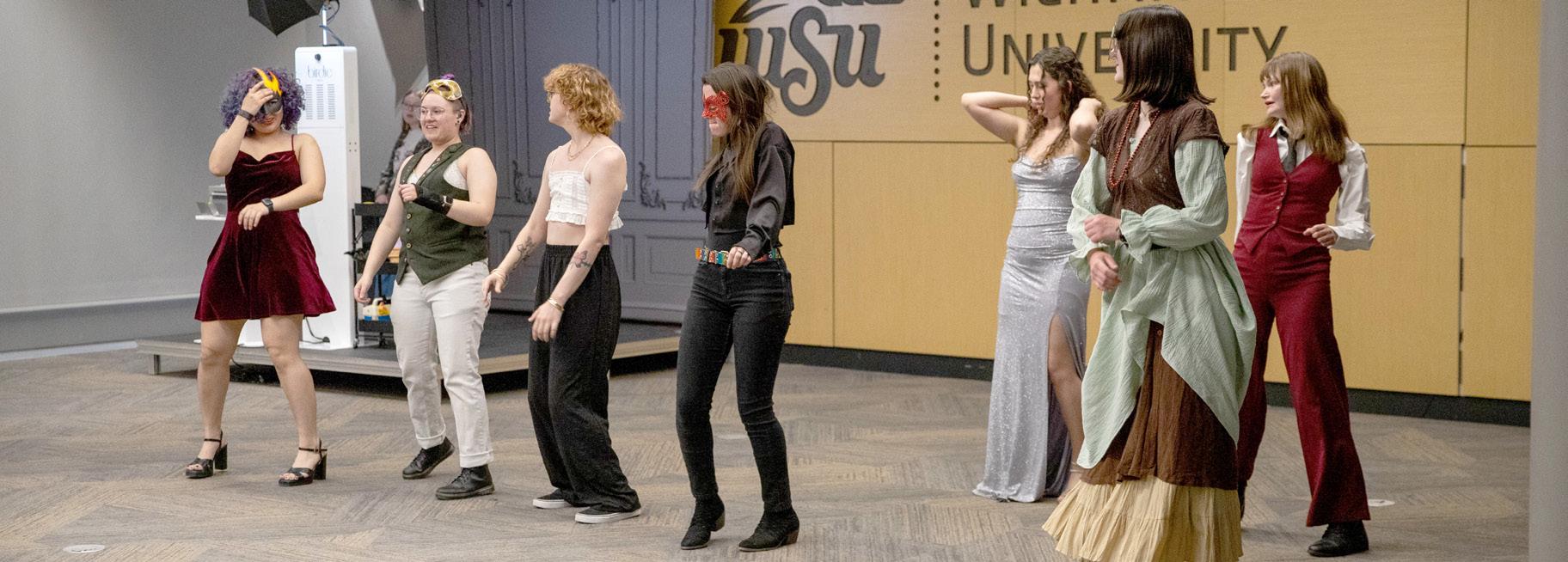
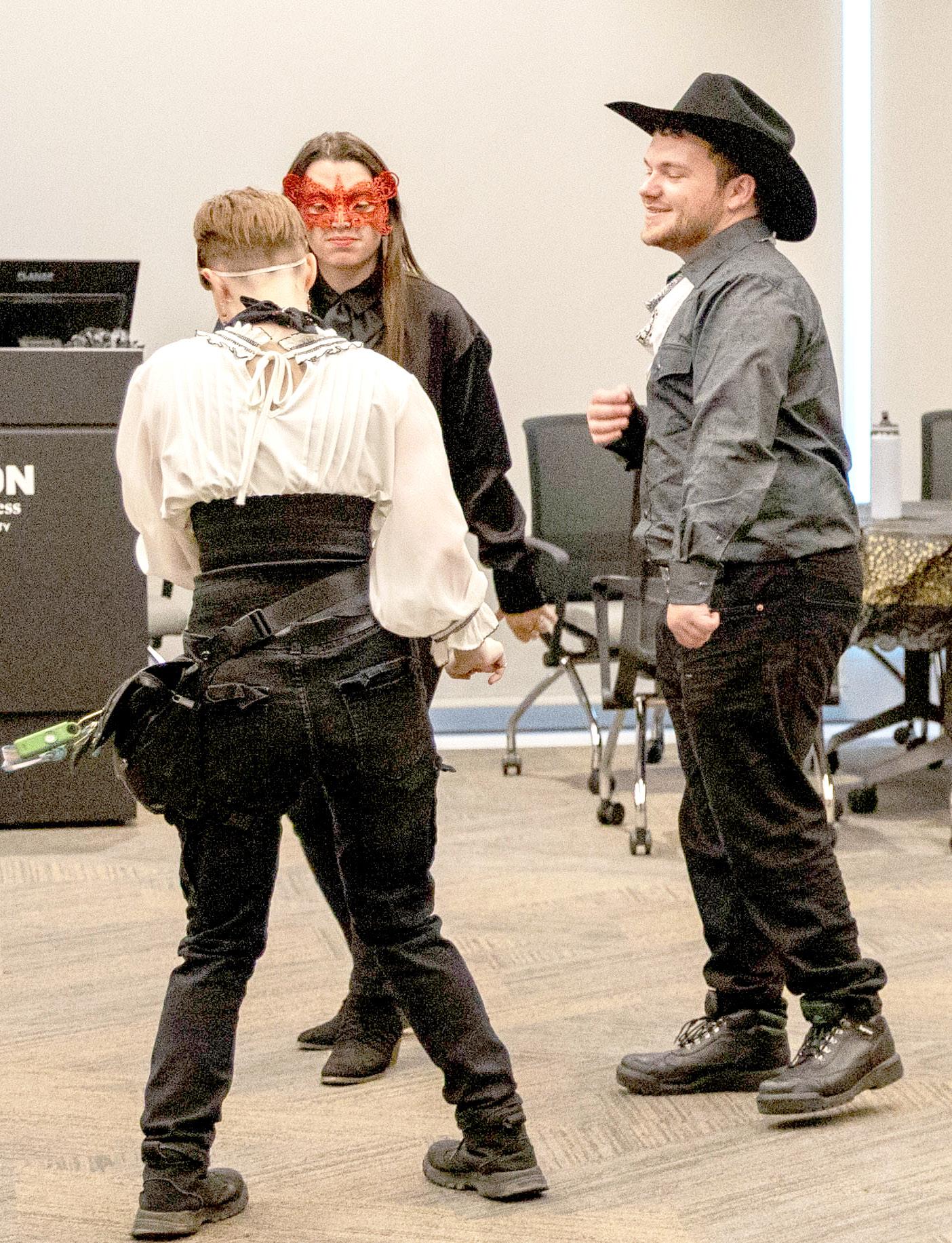
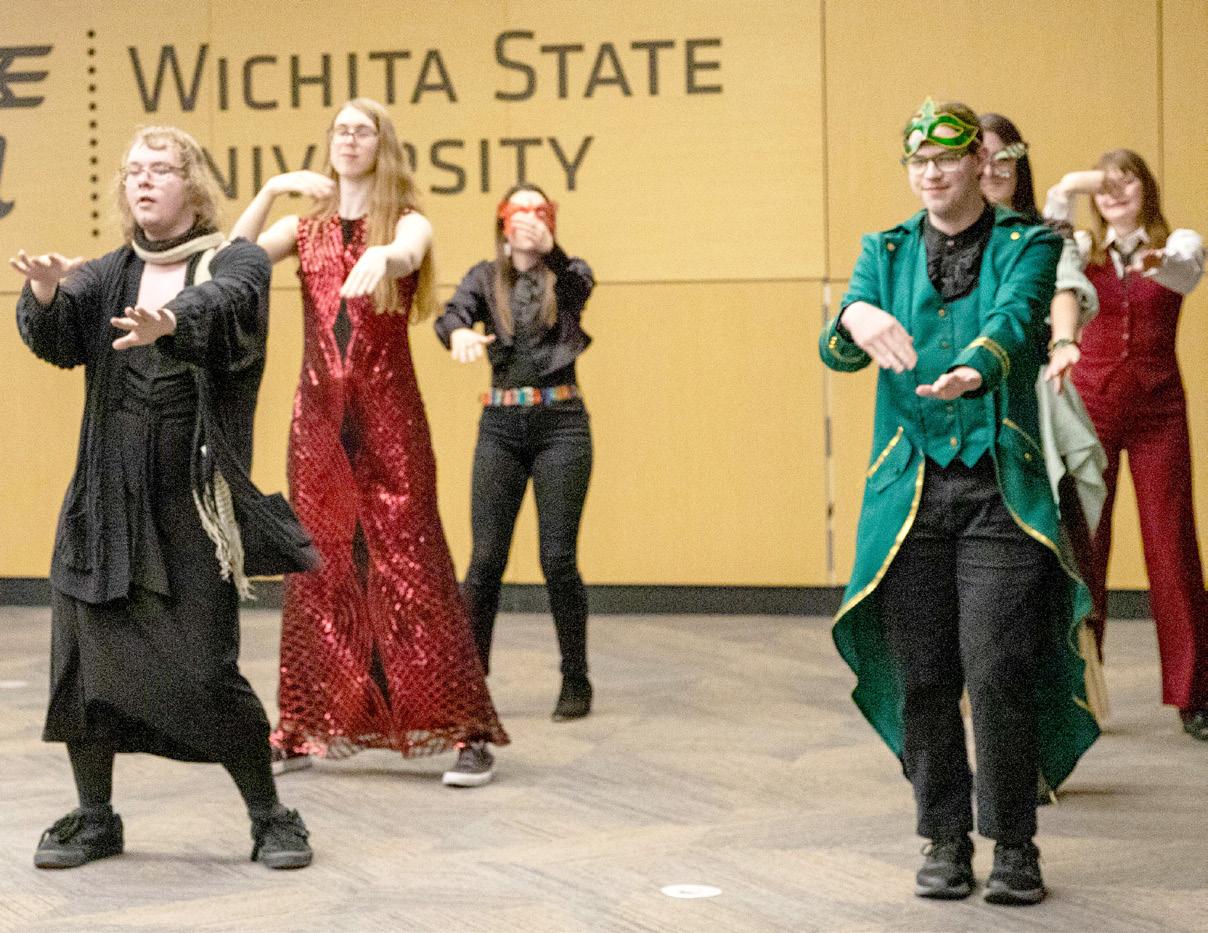
Students donned masks and fantastical attire to dance and chat with friends at Spectrum’s annual Pride Prom on April 18. This year’s theme was “Captured by the Fae,” and the dance was held in the Fidelity Bank ballroom in Woolsey Hall.
Spectrum is an organization for LGBTQ students and allies at Wichita State. It holds the prom for anyone to eat, dance and celebrate “queer and trans love and joy,” according to the event description.
“It’s a fun event, everyone likes fun events,” said Tauren Engle, a WSU student studying mechanical engineering. “There aren’t many spaces like this.”
Spectrum began planning at the start of the semester, with a committee of executive board and general members working to organize it.
“I would say it’s fairly straightforward … my brain works really well with event planning,” said Moe Hatfield, a sophomore ambassador for Spectrum. “The most difficult part is when you really have to make a decision, and there’s just too many opinions from everyone on the committee, like deciding (the) theme.”
Hatfield said the number of people who attend the events depends on the overlap with other
events and how well-advertised they are.
“Last year, we got somewhere between 60 to 70 people,” Hatfield said.
Despite recent restrictions on diversity, equity and inclusion initiatives at public universities,
Spectrum still held the Pride Prom as a way to create a space for LGBTQ students and allies to celebrate joy.
The Student Government Association recently changed how Spectrum and other organizations are classified and receive funding.
Spectrum used to be an SGA agency, funded directly from the student body president’s budget with staff support from the Office of Student Engagement and Belonging. This model was dissolved due to conflicts with state DEI policy after the Kansas State Finance Council designated student governments quasi-governmental, meaning they must follow state regulations like the ones eliminating DEI.
Now, Spectrum and other agencies are considered student organizations, getting their funding from a different pool. The change in designation means the agencies are no longer part of SGA and don’t have to follow state regulations.
With these recent shifts, Hatfield said not much has changed for Spectrum operationally, just a reclassification from being an agency to a recognized student
organization.
“That has had both positives and negatives,” they said. “The biggest internal change is that we no longer have to have an adviser that works in the Student Engagement and Belonging office. Since we’re not connected to any university office, we have more freedom in some of the stuff we can do, previously because of our connections … (we were) limited on some of the things we could be outwardly vocal about.
“We’re able to be more open about things as an organization and not just as individual students.”
Hatfield said they and others wished the university would be more vocal about the operational and organizational changes that are being made.
Despite uncertainties about the changes at the university, state and federal levels, Spectrum still aims to fulfill its mission of inclusivity and creating a safe space for LGBTQ students to exist, members said.
“A lot of people try to make those spaces, but it can get difficult sometimes,” Engle said. “The community tries (its) best to make these sorts of spaces for everyone.”
Attendees like Engle felt like it was a “nice place for queer and allies to come out and have fun.”
Hatfield said next year is the 50th anniversary of having a queer and trans organization on campus, and so the group has begun planning to celebrate that milestone.
‘Time Stands Still’ to come to campus, exploring life after war
BY DESTINY REICHER destinyereicher@gmail.com
Wichita State University’s School of Performing Arts will bring a thought-provoking drama to the stage starting this week with its production of “Time Stands Still.”
Written by Pulitzer Prize winner Donald Margulies, the play is set in a Brooklyn apartment and follows photojournalist Sarah and her partner James, a foreign correspondent, who are attempting to heal and settle back into domestic life after returning home from covering a war. As they try to readjust to everyday life, their relationship is tested.
The play explores the emotional toll of witnessing violence and its lasting impact, as well as the strain it places on personal relationships.
The story ultimately leaves audiences questioning what they owe to the world versus what they owe to themselves.
The production is directed by Sheldon Mba, an actor, dancer and
choreographer who has worked with companies across the country and has been featured at the National Black Theater Festival, the American Dance Festival and on many other projects.
“Set within the highstakes worlds of journalism and humanitarian work, this production exposes how ambition can fuel purpose while fracturing relationships and ethical boundaries along the way,” Mba said according to a press release. “... As characters press forward, the play asks who catches the fallout of that ambition and what the human capacity for resilience truly costs those left in its wake.”
Performances will take place April 22-26 at 7:30 p.m., with matinee performances at 2 p.m. on April 25 and 26.
The April 25 matinee will include ASL interpreters.
The production will be held in the Welsbacher Theater, located inside the Hughes Metroplex at 29th Street and Oliver. Entrance to the theatre is through Door F, and late admittance will not be permitted.
Tickets range from $12 to $20, with limited seating available.
WSU students can receive one free ticket with a valid student ID by visiting the Fine Arts Box Office in Duerksen Fine Arts Center.
PREVIEW
Wichita Jazz Festival to start this week to celebrate the history of jazz
BY MALEAH EVANS arts@thesunflower.com
Wichita’s annual jazz festival is kicking off this week, with jazz performances from various local and national musicians at venues across the city.
The festival has been part of Wichita culture since 1972. Part of the festival will take place at Wichita State and includes performances from WSU students and faculty in the WSU Jazz Invitational.
The invitational brings middle and high school students from across Kansas to WSU to participate in educational clinicals led by industry professionals. There will also be student performances and a headline concert.
This year, the WSU’s Jazz Arts 1 Ensemble and the Mid-Kansas Jazz Ensemble will be performing with Nick Finzer, who is known as “the most dynamic and forward-thinking trombonists of his generation,” according to the Wichita Jazz Festival. More information and details about the performances can be found on the website. Ticket pricing and location vary.
FESTIVAL PERFORMANCES
Locations and performers
n April 22: At Walkers Jazz Lounge, the Stan Kessler Quartet with Kessler on trumpet, Jeff Harshbarger on bass, John Kizilarmut on percussion and Brant Jester on piano.
n April 23: Performance by the KC Connection Quintet at the Wichita Art Museum. Jeff Harshbarger on bass, Rod Fleeman on guitar, Matt Otto on saxophone, Brain Steever on drums and Roger Wilder on piano.
n April 24: In Miller Concert Hall, Nick Finzer with the Jazz Arts 1 Ensemble and Mid-Kansas Jazz Ensemble.
n April 24: At WAVE downtown, Kelley Hunt, described as a “full-blown phenomenon,” by the Minneapolis Star-Tribune.
Times At all performances, doors open at 6:30 p.m. and the shows starts at 7:30 p.m.
A group of students dance together at the annual Pride Prom hosted by Spectrum on April 17. This year’s theme was “Captured by the Fae.” Photos by Darrek Bishop / The Sunflower
Students dressed on theme for the annual Spectrum Pride Prom line dance on April 17.
Various attendees to the annual Spectrum Pride Prom dance to the “Macarena.” This year’s prom theme was “Captured by the Fae.”
Photo courtesy of School of Performing Arts.
SHOCKER STREETS
LEADERSHIP
Come
INTELLECTUAL
Learn
‘TIME
PIZZA AND POLITICS
Thursday, April 23
12:30 p.m.
Lindquist Hall, Room 417
Join a discussion lead by Professor Dinorah Azpuru on regime change in Latin America and beyond. Pizza and refreshments will be provided for students who attend.
END OF YEAR BLOCK PARTY
Thursday, April 23
4 - 6 p.m.
Rhatigan Student Center, North Patio
Celebrate the end of the semester with a block party hosted by the Office of Student Engagement and Belonging. Enjoy refreshments, music, games, crafts and free gifts.
JAPAN FESTIVAL
Friday, April 24
12:30 - 4 p.m.
Rhatigan Student Center, Second Floor
Come to the annual Japan Festival to celebrate Japanese culture with presentations, artist booths and more. The winners of the Haiku contest will be announced at 3:30 p.m.
BASEBALL VS. RICE
Friday, April 24 - Sunday, April 26
Times Vary Eck Stadium
Support the Shocker baseball team as they take on Rice in conference play. The first 700 fans through the gates on Friday will receive a special WSU football jersey.
WSU JAZZ INVITATIONAL
Friday, April 24
All Day
Duerksen Fine Arts Center
Listen to performances from jazz musicians from around the region, educational clinics and a headline concert from a guest artist and WSU’s ensembles.
VOLUNTEER WITH THE ART PARK Saturday, April 25
9 - 11 a.m.
JAZZ
7:30 p.m.
Walker’s
HAVE
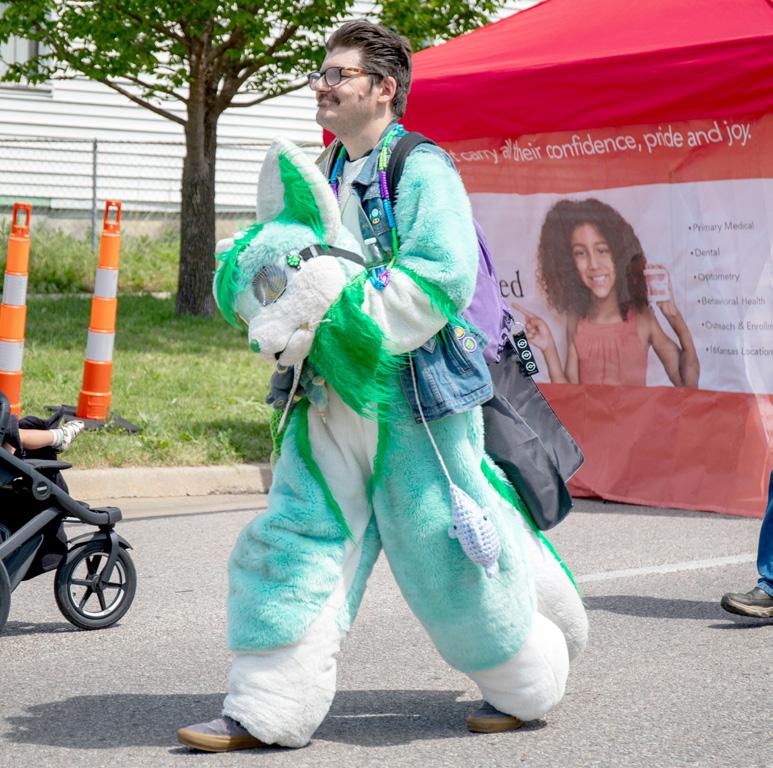
Two children blow bubbles at Open Streets ICT - WSU and Shocker Neighborhood on April 19. The event took over 17th Street between Volustia and Oliver from noon to 4 p.m. Photos by Peyton Eck / The Sunflower
Monty Mint the Peppermint Cat prowls the block at Open Streets ICT on April 19. Mint was created by Owen Marshall.
A child plays cornhole at Open Streets on April 19. Many of the vendors brought outdoor games.