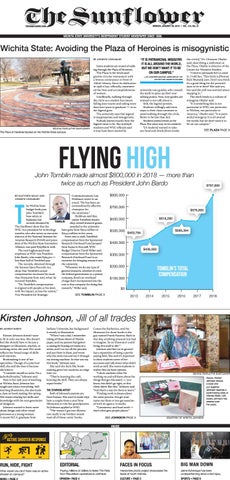
MONDAY, JANUARY 28, 2019 • VOL. 123, ISS. 31
THESUNFLOWER.COM
WICHITA STATE UNIVERSITY’S INDEPENDENT STUDENT NEWSPAPER SINCE 1896.
Wichita State: Avoiding the Plaza of Heroines is misogynistic BY ANDREW LINNABARY
SELENA FAVELA/THE SUNFLOWER
The Plaza of Heroines located on the Wichita State campus.
Some students are scared of walking through the Plaza of Heroines. The Plaza is the brick-andgranite circular monument with a bronze centerpiece in front of Ablah Library. Since its dedication in 1998 it has, officially, represented the lives and accomplishments of women. Unofficially, walking through the circle as a student has meant failing your exams and taking more than four years to graduate — or so the legend goes. The university says that legend is inappropriate and misogynistic. Nobody knows exactly how the legend came to be. But multiple students and WSU officials said it may have been started by
“IT IS PATRIARCHAL MISOGYNY. IT IS ALL AROUND THE WORLD, BUT WE DON’T WANT IT TO BE ON OUR CAMPUS.” —DR. CHINYERE OKAFOR, DIRECTOR OF THE CENTER FOR WOMEN’S STUDIES
university tour guides, who created the myth to spice up their tour talking points. Now, tour guides are trained to not talk about it. Still, the legend persists. Students willingly add extra steps to their class commute to avoid walking through the circle. Better to be late than fail. Students attend events at the Plaza. But some stay on its outskirts. “[A student] wanted to take our food and drink [from inside
the circle],” Dr. Chinyere Okafor said, describing a 2018 event at the Plaza. Okafor is director of the Center for Women’s Studies. “I tried to persuade her to come in. I told her, ‘This brick is [Provost Rick Muma’s] aunt. Don’t you think it’s a good thing for the provost’s aunt to be in here? She said yes, but said she still was worried about stepping in.” The myth lends to a culture of misogyny, Okafor said. “It is something that is not particular to WSU, not particular to Wichita, not particular to America,” Okafor said. “It is patriarchal misogyny. It is all around the world, but we don’t want it to be on our campus.”
SEE PLAZA PAGE 3
Flying High
John Tomblin made almost $800,000 in 2018 — more than twice as much as President John Bardo Communications Lou Heldman wrote in an email. “He has been an he Wichita State extraordinarily effective budget book puts champion for John Tomblin’s the university.” base salary at Heldman said that, $358,000, but under Tomblin’s leaderTOMBLIN records obtained by ship, overall research grants The Sunflower show that the awarded to the university WSU vice president for technology have gone from $50.5 million to transfer, who also serves as executive $104.5 million in five years. director of the National Institute for From 2017 to 2018, Tomblin’s Aviation Research (NIAR) and presi- compensation from the Sponsored dent of the Wichita State Innovation Research Overhead Fund jumped Alliance, was paid $797,869 in 2018. from $4,641 to $152,508. WSU The next highest-paid state Budget Director David Miller said employee at WSU was President compensation from the Sponsored John Bardo, who made $364,322 — Research Overhead Fund is an less than half of Tomblin’s pay. incentive for bringing research into The records, obtained through the university. the Kansas Open Records Act, “Whenever we do any type of show that Tomblin’s actual general research, whether it’s with compensation increased by more the federal government or a private than $200,000 from 2017, when he company, there’s an overhead received $576,800. charge that’s incorporated into the “Dr. Tomblin’s compensation cost to that company for doing that is aligned with people at his level, research,” Miller said. with his impact, across the nation,” Vice President for Strategic SEE TOMBLIN PAGE 3 BY MATTHEW KELLY AND ANDREW LINNABARY
T
$797,869
$800,000 $700,000
$576,800
$600,000 $500,000
$518,290 $585,394
$403,784
$400,000 $426,550
$300,000 $200,000
tomblin’s total compensation
$100,000 $0 2013
2014
2015
2016
2017
2018
Kirsten Johnson, Jill of all trades BY AUDREY KORTE
Kirsten Johnson doesn’t want to fit in only one box. She doesn’t feel she should have to be just a designer or illustrator, teacher, or working artist, she said. Her work reflects her broad range of skills and interests. Bookmaking is one of her specialties. Though it’s a practical skill, she said she does it because she loves it. “I consider myself an artist. I’m a jack-of-all-trades,” Johnson said. Now in her 35th year of teaching at Wichita State, Johnson has taught just about everything. Still teaching illustration, she also leads a class on book making this spring. She enjoys sharing her skills and knowledge with the next generation of designers. Johnson wanted to learn more about design and other visual processes as a young woman. A recent M.F.A. graduate from
Indiana University, her background is mostly in illustration. “When I was a kid, I remember taking all these sheets of Manila paper, and my parents had gotten a catalog for buying art books in a series, and I cut out all the pictures and put them in there, and wrote who the artist was and ran it through my sewing machine. So that was my first book,” Johnson said. She said she feels like bookmaking gives her students an edge later on. “They’re learning the craft, learning the skill. They can always repair books.” THE STARVING ARTIST
Both of Johnson’s parents are from Kansas. She used to make trips here a couple times a year from Minnesota to visit her grandparents. So Johnson applied at WSU. “The reason I got into illustration really is my brother would read all of these comic books,
Conan the Barbarian, and the illustrator for those books is the guy named Frank Frazetta. Back in that day, anything unusual you had to imagine. So an illustrator could bring this stuff to life.” Johnson said fine art in general has a reputation of being a poorly paying field. She said it’s important to show students some of her successes and talk about what didn’t work as well. She wants students to realize they do have options. “I show students what I’m working on and tell them about the things that get discussed. — you know, this didn’t go right, or this client didn’t like this,” Johnson said. “And that’s a way for them to learn.” “Finding work is always about the same process. You get your name out there or you get associated with an agency or studio. “Consistency and hard work — that’s what gets people places.” SEE JOHNSON PAGE 3
SELENA FAVELA/THE SUNFLOWER
Above, Kirsten Johnson shows a book she put together. Johnson teaches a bookmaking class at Wichita State. Left, books Johnson has created over the years.
COURTESY OF KIRSTEN JOHNSON
INSIDE
active shooter response A M E N D M E N T
run • Evacuate the area • Have an escape route(s) in mind • Don’t worry about going into restricted areas, any exit will do • If you can safely escape, do so quickly • If you can help others escape, do so quickly • Do not try to escape through the area where the active shooter may cross your path • Leave your belongings behind • Keep your hands visible • Don’t give aid to wounded • Follow police instructions
hide • Get out of shooter’s view • Provide coverage or protection if possible • Do not trap or restrict your movement • Lock the door • Barricade the door (most doors open inward) • Take a quick inventory to see what you can use to jam the door if barricading is not possible • Turn off cell phone ringers • Stay quiet
fight • When your options of running or hiding are gone, attacking the shooter becomes a reality • Throw things at the shooter or use objects to disrupt or incapacitate the shooter when practical • Pre-plan if there is more than one of you and commit to your actions • Fight for your life - it could well come down to you or the shooter
EDITORIAL
FACES IN FOCUS
BIG MAN DOWN
What would you do if there was an active shooter on campus?
Paying millions of dollars to lease The Flats from Republican operatives is unethical.
Horizontes photo project showcases the faces of North Wichita.
Jaime Echenique has been underperforming since a foot injury.
NEWS • PAGE 2
OPINION• PAGE 4
CULTURE • PAGE 5
SPORTS • PAGE 6
RUN, HIDE, FIGHT
NEWS
2 | MONDAY, JAN. 28, 2019
www.thesunflower.com
www.thesunflower.com
THE STAFF EDITORIAL
Editor in Chief Matthew Kelly Digital Managing Editor Andrew Linnabary Visual Managing Editor Madeline Deabler Culture Editor John Darr Opinion Editor Austin May Sports Editor Evan Pflugradt Photo Editor Selena Favela Sports Photo Editor Joseph Barringhaus
ADVERTISING
Advertising Manager Kylie Cameron
ADVISING
Faculty Adviser Amy DeVault
LETTERS TO THE EDITOR
Send letters to the editor to editor@thesunflower.com or submit at thesunflower.com. Please keep letters to 400 words or less. All letters are edited for clarity and length. Please include your name, WSU affiliation and a phone number for verification purposes.
Our Mission
The Sunflower — both in print and online — will be a timely resource of information about the Wichita State University community. It will report on news, issues, activities, academics and athletics, in addition to offering a forum for discussion, reviews and commentary. It will also be an effective learnig experience for students, who will have the final authority over what is published.
Legal
The Sunflower (published for use by WSU students, faculty and staff) is private property and unlawful removal or use of papers is prosecutable. One copy may be taken for free. Additional copies must be purchased for $1 each. The Sunflower is also partially funded by the Student Government Association at WSU. The opinions expressed in The Sunflower editorials, columns, guest columns, reviews, advertisements, letters and editorial cartoons are not necessarily those of the staff, publications board, student body or university. The Sunflower reserves the right to edit or reject any submission. We also reserve the right to edit or reject any advertisement.
CONTACT THE SUNFLOWER 019 Elliott Hall 1845 N. Fairmount Ave. Campus Box 134 Wichita, KS 67260-0134 ----------
SUNFLOWER OFFICES Front Desk: 316-978-3640 ADVERTISING Kylie Cameron: 316-978-6906 admanager@thesunflower.com EDITORIAL Matthew Kelly: 316-978-6905 editor@thesunflower.com ADVISER Amy DeVault: 316-978-6052 amy.devault@wichita.edu ---------ONLINE www.thesunflower.com FACEBOOK www.facebook.com/sunflowerwsu TWITTER @sunflowernews INSTAGRAM @thesunflowernews
First Amendment
Congress shall make no law respecting an establishment of religion, or prohibiting the free exercise thereof; or abridging the freedom of speech, or of the press; or the right of the people peaceably to assemble, and to petition the Government for a redress of grievances.
CORRECTIONS This space is reserved for corrections. Spot an error? Call us at 316-978-6905.
Wichita State Police Department talks active shooter preparation BY AUDREY KORTE
“B
reaking news. Active shooter at Wichita State.” The words strike fear in the hearts of students across campus. It’s too horrible to imagine. But preparation requires just that. Most college students don’t remember a time when mass shootings weren’t repeatedly shown in the news. The current generation of college aged students may not remember Columbine — most remember Virginia Tech, Parkland, and Santa Fe. If there was an active shooter on campus, WSU has an Emergency Operations Plan that’s “designed to enable faculty, staff and students to successfully cope with campus critical incidents, crises and catastrophes events.” Chief Rodney Clark and Capt. Cory Herl of the WSU Police Department recently sat down with The Sunflower to discuss active shooter preparations and training at WSU. One of the things Clark wanted to stress is that any response to an active shooter has to be flexible. Active shooter situations are fluid and dynamic. No two are alike. It’s difficult to plan ahead. “That presupposes the idea that if there is an active shooter, you should do step one, step three, and step five. All active shooters are going to be different,” Clark said. “Professors or other people might be well-intentioned in saying, ‘We’re gonna do this,’ but it’s an old military axiom that no plan survives first contact and if you don’t have that mindset — if you have the mindset that you think, ‘I’m going to defeat this because I have a plan,’ you may or may not be correct.” However, you should still think about active shooters on campus before you’re faced with one, Clark said. Three responses to active shooters are taught nationwide, including at WSU. They’re simple, but not easy. First, run. Get away from the shooter as fast as possible. Second, hide. Use anything available that will provide some cover from a shooter or shooters. Third, fight. This is recommended when options one and two are no longer feasible “Those are pretty much your three options. If you’re inside a
building where the shooting is not taking place, my advice is to shelter in place in that building,” Clark said. “That’s part of the hiding. Hiding doesn’t just mean hiding. It also means securing yourself.” Most walls don’t offer protection. They won’t stop bullets, but walls and doors influence where the shooter goes and where they fire. Clark said most shooters take the path of least resistance. If they can’t get you, they’ll move on. That’s where barricades become useful. “You can start piling up things in front of the door to make a door secure, so if the shooter tries to open it, they can’t, so there are preventative actions you can take,” Clark said. If calling 911, what information can you give to make law enforcement’s job easier? “A description of the shooter, if you’re calm enough,” Herl said. “Where they are. What type of weapon you think it is — is it a shotgun, a rifle, a pistol? Are there multiple actors? Anything you see as an eyewitness is helpful information. “Since we started teaching this, something that we have pushed is to give yourself options. Think about your options beforehand but don’t just hold solid to one thing. If that one thing fails, don’t just throw up your hands and give up.” Fighting is your toughest option. Nobody wants to go one-on-one with an armed attacker, but it has been effective in the past. “I would never suggest that everyone try to fight back because that might not be your forte, but if it’s between your life and someone else’s life, that’s very much a reality that it could come down to that,” Clark said. After police dispatch takes a call reporting an active shooter, they’ll put out a campus alert with the Rave Guardian personal safety app. Emergency alerts can come from Wichita Police Department or university administrators. Clark said most go through the police department because they’re crime-related. “If there was some kind of emergency, there are other people who could activate it, but we have it down in our dispatch center,” Clark said. The Wichita Police Department has dispatchers on campus in addition to officers. If you call for help during a campus emergency, you’re
HOW TO RESPOND WHEN LAW ENFORCEMENT ARRIVES
She’s taking over as the EBC for the Ablah Library this month. Williams says the EBC’s job is Information to provide to law to provide a point of contact if enforcement or 911 operator: there is an emergency. Their • Location of the active shooter focus is on what needs to • Number of shooters, if more than one happen to keep people as safe as possible. • Physical description of shooter/s Williams has seen the campus alert system being • Number and type of weapons held tested at the library. by the shooter/s “It takes over our computer • Number of potential victims screens, so whatever I’m doing, at the location it’s not going to look like that The first officers to arrive to the scene anymore,” Williams said. “It’s will not stop to help injured persons. going to display whatever Once you have reached a safe location message they (the police) want or an assembly point, you will likely be me to see. It’s not a pop-up window. It’s the entire screen held in that area by law enforcement until the situation is under control, that changes.” and all witnesses have been identified If you don’t have the Rave and questioned. Do not leave until Guardian app, Herl said you might law enforcement authorities have be at a disadvantage in a crisis. instructed you to do so. “The only way to get an alert if you don’t have the Law enforcement’s purpose is to stop the active shooter as soon as Rave Guardian app is to get it possible. Officers will proceed directly through your email, or if you’re to the area in which the last shots on a university network with were heard. your computer, it flashes over your computer and the uni• Officers may be armed with rifles, versity television that displays shotguns, handguns information like at the RSC and • Officers may use pepper spray or Ahlberg Hall.” tear gas to control the situation If you have the Rave • Officers may shout commands, and Guardian app on your phone may push individuals to the ground for you can expect to be provided their safety with as much detailed information about the shooting and its HOW TO REACT WHEN LAW location as is available. ENFORCEMENT ARRIVES “If we know the location, • Remain calm, and follow officers’ we’re going to try to give the instructions location — that it’s in such and such building or in an outdoor • Put down any items in your hands (i.e., bags, jackets) location in a certain section of campus,” Clark said. “There • Immediately raise hands and could be something that comes spread fingers out that says, ‘Shelter in place • Keep hands visible at all times right now. Await further instructions.’ I mean, we’re allowed • Avoid making quick movements to type anything that we find toward officers such as holding on to relevant at the time. If there’s them for safety gunshots ringing out, we’ll try to • Avoid pointing, screaming triangulate — figure out where and/or yelling the person is at.” There is currently no mandatory active shooter training for talking to operators in the faculty and staff at WSU. basement of the police station. “There’s nothing that is “It’s manned all the time,” mandatory, but active threat Clark said. training is available,” Herl said. Meanwhile, police officers “We’ve been doing that since will investigate the call. 2013. HR’s training division “We’d get in there as quickly helps us, and they track that. as we could with an armed I think we’ve done 80 sessions response to try and neutralize and somewhere around 1,400 or the threat and send a message 1,500 people have gone through at the same time — to shelter in the training.” place,” Clark said. Faculty, staff, and student Ginger Williams, associate employees can access voluntary dean for academic engagement active threat training through and public services and assisthe MyWSU website tant professor, recently complet“I don’t know if you can maned the training for Emergency date training for something like Building Coordinators (EBC). this. As a police chief, I can’t.”
NEWS
www.thesunflower.com
PLAZA
MONDAY, JAN. 28, 2019
|3
“IT’S A NICE PLACE — BUT STILL, I’M SCARED.”
FROM PAGE 1 In the span of a few minutes on Friday afternoon, in mid-30s weather, eight out of 10 students walked around the circle. “Better safe than sorry,” one student said. “I graduated in four years. I should’ve graduated in two,” said another. And for Thashvin Mahenthirarajah, an industrial engineering senior from India who avoids the circle, believing in the myth comes with his culture, he said. “We believe stuff like this,” Mahenthirarajah said. “I haven’t walked into [the Plaza], and I’m not going to. “It’s a nice place — but still, I’m scared.” But other students rolled their eyes at the myth. “It’s stupid,” said Ali, a Ph.D. computer science candidate. Ali did not want to disclose his last name. “It’s a beautiful place. Why’s nobody go there?” Regardless of stance, most students agreed they didn’t know the meaning behind the Plaza or the significance of each stone. “They didn’t mention any of that during my tour,” said Kayla Brizendine, a biology sophomore. “I didn’t even know why [the Plaza] exists.” After hearing about the
TOMBLIN
FROM PAGE 1 “It doesn’t surprise me that [Tomblin] has an allocation there to sponsored research overhead, since he’s overseeing all the research for NIAR and he’s the director of research and technology.” Last year, $42,387 of Tomblin’s pay came directly from students’ tuition — down from $84,774 in 2017. “In order to keep tuition increases to a minimum, the university is phasing out General Use (tuition) funding for designated centers across campus, of which NIAR is one,” Paul Werner, NIAR director of finance and operations, wrote in an email. “The sponsored research overhead (SRO) funding was available
—THASHVIN MAHENTHIRARAJAH, INDUSTRIAL ENGINEERING SENIOR
Plaza’s background, fine arts sophomore Kelsey Vesta said she thinks “it’s kind of stupid the one thing for women [at WSU] is a bad thing.” Some students said they’d start walking through the Plaza after hearing its background. Others said they don’t see why the university wants to do away with part of campus culture. Acting President Rick Muma said Shocker Navigators are now trained to talk in their campus tour script about how the Plaza is a place to celebrate all women — “that anyone can pay homage to a woman who has been special and influential to their personal and professional lives.” Okafor said she hopes to one day completely get rid of the myth and cement the Plaza’s status as a positive place for students. “For me, I like to walk into that place, because it is highly symbolic,” Okafor said. “It just gives me a lot of power to be walking by the shoulders of women who have achieved a lot, and who have made the world better for people like me.” and therefore used to help cover the loss of this GU funding and to cover the majority of the increase in Dr. Tomblin’s compensation in 2018.” Miller said the use of SRO funds is justified in Tomblin’s case. “Dr. Tomblin, I think, has more research to his name than anyone in the entire history of the university,” Miller said. Andy Schlapp, WSU chief of staff and director of NIAR business development, received $23,067 in SRO funds in 2018. The WSU budget book lists Schlapp’s base salary at $184,500, but records show he made $317,211 in 2018. The National Science Foundation ranked WSU first in industry-funded aeronautical research — an achievement Werner said he credits to Tomblin. “Dr. Tomblin is directly
SELENA FAVELA/THE SUNFLOWER
Kirsten Johnson shows off a book she put together. Johnson is in her 35th year at Wichita State.
She said it’s important to show her students the options for work that are out there. But it’s not just about getting hired. Johnson hopes to teach her students how to grow into their full potential. “We try to make them think on their own, to be creative problem solvers.” They don’t come out looking like little Kirsten Johnson’s, she said.
People also have the wrong idea about art school, she said. “Most people think you’re going to go to art school and starve.” But that hasn’t been her experience. She said when she was a student they thought she was too design oriented in her art classes, and too art oriented in her design classes. “I consider myself an artist rather than just a drawer or just a graphic designer I’m interested in everything. When I initially went into illustration I got a job at a studio
drawing ads for a newspaper — that was pretty exciting. They didn’t use photographs as much as they used illustrations back then.” Johnson said she gravitated towards English, music, and the arts in high school, but art was her favorite. When she told her parents that she wanted to go to college to study art, they questioned it, she said. But they ended up allowing her to go. “I went to college with people whose families disowned them for wanting to go study art. I felt lucky in that sense.”
responsible for this ranking and for upholding the university’s reputation in research and development,” Werner wrote. Miller said setting Tomblin’s base salary at less than $400,000 with the incentive of additional compensation acts as a performance driver. “For someone like Dr. Tomblin, his [additional compensation] is driven by the grants and research that he’s bringing into the university, so if we incorporated that into his appointment letter and his salary is way up here, now what’s the performance driver for him to bring more and more research into the university?,” Miller said. He said that, much like Men’s Basketball Head Coach Gregg Marshall, Tomblin is someone worth investing in to keep at WSU. Werner agreed that Tomblin’s services would
be in high demand if he ever decided to leave the university. “Based on Dr. Tomblin’s experience, expertise, and reputation in the aerospace industry, I have no doubt he would be highly sought-after by industry if he ever chose to leave WSU,” Werner wrote. Heldman characterized Tomblin as an invaluable asset to WSU. “We are fortunate to have him as an extraordinarily gifted advocate for WSU’s students, faculty, staff, university and state,” Heldman wrote. Tomblin did not respond to The Sunflower’s request for comment. The WSU budget book is available in Ablah Library and on the university website. Miller said the discrepancy between WSU employees’ actual compensation and the salaries that appear in the budget book is not meant to mislead people.
“A budget is always a plan. It’s nothing more,” Miller said. “Usually, [the budget book] is already out of date a few days after it goes to print.” Kansas OpenGov is an online database maintained by the Kansas Policy Institute. Its state employee payroll report has not been updated for 2018 yet, but in 2017, Tomblin’s $576,800 made him the second highest-paid state employee. Sheahon Zenger, the former University of Kansas athletic director who was fired last May, made $721,735 in 2017. KanView is a state-run database that tracks state employee compensation by fiscal year instead of calendar year. In fiscal year 2018, which began on July 1, 2017 and ended on June 30, 2018, Tomblin made $643,353. Schlapp made $290,769.
JOHNSON
FROM PAGE 1
IT PAYS TO BE A SHOCKER. EARN A $300 BONUS WITH A NEW JUST CHECKING ACCOUNT. Interactive Banking has arrived. Now you can connect with a live banker to cash checks, make deposits, withdraw money, make loan payments and more, right on campus in the Rhatigan Student Center. Interactive banking is available until 8:00 p.m. on weeknights and until 5:00 p.m. on Saturdays.
To celebrate, WSU students, faculty and staff can earn a $300 bonus when opening a new Just Checking account.* Your Just Checking account is packed with features that take the complications out of banking, including a free VISA® debit card. Each account comes with online and mobile access that allows you to bank when and where you want. For our fellow Shockers, we stand ready to serve. *Bonus offer only available to new Fidelity Bank checking customers. Students, faculty and staff must present a valid WSU ID card. Account must be opened on or before March 30, 2019. $300 bonus is earned by completing 15 combined signature or mobile wallet point-of-sale transactions within 60 days of account opening. Bonus will be paid within 30 days of meeting the transactions requirement. Minimum deposit of $25 is required to open an account.
fidelitybank.com/shockers 1.800.658.1637
OPINION
4 | MONDAY, JAN. 28, 2019
www.thesunflower.com
Paying Republican operatives’ company millions an unacceptable lapse in ethics for WSU STAFF
EDITORIAL As a public university, Wichita State must steer clear of promoting partisan political agendas. You’d be hard-pressed to catch a university administrator openly endorse a candidate for office, but scratch just below the surface and it’s hard to miss WSU’s closer-than-comfort relationship with the Republican Party. Opening the door to industry partnership in a reliably conservative state concedes a certain level of influence to powerful Republicans — Charles Koch’s personal residence is a mere 10 minutes from WSU, and his fingerprints are all over campus — but certain dealings stand out as particularly problematic. Two Innovation Campus developers whose company is quickly cornering the market on student housing at WSU, announced earlier this month that they will co-chair a 2020 Republican Senate campaign. The developers, Ivan Crossland and David Murfin, are partial owners of Flats of Kansas, LLC, the company WSU is paying more than $2.5 million this year to lease The Flats private apartment complex from. WSU will pay Crossland and Murfin’s company even more next school year when university-owned
CARTOON BY MADELINE DEABLER/THE SUNFLOWER
Shocker Hall becomes a freshman-only facility, meaning upperclassmen who want to live on campus will be directed exclusively to The Flats or The Suites, a lower-priced Flats of Kansas-leased residence hall set to open this fall. Freshmen can choose to stay in The Suites next year, but upperclassmen hoping to stay in Shocker Hall are
out of luck. Presenting students with a private housing option isn’t problematic. Giving them no alternative to it is. On top of a $1.96 million base rate, WSU is paying Flats of Kansas, LLC 70 percent of gross rental revenue from The Flats this year. That means each individual student
paying to stay there prompts WSU to shell out more money to Crossland and Murfin — even though their company is in no way involved with the day-to-day operation of the facility. And WSU isn’t just waiting around for campus housing to fill itself. Out-of-state recruitment efforts are being bolstered through
the expansion of the I-35 Corridor in-state-tuition initiative. More students from outside of Kansas means a higher demand for student housing at WSU, a commuter school by nature. It also means more students unwittingly padding the pockets of men with a clear political agenda. Freshmen choosing between The Suites and similarly priced Shocker Hall won’t know the difference. When questioned by The Sunflower, multiple university officials were unaware that Crossland and Murfin were even co-chairing a campaign. Vice President for Student Affairs Teri Hall said that as long as leases are approved by the Regents, they “must pass the smell test.” But that process is complicated by the fact that Murfin is a member of the board. Even though he recuses himself from votes that involve his various companies’ finances at WSU, regents rubber-stamping each other’s conflict-of-interest-ridden projects at state universities is standard practice. WSU officials should take a step back and remember that they are running a public university. Cozying up with political actors means decisions have political consequences. Right now, WSU’s housing plan for next school year promotes a partisan agenda.
The RSC’s WiFi nightmare isn’t getting better any time soon Imagine this. You’re sitting in the RSC, eating lunch and trying to hurry through your online calc homework before class. You work through the problem, enter your solution into the answer bar, and click submit, only to realize that the Wi-Fi had failed you long before. First world problems, am I right? While this may seem like a somewhat silly complaint, I cannot tell you how many deadlines I personally have missed due to the spotty-at-best internet in the busiest building on campus. Perhaps more worrisome for a chronic procrastinator, I have wasted countless
AUSTIN MAY
OPINION EDITOR hours simply trying to get videos to buffer in the technological dead zone that is the first floor from the hours of 11 to 1. To make matters worse, the
majority of cell providers, in my experience, have at best limited service in Rhatigan, and the excessive number of people on campus at that time only makes it worse. To be clear, the issue is not one of speed. When the RSC is empty, such as on the weekends, the speed is more than adequate. The true root of the issue lies in the bandwidth. For those of you who aren’t STEM nerds, greater bandwidth allows more devices to operate with greater speeds. Perhaps the best way to visualize this is to draw an analogy to plumbing. Normally, the water pressures in your house will be strong
through all the faucets. However, if the faucets are all simultaneously turned on, the pressure will likely drop dramatically. If you pack a building with a few hundred college students, all of whom are accessing the internet on at least one device, it’ll be less like a single house full of running faucets, and more like a neighborhood — slowing internet speeds to an infuriating crawl. What can be done to increase your productivity during midday class breaks? Well, the short answer is to stay out of the RSC. If you go into a less-populated building, the internet will be
significantly better. Even in less populated areas of the Rhatigan, the internet seems to be a little bit faster, but that may just be my own antisocial tendencies playing mind games. Perhaps the best answer would be to not put off any assignments until your lunch break — at least not in a last-second effort. Though the RSC Wi-Fi’s unreliability is a major issue in the lives of most every Wichita State student, it’s not one that’s likely to change in the near future, barring a technological breakthrough the likes of which we haven’t seen since, well, Wi-Fi itself.
Student center should focus more on non-biased news, variety of sources Imagine sitting in the RSC — enjoying lunch or just kicking back with friends. You’re not focused on the silent, subtitle-covered television above, but it’s impossible to ignore new headlines as they appear. From the border wall funding fight to yet another indictment in the Mueller probe, the overwhelming amount of information is being broadcast from the commentary-heavy 24 hour news stations of CNN and FOX News. With only the most extreme content being aired, it’s worth asking why we don’t have a more unbiased station, or at least a larger variety available? With the American political dynamic at its most polarized in our lifetime, bipartisan media
consumption is becoming an increasingly important life skill. Not only does it actively challenge the mind to determine fact from bias, but it also allows for more in-depth discussion and understanding of the people and world around us. When places as frequently visited as the RSC show only one or two particularly biased news programs at a time, it does nothing to aid media comprehension. Scientifically speaking, the reliability of America’s most popular news stations vary greatly — ranging from extreme to almost non-existent bias. The Pew Research Center’s annual State of the News Media report in 2013 found MSNBC to be the most opinionated
MADDIE SPURLOCK COLUMNIST
broadcast news sources, relying heavily on expert commentating and debate rather than factual reporting. FOX News and CNN follow suit, finding stark increases in both interviews and cometating. However, Pew also found the most
trusted broadcast media source in the United States to be topped by CNN. Whatever the trustworthiness of the source, one truth is clear — the sources we rely on the most are biased in their reporting. To combat this, there needs to be a clear shift in perspective. By exposing ourselves to other, statistically less biased sources, such as ABC, NBC, or BBC, we become more aware of the differentiating takes on facts that other sources report, and in turn, the more factual sources become the most trusted. Nevertheless, this cannot occur without the exposure of said reliable sources, and the RSC is a prime location to do so. With hundreds of impressionable students
walking in and out of the building daily, the potential exposure time to multiple sources is amazing. Whether they report the same story or not, simply the subjection to a source not typically viewed is a step in the right direction. Watching and absorbing unbiased media is vital in the creation of an open, educated mind. The “fake news” narrative, though not outside of the realm of impossible, is driven by those unwilling to accept varying views and interpretations of fact. Lacking the capability to openly view, understand, and discuss opposing viewpoints leaves the door open for ignorance — even in the most educated people.
CULTURE
www.thesunflower.com
MONDAY, JAN. 28, 2019
|5
Week Preview Jan. 28
Jan. 29
Jan. 30
Jan. 31
VOLUNTEER FAIR
DIY VISION BOARDS
SPRINGFEST
Time: 10:30 a.m. – 1 p.m.
Time: 10:30 a.m. – 12:30 p.m.
SHOCK THE FUTURE: ALL STUDENTS TOWN HALL MEETING
Location: RSC First Floor
Location: RSC First Floor
Cost: Free!
Cost: Free!
Wichita State’s Community Service Board is making volunteer opportunities more accessible than ever during this year’s Volunteer Fair. Agencies across the Wichita metro area will be in the RSC this Monday. It’s a great opportunity to find something that suits your talents and schedule. Visit five different agencies during the fair and you’ll be entered for a special prize!
Having New Year’s Resolutions and goals for the coming semester is great, but bringing them all together in a vision board is even better! Head over the RSC this Tuesday to make a vision board for free with other Shockers. The Student Activities Council will providing everything you need to map your dreams and aspirations.
Time: 12:00 p.m. – 1 p.m. Location: RSC Beggs Ballroom Cost: Free! Showing up to a town hall meeting is still the best way to stay engaged as a WSU student. Stay informed on university policies that affect you and make sure to voice your opinion during the forum. Acting President and Provost Richard Muma will be answering key questions about the March referendum asking students to raise their own student fees to address campus infrastructure priorities.
Time: 5 – 7 p.m. Location: Heskett Center Cost: Free! Free food! Prize giveaways! Giant inflatables! Those are three great reasons to come to Springfest, an event thrown by campus powerhouse organizations to bring a burst of joy to WSU’s campus and kick the semester off right. There will be a live DJ to soundtrack the day, and a whole bunch of informational tables for networking and socializing purposes. Don’t miss the fun! INFORMATION COMPILED BY JOHN DARR
Kiss 2 leads Wichita’s DIY scene back towards the heart of punk by giving back to community In a small, church-like community center in Southeast Wichita, a new vision of local music is taking shape. Carson Schneider is hustling chairs from a storage room to the main room. No, not in the center — along the walls. The center is where the mosh pit is going to break out. The mosh comes two hours later — moments after Schneider grabs the microphone. His band, hilariously named Kiss 2, unleashes waves of distorted, pummeling riffage into the crowd, and the audience goes nuts. Fans crush together and apart like some living mass of thrift shop hoodies and ripped jeans — wildly flailing around the room while miraculously leaving onlookers and the band itself completely unscathed. This is a crowd trained from years of DIY punk shows. Carson hopes that Wichita Oasis will provide the scene both a new home and a new purpose. “Packing out a cool place is cool, but for us, it’s supposed to mean something,” Schneider said. “It’s supposed to have a message behind it. I’m thinking of bands like Fugazi and Bikini Kill that had their own ethics. Local shows that we book and we play, we want to make them benefit shows. That way, we’re giving back to the community and we’re not trying to put ourselves on this pedestal.”
JOHN DARR
CULTURE EDITOR After all, there’s no bouncer charging tickets for money at the door here. Instead, there’s a young woman who switches back and forth from jamming out to passing a vase labeled “donations” to generous audience members. The night’s proceeds are going straight to Warm Hearts, a non-profit dedicated to providing essential supplies to refugees on the Syrian border. By the end of the night, hundreds of dollars have piled up from donations and merch sales. Schneider said he sees shows like this as a way to reclaim music as a visceral, personal force. At a benefit show, music’s not about the profits. It’s about people — both those who play and those who come to support the performance. “It empowers people,” Schneider said. “The show isn’t just a stepping stone to something bigger. It’s in the moment.” After a barrage of incredible, soul-shaking performances from Dreamist, Garden
EASTON THOMPSON/THE SUNFLOWER
Carson Schneider, Kiss 2’s lead singer, performs during the band’s set at Wichita Oasis on Saturday.
Club, Kiss 2, Sutphin, and Not Cops, the audience members mill about in a haze of soft, cheerful banter. It takes energy to thrash for four hours straight, after all. But there’s one more order of business. The few scraps of trash disappear from the floor. The sound equipment gets tidied up. Carson grabs some chairs and heads back to storage room. Everyone helps clean in hopes that something like this can happen here again.
It’s true that the DIY scene has a strong presence in the community, with groups such as the Not Swell Collective and the This Ain’t Heaven Recording Concern providing ways for artists to record and release great music. However, they’re hoping that establishing a partnership with a venue such as the Oasis can anchor the scene in a more concrete fashion. “The infrastructure is there,” Carson said. “We just need a space where we can congregate
besides an illegal house show.” Once that happens, there will be a place for bands to perform outside of the transactional bind of the commercial music business. Bands who want to support the community will have a place to do it. to Schneider, that’s at the heart of local music, and DIY bands the likes of Kiss 2 will continue to play for the sake of lifting Wichita up. “This is where we’re from,” Schneider said. “This is who we are.”
‘The Color Line’ photography project brings the face of North Wichita into focus BY BECCA YENSER
On Final Friday, a diverse crowd packed the Kansas African American Museum for the opening reception of “The Color Line: Faces from North Wichita.” Organized in collaboration with the non-profit organization Horizontes, the exhibit included portrait, audio, and video interviews featuring residents from Wichita’s North End and Northeast neighborhoods. The show opened with a galley that defined “The Color Line” as: exploring “the axis of neighborhood stratification as defined by labor, migration, and racialized identities in North Wichita’s most iconic neighborhoods.” Horizontes hired four photographers to capture the portraits — Alexis Rivierre, Xavier Leija, Ashwin Govindarajan, and Juan Garcia. These portraits offer “living testimonies” of people who have been systematically neglected by city resources, yet overcame adversity to become pivotal members of their communities. Keeping with Horizontes’ mission to facilitate social change through public art, the photographs were paired with personal stories that aimed to break down stereotypes. The project represented the organization’s stance that social change can be initiated by transforming a historically oppressive dividing line into a deepening connection of community. It was almost too crowded to view the vibrant portraits that
BECCA YENSER/THE SUNFLOWER
Carla Cole stands in front of a portrait of herself, family, and neighbors, taken for “The Color Line: Faces of North Wichita” exhibit by photographer Xavier Raul.
lined the walls. The positive energy was palpable — animated discussions and a sense of optimism filled the room. Every photograph displayed held a story; each portrait was unique and powerful. The art felt like a celebration of self-determination and empowerment of disenfranchised individuals. Carol Cole was not only an attendee, but also a subject in one of the portraits. She led me by the hand to a large photograph of laughing people with a sun setting behind them. “Horizontes contacted my sister (Carla) and asked if we could all come together again in
our old neighborhood,” Cole said. “I said, ‘You know, I bet we could get together.’” From there, 15 to 20 people gathered on the corner of 27th and Fairmount. Their images were captured before they walked down the street, holding hands. Cole hadn’t seen some of her old neighbors in over 40 years. She lived in that neighborhood from age eight to eighteen — 1967-77. “It wasn’t just a neighborhood — it was a family,” Cole said. When asked if the neighborhood had changed, she nodded vehemently. “Yes, there was nobody outside … It’s just a different world now.”
BECCA YENSER/THE SUNFLOWER
More than 200 people packed the Kansas African American Museum for “The Color Line’s” opening reception on Friday.
What did this night represent for her? “[It showed] that we’re all the same,” Cole said. “I’m just so grateful for the opportunity to be a part of this project and proud of the young people who put it together. The tentacles are going to be far-reaching. We can all appreciate every bit of it.” I left the art opening with Cole’s
words in my head — the tentacles are going to be far-reaching. With an attendance of 200 people at the reception, the project has confidently begun moving toward the end it seeks. The Kansas African American Museum is located at 601 N. Water Street in Wichita, Kansas. The exhibit is open through May 18.
CULTURE
www.thesunflower.com
MONDAY, JAN. 28, 2019
|5
Week Preview Jan. 28
Jan. 29
Jan. 30
Jan. 31
VOLUNTEER FAIR
DIY VISION BOARDS
SPRINGFEST
Time: 10:30 a.m. – 1 p.m.
Time: 10:30 a.m. – 12:30 p.m.
SHOCK THE FUTURE: ALL STUDENTS TOWN HALL MEETING
Location: RSC First Floor
Location: RSC First Floor
Cost: Free!
Cost: Free!
Wichita State’s Community Service Board is making volunteer opportunities more accessible than ever during this year’s Volunteer Fair. Agencies across the Wichita metro area will be in the RSC this Monday. It’s a great opportunity to find something that suits your talents and schedule. Visit five different agencies during the fair and you’ll be entered for a special prize!
Having New Year’s Resolutions and goals for the coming semester is great, but bringing them all together in a vision board is even better! Head over the RSC this Tuesday to make a vision board for free with other Shockers. The Student Activities Council will providing everything you need to map your dreams and aspirations.
Time: 12:00 p.m. – 1 p.m. Location: RSC Beggs Ballroom Cost: Free! Showing up to a town hall meeting is still the best way to stay engaged as a WSU student. Stay informed on university policies that affect you and make sure to voice your opinion during the forum. Acting President and Provost Richard Muma will be answering key questions about the March referendum asking students to raise their own student fees to address campus infrastructure priorities.
Time: 5 – 7 p.m. Location: Heskett Center Cost: Free! Free food! Prize giveaways! Giant inflatables! Those are three great reasons to come to Springfest, an event thrown by campus powerhouse organizations to bring a burst of joy to WSU’s campus and kick the semester off right. There will be a live DJ to soundtrack the day, and a whole bunch of informational tables for networking and socializing purposes. Don’t miss the fun! INFORMATION COMPILED BY JOHN DARR
Kiss 2 leads Wichita’s DIY scene back towards the heart of punk by giving back to community
I
BY JOHN DARR
n a small, church-like community center in Southeast Wichita, a new vision of local music is taking shape. Carson Schneider is hustling chairs from a storage room to the main room. No, not in the center — along the walls. The center is where the mosh pit is going to break out. The mosh comes two hours later — moments after Schneider grabs the microphone. His band, hilariously named Kiss 2, unleashes waves of distorted, pummeling riffage into the crowd, and the audience goes nuts. Fans crush together and apart like some living mass of thrift shop hoodies and ripped jeans — wildly flailing around the room while miraculously leaving onlookers and the band itself completely unscathed. This is a crowd trained from years of DIY punk shows. Carson hopes that Wichita Oasis will provide the scene both a new home and a new purpose. “Packing out a cool place is cool, but for us, it’s supposed to mean something,” Schneider said. “It’s supposed to have a message behind it. I’m thinking of bands like Fugazi and Bikini Kill that had their own ethics. Local shows that we book and we play, we want to make them benefit
shows. That way, we’re giving back to the community and we’re not trying to put ourselves on this pedestal.” After all, there’s no bouncer charging tickets for money at the door here. Instead, there’s a young woman who switches back and forth from jamming out to passing a vase labeled “donations” to generous audience members. The night’s proceeds are going straight to Warm Hearts, a non-profit dedicated to providing essential supplies to refugees on the Syrian border. By the end of the night, hundreds of dollars have piled up from donations and merch sales. Schneider said he sees shows like this as a way to reclaim music as a visceral, personal force. At a benefit show, music’s not about the profits. It’s about people — both those who play and those who come to support the performance. “It empowers people,” Schneider said. “The show isn’t just a stepping stone to something bigger. It’s in the moment.” After a barrage of incredible, soul-shaking performances from Dreamist, Garden Club, Kiss 2, Sutphin, and Not Cops, the audience members mill about in a haze of soft, cheerful banter. It takes energy to thrash for four hours straight, after all. But there’s one more order
EASTON THOMPSON/THE SUNFLOWER
Carson Schneider, Kiss 2’s lead singer, performs during the band’s set at Wichita Oasis on Saturday.
of business. The few scraps of trash disappear from the floor. The sound equipment gets tidied up. Carson grabs some chairs and heads back to storage room. Everyone helps clean in hopes that something like this can happen here again. It’s true that the DIY scene has a strong presence in the community, with groups such as the Not Swell Collective and the This Ain’t Heaven Recording
Concern providing ways for artists to record and release great music. However, they’re hoping that establishing a partnership with a venue such as the Oasis can anchor the scene in a more concrete fashion. “The infrastructure is there,” Carson said. “We just need a space where we can congregate besides an illegal house show.” Once that happens, there will be a place for bands to perform
outside of the transactional bind of the commercial music business. Bands who want to support the community will have a place to do it. to Schneider, that’s at the heart of local music, and DIY bands the likes of Kiss 2 will continue to play for the sake of lifting Wichita up. “This is where we’re from,” Schneider said. “This is who we are.”
‘The Color Line’ photography project brings the face of North Wichita into focus BY BECCA YENSER
On Final Friday, a diverse crowd packed the Kansas African American Museum for the opening reception of “The Color Line: Faces from North Wichita.” Organized in collaboration with the non-profit organization Horizontes, the exhibit included portrait, audio, and video interviews featuring residents from Wichita’s North End and Northeast neighborhoods. The show opened with a galley that defined “The Color Line” as: exploring “the axis of neighborhood stratification as defined by labor, migration, and racialized identities in North Wichita’s most iconic neighborhoods.” Horizontes hired four photographers to capture the portraits — Alexis Rivierre, Xavier Leija, Ashwin Govindarajan, and Juan Garcia. These portraits offer “living testimonies” of people who have been systematically neglected by city resources, yet overcame adversity to become pivotal members of their communities. Keeping with Horizontes’ mission to facilitate social change through public art, the photographs were paired with personal stories that aimed to break down stereotypes. The project represented the organization’s stance that social change can be initiated by transforming a historically oppressive dividing line into a deepening connection of community. It was almost too crowded to view the vibrant portraits that
BECCA YENSER/THE SUNFLOWER
Carla Cole stands in front of a portrait of herself, family, and neighbors, taken for “The Color Line: Faces of North Wichita” exhibit by photographer Xavier Raul.
lined the walls. The positive energy was palpable — animated discussions and a sense of optimism filled the room. Every photograph displayed held a story; each portrait was unique and powerful. The art felt like a celebration of self-determination and empowerment of disenfranchised individuals. Carol Cole was not only an attendee, but also a subject in one of the portraits. She led me by the hand to a large photograph of laughing people with a sun setting behind them. “Horizontes contacted my sister (Carla) and asked if we could all come together again in
our old neighborhood,” Cole said. “I said, ‘You know, I bet we could get together.’” From there, 15 to 20 people gathered on the corner of 27th and Fairmount. Their images were captured before they walked down the street, holding hands. Cole hadn’t seen some of her old neighbors in over 40 years. She lived in that neighborhood from age eight to eighteen — 1967-77. “It wasn’t just a neighborhood — it was a family,” Cole said. When asked if the neighborhood had changed, she nodded vehemently. “Yes, there was nobody outside … It’s just a different world now.”
BECCA YENSER/THE SUNFLOWER
More than 200 people packed the Kansas African American Museum for “The Color Line’s” opening reception on Friday.
What did this night represent for her? “[It showed] that we’re all the same,” Cole said. “I’m just so grateful for the opportunity to be a part of this project and proud of the young people who put it together. The tentacles are going to be far-reaching. We can all appreciate every bit of it.” I left the art opening with Cole’s
words in my head — the tentacles are going to be far-reaching. With an attendance of 200 people at the reception, the project has confidently begun moving toward the end it seeks. The Kansas African American Museum is located at 601 N. Water Street in Wichita, Kansas. The exhibit is open through May 18.
SPORTS
6 | MONDAY, JAN. 28, 2019
www.thesunflower.com
‘THE CONFERENCE GOT US’ How baseball is planning for its second year in the AAC BY EVAN PFLUGRADT
T
JOSEPH BARRINGHAUS/THE SUNFLOWER
Head Coach Todd Butler walks to the dugout before a baseballn game last season at Eck Stadium.
odd Butler is used to changing plans on the fly. Three weeks prior to Wichita State’s opening series, Butler’s plans for a scrimmage on the team’s home turf were pushed inside by spontaneous snowfall. In his sixth season as head of the program, Butler is pushing to restore the Shockers to the powerhouse status they once enjoyed. There’s no time for Butler to wait around for the door to the NCAA Tournament to open. The Shockers were knocking at post-season’s door last spring with MLB signees Alec Bohm and Greyson Jenista. Those aspirations were crippled with 14 conference losses. “The conference got us,” Butler said. “That left a bitter taste in my mouth.” It’s been a decade since the Shockers last appeared in the NCAA Tournament. The recipe to post-season play is simple — win two out of three games most every weekend. The Shockers didn’t do that. The American wrecked the Shockers. Hitting was better. Pitching was fiercer. The physicality of offenses were stronger and more athletic. “We just weren’t ready for it,” sophomore pitcher Liam Eddy said.
What happened to Jaime Echenique? BY EVAN PFLUGRADT
Two quick fouls early in the game will usually send any Wichita State player to the bench. That’s not why Jaime Echenique substituted out against UConn not even three minutes in. “I took him out of the game because he wasn’t very good,” Head Coach Gregg Marshall said following the team’s sixth road loss of the season. Held scoreless, the 6-11 junior had the worst game of his career. He tied a season-low nine minutes of action. In the last six games, Echenique has averaged four points. Before then, he’d had two three-game stretches where he scored in double figures. What happened? He’s lacked the same bounce, quickness, and drive. In the Shockers’ last non-conference game of the year at Virginia Commonwealth, Echenique aggravated his left foot after coming off a screen. He sat on the bench for the second half of play, wearing a protective boot. “He hasn’t been very good since he hurt his foot,” Marshall said. “He doesn’t give ups the same bounce . . . the same [ability] to block shots and rebound. He just
Sports in Brief FINALLY
Women’s basketball broke into the win column for the first time in 27 days. Wichita State captured its first conference victory of the year against Tulane — snapping a five-game losing streak. They host East Carolina at 6:30 p.m. Tuesday.
NOT EXACTLY ROAD WARRIORS
Men’s basketball lost at UConn Saturday. The Shockers have lost seven of their last eight games, and remain winless on the road. Gregg Marshall and Co. won’t get another chance at claiming their first road victory of the season until Feb. 6 at East Carolina.
SNOWED IN
Baseball held its first practice inside the Bombardier Learjet Indoor Practice Facility on Friday. Coach Todd Butler pushed practice indoors after snow flurries moved into the area. Pre-season All-Conference secondbasemen Luke Ritter headlines a young team that returns just 14 members.
FAST-TRACK
The women’s track and field team won the Air Force Invitational in Colorado Springs. Kelsey Slawson (shot put) and Amiya Anoma (triple jump) claimed individual titles. Rayvon Allen won the men’s 200-meter and broke into WSU’s top-10 for the event.
JOSEPH BARRINGHAUS/THE SUNFLOWER
Wichita State’s Jaime Echenique celebrates on the bench during their game against Louisiana Tech in Koch Arena on Nov. 6, 2018.
seems to be favoring that foot all the time.” That was 35 days ago. Since aggravating his foot, Echenique has once played 20 minutes. He hasn’t topped six rebounds, scored more than eight points, or averaged more than 50 percent from the field. Before the injury, he’d shot less than 50 percent just three times in 11 games. WSU has won five out of six games when Echenique has scored in double figures. Against
UConn, Marshall decided he had seen enough out of the junior college transfer. That’s been the status quo for the Shockers’ recent stretch. Reserves Asbjørn Midtgaard and Morris Udeze have each seen an uptick in playing time given Echenique’s contributions of late. “He (Echenique) has either got to rest, sit out, and let that foot heal, or be able to block it out totally — not just when he wants to,” Marshall said.
This year’s team brings in much less. Bohm, last season’s superior slugging third-baseman, was taken third overall in the MLB draft, and nine of his teammates joined him in signing big-league contracts this summer. Only Kentucky had more players taken in the MLB draft. In three short weeks, Butler will have to prove that his 19 true freshmen have confidence. That’s a test for any coach. “There’s no confidence bucket at Walmart you can buy,” Butler said. If there were, he would have stocked up. There’s a difference between inexperience and lacking experience. Butler would say that this year’s rotation is lacking significant experience, but is far from inexperienced. There are six returning pitchers in the bullpen and seven position players in the field. The Shockers are young — almost too young. But to his credit, Butler worked with another rotation lacking quality experience in 2016, with Jenista, Bohm, and Dayton Dugas — all who became Freshman All-Americans. Butler’s infield isn’t full of guys who could step in front of Bohm at third base or beat out Jenista in right-field. Who could? “It doesn’t mean these guys can’t put up the same kinds of numbers,” Butler said.
COURAGE. CHARACTER. HELPFUL. COORDINATES. ENGAGING. PLANS ORGANIZATION. INCLUDES. CREA INSPIRATIONAL. FOCUSED. REFER CARING. UNDAUNTED. RESPECTF CRAFTY. LISTENING. HONORABLE TEAMWORK. PATIENT. LEARNING. ACCOMMODATES. COMFORTING. PRACTICAL. DEPENDABLE. FUN. WORK ETHIC. TRUSTWORTHY. EXC ENCOURAGING. CHEERLEADERS. RESPONSIBLE. FAIR. CONSIDERAT RESOURCE. GUIDING. COMMITTED MEMORABLE. CONNECTEDNESS. L WE ARE SEARCHING FOR YOU! APPLY TO BE AN RA, CDS, OR DA TODAY.