The student newspaper of Stevens Institute of Technology, and creator of Attila the Duck. www.thestute.com TikTok @thestute Instagram @thestute facebook.com/stevensthestute
Welcome Back Ducks!
We write Stevens history HOBOKEN, NJ | SEPTEMBER 11, 2026
VOLUME CXXIII No. 01
NEW STUTE EVERY FRIDAY • EST. 1904
Davis Hall demolition approved
Change to eighteen credit max
BY ALESSANDRA ZULUETA NIETO, STAFF WRITER
BY KATHERINE GARCIA, CONTRIBUTOR
A change to the Hoboken skyline is on the horizon. On June 9, the Hoboken Planning Board reviewed and approved plans for the demolition of Davis Hall. While the upcoming change to campus has been waiting in the wings for about two years, this approval brings the longplanned project a step closer to becoming reality. Plans to replace Davis Hall were first revealed in 2024, with the new building designed by Davis Brody Bond, an architectural firm headquartered in New York City. The 238,000-squarefoot building will combine academic, research, and residential spaces. The first three floors will house offices, classrooms, and teaching laboratories. Floors four through six will have dry laboratories, research rooms, additional offices, and study spaces. Floors seven through thirteen will serve as student housing, holding 457 beds. This will give Stevens a net increase of 245 beds. Current plans also include a green roof deck along Wittpenn Walk and a solar canopy atop the building. Davis currently serves as a residence hall, but the
SEE DAVIS PAGE 2
SAMUEL STRASSBURGER FOR THE STUTE
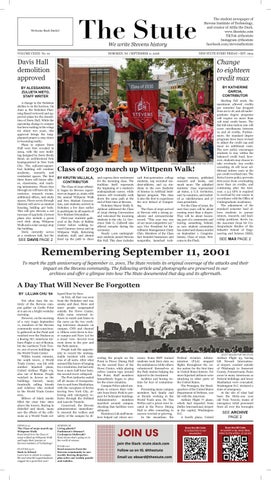
Class of 2030 march up Wittpenn Walk! BY KRUTIN VALLALA, CONTRIBUTOR The Class of 2030 officially began its Stevens experience on August 31, 2026, with the annual Wittpenn Walk and New Student Convocation, and students arrived in Hoboken a few days earlier to participate in all aspects of New Student Orientation. First-year students gathered at the Patio of Babbio Center before walking toward Canavan Arena and up Wittpenn Walk. Returning students, staff, and alumni lined up the path to cheer
and express their excitement for the incoming class. The tradition itself represents the beginning of a student’s undergraduate career, while seniors will eventually walk down the same path at the end of their time at Stevens. Hoboken Mayor Emily B. Jabbour addressed the Class of 2030 during Convocation and welcomed the incoming students to the city. Lt. Governor Dale G. Caldwell also offered remarks during the ceremony. Nearly 1,100 undergraduate students joined Stevens this Fall. This class includes
248 first-generation college students, 193 recruited student-athletes, and 23 students in the new Bachelor of Science in Artificial Intelligence program. This class is also the first to experience the new School of Computing. The Class of 2030 arrived at Stevens with a strong academic and extracurricular record. “This year was one of our most competitive yet,” says Vice President for Enrollment Management Cindy Chin. Members of the Class had founded businesses and nonprofits, launched tech-
nology ventures, published research and books, and much more. The admitted students’ class represented 46 states, 5 U.S. territories, and 74 countries, and included 41 valedictorians and 57 class presidents. For the Class of 2030, the next four years will be about earning more than a degree. They will be about becoming part of a community and leaving something behind, as new student orientation has ended and classes started on September 1. Congratulations, Class of 2030. Welcome to the Flock.
Starting Fall 2026, the maximum allowed credits per semester has dropped from 20 to 18, and all undergraduate degree programs will require no more than 128 total credit hours. The flat full-time tuition rate will cover enrollments between 12 and 18 credits. Furthermore, the standard degree programs have been revised to adjust the credit cap and incur no additional costs. The new policy encourages students to stay within the balanced credit load; however, students may choose to take overloads. Any credits exceeding 18 will incur additional tuition costs at the per-credit overload rate. The Extra Course policy prevents first-years from overloading more than 20 credits, and continuing after the firstyear, a 3.3 GPA is required to overload by one course in accordance with the Office of Undergraduate Academics. The adjustment of the standard semester load allows students to pursue minors, research, and leadership positions. Kevin Lu, the Associate Dean for Undergraduate Studies of the Schaefer School of Engineering and Science (SES),
SEE MAX PAGE 2
Remembering September 11, 2001 To mark the 25th anniversary of September 11, 2001, The Stute revisits its original coverage of the attacks and their impact on the Stevens community. The following article and photographs are preserved in our archives and offer a glimpse into how The Stute documented that day and its aftermath.
A Day That Will Never Be Forgotten BY LILLIAN CHU ‘04 Not often does the entirety of the Stevens campus gather on Castle Point at 9 am on a bright weekday morning. However, on the morning of a very tragic September 11, members of the Stevens community semi-consciously gathered on the Point and watched over the Hudson as a Boeing 767, American Airlines Flight 11 out of Boston, hit the northern Twin Tower, one of seven buildings in the World Trade Center. Within twenty minutes, the south tower, 2 World Trade Center, was hit with another hijacked plane, United Airlines Flight 175, also out of Boston. People watched in horror as the buildings burned, many frantically calling friends and relatives who worked in the World Trade Center area. Billows of black smoke filled the clear blue skies above the towers. Staring in disbelief and shock, many saw the effects of the collisions as 2 World Trade col-
lapsed floor by floor. At first, all that was seen from the Hoboken end was smoke and dust. More and more people congregated outside the Howe Center, while some returned indoors to watch and listen to the news on the two working television channels on campus, CNN and channel 2. Others went down to lower campus and Navy Lot for a closer view. Several even went down to the pier and the Path station. People took the opportunity to record the unimaginable incident with cameras of all sorts. After what seemed like hours of longing for a resolution, but had only been a mere half hour later, the second tower collapsed. The Port Authority sealed off all means of transportation to and from Manhattan, with the exception of ferries leaving New York City, allowing only emergency vehicles through the Holland and Lincoln Tunnels. Concerned, the Stevens administration immediately ensured the welfare and safety of the campus by di-
NEWS (2-4)
SCIENCE (8)
The Class of 2030 march up Wittpenn Walk Read about how the Class of 2030 walked up Wittpenn Walk and begin their journey at Stevens Institute of Technology! FEATURE (5-6)
Back to School Learn how to adjust to campus life and what the upperclassmen suggest for a great first year!
Living plastic? Parkinson’s Disease? Cyclospora Outbreak? Read about what’s going on in the world of science. PULSE (10)
Read answers from the Stevens community to our weekly Roving Reporter, plus solve our weekly puzzle and sudoku.
recting the people on the Point to Pierce Dining Hall on the second floor of the Howe Center, while placing yellow caution tape around the Point. Staff members immediately began to plan for the crises situation. Campus Police asked students to remove their vehicles from Davis Field to prepare for helicopter landings. Administrative members marched around campus, checking that facilities were adequate. Residence Life staff members helped out where nec-
essary. Some EMT trained students took their duty on the ambulances while others volunteered themselves at the Path station helping the injured to the treatment facilities and hosing victims for fear of contamination. Presuming many campus members had family and or friends working in the World Trade area, Dr. Tim Welles and a priest were located in the Pierce Dining Hall to offer counseling to anyone worried or grieving. In the meantime, the
Federal Aviation Administration (FAA) stopped flights throughout the entire nation for the first time in United States history. Yet more hijacked airliners were attacking in other parts of the United States. The Pentagon, the Headquarters of the United States Department of Defense, was hit with the American Airlines Flight 77 plane, which had departed from Dulles International Airport in the capital, Washington D.C. A fourth plane, United
SCOTT MOLSKI FOR THE STUTE
Airlines Flight 93, having left Newark International Airport, crashed outside of Pittsburgh in Somerset County, Pennsylvania. Panic arose in many Americans as Federal buildings and lower Manhattan were evacuated. Washington D.C. declared a state of emergency. At the site of what had been the thirty-one year old Twin Towers, teams of emergency relief personnel from all over the boroughs
SEE ARCHIVE PAGE 2