[The Stute] December 12, 2025 (Issue 13, Volume CXXIII)
SERENA PANUCCI,
EDITOR
In October, the Sanctuary Policy Letter from the Stu dent Body (LSB) was passed by the student body. This let ter, which urges Stevens to adopt Sanctuary University protections for undocument ed, international, Deferred Action for Childhood Arrivals (DACA), and other legally vul nerable students, was formal ly reviewed by the Office of the President and the President’s Cabinet. A written response has since been issued to the student body on behalf of the administration on December 1. To qualify as a successful LSB, at least 10% of under graduates must vote, and twothirds must support the proposal. The Sanctuary Policy letter surpassed both requirements by a significant margin — 778 students participated in the vote (19.1% of undergraduates), with 712 voting in favor (91.5%), 58 opposed (7.5%), and 8 abstaining (1.0%). Because voting thresholds were met, the Student Government Association (SGA) transmitted the proposal to University leadership for review, as outlined in the LSB procedure.
SOFIA STOECKEL, STAFF WRITER
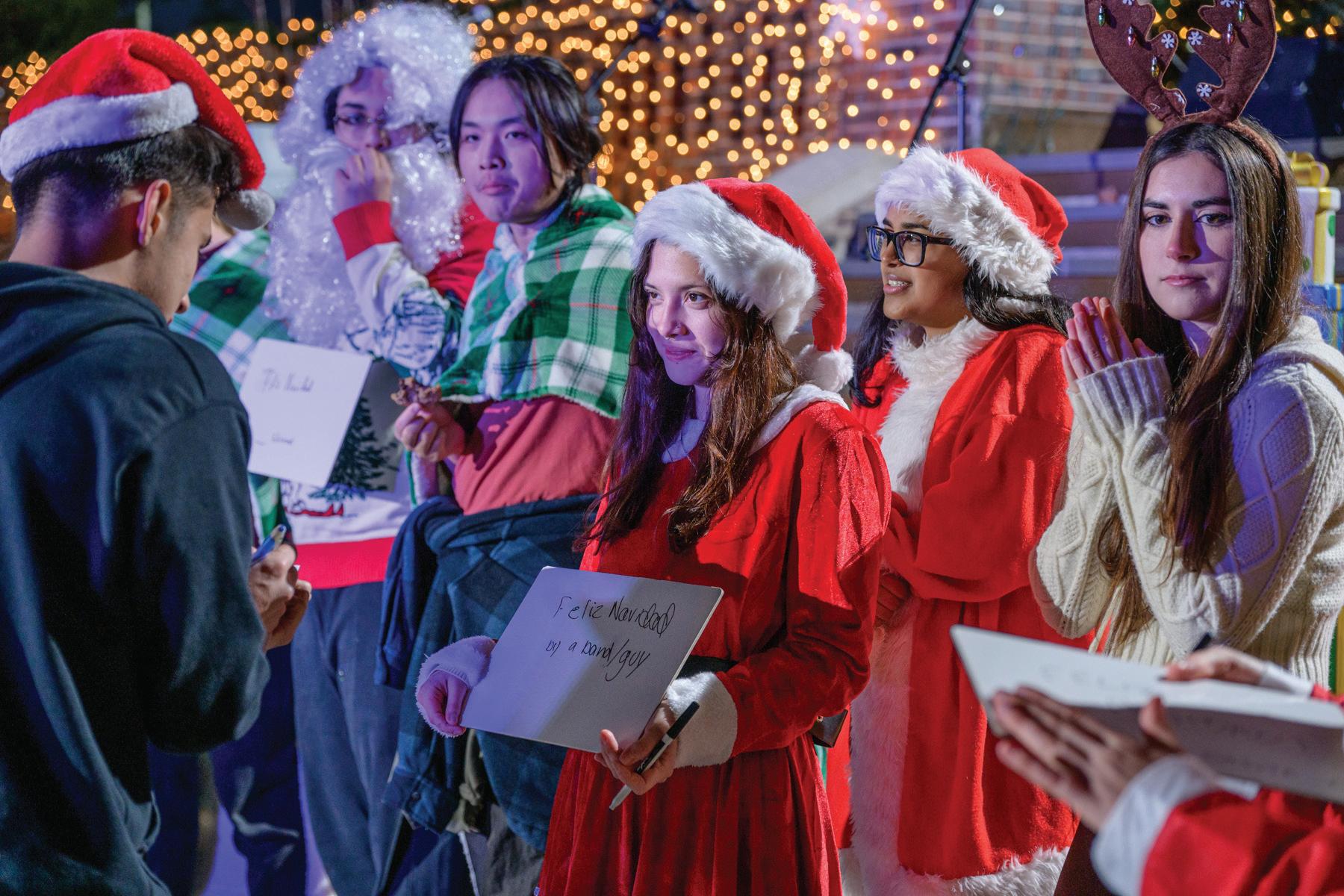
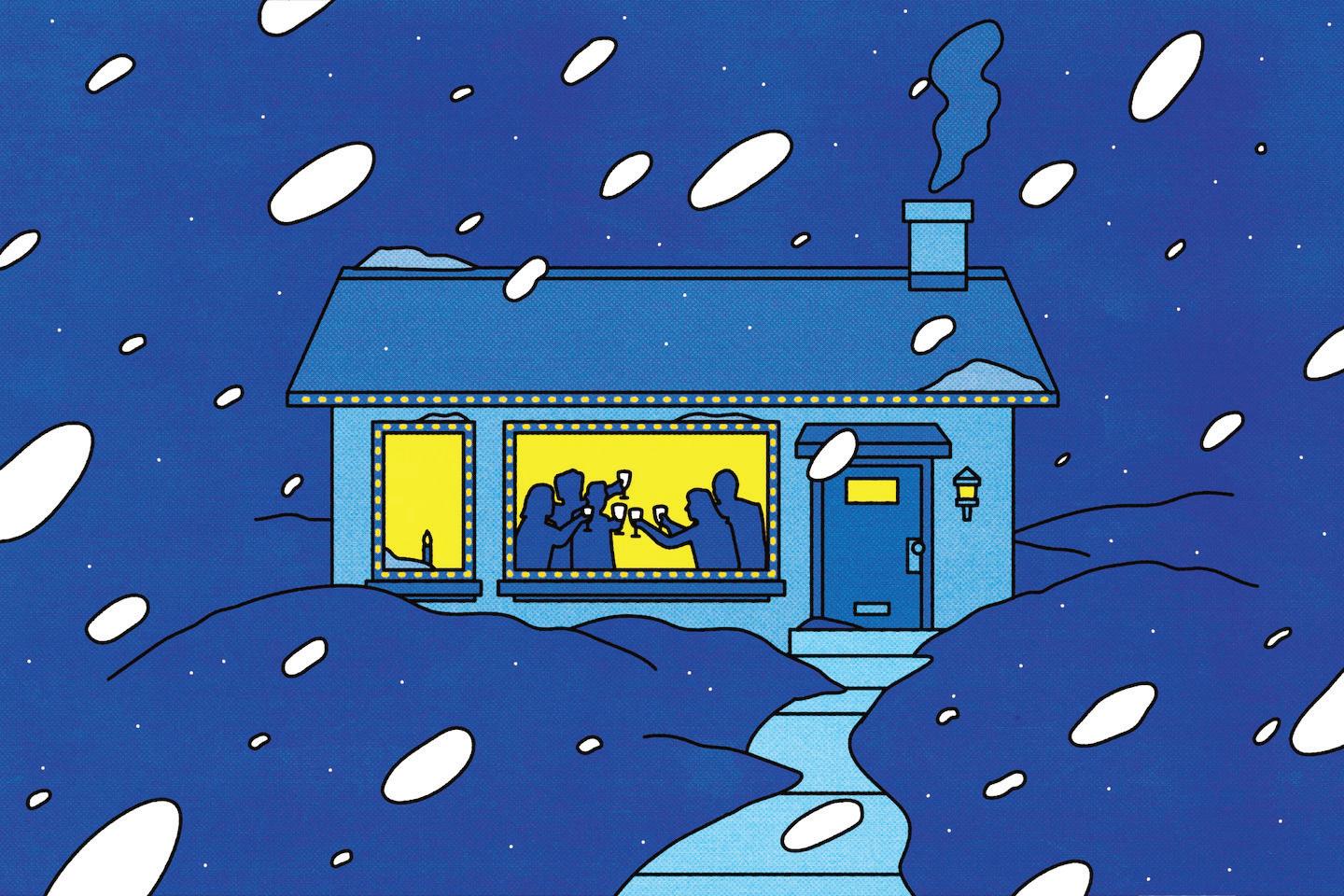
The Winter Wonderland has been a recurring event at Stevens for over a decade, with this year’s being its 11th anniversary, whose exciting events took place on December 3 on Walker Lawn and directly outside of Babbio. It went from 4 to 7 p.m. and featured a multitude of fun and jubilant events for students to watch and partake in.
DuckAI 2025: Stevens pushes for computing without boundaries BY DISHA RANA, OPINION COLUMNIST
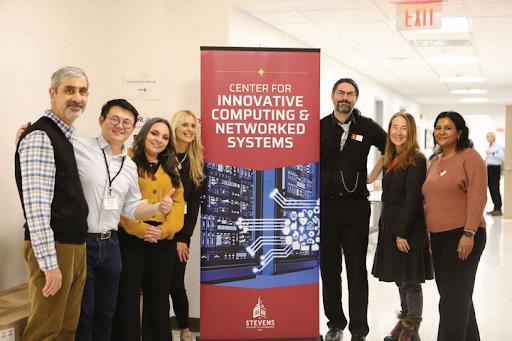
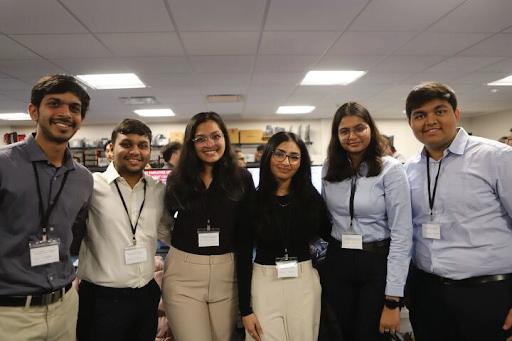
On Wednesday, December 10, the Center for Innovation Computing and Networked Systems (iCNS) and the Department of Electrical and Computer Engineering (ECE) hosted DuckAI 2025 Fall, the 2nd annual symposium of its AI research series. The fall symposium showcased how Stevens is working to make “computing without boundaries” real on campus, turning iCNS from a new research center into a community where students, faculty, and industry partners build AI-driven systems together.
iCNS and computing without boundaries
The symposium is anchored in the launch of the iCNS, which Dr. Min Song, ECE professor and Director of the iCNS, helped create around the idea that computing now permeates every discipline and every system we touch. iCNS brings together research in areas such as mobile and quantum computing, power and energy systems, robotics and smart systems, cyber-physical systems and IoT, 5G/6G networks, and embedded and trustworthy AI, giving students a place to work at the intersections rather than within narrow silos.
DuckAI 2025 Fall featured a lineup designed to connect Stevens students directly with leaders working on real-world AI systems. Invited speakers included Dr. Tianhao Wu, founder and CEO of opAIda Inc., Dr. Yingchao “YZ” Zhang, a technology executive and co-leader at opAIda, Dr. Mingyu Derek Ma, a senior machine learning scientist at Prescient Design (Genentech/ Roche), and Dr. Yulong Cao, a research scientist at NVIDIA working on safe, human-centered autonomous driving. The symposium itself was organized and supported by a team including Hao Wang, Joseph Helsing, Min Song, Jessica Gruich, and Kevin Lu, with student research volunteers Rui Wei, Qingyang Yu, Hao (Lucas) Wang, and Xuan Li helping bring the day together.
Song’s “computing without boundaries” philosophy is visible in how DuckAI mixes hardware, software, communications, and data-driven projects in one space instead of separating them into different events. By tying DuckAI to iCNS, Stevens signals that this is not a one-off showcase but part of a longer-term effort to build an interdisciplinary ecosystem around computing
KEVIN MATIAS, CONTRIBUTOR
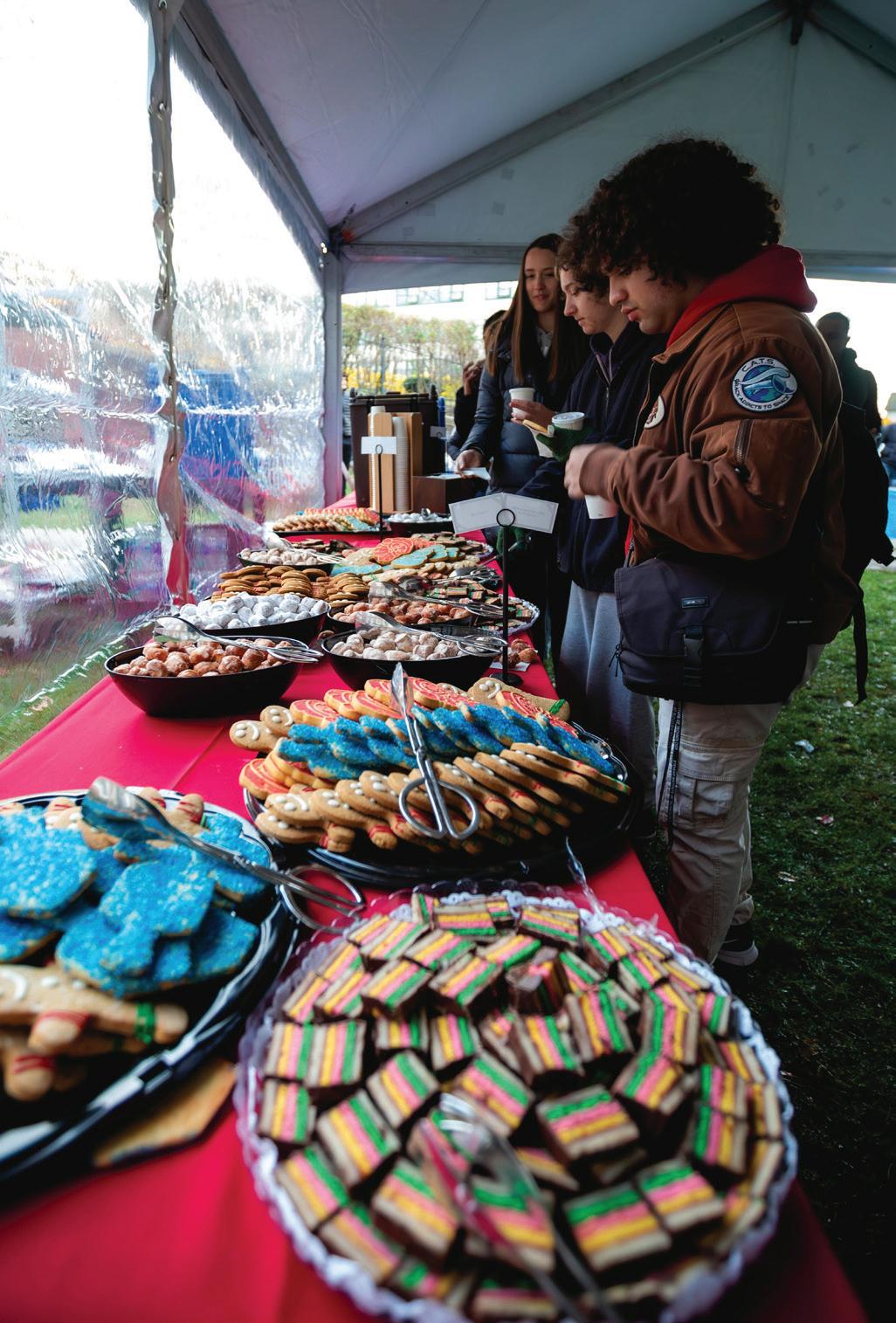
This year’s events included giveaways like decorated ducks, shirts, and mugs, as well as a raffle with different prizes. There were more events like ice skating in front of Babbio, as well as a Santa competition that multiple frats and clubs took part in. Some of the prizes in the raffle included items such as an ice cream machine and a hot chocolate kit, amongst many other things. The foods offered were different varieties of festive desserts and warm
drinks, from sprinkled sugar cookies and gingerbread men to hot apple cider and hot chocolate. Next to the food were multiple vendors selling custom items, including press-on nails and special hand-crafted creations. There was also a photo booth in Babbio with fun props and signs to take pictures with. The evening culminated with the final event — the lighting of the Christmas tree in front of Walker Gym at 7 p.m. There were performanc-
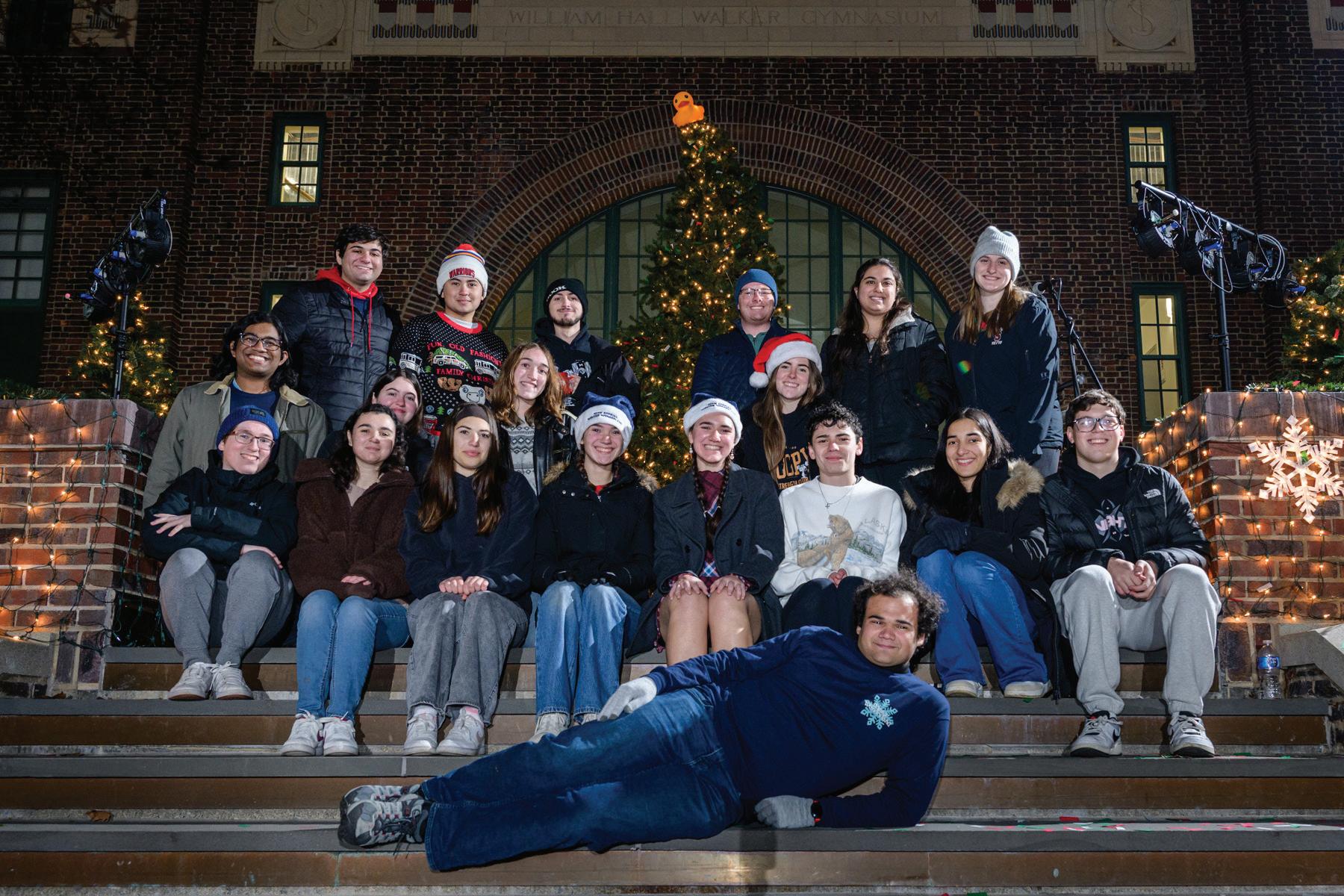
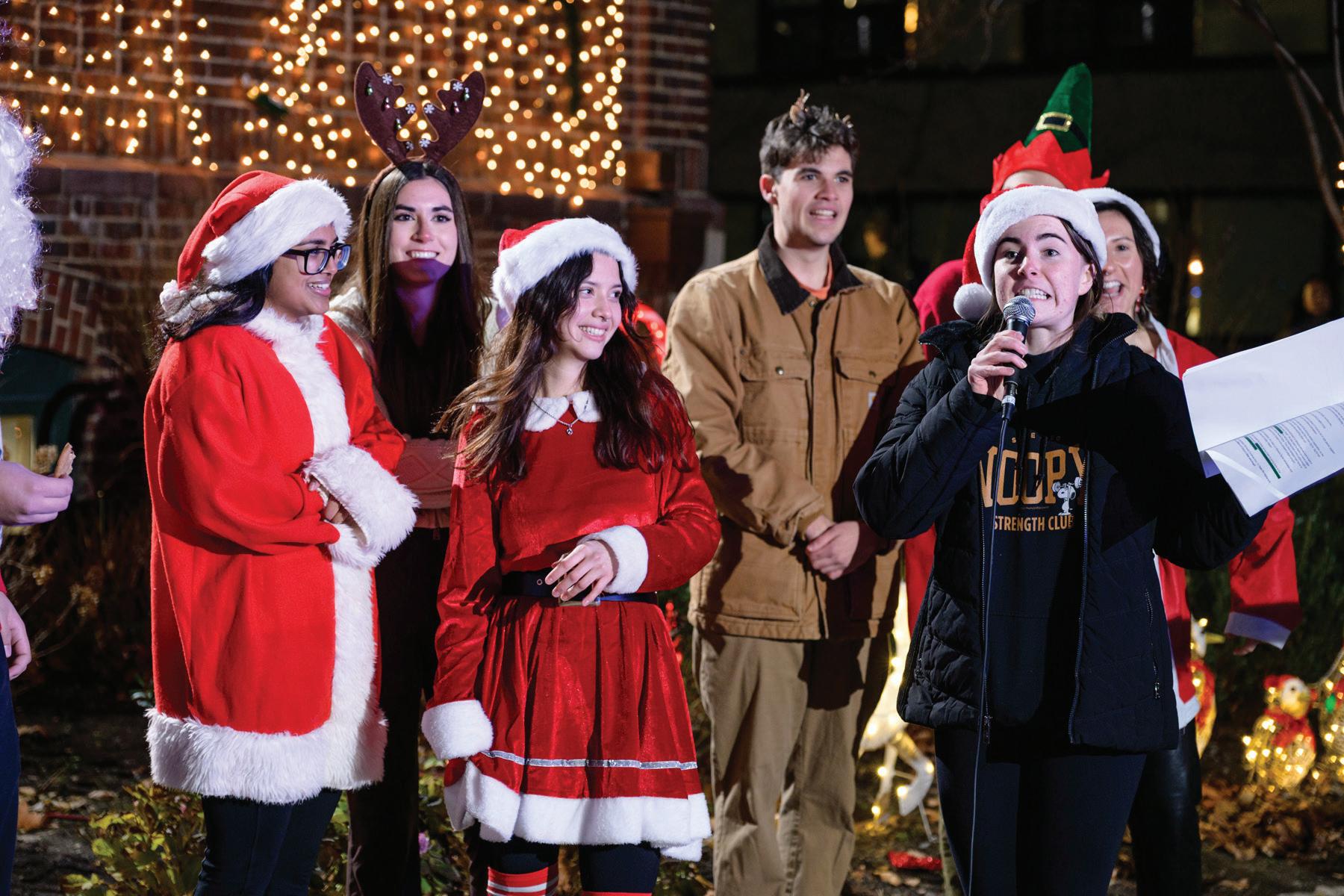
es in that spot from the President’s Ensemble, Stevens A Cappella, and other singers and bands before the lighting of the tree and raffle. The President’s Ensemble sang “Carol of the Bells,” a medley of “Deck the Halls,” “Here We Come A-wassailing,” and “Jingle Bells,” and Stevens A Capella sang “You’re a Mean One, Mr. Grinch,” “Grandma Got Run Over by a Reindeer,”
The incredible diversity of the Stevens community was illuminated in this year’s Winter Interfaith Summit. Held in Gateway North on December 10, the Summit wasn’t just another meeting; it was a showcase of the diverse beliefs on campus. Spiritual organizations such as Newman Catholic, the Stevens Christian Fellowship, the Sikh Student Association, and more united to share their faith with all attendees. The Summit drew those who were devoted to their faith and those who were simply curious, uniting the Stevens community as one. This year’s outcome stems from the passion of its student leadership. Charles Smith, President of Newman Catholic, has shared that he hopes “this Interfaith Summit strengthens the bonds between religious organizations and allows us to see past our differences, particularly when it comes to serving the community.” His perspective perfectly fits with the Summit’s theme of Community Care and Collective Well-Being, as Newman Catholic aims to assist those in need. Similarly, Sikh Student Association’s President Jasraj Baweja has also shared, “to us, the theme connects directly to Seva, which is a cen-
BY JOSEPHINE CHOONG, SECRETARY
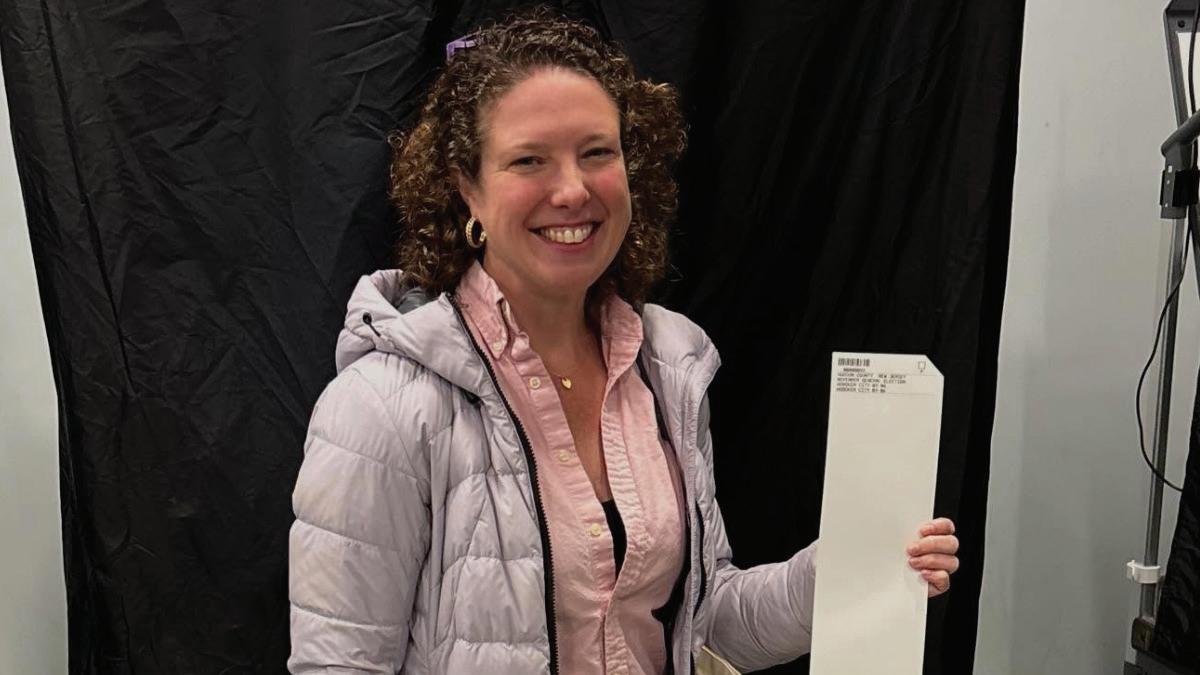
Because Hoboken’s recent nonpartisan general election ended without any candidate receiving a majority of votes (typically 51%), the city held a runoff election. The two candidates with the most votes, Emily Jabbour and Michael Russo, faced off on December 2. The election ended with Jabbour elected as Hoboken’s new mayor.
For the previous two may-
oral terms, Hoboken’s current mayor, Ravi Bhalla, ran unopposed, which was seen as unusual. In comparison, this year, six candidates ran for the mayoral elections, similar to the 1993 and 2005 elections, which had at least five candidates with runoffs happening. A runoff election is a second election and serves as a tiebreaker to determine the clear majority.
During Hoboken’s nonpartisan general election, Jabbour had 27% of the votes while Russo had 24%. When
the runoff votes were counted at 11:13 p.m., Jabbour won by 853 votes, with 6,407 compared to Russo’s 5,554 (53.6% to 46.4%). In a Facebook post, Jabbour noted that she was grateful and she will “continue building a Hoboken that is stronger, fairer, and ready for the future.” Meanwhile, Russo congratulated Jabbour on her win and stated that “Team Russo’s vision remains strong.” Bhalla, who opted out of seeking a third term and instead won a seat in the state Assembly, also
NATIONAL NEWS
congratulated Jabbour and looked forward to supporting a smooth transition. Jabbour was a Hoboken resident for 17 years and served as a Councilwoman for eight years in the City Council. In an interview with the Hoboken Girl, she said her top three priorities were public safety, quality of life issues, and the responsiveness of City Hall. Jabbour and her administration will be sworn
SEE MAYOR PAGE 3
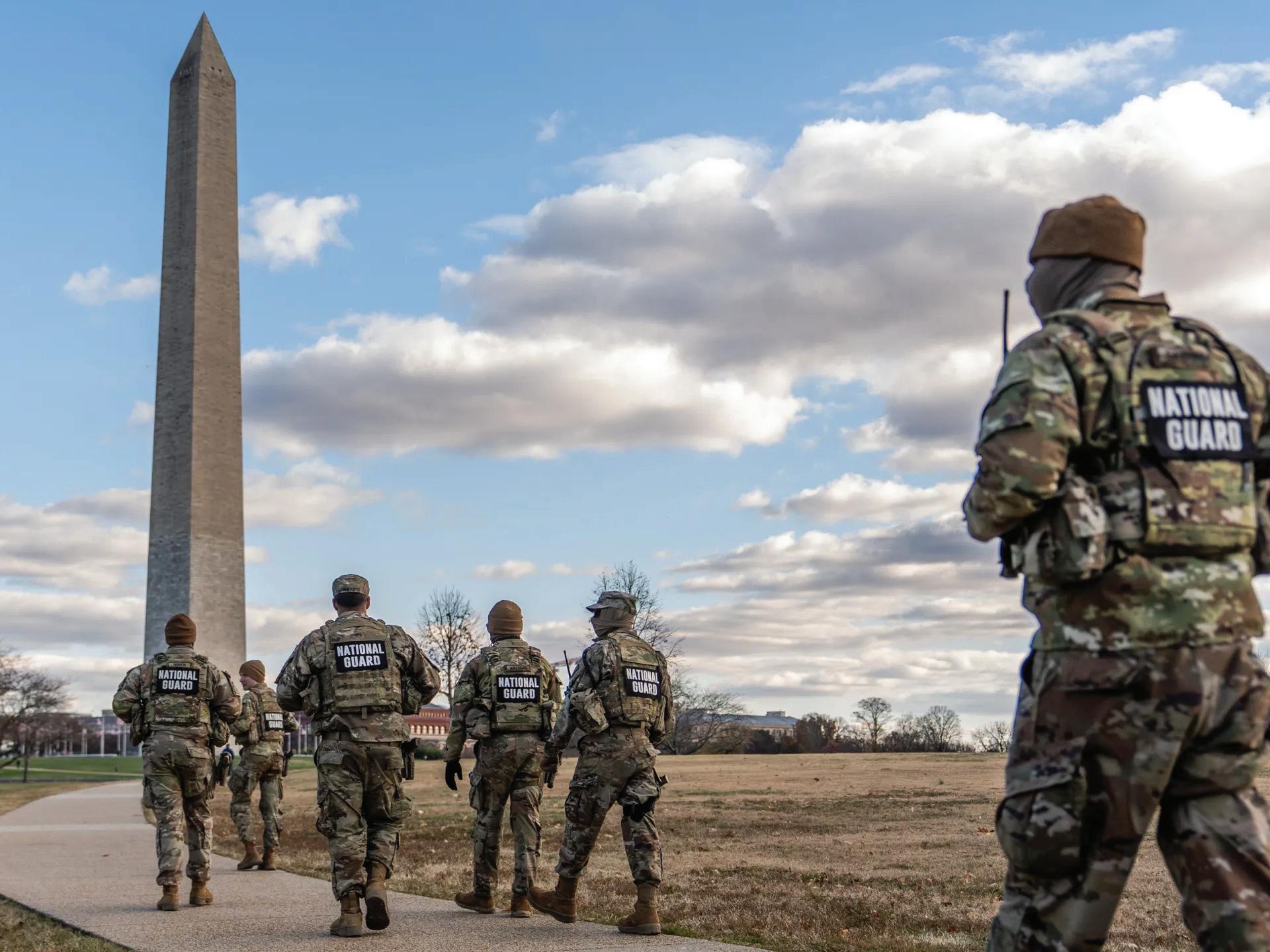
Fatal national guard shooting: Trump’s asylum pause and halts visas for Afghans
BY ARACELY CANDELARIA, STAFF WRITER
Because Hoboken’s recent nonpartisan general election ended without any candidate receiving a majority of votes (typically 51%), the city held a runoff election. The two candidates with the most votes, Emily Jabbour and Michael Russo, faced off on December 2. The election ended with Jabbour elected as Hoboken’s new mayor.
For the previous two mayoral terms, Hoboken’s
current mayor, Ravi Bhalla, ran unopposed, which was seen as unusual. In comparison, this year, six candidates ran for the mayoral elections, similar to the 1993 and 2005 elections, which had at least five candidates with runoffs happening. A runoff election is a second election and serves as a tiebreaker to determine the clear majority. During Hoboken’s nonpartisan general election, Jabbour had 27% of the votes while Russo had 24%. When the runoff votes were counted at 11:13 p.m., Jab-
bour won by 853 votes, with 6,407 compared to Russo’s 5,554 (53.6% to 46.4%). In a Facebook post, Jabbour noted that she was grateful and she will “continue building a Hoboken that is stronger, fairer, and ready for the future.” Meanwhile, Russo congratulated Jabbour on her win and stated that “Team Russo’s vision remains strong.” Bhalla, who opted out of seeking a third term and instead won a seat in the state Assembly, also congratulated Jabbour and looked forward to supporting
a smooth transition. Jabbour was a Hoboken resident for 17 years and served as a Councilwoman for eight years in the City Council. In an interview with the Hoboken Girl, she said her top three priorities were public safety, quality of life issues, and the responsiveness of City Hall. Jabbour and her administration will be sworn in on January 15.
As for Hoboken’s neighbor city, Jersey City’s runoff
OFFICE.................................UNIVERSITY CENTER ROOM 216B
NOTICE A MISTAKE?
Email us at eboard@thestute.com.
Disclaimer
All opinions and editorials reflect the views of their respective author(s). No Part of The Stute may be reproduced in any form, in whole or in part, without the written consent of the Editor-in-Chief. Cited references of The Stute are permitted.
All members of the Stevens community are able to submit a Letter to the Editor to be published in The Stute. Letters must refer either to a piece published in The Stute or to The Stute in general and must be between 400 – 800 words in length. Submit letters to editor@thestute.com with your name and title (when applicable) or using our Google form. For writers who wish to write a Letter to the Editor anonymously, please see our policy on anonymity.
The Editorial Board reserves the right to choose whether or not to publish a submitted Letter to the Editor based on a majority rule vote, and additionally reserves the right to edit letters for clarity or request authors to revise. Provided that the author approves the final version, The Stute reserves the right to edit letters according to our copy editing procedures, defined in our policies.
All members of the Stevens community are able to submit a stand alone opinion piece (otherwise known as an Op-Ed) to be published in The Stute. Op-Eds must be between 400 – 800 words, but longer sub missions will be considered on a case-by-case basis. To submit an OpEd please email eboard@thestute.com with your name and title (when applicable) or using our Google form (tinyurl.com/submit-t0-stute). For writers who wish to write an Op-Ed anonymously, please see our policy on anonymity.
The Editorial Board reserves the right to choose whether or not to pub lish a submitted Op-Ed based on a majority rule vote, and additionally reserves the right to edit Op-Eds for clarity or request authors to revise. Provided that the author approves the final version, The Stute reserves the right to edit Op-Eds according to our copy editing procedures, de fined in our policies.
SANCTUARY
CONTINUED FROM PAGE 1
The SGA does not endorse, edit, or oppose LSB proposals; its function is solely to facilitate the voting and delivery process.
The Sanctuary proposal requests a university-wide commitment to protections such as refusal of voluntary cooperation with federal immigration enforcement, limits on data disclosure, restrictions on U.S. Immigration and Customs Enforcement (ICE) access to campus buildings without a warrant, expanded confidential support for undocumented and international students, and guaranteed freedom of political expression without academic or disciplinary consequence. The letter also calls for increased legal resources, trauma-informed mental health care, campus-wide de-escalation training, communication protocols in the event of ICE presence, and academic continuity options for students facing deportation or legal uncertainty. The proposers ask the administration to declare Stevens a Sanctuary University beginning in the 2025–2026 academic year.
In response, the President’s Cabinet acknowledged the effort and collaboration behind the proposal, stating that the letter reflects “a shared commitment to ensuring that Stevens remains a community where every student, faculty and staff member feels safe, respected and supported — regardless of background, identity or immigration status.” The response reaffirms that Stevens condemns discrimination and upholds privacy protections already established under the Family Educational
WINTER
CONTINUED FROM PAGE 1
and “Have Yourself a Merry Little Christmas.” There were four other bands and singers that sang previously, before the President’s Ensemble and Stevens Acapella: Ticklemonsters, Abby Grace, Technique, and Amberjack. When the tree was lit, all the lights hung on the small walls by the stairs were also lit up, creating a bright, vibrant scene in front of Walker Gymnasium.
Even in the cold weather, this year’s Winter Wonderland welcomed many students, undergraduate and graduate, to enjoy a multitude of fun events before finals and to usher in the Christmas season.
tral part of Sikhism. It means selfless service, and it’s all about taking care of the community.”
The organizations at this year’s Interfaith Summit have been dedicated to creating an impact both on and off campus. Stevens Christian Fellowship (SCF) President Anthony Tarallo has made the organization a
Rights and Privacy Act (FERPA) and the university’s anti-discrimination policies.
However, while supportive of core principles within the proposal, the administration clarified limitations and legal boundaries. The response notes that the term “Sanctuary University” has no singular legal definition, and that Stevens must comply with federal and state laws to maintain eligibility for federal funding, including financial aid and government-supported research. The response outlines areas where current university policies already align with requests, as well as instances where the institution cannot expand protections beyond what the law permits.
In response, the university cited ongoing policies and legal compliance:
• Privacy & Information Disclosure: Stevens does not voluntarily share student information with third parties, including federal agencies, and only discloses records under a valid court order or subpoena in accordance with FERPA.
• ICE & Law Enforcement Access: A warrant or subpoena is required to access campus buildings for searches or arrests. Due to Stevens’ open urban campus structure, outdoor areas cannot be legally restricted. Campus Police do not perform immigration enforcement duties except during immediate safety threats.
• Legal & Mental Health Resources: Stevens does not have the financial capacity to provide free immigration legal services, but International Student & Scholar Services (ISSS) maintains a list of qualified attorneys. Counseling and Psychological Services (CAPS) will explore
further training to support marginalized student communities.
• Training & Crisis Response: Campus Police already undergo biannual de-escalation training; the university commits to expanding this training to additional administrators by June 2026.
• Academic Continuity: Remote accommodations may be made case-by-case for students facing legal or personal obstacles to on-campus attendance.
• Freedom of Expression: The university emphasizes commitment to peaceful advocacy without disciplinary consequences, as long as actions fall within university conduct policies and applicable laws. The response also clarifies that student conduct processes do not include student adjudicators due to privacy and impartiality concerns.
The Cabinet concludes by expressing gratitude for student engagement, stating that the university “remains committed to maintaining a campus environment where all individuals, regardless of citizenship status, identity, or beliefs, can learn, work, and live free from discrimination and fear.” While the university did not adopt a formal Sanctuary designation nor commit to all protections requested, leadership affirmed areas of existing alignment and indicated willingness to continue dialogue with students.
The Sanctuary Policy LSB now joins a growing history of student-driven advocacy initiatives at Stevens. Though the administration’s response falls short of full adoption of the proposal, university officials expressed openness to continued collaboration with the student body, citing shared values of safety, inclusivity, and community support.
facing extreme circumstances receive a present. Similarly, the Sikh Student Association has taken part in food and hygiene kit drives, inspired by the Sikh values in giving back. Members of Newman Catholic have also participated in a variety of service events, including donating unsold bagels to the Hoboken Shelter and participating in Sandwich Sundays at the Saints Peter & Paul Roman Catholic Church.
Beyond service activities, the primary mission of each organization remains the same: welcoming students with open arms. Brooke Pasker, Campus Minister of Newman Catholic, encourages anyone interested in the Catholic faith to reach out to Chaplain Father Jarek or to her for individual conversation. Tarallo welcomes all forms of
questions at SCF as his mission is to make Christ known, emphasizing, “we are all made for spiritual growth within a community”. By the end of this year’s annual event, those in the Interfaith Summit had worked together to assemble nearly 150 hygiene care kits.
While this year’s Summit is over, the work for spiritual connection continues year-round from all participating groups, including Hillel, Olami, SCF, and the Muslim Student Association (MSA). Community has played a driving role in each organization, transforming Stevens into a place that feels like home. As Tarallo and Baweja noted, involvement in their respective groups has created a powerful sense of community, lifelong friendships, and shared purpose during their time at Stevens.
PHOTO COURTESY OF JEFFERY VOCK
DUCKAI
CONTINUED FROM PAGE 1
and networked systems.
DuckAI as applied AI in action
This year’s DuckAI 2025 Fall, the second iCNS/ECE Symposium on AI Research and Innovations at Stevens, builds on the first DuckAI held in Spring 2025 and expands both its scope and ambition. The event featured invited talks, tutorials, and a poster and demo session where student teams present AI projects that span communications, sensing, robotics, security, and more. The throughline is applied AI: students are expected not just to understand machine learning concepts, but to apply them to real-world problems, explain their work to non-experts, and get feedback from people in academia and industry.
Dr. Hao Wang, who helped launch DuckAI while teaching Applied Machine Learning, describes the symposium as a response to students who want more than lectures and problem sets. Drawing on his experience running “Tiger AI” at Louisiana State University, he envisioned DuckAI as a recurring event
MAYOR
CONTINUED FROM PAGE 1
in on January 15.
As for Hoboken’s neighbor city, Jersey City’s runoff election between James Solomon and Jim McGreevey ended with Solomon as mayor. Similar to Hoboken’s election, with seven mayoral candidates, no one candidate received the majority vote. In the nonpartisan general election, Solomon received 17,200 votes or 29.02% of the vote, while McGreevey had 15,402 votes or 25.38% of the vote. However, during the runoffs, with more than 95% of the votes tallied, Solomon received 24,489 votes while McGreevey obtained 11,463 (68.1% to 31.9%). Jersey City’s current mayor, Steven Fulop, didn’t seek a fourth term and lost in the Democratic primary for governor. Following
with tutorials, posters, and demos where students can experiment, self-teach beyond the syllabus, and demonstrate what they can build with AI. Wang emphasizes that Stevens students “are really not satisfied with what we taught in the classroom” and actively seek chances to test themselves on real problems using AI and machine learning. That is why he pushed to make DuckAI a per-semester event, with backing from Department Chair Min Song and ECE faculty and staff, and why he wants to grow it into a regional gathering that includes students and speakers from places like Yeshiva, New York University, and Rutgers. Graduate students such as Drishti and Eden, both in the data science master’s program, see DuckAI as both a learning experience and a launch pad. Over the course of the fall symposium, several visitors stopped by their poster, called their project interesting and different, and offered concrete ideas for how to scale it and align it more closely with industry needs. Encouraged by the positive feedback, they are now considering turning the project into a research paper with their advisor, Professor Hong, and exploring how far they can take it beyond the sym-
the election, Solomon responded that he will tackle Jersey City’s challenges and represent its citizens. McGreevey also congratulated Solomon and proclaimed that his focus would return to the New Jersey Reentry Corporation. In an interview with Slice of Culture, the two mayors-elect expressed their feelings when the results were announced. “The moment the results came in, I felt a mix of gratitude, humility, and determination,” Solomon said. “Knowing that the residents of Jersey City placed their trust in me is an incredible honor.” Meanwhile, Jabbour added, “When the results were confirmed on Tuesday, I actually started crying! It was a mix of emotions and a sense of fatigue coming together after having announced my campaign in January. Then I got super excited and hugged everyone around me!” She encourages residents to reach out with ideas.
posium — exactly the kind of stu dent growth iCNS and DuckAI are designed to foster.
Students’ path into iCNS Song notes that students have multiple pathways into this world of computing and networked systems research: formal research courses at the undergraduate and graduate levels, working with faculty during semesters and summers, and, in stronger budget years, research scholarships offered through iCNS. Even with scholarships temporarily paused, he encourages students to seek out research not only for cred it but to build capabilities and con tribute to the center’s work. He also offers a roadmap for those hoping to enter fields related to AI and networked systems: first, build a solid foundation in a home discipline; second, learn how human, physical, and computational systems connect; and third, embrace AI as a powerful tool while remembering it must serve people rather than replace judgment. DuckAI 2025 Fall, with its mix of iCNS’s interdisciplinary vision, Wang’s applied AI ethos, and student-driven projects like Drishti and Eden’s, shows what that roadmap can look like when it comes to life on campus.
GUARD
CONTINUED FROM PAGE 1
election between James Solomon and Jim McGreevey ended with Sol
omon as mayor. Similar to Hoboken’s election, with seven mayoral candidates, no one candidate re ceived the majority vote. In the non partisan general election, Solomon received 17,200 votes or 29.02% of the vote, while McGreevey had 15,402 votes or 25.38% of the vote. However, during the runoffs, with more than 95% of the votes tallied, Solomon received 24,489 votes while McGreevey obtained 11,463 (68.1% to 31.9%). Jersey City’s cur rent mayor, Steven Fulop, didn’t seek a fourth term and lost in the Democratic primary for governor. Following the election, Solomon responded that he will tackle Jersey City’s challenges and represent its citizens. McGreevey also congratu lated Solomon and proclaimed that his focus would return to the New Jersey Reentry Corporation.
In an interview with Slice of Cul
ture, the two mayors-elect expressed their feelings when the results were announced. “The moment the results came in, I felt a mix of gratitude, humility, and determination,” Solomon said. “Knowing that the residents of Jersey City placed their trust in me is an incredible honor.” Meanwhile, Jabbour added, “When the results were confirmed on Tuesday, I actually started crying! It was a mix of emotions and a sense of fatigue coming together after having announced my campaign in January. Then I got super excited and hugged everyone around me!” She encourages residents to reach out with ideas.
PHOTO COURTESY OF STEVENS.EDU
PHOTO COURTESY OF HUDPOST.COMW
-
PHOTO COURTESY OF ALJAZEERA.COM
Science
Holiday lights: so dazzling they can be seen from space!
BY SEAN PALERMO, SCIENCE WRITER
While December’s days get shorter and shorter as nightfall comes increasingly earlier, holiday lights nevertheless shine beautifully against its dark backdrop. In fact, reports from NASA and the US National Oceanic and Atmospheric Administration (NOAA) have given proof that holiday lights can actually be seen from space through the use of the Suomi National Polar-orbiting Partnership (Suomi NPP). This climate-tracking satellite, launched in 2011, possesses its Visible Infrared Imaging Radiometer Suite (VIIRS), used to measure visible and infrared light emissions from Earth. From analyzing the first few years worth of data that the Suomi NPP has provided, researches discovered that around the holiday period, cities in the US, Canada, and Europe alongside other majority-Christian regions shone about 20-30% brighter than the rest of the year, with suburban and semi-rural areas reaching as high as 50% as a direct result of decorative lighting.
However, although this is true for majority-Christian regions, holiday lights are put up for a variety of reasons during the festive season, such as Christmas, Hanukkah, Kwanzaa, and New Year’s. In fact, NASA researcher Miguel Roman commented, “despite being ethnically and religiously diverse, we found that the U.S. experiences
a holiday increase that is present across most urban communities,” with this same effect occurring in practically all US cities, notwithstanding their demographic makeup. Additionally, this brightness effect has also been noted to occur in many Muslim-majority countries during the month of Ramadan.
In order to capture the data, filters, algorithms, and analytical tools were used on the data in order to reduce the impact from other light sources, such as moonlight, to determine that, in fact, holiday lights were the culprit. Interestingly enough, despite more people living in cities, the suburbs and semi-rural areas trumped them in holiday light brightness — being explained as a result of outdoor lightning not usually being possible for apartment dwellers in the city and there being many more single-family homes possessing room for plenty of holiday lights in the suburbs coupled with the fact that many people return home from the city to visit family during the holiday season.
While this phenomenon typically refers to the cumulative effects of holiday lights in certain regions, a study performed by a group of physics students attending the University of Leicester, which was published in the student-run Journal of Physics and Special Topics, revealed the theoretical numbers necessary for a singular house to be visible from the International Space Station. Their findings un-
veiled that the supposed house would need an apparent magnitude of at least +6.5, or in other words, light emissions of around 10,600 lumens. Given that one LED bulb is typically around four lumens, you’d need around 2,638 LEDs to make your house visible from space, which would cost an estimated £500 (about $666).
One particular Texas Hill Country Town, Johnson City, has become known as the “Twinkliest Town in Texas” — the factor responsible for the name being its massive annual Lights Spectacular that’s been held for the past 36 years. Beginning as a fundraiser for local nonprofits with around 100,000 lights, today, about two million lights drape the Live Oaks behind the Blanco County Courthouse as the surrounding town square glows to match. Beginning on Saturday, November 29, the event brings about 8,000 people to Johnson City every holiday season — a particularly impressive number considering it is four times the number of residents.
NASA has reported seeing the grand lights of the city during this month-long event (running through January 4th), certainly pleasing Johnson City business owner and Lights Spectacular chair Rayette Bible, who hearteningly describes how “we see children playing together…[and] thousands of photos are taken. Every year, there are more than a few marriage proposals under the lights!”
Rituals, routine, and the holidays: the hidden gift to your mental health
BY SABRINA DEPAULIS, CONTRIBUTOR
The rituals you perform this holiday season may have a bigger impact on your mental health than you think. Whether you decorate for the holidays right when Thanksgiving ends or eat exactly 12 grapes at midnight on New Year, many of us rely on traditions. These familiar actions do more than mark a new season; they ease our minds in moments of uncertainty.
Ritual is characterized by actions performed in “rigid, formal, and repetitive ways” with little to no variation. Unlike habits, rituals follow a set of rules and carry symbolic relevance despite having no direct outcome. Traditions before a sports event or singing happy birth day might not change the world, but they provide structure and so lace. Rituals have power because they feel meaningful, even though they have no ties to results, accord ing to Hobson et al.
Historically, rituals existed to create social connection, like wed ding ceremonies, funerals, and sea sonal celebrations. Modern life has woven ritual into personal routine. Preparing a morning coffee or a weekly walk on the same route are small, everyday rituals that help people feel grounded. Rituals give way for the mind to process difficult experiences, like stress or change.
A Harvard study reported that people who perform a symbolic rit ual after a stressful event felt more
in control, even if they did not believe the ritual worked. This effect can help explain why rituals are shown to lower anxiety. Finding a sense of community through ritual also plays a role in creating a calm response. Group rituals validate the human need for connection and belonging that our mental health depends on. Research shows that holidays not only bring families together, but the rituals practiced increase enjoyment and give a refreshing pause from daily routine. It can be helpful to identify rituals in your life and harness their importance. Pay attention to a habit that has a deeper meaning, like daily journaling and morning affirmations, and notice how it serves
you. Identifying your rituals can be like finding your strengths and weaknesses; you can eliminate personal rituals that no longer benefit you and appreciate what works.
As the holiday season approaches, the predictable rhythm of rituals may be exactly what our minds need. Lighting a candle at the end of the day, making hot cocoa in your favorite mug, or repeating cultural traditions each winter can help reduce stress, strengthen relationships, and make life feel more manageable. Research shows that ritualistic practices provide comfort, and as you begin the last few days of the year, that sense of stability might be the best gift for yourself.
Self-hypnosis with cooling mental imagery could ease hot flashes
BY GAVIN MCCRARY, SCIENCE WRITER
Menopausal hot flashes have been compared to a “human furnace” and disruptive to daily life. Around 85%of women experience hot flashes during menopause, and symptoms may flare up even years later. While pharmaceutical treatments exist, they are not suitable for everyone, particularly women with a history of breast cancer or those at risk for cardiovascular issues. This makes nonhormonal interventions a critical area of research. A recent study has shown that 53% of participants saw a reduction in hot flash symptoms as a result of hypnosis, offering a promising alternative. A more unorthodox approach to hot flash treatment was introduced. A recent study has shown that 53%of participants saw a reduction in hot flash symptoms as a result of hypnosis.
A new multicenter randomized clinical trial led by Baylor University psychologist and neuroscientist Gary Elkins provides strong evidence that daily, self-administered hypnosis can significantly reduce both the frequency and severity of hot flashes.
The study enrolled 250 postmenopausal women, including a notable subset with a history of breast cancer, a group often excluded from hormone-based treatments. Participants listened daily for six weeks either to guided hypnosis audio recordings or to a white-noise recording serving as a sham control. Throughout the study, all participants tracked hot flashes in a diary. After six weeks, women in the hypnosis group reported a 53% reduction in hot flash scores, which combine frequency and intensity. The white-noise group also improved, showing a 41% reduction, which researchers note is typical given placebo effects in hot flash trials. Even so, the ad-
ditional improvement associated with hypnosis was substantial. And the effect grew stronger over time. At the three-month follow-up, women in the hypnosis group reported a 61% reduction, compared to 44% in the control group. These results are rather striking.
These outcomes actually align with previous research showing hypnosis can help reduce hot flashes when delivered in person. However, most prior studies required trained clinicians and regular office visits, limiting accessibility. This new study is the first to demonstrate that self-guided hypnosis, delivered solely through audio recordings, can produce clinically meaningful improvements without the need for professional supervision. Elkins emphasizes that once participants learn the technique, they often continue using it, which helps explain why symptoms continued to decline even after the study ended
The methods and approach are very simple. Participants are guided into a state of deep relaxation, then prompted to imagine cooling sensations such as a breeze or cool water that counteract the physiological cascade of a hot flash. The intervention avoids the stereotypical depictions of hypnosis found in popular culture. Instead, it centers on focused attention, calm breathing, and intentional sensory imagery. Participants in the study also experienced improved sleep, a reduction in stress, and an overall better quality of life. The trial’s design being randomized adds confidence that the benefits were due to the hypnosis itself, not expectation alone. Its remote delivery also makes it a practical and accessible solution for women unable to attend regular clinic visits, highlighting the potential of self-administered hypnosis as a widely available, nonpharmaceutical option for hot flash relief.
Twisted layers of carbon could help unlock the future of superconductors
BY JACOB NORMAND, STAFF WRITER
A group of MIT physicists recently discovered that carbon stacked in a particular way behaves like an unconventional superconductor.
Superconductors are critical to current and future technological innovations. They function by providing effectively no electrical resistance when cooled below a certain temperature, called the critical temperature. Technologies such as MRI machines, maglev trains, quantum computers, particle accelerators, and future nuclear fusion reactors all critically rely on this property.
Typically, conventional superconductors require ultra-low critical temperatures to operate, which can involve complex, expensive cooling systems. If superconductors could work closer to room temperature, entirely new technological possibilities could emerge, such as lossless power grids, more precise medical imaging, and more capable quantum computers.
A recent discovery out of MIT is generating excitement in the world of superconductors. In November, researchers reported new and direct evidence that a carbon-based material known as “magic-angle” twisted tri-layer graphene (MATTG) behaves as an unconventional superconductor. The material is created by stacking three atomically thin sheets of graphene at a very specific angle, allowing unusual electrical properties to appear.
Scientists have suspected for years that twisted graphene structures might host unconventional superconductivity, but proof has remained elusive. The new work, published in Science, offers the clearest confirmation yet.
What makes unconventional su-
perconductors so interesting is that they do not follow the traditional governing rules of superconductors. In conventional superconductors, electrons pair up through vibrations in the atomic lattice. These pairs, called Cooper pairs, allow electricity to flow without resistance. But in unconventional superconductors, the electrons appear to pair through a completely different mechanism that scientists still do not fully understand. Because of this, many of these materials operate at higher temperatures than their conventional counterparts. Using a new experimental platform, the MIT team was able to directly measure MATTG’s superconducting gap, an energy signature that reflects how strongly electrons are paired. What they found was striking: instead of the smooth, uniform gap observed in conventional superconductors, MATTG displayed a distinct V-shaped gap profile. This shape strongly suggests that the material has “nodes,” or directions in which electrons don’t participate in pairing, one of the defining characteristics of unconventional superconductors. Confirming this behavior is a major milestone because graphenebased superconductors are structurally simple, just carbon, making them easier to model and study than many complex unconventional superconductors previously discovered. By probing how electrons pair in this cleaner system, researchers hope to finally crack the mechanism of unconventional superconductivity. While room-temperature superconductors are still a long way off, discoveries like this bring researchers one step closer to technologies that today sound like science fiction, but may not stay that way for long.
PHOTO COURTESY OF STEARNELECTRIC.ORG
PHOTO COURTESY
BY JEYLAN JUBRAN, OPINION COLUMNIST
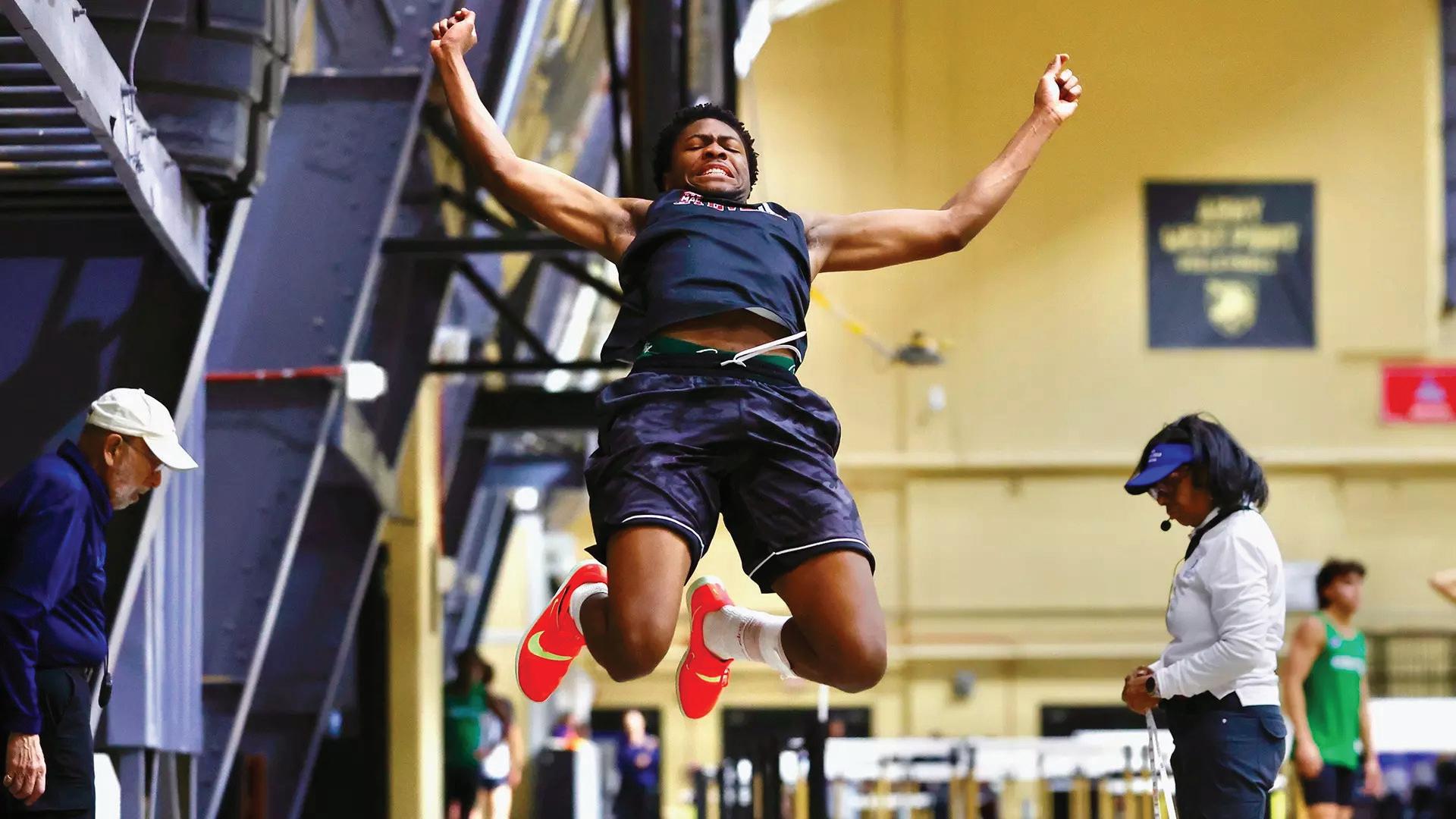
The Men’s and Women’s Track & Field teams opened their 2025–26 indoor campaigns this past weekend at the Crowell Open and Crowell Invitational, hosted by the U.S. Military Academy. Across both days of competition, the Ducks delivered several standout performances, program-record marks, and early-season personal bests.
The weekend began on December 5 with the Crowell Open, where the women’s team had a strong showing in the multi events. Junior Isabella Shanley led the Ducks with a second-place finish in the pentathlon, scoring 2,957 points — the third-highest total in program history. Shanley won the 800m segment of the pentathlon in 2:28.69 and placed top six in the hurdles, high jump,
shot put, and long jump, surpassing a nearly 13-year-old program mark of 2,936 points. Several first-years made their Stevens debut at the Open as well, setting the tone for an underclassmen-heavy roster entering the new season.
The following day, both teams returned for the Crowell Invitational, where the Ducks faced a field loaded with Division I competition and still came away with major highlights.
For the women, senior Maggie Previglian headlined the meet with a career-defining performance in the high jump. Previglian cleared 1.67 meters, tying the current national lead and earning second overall in a field dominated by DI athletes. The mark shattered her previous best of 1.58m and moved her to third all-time in Stevens program history. Senior Maya Lapinski also impressed, ty-
Women’s Track & Field
ing for fifth at 1.47m and placing eighth in the long jump at 4.69m.
On the track side, first-year Emily Laudman finished fifth in the mile at 5:54.37, ranking third among non-DI competitors. Fellow first-years Chelsea Baxter and Caitlyn Adamchuk produced topeight finishes of their own in the triple jump and 500m, rounding out a balanced day for the women’s squad.
The men’s team delivered equally strong results at the Invitational, highlighted by a historic moment in the triple jump. First-year Jonathan Mordi broke a 45-year-old program record, leaping 13.58 meters to surpass the previous standard of 13.57m. Mordi finished fifth overall and first among Division III athletes in the event.
In the hurdles, sophomore Joseph Perriello and first-years Matthew Rudzinski and Kon-
stantinos Georgiadis advanced to the final, placing fifth, sixth, and seventh while competing exclusively against DI runners. Firstyear thrower Kane Perry was the top non-DI finisher in the weight throw, placing eighth overall with a 15.29m effort — the only non-DI thrower to surpass the 14-meter mark.
The Ducks also fielded a strong group in the heptathlon: senior Brandon Kiefer held third place through both days of competition, while teammate Calvin Gibson climbed three spots in the standings after strong showings in the hurdles, pole vault, and 1,000m run.
Both squads will continue their early-season buildup with several key invitationals before the semester break, carrying momentum from a weekend filled with personal bests, school records, and national-level marks.
Stevens swim teams split results in home dual meet
BY MISAYO IDOWU, SPORTS WRITER
On Saturday, December 6, the Men’s and Women’s Swim Teams participated in a home meet against the United States Merchant Marine Academy. Despite swimming well, the men’s team lost 171-91. On the other hand, the women’s team swam amazingly and won 171- 88. Despite the mixed results, it was clear that both teams swam well.
The meet started with the women’s 200 medley. The Ducks
A team relay of sophomores Paige Bleckley, Eszter Kiss, Natalia Brunetti, and Delaney Klaus, and senior Natalia Brunetti won the race with a time of 1:54.01. Stevens also finished third in this relay with a team of junior Abigail Rosingana, senior Adriana Bertolotti, junior Ashley Settle, and senior Gabby Sokolik, finishing in 1:58.21.
Sophomore Dora Dvorkin impressed by winning the 1000 freestyle in 11:20.47, followed closely by her sophomore teammate Julia McKinley and Rosingana. The men’s team also started off with the 200 medley relay. The team of four seniors, Angel Velasquez, Lukas Mikulenas, Deo Bove, and Will Stibor, finished second with a time of 1:36.87. First-year Cooper Moffatt then opened individual racing by finishing second in the 1000 freestyle in 10:18.75, with sophomore Andrew Gaba placing fifth and first-yearYusuf Tokuz sixth. First-year Sebastien Nappi led the Ducks in the 200 freestyle with a second-place 1:48.93. Sophomore Ethan Emerton finished second in the 100 backstroke in 54.05, followed by seniors Leo Timmermann and Daniel Shemetov.
Jumping back to the women’s team, Kiss returned to the pool to
win the 200 freestyle in 1:59.66. The Ducks dominated in the 200 butterfly as sophomore Hanna Matheson won in 2:16.40. Klaus sprinted to wins in both the 50 and 100 freestyle. Kiss added another victory in the 500 freestyle with a 5:28.37; McKinley and Rosingana also placed in this race. First-year Samantha Gallo and Settle took first and second in the 100 butterfly. Matheson and senior Gabby Tyer placed second and third in the 200 IM. The Ducks closed out the meet with a strong win in the 400 freestyle relay as Kiss, Brunetti, Gallo, and Klaus posted an impressive 3:48.10. All these results, along with many others, are what led to the women’s team winning with a whopping 171 points.
On the men’s side, sophomore Joe Sparshott finished second, closely followed by first-yearKyle Phillips in the 200 butterfly. Sti-
bor touched the wall second in a close 50 freestyle. He added another runner-up finish in the 100 freestyle, grabbing even more points for the team. Emerton continued his strong day by winning the 200 backstroke. Nappi got a remarkable win in the 500 freestyle, finishing comfortably after taking an early lead. In the 200 IM, Moffatt led Stevens with a 2:04.78, followed by fellow firstyears Andrew Thau and Phillips. Stevens ended the meet with the 400 freestyle relay as the team of Nappi, Velasquez, Bove, and Stibor placed second in 3:16.38. As you can see, the Ducks had many good results throughout the afternoon. Unfortunately, they still lost to USMMA, but they undoubtedly put up a good fight. Both swimming teams will return after the break on January 17 as they host Drew in the final home meet of the season.
STEVENS SCOREBOARD
THE STUTE EDITORIAL
Falling in and out of love
I know, I know, you missed The Stute Editorial last week. My apologies, I have the immune system of a walnut and was rotting away while studying for final exams. Today, Wednesday, December 10, was my last exam! I feel so relieved, and as I sit in the Stute Office, I have begun reflecting on this semester.
As you know, I say it every Editorial, being Editor-in-Chief is an intense role. These past few weeks have been difficult trying to get the newspaper out every Friday. I would walk into this office with so much weight on my shoulders, terribly aware of all the other tasks I could be doing other than Stute work. Today is the first day I have walked into this office with a genuine smile on my face in the last three weeks.
This is not to say I have not enjoyed the last three weeks of production; they have simply been more difficult than normal. With
all of my school assignments, the Stute felt more like a burden than a relief. In the only way I can think of articulating, I hated myself for loving this so much because I know if I did not put my best foot forward, I would have nobody else to blame for subpar results other than myself. I was upset at myself for wanting to print a newspaper I was proud of and find time to also be an excellent student.
Stress that comes along with being a student is unlike any other kind. Everything you love becomes a task on a checklist, and you are unable to sit and enjoy your time. Let’s just say I was constantly running around, and now that I am not anymore, I can stop and smell the flowers.
Needless to say, I am so excited for this week’s issue! It is the last one of the semester, and I promise you it will be my favorite one. I plan on testing my layout abilities,
MIND OF A FRESHMAN
playing around with the front page, blasting house music until my ears fall off, and reading the Pulse and giggling at the responses.
Originally, I felt so guilty for resenting my job these last few weeks. I kept thinking, “How will I possibly get through next semester?” and “How do I expect to be good at my job if I absolutely hate it?” There is a lot to unpack in those questions, and I will spare you the details. But what I can say is what I concluded, that I do love my job, but I continuously fall in and out of love with it.
If you have read my past Editorials, you know I have spoken about the “lessons” that I am forced to learn each week. I believe this is one of them. I cannot seriously believe that every past E-board member has loved every minute of their job. Sometimes the stress becomes too much, and if you are anything like me, you want Wendy’s, TV time, and a cozy blanket instead
of having to sit up and pump out a whole newspaper. I have realized that falling in and out of love with The Stute will forever be a battle I face. This week, I have won. I cannot wait to give it everything I have and rock out to my 2010 jams on the Stute Speaker. But I cannot be too hard on myself when the work on my plate piles up, and I find it hard to enjoy the little things. So I pat myself on the back, and I am back at it again. Every time I fall out of love with The Stute, I fall right back in love, remembering exactly why I am here in the first place. To anyone that’s reading this, remember, there is a light at the end of the tunnel; those finals won’t kill you, I promise. And all of a sudden, you will feel a new appreciation for everything around you once you are out of finals mode. Happy Holidays Stuters, I will see
We’re at the end Holiday hubbub
week and still felt as though I accomplished nothing. For once in my life, I’ve been made to question if final projects really are better than final exams. Even though managing studying for several different exams is difficult, I feel as though it might be more bearable than the stress of several lengthy projects all due on the same day. Then again, I will be
saying the very opposite once this article comes out, and I am studying for finals instead of finishing projects. Finals aside, the end of the semester makes me look back on how my “college experience” has been so far. I feel as though I am out of bounds with what the definition of a typical college student experience is. I have been waking up earlier than I ever have before, and let me just say, 7 a.m. is primetime for laundry. Nobody is even near the laundry room yet, unless they left it overnight. I also have had more of a schedule, which I really appreciate. I feel calmer. It helps me prioritize and complete all of the tasks I have to with time to spare.
In terms of late-night hangouts, I must say my favorite is the board game and movie nights. It’s just filled with the laughter of friends who are all exhausted and need a break. I thought that the big part of meeting people was over once orientation passed, but I’ve
quickly learned that it’s only the beginning. I became re ally close with people in my classes that I hardly even spoke to in the beginning of the year. It’s a constant cycle of new faces and intro ductions. Looking back, I’ve realized that not even those I’ve been with since orien tation have known me for more than four months, and all of those late-night convos can hardly sum up my life beforehand.
I come from a fairly small town where everybody knows everything about ev eryone. The transition feels odd because everyone you could or would have encoun tered at school knew you or you knew them in some way, shape, or form. The change in environment is honestly refreshing. I hadn’t really understood what people meant by “reinventing” yourself in college. I guess you really can. In retrospect, I haven’t changed too much, but now people apparently think I’m an early riser (they’re dead wrong).
packed schedules. Now, as I write this on December 4, I have turned in my last assignment, and I actually have no finals. Let me tell you, this feels weird and almost ominous. Since I am an RA, I have to stay on campus until December 21, so what will I do during the next 17 days, especially when everyone else is busy?
the poems I have outlined in my head? Free time makes me more unproductive than a packed schedule. Not having a clear list of to-dos causes me more anxiety than a clear Canvas page because I can’t use a formula to organize my free time.
adorable village that could be straight out of a movie (and sometimes is with all of the filming that happens here). However, I scarcely get to enjoy the holidays in Hoboken with the chaos of finals and millions of to-dos needed to close out the year. When reflecting on my time at Stevens in the twoweek finals period of December, I remember staring at my dorm room wall, pleading with formula sheets to carry me through exams. I remem ber rushed gift exchanges with friends and celebration dinners carefully slotted into
I am usually the busiest one in my social circles, taking on a plethora of campus commitments and side hustles. For the past semester, however, I have been slowly offloading responsibilities in preparation for an exceptionally not-busy spring senior semester. I have no more e-board positions, just finished an intense internship, and finished applying to grad school. All that lies before me are 12 filler credits for the spring, meant to keep me as a full-time student. This is extremely frightening. I have never been confronted with this much free time before. Will I read the stack of ten books sitting next to my bed that I have dodged for the past three years? Will I finally advance
I have decided to prioritize my inner child, and take these two weeks in the Holiday hubbub of Hoboken to truly have fun. I am going to stop at every Holiday light display and stare in wonder, and order every themed drink from every local coffee shop despite the egregious prices. Maybe I will venture to the Bryant Park Christmas Village more than once, and formulate side quests throughout the city, only guided by wonder and whimsy. Dare I sit down and watch a movie, all the way through, and actually pay attention?! Perhaps I will get that crazy. This will be my “training period” for the spring, as I unlearn the intense rigor that I have confronted in all aspects of my education. This spring, I promise myself that I will simply be a person, a person who can see the value of taking a break and
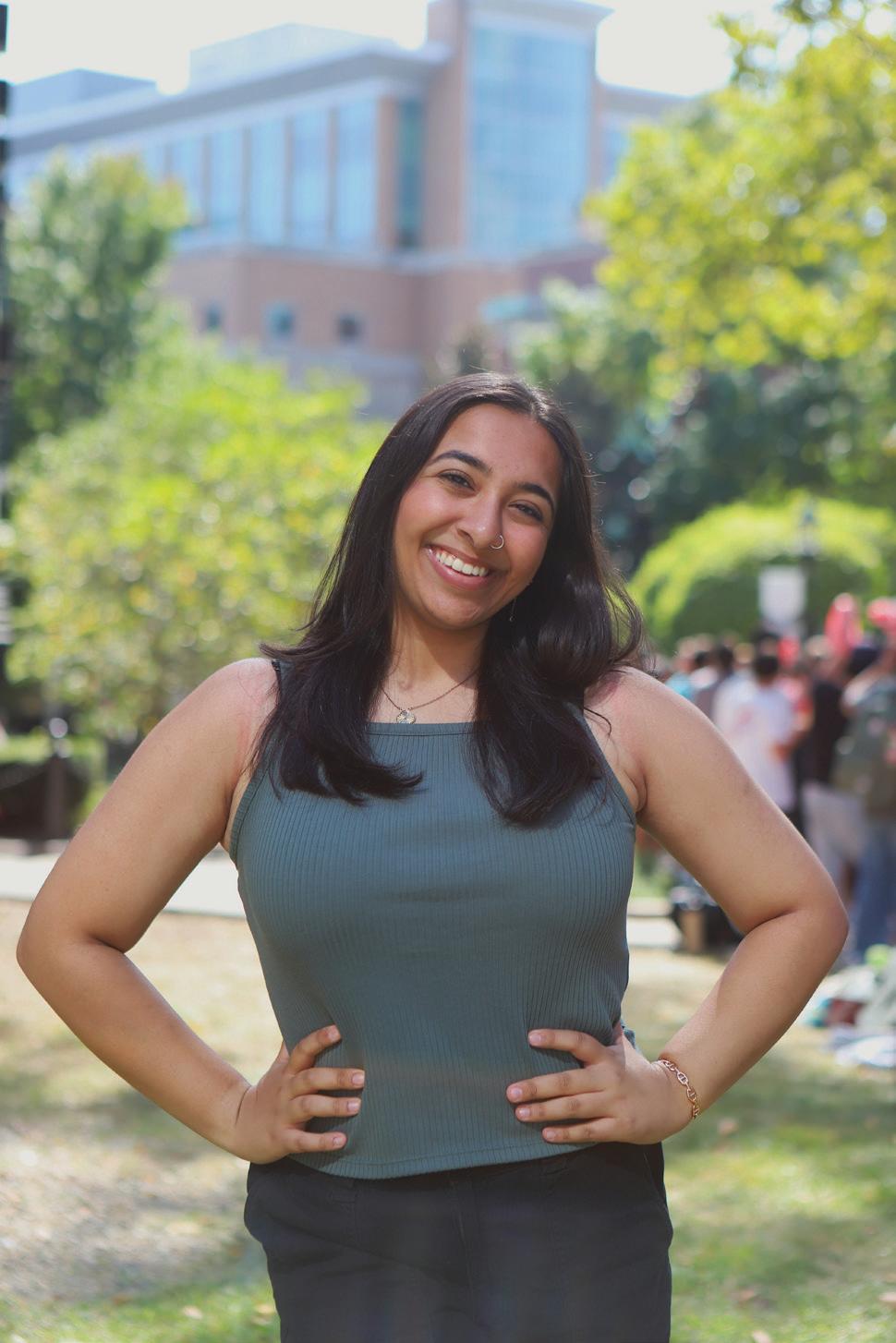
Jiya Jaisinghani ‘27 Editor-in-Chief
Soláz: a modern Mediterranean dining experience
BY
ly sophisticated and richly composed, giving the menu a refined depth. Many dishes balanced heaviness with freshness in a playful way that kept the dining experience lively and kept us eagerly waiting for more. I found myself captivated by the interior decoration; the abstract mural illuminated by a soft red glow, and the warm golden lighting along the beaded ceiling added a cozy atmosphere that pulled the whole room together. In addition to enthralling and flavorful food options, the restaurant features golf suites that make it the ideal spot for a fun night out.
Beets and falafel sat atop a velvety pool of goat cheese, lush and tangy with a hint of mustiness. Golden and red beets with cucumber added a refreshing brightness, while
spiced pistachios brought warmth and nutty depth. Crisp falafel bites rounded out the dish, soft and herbaceous inside. The baklava bites, on the other hand, came with a golden, crunchy shell that broke open to a warm and savory filling. Each piece had a piped dollop of smooth goat cheese on top and a honey-glazed walnut set right over it, adding a gentle sweetness that elevated each bite. The plate was finished with crisped Brussels sprouts that brought a smoky edge to
A side is meant to complement the main dish, and the Moroccan fries paired best with the grilled lamb chops. Thin, golden, and crisp, the fries were well-seasoned and finished with parsley, cutting through the richness of the medium-rare lamb. Pistachios added a gentle crunch and warm, nutty note, while the sparse gremolata brought a fresh, herb-driven lift. Cherry tomatoes added color and freshness to the plate. The twin lobster tails were cooked tenderly, yet the exotic spiced tomato butter that accompanied them felt a bit flat and could have lifted the dish more. I wished for a stronger spice profile to give the lobster more character. The cherry tomatoes did not feel like the right pairing for the lobster, but the red piquillo peppers were a strong addition with their sweet and slightly peppery flavor.
My favorite part of dinner is always dessert, and
at Soláz, I definitely indulged. I had to order the vanilla bean crème brûlée, my benchmark for testing desserts. The custard was silky smooth, paired with a hard, brittle caramelized sugar topping. While the topping was perfectly browned, it was a bit thin and didn’t deliver the satisfying crack I was hoping for. The poached currants gave a sharp contrast. When paired with the custard, the flavors were additive; the richness of the custard balanced the bright acidity of the currants. The fig jam, wedged into the cookie, comple -
mented the dessert nicely, adding a subtle sweetness to the custard.
As for the soft and fluffy tiramisu donuts, four came on a skewer coated in a sugar reminiscent of churros. The presentation featured mascarpone cream on the outer ring of the bowl, pistachio cream in the middle ring, and an espresso syrup center. Yet of all the desserts, I enjoyed the banana baklava the most. The banana “baklava” Napoleon featured crisp phyllo dough, silky maple-flavored pastry cream, caramelized banana topping, and hon -
eyed walnuts arranged in a mille-feuille style. This dessert combined crisp phyllo, smooth maple-flavored cream, and the nutty sweetness of walnuts in every bite. I wish to relive the moment of savoring this dessert all over again.
Soláz was incredible from start to finish, but the staff were truly the highlight of my meal. The service was consistently attentive, from the manager checking in on us and giving us a tour as soon as we arrived, to the waiter keeping us engaged throughout the meal. Combined with the ele -
gant, inviting ambiance, the experience felt carefully curated and welcoming. Since Soláz is new and not widely known, I highly suggest checking it out. I had the honor of meeting the Chef de Cuisine, Vikas Rawat. He comes from a humble background and worked his way up to become the talent behind the food. Tasting these dishes was one thing, but meeting him in person made it clear how much care and thought went into every plate, shaped by his experience working in India, the Caribbean, and the United States.
Wistful Christmas on shuffle
have you done?” I’d like to think this is his way of asking the listeners to dive into their own consciousness and awareness. Along with the rest of his discography, John Lennon leaves us with a peaceful imagining of a happy Christmas.
months now. I think this time of year is so fun and beautiful and exciting. I have to say, though, the holidays bring me into a spiral of nostalgia. The Christmas lights hanging on humble houses and the way we count down the days until Santa drops off gifts always come with a sense of wistfulness. I am a summer girl through and through. I was born in late June, and I feel most like myself when I’m down the shore. The one thing that can get me to truly enjoy the cold, crowded winters is Christmas music. Here are some of my favorite Christmas tunes that may not help with curing nostalgia, but are sure to make you feel something.
First up is John Lennon and Yoko Ono’s classic hit, “Happy XMas (War is Over).” This song was released in 1971 during a hostile time in a war-stricken world full of uncertainty and helplessness. This song offers a wish for a hopeful Christmas with peace and calm. John challenges the listeners by asking, “So this is Christmas, and what
Next is a song that I have always loved for as long as I can remember. The song is called “Do They Know It’s Christmas?” by Band Aid. Almost a protest song, this tune was released in 1984 as a charity single. The meaning of this song is an urge to privileged audiences to remember those suffering from hunger, poverty, and war, especially during Christmas. This song has many beautiful voices that all come together to create a symphony of Christmas hope.
The last song is a more traditional Christmas song, probably one that most of us have heard before.
“Have Yourself a Merry Little Christmas” is a classic tune whose deeper message is disguised in festive musicality. Being from North Jersey and living in Hoboken for the past three
the Frank Sinatra version the best. This song might not sound like the most yearning of Christmas carols, but when you really get into the lyrics, it is evident that this song has many wistful aspects. Specifically, the lyric that always has my eyes turning wet is the verse that says, “Through the years, we all will be together. If the fates allow.”
I think this lyric goes unrecognized because it is sandwiched between classic Christmasness. The holidays are always a time for family and friends to be together. When you get older, the number of seats at the table sometimes starts decreasing, and the holidays are a time to remember those who have passed on. I can totally relate to this song and concept. I think that’s why I love it so much. All in all, I love Christmas, and I love the fun songs that come along with the season. I am not a big fan of the cold, but these wistful holiday songs always get me in the chilly Christmas spirit! Take a listen to some of these tracks during your time of
PRISHA VAGVALA ‘28
PRISHA VAGVALA FOR THE STUTE
PHOTO COURTESY OF LA PHIL STORE
Opinion
Why winter hits different
about a different feeling in me. Aside from the joys of the upcoming holiday season and break, the stresses of finals, and the year-end, there is a lot of room for reflection. Why is this the case? What is it about this time of year that leads to introspection and nostalgia?
Firstly, for girlies like me, they always have a lot going on. Not only are we living in the moment, but constantly mapping out the next steps. However, with the cold, we are forced inside literally and metaphorically. Winter forces you to adapt and to slow down. Of course, that is difficult with the holidays almost upon us and the trenches known as finals that
we have to cross, but there is that inherent need to want to pause and look back for a second. “How did I do? Who did I lose? Did I achieve everything I wanted to this year? Why is this one thing from March still bothering me? What went wrong? What should I do differently in the future?” These are all thoughts that run through my mind and, dare I say, through other people’s minds too, especially prior to the new year.
Another reason why this season hits you differently and hits you hard is that even though you want to take things slow, work keeps piling up. Academic burnout is on the ris,e and every-
one’s infected. The thrill of the new semester, such as seeing your friends and embarking on your college journey, has sort of passed. Now the semester is just about completing all your assignments, submitting the group projects, studying for finals, holding up your grades, and just managing to eat and sleep adequately in the midst of all of that. With the changing of the seasons, everything catches up with you; your brain is tired, your emotions are running high, and you recognize burnout but are forced to push through. That is why you want it to be quiet, and you just want some time to breathe.
Another key factor is the
holidays. Holidays typically symbolize family and community. Many eagerly wait for the winter break to be able to go home. You’re literally counting down the days until you can go back, but in the meantime, all you can think of is your bed at home, your mom’s (or dad’s) cooking, and catching up with your friends back home. This leads to a very strong sense of urgency to get through the semester. It’s hard to explain, and even if you don’t want to go home, winter triggers this primal longing for comfort.
One possible explanation of why this season hits different is because of its aesthetic. All my fellow Pinterest en-
thusiasts know that winter is very emotionally coded and nostalgic. The holiday lights, the cozy blankets, the hot drinks, coupled with earlier sunsets, old memories, and an older you. Everything is cinematic, and everything has a meaning attached. The vibes of winter force you to reconnect with yourself, what makes you fulfilled, and reflect. You start to realize how much has shifted and how much you’ve changed. This season is like my Spotify Wrapped, except strictly for memories and internal thoughts. It is a seasonal reset where you take the best and the worst from the year and sit with it until the year ends.
The weirdest internship cycle yet (and why you definitely weren’t the problem)
pushed everything back.
A lot of engineering, defense, and infrastructure companies can’t hire interns until federal budgets are finalized or funding for projects is confirmed. When Congress delays anything (which is often), hiring departments freeze like statues in a children’s museum
2. Background checks + security clearance = long
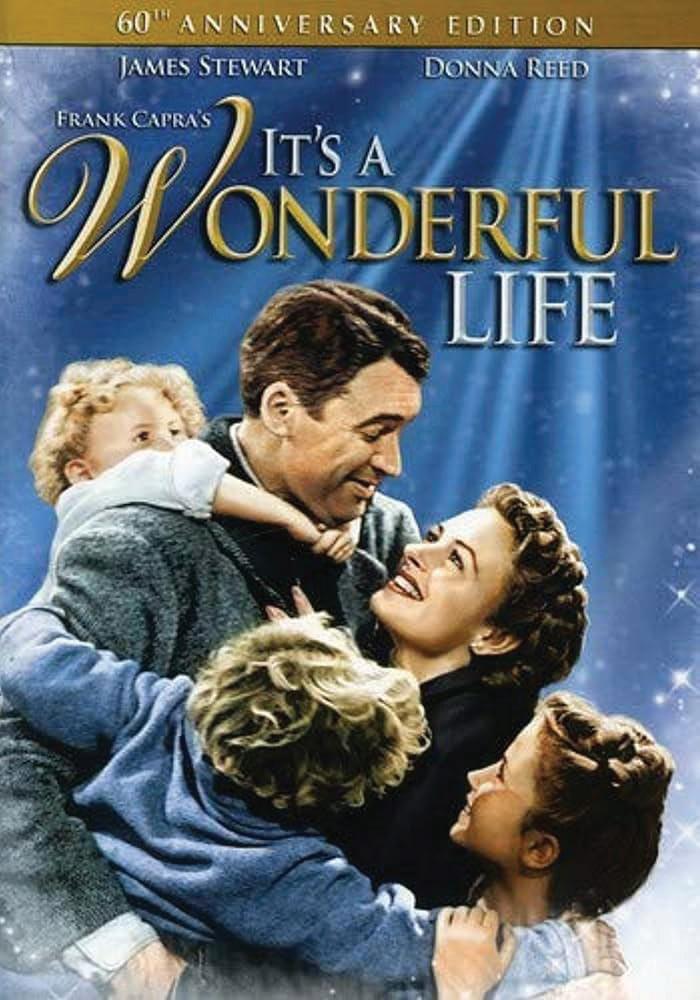
It’s a Wonderful Life: the miracle hidden in an ordinary man
over the business. By the time he reaches adulthood, George feels trapped at Bedford Falls, unable to pursue his passions anymore. What makes George compelling and relatable is not because he is heroic, but his small, meaningful acts of kindness over and over again. He believes that his life has amounted to nothing when, in reality, it has meant everything to the people around
This cycle was just flatout weird for everyone
Normally, fall recruiting season is chaotic in a comforting, predictable way: postings appear, interviews roll in, and you panic-apply to roles you’re 50% qualified for (or 12% qualified for — we don’t judge here).
But this year? Crickets. Tumbleweeds. Ghost towns across Handshake.
Companies posted later. Interviews took longer. Some employers acted like they were waiting for a sign from the universe before making any decisions. And government contractors? Forget about it. They were on their own timeline, which apparently runs three months slower than the rest of us. So why was this cycle
Companies tied to DoD, energy, aerospace, and public infrastructure typically need to know whether you’d pass a clearance before they commit to an internship slot. Those checks don’t move fast, especially after the 2023–24 reforms that tightened processing.
3. The private sector was hedging.
In tech, manufacturing, and logistics, many companies slowed their early hiring because of economic uncertainty, supply chain instability, and cost-cutting from 2024 rolling into 2025. Translation: they didn’t want to hire interns for projects that might not exist yet.
4. A lot of companies shifted their recruiting windows. Some moved to January–March hiring instead of fall, which left students staring at empty dashboards in October, wondering if they were doomed. Spoiler: You weren’t.
How you know it
If you ever thought: “Why is no one posting roles yet?”, “Why is this recruiter replying once every lunar cycle?”, “Why is my interview scheduled for February when the internship starts in May?”… it wasn’t a red flag about your qualifications.
It was the system catching up to delays way above your pay grade.
What you can control
Even in a cycle this bizarre, there are things you can do:
Apply broadly and early — even if the posting looks “too early.”
Reach out to recruiters (nicely); half of them are drowning in approvals like you are drowning in finals right now.
Build a skills portfolio so you’re ready when the floodgates finally open.
Talk to past co-op students; they always know which companies run behind.
If you haven’t received an offer yet
You are not behind.
This year, many companies won’t finalize hiring until January, February, and even March.
You’re allowed to breathe.
The process is messy, unpredictable, and slower than a government website loading on Stevens Wi-Fi. Just know you’re going to end up where you’re meant to be.
And when you do, you’ll look back and realize this chaotic cycle was just another story for your own Coop Chronicles.
George Bailey’s quiet impact on the people of his town. His story endures because it mirrors the silent struggles many of us hide behind the holiday cheer — fear of falling short, the weight of responsibility, and the looming future ahead of us. But it also reassures us that the unseen and uncelebrated parts of us are shaping the world in ways we don’t realize.
The movie follows George Bailey, a man who sacrifices his dreams for the sake of others. While others are out progressing and having adventures, George stays behind in Bedford Falls, taking care of his late father’s small building and loan associa-
The film takes a darker turn when George, overcome with financial burden and failure, contemplates taking his life. His breaking point doesn’t come from not making enough money but from feeling unworthy. This part of the film serves as the emotional core of the story, transforming George’s perspective on his life. George believes that the world would be a better place without him. At this point in the movie, the film delivers its most powerful message: the importance of a life is rarely visible to the person living it. Clarence, the guardian angel sent to intervene, doesn’t save George by granting wishes, miracles, or wealth. He instead decides to show George his worth. Clarence shows George a world in which he was never born. This perspective forces him, and us, to see how much one person’s life can have a big impact on the people around them without realizing it.
The alternate Bedford
collapsed into helplessness and greed. His brother dies young, the pharmacy owner is ruined, multiple families in town lose their homes, and the community he had unknowingly held together falls apart. It is through this haunting perspective that George realizes his worth and the value of his presence in Bedford Falls. This sequence confronts the viewer with the uncomfortable truth that we often see ourselves as failures because of the things we didn’t accomplish rather than the people we’ve helped along the way. When George returns to Bedford Falls, nothing in his life has actually changed. He is still in debt, still facing consequences, and still unsure of the fate of tomorrow. But he has rediscovered why his life matters. In the film’s closing moments, the community comes together to help him with his struggles. It’s not a miracle of generosity that resulted in this moment, but the natural outcome of a life spent helping others.
It’s a Wonderful Life is timeless, as it touches on a universal human fear: the feeling of insignificance. But it offers a countertruth just as universal. Our impact is greater than we know. The film reminds us that meaning is not found in grand achievements but in the quiet, everyday choices that shape the world of the people around us. And sometimes,
PHOTO COURTESY OF AMAZON
Opinion
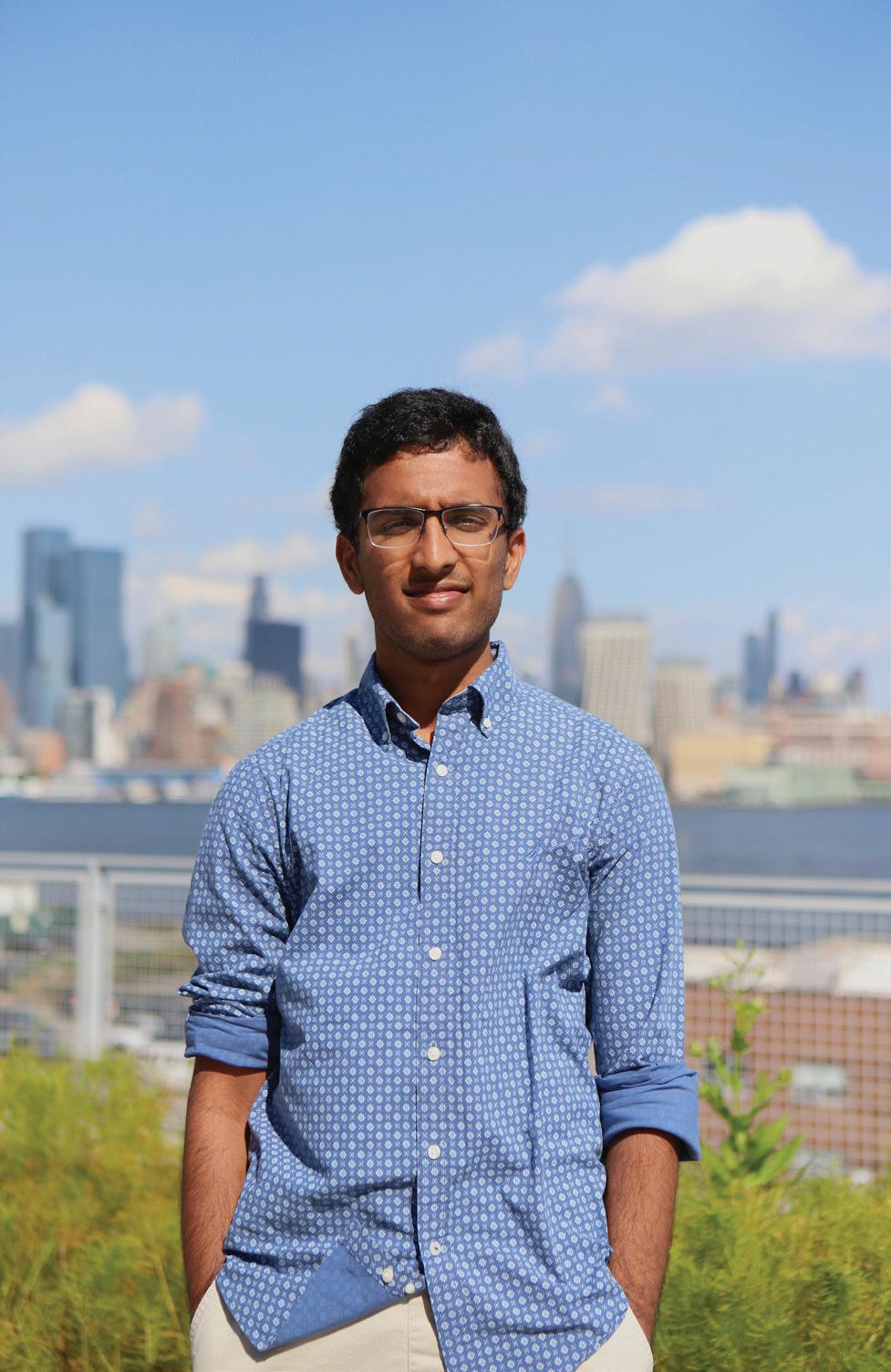
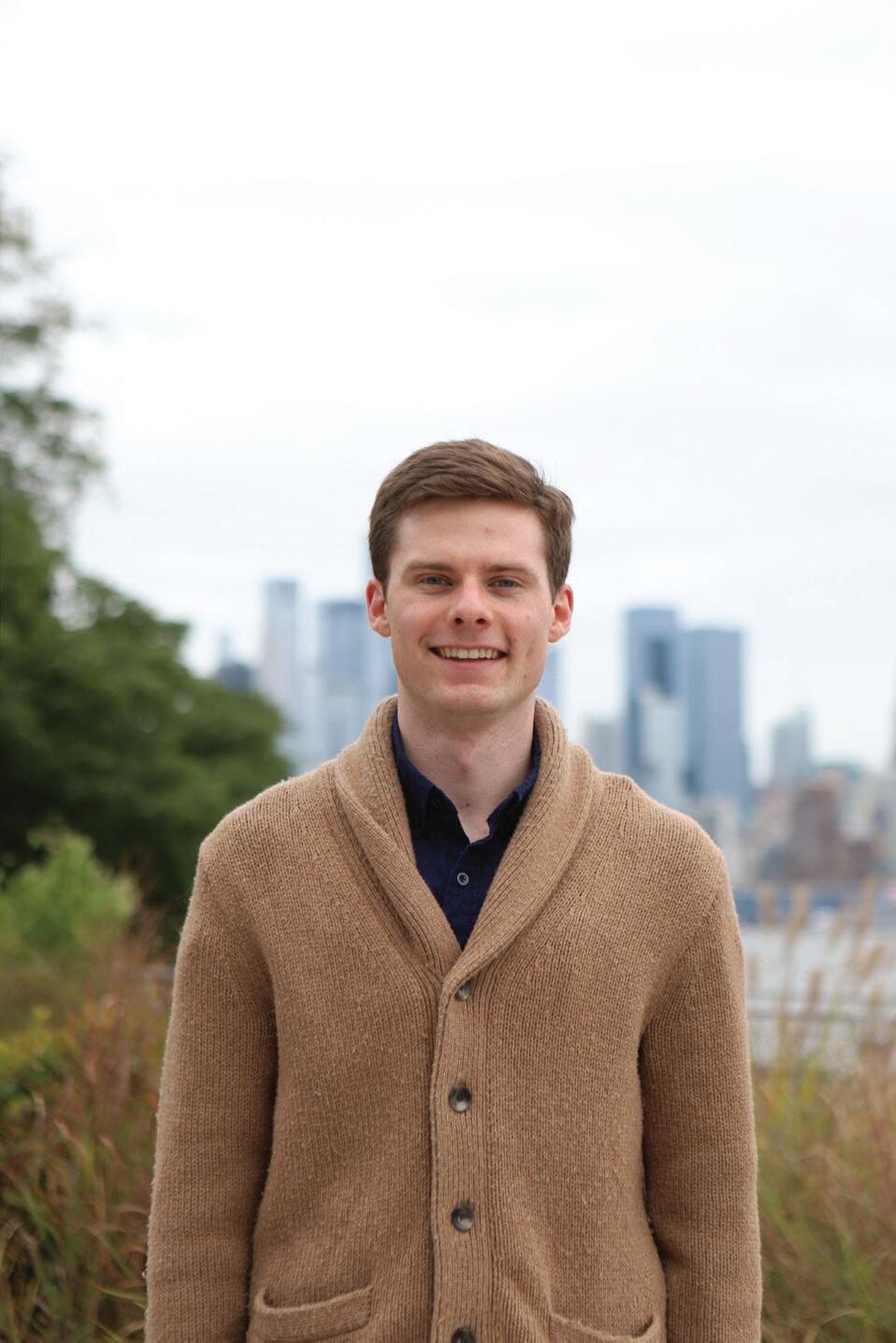
A conversation with fellow mathematics PhD student Michael Catli
BY CHARLES BEALL B.S. ‘23 & PHD STUDENT
at Seton Hall University, where Michael completed his undergraduate studies. Michael now works in the group of Professor Alexei Miasnikov, and is a Teaching Assistant for the firstyear calculus sequence. I found this conversation, edited for conciseness and clarity, to be particularly fascinating, so a more complete account of it can be found on the Stute website. Happy last day of classes, and good luck on finals!
Charlie: What was your experience with mathematics growing up? What about the subject excited you, or made you want to pursue it at the university level?
Michael: I really liked math along with science, and as a kid I actually wanted to be an astronaut because I just loved space and was so excited to think about things that existed outside of the planet. In elementary and middle school, I used my parents’ laptop to look up math stuff beyond what I was learning in school, and got a lot
geometry in high school. I got to teaching myself calculus from the internet in junior year, and senior year I bought Cornel Ioan Valean’s “Almost Impossible Integrals, Sums, and Series,” and would work on problems from it all day. This prompted study into other areas of mathematics used to evaluate integrals, and I came to see mathematics as the number one way to improve the ability to think. That’s a loaded statement, but I feel like it’s really true, and improving my ability to think made math the most stimulating subject for me, and that can be attractive for anyone as well.
C: That perspective on math you give at the end is really interesting! I know a lot of people lump mathematics into the sciences thanks to STEM being such a popular acronym, while others (typically mathematicians) believe that the subject is more of an art, or at least has more artistic elements, due to its abstractness, compared to the other sciences. It seems like you’re saying mathematics to you is a kind of philosophy – could you comment a bit more on that?
M: You could view math as a big circle, and then the sciences and engineering fields can make up a part of that circle, in the sense that they depend a lot of times on being able to make conclusions utilizing mathematics. I’m not saying that math is any better than these fields, because you can be very stimulated by these other fields too, but I think all of them require the ability to mathematically think. And this mathematical ability really strengthens overall cogni -
tive ability and reasoning skills. Ultimately it’s hard to describe this mathematical ability in words –like somebody once said “Mathematics is what mathematicians do” – and that’s all you can really say about it. But this ability to think or desire to strengthen your ability to think is what drives your ability to study the subject.
C: That’s a really great explanation on the connection between mathematics and logic and reasoning skills! Now I want to ask about the work you’re currently doing for your PhD. What is your current research focus?
M: It’s still in the very beginning stages, but I’m currently trying to prove results about what we call the decidability of certain problems, specifically problems within group theory. I’m trying to show that in certain groups, there’s no easy algorithm for finding a solution to any given system of equations. For those not familiar with group theory, the idea of a group is that you have a set of elements, and then you can perform what’s called a binary operation on any two elements to get a different element in the set. You can also “divide” by any element, and there’s some element that acts like a “1,” both with respect to this operation. An example of this is multiplication of two nonzero numbers: each number has a reciprocal, and you can multiply by the reciprocal to obtain the “division” I just mentioned; 1 acts as the identity, since any number times 1 is again that number.
C: What about this problem interests or excites you?
M: I think it’s exciting
to work towards making these algebraic structures less abstract and more something you have a grip on. The more results we can show about groups, the better we understand them, which is what I’m trying to do. I’m trying to get a sense of, “Okay, how hard is it to do this task in groups? And based on that, would the group be more similar to more familiar algebraic structures we know?” Also, I’ve always had a particular interest in group theory, going back to my undergrad, so it’s cool to push the limits of under standing in that subject.
C: This is already quite interesting, and you already touched on your self-study of inte grals going back to high school. Are there any other mathematical re sults or areas of math that you find particu larly exciting?
M: I was thinking of sharing for this ques tion that all finite simple groups have been classi fied, via thousands of pag es of mathematical proof due to around 100 authors. Simple groups are real ly important since they’re like building blocks for more general finite groups, and thanks to these mathe maticians, we have basical ly a periodic table but for group theory. This is very interesting, but it’s also quite beautiful, because I think it shows how fruit ful these types of collab orative efforts can be be tween hardworking people who have the same goals in mind.
C: The level of col laboration really was impressive for this classification project –you mentioned the pe riodic table which is a great analogy, and I’d also like to analogize
The intersection of engineering and art
BY ITAI GELLER ‘26
used to be a favorite hob by. In completing my secondary education, I was able to extensively fulfill my desire to create through various art classes and personal projects I had time for. Despite finding consistency, opportunities to pursue my artistic passions dwindled once I started my undergraduate education at Stevens. Generally, having less time hasn’t hindered my ability to create some of my best work.
Constantly being forced to think as an engineer has definitely taken its toll, though, and I’ve felt it more challenging to act on my inspirations. Overall, I have a very spontaneous creative process; I’ll suddenly see an image of exactly what I want to do in my head, and then I execute. However, I feel like my mind—through the process of learning to be an engineer—has been slowly conditioned to a necessity for perfection.
Engineering is an interesting profession in that you are constantly required to synchronize science and ethics. To ensure that a system works, one must ask a multitude of questions: Will this mechanism perform correctly based on my calculations? How can I improve the output of this system by utilizing a statistically controlled process? Will this new implementation influence the job performance of operators? How will neglecting a peer review process for these bridge structural drawings hinder commuter safety? In the real world, the things engineers create can’t fail because people rely on those devices, products, machines, and processes. These considerations are essential and must never be forgotten.
Thinking methodically and accurately is essential in engineering, but when it seeps into an artistic process, such a structured way of thinking can actually be detrimental. I oddly notice myself taking fewer chances on new ideas, meticulously coordinating the utensils I use, and becoming more frustrated with failed con cepts.
Unlike engineering, art represents a medi um where failure is of ten more beautiful than it is catastrophic. Artists confront their failures, insecurities, and frustra tions by creating physical representations of those feelings through different mediums. In some ways, art is a process in which you “fail upwards”. Here’s an example: in drawing a landscape, I notice that I don’t like the way the trees look, but that dis tant mountain range re sembles a nose. Natural ly, I rotate my canvas 90 degrees and continue as though nothing even hap pened. Additionally, art oftentimes isn’t designed to be appealing or cater to a large audience. In fact, there are art forms specifically intended to make the viewer severe ly uncomfortable. For the artist, if a viewer is abso lutely repulsed by what
they are looking at, they have succeeded. If an en gineer at Philips designed a toothbrush shaped like a rectangular prism because they “wanted the consum er to consider the privi lege of routine” or some thing ridiculous like that, they would get fired. Ultimately, it boils
Ryan Li Me ‘27
“Michael
Jay McKinley ‘28
“Gingerbread is garbage.”
Fiona Shi ‘26
“Christmas songs are amazing year round.”
ROVING REPORTER
By Isabelle Villanueva and Rachel Choi
Devin Aaron ‘26
“Arbor
Puzzle Page
Across: 1. Popular soda
“What’s your unpopular holiday opinion?”
Ryan Paradine ‘27
“Christmas lights should go up after Christmas.”
6. Something that causes students stress during finals season
7. Japanese electronics company known for producing paper printers
8. Italian sauce made from crushed basil, garlic and olive oil
9. A mix of rain and snow
Links
Taylor Enes ‘26
“Christmas lights can go up before Thanksgiving.”
Down: 1. Marshmallow candy usually in the shape of a baby chicken
2. Force out or eject 3. Out of date or no longer fashionable 4. To have struck someone/something down in the past 5. Isn’t
Inspired by the British game show Only Connect, the goal of this puzzle is to find the hidden connection between four seemingly abstract clues. Each answer will use trivia, wordplay, logic, or some combination thereof. The solution is always more specific than “nouns”, “places”, etc. What do the following have in common?
Holiday, Pre, Hunting, Finals → Words that precede ‘season’
Traverse each square one by one in any of the eight directions (like a king in chess) to spell out the answer. The starting and ending squares are bolded. Every letter will be used exactly once. The clue below the grid designates the lengths of each word.
*Puzzle instructions by Stephen Pachucki
Each of the six clues on the right leads to a two-word phrase or compound word. Insert each answer into two of the boxes on the right. At the end, you will have an interlocking chain of six phrases.
*Puzzle instructions by Stephen Pachucki
Clues:
1-2. A cold and round object typically thrown playfully during the winter
3-4. Important event for a college sports team
4-5. Typically between 7am-5pm 5-6. Brief pause in a game
ANSWERS TO LAST WEEK’S PUZZLES
Day is the best holiday.”
Frankie Febbo ‘29 “There’s no thing as a good turkey.”