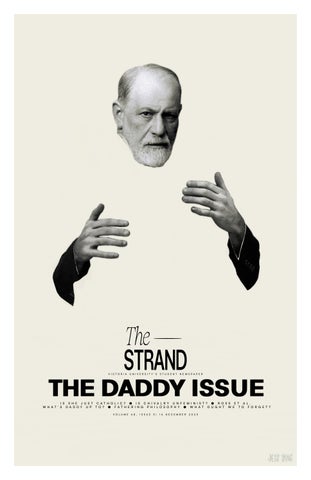
V I C T O R I A
U N I V E R S I T Y ’ S
S T U D E N T
N E W S P A P E R
I S S H E J U S T C A T H O L I C ? ● I S C H I VA L R Y U N F E M I N I S T ? ● R O S S E T A L . W H A T ’ S D A D D Y U P T O ? ● F A T H E R I N G P H I L O S O P H Y ● W H A T O U G H T W E T O F O R G E T ? V O L U M E
6 8 ,
I S S U E
5 |
1 6
D E C E M B E R
2 0 2 5
EDITOR | SIJIL JINDANI NEWS@THESTRAND.CA
02 NEWS & POLITICS
What’s daddy up to? What has Carney’s government actually accomplished thus far? HANIYA SIDDIQUI ASSOCIATE NEWS & POLITICS EDITOR
A
midst a federal election, fighting through a tumultuous political and economic atmosphere, one man with little to no political experience propelled himself forward as the shining beacon of hope Canadians so desperately needed. Mark Carney’s landslide win in the March 2025 federal election was unprecedented, to say the least. In the eyes of both liberal and conservative Canadians, Carney’s extensive background in economics compensated for his lack of experience in politics, and he represented the change that everyone hoped to see after ten years of Trudeau’s Liberal government. However, eight months into his mandate, the question remains: what has our beacon actually delivered? Here is a breakdown of all his campaign promises, his progress on achieving these goals, and where Carney’s Liberal government continues to fall short.
Act. The bill aims to reduce the lowest federal income tax rate from 15 percent to 14 percent and implements a temporary GST rebate for first-time homebuyers on properties under $1 million. However, this bill is still waiting for further parliamentary action before it can receive Royal Assent to become law. On the topic of housing, Carney was extremely ambitious during his campaign, inciting the slogan “Build, baby, build,” vowing to double home-building rates, bolstering Canadian lumber and technology sectors, and supplying 500 000 new homes a year. In September, he launched Build Canada Homes, a new federal agency that will build affordable housing at scale. The agency received $13 billion in initial funding and expects to provide tangible results within the next five years.
Trade, Tariffs, and our Neighbours to the South A significant portion of Carney’s campaign focused on addressing tariffs and threats to free trade imposed by US President Donald Trump. Since September 1, 2025, the federal government has removed the 25 percent tariffs on goods imported into Canada from the United States. This includes removing tariffs on $14.2 billion worth of goods that had been in place since March 13, 2025, and tariffs on $30 billion in goods that had been in place since March 4, 2025. Although significant progress has been made, Canada’s tariffs on steel, aluminum, and automobiles remain in place. Aside from international threats, trade barriers between provinces have hindered much of the nation’s potential GDP growth. According to CBC, “some economists have said removing them [internal trade barriers] could boost Canada’s economy by $200 billion annually.” To address this concern, Carney passed Bill C-5 in June of this year. This bill tabled legislation to eliminate all federal barriers to interprovincial trade and labour mobility and to remove all federal exceptions under the Canadian Free Trade Agreement. Since Canada Day 2025, all interprovincial trade barriers at the federal level have been eliminated, and provinces have begun discussions on removing barriers at the provincial level.
Budget While many of the Prime Minister’s key campaign promises have been achieved or are currently works in progress, he has still faced significant backlash for the controversial 2025 budget. The budget projects a deficit of about $78 billion for the current fiscal year, adding a significant amount to the country’s cumulative debt. This will ultimately lead to higher interest rates, curbing the progress made to bring down the cost of living. Critics argue that the budget will lead to higher taxes on farmers, food, and home building due to the industrial carbon tax. Moreover, the budget proposes cutting nearly 40 000 public service jobs through attrition and early retirement in an effort to ‘streamline’ services. However, experts warn that this elimination of services could lead to longer wait times for government benefits and decreased efficiency in already overburdened systems. Eight months into Mark Carney’s tenure, it is clear that the optimism that swept him into office now competes with the realities of governing. While his economic expertise has guided some promising early progress, the controversies surrounding the newly announced budget leave voters wary about the changes to come. Whether Carney can transform initial hope into lasting impact is a question that has yet to be answered with conviction.
Cost of Living and Housing Crises’ Of the many economic concerns troubling Canadians, the rising cost of living and the housing crisis were the most decisive for voters and remain central concerns today. Addressing this dilemma, Carney’s government proposed Bill C-4: Making Life More Affordable for Canadians
CREDIT//@MarkJCarney
@STRANDPAPER THE STRAND | 16//DEC//25
NEWS & POLITICS 03
The Fall 2025 caucus meeting report Caucus concerns: accessibility, Ryerson’s portrait, and the Coburn SIJIL JINDANI NEWS AND POLITICS EDITOR
Vic’s Fall Caucus took place on Friday, November 21st at the Old Vic Chapel. It was chaired by VUSAC’s Vice President External (VPE) Isha Mathur and consisted of reports and Q and A with administrators, VUSAC executives, and levy representatives. Highlights of the 3.5 hour meeting included discussions on accessibility, campus spaces, and Vic’s Annual Operating Budget. Administration Reports President Rhonda McEwen discussed campus master planning and common themes from student feedback, including physical accessibility, wellness, diversity, and free discourse. Registrar Yvette Ali informed students of extra drop-in hours for the end of the term, a new Advisor on Call to provide immediate assistance, a program supporting suspended students, and study abroad deadlines. Professor Ira Wells from the Office of the Principal discussed developing partnerships, efforts to scale up experiential learning, the expansion of the faculty-student mentorship program, and revisions to the Vic One application process. Dean of Students Kelly Castle outlined ongoing food and space reviews and summarised feedback from the Dean’s Advisory Committee meetings, which includes demands for longer dining hours, after hours study spaces, and increased campus housing. Castle informed students about planned improvements to Wymilwood Lounge and the Glass Study Room at Goldring. Bursar and Chief Administrative Officer Jennifer Ankrett discussed renovations, efforts towards food affordability, and plans to improve student safety. Admin reports took 50 minutes, which was double the time they were scheduled for. This delay significantly decreased time for Q and A. One attendee expressed that “admin should respect the five minute limit.” This issue was acknowledged by Mathur during the meeting and is not unique to this semester’s caucus, suggesting a need to review the meeting procedure. During the question period, President McEwen addressed a concern about the potential restoration of Egerton Ryerson’s portrait to Old Vic. She outlined the context behind the portrait’s removal during the pandemic as a safety measure, and “not in objection to who he was.” Restoration discussions have been under way for three and a half years and concerns about erasing history have arisen. Discussions include consultation with Vic’s Indigenous Advisory Circle, made up of “student representation, faculty, librarians, and elders.” An anonymous feedback form was administered at their recommendation but is “getting very little feedback,” McEwen said. She encouraged students to make their opinions heard soon because while there is no timeline set, “there will be a time when we have to do something.” Accessibility was a recurring theme throughout the meeting. The President discussed campus space enhancements accommodating sensory needs, and the CAO mentioned plans for improving accessibility through building and facilities modernisations. Issues were raised about Old Vic’s elevator closure for its modernisation, which will span all Winter semester. The CAO assured students that most events will be relocated and classes will be adjusted based on need. A student highlighted concerns with the Registrar’s 2024/25 Student Experience Survey, which lacked an option to identify as disabled. Thus, when assessing accessibility, “it is not possible to filter out and see how disabled students are experiencing this.” The Registrar’s Office cited privacy concerns limiting survey questions on disability and said accessibility “wasn’t a strong theme in the responses.” Students clarified that this may be because focused and intentional data from disabled students was not collected by this form. The Strand asked the Dean’s Office about the student response and budget allocated to their new wellness programming. According to Castle, the budget is “packed into staffing” and difficult to break down. 30% of on-site counselling is funded through Vic’s budget, from residence, commuter, and UofT transfer fees. Responding to a follow-up request for increased transparency and student input on the Student and Registrarial Services portion of Vic’s Annual Operating Budget, Castle encouraged students to attend Dean’s Advisory Committee meetings. The Strand raised a question about the Coburn Award, through which Vic maintains ties to Tel Aviv University and the Hebrew University of Jerusalem. This has come up at past caucus meetings due to the universities’ connections to the Israeli military, which has been widely acknowledged to be committing genocide in Gaza. McEwen’s response focused on the importance of students’ ability to travel and research in the region. Vic has consistently used ideas of ‘academic freedom’ to justify this partnership. While McEwen suggests that academic freedom manifests in students’ ability to explore their interests, it is unclear how Victoria College represents Palestinian views. The award is only in partnership with Israeli universities, many of which contradict academic freedom by aligning with hegemonic state narratives of suppressing Palestinian voices in academic discourse, and being complicit in Israel’s scholasticide in Gaza.
VUSAC and Levy Reports VUSAC President Rohini Patra’s report, presented by another exec in Patra’s absence, discussed her $5.50 Ned’s Cafe initiative and recently successful efforts to open Goldring Student Centre on weekends. She mentioned the Diwali collaboration with admin and Patra’s intentions to host similar large-scale events for Lunar New Year and Eid. Vice President Internal Aiden Kong discussed VUSAC retreat and staff/co-chair hiring, acknowledging delays in the process. Mathur’s VPE report discussed the Vic Pride scholarship, elections, and Eat After Eight, which recently launched a volunteer program and supports approximately 40 students per night. Levies provided updates on hiring and programming. The Cat’s Eye discussed their expanded subcommittee, their Pub Night with VicPride, and Co-Manager hiring. VicPride detailed events and Acta Victoriana discussed their launch party. VCAA, VCDS, and The Strand mentioned rocky leadership transitions and future plans, including VCDS’s upcoming shows and the Strand’s plan to make their office a bookable space. Caffiends detailed collaborations and cafe maintenance. VicXposure reported on free dark room sessions and their equipment rentals program, which they plan to expand next term. The Student Projects Fund outlined website updates and applications reviewed thus far, and encouraged Vic students to apply for funding. The VUSAC and student groups question period involved pre-submitted and live questions. VOCA addressed concerns about unused commuter lockers and proposed a solution of reserving 15-20 lockers for short term sign-outs. The Strand received a question about their accessible e-paper. This was paused due to technical problems with the Strand’s Issuu subscription and website, which the web team is working to resolve. Expanding on this, the Strand Editor-in-Chief highlighted the time investment that this work, and generally running a monthly publication, takes on the part of the Strand team and asked the VUSAC president about paying masthead members. Concerns about recognising student leaders’ labour and time are underscored by the fact that Vic has the largest endowment of any UofT college and that other campus publications pay their workers. Patra commented that using a majority of a levy’s funding to pay execs “doesn’t sound equitable.” It should be noted that the VUSAC President is paid an honorarium of $8000, VPs receive $600, Staff receive $500, and Commissioners and Co-chairs receive $250 each. Patra contended that student leadership is voluntary and work does not correspond to compensation, a perspective expressed by VUSAC in the past. This approach systemically excludes less wealthy students, who often work jobs out of financial necessity, from participating in student leadership. Patra also mentioned that levies can increase budget towards honoraria if they wish. However, VUSAC constrains this through constitutional limits on honoraria allocation. VUSAC went as far as to cut the Cat’s Eye’s honoraria budget last year, despite protests from members of the exec team. VUSAC was asked about reintroducing grocery card giveaways, which occurred before the pandemic. VUSAC members stated that giveaways are an inefficient use of funding. VOCA mentioned a potential collaboration with Regenesis UofT to establish a grocery co-op, which addresses similar concerns of food insecurity. The Equity Commission discussed plans to make non-perishable groceries and recipe carts available to expand access and promote food literacy. Concerns were raised regarding the visibility of information about student programming outside social media. Students who do not use Instagram or have issues navigating devices are often unaware of events, opportunities, and hiring. The Commuter Commissioner mentioned efforts to better utilise VOCA’s website, and suggested VUSAC and other groups use PDFs shared through Google Drive to circulate documents. A VOCA executive recommended a centralised website with all programming and hiring listed. It was also suggested that QR codes should be used in conjunction with links to accommodate people who do not use smartphones. Accessibility concerns were at the crux of the final discussion item. Several students detailed experiences of hostility and ignorance towards disabled individuals within student organisations, a lack of forethought during event planning, and an absence of training and proactive measures that sideline disabled students from programming and spaces at Vic. VUSAC’s failure to establish accountability for levies, clubs, and themselves with regards to accessibility, and their history of “penalizing disabled students for their disability” was brought up. The proposed solution by students was to create an Accessibility Commission on VUSAC. The Equity Commissioner suggested an interim Head of Accessibility on their team, which was not met positively. Students and a few VUSAC members outlined a framework for disability representation. This generated action items for the VUSAC meeting on Friday, November 28th to discuss and vote on these plans. The meeting concluded with a raffle for students who stayed until the end, in an effort by Mathur to encourage attendance and participation.
EDITOR | SOFIJA STANKOVIC EDITORS@THESTRAND.CA
04 EDITORIAL
Daddy Loblaws
Spoiled patience and ripe produce SOFIJA STANKOVIC EDITOR-IN-CHIEF
DUCHESS: True, Master Doctor, and since I find you so kind, I will make known unto you what my heart desires to have; and were it now summer, as it is January, a dead time of the winter, I would request no better meat than a dish of ripe grapes. — Doctor Faustus, Scene 11, Christopher Marlowe
D
azzling the Duchess with the devil’s power, Christopher Marlowe’s Faustus accomplishes a most incredible, unthinkable, incomprehensible feat: he fetches ripe grapes in the off-season. For us grocery goblins, such magic describes your average Monday march to the grocery store. Apples, bananas, lemons, oranges, shining in all their waxy wonder, your classic lunchbox fruits that never go out of stock. Apricots are a touch more shy, waiting for summer to show their face. Quinces scarcely make an appearance, dare I ask of the whereabouts of watermelons. Raspberries, strawberries, and blueberries never fail to form phalanxes along store shelves, a permanent fixture in our LED-lit lives. Time moves more or less the same, cheap tinsel, Christmas decor, and plentiful piles of untouched extremely overpriced panetonne the only indicators of any change in season. Occasionally you’ll buy a bag of budding potatoes, a carton of strawberries with one hidden pelt of fuzz, some small indication of spoilage. A cue to consider what happens to the whipping cream soon to go sour, the fruits shriveling on their stands, the grocer’s morning task to “discount, dispose, or donate” the stragglers. Yet all we see is the eternal shine of lemons, always restocked, ready for purchase. Our expectations are reconfigured by continual exposure to the glossy gleam of beefsteak tomatoes, with no blemish, no bruise, no bug bite. We become prisoners to plausible perfection, fully believing the magic of ever-present produce, the offspring of the offseason, until we take a bite. A deal with the devil comes at a cost. Our tastebuds sense the stunted passage of time, even if our eyes see no change in the luster of limes. Food blogs advise against picking up peaches in November, bland berries in winter. Dieticians advise buying frozen, fruit flashed at its peak ripeness for our enjoyment when their parent plants have ceased production. All the talk of buying fruits “in-season” demands an investigation into the steady stream of off-season imports and the secret rites of prolonged storage. If bending the seasons to our will compromises taste, why continue? Why not breed patience with produce? Why not wait for our seasonal favorites, train ourselves in restraint, and make do with whatever grows in the meantime? In these dens of barcodes and BOGO deals, we grow spoiled with that which never spoils. To set time back on its course, I implore you to take the investigation upon yourself. Pick one fruit from the line-up, just one that seems out of place, and trace the network of imports to their source. Follow the surplus to a food bank, find those bruised bananas on Too Good to Go, and wonder—when did omnipresent apples become our normal? How does ordering food and groceries to your door at the tap of a button change your relationship to delivery men, your friend’s tipping standards, your connection to the worker hushing the beep of the UberEats screen as they take down three in-person orders? As you buckle down for finals and the semester draws to a close, question—how did Daddy Loblaw’s pull the wool down over our eyes?
V O L U M E 6 8 editor-in-chief
sofija stankovic
managing editor
karim arif
editors@thestrand.ca editors@thestrand.ca business manager
tan tan jongrengpian
business@thestrand.ca web managers
web@thestrand.ca
andrew xu nour gatti
news & politics
sijil jindani
news@thestrand.ca opinions
romina emtyazi
opinions@thestrand.ca features
lia iannarilli
features@thestrand.ca science
yaocheng xia
science@thestrand.ca arts & culture
bosko garaca
culture@thestrand.ca poetry
zoe deligianis
poetry@thestrand.ca stranded
stranded@thestrand.ca copy editing
max friedman-cole amy yang
copy@thestrand.ca design
design@thestrand.ca
patrick ignasiak olivia tsoi
photo
chiara zehnder
visuals@thestrand.ca illustration
jessie yang
visuals@thestrand.ca jersey myke-tomlinson erin asaba
social media
@strandpaper
associate editors
features vacant
opinions julia mccarthy
arts & culture sofia terese glantz
science shivantika shegar stranded christina pizzonia
news & politics emmanuella nwabuoku haniya siddiqui
poetry reina van leeuwen
photo vacant
web vacant
copy
editors
rowan
crocker
christina
kavouris
sabrina
kousaian
dinah
miranda
blair
corrine
yang
tangente
harman
banga
haley
victoria laís
zalewski
russi
danica
mae
caputo
oldfield
elyan
wong
true
hystad
cueto
cover illustration jessie yang
The Strand has been the newspaper of record for Victoria University since 1953. It is published 10 times a year with a circulation of 500 and is distributed in Victoria University buildings and across the University of Toronto’s St. George campus. The Strand enjoys its editorial autonomy and is committed to acting as an agent of constructive social change. As such, we will not publish material deemed to exhibit racism, sexism, homophobia, transphobia, ableism, or other oppressive language.
@STRANDPAPER WWW.THESTRAND.CA
@STRANDPAPER THE STRAND | 16//DEC//25
NEWS & POLITICS 05
Is chivalry unfeminist? On the infantilisation of women in heterosexual constructs of romance EUNSAE LEE STAFF WRITER
I
dealised performances of gender heavily guide our expectations and desires within heterosexual romance. Though it’s been tweaked, to be sure, we believe in the same old script of traditional gender roles: the gallantly enlarged male figure and the protected, softened female counterpart. Male acts of service are signals that draw us into the script, then it’s our turn to blush, maybe even giggle, and graciously accept the gesture, thereby sparking the emotional and sexual dialogue of masculine and feminine roles. At the core of the dynamic is an imbalance of power; the feminine role is to passively receive. Can our subscription, then, to these traditional gendered expectations coexist with our belief in equal rights and equal authority within relationships? Is chivalry inherently misogynistic? It’s a cloudy topic of discussion. On a first date, there seem to be more pressing issues: Is he snapping at the waiter? Sliding racist jokes? Launching into an uninterrupted rant of why his three-year-long relationship blew up last week? A considerate, well-mannered guy seems to be a rare find—one to claw at, even. To want the door held open, the first date paid for, and the seat on the subway kindly offered: How could it be a bad thing to be attracted to kindness and decency? Dissecting these behavioural patterns on a deeper level seems unnecessary. The problematic, outdated premises of traditional gender roles, such as the lack of women’s rights and autonomy, and the now-ugly phrase “male dominance” have long been rejected and eliminated from the picture. Narratives defensive of gendered romantic roles often emphasise the woman’s willing choice to accept male interference. It’s not that we need things to be done for us, but that it would be nice if they were. It’s not that we are incapable of paying or carrying our bags, but that it is flattering to have someone do it for us. But is this not just a convenient reframing of a relinquishment of our capable, self-sufficient selves? It’s worth asking: Why do we need to sell ourselves as incapable and passive? I, for one, can’t quite imagine the answer to that question as being independent from the patriarchal repression of female power and self-assertion. Whether it’s consequential enough to warrant condemnation or not, it is contradictory to reject externally imposed passivity as an individual, and simultaneously seek a passive identity in order to be desired romantically. Thus, the seemingly harmless narrative of chivalry prompts women to
self-inflict the infantilising narrative of being incompetent and weak. Even if the attraction to masculine chivalry feels unrelated to the active endorsement of this infantilising narrative, these gendered dynamics can be interpreted as deeply solidified mechanisms of such ideas. Returning to the idea of gendered romantic roles as a script, the script itself is glorified, becoming a subject of desire in itself, not just a mere mode of pursuing romantic desires. The images of feminine and masculine roles exist as sexually charged archetypes, holding allure not only for the opposite gender but for the performers themselves. Adopting a ‘more feminine’ persona is part of the erotic experience, perhaps just as much as interacting with the masculine counterpart. Media representations that have been internalised and glamorised since childhood have helped construct such vivid templates of romantic femininity, and we continue to uphold those prescriptive traits—with a willingness that can be confusing to us at times. More soft, higher-pitched laughter; more—somewhat guilty—enjoyment of feeling delicate and protected; more shrinking. Of course, real relationships aren’t so two-dimensional. Gendered performances do not comprise the entirety of romantic connection, and these expectations are perhaps more prominent between strangers who are situated in a romantic context with no other bearings to each other. However, even as partners reach beyond these superficial archetypes, it’s worth questioning how these initial self-prescriptions influence the understanding and relationship between them. Built on the foundations of assumed female passivity, how are its equality and authenticity manipulated? In her trending Vogue article, “Is Having a Boyfriend Embarrassing Now?” Chanté Joseph considers whether women are diminished by their participation in heterosexual relationships. The amount of discussion it sparked both online and between friends was, to me, an encouraging sign that women are becoming uncomfortable with subscribing to these old misogynistic scripts of romance. Joseph criticises the trending attitude for wanting to keep “the clout that comes with being partnered” yet being desperate to seem fashionable and “not appear so boyfriend-obsessed.” Nevertheless, if the trend is one that prompts women to reevaluate the deep-rooted misogyny of dating culture and reexamine the contradictory ideas they subscribe to, it’s one that I welcome.
CREDIT//The Champion, 1824. Sir Charles Lock Eastlake
EDITOR | ROMINA EMTYAZI OPINIONS@THESTRAND.CA
06 OPINIONS
Fathering philosophy The patriarchy of reason as we know it JULIA MCCARTHY ASSOCIATE OPINIONS EDITOR
T
he act of philosophizing is one that every individual will inevitably engage in at some point in their life. This ability to enact reason in political, personal, religious, and even existential thought is a skill in which most philosophical streams aim to unravel and debrief through the use of the abstract and theoretical. However, what can be said about the figures behind which such foundations of philosophy are constructed? The framework for philosophy and reason as we know it was debated by Socrates and his fabricated patriarchal lineage of students, Plato, and Aristotle during the period of 400-300 BCE. As Athens experimented and birthed new democratic structures, the city flourished with debate, scholarship, and radical ideas. But the question remained: Who would nurture and legitimize this emerging intellectual order? In the collective imagination, Athens needed a symbolic, central Father figure. Plato’s Republic is perhaps the most conducive example of an ideal state’s establishment, with its relevance remaining extremely pertinent in modern literature and political theory. The narrative of the book follows Socrates, Plato’s teacher and mentor, as he addresses every facet of social and political life. What’s interesting about the dictation of the book is the method through which Socrates guides his interlocutors into agreeing with him on every point made. By employing the Socratic method (that is, questioning and countering opponents with questions), it is reminiscent of a wise and “all-knowing” Father who is guiding a child to the “correct” way of thinking, or the right answer—shedding away their ignorance by enabling subtle guidance. This Fatherly nurturing of thought and guardianship quickly becomes an overarching theme of the Republic, as the ideal standards of social hierarchies are created. Plato positions fellow philosophers, including himself, as the “Guardians” of the theoretical city, responsible for overseeing its functioning and ensuring its proper order. They are the ones who determine the level of education of citizens, their roles, and the operation of the city. These “king philosophers” are born naturally superior and are bred for this lineage of rule. Remarkably, this rule over the ideal city is not endeavoured or suggested from a place of pining for power, but rather from a place of protectiveness over the city and its citizens. Socrates
demonstrates this Fatherly ideal clearly when he compares how a ship’s captain is only a good captain when he cares for his crew and the overall shape of his ship. Using this metaphor to refer to the citizens and the city, Socrates asserts that the head of the family must be level-headed, wise, and act in the best interest of his children and home. Through his students, Socrates’s legacy and life’s work were documented and praised. As if avenging and honouring a lost patriarch, Plato and later Aristotle devoted their lives’ work to studying philosophy within the context of what Socrates had already laid out. Athenian politics, in their many complexities, also served as an opportunity for other philosophers to record and write down what Socrates himself taught but never documented, addressing various orders and topics such as politics, family, roles, and gender. Not only were philosophers cast as the abstract leaders of the city, but they were also expected to carry this responsibility into the literal world, establishing themselves at the head of the dinner table as a Father would. The lineage of philosophy and reason has been dominated by these same patriarchal ideals. Most mainstream philosophies that have arisen since the Ancient Greek tradition still examine these ideals of familial structures. More recent philosophers, such as Nietzsche, examine these ‘Fathering’ relationships as psychological and generational. Across periods and thinkers, the figure of the ‘Father’ persists in philosophical discourse, transcending time and remaining a dominant motif in scholarship. As I considered this month’s Strand theme, I felt compelled to write about some of the most infamous ‘Daddies’ known to scholarship worldwide. While they serve(d) as classical geniuses for medieval, Renaissance, and contemporary thinkers, this patrilineal distinction of philosophy is a timeless theme in academia. Considering they reappear constantly in media and literature, it is important to understand why. How can we interpret the work of these scholars now, as twenty-first century thinkers who value diversity and fairness? How can we examine and garner insight from their words while maintaining our own city’s foundational morals? That, my dear reader, is up to you. As Socrates once said, “I am the wisest man alive, for I know one thing, and that is that I know nothing.”
Paternal politics
The danger of romanticizing political figures HANIYA WAHEED CONTRIBUTOR
A
lthough much of Freud’s psychoanalytic theory has been scientifically disproven, it proudly lives on in popular culture through the sexualisation of the word ‘daddy.’ In recent years, parental prose has extended to the realm of politics, and Mark Carney is now Canada’s ‘daddy.’ While the thirst traps on Instagram reels are entertaining, these trends are indicative of a deep-rooted patriarchal structure and an extension of colonial attitudes. To see the effects of our self-infantilisation in action, we look towards the current economic situation, which is approaching recession. Unemployment is at an all-time high, jobs are nonexistent, and the cost of living exceeds what most of the population can afford. One social response to this dire situation has been the rise of the ‘tradwife aesthetic’ on social media (and in real life). Many women are romanticising men who can provide for them and allow them to live at home without having to work or worry about money. The sexualisation of simple provision allows us to ignore the deteriorating economic situation and our responsibilities within it. We can shift the responsibility onto ‘The Man,’ surrendering our autonomy in doing so. This over-reliance on strong, ‘traditional’ male figures is exactly what draws people to superficially engage in politics without responsibly contributing to democratic society. It is our job to remain educated and engage in politics through the news, government surveys, or activism—just to name a few. However, these romantic and sexual trends minimise the gravity of our responsibility and justify our inaction by relying on father-like figures to take care of us. Videos of Carney taking his jacket off or flipping his hair are wonderful for the thirsty Carney fans out there, but roman-
ticising our politicians contributes to a dangerous trend. Gaslighting ourselves into loving our situation dismisses the horrible impacts these people are having on the world, similar to concerns with the tradwife trend. The Carney government has been passing many controversial pieces of legislation, such as Bill C-5, which will only further the corruption allegations our government is facing. Making edits of him does not provide any educational value, and in a time where anti-intellectualism is rising, it’s more important than ever to promote awareness and education over blind desire. The patriarchal notion of a strong man as the head of the household is rife in our current political system as well. Everyone in the house is second to the man, and whoever disobeys is ‘othered.’ It is the same for our government: people rely on a strong man to save them. Indeed, this is exactly the rhetoric that was common during the previous federal election. Anyone who wasn’t a white man was ‘othered’ —one example is immigrants. Anti-immigration attitudes are becoming dangerously prevalent in the public sphere. The fantasy of a white man coming into power to save us from immigrants is simply a repackaged version of the colonial attitudes that we are actively trying to fight. It’s white supremacy in disguise, and yet our romanticisation of political figures glosses over all of this to make our ‘heroes’ palatable. Part of why people like Carney, Trudeau, and Harper win elections is because they appeal to people’s subconscious ideals of what a good leader looks like—a strong white man who people can blindly rely on, as the patriarchy and colonialism have taught us to believe. Why should we elect a woman or a person of colour—someone who is inherently ‘other’? Cont. on page 07
@STRANDPAPER THE STRAND | 16//DEC//25
SCIENCE 07
Cont. from page 06 At a time when our media is being heavily controlled and anti-intellectualism continues to rise, it is our responsibility to educate ourselves, to remain cautious of who we idolise, and be cognisant of the consequences. Of course, I’m not entirely condemning all fun
related to politics, but we must be careful when consuming information that can become propaganda. The last thing we want to do is copy the rise of authoritarianism in our neighbouring country, which is only possible when our lack of education allows others to take advantage of us.
Sinister nature of Boy Knowledge And the disappearance of the Y chromosome MARK N. METRI CONTRIBUTOR
D
id you know that the Y chromosome might disappear sometime in the next five to ten million years? Did you also know that we are technically still in an ice age? The sun will explode in five billion years. Something about Rome. If you know some of this and can recite it, you are in possession of Boy Knowledge. A nugget of Boy Knowledge is characterised by the freedom that stems from bearing the social burden of information. This is okay. There is no better time in recent memory to possess Boy Knowledge, or eat Boy Dinner, or have a Boys’ Night. In the last couple of years, popular culture has seen a rightward shift. Gender roles, which have been eroding for decades, have begun to harden again. At risk of talking out of turn, I would point to the recent aesthetic pursuits of stars like Taylor Swift and Sabrina Carpenter, noting the former’s significant drop-off in political involvement. Boys gamble and pop Zyns; girls make sourdough. Boys and girls will marry, and they will not understand each other, but there will be Boys’ Nights. There’s more. Rainbow capitalism is gone; Louis CK is back, I saw him at Massey Hall; and Sydney Sweeney is a denim eugenicist who isn’t going to apologize for it. In my estimation, Woke took a huge blow after 2009, and Woke has been dying for the last two years (though Woke might be back soon). The Death of Woke is inseparable from tech. In the last two decades, the internet has become the primary cultural landscape. Since the election of Trump in 2016, the Woke Silicon Valley Democrat has transitioned to what journalist Gil Duran calls the “Nerd Reich.” It might be erased from cultural memory, but there was a time when the likes of Elon Musk, Mark Zuckerberg, and Peter Thiel were well-liked by the liberal establishment. Tech billionaires appealed to a decent chunk of men. Musk ‘built’ rocket ships and guest-starred in Rick and Morty. Joe Rogan was a good model
for the median bro. There was a time when Joe Rogan was a Woke Stoner. He was just a curious dude who liked facts about monkeys and thought Elon Musk was cool: harmless, if not overly positive. As we all know, Rogan lost his mind and moved to Austin, where he spends his days shilling out for tech billionaires and boosting terrible comics. Does that sound familiar? Are you listening to me? Joe Rogan’s brain was killed, at least in part, by the wanton pursuit of Boy Knowledge. In parallel with the Nerd Reich, Rogan’s curiosity underwent a transition, beginning with relatively harmless moon landing conspiracy theories. Rogan now hosts interviews with the likes of Eric Weinstein, Donald Trump, Peter Thiel, Elon Musk, and Marc Andreessen, providing them the platform to spew blatant slop, unchallenged by the stoned and ape-brained half-billionaire host. Rogan now lives in an eternal Boys’ Night (the Comedy Mothership) and eats Boy Dinner (elk). He is a case study in what the Nerd Reich wants to do to you. Boy or not, the Nerd Reich is winning the war on your brain and you don’t even know it. I do not hate trivia, nor do I hate fun. I just need you to be a lot more careful on the internet. If you are in your 20s, the internet you grew up on is not what it is now. At least for the moment, the tech billionaires have lost any incentive to feign interest in responsibly running their platforms. It is no coincidence that there is an influx in alt-right accounts and even seemingly apolitical accounts, which use increasingly renormalized slurs and alt-right aesthetics. This is not normal or good. The only way to resist this nihilistic turn and move in a somewhat progressive direction is to be accountable to our principles. Think about what you see and what you know, and measure it against what you believe.
The pull of power ZIAD NASHED & ZACHARY XERRI CONTRIBUTOR
P
ower does weird things to the human brain, and honestly, so do midterms. A raised eyebrow from a professor can feel like a personal attack, while a “nice work” from a supervisor can turn your day around. But why do our brains react so strongly to those we barely know once we step outside the rush of work and school? To get to the bottom of this, we’ve decided to offer you two sides of the same coin. One of us leans into the neuroscience, breaking down the chemistry behind how power and authority influence the brain. The other writes the way your brain feels when cortisol spikes: fast and candid (and a tad chaotic). Together, we’re tackling the neurochemistry of authority from two angles: the science of what happens under the hood, and the lived reality of how it actually feels. Power isn’t just a social concept; it also manifests in the biochemistry of the brain. Power doesn’t just organize societies; it organizes biology. Whether we’re dealing with professors, supervisors, coaches, or community leaders, our brains interpret authority at a chemical level long before we consciously analyze it. Three neurochemical systems help shape that response: dopamine, oxytocin, and cortisol. Together, they determine whether authority feels motivating, reassuring, or downright stressful. Dopamine is not just a reward chemical, but also a prediction system. It spikes when we anticipate recognition, approval, or advancement. Research suggests that people in authority often have higher baseline dopamine activity, while those who aren’t in authoritative positions don’t. Instead, they tend to experience brief dopamine surges, specifically when they receive approval or positive feedback from an authority figure. This makes praise disproportionately motivating. Oxytocin adds another layer. Infamous for its role in bonding, oxytocin’s effects shift depending on social context. Studies show that oxytocin is more readily released when a relationship feels predictable, safe, or supportive, which means that mentorship-oriented authority figures trigger different physiological states than unpredictable or punitive ones. The brain sorts authority into a binary framework: trustworthy versus un-
reliable, each carrying its own neurochemical signature. Then there’s cortisol, the stress hormone. In moments of evaluation that cause stress, such as a performance review, an exam, or a highstakes conversation, cortisol rises. It sharpens attention, narrows focus, and prepares the body to respond to threat or judgment. A short burst of cortisol can be productive. However, chronic elevation of cortisol can harm memory, attention, and sleep. Authority becomes stressful not merely because of power, but because of prolonged unpredictability. Taken together, these systems demonstrate that authority is not just social, but also biological. And yet, biology alone doesn’t capture what it feels like to navigate power. A supervisor hits you with a “We need to talk,” and cortisol kicks in immediately: your focus sharpens, your pulse jumps, and suddenly, every word feels high stakes. On the flip side, a simple “Nice work” from a professor delivers a fresh dopamine boost that keeps you humming along. Dopamine shows up whenever your boss hints you’re on the right track. It’s less about the praise itself and more about the anticipation as the brain places bets on approval before anything even happens. Oxytocin kicks in when an authority figure seems dependable, creating a sense of ease, trust, and a lowered guard. When said figure is unpredictable, that signal drops, and your body moves into a more defensive, watchful state, which is when cortisol steps in and takes over. Cortisol is the body’s built-in ‘stay sharp’ hormone. It doesn’t surge just because someone is watching you, but because they’re unpredictable. When a supervisor’s reactions are inconsistent, your brain stays alert, pumping out cortisol. A little bit of that can help you focus, but when the uncertainty drags on, even a harmless email can feel like a jump scare. Authority is wired into us, both socially and biologically. These chemicals shape how we react, focus, trust, and protect ourselves. All in all, power doesn’t just hover around us—it leaves fingerprints all over our nervous systems.
EDITOR | LIA IANNARILLI FEATURES@THESTRAND.CA
08 FEATURES
Ross et al. The fathers of The Strand AMY YANG SENIOR COPY EDITOR
T
he Strand has stood proudly in our quaint office on 150 Charles St. W for about a decade, but we’ve been Victoria College’s student newspaper since approximately 1953 (more on this later). The “mediocre millennial paper striving to be the tasteful, artsy, light academia version of the Garg” it is now is far from its modest Vic student life origins in Middle House of Upper Burwash. The origins of The Strand are elusive, even to the Masthead. Most of what we have to draw on comes from the piles upon piles of old issues stacking up to be a real fire hazard inside the office. But this summer, as we were putting together a collage to display at freshman orientation, a mysterious type-
written pamphlet appeared on the coffee table, signed “J.D.R. (5T4).” Is there…a story here? In its six pages, it detailed the humble origins of your beloved student newspaper. J.D.R.’s account begins in 1953, with Volume 2 of the Vic Strands. There is speculation about previous newsletters titled The Strand appearing shortly after Victoria University moved from Cobourg to Toronto in 1890, but no one can say for sure. The Vic Strands began as a weekly endeavor, produced each Wednesday afternoon and evening to be distributed the next day. It was printed on an A.B. Dick (or Gestetner) Mimeograph machine with an “ad hoc” team of editors, gophers, reporters, proof-readers, typists, contributors, stencil cutters, writers, cartoonists, publishers, and distributors. Their budget for the year was $75; printing stopped when the money did. The Strands were circulated in the Wymilwood Coffee Shop and had a close partnership with Vic’s comedy club, The Bob Revue. Its main purpose was to print reports from various Vic clubs, but it “quite often had a life of its own.” I guess some things never change. However, I’m more interested in the people who were involved. J.D.R. named Phil Cooke, Doug Ross, and Carl Anderson as the first co-editors of the Vic Strands for Volume 2 in 1953-1954. I suppose it’s right to bestow upon them the title, “Fathers of The Strand.” Phil Cooke, specifically, took up the weekly chore of producing the Vic Strands. He was a linguistics student, enrolled in a Modern Languages honours course, and presumably in his fourth year. Phil was the only one to remind the typists to name the editors and assistants. When his course load became too heavy, Doug and Carl stepped in to save the day. All that was said about Carl Anderson was that he was a Vic sophomore, came from the township of Hornepayne, had a gripe with mandatory cadet training in secondary schools, and was forced to write an article for Vol.2 No.14 when some “staff” went MIA. But, after scouring Google, LinkedIn, and the E.J. Pratt photo archives, not much more about Phil and Carl could be found. Doug Ross was a different story. His personal website contains a plethora of photos and interesting tales about his life. He was generous enough to include sections on his times at Vic, including 1954 copies of the Vic Strands and the 1953 burning of Senator McCarthy’s effigy. At
the Vic Strands, Doug and other Vic volunteers chipped in whenever Phil was too busy with academics. As a co-editor, publisher, and distributor, he was often sent as a scapegoat to attend Victoria College Union (VCU) meetings. Perhaps as an act of rebellion, Doug wrote a spoof/exposé about the VCU and drew a satirical cartoon which was published in Vol.2 No.7. At a subsequent VCU meeting, he was accused of drawing more cartoons under the table, but claimed he lent his only pencil to a friend. VUSAC, watch out. From his autobiography, I was able to glean many details about who Doug Ross is. For starters, his full name is John Douglas Ross, born May 11, 1930, in Oshawa (any guesses as to who J.D.R. is?). His career began in his teen years with an apprenticeship in eavestroughing, then a gig in construction, and finally a job as an assistant at a medical research lab—which he quit, because they weren’t paying him enough. His journalistic career also began in high school, when photos he took of a local fire at an auto parts building were sold to and printed by The Globe and Mail for $15 in 1947. Doug Ross graduated from the Toronto Normal School for teacher training in 1951. Subsequently, his legacy at Victoria College was made. Besides the Vic Strands, he wrote science fiction that was read by Northrop Frye and published in Acta Victoriana. On October 30, 1953, he helped lead a demonstration against McCarthyism with other Vic students in the Vic field. Photos of this endeavour made their way into Times Magazine, reaching as far as Thailand. After graduating from UofT with a B.A. in 1954, he went on to a fulfilling career of teaching and has published two books. But, more importantly, The Strand would not be what it is now without his contributions. Volume 2 of the Vic Strands concluded on March 5, 1954. Doug and Phil graduated that year, but Vic sophomores assured them that the tradition would continue smoothly—and look where we are now: Volume 68. The current Strand budget sits at around $20 000—a bit more than the $75 it used to be, even accounting for inflation. The circulation has reached around 600, and the production is now a monthlong endeavour. Though our production process remains in need of fine-tuning, the chaotic weekly production they followed in the 50s is completely unattainable and would probably be a complete disaster. Then again, I doubt they did three rounds of copy editing back then. The Strand has developed lofty ambitions over time, striving to establish itself as a “respectable” newspaper, even as people keep treating us like Reddit. Though the appearance of this six-page pamphlet by J.D.R. remains a mystery, the rusty staple holding it together provides a slight hint as to its age, and the age of the newspaper that’s in your hands. Rest easy, Phil, Doug, and Carl. We’ve kept your tradition alive.
@STRANDPAPER THE STRAND | 16//DEC//25
FEATURES 09
In which the part stands-in for the whole What happens in Synecdoche, New York? PATRICK IGNASIAK DESIGN EDITOR
S
ynecdoche, New York is about Caden Cotard, and Caden Cotard is the emergence of some germ of self-awareness from daily occurrence and its noise. Philip Seymour Hoffmann gives a very wonderful performance. He’s constantly processing imperceptible scenery, and so he’s coming across as at once hyperaware and hopelessly clueless. It’s perfect casting, because, while you’re watching the movie, you’re consciously repeating that’s Philip Seymour Hoffmann pretending to be Caden Cotard pretending to be Charlie Kaufman. In the movie, every character is an actor, and every actor is also a character. That’s the title of the movie. At one point, mid-conversation and between a shot-reverse-shot cut, five months pass unnoticed. Every time a clock or calendar reappears on screen, they’ve been subtlety manipulated by an incomprehensibly stupid economy of cinematic time. This is generally how I watched Synecdoche, New York: asking the television screen, “how aware am I of this moment?” Let’s try to answer one question with another question. Do I decide to move my fingers? This can dissipate into pointless and recursive layers of events. It’s obvious that the motor cortex is inciting an electrical pulse in my central nervous system, but it’s less obvious which more granular brain structures begin this motion. It’s even less obvious which electron field interaction is to blame for the possibility of this cooperative neurological activity in the first place. The entire situation is carefully coordinated — otherwise my fingers wouldn’t be moving; only, I’m not sure at which stage I become a participant, rather than a product. This is a pretty common anxiety. What significant difference exists between my conscious experience and the concert of lower-level elements that I take as my body, my brain, or my socialization? This self-reflexivity is, in Synecdoche, New York, a massive theatre performance. The complexity of causal involvement implicates actors at various scales, and so it becomes increasingly difficult to follow the intentionality of their performances. There are a dozen people playing Caden Cotard. Even though some of these Caden Cotards are more real than others, they all pollute the microscopic level of understanding with equal responsibility. The collective behaviour of these actors could even be another title for the movie. Regardless of whose playing Caden Cotard, he’s explainable in the abstract, as conditions and functions. My fingers are largely the same. The intention to flex from my wrist along to my knuckle bone could arise from any sufficiently sophisticated chain of anything else, which just means there’s no intrinsic causal agent that decides when
and how my musculature is being articulated. You could divide me into a dozen people playing Caden Cotard, or even a much denser blizzard of physical atoms, and you still wouldn’t be able to describe why my finger is moving. That’s why you’d really enjoy Synecdoche, New York, because of its fluid receptivity. Philip Seymour Hoffmann is a repertoire of heterogeneous elements — he’s a dozen Caden Cotards who possess a mirror-like clarity: “I am a dozen Caden Cotards and this experience is unnerving.” That could be another title for this movie. Here’s a theory. The psychological habits and relationships under my scrutiny seem to be at best ripples cast off of the total movement of a highly complicated pattern. In Synecdoche, New York, the entire city is reconstructed with progressive granularity in order to explain the behaviour of Caden Cotard. These low-level physical processes, like apartments or trash cans, are abstracted into something of an episodic memory. For instance, what would happen to Caden Cotard if he watched himself fall in love with his assistant? There aren’t any other characters in Synecdoche, New York, so the entire process is pointless. Caden Cotard might as well be a perfect hexagon in Saturn’s’ rings. It’s just naval-gazing. It’s the movement of your finger being replicated across the observation of your finger’s inexplicable movement. Every Caden Cotard is copying the organization of every other Caden Cotard with such impressive sensitivity that there really isn’t any distinction between macro- and micro-adjustments in their performance. Is everything determined by its being-a-Caden-Cotard? Or are his other elements — progressively finer structures of Caden Cotards — able to gain meaningful traction over what determines a Caden Cotard? These are the movies’ questions. Synecdoche, New York is a movie about making stage productions, and also movies, and also your finger’s movement. It’s also a movie about what would happen if you tried to actually feel each of the four-hundred-trillion hemoglobin molecules being created and terminated in your blood stream every second. Those are your Caden Cotards. Do you ever feel desynchronized from the series of interactions that, for all intents and purposes, constitute you — Caden Cotard? The communication between your Caden Cotards is less than perfect, and so is the electric oneness of ganglia as they make my fingers move. What counts, then, is the signal, or the active system that makes this movie meaningful to me, and maybe to you too. That could be your brain. It could be a Caden Cotard.
EDITOR | YAOCHENG XIA SCIENCE@THESTRAND.CA
10 SCIENCE
Top ten DILFs in science ALDOUS STUTTERKLIEN CONTRIBUTOR
Find it hard choosing between beauty and intelligence? Many great scientists have been blessed with both! Let’s explore the daddiest scientists out there (Einstein not included, sorry).
work of studying radium and its applications in medicine. Move over, Huda from Love Island, because Marie Curie is a mommy—nay, a matriarch. RAAHHH POLAND!
10. J. Robert Oppenheimer (1904-1967) J. Robert Oppenheimer: the father of the atomic bomb. While physicist Oppenheimer had two other human children, he was not proud of his most famous child—the atomic bomb—which took the lives of an estimated 110,000 to 220,000 people. Unfortunately, his controversial position restricted his human daughter’s professional aspirations. She was rejected as a translator for the UN simply because she could not be granted a security clearance due to her father’s past. Not cool, Dad. Not cool.
5. David Suzuki (1936 - Present) I don’t know if there is a scientist DILF who cares more about the climate crisis than David Suzuki. This Canadian zoologist and environmental activist has five children, not including his world-renowned science educational television program “The Nature of Things.” Having retired from his career in 2023, Suzuki remains a fierce policy advocate for the environment. Why? Because he cares about us and our future. Great job, Dad.
9. Edward Teller (1908-2003) When you ask Edward Teller a question about your math homework, he’ll yell at you and call it “helping.” Nuclear physicist and father of the hydrogen bomb, Teller is the type of father to force you into piano lessons and constantly complain that you sound terrible. A colleague of Oppenheimer’s at the Manhattan Project, Teller did things his own way. He strongly advocated for a fusion program at Los Alamos and later engaged in the development of a hydrogen bomb. His stubborn behaviour repulsed his fellow scientists, and at one point he refused to do calculations for his superior. DIVA! 8. Srinivasa Ramanujan (1887-1920) Ramanujan was a mathematician known for his plentiful contributions to mathematics, all with very little formal training. Although he died young and without children, he is survived by his genius: finding a formula for the infinite series for pi, the Ramanujan number (1729), and contributions to game theory, among others. Legend has it that much of his mathematical genius came from visions in his dreams—how Freudian of him! 7. Georges Lemaître (1894 - 1966) Is God just a spaghetti monster in the sky? Maybe! Belgian theoretical physicist Georges Lemaître sure doesn’t think so, since he’s also a Catholic priest and therefore a spiritual Father of many. As a physicist, he discovered that the universe is expanding, which led to the Big Bang theory and revolutionised cosmology. Father also shares an uncanny resemblance to George Costanza from Seinfeld, who is neither a scientist nor a daddy (thank God for that)! 6. Surprise MILF: Marie Skłodowska-Curie (1867-1934) Polish-French physicist, chemist, and winner of two Nobel Prizes, Curie also had two children. She collaborated with her fellow scientist and husband, Pierre Curie, to analyze radioactivity and isolate polonium and radium. Curie’s scientist daughter Irene also assisted Marie in her life’s
4. Professor Utonium (n.d.) While Professor Utonium is a fictional animated character, neither his scientist nor ‘daddy’ status is up for debate. Aside from teaching classes in quantum physics, he is best known for the accidental creation of his daughters, the Powerpuff Girls. A great father with a chiseled jawline, the Professor is kind, encouraging, but strict when he needs to be. Who can resist healthy parental authority in a lab coat? 3. Surprise MILF: Ada Lovelace (1815-1852) Think computer science is a smelly men’s club? Think again, because Ada Lovelace, or, as I like to call her, MOTHERRRRRR, is considered the first computer programmer. Indeed, her translation and elaborate annotations of a French article on Babbage’s “Analytical Machine” provided essential insights into a computer’s abilities to follow a program. I bet she smelled like flowers. 2. Nikola Tesla (1856-1943) Although engineer Nikola Tesla produced no human offspring, his inventions are his real descendents. The greatest of these include the Tesla coil, used in wireless and radio technology, along with the alternating current electrical system, allowing electricity to be transmitted across long-distances. While his romantic success during his earthly life was lacking, he was a great father to many pigeons! After filing for bankruptcy, working as a consultant, and developing his uncompleted death ray, he spent much of his later life caring for these silly birds in New York City parks. (Green flag alert!) 1. Jonas Salk (1914-1995) Jonas Salk, the American virologist, had three human children. However, he ended up saving millions more when he developed the first successful polio vaccine! He later became alienated from the medical community; many scientists saw him as someone who simply applied science that had already been discovered. He later created the Salk Institute for Biological Studies and named it after himself. I think he gets a pass on this one, since he literally cured polio. Get your vaccines, kids!
ARTS & CULTURE 11
@STRANDPAPER THE STRAND | 16//DEC//25
CREDIT//Corrine Keyouyang
Blood on blood
How Springsteen manifests childhood trauma SOFIA GLANTZ ASSOCIATE ARTS & CULTURE EDITOR
Springsteen: Deliver Me From Nowhere a film written and directed by Scott Cooper
I
f you’re like my dad, then you’ve been excited about Springsteen: Deliver Me From Nowhere ever since the film was announced. For diehard Springsteen fans, the film is perfect. For people who just want to see a sad Jeremy Allen White, this film is perfect. But if you don’t love Springsteen enough to be blinded by his story, and if you care about the art of the biopic, something is lost in the way this movie fails to trust itself with Springsteen’s story. The film follows Springsteen as he relives his childhood trauma in his hometown, isolated while fumbling friendships and relationships, turning to movies and music to process his past and write the songs that would become part of Nebraska and Born in the U.S.A. Nebraska is some of Springsteen’s most precious work––the untouched and raw quality of the album has allowed it to nestle in the hearts of Springsteen’s truest fans for almost fifty years. Deliver Me From Nowhere aims to communicate the depths of Springsteen’s depression to its audience. The film attempts to highlight the underbelly of Springsteen’s image: the gritty vulnerability that lies under the surface of his music, ready to comfort those who are willing to search for it. Jeremy Allen White was the perfect choice for this. If The Bear showcases anything, it’s White’s ability to incorporate fictional traumas into his facial structure and every one of his words. For a Best Actor Oscar play, White delivered every voice crack and sad glance that he needed to. The movie excellently focuses on Springsteen’s overwhelming loneliness. Scene after scene of Springsteen laying on his couch, watching black and white films in the dead of night portray the depression that birthed Nebraska. Flashbacks to child Bruce, dealing with his father’s
abuse in real time, effectively communicate the impact of Springsteen’s past on his present. The film allows White’s Springsteen to have one real friend: his manager, Jon Landau, who acts like a brother to Springsteen throughout the film. He fights with the label for Nebraska and helps Springsteen seek professional help in Los Angeles at the close of the film. Recently, Landau has been in poor health; the film memorialises his role in Springsteen’s life and career, painting him as responsible for giving the world the Springsteen we know and love today. However, the movie decides to go beyond its implications and demonstrations of depression and abuse, and unnecessarily explicates the ways that Springsteen’s trauma affects his present. The most controversial and terribly perceived aspect of the movie, Springsteen’s girlfriend, Faye, who was made for the film, is the most obvious example of this. Just barely dodging creating a manic pixie dream girl in 2025, the film invents Faye, a single mother, waitress, and a canvas for Springsteen’s inability to date before going to therapy. Faye is the film’s most flagrant deviation from reality, and she feels out of place, especially with the friends and bandmates that were cast in the film but given no lines. The film invents a romantic tragedy, when it could have told a story of unconditional friendship through the people who actually supported Springsteen through his struggles. Without Faye, Deliver Me From Nowhere could have hit the same notes of verity and emotion as last year’s renowned Bob Dylan biopic, A Complete Unknown. Instead, by altering Springsteen’s life, it only captures the audience of the diehard fan, who already knows the story and can reconcile the interpretation with the truth. As a biopic, the film’s emotional resonance does not match that of the other musician biopics of the 2020s. Still, Springsteen’s music and words shine through the film, saving it from itself.
EDITOR | MAX FRIEDMAN_COLE STRANDED@THESTRAND.CA
The art of autofiction
TATIO
The fine line between creativity and reality
N
SELIN GINIK CONTRIBUTOR
S
RO
12 ARTS & CULTURE
L 1. Style Teef BY: Blawan 2. Lots of Love & a Long, Long Ladder BY: Graham Smith 3. House of The Rising Sun BY: The Animals 4. Dynachord BY: Egyptrixx 5. Richard 2 BY: Champion Trees 6. Bass Gluttony BY: Slum Science 7. AfterMath Rock BY: Ole Morten Vagan 8. Manhattan City BY: Don Cherry 9. The Only Song of the Ladiesman BY: Father John Misty 10. I Love My Dad BY: Sun Kil Moon 11. Good Morning Mr. Kishida BY: Miru Shinoda 12. Intra-3 BY: Mark Fell 13. Rapid Eye Movement BY: The Necks 14. God’s Gonna Give You a Million Dollars BY: Shallowater 15. Blue Arrangements BY: Silver Jews 16. Sam Rudich BY: Snowing 17. Daddy’s Gonna Tell You No Lie BY: Red Hot Org 18. Father Time BY: Kendrick Lamar
19. Sweetest Thing on This Side of Heaven BY: Papa Bear & His Cubs
iterary matters are essential for shaping the mind’s creativity and perception. When two sides of the same literary coin are combined, fictionalism and non-fictionalistic biography, you get autofiction. Short for autobiographical fiction, the genre explores the author’s autobiography while incorporating fictionalized elements. Through implementing fictionalized characters, places, or even adjusting the plot of real-life scenarios of the author, the purpose of such a unique genre is to create a form of art that implements elements of creativity and imagination to explore themes that may not have aligned with reality. It’s also a way to focus on the story rather than the author’s actual choices and scenarios. Autofiction encourages the preservation of storytelling in autobiographical works by blending two genres, sustaining interest across different forms and explorations. The term ‘autofiction’ was first used by Serge Doubrovsky in 1977 to describe his own book, Fils (1977), which centers on the narrator’s everyday life in New York City. It was unique because the narrator and main character were blended, blurring the lines between reality and imagination. Doubrovsky explains such a concept in an interview: Autobiography? No, that is a privilege reserved for the important people of this world, at the end of their lives, in a refined style. Fiction, of strictly real events and facts; autofiction, if you will; to have entrusted the language of an adventure to the adventure of language, outside of the wisdom and the syntax of the novel, traditional or new. Interactions, threads of words, alliterations, assonances, dissonances, writing before or after literature, concrete, as we say, music. What Doubrovsky didn’t know at the time was that such claims would transform into a genre that would categorize art by style and realism. The “language of an adventure to adventure of language” is, in other words, a method of exploring creativity through words, and how words alter the perception of the fine line between reality and art. Author Joostde Bloois from the University of Amsterdam claims in her research that autofiction is a tool that authors use to critique the journey of fiction itself, arguing that ‘Autofiction’ as a medium is inherently an instrument of critique: ‘autofiction’ makes ‘critique.’ The originality that results from giving authors a platform to use their real-life situations while incorporating fiction helps them enhance the story’s realism, reflect on themselves, and even shift the narrative of the intended story. We can understand just how impactful this expansion of literature was by shining a light upon wellknown books that many might not know are autofiction—books which explore a variety of literary themes. Autofiction leverages the author into an exploratory narrative, which creates an alternative perspective on its message. Sylvia Plath’s The Bell Jar (1963) follows Esther Greenwood, who moves to New York City for her new job, detailing her experiences with mental health, the rejection of social norms, and reflects on women’s place in society in 1950s America. Meanwhile, James Baldwin’s Go Tell it on the Mountain (1953) is about John Grimes, a 14-year-old boy living in Harlem, New York City. It explores Grimes’s journey through loss, identity issues, family conflicts, faith, and even financial struggles. Through Grimes, Baldwin illustrates the process of being ‘saved’ through faith. The undertones of the story deliver its purpose and the author’s point of sharing his experiences through the eyes of Grimes. Similarly, Elif Batuman’s The Idiot (2017) tackles the story of Selin, an immigrant student at Harvard who grapples with identity and communication. It follows her journey to Hungary and her story of perseverance. What do these three books have in common? They narrate and explore the author’s life to illustrate how they evolved through and resolved conflict. This both connects with the reader and conveys the message of perseverance. However, it’s also clear that the change in narration/main character gives the stories an individualistic and distinct motive, separating it from both the author and the character’s life. These decisions illustrate that autofiction is uniquely essential to storytelling. Storytelling comes in many distinct forms, but it’s the impact the story delivers that makes autofiction stand out from other literary genres. The term ‘autofiction’ is what happens when a storyteller adds their own twist to their personal experience. They demonstrate the lengths to which creativity can go beyond the lines of simple fiction and non-fiction, confidently elucidating that literature is not black and white. The possibilities are unlimited when it comes to words and the creative mind, just as Doubrovsky remarks: “to have entrusted the language of an adventure to the adventure of language.”
Recommended Reading From the Editor(s): Margery Kempe - Robert Gluck Windows on the World - Frédéric Beigbeder Backwardness - Garielle Lutz Rave - Rainald Goetz Girls Against God - Jenny Hyal The Rings of Saturn - W.G. Sebald Magenta Soul Whip - Lisa Robertson
STRANDED 13
@STRANDPAPER THE STRAND | 16//DEC//25
Against the word ‘daddy’
An elegy for a term made unusable by the Internet. MAX FRIEDMAN-COLE STRANDED EDITOR
I
f you’ve spent any amount of time on the Internet, you’ll know that one of its denizens’ favourite hobbies is posting repetitive hot takes about how Sigmund Freud is not, in fact, a profoundly influential psychologist and pioneer of the study of the unconscious, but instead a crackpot and a sicko to boot. The prevalence of this kind of take makes it all the funnier that one of internet users’ other favourite hobbies is constantly using the word ‘daddy’ to refer to men they find hot. Lack of intellectual consistency aside, I find the term to be bizarrely overused, inaccurately applied, and sickeningly cutesy. Let’s take a tour through the history, usage, and implications of the term, so that I can get across exactly why I hate it. The idea that underpins the term ‘daddy’ is, of course, nothing new—the sexual archetype of the dominant father has been around at least as long as Abrahamic religions. They get away with it, though, because they have a better prose style: “I await the judgement of the Lord” has more of an air of dignity to it than “please punish me, daddy.” You see, it’s not the undeniably Electra-ish implications of the term that I take issue with. If that’s what you’re into, you do you. No, befitting my English major and general tedious pedantry, my grievances lie exclusively with the word’s deployment, which is often laughably erroneous. When I first started seeing ‘daddy’ in use on the Internet, it was being employed accurately enough, usually referring to hot, grizzled older men. Idris Elba? Sure. George Clooney? Totally get it. However, the Internet’s tendency to water words down has wreaked havoc on ‘daddy.’ Nowadays, it seems like any man over the age of 25 and/or in possession of facial hair seems to qualify. Hell, I saw someone call Timothee Chalamet ‘daddy’ the other day. Timothee Chalamet! You think that guy is the ideal of grizzled, domineering masculinity? His next movie is about ping pong! I believe that, before someone uses the word ‘daddy,’ they should
be legally required to subject the man in question to what I call the Offerman Test: 1) Is he at least 45 years old? 2) Does he have noticeable grey hair? 3) Has he been shown on camera chopping wood with an axe and/ or fishing? If the answer to more than one of these questions is “no,” he’s nobody’s daddy. One may wonder why I have just outlined a defensible use for ‘daddy’ if I claim to hate it so much. This is because my other main reason for hating the term stems from its utter universality. If it were being used accurately by a small community of noble and rigorous fetishists, it would be no problem, since it would not have nearly the cultural purchase it does now. As it is, its common usage has tinged the term’s other definitions with a notable sexual air, and made them essentially unusable. This is my main grievance with the term: it’s made any other use of ‘daddy’ unavoidably embarrassing. I want to live in a world where I can say “daddy longlegs” without sounding a little bit like I want to fuck a spider. I want to go to Daddy’s Chicken without worrying about what might be in the ranch dressing. I want, one day, to perhaps even be able to talk about the ska revival band The Cherry Poppin’ Daddies without throwing up in my mouth a little. The sexual use of the term ‘daddy’ is not, in itself, insufferable, but its wildly inaccurate overuse has led to a ubiquity that ruins the term’s other usages. Take this article as an exhortation not to drop the term completely, but to use it wisely, and only in situations where a genuine, dyedin-the-wool daddy is present. I believe that a world where ‘daddy’ is used properly is possible—though I can’t imagine this issue will be much of a help.
Is she just Catholic?
Or does my friend have a kinky relationship with an older man? NATALIE RADULOVIC STAFF WRITER
F
irst, I’d like to make one thing clear: this is a plea for help. My friend has always been a bit of a sullen person—her dad died when she was six (hit in the head with a boomerang during a trip to Australia), so I’m sure you can imagine how that would affect someone. But a few months ago, she seemed happier than she usually was, so I asked her if anything had changed. This is what I remember her telling me: 1. She visits an older man once a week. 2. She tells this man secrets that she’s told nobody else. 3. At the end of their meetings, he tells her to repent and beg for forgiveness. 4. She refers to him with a paternal nickname (unfortunately, I don’t remember if it was ‘father’ or ‘daddy’). An astute reader may wonder how I only took away four points from her explanation and why I was unable to tell whether she said ‘father’ or ‘daddy.’ You may judge me for this, but while she was explaining herself, I started playing Clash of Clans. I know that sounds really bad, but hear me out—I was trying to maintain my streak for the Streak Event, and I’m only Gold League III, so I really needed the extra loot. Plus, she’s kind of a slow talker and I didn’t really have the mental wherewithal to use 100% of my brain listening to her. Despite my justified reasons for playing Clash, this meant that I was left in a state of confusion after the conversation ended, with my first thought being: wait, was she talking about a Catholic priest or a kinky older man?
Perplexed by the conversation we had, I spent the next few months trying to figure out more about this mystery man, to little avail. I’ve tried asking about him, in vague and subtle ways, such as by asking if she would consider buying him a Christmas gift or asking her what his personality’s like—her responses to these were that she’ll buy him a bottle of wine and that he’s “very passionate, if you know what I mean.” (No, I, in fact, do not know what you mean.) Another time, I tried following my friend to her meeting with him, but in my efforts to not lose track of her car, I ended up accidently running a stop sign and got T-boned by a truck (it probably didn’t help that I was playing Clash at the same time). Once I actually did meet him in person. My friend and I were at the mall when she saw him and introduced the two of us—his name is Tennessee, apparently. We started talking, and I intended on getting some information out of him, but he also plays Clash, which completely derailed the conversation (he’s ranked Crystal I, much to my dismay). Figuring out the relationship between my friend and that man is of the utmost importance to me. If I don’t, it’ll only be a matter of time until I accidentally make an inappropriate comment about their relationship. Just to be clear, I CANNOT under ANY circumstances ask my friend who the man is (this has been going on long enough that it would be way too weird to ask at this point). This only leaves me with one option: to ask you, the reader, for help—this is why I’m offering $20, a 1995 tiedye Lizzy the Lizard Beanie Baby, and a 50% off McDonalds coupon to anyone that can figure this out. Please, help me.
EDITOR | ZOE DELIGIANIS POETRY@THESTRAND.CA
14 POETRY
Real isn’t an adjective SURI WU CONTRIBUTOR
he hates poems well i do too he sometimes stuffs two tons of smog in his heart every once in a while diffuse them into stone plagued veins. he hates poems that list nice things: soap bar arm chair hand stitched chapbook sandal woods buckled belts a pipe winding throat he’s not telling me what he loves i only know he loves any sort that dissolved into bath or birds another burn button along my back with his cigarette or foxglove in 1999 he patch my wounds with slop from a bucket he milk me, swirl me spit me out said he could see my spirit like it’s stuffing puffing out he makes his exit early and often shaves his face and shape a half moustache makes his egg the same way and adds tobacco
Aftershocks JUBRAN MANSOUR CONTRIBUTOR
A thunderclap never truly dies, instead It bores itself deep into places unseen; Into a hopeful boy’s DNA And it grows with his skin. A thunderclap never dies, it lives on in echoes; In screams, in shouts heard From across the span of the world … And they rip apart precious things Like a stone pitched violently into the future. Towards something beautiful like a painting. Really, I must confess A thunderclap never dies Because it remakes itself;
A thunderclap never dies Because it is alive in this poem.
@STRANDPAPER THE STRAND | 16//DEC//25
ARTS & CULTURE 15
Grandma DOMINIC LE CONTRIBUTOR
lie when you’re tired, lie when you’re brave, such a great shame, such easy handles. laugh in our face, pretend that things are great, we will catch on to it, your face will be every colour. grandma, what did you do while raising dad? he turns into your son whenever he is drunk. i think you can’t tell when we are sad, when you make us cry, you don’t try to make it stop. tried to learn about you, what you were like in high school make a great network tying breaks and rewards, you thought: why are older people always messing with my goalposts? some kicks in the dirt refuse fading till now. grandma, what did you end up telling him? did they rip off your sides, tickles for a fake smile if you can’t just tell me, then I’ll make up a story only when dad’s drunk, can he be in your arms.
Promises extended CHENDAFEI LI COPY EDITOR
The smoke sticks all over and lingers. I’m suddenly afraid of man and his promise, for it smells like a cigarette. Whose father is this in front of me? The hands on my shoulders are steady and sure, but the man has aged.
I was introduced as talented and beautiful. Underneath I know well that he would like a son, as his father had before him.
The smoke had filled the gaps in their laughter. I curled up in another room and played pretend, holding back words my mother might have said.
Sips of beer were taken across the table. I was his precious treasure hidden behind curtains, and the only one truly in the dark. What was my father doing in that room? I am overcome with an uneasiness deeper than fear, for what else is he hiding?
The smoke seeps away to the balcony. I see the truth and need not hear a word, but keep a promise of silence.
16 ARTS & CULTURE
EDITOR | BOSKO GARACA CULTURE@THESTRAND.CA
What ought we to forget?
Dorothea Lasky’s new essay collection questions how we ought to remember ourselves BOSKO GARACA ARTS AND CULTURE EDITOR
MEMORY by Dorothea Lasky Semiotext(e), 264 pp., $24.95 (paper)
W
hat are we to do with our juvenilia? At some time in our lives—and for those students nearing their graduation, its first glimpses are showing—we must ask ourselves this question. We eventually confront ourselves in a double take and decide what is to be done with that history of ourselves we cannot disavow but neither wish to embrace. What are we to do with our youthful ways, our pent-up angst, our old moral dilemmas and institutional woe, and most of all our naïveté. All in all, the question we confront is interminable but basic: who were we yesterday and who today? Dorothea Lasky’s new book, MEMORY (2025), is a memoiristic collection of essays that deal with these questions of remembrance. Those interminable but basic questions plague her as she looks back on her history. She reflects on a history both of herself and her heritage, though she finds the two—quite rightly—inextricable. Her reflections are seldom univocal, incorporating the perspectives of those who have faded through her life, and neither linear but instead fragmentary, exemplary of the memories she tackles. Essays jump rather unthematically and sometimes recall each other as faded allusions. Each essay holds the opportunity to remember the book being read from within it. The most exceptional of Lasky’s reflections deal with the remembrance of her fragmented identity. Particularly, her essays concerning her parents and her Jewish identity are most passionate. In a furtive reminiscence of her mother, Lasky harkens back to Covid-19 when she pays her a visit. After buying some groceries, Lasky quickly hurries into her at-risk mother’s home to drop off the groceries and leave for her mother’s safety. Lasky’s met with her mother’s sneer of “You’ve ruined me!” Lasky separated her mother from the remainder of their family during the pandemic for her safety; and for this traumatic alienation, she was incapable of forgiving Lasky. As Lasky remarks, “Her words cut into me,” leading her into a reflection of the pains of motherhood and “female anger personified” by the colour blue. Out of this personified raging blue she identifies the blues and greens of David Hockney’s paintings, whose work Lasky was introduced to by her artist mother: “An uncanny valley of all the impressions of what an ocean might be. What might have been. What maybe it still can be.” The tumultuousness of motherhood brings with it a debt, both owed to a mother’s children and to her ancestry: to be a mother who ruptures a heritage of failed parentage and who owes her life to the inalienability of her children—even if her children alienate her. On remembering her Jewishness, Lasky reflects on her concomitant conspiracy theorism as she recounts her intimate relationship with Stanley Kubrick’s The Shining (1980). Perhaps an initially strange combination—Judaism and conspiracy theory—she finds in both an unflinching questioning of power. In the former, one of ancestral trauma that calls for a remembrance of questioning authority and the possibility for its processes to become derelict. In the latter, the manifestation of questioning authority through a raised eyebrow at the interpretive totalisation perpetuated by dominant systems of knowledge. (Even if it manifests in Lasky’s rather questionable commitments to conspiracy theory, especially the possibility of The Shining being an apologia for filming a faked moon landing.) Lasky’s essays stretch quite far in their breadth and approach exceptional themata for memoiristic reflection; though the essays beyond these two flounder in such a way that we might question how obliged we feel to retain them in our memory. Indeed, we might not feel obliged at all. While Lasky’s approaches are fascinating (if not interpretively questionable—though that’s presumably the point), they land as only half formed. The general outline of her essays’ contents arrives with a unique angle, but the execution often arrives incomplete. As Lasky reaches for an interesting thought, her writing falls flat, collapsing back into a repetitive unpolished formal style. Though form and style can be the most exceptional aspect of an author’s corpus—as Lasky herself claims in an essay on Iris Apfel—they don’t convey anything substantial when there isn’t anything substantially formed to convey. Content can save a rather half-baked form; but form, unfortunately, cannot do the inverse. Reading Lasky’s essays undoubtedly suggests important questions of oneself and the fragmentation of remembering one’s identity. But when prose like “Real poetry is a party, a wild party” is a mature formulation, we may come to conclude that we never get past our juvenile ways. And sometimes it’s best to let that juvenilia remain past, leaving it to be gradually forgotten as something embarrassing though occasionally nostalgic. Yet nostalgic in a way that it needn’t be repeated.
CREDIT//Kate Caracci