State Bar of South Dakota
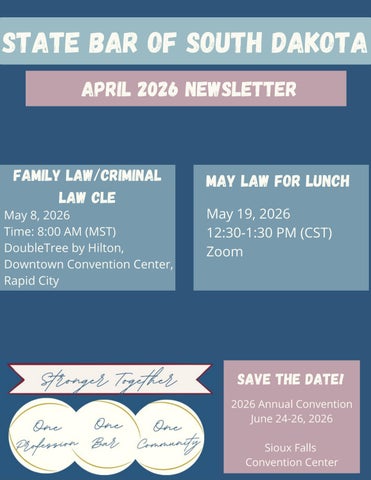
Family Law/Criminal Law CLE
May 8, 2026
Time: 8:00 AM (MST)
DoubleTree by Hilton, Downtown Convention Center, Rapid City
May Law for lunch
May 19, 2026 12:30-1:30 PM (CST)
Zoom

Family Law/Criminal Law CLE
May 8, 2026
Time: 8:00 AM (MST)
DoubleTree by Hilton, Downtown Convention Center, Rapid City
May Law for lunch
May 19, 2026 12:30-1:30 PM (CST)
Zoom
You are invited to provide ideas or concerns to State Bar Officers & Commissioners
President: John Richter, John.Richter@state.sd.us
President Elect: John Burke, jburke@tb3law.com
Commissioners: 1 Cir- Justin Johnson, jjohnson@cityofmitchell.org st
2 Cir- Emily Maurice, emilym@halbachlawfirm.com
3 Cir- Anthony Teesdale, tony@teesdalelaw.com
4 Cir- Kimberly Kinney, kim@kinney-law.com
5 Cir- Gerald McCabe, jerry.mccabe@state.sd.us
6 Cir- Ellie Bailey, e.bailey@riterlaw.com
7 Cir- Matthew Naasz, mnaasz@gpna.com
At Large: 1 Cir- Teramie Hill, teramie.hill@usd.edu
2 Cir- Amber Mulder, amber.mulder@siouxfalls.gov
4 Cir- Sarah Covington, sarah.covington@westriverlawandmediation.com
5 Cir- Stacy Johnson, sjohnson@rwwsh.com
6 Cir- Kristen Edwards, kristen.edwards@state.sd.us
7 Cir- Steven Blair, steven.blair@state.sd.us


Connection: Reflections on the Generosity of Our Members
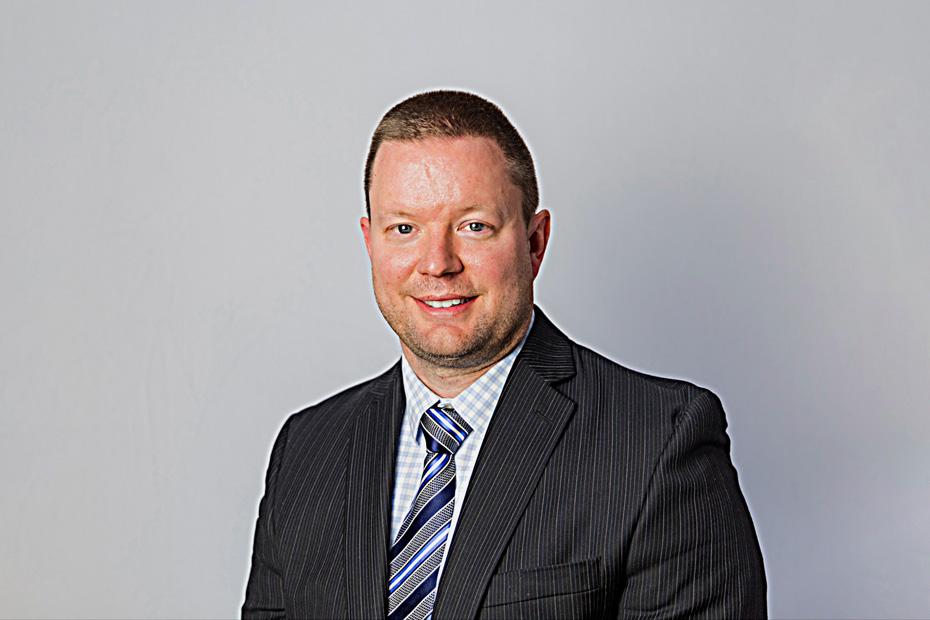
From John Richter, President of the State Bar of South Dakota
Dear Members of the State Bar,
Connection has been our guiding theme this year. This month, I want to highlight the generosity of our members, who consistently share their time and talents to support each other and advance our profession. Your commitment brings this theme to life every day.
Providing a Voice to Our Membership.
As an At-Large Commissioner, President-Elect, and now President, I have continually grappled with how to ensure our members' voices are truly heard. Each of us views the profession through our own lens, shaped by our experiences, practice settings, workloads, and communities. In serving the Bar, I always strive to consider what is in the best interest of all members.
To do that effectively, we need more than thirdparty hearsay. We need genuine, representative, and meaningful feedback from those we serve. Data does not replace judgment, but it informs it. It helps leadership shift from assumptions about what members want to what we actually hear from members.
That is why this recent survey was so important. A direct, open call for member input gave us exactly what we needed: clear and honest guidance from across the state. The response was truly remarkable.
Over the past few weeks, we asked for your opinions on whether members who cannot attend the State Bar Convention business meeting in person should still have the right to vote on issues affecting the entire Bar. Three hundred forty-one members responded, and 111 of you took extra time to share written comments.
The results were clear and decisive. A total of 87.1 percent of respondents voted “Yes,” while 12.9 percent voted “No.” While the numbers tell part of the story, the thoughtful reasons behind those votes tell the rest. Members who voted yes emphasized fairness, accessibility, modern technology, and the importance of ensuring all members—especially those with family obligations, demanding workloads, disabilities, military service, or long travel distances—have a meaningful voice.
Members who voted “No” shared concerns about attendance, the importance of informed voting, and the need to protect the collaborative spirit of in-person dialogue.
What stood out most was not the division but the engagement. This level of participation demonstrates once again that our members care deeply about how decisions are made, how voices are included, and how our Bar continues to evolve. The Bar Commission will use your feedback to guide the next steps, and we will continue engaging you as this conversation progresses.
Lawyers Sharing Their Talents: Pin Auction Experiences for Law Students
One of the most rewarding aspects of serving as your President is witnessing, time after time, how quickly our members step up when asked to support law students. This year’s pin auction offered three unique experiential opportunities, and the generosity from donors was almost immediate. The time between the request and the enthusiastic “Absolutely, count me in” was measured in minutes.
These experiences highlight something fundamental about our Bar: when it comes to mentoring the next generation, our members don’t hesitate. They share their time, talent, and the parts of their profession that can’t be learned in a classroom.
• A Day at the Capitol. Thanks to Governor Larry Rhoden, a group of students will spend a day immersed in state leadership. The experience includes private conversations with the Governor, Lieutenant Governor, General Counsel, and Deputy General Counsel, along with visits to agency legal offices. It will provide an inside look at public service.
• Behind the Bench: A Supreme Court & Circuit Court Immersion. The State Bar is proud to offer an exclusive behind-the-scenes judicial experience that few lawyers, let alone students, ever encounter. Participants will meet with Justices of the South Dakota Supreme Court, engage with Circuit Court Judges, tour chambers, and observe judicial work firsthand. The Commission has also agreed to provide a VIP “behind the curtain” experience during the State Bar Convention in June.
• Public Sector Section Interactive Outing. Two students will join members of the Public Sector Section for an informal, hands-on outing (ranging from axe-throwing or a breakroom session to team-based challenges), which includes a hosted lunch and discussions about careers in public service.
These are not small commitments of time. They again demonstrate that our Bar is made up of lawyers and judges who want students to feel welcomed, supported, and inspired as they start their careers.
My sincere thanks to Governor Rhoden and his team,
the Supreme Court and Circuit Court Judges, the Bar Commission, and the Public Sector Section for making these opportunities possible. Each of you has helped create an experience that will impact these students for years to come.
Extraordinary Interest in the UJS Artificial Intelligence Workgroup
A couple of weeks ago, we invited members to express interest in joining the UJS Artificial Intelligence Workgroup, and the response has been remarkable. We have already received more than a dozen highly qualified applicants (far more than I expected), and the range of experience represented is truly impressive.
What stands out most is the curiosity and generosity behind these responses. Our members are not only thinking about the future of law but are also eager to share their knowledge and help the entire profession deepen its understanding of AI and emerging technologies. There is a clear desire to learn together, ask thoughtful questions, and ensure that any steps we take as a justice system are thoughtful, responsible, and well-informed.
I will soon appoint two members to serve on the UJS AI Workgroup. However, given the strong interest and expertise offered by many, I am also considering whether to recommend establishing a State Bar AI and Technology Committee. The collective enthusiasm and forward-thinking energy from our members are simply too significant to limit to a single workgroup.
Thank you to everyone who volunteered to share their talents and dedication to help our profession grow.
I am grateful for the many ways you contribute, and I remain inspired by the shared commitment to learning, service, and support that defines the State Bar of South Dakota. Thank you again for the privilege of serving as your President.
John Richter

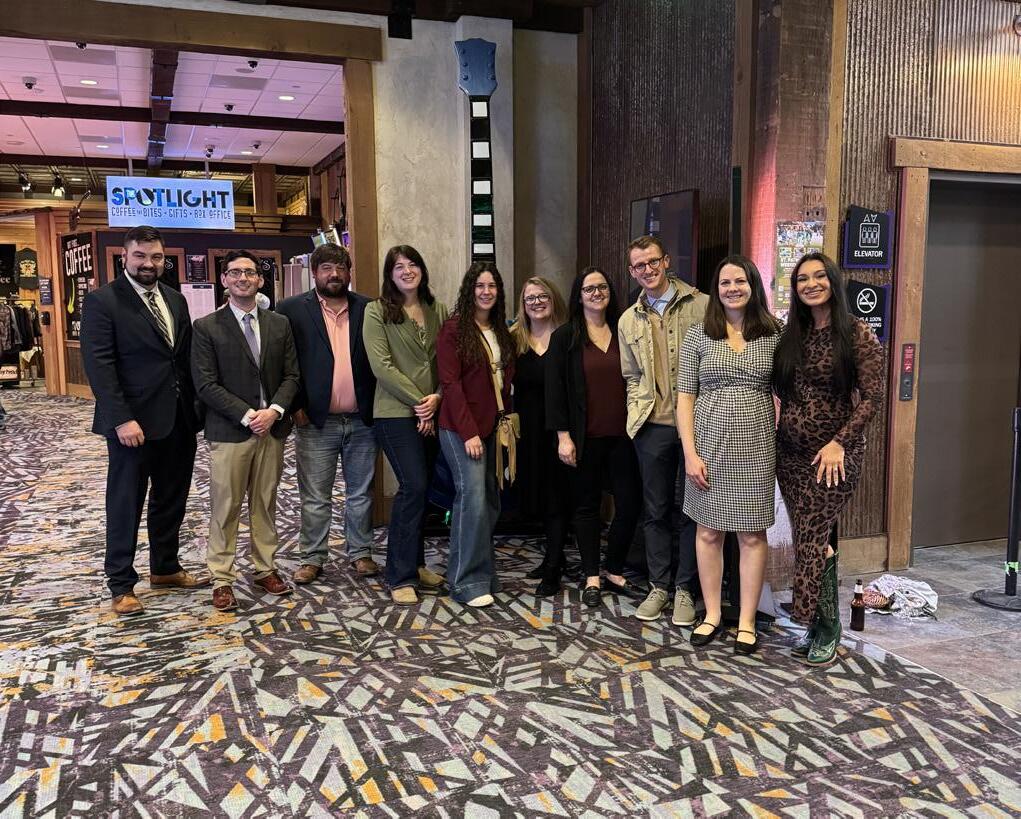
The Young Lawyers Section held a successful Spring Bootcamp in Deadwood. Thank you to everyone who attended and to our wonderful speakers: Judge Day, Jennifer Williams, Tim Rensch, Lynnel Bruemmer, Annie Burnett-Anderson, Justice Kern (Ret.), and Justice Gusinsky. Attendees appreciated the wisdom imparted from our speakers throughout the day. And the evening social fostered a great sense of collegiality and connection for all. These events are great sources of energy for young lawyers to continue to grow in the profession. Thank you to our Bootcamp Chairs, Olivia Edoff and Lora Waeckerle, Bar Services Coordinator Alyssa Blasius, and Bar staff for your contributions!
If you know of a stellar young lawyer who deserves recognition, please consider nominating them for the YLS Young Lawyer of the Year Award. The nominee must be less than 36 years old or admitted to practice in any jurisdiction for less than 10 years, as of June 24, 2026. Nominees should exemplify the following characteristics:
-Professional excellence
-Dedication to serving the legal profession and the Bar
-Service to their community
-A reputation that advances legal ethics and professional responsibility
Nominations should include a brief letter in support of the nominee emailed to the YLS Secretary, Rebecca
Ronayne, at rebecca@ronaynelawoffice.com
The deadline for nominations is April 23, 2026.
The Young Lawyers Section will hold its Annual Section Meeting on June 24, 2026, at 5:15 p.m., in conjunction with the State Bar Convention at the Sioux Falls Convention Center. The order of business at the Annual Section Meeting will be as follows: the outgoing President will give the Section’s report, summarizing activities and goals accomplished over the last year; the Secretary-Treasurer will give a report on the Section’s financial affairs/condition, including monies appropriated and/or expended by the Section; miscellaneous business; and, finally, the nomination and election of directors and officers.
The following board positions are up for election at the 2026 Annual Section Meeting:
-Second Circuit Director
-Fourth Circuit Director
-Sixth Circuit Director
-At-Large Director
Officers:
-President-Elect
-Secretary-Treasurer
Any member of the Section in good standing is eligible for the position of director for the specific Judicial
Circuit in which that member resides or maintains an office at the time of the election. The at-large director may reside or maintain an office in any Judicial Circuit in the State of South Dakota. Any interested member of the Section in good standing may place his or her name in nomination for a specific Judicial Circuit director, atlarge director, Secretary-Treasurer, or President-Elect by submitting to the President of the Section, at least thirty days in advance of the election for that position, his or her written intent or declaration of interest in pursuing such position. Nominations may also be received from the floor of the Annual Section Meeting held in conjunction with the Annual Meeting of the
State Bar of South Dakota. It is preferred that officers have experience as a director prior to running for an officer position. Please email nominations to Mae at mae@meierhenrylaw.com by May 25, 2026.
The YLS Bylaws Committee has been working on updating the Section bylaws. Revisions approved by the YLS Board of Directors will be noticed in the May newsletter and voted on at the Annual Section Meeting.










Sustaining Life Fe�low - $50,000 plus Fe�lows of the South
Fred & Luella Cozad
Diamond Fe�lows - $10,000 plus
Thomas C. Barnett, Jr.
P.Daniel Donohue
Dale E. Froehlick
Robert E. Hayes
Scott N. Heidepriem
Andrew J. Knutson
David L. Knudson
Robert A. Martin
Kimberley A. Mortenson
Platinum Fe�lows - $10,000
Hon. Richard H. Battey
Melissa Nicholson Breit
Dana J. Frohling
Chet Groseclose
Hon. John B. Jones
Jerome B. Lammers
Scott C. Moses
Charles L. Riter
William Spiry
Hon. Jack R. Von Wald
Gold Fe�lows - $5,000
Renee H. Christensen
Richard A. Cutler
William F. Day, Jr.
David J. King
Richard L. Kolker
Kimberley A. Mortenson
Timothy J. Rensch
Michael Sharp
Silver Fe�lows - $1,000 (per year)
Neil Fulton
Hon. Bobbi J. Rank
Timothy J. Rensch
Lori D. Skibbie
Life Fe�low - $25,000 plus
Frank L. Farrar
Gregory A. Yates
John P. Blackburn
Heather Lammers Bogard
Richard D. Casey
Hon. Michael Day
Robert B. Frieberg
Thomas H. Frieberg
Thomas G. Fritz
William C. Garry
David A. Gerdes
Hon. David R. Gienapp
Patrick G. Goetzinger
G.Verne Goodsell
Robert E. Hayes
Terry L. Hofer
Steven K. Huff

Presidential Fe�lows - $10,000
Carleton R. “Tex” Hoy
Hon. Charles B. Kornmann
Lisa Hansen Marso
Bob Morris
Thomas J. Nicholson
Gary J. Pashby
Stephanie E. Pochop
Reed A. Rasmussen
Pamela R. Reiter
Robert C. Riter, Jr.
Eric C. Schulte
Jeffrey T. Sveen
Charles M. Thompson
Richard L. Travis
Thomas J. Welk
Terry G. Westergaard
Fe�lows - $500 (per year)
Hon. John Bastian
Hon. John L. Brown
Mary Jane Cleary
Paul L. Cremer
Andrew L. Fergel
Michael S. Fischer
Tom E. Geu
Craig A. Kennedy
Denise Langley
Hon. Judith K. Meierhenry
Hon. Robert A. Miller
Robert C. Riter, Jr.
Jason R.F. Sutton
Rodrick L. Tobin
Lea Wroblewski
Raising the Bar: Our Profession. Our Responsibility.


Let's PAR-TEE

The A2J Golf Fundraiser Tournament will be held on Thursday - June 25, 2026
THIS YEAR ’ S TOURNAMENT WILL BE HELD AT Morning session: 8:00 AM check-in & continental breakfast; 8:30-11:30 AM tournament play
Afternoon session: 12:30 PM check-in & street nachos buffet; 1:00-4:00 PM tournament play
Online registration is for 4-person teams $500 each team ($125/player)
Y ou must pay for all 4 players at the time of registration.
Players will be playing a digital golf tournament game in climate-controlled bays; full service restaurant and bar on site.
All skill levels are welcome to play.
Each player will receive 1 drink ticket!
JOIN US FOR ALL THE FUN AT GREAT SHOTS IN SIOUX FALLS !
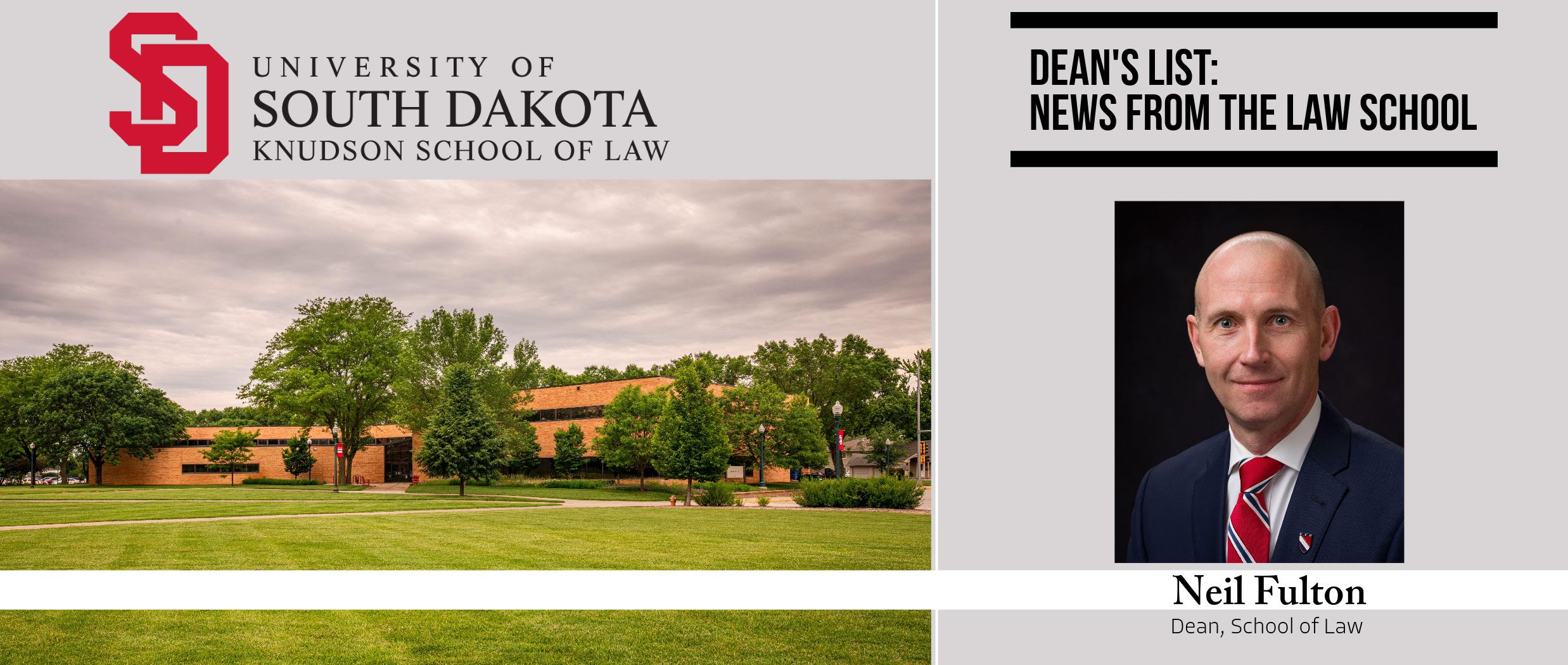
Spring brings one of my favorite events to the law school. The Sam Masten moot court competition is a law school tradition that I look forward to each year. As you read this, this year’s competition has just wrapped up. Accordingly, this month's column is a reminder of what the competition is and why it is such a great tradition.
Simply stated, the Sam Masten moot court competition is an appellate argument competition for first-year students. Competing students argue the legal issue from their Foundations of Lawyering class. So, they are familiar with the issue, having briefed it for class. While all students present oral arguments in class, participation in the Sam Masten competition is voluntary. Nonetheless, almost half of the class chose to compete this year.
All competitors get multiple arguments in the initial round. This allows students to find their footing as oral advocates, work out some kinks in their arguments, and obtain feedback. Based on scores in the initial rounds, the competitors are seeded for the knockout rounds. When the knockout rounds begin, students compete head-tohead in a win or go home format, just like the NCAA basketball tournament. The total score among all judges decides the winner. I can tell you from experience that these knockout rounds are often exceptionally close. The quality of advocacy is impressive, both in its caliber for first-year students, and in how much the students improve over the course of the tournament.
Students are judged by lawyers who volunteer their
time. Recent moot court alumni usually have a strong presence as do lawyers and judges from the region. We also have a wonderful tradition that members of the South Dakota Supreme Court and other “celebrity guests” judge the final round. It is a memorable experience for everyone to have a packed courtroom for the final round with the Supreme Court justices treating it just like argument in a real case. Everyone can then commiserate about the experience at a reception sponsored by the Woods Fuller law firm. Sam Masten finals day is one of the biggest days of the Law School year, right up there with orientation and hooding.
The competition carries the name of Sam Masten for a couple of reasons. First, Sam Masten was a legendary South Dakota litigator. He was renowned for both his ability and ethics. Having his name attached to this competition provides a splendid example to students of what our graduates and South Dakota lawyers can and should be. Second, the generosity of the Masten family supports a cash award for the two finalists. We are grateful that the Masten family continues to invest in the next generation of USD lawyers.
In recent years, the Moot Court Board has chosen to recognize additional achievements of the competitors. This will be the third year that the Board has chosen the Spirit of Sam Masten winner. This is a student, chosen by other students, who is recognized for their professionalism and courtesy in the competition. I love this award because it demonstrates that students realize that there is much more to being a great lawyer than winning and losing. Through the support of recent
moot court alumni and others, the Spirit of Sam Masten recipient will now also receive a cash stipend and have their name placed on a perpetual plaque like that cataloguing all the Sam Masten winners. Additionally, starting this year, the best brief among competitors will be recognized. While briefing is not a part of the competition itself, practicing lawyers and judges know the importance of quality briefing, so it is appropriate to also recognize great writing. We are grateful to the family of the late Justice Robert Amundson for their support of a cash stipend for this award.
The Law School is not the only host of a moot court competition. There is something special about Sam Masten, however. The feeling of community that runs throughout this entire tournament is palpable. The willingness of students to try something outside their comfort zone is inspiring. One of the best moments every year is talking to students who were reluctant to compete but realized in the process that they have an interest and aptitude for oral argument. The respect
demonstrated between competitors and by the judges is gratifying. It truly is a special competition and one of the best weeks of the Law School year.
The Sam Masten final round was held after the deadline for the State Bar newsletter. Since time thus prevents me from announcing the winners here, please go to our social media pages to see those winners yourself. I can say in advance that we are extremely proud of all the competitors in this year’s Sam Masten competition. We are also deeply grateful to all the lawyers and judges who came home to give their time as judges. I hope that many of you will join us next year. Lastly, I am deeply grateful to the Moot Court Board, Professor Sean Kammer (the moot court advisor), and all the Foundations of Law faculty, for their work to make the 2026 Sam Masten Moot Court competition a wonderful success.

you to join us for a Spring Mixer!


Come mingle, connect, and enjoy great conversation in Rapid City on April 22nd from 5:30–7:30 PM. We’ll have light bites, and plenty of networking. Location details coming soon.
REGISTER NOW
*Pre-registration is required to ensure adequate space and food for all attendees. Please register no later than April 14, 2026, by 5:00 PM CDT.
*More information will be posted on the registration page.
Wednesday, April 22 5:30 PM - 7:30 PM MST Rapid City

Knudson School of Law Announces Tom Simmons as Inaugural Trusts and Estates Endowed Chair
Tom Simmons, J.D. ’98, ’91, a tenured faculty member at the University of South Dakota Knudson School of Law and a leading expert in trusts and estates, will serve as the inaugural McDowell, King, & South Dakota Trust Company Chair in Trusts and Estates Law.
“I am humbled that I was chosen for this position,” said Simmons. “South Dakota is the premier trust jurisdiction in the world. The state has only one law school and only one position for an academic who teaches trust and estates law. The recognition that the chair position lends to the support for innovation, reform and continued excellence in trust law is invaluable.”
The appointment recognizes Simmons as one of the state’s leading experts in trusts and estates and affirms the central role the Knudson School of Law plays in sustaining South Dakota’s position in the trust industry.
Simmons also currently serves as the Commissioner of the Uniform Laws Commission, a gubernatorial appointee to the Governor’s Task Force on Trust Administration Review and Reform. He previously held the position of state chair of the American College of Trust and Estates Council.
The endowed chair position was made possible thanks to gifts from Pierce McDowell III, Al King III and the South Dakota Trust Company. Gifts to endowments support a stable and ongoing source of funding. With this support, USD will ensure that South Dakota’s future lawyer leaders continue to have the opportunity to learn from one of the brightest minds in trust and estates law.
“This endowed chair position puts USD and the Knudson School of Law in the spotlight. It showcases the emphasis on trust law that benefits not only South Dakota, but trust settlors and beneficiaries across the country and the world,” Simmons explained. “USD students will benefit from this position by tracing their education lineage to an institution that values educational excellence and reform, as well as to donors who share those same commitments.”
Neil Fulton, J.D., dean of the Knudson School of Law, emphasized that Simmons embodies the model of a practitioner-scholar that the law school seeks to cultivate.
“The trust industry has had a tremendous and positive impact on South Dakota. A critical part of that has been developing a body of law that sustains that industry and developing lawyers with expertise to serve clients well. The law school has been a partner in that work by having a strong commitment to faculty in trust and estate law who combine practical experience with technical expertise,” said Neil Fulton, J.D., dean of the Knudson School of Law.
“Tom Simmons is the model of what that faculty position can be. The creation of the McDowell, King, and SDTC Chair recognizes Tom’s leadership and ability and will facilitate recruiting and retaining his successors to sustain this important partnership.”
A $1 million gift from Al King III, Pierce McDowell III and the South Dakota Trust Company will be made available for faculty to support the area of Trust and Estate Law.
CLE 1: What You Do Matters: Lessons From the Holocaust
Wednesday, June 24 at 1pm-4pm
Chair: Dean Neil Fulton
CLE 2: Early Bird
Thursday, June 25 at 6:30am-7:30am
Chair: Nicole Tupman
CLE 3A: Avoiding the D-Board and Malpractice! Common Ethical and Professional Issues
Thursday, June 25 at 8:30am-11:30am
Chairs: Jeff Tronvold & Jason Sutton
CLE 3B: Working TogetherClient Capacity Concerns
Thursday, June 25 at 8:30am-11:30am
Chairs: Eric Hanson, Anthony Sutton & Mandy Miiller
CLE 4: Improve Your Page and Presence: Tips and Tools to Strengthen your Legal Writing and Oral Communication Skills
Thursday, June 25 at 1:30pm-4:30pm
Chairs: Jennifer Williams & Tamara Nash
Sponsored by: Diversity and Inclusion Committee
The State Bar of South Dakota’s Diversity and Inclusion Committee seeks nominations for the 6th Annual Diversity and Inclusion Award.
Purpose
The Diversity and Inclusion Award serves to recognize members of the State Bar of South Dakota who actively promote diversity and inclusion in the legal profession. Recipients of the award contribute to and enhance the environment of inclusion in the legal profession, particularly in South Dakota.
Eligibility Criteria
To be eligible to receive the Diversity and Inclusion Award, an individual must be a member in good standing of the State Bar of South Dakota and must demonstrate an exceptional understanding of diversity and inclusion beyond the call of duty as represented by the following criteria:
• Enhances inclusion through positive communication between persons of different backgrounds.
• Demonstrates a commitment to the values of diversity and inclusion through documented efforts that are above and beyond routine expectations.
• Develops innovative methods for increasing and valuing diversity through wide-ranging activities.
• Demonstrates outstanding efforts to promote an environment free from bias and discrimination.
• Organizes, creates, and facilitates various professional or community events promoting diversity, respect, and inclusion.
• Shows efforts to recruit and retain individuals who increase the diversity of the State Bar of South Dakota.
• Promotes the sponsorship of, or active participation in, programs, initiatives, or projects in the area of diversity and inclusion.
• ELIGIBILITY RESTRICTION: The individual being nominated cannot be a current member of the Diversity and Inclusion Committee.
Nomination Criteria
Individuals may nominate a member of the State Bar of South Dakota by submitting a completed Nomination Form by email or mail as instructed.
Deadline
Nominations must be received by Friday, April 3, 2026.
Each spring, the Diversity and Inclusion Committee will publish an invitation in the South Dakota State Bar Newsletter soliciting nominations for the Award. To be considered, nominations must be received no later than the published deadline. Each nomination should include a brief synopsis of the nominee’s commitment to diversity, inclusion, and equal participation in the legal profession. A subcommittee of the Diversity and Inclusion Committee will then review each nominee’s materials. The Committee will select, by majority vote, one or more recipients who best exemplify the eligibility criteria. All recipients of the Award will be notified in May. The Award will be presented during the annual State Bar Convention in June.
1. Nominee Information
Name: ____________________________
Address:
2. Nominator’s Information:
Name:
Address:
3. Please attach a one-page synopsis of the nominee’s qualifications and attributes.
Completed forms with synopses attached must be submitted to jsmith@ctnativelaw.com or
Diversity & Inclusion Award Committee C/O Jillian Smith
Cedar Tree Native Law 929 Kansas City St Rapid City, South Dakota 57701 by April 3, 2026.

Almost everyone, even lawyers and law students have experienced a time when a personal problem or crisis affected their life. Recognizing this, your State Bar, over the past several years, has instituted a variety of ways to support our members when they may need it most. Go to https://www.sdlawyerwellness.com/, which is dedicated to providing you with the information you need about the programs and resources available to the members of our South Dakota legal community and their families.




Hoffman Law Firm is pleased to announce Derek J. Hoffman as an associate attorney.
Hoffman Law Firm
221 S Phillips Ave #205, Sioux Falls, SD 57104
Phone: (605) 518-8512
Email: derek@hoffmanlawsd.com
Dakota Plains Legal Services
will relocate its Sioux Falls office on April 17, 2026. The new office will be located at
Dakota Plains Legal Services
300 N. Dakota Ave., Suite 306 Sioux Falls, SD 57104
Phone numbers and email contacts will remain the same.
Daneta Wollmann is please to accounce the opening of her mediation practice.
Rushmore Mediations
7156 Prestwick Road Rapid City, SD 57702
Phone: (605) 490-5030
Email: rushmoremediations@gmail.com


The State Bar extends gratitude to State Bar members who assisted with recently enacted Supreme Court Rules changes, including:
Evidence Committee members, for their work to align SDCL 19-19702 with FRE 702
(special thanks to Matthew Murphy for serving as the Evidence Committee Chair for the last 8 years);
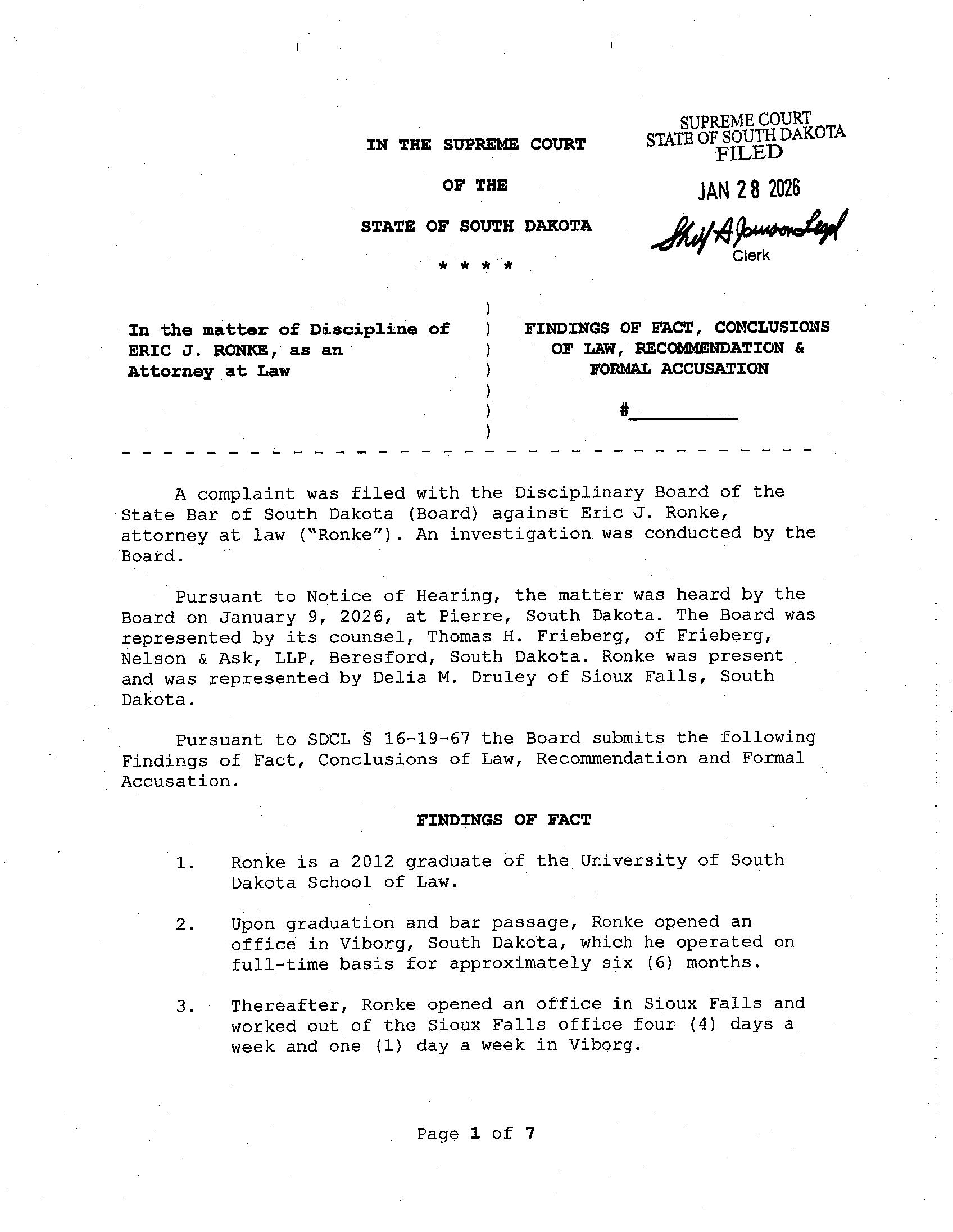
Disciplinary Board members, and counsel Tom Frieberg, for their work to update trust account guidelines;
Family Law practitioners, for their work to update various family law provisions.
The updated Supreme Court Rules were published in the March State Bar Newsletter, and are available online.















































DAVID A. LAWRENCE














Founder and President








Friday, April 17, 2026
12:30-4:00 P.M.
Chef Dominique's Banquet Facility (Shriver's Square)
230 S. Phillips Ave. LOWER LEVEL Sioux Falls, SD 57104
Join us for three hours of CLE and light refreshments. Social event & networking to follow at PAve.
1:00 – 2:00 PM
“Mediation Essentials for Trial Lawyers”
Presenter: Lon J. Kouri, May & Johnson (Sioux Falls, SD)
2:00 – 3:00 PM
“Cybersecurity & Strategy for Trial Lawyers in the AI Era” *
Presenters: Kasey L. Olivier & Sean S. Porter, Vioris (Sioux Falls, SD)
3:00 – 4:00 PM
“The Value of Case Workshops / Preparing for Retrials” *
Presenter: George Johnson, Johnson Pochop & Bartling Law Office, LLP (Gregory, SD)
REGISTRATION FEES:
_____$75.00 SDTLA Sustaining Member
_____$125.00 SDTLA Member _____$175.00 Non-member
_____$ 25.00 Requested out of state credit
Please photocopy and use a separate registration form for each registrant. Return this form to: SDTLA, 214 Marina Dell Ave., Yankton, SD 57078. Questions, call (605) 660-5064.
REGISTER ON-LINE by sending an email message with the above information to sdtriallawyers@gmail.com

3,
2 6 11:30 A.M. - 12:30 P.M . (Mountain)
Light Lunch & Refreshments at 11:00 A.M. (Mountain)
This event will consist of five introductory level discussions related to the basics of bankruptcy law. Prior knowledge of bankruptcy law is not required. Each rotation will include a seven-minute briefing concerning the topic listed below, along with time for questions. The roundtable format is designed to create an opportunity for attendees of all backgrounds to engage with experienced bankruptcy practitioners to encourage interest in bankruptcy law.
STAN ANKER
INTAKE AND ANALYZING FINANCIAL SITUATIONS FOR RESTRUCTURING THROUGH CHAPTER 11 INCLUDING SUBCHAPTER V AND CHAPTER 12 FOR A FAMILY FARM OR RANCH
DAVE CLAGGETT
OVERVIEW OF CHAPTER 7, INCLUDING INTAKE, COMMON EXEMPTION ISSUES, CREDIT COUNSELING REQUIREMENT, REAFFIRMATION AGREEMENTS, AND 341 MEETING PREPARATION
MICHAEL GIESEKE
PURPOSE, FUNCTIONS AND SERVICES OF THE TRUSTEE'S OFFICE, BENEFITS OF CHAPTER 12/13, TIPS FOR WORKING WITH THE TRUSTEE
DAN PAHLKE
CHAPTER 7 VERSUS CHAPTER 13 AND BENEFITS OF FILING CHAPTER 13 WHEN DEBTOR MAY QUALIFY FOR BOTH
CREDITOR'S PERSPECTIVE ON NAVIGATING THE STAY, PROOF OF CLAIMS, MEETING OF CREDITORS, OBJECTIONS, AND RELATED ISSUES
RSVPs are encouraged. Please email Rick at rick_entwistle@sdb.uscourts.gov by April 13, 2026 to RSVP.
Annual Reports
be completed and submitted by Committee Chairs, Board Presidents, and Section Leadership for inclusion in the State Bar Annual Convention





Connecting the Bench, Bar, and Courthouse Staff Connecting the Bench, Bar, and Courthouse Staff Bench,
Tour & Staff Introductions - Brown
County Courthouse
Gavel Gathering – an opportunity for informal engagement with Judges and courthouse staff. Bring your best questions and curiosities!
Reaffirmation of Attorney Oath Social Event to follow
5th Circuit

MAY 1, 2026
Address: 101 SE 1st Avenue
Aberdeen, SD 57402-1087
3:00 Tour & Staff Introductions 4:00 pm Gavel Gathering 5:00 pm Social Event
RSVP: Email Alex Stange-Weig AStangeWeig@rwwsh.com


Connecting the Bench, Bar, and Courthouse Staff
Connecting the Bench, Bar, and Courthouse Staff Bench,
Butte County Courthouse Panel with Judges and Courthouse Staff
Reaffirmation of Attorney Oath Social Event to follow
4th Circuit
MAY 1, 2026
Address: 839 5th Ave, Belle Fourche, SD 57717
3:00 Panel and Attorney Oath 4:00-6:30 Social Event at Belle Fourche Country Club
RSVP: Email Drew Skjoldal drew@spearfishlaw.com


Alecia Fuller
Tom Keller
Amanda Miiller Criminal Law Topics: Family Law Topics
Legislative Update 2026 – Kyle Krause, Rapid City
Child Support Commission Report & 2026 Changes – Christi Weideman, Aberdeen
There’s an App for That – Kylie Riggins, Rapid City
Immigration & Family Law Issues –Ilisja Duffy, Rapid City
Renee Stellagher
Beyond Evidence: Understanding the Medical-Forensic Exam After Sexual Assault – Jennifer Canton, Sioux Falls
South Dakota Forensic Lab: Capabilities, Reliability and Case Impact– Kristina Fryer, South Dakota
May 8, 2026
DoubleTree by Hilton, Downtown Conven tion Center | Rapid City


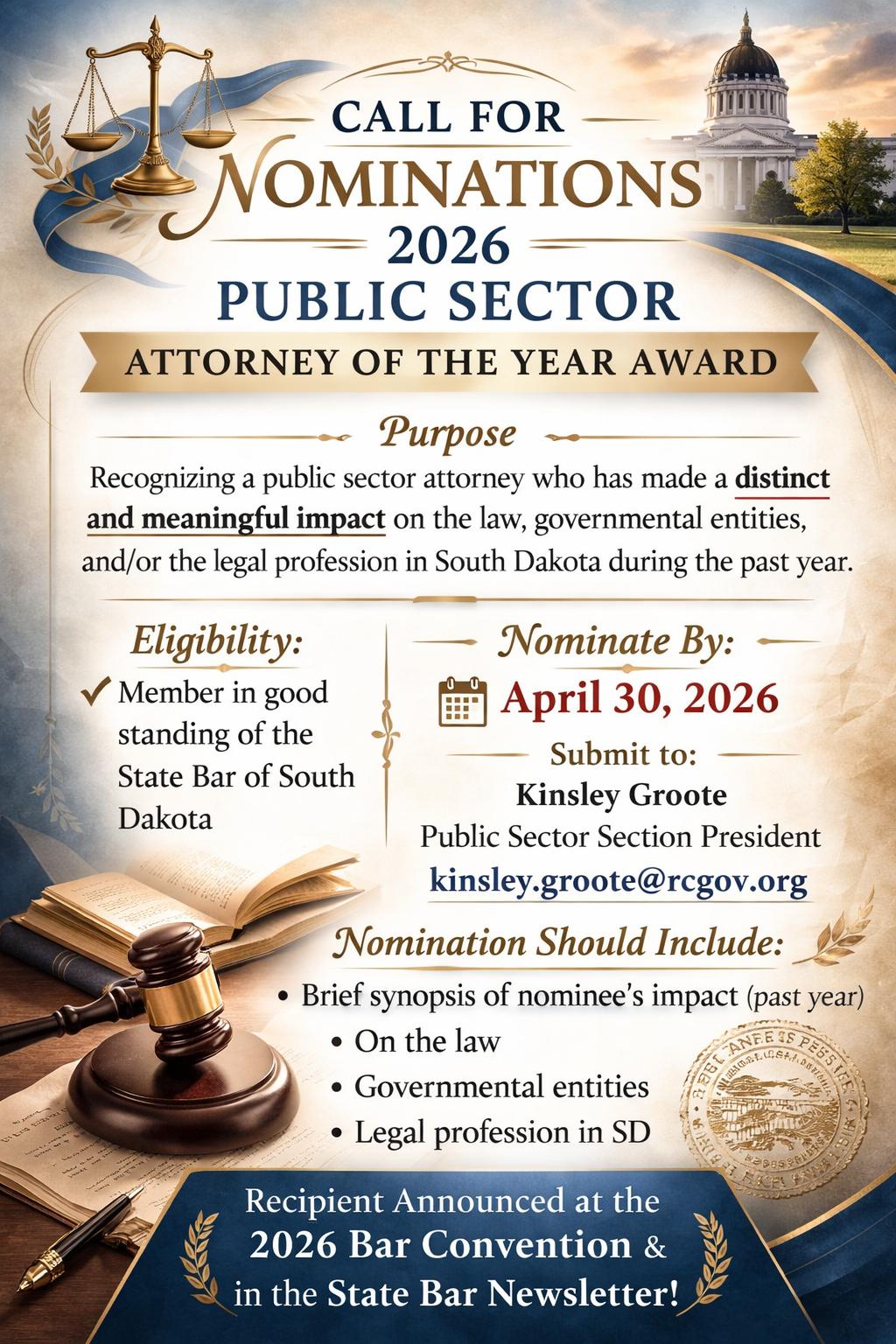
Nominations for the 2026 Attorney of the Year award are now open! USD Women In Law seeks to champion women in the legal profession through educational programming, mentorship, and outreach. The Attorney of the Year Award recognizes an attorney (female or male) who has demonstrated exceptional skill within their field and has furthered the interests of Women in Law.
If you know a special attorney deserving of this award, please consider nominating them by writing a 1 to 2-page letter addressing why they embody and further the interests of Women in Law.
Please include the nominee's contact information within the letter.
Nomination letters are to be addressed to the USD Women in Law Board and sent via email to sydney.schad@coyotes.usd.edu.
Nominations close on May 15, 2026, at 5:00 p.m.
The award will be presented at the 2026 State Bar Convention in Sioux Falls, SD.
Thank you,
on behalf of USD Women in Law






June 24, 2026
11:30 AM
Sioux Falls Convention Center

USD KNUDSON SCHOOL OF LAW WOMAN IN LAW AWARD
ATTORNEY OF THE YEAR
PRESIDENT’S A2J PRO BONO/LAW BONO AWARD
BILL DAY AWARD
YOUNG LAWYER OF THE YEAR AWARD
BARBARA ANDERSON LEWIS SPECIAL COMMEMORATION




THE TRADITION OF HONORING MEMBERS OF THE STATE BAR WHO HAVE REACHED THE REMARKABLE MILESTONES OF FIFTY AND SIXTY YEARS SINCE THEIR ADMISSION TO PRACTICE LAW IN SOUTH DAKOTA CONTINUES. THIS CEREMONY REMAINS A CHERISHED HIGHLIGHT OF OUR ANNUAL CONVENTION, CELEBRATING THE DEDICATION AND LEGACY OF OUR LONGSTANDING MEMBERS.
CARYL H. ABBOTT
JON E. ARNESON
THOMAS C. BARNETT
WESLEY W. BUCKMASTER
ARTHUR TRACY CARTER
MARY JANE CLEARY
SUSAN E. COLLINS
GARY W. CONKLIN
DOUGLAS P. CUMMINGS
HAROLD H. DEERING
HON. ALAN D. DIETRICH
ROBERTA A. FERRON
ROBERT G. FITE
THOMAS M. FRANKMAN
DAVID L. GANJE
PAUL O. GODTLAND
THOMAS E. GRASLIE
PETER I. GREGORY
TODD D. HAUGE
ROBERT E. HAYES
MICHAEL M. HICKEY
ROBERT R. JACKSON
CURTIS S. JENSEN
STEVEN M. JOHNSON
BRIAN JAMES KELLY
CRAIG A. KENNEDY
MICHAEL V. BRALEY
CHARLES A. WOLSKY
CARL J. KOCH
MARK KRATOCHVIL
DAVID J. LARSON
PAUL JAY LEWIS
JEFFREY P. MASTEN
HON. JOSEPH NEILES
ROBERT R. SCHAUB
JOHN P. SLATTERY
GARY P. THIMSEN
MICHAEL E. UNKE
THOMAS K. WILKA
DAVID L. ZUERCHER
THE STATE BAR MEMBERS ABOVE ARE ELIGIBLE TO RECEIVE THE AWARD ON WEDNESDAY EVENING DURING THE STATE BAR SOCIAL & AWARDS RECEPTION.


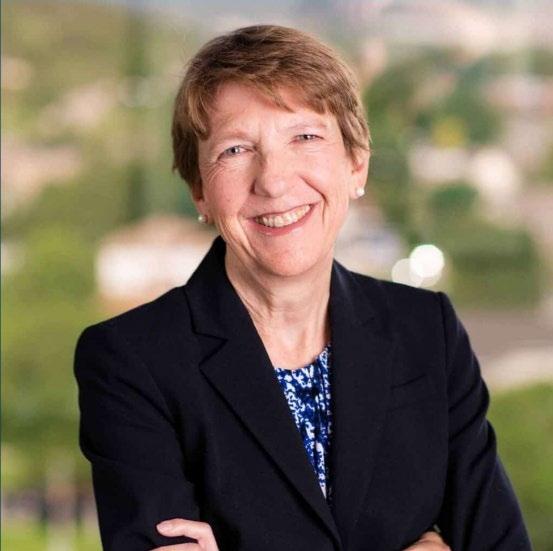
The Barbara Anderson Lewis Community Award recognizes Professionalism and Service within the legal community. This award is presented to a nominated member of the South Dakota Bar Association who has demonstrated exceptional professionalism within the legal community through daily interactions with other lawyers and who regularly fosters civility in the practice of the law. Additionally, this individual has devoted time and energy to their community through sustained volunteer work with nonprofit organizations that strive to make their community a better place to live and work. Part of this award is a monetary donation to the designated nonprofit organization in recognition of that service.
An open letter of nomination can be submitted to the following email address (Janepfeifle@gmail.com). It should be submitted not later than April 30 to be considered. Up to two additional letters of support can be submitted along with the nomination letter. The nomination letter must show how the nominated individual demonstrates professionalism and civility in the practice of law. Examples of these actions will provide how that is demonstrated. The Community portion of the nomination should include a description of the organization the nominated individual supports and in what roles. The nomination should also include the organization’s name and address and a point of contact for an award presentation for the award winner.
Barbara Anderson Lewis graduated from the University of South Dakota School of Law in 1984 and was the first female attorney hired by Woods, Fuller, Shultz, and Smith in Sioux Falls, later becoming the first woman to be named a partner. Following law practice in Fargo, ND, Barbara joined Lynn, Jackson, Shultz, and Lebrun in Rapid City. Barbara was known for her professionalism and was a tenacious but fair opponent. She was impeccable in her choice of words and methods to be especially effective when dealing with her colleges and opponents alike. Barbara was an active member of professional and community organizations throughout her life. She focused on mentoring younger attorneys to help them grow in their careers. Barbara Anderson Lewis passed away in July 2024 after being diagnosed with ALS.






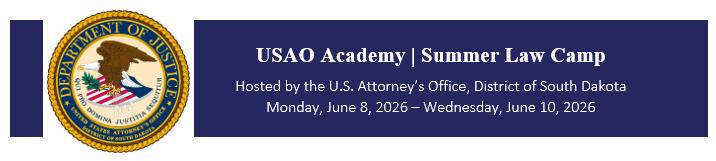
The USAO Academy – Summer Law Camp is an opportunity for high school students interested in pursuing a career in law and/or criminal justice to learn about local opportunities available to them in various professions. Led by federal prosecutors in the U.S. Attorney’s Office, students attending this interactive program will be introduced to the American Justice System, including criminal, civil, and appellate law; will have the opportunity to meet and interact with federal law enforcement agents; and will participate in a mock trial at the Federal Courthouse.
The Camp will be held at the United States Attorney’s Office in Sioux Falls, South Dakota, June 810, from 9:00 a.m. to noon and 1:00 pm to 3:00 pm Monday and Tuesday with free time for lunch on your own; 8:30 am to 1:00 pm Wednesday.
The Camp is free of charge and space is limited. To apply, please download and complete the application form found via the following link.
https://www.justice.gov/usao-sd/usao-academy-summer-law-camp
Completed applications may be emailed to: USASD.SummerLawCamp@usdoj.gov
Additional information and logistics, including pick-up, drop-off, and parking locations will be provided to students upon acceptance to the program.
Application Deadline: May 1, 2026
How to Apply:
Download Application: https://www.justice.gov/usao-sd/usao-academy-summer-law-camp
Completed PDF applications should be emailed to the following by the deadline: USASD.SummerLawCamp@usdoj.gov
Camp Location:
U.S. Attorney’s Office 325 S. First Avenue, Suite 300 Sioux Falls, SD 57108
If you have additional questions, please email: USASD.SummerLawCamp@usdoj.gov
This month’s Bar Star is honored for their dedication and impact in the profession and community:
Members of the Young Lawyers Section Board are recognized for their leadership in hosting the 2026 Spring Bootcamp in Deadwood, South Dakota. They delivered a dynamic program featuring a fireside chat with Justice Kern and Justice Gusinsky, along with sessions from Judge Day sharing 43 years of courtroom insight; Jennifer Williams on persuasive legal writing and advocacy; Tim Rensch on criminal law; AI-powered legal research tools from Westlaw and LexisNexis representatives; and insights from court reporters in the state.
What legacy do you want to leave through your service?


South Dakota’s Potentially Counter-Intuitive Rule 1.6(b)(1): A Guide
Thomas E. Simmons
South Dakota Rule of Professional Conduct 1.6 restricts attorneys from revealing information relating to the representation of a client – a broad prohibition indeed. 1 Information relating to the representation must be kept confidential by the lawyer. 2 The broad swath of Rule 1.6 protects all such information as “confidential information.” This extends far beyond merely privileged communications between attorney and client.
The rule also contains eight exceptions. 3 The first two exceptions authorize disclosure with either the express or implied informed consent of the client. 4 The next six exceptions are numbered in subpart (b) of the rule. 5 We are concerned here with the first of those numbered exceptions, the one contained within Rule 1.6(b)(1).
Under the aforesaid exception to confidentiality, a lawyer is permitted to “reveal information relating to the representation of a client to the extent the lawyer reasonably believes necessary:”
To prevent the client from committing a criminal act that the lawyer believes is likely to result in imminent death or substantial bodily harm;
S.D. Rule of Professional Conduct 1.6(b)(1). 6 This text departs from the recommended text in the American Bar Association’s (ABA) current version of the rule, which permits a lawyer to reveal information relating to the representation of a client:
to prevent reasonably certain death or substantial bodily harm;
Model Rule 1.6(b)(1). 7 The difference in wording between the ABA version and the South Dakota version is significant. There are two additional elements in South Dakota’s version which must be satisfied compared to the Model Rule’s text: (1) crime; and (2) client, elements omitted in the current ABA version. Let’s examine the latter element (preventing “the client from committing”) first.
Consider the following hypothetical example: Client tells lawyer that his son has planted a powerful bomb in a janitorial closet of the local high school which will detonate in one hour’s time just when students are heading into the lunchroom. The client presents credible support for his allegation, but when the lawyer asks for her client’s consent to disclose the imminent threat to the authorities, the client declines and exits her lawyer’s office in tears.
May the lawyer notify anyone of the bomb?
Under the ABA’s Model Rule, the answer is yes. The lawyer may disclose the information “to the extent the lawyer reasonably believes necessary” in order “to prevent reasonably certain death or substantial bodily harm.” Thus, the lawyer may disclose the threat
It bears emphasis that the lawyer should only disclose that there is a bomb at the high school timed to explode an hour. Perhaps the location of the bomb should also be disclosed in the interest of the safety of the bomb squad and/or janitorial staff.
The lawyer need not (and may not) disclose the source of the information or the suspected culprit’s identity unless the authorities refuse to take her seriously without additional information. Remember: the lawyer may disclose confidential information only to the extent necessary to prevent the death and/or substantial bodily harm to the high schoolers. Even when disclosing confidential information pursuant to an exception, no more information than is reasonably necessary should be revealed. A lawyer should disclose as little as possible, but disclosure of the bomb threat under the ABA version of 1.6(b)(1) is permitted.
What about disclosure of the client’s son’s bomb under South Dakota’s version?
Under South Dakota’s Rule of Professional Conduct 1.6(b)(1), the result is different. The lawyer may not notify the authorities of the explosive ordinance. Why? Because it’s not “the client” who will be prevented from committing the criminal act which will result in death and substantial bodily harm; it’s the client’s son. Since the client’s son is not the lawyer’s client, South Dakota’s 1.6(b)(1) does not permit disclosure.
This outcome seems counterintuitive. The rule dilutes confidentiality protections for crimes contemplated by the client but not for the crimes of a non-client (to whom the attorney owes little or no duty of loyalty). Weirdly, had the client disclosed that it was he that had planted the bomb at the high school, the lawyer would have been permitted to warn the authorities. But because it was not the client who was committing (or about to commit) the crime, the lawyer could not.
Observe that it sounds as if the client’s disclosures to his lawyer in the hypothetical outlined above were conveyed in a privileged communication, but as underscored below, it is not necessary that the privilege attach in order for 1.6 to insist upon confidentiality. Rule 1.6 protects all information relating to the representation of a client. Not just privileged communications. 8
Thus, for example, if it was the client’s friend who accompanied the client to the office conference and articulated the bomb threat details, the communication would not be privileged since it was not an attorney-client communication, yet it nevertheless represents information relating to the representation. Therefore, it must be maintained as confidential unless an exception to confidentiality applies. Under South Dakota’s version of 1.6(b)(1), disclosure of the bomb threat posed by a non-client would not be authorized – whether or not the communication was privileged. 9
Privileged communications are a rule of evidence. Securing information related to the representation of a client is an ethical obligation.
Now let’s turn to the second element contained in South Dakota’s version of 1.6(b)(1) which is absent from the ABA’s current version: that of “crime.” The South Dakota version of Rule 1.6(b)(1) requires – as an element of permissive disclosure – that what will result in death or
substantial bodily harm be a crime. A well-reasoned opinion by the South Dakota Bar’s Ethics Committee illustrates the “crime” element of South Dakota’s rule. 10
Recently, a South Dakota attorney encountered a client contemplating suicide and the attorney reasonably believed it to be more than an idle threat. Assuming that the client was not suffering from diminished capacity, 11 a South Dakota lawyer is prohibited from disclosing the client’s likelihood of harming themselves against the client’s wishes. Why? Because suicide is not a crime. 12
The South Dakota Ethics Opinion on point is nuanced, thoughtful, and sensitive. It’s also textually correct and merits a careful read. While some ethics authorities in other jurisdictions have read in a non-textual “humane” exception to those versions of Rule 1.6(b)(1) (like South Dakota’s) which contain the “crime” element and therefore authorize disclosure of a client’s contemplated suicide, the reasoning they employ disregards the plain text of the “crime” element 13 South Dakota’s Ethics Committee correctly rejected those lines of reasoning because they contravene the text adopted by the South Dakota Supreme Court.
Two final points:
First, the ABA version of the Rule – while in some ways (as illustrated supra) more permissive in terms of authorizing disclosure than South Dakota’s version, it is – in other respects – more restrictive.
To wit: South Dakota permits disclosure of confidential information when death of substantial bodily harm is only “likely.” But the current ABA version requires the harm to be “reasonably certain.” Greater certainty that the threat will actually manifest itself is required under the ABA version. Thus, South Dakota’s rule is more forgiving regarding the level certainty connected to the contemplated crime than current ABA text.
Second, disclosure under Rule 1.6 – in both the South Dakota and ABA versions – is always permissive, not mandatory. 14 The attorney “may” disclose. And “may” does not mean “shall.”
Stated another way, the attorney who decides against disclosure cannot face discipline under 1.6. 15 Non-disclosure of confidential information (even a bomb threat), from a disciplinary perspective (although not necessarily from an ethical one), is the safer bet.
Tom Simmons is a professor at the University of South Dakota’s Knudson School of Law and a member of the South Dakota Bar’s Ethics Committee, but his opinions and views articulated above are merely his own as a private citizen and not as a representative or member of any organization. He lacks any authority to speak on behalf of the South Dakota Board of Regents.
1 Rule 1.6 prohibits lawyers from making any disclosures that could lead to the discovery of confidential information as well. “This prohibition also applies to disclosures by a lawyer that do not in themselves reveal
protected information but could reasonably lead to the discovery of such information by a third person.” Model Rule of Professional Conduct 1.6 cmt. [4].
2 Rule 1.6 applies during the representation of a client. Other rules apply pre- and post-representation:
See Rule 1.18 for the lawyer's duties with respect to information provided to the lawyer by a prospective client, Rule 1.9(c)(2) for the lawyer's duty not to reveal information relating to the lawyer's prior representation of a former client and Rules 1.8(b) and 1.9(c)(1) for the lawyer's duties with respect to the use of such information to the disadvantage of clients and former clients.
Model Rule of Professional Conduct 1.6 cmt. [1].
3 Additional exceptions to confidentiality can be found in Rules 1.13(c)(2) (corporate clients), 1.14(c) (clients with diminished capacity), and 3.3(c) (candor toward tribunal).
4 S.D. Rule of Professional Conduct 1.6(a).
5 S.D. Rule of Professional Conduct 1.6(b)(1)-(6). The current ABA Model Rule 1.6(b) contains seven numbered exceptions. ABA Model Rule of Professional Conduct 1.6(b)(1)-(7).
6 Compare R3D OF THE LAW GOVERNING LAWYERS § 66(1) (authorizing the disclosure of confidential information “when “necessary to prevent reasonably certain death or serious bodily harm to a person.”). Thus, the Restatement – like the ABA – omits the elements of “crime” or “client.” Id
A threat within Subsection (1) need not be the product of a client act; an act of a nonclient threatening life or personal safety is also included, as is a threat created through accident or natural causes. It follows that if such a threat is created by a person, whether a client or a nonclient, there is no requirement that the act be criminal or otherwise unlawful.
Id. cmt. [c]. Interestingly, the Restatement proposes disciplinary immunity for both compliance and noncompliance with this obligation. See R3D OF THE LAW GOVERNING LAWYERS § 66(3) (providing that any “ lawyer who takes action or decides not to take action permitted under this Section is not, solely by reason of such action or inaction, subject to professional discipline”).
7 The ABA amended Rule 1.6(b)(1) in 2001 as part of the Ethics 2000 Commission. Report of the Commission on Evaluation of the Rules of Professional Conduct, 118:2 A.B.A. Before the ABA’s adoption of the amendment in 2001, its Model Rule 1.6(b)(1) read: “to prevent the client from committing a criminal act that the lawyer believes is likely to result in imminent death or substantial bodily harm.” Michael S. Ariens, “Playing Chicken: An Instant History of the Battle over Exceptions to Client Confidentiality, 33 J. LEGAL PROF. 239 (2008-09).
8 “The confidentiality rule … applies not only to matters communicated in confidence by the client but also to all information relating to the representation, whatever its source.” Model Rule of Professional Conduct 1.6 cmt. [3].
9 Admittedly, privilege matters in some contexts. Thus, for example, if the bomb detonates, the malefactor is indicted, the attorney is subpoenaed to testify, and is asked what the client’s friend told the lawyer, the lawyer could answer the question pursuant to South Dakota Rule of Professional Conduct 16(b)(5) (compliance with a court order). But if the attorney is asked what the client told the attorney (and the communications were confidential (i.e., the friend was not present)), the attorney would be expected to assert the privilege and refuse to answer the question. See Model Rule of Professional Conduct 1.6 cmt. [15] (explaining that in the absence of client consent to disclose, a “lawyer should assert on behalf of the client all nonfrivolous claims that the order is not authorized by other law or that the information sought is protected against disclosure by the attorney-client privilege or other applicable law.”).
10 S.D. Ethics Op. 2023-7 (available at https://www.statebarofsouthdakota.com/ethics-opinions/).
11 See S.D. Rule of Professional Conduct 1.14. “In determining whether the Client truly has ‘diminished capacity’ to act in the Client’s best interest, the Lawyer may consider the Client’s expressed intention to commit suicide as evidence of diminished capacity but must also consider whether the specific facts or circumstances of the situation render the Client’s proposed course of action a rational one.” S.D. Ethics Op. 2023-7. See also id. (quoting Conn. Bar Ass’n Formal Op. 49 (quoting Rule 1.14(b)) (reasoning: “In counseling and acting on behalf of a suicidal client we think the lawyer should focus on and be respectful of the client and substitute his judgment for that of the client ‘only when the lawyer reasonably believes that the client lacks the capacity to act in his own interest.’”).
12 Cf. S.D.C.L. § 22-16-37 (aiding or abetting with suicide (or attempted suicide) as a class 6 felony).
13 See, e.g., Ariz. Ethics Op. 91-18 (authorizing a lawyer to reveal a client’s suicidal intent in order to “allow[] the attorney to respond humanely to what well may be his client’s cry for help”). The South Dakota Ethics Committee (correctly) characterized this sort of rationale as one which is “outside of the Rules.” S.D. Ethics Op. 2023-7. The Restatement Third – which omits the “crime” element (supra note 6) – would allow an attorney to report a contemplated suicide: “Serious bodily harm … includes life-threatening illness and injuries and the consequences of events such as imprisonment for a substantial period and child sexual abuse. It also includes a client's threat of suicide.” R3D LAW GOVERNING LAWYERS § 66 illus. 3.
14 Compare Tex. Disciplinary Rules of Professional Conduct 1.5(e) (providing that a “lawyer shall reveal confidential information” to prevent a client from committing a criminal or fraudulent act “likely to result in death or substantial bodily harm”) (emphasis supplied). Six other states are in accord with Texas on this point.
15 See, e.g., People v. Belge (N.Y. Cnty. Ct. 1975) (dismissing an indictment against an attorney for failing to report an unattended death and location of the remains when the information came to the attorney via a privileged communication from his client (who had murdered the decedent in question)). In Belge, a lawyer’s client told the lawyer where to find the body of a victim hidden in the woods. Disclosure in the Belge circumstances might be permissible under S.D. Rule of Professional Conduct 1.6(b)(5) (compliance with “other law”) although an attorney’s duty of loyalty to the client ought to countermand a permissive disclosure when it could result in the client being criminally charged. See also Model Rule of Professional Conduct 1.6 cmt. [12] (explaining that “[o]ther law may require that a lawyer disclose information about a client [but w]hether such a law supersedes Rule 1.6 is a question of law beyond the scope of these Rules.”).

Get paid faster, control your finances, and stay compliant with 8am LawPay, trusted by 115k+ legal professionals.
Next-business-day deposits that keep cash flowing
True IOLTA protection built for law firms
Endorsed by all 50 state bars, the ABA, and 60+ specialty bars


Discover why thousands of bar members trust LawPay


Taking care of your mental health should be simple, supportive, and always within reach. That’s why we created the AllOne Health app and member portal—to make it easier than ever for you to access the care you need, when you need it.
Whether you’re navigating life’s challenges, looking for resources, or just need someone to talk to, we’re here to help.
Virtual Counseling Made Easy
Self-schedule virtual counseling sessions directly through the app.
Izzy, Your AI Mental Health Navigator
Receive guidance and personalized support in real time.
On-Demand Self-Help Resources
Explore self-guided therapy (iCBT), articles, videos, assessments, and tools.
Family Care and Lifestyle Support Referrals
Request referrals for childcare, eldercare, legal, financial consultation, personal assistant and medical advocacy.
Real Human Support
24/7 live assistance is always just a tap away when you want to speak to someone.
1. Download the AllOne Health App from the Apple App Store or Google Play Store or visit allonehealth.com/portal
2. Sign Up using your member portal and app code. The email address and password used to create your account will work for both the app and the member portal.
3. Start Exploring – Book sessions, chat with Izzy, and discover resources that support your whole health.


Download the App and Take the First Step No matter where you are in your journey, support is here—because your mental health deserves care that’s easy to access, always available, and built around you.


By Mark Bassingthwaighte, Risk Manager

Our Director of Claims, Stacey Smith, recently posted an insightful article entitled “Why Insurance Defense Firms Are Struggling to Secure Professional Liability Coverage” on our Blog. Not only did she do an excellent job of explaining what’s going on, but she also gave me an opportunity to follow-up with an update for solo attorneys who handle insurance defense work. What follows is offered in the spirit of helping solos find steadier footing in challenging times.
To briefly recap, Stacey shared that there seem to be three major pressures reshaping the landscape: verdicts have become increasingly large, privity laws are loosening, and carriers are under financial pressure to recoup losses. In short, when a verdict hits the books, someone has to absorb it. Increasingly, carriers are deciding that “someone” might be defense counsel.
A review of recent claims shows a clear pattern. Insurers are more willing to blame defense counsel when outcomes are unfavorable. For solos, the risks are amplified:
• You’re a single point of failure. There is no partner with whom you could corroborate your thinking.
• Time‑limited demands are landmines. As a solo juggling multiple deadlines, it can be all too easy to miss a technical condition in a policy-limits demand.
• For solos who lack internal actuarial or analytics support that larger firms may rely on, case valuation disagreements can quickly turn into malpractice allegations
• Documentation expectations have skyrocketed and solos often lack the administrative support to keep up. These challenges aren’t a reflection of solo attorneys’ abilities. They stem from the risk landscape inherent in insurance defense.
Practical Steps Solos Can Take
Here are a few steps solos can take that can help reduce exposure:
• Document everything, especially settlement recommendations. Write it down. Email it. Confirm it.
If you’d be embarrassed about having to show a claims attorney what’s in your files, it’s not enough.
• Build redundancy into your workflow by creating a simple, repeatable process for things like time-limited demands, expert disclosures, and settlement communications. Even a one-page checklist can dramatically reduce risk.
• Adopt a “second look” habit. Commit to conducting a daily end of day or weekly end of week review of critical deadlines and carrier communications.
• Join a practice‑area listserv or defense network to stay current on traps and trends.
• Set clear boundaries with carriers. Start by establishing response time expectations, asking carriers to confirm all instructions in writing, and requesting clarification whenever any directive is ambiguous.
The insurance defense world has changed. Carriers are quicker to blame panel counsel, quicker to pursue recovery, and quicker to scrutinize your decisions with the benefit of hindsight.
None of this means you can’t continue doing this work. But it does mean you need to approach it with eyes wide open, stronger documentation habits, and a clearer understanding of the risk landscape you’re navigating. If you’re a solo attorney handling insurance defense, the goal is to make sure your practice model remains aligned with the realities of today’s claims environment.
Authored by: Mark Bassingthwaighte, ALPS Risk Manager
Since 1998, Mark Bassingthwaighte, Esq. has been a Risk Manager with ALPS, an attorney’s professional liability insurance carrier. In his tenure with the company, Mr. Bassingthwaighte has conducted over 1200 law firm risk management assessment visits, presented over 400 continuing legal education seminars throughout the United States, and written extensively on risk management, ethics, and technology. Mr. Bassingthwaighte is a member of the State Bar of Montana as well as the American Bar Association where he currently sits on the ABA Center for Professional Responsibility’s Conference Planning Committee. He received his J.D. from Drake University Law School.



…about depression or anxiety
…if you’re concerned about a loved one
…if you need resources for substance use or mental health
…if you’re having thoughts of suicide
Counselors at the Helpline Center answer the 988 Lifeline for South Dakota. 988 provides support, connections and hope during a mental health or substance use crisis. People can call, text or chat 988 for themselves or if they are worried about a loved one who may need support. Available 24/7.
The Hagemann-Morris Young Lawyer Mentorship Coin Program strives to foster mentorship within the State Bar by pairing members of the Young Lawyers Section with Mentors who can provide candid and insightful guidance to Young Lawyers as they navigate the beginning stages of their legal career. The Program hopes to:
• Foster the development of the Young Lawyers practical skills and their knowledge of legal customs;
• Create a sense of pride and integrity in the legal profession;
• Promote collegial relationships among legal professionals;
• Improve legal ability and professional judgment; and
• Encourage the use of best practices and highest ideals in the practice of law.
State Bar members are members of the Young Lawyers Section until they reach age 40 or have practiced law for ten years, whichever occurs later.
1. Young Lawyers and Mentors sign up with the State Bar by completing the online forms linked below
2. The YLS Board establishes a compatible mentorship pair.
- The YLS Board creates mentorship pairs using the information provided in the applications and reaching out to attorneys believed to be a good fit for the Young Lawyer.
- Young Lawyers may also request specific mentors or request Mentor Coins for an alreadyestablished mentorship.
3. The YLS Board will send the Young Lawyer and Mentor an informational packet with suggested conversations and activities. The Young Lawyer will also receive Mentor Coins.
4. The Young Lawyer may present a Mentor Coin to their Mentor as an invitation for mentorship and acknowledge their trust in such Mentor.



I DO SOLEMNLY SWEAR, OR AFFIRM, THAT:
I WILL SUPPORT THE CONSTITUTION OF THE UNITED STATES AND THE CONSTITUTION OF THE STATE OF SOUTH DAKOTA;
I WILL MAINTAIN THE RESPECT DUE TO COURTS OF JUSTICE AND JUDICIAL OFFICERS;
I WILL NOT COUNSEL OR MAINTAIN ANY SUIT OR PROCEEDING WHICH SHALL APPEAR TO ME TO BE UNJUST, NOR ANY DEFENSE EXCEPT SUCH AS I BELIEVE TO BE HONESTLY DEBATABLE UNDER THE LAW OF THE LAND;
I WILL EMPLOY FOR THE PURPOSE OF MAINTAINING THE CAUSES CONFIDED TO ME SUCH MEANS ONLY AS ARE CONSISTENT WITH TRUTH AND HONOR, AND WILL NEVER SEEK TO MISLEAD THE JUDGE OR JURY BY ANY ARTIFICE OR FALSE STATEMENT OF FACT OR LAW;
I WILL MAINTAIN THE CONFIDENCE AND PRESERVE INVIOLATE THE SECRETS OF MY CLIENT, AND WILL ACCEPT NO COMPENSATION IN CONNECTION WITH A CLIENT'S BUSINESS EXCEPT FROM THAT CLIENT OR WITH THE CLIENT'S KNOWLEDGE OR APPROVAL;
I WILL ABSTAIN FROM ALL OFFENSIVE PERSONALITY, AND ADVANCE NO FACT PREJUDICIAL TO THE HONOR OR REPUTATION OF A PARTY OR WITNESS, UNLESS REQUIRED BY THE JUSTICE OF THE CAUSE WITH WHICH I AM CHARGED;
I WILL NEVER REJECT, FROM ANY CONSIDERATION PERSONAL TO MYSELF, THE CAUSE OF THE DEFENSELESS OR OPPRESSED, OR DELAY ANY PERSON'S CAUSE FOR LUCRE OR MALICE.
Preamble
A lawyer should demonstrate civility, personal courtesy, dignity, respect and professional integrity when interacting with the public and participating in the legal system. As we vigorously represent our clients, we must honor our obligations to the administration of justice, resolving disputes in a rational, diplomatic, and efficient manner. We must remain committed to the rule of law as the foundation for a fair and peaceful society.
While our State’s Rules of Professional Conduct are instructive, they cannot address all of the various circumstances and conflicts that arise. The following standards are designed as a guide for lawyers and judges when interacting with each other, with litigants and with the public. Lawyers are expected to adhere to these standards as a commitment to justice and the rule of law.
Creed
As lawyers licensed to practice in South Dakota, admitted to the State Bar of South Dakota and/or admitted pro hac vice to appear in a matter before any Court in South Dakota, we will at all times adhere to the following:
1. We will treat participants of the legal system with civility, dignity and courtesy in court, as well as in all communication.
2. We will refrain from using hostile, demeaning or humiliating words in written and oral communications with adversaries.
3. We will continue to prioritize the inclusion and active participation of lawyers (and law students) from all backgrounds, identities and circumstances.
4. We will avoid impermissible ex parte communications with the court.
5. We will not intentionally mislead the court in oral or written communications.
6. In court, we will be punctual and prepared. We will not engage in conduct that is disorderly or disruptive and will instruct our clients and witnesses to act accordingly.
7. We will consult with other counsel concerning scheduling and deadlines prior to bringing such issues to the court. We will not unilaterally schedule hearings, depositions or similar matters.
8. We will not assert improper conduct on the part of other counsel without good cause and an adequate factual basis.
9. When agreements are reached, we will adhere to the agreement and accurately and in good faith memorialize the agreement in writing.
10. We will draft orders that accurately and completely reflect the court’s ruling.
11. We will not time the filing or service of motions or pleadings with an attempt to unfairly limit another party’s ability to respond.
12. We will explain to our clients that cooperation, civility and fair dealing are expected in the legal system.
13. We will advise our clients that we reserve the right to grant accommodations to other counsel in matters not directly affecting the merits of the case or prejudicing their rights.
14. Discovery requests will be drafted without harassment or placing undue burden on the other party. Further, we will instruct our clients that they must fully and honestly respond to discovery requests.
15. When there is a potential for settlement, we will timely confer with our client and other counsel and not purposefully delay negotiations.
16. We will in good faith stipulate to undisputed matters.
17. We will strive to abide by previously scheduled dates for trials, hearings, depositions, meetings and conferences.

The South Dakota Bar Association offers a special group insurance plan for bar members and their employees through Avera Health Plans.
Organizations with employees who are active members of the South Dakota Bar Association qualify
The following networks are available:
• Standard Network – Avera and other independent providers across South Dakota and northwest Iowa
• Direct Network – Avera-owned, -managed and -leased providers. Available to employers headquartered in Brown, Lincoln and Minnehaha counties.
• Extended Network – Along with our Standard network, members can take advantage of a Nationwide PPO network that offers access to a range of health care providers and facilities like Mayo Clinic.
The plan offers the following benefits:
• Lower premiums
• Options not available on small group plans, such as the more comprehensive “Ultra” plans
• The Nationwide PPO network provides access to a broad range of services at lower costs than out-of-network options.
• The SD Bar Association plan does not include pediatric dental and vision. If you have questions about how to get these benefits, an Avera Health Plans representative can explain your options.
• The Bar Association health plan renews annually on Sept. 1, but benefits follow a calendar year (January–December). If you enroll on April 1, your plan will follow 2024-2025 pricing until the next renewal on Sept. 1. If a member signs up for the plan mid-year, they will receive a credit for deductible and out-of-pocket expenses to cover them until the renewal date (Sept. 1).
• Prices and benefits are subject to change.


The following agents or agencies that are authorized to sell the State Bar Association Health Plan.
Office Location
Mitchell & Yankton Area
Aberdeen Area
Sioux Falls Area
Sioux Falls & Brookings Area
Pierre, Mitchell & Sioux Falls Area
Watertown Area
Dice Financial
Mark Mehlhoff
Midwest Employee Benefits
McGreevy & Associates
Fisher Rounds & Associates
Freimark & Associates
Office Location Agency Agency Contact Contact
West River
Black Hills Insurance Agency
Black Hills Insurance Agency
Carver Insurance
Jacquelyn Johnson
Mark Mehlhoff
Dawn Knutson
John Lawler
Josh Gilkerson
Todd Freimark
Dan Maguire
Everett Strong
Lisa Knutson
Questions on Eligibility, Rates, and Services?
Please contact the agency listed above based on your office location within the state for questions related to the Association Healthcare Plan.
Life is often busy, and responsibilities can feel overwhelming. Your Assistance Program is here to help save time and clear your mind with personal assistant referrals.
Our personal assistant team listens to your requests, conducts research, and provides comprehensive referrals, resources, and information to help with your needs. Personal Assistant referrals can include:
• Home care, renovation, and repair services
• Grocery and meal delivery services
• Transportation, car maintenance and repair
• Travel research, planning and itineraries

• Self-care, spas, gyms, and local services
• Theatre, concerts, and sporting events referrals
• Children's sports, programs, and activities
• Donations and volunteer opportunities
Personal Assistant referrals are non-transactional. Your Assistance Program is free to use, confidential, and open to family members.
Contact AllOne Health
Call: 888-243-5744 Visit: sandcreekeap.com


Nora Kane
March 29, 1961 –March 23, 2026
Nora Kane, attorney at law and inhouse counsel for Omaha Steaks, died peacefully in her home, surrounded by the love of her family, on March 23, 2026. She was 64.
Nora Marie Kane was born on March 29, 1961, in Onida, South Dakota, to Patrick and Jean (Walsh) Kane, the fifth of seven siblings. She started school in Onida, moving with her family to Vermillion, Salt Lake City, and finally Sioux Falls, where she graduated from Washington High School in 1979.
Nora worked in the hospitality/restaurant industry for years until she heard “Piano Man” on the jukebox one too many times and thought, “Man, what am I doing here?” She enrolled at the University of South Dakota in Vermillion in 1989, majoring in Criminal Justice and minoring in Spanish. She graduated cum laude with a Bachelor of Arts degree in 1993, and immediately followed in her father’s footsteps, continuing her studies at USD Law School.
During her time in law school, Nora was the top student in her class of 70 in the first year, an editor of the Law Review, a member of Women in Law and the Student Bar Association, and graduated in the top ten in her class in 1996. She accomplished all this while bringing up her beloved son Dorian, who graduated from high school the same year as her law school graduation.
After graduating, Nora was selected as a law clerk for South Dakota Supreme Court Justice Richard Sabers, with whom she was honored to work for two years. Following her time in Pierre, she continued her career in Omaha, Nebraska, first at Domina Law Group, then at Koley Jessen, Stinson Morrison Hecker, and finally at Omaha Steaks, where she served for nine years as their first in-house counsel.
Nora was a dedicated and loving mother to her only son, Dorian, with whom she shared a love for music, reading, travel, and thrifting–often in combination! She was also a superb grandmother to her six grandchildren, making a point to know and spend time with them both individually and together. She especially loved having them down to visit in Omaha for zoo trips, followed by swimming in the backyard pool.
Grateful for having shared her life are her son, Dorian, his wife, Caitilin, and their six children Susannah (Ryan) Dickson, Cecilia (Mary Egan) Kane, Finn (Natasha) KaneZebrev, Ian (India Allar) Kane, Eleanor (Mack Baze) Kane, and Gideon; her siblings, Dan Kane, Sheila (Doug) George, Anne Howell, Sam (Vicki) Kane, Mary Kane, and Rita Kane; her eleven nieces and nephews; and her many friends and colleagues. She was preceded in death by her parents, Patrick and Jean Kane.
Memorial service with visitation will be held at Miller Funeral Home, 507 S Main St., in Sioux Falls, on April 4th, 2026, from 1-3 pm. Memorials may be directed to the Sienna Francis House–Omaha, where Nora served on the board for several years.
“I’m sorry it’s ending, oh, it’s sad, but it’s true Honey, it’s been a lovely cruise.”
–Jimmy Buffet
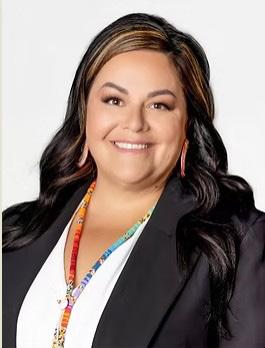
Michelle Fox September 3, 1976 –February 21, 2026
We are deeply saddened by the passing of our friend, Michelle Fox.
Michelle was an attorney and founding Shareholder at Cedar Tree Native Law and focused her service to Indian Country.
Her passing is a tremendous loss for Indian Country. Michelle believed in strengthening Tribal agriculture and uplifting Native producers, and her legacy will live on through the many lives she touched. The Intertribal Agriculture Council had the benefit of seeing Michelle’s commitment to producers in Indian Country firsthand—she was always ready and willing to support Tribal agriculture, from sitting with producers and helping them navigate USDA programs to offering key insights around federal agency processes during our annual conference. Michelle was not only a trusted partner in the work we care about, but also a dear friend.
Beyond her legal career, Michelle was a cowgirl and cattle producer who truly lived the agricultural life she championed. But most of all, she cherished her family above all—her children were the center of her world.
We extend our heartfelt condolences and prayers to her family and all who loved her. Michelle’s dedication, spirit, and service will continue to live on through those who knew her.
26th of each month next
Emailyouremploymentannouncement to tracie.bradford@sdbar.net by to haveitincludedinthe newsletter.Pleasebesure to include a closingdate. To seemorejobslistings,visit www.statebarofsouthdakota.com
Overview

Gordon Rees Scully Mansukhani, a national law firm with offices in all 50 states, has an immediate opening for litigation attorneys to work in its growing Rapid City, South Dakota office. The ideal candidate will have 2+ years of general defense litigation experience, and experience in commercial, professional liability, and/or employment litigation is preferred.
Candidates must be licensed and admitted to practice in South Dakota.
Responsibilities:
• All aspects of employment, commercial, and insurance litigation practice.
• Drafting and opposing motions, mediation statements, and deposition summaries.
• Attending depositions, mediation, arbitrations and court appearances, and trial preparation.
Qualifications:
• Strong analytical and writing skills.
• Excellent academic credentials.
• Clear and effective communication with clients and counsel.
• Ability to work independently and in a collective team environment.
• Highly motivated and provide superior client service.
GRSM is a full-service Am Law 100 firm with robust national and local practices and is the first and only law firm with attorneys and offices in all 50 states! We have garnered national recognition for our demonstrated commitment to the recruitment, retention and advancement of qualified female and diverse attorneys. Our attorneys have access to professional development and mentorship to promote advancement in a collaborative and collegial environment.
Opportunities include forward-facing client interactions and experience handling appearances at hearings, depositions, and trials. We offer great stability, have an industry-leading low overhead platform, and maintain no debt whatsoever.
We offer competitive compensation and a full benefits package including eligibility for subjective and objective bonuses and student debt repayment assistance.
For consideration, please submit a cover letter, resume, and writing sample.
Gordon Rees Scully Mansukhani is an equal opportunity employer.
Gordon Rees Scully Mansukhani, a national law firm with offices in all 50 States, has an immediate opening for an experienced Litigation Paralegal to work in a fast paced and welcoming environment - joining a team supporting the South Dakota and North Dakota offices. The qualified candidate will have a minimum of 4 years of civil litigation experience, work in the Rapid City, SD office 3 days per week, and have the option of remote work 2 days per week.
Skills/Requirements:
• A paralegal certificate and/or degree is preferred.
• Candidate must have excellent computer and document organization skills.
• A working knowledge/experience with: Microsoft Word, Outlook, and familiarity with iManage or other document management systems and iTimekeep, or other timekeeping software is preferred.
• Candidate should have strong organizational and communication skills.
• Candidate must pay high attention to detail, be self-
motivated and maintain the ability to multitask.
• Prioritizing work for multiple attorneys is essential.
The firm offers a friendly, business casual environment with competitive compensation and a full benefits package including Medical, Dental, Vision, 401K, PTO, Disability, Parental Leave and Life Insurance.
For consideration, please submit a cover letter and resume.
Gordon Rees Scully Mansukhani is an equal opportunity employer.
Opening date: 03/03/2026
Wage: $3,110.75 to $3,884.91, bi-weekly, DOE
Closing date: Open until filled
The Brown County Public Defender’s Office is looking for a Deputy Public Defender to help create its brandnew office. We are considering newly admitted attorneys, attorneys with 20 or more years of experience and everyone in between. (Admission to practice law with the State Bar of South Dakota or ability to obtain admission is required.) This office handles felony and misdemeanor criminal cases; abused and neglected child(ren) cases, juvenile delinquency cases, mental health and involuntary alcohol committal cases.
Do not let lack of experience in criminal law deter you from applying. We are dedicated to providing training opportunities both internal and external that will include handling these types of cases. We offer on-the-job training that includes proper etiquette in court, negotiation tactics, conducting jury trials, drafting motions, meeting with clients, filing appeals, plus more. You will learn valuable skills at no cost to you that will benefit you for your entire career! With that being said, we hope that is with Brown County.
The Brown County Public Defender’s Office promotes a team-focused environment where we strive to create a fun and inviting atmosphere while dealing with a difficult but important job, the only one mentioned in the Constitution. (Please see the Sixth Amendment.) We work hard to create a healthy work/life balance by monitoring caseloads and using technology to help streamline case management. Our goal is for you to be at your best while feeling confident in handling your own cases with minimal micro-managing, as we support you each step of the way! The Public Defender’s Office also values your opinion, and we encourage you to provide alternative solutions to current practices which help keep us on the path of continued improvement.
We offer competitive starting salaries based on experience and qualifications, ranging from $80,800 to 101,000 per year for 2026, and negotiable, depending on experience. We provide employer paid premiums on employee health, dental, and life insurance, while offering cost options for employee dependent plans and supplemental insurance. We are part of the South Dakota State Retirement system which offers a 6% employee match for eligible employees. In addition, we provide a generous paid time off and extended sick leave package, while observing 13 paid holidays throughout the year.
Excited by what you’ve read? Don’t wait apply now and join our team!
This position is responsible for the representation of individuals who cannot afford legal representation in criminal cases, abuse and neglect cases, juvenile cases, mental health and involuntary committal cases where the new Brown County Public Defender’s Office has been appointed to represent them. Candidates for this position may be designated “Senior Deputy Public Defender”, depending upon education and experience.
• Zealous representation of clients in criminal, abuse and neglect, juvenile, mental health and involuntary committal proceedings. Representation of clients in criminal and juvenile cases happens at all phases of the criminal justice system including initial appearances, arraignments, motions hearings and trials.
• Coordinates with and assists the Chief Public Defender and other staff members in providing information to the Courts, Court Administration, Clerk of Courts, County Auditor and County Commission as requested.
EDUCATION/AND OR EXPERIENCE REQUIRED Professional degree (Juris Doctor) Graduation from a college of law and attainment of JD or LLB.
• 0-10 years of experience.
• Admitted or eligible to be admitted to the South Dakota Bar Association.
POSITION
• Knowledge of local, state, and federal law.
• Knowledge of investigative tools and techniques.
• Knowledge of trial proceedings.
• Knowledge of computers and job-related software programs.
• Skill in the completion of legal research.
• Skill in producing persuasive legal arguments.
• Skill in the analysis of problems and the development
and implementation of solutions.
• Skill in oral and written communication.
• • SUPERVISORY CONTROLS
• The Chief Public Defender assigns work according to department goals and objectives. The supervisor reviews work through conferences, reports, and observation of department activities.
GUIDELINES
Guidelines include rules of professional conduct, rules of ethics, South Dakota Supreme Court rules, South Dakota codified law, rules of evidence, and county and department policies and procedure. These guidelines require judgment, selection, and interpretation in application.
COMPLEXITY/SCOPE OF WORK
• The work consists of varied legal duties. The variety of tasks to be performed contributes to the complexity of the position.
• The fast pace of the working environment contributes to the complexity of the position.
CONTACTS
• Contacts are typically with co-workers, legal assistants, other county employees, other attorneys, law enforcement personnel, judges, victims, witnesses, defendants, and members of the general public.
• Contacts are typically to provide services; to give or exchange information; to resolve problems; to motivate or influence people; or to justify, defend or negotiate matters.
PHYSICAL DEMANDS/ WORK ENVIRONMENT
• The work is typically performed while sitting at a desk or table or while intermittently sitting, standing, or stooping. The employee occasionally lifts light objects.
• The work is typically performed in an office or courtroom.
SUPERVISORY AND MANAGEMENT RESPONSIBILITY
This position may supervise assigned personnel.
APPLY BY
Submit Brown County application or resume to: Brown County Human Resources
25 Market St Aberdeen, SD 57401
Fax: 605-725-2355
Email: Humanresources@browncounty.sd.gov
Email: Allison.Tunheim@browncounty.sd.gov
WAGE: $87,000 to $110,300 DESCRIPTION OF WORK
General Statement of Duties
Handles the prosecution of misdemeanor cases for Brookings County. Assists the State’s Attorney and Chief Deputy State’s Attorney as needed with the prosecution of adult criminal matters and civil work on behalf of the County. Reports to the State’s Attorney.
• Prepare and manage a caseload of predominantly misdemeanor and felony cases.
• Present cases for legal proceedings. Perform legal research. Prepare, draft, and file legal documents and correspondence.
• Review offenses, police reports, and evidence to make determination on charges. Prepare, send, and track subpoenas for witnesses and records. Prepare and interview witnesses for legal proceedings.
• Represents the State of South Dakota before the grand jury.
• Makes bond arguments and sentencing recommendations.
• Stay informed on changes in relevant law and statutes and proposed legislation and policy pertaining to criminal law, juvenile delinquency, and juvenile abuse and neglect.
• Communicate, correspond, and collaborate with parties involved in cases including victims, parents, school personnel, attorneys, court personnel, and law enforcement regarding procedures and actions for those cases.
• Respond to inquiries from the public. Make recommendations for custody, parental rights, sentences, and restitution.
• Represent the State’s Attorney’s Office at public, private, and inter-governmental programs and events.
• Train and educate volunteers, law enforcement, and social workers on their roles and duties on legal issues and the court process duties.
• Answer, handle, or direct phone calls and walk-in traffic from clients and the general public regarding legal concerns and questions.
Education/Experience
• Obtained Juris Doctorate degree and is licensed to practice law in the State of South Dakota, or will be prior to the start date.
• 0-3 years experience in prosecution, litigation, or criminal law.
Please send cover letter and resume to State’s Attorney Dan Nelson Dnelson@brookingscountysd.gov
Full-time permanent position now open for a Deputy State’s Attorney in the Hughes County Office of the State’s Attorney in Pierre, South Dakota.
The Hughes County State’s Attorney’s Office is looking for an attorney to assist in the prosecution of criminal and juvenile matters. This would primarily include juvenile delinquency actions, CHINS petitions, abuse and neglect actions, and some misdemeanor and felony cases. Responsibilities would include presenting cases for legal proceedings, performing legal research, and preparing, drafting and filing legal documents and correspondence. Additional responsibilities include but are not limited to: advising local law enforcement agencies and working with DSS, dealing with juvenile justice issues, providing information to victims and witnesses and helping to fulfill the statutory responsibilities of the office.
Applicants must be able to: manage a large case volume and respond quickly and effectively to changing circumstances; speak and write effectively; establish and maintain effective working relationships with coworkers, other agencies, and the public; maintain professional appearance and demeanor.
Minimum Qualifications: Applicants must possess a J.D. and be an active member in good standing of the State Bar of South Dakota or be admitted within one year of hiring.
Preferred Qualifications: One or more years’ experience is highly preferred. The ideal candidate would have 2 to 5 years’ experience in the abuse and neglect area but will consider all applicants with a strong desire to work on behalf of and ensure the safety of children.
Hughes County offers a comprehensive benefits package for employees including health and dental insurance, participation in the SD Retirement System, and paid time off. Salary range is $72,580.31 to $90,255.04 and is determined in part based on years of professional experience.
Please send a resume and cover letter to Casey Jo Deibert, Hughes County State’s Attorney, 104 E. Capitol, Pierre, SD 57501. Resumes and cover letters will also be accepted via email at casey.deibert@co.hughes.sd.us.
Posting to remain open until the position is filled. All inquiries are confidential. Hughes County is an Equal Opportunity Employer.
Share
Hiring Organization
USAO District of South Dakota
Hiring Office
Criminal Division
Job ID
26-SD-12901412-AUSA
Location: Rapid City, SD
Application Deadline: Sunday, April 12, 2026
About the Office
The U.S. Attorney’s Office, District of South Dakota is seeking an exceptional, motivated prosecuting attorney to join our Criminal Division in the beautiful Black Hills of Rapid City, SD.
In all matters, our mission is to represent the people of the United States in a manner that instills confidence in the fairness and integrity of our office and the judicial system, and to conduct our work with the highest integrity.
The district’s main office is in Sioux Falls, SD, with two branch offices located in Pierre and Rapid City. This position is located in Rapid City, SD.
More information about the U.S. Attorney’s Office, SD can be found at: http://www.justice.gov/usao/sd/
Job Description
As a Criminal Assistant U.S. Attorney for the District of South Dakota, attorneys are responsible for prosecuting a variety of violations of federal law including, but not limited to, drug trafficking and smuggling; child exploitation; gang activity and violence; illegal immigration; firearms offenses; national security and border security, and cybercrime. Work includes partnering with law enforcement agencies to investigate crimes, research and brief legal issues, representing the United States before the United States District Court, hearings, trials, and appeals, and presenting criminal cases to a grand jury. Candidates should also be capable of litigating criminal prosecutions involving Major Crimes Act violations in Indian Country including murder, child sex abuse, rape and other violent crimes.
Responsibilities will increase and assignments will become more complex as training and experience progress. This position may be extended or made permanent without further competition. More than one applicant may be selected from this announcement.
More information about the U.S. Attorney’s Office, SD can
Security Requirements: Initial appointment is conditioned upon a satisfactory preemployment adjudication. This includes fingerprint, credit and tax checks, and drug testing. In addition, continued employment is subject to a favorable adjudication of a background investigation.
Residency Requirements: Assistant United States Attorneys generally must reside in the district to which he or she is appointed or within 25 miles thereof. See 28 U.S.C. 545 for district-specific information.
Selective Service: If you are a male applicant born after December 31, 1959, you must certify that you have registered with the Selective Service System, or are exempt from having to do so under the Selective Service Law. See www.sss.gov.
• Applicant must be a United States Citizen or National.
• Initial appointment is conditioned upon a satisfactory preemployment adjudication. This includes fingerprints, credit and tax checks, and drug testing. Continued employment is subject to a favorable adjudication of a background investigation.
• Applicant must be registered for Selective Service, if applicable.
• Applicant must possess a J.D. degree, be an active member of a bar (any U.S. jurisdiction), and have at least one year of post-J.D. legal or other relevant experience.
• Applicant must be a member, or be eligible to become a member, of the federal district court bar.
• Note: The U.S. District Court for the District of South Dakota requires that all Assistant U.S. Attorneys be admitted to the State Bar of South Dakota within 12 months from the date of an attorney’s oath of office for the position in South Dakota. See Local Rule (Criminal) 44.1(F)(1) (b). Accordingly, if the successful candidate is not a member of the South Dakota Bar, he/she must become a member within one year from entry on duty.
• Applicant must reside in the district to which he/she is appointed or within 25 miles thereof. See U.S.C. § 545 for district specific information.
• Applicant must be capable of traveling on occasion.
• Applicants must meet all qualification requirements upon the closing date of this announcement.
Required: Applicants must possess a J.D. Degree, be an active member of the bar (any U.S. jurisdiction), and have at least 1* year post-J.D. legal or other relevant experience.
United States citizenship is required.
Preferred: Applicants must demonstrate superior analytical ability; strong research, writing and courtroom skills; exercise fair and sound judgment; follow all Department of Justice and United States Attorney’s Office policies; exhibit the ability to work collaboratively in a supportive and professional manner with other attorneys, support staff, and law enforcement agencies; superior analytical and communications skills; handle matters in court persuasively and justly on behalf of the United States of America; and be devoted to excellence.
The ideal candidate should have the ability to work in a supportive and professional team environment with client agencies, support staff and other attorneys, and a demonstrated commitment to public service. You must meet all qualification requirements upon the closing date of this announcement.
Please provide a complete Application Package by April 12, 2026 which includes: https://www.usajobs.gov/job/860336000
Online application can be accessed via the above.
• Applicant must be a United States Citizen or National.
• Initial appointment is conditioned upon a satisfactory preemployment adjudication. This includes fingerprints, credit and tax checks, and drug testing. Continued employment is subject to a favorable adjudication of a background investigation.
• Applicant must be registered for Selective Service, if applicable.
• Applicant must possess a J.D. degree, be an active member of a bar (any U.S. jurisdiction), and have at least one year of post-J.D. legal or other relevant experience.
• Applicant must be a member, or be eligible to become a member, of the federal district court bar.
Note: The U.S. District Court for the District of South Dakota requires that all Assistant U.S. Attorneys be admitted to the State Bar of South Dakota within 12 months from the date of an attorney’s oath of office for the position in South Dakota. See Local Rule (Criminal) 44.1(F)(1)(b). Accordingly, if the successful candidate is not a member of the South Dakota Bar, he/she must become a member within one year from entry on duty.
Applicant must reside in the district to which he/she is appointed or within 25 miles thereof. See U.S.C. § 545 for district specific information.
Applicant must be capable of traveling on occasion.
Applicants must meet all qualification requirements upon the closing date of this announcement.
Salary: Assistant United States Attorney’s pay is administratively determined based, in part, on the number of years of professional attorney experience. The range of pay is $76,748 to $197,100, inclusive of locality pay.
Relocation Expenses: Relocation expenses will not be authorized.
Travel: Employment will require occasional travel to court at designated sites within and outside the district. Travel is also required for training at the Department of Justice’s National Advocacy Center, Columbia, SC.
* * *
Equal Employment Opportunity: The U.S. Department of Justice is an Equal Opportunity/Reasonable Accommodation Employer. Except where otherwise provided by law, there will be no discrimination because of race, color, religion, national origin, sex - including gender identity, sexual orientation, or pregnancy statusor because of age (over 40), physical or mental disability, protected genetic information, parental status, marital status, political affiliation, or any other non-merit based factor. The Department of Justice welcomes and encourages applications from persons with physical and mental disabilities. The Department is firmly committed to satisfying its affirmative obligations under the Rehabilitation Act of 1973, to ensure that persons with disabilities have every opportunity to be hired and advanced on the basis of merit within the Department of Justice. For more information, please review our full EEO Statement.
Reasonable Accommodations: This agency provides reasonable accommodation to applicants with disabilities where appropriate. If you need a reasonable accommodation for any part of the application and hiring process, please notify the agency. Determinations on requests for reasonable accommodation will be made on a case-by-case basis.
and Recruitment
with Disabilities: The Department encourages qualified applicants with disabilities, including individuals with targeted/severe disabilities to apply in response to posted vacancy announcements. Qualified applicants with targeted/severe disabilities may be eligible for direct hire,
non-competitive appointment under Schedule A (5 C.F.R. § 213.3102(u)) hiring authority. Individuals with disabilities are encouraged to contact one of the Department’s Disability Points of Contact (DPOC) to express an interest in being considered for a position. See list of DPOCs.
Suitability and Citizenship: It is the policy of the Department to achieve a drug-free workplace and persons selected for employment will be required to pass a drug test which screens for illegal drug use prior to final appointment. Employment is also contingent upon the completion and satisfactory adjudication of a background investigation. Congress generally prohibits agencies from employing non-citizens within the United States, except for a few narrow exceptions as set forth in the annual Appropriations Act (see, https://www.usajobs.gov/Help/ working-in-government/non-citizens/). Pursuant to DOJ component policies, only U.S. citizens are eligible for employment with the Executive Office for Immigration Review, U.S. Trustee’s Offices, and the Federal Bureau of Investigation. Unless otherwise indicated in a particular job advertisement, qualifying non-U.S. citizens meeting immigration and appropriations law criteria may apply for employment with other DOJ organizations. However, please be advised that the appointment of non-U.S. citizens is extremely rare; such appointments would be possible only if necessary to accomplish the Department’s mission and would be subject to strict security requirements.
Applicants who hold dual citizenship in the U.S. and another country will be considered on a case-by-case basis. All DOJ employees are subject to a residency requirement. Candidates must have lived in the United States for at least three of the past five years. The three-year period is cumulative, not necessarily consecutive. Federal or military employees, or dependents of federal or military employees serving overseas, are excepted from this requirement. This is a Department security requirement which is waived only for extreme circumstances and handled on a case-by-case basis.
Veterans: There is no formal rating system for applying veterans’ preference to attorney appointments in the excepted service; however, the Department of Justice considers veterans’ preference eligibility as a positive factor in attorney hiring. Applicants eligible for veterans’ preference must include that information in their cover letter or resume and attach supporting documentation (e.g., the DD 214, Certificate of Release or Discharge from Active Duty and other supporting documentation) to their submissions. Although the “point” system is not used, per se, applicants eligible to claim 10-point preference must submit Standard Form (SF) 15, Application for 10-Point Veteran Preference, and submit the supporting
documentation required for the specific type of preference claimed (visit the OPM website, www.opm.gov/forms/ pdf_fill/SF15.pdf for a copy of SF 15, which lists the types of 10-point preferences and the required supporting document(s). Applicants should note that SF 15 requires supporting documentation associated with serviceconnected disabilities or receipt of nonservice-connected disability pensions to be dated 1991 or later except in the case of service members submitting official statements or retirement orders from a branch of the Armed Forces showing that their retirement was due to a permanent service-connected disability or that they were transferred to the permanent disability retired list (the statement or retirement orders must indicate that the disability is 10% or more).
USAO Residency Requirement: Assistant United States Attorneys must reside in the district to which appointed or within 25 miles thereof. See 28 U.S.C. 545 for district specific information.
* * *
This and other vacancy announcements can be found under Attorney Vacancies and Volunteer Legal Internships. The Department of Justice cannot control further dissemination and/or posting of information contained in this vacancy announcement. Such posting and/or dissemination is not an endorsement by the Department of the organization or group disseminating and/or posting the information.
Position Description:
The Executive Director will serve as the chief executive and legal leader of the organization, responsible for strategic direction, fundraising, litigation vision, staff leadership, and external relationships. This is a rebuilding and transformation role, suited for a leader who is entrepreneurial, resilient, and deeply committed to access to justice in underserved and tribal communities. The main office is located in Mission, SD on the Rosebud reservation with limited nearby housing and services. Candidates should carefully consider the geographic and logistical realities of the position.
Dakota Plains Legal Services (“DPLS”) is a unique and historic nonprofit legal aid program providing civil legal services to members of nine Native American tribes, as well as non-tribal community members, in Western South Dakota. For decades, the organization has played a critical role in advancing justice in Indian Country and rural communities through litigation, advocacy, and direct legal services.
Like many long-standing institutions, the organization is at an inflection point. After years of underinvestment, it now seeks a visionary, hands on Executive Director to rebuild capacity, reinvigorate litigation and advocacy strategies, strengthen relationships with tribal nations, and lead the organization into its next chapter of impact and sustainability.
Key Responsibilities:
Strategic & Organizational Leadership
• Develop and implement a clear, forward-looking vision for the organization’s legal, advocacy, and operational work
• Lead organizational rebuilding, including systems, policies, and culture
• Work closely with the Board of Directors to strengthen governance and long-term sustainability
Litigation & Legal Advocacy
• Reinvigorate and oversee the organization’s litigation strategy, including impact litigation where appropriate
• Ensure high-quality legal services across practice areas
• Stay informed of legal developments affecting tribal nations and rural communities
Fundraising & External Relations
• Lead fundraising efforts, including grant writing, foundation relationships, and government funding
• Cultivate relationships with tribal governments, community partners, funders, and allied organizations
• Serve as the public face of the organization in the legal and broader community
Staff Leadership & Development
• Recruit, train, mentor, and retain a small, dedicated legal and support staff
• Foster a collaborative, supportive, and trauma-informed workplace
• Supervise senior staff and manage performance and professional development
Operations & Administration
• Oversee finances, budgeting, and compliance with grant and funding requirements
• Ensure ethical, effective, and fiscally responsible operations
• Balance limited resources while maintaining mission focus
• Qualifications: Required
• J.D. and active license (or eligibility to become licensed) in South Dakota. South Dakota has reciprocity with many states.
• Significant experience in legal aid, public interest law, tribal law, or closely related fields
• Demonstrated leadership experience, including staff supervision
• Experience with or strong aptitude for fundraising and grant development
• Commitment to serving Native American communities and underserved populations
• Ability to work effectively with tribal governments and diverse stakeholders
Preferred
• Experience working in or with tribal nations or Indian Country
• Litigation experience, including impact or complex litigation
• Executive or senior management experience in a nonprofit organization
• Cultural competence and humility in cross-cultural settings
Work Environment & Location Considerations
• Primary office is located on a reservation in a rural area
• Limited housing options near the office; relocation may be challenging
• Some remote or hybrid work may be possible, but regular on-site presence is required
• Position may involve travel within the service area and occasional out-of-area travel
Compensation & Benefits
• Salary is competitive within nonprofit legal aid but constrained by current funding
• Benefits include:
• Employer-paid employee coverage for medical, dental, short-term disability, long-term disability, term life, and AD&D insurance. Vision insurance is also available
• 401(k) with employer matching
• Earn 6 weeks of paid time off each year
• No relocation assistance currently available
To Apply:
Please submit:
1. A resume
2. A cover letter describing your interest in the position, relevant experience, and vision for leading a rebuilding legal aid organization serving tribal communities
Applications will be reviewed on a rolling basis until the position is filled.
Please submit these materials to:
Mr. Craig Lafferty
DPLS Board Chair
28778 274th Ave
Mission, SD 57555
605-319-1812
Notes:
Equal Opportunity Employer
Salary range:
$110,000 - $150,000
Corporate Associate Sioux Falls
Lateral - Associate Business and Transactions
Ballard Spahr’s Sioux Falls office and the Business & Transactions Department seek to hire a corporate associate with 2-5 years of experience. Qualified candidates should have experience in mergers and acquisitions and general corporate and commercial matters, corporate governance, and advising both emerging and middle-market companies on a wide range of corporate matters. Experience with private equity transactions and working with outside General Counsel is a plus. Successful candidates will have strong academic credentials and superior writing and communication skills. An active license in South Dakota is required.
Our Business and Transactions Department has a regional and national practice involving public and private companies and nonprofit organizations, including ESOP owned companies, private equity funds, financial institutions, investment companies, sports and other franchises, public utilities, and hospitals and health services. Our clients are engaged in a wide range of sectors including technology, life sciences, manufacturing, architectural and engineering, industrial, energy, retail, telecommunications, and software.
This is an excellent opportunity for a motivated entrepreneurial candidate to thrive in a collegial environment at a firm with a national profile and emphasis on mentoring, community engagement and professional development.
Ballard Spahr offers an excellent benefits package. A summary of available benefits can be found here on our Careers website.
At Ballard Spahr, we believe that our skills, perspectives,
and backgrounds drive innovation and excellence, while our unique culture fosters collaboration and success. Our culture of thriving together forms the cornerstone of how we deliver exceptional service and position our firm for a strong future. We welcome and encourage applicants from all backgrounds to apply.
Ballard Spahr is an equal opportunity employer. We offer equal consideration to all qualified applicants, regardless of race, ethnicity, religion, age, national origin, handicap or disability, citizenship, sex, pregnancy, childbirth or related medical condition, sexual orientation, gender identity and expression, transgender status, sex stereotyping, genetic information, ancestry, veteran status or any other category protected by applicable law.
We are not currently accepting search firm submissions for this position. For questions or more information, please contact Dana Casterella, Manager of Legal Recruiting, at casterellad@ballardspahr.com.


Find out how you can post your open positions here!
Email: tailynn.bradford@sdbar.net
We are pleased to share an important update regarding the future of the State Bar Lawyers Assistance Program (LAP).
As part of our ongoing commitment to supporting the well-being, resilience, and professional success of our members, the State Bar will soon begin the search for new leadership of the Lawyers Assistance Program.
This search reflects our dedication to ensuring the continued strength and sustainability of the work and services provided by our current LAP Director, Becky Porter.
Becky plans to continue to serve in her role during the transition and will play an integral role in mentoring and training.
This thoughtful, collaborative transition plan is designed to maintain continuity of services, program stability, and the high standard of care that Becky has provided to members over the years.
With Becky’s continued leadership through the transition, we are confident that the Lawyers Assistance Program will remain a strong and trusted resource for those seeking support and guidance.
We extend our sincere appreciation to Becky for her ongoing dedication and for helping to ensure a smooth and successful transition.
Additional updates will be shared in the coming weeks.
State Bar of South Dakota
Disability Rights South Dakota is seeking to fill the attorney vacancy on the Protection & Advocacy for Individuals with Mental Illness (PAIMI) Program’s Advisory Council (PAC):
◄Provide independent advice and recommendations to the PAIMI Program about issues related to individuals with mental illness.
◄Work jointly with the Board of Directors of DRSD in the development of priorities and objectives.
◄Have a commitment to promoting the legal and civil rights of individuals with mental illness.
If you are interested in serving on this advisory council, go to https://drsdlaw.org/who-we-are/#pac to learn more about the PAC and submit your information to receive an application.
Our Mission:
Disability Rights South Dakota is the non-profit legal services agency dedicated to protecting and advocating for the rights and inclusion of South Dakotans with disabilities.
APRIL 22 April 2026 Bar Commissioner Mixer Rapid City | 5:30 PM - 7:30 PM MST
APRIL 23 Rapid City | 11:30 AM - 12:30 PM MST
MAY 8 Rapid City | 8:00 AM - 5:00 PM MST
JUNE
