F1
WEDNESDAY, AUGUST 15, 2018 extrastory2000@gmail.com
GROWTH AND RISING INFLATION
INVESTMENTS, JOBS BOOST ECONOMIC EXPANSION
F
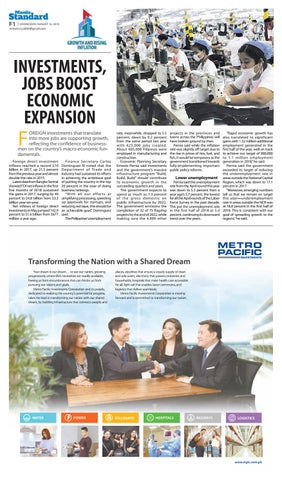
OREIGN investments that translate into more jobs are supporting growth, reflecting the confidence of businessmen on the country’s macro-economic fundamentals. Foreign direct investment inflows reached a record $10 billion in 2017, up 21.5 percent from the previous year and almost double the rate in 2015. Latest data from Bangko Sentral showed FDI net inflows in the first five months of 2018 sustained the gains in 2017, surging by 49 percent to $4.8 billion from $3.3 billion year-on-year. Net inflows of foreign direct investments in May jumped 142.9 percent to $1.6 billion from $677 million a year ago.
Finance Secretar y Carlos Dominguez III noted that the Depar tment of Trade and Industry had sustained its efforts in achieving the ambitious goal of putting the country in the top 20 percent in the ease of doing business rankings. “ With all our effor ts at simplifying processing, speeding up approvals for startups, and reducing red tape, this should be an achievable goal,” Dominguez said. The Philippines’unemployment
rate, meanwhile, dropped to 5.5 percent, down by 0.2 percent from the same period last year with 625,000 jobs created. About 605,000 Filipinos were employed in manufacturing and construction. Economic Planning Secretary Ernesto Pernia said investments and the government’s massive infrastructure program “Build, Build, Build” should contribute to economic growth in the succeeding quarters and years. The government expects to spend as much as 7.3 percent of the gross domestic on public infrastructure by 2022. The government envisions the completion of 32 of 75 flagship projects by the end of 2022, while making sure the 4,909 other
projects in the provinces and towns across the Philippines will have broken ground by then. Pernia said while the inflation rate was slightly off target due to the rise in prices of rice, fuel, and fish, it would be temporary as the government transitioned towards fully-implementing important public policy reforms.
Lower unemployment
Pernia said the unemployment rate from the April round this year was down to 5.5 percent from a year ago’s 5.7 percent, the lowest for all the April rounds of the Labor Force Survey in the past decade. This put the unemployment rate in the first half of 2018 at 5.4 percent, continuing its downward trend over the years.
“Rapid economic growth has also translated to significant gains with 1.52 million additional employment generated in the first half of the year, well on track to achieve our target of 900,000 to 1.1 million employment generation in 2018,” he said. Pernia said the government exceeded its target of reducing the underemployment rate in areas outside the National Capital Region, which was down to 17.1 percent in 2017. “Moreover, emerging numbers tell us that we remain on target this year—underemployment rate in areas outside the NCR was at 18.8 percent in the first half of 2018. This is consistent with our goal of spreading growth to the regions,” he said.
Transforming the Nation with a Shared Dream Your dream is our dream… to see our nation, growing progressively where life’s necessities are readily available, freeing us from encumbrances that can hinder us from pursuing our visions and goals. Metro Pacific Investments Corporation and its people, dedicated to realizing the country’s potential for progress, takes the lead in transforming our nation with our shared dream, by building infrastructure that connects people and
WATER
POWER
places, pipelines that ensure a steady supply of clean and safe water, electricity that powers industries and households, hospitals that make health care accessible for all, light rail that enables faster commutes, and logistics that deliver seamlessly. Metro Pacific Investments Corporation is moving forward and is committed to transforming our nation.
TOLLROADS
HOSPITALS
RAILWAYS
LOGISTICS
www.mpic.com.ph
F2
WEDNESDAY, AUGUST 15, 2018 extrastory2000@gmail.com
GROWTH AND RISING INFLATION
BPI is focusing on helping self-employed microentrepreneurs (SEMEs), most of whom have no bank accounts, through BPI Direct BanKo, its microfinance arm.
BPI overhauled its consumer loan processes in 2017 to improve turnaround times for auto and housing loans.
Growth-generating giant: How BPI fosters an inclusive economy By MJ Blancaflor and Dexter Tilo
I
NCLUSIVE economic growth is desired by all sectors in society, and financial institutions are taking part in making this possible. This desire has kept the Bank of the Philippine Islands (BPI) busy improving its products and services to make wealth creation more accessible to Filipino households. Established in 1851, BPI has been inextricably linked to our country’s economic growth. With its commitment to Clients, People, Shareholders, and Country, the bank has taken advantage of the country’s economic growth to offer what Filipinos need. It is BPI’s vision to become the country’s most inclusive bank. It aims to provide the most innovative solutions that satisfy clients’ financial needs, while creating shared value and prosperity for all stakeholders. SUPPORTING THE UNBANKED, ENTREPRENEURS The present administration has made the micro, small and medium enterprises (MSMEs) a priority, recognizing this sector as a significant force in generating jobs and driving the country’s economy. As a result, government financial institutions were directed to develop financing options for MSMEs to reduce their dependence on informal lenders. On the other hand, private financial institutions were asked to provide options to help MSMEs. BPI has heeded the call of the government, focusing on helping self-employed microentrepreneurs (SEMEs), most of whom have no bank accounts, through BPI Direct BanKo, its microfinance arm. BanKo now has over 10,000 clients and more than Php 559 million in loans to clients as of end 2017. It uses a more traditional inperson business approach through financial advisors called BanKoMares and BanKoPares, who go out to wet markets and small business owners who need financing. BanKo ended 2017 with 103 branches and micro-banking offices. It aims to reach 200 branches nationwide by the end of the year. Earlier this year, BPI also launched its Business Banking group to sharpen its focus on the unique financial needs of clients, particularly the SMEs. The Business Banking Group will cater to over 100,000 BPI clients that maintain deposits, but, for the most part, do not avail of other financial services, including business loans. SME loans currently account for less than 10% of the Bank’s total loan book. The Bank intends to further invest in its microfinance and SME business to tap opportunities in the growing market for the unbanked and underserved microfinance segment, as well as the thriving SMEs who still fail to take full advantage of loans available to them. All this, ultimately, will help support inclusive growth for a more resilient society. AUTO AND HOUSING LOANS FOR ALL The recently enacted Tax Reform for Acceleration and Inclusion (TRAIN) Law effectively reduced personal income tax rates and has resulted in higher disposable incomes for Filipino taxpayers. In turn, the Bank expects stronger growth in the consumer lending market through BPI Family Savings Bank.
Since the Philippines has a growing digitally-savvy population, BPI invests heavily in technology.
Recognizing that the Philippine economy is consumption-driven, BPI overhauled its consumer loan processes in 2017 to improve turnaround times for auto and housing loans. The impact of its improvements for the auto and housing loans is expected to be realized this year. In 2017, BPI has registered P12.2 billion in total loans for affordable housing. The auto loans business catered to 102,000 clients in the same period. Its card business (credit, debit, and prepaid) has also benefited from smart analytics that enhances origination, credit scoring, and fraud detection to improve security. It has over 9 million cardholders, and P206 billion in transactions across all card types. At the present, the oldest bank in Southeast Asia is ready to capture a larger share in the retail business covering auto loans, housing loans, and consumer loans through its credit, debit and prepaid cards. LONG-TERM DIGITALIZATION JOURNEY The Bank has the future in mind. Since the Philippines has a growing digitally-savvy population, BPI invests heavily in technology, both front-end and back-end processes to significantly improve operational efficiency, security, access and overall customer experience. It is the pioneer and leader in local mobile and internet banking. In fact, for the past three years, the total number of unique users of the BPI Mobile App has steadily increased, growing 28% just for 2017. The BPI will continuously provide quality service to the growing number of clients
who access the Bank through its mobile app and online facility. In 2017, the uptime rates for mobile banking, express phone and ELink/ BizLink reached 99.5%, 100% and 99.43%, respectively. “We recognize the importance of building strong digital capabilities by enhancing client access points, as well as improving our back-end systems to spur better productivity, automation, and cost-efficiency. This long-term digitalization journey will complement our physical branches, enabling a more efficient and convenient self service banking experience while enhancing face-to-face interaction at the branches for our clients’ more complex needs,” said Ramon Jocson, BPI Executive Vice President and Head of Enterprise Services Segment. PROVINCIAL EXPANSION Gross Regional Domestic Product (GRDP) outside Metro Manila has mostly been growing since 2014, especially in the Eastern and Central Visayas, Central Luzon, and Davao Region. However, poverty and inequality are still present across the regions. The government is committed to addressing these problems by redirecting investor focus outside Metro Manila, particularly the underdeveloped regions in Visayas and Mindanao. “We are cognizant of the need for financial services in the provinces, especially in underdeveloped regions, and the long-term potential that this need implies,” said Cezar Consing, BPI President and Chief Executive Officer. “That is why we continue to expand our branch network to key growth areas nationwide, at the same time, intensify our push towards digital financial channels and services for better access to more Filipinos.” In 2017, the Bank has opened 111 more BPI, BPI Family Savings Bank, and BanKo branches and MBOs, a 13% increase from 2016. The total number of clients in both retail and corporate
segments rose to 8.5 million, a 6.6% growth. According to its Integrated Report last year, there are 942 branches and MBOs across the archipelago, while there are 3,105 ATMs & CAMs, or Cash Accept Machines. INDUBITABLE GROWTH With 167 years of providing top notch financial services, the first bank in the country and in Southeast Asia has grown its assets to Php 1.9 trillion as of 2017. It has the highest profitability ratios among local banks, with a Return on Equity of 12.75% and a Return on Assets of 1.27% in 2017. It has received numerous awards, too, including the top spot in the Top Investment Houses of Asian Local Currency Bonds based on the number of votes received from top-rated analysts, economist and strategists, salespeople, and traders. BPI’s strategy centers on expansion tempered with financial prudence and risk management. After focusing on efficiency for several years, BPI is embarking on an ambitious growth journey anchored on four strategic priorities: the SME business through the newly-launched Business Bank, the retail and consumer finance business under BPI Family Savings Bank, financial inclusion through BPI Direct BanKo, and digitalization, which cuts across the rest not only through the channels but also the frontend and back-end facilities. Digitalization, according to Consing, is a key component of financial inclusion, which is all about making financial services available to every Filipino. “We intend to digitalize the bank further because only by digitalizing further can we actually become much more financially inclusive,” Consing added. As a leading bank in the country, BPI hopes that, through its strategic priorities, it can create a foundation for robust and inclusive economic growth for the Philippine nation.
GROWTH AND RISING INFLATION
Economic team wary of planned shift to federalism
A
FEDERAL system of government may be ideal in making growth inclusive, but the pending versions in Congress lack the clear mechanics in making economic growth sustainable. T h e c o u n t r y ’s e c o n o m i c managers fear that a federal form of government might have dire economic consequences in the long run, especially since the draft federal constitution contains ambiguous provisions on the allocation of expenditures for the would-be federated government and its federated regions. Finance Secretar y Carlos Dominguez III called for further discussions on the issue, saying the economic team has the responsibility to point out the unclear provisions in the proposed draft charter “especially when the possible repercussions could result in dire, irreversible economic consequences.” “We welcome a discussion on the draft so that it is clear and unambiguous. We do not want the revenue assignment and the expenditure assignment to be misunderstood, as what happened in the recent case involving the Internal Revenue Allotment (of the local government units),” Dominguez said. He said while the draft Charter contained provisions on the taxation powers of the Federal Government and the Federated Region and a provision on revenue assignment in which the regions would be given a 50-percent share in income, excise, value added taxes and customs duties,
“there is no provision on expenditure assignment.” The draft Constitution enumerated the exclusive powers of the Federal Government and the Federated Regions but was silent on the funding source for the exercise of the powers, he said. “As we pointed out earlier, we never stated that we are against federalism. Rather, with respect to the fiscal provisions of the proposed Constitution, there are ambiguous provisions on revenue assignment and there are no provisions on expenditure assignment,” the Finance chief said. “There are, likewise, principles on revenue sharing that do not appear to be well studied.” Dominguez cited that while the draft Constitution provided for an Equalization Fund, which should not be less than 3 percent of the annual General Appropriations Act, it did not state if this would be taken from the share of the Federal Government or of the Federated Regions. The Equalization Fund refers to the allocation for the federated regions that would be distributed based on the needs of each region, with priority given to those that require greater support to achieve financial and economic sustainability as determined by a “Federal Intergovernmental Commission.” Julito G. Rada
IMF, Moody’s Investors give PH economy seal of approval TWO international financial institutions have given the Philippines a good housekeeping seal of approval. The separate endorsements from the International Monetary Fund and global debt watcher Moody’s Investors Service are a clear indication that the macro economic fundamentals of the Philippines remain solid despite the high inflation rate. The IMF kept its 2018 growth forecast for the Philippines at 6.7 percent, although it warned that rising inflation and external developments such as the trade tension between bigger economies might threaten sustained expansion. IMF mission chief Luis Breuer noted that the Philippine economy was performing well. Real GDP [gross domestic product] grew 6.7 percent in 2017, with his team predicting that rate will be sustained in 2018 and 2019, “underpinned by strong consumption and investment, including public investment.” “The Philippines has been one of the region’s strong economic performers over the past years, reaping the fruits of prudent policies and critical reforms. The team welcomes the authorities’ strategy of maintaining policy continuity while adapting to emerging challenges and taking advantage of the strong economy to implement reforms to improve inclusive growth and job creation. This strategy has served the Philippines well,” says Breuer.
M o o d y ’s s h a r e d t h e s a m e observation. Strong GDP growth, it said, could accelerate even further, especially if the gover nment achieved higher spending on infrastructure. I t also expects further progress “on improving government revenue on the back of additional reforms and ongoing enhancements in tax administration, which would also help keep government debt stable.” “ The credit profile of the government of the Philippines [Baa2 stable] is supported by a large and fast-growing economy and continued gains in debt affordability, in part because of revenue reforms,” the rating agency said. The support from the two financial institutions validated the painful reforms the Philippines implemented in the past to keep the economy afloat. The expanded value-added tax during the term of former President Gloria Macapagal Arroyo and the business-friendly policies during the time of ex-President Benigno Aquino III cemented the gains of the economy. President Rodrigo Duterte’s ‘Build, Build, Build’ program and the recent tax reform package that Congress passed are making the economy stronger. The government now faces the challenge of creating the trickledown effect to make the economic gains inclusive to the poor and the marginal sectors.
WEDNESDAY, AUGUST 15, 2018 extrastory2000@gmail.com
F3
F4
WEDNESDAY, AUGUST 15, 2018 extrastory2000@gmail.com
GROWTH AND RISING INFLATION
Govt paves road to development By Darwin G Amojelar
T
HE Public Works Department is paving more roads to development, by undertaking massive projects the country has not seen before.
Data from the agency showed that since the start of the term of President Rodrigo Duterte in July 2016, the DPWH widened 1,908 kilometers of roads, built 328 km of bypasses and diversion roads, 393 km of missing gaps connecting national roads and 1,316 km of access roads leading to airports, seaports/Ro-Ro ports and tourist destinations. “DPWH has also widened a total of 511 bridges spanning 23,929 meters, replaced 204 bridges, spanning 8,305 meters and built 127 new bridges spanning 6,260 meters,” Public Works Secretary Mark Villar said. “We have also rehabilitated 939 bridges spanning 40,192 meters and strengthened 642 bridges, spanning 29,260 meters,” he said. Villar said the construction was happening in every region in the country as part of President Duterte’s call to spread development nationwide. He said that by 2022 , the Duterte administration would have constructed the Luzon Spine Expressway Network—a network of highstandard highways with a total length of 834.72 km, or about twice the six of 382 km of existing expressways. “Once completed, travel time from Metro Manila to San Fernando, La Union will be reduced from 6 hours and 55 minutes to 3 hours and 10 minutes. Moreover, travel time from Ilocos to Bicol will be reduced from 19 hours and 40 minutes to 8 hours and 15 minutes,” Villar said. “We are on target. We have already opened several sections of the Tarlac-Pangasinan-La Union Expressway, the Arterial Plaridel Bypass Project, the Laguna Lake Expressway and the Radial Road 10,” he said.
“Within the year, we expect to open the NLEx Harbor Link Project, which will connect McArthur Highway and C3 and reduce travel time from Quezon City to Manila to only 10 minutes,” Villar said. Villar said the Inter-Island Linkage Project—a network of short and long span bridges which would allow land travel from Luzon, Visayas and Mindanao, is also in advanced stages. “In October 2018, we will start the construction of the 3.77-km Panguil Bay Bridge that will connect the city of Tangub in Misamis Occidental to the municipality of Tubod in Lanao del Norte,” he said. “Once completed in 2021, it will only take 10 minutes to reach Tangub City from Tubod using the bridge compared to the 2.5 hours it would take using the 102-km route via the Tubod- KapataganMolave-Tangub road,” he said. “Travel time between Ozamiz City, Misamis Occidental and Mukas, Kolambugan, Lanao Del Norte will be reduced from 2.5 hours using Ro-Ro operations to 20 minutes using the Panguil Bay Bridge,” he said. Also included in this network is the BataanCavite Interlink, the Mindoro-Batangas Super Bridge, the Panay-Guimaras-Negors Link, the Negros-Cebu Link Bridge, the Panguil Bay Bridge, the Guicam Brdige, the Camarines-Catanduanes Friend Bridge, the Luzon Sorsogon-Samar Link Bridge and the Davao Samall Bridge. Amid the construction binge, the Labor Department reported a year-on-year increase of 468,000 jobs generated in the construction sector, based on a survey conducted by the Philippine Statistics Authority in April 2018.
Public Works Secretary Mark Villar (second from right), together with Transportation Secretary Arthur Tugade (right) lead the opening of an additional 700 meters of two-lane concrete pavement along Laguna Lake Highway (formerly C-6 Dike Road).
Duterte wants third telecom player to break duopoly T H E Duter te administration wants to deliver on its promise to provide reliable and affordable telecommunication services to Filipinos, as it pushes for the entry of a new major player to complete with the duopoly. President Rodrigo Duterte, in his 3rd State of the Nation Address, pledged to bring in a new telco player to ensure that the country’s telecommunications services are reliable, inexpensive and secure. “A draft terms of reference for the entry of a new, major industry player is at hand. The terms will be fair, reasonable and comprehensive. It will be inclusive so it will be open to all interested private parties, both foreign and local,” Duterte said. “The only condition is that the chosen entity must provide the best possible services at reasonably accessible prices,” he said. The Department of Information Communications and Technology is in the process of finalizing the terms of reference for the selection of the third telco player. DICT acting Secretary Eliseo RIo said the entry of new major player in the Philippine market was a mandate given by the president to the agency to address the paramount national interest on the quality of internet connection in the country. He said the major player was expected to stir up genuine competition in the telco market and consequently lower the prices and improve the quality of the services. Rio said the new player was
expected to make a commitment that was never done by the existing telco players. “Filipinos can now expect a faster internet speed at a lower cost,” he said. The DICT adopted the highest committed level of service or HCLoS as the mode of selection for the major player. Through the HCLoS terms of reference, the participant with the highest points gained on the basis of coverage (40 percent), speed (20 percent) and financial capability (40 percent) in the next five years would be named as the new telco player. Existing telco players PLDT Inc. and Globe Telecom Inc. expressed no objection to the entry of new players in the telecommunications industry. “Globe is not opposed to the entry of a third player, or for that matter, as many players that the market can accommodate. Globe has always geared itself for growth and competition,” Globe senior vice president and general counsel Froilan Castelo said. “Competition has the potential of opening up new sources of revenue streams for telecommunications players, while benefiting consumers with more innovative products and services at competitive rates,” he said. The government through the National Telecommunications Co m m i s s i o n a l s o m ove d to reduce interconnection charges among telcos to make text and voice calls more affordable to Filipinos. Darwin G. Amojelar
GROWTH AND RISING INFLATION STATE OF THE PHILIPPINE ECONOMY ROLANDO G. ESTABILLO Publisher
RAY S. EÑANO Editor
RODERICK T. DELA CRUZ Assistant Editor
DARWIN G. AMOJELAR JENNIFFER B. AUSTRIA OTHEL V. C AMPOS ALENA MAE S. FLORES JULITO G. RADA Reporters
ANITA F. GREFAL OIC-Operation
BALDWIN FELIPE
OIC-Advertising Manager
PAULA REYNOSO
Head-Supplements
BESSIE GOOD BABES GOOD ALBERT LEGASPI RON TAMAYO
ROMEL J. MENDEZ
Ad Solutions Specialists
VICKIE R. AYENG LUZ E. JIMENEZ ALICE V. E STRELLA
SHEILA SUAREZ JOAN VELASCO ERIC JUTIC EDELYN ELAMPARO
Art Director
Layout Artists
Advertising Support Group