D1
GROWTH AND RISING INFLATION
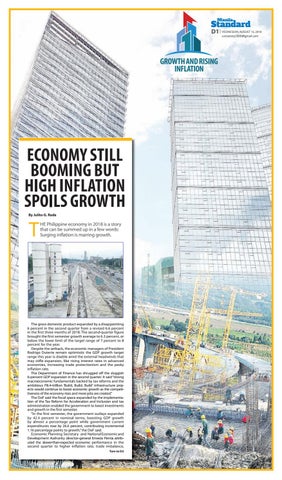
ECONOMY STILL BOOMING BUT HIGH INFLATION SPOILS GROWTH By Julito G. Rada
T
HE Philippine economy in 2018 is a story that can be summed up in a few words: Surging inflation is marring growth.
The gross domestic product expanded by a disappointing 6 percent in the second quarter from a revised 6.6 percent in the first three months of 2018. The second-quarter figure brought the first semester growth average to 6.3 percent, or below the lower limit of the target range of 7 percent to 8 percent for the year. Despite the setback, the economic managers of President Rodrigo Duterte remain optimistic the GDP growth target range this year is doable amid the external headwinds that may stifle expansion, like rising interest rates in advanced economies, increasing trade protectionism and the pesky inflation rate. The Department of Finance has shrugged off the sluggish 6-percent GDP expansion in the second quarter. It said “strong macroeconomic fundamentals backed by tax reforms and the ambitious P8.4-trillion ‘Build, Build, Build’ infrastructure projects would continue to boost economic growth as the competitiveness of the economy rises and more jobs are created.” The DoF said the fiscal space expanded by the implementation of the Tax Reform for Acceleration and Inclusion and tax administration enabled the government to boost investments and growth in the first semester. “In the first semester, the government outlays expanded by 42.4 percent in nominal terms, boosting GDP growth by almost a percentage point while government current expenditures rose by 26.6 percent, contributing incremental 1.16 percentage points to growth,” the DoF said. Economic Planning Secretary and National Economic and Development Authority director-general Ernesto Pernia attributed the slower-than-expected economic performance in the second quarter to higher inflation rate, trade imbalance, Turn to D2
WEDNESDAY, AUGUST 15, 2018 extrastory2000@gmail.com
D2
WEDNESDAY, AUGUST 15, 2018 extrastory2000@gmail.com
GROWTH AND RISING INFLATION
Inclusive growth, fiscal discipline By Julito G. Rada
A
PROGRESSIVE economy is meaningless if growth does not produce a trickle-down effect.
Embarking on massive infrastructure projects is one strategy that the government of President Rodrigo Duter te i s l e an i n g o n to spread the benefits of economic expansion. Finance Secretary Carlos Dominguez III says along with other reforms such as the long-due modernization of the tax system and improvements in the ease of doing business, the Duterte administration envisioned the infrastructure program to reduce poverty incidence by a third of the 2015 level of 21.6 percent to just 14 percent by 2022. “ This will be the absolute measure of success of our strategy of inclusive growth. This is the goal that has been set for us by President Duterte, and this is how we are implementing it,” said Dominguez. “We fully aspire to be the fastest growing economy in the fastest growing region in the world. This will not be an easy task to accomplish. But we are ready to meet the challenges, driven by the optimism of our people, the confidence of our development partners, and the leadership of President Duterte,” he said.
Aggressive public spending
Dominguez said the government would maintain fiscal discipline despite an aggressive public spending to keep the momentum of the “Build, Build, Build” infrastructure program, designed to fuel high—and inclusive—growth. He said the Department of Finance and the Bureau of the Treasury would also ensure that the government’s borrowing policy remains cost-efficient to provide it with enough resources to fund infrastructure and other priority programs. The country’s fiscal position “is strong” and “will continue to be so in the foreseeable future,” Dominguez said. To maintain the momentum of the “Build, Build, Build” program, Dominguez said the economic managers slightly adjusted the deficit forecast from 3 percent to 3.2 percent through 2019. “We assure our people that the government remains steadfast in its commitment to fiscal discipline. The improved revenue collections are channeled to productive spending that will clear the way towards inclusive economic growth,” Dominguez said during the
latest meeting of the inter- percent from P210 billion on agency Development Budget year. Expenditures, meanwhile, Coordination Committee in grew 21 percent to P1.603 trillion Manila. from P1.330 trillion a year ago. Dominguez said to ensure Robust collections Data released by the DoF on efficient borrowing, this year’s Aug. 11, 2018 showed that to- goal of securing 65 percent of tal revenues collected by the loans from the domestic margovernment in the first semes- ket and 35 percent from exterter jumped 20 percent to P1.410 nal sources would be modified trillion from P1.176 trillion a so that the government would now be targeting the proporyear ago. The Bureau of Internal tion of domestic borrowing to Revenue collected P965 bil- increase to 75 percent, which lion in the first half, up 14 per- would reduce the percentage of cent from P848 billion on year. external financing in the mix to The Bureau of Customs raked 25 percent. “The larger proportion of doin P279 billion, higher by 33
mestic borrowing in the 2019 mix will help us better hedge against foreign exchange risks,” Dominguez said. The aggressive spending will close the infrastructure gap with the Philippines’ neighboring economies, attract industrial investments, stimulate domestic economic activity, ensure that every community and every island participate in the mainstream of national wealth creation, and enable the country to take full advantage of regional economic integration within the framework of the Association of Southeast Asian Nations.
ECONOMY... From D1 “stagnant” agriculture sector, and the closures of the island resort of Boracay last June and some mining operations during the time of former Environment secretary Regina Lopez, a staunch environment advocate. President Rodrigo Duterte temporarily closed Boracay to rehabilitate the island resort and prevent its further degradation due to too much commercialization that has been taking its toll on the island resort. But Pernia expressed optimism the reopening of Boracay sometime in October this year could again lure many tourists and eventually contribute significantly to economic growth in the last quarter.
Robust infra spending
Finance Secretary Carlos Dominguez III said national government spending on infrastructure reached P281 billion in the first five months of 2018, up 42 percent over the same period last year. The expenses are on top of the private sector construction and public sector projects financed through public-private partnerships. Dominguez said with P281 billion invested on infrastructure in the first five months, the government was averaging close to P56 billion a month in funding”Build, Build, Build.” Moreover, with 30 percent of the spending going to wages, about P17 billion was infused into the economy per month in the form of additional income and purchasing power for workers, aside from creating some 100,000 new jobs so far, spurring economic activity in related sectors and other multiplier effects, he said. “Build, Build, Build will drastically alter the Philippine economic landscape. It will create over a million jobs per year. It will bring our logistics backbone up to par in a region that is growing very dynamically,” Dominguez said.
GROWTH AND RISING INFLATION
WEDNESDAY, AUGUST 15, 2018 extrastory2000@gmail.com
D3
DPWH’s Villar battles corruption, and RoW issues By Darwin G. Amojelar
T
HE Duterte administration is slowly making headway toward building more infrastructure projects but issues on right of ways and corruption are hindering the “golden age of infrastructure” goal. The Department of Public Works and Highways so far is pushing the right buttons to accelerate the construction of critical infrastructure projects. The department, for one, granted an original proponent status to Metro Pacific Tollways Corp. to build the ambitious P22.4 billion Cavite-Tagaytay-Batangas Expressway, the first OPS granted under the Duterte administration. CTBex is a 50.4-kilometer expressway that will connect Cavite and Batangas, with a spur road to Tagaytay City and ultimately terminating in Nasugbu, with another spur road
to Tuy, Batangas. “This is another sign that Build, Build, Build is all systems go,” DPWH Secretary Mark Villar said. Under the “Build, Build, Build” program, the government plans to spend P8 trillion to P9 trillion, or roughly $160 billion to $180 billion, for the big-ticket projects. The “Golden Age of Infrastructure “ program aims to build more roads and bridges, airports and seaports with the end goal of decongesting the country, and subsequently promoting inclusive growth and development.
NEW CITY. Finance Secretary Carlos Dominguez III (from left), Public Works and Highways Secretary Mark Villar, Economic Planning Secretary Ernesto Pernia, MTD Clark Inc. chairman Isaac David, MTD Clark Inc. president Nicholas David, Bases Conversion and Development Authority president and CEO Vivencio Dizon and Transportation Secretary Arthur Tugade lead the media on a tour of the New Clark City spanning the city of Angeles in Pampanga and the towns of Capas and Bamban in Tarlac. New Clark City is one of the flagship projects under the Duterte administration’s “Build, Build, Build” program.
New expressway projects
Villar also said the construction and acquisition of road right-of-way for Cavite-Laguna Expressway of MPCala Holdings Inc. were being rushed to complete the project with the planned 2020 deadline. “To date, 96 percent of Letter Offer have been served to the land owners, 81 percent of the signed Deeds of Absolute Sale and Expropriation Cases have been submitted to the Office of the Solicitor General, and 21 percent of the Permits to Enter/
Writ of Possessions have been issued,” Villar said. Calax is a 45.29-kilometer, four lane toll road which starts from CAVITEX in Kawit, Cavite and ends at the SLEX-Mamplasan Interchange in Biñan, Laguna with eight interchanges and one main toll barrier. It also has a bridge component of 12,207 meters inclusive of 4,618 meters of viaduct. The DPWH, meanwhile, said the C3 to R10 section of the NLEX Harbor Link was expected to open by the fourth quarter of 2019.
NLEX Harbor Link Segment 10 is an 8.25-km elevated expressway traversing the NLEX from Karuhatan, Valenzuela City, passing through Malabon City, Caloocan City and extending to R-10 in Dagat-Dagatan, Navotas City. Featured as one of the bigticket projects in the infrastructure plan, the NLEX Harbor Link Segment 10 is envisioned to alleviate traffic congestion and drive commerce between the Harbor area and Central and Turn to D4 North Luzon.
D4
WEDNESDAY, AUGUST 15, 2018 extrastory2000@gmail.com
GROWTH AND RISING INFLATION
Increasing PH demand straining power supply By Alena Mae S. Flores
T
HE Build, Build, Build program is stretching the energy supply in the Philippines, unless the government steps up efforts to fill in what could be a looming gap in the near horizon. The Department of Energy has expressed readiness to support the mammoth infrastructure program but stakeholders this early have expressed concern the increased higher demand could impact on future supply. “We can say it’s more stable, yes, we have a more stable supply now, enough to meet the present demand. We are building our capacity for the future requirements, like these future requirements under the Build, Build, Build and our GDP (gross domestic product) growth,” Energy Secretary Alfonso Cusi said. The critical infrastructure projects are seen to spur the growth of the country and increase power demand. Cusi said the Philippines by 2022 would need an additional power capacity of 10,000 MW “from January last year to make sure we will not have a crisis.” Cusi said Executive Order No. 30, signed by President Rodrigo Duterte in June last year, created the Energy Investment Coordinating Council that would help streamline the regulatory proce-
dures affecting energy projects of national importance. By declaring the energy projects of national significance, government agencies concerned are required to act upon and issue their respective permits within a 30-day period upon submission of complete documents. “The EO will help to meet the timeline... Now power is more stable and we would like to continue improving that and we are inviting investors into energy both local and foreign, and we want to have a wider, more investors in the field,” he said. Cusi said the best solution to maintain a stable and robust energy industry under the Philippine Energy Plan (2017 to 2040) was through a “technology-neutral and competitive business environment.” “Using reliable data, coupled with adequate industry analysis, the DoE is dedicated to adhere to the point of view and sentiments of the consumers in addressing the challenges of the dynamic energy sector, particularly in its policy and decision-
making initiatives,” Cusi said. DoE data showed the Philippines had an installed generating capacity of 22,728 megawatts as of end 2017, with the bulk, or 8,049 MW, coming from coal-fired power plants. Renewable energy followed at 7,079 MW and oil at 4,153 MW and natural gas at 3,447 MW, respectively. The country’s dependable generating capacity in 2017, however, was much lower at 20,515 MW. Power consumption reached nearly 95 million gigawatt-hours in 2017, up four percent from 90.798 million gWh in 2016. Residential customers had the highest consumption at 26.792 million gWh last year, followed by industrial customers at 25.573 million gWh and commercial at 22.767 million gWh. Luzon generated the highest power supply with a capacity of 68.512 million gWh, Visayas with 14 million gWh and Mindanao at 11.8 million gWh. Luzon’s power reserves were placed at 3,337 MW as of August 11, 2018, around 30 percent of the system capacity of 11,348 MW. An adequate power capacity has helped bring down electricity costs through market competition. Power rates offered by generators have gone down to below P3 per kWh, while prices at the Wholesale
Electricity Spot Market, the coun- mand for power, which is haptry’s trading floor of electricity, pening as well for other goods hovered at the same level. and services, putting an increasing strain on our electricity distribution and generation infrastructure,” ERC vacuum Industry players, however, Manuel Pangilinan, chairman of are wary that the turmoil at the Manila Electric Co., said. Renewable energy developers Energy Regulatory Commission could affect future power supply. have expressed interest to step Four commissioners of the ERC in and address the increase in were suspended by the Office of power demand, but industry ofthe Ombudsman until October. ficials said the grid could not afford Two of the commissioners have too much intermittent supply. Renewable energy such as since retired, and the Office of solar, in addition, cannot run the President has not announced for 24 hours. Solar also requires their replacements. The suspended ERC commis- more land compared with other sioners, as a result have not acted technologies. AC Energy Inc., a unit of conon the pending power supply agreement applications of Ma- glomerate Ayala Corp., in connila Electric Co. with seven trast, sees an oversupply as regenerators that offered over serve margins stay above the 20 3,000 megawatts of supply. percent requirement. “Barring any force majeure These PSAs have been pending since 2016. Power plants, ac- event, this is more than adequate cording to industry estimates, for the system. With over 3 GW (gigawatts) of power plants curtake three to five years to build. If the construction of pending rently under construction all over plants are approved in the next the country, our supply should two years, the power sector must be enough to meet the growing find a replacement to fill in the ca- demand for the next 4-5 years,” pacities to address rising demand. AC Energy chief executive officer “We are seeing a surge in de- Eric Francia said.
DPWH‘S... From D3 It is seen to advance transport logistics and facilitate efficient delivery of goods by providing an alternative entry to NLEX, bypassing EDSA and other busy streets of Manila. Once opened, travel time from the Manila Port to the NLEX will take just 10 minutes. “We want to fast track all infrastructure projects,” Villar said.
Slippage
To ensure efficient delivery of infrastructure, Villar has ordered the imposition of sanctions based on calculated actions on contractors with negative slippages. “As early as when the system detects a 5 percent negative slippage—the contractor involved in the project will be given a warning and required to submit a “catch-up program” to eliminate the slippage or delay,” Villar said. “If such slippage furthers to at least 10 percent—he will be given a second warning and required to submit a detailed action program on a twoweek basis. At any point that such contractor incurs a delay of at least 15 percent, he will be given a final warning and required to come up with a more detailed program of activities with weekly physical targets, together with the required additional input resources,” he added.
Reforms
Villar said while reforms were still being done to further improve fiscal spending, the agency’s absorptive capacity in 2017 was the highest it achieved since the start of the Duterte administration. “In 2017, DPWH has already recorded the highest absorptive capacity at 92 percent above the 85 percent target—with P674.93 billion
in allotments and P621.94 billion in obligations incurred. This is historically the highest absorptive capacity achieved by the department,”Villar said. “This is far higher than the 70-percent absorptive capacity recorded in 2011—at a budget far lower. Allotment then was only at P173 billion and obligations was at P121 billion,” he added. The DPWH as of June 15, 2018, has recorded a 68-percent absorptive capacity—with P457.13 billion obligations already incurred out of the P675.27 billion obligated. This excludes the projects executed by the department outside the General Appropriations Act, such as unsolicited proposals. “While the department is performing at its best—we learned that the problem of underspending is an institutional issue that can only be cured by institutional reforms. We need to ensure there is discipline in the planning process,” Villar said. “The Filipino should not be held liable for the flaws in the system. Corruption is a function of discretion and monopoly. In increasing accountability inside the system, we ensure faster budget execution and service delivery,” he said. Villar also said the agency would fully migrate to the Infra-track System—a new monitoring system that utilizes built-in geotagging feature, satellite technology and drone monitoring. “This will put an end to ghost project. Now, before contractor claims could be processed, before payments can be made—they would now need to submit geo-tagged photos as well as a geographic-based status reports,” he said. “Corruption is a function of discretion and monopoly. The use of technology increases accountability and serves as a strong deterrent against any existing and future anomaly and delays,” he said.
GROWTH AND RISING INFLATION
WEDNESDAY, AUGUST 15, 2018 extrastory2000@gmail.com
D5
Stock market braces for rebound By Jenniffer B. Austria
A
FTER the stock market entered the ‘bear’ territory in the first six months of 2018, it bounced back in July and is expected to sustain its strong rebound in the coming months. From a record high of 9,078.37 points in January, the bellwether Philippine Stock Exchange index plunged over 20 percent in June to 6,923, as inflation rate accelerated, driven by various factors such as the implementation of package 1 of the Duterte administration’s tax reform agenda, steady rise in world crude prices and tight supply of rice. Foreign investors have exited the Philippine equities market since February mainly because of the aggressive US Fed rate hike and the strengthening of the US dollar. Concerns over the US-China trade war and the delay in interest rate hikes by the Bangko Sentral ng Pilipinas are hurting investors’ sentiment. As as result, foreign investors have become net sellers by P68.6 billion as of Aug. 3, while the average daily turnover shrank to P7.2 billion. Analysts, however, remain optimistic after the benchmark index began to recover at the
start of the third quarter. It slowly climbed back from the bear market zone to reach the 7,800-point level. This could be attributed to the positive outlook on the domestic economy, robust domestic spending despite the implementation of package one of the Tax Reform for Acceleration and Inclusion law and strong corporate earnings. First Metro Investments Corp. vice president Cristina Ulang said in a briefing she expected the PSEi to rally back to the 7,900 to 8,200 levels in the second half. Ulang said one key factor that could push the market higher was the sustained growth of the gross domestic product. The economy expanded 6.3 percent in the first half, just below the government’s target of 7 percent to 8 percent. Corporate earnings are expected to deliver a 10-percent growth this year, while the fiscal stimulus from the massive infrastructure projects the govern-
ment plans to undertake would also be a key consideration and catalyst for the equities market. Fund raising initiatives in the capital market is also expected to recover in the second half, after a slowdown in the first six months because of the volatility in the equities market. First Metro said capital raising this year was expected to grow by 7 percent to P773 billion, of which P220 billion would come from the equities market and P553 billion from fixed-income issues. Online brokerage firm COL Financial is more optimistic about the market, expecting the index to hit 8,600 points by the end of the year. COL Financial research head
April Lynn Tan said there were strong indications the market already hit the bottom at the 6,923-point level, including the magnitude and duration of the ongoing correction. “We continue to recommend slow accumulation of a diversified portfolio of stocks using long-term money, focused on blue chips that trade at attractive valuations,” Tan said. She said most negative developments in the local and global front were already priced in the current valuation, thus the market was just waiting for fresh catalysts before resuming an upward trek. These catalysts include inflation moderating from its peak, corporate earnings growth beat-
ing estimates, the US Fed stopping rate hikes and US-China corporate earnings remaining strong even with the trade war. Tan said she was also expecting the domestic economy to remain resilient and strong which would continue to favor property, financial, gaming and retail sectors. She said despite the rising interest rates, she preferred the property sector because the rate increases remained generally acceptable which could enable real estate companies to expand their residential sales. “The rate increases are not the kind of increases [which] aim to prevent a bubble. We not yet overheating for BSP to be aggressive in raising rates,” Tan said.
D6
WEDNESDAY, AUGUST 15, 2018 extrastory2000@gmail.com
GROWTH AND RISING INFLATION
BSP moves to stop the fall of the peso
Property developers are building major residential projects in Makati City.
Property firms still bullish despite BSP rate increase By Jenniffer B. Austria
P
ROPERTY developers remain bullish on launching new projects this year amid the sustained strong demand from local and foreign tenants, despite the rising interest rates. When it comes to real estate, a rising inflation is a major concern for the industry as this could eventually lead to higher interest rates. The two figures typically move in the same direction. The Philippines has enjoyed a low interest-rate environment for several years, encouraging homebuyers to tap bank loans to purchase condominium units in Metro Manila or single-detached houses in the provinces. With inflation rate beginning to pick up above 5 percent, the Bangko Sentral ng Pilipinas saw it wise to adjust the benchmark interest rate by a total of 100
basis points in three separate Monetary Board meetings this year. This brought the overnight borrowing rate to 4 percent. This could be one reason the property index was down 5.25 percent as of Aug. 3. The 1997 Asian financial crisis when many property companies suffered financially on sharp increases in interest rates, liquidity problems and excessive indebtedness still lingers in the minds of businessmen, who learned the lesson the hard way two decades ago. Developers this time remain bullish despite the rising interest rate and are aggressive with their project launches. Property developer Ayala Land Inc. said it would launch more projects in the second half, as the economy continued to be supportive of the property sector. “The growth of the domestic economy continues to be supportive of the property sector. We have seen growth across-theboard in all product lines and in all market segments which we participate in. So for the balance of the year, given what we see in the economy, we are optimistic we will be able to sustain the growth we achieved in the first half of the year,” Ayala Land president and
chief executive Bernard Vincent Dy said. Dy said while interest rates increased, the underlying mortgage rates, which are more important factors for homebuyers, did not move significantly. “We are not seeing the impact on the consumer level and residential buyer level. The increase in benchmark rates has not translated into higher mortgage rates,” Dy said. Ayala Land chief finance officer Augusto Bengzon agreed, saying the reason mortgage rates remained steady was the stiff competition among banks. Bengzon said many banks were looking to increase their loan portfolio by at least 15 percent. These banks are targeting retail borrowers as well as small and medium enterprises, he said. “If you look at the 10-year mortgage rate which has come down to 7.75 percent, banks are still able to get a better spread if they lend to the retail borrowers and SMEs. It is also profitable for them, so banks are focusing on retail market,” Bengzon said. Ayala Land launched P39.5 billion worth of projects in the first half. Reservation sales reached P72 billion, up 17 percent year-onyear.
SEVERAL domestic and foreign factors are eroding the value of the peso against the US currency, but the Bangko Sentral ng Pilipinas’ aggressive 100-basis-point hike in benchmark interest rate could support the rebound of the local currency. The peso dropped to a 12-year low of 53.5 against the US dollar on July 28, its lowest level in nearly 12 years. The peso lost about 6 percent of its value against the US dollar, or more than the full-year depreciation of 5.4 percent and 4.7 percent in 2016 and 2015 respectively, making it the weakest currency in Asia, excluding Japan. Analysts are quick to point out that the ballooning trade deficit is greatly weakening the value of the peso. The trend has prompted DBS Bank of Singapore to predict that the peso may depreciate further to 54 per US dollar by the end of the year. The trade deficit widened to a cumulative $12.2 billion in the first four months of 2018, after imports rose 10.5 percent while exports fell 6.2 percent. This implies that more dollars are being spent overseas by importers compared with the foreign exchange earnings of exporters, resulting in the reduced supply of the US currency in the local financial market. More imports are coming in because of the demand in the local economy, partly triggered by the capital equipment requirements of the government’s massive infrastructure program. Foreign fund managers, meanwhile, are avoiding emerging markets like the Philippines in favor of US dollar-based investment instruments. Higher interest rates in the US have made the American currency more attractive in terms of investment returns, weakening the value of the peso in the process.
Rice imports seen to tame inflation rate THE Philippines, at last, is finding the solution to rice shortage and higher prices. President Rodrigo Duterte in his third State of the Nation Address Monday asked Congress to consider as urgent the passage of the law amending the Agricultural Tariffication Act of 1996 to stabilize rice prices and address the artificial shortage. The amendment to the law essentially calls for a straight high tariff or duty on rice imports, instead of non-tariff barriers that also make inbound shipments costlier. Market forces eventually will decide on the price of imported rice. With more importers competing for the Philippine demand, the cost of imported rice will soon settle down and offset the high tariff. The National Economic and Development Authority renewed its call to Congress to pass the Rice Tariffication bill, saying it will help temper inflation and improve the agriculture sector. “There is no time to waste. All of us must rally behind the administration’s reform agenda, most especially the Rice Tariffication bill, which if implemented will make our agriculture sector competitive in the long-term,” Economic Planning Secretary Ernesto Pernia said.
GROWTH AND RISING INFLATION
WEDNESDAY, AUGUST 15, 2018 extrastory2000@gmail.com
D7
Office space to absorb record 1m sqm By Jenniffer B. Austria
T
HE office space sector, one of the bright spots of the economy, is expected to absorb over 1 million square meters of newly-built projects this year, a record in Metro Manila’s history. “We see the strong demand being complemented by recordhigh completion of new office buildings across the country’s capital,” property consulting firm Colliers International Philippines said in a report. It said the growth would be supported by strong demand from business process outsourcing companies, gaming firms and traditional offices. It said the demand from nonBPO and traditional occupants, including government agencies, banking and finance, telecommunications, construction and logistics remained robust. “The Philippine economy is projected to grow between 6.5 percent and 7 percent per annum over the next three to six years and this should help sustain the traditional firms’ demand for office space,” said Dom Fredrick Andaya, Colliers International Philippines director for office services. Andaya said the robust growth
reflected not just the sustained dynamism of the BPO-led services sector, but also the expansion of other key economic subsectors such as construction, telecommunications, banking and finance, warehousing and logistics and manufacturing. Companies engaged in these businesses were compelled to expand and, thus, occupy larger and high-quality office space, he said. Colliers said these traditional offices covered 34 percent of all transactions in the first half of 2018, or more than 250,000 square meters. Major non-BPO deals in the first six months included stateled firms, fast-moving consumer goods, engineering, insurance, online shopping and logistics companies. Colliers said the net take-up in Metro Manila in the first half already outpaced the full-year 2017 figure. It said midway through
Makati central business district
2018, it recorded a net take-up of 641,000 sqm, higher than 638,000 sqm posted in the entire 2017. Colliers said it was expecting a little over 1 million sqm of net take-up for the whole 2018, the highest in Metro Manila’s history. “We have observed that transactions in the first six months of the year remain diversified and Colliers believes that this bodes well for the Manila office sector in
general,” Andaya said. Offshore gaming companies are also driving the demand. In the first six months, offshore gaming firms accounted for 24 percent of total deals, taking up about 180,000 sqm of space. Significant space was occupied by flexible space operators such as Figari, Clock In and Common Ground. This indicates the flexible space market in Metro Manila continues to thrive, according to Colliers.
Colliers said it was expecting at least 440,000 sq m (4.7 million sq ft) of additional office space to be delivered for the remainder of 2018, pushing the 2018 completion to a little over 1 million sqm. It is expecting the completion of about 820,000 sqm (8.8 million sq ft) of new office space per year from 2019 to 2021. The Bay Area, Fort Bonifacio and Ortigas Center would corner the bulk of the new supply, it said.