




US President Donald Trump said he has sent a peace plan to Iran as he voiced optimism Tuesday at ending nearly a month of warfare, but Iran’s ambassador to Pakistan said there had been no talks between Washington or Tehran. Next page



‘Medicine prices may go up amid Mideast crisis’
By Rolando Ng III, Charles Dantes, Othel Campos and Ram Superable

By Charles Dantes, Alena Mae Flores, Darwin G. Amojelar, Joel Zurbano and Ram Superable
RESIDENT Ferdinand Marcos Jr. yesterday signed into law a measure allowing him to temporarily suspend or reduce excise taxes on fuel to shield consumers from surging pump prices amid the ongoing tensions in the Middle East.
This as an industry source said consumers should brace for another hefty oil price hike next week by as much as P15.50 per liter for diesel and P3.50 per liter for gasoline.
Over the past three weeks since the war in the Middle East broke out, domestic pump prices have risen significantly. Diesel has increased by P52.90 to P66.15 per liter, gasoline by P27.60 to P41.60 per liter and kerosene by P50.90 to P69.40 per liter.
Under the newly-signed Republic Act 12316, the President, in coordination with the Department of Energy and upon recommendation of the Development Budget Coordination Committee, may adjust excise taxes when the average Dubai crude oil price based on Mean of Platts Singapore (MOPS) reaches or exceeds $80 per barrel for one month preceding issuance of the order.
Ahead of yesterday’s signing, Mr. Marcos said the implementation of the excise tax suspension would depend on the conditions specified in the measure.
“Now, we will look into when is the best time to use that new authority, because there are conditions within the law that have to be satisfied,” he said.
The chief executive added the government is also assessing the “optimum levels” of support measures, including the possible suspension of certain charges imposed on essential goods, particularly food products, to mitigate inflationary pressures.
By Katrina Manubay
THE Department of Foreign Affairs (DFA) refrained from commenting on proposals to postpone the country’s hosting of the annual regional dialogues even as it underscored on Wednesday that the 2026 Association of Southeast Asian Nations (ASEAN) Summit is central to the Philippines’ foreign policy. In a news forum, DFA Secretary
MEDICINE prices may increase as the ongoing war in the Middle East could lead to tightening of supply, Health Secretary Ted Herbosa said yesterday.
“Our fear is that prices of medications would go up. Hospitalization fees may go up if that happens. Our kababayan would suffer,” Herbosa said in an ambush interview.
“If the conflict escalates, the next delivery of medicines might not reach our shores, or if they reach us, their prices might spike similar to what happened to gasoline. What we have budgeted last year (for 2026) might not be enough. We might have a shortage,” he said, adding that the Health department is

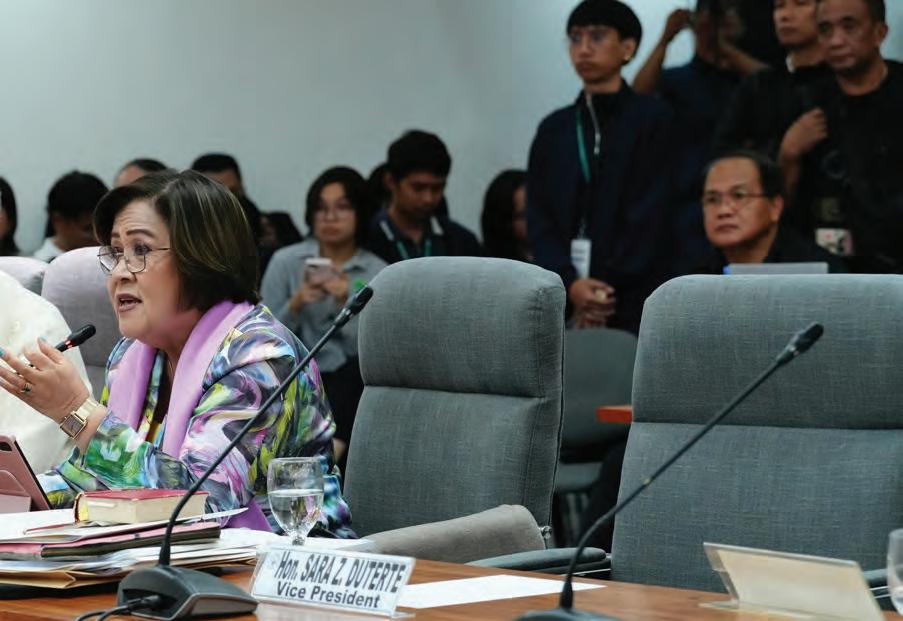
By Charles Dantes
PRESIDENT Ferdinand “Bongbong”
Marcos Jr. said the Philippines is open to exploring partnerships with China to develop gas resources in disputed areas of the South China Sea, as the govern-
ment seeks to secure energy supplies amid the global oil crisis.
In an interview with Bloomberg News, Mr. Marcos said Manila has long sought to separate territorial disputes from economic cooperation, noting that China remains a key trading partner and
DBM releases P44.17b for
By Darwin G. Amojelar
Phase I and the North-South Commuter Railway (NSCR) System, following a direct order from President Ferdinand Marcos Jr. Authorized via two Special Allotment Release Orders (SAROs) on March 23, the funding is designed to maintain construction momentum and prevent delays. “These are projects that Filipinos have waited decades for. By order of the President, it cannot be delayed any longer. We are making sure that funding is not the bottleneck—so these projects can move faster and deliver real relief to commuters,” Budget Secretary Ronaldo Toledo said.
source of major investments.
In the same interview, the President said a “reset” in Philippine-China relations may be inevitable as global geopolitical dynamics continue to shift, while reiterating Manila’s position against war amid the ongoing
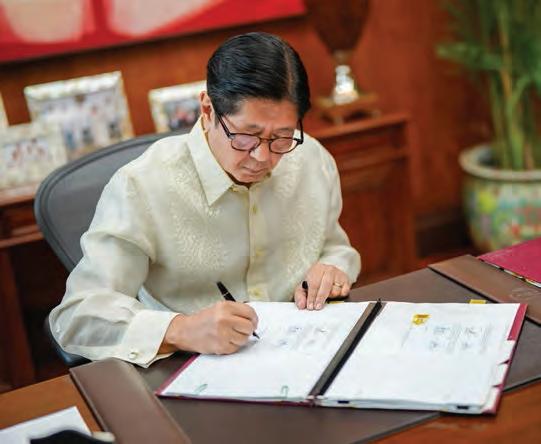
By Maricel V. Cruz
THE House of Representatives on Wednesday opened formal impeachment proceedings against Vice President Sara Duterte, but the historic hearing unfolded without her presence, prompting sharp questions from lawmakers on accountability and constitutional duty. On the other hand, the Vice President’s legal team reiterated their rejection of the invitation to participate in the proceedings, asserting that any form of “mini-trial” is unconstitutional and falls solely under the jurisdiction of the Senate.
Middle East conflict.
“We’ve always tried to differentiate the territorial disputes from our trade arrangements,” Marcos said, adding that Chinese support has extended to critical imports such as fertilizer.
House Committee on Justice chairperson Rep. Gerville Luistro of Batangas did not mince words as she confirmed that despite being invited and reportedly preparing a full legal defense, the Vice President chose not to participate in the opening proceedings.
“The Vice President has been invited to participate… She is, apparently, ready to face the accusations and defend herself at length. And yet—it appears she will not even participate,” Luistro said. The absence immediately cast a shadow over what Luistro herself had earlier
David leaves post
By Thony Rose Lesaca
Next page Next page
THE Anti-Money Laundering Council (AMLC) said Wednesday it filed three petitions for civil forfeiture before the Manila Regional Trial Court, covering properties owned by individuals and entities previously placed under freeze orders by the Court of Appeals.
Following these petitions, the AMLC said the Regional Trial Court has issued two provisional asset preservation orders to safeguard the monetary instruments and properties involved while awaiting final judgment.
Meanwhile, AMLC Executive Director Atty. Matthew M. David, who was appointed in 2022, has requested a



By Charles Dantes
PRESIDENT Ferdinand “Bongbong” Marcos Jr. has signed into law a measure resetting the first regular elections in the Bangsamoro Autonomous Region in Muslim Mindanao to September 2026.
Republic Act No. 12317, which amends the Bangsamoro Organic Law, states that the first regular parliamentary elections in BARMM will
The President earlier declared a state of national energy emergency, creating an “UPLIFT” committee to coordinate the government’s response to the fuel crisis and mitigate the impact of the Middle East conflict on the country.
Meanwhile, Mr. Marcos assured the public the country still has about 45 days’ worth of petroleum supply and is working to secure additional sources amid disruptions linked to tensions in the Middle East.
“The average now is running at 45 days’ supply. It varies, but the average is 45 days. We are not (letting that go down),” he said, citing the country’s diplomatic ties with partner nations as crucial to maintaining fuel availability despite the volatile global energy market.
“I credit the success of this ensuring the supply to the good relations that we have with our partner countries around the world,” Mr. Marcos added.
The government is also looking beyond traditional oil suppliers and exploring alternative sources not directly affected by the ongoing conflict, he said, adding that the country is sourcing gasoline, diesel and jet fuel to support transportation and aviation needs.
Theresa Lazaro said responding to postponement recommendations is not within the department’s authority, noting that the final decision rests with the Office of the President.
“I think there would be an appropriate time kung anong sasabihin po ng Palasyo (for what the Palace has to say) and coordination with the concerned government agencies,” she said at the Kapihan sa Manila Hotel. “Abangan na lang po ninyo at (Just wait for it since) we cannot make that decision.”
This statement comes in response to Senate leaders expressing support for postponing the Philippines’ hosting of the 2026 ASEAN Summit to save over ₱17 billion.
This year, a total of 104 closed-door working group meetings will be held across Metro Manila, with 77 Senior Officials Meetings (SOMs) scheduled in Luzon, the Visayas, and Mindanao. The 48th ASEAN Summit is set to convene in Cebu on May 8-9. Furthermore, ministerial meetings are also anticipated in these regions.
The 59th ASEAN Foreign Ministers’ Meeting (AMM) and the 50th Anniversary Commemorative Activity of the Treaty of Amity and Cooperation (TAC) will take place in Metro Manila in July.
The ASEAN 2026 activities will be led and co-chaired by various government agencies, including the Presidential Communications Office, the DFA, and the Department of Tourism, among others.
In December, Congress approved ₱17.5 billion to fund the Philippines’ hosting of the ASEAN Summits and related meetings.
When asked how the DFA can contribute following the president’s declaration of a state of national energy emergency, the foreign affairs secretary explained that the DFA’s primary role is to communicate the needs of government agencies to other countries through Philippine embassies.
Once completed, the MMSP and NSCR are expected to dramatically cut travel time, decongest major corridors, and provide safer, more efficient mobility for millions of daily commuters.
The P44.17-billion release is charged against the Unprogrammed Appropriations under the Fiscal Year 2026 General Appropriations Act (GAA), specifically for Support to Foreign-Assisted Projects (SFAPs)—a mechanism that
be held on the second Monday of September this year.
Subsequent elections will take place every three years thereafter, synchro-
“It would be premature to say that we have perfected contracts with them. But I think it’s sufficient to say that things are beginning to open up,” the President said.
“I think we can be fairly confident that after the 45 days, we have not just one delivery, not just two deliveries but a flow of petroleum and petroleum-related products.”
“I’m very confident in saying that we have sufficient supply… In our analysis, we have no problems with the supply of petroleum and also of petroleum products.,” he added.
Meanwhile, the country’s two largest airlines yesterday said they have secured sufficient jet fuel to maintain operations, including long-haul flights, despite a volatile global market.
Philippine Airlines said it is closely monitoring regional developments affecting fuel supply and pricing. The flag carrier assured the public that it has secured enough supply for the foreseeable future.
“The airline recognizes that global supply conditions remain dynamic. As part of prudent planning, PAL continues to work closely with fuel suppliers, industry partners, and government stakeholders to ensure stable and efficient operations over the longer term. PAL remains committed to connecting the communities we serve,” PAL said.
Trump... From A1
“We have also heard such details through the media, but according to my information -- and contrary to Trump’s claims -- so far no negotiations, direct or indirect, have taken place between the two countries,” said ambassador Reza Amiri Moghadam, adding that it was “natural that friendly countries are always engaged in consultations with both sides to end this illegitimate aggression”.
Tehran, meanwhile, announced that it will let “non-hostile” oil vessels go through the crucial Strait of Hormuz.
Trump, whose pronouncements in recent days have swung wildly from vowing massive attacks on Iran to declaring the nearly month-long war virtually over, said the United States was “in negotiations right now” with Iran—which has not confirmed any formal talks.
Despite Trump’s stated hopes for diplomacy, The Wall Street Journal reported
nized with the national and local polls.
The first election of members of the Bangsamoro Parliament, which will replace the interim Transition Authority, has faced repeated delays. Originally set for May 2022, the vote was moved to 2025 due to the pandemic and the absence of an electoral code.
It was later pushed back again after the Supreme Court excluded Sulu from BARMM and struck down two districting laws.
The election, once scheduled for Oct.
being proactive on the matter.
Since President Ferdinand Marcos Jr. declared a state of national energy emergency Tuesday, Herbosa said he has already ordered an inventory of medical supplies to ensure their availability and the stockpiling of commonly used medicines.
The Health chief also floated the idea of forming a price negotiation board to ensure that prices remain controlled during the duration.
“I will talk to the Department of Trade and Industry so that no one can take advantage of the situation. With the emergency declaration, we may have a legal basis to control the price of medicines,” Herbosa added.
Earlier this week, Thailand’s Public Health Ministry announced it is rolling out a three-phase plan to manage medicine supplies and healthcare services, with officials warning that drug prices are likely to rise.
British trade group Medicines UK also warned that higher freight costs could soon trigger price increases or supply shortages in medicines.
As this developed, President Ferdinand Marcos Jr. said he declared a state of energy emergency to give the government broader powers to respond quickly to potential disruptions, including expedited oil pro-
that the United States is planning to send 3,000 soldiers from the elite 82nd Airborne Division to the Middle East.
The tentative signs of a diplomatic solution came despite new violence, with an Iranian missile causing injuries in Israel, which in turn pressed on multiple fronts and vowed to seize control of a strip of southern Lebanon.
“They did something yesterday that was amazing actually. They gave us a present and the present arrived today. And it was a very big present worth a tremendous amount of money,” Trump told reporters in the Oval Office.
“That meant one thing to me—we’re dealing with the right people.”
He did not explain further but said it was related to the Strait of Hormuz, which Iran has largely blockaded in retaliation for US and Israeli strikes, sending global energy prices soaring.
Iran, in a message circulated by the International Maritime Organization shortly afterward, assured safe passage
The President acknowledged that joint development in contested waters has been under discussion for some time, but said sovereignty issues remain a significant obstacle.
“Something that we’ve been talking about for a great deal. But the territorial disputes will get in the way of that,” he said, adding that the situation could also push both sides toward reaching an agreement.
President Marcos said the government is “still working on” possible arrangements, emphasizing the urgency of boosting the country’s fuel supply as geopolitical tensions continue to disrupt global energy markets.
The Philippines recently declared a state of national energy emergency in response to the ongoing conflict in the Middle East, which officials warned could affect both the availability and stability of energy supplies.
Mr. Marcos said the government is pursuing multiple options to ensure adequate supply, including exploring new energy sources beyond traditional partners.
“Basically, we are trying anything, everything to secure supply
ensures critical infrastructure projects continue without delay once financing requirements are met.
Of the total amount, P21.28 billion will fund the NSCR System and MMSP Phase I, financed through the Japan International Cooperation Agency, while P22.88 billion will support the NSCR System under its loan agreement with the Asian Development Bank.
“Every peso we release for infrastructure is an investment in time saved, opportunities created, and everyday comfort for our countrymen. This is not just a project—it is a solution to the
The law also provides for voter eligibility based on existing registration records within the BARMM.
Funding for the implementation of the measure will be sourced from available appropriations, with the national government authorized to provide additional support if necessary.
13, 2025, is now expected no later than March 31, 2026. Under the new law, elected officials will assume office at noon on October 30, 2026, following the elections. The opening of the first regular session of the Bangsamoro Parliament is set on the same day. During the transition period, the Bangsamoro Transition Authority will continue to serve until a new set of officials has been elected and qualified. The Commission on Elections is tasked with issuing the necessary rules and regulations for the conduct of the elections, consistent with the Bangsamoro Organic Law and other national laws.
curement and tighter coordination across agencies.
“Everyone is helping,” Mr. Marcos said, emphasizing a whole-of-government approach to ensure swift and coordinated action.
The President also warned against hoarding and price gouging, saying the government would strictly enforce rules against profiteering not only in fuel but also in essential goods.
“I think we made that warning very early on: No hoarding and no price gouging,” he said. The Philippine Chamber of Commerce and Industry (PCCI), the country’s largest business group, has expressed support for the government’s declaration of a state of national energy emergency, calling it timely and necessary amid global energy disruptions.
PCCI president Perry A. Ferrer said Executive Order 110, which will take effect for one year, is the first step to secure adequate energy supply and stabilize prices.
“The PCCI supports any government measures to absorb rising costs of fuel and basic goods. Three weeks into the war, we are already seeing higher logistics, transport, and commodity costs,” he said.
He warned that if the conflict persists beyond two to three months, the Philippine economy could face serious strain, particularly micro, small, and medium enterprises (MSMEs).
to “non-hostile vessels” going through the strait, the gateway for one-fifth of the world’s oil.
Iran had already in recent days said it was not targeting friendly nations, although many vessels have shied away as insurance companies refuse to take risks.
The benchmark price of crude oil dropped close to six percent after the latest developments. Prices at the pump have soared in the United States after the war by Trump, causing him a political headache.
New nuclear deal?
Trump had earlier threatened to “obliterate” Iran’s power plants, which some argue would be a war crime, if it did not open the strait by late Monday Washington time.
Before US markets opened Monday, Trump abruptly extended that deadline by five days, citing diplomatic progress.
Pakistan’s prime minister has offered to host US-Iran talks, which Trump said involved top officials including Vice President JD Vance.
because that’s the one thing that we can do about,” he said.
“The pricing is going to be a much more difficult challenge because everyone is a price taker when it comes to oil,” the president added.
He noted that Russia, while not a traditional supplier of crude oil to the Philippines, is among the countries being considered as a potential source.
“I think we’re doing better than a month in terms of fuel supply, maybe 45 days more or less, depends on diesel or gasoline,” he said.
The president added that existing supply contracts with international partners continue to be honored, providing some assurance as the government navigates the energy crisis.
“I think it’s certainly going to happen… It’s happening now,” the President said when asked if a “reset” of ties with China is on the table.
He noted a wider restructuring in international systems.
“There’s going to be a very, very serious restructuring. I remember I was watching Prime Minister Wong from Singapore and he was saying there will be, we will have to withdraw, redraw, all of our, even our legal relationships in terms of international law, in terms of all of these things.”
hardship of traveling for millions of Filipinos,” Toledo said.
With sustained funding support, the DBM reaffirmed its commitment to ensure that high-impact infrastructure projects are implemented without delay, turning the national budget into concrete improvements in the lives of Filipinos.
Additionally, the Budget Department has released P16.5 billion to the Department of Public Works and Highways (DPWH) to cover the settlement of its due and demandable accounts payable.
The DBM chief said the move is part of the administration’s strategy to keep
infrastructure projects on track while stimulating economic activity.
“Government spending, especially in infrastructure, has a strong multiplier effect. When we release funds on time, we support jobs, strengthen businesses, and accelerate project completion— creating immediate and tangible benefits for our people,” Toledo said.
He also stressed that the release underwent strict validation, ensuring that only properly supported and documented obligations were approved, consistent with budgeting, accounting, and auditing rules.
described as a “mini-trial,” where both sides are expected to present evidence and arguments before the committee determines probable cause.
In a striking portion of her opening statement, Luistro invoked jurisprudence from past impeachment proceedings, warning that non-participation in the process carries serious implications.
“Failure to participate in the hearings before the Committee on Justice is tantamount to a culpable violation of the Constitution,” she said. The lawyer-politician then posed the question directly to the public and to her colleagues: “The question now is: can we also say this to the Vice President?”
Luistro said this development signaled a potentially critical narrative emerging early in the proceedings—that Duterte’s absence may itself become part of the broader question of “betrayal of public trust,” one of the constitutional grounds for impeachment. She emphasized that public office demands accountability, not avoidance, underscoring that all government officials are bound by the same oath to uphold the Constitution.
“What the people expect is not evasion, but presence; not silence, but accountability,” she stressed.
Luistro reminded that impeachment is not merely a legal exercise, but a test of public trust and moral responsibility. “Impeachment calls for judgment… what can be justified before the people.” Despite the Vice President’s absence, the Justice Committee proceeded with the hearing.
Luistro made clear that the process would not be stalled: “Regardless of the non-participation of the Vice President… this Committee will proceed. We will do our duty—with resolve, without hesitation, and without delay,” she said.
The Committee’s task at this stage is to determine whether probable cause exists to elevate the case to the Senate for trial.
Luistro clarified that the proceedings remain investigative in nature, stressing that no final judgment is being rendered at the House level.
transfer to the Bangko Sentral ng Pilipinas (BSP). The AMLC said Arnold Kabanlit has been designated as officerin-charge as the agency looks for a new executive director. The AMLC did not say why David requested to be transferred from his post.
“The filing of civil forfeiture cases is the final step to ensure the recovery of illicit proceeds linked to flood control project anomalies. The action marks the first of several petitions to be filed, all aimed at recovering funds tied to corrupt practices involving flood control projects,” the AMLC said in a statement. The council added that the cases involving the flood control projects scandal are complex due to the volume and breadth of records. These include numerous entities, interconnected accounts, and a wide range of assets placed under investigation.
Given the scale and intricacy of the data, the AMLC said it is proceeding with deliberate care to ensure the completeness and accuracy of all evidence.
“This is essential not only to uphold the integrity of the investigation but also to ensure that the cases, once filed, are supported by robust and admissible evidence capable of withstanding judicial scrutiny,” it said.
The AMLC has yet to disclose the identities of the individuals and entities covered by the petitions.
But media reports have identified former DPWH Secretary Manuel Bonoan, the late Undersecretary Catalina Cabral and her children, resigned Rep. Eric Yap and his brother Rep. Edvic Yap, dismissed DPWH officials Henry Alcantara and Bryce Hernandez, an Engineer Mendoza, and contractor Sally Santos as among those whose accounts have been frozen.
By Ma. Katrina Mikaela Manubay
AMAJORITY of Filipino adults cited President Ferdinand Marcos Jr.’s fight against corruption (28.6%) as the leading reason for their trust, while the most common reason for indecision is his failure to control inflation (39.3%), according to a Pulse Asia survey.
The latest Ulat ng Bayan survey indicated that among those who have a positive opinion of the president, other reasons for trust include his aid to calamity-hit areas and victims (12.4%), the success of his administration’s programs in improving the lives of Filipinos (10.9%), and his efforts to support farmers (9.9%).
Trust in the president’s anti-corruption efforts is most notable among residents of Metro Manila (37.1%), followed by the rest of Luzon (29.4%) and the Visayas (26.3%), with Mindanao reporting the lowest at 6.8%.
A significant plurality of respondents (39.3%) is undecided about their trust or distrust in the President, primarily because of his inability to control the rising prices of basic commodities.
At the national level, distrust of the president is most pronounced in the rest of Luzon (51.8%) and Mindanao (35.7%), followed by Metro Manila (19.5%) and the Visayas (17.9%).
Among residents of Metro Manila who express indecision regarding presidential trustworthiness, the most frequently mentioned reasons include his failure to arrest anyone involved in the flood control projects scandal (23.2%), the continuing increase in the prices of basic goods (19.5%), allegations of his use of illegal drugs (14.0%), and his failure to fulfill promises (12.1%).
By Joel E. Zurbano
THE Metropolitan Manila Development Authority (MMDA) reactivated its Emergency Operations Center (EOC) in response to reports of stranded commuters in various areas of the National Capital Region, including Parañaque, Quezon City, Taguig, and Navotas.
The agency earlier observed a decrease in the volume of vehicles, including public utility jeepneys (PUJs), on the road and an increase in the number of commuters.
In response to the situation, the MMDA and local government units initiated the deployment of free rides to assist passengers affected by limited PUJ operations.
MMDA xhairman Don Artes said the agency is prepared to mobilize assets and 16 more vehicles to provide free rides, expanding coverage of affected routes and facilitating timely travel for passengers.
“Ambulances and other critical service vehicles remain on standby to ensure rapid response for any emergencies that may arise,” he said.
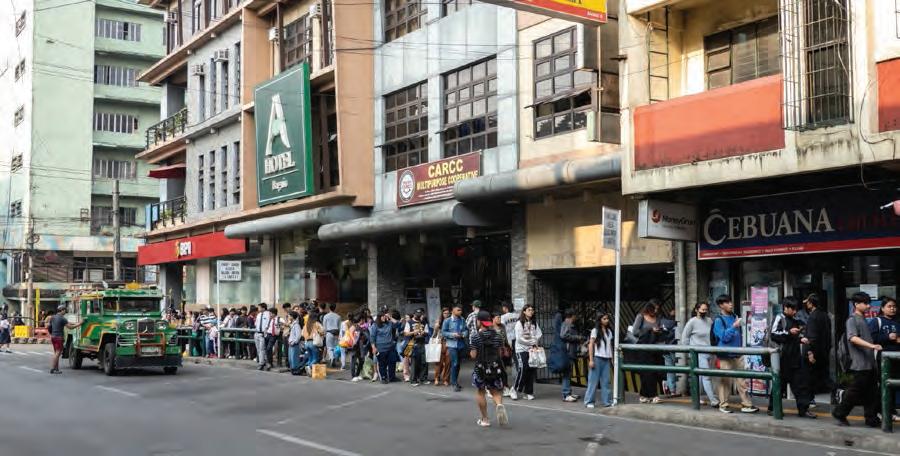
By Vince Lopez
CLOSE to 7.4 million Filipinos in remote communities are now benefiting from farm-to-market roads built under the Local Government Support Fund – Support to the Barangay Development Program (LGSF-SBDP), the Department of the Interior and Local Government (DILG) says Wednesday, March 25.
In line with the directive of President Ferdinand Marcos Jr., the DILG is accelerating infrastructure that directly improves food supply, reduces transport costs, and stabilizes prices on the ground. Since 2022, the program has com-
pleted 2,945 farm-to-market road projects covering approximately 945 kilometers, connecting 2,874 barangays nationwide. These serve as working links between farms and markets. In far-flung areas, what used to take days can now be done in hours.
In Sitio Bila, Barangay Tudok, T’boli, South Cotabato, residents say travel that once required days of back-and-forth can now be completed within two to three hours, allowing farmers to move goods faster and return home sooner.
In Bohol, improved road access between Barangay Casate in Ubay and Barangay Corazon in San Miguel now allows farmers to reach markets
earlier, with produce arriving in better condition and at more stable prices.
A barangay official noted that both travel time and transport expenses have dropped significantly.
As global oil prices continue to fluctuate, these roads play a critical role in keeping food moving efficiently from farms to markets, helping protect consumers from sudden price increases.
The DILG said SBDP continues to focus on projects that deliver immediate, felt impact at the community level, ensuring that government investments translate into lower costs, faster mobility, and stronger local economies.

By Vince Lopez
THE Philippine National Police (PNP) on Wednesday, began preparations for anticipated protests and rallies to mark former president Rodrigo Duterte’s 81st birthday on March 28.
PNP chief Gen. Jose Melencio Nartatez Jr. said he has tasked chiefs of police offices and unit heads to prepare the deployment of officers in areas where rallies are expected.
“We are laying the groundwork to ensure that public assemblies remain orderly and secure. Our priority is to maintain public safety while providing a protected space for our fellow citizens to exercise their right to peaceful expression,” he said.
The PNP chief also said they will coordinate with local government
units and other concerned agencies to support the effort.
“I have directed our chiefs of police to assess and prepare the deployment of police officers in key areas where rallies could take place. I also tasked them to ready resources and assets for mobilization,” he said.
Nartatez also said that law enforcement will engage with organizers of the expected rallies as part of the established practice of dialogue between police and civil society groups during major demonstrations. Nartatez said the aim is to foster cooperation and prevent misunderstandings.
Supporters of the former president, who is currently detained in The Hague while facing crimes against humanity charges, have signaled plans for gatherings on his birthday.
of Justice (DOJ) on Wednesday announced the establishment of a new regional prosecution office in the Cordillera Administrative Region (CAR). Justice Secretary Fredderick Vida led the justice department’s initiative as he conducts key meetings in the region this week.
“Establishing this Regional Prosecution Office in CAR is a gamechanger. It brings swift, accessible justice right to the doorsteps of Cordillera communities, cuts delays in case resolution, and strengthens our coordination with local leaders and law enforcement for a safer Northern Luzon,” he said. The effort is anchored on Republic Act No. 10071 and Executive Order No. 220 (1987) as it underscores the DOJ’s commitment to a robust justice system in Northern Luzon. Pot Chavez
Aguda nixes proposal to ban Roblox game app A BAN on social gaming application Roblox will not be enacted, Department of Information and Communications Technology (DICT) Secretary Henry Aguda said Wednesday. At the Kapihan forum in Manila, Aguda said he is in talks with the game’s personnel to resolve concerns about possible exploitation of minors.
“We issued a notice and wrote to Roblox. The letter was proper, and they explained. They admitted these complaints,” he said, adding that the game’s management team will meet with the DICT after the Holy Week.
The DICT has also received complaints on Roblox’s use, with Aguda citing criminal cases from recent hearings on anti-online sexual abuse and exploitation of children. Rolando Ng III
SC: DSWD certification mandatory for adoption
A CERTIFICATION from the Department of Social Welfare and Development (DSWD) declaring a child legally available for adoption is required even when voluntarily surrendered by the mother, the Supreme Court (SC) said Wednesday. In its decision, the SC Third Division ruled that the certification requirement also covers surrendered children.
The implementing rules and regulations (IRR) of Republic Act No. 9523 clarify that the requirement applies to surrendered, abandoned, neglected, and dependent children. Additionally, the High Tribunal noted that the law should be read together with the Child and Youth Welfare Code, which treats a child surrendered to an individual as a voluntarily committed child. Pot Chavez
Customs ramps up delivery of unclaimed balikbayan boxes
By Vito Barcelo
THE Bureau of Customs (BOC) has completed the delivery of nearly 26,000 abandoned balikbayan boxes nationwide, marking a major milestone in government effort to return undelivered shipments to overseas Filipino workers (OFWs) and their families.
As of March 23, 2026, a total of 25,818 balikbayan boxes have been successfully delivered across the country, including all abandoned shipments previously left at the Port of Manila and the Port of Davao.
Customs commissioner Ariel Nepomuceno said the last distribution activity was held at the Port of Cebu on March 24, where remaining boxes were turned over to the beneficiaries.
Special Assistant to the President for Investment and Economic Affairs Frederick D. Go stressed that OFWs should not be neglected.
“The Bureau of Customs and the Department of Finance, together with the Department of Migrant Workers, continue to assist in returning abandoned boxes to families. We will not allow our OFWs to be deceived. The government will ensure that their hard-earned shipments are protected,” Go said.
He added that the government has the responsibility to ensure that all boxes reach their rightful recipients and that those who took advantage of OFWs must be held accountable.
Taguig registers lowest stunting rate in NCR
TAGUIG City has achieved the lowest stunting rate in the National Capital Region (NCR) for children aged 0–5 years, according to data provided by the National Nutrition Council (NNC).
This statistic highlights the effectiveness of local nutrition programs and initiatives aimed at improving the health and growth of young children in the city.
Data from Operation Timbang Plus showed Taguig at 0.20 percent stunting prevalence, significantly lower than the 7.82 percent national average. Over the past decade, Taguig has achieved a remarkable decline in stunting prevalence, decreasing from 9.69 percent in 2015 to just 0.35 percent in 2019. Joel E. Zurbano
Bill gives more teeth to Bawal Bastos Act
HOUSE Senior Deputy Minority Leader
Leila de Lima has filed a bill to strengthen Republic Act (RA) 11313, or the “Safe Spaces Act”, by imposing stiffer penalties for violators, and enhancing protections against gender-based sexual harassment.
In filing House Bill (HB) 8717, De Lima of Mamamayang Liberal (ML) party-list proposes to give more teeth to the Safe Spaces Act, also known as the “Bawal Bastos Law”, by including the recognition of “grooming” as a form of predatory conduct, and by addressing gender-based online harassment committed through emerging technologies such as artificial intelligence.
HB 8717 likewise imposes stiffer penalties for gender-based sexual harassment in workplaces and educational or training institutions, where power imbalances may place victims in particularly vulnerable situations.
“By upgrading the penalties, expanding protections, and reinforcing accountability mechanisms, this bill aims to ensure that the Safe Spaces Act continues to effectively safeguard dignity, equality, and safety in workplaces, educational institutions, public spaces, and digital environments,” De Lima said. Maricel V. Cruz
NHC marks 125th year of First PH Republic
THE National Historical Commission of the Philippines (NHCP) and the municipal government of Palanan, Isabela on Monday jointly marked the 125th anniversary of the End of the First Philippine Republic with a simple ceremony at the Aguinaldo Capture Marker in the town.
“As we remember the sacrifices of our heroes, let us also remember the values they fought for: freedom, sovereignty, and the pursuit of a better future for our nation,” Isabela 2nd District Rep. Ed Christopher Go said in his remarks. The capture of President Emilio Aguinaldo by American forces in Palanan, Isabela, signaled the end of the First Philippine Republic.
Aguinaldo’s valiant fight for independence began with the establishment of the Republic on January 23, 1899, but was met with the Philippine-American War just a month later. Jessica M. Bacud

By Vince Lopez
THE chief of the Philippine National Police-Highway Patrol Group (PNP HPG) on Wednesday, March 25, stepped down from his post over charges of sexual harassment filed by a policewoman at the National Police Commission (Napolcom).
“To ensure a completely impartial, fair, and transparent conduct of the investigation, I have decided to voluntarily step down from my position as Acting Director of the PNP Highway Patrol Group, effective immediately,” Director Brig. Gen. Jessie Tamayao said in a statement
He added that he was innocent of the charges “in the clearest and most categorical terms.”
“I firmly deny the allegations. I can only deduce this is a personal
vendetta the reason of which I am not aware. However, I recognize the gravity of such a complaint and the importance of maintaining the public’s trust in the integrity of our office,” Tamayao said. He clarified that his decision to step down was not an admission of guilt, but a demonstration of his commitment to due process and the institutional reputation of the PNP.
“In my 30 years of service, I have never been involved in, nor subjected to, any such allegation or complaint. I have risen through the ranks through my own diligence, hard work, and integrity. By stepping down, I aim to remove any perception of influence or conflict of interest while the proper authorities perform their duties,” he stressed.
By Minerva Newman
CEBU City— Grocery owners and retailers here, in collaboration with the Cebu Chamber of Commerce and Industry (CCCI), the Department of Trade and Industry (DTI), and the Cebu City Police Office (CCPO), are set to roll out caravans bringing essential goods to the remote communities starting off with Prince Stores (South District) going to Barangay Babag and Prince Hypermart (North District) servicing Barangay Guba. In a meeting with private sector stakeholders on March 24 at the city hall, Mayor Nestor Archival discussed the project with the local grocery owners and retailers to help residents in upland barangays enjoy wider access to essential goods, thereby sparing them of precious time and money in traveling to the downtown to buy their basic needs.
Participating grocery owners have agreed to keep their existing prices of the goods that will be brought to the farflung areas, ensuring affordability for residents in keeping with their corporate social responsibility commitments.
To ensure transparency and consumer protection, the DTI will monitor prices and existing inventories, while both the CCCI and city government regularly posting updated prices of essential goods.
To facilitate the rollout, a technical working group (TWG) has been created, led by Kenneth Siasar, the mayor’s chief of staff. The TWG will visit identified barangays to assess and determine the specific commodities needed by the residents. The findings will be relayed to participating groceries to ensure that only essential and in-demand items are loaded in the caravan.
“I fully welcome a thorough investigation, and I am prepared to cooperate with the investigating body to clear my name. I am confident that the truth will prevail through the proper legal and administrative channels,” he added.
In a statement, Napolcom did not disclose the complainant’s name and rank, but identified the respondent as Brig. Gen. Jessie Tamayao.
The complainant, reportedly also a member of the HPG, was seeking tTamayao’s dismissal for alleged violations of Republic Act No. 7877 (Anti-Sexual Harassment Act of 1995) and Republic Act No. 10173 (Data Privacy Act of 2012).
According to the complainant, Tamayao allegedly invited her to engage in sexual activity while also reportedly touching her behind.
By Maricel V. Cruz
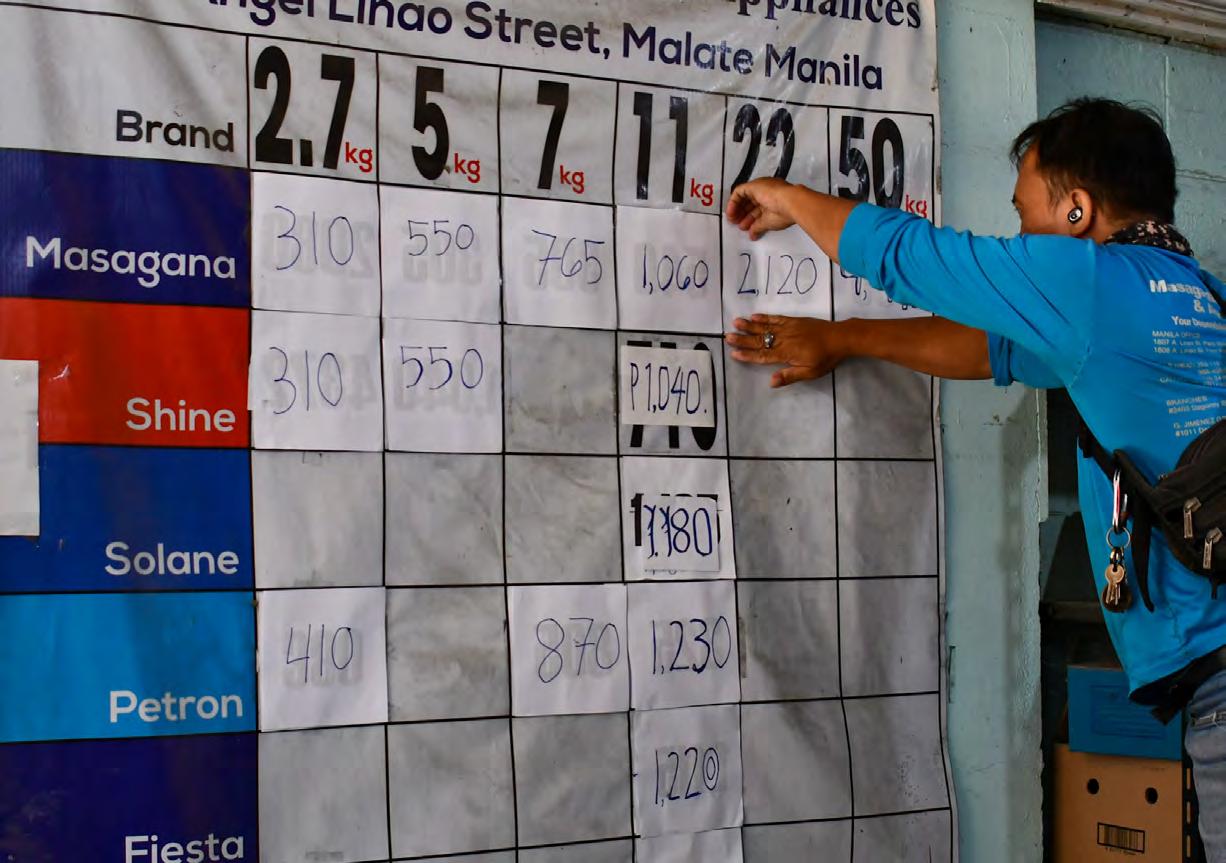
ABILL filed at the House of Representatives proposes to amend the Price Act to include gasoline, diesel, and other petroleum products in the list of prime commodities, which may be subject to a price freeze during a state of calamity or emergency.
The Makabayan Bloc—composed of party-list Reps. Antonio Tinio of ACT Teachers, Sarah Jane Elago of Gabriela and Renee Louise Co of Kabataan—authored House Bill 8765 to push the measure rewriting the Price Law. If enacted, the proponents said the law will curb profiteering and mitigate the domino effect of fuel price hikes on fares, food, and other basic commodities and services especially during national emergencies.
“Petroleum prices directly drive transport fares, electricity rates, and the prices of food and other essentials. Yet, under oil deregulation since 1998, price spikes have been left largely unchecked, and monopoly oil firms have been allowed to dictate the people’s cost of living,” the bill’s explanatory note stated.
The legislators said the escalating geopolitical conflict and oil supply disruptions in the Middle East have “been exploited for market abuse and windfall profits, including staggering hikes and premature price increases even on existing stocks.”
“While the people are suffering, the big oil companies are amassing huge profits, and the government’s sham ‘mitigation’ measures through token subsidies and stopgap measures,” the Makabayan lawmakers said.
“This kind of (consumer) protection is urgently needed to prevent rampant overpricing and to mitigate the domino effect of fuel hikes on transportation fares, food, and other basic commodities,” they added.


LAST Tuesday, I was the guest of Atty. Karen Jimeno in her Bilyonaryo TV program “At the Forefront.”
The main topic was supposed to be the “recycling” into largely decorative positions of two former Cabinet members, Christina Frasco and Antonia Loyzaga. But the 28-minute program segued into many other issues, mainly the current problems arising from the Iran war, and how the administration is handling what PBbM’s factotums call a non-crisis.
Last Monday, the usually un-studied statement of the cantankerous Claire Castro came to fore again.
She said that the president would soon convene a crisis committee and asked media to just wait because the document (which could be an EO or an AO) creating the same was still being crafted. What the …?
On Feb. 28 (okay, March 1 in our time zone), Israel, backed to the hilt by the US of A, bombed the supreme leader of Iran, along with family members and key Cabinet and military officials into smithereens.
Knowing how important the perennially troubled Middle East has been and knowing that our principal source of oil and gas is right smack in the theater of conflict, shouldn’t our president have immediately convened a “crisis committee?”, I asked in that interview.
“You do not need an EO for that, I said. All that is needed is for the president to gather officials equipped with enough brains to assess the situation and study our options in case the conflict worsens. Mercifully but in characteristic procrastination, PBbM signed EO 114 declaring a “State of National Energy Emergency”, hours after senators fumed at the lack of urgency and clear inability of government to respond to a crisis like no other, one that would impact not only on the soaring prices of oil, but its nonavailability, along with the downstream consequences on mobility to food and practically everything.
My high school English teacher would have described our London and New York-grown president as “pusillanimous,” a new word he would each week introduce to class.
I searched the net for an official definition of the adjective, and here is what I got:
Pusillanimous, adjective: “Destitute of that strength and firmness of mind which constitute courage, bravery and fortitude; being of weak courage; mean spirited; cowardly; applied to persons; as a pusillanimous prince”. Pray tell, are we being led by one such pusillanimous person?
We segued into the president’s latest trust ratings, which in Pulse Asia’s Feb.27 to March 2 survey, registered a distrust of 44 versus a trust of 35, or a negative trust of 9 points.
“Trust is the single most important political commodity which a leader must
possess, and when that is lost, it is most difficult to regain”, I said.
And to the country’s misfortune, conflict in the Middle East has become a test of strength, of character, of leadership, for a president who has a paucity of trust.
The signs are all over, from tepid reception to his presence in “ayuda” events, to “wa-pansin” from OFW’s returning from the war zone, even if he took the trouble of welcoming them back home at the airport.
Governance by optics, where a year-long campaign called Utos, Sundin, Palakpak, as Unique Selling Propositions, has the audience left cold
It is almost as if the public has cancelled out the president from their lives. That lack of trust is fortified when the president does characteristic “urong-sulong”, such as when he said he “will yet study” what to do with the excise tax after he himself asked Congress to rush his emergency authority.
The latest manifestation was when he recalled the LTFRB-announced decision to increase public transport fares owing to the hefty spike in diesel prices.
Wala ba kayong mga cellphone man lamang?
But then again, this was the same president who famously said in late 2024 that “impeaching his vice-president will not improve the life of a single Filipino”, and yet, 216 congressmen, led by his son, mismo, and his first cousin, otro, openly disobeyed his admonition.
And now, as we drown in the sea of troubles choked by the Strait of Hormuz, Bitrics, Terry, Joel, Abante et al., are in Take Two of their common desire to eliminate a strong contender for the 2028 elections, simply because the administration has no one to champion, except to shack up with the Left and the Pinks, in a Villarroyo 2.0, otherwise to be dubbed --- “Marcoleni”.
As anti-climax to this article, now I realize why EO 110 came out just now.
Propagandists were yet pouring their creative juices into coming up with “memorable” acronym – UPLIFT or Unified Package for Livelihoods, Industry, Food and Transport.
Pilit na pilit.
Governance by optics, where a yearlong campaign called Utos, Sundin, Palakpak, as Unique Selling Propositions, has the audience left cold.
Walang pumapalakpak!

FINALLY, the government agreed there is indeed an oil crisis and declared a national emergency to deal more efficiently with the situation.
As they say, better late than never. Coincidentally, our first oil crisis that happened in 1973 was also under a Marcos presidency, the father of our current president. It might interest the public especially those in government who are struggling to find a proactive approach that could mitigate the burden of sky high fuel prices to compare how father and son dealt with the problem.
To be fair, the current oil crisis is a lot bigger and more complicated than the 1973 oil crisis when the Arab oil producing nations suddenly stopped production. The times are also different but in decision making, there is always something constant even with the passage of time. This is perhaps where we can find the differences or similarities on how decisions were made then and now.
In 1973, as a young officer, I was always present in the almost daily conferences in Camp Crame where then Defense Minister Juan Ponce Enrile chaired the government committee responding to the crisis.
I was able to witness how decisions were made by the highest officials and it was an experience that served me well throughout my years of government service. From the beginning of the crisis, the cri-
sis committee was immediately organized involving all government Departments unlike now.
In 1973, the prices of regular gasoline spiked overnight from fifteen centavos to thirty five centavos or more than double the prevailing price.
Diesel was not yet very much in use by the public transport especially the jeepneys except for the buses. It was only after the 1973 crisis that jeepneys all switched to diesel fuel.
The next couple of weeks will be crucial
Today, the two government agencies most involved in the oil such as the DOTr and DOE continue basically to function as normally as possible.
PBBM even shot down the suggestion that it declare an emergency to more effectively deal with the developing situation until last Tuesday. He further contradicted the decision of the LTFRB to increase the basic fare by one peso, eliciting almost universal condemnation in the transport industry. Considering the fare hike is not so high in relation to the fuel increases, one would
THE recent killing of Negros Occidental radio broadcaster Julito Diamante Calo shows the actual state of press freedom in the country, and highlights issues involving media safety, impunity, and the credibility of government mechanisms meant to protect the press.
The country has historically been one of the most dangerous countries for journalists.
We recall the Maguindanao massacre in 2009 where 32 media workers were killed. Because of this, every new killing is treated not as an isolated crime but as part of a pattern that indicates weak protection for the media sector.
Many of the journalists killed in the Philippines are not national personalities but local radio commentators who often name local officials on air, expose criminal activity, and take strong political positions.
Because they operate in smaller communities, suspects are often powerful local figures.
The killing of a radio broadcaster in Negros Occidental fits this pattern, which is why press groups usually treat such incidents as indicators of broader risks to media workers.
Why is the latest media killing considered a threat to press freedom? When a journalist is killed, the impact goes beyond the individual victim.
Attacks on journalists create a chill-
ing effect, meaning other reporters may avoid sensitive topics out of fear for their own safety.
This is especially true in provincial areas, where radio broadcasters often expose corruption, illegal gambling, land disputes, or local political conflicts.
The country has historically been one of the most dangerous countries for journalists
This latest killing is disturbing because it touches on three core issues.
One, the safety of journalists, or whether media workers can do their reporting without fear.
Two is the rule of law, or whether crimes against the press are punished. And third is democratic accountability,

By Jose Antonio Goitia
THESE days, it is easy to feel the weight of frustration. Every time a Filipino visits the market or pulls up to a gas pump, the pressure is palpable.
Prices are rising, fuel is expensive, and the struggle to make ends meet is a reality for millions. I hear that frustration, and I believe it deserves to be heard.
However, we must be careful. Frustration is a powerful emotion, but it should never lead us to accept simple answers for incredibly complex problems.
Recently, columnist Jarius Bondoc claimed the government has “stolen everything.” It is a searing, emotional statement— the kind that resonates deeply when people are hurting.
But as someone who has spent years studying governance and national security, I must insist that such claims be grounded in facts.
When we allow rhetoric to replace reality, we risk misleading the very public we claim to defend.
As I often tell my colleagues: When people are under pressure, it becomes easier to accept extreme conclusions. But governance must still be judged on facts, not feelings.
A Global Crisis, Not a Local Failure
We must acknowledge a hard truth: the rising cost of living is not a unique Philippine failure.
From Europe to Southeast Asia, nations are grappling with the same economic headwinds.
These are driven by global supply chain disruptions and geopolitical tensions—forces that no single president or parliament can flip a switch to stop. We cannot control the global market, but we can control our response. That is where leadership is truly tested.
think that a peso increase was reasonable but PBBM vetoed the idea. The reason given was that the increase will unduly burden the masses. Instead, PBBM decided on financial aid to public transport drivers as well as fishermen. He also appealed to the bayanihan spirit of the Filipino. With his proclamation of national emergency, will the government response now include the immediate suspension of excise taxes for both gasoline and diesel?
For the benefit of those who do not yet know the definition of what a crisis is, crisis is defined as a problem or situation that could turn for the better or worse at any moment. By that, the current situation fits perfectly what is currently going in the Middle East
or whether the public can rely on a free press to expose wrongdoing.
The Presidential Task Force on Media Security was created precisely to address the problem of violence against journalists by coordinating investigations, monitoring cases, and ensuring accountability. Its condemnation of the killing and promise to “ensure justice is served” is therefore expected, but the credibility of the task force depends on actual case resolution, not merely statements.
This case should be solved quickly, to strengthen confidence that the government can protect journalists. If it remains unresolved, it reinforces the perception of impunity, which is one of the biggest threats to press freedom.
Since the task force operates under the Office of the President, the handling of this case reflects on the administration’s commitment to press freedom. The government must be able to identify suspects, prosecute those responsible, and protect other journalists.
Organizations such as the National Union of Journalists of the Philippines and international watchdogs are correct in closely monitoring cases of violence against media. In countries with strong press freedom, attacks on journalists are rare occurrences and quickly solved. But in countries like the Philippines where cases remain unsolved, violence becomes a tool to silence criticism. This situation cannot be allowed to continue without decisive government action—and soon.
Relief Measures: Acknowledging the Effort
It is intellectually dishonest to suggest that nothing has been done. Fuel subsidies have been deployed to help our transport sector; support has been funneled to farmers and fisherfolk; and social safety nets continue to catch those most at risk.
Is it enough? That is a fair and necessary question for debate. But to claim there has been “no action” creates a false narrative that erodes public trust. We can question adequacy, but we should not deny what already exists.
When we allow rhetoric to replace reality, we risk misleading the very public we claim to defend
The Danger of One-Line Explanations
Corruption is a scourge that must be addressed with every tool at our disposal. However, using it as a “catch-all” explanation for every economic woe oversimplifies a messy reality.
Inflation is a multifaceted beast; it cannot be reduced to a single headline-grabbing cause. When we reduce every issue to one cause, we stop understanding the real problem—and if we don’t understand the problem, we will never find the solution.
Criticism Should Offer Direction Criticism is the lifeblood of a healthy democracy, but it should offer direction, not just blame. It is easy to point at a house and say it is leaning; it is much harder to provide the architectural plans to straighten it. What I find missing in today’s loudest
which could improve or worsen at any moment. Maybe the initial refusal of the government to recognize the existence of an oil crisis was not to panic the public and show that the government could still deal with the problem without declaring an emergency. By declaring an emergency, the government could now deal with profiteering and hoarding more effectively and perhaps the imposition of fuel rationing which should in fact be done now to be on the safe side.
This is not only on fuel products but other goods as well. In crisis situations, the government must assume that there will always be greedy people who will take advantage of the situation to make huge profits from the misery of others and plan for the worst.
outcries is a clear alternative. What should be done differently? What are the tradeoffs? It is easy to say everything is wrong; it is far more courageous to propose what should be done next.
Leadership Under Pressure No government is operating under ideal conditions today. Under President Ferdinand R. Marcos Jr., the administration has opted for a steady, practical approach—balancing targeted support with the fiscal discipline required to keep our economy stable in the long run.
This isn’t inaction; it is measured governance.
Leadership is not about avoiding a crisis—that is often impossible. It is about responding with discipline and responsibility when the storm hits.
Choosing Clarity Over Noise At this crossroads, the Philippines needs clear thinking more than it needs outrage. Statements like “everything has been stolen” may win clicks and applause, but they do not put food on the table or lower the price of rice.
A country moves forward not when it shouts the loudest, but when it understands the clearest.
We have faced challenges before, and we have always overcome them through resilience and unity. We must continue to demand better from our leaders, but we must remain fair and focused on solutions. In the end, nation-building is not a shouting match. It is the work of people who think clearly, stand together, and move forward. That has always been the true strength of the Filipino.
(The writer, Chairman Emeritus of ABKD, PADER, LIPI, and the Filipinos Do Not Yield Movement , holds a Juris Doctor and a PhD, along with advanced degrees in National Security Administration, Public Administration , and Business).
Furthermore, we are getting mixed signals from the US president. Will the missile strikes from the warring parties soon stop? We cannot be sure. This is reason enough to prepare and plan for the worst rather than just hoping for the best to happen. We have to remember that we only have an average of 45 days of oil stocks left. Even if the DOE is reported to be buying 1 million barrels of diesel to increase our supply for a few more days. What happens if the DOE cannot get those fuel shipments that were contracted delivered to the country on time? With the situation so volatile, we need hustlers in government and go getters and get things done. The next couple of weeks will be crucial.
THURSDAY, MARCH 26, 2026
mst.daydesk@gmail.com
UNITED NATIONS, New York – The Gaza envoy for US President Donald Trump’s new “Board of Peace” initiative urged UN Security Council members to pressure the militant group Hamas to disarm, as part of a ceasefire to end over two years of war.
“I ask the council members to use all means at their disposal to urge Hamas and all Palestinian factions to accept this framework without delay,” said Nickolay Mladenov, a veteran Bulgarian diplomat named the board’s high representative for Gaza.
“Every hour, every day wasted, carries a human cost and further erodes the process for credible and lasting peace,” he told a Security Council meeting on the Palestinian conflict.
Trump’s administration, along with Qatar and Egypt, negotiated a ceasefire in October to halt two years of devastating war in Gaza.
In January, Washington said it was moving into the second phase of the peace plan that calls for the disarmament of Hamas, whose unprecedented October 7, 2023 attack on Israel triggered the massive offensive.
It also calls for the gradual retreat of Israeli forces and the deployment of an international stabilizing force. AFP
Kim vows ‘unshakable’ support for Russia
SEOUL – North Korea’s leader Kim Jong Un said his country will always support Russia, state media reported on Wednesday, in a thank you letter to his Russian counterpart Vladimir Putin.
Ties between the two have grown closer since Moscow’s 2022 invasion of Ukraine, with Pyongyang dispatching ground troops and weapons systems to aid Russia’s war effort.
Analysts say the assistance has been provided in exchange for Russia’s provision of food and weapons technologies.
“I express my sincere thanks to you for sending warm and sincere congratulations first on my reassumption of the heavy duty as President of the State Affairs,” Kim said in the message on Tuesday, the official Korean Central News Agency said.
North Korea’s rubber-stamp legislature reappointed Kim this week as head of the authoritarian nation’s highest policymaking and governing body. AFP
Brazil court grants
Bolsonaro house arrest
BRASILIA – A Brazilian Supreme Court justice on Tuesday (Wednesday, Manila time) granted a request by former president Jair Bolsonaro to temporarily serve his sentence under house arrest after his discharge from a hospital for treatment of bronchopneumonia.
“I authorize temporary humanitarian house arrest... for an initial period of 90 days,” Justice Alexandre de Moraes said in a court document obtained by AFP, adding that the period could be renewed in case of medical necessity.
The 71-year-old former far-right president was sentenced to 27 years in prison last September for an attempted coup in 2022.
“Thank you, God!” his wife, Michelle Bolsonaro, posted on Instagram after the justice’s ruling was released. Since mid-January, Bolsonaro had been serving his sentence at the Papuda penitentiary complex in Brasilia.
On March 13, he was admitted to a private clinic in the capital after falling ill in his cell. AFP
Danish PM’s left-wing bloc wins election
COPENHAGEN, Denmark – Denmark’s Social Democrats, led by Prime Minister Mette Frederiksen, finished first in Tuesday’s general election but posted their weakest showing in more than 120 years and the left-wing bloc failed to secure a majority.
With all votes counted in metropolitan Denmark, the left bloc was credited with 84 seats in the 179-seat parliament and the right with 77, while 90 are needed for a majority. It remains to be seen which bloc will be able to build a majority. The centrist Moderate party, headed by Foreign Minister Lars Lokke Rasmussen, became kingmaker with 14 seats, and thorny negotiations are expected in the coming weeks to build a coalition government. AFP
HAVANA – The first boat of a flotilla carrying medical supplies, food and solar panels reached Cuba on Tuesday (Wednesday, Manila time) to aid the island as a US fuel blockade deepens its energy crisis.
The Maguro shrimp fishing boat docked in Havana three days later than hoped after battling strong winds, currents and a pesky battery during its journey from Mexico.
As they approached Havana’s colonial-era fortification, the international activists stood on the cabin roof of the boat -- symbolically renamed “Granma 2.0” as a tribute to the yacht used by Fidel Castro’s guerrilla fighters to launch their
revolution in 1956. They held a sign reading “Let Cuba live” while others waiting for them on the dock chanted “Cuba yes! Blockade no!”
“I wish everyone would unite, even Cubans abroad, and come and do the same because it is the people who are suffering,” said Amado Rodriguez, a 59-yearold driver walking near Havana Bay.
The first shipments arrived by plane from Europe, Latin America and the United States last week as part of an air and sea mission, dubbed Our America Convoy, to bring some 50 tonnes of aid to Cuba.
Two more ships will follow.
DHAKA –Rohingya refugees in Bangladesh expressed concern on Wednesday as the cash-strapped UN World Food Program prepares to cut aid for large portions of the 1.2 million-strong group
Bangladesh’s vast refugee camps shelter Rohingya who fled persecution in neighbouring war-torn Myanmar, with more than 150,000 new arrivals since 2024, according to the WFP. The agency is the sole provider of monthly food assistance for the community. But with global funding stretched thin and more people needing aid, resources are already under pressure.
Currently, Rohingya in the Cox’s Bazar camps receive food aid equivalent to $12 per month.
From April 1, rations will be cut to just $7 for groups deemed to be at lower risk, and $10 for a middle category. Only those deemed “extremely food insecure”, who make up around a third of the current beneficiaries, will maintain the same $12 payment. The designation includes households headed by children or women, or the elderly or physically challenged.
WFP spokesperson Kun Li said the changes aim to “deliver assistance more equitably and in line with real needs”.
“Every household continues to receive support according to their food gap, with the most food-insecure receiving the highest level,” she added. But refugee representative Sayed Ullah, president of the United Council of Rohingya civil rights platform, said people were already struggling on meager rations.
Convoy organizer David Adler, a US citizen, told AFP the mission brought urgently needed aid directly to Cubans and showed the world “the human costs of Trump’s siege on Cuba.”
“It demonstrated that international solidarity can triumph over forced isolation,” said Adler, coordinator of global left-wing group Progressive International. AFP
Activists say the mission, which had the support of the government, aims to bring relief to Cubans amid a de facto US oil blockade that President Donald Trump launched in January. Critics have slammed the effort as benefiting the communist government more than ordinary people.

country’s south. AFP
It’s go time: Historic Moon mission for lift-off from Florida on April 1
WASHINGTON, DC – More than half-acentury after the groundbreaking Apollo program’s last crewed flight to the Moon, three men and one woman are preparing for a lunar journey set to turn a new page in American space exploration.
The long-delayed NASA mission dubbed Artemis II is slated to lift-off from Florida and venture to Earth’s natural satellite as early as April 1.
They won’t land but are instead on a mission to fly by, much as Apollo 8 did in 1968.
Americans Reid Wiseman, Victor Glober and Christina Koch -- along with Canadian Jeremy Hansen -- will carry out the approximately 10-day trip.
The odyssey will mark a series of firsts: the first time a woman, a person of color and a non-American will venture on a Moon mission.
It’s also the inaugural crewed flight of NASA’s new lunar rocket, dubbed SLS.
The mammoth orange-and-white rocket is designed to allow the United States to repeatedly return to the Moon
in years to come, with the goal of establishing a permanent base that will offer a stepping stone for further exploration.
“We’re going back to the Moon because it’s the next step in our journey to Mars,” said Wiseman, the Artemis II commander, on a NASA podcast.
The Artemis program -- named in honor of Apollo’s goddess twin -- aims to test technologies needed to one day send humans to Mars, a far more distant journey.
That ambition presents an immense challenge -- which is
“Do you think $12 is enough for a person to have food for an entire month?” Ullah told AFP.
“How on earth will a person survive on $7 to $10 worth of food assistance?” Refugees are officially not allowed to work, and Ullah said smaller rations may push many to engage in “illegal activities just to survive”. AFP
al is based on an embraced faith, and on an inclusive popular piety and devotion,” he told AFP. AFP



THE Maharlika Pilipinas Basketball League (MPBL), through its founder and chairman Manny Pacquiao, has renewed its broadcast partnership with Solar Sports in bringing the games closer to local cage fans.
Elated by the result of the MPBL games aired by Solar last year, Pacquiao, boxing’s lone eight-division world champion, said on Wednesday he’s looking forward to an even more successful Eighth Season with the infusion of fresh talents and standouts from the country’s top collegiate leagues.
“Fans can expect better, more competitive games this year,” said Pacquiao, who signed the agreement
with Solar Sports president Wilson Tieng at the Solar Century Tower in Makati.
Other signatories are MPBL Commissioner Emmer Oreta, CEO Joe Ramos and Legal Counsel Glenn Gacal, Solar chairman William Tieng, CFO/COO Kenneth Yumang and Chief Legal Counsel Valerie Grace Domantay.
“With Solar as an integral partner,
we can look forward to an even more comprehensive coverage not only of the games, but the league’s other activities.”
Ramos concurred and noted that Solar has doubled its MPBL coverage, from six live games weekly last year to 12 in the Eighth Season, which begins on April 10, with simultaneous inaugural ceremonies at the Caloocan Sports Complex for the North Division and the Alonte Sports Arena in Binan, Laguna, for the South Division.
The MPBL has also decided to make its National Finals a best-ofseven affair, instead of the best-offive format since 2019.
According to Yumang, apart from
Solar’s free TV, the games will also be beamed by partner cable channels. Furthermore, the coverage will be expanded to include the activities of the league and the players. Also present were MPBL players Kymani Ladi (Caloocan), Tucker Molina (Abra), Nicko Elorde (Abra), Mike Are (Zamboanga), Paeng Are (Zamboanga) and Inno Comboy (Batangas).
Caption: MPBL Founder and Chairman Manny Pacquiao talks with Solar Sports President Wilson Tieng as MPBL Commissioner Emmer Oreta and CEO Joe Ramos confer at the back. At right is Solar Sports Chairman William Tieng.
ZACHARY Da Silva and Lauren Lee Tan demonstrated grit and composure as they topped their respective divisions in the RLC Residences IRONKIDS Davao aquathlon at the Bago Aplaya Esplanade along the Davao City Coastal Road over the weekend.
Da Silva ruled the boys’ 13-15 division, clocking 11:57.76 over the 250m swim and 2km run, edging Jacob Sia (12:29.00), with Alexander Cayetano finishing third (12:54.48).
Tan, meanwhile, stamped her class in the girls’ premier side, finishing in 12:48.67 to narrowly beat Ethana Go (13:24.48) and Thea Zozobrado (13:53.55).
Beyond the tight finishes, the event also served as a celebration of camaraderie, perseverance and shared dreams among young athletes, pushing each other to excel while sharing smiles, encouragement, and even post-race congratulations at the finish line.
In the boys’ 11-12 class, Nathan
Samputon clinched gold in a close contest, clocking 10:18.06 in the 200m swim and 1.5km run. Therrence Paulter and Ralph Pitogo also delivered strong performances, reflecting the depth of talent in the field.
Angel Da Silva topped the girls’ 11-12 division, highlighting how the sport continues to inspire families and communities alike.
In the 9-10 category, Alfonso Sumabat dominated the boys’ race, while Althea Arciaga emerged victorious in the girls’ side, both embodying determination and joy in competition.
The youngest participants, aged 6-8, brought energy and enthusiasm to the course. Johan Santos and Georgina Sumaje topped their divisions, but every finisher drew cheers – proof that in grassroots sport, participation is as meaningful as podium finishes.
The event also featured a kids’ run and marked a milestone with the

Enthusiasm and excitement burst across the youngsters’ faces as they surge forward

CABANATUAN City—Yvon Bisera sustained her blistering form and tightened her grip on the ICTSI Lakewood Championship, firing a second straight 69 to seize a three-shot lead over Lois Kaye Go after 36 holes here on Wednesday. Displaying a complete game –distance, control and touch under another sweltering sky – Bisera birdied all but one of the Lakewood Golf and Country Club course’s long holes over two rounds, underscoring a dominant blend of firepower and finesse that has left her closest pursuers scrambling to keep up. With a six-under 138 aggregate, Bisera heads into the final round of the P1.2 million championship brimming with confidence. Her three-shot cushion, combined with her current form and the course’s generous fairways and receptive greens, positions her strongly for a wire-to-wire victory. She could have stretched her lead
further if not for a string of missed birdie looks early in her round, but her steady scrambling kept the momentum intact.
“Sa front nine marami birdie chances sa par-4s pero ‘di pumapasok. Pero sa backnine, may 5 save pars ako galing sa labas ng green,” said Bisera, who repeatedly set herself up with makeable opportunities, particularly on the par-5s at Nos. 4, 8 and 14.
Go mounted the day’s strongest challenge. After opening with a 73, she rebounded with a tournamentbest 68, overcoming a shaky start with a five-birdie surge to climb to 141, three shots behind Bisera and firmly in contention for the top P146,400 purse of the 54-hole kickoff leg of the Ladies Philippine Golf Tour.
“I struck the ball much better today – I drove it well, hit it close on several holes, and was able to convert,” said Go. “My wedge game was sharp, which gave me plenty of birdie opbat-
SAN JOSE DEL MONTE, Bulacan — National University moved a step closer to reclaiming the UAAP Collegiate Women’s Tennis crown, outlasting University of the Philippines, 3-2, in a tense Game 1 of the Season 88 Finals on Wednesday at the Colegio San Agustin-Bulacan Tennis Court here. With the narrow victory, the Lady Bulldogs are now on the brink of securing their eighth championship— and their first since Season 86 -- in this tournament supported by Wilson Philippines.
The Jhocson-based squad will have a chance to close out the series in Game 2, scheduled at 9:30 a.m. on Saturday at the same Bulacan venue. The decisive point came from the tandem of Rovie Baulete and Kolin Cornell, who rose to the occasion in the first doubles match.
The pair survived a nerve-wracking opening-set tiebreak before pulling away for a 7-6(10), 6-4 victory over UP’s Anica Cari and Sydney Enriquez, sealing the overall win for NU.
“Importante po ito sa amin dahil po grabe ‘yung pinaghirapan po namin during training, at also for our coaches po na masuklian po ‘yung pag-guide nila sa amin during training, and for our teammates,” said Cornell.
“Para sa akin, importante po ‘to dahil nandito na kami. ‘Yung first round namin, sobrang down po kami. ‘Di namin ini-expect na mapupunta po kami dito sa Finals. And also, kaya po nakapunta kami sa Finals, gapang po talaga, binigay namin lahat at sobrang importante dahil gusto po naming makuha po ‘yung title dahil last season po, finalist lang po kami. Gusto naming makabawi po ngayon,” she added.
tle with Go, recalling their previous final-round pairing.
“We played before in the final round, at Valley I think, but this will be exciting,” she said, looking ahead to a decisive closing stretch.
Martina Miñoza carded a second straight 72 for fourth at 144, defending champion Tiffany Lee showed flashes of a rally but couldn’t sustain it, carding a 72 for a 145 total, seven shots off the lead.
Harmie Constantino recovered from an early stumble with three straight birdies but closed with back-to-back bogeys to finish with a 73 and share fifth with Lee. Velinda Castil surged with a 69 to tie Daniella Uy at seventh with 146, while Kayla Nocum faltered with a 74 for a 147 and Mafy Singson pooled a 148 after a 74 in a tie with Seoyun Kim, who limped with a 76 after a 72. But all eyes remain on Bisera, whose red-hot ball-striking and clinical dismantling of the par-5s have put her within 18 holes of opening the new season of the circuit organized by Pilipinas Golf Tournaments, Inc. in emphatic, wire-to-wire fashion.
NATIONAL University advanced to a third straight UAAP Collegiate Men’s Baseball Final Four, defeating Adamson University, 10–4, and snapping a two-game skid on Wednesday at the Rizal Memorial Baseball Stadium in Malate, Manila. The reigning back-to-back champions secured a postseason berth and inched closer to a dream three-peat with the win, erasing the sting of recent defeats to the University of Santo Tomas, 5–4, and the University of the Philippines, 4–3. This time, NU leaned on a more potent offensive performance. A precarious one-run Bulldogs’ lead after two innings quickly grew into a five-run cushion over the next two frames. Four straight hits produced three runs in the fourth inning, followed by another run in the fifth.
The top of the order sparked the rally, with singles from Kiel Olazo and Jherick Timban driving in runs after being plated by a hit from Julius Cesar Soriano. A sacrifice fly from Charles Chua later brought in Kenneth Maulit, who had earlier recorded a hit to right field.
“Down talaga kami nu’ng dalawang losses na ‘yon. Pero, kumbaga, sabi nga ng iba, champions always rise in adversity. Alam naman namin kung pa’no bumangon, at pinatunayan naman namin na kayang bumounce back kahit low morale na ‘yung team.
THURSDAY, MARCH 26, 2026
RIERA U. MALLARI, Editor
RANDY M. CALUAG, Asst. Editor

By Peter Atencio
FROM a breakthrough run to a career-high ranking, Alexandra Eala continues her meteoric ascent on the WTA Tour, now turning her focus to a fresh challenge on clay at the Upper Austria Ladies Linz Open.
The 20-year-old Filipina, who recently climbed to world No. 29, reflected on her journey following her fourth-round stint at the Miami Open, where she fell to Karolína Muchová, 0-6, 2-6.
“I’m able to compete and do my thing on the court, but I’m also aware of what I represent off it. I’ve come a long way,” said Eala during a oneon-one conversation with tennis great Andy Roddick in a podcast.
Now, a new chapter begins.
Eala is set to make her debut in the Linz Open from April 6 to 12, a WTA 500 event played on indoor red clay at the Design Center Linz, marking the start of her 2026 clay-court campaign.
As her profile continues to rise, so do the expectations and challenges. Facing seeded opponents has become a regular part of her schedule, a sign of her growing stature in the sport.
“If I can master the times I need to be confident and the times I need to be humble and grateful, I think that’s an amazing recipe,” she said.
Despite the uncertainty that comes with elite competition, Eala remains grounded and fearless in her approach.
“I could win the whole thing or lose the first match. If I don’t get the win here, I’ll get it somewhere else,” she added.
THE Perpetual Help Junior Lady
Altas look to draw first blood as they take on defending champions Arellano University Lady Braves in Game 1 of the Best-of-Three Finals of the NCAA Season 101 Volleyball Fiesta (Girls Division) on Thursday at the Arellano Gym in Pasay City. Both teams marched into the championship round with authority, securing twice-to-beat incentives in the Final Four after dispatching the Emilio Aguinaldo College Lady Brigadiers and the Lyceum of the Philippines-GenTri Lady Pirates, respectively.
Perpetual holds a psychological edge heading into the series, having beaten Arellano in their lone elimination-round meeting, 25-17, 25-21.
For head coach Sandy Rieta, however, the Finals present an entirely different challenge.
“It’s a different game because the title is at stake. It’s better to get the first win in the series, it boosts the morale of the kids,” said Rieta during a recent practice at The Home of the Altas gym in Las Piñas. Rieta will lean on key players Sherrie Rose Acosta, Elizha Sildo, Ramiel Panganiban, Isabel Baser, Joycelle Casil, Jasmin Monte, and Janine Espiritu to counter the Arellano squad of coach Robert Javier, bannered by Catherine Chu, Penelope Vargas, Kriselle Pecana, and Kallah Espinosa.
The Finals mark the third straight season that the two programs will meet for the title.
Perpetual ruled their first encounter in 2024 behind Finals MVP Jemalyn Menor—now part of the Lady Altas lineup—while Arellano bounced back last season, capturing the Season 100 crown led by MVP Samantha Maranan.
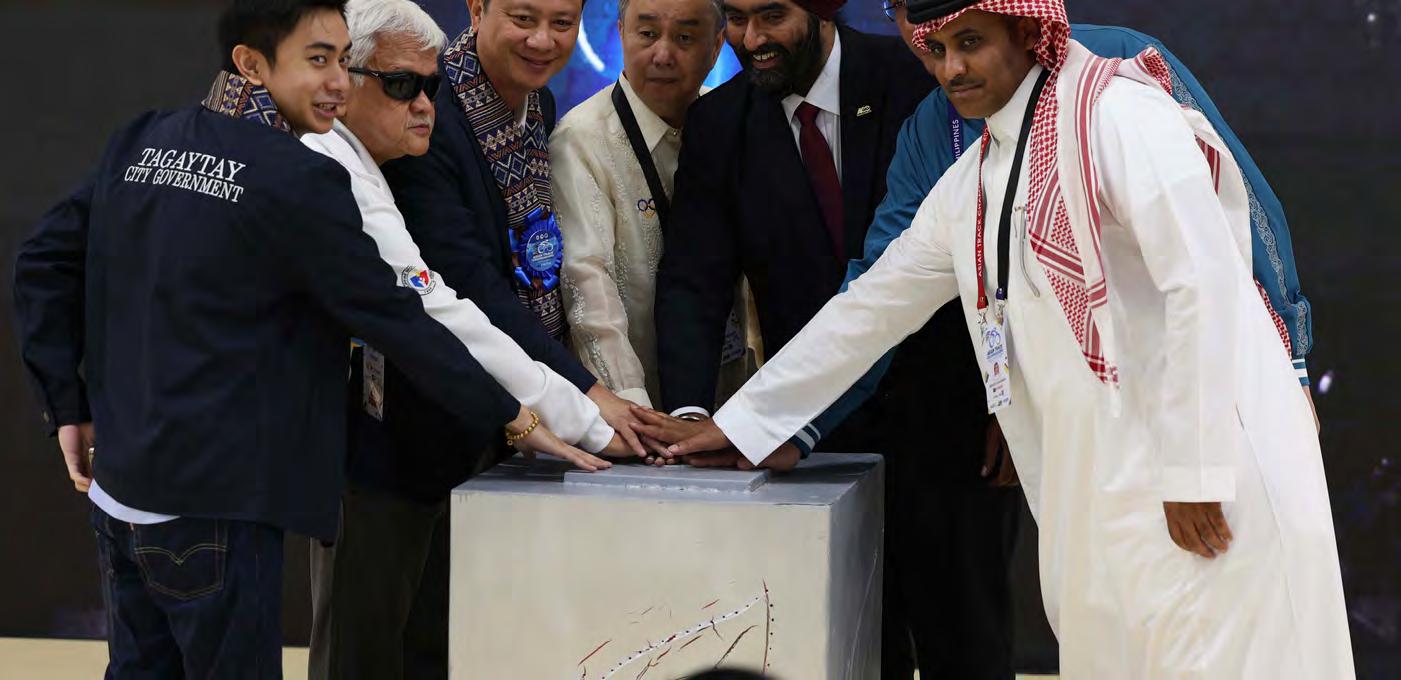
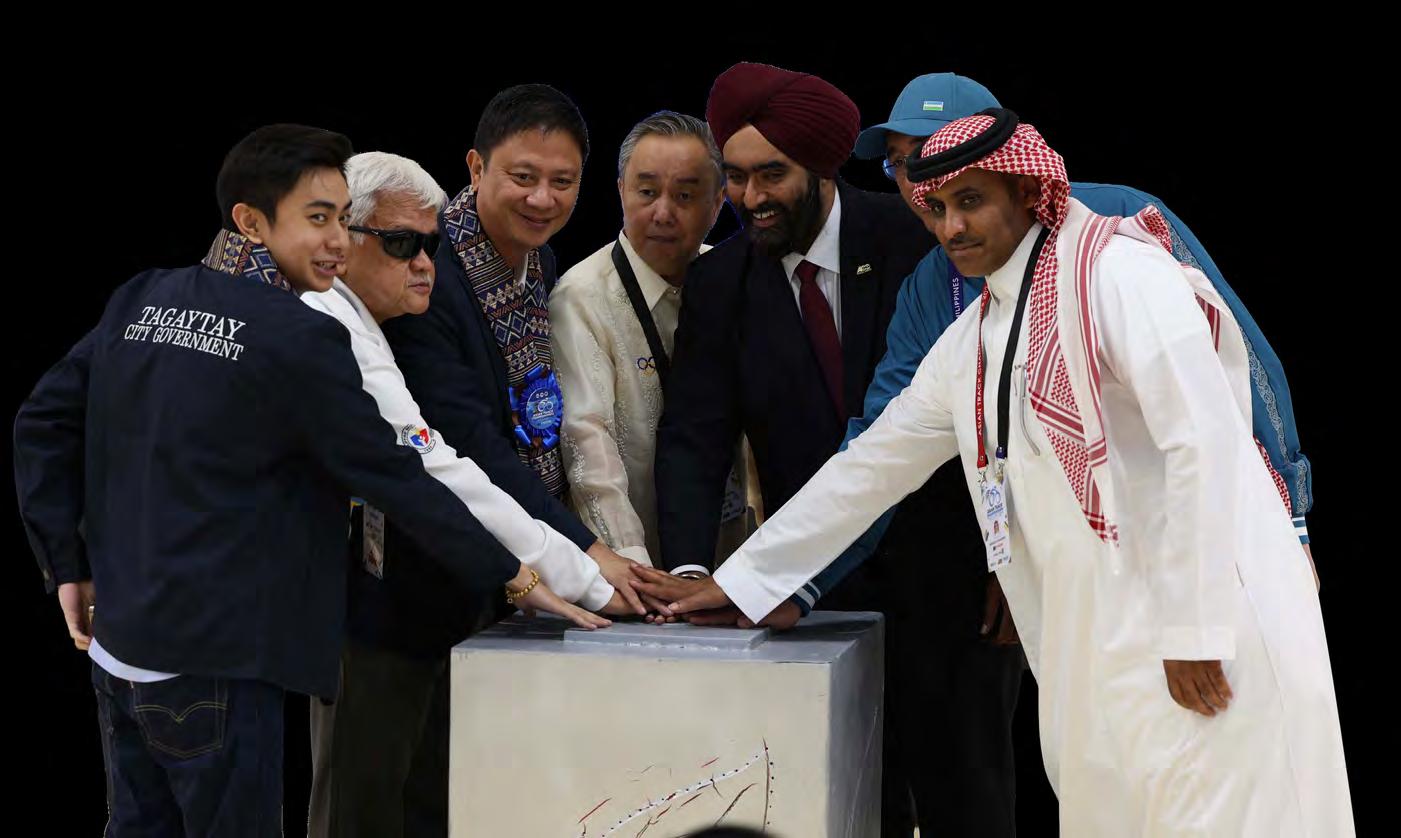
THE Asian Cycling Confederation Track and Para Track Championships roared to life on Wednesday at the Tagaytay CT Velodrome, drawing nearly 600 cyclists from 16 countries in a vibrant showcase of Asia’s best track athletes vying for continental supremacy.
While the event marks a milestone for Philippine cycling, Abraham Tolentino tempered expectations, emphasizing that the national team is still in its early stages of development.
“I don’t expect any medal or podium finish here for our track cycling team,” said Tolentino, who also heads
PhilCycling. “We’re starting from scratch … we’re still calibrating and adjusting.”
“So we will learn, little by little, and we will soon learn it,” he added.
For Patrick Gregorio, the successful staging of the championships is already a major victory, calling it a long-awaited breakthrough for both
the country and Tolentino.
“It’s a dream come true for President Tolentino, and for the country,” Gregorio said during the lively and colorful opening ceremony held at the velodrome’s infield. The state-of-the-art venue now stands as a symbol of Philippine cycling’s future, replacing the historic Amoranto Velodrome in Quezon City. Built to meet UCI standards, the Tagaytay facility is envisioned to become a cornerstone of the nation’s rise as a regional sporting hub.
Adding prestige to the occasion were Amarjit Singh Gill, Tagaytay Mayor Brent Tolentino, Philippine
Paralympic Committee president Mike Barreto, Uzbekistan Cycling Federation secretary-general Khurshid Atakulov Bakhodirjanovich, and Saudi Cycling Federation president Abdulaziz Al-Shahrani. They were joined by Philippine Sports Commission commissioners Walter Torres and Eduardo Hayco, Tagaytay Vice Mayor Agnes Tolentino, and former Cavite governor Athena Tolentino.
“We finally hosted this event after 31 long years. And it is really a dream come true for Philippines sports,” Tolentino said. “We are thankful to ACC and UCI for helping us.”
FILIPINO Olympic pole vaulter Er-
nest John Obiena and Atletang Ayala are helping advance accessible and comprehensive cancer care in the Philippines.
On Tuesday, Obiena represented Atletang Ayala for the donation of the proceeds of the historic World Pole Vault Challenge to the Cancer Care Hope Fund of Healthway Foundation, Inc.
The Atletang Ayala World Pole Vault Challenge marked a milestone for Philippine athletics, bringing together top Filipino and international pole vaulters in Ayala Triangle Gardens while rallying strong backing from sponsors. Through their support, ₱3.1 million was raised to benefit initiatives that expand access to cancer care.
“Bringing a world-class pole vault competition to the Philippines has always been a dream of mine,” Obiena said. “To see that dream come to life—and to make it even more meaningful by using it to support Filipino cancer patients—means a lot to me. This shows how sports can go beyond competition and become a platform

for purpose, helping make a real difference in people’s lives.”
Established in 2025, the Cancer Care Hope Fund supports patients across the cancer care continuum— from diagnostics to treatment and

CABANATUAN City—Justin
Quiban strengthened his hold on the ICTSI Lakewood Championship, turning the P3 million event into a potential personal showcase with an eagle-aided 68 as he extended his lead to five strokes over Ryan Monsalve midway through here on Wednesday. Though he cooled off from his blistering, record-setting 62 on Tuesday, Quiban’s steady 33-35 round under another scorching day proved more than enough to widen the gap between him and the rest of the elite field.
Monsalve, however, mounted a strong charge in one of the later groups, carding a 67 he also highlighted by an eagle to climb to solo second. Still, Quiban’s 36-hole aggregate of 14-under 130 gave him
survivorship—while advancing education and capacity-building within the healthcare system. The donation from Atletang Ayala will help enable Healthway Foundation, Inc. to roll out its first set of grants
firm control, with Monsalve trailing at 135.
Korean Taewon Ha also impressed with a 67 to move into third at 136.
“I felt I hit the driver just as well. If anything, I just wasn’t holing as many putts as I did yesterday. But I was hitting my lines – it’s just how it goes sometimes,” said Quiban.
“I’m focused on what I need to do. The plan is to stay in the present and stay locked in, and I think I’ve been doing a pretty good job of that,” he added.
Despite trailing by five, Monsalve remains optimistic about his chances of a breakthrough.
“I hit my drives better yesterday (Tuesday), but I was able to manage my misses today (Wednesday),”
supporting cancer patients.
“Bringing together Filipino sporting excellence and a meaningful cause is something truly special, and it reflects the kind of community we’re proud to be part of,” said Borromeo, President and CEO of AC Health and Chairman of Healthway Foundation. “This donation will enable us to strengthen patient support services and raise greater awareness about early detection and treatment.”
Also present at the turnover ceremony were Sherry Gosiengfiao, People Experience Head of Ayala Corporation; Dr. Beverly Ho, Chief Health Officer of AC Health; and Chiqui Batac, Executive Director of Healthway Foundation.
“From the very beginning, the goal was to create something that goes beyond sport,” Gosiengfiao said. “Through Atletang Ayala, we are proud to have built a platform that not only elevates Filipino athletic excellence but also channels that momentum into meaningful impact, particularly for patients and families navigating cancer.”
said Monsalve, whose round featured just two bogeys after a first round that included two bogeys and a double bogey.
“I also finished stronger today, and everything else was pretty similar. I’ve been putting well and hope to continue that for the last two rounds,” he added.
“The gameplan is to take advantage of opportunities on the long holes, try to be aggressive with the tee shot to have a shorter club for those holes. It makes the green bigger for me, especially with how firm the greens are,” said Monsalve, highlighting his monster drive on No. 8 that set up another eagle. From 155 yards, he hit a 9-iron second shot to about 35 feet and drained the putt.
3.1% 3.0% 5.4%
Growth forecast for Q1 of 2026 Actual GDP growth in Q4 of 2025 Actual GDP growth in Q1 of 2025
By Thony Rose Lesaca
PHILIPPINE economic growth is likely to remain subdued in the first quarter of 2026 as weaker employment figures and rising inflation pressures weigh on activity, University of Asia and the Pacific (UA&P) economists said.
The university, in its March 2026 Market Call report, projected a gross domestic product (GDP) growth of 3.1 percent in the first quarter, before rebounding to above 5 percent in the second half of the year. Economists said earlier “green shoots” in economic data have faded amid escalating geopolitical tensions in the Middle East which has driven crude oil prices higher.
BALIKBAYAN BOXES.
Finance Secretary Frederick Go and Customs Commissioner Ariel Nepomuceno lead the distribution of balikbayan boxes left by cargo handlers at the Port of Cebu.
Some 25,818 boxes were turned over to the families of overseas Filipino workers as of March 23, 2026, following a directive from President Ferdinand Marcos Jr. to fast-track the release of shipments abandoned by freight forwarders across various Philippine ports.
“Recent economic indicators, par-
ticularly low pre-war employment figures show weak first quarter of 2026 GDP growth at 3.1 percent yearon-year, but improvement is expected in the second half with projected expansion above 5.0 percent,” the economists said in the report.
The economists said faster growth in the second half of 2026 could hinge on an improvement in infrastructure
spending.
Data from the Philippine Statistics Authority showed the number of employed Filipinos fell to 47.9 million in January 2026. This pushed the unemployment rate to 5.8 percent, the highest since June 2022, with an estimated 2.96 million unemployed Filipinos.
Inflation is also seen picking up higher than the 2.4 percent figure in February as tensions in the Middle East continue to affect domestic oil prices.
“Inflation will likely rise sharply to 4.2 percent year-on-year in March, compared to 2.4 percent previously, and may continue climbing until crude oil prices stabilize or decrease as more producers respond to higher prices and as Iran and the U.S. allow additional tankers to transit the Strait of Hormuz,” the economists said.

By Jenniffer B. Austria
ROBINSONS Retail Holdings Inc.
(RRHI) will close all its standalone No Brand stores in the Philippines by end-June 2026 after seven years of operations, the Gokongwei-led company said on Wednesday.
By Alena Mae S. Flores
THE Philippine power grid is projected to have sufficient supply from April to June 2026 even as reserve margins remain thin and vulnerable to unplanned outages, according to a report released Wednesday by the Institute for Climate and Sustainable Cities (ICSC).
The energy think tank warned that supply stability depends heavily on the timely delivery of committed power projects and the stability of high-voltage direct current (HVDC) transmission lines.
The Luzon grid is expected to maintain adequate reserves in the second quarter of the year provided that nearly 2,316 megawatts (MW) of new capacity, including the 1,785.7 MW Terra Solar Phase 1 and the 530.4 MW Bugallon Solar Power Project, come online as scheduled in the first half of 2026.
Despite the stable outlook for Luzon, the Visayas region is projected to experience yellow grid alerts in May. While the region typically maintains reserves through HVDC imports of up to 450 MW from Mindanao and 250 MW from Luzon, these margins could tighten if the neighboring islands restrict exports to protect their own supply. ICSC chief data scientist Jephraim Manansala said the outlook could worsen if additional plants go offline unexpectedly.
“If additional power plants go offline beyond what is expected, this could further aggravate the power outlook and potentially lead to a more grave outcome, as available supply would be reduced,” Manansala said.
“The decision reflects evolving consumer preferences and how customers are choosing to shop across our retail formats,” RRHI president and chief executive Stanley Co said.
“Our focus remains on meeting customer needs by providing relevant assortments in the most appropriate formats,” he said.
The retailer operates 11 No Brand stores across the country. The move aligns with a broader strategy to streamline the group portfolio and prioritize retail formats that yield higher returns.
The company faced headwinds in August 2025 when the Bangko Sentral ng Pilipinas ordered e-wallet providers to delink from online gaming applications. Prior to this regulatory shift, DigiPlus recorded quarterly revenues of approximately P25 billion. Tsui noted that without the delinking, full-year revenues for 2025 could have reached P90 billion to P100 billion.
“As a licensed and leading online gaming operator, we continue to welcome collaboration and active participation in discussions with the Philippine government to achieve our shared goal of raising the standards of the industry,” DigiPlus chairman Eusebio Tanco said. Jenniffer B. Austria
THE Bistro Group expanded its footprint in Western Visayas on March 20 with the opening of Italianni’s and TGIFridays at SM City Iloilo. This marks the group’s first entry into the Iloilo market following recent openings in Laoag and La Union.
The two restaurants are located at the ground floor of the mall’s South Wing.
DigiPlus eyes recovery by second half of 2026
DIGIPLUS Interactive Corp. expects to fully recover by the second half of 2026 from the impact of tighter government regulations on online gaming firms.
DigiPlus president Andy Tsui told a press briefing the group has seen a steady recovery over the last six months as it increased engagement with longterm and high-value users.
“So we’re still in the recovery stage.
We’ll probably see, I would say, full recovery more towards maybe third or fourth quarter of this year,” Tsui said. The online gaming firm, which operates BingoPlus, ArenaPlus, and GameZone, reported a net income of P12.6 billion in 2025. This was largely flat from the previous year, even as revenues rose 12 percent to P84 billion from P75 billion.
Italianni’s, which specializes in ItalianAmerican cuisine, features a 120-seat capacity and serves signature dishes such as Sicilian Salad, Truffle Chicken and Mushroom Pasta and Quattro Staggioni Pizza.
TGIFridays, situated adjacent to Italianni’s, offers a 106-seat space known for its American-style bar and grill menu, including Whiskey Glazed Ribs and Fried Mozzarella.
The Bistro Group executive chef Josh Boutwood, whose portfolio includes the Michelin-starred Helm, oversees the culinary direction of the company’s diverse brands.
The group founded in 1994 popularized the casual dining concept in the Philippines over 30 years ago. Its portfolio includes international brands such as Denny’s, Texas Roadhouse, and Hard Rock Cafe, alongside Asian concepts like Watami and Modern Shang.
No Brand entered the Philippine market in 2019 via a master franchise agreement between RRHI and South Korea-based Emart, which owns the private label concept.
RRHI said the closure will not have a material impact on its financial performance. The No Brand stores contribute about 0.2 percent of annual net sales and represent a minimal share of total assets.
The 11 locations constitute a small
fraction of the company network, which included over 2,700 companyowned outlets and more than 2,100 franchised branches as of the end of 2025. These operations span supermarkets, convenience stores and drugstore chains. The company reported that its 2025 core net earnings rose 6 percent to P6.7 billion, supported by steady sales growth and contributions from new store openings.

GREEN Xentro has launched the first phase of a 2,500-unit fleet of fully electric battery-powered taxis in Rizal province through a partnership with global mobility platform Green GSM.
The initiative represents one of the largest electric vehicle (EV) rollouts in the Philippines and introduces a partner-led model intended to accelerate the adoption of green mobility across emerging markets.
The deployment stems from a memorandum of understanding signed in October 2025 between Xentro Group and Green GSM. While the partners originally planned for 2,000 vehicles, they expanded the fleet to 2,500 units due to increasing operational confidence. Following the Rizal launch, the companies expect to expand services across Metro Manila and sur-
rounding areas. Green Xentro is a subsidiary of the Xentro Group of Companies, led by chairman Alexander Cruz. Green GSM is an affiliate of GSM (Green and Smart Mobility), which operates all-electric ride-hailing services across multiple international platforms. Under the operating model, Green Xentro manages on-the-ground execution including driver management and local operations. Green GSM provides the integrated platform, which includes the electric vehicles, technical infrastructure and standardized service protocols. The fleet features real-time monitoring and safety equipment such as GPS tracking, CCTV, dashcams, and panic buttons linked to a 24/7 monitoring center.
Mindanao is expected to maintain normal reserve levels throughout the quarter, but its tightest period is forecasted for late April. The ICSC analysis, which has been published annually since 2021, used conservative assumptions that accounted for forced outages of 700 to 800 MW. The report noted that a grid alert was already raised in the Visayas in January, a month usually characterized by low demand.
PH asked to tap commercial funds for PPP projects
By Othel V. Campos
THE Philippines needs to expand its financing base beyond official development assistance and tap more commercial funding sources to support its P3.6 trillion public-private partnership (PPP) pipeline, the Japan Bank for International Cooperation (JBIC) said Tuesday. Speaking at the Philippines-Japan Diplomatic Partnership Forum at The Peninsula Manila, Japan Bank for International Cooperation Manila Office chief representative Hiroshi Sagawa said nearly 288 PPP projects under implementation are driving a widening financing gap that domestic sources alone cannot fully cover.
“Given the scale of the Philippines’ infrastructure and energy requirements, it is essential to mobilize broader commercial financing, including greater participation from foreign lenders, to bridge the funding gap,” Sagawa said.
While Philippine banks hold about P12 trillion in total exposure, only about P1 trillion is allocated to PPPs. This indicates limited capacity to fund large-scale infrastructure needs as the government seeks to reduce reliance on public funds and official development assistance.
The funding pressure is particularly evident in the energy sector, where investments of P4
By Jenniffer B. Austria
JG SUMMIT Holdings Inc. (JGS) reported a net loss of P87.9 billion in 2025 following a P114.3-billion impairment charge related to the discontinuation of its petrochemical operations.
The company’S board approved the write-down of assets for JG Summit Olefins Corporation, which manages a $2-billion manufacturing complex in Batangas.
JGS said it decided to exit the sector on persistent unfavorable global market conditions.
JG Summit president and chief executive Lance Gokongwei said the conglomerate has entered discussions with potential buyers for the mothballed facility.
While the impairment led to a heavy bottom-line loss, recurring net income from continuing operations rose 3 percent to P31.9 billion.
The growth was supported by robust consumer spending and increased demand for travel and leisure. However, net income from continuing operations fell 7 percent to P36.1 billion.
Consolidated revenues from ongoing businesses climbed 9 percent to P368.6 billion. The increase was led by double-digit growth in the airline and real estate
divisions, as well as volume-led expansion in the food and beverage segment.
These gains helped the group mitigate the impact of high coffee costs and increased interest expenses at the parent level.
“Our 2025 performance reflects the resilience of our portfolio, supported by sustained consumer demand and continued strength in our leisure-related businesses,” Gokongwei said.
Looking toward 2026, the company plans to prioritize cash flow protection and operational efficiency amid global economic uncertainty.
“As we look ahead to 2026 amid heightened global uncertainty, we are taking a prudent and disciplined approach—prioritizing cash flow protection, balance sheet strength, and operational efficiency,” Gokongwei said.
He said the group remains focused on long-term value creation through a transformation of the parent company and refined investment guardrails for its business units.

PHILIPPINE shares rallied for a second straight trading day Wednesday, closing above the 6,000 level as global political tensions eased.
However, the peso depreciated again, slipping below the 60-level against the U.S. dollar. The local currency closed at 60.10, compared with 59.95 on Tuesday.
The 30-company Philippine Stock Exchange index (PSEi) ended at 6,044.17, up 107.97 points or 1.82 percent. The broader all shares index rose 60.93 points, or 1.85 percent, to close at 3,356.16.
AB Capital Securities said the index staged a relief rally as regional markets rose following reports that Iran received a 15-point ceasefire proposal from the U.S.
All sectors ended in the green, led by mining and oil, which jumped 4.03 percent. Property gained 2.11 percent, while financials advanced 1.93 percent.
Value turnover reached P5.4 billion. Foreign investors turned net

IF THERE is one way of delivering goods and services in a more economical way, the ride has to be smooth and with fewer roadblocks along the way.
Road conditions must be near-perfect to allow faster transportation and make way for economic progress from one end to another.
Department of Public Works and Highways (DPWH) Secretary Vince Dizon is aware of the challenge that is causing the Samar logistics bottleneck. And he has made a commitment: the rehabilitation of the Maharlika Highway, costing an estimated ₱16 billion, will proceed this year, including the critical 200-kilometer stretch through Western Samar.
The DPWH chief exerted efforts to coordinate the job with Western Samar Governor Sharee Ann Tan and the provincial government to ensure local priorities are addressed. After all, the highway’s rehabilitation will directly benefit communities along the corridor.
Stretching over 3,000 kilometers from Luzon to Mindanao, the Maharlika Highway is the country’s primary land transport corridor.
It carries a substantial share of domestic cargo, agricultural goods from Mindanao moving north, and manufactured products from Luzon moving south.
At the center sits Western Samar, whose long highway stretch is crucial for maintaining regional connectivity and attracting investments that depend on reliable transport links.
The government is signaling its intent to address a longstanding bottleneck in logistics. Improved infrastructure can catalyze investment, encourage public-private partnerships and support local economic initiatives.
Logistics costs in the Philippines remain among the highest in Southeast Asia, often accounting for 20–30 percent of the total product cost in agriculture and distribution.
Poor roads in typhoon-prone areas like Eastern Visayas result in longer travel times, higher fuel consumption and increased vehicle wear.
Eastern Visayas produces tens of billions of pesos worth of agriculture, including coconut, abaca, fisheries and root crops. Western Samar, a leading abaca producer, supplies both domestic and export markets.
Delays erode margins and reduce competitiveness, discouraging investment and limiting growth potential for small and medium enterprises along the corridor.
A rehabilitated highway would lower operating costs, improve delivery predictability and strengthen supply chain reliability. Agri-businesses would enjoy better farm gate prices, while manufacturers and traders benefit from more efficient distribution networks.
Dizon’s recent visits, where he personally inspected the highway and committed to rehabilitate all critical segments, provides a strong foundation. That pledge to the provincial government ensures shared responsibility to meet timelines and deliver results.
The DPWH chief exerted efforts to coordinate the job with Western Samar Governor Sharee Ann Tan...
Such high-level engagement signals to investors that the national government is serious about Eastern Visayas as a growth corridor.
Phased implementation is practical. Prioritizing the most deteriorated sections in Western Samar can deliver immediate economic benefits while building public confidence.
Clear timelines and public communication will help align expectations for stakeholders, from logistics firms to agricultural producers.
Transparency will reinforce confidence. Regular updates via official channels or digital platforms, combined with active coordination with DPWH, can ensure Samar’s priority segments are rehabilitated without delay.
The economic upside extends to tourism. Western Samar has invested in eco-tourism and community-based projects
The Ulot River Torpedo Boat Extreme Ride in Paranas, for one, offers a unique eco-adventure experience, while the Sohoton Caves and Natural Bridge Park in Basey and Lulugayan Falls showcase the province’s dramatic natural beauty.
Cultural initiatives such as the “Secret Kitchens of Samar” and Basey’s banig weaving add depth to the province’s tourism offerings, generating income and supporting community livelihoods.
The San Juanico Bridge Aesthetic Lighting Project has turned the landmark into a nighttime attraction, and cruise tourism is emerging. In 2025, the Heritage Adventurer cruise ship docked in Daram town, prompting the provincial government to develop shore excursions linking visitors to local attractions.
Poor road conditions, however, limit accessibility.
But a rehabilitated highway would allow tourism enterprises to expand and local communities to capture greater value from visitors.
Climate resilience is also key. Eastern Visayas is disasterprone. During typhoons and emergencies, the highway is a vital lane for relief and recovery.
Western Samar’s Maharlika segment has been a weak link in a vital national corridor. Addressing it unlocks economic value across agriculture, logistics, tourism and trade, while also signaling to potential investors that the region is ready for development.
Dizon’s prioritization and commitment to include Samar’s long-neglected sections, reinforced by Governor Tan’s provincial oversight, set the stage for urgent and disciplined implementation.
The path forward is straightforward: define timelines, prioritize segments, maintain transparency and deliver. If executed as planned, the Maharlika Highway rehabilitation will improve mobility and expand economic opportunities for Samar and the broader Eastern Visayas.
Secretary Dizon has made the commitment. Western Samar is firmly at the center of national priority.
E-mail: rayenano@yahoo.com or extrastory2000@gmail.com
buyers, breaking a 14-day selling streak with inflows of P224.7 million.
Market breadth was positive, with gainers leading decliners 118 to 81, while 54 stocks remained unchanged.
Century Pacific Food Inc. was the day’s top index gainer, rising 5.32 percent to P36.65. PLDT Inc. was the worst performer among blue chips, falling 2.96 percent to P1,310.
Oil prices tumbled and stocks rose Wednesday after reports that Washington sent a peace plan to Iran, while Tehran announced it will let “nonhostile” oil vessels through the crucial Strait of Hormuz.
After nearly four weeks of conflict, investors jumped on the first signs that hostilities could wind down, though analysts pointed out that the arrival of more US troops in the Middle East suggested the chance of escalation remained.
The economic impact of the crisis has begun to bite around the world, with governments looking to cut en-
ergy consumption. Both main crude contracts plunged more than six percent -- with Brent back below $100 -- after US President Donald Trump voiced optimism at ending the war and said officials were “in negotiations right now”. However, both pared the losses as the day wore on.
Speaking to reporters in the Oval Office, Trump said Iran “did something yesterday that was amazing actually. They gave us a present and the present arrived today. And it was a very big present worth a tremendous amount of money.”
“That meant one thing to me -we’re dealing with the right people.” He did not explain further but said it related to the Strait of Hormuz, through which a fifth of global oil and gas flows and which Iran has largely blockaded, sending global energy prices soaring and fueling fears of another surge in inflation.
Jenniffer B. Austria with AFP
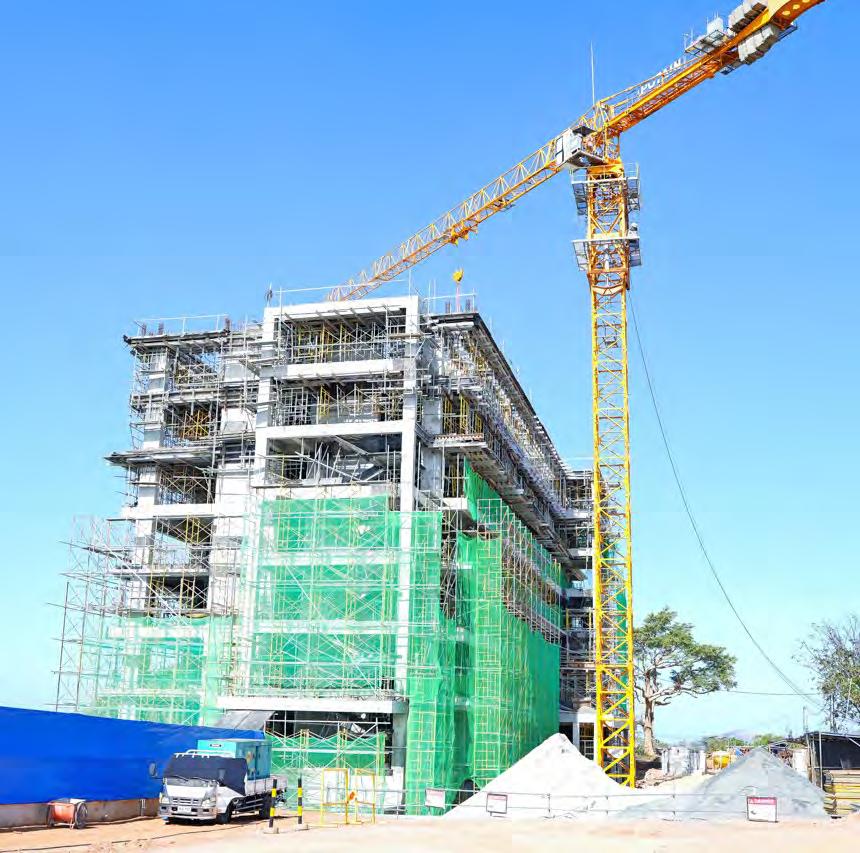
SM Prime invests over P300m in Greater Manila transport links
SM PRIME Holdings Inc. is investing more than P300 million to fund transport infrastructure projects designed to improve commuter mobility across the Greater Manila Area.
In partnership with various government agencies, the company is building a direct pedestrian link between the LRT-2 Antipolo Station and SM City Masinag. The project will provide weather-protected access between the station and the mall, reducing transfer times and eliminating the need for street-level crossings.
“Urban mobility is central to national development. By working with government, we are able to improve access points that affect commuters every day,” SM Prime president Jeffrey Lim said in a statement Wednesday. Lim noted that the partnership began during the pandemic when improving public transport access became a priority.
The project will include ramps,
elevators, lighting and closedcircuit television systems to enhance accessibility and safety. Construction is scheduled to begin in the second quarter of 2026 and is expected to be completed within six months under a public-private partnership with the Light Rail Transit Authority.
In March 2025, SM Prime also opened the SM North EDSA Busway Concourse, featuring covered walkways, escalators and direct access to the busway station. A similar concourse model is under construction at SM Megamall, with completion targeted for the first quarter of 2026. The property firm has also partnered with the Metropolitan Manila Development Authority to provide real-time traffic updates through digital directories in select malls. The system uses live feeds from the agency’s AI Traffic Management System to help commuters plan their routes more efficiently.
Jenniffer B. Austria

Philippines as a compelling destination for experiential and culture-driven travel. The Philippines secured more than P925 million in preliminary sales leads at the ITB Berlin, a significant increase in trade performance for the country’s European market engagements.
By Jenniffer B. Austria
D&L Industries Inc. reported a 10.6-percent increase in recurring net income to P2.6 billion in 2025 from P2.3 billion the previous year, as the company prepares to navigate market volatility linked to ongoing conflict in the Middle East.
The country’s largest producer of oleochemicals and specialty plastics saw 2025 volumes grow 8 percent year-on-year, supported by resilient demand in both high-margin specialty products and commodity segments.
The earnings growth came despite coconut oil prices reaching an all-
HALAL
FESTIVAL. Manila Mayor Francisco Moreno Domagoso
event highlighted opportunities in the expanding halal market.
time high and nearly tripling from lows recorded 2 years ago.
D&L Industries president and chief executive Alvin Lao said 2026 presents a new set of uncertainties, particularly from the potential impact of the Middle East war on crude oil prices, raw material costs and global supply chains. However, Lao noted that market disruptions also create opportunities for the firm.
“We believe this environment allows us to further strengthen our position as a reliable supplier and trusted partner, supporting our customers with customized solutions as they navigate a more volatile operating
landscape,” Lao said.
To mitigate supply chain risks, the group has expanded its list of suppliers after some providers declared force majeure, effectively canceling contracted future supplies. The company maintains 74 days’ worth of inventories to ensure manufacturing facilities remain operational.
The Lao family has demonstrated confidence in the long-term outlook through continued share accumulation. Their holding company, Jadel Holdings, has increased its stake in the firm by approximately 5 percent since the pandemic.

INTERNET services in the Philippines have become more affordable due to increased competition and infrastructure investment, but sustaining these gains requires a policy shift to recognize connectivity as an essential utility, a consumer advocacy group said.
CitizenWatch Philippines is calling on the government to formally classify internet access as the country’s “fifth utility,” alongside electricity, water, gas and transport. This status would align with the amended Public Service Act, which already identifies telecommunications as critical infrastructure.
CitizenWatch Philippines co-convenor Kit Belmonte said the decline in data costs and the rise of flexible prepaid promos have expanded access across all income segments.
“Consumers today are paying less for more data, with greater flexibility in how they spend on connectivity,” Belmonte said.
“Low-denomination, short-duration packages have made internet access far more accessible, especially for prepaid users who make up the majority of the market,” Belmonte said.
Data from the Department of Information and Communications Technology and the International Telecommunication Union show that the cost of 1 GB of mobile data has fallen from over 2 percent of gross national income per capita in the mid-2010s to below 1 percent recently. This meets the affordability targets set by the United Nations.
Fixed broadband speeds have also seen a sharp increase. Average speeds rose from single-digit levels in 2016 to over 90 Mbps by 2025. While performance has improved, entry-level fiber plans have remained stable between P1,299 and P1,699, representing a significant drop in the cost per Mbps.
Belmonte said connectivity is now embedded in basic functions such as education, employment and public services. However, he cautioned that structural pressures like high electricity rates and complex local permitting processes for towers and fiber continue to threaten service expansion.
“Power accounts for a significant share of network operating costs, while permitting inefficiencies slow down rollout and increase capital requirements,” Belmonte said.
“These directly affect both pricing and service expansion,” said Belmonte.
The group also noted that global energy volatility and geopolitical tensions in the Middle East could impact domestic costs. Belmonte suggested that strengthening digital infrastructure can act as a “cost stabilizer” by reducing the need for physical travel and fuel consumption through remote work and digital transactions. CitizenWatch Philippines said the “whole of society” effort should focus on real-world reliability rather than just headline speeds.
By Alena Mae S. Flores
FIRST Gen Corp. reported on Wednesday an 8-percent increase in attributable recurring net income in 2025 to $264 million (P15.2 billion) from $245 million (P13.9 billion) in 2024.
The independent power producer attributed the growth to a surge in its hydro portfolio following higher water levels, but said the gains were partially offset by lower earnings from its geothermal subsidiary.
The company generated $906 million (P52.1 billion) in revenues for 2025, up 6 percent from $857 million (P48.9 billion) the previous year.
The revenue growth was led by a greater volume of electricity sold during the period. The geothermal, wind and solar portfolio under Energy Development Corp. (EDC) accounted for 87 percent of total consolidated revenues, while hydroelectric power plants contributed 11 percent.
In a fundamental shift in strategy, First Gen sold a 60-percent equity stake in its natural gas business to Prime Infrastructure Capital Inc. in November 2025 for P50 billion.
The company no longer consolidates natural gas assets such as the Santa Rita and San Lorenzo plants. Earnings prior to the sale were booked as net income from discontinued operations at $200 million (P11.5 billion), representing a 21 percent jump from 2024, with the sale resulting in a gain of $159 million (P9.2 billion).
“The previous year brought about a fundamental change in First Gen as we decided to sell down our controlling stake in the gas assets,” First Gen president and chief operating officer Francis Giles Puno said.

“We decided to strategically pivot into our renewable energy investments,” he said. Puno said 2026 will be the year the drilling program of EDC “bears significant fruit.” He said a partnership with Prime Infra for the 600-megawatt Wawa and 1,400-megawatt Pakil pumped storage hydro projects marks the company’s debut as greenfield hydro developers.
The hydro platform contributed $33 million (P1.9 billion) to recurring earnings, a 73 percent rise from 2019 levels. Specifically, the 132-megawatt PantabanganMasiway power plants outperformed with $16 million (P949 million) in earnings due to higher water elevations and power supply contract prices.
However, EDC attributable recurring income, excluding hydro, fell 31 percent to $52 million (P3 billion). The decline was caused by lower Wholesale Electricity Spot Market prices and increased expenses for steamfield maintenance.
EDC also reported higher interest expenses from increased debt following its drilling program and expansions. The company has completed 77 megawatts of geothermal growth and 40 megawatt hours of battery storage.
First Gen remains the largest renewable energy producer in the Philippines with 1,764.2 megawatts of installed capacity. The company is a subsidiary of First Philippine Holdings Corp. of the Lopez family.
INTERIM INTERNAL RULES OF THE COURT OF APPEALS *
Pursuant to Section 12 of the Judiciary Reorganization Act of 1980 (Batas Pambansa Bilang 129), as amended, the Court of Appeals hereby adopts and promulgates these rules that shall govern its internal operating procedures. These rules shall be known and cited as the INTERIM INTERNAL RULES OF THE COURT OF APPEALS (IIRCA)
THE COURT, ITS ORGANIZATION AND OFFICIALS
Section 1 Composition of the Court of Appeals (a) Unless otherwise provided by law, the membership of the Court of Appeals consists of a Presiding Justice and sixty-eight (68) Associate Justices. It shall sit en banc, or in twenty-three (23) divisions of three (3) Justices each. The members of the Court are classified into three groups according to the order of precedence in their appointment or their seniority. The first twenty-three (23) being Chairpersons of the first to twenty-third divisions; the next twenty-three (23), its Senior Members; and the last twenty-three (23), its Junior Members, modified only by the ‘statement of preference’ or designation in an acting capacity under Sections 8 and 9 hereof. Such preference or designation shall not affect the precedence of members courtwide.
(b) Associate Justices shall have precedence according to the dates of their respective appointments. When the appointments of two or more of them bear the same date, precedence shall be according to the order in which their appointments were issued by the President, as may be reflected in the following sequence: (a) the order of their appointments as officially transmitted to the Supreme Court; (b) the order in which the names of the appointees appear on the transmittal document; or (c) some other sequential method evident in the appointment documents, such as bar code or QR code. (1a)
Section 2 Station and Place of Holding Session. - (a) The Court shall have its permanent stations as follows: the first Seventeen (17) Divisions shall be in the City of Manila, for cases coming from the National Capital Judicial Region and the First, Second, Third, Fourth, and Fifth Judicial Regions; the Eighteenth, Nineteenth, and Twentieth Divisions shall be in Cebu City for cases coming from the Sixth, Seventh, and Eighth Judicial Regions; and the Twenty-first, Twenty-second, and Twenty-third Divisions shall be in Cagayan de Oro City for cases coming from the Ninth, Tenth, Eleventh, and Twelfth Judicial Regions.
(b) Whenever demanded by public interest or whenever justified by an increase in caseload, the Supreme Court, upon recommendation of the Presiding Justice, may authorize any Division of the Court to hold sessions periodically or for such periods and at such places as may be determined for the purpose of hearing and deciding cases. (2a)
(c) Unless otherwise determined by the Presiding Justice, sessions shall be held in Baguio City by at least one (1) Division of the Court at a time and by not more than seven (7) Divisions on rotation basis during the summer months. (10, RVIII)
Section 3 Powers and Functions; Exercise of Adjudicatory Powers – (a) The Court, having original and appellate jurisdiction as provided by law, exercises adjudicative powers, functions, and duties through its Divisions. In the exercise and discharge of said powers, the Divisions shall hold consultations and deliberations on-site or through remote communications/videoconferencing. In no case may an Associate Justice act on any incident alone, except as may be allowed by laws and rules.
(b) A Division is denominated as a Regular Division when its membership is fixed and permanent until the next reorganization. It is denominated as a Special Division whenever its membership is not fixed and permanent such as when one or more members are only in an acting capacity. A Special Division of Five is a Division that is constituted whenever the members of a Regular Division fail to reach a unanimous vote (3a)
Section 4. Powers and Functions; Exercise of Administrative, Ceremonial and Other Non-Adjudicatory Powers. – (a) The Court sits en banc when it exercises administrative, ceremonial, and non-adjudicatory functions, except for those designated to be exercised by the Presiding Justice, the Executive Justices, and the Clerk of Court.
(b) The Court en banc convenes at least twice a year. The Presiding Justice or a majority of the incumbent members of the Court may call for an en banc session as they may deem necessary. It shall be presided by the Presiding Justice or, in case of absence, the most senior Associate Justice in attendance.
(c) A majority of the incumbent members of the Court shall constitute a quorum for its session en banc. The affirmative vote of a majority of those present shall be necessary to approve any matter submitted for its consideration.
(d) An en banc session may be conducted through remote communications/videoconferencing. Members of the Court present through remote communications/ videoconferencing shall be counted for the purpose of determining the existence of a quorum and the vote required for the approval of any matter. (4a)
Section 5 Matters Cognizable by the Court En Banc - The Court en banc shall, inter alia:
(a) Promulgate rules relative to the organization or reorganization of the Divisions, assignments of Associate Justices, distribution of cases, and other matters concerning the operation and management of the Court and its Divisions;
(b) Act on administrative matters, including regrouping, merger or abolition of existing offices, units or services, creation of new ones, or transfer of functions of one office, unit, or service to another, as the exigencies of the service may require;
(c) Adopt uniform administrative measures, procedures, and policies, consistent with the Rules of Court and issuances of the Supreme Court, for the protection and preservation of the integrity of judicial processes, speedy disposition of cases, promotion and efficiency of personnel;
(d) Recommend to the Supreme Court the appointment of the Clerk of Court, Assistant Clerks of Court, Court Reporter, and Division Clerks of Court;
(e) Receive foreign and local dignitaries, important guests and visitors, honor a colleague or retiring member of the Court and former members who passed on after retirement, and hold necrological services for members who die in office; and
(f) Take up other administrative matters which the Presiding Justice or any member may submit for consideration and inclusion in its agenda. (5a)
Section 6 The Presiding Justice. - The Presiding Justice shall have control and supervision of the administrative affairs of the Court, which shall include the power to:
(a) Preside over the Court en banc;
(b) Designate the members of the standing committees and set up ad hoc committees;
(c) Effect court reorganization in case of permanent
vacancy among the ranks of Division Chairpersons
pursuant to the rules promulgated for this purpose;
(d) Recommend all appointments of personnel and endorse all resignations from office to the Chief Justice for appropriate action;
(e) Have direct control and supervision of the Raffle Unit which shall choose by raffle the Associate Justices to be assigned to supervise the raffle of cases;
(f) Make adjustments, in the interest of the service, in the assignment of initial caseloads;
(g) Resolve all disputes, grievances, and complaints in the application and interpretation of these rules, in consultation with the Committee on Rules and Raffle. The decision of the Presiding Justice shall be final and binding, the originals of which shall be compiled and kept in the Office of the Presiding Justice and the Clerk of Court;
(h) Prepare a schedule of sessions in Baguio City, recess, wellness leave, and decision writing; and
(i) Resolve a Division Chairperson’s request to extend the period to resolve a case. (n)
Section 7 The Executive Justice. – (a) The Executive Justices of the Visayas (Cebu) and the Mindanao (Cagayan de Oro) Stations of the Court shall be designated by the Supreme Court from among the most senior Associate Justices of the Court. The recommendation of the Presiding Justice shall be accorded weight but is not binding on the Supreme Court.
(b) The Presiding Justice may delegate in writing the administrative functions to the Executive Justices of the Visayas (Cebu) and the Mindanao (Cagayan de Oro) Stations, including the designation of acting members to fill up absences, approval of applications for leave of absence, temporary detail of court personnel within the station, signing of vouchers, and such other acts as may be necessary for the day-to-day operations of the Court in each station. (n)
Section 8 Reorganization due to Permanent Vacancy of a Division Chairperson; Designation due to Permanent Vacancy of Senior and Junior Members. – (a) Reorganization of Divisions shall be effected whenever a permanent vacancy occurs in the chairpersonship of a Division; in which case, the assignment of Associate Justices to the Divisions shall follow the precedence in appointment or order of seniority.
(b) Associate Justices may state in writing their preference to be assigned to a particular station. Their statement of preference shall be taken into consideration by the Presiding Justice in reorganizing the Divisions based on the order of seniority.
(c) The statement of preference shall be effective until withdrawn in writing before the reorganization. For this purpose, the statement of preference shall be as follows:
Except in cases of temporary assignment, I hereby express my preference to be assigned [in] or [to] ________________ [station]. It is understood that this preference and my resulting assignment will not affect my seniority in the Court of Appeals. It is further understood that this statement of preference shall be effective until revoked in writing.
Date
Associate Justice
(d) In the exigencies of the service, the Presiding Justice may temporarily assign an Associate Justice to any station, defer the reorganization of the Divisions, or cause the temporary assignment of an Associate Justice in one station to substitute for another in some other station. No Associate Justice may be re-assigned to another station for more than six (6) months without consent.
(e) Should the creation by law of a new Division or Divisions require new appointments to the Court, the most ranking Senior Member or Members shall be the Chairperson or Chairpersons of such new Division or Divisions, and the resulting vacancies in the senior membership shall be filled by the most ranking Junior Member or Members, subject to the provisions of the preceding paragraphs. The new appointees shall be assigned to the vacancies as Junior Member or Members.
(f) When, as a result of reorganization, the resulting vacancy in the ranks of Junior Members is not filled, the most junior Associate Justice shall be designated as acting Junior Member of the Division for a period of twenty (20) working days, unless otherwise dictated by exigent circumstances, in addition to the duties as a regular member of his or her current Division. The succeeding acting Junior Member shall be chosen via another raffle to be conducted upon the expiration of the period. Such Division shall be constituted as a Special Division.
(g) Whenever a permanent vacancy exists in the office of the Senior Member of a Division, the assignment of Associate Justices to the Divisions shall follow the order of seniority upon reorganization. Whenever the vacancy is not filled, the regular Junior Member of the Division shall be designated as acting Senior Member. The most junior Associate Justice shall be designated as acting Junior Member of the Division, in addition to the duties as a regular member of his or her current Division, for a period of twenty (20) working days, unless otherwise dictated by exigent circumstances, with another raffle to be made upon the expiration of the period. Such Division shall be constituted as a Special Division.
(h) Whenever a permanent vacancy exists in the office of the Junior Member of a Division, the assignment of Associate Justices to the Divisions shall follow the order of seniority upon reorganization. Whenever the vacancy is not filled, the most junior Associate Justice shall be designated as acting Junior Member of the Division, in addition to the duties as a regular member of his or her current Division, for a period of twenty (20) working days, unless otherwise dictated by exigent circumstances, with another raffle to be made upon the expiration of the period. Such Division shall also be constituted as a Special Division.
(i) An Associate Justice cannot be designated as an acting member of more than four (4) Divisions at a time, unless otherwise dictated by exigent circumstances. (9a)
Section 9 Provisions Due to Temporary Absence or Incapacity. – Whenever there is a designation due to temporary absence or incapacity, a Special Division shall be constituted, and the rule on precedence shall be observed as follows:
(a) In the temporary absence or incapacity of the Presiding Justice, the most senior Associate Justice present shall act as Presiding Justice until the regular Presiding Justice returns and resumes office or until the incapacity is removed.
(b) In the temporary absence or incapacity of the Executive Justice, the most senior Associate Justice present in the station shall act as Executive Justice until the regular Executive Justice returns and resumes office or until the incapacity is removed.
(c) In the temporary absence or incapacity of the Chairperson of a Division, the substitute shall be whoever is more senior between the regular Senior Member of that Division and a Senior Member chosen by raffle from any of the other Divisions in the same station.
The Senior Member designated to act as Chairperson of a Division shall be the acting Chairperson. The other Senior Member shall be the acting or regular Senior Member, as the case may be.
(d) In the temporary absence or incapacity of a Senior Member of a Division, the substitute shall be whoever is more senior between the regular Junior Member of that Division and a Junior Member chosen by raffle from any of the other Divisions in the same station. The Junior Member designated to act as Senior Member of a Division shall be the acting Senior Member. The other Junior Member shall be the acting or regular Junior Member, as the case may be.
(e) In the temporary absence or incapacity of a Junior Member of a Division, the substitute shall be another Junior Member chosen by raffle from any of the other Divisions in the same station. The Junior Member designated to act as Junior Member of a Division shall be an acting Junior Member.
(f) In paragraphs (c), (d), and (e) of this section, the acting member shall act as Chairperson, Senior Member, or Junior Member of the Division concerned, as the case may be, until the regular member resumes office or until the incapacity is removed. The acting member so designated shall continue to be a regular member of his or her Division.
(g) If no one in either the Visayas (Cebu) or the Mindanao (Cagayan de Oro) Stations is available for the rank to be filled in an acting capacity, the raffle shall include those in other ranks.
(h) When an Associate Justice participates in a case in an acting capacity on a matter other than the adjudication thereof, the same shall appear in the corresponding resolution. When an Associate Justice participates in the hearing of a case in such capacity, the same shall be announced by the Chairperson in open court before the start of the hearing. (6a)
Section 10 Standing Committees. – (a) There shall be standing committees to oversee and review the implementation of the policies of the Court concerning its operations and to recommend adjustments as may be warranted. Each committee shall be composed of a chairperson and at least two (2) members, all of whom shall be designated by the Presiding Justice. Unless earlier revoked or extended, they shall serve for a term of two (2) years; provided that members of the Bids and Awards Committee shall only serve a one-year term, renewable as provided in procurement laws. The Presiding Justice may also set up ad hoc committees, define their functions, and designate their members.
(b) Committees shall meet at least once every semester of the calendar year, or as often as necessary. Each standing committee shall compile its resolutions, minutes, and other records for continuity. The chairperson of the committee is responsible for the safekeeping and endorsement of its records to the next chairperson, as well as the assignment of the members to such sub-committee or sub-committees as the committee may establish. The standing committees shall assist the Court on various matters indicated hereunder:
(1) Committee on Ethics and Discipline - On matters involving ethics and discipline of judicial officers and employees, and other related matters endorsed by the Supreme Court or the Judicial Integrity Board, in accordance with the Procedure in Administrative Cases to be promulgated by the Committee;
(2) Committee on Rules and Raffle - On matters involving the amendment and revision of these Internal Rules, drafting of other rules, and the conduct of raffle of cases. The Committee shall, upon request of the Presiding Justice, render an opinion on the application and interpretation of these Rules.
(3) Committee on Budget and Finance - On matters involving the preparation and submission of the Court’s annual budget to the Supreme Court, Department of Budget and Management, and the Congress, disbursement of funds, accounting, and all financial transactions.
(4) Committee on Human Resources, Gender and Development Focal Point – On matters involving personnel, such as recruitment, appointment, leaves of absence, training, change of organizational structure, creation or abolition of positions, discipline, retirement, termination of services, and the implementation of the Gender Responsiveness Plan.
(5) Committee on Employee Welfare, Benefits, Sports and Recreation - On matters involving the maintenance of medical and dental services, health and welfare plan, and a provident fund; operation of canteen services, sports and gym equipment, and recreation and wellness facilities.
(6) Committee on Records Management and Caseload - On matters involving the management of records, case information, caseloads, and statistical data.
(7) Committee on Legal Research and Continuing Legal Education - On matters involving the operations of the Office of the Court Reporter and the Court Library, publication of decisions, resolutions, and circulars of the Court, continuing legal education of Court Attorneys and staff, acquisition of books and research tools; conduct of research on legal issues and analyses of incongruent decisions of the Court, and other significant legal questions that may be brought to the Court for its appropriate action.
(8) Committee on Buildings and Grounds and Disposal of Depreciated Equipment, Vehicles, and other Assets - On matters involving the construction, lease, repair, improvement, maintenance of buildings and grounds, installation of safety and other necessary devices, and disposal of depreciated, unserviceable equipment, vehicles, and other assets.
(9) Committee on Security and Protective ServicesOn matters involving security protocols, procedures, enforcement, conduct of security training, and implementation of security measures to protect the members of the Court, court officials and court personnel, plants, property, assets, and equipment.
(10) Committee on the Purchase and Acquisition of Court Facilities, Equipment, and Supplies - On matters involving the purchase and acquisition of office equipment, supplies, and services, and the conduct of the required biddings and awards. The members of the Bids and Awards Committee as prescribed by law must come from this committee.
(11) Committee on Court of Appeals Journal - On the matter of publishing, maintaining, and improving the Court of Appeals official journal and/or newsletter or news bulletin.
(12) Committee on Information Technology, Automation, and Data Privacy - On matters involving the operation and maintenance of the Court of Appeals Court Management Information System (CA-CMIS), court website, and the automation and modernization of other court processes.
(13) Committee on Public Information - On matters involving the dissemination of information concerning public interest and release of official statements on questions concerning the Court.
(14) Committee on Educational Travel - On matters of educational travel programs, guides, and schedules, the determination of the Associate Justices and judicial
officers who may be eligible to travel overseas for such purpose, on official time or business, and to recommend accordingly.
(15) Committee on Baguio Cottages and Administrative Building - On matters involving the use, maintenance, and improvement of the Court’s Baguio Cottages, supervision of the employees therein, and operation of the Administrative Building in said City.
(16) Committee on Transportation Services and LTO Concerns - On matters involving the procurement, deployment, maintenance, and operation of transport buses, staff vehicles, and LTO concerns. (7a)
Section 11 Other Court Officials and their Duties. -
(a) Clerk of Court. - The Clerk of Court is the Chief Administrative Officer of the Court, who shall be under the direct supervision of the Presiding Justice and is accountable to the Court. The Clerk of Court shall take charge of the dayto-day administrative activities of the Court and exercise general administrative supervision over subordinate officials and employees, except the co-terminous staff of the Associate Justices, and shall assist the Presiding Justice in the formulation of programs and policies for consideration of the Court en banc It shall also be the duty of the Clerk of Court to:
(1) Disseminate information concerning Court activities of public interest and answer questions concerning the Court and official functions of Associate Justices;
(2) Answer queries from litigants, counsel, and interested parties pertaining to the status of cases pending in the Court; and
(3) Perform other functions as may, from time to time, be assigned by the Presiding Justice or the Court.
(b) Assistant Clerk of Court. –
(1) The Assistant Clerk of Court (Manila) shall assist the Clerk of Court in the performance of his or her duties and perform such other duties as may be assigned by the Presiding Justice or the Clerk of Court. In case of vacancy in the position of the Clerk of Court, the Assistant Clerk of Court (Manila) shall act as Acting Clerk of Court until the successor shall have been appointed and qualified. In case of temporary absence or incapacity of the Clerk of Court, the Assistant Clerk of Court (Manila) shall perform the duties of the Clerk of Court until he or she returns and resumes office or until the incapacity is removed.
(2) The Assistant Clerks of Court for the Visayas (Cebu) and Mindanao (Cagayan de Oro) Stations shall take charge of the day-to-day administrative activities of their station and perform duties and functions as may be assigned by the Presiding Justice and the Executive Justice of the particular station. In case of temporary absence or incapacity of the Assistant Clerk of Court, and unless otherwise directed by the Presiding Justice, the Executive Justice of the station shall designate an acting Assistant Clerk of Court from among the Division Clerks of Court in the station until the Assistant Clerk of Court returns and resumes office or until the incapacity is removed.
(c) Division Clerks of Court. - Each Division shall be assisted by a staff composed of a Division Clerk of Court, an Assistant Division Clerk of Court who shall perform tasks as are assigned by the Division Clerk of Court, and such number of personnel as may be required by the service. The Division Clerk of Court shall perform the duties prescribed in Rule V, Section 1.
The Division Clerk of Court and the Assistant Division Clerk of Court shall be under the direct control and supervision of the Chairperson of the Division. Whenever there is a vacancy in the office, the Chairperson’s recommendation shall be given preference in the selection of the Division Clerk of Court and the Assistant Division Clerk of Court.
(d) Court Reporter – The Court Reporter shall:
(1) Keep custody of the originals of the decisions and final resolutions, which shall not be brought out of the Court premises without the written authority of the Presiding Justice, and cause the binding thereof in separate volumes;
(2) Release certified copies of decisions and resolutions only upon written request, payment of the proper fees, and presentation of the corresponding receipt;
(3) Publish in the Official Gazette and the Court of Appeals Reports decisions and final resolutions together with their syllabi in consultation with the ponentes;
(4) Prepare syllabi of decisions and final resolutions of the Court that have become final and executory, and disseminate them to the members of the Court, and disseminate, as well, decisions of first impressions;
(5) Prepare and publish with each reported decision and final resolution a synopsis of the facts necessary for a clear understanding of the case, the names of counsel, the material controverted points involved, the authorities cited and a syllabus which shall be confined to points of law;
(6) Invite the attention of the Presiding Justice to incongruent decisions; in which case, the Presiding Justice shall convene the divisions concerned to discuss the same; and,
(7) Have supervision and control of his or her staff in the performance of the duties of the office. (10a)
Section 12 Appointments and Resignations of Court Officials and Other Employees. - (a) Appointments of the Clerk of Court, Assistant Clerks of Court, Division Clerks of Court, and Court Reporter shall be recommended by the Court en banc to the Chief Justice. Appointments of all other personnel shall be recommended by the Presiding Justice. Upon receipt of the Supreme Court resolution approving the recommendation, the Presiding Justice shall immediately issue to the appointee the corresponding commission evidencing the appointment. Appointees may then take their oath and perform their duties and responsibilities.
(b) The duties of the position to which a prospective employee is recommended for appointment shall not be assumed before issuance of the commission
(c) For purposes of civil service laws, the commission shall serve as the appointment paper of the appointee and a copy thereof shall be forwarded to the Civil Service Commission, together with supporting papers.
(d) All resignations from office shall be endorsed by the Presiding Justice to the Chief Justice for appropriate action. (11a) RULE II PRECEDENCE AND PROTOCOL
Section 1 Concept. – The Presiding Justice enjoys precedence over all the other members of the Court in all official functions. The Associate Justices shall have precedence in the order of their seniority in accordance with Section 1, Rule I. Members reappointed to the Court after rendering service in any other position in the government shall retain the precedence to which they were entitled under their original appointment, and their service in the Court shall, for all intents and purposes, be considered as continuous and uninterrupted. (1a)
Section 2 When Rule on Precedence is Applicable – The rule on precedence shall be applicable in the following instances:
(a) In case of vacancy in the office of the Presiding Justice, absence or inability to perform the powers, functions, and duties of the office, the Associate Justice who is first in precedence shall perform the powers,
functions, and duties until a Presiding Justice is appointed and has qualified or the disability is removed;
(b) In the determination of the Chairperson of the Division;
(c) In the seating arrangement and photo session of the Associate Justices in all official functions;
(d) In the choice of support personnel and other employees; and
(e) In the choice of office space, facilities, equipment, transportation, and cottages. (2a)
Section 3 When Rule on Precedence is Not Applicable – Precedence in rank shall not be observed in social and other non-official functions or be used to justify discrimination in the assignment of cases, amount of compensation, allowances, or other forms of remuneration, except in the case of the Presiding Justice, or whoever is acting in his or her place, and the Chairpersons of the Divisions.
In no case shall adjudicative functions be affected by the rule on precedence. Regardless of the order of precedence, each member of any Division shall have an equal vote, which shall be exercised freely and accorded respect (3a)
Section 4. Protocol in En Banc Session. – (a) During an en banc session, the most junior member of the Court enters first and the Presiding Justice exits first.
(b) After the Presiding Justice and the Associate Justices shall have entered the session hall for an en banc session, the Clerk of Court announces: “The Honorable Court of Appeals En Banc, presided by Mr. / Madame Presiding Justice ___________, is now in session. Silence is enjoined.” With that announcement, the Presiding Justice strikes the gavel against the sound block to call the assembly into order and to signal the commencement of the proceedings. All shall then take their seats.
(c) In the absence of the Presiding Justice, the most senior Associate Justice in attendance shall preside over en banc sessions pursuant to the rules prescribed by the Court. (4a)
Section 5 Protocol and Conduct of Hearing in Divisions – (a) During a Division hearing, the Chairperson enters and exits first, followed by the members according to precedence, unless otherwise requested by the Chairperson.
(b) The Chairperson controls the proceedings during the hearing and shall, in consultation with the members, rule on all motions and objections that may be interposed. The Chairperson may, however, yield the conduct of the proceedings to any member, who shall exercise the powers of the Chairperson.
(c) In Division hearings, the Division Clerk of Court announces: “The ____________ Division of the Honorable Court of Appeals presided by its Chairperson, Mr./Madame Justice ____________, is now in session. Silence is enjoined.” With that announcement, the Chairperson strikes the gavel against the sound block to call the assembly into order and to signal the commencement of the proceedings. All shall then take their seats. (5a)
RULE III FILING, RECEIVING AND COMPLETION
Section 1. Manner of Filing; Duty of Receiving Section. –Filing is the act of submitting pleadings or other papers to the Court. Unless otherwise directed by the Court, pleadings, motions, and other submissions shall be filed in three (3) copies, and processed in the following manner:
(a) Pleadings, motions, and other submissions filed by personal service, pursuant to Rule 13 of the Rules of Court and pertinent circulars of the Supreme Court, shall be received by the proper section at the One-Stop Processing Center of the Judicial Records Division of the Court. Upon receipt of the pleadings, motions, or other submissions, the proper section of the Judicial Records Division shall forthwith legibly stamp on the first page thereof the exact date and time of such receipt, sign the same, and thereafter proceed to barcode and enter the relevant data of the pleading, motion, or other submission, in the Court’s case management information system within one (1) day from such receipt.
(b) Pleadings, motions, and other submissions filed by registered mail or through accredited private courier shall be received by the clerk of the Receiving Section, who shall legibly stamp or indicate on the first page of the pleading, motion, or other submission, the date of its receipt by the Court and the fact that the same was received by registered mail or through accredited private courier, duly sign the same, barcode, and encode the relevant data, such as the date of posting or mailing, in the Court’s case management information system, and which submissions shall be forwarded to the proper section of the Judicial Records Division within one (1) day from such receipt. The corresponding envelope or portion thereof, showing the date of posting and registry stamp or tracking number of the private courier, shall be attached to the pleadings, motions, and submissions.
(c) Pleadings, motions, and other submissions filed through e-mail or any other electronic means shall comply with and be processed according to the Rules of Court, and any subsequent amendments thereto, as well as other issuances and circulars of the Supreme Court pursuant to the Strategic Plan for Judicial Innovations, including but not limited to A.M. No. 10-3-7-SC and A.M. No. 11-9-4-SC, and pertinent guidelines issued by the Court.
For such purpose, there shall be a centralized E-Filing Unit, located in the Judicial Records Division (JRD), which shall be composed of staff members equipped with computers and printers, and such other supplies necessary for its operations. In line with the transition towards digitization, the E-Filing Unit shall save the pleadings, papers, and documents transmitted via email or eCourt system in the proper manner and storage allotted for the purposes herein, as may be determined by the Court.
The E-Filing Unit shall be responsible for the monitoring of pleadings, papers and documents filed via e-mail or eCourt system; acknowledge receipt of pleadings, papers and documents; print the electronically transmitted pleadings, papers, and documents; and forward the printed pleadings, papers, and documents to the OneStop Processing Center for Manila station or the proper unit for Visayas and Mindanao stations, as the case maybe, for barcoding within forty-eight (48) hours from receipt thereof.
(d) Pleadings, motions, and other submissions filed by ordinary mail, private courier, or any mode other than personal delivery and registered mail as may be allowed by law or the Rules shall be processed by the Receiving Section, which shall legibly stamp on the first page thereof the date and time of receipt by the Court, duly sign the same, barcode, and encode the relevant data in the Court’s case management information system, and which submissions shall be forwarded to the proper section of the Judicial Records Division within one (1) day from such receipt. The corresponding envelope or portion thereof, showing the date of posting and registry stamp or tracking number of the private courier, shall be attached to the pleadings, motions, and submissions. (1a) Section 2. Processes after Receipt of Records, Pleadings, and other Submissions. -
A. Ordinary Appeals. –
(1) In Appealed Civil Actions.
(a) If the records are transmitted personally, the Civil
Cases Section of the One Stop Processing Center shall, upon receipt, make an initial examination of the transmittal letter, verify its contents with the documents or records transmitted, encode and barcode the relevant data in the Court’s case management information system, examine the same in the presence of the filer, and immediately issue a list of the lacking portions, if any.
(b) If the records are transmitted through mail, the Receiving Section shall make an initial examination of the transmittal letter and verify its contents with the documents or records transmitted, encode and barcode the relevant data in the Court’s case management information system, and forward the records to the Civil Cases Section of the Judicial Records Division within two (2) days from receipt.
(c) The Civil Cases Section of the Judicial Records Division shall, within two (2) days from receipt of the records, whether personally or by mail:
i. Check the records for the decision, notice of appeal and order giving due course to the appeal;
ii. Prepare the corresponding rollo, docket the case, and assign the corresponding CA-G.R. CV number;
iii. Transmit the rollo to the Raffle Unit for inclusion in the list of cases for raffle;
(d) After the raffle, within three (3) days from receipt of the rollo from the Raffle Unit, the Civil Cases Section of the Judicial Records Division shall:
i. Check if all the documents and submissions required under the Rules of Court have been transmitted;
ii. Check and report the proof of full payment of the appellate court docket and other lawful fees and deposits for costs paid to the branch clerk of the court which rendered the appealed judgment or order;
iii. Issue notice of incompleteness to the branch clerk of the court of origin for the submission of the lacking parts of the records; or if the records transmitted are still incomplete despite the notice to the branch clerk of court, report to the Division Clerk of Court concerned the lacking portions of the records for appropriate action;
iv. If the transcripts of stenographic notes are incomplete, notify the branch clerk of court concerned to complete the records within thirty (30) days from notice. A notice shall also be issued to the appellant’s counsel with a warning that failure on the counsel’s part to take the necessary steps to complete the transcripts within thirty (30) days from notice may result in the dismissal of the appeal.
(e) The records are deemed complete when all the documents listed in the transmittal letter are actually transmitted to the Court or when otherwise declared by the Associate Justice assigned to the case as complete.
(f) Once the records are deemed complete, regardless of any pending motion, the Civil Cases Section shall issue forthwith a notice to the parties to file their briefs. The notice shall require that the appellant’s brief be filed within forty-five (45) days from receipt of the notice; that the appellee’s brief be filed within forty-five (45) days from receipt of the appellant’s brief; that a legible copy of the appealed decision or order be appended to the brief; and that the sheriff’s fees appurtenant to the Sheriff’s Trust Fund (STF) be paid by the appellant. Once the amendments to the Rules of Court, that prescribe the filing of appeal briefs in the court of origin come into force, this provision shall be deemed amended
(g) All notices mentioned in this Rule shall be issued in the name of the Clerk of Court by the Chief of the Judicial Records Division or the Division Clerk of Court.
(h) Within one (1) day after the briefs have been filed or the period for their filing has expired, the Civil Cases Section of the Judicial Records Division shall forward the rollo, with the briefs duly stitched, to the Division Clerk of Court. If the rollo is with the Division Clerk of Court or with any other office, the briefs shall be transmitted by the Civil Cases Section within twenty-four (24) hours from receipt to the Division Clerk of Court. The Division Clerk of Court shall ensure that the briefs are consecutively paginated. Once the amendments to the Rules of Court, that prescribe the filing of appeal briefs in the court of origin come into force, the period shall be reckoned from the time the records are deemed complete pursuant to these Rules.
(i) When used in the Rules, the term rollo shall include electronic rollo, as incorporated in the Supreme Court’s eCourt system and other digitization efforts.
(2) In Appealed Criminal Actions.
(a) The original records of criminal actions shall be processed by the Criminal Cases Section, in accordance with Section 2(A)(1) hereof insofar as applicable, and this Section.
(b) The Criminal Cases Section shall assign the corresponding CA-G.R. CR number; and in the issuance of the notice to file briefs, require the counsel for accused-appellant to manifest where the accused-appellant is currently detained, if so detained. The appellant’s brief shall be filed within thirty (30) days from notice while the appellee’s brief shall be filed within thirty (30) days from receipt of the appellant’s brief
(c) No payment of docket and other lawful fees, and deposit for costs shall be required in criminal actions except when authorized by the Supreme Court, in petitions for review of criminal actions, and appeals from confiscation or forfeiture of bail bonds.
(d) Appeals from orders of confiscation or forfeiture of bail bonds shall be treated as appeals in civil actions. The green-colored rollo cover for civil actions shall be used instead of the cream-colored cover for criminal actions. The case shall be re-captioned “Republic of the Philippines, plaintiff-appellee, versus (the name of the bondsman or surety), defendantappellant”.
(e) Appeals from orders that found a person in indirect contempt of court shall be treated as appeals in criminal cases.
B. Original Petitions.
(1) Processing of Petitions for Review and Original Actions.
– Upon the filing of the petition and payment of the docket and other lawful fees as well as deposits for costs, the Special Cases Section shall within one (1) day from receipt:
(a) Prepare the rollo, record the same in the Court’s case management information system and docket for special cases and assign the corresponding CA-G.R. SP number or UDK-SP number;
(b) Make a notation of the payment or non-payment of the docket and other lawful fees and deposit for costs or the insufficiency thereof on the first page of the rollo; and
(c) Forward the rollo to the Raffle Unit for assignment to an Associate Justice for appropriate action.
(2) Original Actions governed by Special Rules or Supreme Court Administrative Matters. - Original actions filed shall be governed by the specific provisions of the Rules of Court and/or under the pertinent Administrative Matter of the Supreme Court.
(3) Special Cases on Appeal. – The original records of special
Manila
Standard TODAY cases on appeal shall be processed by the Special Cases Section in accordance with Section 2 (A) (1) hereof, insofar as the procedures for the processing of ordinary civil cases are applicable, and which section shall assign a CA-G.R. SP number.
C. Subsequent pleadings. The following procedure shall apply in the disposition of pleadings, motions, and other submissions:
(a) All pleadings, motions, and other submissions filed with the respective docket sections of the Judicial Records Division shall be entered in the Court’s case management information system, stitched to the rollo of the case, paginated consecutively, and then forwarded to the Division Clerk of Court concerned, within two (2) days from receipt.
(b) In case of urgent motions, such as those seeking provisional relief, such incidents shall be entered in the Court’s case management information system and within one (1) day forwarded to the Division Clerk of Court concerned, who shall in turn report the matter to the Associate Justice assigned to the case within the same one (1) day period.
(c) If the rollo is with the Division Clerk of Court or is in any other office, the pertinent section of the Judicial Records Division shall report the receipt of such incidents to the Division Clerk of Court within the same one (1) day period. (4a, RIV)
Section 3 Erroneous Transmittal of Records. –Original records that may have been erroneously transmitted shall still be processed according to Sections 2(A)(1) and 2(A) (2) of this Rule. (1a, RVIII)
Section 4 Case Received Without Docket and Other Legal Fees and Deposit for Costs. -When an original petition is received by mail without docket, other lawful fees, and deposit for costs being paid, the Judicial Records Division shall assign it an undocketed special case number (UDK-SP), barcode and encode it in the Court’s case management information system, and transmit said case to the Raffle Unit for raffle. The Special Cases Section shall maintain a record of undocketed special cases for this purpose. (2, RVIII)
Section 5. Case Remanded by the Supreme Court. – A case filed and docketed in the Supreme Court but subsequently remanded by it to the Court shall be entered in the appropriate docket and the Court’s case management information system and given the corresponding docket number. (3, RVIII)
Section 6 Color Code of Rollos. - To facilitate the identification of cases, the cover of rollos shall be color coded as follows:
(a) Green for appealed civil actions;
(b) Cream for appealed criminal actions wherein the accused is out on bail;
(c) Orange for appealed criminal actions wherein the accused is detained;
(d) Mustard for agrarian cases;
(e) Red for habeas corpus, amparo, habeas data, kalikasan and continuing mandamus, antimoney laundering, and anti-terrorism cases;
(f) Gray for special civil actions on appeal;
(g) Yellow for petitions for review of quasi-judicial agencies;
(h) Pink for annulment of judgment cases;
(i) White for heinous crimes cases;
(j) Lavender for petition for review of criminal actions; and
(k) Blue for all other special cases. (9a, RVIII)
Section 7 Erroneous Filing. – Cases erroneously filed with a station of the Court shall be transmitted to the proper station for re-docketing.
Subsequent pleadings shall also be transmitted to the proper station. For all intents and purposes, the pleadings shall be considered filed on the date of filing. Unless the party who caused the erroneous filing is exempt from the payment of docket and other fees, all costs for the transmittal shall be charged to the party who caused the erroneous filing.
Subsequent pleadings and other court submissions filed through e-mail or the eCourt system to the wrong station shall be forwarded to the correct station through its respective E-Filing Unit within twenty-four (24) hours from receipt thereof. (n)
Section 8 Erroneous and Double Docketing. When an appealed case or original action is erroneously assigned with two or more docket numbers, the case or action shall be assigned to the Associate Justice to whom the case with the lowest docket number was raffled. The other docket number/s shall be declared closed.
Section 9 Docket Fees and Docket Number for Consolidated Cases. – (a) In an appeal from the regional trial court involving two (2) or more cases, which were tried and decided jointly, only one (1) docket and other lawful fees and deposit for costs need be paid by the appellants to the clerk of the trial court, except when separate notices of appeal were filed. The multiple appeals shall be assigned only one docket number.
(b) In an original petition involving two (2) or more consolidated cases, only one docket and other lawful fees and deposit for costs need be paid by the petitioners. (5, RVIII)
Section 10 Payment of Docket and Other Lawful Fees and Deposit for Costs. - Payment of docket and other lawful fees and deposit for costs may be made in cash, postal money order, or manager’s check payable to the Court. Personal checks shall be returned to the payor. This is without prejudice to the allowance of electronic payment in due course. (6a, RVIII)
Section 11. Report on Late Payment. – (a) Payment of docket and other lawful fees and deposit for costs made after the elevation of the original records shall be reported to the Court for appropriate action.
(b) In case of a notice of appeal of a judgment or final disposition by the Court, pursuant to Section 3(c) of Rule 122 of the Rules of Court, docket and other lawful fees shall be collected in accordance with Supreme Court guidelines on Adjusted Legal Fees. (7a, RVIII)
Section 12. Non-Refund of Docket Fees. - The docket and other lawful fees and deposit for costs, once paid, are nonrefundable, except when erroneously made. (8a, RVIII)
Section 13. Return of Object Evidence in Ordinary Appealed Cases. - In ordinary appealed cases, object or real evidence need not be transmitted to the Court unless otherwise required. If object or real evidence is attached to the records transmitted by the court of origin, the Judicial Records Division shall forthwith notify the Division Clerk of Court for appropriate disposition pursuant to Section 5, Rule V. Pending disposition, the Judicial Records Division shall retain custody and safekeep the said evidence. (n)
Section 1 Raffle of Cases. - All cases shall be assigned only by raffle to an Associate Justice, unless otherwise specified by law, rules, or resolutions of the Supreme Court. (2a, RIII)
Section 2 Conduct of Raffle. – (a) Raffle of cases shall, as much as practicable, be open to the public and conducted every working day within the Court premises, to be announced by the Raffle Unit, at least one (1) day before the raffle date.
(b) Except for applications pursuant to the Anti-Terrorism Act and the Anti-Money Laundering Act, raffle of cases shall
be conducted by the staff of the Raffle Unit to be assigned by and who shall remain at all times under the supervision of the Presiding Justice. Three (3) Associate Justices of a Division of the Court, who shall be chosen by raffle on every previous raffle day, shall be present to supervise the conduct of every raffle.
(i) A member of the Division assigned to supervise the raffle and who is on approved leave of absence on raffle day, shall furnish the Raffle Unit with a copy of the Associate Justice’s approved leave of absence at least one (1) day prior to the raffle.
(ii) In any other case where an Associate Justice is unavailable or otherwise excused for any valid reason on the assigned day for raffle, a written notice of such absence from the Associate Justice, or by an authorized staff, shall be served not later than 9:00 A.M. of the raffle date on the Raffle Unit, who shall report the absence to the Presiding Justice or the Executive Justice. Within two (2) working days from the written notice, a copy of the leave of absence of said Associate Justice, duly approved by the Presiding Justice, shall be furnished the Raffle Unit to form part of the records of the raffle for that day.
(iii) The absent Associate Justice shall be replaced via raffle by another Associate Justice to be designated according to the order of precedence in the station, in the following manner: (a) if the Chairperson is absent or unavailable, the replacement shall be taken from the Chairpersons of the Divisions, (b) the Senior Member, from the Senior Members; and (c) the Junior Member, from the Junior Members. The substitute must be present in Court to accept the substitution.
(c) Actions reported out for raffle shall be classified according to the following categories:
(i) Appealed civil actions; (ii) Appealed criminal actions, ordinary and heinous criminal actions; (iii) Appealed criminal actions involving detention prisoners; (iv) Appealed special civil actions; (v) Appealed special proceedings; (vi) Petitions for writ of habeas corpus; (vii) Petitions for writ of amparo; (viii) Petitions for writ of habeas data; (ix) Petitions for writ of kalikasan and continuing mandamus; (x) Petitions for certiorari, prohibition, and mandamus; (xi) Petitions for annulment of judgment; (xii) Petitions for review of the decisions of quasijudicial agencies; (xiii) Petitions for contempt; (xiv) Anti-money laundering law applications; (xv) Anti-terrorism law applications; (xvi) Matters involving substitution of associate justices assigned to the case or designation of Associate Justices to fill vacancies in a Division or to create a Special Division of Five; and (xvii) Administrative matters and all other incidents remanded by the Supreme Court.
(d) To the extent feasible, the raffle of cases to Associate Justices, whether new, substituted, unloaded, reinstated, remanded, or a replacement, shall be equal in number and nature. Cases of similar nature, based on the preceding classification, shall be raffled among Associate Justices who have not yet been assigned a case within that classification, starting from the lowest docket number to the highest.
(e) Associate Justices who are assigned administrative cases directly by the Supreme Court shall report such assignment to the Raffle Unit for record and credit purposes.
(f) The Raffle Unit shall furnish the Presiding Justice, the Associate Justices, the Information and Statistical Data Division, the Judicial Records Division, and the Management and Audit Division with the results of the raffle within the same day of the raffle through the Court’s case management information system. Hard copies may be provided upon request. The Raffle Unit shall also furnish the Presiding Justice with a year-end report of the distribution of case assignments to Associate Justices not later than the fifteenth (15th) of January of the succeeding year.
(g) The rollos of appealed civil and criminal actions raffled on any raffle day shall be transmitted by the Raffle Unit to the Judicial Records Division within one (1) day from raffle. Within the same period, the rollos of special cases shall be transmitted by the Raffle Unit to the Division Clerk of Court of the Division to which the Associate Justice assigned to the case belongs, unless otherwise directed by the Associate Justice. (2a, RIII)
Section 3. Raffle of Specific Cases. – (a) Cases brought under the Anti-Terrorism Act and Anti-Money Laundering Act shall be raffled to all members of the Court, unless otherwise directed by the Supreme Court. Raffle of these shall be conducted by three (3) Chairpersons, or in their absence, by the most senior Associate Justices present, designated by the Presiding Justice. The raffle, including the handling and routing, thereof shall be subject to strict confidentiality.
If necessary to preserve the confidentiality of the raffle, the Presiding Justice or the Executive Justice, as the case may be, has the discretion to transfer the venue of the raffle and limit the clerical staff to be present therein.
(b) In petitions for habeas corpus, amparo, habeas data, or kalikasan and continuing mandamus which cannot be included in the scheduled raffle for the day, the Presiding Justice or the Executive Justice, as the case may be, or if absent, the most senior Associate Justice present, may authorize in writing the special raffle thereof. The Associate Justices assigned to supervise the regular raffle of cases for the day shall conduct the special raffle. If they are unavailable, the Presiding Justice or the Executive Justice, as the case may be, or if absent, the most senior Associate Justice present, may conduct the raffle himself or herself, subject to the established processes for newly raffled cases. (2a, RIV)
Section 4 Re-raffle of Cases. – When an Associate Justice to whom a case is assigned inhibits or is involuntarily prevented from acting for a period of more than six (6) months, the case shall be re-raffled to another Associate Justice in the same station upon the order of the Presiding Justice. When an Associate Justice is on approved leave of absence for at least six (6) consecutive months or when an Associate Justice has retired, been transferred, promoted, or has otherwise ceased to be a member of the Court and no new Associate Justice has been appointed as replacement after six (6) months from such cessation, the cases assigned to such Associate Justice shall be re-raffled upon the order of the Presiding Justice. In both instances, the new Associate Justice assigned to the case shall have a right of replacement or, if replacement is no longer feasible, a right to unload a case of similar nature and status, which shall be raffled to all Associate Justices in the same station. (2a, RIII)
Section 5 Exemption from Raffle. – (a) The Associate Justices who are assigned to supervise the raffle of cases for a particular day and are present during raffle shall be exempt from the raffle of cases for that day.
(b) An Associate Justice with an approved leave of absence or who is on wellness leave of fifteen (15) consecutive days shall be exempt from the raffle of cases for the period covered by the Associate Justice’s leave. Associate Justices who are on wellness leave under the CJ Cares program, attending the Baguio Summer Session, or on decision writing week, are exempt from raffle during the period of such leave or attendance but only for new and urgent cases, which include the following: actions with prayer for temporary restraining order and/or issuance of writ of injunction and writs of habeas corpus, amparo, habeas data, kalikasan, AntiTerrorism Act, and Anti Money Laundering Act applications.
(c) The Presiding Justice shall be exempt from the raffle of all original actions, including Anti-Terrorism Act and Anti-Money Laundering Act applications. Only appealed civil and criminal actions not involving detention prisoners shall be raffled to the Presiding Justice or the Executive Justices of the Visayas (Cebu)
and Mindanao (Cagayan de Oro) stations. The cases raffled to the Presiding Justice or the Executive Justices, in relation to other Associate Justices, shall be in the ratio of 1:4 for the Presiding Justice and 3:4 for the Executive Justices. (2a, RIII)
Section 6 Exclusion from Raffle. - An Associate Justice shall be excluded from the raffle of all cases, regardless of nature or status, one hundred eighty (180) days prior to mandatory or approved optional retirement. (2a, RIII)
Section 7 Disposition of Pending Cases When an Associate Justice Ceases to be a Member of the Court.When an Associate Justices retires, is transferred, promoted, or otherwise ceases to be a member of the Court, he or she shall submit to the Presiding Justice within thirty (30) days from such retirement, transfer, promotion, or cessation, a complete inventory of his or her pending cases, copy furnished the Clerk of Court, the Judicial Records Division, and the Raffle Unit. Within the same period, the records of said cases shall be forwarded to the Judicial Records Division.
Section 8. Distribution of Cases Upon Assumption of a Newly Appointed or Transferred Associate Justice. – (a) Upon assumption of a newly appointed or transferred Associate Justice, he or she shall be assigned, as initial caseload, all cases at whatever stage left by the Associate Justice who retired, was transferred, was promoted, or otherwise ceased to be a member of the Court, whom he or she replaced.
(b) If there are no cases left behind, the initial caseload of the newly appointed or transferred Associate Justice shall be taken from the unloaded cases of other Associate Justices in the station to which the newly appointed or transferred Associate Justice is assigned.
(c) The following cases cannot be unloaded: (1) any case that is part of an Associate Justice’s initial caseload of cases; (2) cases that are already submitted for decision for more than six (6) months from the time the order to unload is issued by the Presiding Justice; and (3) cases brought under the Anti-Terrorism Act and Anti-Money Laundering Act.
(d) When necessary and in the interest of an orderly and efficient administration of justice, the Presiding Justice shall have the discretion to adjust the unloading of cases as may be warranted by the circumstances. (5a, RIII)
Section 1 Processing of Cases; The Division Clerk of Court. – (a) Processing of cases shall be done by the Division Clerks of Court, after the receipt of the rollo and/or records, and shall include the duty to:
(1) Maintain and update the records of the Division;
(2) Keep track of the status and progress of cases assigned to the Division, including the monitoring of pleadings, motions, and submissions filed with the Receiving Section of the Judicial Records Division;
(3) Examine the records of cases to be acted upon by the Division to determine the payment of docket and other legal fees, filing of briefs, memoranda, and other submissions if they are within the allowable periods;
(4) Review if consolidation with other cases pending in the Court is proper;
(5) Prepare the agenda of incidents needing action by the Division;
Issue minute resolutions, notices of decisions, resolutions, and hearings, summons, subpoenas, writs, commitment orders, mittimus, release orders and other processes under the authority of the Division; if a party has failed to comply with the resolution or order of the Division within the prescribed period, the immediate reporting to the Associate Justice concerned of such failure;
(6) Attend hearings of the Division, including the supervision of stenographic recording of the proceedings and preparation of the minutes;
(7) Recommend that appropriate cases be referred to the Philippine Mediation Center;
(8) Confirm whether the accused is detained and, if so, inquire as to where the accused is currently detained;
(9) Sign and release warrants of arrest, or resolutions recalling or lifting such warrants of arrest, as authorized by the Division;
(10) Receive promulgated decisions and resolutions of the Division for release or service of copies to counsel unless such be ordered released or served on the parties themselves;
(11) Transmit copies of decisions and resolutions to the Court Reporter, which shall be done within three (3) days from promulgation; and
(12) Issue entries of judgment upon order of the Division.
(b) The Division Clerk of Court shall also perform such other duties as may be assigned by the Chairperson of the Division.
(c) If only one or two Associate Justices remain in the Division after a decision is promulgated, it shall also be the duty of the Division Clerk of the ponente to request the Raffle Unit for substitution; but if no Associate Justice is left, the Chief of the Judicial Records Division shall make the request for raffle. (10(c)a, RI)
Section 2 Uniform Actions and Minimum Authorities of the Division Clerk of Court. – (a) Unless otherwise advised by the Chairperson in consultation with the members of the Division, the Division Clerk of Court shall, within five (5) working days from receipt of motions, pleadings, and Judicial Records Division reports and communications, perform the following without need of an agenda:
(1) Grant or deny motions for extension of period to file the appellant’s or appellee’s brief in ordinary appeals, subject to the requirements of Section 12, Rule 44, of A.M. No. 19-10-20-SC. In no case shall the extension granted exceed a period of thirty (30) days;
(2) Require proof of receipt of copies of briefs, pleadings, motions, and other submissions by the parties;
(3) Require the parties in ordinary appeals to submit the required number of copies of their briefs or memoranda, and/or legible copies of the appealed decision or resolution;
(4) Note the formal entry of appearance of counsel;
(5) Note the substitution of counsel, provided it is accompanied by the written conformity of the client. If there is no such written conformity, require the counsel to submit the same;
(6) Note notices of change of address of counsel, parties, and firm name;
(7) Send letter-tracers to the postmaster concerned for the submission of the actual date of receipt by the parties of court decisions and resolutions;
(8) Note the compliances of stenographic reporters, branch clerks of court, postmasters, and parties and their counsel;
(9) Send copies of decisions and resolutions directly to the parties (except when the party is detained) in case the same, which were originally addressed to their counsel, have been returned with the postal notation:
“Deceased” or other words of similar import; and (10) Cause the service of temporary restraining orders, writs, subpoenas, summons or warrants to counsel, parties and/or courts, quasi-judicial agencies or other agencies concerned, by means authorized by law, the Rules of Court, or by the Court, when personal service is not feasible, followed by registered mail.
(b) Copies of minute resolutions issued by the Division Clerk of Court shall be furnished to the Associate Justice to whom the case is assigned within three (3) days from issuance. (3a, RIV)
Section 3 Procedure in the Disposition of Pleadings, Motions, and Other Submissions when an Agenda is Required.
– (a) Within five (5) working days from the receipt of a pleading, motion, or other submission from the Judicial Records Division, Raffle Unit or the Associate Justice to whom the case is assigned, and if the Division Clerk of Court has no authority to act on such pleadings, motions, and other submissions as provided in the preceding section, the Division Clerk of Court shall prepare the agenda and submit the same to the Division, through the Associate Justice to whom the case is assigned, except for urgent motions, which should be reported immediately, but not later than the following working day from receipt thereof.
(b) The Division Clerk of Court shall state in the agenda, with page references, the antecedents of the case which are necessary for an understanding thereof, a synopsis of the motion or incident and the opposition thereto, if any, the issues involved, and his or her remarks or recommendations. An agendum is deemed acted upon when the Associate Justice to whom the case is assigned and the members of the Division have indicated their action based on the recommendations by placing their initials thereon.
Within three (3) days from receipt of the acted upon agendum, the Division Clerk of Court shall issue a minute resolution in accordance with the standard form of the Court and furnish copies to the parties and/or their counsel, the court a quo or agency involved in the case, and other persons or agencies, as the case may be, with one copy of the minute resolution attached to the rollo. (1a, RIV)
Section 4 Post-disposition Actions. In accordance with Rule IX of these rules, within five (5) days after having verified the finality of a decision or resolution, the Division Clerk of Court shall report such fact by way of an agendum to the Division, which shall direct the issuance of the entry of judgment by minute resolution. Said entry shall be issued within three (3) working days from receipt of the acted upon agendum. (3a, RIV)
Section 5 Procedure in Return of Object Evidence – When notified by the Judicial Records Division that real or object evidence is included in the records, the Division Clerk of Court shall report the matter forthwith to the Division and coordinate with the appropriate government agency within five (5) days from the issuance of the resolution directing its return or disposal.
Section 1 Consolidation of Cases. – (a) When related cases are raffled to different Associate Justices, they shall be consolidated, irrespective of any pending incident, and assigned to one Associate Justice. Any incident shall be resolved by the Associate Justice to whom the consolidated cases are assigned. A motion for inhibition, however, must be resolved first by the concerned Associate Justice or Division prior to consolidation.
(b) The consolidation of two (2) or more actions is mandatory, without the need of a motion, where the cases arise from the same act, event or transaction, involve common questions of law or fact, or involve the same parties, and depend largely or substantially on the same evidence, provided that the Court has jurisdiction and that consolidation will not give one party an undue advantage or that consolidation will not prejudice the substantial rights of any of the parties.
(c) Consolidated cases shall pertain to the Associate Justice -
(1) To whom the case with the lowest docket number is assigned, if they are of the same kind;
(2) To whom the criminal case with the lowest docket number is assigned, if two or more of the cases are criminal and the others are civil or special;
(3) To whom the criminal case is assigned, if the others are civil or special; or
(4) To whom the civil case is assigned, or to whom the civil case with the lowest docket number is assigned, if the cases involved are civil and special.
(d) All pleadings and incidents involved in the consolidated cases shall be reported, stitched to the corresponding criminal, civil, or special case rollo, and consecutively paginated.
(e) In consolidating cases involving petitions for issuance of the writ of amparo, writ of habeas data, writ of kalikasan, and writ of continuing mandamus, the provisions for consolidation of the Rule on the Writ of Amparo, the Rule on the Writ of Habeas Data, and the Rules of Procedure for Environmental Cases shall be observed.
(f) The parties, the Raffle Unit, and the Judicial Records Division shall be notified of the consolidation of cases through the Division Clerk of Court of the Justice to whom the cases are consolidated. (3a, RIII)
(g) Consolidated cases shall remain with the Associate Justice to whom the cases have been consolidated for joint or separate resolution or decision.
Section 2 Replacement of Cases. – (a) When cases pertaining to different Justices are consolidated, the Justice to whom the consolidated cases have been assigned shall transfer to the Justice from whom the consolidated case was taken a case of his or her own in exchange for the re-assigned case, which should be of similar nature and status as the one replaced, unless no such other case is available; or in case any of the consolidated cases is already decided, any similar case at completion stage, within thirty (30) days from consolidation.
(b) Upon replacement, the Justice to whom the replacement case is re-assigned shall send the rollo thereof to the Raffle Unit which shall indicate on the cover of the rollo that it is a replacement case, recording therein the Justice to whom it is re-assigned. (4a, RIII)
Section 1 Mandatory Inhibition. – An Associate Justice who is disqualified under any of the grounds enumerated in pertinent rules or regulations of the Supreme Court, such as the first paragraph of Sec. 1, Rule 137 of the Rules of Court (Disqualification of Judicial Officers), Rule 3.12 of the Code of Judicial Conduct (Disqualification), and Section 5, Canon 3 of the New Code of Judicial Conduct for the Philippine Judiciary (Impartiality), shall immediately notify the Raffle Unit and the members of the Associate Justice’s Division. (1a, RV)
Section 2 Actions of Justices. –
(a) Voluntary Inhibition. - An inhibition of an Associate Justice shall be made in writing within ten (10) working days from discovery of a just and valid reason to inhibit.
(b) Inhibition through a Motion. - A motion for inhibition shall be in writing and under oath and shall state the grounds therefor. A motion for inhibition of a Division shall be acted upon by that Division. A motion for inhibition of an Associate Justice may be acted upon by the Associate Justice concerned through
a notice or by the Division. The motion shall be acted upon within ten (10) working days from receipt of the motion except when there is an application for a temporary restraining order, in which case, the motion shall be acted upon immediately before resolution of the application.
(c) Baseless Motion. – A party who files a motion for inhibition without basis and manifestly for delay may be held in contempt of court. A lawyer who assists in the filing of such baseless and dilatory motion may be referred by the Associate Justice concerned or by the Court motu proprio to the Supreme Court for appropriate disciplinary action pursuant to the Code of Professional Responsibility and Accountability.
(d) Copies to be Furnished. - In addition to the requirement of the administrative order on the Submission of Copies of Orders of Voluntary Inhibition, copies of the action of the Associate Justice shall be furnished to the parties, the other members of the Division, the Presiding Justice, the Raffle Unit, and the Division Clerk of Court. (2a, RV)
Section 3 Inhibition After a Decision or Final Resolution Has Been Rendered. - No motion for inhibition of an Associate Justice or a Division will be granted after a decision on the merits or substance of the case has been rendered or issued by the Division. (3a, RV)
Section 4. Action on Inhibition. - The action on the inhibition shall be attached to the rollo. (4a, RV)
Section 5 Right of Replacement. – When an Associate Justice inhibits from a case, the Associate Justice to whom it is raffled may, within thirty (30) working days from the time the case is re-raffled, replace it with another case of similar nature and status, unless no such case of similar nature and status is available, in which case, he or she may replace it with any ordinary case at completion stage. Cases which form part of the Associate Justice’s initial caseload shall not be used as replacement. (5a, RV)
Section 1. Period for deciding or resolving cases. The Court shall decide or resolve all cases within twelve months from the date of submission for resolution. A case shall be deemed submitted for decision or resolution upon filing of the last pleading, brief, or memorandum that the Court or the rule requires.
An Associate Justice assigned to the case who is unable to decide or resolve the case within the required period shall request the Chairperson of his or her Division for an extension of the period, stating the ground for the request. If the request is made by a Division Chairperson, the request shall be addressed to the Presiding Justice. The Division Chairperson or the Presiding Justice, as the case may be, shall act on the request as he or she sees fit, according to the circumstances of the case. (n)
Section 2. Associate Justice to whom a Case is Assigned – An Associate Justice shall retain every case assigned, whether it be appealed or original, even if he or she is transferred to another Division in the same station. Adjudication of cases shall be made by the Associate Justice to whom the case is assigned and the members of his or her Division, except as provided hereunder. (1a, RVIII)
Section 3. Associate Justices Who May Participate in the Adjudication of Cases. – In the adjudication of cases, the following shall be observed:
(a) The case shall be the subject of consultation and deliberation among the members of the Division of the Associate Justice to whom the case is assigned;
(b) If the Associate Justice to whom the case is assigned is disqualified, the replacement shall be chosen by raffle among the Associate Justices in the same station;
(c) If a member of the Division is on leave of absence, disqualified, transferred or has otherwise ceased to be a member of the Court, the replacement shall be chosen by raffle from among the Associate Justices in the same station. The Division shall be called a Special Division;
(d) If all the members of said Division have ceased to be members of the Court or have transferred to other stations, the Judicial Records Division shall request the Raffle Unit to conduct a subsequent raffle to a new Associate Justice; and,
(e) Where the composition of a Division which decided a case has changed, the Division which shall subsequently act on the case shall be called a Former Division.
(f) Cases brought under the Anti-Terrorism Act and AntiMoney Laundering Act shall remain with the Associate Justice to whom the case is assigned and the Associate Justices who participated in the issuance of a freeze or bank inquiry order, for Anti-Money Laundering Act cases, or in the issuance of a surveillance order, data preservation order, permanent order of proscription, or delisting order, for Anti-Terrorism Act cases, notwithstanding their reassignment to another Division. All other cases follow the Associate Justice to whom the case is assigned and the members of his or her Division. (2a, RVIII)
Section 4. Power of the Court to Receive Evidence. The Court may receive evidence in the following cases:
SMS or such other platforms as the Court may authorize. Within one (1) day from issuance, the issuing member shall furnish the other members with the order or resolution for their ratification by affixing their signatures. (5a, RVIII)
Section 7. Judicial Action on Certain Petitions. – In addition to the relevant provisions of Rules 42 and 43 of the Rules of Court, the Court may (i) require the court a quo or quasijudicial agency to either elevate the original records of the case or furnish the Court with copies of the pleadings, documents and other submissions needed to act upon the petition, at any stage of the proceedings; (ii) set the case for oral argument; (iii) require the parties to submit their memoranda; and/or (iv) refer the case for mediation, when proper. (6a, RVIII)
Section 8. The Associate Justices Who Shall Act on Motions for Reconsideration. – (a) If during the completion-ofrecord stage, there is no unanimous concurrence of the members of the Division on the resolution disposing of an interlocutory matter and a Division of Five is constituted, the latter shall act on said matter only up to the resolution of the motion for reconsideration of said interlocutory order. The adjudication on the merits of the case shall be by the current members of the Division of the Associate Justice to whom the case is assigned.
(b) In the event that the motion for reconsideration on an interlocutory matter results in the reinstatement of the case, the case shall be assigned to the Associate Justice who penned the resolution which ordered the reinstatement, until the case is finally resolved on the merits, with right of replacement.
(c) A motion for reconsideration of a decision or resolution shall be acted upon by the ponente and the other members of the Division, whether of Three or Five and whether regular or acting, who participated in the rendition of said decision or resolution, regardless of such members being already in other Divisions at the time the motion for reconsideration is filed or acted upon, provided that they are still in the same station, otherwise, Sec. 2 hereof shall apply.
(d) If the ponente has ceased to be a member of the Court, has transferred to another station, or has been involuntarily prevented from acting for a period of more than six (6) months, the replacement shall be chosen by raffle from among the remaining members of the ponente’s Division in the same station, whether regular or acting, who participated in the rendition of the decision or final resolution. The resulting vacancy therein shall be filled by raffle from among the other Associate Justices in the same station, who shall remain to be a member thereof until the motion for reconsideration is finally resolved and/or an entry of judgment is issued.
(e) If the ponente in a Division of Five has ceased to be a member of the Court or has transferred to another station, the replacement shall be chosen by raffle from among those who concurred in the ponencia
(f) If a member of the Division, other than the ponente who participated in the rendition of the decision or final resolution, whether as a regular member or in an acting capacity, has ceased to be a member of the Court, has transferred to another station, or has been involuntarily prevented from acting for a period of more than six (6) months, the replacement shall be chosen by raffle from among the other Associate Justices in the same station, who shall remain to be a member thereof until the motion for reconsideration is finally resolved or an entry of judgment is issued.
(g) If only one member of the Division who participated in the rendition of the decision or resolution, whether as a regular member or in an acting capacity, remains, the motion for reconsideration shall be sent to such remaining member by the Raffle Unit. The said member shall act thereon with the participation of the current members of his or her Division.
(h) If the ponente and all the members of the Division who rendered the decision or resolution, whether as regular members or in an acting capacity, have ceased to be members of the Court or are no longer in the same station, the case shall be raffled to any Associate Justice in the same station and the motion for reconsideration shall be acted upon by said Associate Justice with the participation of the other members of his or her Division.
(i) This Section shall also apply to notices of appeal, entries of judgment, and other post-judgment issuances or incidents. (7a, RVIII)
Section 9 Study, Report, and Deliberation on the Case. – (a) Every Chairperson shall set a consultation and deliberation session as often as necessary but not less than once a week, unless postponement may be had due to exceptional circumstances.
(b) The Chairperson shall preside over the sessions and prepare the minutes, which shall indicate the actions taken by the Division. The minutes need only reflect the actions taken per resolution of the Division in order to maintain the confidentiality of the discussions. The Chairperson shall, from the conclusion of each session, furnish a copy of the minutes to the other members within five days from the session date.
(c) The Justice to whom the case is assigned shall submit a written report thereon to the members of his or her Division. If a consensus is reached during deliberation, the members may, then and there, sign the approved decision.
Interim Internal Rules of the Court of Appeals 49
(a) Actions falling within its original jurisdiction, such as, but not limited to: (1) certiorari, prohibition, and mandamus, (2) annulment of judgment or final order; (3) quo warranto; (4) habeas corpus; (5) amparo; (6) habeas data; (7) anti-money laundering; (8) application for judicial authorization under the Anti-Terrorism Act of 2020; (9) petition for contempt; and (10) kalikasan
(b) Appealed civil actions, where the Court grants a new trial on the ground of newly discovered evidence, pursuant to Sec. 3, Rule 53 of the Rules of Court;
(c) Appealed criminal actions, where the Court grants a new trial on the ground of newly discovered evidence, pursuant to Sec. 12, Rule 124 of the Rules of Court;
(d) Appeals involving claims for damages arising from provisional remedies issued by the lower court; and (e) Those which are remanded to the Court by the Supreme Court. (3a, RVIII)
Section 5. Hearing on Preliminary Injunction. – (a)
Consistent with the Rules of Court, the requirement of a hearing on an application for preliminary injunction is satisfied with the issuance by the Court of a resolution served upon the party sought to be enjoined requiring him or her to comment on said application within a period not exceeding ten (10) days from notice. Said party may attach documents to the comment that show why the application for preliminary injunction should be denied. The Court may require the party seeking injunctive relief to file a reply to the comment within five (5) days from receipt of the latter.
(b) If the party sought to be enjoined fails to file a comment as provided in the preceding paragraph, the Court may resolve the application based on the petition and its annexes.
(c) The preceding paragraphs notwithstanding, the Court may, in its sound discretion, set the application for preliminary injunction for further hearing or oral arguments, during which the parties may present their respective positions or submit evidence. (4a, RVIII)
Section 6 Actions on Temporary Restraining Orders and Preliminary Injunctions. – As a rule, all members of the Division shall act upon an application for temporary restraining order and/ or preliminary injunction. If the matter is of extreme urgency, however, any member may, by himself or herself, sign the order or resolution, after obtaining the concurrence of the other members via videoconferencing or other means of communication, such as
(d) Every decision shall be accompanied by the minutes of consultation and deliberation duly accomplished and signed by all members of the Division in the following format or as may be similarly worded:
“Minutes of Consultation and Deliberation in (Docket No.), entitled (Title of the Case)”
I. Comments on the Draft Report prepared by Justice (to whom the case was raffled).
Name of Justice Concur Dissent Others
II. After consultation/deliberation, the Division agreed to assign this case to Justice (name of Justice) for the writing of the opinion of the Court:
Name of Justice Agree Disagree
Name of Justice Chairperson
Name of Justice Senior Member Name of Justice Junior Member
e) The junior member shall first be heard and the most senior shall speak last. In voting, the most junior member votes first and the most senior member votes last.
Standard
TODAY
e) The junior member shall first be heard and the most senior shall speak last. In voting, the most junior member votes first and the most senior member votes last.
f) The Chairperson may prescribe other rules of deliberations, not inconsistent with Article VIII, Section 13, of the 1987 Constitution, to govern the session. (9a, RVIII)
Section 10 Procedure in Case of Dissent. – When the unanimous vote of the members of the Division cannot be attained, the following shall be observed:
(a) Within five (5) calendar days from the date of consultation and deliberation, the Chairperson of the division shall refer the case in writing, together with the rollo, to the Raffle Unit which shall designate two (2) Associate Justices by raffle from among the Associate Justices in the same station to sit temporarily with the three members, forming a Division of Five.
(b) A written dissenting opinion shall be submitted by a dissenting Associate Justice to the Associate Justice to whom the case is assigned and the other members of the Division of Five, within ten (10) calendar days from the receipt of the rollo or the records. If no written dissenting opinion is submitted within the period, with no additional period being agreed upon by the majority of said Division, the Division of Five shall be automatically dissolved, and the case shall revert to the regular division as if no dissent has been made.
(c) After a member of the Division, whether regular or acting, has dissented in writing and the Division of Five is constituted, that Division of Five shall retain the case until its final disposition despite changes in membership of the Division to which the ponente is assigned, due to reorganization or other causes, provided that the members of the Division of Five remain in the same station.
(d) The concurrence of a majority shall be necessary to render a decision or resolution of the Division of Five. The most senior among the five members shall be the Chairperson.
(e) After due consultation and deliberation, the members of the Division of Five, whose opinions constitute the majority, shall choose the ponente from among them.
(f) Any member of the Division of Five may write a separate concurring or dissenting opinion which, together with the majority opinion, shall be promulgated and attached to the rollo. Such separate opinion shall be submitted within ten (10) days from final deliberation; otherwise, the decision shall be promulgated without such opinion. An Associate Justice who desires to write a separate opinion may secure duplicate copies of the rollo and records from the Division Clerk of Court or the Associate Justice to whom the case is assigned.
(g) If the consultation in the Division of Five results in a unanimous concurrence, the original Associate Justice to whom the case is assigned shall write the decision or resolution which shall be signed by all the members.
(h) To maintain the confidentiality of the deliberation process, only the promulgated decision and any separate concurring or dissenting opinion shall be attached to the rollo. (10a, RVIII)
Section 11 Certificate of Consultation. - Every decision shall be accompanied by a certificate signed by the Chairperson or the acting Chairperson of the division in the following form or as may be similarly worded:
“CERTIFICATION
Pursuant to Article VIII, Section 13 of the Constitution, it is hereby certified that the conclusions in the above decision were reached in consultation before the case was assigned to the writer of the opinion of the Court.” (11, RVIII)
Section 12 Resolutions. – (a) Any disposition other than on the merits of the case shall be embodied in a resolution.
(b) An action that modifies, recalls, sets aside, or reverses a decision prior to its finality shall be denominated as an “Amended Decision” and shall include an express provision in the dispositive portion thereof that it is modifying, setting aside, or vacating the original decision. (12a, RVIII)
Section 13 Promulgation and Release of Decisions and Resolutions. — (a) A decision or resolution shall be deemed promulgated when the decision or resolution is deliberated and voted upon by the Division.
(b) Immediately after promulgation, the signed copies of the decision or resolution with the Chairperson’s certificate shall be filed by the Office of the ponente with the Division Clerk of Court, who shall attest to its receipt by his or her signature thereon, and forthwith annotate the date and time of promulgation on the notice of resolution or judgment.
(c) The prompt release of promulgated decisions and resolutions shall be the direct responsibility of the Division Clerk of Court. He or she shall record in the Court’s case management information system the docket number, title of the case, ponente and other members, nature of the document, whether a decision or a resolution, and the action taken by the Division.
(d) Within five (5) calendar days from promulgation of a decision or resolution, the Division Clerk of Court shall send notices and copies thereof in sealed envelopes to the parties through their counsel by registered mail, or by other means as sanctioned by the Rules of Court, or by any means ordered by the Division. A judgment of acquittal of an accused who is detained, however, shall be served immediately and personally on the Director of Prisons or whoever has custody of the accused.
(e) The Division Clerk of Court shall release copies of promulgated decisions without need of the physical presence of the Associate Justices who are the signatories thereof. (13a, RVIII)
Section 14 Remanded Cases from the Supreme Court. - A case remanded by the Supreme Court to the Court for further proceedings shall be raffled anew, subject to the rule on replacement. The Associate Justice assigned to the case who penned the decision that was remanded by the Supreme Court shall be excluded from the raffle and from participating in the disposition of the remanded case as a member of a Division.
Section 15 Effect of Filing an Appeal in the Supreme Court. - No motion for reconsideration or rehearing shall be acted upon if the movant has previously filed in the Supreme Court a petition for review on certiorari or a motion for extension of time to file such petition. If such petition or motion is subsequently filed, the motion for reconsideration pending with the Court shall be deemed abandoned. (15a, RVIII)
Section 16 Number of Copies and Distribution. — Within five (5) calendar days after promulgation of a decision or resolution, copies thereof shall be distributed by the Division Clerk of Court as follows:
(a) one (1) original plus one copy to the Court Reporter; (b) one (1) original to be stitched to the rollo and one (1) copy, in case of a decision, attached on the back cover of the rollo; and
(c) one (1) original to the ponente
In addition, sufficient copies shall be prepared for the counsel of the parties, and court of origin or quasi-judicial agency concerned. The Division Clerk of Court and the Judicial Records Division may request additional copies from the ponente. (14a, RVIII)
Section 1 Entry of Judgment. – (a) Unless a motion for reconsideration or new trial is filed or an appeal is taken to the Supreme Court, decisions and final resolutions of the Court shall be entered in the book of entries of judgments and recorded in the Court’s case management information system upon expiration of fifteen (15) calendar days from notice to the parties. The date when the judgment or final resolution becomes executory shall be deemed as the date of its entry. The record shall contain the dispositive part of the judgment or final resolution and shall be signed by the clerk, with a certificate that such judgment or final resolution has become final and executory.
(b) The Division Clerk of Court shall verify if proof of receipt is available and issue the entry of judgment within sixty (60) days from promulgation. If no proof of receipt is available, the Division Clerk of Court shall issue a tracer and issue the entry of judgment within six (6) months from the issuance of tracer.
(c) With respect to appealed criminal actions, entry of judgment shall be made immediately when the accused is acquitted or the withdrawal of appeal is granted. If the motion withdrawing an appeal, however, is signed by the appellant only, the Court shall first take steps to ensure that the motion is made voluntarily, intelligently and knowingly or require the counsel of the accused to comment thereon.
(d) When there are several accused in a case, some of whom appealed and others did not, entry of judgment shall be made only as to those who did not appeal. The same rule shall apply where there are several accused in a case, some of whom withdrew their appeal and others did not, subject to Section 11(a), Rule 122, of the Rules Court.
(e) Entry of judgment in appealed civil actions shall be made immediately when an appeal is withdrawn or when a decision based on a compromise agreement is rendered. (1a, RVII)
Section 2 Form. - Entry of judgment shall be made in the prescribed form, signed by the Division Clerk of Court concerned, who shall certify, under the seal of the Court, the date when the decision or final resolution was promulgated and the date it became final and executory. (2, RVII)
Section 3 Disposition of Copies. – (a) Copies of the entry of judgment shall be furnished the parties through their counsel by the Division Clerk of Court who shall then attach a copy to the rollo and transmit the original, together with the rollo, to the Chief of the Archives Section within five (5) days from notice to the parties. The Chief of the Archives Section shall record such facts in the Court’s case management information system and cause the entries of judgments to be bound in chronological order and indexed within one (1) day from receipt.
(b) In appealed criminal actions wherein the accused is detained, the detention facility where the accused is detained shall be furnished a copy of the entry of judgment. When the judgment orders the acquittal and release of the accused, the detention facility must be notified immediately through personal service, together with an order for the detention facility to report all actions taken with regard to the order of release within five (5) days from receipt of the entry of judgment.
(c) In land registration cases, a copy shall also be furnished to the Land Registration Authority. (3a, RVII)
Section 4 Allowance for Delay of Mail in Issuing Entries of Judgment. – If the date of receipt of the judgment or final resolution is not determinable from the records after the tracer, there shall be a presumptive receipt of the said judgment or final resolution that has been sent by registered mail under the following circumstances:
(a) In Manila - forty-five (45) days, if the addressee is from Mindanao, including Palawan; thirty (30) days, if the addressee is from the Visayas; twenty (20) days, if the addressee is from Luzon, except Metro Manila; and fifteen (15) days, if the addressee is from Metro Manila;
(b) In Cebu - thirty (30) days, if the addressee is from Luzon and Mindanao; twenty (20) days, if the addressee is from the Visayas, except Cebu; and fifteen (15) days, if the addressee is from Cebu;
(c) In Cagayan de Oro - forty-five (45) days, if the addressee is from Luzon; thirty (30) days, if the addressee is from the Visayas; twenty (20) days, if the addressee is from Mindanao, except Cagayan de Oro; and fifteen (15) days, if the addressee is from Cagayan de Oro. (4a, RVII)
Section 5 Transmittal of Records. - Within five (5) working days from receipt of the rollo, the Chief of the Archives Section shall cause the remand of the original records to the court or quasi-judicial agency of origin and furnish a copy of the transmittal letter to the Division Clerk of Court. (6a, RVII)
Section 6 Correction of Typographical Errors in Decisions and Resolutions. – Typographical errors discovered after the promulgation or even after the publication of a decision or signed resolution may be corrected as follows:
(a) The Court Reporter shall, with the written authority of the ponente of the decision or resolution, make the necessary correction of typographical errors. When the ponente has retired, or has been transferred, promoted, or has otherwise ceased to be a member of the Court, the written authority shall be given by the Presiding Justice.
(b) The correction of typographical errors shall be made by crossing out the incorrect word and inserting by hand the appropriate correction immediately above the corrected or cancelled word. The ponente or the Presiding Justice, as the case may be, shall authenticate the correction by affixing his or her initials and the date of correction immediately below the correction.
(c) The Court Reporter shall submit to the Court a quarterly report of cases wherein the decisions and resolutions have been corrected, copy furnished the Division Clerk of Court concerned. (n)
RULE X MISCELLANEOUS PROVISIONS
Section 1. The Court’s Coat-of-Arms – The Court’s Coat-of-Arms shall have: the 1946 national Coat-of-Arms of the Republic, but without the scroll and the inscription thereon; a sword and a scale behind; and a branch of laurel leaves on each side at the foot, as illustrated herein:

The 1946 Coat-of-Arms of the Republic depicts the country’s history. The upper portion of the coat represents the independence of the Republic from colonization; the eight-rayed sun representing the eight provinces that first revolted; and the five-pointed star representing the three geographical regions of the country. The independence of the Republic is depicted by the sun and stars against a white background symbolizing peace and purity. The lower portion of the Coat represents the colonial history of the Republic, symbolized by the lion-rampant of Spain on the right side against a red background representing courage and bravery and the bald eagle of the United States on the left against a blue background for nobility. The scales of justice adopted from the scales carried by the Roman goddess of justice, Justitia, represent the Court’s ideals of fair and impartial administration of the law. The sword on the other hand, also from Justitia, symbolizes the Court’s power to punish offenders. The laurel leaves represent liberty and prosperity. (n)
Section 2. The Court’s Seal. - The Court’s seal shall be oval in form, with the Coat-of-Arms as described in the preceding section, and beneath shall be a scroll with the Latin inscription “Justitia per Legem.” Surrounding the Coat-of-Arms shall be a double marginal oval within which shall be inscribed the words “Republic of the Philippines” on top and “Court of Appeals” at the bottom, with two stars in the middle to separate the two inscriptions, and which is illustrated thus:

“Justitia Per Legem,” literally, justice through law, guides the Court along the path of justice, fairness, and impartiality.
The Clerk of Court shall be the custodian of the seal. The Court Seal shall be affixed to decisions, resolutions, and other official court issuances and used to authenticate a copy of a document, record, or other proceeding of the Court. For the purpose of affixing the Court’s Seal, the color shall not be deemed essential, but tincture representation shall be used. (n)
Section 3. The Court’s Flag. - The Court’s flag shall be white with the official seal in the center. The white color shall bear Cable No. 80001, as listed in the Tenth Edition of the Standard Color Reference of America. The flag shall have the following proportions: the width of the flag, 1; the length of the flag, 2. The official seal shall be 3/4 of the width of the flag, as illustrated below:

The provisions of the Republic Act No. 8491 or the Flag and Heraldic Code of the Philippines shall govern, as far as applicable, with regard to the protocol and procedure in the use of the Court’s flag. (n)
Section 4 Unauthorized Use of Seal and other Insignias. – The production, sale, or distribution of any items or merchandise bearing the Court’s seal, or similar items or merchandise indicating any connections with the Court, without permission, is prohibited. The Clerk of Court shall monitor the unauthorized sale of the above-stated items.
Section 5 The Court of Appeals’ Hymn. – During flag ceremonies and in all official programs sponsored by the Court or by any office under it, the Court hymn and the Judiciary hymn shall be sung. To ensure the active participation of the audience during such programs, the hymns shall be embodied in the printed programs. The Presiding Justice may provide further guidelines for the purpose. (n)
Section 6 Standard Format of Decisions, Resolutions, and Issuances of the Court. - For easy comprehension by the litigants and the general public, a uniform format pertaining to margins, font, character, script and style of court decisions, resolutions, and issuances in accordance with the Supreme Court Stylebook, shall be adopted by the Court. (n)
Section 7 Separability Clause. – (a) If the effectivity of any provision of these rules is suspended or disapproved by the Supreme Court, the unaffected provisions shall remain in force.
(b) Unless otherwise provided by law or rules, the Presiding Justice or anyone acting in his or her place can act on any matter not covered by these rules, and the action taken shall be seasonably reported to the Court en banc. (11a, RVIII)
Section 8 Repealing Clause. - Upon the effectivity of these Rules, all resolutions, orders, memoranda, and circulars of the Court which are inconsistent herewith are hereby repealed or modified accordingly. (12a, RVIII)
Section 9 Incorporation Clause. – The provisions of the Rules of Court and its amendments are deemed incorporated and shall apply with respect to prescriptive period, manner of filing and service, and all other matters concerning rules of procedure. (n)
Section 10 Transitory Provisions. – (a) The Rules shall govern all actions filed after their effectivity, and also all pending proceedings, except to the extent that in the opinion of the Court, their application would not be feasible or would work injustice, in which case the procedure under which the actions were filed shall govern.
(b) The Division Clerks of Court and division heads shall submit to the Presiding Justice a report on the status of all pending actions and incidents. Upon the effectivity of these rules, a period of sixty (60) days shall be given to enable all concerned to be compliant with the time limits herein provided for certain internal processing steps to be undertaken.
(c) The Clerk of Court shall undertake the widest dissemination of these Rules. (n)
Section 11 Effectivity Clause. - These rules shall become effective fifteen days after publication in a newspaper of general circulation in the Philippines. (13a, RVIII)
Per Supreme Court En Banc Resolution dated January 14, 2026 in A.M. No. 23-08-08-CA.

By Julie Ann Lope
THE PHILIPPINES IS positioning itself as a highly accessible and profitable destination for Chinese travelers following the implementation of a new visa-free policy, Philippine Ambassador to China Jaime FlorCruz said during a tourism presentation at the Philippine Embassy Social Hall on March 19, 2026.
Marikina business chamber, fire brigade celebrate 84th
THE MARIKINA FILIPINO Chinese Chamber of Commerce celebrated its 84th founding anniversary and the induction of its 60th set of officers on March 22, 2026 at Gloria Maris Sharksfin Restaurant.
The event also marked the 44th anniversary and induction of the 23rd officers for the Marikina Filipino Chinese Fire Brigade Volunteers Inc.
Marikina Mayor Marjorie Ann Teodoro served as the keynote speaker, praising both organizations for their long-term contributions to local development and disaster prevention. Teodoro expressed hope for deeper cooperation between the city government and the Filipino-Chinese community to build a more prosperous and safer city.
Federation of Filipino-Chinese Chambers of Commerce and Industry Inc. president Victor Lim commended the chamber for its thriving affairs and strong reputation. Lim said he expects the new leadership to further contribute to local industrial growth and the national economy.
Newly-elected Marikina Filipino Chinese Chamber of Commerce president Wan Zhen David outlined three priorities for her term: promoting fellowship among members, strengthening ties with the city government, and expanding charitable services. Michael Wong Ho
FlorCruz told an audience of travel trade representatives that the country is prepared to work closely with partners to make the Philippines one of the most attractive destinations for Chinese travelers in 2026.
Visitor arrivals from China reached nearly 80,000 in January and February, representing a 50-percent increase year-on-year. The figure marks the largest growth among the country’s top 10 source markets.
FlorCruz attributed the rebound to a policy launched on Jan. 16, which allows holders of ordinary Chinese e-passports to enter the Philippines visa-free for up to 14 days for tourism or business.
“The Philippines is positioned to be one of the easiest and most profitable destinations for you to sell this year, offering your clients the quick and unforgettable tropical
escapes they are actively seeking,” FlorCruz said.
The Department of Tourism–Beijing Office organized the hybrid event in partnership with Megaworld Hotels, drawing 20 onsite and more than 30 online participants. During the session, Megaworld Hotels provided an overview of 13 properties located in Manila, Cebu, Boracay and Iloilo.
Additional presentations were delivered by Philippine Airlines (Beijing) regarding its flight connectivity and Aboitiz Infra Capital concerning the readiness of Mactan–Cebu International Airport to handle increased flights from China.
“The Philippines is ready and we want to work closely with you to make it one of the most attractive destinations for Chinese travelers this year,” FlorCruz said.

By Julie Ann Lope
PHILIPPINE AND GUANGDONG officials met on March 20, 2026 to fast-track trade and investment links, proposing new business delegations and joint ventures to capitalize on the province’s status as the country’s top provincial trading partner in China.
Philippine Consulate General Consul General Iric Cruz Arribas and China Council for the Promotion
of International Trade – Guangdong Province (CCPIT-GD) vice president Yao Xinmin focused on practical measures to increase bilateral trade volume.
The leaders discussed coordinating businessmatching sessions at the China-ASEAN Expo in Nanning this September and the APEC Leaders’ Meeting in Shenzhen in November 2026. Arribas proposed an agreement with the Philippine
By Michael Wong Ho
PHILIPPINE AMBASSADOR TO China Jaime FlorCruz urged Chinese electric vehicle manufacturers to establish operations in the Philippines, highlighting the country as a strategic regional hub during a major industry exhibition in Beijing.
Speaking at the China International New Energy Vehicle Technology, Parts, and Services Exhibition on March 13, 2026, FlorCruz invited firms to invest in vehicle assembly, battery technologies and supply-chain components.
He cited the country’s Englishproficient workforce, competitive operating costs and expanding industrial zones as primary incentives for Chinese companies looking to expand into Southeast Asia.
“Our aim is to create an ecosystem conducive to partnerships and collaborations, so find your right partners and let us prosper together in the Philippines,” FlorCruz told industry leaders during the event’s New Energy Vehicle Supply Chain Conference.
The pitch comes as the Philippine government moves to foster an EVfriendly environment through tax incentives, duty-free importation and streamlined investment policies. Philippine Trade and Investment Center Economic and Trade Counsellor Glenn Peñaranda said there is strong local demand for vehicles and noted that rising interest from foreign manufacturers is making the Philippines a more attractive destination for supply-chain participation.
On the sidelines of the exhibition, the Philippine Trade and Investment Center hosted a dedicated business cooperation conference to engage companies specialized in batteries and related technologies. The Philippines also maintained a national booth to showcase investment opportunities to the 100s of delegates in attendance. While the ambassador did not specify the total value of potential deals, the government has previously targeted investments worth billions of pesos to modernize its transport sector. By positioning itself as a manufacturing partner, the Philippines aims to capture a larger share of the electric mobility market as the global shift toward cleaner transportation accelerates.
Chamber of Commerce to catalyze trade missions and improved connectivity. He said the initiative is expected to generate significant opportunities for businesses on both sides.
“With some 500,000 Guangdong companies seeking global expansion, the Philippines offers a welcoming environment for Guangdong-based firms to invest and establish operations,” Arribas said.
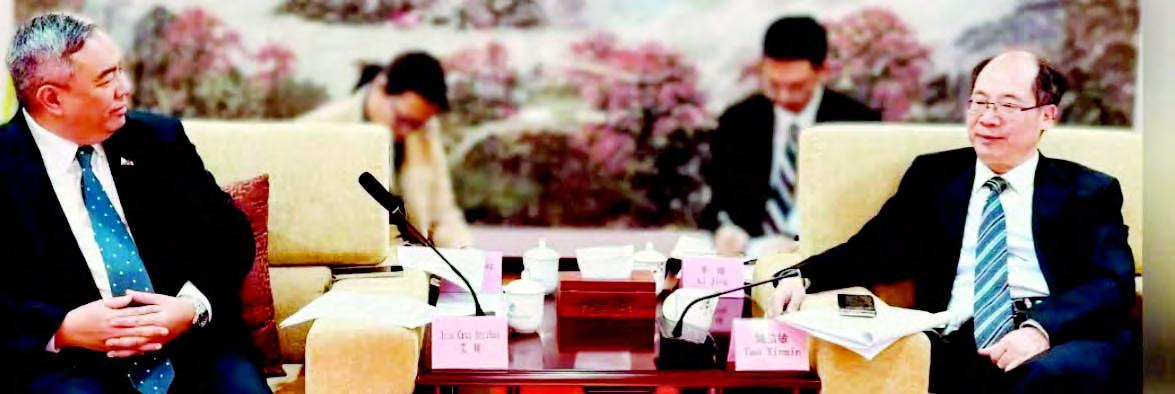
to

and Guangdong
in
and
FFCCCII’S medical mission serves 910 Manila residents
A VOLUNTEER MEDICAL team provided free healthcare services to 910 residents of Barangay 165 and 164 in Manila’s 2nd District on March 8, 2026, as part of a social welfare initiative by the Federation of Filipino-Chinese Chambers of Commerce and Industry Inc. (FFCCCII).
The outreach program, organized by the FFCCCII Social Responsibility Committee, deployed five physicians and 10 dentists to address the primary health needs of the underserved community.
The team treated 700 patients, performed 50 dental extractions and distributed 160 pairs of reading glasses during the day-long clinic.
FFCCCII vice-president William Yap Castro led the delegation alongside social responsibility committee director Hong Zhao Jian, deputy director Xu Huan Dong and office head Yang Xue Qin. The federation officials were joined by local barangay leaders to oversee the distribution of care and supplies. Castro donated Gibi sports shoes from his own manufacturing company to those in attendance. The initiative aimed to expand access to essential health and dental services for community members who often lack professional care. The clinic is part of the FFCCCII’s broader efforts to support social welfare and public health across the Philippines. Julie Ann Lope
THURSDAY, MARCH 26, 2026
lifeandshow.manilastandard@gmail.com
NICKIE WANG, Editor
ANGELICA VILLANUEVA,
JASPER VALDEZ,
Writer
Writer
BTS concert drew 18.4 million viewers on Netflix
THE comeback concert by K-pop megastar
BTS drew an estimated 18.4 million viewers worldwide, streaming giant Netflix said Wednesday.
Netflix said its livestream of the show on Saturday “drew 18.4 million global viewers..., proving the group’s influence has only intensified during their time apart.”
The live broadcast from Seoul’s Gwanghwamun Square reached Netflix’s weekly Top 10 in 80 countries and secured the number one spot in 24 countries, it said. It added that its estimates were derived from so-called first-party data.
The seven-member group took to the stage together for the first time following a yearslong hiatus prompted by mandatory military service.
It drew more than 100,000 fans to central Seoul, according to the group’s label. Fans waved a sea of glowsticks and sang along to the group’s hits, holding their phones aloft to film the performance as giant screens set up across the venue allowed the crowd to watch.
Around 15,000 police officers and security personnel were mobilized for the concert, with barricades lining the roads and nearby venues shut.
The latest album, Arirang , released Friday, is billed as reflecting the maturing boy band’s Korean identity. It sold nearly four million copies on its first day, according to the label.
Following Saturday’s concert, the superstars will embark on their ARIRANG world tour, beginning April 9 in Goyang, South Korea.
The 2026–27 tour spans 82 concerts across 34 cities in Asia, North America, Europe, and Latin America. Tickets for shows in South Korea, North America, and Europe sold out within hours.
Square during its comeback concert, which draws millions of viewers worldwide via Netflix

‘The wait is over’ BTS reunion brings fans back to where they left off
By Angelica Villanueva
“ A NNYEONG , Seoul! We’re back!”
Four words—it just took four words to end those four long years of waiting. These were the opening words of RM, leader of K-pop group BTS, as the septet finally reunited on stage for their comeback concert at Gwanghwamun Square on March 21—an event streamed globally on Netflix. Seeing the concert from a watch party hosted in partnership with PLDT and Manila-based BTS fan club Borahae From Manila, the moment didn’t feel distant. So close yet so far. It felt almost unreal. After years of solo projects, enlistments, and uncertainty, seeing all seven members together again carried a weight that was hard to put into words. It had been nearly four years since BTS last performed as a complete group, when they held a free concert in Busan in 2022 before entering military service. That memory lingered for many fans—a pause that stretched longer than expected. The reunion concert

feels great,” he said. The concert doubled as the launch of BTS’ new album, which Suga described as their most honest yet.
“We worked hard to show a more mature and evolved BTS,” he shared, adding that the group aimed to present a clearer picture of who they have become.
I got that. To be honest, the only time I got to listen to their new songs was at the concert. The only song that stood out to me was “Like Animals.” But when I listened to the whole album and sat with it, I got to understand what they really meant in “Normal.” They wanted us to know what they really feel. They shared what it felt like to have this fame and the things that come with it. That evolution came with uncertainty. j-hope shared that while working on the album, the group questioned whether fans would still be there.
“We’ve had anxieties about whether people would keep waiting for us, or if we’d be forgotten,” he said.

picked up from where they left off—only this time, the anticipation had built into something heavier. It’s kind of funny that they left us, fans, with a free concert and now returned to us again with a free concert.
“Thank you for waiting for us,” j-hope said. People were screaming and cheering behind me, but that line landed quietly and stayed with me for a while.
Across the broadcast, the group acknowledged the time that had passed. RM described the return as “a long journey,” while V admitted that he himself couldn’t believe it was finally happening. I wanted to answer him, Paano pa kaya kami?” Who would’ve thought we’d finally be here?
There was no attempt to overstate the moment. If anything, the members spoke with a kind of restraint, choosing to sit with the reality of being back rather than dramatize it too much.
Jungkook reflected on the pressure that came with the comeback.
“It really has been a long time. I don’t think I’ll ever forget tonight. Honestly, I definitely felt some pressure about the comeback, but being here in front of you all, it
THIS year’s Oscars was, as expected, remarkable for both good and bad. But having been on US soil for the past four Oscars, I am seeing the yearly telecast from quite a different point of view. I’m saying that because I’ve been to the Dolby Theatre and its surroundings a number of times.
When, during the red carpet telecast, the hosts mentioned it was hot, I knew and felt that kind of dry heat myself, in real time.
Of course, I still have not attended an Oscars event in person, and I am not expecting that I would anytime soon, though pardon me, I have added it to my bucket list.
So may I say that from my vantage point navigating Southern California the past few years, talking about the Oscars is personally more exciting than ever.
Here are ten details I believe made the latest Oscars worth remembering.
1. That live meme from the king of the memes: The young man who screamed, “I’m the king of the world!” in Titanic has adapted to the times, and host Conan O’Brien rightfully labeled him as such. Leonardo DiCaprio was certainly game, as he flashed a face showing “that feeling when you didn’t agree to this.” His mustache sold it!
2. Sean Penn making his absence felt: If you’re alive and well to go up on stage to accept an Oscar, no amount of reasoning can excuse being absent. So Kieran Culkin may not have been joking but rather implying the truth when he said that Sean, who won Best Supporting Actor for One Battle After Another , “couldn’t be here this evening or didn’t want to.” It would have been the biggest news if somebody came up to
read a message from Sean himself saying he was not accepting the trophy in protest over something. Well, such a scenario has actually happened before.
3. Michael B. Jordan celebrating at In-NOut: I’m glad the actor did it amid surprised diners at a very Californian fast-food stop, where else but in L.A. It’s a juicier bit than telling everyone he’s the sixth Black actor to win the statuette.
4. Netflix CEO’s presence: Netflix co-CEO Ted Sarandos laughing when Conan joked it was his “first time in a theater” appeared natural. He must have seen it coming.
5. Golden speech cut off: The songwriting team behind the song Golden from KPop Demon Hunters became victims of the play-off music, which they didn’t deserve. But as a blessing
in disguise, that made their triumph more highlighted. I wonder how it would have been if a Hollywood legend had gone up and angrily told the band to let the winners further enjoy their moment.
6. Horror uproar: The horror genre finally scored big at the Oscars. Sinners won four, including Best Original Screenplay; Frankenstein took home three; Kpop Demon Hunters bagged two; and Amy Madigan of Weapons’ fame snatched a Best Supporting Actress award. She was nominated 40 years ago, and her character Aunt Gladys is among the most remarkable in recent memory.
7. Thomas Anderson finally winning: The talented but previously Oscar-less director won three awards (Best Adapted Screenplay, Best Picture, and Best Director) for One


For fans watching the stream, that doubt felt distant from what unfolded on screen. The performance drew fans from across the world attending the event live, with many gathering in homes, cafés, and organized watch parties. Jimin, speaking to the crowd, framed the group’s return in simpler terms.
“As you all know, we’re really not that special or extraordinary. Just like you, we get scared and worried all the time… But despite that, we want to accept those feelings and keep swimming together,” he said. The night didn’t try to resolve everything. It didn’t need to. What it offered instead was presence—the group on stage, complete again, and fans watching from wherever they were.
“ARMY, I’m so happy to be back. All of these moments are thanks to you. BTS 2.0 is just getting started,” j-hope stated. Jin echoed that promise, saying the group would continue to show different sides of themselves and make sure to come see us often. I will take that.
For a comeback that took years to arrive, the concert moved quickly. But some parts lingered—the opening line, the pauses between songs, the quiet acknowledgments of time lost and regained. And for those who waited, those were enough.

Battle After Another. He lost more than 10 times before Sunday. Some notable films he directed in the past include There Will Be Blood, Boogie Nights, Magnolia, and The Master
8. Timothee party: For commenting “no one cares about this anymore,” referring to opera and ballet just a month before, Mr. Chalamet became the night’s butt of the joke. I feel sorry for him, but it’s a lesson that every criticism is subject to public criticism, so think again before you speak. That punchline from Conan about jazz curiously being left out in the controversial comment was solid.


9. Forever host: Conan’s hosting was well received because the jokes were tasteful and he didn’t let partisan politics get in the way. That’s a personal opinion, which I think I share with many others. He also looked classy on stage.
10. Woman standing up: Autumn Durald Arkapaw’s victory in the cinematography category was historic for all the right reasons. She was the first woman cinematographer to win and, even before that, the first woman of color nominated. Not to mention, she is of Filipino descent. That she asked the women in the audience to stand up with her was pure empowerment.
By Nickie Wang
EMAN Bacosa Pacquiao is carving out a name for himself both inside and outside the ring. In a recent interview, the young fighter offered a glimpse into his daily life, his inspirations, and how he balances the pressures of family legacy with personal ambition.

“What’s normal for me? Simple. When I wake up, I pray first. Then I think about what I have to do for the day. If nothing’s pressing, I just relax—read manga or take a walk,” Pacquiao told Manila Standard Life
His favorite manga? “Solo Leveling, and Nano Machine,” he said, revealing the fantasy stories that keep him entertained during downtime.
Since entering the world of showbiz last year, Eman said he feels “super blessed” by the opportunities that have come his way, including meeting new people, getting endorsements, and connecting with artists he admires.
“Of course, they inspire me,” he said in the vernacular, citing Dingdong Dantes and Marian Rivera as examples.
On the influence of his famous father, boxing icon Manny Pacquiao, Eman credits him for qualities he strives to emulate: generosity, understanding, simplicity, and faith.
“That’s where we get our confidence,” he said. “The best advice he gave me? ‘Let God guide you.’ You still decide your path, but it helps to have faith. For my career, focus on what you’re doing, and if you enjoy it, just keep going.”
Despite the attention surrounding
his name, Eman said entering showbiz was never planned.
“It really just happened.
Everything was sudden, pero sobrang thankful talaga ako,” Eman beamed.
Outside the ring, Eman stays disciplined with his routine, combining careful nutrition with regular exercise, especially when preparing for a special project or campaign.
That discipline was on full display when Eman delivered a careerdefining performance, stopping Indonesia’s Reynold Kundimang in the fourth round of their scheduled lightweight bout at Kumong Bolanon XXIV in Tagbilaran City.
From the opening bell, he demonstrated tactical patience, controlling distance with his jab and methodically breaking down his opponent’s defenses. A decisive flurry along the ropes midway through the fourth forced the referee to stop the fight, marking a clear stoppage victory.
While the Pacquiao name carries global recognition, Eman’s performance showed his commitment to preparation, discipline, and ring intelligence. Observers praised his composure and strategic pacing as signs of a young fighter maturing with each bout.
A CHANCE meeting that never happened eventually brought Ian, 27, and Johanna, 24, together—thanks to online dating.
The couple discovered months after matching on Viber Dating that they had actually been at the same pop-up kiosk outside Johanna’s campus a year earlier, only hours apart. “We almost crossed paths without knowing it,” they said.
“It feels like a quiet reminder that sometimes the right people are already moving in the same circles—we just need the right moment and the right platform to truly find each other,” the couple added.
In the wake of the victory, IAM Worldwide formally introduced Eman as its newest brand ambassador, reinforcing the company’s commitment to supporting high-potential athletes at key points in their careers.
“We are proud to grow alongside and be part of the journey of a future boxing champion,” the company said in a statement, adding that Eman embodies “the discipline, humility, and relentless mindset required to succeed at the highest levels.”
As part of his ambassador role, Eman headlines a campaign for IAM Amazing Organic Barley Gummies, with a prominent billboard along EDSA in front of SM Megamall.
The campaign also sees him sharing the screen with longtime idol and fellow IAM ambassador Piolo Pascual, blending mentorship, sport, and entertainment in a narrative of aspiration and achievement.


Ian and Johanna credit online dating for giving them the chance they might otherwise have missed. They offered tips for those looking to turn digital connections into meaningful encounters:

Use multiple, authentic photos.
with a mix of selfies and full-body shots can spark connections based on shared interests, as it did for Ian and Johanna, who both enjoy spending time outdoors. Go beyond typical openers. Ian’s unconventional first message—asking Johanna her top three senators—led to a conversation that revealed shared values. “It helped us see that we could connect beyond small talk,” Johanna said. Commit to consistent communication. The couple emphasized replying promptly and openly to messages, helping to avoid misunderstandings and build trust before meeting in person. Take time to know each other. Ian and Johanna spoke on Viber Dating for weeks before exchanging phone numbers, prioritizing safety while understanding each other’s personalities. Follow your curiosity. Johanna said joining Viber Dating was a simple choice driven by curiosity. “Sometimes it really begins with a simple decision to try,” she said. According to Viber Dating’s 2026 State of Modern Dating report, nearly half of users start chatting within an hour of matching, and many prioritize privacy and the ability to talk before meeting in person. Ian and Johanna’s story reflects how digital platforms can turn what might have been a missed encounter into a lasting relationship.


By Angelica Villanueva
THE Pinoy Big Brother house is closing its doors after 21 years as production prepares to move to a new location for upcoming seasons.
On Tuesday, March 31, TV
Production and Star Magic head Laurenti Dyogi confirmed the news during a farewell gathering with staff, hosts, and executives.
“It’s time. This is the time that we officially say goodbye to the house. We’ve sustained this for 21 years,” Dyogi said.
The property where the house stands has already been sold, prompting production to vacate after securing a temporary lease extension to accommodate recent editions of the show.
“Years back I’ve been seeing the possibility of moving out of
this property. But the collaboration happened with Channel 7, so we found a good reason to keep the house,” he added. Built in 2005, the house was originally intended to last only five years, but it remained in use for over 21 years. It became the setting for multiple seasons that introduced well-known personalities and stories to viewers.
Siyempre sad. We literally built the house in 2005, so talagang nakakalungkot ,” said business unit head Linggit Tan. The reality show’s hosts also reflected on its impact.
“Life-changing house, hindi lang para sa housemates pero para sa mga nasa likod ng kamera ,” said Bianca Gonzalez Dyogi said a new house is being planned, with details to be announced.
THURSDAY, MARCH 26, 2026
lifeandshow.manilastandard@gmail.com
NICKIE WANG, Editor
ANGELICA VILLANUEVA, Writer
JASPER VALDEZ, Writer

MERCK , a global science and technology company, hosted its second She Matters: Women’s Health Summit on March 7 at Conrad Manila, bringing together doctors, healthcare leaders, policymakers, and advocates to address women’s health across all life stages and its broader societal impact.
The summit, themed “Healthy Women, Healthy Economy, Healthy Planet,” highlighted that improving women’s health strengthens families, boosts productivity, and benefits society. “Her health matters, her voice matters, her future matters. And when she thrives, the world thrives with her,” said Martha Paiz, managing director and general manager of Merck Inc.
Discussions focused on cardiometabolic conditions such as hypertension, diabetes, and polycystic ovary syndrome, which increasingly affect younger women and often go undetected until severe complications arise.
Panelists emphasized early screening to prevent disease progression and improve long-term outcomes. Speakers also linked women’s health to economic participation, noting that healthy women contribute fully as professionals, caregivers, leaders, and
innovators.


continues to support a growing
By Nickie Wang
EATING one meal a day, or OMAD, has gained attention as a form of intermittent fasting that limits calorie intake to a single window. It may help with weight loss and has been linked to lower blood sugar, reduced inflammation, and improved heart health markers.
But the approach is not for everyone. Content creator Zeinab Harake said those considering OMAD should first understand the risks cited by nutritionists and medical professionals before committing to such a restrictive pattern.
Zeinab, known for her candid posts, said her decision to try OMAD came from personal struggles with body image.
“I was chubby before, and I had a lot of insecurities,” she told Manila Standard Life in an interview.
She recalled how those insecurities grew when she compared herself with people she appeared with in her vlogs.
“That’s when I started. I carried those insecurities from before. When I was with my vlog friends, they all looked so small. That’s where my insecurities began. I realized I looked bigger next to them. I only came to that realization late, during the pandemic,” she said.
Zeinab said it was also during that period that she developed discipline, which she credits for helping her stay

her daughter, she said she was introduced by Anna Magkawas to Luxe Slim, while maintaining that her weight loss journey relied on effort and consistency.
“I really put in the effort after giving birth. I still eat, I eat,” she said, laughing. She added that she prefers an “organic” approach and avoids injectable weightloss treatments such as peptides or drugs like Ozempic.
“I’m scared of injections. I feel like they have effects. You can see it in a person’s aura. I’ve been around people who take them, and I tell them when it’s enough, especially when
Thyroid disorders, which disproportionately affect women, were highlighted for their subtle symptoms and potential impact on fertility, metabolism, and pregnancy.
Dr. Nemencio Nicodemus Jr. , president of the Philippine College of Physicians, stressed that screening during pregnancy can protect both mother and child.
Dr. Jeremy Robles, past president of the Philippine Thyroid Association, called for recognizing thyroid disease as part of the country’s broader noncommunicable disease strategy to expand screening and treatment access.
The summit also examined environmental exposures, including microplastics and endocrine-disrupting chemicals, and their effects on hormonal, metabolic, and reproductive health.
Dr. Renzo Guinto of the SingHealth DukeNUS Global Health Institute said the health of people and the planet are deeply interconnected.
Dr. Ronald Law of the Philippine Department of Health added that climate-resilient health systems must prioritize women to protect families and future generations.

you see changes in their face. I’m not against it, but personally I’m more comfortable going organic,” she explained.
On her OMAD routine, Harake shared that she usually eats once in the evening.
“Yesterday I ate at 12:30 p.m., but usually it’s around 8 or 9 p.m. I only have coffee when I wake up, then I work the whole day or take care of the kids. If I don’t have work, I’m with the kids. Then I join them for dinner,” she said. She also makes sure to exercise regularly, especially when preparing for a special project or campaign.
Despite the limited eating window, she said her energy levels remain steady.
“My energy is actually okay because I’m working the whole day. I just make sure what I eat is healthy, and I take the right supplements,” she added.
Asked what advice she would give her younger self, Zeinab pointed to one thing.
“Discipline. I didn’t have discipline before. Now I do.”

MARCH is Women’s Month, a time to recognize the contributions of women who inspire, nurture, and lead. For those looking to mark the occasion, there are opportunities to explore wellness, fitness, and lifestyle experiences.
Spa treatments offer a chance to take a midweek break. Forbes Travel Guide Five-Star Nuwa Spa and Nobu Spa at City of Dreams Manila provide discounts on regular treatments from Monday to Thursday, allowing visitors to focus on rest and self-care.
Fitness routines can also be refreshed. Kinetix Lab is offering discounted training packages for performance-based workouts aimed at improving strength and mobility.
For those interested in social sports, Manila Padel Club provides access to court bookings, coaching, and equipment, giving friends a way to stay active together. Jewelry can mark personal milestones or meaningful moments. Esotico Jewelry is offering discounts on plain gold