Southern Accent
'Our goal is to serve': Southern students help Fort Myers locals recover from Hurricane Ian disaster
Carl Bernstein to visit campus
Staff Report WiRE magazine
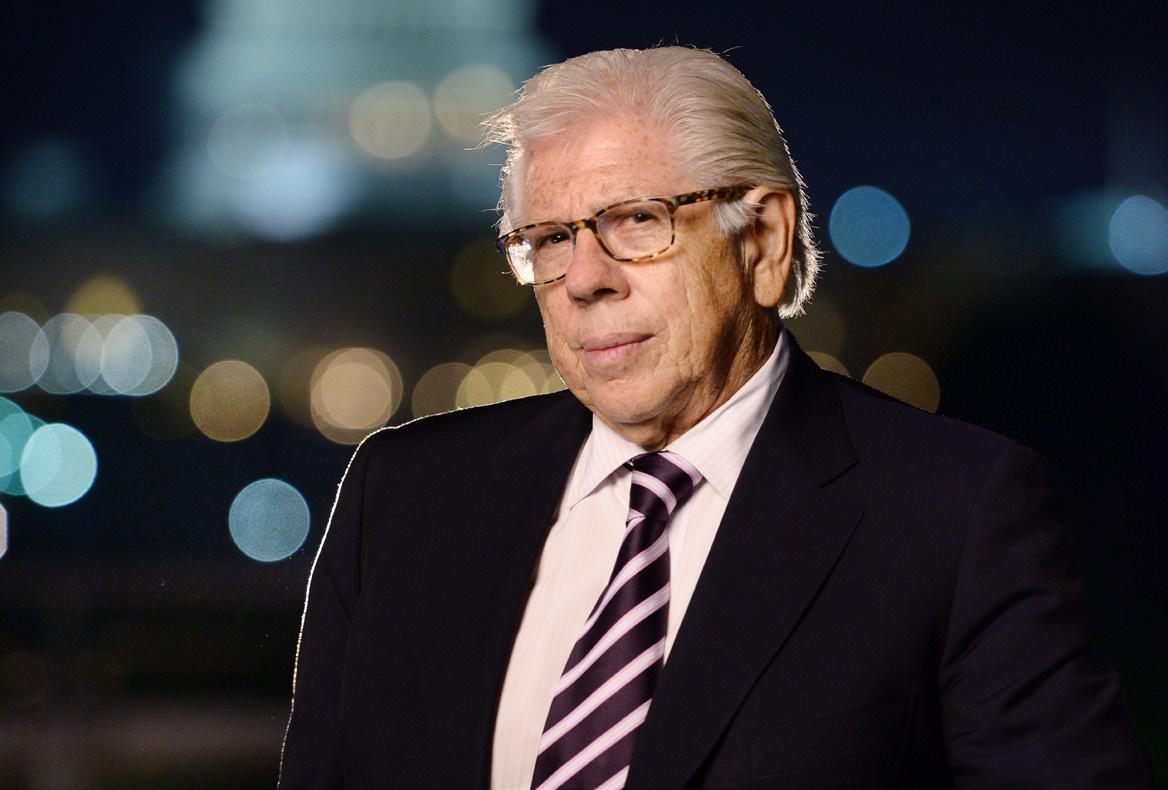
Fifty years have passed since for mer Washington Post reporter Carl Bernstein uncovered the Watergate scandal along with his colleague Bob Woodward, setting the stan dard for investigative journalism. Yet, he remains a powerful voice in the American political arena, as a renowned author, cable news com mentator and public speaker.
On Dec. 1, the legendary journal ist will bring his wealth of experi ence to Southern Adventist Univer sity as the inaugural speaker for a new lecture series launched by the School of Journalism and Commu nication (SJC). He will speak on the topic: “Why Truth Still Matters.”
Alison Lebovitz, host of the local PBS show, “The A-List with Alison Lebovitz,” will serve as moderator.
Amanda Blake Managing Editor
Southern Adventist University dispatched two disaster relief teams to Fort Myers, Florida, after Hurricane Ian struck the Gulf Coast on Wednesday, Sept. 28. The teams, consisting of students and staff, were sent in two trips: the first taking place Oct. 9 to 12 and the second Oct. 12 to 16.
According to an NBC News article, Ian made landfall near Cayo Costa, an island just west of Fort Myers. The article described Ian, which hit Florida as a category 4 storm, as one of the most powerful hurricanes to touch down in the United States in decades. More than two mil lion buildings lost power.
The first Southern service group ran points of distri bution (POD) for locals, and the second group worked on debris removal, or “muck-outs,”
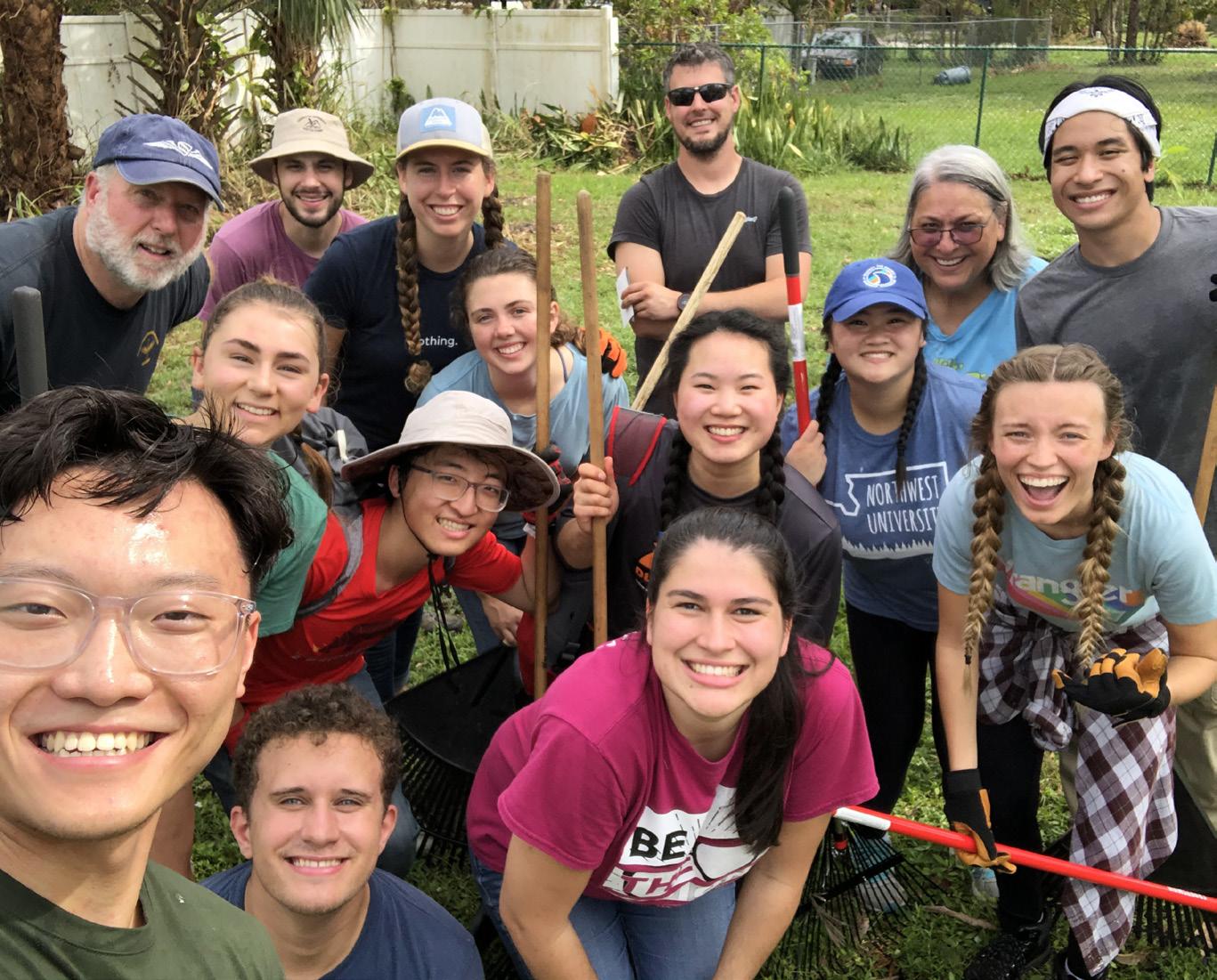
according to information pro vided by Laura Racovita, dean of the School of Social Work, and Cheryl Craven, director of Humanitarian Engagement and Christian Service, in an email to the Accent. PODs are places where hurricane victims can get food and water.
In the email, Racovita and Cra ven explained that the teams’ mission also included social and spiritual goals.
“We [helped out] out wherever needed, whether [it was] debris removal, helping distribute essen tials at Points of Distribution, [or] talking and praying with and for those who are hurting in these dif ficult moments,” the email stated.
“Our goal is to serve, provide a helping hand, lend an ear, pray and then invite people to learn more about our Savior.”
Racovita, who helps lead Southern’s disaster response
team, began the process of preparing the trips by submit ting a proposal to the univer sity’s administration, the email said. The school’s deans and chairs followed administra tion’s approval by giving their unanimous support. After set ting academic qualifications for interested students, such as one completed semester at Southern, the team began pro cessing applications. Nearly 80 individuals expressed interest, and 55 applied, which was more than could be accommodated, according to the email.
Craven and Racovita wrote that more students were interested in and applied for the Hurricane Ian relief trips than for the trips aiding victims of hurricanes Harvey (2017), Florence (2018) and Michael (2018). In response to Michael, 52 students applied and 13
An animator's journey from Disney to Southern Jorge Pontarelli Staff Writer
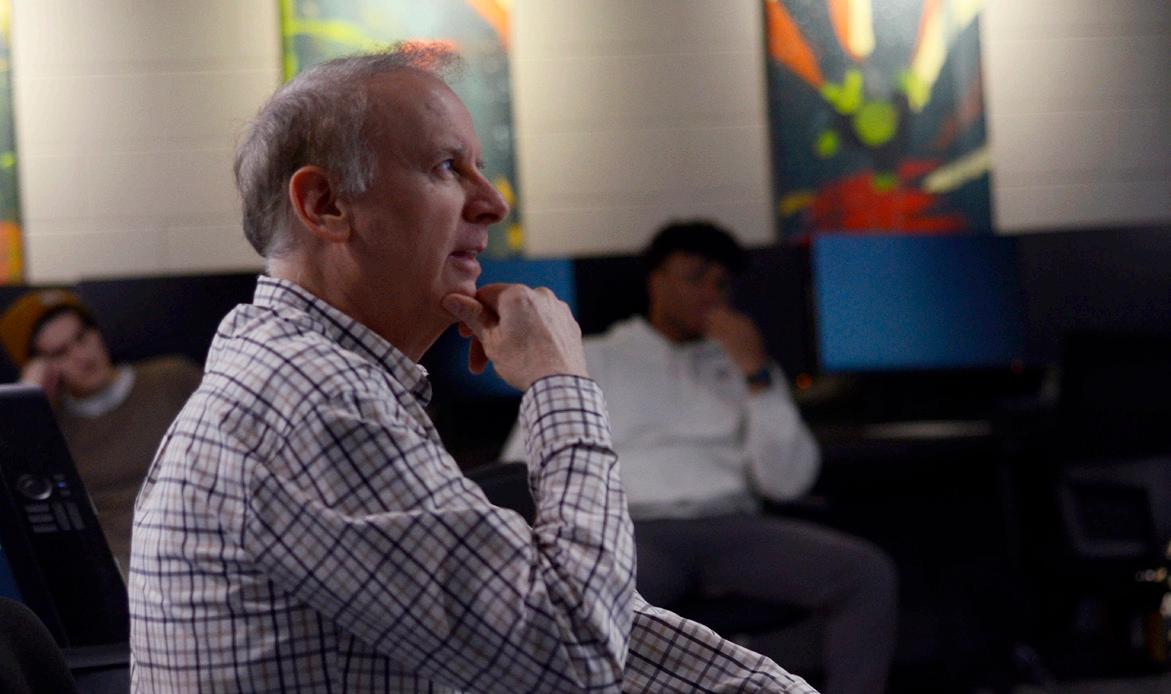
Professor Hendel Butoy realized he wanted to be an animator when he was just 12 years old.
“I’ve always liked drawing because I watched animations on television,” he said. “I enjoyed it because I felt like it was taking me to a different place, a different world. I think the reason for that is because growing up in a Chris tian home, I also was taught and believed the biblical stories I was told, which also took me into differ ent worlds, true worlds.”
Butoy believed he could com bine those two ideas of spiritual messages and great art forms. Growing up, he would play with his father’s camera and create stick figure films. He drew photos in his school books so that when he flipped through the pages, tiny ani mations would appear.
For a high school project, Butoy made a film that he now describes as “very crude and not much.” Yet, one of his teachers thought oth erwise and took it to a film festi val where Butoy met a fellow Sev enth-day Adventist who was going to California Institute of the Arts (CalArts), a school founded by Walt Disney that teaches animation.
“If you are passionate about what you are doing, and you are actively creating and doing things, connec tions begin to happen,” Butoy said. With the recommendation of the individual who saw his film, Butoy decided to go to CalArts.
“One of the prayers I had when I was entering this school was, ‘Lord, I don’t know if this is where you want me to go. However, I have a passion in my heart I believe is coming from you, so I’m going to keep going down this path until You
close the door,’” he said.
At the time, CalArts was one of the few universities teaching ani mation, Butoy said. He further explained that he enrolled in the school in the late 1970s in the third year of the program’s existence.
Butoy said Disney’s vision for the institute was all of the programs — music, theater, film, fine arts and animation — working together to create things.
“Disney wished that [the] music school would make music for the animation school, and the fine arts school would do conceptual artwork for the film school, but it never turned out that way,” he said.
Even though Butoy enjoyed learning and creating animations, he had a hard time at CalArts.
“I struggled with every single thing,” he said. “Every single class that I had was a struggle; nothing came easy. But I sat there, and I did it. I said, ‘The only way I’m going to do this is if I sit here and put in the time and do it.’”
Since the animation program at CalArts was being taught by Dis ney veterans, that was the school where the company would send their scouts looking for the next
generation of animators, according to Butoy. He explained that at the time, CalArts was the only school teaching character-specific anima tion in Disney’s style, so if a student graduated with a well-done portfolio, they were almost guaranteed a job.
Before he could graduate, how ever, Disney pulled several CalArts students, including Butoy, out of school to begin training at its stu dio. He began working at the com pany in 1979, and he took on all the roles that an artist can go through as an animator, he said.
He started as an inbetweener; an artist who draws frames between the extremes of an action; followed by an assistant; then an animator; a supervising animator; a directing animator and finally, the director.
“I never asked for anything while I was there. I didn’t ask for a pro motion; I didn’t ask for how I could have this or that job. I just did the best that I could with what I had because I was just happy to be doing what I was doing,” he said.
“Some animators would prefer to have this type of shot or that type of shot, and I didn’t care. I’ll take any thing that I’m given because I know
were deployed within a group of 22 individuals.
In response to Ian, 15 stu dents and two sponsors were deployed on the first trip, and 24 students, two sponsors and one staff driver were deployed on the second, Racovita speci fied in a later email.
The driver was Christina Donesky, international student services coordinator, who drove 14 hours straight, both ways.
The Accent interviewed Done sky during the trip.
“I am glad to help and be a part of it so that students can have the opportunity to serve,” she said. “I think it’s really important that staff show a good model of why service is important.”
Donesky added that she enjoyed connecting with stu
The SJC created the R. Lynn Sauls Lecture Series in honor of former SJC dean Lynn Sauls, who guided the school through unprecedented expansion and development from 1989 to the mid-1990s. Under Sauls’ leadership, the SJC established a permanent home in Brock Hall, pri oritized the importance of writing in the curriculum and developed a network connecting students with journalism and communication pro fessionals.
SJC Dean Rachel Williams-Smith said the lecture series will be an annual event featuring prominent speakers in the fields of journalism and communication. This year, she is excited about bringing Bernstein to campus.
“I am thrilled that Mr. Bernstein accepted our invitation to come,” she said. “We can learn much from history. And, on Dec. 1, we will have history standing before us. Further more, his topic is very timely and
Southern theology students encouraged to marry for ministry
Hannah Johnson Staff Writer
Over the years, Southern Adven tist University has been called “Southern Matrimonial College,” often by those specifically referring to the School of Religion.
In a recent interview with the Accent, Ilcias Vargas said that, as a junior theology major, he has been told that marriage is expected when pursuing a ministerial career.
“From time-to-time, professors will bring it up in class: ‘You are here on campus — [with] a lot of Chris tian women. Might as well take advantage of the opportunity,’” he said. “And I think it is legitimate to have that type of expectation.”
Vargas added that theology professors, conference leaders and other students sometimes put pressure on theology majors to pursue marriage. When inter viewed by the Accent, numerous theology students said they feel pressure to marry because many believe having a spouse will bring work benefits.
Southern Theology Professor Stephan Bauer said it is possible to become ordained without saying “I do.” He added, however, that pasto ral jobs in specific locations can be more accessible if the applicant is married.
“If there was pressure, the pres sure would be more, ‘Go to sem inary; we want you to come out married’ as the unwritten prefer ence,” Bauer said. “The joke was you were sent to seminary not so much for your MDV (Master of Divinity) but for your MRS.”
This expectation has existed for many years and not just at South
ern. Peter Flores, an alumnus of Walla Walla University, has also expe rienced this pressure while studying theology at that university. Flores is now currently attending the semi nary program at Andrews University.
“The pressure didn’t come from a specific person,” Flores said. “It is just implied that if I were to get mar ried, I would have better job oppor tunities in the field, and it pressured me to be in a relationship I didn’t want to be in at the time.”
Bauer said conferences will often send single pastors to churches that are less prejudiced against the idea of having an unmarried pastor.
Vargas said the question of whether or not the applicant is married or seeking a relationship is sometimes brought up during the interviewing process.
"It is just implied that if I were married, I would have better job opportunities."
Flores added, “There’s a certain pressure for any guy to get mar ried, but I don’t think that stems from the theology department itself. I think that stems more from the employment possibilities out side.”
Bauer said conferences in the Southern Union have adapted to the thought of employing more single pastors and have become more accepting of them, especially in comparison to a few decades ago. Vargas said, “While there are ben
The student voice since 1926 October 26, 2022 Collegedale, Tennessee Vol. 78 Issue 7 The connection between science fiction and religion Lifestyle | 7 Mindfulness: Living in the here and now Mental Health | 5 Zoos: An ethical dilemma or indispensable resource Opinion | 6 Letter to the editor: What to do with resentment? Religion | 6
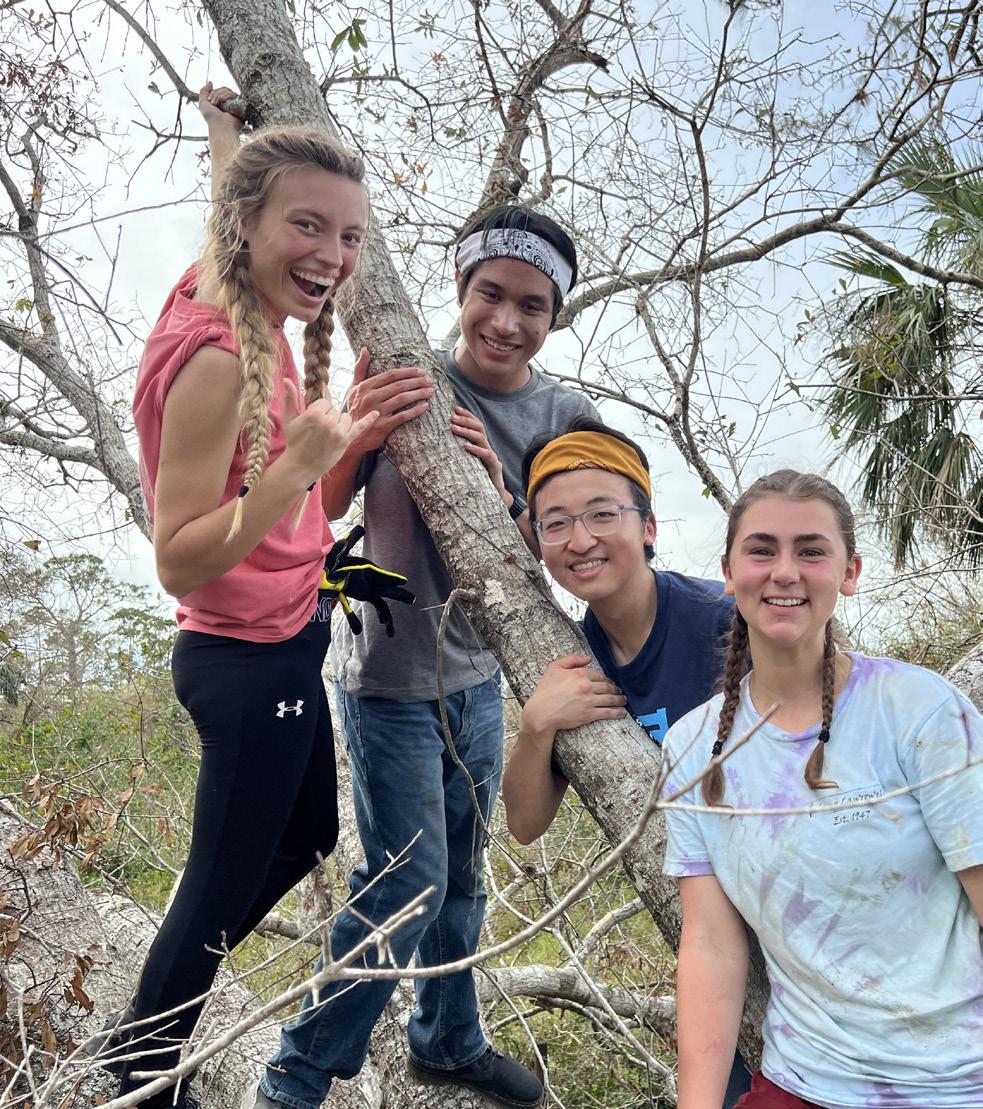
(Left) Students Heather Morris, Tristan Deschamps, Joshua Kim and Natalie Marden stand atop a fallen tree.
(Right) Part of the group takes a selfie with one of the hurricane victims they assisted. (Photos courtesy of Elsie Pak)
See CARL BERNSTEIN on
page 3 See THEOLOGY on page 2See ANIMATOR'S JOURNEY on page 2
See DISASTER RELIEF on page 2
Professor Hendel Butoy reflects with students in his senior portfolio class. Thursday, October 20, 2022 (Photo by: Adam de Lisser)
If
HURRICANE RELIEF continued from page 1
dents she would not normally be able to spend time with on cam pus. April West, a junior health science major who accompa nied Donesky on the second trip, agreed, stating in an inter view that hanging out with her fellow students was one of the best parts of her experience.
West originally had fall break plans set in motion, which would have occurred during the second trip, but couldn’t escape the call to serve after she saw the schoolwide email asking for volunteers.
“[The email] kept bothering me in the back of my mind,” she said, “so I decided to pray about it. I asked God for a spe cific sign if He wanted me to go on this mission trip or not, and He answered. … He gave me the sign that I needed, and so that’s why I’m here now.”
West said debris removal was physically tough. Joshua Kim, senior chemistry major, further described the work, explaining that the group raked debris and
cut branches when needed.
“The best moment was prob ably when we cut down a really big tree branch yesterday that was just over this creek,” he said. “The guy in charge said, ‘Nah, it’s too big. You can’t do it.’ But we did it anyway.”
When asked if any aspects of the experience were different from her expectations, West said she was surprised by the gratitude displayed by the locals they helped.
“A lot of them were moved to tears, and I didn’t think we were making that much of an impact,” she said. “ … I realized afterwards this was something that was really stressing them out because their homes were partially ruined from the hur ricane, and us just coming and helping out for a few hours made such a big impact on their lives.”
Collegedale Editor Elsie Pak con tributed to this story.
ANIMATOR'S JOURNEY continued from
I’ll learn from it. And I think because I was willing to do anything and do the best that I could at it, I was given more responsibility.”
The first animated film that Butoy worked on at Disney was “The Fox and the Hound.”
“I got to do inbetweens on the lit tle fox character, and then I also got to animate some shots with him,” Butoy said. “They gave me the sad shots where the fox is always sad and left out in the woods, and it starts raining on him.”
Butoy added that when he drew these shots with sad faces, he would feel the sadness of the character.
“I had to think of ways to keep myself cheerful because you have to get into the mindset of the char acters when you animate them,” he said. “You’ve got to think like they do; you’ve got to feel like they do.”
Butoy also worked on “Oliver & Company,” “The Great Mouse Detective,” “The Black Cauldron” and “The Emperor’s New Groove.” He co-directed “The Rescuers Down Under” and “Fantasia 2000.” As a Christian working in a secular envi
of the time and effort put into this class. We urge you to realize that a class with such a high percent age of withdrawals and low grades has failed to make students’ learn ing and well-being a priority and reflects poorly on the chemistry department as well as the institu tion as a whole.”
ronment, Butoy’s co-workers would ask questions about his beliefs, he said. And through his answers, he was able to share his faith with them.
“They would notice my lifestyle was different — the things that I ate, the way I carried myself and the fact that I wouldn’t hang out with them on Saturday,” he said. “They didn’t feel like that was strange. They just felt like, ‘Ok, that’s what you believe,’ and they were fine with that. They supported it. But they did ask ques tions like, ‘Why do you believe these things?” So I was able to witness to them in some ways.
When asked why he decided to leave Disney, Butoy answered, “The same reason I got in. I was praying and asking that God would lead me, and one day, I got a call from Southern. They wanted to start an animation program, and they didn’t have a professor that was both a professional animator and a Sev enth-day Adventist. And, somehow, they found me.”
The dean of Southern’s School of Visual Art and Design at the time invited him over to present a lecture to the students.
“When I did that, he asked me if I could do more,” said Butoy.
without the proper preparation.
Butoy prayed, asking God if Southern was where He wanted him to be. He sensed it was time for him to leave Disney and begin to teach others what he had learned. Butoy helped put the anima tion curriculum together, and has been teaching students the subject for 19 years.
“We’ve had lots of graduates who’ve left here and gotten into the industry,” he said. “We [have] peo ple at Disney, we [have] a gradu ate at Pixar and we have people at Sony … Nickelodeon, too. [At] every major studio, we’ve got a graduate that’s gotten there.
After almost two decades of teaching here at Southern, Butoy hopes for students to find what they are passionate about, and he encourages them to allow God to lead them.
“You have to have a love for the thing that you are wanting to do,” Butoy advised. “Be willing to work hard on it. Don’t give up when it gets tough, and keep praying and asking for God to lead you down this path. Because if He’s with you, you’ll be content wherever it is that He leads you.”
efits for people in the ministry to be married and have someone by their side for emotional support, provid ing advice for family and even relat ing to certain people in the church, I don’t see it as a requirement based on biblical standards."

Bauer provided texts within Timo thy and Titus that discuss whether one has to be married to become a pastor or an elder. I Timothy 3 and Titus 1 go over the qualifications of an elder, with one of the qualifica tions being a husband of one wife.
“I believe that the husband of one wife is indicating that he should be a model of sexual morality, not that he should be married,” Bauer said. “People who don’t read the text carefully, with that depth, will interpret that text [to mean] that the pastor should be married.”
Exploring 'Living Memoirs'
Alana Crosby Editor-in-Chief
McKee Library will host “Living Memoirs,” an event created to help unite people from Southern Adven tist University’s campus and the surrounding community through personal stories.

The event, scheduled for Nov. 9 from 2 to 8 p.m., will feature staff and faculty who have volunteered to sit down with participants and speak one-on-one about their unique life experiences, according to Bethany Howard, public services librarian at McKee Library. Students and community members can sign up on the library’s website for a one-
Southern Accent
The Accent encourages readers to write articles and voice their opinions. However, the views expressed do not necessarily reflect the opinions of the Accent, Southern Adventist University or the Seventh-day Adventist Church.
For any questions, comments and article submission information, email the editor at acrosby@southern.edu
For all advertising inquiries, email studentadmgr@southern.edu.
Grades dropping
Kathy Zelidon Reporter
The New York Times recently published an article about how Maitland Jones Jr., an experimen tal chemist with a long resume of experience in teaching chemis try, was fired from the prestigious New York University (NYU). A group of students who had been in his organic chemistry course com plained to the university that Jones’ teaching methods and resources were not enough for them to suc ceed.
An excerpt from the petition reads, “We are very concerned about our scores, and find that they are not an accurate reflection
hour block of time, in which they will speak to four different people.
According to Howard, “Living Memoirs” will take place on the main level of the library. Participants will meet with volunteers in study rooms where they can share snacks and conversation. Howard encour ages participants to come prepared with appropriate questions.
In an interview with the Accent, Howard said the event is meant to promote and celebrate the unique diversity in the area.
“You can have a personal inter action with somebody who has a really unique life experience and ask them all those questions that you might have had throughout your life,” Howard said. “A lot of times we have a hard time under standing where other people are coming from, and this is an oppor tunity for us to sit one-on-one with somebody who has a unique life
The article continues to explain that COVID-19 may have been a factor in the students’ bad perfor mance in the class. Professors from NYU’s chemistry department stated that due to the pandemic, many students experienced learning loss and were coming to the university without the knowledge of how to properly study.
Could this be happening at Southern Adventist University?
According to Chris Hansen, director of Institutional Research at Southern, the amount of F’s and students dropping out of classes have been slowly rising over the last five years. Hansen told the Accent that while the amount of F’s and W’s did noticeably rise in the year 2020, this does not nec essarily indicate poor perfor mance among students.
Some professors in South ern’s biology and chemistry departments told the Accent they have seen some differ ences in the students that have entered post-COVID.
In an interview with the Accent, Brent Hamstra, chair of the Chemis try Department, expressed concern about the fact that some students are coming into science classes
experience. Maybe it's one that's similar to ours, and we want to find camaraderie with them. Or maybe it's something very dif ferent that we didn't understand before and want to learn more about, and we just want to sit down and be like, ‘Hey, what is it like really to experience this?’”
The list of unique experiences to be shared by the volunteers includes miscarriage and infer tility, post abortion, being a marathon runner, having an international communication career and being a missionary during the Rwanda genocide.
Faith Ann Laughlin, profes sor in the School of Education and Psychology, is sharing her experience as a first-genera tion college graduate and the challenges that come with hav ing Attention Deficit/Hyperactivity Disorder (ADHD) as a student.

Social Media Manager
Estep
“Certainly at some high schools over the past few years, just to kind of survive, things may not have been quite as rigorous. And, again, based on what I've seen, the col lege standards haven't changed,” he said. “If the high school stan dards are getting lower, and the col lege standards are getting higher, the gap is bigger; there's more of an adjustment.”
Hamstra teaches general chem istry one and two, classes usually taken by freshmen and sopho mores who are going into the med ical field. He told the Accent that incoming class grades are fairly consistent but a little bit below what the previous years’ were. He noted that while the average of home work grades rose from a 78% aver age in the Winter 2022 semester to an 87% this fall semester so far, the average for quizzes and tests has stayed around the same.
Students themselves see the change in their studying styles since having Zoom classes compared to attending classes in person. In an email interview with the Accent, Amanda Leitao, a sophomore predent biology major, stated that online classes and being in quar antine affected her time manage ment.
“During my senior year of high school, I got a bit lazier after spend ing a whole year indoors and hav ing Zoom classes every day,” she wrote. “I was more comfortable with procrastinating. I still got everything done, but I added this
Laughlin, known as “Mama Faith” to students who have worked closely with her, said she hopes to share coping mechanisms and advice for students who are in sim ilar situations. According to Laugh lin, she will offer tips to “navigate the waters of ADHD” and provide how-to advice for students who are expected to make decisions and deal with paperwork alone.
In an email to the Accent, Laugh lin wrote about the importance of events that foster conversations.
“I believe they want a physi cal person to talk to face-to-face,” Laughlin wrote. “There are far too few conversations in this day of instant text messages.”
Howard hopes the event will help break down stereotypes, garner a sense of camaraderie in the com munity and show participants they are supported.
“We hope that the students find
Sports Editor
unnecessary stress to my putting things off until later.”
Noemi Gonzalez, biology pro fessor, told the Accent that her classes have been fairly consistent over the past few years. In 2020, the department worked tirelessly to make sure that the rigor of the classes was unaffected by the pan demic, she said. Now, after a couple of years of online and hybrid learn ing, Gonzalez has observed that incoming students do require more support coming back into a physi cal classroom. Nevertheless, the department is still doing all it can to help them adjust.
“Students, especially freshmen, needed a little bit more hand hold ing help, just because their last few years of high school were given in a very unusual method,” she said. “It takes a bit more patience, a bit more assistance, but it's just part of what we do here. We want them to succeed and rise up to the chal lenge of becoming scientists or allied health professionals.”
Editor-in-Chief Alana Crosby
Managing Editor
Amanda Blake
News Editor
Orquia Collegedale News Editor
Pak
Lifestyle Editor
Cannon
Editor
Quiles
Photo Editor
Nevis Copy Editors
Layout Designers
Web Manager
that it's a way to meet with fac ulty and staff members and get to know them a little bit better,” she said. “ … [We want to] try to spread awareness, break down stigmas [and] help people to meet together in a community sense.”
Circulation Manager
Reporters
NEWS
you would like to be a contributor, contact Alana Crosby at acrosby@southern.edu2 | Wednesday, October 26, 2022
Matthew
Elsie
Jacob
Sarah
Klingbeil
Stefanie
Green
Anton
Kannenberg
Hannah
Mortenson
Nickolas
Nieves
Anna
Christina
Opinion
Xavier
Adam
De Lisser
Religion
Editor Madison Wilcox
Norelie
Cabrera
Génesis Ventura
Charlene
Arnold
Kathy
Zelidon
Photographers
Preston
Waters
Ron
Cabacungan Mila Bales
Staff Sponsor Alva James-Johnson
page 1
THEOLOGY continued from page 1
Student struggling with school (Photo sourced from Pexels)
Living Memoirs (Photo courtesy of Howard)
Newly married couple (Photo sourced from Pexels)
Comparing area churches
Amanda Blake Managing Editor Charlene Arnold Reporter
Editors Note: This article is part two of a two-part series.
Chattanooga First Church 7450 Standifer Gap Road, Chat tanooga, Tennessee, 37421
Senior Pastor Rusty Williams wrote in an email to the Accent that Chattanooga First has a dynamic young adult Sabbath School at 9:30 a.m. The church’s website lists Saturday service times at 8:30 and 10:45 a.m.
Williams said traditional worship services are offered with practical messages that focus on real prob lems, point to Jesus and are “deliv ered in a style where you would feel comfortable inviting guests.”
Williams wrote in a closing state ment to Southern students, “We pray that God would bless you in your studies, guide you in all your choices, and may your relationship with God grow into a testimony for years to come. And by the way, our potlucks are on [the] fourth Sab bath of the month.”
Orchard Park SDA Church 951 N. Orchard Knob Ave., Chattanooga, Tennessee, 37406
In an interview with the Accent, Senior Pastor Troy Brand said Orchard Park offers a contemporary, urban worship experience and multiple oppor
CARL BERNSTEIN continued from page 1
should be especially meaningful to all who have been taught the value of searching out and treasuring truth.”
Bernstein, a native of Wash ington, D.C., began his journal ism career at age 16 as a copyboy for the Washington Evening Star, according to his professional bio. In addition to uncovering the Water gate scandal, which led to the resignation of President Richard Nixon, Bernstein has written books.
A Pulitzer Prize-winning journal ist, Bernstein co-wrote “All the Pres ident’s Men,” a book that became the basis for a film with the same
tunities to engage in communi ty-oriented service.
It holds two prayer meetings on Wednesdays, one in person at noon and the other virtually at 7 p.m. On Saturdays, it has a hybrid young adult Sabbath School class, meaning it is both in person and virtual, at 10:30 a.m. and a worship service at 11:45 a.m. Every second Sabbath is “Compassion Sabbath,” a day when members go into the community to conduct service proj ects and ministries.
Brand, who also serves as an adjunct professor at Southern, said several Southern employees attend the church, and the congregation also has a close relationship with Southern’s Christian Service Depart ment. Theology students who need an external internship can do one under Brand’s supervision.
“Because we are traditionally an African American church, it may appear that we are not a part of the Southern community, but we are very much a part of it,” Brand said. “ … We are open to everyone coming: black, white, Hispanic, Asian — doesn’t matter. Everybody’s welcome.”
Crosswalk Chattanooga 6401 Lee Highway, Chatta nooga, Tennessee, 37421
Crosswalk involves students in various activities, according to Leadership Team Chair Brooks Prueh, and the church also offers community outreach opportuni ties. Prueh specifically mentioned the Food Bank.
The church conducts two identi cal Saturday services, one at 10:30 a.m. and the other at 12 p.m. Cross
title, chronicling Woodward’s and Bernstein’s coverage of the Water gate scandal. Bernstein’s most recent book, published in 2022, is a memoir, titled “Chasing History: A Kid in the Newsroom.”
“It’s not every day that you get to meet and listen to a living leg end,” Williams-Smith said. “So, it is my hope that this will prove to be a memorable occasion for Southern’s students and members of the sur rounding community.”
This article was originally published in WiRE magazine.
walk’s website describes the wor ship experience it offers as “fullbody” and “sensory” and explains there is no dress code.
“The language that I would use to describe our worship is we make every effort for it to be dis traction-free,” he said. “We try to bring a level of professionalism not because we want to be a concert. … [We want] to provide an atmo sphere where people can actu ally just kind of get caught up in it and let the Holy Spirit move in their hearts.”
Prueh said the busiest time at Crosswalk is between its two services, when people engage with each other in the lobby. The church’s unofficial motto is: “Come early, stay late, love well.”
McDonald Road SDA Church (MRC) 5440 McDonald Rd., McDonald, Tennessee, 37363
Southern alumnus J.C. Brown, formerly involved in ministry at McDonald Road SDA Church, shared his thoughts on the church.
“McDonald Road SDA Church, particularly through its Sabbath School programs, provides a safe place for students to come together to search for God, to ask questions, express doubts, be vulnerable and have fun,” Brown said.
The church’s website lists the Sat urday service times as 9 and 11:30 a.m, and Sabbath School begins at 10:15 a.m. In an email to the Accent, Office Assistant Meagan Grundy wrote that Senior Pastor Fred Fuller has a history of working with youth and young adults.
“We are looking for colle giate-aged individuals to help with special music and other ministries,” Grundy wrote in a message to stu dents. “Please come and introduce yourself to Pastor Fuller when you visit.”
High Point Chinese SDA Church 3450 Camp Road, Ooltewah, Tennessee, 37363
In an interview with the Accent, Pastor Dennis Li said High Point has a multicultural, family atmosphere where students can find belonging and a place to actively participate in various ministries, including church leadership, youth ministries, music and sports. High Point was started by students, he added, and cur rently involves a large number of young people.
The church conducts prayer meetings, online and in-person Bible studies, regular Saturday ser vices and small groups, some of which are led by students. Accord ing to its Facebook, High Point has an English Saturday service from 9:30 to 11:30 a.m. followed by Sab bath School from 11:30 a.m. to 12:30 p.m.
“We welcome [students] as brothers and sisters. They will feel accepted here and feel like this is their home, their family,” Li said.
Li mentioned two upcoming church events. “Glow in the Dark” is an outreach event to take place on Oct. 31 during which participants will pass out glow tracks and inter act with community members. On Dec. 3, the church will host a cul tural night and banquet.
Hamilton Community Church (HCC) 7997 Shallowford Road, Chat tanooga, Tennessee 37421
In an email to the Accent, Asso ciate Pastor Keith Bowman wrote that Hamilton Community Church (HCC) involves students in service no matter their interests or skill lev els.
“We plug students into learning cameras, lighting, directing, Pro Presenter, running sound, stage set-up, stage hands, playing music, singing, helping in classrooms or children's church, basically any thing a college student wants to do,” he wrote.
He added that the church regu larly runs community service proj ects, such as its community meals on Tuesday evenings.
Bowman said HCC started with a mission to help connect people to Jesus and offered the first contem porary worship service in the local area. The church stood out because of its percussion, electric guitars, lights, smoke machines and cof fee. And, although other nearby churches eventually adopted some of those elements, Hamilton remains a place that is welcoming and a bit different, according to Bowman.
Akuna Soap Industry takes students to Germany
Naomi Linder Staff Writer
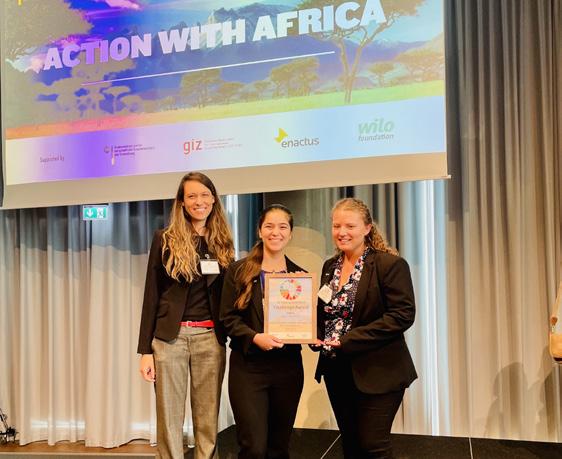
Students Adonna Andino, junior accounting major, and Ashley Blake, senior accounting major, col laborated with Enactus teams from all over the world while participat ing in the international “Action with Africa” Enactus challenge.
The students traveled to Bonn, Germany, on Sept. 26, with South ern Adventist University’s Enactus Sponsor Michelle Doucoumes, to attend the challenge’s main event. After presenting one of Southern’s Enactus chapter’s project, “Akuna Soap Industry,” to a panel of judges, the team placed seventh overall in the challenge, earning 8,000 euros in project funding. Andino is the cur rent Akuna project manager, and Blake is a former Southern Enactus president who served as an on-site project manager and missionary in Zambia last school year.
In 2020, Joshua Draget, who was a Southern student at that time, served as a missionary at River side Farms in Zambia, according to Doucoumes, an associate busi ness professor at Southern. While there, he realized there was a need for healthy, natural soap in the area, and he could do something about it. Riverside Farms produced
soybeans, a primary ingredient in soap, and Draget began to exper iment creating soaps until eventu ally the Enactus team at Southern picked up the project in January of 2021, Doucoumes said.
Since then, the small soap-mak ing business – now called “Akuna Soap Industry” – has grown, provid ing jobs and soap for many locals.
“Basically, we employ loc als to do the manufacturing, so we’re providing jobs for them. And then, we also employ local women and youth to sell it,” Doucoumes explained. “We wholesale the soap to the women and youth so they can basically start their own busi nesses … so it provides them a liv ing.”
Southern’s Enactus members have dedicated much of their time and efforts to this project since the start, leading to continual expan sion in an effort to help as many people as possible.
“We just this summer finished building our new factory, which is really cool,” said Doucoumes. “We have the capacity now to produce up to 12,800 bars of soap every day … and our team here raised the money for that last year. We raised $145,000 for this factory.”
All these efforts and their out comes were shared last April with
the Enactus international organi zation when Southern’s chapter decided to enter the “Action with Africa'' challenge. According to Doucoumes, a total of 210 teams registered for the challenge. And, because Akuna placed within the top eight projects, Southern’s chap ter was granted the opportunity to represent the industry in Germany for the finals. Southern was the only university in the United States to place in the top eight, and the group’s trip expenses were paid for by Enactus, said Doucoumes.
The money won by the group will go toward purchasing a reliable energy source for the newly built factory in Zambia, as “the power grid in Zambia is unreliable,” said Doucoumes. With the project’s recent developments, Doucoumes said the industry is also planning to export and sell Akuna products in the U.S.
"Come
Mckee Foods Family Health Center and Pharmacy coming to the area soon
 Charlene Arnold Staff Writer
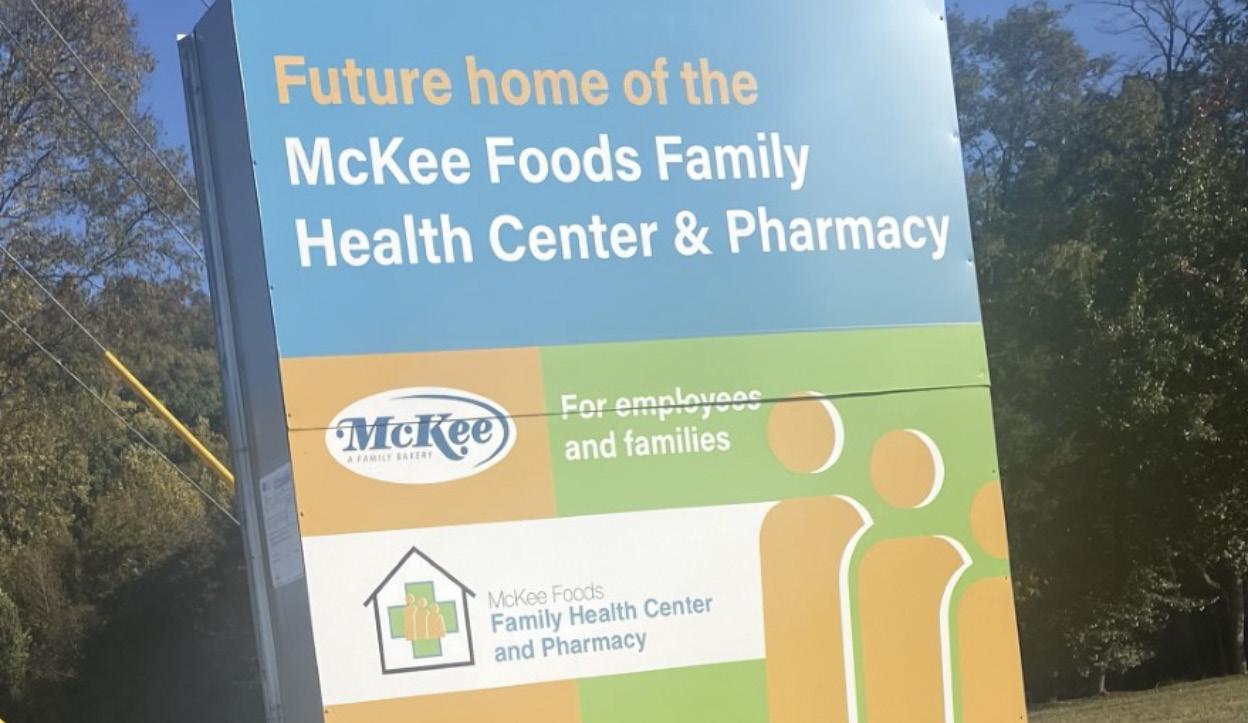
A new McKee Family Health Cen ter and Pharmacy, located at 9526 Apison Pike, is set to open on Mon day, Dec. 5, according to McKee Foods Communications and Public Relations Manager Mike Gloekler.
“Our hope is to provide a conve nient single-stop resource for [our] employees and their families to get the day-to-day health and pharmacy care [as] needed,” Gloekler said.
The existing McKee Foods health clinic will move to this new property, and the new center will introduce a pharmacy sevice, Gloekler explained.
In an email to the Accent, Gloekler shared that the property originally belonged to McKee Foods and was sold to SunTrust Bank years ago.
The property was repurchased by McKee when SunTrust and BB&T merged, closed and moved to its existing location in Ooltewah.
“The existing health clinic, though owned by McKee Foods, is operated by a third-party con
tractor, Premise Health. Daily functions, the hiring process and specifics concerning eco-friendly habits of the pharmacy will con tinue to be managed by Premise Health,” the email stated.
According to Gloekler, the phar
macy is not open to the general pub lic. It will be for McKee employees and their families who are a part of the health plan offered by the com pany, as well as retirees of McKee.
He explained that the com pany believes the pharmacy will
be beneficial and convenient for employees and plans for there to be some cost savings to [the] health plan by providing a phar macy resource directly to them.
The pharmacy’s proximity is consistent with the company's
desire to promote wellness for its employees.
“This location will offer addi tional over-the-counter health and wellness products, including the ability to order durable medical equipment (DME) such as mobility equipment,” said Gloekler.
According to the McKee Foods website, the company has long practiced environ ment-friendly actions for eco nomic and ecological reasons.
“We are also pleased to be able to repurpose an existing building, and we hope it will be viewed as a community asset,” Gloekler wrote concerning how this new estab lishment aligns with the company's eco-friendly conscientiousness.
“I think this also shows our con tinued willingness to invest in Col legedale, just as we are with the expansion of the Apison Plant,” wrote Gloekler. “As a large manu facturing employer, we desire to be an asset to Collegedale and greater Hamilton County.”
NEWS COLLEGEDALE NEWS For more related news, visit our website at southern-accent.org3 | Wednesday, October 26, 2022
Mckee Foods hopes to provide a nearby day-to-day pharmacy for employees and their families. Thursday, October 20, 2022 (Photo by: Charlene Arnold)
Carl Bernstein (Photo provided by source)
Doucoumes, Andino and Blake (Photo courtesy of Doucoumes)
"We welcome [stu dents] as brothers and sisters. They will feel accepted here and feel like this is their home."
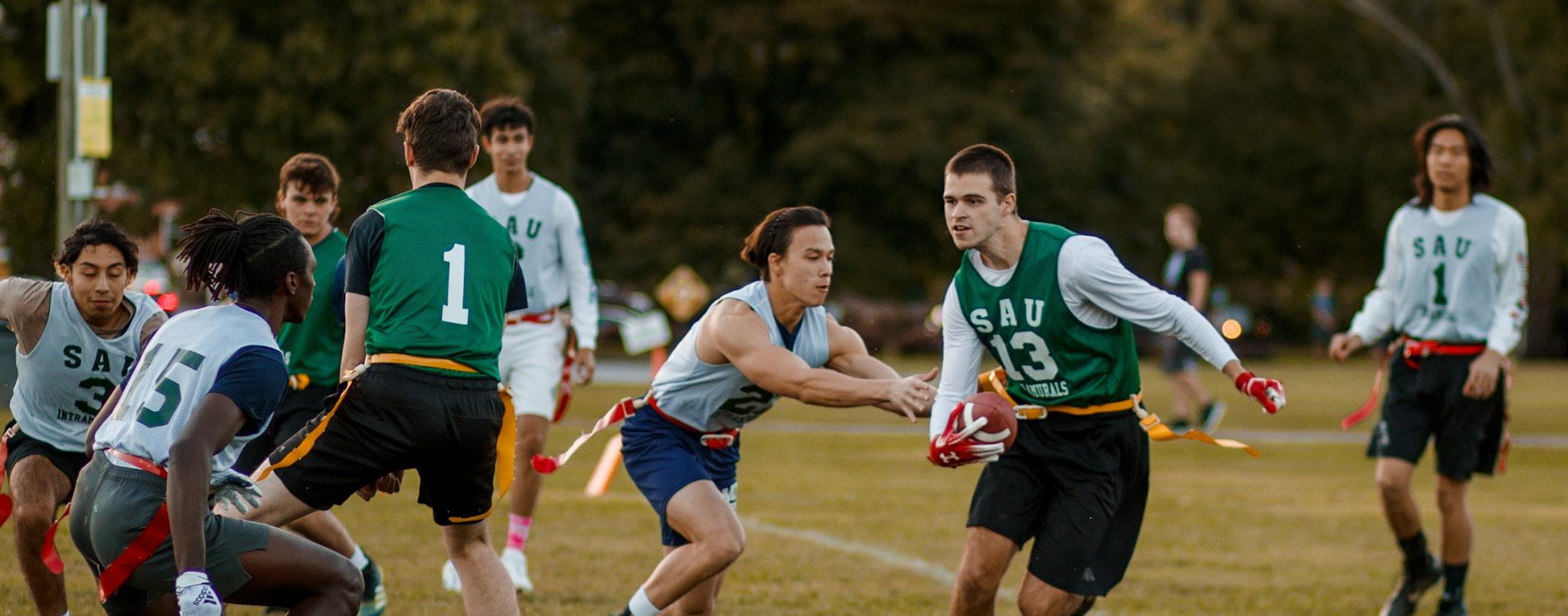
Flag Football



If you would like to be a contributor, contact Alana Crosby at acrosby@southern.edu NEWS 4 | Wednesday, October 26, 2022
Sydney Park (#5) pitches during a running play to Kailee Bilbao on the field.
Tuesday, September 27, 2022 (Photo by: Ronnell Cabacungan)
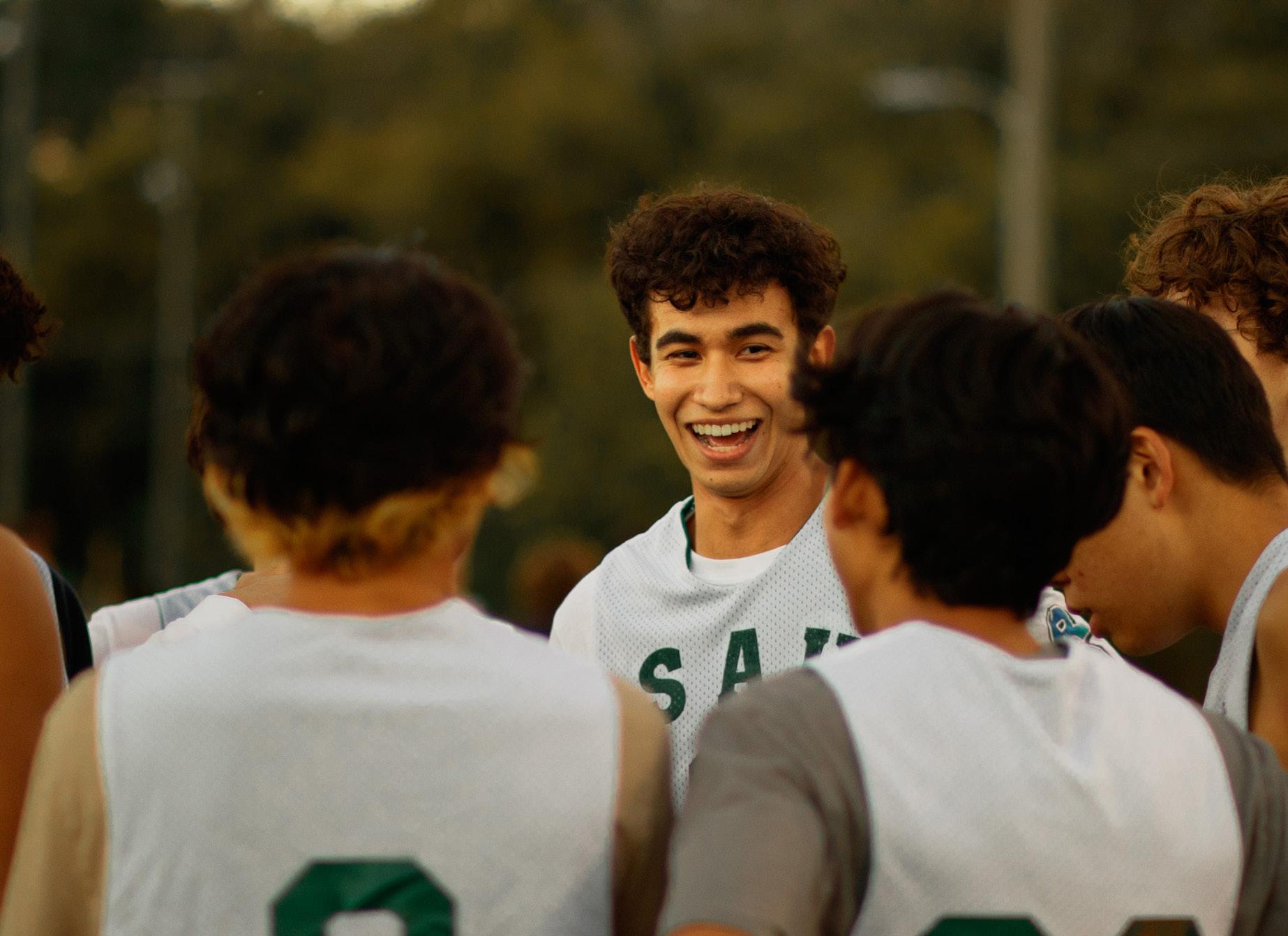
Caleb Washington in team huddle. Tuesday, September 27, 2022
(Photo by: Ronnell Cabacungan)
Ben Shull runs the ball through the field past Ethan Stephens. Wednesday, September 28, 2022
(Photo by: Ronnell Cabacungan)
Thatcher Catchers’ wide receiver, Ethan Johnson, catches a long shot and runs it home to the end zone.
Tuesday, September 27, 2022 (Photo by: Ronnell Cabacungan)
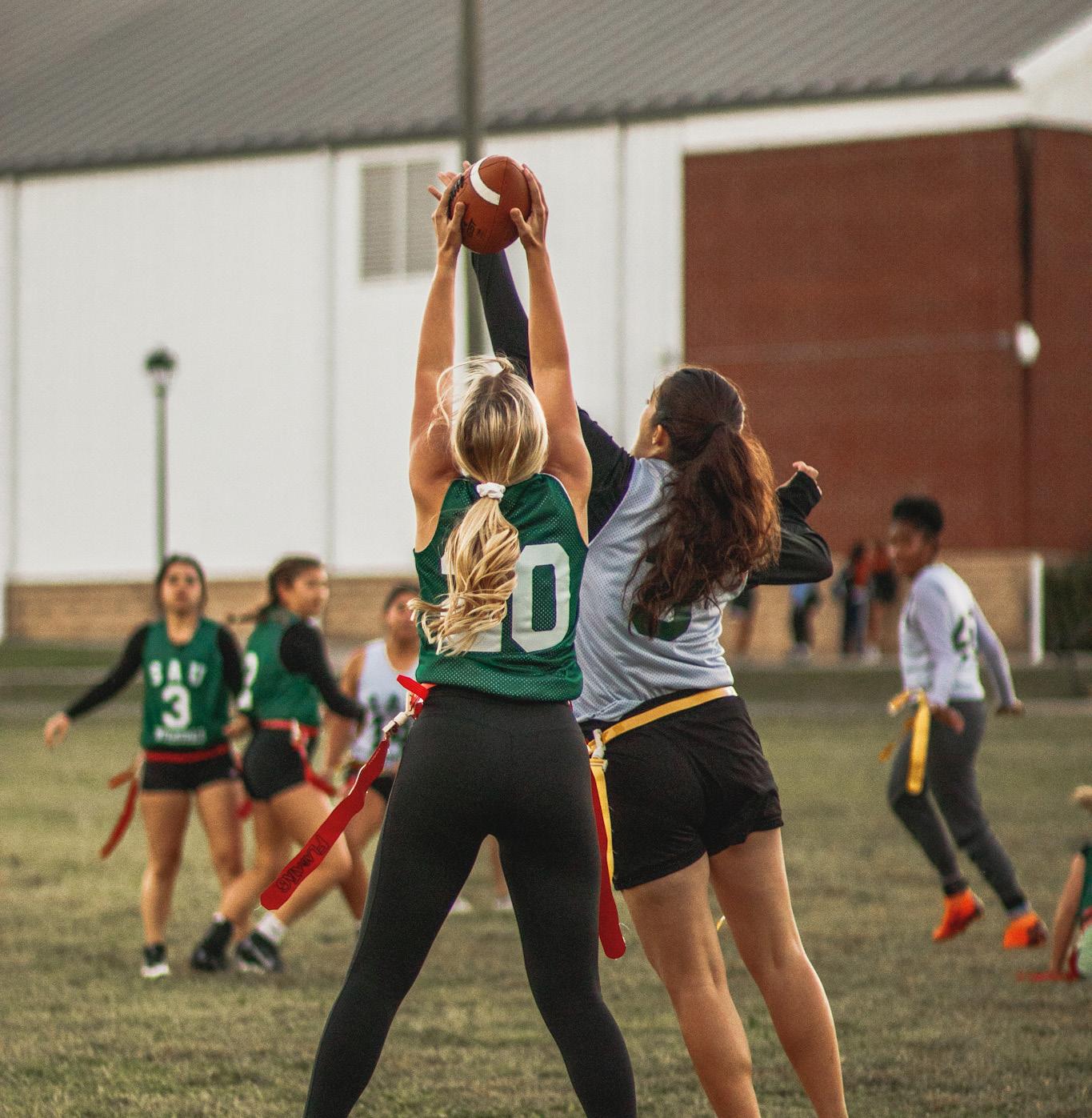
Brock Anderson (#22) flies high for a crazy catch during Thursday’s afternoon game.
Friday, September 29, 2022 (Photo by Ronnell Cabacungan)
Emma Macomb performs an amazing catch during Wednesday's night game.
Wednesday,
September
28,
2022
(Photo
by: Ronnell Cabacungan)
MENTAL HEALTH
The meaning of mindfulness: Living in the here and now
Brandon Grentz Counselor
Have you ever started to read a book and minutes later snapped back into reality to re alize you didn’t remember what you just read? Maybe you were so distracted or busy that you didn’t notice a friend’s haircut or that they planted new flow ers around the Southern foun tain.
If you keep up with topics on mental health, you’ve probably noticed the word “mindfulness” is trending lately. Let’s dive into what mindfulness really is.

A new study conducted at Queens University in Kingston, Canada, found that people, on av
erage, have over 6,000 thoughts a day. Many thoughts that we have are about the past or the future. They may occur when you are studying for an upcoming exam or doing homework trying to re call what you’ve learned that day.
However, the only thing we can really exert change on is the pres ent. The present is indeed linked to our past and also has major im plications for our future. But if we are too focused on anything but the present, we can miss a lot of the important time we have now.
Mindfulness, simply put, is grounding ourselves in the here and now.
Mindfulness is making sure we are experiencing things as they happen, rather than being too stuck in our minds
or drifting our attention away from where we are. For exam ple, how many times do you check your phone in a day? We often do it out of habit or
Mindfulness, sim ply put, is ground ing ourselves in the here and now.
turn to it when things get too quiet or uncomfortable. You look at your phone often, but if I ask you what the top right icon is on your home screen would you remember? We can do a lot of things mindlessly. We must be intentional about being present in the present moment.

In 2 Corinthians 3:18, Paul writes “By beholding we be come changed.” What we turn our attention and focus to has great implications for our thoughts, feelings and behav iors. If we are constantly re gretting things of the past, it can turn into depression. If we are constantly anticipating the future or the next bad thing that could happen, it can turn into anxiety.
Focusing on the present and being mindful grounds us to more of what we can control in stead of things we cannot. As Christians, we can also bring God into our present to focus on how He is working in us and through us.
So next time you are dis
tracted in class, look around the classroom and notice things you maybe take for granted or fail to see, hear or feel. Take a walk, and don’t let your mind wander, but instead be mindful of the path you are walking on, the trees and flowers around you and the expressions on people’s faces as you walk by them.
Listen to a song and actually think about the words being sung; read a book and visualize the scene or subject. Instead of being distracted and doing things mindlessly, make sure to fill your day with mindfulness, live in the present moment and take advantage of the time you have right now.
(Photo by: Lesly Juarez)
Real-world problems: Cancer survivors and awareness
Jacob Nevis Sports Editor
Since 2009, the NFL and American Cancer Society have teamed up every October to help bring awareness to cancer. The campaign, “Crucial Catch: Intercept Cancer,” has helped bring light to viewers of the NFL. While sometimes it may seem that athletes are super human, they struggle with the same real-world problems that everyday people do.
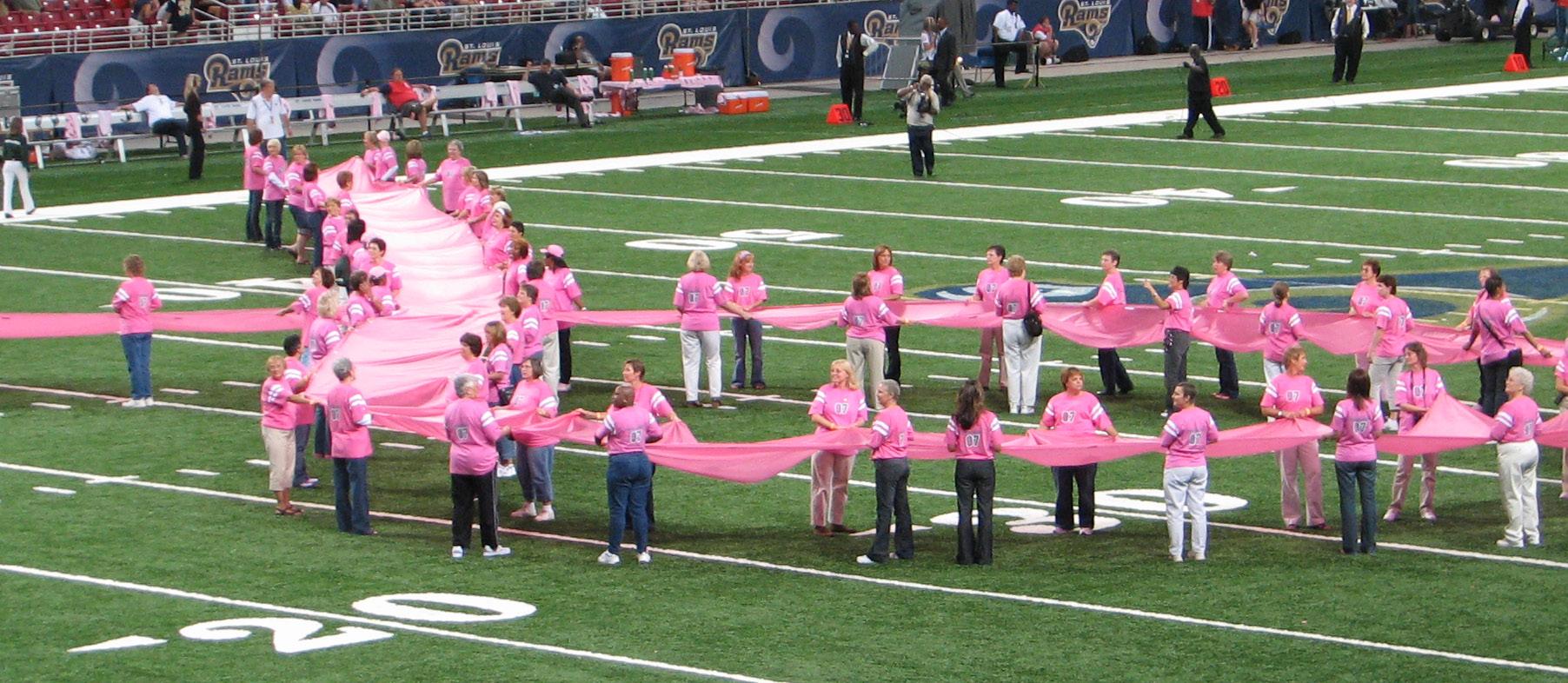
Some current NFL players have dealt with cancer. Trent Williams, an all-pro offen sive tackle for the San Francis
co 49ers discovered in 2019, while playing for the Washing ton Redskins (Commanders now), that he had a growth on his brain. He had the growth re moved and then had to sit out the entirety of the 2019 season.
The following year, Williams was able to get traded to San Fran cisco where he has continued to be one of the best offensive linemen in the whole league.
John Metchi III was drafted by the Houston Texans in this year’s draft in the second round.
The rookie out of Alabama was
diagnosed with leukemia in July and has been unable to play professional football since then. He has said that he will return to the football field when the time is right.
Eric Berry, former safety for the Kansas City Chiefs, discov ered a mass growing on his chest in the 2014 season. He was later diagnosed with Hod gkin’s lymphoma and was told he probably wasn’t going to be able to return to the football field. The next season, Berry would defy the odds and return
to football, winning Comeback Player of the Year in 2015.
Athletes from other sports have dealt with cancer and returned to the field as well. In the baseball arena, Trey Mancini, right fielder for the Houston Astros, was diag nosed with stage 3 colon can cer in 2020. Mancini received treatment and returned in time for the start of the 2021 season.
These athletes help show people that it is possible to beat cancer and all hope isn’t lost.
Editor’s note: This topic is very important to me because of the impact it has had on my life. My dad is a cancer survi vor who beat brain cancer. My uncle was diagnosed with a rare adrenal cancer that has been hard for him to fight. It’s very important to bring light to this issue because it affects a lot of people, and there is still no cure for cancer. It’s im portant to get screened and be able to detect cancer early.
Editor’s note: The following article is written in partnership with Counseling Services and the Southern Accent.
(Photo sourced from: Wikipidea) For more related news, visit our website at accent-southern.org5 | Wednesday, October 26, 2022
SPORTS
Alana Crosby Editor-In-Chief
I have always been an ani mal lover, and I have pleasant memories of going to the zoo with friends and family. How ever, on a recent outing with my local Pathfinder group to Zoo Knoxville, I began noticing a disturbing pattern. The edg es of animal enclosures were worn down as a result of caged animals listlessly pacing. I start ed researching the well-being of animals in captivity and was saddened and shocked by what I found.
In 2014, at a zoo in Copenha gen, Denmark, a young male giraffe named Marius was coaxed to the middle of his pen with a piece of bread and shot in the head with a Winchester rifle. He was later dissected in front of a group of children as part of an event called “Animals Inside Out.” Marius was not the only animal dissected in front of a live audience. The event also featured a young lion which had been euthanized earlier and frozen for the event. Marius’ killing spurred a media frenzy and raised questions about the ethical standards of zoos everywhere.

According to a 2021 article in The New York Times by Emma Marris, an environ mental writer and author of the book “Wild Souls: Freedom and Flourishing in the Non-hu man World,” most zoos very quietly take part in “culling,” a process in which surplus ani mals are killed. This is often a result of overbreeding, also a common practice at zoos. Baby animals attract visitors, and vis itors bring in money. But baby animals grow up and aren’t as cute or lucrative anymore, and
the housing and financial bur den increases. A 2017 article in The New Yorker, titled “Killing Animals at the Zoo,” reports that out of 33 zoos asked about their culling process, 79% eu thanized animals, and 45% ad mitted that the culled animals were healthy.
Last Chance for Animals, a nonprofit organization, states that, “While zoos claim to pro vide conservation, education, and entertainment, their pri mary goal is to sustain public support in order to increase profits.”
Another appalling issue pres ent in zoos is the mental health of animals. According to In De fense of Animals, zoochosis is a common symptom of captivity and refers to agitated behavior such as pacing, hair pulling, ag gressiveness, rocking, bar bit ing, self-mutilation and more.
Animals are known to experi ence depression and boredom from lack of stimulation. Marris writes that zoos often deal with this by administering psycho active drugs like Prosac and Celexa. According to The New York Times article, captive ele phants endure agonizing zoo chosis in their small pens, un able to cover the 50-mile range that elephants in the wild travel daily.
I understand that some zoos are focused on conservation.
However, the evidence of un ethical and questionable prac tices at zoos is overwhelming.
The question is, “What can be done about it?”
Marris suggests that animals who are not in danger of ex tinction be released into sanc tuaries and refuges, where “fa
RELIGION
cilities are really arranged for the animals, not for people.”
I would have to seriously contemplate my decision to re turn to a zoo since discovering these disturbing facts. I cannot look into an enclosure and be lieve that the sentient beings inside these glorified cages are truly content. It is time to stop the exploitation of animals for entertainment. Although our intentions may be innocent, there is a strong chance that we are prolonging the animals’ suffering by supporting these institutions.
Stefanie Green Copy Editor
The first zoo I ever visited as a child was the Atlanta zoo. I remember telling my mom that when I got older, I would buy the season pass so I could stay there and watch the animals for as long as I wanted.
Since then, I’ve become more educated about animal rights and the plight of wild animals in captivity. My heart breaks when I see a bear or a goril la pacing back and forth in a small enclosure. But, I believe that zoos offer an incredible educational experience, can aid in conservation awareness and, when operated appropriately, can be humane.
Zoos allow you to see ani mals from all over the world in one place. Without zoos, you would have to fly to China to see pandas, India to see tigers and Kenya to see elephants. Of course, that wouldn’t be pos sible for most, so your only exposure to these magnificent creatures would be through photographs. There is some thing so special about seeing wild animals in person: watch ing them feed, observing the movements and sounds they make and noticing how they in teract with one another. These experiences are possible be cause zoos exist.
Reading facts about each species at the exhibits and lis tening to the animal caretak ers talk can cause visitors to be more aware of the natural world around them and be come educated on the urgent issues facing many species in their natural homes. With rela tively affordable entrance fees, people of any financial status can step into this other-world
ly experience. People who wouldn’t be able to afford an international vacation in order to see foreign species in their natural habitat are able to see and learn about those animals close to home.
According to the Associa tion of Zoos and Aquariums, educational programs with in zoos have trained more than 400,000 teachers with award-winning science curric ula. Furthermore, a nationwide study by AZA found that “visits to zoos and aquariums prompt individuals to reconsider their role in environmental problems and see themselves as part of the solution.”
Another benefit of zoos is their participation in wildlife re habilitation. According to AZA, at least nine species have been saved from extinction through the breeding and reintroduc tion programs of accredited zoos, and there are currently 117 of these programs.
In conclusion, I believe that as humans we should be mind ful of the impact that we have towards living things, ensuring that zoos are not a place where animals suffer but where they thrive and can be rehabilitated and preserved. I believe that this balance is possible.
Letter to the editor: What to do with resentment?
Madison Wilcox Religion Editor
Dear Editor:
I’m a preacher’s kid (PK). What do you do when you hold an ger in your heart against your parents but still want to respect and honor them like God wants you to? How can you let it go while still acknowledging the wrongs? Have I really forgiven them yet if I still remember?
Dear PK:
First of all, thank you for your honesty. I’ve had similar ques tions myself about how to deal with feelings of resentment, how to acknowledge wrong without fixating on it and how to move on from pain without trivializing it. I appreciate that you’re asking the hard ques tions.
I know I have a lot more to learn in this area, but here are a few things I’ve come to under stand.
First, I want to encourage you that it isn’t wrong to acknowl edge when someone has sinned against you. It isn’t wrong to grieve it. In fact, I think it would be wrong to let it pass by, over look it or push it under the rug.
Sin doesn’t just disappear; it goes places inside of us, and it destroys as it goes. If we neglect it inside ourselves, it spreads to others. To not choose confron tation — both with the person who has wronged us and with the emotional repercussions of that wrong in our own hearts — is to treat the hurt dishonest ly, as if it is harmless, inconse quential. It’s not.
But what would confront ing sin look like? Here’s what it doesn’t look like. It doesn’t look like savoring the wrong like a lozenge, turning it around and
around in your heart, exploring its depths again and again, until the hurt sours and grows and becomes as destructive as the wrong that prompted it. This would only deepen the pain, spreading its consequences fur ther into your life and the lives of others.

Instead, confronting the sin may look like hard conversa tions, both vertically (with God) and horizontally (with the peo ple who have hurt you). It might
look like letting someone back into your heart, talking about hard things with them that you’ve never voiced but always noticed. Or it might look like telling someone “no” for the first time and setting up new boundaries. It depends on the specifics of your situation.
But confrontation isn’t the last step. After the acknowledge ment of wrong done and hurt received, you must make the choice to ask or to not ask God
the simple questions: “What is your command for me here? What do you want for me in this place?” As difficult a situation as it may be, God does have a plan for you there, a next step in mind.
I don’t know what that step may be in your situation, but I do know that God doesn’t de mand that your life return to normal, that you forget the hurt done to you or even that you ignore the pain of present hurt,
but that you allow Him to make you something in it, something beautiful. His intention is that in this place, you learn to let God command you, to submit to His gentle teaching and to embrace forgiveness. That is God’s inten tion for you, and He is incredibly good at working with difficult situations, suffering people and throbbing hearts.
I’ll be thinking and praying for you as you continue on this journey.
If you would like to be a contributor, contact Alana Crosby at acrosby@southern.edu6 | Wednesday, October 26, 2022
OPINION
(Image sourced from: Flickr)
“I believe that zoos offer an incredible educational experience.”
The problem with zoos: An ethical dilemma Zoos: An indespensable resource for education
Road in a forest. (Photo
by: Joshua Welch)
LIFESTYLE: Arts & Ideas
Exploring the connection between science fiction and religion
“But it’s a human trait that when we encounter personal problems, these things most deeply personal are the most difficult to bring out for our logic to scan. We tend to floun der around, blaming every thing but the actual, deep-seat ed thing that’s really chewing on us.”

Frank Herbert, Dune
Many great works of science fiction draw from the well of historical Christian practices. In Isaac Asimov’s classic novel series, “Foundation,” a triune
godhead, made up of Dawn, Day and Dusk, is the epicenter of a number of theological and institutional links to Christian tradition.
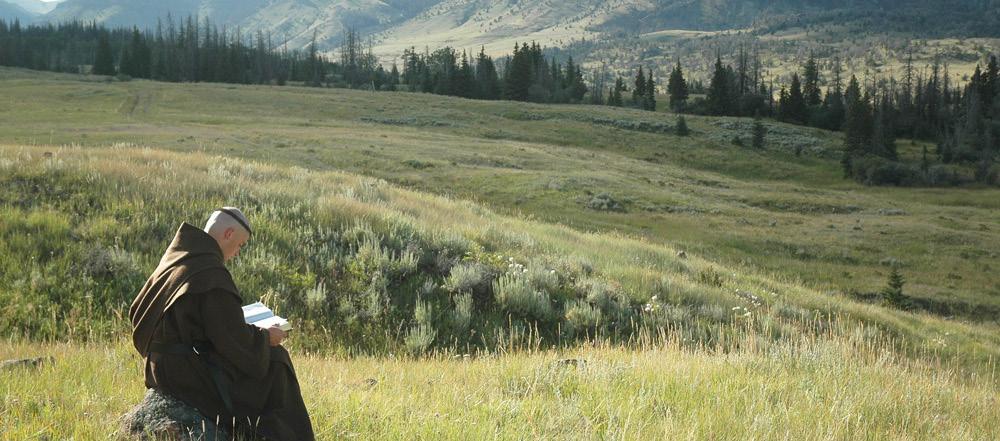
“Dune’s” priesthood and di vine-ruler structure clearly echoes the social and political system of medieval western Christendom, blending in an Islamic “jihad” concept and He brew prophetic tradition. There are obvious parallels between “Star Wars’” Jedi and Irish Chris tian monastics, from the stone beehive habitations to the icon ic brown habits.
But it is not primarily how fictional works reflect our re ligious heritage that enable them to help shape and deep en our faith.
Fiction seeps into our imagi nations in a way that didactic instruction can’t. It allows us to move freely through other cul tures, dive into other religions and live through relationships we would not likely form in our own world. It helps us gain insight into despair and the deeply human practices of joy and humility. We become more human by living through the humanity of others.
In his “An Experiment in Crit icism,” C. S. Lewis noted “Lit erary experience heals the wound, without undermining the privilege, of individuality.
… In reading great literature I become a thousand men and yet remain myself. … Here, as in worship, in love, in moral action, and in knowing, I tran scend myself; and am never more myself than when I do.”
Kathleen A. Melhern is a pro fessor who teaches Christian formation and church histo ry at Denver Seminary. In her article “Is Reading Fiction a

Waste of Time?” she explained that she has started assigning works of fiction in the courses she teaches.
“We who belong to the church, who have cognitively accepted the Unseen Reality … also suf fer from constricted imagina tions,” she wrote in her article. “The disenchantment we have all undergone as products of the modern world has critically stunted our spiritual develop ment, our knowledge of our selves, our hopes and dreams for God in the world.”
Kevin
Kevin Southern Accent Mascot
Dear Kevin: I have a friend who constantly gossips. How do I kindly shut it down?
Dear Concerned Confidante: Great question. Ducks love to “spill the tea” as the kids say. What has your friend been say ing?
Just kidding. Gossip is a com mon problem that can come in many seemingly innocent shapes and forms. If you are talking in a negative way about someone behind their back — even if what you are saying is true — that is gossip. Here are a few short phrases to shut it down:
“I have too much to improve in myself to judge (insert name).” This lets the gossiper know that you are not interest ed in tearing someone down when we all have room for im provement.
“Why are you telling me this?” There is rarely a good reason for the spread of gos sip, and gossipers will likely not have an answer for this.
Say something positive. Re direct the conversation by lifting it to a more intellectual level. If
that doesn’t work, try confront ing the rumor.
Remember, if someone feels the need to tear down another person through gossip, they may be going through a tough time themselves. Be kind and treat others how you want to be treated.
Dear Kevin: My best friend’s boyfriend keeps trying to flirt with me. What should I do?

Dear Flabbergasted Friend:
In the duck community we have a saying for that (unintel ligible squawks). Here’s what you should do. Confront him directly about his unacceptable behavior. Tell him clearly and firmly that it is inappropriate and needs to stop immediately.

If he does not stop, it is time to involve your best friend. Keep in mind that love is blind. Your friend may not be able to see her boyfriend’s problematic behavior and may even blame you. All you can do is lay out the facts respectfully and give your friend some space to work through the issue.
For more related news, visit our website at southern-accent.org7 | Wednesday, October 26, 2022
Christina Cannon Lifestyle Editor
Monk Praying at New Mount Caramal (Photo sourced from: Wikipidea)
#SAUlife Congratulations @am.eliagrace, you found Kevin last week! Your prize is waiting for you in the Student Development office. For a chance to be featured, use or tag @sauaccent on Instagram in your posts! Dear
SOCIAL
stephamu_29
Falling for fall ma_al_ca_pi ~fall vibes~
Stephany Muñoz
Alejandra CamachoS A
c_h_i_d_i
pose for the daily collage
daubin117
There’s
an upside being roommates with a guy who can take pictures.
Chidi Onyeije
Derek AubinC D
miranda_isabellee weekend in the city
abby.9417 you make me happy / when
skies
are
gray
Miranda Delgado
Abby KishiharaM A
Knowing that students are always starving late at night, Kevin is offering a DM us on Instagram with a photo of where Kevin is hiding! $10 Panda Express Gift Card!
Weekly
9:00 a.m. - 2:00 p.m. Psychology Sympo sium, Summerour 1200 6:49 p.m.
7:30 p.m. Vespers, Benjamin Lindquist, Collegedale Church 8:45 p.m. Afterglow, Collegedale Church South Atrium
Alumni Homecoming
Last day for 40% tuition refund (16 Week Class(es)). No tuition refund after today. Last day to receive a ‘W’ on transcript (16 Week Class(es)) 11:00 a.m. Convocation: Adventist Heritage, Chantal Klingbeil, Collegedale Church

Urdaneta-So
M. Trumbull,
Cordero
9:00 a.m. Adoration Worship, Collegedale Church 9:00 a.m. Connect Worship, Student Park Goliath Wall 11:45 a.m. Renewal Worship, Collegedale Church 11:45 a.m. Merge Worship, Lynn Wood Chapel 7:00 p.m. Evensong, Collegedale Church 8:00 p.m. Southern Shuffle Race, Wood Hall Parking Lot
SA Announcements
Announcements:
SA Spirit Week is happening this week! Show your school spirit and be sure to tag SA on Instagram for a chance to win a prize! Campus Safety will be teaching all who are interested various self-defense tactics. It will be held in the Grid at Bietz this Thurs day (10/27) at 7 p.m.
SA Fall Fest is this Sunday (Oct. 30). Come out for a fried oreo, tractor ride, car show, or to hang out with friends. It will be held at the walking track from 4:30-6:30 p.m.
GRE
Exams,
Room
MASTER’S DEGREE IN BUSINESS

With a Biblical Perspective
Southern’s

It’s
It’s
If you would like to be a contributor, contact Alana Crosby at acrosby@southern.edu8 | Wednesday, October 26, 2022
Birthdays
TODAY |26 Sam Benjamin Amanda Brennan Kylie McMahan Emily Olson Natalie Olson Spencer Tobing Thursday |27 Kristina Bermudez Kevin Collins Kelsey Hurd Euna Kim Anna Lewis Lia Narikawa Stefania
lano Lizbeth Walters Sarah Yoon Friday |28 Danielle Aka Joel Brown Samuel Fisher Nico Goncalves Wycliffe Jangdharrie Georgia Tankersley Tadd
II Saturday |29 Dennis Clifford Jorge
Alaina Kirkland Sunday |30 James Ahn Pamela Britton Lucas Bueno Dave Johnson Alina Kasap Tiffany Meulemans Jhoan Ogando Macy Ottati Brooke Scott Steven Thompson Kristi Young Monday |31 Cole Boggess Joy Bruner David Chi Daniel Chibaya Michael Danese Jared Dangazo Stephanie Killingsworth Ellen Lazo Tuesday |32 Janetta Byrd Leroy Cox Amy De Armas Kimberly Kovach Mimi Lane Caeden Scott Adeline Sihotang CHATTER 64-47 71-47 69-53 66-52 74-48 69-53 68-48 Today — 26 Thursday — 27 Saturday — 29 Monday — 31 Friday — 28 Sunday — 30 Tuesday — 1
Business
Master of Business Administration degree helps you acquire the skills you need to be successful in today’s workforce—based on the biblical principles of honesty, integrity, and high ethical standards.
convenient All classes are online. Full- and part-time tracks are available, and the MBA can be completed in as little as one year. With careful planning, you can complete a bachelor’s degree AND a master’s degree in five years!
affordable Southern’s competitively priced program is a valuable investment in your future Prep for CPA Review. Students with an MBA Accounting emphasis may take the Wiley CPAexcel review courses for six of their 12 elective hours. 1.800.SOUTHERN • southern.edu/graduatestudies 5:00 p.m. Floor Hockey Captain’s Meet ing, Hulsey Wellness Center 7:30 p.m. General Recitals, Wood Hall Ackerman Auditorium
Sunset
8:00 a.m. Alumni Golf Tournament 4:30 p.m. - 6:30 p.m. SA Fall Fest
Subject
Bietz Center 3rd Floor Testing
Online W23 Registration for Southern Schol ars/Graduate Students Floor Hockey Begins Online W23 Registration for Returning Seniors >93 hours Remember to file for Financial Aid for 2022-23 FAFSA Deadline Nov 30 12:00 p.m. Tornado Siren Test Check out our website! www.southern-accent.org
