
Bear mascot officially approved
Robert Benge to retire after 25 years at Southern Adventist University
“Lord, if you really want me to get a doctorate, you’ve gotta give me a sign,” Robert Benge prayed as he prepared to cross the border between Texas and New Mexico.
Amanda Blake Managing EditorThe President’s Cabinet at Southern Adventist University officially approved Student Association’s (SA) proposed bear mascot on March 27, according to President Ken Shaw.

SA President Kenneth Bautista, senior management major, wrote in an email to the Accent that SA plans to soft launch the mascot this semester. Bautista also shared an image of the official mascot logo (shown above).
Students can vote for the mascot’s name on a Google form survey available now by selecting one of four names: Baker, Gruff, Dave and Berry. SA plans to promote the survey on Instagram.
“We have four names with a rich history in Southern culture and need your help in deciding the name of our school mascot,” Bautista wrote, addressing students. The history associated with each name is explained in the survey.
Bautista said the mascot committee, composed of Bautista and SA Senate members Wilson Hannawi, junior biology major, and Anna Mihaescu, junior accounting major, presented the mascot to the Student Development Committee, Faculty Senate and the Board of Trustees after discussing the proposal with more than 300 students through voting forms and focus groups.
“This was a student-led effort that was valued,” Shaw wrote to the Accent. “With
the mascot being an important decision for the university, it was important to obtain broad input, which was done in meetings such as University Senate, University Assembly, and our Board of Trustees.”
The President’s Cabinet reviewed the School of Health and Kinesiology’s letter of concern about the implementation of an official mascot. The letter was discussed in a previous Accent article.
See BEAR MASCOT on page 2
His wife, Debbie, and their two sons were back in Collegedale, where Debbie taught at Collegedale Academy Elementary School, known then as Spalding. Benge said he could not ignore the call to pursue a career as a college professor. Yet, he struggled with the thought of 14 months away from his family while studying at the University of New Mexico.
He promised himself that when he crossed the state line, when the terrain turned rocky and fell “like dropping off an escarpment,” he’d
See BENGE RETIRING on page 3
Southern holds forum to address students' concerns about perceived censorship of the Accent by administration
Amanda Blake Managing EditorEditor’s Note: In the interest of full disclosure, the author of this article is a managing editor and writer at the Southern Accent. She wrote this article to update readers on the controversy and has aimed to remain objective.
Southern Adventist University President Ken Shaw sent students an email on Wednesday, April 12, informing them that the university would hold a student forum at 11 a.m. on Tuesday, April 18, in Thatcher Hall Chapel.
The forum’s purpose was to address students’ concerns about administration asking the Accent to remove from its website and social media an article about Fight Night, an off-campus boxing event organized by Southern students and not affiliated with the university.
In an email to the Accent, Ingrid Skantz, vice president for Marketing and University Relations (MUR), shared a statement on the forum from senior leaders:
“Administration asked the Southern Accent staff to remove the April 5 cover story about a community event that is not condoned by Southern Adventist University. That same day the university dis-
tributed an official statement speaking against the event. Since then, administration heard from a number of students expressing concerns regarding the decision to have the story removed. In light of this, campus leaders felt it would be worthwhile to provide Southern students with an opportunity to have a wider dialogue about the topic with administration. Student voices matter and we hope this will provide a forum for students to ask questions and have their concerns heard.”
day, April 13. That was the same time and location for the university’s Giving Day Finale.
The organizers of the protest wrote in a text to the Accent that they called off the protest shortly after Shaw announced the student town hall meeting so they could “re-organize student action for a response” at the forum. The organizers wish to remain anonymous because they did not abide by the Student Handbook’s “Public Assembly and Forum” guidelines.
“We were willing to take that risk to start a conversation with administration,” they wrote, “but once a student forum was announced, a protest was no longer necessary.”
Accent staff members were not among those who planned the protest, according to editors.
wrote. “ … We understand that free speech in a student paper is not a right at a private university but it is something that is important to us, and something we are dedicated to protecting. We strongly believe it makes us a better school.”
The organizers confirmed that they purposefully planned the protest at the same time as the Giving Day Finale. They added that they have no reason to believe that the student forum was created as a response to the planned protest except for the timing.
Ruf said the discussion with administrators was off the record, but James-Johnson confirmed that the censorship concerns were addressed and the Accent will continue in the fall with business as usual.
Ruf wrote in an email to the Accent that he appreciated that Shaw and several vice presidenwts met with the three Media Board members so each party could express their concerns.
About four hours before Shaw sent the email, information about a protest, described as a “Rally against Administrative Censorship,” began circulating on social media. According to social media posts, the protest was scheduled to occur at Wright Hall at 12 p.m. on Thurs-
The student organizers said they planned the protest because they were concerned about the university censoring the newspaper. They heard that administration did not initially allow the Accent to publish an editorial responding to the criticism they received for publishing the story and believed that was unfair.
“The student paper is a major voice for students on Southern’s campus, and we really do not want to lose it,” they
In the midst of the controversy, several former Accent editors also expressed support for the newspaper, writing letters to administration describing how the Accent prepared them for their professional careers and requesting that the newspaper be allowed to operate independently as the student’s voice as it has over decades.
On Wednesday evening, administrators met with members of the Student Media Board: Stephen Ruf, chair of the board and professor in the School of Journalism and Communication (SJC); Rachel Williams-Smith, dean of the SJC, and Alva James-Johnson, SJC professor and Accent adviser.
“A constructive conversation helped clarify the path forward,” Ruf wrote. “We welcome the opportunity for students to also dialogue with administration about issues that affect SAU’s student media. Our student-generated content goes around the world and is seen by many via social media. And it can have an immediate impact.
“My hope is university leaders will continue to see value in allowing students to publish newsworthy stories and commentary relevant to the campus and community,” Ruf continued. “I also encourage student editors and producers to recognize the responsibility they share in reporting and editing stories so they are accurate, fair and reflect multiple points of view, especially the values we embrace as a Seventh-day Adventist University.”
The student voice since 1926 April 19. 2023 Collegedale, Tennessee Vol. 78 Issue 22 How to get back on track: Capitalizing productivity while still prioritizing fun Lifestyle | 7 What you need to know about coping with chronic stress Mental Health | 5 The search for fresh produce: Students need healthier meal plan options Opinion | 6 Jesus, come quickly: Longing for hope in the face of loss Religion | 6
The official bear mascot logo (Graphic provided by Kenneth Bautista)
Amanda Blake Managing Editor
“Student voices matter and we hope this will provide a forum for students to ask questions and have their concerns heard.”
BEAR MASCOT
continued from page 1
“One of the premises of their faculty that we spoke in great support of was that this mascot in no way will be a precursor to starting intercollegiate sports,” Shaw wrote. “We also discussed the great value Southern has with our strong intramural program, and we want to continue this for many years to come.”
To soft launch the bear this semester, SA will introduce bear-associated elements to campus activities, wrote Bautista. For example, the group will distribute “bear bucks” at 423 Night Market this weekend.
The mascot’s official costume reveal party will occur next school year, but the university’s current SA hopes to “create a clear blueprint for what a mascot on Southern’s campus will look like for future mascot committees,” wrote Bautista.
He added that SA Senate voted to create an official mascot for the university years ago, but nobody took initiative to complete the task.
Developing a mascot was a main tenet of Bautista’s presidential campaign, and his aim was to create an entity that would uplift students.
“The goal of a mascot on campus is to build camaraderie, grow school spirit and
become a common symbol that Southern students can get behind,” Bautista wrote.
departmental events, as well as intramurals.
Shaw wrote that he looks forward to seeing students interact with the mascot at student club and Southern Preview events.
Joseph Khabbaz, vice president of Spiritual Life and member of the President’s Cabinet, wrote to the Accent that he is proud of SA’s hard work in creating a mascot for the university and is grateful for the group’s dedication to the school.
cially important for those who plan to utilize the mascot the most, such as intramural teams, student organizations, and other campus groups.
Next school year, an SA Senate committee will plan the mascot’s operations, Bautista added. The bear will appear at SA, dorm and
“My belief [is] that any new university mascot should have the support of the majority, if not the entire campus community,” Khabbaz wrote. “This is espe -
“A mascot is not just a symbol, but a representation of the mission and values of Southern," he added. "It is therefore something that should be embraced and celebrated by students, faculty, and staff. If a mascot is adopted without the support of the majority of the campus community, it could lead to a lack of enthusiasm and participation in events and activities that involve the use of a mascot.”
Letter from the Accent staff: Why we published the ‘Fight Night’ article
Accent Editorial Staff Accent
Editor’s Note: This editorial represents the opinions of the editorial staff, not of Southern Adventist University or its administration.
In an issue of the Southern Accent, published on Wednesday, April 5, the newspaper staff ran an article about Fight Night,
a local boxing event organized by two Southern Adventist University students. Shortly after publishing the online version of the story, the Accent deleted the article from its website and social media accounts per the request of administration. Later that night, the university sent an email to campus denouncing the event and encouraging students to attend the Gym-Masters’ Home Show instead. At the time, both events were scheduled for the same night.
parents, alumni, church members and other stakeholders chastised the Accent, and ultimately Southern Adventist University, for what they considered promotion of the event by the newspaper.
versity” so prominently in the headline. While we attributed the event to the two student organizers and made it clear in the first two paragraphs of the story that Fight Night was an off-campus event unaffiliated with the university, some readers automatically made the false connection. Similarly, we believe our readers would have been better served if we had included a comment from administration regarding the university’s position on Fight Night.
and other details. In addition, it brought awareness to the larger community (administration and parents included) about an event drawing hundreds of students.
is unfair to blame the newspaper for an event that hundreds of students had attended long before the article was published. We also believe the university should not be held responsible for students — most of whom are now young adults — deciding to venture off campus for a non-university-sanctioned activity. Instead, we see the story as an opportunity for intergenerational dialogue about issues that continue to divide us as a denomination.
The article and the subsequent university statement ignited a firestorm among readers who provided immediate feedback via phone calls and emails to the university as well as comments on the Accent’s Instagram and Facebook social media accounts.
Many parents, in calls to the university, questioned whether their children should continue attending Southern because of the boxing event, which they consider a brutal sport inconsistent with traditional Adventist values. Some
SonRise Resurrection Pagent 2023
Despite rainy conditions, hundreds of visitors attended the Collegedale Church of Seventh-day Adventists’ annual SonRise Resurrection

Pageant on Saturday, April
8. Attendees walked across Southern Adventist University’s campus and witnessed Jesus’ final day before the cross, His death and His resurrection. Church members and Southern students played the parts of Jesus, His disciples and other characters in the Easter pageant. A gallery of photos of the event will be published on the Accent’s website, southern-accent.org.
Southern Accent
The Accent encourages readers to write articles and voice their opinions. However, the views expressed do not necessarily reflect the opinions of the Accent, Southern Adventist University or the Seventh-day Adventist Church. For any questions, comments and article submission information, email the editor at acrosby@southern.edu
For all advertising inquiries, email studentadmgr@southern.edu.

At the same time, dozens of students, alumni and other readers came to the Accent’s defense on Instagram and Facebook, arguing against what they considered “censorship” by administration and the resistance among many Adventists against boxing and other competitive sports. At the crux of the controversy is a generational divide concerning such issues that has long existed.
As a staff, we apologize for a few misjudgements on our part regarding how we reported and published the story.
First, we acknowledge that the article could have taken less precedence in the hierarchy of the newspaper articles published last week, especially as it overshadowed coverage about the upcoming retirement of Kari Shultz, the director of Student Life and Activities. Shultz has been a beloved figure on this campus for 24 years and deserved better recognition in the paper.
In hindsight, we also regret writing “Southern Adventist Uni-
Yet, we stand by our decision to cover Fight Night because we exist to serve our readers, even when it means reporting on university, denominational and societal issues that make people uncomfortable. As student journalists, we are responsible for reporting the truth and ensuring that our readers are well informed about the world in which they live.
The newspaper’s role on campus is to be the student voice, which has been its motto since 1926. This means reporting on issues and events that are timely and relevant to students, whether on or off campus. The Accent prioritizes stories based on news value (a standard practice in the field of journalism), which is determined by such factors as timeliness, oddity, relevance, proximity and impact.
We felt it was important to publish the story about Fight Night, as it included all of these elements. It is a large event that involved Southern students as participants, organizers and attendees.
As a newspaper, we felt it was important to provide our readers with as much information about the event as possible. So, the article focused on the organizers and their motivations for creating the event, as well as safety measures
A concern raised by some is that the Accent does not give the same attention to other on-campus events, such as BCU Night, Asian Night and the Gym-Masters’ Home Show. The Accent dedicates valuable space in most issues of the newspaper to photo spreads featuring the various cultural nights as well as other on-campus programs. We also publish weekly stories notifying readers of upcoming events. However, oddity and impact are news values we must consider when deciding which stories to cover. In the case of Fight Night, we wrote a story about an unusual event drawing 500 to 750 students.
Moreover, it was never our intention to promote Fight Night — that is not our role as news reporters. The Accent remains objective when writing news stories. We reserve personal viewpoints and commentary for our Opinion, Lifestyle, Sports and Religion sections, as well as occasional editorials that are clearly labeled as letters from or to the editor.
The Accent staff did not create Fight Night; we are just the messengers. Therefore, we believe it
Finally, we are not responsible for — nor can we control — the way readers react to the news. When reporting the facts, there is always the risk that someone might be offended. While we attempt to minimize harm, as stated in the Society of Professional Journalists’ code of ethics, we believe a well-informed public is crucial to a democracy as well as a healthy, thriving society. In this case, we felt our coverage of Fight Night shed light on an important topic affecting our community.
Editor-in-Chief
Alana Crosby
Managing Editor Amanda Blake
News Editor Matthew Orquia
Collegedale News Editor Elsie Pak
Social Media Manager Anna Estep
Lifestyle Editor Elise Deschamps
Photo Editor Adam De Lisser
Religion Editor Madison Wilcox
Opinion Editor Christina Cannon
Sports Editor Jacob Nevis
Copy Editor Stefanie Green
Layout Designers
Anton Kannenberg
Hannah Mortenson
Web Manager Nickolas Nieves
Circulation Manager Norelie Cabrera Reporters
Génesis Ventura Hannah Johnson
Photographers Ron Cabacungan
Mila Bales
Preston Waters
Staff Sponsor Alva James-Johnson
NEWS If you would like to be a contributor, contact Alana Crosby at acrosby@southern.edu 2 | Wednesday, April 19. 2023
Mascot's name survey
As a staff, we apologize for a few misjudgements on our part regarding how we reported and published the story.
We believe our readers would have been better served if we had included a comment from administration regarding the university's position on Fight Night.
The newspaper’s role on campus is to be the student voice, which has been its motto since 1926.
While we attempt to minimize harm, as stated in the Society of Professional Journalists' code of ethics, we believe a well-informed public is crucial to a democracy as well as a healthy, thriving society.Saturday, April 8, 2023. (Photo by Mila Bales)
BENGE RETIRING
continued from page 1 decide once and for all what to do. So he prayed.
“I opened my eyes — this is a true story, but people won’t believe it — and I was blinded by colored light in my rearview mirror,” Benge said. “What the Lord had done is somehow move a shower [of rain] between my truck and the sun, and there was a rainbow, … the end of it right in the back of my pickup truck.”
Now, after 25 years at Southern Adventist University, Benge, dean of the School of Health and Kinesiology, is retiring this May.
“It just amazes me, looking back and reflecting on [my life],” Benge said. “[God] always looked down on me with favor and protected me for some reason.”
Benge’s years at Southern began in the early 1970s, when he was a student. Phil Garver, his predecessor as dean of Southern’s Physical Education Department, now the School of Health and Kinesiology, had
taught Benge physical education at Mount Vernon Academy. His intramural program satisfied Benge’s desire to compete, and his teaching helped inspire Benge to study physical education at Southern, where he attended from the fall of 1973 to the spring of 1977.
Benge immediately got involved with Southern’s swimming pool as a lifeguard. He became certified as an American Red Cross Water Safety and Lifeguard Instructor, a qualification he’s held for 50 years. He also met his wife of 45 years at the pool.
“We had these huge water polo games on Friday afternoons. We’d play across the deep end; we had some goals made,” Benge recounted. “My wife would come in, and we’d play water polo. That’s where I met her, so the rest is history with that story.”
After a stint at Southern, he taught at an Adventist academy in Pell City, Alabama. A couple years later, he and his wife both found teaching positions at Tidewater Adventist Academy in Chesapeake, Virginia. The school was near

a large naval base, so the student body was incredibly diverse. Benge considers his teaching experience at Tidewater and later living experience in New Mexico great preparation for working on Southern’s diverse campus.
After nine years, Benge and his wife moved to Collegedale to teach at Spalding, and, in 1998, the uni -
versity hired Benge to be the aquatic and intramural director. In 2001, Benge completed his doctorate in physical education from the University of New Mexico and became a professor at Southern. Ten years ago, he was appointed as dean of the School of Physical Education, Health and Wellness, but he never forgot where
he started.
“I never fully got away from the swimming pool,” Benge said. “I’m still teaching basic swimming and lifeguarding this semester. Every morning I check the chemicals.”
Benge considers the following to be his three signature accomplishments as a Southern employee: expanding the community swimming program, building the intramural program and creating special rules for intramural sports during COVID-19.
Judy Sloan, professor in the School of Health and Kinesiology, will succeed Benge as dean on June 1. Sloan, a professor at Southern for 22 years, said she is thankful for Benge’s diligent work and plans to have his number on speed dial.
“Benge told us two years ago that he was going to retire this year, which I really appreciate,” Sloan said. “Not everybody prepares their department like he did for us, and that’s a huge blessing.”
Southern choruses perform with Chattanooga Symphony and Opera
Alana Crosby Editor-in-ChiefBel Canto, Southern Adventist University’s women’s chorus, and Die Meistersinger, Southern’s men’s chorus, performed Mozart’s “Requiem Mass in D Minor, K. 626” with the Chattanooga Symphony and Opera last month.
The concert took place on March 30 at Walker Memorial Auditorium.
Gennevieve Brown-Kibble, professor in the School of Music and director of Southern’s choirs, said it was the first time since 2017 — when the chorus performed Poulenc’s “Gloria” — that Bel Canto and Die Meistersinger have participated in such an event. She said the gap in performances with the Chattanooga Symphony and Opera has been due to scheduling conflicts.

Bel Canto and Die Meistersinger performed with the Chattanooga Symphony Orchestra Chorus, directed by Darrin Hassevort, Chattanooga Symphony and Orchestra, directed by Kayoko Dan, and four soloists. Combined, the group included 130 members.
In an email to the Accent, Kibble wrote that the choirs took a class period after the performance to reflect on the experience.
“There was a wide range of responses from the students,” Kibble wrote, “including how this challenging work helped them improve their rhythmic skills, extended their vocal range, breath control and endurance, taught them perseverance, a new appreciation for the Latin language, the power of singing the gospel and an increased awareness that anything is possible when we trust one another and work towards a common goal.”
As the director, Kibble hopes her students learned lessons in hope and joy as well as expanded their musical knowledge and capabilities.
“[I] hope they reflect on how far they’ve come from the time they first opened the score and saw a bunch of black dots on white pages to the kind of supernatural joy that comes from rehearsing and performing music with and for others,” Kibble wrote.
“Singing with a choir can serve to remind them that they are not alone and that they don’t need to do life alone.”
According to the playbill, Mozart’s Requiem Mass in D Minor suggests a still-evolving Mozart. It stated that the music is a glimpse into his facile genius and could have been a clarifying look into his “growing edge,” but it was muddied by the many hands that helped complete the piece of music.
“One reason this piece is meaningful is that the richness of its texts has transcended centuries and cultures,” Kibble wrote concerning the importance of the music. “We also hear Mozart’s mature classical style that reaches back to the Baroque past for inspiration even as it leans towards the Romantic era to come. This unfinished work entrusted to his student in his last hours reminds us that art is never ‘finished’ and that we run our best lap before passing the baton to the waiting runner.”
Victoria Mills, senior mass communication major, sings soprano in Bel Canto. In a
text message to the Accent, Mills said she was glad to be a part of the experience.
“It was amazing to learn from other groups and musical leaders we were performing with. I feel like a better musician because of the whole experience,” Mills wrote.
Alumnus Dylan Vogel, who
sings bass in Die Meistersinger, noted that singing the Requiem was “a reminder of the sustaining power and legacy of music. The Lacrymosa (one of the movements in the Requiem) is a reflection of the soul in its rawest form. You can’t sing it without falling to your knees.”
“Singing with a choir can serve to remind them that they are not alone, and that they don’t need to do life alone.”
Strawberry Festival to feature recap videos and live performances
Jahsoulay Walton
Staff Writer
On April 30, Southern Adventist University will hold its annual Strawberry Festival. The event will be held at 4 p.m. in Iles gym.
The first Strawberry Festival slideshow was held in 1979, according to information on Southern’s website. The event brings students together to recap their school year as it comes to an end.
Strawberry Festival Director Xander Ordinola, senior mass communication-photography major, shared his plans concerning this year's festival in an email to the Accent. He said the event will feature recap videos from the religion, sports and student life depart-
ments; a look back at all of the Student Association events this school year and more. Attendees will also see live Gym-Masters performances, cultural dancing and music from the 2am Curfew band.
“In addition, there are a few other videos and a presidential goodbye,” Ordinola added.
Although focused on the event, the organizing team has been active all semester, especially on social media.
“What's been different about the Strawberry Festival this year is that there's been a lot more happening than just the end-of-the-year event,” Ordinola wrote. “For example, we've been posting weekly

recap videos and photos from major events [on Instagram] as well as helping in the December Grad Fest.”
Memories yearbooks are usually distributed at the event but won’t be available this year since no one applied for the yearbook editor position for the 2022-2023 school year. Still, Ordinola said he has something special in store for attendees.
“It's sad that there isn't a yearbook this year, which was also another attraction for people to come to the Strawberry Fest,” he wrote. “But something I'm planning is to give out white T-shirts and markers for people to sign.”
Southern purchases four apartment buildings for student housing
Matthew Orquia News EditorSouthern Adventist University has purchased four apartment buildings to use as additional student housing and plans to have them ready for the 2023 Fall semester, according to Marty Hamilton, senior vice president for Financial Administration.
The apartments are located at 10025 Laumere Court, about half a mile from Southern’s campus off of University Drive.
The four buildings can house 24 students total, and each building has two apartments with three bedrooms and three bathrooms, according to Hamilton. Apartments have
a shared kitchen and washer and dryer. The buildings, built in 2016, cost about $1.4 million total, according to Hamilton. He said the proximity of the apartments to Southern was one of the main reasons why the university decided to purchase the space.
“Our big thing is we don't typically find things around us
that are close enough proximity to help our students,” Hamilton said. “ … So those are constant challenges.”
Hamilton added that he met the previous owner of the apartment buildings by chance and at just the right time, as Southern is working to expand its student housing options. As
enrollment at Southern has increased, there has been pressure to add more housing, according to a previous Accent article.
“Finding these apartments, even though it's only 24 students … I mean, it's kind of a win,” Hamilton said.
Alana Crosby contributed to this article.
NEWS For more related news, visit our website at southern-accent.org 3 | Wednesday, April 19. 2023
(Photo courtesy of source)
This year's annual Strawberry Festival is set for April 30. (Photo courtesy of source)
Benge poses for a photo with his family, who attended his retirement party. Thursday, April 6, 2023. (Photo by Arlene Leavitt)
Gym-Masters Home Show


If you would like to be a contributor, contact Alana Crosby at acrosby@southern.edu NEWS 4 | Wednesday, April 19. 2023
Cheyenne Hyde suspends herself high in the air using silks.
Saturday, April 15, 2023. (Photo by Mila Bales)
Mariana Velasquez strikes a pose in the air, supported by teammates. Saturday, April 15, 2023. (Photo by Mila Bales)
Calissa Reich, Brianna Trott and Mariana Velasquez pose for the audience after balancing on russian bars held by teammates.
Saturday, April 15, 2023. (Photo by Mila Bales)
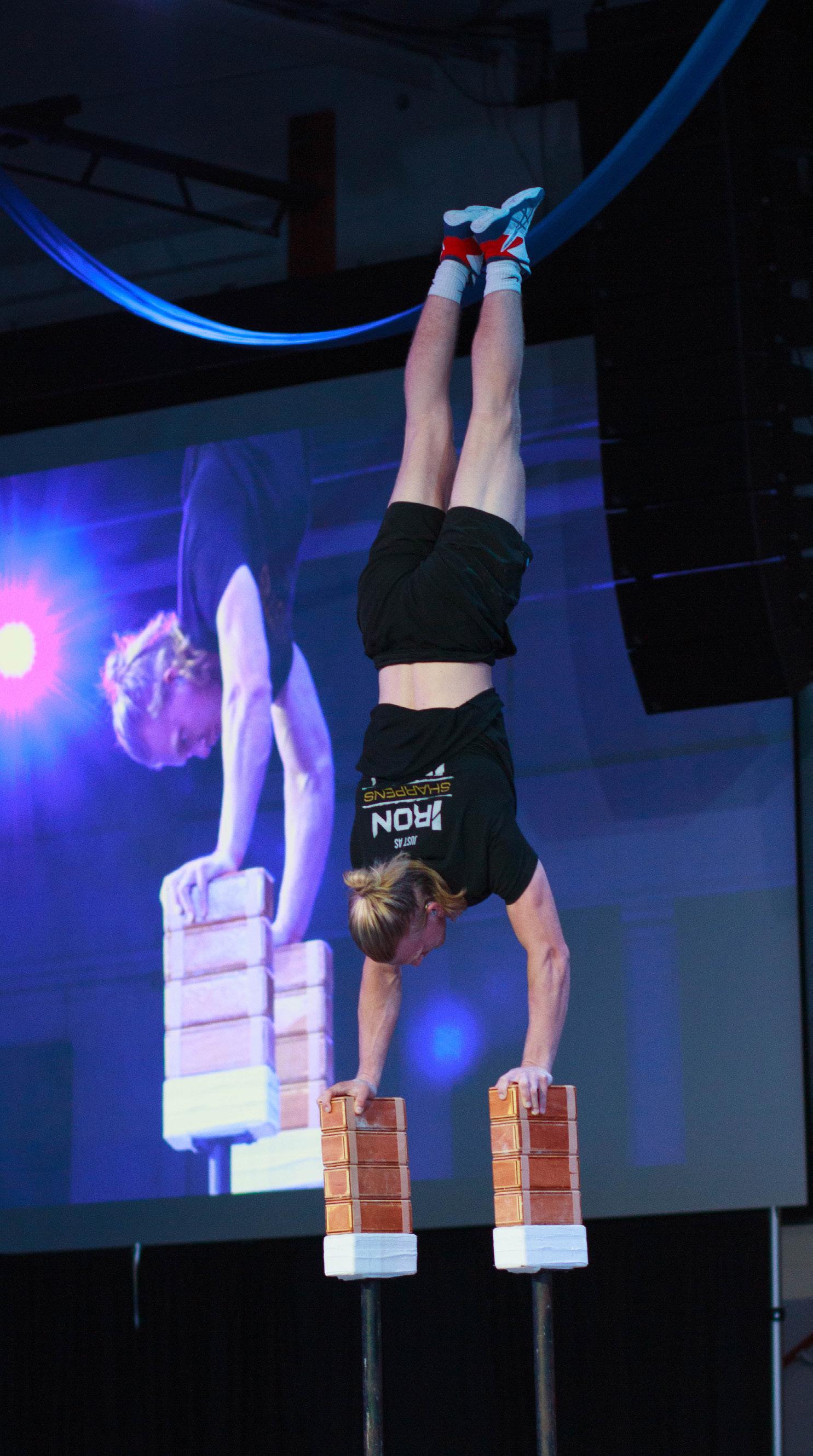
Micah States displays his strength in a suspended handstand. Saturday, April 15, 2023. (Photo by Mila Bales)
Shannon Bradshaw makes use of her suspended lyra to perform various midair maneuvers.
Saturday, April 15, 2023. (Photo by Mila Bales)
(L-R) Zach Dale, Patrick King, Jack Bell and Tyler Ritterskamp perform a routine wearing astronaut suits. Saturday, April 15, 2023. (Photo by Mila Bales)
What you need to know about coping with chronic stress
 Tiffany Bartell, LPC MHSP Healthy Minds QEP Director
Editor’s note: The following article is written in partnership with Counseling Services and the Southern Accent.
We have been spending a great deal of time discussing the topic of stress over the past few weeks — and for good reason. Stress is one of the most significant challenges that college students face and is something that needs to be monitored and managed intentionally.
In previous posts on our social media page, and through our Stress Out Week event, we’ve learned that there can be positive stress that gives us energy and can be motivating, as well as negative stress, which
can be de-motivating and has negative health implications.
The hormone that is responsible for helping you to experience that “stressed out” feeling is called cortisol. You may have heard of it in classes or other articles about stress.
Cortisol is key to the fightor-flight response in the body that can help you to get out of a burning building or run away from a dangerous experience. It helps your body to release glucose, which gives you that energetic stress feeling. Cortisol in the moment of stress or danger is healthy and important, but chronic stress can cause cortisol levels to become high for prolonged periods of time.
According to an article pub-
lished by the Amen Clinic, this can lead to increased weight gain, difficulty sleeping, increased depression and anxiety and decreased happiness.
We all know that stress can increase cortisol levels, but studies show that sugar, caffeine, alcohol, nicotine and insufficient quality of sleep can also increase cortisol in the body. The Amen Clinic proposes easy-to-follow strategies for balancing your cortisol levels.
The first is to make sure to protect your sleep. Make seven to nine hours of sleep nightly a regular routine for optimal mental health. Sleep is one of the pillars of mental health and is key to wellbeing, as it helps enable your body to regulate
and balance cortisol levels.
Another strategy is regular movement, or exercise. According to an article published in 2017, Amen Clinic reports that moderate exercise can help the body balance cortisol levels, and research supports its benefits on stress, anger, depression and anxiety. Taking regular walks on the greenway or one of the beautiful trails surrounding campus can give you just the break you need to reset and allow your body to return to a state of calm.
Other ways to lower cortisol levels include laughing, listening to calming music and staying hydrated. Eating a healthy, plant-based diet is another way to maintain lower cortisol levels.
Feeling stressed in the moment? Take the time to engage in relaxation. Breathing has been shown to lower cortisol levels almost instantly. A relaxing massage can also decrease cortisol levels and increase dopamine and serotonin levels.
In times of stress and pressure, it is tempting to buckle down and work harder with less breaks and more internal pressure. Remember to take care of your body so that your beautiful brain can both work well and feel great.
For more information on this topic, check out the Amen Clinic’s blog: https://www.amenclinics. com/blog/cortisol-try-these-13strategies-to-soothe-the-stresshormone
“Sleep is one of the pillars of mental health and is key to wellbeing, as it helps enable your body to regulate and balance cortisol levels.”
SPORTS
NBA regular season closes: playoffs start
Jacob Nevis Sports EditorAfter 82 games, the NBA regular season comes to a close. This season saw many ups and downs for different teams and was nothing short of exciting for basketball fans. But the NBA season is far from over with the playoffs off to a roaring start.
The playoffs began this year with the play-in tournament, which has each conference play three games to figure out the seventh and eighth seed of each respective conference. In the Eastern Conference, the Chicago Bulls defeated the Toronto Raptors in the ninth vs.10th seed game. In the seventh vs. eighth seed game, the Atlanta Hawks would defeat the Miami

Heat to become the seventh seed. The Miami Heat, however, would still make the playoffs after defeating the Chicago Bulls to become the eighth seed.
Over in the Western Conference, the Minnesota Timberwolves played LeBron James and the Los Angeles Lakers. The Lakers were able to secure their spot in the playoffs, taking the seventh seed. The Oklahoma City Thunder defeated the New Orleans Pelicans in the ninth vs. 10th seed game; however, they were defeated by the Timberwolves for the eighth seed.
In the Eastern Conference, the Milwaukee Bucks put togeth-
er another phenomenal season, claiming the best record in the NBA. The first seed Bucks were led by Giannis Antetokounmpo, who played another great year. The Bucks are currently playing the Heat. The second seed Boston Celtics will look for revenge after suffering defeat in last year’s finals and are playing the seventh seed Hawks.
The third seed Philadelphia 76ers, who are led by one of the favorites to win the MVP Joel Embiid, will take on the sixth seed Brooklyn Nets. The fourth seed Cleveland Cavaliers play the fifth seed New York Knicks.
In the Western Conference, the
first seed Denver Nuggets had another great season. Nikola Jokic, center for the Nuggets, who won the MVP award two years in a row, is a favorite to win the MVP again. The Nuggets are currently playing the eighth seed Timberwolves.
The second seed Memphis Grizzlies will look to make the finals after having some issues this season off the court. The Grizzlies opened up the first round against the seventh seed Lakers. No team has been more surprising this season than the Sacramento Kings. The third seed Kings had not made the playoffs since 2006 and were not projected to make the playoffs this year as well.
The Kings will commence a battle of Northern California basketball when they take on the reigning NBA champions, the sixth seed Golden State Warriors. The fourth seed Phoenix Suns will take on the fifth seed Los Angeles Clippers. No doubt about it. Another exciting NBA season is about to end, and fans are anxious to see who will be crowned champions.
Editor’s Note: Being from Northern California, it has been the best feeling seeing the Kings make the playoffs. I am a Warriors fan at heart, but deep down I hope the Kings finally win a championship.
MENTAL HEALTH
“The playoffs began this year with the play-in tournament, which has a conference play three games to figure out the seventh and eighth seed of each respective conference.”
(Photo sourced from: Pexels)
For more related news, visit our website at accent-southern.org 5 | Wednesday, April 19, 2023
(Photo sourced from: Pexels)
OPINION
The search for fresh produce: Students
Lindsay Beckwith Contributor“Grrrrrrrrrrrrrrrr,” rumbles my stomach alerting me that it must be time to eat again. As I ponder where I want to eat, it occurs to me that what I really want is to make my own food according to my dietary needs. While Southern Adventist University provides several venues and locations for its students to obtain a tasty vegetarian meal, many of the options do not cater to an all-organic, non-GMO and ultra-fresh diet.
The Village Market (VM), which has produce and groceries, remains the next best option for students who prefer fresh alternatives to packaged or premade foods. However, much of the produce is either not offered on the meal plan or is in graband-go quantities. This forces students to have an alternative form of payment in addition to
the meal plan if they wish to buy the food they want in the quantity that they need.
According to the Adventist health message, we are to avoid harmful substances, regularly exercise and maintain a balanced vegetarian diet with large quantities of fruits and vegetables. I find this statement to be ironic considering much of the food on campus is deep fried, caffeine is sold at the Village Market and a pint of ice cream is more likely to be available on your meal plan than a head of lettuce.
To be fair, the Village Market did expand its meal-plan-available produce section in the fall of 2022 to include items such as avocados, packaged tomatoes and single pieces of fruit.
According to Nick Johnson, VM assistant store manager,
“Southern wants to give students options,” which includes caffeine “specifically in teas.”
Johnson said the VM adheres to Southern’s suggestions and has discontinued products like Kombucha for its alcohol content as requested. Caffeinated tea does not appear to be a concern at the moment.
Doug Frood, associate vice president for Financial Administration, and Jackie Rose, Manager of the Village Market, responded to criticism about the limited meal plan produce in emails, stating that the fresh produce options have to do with sales tax exemptions.
“The state of Tennessee exempts university meal plans from state sales tax,” Frood wrote. “Ten or more years ago, the café had a selection of produce and single serve items
that fit under the exemption of the meal plan. When we remodeled we decided to move these items under the purview of the VM. By limiting the items to single serve and such we were trying not to run afoul of the state sales tax rules.
“We could let the students buy more stuff from the VM, but it would need to be sales taxable since the exemption is more about prepared food,” Frood added. “ … Most schools don’t have a VM as a part of their meal plan. We have tried to find balance between the hot meal (prepared) side of the meal plan and groceries.”
Regarding caffeinated teas, Rose wrote: “The caffeine content in tea is very low like chocolate. If we went totally caffeine-free we would have to take all chocolate products out of the store.”
Still, students are faced with a choice. Do we eat at the cafeteria, CK2, The Garden or the Deli and have our food quality decided for us? Or do we spend additional funds, if we have any, to buy organic, non-GMO, fresh, bulk produce?
While I respect that Southern has provided several options for its students and has put time and effort into providing cultural and diverse cuisine, students’ food choices should not be limited, especially when it results in making nutrition-deficient snacks more available and easier to purchase than produce.

In my opinion, the health message is being compromised by restricting students’ access to healthy foods like fresh produce and staple foods like bread.
RELIGION
Jesus, come quickly: Longing for home in the face of loss
 Melissa Maguire Contributor
I am homeless.
I have a bed, a bathroom, a roof over my head and food every day, but I am without a home. College affords the rare opportunity to live in so many different places that I live in none of them. For a maximum of three consecutive weeks at a time, I return to my childhood home, and a sense of nostalgia sets in.
The place I once called home feels different now. The place that should be home lacks my dad’s terrible jokes and contagious laughter since he passed. The couch shifts position each time I am here, the dishes emigrate to a different cabinet and my bedroom with the soft lilac walls I chose at 17 is often occupied by another family member. My dresser is my suitcase, and
my closet is full of clothes I no longer wear. I sleep on a mattress on the floor in the house that was once my sanctuary.
“I don’t want you to feel like a guest. This is your home,” my mom tells me. But I do. I feel like a guest who visits only on the holidays.
Well, then the place I live the rest of the time must be home!
A roughly 11-by-12-foot postage stamp: my dorm room. Amenities include a sink that sprays your face if you turn it on too fast, the world’s loudest shower and cozy bunk beds for two. I share a tiny box refrigerator with my roommate and eat meals made by someone else for the low price of 52 cents an ounce. This hardly feels like a home. It’s an in-between.
We make do because, after all,
we aren’t staying here long. Every August we move in and in May move out. Command strips and push pins hold up any decorations we managed to accumulate. I am not complaining. Dorm life is fun, and living near all of your friends holds much value. But it never quite feels like I live here. The other three months of the year, summer break, I spend in yet another not-home: summer camp. The warm air on my face, Chaco sunburn on my feet and French braids in my hair, I run between the camper cabin and my “personal cabin,” which stores all my clothes. I don’t live here either; I am working a rewarding job, but I sleep on yet more bunk beds. I have no home.
Home is a place where you feel
safe and at peace, the place where you can be your real self because you belong there. It is your own; everything is where you left it and how you like it. You don’t have to leave, and you put down roots. Home feels permanent.
I have no home. I am in a constant state of visiting and preparing to leave. Yet I find myself wondering if we were meant to find such a permanent home. “This world is not my home / I’m just a-passing through.” We sing this chorus at camp meeting every year, but it has recently taken on new significance to me. The loss of my father this year has kicked my feeling of homelessness into overdrive. How can this be my home without such an integral member of its ecosystem?
And yet a thought comes to my mind: I am only a transient visitor of this planet, not a permanent resident. And I understand what

Jesus meant when He said, “The Son of Man doesn’t have a place to call his own.” (Matthew 8:20) Jesus grew up, and then He, too, was homeless. Not that He had nowhere to stay, but He didn’t have a home. He didn’t take up a permanent residence on earth because He knew He was leaving.
The more and more the world changes, the less I feel attached to it. Sometimes I have thought, “Jesus, wait to come until I get married and have children because I want to experience that before I get to heaven.” But now I pray, “Jesus, come quickly. I want to come home.”
If you would like to be a contributor, contact Alana Crosby at acrosby@southern.edu 6 | Wednesday, April 19, 2023
Natalie Jensen looks through groceries at the Village Market.
Monday, April 10, 2022. (Illustration by: Adam De Lisser)
need healthier meal plan options“Home is a place where you feel safe and at peace, the place where you can be your real self because you belong there.” (Photo by: Vlada Karpovich)
How to get back on track: capitalizing productivity while still prioritizing fun

 Elise Deschamps Lifestyle Editor
Wake up. Snooze once (or twice). Drag myself out of bed, get into my swimsuit, sweatpants and hoodie. Grab my keys. Drive to the gym and swim laps. Shower, maybe icebath or sauna, do my skincare and makeup and drive home. Cook a big, balanced breakfast, watch some Youtube and, finally, open up my planner to start on homework. By now, it’s 8:30 a.m., and I feel fully ready for the rest of my day. I’m even cutting down on my caffeine intake.
You might be thinking, “Yeah, okay, you lost me at 8:30 a.m. I just know I would never even want to do all of that.” To be fair, I am naturally a morning person. But I also am naturally a 2 a.m. social media doom-scroller and Netflix binger even when I know I have a jam-packed, energy-draining schedule the next day. And to be even more honest with you, that morning routine was way more realistic last semester than this semester.


These days, my morning routine looks more like this: barely wake up to my alarm at 5:50 a.m. and decide I’m too tired to swim because I stayed up too late last night, then promise to swim later in the day (I won’t). I proceed to fall back asleep until 9:30 a.m. because I purposefully scheduled all of my classes in the afternoon and then lay in bed scrolling on my phone for an hour (or more). I’ll look at the checklist I swore that I’d follow the night before and feel a little bad about myself. After all, there’s always tomorrow.
So how did I ever do all of those things before? Where did my motivation and energy go? Well, for starters, I stopped prioritizing sleep the way I did.
I also stopped being as intentional about grocery shopping. Instead, I prioritized late nights with lovely newfound friendships and different experiences that bring richness to my life.
It’s hard finding balance. Last semester was probably the first time in my life that I fully dedicated myself to finding a schedule that capitalized my time and efficiency. Then, as I finally found my people in college, I dedicated myself to deepening those relationships rather than dedicating myself to my productivity. Now, with less than a month left in the semester, comes the question: How can we do both?
As fun and enriching as it is to have multiple spontaneous latenight hangouts with my friends, my sleep schedule and morning routine — and thus my productivity, grades and energy levels — have definitely suffered as a result. Here’s how I plan on getting back on track:
Going to bed on time: This one is annoying, but I know it’s the first step for me. I need at least seven hours of sleep to wake up without feeling exhausted. This looks like kicking out my friends by 9:30 p.m., taking my melatonin a little bit earlier than usual (I only use it to re-train myself to go to bed early) and maybe doing some reading right before bed because I’ll actually get bored and sleepy, unlike when I scroll on my phone.
Standing up as soon as my alarm goes off: If I don’t immediately stand up, chances are I’m going back to sleep. Given I actually got enough sleep the night before, I tell myself that I want the results of a productive morning more than I want to sleep in a little bit more.
Planning my day the night before: My notes app is my best friend. I used to be a planner girly (and still am to a certain degree) but recently I have been utilizing a daily to-do list. The first half is a detailed checklist of every little thing I want to do for myself. Wake up. Drink water. Eat a banana. Swim. Shower. Cook breakfast. Make my bed. Brush my teeth. I see every small thing I do as a win, as a check mark of productivity. It truly helps me feel like I’m already being productive, and I then can transition this basic-self-care-energy into being productive with actual school work.
Plan fun things ahead of time: Knowing that I have something fun planned for the weekend (or even a bit earlier on a random weeknight) allows me to have a goal to work toward. I remind myself that freedom and fun is right around the corner. If a friend is coming over for dinner, I need to get as much done as I can during the day so I can be fully present later.
Understand that it’s okay to veer off schedule: It’s going to happen, so there’s no point in beating yourself up about it. The only reason I feel so passionately about making sure I “do my mornings right” is that
it makes it easier to get everything else done because I actually set myself up for success. If snoozing my alarm and sleeping in made it easier for me to be productive in life then I definitely would be doing that.
Life is more than just school
and work. Experiences with good friends, in my opinion, is just as important as getting good grades. Making sure you’re sleeping and eating well enough is one of the best things we can do for ourselves in the long run.
Dear Kevin: How do I know if college is for me?
Dear Inquisitive Inquirer: College, while a rich and rewarding experience, shouldn’t be something you feel obligated to do if you do not feel any desire or motivation to go or if you see a clear plan for your life that does not include hi gher education. Don’t be afraid to explore other options, such as trade school. There are many professions that do not need degrees. As long as you have a good work ethic and are not afraid to start at the bottom, you have a bright future.
That being said, if you are still unsure about college, try taking a few courses and see how you feel. Pursue something you are passionate about, and remember that it is never too late to go back to college.

Another thing you can do is talk to your friends and family or a guidance counselor.

Here’s what NOT to do. Don’t sit around waiting for a job opportunity to arise. Be proactive and work on yourself during times of unemployment.
Dear Kevin: I feel I am being replaced in my best friend’s life. What should I do?


Dear Reader: How astute of you to ask such a question. I, too, fear I will be replaced in this dizzying climate of change. It is sad to think how fast one can be forgotten, voted out of existence. *Pensive duck sigh* But, I digress. You should have a good talk with your best friend. Communication is usually a good option. Keep in mind, however, that sometimes people naturally grow apart, and there is nothing you can do about it. Fate, that cruel mistress, plays at our heartstrings until we can barely bear it. But take heart, my dear friend. There are other diversions. Perhaps it is time to move on yourself. Talk to new people, do new things. Perhaps, although it may never replace your best friend, it may numb the pain of being replaced for just a while.

For more related news, visit our website at southern-accent.org 7 | Wednesday, April 19, 2023
LIFESTYLE
“I see every small thing I do as a win, as a check mark of productivity.” (Photos sourced from: Pexels)
#SAUlife This week’s winner is Arturo Vidal-Aquino. Come pick up your prize at the Student Development Office. For a chance to be featured, use or tag @sauaccent on Instagram in your posts!
SOCIAL antonnnn_k nyc ��☀ beckks.z It’s the season to go frolicking in a field Anton
Rebecca
A R abbytishaw 75 & sunny ☀️ jennakpeters Sunday tea time✨✨ Abby
hventuraaa 23 simply.solomon Psichi Certified ✓ Hector Ventura Solomon Hill H S Knowing that students love shopping, Kevin will be offering a DM us on Instagram with a photo of where Kevin is hiding! A J $10 Target Gift Card!
Dear Kevin
Kannenberg
Zaldivar
Tishaw Jenna Peters
CHATTER
Today — 19
Thursday — 20
Weekly Birthdays
TODAY |19
Michael Garcia
Daniella Gonzalez
Katie Hamilton
Zach Kirstein
Christine Kolinek
Isaiah Lee
Melanie Moraes
Kailey Nash
Joshua Scott
Nicholas Thompson
Mariana Velasquez
Melany Ventura
Bryan Vyhmeister
April West
Friday — 21
Saturday — 22
Jason Williams
Thursday |20
Kevin Andreu
Justin Childers
Tracia Howell-West
Lydia Kelly
Emily Lyngaas
Charlia Ringer
Lara Soares
Nathan Vidal
Izzy Wood
Sunday — 23
Monday — 24
Friday |21
Jared Azevedo
Jared Freeman
Jaylen Gomes
Anton Kannenberg
Brayan Lopez
Yehyun Park
Geisha Sulsona Alamo
Saturday |22
Lucas Aedo
Stephanie Do Carmo
Sharna Ebanks
Ian Erskine
Joshua Sutherland
Kaitlyn Vasquez
Kyle Williams
Ingrid Yanes
Sunday |23
Traverse Brown
Ellen Choe
Isabella Eklund
Connor E. Grant
Ryan Kuczma
Ariel Lantigua
Sahyii Lozano
Blake McClure
SA Announcements

Macy McIntosh
Reyes Miguel-Perez
Jj Moon
Monday |24
Kenneth Alonso
Gabriel Gozalo
D’Lainee E. Graciano
Matthew Howland
Renzo Inalvez
Taylor Moren
Zackery Ottati
Tenci Reid
Tuesday |25
Hannah Hagan
Micah Hansen
Raymond Hylton
KC Lanagan
Kevin Mogollon Ca-
bellos
Sarah Onjukka
Xander Ordinola
Lauren Rasar
Lily Sakata
Luke Yeom
423 Night will be happening at the Collegedale Church parking lot this Saturday, April 22, at 9:30 p.m. Come out to buy your favorite food or cute trinkets. This event is open to the community. Make sure you don’t miss this night full of fun!
Tuesday — 25
MASTER OF ARTS IN TEACHING


A Pathway to the Classroom (With Any Bachelor’s Degree!)
Our online MAT program offers a master’s degree and initial teacher certification at the same time.
Seventh-day Adventist and/or public school certification options are available in as few as five to six semesters. All classes are available online and students have the possibility of being paid during their field experience or student teaching.

Set yourself up for a rewarding career that offers:
• great benefits
• summers off
• incredible job security
• a strong sense of mission
• the fulfillment that comes from knowing you’re making a difference
If you would like to be a contributor, contact Alana Crosby at acrosby@southern.edu 8 | Wednesday, April 19, 2023
84-52 84-58 70-42 66-40 79-60 59-37 65-45
1.800.SOUTHERN • southern.edu/graduatestudies
8:00 p.m. SA Senate, Bietz Center Payday: Hourly/Student Engage God (21-22) 7:30 p.m. Lawn Concert, Goliath Wall 8:17 p.m. Sunset 8:45 p.m. Expo, South Atrium of Collegedale Church No Field Trips (23-29) 12:00 p.m. - 11:00 p.m. McKee Library Open 7:30 p.m. Symphony Orchestra Concert, Collegedale Church Campus Research Day Student Mission Exit Retreat (20-23) 11:00 a.m. Convocation: Origins, Joe Deweese, Collegedale Church 9:00 a.m. Adoration Worship, Collegedale Church 9:00 a.m. Connect Worship, CA Elementary School Gym 11:45 a.m. Merge Worship, Lynn Wood Chapel 11:45 a.m. Renewal Worship, Collegedale Church 7:30 p.m. Evensong, Lawn Concert 9:30 p.m. 423 Night Market, Church Parking Lot Happy Monday! 10:00 a.m. - 3:00 p.m. Student Appreciation Day, Various Locations Check out our website! www.southern-accent.org