The Southern Accent
Update of the Week, page 2
DEEP Leadership Summit brings Southern and Oakwood together
The Student Voice Since 1929
Pressing Issue page, 2
Former NFL player arrested for murder

Update of the Week, page 2
DEEP Leadership Summit brings Southern and Oakwood together
Pressing Issue page, 2
Former NFL player arrested for murder
Texas, during the end of the Dust Bowl. He began his educational journey in a one-room schoolhouse, with a single teacher for multiple grades.
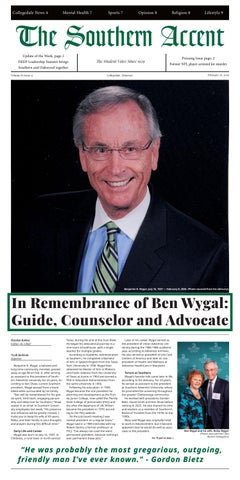
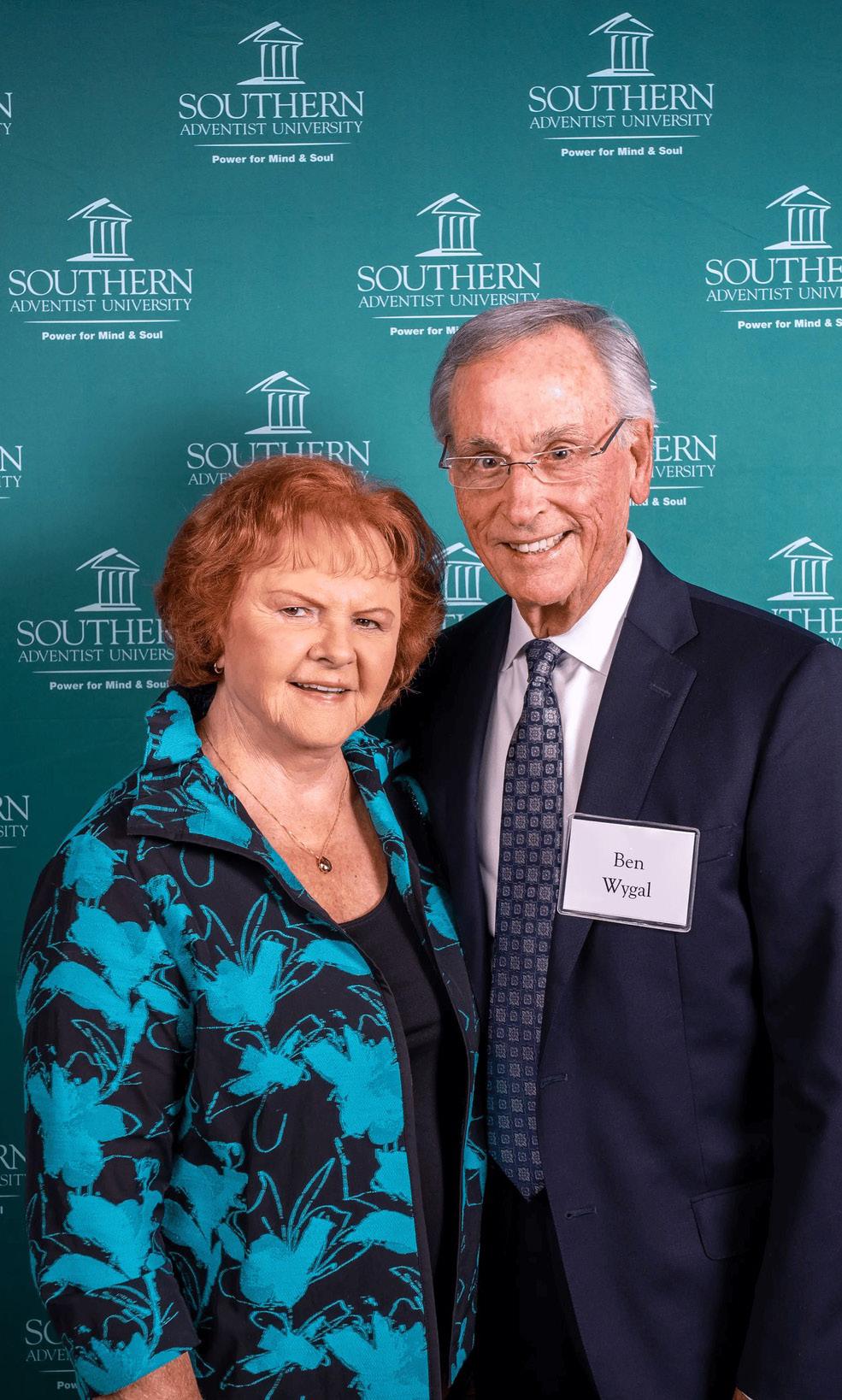
Benjamin R. Wygal, a beloved and long-time community member, passed away at age 88 on Feb. 8, after serving as assistant to the president of Southern Adventist University for 23 years. According to Ken Shaw, current Southern president, Wygal passed from a brain bleed while surrounded by his family.
“Ben will be remembered for his gentle spirit, kind heart, engaging personality and deep love for Southern,” Shaw stated in an email to Southern University employees last week. “His presence and influence will be greatly missed. I invite you to keep his wife of 69 years, Reika, and their family in your thoughts and prayers during this difficult time.”
Early Life and Career
Wygal was born on July 16, 1937, in Childress, a rural town in north-central
According to Academic Administration at Southern, he completed a Bachelor of Arts in Speech/English from the Texas Tech University in 1958. Wygal then obtained his Master of Arts in Rhetoric and Public Address from the University of Texas at Austin in 1964 and earned a PhD in Education Administration from the same university in 1966.
Following his education, in 1969, Wygal became the vice president for planning and development at the Florida Junior College, now called the Florida State College of Jacksonville (FSCJ) and the after the departure of J.W. Wilson became the president in 1970, according to the FSCJ website.
“At the July board meeting I was named president on a regular basis,” Wygal said in a 1989 interview with lay Robert Gentry a former professor at FSCJ. “I've always not used the word permanent president, because nothing's ever permanent these jobs.”
Later in his career, Wygal served as the president of Union Adventist University during the 1985-1986 academic year, according to Adventist Archives. He also served as president of Life Care Centers of America and later as vice president of Health and Wellness at Adventist HealthCare in Maryland.
Tenure at Southern Wygal’s favorite role came later in life, according to his obituary. For 23 years, he served as assistant to the president at Southern Adventist University, where he promoted the university throughout the greater Chattanooga community.
He worked with presidents Gordon Bietz, David Smith and Ken Shaw before retiring in 2025. He also shared his time and wisdom as a member of Southern’s Board of Trustees from the 1970s to the 1990s.
Bietz said Wygal was originally hired to work in Advancement, but it became apparent that he would do well as associate to the president.
See Wygal on page 3
“He was probably the most gregarious, outgoing, friendly man I’ve ever known." - Gordon Bietz
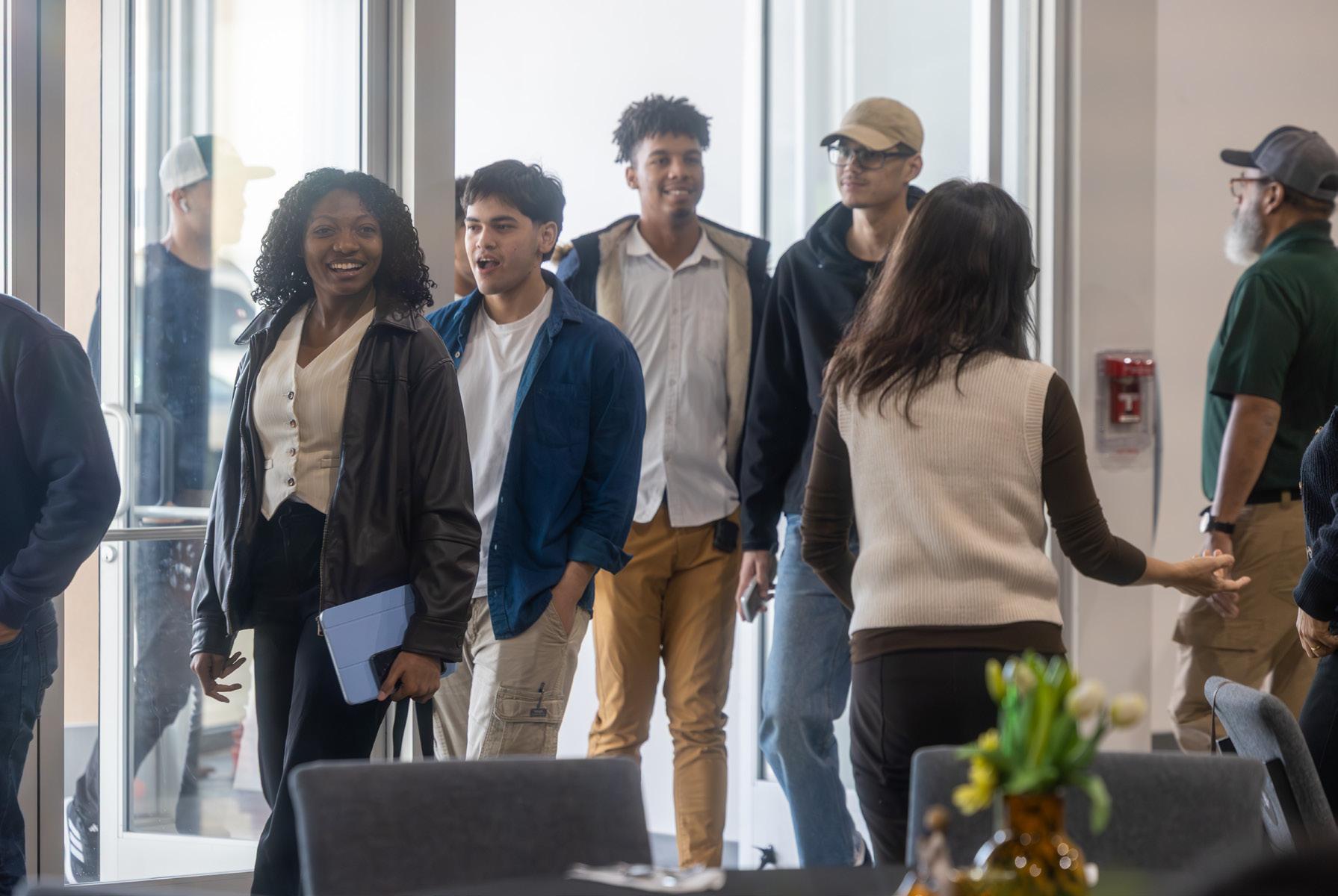
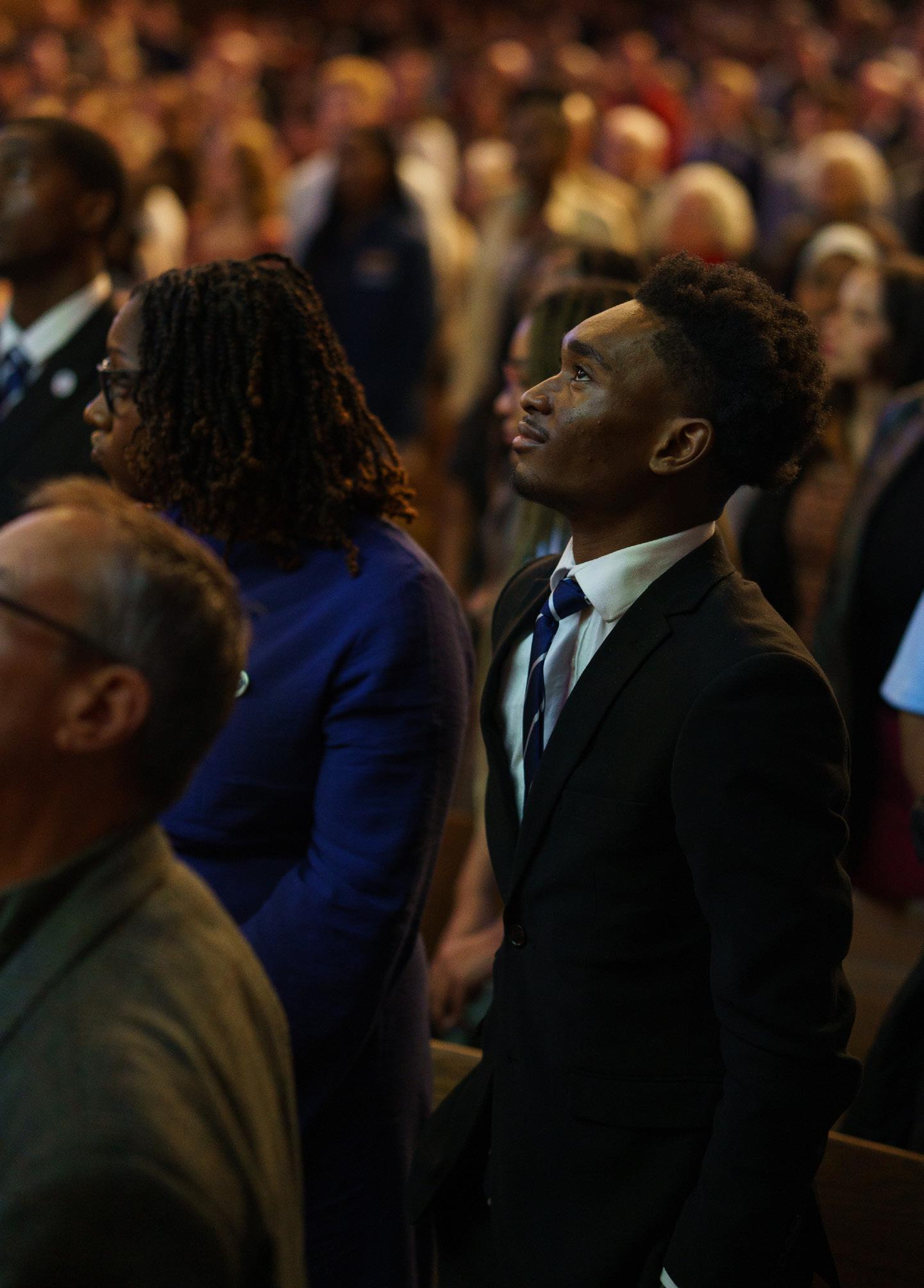
Students from Southern Adventist and Oakwood universities gathered in Chattanooga last week for the Diversity Educational Exchange Program (DEEP) Leadership Summit, a three-day experience focused on global leadership, collaboration and service. The event was held at Crosswalk Chattanooga Church from Feb. 11 to Feb. 13.
According to Southern’s website, this year’s summit aimed to “cultivate faith-informed, globally minded leaders through purposeful dialogue, collaboration and experiential learning.” It was described as an immersive experience where participants could “strengthen their ability to lead ethically, communicate effectively across diverse perspectives and apply creative solutions that advance mission-driven education and community impact.”
Oakwood’s coordinator for the summit, Shalunda Sherrod, said that a candid discussion among student leaders helps each campus face its unique challenges.
“[The biggest challenge] is just cultural competence or cultural humility,” Sherrod continued, “being able to understand and be empathetic to other cultures because we’re very used to our own culture.”
Former Southern President Gordon Bietz and former Oakwood President Delbert Baker reflected at this year’s summit about the original idea for the DEEP program. The concept emerged during a 1997 trip to Cambodia with Southern Union leaders, when an unexpected military coup disrupted their visit. After finally being allowed to leave their hotel room, they witnessed bodies on the street. Baker said he wondered how to turn a traumatic event into something good.
Baker remembered telling Bietz, “Listen, you’re in a pre-
dominantly white institution. I’m in a predominantly Black institution. Can we do something substantive?”
Baker said they both wanted to do something meaningful beyond swapping basketball games and music concerts. He said the goal was to address racial and cultural divisions by bringing students together while they are still forming their perspectives.
DEEP was implemented as a semester-long exchange program, in which students from Southern would attend Oakwood and vice versa. However, due to limited participation, they shifted to weekend-long events and summits to expose more students to the program.
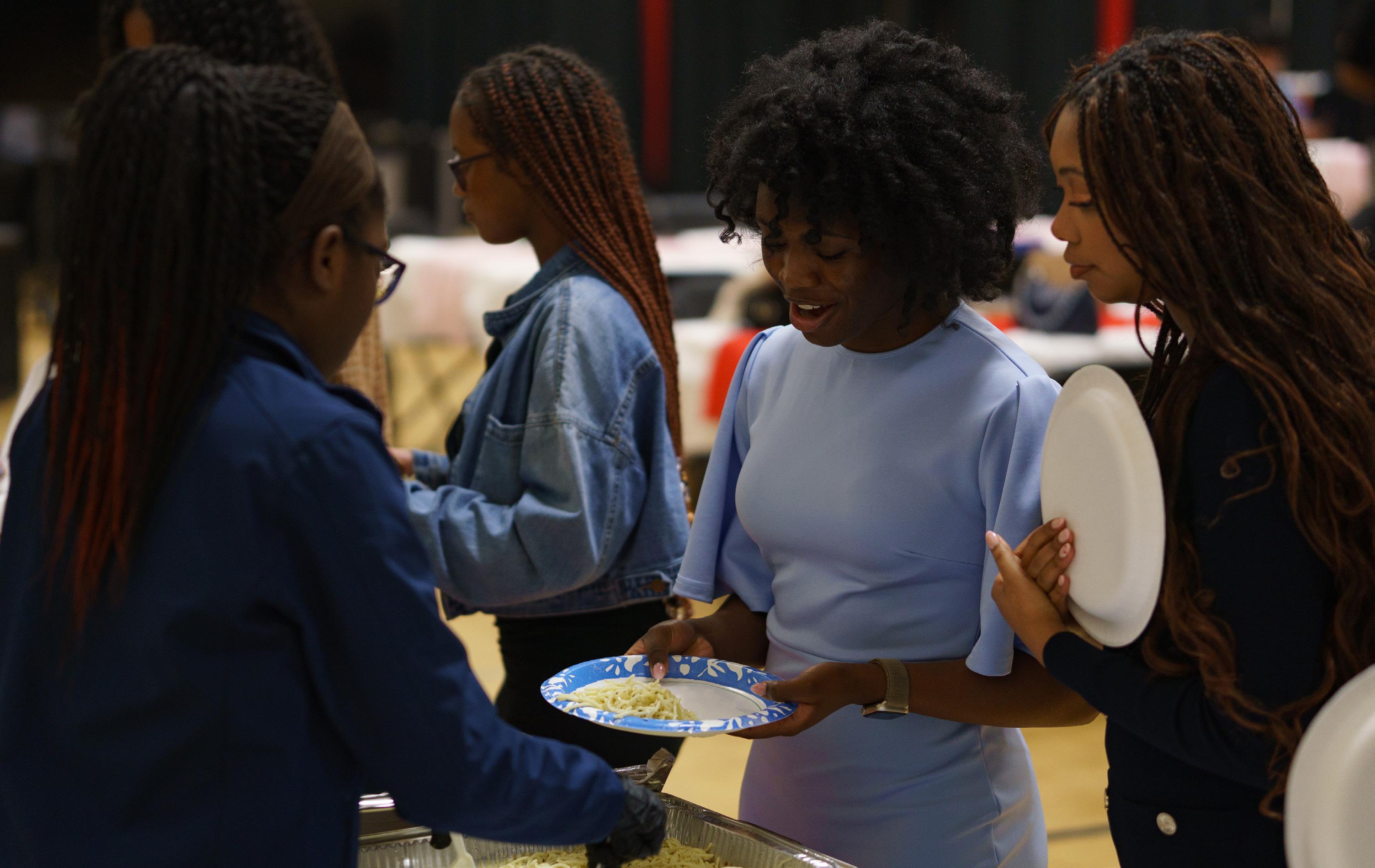
This year’s summit began on Feb. 11 at 5:30 p.m. with a welcome from the presidents of both universities, followed by a prayer over the meal. After dinner, Crosswalk’s pastor, David Ferguson, led the group through several icebreaker exercises.
Attendees then moved to the auditorium for worship led by praise team members from Merge Worship, a student-led service on Southern’s campus.
The evening’s main event was the “Legacy Panel,” featuring Bietz, Baker, current Oakwood President Gina Brown and current Southern President Ken Shaw.
Bietz encouraged the current presidents to use DEEP to engage students in conversations about current global issues. Shaw agreed, noting that the program has expanded beyond bridging predominantly Black and White communities to its current mission of bringing together students from many cultural backgrounds.
“We’re different in a way,” Shaw said, “but what Dr. Bietz says is that we’re all the same, and when we have Jesus in our hearts, we should be different from the people that don’t have Jesus in their hearts.”
The panelists explained how the Southern Union became a sponsor of the program and continues to support DEEP events, such as this year’s summit.
The evening closed with a time of prayer for the nation, the church and personal needs. Participants formed groups according to the topic they wanted to pray over.
Thursday’s activities focused on leadership development, diversity and belonging. After morning worship, participants separated for workshop sessions. Some of the workshops included “Wellbeing and Thriving”; “Let’s Talk: Reimagining DEEP;”and “Lessons Learned: Our Stories, Our Experiences.”
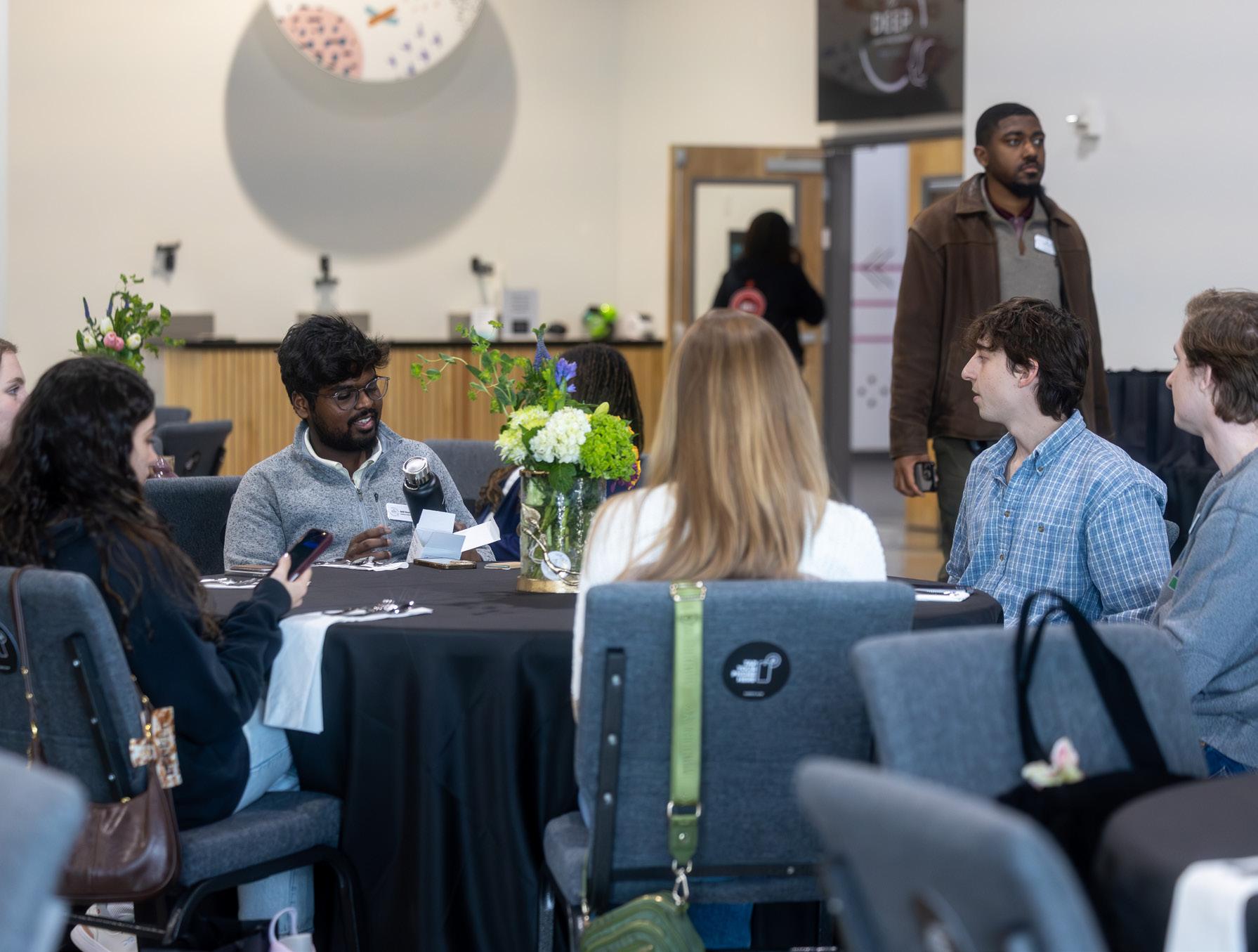
The next activity was the “World Café” experience, a series of small-group conversations. Participants were divided by the last digit of their phone number, creating mixed groups from both universities. Topics included what it means to be a global leader, tips for next year’s summit and whether DEEP should expand into a year-long experience.
The Accent encourages readers to write articles and voice their opinions. However, not all topics and views are endorsed by Southern Adventist University or the Seventh-day Adventist Church.
For any questions, comments and article submission information, email the editor at haydenjkobza@southern.edu.
For all advertising inquiries, email alvajohnson@southern.edu.
The keynote sessions began after lunch. Bietz’s keynote emphasized servant leadership, reminding students that the goal of leadership is to serve rather than control. He outlined characteristics of effective leaders, including listening well, sharing information openly and building trust through relationships.
In a second keynote, Baker presented “Built to Lead,” sharing seven dimensions of leadership. He described three leadership types: a strong natural leader, a strong spiritual leader and a strong Adventist leader. Baker also highlighted four essential intelligences for leaders: physical, spiritual, emotional and experiential.
The keynote session concluded with a charge from Bietz: “Leadership is influence, nothing more, nothing less. And that develops through relationships.”
After a two-hour break, the summit resumed with a wellness activity and dinner, where participants painted and released paper butterflies. A short worship followed before dismissal.
On Friday, the group met on Southern’s campus at 8:30 a.m. for worship before doing a service-learning activity. The summit ended around 1 p.m. with closing reflections.
Student reactions
Sharna Ebanks, a Southern senior mass communication major, said the environment was welcoming and everyone was friendly. One of her favorite parts of the event was the ice breakers.
“I liked it because I got to interact with others in a way that wasn’t awkward or uncomfortable, like ice breakers usually are,” she said.
Oakwood student and junior theology major Ryan Williams was also impressed by the hospitality, describing it as “phenomenal” from the moment he arrived at the hotel and throughout the summit. He said he enjoyed the Legacy Panel discussion on Wednesday.
“I feel like that was a really great touch of just understanding the roots of where DEEP was founded and where it’s going in the future,” he said. Williams’ favorite part, though, was talking to others in the breakout groups.
Ismeily Vasquez, a senior business major at Oakwood, said she got to know many new people and will tell friends who are not yet graduating about the summit so they can attend next year.
“I had the opportunity to share my experience and story at one of the workshops I chose, and it was very involving,” she said. “This is a great opportunity just for fellowship and networking.”
Anil Asok is a graduate student from Southern, pursuing a master’s degree in clinical mental health counseling. He thought the summit was well-organized and appreciated the coordinators’ behind-thescenes effort. His favorite part of the event was the keynote sessions from Bietz and Baker.
“They have decades of experience, and it was nice to know how they have moved forward and what they think is important in leadership,” he said.
Jazmin Mota, a senior psychology major from Southern, said she enjoyed the opportunity to connect with people she might not otherwise meet.
“It wasn’t surface-level type stuff,” she said. “You actually got to know people, their backgrounds, their stories. I really appreciate that aspect of the summit.”
Charge for students Baker told students that one of the best things they can do after the summit is to scout and identify areas of need.
“You can be a real agent for balanced relationships and change,” he said. “So, we would challenge you to take the spirit of DEEP... as you go forward, and make a difference on campus.”
Lillian
Kyla
Photographers
Sam
Christian
Layout
Nyah
Lindsey
Office
tribute.
continued from page 1
“He was probably the most gregarious, outgoing, friendly man I’ve ever known,” Bietz said in a recent interview with the Accent. “He could go into a crowd of strangers and just feel right at home. So, when I was president and would go down to Rotary or some other event downtown, I would have him with me, and he would kind of lead the way, and I’d follow along.”
Bietz also remembered their many conversations about theology and religion, as well as his skillful ability to calm down people who were upset. Wygal often assisted in Southern’s presentation to the Southern Association of Colleges and Schools, due to his previous experience in higher education. He loved mentoring, encouraging and supporting Southern’s faculty, staff and students. This love for Southern led Wygal to win the Honorary Alumni Award in 2023. As assistant to the president,
Wygal spent a great amount of time with President Shaw and worked to introduce students to opportunities, connect faculty with new partnerships and take Southern’s vision to a broader world.
Kyla Wetmore contributed to this article. Wygal
Shaw gave the Accent a written copy of the tribute he paid to Wygal during his retirement celebration last year.
“For more than two decades, Ben has been a steady, thoughtful presence at Southern, a trusted guide, a wise counselor, and a passionate advocate,” Shaw stated in the
Vice President for Student Development Dennis Negrón spoke highly about his former colleague.
“Mr. Wygal was the type of man all of us should want to emulate,” he said. “No matter who he was talking to, you were who mattered at that moment. A sharp dresser, his perpetual smile only enhanced the look and presence on campus.”
Bietz also remembered Wygal as a positive role model on campus.
“He was the ideal person to represent, I think, Southern Adventist University in the community and to other people because of his kindness and his abilities to represent the university in a very positive way,” he said.
A memorial service for Wygal will be held Sunday, March 1, at 3:30 pm at the Collegedale Seventh-day Adventist Church, 4829 College, Dr., Collegedale, TN.
Anaya Miller Reporter
Anaya Parker sat back in her chair as she supervised the evening rehearsal. The cast members in attendance ran through their lines with almost perfect accuracy, as Parker, the playwright, occasionally called out prompts.
For the past few months, Parker, a senior religious studies major, has been writing and directing a play about belonging and the power of stories. “Building Paper Castles” will debut on Feb. 27, with a second showing on March 1.
Written by Parker and co-directed by Ava-Caroline Schmidt, a sophomore digital communication and media major, the play will be performed by students in the Southern Stage drama club, as well as one alum. According to Parker, the club was started as a result of last year’s play, “Breaking Tides.”
“I had always wanted to start a drama club, but I never had other people to do it alongside me,” Parker said. “This was the opportunity that I had to get that group together and to make it happen. Almost everyone on our officer list is from the last play.”
After last year’s production of Parker’s “Breaking Tides,” the topic of recreating classic books came up, giving her the idea to combine some stories into one. The idea was to have a character explore her world by imagining herself into these well-loved stories.
According to Parker, the play is about Kira, a foster girl, who explores her identity and faith through reading stories.
“The story of Kira is about finding belonging,” she said, “and she seeks to do that through reading books but eventually finds that her story is just as valuable as the ones she’s reading in her books.”
Parker started writing “Building Paper Castles” over the summer of 2025. According to her, the Southern Stage’s first goal as a club was to get another play out. They promoted their club and the play at Southern’s Organizational Showcase in hopes of finding students who were interested in performing. Auditions started in the first month of school. A small struggle Parker first ran into was the modifications that had to be made to the play due to a rule regarding dancing.
“Southern only allows cultural clubs to do dancing,” Parker said. “We had wanted to have some swing dance, but unfortunately they said we could not do that.”
Parker mentioned that another major change to the play happened when the student playing the main lead dropped out. Parker expressed her thankfulness that Melea Hwang, a sophomore communication major, stepped into the role.
Hwang first heard about Parker and Schmidt while visiting during Smart Start. When she saw them at the Organizational Showcase, she signed up to join “Building Paper Castles” and auditioned for a small role. The week before Thanksgiving break, Parker reached out and asked Hwang if she would accept the lead role and play Kira.
“After about a week of thinking and praying, I said ‘yes,’” Hwang said. “I had a few less months to kind of learn the show and the lines, but I locked in over Christmas break, and here we are.”
Hwang had to adjust her evening schedule to balance this new responsibility, but she enjoys the time she gets to rehearse with new friends and has loved the story since the beginning.
“I was just so amazed by the writing, and I thought it all so clever, and so clean and so well
Ask the Accent!
Are questions keeping you up at night? Too scared to go to vespers because you don’t have the guts to ask out your crush? Is the CIA stalking you?
Scan the QR code to let us know!

put-together,” she said. “I really believe in the story that it has to tell, and I believe in the message that it has to bring. I think it’s so valuable and so necessary, and I’m just really honored to be a part of it and portraying this to our audience because it’s really powerful. I tell people that if I can make the audience feel as strongly in the tender moments at the end as I can the intense moments in the middle, then I will have done what I came here to do.”
Otis Bodie, a sophomore construction major, first played a role in Parker’s “Breaking Tides.” When Parker pitched the idea for starting the Southern Stage, Bodie was happy to get the opportunity to help run the club as an officer. He is also playing a main role in “Building Paper Castles” as Scott, Kira’s foster brother.
“This is actually the first time I’ve been given a main character,” Bodie said. “I kind of had a main character when I did a production at camp, but this is actually presented to people [who are] buying tickets to see the show. It’s really, really exciting and really, really nerve-wracking, but I’m super stoked to have this opportunity.”
Bodie enjoys multitasking and sees the play as a fun activity he can add to his school life. His favorite thing about producing the play is the laughter he and his castmates share – laughter he hopes the audience will also experience.
“It’s fun because these guys are basically my best friends,” he said. “I really enjoy hanging out here; it feels like my little safe zone away from home. The play is super funny and super endearing at the same time, and I really like the emotion that we’re developing that everyone else is also going to feel: the same way I first felt when I read the script.”
Jeanyvah Desarmes, a senior

religious studies major, is also on the team. She performed in “Breaking Tides” and will help with “Building Paper Castles” from backstage. Her favorite thing about this play is how it brings different kinds of students together.
“I’m actually really surprised by the [representation] of the different parts of campus,” she said. “We have really introverted people and really extroverted people and it’s nice to see, not the clash, but the merging of the two. We have fine arts majors, we have film majors, biology, chemistry. I’m excited and looking forward to presenting this play with my fellow comrades at Southern.”
Parker expressed her thanks to those who are helping make the production possible. In addition to Schmidt as co-director, Parker has been assisted by Maddy Brower, a sophomore communication major, and Angelina Maphis, a junior computer science major. Lynn Wood Hall has allowed the Southern Stage to use their chapel, and
Southern’s Audio-Visual team will run the tech booth. Outside organizations are also helping the club.
“I’m super grateful for ... Ripple Productions giving us the costumes, and Jesse Rademacher for being our sponsor,” Parker said. “There’s been a lot of moving parts, and I’m just very grateful for everyone that is helping us make this a reality.”
Parker sees the Southern Stage as a blessing and an avenue to teach through drama.
“I believe drama is such an amazing influence and can be used for so much good,” she said. “I think sometimes [it] gets a bad rap in Adventism, but even Jesus told parables. Stories are the most powerful things that we can use to illustrate points and messages. Jesus did that, so why shouldn’t we also use stories to tell people the important messages about [Him] and what He offers us?”
For more information about “Building Paper Castles”, visit the Southern Stage’s Instagram page: thesouthernstage.
Editor's Note: The Southern Accent has produced a one page Collegedale News section this issue as part of a national initiative to enhance community news coverage. The local effort, led by Southern's School of Journalism and Communication in conjunction with the Center for Community News (CCN) at the University of Vermont, places student journalists at the forefront of addressing the news desert crisis, a phenomenon caused by the decline of newspapers in local communities. The Accent believes local news is vital to a thriving democracy, and we remain committed to reporting about important issues, novel occurrences and interesting people in the greater Collegedale area. We will publish this special section in five issues of the newspaper this semester. To submit tips or press releases, go to https://southern-accent.org.
Lillian Lelko Reporter
Twenty-nine-year-old Gabriella Perpétuo was found dead in her Ooltewah home on Feb 5, resulting in the arrest of her live-in boyfriend, Darron Lee, a former NFL linebacker.
Prior to the arrest, Lee called law enforcement authorities, telling them he thought Perpétuo might have fallen in the shower, according to an article published by the Chattanooga Times Free Press. The former pro-football player was at the scene when Hamilton County Sheriff’s Office (HCSO) deputies arrived, HCSO law enforcement authorities stated in a press release. HCSO Criminal Investigative Services responded due to Perpétuo’s condition and took Lee into custody, ruling the death a homicide.
Lee, 31, has been charged with first-degree murder and tampering with evidence.
According an article published by the Chattanooga Times Free Press, Judge Tori Smith denied Lee bond after Hamilton County District Attorney Coty Wamp cited Lee’s ability to flee the state, his past convictions and possible candidacy for the death penalty.
Perpétuo’s family has filed a wrongful death lawsuit against Lee in the Hamilton County Cir-
cuit Court, seeking $25 million in compensatory damages and $25 million in punitive damages, according to the wrongful death complaint.
The lawsuit claims that Lee intentionally harmed Perpétuo.
“As a result of Defendant's (Lee) intentional assault, Decedent (Perpétuo) sustained severe bodily injuries... consistent with a violent physical struggle and intentional assault,” the lawsuit stated.
Perpétuo’s family is represented by Attorney C. Mark Warren.
Warren said, in an article by Local 3 News, that while money can’t change the situation that the family is facing, the lawsuit will hopefully help punish Lee and assist with funeral expenses.
“The money will come from his bank accounts, his investment accounts, his personal property, his real estate, his pension plan,” Warren said in the article.
According to the wrongful death complaint, Perpétuo was found with multiple stab wounds, a fractured neck, human bites, blunt force trauma to the head and bruising on the left side of her face.
Perpétuo’s mother, Monique, is quoted in the Local 3 News on the moment she learned Perpétuo was killed.
“I heard the police officer asking, ‘Is this the residence of
Noemia Monique Perpétuo?’ very firm,” she recalled. “I knew in that moment. I kneeled down and prayed to God to have mercy on my daughter, to keep her here on earth [with] us, but it was too late.”
In an effort to raise funds for the family, someone who identified themself as Perpétuo’s cousin created a GoFundMe page with the username, Tati A. The page raised $61,513 by Feb. 16 with a goal of $100,000. Tati A. stated on the GoFundMe website that Perpétuo’s body is still in Tennessee, and her parents are trying to return her to Florida as soon as possible.
“The traveling and funeral expenses are something no family should need to worry about in these times,” Tati A. stated on the GoFundMe page. “We are also adding the cost of attorney fees. We’d like to help take some weight off their shoulders in any way possible.”
Perpétuo was only three months away from completing her nursing degree at Broward College, according to an article on the Local 3 News website.
“She was studying to become a registered nurse,” her father, Nilson Perpétuo, was quoted as saying it the Local 3 News article. “She wanted to take care of babies working in pediatrics.”
Perpétuo’s family released a statement to the media asking for privacy.

“At this moment of deep pain and mourning, we kindly ask for understanding and respect as our family gathers strength to speak publicly about this tragedy,” the statement reads. “...May justice be done and may
no other woman ever have to endure such an atrocity."
Kyla Wetmore contributed to this article.
Leif Bromme Collegedale Reporter
On Oct. 3, 2025, Steve and Jen DeFazio opened the doors of their family pizzeria. For the past four months, they have served the community with fresh, oven-fired pizzas.
Steve and his son James DeFazio described how their family’s dream traveled from Utica, New York, to a storefront in Collegedale.
“I’ve never been in the food industry,” said Steve, “but I’ve always wanted a pizzeria. When I was a kid in New York, everyone had a pizzeria. You’d go there to hang out, have school lunch. ... I thought it would be cool to own one of my own.”
As Steve married and grew his family, he put those thoughts on hold. It wasn’t until he turned 50 that he began to reconsider his childhood dream. The DeFazios were driving along Ooltewah-Ringgold Road when they noticed a storefront available. Jen originally had ideas about converting the space into a café, but it proved too small.
“It was perfect for what I wanted to do,” Steve explained. “We just put it in God’s hands; if there were signs, maybe we’d do it.”
After a call to the seller revealed an exceptional rent price, the family wasted no time embracing the opportunity. With a Small Business Administration (SBA) loan, the DeFazios worked to renovate the storefront and open their pizzeria to customers. Training their crew on the culinary side was James, who had already gained three years of experience at Pizza Bros.
“It really helped us start off,” James said, “because the
hardest part of pizza making is throwing the pies in the air. In my three and a half years of experience, they taught me how to throw, so when I got here, I taught everyone else.”
During an interview with the Accent, the conversation always circled back to two values that serve as the foundation for the pizzeria: family bonds and authentic food. Many of the employees at DeFazio’s are family members or longtime friends.
“The biggest thing is that it’s family-oriented,” Steve said. “Anybody that we bring in here is like family .. We all have a good time together. Everybody that’s worked here has been to my house. I’m not the business owner who says, ‘Nobody goes near my house.’”
The DeFazios wanted to fill a culinary niche in Collegedale that other pizzerias had neglected. While many chains use “conveyor belt” setups, where the pizzas are fed through an oven for a set interval, DeFazio’s uses brick ovens. The ovens allow the pizzas to develop a crispy bottom crust without burning —a traditional standard for New York-style pizzas. In addition, they allow cooks to customize the style of pizza depending on what the customer wants.
“There’s no set time,” James explained. “We basically let you choose how you want it. We can undercook it, we can cook it normal [or] if you want it more cooked, we can do that too. That’s just part of the brick oven.”
From the counter, customers can watch cooks throwing homemade dough before topping the pies with everything from Italian sausage to sundried tomatoes. The menu also
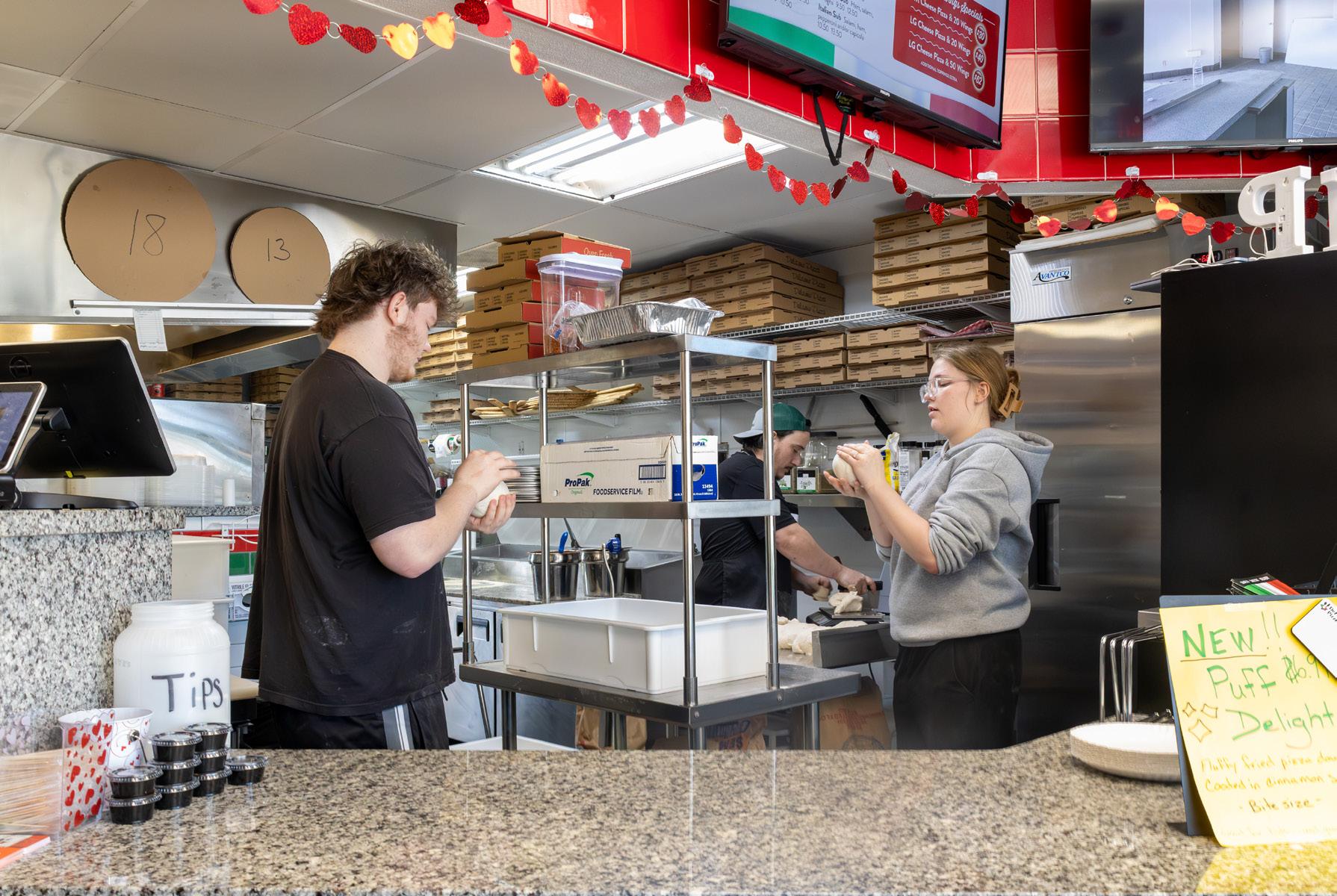
includes vegan and vegetarian options.
Despite the diverse offerings, foot traffic was low for a while after the pizzeria first opened.
James said that a TikTok review by local influencer Cameron Parker spurred a new wave of customers who fell in love with the pizzeria. The surge in business could have overwhelmed a new restaurant, but the staff embraced the momentum.
“I was the first employee hired,” said Faris Sayar. “There’s a family atmosphere. Everyone’s kind. It’s not a drag coming in, because it’s a lot of fun.”
James DeFazio’s fiancé, Maddie Williams, also works at the pizzeria and appreciates time with customers.
“Just seeing people smile brings me comfort and joy,” she said. “Genuinely just making connections with others.” She pointed to customer Doug Hodges, who had just arrived
at the counter. “He’s one of the regulars!” Hodges first noticed the pizzeria while driving, long before the TikTok review. He attended the Oct. 3 opening and has frequented the spot ever since.
“I knew as soon as I tried the quality of the pizza they were bringing to the table that they were going to do very well,” he said. “It’s not doughy, just more authentic. Way better quality ingredients than all your fastfood stuff around here anyway. Nobody else is making pizza like this. Nobody.”
While reviews like his are encouraging, the family has also experienced setbacks. Steve was most surprised by food costs for the first four months. The bill for ingredients alone soared past $80,000; adding operating costs, salaries and rent only increased the expenditure. Still, Steve said he is confident, emphasizing that the
pizzeria has been self-sufficient from day one and that the family has not been forced to dip into any savings to supplement the operation. He even looks forward to expanding someday.
“We have a ton of our sauce around here,” he laughed, pointing to the storage bins and sauce kegs stacked against the wall. “We need more space.”
Above all, the DeFazios encourage entrepreneurs to look past potential obstacles and commit to their ideas.
“Do it,” he emphasized. “Just do it. I held back for 50 years, and I never really looked into pizzerias. I could never just drop it and start one. But all my businesses have been started with no money. My wife says we opened this on a dollar and a dream, and we did. You’ve gotta take a chance and do some research.”
My Passion: After asking those closest to me what they believe I am most passionate about, they all gave the same answer: I consistently put others before myself and genuinely want to see those around me succeed. This is a value I plan to carry into my presidency, making it the foundation of my leadership. Jesus’ life was marked by humility and compassion, always prioritizing the needs of others. As president, I hope to follow the example of Jesus. I will lead with humility, compassion, and a sincere commitment to the success of our Southern family.

“Set an example for the believers in speech, in conduct, in love, in faith and in purity.” 1 Timothy 4:12 Serving JESUS.
A Christ-Centered Campus
• Ensure the Student Association upholds a standard that reflects Christ first and foremost, modeling integrity, service, and faith-centered leadership in all decisions and initiatives.
• Promote and maintain a Christcentered campus by supporting faith-based initiatives, encouraging spiritual growth opportunities, and fostering an environment where students can integrate their faith into campus life and leadership.
Mid-Semester Student Feedback Surveys
I would like to implement a feedback system that helps instructors recognize what is effective, address challenges, and adapt in ways that enhance student engagement and understanding before the term concludes.
Public Follow-Ups As president, I will use Student Association social media to share concise monthly updates so students can easily stay informed on past actions, current initiatives, and what’s coming next.
Counseling Center Information in All Syllabi
• I am committed to prioritizing student well-being by working to include Counseling Center information in all syllabi, so mental health support is visible, accessible, and normalized from day one.
Networking with Alumni
• I would like to develop a student success initiative that links current students with local alumni, offering networking opportunities for students seeking guidance and professional insight.
I would like to work toward local church member involvement and departmental support to help create effective connections for students who may be seeking guidance.
Presidents Accountability for Other Officers
Regular Check-Ins: Scheduling consistent one-on-one or group meetings with officers to review progress on assigned tasks, initiatives, and events.
Clear Expectations: Defining roles, responsibilities, and deadlines to ensure officers understand their duties and how they align with the association’s goals.
• Support & Resources: Identifying obstacles officers may face
and connecting them with the tools, mentorship, or campus resources needed to succeed.
Events
• For many students, Southern becomes a home away from home. I would like to support my team as they create thoughtful and engaging events that bring students together and build a strong sense of community. My hope is to help foster a campus environment where students feel welcomed, connected, and encouraged to be involved.
Anonymous Student Feeback Platform Maintain clear communication channels between the SA and the student body. Bring student perspectives to policy discussions or campus improvement.
Building A Team
Another quality I admire about John Hargys leadership is that he chose team members based on their skills and strengths, rather than personal friendships. I believe this is key to building a strong Student Association, and as president, I would continue this approach to ensure our team is effective, diverse, and able to serve all students.
• If you have the passion and desire to serve, you’ll have the opportunity to be considered for a spot on our team.
Club Support • I admire the work John Hargy did in supporting campus clubs, and I would like to continue and build on that foundation. Clubs play a vital role at Southern, giving students the chance to explore their passions, develop leadership skills, and connect with one another. As president, I would continue supporting clubs by helping them access the resources they need and by encouraging a campus community where students can come together
Student Represenation on University Committees
Over the past several semesters, I have gained valuable experience through both leadership and challenge. I have been tested repeatedly, and each time
I have grown stronger, more disciplined, and more prepared to serve. These experiences have shaped my commitment to this campus and to the students who call it home. I am not only willing, but eager, to serve as your representative for meaningful progress. With that in mind, I would like to share a few focused proposals aimed at strengthening engagement, improving student life, and advocating effectively on your behalf.
Improve Thatcher Dorm Facilities – Work with dorm leadership to pursue ice machines in the girls’ dorms, initiate funding and planning for an elevator, and advocate for additional washers and dryers to enhance daily student life.
• Support Student Athletes & Soccer Community – Advocate for permanent soccer goals on campus fields and explore forming a club structure to promote leadership and broader student involvement.
• Strengthen Senate Engagement – Expand the Social Committee to approximately ten senators so it can support not only Senate-hosted events but also major Student Association events, increasing collaboration, leadership opportunities, and overall campus engagement.
Above all, my role as Vice President would be rooted in advocacy. I believe it is important to be honest about the limits of Student Association authority.
While students desire change and solutions, many decisions ultimately rest with the administration. However, as a student leader, it is my responsibility to consistently represent the needs and concerns of the student body, even when outcomes are uncertain.
One ongoing concern on our campus is parking. I understand how frustrating it can be to find parking, and while this issue has persisted year after year, I am committed to continuing to advocate for creative and realistic solutions on behalf of students, even if immediate expansion is not possible.
Another concern is academic credits. I deeply relate to the challenge students face in staying on top of credit requirements. While I cannot promise reduced credit requirements or guaranteed changes to how credits are earned, I will advocate for students by communicating concerns, exploring possible alternatives, and supporting opportunities that make participation more accessible, recognizing that students balance academics, work, leadership, and campus involvement.
Overall, my goal is, Build a More Student-Centered SA, Empower senators, increase accessibility, and develop leaders prepared to serve both now and in the future.
In His Service, Alejandro Robles

Hello everyone, my name is Jordan Collazo, and I am running to be your Social Vice President for the 2026–2027 school year. This past semester, I had the privilege of serving as Social Vice President for the Winter 2026 term. Stepping into this role helped me understand how important it is to support and connect with the student body, and it showed me that this is something I truly want to commit to for a full year. I am a social work major, and my passion is helping others and building a strong campus community. These values closely align with what Student Association represents. I believe that serving others is an important calling, and being able to serve the student body has been both meaningful and motivating for me. This experience has confirmed that I want to continue in this role and give my best to the student body and on our campus.

Morals & Guidelines as Social VP:
International Food Fest Theme: This would be a night to celebrate different cultures on campus through food, music, and traditions. It’s more than just eating — it’s learning about each other and bringing people together. I want it to feel welcoming,
or does comedy — this night would be about hyping each other up and celebrating talent.
• Mid-Winter Party : Winter can feel long and stressful, so I’d love to do something cozy and fun. Think twinkle lights, warm drinks, games, music, and just a relaxing atmosphere. A break from school stress where everyone can just enjoy being together.
Diversity : I truly believe that outreach and collaboration with different clubs strengthen diversity and camaraderie within the student body. My goal is to create stronger connections and encourage greater student involvement, whether through campus events, support, or assisting in any way I can because I believe that God calls us to serve.
Inspiration: As Social Vice President, I want to inspire and encourage students to take initiative by creating and organizing their own events and clubs. I believe every student should feel empowered to bring their ideas to life and know that they have the support to do so. I am always willing to help, whether that means offering guidance, collaborating on planning, or helping along the way. My goal is to create an inclusive and welcoming environment where students feel confident, supported, and excited to get involved on campus.
I am running for Social Vice President because I believe student life at Southern Adventist University has the potential to be more intentional, more engaging, and more memorable than it currently is. Events should not simply fill a calendar. They should create experiences that bring people together, elevate campus culture, and leave lasting memories that define our time here.
Raising the standard means focusing on quality over quantity. It means thoughtful planning, stronger production value, student collaboration, and events designed with clear purpose. When students choose to spend their time at a campus event, that time should feel valued. Social life should feel exciting, inclusive, well executed, and truly worth showing up for.
My vision includes large scale signature events that become part of our university’s identity and give students something to anticipate each semester. I want to create moments that feel intentional from start to finish. Moments that draw the campus together, create anticipation, and strengthen community.
Intentional leadership also means listening. I want students to have a voice in shaping campus experiences through feedback, collaboration, and creative involvement. When students help build what they attend, events become more than entertainment. They become shared ownership. Creating unforgettable events requires confidence, vision, discipline, and the willingness to raise expectations. Culture does not evolve by accident. It evolves when someone is willing to challenge the norm and lead with purpose. I am ready to lead with that level of intention. To view my full platform and the specific events I plan to introduce, scan the QR code to explore the vision for a more intentional student experience at SAU


Abby Dizon Contributor
Have you ever encountered someone with an inflated ego?
Someone who is self-absorbed, disrupts conversations, disregards opinions and always seeks the spotlight? Whether this person is you or someone you know, having a big ego can harm decision-making and social dynamics, especially in collaborative settings.
However, a healthy, strong ego is not necessarily bad, as it can help our self-esteem and self-confidence, pushing us to pursue our goals and achieve personal growth. Here are some tips for maintaining a healthy, balanced ego.
Learn from others and let go
Inflated egos can cause individuals to overlook their flaws. Having a high ego often masks a sense of fragility and insecurity, giving the appearance of being “all-knowing” as a defense mechanism. People with high egos may even lean on the “backfire effect,” where their reaction to evidence that contradicts their beliefs is to strengthen those beliefs rather than reconsider them, especially if those beliefs are incorrect.
Additionally, those with an inflated ego may feel a poisonous need to micromanage everything. This behavior can be especially detrimental in group projects, where working together is essential. In contrast, someone with a healthy ego acknowledges their own shortcomings and mistakes, limits their own power and reach and is willing to pass the baton to
those who are capable.
“Sometimes a good leader means knowing when to step down and let others lead,” said Janet Levinger, a social impact leader.
Practice gratitude
Along with passing the baton to others, it is important to recognize where praise is deserved. By expressing gratitude to those who have helped you along the way and recognizing the small efforts others have
made for your success, you strengthen relationships and cultivate a mindset that appreciates the support you received.
Being honest with yourself and others
The ego is a false front, projecting what we want others to think we are. According to R. Herrema in Honesty and Ego, maintaining a false ego is exhausting, with its only power source being validation. Our false ego thrives when the
external data matches our external input. For example, if we present ourselves as caring and strong (our external input), and someone contradicts us by saying the opposite (the external data), our ego is unsettled.
“They are never satisfied and drain us because to power them takes more energy than the energy they give back,” Herrema said.
The only way to settle is to embrace your true self and be honest with others as much
as possible. It may be painful at first, but it sets you on the course of true empowerment.
Losing your inflated ego is the best thing you can do for yourself. It allows you to take responsibility and learn from your mistakes, which opens the door to personal growth and strengthened relationships. With humility, one can appreciate the strengths of others and live a more fulfilling life.

Matthew Taylor Sports Editor
The Winter 2026 basketball intramurals came to an exciting finale during the Rees Series Basketball Tournament on Saturday night, Feb. 14. Nearly 50 teams participated in the five leagues. The men’s tournaments included 33 teams divided into three leagues (A, B and C), and the women’s tournaments included 16 teams divided into two leagues (A and B).
The Rees Series Championships for Men’s and Women’s A Leagues were sponsored by AdventHealth, who gave out Most Valuable Player (MVP) awards for the final two games in each bracket.
The Men’s A League featured a five-team bracket. The championship game was a face-off between first-seed “We’re Washed,” captained by Adrian Serna, and the second-seed “Moggers,” captained by Orlando Lopez. Due to a momentum shift at the end of the second half, the Moggers came out victorious in a high-scoring matchup, winning 78-66. AdventHealth awarded team captain Lopez with the MVP.
“It felt great,” said Moggers player Ryan Lopez. “It is my second time reaching the championship, and I graduate this semester.”
The Women’s A League featured eight teams. The fifthseed “Basketball,” captained by Grace Peterson, rose through the ranks to face off against the second-seed “Tall Tale,” captained by Nyah Jackson. Jackson, whose team name was inspired by the average height of its players, had played with many of her team members in prior years, including a homecoming season playing alongside her sister, Camryn, for the first time since high school.
“I was relieved but also nervous,” said Jackson. “I hadn’t
been in the championship since freshman year, and my team then got blown out.”
Grace Peterson’s “Basketball” was the underdog in each of their games leading to the championship. They defeated the fourth-seed “Southern Breeze” and first-seed “Chick-filLayups” in their attempt to take the championship title. After a defensive 34-24 matchup, “Basketball” continued their underdog win streak, and captain Peterson was rewarded with the MVP.
Twelve teams participated in the Men’s B League bracket, and the championship game featured first-seed “Never Played,” captained by Joshua Kim, and the second-seed “Foul Baiters,” co-captained by Tumelo Mhango and Jackson Cvercko.
The players on Kim’s “Never Played” were primarily from the pre-medical/dental background. Their name was picked in irony, as most of their players had some sort of experience before coming into the season.
“Our primary strategy for the game,” said Kim, “was to get the ball to either Josh Loenser or Isaac Lopez and just try and support them in whatever way we can.”
Mhango and Cvercko’s Foul Baiters have a long history playing together, as even their underclassmen players have teammate chemistry from high school. The team entered the game with their spirits weighed down by the sudden injury of one of their offensive players, sophomore Joseph Houston, who had suffered a partial tear of his LCL.
“We didn’t really have a strategy going into the night,” commented Mhango. “We’ve been playing very good defense and offense.”
While Mhango expressed frustration with the officiating,
he shared appreciation for the opportunity to grow closer to his teammates.
Never Played defeated the Foul Baiters with a score of 55-43.
As with the upper leagues, the Women’s B League featured eight teams pushing to take home the victory. Firstseed “Princess Ball,” captained by Melody Mambo, faced second-seed “Ball w/o You,” captained by Chloe Frans.
“We played against our friends,” said Mambo. “It was a really fun opportunity to have fun and remember that we’re all still friends in the end.”
“We all knew what we were comfortable with,” continued Mambo. “Being able to adjust to different positions was the true strategy into playing the game.”
In the closest matchup of the night, Ball w/o You defeated
Princess Ball in a tight 26-22 game.
The Men’s C League was the largest bracket of the night, featuring 16 teams. Unlike the aforementioned championships, this tournament’s journey to the final game was not as straightforward. The initial matchup was meant to be between fourth-seed “Shalom Yahweh,” co-captained by Gideon Orellana and Jadon Douglas, and third-seed “Hoogins,” captained by Noah Saesim. However, fans at the event instead saw the second-seed “Love Muffins,” captained by Morgan Baldwin, get a second chance after their loss to Hoogins.
“Hoogins actually beat Love Muffins in their semi-final game,” explained Intramural Director Troy Walker, “[but] the captain of Hoogins contacted me and said they had to forfeit the championship game due to
injuries/other.”
“Our strategy was simple,” said Love Muffins player Caleb Mohns. “Play solid defense, rebound well and look for a strong first breakout pass. Whenever we were at our best, everything started with those fundamentals.”
“Our primary strategy was to just play hard defense and have our defense lead into offense,” said Douglas. “There aren’t any plans we ran; [we] just moved the ball around set screens for each other, played to our strengths.
In the end, Love Muffins made good on their second chance and defeated Shalom Yahweh 54-45.
After hours of competition, five teams emerged as champions from the 49 contenders of the evening’s event.

Maddie Schmidt Opinion Editor
The other morning, I woke up to the sound of my roommate walking in and out of our room as she was getting ready for class. Confused, I checked my phone to see why my alarm hadn’t gone off, only to discover that my phone had died overnight. Upon further investigation, I realized that my charger had not been fully plugged into the wall.
Frustrated, I reinserted my phone charger and began to get ready for my day. I usually listen to music or a podcast while I get ready or do chores, but that morning I had to get ready in silence.
I thought that the silence would be boring—that I would be itching to grab my AirPods after a few minutes. However, I found that I actually enjoyed the silence. It provided room for me to listen to my own thoughts while I was getting ready, instead of just tuning out while listening to something else.
Recently, I have found that it has been harder for me to come up with ideas, whether it be a topic for an essay I need to write for class or just something to write about in my journal. My creativity has felt stagnant, and it has been taking me a long time to come up with something original to talk or write about.
The other morning, though, when I chose to get ready in silence, ideas began to spark.
I thought of a topic for an essay I needed to write, and I remembered something that I wanted to jot down in my
journal. I even thought about how I could turn that journal entry into some sort of poem or short story. All of these ideas surfaced in just 20 short minutes of silence.
I realized that I have been unintentionally letting other people do my thinking for me. If I choose to fill all my moments of silence with listening to music or to someone else talk on a podcast or TV show, then I am not allowing myself the opportunity for my own creativity to flow through my mind. I am simply absorbing and critiquing other people’s ideas, not thinking critically about my own.
Generally, my first reaction to silence is boredom, so I turn to entertainment because it is right at my fingertips. But if I am never bored, then how will I ever be motivated to create anything of my own? I realized that constantly satisfying my craving for entertainment has stunted my own creativity, and as a result, I have allowed myself to become somewhat robotic in how I approach my day-to-day life.
Once I realized how avoiding boredom has shaped my critical thinking habits, I began to ponder the implications of this problem in society. My generation (Gen Z) constantly has headphones in our ears and all the entertainment we could ever desire in our back pockets.
On the surface, this doesn’t seem like such a horrible thing. We have access to all kinds of information and nearly unlimited possibilities at our disposal. However, what kind of problems might arise if we are all so tuned in to the media
that we forget about our ability to be creative?
If our generation lets the trend of passive consumption take over, society itself will eventually experience a decline in problem-solving skills, and we will forget how to adapt to our dynamic environment. Overall, we will become a less productive society that suc-
cumbs to conformity instead of encouraging original thinking.
For a long time, I just thought that I wasn’t good at the brainstorming process of activities like projects and writing. However, I wonder if I simply haven’t given myself the space to practice coming up with my own ideas. I think that many of us would find
that we are more creative and better at problem solving and brainstorming if we would sometimes sit in silence and let our brains do what they were made for. I think the solution to stunted creativity and lack of inspiration is to let ourselves sit in silence—to experience boredom.

Katie-Jane Emde Contributor
The wallpaper was covered with fish. The room smelled like crayons, books and stuffed animals that had been taken out to recess. But I was so sad. My loving mom and sisters were at home, while I was surrounded by strangers.
I was in first grade and would spend my weekends crying in dread of going back to school on Monday. I developed a coping habit for when the sadness became too much to handle: I would go into the bathroom, close the door and look at the fish wallpaper. There, I would start to sing, “Jesus loves me, this I know, for the Bible tells me so. Little ones to Him belong; they are weak, but He is strong...” My little heart knew just what would make it feel better: remembering that Jesus loves me.
Fast-forward 13 years, and I had long since gotten over my fear of new people, new places and new adventures. Now I was the “mom” of 15 little girls in Bolivia! My entire identity was wrapped up in making sure that they knew that they were worthy of being loved, despite histories of abandonment and abuse.
But a few months before my time was over, I was reflecting with my fellow student missionary on our day off. We realized that we had gotten so wrapped up in singing “Jesus loves you” that we had forgotten to sing “Jesus loves me.” We all crave being loved. We put our value in it and build our identities around it. Some of us seek love in relationships, and others build an identity in service, hoping to be loved and valued by those we serve. Perhaps for many of us, a faint
tune is always playing underneath it all. Maybe that tune has become too soft to hear on a regular basis, drowned out by other louder songs. But that tune is still in the back of our minds, comforting us since childhood: “Jesus loves me.”
Seeing the hurt in my heart after my return from Bolivia and witnessing my longing to find myself and God again, my friend implored me, “Katie-Jane, you have to let God love you. When you let God love you, your ministry will look different, your identity will look different and your heart will feel different.”
The phrase “Let God love you” changed my life. It resonated with the faint, buried tune in my heart, but this I didn’t know. I certainly didn’t feel it.
So, I took my friend seriously. I went and bought a new Bible, and I opened it with a prayer: “God, reveal Yourself to me in a new, fresh way. Help me find You for who You are right here, right now. I am going to read this Bible with only one assumption: that I am loved.” That is how I began to fall in love with Jesus for the second time.
What I found as I read Scripture with fresh eyes was the most beautiful picture of God I had ever seen. In every verse and every story, His love radiated out! The more I read, the deeper in love I fell. Here was a God who called me precious (Isaiah 43:4), who delights in me (Psalm 18:19), and says over and over, “I love you.” Finally, I could sing again, “Jesus loves me, this I know, for the Bible tells me so!”
One of the perfect passages to illustrate this is John 15:1-17. I encourage you to read it slowly. Jesus calls Himself the Vine and us the branches, reminding
us that if we abide in Him and stay connected, we will produce fruit in abundance.
“Our assignment is not fruitfulness but faithfulness,” Max Lucado writes in his book “Anxious for Nothing.” Verses 9-17 are my very favorite part of this passage because we see a profound sequence. The first command is given: “Remain in my love.” God is literally saying, “Be loved by Me!” To remain in His love is to obey His commandments, showing us that a love theology does not remove the commandments but just gets the order right.
The second event, after remaining in God’s love, is that “your joy will overflow!” What
I did not mention in my story is that after rediscovering God and His character of love for me as an individual, I was filled with the most intense joy. I learned that joy is not just a nicely packaged gift from Jesus; it’s an atmosphere we are invited to peek into and choose to stay in!
When we realize that it is not our intrinsic value that makes God love us and that it is the love of God that gives us our value in the first place, we can’t help but experience this joy!
And third, Jesus speaks the final command: “love each other.” We cannot love well if we are not loved first. We do love well when it is from a joyful
overflow!
I pray the words of Ephesians 3:17-19 over this campus and each of God’s children: “Then Christ will make his home in your hearts as you trust in him. Your roots will grow down into God’s love and keep you strong. And may you have the power to understand, as all God’s people should, how wide, how long, how high and how deep his love is. May you experience the love of Christ, though it is too great to understand fully. Then you will be made complete with all the fullness of life and power that comes from God” (NLT). Let God love you. Remain in His love. The simple gospel is this: “Yes, Jesus loves me, the

Rhett Seitz Lifestyle Editor
In high school, I had a specific role, and I played it well: I was the expert. I was the “go-to guy” for history and social studies. If you had a question about a political movement or a historical date, I had the answer. I built my identity around being the one who knew everything. I walked into classrooms confident that I was the smartest person in that specific subject, and, frankly, I liked the feeling. It felt safe. It felt validating. But, as I would soon find out, it was also a trap.
When I arrived at Southern Adventist University, I decided to leave the safety of history books behind and go out on a limb. I declared a major in computer science.
To call this a “pivot” would be an understatement. It was a complete restart. Before my first collegiate class, I had practically zero experience with coding. I didn’t know the difference between Boolean and binary code. In high school, I had never heard anyone use the term “programming.” I did not even know what it was.
When I walked into the computer science lab, reality hit me like a cold splash of water.
I was suddenly surrounded by peers who were brilliant. These students seemed to have been coding since they were in diapers. They were talented, hardworking and driven. They spoke a language that sounded alien to me. They thought differently from me based on my background from high school. For the first time in a long time, I wasn’t the expert. I was the novice.
I felt incredibly out of place. It wasn’t because the people were unkind—in fact, they were great. It was because I felt I lacked the fundamental skills to belong. Imposter syndrome set in. I looked at my classmates and thought, “They are clearly better than me.”
I wanted to give up. The gap between where they were and where I was seemed too wide to bridge. But then, my perspective shifted. I realized I had a choice. I could view these proficient classmates as threats to my ego, or I could view them as open doors for my future.
There is an old saying that floats around successful circles: “If you are the smartest person in the room, you are in the wrong room.”
At first, this phrase confused me. Was it asking me to be incompetent? Not at all. The phrase isn’t telling us to be unintelligent; it is telling us that growth stops when you top out. Being the expert often means you have stopped asking questions. Real intellectual strength doesn’t come from always being right; it comes from recognizing your mistakes and having the ability to adapt.
I decided not to quit. I decided to become a “backseat driver.”
Usually, a backseat driver is an insulting term for someone who annoys the driver by giving unwanted advice. But in this context, being in the backseat is a good thing. It means you are watching someone who knows how to drive the car better than you do. You are observing their turns, their speed and their decisions.
I started learning from my professors and even more so
from my peers. I realized that if I am surrounded by people smarter than me, I am in the perfect environment to absorb wisdom.
Comfort is the enemy of progress. If you have been struggling recently with a certain skill or goal, that might actually be good news. It means you are stretching. It means you are growing. It means you have work to do.
I recently took a test for one of my classes. I didn’t do badly on it, but I didn’t get a perfect score, either. “High school Rhett” would have been devastated that he wasn’t the top scorer. “College Rhett” saw it differently. It was a wake-up call. It showed me exactly where my gaps were. It wasn’t
a failure; it was a success in disguise, because it gave me a roadmap for what I needed to work on next. You don’t have to be the smartest person in the room to succeed. In fact, if you want to grow, you shouldn’t be. You just have to be the most willing to learn.
Here are some tips on how to handle a room full of experts: Kill the “Know-It-All”: Don’t think you know everything, and definitely don’t act like it. The moment you think you have arrived, you stop moving forward.
Be a Student of Everyone: Treat every person you meet as if they know something you don’t—because they usually do.
Embrace the Struggle: If you are bad at something initially, you just haven’t done it enough times to become a master.
Scripture speaks directly to this posture of humility. Proverbs 13:20 NIV says, “Walk with the wise and become wise, for a companion of fools suffers harm.”
When you surround yourself with people who challenge you, you aren’t losing status; you are gaining wisdom. So, take a look around your classroom. If you feel like everyone else is smarter than you, take a deep breath and smile. You are exactly where you need to be. You are in good hands.


Created by Nyah Jackson

• 11:00 am Convocation: Student Association Election Speeches @ Iles P.E.

Wednesday
pm - Dih1 vs Hitmen (Men’s A) - green beans vs 5NightsAtFredHuta’s (Men’s B)
- Hits Different vs Disciples of Digs (Women’s A)


• Payday: Hourly/Students
• 6:00 pm School of Business Induction Service @ Thatcher Chapel
• 6:28 pm Sunset.
6:30 pm Vespers: Manny Gomez @ Collegedale Church of Seventh-day Adventists
7:30 pm AfterGlow @ Collegedale Church of Seventh-day Adventists South Atrium
8:30 pm Vespers: Manny Gomez @ Collegedale Church of Seventh-day Adventists
- Sarang stealers vs blocked, full contact (Women’s B)
6:45 pm
- Monkeyzandfriendz vs B.I.R.D (Men’s A)
- Benny and the Sets vs bouncy gorls (Women’s B)
- We Know Ball vs bailing (Co-Ed A)
- Evans Co-ed Volleyball Team vs Thunder Serve (Co-Ed B)
7:30 pm
- volleyball vs Ballers (Co-Ed A)
- setter? i hardly know her vs Love at First Spike (Co-Ed B)
- All Set vs Blackout Barbies (Women’s A)
- Phantom Blockers vs Old school (Men’s B)
8:15 pm
- Pleeuse vs 67 OVR (Men’s A)
- The Empire Spikes Back vs Bone Blossom (Men’s B)
- Block Blast vs super smash bros (Women’s A)
- here i am set me vs volleyball (Women’s B)
9:00 pm
- LA Fitness Runs vs That’s Chlo and ‘em? (Co-Ed A)
- No Diggity vs aegyo attack (Women’s B)
- san sans minions vs Sky force (Co-Ed A)
- Mickeys Clubhouse vs Big Boom (Co-Ed B)
9:45 pm
- 40pop vs Bing Bongs (Co-Ed A)
- caesar salad vs Pop Up Blockers (Co-Ed B)
- Monkeyjumpers vs serves you right (Co-Ed A)
- volleyball team vs aj loves cheese pizza (Men’s B)
Become an advanced practice nurse and earn a doctor of nursing practice at the same time.
The BSN to DNP program mentors bachelor’s degree-level graduates as they gain necessary RN experience through an advanced nursing practice emphasis of their choice.
Options include:
• DNP/MBA
• Lifestyle Medicine
• Nurse Educator
• Nurse Practitioner (emphases include Acute Care–Adult/Gerontology, Primary Care–Adult/Gerontology, Family, and Psychiatric Mental Health)
Call or visit online to find out how to get started.