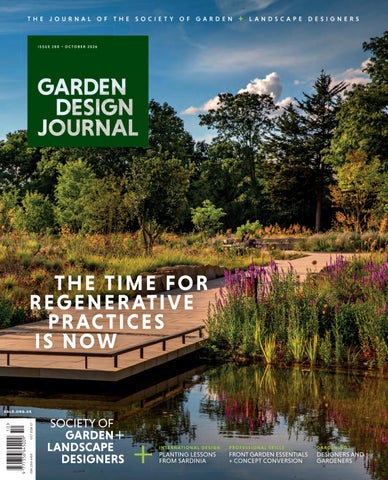
THE JOURNAL OF THE SOCIET Y OF GARDEN
+ LANDSCAPE DESIGNERS
ISSUE 280 + OCTOBER 2026
TH E TI M E FO R R E G E N E R ATI V E PR AC TI C E S I S N OW
ISSN 1356-6458
OCT 2026 £7
SGLD.ORG.UK
I N T E R N AT I O N A L D E S I G N
PROFESSIONAL SKILLS
GARDENING
PLANTING LESSONS FROM SARDINIA
FRONT GARDEN ESSENTIALS + CONCEPT CONVERSION
DESIGNERS AND GARDENERS
Photograph, (Garden in the Silver Moonlight by Haruko Seki (Studio Lasso), pre-registered SGLD member, and Makoto Saito (ADD.Locus Architects Ltd)) Alamy/Emma Peios
LOOK AROUND
ART AND THE GARDEN Landscape historian and critic Tim Richardson has curated and is chairing Garden/Art/Garden, a series of talks at the Garden Museum, London, aimed at broadening our understanding of what gardens, landscape and place can mean in the context of artistic practice in an era of climate change. On 20 October, he will talk to sculptor Lotte Scott, photographer and sculptor Mike Perry, and artist Miranda Whall about the role of the garden in artists’ and gardeners’ re-presentations of the natural world.
In subsequent talks on 3 and 17 November, and 1 December, he and other speakers, including artist Tania Kovats, landscape designer Dan Pearson OBE FSGLD, and lecturer and author Dr Becca Voelcker, will consider ideas surrounding plants, places, growth and decay; the Japanese Garden as a work of art, and ways of celebrating plants and the people who care for them. For more details and to book tickets, visit gardenmuseum.org.uk
GARDEN DESIGN JOURNAL 3
24
Hello, The last of this year’s big flower shows may be over but I am still glad to hear from SGLD members about their experiences of taking part in those events. SGLD Friend Gemma Lasseter has sent news of the planting she and SGLD Students and Graduates installed at RHS Badminton (page 44) and we will hear from RHS Sandringham exhibitors in the next issue. Pre-registered SGLD member Zoe Claymore and John Wyer FSGLD both attended Groundswell this year, to learn about regenerative farming and its implications for garden and landscape design (see pages 30 and 17), and I hope one or more readers will submit a piece about the Beth Chatto Symposium (email gdj@ jamespembrokemedia.co.uk). Of course, there are other industry events still to take place this year, including FutureScape in October. The SGLD will be there (see page 29) while, for plant historians, the Chelsea History Festival (1 to 4 October) is a chance to learn about the horticultural history of that Royal borough.
34
18
Arabella St John Parker EDITOR | gdj@jamespembrokemedia.co.uk
40
Editor: Arabella St John Parker Senior Editor: Lizzie Hufton Publisher: James Houston Published by: James Pembroke Media, Ground Floor Riverside North, Walcot Yard, Bath BA1 5BG 01225 337777, gdj@jamespembrokemedia.co.uk Advertising: Annabelle Bruning, Advertising Sales Executive, 020 3859 7100, annabelle.bruning@jamespembrokemedia.co.uk Subscriptions: 01442 820580, contact@webscribe.co.uk Editorial Panel: Zoe Claymore, Naomi Ferrett-Cohen,
4 SGLD.ORG.UK
50 Marcus Foster, Amber Hine, Joe Perkins, Christina Sullivan, and Rae Wilkinson Society of Garden + Landscape Designers Katepwa House, Ashfield Park Avenue, Ross-on-Wye, Herefordshire HR9 5AX, 01989 551083, sgld.org.uk info@sgld.org.uk SGLD Awards, AMS: 01989 567678, awards@sgld.org.uk Copyright notice and disclaimer: Garden Design Journal is published 10 times per year by the Society of
Garden + Landscape Designers (SGLD). All material is copyright of the SGLD and/or named contributors and may not be reproduced in any form without written permission. While all reasonable efforts have been made to ensure the accuracy of the contents of this publication, the publishers do not accept responsibility for any errors or omissions. The views expressed in the Journal are not necessarily those of the SGLD or James Pembroke Media and publication of an advertisement or article does not necessarily mean the SGLD endorses those products, materials or techniques.
CONTENTS
LETTER FROM COUNCIL
I S S U E 28 0 + O C TO B E R 2 026
32
Insight: the ability to think about and see things differently is a garden designer’s superpower
34
Professional Skills: four student designers conceive and build a show garden
40
Professional Skills: reclaiming our front gardens for plants
REGULARS 14
30
Member Project: Marian Boswall FSGLD on Chalk to Coast, a regenerative nature plan for Kent
17
Point of View: regenerative gardening is a profound
UP FRONT
philosophical shift, says John
03
Wyer FSGLD
Look Around: Garden Museum talks about gardens, landscapes
07
Newsprint: industry news, awards
policy proposals 47
International Design: Marco Scano’s take on Sardinian mosaic
Round Up: our recommended selection of the latest garden books
SHOWCASE 18
SGLD Updates: RHS Badminton; Grand Designs Live; landscape
and events for your diary Photograph, (Arabella St John Parker) Frizbee Film/Gavin Renz
45
and art in a changing climate
50
Point of Interest: the Queen Elizabeth II Garden
plant formations 24
Gardening: how Julie Toll FSGLD has assembled a professional
David Stevens FSGLD
garden team to manage the
SGLD COUNCIL MEMBER AND AMBASSADOR FOR THE SOCIETY
ongoing care of a long-term project in Hertfordshire 30
With spring and summer gone, this year’s show garden season has come to an end and yet, it will be back, and sooner than we think. Large or small, near or far, show gardens are platforms that can offer endless opportunities. Many of us work alone, and to create and build a show garden is far from easy. You need the best of teams, a sponsor, funding, and a contractor. You have to juggle time and workloads, search for the right plants, nurseries and materials, get to grips with Construction, Design and Management regulations, insurance... the list is extensive. Is it worth it? For some, the light at the end of the tunnel is recognition, a medal, and the prospect of clients flocking to their door. All that might happen but the true worth of creating a show SHOW GARDENS garden, or any garden, is far more than that. While ARE PLATFORMS a domestic garden can take months, even years THAT CAN to build, a show garden OFFER ENDLESS will take two, maybe three weeks, but only if OPPORTUNITIES. you are part of a team, and involvement extends far beyond the build. The team is the force behind your vision, and you need to know and work with everyone so that when the spades hit the ground, absolutely everything is ready. The build will have highs and lows and most things in between. You are utterly dependent on your contractor and their team; you are one of them, you start early, and you finish late. Think hard before embarking on the show garden route, but if you do, you will have one of the most privileged opportunities and, most importantly, you will have embraced the team around you. That garden, and all others you create, belongs to you all.
Look Back: tapping into new ways of thinking at Groundswell, Britain’s festival for regenerative farming
Join us today: become a member of the SOCIETY OF GARDEN + LANDSCAPE DESIGNERS Garden Design Journal is the journal of the Society of Garden + Landscape Designers (SGLD), the professional association for garden and landscape designers. The Society has been championing excellence in garden design for more than 40 years and includes both individual designers and design practices among its growing membership. They are all competent, creative professionals, accredited by the
← COVER Photograph, Clive Nichols (see page 50). Issue 280/£7 ISSN: 1356-6458
SGLD and working to its Code of Conduct, on a wide range of projects around the globe. CATEGORIES OF MEMBERSHIP Student member Open to students currently attending a suitable course – see sgld.org.uk for details. Pre-registered graduate For those who have recently obtained their garden design qualification and who wish to join the Pathway to Registered Membership. Pre-registered member Open to all professional garden designers who aspire to Registered Membership.
Page 34: discover how four young designers worked together to conceive and build their show garden for the International Garden Festival 2026 at Chaumont-sur-Loire.
Applicants need to provide evidence of competence in garden design either by qualification or review, plus evidence of professional indemnity insurance. This category now includes submission for accreditation as an inclusive fee – there are no additional charges. Registered member The status awarded to professional garden designers who have been assessed and approved by the SGLD Accreditation Panel. MSGLD (Member of the Society of Garden + Landscape Designers) or FSGLD (Fellow of the Society of Garden + Landscape Designers) can be used after their name and they are profiled and
promoted on the SGLD website. Affiliated business partnerships Open to landscape professional suppliers who foster and promote sustainable and environmentally friendly garden design, using responsible techniques and practices. Registered practice A category for Registered Members who would also like to advertise their practice alongside their MSGLD/FSGLD status. You can also join the Society as a Friend. To find out more, visit the SGLD website: sgld.org.uk
SPONSORSHIP OPPORTUNITIES Find out about sponsorship opportunities for the SGLD Awards and conferences by contacting Andy Barringer at andy@sgld.org.uk GARDEN DESIGN JOURNAL 5
NEWSPRINT
For the latest garden design and landscaping news, visit sgld.org.uk
NEWSPRINT ALL THAT’S NEW IN THE WORLD OF GARDEN DESIGN COMPILED BY ZIA ALLAWAY
→ Right, clockwise from top: Anthony Purdy’s The Rhythm of Rainwater; Naturally Resilient by Susan Harvey and Konstantinos Gargaletsos; The Goldcrest Garden by Sam Outing; Gardens on the Edge by Emily Joy; 100 Sweet Summers by Kitti Kovacs.
SGLD MEMBER WINS THE KING’S BIODIVERSITY AWARD AT RHS SANDRINGHAM FLOWER SHOW
Photographs, (RHS Sandringham Show Gardens) RHS/Neil Hepworth; (RHS Sandringham Long Borders) RHS/Josh Kemp-Smith
The first King’s Biodiversity Award was awarded to Sophie Godber, a pre-registered member of the Society of Garden + Landscape Designers (SGLD), by His Majesty King Charles III, for her habitat-rich show garden, Mindful Chef’s Gathering (pictured, below), at the inaugural RHS Sandringham Flower Show this year. At the same Show, pre-registered SGLD member Anthony Purdy also won a string of top awards for his innovative show garden titled The Rhythm of Rainwater. Sophie’s garden, which also won a Gold medal and the RHS Environmental Innovation Award, showcased naturalistic and edible planting that provided habitats and food for pollinators, other insects and birds, and exemplified how neighbours
GARDEN DESIGN SCHOOL CLOSES After 25 years, Robin Templar Williams FSGLD is retiring from teaching and has closed his celebrated Garden Design School in Bristol. He originally set up the school in 2000, with co-founder and garden designer Moira Farnham. ‘For a while, we had three venues – in Cobham, Surrey, at Bristol Botanic Garden, and at the New England Botanic Garden in Massachusetts – but more recently, we scaled things back to just the
can work together to create wildlife corridors that link the gardens and other natural spaces beyond their walls and fences. Anthony was awarded a Gold medal, the Best Grow Forward Garden, and the award for Best Construction for his innovative design, which was inspired by the musicality of rainfall and which featured seven aluminium dipping tanks for capturing and storing rainwater. Meanwhile, SGLD Student member Kitti Kovacs won a Silver-Gilt medal and The People’s Choice show garden for 100 Sweet Summers, which explored the balance between nostalgia and innovation through the story of a retired couple who cherish life’s simple pleasures. In the Long Borders category, Silver-Gilt medals were awarded to pre-registered SGLD member Sam Outing, for The Goldcrest Garden, and to pre-registered SGLD member Katy Noon and SGLD Graduate Kate Eves, for their Norfolk Weave Border. In the same category, Gardens on the Edge, by SGLD Student member Emily Joy, and Naturally Resilient, inspired by the Norfolk coastline and designed by SGLD Graduate Susan Harvey and SGLD Student Konstantinos Gargaletsos of H&G Studio, both won Silver medals. SGLD members also created a range of RHS Feature Gardens to inspire visitors. Pre-registered SGLD member Catherine MacDonald collaborated with HM The King on the design of the RHS Royal Legacy Garden, which showcased the horticultural
Bristol campus,’ says Robin (pictured). ‘Moira retired seven years ago, after which I continued to run the school with the help of my amazing teaching staff, who included leading names such as Lisa Cox FSGLD and Mark Gregory, MD of Landform. Then, about a year ago, my wife and I moved to Pembrokeshire, and I made the decision to prioritise other things in my life, although I will miss teaching and the satisfaction of seeing talented people develop and thrive.’ Robin will continue to run his garden and landscape design practice from Wiltshire and Pembrokeshire. robinwilliams.co.uk
legacy of His Majesty, his pioneering approach to the environment and his championing of gardeners’ skills. SGLD Graduates Laura Strand and Sam StarkKemp’s RHS Crafted from Nature garden celebrated Norfolk’s distinctive creativity and natural beauty. Meanwhile, the naturalistic, wildlife-friendly RHS Pollywiggle Garden, by pre-registered SGLD member Joe Carey and his wife Laura, featured ideas to support ‘pollywiggles’ (a Norfolk word meaning tadpoles), frogs, and other amphibians. rhs.org.uk For more news about SGLD members at RHS Badminton, turn to page 44.
VOTING OPENS FOR SGLD PEOPLE’S CHOICE AWARD 2027 The shortlist of gardens for the SGLD Main Awards 2027 has now been decided and those finalists in categories one to nine are automatically entered into the People’s Choice Award. The winner will be chosen by public vote, which is run by the Awards’ media partner, Gardens Illustrated, and is open via sgld.org.uk from 1 to 31 October 2026.
GARDEN DESIGN JOURNAL 7
NEWSPRINT ← Far left: Harrington Porter’s winning project, a beautiful, functional family garden. Left: Robert Hughes’ design for this newly renovated corner plot was also a winner.
ACCREDITATION AND AFFILIATES UPDATES The Society of Garden + Landscape Designers (SGLD) congratulates Joanna de Boise and Angela Davidson, who have passed their first projects for accreditation, Dan Bristow, who has passed his second project, and Jennifer Berry, whose third project has been accepted, making her the Society’s latest MSGLD. The Society also welcomes new Affiliated Business Partners (ABPs) McCormack Noble Landscapes (mccormacknoble.co.uk), contractor of high-quality gardens for private and commercial clients; and Steintec Tuffbau (steintec.co.uk), manufacturer of high-performance mortars and materials for the construction of modular pavements. sgld.org.uk BIRMINGHAM BOTANIC GARDENS SET FOR RENOVATION Funding from the National Lottery, together with generous pledges from a number of charitable trusts and organisations, has secured the preservation of Birmingham Botanic Gardens’ historic estate, nursery and iconic glasshouses. Led by the Gardens’ Chief Executive Officer, Sara Blair-Manning, a Growing Green Heritage project has been set up to improve key spaces and facilities, create a suitable environment in which to care for the living collections, strengthen financial resilience, and increase public understanding of plants, sustainability, and environmental issues. birminghambotanicalgardens.org.uk PLANT RISK APP LAUNCHED BY PCA A new app designed to help gardeners, landscapers and horticulturists take early action on invasive non-native plants, including Japanese knotweed, bamboo, and giant hogweed, has been launched by national trade body the Property Care Association (PCA). After identifying an invasive plant, the app will produce a hazard-rating indication, along with advice on what action to take and whether specialist help is needed. property-care.org
8 SGLD.ORG.UK
HARRINGTON PORTER WINS AT PRO LANDSCAPER’S PROJECT AWARDS A stylish family garden with outdoor kitchen, dining area, seating area and richly planted borders topped the bill at this year’s Pro Landscaper Project Awards, as SGLD-registered design practice Harrington Porter was named as both the Supreme Winner and winner of the Design & Build Between £100,000-£250,000 Award. Pre-registered SGLD members Jen Donnelly and Catherine Gibbon received the Community Green Space Under £100,000 Award for their Room to Breathe Garden at Amersham Hospital, rebuilt from a Gold-medalwinning container garden shown at RHS Chelsea Flower Show in 2025. The Design Under £50,000 Award went to pre-registered SGLD member Helen Saunders, for Epsom Townhouse Garden, featuring a kitchen and dining
SGLD SUBMITS POLICY PROPOSALS TO CLIMATE CHANGE COMMITTEE terrace, with tiling that adds a splash of colour and pattern, ornamental planting and a productive area. Robert Hughes MSGLD won the Design Between £50,000-£100,000 Award for Mereheath Lane, a contemporary design for a renovated corner plot. The Design & Build Under £50,000 Award went to pre-registered SGLD member Tom Howard for Mallinson Road, a tiny courtyard garden that combines sustainable materials with naturalist planting. Pre-registered SGLD member Darryl Moore, of Cityscapes, won best Planting Design Under £25,000 for Druid Street in London, and SGLD Student Kitti Kovacs won Temporary Installation Under £50,000 for her QVC’s Reflective Retreat Garden at BBC Gardeners’ World Live 2025. prolandscapermagazine.com
RHS ANNOUNCES NEW SHOWS AND CONFIRMS PEAT-FREE POLICY FOR 2027 The Royal Horticultural Society (RHS) has announced the dates for its Flower Shows in 2027, including a new event in Bristol on 8 to 11 July. The RHS Malvern Spring Festival will take place from 6 to 9 May, followed by RHS Chelsea Flower Show from 18 to 22 May. The new Bristol event will take place in The Prospect Building in the city centre, and will feature a programme of pop-up plant displays, expert talks and advice, and hands-on workshops. RHS Flower Show Tatton Park returns to the estate in Cheshire on 21 to 25 July. Designers considering exhibiting at the shows in 2027 should visit rhs.org.uk/shows-events/exhibitThe Prospect Building in Bristol will host a new RHS show next year.
at-a-show/garden-applications as a matter of urgency, as the deadlines for applications are closing very soon. The RHS has also announced that it is retaining its peat-free policy at its shows but will support growers to increase the range of peat-free plants to maintain biodiverse British gardens for climate adaptation and resilience. Any dispensation will be tightly limited to exceptional circumstances. The RHS may consider extending its peat starter plants dispensation, with plants grown on in peat-free media, only where exhibitors or growers can show they have exhausted all other options and full compliance is outside their control, such as: significant pest or disease outbreak or biosecurity issue affecting stock; extreme weather events affecting production (flooding, drought, storm damage, heat stress); or because plants are part of a recognised conservation scheme to re-establish populations in the natural environment. rhs.org.uk
Rachel Bailey MSGLD, the Society of Garden + Landscape Designers’ (SGLD) lead for sustainability issues, has delivered a proposal to the Climate Change Committee for the National Planning Framework 4 (NPF4) and Net Zero in Scotland. In her submission on behalf of the SGLD, Rachel outlined seven initiatives intended to help to achieve more sustainable, carbonneutral landscapes. For more details, turn to page 45.
SINGAPORE WIN FOR MCWILLIAM AND WILSON A contemplative landscape installation by design duo Gavin McWilliam MSGLD and Andrew Wilson FSGLD has won a Platinum Award at the 2026 edition of the Singapore Garden Festival. The design, titled Gathering the Void (pictured below), explored the moment between dissolution and emergence, and featured curving sculptural elements with a still reflective pool in the centre creating a quiet focal point. It was part of the Show Gardens All-Stars competition which brought together eight of the Festival’s previous Best of Show winners. On receiving the award, Gavin commented: ‘Designing and delivering a show garden more than six thousand miles from home was both a challenge and a privilege.’ mcwilliamstudio.com
Photograph, (Singapore) Chan
NEWS IN BRIEF
NEWSPRINT
PAPER PROPAGATION HERALDS POT-FREE PLANTS
NEWS IN BRIEF
A new propagation system that roots cuttings in biodegradable cellulose paper rather than pots of traditional substrates is set to put the horticultural trade one step closer to becoming a sustainable, plastic-free industry. RCS® 2.0 (pictured right) has been developed by the plant-breeding company Selecta One, and its design allows for rooted cuttings to be
NATURAL HISTORY MUSEUM GARDEN WINS AWARD The Urban Nature Project, designed by J&L Gibbons + Feilden Fowles for the Natural History Museum in London, has won the Built | Institutional Landscape Design award at the 2026 World Landscape Awards. The five-acre, biodiverse public garden acts as a living laboratory, where scientists can monitor and study urban wildlife while inspiring visitors to help safeguard nature in towns and cities. nhm.ac.uk
held substrate-free within strips of sustainable, lightweight and compact paper bags that can be more easily transported and the young plants will be ready for immediate use, leading to reduced packaging waste and a lower carbon footprint overall. The system is currently used for ornamental plants and Selecta is exploring opportunities to license it for
Photographs, (Jo Thompson) Joanna Kossak, (Joe Perkins) Natalia Perkins), (IMED tool) Ben Elliott/Unsplash
JO THOMPSON FSGLD TAKES UP TEACHING ROLE The London College of Garden Design (LCGD) has announced the appointment of Jo Thompson FSGLD as Head of the College’s Garden Design Studies. She will be supported by Duncan Cargill, in the role of Deputy Head of Garden Design Studies, and together, they will lead the College’s Garden Design Diploma from September 2026. The double appointment, says the College, presents the next generation of garden designers with a wealth of professional experience, creative vision, and educational expertise and further strengthens the College’s commitment to teaching done by practising professionals. The College has also launched a new financial award, the Nigel Dunnett Plantsmanship Bursary, that will support students enrolling in the Certificate in Plantsmanship course. The bursary celebrates Nigel’s outstanding contribution to the College, where he taught from 2013 until his death earlier this year, and the significant role he played in inspiring a new generation of garden designers and horticultural professionals. lcgd.org.uk
other industries, including agriculture and soft-fruit growers, allowing the technology to be adapted wherever efficient and sustainable plant propagation is required. selecta-one.com
JOE PERKINS FSGLD TO DESIGN HORATIO’S GARDEN YORKSHIRE The tenth transformative outdoor space in the Horatio’s Garden portfolio will be located at the Yorkshire Regional Spinal Injuries Centre in Wakefield, part of the Mid Yorkshire Teaching NHS Trust, and will be designed by Joe Perkins FSGLD. The calming, accessible, restorative garden will also include a fully accessible garden room and pods designed by architect Clementine Blakemore. Joe and Clementine have been in consultation with patients and their families to identify their needs and wishes for the garden. ‘Working with Horatio’s Garden means we’re going to make a real difference to people’s recovery and rehabilitation,’ says Joe. ‘To be part of their journey is such a privilege and listening to staff and patients has been incredibly valuable.’ joeperkinsdesign.com; horatiosgarden.org.uk
ANALYTICAL TOOLS TO MAP ENVIRONMENTAL PRESSURES LAUNCHED Two new analytical tools have been launched by the Environment Agency and Natural England to help identify at a street level where environmental and climate pressures are hitting socio-economically deprived communities hardest. Aimed at landscape architects and designers, local authorities, government, non-government organisations and others, the Index of Multiple Environmental Deprivation (IMED) maps cumulative environmental pressures, including climate risks, air quality, flood risk, noise and access to green space, across England. The second tool, the Environmental Equity Index (EEI), builds on the first tool by incorporating socio-economic and health indicators to reveal where these pressures intersect and accumulate. Together, the tools can identify areas experiencing the greatest burdens and thus support targeted resource provision, strengthen planning decisions, and enable a joined-up approach to environmental, socio-economic and health challenges. The free-to-use tools are available via Natural England’s Green Infrastructure Mapping Tool; gov.uk/government/organisations/natural-england.
HARROWDEN ACQUIRES GEORGE DAVIES TURF & STONE British grower and distributor of turf and mat products, Harrowden, has acquired George Davies Turf & Stone. The latter’s founder, George Davis, who will remain actively involved in the business, said that Harrowden offers complementary strengths to his company and a commitment to quality, service and long-term customer relationships. harrowden.co.uk LANDSCAPES AT RISK AS GARDENS TRUST REMOVED AS STATUTORY CONSULTEE FOR PLANNING The Gardens Trust has warned that Britain’s designed green space, created and enjoyed over hundreds of years, is ‘at immediate risk of harm through poorly informed development’ following the government’s announcement that the Trust’s role as a statutory consultee in the English planning system is being removed. thegardenstrust.og; gov.uk CROCUS LAUNCHES NEW SUSTAINABLE BIO-MULCH Crocus has launched Britain’s first biologically active mulch, a product that combines insect frass and British-grown willow fibre to actively improve the soil. Called Frasstastic Bio-mulch, it is a complete organic plant feed that will support soil micro-organisms and help to create healthy, living soil, while delivering all the practical benefits gardeners expect from a mulch. crocus.co.uk
GARDEN DESIGN JOURNAL 9
NEWSPRINT
→ Digital artist’s impression of the Bring Me Sunshine Garden at Eden Project Morecambe
FOR A COMPLETE LIST OF SGLD EVENTS, AND TO BOOK, VISIT SGLD.ORG.UK – ‘WHAT’S ON’ UNTIL 10 JANUARY 2027 RBGE EXHIBITION: GRASSLANDS Explore remarkable grassland landscapes and the plants within them at this new exhibition of photographs, crafts and illustrations at the Royal Botanic Gardens Edinburgh. rbge.org.uk 1 OCTOBER CONFERENCE: SOILSCON 2026 This event will focus on, among other topics, the circular economy, greenfield soil management and reuse of surplus topsoil, agricultural land classification, SuDS, and landscape construction and urban tree planting. Speakers include Kevin Barton of Robert Bray Associates, Ellen Fay of Sustainable Soils Alliance, and Alistair Bayford of Frosts Landscapes. toha.co.uk 1 OCTOBER SGLD EVENT: GARDEN VISIT A day visit organised by the SGLD Devon Cluster Group to the garden of Professor James Hitchmough, in Chard, Somerset, which he has been creating since 2022, since his move from the University of Sheffield. Limited spaces. 13 AND 14 OCTOBER FUTURESCAPE The 15th edition of this key event for landscape and garden designers takes place at its new home, the Farnborough International Exhibition & Conference Centre. For more details, turn to page 29. futurescapeevent.com 8 OCTOBER TO 20 DECEMBER EXHIBITION: SABINE MORITZ Sabine Moritz’s first exhibition at a British museum will be at the Garden Museum, in partnership with London gallery Pilar Corrias. Her work shows imagined landscapes of plants, vast abstract works, and floral still lives, taking the viewer on a journey of memory and experience of the natural world. gardenmuseum.org.uk
10 SGLD.ORG.UK
CONSTRUCTION BEGINS AT EDEN PROJECT MORECAMBE Following years of planning, construction has now begun at the much-anticipated Eden Project Morecambe on the seafront of that town in Lancashire. The pivotal moment comes after planning permission was granted in February 2026 and VINCI Building was appointed as main contractor in April. In May, the project gained more national attention thanks to the Bring Me Sunshine Garden, co-designed by pre-registered SGLD member Harry Holding, architect Alex Michaelis, and young adults from Morecambe at RHS Chelsea earlier this year. The garden won a Silver-Gilt medal and the Environmental Innovation Award at the Show. In June, the Project received a £4.5 million donation from the Omaze Million-Pound House Prize Draw, which has helped secure the project’s central exhibit, The Elder Tree. At the time of going to press, the Eden Project said the full Morecambe site remains on track to open in the winter of 2028. edenproject.com
WYEVALE NURSERIES LAUNCHES RESILIENT NATIVE TREE SELECTION A range of native tree cultivars that can better withstand climate change and urban pressures is the latest offering from Wyevale Nurseries. Propagated and grown in Britain, the Original Select cultivars have been curated by the commercial grower’s team following extensive trials to offer enhanced establishment, consistency and long-term performance, while retaining the ecological benefits of native species. The range has been developed in response to the increasing challenges facing native trees, including climate change and difficult planting environments, with all demonstrating significant advantages over standard seedling stock. The range includes Betula pendula ‘Select’ (above); Crataegus monogyna ‘Select’; Prunus padus ‘Select’; Quercus robur ‘Select’ and Tilia cordata ‘Select’. wyevalenurseries.co.uk
NEW STEEL TARIFFS TO INCREASE COST OF BRITISH BESPOKE STEEL FABRICATIONS Landscape and garden designers are being warned that the cost of steel fabrications such as fencing and gates may rise in the coming months, following new tariff-rate quotas on steel imports, which came into force on 1 July 2026. The quotas cut the volume of tariff-free steel that can enter Britain by around 60 per cent compared with the previous safeguard regime. The tariff on imports above quota has also doubled to 50 per cent. Industry bodies have also flagged a loophole in the new rules that may exacerbate the problem. Fabricated and semi-finished steelwork currently sits outside the tariff regime altogether, which could jeopardise up to 30,000 jobs in the fabrication sector if the anomaly encourages more fabrication work to move overseas. Richard Gray, Chief Operations and Commercial Officer at Cleveland Containers, says: ‘Businesses can’t simply assume that steel bought as a finished or fabricated product will behave the same way as raw steel under these rules. That distinction matters a great deal when you’re trying to forecast costs or plan procurement months in advance.’ gov.uk/government/publications/uks-steel-trademeasure-from-1-july-2026; clevelandcontainers.co.uk
DRY WEATHER REVEALS GARDENS OF THE PAST The footprints of Newby Hall’s long-lost Victorian parterre gardens and the 18th-century formal garden at Blenheim Palace were revealed this summer following weeks of drought. The dry conditions offered rare glimpses of the designs that lie beneath the lawns of the North Yorkshire and Oxfordshire estates. At Blenheim, the skeleton of the enormous parterre that was created in 1705 by royal gardener Henry Wise could be seen, stretched across the full width of the palace façade. Before it was dismantled by Lancelot ‘Capability’ Brown in the 1760s, it would have been surrounded by a high stone wall with bastions. Despite the detrimental effects of the drought, these rare views are, as Andy Mills, Head Gardener at Blenheim Palace, says, a reminder of the layers of history that shape our landscapes. Indeed, he is working on a ten-year plan to restore and transform the Formal Gardens. At Newby Hall, aerial photographs show the elaborate design that, until it was removed in the early 1920s, once lay within the stone balustrade that is all that remains of the parterre there. Another piece of ‘lost’ history at Newby Hall was returned to public view this summer with the reopening of the Edwardian rock gardens. Created between 1912 and 1914 by the then owner Robert Vyner, who worked with plantswoman and family friend Ellen Willmott, the Alpine-inspired landscape has been restored by current owners Richard and Lucinda Compton, Head Gardener The outlines of historic gardens were revealed in drought conditions at Newby Hall (above) Lawrence Wright and his team, and Blenheim Palace (below). Stella and David Rankin of Kevock Garden Plants, and volunteers. blenheimpalace.com; newbyhall.com
Illustration, (Morecambe) Studio Sylvie/Bronte Seller; Photographs, (welder) Max LaRochelle/Unsplash, (Blenheim) Pete Seaward
WHAT’S ON
NEWSPRINT
Hillier’s tree nursery at Andlers Ash in Hampshire
WHAT’S ON 16 OCTOBER SGLD CPD: DESIGN-LED DECKING, CLADDING, FENCING AND SCREENS Tiffany Ulph, Managing Director of Grad System UK, an SGLD ABP, will show how its hidden fix decking and cladding system works, where and how it can be used for garden rooms, outdoor kitchens, boundaries, terraces, rooftops and contemporary garden schemes. 16 OCTOBER CONFERENCE: SNSS FUTURE LANDSCAPE 2026 Held at Scotland’s Rural College (SRUC) Barony Campus, the Future Landscape Conference has the theme ‘Innovation in Integration: Building resilient futures through collaboration’. Speakers will share research into the future resilience of rural landscapes, and highlight opportunities for collaboration between industries. sruc.ac.uk 22 OCTOBER SGLD CPD: NATURAL STONE AND GARDEN LIGHTING This practical session presented by Kebur Garden Materials at its Farnborough headquarters will offer guidance on using and specifying natural stone and outdoor lighting to elevate garden designs, drawing on real project examples. 28 OCTOBER TALK: MADE IN SHADE Designer and owner of Southlands garden in Lancashire, Maureen Sawyer, will discuss plants for shade at the Mere and Tabley Community Club in Knutsford, Cheshire. plantheritage.org.uk – ‘Events’.
12 SGLD.ORG.UK
NEW RESEARCH EXPLORES FUTURE OF TREE SELECTION Pioneering new research exploring how climate change could influence the future of tree selection across Britain over the next 50 to 75 years has been published by Hillier and Urban Plant Lab, a not-forprofit research organisation. The report includes detailed climate suitability mapping, species-by-species analysis, and practical recommendations to help inform future nursery production, tree specification, and long-term landscape resilience. It also combines climate modelling with detailed plant data to build a stronger evidence base for tree selection, helping landscape
→ The late Nigel Dunnett’s planting scheme for Grosvenor Square includes 70,000 new plants and 44 trees.
professionals make more informed, long-term decisions on how projected conditions may influence different species across Britain. Adam Dunnett, Director of Amenity at Hillier, said: ‘The aim [of the project] wasn’t to create a completely new list of trees for Britain but to better understand how the species we already grow are likely to perform as our climate changes, while identifying where there may be opportunities to introduce others that are better suited to future conditions.’ While many of Britain’s most widely planted tree species are expected to remain suitable under future climate conditions, others could become vulnerable in some regions over the coming decades. To obtain a copy of the report, visit trees.hillier.co.uk/climate-change.
FUNDING CONFIRMED FOR NEW ENGLISH WOODLAND
The government has confirmed more than £260 million of funding for the next phase of the national Trees for Climate programme, which is set to create 23,037.6 acres of new woodland across England over the next four years. The programme will be bolstered by a partnership combining England’s Community Forests network, the National Trust, the Woodland Trust, and the Community Forest Trust. It is hoped that this new partnership will ensure that the right trees are planted
in the right places, for the right reasons, backed by centuries of combined landmanagement expertise. Helen Elks-Smith FSGLD welcomes the news but says the focus must be on establishment: ‘Past mass tree plantings have been heralded, but quietly followed by mass losses, with many new trees dying within the first five years, and further losses occurring within ten years. Community involvement could well be key to changing this situation, but with increasingly hot summers, just how are the new tree plantings to be watered so that they survive and establish?’ Helen also stresses the need to plant large trees, which take generations to reach maturity and need ongoing care. ‘Climate change has already started but [now] is not the endgame,’ she says, ‘so what “climate” are the new forests being selected for?’ communityforest-trust.org
CLIMATE-RESILIENT LONDON GARDEN OPENS Following a £25 million investment and new designs shaped by feedback from more than 7,000 Londoners, Grosvenor Square in the heart of Mayfair has been reopened. The transformation was underpinned by ecological ambition, with a planting design by the late Nigel Dunnett that responds to the climate challenges of wetter winters and hotter summers, and how those affect urban environments in particular. With 70,000 new plants, 80,000 bulbs, 44 trees and two wetlands, the planting area within the Square has been expanded from less than one per cent to almost half of the space. Other improvements include 300 additional places in which to sit, public lavatories, water fountains, better lighting and CCTV, and an education centre offering programmes funded by The Westminster Foundation and delivered by London Wildlife Trust. The Square also honours its rich history with the reinstatement of the original 1720s oval at the centre of the design. The design was originated by London-based architecture and landscape architecture practice Tonkin Liu and delivered by design practice BDP. grosvenor.com
MEMBER PROJECT
Through Chalk to Coast, Marian (pictured below right) and her co-founders have established a Water Environment Partnership to design and deliver nature-based solutions such as restoring wetlands, re-wiggling rivers and improving soil health, to slow waterflow and reduce flood risk, pollution and pressure on drinking water supplies.
W H AT A R E YO U W O R K I N G O N ? Marian Boswall FSGLD is on a mission to reverse biodiversity loss and support sustainable farming practices across 501.9 square miles of south-east England, from the Kent Downs to the Thames and Swale estuaries arian Boswall FSGLD initially worked as an international management consultant before switching to horticulture and landscape design. She holds a Masters in Landscape Architecture and opened her studio in 2004, specialising in historic landscapes and regenerative design. She is the author of two books, adviser to several historic estates, and an agro-ecology coach. In 2025, she co-founded Chalk to Coast, a farmer- and landholder-led naturerecovery project.
M
What is the background to the Chalk to Coast project? It was instigated in 2024 by Guy Nevill, owner and Steward of the Birling Estate in Kent. We were working on a masterplan for the
14 SGLD.ORG.UK
estate, and I was looking for ways to link the benefits of that work to neighbouring land. This sparked the idea of regenerating a much larger area to benefit farmers, communities, wildlife, and the environment. Two likeminded farmers, Tom Gore and Gareth Fulton, joined as co-founders, and the Chalk to Coast project was born. What are your aims? Guy, Tom and Gareth lead three farm clusters (Hoo Peninsula, Swale, and North Kent Downs and Medway Gap) which, together with nearby landowners, form a ‘super cluster’ of commercial farms, estates, urban areas and waterways through which we plan to create wildlife corridors to increase biodiversity and healthy eco-systems. Our aims are to improve soil health, manage water more effectively, and improve sustainability.
Who were your inspirations? Charlie Burrell and Isabella Tree at Knepp have been a great source of inspiration and advice, although our focus is not rewilding. We are farmer-led. Our communities are losing crops through degraded soils, floods, and drought, and we are looking for ways to improve conditions for nature and to farm sustainably without going bust. The work of author and agro-ecologist Nicole Masters and Andy Cato, founder of Wildfarmed, who is making regenerative farming profitable, have also inspired me. What are your first goals? The first step is to commission biodiversity surveys, so we know the baselines we are starting from. Our next priority is to work with water and build healthy soil to capture rainwater more effectively. Mains water
consumption is currently unsustainable, while pollution levels are high, as contaminated water runs off compacted soils and paved surfaces into our waterways. By restoring wetlands, re-wiggling rivers, and planting diverse crops, trees, hedges, and groundcover, we can create healthier soils that act as sponges, filtering water into aquifers below ground and reducing pollution levels. How will you implement these plans? We are working with farmers and landowners across north Kent to find the best ways of implementing changes. They are the farming experts, and we want them to feel the benefits of improvements such as stabilising riverbanks, planting trees, diverting water, or reviewing the way they farm. We are also encouraging urban communities to work with us to improve their green spaces. What is your role? I advise people about resilient planting for estates and gardens, designing areas for nature recovery, specifying agro-forestry and the type of woodland-edge layered planting that farmers and gardeners alike can include to create natural eco-systems.
Interview, Zia Allaway; photograph, Xanthe Elbrick; illustrations, Marian Boswall Landscape Architects
A series of continuous wildlife corridors (pictured right) will link, support and improve the diverse wildlife populations and chalk, coastal and marine landscapes of Kent.
2
1
RESTORE, ecological manager of landscapes across Britain; restoredland.com Nattergal, a nature-restoration company pioneering the commercialisation of nature restoration; nattergal.com
MEMBER PROJECT
I am also an agro-ecology coach and show landowners how different methods can improve productivity and make farming more sustainable. How is the project being funded? The directors work on a voluntary basis, and we have one paid project lead, a role that was initially funded by the Farming in Protected Landscapes (FiPL) programme. I have invested a small seed donation, and one of my clients has generously contributed. This year, we registered as a Community Interest Company (CIC), established corporate governance, and have a ten-year business plan to share with potential partners, investors and benefactors. In the longer term, we will be funded through natural capital mechanisms, much like RESTORE1 and Nattergal2. What are the challenges? The project requires support from a range of people, and we have held workshops for farmers, landowners, town councillors, water companies, local authorities and planners to
communicate our aims and discuss ideas. The response has been very enthusiastic, which is encouraging. A few farmers have been resistant, but by taking them to see successful projects such as the beaver introductions at Spains Hall Estate in Essex and wading bird recovery at Elmley Nature Reserve, they see what is possible. Do you have advice for designers taking on nature recovery projects? Find out what is already there: look at historic maps for routes of old hedgerows, which will offer seams of healthy soil, and water sources such as spring lines or ghost ponds. Assess the geology, topography, and drainage, and talk to local farmers, who are vital sources of knowledge. On a garden scale, do things in stages. marianboswall.com; chalktocoast.co.uk Do you have a project in the pipeline that you could share with Journal readers? Email: gdj@jamespembrokemedia.co.uk
GARDEN DESIGN JOURNAL 15
POINT OF VIEW
R E - E D U C AT E TO R E G E N E R AT E We garden and landscape designers need to rethink our relationship with nature and design spaces that pro-actively heal eco-systems, says John Wyer FSGLD
recently went to Groundswell, the regenerative farming festival. It is not the first time I have been as it takes place almost on our doorstep, and it is a real treat. It takes place on two days in late June or early July, across several fields, and attracts more than 10,000 visitors. A bit niche, you say? Well, maybe, but regular readers of this column will know of my interest in permaculture, wildlife gardening, and circular economics. Regenerative farming is centred on protecting and improving the soil. Wildlife and water resources are also key to the thinking. The aim is to have a low input/high output system. This is achieved by cutting out the tilling process, reducing the use of chemicals, and minimising the amount of exposed soil though the use of cover crops. Interesting as it is, how is all this relevant to garden design? Well, just as rewilding spread from farming to gardening, so the same is happening with regenerative practices. Indeed, it is arguable that modern gardening techniques (the use of artificial fertilisers, pesticides, and weedkillers, as well as F1 hybrids) originally came from agriculture. In an era defined by urgent environmental and societal challenges, gardens and gardening are still often perceived as merely aesthetic, or an extension of human comfort. Yet this perspective underestimates the potential of such spaces. Regenerative gardening is not merely a set of practices but a profound philosophical shift that urges us to rethink our relationship with nature, and to design spaces that pro-actively heal eco-systems. It moves us beyond aesthetic concerns to an ecological imperative. Ultimately, gardens are, or should be, as near to closed systems as we can make them. Natural eco-systems (unlike our national economy) operate within defined limits. Soil health is partly about allowing natural systems to do the heavy lifting and partly about not doing things that actively degenerate the soil, such as excessive digging, which disturbs the strata and damages both soil structure and the soil biome. Back to Groundswell for a minute. On the day I went, the first talk I attended was a joint presentation given by Ellen Smith, of the Woodland Trust, and Kinna Moseley, of the Forestry Commission. Towards the end, they came up with seven principles of regenerative agriculture. These were drawn up with particular reference to agroforestry but are more widely applicable and worth repeating:
Photograph, Getty Images/Matt Cardy
I
REGENERATIVE GARDENING MOVES US BEYOND AESTHETIC CONCERNS TO AN ECOLOGICAL IMPERATIVE.
• Let ecological processes shape the design; •C onsider your own needs, time, and practicalities [or, in the case of garden and landscape designers, those of the client]; •O f the things you currently buy in, what can you grow
and produce yourself? (Think here about balancing cut and fill, reusing materials, and so on); • L isten to the land; what will work best where? (Build healthier soils, protect water resources); •D esign in right-relationship with nature (increase biodiversity); •P ractice closed-loop design, with minimum input, maximum output (store carbon and cycle nutrients); •D esign in reciprocity with the land; give back what you take. Realise that ‘everything is food to someone, including ourselves’; for example, plant food species suitable for birds rather than fill a bird feeder with bought seed. Marian Boswall explores all this in her excellent blog on the subject, and even more so in her recent book, The Kindest Garden. According to the Royal Horticultural Society, there are 25.8 million gardens in Britain, covering around 2.4 million acres, more than all this country’s nature reserves put together. So how we treat gardens is of vital importance and can have a real impact. It is important to understand that this is not about planting native species; as I have said before, nature respects no physical boundaries and does not read the books. It is about fostering biodiversity but, more than that, it is about the health of the whole eco-system: soil, water, air, flora, fauna, and people. So many of the problems we face today can be addressed by this approach, whether it is biodiversity loss, carbon sequestration, water management, mental or physical health, and we should all strive to move more in this direction in our own gardens. More importantly, we garden and landscape designers need to incorporate these principals into our designs, and to educate and enthuse our clients to adopt a more regenerative approach. ‘Kind gardening’, as Marian calls it. As always, I would be interested to hear about your experience and views on this subject. Do please email your thoughts to gdj@jamespembrokemedia.co.uk
JOHN WYER FSGLD graduated from Manchester Metropolitan University with a post-graduate diploma in landscape architecture in 1983 and co-founded Bowles & Wyer in 1993. His extensive design portfolio spans private gardens to large-scale development projects, and many have won awards. He was elected a Fellow of the Society of Garden + Landscape Designers (SGLD) in 2011, and a Fellow of the Landscape Institute in 2020. As well as continuing to take a lead role in Bowles & Wyer, and to serve as Vice-Chair of the SGLD, he lectures in Britain and abroad and writes a monthly blog that explores the design process and role of landscape and maintenance. bowleswyer.co.uk
marianboswall.com/insight/the-kindest-garden-what-is-regenerativegardening 2 Ibid 3 The Kindest Garden: A practical guide to regenerative gardening, by Marian Boswall (Frances Lincoln, ISBN 978-0711289437) 4 RHS State of Gardening Report, rhs.org.uk/about-us/what-we-do/rhs-stateof-gardening 1
GARDEN DESIGN JOURNAL 17
INTERNATIONAL DESIGN
PART OF THE LANDSCAPE CONTINUUM 18 SGLD.ORG.UK
The natural mosaic plant formations that occur on the island of Sardinia inform both Marco Scano’s design for a garden he has made on its northern slopes and his current PhD studies into sustainable, ecological planting design W O R D S : A N N I E G U I L F OY L E P H OTO G R A P H S : R I C H A R D B LO O M
INTERNATIONAL DESIGN
Clockwise, from far left: the view from Li Parrici towards the Maddelena Archipelago and the island of Caprera has remained unspoiled for centuries; Lavandula dentata and Rosmarinus officinalis Prostratus Group help prevent erosion by holding the soil in place in the sloping garden; on the slope below the house, Hyparrhenia hirta, a tough, native, tufted grass grows to 3.9 feet high.
L
i Parrici is a house and garden set high in the hills, close to the picturesque village of San Pantaleo, in northern Sardinia. Just a few miles inland from the Costa Smeralda, the area is famous for sparkling white beaches, exclusive villas, and being a playground for the jet set. This northeastern region of the island is known as Gallura (meaning rocky or stony) and is formed from granite, with a rugged, mountainous terrain that has been sculpted over millennia by the ever-present coastal winds. The result is a landscape that is essentially wild, undeniably craggy, and extraordinarily beautiful. The only way to reach the house is to drive a mile or so up an exceedingly bumpy, precipitous, un-made road that
is best tackled in a four-wheel-drive vehicle. The house is owned by an English couple, who, in 2016, asked architect Luca Fancello to design them a new, contemporary home on the site. Fancello, in turn, enlisted local plantsman and landscape designer Marco Scano to create the garden, as the two of them had collaborated on other projects in the past. The grounds that immediately surrounded the new building were barren and stony and lacked any real sense of connection with the wider landscape. The clients wanted a garden that would provide them with places for dining and relaxing, and for there also to be a swimming pool and a productive garden that included fruit trees. These different areas were to be spread across the
‘THE DESIGN BELONGS TO A RURAL CONTEXT; IT TAKES ITS CUES FROM HOW THE LANDSCAPE WAS FORMED BEFORE MECHANISATION.’
GARDEN DESIGN JOURNAL 19
INTERNATIONAL DESIGN
Left: juvenile Olea europea subsp. sylvestris are tightly clipped into mounds, to mimic the effect of animal grazing. Lomelosia cretica is the lilac-flowering plant, which seeds itself around the garden. Below: Marco has created an abandoned vineyard on one of the slopes, with randomly positioned vines interrupted by the wild vegetation, a clever nod to the historic landscape.
garden and to make the most of the site’s various levels, and to include places from where the couple could enjoy the island’s spectacular panoramic views. They requested a ‘modest’ design and, most importantly, said that it should require minimal watering and maintenance. The clients have a very good understanding of Mediterranean flora and fauna and it was extremely important to them that their new garden should connect to the wider landscape. In fact, they named the house Li Paricci as a reference to the wild partridges that inhabit the place. I asked Marco to tell me about his philosophy and design approach for the garden. ‘The design belongs to a rural context; it takes its cues from how the landscape was formed before mechanisation,’ he explains. ‘Here, traditional, pre-industrial agriculture operated at a human scale and left a light footprint, which resulted in a “mosaic landscape”. Open cultivated ground giving way to rougher grazing, then to structured scrub, and finally the woodland, which comprises mainly Quercus ilex and Juniperus. This complexity is the historic signature of the place. ‘My design works with this logic rather than against it,’ he continues. ‘The usable clear spaces and the productive garden play the part of the open, worked ground. The planting, selected to enhance biodiversity, echoes the intermediate mosaic plant formations. Patches of differing structure and plant density mediate between the cultivated and the wild, leading into the existing macchia [coastal shrubland] and woodland.’ Geographically, Marco tells me, the garden does not sit like an object dropped into the countryside but as another layer in that continuum, thus tying the house to its surroundings. ‘Culturally, this is also a way of keeping true to the Mediterranean identity, a low-input, droughtadapted, mosaic landscape.’ Such a treatment has also
20 SGLD.ORG.UK
‘THE GARDEN ISN’T A FIXED PICTURE THAT I COMPLETED AND LEFT BEHIND, IT’S A LIVING SYSTEM THAT I KEEP STEERING.’
allowed him to recover the ecological richness that intensive land use and later abandonment tended to erase. ‘The minimal footprint isn’t just an environmental choice,’ he says, ‘but also a continuation of how this land was historically inhabited’. An important aspect of Marco’s work is that he is always involved with the ongoing care of his garden projects. This applies not only to the ornamental planting but to the productive side too – the olive grove, the vegetable and herb garden, and the fruit trees. Everything is managed under an organic regime, his theory being that ‘The design continues by other means; every season, the management involves design decisions: whether to hold the planting close to its original scheme or to let it evolve; favouring the species that prove best adapted to this site and climate and letting the less suited ones give way; managing the balance of what to keep, what to thin, what to let self-sow. This is where the design really plays out; the garden isn’t a fixed picture that I completed and left behind, it’s a living system that I keep steering.’ Marco’s design vision for the landscape differs from most other Sardinian designers. He firmly believes that creating manicured lawns and English rose gardens in this setting is fundamentally wrong on so many levels, most notably from a cultural point of view but from a sustainable one as well. Marco and I have been friends for more than 15 years and in 2020, when we were attending the annual Landscape Festival in Bergamo, he told me that he really wanted to meet Professor James Hitchmough, and to discuss the possibility of studying with him at the University of Sheffield’s School of Architecture and Landscape. As James happened to be at the same event as a speaker, I introduced them, and the following year, Marco began to study for his doctorate under James’s
INTERNATIONAL DESIGN
MARCO SCANO is an agronomist based in Sardinia, who specialises in ecological planting design. He studied Agricultural Sciences and worked in his family nursery as well as in California, and regularly travels to South Africa for inspiration. His approach combines scientific observation of Mediterranean plant cycles with designed plant communities that are biodiverse, low maintenance and water limited. He propagates most plants from seeds collected locally and abroad and is currently undertaking his doctorate, investigating resilience of designed plant communities, with Professor James Hitchmough at the University of Sheffield. pratobello.com
A SELECTION OF THE PLANTS MARCO HAS USED AT LI PARRICI Salvia chamelaeagnea Lomelosia cretica Limoniastrum monopetalum Aristea inaequalis Salvia ‘African Pride’ (not available in Britain) Felicia aethiopica Asclepias speciosa Elegía elephantina Melinis nerviglumis A SELECTION FROM MARCO’s PhD PLANT TRIAL LIST Euphorbia pithyusa subsp. cupanii Teucrium marum Teucrium flavum Micromeria frutícosa Carlina corymbosa Salvia albicaulis Scilla peruviana Aristea inaequalis A sculpture, Mantle II by David Harber SGLD ABP, against a backdrop of Ballota pseudodictamnus and Limoniastrum monopetalum.
Watsonia schlechteri Melica ciliata
GARDEN DESIGN JOURNAL 21
INTERNATIONAL DESIGN
supervision. James has now retired from his role as Head of Department in Horticultural Ecology, but he still oversees Marco’s work, along with Elisa Olivares Esquivel, the School’s Lecturer in Planting Design. The topic Marco has chosen for his PhD is sustainable ecological planting design built around a single functional trait, which is the ability for plants to resprout. The idea was inspired by the ‘woody meadow’ concept conceived by James at the University of Melbourne. The theory is for the plants to resprout, to simplify maintenance and at the same time, to increase the resilience and longevity of the planting itself. ‘Longevity is a crucial and an often-neglected dimension in planting design,’ says Marco. ‘Schemes are judged on how they look at establishment, rarely on how they endure and regenerate over decades.’ The planting in his study follows a mosaic structure that brings together species of a different habit, but which are typical of Mediterranean shrubs, which tend to dominate, while still co-existing with sub-shrubs and herbaceous species. Marco goes on to explain: ‘It’s in these last two layers that much of the biodiversity resides, so keeping them present in the mix is central to the design.’ Conceptually speaking, his study focuses on the capacity for plants to resprout after disturbance, whether that be fire, animal grazing, or cutting. The key is to be able to choose species not only by their ecological strategy (as in Grime’s competitive, stress tolerant, ruderal or rapid propagation [CSR] theory), but also by their regeneration strategy. Selecting plants using this knowledge will make it possible to design plantings that are genuinely resilient and low maintenance. Employing this method of management, using a periodic cut, will work with the plant’s own regenerative biology rather than against it. Marco has set up a field study at his nursery in Sardinia and is due to conclude his studies in the spring of 2027, following a final round of field measurements. I asked him what some of the challenges have been to date. ‘The hardest part has been assembling a plant palette built around resprouting species,’ he says. ‘Firstly, in availability, as these species are largely absent from the national nursery trade, so I couldn’t rely on commercial supply and had to propagate much of the material myself. ‘Secondly, the knowledge base is narrow – resprouting ability simply hasn’t been documented in the ecological literature for many species. And where it has been studied, recent research shows the trait is far from fixed; the same species can behave differently depending on ecotypes considered. And so I have often worked without a reliable reference, having to test and observe the plants’ responses directly rather than draw on established data.’ He has had to produce literally thousands of graphs for each selection of plants in the field study as he records each aspect of the study, and there is, he tells me, a great deal of work still to do to compile his findings. Marco is a maverick, his approach and thinking is still very new, and he says that so far, there has been little interest shown in his ideas from other landscape designers in Italy but let us see if this changes once his PhD results are published.
22 SGLD.ORG.UK
‘LONGEVITY IS A CRUCIAL AND OFTENNEGLECTED DIMENSION IN PLANTING DESIGN.’ The swimming pool, at the lowest point in the garden.
GARDENING
LONG-TERM VISION This beautifully complex country garden, created for busy clients, is an excellent case study in the value of appointing and working with a good gardening team WORDS: HANNAH GARDNER
J
P H OTO G R A P H S : A N N A Ï C K G U I T T E N Y
ulie Toll FSGLD and Ian Kitson FSGLD were asked to re-design the grounds of this listed country house in Hertfordshire six years ago. The garden is local to Julie’s studio, and the clients were not experienced gardeners themselves. With busy family and professional lives, it was clear they had little interest in any hands-on gardening going forward and that the designers would be central to the ongoing care and development. Resources were soon put in place for a highly skilled garden team and today, the garden is cared for by principal gardener Charlie Cox, who is on site two days a week, and Vanessa, who works in the garden three to four days a week. Alongside them, there is regular input from arboricultural specialists, who focus on the trees and the hedges, and there is a well-organised work yard with compost bays (sustainability and soil health are important here), and a polytunnel which is an essential winter storage space for the exotic plants in the pool garden and a resource to support the productive garden. This garden, then, is an interesting case study into how such a team can be successfully assembled and managed over time. Julie regards her planting design as the starting point for the process: ‘Really, there is a requirement to continue involvement, and it needs to be clear from the start that both the designer and client want that.’ In this instance, the clients’ brief was to create an ornamental and highly functional entrance courtyard with extensive upper-level ornamental gardens (including a pool garden) behind the house. The aspect is sunny but with OFTEN, GOOD EDITING, shady pockets, and STRICTLY MONITORED, IS MORE the soil is primarily Hertfordshire clay IMPORTANT THAN ADDING TO and flint, which continues to be THE PLANT PALETTE.
24 SGLD.ORG.UK
GARDENING
The large focal point specimen trees planted at the outset, to answer the clients’ wish for instant impact, and younger trees and hedging are all tended by arboricultural specialists while Charlie and Julie work together to maintain and develop the fluid lower and ground-level planting contained within the structure created by the Buxus hedging. ‘Without the tree work, everything is out of balance,’ says Julie.
GARDEN DESIGN JOURNAL 25
GARDENING
Close to the house, woodland-edge plants are used in the areas of deep shade while the south terrace is planted with a tapestry of droughttolerant perennials. The vigorous Rudbeckia fulfida (above) is top of Julie and Charlie’s list for keeping in check.
26 SGLD.ORG.UK
ameliorated to enhance its quality. During the first phase of making the garden, a bore hole was dug and some topsoil imported. The site also benefits from a number of stately trees for, as the designer noted, the clients’ preference was for immediate impact; accordingly, large specimen trees were planted as focal points alongside younger trees that have developed in step with the under-storey planting. The planting palette is extremely varied; a vibrant prairie wraps around the driveway and features swathes of textural grasses and tough perennials such as Salvia nemorosa ‘Caradonna’, Euphorbia palustris and Geum ‘Scarlet Tempest’. Eremurus and Narcissi are threaded through for strong seasonal accents and the space is anchored by characterful mature trees and shrubs that have been thoughtfully pruned, and a series of multistem Amelanchier and Acers. Close to the house there are areas of deep shade, and the plants are those found in a woodland-edge habitat, with cool green, cream, and white colours. In contrast, the pool area is lush, bold, and tropical in feel and the broad, south-facing terraces form a tapestry of drought-tolerant perennials such as Salvia ‘Blue Spire’ and Verbena bonariensis. The fluid planting is underpinned by a strong, evergreen structure of immaculate, molly-coddled Buxus hedging and yew
topiary (Julie no longer plants Buxus in her projects but in this garden, Charlie is energetic and meticulous in fending off pests and disease from the phalanx). Establishing a process Julie and Charlie have known each other for decades and engage in constant and close conversation. They are clearly horticulturally on the same page and trust each other’s abilities. For this garden, they have set up a WhatsApp group so that all the members of the team, and their communications about the site, are all in one place but Julie and Charlie also make regular garden visits, which take the form of a walkabout and the creation of priority lists. Ask them what is important in the garden and Julie immediately says: ‘Balance; without the tree work, everything is out of balance.’ She adds that wildlife is valued by the client, who loves the countryside, and by the garden team, but it is an evolving topic of conversation: ‘It’s crucial that clients understand the reasoning behind decisions made with regard to the timing of operations in the garden.’ A good example is the mid- to late-summer cutting back of long grass areas and waiting until early spring to clear the decaying foliage of many perennials. A non-gardening client would not necessarily connect wilder aesthetics with biodiversity
GARDENING
An eye-catching prairie-style planting lines the driveway, with grasses and perennials such as Salvia nemorosa ‘Caradonna’, Euphorbia palustris and Geum ‘Scarlet Tempest’. Both Julie and Charlie speak often with the client, to help them understand and appreciate the reasoning behind late summer cutting of long grass areas, or waiting until spring to clear decaying foliage.
USEFUL RESOURCES Chartered Institute of Horticulture, the professional voice for horticulture that offers, among other things, resources to enable professional gardeners to move their careers forward; horticulture.org.uk English Country Gardeners, recruitment agency for gardeners; englishcountrygardeners.co.uk Greycoat Lumleys, recruitment agency for gardeners, greycoatlumleys.co.uk HL Services, recruitment agency for gardeners, hlservices.co.uk Horticruitment, recruitment agency for gardeners, horticruitment.com Hortus Recruitment, recruitment agency for gardeners, hortusrecruit.co.uk Indeed, indeed.com Julie Toll Landscape & Garden Design, julietoll.co.uk Landscape Academy SGLD ABP, offers courses in soft landscaping and sustainability; landscapeacademy.co.uk Professional Gardeners Guild, for professional gardeners employed by private estates and gardens; its website includes a job vacancies listing, pgg.org.uk
and habitat but clear communication allows the client to understand (and appreciate) the reasoning behind the sustainable, wildlife-friendly gardening calendar. Extended seasonality and the importance of the winter season within the garden is also high on the duo’s agenda. On the crucial matter of tree pruning, they initially discuss the aesthetic together and Charlie then liaises, oversees and guides the contractors. ‘There are always limitations to time and resources, and a need to be efficient,’ she says of her leadership role. Good communication is key. In life, not everyone wants responsibility for an unfamiliar, skilled task – ‘Everyone has their strengths and weaknesses, and there’s little to be gained in pushing someone into a task when they’re resistant,’ comments Julie. In those instances, she and Charlie will bring in the team with the best equipment and expertise for specific tasks such as topiary and hedge cutting. Recruitment can be a thorny issue for any project as a large part of its success is the realisation by the client that there is an ongoing requirement for the involvement of a skilled and invested horticultural team, one that is well resourced, valued and fairly paid for its experience, skills and hard work. Julie is often involved with recruitment for her clients. The jobs website Indeed, she notes, is a busy and
cost-effective platform but specialist recruiters, whilst expensive, might be required for management positions. Staff development can also be an option if you have a skilled horticulturist who can mentor a Work and Retrain As a Gardener Scheme (WRAGS) trainee. Long-term advantages The chief benefits of working closely with a designer beyond the first few years of a garden’s establishment include greater clarity in communicating the overall vision, improved time efficiency, and creating a smooth flow of information and feedback between client, designer and gardeners. Julie and Charlie agree that often, good editing is more important than adding to the plant palette. However, they point out, ‘gardeners naturally want to save everything and new gardeners can lack the courage to edit’, so this has to be strictly monitored to achieve the required result. Back in the Hertfordshire garden, Euphorbia palustris and Rudbeckia fulgida are top of the duo’s list for beautiful but vigorous perennials that need to be kept in check. They also, currently, have their creative eyes on cloud-pruning a vigorous Crataegus crus-galli and the creation of a large wildlife pond as the garden continues to develop.
Professional Gardeners’ Trust, set up in 2004 by professional gardeners to encourage the raising of professional standards through further education and practical experience; pgtrust.org The Gardeners Guild, a business support service for self-employed professional gardeners; gardeners are accepted on the basis of their qualifications; thegardenersguild.co.uk Working for Gardeners Association (WFGA; formerly Women’s Farm and Garden Association), a membership association for people who work in horticulture, and which promotes, encourages and establishes opportunities to study and practise within the horticultural profession. It runs the Work and Retrain As a Gardener Scheme (WRAGS) for the benefit of its members; wfga.org.uk
GARDEN DESIGN JOURNAL 27
SGLD PROMOTION
An extensive programme of talks, a long list of exhibitors offering new products and presenting live demonstrations, and a multitude of networking opportunities are on offer at FutureScape 2026.
SGLD SPEAKERS
I N TO T H E F U T U R E The SGLD will have its own stand and stage at this year’s FutureScape, which takes place on 13 and 14 October, at Farnborough International, the Exhibition & Conference Centre that is a 35-minute train journey from London Waterloo Bo Cook MSGLD
he Society of Garden + Landscape Designers’ (SGLD) stage strapline this year is Into the Future, and it is the SGLD Council’s hope that FutureScape 2026 will provide the Society with the opportunity to push forward with conversations around sustainability, biodiversity, and the environmental questions that sit at the heart of so much of its work. This year, FutureScape takes place at a time when artificial intelligence (AI) and a new wave of garden design apps are potentially changing the way in which designers think, design, and present their work. Some of that change is exciting. Some of it raises real questions about creativity and the design process and the SGLD wants to engage in those conversations and more at the show, which takes place at a new location, Farnborough International, on the Hampshire/ Surrey border and easily accessible by train and by car.
Photograph, (John Wyer) © image Charlie Hopkinson
T
The SGLD stand The Society’s stand at this year’s show will be staffed by SGLD members and they are looking forward to talking to students considering a career in garden and landscape design, to potential new members curious about joining the Society, and to sponsors and partners. The Society will also be running ‘taster’ sessions for anyone thinking about undertaking the SGLD Accreditation process and becoming a fully Registered Member. The sessions will be run by Nigel Phillips FSGLD, Emma Mazzullo FSGLD and James Scott FSGLD, so if accreditation has been on your mind, this is the perfect opportunity to ask anything you want about it. In the theatre The Society is running two strands of programming this year, both on Wednesday 14 October. The first strand will focus on sustainability and biodiversity, with a talk given by Bo Cook MSGLD and Eliza Gray MSGLD, the designers behind the SGLD’s 4-Star-award-winning stand at RHS Chelsea this
year. Both are experienced designers whose work puts sustainability and biodiversity at its core, and the Society is delighted they have agreed to share the stage together for this event. It is the first time the SGLD has had two speakers presenting jointly at an SGLD stage session and it should make for a genuinely interesting hour. The second speaker will be the SGLD Chair, Andrew Duff MSGLD, who will talk about AI and specifically how, or whether, we designers integrate it into our practice. The panel session At 2pm on Wednesday 14 October, the Society will run a panel session titled Artificial Intelligence – Friend or Foe, which will be chaired by John Wyer FSGLD. Joining him will be Andrew, Bo, and SGLD Ambassador David Stevens FSGLD, who will offer the perspective of someone who has been designing since well before CAD, let alone AI, was ever part of the conversation. Expect a lively debate. Whatever your view on AI’s place in garden and landscape design, this promises to be one of the more thoughtprovoking sessions of the day. Come and say hello Do come and visit the SGLD stand on 13 and/or 14 October, whether you are a member, a student, a prospective sponsor, or are simply curious about what Into the Future means for our profession. We would love to see you there.
Andrew Duff MSGLD
Eliza Gray MSGLD
David Stevens FSGLD
Tickets to FutureScape 2026 are free; visit futurescapeevent.com to register and for more details about exhibitors and the talks and seminar programme.
John Wyer FSGLD
GARDEN DESIGN JOURNAL 29
LOOK BACK
BEYOND HORTICULTURAL BORDERS Traditional practices of regenerative land management have been regaining traction in agriculture but what lessons do they hold for garden and landscape designers? Zoe Claymore went along to find out more at the tenth Groundswell Festival
T
he Groundswell Festival is often described as the Glastonbury of regenerative farming, but that only tells part of the story. Held over two days in Hertfordshire, Groundswell attracts an international set of farmers, policymakers, researchers, conservationists, journalists, food producers, and businesses, alongside a smaller contingent of horticulturists and landscape designers. There are campsites and coffee vans, vast marquees and smaller tents, a bewildering programme of talks, panel discussions and Q&As, alongside live music in the evening from a world-class DJ who also happens to run a regenerative farm. Sheep graze beside tractors, while a large assortment of trade stands linked to farming businesses fills the site. Everywhere, conversations are unfolding, ideas are being debated,
30 SGLD.ORG.UK
and collaborations are taking shape. It was exhilarating and, at times, slightly overwhelming, or at least that was my experience as a first-time visitor. Thankfully, I was taken under the wing of garden designer Claire McArthur, who has attended for several years and who helped me navigate what felt like a festival of ideas. Opportunity knocks While walking between talks, Georgie Newbery of Flowers from the Farm described Groundswell as ‘a meeting of the curious, not the converted’. It was perhaps the most fitting description of the event. Rather than promoting a single vision of regenerative agriculture or the future, Groundswell creates a space where ideas are challenged, evidence is scrutinised, and uncertainty is openly acknowledged. Compared with many other conferences and
events, I was struck by the quality of the discussion from the audience as much as that from the speakers themselves. There was a palpable energy: a genuine sense of earnest urgency, balanced by refreshing pragmatism, a ‘get on and do’ spirit and a real willingness to work together and experiment for the common good. I think areas of horticulture and some of the design spheres in which we garden and landscape designers work could learn a lot from this. The programme of more than 500 talks covered everything from soil biology and agroforestry to food security, technology, market gardening, and public policy. As with any event of this scale, the quality inevitably varied and I quickly learnt that researching speakers beforehand was just as important as choosing topics. Note to self for when I go again. Across the two days, several themes surfaced repeatedly. Conversations were less about climate change in the abstract and more about pragmatically adapting to increasingly frequent weather extremes. Shade, water, biodiversity, the role of animals and healthy soils were discussed not as environmental aspirations but as practical necessities for creating resilient landscapes now. Soil health, more than anything else, was the thread that connected almost every conversation. Whether discussing cover crops, microbiology, carbon storage or water retention, speakers repeatedly returned to the living systems beneath our feet. The breadth of scientific research in this area and the close collaboration between academics and practitioners, I found inspiring. It highlighted just how much horticulture and landscape design could learn from the pace of innovation taking place within agriculture and soil science. We are all part of the same planet. Technology also featured prominently in discussions, although often in unexpected ways. Artificial intelligence, precision farming, and data
Photographs, Groundswell/Zoe Warde-Aldam
‘A meeting of the curious, not the converted’: at Groundswell this year, more than 500 speakers, 375 exhibitors and thousands of visitors gathered to learn about the latest scientific research, finance, and food systems relating to regenerative agriculture.
LOOK BACK
collection were discussed alongside a more fundamental ethical question: not simply what technology can do, but who benefits from it and how it is used. Likewise, discussions around policy repeatedly highlighted the tension between ecological timescales, measured in years or decades, and political cycles that often last only a few years. Speakers, including Helen Browning, an organic farmer and current Chief Executive of the Soil Association, argued that long-term environmental improvements require long-term consistency, something that has sadly been lacking in recent years. What good is it for landscape design? For landscape designers, I think perhaps the greatest value of Groundswell, beyond the soil science and approaches, is that it signals how easily, without knowing it, we can become siloed and is an opportunity to step outside our professional bubble. Listening to farmers, scientists and policymakers from around the world, I was repeatedly struck by how many of the challenges mirrored those we face in horticulture: improving soil health, responding to changing weather patterns, balancing productivity with biodiversity, designing for resilience rather than perfection/optimal short-term efficiency, and educating the public on necessary shifts for our
shared future. The scale may differ, but the questions are remarkably similar. Next steps Overall, for me Groundswell’s greatest strength I think is that it does not pretend regeneration or how we need to work in the future has a simple formula. Instead, it creates a space for adaptive approach, curiosity, challenge and collaboration. I left the event determined to look beyond the boundaries of horticulture, to deepen my understanding and play my part in the wider conversation of how we adapt, listen and thrive in our changing world. I arrived seeking answers; I left with hope and with better questions. Perhaps that is the true value of Groundswell; it is a reminder that nature rarely fits into neat boxes, and that the future will depend less on finding a single fixed solution and more on learning how to collectively adapt, listen and respond over time. Survival of the fittest at play in real time. For more on regenerative land management in this issue: turn to page 14, to learn about Chalk to Coast, a project to create wildlife corridors across Kent; to pages 17 and 34 for thoughts on regenerative processes in garden design; and to page 50 for more on the closed-loop system applied to the making of the Queen Elizabeth II Garden.
USEFUL RESOURCES FarmED, learn more about regenerative principles and see them in practice at FarmED’s base in Oxfordshire, which is also home to a community-supported kitchen garden, apiary, heritage orchard, and natural flood management scheme; courses include an Introduction to Permaculture, Climate Change and Honeybees, and Landscape Design for Animal Health; farm-ed.co.uk Groundswell Festival 2027, 23 and 24 June 2027, at Lannock Manor Farm, Hitchin, Hertfordshire; groundswellag.com One Billion Acres campaign, launched this year to support the transition of one billion acres of the global land mass to regenerative land management; pledge support at onebillionacres.org. Regenerative Agriculture Foundation, offers grants to organisations that promote regenerative processes; regenerativeagriculturefoundation.org
GARDEN DESIGN JOURNAL 31
INSIGHT
WAYS OF THINKING AND SEEING
A
few months ago, I had a dream. I often dream about exams and being at college or school, usually when I am stressed, and I am sure it is related to my unsuccessful academic career. In this particular dream, I was in school, doing some sort of exam. There was a computer screen in front of me, and various questions appeared, one after another, page after page. The questions were not too difficult but required some thought and concentration to answer. I kept getting them wrong because other bits of information and images kept appearing all around them. When I was told, inevitably, that I had failed, I complained saying there were too many distractions on each page. ‘You should just ignore them,’ they said. And my answer (in the dream) fascinates me. I said: ‘The ability to be distracted by things is how my brain works – it’s a strength and allows me to make links that other people can’t.’ I woke up almost immediately, quite shaken. It occurred to me straightaway that this was true. I am
32 SGLD.ORG.UK
not sure quite how or why it has taken until now for me to have this insight (I am not young by anyone’s measure). This led me to reflect on the many different types of thinking that people have and how, in the world of garden and landscape designers at least, their diverse previous careers lead them to become different designers. How is this manifested? I have long distrusted the phrase ‘on the spectrum’. It implies not only that there are simply two dimensions in scale, but that there is ‘normal’ at one end and ‘autistic’ at the other. There is also an implicit value judgement in this, that ‘normal’ is okay and that the other end of the spectrum is, well, ‘abnormal’. The term ‘neurodiverse’, although overused, seems to me more descriptive and accurate. Like many designers I am visual in my
‘THE ABILITY TO BE DISTRACTED BY THINGS IS HOW MY BRAIN WORKS – IT’S A STRENGTH.’
approach, and I would best describe neurodiversity as a roughly spherical cloud that is dense at the centre and looser as you move outwards. There is also a gravitational ‘centre’ to the cloud which, for want of a better term, one could call ‘the norm’. Those neurodiverse people who are further from the centre may find it difficult to relate to people, or feel that in some ways, the world is not built for them in the same way that it is for others. However, they may also be able to see or think so differently that, in some circumstances, it lends them a distinct advantage. In reality of course, not only are there many ways of thinking and seeing, but everyone has a unique combination of these instead of just one. Our own lived experiences shape our thinking further still. My own education experience was not good. Although I went to an excellent school, I struggled to focus properly. From the age of around 15, I failed and had to re-sit almost every exam although, curiously, during the exams themselves, I had intense focus on the task in hand. Then, after a year of working in a plant nursery and on landscape sites, I went to a polytechnic to study Landscape
Architecture which, at that time, was structured as a five-year course with the fourth year spent doing work experience. I failed some element of every year but blossomed in my ‘year out’, which was working as a landscape assistant for a local authority. When I left college and got a job, once again, I thrived. I have been talking to other designers about their own experiences. Tom Massey FSGLD made a very interesting observation, which chimes with my own views: ‘Garden design as a profession seems to attract a wide range of minds. Some people are deeply visual, some highly analytical, some intensely plant-focused, some fascinated by systems and ecology. That diversity of thought feels like one of the strengths of the profession.’ He continued, saying: ‘Many of the people I most admire in creative fields seem less interested in fitting into existing categories and more interested in exploring connections that others have overlooked. Whether that relates to neurodiversity, personality, experience or something else entirely, I’m not sure.’ Most of the people I spoke to had a difficult time at school. For some, it
Illustrations, (flowers) Getty Images/Anna Bergbauer; (heads) Getty Images/Oxi An
John Wyer FSGLD explores how the different ways that neurodiverse people experience the world can be both a strength and, at times, a challenge when working in garden and landscape design
INSIGHT
was simply that the school was overly academic and offered no creative outlets. Patrick’s comment is typical: ‘I don’t recall creative careers ever being emphasised or explored. Looking back there was also a lack of real engagement with pupils on an individual level, understanding their particular potential or interests. It felt very much like a conveyor belt of academic learning and testing.’ Many people spoke of lacking the ability to focus. David said: ‘I didn’t really fit in at school. I struggled to focus and unless certain teachers engaged with me on a human level, I found it impossible to digest information. I loved the creative subjects and those teachers who tried to reach pupils like me on an emotional level.’ This feeling of not fitting in was frequently raised. Meg’s experience is characteristic: ‘I wouldn’t say I enjoyed school really. I struggled with the rigid structure and organisation of it all. I also didn’t learn things the same way as most of the other students; I needed time to work things through, not just follow steps or memorise facts for exams. Unfortunately, this was misread back then as rebellion or bad behaviour rather than simply a different way of learning.’ Funny that. I too was always seen as a rebel, or a disruptive influence (some might argue that I still am). One of the questions I have asked fellow designers was about a diagnosed (or undiagnosed) condition, and whether it was a hindrance or an advantage both in their general life and as a designer. The range of conditions that people spoke about was remarkable: synesthesia, aphantasia, dysgraphia, dyslexia, attention-deficit hyperactivity disorder (ADHD), depression, colour blindness, all these featured, along with other more general characteristics such as creativity, sexual orientation, biophilia, and others. Many spoke of their condition as something they have had to come to terms with. Being seen initially as different from others took some adjustment, but almost all feel it is an advantage in their work; it lends them an individual slant or edge.
Patrick told me about his experience: ‘One form of neurodivergence I have is aphantasia – the inability to voluntarily visualise things or people in my mind’s eye. I can’t, for example, bring to mind a clear picture of my own children’s faces. I only realised this in recent years and have since often reflected on whether and how this impacts my ability as a designer of outdoor spaces. For example, I think not being able to conjure a picture of a place without being there, even if I’ve visited many times, allows me to see it more perceptively and experience it more richly when I am there. I think this is one of the reasons why experiencing the natural world and its beauty has such a strong impact on me. The lack of visual recall means my processing of a place – what it could be, its constraints and possibilities, its particular qualities – is based more on feeling and imagination than it might be if I already had an ingrained picture in my mind of how it looks now.’ Darren Hawkes, a pre-registered member of the Society of Garden + Landscape Designers (SGLD), spoke about his adjustment: ‘I have read so much about procrastination that I have wasted a lifetime. Not being able to focus on things that don’t excite me does cause me quite a lot of guilt, but I try and focus on the things I do well now and don’t beat myself up for the things that I’m less good at. Also, it’s really important to me that I don’t get pigeon-holed by others; I can be horribly disorganised with some things but equally I can orchestrate a project like the RHS Chelsea garden we’ve just built better than most people, so I always try to look at my work life through a wide lens and not get caught up on the crappy little jobs that people like to fixate over.’ That reflects my own experience too. Most people I have spoken to are either selfemployed or run small practices. However, some are employers and some work in larger practices. What are the implications for employers?
‘THE LACK OF VISUAL RECALL MEANS MY PROCESSING OF A PLACE IS MORE BASED ON FEELING AND IMAGINATION.’ The first is that they have a legal duty of care to support the mental health of their staff, which commonly involves managing stress, anxiety, and depression. These are sometimes side-effects of diagnosed (or undiagnosed) conditions as people try to fit into a world in which they are not comfortable. I spoke to one employer who had a negative experience with an employee. ‘I hired someone who was self-diagnosed with autism (and is clearly on the spectrum). They couldn’t even look me in the eye when they started working with us. I went out of my way to create a role around them, the details of which we routinely discussed. And then their “superpower” became their downfall. I promoted them and everything they touched became a disaster. They refused to work with certain people and were rude and unprofessional and had a negative impact on the mental health of those in their team.’ That employer went on to say: ‘Would I hire anyone again who I thought was on the spectrum? I doubt it.’
Another spoke to me about their experience. ‘Daisy had been working with us for a while before having to take time off for mental ill health. During this break, she was diagnosed with ADHD. We adapted our communication with her to accommodate her condition. She is an exceptional designer and can achieve incredible things but tends to work until she falls over. I see her like a highly tuned Ferrari; she can do two or three brilliant laps, but then I have to take her off the track for a bit.’ So maybe, to get the best out of all their team members, employers need to make individual adjustments in a similar way that individuals must adjust to the world around them to fit in, even though that is sometimes awkward for both parties. It is a truism to say that we are all different. But it is clear that character traits or ways of thinking and seeing may be advantageous in some situations, and a drawback in others. Colm Joseph, a pre-registered SGLD member, sums this up very well: ‘I believe that everyone is complex and unique, each with the potential for a different way of looking at things. My particular cocktail of complexities and experiences has led me to garden design, and it feels like a good fit.’
Thank you to all those who spoke to me. Some names and details have been changed to protect identities. Where people are directly quoted, it is with their consent. JW
GARDEN DESIGN JOURNAL 33
PROFESSIONAL SKILLS
THE DESIGNERS
LOUNA ROCQUINGENIEZ , originally driven by a desire to draw plants, shifted her focus to landscape architecture with the ambition of designing innovative landscapes in which ecology is a fundamental component.
LUCAS LEBLANC has a solid technical and practical grounding in landscape design and development, and sees the garden as an intimate space for dialogue between nature and personal sensibility.
FANNY SUERE ’s background encompassing biological engineering and practical experience of horticultural production, means she has a collaborative and technically grounded approach to landscape projects that are respectful of their environmental context.
PAUL GRIMAULT chose to study landscape because he saw it as a practical means of shaping places in ways that respect the environment and helping convey the importance of protecting it to a wide audience. institut-agro-rennes-angers.fr
34 SGLD.ORG.UK
PROFESSIONAL SKILLS
CAPTURING THE CONCEPT Juliet Roberts talks to four landscape engineering students about how they turned an abstract cinematic idea into an awardwinning landscape for the International Garden Festival 2026 at Chaumont-sur-Loire he very best gardens are immersive, thought provoking, poetic even, and capable of transporting visitors beyond the immediate environment. No mean feat for a show garden built in just weeks and on a budget, but exactly what a team of students achieved at this year’s International Garden Festival in Chaumont, France. Established in 1992, the Festival is widely regarded as one of the most prestigious garden events in Europe and attracts designers from around the world. This year’s theme, The Garden Goes to the Movies, inspired more than 20 innovative and thoughtprovoking designs that draw parallels between cinema and landscape. Le Jardin de Truman: The True Man Sows, a garden designed by four landscape engineering students (Louna Rocquin-Geniez, Lucas Leblanc, Fanny Suere and Paul Grimault, all in the final year of their Masters degrees) from the Institut Agro Rennes-Angers, was inspired by Peter Weir’s 1998 film, The Truman Show. The film’s main character, Truman Burbank (played by Jim Carey), begins to question the world in which he lives and gradually realises that he is unwittingly the star of a reality show, whereas the garden suggests we should reassess what appears to be ‘normal’ and query our relationship with the living world, contemporary landscape methods, gardening practices, and plant diversity. The garden, like the film, opens
Le Jardin de Truman, winner of the Prize for the Transposable Garden at the International Garden Festival 2026.
Photographs, Andrea Jones
T
with a tightly controlled environment, giving the impression of a reassuring, orderly aesthetic with conventional elements such as asphalt paving and manicured planting. Further into the garden, the path starts to break up, lines begin to fracture, and the ‘model’ garden gives way to something wilder and more spontaneous. Just as Truman’s reality begins to break up in the film, we start to question the artifice and to wonder if there may be other ways of living and of approaching gardens less artificially. The roughly 2,260 square feet (210 square metres) of irregularly shaped garden is in effect a three-act sequence: controlled artifice, the shattering of the illusion, and a more spontaneous, looser aesthetic. We are thus invited to question how much control we impose on living things and what happens if we let go. The visitor’s journey is central to the design, encouraging visitors to immerse themselves in the details and discover subtle references to the film as they make their way through the garden. The space is divided by wooden walls, some made from slats that allow glimpses of other areas. Two ponds are crossed by a wooden walkway that leads through a moon gate in a wall painted to look like a blue sky, delineating the transition from artifice into something more natural. The designers tried to draw parallels with concepts close to their hearts: water filtration, symbolised by the asphalt pavers that visitors gradually
GARDEN DESIGN JOURNAL 35
PROFESSIONAL SKILLS
EXPERT ADVICE For designers considering applying to design and build a show garden for the first time, Louna, Fanny, Paul and Lucas offer the following thoughts:
∞ Create a hierarchy of the most important elements you wish to convey and explore three or four of them fully. For Le Jardin de Truman, the key elements were the fake sky, the crossing of the water and the projector that appeared to have fallen from the sky;
As the visitor progresses through the garden, the regular paving (left and right) becomes irregular and more open (below left; the designers used the ancient Roman technique of opus incertum) and the alley becomes a spiral, creating an illusion of choice and
∞ Talk to family, friends, anyone who has no understanding of landscape, to see if they understand the concepts and your visual storytelling;
deadlock – a labryrinth. In this naturalistic garden, the seating, made of reinforcing steel bar and timber, incorporates a trellis, allowing climbing plants to redraw its contours over time. Far right: a partially buried projector points to the garden’s cinematic story – who is watching whom?
∞ As well as the three or four key elements, include more subtle details that may not be evident to all the visitors, but which those who understand the concept well will be delighted to notice;
∞ When looking at gardens, consider what are the ‘recipes’ rather than just the ‘ingredients’. For example, instead of looking at individual plants, it is important to look at how they are put together and the way they make you feel. Go further into researching why something works; look at the bigger picture;
∞ Keep track of what you feel and experience when you visit a garden;
Above: an artist’s model climbing the ‘steps’ created by the fence’s shadow on the fake sky became an unwitting depiction of the film character Truman Burbank climbing the stairs to ‘freedom’.
∞ Be open to happenstance. Visitors will have their own interpretation of a garden. In Le Jardin de Truman, the pump in the water features was inadvertently set wrong, creating small ripples, yet a number of visitors saw these as representing the waves that the character Truman encounters as he escapes in a boat during a storm. Also, when an unexpected shadow was cast from the vertical fence on to the fake sky wall, it looked like the steps of a staircase and the team positioned an artist’s mannequin on top. Unwittingly, they had created a shadow play that resembled one of the film’s final scenes, in which Truman climbs the stairs;
∞ Give yourselves plenty of time. Most of the team’s ideas occurred when they were not in the office or trying to brainstorm. Do not aim for creative productivity every day of the week;
∞ Each designer should also have the time to work on the project by themselves, before coming to discuss and work out which ideas to take forward. Play to each other’s strengths and learn from each other.
36 SGLD.ORG.UK
Above, right and above right: in the opening garden, planting is manicured, picturesquely perfect beneath an idyllic blue sky, an artificial view of nature. The deck gently rises, giving the illusion of walking on water and accentuating the feeling of crossing from artifice into another world through the moon gate.
PROFESSIONAL SKILLS
Below: as the visitor moves from the manicured garden into a new, unknown world, the planting is more layered and naturalistic in arrangement.
Plan and photograph (mannequin), Louna Rocquin-Geniez/Fanny Suere/Lucas Leblanc/Paul Grimault
leave behind; the diversity of the plant world; and the relinquishing of control, allowing for a more natural planting aesthetic. From concept to reality The four students only decided to enter the Festival as a team in September 2025, a month before the submission deadline. Agreeing on a concept and initial ideas was imperative. Having discussed the advantages, disadvantages and design possibilities of numerous options, they decided on The Truman Show. ‘The biggest cause of tension for the team was agreeing with an idea that the others hadn’t conceived of,’ says Lucas, ‘then trying to create something meaningful that we all felt ownership over.’ The students were helped in their endeavours by their landscape teacher-researcher, Vincent Bouvier, and the Institut’s botanist-gardener, Sébastien Guillet. To the students’ delight, their entry, a relatively vague 250-word description and a simple general plan, was accepted in December 2025, giving them until February to develop the concept, design, planting plans and technicalities. The design phase was relatively straightforward despite the students’ other commitments. Mutual respect, allowing enough time to sleep on disagreements, and letting ideas mature meant that many of the conflicts resolved themselves. Due to time constraints, the team worked mostly with sketches and text to convey the look and feel of the garden and tried to list and consider every element. ‘We did some work on CAD to get an idea of how the light and shadows would work,’ Lucas explains. ‘The idea was that when the sun sets on the first part of the garden, the slatted fencing was angled in such a way that it would look like prison bars. We also gave a lot of thought to the crossing of the pools as we wanted it to feel like one pool was being cut through, rather than two separate pools.’ The construction of the garden proved to be trickier than the design. The team grew to seven, with a number of other students (Juliette
Gard, Maëlle Juhel, and Julie Van Inghelandt) pitching in, although not everyone was available to be on site at the same time. Through necessity, Lucas took on the role of unofficial project manager, co-ordinating supplies, planning and decisions. ‘For expediency’s sake, we tried to keep the meetings small and with an odd number of votes to resolve disputes,’ he explains. A late instruction from the Festival meant they had to reduce the planned seven-week timetable to just under five, necessitating a shift from a mostly on-site build to more pre-fabricated elements. Flexible thinking Although the students all come from very different backgrounds, including fine art, agronomy, environmental studies, and landscape engineering, with differing skill sets, together they have created a garden that is innovative, thought-provoking and highly relevant to contemporary concerns, encouraging visitors to understand that there are alternatives, be they the plants grown, the maintenance methods used, or a garden’s capacity to evolve. Clearly the garden also struck a chord with the Festival jury, which awarded it this year’s Transposable prize in recognition of how the design inspires visitors to imagine or develop their own gardens on their own terms. The garden is on display until 1 November 2026. A typical visit to the Festival grounds takes around two hours; open daily 10am-until closing, with closing times varying by season. Domaine de Chaumont-sur-Loire, domainechaumont.fr, +33 (0)2 54 20 99 22.
GARDEN DESIGN JOURNAL 37
PROFESSIONAL SKILLS
MAKE IT A GREEN WAY How to ensure planting and permeable surfaces lead the way in front gardens
eople often lament the loss of traditional front gardens that once distinguished suburban streets; walk around most cul-de-sacs and closes today and those once proudly kept privet hedges, lawns and rose beds have become parking spaces, lost to concrete, paving and, painfully, artificial grass. In 2015, the Royal Horticultural Society (RHS) estimated that 55 per cent of front garden space in Britain was paved, and one-third of front gardens had no plants at all. The RHS warned then, and continues to do so today, that turning these spaces into hard standings can cause flooding and subsidence, increase local
P
temperatures, and reduce wildlife habitats and the benefits of nature, and yet the reformations continue. A recent article by property search company Rightmove, for instance, recommended ‘Converting gardens into off-street parking’1. Pressures on the spaces that flank our homes are certainly intense. Besides providing access to the house itself, the front garden today ideally allows parking and charging space for a car; it is where we keep one, two, three or more various types of rubbish bin; it is a place where push- and motorbikes need secure storage; and where, increasingly, many of us want to enable couriers to securely stow deliveries. It must also offer privacy without making the
house a target for thieves. Equally importantly, though, front gardens also have the capacity, if planted carefully and combined with others, to slow rainwater run-off, trap polluting particles, mitigate noise, reduce summer heat, and support biodiversity. These are spaces about which Chloe Wood, an Oxfordshire-based garden designer and pre-registered member of the Society of Garden + Landscape Designers (SGLD), feels strongly. ‘Front gardens must fulfil lots of roles and have to work hard; you walk through them every day, even in winter, so they shouldn’t be an afterthought,’ she says. Clients often know what they want from their front gardens but trying to fit everything
Words, Philip Clayton; Photograph, Maïtanne Hunt
Inspired by the mock-Tudor styling of her client’s home, garden designer Maïtanne Hunt MSGLD created a contemporary take on a knot garden to turn what had been a bald parking spot into a front garden where planting and a sense of place is immediately apparent.
GARDEN DESIGN JOURNAL 39
PROFESSIONAL SKILLS
into a scheme that looks and feels cohesive and visually appealing is challenging.
Permeable surfaces Driveways and paths must comply with National Standards for Sustainable Drainage Systems (SuDS)2. Approved materials include permeable block paving and resin-bound surfaces and of course, gravel, which pre-registered SGLD member Helen Parsons favours. ‘I’ve started using recycled gravel from trusted suppliers with proper
40 SGLD.ORG.UK
USEFUL RESOURCES STORMWATER PLANTERS Flexible rain garden systems, HydroPlanter Flex, GreenUrban Blue, uk.greenblue.com/products/raingardens/hydroplanterflex Hybrid SuDS planters, Meristem Design, meristemdesign.co.uk/ product/hybrid-suds-planters Rainwater sustainable drainage planters, eastofedenplants.co.uk/ rain-garden-planters RAINWATER STORAGE GRAF UK, grafuk.co.uk Livingreen Design, livingreendesign.com STORAGE Bikebox Works, bikebox.london The Bike Storage Company, thebikestoragecompany.co.uk The Bike Shed Company, SGLD ABP, thebikeshedcompany.com
Photographs, (right and top right) Chloe Wood; (top left) Caroline Loup
Trees and planting Trees provide cooling shade and height, particularly in roads without street trees. ‘Adding these verticals is a way of introducing greenery when space is at a premium,’ said Caroline Loup, a pre-registered member of the SGLD who favours ‘flame-shaped’ trees in front gardens. ‘They add height and privacy and provide a sense of proportion beside the house, but you’ve got to pick the right one,’ says Katrina Kieffer-Wells MSGLD, who uses evergreen Arbutus as well as Japanese maples, Liquidambar styraciflua ‘Fastigiata’, and Prunus serrula for its shining bark. If possible, Chloe advises having a planting bed that is 4.9 feet (1.5 metre) deep in front of the house as she feels the effect softens and ‘grounds’ the building. ‘Even with small front gardens you can have a bit of fun. Japanese-influenced planting, for instance, can be simple but effective; for one project, I used a trained specimen pine, which looked rather like a large bonsai, and underplanted it with tulips and box balls, within a square, raised bed,’ she says. Caroline considers plant shape. ‘I usually want to create a sense of entrance and a warm welcome. The shapes can be dictated by the architecture of the house and surroundings, and they can give the space a framework or structure.’ She also likes to use evergreens in front gardens and chooses species such as Sarcococca and Daphne x transatlantica ‘Eternal Fragrance’ for their deliciously scented flowers.
Brighton Bike Sheds, brightonbikesheds.co.uk The Bin Store Company, thebinstorecompany.co.uk GARDEN DESIGN Caroline Loup, pre-registered SGLD member, carolineloup.co.uk Chloe Wood, pre-registered SGLD member, chloewoodgardendesign.com Helen Parsons, pre-registered SGLD member, helenparsonsgardens.co.uk Katrina Kieffer-Wells MSGLD, ED Gardens, edgardens.co.uk Maïtanne Hunt MSGLD, maitannehunt.com
Clockwise, from above: pre-registered SGLD member Caroline Loup has selected topiaried yews as a nod to the Arts & Crafts architecture, and a seasonal plant palette of bulbs, repeat-flowering roses, pollinator-friendly perennials and special shrubs to please her plant-loving client and passers-by; fellow pre-registered SGLD member Chloe Wood’s front garden design provides the relentlessly hard environment with a much-needed, characterful, practical and easy to maintain burst of nature; Chloe’s artful selection and use of hedging, brick and gravel adds character, structure, definition and destination to this semi-detached house without closing down or over-imposing on the otherwise open street styling.
PROFESSIONAL SKILLS
screening processes – a specialist in waste removal has shown me how to check these, and to realise it’s not a cut and dried or easy process; due diligence is constantly necessary. The mix includes brick or tarmac fragments but most people can’t tell the difference, and a little brick can sit more comfortably with the house than some decorative aggregates. I specify a permeable base such as Type Three or No Fines, which is also available in recycled form,’ she says. Gravel retention systems reduce movement, as does installing clay pavers to make an edge that helps provides a ‘finish’; a raised driveway apron also prevents gravel travel. For her design for a front garden with an existing driveway, Caroline installed a gravel surface to allow for occasional parking. ‘Mixing permeable and hard surfaces tends to be cheaper and rain friendly,’ she adds. ‘If parking is not a requirement though, lawns and small wildflower meadows are the ultimate permeable surfaces.’ Rainwater run-off and storage Because of their proximity to public highways, any plans to incorporate rainwater capture and storage systems in a front garden must consider the likely existence of complex systems installed below ground. Access during the build and after installation is also key, particularly for urban, pre-existing sites. Personal experience of a tricky drainage problem at home encouraged Helen to expand her expertise in dealing with sites that require more than a soakaway. ‘At home, I have a large in-ground GRAF tank which was installed when we built the house. It is excellent, but the amount of spoil and cost of muckaway [incurred during installation] made it a luxury. Also, inspection covers need careful integration, which contractors do not always prioritise,’ she says. Attractive above-ground water storage options are limited and tend to take up valuable space on a small site: ‘Livingreen Design offers goodlooking options, including bespoke shapes,’ says Helen, ‘and I hope more off-the-shelf choices will emerge now the National Standards [have
‘LAWNS AND SMALL WILDFLOWER MEADOWS ARE THE ULTIMATE PERMEABLE SURFACES.’ put] rainwater harvesting at the top of the drainage hierarchy. ‘I’ve successfully adapted recycled, high-grade, intermediate bulk containers of around a thousand litres with taps and screening. I also utilise agricultural troughs under downpipes as dip tanks or stormwater planters. They need [to be adapted so they] direct excess water back into the drainage system or, preferably, into a rain garden,’ she explains. Off-the-shelf stormwater planters are available, but Helen finds its cheaper to direct water into a rain garden border. Planning Planning permission is required for impermeable materials used on areas measuring more than 53.8 sq ft (five sq m) but if permeable materials are used, unless the site falls within a conservation area, it is not usually necessary. If the front garden is separated from the road by a pavement, and parking is part of the client brief for the space, then a dropped kerb must be installed as it is illegal to drive over a pavement onto the property, and a specific dropped kerb application for a domestic vehicle crossing licence must be submitted to the local authority. There are also instances when planning permission will be required3 and there may be a cost involved; the local authority will be able to confirm whether permission is required. Root Protection Areas in place around existing trees are a common challenge and can make requests to widen a driveway tricky. ‘No-dig drive construction is expensive, but when you consider the character, screening and ecological value a mature tree
GARDEN DESIGN JOURNAL 41
PROFESSIONAL SKILLS
Photograph, Chloe Wood
For this large front garden of an academic property, where frequent visitors arriving on foot, bike or by car, and the need for space for parking and bins, safety evacuation and services access are all important considerations, Chloe Wood has used cream-coloured Belgian pavers and pale Irish gravel to clearly link the space with the sandstone detailing of the house. The wide planting beds further anchor the building within the area as well as aid water capture. A pair of liquidambars mark the entrance and add to the street scene and electric car chargers are mounted on the oak posts (to the right in picture).
provides, it is often a worthwhile investment,’ says Helen.
house for some lovely planting,’ she explains5.
Boundaries Hedges are wildlife-friendly, tough, long-lasting, vandalism-proof and a simple way of increasing biodiversity, particularly in urban locations. Species such as Crataegus, Ilex, Rosa spp. and Fagus have been found to mitigate noise and airborne pollution4 and hedges generally are an important means of helping to reduce water run-off. Their semi-transparent forms also make them a more attractive solution for creating privacy than a solid fence or walling. Espalier trees are ideal space-saving living screens for creating privacy and separation from neighbouring gardens – ‘They give height without much breadth,’ says Katrina – but that said, removing an existing hedge can solve problems if space is tight. Taking such an approach enabled Maïtanne Hunt MSGLD to transform the front garden of one of her clients. ‘I managed to help them see that taking out a huge Leylandii hedge [that ran] round the side [of the house] meant we could shift the car-parking area and so free up space directly in front of the
Design with the house Integrating a new garden into the house setting requires attention to detail, be it in the use of common materials or patterns; a path of brick laid in a herringbone pattern that echoes flooring inside the house, for example. For a garden in front of a mock Tudor-styled modern house, for instance, Maïtanne designed a knot garden comprising four square raised beds, each planted with topiary yew and silver-leaved plants, as a nod to the architectural motif, while crab apple trees provide privacy from the street. Using design to draw the eye away from parked cars, or to guide visitors to the main entrance is another useful tactic. In a large, mostly paved front garden, for instance, Maïtanne diverted visual focus with a river of cobbles that twists between large square planters. Design is also useful for guiding visitors to the ‘destination point’ through the garden, particularly if it is not immediately obvious from the street. ‘It’s surprisingly common for visitors to be unsure of where to go,’
comments Helen. ‘I’ve had clients whose kitchen door has become the main door because the layout encouraged that route. Widening the path to the front door and screening the back door with planting resolved that issue and the client described it as life changing.’ Stores and chargers Where hedging or planting is not an option for hiding bins and bike storage, Katrina suggests Bikebox Works, although she caveats this with a note that permission may be required before an electric vehicle charger can be installed, and if the house is listed, consent will be needed to make any changes. 1 Agents reveal 5 renovations sellers think will add value but often don’t...5 home improvements that can add value to your home, rightmove.co.uk/ news/articles/property-news/5-renovationssellers-think-add-value 2 gov.uk/government/publications/nationalstandards-for-sustainable-drainage-systems/ national-standards-for-sustainable-drainagesystems-suds#standard-7-design-of-drainagefor-construction-operation-maintenancedecommissioning-and-structural-integrity 3 planningportal.co.uk/permission/commonprojects/dropped-kerbs/planning-permission 4 sciencedirect.com/science/article/pii/ S1618866718306848 5 You may need planning permission if installing boundary walls or items measuring 3.2 feet (1m) or more in height next to a public footpath.
GARDEN DESIGN JOURNAL 43
UPDATES
Left to right: SGLD Student Jack Dicks; the SGLD Bristol & Bath Cluster Lead and SGLD Friend Gemma Lasseter; Tom Stuart-Smith FSGLD; SGLD Student Sarah Chaffer; and SGLD Graduate Hazel Argent at RHS Badminton.
he inaugural RHS Badminton Flower Show this July provided a unique opportunity for SGLD Student and Graduate members to gain first-hand experience of delivering a live project for the Royal Horticultural Society (RHS). Led and mentored by Gemma Lasseter, an SGLD Friend and also the Society’s Bristol & Bath Cluster Lead, the project team of SGLD Students Jack Dicks and Sarah Chaffer and SGLD Graduate Hazel Argent was commissioned to design, install and maintain the communal planting across the showground. Working to the RHS brief, the team gained hands-on experience
T
44 SGLD.ORG.UK
of delivering every stage of a professional project, from concept development and plant sourcing to budgeting, logistics, installation, and show-week maintenance. Inspired by the theme of Restorative Places for People and Planet, the trio combined ornamental and edible planting to create colourful, productive displays across 40 installations throughout the showground. For Gemma, the project demonstrated the value of giving
‘IT HAS BEEN THE BEST KICK-START TO MY CAREER.’
emerging designers meaningful opportunities to develop their skills and confidence. ‘It has been fantastic to see the team grow in confidence while gaining first-hand experience of delivering a live RHS project,’ she commented. ‘The SGLD and RHS have been incredibly supportive, and it’s exciting to think about how opportunities like this could benefit more student and graduate designers in the future.’ For SGLD Student Sarah, the experience has already inspired her to take the next step: ‘It’s been a wonderful springboard into making industry contacts, setting up a new business and sharing fresh ideas with other designers. I’ve definitely got the bug now, and the experience has given me the confidence to apply for a Pocket Garden next time.’ For SGLD Graduate Hazel, the project provided an insight into the world of RHS Shows and has given her the confidence to pursue her own ambitions. ‘Being part of the Show has been incredibly exciting; so many opportunities to learn how [an event like this] works and to meet the team
Photograph (group) Jack Bolton
B R I L L I A N T S H OW T I M E FOR STUDENT AND G R A D UAT E M E M B E R S AT R H S B A D M I N TO N
that makes it all happen. I’ve dreamed of having my own show garden and it now feels possible. But it’s the other designers I’ve worked with and the relentless passion and support from Gemma that will be the lasting impressions.’ For SGLD Student Jack, who completed his garden design diploma as the project got underway, RHS Badminton provided an immediate opportunity to put his skills into professional practice: ‘The freedom and creative license given to us by the RHS made this a highly rewarding project. I worked on this just as I handed in my final diploma project, so it has [been] the best kick-start to my career. Working closely with volunteers and fellow designers to get our hands muddy and build the displays was fantastic, and we owe a huge thank you to Gemma for facilitating this and sharing her extensive industry expertise.’ ‘The RHS Badminton project highlights the role the SGLD can play in helping students and graduates bridge the gap between training and professional practice by creating opportunities to gain experience, make industry connections and work alongside their peers,’ says Gemma. Building on the success of the project, the SGLD hopes to continue working with the RHS to explore similar opportunities as RHS Shows move to different locations around the country. gardensbygemma.co.uk; jackdicks. co.uk; @sarahchaffergardendesign; gardensbyhazel.com
UPDATES
S G L D M E M B E R S TO H E A D L I N E AT G R A N D D E S I G N S L I V E ollowing the hugely popular series of talks given by registered members of the Society of Garden + Landscape Designers (SGLD) at Grand Designs Live in May this year, six more members of the Society will take to the stage to share their garden design expertise at the next edition of the show, which takes place on 2 to 4 October at the NEC Birmingham. The designers will talk about how to design sustainable and biodiverse gardens, and transform challengingly sloping sites into sequential and usable outdoor spaces. ‘We’ve had a great response to our appeal to registered members to speak at this showcase event,’ says Andy Barringer, the SGLD’s lead for Sponsorship, Education & Membership, ‘and each speaker has been able to choose from seven topics devised by SGLD Ambassador David Stevens FSGLD, and to pick their own time slot within the talks schedule. They and their membership status, alongside the Society’s logo, will be promoted on the Grand Designs Live website, the talks schedule, within the show guide and outside each theatre,
F
Left: Karen McClure MSGLD with fellow designer James Scott FSGLD, both of whom presented talks in the theatre at Grand Designs Live in May this year. Above: Karen, on stage at the show in May, spoke about creating Rooms with a View, and enjoyed sharing practical tips and having ‘meaningful discussions’ with audience members afterwards.
and they’ll also be provided with a Grand Designs Live social media tile that they and the SGLD can use on their social media news feeds.’ The six designer-speakers are James Scott FSGLD, Helen Elks-Smith FSGLD, Timothy Carless MSGLD, Lucy Conochie MSGLD, Sally Tierney MSGLD, and Karena Batstone MSGLD, and between them, they will talk about the following: An Uphill Battle Turning steep slopes and awkward levels to an advantage by creating sequential and usable spaces that can dramatically increase the workable areas of a garden.
Retaining walls, gabions, graded banks, slopes, steps, raised beds and terraces. To Bee or not to Bee Bees and a multitude of other insects are essential to pollinate plants, increasing biodiversity and the wellbeing of our environment. A rich and carefully chosen planting palette not only encourages this but allows us to create gardens that are full of colour, vibrancy and interest throughout the year. We show you how. Waste Not Want Not The whole thrust of how we design and build gardens is changing. No longer
do we slash and burn to obtain an empty palette on which to work; rather, we upcycle and recycle many of the materials that are already on site, reducing haulage and construction costs, as well as our carbon footprint. Paving of all kinds can be imaginatively repurposed, concrete crushed and incorporated elsewhere, soil graded and contoured, as well as using timber in any number of inventive ways, from screens, structures and the creation of insect-friendly habitats. granddesignslive.com
SGLD PRESENTS L ANDSCAPE POLICY P R O P O S A L S TO S C OT T I S H G OV E R N M E N T n behalf of the Society of Garden + Landscape Designers (SGLD), Rachel Bailey MSGLD, the SGLD’s lead for sustainability, presented seven landscape policy proposals to the Climate Action Committee Scotland, ahead of its first meeting in June 2026, to help deliver Scotland’s National Planning Framework (NPF4) and net zero.
O
The proposals are: 1. Mandate the use of elemental, the landscape sustainability
tool for land-based design. The tool calculates real-time environmental metrics such as carbon sequestration, water conservation and biodiversity enhancement. This enables data-driven sustainable decision-making and delivers measurable environmental benefits and will support the implementation of NPF4 and assist the Scottish government in achieving net-zero goals. It would also strengthen planning applications by helping to demonstrate
alignment with national environmental objectives. 2. I ntroduce legislation to protect soil and strengthen tree protection. 3. Use the community infrastructure levy to fund the care of green spaces by professional gardeners. 4. Introduce nature covenants for homeowners in new developments and introduce an environmental performance certificate for existing gardens to assess how effectively gardens support nature-based solutions.
5. R eform use of peat and growing media. 6. Restrict synthetic pesticides and herbicides. 7. Adopt the planting of climateresilient trees rather than native tree species in urban areas, where the latter will not thrive in a changing climate. At that meeting, the Committee agreed to hold evidence sessions with stakeholders in September 2026. Ed’s note NB. this issue went to press ahead of the September meeting.
GARDEN DESIGN JOURNAL 45
ROUND UP BY: TATSURO MIKI, WITH A FOREWORD BY KOEN VAN SYNGHEL, AND INTRODUCTION BY AXEL VERVOORDT PUBLISHED BY: EDITIONS FLAMMARION PRICE: £55 ISBN: 978-2080482273
B O O K O F TH E M ONTH
DOMUS TERR AE: THE POETICS OF ARCHITECTURE This book, a monograph of the author’s work as an architect, is as beautiful and understated as the buildings themselves. To hold the book in one’s hands is a pleasure. The coffee and caramel colours of thick board covers are soothing, with precisely guillotined edges aligning exactly with the pages; it seems a pity to open it. But the photograph on the cover draws you in and three more pages of photographs, dark and then lighter, entice you further. The book opens with an introduction from Miki’s main collaborator, the antiques and art dealer and interior designer Axel Vervoordt. Their professional relationship goes back 20 years, in which time they have collaborated on countless projects. Tatsuro Miki was born in Japan and first worked there with his father, who restored ancient buildings. He travelled to Europe to study architecture and stayed. His work reflects both cultures – perhaps unconsciously at first, though retrospectively with understanding and he sums this up well in a chapter on Belgian Country Houses. ‘More and more clients share the desire to live in a home that is deeply rooted in its local environment yet open to external influences,’ he writes, ‘I believe that part of the answer lies in traditional Japanese architecture, which shows a surprising
affinity with modern aesthetics: large openings to the outside, blurred boundaries between interior and exterior, simplicity of volumes, and material sobriety – all elements that already respond, in part, to the evolving aspirations of Western lifestyles.’ Vervoordt and Miki first worked on a project in Belgium together and thereafter, travelling between Belgium and Japan, their working relationship blossomed. The projects were often in Belgium, but also spread widely in Japan, Mexico, Europe, USA and the Middle East. Nine are singled out for in-depth study. Each chapter follows the same pattern: several paragraphs of introduction, followed by a few graceful, full-page photos, finishing up with more text interspersed with occasional photos. The layout may be consistent in style, but the architecture is not. It varies from conceptual and experimental, to strict modernism (often with a Japanese accent) to tactile, materials-led design, rich in craftsmanship. The common factor is that the architecture is always strongly linked to place, or culture – frequently both. A good example of this is a conceptual installation in Venice. Miki describes a pavilion constructed with columns, using wooden piles reclaimed from the canals. The walls between the columns are made of brown cardboard, coated with clay from the lagoon bed, offering a subtle and organic palette of greys. The materiality embodied the Japanese concept of Wabi – the quiet, rustic simplicity and humble elegance found in natural imperfection, asymmetry and unworked things. The layout of the installation draws parallels between the complex maze of passages and squares in Venice, and the layout of Japanese houses, often with simple rooms to entertain in, with passages leading to more private and often sacred spaces. Frequently the schemes have an overt relationship with landscape. Sometimes simply as a setting for the building, more often as a series of curated views from inside, but also of blurred boundaries. In some cases, this is courtyards, but in several schemes, there are significant roof gardens. Perhaps the most famous of these is the Tribeca Penthouse. Made up of a tumbling, crumbling series of cuboid structures with linked terraces and pergolas, the whole is scrambled over by climbers and evergreen shrubs, with Hakonechloa bordering rojiinspired paths through the terraces. The structure is industrial brick, to reflect the surrounding buildings and heritage. This riot of vegetation is contrasted strongly with the Japanese interiors – an exercise in restraint – simple forms, muted tones, honesty of materials and an almost rustic simplicity – Wabi again. On a more relatable scale is an inward-looking townhouse in urban Japan. The clients wanted a garden, but the building occupies nearly all of the site – there is room only for a narrow roji side passage. The (obvious) solution is a roof garden. This is once again executed with restraint – strong forms in grey stone with an abundance of foliage and white flowers. Niches, small outdoor rooms and spaces to relax form a garden that feels larger than it is. I was fascinated how a Belgian art dealer came to be partnered with a Japanese architect almost 30 years his junior. The answer seems to lie in their shared appreciation of form, and of the beauty of materials. As I close the book, I notice the final pages reflect the opening ones, except this time it is passageways and simple framed views looking out from the building to the landscape outside. Reviewed by John Wyer FSGLD, a landscape designer and co-founder and Chief Executive of Bowles & Wyer.
GARDEN DESIGN JOURNAL 47
ROUND UP
FLOWER POWER: DESIGNING GARDENS FOR YEAR-ROUND WONDER
BY: JAC SEMMLER PUBLISHED BY: THAMES & HUDSON PRICE: £40 (HARDBACK) ISBN: 978-1760764548
Flower Power is based on horticulturist Jac Semmler’s planting of a seven-yearold experimental garden located in the outer suburbs of Melbourne, Australia. She shares her knowledge and enthusiasm for designing with a variety of plants that flourish specifically in dry, summer gardens, in the garden that is her own and which is also the base for her work as a professional plant practitioner and Founder-Director of the Super Bloom Plant Practice. One of Semmler’s dreams is for there to be as many different types of gardens and as wide a range of plants as possible that reflect the constraints and opportunities of each site and also the personalities and interests of their owners. In turn, this variety and complexity will also collectively offer greater resilience and chance that more will survive in a changing climate. She definitely wants to adjust her fellow Australians’ attitudes to their garden spaces. Flower Power is clearly set out and aimed at those who have some interest in but limited knowledge of plants and how to design with them. She skips across ‘Soils’ and ‘Seasons’ to ‘Plant Characteristics’ (annuals, perennials etc., although very few shrubs, and no trees), then to ‘Colour’, ‘Shape’, ‘Scale’, and finally
‘Composition’, and ‘Seasonal Changes’. She poses relevant questions throughout for the homeowner to consider, and through case studies also reviews her own planting designs. It is full of practical and technical advice. This is a hefty book with 352 pages and 340 illustrations, including many full- and double-page photographs (although these are not always captioned) to entice the reader on. It is a companion volume to her earlier books Super Bloom (2022) and Super Bloom Handbook (2024) but the focus of this is on composition, design and experience of plantings. While I like the idea of plotting neighbourhood garden types, and trying collectively to introduce improvements, I think this book could be a good, if expensive, marketing tool to achieve that. However, although the climate in Melbourne is within the same zone as western Europe, with longer and hotter summers and milder, drier winters, it is worth noting that not all the plants Semmler talks about will perform as well in Britain. Reviewed by garden designer Annabel Downs FSGLD.
THE GARDEN THROUGH TIME: EVERY GARDEN TELLS A STORY. LET THE PAST INSPIRE YOURS The stories behind 45 gardens situated around the world are succinctly told in this table book made for quick but insightful reading by Thomas Rutter. Although many of the gardens have been well documented elsewhere, the rapid style of Rutter’s text provides information that can be easily absorbed without needing to visit the garden. An ‘Inspirations’ section gives an insight into the potential for readers to create adaptations of the featured gardens for themselves. The British classics are covered, including Sissinghurst, Prospect Cottage,
and Hestercombe, and the travelling gardener will be pleased to read descriptions of those situated much further afield. With Las Pozas in Mexico, and The Garden of the Moon in Japan among these, it really does make one want to travel and spend time in far-away climes. Beautifully presented, this is an excellent armchair book, to be picked up as many times as it remains nearby for quick inspiration and insight. Reviewed by garden designer Marcus Foster MSGLD.
BY: THOMAS RUTTER PUBLISHED BY: HEADLINE PUBLISHING GROUP PRICE: £25 (HARDBACK) ISBN: 978-1035433322
GARDEN DESIGN JOURNAL 49
POINT OF INTEREST
FULL CIRCLE The site of a former nursery in Regent’s Park has been transformed into a beautiful, biodiverse haven hen the Queen Elizabeth II Garden opened in April, it was the first time for more than 100 years that the general public had been able to access the two-acre site on which it lies, in the heart of The Regent’s Park, London. Formerly a store yard and nursery, it once produced plants for London’s eight Royal Parks but was decommissioned following the opening of the Hyde Park Nursery in 2018. According to Amanda-Jayne Doherty, Senior Landscape Architect at the Royal Parks, the decision to turn it into a public garden that celebrates the life of our previous monarch was an extraordinary opportunity to enrich the historic park landscape and boost local biodiversity with an innovative, climate-resilient design.
W
Using the closed-loop system ‘We were determined that the garden would be a sustainable entity in its own right, not simply an extension of the existing park,’ says Amanda-Jayne. ‘Following the closed-loop principle, we worked with Tim O’Hare Associates to develop a growing medium incorporating seventy-five per cent crushed concrete, sourced directly from the former glasshouses and buildings on site, with twenty-five per cent topsoil. It is the first time, that we know of, that crushed concrete has been used as a growing substrate at this scale in a British public park.’ The pea shingle that lined the base of the old glasshouses was repurposed in terrazzo paving slabs used throughout the garden, and a pergola was designed to incorporate elements of the old glasshouse frames. Paving and soils were recycled from other Royal Parks sites, and nothing left the site that did not need to, resulting in The Royal Parks’ first BREEAM1 Infrastructure Excellent rating.
Considering the wildlife Enhancing biodiversity was central to the brief and the garden is projected to deliver a 184 per cent net gain. ‘The circular pond has had a transformative impact, creating an aquatic habitat where there was none before,’ says Amanda-Jayne. ‘Around the perimeter we’ve worked to enhance existing woodland areas. Regent’s Park is home to the only confirmed breeding population of hedgehogs in central London and we designed for them throughout, with hibernacula and summer houses in the woodland edge, stone escape steps in the pond, and gaps in the boundaries so they can move freely.’ In addition, there are swift and bat boxes, mixed hedging, meadow habitats and areas of sun-warmed aggregate for ground-nesting solitary bees. royalparks.org.uk/visit/parks/regents-park-primrose-hill/ queen-elizabeth-ii-garden 1 Building Research Establishment Environmental Assessment Method, a certification for sustainable buildings; breeam.com
50 SGLD.ORG.UK
‘THE PLANTING MIXES CREATE A MOSAIC OF HABITATS THAT IS AS ECOLOGICALLY PURPOSEFUL AS IT IS BEAUTIFUL.’
Words, Jodie Jones; photographs, Clive Nichols
Mosaic of habitats ‘The planting design, developed with Dr Noel Kingsbury, comprises sixteen different planting mixes, each responding to the specific conditions and character of that part of the garden,’ says Amanda-Jayne. ‘From flowering steppe-style planting and Mediterranean shrub communities to swale planting, biodiverse lawns and woodland fringe mixes, they create a mosaic of habitats that is as ecologically purposeful as it is beautiful.’