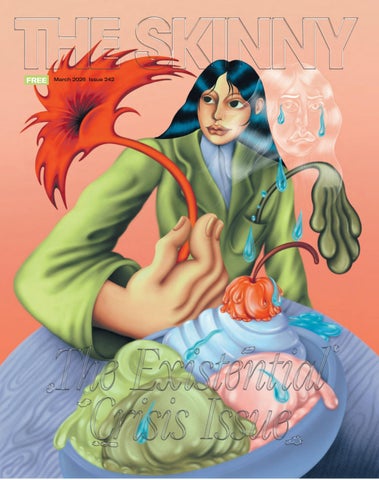
March Issue 2026 Issue 242

Page 1


The

Skinny's

songs we'd play while the world burns

The Walker Brothers - The Sun Ain't Gonna Shine Anymore

Junior Senior - Move Your Feet

Skeeter Davis - The End of the World

Carl Orff - O Fortuna

Daft Punk - Get Lucky

Alice Deejay - Better Off Alone

Zombie Nation - Kernkraft 400

Pixies - Where Is My Mind?

Isa Gordon - War Pigs

Linkin Park - In the End

Rosalía - La Yugular

Justice - Genesis

Madonna - Like a Prayer

Pitbull - Fireball

Florence + The Machine - Everybody Scream

Wham! - Club Tropicana

The Doors - The End

Listen to this playlist on Spotify — search for 'The Skinny Office Playlist' or scan the below code

Issue 242, March 2026 © Radge Media C.I.C. Get in touch:

E: hello@theskinny.co.uk

The Skinny is Scotland's largest independent entertainment & listings magazine, and offers a wide range of advertising packages and affordable ways to promote your business. Get in touch to find out more.

E: sales@theskinny.co.uk

All rights reserved. No part of this publication may be reproduced in whole or in part without the explicit permission of the publisher. The views and opinions expressed within this publication do not necessarily represent the views or opinions of the printer or the publisher.

Printed by DC Thomson & Co. Ltd, Dundee

Meet the team

Championing creativity in Scotland

We asked: What crisis are you currently having?

Senior Editorial

Rosamund West Editor-in-Chief

"I've been called for jury duty but also have norovirus and it's print week, my boiler has been broken for a week and a half."

Commissioning Editors

Myrtle Boot Clubs Editor

"The state of my worn-once, can't go back in wardrobe, clothes chair. Getting dressed is like playing charity shop jumper Jenga."

Business

Laurie Presswood General Manager "[redacted]"

Peter Simpson

Deputy Editor, Food & Drink Editor

"Cost-of-living (persistent); political (revolving); Time (I’m in NQ64 with my tiny plastic light gun, pew pew)"

Eilidh Akilade Intersections Editor "I have a blister on the arch of my foot right now. It's like really sore."

Production

Dalila D'Amico Art Director, Production Manager "My to do list and I are no longer on speaking terms."

Anahit Behrooz Events Editor, Books Editor

"My recent Reddit search history: do i like myself, look more graceful aerial trapeze, how to build a relationship with yourself, fluoxetine wearing off five months?, concussion symptoms, concussion symptoms serious, how hard do you have to hit your head concussion"

Rachel Ashenden Art Editor "Identity?"

Jamie Dunn

Film Editor, Online Journalist "Meeting my deadlines (so sorry, Ros)."

Tallah Brash Music Editor

"How to succinctly answer this question in 20 words or less x"

Polly Glynn Comedy Editor "Will I remember to superglue my silver cowboy boots back together in time for seeing CMAT?"

Mika Morava Theatre Editor

"I have tried so many things to keep my cat from peeing all over the house that I have contacted a cat psychic. Will update."

Phoebe Willison Designer "I don't have crises, crises have me x"

Ellie Robertson Editorial Assistant "Crisis? What crisis?"

Sales

Sandy Park

Commercial Director

"Coming to terms with the fact it might not be possible to own a medium to large sized dog in a third floor flat with a full time job."

Joanna Hare

Business Development Executive "I haven't been to Greggs in over a month."

Ema Smekalova

Media Sales Executive "I'm having a meta crisis about all my other crises."

Emilie Roberts

Media Sales Executive "Hummus from any other shop than Lidl doesn't come with a lid. [Jerry Seinfeld voice] What's up with that?"

Editorial

Words: Rosamund West

This month’s theme came to us in a flash of inspiration as we sat in our dark office, the heating broken for the second month of the year, hugging our oil-filled radiators, wearing the work-mandated off-brand oodies that definitely don’t make us look like some sort of sinister cult. No one could feign any enthusiasm for anything more inspiring or intellectually challenging – we could all get behind acknowledging, frankly, that everything seems shite and it’s more than just the usual months of darkness malaise. Welcome to the (existential) crisis issue.

We set to work commissioning all the things that fit within the theme. The closure of beloved Glasgow arts hub the CCA is an obvious lead – its loss due to, seems like, failures of management and governance, leaves a gaping hole in the city’s art infrastructure for artists and audiences alike. Jamie’s spoken to a range of those involved and affected to map a picture of what’s been and what could be in the future.

Film talks to Hlynur Pálmason, whose new release The Love That Remains follows a family in crisis across four seasons, and Chinese filmmaker Bi Gan, whose latest Resurrection reveals a society where people have stopped dreaming in an effort to extend their lifespan. Raoul Peck’s Orwell 2+2=5 uses the life of George Orwell to tell a wider tale of the crisis of totalitarian power and media manipulation, past and present. Books meets Sarvat Hasin, whose beautiful Strange Girls tells the underrepresented story of the crisis of friendship breakdown.

Things somehow keep getting worse in the office. An email goes round banning what electric radiators we do have providing our measly heat. The air con comes on at 11 each morning to blast icy air into the already icy room.

Ilana Halperin’s new exhibition at Fruitmarket connects with the vastness of geological time, rock formation, volcanoes, the resulting sense of the minute scale of human existence in the life cycles of the Earth. Things become more upbeat as we

look forward to Glasgow International Comedy Festival with some comedians’ highlights and an interview with Sam Nicoresti. We are ever mindful, however, that much comedy is written from a place of profound personal crisis. Intersections considers the limits of self care against the backdrop of rising fascism and looks at the role of community beyond the self.

Monday of print week – I have norovirus and also, somehow, possible jury duty. Anahit is sick, Tallah has injured her back so is struggling to walk or sit. By Wednesday, Laurie has also fallen to the plague. Others work on, pretending they aren’t ill. The heating remains determinedly broken.

Beyond the crisis theme, things get a little sunnier. Music meets Isa Gordon to talk about her forthcoming album release via cassette, 8Men and, paraphrasing, how Burns took credit for a load of women’s work, classic. We celebrate a decade of GLARC, Glasgow’s premier experimental label, with ten highlights from their back catalogue, and look forward to experimental music festival Counterflows with some words with sound artist Marlo De Lara.

Hippfest returns with some silent film and live scoring in the magical Bo’Ness Hippordrome, and we take a brief detour back to the theme with a new play, The Trials, where teens hold adults accountable for a catastrophic climate in the near future. We close with The Skinny on… Amy Matthews, bringing a work in progress to Glasgow Comedy Festival and sharing on these very pages the definitive guide to surviving a Scottish winter.

This particular Scottish winter is finally limping to a close – by the end of this issue’s shelf life the clocks will have gone forward and it’ll be light in the evening. We’re hopefully moving office, to somewhere with daylight and (the pinnacle of human ingenuity) functioning radiators. We’re also thinking about the themes and their impact on general morale / vibes. Come back next month for a positivity theme to see if that manifests a better month for everyone.

Cover Artist

Costanza Starrabba, also known as Starrenco, is an Italian illustrator and visual artist based in Milan. Her practice centres on the relationship between forms and the spaces they inhabit. Her work starts from reality and distorts it into colourful, dynamic, and slightly disorienting worlds, where drawing becomes both personal investigation and emotional narration. Through deformations, vibrant palettes, and ironic details, she reflects on time, femininity, and the complexities of human relationships, creating images for grown-up children and not-quite-mature adults.

IG: @starrenco

Love Bites: Two Pebbles

This month’s columnist takes to St Columba’s Bay and muses on decisions of love

Words: Marlene Ayumi Ito

Iona beckoned us as the ferry drew closer. Barely three miles long by one mile wide, skin of sand and rock exposed to the sun, Iona gazed curiously at the approaching boats.

In 563 AD, St Columba – an Irish abbot – sailed to Iona. The sky pressed low and wisps of cloud dripped onto the land, while the grass grew upward from the sky. Columba reached for the grass, pulled and Iona’s light stirred; handfuls of pebbles followed.

We had precariously pitched our tent on the north of the island, and despite the wind pulling at our shoulders, both us and the tent clung on stubbornly. Iona is known to be a ‘thin place’, a veil between heaven and earth, an entryway into suspension. We made our way to St Columba’s Bay, which resides on the opposite end of the island, in the south. There, the bay is made entirely of pebbles, each one worn down to the size of a decision. They say the pebbles there hold mystical powers. You must choose two pebbles: one representing something in your life you would like to let go of, and one representing something that you would like to manifest for your future.

For me, the real decision is which pebble to pick. Such decisions plague me; I feel them move under my skin, contaminated by a litany of thoughts. I wanted to split open the earth and lie against it and feel its cool surface, letting it spin underneath me, while I remain its passive recipient. Perhaps, love tempts that same surrender; it arrives, undoing and reshaping the landscape, and recedes. The current will continue to meet with the pebbles on St Columba’s Bay, and the world will spin on regardless. I let my fingers curl over the pebbles, one in each palm, before they wash away.

Heads Up

Glasgow Short Film Festival

Various venues, Glasgow, 18-22 Mar

If you like your movies short and sweet (and who doesn’t), Glasgow Short Film Festival is the place for you. This year’s programme opens with Downriver a Tiger, a dreamlike portrait of Glasgow captured by a young photographer from Barcelona, and continues with a celebration of Iranian artist Gelare Koshgozaran’s oeuvre, a competition strand for best international short film, and even a film about a Persian cat having an existential crisis.

Tessa Rose Jackson

Leith Depot, Edinburgh, 18 Mar, 7pm

Written during a period of intense solitude in rural France, Tessa Rose Jackson’s latest album The Lighthouse is a tender and introspective meditation on ancestry, grief and belonging. It is the first album she has released under her own name in a decade, having been creating beautiful indie-folk under the enigmatic moniker Someone.

Your existential crisis doesn’t have to be boring – set the scene with a festival, play, exhibition or gig to add a little je ne sais quoi to your malaise.

RSA New Contemporaries 2026

RSA: Royal Scottish Academy, Edinburgh, 28 Mar-22 Apr

Every year for the past 19 years, the Royal Scottish Academy celebrates the best of rising talent in the Scottish visual arts with New Contemporaries, an exhibition of work selected from across the country’s art school degree shows last year. Extremely unique, New Contemporaries offers a snapshot of the cutting edge of Scottish art, from sculpture and painting to installation and moving image.

Govan Music Festival

Various venues, Glasgow, 22-28 Mar

Club 69 at Paisley Arts Festival

Paisley Town Hall, Paisley, 28 Mar, 5pm

Armand Hammer

SWG3, Glasgow, 11 Mar, 7pm

Can a supergroup be just two people?

If so, hip-hop duo Armand Hammer, made up of acclaimed rappers and musicians billy woods and Elucid, is one of the most exciting supergroups currently out there. Their latest album Mercy, recorded in collaboration with hip-hop producer The Alchemist, is an interrogation of the role of art and meaning-making in times of crisis.

Ponyboy Labs presents:

Project Equinox Exit, Glasgow, 27 Mar, 9pm

The latest project from beloved queer clubbing institution Ponyboy, Project Equinox is a new clubbing world that has been quietly in the works for months: this night is the first of a series of events that will take place over the spring and summer. Expect the usual Ponyboy MO: excellent DJs, outrageous costumes, and incredible worldbuilding.

The Bacchae

Citizens Theatre, Glasgow, 4-7 Mar, various times

Acclaimed Glasgow theatre company Company of Wolves are kicking off their national tour of The Bacchae, a visually innovative adaptation of Euripides’ classic play. Blending labyrinthine soundscapes, neon lighting and a fierce solo performance, this take on The Bacchae explores the myth of Dionysus through a disruption of binaries: human and animal, male and female, victim and perpetrator.

Mar-24 Mar

Various venues, Glasgow, 11-29 Mar

Glasgow International Comedy Festival
Paloma Proudfoot: Glass Delusion Collective Gallery, Edinburgh, 6
Photo: Hugh Holton
Photo: Curse These Eyes
The Bacchae
Ponyboy
Armand Hammer
Existential Greg
Tessa Rose Jackson
New Contemporaries 2017, foreground artwork by Lucy Wayman
Govan Music Festival
Paloma Proudfoot, Lay Figure, 2024, at The Lowry
Melé
Christopher Macarthur-Boyd
Photo: Louise Mather
Image: courtesy of Ponyboy and El Hogg
Photo: Alexander Richter
Photo: Will Anderson, courtesy of GSFF
Photo: Bibian Bingen
Photo: Chris Park

Buck Meek

Mono, Glasgow, 18 Mar, 8pm

Perhaps most familiar as the guitarist and backing vocalist from Big Thief, Buck Meek has a formidable solo career of his own, having just brought out his fourth studio album. His music contains the same tender lyricism and haunting, minimalist vocals that characterise the work of his band, but here it is entirely his own, playing around the boundaries between folk, rock, and experimental music.

Sam Nicoresti: Baby Doomer Monkey Barrel Comedy Club, Edinburgh, 12 Mar, 7:30pm Glasgow may be the centre of comedy in March but there’s still some great shows to catch in Edinburgh, including a lot of the stars from Glasgow International Comedy Festival, in case you want to catch them twice. One of our favourites is Sam Nicoresti, whose stand-up hour Baby Doomer was one of the best things to come out of last Fringe.

Slow Karma

The Liquid Room, Edinburgh, 21 Mar, 7pm

Having formed in 2024, Slow Karma are still relatively new in the Scottish jazz scene but they’re fast becoming Ones To Watch™ following a performance at Kelburn Garden Party and a live album recorded at The Voodoo Rooms last year. This month they’re bringing their unique blend of jazz, funk and soul to The Liquid Room for another spectacular live performance.

StAnza

Various venues, St Andrews, 13-15 Mar

This year’s edition of StAnza, St Andrews’ prolific poetry festival, is themed around ‘You Are Not Alone’, exploring ideas of grief, anxiety, repair and community, and the ability of poetry to express and facilitate these impulses. Taking full advantage of the festival’s beautiful setting, there are coastal walks with poets, an outdoors performance of poetry and projection, and an abundance of workshops, readings, and poetry slams besides.

Microsteria x T E E S H

People’s Leisure Club, Edinburgh, 7 Mar, 10pm

Microsteria is back! The immersive music and club experience, originally created by Edinburgh band Maranta, brings together live music, weird visuals – think costuming, lighting, the whole shebang – and the best DJs in Scotland. On the lineup this time are punk rockers Bikini Body, dream pop duo Sarah/Shaun and DJ sets from Pako Vega, Marinello Studio and more.

HippFest

Hippodrome, Bo’ness, 18-22 Mar

If you like your movies really old and obscure (and, truly, who doesn’t), Hippodrome Silent Film Festival is the place for you. Taking place in Bo’ness’ beautiful Hippodrome, Scotland’s first purpose-built cinema, the programme marries silent film with live, experimental musical accompaniment: this year they’re screening Norway’s first indigenous feature from 1920, Fante-Anne, three Sherlock Holmes films, and lots more.

Scottish Roots
CANVAS, Dundee, 12 Mar, 7pm
Dundee Zine Fest Art Angel, Dundee, 14 Mar, 11am
Reclaim the Frame presents The Testament of Ann Lee Glasgow Film Theatre, Glasgow, 16-19 Mar, various times
Luke Fowler: Patrick The Modern Institute, Glasgow, until 4 Mar
Photo: Patrick Jameson. Image:
Photo: Camilla Greenwell
Buck Meek
Marjorie Lotfi for StAnza
Sam Nicoresti
Sarah/Shaun for Microsteria
Fante-Anne (1920)
Slow Karma
Scottish Roots
Patrick Dundee Zine Fair
The Testament of Ann Lee
Photo: Daniel Arnold
Photo: Heshani Sothiraj Eddleston
Photo: Solen Collet
Image: courtesy of National Library of Norway
Photo: Taile Eigeland
Photo: Sam McGill

What's On

Music

All details correct at the time of writing

As the weather starts to heat up, so too does the Scottish gigs calendar as a slew of SAY Award winners and nominees play a bunch of dates. Kicking things off, in celebration of his brand new collaborative album Irreparable Parables, Andrew Wasylyk hits the road with Kathryn Joseph for a run of shows in Stirling (Tolbooth, 3 Mar), Aberdeen (The Lemon Tree, 4 Mar), Edinburgh (Pleasance Theatre, 5 Mar) and Glasgow (Mackintosh Church, 6 Mar), finishing with a hometown show in Dundee’s Marryat Hall (7 Mar). Jazz pianist Fergus McCreadie also plays multiple shows, albeit in less frequented towns and venues; catch him at Black Isle Resolis Memorial Hall (20 Mar), Findhorn Universal Hall (21 Mar), Aberdeen Fountainhall Church (22 Mar), Tolbooth, Stirling (24 Mar), Dunoon Burgh Hall (27 Mar) and Perth Theatre (28 Mar). Back at the top of the month in Glasgow, ahead of their April festival Counterflows host a warm-up show at the Listen Gallery (4 Mar) with Yan Jun and Life Without Buildings’ Sue Tompkins, Cryptic Nights host Flutter by Aurora Engine at Tramway (5 Mar) and recently crowned SAMA winners Martha May & The Mondays bring the fire to The Poetry Club (7 Mar). As part of the Glasgow International Comedy Festival, Game Boy duo King Wine play The Flying Duck (12 Mar) with a promise of new music and Dayydream launch Trace, their stunning new EP at The Hug & Pint (15 Mar). On 20 March, GLOSS host a ‘bring your own pillow’ quadraphonic event with Sonia Killman, and on 28 March, choose between Callum Easter (The Glad Cafe), Lo Rays (King Tut’s) or Allmyfriendsaresynths, Tupper Werewolf and I Am Blip (McNeill’s).

In Edinburgh, Bikini Body and Sarah/Shaun play a Microsteria x Teesh club show at the People’s Leisure Club (7 Mar), International Women’s Day takes centre stage at The Bongo Club on the 8th with music from Machine Orchid, Faith Eliott, Jemima Thewes, Kirsty Law and Esther Swift and Nani Porenta brings a quadraphonic setup to the Pianodrome on the 13th. On the 17th, Aldous play the People’s Leisure Club alongside Family Art Club; pick between Slow Karma at The Liquid Room and Former Champ at the Leith FAB Cricket Club on the 21st and head to The Queen’s Hall on the 27th for AMPLIFI with Brownbear, Ria Andrews and Nuna.

A stack of artists play shows at either end of the M8 this month too. Curiosity Shop play back-to-back weekends at The Doublet (11 & 18 Mar) and Leith Depot (12 & 19 Mar), Siobhan Wilson plays Stereo (14 Mar) and Cabaret Voltaire (20 Mar) and Taupe launch their frenetic new album waxing | waning with shows at The Hug & Pint (27 Mar) and the Leith FAB Cricket Club (28 Mar). Elsewhere, at the top of the month it’s’ happy CMAT week to all who celebrate as our 2025 Album of the Year creator plays three nights at the Barrowlands (2, 3 & 4 Mar) and two nights at the Corn Exchange (6 & 7 Mar). Also in Edinburgh, catch Armand Hammer (La Belle Angele, 12 Mar), Madra Salach (Sneaky Pete’s, 19 Mar), Bruise Control (Legends, 20 Mar) and Ora Cogan (Sneaky Pete’s, 24 Mar). In Glasgow expect shows from Lily Allen (Glasgow Royal Concert Hall, 2 Mar), David Byrne (SEC Armadillo, 6 & 7 Mar), Howling Bells (King Tut’s, 13 Mar), Buck Meek (Mono, 18 Mar), bar italia (St Luke’s, 20 Mar), Geese (Barrowlands, 21 Mar), Austra (Stereo, 21 Mar), Stella Donnelly (Mono, 21 Mar), Jehnny Beth (King Tut’s, 22 Mar), Danny Brown (SWG3, 24 Mar), Mandy, Indiana (Room 2, 28 Mar) and Avalon Emerson & The Charm (Stereo, 31 Mar). [Tallah Brash]

Photo: Tommy Perman
Photo: Lucy Cheyne
Photo: Paul Reid
Photo: Tammy Dyson
Brownbear
Dayydream
Andrew Wasylyk
Lo Rays

Film

Scottish film fans, get ready to part with all your money this month. Not only does Glasgow Film Festival continue until 8 March, but two more Scottish film festival gems happen later in the month: HippFest in Bo’ness and the Glasgow Short Film Festival. From the former, expect an eclectic mix of movies from the silent era paired with musicians who’ll perform new music live at each screening. For example, on 18 March, Jean Epstein’s 1929 film Finis Terræ will have a live score from guitarist Dan Abrahams and drummer Philippe Boudot (find out more in our interview on p.50). And at GSFF, you’ll find a sharply curated selection of short films from around the world, and a particularly fantastic-looking Scottish shorts competition this year. One of those contenders is James Ley’s inventive queer comedy Sleazy Tiger (read our interview with Ley on p.64). My only complaint is that these festivals take place at the same time. Both run 18 to 22 March – make your Sophie’s choice.

If you blow all your disposable income on those festivals, you can see some films for free at Glasgow School of Art’s new cinema programme, which takes place in the GSA library’s screening room. The March lineup is ace, featuring the likes of Víctor Erice’s The Spirit of the Beehive (4 Mar), Juzo Itami’s Tampopo (11 Mar) and Jan Švankmajer’s Faust (24 Mar), as well as Jonas Mekas’s epic As I Was Moving Ahead Occasionally I Saw Brief Glimpses of Beauty, which is screening all day on a loop on the 16th. For the full lineup, check out the GSA library on Instagram @gsalibrary

Despite helping define the British New Wave in the ‘60s, winning Best Director for Midnight Cowboy and having a long and varied career, John Schlesinger is one of those directors who’s perhaps not appreciated enough by cinephiles. That’s about to change with the UK-wide season The Consummate Professional: John Schlesinger, which comes to GFT as a mini-season of four of his best films: Sunday Bloody Sunday (14 & 17 Mar), Midnight Cowboy (22 & 24 Mar), The Innocent (28 Mar & 1 Apr) and Marathon Man (4 & 8 Apr).

Other highlights this month include Kinoteka Polish Film Festival, which tours to Edinburgh’s Filmhouse with a retrospective celebrating Andrzej Wajda, with films from across his career – including Ashes and Diamonds (7 Mar), Man of Iron (8 Mar) and Man of Marble (24 Mar) – screening. On 11 March, Edgar Wright comes to GFT for two Q&A screenings of The Running Man, in which he creates a dystopian future via an inventive use of Glasgow locations. And finally, Dundead have teamed up with SQIFF for Sleepaway Camp (14 Mar, DCA), a problematic 80s slasher whodunit that has been embraced by queer film fans in recent years. [Jamie Dunn]

Clubs

FemmeDM are set to celebrate International Women’s Day at The Berkley Suite, Glasgow, linking up with FUNK THE SYSTEM on Thursday 5 March. Cairo-raised DJ and producer Assyouti makes his Scottish debut at Out Of Bounds, bringing frenetic, bass-driven sounds to The Flying Duck (6 Mar). feeo performs live at intimate Edinburgh venue, Pianodrome – expect ambient soundscapes and mesmeric vocals (6 Mar). On Thursday 12 March, Night Tube x RAG welcomes Pressure Dome label-head Yushh to The Bongo Club, with proceeds being raised towards Alzheimer’s UK and Street Assist Edinburgh.

Erosion marks their 4th birthday at The Flying Duck, Glasgow, with stateside artists Loidis and livwutang bringing an assortment of dubby, techy and progressive tunes (13 Mar). Across to Edinburgh for another birthday celebration – Palidrone turns eight at Sneaky Pete’s with Peder Mannerfelt headlining the party (13 Mar). Get out your green, gold and tartan for Celtic Erections’ St. Patrick’s Day warm-up, with Scotland and Ireland going b2b all night long at EXIT, Glasgow (13 Mar).

Transcend the human realm with Faerie Circle on Thursday 19 March, as Alice Gas and 99 Jakes headline a night of hardcore and hyperpop at The Mash House, Edinburgh, accompanied by Sigil hosting an open decks upstairs. Headset return to Edinburgh’s Sneaky Pete’s for their second label

Image: courtesy of artists
Photo: Aldo Paredes
Image: courtesy Gaumont and Cinémathèque française
Image: courtesy of MGM
Midnight Cowboy
The Running Man
Finis Terrae
Faerie Circle
The Black Madonna

party, with local talent including Fourth Precinct and Capricorn One showcasing a range of sound system music (20 Mar). On Saturday 21 March, Glasgow party, Supertouch, take over EXIT with a techno-driven lineup, headed up by Akua and Céilí (21 Mar). On Saturday 28 March, Bounce 101 makes a return to Stereo for bootyshaking dancehall, baile funk and hip-hop. Round the corner, The Blessed Madonna and Hayley Zalassi take to Sub Club for an early show – an almost-certain sell out (28 Mar). [Myrtle Boot]

Art

It’s a quiet month for exhibition openings in Glasgow and Dundee, with Rae-Yen Song’s solo show at Tramway and We Contain Multitudes at Dundee Contemporary Arts to keep you entertained in the meantime. However, in Edinburgh, two intriguing exhibitions launch across the city.

Fruitmarket presents Where we meet land: environment and ecology in artists’ moving image (7-22 Mar). Nine artists, including Olivia Priya Foster and Hanna Tuulikki, showcase moving image works that are motivated by humans’ relationship with the environment. Where we meet land responds to growing concerns around the climate crisis, of manmade destruction, but also offers hopeful stories about our relationship with Earth.

At Collective, up Calton Hill, Paloma Proudfoot has her first solo exhibition in Scotland. The Edinburgh College of Art graduate shows new site-specific sculpture and performance that further her explorations of the female voice and body. Proudfoot has made ceramic friezes that challenge anachronistic medical systems, engaging with the 19th-century concept of ‘hysteria’ to control and subdue women. Glass Delusion runs from 6 March until 24 May.

Further afield, in rural south-west Scotland, CAMPLE LINE opens Brazilian artist Anderson Borba’s exhibition on 21 March. Titled The Unearthed, the exhibition presents a series of totem sculptures carved out of wood, drawing on traditional craft practices of Brazil. The exhibition closes on 31 May. [Rachel Ashenden]

Theatre

March theatre in Scotland is leaning into myth and moral reckoning, with plenty of ancient stories refracted through contemporary lenses. At Glasgow’s Citizens Theatre, Waiting for Godot runs until 14 March, offering Beckett’s bleak meditation on stasis for those willing to play the long game. The mood stays across multiple venues: Company of Wolves bring The Bacchae to the Studio Theatre in Glasgow (4-7 Mar) and Edinburgh (9-10 Mar), with a solo, shattering take on Dionysos, while Medea takes the Traverse Theatre (6-7 Mar) before reappearing at the Tron Theatre (25-28 Mar), reclaiming Euripides’ heroine with renewed fury.

Elsewhere, classical figures are taken into clubland at Summerhall, where Medusa (6-8 Mar) reimagines the Gorgon as a queer nightclub worker in a rave-soaked Athens. It’s Greek tragedy with glitter and bass.

Political storytelling also threads through the month. A Grain of Sand visits both the Traverse Theatre (10-12 Mar) and Citizens Theatre (13-14 Mar), drawing on Palestinian folklore to follow a young girl navigating life in Gaza. Later, Flight (from 21 Mar, Citizens Theatre) charts two orphaned brothers on a desperate journey to safety – an immersive road story that sees audiences experiencing the journey through their own personal booth with headphones. Meanwhile, A Giant on the Bridge lands at the Studio Theatre in Edinburgh (13-14 Mar), using gig theatre to explore prison homecoming through lived experience and song.

For audiences seeking something lighter, Dundee Rep premieres

The High Life: The Musical, Still Living It! (from 27 Mar), reuniting the original cast of the beloved BBC Scotland series for a dose of camp nostalgia. And new musical Flora heads to Glasgow’s Pavilion Theatre (26-28 Mar), placing Flora MacDonald centre stage in her own story at last, with Gàidhlig woven through its script and soundtrack. [Mika Morava]

Photo: Louise Mather
Image: Courtesy of Fergus Carmichael
Still from Fergus Carmichael, Island Island, 2017
Hanna Tuulikki, Seals’kin, 2022, colour, 19 mins 15 secs, still Image: courtesy of Hanna Tuulikki
Medusa
Photo: Tiu Makkonen
The Bacchae

Comedy

This month, Glasgow gets the comedy festival treatment with hunners of shows on your doorstep via Glasgow International Comedy Festival. For local talent, you can’t go wrong with Krystal Evans’ latest WIP (Blackfriars Basement, 18 Mar, 6.30pm) as she works up a new hour. Expect tales of parenthood, divorce and Mitchell & Webb in the Edinburgh-based American’s classic no-nonsense style. Marjolein Robertson’s also back on Scottish soil with her first show post her Marj-O-Lein trilogy. Now all she wants is a holiday (The Flying Duck, 21 Mar, 1.30pm).

Glaswegian 8-bit sketch outfit King Wine (The Flying Duck, 12 Mar, 8.30pm) bring their unique brand of chiptune-chat to the festival too, if you’re after something a little different. And Susan Riddell brings the best show title to the festival. Anyone Struggling with the Work-Genocide Balance? (The Stand Glasgow, 28 Mar, 3.20pm) will no doubt touch on Palestine, her recent stint under curfew, and make it all very funny indeed.

As expected, GICF sees some of the best shows from Fringe visit Glasgow. Bestie winner and total riot Rosa Garland: Primal Bog promises the best slime x canoeing crossover in comedy (Old Hairdresser’s, 11 Mar, 8pm), while Edinburgh Comedy Award nominee Katie Norris brings TUNES and farmery to the Old Hairdresser’s (12 Mar, 9pm; also Monkey Barrel, Edinburgh, 26 Mar, 8pm). And leaving a trail of Sudocrem and pickled eggs in his wake, gleeful gruff-voiced oddball Frankie Monroe delves into hell (Monkey Barrel, Edinburgh, 18 Mar, 7.30pm; The Stand, Glasgow, 19 Mar, 8pm).

Finally, we heard excellent things about these two at the Fringe. Dru Cripps: Juicy Bits had a spot at one of the Potterrow yurts in August and every day had a big ol’ queue. Expect silly, clowny, loop pedal shenanigans now in Glasgow (Committee Room No.9, 17 Mar, 6pm & 9pm). Paul Campbell’s The Lost Tapes of Somerfield (Gael & Grain, 22 Mar, 1pm) proved a bit of a cult hit too. A love letter to the long forgotten supermarket, the show won a Malcolm Hardee Award for Comic Originality, so colour us intrigued. [Polly Glynn]

Books

Book festivals resume this month with the return of StAnza, St Andrews’ poetry festival (13-15 Mar). Find the likes of Marjorie Lotfi, Andrés N. Ordorica, Ken Cockburn and Anthony Vahni Capildeo performing, giving workshops and even leading coastal poetry walks, and if getting to St Andrews proves tricky, they also have an online programme. Over in Edinburgh, there’s a whole bunch of book launches: Virginia Evans launches The Correspondent on 7 March, Pim Wangtechawat launches sweet Edinburgh romance I Dreamed Of You on 10 March, Isabel Waidner launches her latest novel As If on 23 March, and Kiran Millwood Hargrave launches Almost Life in conversation with our own Rachel Ashenden on 25 March, all at The Portobello Bookshop.

Over at Lighthouse Bookshop, meanwhile, writing project and collective Me mother other launch their zine on International Women’s Day (8 Mar), indie poetry press Tapsalteerie hold a poetry evening with three of their poets Sarah Stewart, Taylor Strickland, and Stewart Sanderson (5 Mar), and Nana Darkoa Sekyiamah launches Seeking Sexual Freedom, the follow up to their critically acclaimed book The Sex Lives of African Women (24 Mar). And in Glasgow, at Mount Florida Books, the incredible So Mayer discusses Bad Language with Adam Benmakhlouf (4 Mar) and Kirsty Dunlop launches their novella Centrefolding (20 Mar). [Anahit Behrooz]

Andrés N. Ordorica
Marjolein Robertson
Marjorie Lotfi for StAnza
King Wine
Rosa Garland
Photo: Trudy Stade
Photo: Daniel McGowan
Photo: Connor MacDonald
Photo: Corinne Cumming
Photo: Heshani

Features

22 Opening our theme of crisis, we examine what’s happened to Glasgow’s Centre for Contemporary Arts, what’s lost, and what it could become in the future.

26 We meet Icelandic director Hlynur Pálmason to talk about The Love That Remains, an idiosyncratic look at a family in crisis.

28 One writer gathers recollections of Fire Island, Scotland’s first regular gay club.

30 Haitian director Raoul Peck introduces his tale of totalitarian power and media manipulation, Orwell 2+2=5

33 The hugely talented Chinese filmmaker Bi Gan on his latest, Resurrection, a dazzling epic spanning the history of cinema.

34 Sarvat Hasin on her fourth book, Strange Girls, a beautiful exploration of friendship break-up.

37 Sam Nicoresti on her Edinburgh Comedy Awardwinning show, Baby Doomer

38 We talk about the rock cycle and geological time with Ilana Halperin ahead of her Fruitmarket retrospective.

46 As she releases her latest album 8Men we talk all things cassette tapes and Robert Burns with Isa Gordon

49 As experimental Glasgow label GLARC turns ten, we pick ten highlights from their discography.

53 We catch up with sound artist Marlo De Lara ahead of their appearance at Counterflows.

54 Joanna Bowman on climate crisis play, The Trials, arriving at the Tron this month.

On the website...

Podcasts a-plenty – Music Now chats to Brownbear ahead of his Queen’s Hall gig, The Cineskinny talks to Felipe Bustos Sierra re: Everybody to Kenmure Street. If you like direct recommendations, sign up to our newsletter The Zap!, and if you want some new music picks follow our New Scottish Music playlist. Oh, and follow us on Instagram if you haven’t already x

Image Credits: (Left to right, top to bottom) Tiu Makkonen; Hlynur Pálmason; Joe Munsey; courtesy of NEON; courtesy of artist; Angelique Neumann; Rebecca Need-Menear; courtesy of artist; Harrison Reid; courtesy of GLARC; Martin Paul Wright; Mihaela Bodlovic

Shot of the month

Deftones @ OVO Hydro, Glasgow, 13 Feb by Marilena

1. Extremely shy (purple?) person (9,6) 9. Nature (as opposed to nurture) – e.g. insect (anag) (8) 10. Handy (6) 11. Despise (6) 12. Accidental call – adult bit (anag) (4,4) 13. Dark horse – the little guy (8) 15. Disturbed – not stirred? (6) 16. Jumpsuit (6)

18. New companies (5-3)

20. Hand over – handover (8)

22. Remove blockage (6) 24. Rum liqueur (6)

25. Procured (8) 26. Shamelessly expensive pricing (8,7)

2. Folk dance party (7)

3. What 'i.e.' stands for – edits (anag) (2,3)

4. The sharp bit – precarious situation (5-4)

5. Horse feeder (7)

6. Leap – safe (5)

7. Bank account deficit (9)

8. Imitate (7)

14. Necessary (9)

15. How things are (6,3)

17. Bliss – band (7)

18. Lackey – public or civil? (7)

19. Discoverer – break new ground (7)

21. Chucked (5)

23. Get higher (5) Feedback? Email crossword@theskinny.co.uk Turn to page 7 for the solutions

GOT A QUESTION?

In this month’s advice column, one reader is troubled by their fraught relationship with a sibling

My sister hates me. I’ve spent my whole life trying to show her my love but she treats me so badly. I think it’s resentment as I’m the youngest and we don’t share a dad. It’s taking a massive toll on my mental health to the point where I’m considering cutting myself off from our family. Help!

Oh pal. This is like, an actual problem. I’m flattered you have come to me, but also mildly concerned because a) you don’t know me and b) I could say anything (and frequently do).

I’m going to do the responsible and I think radical thing here and not give you any advice, as this seems like a delicate situation and I would need to know more about both of you and your history to actually be helpful. But what I will do is tease apart some of the language you’ve used, in the hope that that might prompt some revelations in you, if that’s OK? Crazy that people train for years to be therapists when they could qualify with three years of a problem page and a lot of misplaced confidence but I suppose we each have our own journeys.

I guess the thing that strikes me most about your question is the definitiveness of your narrative. She hates you, you’ve spent years trying to love her, she’s resentful because you don’t share a father etc. I’m not for a second suggesting that your read on the situation is wrong – you would know best! – but I suppose I am curious about the way you present emotions as facts, and also why you have kept trying for so long if you truly believe this to be the case.

Listen, I don’t know either of you so I’m not trying to define the situation. But what I will say is hate is different to resentment, and someone loving you does not preclude them from hurting you. That doesn’t mean you should put up with behaviour that is harmful, but more to be wary of the narratives you construct around other people’s actions, and the way you absorb that as a reflection of yourself in relation to other people.

Ultimately the only thing you can do, which is the blanket advice I could give to every question here, is talk to them – both your sister and wider family. I wouldn’t cut yourself off without putting some of this out in the open and giving it a chance. But I would also try and disentangle the reality of the situation from the fear and hurt and anxiety you feel. Not because those aren’t important, but because they may not be the entire story. I hope it works out, friend, I really do.

At Jupiter Artland, Tai Shani’s sculpture of a blue giant rests in a glass coffin. In this creative response, our Art editor wonders what the hell it’s doing there

Words: Rachel Ashenden

"but like for why?”

“Something tells me this being is being passed off as art but actually real.”

“the megalophobia in me would never allow me near it especially since it’s breathing”

I see Tai Shani’s The Spell on TikTok before I see it in person; it went viral while it occupied the courtyard of Somerset House, London, before it arrived at Edinburgh’s Jupiter Artland. It must’ve taken the A1 and passed the Angel of the North to reach its final resting place.

I first learned what it’s like to come face-to-face with this blue giant through a spiky stream of Gen Z comments. But when I meet it in real life – pull my body up to the coffin that encases her, clouding the glass with my breath – I realise ‘it’ is the wrong pronoun for her. She sleeps soundly at Jupiter, her chest gently rising and falling, within earshot of that crazy mustard mansion.

I loop around her to take her in from all angles; her foot is the size of my torso, and her torso is the size of a whale (give or take). What must’ve happened for her to choose to live in this glass box? I think of a poem by Mary Oliver. It’s called The Journey. You should read it. This poem must be about this giant: it’s the only reason she’s here, dreaming. This is no sleeping beauty myth – she is not here against her will, and she is not in a coma. She is protecting herself, muffling out the external voices and their bad advice, until she knows what she has to do.

Tai Shani: The Spell or The Dream, Jupiter Artland, Edinburgh, until 12 Sep jupiterartland.org

Do you have a problem Anahit could help with?

Get in touch by email on pettyshit@theskinny.co.uk, send us your quandaries with an almost-unhelpful level of anonymity via NGL, or look out for Ask Anahit callouts on our Instagram stories

Poster by Ilana Halperin (p40-41)

Etna in June, Catania, Sicily, 2001

Part of the series Field Encounters, 1999–

Currently on display in Fruitmarket, Edinburgh, in the exhibition What is Us and What is Earth, until 17 May, Mon-Fri, 11am-6pm, free entry. Read an interview with Ilana Halperin on p38.

Photograph courtesy the artist and Patricia Fleming Projects

We’re having a crisis this month – maybe existential, maybe a crisis of a different sort. We thought about other themes but couldn’t muster any enthusiasm. The office heating has been broken since the start of the year, it’s very dark, the world continues to be on fire, but a fire that doesn’t provide any heat, a cold dark fire…

Kicking off with a thorough exploration of the CCA’s depressing demise, we’ve then got Hlynur Pálmason on The Love That Remains about a family coming apart, a dive into the story of long lost Edinburgh gay club Fire Island, and an exploration of Ilana Halperin’s environmental crisis-linked new exhibition at Fruitmarket.

Further crises unfold with Bi Gan on Resurrection, Sarvat Hasin on Strange Girls, Raoul Peck on Orwell: 2+2=5 and the entirety of the Glasgow International Comedy Festival programme – because great comedy comes from crisis, probably.

What We’ve Lost

With the Centre for Contemporary Arts in Glasgow now in liquidation, its staff left jobless, and its windows boarded up, we speak to some of the artists and programmers who use this space and ask what we’ve lost in the wreckage and what we can salvage if the CCA returns

Scotland’s culture scene has taken a beating over the last few years, but few blows have hit harder than the closure of the Centre for Contemporary Arts (CCA). For 33 years, this multi-arts venue has been the beating heart of Glasgow’s arts community. It’s hosted world-class contemporary art exhibitions, championed experimental theatre, music and cinema, and pioneered an open source programming approach that helped CCA become a hub for all sorts of DIY and community events. At the time of its collapse, the CCA estimated that it worked with over 200 partners, many of them putting on some of the most forward-thinking, boundary-pushing events in town.

Sonica, Ceòl is Craic, SQIFF, Glasgow Short Film Festival, BUZZCUT and the Glasgow Improvisers

Orchestra are just a handful of the much-loved festivals and events that called CCA home.

All those organisations are now in search of new abodes. The CCA closed suddenly on 30 January, with its Board announcing it would be entering liquidation. All future programming activities were cancelled, and all of its staff (close to 40) were made redundant. The CCA building, designed by Alexander ‘Greek’ Thomson, now sits boarded up along with the defunct nightclubs, bars and venues that sit derelict along that increasingly moribund end of Sauchiehall Street.

One of those organisations in search of alternative venues is Counterflows, the experimental music festival with a long association with CCA. Glasgow is not short of music venues, so the event, which returns in April, has comfortably found alternatives. Counterflows’ co-director Fielding Hope notes, though, that they’ll be hard-pressed to find a similar lively atmosphere. “While I was setting up for gigs [at CCA], I always remember their vibrant film programme taking place downstairs, local artists experimenting in their Intermedia gallery, community group meetings taking place throughout the building, and a vibrant mixture of people hanging out, drinking and seeing the main exhibition in the ground floor foyer,” he recalls.

well-publicised financial and governance issues. Its cafe and bar, Saramago, was once a popular meeting place and late-night hangout, catering for a mix of arts workers and art school students, but in 2023, CCA parted ways with Saramago when they had a bitter dispute with three staff members over working conditions. Its closure surely contributed to CCA’s huge drop in footfall.

What went wrong?

The sudden closure of CCA is heartbreaking, but it would be inaccurate to describe it as a shock. Since the COVID pandemic, the venue has suffered a revolving door of

Since the loss of Saramago, the venue had to temporarily close twice in the space of six months. At the end of 2024, it shut its doors for four months when it ran out of cash. It reopened in spring 2025 but then shut again in the summer after its Board was roundly condemned for escalating tensions and abusing its power by calling in police to clear activists who had gathered at CCA to protest over the Board’s decision not to endorse a cultural boycott of Israel over its military actions in Palestine. By the end of that summer, seven out of nine of those Board members had been removed.

The CCA faced further humiliation and farce when it appointed a new chair, a business consultant called Muse Greenwood, to steer the venue through this troubled period, but she quit after just 35 days in the job. Amid all this chaos, few members of the public seemed to know if the venue was open or closed. Financially, it was running at a loss, despite receiving substantial multi-year funding from Creative Scotland, and following its liquidation at the start of the year, the Scottish charity regulator is currently looking into

claims of potential financial mismanagement. A complete shit show would be putting it mildly.

An exhibition disrupted and curtailed

Someone who knows firsthand about many of these issues is Shalmali Shetty, who was the curator and producer of CCA’s last major exhibition, Alia Syed’s The Ring in the Fish. The show was a perfect example of the type of multifaceted exhibition at which CCA once excelled. It spanned works of film shot on 16mm, photography and audio interviews, and drew inspiration from a series of interviews Syed conducted with first- and second-generation members of the South Asian community in Glasgow. The exhibition also included a wider public programme of talks and panel discussions to explore the themes of the exhibition. There was even a Kabaddi workshop planned.

“The CCA was a significant and meaningful space and context for Alia’s exhibition,” Shetty told me by email, “particularly because of its history as a radical, shared, community-oriented space capable of bringing together a wide range of audiences (and Alia’s relationship to the city of Glasgow), which also informed how the exhibition and its related events were conceived.”

The exhibition was originally scheduled to take place at the beginning of 2025, but CCA’s unexpected winter hiatus from December 2024 to March 2025 put the show on hold. “That closure meant that a substantial number of staff roles had

been made redundant,” Shetty explains. “This created uncertainty about whether the exhibition could proceed and affected the level of institutional support available, while also impacting practical implications for planning, timelines, and preparedness.”

When CCA secured its multi-year funding, The Ring in the Fish became the centrepiece of CCA’s grand reopening. Things didn’t go to plan, though, partly because many of the staff who were let go during the hiatus weren’t rehired. “The reduced staffing capacity meant that the remaining team was managing significant workloads,” says Shetty, “which inevitably shaped the scale of what could be delivered and the extent of support available to the artist and the exhibition.”

CCA’s terrible handling of the Art Workers for Palestine Scotland protests then necessitated that second disastrous closing. “A number of public programmes had to be postponed or cancelled,” explains Shetty, “and the show lost a substantial portion of its scheduled duration (a little over a month). This had a knock-on effect on related activity, collaborator and audience engagement, and the artist and I were suddenly left in an uncertain space, having to figure a lot out by ourselves and being answerable to people when we had no answers for ourselves.”

Shetty is quick to point out, though, that the CCA’s beleaguered staff couldn’t be faulted. “They were attempting to sustain the project under

extremely challenging circumstances, but the broader organisational situation limited communication and what could be addressed in real time. We could not make contact with the Board, nor was there any capacity from their side for grievance redressals. In this case, future exhibitions slated for the rest of the year had no chance to materialise without institutional support that such exhibitions require.”

“It’s quite rare for a venue to go, ‘That sounds great. It’s going to be a nightmare to make safe, but we’re up for it’”
Craig Manson

A pioneering programming approach

As a business and as an exhibition space, CCA clearly wasn’t functioning as it should, but its open source programme continued to be incredibly important for Glasgow’s art scene, right up until CCA’s closure. “It offered a level of openness, accessibility and informality that is difficult to replicate within more conventional gallery structures in the city,” says Shetty of the open source approach. “It is a huge loss for a city like Glasgow with its grassroots experimental arts scene.”

CCA’s open source programming policy came about out of necessity. At the beginning of the millennium, the venue’s exhibition and event spaces were expanded, but budgets didn’t substantially increase with capacity, so the CCA programmers were struggling to fill the building. Francis McKee, who became director at CCA in 2006, had a novel solution: invite Glasgow’s arts community to propose their own events and give them the space for free. “We realised people who wanted to use the building couldn’t afford to, so it was better to give it away,” McKee said in 2015. “They get to use this beautiful building and we get the fact they are using it, their programme happens here and their audience.”

A unique, flexible, professional space

One programmer who was taking advantage of CCA’s open source policy right up until CCA’s collapse was filmmaker Rastko Novaković. Back in 2022, he proposed a season of the 1987 documentary The Journey, Peter Watkins’ epic, 19-chapter film looking into the nuclear arms race. “I thought to myself, ‘Well, what’s the only place in Glasgow that you could put on a 14-hour global peace film with a few weeks’ notice?’” says Novaković. “And that was certainly the CCA.”

The screenings happened across six distinct programmes, spread across ten days. Taking place in the CCA’s Club Room, which was given to Novakovic in kind, the season was more than a simple airing of this rarely screened work. Watkins’ film had been designed to be shown in classrooms, and each chapter would end with a question mark, which Novakovic turned into an invitation for a group conversation at the screenings. He reckons this sort of deep, long engagement with

Buzzcutt
Photo: Tiu Makkonen

audiences, with art and with culture, is really only possible in a space like the CCA. “If you think about a conventional cinema space, you’re often very clipped in terms of what you can do, in terms of discussion, in terms of engagement. You might have time for a panel discussion for a sort of top table, but not in the round, you know? So the CCA was a perfect space for that to happen.”

Those screenings of The Journey were the beginning of the INCLINATIONS Film Club, which became a regular fixture at CCA. Their programming was wide-ranging and eclectic. Many of the films they screened were, like Watkins’ documentary, antimilitarist in some fashion. DIY, experimental and queer cinema also featured heavily. “There was usually a hope that the film would be a Scottish or UK premiere,” explains Novaković, “so these were films that we felt should be getting [distribution] over here, but don’t. So in that sense, the screenings were quite special.”

Part of the reason filmmakers were comfortable trusting this volunteer-run film club with their Scottish and UK premieres is that they also knew they’d be screened to a high level at CCA. “The cinema, it’s a technically well-kitted-out, nifty space,” says Novaković. “It’s very flexible in terms of what you can do, and obviously, the digital projection is industry standard, which is important for filmmakers when they’re considering whether to share their work with us. They’d say, ‘Ah, OK, well, we can send you a DCP.’” Since CCA’s closure, INCLINATIONS Film Club has found alternative venues for their screenings, like ARC and GMAC. These are great, affordable spaces for pop-up events, but they can’t hold a candle to the technical capabilities at CCA.

A place to take risks and experiment

The CCA was affordable and well-equipped – DIY, but you know, nice, with knowledgeable staff and luxuries like seating and running water. There are other venues in Glasgow that will give you a deal, of course, and performance artist and

choreographer Craig Manson has come across many of these more ramshackle spaces. “A lot of the time, if you’re booking out a space in kind, it’s usually some freezing cold warehouse that doesn’t have a toilet,” he says. That’s another thing CCA had going for it: it was fully accessible to wheelchair users. “The staff were also trained in sighted guidance and stuff like that,” adds Manson, “so it did feel like there wasn’t a barrier in terms of physical access, at least. Plus, as a resource, the CCA was in the centre of town, and that made it really accessible to get to. So yeah, it’s just devastating that that’s gone.”

“CCA offered a level of openness, accessibility and informality that is difficult to replicate”
Shalmali Shetty

Manson’s first performance at CCA was straight out of drama school, as part of the 2016 UNFIX, a festival of ecological performance, dance, music, film and discussion. The show was titled Selkie, with Manson playing the mythical seal in human form, and he still can’t believe CCA let him get away with it. “It was such a messy show,” recalls Manson. “The risk assessment for it must have been an absolute nightmare, because I’m slamming myself against the floor, totally naked, with my legs tied up, and there’s water everywhere. But [the team at CCA] were just so up for it. I think it’s quite rare to get a venue that will go, ‘That sounds great. It’s going to be a nightmare to try to make safe, but we’re up for it. Let’s do it.’”  Manson later worked at CCA as one of its duty managers, but continued to be a regular on its

stage. His cabaret performance as Bunny, an aspiring theatre starlet who’s also a serial killer offing her competition, was particularly popular. “The first time that I ever did Bunny was at CCA for three nights. For contemporary performance, doing a three-night run is such a dream, but the CCA were real partners for Bunny. They were real champions of her, and really supportive of it.”

When CCA returns

It’s very likely the CCA will reopen. Creative Scotland owns the building, and have suggested it will remain as a cultural asset for the city. The question of when it will open, and what form it will take when it does, remains to be seen.

Manson does challenge the next incarnation, when it does come, to be bolder. “I did feel like the programme could have done with a bit more life in it, in recent years,” he says. “I think if it came back, or if something else replaced it, it would have to come back with a really big splash. Like jampacked stuff. Daring. Wild.”

Hope has a line in the sand if the CCA returns: its community-led programming ethos must remain. “CCA’s open source programming was quietly revolutionary while I was growing up,” he says. “In my teens, around the mid 00s, I started putting on DIY events in the city, and although I was extremely inexperienced and frankly a bit chaotic, CCA still encouraged me to programme events there. Frances [McKee] and the team were always open-minded and supportive, and they always wanted a wide array of voices in the programme. Without bells and whistles, they were enacting the ideals of Raymond Williams’ cultural democracy; art and culture produced and shared by the artists and community who make it.”

Shetty agrees that CCA’s central concept doesn’t require improvement; it’s the underlying structures – the governance, funding and operational frameworks – that need some work. “Given the scale of its public role, the organisation would need to address its internal challenges before it can effectively extend support outward,” she says. “There is a clear need in Glasgow for a radical, shared cultural space that reflects the city’s long history of working-class organising, activism, and solidarity. With strengthened internal foundations, the CCA, or a comparable model, would be able to once again provide that kind of open and collectively oriented environment in the near future.”

Novaković, meanwhile, is of the mind that it’s simply a case of stimulating the value and the history that’s already there, and dusting it off. “I feel like CCA just needs to go back to doing the things that it does well. And there’s so much that it’s done well. So in some ways, it doesn’t need a lot.” One thing we have to remember, though, is that the CCA is not a monolith. “As we’ve discovered, the CCA is not just one thing,” says Novaković. “It’s many, many different things, and different things to different people. Yet there is one thing we can all agree on: the CCA is of huge value. If we put a bunch of love back into it, then I’m sure it will thrive for many years.”

More on Counterflows at counterflows.com

More on Shetty’s practice at shalmalishetty.wordpress.com

More on INCLINATIONS Film Club’s activities at instagram. com/inclinations_film_club

More on Manson’s practice at craigmanson.info

SQUIFF 2023
Photo: Tiu Makkonen

Sculpting Time

Hlynur Pálmason’s fourth feature is an idiosyncratic look at a family in crisis that’s set over four seasons and regularly drifts from the quotidian to the surreal. The Icelandic writer-director discusses his unique approach to filmmaking

Time is of the essence in Hlynur Pálmason’s films. For his extraordinary epic Godland (2022), the director spent two years photographing the decomposing remains of a horse; in the film, this is presented as a minute-long montage, evoking time’s inexorable passage. A few months before Godland premiered at Cannes, Pálmason screened Nest at the Berlin Film Festival, a 22-minute short that took 18 months to film. The camera sits at a fixed position, observing Pálmason’s children as they construct a treehouse in their backyard. The changing seasons and landscape are as integral to the film as the action in the foreground.

The first seeds of The Love That Remains were planted while Pálmason was making Nest, which he shot during a COVID lockdown. “I was filming my kids building a treehouse and I wanted the elements and animals and everything to be part of the film, so I had to build this house around my camera so the animals wouldn’t see me,” he recalls. “I ended up spending a lot of time in this small shed, just sitting there and waiting, recording sound and reading and writing, and I started thinking about what the parents of these kids are doing. I was seeing these kids build a treehouse, so I started writing these narratives of their parents, and that was one of the places where it began to be serious.”

The narrative that Pálmason dreamed up is a portrait of a family coming apart, with the parents (played by Saga Garðarsdóttir and Sverrir Guðnason) going through a separation. Most films would zero in on that point of drama and discord, but in The Love That Remains, marital strife is just one of the threads that gets mixed into a mosaic of family life, and it is given no more importance than any of the tender, funny, surreal or painful incidents that occur in the span of a year.

“I always have a very strong feeling of what I don’t want my films to be, but it’s sometimes a little bit mysterious what I want them to be,” Pálmason explains. “You start by saying, ‘OK, I don’t want this film to be another separation film where people are screaming at each other,’ because I know people go through those processes, and we don’t need to always emphasise the most dramatic things. Sometimes the more effortless things are just as important. They’re a little bit trickier to capture, but I think if you give yourself time, you can capture that and create a film that is as strong as the more dramatic film.”

Pálmason spends a lot of time capturing these fleeting, incidental moments. When he moved his family back to Iceland from Denmark, he bought a 35mm film camera and made shooting an everyday part of his life. “I didn’t want to write and develop for four years and then shoot a film

“I always have a very strong feeling of what I don’t want my films to be, but it’s sometimes a little bit mysterious what I want them to be”
Hlynur Pálmason

over two months; I wanted to shoot every week,” he says. “It’s more like a painter’s process, just like being a painter in a studio. If there was such a long time between filming, I didn’t feel like a filmmaker, you know? When it came to filming, I was rusty.”

This organic approach means there is little separation between life and work, reality and fiction, and much of The Love That Remains is built on footage collated over many years. The opening shot is an incident Pálmason filmed in 2017, and the father’s job as a trawlerman emerged from the three summers he spent documenting that profession. Even the mother’s artistic practice is something that Pálmason had previously developed; large metal shapes are left outside so they rust into the canvases beneath them and create images. It’s work that speaks directly to the film’s themes of time and nature.

You need patience and freedom to make a film this way. These are two things most independent filmmakers can only dream of, but Pálmason has established a process that works for him. “We are enjoying ourselves and we’re making things that we really love, so we have been trying to make a setup where we’re always working on a couple of projects in parallel,” he says, mentioning a book called Lament for a Horse, which will contain all the decomposing horse photographs from Godland.

“I’m lucky that I have a solid crew of my editor, my sound designer and my producers and distributors. Whatever we make, they help us figure out how we make this so it’s never about the one project, it’s more about the body of work and the direction. We have a certain amount of time and we’re going this direction, and then the projects kind of decide for themselves what project wants to be made now, because I think each project has its moment.” The project of the moment is The Love That Remains, and immersing yourself in the world Hlynur Pálmason has crafted is guaranteed to be time well spent.

Love That Remains is released 13 Mar by Curzon

The Love That Remains
Photo: Hlynur Pálmason

Thank You for the Music

A dance through time – one writer gathers recollections of Fire Island, Scotland’s first regular gay club, charting police raids, leaky ceilings and love to the soundtrack of disco

Words: Rachel Ashenden

Illustration: Joe Munsey

Today, Scotland’s queer scene tends to be a pop-up affair, with the likes of Femmergy and Hot Mess making waves across the central belt, but there was once a gay nightclub slap bang in the middle of Edinburgh’s Princes Street. Opening its doors to the public while homosexuality was still illegal in Scotland, Fire Island saw queer clubbing through the partial decriminalisation of homosexuality and the height of the AIDS pandemic, a second home to many members of the community. While it occupied one of the most visible spaces on Princes Street – the building now owned by Waterstones, with coveted views of the castle – clubbers entered via an anonymous plywood door adjacent to a ‘Watches of Switzerland’ sign. Discreet as hell. With the surge of far-right political views and a global crackdown on human rights, it’s all the more pressing to preserve the memories of those who partied, built communities and advocated for LGBTQ+ wellbeing under Fire Island’s leaky roof. With this in mind, we speak to our queer elders who once found refuge in Scotland’s beloved first regular gay nightclub.

Two years after Fire Island opened its doors, the Criminal Justice (Scotland) Act 1980 came into force, legalising private, consensual acts between men over the age of 21. Despite the slight advance in gay rights, homophobia, of course, remained rife, with police raids of queer spaces a constant threat to the community. Glasgow resident Criz McCormick travelled through to Edinburgh to party at Fire Island, noting that the challenge was to secure an overnight hook-up – otherwise, you’d be waiting at Waverley station for the first train home. “Police were still doing their best to make being gay as unpalatable as they possibly could,” McCormick recalls, adding that the 21 license legitimised raids as police sought out to ID young clubbers. “You could easily lose your job and be thrown out of your home if you happened to be caught in one of the raids,” he says. It was

common practice for men to adopt a “completely separate identity” inside Fire Island, styling their outfits and hair differently for the night before changing back into a straight-presenting garb and stepping out onto Princes Street.

“You could easily lose your job and be thrown out of your home if you happened to be caught in one of the raids”
Criz McCormick

From overnight hookups to lifelong love, Bob Orr met his husband on Fire Island’s dance floor. Along with the indomitable Sigrid Nielsen, Orr co-founded Lavender Menace, Scotland’s first Lesbian and Gay Community Bookshop, in 1982. Colluding with Fire Island’s manager, Bill Grainger, Orr and Nielsen sold romance novels in the cloakroom, establishing their brand as gay and lesbian booksellers before opening the legendary bookshop-turned-archive. On a quiet Thursday in April 1982, Orr chanced leaving the cloakroom for a moment on the dance floor: there, he asked Raymond Rose for a dance, and the rest is history. With disco music so central to LGBTQ+ expression in the 80s, Grainger invited some of the most celebrated acts in the business. Orr reels off a list of the memorable DJs and singers, including Eartha Kitt, the Village People and Sylvester. Most fondly, he remembers meeting his American crush, the moustached singer Paul Parker, with “jelly legs.”

While Fire Island was first and foremost a space for queer men, in the words of Sigrid Nielsen, it didn’t stop women “getting [their] foot in the door.” Sexual activity between women has never been criminalised in Scotland, yet, as Nielsen observes, “the law [cast a] very long shadow and it extended to us, too, even though technically we weren’t illegal.”  Attending the weekly lesbian discos held on the third floor, Nielsen remembers that the space was so cold during the winter that the ceiling would ice over. But as they danced, the ice would melt. “One of the songs from those days was It’s Raining Men. But in the lesbian disco, it was just raining. When the chorus came up, everyone would shout ‘WOMEN!’ over the top of ‘men.’” Nielsen reflects that as the music was so loud, any “conversation [meant] leaning up to somebody’s ear. If you were leaning up to somebody’s ear, you were getting closer to them than you were likely to do at any time during the rest of the week. That changed the way we were thinking and feeling.” She adds something that will likely resonate with readers today: “the lesbian scene was a village.” Some things never change.

As Nielsen suggests, the lesbian disco wove together “a huge tapestry of people’s lives,” and within that tapestry was Kate Fearnley, a founding member of the Edinburgh Bisexual Group. Checking her diary from her university days, Fearnley notes that she was 18 when she first went to Fire Island in 1979, heading there with her friends from Gay Soc. “Politically, it was really excellent to have a space right in the centre of Edinburgh... It was a prestigious location. It didn’t particularly feel prestigious inside,” Fearnley laughs. It’s near impossible to find photographs of Fire Island from the inside, as cameras were actively discouraged to protect clubbers’ identities. Fire Island’s ramshackle exterior lives on in the interviewees’ memories. For Fearnley, the women’s toilets in the attic – complete with

nesting pigeons and broken windows – hammered home that it was predominantly a male space. “They’re lucky they [women] had a toilet at all. In many gay bars, there are men shagging,” says Edward Kingsley, with a smile in his voice. Kingsley talks about his old gay haunts with nostalgia: “If we go back to the early 1980s, you had the Laughing Duck and Key West,” on Howe St and Jamaica St respectively. Whereas Fire Island was a weekly hotspot, Laughing Duck “was there all the time, all day, every day.” Hopping between bars “on a Saturday evening would be quite buzzy. And it was nice. It was very nice indeed.” Before the first reported case of AIDS in the UK in 1981, Kingsley observes that “there was a certain invincibility,” motivated by an impulse to “live up to the precedent set in cities like New York and San Francisco” – and indeed by the club’s namesake island, revered for its LGBTQ+ culture. And while Scotland didn’t boast a queer nightclub on the scale of Heaven in London, for instance, Fire Island “was a source of pride in the gay

community,” Kinglsey explains. He elaborates:

“When you’re in your late teens or early twenties, going to a club like that with a mixture of defiance and pride... there’s a certain ‘fuck you’ feeling to it... The threat of harassment or intimidation when you were in [Fire Island] became a badge of honour,” but on re-entering the outside world and walking home alone, the fear returned. Kingsley’s time on Scotland’s gay scene spanned from September 1977, the moment he came out, to early 1988, when he left for London. By that time, he had lost many of his friends to AIDS.

Through the music and the hookups, what repeatedly emerges from the conversations with our queer elders is a shared sense of resilience and defiance that Fire Island nurtured. The club stepped up to protect the community during the outbreak of the AIDS crisis, notably with activists Derek Ogg and Sandy McMillan delivering awareness lectures to crowds of clubbers. Misinformation was rife, motivated by structural homophobia, and Lavender Menace also did much

to dispel myths and raise funds for Scottish AIDS Monitor, an awareness organisation founded by Ogg. As Nielsen reflects, “AIDS changed the community. Everything had run on only saying as much as you needed to say. And, suddenly, you realised a person’s life had a whole other dimension, and that dimension might affect you. Relationships changed after that point.” Her words underscore how much of LGBTQ+ culture has been unevenly shaped by the need for discretion and protection.

Fire Island closed its doors in September 1988, to the sound of ABBA’s Thank You For the Music. Thank you to the queer elders whose advocacy and activism carved out space for us to live and speak more freely.

With huge thanks to OurStory Scotland, a charity dedicated to preserving LGBTQ+ stories, for connecting us to Fire Island clubbers.

ourstoryscotland.org.uk

Hope is a Privilege

In Orwell 2+2=5, Raoul Peck uses the life and writing of George Orwell as the connective tissue to tell a wider history of totalitarian power and media manipulation, past and present. We find out more from this trenchant political filmmaker

There was a bit of a stooshie at the recent Berlin Film Festival when Wim Wenders, this year’s jury president, suggested “[filmmakers] should stay out of politics.” For an incisive rebuttal, watch Orwell 2+2=5, an urgent piece of political filmmaking from Haitian director Raoul Peck.

It opens on the Isle of Jura in 1946, where Orwell is ill with tuberculosis and attempting to finish writing his masterpiece, Nineteen EightyFour. From this jumping-off point, Peck creates a sprawling, mosaic-like visual essay that explores how Orwell’s ideas have played out in world politics, weaving together contemporary events in Gaza, Ukraine, and the rise of Trump, with other horrors of the past.

Peck covers a lot of ground in Orwell 2+2=5, digging into the archive to blend news footage, film clips and extracts from Orwell’s writing read by Damian Lewis. The results are dazzling and devastating. We speak to Peck at the London Film Festival to find out more.

The Skinny: Orwell has always been relevant, but he seems more relevant than ever just now.

Raoul Peck: Well, that’s the thing: he would have been relevant anytime. I started this project four or five years ago, and while I was making the film, I was convinced that Kamala Harris was going to be president. But despite that, the film was urgent for me, because [Harris being president] wouldn’t have changed anything fundamental. It would be just another US administration, and I’ve been fighting that world for the last 50 years. Even Obama was still representing the status quo. So it’s clear to me that Orwell will always be correct, because the foundation of his work is to say, if you’re a citizen of a country, you need to be awake. History is not something that just exists. You have to be part of it.

“The Western world has always seen itself as at the centre and everybody else is in the margins, whereas it is in fact the contrary”
Raoul Peck

Can you talk about the framing of your film? We open in Scotland with Orwell trying to write Nineteen Eighty-Four. Why start there?

I know that for the magic of cinema to work, you have to make a film. So a film means a story, and a story needs a character. So in that sense,

Orwell is the character, and I had to find, what is the story? What is the dramatic moment in his life where there is a dramatic curve? And after a while, I come up to this moment, the last years, where he’s struggling to write Nineteen Eighty-Four, where we don’t know if he’s going to achieve it. Obviously, we know he does, but in the film, it creates a sort of suspense. Is he going to die before finishing? So when you have such a simple storyline, it allows you to go everywhere else. You can digress because you know you’re going to come back to the main thread, so you don’t lose your audience, even though the film asks a lot of you.

The film unfolds at such a pace and creates a mosaic of all the conflicts that are happening around the world. It’s quite an overwhelming experience.

Because that’s the state of the world, and it’s been like that for a while. But you might not know it the way the news functions. It’s like they choose a menu every day or every week or every month. A little bit of Gaza today, a little bit of Indonesia tomorrow, a little bit of China. But people like me, and a lot of people from the Global South, they live every day with those conflicts. I have friends in many of those places. So the film basically gathered all those moments in one place. And of course, people are overwhelmed, because suddenly it’s not that they didn’t know each one, but they didn’t realise it’s at the same time.

And then it gets even more complex when you begin to layer on history.

But that’s also a hidden criticism of Eurocentrism. Because Europe, or let’s say, the Western world, if we have to give it a title, has always seen itself as at the centre and everybody else is in the margins, whereas it is in fact the contrary. And I wanted to show that Orwell’s ideas came while he was living in a world of colonialism, because sometimes people, you can hear even today, say the excuse, “Yeah, but, we didn’t know at the time that slavery was unacceptable.” No, there were people fighting slavery in the UK, in France, in the US. You knew what you were doing, so it’s really crazy that you still hear that today, that we didn’t know. You have to have the courage to recognise it.

Your film doesn’t offer any easy answers to the many struggles it lays bare. Do you see the film as a hopeful one?

That’s a terminology I don’t use, because it’s like giving the responsibility to fate. And hope is also a privileged question. Most people have to struggle. And if you’re struggling, you don’t have time to reflect, ‘Have I won this battle?’ No, you have to survive, you have to live, you have to fight. So it’s a concept that I never use – same with pessimistic or optimistic? No, history will not wait for you. Either you’re part of it or you’re just a victim. Orwell would always say, ‘if’ there is hope, he doesn’t say that there is hope. He returns it to you. You have to do something. It won’t happen by itself.

Orwell: 2+2 = 5 has its Scottish premiere at Glasgow Film Festival on 2 Mar, and is released by Altitude on 27 Mar

Dreaming Big

We are living in the Bi Gan era! This hugely talented Chinese filmmaker discusses his latest work, Resurrection, a dazzling epic spanning the history of cinema

Acentury-spanning fantasy using largely disconnected vignettes to, in part, comment on cinema’s past and perhaps its future, Resurrection feels like the sort of maximalist, often elegiac epic made by a master filmmaker in their twilight years, throwing every theme, every visual or aural idea they’ve had brewing for decades at the screen. Nobuhiko Obayashi’s final film, Labyrinth of Cinema, is a shining example of this. For some people, that seems to be how they responded to Francis Ford Coppola’s Megalopolis. The key difference with the remarkable Resurrection is that its Chinese director, Bi Gan, is not an octogenarian filmmaker in the late stage of his career looking back – he’s currently 36 years old.

While his Jury Special Prize win at Cannes suggests he’s vindicated in having done so, what could possibly make a pesky millennial think he’s got something to say about the history of cinema so far, on such a grand canvas? Well, while Bi acknowledges that his third feature absolutely engages with the entire lifespan of moviemaking to date (intertwined with a rumination on the past 100 years of a rapidly changing China), that is more the method than the inception point. “In 2020, everything was experiencing huge changes,” he tells me.

“The creative impulse of this project was to consider the meaning of existing in the new world.”

Looping back to late-career maximalist experiments from established greats, Bi’s film may share a spiritual connection to Akira Kurosawa’s Dreams, a collection of eight tales based upon the director’s own recurring dreams. In Resurrection, the opening section places us in a society where people have stopped dreaming in an effort to extend their lifespan. Those who continue with the outlawed activity have become shrivelled, monstrous creatures known as deliriants. When one such dreamer (Jackson Yee) is caught by an agent (Shu Qi) hunting him, the captor takes pity, allowing the weakened deliriant to dream one final time as he dies. The agent watched the dreams via the aid of a magical film projector that presents the dreams like movies on a screen.

From there, actor Yee – minus his monster make-up – plays the protagonists of several short stories set across the 20th century, each aesthetically influenced by wildly different periods of filmmaking (e.g. the heyday of film noir) and loosely revolving around the five human senses; changing up aspect ratios, visual resolution and performance styles each time. Even the opening bookend section is itself a movie pastiche, the world of deliriants and their pursuers presented as a silent cinema wonderland with shaky cardboard sets and choppy frame rates.

“The similarity between dreams and films is that they are fragmented,” Bi tells me. “And their logic is hidden under all of this fragmented storytelling. Also, they are the opposite of technology. Unlike technology, which has a very clear trajectory or pathway of expression, films and dreams are sometimes drifty and vague. I think watching a film is like dreaming. We can watch someone’s dream, watch a film, and we can also share that dream, share a film.”

Although Resurrection is an anthology film in a sense, its stories are ordered linearly in terms of time, starting with an alternate version of the 1910s/20s and concluding – minus the closing bookend – with a tale set on New Year’s Eve, 1999. “We mainly drew inspiration from silent films instead of drawing from Shu Qi’s past films,” Bi says of directing the Taiwanese superstar for the first section. “We had [her] watch a lot of materials and documentaries related to silent films. She could see how those actors make their facial expressions and present their bodies. But the key was not for her to imitate them, but to understand why they have such dramatic facial expressions. We wanted to make Shu Qi’s movements more like a dance.” There’s also a dance-like quality to the millennium eve sequence, which sees Yee playing a hoodlum entranced by an enigmatic gangster’s moll (Li Gengxi), who might be a vampire. The camera is as much a dancer in this section, though, pulling off moves as astounding as those of the onscreen actors.

“I think watching a film is like dreaming”
Bi Gan

Ambitious, extended, unbroken tracking shots that cover lots of ground have been a signature of Bi’s cinema ever since his debut feature Kaili Blues. His skill at long takes reaches new heights in the extraordinary back half of his second film, Long Day’s Journey Into Night, with a shot that’s a nearly hour-long, hallucinatory oner – in 3D! – where time and space collapses. Resurrection’s big unbroken set-piece is a bit shorter (30-ish minutes), but no less impressive for how it condenses hours of time without cutting away. Rather than a showy gimmick, the technique is a necessary tool for translating the temporal language of dreams to the screen.

“The biggest challenge was that we had to work from 2am into the daytime,” Bi says of the stunning scene, which apparently took three tries to nail. “The difficulty of the long take is about how to balance this youth story through a heavy technique. I would call a long take a heavy technique because it’s strenuous, but the story itself is light. It’s romantic, it’s about the chemistry between two young characters. This is what makes [the balance] challenging.”

Resurrection is released 13 Mar by Trinity

Mark Chao
Li Gengxi
Jackson Yee
Bi Gan

Best Friends (Forever?)

In Sarvat Hasin’s beautiful friendship break-up book Strange Girls, the intimacies, co-dependencies, and queernesses of female friendship prompt a crisis

On the front cover of Sarvat Hasin’s Strange Girls, two women cram into a photobooth: their legs are suggestively in view, but they are cut off at the waist. Are they kissing, or pulling silly faces? Are they lovers or friends? An image that seductively brims with tension, it sets the tone for Hasin’s latest novel, a work that revels in the ambiguity of intense female friendships.

“People refer to it in different ways… a friendship breakup novel [or a] queer yearning novel. I quite like that it sits between those two things,” says Hasin. Strange Girls is the fourth book by the British-Pakistani author, and the liminality of female intimacy is writ large across it, desires largely going unspoken and instead teased throughout, depending on how you interpret the enigmatic relationship of our two protagonists, Ava and Aliya.

The novel opens in the present day with Ava’s voice, as she confronts an awkward reunion with the now-married Aliya in her London home. As the chapters alternate between Ava’s first-person and third-person as told through Aliya’s perspective, we learn that the pair met on a feverish corner of the internet a decade earlier: the online forum of their university’s creative writing group. The feedback Aliya receives on her excerpts is uninspiring, with one student recommending she focus on fictionalising her Pakistani heritage. But she feels seen in an email from Ava, setting in motion a connection that sprawls life stages and literary influences. We hungrily read on to find out if there is romance in their past and the cause of the frostiness.

“I was interested in writing about a breakup that you don’t have a script for,” Hasin explains. In experiencing a romantic breakup, “you know what to do, and everyone around you knows what to do. There’s a determined path for that to take,” she says, listing crutches that offer immediate relief: “a bad haircut, ice cream and tequila, or whatever.” By contrast, we don’t announce friendship breakups; we don’t reach for the apps to let the world know that we’re recently out of a long-term friendship and looking to befriend a replacement. Hasin observes that platonic severances are predominantly experienced in solitude.

There is no script for how to heal from a friendship breakup; similarly, there is no script for working out what kind of woman to be. On the wall of Ava’s university

dorm, there is a poster emblazoned with the script ‘STRANGE GIRLS. Can They Marry Like Other Girls? Have Children? Be Happy As They Are? Why Were They Born?’ Ava and Aliya self-identify as strange, and amidst the sea of influences, from family norms to characters on TV, rely on each other to shape their femininity. “That sort of power dynamic of wanting to be someone, but also wanting to be their friend,” was what motivated Hasin’s characterisation of her entangled protagonists, she explains.

We talk about betrayal. I go in hard on my issues with Ava, but Hasin is gentler when she talks about her character – Ava’s voice came to the author first, after all. She was keen, she explains, to toy with readers’ loyalties through the alternating perspectives: Ava and Aliya “each have their moments where they feel like they’ve been betrayed by the other, and what you call the central betrayal of their relationship would be different if you asked Ava and if you asked Aliya.”

While I describe Ava’s cultural slip-ups – particularly in relation to Aliya’s Muslim background and her difficulty understanding the nuances of her relationship with her family in

“I was interested in writing about a breakup that you don’t have a script for”
Sarvat Hasin

Karachi – as microaggressions, Hasin sees it differently. She wrote these moments as “two people who are from culturally different backgrounds trying to understand each other and failing”. The thrust of Ava and Aliya’s friendship unfolds in the 2010s, and although they share cultural touchpoints such as Bill Nighy, Usher and Britney, they are both living in the UK for the first time. The setting smooths out their differences. “University is a great leveller,” Hasin says. “You spend your days in the exact same way, you’re living in very similar places, you’re eating very similar things.” It’s only until graduation, and navigating the gruelling world of adulthood, that their cultural backgrounds are inflamed by difference.

Strange Girls presents a book within a book, but the script for messy, indomitable friendship is co-authored by our two protagonists. I ask Hasin what pile of books sat on her desk while writing Strange Girls. In a meta turn, she speaks of a book that the protagonists repeatedly return to: The Age of Innocence by Edith Wharton. “Aliya relates to Newland Archer’s inability to reconcile his desires with real life. And Ava relates to Countess Ellen Olenska’s braveness in living a singular life outside of the margins of what society expects of her.” For Hasin, The Age of Innocence captures the power of an intense relationship that is unacknowledged in the world. Strange Girls does something similar.

Strange Girls is out on 12 March with Dialogue Books

Photo: Angelique Neumann
Sarvat Hasin

A Comedian’s Guide

...to Glasgow International Comedy Festival. Straight from the horse’s mouth, we have recommendations from five of the best Scotland-based comics at the festival this year

MC Hammersmith

Amy Matthews

John Tothill’s tour show is an ode to sumptuous living. In a world increasingly promoting restriction and minimalism, I beg you to spend an opulent hour in sumptuous company.

I saw a WIP of Jeff Khan’s show in August and still quote it around the house. Scattergun energy and generous world building. For fans of Stath Lets Flats and David Elms.

An hour in Giulia Galastro’s world is an hour spent in excellent company and total originality. She’s a cabinet of comedy curiosities, full of great jokes and imaginative flair.

Loretta Maine is back! An absolute must-see for musical comedy fans, she makes me laugh and terrifies me in equal measure. Also, her doppelgänger Pippa Evans is truly one of the best improvisers in the world.

Raymond Mearns is another improvisational genius. He opens his mouth and is just funny (relentlessly). A genuine Scottish comedy icon.

Falling & Laughing are great! A mix of established and up-and-coming improvisers from across Glasgow and beyond. Big fan of them all individually and as a team. If you want to see great improv, they get my strong recommendation. Yes and, et cetera!

Hannah Cruickshank

Nobody does it like Donny Vostok. If you want to see something original, unpredictable, and very funny, do not miss this solo show from the father of irreplicable local altcomedy night Chunks.

Guaranteed witty observations from James Byron that will make you feel young and cool for knowing what they’re talking about. A show that could be alternatively titled Everything Will Be Funny

Alvin Bang and Eva Peroni are two of the funniest storytellers on the Scottish comedy scene. Wake up sheeple and book tickets now!

Giulia Galastro

The lineup for the GICF this year is a banquet of treats – but if I had to pick the top three morsels I’m most eager to try…

I’m obsessed with Gita Blaze: she is winsome, she is wise, she is sometimes carrying a basket of mushrooms onstage. What more do you want?

Mara Joy is an endlessly inventive silly-billy, and I’m excited to see what she’s cooking up with this new show.

Amy Matthews: Definitions of Toast (WIP), Gael & Grain, 11 Mar, 7pm, £12

John Tothill: This Must Be Heaven, Òran Mór, 20 Mar, 9.30pm, £15

Jeff Khan: Christmas Day, Four AM, Gael & Grain, 11 Mar, 8.15pm, £7.50

Giulia Galastro: Growth (WIP), Gael & Grain, 14 Mar, 2.45pm, £8.50

MC Hammersmith: Hippity Hoppity Get Off My Property, Glasgow Stand, 22 Mar, 4pm, £17.50 AND Spontaneous Potter, King’s Theatre Glasgow, 18 Mar, 7.30pm, £21.50

Loretta Maine: MOm iS BaCk (WIP), Gael & Grain, 21 Mar, 5.15pm, £10/8

Raymond Mearns is Looking For Trouble, Blackfriars Basement, 22 Mar, 7 & 8.30pm, £12

Falling & Laughing, The Rum Shack, 22 Mar, 8pm, £5

Hannah Cruikshank: Both Parties, Gael & Grain, 25 Mar, 7pm, £8.50/6 AND That’s Clown, Gael & Grain, 18 Mar, 9.30pm, £8.50/6

Donny Vostock: Heet (The Crowd Work Show, I Swear I’ll Try My Best To Not Talk About 1995’s Heat For An Hour), Gael & Grain, 20 Mar, 10.15pm, £5

Hannah Cruickshank is a powerful new voice on the Scottish alt scene – she’s 50% of the team behind cool local night That’s Clown, and I can’t wait to see what she does with her first solo hour.

Rosco McClelland

First up I’d like to shout out Ifrah Qureshi! She rocks. I think her style is so cool! I’m not actually sure how long Ifrah has been going but she’s already found her ‘voice.’

Kate Hammer is ace. The first time I saw Kate do stand-up she had turned up to do her spot after being hit by a car. That’s cool tbh and this will be too!

Finally, Stephen Buchanan is called ‘The Master’ for a reason. I saw him working this show up and it was great then. Will be even better now it’s finished.

James Byron: Everything Will Be Fine, Gael & Grain, 26 Mar, 8.15pm, £10/7.50

Alvin Bang and Eva Peroni: Alvin & Eva Go Woke, Gael & Grain, 22 Mar, 2.15pm, £10

Gita Blaze Absolutely Baltic, Blackfriars Basement, 15 Mar, 2.30pm, £7.50/5

Mara Joy: I Am (Not) A Robot (WIP), Gael & Grain, 15 Mar, 4.45pm, £10/7.50

Rosco McLelland: How Could Hell Be Any Worse?, Òran Mór, 29 Mar, 8.30pm, £18

Ifrah Qureshi: 48 Flaws of Power, Tennent’s Laughter Lounge @ Tennent’s Bar, 14 Mar, 3.30pm, £10/6

Kate Hammer: Government Approved Comedian, Blackfriars Basement, 15 Mar, 4pm, £6/3

Stephen Buchanan: Cold Meat, Blackfriars Basement, 18 Mar, 8pm, £12

Glasgow International Comedy Festival, 11-29 Mar

glasgowcomedyfestival.com

Rosco McClelland
MC Hammersmith
Photo: Andrew Downie
Photo: Lawrence Winram
Image: courtesy of Glasgow International Comedy Festival
Amy Matthews

Rites of Passage

Edinburgh Comedy Award Winner Sam Nicoresti chats Baby Doomer, fandom and success

“There’s no platonic ideal [of a skirt suit]. The quest for perfection never ends because it’s an unachievable goal. That’s actually the point of the show, not many people get that,” jokes Sam Nicoresti on her Edinburgh Comedy Award-winning show Baby Doomer

For someone on our radar for a while, it’s been a joy to see the comic’s rise. Previously a more multimedia-focused act, it’s safe to say Nicoresti smashed her first traditional Fringe hour: “I’ve not done a stand-up show before. So I did one. And it was the best one,” she laughs.

“When I first went to the Fringe I was watching a lot of Joe Morpurgo and Richard Gadd and really heavy concept, prop-based comedy. That to me was the epitome of a Fringe show.” Tim Key’s bath show (Masterslut) also proved formative, with Nicoresti only realising when planning her own show with a claw foot tub on stage. She saw Key perform while at uni in Sheffield and took a photo with him afterwards, fondly remembering it as “the dorkiest I’ve ever looked... Never meet your heroes, not because they’ll let you down, but because you’ll say something mad that’ll haunt you forever.”

Wokeflake, Nicoresti’s previous show, was an underground hit at the 2022 Edinburgh Fringe and began to journal her coming out as trans. “I wanted to record that experience because I hadn’t really seen that anywhere else... There’s lots of really good trans media, films, art, about being in the scene and just living it, but I didn’t have anything about people that were just like ‘Oh I don’t know, I’ve got a lot of self-doubt and hate around this.’”

The show has since gained more traction after it went on YouTube, and Nicoresti’s now getting her own taste of meeting fans after gigs.  “Somebody sent me something a month or so ago where they’d done a drag performance based off Wokeflake where they were miming to bits of the show as a frog.” The show draws a comparison between trans people and frogs, for context. Another fan showed her a physical DVD cover they’d designed for Wokeflake, because it meant so much to them. “Stuff like that – that’s so fucking cool,” Nicoresti beams.

“Never meet your heroes, not because they’ll let you down, but because you’ll say something mad that’ll haunt you forever”
Sam Nicoresti

Baby Doomer is “the second part of a trans trilogy,” focusing on living as a trans woman and Sam’s quest to feel at home in her body. Think rites of passage for any woman, queer magic, and burning her trauma – all with more references to Sméagol than you’d anticipate. “It’s that classic thing of confusing making a Fringe show about something with having dealt with the problem. I did a show about my love of clothes, I have not resolved my deeply capitalistic affiliation with my emotional wellbeing,” she pithily claims.

Self-criticism aside, the show was acclaimed and won the most revered award in live comedy. The impact of the win is “impossible to quantify. It’s such a strange sentence to consider that ‘Oh, I did that. I won that thing’ that I’ve been following since I was fourteen.” It has certainly opened new doors for Nicoresti: a UK tour, an appearance on Cats Does Countdown and more exciting projects coming up, but she does question the personal toll of it all. “I think you go mad for a year, that’s what I’ve been told. You become unbearable and insane for about 12 months and then hopefully you mellow out and become normal again, which is what I’m

trying to fast-track, cos it’s a total perspective vortex machine.”

As for its impact on trans comedians and the comedy scene, it’s less clear-cut. “I’m really proud to have got there, where Jordan Gray should have been in ‘22, it’s like ‘okay, for the team,’” and there’s a huge growth of trans comics and inclusive gigs, but Nicoresti is still doing gigs where “I feel either like a token or not really respected in what I’m doing.” To combat this, she’s organising trans charity fundraiser gigs and is teaming up with fellow trans pals and comics to produce a best practice guide for gigs and clubs.

“I think it’s why gay men dominated cultural media in the 90s and beyond, because if you villainise a people, they will find a way of fighting back. Whether that be through protest or culture. We will come to dominate.” Nicoresti’s proudly doing both.

Sam Nicoresti: Baby Doomer, Monkey Barrel, Edinburgh, 12 Mar, 7.30pm; Old Hairdresser’s, Glasgow, 13 Mar

@samnicoresti on Instagram samnicoresti.com

Photo: Rebecca
Need-Menear

Teeth of Stone

Marking her Fruitmarket retrospective, Ilana Halperin tells us why the vastness of geological time calls for an emotional, profoundly human response

“We are made of calcium carbonate ourselves, with our teeth and bones,” Ilana Halperin tells me from her flat in Isle of Bute’s Kilchattan Bay, where she’s just arrived to collect some works that will feature in a forthcoming mid-career retrospective at Edinburgh’s Fruitmarket. “We are implicitly part of that calcium carbonate rock cycle.” Amongst the many memorable sentiments that Halperin’s art can leave you with is the uncanny feeling that we are, in some sense, literally made of the same stuff as the planet we walk on.

The name of that show, What Is Us and What is Earth?, gets across this strange feeling of enmeshment nicely. In an age of climate and nature crisis, we are relatively used to visual art which quickens our sense of connection and responsibility to the other animals with which we share the planet. To stir the same feelings of empathy with rocks and minerals – which we are more accustomed to think of as inert or dead – is an achievement indeed.

The exhibitions will feature work created across several decades which shows a focused and evolving kinship with geological matter. This includes new work in The Rock Cycle format which Halperin has developed over many years, presenting found and altered sculptural objects representing different stages in the Earth’s geological evolution. Usually, this involves scouring diverse geographical locations for examples of different rock types that have, over billions of years, turned into one another. As a dazzling conceptual flourish, these are deposited in the springs of the Fontaines Pétrifiantes de Saint-Nectaire in central France, whose water is so calcium-rich that the items grow a new skin of limestone in a matter of months.

Most recently seen in Scotland at Bute’s Mount Stuart House in 2021 (featuring pieces of pottery fished from the bay by Halperin’s home, site of an old brick and tile works), this technique creates chance-based sculptures in collaboration with sped-up geological processes. The resulting works, whose outer limestone layers contain ancient marine debris such as coral, shells, and algae, have a strange animal quality to them, fresh and pale as flesh, or exposed bone. The new instalment in the series to be shown in Edinburgh, The Rock Cycle (from stromatolites to diamonds), will reveal how 500-million-year old stromatolites, some of the oldest surviving lifeforms on Earth, evolved into limestone, which in turn metamorphosed into marble and allowed quartz to grow in its veins and cavities.

As in all of Halperin’s work, connections to human life abound in this sequence, not only in the sense of emotional intimacy with rocks that she is able to muster, but through the biographical narrative woven into its creation. The idea for The Rock Cycle (from stromatolites to diamonds) came to her during a 2022 residency at Mass MoCA in the Berkshire Mountains of Massachusetts and New York, an area which she had “deep memories” of from family holidays during her Manhattan

childhood. “I did a lot of clambering round birch forests with my siblings, damming small streams – really treasured memories.”

Researching the area in depth for the first time, Halperin discovered that it was close to Herkimer county, home of the famous Herkimer Diamond, a kind of quartz that, due to its clear body and intricately faceted surface, has been used as a diamond substitute by everyday Americans for centuries. When a local geologist pointed out that Herkimer Diamonds were lodged in dolomitic limestone, which is not only formed from ancient stromatolites but also grew into the Ledmore Marble found in the north of Scotland, the seeds of an intercontinental geological story were planted, one which mirrored Halperin’s own journey from the USA to Scotland.

Halperin has always been compulsively interested in rocks, she tells me, ever since making a soapstone rabbit at summer camp aged 11. She went to a music and arts-focused high school, “so I was able to focus on sculpture and stone-carving from the age of 15. Growing up in New York, I remember climbing on rocks in Central Park covered in mica and clambering around the hall of rocks and minerals at the Museum of Natural History playing hide-and-seek.” Her “obsession” with stone-carving carried her through an apprenticeship at a carving workshop (“holding alabaster up to the sunlight made me realise the fleshiness of stone, seeing the pink veins in it”) and degrees at Brown University, Rhode Island and Glasgow School of Art.

Words: Greg Thomas

“Holding alabaster up to the sunlight made me realise the fleshiness of stone, seeing the pink veins in it”
Ilana Halperin

But ultimately, learning about the scientific make-up of rock took her away from sculpture in the traditional sense towards what she calls “geological intimacy,” a set of techniques that frame and celebrate the inherent qualities of rocks and minerals for their own sake. This is what audiences will get a sense of at the Fruitmarket, not only through Halperin’s new Rock Cycle, but through works exploring Martian geology, a range of abstract, interpretive maps and watercolours, and lots more. This is a chance to experience a major body of ecological art in the round for the first time: not to be missed.

Ilana Halperin: What is Us and What is Earth, Fruitmarket, Edinburgh, until 17 May, Mon-Fri, 11am-6pm, free entry fruitmarket.co.uk

Ilana Halperin, The Rock Cycle, 2021
Field
Encounters: Etna in June, Catania, Sicily, 2001
Photo: Ilana Halperin

Zines That Glitch

Analogue media is back, baby. It’s unsurprising, then, that online creators have taken to turning their content into zines. We unpack how this trend aims to distance ourselves from Big Tech and question the ethos clash of zine-making and social media

Zines have a long history of thriving on the internet, with new spaces to learn about and share zines, and new avenues for selfpublishing. And as so much of our culture now emerges online, creatives are turning to zines to showcase the digital content they love. Writers compile their email newsletter archives into limited run A5 booklets, content creators rework 60 second videos into zines, and artists recount online stories in print through screenshots of comment sections and message threads.

Glasgow Zine Library (GZL) has observed this phenomenon in their collection, noting that both mediums share a similarly low barrier to entry: “Zines, like social media, are an accessible medium to create with: they don’t necessarily require any budget or much know-how to get started, so there’s natural crossover.” Translating online content to physical print also provides an avenue for the preservation of creative work outside of the privately owned platforms they

originated on, granting creatives more control over their digital content. The GZL team enjoys seeing online content made into zines, turning it “into something that can’t be deleted or taken down without the input of the creator, [which] can help preserve art from the whims of platforms that frequently censor, suprress and erase content.”

Indeed, while the early days of social media were marked with enthusiasm at the unprecedented opportunity to share creative work with thousands in one click, the early 2020s have made it clear that the tech companies behind our favourite platforms ultimately control the content we engage with – whether we create it or pay to access it. With social media platforms abruptly shutting down and losing user data, and media companies deleting entire cinematic works from their catalogues, social media users have turned to physical media over the past year to resist corporate interests taking over the culture they love, of which digital content is a part. However, even amidst the

‘How can we navigate the need to connect with each other and share meaningful work, and the corporate interests of private platforms that profit off of our creative labour, and often suppress and censor us?’

ChatGPT takeover of Instagram captions, social media is still home to some genuinely funny, insightful and creative content. Whereas movies, music and books all have pre-existing physical formats, zines could be a way to make digital work into a physical media.

For some creators, zine-making also came before digital content. Writer Sihaam, who turned her latest Substack post into a zine, previously ran seven issues of the zine Stupid Girl. “The DIY ethos of a zine is singular,” she explains to me. “[It] feels instantly bespoke to you as an individual.” Zine-making thus provides creative constraints that do not exist online. As GZL tells me, “A zine has very specific limits and has to be taken as a standalone piece of work, it’s refreshing for content to have boundaries in that way.” These constraints, in turn, may encourage creative play and experimentation, something that is difficult to do when social media algorithms favour trendy content, and it could help us engage more critically with the content we create and consume.

But what happens to a zine once it is posted back to the grid? How can we navigate the need to connect with each other and share meaningful work, and the corporate interests of private platforms that profit off of our creative labour, and often suppress and censor us? “On one hand, depending on the message and intent of the zine, sharing it more widely can be a useful way to spread critical or timely information,” Abby Schleifer – zine librarian at New York’s Pace University – tells me. “On the other hand, we do not live in a vacuum. [It’s] a constant battle of wits against yourself as you weigh the utility of such platforms against their faults.” While sharing your zine on Instagram doesn’t necessarily take away from its inherent meaning, many social media users must wrestle with the tension between the corporate interests of platforms and their necessity for us to find community in the digital age.

Simply turning our social media content into a zine won’t silence the consumerist impulses that have been drilled into our psyche from decades of capitalist expansion. To make our move to physical media a true resistance to the ever expanding spiral of content consumption, we need to divest from the attention economy, and remember that our creativity can exist without being immediately harvested for content. This might look like experimenting with ways to preserve and celebrate the best of our social media feeds through zines, but we can also harness the potential offered by physical media to tend to non-digital networks of creativity. So, post your zines online, send them to a library, swap them with a friend, join a fair, attend a workshop. Preserve online culture and nurture both online and offline life, so when Big Tech finally crumbles, we still have a trace of the creativity we brought to it and the community we found there.

Glasgow Zine Festival
Image: Matthew Williams

Less Self, More Care

A pilates class might help us forget far-right violence – but not for long. We consider the limits of self-care amid the ongoing rise of fascism and unpack the role that community can step into

Let’s be blunt: if you’re struggling with your mental health right now, you’re not alone. Because how are we supposed to cope with the accelerating creep of fascism? With ICE agents murdering people in the streets in the US, with the rise of Reform and increased platforming of racist, anti-immigrant rhetoric in the UK; with the roll-back of trans rights, the villainisation of disabled people; with our government arresting pensioners who think our country maybe shouldn’t be funding a genocide – how could our mental health be intact?

Infographics on Instagram – or an overstretched, underfunded NHS that lacks the resources to meaningfully help when it comes to mental illness – might suggest self-care. But self-care feels entirely insufficient right now, a buzzword co-opted by corporations to sell us a brief distraction from the horrors around us – pretty far removed from the immortal words of Audre Lorde: “Caring for myself is not self-indulgence, it is self-preservation, and that is an act of political warfare.”

‘Fascism thrives when we are isolated from each other, and a concept of self-care dominated by consumerism pushes us towards individualism and self-optimisation’

While in 2026 we might associate ‘self-care’ with sheet masks and bubble baths, with morning meditating or yoga classes, it has its origins in the late 20th century. Alyson K. Spurgas – associate professor of sociology at Trinity College, Hartford and co-author of Decolonize Self-Care – explains that self-care began with medical providers encouraging patients to take greater personal responsibility for their own health. It was adopted in particular by Black communities, as a means to meet the basic needs that went ignored by a discriminatory medical system. The context in which Lorde – a Black feminist, lesbian, author, poet – was speaking is crucial to understanding the political potential of self-care. Spurgas points out that in addition to living with cancer for many years, Lorde was also “violated and oppressed and harmed over and over and over again under white supremacy, under capitalism.” Lorde saw her own personal survival under those systems of oppression and the survival of her communities as

intertwined, according to Spurgas. “In that way, self-care was a way for her to say: ‘I’m going to do this to take care of my people. I’m going to live so that other people can also survive. I’m going to do this for my community,’” they say.

So what has changed? Nowadays, the political power Lorde was speaking of has been watered down by – you guessed it – capitalism. We’re told to buy into this quick fix to systems of oppression; the emphasis is on the ‘self’ rather than the ‘care’.

Fascism thrives when we are isolated from each other, and a concept of self-care dominated by consumerism pushes us towards individualism and self-optimisation. Dr Liz Powell – a licensed psychologist based in California who specialises in working with queer and/or non-mongamous people to build authentic, autonomy-focused relationships with themselves and others – points out how today’s conversations around self-care can leave us blaming ourselves if we’re still struggling, rather than the actual systemic issues responsible. They note how we’re told that if we’re super stressed then we just need to do more meditation (or yoga, or start a gratitude journal) and that will fix it for us, “as though there’s any amount of meditation that’s going to make living under fascism bearable.”

This push towards personal responsibility is an attempt to ignore the limits of self-care. “Selfcare cannot replace a larger system that is designed to take care of people,” Dr Powell explains. Personal wellness practices won’t make healthcare more accessible, childcare more affordable, or hate speech and state-sanctioned violence any less intolerable. It’s not that self-care is

Words: Quinn Rhodes

Illustration: Vaso Michailidou

unnecessary – Spurgas points out that women, queer and trans people, disabled people, and people of the global majority still have to interface with a world that doesn’t take care of us. “In many ways, self-care is a reasonable response to sexist, misogynistic, anti-black, anti-disabled, anti-queer violence – the slow harm of neglect and a lack of support,” says Spurgas.

We need self-care, but we also need to recognise when we’re using it as justification to buy a new skin care product as opposed to tuning into what we actually need. And sometimes – maybe more often than we realise – what we need is connection. Amari, who is 26 and a trainee therapist, sees community as the cure to isolation. Amari is bisexual, non-binary and disabled; they rely on their communities to give them safety in a world that views them as ‘deviant’. They volunteer with Food Not Bombs – showing up for their local community by helping reduce food waste and providing hot meals to those facing food insecurity – and are also part of their hometown’s City of Sanctuary. To Amari, community care encompasses the intersecting ways we turn up for each other: “be that as ‘small’ as having a phone call with a friend who’s having a rough time, or as ‘big’ as protesting for the Filton 24.” There are ways we can all reach out and show up for each other, shifting the focus away from ‘self’ and towards ‘care’.

Self-care isn’t going to save us –  at least not without community care alongside it. If it’s going to be part of how we survive our current descent into fascism, we need to work towards a self-care that’s just as political as Lorde once imagined.

Breaking Traditions

Ahead of releasing her brand new album on Lost Map Records, we catch up with Isa Gordon to talk all things cassette tapes, Robert Burns, reinterpretation and more

Fresh from releasing a 12” dance record on Huntleys + Palmers alongside septuagenarian Tony Morris, we meet multi-instrumentalist, producer and artist Isa Gordon at The Mitchell Library in Glasgow on a dreich February afternoon. We’re here to talk about her forthcoming album, 8Men, set for release on cassette tape via Lost Map Records on 20 March, and when we find Gordon in the cafe, she’s just received some photos from her dad of his old cassette tape collection. Talk naturally flows about the tapes that played an influential role in her childhood.

“Pop stuff like David Bowie and Tom Waits, that sort of stuff is burned into my mind,” she tells me, “and my dad was really into electronic stuff as it was coming out, like Kraftwerk. I particularly remember him driving down the motorway to Autobahn, he just was in his zone [...] And then my dad’s pals used to make compilations of stuff, and my dad used to rip shows off BBC Scotland onto tape, like Pipeline, a piping show… He’s from the Northeast, so it would’ve been like trad and then he moved to Edinburgh and I guess he was a bit trendy.”

Despite these connections to Edinburgh and the Northeast, Gordon grew up in Auchinleck, an ex-mining town in East Ayrshire. When I ask about the singing clubs she was part of there, Gordon visibly squirms. “It was more like competitions,” she says. “So I grew up in East Ayrshire and then I

moved about a good bit actually, but kind of up and down that valley, which is Burns territory. So, that was huge in the school that I went to.

“They really put me off singing for years.” She continues: “I just really had the feeling that people didn’t really know what they were singing about. And that’s not really what it was about. It was more about, I dunno, singing it the perfect way… I guess when I became a teenager, I just kind of said ‘fuck this’ and started playing guitar and getting into emo music.” Alexisonfire, in case you were wondering.

Now living in Glasgow, and reconnected with traditional music, Gordon regularly attends the GLARC-affiliated HOW SERENE trad singing night at The Ivory Hotel. Its ethos of sharing songs is carried throughout 8Men with its songs finding their way into Gordon’s repertoire through a variety of channels, from songs being shared by friends, passed down in the true oral tradition, to others being etched in her brain since she was a toddler, while others were serendipitous discoveries after falling down what Gordon describes as many an internet “wormhole.”

The first half of 8Men features versions of four trad songs, all of which appear in the Roud Folk Song Index, a database of approximately 25,000 songs collected from the oral tradition, they are impossible to date. Gordon says album

opener I Wish, I Wish is probably about 500 years old. Recorded versions under the name What a Voice, What a Voice already exist by the likes of Jeannie Robertson and her daughter Lizzie Higgins, with Higgins’ version appearing as a sample on Martyn Bennett’s Blackbird.

Harrison Reid

“One tune on the record, Young Edward, is very old, definitely. But it’s hard to know,” Gordon confesses. Her version of this Scottish folk song that she first heard sung by Northeast band Old Blind Dogs, much like the rest of the record, sees Gordon breaking free from the confines of tradition. Here, she bends Young Edward into new shapes owing to further inspiration from a grime tune she heard at Kelburn. “There was a wee weird horn melody in it – the tune was called Jenny, by a producer called Davinche – and I went looking to try and find if the record label still exists that released it, but couldn’t, so I was like, ‘right, well, I’ll just make my own tune rather than sample this.’ I just found [the melody] worked really well with that tune.”

While Gordon’s version is by no means a grime tune, the traditional murder ballad is still centuries removed from how it would have originally sounded as auto-tuned vocals dance over broken beats and fuzzing squelchy synths, with electronic flourishes that wouldn’t be out of place on a HudMo record. “Whether or not he’d like to hear it, there’s wee traddy elements in [HudMo’s] melody making,” notes Gordon when we draw the comparison, describing him as “The Don.”

Names like Rustie, Aphex Twin, Sam Gendel, John Cale, Bon Iver and even Timbaland also come up when we chat about the album from a production point of view. “I like a lot of rap music and the way that auto-tune is used,” she adds. “I like auto-tune being used kind of like an instrument, it’s kind of like pipes, like very definite notes and it’s my style choice rather than like trying to make my voice sound pure amazing.”

Photo:

Beyond side one’s more trad offerings, on side two you’ll find four songs from the 1970s by Richard Thompson, Lou Reed, Robert Wyatt and Black Sabbath. As with the first four songs, as a woman, Gordon is reclaiming the narrative of the songs on 8Men. “I was singing on Burns Night, so I did a bit of a spiel about him,” she tells me. “Because he wrote down a lot of stuff, we consider a lot of things to be a Burns song. But a lot of it was written by women. But as he was writing stuff down, he was changing the perspective, the narrator... Not to discredit him, I don’t want to say that, you know, but I do think there’s a bit of nuance. A bit of an erasure has happened.”

Gordon later adds: “I think what kind of got me thinking was the tune, Ca’ the Yowes. It’s a really big Burns tune. But I went looking into it and it wasn’t written by Burns, it was written by a woman from New Cumnock called Isabel Pagan, who had a deformed leg, she couldn’t walk. So she had this nickname, which to me is like a rapper’s name, she was called Pistol Foot. She opened a cottage as a howff and just served drinks and sang tunes. And that’s how she made a living,” Gordon enthuses. “I don’t think it was necessarily like [Burns] stealing the tune. I think people would want their songs to be transcribed... But it’s now just become this Burns tune because it’s now from the point of view of a man. So I think, I dunno, there’s something about reinterpreting. I like to reinterpret songs by men the other way around, just reinterpret whatever, change it and transform it.”

The narratives of women are threaded through the album’s carefully curated songs, extraordinarily reinterpreted in a style unique to Gordon. Her take on Black Sabbath’s anti-war protest song War Pigs, for example, is a swirling, pained and spine-tingling experience that wraps up the record. “I wanted to have a song about war because there’s so many Scottish tunes about war,” she tells me. “Some of them I really like, like Johnnie Cope and Killicrankie, they’re really fun to sing, but they’re still quite reverent of war and this war hero type thing. So it just didn’t really sit right singing any of them.

“I was doing a gig last year at Celtic Connections called Bethlehem Calling. It was a theatre piece and they had a pipe band from Palestine that they tried to get over, but I think only three of them made it because of visa issues... I was doing the support slot for that, so I wanted to do something, so I did War Pigs on the harmonium. And then, aye, Ozzy died [last] year, so I had a version of it and I was like, ‘oh, it’s got to be on the tape then, really.’” Interrupting herself, outraged, Gordon quickly notes: “I’ve seen at the Grammys,

Post Malone did a version of War Pigs!” She continues: “I have it on record that I was first, fucking Post Malone copied me,” she chuckles. Before we part ways, I have one final question for Gordon regarding the album’s artwork. On it a painting of a pregnant woman straddles an apple, nibbling on a slice of the same apple. “My mum painted that,” she proudly states. “She painted a set of tarot cards in the late 80s, 90s… And that card is The High Priestess, which suits my mother,” she laughs. “So there’s like 70-odd of these, 20 from the Major Arcana. I’ve been wanting to use them for something for the longest time.” Before we spoke, I have to admit I was a bit confused at

the artwork’s relevance, but after talk of reinterpretation and reclaiming the narrative as a woman, it’s perfect. “It’s kind of like eating the apple of all the knowledge of these men,” Gordon shrugs.

8Men is released on cassette tape via Lost Map Records on 20 Mar

Isa Gordon plays for GLARC’s 10th Anniversary at McNeill’s, Glasgow, 7 Mar and in support of Clark at The Art School, Glasgow, 13 Mar

isagordon.scot

Photo: Harrison Reid

HAPPY GLARCIVERSARY

To celebrate a decade of GLARC, Glasgow’s premier experimental label, we pick ten highlights from across their discography

Since 2016 the (fictional) Greater Lanarkshire Auricular Research Council have been surveying the music of the (also fictional) Greater Lanarkshire area and publishing their findings in elaborately packaged tape form. In reality GLARC have been a focal point for Glasgow’s experimental underground and in the process have become one of the UK’s essential DIY labels. To mark their tenth anniversary we spotlight a few of their high points.

Still House Plants – Still House Plants

You really can do worse than having your first release be the debut of the best British band of the last decade. The label came flying out of the traps with Still House Plants’ rickety vision of soulful slowcore; their first track, the rapturous one chord stutter of Warm in the Car, remains one of the best things they’ve ever done. One of many cases of GLARC being miles ahead of the rest.

Horse Whisperer – The Fifth Season

Max Syedtollan’s debut more than any other feels like the tape that helped define GLARC, the first to walk the line between boundary-pushing experimentalism and a deeply silly spirit of fun. It really is fun as well; a giddy, playful bricolage spinning through the centuries and genres with joyful abandon. It was also the first release to adopt the idiosyncratic packaging that would become a label calling card, the tape run all coming in handmade clay covers by artist Bryony Rose.

Quinie – Buckie Prins

GLARC have always been essentially genre-averse, the majority of their releases falling firmly into unclassifiable, but the forms of traditional music are a throughline of their output. These folk song instincts were never more pronounced than on the brilliant second tape from Scots song unearther Quinie, which introduced instrumentation to her starkly sublime voice.

Able Noise – Recordings

Another case of the label getting there a good half-decade before the experimental establishment even vaguely cops on. The Athens/The Hague duo’s debut is a looser, more slippery take on the creaky unease they’ve since made their own. It marked GLARC’s increasingly international approach, moving beyond the Glasgow underground to go global in their search for left-of-centre eccentricity.

Supernormal Kids – Supernormal Kids Party

A selection of songs recorded by children as part of a workshop the label ran at Supernormal Festival 2022, this is about as purely joyful a record as you’re likely to encounter. As you’d imagine, the tape has more natural oddness in one

Words: Joe Creely

of its twenty-second tunes than a lot of very po-faced self-satisfied experimental labels’ whole catalogues. It’s a great compliment to GLARC that it fits like a glove into their discography.

soft tissue – gush

The third collaboration between Feronia Wennborg and Simon Weins, gush pushed further into their aural charting of some computerised morass, abstracting electronics into something bracingly distinctive. It operates in antiseptically clean tones of electronics, but pushes them until they seem to gurgle and twitch like they’re being jolted to life, like Wennborg and Weins are playing Frankenstein rather than making music.

Harry Gorski-Brown – Durt Dronemaker After Dreamboats

Something of a Glasgow underground Zelig (his playing is scattered throughout the GLARC discography) the multi-instrumentalist’s first at the helm shows him at his absolute best, a collection of oaky drones tumbling into unclassifiable folk-adjacent maelstroms. Its closing moments, a live recording of The Rubberbandits’ I Wanna Fight Your Father turning into a Peter Bellamy-style folkie screecher is astonishing, and the audience’s shift from ‘This is daft’ to awe is one of the label’s finest moments.

Masa Nazzal & Ilyas Titaou – Slovenia Inshallah Not generally a label that foregrounds politics in its recorded output (notwithstanding the ace knockabout satire of han’s The Institute of Ecoterrorism), Masa Nazzal & Ilyas Titaou’s Slovenia Inshallah broke their mould in remarkable fashion. Using field recordings from across border camps in Croatia and Bosnia the pair work these

recordings into a brilliant incisive record that sidesteps cliche and courses with imagination and possibility.

…and a couple of highlights from GLARC cofounders Gordon Bruce and Joel White

Le Diable Dégoûtant – Les Guillis du vide

Le Diable Dégoûtant is the nom de plume of Pauline Marx and translates to the disgusting devil. To me, her music sounds like it’s been filtered through some demonic slimy bog. I don’t really know anything that sounds similar to it, with its stuttering rhythms and these melodies which waltz between sublimely beautiful lines and dissonant, grating noise. This track is particularly dizzying in the way it sputters out mulchy wet noises and I love it! [GB]

One decade-long highlight

Cheesy but true: it’s been one decade-long highlight getting to do cassettes and gigs with friends who also cling to a similar ethics of a DIY/underground music, even as life shifts around us. I think a lot about the tours: Still House Plants, Pussy Mothers, Groan Vessel and Luar Domatrix piling into a car for the first one in 2016; a photo of us all smiling in the Kashmir curry house in Bradford. I think of all the weird venues, sofa-beds, car-playlists and long chats; how precious, and silly, and how music is just one part of the interpersonal, expansive entanglements that make up GLARC. Thanks all! [JW]

Celebrating their GLARCIVERSARY, GLARC are throwing events in Glasgow and beyond throughout March, details available at glarc.neocities.org

Images: courtesy of GLARC

Sound & Vision

Dan Abrahams and Philippe Boudot discuss their latest collaboration, a new folk-tinged score to Jean Epstein’s landmark experimental drama Finis Terræ, which they will be debuting live at this year’s HippFest

HippFest introduces old films to new audiences. In the case of Sheffield-born, Edinburgh-based Dan Abrahams and Frenchman Philippe Boudot, it also introduces musicians to the art of film scoring. The pair collaborate frequently, with drummer Boudot joining Abrahams’ duo Dowally (with Rachel Petyt) for recent performances and recordings. Writing a film score, let alone a silent one, is new territory, but they’ve done just that for Jean Epstein’s 1929 genre-defying Finis Terræ, and will be performing this new score live at this year’s HippFest. Abrahams, who plays electric guitar, synth bass, and bass pedals for Finis Terræ’s score, has wanted to compose for film since working with Cinetopia on a project where he and Petyt curated traditional music recordings that were edited with moving-image clips from the Scottish archive. He had been chatting with Alison Strauss, HippFest’s Founding Director, feeling that his music with Dowally would be suited to silent cinema. When a live score was proposed by Edinburgh Film Guild for Finis Terræ’s 4K digital restoration, Strauss and Cinetopia’s Amanda Rogers called Abrahams. The project clicked together when Abrahams brought in Boudot, who has connections to Brittany, where the film is set.

Epstein’s groundbreaking, experimental drama centres on a small group of seaweed farmers. Abrahams reckons his and Boudot’s music works perfectly with Finis Terræ’s aesthetic. “This film has a folk feel due to its remote setting, with men collecting seaweed,” Abrahams says. “But its blending of fiction and nonfiction, use of slow motion, and weird camera effects were modern in 1929. Our music is like folk, but with new harmonies. It feels like a great fit.”

Boudot’s percussion setup includes a traditional drum kit as well as pitched percussion, and a “fairly simple” analogue system that allows him loop sounds live. “With Dan, we explored all the possibilities to sample his music or mine, or other sounds entirely,” says Boudot. “It’s a very enjoyable process to create this atmosphere together.”

Performing to a film is similar to playing an 80-minute set, though performing a “continuous chunk of brand new music” is different, Abrahams admits. He has broken the film into fifty sections, though these sections blended and morphed in rehearsals.

“We have some passages that are very precisely written,” Boudot says, “but there’s also an improvisation side, where we can keep it fresh and a little bit different.”

Epstein’s passages focusing on the quotidian and Brittany’s harsh landscape invite both melodies and atmospheric drones. “There will be a contrast between melodic sections and dreamy soundscapes with looping percussion and pedals,” reveals Abrahams. They are currently playing with the idea of Boudot singing an original song at a particularly tense moment. This is the freedom

“There’s something magical about being driven by the image”
Dan Abrahams

that comes when composing music for a 97-yearold movie. “Unlike new film scores where a director can say yes or no, we can do what we want,” Abrahams says.

Instead of pulling from particular influences for their Finis Terræ score, the duo agreed to “express ourselves in a fairly natural way,” according to Boudot. “It’s close to what we play all the time,” he says. “We have enough ideas together – the hard part is choosing.” Boudot also looks forward to exploring tension through silence. “Moments don’t have to have rhythm, melodies, harmonies, or even sounds at all. We’ll play with everything we have, but we don’t have to play all the time.” If their live score to Finis Terræ tours further, they might add more instruments – perhaps accordion, a staple of Scottish and Breton folk music.

“We trust that the things which have always influenced us, from folk, jazz, and cinema, will come out subconsciously and spontaneously,” Abrahams adds. They have to “move fast with the first thing that feels right” when in-person rehearsal time is limited; they had two days together back in January around their Celtic Connections concert. Remotely, their process includes sending voice notes to share ideas and develop the score’s shape. Abrahams will go to France in early March to work with Boudot before final rehearsals in Scotland.

Someday, scoring a new film might be on the cards. Abrahams is currently working with the RSNO Film Composers Lab, writing frame-byframe with a 60-piece symphony orchestra. “It’s a completely different feeling and process,” he says. “But I love the interaction between music and film. There’s something magical about being driven by the image.”

Boudot, who’s currently composing for dance, is similarly enthusiastic about cinema. “I’ve realised the film is a third member of the band,” he says. “We have to take it into account in the process and performance.” Working to enhance the moving image, the music has more freedom to breathe. “The sense of space with the pictures allows the music to extend, but the space does not have to be filled,” he says. “The movie doesn’t stop, slow down, or start again, but simple things can stretch for a long time within this rhythm.”

The performance, however exciting, is only one aspect of the process. The duo are heartened to see such support – including funding from Help Musicians UK, Hope Scott Trust, and The Cockaigne Fund – for their work. “Creation is not always easy, but it is encouraging that these projects happen,” Boudot says.

“The joy of making music is the discovery,” Abrahams adds. “It’s not about the final sound.”

HippFest opens with Abrahams and Boudot’s live performance to Finis Terræ on 18 Mar at the Hippodrome Cinema Bo’ness Abrahams and Boudot will also perform with the film at Cinetopia Salons on 24 Mar at the Institut Français in Edinburgh

Accidents of the Moment

Ahead of their performance at this year’s Counterflows festival, we catch up with sound artist Marlo De Lara

Take a look at some of the objects sound artist Marlo De Lara performs with and incorporates in their recordings, and you immediately get a sense of the physicality and storytelling present in their work: a broken omnichord; knitting needles; indigenous beads from the Visayan; zither; ‘junk.’ At the upcoming Counterflows festival, Glasgow’s now renowned showcase of experimental music from the fringes, De Lara is thinking of introducing an object (one could say, an instrument) that will allow audiences to see them in a way that hadn’t been possible before.

“I’m currently pregnant,” they say casually, as if it isn’t going to mean we stop talking about performance and artistic practice for a minute for congratulations. “I’m curious about how my baby will sound alongside my work where I do a type of breathing that could be similar to labour. Movement and embodiment is in a lot of what I do – controlled breathing and moving my heart rate – and I just wonder how performing while pregnant will sound.”

De Lara says that an ultrasound machine they have might be able to show this. It’s a radical and evocative image – pregnancy while touring, appearing in performance, is not common – which is a natural next step in exploration for an artist that has moved from punk roots to deep listening, all while discovering the cross-section of making noise and channeling their identity as a child of migrants from the Philippines.

De Lara is an OG riot grrrl, but through their practice and academic study – touching down in Edinburgh, where their post-doc work on tracking migrant diasporas through sound and listening, allowed them to percolate for a while in the city’s noise-music scene, even producing the very Scottish sounding project cannae – have transitioned to work that is even more politically mindful and cathartic.

“I grew up with this westernised immigrant experience, and I didn’t know how to say that, in this array of emotions and feelings of my experience, rage and dissent is yet another phase of existence,” they say, tying together the milestones of their life and career somewhat. “Healing is an anchor, healing is rage, healing can be sitting with all that and breathing too. Sometimes nothing is healthier than getting angry in front of someone about the world. These ideas have been around for hundreds of years.”

Most recently, De Lara has focused their work on their tribal identity. Watching or listening to a Marlo De Lara piece can be loud, it can be minimalist, but it is always sensorial, visual and active. They talk from home here in the UK, but they’re just back from a long trip to their ancestral home, spending time in Davao del Sur having their soon-to-be newborn blessed by elders, making

field recordings of traditional local weaving techniques and the percussive sounds of looms and wooden shuttles, with the coming Counterflows performance in mind, and making plans to translate graphic scores from indigenous textiles.

“I’ve always been ‘overly’ confessional, and I’m generally unapologetic about how we navigate our sense of self,” they say of traversing their identity in their work. “In Tagalog there’s this word ‘kapwa’, which means this sense of responsibility to one another [it can apply to the collective or diaspora]. So it was important to me to gather components [for compositions] in the Philippines.”

De Lara has been thinking a lot about taking audiences on that journey with them. “I don’t want there to be this fetishisation, but also there’s this idea that we’re all time travellers, and we’re all on this voyage of finding ourselves. Hearing is just an act. So, if you hear without context, my hope is that people seek out and realise their own context.”

Part of doing that will be in translating the found sounds, field recordings and physical elements De Lara includes and reproduces in their performance. They explain that they’ve seen a change in how they approach their work, moving from the mindset of laboratory scientist to something based more around emotional resonance.

Replying to a question about how they land on the sounds and objects they use in their work, they tap into something strangely mystical. “When I hold an object, sometimes it’s just the way it fits in my

“Movement and embodiment is in a lot of what I do and I just wonder how performing while pregnant will sound”
Marlo De Lara

hand. It might not even make a good sound. And I’m hoping that in the accidents of the moment, something might happen, there might be a way that I layer the resonance of the room feedback.”

Sometimes, De Lara says, it’s a little more purposeful. They explain about different types of bells they have, their weight, their shape, their texture, how the sound carries differently in different places. “There’s always a relationship,” they say. “Sometimes it’s just for me, sometimes it’s for you. But it’s kind of like the concept of divining water.”

Counterflows takes place in Glasgow, 9-12 Apr; Marlo De Lara performs at The Art School, 10 Apr instagram.com/marlodewawa counterflows.com

Photo: Paul Wright
Marlo de Lara

Unanswerable Questions

In Dawn King’s The Trials, teens hold adults accountable to a catastrophic climate in the near-future. Our writer speaks to director Joanna Bowman about exploring praxis through theatre in times of crisis

Joanna Bowman wants audience members to “ask big questions together” – to recognise their sameness in curiosity, despite their strangeness to one another.

No production seems more fitting for such a collective task than her upcoming iteration of The Trials by Dawn King, showing at Tron Theatre from 6-14 March, where the narrative is practically led by a cast of twelve actors aged between 12 and 17 from across Glasgow. “The play belongs to the teenagers,” Bowman affirms, as they play jury members who must determine the guilt of three adults accused of total climate destruction.

Bowman is not afraid to inspire ambiguity within the audience. Instead of providing answers, she wishes that viewers leave with questions. “I think there is nothing like watching people negotiate a question or a problem or a situation that yes, you might have had in your life, or you might never have imagined in your own life,” she says. “And to see the kind of variety – joys and sorrows and tragedies and comedies of human experience – like, it’s really the best.”

Played by Brian Ferguson, Maryam Hamidi and Pauline Goldsmith, the adults represent older generations’ failures to interrogate these problems themselves, and to act on their responsibility to survive. The young generation inherits this failure, and their sole duty is now of a jury kind.

Bowman asserts that she is “uninterested in telling people what [to] feel about anything.” Her method is more patient and spacious. For her, “the co-spirit [of theatre] is sort of a live negotiation that lies in the present, breathing audience.” And there is no better place to stage the production than Glasgow’s Tron Theatre, whose “live energy” she finds essential to the play. Its vividness is in its simultaneous irremovability from reality, and promise to carve time and space for a paradoxically patient approach to an impending catastrophe.

“You know, it certainly doesn’t start in a position that this is not a problem, or this is not a

moving crisis that we all have to deal with,” Bowman says. “But, I think it does meaningfully create space for a number of different responses of how we might actually deal with it, in practice rather than in theory.”

It is this emphasis on praxis that captures the play’s drive: twelve teens are forced to navigate a crisis that is generations and empires older than them, and finally hold the power of jurisprudence, as those who have long exploited the law plead before them. For teens especially, there is a fine line between the stage and the world. Bowman affirms: “I think being a teenager is like being in a Greek tragedy, hopefully with [no] tragic ending, right?” King’s choice of a young ensemble is especially effective, or in Bowman’s words, “sophisticated,” as the adolescent capacity for drama and emotion meets an equal scale of corruption – their antithetical match.

King has quite literally created a play that is ahead of its time, and Bowman’s direction aims to show audiences – “surprise” them – with the prospects of an unpredictable future, as certain as everyone is about its doom. For Bowman, this is definitely not the end of the story. In fact, putting adolescents on the stage, where “theatre [puts] life,” necessitates a renewal whereby the young cast and audience alike are “discovering life” for the first time – and it’s complicated.

“The play occupies many different registers,” Bowman adds. “It’s not just a message on the fact that the polar bears are dying. It’s complicated – it’s death – and it’s layered. That’s why I think it’s effective.”

The twelve teenagers – “some rightfully angry, some quite bored, some [who] think it shouldn’t be their responsibility, some [morally stanced], and some [who] get it over and done with” – inspire Bowman’s “multitudinous way of looking at the planet.” To her, it is these varying registers that theatre has the capacity to address, enabling a coexistence between seriousness and humour.

Words: Maria Farsoon

“Theatre reminds us that being alive is a thing worth doing, and for me, that’s a thing worth funding”

“I think theatre is about rhythm,” she says. “There’s a reason that we use the phrase comic timing, and it’s about comic timings. It’s about building rhythms precisely with the company. Particularly when making political work or work that might be issue-based, like a climate emergency, I would suggest that entertainment and humour is a really good way of disguising or complicating more serious points.”

In an age of overwhelming political crimes and underwhelming levels of accountability, theatre is about catharsis – not solving issues that world leaders should undertake. Bowman likes that theatre is “ephemeral,” existing for one night and then disappearing. Nevertheless, the material politics of the production are hand-in-hand with its subject matter: “We’re making the production in a really sustainable way. Our set is all recycled, costumes all secondhand,” she says, adding that a material impact on our world is deeply intertwined with the relational. “Theatre reminds us that being alive is a thing worth doing, and for me, that’s a thing worth funding,” she says.

As Bowman thinks it crucial for us to observe this production in a space as “distinct” and provocative as The Tron, it is equally necessary that audiences witness this story through the emotional register of a group whose years are fleeting and forgotten, but ever-formative.

The Trials, Tron Theatre, Glasgow, 6-14 Mar

Photo: Mihaela Bodlovic

Listen to: WAITING FOR THE PHONE CALL, DEAD FLOWERS, CHEST WOUND TO THE CHEST

Album of the Month

The Twilight Sad — IT’S THE LONG GOODBYE

It seems difficult to fathom Kilsyth’s The Twilight Sad as Scottish indie veterans. But we are fast approaching the 20th anniversary of their incendiary debut. Perhaps even more surprising is that IT’S THE LONG GOODBYE is the band’s (now officially a duo of vocalist James Graham and guitarist/producer Andy MacFarlane) first record in seven years. However, album opener GET AWAY FROM IT ALL immediately sets the scene for the long delay, describing in great detail Graham’s struggle with his mother’s dementia and the effect it’s having on him mentally.

Over their two-decade-spanning career, The Twilight Sad have always been an act incrementally adding to their sound. Every record since their humble beginnings in shoegaze-folk has introduced elements reflecting where Graham and MacFarlane are as musicians and as people. Songs became more direct, squelchy synths arrived, The Cure’s Robert Smith became a key collaborator, and layers upon layers of guitar interplay peppered in a more texturally rich approach to the all-out wall of sound.

IT’S THE LONG GOODBYE, the band’s sixth record, is the culmination of all the subtle evolution that has progressed from the very beginning. Wrestling with heartbreaking themes of loss and

anguish, this confident collection shines light on the dark. DEAD FLOWERS, the maurauding centrepiece, for instance, begins cerebral and threatening, before a mid-song turn shows a more hopeful prospect, exploding out of the traps in classic Sad style, resulting in the emotional catharsis the band have mastered in their oeuvre. Elsewhere, they dabble in a similar, almost poppy, post-punk to Fontaines D.C. on the excellent CHEST WOUND TO THE CHEST, Graham giving one of his most infectious melodies of all time. Smith, who for the first time actively performs on record for the band, has his influence a little too keenly felt on INHOSPITABLE/ HOSPITAL, but elsewhere provides excellent turns on tracks like lead single WAITING FOR THE PHONE CALL and BACK TO FOURTEEN.

Album closer TV PEOPLE STILL THROWING TVS AT PEOPLE ends on a cliffhanger, slowly building in tension while Graham repeatedly asks himself, ‘Is it OK to feel this way? / I don’t want to feel this way!’ before finally, seemingly answering ‘No, I don’t want to feel this way’. In the record’s final breath, however, Graham questions himself again, leaving it open-ended. There is no definitive answer in life, but this record is an incredible ride in questioning it. [Adam Turner-Heffer]

Dutch Interior It’s Glass Out 6 Mar via Fat Possum Records
Kim Gordon PLAY ME Out 13 Mar via Matador Records
Ora Cogan Hard Hearted Woman Out 13 Mar via Sacred Bones
Leila Bordreuil and Kali Malone, Music For Intersecting Planes, Out 20 Mar via Ideologic Organ
Courtney Barnett Creature of Habit Out 27 Mar via Fiction Records
Robyn Sexistential Out 27 Mar via Young

Mitski

Nothing’s About to Happen to Me Dead Oceans, out now rrrrr

Listen to: Where’s My Phone?, Cats, I’ll Change for You

‘I won’t leave you, cause I still love you / So it’s up to you if you choose to go’ sings Mitski on Cats, one of the most beautiful tracks from Nothing’s About to Happen to Me. Gritty guitar claws out the rhythm and pedal steel slinks across the backdrop as the narrator finds solace in the two cats by her side. This aching vulnerability is seared across the album, building upon the elegant orchestration of her previous LP to create a rich, sultry infusion of vintage pop and noisy indie-rock, easily matching her best songwriting to date.

The feline imagery returns on That White Cat, which bristles with spite as the narrator complains of a neighbourhood cat encroaching on her garden. This sense of intrusion is made visceral on Where’s My Phone?, as lumbering guitars and distortion crowd in on Mitski’s nimble vocal melody. Rules is a country rocker with a boisterous big band interlude. But especially beautiful is the yearning, liquid jazz of I’ll Change for You. Across the LP Mitski’s velvet vocals command the melodies, interlacing mystical beauty and prickly anxiety: the cat purring softly on your lap and the stray skulking through the yard. [Zoë White]

This woozy, wandering new album from Isa Gordon sees the Ayrshire musical magpie presenting four interpretations of trad folk tracks, alongside four eclectic covers. It’s an intense, otherworldly experience that rewards repeated listens. Vocoder laments twist through ambient soundscapes, never losing the melody at the heart of each track, like Laurie Anderson’s O Superman battling it out with the more introverted end of The Cure’s Songs of a Lost World

The covers are a clever hook that showcase just how versatile Gordon can be. If you weren’t expecting to hear a trad ambient version of War Pigs by Black Sabbath, then today is your lucky day. This has clearly been a labour of love, choosing songs that, despite their diverse heritage, somehow hang together.  And it’s testament to just how arresting Gordon is on stage that these tracks occasionally struggle to match up to their live versions. That said, there is much to love here: textured synths and hypnotic vocals, mood swings and tonal shifts. Any attempt to pigeonhole Gordon would probably be futile, but imagine The Fiery Furnaces raised on folk music and The Old Grey Whistle Test and you’ll be some of the way there. [Andrew Williams]

Andrew Wasylyk Irreparable Parables Clay Pipe Music & State 51, 6 Mar rrrrr

Listen to: Spectators In The Absence of God, Love Is a Life That Lasts Forever

Dundee composer extraordinaire

Andrew Wasylyk enlists some well-known names for his latest project, Irreparable Parables. From Gruff Rhys and Kathryn Joseph to Belle and Sebastian’s Stuart Murdoch, for first-time listeners this is likely Wasylyk’s most accessible material, blending his cinematic noir charm with pockets of jazz, classical and indie flair.

It’s counterpointed by two key highlights: the first being Love Is a Life That Lasts Forever (ft. Molly Linen). Reminiscent of Glasgow duo Cloth via Linen’s hushed vocals, its bright trumpets and textures echo waves of joy and hope, with Wasylyk looking to the writings of Derek Jarman for inspiration. Constrastingly, Kathryn Joseph’s pain-ridden vocal delivery on Spectators In the Absence of God is astounding, tackling themes of helplessness and complicity among human suffering.

Murdoch’s inimitable voice opens proceedings tenderly with Private Symphony #2, followed by Rhys on the fearful The Cold Collar, as well as Wasylyk’s own drawls on the title track. This record’s collaborative ethos makes it shine. By seeking human voices for his usually nature-imbued work, Irreparable Parables pulses withan awe-inspiring spirit. [Jamie Wilde]

Records, 6 Mar rrrrr

Listen to: A Future Untold, Call the Power, Dance In Praise

Two years after his solo debut album, Shabaka’s second solo record shows a clear shift in his musical evolution. Where Perceive Its Beauty, Acknowledge Its Grace highlighted inward reflection and a meditative stillness, Of The Earth represents a powerful driving force, movement, and active chaos on a cosmic level. There is a certain messiness that he has managed to pull together throughout the record, giving an overall impression of authenticity, as well as multiple formidable creative sources colliding.

Opening with A Future Untold, this cerebral track sets an impressively expansive background for the whole album, with shimmering electronics and serene woodwinds topped with a deeply warm saxophone melody. The fourth and fifth tracks, Call The Power and Dance In Praise, prove to both be incredibly high-octane, as one might guess from the titles. With rhythmical clapping, frantic beats, and hectic call-and-responses from the flutes, these tracks are bursting with energy and propulsion. The album also sees Shabaka exploring rap for the first time. The André 3000-inspired vocal performances heard in tracks Go Astray and Eyes Lowered are subdued and understated, but again with a quiet impetus that Shabaka continuously seems to embrace so well.

[Rhea Hagiwara]

Shabaka Of The Earth Shabaka
Isa Gordon 8Men
Lost Map Records, 20 Mar rrrrr
Listen to: Birken Tree, Wheely Down, War Pigs

Barry Can’t Swim

Night Tales: Barry Can’t Swim Late Night Tales, 6 Mar rrrrr

Listen to: Afternoon At Barenquell, (Chala) My Soul Is On a Loop, Annabi

Born and raised in Edinburgh, Joshua Mainnie, aka Barry Can’t Swim, is the latest in a long and illustrious list of artists to curate a Late Night Tales compilation. Mainnie’s mix comes as something of a milestone in his young career. “I was absolutely buzzing when I got asked to do Late Night Tales,” he said. “Over the moon.”

Drawing from his popular Barry Can’t Curate playlist, Mainnie described Late Night Tales as “another place where you can share the music you love, but not necessarily music you’d play on a dancefloor.” The result is a melodic and chilledout collection that ripples with sonic goodness. It’s much more Balearic than Barrowlands, mixing an eclectic collection of jazz and funk with humming, unhurried dance music. Slower songs are thoughtfully selected and mixed. The album really begins with Annabi, a delicate Moroccan jazz number and eventually flows into the soft trumpets and simmering synth lines of Loket’s Afternoon at Barenquell. And there is still plenty here for his fans with exclusive Barry tracks Sometimes I Feel So Alone and (Chala) My Soul Is On a Loop complementing the curated tracks to form a poignant whole. [Calum Skuodas]

27 Mar rrrrr

Listen to: Agony Freak, Hell, Cruise

Five years after her last album, Snail Mail’s Ricochet echoes the tender vocals and direct lyricism of previous albums, sharpened with shoegazestyle guitars and hushed strings. Existential, wrestling with broken relationships and fleeting mortality, Ricochet teeters between selfreflection and self-criticism. The hazy romantic glow of opener Tractor Beam fades into matter-of-fact confessions: ‘You can cast my letters to the sea / But you can’t find anyone else like me’, while on Hell, Lindsey Jordan scrutinises herself alongside past relationships, criticising destructive tendencies: ‘Alienate your friends / Cause they’re just a means to an end’. Blunt colloquialisms can detract from philosophical musings, and sunny chords sometimes overshadow introspective lyrics. My Maker demands deeper concentration when she imagines ‘Battalions of angels / Marching from on high / Say, “above us, it’s just sky”’. Orchestral touches seamlessly complement fiery emotions; the title track’s darting strings mimic restless anxieties, while Cruise fuses gentle guitars with creeping cellos, with horns softly saluting. Agony Freak’s tantalising, riffs imitate a push-and-pull battle with sadness. Ricochet revisits Snail Mail’s familiar gentle honesty, while welcoming a grunge-infused edge. [Juliette Pepin]

20 Mar rrrrr

Listen to: I Believe in You, Kingdom Undersea, Sing

Ladytron are perhaps best known for their sleek and bleak synth-pop. But for their eighth album, Paradises, the trio are sounding, well, happy. The group’s new found fun kicks off with I Believe in You, a banger that uses the hypnotic Roland sound of A Guy Called Gerald’s 80s acid house classic Voodoo Ray. The sound is used again on A Death in London, Free, Free and to great effect on album closer For a Life in London, a spoken word song with Pet Shop Boys DNA. The album is all about looking back and remembering the fun in clubland they had in the late 90s. There isn’t much depth to the lyrics. This album is about feel. The peak is Kingdom Undersea, a lavish and dreamy song underpinned by Italo-disco synth stabs. Sing also echoes the dance past with Marnie sounding like Kirsty Hawkshaw from Opus III’s 1992 hit It’s a Fine Day. One quibble: many of the songs could do with a minute taken off them and 16 songs is four too many. But for once this is a Ladytron album to listen to in the sunshine. [Rick Fulton]

Listen to: if you wanna party, come over to my house, Feel the Real, Play Me

On their debut album, New York duo Fcukers commit to a kind of 90scoded insouciance: lethargic vocals draped over a club-ready chassis and an occasionally unconvincing refusal to try too hard. For a band sold as the city’s next great party-starters, a lot of ‘Ö’ feels oddly undercooked. Beatback is the clearest case: a trace of Timberlake’s Señorita and a local-club-night bounce that so lacks in momentum that even singer Shanny Wise sounds bored by it. L.U.C.K.Y fares better, a hazed-out 303 thrum with Justice-adjacent bite and an adhesive hook. Elsewhere, the law of diminishing returns arrives early: Butterflies circles melodic ideas already spent while I Like It Like That stretches a corny 90s radio-dance pastiche past the point of any meaningful irony. TTYGF throws a smear of dancehall grime at an otherwise sanitised palette, but the cobwebs don’t shake.

When Fcukers actually apply pressure, the record sharpens. if you wanna party, come over to my house turns Kenny Beats’ production muscular, its hook grinding against a slow-build of more aggressive house. Closer Feel the Real lands in a surprisingly lush trip-hop hush, standing as the convincing reason for the sequencing of an album proper at all. [Rhys Morgan]

Late
Ladytron Paradises Nettwerk,
Snail Mail Ricochet Matador,
Fcukers ‘Ö’ Ninja Tune, 27 Mar rrrrr

Music Now

There’s some great new music to look forward to this month from The Foot & Leg Clinic, Taupe, Dayydream, Cowboy Hunters, Clay Rings and more

Words: Tallah Brash

Before we get into March, last month we missed another plant-based record from Brian d’Souza, aka Auntie Flo, with Sunflowers coming out on limited edition cassette tape via Music to Watch Seeds Grow By. And at the end of the month, Glasgow alt-rock five-piece Sister Madds released Are You Hungry? There was also a glut of singles from the likes of Day Sleeper, Lizzie Reid x Hamish Hawk, Carla J. Easton, Broken Chanter, Kohla, pedalo, Azamiah, rahul.mp3,  San Jose and Lucia & The Best Boys x Lauren Mayberry

For releases this month, turn back the pages for reviews of records from The Twilight Sad, Barry Can’t Swim, Isa Gordon, Andrew Wasylyk and the Helen Marniefronted Ladytron. On 13 March, The Foot & Leg Clinic (fka The Wife Guys of Reddit) return with Sit Up For Rock and Roll via Bingo Records, which sees the four-piece doing things differently as they’ve been forced to slow down. Bringing together myriad facets of slacker indie, angular art-rock, psych, baroque and more, the band told us “it’s an album shaped by change on a personal and societal level... There are songs about the bad insurancemen burning down Glasgow’s listed buildings, childhood friends, the allure of the endangered craftsperson, and how to reckon with artistry in a body that doesn’t feel like yours anymore.”

Overflowing with ideas, you’ll find loads of inspiration coming from Welsh bands like The Bug Club across its 13 tracks, which flit between wonky, boisterous, tender and silly (‘Wriggle, wriggle’) with elastic guitar lines, rubbery basslines and fuzzed-out walls of sound that surprise and delight in equal measure. With its rich instrumentation, and restless nature, it’s an album with a twinkle in its eye that will keep you on your toes and make you ‘stand up, sit down for rock and roll.’

On 6 March, experimental jazz and skronk outfit Taupe return with waxing | waning. Out via Minority Records, it states its case early with the mind-bending Lemonade Tycoon, a five-minute assault of drums, guitar, bass, electronics and sax that expertly jostle with one another, always feeling dangerously close to falling into a pile of limbs on the floor. As the album evolves it continues to stretch out of shape in unexpected, often unnerving ways, like a pure wool jumper you’ve accidentally put through the wash feels tight, scratchy and uncomfortable, although you still want to wear it.

A couple of weeks later, Edinburgh-based singer-songwriter Étain wears her heart on her sleeve on The Well (20 Mar). Written over the course of a ten-year period, from her teenage years in County Leitrim to her life in Scotland now, there’s a delicate vulnerability to be found across its 12 tracks that, amongst other things, explore relationships, independence,

writer’s block, nostalgia and more, culminating in Is Do Ghrá, the first song Étain wrote in Irish as a teenager.

On 13 March, Glasgow dream pop outfit Dayydream release Trace via No Soap, and seconds into opener Every Time feels like being lulled into the sweetest of daydreams; the rich, glowing instrumentation takes its time, lingering, it seeps into your skin slowly like moisturiser, and then Chloe Trappes’ vocals kick in: ‘I would swim across / Any sea, anywhere / If you asked / I would, I swear’ and there’s such emotional heft in her crushing delivery, you’re locked in for the 24-minute runtime. Nothing here is complicated, but everything feels intentional and is astoundingly beautiful – even the way the album peaks in the middle on the more shoegaze-y Proximity feels considered, making the record feel remarkably cohesive.

On their debut EP, Epeepee (20 Mar), Glasgow’s premier Cowboy Hunters have more than a few ideas on how to solve all your problems amid the state of, well, everything. Sounding fed up and furious, across its five tracks the punk pair ‘need money for drugs’, demand that you ‘shag slags not flags’, ‘serve cunt not countries’ and invite you to ‘get cunted’ over a pint, or five with them in the face of everything being ‘fucked’. It’s a full throttle, high energy assault that’ll make you laugh, despair and want to go set something on fire.

The following week, genre chameleons Clay Rings release Day After Day (27 Mar). Its four tracks offer up playful indie, a zombie hoedown and a bossa nova alt-indie Scottish Hinds cut, while on the title track, dreamy arpeggiated guitar lines rise and fall in the song’s first half, but by the end it unexpectedly transforms into an almost Pink Floyd-esque psych number, with big fuzzed out guitars, providing a great showcase of Eve Scrimger’s vocals as they change from emotional and tender to wailing in the blink of an eye.

Also this month seek out All Inclusive (26 Mar), the debut EP from Grow Up. Setting you up for what to expect with its opening rhyming couplets, ‘Holding hands in the park, dance like dickheads in the dark / Overthinking in my head / Watch Below Deck in a bed,’ All Inclusive is wordy, impatient, threaded with humour and ultimately bags full of fun. There are also albums due this month from Brian Molley and Kyle Falconer as well as EPs from Julia’s Bureau and Niamh Corkey, with singles expected from SHHE, Bottle Rockets, Pippa Blundell, Juan Laforet, Sports Frock, Flair and more.

Scan the QR code to follow and like our Music Now: New Scottish Music playlist on Spotify, updated on Fridays

Taupe
The Foot & Leg Clinic
Photo: Tom Lovatt
Photo: Laura Meek

Film of the Month — Resurrection

Director: Bi Gan

Starring: Jackson Yee, Shu Qi, Li Gengxi

13 March by Trinity Certificate 15 theskinny.co.uk/film

Providing a story synopsis to a film by the Chinese wunderkind Bi Gan rarely does audiences any favours, but here goes. In Resurrection, his third film and first for seven years, we are dropped into a reality where the human race has exchanged the ability to dream for extended lives, apart from a few ‘deliriants’ who continue to dream in secret. We follow one of these monstrous deliriants (Jackson Yee) who, in his dying moments, experiences a series of cinematic dreams.

I’m well aware this sounds a bit like the sort of 80s rock opera where it turns out Neil Peart is Jesus, but in practice it works as a portmanteau of distinct short films in which the deliriant becomes a series of characters – be they monks, con-men or lovelorn delinquents – all played by Yee, in different situations through time.

No one could accuse Bi Gan of not taking big swings, and Resurrection is full of the kind of bold decisions that other filmmakers wouldn’t dream of. For example, the monk-centric third chapter seems to be deliberately boring the audience, slowing the pace to a crawl, complete with loud snoring on the soundtrack, as if the director is beckoning the audience to push through and slip into the kind of dream state in which this film would be best enjoyed.

This isn’t new territory for Bi Gan. In his previous film, Long Day’s Journey Into Night, he attempted to formally mirror the drifting fog of memory and succeeded so well that audiences found it to be either totally inscrutable or achingly

heartbreaking. He achieves something similar here. The stories spin off each other in beautifully enigmatic fashion until it becomes apparent that to get bogged down in concrete symbolism is to miss the point. That is not to say Resurrection isn’t thematically rich: there is a great deal in the film on China’s shift throughout the 20th century, for example. But it’s as a sensory cinematic experience that makes the film utterly remarkable.

The phrase ‘love letter to cinema’ gets bandied around a lot, and it does apply here, but Resurrection is not Spielberg’s misty-eyed nostalgia or Tarantino interfering with himself in a video shop. Instead, Bi Gan’s vision is of the boundless possibilities of the medium. To this end, he trades in the weightless drift of Long Day’s Journey into Night and instead takes us on a whistle-stop trip through film form, flying through silent cinema, film noir and the neon-hued East Asian cinema of the turn of the millennium. It’s a dazzling display of technical prowess, but the film skilfully avoids pastiche, largely because he is so singular a crafter of sublime imagery that it never feels for a second like the film could be made by anyone else.

Resurrection is not without precedent. Holy Motors and The Beast hang heavy in its wonky relationship with sci-fi and fragmented narratives, but the film’s closest precedent is Joyce’s Ulysses. An excitable Supermarket Sweep of form and style, made by someone who can’t shake their awe at the sheer potential of their medium, and indeed of being alive, the whole film feels like a resounding echo of Molly Bloom’s final “Yes.” [Joe Creely]

Scotland on Screen: James Ley on Sleazy Tiger

Celebrated playwright James Ley discusses his debut short film, Sleazy Tiger, ahead of it competing in the Scottish Competition at the Glasgow Short Film Festival. We discuss queer crisis, flagrant film references and a horny Alan Cumming

Scottish cinema hasn’t yet produced a great queer feature film. We don’t have our own My Beautiful Laundrette, My Summer of Love or Weekend. When it comes to short films, however, we have wonderful LGBTQ+ stories aplenty, and the latest to add to the pile is Sleazy Tiger, a funny, sweet and wildly horny comedy from James Ley.

Filmography: Sleazy Tiger (2025)

Plays (selected): First, Let Me Ask You Some Questions (WIP) (2025), Ode to Joy (2022), Wilf (2021), Sally (2020), Love Song to Lavender Menace (2017)

More info at jamesley.me

The film begins conventionally enough. Alan, our gangly twink hero, played by Jay Newton, arrives at a pub for a first date with Blair (Jack Douglas), a dreamboat who makes his own kimchi. Alan doesn’t want this to be another one-night stand – Blair is husband material, after all – but his increasing arousal sends him on a nightmarish trip to Horny Hell where he discovers an underground cabaret serving up cake-adjacent kink and a dungeon filled with more deviants named Alan – who include Hollywood star Alan Cumming, who’s sporting an icing-covered derrière.

This is Ley’s first short film, but he’s well-known in the theatre world. One of his earliest gigs was when he was living in London after studying acting at drama school. “My first piece was actually directed by Miranda Hart in a pub in Islington. She did quite well out of doing that, and I went off in a different direction,” laughs Ley. The title was Overpowering Mother. Ley played a gay man living in London whose mum turns up at his flat and moves in. “He’s having a bit of a crisis because his mother is like, I don’t know, just a lot more interesting than him. I guess it was a bit like a gay, male Ab Fab.”

Gay men going through an existential crisis also feature in the trio of plays that finally put Ley on the map: Ode to Joy, Wilf and Love Song to Lavender Menace Sleazy Tiger also fits neatly into this theme, but while it shares much DNA with his theatre work, Ley says he was determined to make his short a true piece of cinema. “I didn’t want to do something that was like a chamber piece, or like a conversation, because I think sometimes if you come from theatre, people can think, ‘Oh, that’s what you’re going to do.’ I thought, if I force it to have action, then I’m not going to get lost in dialogue. I love those dialogueheavy films as well. But I think you have to be able to master telling a cinematic story first.”

The film’s premise came to him after a revelatory night at a queer speakeasy. “I remember being a bit freaked out by the experience. I was like, ‘Why is this fun? What’s going on?’ The rules inside were really quite twisted, and I thought, ‘What is this world?’ That was the spark of Sleazy Tiger, and the script just became super gay and pushed me out of my comfort zone.”

Like Alan in the film, Ley manages to have his cake and eat it with Sleazy Tiger. It’s a glorious celebration of queer sex and romance, but it doesn’t shy away from the darker aspects of queer life either, and asks the fundamental question: how does a queer person discover their authentic

self when they’ve been raised in a mainly heterosexual world? “I think we’ve been navigating that question for most of recent queer history. How do we express ourselves authentically? When I was growing up, that wasn’t at all on the agenda. It was about a baseline of acceptance and kind of coming out, but now we’re at an interesting place where we’re asking, ‘How do I express all the parts of myself and fit in and not make it all about us?’ Because in a sense, cis gay men have become part of the mainstream as well.”

Sleazy Tiger is only 14 minutes long, but as well as exploring its thorny and horny themes, it also squeezes in more genre nods and film references than a Tarantino flick. “That was a bit chaotic,” admits Ley of his magpie approach. “It’s got its Amélie moment at the start, and that’s me going, ‘Hey, can we make a queer romance where we are behind it in a wholesome way?’ And then there’s a kind of Candyman reference. So, that’s, ‘Can we have a queer horror? Is that a space that we can go into?’” Add to these homages an action setpiece that could be straight out of John Wick and a scene involving a toilet that will be familiar to anyone who grew up with Scottish cinema in the 90s. “Maybe it’s just the rookie filmmaker in me trying to prove myself, going OK, let’s do some references,” suggests Ley. As well as being hilarious and horned-up, Sleazy Tiger also has a trump card in that delightful cameo by Cumming as himself. Did he have any qualms about playing an amorous deviant who hangs around Horny Hell for fun? “When we were developing the script, I did write quite a boring, safe version of that scene, where it was just very reverent to him as a queer icon,” Ley confesses. “But then we were like, ‘No, Alan needs to be part of this sex party and to be having fun.’ So we passed him that and he was, like, ‘Yeah, I’ll do it. Absolutely.’ Of course he’d be at the centre of all that.”

Words: Jamie Dunn
Sleazy Tiger screens at Glasgow Short Film Festival on 19 Mar as part of Scottish Competition 1: The Inner Chamber
Sleazy Tiger
James Ley

The Love That Remains

Director: Hlynur Pálmason

Starring: Saga Garðarsdóttir rrrrr

Most romantic films fixate on love’s dramatic peaks: first kisses, bitter break-ups and grand reunions. Not Hlynur Pálmason. The Icelandic director’s follow-up to his austere 19th-century drama Godland (2022) takes a geological interest in love, and how the accumulated weight of years can transform passion into something more enduring.

Visual artist Anna (Saga Garðarsdóttir) and fisherman Magnús (Sverrir Guðnason) were once teenage sweethearts, but have gradually grown apart. Anna, whose work explores environmental erosion and decay, has recently lost her studio; its roof was wrenched off by a crane in the film’s opening scene, mirroring her domestic upheaval. Meanwhile, Magnús spends long periods at sea, although his lingering presence during shore leave suggests unresolved feelings. Together,

Dead Man’s Wire

Director: Gus Van Sant

Starring: Bill Skarsgård, Dacre Montgomery, Colman Domingo, Al Pacino, Myha’la, Cary Elwes, Kelly Lynch, John Robinson, Todd Gable rrrrr

Gus Van Sant’s latest is a slick crime thriller throwback set in the 1970s and clearly paying homage to the cinema of that decade – most notably Dog Day Afternoon, including the casting of Al Pacino as M. L. Hall, the predatory mortgage broker who finds his son Dick (Dacre Montgomery) at the centre of a legendary Indianapolis hostage crisis. This standoff is led by Tony Kiritsis (Bill Skarsgård), whose family might lose everything due to what he perceives as an underhanded deal crafted by the Halls. Hoping to meet the father, but stuck with the son, Tony wires a shotgun around Dick’s neck with the barrel pointing at his head and set to go off at the slightest unexpected movement.

they navigate their separation while raising their three children (played by Pálmason’s own kids) and their scene-stealing sheepdog Panda (winner of the Palm Dog at Cannes.)

Shot on 35mm, the gritty imperfection deepens the film’s fascination with impermanence and makes watching it feel like flicking through an old family photo album. However, instead of images of posed perfection, we observe the daily routines, in-jokes and invisible bonds that constitute family life. Throughout the film, Pálmason eschews melodrama, instead opting for dry humour and moments of surreal fancy, including a memorable dream sequence featuring a vengeful rooster.

Rich with metaphor yet emotionally authentic, The Love That Remains is full of the fecundity of life; it’s a romantic drama in which love isn’t a flame that needs rekindling, but something that weathers, erodes and rebuilds over time. [Patrick Gamble]

Released 13 Mar by Curzon; certificate 15

This is an excellently constructed picture that walks the line between pleasingly retro and cleverly relevant. Based on a true story, it eschews showmanship and exploitation in favour of an understated, taut nail-biter. Mainly set in office buildings and Tony’s apartment, colours are muted and shadowy, and flaring tempers enhance the claustrophobia. This does not always pay off. When local radio DJ Fred Temple (Colman Domingo) ends up with a surprise supporting role in the proceedings, his easy charisma and colourful turns of phrase elevate the film with an irreverent, outlaw energy. But in other scenes, Van Sant seems uninterested in re-canonising Tony Kiritsis as a folk hero. Skarsgård’s performance is grounded and captivating, however. He’s an everyman making what he sees as the only reasonable choice – and perhaps, ultimately, we agree.

[Carmen Paddock]

Released 20 Mar by Vertigo; certificate 15

Sound of Falling

Director: Mascha Schilinski

Starring: Hanna Heckt, Susanne Wuest rrrrr

Mascha Schilinski’s Sound of Falling uses a narrative structure reminiscent of a 3D puzzle. Following four generations who live in one German farmhouse across a century, the story unfolds in a non-linear style by seamlessly moving from one era into the next, and then back again. Schilinski concertinas the lives and dramas through the eyes of four young protagonists: Alma, Erika, Angelika and Lenka.

A key visual device, similarly deployed in Schilinski’s 2017 debut feature Dark Blue Girl, is the child’s point of view. The full picture of events is obscured as glimpses of unflinching adult life are exposed through keyholes, holes in walls and below doorframes. This is alternated with a drifting, omniscient, otherworldly perspective. Life sounds give way to an audio motif of breathy winds, further

Broken English

Director: Iain Forsyth, Jane Pollard Starring: Marianne Faithfull rrrrr

Opening onto the Kafkaesque Ministry of Not Forgetting – an imaginary institution supposedly created to preserve memory – Broken English meticulously documents the life (and lies) of iconoclastic British singer-songwriter Marianne Faithfull. Diverging from a run-of-the-mill music documentary, directors Iain Forsyth and Jane Pollard’s film blends the nuances of living memory with the formalities of a dispassionate archival institution, headed by a steely Tilda Swinton. George MacKay shines as a kind, warm interviewer, and he and 78-yearold Faithfull have chemistry to burn. Their mutual respect contrasts with Faithfull’s experiences of misogyny at the hands of the media, illustrated through carefully assembled montages of archive interviews. Adding some mellifluous character to this tension are Faithfull’s enchanting performances

suggesting a haunting presence.

The families’ intertwining stories coalesce piece by piece, particularly around the experiences of young women and girls and their struggles against the gazes and hands of often abusive men. Layering and intercutting the different time periods suggest everything is always happening at once, constructing a central theme of generational trauma and repeated patterns.

The ‘stone tape theory’ posits that traumatic energy imprints into the walls of houses; this family home is pregnant with it. An oppressive weight, these traumas push people across veils and borders, from life and death and family lines, to the other side of the farmhouse river and a different Germany. The film ultimately achieves an intricate uncovering of hidden and unspoken truths, revealing their influence across time.

[Eleanor Capaldi]

Released 13 Mar by Curzon; certificate 15

through the decades, as her voice transforms from youthful folksy ephemerality to the raspy edge of new wave. Although now restricted from singing due to emphysema, Faithfull’s legacy is prolonged through stirring covers of her songs and emphatic roundtable love-ins by contemporary artists. Despite the restrictions imposed by her ill-health, Faithfull is an indomitable participant in the film. Perhaps the most moving element of Broken English is her being enraptured by footage of her growing older, and the vulnerability that emerges as she reflects on galvanising into the artist she is today after surviving suicide and drug addiction. The film’s production halted abruptly in January 2025 with Faithfull’s passing, and as such, Broken English’s motley aesthetic can feel incongruent. Forsyth and Pollard ensured one thing, though: Marianne Faithfull has the last word, even in death. [Lakshmi Ajay]

Released 13 Mar by Curzon; certificate 15

Dead Man’s Wire
The Love That Remains Broken English Sound of Falling

DIGGERS LEITH, EDINBURGH

The newly-born Leith sibling of Gorgie institution The Athletic Arms has us contemplating time, nostalgia, and the importance of a good pie

TSun-Thu, midday-midnight; Fri-Sat, midday-1am

he Athletic Arms first opened its doors in 1897; it’s a large, wood-paneled corner bar at the notional boundary between Gorgie and Dalry in the west of Edinburgh. Inside it’s all well-hewn wood and stained glass, short mushroom-like stools, an everchanging selection of cask ales and enough whisky to float a mediumsized ship. Oh, and pies. It’s right round the corner from Tynecastle so it’s a canonical ‘Hearts pub’ down to the various maroon shades around the place, and it’s also sat opposite one graveyard and a block or so from another. This explains why The Athletic Arms is commonly referred to as The Diggers.

Diggers Leith opened its doors in February 2026; it’s a long, thin bar on the wide-paved corner of Bernard Street and Constitution Street that by some measures is right in the middle of Leith. The outside is a nice shade of green (as is the paletteswapped logo), but there isn’t a graveyard in sight. What we do see, on a Monday night a week after opening the doors, are five different groups of folk sat down for a pint, leaving the main bar impressively full for the off-est of off-peak pub times. The beer selection is great, with a good offering of local breweries across cask and keg, the staff are lovely, and the twin Diggers staples of ‘impressive pies’ and ‘an extensive and cheap whisky list’ are in full effect. Show us another pub in which you can get a bumper dram of Tamnavulin or Laphroaig for £3, and

‘Picture your favourite pub in your mind... now imagine walking into that decades or perhaps centuries-old boozer, in *the week it opened*’

you are showing us the other Diggers from the start of this article.

But here’s a thought: picture your favourite pub in your mind. It’s warm but a bit worn; it’s probably Edwardian, Victorian, or Georgian if you’re particularly fancy. It feels lived-in, lightly chaotic, like it’s been decorated by dozens of different people over the years each broadly following on from the last. Now imagine walking into that decades or perhaps centuries-old boozer, in *the week it opened*.

Right now, Diggers Leith is missing a few of those touches that come over time – it all feels very fresh, like someone needs to come in with a bag of bar mirrors and old drinks trays, wearing their biggest boots to help scuff the place up a bit. Some of these things are resolvable fairly quickly, and some of the elements of the decor that don’t quite work would be less obvious on a stowed-out Saturday night. But what the Diggers Leith needs, really, is to somehow become old.

It’s a trick that only a handful of places have managed from a standing start (Newbarns Taproom, we’re looking in your direction), and we aren’t arguing for some kind of forced nostalgia. As we all know, the most effective and straightforward way to become old is through ‘the passage of time’, and history may be on the side of Diggers Leith, as there have been public houses on this block since they started marking the pubs on the map.

We’ve actually reviewed one of them – Chancho, the former inhabitants of this unit, poured a mean mezcal

cocktail, RIP. This venue turnover is just part of life, but there is something uncanny about visiting a venue before it’s fully bedded in, when you can almost smell the freshly-cut edges of the wood, the moment before the first water rings have started appearing on the tables. It goes against what we want, which is our pubs and third spaces to feel like they’ve been here for ages, immovable symbols of the link between past and present, but the kind of immovable symbols that are also completely malleable to our current demands and desires. We’re a fun bunch to deal with, and this line of thinking never leads to venues failing to acquire the coveted place in our hearts and minds that would ensure their continued survival, thereby perpetuating the cycle of places either shutting after six months or staying open for sixty years. That almost never happens!

Looking around the bar, past our lovely pint of Jarl, and down at the well-trodden wooden floorboards – their joins, imperfections, shiny spots and worn patches – offers a glimpse into the future of this and every bar that yearns to stick around. Wear comes from use; age comes with time; nostalgia is history’s absent-minded cousin.

People keep going to the Athletic Arms because of the whisky list and the pies and the warm welcome but they also keep going because it’s there, they like it, it’s been there for ages, they’ve liked it for ages, and it feels like it’ll always be there. Did the punters feel the same way when the place opened in The Nineteenth Century? In these very early days, the best thing to do is keep it simple: something like getting good beers, an extensive but surprisingly cheap whisky list, and impressive pies. That, plus time, adds up to a very good pub.

7 Bernard St, Leith, Edinburgh, EH6 6PW
Words: Peter Simpson
Image: Courtesy of Diggers

Assembly Required

We meet Agora, the collective building space and community for Glasgow’s creative feminists

It’s a chilly morning on Victoria Road in Glasgow, but I spot AJ Duncan and Séania Strain across the road and immediately feel their warmth.

We’re here to discuss Agora, an intersectional feminist creative collective founded last year by Duncan and Strain. Named after the ancient Greek gathering space used for assemblies and markets, Agora hopes to remedy the lack of accessible, feminist spaces in the city. Duncan remembers a cafe in Houston where she went to school that was open until 2am – also named Agora. “You could go and have a tea, and everybody was playing chess, doing their homework. It was a proper shared space, which is what we’re going for here, but using feminism and creativity as the medium to bring everybody together.”

Defining a feminist space, she explains: “Our ethos as a whole is that it’s a feminist project, and anybody who identifies as a feminist is welcome.”

Strain adds that ever since moving to Glasgow, she’s dreamt of “a huge warehouse where people can come and make art, and I can make art, and it can be as messy as it wants to be – there’s stuff everywhere. You’re being more creative by being in the space, and you’re influenced by the space itself.” After crunching some numbers, Agora was born, with initial events raising money for a deposit on a centrally located unit, ensuring feminists from Glasgow and surrounding areas can easily access the space.

have an open dialogue about your art, or even peer criticism about your art.”

Both Duncan and Strain, who met online, have their own artistic practices, which they reached via different educational routes, studying Politics and Communication Design respectively. Studying at Glasgow School of Art gave Strain a taste of a creative network, but the impact of the pandemic left a hole in her arts education. “I feel like art school [used to be] more of a community. Back when there was a bigger drinking culture, people were in each other’s houses all the time. But with people doing uni from home, we’ve lost some human interaction. Even the university experience suffered – it would have been good to

“This is fucking magical, actually. This is what I want every day to be like” AJ Duncan, Agora

“Art can be quite intimidating too”, she adds. “That’s why we try to make all of our events as inclusive as possible – it’s like, come in, draw and have a yap.”

“Yeah, to enjoy being bad at drawing!” chimes in Duncan. “It’s gonna look like absolute shit, and we’re gonna have fun with it – that’s kind of the point of it.”

Since founding, Agora have organised markets, thrift stores, workshops in linoprinting and sketching, a club night and most recently a Valentine’s Day Cupid’s Cabaret at Glasgow’s Stereo. Looking to ensure Agora includes all types of creative practice, not just visual arts, the pair didn’t let a lack of personal experience stop them from attempting the ambitious event. “We have no sound knowledge, no performance knowledge – we have no idea,” Strain confessed, “but we have great organisational skills and we’ve done a bunch of events already.” Of course, they pulled it off, filling Stereo with drag performers, belly dancers, comedians, poets and singers. “Someone made a

Words: Phoebe Willison

muppet and sang Man or Muppet [from The Muppets soundtrack] – like, they built their own little muppet! It was so good.”

“The energy in the room was so lovely,” Strain attests. “And that’s exactly what every single Agora event is like. We had a thrift the week before, and it was the same – the people that come out to be part of Agora are always genuinely nice people. And that’s what we’re trying to build – that community.”

Next on the horizon is an exhibition for International Women’s Day, which Duncan has been running since 2024. She speaks passionately about the previous years’ events, which began from a starting point of “let’s have a massive party, but go mental with it.” The first iteration, a fundraiser at Strange Field, featured workshops and events supporting the core exhibition of 33 female and gender non-conforming artists. “We had a clothing swap shop that Clique ran, a painting workshop where you could just join in – everything was free. There was tarot reading, our friend Aylee was DJing. You could buy the art, and everybody just stayed in the space,” Duncan gushes. “It was just a big party of people that didn’t know each other, sitting doing crafts together. And I was like, this is fucking magical, actually. This is what I want every day to be like.”

This year’s event is being organised together with artist Anna Burgess, and is set to be their biggest event yet.

“We’ve got four days at Burns Street Studios – we’ve made it a mini festival where every single day has different events. Anna’s gonna do feminist informed life drawing, we’ve got collage workshops, yoga, still life,” lists Duncan.

Empowering, welcoming events like this help build Agora’s network while they wait to acquire the perfect space. And with the rise of right-wing populism, the pair feel that community is needed more than ever. “If we’re going to come together, we need to stop being divisive, and we need to make space for one another,” she adds.

“We want it to be open to everybody, a space where you can build community with people that you might not normally speak to.” In this cold political climate, Agora’s passion and ambition is a welcome warmth.

Agora’s International Women’s Day Exhibition, Burns Street Studios, Glasgow, 7-10 Mar

Free tickets for the opening party on 7 Mar can be found @agora.gla on Instagram

AJ Duncan and Séania Strain Image: courtesy of Agora

We Contain Multitudes @ Dundee Contemporary Arts

From the vantage point of disability, four interdisciplinary artists challenge ableism in the arts in a new group show at Dundee Contemporary Arts

The first invitation of We Contain Multitudes, a group exhibition from Andrew Gannon, Nnena Kalu, Daisy Lafarge and Jo Longhurst at Dundee Contemporary Arts, is to rest. Synthetic grass and chaise longues present you with Daisy Lafarge's free pamphlet of poems, The Romance of the Sick Rose. The poems and their setting play on the sickly sweet pity offered to disabled people, a private garden that claims it is for wellness, but feels more like a prison, hiding restful bodies from an over-worked world. Lafarge rejects the isolation of the old English garden and stands alongside the other artists to question how health, healing and accessibility might be understood through public dialogue. The garden is made complete by watercolour paintings Lafarge works on while she waits on hold for the adult disability payment helpline. The time she might choose to indulge in that natural beauty supposedly on offer is actually sucked up by the admin and waiting times to get that access arranged. And she is not the only one who’s seen the sun peak and fall while waiting for a doctor to call back.

After you have fought for accommodations, there’s the guilt of using them. Especially when it feels like your condition and your access needs are taken out of your hands and used as bait for dog whistles against diversity, equity and inclusion. Through prints, Jo Longhurst sheds light on the increasing use of NDAs to silence workers and vulnerable people. She highlights the risks of disabled people speaking truth to power: the risk of isolation and blacklisting for challenging an ableist employer and the risk of seeming ‘too much’ or ‘unemployable’ when advocating for disability justice. There are all too many ways to silence the conversation around the experiences of disabled people, including NDAs, benefit sections, or a lack of privacy and public scrutiny. Longhurst’s presentation doesn’t provide the answers, but reveals an empathetic perspective on disability. She acknowledges that disability is unique to each individual and that the medical system is weighed down

by bureaucracy.

Andrew Gannon puts his limb difference at the forefront of the exhibition. I catch blue silhouettes of him dancing along the white walls. Gannon shares the scientific community’s appreciation for prosthetics as art, but they diverge in their philosophy regarding art as a means of usefulness. There is an ableist implication that a prosthetic sets people back on the path of productivity. Instead, Gannon leans into meandering and multiple possibilities. When he fashions a new prosthetic, he doesn’t make fingers; he doesn’t alter his limb and instead multiplies them for display. He calls for more people like him to have more visibility. Perhaps a blank canvas is the more fitting prosthetic for an artist, and imagined outside the realms of functionality, the casts

become canvases for Gannon’s love of modern art and graffiti, bold colours and spraypainting. Through the work of Nnena Kalu, 2025 Turner Prize winner, we move from rest to ecstatic action, expressed in large sculpture and acrylic vortexes on paper, made over long stretches of time. Kalu uses simple, accessible materials to create extraordinary sculptures and wormholes that lead us into new dimensions. The sculptures are made from netting, cassette tapes, rope, sponge, duct tape – architecture usually hidden in machines and buildings. Kalu brings them to the light and forces them inside out. It’s as if we’re looking inside a body and seeing its vital organs. Her sculptures feel like a call to pay attention to the decaying infrastructure of public and private spaces, giving us

care before it degrades from neglect. Together, the works of these disabled artists bring us new ideas for accessibility in gallery spaces. There’s a handling box where gallery goers can touch and play with some of the materials the artists have used: offcuts of Kalu’s sculpture materials, plastic binding foil from Longhurst, and one of Gannon’s prosthetics – all are an invitation to feel your way to understanding. This tactile experience doesn’t demand you be ‘disabled enough’ to use it. Instead, it asks a different question: Do you enjoy the access provided? If so, then you are welcome here. And you are one of us.

We Contain Multitudes, Dundee Contemporary Arts, until 26 Apr dca.org.uk

Installation shot of We Contain Multitudes, Dundee Contemporary Arts
Photo: Ruth Clark

The Delusions

Set against a striking celestial stage, Jenni Fagan’s The Delusions addresses universal concerns through the intensely personal. It’s a novel which reveals its layers with stealth, in no small part due to the unusual setting which is simultaneously heavenly and humdrum, and which takes time to fully comprehend. Love, loss, sickness, prejudice and pain are examined, but there’s also joy and hope, as the worst and best of humanity is made manifest.

Edi and her closest colleagues Batshiva and Eustace work in Admin, where they have to process the recently deceased from Earth. On arrival, there is a set of questions which need honest answers before individuals can be relieved of their Delusions, an unexpectedly corporeal undertaking. Only then can they pass. Many try to cheat the system, but their sins will find them out.

There is an incident involving Edi which results from an administrative error, and for which she is disciplined. Edi’s reaction to this situation is to reflect inwardly on her own time on Earth, and the manner of her demise. No matter where they begin, thoughts always return to Ivor, the son who was left behind, and there are beautiful and heartbreaking details of the relationship between mother and child, and the yearning which remains. Edi’s predicament exemplifies the existential fear of outliving your children, and the depth of feeling is at times palpable. By confronting readers with their own mortality, Fagan digs deep into what it means to be alive, and does so with such honesty and artistry it’s quite extraordinary. [Alistair Braidwood]

It is the year 1928, and someone – or something – deadly lurks in the grounds of Briarley School for Girls. Avery Curran’s debut novel Spoiled Milk is as much a letter of consolation to teenage grief and sexuality as it is a witty interrogation of the systems that uphold their repression. In this book, death gradually touches all that it sees, and no one can officially identify the culprit. It opens describing schoolgirl victim Violet Kirsch and continues detailing the observations of Emily Locke and the other schoolgirls who are both grieving – and sceptical over –Violet’s gory demise. This leads to a series of conspiracies and seances; all the while, Briarley seems to be falling into decay. With tenderness, Curran quietly weaves elements of young queer love into this narrative of mystery, for what else is queerness to a heteronormative and self-hating institution of thought and power but a mystery? Curran does not aim to dispel secrets about gender or sexuality, but respects the spoken and unspoken dynamics they produce between teenage girls. Sightings of the supernatural become a metaphor for the nuanced growing pains of queerness, but also a criticism of those who pervert religious ideas to produce cultures of shame. “So I kept it to myself,” she writes, “let it fester, felt sure beyond anything that it was a warning to me specifically, for some unknown sin that only I could have committed.”

[Maria Farsoon]

Mirrorstage

Fortunately for fans of Peter Scalpello’s poetry, his debut novel, Mirrorstage, does not fall far from his celebrated lyrical work. Written mostly in verse, this formally daring journey follows an unnamed narrator as they travel through modern Britain, as well as inwards, through an exploration of their fragmented identity, queerness, substance abuse and strained family relationships.

The narrative breaks through the poetic images: the story emerges with a sense of restless movement. Readers are taken back and forth in time, between a youth of desire — for paternal approval, intimacy, self-understanding — and a present in which mental illness, addiction and sexual recklessness manifest these unattained cravings, alongside the Shame that has become the narrator’s constant companion.

In Mirrorstage, psychoanalytic vocabulary provides a structure for the narrator to process their own life and choices; for the reader, the opaqueness of the poetic language mirrors the inaccessibility of clinical terminology. The elegant metaphors and the sexual crudeness blend seamlessly with the psychiatric lingo.

This novel explores the vulnerability and alienation intrinsic to being. It asks what it means to be oneself, and why that process of recognition is so painful. Yet beneath these uncertainties, another revelation emerges – a hopeful affirmation of life itself. The question shifts from how to endure identity to why life, despite everything, remains worth living. [Venezia Paloma]

Body Double

Sold as a Hitchcockian literary thriller, Body Double is an odd and artistic book with a fun-house mirror feel, filled with spare, clipped prose. Switching intermittently between first and third person, it tells the story of two women, Naomi and Laura, who live in an unnamed city and meet by chance after swapping coats in a department store cafe. Their encounters are always fleeting but have a resounding impact on Naomi who, after no time at all, invites Laura to move in with her. Over time, Laura starts to resemble Naomi more and more, until she begins to take over her life. Meanwhile, the story jumps back and forth between another narrative: a woman who transcribes life stories for a ghostwriter begins to realise she is disappearing.

Experiencing Hanna Johansson’s second novel feels like reading the audio description of a surrealist indie film; it is dreamlike, uneasy, minimalist and a little muddling. Despite its intensity – and perhaps because it feels as if viewed through the distance of a screen – it is distinctly unemotional. More than a bit enigmatic, this book is one for readers who love to puzzle slowly over writing, who seek out their own meaning in a piece of fiction. This means it is perhaps not the best choice for readers who grow impatient with overly specific descriptions and narrative ambiguity.

Spoiled Milk
Hutchinson Heinemann, 19 Mar Quercus, 12 Mar
Cipher Press, 12 Mar Scribe, 12 Mar

Ross Leslie of Good Egg Comedy chats about being a Good Egg, Glasgow International Comedy Festival and supporting the next generation of Scottish comics

Tell me about Good Egg Comedy...

We started running gigs officially in 2021. Initially we called ourselves ‘Scotland’s Best Comedians’ as we book, in our view, the best comedians in the country. We changed to Good Egg Comedy as it was just too much pressure to be brilliant every show – something comic Stuart McPherson said and made me realise I’d never considered that.

And Good Egg gives us so many opportunities for wordplay – hence Cracking New Jokes (a new material night) in Edinburgh, and Cracking Good Jokes (because the jokes are written already and good – mostly!) in Glasgow.

How did it come about?

I say we, it is just me, but I get lots of help from family. One son does most of the act booking; another son works on imagery and social media; and my wife keeps us going in the background. I have another younger son, who is 12. Would be unethical to have him involved at this age. Soon though. And our pal Sarah is a great help too.

What was the first Good Egg Comedy night like? It was at Gael & Grain in Glasgow, and went…fine. Nothing spectacular. Apart from when Susan Riddell did a bit about bald guys, and an audience member walked out. Her reason? Her Dad was bald.

Who would be on your dream lineup?

We’ve been lucky to have ‘everyone’ on one of our shows at some point! Daniel Sloss and Danny Bhoy regularly do our Edinburgh gig. Mark Nelson and Susie McCabe have done our Glasgow ones too.

I’d love to convince Kevin Bridges to make an appearance, so hopefully saying it out loud makes that come true.

What’s been your best takeaway from running Good Egg Comedy? We only book acts we like spending time with. That’s the ethos of Good Egg – we like to think we are Good Egg, and only want to work with people we like. Not just for their comedy, but good people to hang out with.

That was advice I took from a friend outside of comedy. He said, “Being your own boss means you don’t have to speak to people who are not a positive addition to your life.” Life’s too short to deal with people who aren’t nice.

Who on the comedy scene should we look out for?

Eva Peroni’s going to be a big star. We have a running joke when I’m hosting a gig and she’s performing; I always whisper “that was shit” when she’s smashing it, but I think I’m just jealous of her natural abilities and charisma.

What’s the funniest gig you’ve seen?

At one of our old afternoon shows in Glasgow, the standout performance was the aforementioned Susie McCabe. Never seen an audience react like that before, and have never seen anyone get a standing ovation like that too. Proper awe-inspiring!

What can make Scottish comedy even better?

More people taking chances and going out of their comfort zones. The days of doing the same tired 20 minutes for 10+ years are gone: this generation wants fresh content all the time. Let’s see more amazing comedians writing brand new hours every couple of years, really encourage the new acts bringing interesting stuff to the table and support them, especially working-class talent.

What’s next for Good Egg Comedy?

Good Egg Comedy programme just under a third of the Glasgow International Comedy Festival every year. There are 180 shows across our four venues this year.

Some of these are our weekend compilation shows, but the ones I’m looking forward to most are our Friday Afternoon Comedy, The Comedy Experiment, and the ‘Bairn’ shows: Bring Yer Bairn, for parents and babies, and Bring Yer (Big) Bairn, for P7-S4 kids and their adults. We want to give kids their first grown-up taste of live entertainment, get them out of their bedrooms and off their phones.

All of them, apart from The Comedy Experiment, are afternoon shows and target so many different demographics. They’re perfect for people who don’t fancy the hassle of being out late, want a good laugh, and get home in time for The Chase

My friend Kathleen Hughes and I are also doing a comedy walking tour of Glasgow. I’m a historical tour guide by day, and Kathleen is a mad history buff, so together we’ve written a wonderfully funny tour around the city.

Bring Yer Bairn Comedy, Van Winkle, Glasgow, 12, 19 & 26 Mar, 12:30pm, £10

Glasgow’s History: A Comedy Walking Tour, Duke of Wellington Statue, Queen Street, Glasgow, 13, 20 & 27 Mar, 10am, £15

Friday Afternoon Comedy,Gael & Grain, Glasgow, 13, 20 & 27 Mar, 12:30pm/2:30pm/4:30pm, £10

The Comedy Experiment, 26 Mar, The Flying Duck, Glasgow, 26 Mar, 8:30pm, £12

Bring Yer (Big) Bairn Comedy, Gael & Grain, Glasgow, 14, 21 & 28 Mar, 12:15pm, £10

@goodeggcom on Insta  goodeggcomedy.com

Glasgow Music

Sun 1 Mar

CHERYM (UNINVITED)

STEREO

Pop punk from Derry.

Mon 2 Mar

ALTER BRIDGE (DAUGHTRY + SEVENDUST)

THE OVO HYDRO Rock from Florida.

CMAT

BARROWLANDS

Country pop from Ireland.

KIM DRACULA

SWG3

Trap metal from Australia. THERE WILL BE BLOOD! FUNDRAISING

GIG FOR TRANS HEALTHCARE ACCESS (COMFORT + SERSI + DEEP FILFF + RUTH PIERCE)

STEREO

Eclectic lineup.

Tue 3 Mar

CRUZ BECKHAM

KING TUT'S

Singer-songwriter from the UK.

CMAT

BARROWLANDS Country pop from Ireland. THE FEELING

ST LUKE'S Rock from the UK.

GRANDSON

SWG3 Alt from Canada.

Wed 4 Mar

DAVE THE OVO HYDRO Rap from the UK. FALL FROM GRACE (8 DAYS)

KING TUT'S

Pop punk from Glasgow.

CMAT

BARROWLANDS Country pop from Ireland.

EUROGIG: ODD SOCKS + REENA FORREST + SINEAD MIREN + FLU?

THE OLD HAIRDRESSERS Eclectic lineup.

POPPY

SWG3

Pop from the US.

Thu 5 Mar

FEEO THE FLYING DUCK Experimental from London. COUCH ORAN MOR Indie from Boston.

Listings

Looking for something to do? Well you’re in the right place! Find listings below for the month ahead across Music, Clubs, Theatre, Comedy and Art in Glasgow, Edinburgh and Dundee. To find out how to submit listings, head to theskinny.co.uk/listings

LATE NIGHT GETAWAY

DRIVERS

KING TUT'S Rock from Glasgow. ALI STOTT (JOSEPH HEWER)

THE HUG AND PINT Singer-songwriter from Glasgow.

GEORGIA DAGAKI

NICE 'N' SLEAZY Folk-rock from Greece. SONGSEEDS: THE HARVEST STEREO Folk.

Fri 6 Mar

REBEL FRUITION (ESCAPE GOATS) THE GARAGE Rock. TYLER CHILDERS THE OVO HYDRO Country from Kentucky. 49TH & MAIN KING TUT'S Pop from Ireland. GENE BARROWLANDS Rock from the UK. MAIN STREET RECORDS SHOWCASE ST LUKE'S Eclectic lineup. THE HEALING POWER OF HORSES (WILD CABIN + CLASSIFIEDS) THE OLD HAIRDRESSERS Indie.

REMEMBER SPORTS (FORTITUDE VALLEY) THE RUM SHACK Indie rock from Philadelphia.

THE WEEKENDER: DEFENESTRATE + KISSES UNDER CANNONS + SUNBURN + YOUR FAVOURITE EX SWG3 Eclectic lineup. THE WEEKENDER 2 (EVYN, LEWIS AIRD, RYAN BROWN + MORE TBA)

NICE 'N' SLEAZY Punk. THE MAN, THE MYTH, THE MEATSLAB NICE 'N' SLEAZY Indie folk from London. BEANS ON TOAST STEREO Folk from Essex.

Sat 7 Mar

THE MONOCHROME SET (THE CATHODE RAY) MONO Post-punk from London.

SINCE 2000 THE GARAGE Alt rock from Glasgow. THE ROSADOCS (LEAZES + THE RAMPANTS)

KING TUT'S Rock from Sheffield. LESS THAN JAKE BARROWLANDS Ska punk from Florida. JOSHUA BURNELL THE HUG AND PINT Folk rock from Scotland. PRZDNT (OTHER PEOPLE'S LEISURE) THE HUG AND PINT House and disco. SUNIK KIM (JOHN WALL + SCOTT GORDON) THE OLD HAIRDRESSERS Experimental from LA. LUTE ROOM 2 Rap from the US.

MARTHA MAY & THE MONDAYS SWG3 Punk from Glasgow. CLEAR STORM (NOVA BABY, STEVIE BARBOUR)

NICE 'N' SLEAZY Indie rock from Glasgow. THE CLAES (LEWIS WILSON)

NICE 'N' SLEAZY Indie from Glasgow. CAM COLE STEREO Blues folk from London.

Sun 8 Mar

LAUREN ASH THE GARAGE Pop from Canada. MGK THE OVO HYDRO Rap from the US. CHESNEY HAWKES ORAN MOR Pop from the UK. THE ANTLERS KING TUT'S Indie rock from Brooklyn. HOT MULLIGAN BARROWLANDS Emo from the US. MADISON CUNNINGHAM ST LUKE'S Folk rock from California.

MICAH P HINSON THE RUM SHACK Americana from Tennessee. KEO SWG3 Alt rock from London. ARCHIE SWG3 Alt pop from Glasgow.

MOULD NICE 'N' SLEAZY Punk from Bristol.

Tue 10 Mar

MIETZE CONTE THE FLYING DUCK Electronica from Vienna. CAVETOWN BARROWLANDS Indie pop from the UK. DRUGDEALER

ST LUKE'S Psych from LA. BLOODMOON SWG3 Alt rap lineup. SINGER SONGWRITER

CHARITY NIGHT NICE 'N' SLEAZY Acoustic from Glasgow. Wed 11 Mar

KESHA THE OVO HYDRO Pop from the US.

JAMIE MCINTYRE

KING TUT'S Indie from Galway. THE FALLEN ANGELS

CLUB: SAM LEWIS THE RUM SHACK Country from Nashville.

ARMAND HAMMER SWG3 Rap from the US.

HAYLEY TUCKER SWG3 Singer-songwriter. THE TERRY'S NICE 'N' SLEAZY Skate pop from Gerringong.

GRASSROOTS: GARÚA

TANGO CLUB & ROOFCATS DOUBLE

BILL STEREO Tango from Glasgow.

Thu 12 Mar

THE GARAGE Rock from France.

FRENCH POLICE

KING TUT'S Indie.

STRIKING MATCHES (FIRST TIME FLYERS)

ST LUKE'S Americana from Nashville.

HAUNTED HOUSE:

SAVAGE GA$P & KAMAARA + GRIM

SALVO

ROOM 2 Rap metal.

ASHA BANKS SWG3

Singer-songwriter from the UK.

DEL WATER GAP SWG3 Indie pop from Brooklyn.

WRECKLESS ERIC

THE OLD FRUITMARKET Rock from the UK.

SNAKE EYES

NICE 'N' SLEAZY Indie punk from Brighton.

Fri 13 Mar

HOWLING BELLS

KING TUT'S Indie rock from Australia.

CLARK ST LUKE'S Electronica from the UK.

CARDIACS THE OLD HAIRDRESSERS Rock from the UK.

WILLE & THE BANDITS

THE RUM SHACK Rock from Cornwall.

GUERRILLA LISTENING PARTY (GLEAM, REIGN, THE LINES, THE VIOLENT POLITE)

NICE 'N' SLEAZY Alt shoegaze from the UK.

BRSR STEREO Alt from Glasgow.

Sat 14 Mar

MAMAS GUN KING TUT'S Soul pop from the UK. THE BOXER REBELLION

ST LUKE'S Indie from London. THE BATTERY FARM (PANHEAD SHARPS, THE RED STAINS)

NICE 'N' SLEAZY Gutter punk from Manchester.

SIOBHAN WILSON

STEREO

Singer-songwriter from Elgin.

Sun 15 Mar

KILLOWEN THE GARAGE Rap from London. ERIC BIBB

ORAN MOR Blues from the US.

CARDINALS

KING TUT'S Indie from Cork.

SOMBR (CHARLOTTE LAWRENCE)

O2 ACADEMY Indie from New York. THRICE

SWG3

Post-hardcore from the US.

WOMEN TAKEOVER

GLASGOW ALL-DAYER (MARY OF SILENCE, MODERN RUIN, THE URBAN, YOUR FAVOURITE EX, MORE TBA)

NICE 'N' SLEAZY

Alt from Glasgow. EXTC STEREO Rock from Swindon.

Mon 16 Mar

BETTER JOY

KING TUT'S Indie from the UK. SCOUTING FOR GIRLS

O2 ACADEMY Pop from the UK. STIFF LITTLE FINGERS BARROWLANDS Punk rock from Northern Ireland.

EDEN SWG3 Indie from Ireland.

Tue 17 Mar

THE STUNNING KING TUT'S Rock from Ireland. AUDREY HOBERT

O2 ACADEMY Pop from New York. STIFF LITTLE FINGERS BARROWLANDS Punk rock from Northern Ireland.

THE BRAND NEW HEAVIES (GALLIANO) ST LUKE'S Acid jazz from the UK. AUTONYM (BAD ACTRESS)

NICE 'N' SLEAZY Alt rock from West Yorkshire.

Wed 18 Mar

BUCK MEEK MONO Indie from the US. ARI ABDUL THE GARAGE Indie from Brooklyn. THE JACK WHARFF BAND

KING TUT'S Bluegrass from Virginia. TINLICKER SWG3 Electronica from the Netherlands.

BRIGHT LIGHT BRIGHT LIGHT STEREO Synth pop and nu-disco.

Thu 19 Mar

HEAVENLY (THE ORCHIDS + THE CORDS)

MONO Pop from the UK. WYTCHWOUND (BAD GRAVY + COLLATERAL DAMAGE)

KING TUT'S Indie from Scotland. WATERPARKS BARROWLANDS Pop from Texas.

JARED HART THE HUG AND PINT Singer-songwriter from New Jersey.

STRANGE NEW PLACES SWG3 Punk from Belfast.

CRUZ (ARIENAS, PARALLEL SENSES)

NICE 'N' SLEAZY Indie rock from Sheffield.

VÆB STEREO Electro pop from Iceland.

Fri 20 Mar

EDWIN R STEVENS (TAI HAF HEB DRIGOLYN) THE FLYING DUCK Experimental from Wales. ROMEOPATHY THE GARAGE Rock from Northern Ireland.

PAUL DRAPER

KING TUT'S Rock from Liverpool.

BILLY GILLIES

O2 ACADEMY Trance from the UK.

BAR ITALIA ST LUKE'S Indie rock from London.

EVE CHRISTINA SWG3 Folk pop.

RAT HOLE

NICE 'N' SLEAZY Punk rock from London. THE BREATHING METHOD (RULED BY RAPTORS, THE MUSICIANS OF BREMEN)

NICE 'N' SLEAZY Punk grunge from Ayrshire. IGLU & HARTLY STEREO Pop rock from California.

Sat 21 Mar

CRYSTAL LAKE (MISS MAY I) THE GARAGE Metalcore from Tokyo.

PENTIRE (THE BRAES + KAYLA GRACE)

KING TUT'S Indie from the UK.

GEESE BARROWLANDS Rock from Brooklyn. DEYYESS SWG3 Indie pop.

PAPERCUT PEACH (STUFFED ANIMALS + JUAN LAFORET)

NICE 'N' SLEAZY Blues rock from Glasgow. RIPCORD FEST (HUNDRED YEAR OLD MAN, CODESPEAKER, INDIFFERENT ENGINE, BENEATH A STEEL SKY, MILLION MOONS, HELVE, CIVIL SERVICE, SOLARS, WOLVES) NICE 'N' SLEAZY Alt. AUSTRA STEREO Electronic from Toronto. Sun 22 Mar

STELLA DONNELLY MONO Indie from Australia. MASON HILL THE GARAGE Rock from Scotland. JEHNNY BETH KING TUT'S Indie from France. KOFI STONE ST LUKE'S Hip-hop from Birmingham. SCREWDRIVER LOBOTOMY (SLEPT ON, ABYSMAL, 12 GAUGE AUTOPSY, GBH)

NICE 'N' SLEAZY Hardcore from Glasgow.

Mon 23 Mar

YUMI ZOUMA THE GARAGE Alt pop from New Zealand. JOHNNY MORGAN & THE MORAL SUPPORT SWG3 Singer-songwriter from the UK.

Tue 24 Mar

GORILLAZ THE OVO HYDRO Trip hop from the UK. CRYSTAL TIDES KING TUT'S Indie from Portsmouth.

SIGRID BARROWLANDS Indie from Norway. A.S. FANNING (JAMES MICHAEL RODGERS) THE HUG AND PINT Indie folk from Ireland. DANNY BROWN SWG3 Rap from the US.

Thu 5 Mar

Cabaret Voltaire

TUESDAYS

MIDNIGHT BASS, 23:00

Big basslines and small prices form the ethos behind this weekly Tuesday night, with drum’n’bass, jungle, bassline, grime and garage aplenty.

FRIDAYS

FLY CLUB, 23:00

Edinburgh and Glasgowstraddling night, with a powerhouse of local residents joined by a selection of guest talent.

SATURDAYS

PLEASURE, 23:00

Regular Saturday night at Cab Vol, with residents and occasional special guests.

Sneaky Pete’s

MONDAYS

RIDE N BOUNCE, 23:00

R‘n’B, pop, rap and hip-hop bangers every Monday.

TUESDAYS

RARE, 23:00

House, UKG and occasional techno from special guest DJs and rising locals.

FRIDAYS (FIRST OF THE MONTH)

HOT MESS, 23:00

A night for queer people and their friends.

SATURDAYS (LAST OF THE MONTH)

SOUL JAM, 23:00

Monthly no-holds-barred, down-and-dirty disco.

SUNDAYS

POSTAL, 23:00

Bass, breaks, grime and more from a selection of Cowgate all stars.

The Bongo Club

FRIDAYS (SECOND OF THE MONTH)

FRIDAYS (MONTHLY, WEEK CHANGES)

SOUND SYSTEM LEGA-

CIES,23:00

Exploring the legacy of dub, reggae and roots music and sound system culture in the contemporary club landscape.

FRIDAYS (EVERY OTHER MONTH)

DISCO MAKOSSA, 23:00

Disco Makossa takes the dancefloor on a funk-filled trip through the sounds of African disco, boogie and house – strictly for the dancers.

FRIDAYS (EVERY OTHER MONTH)

OVERGROUND, 23:00

A safe space to appreciate all things rave, jungle, breakbeat and techno.

SATURDAYS (FIRST OR SECOND OF THE MONTH)

MESSENGER, 23:00

Roots reggae rocking since 1987 – foundation tune, fresh dubs, vibes alive, rockers, steppers, rub-a-dub.

SATURDAYS (MONTHLY)

CHROMATIC, 23:00

Championing all things UKG, grime, dubstep, bass and more, with disco, funk and soul from Mumbo Jumbo upstairs.

SATURDAYS (EVERY OTHER MONTH)

PULSE, 23:00

Techno night started in 2009 hosting regular special guests from the international scene.

SATURDAYS (MONTHLY)

HOBBES MUSIC X CLUB

NACHT, 23:00

The Liquid Room

SATURDAYS (FIRST OF THE MONTH)

REWIND, 22:30

Monthly party night celebrating the best in soul, disco, rock and pop with music from the 70s, 80s, 90s and current bangers.

The Hive

MONDAYS POPTASTIC, 22:00

Pop, requests and throwbacks to get your week off to an energetic start.

TUESDAYS

TRASH TUESDAY, 22:00

Alternative Tuesday anthems cherry picked from genres of rock, indie, punk, retro and more.

WEDNESDAYS COOKIE WEDNESDAY, 22:00 90s and 00s cheesy pop and modern chart anthems.

THURSDAYS HI-SOCIETY THURSDAY, 22:00 Student anthems and bangerz.

FRIDAYS

FLIP FRIDAY, 22:00

Yer all-new Friday at Hive. Cheap entry, inevitably danceable, and noveltystuffed. Perrrfect.

SATURDAYS BUBBLEGUM, 22:00 Saturday mix of chart and dance, with retro 80s classics thrown in for good measure.

SUNDAYS

SECRET SUNDAY, 22:00

Two rooms of all the chart, cheese and indie-pop you can think of/handle on a Sunday.

Subway Cowgate

MONDAYS

TRACKS, 21:00

Blow the cobwebs off the week with a weekly Monday night party with some of Scotland’s biggest and best drag queens.

TUESDAYS

TAMAGOTCHI, 22:00

Throwback Tuesdays with non-stop 80s, 90s, 00s tunes.

WEDNESDAYS

TWISTA, 22:00

Banger after banger all night long.

THURSDAYS

FLIRTY, 22:00

Pop, cheese and chart.

FRIDAYS

FIT FRIDAYS, 22:00

Chart-topping tunes perfect for an irresistible sing and dance-along.

SATURDAYS

SLICE SATURDAY, 22:00

The drinks are easy and the pop is heavy.

SUNDAYS

SUNDAY SERVICE, 22:00

Atone for the week before and the week ahead with non-stop dancing.

The Mash House

MONDAYS

MASH MONDAYS, 23:00

Edinburgh’s new Monday night.

SATURDAYS (FIRST OF THE MONTH)

SAMEDIA SHEBEEN, 23:00

Joyous global club sounds: think Afrobeat, Latin and Arabic dancehall on repeat.

SATURDAYS (LAST OF THE MONTH)

PULSE, 23:00

The best techno DJs sit alongside The Mash House resident Darrell Pulse. Regular Edinburgh club nights

SIERRA VEINS BANNERMANS Rock from Paris. CALUM MACPHAIL THE CAVES Folk from Scotland. CALI AGENTS THE LIQUID ROOM Hip-hop from California. PRZDNT (OTHER PEOPLE'S LEISURE) LEITH DEPOT House and disco.

CELEBRANT (GAZE IS GHOST + BELLS LUNGS)

SNEAKY PETE'S Indie folk.

Fri 6 Mar

TANKUS THE VOODOO ROOMS Rock from London. CMAT

EDINBURGH CORN EXCHANGE Country pop from Ireland.

SAMANTHA FISH ‘PAPER DOLL WORLD TOUR’ THE QUEEN'S HALL Jazz blues from the US.

Sat 7 Mar

OLGA RAJECKA THE VOODOO ROOMS Pop from Latvia.

CMAT

EDINBURGH CORN EXCHANGE Country pop from Ireland. THE SCREAMIN' KICK LEITH DEPOT Garage punk.

LOTUS SNEAKY PETE'S Rock.

CADENCE (ALDOUS + PAEIZI + NO BAD NEWS IN HEAVEN)

WEE RED BAR Indie pop.

Sun 8 Mar

ARMAND HAMMER LA BELLE ANGELE Rap from New York.

Fri 13 Mar

SHARP CLASS BANNERMANS Rock from the UK.

SYRENA (LOST LEGS + WE CRY WOLF + ELGIN DRIVE)

SNEAKY PETE'S Indie rock.

Sat 14 Mar

EXTC

THE VOODOO ROOMS Rock from the UK.

BUG TEETH SNEAKY PETE'S Indie. NOISE COMPLAINT (SUGARMAN COLLECTIVE + AMPERSAND)

WEE RED BAR Indie.

Sun 15 Mar

THE GRAHAMS THE CAVES Alt pop from the US. SAOR (CISTVAEN) LA BELLE ANGELE Caledonian metal from Scotland.

Tue 17 Mar

PERENNIAL

SNEAKY PETE'S Post-hardcore.

Wed 18 Mar

AUTONYM (RICH GORDON BAND + ELEMENT 95)

BANNERMANS Alt rock from Yorkshire.

TESSA ROSE JACKSON LEITH DEPOT Dream pop from the Netherlands.

M.A.Y. SNEAKY PETE'S Indie.

Sun 22 Mar

THE SONS OF GUNS THE VOODOO ROOMS Blues rock from Nice. SPLIT MILK (BOYS CAN'T DRIVE) WEE RED BAR Indie.

Tue 24 Mar

ORA COGAN SNEAKY PETE'S Folk.

Wed 25 Mar

CUT LEITH DEPOT Rock from Bologna. MALCOLM LE MAISTRE & THE WOOLVERSTONES SNEAKY PETE'S Folk.

J WONK INC (KAI SWARVETT) WEE RED BAR Ambient and electronica.

Thu 26 Mar

OSUKARU (BLITZ)

BANNERMANS Hard rock from Sweden. STAR WHEEL PRESS (GURRY WURRY) SNEAKY PETE'S Folk.

Fri 27 Mar

THE JACKALS (WILL CAIRNS) THE BONGO CLUB Rock 'n' roll.

DAN BYRNE THE VOODOO ROOMS Rock from Liverpool. THE BREATH THE VOODOO ROOMS Alt folk from Manchester.

FEMMEDM 3RD BDAY INVITES FUNK THE SYSTEM THE BERKELEY SUITE Techno and house. NO SWEAT INVITES RUA DJ LA CHEETAH CLUB Techno and house. XMAKINAX NICE 'N' SLEAZY Happy hardcore. GLASGOW UNIVERSITY MAGAZINE: PURE STEREO Experimental club. Fri 6 Mar OUT OF BOUNDS X THE FLYING DUCK: ASSYOUTI, MRWIZE (LIVE), CU-S1TH, XIVRO THE FLYING DUCK Experimental and noise. FARMACIA THE FLYING DUCK Synth pop. MUNGO'S HI FI SUB CLUB Bass and dancehall. THE BERKELEY SUITE PRESENTS-YOUNG MARCO THE BERKELEY SUITE House.

RENDEZVOUS: BIG MIZ LA CHEETAH CLUB Techno and house. LEN FAKI & FRAZI.ER SWG3 Techno.

ELECTRIKAL, 23.00

Sound system and crew, part of a music and art collective specialising in BASS music.

A collaboration between longrunning club night and Edinburgh record label ft. house, techno, electro, UKG and bass.

Regular Glasgow club nights

The Rum Shack

SATURDAYS (LAST OF EVERY OTHER MONTH)

VOCAL OR VERSION, 21:00

Vintage Jamaican music on original vinyl by resident DJs and guests. Sub Club

Wed 25 Mar

ELLES BAILEY ST LUKE'S Americana from the UK. ORA COGAN ROOM 2 Indie folk.

GOON

NICE 'N' SLEAZY Indie rock from LA. SWEÆTSHOPS STEREO

Experimental.

Thu 26 Mar

TOM A. SMITH

KING TUT'S Rock from Sunderland. UNKNOWN MORTAL

ORCHESTRA BARROWLANDS

Psych rock from Auckland. SPLIT DOGS (SKRAP) THE HUG AND PINT Rock.

CASUAL DRAG + GROGG (CLUB DUMM + DUNCECAP)

NICE 'N' SLEAZY Garage punk from Scotland.

FRIDAYS (SECOND OF THE MONTH) RETURN TO MONO SLAM’s monthly Subbie residency sees them joined by some of the biggest names in international techno.

SATURDAYS SUBCULTURE, 23:00 Long-running house night with residents Harri & Domenic, oft’ joined by a carousel of super fresh guests.

GOVAN COMMUNITY PROJECT FUNDRAISER STEREO Acoustic.

Fri 27 Mar

HELLRIPPER THE GARAGE Speed metal from Scotland. TIDETIED KING TUT'S Indie rock from Sheffield. THE BLOCKHEADS ST LUKE'S Rock from the UK. FEET ROOM 2 Indie rock.

BRUCE FOXTON & HIS ALL-STAR BAND SWG3 Rock. TOO RED (RUBY CHERRY + AMY LOUISE)

NICE 'N' SLEAZY Pop-punk from Glasgow. AVENUE STREET NICE 'N' SLEAZY Indie from Glasgow.

TWINNIE STEREO Country from the UK. Sat 28 Mar

DAN BYRNE THE GARAGE Rock from Liverpool. LO RAYS (HUMAN RENEGADE + HER PICTURE)

KING TUT'S Electro rock from Glasgow.

JIM BOB

ST LUKE'S Indie punk from the UK. MANDY, INDIANA ROOM 2 Noise rock.

CHELSEA THE OLD FRUITMARKET Punk rock from the UK.

HELL HOTEL + THE THROWAWAY SCENE

NICE 'N' SLEAZY Hardcore from Brighton. Sun 29 Mar FUCKED UP MONO Hardcore from Toronto.

KREATOR (CARCASS + EXODUS + NAILS)

O2 ACADEMY Thrash from Germany. REMY BOND ST LUKE'S Pop from the US. GHOST FUNK ORCHESTRA THE RUM SHACK Psych soul from New York. LEON THOMAS SWG3 Singer-songwriter from the US.

HOLLY HUMBERSTONE THE OLD FRUITMARKET Indie from the UK.

Tue 31 Mar

AVALON EMERSON & THE CHARM STEREO Dream pop from Berlin.

Edinburgh Music

Tue 3 Mar

THE PLANET HOUR (THE RAEBURN BROTHERS)

SNEAKY PETE'S Rock.

Wed 4 Mar

THE VACCINES (BRIGITTE CALLS ME BABY)

USHER HALL Indie rock from the UK. RHIANNON MINTO (ERIN O’CALLAGHAN)

SNEAKY PETE'S Folk.

MACHINE ORCHID (FAITH ELIOTT + JEMIMA THEWES + KIRSTY LAW + ESTHER SWIFT) THE BONGO CLUB International Women's Day lineup.

DAN OWEN THE VOODOO ROOMS Blues rock from the UK.

Mon 9 Mar

LITTLE LEAGUE REBELLION BANNERMANS Electro-punk from Scotland.

Tue 10 Mar

CAPSULA BANNERMANS Rock from Buenos Aires. SHELF LIVES (BATHING SUITS) THE MASH HOUSE Electro punk.

NOTHINGS REAL THE MASH HOUSE Alternative rock from Iowa.

Wed 11 Mar

WRECKLESS ERIC THE VOODOO ROOMS Rock from the UK. DAMIEN MCFLY BANNERMANS Indie folk from Italy. THE SCARLET GOODBYE/OVERHAUL SNEAKY PETE'S Alt rock.

Thu 12 Mar

WILLE & THE BANDITS

THE VOODOO ROOMS Rock from the UK.

REBECCA POOLE THE VOODOO ROOMS Jazz from the UK. EMF (DICTATOR) THE CAVES Alt rock from Gloucestershire.

CURIOSITY SHOP LEITH DEPOT Alt folk from Edinburgh. GREEN GARDENS

SNEAKY PETE'S Art rock.

Thu 19 Mar

MARK HUMMEL BAND (AL HUGHES)

THE VOODOO ROOMS Blues from the US. SMOTE THE VOODOO ROOMS Psychedelic folk from the UK.

MADRA SALACH SNEAKY PETE'S Folk.

Fri 20 Mar

NORRIE TAGO MACIVER THE VOODOO ROOMS Folk from the Usle of Lewis. VITAMIN STRING QUARTET THE QUEEN'S HALL Classical from the US. T-A SNEAKY PETE'S Post-punk. THE SMALL FORTUNES WEE RED BAR Indie.

Sat 21 Mar

BLOCK 33

THE VOODOO ROOMS Indie rock from London. LOGOZ (2SEVENS + AFTERSHOCKS) BANNERMANS Punk from Northumberland. SLOW KARMA

THE LIQUID ROOM Jazz funk from Edinburgh. FORMER CHAMP LEITH CRICKET CLUB Pop from Scotland. MAE STEPHENS SNEAKY PETE'S Pop. EMPLOYED TO SERVE THE MASH HOUSE Metalcore from the UK. ROMEOPATHY (AS ABOVE + TASTING SHAPES + HOLYRUDE VAULT)

THE MASH HOUSE Rock from Belfast. STRANGE NEW PLACES (HARRY MILES WATSON & THE UNION + SKINNY IMPS) WEE RED BAR Alt punk.

AMPLIFI: BROWNBEAR + RIA ANDREWS + NUNA THE QUEEN'S HALL Eclectic lineup. BY STORM THE MASH HOUSE Rap from Arizona.

Sat 28 Mar

TAUPE (BUFFET LUNCH) LEITH CRICKET CLUB Rock from Glasgow. CLOVER (KIERAN FORBES + THE VAUNTS) SNEAKY PETE'S Indie rock. THE BLOCKHEADS LA BELLE ANGELE Rock from the UK. ALL THE YOUNG (DARK HEARTS) WEE RED BAR Indie.

Sun 29 Mar THE CELTIC SOCIAL CLUB THE VOODOO ROOMS Folk. N0TRIXX (KURO) BANNERMANS Alt metal. DOM MARTIN THE CAVES Blues from Ireland.

IMMECKE ALL STARS (DRIVEN BY HARNESS + SCOTT CURLEY ALLAN) WEE RED BAR Indie.

Mon 30 Mar

AYNUR DOĞAN THE QUEEN'S HALL Folk from Turkey

Glasgow Clubs

Sat 21 Feb

BARE MAXIMUM X STEREO: SEXY LADY MASSIVE STEREO Jungle and bass.

Sun 1 Mar

WAVELENGTH

NICE 'N' SLEAZY Jungle.

Thu 5 Mar FLY // BULLET TOOTH SUB CLUB Techno.

A NIGHT OF DARK SOUL: PESSIMIST, TRSSX, JAYJAY EXIT Drum 'n' bass. DISCLAIMER NICE 'N' SLEAZY House. NIGHTSHIFT (JOHNNY GREIG + EUBO, TRAINSPOTTERS, NO SWEAT)

STEREO Minimal techno. Sat 7 Mar

SCATTER 001 THE FLYING DUCK House and electro. BREATHE: KORNÉL KOVÁCS

THE BERKELEY SUITE House and electro. WRONG PARTY! SEIZE THE DAY #1 LA CHEETAH CLUB Electro and new wave. PHG PRESENTS: IN VERRUF + DORUKSEN ROOM 2 Hardcore and acid. TILL WHENEVER SWG3 House. EXIT CLUB EXIT Techno and bass. ENEI \\\ PRAY TO GOOD THE ART SCHOOL Drum 'n' bass. RINSE FM X STEREO IWD: MILEY SERIOUS, JOSSY MITSU, DIJA, ORLA HALIGAN (POWERED BY HOMETOWN SOUND SYSTEM)

STEREO Bass, breaks.

Sun 8 Mar

SHED NICE 'N' SLEAZY House.

Thu 12 Mar THROUGH THE ROOF PRESENTS KALUKI SUB CLUB House.

BODIES IN MOTION 012: TOURÉ THE BERKELEY SUITE House and electro. PEDESTRIANISM 11: BREAKS, EVEN LA CHEETAH CLUB Breakbeat and garage.

Fri 13 Mar

EROSION: LOIDIS, LIVWUTANG, CONNA HARAWAY, ALLIYAH ENYO & JOE UNKNOWN THE FLYING DUCK Bass and techno. I LOVE ACIDPOSTHUMAN THE BERKELEY SUITE Acid.

BOUNCE: UEBERREST ROOM 2 Trance.

L.P. RHYTHM + M-HIGH

SWG3 House. CELTIC ERECTIONS EXIT House.

STEW!003: STOCK NICE 'N' SLEAZY Tech house.

JANUS ~ VOL 2: THE GARDEN OF EARTHLY DELIGHTS STEREO Baile funk.

Sat 14 Mar

DON'T BREAK THE TRANCE THE FLYING DUCK Trance.

SHOOT YOUR SHOTANDI (SYNTHICIDE) & LEZZER QUEST THE BERKELEY SUITE Disco.

KSK X WARFARE

PROJECT PRESENTS:

5VRGN B2B ØC ROOM 2 Techno.

C2C AFTERPARTY SWG3 Techno.

DON'T FORGET TO EXIT EXIT Experimental.

TAIKANO PRESENTS

DJ STINGRAY // BABYCCINO // AJAY C THE ART SCHOOL Techno and electro.

DIVERGENCE X W133 (PINO PEÑA, WALLFLOWER_, NOTI, RIZLA OPS, AIOLOS) STEREO Bass and techno.

Tue 17 Mar

FLY X INDEX // ST PADDY'S DAY SUB CLUB House. ALL U NEED-ST PATRICKS NIGHT THE BERKELEY SUITE Techno and house.

Thu 19 Mar

RARE CLUB // ENZO SIRAGUSA SUB CLUB House and minimal. DUURTY TECHNO NICE 'N' SLEAZY Underground. POP MUTATIONS: SHAMPAIN STEREO Club.

Fri 20 Mar

H4LW4 X WSHWSH: EID AFTER PARTY THE FLYING DUCK SWANA pop.

SIH-LEST PRESENTS: DATSKO + JUDE BRADSHAW SUB CLUB House.

POLKA DOT DISCO CLUB

THE BERKELEY SUITE House and bass.

OPTIMISTIC EVENTS ROOM 2 Techno and gabber. SELN PRESENTS CNL EXIT Techno and industrial.

Sat 21 Mar

THE BERKELEY SUITE PRESENTS: MAN POWER ALL NIGHT LONG THE BERKELEY SUITE House.

NINAJIRACHI SWG3 Electro. SUPERTOUCH EXIT Techno and industrial.

Thu 26 Mar

DEEP PURPLE 1ST BIRTHDAY: DJ **** LA CHEETAH CLUB Electro.

Fri 27 Mar

CÉLESTE: JACKYBOOM + EMJANERO THE BERKELEY SUITE House.

PONYBOY LABS PRESENTS: PROJECT EQUINOX EXIT House.

SIDECHAIN 003

NICE 'N' SLEAZY House and techno. PSYCHOBUZZ STEREO Techno and house.

Sat 28 Mar

IOS X KG PRESENTS : KIRSTY + BLURRED MOVEMENT ROOM 2 Techno.

FLY HOUSE HEADS GLASGOW: JOB DE JONG, LEWIS TAYLOR, THEO KOTTIS + MORE SWG3 Techno.

GUNK

NICE 'N' SLEAZY Techno.

BOUNCE 101: BACK AND BAD STEREO Hip-hop and Jersey club.

Edinburgh Clubs

Mon 2 Mar

MASH MONDAYS THE MASH HOUSE House.

Tue 3 Mar

EMS PRESENTS: ARCADIA III THE BONGO CLUB Techno and hardcore.

Wed 4 Mar ANDROMEDA SNEAKY PETE'S Electronica.

Thu 5 Mar

ELEMENTS: CHAPTER 2-FIRE

POEPLE'S LEISURE CLUB House.

MILE HIGH CLUB: LEWIS ROBERTSON + YUNG KIDD SNEAKY PETE'S Techno.

Fri 6 Mar

BONGO INCOGNITO #10 THE BONGO CLUB Drum 'n' bass. NEPTUNE DISCS

POEPLE'S LEISURE CLUB Prog house.

BPM BLANC LA BELLE ANGELE Hip-hop.

LOVEBITE WEE RED BAR Queer disco.

Sat 7 Mar

TRANCEPARENCY AT THE VAULTS

CABARET VOLTAIRE Trance.

MICROSTERIA X T E E S H POEPLE'S LEISURE CLUB Experimental and electronica.

VUNCLE & FRIENDS

SNEAKY PETE'S House.

CLUB RIHANNA LA BELLE ANGELE Pop. CLUB CULTURE LA BELLE ANGELE House.

Sun 8 Mar

RIO TASHAN PRESENTS

EXPRESSIONS: FREE TIME X NIGHTVISION SNEAKY PETE'S House.

Mon 9 Mar

MASH MONDAYS THE MASH HOUSE House.

Wed 11 Mar

REDEMPTION

SNEAKY PETE'S House.

MODULAR LA BELLE ANGELE House.

Thu 12 Mar

NIGHT TUBE X RAG // CHARITY CLUB NIGHT THE BONGO CLUB Techno and house.

REFRACTA & PALS: THERMAL SNEAKY PETE'S Bass.

Fri 13 Mar

PALIDRONE 8TH

BIRTHDAY: PEDER

MANNERFELT + LWS

SNEAKY PETE'S Techno.

UNTITLED THE MASH HOUSE Techno.

NON STOP STYLES LA BELLE ANGELE Pop. WILD FLOWER WEE RED BAR UK garage and jungle.

Sat 14 Mar

NSA DAY CULTURE: SEAN JOHNSTON & TIA COUSINS THE BONGO CLUB New Wave. HAND-MADE WITH LOVE

SNEAKY PETE'S Disco. C-RIGHT THROUGH THE MASH HOUSE 90s dance.

MONSTER BALL LA BELLE ANGELE Pop.

ASCENSION WEE RED BAR Goth and EBM.

Sun 15 Mar

JITWAM (DJ SET): FREE TIME SNEAKY PETE'S Disco.

Mon 16 Mar

MASH MONDAYS THE MASH HOUSE House.

Tue 17 Mar

INFOLINE ST PADDY'S SPECIAL POEPLE'S LEISURE CLUB Trance and house. INKOHERENT ST PADDYS THE MASH HOUSE Hardcore.

Wed 18 Mar

BORLEY ROOM SNEAKY PETE'S House.

Thu 19 Mar

MEMBRANE SNEAKY PETE'S Dub. FAERIE CIRCLE PRESENTS: ALICES GAS X 99 JAKES THE MASH HOUSE Hyperpop.

Fri 20 Mar

BRISTO SNARE POEPLE'S LEISURE CLUB Club. HEADSET LABEL PARTY

POPULAR MUSIC

SNEAKY PETE'S Indie.

FRNZY THE MASH HOUSE Hard techno. DECADE EMO PUNK POP PARTY LA BELLE ANGELE Pop punk. JUST LIKE HONEY WEE RED BAR Post-punk and New Wave.

Sun 22 Mar

IZCO: FREE TIME X SATSUMA SOUNDS [6-10PM]

SNEAKY PETE'S Garage.

Wed 25 Mar

ARCHIE HOLMES & FRIENDS

SNEAKY PETE'S House. APPLE

THE MASH HOUSE Pop.

Thu 26 Mar

YBZ SNEAKY PETE'S Bass.

Fri 27 Mar

DISORDER: METALHEADZ THE BONGO CLUB Jungle.

TELFORT'S GOOD PLACE: 10 YEARS

SNEAKY PETE'S House.

SATSUMA THE MASH HOUSE House and disco. HEATED RIVALRY CLUB LA BELLE ANGELE Pop.

COMPRESSION

WEE RED BAR Hard techno.

Sat 28 Mar

DBT. WITH HERODOT CABARET VOLTAIRE House and techno.

DEEP EXCURSIONS (DAYTIME): MAURICE FULTON POEPLE'S LEISURE CLUB House and disco. PULSE

THE MASH HOUSE Techno house. K POP PARTY LA BELLE ANGELE K-pop.

HARDWARE

WEE RED BAR Industrial and post-punk.

Sun 29 Mar

RALPH LAWSON: FEEE TIME X SOLESCIENCE

SNEAKY PETE'S Electro.

Mon 30 Mar

MASH MONDAYS THE MASH HOUSE House.

Glasgow

Comedy

Citizen's Theatre

WHEN BILLY MET ALASDAIR BY ALAN BISSETT SAT 28 MAR

Award-winning writer and performer Alan Bissett takes on the dual roles of two Scottish giants: Billy Connolly and Alasdair Gray.

MARK SIMMONS: JEST TO IMPRESS WED 18 MAR

MHAIRI BLACK: DIFFICULT SECOND ALBUM

THU 19 MAR

Following her sold-out Fringe run and a smash-hit tour, MP-turned-comedian Mhairi Black returns with her Difficult Second Album.

KIM BLYTHE: COWBOY

FRI 20 MAR

Kim Blythe is a cowboy. Not the rugged, western kind but more like a questionable tradesman. One last rodeo.

MIKE WOZNIAK: THE BENCH

SAT 21 MAR

A story about a bench will be prominent. Previous experience of or strong opinions about benches not required.

KAREN DUNBAR: THE GLESGA SPECIAL WED 25 MAR

From Glesga pubs to the National Theatre, Karen has captivated audiences with her mix of comedy, music and acting talents.

DES CLARKE: LIFE

AFTER DES

THU 26 MAR

Des explores the comedy of hitting reset, finding the funny in everything from personal meltdowns to unexpected comebacks.

RUBY WAX: ABSOLUTELY FAMOUS

FRI 27 MAR

Together live on stage Ruby Wax and Clive Tulloh review clips and tell scandalous stories never before heard.

Oran Mor

KYLA COBBLER: GONE ROGUE

TUE 10 MAR-WED 11 MAR

Kyla covers everything from the chaos of Barcelona dating life to navigating a friend crush and the power plays of a barbecue.

AN (UNBIASED) EVENING WITH ALLASTER

MCKALLASTER

THU 12 MAR-SAT 14 MAR

Scotland’s Most Unbiased Commentator brings his broadcasting brilliance to GICF.

CRAIG HILL: WAIT

'TIL YOU SEE MY ENTRANCE

FRI 13 MAR-SAT 14 MAR

Don’t miss Scotland’s cheeky uproarious Kilty Comedy Pleasure. Join Craig as his hilarious new show explodes onto the Oran Mor stage.

THOMAS GREEN: BRAINSTORM

SUN 15 MAR

One of Australia's best exports, Thomas Green, storms back onto the stage to electrify audiences with a brand new hour.

FESSHOLE LIVE

MON 16 MAR

Join Rob as he tells you the secrets of what he's learned from filtering through 350,000 horrible secrets by hand.

MARJOLEIN

ROBERTSON: O

TUE 17 MAR-WED 18 MAR

A show about the body. Marjolein returns to Glasgow to perform this show for a final time.

LORNA ROSE TREEN: NOW THAT'S WHAT I CALL CHARACTERS

LAURA SMYTH: WORK IN PROGRESS

FRI 20 MAR Fresh off her sold-out debut tour, multi-award winning comedian Laura Smyth is working up her new show.

JOHN TOTHILL: THIS MUST BE HEAVEN

FRI 20 MAR

John Tothill's criticallyacclaimed, Edinburgh Comedy Award nominated show comes to Glasgow for one night only.

JUDI LOVE: ALL ABOUT THE LOVE

SAT 21 MAR

Judi Love is back with a brand-new show packed with home truths about the hustle of juggling parenting, work and everyday life.

SO YOU THINK YOU'RE FUNNY? GLASGOW SHOWCASE

SUN 22 MAR

The UK's biggest comedy newcomer competition returns for its 39th edition.

ALANA JACKSON: LAST ORDERS

SUN 22 MAR

Alana Jackson, winner of So You Think You're Funny? 2024 brings her debut show to GICF.

CELTIC DA'S

TUE 24 MAR

Meet Pat and Danny, two Celtic supporting childhood pals now in their seventies who view life through a green and white prism.

PADDY MCDONNELL: GOUT'S OUT

THU 26 MAR

Gout's Out is the brandnew show from top Irish comedian and master storyteller Paddy McDonnell.

FRED MACAULAY:

GOOD EVENING

SAT 28 MAR

Back for his third Oran Mor GICF show. A mix of workin-progress and some never before recorded material.

BILLY KIRKWOOD: FULL MENTAL SCOTSMAN

SAT 28 MAR

A brand new comedy show with high energy stand-up, random acts of lunacy and filth.

ROSCO MCCLELLAND: HOW COULD HELL BE ANY WORSE?

SUN 29 MAR

Rosco McClelland returns with one of the best-reviewed shows at this year's Edinburgh Fringe Festival.

The Glee Club

ALASDAIR BECKETTKING: KING OF CRUMBS

WED 11 MAR

The crumbliest comedian in the game: a multi-awardwinning stand-up comic and (occasionally) an internet sensation.

DEIRDRE O'KANE: O'KANING IT

THU 19 MAR

Comedic fireball Deirdre O'Kane is mad for road, mercilessly mining hilarity from the human condition.

The King's Theatre

CONNOR BURNS: GALLUS

FRI 13 MAR-SUN 15 MAR

CHRISTOPHER MACARTHUR-BOYD: HOWLING AT THE MOON

THU 19 MAR

One of the hottest tickets at the Fringe in 2025, Howling At The Moon is a new show of nocturnal stand-up about neurodivergence, sexuality and lunacy.

MARC JENNINGS: BREAD AND CIRCUSES

FRI 20 MAR

Scottish Comedian of the Year winner and Some Laugh podcast host Marc Jennings returns to Glasgow's iconic King's Theatre.

SUE PERKINS: THE ETERNAL SHAME OF SUE PERKINS

SAT 21 MAR

In her first live show in over a decade, Sue delivers a hilarious treatise on stigma, humiliation, and misunderstanding.

JACK DOCHERTY IN THE CHIEF: NO APOLOGIES

SUN 22 MAR

After packed-out Fringe runs in 2024 and 2025, The Chief comes to Glasgow. New bits, old bits, classic bits and favourite bits.

HARRY ENFIELD AND NO CHUMS

WED 25 MAR

A rare and entertaining evening with legendary satirical comedian and self-styled 'stupid idiot', Harry Enfield.

ROSIE O'DONNELL: COMMON KNOWLEDGE

THU 26 MAR

A first Glasgow show for the 11-time Emmy and Tony Award winner known for her legendary career in film, television and stage.

SUSIE MCCABE: COMING OF RAGE

FRI 27 MAR-SAT 28 MAR

McCabe is back, she is still standing and determined to have her say in Coming of Rage.

GICF COMEDY GALA 2026

SUN 29 MAR

The very best of GICF 2026 and find out who will win the Sir Billy Connolly Spirit of Glasgow Award 2026.

ALAN DAVIES: THINK AHEAD

SUN 29 MAR

A return to Scotland for the QI star with a brand new show.

The Old Hairdressers

ROSA GARLAND: PRIMAL BOG WED 11 MAR

The award-winning, gorgeously gross Fringe hit: like Jackass if Johnny Knoxville was Gwyneth Paltrow.

SOPHIE DUKER: THE SOPHIE DUKER SHOW (WIP)

THU 12 MAR

This IS a drill! The eldest daughter of UK comedy is back in Glasgow trialling her spiciest material to date.

KATIE NORRIS: GO WEST, OLD MAID THU 12 MAR

CELYA AB: WORK IN PROGRESS FRI 13 MAR

Following multiple sell-out runs and a UK tour, Celya AB is working on her brand new show.

RACHEL FAIRBURN: WORK IN PROGRESS

SAT 14 MAR

Join Rachel (Live At The Apollo, All Killa No Filla) as she tries brand new material for her 2026 tour.

OLGA KOCH: WORK IN PROGRESS

SAT 14 MAR

A new WIP from the acclaimed writer and comedian, recently nominated for Most Outstanding Show at MICF 2025.

JOSH GLANC: WORK IN PROGRESS SUN 15 MAR

The Edinburgh Comedy Award nominee comes to Glasgow. Warning: lots of the show will be improvised, bad, sexy, fun, terrifying.

JIN HAO LI: WORK IN PROGRESS SUN 15 MAR

Edinburgh Comedy Award Best Newcomer Nominee and Chortle Best Newcomer.

CATHERINE BOHART: WORK IN PROGRESS

SUN 15 MAR

The Edinburgh Comedy Award Nominee is back with a new show. Well, the beginnings of a new show.

HAMISH NIGHT (GLASGOW IMPROV THEATRE)

MON 16 MAR

Featuring Glasgow Improv Theatre house teams tubducky and Smoking Cat! Watch them improvise a comedy show on the spot! PRETTY THISTLE (GLASGOW IMPROV THEATRE)

MON 16 MAR

Pretty Thistle is an improv show from Martin James and John McInnes from the Glasgow Improv Theatre. GAMES NIGHT IMPROV: SALAD BOWL EDITION MON 16 MAR

Think Articulate on steroids. You create clues, the improvisers perform scenes and everyone competes for the ultimate prize: clout.

HAROLD NIGHT (GLASGOW IMPROV THEATRE)

TUE 17 MAR

Two Glasgow Improv Theatre house teams performing an improv show. Feat. Saved By The Beep and With Bits! COUCH SURFS THE WEB (GLASGOW IMPROV THEATRE)

TUE 17 MAR

A night of improv comedy where Couch looks up bad reviews of places the audience have been to.

SNEAKY PETE'S Bass. BAD BUNNY PARTY LA BELLE ANGELE Reggaeton.

Sat 21 Mar

PULSE: ELLI ACULA THE BONGO CLUB Techno.

Mark Simmons is back with even more expertly crafted one-liners, alongside his trademark off-the-cuff jokes based on audience suggestions.

THU 19 MAR

Lorna Rose Treen is heading out on tour for the first ever time, with a surreal, silly and joyful hour of nonsense character comedy.

The all-new show from Scotland’s hilarious global breakthrough stand-up star.

SPONTANEOUS POTTER

WED 18 MAR

Grab your wands, don your house robes, and apparate yourselves to the box office.

Best Comedy Show nominee at the 2025 Edinburgh Comedy Awards hits Glasgow.

SAM NICORESTI: BABY DOOMER FRI 13 MAR

A glistening diamond hour of stand-up from delusional queer icon Sam Nicoresti about love, insanity, and the hunt for the perfect skirt suit.

ROB COPLAND: WORK IN PROGRESS THU 19 MAR A work in progress show from Edinburgh Comedy Award 2024 and Chortle Comedy Award 2025 winner Rob Copland.

MORGAN REES: WORK IN PROGRESS THU 19 MAR

Welsh queer comedian and internet sensation Morgan Rees is working on his new show ahead of his 2026 tour.

KIRI PRITCHARDMCLEAN: WORK IN PROGRESS FRI 20 MAR-SAT 21 MAR Brand new jokes from the new woman of UK comedy.

JESSIE CAVE: WORK IN PROGRESS

SAT 21 MAR

A brand new work in progress from critically acclaimed comedian Jessie Cave.

DAVID ELMS

DESCRIBES A ROOM

SUN 22 MAR

Following sell-out runs at Soho Theatre and the Edinburgh Fringe, the cult hit comes to Glasgow.

KEMAH BOB: WORK IN PROGRESS

SUN 22 MAR

Join Kemah as she feels through her new show with the energy of Velma searching for her glasses in the dark.

MAISIE ADAM: WORK IN PROGRESS

SUN 22 MAR

Straight off the back of the latest season of Taskmaster, Maisie Adams is working up her new tour show.

HOT DEATH THEATRE: RAPTURE

MON 23 MAR

Televangelical horrorcomedy guaranteed to save your very soul, from multiaward winning purveyors of high quality troubling imagery.

BOUNCE HOUSE SOLVES EVERYTHING (GLASGOW IMPROV THEATRE)

TUE 24 MAR

Solving all of the petty squabbles they come across with improv comedy.

SPREAD: UNDER THE COVERS (GLASGOW IMPROV THEATRE)

TUE 24 MAR

Spread delve into the world of gossip magazines to find inspiration for improv.

SEAGLASS & FEATHERSTONE: BLACK SEAL/OFFICE OF OBSCENITY

WED 25 MAR

Two shows by Seaglass & Featherstone: an internationally touring occult comedy, music, burlesque and performance art duo.

ANDREW FROST: THE GREATEST CARD MAGICIAN IN THE WORLD

SAT 28 MAR

Andrew Frost has recently been described as 'The Greatest Card Magician in the World.'

JULIA SUTHERLAND'S COMEDY SALON

SAT 28 MAR

An audience volunteer gets their hair cut by an unqualified comedian live onstagecould it be you? Stand-up about self-expression...

SOPHIE ROSE

MCCABE: YER MA'S A ROCKET!

SAT 28 MAR

Motherhood, mental health and millennial madness from rising star of Scottish comedy. The Stand Glasgow

ZOLTAN KASZAS

WED 11 MAR

Breakout comedy star featured on several SiriusXM comedy channels, Laughs on Fox, Netflix Is a Joke, Edinburgh’s Fringe Festival.

JESSICA FOSTEKEW: ICONIC BREATH

THU 12 MAR

A monster’s guide to tolerance and temperance from the star of Live at the Apollo and QI.

GARETH MUTCH: MAYBE TOMORROW SAT 14 MAR

Scottish rising star returns following Best Show nomination - selfdeprecating humour, sharp observations and easy storytelling style.

MC HAMMERSMITH: HIPPITY HOPPITY GET OFF MY PROPERTY SAT 14 MAR

The viral sensation brings improvised hip hop comedy to venues across the UK.

NEIL DELAMERE: REINVENTIG THE NEIL SUN 15 MAR

Comedic adventurer returns with a brand new stand-up show, packed to the brim of tall tales and hilarious stories.

JORDAN GRAY: IS THAT A C*CK IN YOUR POCKET, OR ARE YOU JUST HERE TO KILL ME? MON 16 MAR

The Edinburgh and Melbourne award nominee and star/creator of ITV’s Transaction is at GICF.

TOM ROSENTHAL: WHATEVER PEOPLE SAY I AM, THAT'S WHAT I AM WED 18 MAR

Award-winning actor and comedian Tom Rosenthal comes to Glasgow.

JOE KENT-WALTERS IS FRANKIE MONROE: DEAD!!! (GOOD FUN TIME)

THU 19 MAR

Yorkshire’s biggest bastard and Edinburgh Comedy Award Best Newcomer 2024 is back. This time he's dead... dead good.

JANINE HAROUNI: THIS IS WHAT YOU WAITED FOR FRI 20 MAR

Two-time Edinburgh Comedy Award nominee

Janine Harouni returns with a hilarious new hour on having parents and being parents.

MC HAMMERSMITH: HIPPITY HOPPITY GET OFF MY PROPERTY SAT 21 MAR-SUN 22 MAR

The viral sensation brings improvised hip hop comedy to venues across the UK.

JAY LAFFERTY: OOFT! (SPECIAL RECORDING) SAT 21 MAR

Award-winning stand up, Jay Lafferty returns to GICF with a special recording of her critically acclaimed Fringe 2025 show.

JIM SMITH: WORK IN PROGRESS SUN 22 MAR

The Perthshire farmer returns to the big smoke with some homegrown fresh pickings ready for sampling.

DALISO CHAPONDA: TOPICAL STORM

MON 23 MAR

A show not about the news but about news itself.

AMY MASON: BEHOLD!

WED 25 MAR Connection, intimacy, and the perils of using your dead cat's name as your password for literally everything.

JOHN ROBERTSON'S THE DARK ROOM

THU 26 MAR

Legendary interactive comedy show fusing improv, crowdwork and gaming to create an insane live-action videogame.

CHRIS FORBES: FATHER CHRISTMAS (WIP)

FRI 27 MAR

SUSAN RIDDELL: ANYONE ELSE STRUGGLING WITH THE WORK/GENOCIDE BALANCE?

SAT 28 MAR

The only comedian regarded more dangerous than Al-Qaeda. No... really.

Come along!

SCOTT BENNETT:

STUFF

SAT 28 MAR

Tour support for Mickey Flanagan, Rob Brydon, Jason Manford, and John Bishop. Star of Live at the Apollo, The News Quiz and The Now Show.

HANNAH EAST:

EXPRESS YOURSELF

SUN 29 MAR

Hannah East’s brand-new show is a hilarious deep dive into the highs and lows of parenting. There is chaos, joy, and absurdity in mum life.

BENEFIT FOR LUI

SUN 29 MAR

See some of the best comics in the country raise funds for Lui - with host Jay Lafferty.

Theatre Royal Glasgow

BRIDGET CHRISTIE:

JACKET POTATO PIZZA

SUN 15 MAR

A kidney stone. A stray cat. An eye-themed fetish. Bridget Christie hits the road again with a brand new show.

Edinburgh

Comedy

Festival

Theatre THE ETERNAL SHAME OF SUE PERKINS

SUN 22 MAR

A hilarious treatise on misunderstanding and shame.

Monkey Barrel Comedy Club

ROGER O'SULLIVAN:

FEKKEN

SUN 1 MAR

Join Edinburgh Comedy Awards Best Newcomer nominee Roger O’Sullivan as he returns to Edinburgh.

SCUMMY MUMMIES:

HOT MESS

MON 2 MAR

From menopause to mansplaining, teenagers to Tinder, no subject is safe.

CHRISTOPHER

MACARTHUR-BOYD:

HOWLING AT THE MOON

WED 4 MAR

One of the hottest tickets at the Fringe in 2025, Howling At The Moon is a new show of nocturnal stand-up about neurodivergence, sexuality and lunacy.

ED IMPROV FEST: THE FIRST BEAT

THU 5 MAR

Kicking off Edinburgh International Improv Festival in style.

EIIF PRESENTS: SMOKING CAT & HERE'S ONE WE DIDN'T MAKE EARLIER

FRI 6 MAR

A house team meets a playhouse team! The perfect show for anyone who has ever wished the space work in improv scenes was real. And damp. And covered in glue.

EIIF PRESENTS:

CHEKHOV'S FUN & FACTS MAY VARY

FRI 6 MAR

EIIF PRESENTS:

SQUEAKY BUM TIME & BRANDED SILK

FRI 6 MAR

Branded Silk bring a fast, chaotic, satirical voice from an unapologetically Black perspective. Squeaky Bum Time is one of the most fun shows in Scotland, bringing together the cream of Glasgow improv

EIIF PRESENTS: CHRIS

GETHARD & TRUMANE

ALSTON

FRI 6 MAR

Fresh from headlining at the Fun and Dumb Festival in Brooklyn, Chris and Trumane are bringing their twoprov to the UK for Friday night's headline show.

EIIF PRESENTS: TUBDUCKY & JAZZ

POLICE

FRI 6 MAR

A fresh-faced Harold team from Glasgow joins one of Bristol's longest running teams for a high-energy hour.

EIIF PRESENTS: WITH BITS! & QUESTIONABLE DECISIONS

FRI 6 MAR

Join Montreal Improv group Questionable Decisions and Glasgow Improv Theatre group With Bits!

EIIF PRESENTS:

DADVICE & SIPS & THE LITTLE IMPROV THEATRE

SAT 7 MAR

Kick off Saturday's line-up with a trio of top teams: Dadvice, Sips & The Little Improv Theatre.

EIIF PRESENTS: IMPROVERTS! & COMEDIASIANS

SAT 7 MAR

Join Comediasians, the UK's premier pan-Asian improv group hailing from London, and The Improverts!, Edinburgh Festival Fringe's longest running sketch-comedy-improv show.

EIIF PRESENTS: TONGUE & GROOVE

SAT 7 MAR

Saturday's headline set, featuring Jiavani, Nick Mandernach, Lyndsey Frank and Oscar Montoya.

EIIF PRESENTS: SPONTANEOUS PLAYERS & FABLED: THE IMPROVISED FANTASY ADVENTURE

SAT 7 MAR

Travel to far-flung fantasy lands with some of the most experienced improv teams in the UK.

EIIF PRESENTS: SAVED BY THE BEEP & STELLA

SAT 7 MAR

An hour of laughs from Glasgow and London.

EIIF PRESENTS: COUCH & THE CRAFT

SAT 7 MAR

Bring your least favourite holiday destination and let Couch turn it into a memorable experience before joining in the spooky fun with The Craft.

EIIF PRESENTS: SMOKY MONKEYS & HEALTH PLAN

SAT 7 MAR

Expect laughs, surprises, and an unforgettable night of spontaneous comedy from Berlin based Health Plan and Edinburgh based Smoky Monkeys.

EIIF PRESENTS: DATE NIGHT & TURTLE

LOGIC

SAT 7 MAR

EIIF PRESENTS: MONIKA SMITH & BUOYS BUOYS BUOYS & 20% LESS

SUN 8 MAR

Start your Sunday evening the right way with this improv extravaganza.

EIIF PRESENTS: WHAT THE HELL? AN INCREDIBLE IMPROV SHOW

SUN 8 MAR

Straight from UCB NY

Amanda Breen is bringing their hit improv show What The Hell? to Edinburgh.

EIIF PRESENTS: ED IMPROV FEST-THE FINAL BEAT

SUN 8 MAR

An unmissable closing lineup.

JESSICA FOSTEKEW: ICONIC BREATH

WED 11 MAR

Jess can feel herself becoming an emotional wildebeest right when her world (and the whole world, thanks) demands cool, collected ultra detached saint-like kindness and understanding.

SAM NICORESTI: BABY DOOMER

THU 12 MAR

A glistening diamond hour of stand-up from delusional queer icon Sam Nicoresti about love, insanity, and the hunt for the perfect skirt suit.

THOMAS GREEN: BRAINSTORM (EXTRA DATE)

FRI 13 MAR

After a significant selfdiscovery, Green realises his life is a whirlwind full of tangents of his own making, navigating through the impulsive, random and stupid.

EVALDAS KAROSAS: WORK IN PROGRESS

SAT 14 MAR

Take a cynical, detached mind forged in Eastern Europe and train it in the art of Western stand-up. The result is a brutally honest and sharply relatable hour of comedy.

DESIREE BURCH: THE GOLDEN WRATH

SAT 14 MAR

Authentic, curious, and gleefully irascible, comedian Desiree Burch leads a madcap voyage through the Middle Ages-AKA the mid-life crisis, and its mandatory metamorphosis.

DES CLARKE: LIFE AFTER DES

SUN 15 MAR

In his brand-new standup special, Des Clarke explores the comedy of hitting reset. Finding the funny in everything from personal meltdowns to unexpected comebacks.

MARK SIMMONS: JEST TO IMPRESS

MON 16 MAR

Mark is back on tour in 2026 with Jest to Impress, a brand new show packed with even more expertly crafted one-liners.

AMY ANNETTE: BUSY BODY

TUE 17 MAR

What happens when you mix a child who was called an “Old Soul” with a woman who has been called a “Fun Aunt”? You get Amy Annette.

JOE KENT-WALTERS IS FRANKIE MONROE: DEAD!!! (GOOD FUN TIME)

Regular Glasgow comedy nights

The Stand

Glasgow

FIRST MONDAY OF THE MONTH

MONDAY NIGHT IMPROV, 20:30

Host Billy Kirkwood & guests act entirely on your suggestions.

TUESDAYS

RED RAW, 20:30

Legendary new material night with up to 8 acts.

FRIDAYS THE FRIDAY SHOW, 20:30

The big weekend show with four comedians.

SATURDAYS THE SATURDAY SHOW, 20:30

The big weekend show with four comedians.

The Glee Club

FRIDAYS FRIDAY NIGHT COMEDY, 19:00

The perfect way to end the working week, with four superb stand-up comedians.

SATURDAYS SATURDAY NIGHT COMEDY, 19:00

An evening of awardwinning comedy, with four superb stand-up comedians that will keep you laughing until Monday.

Regular Edinburgh comedy nights

The Stand

Edinburgh

MONDAYS RED RAW, 20:30

Legendary new material night with up to 8 acts.

TUESDAYS (FIRST OF THE MONTH)

STU & GARRY’S IMPROV SHOW, 20:30

The Stand’s very own Stu & Garry’s make comedy cold from suggestions.

THURSDAYS THE THURSDAY SHOW, 20:00

Simply the best comics on the contemporary Scottish circuit.

FRIDAYS THE FRIDAY SHOW, 21:00

The big weekend show with four comedians.

SATURDAYS THE SATURDAY SHOW (THE EARLY SHOW), 17:00

A slightly earlier performance of the big weekend show with four comedians.

SATURDAYS THE SATURDAY SHOW, 20:30

The big weekend show with four comedians.

Monkey Barrel

Comedy Club

SECOND AND THIRD TUESDAY OF EVERY MONTH THE EDINBURGH REVUE, 19:00

The University of Edinburgh’s Comedy Society, who put on sketch and stand-up comedy shows every two weeks.

WEDNESDAYS TOP BANANA, 19:00

Catch the stars of tomorrow today in Monkey Barrel’s new act night every Wednesday.

THURSDAYS BEST OF THE FRINGE, 19:00 + 21:00 Four acts every Thursday take to the stage to try out new material.

FRIDAYS MONKEY BARREL COMEDY’S BIG FRIDAY SHOW, 19:00/21:00 Monkey Barrel’s flagship night of premier stand-up comedy.

SATURDAYS MONKEY BARREL COMEDY’S BIG SATURDAY SHOW, 17:00/19:00/21:00 Monkey Barrel’s flagship night of premier stand-up comedy.

TOM ROSENTHAL: WHATEVER PEOPLE SAY I AM, THAT’S WHAT I AM THU 19 MAR

Star of Friday Night Dinner (C4) and Plebs (ITV), this is Tom’s much awaited return to stand-up following his critically-acclaimed 2019 show, Manhood.

CHRIS FORBES: WORK IN PROGRESS FRI 20 MAR

Critically-acclaimed comedian, Chris Forbes presents a unique work in progress show all about Christmas. Ignore the fact it’s March.

JANINE HAROUNI: THIS IS WHAT YOU WAITED FOR SAT 21 MAR

Two-time Edinburgh Comedy Award nominee Janine Harouni hits the road with a brand-new hour of joyful, quick-witted stand-up.

JOZ NORRIS: YOU WAIT. TIME PASSES. SAT 21 MAR

After a multi-awardnominated, 5-star critically acclaimed, sellout smash hit run at the Edinburgh Fringe, Comedians’ Choice Award-winner Joz Norris bring his show back to Edinburgh.

MAX RODDY: PETER PAN

SUN 22 MAR

Max Roddy launches his debut tour with his most unhinged hour yet: Peter Pan, a chaotic, childish, and irresistibly absurd comedy rollercoaster.

DALISO CHAPONDA: TOPICAL STORM

SUN 22 MAR

Daliso Chaponda brings Topical Storm to Edinburgha show not about the news but about news itself.

MC HAMMERSMITH AND FRIENDS

TUE 24 MAR

Multi-award winning freestyle rap comedian MC Hammersmith presents an evening of improvised comedy raps.

CHORTLE HOTSHOTS: CLASS OF 2026

TUE 24 MAR

In this scorching showcase, around eight comedians making their hotly-anticipated debuts in 2026 show us why they’ve been tipped for the top.

GRACE MULVEY: DID YOU HEAR WE’RE ALL GOING TO DIE?

WED 25 MAR

SUNDAYS

MONKEY BARREL COMEDY’S BIG SUNDAY SHOW, 19:00/21:00 Monkey Barrel’s flagship night of premier stand-up comedy.

The Gilded Saloon FRIDAYS (EXCEPT LAST) THE COMEDY SHOW, 20:00 Mixed bill comedy lineup. LAST FRIDAY OF THE MONTH STORY PLATFORM, 19:30 + 21:00 Comedy sketch show with local comedians.

SECOND THURSDAY OF THE MONTH ROBIN GRAINGER'S SPECIALIST SUBJECT, 20:00

Mixed-bill of stand-up comedy and live podcast. LAST THURSDAY OF THE MONTH GARETH MUTCH, 20:00 Mixed bill comedy lineup.

KATIE NORRIS: GO WEST, OLD MAID

THU 26 MAR

Katie Norris embarks on a personal odyssey into the untamed realms of her imagination following a sold-out run at this year's Edinburgh Fringe.

ANDREW FROST: THE GREATEST CARD MAGICIAN IN THE WORLD

FRI 27 MAR

Following an acclaimed Edinburgh Festival Fringe run and working with some of the world’s top magicians, Andrew Frost brings his innovative and contemporary blend of comedy, theatre and magic on tour.

TOM BRACE: WORK IN PROGRESS

SUN 29 MAR

Join Tom Brace for an hour of magic and comedy as he attempts to put himself back together again after the success of Tom Brace Saws Himself in Half.

SEAN BURKE: YOUR MAN

TUE 31 MAR

Critically-acclaimed comedian, Chris Forbes presents a unique work in progress show all about Christmas. Ignore the fact it's March.

Facts May Vary from Liverpool create an award-worthy mockumentary universe and Chekhov's Fun bring hilarious long form improv in a montage format.

Berlin and Glasgow join forces for an hour of big laughs.

EIIF PRESENTS: ENSEMBLE TEAMS

SUN 8 MAR Two very special teams in a one-time-only performance.

WED 18 MAR

Yorkshire’s biggest bastard and Edinburgh Comedy Award Best Newcomer 2024 is back, after yet another sold-out run at the Edinburgh Fringe Festival.

The Irish? They live to die. And self-dubbed the ‘Death Queen’, this rising Irish comedy star will teach you how not to be weird about loss.

The debut show from Seán Burke, one of Ireland's favourite internet comedians.

The Gilded Saloon HOT COMEDY

SUN 1 MAR

Mixed bill of stand-up comedy.

AMY MATTHEWS: DEFINITIONS OF TOAST

TUE 3 MAR

Acclaimed UK stand-up.

NATE KITCH: SOMTHING DIFFERENT!!!!!

SAT 21 MAR

Anti-comedian, who is still very funny.

MAISIE ADAM: WORK IN PROGRESS

SAT 21 MAR

Taskmaster star tries out new material.

The Queen's Hall

JASON MANFORD: A MANFORD ALL SEASONS SAT 7 MAR

Jason Manford is back and he hasn't changed a bit.

SARA PASCOE: I AM A STRANGE GLOOP

SUN 8 MAR A show that doesn't make much sense and is a bit weird on reflection.

TOM DAVIS: SPUDGUN FRI 13 MAR

Fully loaded stand-up set.

VITTORIO ANGELONE: YOU CAN’T SAY NOTHING ANY MORE

SUN 15 MAR

As seen on the internet (take from that what you will).

JUDI LOVE: ALL ABOUT THE LOVE

SUN 22 MAR

Home truths about the hustle of juggling parenting, work and everyday life.

Glasgow Theatre

A Play, A Pie and A Pint

THE LEGEND OF DAVIE MCKENZIE

MON 2 MAR-SAT 7 MAR

A darkly funny comedy about an incarcerated man who does whatever he can to honour his late pal and make him a legend.

Citizen's Theatre

WAITING FOR GODOT

FRI 20 FEB -SAT 14 MAR

Play the waiting game at this staging of the seminal existentialist Beckett play. THE BACCHAE

WED 4 MAR -SAT 7 MAR

Glasgow's acclaimed Company of Wolves present a shattering retelling of the myth of Dionysos.

CLASS ACT GLASGOW

SHOWCASE 2026

WED 11 MAR -THU 12 MAR

Scripts written by young people from Glasgow high schools, staged and performed by professional theatremakers.

A GRAIN OF SAND

FRI 13 MAR -SAT 14 MAR

Drawing on Palestinian folklore, this story of a young girl journeying through Gaza looks at war through the eyes of a child.

FLIGHT

SAT 21 MAR -SAT 4 APR

Two orphaned brothers embark on a desperate odyssey to freedom and safety, in a heart-wrenching road story of terror, hope and survival.

Oran Mor

A PLAY, A PIE AND A PINT: THE LEGEND OF DAVIE MCKENZIE

MON 2 MAR-SAT 7 MAR

A darkly funny comedy about an incarcerated man who does whatever he can to honour his late pal and make him a legend.

A PLAY, A PIE AND A PINT: THE SWANSONG

MON 9 MAR-SAT 14 MAR

A wild and soulful new Scottish musical inspired by late-night piano joints and last-chance saloons.

A PLAY, A PIE AND A PINT: JOY

MON 16 MAR-SAT 21 MAR

An eccentric comedy drama about one woman’s pursuit of a sense of humour.

A PLAY, A PIE AND A PINT: MISS LOCKWOOD ISN’T

WELL

MON 23 MAR-SAT 28 MAR

An ecclesiastical comedy drama about a Catholic primary school teacher who’s been having disconcerting religious experiences in her classroom.

A PLAY, A PIE AND A PINT: OUTSKIRTS

MON 30 MAR-SAT 4 APR

A hilarious and heartfelt musical about a young granny and her lifechanging visit to a Glasgow gay bar.

The King's Theatre

PRISCILLA QUEEN OF THE DESERT

MON 2 MAR -SAT 7 MAR

A life-affirming jukebox musical about three drag queens traversing the Australian outback.

Theatre Royal

SCOTTISH OPERA:

TRISTAN UND ISOLDE

SAT 7 MAR

Wagner's tragically romantic opera is given in concert.

WOMAN IN MIND

TUE 10 MAR -SAT 14 MAR

After sustaining a bump on the head, a woman's reality splits in two.

HIDDEN

TUE 17 MAR

Thrilling dance circus exploring how light can emerge from crisis.

THE SHAWSHANK REDEMPTION

TUE 24 MAR -SAT 28 MAR

An ode to hope against the odds based on the acclaimed film, in turn based on the acclaimed Stephen King novel.

Tramway

BALLET LORENT: SNOW WHITE

FRI 20 MAR -SAT 21 MAR

A balletic imagining of the fairytale told by Carol Ann Duffy and directed by Liv Lorent.

Tron Theatre

THE TRIALS

FRI 6 MAR -SAT 14 MAR

A jury of twelve angry teenagers put adults on trial for the part they played in the climate crisis.

MEDEA

WED 25 MAR -SAT 28 MAR

Erased from the narrative, the mythic figure of Medea reclaims her story in this blistering retelling.

Edinburgh Theatre

Assembly Roxy ROSENCRANTZ AND GUILDENSTERN ARE

DEAD

WED 4 MAR -SAT 7 MAR

Two of Hamlet's side characters get their own play in this British classic first staged at the Fringe in 1966.

Festival Theatre

INSPECTOR MORSE: HOUSE OF GHOSTS

TUE 3 MAR -SAT 7 MAR

The first stage adaptation of the iconic detective delves into his past.

THE BOY AT THE BACK OF THE CLASS

THU 19 MAR -SAT 21 MAR

After learning that he has fled his own war-torn country, Ahmet’s classmates come up with a plan to reunite him with his family in this heartwarming play.

DEATH ON THE NILE

TUE 24 MAR -SAT 28 MAR

A couple's honeymoon is disrupted in this Poirot classic.

Royal Lyceum

Theatre

ONE DAY: THE MUSICAL

FRI 27 FEB -SUN 5 APR

The world premiere of a new musical version of the bestselling romance novel.

Studio Theatre THE BACCHAE

MON 9 MAR -TUE 10 MAR

Glasgow's acclaimed Com-

pany of Wolves present a shattering retelling of the myth of Dionysos.

A GIANT ON THE BRIDGE

FRI 13 MAR -SAT 14 MAR

Half-gig, half-theatre, this play explores the homecoming process for people released from prison.

SAILMAKER

WED 18 MAR -SAT 21 MAR

A father and son struggle with loss in this exploration of working-class masculinity in Glasgow.

A BRIEF HISTORY OF NEURODIVERGENCE

FRI 27 MAR -SAT 28 MAR

Blending theatre, storytelling and comedy, this experimental show gives a glimpse into the modern neurodivergent experience.

Summerhall

MEDUSA

FRI 6 MAR -SUN 8 MAR

Medusa works behind the bar of Athens nightclub in this queer rave-soaked retelling of the Greek myth.

APHRODITE ROGUE

FRI 27 MAR -SAT 28 MAR

Four lovelorn flatmates in Edinburgh begin to suspect someone is messing with their lives.

The Edinburgh Playhouse

MATILDA THE MUSICAL

WED 4 MAR -SUN 22 MAR

With music and lyrics by Tim Minchin, this vibrant adaptation of Roald Dahl's classic is celebrating its 15th year.

Traverse Theatre

A PLAY, A PIE AND A PINT: SOMEONE'S KNOCKIN' AT THE DOOR

TUE 3 MAR -SAT 7 MAR

CLASS ACT

EDINBURGH

SHOWCASE 2026

WED 4 MAR -THU 5 MAR

Scripts written by young people from Edinburgh high schools, staged and performed by professional theatremakers.

MEDEA

FRI 6 MAR -SAT 7 MAR

Erased from the narrative, the mythic figure of Medea reclaims her story in this blistering retelling.

A PLAY, A PIE AND A PINT: THE LEGEND OF DAVIE MCKENZIE

TUE 10 MAR -SAT 14 MAR

A darkly funny comedy about an incarcerated man trying to honour his late friend.

A GRAIN OF SAND

TUE 10 MAR -THU 12 MAR

Drawing on Palestinian folklore, this story of a young girl journeying through Gaza looks at war through the eyes of a child.

CLASS ACT GLASGOW SHOWCASE 2026

WED 11 MAR -THU 12 MAR

Scripts written by young people from Glasgow high schools, staged and performed by professional theatremakers.

A PLAY, A PIE AND A PINT: THE SWANSONG

TUE 17 MAR -SAT 21 MAR

An uplifting new musical about a desperate young woman, a smooth-talking swan, and one transformative night out in Edinburgh.

SAINT JOAN

WED 18 MAR -SAT 21 MAR

George Bernard Shaw's classic play is reimagined for the 2020s, featuring a film sequence directed by Adura Onashile.

PASS: CYRANA

WED 25 MAR -THU 26 MAR

A fierce feminist retelling of Cyrano de Bergerac set in the Scottish arts scene.

PASS: ROLL WITH IT

WED 25 MAR -THU 26 MAR

A coming of age comedy exploring friendship and identity set against a Dungeons and Dragons game.

THE LIGHT HOUSE

SAT 28 MAR

A tender, defiant play about providing a beacon to loved ones in the darkest of times.

Dundee

Theatre

Dundee Rep

MEDEA

WED 4 MAR

Erased from the narrative, the mythic figure of Medea reclaims her story in this blistering retelling.

SCOTTISH ROOTS

THU 12 MAR -SAT 28 MAR

A new triple bill by Scottish Dance Theatre.

SCOTS

FRI 6 MAR -SAT 7 MAR

The story of Scotland-past, present and future-told in zippy musical form.

THE HIGH LIFE: THE MUSICAL, STILL LIVING IT!

FRI 27 MAR -SAT 9 MAY

Based on the beloved BBC Scotland television series, this new musical spectacular reunites all four original cast members.

Glasgow Art Compass Gallery

MIXED

SAT 14 FEB -SAT 28 MAR

Continually changing exhibition of works by regular gallery exhibitors, including paintings, drawings, sculptures and prints by Jack Knox, Shona Kinloch, Neil MacPherson and others.

Glasgow Women's Library

MARTHA ORBACH: TO BUILD A HOME

THU 30 OCT -SAT 28 MAR

An exhibition about homemaking amidst the climate crisis, using domestic waste and debris as building material.

CHLOE AUSTIN:

DARLING

DIAPHANOUS

SAT 6 DEC -SAT 28 MAR

Poetic meditations on queer feminist archives, intimacy, and the act of writing as touch act as a love letter to the library's lesbian archive.

GoMA

JOHN AKOMFRAH: MIMESIS: AFRICAN

SOLDIER

SAT 26 OCT -MON 20 APR

A film installation from acclaimed artist exploring the significant contribution of over six million African, Caribbean and South Asian people from across former colonies who fought and died in World War I.

STILL GLASGOW

SAT 29 NOV -SUN 13 JUN

An extensive exhibition using photography to look at Glasgow's past and present.

iota

PETE WATSON: MOMENTS

SAT 14 MAR -SAT 28 MAR

A composite of 80 familiar domestic images offering a playful reflection on home time and memory yet each individual moment has an inner story open to the imagination.

Street Level

Photoworks

SIMON PHIPPS:

BRUTAL SCOTLAND

SAT 21 FEB -SAT 16 MAY

An extensive survery of Scotland's post-war modernist architecture, in which buildings become witnesses to social and cultural history.

The Briggait

SAMUEL O’DONNELL: VIEWFINDER

FRI 6 FEB -FRI 10 APR

Exploring the medium of painting as a way of framing and making sense of the world.

The Modern Institute

LUKE FOWLER: PATRICK

FRI 30 JAN -WED 4 MAR

Moving image piece exploring the figure of 1980s queer dance music icon Patrick Cowley, and the political context of music making.

Tramway

LEAP THEN LOOK: PLAY INTERACT EXPLORE

SAT 27 SEP -MON 11 MAY

RAE-YEN SONG

WED 15 OCT -MON 24 AUG

Glasgow artist transforms Tramway’s vast gallery space into a sub-aquatic world, which serves simultaneously as a spectacle, a memorial and a refuge.

Edinburgh

Art

Collective

Gallery

PALOMA PROUDFOOT:

GLASS DELUSION

FRI 6 MAR -SUN 24 MAY

Presenting large scale ceramic friezes, depicting contemporary puppet-like figures often in uncanny medical poses where skin and organs are revealed, examined and stitched together.

Dovecot

Studios

DRAWING ON STYLE: ORIGINAL FASHION

ILLUSTRATION

SAT 10 JAN -SAT 11 APR

Original fashion illustratons from the 1960s and 1970s.

THE BIBA STORY:

1964–1975

FRI 6 FEB -SAT 27 JUN

Journey into 60s and 70s fashion through the world of Biba, a fashion phenomenon who became the world's first lifestyle label.

DAVID REMFRY: IN RESIDENCE

SAT 21 FEB -SAT 13 JUN

Paintings and drawings of neighbours and friends by Royal Academician.

Embassy

Gallery

AGAINST CAPTURE

SAT 14 FEB -SAT 7 MAR

A group exhibition investigating the materiality and dramaturgy of images.

Ingleby Gallery

WINSTON ROETH

SAT 31 JAN -SAT 28 MAR

Abstract paintings by American artist making incredible use of colour, shape and texture.

Jupiter Artland

GEORG WILSON: THE EARTH EXHALES

SAT 11 OCT -SUN 1 MAR

Folkloric, eerie paintings imagining a wild natural landscape untouched by humanity, and the inherent autonomy of the nonhuman.

TAI SHANI: THE SPELL OR THE DREAM

SAT 11 OCT -TUE 1 SEP

A new sculpture by Turner-prize winning artist, in which a luminous giant figures lies and breathes gently in Jupiter Artland's orchard space.

Out of the Blue Drill Hall

CAT GORDON: SCAREDY CAT

FRI 30 JAN -TUE 31 MAR

A brand new riso comic and exhibition from Out of the Blueprint artist-in-residence Cat Gordon about self-doubt, queer identity / acceptance and learning to love, and live, out loud.

RSA: Royal Scottish Academy

ORIGIN STORIES

SAT 24 JAN -SUN 8 MAR

RSA NEW CONTEMPORARIES

2026

SAT 28 MAR -WED 22 APR

Now in its 17th year, RSA New Contemporaries brings together some of the most cutting-edge emerging artists in Scotland today.

GENERATION

SAT 24 JAN -SUN 8 MAR

Curated by Richard Murphy

RSA OBE, this exhibition explores the idea of the architectural family tree and creative legacies.

MODERN MINIATURES

SAT 17 JAN -SUN 8 MAR

A wide series of artworks limited only by size, exploring the discipline of working on a restricted scale.

Scottish Portrait

Gallery

ALFRED BUCKHAM: DAREDEVIL

PHOTOGRAPHER

SAT 18 OCT -SUN 19 APR

Take to the skies in this extraordinary exhibition looking at the life and work of the pioneering 20th-century aerial photographer.

Stills

TWENTY SIX: A STILLS SCHOOL EXHIBITION

SAT 21 MAR -SAT 11 APR

An exhibition of work by 16-25 year olds who have attended the Stills photography school.

Summerhall

TARANEH DANA: A HEART IN EXILE

SAT 31 JAN -SUN 29 MAR

Three bodies of work that trace the inner landscape of migration; its fractures, its expansions, and its quiet, unresolvable tensions.

EILIDH APPLETREE: NET WORTHY

SAT 31 JAN -SUN 29 MAR

Immersive installation exploring how capitalism drives biodiversity loss.

KASIA OLESKIEWICZ: ANY BODY HOME

SAT 31 JAN -SUN 29 MAR

Drawing on entanglements between environmental and feminist thought, this exhibition examines the precarity of bodies.

Talbot Rice

Gallery

THE DEAD DON'T GO

UNTIL WE DO

SAT 7 MAR -SAT 30 MAY

Four exhibitions by artists and collectives Małgorzata Mirga-Tas, Amol K Patil, Kang Seung Lee and MADEYOULOOK examining how to memorialise.

Dundee Art

Cooper Gallery

BAHAR NOORIZADEH: THE DEBTOR’S PORTAL FRI 13 FEB -SAT 11 APR

Science fiction, performance and experimental film meld to open new imaginaries for collective and postcapitalist futures.

DCA: Dundee

Contemporary Arts

WE CONTAIN MULTITUDES

SAT 7 FEB -SUN 26 APR

A group show across textiles, photography, sculpture and drawing, drawing on ideas of envelopment, enclosure and support.

A nostalgia-filled comedydrama about a bickering couple on a mission to meet their idol, Paul McCartney.

An exhibition of interactive artworks created by artists Lucy Cran and Bill Leslie.

Exploring the web of artistic relationships that have manifested through the evolution of art teaching in Scotland.

The Skinny On... Amy Matthews

Ahead of her WIP show at Glasgow International Comedy Festival, Amy Matthews takes on our Q&A and provides probably actually the definitive guide to surviving Scottish winter

What’s your favourite place to visit?

The condiments, sauces and pickles aisle of a supermarket. It feels like being in the BFG’s cave of dreams. If I’m feeling overwhelmed by life, I’ll go and look at some cornichons. There’s very little I can’t soothe by looking at pickled walnuts and a balsamic vinegar selection for a bit.

Favourite food?

Yoghurt. My girlfriend has dubbed my prettymuch-daily yoghurt my ‘thinking yoghurt’; I like to have a big sit, eat a little yoghurt and have some medium thoughts. Something’s going on with yoghurt at the moment though – it’s being marketed like industrial tarmac. They all seem to want to tell you how much protein they contain in a font that I’ve only ever seen in military recruitment ads.

Favourite colour?

Any kind of rich green and red combination. It’s the combination of classic canal boat paintwork; of Christmas; of a claret wine paired with gordal olives; it’s the palette of snooker; it’s a traffic light that’s trying to keep everyone happy.

Who was your hero growing up?

I can think of three off the dome. Children’s author Jacqueline Wilson Paramore frontwoman, Hayley Williams and the naval administrator and diarist Samuel Pepys. Because we contain multitudes. What can I say – I love a risky writer with a bold haircut.

Whose work inspires you now?

Grayson Perry. Lily Allen. Wes Anderson. Tove Ditlevson. Elf Lyons. Ben Edge. Rob Auton. Jess Fostekew. Lucy Worsely.

What three people would you invite to your dinner party and what are you cooking?

Farage, Trump and Musk. And I’ll be cooking lukewarm oysters and raw chicken in a ghost pepper sauce.

What’s your all time favourite album?

Kimono My House by Sparks.

What’s the worst film you’ve ever seen?

All art is subjective and all acts of creativity should be celebrated, even if it’s not to one’s own taste. But obviously Cats is the only correct answer here.

What book would you take to a desert island?

Apple’s Terms & Conditions. Think it would be cool to be the first person in the world to read them.

Who’s the worst?

Cafes that have signs like ‘no we don’t have wifi – pretend it’s the 90s and talk to each other.’ It’s

like, you’re a card only establishment…? You’re charging £8 for a coffee. If we’re pretending it’s the 90s, I could buy an actual flat for the price of your flat white.

When did you last cry?

I watched Hamnet at The Cameo. Good lord.

What are you most scared of?

That one day I’ll get a brown envelope through my door asking me to explain every error I’ve ever made and to account for every administrative task I’ve ever done.

When did you last vomit?

In Amsterdam. Next question.

Tell us a secret?

Okay I’ll admit it; I’m not convinced that I know the back of my hand very well at all, actually.

Which celebrity could you take in a fight?

The Microsoft paperclip.

If you could be reincarnated as an animal, which animal would it be?

An eel. Scientists still don’t fully know how they mate – it’s never been seen. So I’d like to be in on their secret, then come back with a better answer for the secret question.

What’s your favourite plant?

Black tulips. I love it when nature looks like it’s been directed by Tim Burton. See also, fiddlehead ferns.

Who’re you most looking forward to seeing at Glasgow International Comedy Festival?

Amelia Bayler. There’s just no one on the scene doing what she’s doing. She writes comedy pop bangers with BRAT attitude, punk tunes with the grit and wardrobe of a rockstar, and tells jokes in a way that feels like your funniest friend is sharing her latest escapades in a cafe without any regard for the uptight old couple on the next table. She’s just killer.

This month’s theme is existential crisis –how’s 2026 treating you?

Terribly sorry to report that I’m the happiest I’ve ever been. That’s not to say there’s not existential angst though. I woke up in the middle of the night last week wondering if lavender has to sniff a dry human to relax.

What’s your Scottish winter survival tip?

The Six S’s:

Surrender, Sup, Sip, Sound, Sense, Spin. Surrender: stop wishing it was spring. Spring is coming. Anyone who has ever ordered a parcel with Evri knows that wishing something was coming doesn’t make it arrive any faster.

Sup & Sip: eat good food and drink good drink. In the house and out; alone and with folk; learn new recipes, cook old favourites. Order in. Make from scratch. Make cocktails or mocktails. Brew cosy concoctions. Go out for coffee. Have tea in bed. Have tea in the shower. Host. Guest. Sound: listen to a new album. Stick the radio on in the background. Search for a topic and find a podcast on it. Have a total silence day where you just listen to the world around you.

Sense: seek out sensory experience. Sit by a fire. Go to a sauna. Go to a gallery. Go to a ballpit. Spin: anyone who has spoken to me for more than five minutes in the last year knows how much I am obsessed with Spin. Tribe is the most joyful, fun, intuitive, community-feel space and you get to have a disco on a bike. Indoors, protected from the winter weather, but those endorphins will feel like sunshine when you leave.

Amy Matthews: Definitions of Toast (WIP), Gael & Grain, 11 Mar, 7pm

Amy Matthews: Definitions of Toast, Monkey Barrel (Tron), Edinburgh, 5-30 Aug (not 12, 19, 26), 3pm

Amy Matthews: Commute With the Foxes is available on vinyl via Monkey Barrel Records, £22

amymatthewscomedy.com

Photo: Orlando Gill

Turn static files into dynamic content formats.

Create a flipbook