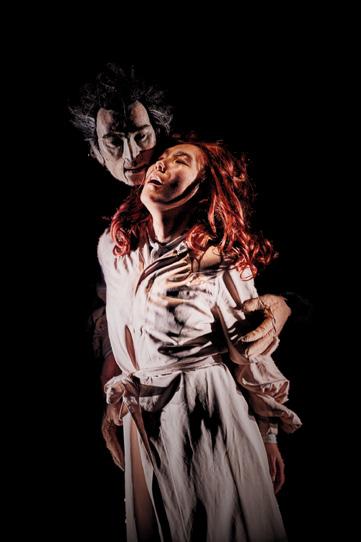
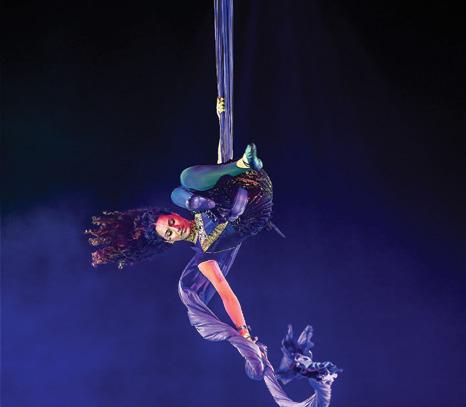
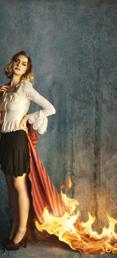
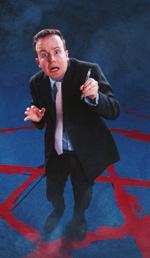
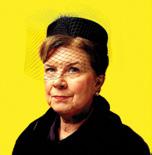
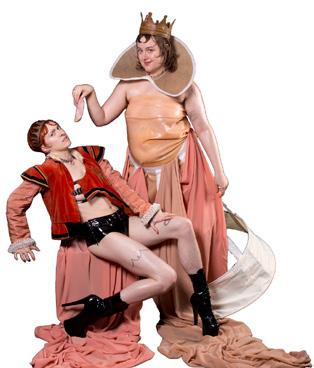
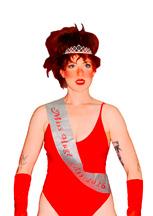
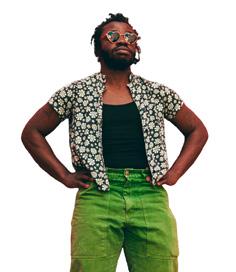
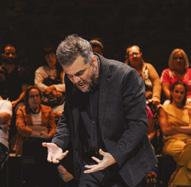
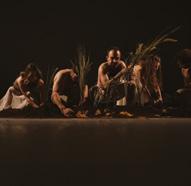
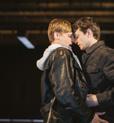
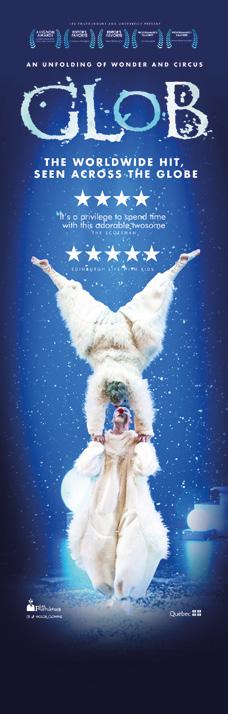
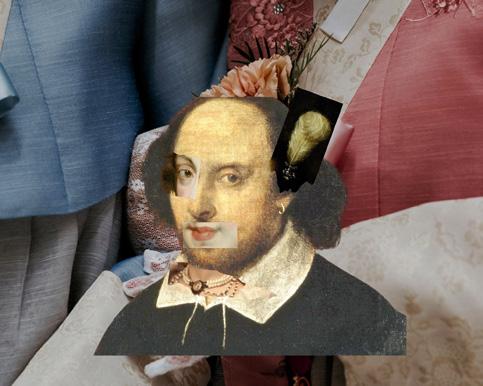
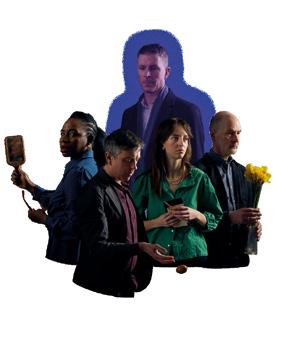
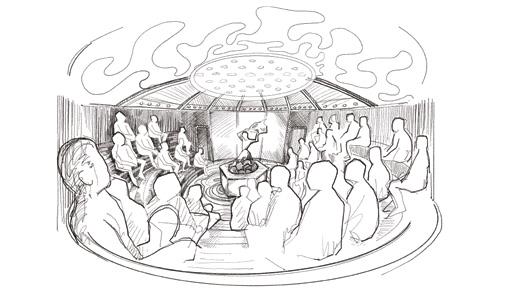
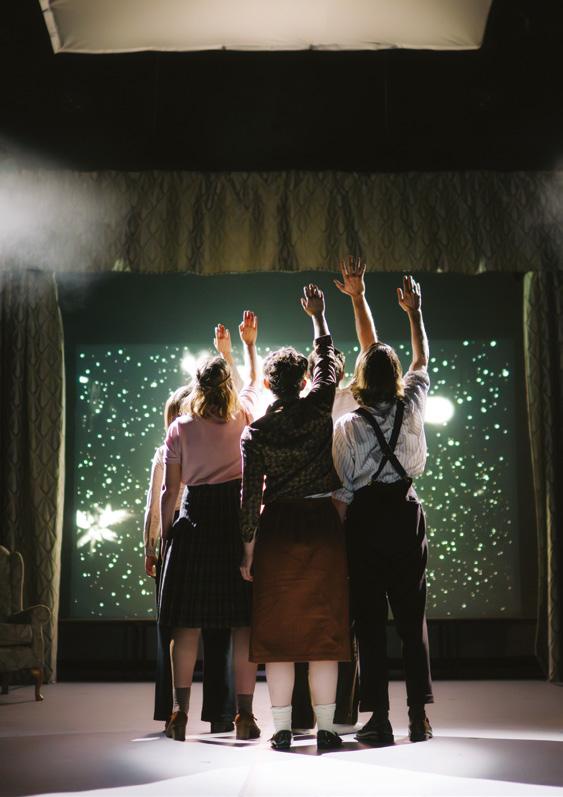
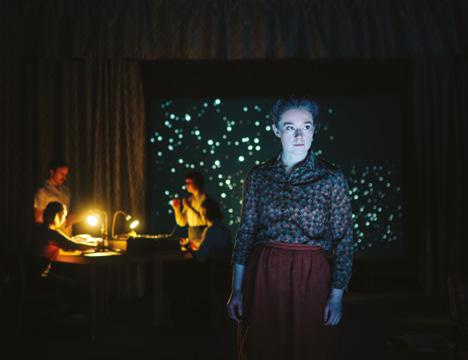
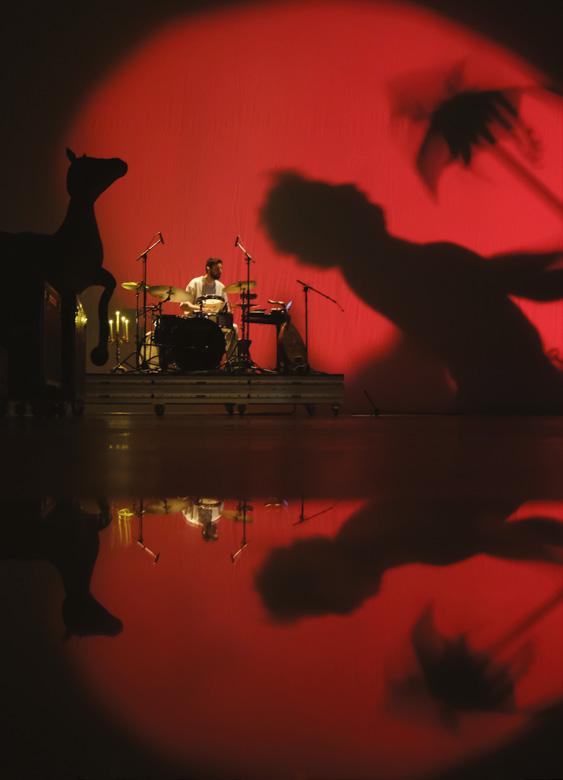
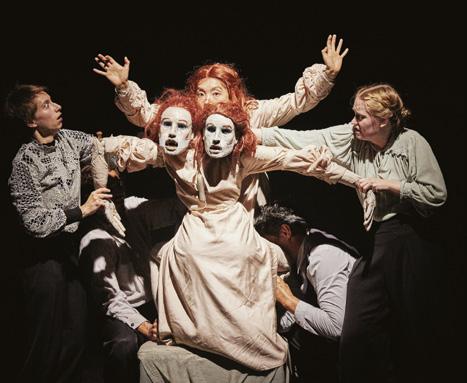
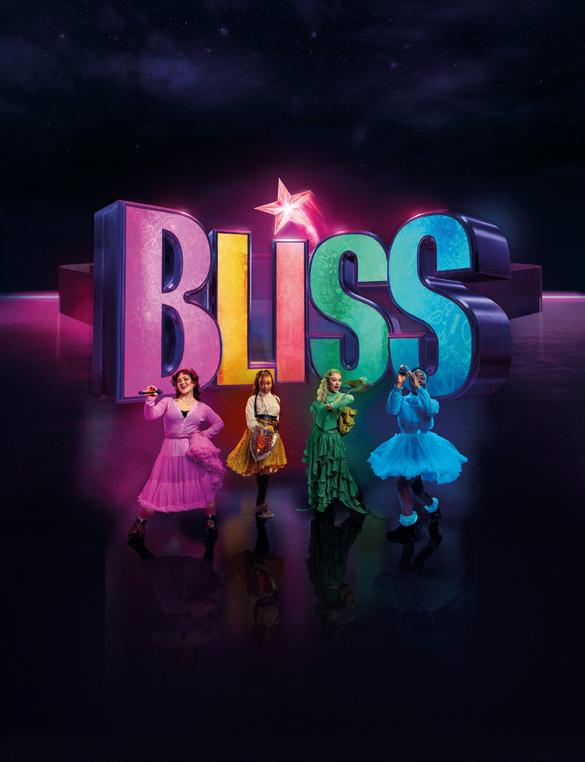
From the award-winning creators of Moby Dick (Barbican)
Directed by Yngvild Aspeli Plexus Polaire presents
Editor
Louis Cammell
Business Development
Edinburgh & Adelaide Festivals
Joanna Hare
Design Team
Phoebe Willison
Dalila D’Amico
Writing Team
Deputy Editor
Megan Wallace
Sales Team
David Hammond
Emilie Roberts
Ema Smekalova
Rachel Ashenden, Anahit Behrooz, Hayley
Jane Dawson, Jamie Dunn, Polly Glynn, Jemima Hawkins, Si Hawkins, Lorna Irvine, Kat Mokrynski, Carmen Paddock, David Pollock, Arusa Qureshi, Jay Richardson, Claire Sawers, Xuanlin Tham
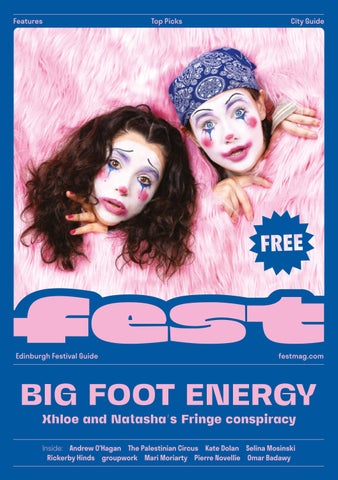
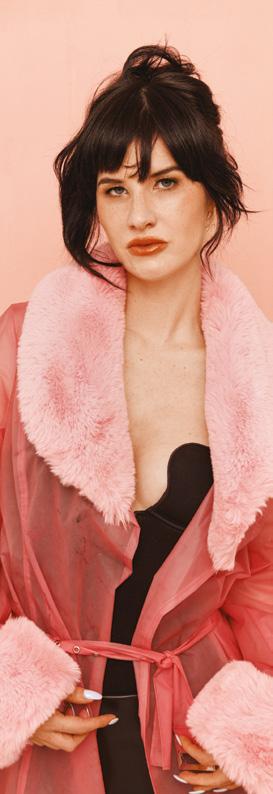
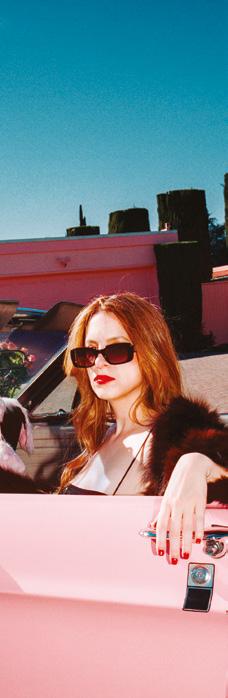
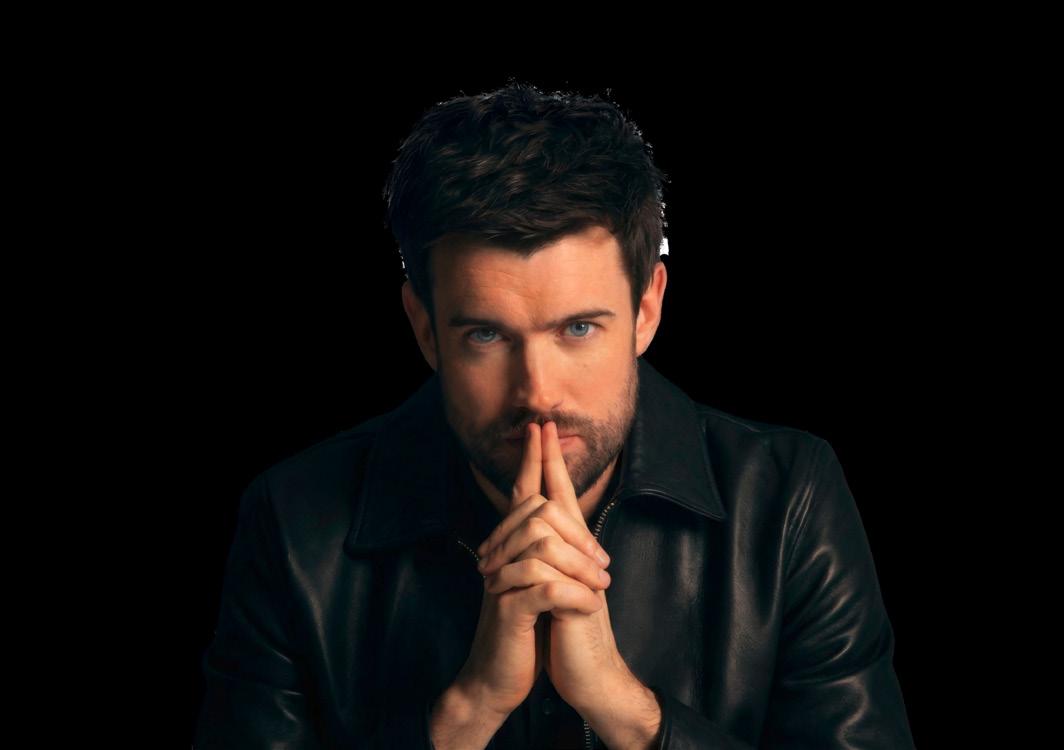
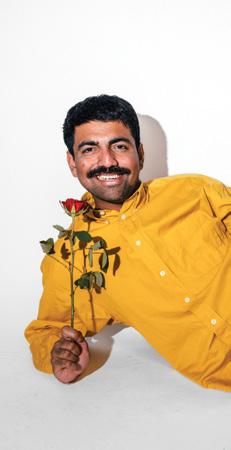
Cover Image
Morgan McDowell
Radge Media
Editor-in-Chief
Rosamund West
Deputy Editor
Peter Simpson
Digital Editorial Assistant
Ellie Robertson
Fest Street Dates 2026 12, 19, 26 August
Advertising 0131 467 4630
sales@festmag.com
Commercial Director
Sandy Park
General Manager Laurie Presswood
Contact festmag.com
hello@festmag.com
Published by Radge Media C.I.C, The Melting Pot, 15 Calton Road Edinburgh, EH8 8DL. Every effort has been made to check the accuracy of the information in this magazine, but we cannot accept liability for information which is inaccurate. Show times and prices are subject to changes – always check with the venue. All rights reserved. No part of this publication may be reproduced in whole or in part without the explicit permission of the publisher. The views and opinions expressed within this publication do not necessarily represent the views or opinions of the printer or the publisher.
Printed by Think Solutions, Glasgow
10 Into the Woods
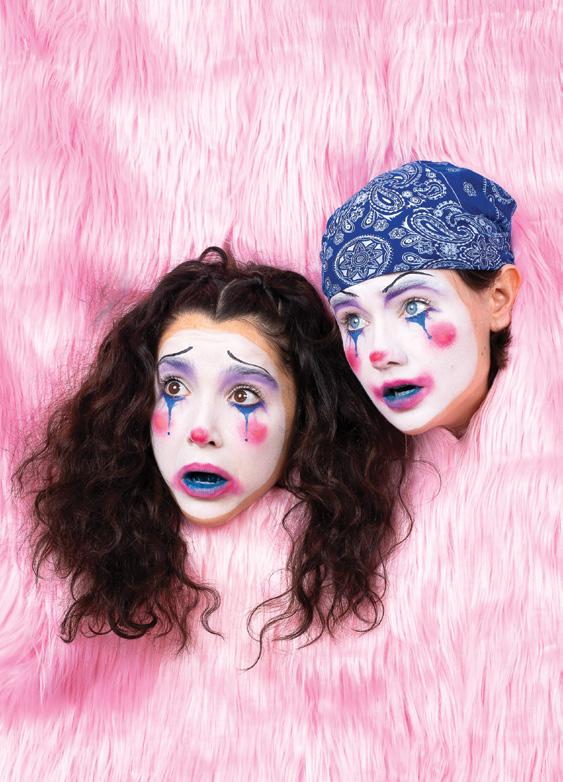
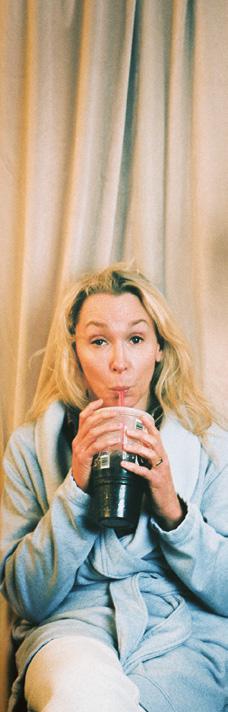
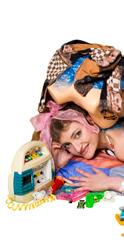
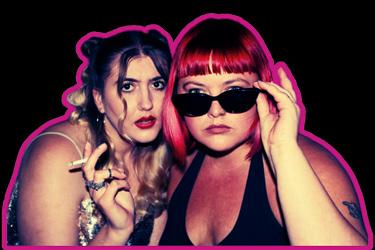
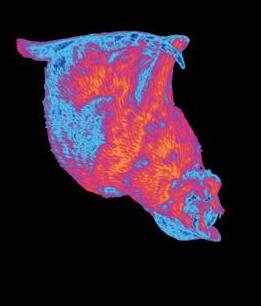
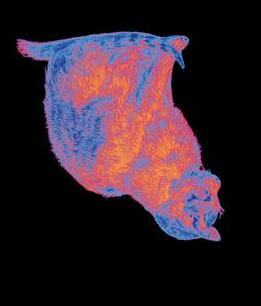
Fringe darlings Xhloe and Natasha on Bigfoot Ripped My Dog in Half I Saw It
Comedy
50 Tight Five
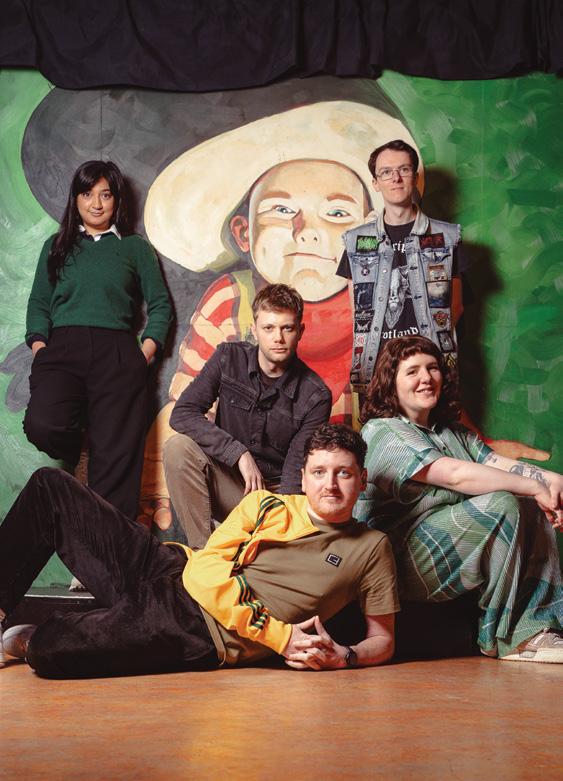
The Stand Comedy Club’s five inaugural sponsorship recipients prepare to debut
EIF
106 Truth Seekers
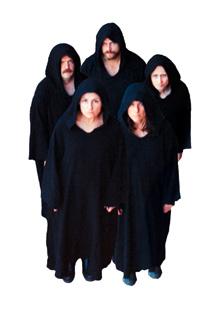
A 1950s Doomsday cult called The Seekers is the subject of the latest piece from groupwork
Music
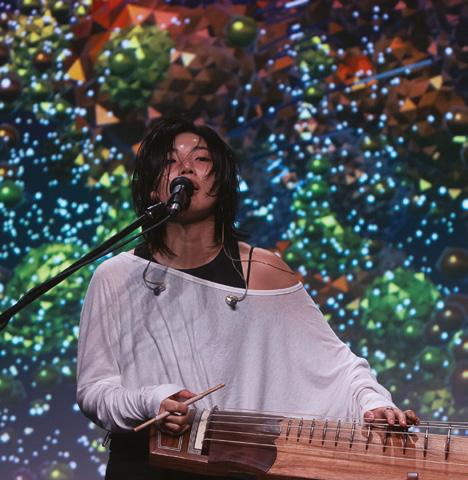
120 Plasticity
Minyoung Kim’s astral geomungo show takes inspiration from plastic
Kids
130 Game On
Delea Shand’s arcade brawler brings together opera’s biggest heroines
14 Lovesick
Harriet Richardson and Catherine Taaffe make romantic obsession their muse
Theatre
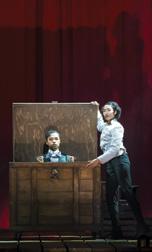
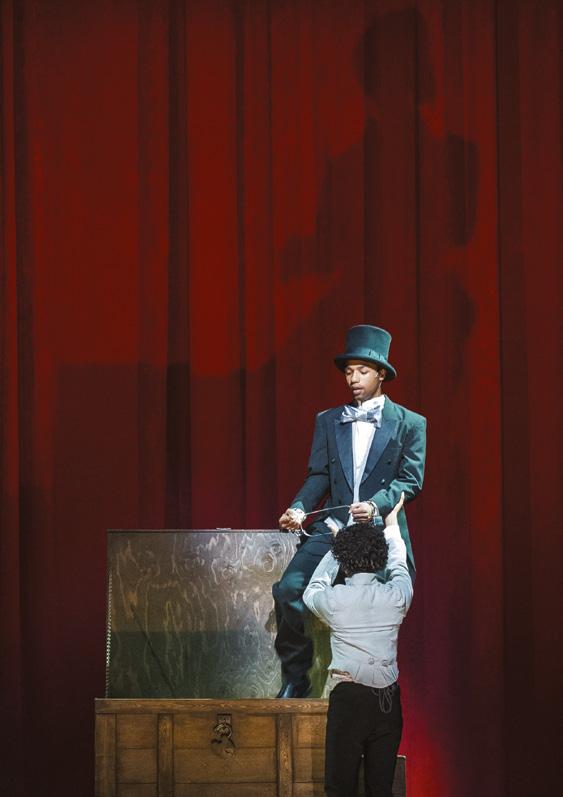
86 Inside the Box
Rickerby Hinds takes us into the life, and daring escape, of Henry ‘Box’ Brown
Cabaret and Variety
116 Amped Up
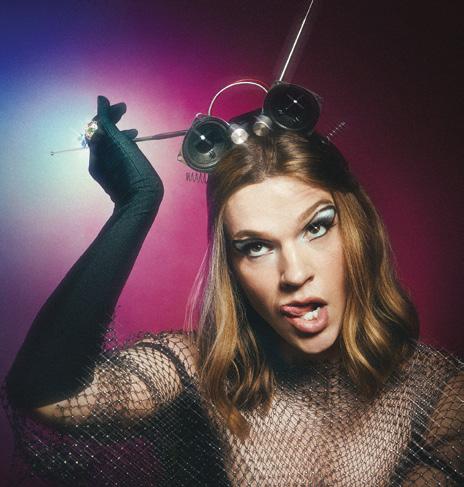
Mari Moriarty plugs us into Fempaths: Transistor Radio Hour
Dance & Circus
124 It’s Alive!
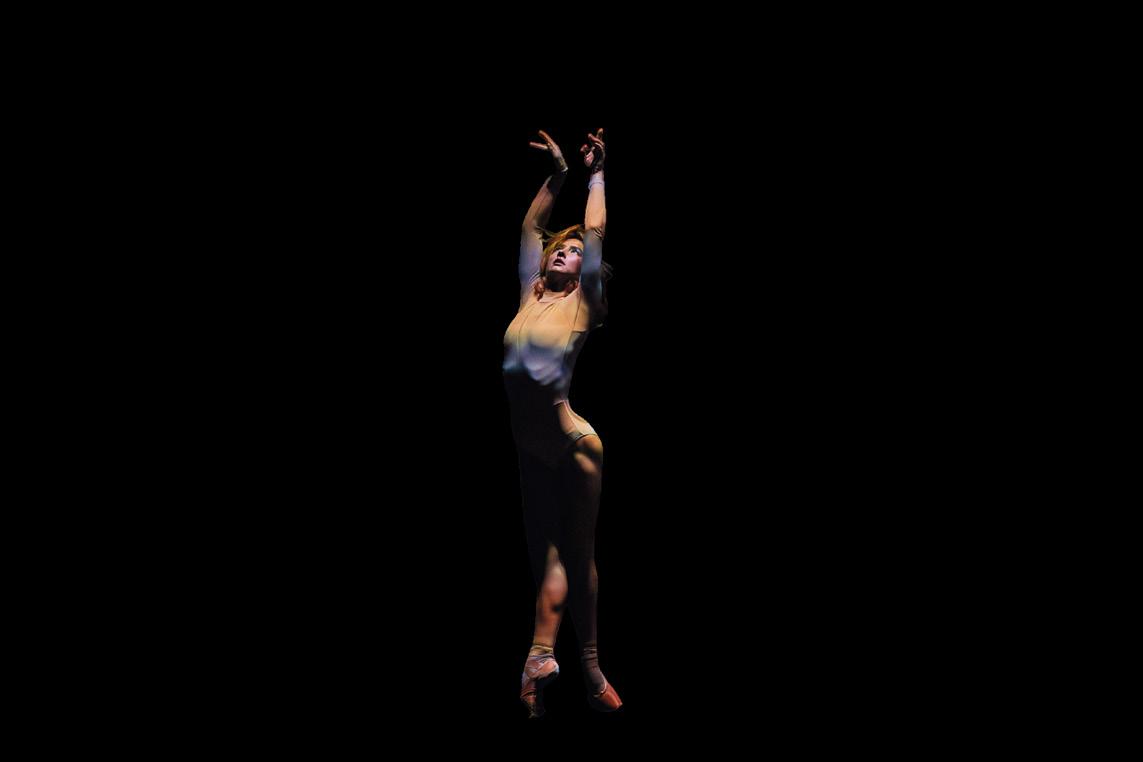
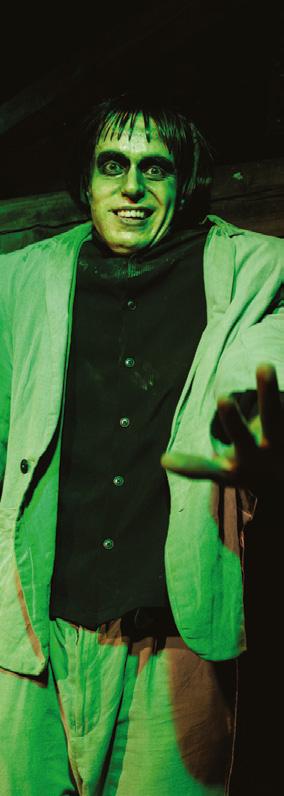
Puppets take centre stage in two wildly different adaptations of Gothic classics
134 City Guide
Pierre Novellie, Robin Grainger, Katie Pritchard and Omar Badawy share their best survival tips
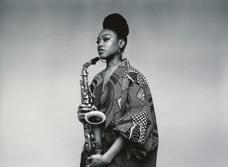
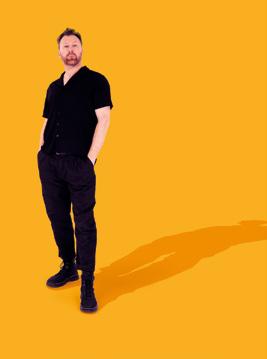
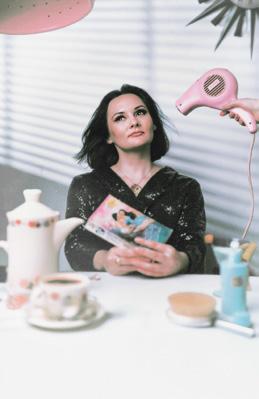
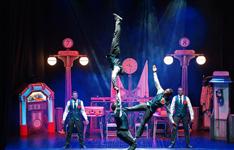
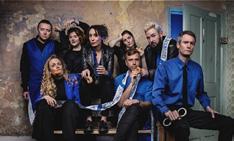
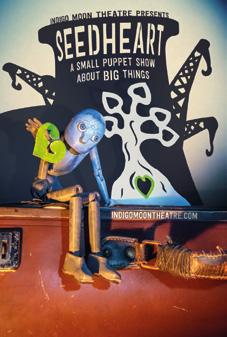
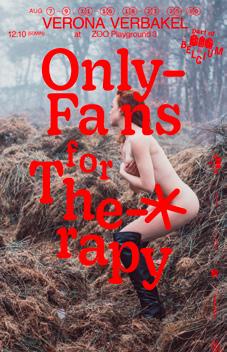
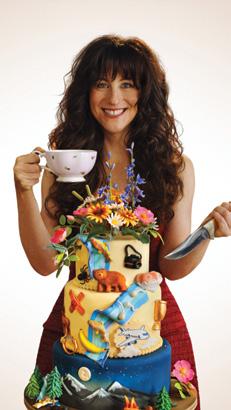
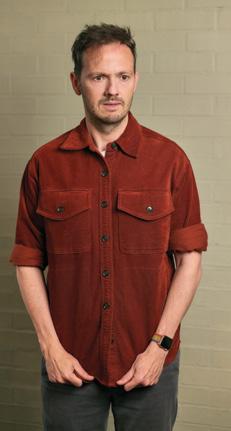
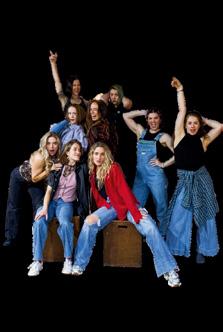
Image credits (top to bottom, left to right): Morgan McDowell; Mindy Tucker; Daryll Buchanan; Jason Sullivan; Mihaela Bodlovic; courtesy of production; courtesy of aritst; Christophe Raynaud de Lage; Alexis Dubus; Matt Stronge
Editorial
Louis Cammell
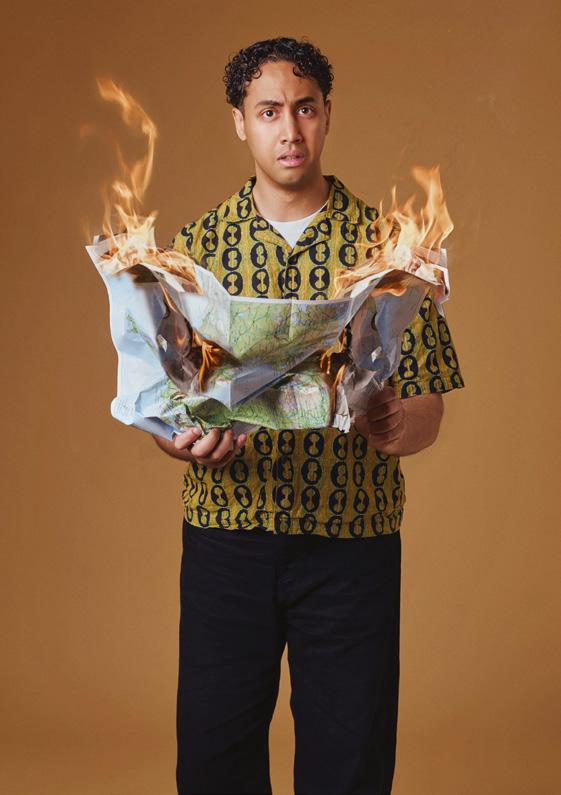
Isit down to write the first draft of this intro on the evening of the FIFA World Cup final. All eyes are on America, its host country, though probably not in the way they ought to be. To quote our cover stars Xhloe and Natasha, “the perfect way to hide something is to drown it out.”
Their new show takes place in a remote Appalachian town rife with distrust, a microcosm of the country in which they live. One that is well versed in big, shiny distractions. Art can be a distraction – a welcome one much of the time – but it’s also a mirror, and in covering it we have a responsibility to balance both virtues.
In this issue, comedians like Kate Dolan, Selina Mosinski, James Trickey, Ted Milligan and Rosalie Minnitt tell us about the stage as a refuge, as does cabaret artist Mari Moriarty. Meanwhile, Scottish physical theatremakers groupwork show us fiction’s intoxicating pull. They play the Seekers in When Prophecy Fails , a 1950s UFO doomsday cult that was the first of its kind.
Stories make history, and so on the 250th anniversary of America’s independence, hip hop theatre pioneer Rickerby Hinds reminds us that stories have all kinds of tellers.
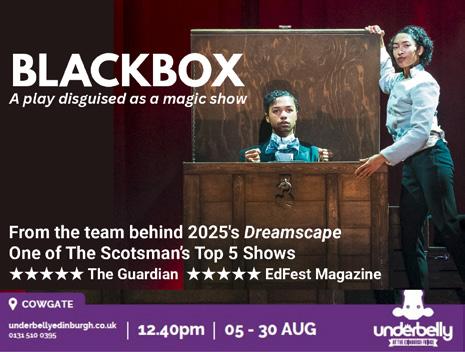
We speak to him about his new work Blackbox , about an enslaved man’s escape to freedom.
It is also a privilege to hear from The Palestinian Circus, who embody the defiance and resilience of Dabkeh, a dance that survives persistent attempts at cultural erasure. I urge you to watch them soar and take in what humans are capable of, much like the young men of Andrew O’Hagan’s Mayflies (which gets its stage adaptation inside a former Leith metalworks this August) who are awed by the likes of The Smiths, New Order and The Fall into political consciousness.
It may sound trite, but Edinburgh's festivals are nothing without bodies: bodies that perform; bodies that fill the city and its rooms, rooms that range from gilded to borderline unsanitary; bodies that feel, fall helplessly in love; bodies that can be moved to action.
So as you bob and weave to your next show, attempting to figure out how you’re supposed to get to the other end of a cordoned-off Princes Street without a drop of signal, try and enjoy the inconvenience. When in Rome, start frictionmaxxing (which we used to just call living). Look around at the sea of people and see collective potential.
Louis Cammell Editor
“Hungry, mainly. Thank god for those Besties breakfasts.”
Dalila D’Amico Designer
“WTF did I just watch?”
Meet the Team
We asked: Tell us your Fringe mood
Sandy Park
Commercial Director
“Knackered. Exhausted. All the adjectives for tired.”
Peter Simpson Digital Editor “Toasty. Busy. Thriving.”
Megan Wallace Deputy Editor
“In need of a deep tissue massage but ready to go again.”
Ellie Robertson Digital Editorial Assistant
“Post-show, sat in the meadows, tipsy, overstimulated, having a great time.”
Ema Smekalova Media Sales Executive
“Feigned disgruntlement with a touch of alcoholism on the side.”
Rosamund West Editor-in-Chief
“I would describe my Fringe mood as ‘deadlines’ and ‘school holidays’.”
Phoebe Willison Lead Designer
“At my desk designing 6,891,24 magazine pages”
Joanna Hare Business Development Executive
“The Scotrail express service from Glasgow Queen St to Haymarket.”
Emilie Roberts
Media Sales Executive
“Frazzled and too warm.”
Laurie Presswood General Manager & Accounts
“Trapped in a deflating bouncy castle. Everything is out of control.”
Into the Woods
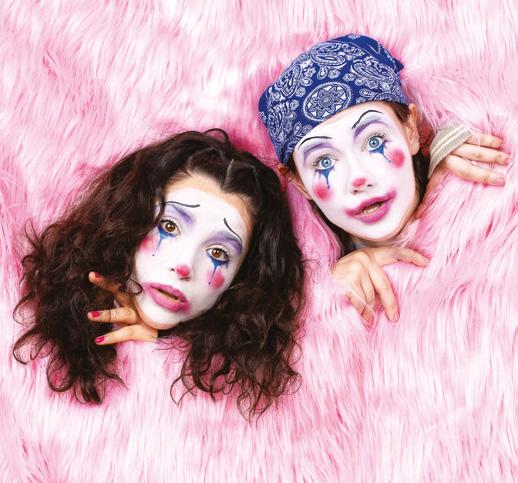
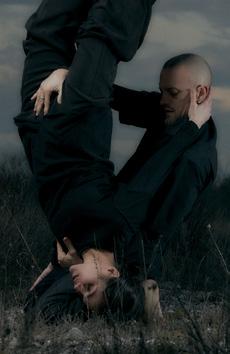
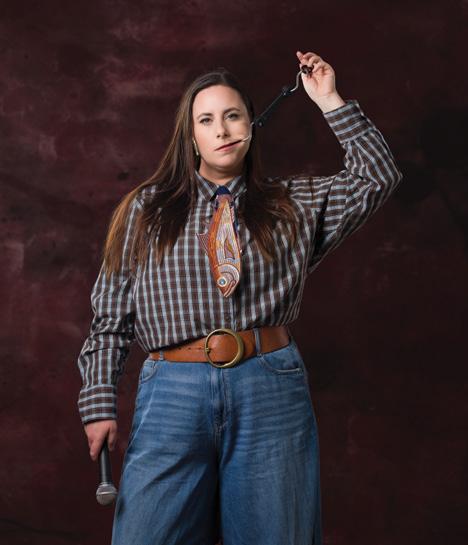
Acclaimed clown and physical theatre duo Xhloe and Natasha tell us about their fourth new work in five years, set in a paranoid Appalachian town
Words: Anahit Behrooz
The day that cult clown duo Xhloe Rice and Natasha Roland arrived at the idea for their new Fringe show, right-wing American commentator Charlie Kirk was shot. The two events are unrelated, insofar as the pair knew nothing about the assassination until it flashed up on their phones, but have in the intervening months become strangely entangled. Rice had just finished watching a documentary on Bigfoot sightings in the US when Roland arrived to nail down the pitch for their upcoming Fringe commission, the duo’s first new show in two years. Moments later, the news broke. The three seemingly disparate threads of the evening – Bigfoot, Charlie Kirk and the Fringe – suddenly coalesced as social media began churning out conspiracies, theories and dire accusations before Kirk had even been pronounced dead. “The right saying it was the left, the left saying it was the right, the centre saying it was the off-centre, people going, ‘this is a distraction, the Epstein files must be really bad’...I was like, oh my god, it has not been 15 minutes,” Rice says. “The whole thing was really inspiring in how flooding people with information is a really good way of distracting them and keeping them fighting with each other,” Roland adds.
It is a wild origin story for a play, but one that makes perfect sense for Rice and Roland. Ever since arriving on the Fringe landscape with their hit show And Then the Rodeo Burned
Down in 2022, the duo have become known for their sharp, absurdist blend of pop culture and political theatre, in which Dolly Parton songs sit alongside metatheatrical critiques of arts funding, and 1950s cannibalistic housewives
“The perfect way to hide something is to drown it out”
Xhloe Rice
speak to a post-Roe-v-Wade landscape. Every one of their shows – 2022’s Rodeo, 2023’s What If They Ate the Baby? and 2024’s A Letter to Lyndon B Johnson or God: Whoever Reads This First – won a Fringe First, a run unheard of for two independent, unproduced theatremakers. This year’s show, Bigfoot Ripped My Dog In Half I Saw It, has a similar fascination with the American political context, this time accompanied by cryptozoologist mythos and a nine-foot tall Bigfoot puppet. “Well, ‘nine-foot,’” Roland laughs. “It might be a little bit shorter than its Hinge profile.”
Employing such an enormous prop – and adding a third figure to the stage for the first time in the duo’s history – is an evolution in their theatrical technique that nevertheless speaks to the pair’s preoccupation with phys-
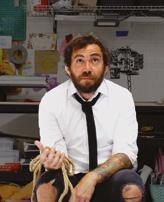
Photo: Morgan McDowell
ical theatre and the marriage between form and function. “We were thinking about themes of coercive control and misdirection, and things that draw your eye; like ‘look over there,’ so that you don’t look over here in both a literal and political sense,” Rice explains. “What’s fascinating about puppetry, when you think of Julie Taymor’s double event of showing the puppeteer and the puppet, is it prove[s] that even with a very Brechtian exposing of mechanics, humans can still suspend their disbelief. We’re reminding you it’s a puppet the whole time, yet when the lights are on and we’re holding this fucking nine-foot guy and he’s moving, your brain tricks you into creating a story.”
In this way, Rice and Roland’s nine-foot sasquatch puppet is the Charlie Kirk of the play – a shiny object that embodies the ways in which distraction and misinformation have become primary tools within the American political and cultural landscape. The pair are animated listing different conspiracies that draw a veil over reality, including a theory that the film Frozen was made specifically to cover up allegations that Disney cryogenically preserved their founder's head. “The perfect way to hide something is to drown it out,” they say eagerly. “Like the hundreds of pages of Elsa and Anna fan art that are hiding Walt Disney’s cryogenically frozen head.”
Bigfoot is the first of Rice and Roland’s shows not to premiere at SpaceUK; instead, it is showing at Summerhall, where the marker of many a successful Fringe show has been an acclaimed television adaptation. Yet in its emphasis on liveness and physical theatre, Bigfoot acts as a wry commentary on the very machine of the Fringe, and the shifting parameters of success within performance arts. “The ‘I Saw It’ in the title – we’re playing on the concept of when something is live and can’t be rewound or replayed,” Rice explains.
“Like how easily can you trust what you saw with your own eyes, especially if you’re on your ninth Fringe show of the day.”
With three Fringe Firsts and multiple soldout runs (the pair brought all of their back catalogue last year, sometimes performing three packed-out shows a day), it would be easy for Rice and Roland to rest briefly on their laurels, or to become obsessed with gaining even more. Yet while they are always aware of how these parameters of success affect their ability to make art, their choice to keep their eyes on the prize of creative experimentation, puppets and all, rather than awards and reviews is, for them, the best indication of success they can imagine.
“I don’t even know if I want to say this,” Rice pauses briefly, “I’ll say it! I think it is objectively true that eventually Natasha and I are going to write a show and it’s not going to win a Fringe First. And no matter how good that show is on paper, people will see it as less than because we’ve set a weird standard for what a Fringe is for ourselves. But there’s so many other metrics of success: having audiences see the show, or even just having a good time.” Do they think not winning a Fringe First might end up feeling liberating? “Listen,” Roland laughs. “Yes. I think when we get over our fear of failure – like failure in broad strokes – we will soar. We’re also reminding ourselves that this is the Fringe and the Fringe is for artists trying new things.”
“Allegedly!” Rice interrupts, laughing. “Allegedly!” Roland laughs too. “That’s what it’s supposed to be. And so to bring a new work, as scary as that is…we are at a point now where we just want to love it ourselves.”
SHOW Bigfoot Ripped My Dog in Half I Saw It
VENUE: Summerhall TIME: 6-30 Aug (not 18, 25) , 9.10pm
Photo: Morgan Mcdowell
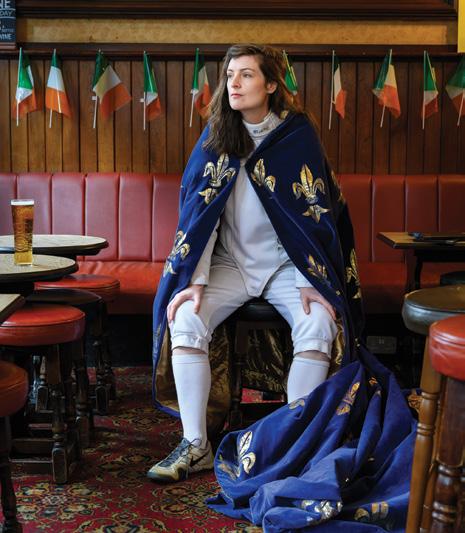
Lovesick
Catherine Taaffe and Harriet Richardson discuss their Fringe shows dealing with the dizzying highs and crushing lows of romantic infatuation
Words: Megan Wallace
Ever heard of ‘limerence’? It’s the heady, obsessive state of new love – where your emotions become so overwhelming they begin to twist your sense of reality. In 2026, it provided fertile inspiration for pop culture. For those who like our films warm and fuzzy, Netflix’s Voicemails for Isabelle recycles a familiar premise of male fixation, packaged as romance. On the flipside is Obsession, which frames female infatuation as visceral horror.
“Obsession can feel so private, so deranged, so uniquely shamefilled, but it’s also deeply human”
Harriet Richardson
It doesn’t take a PhD in Gender Studies to note the subtext: male romantic compulsion is cute (despite plenty IRL evidence to the contrary) whereas women’s feelings are grotesque and violent, a perception which belies a certain castration anxiety. See also: Fatal Attraction, Basic Instinct, Killing Eve…and plenty of other examples. Now, two female-fronted debut shows at the Edinburgh Fringe say 'enough' to the stereotype and take us inside
the minds of women under the influence of limerent attachment; and, in both cases, they’re inspired by the creators’ real lives.
The autofictional skew of these shows allows us a new interiority to these tales of fixation. At least, this is what speaking to writer and performer Catherine Taaffe suggests. The Brooklyn-based creative explains that The Only Man Who Won’t F*ck Me – her darkly comic play exploring a woman’s one-sided obsession with her trans male friend – was inspired by her own millennial existential crisis after a creative project fell through. “I was like, ‘I don’t own property, I’m not married, I know people who are having kids…’ when my career isn’t going well, it feels like this gaping hole,” she says. “I guess I started to sort of fixate on this relationship that I was in, or it wasn’t even a real relationship, it was my best friend who I had feelings for. I thought that if this person chose me, I’d feel, you know, whole again.”
This muddling of professional and personal boundaries is carried forward into Taaffe’s character who – informed by the writer-performer’s own lived experiences – is a successful sex worker. Cultivating desirability is part of her job, so when she comes across a man who isn’t just uninterested in her, but whose transness positions him outside of cis-heteronomative sexual politics, she spirals. “My character has built her whole life and understanding of herself on being desired. She meets this guy who’s not like her clients, and who happens to be a trans man, too,” Taaffe explains. “The
mechanics of how to make men want her don’t work with this guy. It’s freeing but terrifying and it kind of breaks her brain a little.”
While Taaffe’s play deals with one-sided limerence, Harriet Richardson’s Creep deals with the grey, liminal space of situationships: showing how a lack of certitude can be ample fuel for romantic projection. The comedy show – which serves as the performance artist’s first foray into stand-up – explores a period of Richardson’s life following a brief online flirtation with a middling male TV comedian, one which blew up her long-term relationship. In Creep, Richardson explores how the banal personal tragedies and fascinations of romantic rejection and sexual desire in the digital age – where we can know everything about someone through a Google search, and bare our souls over DM, but never fully meet someone in the flesh – can transmute into a kind of fervent, almost religious ecstasy. “If someone is available enough to feel possible, but just out of reach enough to remain unknowable, I can turn them into an icon rather than a person. There’s both safety and risk in that. You get the intensity of devotion without the vulnerability of mutuality,” she explains.
The process is undoubtedly a lonely one, as all sides avoid putting the skin of true intimacy in the game. However, making a monument of another person is a highly creative process and, in her animated retelling of her own fixations and foibles, Richardson winds up rejecting the othered position of hysterical woman.
Photo: Charlie Ralph Harriet Richardson
ICAN’TTELLWHAT SHE’SSAYING
Instead, she turns her male interest to a muse for her own artistic practice (women in male fields, much?). “Obsession has a deranged relationship to creativity. As soon as obsession takes hold, my artistic libido either has a fire lit under it or dies a death, depending on where I am in the cycle,” she says. “Reliving this period in pursuit of writing my debut hour has been, to say the least, artistically invaluable and personally inadvisable.”
If you’re raised or socialised as a woman, you’re sold a fantasy that a man will swoop in and save you – that romance will be your salvation from the cold and lonely world and that love is a pure, saving grace. Both Taaffe and Richardson’s shows explore, and implode, the impulse to turn to romantic love when you need to make sense of the world, or as a defence mechanism; exposing how self-destructive this fantasist line of thinking can be. But, most importantly, they encourage women to reject the shame and silence which can surround rejection, escapism, and limerence. “Obsession can feel so private, so deranged, so uniquely shame-filled, but it’s also deeply human,” says Richardson. “So is performance. So is exploding your life by having a lacklustre affair with the guy from the TV.”
SHOW The Only Man Who Won’t F*ck Me
VENUE: ZOO Playground
TIME: 7-30 Aug (not 17) , 9.50pm
SHOW Harriet Richardson: Creep
VENUE: Pleasance Courtyard
TIME: 5-30 Aug (not 17) , 7pm
Catherine Taaffe
Leap of Faith
Mohamad Rabah, director of the Palestinian Circus, speaks to us about defying the odds to bring their Dabke-inspired performance to Edinburgh
Words: Xuanlin Tham
On a fateful day last June, Mohamad Rabah, director of the Palestinian Circus, sat frozen with indecision. A month prior, the circus had been invited to perform at Glastonbury, setting in motion weeks of visa applications, rejections, and fragmented rehearsals. Then, on the 13th of June, Israel bombed Iran. Flights out of Jordan, where Rabah and the artists would have departed for the UK, were cancelled. Chances of getting to the festival –let alone rehearsing on stage – were slim.
Then, days before Glastonbury, a travel agent called. “He said, ‘We found flight tickets, but you have to leave tomorrow morning, and it’s $2,000 per ticket’,” Rabah says, dialling in from a theatre in Ramallah. With 13 artists needing to travel, this was utterly beyond their budget. They had twenty minutes before the tickets were snapped up. Rabah looked at the faces of the artists around him, waiting.
“I said, ‘Fuck the money, we go.’ And the first show in Glastonbury was the first full rehearsal,”
Photo: Hemispheres Photography
BATSU!
Penelope
Abandoman: Afterglow
Goodbye Dandelion
Bad Boy
Final Queen
Rip Her to Shreds
Mothman: A Romance Musical
he says. “We had a five-minute standing ovation. It was a very, very emotional moment for us that we made it. That’s what pushed us to come back.”
“We want to be at the Fringe celebrating who we are. That will give us the resilience to keep going, until we are all free”
This was the birth of Step and a Half – a dazzling blend of contemporary circus and traditional Palestinian dance. The show’s namesake is the foundational ‘step and a half’ in Dabke: a dance that is the cultural lifeblood of Palestine, in defiance of 79 years of occupation and ethnic cleansing, and the past three years of the genocide in Gaza. “We want to be at the Fringe celebrating who we are. That will give us the resilience to keep going, until we are all free,” Rabah says. “We believe a lot of people are suffering, even in the UK. If people see us Palestinians showing love of life through resistance to very clear oppression, they have this strength coming from us to face their challenges.”
Dabke is life-affirming to witness. It is a dance that summons a collective, carrying generations of people stamping their feet into the land, refusing erasure. “This collectiveness protects us,” Rabah says. “Palestinians, we suffered a lot. But one way we resist is that we stay together.”
Of the eight artists performing at the Fringe, some came up through the Palestinian Circus’ youth pathway; some are parkour athletes; some grew up in Jerusalem, helping the Circus organise training behind Israeli
checkpoints. “We work almost everywhere in Palestine using these mechanisms of partnerships. This is also a political message,” Rabah says. “The occupation tries to geographically fragment us. We want Palestinian youth to come together, and we want to break our isolation from the world.”
When the Palestinian Circus was established, its founders were often met with the question, ‘Circus? Is that really what Palestine needs?’ But circus is about seeing the impossible made possible: about how it feels to see artists breaking past the constraints of real life, bringing a different world within reach. This reach towards the not-yet-possible is also the work of liberation. “You plant this vision in the way you perform,” Rabah says. “Our idea with this show is that, yes, we are suffering: but the life we want to live is full of love and beautiful things.”
When asked how difficult it is to protect this love from a world intent on its destruction, Rabah laughs quietly: “It’s insane.” He talks about a colleague who lost 58 kilograms after being tortured in an Israeli prison. He talks about Hamed, an artist who will be performing on the Cyr wheel at the Fringe. Hamed was practising at the circus when his 17-year-old brother was shot in their village. Rabah goes silent, tears caught in his throat. “And yeah,” he says. “Every time Hamed performs, it’s his way to communicate with his brother.”
Especially through its youth programme, the Palestinian Circus proves how essential art is, not in spite of, but because of, such unthink-
able violence. “Think about a young person living with these conflicts inside, about what it’s worth to keep going, and why the world is not giving us justice – and then [they] decide, I will show love, I want to show celebration of life on stage, I want to show trust in humanity again. This is a very difficult transformation of emotions,” Rabah says. “This is the core of what we try to do with the kids. You come to this circus space, and you do dangerous things, but you feel emotionally safe. And in this place, not like the world outside, we try to practise love.”
The story of Step and a Half demonstrates how art can knit together a network of survival and hope, a material infrastructure of solidarity across borders. “Without the people who helped us in Glastonbury, the Incandescence people in Cornwall, and Leila from Showponies, coming together,” Rabah says, reflecting on the show's journey. “It was like magic. If we were alone, we couldn’t do it.”
He hopes Edinburgh audiences will take part in this magic, the kind that’s necessary to keep fighting for freedom. “It’ll be a big party, with music, dance, the energy of the artists,” he says. “We hope everyone will celebrate with us that we made it so far, all of us safe. We hope everyone will be full of energy and love,” he says, smiling. “And that’s our expectation. No more, no less.”
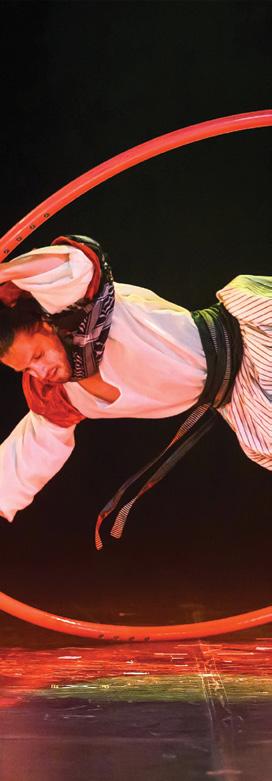
SHOW The Palestinian Circus: Step and a Half VENUE: Underbelly’s Circus Hub on the Meadows TIME: 8-29 Aug (not 17, 24) , 2.05pm
Photo:
THE FIVE STAR SHOW RETURNS FOR ONE FINAL (FINAL) TIME!
PAULO
Eight unique shows: Celebrating the very best in performance from Brazilʼs state of culture. Scan to explore AUGUST 5TH-31ST
The Sound of Metal
Author Andrew O’Hagan and theatre director Ben Harrison on staging their Mayflies adaptation inside a former Leith metalworks
Words: Jamie Dunn
The 1980s were hardly salad days for British youths, but Andrew O’Hagan captured the salt and the sweet of that decade beautifully in his vivid semi-autobiographical novel Mayflies, published in 2020. It follows a group of pals from Irvine who are united by their love of pop culture and their hatred of Thatcherism. In the summer of 1986, they embark on an unforgettable weekend at the Festival of the Tenth Summer in Manchester, where their world is shaken by “a nuclear fuckfest of musical
talent” that includes bands like The Fall, New Order and The Smiths.
Grid Iron will stage an immersive, site-specific adaptation of Mayflies at this year’s Fringe. Ben Harrison, co-artistic director of that celebrated Edinburgh-based theatre company, is writing and directing, and he recalls having O’Hagan’s novel pressed into his hands by his daughter, who told him, “This is basically you”.
“I read it in a day and a half,” Harrison tells me. “I’m usually quite a slow reader, but
Photo: Martin Shields
Andrew O’Hagan
I devoured it. I read the last 30 or 40 pages through floods of tears.”
The waterworks are understandable. The effervescent first half is told from the point of view of 18-year-old Jimmy, aka Noodles, a bookish, gentle soul. The group’s ringleader is the slightly older Tully, a handsome rebel who models himself on Albert Finney’s Arthur Seaton from British New Wave classic Saturday Night and Sunday Morning. The second half of the novel takes place 30 years later. The daft boys are now accomplished middle-aged men, and Tully has devastating news to share with his old friend – and a huge favour to ask.
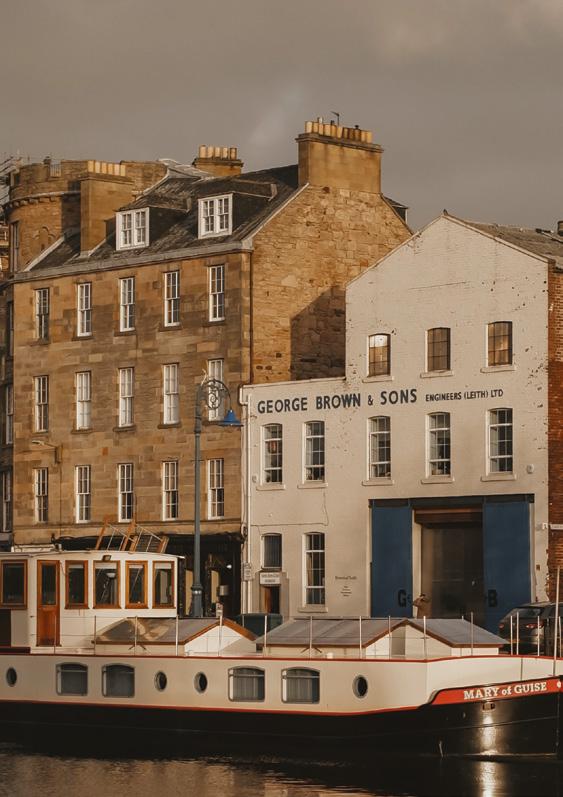
Harrison and his partner at Grid Iron, Jude Doherty, agreed that Mayflies was an ideal project to mark the company’s 30th year, and in 2025, they found the perfect venue. After engineering outfit George Brown & Sons vacated their vast warehouse on The Shore, it became available as a creative space in its new guise as Brown’s of Leith. “I walked in and thought, ‘This is The Haçienda!’” Harrison says of his first visit to Brown’s. From there, the play’s structure quickly formed. “The concept is that the characters never really leave the envelope of that weekend,” he explains. “And the audience doesn’t leave it either.”
The source material is a realist work, but Grid Iron’s staging of Mayflies will incorporate a dash of surrealism. “There’s a sense of ghostliness and a dream-like quality,” confirms Harrison. “And the two generations will actually interact; there’s a lot of merging of young Noodles and Tully with the older versions.”
O’Hagan joins Harrison and me at a bar in Leith that’s a stone’s throw from both Grid Iron’s offices and Brown’s of Leith. This is not the author’s first adaptation rodeo. Mayflies has been particularly popular. Andrea Gibb adapted it as a two-part TV drama for the BBC in 2022, and Grid Iron aren’t even the first to attempt a stage version. “I’ve seen a few theatrical proposals,” says O’Hagan. “One was a jukebox musical idea for the West End.” It was
a potentially lucrative opportunity, but it didn’t feel right. “It wasn’t Scottish enough. I felt from the beginning that [Mayflies] should be made in Scotland, but also by a company that’s interested in pushing the envelope theatrically, and that’s Grid Iron.”
“I felt from the beginning that [Mayflies] should be made in Scotland, but also by a company that’s interested in pushing the envelope theatrically, and that’s Grid Iron”
Andrew O’Hagan
One of the chief pleasures of O’Hagan’s novel, and we assume Harrison’s immersive play, is that it paints a picture of working-class Scottish life that avoids the usual clichés of Scottish miserablism. “Sometimes you write a novel because you want to read it,” says O’Hagan. “I hadn’t read a novel that really depicted the truth of working-class life of boys in Britain in the 80s. Something really happened to masculinity and to working-class life during that period, which was a kind of implicit decision to go at life differently.”
He and his friends, O’Hagan explains, rejected the values of their fathers’ generation. “We weren’t sitting around the pub being misogynistic, racist, and sexist. We were sitting around talking about the NME or how much we loved Brookside and Neil Jordan films. We were fascinated by what was happening in American
culture, by CND, by resisting. Our fathers might have been on the left, but it was the ‘My wife better get the dinner on the table’ version.”
O’Hagan mentioned earlier that he wanted Mayflies to be adapted by a Scottish company, but part of why the novel has been so successful is that its bittersweet depiction of friendship across decades speaks to anyone who has had pals they love and cherish. “For me, the particular is the universal,” says Harrison. “I mean, I grew up quite posh in Norfolk; I couldn’t be further away from these boys from Ayrshire in terms of my background. But that’s the joy of it, it still resonated across that class divide.”
“These types of bonds and friendships are universal,” adds O’Hagan. “I could see a manifestation of this story in any country in South America or Africa or Australia. And in class terms, too, a bunch of boys from Eton or Harrow could have a similar sense of valuing each other.
“I love the idea that stories can cross all boundaries. In this particular case, these boys come from this town, at that time and have that kind of lingo, and I wanted to dive into that. I’m happy to see that Ben’s also interested in that milieu, but if he’d come to me and said, ‘Actually, I quite like the idea of setting this in a series of igloos,’ I would have been interested in that too.”
That’s a fascinating prospect, but I note the music would probably be a bit different. “Yes,” laughs O’Hagan. “Maybe more Björk.”
SHOW Mayflies
VENUE: Brown’s of Leith
TIME: 7-30 Aug (not 11, 18, 25) , 4pm
Photo: Richard Gaston
Top Picks: Comedy
From Scottish mainstays to international artists making UK debuts, here are just a few comedy shows we’ve got our eye on
Gareth Waugh: Is Pepsi Okay?
Monkey Barrel Comedy, 3-30 Aug (not 18), 16:20
A stalwart of the Edinburgh comedy scene, Gareth Waugh tries to unravel the ongoing mystery of what happened to the deal of his career. Was it all a scam?
Sophie Duker: Hot Beef Injection
Pleasance Courtyard, 5-30 Aug (not 12, 19, 26), 20:30
The Taskmaster champion is airing her beef with the male species. She’s off men for good. Let her tell you why in her own unmistakable style.
John Achkar: His Country Is Collapsing. He’s Having a Baby. So Obviously, This Is the Right Year for a Lebanese Comedian You’ve Never Heard of To Try English Stand Up for the First Time
Just The Tonic at The Caves, 6-30 Aug (not 18), 15:40
When it comes to this comedy show from Lebanese comedian John Achkar, the title probably says it all…
Winner of the Billy Connolly Spirit of Glasgow Award and infamously referred to as ‘the slug nudger’ by the Big Yin himself, McClelland’s new show is about evolution, bodies, and hamsters, apparently.
Creepy Boys: SLUGS
Summerhall, 6-17 Aug, 22:40
Performance/comedy duo Creepy Boys won a Bestie last year for this brilliant, bonkers cross-genre show about ‘nothing, nothing nothing’, as they put it. Look out for the WIP of their upcoming follow-up too.
Gareth Waugh
Sophie Duker
Rosco McClelland Creepy Boys
John Achkar
Photo: Daryll Buchanan
Photo: Corinne Cumming
Photo: Nick Gibb
Photo: Bokah Media
Photo: Édouard Bosse
Eva Peroni: Jungled
Gilded Balloon Teviot, 5-30 Aug (not 17), 16:40
This is the story of how Livingston comedian Eva Peroni dropped out of school and moved to Costa Rica aged 17. Four years later, she’s home, out, and debuting a seriously promising debut hour.
Susie McCabe: Coming of Rage
Assembly George Square, 5-30 Aug (not 17), 20:45
Glasgow comedy legend Susie McCabe thought things were on the up after a health scare aged 44. And in many ways, they were… Until they weren’t. Set to be one of her funniest, most cathartic hours yet.
UNDERGROUND MONK SHOW
Assembly George Square Gardens, 5-30 Aug (not 17), 22:15
John Norris, Dee Marcucci, Max Baumgarten, Bill O’Neill and Claire Woolner have been trialing this insane hour of clowning, directed by Corey Podell and co-created with Sam Fishman, at the Fringe for the past two years and we cannot get enough.
Mark Thomas: 40 in Stand-up Years
The Stand Comedy Club, 5-30 Aug (not 20), 18:05
In the forty years that Mark Thomas has been behind the mic, few have matched him in tenacity. In a crumbling world, there’s no question he’s got just the right words to rouse and reset your conscience.
Amy Matthews: Definitions of Toast
Monkey Barrel Comedy (The Tron), 5-30 Aug (not 12, 19, 26), 15:00
Amy Matthews follows up 2023’s criticallyacclaimed I Feel Like I’m Made of Spiders with a stand-up show about trying to reclaim your own rage when you’ve spent years keeping it at bay.
Andrew Doherty: Reviewers
Welcome... TO DIE!
Pleasance Courtyard, 5-30 Aug, 22:50
Exploring the lengths one might go to avenge a middling review, Andrew Doherty’s absurdist comedy follows writer Felix Chatelier as he battles for his life against a performer’s bruised ego.
Susie McCabe
Amy Matthews Andrew Doherty
Mark Thomas
UNDERGROUND MONK SHOW
Eva Peroni
Photo: Orlando Gili
Photo: Hudson Hughes
Photo: Nicholas Elliot
Photo: Andy Hollingworth
Photo: Koltin Sullivan
Photo: Tony Pletts
Top Picks: Theatre
The best
of
theatre at the Fringe, from new Scottish writing to international productions
Cathy
Traverse, 7-30 Aug (not 10, 17, 24), various times
Scottish playwright Eilidh Loan follows the sell-out run of 2022 family tale Moorcroft with an original comedy about her grandmother, Cathy, and the unique way she faced the loss of her husband. Starring Elaine C. Smith.
Mayflies
Brown’s of Leith, 7-30 Aug (not 11, 18, 25), 16:00
Andrew O’Hagan’s beloved novel is adapted for the stage in a world-first, by the award-winning Grid Iron Theatre Company. Fittingly, the play is being performed in a former Leith metalworks, echoing the iconic venues of the Manchester music scene.
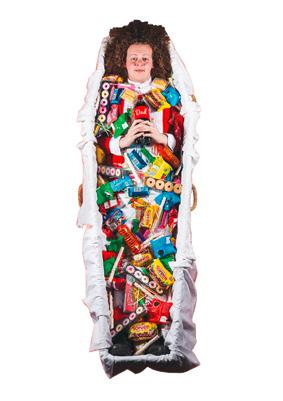
The Trials of Magnus Coffinkey
Summerhall, 6-31 Aug (not 17, 24), 10:30
A fabulistic take on the intense personal trauma of pregnancy loss. Maltese artists Angéle and Malcolm Galea fuse melancholy and whimsy with playful theatricality for a heartwrenching two-hander.
Bigfoot Ripped My Dog In Half I Saw It
Summerhall, 6-30 Aug (not 18, 25), 21:10
When a neighbour’s dog is killed in Appalachia, two teen pranksters (Fringe First winners Xhloe and Natasha) contend with what’s really driving the superstition and paranoia in their remote community.
HAM
Summerhall, 6-30 Aug (not 18, 25), 19:30
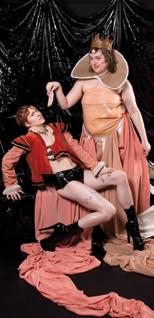
Queer performance duo Hotter Project put Hamlet into the sausage-grinder for a retelling that pits a grief-stricken vegan against the meat-eaters of the world.
Cathy
Mayflies' Andrew O'Hagan
Bigfoot Ripped My Dog In Half I Saw It
The Trials of Magnus Coffinkey
Image: courtesy of Traverse
Photo: Christina Jansen
Photo: Morgan McDowell
The Second Best School Shooting
Pleasance Courtyard, 5-30 Aug (not 12, 19, 26), 12:45
Matthew Lillard and Adam McKay are on production duties for this darkly comic new play about a real-life school shooting, which is written by a former US public school teacher.
Spin Cycle
Underbelly Bristo Square, 5-31 Aug (not 17), 14:25
The launderette is explored as a place of ephemeral, intimate connection in this new queer play from Ireland, which we’re told bears equal amounts of Charlie Kaufman as The L Word influence. Part of Culture Ireland’s showcase.
Adam Riches: The Captain
Summerhall, 6-31 Aug (not 17, 24), various times
Adam Riches served an ace with his 2024 Fringe show Jimmy, about US tennis champ Jimmy Connors. His new tale about the first man to swim the Channel is sure to make a splash.
Mohan: A Partition Story
Pleasance Courtyard, 18-31 Aug, 15:25
Storyteller and playwright Niall Moorjani won a Fringe First last year for Kanpur: 1857 This year, following more performances of Kanpur, they bring back the story of their grandfather’s experience of Partition.
Blackbox
Underbelly Cowgate, 5-30 Aug (not 17), 12:40
Hip-hop theatre trailblazer Rickerby Hinds follows up last year’s Dreamscape with a piece of theatre disguised as a magic show, about enslaved American Henry ‘Box’ Brown’s daring escape by way of freight cargo.
CADEL: Lungs on Legs
Gilded Balloon at the Museum, 6-30 Aug (not 12, 19, 26), 17:55
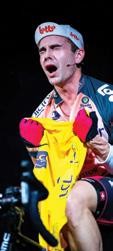
One Australian’s uphill struggle to the top of the podium, based on the riveting true story of Cadel Evans, the first and only Australian to win the Tour de France.
Musicals, opera, parodies and rock icons. Our pick of music at the Edinburgh Fringe
One Man Musical
Pleasance Courtyard, 5-30 Aug, 16:50
and Joan’s mock-autobiographical take the life and work of Andrew Lloyd Webber, lovingly skewering the behemoth of West End culture, returns with Tarot’s Ed Easton in the role.
Heated Rivalry:
The Unauthorized Musical Parody
Underbelly George Square, 5-30 Aug (not 17), 19:50
Admittedly, the name is a bit dead give away, but this hockey-themed romp takes inspiration from beloved queer sports drama Heated Rivalry. Something for the fujoshi among us.
EVITA TOO
ZOO Southside, 7-30 Aug (not Mondays), 18:25
Winking to Andrew Lloyd Webber’s Evita, musical EVITA TOO takes us into the underexplored story of Isabel Perón; the female president who led Argentina for a turbulent 18 months.
Operotica: Lovers in Every Lifetime
Underbelly Bristo Square, 5-30 Aug (not 12, 17, 24), 19:45
Their hearts may have stopped but their loins still burn. The UK’s self-proclaimed ‘premiere kinky opera duo’ brings history’s horniest souls back to life with all of their searing desire intact.
Horsegirl
La Belle Angele, 23 August, 19:00
Chicago’s indie rock threepiece Horsegirl stop by at Edinburgh’s La Belle Angele for a special Fringe performance spanning post-punk, jangle and shoegaze.
Dave Rowntree: No One You Know
La Belle Angele, 25, 27, 28 Aug, 13:00
Blur drummer Dave Rowntree explores the early years of the iconic Britpop band, as well as their infamous Oasis rivalry, in an intimate afternoon discussion of his photobook No One You Know
EVITA TOO
Horsegirl
One Man Musical
Operotica Heated Rivalry: The Unauthorized Musical Parody
Dave Rowntree
Photo: Louise Dalgleish
Photo: Blake Eirmann
Photo: Matt Crockett
Photo: Chase Middleton
Photo: Christa Holka
Top Picks: Cabaret
The best of cabaret at the Fringe includes odes to seminal musicians, sequined sermons and raucous delights
Salty Brine: HOW STRANGE IT IS (The Neutral Milk Hotel Show)
Summerhall, 6-30 Aug (not 12, 17, 24), 21:30
NYC cabaret star Salty Brine stages a dialogue between Neutral Milk Hotel’s In the Aeroplane Over the Sea and Anne Frank’s Diary of A Young Girl, interspersed with his own teenage confessions.
House of Life
Underbelly George Square, 5-30 Aug (not 17, 24), 21:45
Part rave, part religious sermon, House of Life is a raucous healing journey – and Fringe fave – delivered via the medium of cabaret. Be warned: there will be disco lights.
Bernie Dieter’s Club Kabarett
Underbelly’s Circus Hub on the Meadows, 7-29 Aug (not 17, 24), 19:20
A Weimar Republic-themed circus? It would be rude not to. Bernie Dieter comperes an outré evening of sword-swallowing, fire-breathing and contortionism putting a decidedly queer stamp on the Big Top.
Acid’s Reign
Reuben Kaye: Hard to Swallow
Assembly George Square Gardens, 6-29 Aug (not Sundays or Mondays), 20:00
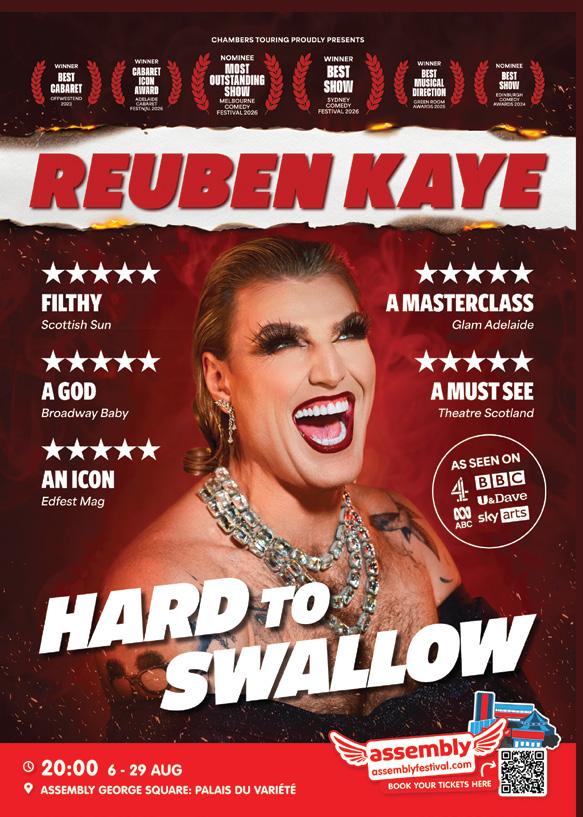
Fresh off the Melbourne Fringe, Australia’s fierce cabaret firebrand Reuben Kaye returns to Edinburgh for a sharp political comedy enlivened by drag, original songs and lashings of charisma.
Pleasance Courtyard, 5-31 Aug (not 12, 24), 15:45
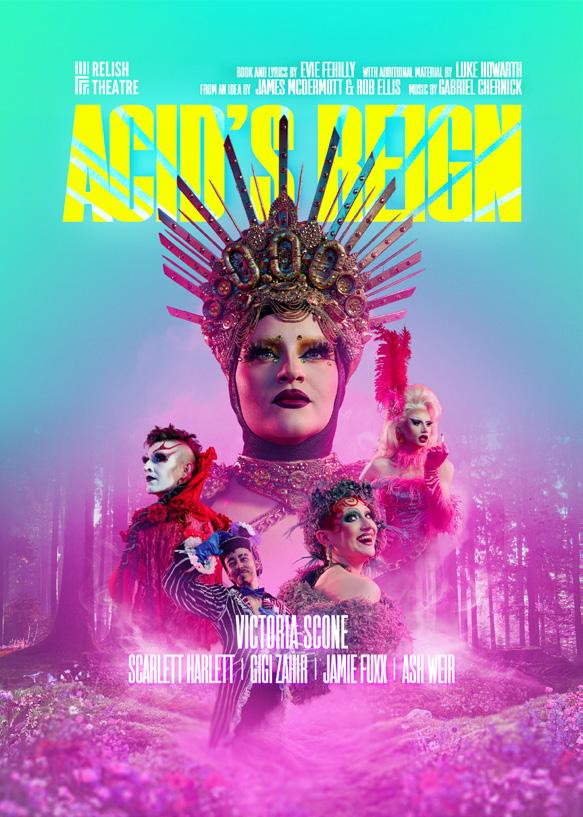
A climate activism-themed drag musical with a live band and performances from the likes of Victoria Scone and Gigi Zahir, Acid’s Reign encapsulates the experimental spirit of the Fringe at its best.
Liberace and Liza – A Tribute
Underbelly Bristo Square, 5-30 Aug (not 18), 20:25
Ever wondered what it would be like to have Liberace and Liza Minnelli together on stage for the night? Liberace and Liza – A Tribute sets out to answer that question in flamboyant, fabulous style.
Salty Brine
Acid’s Reign
House of Life
Hard to Swallow
Bernie Dieter
Liberace and Liza
Photo: Jax Moussa
Photo: Pamela Raith
Photo: Ven Tithing
Photo: Alex Brenner
Take the tram to Ingliston Park and Ride for the Summer Sessions, with extra tram services before and after shows
You must Tap Off to pay the cheapest adult single City Zone fare, otherwise an Airport Zone fare will be charged. Contactless terms and conditions apply.
Top Picks: Kids
Whatever the family prefers, there’s something for everyone at this year’s Fringe
Madame Chandelier’s Grand Theft Opera (5+)
Pleasance Courtyard, 5-16 Aug, 12:15
Opera singer Delea Shand’s alter-ego Madame Chandelier must assemble opera’s greatest heroines for an epic battle in this family-friendly intro to the art form by way of video games.
CODE (12+)
Pleasance Grassmarket, 5-27 Aug (not 12, 19, 24), various times
Advised for young teens upwards, Justice in Motion’s performances are pure adrenaline. Their theatre/trial bike/ rap/parkour mash-up aims to educate young people about County Lines and knife crime in the UK.
The Spencer Jones Experimental Kids Show (5+)
Pleasance Courtyard, 7-16 Aug, 11:00
Alongside his new show for adults, Dogs, the master of silliness and two-time Edinburgh Comedy Awards nominee runs riot with a family-friendly show full of science ‘experiments’, sketches, puppets and more.
Black Blues Brothers: Let’s Twist Again! (5+)
Underbelly Bristo Square, 5-31 Aug (not 18), 17:00
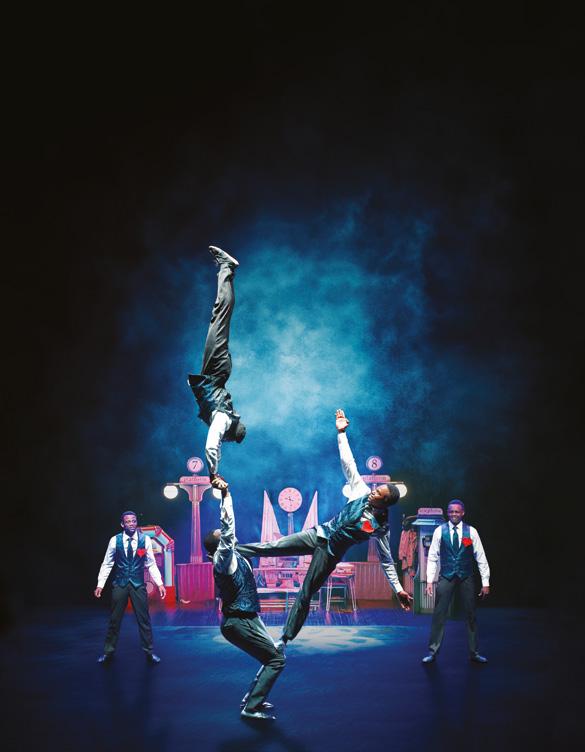
After five smash-hit Fringe runs, this circus show set to the likes of Aretha Franklin and Elvis returns to McEwan Hall. Between the rock‘n’roll and the aerial acrobatics, it’ll keep the whole family happy.
The Listies: 110% Ready (5+)
Assembly George Square Studios, 5-16 Aug (not 13), 13:00
Purveyors of must-see family shows since 2008, The Listies give the ever-dreaded morning routine the disaster movie treatment. Because the school run really does feel like that sometimes…
Quentin Blake’s Mrs Armitage on Wheels (3+)
Assembly George Square, 6-30 Aug (not 12, 17, 24), 11:00
A musical adaptation of Quentin Blake’s much adored Mrs Armitage on Wheels for the stage, featuring live music and puppetry.
Photo: Alexis Dubus
Photo: Debra Hurford Brown
Photo: Ryan Warburton
Photo: Michael Lynch
Madame Chandelier
The Spencer Jones Experimental Kids Show
Photo: Andrew Wuttke
The Listies: 110% Ready
CODE
Black Blues Brothers
Mrs Armitage on Wheels
Top Picks: Dance and Circus
Shows that bring the festival vibes, from bold new choreography to quintessential
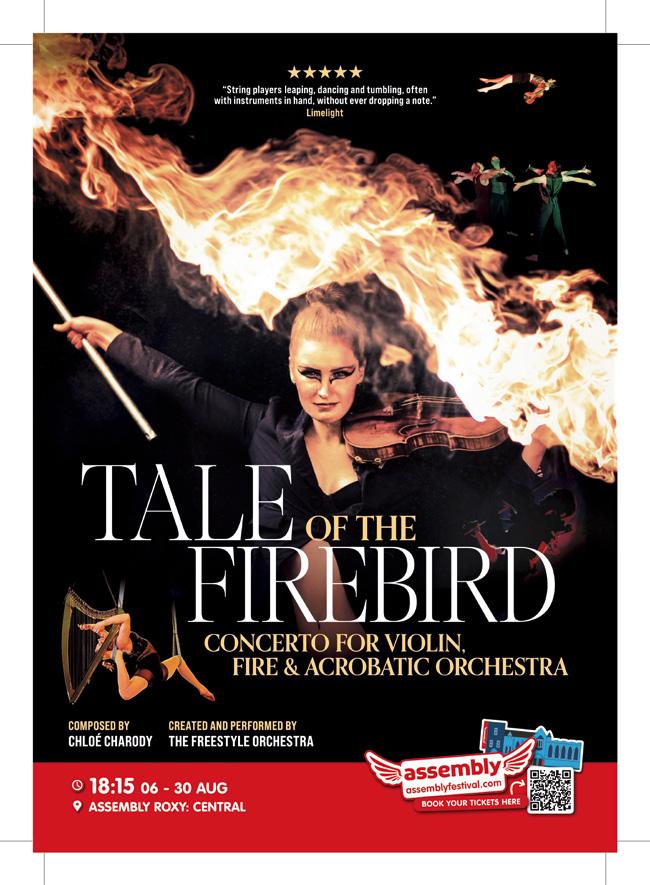
Tale of the Firebird – Concerto for Violin, Fire & Acrobatic Orchestra
Assembly Roxy, 6-30 Aug (not 17, 24), 18:15
As if one wasn’t difficult enough without the other, Tale of the Firebird blends classical music and acrobatics. Yes, really. The Freestyle Orchestra, in which each musician is also an acrobat, plays an original composition by Chloé Charody.
Stamptown
Assembly George Square Gardens, 6-30 Aug (not 12, 19), 21:50
Hosted by clowning’s enfant terrible Zach Zucker, the wonderfully chaotic sell-out variety show moves into a new venue for 2026. Expect special, unpredictable guests.
Poles
Assembly at Dance Base, 18-30 Aug (not 20, 24, 27), 12:45
Champion pole dancer
Yvonne Smink joins forces with composer Isaac Poels for an impressively physical virtuoso pole performance, set on a specially built structure and backdropped by lush soundscapes.
comedy chaos
If I Can’t Dance I’m Not Coming
Assembly at Dance Base, 18-27 Aug (not 24), 14:40
A new collaboration by choreographer Karl Jay-Lewin and composer Matteo Fargion, which utilises the original score from Fritz Lang’s silent classic Metropolis for a quietly political work of collaborative choreography.
The Palestinian Circus: Step and a Half
Underbelly’s Circus Hub on the Meadows, 8-29 Aug (not 17, 24), 14:05
The Palestine-based non-profit organisation, which introduces its young people to the performing arts, comes to Edinburgh with a rich blend of traditional circus and the Palestinian folk dance Dabkeh.
The Yellow Wallpaper
Greenside at George Street, 7-29 Aug (not 16,23), 16:05
A thrilling six-person adaptation of the Charlotte Perkins Gilman classic, about a woman’s postpartum depression and the dismissal of her psychosis as she’s haunted by the visions in her bedroom wall.
The Yellow Wallpaper
The Palestinian Circus
Karin Jonkers Stamptown
If I Can't Dance I'm Not Coming
Tale of the Firebird
Dance & Circus
Photo: Andrej Grilc
Photo: Van Corona
Photo: Hemispheres Photography
Photo: Alexander Williamson
Photo: Guilherme Miotto
Photo: Jacob Hiss
Top Picks: Edinburgh International Festival
The best music, dance and theatre coming to the International Festival
Opening Concert: All Rise
Usher Hall, 8 Aug, 18:30
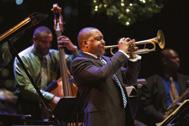
A rousing rendition of Wynton Marsalis’ life-affirming jazz symphony All Rise – a musical journey through birth, self-discovery, play, and death, which served as the inspiration behind this year’s Festival theme.
A Trial - after An Enemy of the People
The Lyceum, 7-10 Aug, various times
Christiane Jatahy’s sequel to Ibsen’s An Enemy of the People explores the original’s themes of personal accountability versus social conformity within the context of contemporary Brazil.
Al-Sirah Al-Hilaliyyah - The Epic
of Bani Hilal /
The Lyceum, 26-29 Aug, 19:30
Palestinian theatre company Khashabi Theatre re-envision ancient poem
Al-Sirah Al-Hilaliyyah, infusing it with Palestinian folklore, physical theatre, poetry, live music, puppetry and dance.
Angels in America
King’s Theatre, 15-20 Aug, various times
Internationaal Theater Amsterdam stage a reimagining of Tony Kushner’s classic play exploring the HIV crisis, incorporating a sparse set and a David Bowie soundtrack for an epic performance.
[seagull]
Studio Theatre, 7-11 Aug, various times
Belgian company Olympique Dramatique explores Chekhov’s classic
The Seagull through Flemish Sign Language, assembling a cast of both Deaf and hearing actors.
Image: courtesy of Premiere Comms
Photo: Fee Golin
Image: courtesy of artist
Photo: Khulood Basel
Photo: Caio
Lírio
A Trial - after An Enemy of the People
Al-Sirah Al-Hilaliyyah
Wynton Marsalis [seagull] Angels in America
The Legacy of Slavery
Playfair Library, 8-30 Aug, 10:00-17:00
The first international exhibition from the Legacy Museum, based in Alabama, delivers a comprehensive history of slavery and racial injustice.
When Prophecy Fails
Studio Theatre, 27-30 Aug, various times
Scottish ensemble groupwork blends movement, voiceover, music and stage and video design to tell the true story of the world’s first Doomsday cult, set in a small town in the American Midwest.
corto.alto
The Hub, 18 Aug, 20:00
Mercury Prize-nominated jazz artist corto. alto [Liam Shortall] brings his genre-melding sound, which dabbles in electronic sounds and club culture, to EIF.
Camilla George
The Hub, 26 Aug, 20:00
Known for incorporating African and diasporic sounds with Western music traditions, saxophonist Camilla George performs alongside her band for a standout evening.
Clown Show
King’s Theatre, 27-30 Aug, various times
Joined by a troupe of clowns, theatremaker Geoff Sobelle creates a portrait of the crumbling United States empire, using the analogy of a struggling circus.
Berliner Philarmoniker: Closing Concert
Usher Hall, 30 Aug, 19:30
Berliner Philarmoniker returns to EIF with Chief Conductor Kirill Petrenko; soloist Augustin Hadelich plays Beethoven’s violin concerto and the ensemble performs Alexander Scriabin’s Third Symphony.
Photo: Daniel Adhami
Photo: Equal Justice Initiative
Photo: James Pearson-Howes
Photo: Maria Baranova
Photo: Chris Christodoulou
Photo: Mihaela Bodlovic
Camilla George
corto.alto
Legacy Museum
When Prophecy Fails
The Clown Show
Kirill Petrenko, Chief Conductor of Berliner Philharmoniker
Tight Five
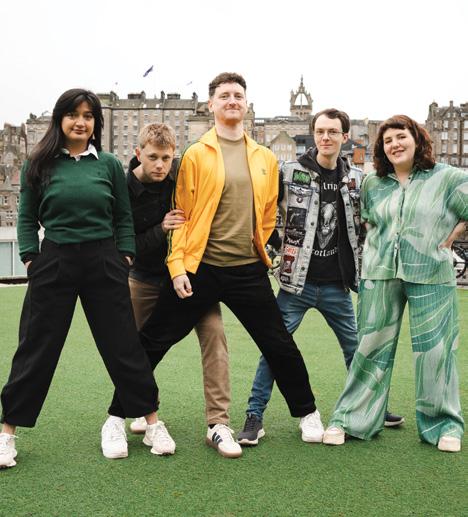
Chris Rutter, Ifrah Qureshi, Matthew Gallagher, Amanda Dwyer and Jack Brookmyre on being the inaugural recipients of The Stand’s new sponsorship scheme
Words: Jay Richardson
“D o you ever worry that you’re deluded?” asks Chris Rutter. “Because you meet acts that probably are. Maybe I’m deluded?”
Backstage at The Stand Comedy Club in Glasgow, five of Scotland’s best up-andcoming comics, Rutter, Ifrah Qureshi, Matthew Gallagher, Amanda Dwyer and Jack Brookmyre, have just been previewing routines from their forthcoming Edinburgh Fringe hours. Beneficiaries of a sponsorship scheme the club has set up backing home-grown talent, the five are being assisted with Festival mentorship, marketing and expenses. One of a growing number of bursaries created to help newer acts with the Fringe’s spiralling financial costs, The Stand’s support is psychological as much as financial. Gallagher voices the insecurity and imposter syndrome that can ambush even the most successful performer: “What?! These five?!”
Yet Rutter asserts that if it wasn’t for the sponsorship, he wouldn’t be debuting at the Festival. Acknowledging the “confidence boost” it’s given him, the Grimsby-raised, Falkirk resident points to the success of a similar scheme, the Brass Tacks Debut Fund, which saw last year’s recipient, Ayo Adenekan, scoop a writer’s role on Saturday Night Live UK after his first Fringe run.
Qureshi, similarly, wouldn’t be making the leap to an hour without the initiative, describing it as “really validating”. Despite all five of the comics living in the Central Belt, the economic costs of staging a Fringe show remain con-
“Being recognised by The Stand is a dream come true”
Ifrah Qureshi
siderable. And the Glasgow-based stand-up believes that the wider public still don’t quite appreciate the demands and sacrifices involved. How it can “seem so unaffordable, such an investment”. Without the backing of producers or an agency, “you really have to back yourself”.
“To have someone say, actually, we think you should be going to the Fringe [is so important]. Being recognised by The Stand is a dream come true” she explains. “A home of comedy, thinking you’ve got something funny and worthwhile to share.”
Winner of this year’s Sir Billy Connolly Spirit of Glasgow Award for reflecting the city’s rascally humour, Dwyer is a Fringe veteran by comparison, performing her third Festival show with The Stand. Despite commuting each day, taking time away from her teaching job, she anticipates this being the first time that she won’t make a financial loss. That’s freeing her up to just focus on her show, “with such a weight off, not worrying about making enough money to cover my transport or the cost of my flyers.”
Photo: Daryll Buchanan
For Brookmyre, likewise, the “ringing endorsement” counts for plenty. Not least because the chance to perform twenty-four nights, more or less straight through, is a tremendous opportunity to develop. “By the end of the Fringe, the show will be different”, after “constant tweaking,” he predicts. Crucially for the Glaswegian stand-up and impressionist, it’s a chance for him to gauge the “universality” of his voices in encounters with international audiences. Shared cultural references are getting harder to identify in the diffuse, digital age. So “if something’s working at the Fringe, you know it’s really broad and it’ll ring true for a greater variety of people,” he suggests.
The weight of The Stand’s endorsement has certainly made Rutter “raise his game”. And Gallagher empathises. His show is titled Last Minute, only slightly tongue-in-cheek. “Because that’s when I usually leave things until”. A freewheeling act who affects outrage at being billed as a “fool” or “buffoon”, the Glaswegian is nevertheless steeped in the history of modern stand-up and knows he can’t afford to “wing” his debut.
“The biggest test for me will be having a 90-95% structurally consistent show [every night],” he reflects. “Doing a service to the actual art and craft of writing stand-up. I’ve walked on stage, the ideas
Photo: Daryll Buchanan
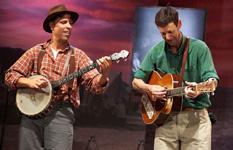
Woody Sez : The Life & Music of Woody Guthrie
Black Blues Brothers: Let’s Twist Again! Glob
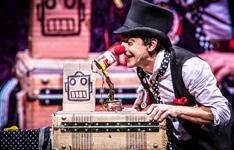
Mario the Maker Magician
The Kaye Hole Hosted by Reuben Kaye CSI: Crime Scene Improvisation
Austentatious: An Improvised Jane Austen Novel
Stefania Licari: I Can Make You Italian in 55 Minutes
“[It’s] such a weight off, not worrying about making enough money to cover my transport or the cost of my flyers” Amanda Dwyer
in my head are good. I’m a god in there. But that’s nothing unless I put the work in expressing them.”
Qureshi’s show is about power dynamics. Regarding audiences, critics and fellow comics, she maintains that, “if you’re a standup comedian, you have a kind of fucked-up relationship with validation from other people.” Unlike other art forms, live comedy demands instant “public judgement”. And that can prompt agonising second-guessing.
“The first few times you’re in a room full of people that think you’re funny, you can maybe make some excuses, like ‘oh, they were just hammered and would have laughed at anything’, ” Brookmyre reasons. “But if it happens enough times, eventually you start to believe in yourself.”
Yet, “always in the back of your mind, you’re thinking ‘maybe they were just pretending’. That a rug’s going to be pulled from under you because this entire time they were all faking it. That it’s all been an elaborate prank.”
Comedians in Scotland continue to be overlooked for Festival awards and find it harder to get reviewed. That’s a consequence, Dwyer ventures, of “Fringe venues openly prioritising and giving the good spots to English acts coming up,” with powerful agencies able to dictate favourable terms for their roster. Fortunately, the quintet agree that comedy north of the border is a nurturing environment, with Rutter praising the “ecosystem.”
“You cross paths with acts that are London-based and they’ll say it’s nicer up here,” he observes. “The headline-level comics are generally supportive and they want to encourage you.” Qureshi had heard “all kinds
of scary stories.” But she believes the scene has “definitely evolved” from the “man’s club” it once was. Everyone is “very forthcoming, very supportive and it’s technically very accessible,” she says. “You just turn up to an open mic, do your five minutes and hope they like you.”
Dwyer, too, speaks warmly of the more established performers that helped her with advice and gig lore when she was a new act. And she’s keen to pay that forward.
“I try to do that for people who are just starting out as well. Because I think it’s daunting, a pure daunting, scary thing to come in and not know anybody, everyone comes in completely on their own. You’re always just trying to make connections.”
SHOW Chris Rutter: Ignorance Is Chris
VENUE: The Stand Comedy Club
TIME: 6-30 Aug (not 17) , 4.35pm
SHOW Ifrah Qureshi: 48 Flaws of Power
VENUE: The Stand Comedy Club
TIME: 6-30 Aug (not 17) , 8.15pm
SHOW Matthew Gallagher: Last Minute
VENUE: The Stand Comedy Club
TIME: 6-30 Aug (not 17, 21, 22) , 8.50pm
SHOW Amanda Dwyer: Better Than Revenge
VENUE: The Stand Comedy Club
TIME: 6-30 Aug (not 17) , 6pm
SHOW Jack Brookmyre: Impressionable
VENUE: The Stand Comedy Club
TIME: 6-30 Aug (not 17) , 6.55pm
Stream of Consciousness
Following a Bestie win for last year’s The Critic, Kate Dolan is back with an altogether deeper stand-up hour
Words: Polly Glynn
“I feel at home in a theatre, but stand-up does work best in a dingy basement. That’s where there’s electricity because we’re all on top of each other and you feel so connected and in the moment,” says Aussie-based alternative stand-up Kate Dolan.
Returning to the Edinburgh Fringe with her third hour Trout, about how she’d rather be a fish than a woman, Dolan’s had an excellent 12 months. She’s played Sydney Opera House (“It doesn’t really feel right for stand-up but what an experience! You’re never gonna say no to that, are you?”), had an acclaimed, award-winning Edinburgh run with The Critic (yes, the award was from us), and has a web series on the go, produced by Aunty Donna’s new alt comedy platform Grouse House.
“Last year I was really finding my voice”, she says. However, she explains that she didn't personally feel like she'd punched through, despite acclaim and validation from the comedy industry. “Comparison is the thief of joy but I’m just being totally honest. You see other shows start selling out, sometimes even before the festival’s started, and you think, ‘What more can I do?’”
“I’m at that point in my career where I really need a festival. People wouldn’t come out to my show individually cos no-one knows who I am,” she points out, and is delighted to be joining one of the Fringe’s most sought-after venues. “Monkey Barrel have a comedy culture built into their brand so I’m really excited to see what the audiences will be like, how I’ll be received there differently.” She’s particularly keen
“Sometimes it’s like you get picked apart so much in life that you start to lose your flesh”
to be discovered by their regular audiences. Dolan certainly is a discovery. Her screwball, frenetic stand-up also veers into character and dance at points. “I love being mad in the moment, do you know what I mean?” she chuckles to herself.
Her influences vary just as wildly. “I loved Lee Evans growing up and he’s nuts. He’s sweating his arse off running around the stage, it’s different but it’s high energy, manic.” Riot grrrl vibes are folded in too. “I like a lot of female punk and I’d love if I could get to a point where that’s the energy I’m bringing into my comedy. I’m an angry woman I guess. I have passion. I have fire. I wanna say something in my art…there’s a pulsation underneath the comedy, where it’s like, ‘This is relentless.’”
New to Dolan’s comedy is a sense of darkness. “With Trout I actually wanted to talk about darkness with frankness”, she says, in an hour which explores the opposite of identity. “I’m talking about not wanting to be yourself. Sometimes it’s like you get picked apart so much in life that you start to lose your flesh and there’s nothing left for you.” But the deep
nature of the show doesn’t mean it’s any less absurd. “It’s a really silly show and a lot of the jokes are quite silly, but in the same breath, if you actually think about what I’m saying, it’s quite dark.”
By teaming silliness with gallows humour, it undercuts the power those dark thoughts can have. “Once you start having a bit of a laugh and a joke, you realise that a lot more people are feeling the way you are than if you never broached the topic at all. Me and the girls are saying ‘I’m gonna chuck myself off a bridge’ and there are genuine mental health situa-
tions going on, but there’s also a lightness to saying ‘hang me in the town square.’” The contrast is what makes it work.
But above all, it’s connection which Dolan is vying to create through her insightful, experimental brand of stand-up. “I always hope that something I do or say in my shows makes someone feel less alone.” Perhaps then, she’ll finally feel like she’s broken through.
VENUE:
TIME: 3-30 Aug, 8.35pm
SHOW Kate Dolan: Trout
Monkey Barrel Comedy
Photo: Matt Ford
I Am Legend
After a successful career in writers' rooms, Madeleine Brettingham prepares for her stand-up debut about being raised a geezer
Words: Louis Cammell
“Idon’t think you can define a geezer,” says Madeleine Brettingham, in reference to her father, the titular Legend of her debut stand-up hour. “You just know it when you see it… It’s kind of an 80s, 90s pub term, that’s how I think about it.” Growing up at that time, accompanying him around the various boozers of Bournemouth, on England’s South Coast, she was exposed to “a version of masculinity that’s maybe dying out, or just being questioned or changed.” One that “wasn’t going to talk about his feelings [but who] had a van and would sort your problem for you.” The show’s title also suggests that her debut is the legend, which is to say the tale, of how she came to be who she is today: the rare “female geezer”.
“A lot of my mannerisms are modelled on those early experiences with geezers”
It’s a self-description she wears only half-seriously, acknowledging the privileges to which she’s been the beneficiary in the years since that don’t necessarily fit its working class etymology, but “a lot of my mannerisms are modelled on those early experiences of geezers,” says Brettingham, explaining why she
sits with her legs spread wide apart. Regardless of her time at Cambridge University studying English, or the many years she has spent working as part of the London media, those early experiences of “what an adult is” were formative. And while she may have excelled in formal education, her comedy education came from late-night, post-watershed TV sessions with her father in front of his beloved Peter Cook, Dudley Moore and Rik Mayall.
In her early 20s, she penned a winning sketch for a Radio 4 competition, which springboarded her into writing for the comedy stalwarts of British 00s television: Harry Hill’s TV Burp, That Mitchell and Webb Look, Would I Lie to You?, and practically everything else. It’s a career that has allowed her to put to use her talent for writing in all sorts of voices, which she puts down to a background that enables her to find a point of connection across the social spectrum. But, a self-confessed cynic, it took a wake-up call from her subconscious to make her take the stage. “I literally had a dream where Michael McIntyre appeared to me and told me to do stand-up. [Before it happened] I just thought, I don’t want to be one of those wankers who think they’d be really good at it. But [in stand-up] you’ve got to try to get out of your own way a little bit, and I think one of the things McIntyre symbolises is, he’s someone who enjoys being seen,” she says.
It came with the challenge of re-learning what worked for her own, authentic voice. Traditional writing stints would result in solid
jokes, ones others could make work, “but when I said them, I realised, ah, that doesn’t work [for me], because the audience doesn’t see me the same way,” she says. Nowadays, she trusts her interior monologue, forged in a family where humour was currency, for routines that arrive wholesale and unlaboured while out in the street or on a bus.
And it’s these routines, specific and personal as they are, that seem to have connected. They have quickly seen her rise through the stand-up circuit, winning competitions like last year’s So You Think You’re Funny at the Gilded Balloon, who are funding her debut as a
result. “[It’s been] the opposite of everything I thought would happen. I was expecting people to pelt me off stage with rotten tomatoes,” she says, opening a suitably Dickensian window into her mind. Presumably not the same one McIntyre flew in through. Although, a midnight apparition telling you to change your cynical ways? I think I’ve read that one before.
VENUE: Gilded Balloon Teviot
TIME: 5-31 Aug (not 17) , 8.20pm
SHOW Madeleine Brettingham: Legend
Photo: Steve Ullathorne
Richard Beck, Broadway Baby
‘Fresh, raw, energetic, bold, and extremely funny.’
Susanne Crosby, Brighton Source
RANK. RANK. RANK. RANK.
SEE SHOW Strat Mastoris, Fringe Review
21:55 05 - 16 AUG
Live and Direct
What exactly
is a standup comedy director? Fest speaks to a trio of comedians and their directors to find out
Words: Si Hawkins
It almost sounds like the set-up for a joke. Stand-ups have directors now? What next, busker conductors?
And yet the concept is becoming increasingly common. Comedians hire other comedians to help shape their shows, and their input – and impact – varies wildly. Different directors have different strengths.
“One of the reasons I was up for this interview is because I think there is a misconception,” says Jessica Fostekew, the fine stand-up who also boasts an impressive directorial CV – but usually keeps it quiet.
Fostekew is currently working on Sapphire McIntosh’s Edinburgh debut, Squeaky Bum
Time, a story of football, family strife and houselessness. It’s a very personal tale, so chemistry was key.
“Our first meeting was probably quite overwhelming,” admits McIntosh, as they reminisce over Zoom. “It wasn’t a done deal, was it?”
Fostekew agrees, having reduced her directing recently. Unlike their famous movie counterparts, stand-up directors often cover multiple shows; one year she did around ten, which “freaked me out a bit. After that, I’ve eased down, and I’ll work with generally one really brilliant, interesting person.”
McIntosh had already enjoyed success with improv and acting – including Ted Lasso’s new
Sapphire Mcintosh
Jessica Fostekew
Photo: Michael Jullings
Photo: Paul Gilbey
season – and now needed to make her standup debut more “Edinburgh-friendly.” Cue: Fostekew, recommended by fellow comic Sophie Duker, and renowned for tone and timing. Although Fostekew's major goal here was keeping McIntosh’s distinctive comic voice intact, within the deeper framework, McIntosh recalls one particular routine she would otherwise have “glossed over”, which Fostekew prioritised.
“You don’t realise people are engaging with the story,” says the comic. “She went ‘build it up! Build it up!’ ‘Okay, okay!’ And it worked. People want to feel something.”
So, too, the creative team. “We’ve cried together,” McIntosh smiles. “It’s been a journey.”
You only get one debut show, so eking out every possible advantage is understandable. The UK-born, Montana-based storyteller Jennifer Jane required an Edinburgh Fringe expert, having rarely performed in the UK. She spotted Stuart Laws’ name on several stand-up specials, then an article which “talked about Stuart being particularly good at structure,”
“I had this little nagging thing. I can see something that I love so much, and it could be even better”
Stuart Laws
Stuart Laws
Jennifer Jane
Photo: Matt Stronge
Photo: Sweeney
“I TEARED UP MULTIPLE TIMES...” “I TEARED UP MULTIPLE TIMES...”
Theatreland Adventures Theatreland Adventures
“Deeply lived.” “Deeply lived.”
Being Seen In Texts Being Seen In Texts
“This show is a banger!” “This show is a banger!”
Fringe Theatre Awards Fringe Theatre Awards
“I COULDN’T WAIT TO BRING MY FRIENDS...”
“I ULD ’T AIT T RI M RIE DS...” A Young(ish) Perspective Perspective
I MADE YOU I MADE YOU
A MIXTAPE A MIXTAPE
Nine girls. One dorm. Zero filter. Nine girls. One dorm. Zero filter.
“We should never know you were there, like an amazing waiter in a posh restaurant”
Jessica Fostekew
says Jane, over Zoom from the States. “And I really wanted to get better at that.”
Laws, who also runs the busy Turtle Canyon Comedy production company, initially fell into live directing via an urge to tweak other comics’ shows. “I had this little nagging thing,” he recalls. “I can see something that I love so much, and it could be even better.”
Jane’s debut, Happy Tea, is a fuller collaboration between director and comic. They liaised intensely but remotely, bar a brief meeting in Montana. Then the show was reshaped after a revealing preview Laws recommended, at the Fringe-like Machynlleth Comedy Festival, in Wales.
“It was educational,” says Jane, slightly ruefully. “American audiences are more forgiving.” Laws had suggested adding a new – more personal and welcoming – intro, but “I initially didn’t, then went to Machynlleth. You could just feel it’s more of a cold room than an American room.”
Structuring a show is tricky enough that, once a running order makes sense, even seasoned acts will stick with it. Stuart’s law? Previews are for learning. “I tell people: ‘It’s time to break the show,’” he says. “My stuff, I’ll do the ending at the beginning, or randomly change the order just before you go on, so that you’re caught off guard.”
Jane happily lauds Laws’ influence: venue advice, tags on gags, a structure tailored for that time slot (7.15pm); “every aspect of it.” But it’s still the comics who pay, and have final say. As Fostekew explains, “I’ve got a rule of three. If I’ve said, ‘what about this?’ three times, and she’s ignored it, I’ll just shut up about that.”
Another international pairing, Josh Glanc and Adi Parmar are very different acts, which
helped elevate the latter’s debut show, Sunny Boy They met when Dutch standup Parmar attended Glanc’s clown workshop in Berlin, then his Soho Theatre Comedy Lab, and admired the tutor’s intuition.
“Josh always has incredible insights into the audience’s underlying emotional response,” says Parmar, over email from Amsterdam. “He would often tell us that the audience didn’t trust us yet, or that they didn’t feel safe or comfortable during certain bits.”
That empathy grew during years of gloriously interactive shows; directing is viewing stuff from another angle, Glanc suggests. “A lot comes down to experience. After a while, you’ve made several shows and you’ve worked with various people, you begin to see things.”
This show’s intro was rebuilt too, in the opposite direction. Here the director diagnosed “too much info for the audience to digest,” says Parmar, who agreed. “I can already feel the difference. The audience seems to relax with me much sooner.”
That word, ‘director,’ can feel misleading. Glanc seems more like a counsellor, mediating between act and audience. He still uses a director too, clown contemporary John-Luke Roberts, who’ll dissect his live shows. “Even though I have those skills as a director, when I’m the one performing I can’t do it for myself.”
Involvement levels vary heavily, onstage and off. Laws went full personal trainer one year, decrying his act’s lifestyle “‘because you are ruining yourself,’” whereas Fostekew knows directors who barely did anything, just encouragement, essentially. Although having also seen shows where comics ended up al-
most mimicking their mentor’s style, Fostekew prefers “imperceptible” directors.
“It shouldn’t have your voice on it all,” she insists. “We should never know you were there, like an amazing waiter in a posh restaurant.”
McIntosh offers her own analogy for that dynamic.
“You know what it’s like? It’s like going to climb a mountain for the first time, and you
know that you can physically do it, but this other person’s climbed it eight times before, so you’re like, ‘for my first trip, will you climb that mountain with me, just to show me the nooks and crannies?’ That’s what it is.”
Comedy sherpas, then. Onwards and upwards.
SHOW Sapphire McIntosh - Squeaky Bum Time
VENUE: Underbelly Bristo Square
TIME: 5-30 Aug (not 18), 5.45pm
SHOW Jennifer Jane: Happy Tea
VENUE: Just The Tonic at The Mash House
TIME: 6-30 Aug (not 18), 7.15pm
SHOW Adi Parmar: Sunny Boy
VENUE: Gilded Balloon Teviot
TIME: 5-31 Aug (not 18), 7pm
Adi Parmar
Josh Glanc
Photo: Wesley Verhoeve
Photo: Marcelle Bradbeer
A Black Comedy A Black Comedy
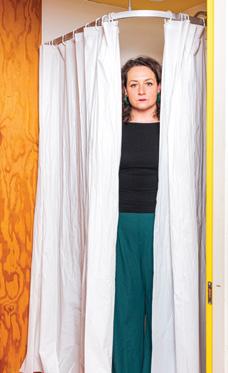
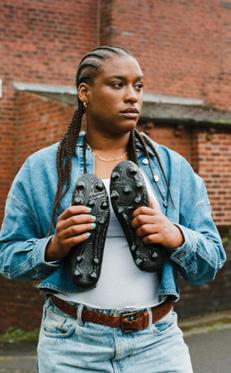
Kinky Boots
Selina Mosinski, the comedian best known as Charity Shop Sue, debuts at the Fringe with a show reviving her stripper persona Randy Cain
Words: Hayley Jane Dawson
Photo:
Tom Platinum Morley
“Ithink it’s absurd, I think it’s absolutely bonkers actually,” Selina Mosinski tells me of her experiences as a young, working class woman in the adult industry of the late 90s and early 00s. We’re chatting ahead of the Fringe, where she will be staging Puss in Boots – A Working Class Fairy Tale: a semi-autobiographical exploration of the lengths a person will go to for fame and fortune.
In the show, Mosinski draws on her time working in a Derby strip club at the turn of the millennium, aged 18, and revives her stripper persona Randy Cain. For the comedian, it’s an opportunity to reflect on the gender politics of the time and, in particular, how it intersected with a burgeoning soft porn and strip club culture, with women using their bodies to make their own money and have fun whilst doing it. Think: Gail Porter, naked and beamed onto The House of Commons; dads reading Page Three at the breakfast table; and glamour models like Jordan becoming household names.
Sue, a domineering former celebrity stylist with increasingly farcical ideas to rescue the ailing charity shop she manages, has over time become a viral sensation online with her iconic catchphrases and absurd comedy.
It’s clear the performer still loves playing Sue, but she’s excited to branch out into something new. “I think Sue became a security blanket, you know? I hope I do Sue for another 14 years, but I felt like I’d started to get too safe,” she explains. “I think when you start to feel like that creatively, you need to do something that makes you feel nervous and anxious. Then you get to the point when you’re in your mid 40s and finally you’re getting the confidence and the financial backing to take something to [the Edinburgh Fringe].”
"I am living a working class fairytale. I never thought I'd be paid to be creative"
As Mosinski sees it, the moment was defined by the social figure of the ‘ladette’: a woman who embraced stereotypically masculine behaviours to operate within a popular culture still defined by men. While women believed that they had finally been liberated from the confines of conservative ideas of femininity, she says the reality is more complex. “We felt like we were being given the keys [to society] and we were going, ‘Wow, we can do anything, we’re going to be really respected, and we can do what we want,’” she says. “Actually, it was very performative, gender performative. We were performing like ladettes.”
While Puss in Boots reflects on one of the earlier periods of Mosinski’s life, it offers an opportunity for the creative to reinvent herself. For the past fourteen years, she’s been synonymous with her role as Charity Shop Sue (created by Matthew and Timothy Chesney).
Despite the institutional barriers she has faced along the way, Mosinski has been able to develop a distinctive voice and attract a fanbase who are compelled by her camp character comedy: something she marvels at when looking back at her journey over the years. “I think I am living in a working class fairy tale, because I never would have thought that I’d be getting paid to be creative,” she says. “Has it taken me a lot longer? Yeah, but I’ve always had this motivation, I think [the adversity] just pushed me to keep going.”
As the conversation comes to a close, Mosinski offers some advice to her younger self, reflecting on just how far she has come. “Don’t beat yourself up about all those years of partying because they were worth it. You’ve had a great life, and you’re just about to storm the bloody Edinburgh Festival [Fringe]!”
SHOW Selina Mosinski: Puss in Boots –A Working Class Fairy Tale
VENUE: Pleasance Dome TIME: 5-30 Aug (not 19) , 9.30pm
Arrested Development
Even at 30, many of us are wondering why we’re still waiting for our lives to start. We speak to five comedians about feeling priced out of growing up
Words: Louis Cammell
It’s a weird age, isn’t it, 30? Your parents were married with kids, while you’re still figuring it out. At this year’s Fringe, several comedians are trying to navigate their own place along that spectrum.
Comedians James Trickey and Ted Milligan are debuting their sketch hour Burger and a Pint: Treats for the Soul, which is about “getting older without quite feeling like you have.” But where does that feeling come from?
Neither one of them feels like they’ve aged a day since they met at university, and yet as they look around at friends and former classmates getting engaged, say, or getting a foot onto the property ladder, they’re faced with the stark reality of time having passed, whether they like it or not.
“The thing that my friends are always talking about is looking at the age their parents were when they had them,” says Ted Milligan, who’s about to turn 28. When Milligan was born, his dad was 29. Having a baby, in a year’s time, in this economy? No way. For one thing, he’s single, and has just this morning left his eighth job in ten years (“but it’s okay because the Edinburgh Fringe is quite cheap, notoriously”).
But even Trickey, 29, with a long-term job
and girlfriend (a contrast they like to play up in their sketches, with Trickey generally playing the older, more grounded straight man to Milligan’s frenetic characters) is not thinking about marriage, in spite of growing pressure from his parents, until it feels like a financially wise decision.
When will that be though? It’s the question that reveals the disparity between what was achievable in their parents’ era, and what’s likely now. With the average first-time buyer for a home in Britain today being 35, it’s surely impossible not to feel like the goal posts have moved for 30-year-olds when compared to the mid-90s. At the time, a first-time home cost around four times one’s salary as opposed to somewhere between 7.6 and 8.8 times one’s salary in 2026.
Unless receiving extra help from family, those who are able to beat the odds are, let’s face it, seldom working in the arts. For a comedian, who’s likely to spend several thousand on an Edinburgh Fringe run every year, it can feel “like you’re still waiting to be serious about your life,” says Rosalie Minnitt, 29.
Her character Lady Clementine embodies the feeling. Clementine, her parody of
Rosalie Minnitt as Lady Clementine
Photo: Ed Rees
mid-twenties spiralling by way of Jane Austen (the show opens with the iconic line from 2005’s Pride and Prejudice adaptation: “I’m 27, I’ve no money and no prospects, I’m already a burden to my parents, and I’m frightened”) did remarkably well in 2023 - which surely demonstrates how many people out there are feeling the same way - but it takes more than one hit show nowadays to reach those impossible figures needed for financial stability.
With this year’s Clementine 2, she’s parsing the fact that while the feminist in her wants to girlboss through modern life in a way that wasn’t afforded to the Bennet sisters, in moments of despair she still can’t help but wish for a rich male benefactor.
It would certainly beat having to pack in comedy for something totally amoral, which Abby Govindan, 29, found out is the path of a lot of unreasonably rich 20-somethings today when she ended up on Forbes’ ‘30 under 30’ list. A ranking of young upstarts with career potential, the LA-based comedian was shocked to end up on it for writing jokes, while others on the list were arrested for financial crimes just a couple of months later - something she explores in her show Pushing 30
Comedian Burt Williamson spent a lot of his twenties feeling the same sense of frustration. “Economic reality and stuff like that means that you don’t really get to feel like a
“[It can] feel like you’re still waiting to be serious about your life”
Rosalie Minnitt
proper adult until you are in your thirties,” he says. “And not for lack of trying.” But a year of undergoing genetic testing to see if he carries an inherited gene that makes him susceptible to motor neurone disease (which he explores in 30, Burty and Thriving) has made him more philosophical - not least because, worst case scenario, he doesn’t have to worry about a pension. “If I’m not going to live past 50, then a career in the arts looks like an act of foresight,” he jests.
Williamson says it’s been weird to think about his own mortality so much, but it’s
Abby Govindan
Photo: Lucy MacDonald
“You don’t really get to feel like a proper adult now until you are in your thirties”
Burt Williamson
made him stop and appreciate that he’s in a job he loves, doing exactly what he wants to be doing. Despite being “pretty broke at the moment”, a large reason he’s able to sustain it is the existence of the PBH Free Fringe, with its no venue costs or registration fees, which makes an annual Fringe show much more viable.
In a year where the Keep It Fringe fund for creators was slashed by over 90% after losing government backing, it’s a reminder of how important it is to keep the Festival affordable for creators and audiences alike, lest we risk a shrinking pool of new comics. Because let’s face it, the demand is there and growing. It’s not just the comedians feeling the strain, it’s the audiences too. With all of our salaries stagnating as inflation skyrockets, if we don’t laugh, we’ll cry.
At least Williamson, the oldest of the pack, is a ray of hope that with age comes acceptance. Perhaps his stoic attitude awaits Trickey, Milligan, Minnitt and Govindan on the other side of hitting the big 3-0, though hopefully without the need for a nail-biting medical journey. Until then, thank god for comedy. Might as well keep being silly when you’re priced out of growing up.
SHOW Burger and a Pint: Treats for the Soul
VENUE: Pleasance Courtyard
TIME: 5-30 Aug (not 19) , 4.15pm
SHOW Rosalie Minnitt: Clementine
VENUE: Shedinburgh
TIME: 11 Aug, 6.45pm
SHOW Rosalie Minnitt: Clementine 2
VENUE: Pleasance Courtyard
TIME: 5-30 Aug (not 18) , 3.35pm
SHOW Abby Govindan: Pushing 30
VENUE: Pleasance Courtyard
TIME: 5-30 Aug (not 17) , 9.35pm
SHOW 30, Burty and Thriving
VENUE: Voodoo Rooms
TIME: 8-30 Aug, 3.05pm
Burt Williamson
Photo: Garry Holden
Inside the Box
Rickerby Hinds tells us about his new play, disguised as a magic show, about the life of Henry ‘Box’ Brown
Words: Arusa Qureshi
“They call me a hip-hop theatre pioneer,” playwright and director Rickerby Hinds tells me over a call from LA. “I always joke and say that just means you’re old,” he laughs, “but I’ve been a practitioner of hip-hop theatre since I started writing for the stage. It began instinctively.”
Hinds, a professor of playwriting at the University of California, Riverside, is regarded as one of the founders of American hip-hop theatre, and he speaks about his practice with a warmth that naturally draws you in. We’re discussing his latest piece, Blackbox, described as “a play disguised as a magic show”, which will see its UK premiere at this year’s Fringe.
“I just decided one day I wanted to write a play that has people who look and sound like me on stage, and that meant influences from hip-hop culture,” he explains of his early days in theatre. “This was in the 90s, and so the way my work evolved was essentially looking around and telling these stories around me, and using the rhythms and the elements and
the flavour and the feel and the dynamics of hip-hop culture, putting that on stage as storytelling tools.”
For Hinds, hip-hop has never simply been a musical influence. It is a framework for understanding narrative, movement and performance. Over the years, he has incorporated everything from MCing and DJing to beatboxing and dance into his work, allowing each project to determine which elements it requires.
That relationship with hip-hop stretches back to his teenage years in LA. Having immigrated from Honduras as a young boy, he found himself carefully observing the culture around him, absorbing language, behaviour and identity.
“I became a sponge,” he says. “I started to try to learn what a 13-year-old who looked like me in Los Angeles should know and how they should speak, and how they should dress. It wouldn’t be for another nine or ten years that I would start writing plays, but that observing,
Photo: Jason Sullivan
“I’ve always believed that the dynamics and the power of hip-hop storytelling: there’s nothing like it.”
that being a fly on the wall, that being outside of myself while interacting with life, I think became my writing tool.”
With this in mind, it is perhaps fitting that Blackbox centres on a figure whose story also speaks to reinvention and transformation. Combining spoken word, gospel music, stage illusion and historical testimony, Blackbox is a reimagining of the extraordinary true story of Henry ‘Box’ Brown, the enslaved man who famously mailed himself to freedom in 1849. The production follows Hinds’ successful Fringe appearance last year with Dreamscape, a two-hander inspired by the 1998 shooting of Tyisha Miller, and promises another bold fusion of performance and hip-hop poetics.
“I knew about Henry ‘Box’ Brown,” he says. “Then I started reading more deeply into the story and realised how compelling it was.” Instead of going for a conventional historical retelling, Hinds chose to make use of a theatrical device that would allow him to explore Brown’s journey through the lens of illusion and performance.
“I’ve always wanted to use magic on stage,” he notes. “I decided the narrative would be a magician’s journey from not being very good to being good enough to make themselves disappear. And once I knew that, the play wrote itself in so many ways.”
In Blackbox, each stage illusion becomes a gateway into a different chapter of Brown’s life, and the result is a powerful piece that combines historical narrative and emotional
storytelling in a way that feels uniquely suited to Hinds’ creative vision.
While Blackbox is rooted in 19th Century America, Hinds believes its themes resonate strongly in our current moment. “This is an interesting political space we’re in,” he says. “We being Black Americans, and it being the 250th anniversary of the country’s founding. For me, it’s about not allowing these stories and histories to be erased. By telling them in a way that resonates with audiences, those stories can exist in more bodies than they did before.”
While many continue to associate hip-hop primarily with rap music, Hinds sees a much broader artistic legacy at work, which enables that all important audience connection.
“I’ve always felt, and I’ve always believed that the dynamics and the power of hip-hop storytelling – there’s nothing like it.” He points to productions such as Hamilton as evidence of hip-hop’s growing influence within mainstream theatre, though he notes that his own work often employs the form more subtly.
“Blackbox isn’t overtly hip-hop,” he explains. “But it uses the rhythms of hip-hop as manifested through other Black American forms of expression. For me, it’s just the art form my mind goes to when I’m being creative. August Wilson said that he wrote in the rhythm of the blues, so for me it would be that my writing has the rhythm and the feel of hip-hop at its core.”
Returning to the Fringe after the success of Dreamscape last year, Hinds’ ambitions for Blackbox are clear. When audiences
choose to attend a play, he believes they are making a significant investment of their time and attention.
“What you’re asking someone to do is get dressed, transport themselves to the theatre and sit in the dark for an hour because you have something compelling to show them,” he says. “My job is to earn their time.”
It is a philosophy that underpins both his artistic practice and his hopes for this year’s Fringe. As Edinburgh audiences prepare to encounter Henry ‘Box’ Brown’s remarkable journey, they will also experience the work of
a creative who continues to expand the possibilities of what theatre can be.
“I’ve seen plays where I just want to linger in the space because of what it’s done for me as a being,” Hinds says. “With any work of art, it’s always layered, but really I would love for a person to sit through this thing and go – yo, that was cool.”
SHOW Blackbox
VENUE: Underbelly Cowgate
TIME: 5-30 August (not 17) , 12.40pm
Photo: Jason Sullivan
Some Like it Hot
Sauna Theatre co-founders James Grieve and Lucy Osborne on their Swedish-inspired experiment to blend sauna with live performance
Words:
Jemima Hawkins
There are not many artistic epiphanies that begin with a stranger wafting you with a towel, but for director James Grieve, that is precisely how Sauna Theatre was born.
“I just said yes,” he recalls of the moment in a Swedish sauna in Karlstad when a woman walked in and asked him something he didn’t understand. “She started wafting me with a towel and it was very disturbing at first,” but as the woman began to dance, using her towel to circulate the fragranced hot air, something clicked. “I looked around and realised I am sitting in an auditorium, and somebody is performing a show for me. I’m in a theatre.”
That Swedish revelation eventually became Sauna Theatre: the UK’s largest sauna, and first purpose-built theatre sauna, arriving at Summerhall Arts’ venue this August as part of the Edinburgh Festival Fringe. Conceived by Grieve and designer Lucy Osborne, who also collaborated on the well-loved venue Roundabout, it seats 80 people in swimwear around glowing sauna stoves, with temperatures reaching 90°C and a programme ranging from Aufguss rituals (an immersive experience that blends heat, essential oils, and towel work into performance), to literary salons, mornings raves, and arts club nights.
The parallels between sauna and theatre, Grieve argues, are more obvious than they first appear. “They’re basically social spaces where people come together for a live experience. No phones, no distractions. Generally, everybody is facing towards a stage or sauna stove.” Osborne adds that the vulnerability of being in swimwear, far from being a barrier to the performance, may actually be the point. “There’s something about being in a really hot environment with steam, with lots of people around you, that makes music and performance feel much more intense.”
The format has been carefully designed around that intensity. Rather than transplanting conventional theatre into a hot room, each session is 90 minutes, structured into 10-minute acts with cooling intervals between
Photo: Ian Georgeson
Lucy Osborne & James Grieve
(or a cold plunge if you’re feeling brave), a rhythm borrowed partly from the continent where Aufguss performances are typically 15 minutes or more. “You can’t just do Coriolanus in a sauna,” Grieve jests. “It's got to be work that has been made specifically for that temperature.”
Of the nine shows announced, a few stand out as must-sees. Bubble Schmeisis (Remixed), a returning sell-out Fringe hit from performer Nick Cassenbaum, brings live klezmer, ritual, and personal storytelling into the heat.
Aufguss x The Waves reimagines Virginia Woolf’s modernist masterpiece through dance, heat, scent, and sound, while Aufguss x Nils Frahm immerses audiences in transcendental piano compositions while towels twirl the rising temperatures.
However, it is the bookends of the day that Grieve and Osborne are most excited about. The morning sessions offer Fringe-goers a quiet Get Set For The Day sauna with curated music, or a more exuberant Morning Sauna Rave, providing a direct answer to the gap in the Fringe’s daily schedule. “There’s very little on in the mornings in Edinburgh for adults,” Grieve notes. “We hope those two sessions are going to set people up for the day and offer them something really good for their bodies and brains,” especially for the industry professionals and performers who often work punishing hours throughout August.
“People come together for a live experience. No phones, no distractions.”
James Grieve
At the other end of the day, the Sauna Sessions Arts Club runs 9pm to 11pm each night, with a rotating lineup of opera singers, circus artists, and live music in what James and Lucy hope to be ‘a night out’ rather than a show.
It’s a bold proposition, and they know it, admitting that eyebrows were raised when they announced the next venue they would be building would be a sauna. But the pair built Roundabout in the same Summerhall courtyard in 2014 against considerable scepticism, and watched audiences fall in love with it.
“Build it,” James admits, “and they will come.”
SHOW Sauna Theatre
VENUE: Summerhall TIME: 6-31 Aug
FRAMES
A O N E M A N S H O W B Y
J O N A N D R E W F R A N K L I N
Lingua Franca
Two pairs of theatre-makers on the process of bringing sign language to both Deaf and hearing audiences
Words: David Pollock
“It really feels like… finally!” says Yana Wuytjens, a non-hearing actor in [seagull], a new Belgian adaptation of Anton Chekhov’s The Seagull for Deaf and hearing audiences. The production integrates Flemish Sign Language, or FSL, into the performances –like spoken language, sign language also has regional variants.
“This hasn’t happened before,” she continues, speaking through an FSL interpreter. “Certainly it was never done professionally on this level, and now we can show it’s possible.
Finally, [FSL users] can follow a production without having to watch the interpreter. It’s a play in their language, and we are very happy with that.”
[seagull] is one of two major plays at this year’s Edinburgh Festivals making sign language work for Deaf and hearing audiences. The other is The Singer, based on the short film by Deaf artist Jamie Rea and hearing director Cora Bissett, who directs the play. Rea plays Joe, who sings with his hands, and whose music inspires washed-up musician Andy
[seagull]
Photo: Kurt van der Elst
“Actors who use BSL have often been sidelined across genres, so I really hope this story will give them a new perspective”
Jamie Rea
(Dylan Wood) to consider a comeback. KT Tunstall has composed the songs.
“I hope our performance will give audiences, directors, producers and casting directors insight into the beauty of [British] Sign Language and how it can enhance all [of] our experiences across Scottish stages,” writes Rea in email response. “BSL is full of lyrical poetry and visual language. Actors who use BSL have often been sidelined across genres, so I really hope this story will give them a new perspective and offer exciting inspiration for future casting.”
In [seagull], meanwhile, the Olympique Dramatique company, residents at Antwerp’s Toneelhuis venue, have transformed Chekhov’s play about feuding generations of a theatrical
family into a deeper exploration of language and communication.
“We made this play in the theatre school when we were youngsters,” says [seagull]’s (hearing) director Stijn Van Opstal. “We fell in love with it, but looking back we were really young. When we were 18 we played all the old people, now we are becoming the old people, so the idea of revisiting it was something very dear.”
A collective which grew out of theatre school in the late 1990s, Olympique Dramatique’s specialism is updating repertory works in new and exciting forms. “Repertoire lends itself to these kinds of meetings,” says Van Opstal. “You take an old play and you look at it from a different point of view.”
The Singer rehearsals
Van Opstal had a very personal reason for instigating this production. As a child, Van Opstal’s father ran an institution for people with disabilities, and he grew up there “amongst these beautiful, unique people”. He was close friends with a boy who was Deaf, and they communicated through the language of play.
“We grew apart,” says Van Opstal. “Then ten years ago he passed away, and I realised I missed our conversations in silence. Of course it’s not silence though, and I wanted to be there, I wanted to learn sign language. With this play, the journey has become much bigger than my personal goal.
“The Seagull is about generations of a family trying to reach each other,” he continues. “The youngsters are making a play and looking for a new worldview, they want to express themselves in new forms, but the elder generation is offended by this, doesn’t understand it. These people really try with their heart to understand, but they never quite reach each other. It’s the perfect habitat to make an encounter with these non-professional deaf artists [in] this play.”
Wuytjens, who plays the thoughtful but maternally browbeaten son Konstantin, is a student and non-professional actor who saw Toneelhuis’s call for Deaf actors. “I’ve always wanted to be part of a play, wanted to act, but there wasn’t much on offer for Deaf or hard of hearing people before [seagull],” she says. “Then I saw the call and I thought, this is my chance!”
The Singer’s Rea, meanwhile, has always wanted to perform since he was at Jordanstown School in Northern Ireland. “I would watch the school performances in its theatre,” he says. “That sparked my desire to be on stage, and I’ve grabbed every chance to perform since then, whether going on stage to model, performing as a drag queen, signing songs or hosting Deaf LGBTQ+ events like Deafab in Belfast and Greenbow in Dublin. I’ve always had a performer’s spirit.”
Bissett met Rea when she saw him perform at the Royal Conservatoire of Scotland, and together they created The Singer, later reimagining it for the theatre. “Telling a Deaf story through the medium of a play with songs
Photo: Kurt van der Elst
[seagull]
is about the passion of doing what you love, without limitation,” says Rea. “This world isn’t built for Deaf people, [but] expressing music in our language means this story plants the seeds of how Deaf artists can express music like everybody else, but in uniquely creative ways. This production process has embedded best practice for accessibility from day one, and we continue to make improvements every day.”
This isn’t just about Rea, but also the other Deaf and hard of hearing professionals involved, both backstage and onstage, as well as the team of BSL interpreters who keep everything running smoothly. What does he hope this production brings for Deaf and hearing audiences alike?
“I hope Deaf audiences will be proud to celebrate BSL with us in every show,” says Rea.
“This is a big production and a huge moment for Deaf communities and artists in Scotland, providing visibility that’s unmatched in the history of the Scottish theatre industry.
“For hearing audience members, I want them not to be afraid to approach Deaf people. I hope they see Joe and Andy, who have tried to build communication that works for them, and feel encouraged to communicate better with Deaf people.”
SHOW [seagull]
VENUE: Studio Theatre
TIME: 7-11 Aug, various times
SHOW The Singer
VENUE: Traverse
TIME: 4-30 Aug (not 5, 6, 7 or Mondays) , various times
Jamie Rea and Dylan Wood
Photo: Tommy Ga-Ken Wan
19:15 05 - 30 AUG
ASSEMBLY GEORGE SQUARE: PICCOLO
Supported by Cold Town House
Do It For The Plot
Lucy Buncombe, Tom O’Kelly, Alex Pritchett and Emma Howlett
discuss their shows Remember, Remember! and The Plot, which each take a different approach to the Gunpowder Plot
Words: Kat Mokrynski
Long has historical fiction fascinated us, with a moment in history able to hold a mirror up to our modern ills. What, then, are we to make of the fact that at this year’s Edinburgh Festival Fringe, the 1605 attempt to blow up the Houses of Parliament seems to have inspired not one but two separate theatre companies?
Playwright Emma Howlett’s The Plot, produced by her company theatregoose, takes inspiration from the consensus that the brutal torture and execution of its plotters influenced William Shakespeare’s work Macbeth, estimated to have been written around the same time. The Plot begins in the aftermath of the attempt, with two of the accused awaiting their trial. While the gunpowder plot of its title has already passed, across the river, Shakespeare writes his own tale of attempted overthrow.
A former student of BA Ancient and Modern History at Oxford, Howlett was “thinking about the idea of the reshaping of a story by different people with different vested interests,” while writing her play. Indeed, Macbeth, a drama rather than a historical artefact, served Shakespeare well, ingratiating him with the monarch James I of England and Ireland (who was simultaneously James VI of Scotland) due to its anti-uprising rhetoric and flattery of the Scottish royal line. Who’s to say what a Britain without Macbeth would look like? Perhaps the Gunpowder plot would sit differently in the British psyche.
Britain today is a nation prone to revisionism from those in power, and the intoxicating fictions that uphold its colonial past can seem stronger than ever. “With history, you have to
“If you’ve always wanted to know the true story of the Gunpowder Plot, then you should probably Google it” Alex Pritchett
Photo:
Candid Studio
be careful. As a historian, I have this respect for treating the past with accuracy and not misrepresenting things in a way that would be damaging or dangerous for what those stories mean for us,” Howlett cautions. Against the backdrop of misinformation online driving us further apart than ever, turning us away from one another and towards conspiracy, The Plot asks; “What is it in the British identity today that is rooted in this idea of there being an enemy amongst us, of loving the cloaks and daggers, something happening in the dark?”
At first glance, WIT? Theatre Company’s (Lucy Buncombe, Ross Tomlinson, Tom O’Kelly and Kluane Saunders) Remember, Remember! may seem like the antithesis to Howlett’s heavily-researched approach. It is a high-energy musical which, to quote director Alex Pritchett; “Exists purely to make people laugh… If you’ve always wanted to know the true story of the Gunpowder Plot, then you should probably Google it.” Yet for all its campy inaccuracy, there seems to be the same wish driving it: the hope that, according to Buncombe; “[Audiences] come away knowing that the Gunpowder Plot wasn’t necessarily what they thought it was!” As opposed to Guy Fawkes who has become ubiquitous with the plot, Remember, Remember! follows the lesser-known plot leader Robert Catesby for “an unapologetically queer retelling of a story that we all learned a little about in school.” As Buncombe explains; “The second we discovered that Robert Catesby was this underdog, that was a really nice hook for us, and an angle to go [down] that wasn’t the typical, expected Guy Fawkes route.
“Because our show is so far removed from the truth, it’s given us a lot of creative licence to make some performance choices that are perhaps a little bit far-fetched,” she says. O’Kelly confirms that the lack of historical accuracy allowed the team to have more creative freedom, stating; “You don’t know much about these people [beyond] the historical things, so we have just made up personalities.”
In reappropriating the story into something unapologetically uplifting, one could argue that WIT? Theatre are opposing Howlett’s clarion call for responsible storytelling. But on the other hand, they’re satirising how much most
“With history, you have to be very careful” Emma Howlett
of us simply don’t know about our collective past. So while they may themselves say that it’s all in search of a laugh, that doesn’t mean there isn’t a powerful reminder in there, one that echoes Howlett’s cautionary message: that we are all susceptible to the rewriting of history.
Whatever their differences, one thing’s for certain about the two productions. They’re both guaranteed to bring the house down.
SHOW The Plot
VENUE: Summerhall TIME: 6-31 Aug (not 18, 25) , 7.30pm
SHOW Remember, Remember!
VENUE: Pleasance Dome TIME: 5-30 Aug (not 17, 24) , 5.15pm
The Plot Image: courtesy of Summerhall
Truth Seekers
groupwork’s Lewis den Hertog, Finn den Hertog and Vicki Manderson on their 1950s-set tale of an American doomsday cult
Words: Rachel Ashenden
Arguably, it’s been a triumphant year for American ufologists so far. Barack Obama came clean about his belief in aliens, though he hasn’t seen any in the flesh and denies the U.S. government is hiding extraterrestrial evidence. Steven Spielberg released his fourth UFO blockbuster, Disclosure Day, alongside affirming his growing belief in another “intelligent civilisation in the Universe.” And President Donald Trump ordered the U.S. Department of War to release 80 years’ worth of UFO files. On Truth Social, he wrote: “with these new Documents and Videos, the people can decide for themselves, ‘WHAT THE HELL IS GOING ON?’ Have Fun and Enjoy!” God knows what he was trying to distract the American public from – a different kind of files, perhaps.
Despite the U.S. Department of War’s inability to determine the nature of the observed phenomena, the greyscale footage of embryonic-like orbs shooting through the sky will be convincing evidence of alien life for many believers, who form a widespread yet tight-knit global community. But how do believers – the uncompromising kind – react when they are faced with evidence to the contrary? At the Edinburgh International Festival, the Scottish collective groupwork explores the mental phenomenon of cognitive dissonance through the real-life story of a 1950s doomsday UFO cult.
During the height of Brexit and Trump’s first presidential campaign, groupwork’s Lewis
den Hertog read the psychological study When Prophecy Fails (1956) in a bid to better understand the term ‘cognitive dissonance’ –the mental tension that occurs when we hold contradictory beliefs – which was frequently being used in public discourse. When Prophecy Fails appeared to him as a “found object”, begging to be transformed into theatre. Inside its pages, den Hertog learned about the Seekers, a Midwest cult spearheaded by New Age spiritualist Marian Keech. Keech claimed to have received messages from aliens, who told her that North America would be destroyed by a catastrophic flood, but believers would be saved by aliens in flying saucers and transported to planet Clarion. Needless to say, that never happened, but the Seekers doubled down, clinging onto their belief in aliens with dear life.
After the pandemic, den Hertog adapted the study with his collaborators; brother, director and co-writer Finn den Hertog, and choreographer and director Vicki Manderson. Their dance-theatre adaptation premiered at the 2025 Manipulate Festival, receiving a string of four- and five-star reviews. This year, When Prophecy Fails slots provocatively into the International Festival’s theme of ‘All Rise’, which marks the 250th anniversary of American independence. After August, When Prophecy Fails will zip across Scotland.
For groupwork, the work’s American setting is integral for an exploration of national
Photo: Mihaela Bodlovic
myth-making and collective belief. As Finn observes, America has been “the defining kind of geopolitical, cultural power of our lifetime” and that in recent years we’ve witnessed “the breaking apart of the American dream, in many ways.” While the Seekers prepared for Armageddon in post-war America – a period of prosperity and optimism, underpinned by trauma and grief – the adaptation offers a parallel examination of contemporary politics: When Prophecy Fails focuses on “a really specific microcosm that somehow speaks to the macro or the global,” expands Finn.
Importantly, groupwork adapt the historical microcosm from a point of empathy, rather than ridicule. The collaborators emphasise that the Seekers were all on individual journeys of grief, and therefore vulnerable to forces of group psychology. As choreographer, Manderson’s challenge was to dynamise the long wait for a world-altering event that never actually occurs; she translates her sensitivity towards the characters’ longing for connection (both earthly and extraterrestrial) into movement. Ultimately, When Prophecy Fails occupies a
“[We’ve witnessed] the breaking apart of the American dream, in many ways”
Finn den Hertog
space where psychological reality brushes up against the strange and the uncanny, treating the UFO phenomenon as less of a patronising story of “little green men” than one concerned with consciousness.
While Trump would rather distract us with the possibility of alien life, When Prophecy Fails urges us to be alert to the power of group psychology and the rise of misinformation on planet Earth. “Have Fun and Enjoy!”
SHOW When Prophecy Fails
VENUE: Studio Theatre TIME: 27-30 Aug, various times
Photo: Mihaela Bodlovic
CREATED & PERFORMED BY ARDEN
DIRECTED BY
CVNTCLAVE
7th - 29th August 20:45 (1 hr)
FITZROY
MEGAN BREWER
Oral Tradition
Khashabi Theatre’s Bashar Murkus on keeping a 14th Century epic alive through Palestinian folklore and decolonial theatre practice Words: David Pollock
“T
his project came from the question, why don’t Arab theatremakers use Arab tools and methods in performance art?” explains Bashar Murkus, co-founder and artistic director of the Haifa-based Palestinian company Khashabi Theatre. “Why are we using the European schools, which are beautiful, but why do we put aside a different heritage of dramaturgy structures and ways of understanding theatre?”
He’s talking about an Arab theatrical lineage which includes storytelling, puppetry, music and dance, all part of theatre’s cultural DNA in the region, yet which he says Arab theatremakers don’t tend to use.
“This project came from the question, why don’t Arab theatremakers use Arab tools and methods in performance art?” Bashar Murkus
“Of course it has something to do with the history of colonisation,” says Murkus. “At some point the artistic schools came with armies from Europe and replaced everything, and what was local became primitive and not good enough, we deal with it only as folklore. I found this question challenging in my process as a theatremaker, I thought it would be interesting to imagine how these methods could be improved if we decolonise them and imagine how they might evolve naturally into modern forms.”
Writer and director Murkus, his producer colleague Khulood Basel and others founded Khashabi Theatre fourteen years ago, and while they research, create and perform their work in Palestine, it’s been seen around the world. Their latest project is Al-Sirah Al Hilaliyyah, or The Epic of Bani Hilal, which is based upon the epic 14th century Middle Eastern poem. It will be their Edinburgh International Festival debut.
“Researchers have called it the Arabic Iliad,” says Murkus of this poem. “Once it was told by the whole of Arab creation at storytelling or singing events, a part of people’s lives in wedding celebrations and festivals. Researchers say poets needed something like 150 hours to tell the whole epic, so we’re talking about a massive amount of oral heritage, but today
Photo: Khulood Basel
7 - 29 AUGUST 2026
In 2026, A Call to Gather invites audiences to unite at the Edinburgh Castle Esplanade for an unforgettable evening of spectacle, storytelling, and celebration.
SCAN FOR TICKETS
almost nobody is telling it. You can find some parts recorded from Egyptian radio, which was helpful in my research, and a small part was published as a Syrian version.”
Al-Sirah Al Hilaliyyah, then, is perfect for adaptation by Khashabi Theatre (thankfully in a three-hour rather than 150-hour version) as a revived piece of Arab culture which is in danger of dying out. Described by UNESCO as one of the ‘Masterpieces of the Oral and Intangible Heritage of Humanity’, it tells of the Bedouin Bani Hilal tribe’s 10th Century migration from the Arabian Peninsula to North Africa, where they ruled for a century before being wiped out by Moroccan rivals.
Incredibly, reciters of the poem underwent ten years of training in their youth to memorise it, but now contemporary entertainment and the demand only for short, tourist-friendly excerpts is causing memory of the full poem to fade. Murkus is interested in creating a Palestinian version where none readily exists, even though some Palestinian dialectic uses metaphors from the epic. The way he describes the poem, the contemporary parallels also seem clear.
Al-Sirah Al Hilaliyyah is a story of migration but also occupation, and in the way different
cultures tell it, the emphasis shifts. In Tunisia, for example, the Bani Hilal are the occupiers and villains. “It’s a very dynamic epic,” says Murkus. “We chose to tell the story not only from the Palestinian perspective, but also by asking ourselves, what are our generation’s questions about this epic? We respect it, but it’s not untouchable. We ask, let’s say, what is our position against this epic?”
Amid all this, he promises a performance which fuses the contemporary and the modern. “It’s about celebration,” says Murkus. “We celebrate being together and we celebrate the story, even when it’s a sad story. It’s a real festival, very energetic with seven great performers, with musicians, singers, dancers, puppets, huge images and funny moments. It’s about feeling welcomed, about feeling part of a real celebration. It’s possible to celebrate the fact we’re in the same place and able to be in this event, and we built it around this understanding.”
Al-Sirah Al-Hilaliyyah (The Epic of Bani Hilal /
VENUE: The Lyceum TIME: 26-29 Aug, 7.30pm
SHOW
Photo: Khulood Basel
Amped Up
Mari Moriarty talks Fempaths: Transistor Radio Hour, her high frequency queer cabaret
Words: Claire Sawers
Mari Moriarty will be starving when she comes off stage every night. There is a gag risk in one particular skit with a banana in her queer cabaret, so she prefers not to eat dinner before the performance, just to be on the safe side.
“I’ve never learned the art of the tease,” jokes the American theatre director and erotic artist when asked to give some teasers about Fempaths: Transistor Radio Hour, the 'kaleidoscopic cabaret' fantasia which she wrote and performs. “Some of the show is docu-drama.
Photo: Queergarden
There are songs that I wrote; some are funny, some are harrowing, but every song has a twist. There’s deep throating, I read tarot cards, it’s a mix of history and comedy. And my piano.”
If that sounds sprawling, extensive and expansive, well, so is the trans experience. “Trans folk are never just one thing and neither is this cabaret!” confirms the Fringe programme blurb.
“Trans people can be heroes, they can be sluts, witches, victims and everything in between,” echoes Moriarty. “I wrote a show that reflects that.” Fempaths includes the story of trailblazing trans rights activist Marsha P. Johnson, who co-founded the radical activism initiative Street Transvestite Action Revolutionaries (STAR) and died in suspicious circumstances. “Often there is a softening of Marsha’s story,” says Moriarty. “She got into fights, she was a sex worker. A lot of the art around trans folks diminishes us into villains or angels. That’s not accurate.”
Audiences will hear about trans icons and their adversaries, including German-born, LA-based pop star Kim Petras who began hormone therapy aged 12, and Ari Bowman, the then 12-year-old trans boy from Pennsylvania who, in 2016, delivered a brave speech to his school board after a cisgender kid complained about sharing changing rooms.
“As a visibly gender-non-conforming person, I’ve watched the temperature rising in America for years,” says Moriarty. “I’ve seen fascism and bigotry seep in. I don’t think people are scared enough.”
One song references sexual assault and PTSD – something which Moriarty covered in her autobiographical protest play Jet of Blood, performed at the 2018 Fringe. “I think I’ve shown a lot of restraint,” she deadpans. “I only gave it one number this time. But sure, I still remember the collective eye roll I got from the NYPD when I went to report that rape. Transphobia affects people I love all the time and that’s really sad.”
Transphobia and the rolling back of freedoms for queer folk were major reasons why
“Trans people can be heroes, sluts, witches, victims and everything in between”
Moriarty chose to leave behind New York and relocate to the UK. She moved with her husband Justin Elizabeth Sayre, who has his own show at Underbelly, Justin Elizabeth Sayre Is a 40-Year-Old-Woman
“I’ve done three Edinburgh Fringes before. I love the cabaret culture here. I’m grateful I had the capacity to get out. Not everyone can apply for an artist visa. I recognise we all have some level of privilege and I still feel guilt about that.”
As a gesture of trans love and solidarity, Moriarty is offering free entrance to trans and non binary people. “OK, it’s not the best financial decision that I could make ," she says, "but I’m really excited. I’ve done parties and performances in New York where porn stars and sex workers could come along and not pay, it works on trust and that’s important," says Moriarty.
The venue is wheelchair accessible, there is creative captioning for Deaf and hard of hearing audience members and touch tours are available for visually impaired individuals; Moriarty is disabled and feels strongly about making her shows inclusive.
“This a politically charged cabaret, but it’s incredibly joyful. We cover addiction, chronic illness [and] queer history, but [we] also have a good time. I’m in my grandmother’s old dress, rhinestoned to the gods, this is my gay church, a place to share pain and joy.”
SHOW Fempaths: Transistor Radio Hour
VENUE: Underbelly Bristo Square, 5-30 Aug (not 17) TIME: 8.45pm
Plasticity
Composer, vocalist and geomungo player Minyoung Kim on her solo show PLASTIC, which harnesses the synethic material's metaphorising potential
Words: Claire Sawers
It was a mix of eco-guilt and frustration that sparked the idea for Minyoung Kim’s solo project, PLASTIC The composer and geomungo (pronounced ko-mun-go) player from Seoul was aware that she, like many of us, had a complicated, contradictory relationship with the synthetic material. Plastic is everywhere. We can’t escape it. It pollutes, it contaminates, yet we use it every day.
“We know plastic is bad for the planet, we also know how convenient it is. We are aware of this paradox. We feel guilty about what we are doing to the environment, but also we don’t stop using it. People often feel the same way about themselves –stuck, frustrated,” explains Kim, switching between talking in English and Korean.
“I like that plastic can be melted and change shape. People can too”
“I am interested in when humans feel this way,” says Kim. “Everyone has their own personal hell. Hard times shape us and we can change, we can grow. I like that plastic can be melted and change shape. People can too.”
Kim began playing geomungo, a type of traditional Korean stringed zither, when she was 13. Her mum played a lot of pop music around the house but her dad was more a fan of traditional Western classical music. Kim’s adult output as a composer has evolved to be a combination of both influences. Over a
decade ago she founded the duo ReMidas with her friend Ji Hyun Park playing gayageum (a 12-string zither), blending South Korean improvisational music with jazz, pop and electronic styles. In PLASTIC, Kim puts a modern update on traditional Korean instrumentation, creating an intense electronic hybrid with pulsing beats and samples of bells, gongs and children chattering. She then threads in her themes around plastic and human quirks and inconsistencies.
The wooden geomungo is one of Korea’s oldest instruments, a long zither with six silk strings and sixteen frets, played with a bamboo stick. Plucked rhythms and bending strings create a wobbly, mesmerising, deep vibrato, somewhere between a much lower-pitched Indian sitar and melodic Chinese guzheng. The tone of the geomungo is rich and resonant, a meditative, versatile sound which Kim blends with her voice; a plaintive, expressive trill, with English lyrics added for this UK premiere at the Fringe. Her singing style draws from jeongga (meaning righteous song), a traditional Korean vocal style. Jeongga is associated with royalty, nobility and aristocracy, and characterised by deep breath control and serene, drawn-out notes. It’s considered more restrained and refined than folk singing, following Confucian
principles of self-cultivation. Kim’s performance moves between those meditative and melancholy ballads to angstier techno-pop.
The lyrical and musical elements of the show are amplified by swirling, psychedelic visuals, newly created for Kim’s Edinburgh run. Revolving, digital clusters of lines beam behind Kim and her geomungo onstage, neon murmurations and violet galaxies, swarming and glowing as she sings.
“I tell personal stories about my family relationships, and I want to tie them in with history. Modern and traditional, together. Past and present. I showed the designer of the visuals what I wanted – these circular patterns that you often see on Korean palaces. Very
beautiful, ornamental roof tiles, symbols and lotuses. Those floral decorations inspired me and became part of the show.” Although the show is grounded in Korean traditions, Kim believes it reflects universal human qualities, both our fragility and enormous potential.
“I premiered the show last year at a festival in Barcelona and there was an incredible atmosphere,” remembers Kim. “The melodies were simple and this big crowd began singing along. I found that unforgettable.”
SHOW PLASTIC
VENUE: Summerhall
TIME: 6-31 Aug (not 17, 24) , 8.45pm
Photo: courtesy of Seoul Namsan Traditional Theater, SangHoon Ok
It's Alive!
Michael Hockey and Yngvild Aspeli on their respective shows that re-animate Gothic tales with the help of puppetry, and why Frankenstein and Dracula continue to fascinate us
Interviews: Lorna Irvine
Few figures cast their shadows over storytelling quite like Frankenstein's monster and Dracula. While the Gothic tales from which they emerged fall in and out of fashion, the pair certainly seem to have sprung back into life recently with the release of Robert Eggers’ Nosferatu and Guillermo Del Toro’s Frankenstein leading a wave of recent adaptations. But what is it about these centuries-old tales – one a Promethean creation myth, the other about fear of the unknown – that compels
contemporary storytellers to keep blowing the cobwebs off and telling them anew? Two theatremakers at the Fringe are breathing new life into the characters, which they see as conduits for our contemporary anxieties, with puppets.
When Mary Shelley wrote “Frankenstein; or, The Modern Prometheus way back in 1818 during a rainy summer in Geneva,” says Michael Hockey, speaking to us about his show TO BE FRANK, “she didn’t realise that she was basically
Photo: Christophe Raynaud de Lage
Dracula: Lucy's Dream
WRIGHT EMERGING VOICE OF DANCE
24 - 30 AUG 5:30 PM
LEILA
Photo: Megan Goldsman
“Puppets being dead things come to life, they somehow put us in contact with the invisible”
Yngvild Aspeli
creating the new genre of science fiction.” It’s no wonder, then, that when Shelley’s work was first anonymously published, against a backdrop of huge scientific progress, it captured imaginations. Pair the recent leaps in medical science with the nascent discovery of electricity, and the question hung heavy in the air: Could science give life? What would it mean to cross that divine threshold? “The idea of creating consciousness by our own hand has kept creative imaginations alive all the way up to now,” he says. “We keep asking, what would that creation be like, alive but not born, and how much of ourselves would exist inside of it?”
Hockey hopes that his show, a punksoundtracked take on the classic featuring a balloon puppet, manages to share his take on that answer in his own “disastrously silly” way. After studying at the École Philippe Gaulier, the preeminent clowning school nestled in France’s capital, he began working on it in 2022, as “an antidote to the constant human normalcy” of being alive; something that all of us can admit that we never once consented to on an individual level. It’s in this universal feeling that he feels we can all relate to when we see the monster, “a being that didn’t ask to exist [and] who must figure it out as they go.” And while we wrestle with our own place in the world, the question over responsibility when creating conscious life “is only becoming more and more relevant as technology quickens its pace,” says Hockey. Indeed, recent takes on the Frankenstein tale have included M3GAN, about an AI powered child’s companion turned bad. The light-hearted pastiche belies a growing concern around the abandon with which Silicon Valley startups like OpenAI and Palantir are approaching delving into uncharted scientific waters.
“Stories about death make us feel more alive,” says Yngvild Aspeli, echoing Hockey’s interpretation. She is the director of Dracula: Lucy’s Dream, which features a giant puppet version of its eponymous creature (something the company, Plexus Polaire, is known for, having captured audiences with Moby Dick). Though paradoxical, she believes “we are attracted to the things we are afraid of, maybe because they show us that we are part of something bigger.” The ‘Lucy’ in the play’s title is Lucy Westenra, who, seduced into being Dracula’s first victim, embodies this paradox. Told finally from her perspective, the story invites the question: what are the constraints on her life, her autonomy as a 19th Century English woman, that the creature’s irresistible pull brings to light?
The question evokes Hockey’s theory of the constancy from which we all seek to break free. At a time when women – particularly in the UK, US and beyond – face a renewed cultural pushback against their own agency amidst a shift towards cultural conservatism (see: the rise of the ‘tradwife’ aesthetic online and a rising American movement to ‘repeal the 19th [amendment which gave women the vote]’), that repression risks dominating us even more strongly. Like Lucy, perhaps we are all sleepwalking our way to our fate. But just as Aspeli believes in “art’s capacity to make you feel and think,” Hockey sees a growing appetite “for the grand, the theatrical, for the camp horror [of early Hollywood],” which can reawaken us to our childlike sense of wonder. Might their giant, Grand-Guignol style puppets be what can circumvent our adult complacency and call us to action?
“Puppets being dead things coming to life,” says Aspeli, “they somehow become a medium that puts us in contact with the invisible. Using puppets, we can make abstract – and existential – themes accessible and therefore make the incomprehensible part of life a bit more concrete and comprehensible.”
Ultimately though, neither Hockey nor Aspeli wish to enforce a specific meaning on their audiences. They know the Festival will attract thousands, from all over the world, each carrying their own baggage. “Telling the story of a vampire opens up for different interpretations and echoes themes like attraction and abuse of power, trauma and addiction, but the concrete context will probably differ depending on the person seeing it and their personal experiences and preoccupations,” says Aspeli. At the end of it all, the aim is catharsis.
Hockey says, “I think that the act of sitting in a room with others and laughing about some deep dark anxiety or fear that you thought may have just been your own is one of the best forms of catharsis that there is. It is great to have a fool on stage to laugh at (or laugh with) really, because it allows us to accept the fool within ourselves. Although straight dramas do a great job of reflecting our anxieties back at us, it gets heavy and life can be tough enough these days.”
SHOW TO BE FRANK
VENUE: Pleasance Courtyard
TIME: 5-30 Aug (not 12, 19, 26) , 2.05pm
SHOW Dracula: Lucy’s Dream
VENUE: Pleasance at EICC
TIME: 6-29 Aug (not 12, 19, 26) , 5.30pm
Photo: Christophe Raynaud de Lage
Dracula: Lucy's Dream
Game On
Delea Shand on her new family show, a video-game styled spectacle featuring opera’s greatest heroines
Words: Carmen Paddock
Photo: Alexis Dubus
You don’t always think of opera and children’s entertainment as a natural pair. But Madame Chandelier’s Grand Theft Opera, Delea Shand’s newest show, gathers opera’s fiercest heroines for an epic video game battle when the Queen of the Night kidnaps Madame Chandelier’s daughter!
In her youth, Shand dreamed of performing on Broadway. Her voice teacher encouraged her but also taught classical German and French songs. Delea’s voice suited this repertoire, and she studied opera and contemporary performance in London, Canada, and New York. During her Masters course at the Manhattan School of Music, she sang with the group Opera on Tap. “Their mission was opera in unusual places – bars, playgrounds, schools, street corners, everywhere,” she says. “I loved taking opera out of the opera house.”
When she and her family moved to London, she struggled to get auditions with regional companies. One day she saw an advertisement for Opera North’s schools’ tour, featuring an accordionist and a singer, and a lightbulb went off. “I got an accordion and taught myself how to play,” she says. “On a whim I took a stand-up comedy course. The teacher asked if we had skills, and I said I sang opera. He was like, ‘yes, do you play any instruments?’ And I told hYm I had an accordion but didn’t really know how to play. He said, ‘Perfect, you don’t want to be too good at it.’” That was all the encouragement she needed to head out on the comedy circuit; people did not always know what to make of Shand’s act when she started eight years ago, but “they kept laughing, so I kept coming back.”
To fine-tune Grand Theft Opera, Shand turned to director, librettist, and author P Burton-Morgan The pair spent nine weeks creating the show from Shand’s ideas, creating a real story arc. Shand picked her cast of characters because they are familiar in popular culture – even featuring in advertisements for washing up liquid. “Carmen, Tosca, and Madam Butterfly are icons – their operas are named after them!” she says. “If this is the first time kids learn about opera, it’s good to start with something they might recognise.”
“Young people like opera. They think it’s cool. They don’t have this baggage”
“Because I developed my work to be accessible, I aim for people to get wider references about opera and what makes it funny,” she says. “[My work introduces] operas but also point[s] out problematic plots where the women are always killed” – something subverted, through kid-friendly video gaming, in Grand Theft Opera
“Doing this taught me a lot about what people think of opera,” she says. “More people like opera than I thought. Young people like opera. They think it’s cool. They don’t have this baggage.” Perhaps Timothée Chalamet needs to spend more time at the club.
Encountering opera in unusual places is a thrilling way to interact with the unique art form. “Opera singers spend so much time learning how to create vibrations and resonance with your body. Sound waves move through the air in a completely different way to amplified music.” She tested out a previous show on Year 5 primary pupils and recalls they were “amazed” at close quarters.
“I hope kids come out feeling like opera is their art form,” Delea says. Many UK opera companies are publicly funded. “We are paying for the Royal Opera. It’s our house, it’s for everyone.” This ownership is not just in enjoyment but in creation. “People email me after the show to tell me their children are out in the garden singing the songs, remembering the characters, and making up their own operas,” she says. “I love that.”
SHOW Madame Chandelier’s Grand Theft Opera
VENUE: Pleasance Courtyard
TIME: 5-16 August, 12:15pm
Edinburgh: The Strategy Guide Pierre Novellie's
The Fringe mainstay, and Button Boys’ resident strategy RPG obsessive, presents the gamer’s guide to winning the festival
When you load up Edinburgh Fringe 2026 you’ll see you can use the character selection screen to choose between a Performer, Punter or a Local. Remember, this is an open-world RPG, so there’s a lot of freedom to walk around having adventures but your win conditions are determined by your character choices!
If you select ‘Punter’ you will spawn at Waverley Station. The map is divided into Old Town and New Town but if you find every hidden Richard Herring poster you can unlock Leith. Musselburgh will be DLC if the game gets big enough. Anyway, the Pleasance faction controls the Courtyard and is fighting for control of Bristo Square with the Assembly, Underbelly and Gilded Balloon factions. Each faction has its own colour scheme and unique missions and side quests. You can complete each of these faction’s quests by seeing ten fun sketch shows, ten debut shows from exciting newcomers and ten shows from the huge theatre or world music section. This will level you up and unlock Pay What You Want venues like Monkey Barrel, Just The Tonic and the various Free Fringes. To complete these venues you need to see ten people with silly podcasts, ten groundbreaking clowns and ten great comedians that no one else has discovered yet. The final boss is The Tattoo Mega Piper inside Edinburgh Castle and to beat it you’ll need to equip American Tourist Outfit and spam Photo Attack using Large Camera.
If you select ‘Performer’ you will start minus 10,000 gold and will only be able to perform in certain free venues unless you’ve played the game before. Then you can load in your
Edinburgh 2025 save file and start the new game with all your gold coins and Reputation Points from the last version, though not the same jokes. The simplest way to win is by surviving till the month counts down and moderately enhancing any of your stats. If you take zero reputational or professional damage for the whole game and earn stars from newspapers, you might win the 10,000 gold coins needed to get your character back to zero. This will unlock Sold Out mode for this and all future games.
If you select ‘Local’ the easiest way to win is to select ‘rent out flat’ when prompted, you will win the game and the ‘Spanish Holiday’ cutscene will play. If that option is greyed out, and you don’t run a bar or restaurant, your character is going to take 100 Inconvenience Damage every day for the entire month, double if you accidentally walk into the Royal Mile PvP area.
As any character, your game will be easier if you attend any Folk Music Venue (+500 Charisma, unlocks Dog On A String), shows at Summerhall (+80 Culture) and, if you need a power up, get a Tattie Dog from Piemaker (+100 Health, -20 Speed).
SHOW Pierre Novellie: Okay, One More Then Bedtime
VENUE: Monkey Barrel Comedy
TIME: 5–29 Aug, 7.05pm
SHOW Pierre Novellie: Do the One About...
VENUE: Assembly George Square Studios
TIME: 18-29 Aug, 1pm
Photo: William Hearle
A Sweet Tooth's Guide to Edinburgh Sir Elton Scone
Katie Pritchard’s musical alter-ego shares his tips for getting your sugar fix in the city
Are you even at the Fringe if you’re not having carbs for every meal? IT’S THE PERFECT FOOD GROUP! Here’s where I, worldrenowned singer and baker extraordinaire Sir Elton Scone, find the best sweet treats, including a few choices which don’t include gluten for those mavericks amongst you.
Despite what my mum says, my first major landmark solo show wasn’t during a Thursday morning assembly at the primary school she worked at, but it was in fact at THE EDINBURGH PLAYHOUSE on September 17th, 1976. Literally the second I finished my bow, the crew marched me round the corner to Café Piccante to enjoy the proteins, the endorphin-boosting chocolate, the nougat for great shiny hair, and the deep frying which is really great for clearing toxins out of your body. I’ve also heard its N*Sync’s favourite way to eat Mars bars because they famously love food when it’s “Fry Fry Fried”!
But my links to Edinburgh are even deeper than that; yes, even deeper than a Nigella Lawson sticky toffee pudding. My collaborator on Goodbye Yellow Brick Road was Edinburgh born and bred guitar legend Davey Johnstone. And when I’m walking around George Square, I do feel a bit like I’m walking down the Yellow Brick Road, mostly because of the cobbles, but also because whenever I walk down it I’m off to see the Wizard, and I’m not talking about the showbiz wizard Jess Robinson (who is coincidentally also doing an Elton-themed show), it’s simply what I like to call the public toilets at Assembly Gardens. Along that square is Panquake, who once sold me a crepe so full of chocolate I immediately entered into a 6-day long food coma! Voulez-vous une crêpe avec moi?
If it’s a scone you’re after, and of course you are – there’s only one choice: Clarinda’s Tearoom. Namely because I think they might be the only place that still serve scones in Edinburgh, and also because they’ve been hand-making them since 1976 – THE YEAR OF MY FIRST MAJOR SHOW IN EDINBURGH!! COINCIDENCE??!!!! THERE’S NO SUCH THING!!!
But that was the old me, I have recently discovered that I’m gluten intolerant and cannot enjoy any of these amazing treats anymore (it’s me, hi, I’m the aforementioned maverick), so you’re gonna find me almost exclusively at SugarDaddy’s Bakery which is 100% gluten-free baby – WE CAN EAT EVERYTHING!!! Thank you so much to my (and now your) Sugar Daddy xxx
SHOW Katie Pritchard is Sir Elton Scone
VENUE: Hoots @ Nicolson Square
TIME: 7-30 Aug (not 18), 3.40pm
Photo: The Burly Photographer
Streetwear Guide to Edinburgh Robin Grainger's
Streetwear is no joke to comedian Robin Grainger. We asked him to pick a few of his favourite places the city has to offer
“How many pairs of shoes do you have?!” and “Where’s that jumper from?” are two questions I get asked a lot, from fellow acts to audience members at gigs. Many friends and loved ones tell me I have too many pairs of shoes (80-90 pairs) with a worrying tone in their voice. So here are some of my recommendations to have that classic “look good, feel good” mentality without going into your overdraft.
Focus Skateboard Shop, 270 Canongate, EH8 8AA
I’ve always loved the atmosphere of skate shops; the owners and regulars know how difficult skateboarding is, so tend to just be nice people and Focus is my favourite. They have a huge array of custom shop hoodies as well as a wall of Nike Dunks, a beautiful cornucopia of colourways to compliment any outfit. A huge reason I buy so many skate shoes is because I used to have one pair of shoes that I would skate with until they were a pile of duct tape and shoelaces. In a psychological sense, I’m paying back the skint kid I used to be by buying him everything he used to want. I was also lucky enough to be asked by Focus to do a photoshoot for their Edinburgh Fringe capsule of clothing, a merch collab for my show last year, with every single penny being donated to charity, as well as voice-over work for their 25th Anniversary across socials. The best people with the coolest stuff. Check them out on the Royal Mile and support local.
Pieute, 19 Candlemaker Row, EH1 2QG
Another local gem in Edinburgh is Pieute, a lovely wee shop on Candlemaker Row. A longtime staple amongst locals, Pieute offers a range of clothing and accessories, with huge collaborations with Lewis Capaldi in 2020 and Tennent’s for this year’s World Cup. My favourite piece is a football top they made, 20% of the profits of which were donated to SkatePal, a non-profit organisation supporting communities in Palestine and promoting the benefits of skateboarding for local youth. Good eggs!
Size?, 5 Frederick St, EH2 2EY
Whether you are shop-hopping from Route One on Rose Street and popping in on your way for a seat in the sun at St Andrews Square or you are a diehard sneaker head who joins the line of camping chairs, portable speakers and smells of herbal enhancements to wait
overnight for the latest pair of Travis Scott Jordans, Size? is always a cool shop to check out. I remember running there to claim a pair of shoes I won in a raffle; Jordan 4 Thunders I believe.
Out of the Blue Drill Hall, 36 Dalmeny St, EH6 8RG
Edinburgh often has “pay and weigh” events and “kilo sales” which are really good for finding clothes that you just don’t see anymore. Think TK Maxx on steroids; racks and racks of vintage stuff that will only benefit your upper arm strength as you rake through it all. The Out of the Blue Drill Hall in Leith often has them. It’s always beneficial to reuse and recycle, especially in a cost of living crisis.
SHOW Robin Grainger: Lemonade
VENUE: Assembly George Square TIME: 5-31 Aug, 8.20pm
Photo: Trudy Stade
Guided Detour Around Edinburgh Omar Badawy's
Hungry? The stand-up and SNL UK writer knows a spot. If you can resist the gems along the way
Photo: Matt Stronge
If you’re looking for a genuinely excellent place to eat in Edinburgh, you’re in luck.
As someone who has been to Edinburgh approximately one and a half times, I know the city extremely well. In fact, I know it so well that I’m going to walk you there, personally.
Start at Waverley Station and head over North Bridge. Continue down towards the University of Edinburgh.
This is where you’ll find some of the university accommodation that fills up with performers, like myself, every August.
If you’re hungry while you’re in this part of town, Mother India is genuinely worth a visit. Brilliant Indian small plates. Ignore that completely though, because what we’re eventually heading towards is much better.
I always stay in university accommodation during the Fringe. It’s an incredible deal. For just £2,000 a month, you get to sleep in the sweat of a University of Edinburgh student. You absorb success through second-hand osmosis. Spend enough time there and you’ll wake up with an internship at KPMG.
I never went to Edinburgh University. I got into an average university through clearing. If you don’t know, clearing is when you don’t get the grades for the course that you want, so you just see what other shitty university courses are left over. It’s like an end-of-season sale but with no discount.
Clearing shouldn’t even be allowed. They should ban it. Because they say the biggest decisions in life are choosing your career and choosing your life partner. Getting into university through clearing is like proposing to the person of your dreams, getting rejected and then turning to the waiter like, “Are you up for it, mate?”
Anyway, keep moving.
Head back towards the city centre and make your way along George Street.
You’ll know you’re there because everything suddenly becomes expensive. George Street is one of Edinburgh’s grandest streets. That’s why when you live in any city, you should only have one dating preference. And that should be rich. But it’s difficult to find rich women. You know why? The patriarchy.
Everyone talks about how the patriarchy affects women. Fair enough. But nobody talks about the other group of people affected by
the patriarchy. Male gold diggers. Me. That’s why I go to women’s rights marches. Everyone’s there like, “Pay women more.” And under my breath I’m like, “So they can spend it on me.” It’s a new wave of feminism. It’s toxic and progressive. You can’t get me. I’ve thought it through.
Just off George Street, you’ll find Chez Jules on Hanover Street. Three courses for just under £16 is one of the best value lunches you’ll find during the Fringe, and genuinely worth a visit. Ignore that completely though, because what I’m about to recommend is much better.
From Hanover Street, continue on towards Stockbridge. This is one of Edinburgh’s neighbourhoods. Lots of independent cafés. Lots of carefully curated shops. Lots of moustaches. That’s the tough part about being an Arab man, which is what I am, I can’t grow a moustache. I can but I shouldn’t. Because when white people grow one, they look hipster-y. When I grow one, I look dictator-y. I look like a young Saddam Hussein.
When I see a white person with a moustache, I think, ‘That guy probably makes a good flat white.’ When I grow a moustache, I look like I want to flatten whites. Whole other situation.
If you’re hungry on the way, Pho & Roll is another place I’d genuinely recommend. Great Vietnamese food, brilliant bánh mì, spring rolls and pho.
Again, ignore that completely. What we’re heading towards is significantly better.
Carry on down towards Princes Street. You’re almost there.
And now we’ve arrived. A place worth travelling across the city for. A destination that consistently delivers. Reliable. Accessible. No fuss. No waiting list. No small plates.
Burger King. 89/90 Princes Street, Edinburgh.
You’re welcome.
Unlike this article, my Edinburgh Fringe show does eventually have a point.
Last year, I accidentally found myself in the middle of a far-right march. And somehow that still wasn’t the hardest part of my day.