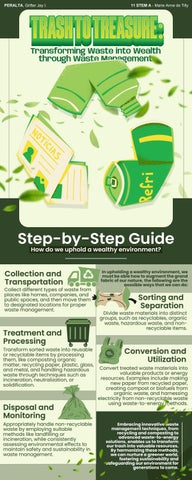



Step-by-StepGuide Step-by-StepGuide
Howdoweupholdawealthyenvironment? Howdoweupholdawealthyenvironment?
Collectionand Collectionand Transportation Transportation
Collectdifferenttypesofwastefrom Collectdifferenttypesofwastefrom placeslikehomes,companies,and placeslikehomes,companies,and publicspaces,andthenmovethem publicspaces,andthenmovethem ttodesignatedlocationsforproper odesignatedlocationsforproper wastemanagement. wastemanagement
Treatmentand Treatmentand Processing Processing
Transformsortedwasteintoreusable Transformsortedwasteintoreusable orrecyclableitemsbyprocessing orrecyclableitemsbyprocessing tthem,likecompostingorganic hem,likecompostingorganic matter,recyclingpaper,plastic,glass, matter,recyclingpaper,plastic,glass, andmetal,andhandlinghazardous andmetal,andhandlinghazardous wastethroughtechniquessuchas wastethroughtechniquessuchas iincineration,neutralization,or ncineration,neutralization,or solidification solidification
Disposaland Disposaland Monitoring Monitoring
Appropriatelyhandlenon-recyclable Appropriatelyhandlenon-recyclable wastebyemployingsuitable wastebyemployingsuitable methodslikelandfillingor methodslikelandfillingor iincineration,whileconsistently ncineration,whileconsistently assessingenvironmentaleffectsto assessingenvironmentaleffectsto maintainsafetyandsustainabilityin maintainsafetyandsustainabilityin wastemanagement wastemanagement
IInupholdingawealthyenvironment,we nupholdingawealthyenvironment,we mustbeablehowtoaugmentthegrand mustbeablehowtoaugmentthegrand ffabricofournature,thefollowingarethe abricofournature,thefollowingarethe possiblewaysthatwecando: possiblewaysthatwecando:
Sortingand Sortingand Separation Separation
Dividewastematerialsintodistinct Dividewastematerialsintodistinct groups,suchasrecyclables,organic groups,suchasrecyclables,organic waste,hazardouswaste,andnonwaste,hazardouswaste,andnonrrecyclableitems ecyclableitems.
Conversionand Conversionand Utilization Utilization
Converttreatedwastematerialsinto Converttreatedwastematerialsinto valuableproductsorenergy valuableproductsorenergy resources Examplesincludemaking resources Examplesincludemaking newpaperfromrecycledpaper, newpaperfromrecycledpaper, creatingcompostor creatingcompostor organicwaste,an organicwaste,an electricityfromnon-rec electricityfromnon-rec usingwaste-to-ene usingwaste-to-ene
Embracinginnov Embracinginnova managementtechn managementtechn rrecyclingandcom ecyclingandcom advancedw t t advancedwaste o e e gy solutions,enable solutions,enable ourtrashintoval ourtrashintoval yharmonizing yharmonizing ecannurture ecannurture ffosterings osteringsu guardingour guardingour gene gene